EP3473452A1 - Personalisierbare seite für sicherheitsbuch - Google Patents
Personalisierbare seite für sicherheitsbuch Download PDFInfo
- Publication number
- EP3473452A1 EP3473452A1 EP18201510.7A EP18201510A EP3473452A1 EP 3473452 A1 EP3473452 A1 EP 3473452A1 EP 18201510 A EP18201510 A EP 18201510A EP 3473452 A1 EP3473452 A1 EP 3473452A1
- Authority
- EP
- European Patent Office
- Prior art keywords
- holographic
- sheet
- page
- layer
- customizable
- Prior art date
- Legal status (The legal status is an assumption and is not a legal conclusion. Google has not performed a legal analysis and makes no representation as to the accuracy of the status listed.)
- Withdrawn
Links
Images

Classifications
-
- B—PERFORMING OPERATIONS; TRANSPORTING
- B42—BOOKBINDING; ALBUMS; FILES; SPECIAL PRINTED MATTER
- B42D—BOOKS; BOOK COVERS; LOOSE LEAVES; PRINTED MATTER CHARACTERISED BY IDENTIFICATION OR SECURITY FEATURES; PRINTED MATTER OF SPECIAL FORMAT OR STYLE NOT OTHERWISE PROVIDED FOR; DEVICES FOR USE THEREWITH AND NOT OTHERWISE PROVIDED FOR; MOVABLE-STRIP WRITING OR READING APPARATUS
- B42D25/00—Information-bearing cards or sheet-like structures characterised by identification or security features; Manufacture thereof
- B42D25/20—Information-bearing cards or sheet-like structures characterised by identification or security features; Manufacture thereof characterised by a particular use or purpose
- B42D25/24—Passports
-
- B—PERFORMING OPERATIONS; TRANSPORTING
- B42—BOOKBINDING; ALBUMS; FILES; SPECIAL PRINTED MATTER
- B42D—BOOKS; BOOK COVERS; LOOSE LEAVES; PRINTED MATTER CHARACTERISED BY IDENTIFICATION OR SECURITY FEATURES; PRINTED MATTER OF SPECIAL FORMAT OR STYLE NOT OTHERWISE PROVIDED FOR; DEVICES FOR USE THEREWITH AND NOT OTHERWISE PROVIDED FOR; MOVABLE-STRIP WRITING OR READING APPARATUS
- B42D13/00—Loose leaves modified for binding; Inserts
-
- B—PERFORMING OPERATIONS; TRANSPORTING
- B42—BOOKBINDING; ALBUMS; FILES; SPECIAL PRINTED MATTER
- B42D—BOOKS; BOOK COVERS; LOOSE LEAVES; PRINTED MATTER CHARACTERISED BY IDENTIFICATION OR SECURITY FEATURES; PRINTED MATTER OF SPECIAL FORMAT OR STYLE NOT OTHERWISE PROVIDED FOR; DEVICES FOR USE THEREWITH AND NOT OTHERWISE PROVIDED FOR; MOVABLE-STRIP WRITING OR READING APPARATUS
- B42D25/00—Information-bearing cards or sheet-like structures characterised by identification or security features; Manufacture thereof
- B42D25/30—Identification or security features, e.g. for preventing forgery
- B42D25/328—Diffraction gratings; Holograms
Definitions
- the present invention relates to the field of multi-sheet security documents, or security booklets, hereinafter “booklets” concisely, and in particular the manufacture of such booklets, typically in the field of passports.
- a booklet includes in particular a cover and a plurality of individual sheets generally based on paper, in particular based on cellulosic fibers, the cover and the sheets being folded along a fold line and sewn together with the aid of a seam that extends along the fold line along a line of seam coincident with the fold line, so that the fold line and the seam are merged and bear the same numerical reference in the figures. After sewing, the fold line is sometimes also called "hinge”.
- the cover and the sheets are folded along a common fold line.
- a “seam area” is defined as an area which extends along the seam line, on either side thereof, and whose distance therefrom is less than a predetermined value.
- Each individual sheet defines two leaflets: a leaflet on one side of the fold line, and a leaflet on the other side of the fold line.
- Each sheet defines two pages: a first page (front) and a second page (back).
- At least one of the pages is customizable (or personalized). It is also called “datapage” by anglicism.
- a customizable page is configured to include personal variable data such as, for example, a name, an address, a date of birth, a photograph, etc. relating to the holder of the booklet and / or variable data relating to the document itself, for example such as its production number, the place and date of its manufacture, its expiry date, etc.).
- personal variable data such as, for example, a name, an address, a date of birth, a photograph, etc. relating to the holder of the booklet and / or variable data relating to the document itself, for example such as its production number, the place and date of its manufacture, its expiry date, etc.
- customizable sheet means the sheet that includes the customizable page.
- the structure of a customizable page protects the individual variable data it contains and differs from the structure of a single sheet page.
- the automatic or semi-automatic control operations of a booklet consist in particular of checking the variable individual data of the personalized page.
- the customizable page is made separately from the rest of the passport booklet to integrate it into the production line at the time of assembly of the pages and the cover, just before the steps of sewing, cutting and single numbering of the booklets.
- the second sheet generally has dimensions reduced to a few centimeters.
- polycarbonate pages have been proposed. They have the advantage of good rigidity and can incorporate new security elements but they have a high manufacturing cost and require personalization equipment (registration of personal mentions such as surname, first name, photo, ...) specific .
- paper sheet is understood to mean both cellulosic fiber paper sheets and synthetic paper sheets (made of a plastic-based material) typically known under the trademark Teslin®.
- the holographic ribbon (10) is substantially parallel to the seam line (40).
- the holographic ribbon (10) is discontinuous along the seam line (40).
- said sheet is a paper sheet (80) of cellulosic and / or cotton fibers, or a sheet of synthetic paper.
- a cellulosic fiber paper sheet (80) is a bleached chemical pulp made from cellulosic fibers having a basis weight of 40 to 90 g / m 2 .
- This arrangement allows the holographic layer to be visibly damaged (partially destroyed) in case of detachment of the stiffening layer (70).
- each stack is a stack of successive layers.
- said stiffening layer (70) partially overlaps said ribbon.
- the holographic laminate (60) has an outline including a set of festoons (61).
- the holographic laminate (60) has embrittlement lines (62), preferably from the periphery to the interior of said holographic laminate (60). It is also possible that the weakening lines come from the paper, in particular after rolling it on the stiffening layer.
- the invention also relates to a security booklet comprising a customizable sheet according to the invention.
- the proposed customizable sheet is paper-based, like the individual sheets of the rest of the booklet, it is more difficult for a counterfeiter to substitute said customizable sheet with a completely counterfeit sheet.
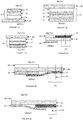
- a holographic ribbon 10 is illustrated on the Figures 1A and 1B . It is in the form of narrow and thin strip of a flexible or flexible material, continuous or discontinuous, possibly in the form of a label.
- narrow and thin strip typically a width of between 5 and 25 mm, and preferably between 10 and 20 mm.
- the carrier layer 13 allows the holographic tape 10 to have good mechanical strength.
- PET polyethylene terephthalate
- PE polyethylene
- PS polystyrene
- PU polyurethane
- PP polypropylene
- the carrier layer 13 may comprise a destructible synthetic material, in particular as defined at the following address: https://www.labelplanet.co.uk/glossary-of-label-terms/frangible-fragile-material.php , and in particular a material such as cellulose acetate.
- the carrier layer 13 comprises a set of precuts, so that the holographic tape 10 is torn in case of attempted tearing thereof.
- the pre-cuts can be made in any type of constituent material of the carrier layer 13, for example PET, PE, cellulose acetate. They are added preferably at the end of manufacture of the holographic tape 10, during the finishing step.
- the thickness of the carrier layer 13 is for example between 12 microns and 50 microns, and preferably between 20 microns and 36 microns.
- the carrier layer 13 is transparent or translucent, which makes it possible to maintain the visibility of the optical effects of the set of holographic layers 12 described below.
- the set of holographic layers 12 comprises a microstructured layer comprising a set of microstructures responsible for the optical effect (hologram, diffractive effect, diffusion effect, etc. or any combination of optical security effects, for example carried by a set of thin layers (less than 10 microns) of the holographic ribbon 10.
- the deterioration of these microstructures reflects an attempted malicious attack.
- microstructured is also understood to be nanostructured or embossed.
- the microstructured layer has a thickness of between 1 micron and 10 microns, depending on the technology used and the depth of the structures to be replicated.
- the structures have a thickness of a few nanometers to a few micrometers; they may be regular, for example of the network type, or irregular, for example of the scattering random type.
- molding better known under its anglicism "casting”, which allows the replication of the deepest structures (> 2 ⁇ m), which includes the printing of a layer, molding of the layer (fresh ) with a microstructure carrier and UV crosslinking.
- hot embossing or "hot embossing” by anglicism, which comprises the coating of a smooth layer and the stamping thereof, that is to say its deformation under the action of pressure and temperature.
- the set of holographic layers 12 also comprises a reflective layer.
- the reflective layer makes it possible to isolate the microstructures and thus to make them visible. It can also optically interact in a complementary manner with the microstructures, for example to produce an interference filter or a reflective color filter known as DID TM.
- the reflective layer is a continuous or discontinuous layer of one or more reflective materials. It is typically carried out by vacuum evaporation of a metal or an alloy, for example aluminum, chromium, copper or other; or a dielectric material of refractive index different from that of the stamped layer (and whose difference in refractive index is greater than 0.3), in particular such as ZnS, TiO 2 , etc.
- the reflective layer has a thickness that depends on the material used. For example, an aluminum layer has a thickness typically between 10 nm and 60 nm; and a ZnS layer has a thickness typically between 40 nm and 200 nm.
- the reflective layer consists of a set of several layers of different optical indices arranged according to the knowledge of those skilled in the art to produce a color interference effect known as "color shift" in English, described for example in the document EP1325086B1 .
- the layers may be continuous or discontinuous in the plane of the holographic ribbon 10 to draw a reflective pattern complementary to the effects produced by the microstructures also visible and controllable to the eye.
- the reflective layer actually comprises several layers of different materials, for example discontinuous aluminum and ZnS, adjacent and / or superimposed, the ZnS may for example cover islands of aluminum.
- the adhesive layer 14 holds the holographic ribbon 10 on the gluing surface (s).
- a cold adhesive such as acrylic or rubber type
- the holographic strip 10 is laminated on the customizable sheet 20; or a heat-reactive adhesive.
- the holographic ribbon 10 is heat-sealed on the customizable sheet 20.
- the hot or cold adhesive or self-adhesive is machine-applied during the manufacture of the customizable page.
- the adhesive may also be bicomponent or crosslinkable, and implemented so as to impregnate the fibers of the paper 80 and adhere to the polymer layer permanently, unalterable, irreversible.
- the adhesive layer has a thickness of 5 ⁇ m to 50 ⁇ m depending on the nature of the layer, and more precisely 5 ⁇ m to 15 ⁇ m for the hot-reactive adhesives, and 15 ⁇ m to 50 ⁇ m for cold adhesives. In any case, a thickness of less than 100 ⁇ m and preferably less than 50 ⁇ m is provided.
- the adhesive layer 14 may be obtained by rolling an adhesive film or depositing an adhesive mass by coating, hot melting ("hot melting” by anglicism) or other, depending on the nature of the adhesive.
- the nature of the adhesive is determined according to the manner of application of the holographic tape 10 to the customizable sheet 20 before the integration thereof into the security document and therefore before the sewing step.
- the adhesive layer is preferably applied to the holographic tape 10 before the finishing step thereof.
- the holographic ribbon 10, in particular the set of holographic layers 12, may comprise a detachment layer (not shown) which ensures the at least partial destruction of the images carried by the ribbon during an attempt to detach said ribbon.
- This detachment layer for example a wax or the like, has a thickness of approximately 1 ⁇ m. It is deposited (typically by printing) so as to produce a discontinuous destruction pattern.
- the detachment layer is integrated with the holographic tape 10, in particular in contact with the carrier layer 13 or with the adhesive layer 14 and preferably when said carrier layer 13 is not itself of destructible synthetic material.
- the detachment layer creates a discontinuous separation of the layers revealing the detachment pattern.
- the take-off attempt is then immediately visible since the ribbon is at least partially destroyed, for example according to an arbitrary pattern, a regular pattern (for example dots) or a significant pattern (for example a text) that defines a destruction pattern.
- the protective layer is obtained by coating the entire surface of the holographic ribbon 10, in this case the entire surface of the set of holographic layers 12.
- the reflective layer does not significantly protect and is itself fragile, which is in fact the case, more generally, for the set of holographic layers 12.
- the customizable sheet 20 comprises a stiffening layer 70, also called stiffening layer.
- the stiffening of the customizable page is a continuous layer of transparent plastic material adhered by a layer of adhesive to said sheet of paper 80.
- the customizable sheet 20 comprises a holographic laminate 60, disposed on the front of the customizable page after personalization.
- the holographic laminate 60 is a set of holographic layers (of a constitution similar to the holographic layers 12 of the holographic ribbon 10) whose degradation is visible following an attempt to falsify the personalization data (change of the photo, change of the date of expiration, etc.).
- the holographic laminate 60 comprises a total detachment layer, so as to allow the carrier layer 13 to be detached after bonding on the page of the paper sheet 80.
- the adhesive layer impregnates the paper for a more effective collage.
- a set of protective layers functionally comparable to the layer 11.
- the holographic laminate 60 does not cover the seam area ZC.
- the holographic laminate 60 comprises weakening lines 62 which are safety incisions, arranged especially around the zones sensitive to falsification, typically around the photograph of the booklet holder.
- the weakening lines 62 are lines going for example from the periphery to the inside of the holographic laminate 60 and which constitute weakening primers to counter attempts to detach the holographic laminate 60 in order to falsify the personal data.
- the holographic laminate 60 is macro-embossed during the transfer to create said weakening lines 62.
- the macro-embossing also makes it possible to create tactile relief effects.
- the contour of the holographic laminate 60 has a predetermined shape, possibly personalized, and for example festoons 61.
- a customizable sheet 20 generally comprises on the first page (front), after personalization, a holographic laminate 60, which is typically intended to cover at least a portion of the personal data of the booklet holder.
- a customizable sheet 20 generally comprises on the second page (verso) a stiffening layer 70, also called stiffening layer.
- the stiffening layer may or may not extend to the outer edges of page 52.
- the stiffening layer extends on all three sides not concerned with the seam (an opposite side and two sides adjacent to the side comprising the seam) to prevent the sheet of paper from being damaged on its periphery and to avoid a detachment primer for the counterfeiters.
- the holographic laminate 60 can penetrate the ZC seam area but stops before seaming since it is affixed after the booklet has been made.
- stiffening of the customizable sheet 20 by the stiffening layer 70 is interesting but, at least at the level of the seam (also called hinge), it is necessary to keep a minimum flexibility allowing the booklet to close, which is why the stiffening layer 70 does not cover the seam either.
- the holographic tape 10 may be glued, by the adhesive layer 14, on the front page or on the back page of a customizable sheet 20.
- the holographic ribbon 10 of the first variant described Figure 1A is pasted on the first page (front).
- the holographic ribbon 10 and the holographic laminate 60 are adjacent. It is also possible (not shown) that said holographic laminate 60 partially covers said tape.
- the holographic ribbon 10 of the first variant described figure 1C is pasted on the second page (back).
- holographic ribbon 10 and the stiffening layer 70 are adjacent.
- the holographic ribbon 10 partially covers the stiffening layer 70, which makes it possible to protect the entire page from rear attacks by dipping and / or cleaving the paper by deterring the release of the stiffening layer 70.
- the stiffening layer 70 partially covers the holographic ribbon 10.
- the at least partially destructible layer of the holographic ribbon 10 is between the paper 80 and the stiffening layer (plastic), and preferably on the plastic side.
- the protective layer 11 (or closing varnish) protects the holographic layers from physicochemical attacks and the risk of copy by demoulding.
- the detachment layer of the set of holographic layers 12 is located either above the microstructured layer or below the reflective layer.
- the booklet is a passport.
- a customizable page with a total thickness of between 200 ⁇ m and 450 ⁇ m, preferably between 300 ⁇ m and 350 ⁇ m, and in particular a total thickness of 320 ⁇ m, with 250 ⁇ m of PET and 70 ⁇ m thickness. thick paper.
- the paper sheet is usually from 90 to 110 g / m 2
- a production step of the elements of the booklet is provided: the plurality of individual sheets, the customizable sheet 20, the cover, the holographic strip 10, the holographic laminate 60.
- the holographic ribbon 10 is applied to the customizable sheet 20 in the ZC seam area.
- the security thread can then be sewn along the seam line 40 of the security booklet 30.
- the blank booklet is then delivered to a personalization center to customize the customizable sheet 20.
- the customizable sheet 20 is personalized by printing the personal data of the booklet holder, and the variable mentions of the customizable sheet 20 are protected by affixing the holographic laminate 60.
- the personalized security booklet 30 can then be handed to the bearer.
- holographic ribbon 11 protective layer 12 set of holographic layers 13 carrier layer 14 adhesive layer 20 customizable sheet 30 security booklet 40 sewing line / fold line 51 first slip 52 second leaflet 60 holographic laminate 61 scallops 62 weakening lines 70 stiffening layer 80 paper
Landscapes
- Credit Cards Or The Like (AREA)
- Decoration Of Textiles (AREA)
Applications Claiming Priority (1)
| Application Number | Priority Date | Filing Date | Title |
|---|---|---|---|
| FR1759908A FR3072611B1 (fr) | 2017-10-20 | 2017-10-20 | Feuille personnalisable pour livret de securite. |
Publications (1)
| Publication Number | Publication Date |
|---|---|
| EP3473452A1 true EP3473452A1 (de) | 2019-04-24 |
Family
ID=60515674
Family Applications (1)
| Application Number | Title | Priority Date | Filing Date |
|---|---|---|---|
| EP18201510.7A Withdrawn EP3473452A1 (de) | 2017-10-20 | 2018-10-19 | Personalisierbare seite für sicherheitsbuch |
Country Status (2)
| Country | Link |
|---|---|
| EP (1) | EP3473452A1 (de) |
| FR (1) | FR3072611B1 (de) |
Citations (5)
| Publication number | Priority date | Publication date | Assignee | Title |
|---|---|---|---|---|
| EP1516749A2 (de) * | 2003-09-19 | 2005-03-23 | Austria Card Plastikkarten und Ausweissysteme GmbH | Reisepass mit plastifizierter Personalisierseite und Verfahren zur Herstellung von einem Reisepass mit plastifizierter Personalisierseite |
| EP1802473A1 (de) * | 2005-07-26 | 2007-07-04 | Centro Grafico DG S.p.A. | Verfahren zum schutz von auf papier- oder kunststoffträgern enthaltenen daten durch transfer einer durchsichtigen schutzschicht |
| EP2679399A2 (de) * | 2012-06-29 | 2014-01-01 | Giesecke & Devrient GmbH | Identifikationsdokument mit Fälschungsschutz |
| DE102014217716A1 (de) * | 2014-09-04 | 2016-03-10 | Bundesdruckerei Gmbh | Datenträger und den Datenträger enthaltender heft- oder buchförmiger Gegenstand sowie Verfahren zum Herstellen des Datenträgers |
| WO2017013311A1 (fr) * | 2015-07-17 | 2017-01-26 | Smart Packaging Solution (S.P.S.) | Insert pour page de données de livret passeport |
-
2017
- 2017-10-20 FR FR1759908A patent/FR3072611B1/fr not_active Expired - Fee Related
-
2018
- 2018-10-19 EP EP18201510.7A patent/EP3473452A1/de not_active Withdrawn
Patent Citations (5)
| Publication number | Priority date | Publication date | Assignee | Title |
|---|---|---|---|---|
| EP1516749A2 (de) * | 2003-09-19 | 2005-03-23 | Austria Card Plastikkarten und Ausweissysteme GmbH | Reisepass mit plastifizierter Personalisierseite und Verfahren zur Herstellung von einem Reisepass mit plastifizierter Personalisierseite |
| EP1802473A1 (de) * | 2005-07-26 | 2007-07-04 | Centro Grafico DG S.p.A. | Verfahren zum schutz von auf papier- oder kunststoffträgern enthaltenen daten durch transfer einer durchsichtigen schutzschicht |
| EP2679399A2 (de) * | 2012-06-29 | 2014-01-01 | Giesecke & Devrient GmbH | Identifikationsdokument mit Fälschungsschutz |
| DE102014217716A1 (de) * | 2014-09-04 | 2016-03-10 | Bundesdruckerei Gmbh | Datenträger und den Datenträger enthaltender heft- oder buchförmiger Gegenstand sowie Verfahren zum Herstellen des Datenträgers |
| WO2017013311A1 (fr) * | 2015-07-17 | 2017-01-26 | Smart Packaging Solution (S.P.S.) | Insert pour page de données de livret passeport |
Also Published As
| Publication number | Publication date |
|---|---|
| FR3072611B1 (fr) | 2020-11-13 |
| FR3072611A1 (fr) | 2019-04-26 |
Similar Documents
| Publication | Publication Date | Title |
|---|---|---|
| EP2198086B1 (de) | Blatt mit mindestens einem nur von einer seite des blattes beobachtbaren wasserzeichen oder falschen wasserzeichen | |
| EP2126797B1 (de) | Sicherheitsdokument mit einer rfid-vorrichtung | |
| EP2780173B1 (de) | Mehrschichtige struktur, und sicherheitsdokument und echtheitsprüfung dazu | |
| EP1516089B1 (de) | Aus mindestens einem faserstoffstrahl ausgeformter gegenstand mit mindestens einer zone der dicke null und sein herstellungsverfahren | |
| CA2703169A1 (fr) | Structure de securite comportant un element thermochromique et un element photochromique | |
| FR2832354A1 (fr) | Procede de fabrication d'un article comportant une feuille et au moins un element rapporte sur cette feuille | |
| CA2654387A1 (fr) | Materiau en feuille comportant une fenetre, son procede de fabrication, et document de securite le comprenant | |
| EP3245074B1 (de) | Ausweisdokument | |
| EP1492680B1 (de) | Sicherheitsdokument mit markierung | |
| EP1831461B1 (de) | Sicherheitstruktur und sie enthaltender gegenstand | |
| EP3148818B1 (de) | Verwendung einer optischen sicherheitskomponente zur personalisierung eines sicherheitsdokuments und herstellung solch einer sicherheitskomponente | |
| EP3640040B1 (de) | Sicherheitsfolie und herstellungsverfahren einer solchen sicherheitsfolie | |
| EP2049731B1 (de) | Sicherheitselement von relativ geringem format mit einem durchgangsloch und blech damit | |
| EP3473452A1 (de) | Personalisierbare seite für sicherheitsbuch | |
| CA2716530A1 (fr) | Feuille de securite comportant un ruban pelable permettant de reveler une information masquee, et son procede de fabrication | |
| EP3558692B1 (de) | Sicheres dokument | |
| KR20050025956A (ko) | 보안 특성을 포함하는 라벨 | |
| EP2266816B1 (de) | Sicherheitsdokument dessen Daten mittels einer rauen Beschichtung geschützt sind |
Legal Events
| Date | Code | Title | Description |
|---|---|---|---|
| PUAI | Public reference made under article 153(3) epc to a published international application that has entered the european phase |
Free format text: ORIGINAL CODE: 0009012 |
|
| STAA | Information on the status of an ep patent application or granted ep patent |
Free format text: STATUS: THE APPLICATION HAS BEEN PUBLISHED |
|
| AK | Designated contracting states |
Kind code of ref document: A1 Designated state(s): AL AT BE BG CH CY CZ DE DK EE ES FI FR GB GR HR HU IE IS IT LI LT LU LV MC MK MT NL NO PL PT RO RS SE SI SK SM TR |
|
| AX | Request for extension of the european patent |
Extension state: BA ME |
|
| STAA | Information on the status of an ep patent application or granted ep patent |
Free format text: STATUS: REQUEST FOR EXAMINATION WAS MADE |
|
| 17P | Request for examination filed |
Effective date: 20190903 |
|
| RBV | Designated contracting states (corrected) |
Designated state(s): AL AT BE BG CH CY CZ DE DK EE ES FI FR GB GR HR HU IE IS IT LI LT LU LV MC MK MT NL NO PL PT RO RS SE SI SK SM TR |
|
| STAA | Information on the status of an ep patent application or granted ep patent |
Free format text: STATUS: EXAMINATION IS IN PROGRESS |
|
| 17Q | First examination report despatched |
Effective date: 20200629 |
|
| GRAP | Despatch of communication of intention to grant a patent |
Free format text: ORIGINAL CODE: EPIDOSNIGR1 |
|
| STAA | Information on the status of an ep patent application or granted ep patent |
Free format text: STATUS: GRANT OF PATENT IS INTENDED |
|
| INTG | Intention to grant announced |
Effective date: 20210607 |
|
| GRAJ | Information related to disapproval of communication of intention to grant by the applicant or resumption of examination proceedings by the epo deleted |
Free format text: ORIGINAL CODE: EPIDOSDIGR1 |
|
| STAA | Information on the status of an ep patent application or granted ep patent |
Free format text: STATUS: EXAMINATION IS IN PROGRESS |
|
| INTC | Intention to grant announced (deleted) | ||
| GRAP | Despatch of communication of intention to grant a patent |
Free format text: ORIGINAL CODE: EPIDOSNIGR1 |
|
| STAA | Information on the status of an ep patent application or granted ep patent |
Free format text: STATUS: GRANT OF PATENT IS INTENDED |
|
| INTG | Intention to grant announced |
Effective date: 20211122 |
|
| STAA | Information on the status of an ep patent application or granted ep patent |
Free format text: STATUS: THE APPLICATION IS DEEMED TO BE WITHDRAWN |
|
| 18D | Application deemed to be withdrawn |
Effective date: 20220405 |