EP3473992A1 - Messvorrichtung zum messen von mechanischen kräften und / oder dehnungen in einem bauteil - Google Patents
Messvorrichtung zum messen von mechanischen kräften und / oder dehnungen in einem bauteil Download PDFInfo
- Publication number
- EP3473992A1 EP3473992A1 EP18188654.0A EP18188654A EP3473992A1 EP 3473992 A1 EP3473992 A1 EP 3473992A1 EP 18188654 A EP18188654 A EP 18188654A EP 3473992 A1 EP3473992 A1 EP 3473992A1
- Authority
- EP
- European Patent Office
- Prior art keywords
- clamping shell
- measuring device
- clamping
- elements
- support
- Prior art date
- Legal status (The legal status is an assumption and is not a legal conclusion. Google has not performed a legal analysis and makes no representation as to the accuracy of the status listed.)
- Granted
Links
Images

Classifications
-
- G—PHYSICS
- G01—MEASURING; TESTING
- G01L—MEASURING FORCE, STRESS, TORQUE, WORK, MECHANICAL POWER, MECHANICAL EFFICIENCY, OR FLUID PRESSURE
- G01L5/00—Apparatus for, or methods of, measuring force, work, mechanical power, or torque, specially adapted for specific purposes
- G01L5/0004—Force transducers adapted for mounting in a bore of the force receiving structure
-
- G—PHYSICS
- G01—MEASURING; TESTING
- G01B—MEASURING LENGTH, THICKNESS OR SIMILAR LINEAR DIMENSIONS; MEASURING ANGLES; MEASURING AREAS; MEASURING IRREGULARITIES OF SURFACES OR CONTOURS
- G01B7/00—Measuring arrangements characterised by the use of electric or magnetic techniques
- G01B7/16—Measuring arrangements characterised by the use of electric or magnetic techniques for measuring the deformation in a solid, e.g. by resistance strain gauge
-
- G—PHYSICS
- G01—MEASURING; TESTING
- G01L—MEASURING FORCE, STRESS, TORQUE, WORK, MECHANICAL POWER, MECHANICAL EFFICIENCY, OR FLUID PRESSURE
- G01L1/00—Measuring force or stress, in general
- G01L1/16—Measuring force or stress, in general using properties of piezoelectric devices
-
- G—PHYSICS
- G01—MEASURING; TESTING
- G01L—MEASURING FORCE, STRESS, TORQUE, WORK, MECHANICAL POWER, MECHANICAL EFFICIENCY, OR FLUID PRESSURE
- G01L1/00—Measuring force or stress, in general
- G01L1/20—Measuring force or stress, in general by measuring variations in ohmic resistance of solid materials or of electrically-conductive fluids; by making use of electrokinetic cells, i.e. liquid-containing cells wherein an electrical potential is produced or varied upon the application of stress
- G01L1/22—Measuring force or stress, in general by measuring variations in ohmic resistance of solid materials or of electrically-conductive fluids; by making use of electrokinetic cells, i.e. liquid-containing cells wherein an electrical potential is produced or varied upon the application of stress using resistance strain gauges
-
- G—PHYSICS
- G01—MEASURING; TESTING
- G01L—MEASURING FORCE, STRESS, TORQUE, WORK, MECHANICAL POWER, MECHANICAL EFFICIENCY, OR FLUID PRESSURE
- G01L5/00—Apparatus for, or methods of, measuring force, work, mechanical power, or torque, specially adapted for specific purposes
- G01L5/0061—Force sensors associated with industrial machines or actuators
-
- F—MECHANICAL ENGINEERING; LIGHTING; HEATING; WEAPONS; BLASTING
- F16—ENGINEERING ELEMENTS AND UNITS; GENERAL MEASURES FOR PRODUCING AND MAINTAINING EFFECTIVE FUNCTIONING OF MACHINES OR INSTALLATIONS; THERMAL INSULATION IN GENERAL
- F16B—DEVICES FOR FASTENING OR SECURING CONSTRUCTIONAL ELEMENTS OR MACHINE PARTS TOGETHER, e.g. NAILS, BOLTS, CIRCLIPS, CLAMPS, CLIPS OR WEDGES; JOINTS OR JOINTING
- F16B31/00—Screwed connections specially modified in view of tensile load; Break-bolts
- F16B31/02—Screwed connections specially modified in view of tensile load; Break-bolts for indicating the attainment of a particular tensile load or limiting tensile load
- F16B2031/022—Screwed connections specially modified in view of tensile load; Break-bolts for indicating the attainment of a particular tensile load or limiting tensile load using an ultrasonic transducer
Definitions
- the present invention relates to a measuring device for measuring mechanical forces and / or strains in a component.
- a measuring device for measuring mechanical transverse or longitudinal forces or strains in a bore of a component comprises at least one sensor which is installed in the relevant bore by a clamping mechanism described therein.
- the clamping cup device and the threaded cone do not move rotationally to each other. If this is the case, then there is no corresponding axial movement between the pickup body and the threaded cone, which results in that the measuring device is not clamped in the bore.
- this is an important prerequisite, so that the measured values recorded by the measuring device are not falsified.
- Another disadvantage of the aforementioned measuring device is that it can only be difficult to remove from the bore again.
- the cause for this is a local and firmly adhering connection between the clamping shells and the bore.
- the basic idea of the measuring device according to the invention is that due to the blocking element, which is arranged in a gap or a slot between two adjacent clamping shell elements of the clamping shell device, the clamping shell device and the at least one support element are not rotationally displaceable to each other, so there is no rotational relative movement between the clamping cup device and the support element can come when the measuring device is braced after positioning in a portion of a bore of the component with a wall of the bore.
- the blocking element By the blocking element, so it is ensured that a rotation of the support member, which can also be marked as a thread cone, relative to the Clamping device is locked or prevented. Thus, only an axial movement of the thread cone is possible.
- the essential advantage which is achieved by the measuring device according to the invention, therefore, is that the assembly process of the measuring device in a bore or bore portion of a component to be measured considerably easier and more efficient, since it is relatively because of the prevention of twisting of the support member of the measuring device to clamping jig now no problems in the tension of the measuring device with the component to be measured.
- the two clamping shell elements of the clamping shell device on the inside each have conical surfaces, which can be brought into sliding engagement with at least one of the cone-shaped support elements, wherein the two clamping shell elements are each radially spreadable by an axial change in distance of the two support elements to each other.
- the at least one blocking element is designed as a pin-shaped or as a plate-shaped element.
- this comprises a first blocking element and at least one second blocking element, which are mutually radially offset on one of the support elements, preferably by 3 x 120 degrees, can be positioned.
- the first blocking element and the at least second blocking element which are thus each preferably offset by 120 degrees from one another, thus run in the respective gaps or slots between the individual clamping shell elements of the clamping shell device.
- the first support element is designed as a conical front element
- the second support element is designed as a, behind the first support member positionable and conical back element.
- the conical front element of the first support element has a conically executed and geometrically tapering front section.
- the first support element comprises a groove-shaped entrainment element, which is designed to receive a portion of one of the tensioning shell elements of the tensioning cup device when removing the measuring device from a bore of the component.
- an engagement means in the measuring device is included.
- the engagement means is adapted to allow a force pulse to the at least two clamping shell elements, in order to solve the at least two clamping shell elements in a simple manner from the component in an advantageous manner.
- the at least one sensor element is designed as a strain gauge or as a piezoelectric sensor element.
- the at least one sensor element comprises a first sensor element and a second sensor element.
- At least one of the clamping shell elements of the clamping shell device comprises a surface roughened by laser treatment or application of a sandblasting method.
- laser treatment the advantage is achieved that the expansion tap is improved, as a very good stretch transfer to the measuring device is achieved.
- an impression of the clamping shell device is avoided in the material of the bore of the component due to the only a few microns deep structure.
- roughening the surface by means of sandblasting a diffuse and rough surface is produced, which also achieves an advantageous expansion transfer.
- an impression of the clamping shell device is avoided in the material of the bore of the component due.
- Fig. 1 shows a schematic illustration of the measuring device according to the invention 1.
- the measuring device 1 according to the Fig. 1 comprises a clamping cup device 6, a guide means 10, which may be designed as a tube.
- the measuring device 1 comprises a first support element 4, which comprises a tapered front section 4a.
- the embodiment of the Fig. 1 a front tap element 6g and a rear tap element 6h for picking up the expansions and forces to be measured.
- the individual cutting directions AA, BB and X are shown by way of example, the respective views are shown in more detail in detail in the other figures.
- the individual and mutually adjacent clamping shell elements 6a, 6b are spaced from each other by a gap or slot 7, as in FIG Fig. 1 shown.
- Fig. 1a shows a section of the schematic illustration of the measuring device 1 according to the invention in sectional view BB with vertically divided clamping shell elements 6, 6a, 6b, 6i with a number of blocking elements 8, 8a, 8b, 8c, each in a gap between adjacent clamping shell elements 6, 6a and 6b or 6b and 6i are arranged by way of example.
- the respective blocking elements 8, 8a, 8b, 8c may be implemented as individual pins which are arranged in the respective gaps or slots between the individual and mutually adjacent clamping shell elements.
- Fig. 1a shows a first clamping shell element 6a, which is adjacent to a second clamping shell element 6b and spaced.
- FIG. 1b shows a first blocking element 8a, a second Blocking element 8b and a third blocking element 8c.
- the individual three blocking means 8, 8a, 8b, 8c are aligned radially with respect to each other and offset by 120 degrees from each other. In this way, a rotation of the support elements 4, 5 and the respective threaded cone is prevented relative to the clamping cup device 6.
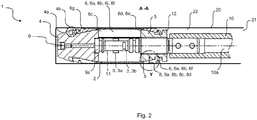
- Fig. 2 shows a schematic illustration in section AA of the measuring device 1 according to the invention of the present invention according to one in the Fig. 1 illustrated embodiment of the Fig. 1 ,
- the measuring device 1 for measuring mechanical forces and / or strains is mounted in the illustrated embodiment in a bore 21 of a component 20 and braced accordingly.
- the measuring device 1 according to the embodiment of the Fig. 2 comprises a receiving body 2 with at least one sensor element 3, a first support member 4 and a second support member 5, a clamping cup device 6, which consists of a one - as in Fig. 1b shown by way of example - radially expandable first clamping shell element 6a and a radially expandable second clamping shell element 6b, wherein the first clamping shell element 6a and the second clamping shell element 6b divided vertically and by not visible in this view gap 7 - see, however Fig. 1b - Are arranged spaced from each other.
- the receiving body 2 can be connected to the first clamping shell element 6a and the second clamping shell element 6b via the support elements 4, 5.
- the first support element 4 and the second support element 5 are also referred to as threaded cones.
- the embodiment of the measuring device 1 according to the invention is shown in FIG Fig. 2 a blocking element 8, 8a, 8b, 8c designed as a pin, which is attached to the second support element 5.
- a section 8a of the respective blocking element 8, 8a, 8b, 8c is introduced into the gap 7 between the first clamping shell element 6a and the second clamping shell element 6b of the clamping shell device 6.
- the first clamping shell element 6a and the second clamping shell element 6b of the clamping shell device 6 each have conical surfaces 6d on their inner surfaces; 6e, which are engageable with at least one of the likewise cone-shaped support elements 4, 5 in a sliding engagement, wherein the two clamping shell elements 6a, 6b by an axial change in distance of the two support members 4, 5 to each other are radially spreadable.
- the respective blocking element 8, 8a, 8b, 8c can be designed as a pin-shaped or as a plate-shaped element.
- the measuring device 1 shows further that the first support member 4 is formed as a conical front member, and that the second support member 5 is formed as a positionable behind the first support member 4 and conical back element or thread cone.
- the measuring device 1 shows, moreover, that the conical front element of the first support element 4 has a conically executed and geometrically tapered front section 4a in order to simplify the disassembly of the measuring device 1 from the bore 21 of the component 20.
- the clamping cup device 6 when the individual clamping shell elements 6a, 6b in an assembled state - like this in the Fig. 2 shown - were spread radially in order to adhere to a wall 22 of the bore 21 of the component 20 and to clamp the measuring device 1 within the bore 21 of the component 20 accordingly.
- the first threaded cone or the first threaded taper portion or the first support member 4 via a threaded hole 9 and a locking screw 9 a mounted accordingly.
- this is only an exemplified option.
- the measuring device 1 according to the embodiment of the Fig. 2 also includes a guide means 10 which is formed as a hollow tube with an inner bore 10a of the receiving body 2.
- the first support element 4 or the first threaded cone or the first threaded conical section comprises a groove-shaped entrainment element 4b. This is formed when removing the measuring device 1 from the bore 21, a portion 6c of the clamping shell elements 6a; 6b, 6i of the clamping cup device 6 according to the Fig. 1a take.
- a measuring means 11 which serves as receiving means for a first sensor element 3, 3a and a second sensor element 3, 3b.
- the sensor elements 3, 3a, 3b can each be designed as a strain gauge or as a piezoelectric sensor element.
- the measuring device 1 of Fig. 2 includes an engagement means 12, which may also be referred to as a so-called Ausschubbund.
- This extension of the second support element 5 enables a simpler release of the measuring device 1 from a wall 22 of the bore 20, when the measuring device 1 with the sensor elements 3, 3a, 3b to be dismantled again.
- At least one of the clamping shell elements 6a, 6b of the clamping shell device 6 has a surface 6f roughened by laser treatment or application of a sandblasting process.
- the expansion tap can be improved.
Landscapes
- Physics & Mathematics (AREA)
- General Physics & Mathematics (AREA)
- Chemical & Material Sciences (AREA)
- Analytical Chemistry (AREA)
- Length Measuring Devices With Unspecified Measuring Means (AREA)
- Force Measurement Appropriate To Specific Purposes (AREA)
- A Measuring Device Byusing Mechanical Method (AREA)
Abstract
Description
- Die vorliegende Erfindung betrifft eine Messvorrichtung zum Messen von mechanischen Kräften und / oder Dehnungen in einem Bauteil.
- Aus der
DE 9106043 U1 ist eine Messvorrichtung zum Messen von mechanischen Quer- oder Längskräften bzw. Dehnungen in einer Bohrung eines Bauteils bekannt. Diese Messvorrichtung umfasst mindestens einen Sensor, welche in der betreffenden Bohrung durch einen dort beschriebenen Spannmechanismus entsprechend installiert wird. Bei dem dort beschriebenen Messsystem ist es erforderlich, dass für die Montage des Messsystems in einer Bohrung sich die Spannschalenvorrichtung und der Gewindekegel nicht rotatorisch zueinander verschieben. Ist dies nämlich der Fall, dann findet keine entsprechende Axialbewegung zwischen dem Aufnehmerkörper und dem Gewindekegel statt, was dazu führt, dass die Messvorrichtung nicht in der Bohrung verspannbar ist. Dies ist jedoch eine wichtige Voraussetzung, damit die von der Messvorrichtung erfassten Messwerte nicht verfälscht werden. - Ein weiterer Nachteil der vorgenannten Messvorrichtung besteht darin, dass diese sich nur wieder schwer aus der Bohrung lösen lässt. Die Ursache ist hierfür eine lokale und fest haftende Verbindung zwischen den Spannschalen und der Bohrung.
- Bei der vorgenannten Messvorrichtung ist eine unverfälschte Messung der entsprechenden in der Bohrung des Bauteils auftretenden Quer- oder Längskräften bzw. den mechanischen Dehnungen nur möglich, wenn der Dehnungsabgriff der Spannschalen an der Bohrung verlustfrei erfolgt. Dies wird in der vorgenannten Messvorrichtung dadurch erreicht, dass die einzelnen Abgriffflächen der Spannschalen mit Rillen versehen sind. Dies ist jedoch nicht optimal, da diese Rillen einen hohen Abnutzungsgrad unterliegen und sich derartige Rillen in weiche Materialien des zu vermessenden Bauteils auf unerwünschte Weise bleibend einprägen können.
- Es ist daher Aufgabe der vorliegenden Erfindung, eine Messvorrichtung zum Messen von mechanischen Kräften und / oder Dehnungen in einem Bauteil derart verbessert weiterzubilden, dass die eingangs beschriebenen Nachteile zumindest reduziert werden und eine hohe Genauigkeit der gemessenen mechanischen Kräfte und Dehnungen erzielt wird. Eine weitere Aufgabe besteht außerdem darin, die Montage- bzw. Deinstallation einer derartigen Messvorrichtung in einem Bauteil zu vereinfachen.
- Erfindungsgemäß wird diese Aufgabe durch die Merkmale der unabhängigen Patentansprüche gelöst. Vorteilhafte Ausführungsformen der vorliegenden Erfindung sind Gegenstand der abhängigen Ansprüche, der Beschreibung sowie der Figuren. Ausführungsbeispiele der Erfindung sind in den Zeichnungen dargestellt und werden im Folgenden näher beschrieben.
- Gemäß einem ersten Aspekt betrifft die Erfindung eine Messvorrichtung zum Messen von mechanischen Kräften und / oder Dehnungen in einem Bauteil, umfassend
- einen Aufnahmekörper mit mindestens einem Sensorelement;
- ein erstes Stützelement und
- ein zweites Stützelement;
- eine Spannschalenvorrichtung, welche aus wenigstens einem radial spreizbaren ersten Spannschalenelement und einem radial spreizbaren zweiten Spannschalenelement besteht, wobei das erste Spannschalenelement und das zweite Spannschalenelement vertikal unterteilt und durch einen Spalt voneinander beabstandet angeordnet sind; wobei der Aufnahmekörper mit dem ersten Spannschalenelement und dem zweiten Spannschalenelement über die Stützelemente verbindbar ist, und
- mindestens ein Blockierelement, welches an mindestens einem der beiden Stützelemente anbringbar ist und wobei ein Abschnitt des Blockierelements in den Spalt zwischen dem ersten Spannschalenelement und dem zweiten Spannschalenelement der Spannschalenvorrichtung einführbar ist.
- Der grundlegende Gedanke der erfindungsgemäßen Messvorrichtung besteht darin, dass infolge des Blockierelements, welches in einem Spalt oder einem Schlitz zwischen zwei benachbarten Spannschalenelementen der Spannschalenvorrichtung angeordnet ist, die Spannschalenvorrichtung und das mindestens eine Stützelement nicht rotatorisch zueinander verschiebbar sind, es also zu keiner rotatorischen Relativbewegung zwischen der Spannschalenvorrichtung und dem Stützelement kommen kann, wenn die Messvorrichtung nach Positionierung in einem Abschnitt einer Bohrung des Bauteils mit einer Wand der Bohrung verspannt wird.
- Durch das Blockierelement, wird also sichergestellt, dass eine Verdrehung des Stützelements, welches auch als Gewindekegel bezeichenbar ist, relativ zu der Spannschalenvorrichtung gesperrt ist bzw. verhindert wird. Somit ist lediglich eine axiale Bewegung des Gewindekegels möglich.
- Der wesentliche Vorteil, welcher durch die erfindungsgemäße Messvorrichtung erzielt wird, besteht deshalb darin, dass der Montageprozess der Messvorrichtung in einer Bohrung oder einem Bohrungsabschnitt eines zu vermessenden Bauteils erheblich erleichtert und effizienter gestaltet wird, da es wegen der Verhinderung eines Verdrehens des Stützelements der Messvorrichtung relativ zur Spannschalenvorrichtung nunmehr keine Probleme bei der Verspannung der Messvorrichtung mit dem zu vermessenden Bauteil gibt.
- Gemäß einer Ausführungsform der vorliegenden Erfindung weisen die beiden Spannschalenelemente der Spannschalenvorrichtung innenseitig jeweils konusförmige Flächen auf, welche mit mindestens einem der konusförmig ausgebildeten Stützelemente in einem gleitenden Eingriff bringbar sind, wobei die beiden Spannschalenelemente durch eine axiale Abstandsänderung der beiden Stützelemente zueinander jeweils radial spreizbar sind. Dadurch wird der Vorteil erreicht, dass die Messvorrichtung auf einfache Weise in dem zu vermessenen Bauteil montiert und fixiert werden kann.
- Gemäß einer Ausführungsform der vorliegenden Erfindung ist das mindestens eine Blockierelement als ein stiftförmiges oder als ein plattenförmiges Element ausgebildet. Dadurch wird der Vorteil erreicht, dass ein Verdrehen des mindestens einen Stützelements relativ zur Spannschalenvorrichtung effizient verhindert wird.
- Gemäß einer Ausführungsform der vorliegenden Erfindung umfasst diese ein erstes Blockierelement und mindestens ein zweites Blockierelement, welche gemeinsam auf einem der Stützelemente zueinander radial versetzt, vorzugsweise um 3 x 120 Grad, positionierbar sind. Dadurch wird der Vorteil erreicht, dass effizient eine Verdrehung des als Gewindekegels bezeichneten Stützelements in der Spannschalenvorrichtung verhindert wird. Das erste Blockierelement und das mindestens zweite Blockierelement, welche also jeweils vorzugsweise um 120 Grad zueinander versetzt angeordnet sind, laufen also in den jeweiligen Spalten oder Schlitzen zwischen den einzelnen Spannschalenelementen der Spannschalenvorrichtung.
- Gemäß einer Ausführungsform der vorliegenden Erfindung ist das erste Stützelement als ein kegelförmiges Frontelement ausgebildet, und ist das zweite Stützelement als ein, hinter dem ersten Stützelement positionierbares und kegelförmiges Rückelement ausgebildet. Dadurch wird der Vorteil erreicht, dass die Spannschalenvorrichtung optimal in dem Bauteil verspannt wird.
- Gemäß einer Ausführungsform der vorliegenden Erfindung weist das kegelförmige Frontelement des ersten Stützelements einen konisch ausgeführten und sich geometrisch verjüngenden Frontabschnitt auf. Dadurch wird der Vorteil erreicht, dass eine Einführung der Messvorrichtung in eine Bohrung eines zu vermessenden Bauteils, insbesondere in sogenannte Stufenbohrungen, erleichtert wird.
- Gemäß einer Ausführungsform der vorliegenden Erfindung umfasst das erste Stützelement ein nutförmiges Mitführelement umfasst, welches ausgebildet ist, bei einem Entfernen der Messvorrichtung aus einer Bohrung des Bauteils einen Abschnitt eines der Spannschalenelemente der Spannschalenvorrichtung aufzunehmen. Dadurch wird der Vorteil erreicht, dass ein einfacheres Demontieren der Messvorrichtung aus der Bohrung des Bauteils ermöglicht wird, da durch diese besondere Geometrie des ersten Stützelements, welches auch als ein Frontkegel bezeichnet werden kann, die Spannschalenvorrichtung durch eine Zugbewegung auf einfache Weise von dem Bauteil, mit welchem die Spannschalenvorrichtung verspannt ist, gelöst werden kann.
- Gemäss einer Ausführungsform der vorliegenden Erfindung ist ein Eingreifmittel in der Messvorrichtung umfasst. Das Eingreifmittel ist ausgebildet, einen Kraftimpuls auf die wenigstens beiden Spannschalenelemente zu ermöglichen, um in vorteilhafter Weise die wenigstens beiden Spannschalenelemente auf einfache Art von dem Bauteil zu lösen.
- Gemäß einer Ausführungsform der vorliegenden Erfindung ist das mindestens eine Sensorelement als ein Dehnungsmessstreifen oder als ein piezoelektrisches Sensorelement ausgebildet. Dadurch wird der Vorteil erreicht, dass die aufzunehmenden Kräfte oder Dehnungen, die von der Messvorrichtung bei entsprechender Verspannung mit dem zu vermessenden Bauteil erfasst werden, effizient erfassen werden.
- Gemäß einer Ausführungsform der vorliegenden Erfindung umfasst das mindestens eine Sensorelement ein erstes Sensorelement und ein zweites Sensorelement. Dadurch wird der Vorteil erreicht, dass unterschiedliche Kräfte und Dehnungen, die im zu vermessenden Bauteil auftreten, effizient erfasst werden können.
- Gemäß einer Ausführungsform der vorliegenden Erfindung umfasst mindestens eines der Spannschalenelemente der Spannschalenvorrichtung eine durch Laserbehandlung oder Anwendung eines Sandstrahlverfahrens aufgeraute Oberfläche. Durch eine Laserbehandlung wird der Vorteil erreicht, dass der Dehnungsabgriff verbessert wird, da dadurch eine sehr gute Dehnungsübertragung zu der Messvorrichtung erreicht wird. Zudem wird ein Einprägen der Spannschalenvorrichtung in das Material der Bohrung des Bauteils aufgrund der nur wenigen Mikrometer tiefen Struktur vermieden. Durch das Aufrauen der Oberfläche mittels Sandstrahlen wird eine diffuse und raue Oberfläche erzeugt, wodurch ebenso eine vorteilhafte Dehnungsübertragung erreicht wird. Auch wird dadurch ein Einprägen der Spannschalenvorrichtung in das Material der Bohrung des Bauteils aufgrund vermieden.
- Weitere Ausführungsbeispiele der Erfindung sind in den Zeichnungen dargestellt und werden im Folgenden näher beschrieben.
- Es zeigen:
- Fig. 1
- eine schematische Abbildung der erfindungsgemäßen Messvorrichtung gemäß einer Ausführungsform der vorliegenden Erfindung;
- Fig. 1a
- einen Ausschnitt der schematischen Abbildung der erfindungsgemäßen Messvorrichtung in Schnittansicht B-B mit den vertikal unterteilten Spannschalenelementen mit einer Anzahl von Blockierelementen, welche jeweils in einem Spalt zwischen benachbarten Spannschalenelementen angeordnet sind;
- Fig. 1b
- einen Ausschnitt X der schematischen Abbildung der erfindungsgemäßen Messvorrichtung mit zwei Spannschalenelementen, die durch ein Blockierelement in einen Spalt voneinander beabstandet sind; und
- Fig. 2
- eine schematische Abbildung in Schnittdarstellung A-A der erfindungsgemäßen Messvorrichtung der vorliegenden Erfindung gemäß einer in der
Fig. 1 dargestellten Ausführungsform derFig. 1 . -
Fig. 1 zeigt eine schematische Abbildung der erfindungsgemäßen Messvorrichtung 1. Die Messvorrichtung 1 gemäß derFig. 1 umfasst eine Spannschalenvorrichtung 6, ein Führungsmittel 10, welches als ein Rohr ausgeführt sein kann. Die Messvorrichtung 1 umfasst ein erstes Stützelement 4, welches einen verjüngten Frontabschnitt 4a umfasst. Zudem zeigt die Ausführungsform derFig. 1 ein vorderes Abgriffelement 6g und ein hinteres Abgriffelement 6h zum Abgreifen der zu messenden Dehnungen und Kräfte. In derFig. 1 sind zudem die einzelnen Schnittrichtungen A-A, B-B und X exemplarisch eingezeichnet, deren jeweilige Ansichten im Detail in den anderen Figuren näher dargestellt sind. Die einzelnen und zueinander benachbarten Spannschalenelemente 6a, 6b sind durch einen Spalt oder einen Schlitz 7 voneinander beabstandet, wie in derFig. 1 dargestellt. -
Fig. 1a zeigt einen Ausschnitt der schematischen Abbildung der erfindungsgemäßen Messvorrichtung 1 in Schnittansicht B-B mit vertikal unterteilten Spannschalenelementen 6, 6a, 6b, 6i mit einer Anzahl von Blockierelementen 8, 8a, 8b, 8c, welche jeweils in einem Spalt zwischen benachbarten Spannschalenelementen 6, 6a und 6b bzw. 6b und 6i exemplarisch angeordnet sind. Die jeweiligen Blockierelemente 8, 8a, 8b, 8c können als einzelne Stifte ausgeführt sein, die in den jeweiligen Spalten oder Schlitzen zwischen den einzelnen und zueinander benachbarten Spannschalenelementen angeordnet sind.Fig. 1a zeigt ein erstes Spannschalenelement 6a, welches zu einem zweiten Spannschalenelement 6b benachbart und beabstandet ist. Zwischen dem ersten Spannschalenelement 6a und dem zweiten Spannschalenelement 6b befindet sich - wie in der Schnittdarstellung X derFig. 1b deutlicher dargestellt - ein Spalt oder ein Schlitz 7, in welchem jeweils ein Blockierelement 8, 8a, 8b, 8c verläuft. DieFig. 1b zeigt dabei ein erstes Blockierelement 8a, ein zweites Blockierelement 8b und ein drittes Blockierelement 8c. In derFig. 1a ist ersichtlich, dass die einzelnen drei Blockiermittel 8, 8a, 8b, 8c radial zueinander ausgerichtet und jeweils um 120 Grad zueinander versetzt angeordnet sind. Auf diese Weise wird eine Verdrehung der Stützelemente 4, 5 bzw. der jeweiligen Gewindekegel relativ zur Spannschalenvorrichtung 6 verhindert. Damit ist zwar eine axiale Verschiebung der einzelnen Stützelemente 4, 5 zueinander möglich, aber eben keine rotatorische Relativbewegung zwischen einzelnen Spannschalen 6a, 6b, 6i der Spannschalenvorrichtung 6 und den jeweiligen als Gewindekegel bezeichneten einzelnen Stützelementen 4, 5, wie auch in derFig. 2 noch näher dargestellt. -
Fig. 2 zeigt eine schematische Abbildung in Schnittdarstellung A-A der erfindungsgemäßen Messvorrichtung 1 der vorliegenden Erfindung gemäß einer in derFig. 1 dargestellten Ausführungsform derFig. 1 . - Die Messvorrichtung 1 zum Messen von mechanischen Kräften und / oder Dehnungen ist in der dargestellten Ausführungsform in einer Bohrung 21 eines Bauteils 20 montiert und entsprechend verspannt. Die Messvorrichtung 1 gemäß der Ausführungsform der
Fig. 2 umfasst einen Aufnahmekörper 2 mit mindestens einem Sensorelement 3, ein erstes Stützelement 4 und ein zweites Stützelement 5, eine Spannschalenvorrichtung 6, welche aus ein einem - wie in derFig. 1b exemplarisch dargestellt - radial spreizbaren ersten Spannschalenelement 6a und einem radial spreizbaren zweiten Spannschalenelement 6b besteht, wobei das erste Spannschalenelement 6a und das zweite Spannschalenelement 6b vertikal unterteilt und durch in dieser Darstellung nicht sichtbaren Spalt 7 - siehe jedochFig. 1b - voneinander beabstandet angeordnet sind. Der Aufnahmekörper 2 ist mit dem ersten Spannschalenelement 6a und dem zweiten Spannschalenelement 6b über die Stützelemente 4, 5 verbindbar. Das erste Stützelement 4 und das zweite Stützelement 5 werden auch jeweils als Gewindekegel bezeichnet. Die Ausführungsform der erfindungsgemäßen Messvorrichtung 1 zeigt in derFig. 2 ein als Stift ausgebildetes Blockierelement 8, 8a, 8b, 8c, welches an dem zweiten Stützelement 5 angebracht ist. Ein Abschnitt 8a des jeweiligen Blockierelements 8, 8a, 8b, 8c ist dabei in den Spalt 7 zwischen dem ersten Spannschalenelement 6a und dem zweiten Spannschalenelement 6b der Spannschalenvorrichtung 6 eingeführt. - Gemäß der
Fig. 2 weisen das erste Spannschalenelement 6a und das zweite Spannschalenelement 6b der Spannschalenvorrichtung 6 an ihren Innenflächen jeweils konusförmige Flächen 6d; 6e auf, welche mit mindestens einem der ebenfalls konusförmig ausgebildeten Stützelemente 4, 5 in einem gleitenden Eingriff bringbar sind, wobei die beiden Spannschalenelemente 6a, 6b durch eine axiale Abstandsänderung der beiden Stützelemente 4, 5 zueinander jeweils radial spreizbar sind. - Das jeweilige Blockierelement 8, 8a, 8b, 8c kann dabei als ein stiftförmiges oder als ein plattenförmiges Element ausgebildet sein.
- Die Messvorrichtung 1 gemäß der Ausführungsform der
Fig. 2 zeigt ferner, dass das erste Stützelement 4 als ein kegelförmiges Frontelement ausgebildet ist, und dass das zweite Stützelement 5 als ein, hinter dem ersten Stützelement 4 positionierbares und kegelförmiges Rückelement oder Gewindekegel ausgebildet ist. - Die Messvorrichtung 1 gemäß der Ausführungsform der
Fig. 2 zeigt zudem, dass das kegelförmige Frontelement des ersten Stützelements 4 einen konisch ausgeführten und sich geometrisch verjüngenden Frontabschnitt 4a aufweist, um die Demontage der Messvorrichtung 1 aus der Bohrung 21 des Bauteils 20 zu vereinfachen. Zudem kann durch eine entsprechende Zugbewegung die Spannschalenvorrichtung 6, wenn die einzelnen Spannschalenelemente 6a, 6b in einem montierten Zustand - wie dieser in derFig. 2 dargestellt - entsprechend radial gespreizt wurden, um an einer Wand 22 der Bohrung 21 des Bauteils 20 zu haften und die Messvorrichtung 1 innerhalb der Bohrung 21 des Bauteils 20 entsprechend zu verspannen. Wie in derFig. 2 dargestellt ist der erste Gewindekegel bzw. der erste Gewindekegelabschnitt oder auch das erste Stützelement 4 über eine Gewindebohrung 9 und einer Sicherungsschraube 9a entsprechend angebracht. Dies ist jedoch nur eine exemplarisch dargestellte Möglichkeit. - Die Messvorrichtung 1 gemäß der Ausführungsform der
Fig. 2 umfasst zudem ein Führungsmittel 10, das als ein hohles Rohr mit einer Innenbohrung 10a des Aufnahmekörpers 2 ausgebildet ist. - Gemäß der Ausführungsform der Messvorrichtung 1 der
Fig. 2 umfasst das erste Stützelement 4 oder der erste Gewindekegel oder der erste Gewindekegelabschnitt ein nutförmiges Mitführelement 4b. Dieses ist ausgebildet, bei einem Entfernen der Messvorrichtung 1 aus der Bohrung 21 einen Abschnitt 6c eines der Spannschalenelemente 6a; 6b, 6i der Spannschalenvorrichtung 6 gemäß derFig. 1a aufzunehmen. - Gemäß der Ausführungsform der Messvorrichtung 1 der
Fig. 2 ist ein Messmittel 11 dargestellt, welches als Aufnahmemittel für ein erstes Sensorelement 3, 3a und ein zweites Sensorelement 3, 3b dient. Mit den jeweiligen Sensorelementen 3, 3a, 3b können Längs- bzw. Querdehnungen der Bohrung 21 des Bauteils 20 erfasst werden. Die Sensorelemente 3, 3a, 3b können dabei jeweils als ein Dehnungsmessstreifen oder als ein piezoelektrisches Sensorelement ausgebildet sein. - Die Messvorrichtung 1 der
Fig. 2 umfasst ein Eingreifmittel 12, das auch als ein sogenannter Ausschubbund bezeichnet werden kann. Dieser Fortsatz des zweiten Stützelements 5 ermöglicht ein einfacheres Lösen der Messvorrichtung 1 aus einer Wand 22 der Bohrung 20, wenn die Messvorrichtung 1 mit den Sensorelementen 3, 3a, 3b wieder demontiert werden soll. - Gemäß der Ausführungsform der Messvorrichtung 1 der
Fig. 2 weist mindestens eines der Spannschalenelemente 6a, 6b der Spannschalenvorrichtung 6 eine durch Laserbehandlung oder Anwendung eines Sandstrahlverfahrens aufgeraute Oberfläche 6f auf. Dadurch kann der Dehnungsabgriff verbessert werden.
Claims (11)
- Messvorrichtung (1) zum Messen von mechanischen Kräften und / oder Dehnungen in einem Bauteil (20), umfassend:- einen Aufnahmekörper (2) mit mindestens einem Sensorelement (3);- ein erstes Stützelement (4) und ein zweites Stützelement (5);- eine Spannschalenvorrichtung (6), welche aus wenigstens einem radial spreizbaren ersten Spannschalenelement (6a) und einem radial spreizbaren zweiten Spannschalenelement (6b) besteht, wobei das erste Spannschalenelement (6a) und das zweite Spannschalenelement (6b) vertikal unterteilt und durch einen Spalt (7) voneinander beabstandet angeordnet sind;- wobei der Aufnahmekörper (2) mit dem ersten Spannschalenelement (6a) und dem zweiten Spannschalenelement (6b) über die Stützelemente (4; 5) verbindbar ist, und- mindestens ein Blockierelement (8), welches an mindestens einem der beiden Stützelemente (4; 5) anbringbar ist und wobei ein Abschnitt (8c) des Blockierelements (8) in den Spalt (7) zwischen dem ersten Spannschalenelement (6a) und dem zweiten Spannschalenelement (6b) der Spannschalenvorrichtung (6) einführbar ist.
- Messvorrichtung (1) nach Anspruch 1, wobei die beiden Spannschalenelemente (6a; 6b) der Spannschalenvorrichtung (6) innenseitig jeweils konusförmige Flächen (6d; 6e) aufweisen, welche mit mindestens einem der konusförmig ausgebildeten Stützelemente (4; 5) in einem gleitenden Eingriff bringbar sind, wobei die beiden Spannschalenelemente (6a; 6b) durch eine axiale Abstandsänderung der beiden Stützelemente (4; 5) zueinander jeweils radial spreizbar sind.
- Messvorrichtung (1) nach einem der vorangegangenen Ansprüche, wobei das mindestens eine Blockierelement (8) als ein stiftförmiges oder als ein plattenförmiges Element ausgebildet ist.
- Messvorrichtung (1) nach einem der vorangegangenen Ansprüche, umfassend ein erstes Blockierelement (8a) und mindestens ein zweites Blockierelement (8b), welche gemeinsam auf einem der Stützelemente (4; 5) zueinander radial versetzt, vorzugsweise um 120 Grad, positionierbar sind.
- Messvorrichtung (1) nach einem der vorangegangenen Ansprüche, wobei das erste Stützelement (4) als ein kegelförmiges Frontelement ausgebildet ist, und wobei das zweite Stützelement (5) als ein, hinter dem ersten Stützelement (4) positionierbares und kegelförmiges Rückelement ausgebildet ist.
- Messvorrichtung (1) nach Anspruch 5, wobei das kegelförmige Frontelement einen konisch ausgeführten und sich geometrisch verjüngenden Frontabschnitt (4a) aufweist.
- Messvorrichtung (1) nach einem der vorangegangenen Ansprüche, wobei das erste Stützelement (4) ein nutförmiges Mitführelement (4b) umfasst, welches ausgebildet ist, bei einem Entfernen der Messvorrichtung (1) aus der Bohrung (21) einen Abschnitt (6c) eines der Spannschalenelemente (6a; 6b) der Spannschalenvorrichtung (6) aufzunehmen.
- Messvorrichtung (1) nach einem der vorangegangenen Ansprüche, wobei ein Eingreifmittel (12) umfasst ist, wobei das Eingreifmittel (12) ausgebildet ist, einen Kraftimpuls auf die wenigstens beiden Spannschalenelemente (6a; 6b) zu ermöglichen, um die wenigstens beiden Spannschalenelemente (6a; 6b) von dem Bauteil (20) zu lösen.
- Messvorrichtung (1) nach einem der vorangegangenen Ansprüche, wobei das mindestens eine Sensorelement (3) als ein Dehnungsmessstreifen oder als ein piezoelektrisches Sensorelement ausgebildet ist.
- Messvorrichtung (1) nach einem der vorangegangenen Ansprüche, wobei das mindestens eine Sensorelement (3) ein erstes Sensorelement (3a) und ein zweites Sensorelement (3b) umfasst.
- Messvorrichtung (1) nach einem der vorangegangenen Ansprüche, wobei mindestens eines der Spannschalenelemente (6a; 6b) der Spannschalenvorrichtung (6) eine durch Laserbehandlung oder Anwendung eines Sandstrahlverfahrens aufgeraute Oberfläche (6f) aufweist.
Applications Claiming Priority (1)
| Application Number | Priority Date | Filing Date | Title |
|---|---|---|---|
| DE102017009681.3A DE102017009681B3 (de) | 2017-10-18 | 2017-10-18 | Messvorrichtung zum Messen von mechanischen Kräften und/oder Dehnungen in einem Bauteil |
Publications (2)
| Publication Number | Publication Date |
|---|---|
| EP3473992A1 true EP3473992A1 (de) | 2019-04-24 |
| EP3473992B1 EP3473992B1 (de) | 2020-07-01 |
Family
ID=63171184
Family Applications (1)
| Application Number | Title | Priority Date | Filing Date |
|---|---|---|---|
| EP18188654.0A Active EP3473992B1 (de) | 2017-10-18 | 2018-08-13 | Messvorrichtung zum messen von mechanischen kräften und / oder dehnungen in einem bauteil |
Country Status (2)
| Country | Link |
|---|---|
| EP (1) | EP3473992B1 (de) |
| DE (1) | DE102017009681B3 (de) |
Citations (2)
| Publication number | Priority date | Publication date | Assignee | Title |
|---|---|---|---|---|
| DE9106043U1 (de) * | 1991-04-22 | 1991-08-08 | Kistler Instrumente Ag, Winterthur | Anordnung zur Messung von Dehnungen und/oder Kräften |
| CH684442A5 (de) * | 1991-09-04 | 1994-09-15 | Schlaepfer Messtechnik Ag | Aufnehmer zum Messen von Querdehnungen in Bohrungen in Strukturen. |
Family Cites Families (4)
| Publication number | Priority date | Publication date | Assignee | Title |
|---|---|---|---|---|
| US4429579A (en) | 1981-10-26 | 1984-02-07 | Helm Instrument Co., Inc. | Tie rod tension sensor |
| US4738135A (en) | 1986-12-15 | 1988-04-19 | Ramsey Engineering Company | Method and apparatus for in situ assemblage of a strain sensor in erected structural elements |
| CH681746A5 (de) | 1991-03-15 | 1993-05-14 | Straintec Ag | |
| DE4125782A1 (de) | 1991-08-03 | 1993-02-04 | Wella Ag | Lockenwickler mit einem sensor |
-
2017
- 2017-10-18 DE DE102017009681.3A patent/DE102017009681B3/de not_active Expired - Fee Related
-
2018
- 2018-08-13 EP EP18188654.0A patent/EP3473992B1/de active Active
Patent Citations (2)
| Publication number | Priority date | Publication date | Assignee | Title |
|---|---|---|---|---|
| DE9106043U1 (de) * | 1991-04-22 | 1991-08-08 | Kistler Instrumente Ag, Winterthur | Anordnung zur Messung von Dehnungen und/oder Kräften |
| CH684442A5 (de) * | 1991-09-04 | 1994-09-15 | Schlaepfer Messtechnik Ag | Aufnehmer zum Messen von Querdehnungen in Bohrungen in Strukturen. |
Also Published As
| Publication number | Publication date |
|---|---|
| DE102017009681B3 (de) | 2018-09-06 |
| EP3473992B1 (de) | 2020-07-01 |
Similar Documents
| Publication | Publication Date | Title |
|---|---|---|
| EP3084379B1 (de) | Kraftsensor für handbetriebene oder pneumatische pressen | |
| EP3156590A1 (de) | Baugruppe für die drehfeste verbindung mindestens zweier rotierender bauteile in einer gasturbine und auswuchtverfahren | |
| DE3120224C1 (de) | Konusspannanordnung | |
| EP3874173B1 (de) | Vorgespannte wälzlagerung | |
| DE4322409A1 (de) | Vorrichtung zur zerspanenden Bearbeitung | |
| DE2460961A1 (de) | Vorrichtung zum aufbringen einer vorspannkraft auf einen zu verbindende teile durchdringenden schraubenbolzen | |
| EP4051918B1 (de) | Prüfstand | |
| DE3317483A1 (de) | Spannvorrichtung zur befestigung von maschinenteilen | |
| DE102017009681B3 (de) | Messvorrichtung zum Messen von mechanischen Kräften und/oder Dehnungen in einem Bauteil | |
| EP3258224B1 (de) | Abstandhalter zum halten eines abstandes zwischen einem stabförmigen innenleiter und einem aussenleiter einer füllstand-messsonde | |
| DE2402101B2 (de) | Einrichtung zum verbinden des formzylinders einer rotations-druckmaschine mit dessen antriebswelle | |
| WO2013114190A1 (de) | Vorrichtung zur erfassung von kräftebelastungen einer stützstruktur | |
| DE102017130769B4 (de) | Messrolle | |
| DE102011120559A1 (de) | Vorrichtung und Verfahren zum Anordnen zumindest eines Prüfkörpers | |
| DE102014016468A1 (de) | Vorrichtung zur Messung einer Körperlänge | |
| EP0561395B1 (de) | Spannfutter | |
| EP1029993A2 (de) | Ankerschiene mit schieneninnenseitig einsehbarer Kennzeichnung | |
| EP4628832A1 (de) | Messtaster | |
| DE2259190C2 (de) | Vorrichtung zum Auswuchten von Hohlwellen | |
| DE2520233C2 (de) | Befestigungsanordnung für Kernreaktorbrennstäbe | |
| EP1471267A2 (de) | Vorrichtung zur lösbaren Befestigung von Maschinenteilen auf einem Schaft grossen Durchmessers. | |
| DE102024106956A1 (de) | Spannvorrichtung zum Spannen eines hohlen Werkstücks und Verfahren zum Bearbeiten, Messen und/oder Prüfen eines hohlen Werkstücks | |
| DE7434756U (de) | Universalaufspanneinrichtung für unterschiedliche Kraftfahrzeugradtypen auf der Auf spann welle einer Prüfmaschine, insbesondere einer Auswuchtmaschine | |
| CH385568A (de) | Einrichtung zur Befestigung eines Maschinenteils auf einem Träger | |
| DE102024201479A1 (de) | Rastmechanismus einer Ankerseillängeneinstellanordnung und Verfahren zum Einstellen einer Ankerseillängeneinstellanordnung |
Legal Events
| Date | Code | Title | Description |
|---|---|---|---|
| PUAI | Public reference made under article 153(3) epc to a published international application that has entered the european phase |
Free format text: ORIGINAL CODE: 0009012 |
|
| STAA | Information on the status of an ep patent application or granted ep patent |
Free format text: STATUS: THE APPLICATION HAS BEEN PUBLISHED |
|
| AK | Designated contracting states |
Kind code of ref document: A1 Designated state(s): AL AT BE BG CH CY CZ DE DK EE ES FI FR GB GR HR HU IE IS IT LI LT LU LV MC MK MT NL NO PL PT RO RS SE SI SK SM TR |
|
| AX | Request for extension of the european patent |
Extension state: BA ME |
|
| STAA | Information on the status of an ep patent application or granted ep patent |
Free format text: STATUS: REQUEST FOR EXAMINATION WAS MADE |
|
| 17P | Request for examination filed |
Effective date: 20191024 |
|
| RBV | Designated contracting states (corrected) |
Designated state(s): AL AT BE BG CH CY CZ DE DK EE ES FI FR GB GR HR HU IE IS IT LI LT LU LV MC MK MT NL NO PL PT RO RS SE SI SK SM TR |
|
| GRAP | Despatch of communication of intention to grant a patent |
Free format text: ORIGINAL CODE: EPIDOSNIGR1 |
|
| STAA | Information on the status of an ep patent application or granted ep patent |
Free format text: STATUS: GRANT OF PATENT IS INTENDED |
|
| RIC1 | Information provided on ipc code assigned before grant |
Ipc: G01B 7/16 20060101ALI20200311BHEP Ipc: G01L 1/16 20060101ALI20200311BHEP Ipc: G01L 5/00 20060101AFI20200311BHEP Ipc: G01L 1/22 20060101ALI20200311BHEP |
|
| INTG | Intention to grant announced |
Effective date: 20200324 |
|
| GRAS | Grant fee paid |
Free format text: ORIGINAL CODE: EPIDOSNIGR3 |
|
| GRAA | (expected) grant |
Free format text: ORIGINAL CODE: 0009210 |
|
| STAA | Information on the status of an ep patent application or granted ep patent |
Free format text: STATUS: THE PATENT HAS BEEN GRANTED |
|
| AK | Designated contracting states |
Kind code of ref document: B1 Designated state(s): AL AT BE BG CH CY CZ DE DK EE ES FI FR GB GR HR HU IE IS IT LI LT LU LV MC MK MT NL NO PL PT RO RS SE SI SK SM TR |
|
| REG | Reference to a national code |
Ref country code: CH Ref legal event code: EP Ref country code: AT Ref legal event code: REF Ref document number: 1286612 Country of ref document: AT Kind code of ref document: T Effective date: 20200715 |
|
| REG | Reference to a national code |
Ref country code: IE Ref legal event code: FG4D Free format text: LANGUAGE OF EP DOCUMENT: GERMAN |
|
| REG | Reference to a national code |
Ref country code: DE Ref legal event code: R096 Ref document number: 502018001786 Country of ref document: DE |
|
| REG | Reference to a national code |
Ref country code: LT Ref legal event code: MG4D |
|
| PG25 | Lapsed in a contracting state [announced via postgrant information from national office to epo] |
Ref country code: BG Free format text: LAPSE BECAUSE OF FAILURE TO SUBMIT A TRANSLATION OF THE DESCRIPTION OR TO PAY THE FEE WITHIN THE PRESCRIBED TIME-LIMIT Effective date: 20201001 |
|
| REG | Reference to a national code |
Ref country code: NL Ref legal event code: MP Effective date: 20200701 |
|
| PG25 | Lapsed in a contracting state [announced via postgrant information from national office to epo] |
Ref country code: CZ Free format text: LAPSE BECAUSE OF FAILURE TO SUBMIT A TRANSLATION OF THE DESCRIPTION OR TO PAY THE FEE WITHIN THE PRESCRIBED TIME-LIMIT Effective date: 20200701 Ref country code: FI Free format text: LAPSE BECAUSE OF FAILURE TO SUBMIT A TRANSLATION OF THE DESCRIPTION OR TO PAY THE FEE WITHIN THE PRESCRIBED TIME-LIMIT Effective date: 20200701 Ref country code: HR Free format text: LAPSE BECAUSE OF FAILURE TO SUBMIT A TRANSLATION OF THE DESCRIPTION OR TO PAY THE FEE WITHIN THE PRESCRIBED TIME-LIMIT Effective date: 20200701 Ref country code: SE Free format text: LAPSE BECAUSE OF FAILURE TO SUBMIT A TRANSLATION OF THE DESCRIPTION OR TO PAY THE FEE WITHIN THE PRESCRIBED TIME-LIMIT Effective date: 20200701 Ref country code: PT Free format text: LAPSE BECAUSE OF FAILURE TO SUBMIT A TRANSLATION OF THE DESCRIPTION OR TO PAY THE FEE WITHIN THE PRESCRIBED TIME-LIMIT Effective date: 20201102 Ref country code: LT Free format text: LAPSE BECAUSE OF FAILURE TO SUBMIT A TRANSLATION OF THE DESCRIPTION OR TO PAY THE FEE WITHIN THE PRESCRIBED TIME-LIMIT Effective date: 20200701 Ref country code: GR Free format text: LAPSE BECAUSE OF FAILURE TO SUBMIT A TRANSLATION OF THE DESCRIPTION OR TO PAY THE FEE WITHIN THE PRESCRIBED TIME-LIMIT Effective date: 20201002 Ref country code: NO Free format text: LAPSE BECAUSE OF FAILURE TO SUBMIT A TRANSLATION OF THE DESCRIPTION OR TO PAY THE FEE WITHIN THE PRESCRIBED TIME-LIMIT Effective date: 20201001 Ref country code: ES Free format text: LAPSE BECAUSE OF FAILURE TO SUBMIT A TRANSLATION OF THE DESCRIPTION OR TO PAY THE FEE WITHIN THE PRESCRIBED TIME-LIMIT Effective date: 20200701 |
|
| PG25 | Lapsed in a contracting state [announced via postgrant information from national office to epo] |
Ref country code: LV Free format text: LAPSE BECAUSE OF FAILURE TO SUBMIT A TRANSLATION OF THE DESCRIPTION OR TO PAY THE FEE WITHIN THE PRESCRIBED TIME-LIMIT Effective date: 20200701 Ref country code: PL Free format text: LAPSE BECAUSE OF FAILURE TO SUBMIT A TRANSLATION OF THE DESCRIPTION OR TO PAY THE FEE WITHIN THE PRESCRIBED TIME-LIMIT Effective date: 20200701 Ref country code: RS Free format text: LAPSE BECAUSE OF FAILURE TO SUBMIT A TRANSLATION OF THE DESCRIPTION OR TO PAY THE FEE WITHIN THE PRESCRIBED TIME-LIMIT Effective date: 20200701 Ref country code: IS Free format text: LAPSE BECAUSE OF FAILURE TO SUBMIT A TRANSLATION OF THE DESCRIPTION OR TO PAY THE FEE WITHIN THE PRESCRIBED TIME-LIMIT Effective date: 20201101 |
|
| PG25 | Lapsed in a contracting state [announced via postgrant information from national office to epo] |
Ref country code: MC Free format text: LAPSE BECAUSE OF FAILURE TO SUBMIT A TRANSLATION OF THE DESCRIPTION OR TO PAY THE FEE WITHIN THE PRESCRIBED TIME-LIMIT Effective date: 20200701 Ref country code: NL Free format text: LAPSE BECAUSE OF FAILURE TO SUBMIT A TRANSLATION OF THE DESCRIPTION OR TO PAY THE FEE WITHIN THE PRESCRIBED TIME-LIMIT Effective date: 20200701 |
|
| REG | Reference to a national code |
Ref country code: DE Ref legal event code: R097 Ref document number: 502018001786 Country of ref document: DE |
|
| PG25 | Lapsed in a contracting state [announced via postgrant information from national office to epo] |
Ref country code: LU Free format text: LAPSE BECAUSE OF NON-PAYMENT OF DUE FEES Effective date: 20200813 Ref country code: SM Free format text: LAPSE BECAUSE OF FAILURE TO SUBMIT A TRANSLATION OF THE DESCRIPTION OR TO PAY THE FEE WITHIN THE PRESCRIBED TIME-LIMIT Effective date: 20200701 Ref country code: RO Free format text: LAPSE BECAUSE OF FAILURE TO SUBMIT A TRANSLATION OF THE DESCRIPTION OR TO PAY THE FEE WITHIN THE PRESCRIBED TIME-LIMIT Effective date: 20200701 Ref country code: DK Free format text: LAPSE BECAUSE OF FAILURE TO SUBMIT A TRANSLATION OF THE DESCRIPTION OR TO PAY THE FEE WITHIN THE PRESCRIBED TIME-LIMIT Effective date: 20200701 Ref country code: EE Free format text: LAPSE BECAUSE OF FAILURE TO SUBMIT A TRANSLATION OF THE DESCRIPTION OR TO PAY THE FEE WITHIN THE PRESCRIBED TIME-LIMIT Effective date: 20200701 |
|
| PLBE | No opposition filed within time limit |
Free format text: ORIGINAL CODE: 0009261 |
|
| STAA | Information on the status of an ep patent application or granted ep patent |
Free format text: STATUS: NO OPPOSITION FILED WITHIN TIME LIMIT |
|
| REG | Reference to a national code |
Ref country code: BE Ref legal event code: MM Effective date: 20200831 |
|
| PG25 | Lapsed in a contracting state [announced via postgrant information from national office to epo] |
Ref country code: AL Free format text: LAPSE BECAUSE OF FAILURE TO SUBMIT A TRANSLATION OF THE DESCRIPTION OR TO PAY THE FEE WITHIN THE PRESCRIBED TIME-LIMIT Effective date: 20200701 |
|
| 26N | No opposition filed |
Effective date: 20210406 |
|
| PG25 | Lapsed in a contracting state [announced via postgrant information from national office to epo] |
Ref country code: SK Free format text: LAPSE BECAUSE OF FAILURE TO SUBMIT A TRANSLATION OF THE DESCRIPTION OR TO PAY THE FEE WITHIN THE PRESCRIBED TIME-LIMIT Effective date: 20200701 |
|
| PG25 | Lapsed in a contracting state [announced via postgrant information from national office to epo] |
Ref country code: IE Free format text: LAPSE BECAUSE OF NON-PAYMENT OF DUE FEES Effective date: 20200813 Ref country code: SI Free format text: LAPSE BECAUSE OF FAILURE TO SUBMIT A TRANSLATION OF THE DESCRIPTION OR TO PAY THE FEE WITHIN THE PRESCRIBED TIME-LIMIT Effective date: 20200701 Ref country code: BE Free format text: LAPSE BECAUSE OF NON-PAYMENT OF DUE FEES Effective date: 20200831 |
|
| PG25 | Lapsed in a contracting state [announced via postgrant information from national office to epo] |
Ref country code: TR Free format text: LAPSE BECAUSE OF FAILURE TO SUBMIT A TRANSLATION OF THE DESCRIPTION OR TO PAY THE FEE WITHIN THE PRESCRIBED TIME-LIMIT Effective date: 20200701 Ref country code: MT Free format text: LAPSE BECAUSE OF FAILURE TO SUBMIT A TRANSLATION OF THE DESCRIPTION OR TO PAY THE FEE WITHIN THE PRESCRIBED TIME-LIMIT Effective date: 20200701 Ref country code: CY Free format text: LAPSE BECAUSE OF FAILURE TO SUBMIT A TRANSLATION OF THE DESCRIPTION OR TO PAY THE FEE WITHIN THE PRESCRIBED TIME-LIMIT Effective date: 20200701 |
|
| PG25 | Lapsed in a contracting state [announced via postgrant information from national office to epo] |
Ref country code: MK Free format text: LAPSE BECAUSE OF FAILURE TO SUBMIT A TRANSLATION OF THE DESCRIPTION OR TO PAY THE FEE WITHIN THE PRESCRIBED TIME-LIMIT Effective date: 20200701 |
|
| GBPC | Gb: european patent ceased through non-payment of renewal fee |
Effective date: 20220813 |
|
| PG25 | Lapsed in a contracting state [announced via postgrant information from national office to epo] |
Ref country code: GB Free format text: LAPSE BECAUSE OF NON-PAYMENT OF DUE FEES Effective date: 20220813 |
|
| REG | Reference to a national code |
Ref country code: AT Ref legal event code: MM01 Ref document number: 1286612 Country of ref document: AT Kind code of ref document: T Effective date: 20230813 |
|
| PG25 | Lapsed in a contracting state [announced via postgrant information from national office to epo] |
Ref country code: AT Free format text: LAPSE BECAUSE OF NON-PAYMENT OF DUE FEES Effective date: 20230813 |
|
| PG25 | Lapsed in a contracting state [announced via postgrant information from national office to epo] |
Ref country code: AT Free format text: LAPSE BECAUSE OF NON-PAYMENT OF DUE FEES Effective date: 20230813 |
|
| PGFP | Annual fee paid to national office [announced via postgrant information from national office to epo] |
Ref country code: DE Payment date: 20250819 Year of fee payment: 8 |
|
| PGFP | Annual fee paid to national office [announced via postgrant information from national office to epo] |
Ref country code: IT Payment date: 20250829 Year of fee payment: 8 |
|
| PGFP | Annual fee paid to national office [announced via postgrant information from national office to epo] |
Ref country code: FR Payment date: 20250821 Year of fee payment: 8 |
|
| PGFP | Annual fee paid to national office [announced via postgrant information from national office to epo] |
Ref country code: CH Payment date: 20250901 Year of fee payment: 8 |
|
| PGFP | Annual fee paid to national office [announced via postgrant information from national office to epo] |
Ref country code: AT Payment date: 20260410 Year of fee payment: 5 |