EP3476460B1 - Procédé pour éliminer du mercure contenu dans du gaz naturel - Google Patents
Procédé pour éliminer du mercure contenu dans du gaz naturel Download PDFInfo
- Publication number
- EP3476460B1 EP3476460B1 EP18205265.4A EP18205265A EP3476460B1 EP 3476460 B1 EP3476460 B1 EP 3476460B1 EP 18205265 A EP18205265 A EP 18205265A EP 3476460 B1 EP3476460 B1 EP 3476460B1
- Authority
- EP
- European Patent Office
- Prior art keywords
- mercury
- amine
- volatile
- solution
- gas
- Prior art date
- Legal status (The legal status is an assumption and is not a legal conclusion. Google has not performed a legal analysis and makes no representation as to the accuracy of the status listed.)
- Active
Links
Images

Classifications
-
- C—CHEMISTRY; METALLURGY
- C10—PETROLEUM, GAS OR COKE INDUSTRIES; TECHNICAL GASES CONTAINING CARBON MONOXIDE; FUELS; LUBRICANTS; PEAT
- C10L—FUELS NOT OTHERWISE PROVIDED FOR; NATURAL GAS; SYNTHETIC NATURAL GAS OBTAINED BY PROCESSES NOT COVERED BY SUBCLASSES C10G OR C10K; LIQUIFIED PETROLEUM GAS; USE OF ADDITIVES TO FUELS OR FIRES; FIRE-LIGHTERS
- C10L3/00—Gaseous fuels; Natural gas; Synthetic natural gas obtained by processes not covered by subclass C10G, C10K; Liquefied petroleum gas
- C10L3/06—Natural gas; Synthetic natural gas obtained by processes not covered by C10G, C10K3/02 or C10K3/04
- C10L3/10—Working-up natural gas or synthetic natural gas
- C10L3/101—Removal of contaminants
-
- B—PERFORMING OPERATIONS; TRANSPORTING
- B01—PHYSICAL OR CHEMICAL PROCESSES OR APPARATUS IN GENERAL
- B01D—SEPARATION
- B01D53/00—Separation of gases or vapours; Recovering vapours of volatile solvents from gases; Chemical or biological purification of waste gases, e.g. engine exhaust gases, smoke, fumes, flue gases, aerosols
- B01D53/14—Separation of gases or vapours; Recovering vapours of volatile solvents from gases; Chemical or biological purification of waste gases, e.g. engine exhaust gases, smoke, fumes, flue gases, aerosols by absorption
- B01D53/1493—Selection of liquid materials for use as absorbents
-
- B—PERFORMING OPERATIONS; TRANSPORTING
- B01—PHYSICAL OR CHEMICAL PROCESSES OR APPARATUS IN GENERAL
- B01D—SEPARATION
- B01D53/00—Separation of gases or vapours; Recovering vapours of volatile solvents from gases; Chemical or biological purification of waste gases, e.g. engine exhaust gases, smoke, fumes, flue gases, aerosols
- B01D53/14—Separation of gases or vapours; Recovering vapours of volatile solvents from gases; Chemical or biological purification of waste gases, e.g. engine exhaust gases, smoke, fumes, flue gases, aerosols by absorption
- B01D53/1456—Removing acid components
-
- B—PERFORMING OPERATIONS; TRANSPORTING
- B01—PHYSICAL OR CHEMICAL PROCESSES OR APPARATUS IN GENERAL
- B01D—SEPARATION
- B01D53/00—Separation of gases or vapours; Recovering vapours of volatile solvents from gases; Chemical or biological purification of waste gases, e.g. engine exhaust gases, smoke, fumes, flue gases, aerosols
- B01D53/34—Chemical or biological purification of waste gases
- B01D53/46—Removing components of defined structure
- B01D53/64—Heavy metals or compounds thereof, e.g. mercury
-
- C—CHEMISTRY; METALLURGY
- C10—PETROLEUM, GAS OR COKE INDUSTRIES; TECHNICAL GASES CONTAINING CARBON MONOXIDE; FUELS; LUBRICANTS; PEAT
- C10G—CRACKING HYDROCARBON OILS; PRODUCTION OF LIQUID HYDROCARBON MIXTURES, e.g. BY DESTRUCTIVE HYDROGENATION, OLIGOMERISATION, POLYMERISATION; RECOVERY OF HYDROCARBON OILS FROM OIL-SHALE, OIL-SAND, OR GASES; REFINING MIXTURES MAINLY CONSISTING OF HYDROCARBONS; REFORMING OF NAPHTHA; MINERAL WAXES
- C10G5/00—Recovery of liquid hydrocarbon mixtures from gases, e.g. natural gas
-
- C—CHEMISTRY; METALLURGY
- C10—PETROLEUM, GAS OR COKE INDUSTRIES; TECHNICAL GASES CONTAINING CARBON MONOXIDE; FUELS; LUBRICANTS; PEAT
- C10L—FUELS NOT OTHERWISE PROVIDED FOR; NATURAL GAS; SYNTHETIC NATURAL GAS OBTAINED BY PROCESSES NOT COVERED BY SUBCLASSES C10G OR C10K; LIQUIFIED PETROLEUM GAS; USE OF ADDITIVES TO FUELS OR FIRES; FIRE-LIGHTERS
- C10L3/00—Gaseous fuels; Natural gas; Synthetic natural gas obtained by processes not covered by subclass C10G, C10K; Liquefied petroleum gas
- C10L3/06—Natural gas; Synthetic natural gas obtained by processes not covered by C10G, C10K3/02 or C10K3/04
- C10L3/10—Working-up natural gas or synthetic natural gas
- C10L3/101—Removal of contaminants
- C10L3/102—Removal of contaminants of acid contaminants
-
- C—CHEMISTRY; METALLURGY
- C10—PETROLEUM, GAS OR COKE INDUSTRIES; TECHNICAL GASES CONTAINING CARBON MONOXIDE; FUELS; LUBRICANTS; PEAT
- C10L—FUELS NOT OTHERWISE PROVIDED FOR; NATURAL GAS; SYNTHETIC NATURAL GAS OBTAINED BY PROCESSES NOT COVERED BY SUBCLASSES C10G OR C10K; LIQUIFIED PETROLEUM GAS; USE OF ADDITIVES TO FUELS OR FIRES; FIRE-LIGHTERS
- C10L3/00—Gaseous fuels; Natural gas; Synthetic natural gas obtained by processes not covered by subclass C10G, C10K; Liquefied petroleum gas
- C10L3/06—Natural gas; Synthetic natural gas obtained by processes not covered by C10G, C10K3/02 or C10K3/04
- C10L3/10—Working-up natural gas or synthetic natural gas
- C10L3/101—Removal of contaminants
- C10L3/105—Removal of contaminants of nitrogen
-
- C—CHEMISTRY; METALLURGY
- C10—PETROLEUM, GAS OR COKE INDUSTRIES; TECHNICAL GASES CONTAINING CARBON MONOXIDE; FUELS; LUBRICANTS; PEAT
- C10L—FUELS NOT OTHERWISE PROVIDED FOR; NATURAL GAS; SYNTHETIC NATURAL GAS OBTAINED BY PROCESSES NOT COVERED BY SUBCLASSES C10G OR C10K; LIQUIFIED PETROLEUM GAS; USE OF ADDITIVES TO FUELS OR FIRES; FIRE-LIGHTERS
- C10L3/00—Gaseous fuels; Natural gas; Synthetic natural gas obtained by processes not covered by subclass C10G, C10K; Liquefied petroleum gas
- C10L3/06—Natural gas; Synthetic natural gas obtained by processes not covered by C10G, C10K3/02 or C10K3/04
- C10L3/10—Working-up natural gas or synthetic natural gas
- C10L3/101—Removal of contaminants
- C10L3/106—Removal of contaminants of water
-
- B—PERFORMING OPERATIONS; TRANSPORTING
- B01—PHYSICAL OR CHEMICAL PROCESSES OR APPARATUS IN GENERAL
- B01D—SEPARATION
- B01D2252/00—Absorbents, i.e. solvents and liquid materials for gas absorption
- B01D2252/20—Organic absorbents
- B01D2252/202—Alcohols or their derivatives
- B01D2252/2023—Glycols, diols or their derivatives
-
- B—PERFORMING OPERATIONS; TRANSPORTING
- B01—PHYSICAL OR CHEMICAL PROCESSES OR APPARATUS IN GENERAL
- B01D—SEPARATION
- B01D2252/00—Absorbents, i.e. solvents and liquid materials for gas absorption
- B01D2252/20—Organic absorbents
- B01D2252/204—Amines
- B01D2252/20478—Alkanolamines
- B01D2252/20484—Alkanolamines with one hydroxyl group
-
- B—PERFORMING OPERATIONS; TRANSPORTING
- B01—PHYSICAL OR CHEMICAL PROCESSES OR APPARATUS IN GENERAL
- B01D—SEPARATION
- B01D2252/00—Absorbents, i.e. solvents and liquid materials for gas absorption
- B01D2252/20—Organic absorbents
- B01D2252/204—Amines
- B01D2252/20478—Alkanolamines
- B01D2252/20489—Alkanolamines with two or more hydroxyl groups
-
- B—PERFORMING OPERATIONS; TRANSPORTING
- B01—PHYSICAL OR CHEMICAL PROCESSES OR APPARATUS IN GENERAL
- B01D—SEPARATION
- B01D2252/00—Absorbents, i.e. solvents and liquid materials for gas absorption
- B01D2252/60—Additives
- B01D2252/602—Activators, promoting agents, catalytic agents or enzymes
-
- B—PERFORMING OPERATIONS; TRANSPORTING
- B01—PHYSICAL OR CHEMICAL PROCESSES OR APPARATUS IN GENERAL
- B01D—SEPARATION
- B01D2256/00—Main component in the product gas stream after treatment
- B01D2256/24—Hydrocarbons
- B01D2256/245—Methane
-
- B—PERFORMING OPERATIONS; TRANSPORTING
- B01—PHYSICAL OR CHEMICAL PROCESSES OR APPARATUS IN GENERAL
- B01D—SEPARATION
- B01D2257/00—Components to be removed
- B01D2257/60—Heavy metals or heavy metal compounds
- B01D2257/602—Mercury or mercury compounds
-
- B—PERFORMING OPERATIONS; TRANSPORTING
- B01—PHYSICAL OR CHEMICAL PROCESSES OR APPARATUS IN GENERAL
- B01D—SEPARATION
- B01D2257/00—Components to be removed
- B01D2257/80—Water
-
- B—PERFORMING OPERATIONS; TRANSPORTING
- B01—PHYSICAL OR CHEMICAL PROCESSES OR APPARATUS IN GENERAL
- B01D—SEPARATION
- B01D53/00—Separation of gases or vapours; Recovering vapours of volatile solvents from gases; Chemical or biological purification of waste gases, e.g. engine exhaust gases, smoke, fumes, flue gases, aerosols
- B01D53/14—Separation of gases or vapours; Recovering vapours of volatile solvents from gases; Chemical or biological purification of waste gases, e.g. engine exhaust gases, smoke, fumes, flue gases, aerosols by absorption
- B01D53/1456—Removing acid components
- B01D53/1462—Removing mixtures of hydrogen sulfide and carbon dioxide
Definitions
- the invention relates generally to a method for removing mercury from natural gas.
- Amine units for amine gas treating refers to a group of processes or units that use aqueous solutions of various alkanolamines (commonly referred to simply as amines) for the removal of H 2 S and CO 2 from gases.
- the removal is driven by either required product specification, e.g., natural gas that contains less than 4 ppm H 2 S, or by environmental permission requirements, and/or by the minimization of corrosion problem of process equipment.
- Amine treating units are commonly used in refineries as well as in petrochemical plants, natural gas processing plants, and other industries, for the removal of H 2 S and CO 2 from gases.
- volatile mercury When volatile mercury is present in the gases to the amine units, it will appear in the products from the units, e.g., the sweetened gas (after removal of H 2 S and CO 2 ) and rich amine containing H 2 S and CO 2 .
- Mercury, CO 2 and H 2 S are to be removed from the sweetened gas. Mercury in these products can impact the operations downstream from the amine units.
- Glycol dehydrators are sometimes used in to dry natural gas, e.g., the sweetened gas from the amine unit, to specifications.
- the glycol absorbs the moisture forming a dry gas.
- Wet glycol is recycled by vaporizing water at low pressure and at elevated temperatures.
- Methane and other hydrocarbons are somewhat soluble in triethylene glycol, particularly at high pressure and ambient temperature. These hydrocarbons are vaporized from the glycol as the pressure is reduced and temperature is increased. If mercury is present in the natural gas, a portion can appear in either the dry gas or vent to the atmosphere from glycol dehydrators.
- Absorbers have been used in the prior art to remove heavy metals such as mercury from the sweetened gas to specifications, e.g., 0.1 ⁇ g/m 3 , with the use of an adsorbent bed of carbon, zeolite, or supported metals known in the art.
- the adsorbents are rather expensive and require disposal as a hazardous waste, or shipped to a re-processing facility.
- US 2011/0265380 A1 describes a process for purifying natural gas, comprising removing mercaptans from a natural gas stream by a combination of an amine-based separation unit and a selective oxidation unit to obtain a purified natural gas stream, wherein at least part of the mercaptans are converted into at least elemental sulphur in the selective oxidation unit by selective catalytic oxidation.
- WO 94/22563 describes a process for removing volatile metals from a synthesis gas stream by (a) contacting in a contacting zone a synthesis gas stream containing zinc, lead, mercury, and cadmium with a polysulfide-containing solution under conditions to convert the zinc, lead, mercury, and cadmium; (b) thus producing the respective metal sulfides of the zinc, lead, mercury, and cadmium; and (c) recovering the synthesis gas having reduced amounts of zinc, lead, mercury, and cadmium.
- Described herein is a method to remove mercury from a gas feed.
- the method comprises: providing a gas feed to a dehydrator, the gas feed containing acid gases, a first concentration of volatile mercury and water, contacting the gas feed with a glycol solution containing a complexing agent in the dehydrator, generating a dehydrated gas stream with a reduced concentration of water and mercury; and wherein mercury and water are concurrently removed from the gas feed for a rich glycol containing at least 50% of the volatile mercury in the gas feed as non-volatile mercury.
- the method further comprises: heating the rich amine solution containing mercury and acid gases in a solvent regeneration process employing at least a stripper and a reboiler, generating a lean amine containing non-volatile mercury for recycle in an absorber to remove acid gases.
- Described herein is a method for removing a trace amount of mercury in a natural gas feed.
- the method comprises: providing a gas feed containing acid gases, a first concentration of volatile mercury and water, contacting the gas feed with a glycol solution in a dehydrator, the glycol solution containing a complexing agent for the glycol solution to concurrently remove the volatile mercury and water from the gas feed, for a rich glycol containing at least 50% of the volatile mercury in the gas feed as non-volatile mercury, generating a dehydrated gas stream having a reduced concentration of water and mercury, removing the non-volatile mercury from the rich glycol by at least one of filtration, centrifugation, precipitation, stripping, distillation, adsorption, ion exchange, electrodialysis, a hydrocarbon steam and separation step, and combinations thereof, generating a recycled glycol stream having a reduced concentration of mercury of less than 50% of the non-volatile mercury in the rich glycol.
- Described herein is a method of removing mercury from a gas feed, the method comprises the steps of: contacting the gas feed with an absorption solution in an absorber, the absorption solution comprising lean amine and a first complexing agent, wherein the absorption solution concurrently removes mercury and acid gases from the gas feed generating a rich amine solution containing mercury and acid gases and a treated gas stream containing water vapor and a reduced concentration of acid gases and a second concentration of mercury, and wherein the second concentration of mercury is less than 50% of the first concentration of mercury; contacting the treated gas stream with a glycol solution in a dehydrator, wherein the glycol solution contains a second complexing agent for the glycol solution to concurrently remove mercury and water vapor from the treated gas stream, generating a rich glycol containing non-volatile mercury and a dehydrated gas stream with a reduced concentration of water and a third concentration of mercury, wherein the third concentration of mercury is less than 50% of the second concentration of mercury.
- the invention relates to a method for removing mercury from a gas feed.
- Figure 1 is a diagram illustrating an embodiment of a gas processing plant.
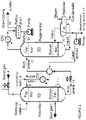
- Figure 2 is a diagram illustrating an embodiment of an amine unit.
- Race amount refers to the amount of mercury in the natural gas. The amount varies depending on the natural gas source, ranging from a few ⁇ g/Nm 3 to up to 30,000 ⁇ g/Nm 3 .
- Volatile mercury refers to mercury that is present in the gas phase of well gas or natural gas. Volatile mercury is primarily elemental mercury (Hg 0 ) but may also include some other mercury compounds (organic and inorganic mercury species).
- Mercury sulfide may be used interchangeably with HgS, referring to mercurous sulfide, mercuric sulfide, and mixtures thereof.
- mercury sulfide is present as mercuric sulfide with an approximate stoichiometric equivalent of one mole of sulfide ion per mole of mercury ion.
- Mercury sulfide is not appreciably volatile, and not an example of volatile mercury.
- Crystalline phases include cinnabar, metacinnabar and hypercinnabar with metacinnabar being the most common.
- hydrogen sulfide is not a sulfane.
- Weight gas refers to natural gas that contains less methane (e.g., less than 85%) and more ethane and other more complex hydrocarbons.
- Amine refers to amines for use in gas treating, including but not limited to monoethanolamine (MEA), diethanolamine (DEA), methyldiethanolamine (MDEA), aminoethoxyethanol (diglycolamine) (DGA), triethanolamine (TEA), diisopropylamine (DIPA), proprietary amines known in the art and commercially available, and mixtures thereof.
- MEA monoethanolamine
- DEA diethanolamine
- MDEA methyldiethanolamine
- DGA aminoethoxyethanol
- TEA triethanolamine
- DIPA diisopropylamine
- proprietary amines known in the art and commercially available and mixtures thereof.
- the most commonly used amines are the alkanolamines such as MEA, DEA, and MDEA.
- Acid gas refers to the product gas from an amine unit that contains acidic impurities, e.g., H 2 S, CO 2 , SO 2 and SO 2 (SO x ), NO and NO 2 (NO 2 ), chlorine, etc.
- the acid gas is chemically absorbed in the liquid (solution or fluid).
- the acid gas is dissolved in the liquid, e.g., an aqueous amine solution.
- Amine unit refers to a process or a group of processes using aqueous solutions of various amines to remove hydrogen sulfide (H2S) and carbon dioxide (CO2) from gases.
- Amine unit can be located in refineries, petrochemical plants, natural gas processing plants and other industries. It is also known as “gas sweetening” or “acid gas removal” unit.
- Acid gas refers to natural gas or any other gas mixture containing hydrogen sulfide (H 2 S), carbon dioxide (CO 2 ), or similar acidic gases.
- Standard gas refers to natural gas or flue gas prior to treatment, which contains acid gas and trace amounts of mercury as volatile mercury.
- Ratich amine refers to the aqueous amine solution containing absorbed acid gas.
- Lean amine refers to the amine after being regenerated by steam stripping to remove the absorbed acid gases and produce regenerated amine solution for use in the absorber to treat sour gas.
- “Sweetened gas” or “sweet gas” refers to a sour gas stream after treatment in an amine unit, after absorption / removal of acid gas by an amine solution, and flows overhead from the absorber (scrubber or amine contactor).
- the reference to "amine” is by way of exemplification only for a solute in which an acid gas is chemically absorbed and can be subsequently released.
- the reference to "H 2 S” is by way of exemplification only for an acid gas that can be chemically absorbed in a liquid system, e.g., amine, sour water, and can be subsequently released, and does not exclude other acid gases or mixtures thereof, e.g., mixture of H 2 S and CO 2 , mixture of SO 2 , NO 2 , chlorine.
- natural gas streams comprise low molecular weight hydrocarbons such as methane, ethane, propane, other paraffinic hydrocarbons that are typically gases at room temperature, etc.
- Mercury is present in natural gas as volatile mercury, including elemental mercury Hg 0 , in levels ranging from about 0.01 ⁇ g/Nm 3 to 5000 ⁇ g/Nm 3 .
- the mercury content may be measured by various conventional analytical techniques known in the art, including but not limited to cold vapor atomic absorption spectroscopy (CV-AAS), inductively coupled plasma atomic emission spectroscopy (ICP-AES), X-ray fluorescence, or neutron activation. If the methods differ, ASTM D 6350 is used to measure the mercury content.
- the invention relates to an improved method to remove mercury present in natural gas feedstock, e.g., wet gas feed, in a gas processing plant.
- gas processing plant may be used interchangeably with "gas production facility.”
- the mercury removal is carried out in the amine treating unit and / or the gas dehydration unit of with the use of a complexing agent.
- FIG. 1 is a schematic diagram illustrating the various processes within a typical natural gas processing plant. Natural gas collected from gas wells is first processed in step 10 for the removal of liquid water and natural gas condensate, generating a gas feed which typically contains acid gases and water vapor, which is typically referred to as a sour gas. The initial water removal step can be done at the processing plant, or it can be at the collection point.
- the sour gas feed is purified with the removal of acid gases by absorption with an amine solution, generating a gas stream with reduced concentration of acid gases.
- the acid gases can be routed into a sulfur recovery unit 15 to recover elemental sulfur.
- the residual gas is processed in the tail gas treating unit 40.
- the sweetened gas having a reduced concentration of acid gases is routed to dehydrator 45, where a solution such as glycol is used to remove water vapor by absorption.
- a solution such as glycol is used to remove water vapor by absorption.
- mercury is then removed by adsorption using activated carbon or other adsorbents known in the art.
- nitrogen is optionally removed in process step 60 in a cryogenic or adsorption process.
- the residue gas from the natural gas liquid (NGL) recovery process 20 is the final purified gas which can be pipelined to the end-user market, or optionally sent to a fractionation train 25 with distillation towers to generate various products such as propane, butane, C5+, etc.
- the various gases can also be sweetened in unit 26 with the removal of mercaptans, prior to being pipelined to the end-user market.
- the invention relates to the removal of mercury from feed to a gas processing plant.
- mercury removal is carried out in the amine unit concurrent with the removal of acid gas from the sour gas feed with the addition of a complexing agent to the amine solution.
- mercury removal is carried out concurrently with the removal of water in a gas dehydration unit (in addition to or instead of the amine unit), with the addition of a complexing agent to the glycol solution.
- the complexing agent for the mercury removal can be generated on-site, e.g., manufacture of polysulfide solutions from elemental sulfur and sulfidic solutions, or the manufacture of sodium sulfide solutions from sodium carbonate and sulfur sources if available on site.
- (lean) amine scrubbing solution is used to remove acid gases such as hydrogen sulfide (H 2 S) and carbon dioxide from the sour feed steam in an absorber, generating a rich amine stream.
- acid gases such as hydrogen sulfide (H 2 S) and carbon dioxide
- a sufficient amount of a complexing agent is added to the absorber for the removal of mercury concurrently with the removing of acid gases from the sour feed stream by the amine scrubbing solution.
- the complexing agent coverts at least a portion of the volatile mercury in the sour gas feed into a non-volatile form, extracted from the gas phase into the amine scrubbing solution.
- the amount of amine in the scrubbing solution feed to the absorber depends on the amount of acid gases in the natural gas to be treated (acid loadings), and based on the moles of H 2 S (and / or CO 2 ) per mole of amine in solution. In one embodiment, the ratio of absorbed acid gases to amine ranges from 0.3 to 0.9.
- amines suitable for use in the scrubbing solution include MEA, DEA, TEA, DIPA, MDEA, and mixtures thereof.
- the lean amine in the absorption solution is selected from monoethanolamine (MEA), aminoethoxyethanol(diglycoamine) (DGA), and mixtures thereof.
- the concentration of amines in the scrubbing solution varies depending on the amine type, and the acid gases for removal, e.g., H 2 S and CO 2 or removing CO 2 only, etc.
- the amine concentration (as wt. % of pure amine in the aqueous solution) ranges from 15-65% in one embodiment, from 20-55% in a second embodiment, and from 25-45% in a third embodiment.
- the scrubbing solution further comprises absorption promoters and other additives, e.g., piperazine.
- the complexing agent is added to the lean amine feed to the absorber in one embodiment; as a separate feed stream to the absorber in a second embodiment; and as the same feed with the make-up water stream to the absorber in a third embodiment.
- the complexing agent is added in an amount of less than 5 vol. % of total scrubbing solution in the amine absorber in one embodiment; less than 3 vol. % in a second embodiment; less than 1 vol. % in a third embodiment; and less than 0.5 vol. % in a third embodiment.
- the complexing agent contains little if any non-volatile alkali metals or alkali earth cations (none purposely added), e.g., with no sodium polysulfide or other sodium salts, as the sodium cation will accumulate in the amine recycle and degrade its performance.
- the first complexing agent comprises volatile cations selected from ammonium polysulfide, amine polysulfides, and sulfanes.
- mercury removal is carried out in the dehydrator unit ("dehydrator") in addition to, or in place of (not according to the invention) mercury removal in the amine unit.
- the dehydrator can be tray columns or packed columns in one embodiment.
- a liquid desiccant dehydrator such as glycol serves to absorb water vapor from the gas stream.
- Glycol has a chemical affinity for water, upon contact with a stream of natural gas that contains water in a dehydrator (e.g., a contactor, an absorber, etc.), will serve to 'steal' the water out of the gas stream.
- the glycol stream containing water (and mercury) is referred to as "rich glycol.”
- the glycol solution typically involves either diethylene glycol (DEG) or triethylene glycol (TEG).
- DEG diethylene glycol
- TEG triethylene glycol
- the glycol solution is employed in a concentration ranging from 99.1% up to 99.95% wt, in an amount sufficient to strip water at a rate of 0.5 - 6 scf (0.01-0.2 sm 3 ) of gas feed / gallon (3.8 liter) of glycol, for a dehydrated gas having water specifications of less than 1 lb. / MMSCF (Million Standard Cubic Feet).
- the dehydrated gas having been stripped of most of its water content has a concentration of less than 100 ⁇ g/Nm 3 mercury in one embodiment; less than 10 ⁇ g/Nm 3 mercury in a second embodiment; less than 1 ⁇ g/Nm 3 in a third embodiment; and less than 0.1 ⁇ g/Nm 3 mercury in a fourth embodiment.
- the dehydrated gas is further processed, e.g., nitrogen injection, NGL recovery, fractionation, etc.
- the complexing agent is added as part of the glycol solution feed to the dehydrator. In another embodiment, it is added as a separate feed stream to the dehydrator.
- the complexing agent is added in an amount of less than 5 vol. % of total glycol solution to the dehydrator in one embodiment; less than 3 vol. % in a second embodiment; less than 1 vol. % in a third embodiment; and less than 0.5 vol. % in a third embodiment.
- Complexing agent refers to a material or compound that is capable of extracting volatile mercury in natural gas into the liquid phase, forming non-volatile mercury complexes.
- non-volatile mercury complexes include HgS and soluble mercury sulfur compounds (e.g. HgHS 2 - or HgS 2 2- ).
- the first complexing agent comprises volatile cations selected from ammonium polysulfide, amine polysulfides, and sulfanes.
- the present invention may employ a second complexing agent being water-soluble and selected from sulfides, hydrosulfides, polysulfides, amine polysulfides, sodium hydrosulfide, potassium hydrosulfide, ammonium hydrosulfide, sodium sulfide, potassium sulfide, calcium sulfide, magnesium sulfide, ammonium sulfide, sodium thiocarbamate, sodium dithiocarbamate, ammonium thiocarbamate, ammonium dithiocarbamate, and mixtures thereof.
- a second complexing agent being water-soluble and selected from sulfides, hydrosulfides, polysulfides, amine polysulfides, sodium hydrosulfide, potassium hydrosulfide, ammonium hydrosulfide, sodium sulfide, potassium sulfide, calcium sulfide, magnesium sulfide, ammonium sulfide, sodium thiocarbamate,
- complexing agents include but are not limited to water-soluble sulfur species, e.g., sulfides, hydrosulfides, and polysulfides, for extracting mercury in natural gas into the aqueous phase as precipitate (e.g., HgS) or soluble mercury sulfur compounds (e.g. HgS 2 2- ).
- water-soluble sulfur species e.g., sulfides, hydrosulfides, and polysulfides
- HgS soluble mercury sulfur compounds
- water-soluble sulfur compounds include amine polysulfides, sodium hydrosulfide, potassium hydrosulfide, ammonium hydrosulfide, sodium sulfide, potassium sulfide, calcium sulfide, magnesium sulfide, ammonium sulfide, sodium thiocarbamate, sodium dithiocarbamate, ammonium thiocarbamate, ammonium dithiocarbamate, and mixtures thereof.
- Aqueous source containing water-soluble sulfur species can be any of purchased or produced reagent solutions, sulfidic water, sulfidic waste water, kraft caustic liquor, kraft carbonate liquor, etc.
- the amount of complexing agents to be added to the amine scrubbing solution and / or the glycol solution is determined by the effectiveness of complexing agent employed.
- the complexing agent to be added to the amine scrubbing solution can be the same or different from the complexing agent added to the glycol solution.
- the amount is at least equal to the amount of mercury in the gas on a molar basis (1:1), if not in an excess amount.
- the molar ratio ranges from 5:1 to 10,000:1.
- a molar ratio of sulfur additive to mercury ranging from 50:1 to 2500:1.
- a sufficient amount of the complexing agent is added to the amine scrubber for a sulfide concentration ranging from 0.05 M to 10M in one embodiment; from 0.1M to 5M in a second embodiment; from 0.3M to 4M in a third embodiment; and at least 0.5M in a fourth embodiment.
- the mercury complexing agent is an organic polysulfide, sulfane or mercaptan, the moles of complexing agent are calculated on the same basis as the amount of sulfur present.
- the complexing agent is an inorganic polysulfide such as sodium polysulfide, for an extraction of mercury from the natural gas according to equation: Hg (g) + Na 2 S x (aq) + H 2 O -> HgS 2 H - (aq) + Na 2 S x-2 (aq) + OH - (aq), where (g) denotes the mercury in the gas phase, and (aq) denotes a species in water. The charges are balanced by other species. Solid HgS is not formed and the mercury remains in solution as an anionic species.
- inorganic polysulfide such as sodium polysulfide
- the complexing agent is a compound with a relatively high boiling point, e.g., not too volatile and above 100°C in one embodiment and above 125°C in another embodiment. If not, the complexing agent would be lost in the stripping operation for the removal of adsorbed acid gas from the acid gas scrubbing solution.
- the complexing agent is sodium sulfide. Sodium sulfide and other complexing agents may promote the removal of mercury from gas streams containing high CO 2 concentrations but low H 2 S concentrations.
- the complexing agent is hydrogen sulfide (H 2 S) or a combination of hydrogen sulfide and one or more of the above-mentioned complexing agents.
- the complexing agent is added to the absorber (scrubber) and / or the contactor (dehydrator), allowing the extraction of volatile mercury from the sour gas feed into the scrubbing solution of rich amine or the glycol solution, for a sweetened gas stream having a reduced concentration of acid gas as well as a mercury concentration of less than 50% of the mercury originally present in one embodiment (at least 50% mercury removal).
- the sweetened gas contains less than 10% of the original mercury level (at least 90% removal).
- the mercury content in the sweetened gas stream will depend on the mercury content of the feed and the percent removal.
- the mercury content is reduced to below 100 ⁇ g/Nm 3 in one embodiment, less than 10 ⁇ g/Nm 3 in a second embodiment, less than 1 ⁇ g/Nm 3 in a third embodiment, and less than 0.1 ⁇ g/Nm 3 in a fourth embodiment.
- the glycol solution leaving the dehydrator unit contains at least 50% of the mercury initially present in the gas feed (to the dehydrator).
- the solution contains at least 75% of the mercury originally present in a second embodiment; and at least 90% in the third embodiment.
- Optional additives In one embodiment in addition to the complexing agent, at least one of an anti-foam and / or a demulsifier is added to the glycol solution.
- an anti-foam includes both anti-foam and defoamer materials, for preventing foam from happening and / or reducing the extent of foaming. Additionally, some anti-foam material may have both functions, e.g., reducing / mitigating foaming under certain conditions, and preventing foam from happening under other operating conditions.
- Anti-foam agents can be selected from a wide range of commercially available products such as silicones, e.g., polydimethyl siloxane (PDMS), polydiphenyl siloxane, fluorinated siloxane, etc., in an amount of 1 to 500 ppm.
- silicones e.g., polydimethyl siloxane (PDMS), polydiphenyl siloxane, fluorinated siloxane, etc.
- a demulsifier is added in a concentration from 1 to 5,000 ppm. In another embodiment, a demulsifier is added at a concentration from 10 to 500 ppm.
- the demulsifier is a commercially available demulsifier selected from polyamines, polyamidoamines, polyimines, condensates of o-toluidine and formaldehyde, quaternary ammonium compounds and ionic surfactants.
- the demulsifier is selected from the group of polyoxyethylene alkyl phenols, their sulphonates and sodium sulphonates thereof.
- the demulsifier is a polynuclear, aromatic sulfonic acid additive.
- an oxygen scavenger is preferably added to any of the glycol solution, the amine solution, and the absorbent.
- the oxygen scavenger may be present in an amount ranging from 0.001 to 1 wt. %, based on the weight of the glycol solution, lean amine, or absorbent.
- the oxygen scavenger removes traces of dissolved oxygen present, minimizing corrosion impact.
- oxygen scavengers examples include bisulfites, metabisulfites, hydrazine salts, hydroxylamine salts, guanidine salts, N,N-Diethylhydroxylamine, oximes, dithionites, ascorbic acid, and isoascorbic acid.
- the anion salts of these oxygen scavengers can be chlorides, sulfates, and other suitable anions.
- the cations associated with the oxygen scavengers can be sodium, potassium or volatile cations as described for the complexing agents. Volatile cations are preferred when they are used in an amine unit.
- a compatible oxygen scavenger is one that does not react with the mercury complexing agent and reduce its effectiveness for mercury capture.
- oxygen scavengers that react with a complexing agent such as polysulfide include bisulfites and metabisulfite.
- the oxygen scavenger is selected for compatibility with the mercury complexing agent.
- compatible oxygen scavengers include: hydrazine salts, guanidine salts, N,N-Diethylhydroxylamine, oximes, dithionites, ascorbic acid, and isoascorbic acid.
- the resultant rich amine containing non-volatile mercury and acid gases from the absorber is routed into the regenerator.
- the regenerator (a stripper with a reboiler)
- a "lean" amine containing non-volatile mercury is regenerated for recycle / subsequent reuse in the absorber to remove acid gases.
- the regenerator overhead gas undergoes further processing in a sulfur unit, e.g., to make sulfuric acid from the acid gas H 2 S, or combusted for subsequent venting. Removal of the mercury in the amine absorber gives an acid gas product with reduced mercury. This enables the production of sulfuric acid, or elemental sulfur, with reduced mercury.
- the regenerator overhead gas is first routed through a condenser set up for the removal of water by condensation, then subsequently sent to a mercury removal unit (MRU) for the removal of mercury using processes and equipment known in the art.
- MRU mercury removal unit
- a portion of the mercury-containing amine adsorbent can be continuously or intermittently purged from the amine unit / removed from the scrubber, and replaced with fresh amine.
- other remediation actions include: a) the contaminated amine solution is purged (bled) on a continuous or intermittent basis and replaced with fresh amine; b) the entire inventory of amine is replaced; and c) reclaiming the solution.
- Reclaiming the solution to remove non-volatile mercury as removed from the natural gas feed to the amine unit can be done by a variety of processes and systems known in the art for the removal of heat stable salts, including but not limited to filtration, centrifugation, precipitation, reduction to elemental mercury followed stripping, distillation, adsorption, ion exchange, electrodialysis, or transfer to a hydrocarbon steam and separation, and combinations thereof.
- the rich glycol bearing non-volatile mercury and water stripped from the natural gas is put through a specialized boiler designed to vaporize only the water out of the solution. While water has a boiling point of 212°F (100 °C), glycol does not boil until 400°F (204 °C). This boiling point differential makes it relatively easy to remove water from the rich glycol, allowing it be reused in the dehydration process.
- mercury remains in the rich glycol bottom, with water going overhead in the glycol regenerator.
- mercury can be removed from the bottom stream by techniques known in the art such as ion-exchange or sub-atmospheric pressure distillation.
- residual mercury in the rich glycol can be removed by other processes known in the art, including but are not limited to filtration, centrifugation, precipitation, reduction to elemental mercury followed stripping, distillation, adsorption, ion exchange, or transfer to a hydrocarbon steam and separation, and combinations. Alternatively a portion of the mercury-containing rich glycol stream can be purged from the system.
- the non-volatile mercury complexes can be removed from the regenerated / recycled rich glycol with the use of a mercury absorber containing a bed of sulphided absorbent as disclosed in US Patent No. 7435338 .
- FIG. 2 a diagram schematically illustrating an embodiment of a system and process for removing mercury from natural gas / flue gas (sour gas feed) in an amine unit.
- (lean) amine scrubbing solution 5 is used to remove acid gases from a sour gas feed 1 in absorber 10 generating a rich amine stream.
- mercury complexing agent 6 is added to the lean scrubbing solution feed to the scrubber.
- mercury complexing agent can also be provided as any of a separate feed stream, part of the make-up water stream to the scrubber, or combinations thereof.
- different complexing agents can be added to the amine unit as different feed streams.
- the mercury complexing agent(s) can be added continuously or intermittently.
- Sweetened gas stream 4 with reduced concentration of acid gas and mercury is removed from the scrubber for subsequent treatment with a glycol dehydrator (not shown).
- the rich amine solution 31 undergoes steam stripping in stripper 30 for the removal of weak acids such as H 2 S and CO 2 as overhead stream 34, wherein the stripping steam is generated from the amine solution in a reboiler 40 that takes its feed 32 from the regenerator tower below the steam stripping section.
- At least a portion of non-volatile mercury in the rich amine is also released from the amine solution in stripper 30 and/or reboiler 40 as volatile mercury that leaves the process with overhead stream 34.
- the overhead stream is directed to a mercury removal unit, e.g., a mercury removal adsorbent bed, for the mercury to be removed by adsorption.
- HSS Heat Stable Salts
- HSAS Heat Stable Amine Salts
- examples include but are not limited to formate, acetate, glycolate, propionate, oxalate, chloride, sulfate, thiosulfate, and thiocyanate.
- a portion of the HSS is removed with at least a portion of the non-volatile mercury in the bleed stream 41.
- the claimed invention provides a method for removing a trace amount of mercury in a natural gas feed which employs an absorption solution comprising lean amine and a first complexing agent comprising volatile cations selected from ammonium polysulfide, amine polysulfides, and sulfanes, wherein the lean amine in the absorption solution is selected from monoethanolamine (MEA), aminoethoxyethanol(diglycoamine) (DGA), and mixtures thereof.
- MUA monoethanolamine
- DGA aminoethoxyethanol(diglycoamine)
- any of these illustrative examples that do not employ an absorption solution comprising a lean amine selected from monoethanolamine (MEA), aminoethoxyethanol(diglycoamine) (DGA), and mixtures thereof as defined in claim 1 fall outside the scope of the claims.
- a lean amine selected from monoethanolamine (MEA), aminoethoxyethanol(diglycoamine) (DGA), and mixtures thereof as defined in claim 1
- Example 1 The example was to investigate the retention of mercury in absorbents, a lean amine from a refinery acid gas scrubber was sampled and analyzed, and found to contain 250 ppb mercury. The lean amine was stripped with 300 cc/min nitrogen at room temperature for one hour. It was found that the mercury content of the lean amine was not changed. The lean amine was centrifuged at 1500 RPM for 10 minutes. The mercury content of the supernatant was analyzed and found to be unchanged.
- the lean amine containing mercury was filtered through a 0.2 ⁇ filter.
- the mercury content of the supernatant was analyzed and found to be unchanged. It is concluded that the mercury which is present in the lean amine is a non-volatile mercury species, and is not present in the form of large particles. Since this mercury species was found in the lean amine from the commercial unit, it was not decomposed to solids or volatile elemental mercury by the temperatures, pressures and residence times in the amine regeneration process.
- Example 2 In this example, a sample of volatile Hg 0 was dissolved in white oil. This material is used to study the conversion of volatile mercury (Hg 0 ) into non-volatile mercury (HgS and other forms). First, five grams of elemental mercury Hg 0 was placed in an impinger at 100°C and 0.625 SCF/min of nitrogen gas was passed over through the impinger to form an Hg-saturated nitrogen gas stream. This gas stream was then bubbled through 3123 pounds of Superla ® white oil held at 60-70°C in an agitated vessel. The operation continued for 55 hours until the mercury level in the white oil reached 500 ppbw by a Lumex TM analyzer. The simulated material was drummed and stored.
- Example 3 In this example, volatile mercury was shown to be absorbed by an aqueous solution of sodium polysulfide.
- a gas containing volatile mercury was prepared by sparging nitrogen through the white oil of Example 2 and this gas was bubbled through a 10 wt% solution of sodium polysulfide at room temperature. Mercury was transferred from the white oil to the polysulfide solution. The mercury content of the stripped oil was reduced below the limit of detection, while > 70% of the mercury initially in the oil was measured in the polysulfide solution. The extent of mercury capture in this bubbler experiment was not optimized, but the test showed the ability of complexing agents such as sodium polysulfide to capture mercury from a gas stream in a non-volatile form that is soluble in the polysulfide solution.
- Examples 4 - 16 To study the conversion of volatile mercury to non-volatile mercury, 20 ml of the material from Example 2 was placed in a series of vials. The mercury analysis of the samples averaged 359 ppbw, indicating some loss of mercury over the years that the sample was stored.
- Example 17 In a three-neck flask with a Teflon stirrer (as glass reactor) was placed a 200 ml of solution of stannous chloride and sulfuric acid, for a concentration of 10% stannous chloride and 5% sulfuric acid. When mercury vapors were to be generated, 0.5 cc of a 209.8 ppm Hg solution of mercuric chloride in water was injected into the reactor via a septum. The stannous chloride rapidly reduced the mercury to elemental mercury. In the glass reactor was a line carrying 300 cc/min of nitrogen which bubbled in the reducing acidic stannous chloride solution. This was used to sweep the evolved elemental mercury to the downstream absorbers.
- the glass reactor was connected to two absorbers in series, each of which contained 200 ml of solution.
- the absorbers were equipped with a glass frit to produce small bubbles. The bubbles contacted the absorbing solution for about one second.
- the first absorber contained the test solution.
- the second contained 3% sodium polysulfide in water.
- the 3% sodium polysulfide solution was prepared by dilution of a 30% solution of sodium polysulfide.
- This second absorber was a scrubber to remove the last traces of mercury from the nitrogen to provide mercury mass closures. Analysis of the exit gas from the second absorber by both Lumex and Jerome techniques found no detectable mercury.
- the efficiency of the test solutions was calculated by comparing the amount of mercury taken up in the first reactor absorber to the amount taken up in both absorbers. If no mercury was taken up in the first reactor with the test solution, the efficiency was zero percent. If all the mercury was taken up in the first reactor, the efficiency was 100%. At the end of the experiments no evidence of precipitated HgS was observed in the absorbers. The solutions were clear.
- Examples 18 - 21 The experiments were to evaluate the Hg uptake in various solutions without the complexing agent according to the procedures in Example 17. The results are shown in Table 2.
- a 56% MEG solution was prepared by mixing 56 wt. % monoethylene glycol (MEG) in DI water. MEG solutions are typically used to prevent the formation of hydrates in gas pipelines that also contain water.
- a 45% MDEA solution was prepared by mixing 45 percent Methyl diethanolamine in DI water. MDEA solutions are typically used in acid gas scrubbers which remove hydrogen sulfide, carbon dioxide and other acidic gases from natural gas. 100% TEG was pure triethylene glycol. TEG is used to dehydrate gases.
- Table 2 Example Solvent Efficiency % 18 DI Water 0 19 56% MEG 0 20 45% MDEA 0 21 100% TEG 0
- Examples 22-38 These experiments are to evaluate sodium polysulfide as complexing agent in the removal of mercury.
- Sodium polysulfide is highly effective in capturing elemental mercury vapors at 1 second of contact, even when the sulfur to mercury stoichiometric ratio is near 2.
- Sodium polysulfide was added in varying amounts to the four solvents as listed and tested according to the procedure of example 17. Results are shown in Table 3.
- Examples 39-62 These experiments are to evaluate ammonium polysulfide as complexing agent in the removal of mercury. Ammonium polysulfide and sodium polysulfide are both used in refineries to control cyanides and to moderate corrosion. If ammonium polysulfide is used then the sodium cation can be avoided, such as in amine absorbers. Using the transient method of example 17, the efficiency of ammonium polysulfide in various solvents was explored and results are shown in Table 4.
- Examples 49 - 56 The experiments are to evaluate the removal of aqueous Hg anions by ion exchange and adsorption, showing that anion mercury can be removed by anion exchange resins or adsorbents.
- the 10 ml of a solution containing anionic mercury were contacted with approximately 0.1 grams of various adsorbents to study the removal of mercury.
- the solution was a 56% MEG solution in water with 2439 ppm ammonium polysulfide and 267 ppb mercury.
- the adsorbents were Darco Carbon (Aldrich 242276), Activated Carbon (Aldrich C2889), and various Siemen's anion exchange resins: A-244OH, A-464OH, A-674OH, A-714OH, and A-284C Resins.
- the solutions and the solid adsorbents were mixed overnight at room temperature on a rotating wheel, and the mercury content of the aqueous solution was determined in the morning along with the mercury content of the adsorbent.
- Table 5 Table 5
- Example 57 contained ammonium polysulfide only and is a reference.
- Examples 58 and 59 show that hydroxylamine and sodium bisulfite suppress the ability of ammonium polysulfide to capture mercury.
- examples 60 to 65 show that other oxygen scavengers do not suppress the ability of polysulfides to capture mercury and some increase its ability. These are examples of compatible oxygen scavengers.
- the term "include” and its grammatical variants are intended to be non-limiting, such that recitation of items in a list is not to the exclusion of other like items that can be substituted or added to the listed items.
- the terms “comprises” and/or “comprising,” when used in this specification, specify the presence of stated features, integers, steps, operations, elements, and/or components, but do not preclude the presence or addition of one or more other features, integers, steps, operations, elements, components, and/or groups thereof. Unless otherwise defined, all terms, including technical and scientific terms used in the description, have the same meaning as commonly understood by one of ordinary skill in the art to which this invention belongs.
Landscapes
- Chemical & Material Sciences (AREA)
- Oil, Petroleum & Natural Gas (AREA)
- Engineering & Computer Science (AREA)
- Chemical Kinetics & Catalysis (AREA)
- General Chemical & Material Sciences (AREA)
- Organic Chemistry (AREA)
- Analytical Chemistry (AREA)
- Health & Medical Sciences (AREA)
- Biomedical Technology (AREA)
- Environmental & Geological Engineering (AREA)
- Treating Waste Gases (AREA)
- Gas Separation By Absorption (AREA)
Claims (9)
- Procédé pour l'élimination d'une quantité de traces de mercure dans une alimentation de gaz naturel, comprenant :la fourniture d'une alimentation de gaz contenant une première concentration de mercure volatil et de gaz acides ;la mise en contact de l'alimentation de gaz dans un absorbeur avec une solution d'absorption comprenant une amine pauvre et un premier agent de complexation comprenant des cations volatils choisis parmi un polysulfure d'ammonium, des polysulfures d'aminé, et des sulfanes, la solution d'absorption éliminant simultanément du mercure et du mercure non volatil et des gaz acides de l'alimentation de gaz ;la génération d'une solution d'aminé riche contenant des gaz acides et au moins 50 % du mercure volatil dans l'alimentation de gaz comme mercure non volatil et d'un flux de gaz traité doté d'une deuxième concentration de gaz acides et de mercure,un sulfane étant un complexe hydrogène-soufre de la formule H2Sx où x ≥ 2 ; etl'amine pauvre dans la solution d'absorption étant choisie parmi la monoéthanolamine (MEA), l'aminoéthoxyéthanol (diglycolamine) (DGA), et des mélanges correspondants.
- Procédé selon la revendication 1, comprenant en outre :la mise en contact du flux de gaz traité avec une solution de glycol dans un déshydrateur, la solution de glycol contenant un deuxième agent de complexation pour la solution de glycol pour éliminer simultanément du mercure et de la vapeur d'eau du flux de gaz traité,la génération d'un glycol riche contenant du mercure non volatil et d'un flux de gaz déshydraté doté d'une concentration réduite en eau et d'une troisième concentration de mercure, la troisième concentration de mercure étant inférieure à 50 % de la deuxième concentration de mercure,le deuxième agent de complexation étant soluble dans l'eau et choisi parmi des sulfures, des hydrosulfures, des polysulfures, des polysulfures d'aminé, de l'hydrosulfure de sodium, de l'hydrosulfure de potassium, de l'hydrosulfure d'ammonium, du sulfure de sodium, du sulfure de potassium, du sulfure de calcium, du sulfure de magnésium, du sulfure d'ammonium, du thiocarbamate de sodium, du dithiocarbamate de sodium, du thiocarbamate d'ammonium, du dithiocarbamate d'ammonium, et des mélanges correspondants.
- Procédé selon la revendication 2, comprenant en outre :l'élimination du mercure non volatil du glycol riche par au moins l'un parmi une filtration, une centrifugation, une précipitation, un strippage, une distillation, une adsorption, un échange d'ions, une électrodialyse, un flux d'hydrocarbure et une étape de séparation, et des combinaisons correspondantes,la génération d'un flux de glycol recyclé possédant une concentration réduite en mercure de moins de 50 % du mercure non volatil dans le glycol riche.
- Procédé selon l'une quelconque des revendications 1 à 3, la solution d'absorption comprenant une amine pauvre possédant une concentration en amine dans la plage de 15 à 65 % en poids ; oule cation volatil étant un polysulfure d'ammonium ; ouau moins 90 % de mercure volatil étant éliminé de l'alimentation de gaz dans la solution d'absorption, éventuellement au moins 95 % de mercure volatil étant éliminé de l'alimentation de gaz dans la solution d'absorption.
- Procédé selon l'une quelconque des revendications 1 à 3, le flux de gaz traité contenant moins de 100 µg/Nm3 de mercure, éventuellement moins de 10 µg/Nm3 de mercure, éventuellement moins de 1 µg/Nm3 de mercure, éventuellement moins de 0,1 µg/Nm3 de mercure.
- Procédé selon l'une quelconque des revendications 1 à 3, l'agent de complexation étant ajouté en une quantité de moins de 5 % en volume de la solution d'absorption à l'absorbeur, éventuellement en une quantité de moins de 1 % en volume de la solution d'absorption à l'absorbeur, éventuellement en une quantité de moins de 0,5 % en volume de la solution d'absorption à l'absorbeur.
- Procédé selon l'une quelconque des revendications 1 à 3, comprenant en outre :le chauffage de la solution d'aminé riche contenant des gaz acides et du mercure non volatil dans un processus de régénération de solvant employant au moins un strippeur et un rebouilleur,
etla génération d'une amine pauvre contenant du mercure non volatil pour un recyclage dans un absorbeur pour éliminer des gaz acides. - Procédé selon la revendication 7, comprenant en outre :
le traitement de l'amine pauvre pour éliminer le mercure non volatil par des processus choisis dans le groupe constitué par une filtration, une centrifugation, une précipitation, une réduction en mercure élémentaire suivie par un strippage, une distillation, une adsorption, un échange d'ions, une électrodialyse, ou un transfert à un flux d'hydrocarbure et une séparation, et des combinaisons correspondantes. - Procédé selon l'une quelconque des revendications 2 et 3, la solution de glycol comprenant en outre au moins l'un parmi un antimousse, un désémulsifiant, un agent de piégeage d'oxygène compatible, et des mélanges correspondants,le désémulsifiant étant choisi parmi des polyamines, des polyamidoamines, des polyimines, des condensats d'o-toluidine et de formaldéhyde, des composés de type ammonium quaternaire, des tensioactifs ioniques, des polyoxyéthylène-alkylphénols, un additif de type acide sulfonique aromatique, et des mélanges correspondants, etl'agent de piégeage d'oxygène étant choisi dans le groupe composé des sels d'hydrazine, des sels de guanidine, la N,N-diéthylhydroxylamine, des oximes, des dithionites, l'acide ascorbique, et l'acide isoascorbique, et des mélanges correspondants, etl'agent antimousse étant un matériau de silicone.
Applications Claiming Priority (4)
| Application Number | Priority Date | Filing Date | Title |
|---|---|---|---|
| US201261697855P | 2012-09-07 | 2012-09-07 | |
| US201261697867P | 2012-09-07 | 2012-09-07 | |
| EP13835682.9A EP2892631B1 (fr) | 2012-09-07 | 2013-09-06 | Procédé permettant d'éliminer du mercure présent dans du gaz naturel |
| PCT/US2013/058398 WO2014039758A2 (fr) | 2012-09-07 | 2013-09-06 | Processus, procédé et système permettant d'éliminer des métaux lourds présents dans des fluides |
Related Parent Applications (1)
| Application Number | Title | Priority Date | Filing Date |
|---|---|---|---|
| EP13835682.9A Division EP2892631B1 (fr) | 2012-09-07 | 2013-09-06 | Procédé permettant d'éliminer du mercure présent dans du gaz naturel |
Publications (2)
| Publication Number | Publication Date |
|---|---|
| EP3476460A1 EP3476460A1 (fr) | 2019-05-01 |
| EP3476460B1 true EP3476460B1 (fr) | 2022-11-02 |
Family
ID=50233478
Family Applications (2)
| Application Number | Title | Priority Date | Filing Date |
|---|---|---|---|
| EP18205265.4A Active EP3476460B1 (fr) | 2012-09-07 | 2013-09-06 | Procédé pour éliminer du mercure contenu dans du gaz naturel |
| EP13835682.9A Active EP2892631B1 (fr) | 2012-09-07 | 2013-09-06 | Procédé permettant d'éliminer du mercure présent dans du gaz naturel |
Family Applications After (1)
| Application Number | Title | Priority Date | Filing Date |
|---|---|---|---|
| EP13835682.9A Active EP2892631B1 (fr) | 2012-09-07 | 2013-09-06 | Procédé permettant d'éliminer du mercure présent dans du gaz naturel |
Country Status (9)
| Country | Link |
|---|---|
| US (2) | US8790427B2 (fr) |
| EP (2) | EP3476460B1 (fr) |
| CN (1) | CN104736222B (fr) |
| AU (2) | AU2013312430B2 (fr) |
| CA (1) | CA2883609C (fr) |
| CL (3) | CL2015000556A1 (fr) |
| MY (1) | MY195976A (fr) |
| SG (2) | SG10201603906VA (fr) |
| WO (1) | WO2014039758A2 (fr) |
Families Citing this family (23)
| Publication number | Priority date | Publication date | Assignee | Title |
|---|---|---|---|---|
| SG11201407565SA (en) * | 2012-05-16 | 2014-12-30 | Chevron Usa Inc | Process, method, and system for removing mercury from fluids |
| DE102013003415A1 (de) * | 2013-02-28 | 2014-08-28 | Linde Aktiengesellschaft | Verfahren zum Behandeln eines Quecksilber und Sauergase enthaltenden Kohlenwasserstoff-reichen Gasgemisches |
| EP3065839A1 (fr) | 2013-11-04 | 2016-09-14 | Dow Corning Do Brasil Limitada | Composition de pétrole avec moins de mousse |
| US9926775B2 (en) | 2014-07-02 | 2018-03-27 | Chevron U.S.A. Inc. | Process for mercury removal |
| AU2016223189B2 (en) * | 2015-02-26 | 2021-07-01 | Chevron U.S.A. Inc. | Method for removing mercury from crude oil |
| AU2016262617A1 (en) * | 2015-05-14 | 2017-11-09 | Chevron U.S.A. Inc. | Process, method, and system for removing mercury from fluids |
| CN105169949A (zh) * | 2015-08-28 | 2015-12-23 | 安徽中烟工业有限责任公司 | 一种造纸法再造烟叶萃取液中As含量的选择性降低方法 |
| CN105146722A (zh) * | 2015-08-28 | 2015-12-16 | 安徽中烟工业有限责任公司 | 一种造纸法再造烟叶萃取液中Hg含量的选择性降低方法 |
| US20170158976A1 (en) * | 2015-12-08 | 2017-06-08 | Chevron U.S.A. Inc. | Compositions and methods for removing heavy metals from fluids |
| US10016719B2 (en) | 2016-05-26 | 2018-07-10 | Exxonmobil Chemical Patents Inc. | Reducing fouling in amine systems |
| US10041014B2 (en) * | 2016-06-10 | 2018-08-07 | Chevron U.S.A. Inc. | Process, method and system for removal of mercury in a gas dehydration process |
| WO2018013099A1 (fr) * | 2016-07-13 | 2018-01-18 | Fluor Technologies Corporation | Élimination d'hydrocarbures lourds à partir d'un gaz pauvre pour liquéfaction de gnl |
| US20180179451A1 (en) * | 2016-12-27 | 2018-06-28 | Lyra Energy SRL | Neutralization of hydrogen sulfide and light mercaptanes in hydrocarbon media |
| US10844156B2 (en) | 2018-03-16 | 2020-11-24 | King Fahd University Of Petroleum And Minerals | Cross-linked polymeric resin and methods of use |
| WO2019226720A1 (fr) * | 2018-05-21 | 2019-11-28 | Ada Carbon Solutions, Llc | Compositions de sorbant et procédés permettant d'éliminer des contaminants d'un flux de gaz |
| WO2020021633A1 (fr) * | 2018-07-24 | 2020-01-30 | 日揮グローバル株式会社 | Dispositif de traitement de gaz naturel et procédé de traitement de gaz naturel |
| CN109486541A (zh) * | 2018-11-30 | 2019-03-19 | 东南大学 | 一种天然气脱水用醇类溶剂中汞的脱除装置、方法及应用 |
| WO2022101833A1 (fr) * | 2020-11-12 | 2022-05-19 | Chevron U.S.A. Inc. | Élimination du mercure dans un processus de déshydratation de gaz à l'aide d'additifs chimiques thermiquement stables |
| US12083473B2 (en) | 2021-04-01 | 2024-09-10 | Chevron U.S.A. Inc. | Mercury removal by injection of reagents in gas phase |
| CN115532024B (zh) * | 2021-06-30 | 2025-12-12 | 中石化南京化工研究院有限公司 | 具有酸性气体吸收功能的组合物和应用 |
| CN114712990B (zh) * | 2022-03-17 | 2023-08-08 | 中国华能集团清洁能源技术研究院有限公司 | 一种co2再生装置及工艺方法 |
| WO2024177820A1 (fr) * | 2023-02-20 | 2024-08-29 | Ecolab Usa Inc. | Procédés de réduction de l'encrassement d'un équipement de traitement de gaz naturel en utilisant des compositions anti-mousse et de démoussage |
| US20250179381A1 (en) * | 2023-12-05 | 2025-06-05 | Chevron U.S.A. Inc. | Process to remove mercury from monoethylene glycol streams |
Family Cites Families (134)
| Publication number | Priority date | Publication date | Assignee | Title |
|---|---|---|---|---|
| US3831346A (en) * | 1973-05-09 | 1974-08-27 | Amoco Prod Co | Method for dehydration of wet gases |
| US4070165A (en) * | 1975-12-15 | 1978-01-24 | Uop Inc. | Pretreatment of raw natural gas prior to liquefaction |
| US4474896A (en) * | 1983-03-31 | 1984-10-02 | Union Carbide Corporation | Adsorbent compositions |
| US4708853A (en) | 1983-11-03 | 1987-11-24 | Calgon Carbon Corporation | Mercury adsorbent carbon molecular sieves and process for removing mercury vapor from gas streams |
| US4591490A (en) | 1984-10-19 | 1986-05-27 | Phillips Petroleum Co. | Removal of mercury from gases |
| US4895708A (en) | 1986-09-10 | 1990-01-23 | Mobil Oil Corporation | Removal of mercury from natural gas |
| US4709118A (en) | 1986-09-24 | 1987-11-24 | Mobil Oil Corporation | Removal of mercury from natural gas and liquid hydrocarbons utilizing downstream guard chabmer |
| US4701212A (en) | 1986-09-25 | 1987-10-20 | Mobil Oil Corporation | Recovery of mercury and heat energy from waste using fluidized beds |
| US4982050A (en) | 1986-10-06 | 1991-01-01 | Mobil Oil Corporation | Natural gas treating system including mercury trap |
| US4764219A (en) | 1986-10-27 | 1988-08-16 | Mobil Oil Corporation | Clean up and passivation of mercury in gas liquefaction plants |
| US4693731A (en) | 1986-10-27 | 1987-09-15 | The M. W. Kellogg Company | Removal of mercury from gases |
| US4834953A (en) * | 1987-09-30 | 1989-05-30 | Mobil Oil Corporation | Process for removing residual mercury from treated natural gas |
| US4814152A (en) | 1987-10-13 | 1989-03-21 | Mobil Oil Corporation | Process for removing mercury vapor and chemisorbent composition therefor |
| US4783201A (en) * | 1987-12-28 | 1988-11-08 | Rice Arthur W | Gas dehydration membrane apparatus |
| US5053209A (en) | 1988-01-09 | 1991-10-01 | Mobil Oil Corporation | Removal of mercury from natural gas and liquid hydrocarbons utilizing silver on alumina adsorbent |
| CA1323321C (fr) * | 1988-07-25 | 1993-10-19 | Kunio Sato | Procede d'elimination du mercure contenu dans un hydrocarbure liquide |
| US4892567A (en) | 1988-08-15 | 1990-01-09 | Mobil Oil Corporation | Simultaneous removal of mercury and water from fluids |
| US4874525A (en) | 1988-10-26 | 1989-10-17 | Uop | Purification of fluid streams containing mercury |
| US4962276A (en) | 1989-01-17 | 1990-10-09 | Mobil Oil Corporation | Process for removing mercury from water or hydrocarbon condensate |
| US4909926A (en) | 1989-02-01 | 1990-03-20 | Mobil Oil Corporation | Method for removing mercury from hydrocarbon oil by high temperature reactive adsorption |
| US5034203A (en) * | 1989-04-27 | 1991-07-23 | Mobil Oil Corporation | Removal of mercury from natural gas utilizing a polysulfide scrubbing solution |
| US5190908A (en) | 1991-06-24 | 1993-03-02 | Mobil Oil Corporation | Racked bed for removal of residual mercury from gaseous hydrocarbons |
| US5141724A (en) | 1991-10-07 | 1992-08-25 | Mobil Oil Corporation | Mercury removal from gaseous hydrocarbons |
| AU9038391A (en) | 1991-12-09 | 1993-07-19 | Dow Benelux N.V. | Process for removing mercury from organic media |
| US5322628A (en) * | 1992-09-08 | 1994-06-21 | Mobil Oil Corporation | Method for simultaneously drying and removing metallic and organic mercury from fluids |
| US5300137A (en) | 1992-09-18 | 1994-04-05 | Pittsburgh Mineral And Environmental Technology, Inc. | Method for removing mercury from contaminated soils and industrial wastes and related apparatus |
| US5223145A (en) | 1992-10-09 | 1993-06-29 | Uop | Removal of mercury from process streams |
| FR2698372B1 (fr) | 1992-11-24 | 1995-03-10 | Inst Francais Du Petrole | Procédé d'élimination de mercure et éventuellement d'arsenic dans des hydrocarbures. |
| US5281258A (en) | 1992-12-21 | 1994-01-25 | Uop | Removal of mercury impurity from natural gas |
| US5281259A (en) | 1992-12-21 | 1994-01-25 | Uop | Removal and recovery of mercury from fluid streams |
| US5419884A (en) * | 1993-02-19 | 1995-05-30 | Mobil Oil Corporation | Regenerative mercury removal process |
| US5354357A (en) | 1993-03-01 | 1994-10-11 | Uop | Removal of mercury from process streams |
| US5271760A (en) | 1993-03-01 | 1993-12-21 | Uop | Recovery of liquid mercury from process streams |
| WO1994022563A1 (fr) * | 1993-04-06 | 1994-10-13 | Shell Oil Company | Capture de metaux volatils contenus dans des courants gazeux |
| CA2114331C (fr) | 1993-06-10 | 2000-03-28 | Bernard J. Lerner | Elimination du mercure, du cadmium et de leurs composes presents dans les gaz de combustion |
| US5401393A (en) | 1993-09-14 | 1995-03-28 | Mobil Oil Corporation | Reactive adsorbent and method for removing mercury from hydrocarbon fluids |
| US5989506A (en) | 1996-12-18 | 1999-11-23 | Uop Llc | Process for the removal and recovery of mercury from hydrocarbon streams |
| US6248217B1 (en) | 1997-04-10 | 2001-06-19 | The University Of Cincinnati | Process for the enhanced capture of heavy metal emissions |
| US6268543B1 (en) * | 1998-11-16 | 2001-07-31 | Idemitsu Petrochemical Co., Ltd. | Method of removing mercury in liquid hydrocarbon |
| US6537443B1 (en) | 2000-02-24 | 2003-03-25 | Union Oil Company Of California | Process for removing mercury from liquid hydrocarbons |
| US6610263B2 (en) | 2000-08-01 | 2003-08-26 | Enviroscrub Technologies Corporation | System and process for removal of pollutants from a gas stream |
| US6475451B1 (en) | 2000-08-23 | 2002-11-05 | Gas Technology Institute | Mercury removal from gaseous process streams |
| NL1017206C2 (nl) | 2001-01-26 | 2002-07-29 | Cdem Holland Bv | Werkwijze voor het verwijderen van kwik uit een gasstroom. |
| US6719828B1 (en) | 2001-04-30 | 2004-04-13 | John S. Lovell | High capacity regenerable sorbent for removal of mercury from flue gas |
| US6576092B2 (en) | 2001-09-13 | 2003-06-10 | The United States Of America As Represented By The U.S. Department Of Energy | Method for removal of mercury from various gas streams |
| US6770250B2 (en) | 2001-09-24 | 2004-08-03 | Cooper Environmental Services | Apparatus and methods for removing mercury from fluid streams |
| US7381388B2 (en) | 2001-09-24 | 2008-06-03 | Cooper Environmental Services Llc | Method for removing mercury from a gas stream using iodine-doped dilution gas |
| US6872370B2 (en) | 2001-09-24 | 2005-03-29 | Cooper Environmental Services | Apparatus and methods for removing mercury from fluid streams |
| EP1467957B1 (fr) | 2002-01-23 | 2009-11-25 | Johnson Matthey PLC | Méthode pour la préparation d'échangeuses d'ions sulfurées et leur utilisation |
| US6726888B2 (en) | 2002-01-25 | 2004-04-27 | General Electric Company | Method to decrease emissions of nitrogen oxide and mercury |
| US7052661B1 (en) | 2002-01-31 | 2006-05-30 | Envi Res Llc | Method for abatement of mercury emissions from combustion gases |
| US6790420B2 (en) | 2002-02-07 | 2004-09-14 | Breen Energy Solutions, Llc | Control of mercury and other elemental metal emissions from combustion devices by oxidation |
| US7060233B1 (en) | 2002-03-25 | 2006-06-13 | Tda Research, Inc. | Process for the simultaneous removal of sulfur and mercury |
| DE60328489D1 (de) | 2002-05-06 | 2009-09-03 | Sorbent Technologies Corp | Verfahren zur entfernung von quecksilber aus verbrennungsgasen |
| US7047764B2 (en) * | 2002-09-30 | 2006-05-23 | Bp Corporation North America Inc. | Modular LNG process |
| DE10302978A1 (de) * | 2003-01-25 | 2004-08-05 | Donau Carbon Gmbh & Co. Kg | Sorptionsmittel und Verfahren zur Entfernung von Schwermetallen aus einem schwermetallhaltigen Gas |
| US7517511B2 (en) | 2003-05-01 | 2009-04-14 | The Regents Of The University Of California | Method and apparatus for mitigating mercury emissions in exhaust gases |
| US6848374B2 (en) | 2003-06-03 | 2005-02-01 | Alstom Technology Ltd | Control of mercury emissions from solid fuel combustion |
| GB0325769D0 (en) | 2003-11-05 | 2003-12-10 | Johnson Matthey Plc | Removal of mercury compounds from glycol |
| US7291271B2 (en) * | 2003-12-09 | 2007-11-06 | Separation Design Group, Llc | Meso-frequency traveling wave electro-kinetic continuous adsorption system |
| JP3847754B2 (ja) | 2004-02-03 | 2006-11-22 | 石油資源開発株式会社 | 蒸留塔を用いた水銀除去方法 |
| US7249564B2 (en) | 2004-06-14 | 2007-07-31 | General Electric Company | Method and apparatus for utilization of partially gasified coal for mercury removal |
| US7597864B2 (en) | 2004-07-16 | 2009-10-06 | Breen Energy Solutions | Control of mercury and other elemental metal emissions using reaction stabilization device |
| US20080044333A1 (en) * | 2004-07-30 | 2008-02-21 | Hakka Leo E | Method and apparatus for NOx and Hg removal |
| US20060051270A1 (en) | 2004-09-03 | 2006-03-09 | Robert Brunette | Removal of volatile metals from gas by solid sorbent capture |
| US7968063B2 (en) | 2005-02-24 | 2011-06-28 | Jgc Corporation | Mercury removal apparatus for liquid hydrocarbon |
| US20060205592A1 (en) | 2005-03-14 | 2006-09-14 | Chien-Chung Chao | Catalytic adsorbents for mercury removal from flue gas and methods of manufacture therefor |
| BRPI0606285A2 (pt) | 2005-03-17 | 2009-06-09 | Nox Ii International Ltd | redução de emissões de mercúrio a partir da queima de carvão |
| US7666318B1 (en) | 2005-05-12 | 2010-02-23 | Ferro, LLC | Process, method and system for removing mercury from fluids |
| JP4611126B2 (ja) * | 2005-06-09 | 2011-01-12 | 三菱重工業株式会社 | 水銀除去システムおよびその方法 |
| US7628969B2 (en) | 2005-09-07 | 2009-12-08 | Energy & Environmental Research Center Foundation | Multifunctional abatement of air pollutants in flue gas |
| US7615101B2 (en) | 2005-09-07 | 2009-11-10 | Energy & Environmental Research Foundation | High energy dissociation for mercury control systems |
| US7497172B2 (en) | 2005-10-12 | 2009-03-03 | Breen Energy Solutions | Method to decrease emissions of nitrogen oxides and mercury through in-situ gasification of carbon/water slurries |
| US7771700B2 (en) | 2005-10-17 | 2010-08-10 | Chemical Products Corp. | Sorbents for removal of mercury from flue gas cross reference to related applications |
| US8644961B2 (en) | 2005-12-12 | 2014-02-04 | Neuco Inc. | Model based control and estimation of mercury emissions |
| US20070234902A1 (en) | 2006-03-29 | 2007-10-11 | Fair David L | Method for mercury removal from flue gas streams |
| US7476365B2 (en) * | 2006-04-21 | 2009-01-13 | Saudi Arabian Oil Company | Apparatus for removing mercury from natural gas |
| US20080041227A1 (en) | 2006-08-15 | 2008-02-21 | Mulvaney Iii Robert C | Process for Removal of Mercury from Gas Stream |
| US20100115993A1 (en) * | 2006-10-24 | 2010-05-13 | Anthonius Maria Demmers | Process for removing mercaptans from liquefied natural gas |
| US8382881B2 (en) | 2006-11-21 | 2013-02-26 | Dow Global Technologies Llc. | Method for removal of mercury from hydrocarbon feedstocks |
| US7722843B1 (en) * | 2006-11-24 | 2010-05-25 | Srivats Srinivasachar | System and method for sequestration and separation of mercury in combustion exhaust gas aqueous scrubber systems |
| US8105423B2 (en) | 2006-12-14 | 2012-01-31 | Hal Alper | Process and system for separating finely aerosolized elemental mercury from gaseous streams |
| JP4889621B2 (ja) | 2006-12-15 | 2012-03-07 | 日揮株式会社 | 水銀吸着剤、水銀吸着剤の製造方法及び水銀吸着除去方法 |
| US7556672B2 (en) | 2007-02-05 | 2009-07-07 | Gas Technology Institute | Regenerative process for removal of mercury and other heavy metals from gases containing H2 and/or CO |
| JP5094468B2 (ja) | 2007-03-01 | 2012-12-12 | 日本エンバイロケミカルズ株式会社 | ガス中の水銀蒸気除去法 |
| US7504081B2 (en) | 2007-03-27 | 2009-03-17 | General Electric Company | Methods and apparatus to facilitate reducing mercury emissions |
| US7531153B2 (en) | 2007-03-27 | 2009-05-12 | General Electric Company | Methods and apparatus for removing mercury from combustion flue gas |
| US7544339B2 (en) | 2007-03-27 | 2009-06-09 | General Electric Company | Method and apparatus for removing mercury from combustion exhaust gas |
| AU2008231735B2 (en) | 2007-03-27 | 2011-03-10 | Shell Internationale Research Maatschappij B.V. | Method for reducing the mercury content of natural gas condensate and natural gas processing plant |
| US8034246B2 (en) | 2007-05-16 | 2011-10-11 | Exxonmobil Research & Engineering Company | Wastewater mercury removal process |
| US20080302733A1 (en) | 2007-06-05 | 2008-12-11 | Amcol International Corporation | Coupling agent-reacted mercury removal media |
| US8025160B2 (en) | 2007-06-05 | 2011-09-27 | Amcol International Corporation | Sulfur-impregnated organoclay mercury and/or arsenic ion removal media |
| US8312822B2 (en) | 2007-07-02 | 2012-11-20 | Energy & Environmental Research Center Foundation | Mercury control using moderate-temperature dissociation of halogen compounds |
| US20090029447A1 (en) | 2007-07-26 | 2009-01-29 | West Virginia University | Process for removing mercury from air or water |
| US20090032472A1 (en) | 2007-07-31 | 2009-02-05 | Perry Equipment Corporation | Systems and methods for removal of heavy metal contaminants from fluids |
| US20090104097A1 (en) | 2007-10-17 | 2009-04-23 | E. I. Du Pont De Nemours And Company | Mercury removal from a gas stream |
| US7645306B2 (en) | 2007-12-13 | 2010-01-12 | Uop Llc | Removal of mercury from fluids by supported metal oxides |
| US7556739B1 (en) * | 2008-02-07 | 2009-07-07 | Amcol International Corporation | Underwater processing of fluid streams |
| US7833315B2 (en) | 2008-02-26 | 2010-11-16 | General Electric Company | Method and system for reducing mercury emissions in flue gas |
| US7837962B2 (en) | 2008-03-24 | 2010-11-23 | General Electric Company | Method and apparatus for removing mercury and particulates from combustion exhaust gas |
| WO2009129298A1 (fr) | 2008-04-15 | 2009-10-22 | Albemarle Sorbent Technologies Corporation | Procédés et sorbants s'utilisant dans un dépoussiéreur électrostatique à partie chaude pour éliminer le mercure de gaz de combustion |
| GB0812699D0 (en) * | 2008-07-11 | 2008-08-20 | Johnson Matthey Plc | Apparatus and process for treating offshore natural gas |
| US8381544B2 (en) * | 2008-07-18 | 2013-02-26 | Kellogg Brown & Root Llc | Method for liquefaction of natural gas |
| US8080156B2 (en) | 2008-08-11 | 2011-12-20 | Conocophillips Company | Mercury removal from crude oil |
| US7901486B2 (en) | 2008-10-02 | 2011-03-08 | Conocophillips Company | Removal of heavy metals from hydrocarbon gases |
| WO2010061212A1 (fr) | 2008-11-25 | 2010-06-03 | Johnson Matthey Plc | Sorbant de sulfure de cuivre réduit pour l'élimination de métaux lourds |
| AU2009318996B2 (en) * | 2008-11-28 | 2013-08-15 | Shell Internationale Research Maatschappij B.V. | Process for producing purified natural gas |
| GB0900965D0 (en) | 2009-01-21 | 2009-03-04 | Johnson Matthey Plc | Sorbents |
| US8535422B2 (en) | 2009-01-26 | 2013-09-17 | St. Cloud Mining Company | Metal contaminant removal compositions and methods for making and using the same |
| CA2694959A1 (fr) | 2009-03-02 | 2010-09-02 | Calera Corporation | Systemes et methodes de lutte contre de multiples polluants d'ecoulement de gaz |
| GB0905896D0 (en) | 2009-04-06 | 2009-05-20 | Univ Belfast | Process for removing metals from hydrocarbons |
| KR20120041171A (ko) * | 2009-05-08 | 2012-04-30 | 코아로직스 테크놀로지 홀딩스, 인코포레이티드 | 연소 가스로부터 중금속 제거 |
| US20100281775A1 (en) * | 2009-05-11 | 2010-11-11 | Gly-Tech Services, Inc. | System for dehydrating natural gas |
| WO2010132105A1 (fr) | 2009-05-12 | 2010-11-18 | Chemnano Materials Ltd | Polymeres fonctionnalises de soufre permettant de separer des metaux d'un gaz ou d'un liquide et procedes de preparation associes |
| US8268744B2 (en) * | 2009-06-16 | 2012-09-18 | Amcol International Corporation | High shear method for manufacturing a synthetic smectite mineral |
| CA2767398C (fr) | 2009-07-06 | 2018-02-27 | MAR Systems, Inc. | Milieux pour l'elimination de contaminants a partir de courants de fluides et procede de fabrication et d'utilisation de ceux-ci |
| WO2011059661A1 (fr) * | 2009-10-29 | 2011-05-19 | Conocophillips Company | Elimination de mercure avec des sorbants aminés |
| GB201000097D0 (en) | 2010-01-05 | 2010-12-29 | Johnson Matthey Plc | Apparatus and process for treating natural gas |
| US8999278B2 (en) | 2010-03-11 | 2015-04-07 | The Board Of Trustees Of The University Of Illinois | Method and apparatus for on-site production of lime and sorbents for use in removal of gaseous pollutants |
| US8282707B2 (en) | 2010-06-30 | 2012-10-09 | Uop Llc | Natural gas purification system |
| CN103068462B (zh) * | 2010-07-14 | 2016-01-20 | Ppg工业俄亥俄公司 | 过滤介质及其应用 |
| US20120017639A1 (en) | 2010-07-21 | 2012-01-26 | Synfuels International, Inc. | Methods and systems for storing and transporting gases |
| EP2576009B1 (fr) * | 2010-08-18 | 2017-01-04 | Mercutek LLC | Système et procédé de traitement d'une poussière de four à ciment |
| CN103338831A (zh) | 2010-11-22 | 2013-10-02 | 阿尔比马尔公司 | 用于减少汞排放的溴化无机吸附剂 |
| CA2839415C (fr) | 2011-06-15 | 2020-12-22 | MAR Systems, Inc. | Agents de soutenement pour le retrait de contaminants de courants de fluide et leurs procedes d'utilisation |
| SG11201402959XA (en) | 2011-12-06 | 2014-07-30 | Cameron Int Corp | Floating liquefied natural gas pretreatment system |
| US8876958B2 (en) | 2011-12-15 | 2014-11-04 | Clariant Corporation | Composition and process for mercury removal |
| MY168529A (en) | 2011-12-30 | 2018-11-12 | Chevron Usa Inc | Process, method, and system for removing heavy metals from fluids |
| US8790452B2 (en) | 2012-02-22 | 2014-07-29 | Richard Paul Posa | Method and system for separating and destroying sour and acid gas |
| SG11201407565SA (en) | 2012-05-16 | 2014-12-30 | Chevron Usa Inc | Process, method, and system for removing mercury from fluids |
| SG11201407563QA (en) | 2012-05-16 | 2014-12-30 | Chevron Usa Inc | Process, method, and system for removing mercury from fluids |
| SG11201407510UA (en) * | 2012-05-16 | 2014-12-30 | Chevron Usa Inc | Process, method, and system for removing heavy metals from fluids |
| BR112014026732A2 (pt) | 2012-05-16 | 2017-06-27 | Chevron Usa Inc | reação de duto para a remoção de metais pesados dos fluidos produzidos |
| US8668887B2 (en) * | 2012-08-07 | 2014-03-11 | Exxonmobil Research And Engineering Company | In situ generation of polysulfide ions using elemental sulfur for improved corrosion control, cyanide management, mercury management, arsine management and performance and reliability of acid gas removal equipment |
-
2013
- 2013-09-06 EP EP18205265.4A patent/EP3476460B1/fr active Active
- 2013-09-06 WO PCT/US2013/058398 patent/WO2014039758A2/fr not_active Ceased
- 2013-09-06 US US14/020,309 patent/US8790427B2/en active Active
- 2013-09-06 SG SG10201603906VA patent/SG10201603906VA/en unknown
- 2013-09-06 CN CN201380053532.5A patent/CN104736222B/zh not_active Expired - Fee Related
- 2013-09-06 SG SG11201501705PA patent/SG11201501705PA/en unknown
- 2013-09-06 US US14/020,293 patent/US8840691B2/en active Active
- 2013-09-06 MY MYPI2015000562A patent/MY195976A/en unknown
- 2013-09-06 AU AU2013312430A patent/AU2013312430B2/en active Active
- 2013-09-06 EP EP13835682.9A patent/EP2892631B1/fr active Active
- 2013-09-06 CA CA2883609A patent/CA2883609C/fr active Active
-
2015
- 2015-03-05 CL CL2015000556A patent/CL2015000556A1/es unknown
-
2017
- 2017-04-25 CL CL2017001020A patent/CL2017001020A1/es unknown
-
2018
- 2018-01-25 CL CL2018000213A patent/CL2018000213A1/es unknown
- 2018-04-23 AU AU2018202812A patent/AU2018202812B2/en active Active
Also Published As
| Publication number | Publication date |
|---|---|
| SG10201603906VA (en) | 2016-07-28 |
| AU2013312430A1 (en) | 2015-03-19 |
| US8790427B2 (en) | 2014-07-29 |
| AU2018202812B2 (en) | 2019-03-21 |
| CA2883609C (fr) | 2021-07-27 |
| EP2892631A2 (fr) | 2015-07-15 |
| CN104736222B (zh) | 2017-09-08 |
| CA2883609A1 (fr) | 2014-03-13 |
| US20140072489A1 (en) | 2014-03-13 |
| EP2892631A4 (fr) | 2016-08-10 |
| CN104736222A (zh) | 2015-06-24 |
| US20140072488A1 (en) | 2014-03-13 |
| CL2018000213A1 (es) | 2018-05-04 |
| SG11201501705PA (en) | 2015-04-29 |
| US8840691B2 (en) | 2014-09-23 |
| CL2017001020A1 (es) | 2018-01-19 |
| AU2018202812A1 (en) | 2018-05-10 |
| AU2013312430B2 (en) | 2018-04-05 |
| MY195976A (en) | 2023-02-27 |
| WO2014039758A2 (fr) | 2014-03-13 |
| WO2014039758A3 (fr) | 2014-06-19 |
| CL2015000556A1 (es) | 2015-07-10 |
| EP3476460A1 (fr) | 2019-05-01 |
| EP2892631B1 (fr) | 2018-11-14 |
Similar Documents
| Publication | Publication Date | Title |
|---|---|---|
| AU2018202812B2 (en) | Process, method, and system for removing heavy metals from fluids | |
| US9975082B2 (en) | Process, method, and system for removing mercury from fluids | |
| EP3468693B1 (fr) | Processus, procédé et système d'élimination du mercure dans un procédé de déshydratation de gaz | |
| US7591944B2 (en) | Sulphided ion exchange resins | |
| US20170158976A1 (en) | Compositions and methods for removing heavy metals from fluids | |
| CN101820975A (zh) | 用于从酸性气体物流中脱除硫化氢和二氧化碳的方法 | |
| US10179879B2 (en) | Method for removing mercury from crude oil | |
| US10118123B2 (en) | Process for the removal of heat stable salts from acid gas absorbents | |
| Khayitov et al. | REGENERATION OF ALKANOLAMINES USED IN NATURAL GAS PURIFICATION. | |
| Rakhimov | Increasing regeneration efficiency by recycling alkanolamines | |
| CA2814943A1 (fr) | Utilisation du 2-(3-aminopropoxy)ethan-1-ol comme absorbant pour eliminer les gaz acides | |
| US20250090997A1 (en) | Removal of mercury in a gas dehydration process using thermally stable chemical additives | |
| CA2309422C (fr) | Procede pour l'elimination du sulfure d'hydrogene |
Legal Events
| Date | Code | Title | Description |
|---|---|---|---|
| PUAI | Public reference made under article 153(3) epc to a published international application that has entered the european phase |
Free format text: ORIGINAL CODE: 0009012 |
|
| STAA | Information on the status of an ep patent application or granted ep patent |
Free format text: STATUS: THE APPLICATION HAS BEEN PUBLISHED |
|
| AC | Divisional application: reference to earlier application |
Ref document number: 2892631 Country of ref document: EP Kind code of ref document: P |
|
| AK | Designated contracting states |
Kind code of ref document: A1 Designated state(s): AL AT BE BG CH CY CZ DE DK EE ES FI FR GB GR HR HU IE IS IT LI LT LU LV MC MK MT NL NO PL PT RO RS SE SI SK SM TR |
|
| STAA | Information on the status of an ep patent application or granted ep patent |
Free format text: STATUS: REQUEST FOR EXAMINATION WAS MADE |
|
| 17P | Request for examination filed |
Effective date: 20191028 |
|
| RBV | Designated contracting states (corrected) |
Designated state(s): AL AT BE BG CH CY CZ DE DK EE ES FI FR GB GR HR HU IE IS IT LI LT LU LV MC MK MT NL NO PL PT RO RS SE SI SK SM TR |
|
| STAA | Information on the status of an ep patent application or granted ep patent |
Free format text: STATUS: EXAMINATION IS IN PROGRESS |
|
| 17Q | First examination report despatched |
Effective date: 20200221 |
|
| GRAP | Despatch of communication of intention to grant a patent |
Free format text: ORIGINAL CODE: EPIDOSNIGR1 |
|
| STAA | Information on the status of an ep patent application or granted ep patent |
Free format text: STATUS: GRANT OF PATENT IS INTENDED |
|
| INTG | Intention to grant announced |
Effective date: 20220524 |
|
| GRAS | Grant fee paid |
Free format text: ORIGINAL CODE: EPIDOSNIGR3 |
|
| GRAA | (expected) grant |
Free format text: ORIGINAL CODE: 0009210 |
|
| STAA | Information on the status of an ep patent application or granted ep patent |
Free format text: STATUS: THE PATENT HAS BEEN GRANTED |
|
| AC | Divisional application: reference to earlier application |
Ref document number: 2892631 Country of ref document: EP Kind code of ref document: P |
|
| AK | Designated contracting states |
Kind code of ref document: B1 Designated state(s): AL AT BE BG CH CY CZ DE DK EE ES FI FR GB GR HR HU IE IS IT LI LT LU LV MC MK MT NL NO PL PT RO RS SE SI SK SM TR |
|
| REG | Reference to a national code |
Ref country code: GB Ref legal event code: FG4D |
|
| REG | Reference to a national code |
Ref country code: CH Ref legal event code: EP Ref country code: AT Ref legal event code: REF Ref document number: 1528336 Country of ref document: AT Kind code of ref document: T Effective date: 20221115 |
|
| REG | Reference to a national code |
Ref country code: DE Ref legal event code: R096 Ref document number: 602013082816 Country of ref document: DE |
|
| REG | Reference to a national code |
Ref country code: IE Ref legal event code: FG4D |
|
| REG | Reference to a national code |
Ref country code: NL Ref legal event code: FP |
|
| REG | Reference to a national code |
Ref country code: LT Ref legal event code: MG9D |
|
| REG | Reference to a national code |
Ref country code: NO Ref legal event code: T2 Effective date: 20221102 |
|
| REG | Reference to a national code |
Ref country code: AT Ref legal event code: MK05 Ref document number: 1528336 Country of ref document: AT Kind code of ref document: T Effective date: 20221102 |
|
| PG25 | Lapsed in a contracting state [announced via postgrant information from national office to epo] |
Ref country code: SE Free format text: LAPSE BECAUSE OF FAILURE TO SUBMIT A TRANSLATION OF THE DESCRIPTION OR TO PAY THE FEE WITHIN THE PRESCRIBED TIME-LIMIT Effective date: 20221102 Ref country code: PT Free format text: LAPSE BECAUSE OF FAILURE TO SUBMIT A TRANSLATION OF THE DESCRIPTION OR TO PAY THE FEE WITHIN THE PRESCRIBED TIME-LIMIT Effective date: 20230302 Ref country code: LT Free format text: LAPSE BECAUSE OF FAILURE TO SUBMIT A TRANSLATION OF THE DESCRIPTION OR TO PAY THE FEE WITHIN THE PRESCRIBED TIME-LIMIT Effective date: 20221102 Ref country code: FI Free format text: LAPSE BECAUSE OF FAILURE TO SUBMIT A TRANSLATION OF THE DESCRIPTION OR TO PAY THE FEE WITHIN THE PRESCRIBED TIME-LIMIT Effective date: 20221102 Ref country code: ES Free format text: LAPSE BECAUSE OF FAILURE TO SUBMIT A TRANSLATION OF THE DESCRIPTION OR TO PAY THE FEE WITHIN THE PRESCRIBED TIME-LIMIT Effective date: 20221102 Ref country code: AT Free format text: LAPSE BECAUSE OF FAILURE TO SUBMIT A TRANSLATION OF THE DESCRIPTION OR TO PAY THE FEE WITHIN THE PRESCRIBED TIME-LIMIT Effective date: 20221102 |
|
| PG25 | Lapsed in a contracting state [announced via postgrant information from national office to epo] |
Ref country code: RS Free format text: LAPSE BECAUSE OF FAILURE TO SUBMIT A TRANSLATION OF THE DESCRIPTION OR TO PAY THE FEE WITHIN THE PRESCRIBED TIME-LIMIT Effective date: 20221102 Ref country code: PL Free format text: LAPSE BECAUSE OF FAILURE TO SUBMIT A TRANSLATION OF THE DESCRIPTION OR TO PAY THE FEE WITHIN THE PRESCRIBED TIME-LIMIT Effective date: 20221102 Ref country code: LV Free format text: LAPSE BECAUSE OF FAILURE TO SUBMIT A TRANSLATION OF THE DESCRIPTION OR TO PAY THE FEE WITHIN THE PRESCRIBED TIME-LIMIT Effective date: 20221102 Ref country code: IS Free format text: LAPSE BECAUSE OF FAILURE TO SUBMIT A TRANSLATION OF THE DESCRIPTION OR TO PAY THE FEE WITHIN THE PRESCRIBED TIME-LIMIT Effective date: 20230302 Ref country code: HR Free format text: LAPSE BECAUSE OF FAILURE TO SUBMIT A TRANSLATION OF THE DESCRIPTION OR TO PAY THE FEE WITHIN THE PRESCRIBED TIME-LIMIT Effective date: 20221102 Ref country code: GR Free format text: LAPSE BECAUSE OF FAILURE TO SUBMIT A TRANSLATION OF THE DESCRIPTION OR TO PAY THE FEE WITHIN THE PRESCRIBED TIME-LIMIT Effective date: 20230203 |
|
| P01 | Opt-out of the competence of the unified patent court (upc) registered |
Effective date: 20230522 |
|
| PG25 | Lapsed in a contracting state [announced via postgrant information from national office to epo] |
Ref country code: SM Free format text: LAPSE BECAUSE OF FAILURE TO SUBMIT A TRANSLATION OF THE DESCRIPTION OR TO PAY THE FEE WITHIN THE PRESCRIBED TIME-LIMIT Effective date: 20221102 Ref country code: RO Free format text: LAPSE BECAUSE OF FAILURE TO SUBMIT A TRANSLATION OF THE DESCRIPTION OR TO PAY THE FEE WITHIN THE PRESCRIBED TIME-LIMIT Effective date: 20221102 Ref country code: EE Free format text: LAPSE BECAUSE OF FAILURE TO SUBMIT A TRANSLATION OF THE DESCRIPTION OR TO PAY THE FEE WITHIN THE PRESCRIBED TIME-LIMIT Effective date: 20221102 Ref country code: DK Free format text: LAPSE BECAUSE OF FAILURE TO SUBMIT A TRANSLATION OF THE DESCRIPTION OR TO PAY THE FEE WITHIN THE PRESCRIBED TIME-LIMIT Effective date: 20221102 Ref country code: CZ Free format text: LAPSE BECAUSE OF FAILURE TO SUBMIT A TRANSLATION OF THE DESCRIPTION OR TO PAY THE FEE WITHIN THE PRESCRIBED TIME-LIMIT Effective date: 20221102 |
|
| REG | Reference to a national code |
Ref country code: DE Ref legal event code: R097 Ref document number: 602013082816 Country of ref document: DE |
|
| PG25 | Lapsed in a contracting state [announced via postgrant information from national office to epo] |
Ref country code: SK Free format text: LAPSE BECAUSE OF FAILURE TO SUBMIT A TRANSLATION OF THE DESCRIPTION OR TO PAY THE FEE WITHIN THE PRESCRIBED TIME-LIMIT Effective date: 20221102 Ref country code: AL Free format text: LAPSE BECAUSE OF FAILURE TO SUBMIT A TRANSLATION OF THE DESCRIPTION OR TO PAY THE FEE WITHIN THE PRESCRIBED TIME-LIMIT Effective date: 20221102 |
|
| PLBE | No opposition filed within time limit |
Free format text: ORIGINAL CODE: 0009261 |
|
| STAA | Information on the status of an ep patent application or granted ep patent |
Free format text: STATUS: NO OPPOSITION FILED WITHIN TIME LIMIT |
|
| 26N | No opposition filed |
Effective date: 20230803 |
|
| PG25 | Lapsed in a contracting state [announced via postgrant information from national office to epo] |
Ref country code: SI Free format text: LAPSE BECAUSE OF FAILURE TO SUBMIT A TRANSLATION OF THE DESCRIPTION OR TO PAY THE FEE WITHIN THE PRESCRIBED TIME-LIMIT Effective date: 20221102 |
|
| REG | Reference to a national code |
Ref country code: DE Ref legal event code: R119 Ref document number: 602013082816 Country of ref document: DE |
|
| REG | Reference to a national code |
Ref country code: CH Ref legal event code: PL |
|
| PG25 | Lapsed in a contracting state [announced via postgrant information from national office to epo] |
Ref country code: LU Free format text: LAPSE BECAUSE OF NON-PAYMENT OF DUE FEES Effective date: 20230906 |
|
| REG | Reference to a national code |
Ref country code: BE Ref legal event code: MM Effective date: 20230930 |
|
| PG25 | Lapsed in a contracting state [announced via postgrant information from national office to epo] |
Ref country code: LU Free format text: LAPSE BECAUSE OF NON-PAYMENT OF DUE FEES Effective date: 20230906 Ref country code: IT Free format text: LAPSE BECAUSE OF FAILURE TO SUBMIT A TRANSLATION OF THE DESCRIPTION OR TO PAY THE FEE WITHIN THE PRESCRIBED TIME-LIMIT Effective date: 20221102 Ref country code: MC Free format text: LAPSE BECAUSE OF FAILURE TO SUBMIT A TRANSLATION OF THE DESCRIPTION OR TO PAY THE FEE WITHIN THE PRESCRIBED TIME-LIMIT Effective date: 20221102 |
|
| REG | Reference to a national code |
Ref country code: IE Ref legal event code: MM4A |
|
| PG25 | Lapsed in a contracting state [announced via postgrant information from national office to epo] |
Ref country code: IE Free format text: LAPSE BECAUSE OF NON-PAYMENT OF DUE FEES Effective date: 20230906 |
|
| PG25 | Lapsed in a contracting state [announced via postgrant information from national office to epo] |
Ref country code: CH Free format text: LAPSE BECAUSE OF NON-PAYMENT OF DUE FEES Effective date: 20230930 |
|
| PG25 | Lapsed in a contracting state [announced via postgrant information from national office to epo] |
Ref country code: IE Free format text: LAPSE BECAUSE OF NON-PAYMENT OF DUE FEES Effective date: 20230906 Ref country code: FR Free format text: LAPSE BECAUSE OF NON-PAYMENT OF DUE FEES Effective date: 20230930 Ref country code: DE Free format text: LAPSE BECAUSE OF NON-PAYMENT OF DUE FEES Effective date: 20240403 Ref country code: CH Free format text: LAPSE BECAUSE OF NON-PAYMENT OF DUE FEES Effective date: 20230930 |
|
| PG25 | Lapsed in a contracting state [announced via postgrant information from national office to epo] |
Ref country code: BE Free format text: LAPSE BECAUSE OF NON-PAYMENT OF DUE FEES Effective date: 20230930 |
|
| PG25 | Lapsed in a contracting state [announced via postgrant information from national office to epo] |
Ref country code: BG Free format text: LAPSE BECAUSE OF FAILURE TO SUBMIT A TRANSLATION OF THE DESCRIPTION OR TO PAY THE FEE WITHIN THE PRESCRIBED TIME-LIMIT Effective date: 20221102 |
|
| PG25 | Lapsed in a contracting state [announced via postgrant information from national office to epo] |
Ref country code: BG Free format text: LAPSE BECAUSE OF FAILURE TO SUBMIT A TRANSLATION OF THE DESCRIPTION OR TO PAY THE FEE WITHIN THE PRESCRIBED TIME-LIMIT Effective date: 20221102 |
|
| PG25 | Lapsed in a contracting state [announced via postgrant information from national office to epo] |
Ref country code: CY Free format text: LAPSE BECAUSE OF FAILURE TO SUBMIT A TRANSLATION OF THE DESCRIPTION OR TO PAY THE FEE WITHIN THE PRESCRIBED TIME-LIMIT; INVALID AB INITIO Effective date: 20130906 |
|
| PG25 | Lapsed in a contracting state [announced via postgrant information from national office to epo] |
Ref country code: HU Free format text: LAPSE BECAUSE OF FAILURE TO SUBMIT A TRANSLATION OF THE DESCRIPTION OR TO PAY THE FEE WITHIN THE PRESCRIBED TIME-LIMIT; INVALID AB INITIO Effective date: 20130906 |
|
| PGFP | Annual fee paid to national office [announced via postgrant information from national office to epo] |
Ref country code: NL Payment date: 20250814 Year of fee payment: 13 |
|
| PGFP | Annual fee paid to national office [announced via postgrant information from national office to epo] |
Ref country code: NO Payment date: 20250909 Year of fee payment: 13 |
|
| PGFP | Annual fee paid to national office [announced via postgrant information from national office to epo] |
Ref country code: GB Payment date: 20250731 Year of fee payment: 13 |
|
| PG25 | Lapsed in a contracting state [announced via postgrant information from national office to epo] |
Ref country code: TR Free format text: LAPSE BECAUSE OF FAILURE TO SUBMIT A TRANSLATION OF THE DESCRIPTION OR TO PAY THE FEE WITHIN THE PRESCRIBED TIME-LIMIT Effective date: 20221102 |