EP3483170B1 - Organometallische verbindung, organische lichtemittierende vorrichtung mit der organometallischen verbindung und diagnostische zusammensetzung mit der organometallischen verbindung - Google Patents
Organometallische verbindung, organische lichtemittierende vorrichtung mit der organometallischen verbindung und diagnostische zusammensetzung mit der organometallischen verbindung Download PDFInfo
- Publication number
- EP3483170B1 EP3483170B1 EP18203677.2A EP18203677A EP3483170B1 EP 3483170 B1 EP3483170 B1 EP 3483170B1 EP 18203677 A EP18203677 A EP 18203677A EP 3483170 B1 EP3483170 B1 EP 3483170B1
- Authority
- EP
- European Patent Office
- Prior art keywords
- group
- formula
- substituted
- binding site
- represented
- Prior art date
- Legal status (The legal status is an assumption and is not a legal conclusion. Google has not performed a legal analysis and makes no representation as to the accuracy of the status listed.)
- Active
Links
- 0 *C(*)(*)C(*)(*)N Chemical compound *C(*)(*)C(*)(*)N 0.000 description 114
- DFLWQPWQHSONFG-UHFFFAOYSA-N N[n]1c([Ar])nc2c1c([Ar])ccn2 Chemical compound N[n]1c([Ar])nc2c1c([Ar])ccn2 DFLWQPWQHSONFG-UHFFFAOYSA-N 0.000 description 2
- CQEVSLGIVAXQKV-UHFFFAOYSA-N CC(C1)C=Cc(c2cc(N(c3ccc(C)cc3)c(cc3)ccc3-c(cc3)ccc3N(c3ccc(C)cc3)c(cc3c4c5cccc4)ccc3[n]5-c3ccccc3)ccc22)c1[n]2-c1ccccc1 Chemical compound CC(C1)C=Cc(c2cc(N(c3ccc(C)cc3)c(cc3)ccc3-c(cc3)ccc3N(c3ccc(C)cc3)c(cc3c4c5cccc4)ccc3[n]5-c3ccccc3)ccc22)c1[n]2-c1ccccc1 CQEVSLGIVAXQKV-UHFFFAOYSA-N 0.000 description 1
- VHUXLBLPAMBOJS-UHFFFAOYSA-N Cc(cc1)cc2c1[s]c1c2cccc1 Chemical compound Cc(cc1)cc2c1[s]c1c2cccc1 VHUXLBLPAMBOJS-UHFFFAOYSA-N 0.000 description 1
- JXZZLBQODXNTGM-UHFFFAOYSA-N Cc1cc(ccnc2C3[IH]C3)c2[n]1N Chemical compound Cc1cc(ccnc2C3[IH]C3)c2[n]1N JXZZLBQODXNTGM-UHFFFAOYSA-N 0.000 description 1
- LTSZNYYBFIZUSA-UHFFFAOYSA-N Fc(cc1)ccc1N(c(cc1)ccc1-c(cc1)ccc1N(c(cc1)ccc1F)c(cc1c2c3cccc2)ccc1[n]3-c1ccccc1)c(cc1)cc2c1[n](C13C=CC=CC1C3)c1ccccc21 Chemical compound Fc(cc1)ccc1N(c(cc1)ccc1-c(cc1)ccc1N(c(cc1)ccc1F)c(cc1c2c3cccc2)ccc1[n]3-c1ccccc1)c(cc1)cc2c1[n](C13C=CC=CC1C3)c1ccccc21 LTSZNYYBFIZUSA-UHFFFAOYSA-N 0.000 description 1
- JRVFWEZUQMXXHM-UHFFFAOYSA-N N#Cc(cc1)ccc1N(c(cc1)ccc1-c(cc1)ccc1N(c(cc1)ccc1C#N)c(cc1)cc(c2ccccc22)c1[n]2-c1ccccc1)c(cc1c2ccccc22)ccc1[n]2-c1ccccc1 Chemical compound N#Cc(cc1)ccc1N(c(cc1)ccc1-c(cc1)ccc1N(c(cc1)ccc1C#N)c(cc1)cc(c2ccccc22)c1[n]2-c1ccccc1)c(cc1c2ccccc22)ccc1[n]2-c1ccccc1 JRVFWEZUQMXXHM-UHFFFAOYSA-N 0.000 description 1
- KOHMIGPYBSQWPW-UHFFFAOYSA-N NC1(c2cc(N)ccc2-c2ccccc12)c1ccccc1 Chemical compound NC1(c2cc(N)ccc2-c2ccccc12)c1ccccc1 KOHMIGPYBSQWPW-UHFFFAOYSA-N 0.000 description 1
- DMMVHIAOJVKRFQ-UHFFFAOYSA-N Nc1c(C(c2ccccc2-2)(c3ccccc3)c3ccccc3)c-2ccc1 Chemical compound Nc1c(C(c2ccccc2-2)(c3ccccc3)c3ccccc3)c-2ccc1 DMMVHIAOJVKRFQ-UHFFFAOYSA-N 0.000 description 1
- JIGOHKABACJGLE-UHFFFAOYSA-N Nc1cccc2c1[s]c1c2cccc1 Chemical compound Nc1cccc2c1[s]c1c2cccc1 JIGOHKABACJGLE-UHFFFAOYSA-N 0.000 description 1
- MESMXXUBQDBBSR-UHFFFAOYSA-N c(cc1)ccc1N(c(cc1)ccc1-c(cc1)ccc1N(c1ccccc1)c(cc1)cc(c2ccccc22)c1[n]2-c1ccccc1)c(cc1c2c3cccc2)ccc1[n]3-c1ccccc1 Chemical compound c(cc1)ccc1N(c(cc1)ccc1-c(cc1)ccc1N(c1ccccc1)c(cc1)cc(c2ccccc22)c1[n]2-c1ccccc1)c(cc1c2c3cccc2)ccc1[n]3-c1ccccc1 MESMXXUBQDBBSR-UHFFFAOYSA-N 0.000 description 1
Images

Classifications
-
- C—CHEMISTRY; METALLURGY
- C07—ORGANIC CHEMISTRY
- C07F—ACYCLIC, CARBOCYCLIC OR HETEROCYCLIC COMPOUNDS CONTAINING ELEMENTS OTHER THAN CARBON, HYDROGEN, HALOGEN, OXYGEN, NITROGEN, SULFUR, SELENIUM OR TELLURIUM
- C07F15/00—Compounds containing elements of Groups 8, 9, 10 or 18 of the Periodic Table
- C07F15/0006—Compounds containing elements of Groups 8, 9, 10 or 18 of the Periodic Table compounds of the platinum group
- C07F15/0086—Platinum compounds
-
- C—CHEMISTRY; METALLURGY
- C07—ORGANIC CHEMISTRY
- C07F—ACYCLIC, CARBOCYCLIC OR HETEROCYCLIC COMPOUNDS CONTAINING ELEMENTS OTHER THAN CARBON, HYDROGEN, HALOGEN, OXYGEN, NITROGEN, SULFUR, SELENIUM OR TELLURIUM
- C07F15/00—Compounds containing elements of Groups 8, 9, 10 or 18 of the Periodic Table
- C07F15/0006—Compounds containing elements of Groups 8, 9, 10 or 18 of the Periodic Table compounds of the platinum group
- C07F15/0033—Iridium compounds
-
- C—CHEMISTRY; METALLURGY
- C09—DYES; PAINTS; POLISHES; NATURAL RESINS; ADHESIVES; COMPOSITIONS NOT OTHERWISE PROVIDED FOR; APPLICATIONS OF MATERIALS NOT OTHERWISE PROVIDED FOR
- C09K—MATERIALS FOR MISCELLANEOUS APPLICATIONS, NOT PROVIDED FOR ELSEWHERE
- C09K11/00—Luminescent materials, e.g. electroluminescent or chemiluminescent
- C09K11/06—Luminescent materials, e.g. electroluminescent or chemiluminescent containing organic luminescent materials
-
- G—PHYSICS
- G01—MEASURING; TESTING
- G01N—INVESTIGATING OR ANALYSING MATERIALS BY DETERMINING THEIR CHEMICAL OR PHYSICAL PROPERTIES
- G01N21/00—Investigating or analysing materials by the use of optical means, i.e. using sub-millimetre waves, infrared, visible or ultraviolet light
- G01N21/62—Systems in which the material investigated is excited whereby it emits light or causes a change in wavelength of the incident light
- G01N21/63—Systems in which the material investigated is excited whereby it emits light or causes a change in wavelength of the incident light optically excited
- G01N21/64—Fluorescence; Phosphorescence
-
- H—ELECTRICITY
- H10—SEMICONDUCTOR DEVICES; ELECTRIC SOLID-STATE DEVICES NOT OTHERWISE PROVIDED FOR
- H10K—ORGANIC ELECTRIC SOLID-STATE DEVICES
- H10K50/00—Organic light-emitting devices
- H10K50/10—OLEDs or polymer light-emitting diodes [PLED]
- H10K50/11—OLEDs or polymer light-emitting diodes [PLED] characterised by the electroluminescent [EL] layers
- H10K50/12—OLEDs or polymer light-emitting diodes [PLED] characterised by the electroluminescent [EL] layers comprising dopants
-
- H—ELECTRICITY
- H10—SEMICONDUCTOR DEVICES; ELECTRIC SOLID-STATE DEVICES NOT OTHERWISE PROVIDED FOR
- H10K—ORGANIC ELECTRIC SOLID-STATE DEVICES
- H10K85/00—Organic materials used in the body or electrodes of devices covered by this subclass
- H10K85/30—Coordination compounds
- H10K85/341—Transition metal complexes, e.g. Ru(II)polypyridine complexes
- H10K85/342—Transition metal complexes, e.g. Ru(II)polypyridine complexes comprising iridium
-
- H—ELECTRICITY
- H10—SEMICONDUCTOR DEVICES; ELECTRIC SOLID-STATE DEVICES NOT OTHERWISE PROVIDED FOR
- H10K—ORGANIC ELECTRIC SOLID-STATE DEVICES
- H10K85/00—Organic materials used in the body or electrodes of devices covered by this subclass
- H10K85/30—Coordination compounds
- H10K85/341—Transition metal complexes, e.g. Ru(II)polypyridine complexes
- H10K85/346—Transition metal complexes, e.g. Ru(II)polypyridine complexes comprising platinum
-
- C—CHEMISTRY; METALLURGY
- C09—DYES; PAINTS; POLISHES; NATURAL RESINS; ADHESIVES; COMPOSITIONS NOT OTHERWISE PROVIDED FOR; APPLICATIONS OF MATERIALS NOT OTHERWISE PROVIDED FOR
- C09K—MATERIALS FOR MISCELLANEOUS APPLICATIONS, NOT PROVIDED FOR ELSEWHERE
- C09K2211/00—Chemical nature of organic luminescent or tenebrescent compounds
- C09K2211/18—Metal complexes
- C09K2211/185—Metal complexes of the platinum group, i.e. Os, Ir, Pt, Ru, Rh or Pd
-
- H—ELECTRICITY
- H10—SEMICONDUCTOR DEVICES; ELECTRIC SOLID-STATE DEVICES NOT OTHERWISE PROVIDED FOR
- H10K—ORGANIC ELECTRIC SOLID-STATE DEVICES
- H10K2101/00—Properties of the organic materials covered by group H10K85/00
- H10K2101/10—Triplet emission
-
- H—ELECTRICITY
- H10—SEMICONDUCTOR DEVICES; ELECTRIC SOLID-STATE DEVICES NOT OTHERWISE PROVIDED FOR
- H10K—ORGANIC ELECTRIC SOLID-STATE DEVICES
- H10K50/00—Organic light-emitting devices
- H10K50/10—OLEDs or polymer light-emitting diodes [PLED]
- H10K50/11—OLEDs or polymer light-emitting diodes [PLED] characterised by the electroluminescent [EL] layers
Definitions
- the present disclosure relates to an organometallic compound, an organic light-emitting device including the organometallic compound, and a diagnostic composition that includes the organometallic compound.
- OLEDs Organic light-emitting devices
- OLEDs are self-emission devices which produce full-color images.
- OLEDs have wide viewing angles and exhibit excellent driving voltage and response speed characteristics.
- OLEDs typically include an anode, a cathode, and an organic layer disposed between the anode and the cathode, wherein the organic layer includes an emission layer.
- a hole transport region may be disposed between the anode and the emission layer, and an electron transport region may be disposed between the emission layer and the cathode.
- Holes provided from the anode may move toward the emission layer through the hole transport region, and electrons provided from the cathode may move toward the emission layer through the electron transport region.
- the holes and the electrons recombine in the emission layer to produce excitons. These excitons transit from an excited state to a ground state to thereby generate light.
- light-emitting compounds e.g., phosphorescence-emitting compounds
- US 2016/240800 discloses compounds having a Pt tetradentate structure for use as emitters, and devices, such as organic light emitting diodes, including the same.
- an organometallic compound an organic light-emitting device including the organometallic compound, and a diagnostic composition including the organometallic compound.
- an organometallic compound is provided in accordance with claim 1.
- an organic light-emitting device may include:
- the organometallic compound may serve as a dopant.
- a diagnostic composition may include at least one organometallic compound represented by Formula 1.
- first, second, third etc. may be used herein to describe various elements, components, regions, layers, and/or sections, these elements, components, regions, layers, and/or sections should not be limited by these terms. These terms are only used to distinguish one element, component, region, layer, or section from another element, component, region, layer, or section. Thus, a first element, component, region, layer, or section discussed below could be termed a second element, component, region, layer, or section without departing from the teachings of the present embodiments.
- Exemplary embodiments are described herein with reference to cross section illustrations that are schematic illustrations of idealized embodiments. As such, variations from the shapes of the illustrations as a result, for example, of manufacturing techniques and/or tolerances, are to be expected. Thus, embodiments described herein should not be construed as limited to the particular shapes of regions as illustrated herein but are to include deviations in shapes that result, for example, from manufacturing. For example, a region illustrated or described as flat may, typically, have rough and/or nonlinear features. Moreover, sharp angles that are illustrated may be rounded. Thus, the regions illustrated in the figures are schematic in nature and their shapes are not intended to illustrate the precise shape of a region and are not intended to limit the scope of the present claims.
- an organometallic compound is provided.
- an organometallic compound is represented by Formula 1: Formula 1 M(L 1 )n 1 (L 2 )n 2 (L 3 )n 3
- M in Formula 1 is a transition metal.
- M in Formula 1 may be selected from a first-row transition metal of the Periodic Table of Elements, a second-row transition metal of the Periodic Table of Elements, and a third-row transition metal of the Periodic Table of Elements.
- M may be selected from iridium (Ir), osmium (Os), titanium (Ti), zirconium (Zr), hafnium (Hf), europium (Eu), terbium (Tb), thulium (Tm), rhodium (Rh), manganese (Mn), cobalt (Co), copper (Cu), zinc (Zn), gallium (Ga), germanium (Ge), ruthenium (Ru), palladium (Pd), silver (Ag), rhenium (Re), platinum (Pt), and gold (Au).
- M may be selected from Ir, Pt, Pd, Au, and Os.
- M may be selected from Pt, Pd, and Au, but embodiments are not limited thereto.
- L 1 in Formula 1 is selected from ligands represented by Formula 2:
- Formula 2 may be understood by referring to the descriptions therefor described herein; * in Formula 2 indicates a binding site to M in Formula 1.
- n1 in Formula 1 indicates the number of L 1 groups, and n1 is selected from 1, 2, and 3. When n1 is 2 or greater, at least two L 1 groups may be identical to or different from each other.
- n1 may be 1, but embodiments are not limited thereto.
- L 2 in Formula 1 is selected from a bidentate ligand, a tridentate ligand, and a tetradentate ligand
- L 3 in Formula 1 is selected from a monodentate ligand, a bidentate ligand, a tridentate ligand, and a tetradentate ligand.
- L 2 may be selected from ligands represented by Formulae 3C to 3F and L 3 may be selected from ligands represented by Formulae 3A to 3F:
- n2 and n3 in Formula 1 respectively indicate the number of L 2 groups and L 3 groups
- n2 is an integer selected from 1, 2, 3, and 4 and n3 is an integer selected from 0, 1,2, 3, or 4; provided that when n2 is 2 or greater, at least two L 2 groups may be identical to or different from each other, and provided that when n3 is 2 or greater, at least two L 3 groups may be identical to or different from each other.
- At least two selected from L 1 groups in the number of n1, L 2 groups in the number of n2, and L 3 groups in the number of n3 may optionally be linked to each other via a single bond, a double bond, and an organic linking group (for example, see T 2 provided herein) to form a tridentate ligand, a tetradentate ligand, a pentadentate ligand, or a hexadentate ligand.
- n1 and n2 in Formula 1 may each be 1, n3 may be 0, L 2 may be a bidentate ligand (e.g., a ligand represented by Formula 3E or 3F provided herein), and L 1 may be linked to L 2 via a single bond, a double bond, or an organic linking group (for example, see T 2 provided herein) to form a tetradentate ligand (e.g., Formula 1A or 1A(1) provided herein), but embodiments are not limited thereto.
- a bidentate ligand e.g., a ligand represented by Formula 3E or 3F provided herein
- L 1 may be linked to L 2 via a single bond, a double bond, or an organic linking group (for example, see T 2 provided herein) to form a tetradentate ligand (e.g., Formula 1A or 1A(1) provided herein), but embodiments are not limited thereto.
- X 3 and Y 12 in Formula 2 are each independently selected from N and C.
- X 4 in Formula 2 is selected from O and S.
- X 4 may be O.
- a bond between X 4 in Formula 2 and M in Formula 1 may be a coordinate bond, and a bond between X 3 in Formula 2 and M in Formula 1 may be a coordinate bond or a covalent bond.
- Ring CY 3 in Formula 2 is selected from a C 5 -C 30 carbocyclic group and a C1-C 30 heterocyclic group.
- rings CY 3 may be selected from a benzene group, a naphthalene group, an anthracene group, a phenanthrene group, a triphenylene group, a pyrene group, a chrysene group, a cyclopentadiene group, a 1,2,3,4-tetrahydronaphthalene group, a thiophene group, a furan group, an indole group, a benzoborole group, a benzophosphole group, an indene group, a benzosilole group, a benzogermole group, a benzothiophene group, a benzoselenophene group, a benzofuran group, a carbazole group, a dibenzoborole group, a dibenzophosphole group, a fluorene group, a dibenzosilole group, a dibenzogermole group, a dibenzo
- ring CY 3 may be selected from i) a first ring, ii) a second ring, iii) a condensed ring in which two or more second rings may be condensed, and iv) a condensed ring in which at least one first ring and at least one second ring may be condensed,
- T 3 may be a single bond, but embodiments are not limited thereto.
- Y 13 may be a single bond or *-O-*', but embodiments are not limited thereto.
- R 3 and Y 14 in Formula 2 may respectively be understood by referring to the descriptions for those provided herein.
- R 3 and Y 14 may optionally be linked to each other via a single bond, a double bond, or a first linking group to form a C 5 -C 30 carbocyclic group unsubstituted or substituted with at least one R 10a or a C 1 -C 30 heterocyclic group unsubstituted or substituted with at least one R 10a .
- L 1 in Formula 1 may be selected from ligands represented by Formula 2(1): wherein, in Formula 2(1), X 3 , X 4 , Y 12 , ring CY 3 , R 3 , a3, and * may respectively be understood by referring to the descriptions for those provided herein, Y 11 may be N or C, and ring CY 4 , R 4 , and a4 may respectively be understood by referring to the descriptions for ring CY 3 , R 3 , and a3.
- R 3 , R 4 , R 7 , R 8 , Y 14 , and R 10a are each independently be selected from hydrogen, deuterium, -F, -Cl, -Br, -I, -SF 5 , a hydroxyl group, a cyano group, a nitro group, an amidino group, a hydrazine group, a hydrazone group, a carboxylic acid group or a salt thereof, a sulfonic acid group or a salt thereof, a phosphoric acid group or a salt thereof, a substituted or unsubstituted C 1 -C 60 alkyl group, a substituted or unsubstituted C 2 -C 60 alkenyl group, a substituted or unsubstituted C 2 -C 60 alkynyl group, a substituted or unsubstituted C 1 -C 60 alkoxy group, a substituted or unsubstituted C 3 -C 10
- R 3 , R 4 , R 7 , R 8 , Y 14 , and R 10a may each independently be selected from
- R 3 , R 4 , R 7 , R 8 , Y 14 , and R 10a may each independently be selected from hydrogen, deuterium, -F, a cyano group, a nitro group, -SF 5 , -CH 3 , -CD 3 , -CD 2 H, -CDH 2 , -CF 3 , -CF 2 H, -CFH 2 , groups represented by Formulae 9-1 to 9-19 and groups represented by Formulae 10-1 to 10-226, but embodiments are not limited thereto: wherein, in Formulae 9-1 to 9-19 and 10-1 to 10-226, * indicates a binding site to an adjacent atom, "Ph” represents a phenyl group, and "TMS" represents a trimethylsilyl group.
- a3 in Formula 2 indicates the number of R 3 groups.
- a3 is an integer from 0 to 20 (for example, a3 may be an integer from 0 to 8).
- a3 is 2 or greater, at least two R 3 groups may be identical to or different from each other.
- L 1 in Formula 1 may be selected from ligands represented by Formulae 2(1)-(1) to 2(1)-(27), but embodiments are not limited thereto: wherein, in Formulae 2(1)-(1) to 2(1)-1(27), X 3 , X 4 , R 3 , and R 4 may respectively be understood by referring to the descriptions for those provided herein,
- an organometallic compound may be represented by Formula 1A: wherein, in Formula 1A,
- the organometallic compound may be represented by Formula 1A(1): wherein, in Formula 1A(1),
- the organometallic compound represented by Formula 1A or Formula 1A(1) may be electrically neutral.
- T 1 and T 3 may each be a single bond
- T 2 may be a single bond, *-N(R 5 )-*', *-C(R 5 )(R 6 )-* ' , *-Si(R 5 )(R 6 )-*', *-S-*', or *-O-*'.
- Formulae 1A and 1A(1) may satisfy one of Conditions 1 to 3:
- the moiety represented by may be represented by one of Formulae A1-1(1) to A1-1(28) and A1 -2(1) to A1 -2(74): wherein, in Formulae A1-1(1) to A1-1(28) and A1-2(1) to A1 -2(74),
- the moiety represented by may be represented by one of Formulae A2-1(1) to A2-1 (17), A2-2(1) to A2-2(58), and A2-3(1) to A2-3(58): wherein, in Formulae A2-1(1) to A2-1(17), A2-2(1) to A2-2(58), and A2-3(1) to A2-3(58),
- the moiety represented by may be represented by one of Formulae A3-1(1) to A3-1(21) and A3-3(1) to A3-3(58): wherein, in Formulae A3-1 (1) to A3-1(21) and A3-3(1) to A3-3(58),
- the moiety represented by may be represented by one of Formulae A4-1(1) to A4-1(24): wherein, in Formulae A4-1 (1) to A4-1(24),
- the moiety represented by in Formulae 1A and/or 1A(1), may be represented by one of Formulae CY1-1 to CY1-30, the moiety represented by may be represented by one of Formulae CY2-1 to CY2-37, and/or the moiety represented by may be represented by one of Formulae CY3-1 to CY3-16: wherein, in Formulae CY1-1 to CY1-30, CY2-1 to CY2-37, and CY3-1 to CY3-16,
- the moiety represented by may be represented by one of Formulae CY4-1 to CY4-7: wherein, in Formulae CY4-1 to CY4-7,
- two adjacent groups selected from a plurality of R 1 groups may optionally be linked to form a C 5 -C 30 carbocyclic group or a C 1 -C 30 heterocyclic group, wherein the C 5 -C 30 carbocyclic group or the C 1 -C 30 heterocyclic group may each be unsubstituted or substituted with at least one R 10a , ii) two adjacent groups selected from a plurality of R 2 groups may optionally be linked to form a C 5 -C 30 carbocyclic group or a C 1 -C 30 heterocyclic group, wherein the C 5 -C 30 carbocyclic group or the C 1 -C 30 heterocyclic group may each be unsubstituted or substituted with at least one R 10a , iii) two adjacent groups selected from a plurality of R 3 groups may optionally be linked to form a C 5 -C 30 carbocyclic group or a C 1 -C 30 hetero
- C 5 -C 30 carbocyclic group as used herein may be understood by referring to the descriptions for ring CY 3 provided herein.
- C 1 -C 30 heterocyclic group as used herein may be understood by referring to the descriptions for R 10a provided herein.
- an azabenzothiophene group, an azabenzofuran group, an azaindene group, an azaindole group, an azabenzosilole group, an azadibenzothiophene group, an azadibenzofuran group, an azafluorene group, an azacarbazole group, and an azadibenzosilole group may each have the same backbone as "a benzothiophene group, a benzofuran group, an indene group, an indole group, a benzosilole group, a dibenzothiophene group, a dibenzofuran group, a fluorene group, a carbazole group, and a dibenzosilole group", respectively, each having a heterocyclic ring in which at least one ring-forming carbon atom is substituted with a nitrogen atom.
- the organometallic compound may be one of Compounds 1 to 12, but embodiments are not limited thereto:
- X 4 may be O or S, and a bond between X 4 and M in Formulae 1, 1A, and 1A(1) may be a "coordinate bond", wherein L 1 in Formula 1 may be selected from ligands represented by Formula 2.
- the organometallic compound may have a relatively high highest occupied molecular orbital (HOMO) energy level (i.e., a relatively low HOMO energy level absolute value), as compared with a compound having a "covalent bond" between X 4 and M in Formulae 2, 1A, and 1A(1) (e.g., Compound A).
- HOMO occupied molecular orbital
- an electronic device e.g., an organic light-emitting device, including the organometallic compound represented by Formula 1, 1A, or 1A(1) may have excellent luminescence efficiency.
- the HOMO, LUMO, singlet (S 1 ) energy level, and triplet (T 1 ) energy level of Compounds 1 to 10 and Compound A were evaluated by using Gaussian according to a density functional theory (DFT) method (structure optimization is performed at a degree of B3LYP, and 6-31G(d,p)). The results thereof are shown in Table 1.
- the organometallic compound represented by Formula 1 was found to have suitable electrical characteristics for use as a dopant in an electronic device, e.g., an organic light-emitting device.
- a method of synthesizing the organometallic compound represented by Formula 1 may be apparent to one of ordinary skill in the art by referring to Synthesis Examples provided herein.
- an organic light-emitting device may include a first electrode; a second electrode; and an organic layer disposed between the first electrode and the second electrode, wherein the organic layer includes an emission layer and at least one organometallic compound represented by Formula 1.
- the organic light-emitting device has an organic layer including the organometallic compound represented by Formula 1, the organic light-emitting device may have a low driving voltage, high efficiency, high power, high quantum efficiency, long lifespan, low roll-off, and excellent color purity.
- the organometallic compound represented by Formula 1 may be used in a pair of electrodes of an organic light-emitting device.
- the organometallic compound represented by Formula 1 may be included in the emission layer.
- the organometallic compound may serve as a dopant and the emission layer may further include a host (that is, an amount of the organometallic compound represented by Formula 1 may be smaller than that of the host).
- the organic layer including at least one organometallic compound means that "(the organic layer) including an organometallic compound of Formula 1, or at least two different organometallic compounds of Formula 1".
- Compound 1 may only be included in the organic layer as an organometallic compound.
- Compound 1 may be included in the emission layer of the organic light-emitting device.
- Compounds 1 and 2 may be included in the organic layer as organometallic compounds.
- Compounds 1 and 2 may both be included in the same layer (for example, both Compounds 1 and 2 may be included in the emission layer).
- the first electrode may be an anode, which is a hole injection electrode
- the second electrode may be a cathode, which is an electron injection electrode
- the first electrode may be a cathode, which is an electron injection electrode
- the second electrode may be an anode, which is a hole injection electrode.
- the first electrode may be an anode
- the second electrode may be a cathode
- the organic layer may further include a hole transport region disposed between the first electrode and the emission layer and an electron transport region disposed between the emission layer and the second electrode, wherein the hole transport region may include a hole injection layer, a hole transport layer, an electron blocking layer, or a combination thereof, and the electron transport region may include a hole blocking layer, an electron transport layer, an electron injection layer, or a combination thereof.
- organic layer refers to a single and/or a plurality of layers disposed between the first electrode and the second electrode in an organic light-emitting device.
- the “organic layer” may include not only organic compounds but also organometallic complexes including metals.
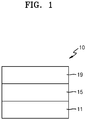
- FIG. 1 illustrates a schematic cross-sectional view of an organic light-emitting device 10 according to an embodiment.
- the organic light-emitting device 10 may include a first electrode 11, an organic layer 15, and a second electrode 19, which may be sequentially layered in this stated order.
- a substrate may be additionally disposed under the first electrode 11 or on the second electrode 19.
- the substrate may be a conventional substrate used in organic light-emitting devices, e.g. , a glass substrate or a transparent plastic substrate, each having excellent mechanical strength, thermal stability, transparency, surface smoothness, ease of handling, and water repellency.
- the first electrode 11 may be formed by vacuum-depositing or sputtering, onto the substrate, a material for forming the first electrode 11.
- the first electrode 11 may be an anode.
- the material for forming the first electrode 11 may be selected from materials with a high work function for easy hole injection.
- the first electrode 11 may be a reflective electrode, a semi-transmissive electrode, or a transmissive electrode.
- the material for forming the first electrode 11 may be selected from indium tin oxide (ITO), indium zinc oxide (IZO), tin oxide (SnO 2 ), and zinc oxide (ZnO).
- the material for forming the first electrode 11 may be a metal, such as magnesium (Mg), aluminum (Al), aluminum-lithium (Al-Li), calcium (Ca), magnesium-indium (Mg-In), or magnesium-silver (Mg-Ag).
- Mg magnesium
- Al aluminum
- Al-Li aluminum-lithium
- Ca calcium
- Mg-In magnesium-indium
- Mg-Ag magnesium-silver
- the first electrode 11 may have a single-layered structure or a multi-layered structure including a plurality of layers. In some embodiments, the first electrode 11 may have a triple-layered structure of ITO/Ag/ITO, but embodiments are not limited thereto.
- the organic layer 15 may be on the first electrode 11.
- the organic layer 15 may include a hole transport region, an emission layer, and an electron transport region.
- the hole transport region may be disposed between the first electrode 11 and the emission layer.
- the hole transport region may include a hole injection layer, a hole transport layer, an electron blocking layer, a buffer layer, or a combination thereof.
- the hole transport region may include a hole injection layer only or a hole transport layer only. In some embodiments, the hole transport region may include a hole injection layer and a hole transport layer which are sequentially stacked on the first electrode 11. In some embodiments, the hole transport region may include a hole injection layer, a hole transport layer, and an electron blocking layer, which are sequentially stacked on the first electrode 11.
- the hole injection layer may be formed on the first electrode 11 by using one or more suitable methods, such as vacuum deposition, spin coating, casting, and Langmuir-Blodgett (LB) deposition.
- suitable methods such as vacuum deposition, spin coating, casting, and Langmuir-Blodgett (LB) deposition.
- the conditions for forming a hole transport layer and an electron blocking layer may be inferred from the conditions for forming the hole injection layer.
- the hole transport region may include at least one selected from m-MTDATA, TDATA, 2-TNATA, NPB, ⁇ -NPB, TPD, spiro-TPD, spiro-NPB, methylated-NPB, TAPC, HMTPD, 4,4',4"-tris(N-carbazolyl)triphenylamine (TCTA), polyaniline/dodecylbenzene sulfonic acid (PANI/DBSA), poly(3,4-ethylenedioxythiophene)/poly(4-styrene sulfonate) (PEDOT/PSS), polyaniline/camphor sulfonic acid (PANI/CSA), (polyaniline)/poly(4-styrenesulfonate) (PANI/PSS), a compound represented by Formula 201, and a compound represented by Formula 202: wherein, in Formula 201, Ar 101 and Ar 102 may each independently be selected from
- xa and xb may each independently be an integer from 0 to 5. In some embodiments, xa and xb may each independently be an integer selected from 0, 1, and 2. In some embodiments, xa may be 1, and xb may be 0, but embodiments are not limited thereto.
- R 101 to R 108 , R 111 to R 119 , and R 121 to R 124 may each independently be selected from
- R 109 may be selected from
- the compound represented by Formula 201 may be represented by Formula 201A, but embodiments are not limited thereto:
- R 101 , R 111 , R 112 , and R 109 in Formula 201A may respectively be understood by referring to the descriptions for those provided herein.
- the compounds represented by Formulae 201 and 202 may include Compounds HT1 to HT20, but embodiments are not limited thereto:
- the thickness of the hole transport region may be in a range of about 100 Angstroms ( ⁇ ) to about 10,000 ⁇ , for example, about 100 ⁇ to about 1,000 ⁇ .
- the thickness of the hole injection layer may be in a range of about 100 ⁇ to about 10,000 ⁇ , for example, about 100 ⁇ to about 1,000 ⁇
- the thickness of the hole transport layer may be in a range of about 50 ⁇ to about 2,000 ⁇ , for example, about 100 ⁇ to about 1,500 ⁇ . While not wishing to be bound by theory, it is understood that when the thicknesses of the hole transport region, the hole injection layer, and the hole transport layer are within any of these ranges, excellent hole transport characteristics may be obtained without a substantial increase in driving voltage.
- the hole transport region may include a charge generating material as well as the aforementioned materials, to improve conductive properties of the hole transport region.
- the charge generating material may be substantially homogeneously or non-homogeneously dispersed in the hole transport region.
- the charge generating material may include, for example, a p-dopant.
- the p-dopant may include one of a quinone derivative, a metal oxide, and a compound containing a cyano group, but embodiments are not limited thereto.
- non-limiting examples of the p-dopant include a quinone derivative, such as tetracyanoquinodimethane (TCNQ) or 2,3,5,6-tetrafluoro-tetracyano-1,4-benzoquinonedimethane (F4-TCNQ); a metal oxide, such as a tungsten oxide or a molybdenum oxide; and a compound containing a cyano group, such as Compound HT-D1, but embodiments are not limited thereto:
- a quinone derivative such as tetracyanoquinodimethane (TCNQ) or 2,3,5,6-tetrafluoro-tetracyano-1,4-benzoquinonedimethane (F4-TCNQ)
- a metal oxide such as a tungsten oxide or a molybdenum oxide
- a compound containing a cyano group such as Compound HT-D1
- the hole transport region may further include a buffer layer.
- the buffer layer may compensate for an optical resonance distance depending on a wavelength of light emitted from the emission layer to improve the efficiency of an organic light-emitting device.
- An emission layer may be formed on the hole transport region by using one or more suitable methods, such as vacuum deposition, spin coating, casting, or LB deposition.
- suitable methods such as vacuum deposition, spin coating, casting, or LB deposition.
- vacuum deposition and coating conditions for forming the emission layer may be generally similar to the those conditions for forming a hole injection layer, though the conditions may vary depending on a compound that is used.
- a material for forming the electron blocking layer may be selected from the materials for forming a hole transport region and host materials described herein, but embodiments are not limited thereto.
- mCP described herein may be used for forming the electron blocking layer.
- the emission layer may include a host and a dopant, and the dopant may include the organometallic compound represented by Formula 1.
- the host may include at least one selected from TPBi, TBADN, ADN (also known as "DNA”), CBP, CDBP, TCP, mCP, and Compounds H50 and H51:
- the host may further include a compound represented by Formula 301:
- Ar 113 to Ar 116 may each independently be selected from
- g, h, i, and j may each independently be an integer from 0 to 4. In some embodiments, g, h, i, and j may each independently be 0, 1, or 2.
- Ar 113 to Ar 116 may each independently be selected from
- the host may include a compound represented by Formula 302:
- Ar 122 to Ar 125 may each be understood by referring to the descriptions for Ar 113 provided herein with reference to Formula 301.
- Ar 126 and Ar 127 may each independently be a C 1 -C 10 alkyl group, e.g., a methyl group, an ethyl group, or a propyl group.
- k and I may each independently be an integer from 0 to 4. In some embodiments, k and I may each be 0, 1, or 2.
- the emission layer may be patterned into a red emission layer, a green emission layer, and a blue emission layer.
- the emission layer may have a structure in which the red emission layer, the green emission layer, and/or the blue emission layer are layered to emit white light.
- the structure of the emission layer may vary.
- an amount of the dopant may be selected from a range of about 0.01 parts to about 15 parts by weight based on about 100 parts by weight of the host, but embodiments are not limited thereto.
- the thickness of the emission layer may be in a range of about 100 ⁇ to about 1,000 ⁇ , and in some embodiments, about 200 ⁇ to about 600 ⁇ . While not wishing to be bound by theory, it is understood that when the thickness of the emission layer is within any of these ranges, improved luminescence characteristics may be obtained without a substantial increase in driving voltage.
- an electron transport region may be formed on the emission layer.
- the electron transport region may include a hole blocking layer, an electron transport layer, an electron injection layer, or a combination thereof.
- the electron transport region may have a hole blocking layer/an electron transport layer/an electron injection layer structure or an electron transport layer/an electron injection layer structure, but embodiments are not limited thereto.
- the electron transport layer may have a single-layered structure or a multi-layered structure including two or more different materials.
- the conditions for forming a hole blocking layer, an electron transport layer, and an electron injection layer may be inferred based on the conditions for forming the hole injection layer.
- the hole blocking layer may include, for example, at least one selected from BCP, Bphen, and BAIq, but embodiments are not limited thereto:
- the thickness of the hole blocking layer may be in a range of about 20 ⁇ to about 1,000 ⁇ , for example, about 30 ⁇ to about 300 ⁇ . While not wishing to be bound by theory, it is understood that when the thickness of the hole blocking layer is within these ranges, excellent hole blocking characteristics may be obtained without a substantial increase in driving voltage.
- the electron transport layer may further include at least one selected from BCP, BPhen, Alq3, BAIq, TAZ, and NTAZ:
- the electron transport layer may include at least one selected from Compounds ET1 to ET25, but embodiments are not limited thereto:
- the thickness of the electron transport layer may be in a range of about 100 ⁇ to about 1,000 ⁇ , and in some embodiments, about 150 ⁇ to about 500 ⁇ . While not wishing to be bound by theory, it is understood that when the thickness of the electron transport layer is within any of these ranges, excellent electron transport characteristics may be obtained without a substantial increase in driving voltage.
- the electron transport layer may further include a material containing metal, in addition to the materials described above.
- the material containing metal may include a lithium (Li) complex.
- the Li complex may include, e.g. , Compound ET-D1 (lithium 8-hydroxyquinolate, LiQ) or Compound ET-D2:
- the electron transport region may include an electron injection layer that facilitates electron injection from the second electrode 19.
- the electron injection layer may include at least one selected from LiF, NaCl, CsF, Li 2 O, and BaO.
- the thickness of the electron injection layer may be in a range of about 1 ⁇ to about 100 ⁇ , and in some embodiments, about 3 ⁇ to about 90 ⁇ . While not wishing to be bound by theory, it is understood that when the thickness of the electron injection layer is within any of these ranges, excellent electron injection characteristics may be obtained without a substantial increase in driving voltage.
- the second electrode 19 may be formed on the organic layer 15.
- the second electrode 19 may be a cathode.
- a material for forming the second electrode 19 may be a material with a relatively low work function, such as a metal, an alloy, an electrically conductive compound, and a mixture thereof. Examples of the material for forming the second electrode 19 may include lithium (Li), magnesium (Mg), aluminum (Al), aluminum-lithium (AI-Li), calcium (Ca), magnesium-indium (Mg-In), and magnesium-silver (Mg-Ag).
- ITO or IZO may be used to form a transmissive second electrode 19 to manufacture a top emission light-emitting device.
- the material for forming the second electrode 19 may vary.
- a diagnostic composition includes at least one organometallic compound represented by Formula 1.
- the diagnostic efficiency of the diagnostic composition that includes the organometallic compound represented by Formula 1 may be excellent.
- the diagnostic composition may be applied in various ways, such as in a diagnostic kit, a diagnostic reagent, a biosensor, or a biomarker.
- C 1 -C 60 alkyl group refers to a linear or branched saturated aliphatic hydrocarbon monovalent group having 1 to 60 carbon atoms. Examples thereof include a methyl group, an ethyl group, a propyl group, an iso-butyl group, a sec-butyl group, a tert-butyl group, a pentyl group, an iso-amyl group, and a hexyl group.
- C 1 -C 60 alkylene group refers to a divalent group having substantially the same structure as the C 1 -C 60 alkyl group.
- C 1 -C 60 alkoxy group refers to a monovalent group represented by -OA 101 (wherein A 101 is a C 1 -C 60 alkyl group). Examples thereof include a methoxy group, an ethoxy group, and an isopropyloxy group.
- C 2 -C 60 alkenyl group refers to a group formed by including at least one carbon-carbon double bond in the middle or at the terminus of the C 2 -C 60 alkyl group. Examples thereof include an ethenyl group, a propenyl group, and a butenyl group.
- C 2 -C 60 alkenylene group refers to a divalent group having substantially the same structure as the C 2 -C 60 alkenyl group.
- C 2 -C 60 alkynyl group refers to a group formed by including at least one carbon-carbon triple bond in the middle or at the terminus of the C 2 -C 60 alkyl group. Examples thereof include an ethenyl group and a propenyl group.
- C 2 -C 60 alkynylene group refers to a divalent group having substantially the same structure as the C 2 -C 60 alkynyl group.
- C 3 -C 10 cycloalkyl group refers to a monovalent monocyclic saturated hydrocarbon group including 3 to 10 carbon atoms. Examples thereof include a cyclopropyl group, a cyclobutyl group, a cyclopentyl group, a cyclohexyl group, and a cycloheptyl group.
- C 3 -C 10 cycloalkylene group refers to a divalent group having substantially the same structure as the C 3 -C 10 cycloalkyl group.
- C 1 -C 10 heterocycloalkyl group refers to a monovalent monocyclic group including at least one heteroatom selected from N, O, P, Si, and S as a ring-forming atom and 1 to 10 carbon atoms. Examples thereof include a tetrahydrofuranyl group and a tetrahydrothiophenyl group.
- C 1 -C 10 heterocycloalkylene group refers to a divalent group having substantially the same structure as the C 1 -C 10 heterocycloalkyl group.
- C 3 -C 10 cycloalkenyl group refers to a monovalent monocyclic group including 3 to 10 carbon atoms and at least one carbon-carbon double bond in its ring, wherein the molecular structure as a whole is non-aromatic. Examples thereof include a cyclopentenyl group, a cyclohexenyl group, and a cycloheptenyl group.
- C 3 -C 10 cycloalkenylene group refers to a divalent group having substantially the same structure as the C 3 -C 10 cycloalkenyl group.
- C 1 -C 10 heterocycloalkenyl group refers to a monovalent monocyclic group including at least one heteroatom selected from N, O, P, Si, and S as a ring-forming atom, 1 to 10 carbon atoms, and at least one double bond in its ring.
- Examples of the C 1 -C 10 heterocycloalkenyl group include a 2,3-dihydrofuranyl group and a 2,3-dihydrothiophenyl group.
- C 1 -C 10 heterocycloalkylene group refers to a divalent group having substantially the same structure as the C 1 -C 10 heterocycloalkenyl group.
- C 6 -C 60 aryl group refers to a monovalent group having a carbocyclic aromatic system having 6 to 60 carbon atoms.
- C 6 -C 60 arylene group refers to a divalent group having a carbocyclic aromatic system having 6 to 60 carbon atoms. Examples of the C 6 -C 60 aryl group include a phenyl group, a naphthyl group, an anthracenyl group, a phenanthrenyl group, a pyrenyl group, and a chrysenyl group.
- the C 6 -C 60 aryl group and a C 6 -C 60 arylene group each include at least two rings, the at least two rings may be fused.
- C 1 -C 60 heteroaryl group refers to a monovalent group having a cyclic aromatic system having at least one heteroatom selected from N, O, P, Si, and S as a ring-forming atom and 1 to 60 carbon atoms.
- C 1 -C 60 heteroarylene group refers to a divalent group having a cyclic aromatic system having at least one heteroatom selected from N, O, P, and S as a ring-forming atom and 1 to 60 carbon atoms.
- Examples of the C 1 -C 60 heteroaryl group include a pyridinyl group, a pyrimidinyl group, a pyrazinyl group, a pyridazinyl group, a triazinyl group, a quinolinyl group, and an isoquinolinyl group.
- the C1-C 60 heteroaryl group and the C 1 -C 60 heteroarylene group each include at least two rings, the at least two rings may be fused.
- C 6 -C 60 aryloxy group indicates -OA 102 (wherein A 102 is a C 6 -C 60 aryl group).
- C 6 -C 60 arylthio group indicates - SA 103 (wherein A 103 is a C 6 -C 60 aryl group).
- the term "monovalent non-aromatic condensed polycyclic group” as used herein refers to a monovalent group that has two or more condensed rings and only carbon atoms (e.g., the number of carbon atoms may be in a range of 8 to 60) as ring-forming atoms, wherein the molecular structure as a whole is non-aromatic.
- Examples of the monovalent non-aromatic condensed polycyclic group include a fluorenyl group.
- divalent non-aromatic condensed polycyclic group refers to a divalent group having substantially the same structure as the monovalent non-aromatic condensed polycyclic group.
- the term "monovalent non-aromatic condensed heteropolycyclic group” as used herein refers to a monovalent group that has two or more condensed rings and a heteroatom selected from N, O, P, Si, and S and carbon atoms (e.g., the number of carbon atoms may be in a range of 1 to 60) as ring-forming atoms, wherein the molecular structure as a whole is non-aromatic.
- Examples of the monovalent non-aromatic condensed heteropolycyclic group include a carbazolyl group.
- divalent non-aromatic condensed heteropolycyclic group refers to a divalent group having substantially the same structure as the monovalent non-aromatic condensed heteropolycyclic group.
- C 5 -C 30 carbocyclic group refers to a saturated or unsaturated cyclic group including 5 to 30 carbon atoms only as ring-forming atoms.
- the C 5 -C 30 carbocyclic group may be a monocyclic group or a polycyclic group.
- C 1 -C 30 heterocyclic group refers to saturated or unsaturated cyclic group including 1 to 30 carbon atoms and at least one heteroatom selected from N, O, P, Si, and S as ring-forming atoms.
- the C 1 -C 30 heterocyclic group may be a monocyclic group or a polycyclic group.
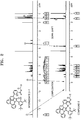
- the NMR spectra of Intermediate 2-1 and Compound 2 were analyzed by using a NMR spectrometer, AVANCE DPX 300. The results thereof are shown in FIG. 2 .
- the FT-IR spectra of Intermediate 2-1 and Compound 2 were analyzed by using a FT-IR spectrometer (attenuated total reflection (ATR) mode), Vertex70-Hyperion 3000. The results thereof are shown in FIG. 3 .
- Compound 1 was diluted in toluene at a concentration of 10 millimoles (mM), and a PL spectrum of Compound was measured by using an ISC PC1 spectrofluorometer, in which a xenon lamp is mounted. The same process was performed on Compounds 2, 3, and A. The results thereof are shown in Table 2.
- Table 2 Compound No. Maximum emission wavelength (nm) Full width at half maximum (FWHM) (nm) 1 572 98.4 2 509 69.6 3 673 63.7 A 516 70
- a CH 2 Cl 2 solution of PMMA was mixed with a mixture of 8 percent by weight (weight%) of CBP and Compound 1 (a content of Compound 1 was 10 parts based on 100 parts by weight of the mixture).
- the resultant obtained therefrom was coated on a quartz substrate by using a spin coater, heat-treated in an oven at a temperature of 80°C, and cooled to room temperature, thereby obtaining a film.
- PLQY in film was evaluated by using Hamamatsu Photonics absolute PL quantum yield measurement system employing PLQY measurement software (Hamamatsu Photonics, Ltd., Shizuoka, Japan), in which a xenon light source, a monochromator, a photonic multichannel analyzer, and an integrating sphere are mounted.
- PLQY in film of Compound 1 was measured.
- 2-TNATA was deposited on the anode to form a hole injection layer having a thickness of 600 ⁇ .
- 4,4'-bis[N-(1-naphthyl)-N-phenylamino]biphenyl (hereinafter, referred as "NPB") was deposited on the hole injection layer to form a hole transport layer having a thickness of 1,350 ⁇ .
- CBP (as a host) and Compound 1 (as a dopant) were co-deposited on the hole transport layer at a weight ratio of 98:2 to form an emission layer having a thickness of 400 ⁇ .
- BCP was deposited on the emission layer to form a hole blocking layer having a thickness of 50 ⁇ .
- Alq 3 was deposited on the hole blocking layer to form an electron transport layer having a thickness of 350 ⁇ .
- LiF was deposited on the electron transport layer to form an electron injection layer having a thickness of 10 ⁇ .
- MgAg was deposited on the electron injection layer at a weight ratio of 90:10 to form a cathode having a thickness of 120 ⁇ , thereby completing the manufacture of an organic light-emitting device (which emits green light).
- the organic light-emitting device thus have a structure of ITO/Ag/ITO/2-TNATA (600 ⁇ )/NPB (1,350 ⁇ )/CBP+Compound 1 (2 weight%) (400 ⁇ )/BCP (50 ⁇ )/Alq 3 (350 ⁇ )/LiF (10 ⁇ )/MgAg (120 ⁇ ).
- Organic light-emitting devices were manufactured in substantially the same manner as in Example 1, except that the compounds listed in Table 4 were used instead of Compound 1 as a dopant in the formation of an emission layer.
- the organometallic compound has excellent electrical characteristics and/or thermal stability. Accordingly, an organic light-emitting device employing the organometallic compound has a low driving voltage, high efficiency, high power, high color purity, and/or excellent lifespan characteristics. Further, a diagnostic composition that includes the organometallic compound may have high diagnostic efficiency, because the organometallic compound is excellent in phosphorescent emission characteristics.
Landscapes
- Chemical & Material Sciences (AREA)
- Organic Chemistry (AREA)
- Engineering & Computer Science (AREA)
- Materials Engineering (AREA)
- Crystallography & Structural Chemistry (AREA)
- Inorganic Chemistry (AREA)
- Health & Medical Sciences (AREA)
- Physics & Mathematics (AREA)
- Nuclear Medicine, Radiotherapy & Molecular Imaging (AREA)
- Life Sciences & Earth Sciences (AREA)
- Analytical Chemistry (AREA)
- Biochemistry (AREA)
- General Health & Medical Sciences (AREA)
- General Physics & Mathematics (AREA)
- Immunology (AREA)
- Pathology (AREA)
- Optics & Photonics (AREA)
- Electroluminescent Light Sources (AREA)
Claims (15)
- Organometallische Verbindung, dargestellt durch Formel 1:
Formel 1 M(L1)n1(L2)n2(L3)n3
 L1 in Formel 1 ausgewählt ist aus Liganden dargestellt durch Formel 2,* in Formel 2 eine Bindungsstelle zu M in Formel 1 angibt,n1 in Formel 1 1, 2 oder 3 ist; vorausgesetzt, dass, wenn n1 2 oder größer ist, zumindest zwei L1-Gruppen miteinander identisch oder voneinander unterschiedlich sind,L2 in Formel 1 aus einem zweizähnigen Liganden, einem dreizähnigen Liganden und einem vierzähnigen Liganden ausgewählt ist, und L3 in Formel 1 aus einem einzähnigen Liganden, einem zweizähnigen Liganden, einem dreizähnigen Liganden und einem vierzähnigen Liganden ausgewählt ist,n2 in Formel 1 1, 2, 3 oder 4 ist und n3 in Formel 1 0, 1, 2, 3 oder 4 ist; vorausgesetzt, dass, wenn n2 2 oder größer ist, zumindest zwei L2-Gruppen miteinander identisch oder voneinander unterschiedlich sind; und wenn n3 2 oder größer ist, zumindest zwei L3-Gruppen miteinander identisch oder voneinander unterschiedlich sind,in Formel 1 zumindest zwei ausgewählt aus L1-Gruppen in der Nummer von n1, L2-Gruppen in der Nummer von n2 und L3-Gruppen in der Nummer von n3 über eine Einzelbindung, eine Doppelbindung oder eine organische Verbindungsgruppe optional miteinander verbunden sind, um einen dreizähnigen Liganden, einen vierzähnigen Liganden, einen fünfzähnigen Liganden oder einen sechszähnigen Liganden zu bilden,X3 und Y12 in Formel 2 jeweils unabhängig N oder C sind,X4 in Formel 2 O oder S ist,X4 in Formel 2 über eine Koordinatenbindung an M in Formel 1 gebunden ist,X3 in Formel 2 über eine Koordinatenbindung oder eine kovalente Bindung an M in Formel 1 gebunden ist,Ring CY3 in Formel 2 eine carbocyclische C5-C30-Gruppe oder eine heterocyclische C1-C30-Gruppe ist,T3 in Formel 2 eine Einzelbindung, eine Doppelbindung, *-N(R7)-*', *-B(R7)-*', *-P(R7)-*', *-C(R7)(R8)-*', *-Si(R7)(R8)-*', *-Ge(R7)(R8)-*', *-S-*', *-Se-*', *-O-*', *-C(=O)-*', *-S(=O)-*', *-S(=O)2-*', *-C(R7)=*', *=C(R7)-*', *-C(R7)=C(R8)-*', *-C(=S)-*' oder *-C≡C-*' ist, wobei * und *' jeweils eine Bindungsstelle zu einem benachbarten Atom angeben, undR7 und R8 über eine Einzelbindung, eine Doppelbindung oder eine erste Verbindungsgruppe optional miteinander verbunden sind, um eine carbocyclische C5-C30-Gruppe oder eine heterocyclische C1-C30-Gruppe zu bilden, wobei die carbocyclische C5-C30-Gruppe und die heterocyclische C1-C30-Gruppe jeweils unsubstituiert oder substituiert mit zumindest einem R10a sind,Y13 in Formel 2 eine Einzelbindung, eine Doppelbindung, *-S-*', *-Se-*', *-O-*', *-C(=O)-*', *-S(=O)-*', *-S(=O)2-*', *-C(=S)-*' oder *-C≡C-*' ist, wobei * und *' jeweils eine Bindungsstelle zu einem benachbarten Atom angeben,R3 und Y14 in Formel 2 über eine Einzelbindung, eine Doppelbindung oder eine erste Verbindungsgruppe optional miteinander verbunden sind, um eine carbocyclische C5-C30-Gruppe oder eine heterocyclische C1-C30-Gruppe zu bilden, wobei die carbocyclische C5-C30-Gruppe und die heterocyclische C1-C30-Gruppe jeweils unsubstituiert oder substituiert mit zumindest einem R10a sind,R3, R4, R7, R8, Y14 und R10a jeweils unabhängig ausgewählt sind aus Wasserstoff, Deuterium, -F, -Cl, -Br, -I, -SF5, einer Hydroxylgruppe, einer Cyanogruppe, einer Nitrogruppe, einer Amidinogruppe, einer Hydrazingruppe, einer Hydrazongruppe, einer Carboxylsäuregruppe oder einem Salz davon, einer Sulfonsäuregruppe oder einem Salz davon, einer Phosphorsäuregruppe oder einem Salz davon, einer substituierten oder unsubstituierten C1-C60-Alkylgruppe, einer substituierten oder unsubstituierten C2-C60-Alkenylgruppe, einer substituierten oder unsubstituierten C2-C60-Alkynylgruppe, einer substituierten oder unsubstituierten C1-C60-Alkoxygruppe, einer substituierten oder unsubstituierten C3-C10-Cycloalkylgruppe, einer substituierten oder unsubstituierten C1-C10-Heterocycloalkylgruppe, einer substituierten oder unsubstituierten C3-C10-Cycloalkenylgruppe, einer substituierten oder unsubstituierten C1-C10-Heterocycloalkenylgruppe, einer substituierten oder unsubstituierten C6-C60-Arylgruppe, einer substituierten oder unsubstituierten C6-C60-Aryloxygruppe, einer substituierten oder unsubstituierten C6-C60-Arylthiogruppe, einer substituierten oder unsubstituierten C1-C60-Heteroarylgruppe, einer substituierten oder unsubstituierten monovalenten nichtaromatischen kondensierten polycyclischen Gruppe, einer substituierten oder unsubstituierten monovalenten nichtaromatischen kondensierten heteropolycyclischen Gruppe, -N(Q1)(Q2), -Si(Q3)(Q4)(Q5), - B(Q6)(Q7) und -P(=PO)(Q8)(Q9),a3 eine ganze Zahl von 0 bis 20 ist,zwei benachbarte Gruppen ausgewählt aus einer Vielzahl von R3-Gruppen optional verbunden sind, um eine carbocyclische C5-C30-Gruppe oder eine heterocyclische C1-C30-Gruppe zu bilden, wobei die carbocyclische C5-C30-Gruppe und die heterocyclische C1-C30-Gruppe jeweils unsubstituiert oder substituiert mit zumindest einem R10a sind,ein Substituent(en) der substituierten C1-C60-Alkylgruppe, der substituierten C2-C60-Alkenylgruppe, der substituierten C2-C60-Alkynylgruppe, der substituierten C1-C60-Alkoxygruppe, der substituierten C3-C10-Cycloalkylgruppe, der substituierten C1-C10-Heterocycloalkylgruppe, der substituierten C3-C10-Cycloalkenylgruppe, der substituierten C1-C10-Heterocycloalkenylgruppe, der substituierten C6-C60-Arylgruppe, der substituierten C6-C60-Aryloxygruppe, der substituierten C6-C60-Arylthiogruppe, der substituierten C1-C60-Heteroarylgruppe, der substituierten monovalenten nichtaromatischen kondensierten polycyclischen Gruppe und der substituierten monovalenten nichtaromatischen kondensierten heteropolycyclischen Gruppe ausgewählt ist aus:Deuterium, -F, -Cl, -Br, -I, -CD3, -CD2H, -CDH2, -CF3, -CF2H, -CFH2, einer Hydroxylgruppe, einer Cyanogruppe, einer Nitrogruppe, einer Amidinogruppe, einer Hydrazingruppe, einer Hydrazongruppe, einer Carboxylsäuregruppe oder einem Salz davon, einer Sulfonsäuregruppe oder einem Salz davon, einer Phosphorsäuregruppe oder einem Salz davon, einer C1-C60-Alkylgruppe, einer C2-C60-Alkenylgruppe, einer C2-C60-Alkynylgruppe und einer C1-C60-Alkoxygruppe;einer C1-C60-Alkylgruppe, einer C2-C60-Alkenylgruppe, einer C2-C60-Alkynylgruppe und einer C1- C60-Alkoxygruppe, jeweils substituiert mit zumindest einem ausgewählt aus Deuterium, -F, -Cl, -Br, -I, -CD3, -CD2H, -CDH2, -CF3, -CF2H, -CFH2, einer Hydroxylgruppe, einer Cyanogruppe, einer Nitrogruppe, einer Amidinogruppe, einer Hydrazingruppe, einer Hydrazongruppe, einer Carboxylsäuregruppe oder einem Salz davon, einer Sulfonsäuregruppe oder einem Salz davon, einer Phosphorsäuregruppe oder einem Salz davon, einer C3-C10-Cycloalkylgruppe, einer C1-C10-Heterocycloalkylgruppe, einer C3-C10-Cycloalkenylgruppe, einer C1-C10-Heterocycloalkenylgruppe, einer C6-C60-Arylgruppe, einer C6-C60-Aryloxygruppe, einer C6-C60-Arylthiogruppe, einer C1-C60-Heteroarylgruppe, einer monovalenten nichtaromatischen kondensierten polycyclischen Gruppe, einer monovalenten nichtaromatischen kondensierten heteropolycyclischen Gruppe, -N(Q11)(Q12), -Si(Q13)(Q14)(Q15), -B(Q16)(Q17) und - P(=O)(Q18)(Q19);einer C3-C10-Cycloalkylgruppe, einer C1-C10-Heterocycloalkylgruppe, einer C3-C10-Cycloalkenylgruppe, einer C1-C10-Heterocycloalkenylgruppe, einer C6-C60-Arylgruppe, einer C6-C60-Aryloxygruppe, einer C6-C60-Arylthiogruppe, einer C1-C60-Heteroarylgruppe, einer monovalenten nichtaromatischen kondensierten polycyclischen Gruppe und einer monovalenten nichtaromatischen kondensierten heteropolycyclischen Gruppe;einer C3-C10-Cycloalkylgruppe, einer C1-C10-Heterocycloalkylgruppe, einer C3-C10-Cycloalkenylgruppe, einer C1-C10-Heterocycloalkenylgruppe, einer C6-C60-Arylgruppe, einer C6-C60-Aryloxygruppe, einer C6-C60-Arylthiogruppe, einer C1-C60-Heteroarylgruppe, einer monovalenten nichtaromatischen kondensierten polycyclischen Gruppe und einer monovalenten nichtaromatischen kondensierten heteropolycyclischen Gruppe, jeweils substituiert mit zumindest einem ausgewählt aus Deuterium, -F, -Cl, -Br, -I, -CD3, -CD2H, -CDH2, -CF3, -CF2H, -CFH2, einer Hydroxylgruppe, einer Cyanogruppe, einer Nitrogruppe, einer Amidinogruppe, einer Hydrazingruppe, einer Hydrazongruppe, einer Carboxylsäuregruppe oder einem Salz davon, einer Sulfonsäuregruppe oder einem Salz davon, einer Phosphorsäuregruppe oder einem Salz davon, einer C1-C60-Alkylgruppe, einer C2-C60-Alkenylgruppe, einer C2-C60-Alkynylgruppe, einer C1-C60-Alkoxygruppe, einer C3-C10-Cycloalkylgruppe, einer C1-C10-Heterocycloalkylgruppe, einer C3-C10-Cycloalkenylgruppe, einer C1-C10-Heterocycloalkenylgruppe, einer C6-C60-Arylgruppe, einer C6-C60-Aryloxygruppe, einer C6-C60-Arylthiogruppe, einer C1-C60-Heteroarylgruppe, einer monovalenten nichtaromatischen kondensierten polycyclischen Gruppe, einer monovalenten nichtaromatischen kondensierten heteropolycyclischen Gruppe, -N(Q21)(Q22), -Si(Q23)(Q24)(Q25), -B(Q26)(Q27) und -P(=O)(Q28)(Q29); undN(Q31)(Q32), -Si(Q33)(Q34)(Q35), -B(Q36)(Q37) und -P(=O)(Q38)(Q39),wobei Q1 bis Q9, Q11 bis Q19, Q21 bis Q29 und Q31 bis Q39 jeweils unabhängig ausgewählt sind aus Deuterium, -F, -Cl, -Br, -I, einer Hydroxylgruppe, einer Cyanogruppe, einer Nitrogruppe, einer Amidinogruppe, einer Hydrazingruppe, einer Hydrazongruppe, einer Carboxylsäuregruppe oder einem Salz davon, einer Sulfonsäuregruppe oder einem Salz davon, einer Phosphorsäuregruppe oder einem Salz davon, einer C1-C60-Alkylgruppe, einer C1-C60-Alkylgruppe substituiert mit zumindest einem ausgewählt aus Deuterium; einer C1-C60-Alkylgruppe; und einer C6-C60-Arylgruppe, einer C2-C60-Alkenylgruppe, einer C2-C60-Alkynylgruppe, einer C1-C60-Alkoxygruppe, einer C3-C10-Cycloalkylgruppe, einer C1-C10-Heterocycloalkylgruppe, einer C3-C10-Cycloalkenylgruppe, einer C1-C10-Heterocycloalkenylgruppe, einer C6-C60-Arylgruppe, einer C6-C60-Arylgruppe substituiert mit zumindest einem ausgewählt aus Deuterium; einer C1-C60-Alkylgruppe; und einer C6-C60-Arylgruppe, einer C6-C60-Aryloxygruppe, einer C6-C60-Arylthiogruppe, einer C1-C60-Heteroarylgruppe, einer monovalenten nichtaromatischen kondensierten polycyclischen Gruppe und einer monovalenten nichtaromatischen kondensierten heteropolycyclischen Gruppe.
 - Organometallische Verbindung nach Anspruch 1, wobei M Pt, Pd oder Au ist; und/oder
wobei:n1 und n2 jeweils 1 sind,n3 0 ist,L2 ein zweizähniger Ligand ist, undL1 und L2 über eine Einzelbindung, eine Doppelbindung oder eine organische Verbindungsgruppe miteinander verbunden sind, um einen vierzähnigen Liganden zu bilden. - Organometallische Verbindung nach Anspruch 1 oder 2, wobeiRing CY3 ausgewählt ist aus i) einem ersten Ring, ii) einem zweiten Ring, iii) einem kondensierten Ring, in dem zwei oder mehr zweite Ringe kondensiert sind, und iv) einem kondensierten Ring, in dem zumindest ein erster Ring und zumindest ein zweiter Ring kondensiert sind,der erste Ring ausgewählt ist aus einer Cyclopentangruppe, einer Cyclopentadiengruppe, einer Furangruppe, einer Thiophengruppe, einer Pyrrolgruppe, einer Silolgruppe, einer Oxazolgruppe, einer Isoxazolgruppe, einer Oxadiazolgruppe, einer Isoxadiazolgruppe, einer Oxatriazolgruppe, einer Isoxatriazolgruppe, einer Thiazolgruppe, einer Isothiazolgruppe, einer Thiadiazolgruppe, einer Isothiadiazolgruppe, einer Thiatriazolgruppe, einer Isothiatriazolgruppe, einer Pyrazolgruppe, einer Imidazolgruppe, einer Triazolgruppe, einer Tetrazolgruppe, einer Azasilolgruppe, einer Diazasilolgruppe und einer Triazasilolgruppe, undder vierte Ring ausgewählt ist aus einer Adamantangruppe, einer Norbornangruppe, einer Norbornengruppe, einer Cyclohexangruppe, einer Cyclohexengruppe, einer Benzolgruppe, einer Pyridingruppe, einer Pyrimidingruppe, einer Pyrazingruppe, einer Pyridazingruppe und einer Triazingruppe.
- Organometallische Verbindung nach einem der Ansprüche 1-3, wobei R3, R4, R7, R8, Y14 und R10a jeweils unabhängig ausgewählt sind ausWasserstoff, Deuterium, -F, -Cl, -Br, -I, einer Hydroxylgruppe, einer Cyanogruppe, einer Nitrogruppe, einer Aminogruppe, einer Amidinogruppe, einer Hydrazingruppe, einer Hydrazongruppe, einer Carboxylsäuregruppe oder einem Salz davon, einer Sulfonsäuregruppe oder einem Salz davon, einer Phosphorsäuregruppe oder einem Salz davon, -SF5, einer C1-C20-Alkylgruppe und einer C1-C20-Alkoxygruppe;einer C1-C20-Alkylgruppe und einer C1-C20-Alkoxygruppe, jeweils substituiert mit zumindest einem ausgewählt aus Deuterium, -F, -Cl, -Br, -I, -CD3, -CD2H, -CDH2, -CF3, -CF2H, -CFH2, einer Hydroxylgruppe, einer Cyanogruppe, einer Nitrogruppe, einer Aminogruppe, einer Amidinogruppe, einer Hydrazingruppe, einer Hydrazongruppe, einer Carboxylsäuregruppe oder einem Salz davon, einer Sulfonsäuregruppe oder einem Salz davon, einer Phosphorsäuregruppe oder einem Salz davon, einer C1-C10-Alkylgruppe, einer Cyclopentylgruppe, einer Cyclohexylgruppe, einer Cycloheptylgruppe, einer Cyclooctylgruppe, einer Adamantanylgruppe, einer Norbornanylgruppe, einer Norbornenylgruppe, einer Cyclopentenylgruppe, einer Cyclohexenylgruppe, einer Cycloheptenylgruppe, einer Phenylgruppe, einer Biphenylgruppe, einer Naphthylgruppe, einer Pyridinylgruppe und einer Pyrimidinylgruppe;einer Cyclopentylgruppe, einer Cyclohexylgruppe, einer Cycloheptylgruppe, einer Cyclooctylgruppe, einer Adamantanylgruppe, einer Norbornanylgruppe, einer Norbornenylgruppe, einer Cyclopentenylgruppe, einer Cyclohexenylgruppe, einer Cycloheptenylgruppe, einer Phenylgruppe, einer Biphenylgruppe, einer C1-C20-Alkylphenylgruppe, einer Naphthylgruppe, einer Fluorenylgruppe, einer Phenanthrenylgruppe, einer Anthracenylgruppe, einer Fluoranthenylgruppe, einer Triphenylenylgruppe, einer Pyrenylgruppe, einer Chrysenylgruppe, einer Pyrrolylgruppe, einer Thiophenylgruppe, einer C1-C20-Alkylthiophenylgruppe, einer Furanylgruppe, einer C1-C20-Alkylfuranylgruppe, einer Imidazolylgruppe, einer Pyrazolylgruppe, einer Thiazolylgruppe, einer Isothiazolylgruppe, einer Oxazolylgruppe, einer Isoxazolylgruppe, einer Pyridinylgruppe, einer Pyrazinylgruppe, einer Pyrimidinylgruppe, einer Pyridazinylgruppe, einer Isoindolylgruppe, einer Indolylgruppe, einer Indazolylgruppe, einer Purinylgruppe, einer Quinolinylgruppe, einer Isoquinolinylgruppe, einer Benzoquinolinylgruppe, einer Quinoxalinylgruppe, einer Quinazolinylgruppe, einer Cinnolinylgruppe, einer Carbazolylgruppe, einer Phenanthrolinylgruppe, einer Benzimidazolylgruppe, einer Benzofuranylgruppe, einer Benzothiophenylgruppe, einer Isobenzothiazolylgruppe, einer Benzoxazolylgruppe, einer Isobenzoxazolylgruppe, einer Triazolylgruppe, einer Tetrazolylgruppe, einer Oxadiazolylgruppe, einer Triazinylgruppe, einer Dibenzofuranylgruppe, einer Dibenzothiophenylgruppe, einer Benzocarbazolylgruppe, einer Dibenzocarbazolylgruppe, einer Imidazopyridinylgruppe und einer Imidazopyrimidinylgruppe;einer Cyclopentylgruppe, einer Cyclohexylgruppe, einer Cycloheptylgruppe, einer Cyclooctylgruppe, einer Adamantanylgruppe, einer Norbornanylgruppe, einer Norbornenylgruppe, einer Cyclopentenylgruppe, einer Cyclohexenylgruppe, einer Cycloheptenylgruppe, einer Phenylgruppe, einer Biphenylgruppe, einer C1-C20-Alkylphenylgruppe, einer Naphthylgruppe, einer Fluorenylgruppe, einer Phenanthrenylgruppe, einer Anthracenylgruppe, einer Fluoranthenylgruppe, einer Triphenylenylgruppe, einer Pyrenylgruppe, einer Chrysenylgruppe, einer Pyrrolylgruppe, einer Thiophenylgruppe, einer C1-C20-Alkylthiophenylgruppe, einer Furanylgruppe, einer C1-C20-Alkylfuranylgruppe, einer Imidazolylgruppe, einer Pyrazolylgruppe, einer Thiazolylgruppe, einer Isothiazolylgruppe, einer Oxazolylgruppe, einer Isoxazolylgruppe, einer Pyridinylgruppe, einer Pyrazinylgruppe, einer Pyrimidinylgruppe, einer Pyridazinylgruppe, einer Isoindolylgruppe, einer Indolylgruppe, einer Indazolylgruppe, einer Purinylgruppe, einer Quinolinylgruppe, einer Isoquinolinylgruppe, einer Benzoquinolinylgruppe, einer Quinoxalinylgruppe, einer Quinazolinylgruppe, einer Cinnolinylgruppe, einer Carbazolylgruppe, einer Phenanthrolinylgruppe, einer Benzimidazolylgruppe, einer Benzofuranylgruppe, einer Benzothiophenylgruppe, einer Isobenzothiazolylgruppe, einer Benzoxazolylgruppe, einer Isobenzoxazolylgruppe, einer Triazolylgruppe, einer Tetrazolylgruppe, einer Oxadiazolylgruppe, einer Triazinylgruppe, einer Dibenzofuranylgruppe, einer Dibenzothiophenylgruppe, einer Benzocarbazolylgruppe, einer Dibenzocarbazolylgruppe, einer Imidazopyridinylgruppe und einer Imidazopyrimidinylgruppe, jeweils substituiert mit zumindest einem ausgewählt aus Deuterium, -F, -Cl, -Br, -I, -CD3, -CD2H, -CDH2, -CF3, -CF2H, -CFH2, einer Hydroxylgruppe, einer Cyanogruppe, einer Nitrogruppe, einer Aminogruppe, einer Amidinogruppe, einer Hydrazingruppe, einer Hydrazongruppe, einer Carboxylsäuregruppe oder einem Salz davon, einer Sulfonsäuregruppe oder einem Salz davon, einer Phosphorsäuregruppe oder einem Salz davon, einer C1-C20-Alkylgruppe, einer C1-C20-Alkoxygruppe, einer Cyclopentylgruppe, einer Cyclohexylgruppe, einer Cycloheptylgruppe, einer Cyclooctylgruppe, einer Adamantanylgruppe, einer Norbornanylgruppe, einer Norbornenylgruppe, einer Cyclopentenylgruppe, einer Cyclohexenylgruppe, einer Cycloheptenylgruppe, einer Phenylgruppe, einer Biphenylgruppe, einer C1-C20-Alkylphenylgruppe, einer Naphthylgruppe, einer Fluorenylgruppe, einer Phenanthrenylgruppe, einer Anthracenylgruppe, einer Fluoranthenylgruppe, einer Triphenylenylgruppe, einer Pyrenylgruppe, einer Chrysenylgruppe, einer Pyrrolylgruppe, einer Thiophenylgruppe, einer C1-C20-Alkylthiophenylgruppe, einer Furanylgruppe, einer C1-C20-Alkylfuranylgruppe, einer Imidazolylgruppe, einer Pyrazolylgruppe, einer Thiazolylgruppe, einer Isothiazolylgruppe, einer Oxazolylgruppe, einer Isoxazolylgruppe, einer Pyridinylgruppe, einer Pyrazinylgruppe, einer Pyrimidinylgruppe, einer Pyridazinylgruppe, einer Isoindolylgruppe, einer Indolylgruppe, einer Indazolylgruppe, einer Purinylgruppe, einer Quinolinylgruppe, einer Isoquinolinylgruppe, einer Benzoquinolinylgruppe, einer Quinoxalinylgruppe, einer Quinazolinylgruppe, einer Cinnolinylgruppe, einer Carbazolylgruppe, einer Phenanthrolinylgruppe, einer Benzimidazolylgruppe, einer Benzofuranylgruppe, einer Benzothiophenylgruppe, einer Isobenzothiazolylgruppe, einer Benzoxazolylgruppe, einer Isobenzoxazolylgruppe, einer Triazolylgruppe, einer Tetrazolylgruppe, einer Oxadiazolylgruppe, einer Triazinylgruppe, einer Dibenzofuranylgruppe, einer Dibenzothiophenylgruppe, einer Benzocarbazolylgruppe, einer Dibenzocarbazolylgruppe, einer Imidazopyridinylgruppe und einer Imidazopyrimidinylgruppe; und-N(Q1)(Q2), -Si(Q3)(Q4)(Q5), -B(Q6)(Q7) und -P(=O)(Q8)(Q9),wobei Q1 bis Q9 jeweils unabhängig ausgewählt sind aus-CH3, -CD3, -CD2H, -CDH2, -CH2CH3, -CH2CD3, -CH2CD2H, -CH2CDH2, -CHDCH3, - CHDCD2H, -CHDCDH2, -CHDCD3, -CD2CD3, -CD2CD2H und -CD2CDH2;einer n-Propylgruppe, einer Isopropylgruppe, einer n-Butylgruppe, einer Isobutylgruppe, einer sec-Butylgruppe, einer tert-Butylgruppe, einer n-Pentylgruppe, einer Isopentylgruppe, einer sec-Pentylgruppe, einer tert-Pentylgruppe, einer Phenylgruppe und einer Naphthylgruppe; undeiner n-Propylgruppe, einer Isopropylgruppe, einer n-Butylgruppe, einer Isobutylgruppe, einer sec-Butylgruppe, einer tert-Butylgruppe, einer n-Pentylgruppe, einer Isopentylgruppe, einer sec-Pentylgruppe, einer tert-Pentylgruppe, einer Phenylgruppe und einer Naphthylgruppe, jeweils substituiert mit zumindest einem ausgewählt aus Deuterium, einer C1-C10-Alkylgruppe und einer Phenylgruppe.
- Organometallische Verbindung nach einem der Ansprüche 1-4, wobei die organometallische Verbindung durch Formel 1A dargestellt ist:
 M, X3, X4, Y12 bis Y14, Ring CY3, T3, R3 und a3 jeweils gleich definiert sind wie diejenigen, die in Anspruch 1 definiert sind,X1 und X2 jeweils unabhängig N oder C sind,X5 ausgewählt ist aus einer chemischen Bindung, O, S, B(R'), N(R'), P(R'), C(R')(R"), Si(R')(R"), Ge(R')(R"), C(=O), B(R')(R"), N(R')(R") und P(R')(R"); wenn X5 eine chemische Bindung ist, X1 und M direkt aneinander gebunden sind,X4 über eine Koordinatenbindung an M gebunden ist,zwei Bindungen ausgewählt aus einer Bindung zwischen M und X5 oder X1, einer Bindung zwischen X2 und M und einer Bindung zwischen X3 und M jeweils eine kovalente Bindung sind, während die übrige Bindung eine Koordinatenbindung ist,Ring CY1 und Ring CY2 jeweils gleich definiert sind wie Ring CY3 in Anspruch 1 definiert,T1 und T2 jeweils unabhängig ausgewählt sind aus einer Einzelbindung, einer Doppelbindung, *-N(R5)-*', *-B(R5)-*', *-P(R5)-*', *-C(R5)(R6)-*', *-Si(R5)(R6)-*', *-Ge(R5)(R6)-*', *-S*', *-Se-*', *-O-*', *-C(=O)-*', *-S(=O)-*', *-S(=O)2-*', *-C(R5)=*', *=C(R5)-*', *-C(R5)=C(R6)-*', *-C(=S)-*' und *-C≡C-*', wobei * und *' jeweils eine Bindungsstelle zu einem benachbarten Atom angeben,R1, R2, R5, R6, R' und R" jeweils gleich definiert sind wie R3 in Anspruch 1 definiert,a1 und a2 jeweils gleich definiert sind wie a3 in Anspruch 1 definiert,zwei benachbarte Gruppen ausgewählt aus einer Vielzahl von R1-Gruppen optional verbunden sind, um eine carbocyclische C5-C30-Gruppe oder eine heterocyclische C1-C30-Gruppe zu bilden, wobei die carbocyclische C5-C30-Gruppe und die heterocyclische C1-C30-Gruppe jeweils unsubstituiert oder substituiert sind mit zumindest einem R10a,zwei benachbarte Gruppen ausgewählt aus einer Vielzahl von R2-Gruppen optional verbunden sind, um eine carbocyclische C5-C30-Gruppe oder eine heterocyclische C1-C30-Gruppe zu bilden, wobei die carbocyclische C5-C30-Gruppe und die heterocyclische C1-C30-Gruppe jeweils unsubstituiert oder substituiert sind mit zumindest einem R10a,zwei benachbarte Gruppen ausgewählt aus einer Vielzahl von R3-Gruppen optional verbunden sind, um eine carbocyclische C5-C30 -Gruppe oder eine heterocyclische C1-C30-Gruppe zu bilden, wobei die carbocyclische C5-C30-Gruppe und die heterocyclische C1-C30-Gruppe jeweils unsubstituiert oder substituiert sind mit zumindest einem R10a,zumindest zwei benachbarte Gruppen ausgewählt aus R1 bis R8, R' und R" optional verbunden sind, um eine carbocyclische C5-C30-Gruppe oder eine heterocyclische C1-C30-Gruppe zu bilden, wobei die carbocyclische C5-C30-Gruppe und die heterocyclische C1-C30-Gruppe jeweils unsubstituiert oder substituiert mit zumindest einem R10a sind, undR10a gleich definiert ist wie in Anspruch 1 definiert.
 - Organometallische Verbindung nach Anspruch 5, wobei die organometallische Verbindung dargestellt ist durch Formel 1A(1):

 M, X1 bis X5, Y12, Ringe CY1 bis CY3, T1, T2, R1 bis R3 und a1 bis a3 jeweils gleich definiert sind wie diejenigen, die in Anspruch 5 definiert sind,Y11 ausgewählt ist aus N und C, undRing CY4, R4 und a4 jeweils gleich definiert sind wie Ring CY3, R3 und a3 in Anspruch 5 definiert;wobei bevorzugt der Teil dargestellt durch
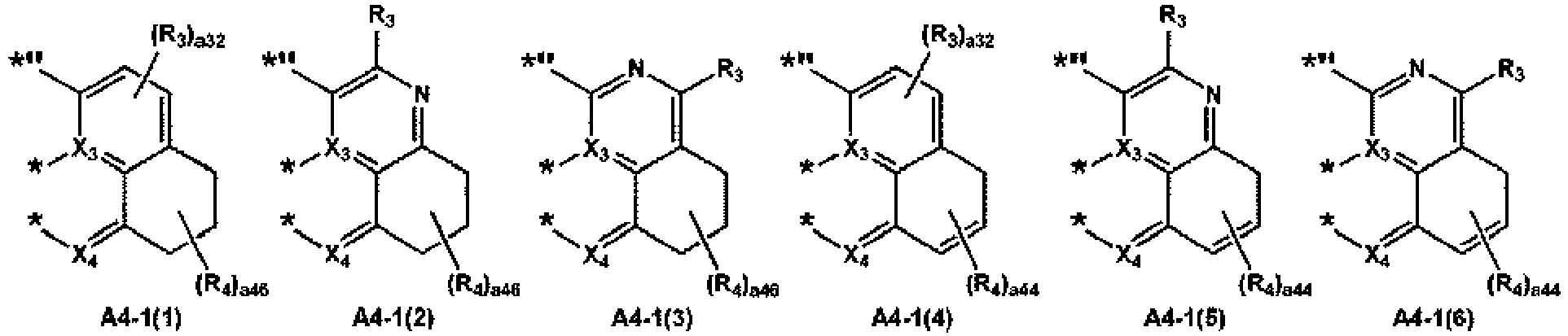
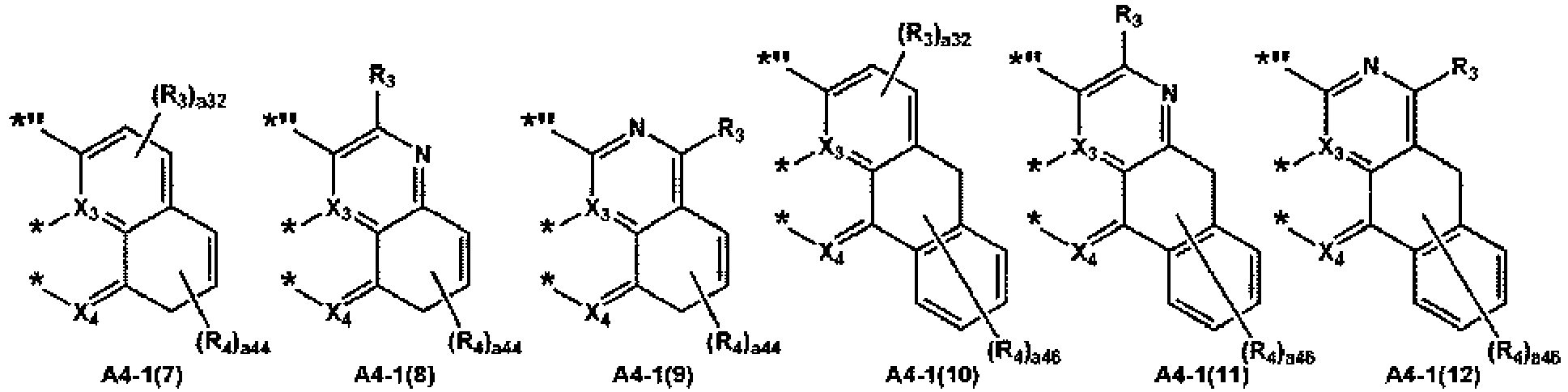
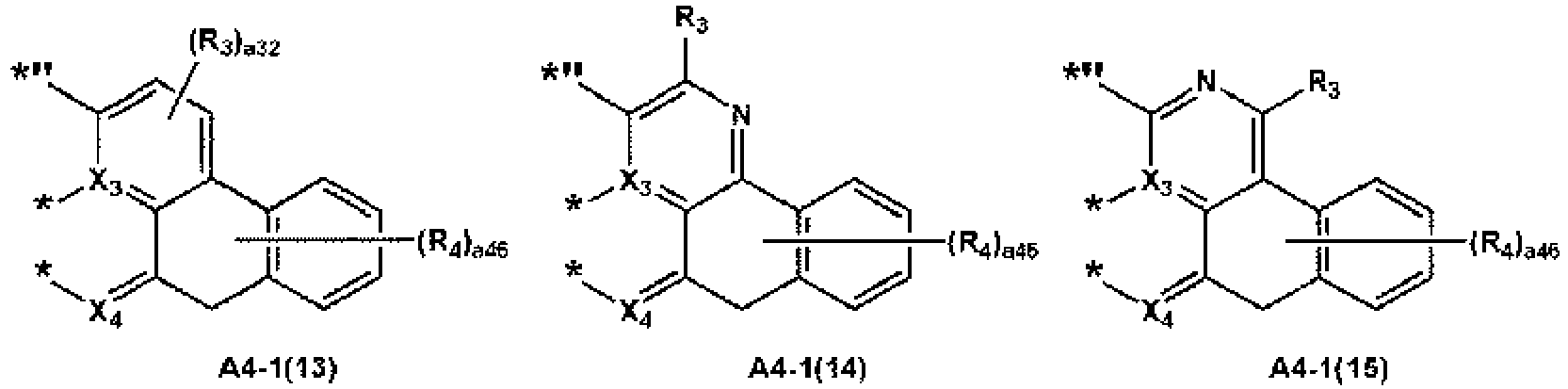

 a46 eine ganze Zahl von 0 bis 6 ist,a44 eine ganze Zahl von 0 bis 4 ist,a42 und a32 jeweils unabhängig eine ganze Zahl von 0 bis 2 sind,* eine Bindungsstelle zu M in Formel 1A(1) angibt, und*" eine Bindungsstelle zu T2 in Formel 1A(1) angibt.
 - Organometallische Verbindung nach Anspruch 5 oder 6, die eine der Bedingungen 1 bis 3 erfüllt:Bedingung 1a) X5 ist eine chemische Bindung;b) der Teil dargestellt durch
 c) T1 ist eine Einzelbindung; undd) der Teil dargestellt durch
 Bedingung 2a) X5 ist O, S, B(R'), N(R'), P(R'), C(R')(R"), Si(R')(R"), Ge(R')(R"), C(=O), B(R')(R"), N(R')(R") oder P(R')(R"),b) der Teil dargestellt durch
 c) T1 ist eine Einzelbindung; undd) der Teil dargestellt durch
 Bedingung 3a) X5 ist eine chemische Bindung;b) der Teil dargestellt durch
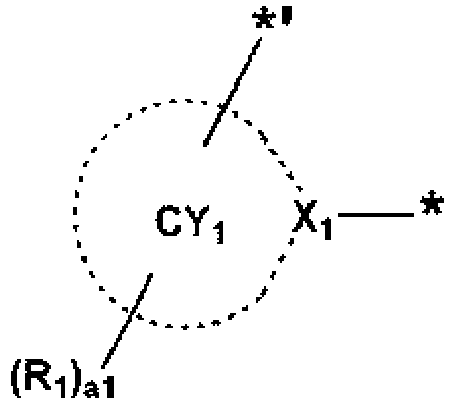 c) T1 ist eine Einzelbindung; undd) der Teil dargestellt durch

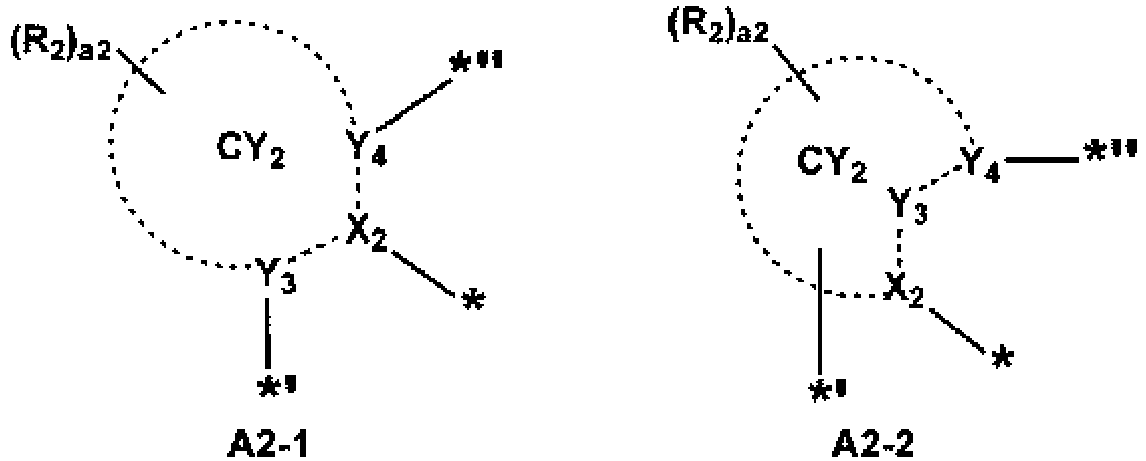 wobei in den Formeln A1-1 und A1-2, X1, Ring CY1, R1 und a1 gleich definiert sind wie diejenigen, die in Anspruch 5 definiert sind, Y1 und Y2 jeweils unabhängig ausgewählt sind aus N und C, * eine Bindungsstelle zu M oder X5 in Formel 1A angibt, *' eine Bindungsstelle zu T1 in Formel 1A angibt,in den Formeln A2-1 und A2-2 X2, Ring CY2, R2 und a2 gleich definiert sind wie diejenigen, die in Anspruch 5 definiert sind, Y3 und Y4 jeweils unabhängig ausgewählt sind aus N und C, * eine Bindungsstelle zu M in Formel 1A angibt, *' eine Bindungsstelle zu T1 in Formel 1A angibt und *" eine Bindungsstelle zu T2 in Formel 1A angibt.
 - Organometallische Verbindung nach Anspruch 5 oder 6, wobei der Teil dargestellt durch





 X1 und R1 gleich definiert sind wie diejenigen, die in Anspruch 5 definiert sind,X11 O, S, N(R11), C(R11)(R12) oder Si(R11)(R12) ist,X13 N oder C(R13) ist,X14 N oder C(R14) ist,R11 bis R18 jeweils gleich definiert sind wie R1 definiert in Anspruch 5,a17 eine ganze Zahl von 0 bis 7 ist,a16 eine ganze Zahl von 0 bis 6 ist,a15 eine ganze Zahl von 0 bis 5 ist,a14 eine ganze Zahl von 0 bis 4 ist,a13 eine ganze Zahl von 0 bis 3 ist,a12 eine ganze Zahl von 0 bis 2 ist,* eine Bindungsstelle zu M oder X5 in Formel 1A angibt, und*' eine Bindungsstelle zu T1 in Formel 1A angibt; und/oderwobei der Teil dargestellt durch





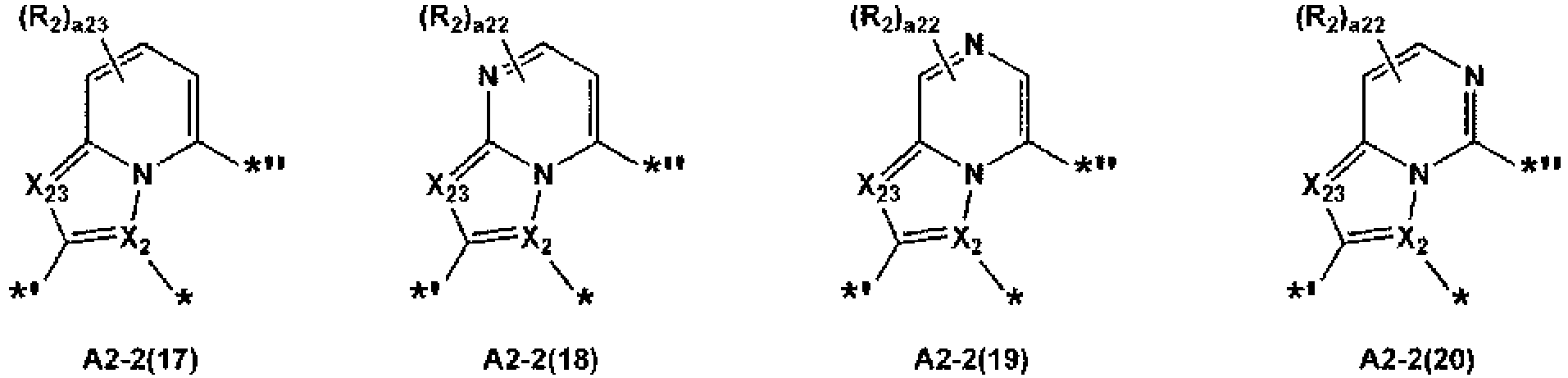







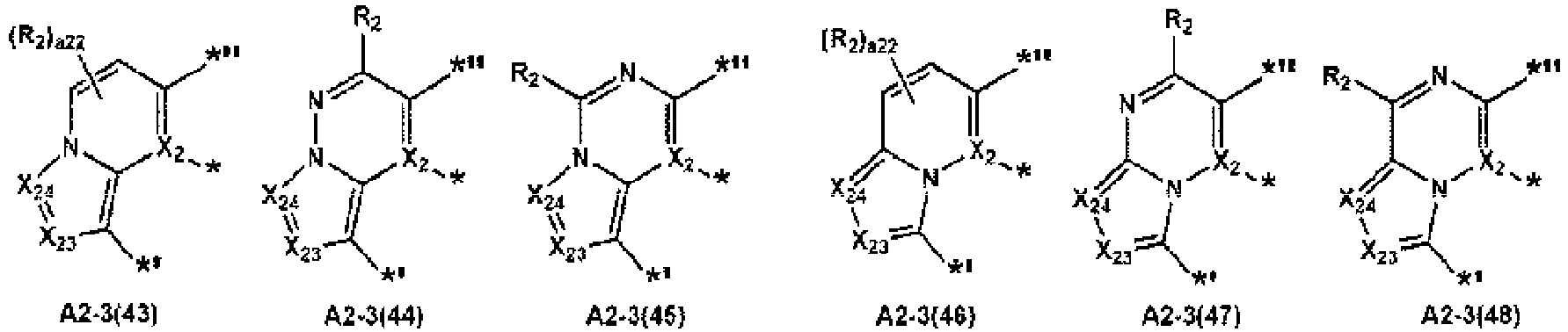

 X2 und R2 gleich definiert sind wie diejenigen, die in Anspruch 5 definiert sind,X21 O, S, N(R21), C(R21)(R22) oder Si(R21)(R22) ist,X23 N oder C(R23) ist,X24 N oder C(R24) ist,R21 bis R28 jeweils gleich definiert sind wie R2 in Anspruch 5 definiert,a26 eine ganze Zahl von 0 bis 6 ist,a25 eine ganze Zahl von 0 bis 5 ist,a24 eine ganze Zahl von 0 bis 4 ist,a23 eine ganze Zahl von 0 bis 3 ist,a22 eine ganze Zahl von 0 bis 2 ist,* eine Bindungsstelle zu M in Formel 1A angibt,*' eine Bindungsstelle zu T1 in Formel 1A angibt, und*" eine Bindungsstelle zu T2 in Formel 1A angibt.
 - Organometallische Verbindung nach Anspruch 5, wobei der Teil dargestellt durch
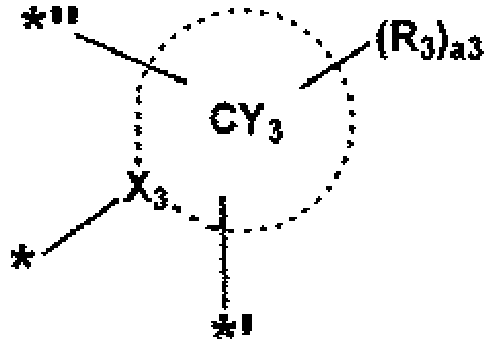


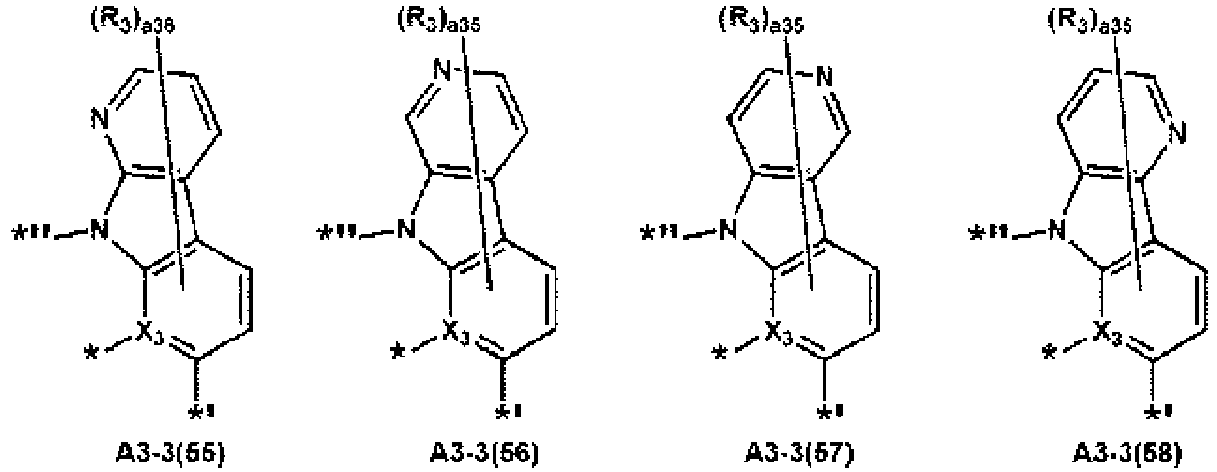 X3 und R3 gleich definiert sind wie diejenigen, die in Anspruch 5 definiert sind,X31 O, S, N(R31), C(R31)(R32) oder Si(R31)(R32) ist,X33 N oder C(R33) ist,X34 N oder C(R34) ist,R31 bis R38 jeweils gleich definiert sind wie R3 in Anspruch 5 definiert,a36 eine ganze Zahl von 0 bis 6 ist,a35 eine ganze Zahl von 0 bis 5 ist,a34 eine ganze Zahl von 0 bis 4 ist,a33 eine ganze Zahl von 0 bis 3 ist,a32 eine ganze Zahl von 0 bis 2 ist,* eine Bindungsstelle zu M in Formel 1A angibt,*" eine Bindungsstelle zu T2 in Formel 1A angibt, und*' eine Bindungsstelle zu T3 in Formel 1A angibt.
 - Organometallische Verbindung nach Anspruch 5, wobei der Teil dargestellt durch

der Teil dargestellt durch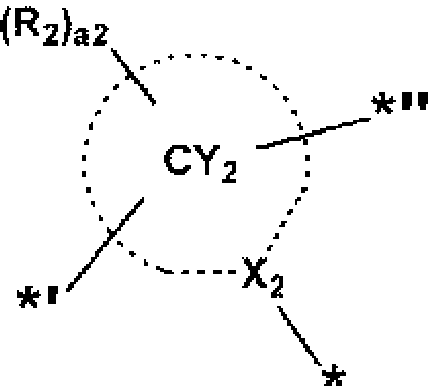
der Teil dargestellt durch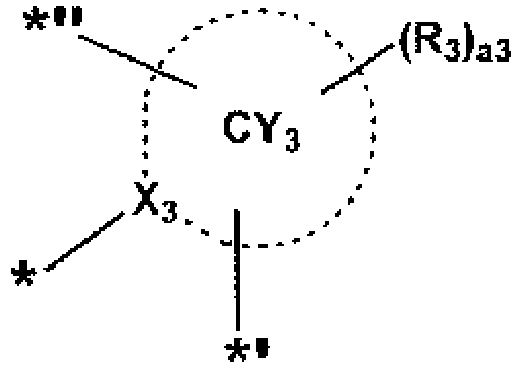



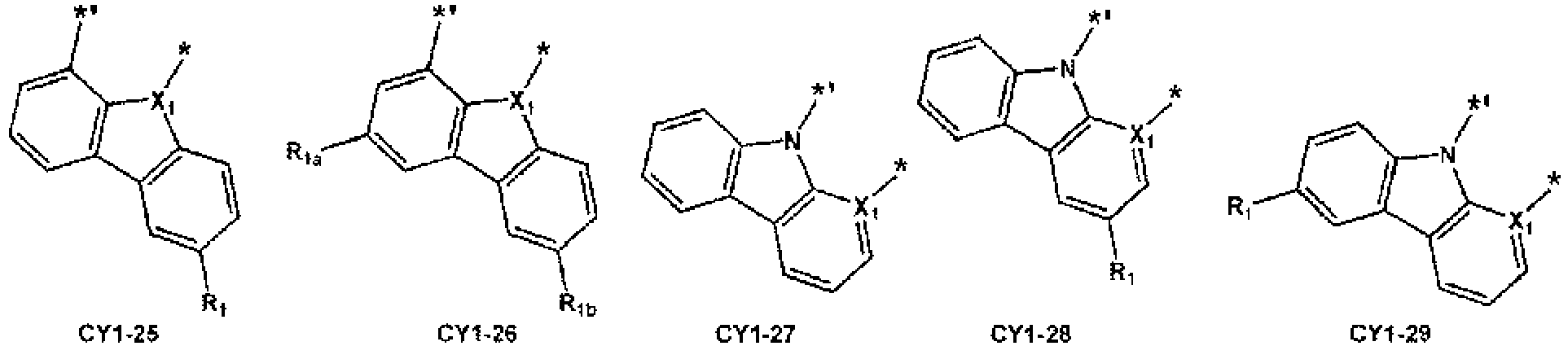
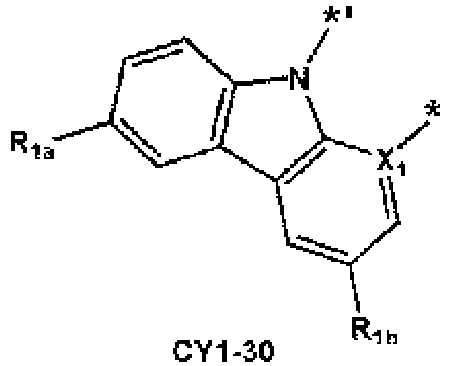




 X1 bis X3 und R1 bis R3 gleich definiert sind wie diejenigen, die in Anspruch 5 definiert sind,X21 O, S, N(R21), C(R21)(R22) oder Si(R21)(R22) ist,X23 N oder C(R23) ist,R1a bis R1d jeweils gleich definiert sind wie R1 definiert hierin,R2a bis R2c und R21 bis R23 jeweils gleich definiert sind wie R2 definiert hierin,R3a bis R3c gleich definiert sind wie R3 definiert hierin,vorausgesetzt, dass R1 bis R3, R1a bis R1d, R2a bis R2c und R3a bis R3c jeweils nicht Wasserstoff sind,in Formel CY1-1 bis CY1-30 * eine Bindungsstelle zu M oder X5 in Formel 1A angibt und *' eine Bindungsstelle zu T1 in Formel 1A angibt,in Formel CY2-1 bis CY2-37 * eine Bindungsstelle zu M in Formel 1A angibt, *' eine Bindungsstelle zu T1 in Formel 1A angibt und *" eine Bindungsstelle zu T2 in Formel 1A angibt, undin Formel CY3-1 bis CY3-16 * eine Bindungsstelle zu M in Formel 1A angibt, *" eine Bindungsstelle zu T2 in Formel 1A angibt und * eine Bindungsstelle zu T3 in Formel 1A angibt.
 - Organometallische Verbindung nach Anspruch 6, wobei der Teil dargestellt durch


 X3 und X4 jeweils gleich definiert sind wie diejenigen, die in Anspruch 6 definiert sind,R4a und R4b jeweils gleich definiert sind wie R4 in Anspruch 6 definiert, vorausgesetzt, dass R4a und R4b jeweils nicht Wasserstoff sind,*" eine Bindungsstelle zu T2 in Formel 1A(1) angibt, und* eine Bindungsstelle zu M in Formel 1A(1) angibt.
 - Organometallische Verbindung nach Anspruch 1, wobei die organometallische Verbindung aus Verbindung 1 bis 12 ausgewählt ist:
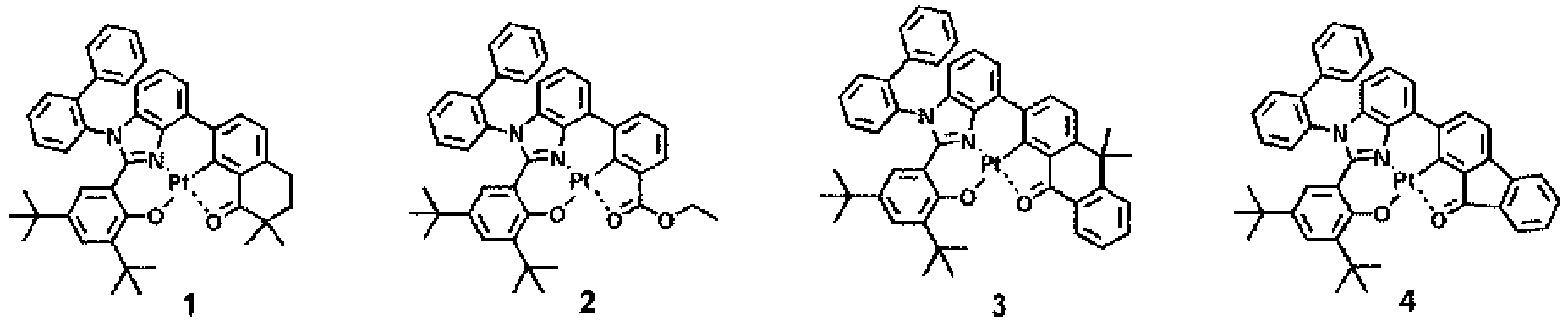


- Organische lichtemittierende Vorrichtung, umfassend:eine erste Elektrode,eine zweite Elektrode, undeine organische Schicht, die zwischen der ersten Elektrode und der zweiten Elektrode angeordnet ist,wobei die organische Schicht eine Emissionsschicht und zumindest eine organometallische Verbindung nach einem der Ansprüche 1-12 umfasst,wobei bevorzugt:die erste Elektrode eine Anode ist,die zweite Elektrode eine Kathode ist, unddie organische Schicht eine Lochtransportregion, die zwischen der ersten Elektrode und der Emissionsschicht angeordnet ist, und eine Elektronentransportregion umfasst, die zwischen der Emissionsschicht und der zweiten Elektrode angeordnet ist,wobei die Lochtransportregion eine Lochinjektionsschicht, eine Lochtransportschicht, eine Elektronenblockierschicht oder eine beliebige Kombination davon umfasst, undwobei die Elektronentransportregion eine Lochblockierschicht, eine Elektronentransportschicht, eine Elektroneninjektionsschicht oder eine beliebige Kombination davon umfasst.
- Organische lichtemittierende Vorrichtung nach Anspruch 13, wobei die Emissionsschicht die organometallische Verbindung umfasst;
wobei die Emissionsschicht bevorzugt ferner einen Wirt in einer Menge von mehr als einer Menge der organometallischen Verbindung umfasst. - Diagnostische Zusammensetzung, umfassend zumindest eine von der organometallischen Verbindung nach einem der Ansprüche 1-12.
Applications Claiming Priority (1)
| Application Number | Priority Date | Filing Date | Title |
|---|---|---|---|
| KR1020170148314A KR102542467B1 (ko) | 2017-11-08 | 2017-11-08 | 유기금속 화합물, 이를 포함한 유기 발광 소자 및 이를 포함한 진단용 조성물 |
Publications (2)
| Publication Number | Publication Date |
|---|---|
| EP3483170A1 EP3483170A1 (de) | 2019-05-15 |
| EP3483170B1 true EP3483170B1 (de) | 2021-06-02 |
Family
ID=64048904
Family Applications (1)
| Application Number | Title | Priority Date | Filing Date |
|---|---|---|---|
| EP18203677.2A Active EP3483170B1 (de) | 2017-11-08 | 2018-10-31 | Organometallische verbindung, organische lichtemittierende vorrichtung mit der organometallischen verbindung und diagnostische zusammensetzung mit der organometallischen verbindung |
Country Status (3)
| Country | Link |
|---|---|
| US (1) | US11569460B2 (de) |
| EP (1) | EP3483170B1 (de) |
| KR (1) | KR102542467B1 (de) |
Families Citing this family (12)
| Publication number | Priority date | Publication date | Assignee | Title |
|---|---|---|---|---|
| KR102811430B1 (ko) * | 2019-11-27 | 2025-05-23 | 삼성디스플레이 주식회사 | 유기금속 화합물 및 이를 포함한 유기 발광 소자 |
| US12371612B2 (en) | 2020-04-14 | 2025-07-29 | Samsung Electronics Co., Ltd. | Organometallic compound, organic light-emitting device including organometallic compound, and electronic apparatus including organic light-emitting device |
| US12247042B2 (en) | 2020-10-26 | 2025-03-11 | Universal Display Corporation | Organic electroluminescent materials and devices |
| US12528833B2 (en) | 2020-11-18 | 2026-01-20 | Universal Display Corporation | Organic electroluminescent materials and devices |
| US12466848B2 (en) | 2020-12-10 | 2025-11-11 | Universal Display Corporation | Organic electroluminescent materials and devices |
| CN113583056B (zh) * | 2021-08-31 | 2024-08-09 | 浙江虹舞科技有限公司 | 基于螺芴-螺芴结构的6/5/6四齿环金属铂或钯配合物的发光材料及其应用 |
| CN116162112A (zh) * | 2023-01-10 | 2023-05-26 | 广西师范大学 | 氧化异阿朴菲生物碱的n-杂环卡宾型环金属铂配合物及其合成方法和应用 |
| CN116023417A (zh) * | 2023-01-10 | 2023-04-28 | 广西师范大学 | 氧化异阿朴菲生物碱的n-杂环卡宾型环金属钌配合物及其合成方法和应用 |
| CN116253763A (zh) * | 2023-01-10 | 2023-06-13 | 广西师范大学 | 氧化异阿朴菲生物碱的n-杂环卡宾类金属有机钯配合物及其合成方法和应用 |
| CN116178446A (zh) * | 2023-01-10 | 2023-05-30 | 广西师范大学 | 氧化异阿朴菲生物碱的芳基类钢琴凳金属钌配合物及其合成方法和应用 |
| CN116143842A (zh) * | 2023-01-10 | 2023-05-23 | 广西师范大学 | 氧化异阿朴菲生物碱与n-杂环卡宾的环金属铱配合物及其合成方法和应用 |
| CN115974935A (zh) * | 2023-01-17 | 2023-04-18 | 广西师范大学 | 氧化异阿朴菲生物碱与联吡啶衍生物的环金属有机铑配合物及其合成方法和应用 |
Family Cites Families (8)
| Publication number | Priority date | Publication date | Assignee | Title |
|---|---|---|---|---|
| JPS5482386A (en) * | 1977-12-15 | 1979-06-30 | Fuji Photo Film Co Ltd | Stabilizing method for organic basic substance to light |
| AU2001285437A1 (en) * | 2000-08-16 | 2002-02-25 | Massachusetts Institute Of Technology | High efficiency solid state light-emitting device and method of generating light |
| CN100528886C (zh) * | 2006-02-16 | 2009-08-19 | 广西师范大学 | 以鹅掌楸碱为配体的金属配合物、其合成方法及其用途 |
| US8877353B2 (en) * | 2010-07-21 | 2014-11-04 | Versitech Limited | Platinum (II) tetradentate ONCN complexes for organic light-emitting diode applications |
| KR20150139965A (ko) * | 2013-04-11 | 2015-12-14 | 메르크 파텐트 게엠베하 | 금속 착물 및 전자 소자에서의 이의 용도 |
| US10144867B2 (en) | 2015-02-13 | 2018-12-04 | Universal Display Corporation | Organic electroluminescent materials and devices |
| KR102673814B1 (ko) | 2016-08-25 | 2024-06-10 | 삼성전자주식회사 | 유기금속 화합물 및 이를 포함한 유기 발광 소자 |
| US10873037B2 (en) * | 2017-03-28 | 2020-12-22 | Universal Display Corporation | Organic electroluminescent materials and devices |
-
2017
- 2017-11-08 KR KR1020170148314A patent/KR102542467B1/ko active Active
-
2018
- 2018-10-31 US US16/176,330 patent/US11569460B2/en active Active
- 2018-10-31 EP EP18203677.2A patent/EP3483170B1/de active Active
Non-Patent Citations (1)
| Title |
|---|
| None * |
Also Published As
| Publication number | Publication date |
|---|---|
| KR102542467B1 (ko) | 2023-06-12 |
| EP3483170A1 (de) | 2019-05-15 |
| US20190140192A1 (en) | 2019-05-09 |
| KR20190052545A (ko) | 2019-05-16 |
| US11569460B2 (en) | 2023-01-31 |
Similar Documents
| Publication | Publication Date | Title |
|---|---|---|
| EP3483170B1 (de) | Organometallische verbindung, organische lichtemittierende vorrichtung mit der organometallischen verbindung und diagnostische zusammensetzung mit der organometallischen verbindung | |
| EP3514163B1 (de) | Organometallische verbindung, organische lichtemittierende vorrichtung damit und diagnosezusammensetzung mit der organometallischen verbindung | |
| EP3450441B1 (de) | Organometallische verbindung, organische lichtemittierende vorrichtung mit der organometallischen verbindung und diagnostische zusammensetzung mit der organometallischen verbindung | |
| EP3508491B1 (de) | Organometallische verbindung, organische lichtemittierende vorrichtung damit und diagnosezusammensetzung damit | |
| EP3415520B1 (de) | Organometallische verbindung, organische lichtemittierende vorrichtung mit der organometallischen verbindung und diagnostische zusammensetzung mit der organometallischen verbindung | |
| EP3663308A1 (de) | Organometallische verbindung, organische lichtemittierende vorrichtung mit der organometallischen verbindung und diagnostische zusammensetzung mit der organometallischen verbindung | |
| EP3461830B1 (de) | Organometallische verbindung, organische lichtemittierende vorrichtung mit der organometallischen verbindung und diagnostische zusammensetzung mit der organometallischen verbindung | |
| EP3560940B1 (de) | Organometallische verbindung, organische lichtemittierende vorrichtung mit der organometallischen verbindung und diagnostische zusammensetzung mit der organometallischen verbindung | |
| JP7227767B2 (ja) | 有機金属化合物及び有機発光素子並びにそれを含む診断用組成物 | |
| EP3705483B1 (de) | Organometallische verbindung, organische lichtemittierende vorrichtung damit und elektronische vorrichtung mit der organischen lichtemittierenden vorrichtung | |
| EP3461831B1 (de) | Organometallische verbindung, organische lichtemittierende vorrichtung mit der organometallischen verbindung und diagnostische zusammensetzung mit der organometallischen verbindung | |
| EP3392258B1 (de) | Organometallische verbindung, organische lichtemittierende vorrichtung mit der organometallischen verbindung und diagnostische zusammensetzung mit der organometallischen verbindung | |
| EP3604321A1 (de) | Organometallische verbindung, organische lichtemittierende vorrichtung damit und diagnosezusammensetzung mit der organometallischen verbindung | |
| EP3862360B1 (de) | Organometallische verbindung, organische lichtemittierende vorrichtung damit und elektronische einrichtung mit der organischen lichtemittierenden vorrichtung | |
| EP3988557B1 (de) | Organometallische verbindung, organische lichtemittierende vorrichtung damit und diagnosezusammensetzung mit der organometallischen verbindung | |
| EP3626724A1 (de) | Organometallische verbindung, organische lichtemittierende vorrichtung damit und diagnosezusammensetzung mit der organometallischen verbindung | |
| EP3971260A1 (de) | Organometallische verbindung, organische lichtemittierende vorrichtung, die diese umfasst, und elektronisches gerät, das diese organische lichtemittierende vorrichtung umfasst | |
| EP3395823B1 (de) | Organometallische verbindung, organische lichtemittierende vorrichtung damit und diagnosezusammensetzung mit der organometallischen verbindung | |
| EP3725793B1 (de) | Organometallische verbindung, organische lichtemittierende vorrichtung mit der organometallischen verbindung und diagnostische zusammensetzung mit der organometallischen verbindung | |
| EP3722301B1 (de) | Organometallische verbindung, organische lichtemittierende vorrichtung mit der organometallischen verbindung, diagnostische zusammensetzung mit der organometallischen verbindung | |
| EP3502117B1 (de) | Organometallische verbindung, organische lichtemittierende vorrichtung mit der organometallischen verbindung und diagnostische zusammensetzung mit der organometallischen verbindung | |
| EP3715352B1 (de) | Organometallische verbindung, organische lichtemittierende vorrichtung damit und elektronische vorrichtung mit der organischen lichtemittierenden vorrichtung | |
| EP3617216A1 (de) | Organometallische verbindung, organische lichtemittierende vorrichtung damit und diagnosezusammensetzung mit der organometallischen verbindung | |
| EP3851443B1 (de) | Organometallische verbindung, organische lichtemittierende vorrichtung mit organometallischer verbindung und elektronische vorrichtung mit organischer lichtemittierender vorrichtung |
Legal Events
| Date | Code | Title | Description |
|---|---|---|---|
| PUAI | Public reference made under article 153(3) epc to a published international application that has entered the european phase |
Free format text: ORIGINAL CODE: 0009012 |
|
| STAA | Information on the status of an ep patent application or granted ep patent |
Free format text: STATUS: THE APPLICATION HAS BEEN PUBLISHED |
|
| AK | Designated contracting states |
Kind code of ref document: A1 Designated state(s): AL AT BE BG CH CY CZ DE DK EE ES FI FR GB GR HR HU IE IS IT LI LT LU LV MC MK MT NL NO PL PT RO RS SE SI SK SM TR |
|
| AX | Request for extension of the european patent |
Extension state: BA ME |
|
| STAA | Information on the status of an ep patent application or granted ep patent |
Free format text: STATUS: REQUEST FOR EXAMINATION WAS MADE |
|
| 17P | Request for examination filed |
Effective date: 20191115 |
|
| RBV | Designated contracting states (corrected) |
Designated state(s): AL AT BE BG CH CY CZ DE DK EE ES FI FR GB GR HR HU IE IS IT LI LT LU LV MC MK MT NL NO PL PT RO RS SE SI SK SM TR |
|
| STAA | Information on the status of an ep patent application or granted ep patent |
Free format text: STATUS: EXAMINATION IS IN PROGRESS |
|
| 17Q | First examination report despatched |
Effective date: 20200320 |
|
| GRAP | Despatch of communication of intention to grant a patent |
Free format text: ORIGINAL CODE: EPIDOSNIGR1 |
|
| STAA | Information on the status of an ep patent application or granted ep patent |
Free format text: STATUS: GRANT OF PATENT IS INTENDED |
|
| INTG | Intention to grant announced |
Effective date: 20201214 |
|
| GRAS | Grant fee paid |
Free format text: ORIGINAL CODE: EPIDOSNIGR3 |
|
| GRAA | (expected) grant |
Free format text: ORIGINAL CODE: 0009210 |
|
| STAA | Information on the status of an ep patent application or granted ep patent |
Free format text: STATUS: THE PATENT HAS BEEN GRANTED |
|
| REG | Reference to a national code |
Ref country code: CH Ref legal event code: EP |
|
| AK | Designated contracting states |
Kind code of ref document: B1 Designated state(s): AL AT BE BG CH CY CZ DE DK EE ES FI FR GB GR HR HU IE IS IT LI LT LU LV MC MK MT NL NO PL PT RO RS SE SI SK SM TR |
|
| REG | Reference to a national code |
Ref country code: GB Ref legal event code: FG4D |
|
| REG | Reference to a national code |
Ref country code: AT Ref legal event code: REF Ref document number: 1398355 Country of ref document: AT Kind code of ref document: T Effective date: 20210615 |
|
| REG | Reference to a national code |
Ref country code: IE Ref legal event code: FG4D |
|
| REG | Reference to a national code |
Ref country code: DE Ref legal event code: R096 Ref document number: 602018017949 Country of ref document: DE |
|
| REG | Reference to a national code |
Ref country code: LT Ref legal event code: MG9D |
|
| PG25 | Lapsed in a contracting state [announced via postgrant information from national office to epo] |
Ref country code: BG Free format text: LAPSE BECAUSE OF FAILURE TO SUBMIT A TRANSLATION OF THE DESCRIPTION OR TO PAY THE FEE WITHIN THE PRESCRIBED TIME-LIMIT Effective date: 20210902 Ref country code: FI Free format text: LAPSE BECAUSE OF FAILURE TO SUBMIT A TRANSLATION OF THE DESCRIPTION OR TO PAY THE FEE WITHIN THE PRESCRIBED TIME-LIMIT Effective date: 20210602 Ref country code: HR Free format text: LAPSE BECAUSE OF FAILURE TO SUBMIT A TRANSLATION OF THE DESCRIPTION OR TO PAY THE FEE WITHIN THE PRESCRIBED TIME-LIMIT Effective date: 20210602 Ref country code: LT Free format text: LAPSE BECAUSE OF FAILURE TO SUBMIT A TRANSLATION OF THE DESCRIPTION OR TO PAY THE FEE WITHIN THE PRESCRIBED TIME-LIMIT Effective date: 20210602 |
|
| REG | Reference to a national code |
Ref country code: NL Ref legal event code: MP Effective date: 20210602 |
|
| REG | Reference to a national code |
Ref country code: AT Ref legal event code: MK05 Ref document number: 1398355 Country of ref document: AT Kind code of ref document: T Effective date: 20210602 |
|
| PG25 | Lapsed in a contracting state [announced via postgrant information from national office to epo] |
Ref country code: GR Free format text: LAPSE BECAUSE OF FAILURE TO SUBMIT A TRANSLATION OF THE DESCRIPTION OR TO PAY THE FEE WITHIN THE PRESCRIBED TIME-LIMIT Effective date: 20210903 Ref country code: LV Free format text: LAPSE BECAUSE OF FAILURE TO SUBMIT A TRANSLATION OF THE DESCRIPTION OR TO PAY THE FEE WITHIN THE PRESCRIBED TIME-LIMIT Effective date: 20210602 Ref country code: NO Free format text: LAPSE BECAUSE OF FAILURE TO SUBMIT A TRANSLATION OF THE DESCRIPTION OR TO PAY THE FEE WITHIN THE PRESCRIBED TIME-LIMIT Effective date: 20210902 Ref country code: PL Free format text: LAPSE BECAUSE OF FAILURE TO SUBMIT A TRANSLATION OF THE DESCRIPTION OR TO PAY THE FEE WITHIN THE PRESCRIBED TIME-LIMIT Effective date: 20210602 Ref country code: RS Free format text: LAPSE BECAUSE OF FAILURE TO SUBMIT A TRANSLATION OF THE DESCRIPTION OR TO PAY THE FEE WITHIN THE PRESCRIBED TIME-LIMIT Effective date: 20210602 Ref country code: SE Free format text: LAPSE BECAUSE OF FAILURE TO SUBMIT A TRANSLATION OF THE DESCRIPTION OR TO PAY THE FEE WITHIN THE PRESCRIBED TIME-LIMIT Effective date: 20210602 |
|
| PG25 | Lapsed in a contracting state [announced via postgrant information from national office to epo] |
Ref country code: RO Free format text: LAPSE BECAUSE OF FAILURE TO SUBMIT A TRANSLATION OF THE DESCRIPTION OR TO PAY THE FEE WITHIN THE PRESCRIBED TIME-LIMIT Effective date: 20210602 Ref country code: NL Free format text: LAPSE BECAUSE OF FAILURE TO SUBMIT A TRANSLATION OF THE DESCRIPTION OR TO PAY THE FEE WITHIN THE PRESCRIBED TIME-LIMIT Effective date: 20210602 Ref country code: PT Free format text: LAPSE BECAUSE OF FAILURE TO SUBMIT A TRANSLATION OF THE DESCRIPTION OR TO PAY THE FEE WITHIN THE PRESCRIBED TIME-LIMIT Effective date: 20211004 Ref country code: AT Free format text: LAPSE BECAUSE OF FAILURE TO SUBMIT A TRANSLATION OF THE DESCRIPTION OR TO PAY THE FEE WITHIN THE PRESCRIBED TIME-LIMIT Effective date: 20210602 Ref country code: CZ Free format text: LAPSE BECAUSE OF FAILURE TO SUBMIT A TRANSLATION OF THE DESCRIPTION OR TO PAY THE FEE WITHIN THE PRESCRIBED TIME-LIMIT Effective date: 20210602 Ref country code: SK Free format text: LAPSE BECAUSE OF FAILURE TO SUBMIT A TRANSLATION OF THE DESCRIPTION OR TO PAY THE FEE WITHIN THE PRESCRIBED TIME-LIMIT Effective date: 20210602 Ref country code: SM Free format text: LAPSE BECAUSE OF FAILURE TO SUBMIT A TRANSLATION OF THE DESCRIPTION OR TO PAY THE FEE WITHIN THE PRESCRIBED TIME-LIMIT Effective date: 20210602 Ref country code: ES Free format text: LAPSE BECAUSE OF FAILURE TO SUBMIT A TRANSLATION OF THE DESCRIPTION OR TO PAY THE FEE WITHIN THE PRESCRIBED TIME-LIMIT Effective date: 20210602 Ref country code: EE Free format text: LAPSE BECAUSE OF FAILURE TO SUBMIT A TRANSLATION OF THE DESCRIPTION OR TO PAY THE FEE WITHIN THE PRESCRIBED TIME-LIMIT Effective date: 20210602 |
|
| REG | Reference to a national code |
Ref country code: DE Ref legal event code: R097 Ref document number: 602018017949 Country of ref document: DE |
|
| PLBE | No opposition filed within time limit |
Free format text: ORIGINAL CODE: 0009261 |
|
| STAA | Information on the status of an ep patent application or granted ep patent |
Free format text: STATUS: NO OPPOSITION FILED WITHIN TIME LIMIT |
|
| PG25 | Lapsed in a contracting state [announced via postgrant information from national office to epo] |
Ref country code: DK Free format text: LAPSE BECAUSE OF FAILURE TO SUBMIT A TRANSLATION OF THE DESCRIPTION OR TO PAY THE FEE WITHIN THE PRESCRIBED TIME-LIMIT Effective date: 20210602 |
|
| 26N | No opposition filed |
Effective date: 20220303 |
|
| PG25 | Lapsed in a contracting state [announced via postgrant information from national office to epo] |
Ref country code: AL Free format text: LAPSE BECAUSE OF FAILURE TO SUBMIT A TRANSLATION OF THE DESCRIPTION OR TO PAY THE FEE WITHIN THE PRESCRIBED TIME-LIMIT Effective date: 20210602 |
|
| REG | Reference to a national code |
Ref country code: CH Ref legal event code: PL |
|
| REG | Reference to a national code |
Ref country code: BE Ref legal event code: MM Effective date: 20211031 |
|
| PG25 | Lapsed in a contracting state [announced via postgrant information from national office to epo] |
Ref country code: MC Free format text: LAPSE BECAUSE OF FAILURE TO SUBMIT A TRANSLATION OF THE DESCRIPTION OR TO PAY THE FEE WITHIN THE PRESCRIBED TIME-LIMIT Effective date: 20210602 |
|
| PG25 | Lapsed in a contracting state [announced via postgrant information from national office to epo] |
Ref country code: LU Free format text: LAPSE BECAUSE OF NON-PAYMENT OF DUE FEES Effective date: 20211031 Ref country code: IT Free format text: LAPSE BECAUSE OF FAILURE TO SUBMIT A TRANSLATION OF THE DESCRIPTION OR TO PAY THE FEE WITHIN THE PRESCRIBED TIME-LIMIT Effective date: 20210602 Ref country code: BE Free format text: LAPSE BECAUSE OF NON-PAYMENT OF DUE FEES Effective date: 20211031 |
|
| PG25 | Lapsed in a contracting state [announced via postgrant information from national office to epo] |
Ref country code: LI Free format text: LAPSE BECAUSE OF NON-PAYMENT OF DUE FEES Effective date: 20211031 Ref country code: CH Free format text: LAPSE BECAUSE OF NON-PAYMENT OF DUE FEES Effective date: 20211031 |
|
| PG25 | Lapsed in a contracting state [announced via postgrant information from national office to epo] |
Ref country code: IE Free format text: LAPSE BECAUSE OF NON-PAYMENT OF DUE FEES Effective date: 20211031 |
|
| P01 | Opt-out of the competence of the unified patent court (upc) registered |
Effective date: 20230520 |
|
| PG25 | Lapsed in a contracting state [announced via postgrant information from national office to epo] |
Ref country code: CY Free format text: LAPSE BECAUSE OF FAILURE TO SUBMIT A TRANSLATION OF THE DESCRIPTION OR TO PAY THE FEE WITHIN THE PRESCRIBED TIME-LIMIT Effective date: 20210602 |
|
| PG25 | Lapsed in a contracting state [announced via postgrant information from national office to epo] |
Ref country code: HU Free format text: LAPSE BECAUSE OF FAILURE TO SUBMIT A TRANSLATION OF THE DESCRIPTION OR TO PAY THE FEE WITHIN THE PRESCRIBED TIME-LIMIT; INVALID AB INITIO Effective date: 20181031 |
|
| PG25 | Lapsed in a contracting state [announced via postgrant information from national office to epo] |
Ref country code: MK Free format text: LAPSE BECAUSE OF FAILURE TO SUBMIT A TRANSLATION OF THE DESCRIPTION OR TO PAY THE FEE WITHIN THE PRESCRIBED TIME-LIMIT Effective date: 20210602 |
|
| PG25 | Lapsed in a contracting state [announced via postgrant information from national office to epo] |
Ref country code: TR Free format text: LAPSE BECAUSE OF FAILURE TO SUBMIT A TRANSLATION OF THE DESCRIPTION OR TO PAY THE FEE WITHIN THE PRESCRIBED TIME-LIMIT Effective date: 20210602 |
|
| PG25 | Lapsed in a contracting state [announced via postgrant information from national office to epo] |
Ref country code: MT Free format text: LAPSE BECAUSE OF FAILURE TO SUBMIT A TRANSLATION OF THE DESCRIPTION OR TO PAY THE FEE WITHIN THE PRESCRIBED TIME-LIMIT Effective date: 20210602 |
|
| PGFP | Annual fee paid to national office [announced via postgrant information from national office to epo] |
Ref country code: GB Payment date: 20250911 Year of fee payment: 8 |
|
| PGFP | Annual fee paid to national office [announced via postgrant information from national office to epo] |
Ref country code: FR Payment date: 20250908 Year of fee payment: 8 |
|
| PGFP | Annual fee paid to national office [announced via postgrant information from national office to epo] |
Ref country code: DE Payment date: 20250910 Year of fee payment: 8 |