EP3483733A1 - Verfahren und vorrichtung zur erforschung einer marge zur ressourcenoptimierung in einer anwendungskette - Google Patents
Verfahren und vorrichtung zur erforschung einer marge zur ressourcenoptimierung in einer anwendungskette Download PDFInfo
- Publication number
- EP3483733A1 EP3483733A1 EP18205310.8A EP18205310A EP3483733A1 EP 3483733 A1 EP3483733 A1 EP 3483733A1 EP 18205310 A EP18205310 A EP 18205310A EP 3483733 A1 EP3483733 A1 EP 3483733A1
- Authority
- EP
- European Patent Office
- Prior art keywords
- resource
- resources
- values
- quality
- requests
- Prior art date
- Legal status (The legal status is an assumption and is not a legal conclusion. Google has not performed a legal analysis and makes no representation as to the accuracy of the status listed.)
- Granted
Links
Images



Classifications
-
- G—PHYSICS
- G06—COMPUTING OR CALCULATING; COUNTING
- G06F—ELECTRIC DIGITAL DATA PROCESSING
- G06F11/00—Error detection; Error correction; Monitoring
- G06F11/30—Monitoring
- G06F11/34—Recording or statistical evaluation of computer activity, e.g. of down time, of input/output operation ; Recording or statistical evaluation of user activity, e.g. usability assessment
- G06F11/3409—Recording or statistical evaluation of computer activity, e.g. of down time, of input/output operation ; Recording or statistical evaluation of user activity, e.g. usability assessment for performance assessment
-
- G—PHYSICS
- G06—COMPUTING OR CALCULATING; COUNTING
- G06F—ELECTRIC DIGITAL DATA PROCESSING
- G06F11/00—Error detection; Error correction; Monitoring
- G06F11/30—Monitoring
- G06F11/3003—Monitoring arrangements specially adapted to the computing system or computing system component being monitored
- G06F11/302—Monitoring arrangements specially adapted to the computing system or computing system component being monitored where the computing system component is a software system
-
- G—PHYSICS
- G06—COMPUTING OR CALCULATING; COUNTING
- G06F—ELECTRIC DIGITAL DATA PROCESSING
- G06F11/00—Error detection; Error correction; Monitoring
- G06F11/30—Monitoring
- G06F11/34—Recording or statistical evaluation of computer activity, e.g. of down time, of input/output operation ; Recording or statistical evaluation of user activity, e.g. usability assessment
- G06F11/3409—Recording or statistical evaluation of computer activity, e.g. of down time, of input/output operation ; Recording or statistical evaluation of user activity, e.g. usability assessment for performance assessment
- G06F11/3419—Recording or statistical evaluation of computer activity, e.g. of down time, of input/output operation ; Recording or statistical evaluation of user activity, e.g. usability assessment for performance assessment by assessing time
-
- G—PHYSICS
- G06—COMPUTING OR CALCULATING; COUNTING
- G06F—ELECTRIC DIGITAL DATA PROCESSING
- G06F11/00—Error detection; Error correction; Monitoring
- G06F11/30—Monitoring
- G06F11/34—Recording or statistical evaluation of computer activity, e.g. of down time, of input/output operation ; Recording or statistical evaluation of user activity, e.g. usability assessment
- G06F11/3442—Recording or statistical evaluation of computer activity, e.g. of down time, of input/output operation ; Recording or statistical evaluation of user activity, e.g. usability assessment for planning or managing the needed capacity
-
- G—PHYSICS
- G06—COMPUTING OR CALCULATING; COUNTING
- G06F—ELECTRIC DIGITAL DATA PROCESSING
- G06F11/00—Error detection; Error correction; Monitoring
- G06F11/30—Monitoring
- G06F11/34—Recording or statistical evaluation of computer activity, e.g. of down time, of input/output operation ; Recording or statistical evaluation of user activity, e.g. usability assessment
- G06F11/3409—Recording or statistical evaluation of computer activity, e.g. of down time, of input/output operation ; Recording or statistical evaluation of user activity, e.g. usability assessment for performance assessment
- G06F11/3414—Workload generation, e.g. scripts, playback
-
- G—PHYSICS
- G06—COMPUTING OR CALCULATING; COUNTING
- G06F—ELECTRIC DIGITAL DATA PROCESSING
- G06F2201/00—Indexing scheme relating to error detection, to error correction, and to monitoring
- G06F2201/81—Threshold
-
- G—PHYSICS
- G06—COMPUTING OR CALCULATING; COUNTING
- G06F—ELECTRIC DIGITAL DATA PROCESSING
- G06F2201/00—Indexing scheme relating to error detection, to error correction, and to monitoring
- G06F2201/865—Monitoring of software
Definitions
- the present invention relates to the field of computer infrastructure performance tests, and more particularly to the optimization of a computer infrastructure hosting an application chain.
- the invention relates in particular to an optimization margin search method making it possible to identify underutilized resources and a device capable of implementing said method.
- IT infrastructure is a big part of a company's investment. Their good management is a strategic challenge to control their costs, but also to ensure reliable and optimized access to different business data system information.
- IT administrators generally have to evolve their IT infrastructure to always offer high-performance business application services tailored to the demands of their organization. For example, following an increase in a certain group of users, there may be an increase in resource consumption by some business applications and therefore it may be advantageous to reorganize this IT infrastructure. Alternatively, a change in application bricks, a modification of an application brick resulting in a reduction in its resource consumption, or an improvement of an IT infrastructure may lead to an increase in available resources.
- a technique for reducing the hardware resources allocated to support a software application is described in the document US2010 / 0192156 . This technique allows an application execution to compute an application service level based on at least one hardware resource metric and to compare the service level to an application service threshold level in order to to determine underutilization of resources.
- this application does not allow automated anticipation of the use of resources and requires choices made a priori, this technique being performed during the execution of the application.
- an iterative approach it is possible to progressively increase the load on a computer infrastructure hosting an application chain so as to determine from what time it exceeds the threshold of maximum use of resources by the application chain.
- This can be a dichotomous approach in order to find the maximum load that the application chain can support, corresponding to the load limit for the application chain in the material environment at its disposal.
- An application of this type is described in the document EP2833267 and allows you to automatically find the maximum load limit that can be supported by an application chain.
- IS information system
- the invention therefore aims to overcome the disadvantages of the prior art.
- the invention aims to provide a resource optimization margin search process capable of quickly determining which resources could be reduced on the IT infrastructure while maintaining a quality of service at a desired level.
- This method must be fast and simple to implement, with a reduced number of steps.
- it must be able to assure the IS administrator of the capacity of the proposed new levels of resources to allow the proper functioning of the application chain.
- Another object of the invention is to propose a device for seeking a margin of resource optimization, said device being able to be configured so as to be easily adapted to the IT infrastructure to be optimized.
- the invention has the advantage of being able to identify a margin of optimization of the resources of a computer infrastructure hosting an application chain.
- the objective of an IS administrator can be to limit to the strict minimum the resources allocated to the application chain hosted by the IT infrastructure.
- the present invention proposes a solution for determining the minimum configuration of the resources of the IT infrastructure so that it can support a given load which is the load associated with conventional operation. of the application chain.
- the minimum configuration of the resources of the IT infrastructure makes it possible to use the least possible resources while not exceeding the predetermined minimum threshold for using these resources and while respecting predetermined values of threshold values of quality parameters. on duty.
- the goal is to optimize the use of resources while guaranteeing the level of service. This reduces the cost of an organization's IT infrastructure while ensuring the desired level of service quality for the various IT applications.
- the invention further relates to a computer program product configured to implement the resource optimization margin search method of a computer infrastructure hosting an application chain according to the invention.
- resource the parameters, capabilities or functions of computer devices for the operation of an application chain.
- the same application chain is associated with several resources.
- a resource is usually associated with a unique identifier to identify it within a computer structure.
- the term “resource” may include: a network disk, a network, a processor, or a RAM.
- level of a resource is meant in the sense of the invention a quantity of resource. For example, this may correspond for network disks to the number of available network disks or the amount of memory available on these network disks, for a processor with the number of cores or the number of processors or the size of the caches, for a memory live to the available quantity, and for ports, the number of ports that can be opened simultaneously.
- the initial level of a resource corresponds to the amount of resource available on the IT infrastructure for the application chain whereas the reduced level of a resource corresponds to the quantity of resource available after a modification step according to the invention.
- the "step of a resource" can be on the one hand the minimum amount of resource that can be added or subtracted when a modification step and on the other hand a multiple of the modification that can be subjected to the level of said resource.
- Some resources have a large grain size (eg servers) while others have a small particle size (eg RAM available).
- a user can define the pitch of a resource according to the granulometry of the resource or more particularly of the IT infrastructure considered.
- value of use of a resource is meant in the sense of the invention a value representative of the consumption or occupation of said resource during operation of the application chain.
- the usage value may correspond for network disks at their inputs / outputs, read / write to disks, the memory utilization rate, for a network at its bandwidth, for processors at their use (in percent) or cache occupancy rate, for RAM the amount used and for ports, the number of ports that were opened simultaneously during operation of the process.
- the utilization value is advantageously reduced to the percentage of the level of the resource.
- the term "max predetermined threshold of use" means a maximum value of parameter associated with each resource allowing adequate operation of said resource. For example, this corresponds to the maximum acceptable limits of resource consumption for a computer structure hosting an application chain. These limits may be real or hypothetical and generally correspond to a value or a level of use beyond which malfunctions may occur with the result that the resource, the IT structure or decreases in quality of service.
- This threshold can be predetermined by a user via a configuration file and a Human Machine Interface (HMI).
- HMI Human Machine Interface
- the term " malfunction " in the sense of the invention corresponds to the occurrence of a hardware incident or congestion on the IT infrastructure.
- predetermined minimum threshold of use means a minimum value of use below which it can be considered that a resource is wasted or underused.
- a predetermined minimum threshold of use for each resource or each parameter of a resource can be predetermined by a user via a configuration file and a Human Machine Interface (HMI).
- HMI Human Machine Interface
- quality of service or level of service in the sense of the invention corresponds to an assessment of the quality of service provided by the application chain.
- quality of service parameter within the meaning of the invention corresponds to subjective or objective criteria such as latencies of a process, packet losses, bit rates, resource utilization values and response times per request.
- there is generally a plurality of quality of service parameters In particular, there may be a different threshold response time for each of the different requests or a global response time.
- predetermined threshold of quality of service parameter within the meaning of the invention corresponds to a parameter value to which a third party can commit in order to guarantee good performance for critical applications of an organization and such that this can be defined in a service level agreement.
- a threshold may be of the type: all response times are less than 3 seconds. Nevertheless, it may be advantageous to have detailed thresholds according to the professional acts. For example, a query implementing a file print may have a higher response time threshold than a request including the display of a web page.
- the predetermined thresholds of quality of service parameters may also include predetermined maximum thresholds of use.
- the term "computer infrastructure" means a set of computer structures (ie computing devices) or machines capable of operating one or more business applications or application chains.
- the computer structure can be a server or comprise a plurality of machines.
- application chain in the sense of the invention corresponds to a set of applications, interconnected by a stream of information and intended to propose, at the through several processes, one or more functionalities corresponding to the business need of an organization.
- application brick within the meaning of the invention corresponds to a component of an application.
- the combination of application bricks is often necessary for the operation of applications, especially business applications, such as for example a Web application, a content sharing platform or a computing platform.
- the application bricks of the IT infrastructure include, for example, an ftp server, an email server, a Java application server and / or one or more databases.
- probe or "computer probe” means software associated with a device that makes it possible to carry out, manage and send back to a computer equipment measures intended to inform, among other things, parameter values. quality of service, the state of the resources, or the use of resources.
- human-machine interface within the meaning of the invention corresponds to any element allowing a human being to communicate with a particular computer and without this list being exhaustive, a keyboard and means allowing in response to the orders entered. keyboard to perform displays and optionally select with the mouse or a touchpad elements displayed on the screen. Another embodiment is a touch screen for selecting directly on the screen the elements touched by the finger or an object and possibly with the possibility of displaying a virtual keyboard.
- load control file is intended to mean a file for configuring the load or the constraint to be applied to a computer structure.
- the configuration file may for example be a file, or a set of files, which allows to associate several data or fields.
- a load control file is, for example, an XML file, a CSV file, an INI file, a JSON file ....
- a load control file may include one or more configuration records. It can be generated from information entered by a user.
- the present invention makes it possible to automatically search for the minimum configuration of the IT infrastructure of an application chain so as to reduce the financial cost. It is based on the identification of underutilized resources, especially when executing a set of requests corresponding to a shot at a desired level of charge.
- the Figure 1 illustrates a possible evolution, spread over several quarters, of the quantity of requests received by an application chain as a result of a change in the information systems management policy.
- the number of users increases over time (full line curve) and the number and weighting of the main business acts that it has to manage daily are significantly modified.
- the number of requests [R1] and [R2] corresponding to operations of type reception, data transmission then treatment, are now almost zero whereas the number of requests [R3] and [R4] consultation and modification are increasing.
- the global number of requests has increased and the distribution of these requests has been modified. It is therefore possible that the use of resources by this application chain no longer corresponds to the use of resources envisaged during the implementation of this application chain. Maintaining an IT infrastructure for this application chain in its current state could lead to wasted resources or operational disruptions. Thus, it is necessary to be able to propose a method of seeking a margin of optimization of the resources of this IT infrastructure.
- the inventors have developed a new method of seeking margin of optimization of the resources of an IT infrastructure. This method advantageously makes it possible to identify which resources are underutilized by an application chain.
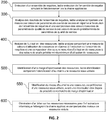
- the figure 2 schematically illustrates a resource optimization margin search method according to the invention.
- the search method according to the invention comprises a first step 200 of executing a set of requests.
- This execution of a set of requests makes it possible to simulate the operation of the application chain. Indeed, in order to identify the underutilized resources, it is necessary to be able to simulate a conventional operation of the application chain.
- This set of queries can also be called a firing and repeating multiple executions of a set of queries can be called a firing campaign.
- This step can be performed by an injection module 20 which will be presented later.
- the set of queries can be limited to the simulation of the main business scenarios, ie those having a significant impact on the resources of the IT infrastructure.
- the activity of the application chain has been summarized in four main business scenarios [R1] to [R4] which alone represent the bulk of the load of an application chain.
- a load instruction file advantageously comprises values on the following parameters: the different types of scenario, the weighting of each of these business scenarios (that is to say the relative proportion of each compared to the others) , and the overall load level (i.e. the target volume or query rate desired during the process). Equivalently, it may include information on the number of scenarios of each type executed simultaneously, for example for one hour. It may also include information about the IT infrastructure being tested.
- the set of queries is typically stored in a load control file that contains the code to be executed.
- Running the load control file can produce a number of actions as diverse as creating, viewing, editing, deleting files, or printing, copying, displaying data. These actions will generally be similar to the main business acts supported by the application chain.
- the method according to the invention may also include a step of loading a load control file.
- all the shots produced in the course of the process are preferably identical (except possibly the optional shots 820).
- the first shot as well as the following will be done in order to simulate the classic operation of the application chain.
- a scenario is composed of several different requests, that is to say, several business acts, which are repeated a number of times to mimic a current use of the application chain.
- the simulation can be considered as an approximation of the burden usually incurred by the IT infrastructure implementing the application chain.
- Shots are advantageously implemented when the infrastructure is little used by users such as night or weekends.
- the launch of the execution of the set of requests ie of the shooting
- this step 200 may include the opening of a file comprising a list of quality of service parameters to be analyzed as well as predetermined thresholds of quality of service. Indeed, as is detailed later, the objective of the execution of the set of requests, or shooting, is in particular to analyze the behavior of the IT infrastructure.
- the method according to the invention also comprises a step 300 of analyzing the results of the set of requests.
- This analysis advantageously comprises a measurement 310 of the quality of service parameter values in response to the execution of the set of requests and a comparison 320 of the measured values of quality of service parameters with quality of service parameter threshold values.
- This step 300 of analyzing the results of all the requests can be performed by a service level monitoring module 30 which will be presented later.
- the method according to the invention can use a probe 90 or a plurality of probes 90 to measure the values of the quality of service parameters.
- the one or more probes collect data on service quality parameters and more particularly their values during execution 200.
- Several values of quality of service parameters can be measured in parallel. These measurements of quality of service parameter values can be made from "Nigel's Monitor” (Nmon) or “Performance Monitor” (Perfmon) probes.
- Step 300 makes it possible to verify that, during execution 200, the predetermined thresholds of quality of service parameters have been respected.
- the method according to the invention may comprise a preliminary step of selecting quality of service parameters that will be taken into consideration during the process. This preliminary step can for example implement an interface type IHM through which a user can select the quality of service parameters to be monitored and the applicable thresholds. The method may then generate a quality of service parameter configuration file with this information that can be used in the process.
- results of such measurements may be stored in a memory 80, for example in the form of at least one matrix comprising for each shot achieved, the resource levels (reduced and / or initial) and the quality of service parameter values monitored.
- These tables can also include resource usage values.
- QoS parameters can be selected from: process latency, packet loss, throughput, resource utilization values, and request response times, response times by type of business act, execution times of certain processes (such as batch processes) and maximum utilization levels of the different resources of the different servers.
- the method according to the invention also comprises a step 400 of analysis of the use of the resources.
- This analysis includes a measure 410 of resource usage values in response to the execution of the set of requests and a comparison 420 of the resource usage measured values to predetermined minimum threshold values of resource usage.
- This step 400 can be performed by a resource utilization analysis module 40 which will be presented later.
- This step makes it possible to verify that, during the execution 200, the use of the resources was optimal. That is to say for example between a predetermined maximum threshold of use and a predetermined minimum threshold of use.
- the resources that can be monitored are, for example: CPU consumption, memory, I / O disk and number of ports that can be opened simultaneously.
- the method according to the invention may include a preliminary step of selecting resources that will be considered during the process. This preliminary step can for example implement an IHM through which a user can select the resources that can potentially be optimized and provide information on these resources. The method can then generate a resource configuration file containing this information and can be used in the process.
- the method according to the invention can use a probe 90 or a plurality of probes 90 to measure the resource utilization values, for example as a percentage of the level of the resource. This can also be raw values which will then be related to maximum limits of use of the resource. Several resource usage values can be measured in parallel. These measures of resource consumption can be made from "Nigel's Monitor” (Nmon) or “Performance Monitor” (Perfmon) probes.
- the method may also comprise a step of storing the measured values of resource utilization during execution 200 of all the requests.
- the results of the measurements may be stored in a memory 80 in the form of, for example, at least one matrix table comprising, for each shot made, the resource levels and the resource utilization values (reduced and / or initial).
- This information can, preferably, be transcribed in the form of a matrix where each column of the matrix representing a resource of the machine (CPU, RAM, .... etc.), each line information on the resource.
- Table 1 below illustrates such a matrix.
- Table 1 CPU Network speed RAM Measured values of use 20% 350 Kbps 20% Maximum thresholds for use 70% 1000 Kbps 70% Minimum thresholds for use 30 % N / A 40%
- the probe mechanism is started before each shot to measure for the duration of the firing a number of resources and quality of service parameters that may be different depending on the case. This allows on the one hand to quickly identify performance impairments (such as response times) beyond a predetermined limit and to identify resources with a usage value below a predetermined minimum threshold of use and therefore the resource is underutilized.
- the method according to the invention also comprises a step 500 of identifying a margin of optimization of the resources.
- This step may advantageously comprise the identification, preferably via a unique identifier, of an underutilized resource.
- the underutilized resource is generally a resource whose resource utilization value is less than the predetermined minimum threshold value of use of said resource while the measured values of the quality of service parameter are in adequacy with the parameter threshold values of quality of service.
- the measured QoS parameter values are in line with QoS parameter threshold values when they have not exceeded the predetermined thresholds. For example, when the response time of a request has remained below the predetermined threshold of quality of service parameter for the response time to this request.
- This step 500 of analyzing resource consumption results can be performed by a resource optimization module 50 which will be presented later.
- the process according to the invention can advantageously include a step 550 changes the level of a resource prior to a replay of the steps of the optimization margin search method.
- the method comprises a step allowing to implement in an automated way, for example via a script, said modification or the optimization then to re-execute the set of queries to determine if the application chain can effectively function effectively as a result of changing its resources.
- the level of resource that can be modified can for example be selected from: the number of CPUs allocated, the amount of available memory and the number of ports that can be opened simultaneously.
- the level of a single resource is changed at this stage.
- the modification of a single resource at a time makes it possible to better identify the consequences of this modification on the quality of service of the application chain as well as on the use of resources.
- only one resource is modified at a time, and this resource is iteratively modified until its utilization value during the execution of all the requests is greater than the predetermined minimum threshold of use, which is less than the predetermined maximum threshold of use and that the quality of service parameter thresholds are respected.
- the modification of the level of the resource can be done according to the step of the resource.
- the level of said resource is modified by subtracting or adding at least one step of this resource to its current value of resource level.
- the extent of the change in the level of a resource is then equal to one or more steps of said resource.
- the step 550 of modifying the level of a resource can be preceded by the stop 321, 421 of the execution of the set of requests (ie of the shot), possibly of a backup 322, 422 of the measured values , then an identification 510, 520 of a resource whose level can be modified during step 550. It is also possible to send an alert message to a user (an email, a graphic message, a sound or other).
- the method of the invention advantageously includes a step 541 of selecting an underutilized resource, the level will be changed. Indeed, as has already been mentioned, it is better to modify one level of resources at a time.
- each of the resources is associated with a priority parameter.
- the priority parameter may for example be a value specifying the impact that the modification of this resource could have on the rest of the resources of the computer structure.
- the step of selecting the underutilized resource whose level is to be modified takes into account the value of the priority parameter of each of the underutilized resources whose level is to be modified.
- the method according to the invention may comprise a step 551 of reducing the level of an underutilized resource before re-executing the steps of the optimization margin search method.
- a step 551 of reducing the level of an underutilized resource before re-executing the steps of the optimization margin search method.
- only one underutilized resource is modified.
- the level reduction can be done arbitrarily. For example, it is possible to start from a maximum reduction value to lower it as and when the infrastructure responds according to expected behavior. For example again, it is possible to start from a minimal reduction value, and to increase it progressively until the infrastructure no longer responds according to this behavior.
- the extent of the change in the level of the resource is calculated as a function of the difference between the measured value of use of the resource and the predetermined minimum threshold of use of the resource or the predetermined maximum threshold. use of the resource. This results in more accurate and faster results. The industrial production cycle of the infrastructure is reduced.
- Table 2 below illustrates the parameters mentioned.
- Table 2 CPU Network speed RAM Measured values of use 20% 350 Kbps 20% Maximum thresholds for use 70% 1000 Kbps 70% Minimum thresholds for use 30 % N / A 40% Level of the resource (ie initial level) 4 CPUs N / A 64 GB No resource 1 CPU N / A 8GB Priority setting 2 N / A 4 Modification parameters CPU script N / A RAM script
- the level of certain resources may be modified automatically in the context of the method of the invention without external intervention. Indeed, some resources may be modified through scripts run on the IT infrastructure and able to limit access to some resources. However, not all resources can be changed by software action and some resources will require the intervention of an operator who can physically modify the IT infrastructure to reduce the level of the resource. Finally, other resources do not have to be modified. This is for example the case of network throughput which preferably will not include a predetermined minimum threshold of use because it is generally not useful to optimize it. In general, the resources that can not be optimized do not have a predetermined minimum threshold of use.
- the method according to the invention comprises a step 560 of determining a mode of modification of the resource.
- each resource can be associated with information on the method of modifying said resource.
- the method can use a file containing metadata to know for example if the resource is editable, which scripts to call to modify the resource, and whether the resource will require a reboot of the machine or whether hot modification is possible.
- the method according to the invention may comprise a step 570 for generating a script for modifying the level of the resource.
- the execution of the script on the IT infrastructure 1 will make it possible to modify the quantity of resource 3 available for the application chain 2.
- Resources that can be easily modified, for example through dedicated scripting, are typically: CPU configuration of a machine, memory configuration of a machine and number of ports that can be opened simultaneously.
- the method according to the invention may comprise a step 580 for generating an alert, said alert comprising an identifier of the resource whose level is to be modified and an instruction on the level to be reached.
- an alert comprising an identifier of the resource whose level is to be modified and an instruction on the level to be reached.
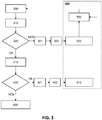
- the method initiates a new execution 200 of the set of requests.
- measured values of quality of service parameters are routinely obtained in a step 310. These values, eg queries response times, error messages, or other, are compared 320 to threshold values.
- the method may include a step 520 of identifying a resource responsible for a service quality parameter. deterioration of the quality of service. For example, the resource responsible for a deterioration of the quality of service is selected among the resources whose measured value of use exceeds the predetermined maximum threshold of use. Thus, it can be verified during step 520, if the measured value of use of at least one resource exceeds its predetermined maximum threshold of use.
- This resource responsible for a deterioration of the quality of service may for example be the last resource whose level has been reduced or another resource having exceeded its predetermined maximum utilization threshold. For example, if the last shot was fired after reducing a resource level, it is checked whether it is possible to decrease the level of this resource.
- the method may also include a step of selecting 542 a resource whose level is to increase.
- the responsible resource might be the underutilized resource whose level was changed before the replay of the query set.
- the resource responsible for a deterioration of the quality of service may be a resource that has already been optimized by the process and that following the last decrease of another resource has a measured value of resource utilization exceeding its predetermined threshold. maximum use.
- the method according to the invention may then comprise a step 552 of increasing the level of a resource responsible for a deterioration of the quality of service, for example an overused resource before a re-execution of the steps of the optimization process. As before, it is better to increase the level of a single resource.
- the method may comprise a step 560 for determining a resource modification mode, a step 570 for generating a script for modifying the level of the resource and a step 580 for generating an alert .
- the method makes it possible to progressively achieve the implementation of all the requests in an IT infrastructure whose resource levels have been reduced so as to allow a minimum of resources used while guaranteeing a minimum of resources. predetermined quality of service level.
- the method advantageously comprises a step 600 of generating a report on the minimum resources required for the IT infrastructure hosting the application chain.
- the balance sheet may advantageously include the identifiers of one or more underutilized resources with reduced resource levels. These levels of reduced resources corresponding to the level of these resources allowing a good functioning of the application chain. That is, an operation to respect the predetermined thresholds of quality of service parameter.
- the report can take the form of a file listing the reduced or minimum levels of resources to meet the quality of service parameter thresholds defined in the context of the defined use.
- the margin optimization searching method according to the invention may also include a step 700 validation and / or step 800 endurance. If it is determined that there is no optimization margin, then these steps will not be triggered. Otherwise, if a validation and / or endurance step is triggered, an alerting step can be executed to warn a user, the tracking file can also be updated during a step.
- the purpose of these steps 700 and 800 is to verify that over time the new resource configuration will work and meet the needs of the application chain.
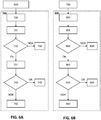
- the validation step 700 includes a replay 720 of all the requests on the IT infrastructure 1 with values of resource levels corresponding preferably to the values of reduced levels of resources defined in the balance sheet generated in step 600.
- the validation 700 aims to take the values of reduced levels of resources so as to validate the optimization margin identified in the context of the process.
- one or more validation mechanisms can be implemented.
- the validation process can be implemented following the execution of step 500 of identification of a margin of optimization of the resources or following the execution of step 600 of generation of a balance sheet on the minimum resources required for the IT infrastructure hosting the application chain with reduced resource levels.
- the endurance step 800 can be performed over a longer period of time and include the replay 820 of the set of requests, said execution 820 of the set of requests can, preferably, simulate a higher load than the operation of the application chain.
- the measurement, carried out over a longer period, can for example continue for several hours.
- a validation can consist in executing 720 again the shooting with the last levels of resource defined in order to verify that the infrastructure reacts correctly.
- the validation step 700 and the endurance step 800 may comprise a step 731, 831 of measuring the quality of service parameter values in response to the execution of the set of requests 720, 820 and a comparison 732 , 832 measured values of quality of service parameters to predetermined threshold values of quality of service parameters. If the thresholds are exceeded (NOK), there is stop 739, 839 of the execution of the set of requests, possibly saving of measured values and then the implementation of the modification step 550 of the level of a resource.
- NOK thresholds
- thresholds are not exceeded then there is a measure 741, 841 of resource utilization values in response to the execution of the set of queries and comparison 742, 842 of the resource usage measured values to predetermined minimum threshold values of resource utilization. If the thresholds are not exceeded (NOK), there is stop 749, 849 of the execution of the set of requests, possibly saving of measured values and then the implementation of the step of modification 550 of the level of '-A resource.
- the resource levels used are validated 750, 850.
- Table 3 illustrates an example of values of reduced levels of resources that can be obtained.
- Table 3 CPU Network speed RAM Measured values of use 45% 350 Kbps 60% Maximum thresholds for use 70% 1000 Kbps 70% Minimum thresholds for use 30 % N / A 40% Level of the resource (ie initial level) 4 CPUs N / A 64 GB Reduced level of the resource 3 CPUs 16 GB
- the various data generated or executed as part of the implementation of the method can be stored in a tracking file.
- alerts can be issued to a user or stored in a tracking file.
- the execution 200 of the set of requests can be interrupted so as to analyze the measured data and to reiterate the method with modified resource level values.
- the method may include a step of stopping the execution of the set of requests.
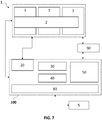
- FIG 7 schematically illustrates a non-limiting functional representation of an embodiment of a resource optimization margin search device 100 3 of a computer infrastructure 1 hosting an application channel 2.
- This device may notably comprise at least one computer machine. and software for implementing the dynamic management method according to the invention.
- the user terminal 5 is a computer, a digital tablet, a mobile phone, or more generally any device allowing a user to send requests, via a communication network (for example LAN, WLAN, or PAN, a log of a database, email), to the search margin optimization device 100.
- the user terminal 5 may be provided with a client application making it possible to send requests or instructions to the optimization margin search device 100 and to interpret the responses thereto.
- This client application is, for example, a FireFox ® web browser, Fennec ®, Opera ®, Opera Mobile ®, Internet Explorer ®, Google Chrome ® for example), or an ftp browser (such as FileZilla ®).
- the infrastructure 1 may include a plurality of resources 3 and machines.
- Each machine may comprise a microprocessor, storage means (such as a hard disk, whether local or remote), and a communication interface (for example a network interface of Ethernet, FiberChannel, InfiniBand ).
- the microprocessor, the storage means and the communication interface are advantageously interconnected by a bus.
- an action is taken to the device according to the invention it is in fact carried out by a microprocessor of the device controlled by instruction codes stored in a memory of the device. If an action is taken to an application, it is actually performed by a microprocessor of the device in a memory of which the instruction codes corresponding to the application are recorded.
- the device according to the invention transmits or receives a message, this message is sent or received by a communication interface of the device.
- the device 100 may comprise or be associated with probes 90.
- the probe or probes make it possible to collect data on the consumption of resources of the IT infrastructure and more particularly of each machine component. Several resources can be measured in parallel. These measurements of resource consumption can be made from a "Nigel's Monitor” (Nmon) or "Performance Monitor” (Perfmon) type probe.
- Nmon probes can display CPU, memory, swap, network, user information, group, storage media, kernel usage, or most consumer processes. Perfmon probes are used to measure the performance of an IT infrastructure.
- the information collected can for example correspond to resource utilization percentages, response times, processing times, but also the status of the ports, the number of JDBC or JMS message queues, the occupancy rate of the data processing system. files, the operating rate of the garbage collector or collector for "garbage collector” for J2EE applications (for "Java Enterprise Edition" in English).
- probes can be associated with each resource to trace measurement or metric information, representing the operating status of the resources and the associated use or consumption.
- the one or more probes define an identifier of the resource and a value of use of resources.
- the consumption or use of each resource can be monitored continuously or at configurable intervals to obtain information for each resource as a function of time. This information can be stored in a memory.
- the device includes a human-machine interface for defining the consumption probes on each machine that back metrics from the use of resources of the machine.
- the device 100 may further comprise a human-machine interface module (HMI) and a communication module able to communicate for example with the IT infrastructure or the terminal of a user.
- HMI human-machine interface module
- communication module able to communicate for example with the IT infrastructure or the terminal of a user.
- the device 100 independent or installed within a computer infrastructure 1, and the method according to the invention that it is able to implement make it possible to search for at least a margin of optimization of the resources in a fast manner and automatic. They are able to quickly determine what resources could be diminished on the IT infrastructure while maintaining a quality of service at a desired level. In addition, thanks to the steps for modifying the resource levels, they are able to confirm the capacity of the new levels of resources proposed to allow a correct functioning of the application chain considered.
Landscapes
- Engineering & Computer Science (AREA)
- Theoretical Computer Science (AREA)
- General Engineering & Computer Science (AREA)
- Physics & Mathematics (AREA)
- Quality & Reliability (AREA)
- General Physics & Mathematics (AREA)
- Computer Hardware Design (AREA)
- Computing Systems (AREA)
- Mathematical Physics (AREA)
- Debugging And Monitoring (AREA)
Applications Claiming Priority (1)
| Application Number | Priority Date | Filing Date | Title |
|---|---|---|---|
| FR1760547A FR3073298B1 (fr) | 2017-11-09 | 2017-11-09 | Procede et dispositif de recherche de marge d’optimisation de ressources d’une chaine applicative |
Publications (2)
| Publication Number | Publication Date |
|---|---|
| EP3483733A1 true EP3483733A1 (de) | 2019-05-15 |
| EP3483733B1 EP3483733B1 (de) | 2020-05-13 |
Family
ID=61258350
Family Applications (1)
| Application Number | Title | Priority Date | Filing Date |
|---|---|---|---|
| EP18205310.8A Active EP3483733B1 (de) | 2017-11-09 | 2018-11-09 | Verfahren und vorrichtung zur erforschung einer marge zur ressourcenoptimierung in einer anwendungskette |
Country Status (2)
| Country | Link |
|---|---|
| EP (1) | EP3483733B1 (de) |
| FR (1) | FR3073298B1 (de) |
Citations (3)
| Publication number | Priority date | Publication date | Assignee | Title |
|---|---|---|---|---|
| US20100192156A1 (en) * | 2009-01-29 | 2010-07-29 | Microsoft Corporation | Technique for conserving software application resources |
| US20150286507A1 (en) * | 2012-10-05 | 2015-10-08 | Elastisys Ab | Method, node and computer program for enabling automatic adaptation of resource units |
| US20170093962A1 (en) * | 2015-09-30 | 2017-03-30 | Spirent Communications, Inc. | Accurate generation of multiple dimensions of computer load |
-
2017
- 2017-11-09 FR FR1760547A patent/FR3073298B1/fr not_active Expired - Fee Related
-
2018
- 2018-11-09 EP EP18205310.8A patent/EP3483733B1/de active Active
Patent Citations (3)
| Publication number | Priority date | Publication date | Assignee | Title |
|---|---|---|---|---|
| US20100192156A1 (en) * | 2009-01-29 | 2010-07-29 | Microsoft Corporation | Technique for conserving software application resources |
| US20150286507A1 (en) * | 2012-10-05 | 2015-10-08 | Elastisys Ab | Method, node and computer program for enabling automatic adaptation of resource units |
| US20170093962A1 (en) * | 2015-09-30 | 2017-03-30 | Spirent Communications, Inc. | Accurate generation of multiple dimensions of computer load |
Also Published As
| Publication number | Publication date |
|---|---|
| FR3073298B1 (fr) | 2021-01-22 |
| FR3073298A1 (fr) | 2019-05-10 |
| EP3483733B1 (de) | 2020-05-13 |
Similar Documents
| Publication | Publication Date | Title |
|---|---|---|
| US10783051B2 (en) | Performance regression framework | |
| US9459980B1 (en) | Varying cluster sizes in a predictive test load while testing a productive system | |
| US8984341B1 (en) | Scalable testing in a production system with autoscaling | |
| US20230244687A1 (en) | Optimization of Virtual Warehouse Computing Resource Allocation | |
| US10785087B2 (en) | Modifying computer configuration to improve performance | |
| US20210133186A1 (en) | Capture and replay of user requests for performance analysis | |
| EP3506094A1 (de) | Verfahren und system zur optimisierung der planung von batchprozessen | |
| EP3113025A1 (de) | Automatischer diagnostik-mechanismus mithilfe von informationen aus einem applikativen überwachungssystem | |
| US10241902B2 (en) | Systems and methods for benchmark based cross platform service demand prediction | |
| US9626328B1 (en) | Method and system for on-demand aggregated logging for distributed systems | |
| US20220277325A1 (en) | Estimating conversions | |
| EP3620928B1 (de) | Vorrichtung und verfahren zur anlayse des verhaltens eines anwendungsbausteins, der einer ressourcenverknappung ausgesetzt ist | |
| US8914517B1 (en) | Method and system for predictive load balancing | |
| EP3767474B1 (de) | Verfahren zur analyse des ressourcenverbrauchs einer it-infrastruktur, alarm und dimensionierung | |
| US20160050135A1 (en) | Real-time measurement of user interface performance in a remote desktop environment | |
| EP3483733B1 (de) | Verfahren und vorrichtung zur erforschung einer marge zur ressourcenoptimierung in einer anwendungskette | |
| EP3617888B1 (de) | Vorrichtung und verfahren zur optimierung der zeitlichen verwendung der ressourcen einer it-infrastruktur | |
| US20240265015A1 (en) | Systems and methods for reducing the cardinality of metrics queries | |
| EP3767476A1 (de) | Vorrichtung und verfahren für die analyse der leistungen einer mehrschichtigen anwendung (n-tier-app) | |
| US12236278B2 (en) | Optimization of virtual warehouse computing resource allocation | |
| FR3069933B1 (fr) | Procede de validation de mutualisation de briques applicatives sur une infrastructure informatique | |
| Yorkston | The Basic Concepts of Performance Testing | |
| FR3091376A1 (fr) | Procédé d’optimisation d’un plan d’ordonnancement et du dimensionnement d’une infrastructure informaTique | |
| FR3087556A1 (fr) | Procede d'amelioration de l'efficacite d'utlisation des ressources d'une infrastructure destinee a executer un plan d'ordonnancement | |
| JP2009163305A (ja) | ログ出力装置、ログ出力方法及びログ出力プログラム |
Legal Events
| Date | Code | Title | Description |
|---|---|---|---|
| PUAI | Public reference made under article 153(3) epc to a published international application that has entered the european phase |
Free format text: ORIGINAL CODE: 0009012 |
|
| STAA | Information on the status of an ep patent application or granted ep patent |
Free format text: STATUS: THE APPLICATION HAS BEEN PUBLISHED |
|
| AK | Designated contracting states |
Kind code of ref document: A1 Designated state(s): AL AT BE BG CH CY CZ DE DK EE ES FI FR GB GR HR HU IE IS IT LI LT LU LV MC MK MT NL NO PL PT RO RS SE SI SK SM TR |
|
| AX | Request for extension of the european patent |
Extension state: BA ME |
|
| STAA | Information on the status of an ep patent application or granted ep patent |
Free format text: STATUS: REQUEST FOR EXAMINATION WAS MADE |
|
| 17P | Request for examination filed |
Effective date: 20191009 |
|
| RBV | Designated contracting states (corrected) |
Designated state(s): AL AT BE BG CH CY CZ DE DK EE ES FI FR GB GR HR HU IE IS IT LI LT LU LV MC MK MT NL NO PL PT RO RS SE SI SK SM TR |
|
| GRAP | Despatch of communication of intention to grant a patent |
Free format text: ORIGINAL CODE: EPIDOSNIGR1 |
|
| STAA | Information on the status of an ep patent application or granted ep patent |
Free format text: STATUS: GRANT OF PATENT IS INTENDED |
|
| RIC1 | Information provided on ipc code assigned before grant |
Ipc: G06F 11/30 20060101AFI20191111BHEP Ipc: G06F 11/34 20060101ALI20191111BHEP |
|
| INTG | Intention to grant announced |
Effective date: 20191129 |
|
| GRAS | Grant fee paid |
Free format text: ORIGINAL CODE: EPIDOSNIGR3 |
|
| GRAA | (expected) grant |
Free format text: ORIGINAL CODE: 0009210 |
|
| STAA | Information on the status of an ep patent application or granted ep patent |
Free format text: STATUS: THE PATENT HAS BEEN GRANTED |
|
| AK | Designated contracting states |
Kind code of ref document: B1 Designated state(s): AL AT BE BG CH CY CZ DE DK EE ES FI FR GB GR HR HU IE IS IT LI LT LU LV MC MK MT NL NO PL PT RO RS SE SI SK SM TR |
|
| REG | Reference to a national code |
Ref country code: GB Ref legal event code: FG4D Free format text: NOT ENGLISH |
|
| REG | Reference to a national code |
Ref country code: CH Ref legal event code: EP |
|
| REG | Reference to a national code |
Ref country code: DE Ref legal event code: R096 Ref document number: 602018004613 Country of ref document: DE |
|
| REG | Reference to a national code |
Ref country code: AT Ref legal event code: REF Ref document number: 1271161 Country of ref document: AT Kind code of ref document: T Effective date: 20200615 |
|
| REG | Reference to a national code |
Ref country code: LT Ref legal event code: MG4D |
|
| REG | Reference to a national code |
Ref country code: NL Ref legal event code: MP Effective date: 20200513 |
|
| PG25 | Lapsed in a contracting state [announced via postgrant information from national office to epo] |
Ref country code: SE Free format text: LAPSE BECAUSE OF FAILURE TO SUBMIT A TRANSLATION OF THE DESCRIPTION OR TO PAY THE FEE WITHIN THE PRESCRIBED TIME-LIMIT Effective date: 20200513 Ref country code: PT Free format text: LAPSE BECAUSE OF FAILURE TO SUBMIT A TRANSLATION OF THE DESCRIPTION OR TO PAY THE FEE WITHIN THE PRESCRIBED TIME-LIMIT Effective date: 20200914 Ref country code: NO Free format text: LAPSE BECAUSE OF FAILURE TO SUBMIT A TRANSLATION OF THE DESCRIPTION OR TO PAY THE FEE WITHIN THE PRESCRIBED TIME-LIMIT Effective date: 20200813 Ref country code: GR Free format text: LAPSE BECAUSE OF FAILURE TO SUBMIT A TRANSLATION OF THE DESCRIPTION OR TO PAY THE FEE WITHIN THE PRESCRIBED TIME-LIMIT Effective date: 20200814 Ref country code: FI Free format text: LAPSE BECAUSE OF FAILURE TO SUBMIT A TRANSLATION OF THE DESCRIPTION OR TO PAY THE FEE WITHIN THE PRESCRIBED TIME-LIMIT Effective date: 20200513 Ref country code: IS Free format text: LAPSE BECAUSE OF FAILURE TO SUBMIT A TRANSLATION OF THE DESCRIPTION OR TO PAY THE FEE WITHIN THE PRESCRIBED TIME-LIMIT Effective date: 20200913 Ref country code: LT Free format text: LAPSE BECAUSE OF FAILURE TO SUBMIT A TRANSLATION OF THE DESCRIPTION OR TO PAY THE FEE WITHIN THE PRESCRIBED TIME-LIMIT Effective date: 20200513 |
|
| PG25 | Lapsed in a contracting state [announced via postgrant information from national office to epo] |
Ref country code: LV Free format text: LAPSE BECAUSE OF FAILURE TO SUBMIT A TRANSLATION OF THE DESCRIPTION OR TO PAY THE FEE WITHIN THE PRESCRIBED TIME-LIMIT Effective date: 20200513 Ref country code: RS Free format text: LAPSE BECAUSE OF FAILURE TO SUBMIT A TRANSLATION OF THE DESCRIPTION OR TO PAY THE FEE WITHIN THE PRESCRIBED TIME-LIMIT Effective date: 20200513 Ref country code: BG Free format text: LAPSE BECAUSE OF FAILURE TO SUBMIT A TRANSLATION OF THE DESCRIPTION OR TO PAY THE FEE WITHIN THE PRESCRIBED TIME-LIMIT Effective date: 20200813 Ref country code: HR Free format text: LAPSE BECAUSE OF FAILURE TO SUBMIT A TRANSLATION OF THE DESCRIPTION OR TO PAY THE FEE WITHIN THE PRESCRIBED TIME-LIMIT Effective date: 20200513 |
|
| REG | Reference to a national code |
Ref country code: AT Ref legal event code: MK05 Ref document number: 1271161 Country of ref document: AT Kind code of ref document: T Effective date: 20200513 |
|
| PG25 | Lapsed in a contracting state [announced via postgrant information from national office to epo] |
Ref country code: NL Free format text: LAPSE BECAUSE OF FAILURE TO SUBMIT A TRANSLATION OF THE DESCRIPTION OR TO PAY THE FEE WITHIN THE PRESCRIBED TIME-LIMIT Effective date: 20200513 Ref country code: AL Free format text: LAPSE BECAUSE OF FAILURE TO SUBMIT A TRANSLATION OF THE DESCRIPTION OR TO PAY THE FEE WITHIN THE PRESCRIBED TIME-LIMIT Effective date: 20200513 |
|
| PG25 | Lapsed in a contracting state [announced via postgrant information from national office to epo] |
Ref country code: RO Free format text: LAPSE BECAUSE OF FAILURE TO SUBMIT A TRANSLATION OF THE DESCRIPTION OR TO PAY THE FEE WITHIN THE PRESCRIBED TIME-LIMIT Effective date: 20200513 Ref country code: DK Free format text: LAPSE BECAUSE OF FAILURE TO SUBMIT A TRANSLATION OF THE DESCRIPTION OR TO PAY THE FEE WITHIN THE PRESCRIBED TIME-LIMIT Effective date: 20200513 Ref country code: EE Free format text: LAPSE BECAUSE OF FAILURE TO SUBMIT A TRANSLATION OF THE DESCRIPTION OR TO PAY THE FEE WITHIN THE PRESCRIBED TIME-LIMIT Effective date: 20200513 Ref country code: AT Free format text: LAPSE BECAUSE OF FAILURE TO SUBMIT A TRANSLATION OF THE DESCRIPTION OR TO PAY THE FEE WITHIN THE PRESCRIBED TIME-LIMIT Effective date: 20200513 Ref country code: IT Free format text: LAPSE BECAUSE OF FAILURE TO SUBMIT A TRANSLATION OF THE DESCRIPTION OR TO PAY THE FEE WITHIN THE PRESCRIBED TIME-LIMIT Effective date: 20200513 Ref country code: SM Free format text: LAPSE BECAUSE OF FAILURE TO SUBMIT A TRANSLATION OF THE DESCRIPTION OR TO PAY THE FEE WITHIN THE PRESCRIBED TIME-LIMIT Effective date: 20200513 Ref country code: ES Free format text: LAPSE BECAUSE OF FAILURE TO SUBMIT A TRANSLATION OF THE DESCRIPTION OR TO PAY THE FEE WITHIN THE PRESCRIBED TIME-LIMIT Effective date: 20200513 Ref country code: CZ Free format text: LAPSE BECAUSE OF FAILURE TO SUBMIT A TRANSLATION OF THE DESCRIPTION OR TO PAY THE FEE WITHIN THE PRESCRIBED TIME-LIMIT Effective date: 20200513 |
|
| REG | Reference to a national code |
Ref country code: DE Ref legal event code: R097 Ref document number: 602018004613 Country of ref document: DE |
|
| PG25 | Lapsed in a contracting state [announced via postgrant information from national office to epo] |
Ref country code: PL Free format text: LAPSE BECAUSE OF FAILURE TO SUBMIT A TRANSLATION OF THE DESCRIPTION OR TO PAY THE FEE WITHIN THE PRESCRIBED TIME-LIMIT Effective date: 20200513 Ref country code: SK Free format text: LAPSE BECAUSE OF FAILURE TO SUBMIT A TRANSLATION OF THE DESCRIPTION OR TO PAY THE FEE WITHIN THE PRESCRIBED TIME-LIMIT Effective date: 20200513 |
|
| PLBE | No opposition filed within time limit |
Free format text: ORIGINAL CODE: 0009261 |
|
| STAA | Information on the status of an ep patent application or granted ep patent |
Free format text: STATUS: NO OPPOSITION FILED WITHIN TIME LIMIT |
|
| 26N | No opposition filed |
Effective date: 20210216 |
|
| PG25 | Lapsed in a contracting state [announced via postgrant information from national office to epo] |
Ref country code: SI Free format text: LAPSE BECAUSE OF FAILURE TO SUBMIT A TRANSLATION OF THE DESCRIPTION OR TO PAY THE FEE WITHIN THE PRESCRIBED TIME-LIMIT Effective date: 20200513 |
|
| PG25 | Lapsed in a contracting state [announced via postgrant information from national office to epo] |
Ref country code: MC Free format text: LAPSE BECAUSE OF FAILURE TO SUBMIT A TRANSLATION OF THE DESCRIPTION OR TO PAY THE FEE WITHIN THE PRESCRIBED TIME-LIMIT Effective date: 20200513 |
|
| PG25 | Lapsed in a contracting state [announced via postgrant information from national office to epo] |
Ref country code: LU Free format text: LAPSE BECAUSE OF NON-PAYMENT OF DUE FEES Effective date: 20201109 |
|
| REG | Reference to a national code |
Ref country code: BE Ref legal event code: MM Effective date: 20201130 |
|
| PG25 | Lapsed in a contracting state [announced via postgrant information from national office to epo] |
Ref country code: IE Free format text: LAPSE BECAUSE OF NON-PAYMENT OF DUE FEES Effective date: 20201109 |
|
| PG25 | Lapsed in a contracting state [announced via postgrant information from national office to epo] |
Ref country code: TR Free format text: LAPSE BECAUSE OF FAILURE TO SUBMIT A TRANSLATION OF THE DESCRIPTION OR TO PAY THE FEE WITHIN THE PRESCRIBED TIME-LIMIT Effective date: 20200513 Ref country code: MT Free format text: LAPSE BECAUSE OF FAILURE TO SUBMIT A TRANSLATION OF THE DESCRIPTION OR TO PAY THE FEE WITHIN THE PRESCRIBED TIME-LIMIT Effective date: 20200513 Ref country code: CY Free format text: LAPSE BECAUSE OF FAILURE TO SUBMIT A TRANSLATION OF THE DESCRIPTION OR TO PAY THE FEE WITHIN THE PRESCRIBED TIME-LIMIT Effective date: 20200513 |
|
| PG25 | Lapsed in a contracting state [announced via postgrant information from national office to epo] |
Ref country code: MK Free format text: LAPSE BECAUSE OF FAILURE TO SUBMIT A TRANSLATION OF THE DESCRIPTION OR TO PAY THE FEE WITHIN THE PRESCRIBED TIME-LIMIT Effective date: 20200513 |
|
| REG | Reference to a national code |
Ref country code: CH Ref legal event code: PL |
|
| PG25 | Lapsed in a contracting state [announced via postgrant information from national office to epo] |
Ref country code: BE Free format text: LAPSE BECAUSE OF NON-PAYMENT OF DUE FEES Effective date: 20201130 |
|
| PG25 | Lapsed in a contracting state [announced via postgrant information from national office to epo] |
Ref country code: LI Free format text: LAPSE BECAUSE OF NON-PAYMENT OF DUE FEES Effective date: 20211130 Ref country code: CH Free format text: LAPSE BECAUSE OF NON-PAYMENT OF DUE FEES Effective date: 20211130 |
|
| P01 | Opt-out of the competence of the unified patent court (upc) registered |
Effective date: 20230330 |
|
| PGFP | Annual fee paid to national office [announced via postgrant information from national office to epo] |
Ref country code: DE Payment date: 20251118 Year of fee payment: 8 |
|
| PGFP | Annual fee paid to national office [announced via postgrant information from national office to epo] |
Ref country code: GB Payment date: 20251120 Year of fee payment: 8 |
|
| PGFP | Annual fee paid to national office [announced via postgrant information from national office to epo] |
Ref country code: FR Payment date: 20251120 Year of fee payment: 8 |