EP3492252A1 - Procédé de fabrication de verres de lunettes individuelles selon une ordonnance médicale - Google Patents
Procédé de fabrication de verres de lunettes individuelles selon une ordonnance médicale Download PDFInfo
- Publication number
- EP3492252A1 EP3492252A1 EP18000865.8A EP18000865A EP3492252A1 EP 3492252 A1 EP3492252 A1 EP 3492252A1 EP 18000865 A EP18000865 A EP 18000865A EP 3492252 A1 EP3492252 A1 EP 3492252A1
- Authority
- EP
- European Patent Office
- Prior art keywords
- block
- transport
- blocking
- transport boxes
- pieces
- Prior art date
- Legal status (The legal status is an assumption and is not a legal conclusion. Google has not performed a legal analysis and makes no representation as to the accuracy of the status listed.)
- Pending
Links
Images


Classifications
-
- B—PERFORMING OPERATIONS; TRANSPORTING
- B24—GRINDING; POLISHING
- B24B—MACHINES, DEVICES, OR PROCESSES FOR GRINDING OR POLISHING; DRESSING OR CONDITIONING OF ABRADING SURFACES; FEEDING OF GRINDING, POLISHING, OR LAPPING AGENTS
- B24B13/00—Machines or devices designed for grinding or polishing optical surfaces on lenses or surfaces of similar shape on other work; Accessories therefor
- B24B13/0031—Machines having several working posts; Feeding and manipulating devices
- B24B13/0037—Machines having several working posts; Feeding and manipulating devices the lenses being worked by different tools, e.g. for rough-grinding, fine-grinding, polishing
-
- G—PHYSICS
- G02—OPTICS
- G02C—SPECTACLES; SUNGLASSES OR GOGGLES INSOFAR AS THEY HAVE THE SAME FEATURES AS SPECTACLES; CONTACT LENSES
- G02C13/00—Assembling; Repairing; Cleaning
- G02C13/001—Assembling; Repairing
-
- B—PERFORMING OPERATIONS; TRANSPORTING
- B24—GRINDING; POLISHING
- B24B—MACHINES, DEVICES, OR PROCESSES FOR GRINDING OR POLISHING; DRESSING OR CONDITIONING OF ABRADING SURFACES; FEEDING OF GRINDING, POLISHING, OR LAPPING AGENTS
- B24B13/00—Machines or devices designed for grinding or polishing optical surfaces on lenses or surfaces of similar shape on other work; Accessories therefor
- B24B13/005—Blocking means, chucks or the like; Alignment devices
-
- B—PERFORMING OPERATIONS; TRANSPORTING
- B24—GRINDING; POLISHING
- B24B—MACHINES, DEVICES, OR PROCESSES FOR GRINDING OR POLISHING; DRESSING OR CONDITIONING OF ABRADING SURFACES; FEEDING OF GRINDING, POLISHING, OR LAPPING AGENTS
- B24B13/00—Machines or devices designed for grinding or polishing optical surfaces on lenses or surfaces of similar shape on other work; Accessories therefor
- B24B13/06—Machines or devices designed for grinding or polishing optical surfaces on lenses or surfaces of similar shape on other work; Accessories therefor grinding of lenses, the tool or work being controlled by information-carrying means, e.g. patterns, punched tapes, magnetic tapes
-
- B—PERFORMING OPERATIONS; TRANSPORTING
- B24—GRINDING; POLISHING
- B24B—MACHINES, DEVICES, OR PROCESSES FOR GRINDING OR POLISHING; DRESSING OR CONDITIONING OF ABRADING SURFACES; FEEDING OF GRINDING, POLISHING, OR LAPPING AGENTS
- B24B27/00—Other grinding machines or devices
- B24B27/0069—Other grinding machines or devices with means for feeding the work-pieces to the grinding tool, e.g. turntables, transfer means
-
- B—PERFORMING OPERATIONS; TRANSPORTING
- B29—WORKING OF PLASTICS; WORKING OF SUBSTANCES IN A PLASTIC STATE IN GENERAL
- B29D—PRODUCING PARTICULAR ARTICLES FROM PLASTICS OR FROM SUBSTANCES IN A PLASTIC STATE
- B29D11/00—Producing optical elements, e.g. lenses or prisms
- B29D11/00009—Production of simple or compound lenses
- B29D11/00423—Plants for the production of simple or compound lenses
-
- B—PERFORMING OPERATIONS; TRANSPORTING
- B29—WORKING OF PLASTICS; WORKING OF SUBSTANCES IN A PLASTIC STATE IN GENERAL
- B29D—PRODUCING PARTICULAR ARTICLES FROM PLASTICS OR FROM SUBSTANCES IN A PLASTIC STATE
- B29D11/00—Producing optical elements, e.g. lenses or prisms
- B29D11/00932—Combined cutting and grinding thereof
- B29D11/00942—Combined cutting and grinding thereof where the lens material is mounted in a support for mounting onto a cutting device, e.g. a lathe, and where the support is of machinable material, e.g. plastics
-
- G—PHYSICS
- G02—OPTICS
- G02C—SPECTACLES; SUNGLASSES OR GOGGLES INSOFAR AS THEY HAVE THE SAME FEATURES AS SPECTACLES; CONTACT LENSES
- G02C13/00—Assembling; Repairing; Cleaning
- G02C13/006—Devices specially adapted for cleaning spectacles frame or lenses
Definitions
- the present invention relates to a method for the production of individual spectacle lenses according to a prescription order according to the preamble of patent claim 1.
- transport boxes - also referred to as recipe boxes or "job trays” - serve as transport medium, which can be used, for example, as transport containers. are transported between the individual stations via conveyor belts, cross-roller devices for transverse discharge from the material flow, lifting devices, switches, etc.
- transport boxes are the subject of German standard DIN 58763, for example.
- spectacle lenses made of different materials have to be supplied to different workstations or machines on which the spectacle lenses are processed with different auxiliary and operating materials (for example polishing agents, polishing pads) as well as different process parameters.
- auxiliary and operating materials for example polishing agents, polishing pads
- Much of this processing of the spectacle lenses takes place on so-called “block pieces", which serve to hold the spectacle lens blanks during processing in the respective processing machine or device.
- block pieces are e.g. Subject of German standard DIN 58766.
- the block piece is first brought into a predetermined position in relation to a surface of the eyeglass lens blank, which is usually protected by a film. Then, in this position, the space between the block piece and the eyeglass lens blank is denoted by a molten material, conventionally mostly a wood metal, also called “alloy”, i. a usually bismuth-based metallic alloy - filled in. After solidification of the filling material, the block piece represents a receptacle for processing the spectacle lens blank.
- ART for Alloy Replacement Technology
- This ART technology is in the published by Satisloh GmbH, the preamble of claim 1 forming the information document " Introduction to Alloy-free lens production ", Frank Heepen, Product Management Blocking & Deblocking, V5.1LC, 15.08.2015 described in detail.
- the ART technology uses a universal, reusable organic block and UV curing adhesive as a block material to join the block piece and eyeglass lens blank, rather than the alloy and foil, to the eyeglass lens blanks for what is termed “ generating " the pre-processing of the optically effective surface of the spectacle lens blank to produce the recipe macrogeometry - and polishing - ie fine machining the optically effective surface to eliminate Vorbearbeitungsspuren and to obtain the desired microgeometry - and possibly also subsequent steps, such as marking, coating, etc. fix and protect.
- These block pieces generally have a substantially rotationally symmetrical base body having on one side a lens mounting surface on which the lens blank can be blocked by means of the block material and on the other side a standardized clamping portion over which the lens blank in a machine blocked on the base body or apparatus for processing or treatment of the lens blank can be fixed.
- various groups of block pieces are typically used, which are in terms of block curvature - also called "base curve" - and diameter differentiate the lens mounting surface.
- the main goal is to approximate the geometry of the lens mounting surface of the block piece as possible to the respective geometry of the surface of the lens blank to be blocked.
- the lens blank is to be given as much full surface support as possible by selecting a suitable diameter of the lens attachment surface on the block piece during processing and protected on its surface facing the block piece, which as a rule is finished and optionally already coated, as far as possible over the entire surface.
- block-piece groups which may be about 20 to 40, depending on how the ART production plant is operated.
- the block pieces that are not currently used must be temporarily stored or stored.
- the block pieces are sorted by block group groups stored as bulk material in a corresponding number of storage boxes.
- the individual block pieces are marked with a D ata M atrix- C ode, or "DMC", which allows individual tracking and management by means of a computer system.
- a process control gives the (or the) matching block piece (s) before - usually two block pieces, one each for the left and the right lens of the prescription order, if necessary, but only one, if only one spectacle lens is finished.
- the assignment of the block pieces specified by the process control to the respective recipe order is generally carried out as a manual process: An operator removes the or the appropriate block pieces from the or the corresponding storage boxes. This can be assisted to reduce confusion and error by a so-called "pick by light” system, in which a light lights up at the corresponding storage box controlled by the process control. The operator then places the matching block or pieces in the transport box to be equipped. By scanning the DMC of the block pieces, a link to the respective recipe order takes place via the process control.
- the work and block pieces pass through the manufacturing process with the main steps (i) blocking the lens blanks onto the block pieces, (ii) treating, i. Processing and possibly coating the blocked lens blanks and (iii) blocking the treated eyeglass lenses from the block pieces, the transport between these steps being effected by means of the transport boxes, which in each case remain associated with the respective recipe order.
- the used block pieces are traditionally brought as bulk material from the production line back for cleaning, testing and sorting in the storage boxes.
- ART-Deblocker-A In order to reduce the associated manual effort, a fully automatic Abblocksystem under the trade name ART-Deblocker-A is available from the applicant, which processed from transport boxes eyeglass lenses in the blocked Condition loads, then this separates from the block piece and the blocked eyeglass lenses finally puts back in the transport boxes.
- the blocking system separates block piece, block material and spectacle lens by water jet and then also dries front and back of the respective spectacle lens in preparation for the inspection.
- this blocking system is also capable of sorting the block pieces according to diameter and curvature and depositing them in the corresponding storage boxes.
- Block sorting system is addressed, which is able to sort out of the production line, used block pieces to sort by diameter and curvature and also take into account because of the DMC of the respective block piece, how often a block has already been used, as a decision criterion for whether the block piece in question should still be used or sorted out.
- the invention has for its object to provide a method for the production of individual spectacle lenses according to a recipe order, which makes it possible to save a sufficient number of block pieces to save space and with the least possible effort to store and retrieve as needed.
- a method of manufacturing individual spectacle lenses according to a prescription order comprising the following main steps (i) to (iii): (i) blocking a provided lens blank as a workpiece having a first surface, a second surface opposite the first surface, and an edge between the first surface and the second surface, on a block piece provided by a plurality of block pieces from a block stocker, with the aid of a block material, the first surface of the lens blank facing a lens mounting surface of the block piece, (ii) treating the blocked lens blank at least at second surface to obtain a blocked treated spectacle lens as a workpiece, and (iii) blocking the treated spectacle lens from the block piece, the workpiece, each optionally in the blocked state, between steps (i) to (i) (iii) is transported in one of several reserved transport boxes;
- the block pieces are stored in the block boxes prior to the step (i) of blocking in the transport boxes and provided for the step (i) of blocking in the transport boxes from the block stock storage and / or after the step (
- the solution according to the invention is based on not treating the block pieces and transport boxes separately from one another, that is. to transport or store, but for this purpose to transport the already transportable and intermediately stored transport boxes as - moving and / or fixed - Block Published Meeting.
- the associated with the separation of block piece and transport box or (re) assignment of block piece to transport box, in particular manual activities and the associated costs can be largely avoided.
- the identification of the block pieces remaining in the transport boxes can easily be done via e.g. RFID or DMC to the transport boxes and / or block pieces done. Since the transport boxes must be stored anyway and always at least half as many transport boxes are vorzuhalten as block pieces, no additional space required. Rather, compared to a conventional solution one of the bearings for transport boxes and block pieces can be saved, which offers both cost and footprint advantages.
- the measures according to the invention can, especially in the case of maximized automation with the greatest possible exclusion of manual transport, sorting or assignment work, serve to minimize both errors in this regard and the throughput times for recipe orders, which is a faster delivery of high-quality eyeglass lenses.
- the measures according to the invention can, especially in the case of maximized automation with the greatest possible exclusion of manual transport, sorting or assignment work, serve to minimize both errors in this regard and the throughput times for recipe orders, which is a faster delivery of high-quality eyeglass lenses.
- the measures according to the invention can, especially in the case of maximized automation with the greatest possible exclusion of manual transport, sorting or assignment work, serve to minimize both errors in this regard and the throughput times for recipe orders, which is a faster delivery of high-quality eyeglass lenses.
- the measures according to the invention can, especially in the case of maximized automation with the greatest possible exclusion of manual transport, sorting or assignment work, serve to minimize both errors in this regard and the throughput times for recipe orders, which is a faster delivery of high-quality
- the method according to the invention is particularly advantageous if block pieces with different, predetermined block piece geometries are held in the transport boxes in the block piece store provided with at least one storage area, which differ with regard to a block curvature of the lens attachment face and / or a diameter of the lens attachment face
- Transport boxes and / or the block pieces are provided with an information carrier which, when detected via a process control, in particular for sorting the block piece store and possibly providing certain block pieces for the step (i) blocking at least information about the block geometry of the block pieces contained in the respective transport box ,
- thirty-six individual block types may be provided, with six different diameters of the lens mounting surface and six different block curvatures with appropriate management of the block storage via the process control. This would be a preferred approach when using the method according to the invention in the context of the above-described ART technology.
- the Block SwissMA include a flexible box storage as a storage area in which the transport boxes are chaotically stored with the recorded block pieces on fixed storage, with an assignment of the respective storage space to the mounted thereon transport box takes place in accordance with the information of the corresponding information carrier.
- a storage method is very flexible and can be carried out easily and quickly. The next free storage space in the flexible box storage is simply occupied by a straight arriving, with regard to the block pieces contained therein transport box with the aid of a suitable handling system, whereupon a storage location number is stored to the corresponding Block congresstyp of the process control.
- the corresponding transport box can be removed again by means of the handling system and output via the assigned storage location number.
- This can be preferable to an "F irst I n / F irst O ut" principle (in short “FIFO” principle) take place, ie the stored first in flexible box store with a specific block piece type transport box leaves the box stores as first again when the corresponding block type is requested.
- the block piece storage comprises an unsorted buffer storage as a storage area in which the transport boxes with the therein recorded block pieces are stored unsorted, preferably a stacking of the transport boxes takes place. This procedure allows in a space-saving manner, a rapid uptake of transport boxes in Block Culturelager when the other storage capacities are exhausted or busy, which may be the case, for example, when the production runs slowly or slowed down.
- the block piece store comprises a sorted buffer store as a storage area in which the transport boxes with the block pieces accommodated therein are sorted sorted according to information of the information carrier according to block piece geometry, with stacking of the transport boxes preferably taking place with the same block pieces in each case.
- a sorted buffer store as a storage area in which the transport boxes with the block pieces accommodated therein are sorted sorted according to information of the information carrier according to block piece geometry, with stacking of the transport boxes preferably taking place with the same block pieces in each case.
- the block piece bearing can have a bearing input and a bearing outlet, which are connected to one another via a conveying path for the transport boxes, which is connected to or to the storage areas, wherein the transport boxes with the block pieces received therein via the conveyor line of the Process control controlled either from the warehouse entrance to the respective storage area, be promoted from the respective storage area to the warehouse output or from the warehouse entrance directly to the warehouse output, which allows a very flexible storage of the block pieces in Block Federationlager, which allows a quick response to utilization fluctuations in the production line.
- control of the block-piece storage can be such that for the step (i) of blocking the provision of the respective block piece via the process control in accordance with a defined by the recipe order geometry of the spectacle lens to be produced by issuing the with the corresponding, on the Information carrier identified block piece loaded transport box from the block piece storage takes place. For most cases, this is the required procedure, because the recipe order also determines the next production process in time.
- the process control can be carried out with the aid of the above-described "bypass" option by means of the direct conveying path between the warehouse entrance and the warehouse exit in the block warehouse, such that the provision of a specific lens blank follows for the step (i) of blocking via the process control
- the information of the information carrier for Block Federationgeometrie of the block piece is carried out, which is contained in the transport box, which is currently promoted on the conveyor line between the warehouse entrance and warehouse output.
- Such a procedure is likely to occur e.g. offer, if actually next - e.g. due to the temporal order entry - recipe order to be processed would require block pieces to which block access in the block store is currently unable or which can not be accessed quickly. This is i.a. also conducive to the highest possible and even utilization of the production line.
- the process control in detection of Information carrier also has information about a frequency of use of the block pieces contained in the respective transport boxes, wherein the Blockzhoulager upstream a switch is arranged, which is controlled by the process control in accordance with this information so that the switch when exceeding a predetermined frequency of use the corresponding Transport boxes for manual collection and cleaning of block piece and / or transport box ausschleust, but otherwise the corresponding transport boxes with the recorded therein block pieces to the Block Swisslager forwards.
- This also leads to a standardization of the control or cleaning operations on the block pieces and transport boxes, which also contributes to a high productivity.
- the information carriers on the transport boxes and / or the block pieces can only be readable and read, as is the case, for example, with a recipe order made of paper on the transport box or a DMC on the block piece. It is preferred, however, if the information carrier on the transport boxes and / or the block pieces are both readable and described with information, the information of the respective information carrier by writing before the step (i) blocking in terms of urgency of the respective recipe order and or in step (i) of blocking with respect to block parameters relevant to step (ii) of the treatment and / or during step (ii) of treatment with respect to changes in geometry of the respective block pieces and / or after step (iii) of Blocking is changed or extended in terms of a need for cleaning the respective block pieces for consideration in each subsequent steps.
- the respective transport box or the respective block piece itself carries this information in a redundant manner, which can serve to increase the failure, functional and operational safety in the production line.
- this also allows an operator or control person with a suitable read-out option to determine a corresponding status of the respective recipe order in the transport box without access to the process control, which may be advantageous in the context of quality assurance measures or if a transport box - for whatever reason - was temporarily removed from the production line.
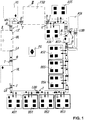
- the Fig. 1 shows a layout of a production facility for the production of individual spectacle lenses L according to a recipe order, in which, as will be described in more detail below, in manufacturing generally the following steps are performed in the order given: (i) blocking a provided lens blank LR on a block piece B, which is provided by a plurality of block pieces B from a block stocker BL, (ii) treating the blocked lens blank LR to obtain a blocked treated eyeglass lens L, and (iii) blocking the treated eyeglass lens L from the block piece B.
- the respective ones Workpieces and block pieces for a recipe order are held in one of several between the aforementioned steps (i) to (iii) Transport boxes T transports.
- the block pieces B are stored in the block piece store BL before the step (i) of blocking in the transport boxes T and for the step (i).
- the blocking in the transport boxes T are provided from the block piece store BL, and secondly that the block pieces B are transported to the block store BL after the step (iii) of blocking in the transport boxes T.
- the transport box T which is preferably injection-molded from a suitable plastic, has a substantially rectangular box bottom T01, from the edge of which a circumferential box wall T02 extends upwards on the top of the transport box T, which encloses an approximately right angle with the box bottom T01 and on the transverse sides of the transport box T is stiffened relative to the box bottom T01 with a plurality of ribs T03.
- the transport box T On the underside of the transport box T extends substantially circumferentially apron portion T04 approximately at right angles from the box bottom T01 away, with a slight offset to the edge of the box bottom T01 inside.
- the transport box T is stackable, wherein the apron portion T04 immersed in a stack upper transport box T in an opening which through the box wall T02 of a underlying transport box T is limited to the outside.
- the apron portion T04 is stiffened relative to the box bottom T01 on the longitudinal sides of the transport box T by means of a plurality of ribs T05, as in particular in Fig. 5 you can see. Furthermore, according extend Fig. 5 on the underside of the transport box T also by means of ribs T05 opposite the box bottom T01 stiffened lying on the box bottom T01 near the middle longitudinal bar T06 and a plurality of the skirt section T04 right-angle inward adjoining transverse webs T07 over the box bottom T01.
- the apron portion T04, the longitudinal web T06 and the transverse webs T07 of the transport box T have the same height with respect to the box bottom T01, so that the transport box T can be safely parked thereon, be it on a flat table when loading the transport box T or about the transport of the transport box T on a conveyor belt or the like.
- Fig. 4 is the box wall T02 on one in Fig. 4 front longitudinal side of the transport box T provided with a slot T08, which serves in principle to receive a recipe order from paper as an information carrier.
- a recipe order from paper as an information carrier.
- an information carrier IT in the form of a RFID recorded, which can be both read and described in a conventional manner.
- Adjacent to the slot T08 is at the bottom of the box T01 an insert part ET made of plastic, which is designed for the positive reception of two block pieces B, as the Fig. 6 to 9 demonstrate.
- the insert part ET is held in a form-fitting manner in the longitudinal and transverse direction of the transport box T via webs T09 protruding from the box bottom T01, which engage in associated recesses ET1 of the insert part ET.
- the insert part ET has in relation to a transverse axis of the insert part ET mirror-symmetrical arrangement two substantially hollow cylindrical receiving portions ET2 for the block pieces B, which will be briefly described below.
- each block piece B in a known configuration generally has a consisting of a suitable plastic, substantially rotationally symmetrical body.
- the main body of the block piece B has on the one, in the 8 and 9 upper side a lens mounting surface BF, which has a predetermined diameter D and a defined block curvature K and on which the lens blank LR by means of a block material M (see Fig. 10 ) can be blocked.
- the block piece B On the other, in the 8 and 9 On the lower side, the block piece B has a standardized chucking portion EA, via which the lens blank LR blocked on the base body can be fixed in a machine or apparatus for processing the lens blank LR.
- a suitable block piece B is at this point expressly to the aforementioned information document of the applicant and the document EP 2 093 018 A1 directed.
- suitable block materials M are, however, the document EP 2 011 604 A1 to which reference is also expressly made.
- the light-curing block materials disclosed there it is of course also possible to use other block materials, for example thermoplastic materials.
- a plurality of projections ET3 are integrally formed on the insert part ET near the box bottom T01 of the transport box T, which form complementary structures to corresponding recesses in the clamping section EA of the respective block piece B.
- An inner diameter of the receiving portions ET2 of the insert member ET is selected to substantially correspond to an outer diameter of the clamping portions EA of the block pieces B, as in FIGS 8 and 9 you can see. The block pieces B can thus be held tightly and securely on the receiving sections ET2 of the insert part ET in the transport box T.
- the block pieces B lie with their basic bodies on annular end faces ET4 of the receiving sections ET2, while the cooperating with the Einspannabêten EA of the block pieces B projections ET3 of the insert part ET in the transport box T for a (pre) orientation of the block pieces B in the rotation angle about a longitudinal axis Block pieces B provide.
- appropriate measures for receiving and orientation of the block pieces can also be provided directly on the box bottom, without insert.
- a plurality of web-shaped receiving projections T10 are integrally formed on the box bottom T01 in a mirror-symmetrical arrangement with respect to a transverse axis of the transport box T.
- the receiving projections T10 are each star-like in a circle grouped around one of two central extensions T11 on the box bottom T01.
- upper end faces T12 of the receiving projections T10 drop off in relation to the extensions T11 in their height relative to the box bottom T01, as best shown in FIGS Fig. 4 and 9 can be seen, which on the receiving projections T10 according to the Fig. 6 to 9 applied lens blanks LR or spectacle lenses L ( Fig. 11 ) Touch the receiving projections T10 at the end faces T12 only with an edge region and at the same time experience a certain centering.
- the lens blanks LR provided have a first surface CX, a second surface CC opposite the first surface CX and an edge RD between the first surface CX and the second surface CC, with the first surface CX of the respective lens blank LR in the blocked state the lens mounting surface BF of the associated block piece B faces, with the block material M as (temporary) fixing means therebetween.
- the first surface CX of the respective lens blank LR before blocking has not only one finished and machined geometry, but is also already provided with a coating (hard coating and anti-reflection coating).
- the actual processing or treatment of the lens blanks LR takes place in the production facility described here only on the second surface CC of the respective lens blank LR and (possibly) on its edge RD.
- Fig. 11 is finally shown to the transport boxes T still exemplarily that the transport boxes T during the manufacture of the spectacle lenses L not only for receiving and transporting the lens blanks LR, the block pieces B and the processed or treated, as in Fig. 11 possibly also displayed eyeglass lenses L - each depending on the processing status in the unblocked, blocked or blocked state - serve, but also other production-relevant, the respective recipe order associated parts can record and transport, such as eyeglass frames BG or tools (not shown here) ,
- each of the block pieces B is to be identified by means of an individual number sequence, which is for example mounted on the block piece B by means of a DMC, so that it can be detected on the block pieces B when loading the transport boxes T and stored in the process controller PS.
- a sequence of numbers is initially stored on the information carrier IT (RFID in the present embodiment) of the respective transport box T, consisting of a first invariable number group for identifying the information carrier IT and thus the respective transport box T and two further, composed of variable groups of numbers.
- variable groups of numbers of the RFID of the transport box T serve to store the geometry of the respectively associated block pieces B (diameter D and block curvature) K) in the RFID of the corresponding transport box T by means of the process controller PS in accordance with the detected at the respective Block Cultureen DMC.
- the individual working or processing stations are marked by means of symbols, wherein work stations AS1 to AS9 described below in more detail, in which only steps for preparation or post-processing of the lens blanks LR or spectacle lenses L take place, have a simple border, while also below Processing stations BS1 to BS6 described in more detail in which the lens blanks LR or spectacle lenses L undergo a change by processing or treating (value-added measures on the lenses) are provided with a double border.
- the central process control PS is in Fig. 1 symbolically indicated by a rhombus.
- Fig. 1 symbolically indicated by a rhombus.
- the conveyor lines or belts of the production line of Fig. 1 in the block piece store BL according to Fig. 2 and in the finishing area FSB according to Fig. 3 are indicated with filled triangles detection devices, which automatically detect the transport boxes T as they pass through and forward the information stored in the information carriers IT to the process controller PS (read and send function). If, for example, a detected transport box T is to be processed in a processing station following a detection device, this transport box T is released for processing by the process controller PS and redirected to the corresponding processing station.
- further detection devices marked with diamonds are provided in the work or processing stations and bearings for block pieces B, lens blanks LR and eyeglass frames BG, which communicate with the process control PS and vice versa (read, transmit and receive function). If e.g. a transport box T detected by such a detection device in a processing station by the process control PS, the process controller PS transmits the stored for the respective recipe order processing information to this processing station.
- the corresponding detection device also has a writing function for changing or expanding the information in the information carrier IT of the transport box T currently located on site.
- the latter detection devices also forward production-relevant information to the process controller PS.
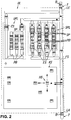
- the block piece store BL has according to Fig. 2 in general, a bearing input LE and a bearing output LA, which are connected to one another via a conveying path FS for the transport boxes T.
- the block piece store BL also has three different storage areas, namely a sorted buffer store SPL, an unsorted buffer store UPL and a flexible case store KS.
- the conveyor line FS is connected to the storage areas in the block piece store BL, wherein the transport boxes T with the block pieces B received therein are controlled by the process controller PS via the conveyor line FS, optionally from the store entrance LE to the respective storage area, from the respective storage area to the warehouse exit LA or be conveyed from the warehouse entrance LE directly to the warehouse outlet LA.
- the geometry information of the block pieces B entrained with the respective transport box T is conveyed in the block piece store BL by means of a Fig. 2 detected behind the storage entrance LE detection device as described and the respective transport box T is assigned depending on the loaded Block Culturetyp either the sorted buffer storage SPL or the flexible box storage KS. In these stores, a maximum number of storage locations is individually reserved for each block type by the process controller PS. Should all be appropriate Bins are occupied, the transport box T is cached in the unsorted buffer storage UPL.
- the transport boxes T with the block pieces B received therein are chaotically stored on fixed storage spaces by means of a handling system HS, whereby the process control PS assigns the respective storage space to the transport box T mounted thereon in accordance with the information of the corresponding information carrier IT at the transport box T takes place.
- a plurality of transport boxes T in stackers SP are combined to form a stack of transport boxes T (in FIG Fig. 2 indicated by a double line around the transport boxes T).
- the respective stacks of transport boxes T are then moved to a buffer belt PB for temporary storage behind the respective stacker SP.
- the stacks of transport boxes T in destackers ES are again singled and returned to the conveyor line FS.
- the transport boxes T While in the sorted buffer storage SPL the transport boxes T are stored with the recorded therein block pieces B according to the information of the information carrier IT at the respective transport box T sorted block type or geometry, with an assignment of four buffer bands PB in the illustrated embodiment of the sorted buffer storage SPL with those transport boxes T takes place, which contain the most common types of block pieces B, all excess transport boxes T are stored with the block pieces B contained therein in the unsorted buffer storage UPL.
- the output of the unsorted buffer storage UPL on the conveyor line FS is located directly behind the storage entrance LE of the block storage BL but before the detection device provided there, so that the coming from the unsorted buffer storage UPL transport boxes T re-captured and, if necessary, directly into one of the two other storage areas can be sorted.
- the process controller PS Upon presentation of a recipe order, the process controller PS, knowing the geometry of the spectacle lenses L to be produced, generally requests a transport box T with matching block pieces B from the block piece store BL and transports them via the conveyor belt to a semi-finished warehouse HL.
- the transport box T is again detected by the process control PS and subsequently loaded manually or automatically with usually round or oval, not yet edged lens blanks LR already on their first surface CX (see Fig. 6 to 9 ) finished, preferably even finished coated (hard and antireflective coating).
- the transport box T is equipped, as in the present exemplary embodiment, with a recordable information carrier IT, it can if necessary be provided with an indication which indicates an urgency of the respective recipe order.
- the provision of the respective block piece B via the process controller PS is thus carried out regularly in accordance with the geometry of the spectacle lens L to be produced by outputting the spectacle lens L identified with the corresponding block piece B identified via the information carrier IT Transport box T from the block storage BL.
- the transport box T is transported to a block station AS1.
- the blocking of the lens blanks LR takes place on the block pieces B accommodated in the same transport box T.
- the lens blank LR is positioned leaving a nip opposite the block B, which is then filled with a UV blocking material M, before the block material M is cured by exposure to UV light and thus Lens lens blank LR is fixed on the block piece B.
- the resulting individual block height is reported to the process controller PS and can also be stored on a writable information carrier IT on this.
- the lens blanks LR locked on the block pieces B are returned to the lens positions in FIG Fig. 10 used in the respective transport box T, whereupon the transport box T is transported to a Vorbearbeitungsstation BS1 on.
- the blocked lens blanks LOB are first removed from the transport box T and processed on the second surface CC, in the industry as well Called "Generate".
- the macrogeometry to be created according to the recipe order is produced on the second surface CC of the respective blocked lens blank LOB by cutting with tools with a specific cutting edge.
- so-called “generators” are used, which can combine milling and turning for the processing of plastic materials and for this purpose have both a milling spindle and a fast tool servo for driving a lathe tool, as for example in the document EP 2 011 603 A1 is described.
- a so-called “cribbing” can also initially take place in order to quickly remove material, the circumference of the lens blanks LR being reduced to a level necessary for the formation of the optically effective surface.
- the block piece B is centered together with the lens blank LR, so that it receives a different diameter D at the lens mounting surface BF.
- This can be reported from the pre-processing station BS1 to the process controller PS, after which the corresponding block pieces B are reclassified for the next round in the production line.
- this diameter information can also be updated directly on the information carrier IT.
- the blocked lens blanks LOB are loaded back into the respective transport box T and further transported via the conveyor belt in the direction of a finishing station BS2.
- a fine grinding or polishing machine the fine machining of the optically effective surfaces to remove the Vorbearbeitungsspuren and to achieve the desired microgeometry.
- Such a polishing machine is for example from the document EP 2 308 644 A2 or the publication WO 2016/058663 A1 known.
- the transport box T for the blocked lens blanks LOB further goes to a marking station BS3, in which the blocked lens blanks LOB are e.g. be engraved by means of a laser.
- markings for the installation side, logos, manufacturer designations, the addition effect of the spectacle lenses and the order number can be engraved here.
- the blocked lens blanks LOB are then transported further to a coating station BS4. There, a hard coating is applied to protect the finished optically effective surfaces of the blocked lens blanks LOB.
- the blocked lens blanks LOB are first automatically cleaned and dried, whereupon they by means of a (dip or) spin coating system, as described for example in the document US 7,748,341 B1 are coated to obtain treated blocked spectacle lenses L.
- the following (optional) vacuum coating station BS5 which reach the blocked spectacle lenses LOB in their transport box T, offers the possibility of applying further coatings such as antireflective or non-stick coatings under vacuum conditions, for which purpose the blocked spectacle lenses LOB in the vacuum coating station BS5 firstly dry and degassing without the transport boxes T are driven through tunnel kilns.
- the blocked spectacle lenses LOB are brought by means of their transport box T to a blocking station AS2, where the spectacle lenses L are automatically separated from the block pieces B, as already described above.
- a blocking station AS2 Such a device for particularly fast and secure blocking of optical workpieces is approximately from the document WO 2011/042091 A1 known. Thereafter, both the spectacle lenses L and the block pieces B of the respective recipe order are placed back in the associated transport box T.
- the respective transport box T is transported on the conveyor belt through a station for block material detection AS3. If no block material residues are to be detected by the station for block material detection AS3 on the blocked spectacle lenses L contained in the transport box T, the respective transport box T is released via the process controller PS for onward transport and a switch downstream of the station for block material residual detection AS3 can pass. If the spectacle lenses L could not be blocked successfully in the blocking station AS2 or if block material remains on the spectacle lenses L, then the corresponding transport box T is blocked by the process controller PS for onward transport and at the downstream diverter into a station for manual blocking and cleaning AS4 discharged.
- the transport box T After successful aftertreatment (manual blocking or cleaning of the spectacle lenses L), the transport box T is again returned to the station to the block material residue detection AS3 on the conveyor belt and passes them again to get to a release. If a contamination on or at the block pieces B has been detected at the station for block material detection AS3, this is reported to the process control PS and this transport box T is blocked with its block pieces B for the next circulation.
- the released eyeglass lenses L and block pieces B then arrive in their transport box T to a cleaning station AS5.
- a cleaning station AS5 Here, an automated cleaning of the spectacle lenses L in a brush washing line and, if necessary, a manual cleaning of the block pieces B.
- the eyeglass lenses L and block pieces B arrive with the associated transport box T to a control station AS6, in which an automated control of the spectacle lenses L in terms of their prescription effect takes place and the eyeglass lenses L also be checked for mechanical damage, such as scratches and other cosmetic problems ,
- the transport boxes T travel with their block pieces B and spectacle lenses L of the respective recipe order into a finishing area FSB, which in Fig. 3 is shown enlarged.
- the transport boxes T with the spectacle lenses L not to be bordered are identified there by the process controller PS and discharged to a station for final inspection and packaging AS7.
- the eyeglass lenses L are removed from the respective transport box T, checked, packed and forwarded without the transport box T to a common shipping AS9 for all eyeglass lenses L or glasses.
- the now only equipped with the associated block pieces B transport box T is meanwhile transported further in the direction of the block stock BL.
- the spectacle lenses L are removed from the transport boxes T and edited the edges of the spectacle lenses L according to the stored in the process control PS processing specifications so that the spectacle lenses L can be used in a preselected spectacle frame BG.
- the finished-handed spectacle lenses L are then placed again in the transport box T to the block pieces B contained therein.
- the eyeglass lenses L are to be mounted in the production facility in a spectacle frame BG, they are first transported together with the block pieces B in the transport box T in a spectacle frame BGL, in which the corresponding eyeglass frame BG is loaded with in the transport box T.
- the BGL spectacle frame is followed by a station for frame assembly, final inspection and packaging AS8. If the finished-edge eyeglass lenses L are not to be mounted on site, they will be transported directly from the edge processing station BS6 to the frame assembly, final inspection and packaging station AS8. Here, the gerimmeten eyeglass lenses L are removed from the transport box T, checked, optionally mounted in the eyeglass frame BG, packed and forwarded without the transport box T to the common shipping AS9. The transport boxes T loaded with the block pieces B are further transported toward the block piece store BL.
- the transport boxes T are moved according to the Leaving the completion area FSB again captured by the process control PS.
- the process controller PS on detection of the information carrier IT also information about a frequency of use of contained in the respective transport boxes T block pieces B.
- the process controller PS controls the Block Glalager BL upstream switch WH so that the switch WH, for example, when exceeding a predetermined frequency of use, the corresponding transport boxes T for manual picking and thorough cleaning of block piece B and / or transport box T to the preparation station VS ausschleust, but otherwise the corresponding transport boxes T with the recorded therein block pieces B to the Block Swisslager BL forwards.
- Other cases of discharging via the turnout WH are the achievement of the lifetime of the respective block pieces B or also the already mentioned above "mismatch" jobs in a transport box T.
- a method for manufacturing individual eyeglass lenses according to a prescription order comprises the steps of: (i) blocking a provided lens blank as a workpiece to a block piece provided from a block stock bearing of a plurality of block pieces by means of a block material, wherein a first face of the lens blank faces the block piece; (ii) treating the blocked lens blank at least on a second surface to obtain a blocked treated spectacle lens as a workpiece; and (iii) blocking the treated spectacle lens of the block piece, wherein the workpiece, if necessary in the blocked state, between the steps (i) to (iii) is transported in one of a plurality of held transport boxes.
- the block pieces are stored in the block boxes prior to the step (i) of blocking in the transport boxes and provided for the step (i) of blocking in the transport boxes from the block stock storage and / or the block pieces after the step (iii) of blocking transported in the transport boxes to the block piece store.
Landscapes
- Engineering & Computer Science (AREA)
- Mechanical Engineering (AREA)
- Health & Medical Sciences (AREA)
- Ophthalmology & Optometry (AREA)
- Physics & Mathematics (AREA)
- Manufacturing & Machinery (AREA)
- General Physics & Mathematics (AREA)
- Optics & Photonics (AREA)
- Eyeglasses (AREA)
Applications Claiming Priority (1)
| Application Number | Priority Date | Filing Date | Title |
|---|---|---|---|
| DE102017010321.6A DE102017010321A1 (de) | 2017-11-08 | 2017-11-08 | Verfahren zur Fertigung von individuellen Brillenlinsen nach einem Rezeptauftrag |
Publications (1)
| Publication Number | Publication Date |
|---|---|
| EP3492252A1 true EP3492252A1 (fr) | 2019-06-05 |
Family
ID=64172169
Family Applications (1)
| Application Number | Title | Priority Date | Filing Date |
|---|---|---|---|
| EP18000865.8A Pending EP3492252A1 (fr) | 2017-11-08 | 2018-11-02 | Procédé de fabrication de verres de lunettes individuelles selon une ordonnance médicale |
Country Status (4)
| Country | Link |
|---|---|
| US (1) | US11199730B2 (fr) |
| EP (1) | EP3492252A1 (fr) |
| CN (1) | CN109752864B (fr) |
| DE (1) | DE102017010321A1 (fr) |
Families Citing this family (3)
| Publication number | Priority date | Publication date | Assignee | Title |
|---|---|---|---|---|
| EP3936280A1 (fr) * | 2020-07-07 | 2022-01-12 | Satisloh AG | Support de transport pour processus de fabrication de lentille automatisé et installation de fabrication associée |
| EP4112769A1 (fr) * | 2021-06-30 | 2023-01-04 | Satisloh AG | Support pour maintenir un substrat, en particulier un verre de lunettes, pendant son revêtement sous vide dans un appareil de revêtement de boîtes et dispositif pour charger/décharger le substrat dans/depuis un tel support |
| EP4552794B1 (fr) | 2023-11-07 | 2025-10-15 | Carl Zeiss Vision International GmbH | Procédé mis en oeuvre par ordinateur pour fournir un ordre d'occupation pour transférer des ébauches de lentille d'un premier support à un second support |
Citations (4)
| Publication number | Priority date | Publication date | Assignee | Title |
|---|---|---|---|---|
| DE102004021696A1 (de) * | 2004-04-30 | 2005-11-24 | Schneider Gmbh + Co. Kg | Aufblockstation |
| DE102011009400A1 (de) * | 2010-12-22 | 2012-06-28 | Schneider Gmbh & Co. Kg | Vorrichtung zum Aufblocken von Brillengläsern |
| DE102015015040A1 (de) * | 2015-11-12 | 2017-05-18 | Schneider Gmbh & Co. Kg | Verfahren, Anlage und System zur Bearbeitung optischer Linsen |
| WO2018153787A1 (fr) * | 2017-02-22 | 2018-08-30 | Schneider Gmbh & Co. Kg | Installation et procédé pour l'usinage de lentilles optiques |
Family Cites Families (11)
| Publication number | Priority date | Publication date | Assignee | Title |
|---|---|---|---|---|
| EP1475320A3 (fr) | 2003-05-02 | 2006-02-08 | Loh Engineering Ag | Conteneur pour une usine de fabrication de lentilles pour lunettes individuelles |
| US7748341B2 (en) | 2006-08-10 | 2010-07-06 | Satisloh North America, Inc. | Lens coating apparatus |
| EP2011604B2 (fr) | 2007-07-05 | 2020-12-09 | Satisloh AG | Procédé de blocage de lentille, composition adhésive et utilisation de cette dernière pour les blocage des lentilles |
| DE102007031703A1 (de) | 2007-07-06 | 2009-01-08 | Satisloh Gmbh | Maschine zur Bearbeitung von optischen Werkstücken, insbesondere von Kunststoff-Brillengläsern |
| ATE494098T1 (de) | 2008-02-25 | 2011-01-15 | Satisloh Ag | Blockstück zum halten eines optischen werkstücks, insbesondere eines brillenglases, zu dessen bearbeitung und verfahren zur herstellung von brillengläsern entsprechend einem rezept |
| DE102008023093A1 (de) | 2008-05-09 | 2009-11-12 | Satisloh Ag | Vorrichtung zum Blocken von Werkstücken, insbesondere Brillengläsern, für deren Bearbeitung und/oder Beschichtung |
| DE102009048590B4 (de) | 2009-10-07 | 2020-06-18 | Satisloh Ag | Vorrichtung zum Abblocken von optischen Werkstücken, insbesondere Brillengläsern |
| DE102009048757A1 (de) | 2009-10-08 | 2011-04-14 | Satisloh Ag | Vorrichtung zur Feinbearbeitung von optisch wirksamen Flächen an Werkstücken, insbesondere Brillengläsern |
| DE102010044893A1 (de) * | 2010-03-10 | 2011-09-15 | Rodenstock Gmbh | Neuer Glasherstellungsprozess für Kunststoffgläser |
| DE102014015053A1 (de) | 2014-10-15 | 2016-04-21 | Satisloh Ag | Vorrichtung zur Feinbearbeitung von optisch wirksamen Flächen an insbesondere Brillengläsern |
| DE102015109703B4 (de) * | 2015-06-17 | 2022-03-17 | tooz technologies GmbH | Brillenglas, Brille und Verfahren zur Herstellung eines Brillenglases |
-
2017
- 2017-11-08 DE DE102017010321.6A patent/DE102017010321A1/de active Pending
-
2018
- 2018-11-02 EP EP18000865.8A patent/EP3492252A1/fr active Pending
- 2018-11-08 CN CN201811325975.6A patent/CN109752864B/zh active Active
- 2018-11-08 US US16/184,215 patent/US11199730B2/en active Active
Patent Citations (4)
| Publication number | Priority date | Publication date | Assignee | Title |
|---|---|---|---|---|
| DE102004021696A1 (de) * | 2004-04-30 | 2005-11-24 | Schneider Gmbh + Co. Kg | Aufblockstation |
| DE102011009400A1 (de) * | 2010-12-22 | 2012-06-28 | Schneider Gmbh & Co. Kg | Vorrichtung zum Aufblocken von Brillengläsern |
| DE102015015040A1 (de) * | 2015-11-12 | 2017-05-18 | Schneider Gmbh & Co. Kg | Verfahren, Anlage und System zur Bearbeitung optischer Linsen |
| WO2018153787A1 (fr) * | 2017-02-22 | 2018-08-30 | Schneider Gmbh & Co. Kg | Installation et procédé pour l'usinage de lentilles optiques |
Also Published As
| Publication number | Publication date |
|---|---|
| US20190137791A1 (en) | 2019-05-09 |
| CN109752864A (zh) | 2019-05-14 |
| US11199730B2 (en) | 2021-12-14 |
| CN109752864B (zh) | 2021-01-08 |
| DE102017010321A1 (de) | 2019-05-09 |
Similar Documents
| Publication | Publication Date | Title |
|---|---|---|
| EP2812152B1 (fr) | Machine de rodage à plusieurs postes de travail et table rotative | |
| DE3409843C2 (de) | Verfahren und Anlage zum Herstellen von aus mehreren Teilen bestehenden Werkstücken | |
| EP3846964B1 (fr) | Système de traitement destiné à traiter des verres de lunettes | |
| EP3374170B1 (fr) | Procédé, installation et système pour le traitement de lentilles optiques | |
| EP2321200B1 (fr) | Système de contenants de transport pour la fabrication de verres de lunettes sur ordonnance et procédé de transport de verres de lunettes et/ou d'ébauches de verres de lunettes | |
| DE202016102149U1 (de) | Fertigungsanlage | |
| EP3554969B1 (fr) | Système de fabrication de verres de lunettes | |
| EP0673711A1 (fr) | Système de manutention | |
| EP3974120A1 (fr) | Installation de tronçonnage des plaques et procédé de tronçonnage des pièces en forme de plaque | |
| DE1809745B2 (de) | Transferstraße mit durch einen elektronischen Rechner zentral gesteuerten Werkzeugmaschinen | |
| EP2050523A1 (fr) | Agencement mécanique pour le traitement de tôle à l'aide d'un dispositif de traitement de tôle ainsi que dispositif de transport | |
| DE102018007463B4 (de) | Vorrichtung und Verfahren zur Linsenbearbeitung sowie Bearbeitungseinrichtung für Linsen | |
| EP1319634A2 (fr) | Procédé et appareil de découpe des feuilles de verre en plaques individuelles | |
| DE102014208519A1 (de) | Bearbeitungsvorrichtung und Bearbeitungsverfahren | |
| EP0885686A1 (fr) | Centre d'usinage | |
| DE102017010321A1 (de) | Verfahren zur Fertigung von individuellen Brillenlinsen nach einem Rezeptauftrag | |
| DE102005034079A1 (de) | Fertigungssystem | |
| EP2603879B1 (fr) | Système et procédé de traitement d'objets de sécurité ou d'identification | |
| EP1718435A1 (fr) | Machine d'usinage pour usiner des pieces | |
| EP1681256A1 (fr) | Système de stockage pour rouleaux de matériau d'une machine pour le traitement de bandes et procédé pour le stockage de rouleuax de matériau | |
| EP3241621B1 (fr) | Procédé de tri par type de composants et dispositif de tri | |
| EP1713707A2 (fr) | Procede d'entreposage de rouleaux de matieres | |
| EP2354047A1 (fr) | Procédé de rassemblement et d'emballage de marchandises à envoyer | |
| EP0499685A1 (fr) | Rectifieuse, en particulier rectifieuse de finition, pour pièces annulaires | |
| AT524608A1 (de) | Verfahren zum Umladen von Waren mit Hilfe eines Roboters mit verbesserter Effizienz und Lager- und Kommissioniersystem hierzu |
Legal Events
| Date | Code | Title | Description |
|---|---|---|---|
| PUAI | Public reference made under article 153(3) epc to a published international application that has entered the european phase |
Free format text: ORIGINAL CODE: 0009012 |
|
| STAA | Information on the status of an ep patent application or granted ep patent |
Free format text: STATUS: THE APPLICATION HAS BEEN PUBLISHED |
|
| AK | Designated contracting states |
Kind code of ref document: A1 Designated state(s): AL AT BE BG CH CY CZ DE DK EE ES FI FR GB GR HR HU IE IS IT LI LT LU LV MC MK MT NL NO PL PT RO RS SE SI SK SM TR |
|
| AX | Request for extension of the european patent |
Extension state: BA ME |
|
| STAA | Information on the status of an ep patent application or granted ep patent |
Free format text: STATUS: REQUEST FOR EXAMINATION WAS MADE |
|
| 17P | Request for examination filed |
Effective date: 20191205 |
|
| RBV | Designated contracting states (corrected) |
Designated state(s): AL AT BE BG CH CY CZ DE DK EE ES FI FR GB GR HR HU IE IS IT LI LT LU LV MC MK MT NL NO PL PT RO RS SE SI SK SM TR |
|
| STAA | Information on the status of an ep patent application or granted ep patent |
Free format text: STATUS: EXAMINATION IS IN PROGRESS |
|
| 17Q | First examination report despatched |
Effective date: 20220518 |
|
| P01 | Opt-out of the competence of the unified patent court (upc) registered |
Effective date: 20230525 |