EP3499247A1 - Interface isolée galvaniquement et procédé de transmission de signaux analogiques par l'intermédiaire de ladite interface - Google Patents
Interface isolée galvaniquement et procédé de transmission de signaux analogiques par l'intermédiaire de ladite interface Download PDFInfo
- Publication number
- EP3499247A1 EP3499247A1 EP18020617.9A EP18020617A EP3499247A1 EP 3499247 A1 EP3499247 A1 EP 3499247A1 EP 18020617 A EP18020617 A EP 18020617A EP 3499247 A1 EP3499247 A1 EP 3499247A1
- Authority
- EP
- European Patent Office
- Prior art keywords
- winding
- voltage
- comparator
- branch
- interface
- Prior art date
- Legal status (The legal status is an assumption and is not a legal conclusion. Google has not performed a legal analysis and makes no representation as to the accuracy of the status listed.)
- Granted
Links
Images

Classifications
-
- G—PHYSICS
- G01—MEASURING; TESTING
- G01R—MEASURING ELECTRIC VARIABLES; MEASURING MAGNETIC VARIABLES
- G01R15/00—Details of measuring arrangements of the types provided for in groups G01R17/00 - G01R29/00, G01R33/00 - G01R33/26 or G01R35/00
- G01R15/14—Adaptations providing voltage or current isolation, e.g. for high-voltage or high-current networks
- G01R15/18—Adaptations providing voltage or current isolation, e.g. for high-voltage or high-current networks using inductive devices, e.g. transformers
- G01R15/183—Adaptations providing voltage or current isolation, e.g. for high-voltage or high-current networks using inductive devices, e.g. transformers using transformers with a magnetic core
-
- H—ELECTRICITY
- H01—ELECTRIC ELEMENTS
- H01F—MAGNETS; INDUCTANCES; TRANSFORMERS; SELECTION OF MATERIALS FOR THEIR MAGNETIC PROPERTIES
- H01F19/00—Fixed transformers or mutual inductances of the signal type
- H01F19/04—Transformers or mutual inductances suitable for handling frequencies considerably beyond the audio range
- H01F19/08—Transformers having magnetic bias, e.g. for handling pulses
- H01F2019/085—Transformer for galvanic isolation
-
- H—ELECTRICITY
- H01—ELECTRIC ELEMENTS
- H01F—MAGNETS; INDUCTANCES; TRANSFORMERS; SELECTION OF MATERIALS FOR THEIR MAGNETIC PROPERTIES
- H01F27/00—Details of transformers or inductances, in general
- H01F27/40—Structural association with built-in electric component, e.g. fuse
- H01F27/402—Association of measuring or protective means
Definitions
- the invention relates to an electrical interface with electrical isolation for a pump set and a method for galvanically isolated transmission of analog signals via this interface.
- electrical interfaces are required in devices to supply external control and / or measurement signals to a device electronics.
- standardized signals such as e.g. an analogue 0-10 voltage signal, an analogue 4-20mA current signal or a pulse width modulated (PWM) signal which is a digital square wave in form and form.
- PWM pulse width modulated
- Such signals are used for example by control units to control another device.
- the signal then forms a control signal and usually represents a nominal value in terms of control technology.
- measuring instruments often use the said standardized signals, which then form according to measurement signals, which is processed by the device electronics.
- the interface has a galvanic isolation, so that an electrical fault, especially a short circuit, on the one side of the interface does not affect the other side.
- galvanic isolation transformers or optocouplers are used in practice. While the PWM signal is an alternating signal, it is in the analog voltage and current signal is a sectionally constant signal, ie, a DC signal, which is why this according to the prior art before the Transmission over the galvanic separation preprocessed, in particular digitized and converted into an alternating signal.
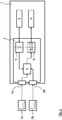
- FIG. 1 An example of a known interface 2 shows FIG. 1 ,
- an optocoupler 6 is used here, whose output signal is passed to the electronics 9.
- the preprocessing takes place by means of a microcontroller 5, which in turn is connected to the interface input 4a, 4b.
- a first interface input 4a for analog input signals and a second interface input 4b for digital signals are provided. These are connected to two corresponding inputs on the microcontroller 5. Since the preprocessing or the microcontroller 5 requires a power supply, a second electrical isolation is required, which takes place here in the form of a transformer 7. This receives a voltage from a power supply. 8
- an electrical interface for a pump unit for the galvanically isolated transmission of an analog input signal to an electronic system comprising an interface input, a A transformer having a first and a second winding and a measuring circuit, wherein the two windings are coupled together in a magnetic circuit, the first winding is connected to the interface input for applying an analog input signal and the second winding is connected to the measuring circuit.
- the measuring circuit comprises a changeable resistance circuit, with which the second winding is connected. Furthermore, the measuring circuit is set up to apply a changing, in particular voltage, to the second winding by changing the resistance circuit, to determine a time span from the time profile of at least one electrical variable of the resistance circuit and to determine therefrom the height of the input signal.
- a key aspect of the invention is thus to make the transmission of an analog input signal through a transformer, wherein the input signal is applied to the first winding of the transformer and a magnetic flux within the core of the transformer and thus causes a change in its permeability.
- the resulting in turn inductance change is evaluated based on the time course of an electrical variable of the measuring circuit.
- the interface according to the invention is intended for a pump unit.
- the invention thus also relates to a pump unit having an interface according to the invention.
- the pump unit may preferably be a centrifugal pump unit.
- the interface according to the invention allows the galvanically isolated transmission of analog input signals such as a 0-10V control or measurement signal from the interface input to an electronics of the pump unit using a single galvanic isolation, which is realized here in the form of the transformer.
- the interface thus has no further component to galvanically separate the interface input from the pump electronics. Furthermore, no DC-AC conversion of the input signal before the first winding is required, so that the interface has a total of a small installation space.
- the interface according to the invention and the method implemented in it make possible the galvanically isolated transmission of analog signals that are constant in sections, ie. Equal sizes. These change over a longer period, e.g. Seconds, minutes or hours not.
- Such signals can not be easily transmitted via a transformer, since in order to be able to induce a voltage on the output winding, an alternating flux is required, which must be generated by the input winding.
- a constant signal only produces a constant flux. Therefore, a transformer can only transmit DC quantities.
- the second winding according to the invention of the measuring circuit by changing the resistance circuit, with which the second winding is connected, applied to an alternating voltage.
- the second winding in the transformer core generates an alternating magnetic flux.
- the constant magnetic flux produced by the input signal is superimposed on the fundamental flux and thereby affects the inductance of the transformer, which in turn determines the time constant with which the electrical resistances of the resistive circuitry, i. change on the side of the second winding.
- One aspect of the method according to the invention is to determine the height of the input signal from this time-characteristic curve, determined by the time constant, of at least one electrical variable of the resistance circuit.
- the transformer core is a soft magnetic material. This has the advantage that the remanence and the hysteresis are close to zero.
- the changing basic flow should only be a fraction of the constant flow generated by the first winding, for example less than 20% of this flow, in particular about 10%.
- This can be achieved, for example, by a suitable ratio of the number of turns of the first winding to the second winding.
- the Windungsiereiere is between 1:10 to 1:20. The larger the turn ratio is, the more accurate the measurement.
- a maximum limit of the number of turns is given by the spatial conditions. This maximum limit is thus dependent on the size of the core.
- the first winding 120 may have turns.
- a lower limit for the number of turns must be taken into account. If the number of turns of the second winding is reduced, the influence of the hysteresis increases and has a negative influence on the measurement. Investigations have shown that, for example, 7 turns in the second winding lead to good results.
- the change of the resistance circuit may be periodic. This means that the voltage applied to the second winding changes at a certain frequency.
- this frequency can be between 1 kHz and 20 kHz, preferably at 8 kHz.
- the frequencies often used in engine controls of pump sets can be used.
- the first and the second winding are wound with the same sense of winding. This means that in the case of a positive current flow through the respective winding, a positive magnetic flux is generated in each case and that these flows are directed in the same direction. This ensures that the changing basic flow is only increased, ie not reduced, by the constant flow generated by the input signal.
- the resistor circuit forms a voltage divider, wherein the second winding is located in a first branch of the voltage divider. Preferably, it is connected in series with at least one resistor.
- it may be a resistor that connects the second winding to a supply voltage or ground.
- Alternatively or additionally, may be in the first branch, a series resistor with which the second winding is connected in series.
- this series resistance can also be dispensed with.
- the electrically effective resistance of a branch of the voltage divider is changeable. This means that the alternating voltage across the winding is effected by alternately changing the actual electrical resistance of the circuit. This can be done in a variety of ways, for example by one or more resistors are added or disconnected in the resistor circuit.
- the resistor circuit comprises two resistors, wherein the second winding is selectively switchable with one or two of the resistors in series between a supply voltage and ground.
- the measuring circuit is arranged to switch the second winding alternately with one or two of the resistors in series between the supply voltage and ground.
- the first branch can be connected to the supply voltage or can be connected via a first resistor and can be connected or connectable to ground via a second resistor.
- the first branch is between the first and second resistors and includes only the second winding.
- Such a circuit is useful if the internal resistance of the second winding is sufficiently large, for example, at least a few ohms.
- the resistor circuit comprises at least three resistors, wherein the second winding is selectively switchable with two or three of the resistors in series between a supply voltage and ground.
- the measuring circuit is adapted to switch the second winding alternately with two or three of the resistors in series between the supply voltage and ground.
- the first branch can be connected to the supply voltage or can be connected via a first resistor and can be connected or connectable to ground via a second resistor.
- the first branch is between the first and second resistors and includes a third resistor in series with the second winding.
- the first and the second resistor may be the same size. They can be in the range 10 ⁇ to 1k ⁇ , for example.
- the third resistor may be smaller. Preferably, its value may be one tenth or less of the value of the first or second resistor.
- the resistance circuit can have, for example, a controllable switch, in particular a controllable semiconductor switch, in order to change the resistance circuit as a function of the state.
- a controllable switch in particular a controllable semiconductor switch
- This may preferably be a transistor, in particular a bipolar transistor or a MOSFET transistor.
- this switch is in parallel or in series with a resistor of the resistor circuit. In the case of a parallel switch, this bridges the resistor in its closed state, so that the effect of this resistance is canceled. In the open state of the switch, the resistance acts against it. In contrast, in the case of a series-connected switch, the resistance only acts in the closed state of the switch, while it does not act in the open state of the switch.
- a particularly simple, changeable resistance circuit is achieved if the first branch can be connected to ground via the switch.
- the first branch via the switch with a supply voltage can be connected.
- the measuring circuit is arranged to switch the switch alternately on and off, in particular to control it with a frequency between 1 kHz and 20 kHz, preferably with about 8 kHz.
- the resistance circuit is changed periodically with this frequency, and at the second winding acting voltage changes with the frequency of the drive signal of the switch.
- the duty cycle is chosen so that the time duration of the switch-on state of the switch is shorter than the time duration of the switch-off state.
- the at least one electrical variable of the resistance circuit which is used to determine the height of the input signal is the voltage at the second winding, in particular at the first branch.
- the measuring circuit may comprise a signal evaluation unit that is parallel to the first branch.
- the signal evaluation unit has the voltage at the first branch or at the winding available to evaluate it.
- the signal evaluation unit may have a comparator for comparing the potential at the input node of the first branch with the potential at the output node of the first branch.
- the input node is that node of the resistor circuit in which a positive current in the the first branch flows in, and the output node of that node of the resistor circuit from which a positive current flows out of the first branch.
- the voltage at the output node thus serves as a reference voltage. However, it may also serve the voltage at the input node as a reference voltage.
- the comparator may be a comparator.
- This comparator provides an output signal indicating whether the voltage at the input node is greater or less than the voltage at the output node.
- the output of the comparator may be zero or ground when the voltage at the input node is less than the voltage at the output node. Accordingly, the output of the comparator may be at logic one (potential of supply voltage V1) when the voltage at the input node is greater than the voltage at the output node.
- the comparator may be configured to generate an output signal that is greater than or less than zero depending on the ratio of the voltage at the input node to the voltage at the output node.
- the comparator may operate in the manner of a differentiator, i. the difference between the voltage at the input node and the voltage at the output node is formed and their sign is output at the output of the comparator.
- the comparator may be configured to generate an output signal that is greater than or less than one depending on the ratio of the voltage at the input node to the voltage at the output node.
- the comparator may operate in the manner of a divider, i. that the ratio of the voltage at the input node and the voltage at the output node is formed and their ratio output at the output of the comparator.
- the comparator may be a discrete, standalone electronic component, or as a functional module may be part of a larger electronic module with multiple functional units, such as a microprocessor or a microcontroller. In this the comparator can only work in hardware be educated. In this alternative, however, it can also be partially or completely implemented by software.
- the signal evaluation unit may comprise a timer which is set up to start a counter at a first change of the output signal of the comparator and to stop the counter at a second change of the output signal of the comparator.
- the counter value that exists when stopping the counter then describes the specific time period.
- the timer English timer called, forms a kind of stopwatch.
- the timer may also be a discrete, self-contained electronic component, for example formed by an integrator.
- the timer is electrically connected downstream of the comparator, so that the output of the comparator is connected to the input of the timer.
- it can be part of a larger electronic component with a plurality of functional units as a functional component, such as a DSP, a microprocessor or a microcontroller.
- the timer can be designed exclusively in hardware. In this case, however, it can also be realized by software. If the comparator and the timer are both functional units of the larger electronic component, the timer is functionally downstream of the comparator.
- the signal evaluation unit may comprise an allocator which is set up to determine the height of the input signal from the derived time span.
- the allocator can also be a discrete, independent electronic, in particular programmable component such as an FPGA, DSP, a microprocessor, or a microcontroller, wherein the assignment to be carried out by the allocator is preferably realized by software technology.
- the allocator consists partly of software, partly of hardware.
- the allocator may include a memory for storing the relationship between the time period T and the input signal U E. This can be part of the programmable component or a memory component arranged and connected to it externally, for example an EEPROM.
- the signal evaluation unit is a microcontroller in which the comparator, the counter and / or the allocator form one, in particular one functional unit in each case, in particular are implemented.
- the comparator, the counter and / or the allocator are housed together in a larger electronic module, the microcontroller.
- the wiring effort is therefore minimal and signal processing between comparator, counter and allocator is particularly easy to design.
- signal evaluation unit is also configured to generate the control signal for the switch. This can be done for example by a frequency generator, which can also be part of the signal evaluation unit, in particular part of the microcontroller.
- the pump unit in which the interface according to the invention is present for example, a centrifugal pump unit, such as those used for heating or cooling systems or in the drinking water supply.
- centrifugal pump units consist of an electromotive drive unit, a driven by this pump unit and an engine electronics, which controls the motor and preferably controls the pump.
- the interface of the invention may be part of this engine electronics, due to their the pump regulating or controlling function is also called pump electronics.
- the engine electronics or pump electronics can structurally form a unit with the engine. However, it can also be mounted on this only alternatively or be provided for an arrangement external to the engine, for example for wall mounting. A structural connection between the engine electronics or pump electronics and the rest of the pump unit is therefore not required.
- the pump unit in which the interface according to the invention is present can also be formed by a pump system comprising two or more functionally cooperating centrifugal pump units. These can be controlled by a common engine electronics or pump electronics, which can be separately installed separately from the motors of the centrifugal pump units, in particular centrally, so that also here no structural connection to the motor units must be present.
- the change preferably takes place periodically, so that the alternating voltage is also a periodic alternating voltage. This simplifies the determination of the time span.
- the alternating voltage is generated by switching the second winding alternately with two or three resistors between a supply voltage and ground.
- the time period is preferably determined from the voltage at a first branch of the resistance circuit, which comprises the second winding or a series connection of the second winding and a series resistor. This voltage forms the aforementioned electrical variable.
- the determination of the time span can be effected, for example, by means of a comparator, in particular a comparator, which is parallel to the first branch and whose output signal changes when the voltage at the first branch changes sign.
- the time span to be determined is the period of time lying between two consecutive sign changes.
- the effect is advantageously exploited that changes with the changing of the resistance circuit, the voltage acting on the second winding voltage in its sign abruptly, namely negative and only gradually strives toward the steady state, which, however, is a positive voltage.
- the self-induction voltage receives a new sign change, which can be determined by the comparator and which takes place at a certain time, which is determined by the currently acting inductance of the second winding and by the currently acting total resistance of the resistance circuit. In other words, this time changes depending on the acting inductance. Since there is a linear relationship, the time is pushed back by an increase in the inductance time and pushed forward by reducing the inductance. Since the inductance in turn is linearly related to the permeability, the same applies to the connection of the time point with the permeability.
- the permeability in turn depends on the level of the input signal, there is also a relationship between the input signal and the time, such that increased input signal shifts the time forward and a lower input signal shifts the time backwards.
- Said time forms the end of said period whose beginning is at the time of the previous sign change of the voltage at the first branch.
- this time coincides with a switching time of the switch, in a preferred embodiment in particular with the opening of the switch, whereby a parallel to the switch resistance is active and connects the first branch to ground.
- a counter is started when the output of the comparator changes its value.
- the counter is stopped again when the output signal of the comparator returns to the previous value.
- the count of the counter then represents the time period to be determined.
- the counter can here by the o.g. Timer be realized.
- the height of the input signal is assigned to the specific period of time from a stored mathematical or tabular context. This can be done by the previously described allocator.
- the measurement of the period always takes place in the same range of the hysteresis curve, i. the magnetization curve is not repeated.
- This can be accomplished by performing a cyclic bias, such as by cycling the switch cyclically for a longer period of time. This causes the core of the transformer to be placed in a defined bias.
- FIG. 1 shows a block diagram of an electrical interface 2 of a pump unit 1 with electrical isolation 6, 7, as used in the prior art for the transmission of analog 0-10V signals 3a and digital PWM signals 3b and is already described in the introduction to the description.
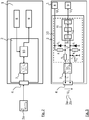
- FIG. 2 shows a block diagram which describes the basic structure of the interface 2 according to the invention with galvanic isolation.
- This galvanic isolation takes place via a transformer 7 with a first winding L1 and a second winding L2, which are coupled together in a magnetic circuit. Both windings L1, L2 are for this purpose wound together on an annular transformer core.
- the interface 2 dispenses with preprocessing of the analog input signals 3a and with a further galvanic isolation. Rather, the first winding L1 is connected directly to an interface input 4, to which the analog input signal 3a is applied, so that the input signal 3a is applied to the first winding L1. It thus forms an input winding.
- a measuring circuit 10 which is connected to the second winding L2 of the transformer 7, is provided in the interface 2.
- the second winding L2 thus forms a measuring winding.
- the measuring circuit 10 is supplied on the one hand from a voltage source 8 of the pump unit 1 with voltage.
- the measuring circuit 10 determines the height of the analog input signal 3a and outputs this for transmission to an electronics 9 (engine electronics or pump electronics).
- the basic idea of the interface 2 according to the invention is to ascertain the influence of the input signal 3a on a physical size of the component which effects the galvanic isolation and from this influence on the height of the Close input signal.
- the measuring circuit 10 is set up accordingly.
- said physical quantity is the inductance of the second winding, which changes more or less in dependence on the magnitude of the applied input signal 3a.
- said inductance change is closed to the height of the input signal.
- a voltage U E is applied to the first winding L1
- a current flow I L1 through the first winding L1 sets in.
- This current flow I L1 generates an external magnetic H field.
- the external magnetic H-field creates a magnetic flux in the transformer core.
- This magnetic flux is described by the B field.
- the increase in the outer H-field will result in a large or less increase in the B-field.
- the permeability ⁇ is not a constant factor, but due to the saturable core (for increasing H-values, the B-field no longer increases) has a substantially parabolic-like course.
- L 1 ⁇ * N 1 2 * A lm
- L 1 the first winding
- ⁇ the permeability
- N 1 the number of turns of the first winding
- A the cross-sectional area of the core
- Im the mean circumference of the core, ie the mean magnetic path length.
- a key aspect of the invention is to use a relationship between the changing inductance of the second winding L2, hereinafter called the measuring inductance, and the input signal or the input current I E fed to the interface input 4.
- FIG. 3 shows an exemplary embodiment of the circuit of an interface according to the invention 2.
- the measuring circuit 10 of the interface 2 comprises a resistor circuit which is connected to the second inductance L2.
- the resistance circuit consists here by way of example of three resistors.
- a first resistor Rs is in series with the second winding L2 and is therefore referred to as Series resistance Rs designated.
- Series resistor Rs and second winding L2 form a first branch with an input node 16 and an output node 17.
- This first branch is connected via a second resistor R1 to a supply voltage V1, which is provided by the power supply 8 of the pump unit 1.
- the first branch is further connected to ground via a third resistor R2.
- Parallel to the second and third resistor is in each case a diode D1, D2.
- Parallel to the third resistor R2 is a controlled switch T1, in particular a semiconductor switch such as a transistor (bipolar or MOSFET transistor), which bridges the third resistor in the closed state and thereby connects the first branch to ground.
- a periodic control voltage U st is used in the form of a square-wave signal, which switches the switch T1 on and off alternately.
- the control voltage U st can be generated by the measuring circuit, in particular a microcontroller thereof.
- a periodic control signal U St is applied to the control input of the switch T 1 , as a result of which the switch T 1 opens and closes alternately.
- the control signal is preferably a square-wave signal.
- the control signal has a frequency between 1 kHz and 20 kHz, for example 8 kHz.
- the control signal U St can be generated for example by a frequency generator.
- a frequency generator may be part of the measuring circuit 10.
- the control signal Ust is selected such that the on state becomes shorter is applied as the off state of the switch T1. It has a duty cycle of about 30%.
- the switch T1 By closing the switch T1, the resistor R2 is bypassed and the first branch is switched to ground. The closing of the switch T1 connects the second branch via the resistor Rs to ground. Then the resistors R S , R 1 , R 2 together with the second winding L2 are connected in series between the supply voltage V1 and ground. The switch T1 is thus able to change the resistance circuit.
- the third resistor R 2 is also switched periodically in series with the first branch or bridged. As a result, the result is that the second winding L2 can be alternately impressed two different voltages.
- two different voltage values at the input node 16 and output node 17, ie at the terminals of the measuring inductance L 1 result for the stationary state. This is given below by means of a numerical example.
- a voltage supply V 1 of, for example, 5V is used.
- the resistor circuit forms a voltage divider, so that following the voltage divider rule the following stationary voltages with respect to ground at the input node 16 and output node 17 result:
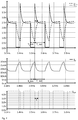
- Fig. 4 shows a diagram of the time course of the voltages U L2 + and U L2- at the input and output terminals 16, 17 of the first branch. This course is based on Lenz's rule: if the magnetic flux is changed in a coil, the self-induction voltage generates a current flow which is always directed so that a magnetic field is created which counteracts the change in the magnetic flux.
- the switch T1 is opened before the voltage at the input terminal 16 has reached its steady state value.
- the third resistor R2 is thereby switched abruptly in series with the first branch. Due to the continuity of the current now flowing at the switching time current flows (about 29mA) through the third resistor R2, so that immediately a corresponding voltage drop occurs (about 4.35V), whereby the voltage at the output terminal 17 to the value of this Voltage drop is raised. At this moment, however, the voltage at the input terminal 16 is still unchanged (at about 0.65V), so that the voltage at the output terminal 17 has risen above the voltage at the input terminal. Thus, the total voltage across the first branch has become negative.
- the curves of the voltages of the input and output terminals 16, 17 of the first branch At this point, then, the voltage across the first branch is zero, ie that the voltage U RS at the series resistance Rs and the voltage U L2 at the second winding L 2 are equal in magnitude, but have opposite signs and therefore cancel each other out.
- L is the inductance of the second winding L 2 .
- the time constant increases, the terminal voltages U L2 + and U L2- change more slowly. If the time constant decreases, the terminal voltages U L2 + and U L2- change faster.
- the time of intersection and thus the time T from the switching time of the switch T 1 to the crossover time depends on the level of the measuring inductance L 2 , since the resistance R ges is a constant factor.
- the time period T and the measuring inductance L 2 there is a proportionality between the time period T and the measuring inductance L 2 .
- a comparator 12 is used, which is connected to the input node 16 and the output node 17 of the first branch and which compares the voltages of these nodes 16, 17 with one another.
- This comparator 12 is here part of a signal evaluation unit 11.
- the comparator may be in a variant embodiment, for example, a comparator.
- the comparator 12 When the voltage U L2- at the output node 17 is used as a reference voltage, the comparator 12 outputs a 0 (ground) as the output signal when the voltage U L2 + at the input node 16 is greater than at the output node 17. This is from the crossing point of the voltages described above U L2 + and U L2 - and for the period of the case in which the switch T1 is closed. If the switch T1 opens, the comparator changes its value at the output, since now the voltage U L2 + to be compared is higher than the referenced voltage U L2- . Thus, the output signal U out of the comparator is zero only during the period T, otherwise positive, here logical 1, for example in the amount of the supply voltage V1 (5V).
- the output signal of the comparator 12 is in Fig. 4 ,
- Uout positive output signal
- the relationships shown can also be the other way round. The same applies to the comparator.
- the voltage U L2 + at the input node 17 can also be used as a reference voltage.
- the time for this crossing is dependent on the time constant ⁇ of the curve, and consequently also dependent on the inductance, is also a change in the inductance of the second winding L 2 due to the input signal U E , the timing of the positive switching edge of the Comparator, in particular shifted to the left, as the inductance decreases, and shifted to the right as it increases. Consequently, the pulse width of the comparator output signal Uout is increased or decreased.
- This highest point of permeability ⁇ max is used as a starting point. This means that it applies to an input signal U E null. Because with an input signal greater than zero, the field strength increases at the second winding and the permeability decreases according to the curve in Fig. 5 , Thus, according to the invention, a region of the permeability curve is utilized in which the permeability ⁇ depends almost linearly and monotonically on the field strength H.
- the timer 13 is designed to determine a characteristic for the time course of at least one electrical size of the resistance circuit period T in the manner of a stopwatch or a counter.
- the timer can also be understood as an integrator that adds up linearly.
- it is the time T passing from the opening time of the switch T1 to the time when the voltages at the input and output nodes 16, 17 intersect Fig. 4 .
- the timer 13 the output signal Uout of the comparator 12 is supplied, so that it is controlled by this.
- the timer 13 is started at zero and counts up in a predetermined increment per second.
- the current slew rate in the second winding is measured by the determination of the time period.
- the relationship between the time period T and the input signal U E has been determined at the factory and stored in the signal evaluation 11.
- the allocator 14 outputs at its output a value corresponding to the value of the input signal U E , which value is supplied to the electronics 9 for further processing.
- a section-wise constant analog voltage signal such as a 0-10V voltage signal from the interface input 4 is electrically isolated to the electronics 9 transmitted.
- a section-wise constant analog current signal such as a 4-20 mA current signal can also be transmitted via the same interface input or an input parallel to it in the manner according to the invention and via the interface 2 according to the invention by a resistor, for example in the amount of 500 ohms parallel to the two Input terminals of the interface input 4 is switched. This can be done for example manually via a dip switch or by electronic connection.
- the resistor converts the current signal into a proportional voltage signal which is transmitted through the interface as previously described.
- a digital signal such as a PWM signal can be transmitted as input signal U E via the same interface input or an input lying parallel thereto.
- the signal evaluation unit 11 may be formed by a microcontroller, in which the comparator 12, the timer 13 and / or the allocator 14 each form an independent functional unit.
- the comparator 12, the timer 13 and / or the allocator 14 may be formed as discrete components and form the signal evaluation unit only in terms of their overall functionality.
Landscapes
- Engineering & Computer Science (AREA)
- Power Engineering (AREA)
- Physics & Mathematics (AREA)
- General Physics & Mathematics (AREA)
- Measurement Of Current Or Voltage (AREA)
Applications Claiming Priority (1)
| Application Number | Priority Date | Filing Date | Title |
|---|---|---|---|
| DE102017011681.4A DE102017011681A1 (de) | 2017-12-18 | 2017-12-18 | Galvanisch getrennte Schnittstelle und Verfahren zur Übertragung analoger Signale über diese Schnittstelle |
Publications (2)
| Publication Number | Publication Date |
|---|---|
| EP3499247A1 true EP3499247A1 (fr) | 2019-06-19 |
| EP3499247B1 EP3499247B1 (fr) | 2020-02-26 |
Family
ID=64476908
Family Applications (1)
| Application Number | Title | Priority Date | Filing Date |
|---|---|---|---|
| EP18020617.9A Active EP3499247B1 (fr) | 2017-12-18 | 2018-11-26 | Interface isolée galvaniquement et procédé de transmission de signaux analogiques par l'intermédiaire de ladite interface |
Country Status (2)
| Country | Link |
|---|---|
| EP (1) | EP3499247B1 (fr) |
| DE (1) | DE102017011681A1 (fr) |
Citations (2)
| Publication number | Priority date | Publication date | Assignee | Title |
|---|---|---|---|---|
| DE10057315A1 (de) * | 2000-11-17 | 2002-05-29 | Skorp Messtechnik Gmbh | Schaltungsanordnung zum potentialfreien Übertragen eines Meßsignals |
| DE102005007378A1 (de) * | 2005-02-17 | 2006-08-24 | Siemens Ag | Vorrichtung zur induktiven Gleichstomerfassung |
-
2017
- 2017-12-18 DE DE102017011681.4A patent/DE102017011681A1/de not_active Withdrawn
-
2018
- 2018-11-26 EP EP18020617.9A patent/EP3499247B1/fr active Active
Patent Citations (2)
| Publication number | Priority date | Publication date | Assignee | Title |
|---|---|---|---|---|
| DE10057315A1 (de) * | 2000-11-17 | 2002-05-29 | Skorp Messtechnik Gmbh | Schaltungsanordnung zum potentialfreien Übertragen eines Meßsignals |
| DE102005007378A1 (de) * | 2005-02-17 | 2006-08-24 | Siemens Ag | Vorrichtung zur induktiven Gleichstomerfassung |
Also Published As
| Publication number | Publication date |
|---|---|
| DE102017011681A1 (de) | 2019-06-19 |
| EP3499247B1 (fr) | 2020-02-26 |
Similar Documents
| Publication | Publication Date | Title |
|---|---|---|
| DE1638009B2 (de) | Gleichspannungsgespeiste, geregelte gleichspannungsversorgung | |
| DE2834381A1 (de) | Vorrichtung zur leistungsuebertragung | |
| EP0393233B1 (fr) | Système de transmission de signaux | |
| DE102014103374A1 (de) | System und verfahren zum kalibrieren eines netzteils | |
| EP0631360B1 (fr) | Dispositif et procédé de surveillance de la position d'un commutateur | |
| DE3346435A1 (de) | Schaltungsanordnung zum ein- und ausschalten sowie zum ueberwachen elektrischer verbraucher | |
| DE102019003470A1 (de) | Resonanzleistungswandler sowie Verfahren und integrierte Schaltkreissteuerungen zu dessen Steuerung | |
| EP2398137A2 (fr) | Régulateur de tension alternative | |
| EP0986039B1 (fr) | Dispositif pour l'alimentation d'un émetteur d'une boucle de courant | |
| DE2607463A1 (de) | Ueberlastungsschutzschaltung | |
| DE2922219B2 (de) | Elektronischer Sensor-Ein/Aus-Schalter | |
| DE3822991A1 (de) | Hochspannungsschalter | |
| EP1737113B1 (fr) | Circuit de commande pour la régulation de courant et de tension d'un circuit d'alimentation à découpage | |
| EP3499247B1 (fr) | Interface isolée galvaniquement et procédé de transmission de signaux analogiques par l'intermédiaire de ladite interface | |
| EP1071210B1 (fr) | Montage de circuit | |
| DE102013021975A1 (de) | Elektronische Anlaufschaltung für einen Einphasen-Induktionsmotor | |
| DE102005001322B4 (de) | Verfahren und Schaltung zur galvanisch getrennten Übertragung eines Signals | |
| DE102011077387A1 (de) | Schaltungsanordnung zum Schalten eines Stromes und Verfahren zum Betreiben derselben | |
| EP1701434A2 (fr) | Circuit de commande pour le commutateur d'une alimentation de puissance à découpage | |
| EP2770641A2 (fr) | Dispositif d'exploitation de signaux d'entrée électriques | |
| EP2994988A1 (fr) | Alimentation en énergie, à l'intérieur d'un appareil, d'un dispositif | |
| WO1998043266A1 (fr) | Mecanisme de commande electromagnetique | |
| EP0509343A2 (fr) | Méthode de fonctionnement d'un régulateur à découpage et son dispositif | |
| EP0155932B1 (fr) | Arrangement de circuit | |
| DE102018214955A1 (de) | Elektronische Schaltung und Betriebsverfahren hierfür |
Legal Events
| Date | Code | Title | Description |
|---|---|---|---|
| PUAI | Public reference made under article 153(3) epc to a published international application that has entered the european phase |
Free format text: ORIGINAL CODE: 0009012 |
|
| STAA | Information on the status of an ep patent application or granted ep patent |
Free format text: STATUS: THE APPLICATION HAS BEEN PUBLISHED |
|
| AK | Designated contracting states |
Kind code of ref document: A1 Designated state(s): AL AT BE BG CH CY CZ DE DK EE ES FI FR GB GR HR HU IE IS IT LI LT LU LV MC MK MT NL NO PL PT RO RS SE SI SK SM TR |
|
| AX | Request for extension of the european patent |
Extension state: BA ME |
|
| STAA | Information on the status of an ep patent application or granted ep patent |
Free format text: STATUS: REQUEST FOR EXAMINATION WAS MADE |
|
| 17P | Request for examination filed |
Effective date: 20190611 |
|
| RBV | Designated contracting states (corrected) |
Designated state(s): AL AT BE BG CH CY CZ DE DK EE ES FI FR GB GR HR HU IE IS IT LI LT LU LV MC MK MT NL NO PL PT RO RS SE SI SK SM TR |
|
| GRAP | Despatch of communication of intention to grant a patent |
Free format text: ORIGINAL CODE: EPIDOSNIGR1 |
|
| STAA | Information on the status of an ep patent application or granted ep patent |
Free format text: STATUS: GRANT OF PATENT IS INTENDED |
|
| RIC1 | Information provided on ipc code assigned before grant |
Ipc: G01R 15/18 20060101AFI20191010BHEP Ipc: H01F 19/08 20060101ALI20191010BHEP Ipc: H01F 27/40 20060101ALI20191010BHEP |
|
| INTG | Intention to grant announced |
Effective date: 20191113 |
|
| GRAS | Grant fee paid |
Free format text: ORIGINAL CODE: EPIDOSNIGR3 |
|
| GRAA | (expected) grant |
Free format text: ORIGINAL CODE: 0009210 |
|
| STAA | Information on the status of an ep patent application or granted ep patent |
Free format text: STATUS: THE PATENT HAS BEEN GRANTED |
|
| AK | Designated contracting states |
Kind code of ref document: B1 Designated state(s): AL AT BE BG CH CY CZ DE DK EE ES FI FR GB GR HR HU IE IS IT LI LT LU LV MC MK MT NL NO PL PT RO RS SE SI SK SM TR |
|
| REG | Reference to a national code |
Ref country code: GB Ref legal event code: FG4D Free format text: NOT ENGLISH |
|
| REG | Reference to a national code |
Ref country code: CH Ref legal event code: EP |
|
| REG | Reference to a national code |
Ref country code: DE Ref legal event code: R096 Ref document number: 502018000798 Country of ref document: DE |
|
| REG | Reference to a national code |
Ref country code: AT Ref legal event code: REF Ref document number: 1238291 Country of ref document: AT Kind code of ref document: T Effective date: 20200315 |
|
| REG | Reference to a national code |
Ref country code: IE Ref legal event code: FG4D Free format text: LANGUAGE OF EP DOCUMENT: GERMAN |
|
| PG25 | Lapsed in a contracting state [announced via postgrant information from national office to epo] |
Ref country code: FI Free format text: LAPSE BECAUSE OF FAILURE TO SUBMIT A TRANSLATION OF THE DESCRIPTION OR TO PAY THE FEE WITHIN THE PRESCRIBED TIME-LIMIT Effective date: 20200226 Ref country code: NO Free format text: LAPSE BECAUSE OF FAILURE TO SUBMIT A TRANSLATION OF THE DESCRIPTION OR TO PAY THE FEE WITHIN THE PRESCRIBED TIME-LIMIT Effective date: 20200526 Ref country code: RS Free format text: LAPSE BECAUSE OF FAILURE TO SUBMIT A TRANSLATION OF THE DESCRIPTION OR TO PAY THE FEE WITHIN THE PRESCRIBED TIME-LIMIT Effective date: 20200226 |
|
| REG | Reference to a national code |
Ref country code: NL Ref legal event code: MP Effective date: 20200226 |
|
| REG | Reference to a national code |
Ref country code: LT Ref legal event code: MG4D |
|
| PG25 | Lapsed in a contracting state [announced via postgrant information from national office to epo] |
Ref country code: HR Free format text: LAPSE BECAUSE OF FAILURE TO SUBMIT A TRANSLATION OF THE DESCRIPTION OR TO PAY THE FEE WITHIN THE PRESCRIBED TIME-LIMIT Effective date: 20200226 Ref country code: GR Free format text: LAPSE BECAUSE OF FAILURE TO SUBMIT A TRANSLATION OF THE DESCRIPTION OR TO PAY THE FEE WITHIN THE PRESCRIBED TIME-LIMIT Effective date: 20200527 Ref country code: SE Free format text: LAPSE BECAUSE OF FAILURE TO SUBMIT A TRANSLATION OF THE DESCRIPTION OR TO PAY THE FEE WITHIN THE PRESCRIBED TIME-LIMIT Effective date: 20200226 Ref country code: IS Free format text: LAPSE BECAUSE OF FAILURE TO SUBMIT A TRANSLATION OF THE DESCRIPTION OR TO PAY THE FEE WITHIN THE PRESCRIBED TIME-LIMIT Effective date: 20200626 Ref country code: LV Free format text: LAPSE BECAUSE OF FAILURE TO SUBMIT A TRANSLATION OF THE DESCRIPTION OR TO PAY THE FEE WITHIN THE PRESCRIBED TIME-LIMIT Effective date: 20200226 Ref country code: BG Free format text: LAPSE BECAUSE OF FAILURE TO SUBMIT A TRANSLATION OF THE DESCRIPTION OR TO PAY THE FEE WITHIN THE PRESCRIBED TIME-LIMIT Effective date: 20200526 |
|
| PG25 | Lapsed in a contracting state [announced via postgrant information from national office to epo] |
Ref country code: NL Free format text: LAPSE BECAUSE OF FAILURE TO SUBMIT A TRANSLATION OF THE DESCRIPTION OR TO PAY THE FEE WITHIN THE PRESCRIBED TIME-LIMIT Effective date: 20200226 |
|
| PG25 | Lapsed in a contracting state [announced via postgrant information from national office to epo] |
Ref country code: CZ Free format text: LAPSE BECAUSE OF FAILURE TO SUBMIT A TRANSLATION OF THE DESCRIPTION OR TO PAY THE FEE WITHIN THE PRESCRIBED TIME-LIMIT Effective date: 20200226 Ref country code: ES Free format text: LAPSE BECAUSE OF FAILURE TO SUBMIT A TRANSLATION OF THE DESCRIPTION OR TO PAY THE FEE WITHIN THE PRESCRIBED TIME-LIMIT Effective date: 20200226 Ref country code: SK Free format text: LAPSE BECAUSE OF FAILURE TO SUBMIT A TRANSLATION OF THE DESCRIPTION OR TO PAY THE FEE WITHIN THE PRESCRIBED TIME-LIMIT Effective date: 20200226 Ref country code: EE Free format text: LAPSE BECAUSE OF FAILURE TO SUBMIT A TRANSLATION OF THE DESCRIPTION OR TO PAY THE FEE WITHIN THE PRESCRIBED TIME-LIMIT Effective date: 20200226 Ref country code: LT Free format text: LAPSE BECAUSE OF FAILURE TO SUBMIT A TRANSLATION OF THE DESCRIPTION OR TO PAY THE FEE WITHIN THE PRESCRIBED TIME-LIMIT Effective date: 20200226 Ref country code: SM Free format text: LAPSE BECAUSE OF FAILURE TO SUBMIT A TRANSLATION OF THE DESCRIPTION OR TO PAY THE FEE WITHIN THE PRESCRIBED TIME-LIMIT Effective date: 20200226 Ref country code: DK Free format text: LAPSE BECAUSE OF FAILURE TO SUBMIT A TRANSLATION OF THE DESCRIPTION OR TO PAY THE FEE WITHIN THE PRESCRIBED TIME-LIMIT Effective date: 20200226 Ref country code: PT Free format text: LAPSE BECAUSE OF FAILURE TO SUBMIT A TRANSLATION OF THE DESCRIPTION OR TO PAY THE FEE WITHIN THE PRESCRIBED TIME-LIMIT Effective date: 20200719 Ref country code: RO Free format text: LAPSE BECAUSE OF FAILURE TO SUBMIT A TRANSLATION OF THE DESCRIPTION OR TO PAY THE FEE WITHIN THE PRESCRIBED TIME-LIMIT Effective date: 20200226 |
|
| REG | Reference to a national code |
Ref country code: DE Ref legal event code: R097 Ref document number: 502018000798 Country of ref document: DE |
|
| PLBE | No opposition filed within time limit |
Free format text: ORIGINAL CODE: 0009261 |
|
| STAA | Information on the status of an ep patent application or granted ep patent |
Free format text: STATUS: NO OPPOSITION FILED WITHIN TIME LIMIT |
|
| 26N | No opposition filed |
Effective date: 20201127 |
|
| PG25 | Lapsed in a contracting state [announced via postgrant information from national office to epo] |
Ref country code: PL Free format text: LAPSE BECAUSE OF FAILURE TO SUBMIT A TRANSLATION OF THE DESCRIPTION OR TO PAY THE FEE WITHIN THE PRESCRIBED TIME-LIMIT Effective date: 20200226 |
|
| PG25 | Lapsed in a contracting state [announced via postgrant information from national office to epo] |
Ref country code: MC Free format text: LAPSE BECAUSE OF FAILURE TO SUBMIT A TRANSLATION OF THE DESCRIPTION OR TO PAY THE FEE WITHIN THE PRESCRIBED TIME-LIMIT Effective date: 20200226 |
|
| PG25 | Lapsed in a contracting state [announced via postgrant information from national office to epo] |
Ref country code: LU Free format text: LAPSE BECAUSE OF NON-PAYMENT OF DUE FEES Effective date: 20201126 |
|
| REG | Reference to a national code |
Ref country code: BE Ref legal event code: MM Effective date: 20201130 |
|
| PG25 | Lapsed in a contracting state [announced via postgrant information from national office to epo] |
Ref country code: IE Free format text: LAPSE BECAUSE OF NON-PAYMENT OF DUE FEES Effective date: 20201126 |
|
| PG25 | Lapsed in a contracting state [announced via postgrant information from national office to epo] |
Ref country code: TR Free format text: LAPSE BECAUSE OF FAILURE TO SUBMIT A TRANSLATION OF THE DESCRIPTION OR TO PAY THE FEE WITHIN THE PRESCRIBED TIME-LIMIT Effective date: 20200226 Ref country code: MT Free format text: LAPSE BECAUSE OF FAILURE TO SUBMIT A TRANSLATION OF THE DESCRIPTION OR TO PAY THE FEE WITHIN THE PRESCRIBED TIME-LIMIT Effective date: 20200226 Ref country code: CY Free format text: LAPSE BECAUSE OF FAILURE TO SUBMIT A TRANSLATION OF THE DESCRIPTION OR TO PAY THE FEE WITHIN THE PRESCRIBED TIME-LIMIT Effective date: 20200226 |
|
| PG25 | Lapsed in a contracting state [announced via postgrant information from national office to epo] |
Ref country code: MK Free format text: LAPSE BECAUSE OF FAILURE TO SUBMIT A TRANSLATION OF THE DESCRIPTION OR TO PAY THE FEE WITHIN THE PRESCRIBED TIME-LIMIT Effective date: 20200226 Ref country code: AL Free format text: LAPSE BECAUSE OF FAILURE TO SUBMIT A TRANSLATION OF THE DESCRIPTION OR TO PAY THE FEE WITHIN THE PRESCRIBED TIME-LIMIT Effective date: 20200226 |
|
| REG | Reference to a national code |
Ref country code: CH Ref legal event code: PL |
|
| PG25 | Lapsed in a contracting state [announced via postgrant information from national office to epo] |
Ref country code: BE Free format text: LAPSE BECAUSE OF NON-PAYMENT OF DUE FEES Effective date: 20201130 |
|
| PG25 | Lapsed in a contracting state [announced via postgrant information from national office to epo] |
Ref country code: LI Free format text: LAPSE BECAUSE OF NON-PAYMENT OF DUE FEES Effective date: 20211130 Ref country code: CH Free format text: LAPSE BECAUSE OF NON-PAYMENT OF DUE FEES Effective date: 20211130 |
|
| P01 | Opt-out of the competence of the unified patent court (upc) registered |
Effective date: 20230615 |
|
| PG25 | Lapsed in a contracting state [announced via postgrant information from national office to epo] |
Ref country code: SI Free format text: LAPSE BECAUSE OF FAILURE TO SUBMIT A TRANSLATION OF THE DESCRIPTION OR TO PAY THE FEE WITHIN THE PRESCRIBED TIME-LIMIT Effective date: 20200226 |
|
| PGFP | Annual fee paid to national office [announced via postgrant information from national office to epo] |
Ref country code: IT Payment date: 20231019 Year of fee payment: 6 |
|
| REG | Reference to a national code |
Ref country code: AT Ref legal event code: MM01 Ref document number: 1238291 Country of ref document: AT Kind code of ref document: T Effective date: 20231126 |
|
| PG25 | Lapsed in a contracting state [announced via postgrant information from national office to epo] |
Ref country code: AT Free format text: LAPSE BECAUSE OF NON-PAYMENT OF DUE FEES Effective date: 20231126 |
|
| PG25 | Lapsed in a contracting state [announced via postgrant information from national office to epo] |
Ref country code: AT Free format text: LAPSE BECAUSE OF NON-PAYMENT OF DUE FEES Effective date: 20231126 |
|
| PG25 | Lapsed in a contracting state [announced via postgrant information from national office to epo] |
Ref country code: IT Free format text: LAPSE BECAUSE OF NON-PAYMENT OF DUE FEES Effective date: 20241126 |
|
| PGFP | Annual fee paid to national office [announced via postgrant information from national office to epo] |
Ref country code: DE Payment date: 20251022 Year of fee payment: 8 |
|
| PGFP | Annual fee paid to national office [announced via postgrant information from national office to epo] |
Ref country code: GB Payment date: 20251023 Year of fee payment: 8 |
|
| PGFP | Annual fee paid to national office [announced via postgrant information from national office to epo] |
Ref country code: FR Payment date: 20251022 Year of fee payment: 8 |
|
| PGFP | Annual fee paid to national office [announced via postgrant information from national office to epo] |
Ref country code: AT Payment date: 20260410 Year of fee payment: 5 |