EP3501437A1 - Knochenplatte und verfahren zum herstellen einer knochenplatte - Google Patents
Knochenplatte und verfahren zum herstellen einer knochenplatte Download PDFInfo
- Publication number
- EP3501437A1 EP3501437A1 EP17209169.6A EP17209169A EP3501437A1 EP 3501437 A1 EP3501437 A1 EP 3501437A1 EP 17209169 A EP17209169 A EP 17209169A EP 3501437 A1 EP3501437 A1 EP 3501437A1
- Authority
- EP
- European Patent Office
- Prior art keywords
- inlay
- bone plate
- supporting structure
- bone
- weld
- Prior art date
- Legal status (The legal status is an assumption and is not a legal conclusion. Google has not performed a legal analysis and makes no representation as to the accuracy of the status listed.)
- Withdrawn
Links
- 210000000988 bone and bone Anatomy 0.000 title claims abstract description 136
- 238000004519 manufacturing process Methods 0.000 title claims abstract description 9
- 239000000463 material Substances 0.000 claims abstract description 76
- 230000035515 penetration Effects 0.000 claims abstract description 4
- 238000000034 method Methods 0.000 claims description 16
- 230000007704 transition Effects 0.000 claims description 16
- 238000003466 welding Methods 0.000 claims description 9
- RTAQQCXQSZGOHL-UHFFFAOYSA-N Titanium Chemical compound [Ti] RTAQQCXQSZGOHL-UHFFFAOYSA-N 0.000 description 13
- 239000010936 titanium Substances 0.000 description 13
- 229910052719 titanium Inorganic materials 0.000 description 13
- 229910001069 Ti alloy Inorganic materials 0.000 description 4
- QVGXLLKOCUKJST-UHFFFAOYSA-N atomic oxygen Chemical compound [O] QVGXLLKOCUKJST-UHFFFAOYSA-N 0.000 description 4
- 229910052760 oxygen Inorganic materials 0.000 description 4
- 239000001301 oxygen Substances 0.000 description 4
- 239000007787 solid Substances 0.000 description 3
- 239000012634 fragment Substances 0.000 description 2
- 229910001257 Nb alloy Inorganic materials 0.000 description 1
- 239000000109 continuous material Substances 0.000 description 1
- 230000000694 effects Effects 0.000 description 1
- 230000017525 heat dissipation Effects 0.000 description 1
- 230000001771 impaired effect Effects 0.000 description 1
- 239000012535 impurity Substances 0.000 description 1
- 238000003780 insertion Methods 0.000 description 1
- 230000037431 insertion Effects 0.000 description 1
- 238000003754 machining Methods 0.000 description 1
- 238000003801 milling Methods 0.000 description 1
- RJSRQTFBFAJJIL-UHFFFAOYSA-N niobium titanium Chemical compound [Ti].[Nb] RJSRQTFBFAJJIL-UHFFFAOYSA-N 0.000 description 1
- 230000000149 penetrating effect Effects 0.000 description 1
- 230000000717 retained effect Effects 0.000 description 1
- 238000001356 surgical procedure Methods 0.000 description 1
- 210000000689 upper leg Anatomy 0.000 description 1
Images


Classifications
-
- A—HUMAN NECESSITIES
- A61—MEDICAL OR VETERINARY SCIENCE; HYGIENE
- A61B—DIAGNOSIS; SURGERY; IDENTIFICATION
- A61B17/00—Surgical instruments, devices or methods
- A61B17/56—Surgical instruments or methods for treatment of bones or joints; Devices specially adapted therefor
- A61B17/58—Surgical instruments or methods for treatment of bones or joints; Devices specially adapted therefor for osteosynthesis, e.g. bone plates, screws or setting implements
- A61B17/68—Internal fixation devices, including fasteners and spinal fixators, even if a part thereof projects from the skin
- A61B17/80—Cortical plates, i.e. bone plates; Instruments for holding or positioning cortical plates, or for compressing bones attached to cortical plates
- A61B17/8052—Cortical plates, i.e. bone plates; Instruments for holding or positioning cortical plates, or for compressing bones attached to cortical plates immobilised relative to screws by interlocking form of the heads and plate holes, e.g. conical or threaded
- A61B17/8057—Cortical plates, i.e. bone plates; Instruments for holding or positioning cortical plates, or for compressing bones attached to cortical plates immobilised relative to screws by interlocking form of the heads and plate holes, e.g. conical or threaded the interlocking form comprising a thread
-
- A—HUMAN NECESSITIES
- A61—MEDICAL OR VETERINARY SCIENCE; HYGIENE
- A61B—DIAGNOSIS; SURGERY; IDENTIFICATION
- A61B17/00—Surgical instruments, devices or methods
- A61B17/56—Surgical instruments or methods for treatment of bones or joints; Devices specially adapted therefor
- A61B17/58—Surgical instruments or methods for treatment of bones or joints; Devices specially adapted therefor for osteosynthesis, e.g. bone plates, screws or setting implements
- A61B17/68—Internal fixation devices, including fasteners and spinal fixators, even if a part thereof projects from the skin
- A61B17/80—Cortical plates, i.e. bone plates; Instruments for holding or positioning cortical plates, or for compressing bones attached to cortical plates
-
- A—HUMAN NECESSITIES
- A61—MEDICAL OR VETERINARY SCIENCE; HYGIENE
- A61B—DIAGNOSIS; SURGERY; IDENTIFICATION
- A61B17/00—Surgical instruments, devices or methods
- A61B17/56—Surgical instruments or methods for treatment of bones or joints; Devices specially adapted therefor
- A61B17/58—Surgical instruments or methods for treatment of bones or joints; Devices specially adapted therefor for osteosynthesis, e.g. bone plates, screws or setting implements
- A61B17/68—Internal fixation devices, including fasteners and spinal fixators, even if a part thereof projects from the skin
- A61B17/84—Fasteners therefor or fasteners being internal fixation devices
- A61B17/86—Pins or screws or threaded wires; nuts therefor
- A61B17/8605—Heads, i.e. proximal ends projecting from bone
Definitions
- the invention relates to a bone plate and a method for producing a bone plate.
- Bone plates can be joined to a bone as part of a surgical operation. They are used, for example, to stabilize a bone after a fracture. To do this, the bone plate is positioned so that it extends beyond the fracture site, and then attached to the bone fragments. The fracture is thereby immobilized and the bone can heal.
- the bone plate may also serve other purposes and, for example, be an element of an endoprosthesis to be connected to a bone.
- a bone screw can be used, the shaft and the head are provided with a thread.
- the shaft is passed through a through hole of the bone plate and screwed into the bone material until the head of the screw enters the through hole of the bone plate.
- the thread on the head of the bone screw engages with the material of the bone plate surrounding the through hole, so that a threaded connection is formed by forming the material of the bone plate.
- the angle at which the threaded connection is made can be freely selected within a predetermined range. The connection is thus multidirectionally stable in angle, so that the surgeon the Einfwinkel during surgery, while still creating a stable angle connection between the bone screw and the bone plate.
- the bone plate in the area of the through hole consists of a material that can be well formed. It is known to use an inlay in a supporting structure of the bone plate for this purpose.
- Such an inlay can for example be connected to the supporting structure of the bone plate by welding, DE 196 29 011 A1 .
- WO 2010/115458 A1 When welding, heat is introduced into the material, which can result in undesirable effects on the material structure.
- the invention is based on the object to present a bone plate and a method for producing a bone plate, in which the probability of undesirable changes in the internal structure of the bone plate is reduced. Based on the cited prior art, the object is achieved with the features of the independent claims. Advantageous embodiments are specified in the subclaims.
- an inlay is inserted into a recess of a supporting structure, so that a lateral surface of the inlay bears against an inner circumferential surface of the recess.
- the inlay and the supporting structure are connected to one another by a weld seam, wherein the penetration depth of the weld seam in one embodiment of the invention is smaller than the material thickness in the region of the weld seam.
- the weld extends only over part of the material thickness, the heat input can be reduced, which acts on the bone plate when creating the weld. Due to the reduced heat input into the material of the bone plate, a change in the material structure can be avoided. In particular, in the region of the inlay in which the screw head engages, a material structure of the inlay designed for good deformability can be retained. The material of the inlay can be deformed with little effort by screwing in the bone screw.
- the supporting structure may have a recess with an inner circumferential surface matching the lateral surface of the inlay.
- the lateral surface of the inlay and the inner circumferential surface of the supporting structure can lie flat on one another along a contact surface.
- the material thickness in the region of the weld seam corresponds to the height of the contact surface, that is to say the surface over which the lateral surface of the inlay and the inner lateral surface of the supporting structure lie flat on one another.
- the height is the direction which extends perpendicular to the circumferential direction of the lateral surface or the inner lateral surface.
- the weld extends only over part of the material thickness, there is a transition region between the inlay and the supporting structure on the side opposite the weld, where the two parts lie against each other but are not welded together.
- a mechanical processing of the transition region can take place.
- a possible gap between the inlay and the supporting structure can be closed, for example by the transition area is milled over. It can be created a closed surface, so that the penetration of impurities is prevented.
- the mechanical processing can be carried out in such a way that material is removed from the inlay and / or from the supporting structure in the transition region, so that the material thickness in the region of the contact surface is reduced.
- an inlay can be used which is already provided with a through-hole prior to insertion into the supporting structure.
- subsequent processing can be dispensed with if a material lip projecting inwards from the hole wall is already formed in the through hole. It is also possible to subsequently produce such a material lip in a prefabricated through hole.
- an inlay can be inserted into the supporting structure, which does not yet have a through hole at this time. If the inlay at the time the weld seams is generated, forms a solid without a through hole, the heat generated by the welding can be better distributed, so that the risk of structural changes in the material continues to decrease.
- a through-hole can be created in the inlay.
- the through hole may be formed so that a material lip protrudes inward from the hole wall.
- the bone plate may have a bottom facing the bone and an upper side burned by the bone when the bone plate is properly connected to a bone.
- a through hole formed in the bone plate may extend between the bottom and the top.
- the method according to the invention can be carried out such that the weld seam is executed from the underside of the bone plate.
- the transition region, where the inlay and the supporting structure abut each other without being welded together, may be oriented toward the top of the bone plate.
- the weld can be produced for example by laser welding.
- the lateral surface of the inlay can be cylindrical or conical. It is also possible that the cylindrical area and / or the conical area does not extend over the entire material thickness, but only over a height portion of the material thickness.
- the inlay can have a first height section, in which the lateral surface is cylindrical and has a second height section, in FIG the lateral surface is cone-shaped. The cone-shaped height portion may taper toward the cylindrical height portion.
- the invention also encompasses lateral surfaces which are not rotationally symmetrical.
- the wider portion of the cone may face the bottom of the bone plate and the narrower portion of the cone may face the top of the bone plate.
- the difference between the largest diameter of the cone and the smallest diameter of the cone may be between 0.01 mm and 0.1 mm, preferably between 0.02 mm and 0.05 mm.
- a stop defining the correct position can be used.
- the abutment may be a stop within the bone plate, as may arise, for example, from the fact that a conical outer surface of an inlay rests against a conical surface of the supporting structure. Also possible is a stop outside the bone plate.
- the combination of the supporting structure and the inlay can then be placed on a stop, so that the underside is easily accessible for producing the weld.
- the inlay inserted into the supporting structure can have the same thickness as the supporting structure.
- the contact area between the inlay and the supporting structure extends over the entire thickness of the inlay.
- the inlay can flush the top and bottom with the supporting structure. It is also possible that the contact surface extends only over part of the thickness of the inlay, for example over at least 50%, preferably over at least 70%, of the thickness of the inlay.
- the thickness refers to the distance between the top and the bottom of the bone plate in the area concerned.
- the inlay protrudes at the bottom against the supporting structure, whereby the surface of the inlay available for heat dissipation can be increased.
- the supporting structure in the vicinity of the inlay exerts a reduced pressure on the bone material, so that the supply of the bone is impaired to a lesser extent.
- the inlay can be flush with the supporting structure.
- the thickness of the inlay is less than the thickness of the supporting structure.
- the inlay may include a lip of material protruding toward the center of the through-hole.
- the material lip may extend in the circumferential direction of the through hole.
- the material lip may extend over part of the circumference or over the entire circumference.
- the lip of material may form the area of the inlay that is reshaped by screwing in the bone screw.
- the material lip may be located within one half of the inlay. The other 50% of the thickness of the inlay are then free of the material lip.
- the material lip is arranged in a third adjacent to the surface. A section of two thirds adjoining the other surface is therefore free of the material lip.
- the material lip may be disposed in a height portion of the inlay that is less than 50%, preferably less than 30%, of the thickness of the inlay.
- the material lip can be arranged in a height section of the inlay which is adjacent to the underside of the bone plate. Above the material lip there then remains space within which the head of the bone screw can be received.
- the force required for forming the inlay and for producing the threaded connection can be kept low. A reduction of this expenditure of force is of particular interest in larger bone plates in which high forces act.
- the bone screws and bone plate are then sized larger and more material of the inlay is reshaped to achieve a sufficiently stable threaded connection between the head of the bone screw and the bone plate.
- the invention can be used in particular for thicker bone plates.
- the thickness of the bone plate may be greater than 2 mm and in particular between 3 mm and 5 mm.
- the thickness of the bone plate is the distance between the top and bottom, which the supporting structure has in the region of the transition to the inlay.
- the bone plates according to the invention may be intended for a large bones of the human body, because these bone plates may be exposed to great leverage. Bone plates for this application have a greater thickness than other bone plates.
- the bone plate may be intended for a femur.
- the weld may extend from a surface of the bone plate into the depth of the material.
- the weld preferably extends over not more than 80%, more preferably not more than 70%, more preferably not more than 60% of the height of the contact surface.
- the weld can penetrate by 1 mm to 3 mm, preferably by 1.5 mm to 2.5 mm in the material of the bone plate.
- the material of the inlay may be softer than the material of the supporting structure. Titanium materials are suitable for the production of the bone plate according to the invention.
- unalloyed titanium pure titanium
- the hardness depends on the oxygen content. The higher the oxygen content the greater the hardness.
- the inlay can be made of pure titanium of low hardness.
- pure titanium grade 0 or grade 1 may be used, wherein the oxygen content may be, for example, less than 0.2%, preferably less than 0.1%.
- the supporting structure of the bone plate can be made of pure titanium of greater hardness.
- the supporting structure may consist of grade 4 pure titanium.
- the oxygen content of the pure titanium may for example be between 0.3% and 0.4%.
- the supporting structure of a Titanium alloy manufacture Titanium alloys usually have a higher hardness than pure titanium. For example, TiAl6V4 or a titanium-niobium alloy is considered.
- the bone plate may have a plurality of through holes. It is possible that a part of the through holes is formed in the supporting structure of the bone plate. In an advantageous embodiment, all the through holes are arranged in the softer inlay material.
- the bone plate may have its own inlay for each through hole. It is also possible that an inlay has a plurality of through holes.
- the invention further relates to a bone plate having a through hole extending between an upper side and a lower side of the bone plate.
- a supporting structure of the bone plate may be formed of a first material.
- the through hole may be formed in an inlay of a second material.
- the supporting structure and the inlay can be connected to each other by a weld.
- a transition region between the load-bearing structure and the inlay opposite the weld can be machined.
- the invention also relates to a system of such a bone plate and a bone screw.
- the head of the screw is threaded (head thread) which is designed to reshape the material of the inlay surrounding the through hole to form a threaded connection.
- the system may include a plurality of bone screws. Since the threaded connection formed only when screwing the bone screw the bone screw can be connected to the bone plate at different angles (angle variable).
- the bone plate can be further developed with further features that are described in the context of the method according to the invention.
- the method can be developed with further features which are described in the context of the bone plate according to the invention.
- the invention also relates to a bone plate which can be produced by the method according to the invention.
- a bone plate 12 according to the invention has according to Fig. 1 six through holes 14 extending from a top 15 of the bone plate to a bottom 16 of the bone plate.
- each through hole 14 there is formed a material lip 17 protruding from the wall of the through hole 14 toward the center of the through hole 14.
- the material lip 17 is a continuous material lip extending without interruption over the entire circumference of the through-hole 14 extends.
- the material lip 17 is arranged in the lower third of the through hole 14, so that above the material lip 17 space for receiving a screw head remains.
- the bone plate is intended to be placed with the bottom 16 on a bone 13, so that the bone plate extends over a break point of the bone away. After the bone is reduced to the correct position, the bone plate is connected to the bone fragments. The bone is then fixed in this position and can heal.
- the bone screws 31 For connecting the bone plate to the bone, bone screws 31 according to the exemplary illustration in FIG Fig. 2 used.
- the bone screws 31 have a shaft 27 which is provided with a bone thread 28, and a screw head 29, whose outer surface has a head thread 30 with a smaller pitch.
- the bone screw is screwed into the bone until the screw head 29 penetrates into the through hole 14.
- the angle which the bone screw encloses with the axis of the through-hole can be freely selected between approximately 0 ° and 15 °.
- the head thread 30 of the bone screw 31 comes into engagement with the material lip 17.
- the material lip 17 is reshaped and a threaded connection is formed between the head 29 of the bone screw 31 and the material lip 17.
- the six through-holes 14 are each formed in an inlay 19.
- the inlay consists of pure titanium grade 1 or grade 0 and thus of a material of comparatively low hardness.
- the inlays are inserted into matching recesses 33 of a supporting structure 20 of the bone plate.
- the supporting structure 20 consists of pure titanium Grade 4 or of the titanium alloy TiAl6V4.
- the bone screw 31 consists of the titanium alloy TiAl6V4 and thus of a harder material than the inlay 19. If the head 29 of the bone screw engages with the material lip 17, the material lip 17 is deformed and a thread connection is created between the head thread 30 and the material lip 17 The bone screw 31 is thereby connected to the bone plate so as to be stable in angular stability.
- a supporting structure 20 of the bone plate is made of pure titanium grade 4 and has for each of the through holes 14 concentric with the later through hole 14 arranged recess 33.
- the recess 33 is formed as a solid body inlay 19 made of pure titanium grade 1, so that the lateral surface 22 of the inlay 19 rests flat on the inner circumferential surface 23 of the recess 33.
- the region in which the lateral surface of the inlay 19 and the inner lateral surface of the recess 33 lie on one another is referred to as a contact surface.
- Both the inlay 19 and the recess 33 have a slight conical shape with a cone angle of about 1 °, which tapers from the bottom 16 to the top 15 out. At the top 15 and bottom 16 of the bone plate 12, the surfaces of the inlay 19 and the supporting structure 20 are flush with each other.
- a weld 21 is produced by laser welding, which penetrates to a depth of about 2.5 mm into the material.
- the bone plate has a material thickness of 3.8 mm, so that the weld 21 extends over slightly more than half the material thickness. The weld 21 thus does not extend over the entire height of the contact surface, but only over a height portion of the contact surface.
- FIG Fig. 5 The state in which the inlay 19, which is in the form of a solid body, is welded in this way to the supporting structure 20, is shown in FIG Fig. 5 shown. This is followed by machining by milling, with which a through hole 14 is produced through the inlay 19. In the lower region of the through hole 14, the material lip 17 remains, which is intended to be later transformed by the head 29 of the bone screw 31.
- transition region 34 With the mechanical processing, in particular, material is removed in the transition region 34, in which the inlay 19 and the supporting structure abut each other, without being welded together.
- the transition region 34 is treated mechanically, so that the seam between the inlay 19 and the supporting structure 20 is closed and results in the transition region 34, a closed surface.
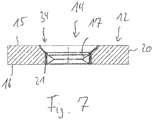
- Fig. 7 an embodiment of the invention is shown in which the mechanical processing engages deeper into the material of the supporting structure 20 and the inlay 19, so that with the mechanical processing into the region of the weld 21 penetrates.
- the closed transition between the inlay 19 and the supporting structure 20 is formed by the weld 21.
Landscapes
- Health & Medical Sciences (AREA)
- Orthopedic Medicine & Surgery (AREA)
- Surgery (AREA)
- Life Sciences & Earth Sciences (AREA)
- Heart & Thoracic Surgery (AREA)
- Nuclear Medicine, Radiotherapy & Molecular Imaging (AREA)
- Engineering & Computer Science (AREA)
- Biomedical Technology (AREA)
- Neurology (AREA)
- Medical Informatics (AREA)
- Molecular Biology (AREA)
- Animal Behavior & Ethology (AREA)
- General Health & Medical Sciences (AREA)
- Public Health (AREA)
- Veterinary Medicine (AREA)
- Surgical Instruments (AREA)
Abstract
Description
- Die Erfindung betrifft eine Knochenplatte sowie ein Verfahren zum Herstellen einer Knochenplatte.
- Knochenplatten können im Rahmen einer chirurgischen Operation mit einem Knochen verbunden werden. Sie werden beispielsweise verwendet, um einen Knochen nach einem Bruch zu stabilisieren. Dazu wird die Knochenplatte so positioniert, dass sie sich über die Bruchstelle hinweg erstreckt, und dann an den Knochenfragmenten befestigt. Die Bruchstelle wird dadurch ruhig gestellt und der Knochen kann ausheilen. Die Knochenplatte kann auch anderen Zwecken dienen und beispielsweise ein mit einem Knochen zu verbindendes Element einer Endoprothese sein.
- Zur Befestigung einer solchen Knochenplatte am Knochen kann eine Knochenschraube verwendet werden, deren Schaft und deren Kopf mit einem Gewinde versehen sind. Der Schaft wird durch ein Durchgangsloch der Knochenplatte hindurchgeführt und in das Knochenmaterial eingedreht, bis der Kopf der Schraube in das Durchgangsloch der Knochenplatte eintritt. Das Gewinde am Kopf der Knochenschraube kommt mit dem das Durchgangsloch umgebenden Material der Knochenplatte in Eingriff, so dass unter Umformung des Materials der Knochenplatte eine Gewindeverbindung gebildet wird. Der Winkel, unter dem die Gewindeverbindung hergestellt wird, kann innerhalb eines vorgegebenen Bereichs frei gewählt werden. Die Verbindung ist also multidirektional winkelstabil, so dass der Chirurg den Eindrehwinkel während der Operation wählen kann, wobei trotzdem eine winkelstabile Verbindung zwischen der Knochenschraube und der Knochenplatte entsteht.
- Für die Verwendung einer solchen Knochenplatte ist es von Vorteil, wenn die Knochenplatte im Bereich des Durchgangslochs aus einem Material besteht, das sich gut umformen lässt. Es ist bekannt, zu diesem Zweck ein Inlay in eine tragende Struktur der Knochenplatte einzusetzen.
- Ein solches Inlay kann beispielsweise durch Schweißen mit der tragenden Struktur der Knochenplatte verbunden werden,
DE 196 29 011 A1 ,EP 2 801 330 A1 ,WO 2010/115458 A1 . Beim Schweißen wird Wärme in das Material eingebracht, woraus sich unerwünschte Auswirkungen auf die Materialstruktur ergeben können. - Der Erfindung liegt die Aufgabe zu Grunde, eine Knochenplatte sowie ein Verfahren zum Herstellen einer Knochenplatte vorzustellen, bei dem die Wahrscheinlichkeit von unerwünschten Veränderungen der inneren Struktur der Knochenplatte vermindert ist. Ausgehend vom genannten Stand der Technik wird die Aufgabe gelöst mit den Merkmalen der unabhängigen Ansprüche. Vorteilhafte Ausführungsformen sind in den Unteransprüchen angegeben.
- Bei dem erfindungsgemäßen Verfahren wird ein Inlay in eine Ausnehmung einer tragenden Struktur eingesetzt, so dass eine Mantelfläche des Inlays an einer Innenmantelfläche der Ausnehmung anliegt. Das Inlay und die tragende Struktur werden durch eine Schweißnaht miteinander verbunden, wobei die Eindringtiefe der Schweißnaht in einer Ausführungsform der Erfindung kleiner ist als die Materialstärke im Bereich der Schweißnaht.
- Indem die Schweißnaht sich nur über einen Teil der Materialstärke erstreckt, kann der Wärmeeintrag vermindert werden, der beim Erzeugen der Schweißnaht auf die Knochenplatte wirkt. Durch den verminderten Wärmeeintrag in das Material der Knochenplatte kann eine Veränderung der Materialstruktur vermieden werden. Insbesondere kann in dem Bereich des Inlays, in dem der Schraubenkopf eingreift, eine auf gute Verformbarkeit ausgelegte Materialstruktur des Inlays erhalten bleiben. Das Material des Inlays kann mit dem Eindrehen der Knochenschraube unter geringem Kraftaufwand verformt werden.
- Die tragende Struktur kann eine Ausnehmung mit einer zu der Mantelfläche des Inlays passenden Innenmantelfläche haben. Wenn das Inlay in die tragende Struktur eingesetzt wird, können die Mantelfläche des Inlays und die Innenmantelfläche der tragenden Struktur entlang einer Kontaktfläche flächig aufeinander liegen. Die Materialstärke im Bereich der Schweißnaht entspricht der Höhe der Kontaktfläche, also derjenigen Fläche, über die die Mantelfläche des Inlays und die Innenmantelfläche der tragenden Struktur flächig aufeinander liegen. Als Höhe wird die Richtung bezeichnet, die sich senkrecht zu der Umfangsrichtung der Mantelfläche bzw. der Innenmantelfläche erstreckt.
- Wenn die Schweißnaht sich nur über einen Teil der Materialstärke erstreckt, gibt es auf der der Schweißnaht gegenüberliegenden Seite einen Übergangsbereich zwischen dem Inlay und der tragenden Struktur, an dem die beiden Teile nur aneinander liegen, aber nicht miteinander verschweißt sind. Bei dem erfindungsgemäßen Verfahren kann eine mechanische Bearbeitung des Übergangsbereichs erfolgen. Durch die mechanische Bearbeitung kann ein eventueller Spalt zwischen dem Inlay und der tragenden Struktur verschlossen werden, beispielsweise indem der Übergangsbereich übergefräst wird. Es kann eine geschlossene Oberfläche erzeugt werden, so dass ein Eindringen von Verunreinigungen verhindert wird.
- Die mechanische Bearbeitung kann so erfolgen, dass in dem Übergangsbereich Material von dem Inlay und/oder von der tragenden Struktur abgetragen wird, so dass die Materialstärke im Bereich der Kontaktfläche vermindert wird. Insbesondere ist es möglich, in dem Übergangsbereich so viel Material abzutragen, dass der Höhenabschnitt des Inlays und/oder der tragenden Struktur vollständig entfernt wird, in dem das Inlay und die tragende Struktur aneinander liegen, jedoch nicht miteinander verschweißt sind. Wenn mit der mechanischen Bearbeitung bis zu der Schweißnaht vorgedrungen wird, so kann eine Knochenplatte erzeugt werden, bei der das Inlay und die tragende Struktur über den gesamten noch verbleibenden Höhenabschnitt durchgehend miteinander verschweißt sind.
- Bei dem Verfahren kann ein Inlay verwendet werden, das bereits vor dem Einsetzen in die tragende Struktur mit einem Durchgangsloch versehen ist. Bei der Verwendung eines solchen Inlays kann die Möglichkeit bestehen, auf eine weitere Bearbeitung des Durchgangslochs nach dem Verschweißen des Inlays mit der tragenden Struktur zu verzichten. Insbesondere kann auf eine nachfolgende Bearbeitung verzichtet werden, wenn in dem Durchgangsloch bereits eine von der Lochwand nach innen vorspringende Materiallippe ausgebildet ist. Möglich ist auch, eine solche Materiallippe in einem vorgefertigten Durchgangsloch nachträglich zu erzeugen.
- Alternativ kann ein Inlay in die tragende Struktur eingesetzt werden, das zu diesem Zeitpunkt noch kein Durchgangsloch aufweist. Wenn das Inlay zu dem Zeitpunkt, zu dem die Schweißnaht erzeugt wird, einen Vollkörper ohne Durchgangsloch bildet, kann die durch das Schweißen erzeugte Wärme sich besser verteilen, so dass das Risiko von Strukturveränderungen in dem Material weiter sinkt.
- Nachdem das Inlay durch Schweißen mit der Tragestruktur verbunden wurde, kann ein Durchgangsloch in dem Inlay erzeugt werden. Das Durchgangsloch kann so erzeugt werden, dass von der Lochwand eine Materiallippe nach innen vorspringt.
- Die Knochenplatte kann eine dem Knochen zugewandte Unterseite und eine von dem Knochen abgebrannte Oberseite aufweisen, wenn die Knochenplatte bestimmungsgemäß mit einem Knochen verbunden ist. Ein in der Knochenplatte ausgebildetes Durchgangsloch kann sich zwischen der Unterseite und der Oberseite erstrecken.
- Das erfindungsgemäße Verfahren kann so durchgeführt werden, dass die Schweißnaht von der Unterseite der Knochenplatte ausgeführt ist. Der Übergangsbereich, in dem das Inlay und die tragende Struktur aneinander liegen, ohne miteinander verschweißt zu sein, kann in Richtung der Oberseite der Knochenplatte ausgerichtet sein. Die Schweißnaht kann beispielsweise durch Laserschweißen erzeugt sein.
- Die Mantelfläche des Inlays kann zylinderförmig oder konusförmig sein. Möglich ist auch, dass der zylinderförmige Bereich und/oder der konusförmig Bereich sich nicht über die gesamte Materialstärke, sondern nur über einen Höhenabschnitt der Materialstärke erstreckt. Insbesondere kann das Inlay einen ersten Höhenabschnitt aufweisen, in dem die Mantelfläche zylinderförmig ist und einen zweiten Höhenabschnitt aufweisen, in dem die Mantelfläche konusförmig ist. Der konusförmige Höhenabschnitt kann sich zu dem zylinderförmigen Höhenabschnitt hin verjüngen. Von der Erfindung umfasst sind auch Mantelflächen, die nicht rotationssymmetrisch sind.
- Wenn das Inlay konusförmig ausgebildet ist oder einen konusförmigen Höhenabschnitt aufweist, so können der breitere Abschnitt des Konus zur Unterseite der Knochenplatte und der schmalere Abschnitt des Konus zur Oberseite der Knochenplatte weisen. Die Differenz zwischen dem größten Durchmesser des Konus und dem kleinsten Durchmesser des Konus kann zwischen 0,01 mm und 0,1 mm, vorzugsweise zwischen 0,02 mm und 0,05 mm liegen.
- Um das Inlay und die tragende Struktur vor dem Schweißen relativ zueinander zu positionieren, kann ein die richtige Position definierender Anschlag verwendet werden. Der Anschlag kann ein Anschlag innerhalb der Knochenplatte sein, wie er sich beispielsweise daraus ergeben kann, dass eine konusförmige Außenfläche eines Inlays an einer konusförmigen Fläche der tragenden Struktur anliegt. Möglich ist auch ein Anschlag außerhalb der Knochenplatte. Beispielsweise kann die Kombination aus der tragenden Struktur und dem Inlay kann dann auf einen Anschlag aufgelegt werden, so dass die Unterseite zum Herstellen der Schweißnaht gut zugänglich ist. Dafür kann es von Vorteil sein, wenn die Oberseite des in die tragende Struktur eingesetzten Inlays bündig mit der Oberseite der tragenden Struktur abschließt.
- Das in die tragende Struktur eingesetzte Inlay kann die gleiche Dicke haben wie die tragende Struktur. In einer Ausführungsform erstreckt die Kontaktfläche zwischen dem Inlay und der tragenden Struktur sich über die gesamte Dicke des Inlays.
- Das Inlay kann der Oberseite und der Unterseite bündig mit der tragenden Struktur abschließen. Möglich ist auch, dass die Kontaktfläche sich nur über einen Teil der Dicke des Inlays erstreckt, beispielsweise über mindestens 50 %, vorzugsweise über mindestens 70 % der Dicke des Inlays. Die Dicke bezeichnet den Abstand zwischen der Oberseite und der Unterseite der Knochenplatte in dem betreffenden Bereich.
- Von der Erfindung umfasst sind auch Ausführungsformen, bei denen das Inlay an der Unterseite gegenüber der tragenden Struktur vorspringt, wodurch die zur Wärmeableitung zur Verfügung stehende Oberfläche des Inlays vergrößert werden kann. Wenn die Unterseite im eingesetzten Zustand der Knochenplatte auf dem Knochen aufliegt, übt die tragende Struktur in der Umgebung des Inlays einen verminderten Druck auf das Knochenmaterial aus, so dass die Versorgung des Knochens in geringerem Maße beeinträchtigt wird. An der Oberseite der Knochenplatte kann das Inlay bündig mit der tragenden Struktur abschließen. Von der Erfindung umfasst sind auch Ausführungsformen, bei denen die Dicke des Inlays geringer ist als die Dicke der tragenden Struktur.
- Das Inlay kann eine Materiallippe umfassen, die in Richtung des Zentrums des Durchgangslochs vorspringt. Die Materiallippe kann sich in Umfangsrichtung des Durchgangslochs erstrecken. Die Materiallippe kann sich über einen Teil des Umfangs oder über den gesamten Umfang erstrecken. Die Materiallippe kann den Bereich des Inlays bilden, der mit dem Eindrehen der Knochenschraube umgeformt wird.
- Bezogen auf die Dicke des Inlays kann die Materiallippe innerhalb einer Hälfte des Inlays angeordnet sein. Die anderen 50 % der Dicke des Inlays sind dann frei von der Materiallippe.
- Insbesondere ist es möglich, dass bezogen auf die Dicke des Inlays die Materiallippe in einem zu der Oberfläche benachbarten Drittel angeordnet ist. Ein an die andere Oberfläche angrenzender Abschnitt von zwei Drittel ist demnach frei von der Materiallippe.
- Die Materiallippe kann in einem Höhenabschnitt des Inlays angeordnet sein, der kleiner ist als 50%, vorzugsweise kleiner ist als 30% der Dicke des Inlays. Die Materiallippe kann in einem zu der Unterseite der Knochenplatte benachbarten Höhenabschnitt des Inlays angeordnet sein. Oberhalb der Materiallippe verbleibt dann Raum, innerhalb dessen der Kopf der Knochenschraube aufgenommen werden kann.
- Wenn durch die Erfindung negative Einflüsse auf die Materialstruktur vermieden werden, können der zum Umformen des Inlays und der zum Erzeugen der Gewindeverbindung erforderliche Kraftaufwand gering gehalten werden. Eine Verminderung dieses Kraftaufwands ist insbesondere bei größeren Knochenplatten von Interesse, bei denen hohe Kräfte wirken. Die Knochenschrauben und die Knochenplatte sind dann größer dimensioniert und es wird mehr Material des Inlays umgeformt, um eine hinreichend stabile Gewindeverbindung zwischen dem Kopf der Knochenschraube und der Knochenplatte zu erreichen. Die Erfindung kann vor diesem Hintergrund insbesondere bei dickeren Knochenplatten zur Anwendung kommen. Beispielsweise kann die Dicke der Knochenplatte größer als 2 mm sein und insbesondere zwischen 3 mm und 5 mm liegen. Als Dicke der Knochenplatte wird der Abstand zwischen der Oberseite und Unterseite bezeichnet, den die tragende Struktur im Bereich des Übergangs zu dem Inlay hat.
- Die erfindungsgemäße Knochenplatten kann für einen großen Röhrenknochen des menschlichen Körpers bestimmt sind, weil diese Knochenplatten großen Hebelkräften ausgesetzt sein können. Knochenplatten für diesen Anwendungsbereich haben eine größere Dicke als andere Knochenplatten. Beispielsweise kann die Knochenplatte für einen Oberschenkelknochen bestimmt sein.
- Die Schweißnaht kann sich von einer Oberfläche der Knochenplatte in die Tiefe des Materials erstrecken. Die Schweißnaht erstreckt sich vorzugsweise über nicht mehr als 80 %, weiter vorzugsweise nicht mehr als 70 %, weiter vorzugsweise nicht mehr als 60 % der Höhe der Kontaktfläche. Beispielweise kann die Schweißnaht um 1 mm bis 3 mm, vorzugsweise um 1,5 mm bis 2,5 mm in das Material der Knochenplatte eindringen.
- Um das Umformen zu erleichtern, kann das Material des Inlays weicher sein als das Material der tragenden Struktur. Für die Herstellung der erfindungsgemäßen Knochenplatte sind Titanmaterialien geeignet. Bei unlegiertem Titan (Reintitan) hängt die Härte bekanntlich vom Sauerstoffgehalt ab. Je höher der Sauerstoffgehalt desto größer ist die Härte. Das Inlay kann aus Reintitan geringer Härte hergestellt sein. Es kann beispielsweise Reintitan Grade 0 oder Grade 1 verwendet werden, bei dem der Sauerstoffgehalt beispielsweise kleiner als 0,2 %, vorzugsweise kleiner als 0,1 % sein kann.
- Die tragende Struktur der Knochenplatte kann aus Reintitan von größerer Härte gefertigt sein. Beispielsweise kann die tragende Struktur aus Reintitan Grade 4 bestehen. Der Sauerstoffgehalt des Reintitans kann beispielsweise zwischen 0,3 % und 0,4 % liegen. Möglich ist auch, die tragende Struktur aus einer Titanlegierung herzustellen. Titanlegierungen haben regelmäßig eine größere Härte als Reintitan. In Betracht kommt beispielsweise TiAl6V4 oder eine Titan-Niob-Legierung.
- Die Knochenplatte kann eine Mehrzahl von Durchgangslöchern aufweisen. Es ist möglich, dass ein Teil der Durchgangslöcher in der tragenden Struktur der Knochenplatte ausgebildet ist. In einer vorteilhaften Ausführungsform sind alle Durchgangslöcher in dem weicheren Inlay-Material angeordnet. Die Knochenplatte kann für jedes Durchgangsloch ein eigenes Inlay aufweisen. Möglich ist auch, dass ein Inlay eine Mehrzahl von Durchgangslöchern aufweist.
- Die Erfindung betrifft ferner eine Knochenplatte mit einem Durchgangsloch, das sich zwischen einer Oberseite und einer Unterseite der Knochenplatte erstreckt. Eine tragende Struktur der Knochenplatte kann aus einem ersten Material gebildet sein. Das Durchgangsloch kann in einem Inlay aus einem zweiten Material ausgebildet sein. Die tragende Struktur und das Inlay können durch eine Schweißnaht miteinander verbunden sein. Ein der Schweißnaht gegenüberliegender Übergangsbereich zwischen der tragenden Struktur und dem Inlay kann mechanisch bearbeitet sein.
- Die Erfindung betrifft außerdem ein System aus einer solchen Knochenplatte und einer Knochenschraube. Der Kopf der Schraube ist mit einem Gewinde versehen (Kopfgewinde), das dazu ausgelegt ist, das das Durchgangsloch umgebende Material des Inlays umzuformen, um eine Gewindeverbindung zu bilden. Für eine Mehrzahl von Durchgangslöchern der Knochenplatte kann das System eine Mehrzahl von Knochenschrauben umfassen. Da die Gewindeverbindung erst beim Eindrehen der Knochenschraube gebildet wird, kann die Knochenschraube unter verschiedenen Winkeln (winkelvariabel) mit der Knochenplatte verbunden werden.
- Die Knochenplatte kann mit weiteren Merkmalen fortgebildet werden, die im Zusammenhang des erfindungsgemäßen Verfahrens beschrieben sind. Das Verfahren kann mit weiteren Merkmalen fortgebildet werden, die im Zusammenhang der erfindungsgemäßen Knochenplatte beschrieben sind. Die Erfindung betrifft außerdem eine Knochenplatte, die mit dem erfindungsgemäßen Verfahren herstellbar ist.
- Die Erfindung wird nachfolgend unter Bezugnahme auf die beigefügten Zeichnungen anhand vorteilhafter Ausführungsformen beispielhaft beschrieben. Es zeigen:
- Fig. 1:
- eine erfindungsgemäße Knochenplatte;
- Fig. 2:
- eine Knochenschraube eines erfindungsgemäßen Knochenplattensystems;
- Fig. 3:
- ein Verwendungsbeispiel eines erfindungsgemäßen Knochenplattensystems;
- Fig. 4 bis 6:
- einen erfindungsgemäßen Verfahrensablauf;
- Fig. 7:
- die Ansicht gemäß
Fig. 6 bei einer anderen Ausführungsform der Erfindung. - Eine erfindungsgemäße Knochenplatte 12 hat gemäß
Fig. 1 sechs Durchgangslöcher 14, die sich von einer Oberseite 15 der Knochenplatte bis zu einer Unterseite 16 der Knochenplatte erstrecken. In jedem Durchgangsloch 14 ist eine Materiallippe 17 ausgebildet, die von der Wand des Durchgangslochs 14 in Richtung des Zentrums des Durchgangslochs 14 vorspringt. Die Materiallippe 17 ist eine durchgehende Materiallippe, die sich ohne Unterbrechung über den gesamten Umfang des Durchgangslochs 14 erstreckt. Die Materiallippe 17 ist im unteren Drittel des Durchgangslochs 14 angeordnet, so dass oberhalb der Materiallippe 17 Raum für die Aufnahme eines Schraubenkopfs bleibt. - Die Knochenplatte ist dazu bestimmt, mit der Unterseite 16 auf einen Knochen 13 aufgelegt zu werden, so dass die Knochenplatte sich über eine Bruchstelle des Knochens hinweg erstreckt. Nachdem der Knochen in die richtige Stellung reponiert ist, wird die Knochenplatte mit den Knochenfragmenten verbunden. Der Knochen ist dann in dieser Stellung fixiert und kann ausheilen.
- Zum Verbinden der Knochenplatte mit dem Knochen werden Knochenschrauben 31 gemäß der beispielhaften Darstellung in
Fig. 2 verwendet. Die Knochenschrauben 31 haben einen Schaft 27, der mit einem Knochengewinde 28 versehen ist, und einen Schraubenkopf 29, dessen Außenfläche ein Kopfgewinde 30 mit kleinerer Steigung aufweist. Die Knochenschraube wird in den Knochen eingedreht, bis der Schraubenkopf 29 in das Durchgangsloch 14 eindringt. Dabei kann der Winkel, den die Knochenschraube mit der Achse des Durchgangslochs einschließt, zwischen etwa 0° und 15° frei gewählt werden. Wenn die Knochenschraube nun weiter eingedreht wird, kommt das Kopfgewinde 30 der Knochenschraube 31 in Eingriff mit der Materiallippe 17. Die Materiallippe 17 wird umgeformt und es wird eine Gewindeverbindung zwischen dem Kopf 29 der Knochenschraube 31 und der Materiallippe 17 gebildet. - Bei der erfindungsgemäßen Knochenplatte 12 sind die sechs Durchgangslöcher 14 jeweils in einem Inlay 19 ausgebildet. Das Inlay besteht aus Reintitan Grade 1 oder Grade 0 und damit aus einem Material vergleichsweise geringer Härte. Die Inlays sind eingesetzt in passende Ausnehmungen 33 einer tragenden Struktur 20 der Knochenplatte. Die tragende Struktur 20 besteht aus Reintitan Grade 4 oder aus der Titanlegierung TiAl6V4.
- Die Knochenschraube 31 besteht aus der Titanlegierung TiAl6V4 und damit aus einem härteren Material als das Inlay 19. Kommt der Kopf 29 der Knochenschraube in Eingriff mit der Materiallippe 17, verformt sich die Materiallippe 17 und es entsteht eine Gewindeverbindung zwischen dem Kopfgewinde 30 und der Materiallippe 17. Die Knochenschraube 31 wird dadurch winkelstabil mit der Knochenplatte verbunden.
- In den
Fig. 4 bis 6 ist das erfindungsgemäße Verfahren zum Herstellen der Knochenplatte 12 am Beispiel eines der Durchgangslöcher 14 dargestellt. Eine tragende Struktur 20 der Knochenplatte besteht aus Reintitan Grade 4 und hat für jedes der Durchgangslöcher 14 eine konzentrisch zu dem späteren Durchgangsloch 14 angeordnete Ausnehmung 33. In die Ausnehmung 33 wird ein als Vollkörper ausgebildetes Inlay 19 aus Reintitan Grade 1 eingesetzt, so dass die Mantelfläche 22 des Inlays 19 flächig auf der Innenmantelfläche 23 der Ausnehmung 33 aufliegt. Der Bereich, in dem die Mantelfläche des Inlays 19 und die Innenmantelfläche der Ausnehmung 33 aufeinander liegen, wird als Kontaktfläche bezeichnet. Sowohl das Inlay 19 als auch die Ausnehmung 33 haben eine leichte Konusform mit einem Konuswinkel von etwa 1°, die sich von der Unterseite 16 zur Oberseite 15 hin verjüngt. An der Oberseite 15 und an der Unterseite 16 der Knochenplatte 12 schließen die Oberflächen des Inlays 19 und der tragenden Struktur 20 bündig miteinander ab. - Von der Unterseite 16 der Knochenplatte 12 wird durch Laserschweißen eine Schweißnaht 21 erzeugt, die bis in eine Tiefe von etwa 2,5 mm in das Material vordringt. Die Knochenplatte hat eine Materialstärke von 3,8 mm, so dass die Schweißnaht 21 sich über etwas mehr als die Hälfte der Materialstärke erstreckt. Die Schweißnaht 21 erstreckt sich also nicht über die gesamte Höhe der Kontaktfläche, sondern nur über einen Höhenabschnitt der Kontaktfläche.
- Der Zustand, in dem das noch als Vollkörper ausgebildete Inlay 19 auf diese Weise mit der tragenden Struktur 20 verschweißt ist, ist in
Fig. 5 dargestellt. Es schließt sich eine mechanische Bearbeitung durch Fräsen an, mit der durch das Inlay 19 hindurch ein Durchgangsloch 14 erzeugt wird. Im unteren Bereich des Durchgangslochs 14 bleibt die Materiallippe 17 stehen, die dafür bestimmt ist, später durch den Kopf 29 der Knochenschraube 31 umgeformt zu werden. - Mit der mechanischen Bearbeitung wird insbesondere Material in dem Übergangsbereich 34 abgetragen, in dem das Inlay 19 und die tragende Struktur aneinander liegen, ohne miteinander verschweißt zu sein. Beim Abtragen des Materials wird der Übergangsbereich 34 mechanisch behandelt, so dass die Naht zwischen dem Inlay 19 und der tragenden Struktur 20 verschlossen wird und sich in dem Übergangsbereich 34 eine geschlossene Oberfläche ergibt.
- In
Fig. 7 ist eine Ausführungsform der Erfindung dargestellt, bei der mit der mechanischen Bearbeitung tiefer in das Material der tragenden Struktur 20 und des Inlays 19 eingegriffen wird, so dass mit der mechanischen Bearbeitung bis in den Bereich der Schweißnaht 21 vorgedrungen wird. Bei dieser Ausführungsform wird der geschlossene Übergang zwischen dem Inlay 19 und der tragenden Struktur 20 durch die Schweißnaht 21 gebildet.
Claims (11)
- Verfahren zum Herstellen einer Knochenplatte, bei dem ein Inlay (19) in eine Ausnehmung (33) einer tragenden Struktur (20) eingesetzt wird, so dass eine Mantelfläche (22) des Inlays (19) an einer Innenmantelfläche (23) der Ausnehmung (33) anliegt, und bei dem das Inlay (19) und die tragende Struktur (20) mit einer Schweißnaht (21) verbunden werden, so dass die Eindringtiefe der Schweißnaht (21) kleiner ist als die Materialstärke im Bereich der Schweißnaht (21).
- Verfahren nach Anspruch 1, dadurch gekennzeichnet, dass ein der Schweißnaht (21) gegenüberliegender Übergangsbereich (34) zwischen der tragenden Struktur (20) und dem Inlay (19) mechanisch bearbeitet wird.
- Verfahren nach Anspruch 2, dadurch gekennzeichnet, dass in dem Übergangsbereich (34) eine geschlossene Oberfläche erzeugt wird.
- Verfahren nach Anspruch 2 oder 3, dadurch gekennzeichnet, dass in dem Übergangsbereich (34) Material von dem Inlay (19) und/oder von der tragenden Struktur (20) abgetragen wird, so dass die Materialstärke im Bereich der Kontaktfläche zwischen dem Inlay (19) und der tragenden Struktur (20) vermindert wird.
- Verfahren nach einem der Ansprüche 2 bis 4, dadurch gekennzeichnet, dass mit der mechanischen Bearbeitung bis zu der Schweißnaht (21) vorgedrungen wird.
- Verfahren nach einem der Ansprüche 1 bis 5, dadurch gekennzeichnet, dass nach dem Erzeugen der Schweißnaht (21) ein Durchgangsloch (14) und/oder eine von einer Lochwand des Durchgangslochs (14) vorspringende Materiallippe (17) in dem Inlay (19) erzeugt werden.
- Verfahren nach einem der Ansprüche 1 bis 6, dadurch gekennzeichnet, dass die Schweißnaht (21) von einer Unterseite (16) der Knochenplatte ausgeführt ist.
- Verfahren nach einem der Ansprüche 1 bis 7, dadurch gekennzeichnet, dass das Material des Inlays (19) eine geringere Härte hat als das Material der tragenden Struktur (20) .
- Verfahren nach einem der Ansprüche 1 bis 8, dadurch gekennzeichnet, dass die Knochenplatte eine Dicke von mehr als 2 mm, vorzugsweise von mehr als 3 mm hat.
- Knochenplatte mit einem Durchgangsloch (14), das sich zwischen einer Oberseite (15) und einer Unterseite (16) der Knochenplatte erstreckt, wobei eine tragende Struktur (20) der Knochenplatte aus einem ersten Material gebildet ist und wobei das Durchgangsloch (14) in einem Inlay (19) aus einem zweiten Material ausgebildet ist, wobei die tragende Struktur (20) und das Inlay (19) durch eine Schweißnaht (21) miteinander verbunden sind und wobei ein der Schweißnaht (21) gegenüberliegender Übergangsbereich (34) zwischen der tragenden Struktur (20) und dem Inlay (19) mechanisch bearbeitet ist.
- System aus einer Knochenplatte gemäß Anspruch 10 und einer Knochenschraube (31), wobei der Kopf (29) der Schraube (31) mit einem Gewinde (29) versehen ist, das dazu ausgelegt ist, das das Durchgangsloch (14) umgebende Material des Inlays (19) umzuformen, um eine Gewindeverbindung zu bilden.
Priority Applications (1)
| Application Number | Priority Date | Filing Date | Title |
|---|---|---|---|
| EP17209169.6A EP3501437A1 (de) | 2017-12-20 | 2017-12-20 | Knochenplatte und verfahren zum herstellen einer knochenplatte |
Applications Claiming Priority (1)
| Application Number | Priority Date | Filing Date | Title |
|---|---|---|---|
| EP17209169.6A EP3501437A1 (de) | 2017-12-20 | 2017-12-20 | Knochenplatte und verfahren zum herstellen einer knochenplatte |
Publications (1)
| Publication Number | Publication Date |
|---|---|
| EP3501437A1 true EP3501437A1 (de) | 2019-06-26 |
Family
ID=60702440
Family Applications (1)
| Application Number | Title | Priority Date | Filing Date |
|---|---|---|---|
| EP17209169.6A Withdrawn EP3501437A1 (de) | 2017-12-20 | 2017-12-20 | Knochenplatte und verfahren zum herstellen einer knochenplatte |
Country Status (1)
| Country | Link |
|---|---|
| EP (1) | EP3501437A1 (de) |
Citations (5)
| Publication number | Priority date | Publication date | Assignee | Title |
|---|---|---|---|---|
| DE19629011A1 (de) | 1996-07-18 | 1998-01-22 | Wolter Dietmar Prof Dr Med | Hilfsmittel für die Osteosynthese |
| WO2010115458A1 (en) | 2009-04-08 | 2010-10-14 | Stryker Trauma Gmbh | Hybrid bone plate |
| US20110184415A1 (en) * | 2010-01-26 | 2011-07-28 | Westmark Medical, Llc | Bone screw retention mechanism |
| DE102013005414A1 (de) * | 2013-03-28 | 2014-10-02 | Dietmar Wolter | Osteosynthesesystem für die multidirektionale, winkelstabile Versorgung von Frakturen von Röhrenknochen umfassend einen Marknagel und Knochenschrauben |
| EP2801330A1 (de) | 2013-05-08 | 2014-11-12 | Dietmar Wolter | Knochenplatte mit einem Inlay und Verfahren zum Herstellen einer Knochenplatte |
-
2017
- 2017-12-20 EP EP17209169.6A patent/EP3501437A1/de not_active Withdrawn
Patent Citations (5)
| Publication number | Priority date | Publication date | Assignee | Title |
|---|---|---|---|---|
| DE19629011A1 (de) | 1996-07-18 | 1998-01-22 | Wolter Dietmar Prof Dr Med | Hilfsmittel für die Osteosynthese |
| WO2010115458A1 (en) | 2009-04-08 | 2010-10-14 | Stryker Trauma Gmbh | Hybrid bone plate |
| US20110184415A1 (en) * | 2010-01-26 | 2011-07-28 | Westmark Medical, Llc | Bone screw retention mechanism |
| DE102013005414A1 (de) * | 2013-03-28 | 2014-10-02 | Dietmar Wolter | Osteosynthesesystem für die multidirektionale, winkelstabile Versorgung von Frakturen von Röhrenknochen umfassend einen Marknagel und Knochenschrauben |
| EP2801330A1 (de) | 2013-05-08 | 2014-11-12 | Dietmar Wolter | Knochenplatte mit einem Inlay und Verfahren zum Herstellen einer Knochenplatte |
Similar Documents
| Publication | Publication Date | Title |
|---|---|---|
| DE69839011T2 (de) | Vorrichtung zum anbringen von skelettplatten | |
| EP2741701B1 (de) | System aus einer knochenplatte und einer knochenschraube | |
| EP1608278B1 (de) | Aufnahme für ein verblockungselement und verblockungselement | |
| DE69838856T2 (de) | Platte für die vordere Halswirbelsäule mit Fixierungssystem für eine Schraube | |
| EP1476098B1 (de) | Zwischenwirbelimplantat | |
| EP2416720B1 (de) | Vorrichtung zur winkelstabilen fixation und kompression einer bruchstelle bzw. osteotomie an einem knochen | |
| EP1143867B1 (de) | Fixationssystem für knochen | |
| EP3081180B1 (de) | Fixationssystem für knochen | |
| EP2709545A1 (de) | Knochenplatte | |
| DE102004009429A1 (de) | Knochenverankerungselement | |
| EP2584983A1 (de) | Knochenplatte sowie fixationssystem mit knochenplatte | |
| EP3267913A1 (de) | Knochenplatte mit einer knochenschraube | |
| DE102005004841B4 (de) | Osteosyntheseplatte mit einer Vielzahl von Bohrungen zur Aufnahme von Knochenschrauben | |
| DE102015102629B4 (de) | Knochenplatte | |
| EP2755584B1 (de) | Knochenplatte | |
| EP4231946B1 (de) | Schraubenelement optimiert für den 3d-druck | |
| EP2801330B1 (de) | Knochenplatte mit einem Inlay und Verfahren zum Herstellen der Knochenplatte | |
| EP3501437A1 (de) | Knochenplatte und verfahren zum herstellen einer knochenplatte | |
| DE102006031801A1 (de) | Osteosynthesisches Fixationssystem | |
| DE102016000167A1 (de) | Zahnimplantat mit einem Mehrfachgewinde | |
| CH704512A2 (de) | Verfahren zur Herstellung eines Implantats mit mindestens einem wenigstens teilweise gebogenen Wandabschnitt sowie nach diesem Verfahren hergestelltes Implantat. |
Legal Events
| Date | Code | Title | Description |
|---|---|---|---|
| PUAI | Public reference made under article 153(3) epc to a published international application that has entered the european phase |
Free format text: ORIGINAL CODE: 0009012 |
|
| STAA | Information on the status of an ep patent application or granted ep patent |
Free format text: STATUS: THE APPLICATION HAS BEEN PUBLISHED |
|
| AK | Designated contracting states |
Kind code of ref document: A1 Designated state(s): AL AT BE BG CH CY CZ DE DK EE ES FI FR GB GR HR HU IE IS IT LI LT LU LV MC MK MT NL NO PL PT RO RS SE SI SK SM TR |
|
| AX | Request for extension of the european patent |
Extension state: BA ME |
|
| STAA | Information on the status of an ep patent application or granted ep patent |
Free format text: STATUS: REQUEST FOR EXAMINATION WAS MADE |
|
| 17P | Request for examination filed |
Effective date: 20191219 |
|
| RBV | Designated contracting states (corrected) |
Designated state(s): AL AT BE BG CH CY CZ DE DK EE ES FI FR GB GR HR HU IE IS IT LI LT LU LV MC MK MT NL NO PL PT RO RS SE SI SK SM TR |
|
| GRAP | Despatch of communication of intention to grant a patent |
Free format text: ORIGINAL CODE: EPIDOSNIGR1 |
|
| STAA | Information on the status of an ep patent application or granted ep patent |
Free format text: STATUS: GRANT OF PATENT IS INTENDED |
|
| RIC1 | Information provided on ipc code assigned before grant |
Ipc: A61B 17/80 20060101AFI20210120BHEP Ipc: A61B 17/86 20060101ALI20210120BHEP |
|
| INTG | Intention to grant announced |
Effective date: 20210209 |
|
| STAA | Information on the status of an ep patent application or granted ep patent |
Free format text: STATUS: THE APPLICATION IS DEEMED TO BE WITHDRAWN |
|
| 18D | Application deemed to be withdrawn |
Effective date: 20210622 |