EP3502186B1 - Masse de formage en polyamide souple et ignifuge et ses utilisations - Google Patents
Masse de formage en polyamide souple et ignifuge et ses utilisations Download PDFInfo
- Publication number
- EP3502186B1 EP3502186B1 EP17209962.4A EP17209962A EP3502186B1 EP 3502186 B1 EP3502186 B1 EP 3502186B1 EP 17209962 A EP17209962 A EP 17209962A EP 3502186 B1 EP3502186 B1 EP 3502186B1
- Authority
- EP
- European Patent Office
- Prior art keywords
- polyamide
- range
- weight
- layer
- acid
- Prior art date
- Legal status (The legal status is an assumption and is not a legal conclusion. Google has not performed a legal analysis and makes no representation as to the accuracy of the status listed.)
- Active
Links
Images
Classifications
-
- C—CHEMISTRY; METALLURGY
- C08—ORGANIC MACROMOLECULAR COMPOUNDS; THEIR PREPARATION OR CHEMICAL WORKING-UP; COMPOSITIONS BASED THEREON
- C08L—COMPOSITIONS OF MACROMOLECULAR COMPOUNDS
- C08L77/00—Compositions of polyamides obtained by reactions forming a carboxylic amide link in the main chain; Compositions of derivatives of such polymers
- C08L77/06—Polyamides derived from polyamines and polycarboxylic acids
Definitions
- the present invention relates to a plasticized, flame-retardant thermoplastic polyamide molding composition with particularly good processing properties, good flame retardancy and good flexibility and washout resistance, e.g. against fuels, and uses of such polyamide molding compounds.
- the material is e.g. Suitable as material for cables for fuels in the automotive sector or generally flexible molded parts including cables or similar for the railway sector.
- the molding composition may also contain additives and polyolefin.
- a polyamide elastomer based on polyamide 12 can be contained in the matrix.
- the molding compound is proposed for flexible components, in particular for fire-protected applications in the railway sector. Materials other than polyamide base are not mentioned.
- Housing for mobile phones are known from an aliphatic polyamide with a content of at least 30 percent by weight of glass fibers and optionally impact modifier.
- polyamide 1010, polyamide 614, polyamide 612 and polyamide 6I / 6T are used, each with a glass fiber content of at least 50 percent by weight. Flame protection is not an issue.
- a flame-retardant polyamide molding compound is known, whereby in addition to reinforcing the polyamide boehmite and a polyhydric alcohol is used for improved processing of the material.
- polyamide 66 / 6T and polyamide 6I / 6T are used, each with 25 percent by weight of glass fibers and 14 percent by weight of flame retardant.
- US2014065338 discloses a single layer tube comprising a melt blended thermoplastic composition consisting essentially of (A) a polyamide resin selected from the group consisting of PA 614, PA 616, PA 618 and mixtures thereof; and optionally as a further component (B) one or more polymeric toughness improvers; (C) one or more plasticizers; and (D) one or more functional additives.
- WO-A-2011000457 relates to a flame-retardant polymer composition made of a polyamide or a polybutylene terephthalate, which contains a selected phosphorus compound as a flame retardant, and molded parts produced therefrom.
- US-A-2017037198 describes a polyamide molding composition, in particular for railway applications, consisting of: (A) 50-90% by weight of a polyamide matrix consisting of polyamide 12 and possibly up to 85% by weight of polyamide elastomer based on polyamide 12; (B) 7-28% by weight of flame retardant, consisting of at least one metal phosphinate and optionally up to 40% of a nitrogenous synergist and / or at least one flame retardant containing nitrogen and phosphorus; (C) 3-15% by weight plasticizer; (D) 0-15% by weight polyolefin; (E) 0-10% by weight of additives and / or particulate fillers, with the exclusion of fibrous reinforcing materials.
- A 50-90% by weight of a polyamide matrix consisting of polyamide 12 and possibly up to 85% by weight of polyamide elastomer based on polyamide 12
- B 7-28% by weight of flame retardant, consisting of at least one metal phosphin
- the molding compound should be low-washout, i.e. H. it shows little migration of modifiers, monomers, oligomers or additives.
- the LOI is measured according to ISO 4589-2 (2006), whereby test specimens with high LOI values have better flame protection than those with lower values.
- the optimal value of LOI is at least 26%, preferably at least 28%, particularly preferably at least 30%.
- the proportion of this component in the polyamide molding composition is preferably in the range from 55-70 percent by weight, preferably in the range from 60-65 percent by weight.
- Component (A1) is a polyamide of the type XY, where X is a preferably linear, unbranched, aliphatic diamine having 4 to 12 carbon atoms, and Y is selected from the group consisting of brassylic acid, tetradecanedioic acid, pentadecanedioic acid, hexadecanedioic acid, heptadecanedioic acid , Octadecanedioic acid.
- the polyamide (A1) is preferably selected as polyamide 514, polyamide 515, polyamide 516, polyamide 517, polyamide 518, polyamide 614, polyamide 615, polyamide 616, polyamide 617, polyamide 618, polyamide 916, polyamide 1016 or mixtures thereof.
- the combination of pentanediamine and hexadecanedioic acid (polyamide 516), the combination of decanediamine and hexadecanedioic acid (polyamide 1016), the combination of hexamethylenediamine and hexadecanedioic acid (polyamide 616) are particularly preferred as component A.
- the polyamide 516 preferably has a melting point (measured in DSC according to ISO 11357-3) of 188 ° C and the polyamide 616 preferably has a melting point of 196 ° C, also measured according to ISO 11357-3.
- the flame retardant (component C) can be mixed in, for example, in the form of a masterbatch.
- a masterbatch can be based on the polyamide (A1), but a different polyamide, for example of the type (A2), can also be used for this purpose.
- a second optional partially crystalline polyamide can therefore be used as component (A1), for example 0-30% polyamide 6, Polyamide 12 or a mixture thereof.
- the flame retardant can be introduced in the form of a masterbatch based on polyamide 516 or polyamide 616.
- the proportion of polyamide (A1) can be in the range of 65-90 percent by weight, preferably in the range of 70-80 percent by weight, and the proportion of partially crystalline polyamide (A2) in the range of 10-35 percent by weight, preferably in the range of 20-30 percent by weight.
- the polyamide (A1) is preferably selected from the group consisting of polyamide 516, polyamide 616, polyamide 614, polyamide 618, polyamide 1016, or a mixture thereof, particularly preferably as polyamide 616 alone.
- Polyamide (A1) preferably has a relative solution viscosity, measured in m-cresol according to ISO 307 (2007) at a temperature of 20 ° C. in the range from 2.0-2.4, preferably from 2.05-2.35.
- the at least one polyamide (A1) has a melting point in the range of 175-240 ° C, preferably 177-220 ° C.
- the partially crystalline polyamide of component (A2) which can be used, for example, as a carrier material for the masterbatch, is preferably selected from the group consisting of: polyamide 6, polyamide 66, polyamide 11, polyamide 12, preferably polyamide 12 or mixtures thereof.
- the portion of partially crystalline polyamide (A2) (or parts thereof) and / or parts of polyamide (A1) can, as said, be used as a matrix for a masterbatch for at least one of components (C), (D) and / or (E), or simply as an addition in the matrix (A).
- the proportion of polyamide elastomer as component (B) is preferably in the range of 8-15 percent by weight, preferably in the range of 9-14 percent by weight.
- the polyamide 12 forms the hard segments in component (B), and there is also a soft segment so that it is an elastomer, which forms an amorphous phase.
- the polyamide elastomer is accordingly preferably made up of hard segments based on polyamide 12 and soft segments, for example based on polyether diol, polyester diol, dimer diol or polyether diamine or polyester diamine.
- the polyether blocks of diol and / or diamine are preferably constructed on the basis of, preferably exclusively, at least one polyoxyalkylene building block.
- the polyether diol is preferably based on, preferably exclusively, at least one C2-C5 (preferably C2-C4) polyoxyalkylene building block, particularly preferably selected from the following group: ethylene oxide, propylene oxide, tetrahydrofuran or a mixture thereof, for example EO / PO.
- the polyamide elastomer has at least one amorphous phase, which preferably derives from the soft segment unit, the ether component, ester component or dimer diol component.
- the glass transition temperature or the glass transition point of this amorphous phase is at most 20 ° C.
- This amorphous phase of the polyether amides preferably has a glass transition point of less than 0 ° C., preferably less than -20 ° C.
- the glass transition point of the soft segment is preferably in the range from -70 ° C. to 0 ° C., particularly preferably in the range from -60 ° C. to -20 ° C., in each case determined by means of DSC measurement in accordance with ISO 11357-2.
- C36 dimer diol preferably based on C36 dimer fatty acid and / or C36 dimer diol, polyether diol based on ethylene oxide and / or propylene oxide and / or tetrahydrofuran; Polyether diamine based on ethylene oxide and / or propylene oxide and / or tetrahydrofuran.
- the C36 dimer acids and the C36 dimer diols are produced by thermal dimerization of unsaturated C18 carboxylic acids or their esters.
- Starting materials are e.g. Tall oil fatty acids as well as oleic or linolenic acid.
- the soft segments typically have a number-average molar mass in the range from 200 to 3000 g / mol.
- the polyamide elastomers according to the invention preferably have a tensile modulus of elasticity of at most 1200 MPa, preferably of at most 1000 MPa and particularly preferably of at most 700 MPa.
- the polyamide elastomers thus preferably have stiffnesses in the tensile modulus of elasticity in the range from 50 to 1000 MPa and particularly preferably in the range from 80 to 700 MPa.
- the polyamide elastomer (B) is therefore preferably composed of hard segments based on polyamide 12 and amorphous soft segments based on at least one of the following structural elements: polyether diol, polyester diol, dimer diol, polyester diamine, polyether diamine.
- the polyether blocks are typically constructed based on or exclusively from at least one C2-C5 (preferably C2-C4, particularly preferably C2 or C4) polyoxyalkylene building block.
- the building blocks are preferably selected from the following group: ethylene oxide, propylene oxide, tetrahydrofuran or a mixture thereof.
- the flame retardant of component (C) is preferably present in a proportion in the range from 12 to 28 percent by weight, preferably in the range from 18 to 25 percent by weight.
- the flame retardant of component (C) is preferably selected as a completely halogen-free flame retardant.
- the flame retardant of component (C) can be selected from the group of the melamine-based flame retardants and / or the phosphorus-based flame retardants.
- Melamine-based flame retardants are preferably selected from the group of the melamine cyanurates and / or the melamine polyphosphates, and furthermore phosphorus-based flame retardants are selected from the group of the phosphinic acid salts and / or diphosphinic acid salts and / or the alkyl phosphates and / or aryl phosphates, preferably selected from the group Group consisting of cresyl diphenyl phosphate, 2-ethylhexyl diphenyl phosphate, tricresyl phosphate, tris (2-ethylhexyl) phosphate, triphenyl phosphate or mixtures thereof.
- the flame retardants can at least partially also act as plasticizers.
- substances have both a significant effect as flame retardants and as plasticizers, they are used in the context of the present invention as flame retardants, i.e. Component (C) attributed.
- flame retardants i.e. Component (C) attributed.
- Such systems are, for example, the above-mentioned alkyl phosphates and / or aryl phosphates, which, in addition to their function as flame retardants, also have a certain effect as plasticizers.
- component (C) It is also possible to add another flame retardant to component (C).
- This can include, for example, an aryl phosphate.
- the plasticizer of component (D) is preferably present in a proportion in the range of 1 -5 percent by weight, preferably in the range of 1.5-3 percent by weight.
- a substance that acts as a plasticizer but also guarantees flame protection is not considered to be part of component (D).
- Component (D) does not include substances that act as plasticizers but also make a significant contribution to flame protection. Alkyl phosphates and / or aryl phosphates are therefore specifically excluded from the plasticizers of component (D).
- the at least one plasticizer (D) is usually selected as hydroxybenzoic acid ester (such as 2-hexyldecyl-4-hydroxybenzoate, HDPB) and / or sulfonamide-based plasticizer, preferably the class of the N-substituted sulfonamide plasticizer, particularly preferably as BBSA.
- hydroxybenzoic acid ester such as 2-hexyldecyl-4-hydroxybenzoate, HDPB
- sulfonamide-based plasticizer preferably the class of the N-substituted sulfonamide plasticizer, particularly preferably as BBSA.
- Suitable hydroxybenzoic acid ester-based plasticizers are systems as follows: 2-hexyldecyl-4-hydroxybenzoate, hexyloxyethoxyethyl p-hydroxybenzoate; Hexyloxypropoxypropyl p-hydroxybenzoate; Hexyloxybutoxybutyl p-hydroxybenzoate; Octyloxyethoxyethyl p-hydroxybenzoate; Octyloxypropoxypropyl p-hydroxybenzoate; Octyloxybutoxybutyl p-hydroxybenzoate; 2'-ethylhexyloxyethoxyethyl p-hydroxybenzoate; 2'-ethylhexyloxypropoxypropyl p-hydroxybenzoate; 2'-ethylhexyloxybutoxybutyl p-hydroxybenzoate; Decyloxyethoxyethyl p-hydroxybenzoate; Decyloxypropoxypropyl p-
- the proportion of additives (E) is preferably in the range of 0.01-3 percent by weight, preferably in the range of 0.5-1.5 percent by weight.
- the additives (E) are preferably selected from at least one additive from the following group: antioxidant; non-conductive pigments; UV absorber; UV stabilizers; Heat and heat stabilizers; Hydrolysis stabilizers; Dyes; Adhesion promoter; Tolerance mediator; Lubricant; Mold release agents; organic or inorganic pigments; IR absorbers, antistatic agents, antiblocking agents, nucleating agents, crystallization accelerators, crystallization retarders, chain-extending additives, optical brighteners, photochromic additives, and mixtures thereof.
- Component (E) is preferably free from ethylene-olefin-based elastomers.
- the present invention further relates to a molded article, in particular a plastic pipe with at least one layer made of a polyamide molding compound as set out above, preferably characterized in that the plastic pipe is designed as a single-layer molded article or multilayer composite in the form of a hollow body enclosing an interior, and the layer is made from a polyamide molding compound such as set out above that forms the multilayer composite that closes inwards and / or outwards.
- the present invention further relates to such a shaped body, in particular in the form of a plastic line, which is characterized in that the layer is formed on the basis of polyamide 616 as component (A1).
- the layer can have a copper stabilization, preferably based on CuI (eg CuI / KI), in a proportion in the range of 0.01-0.10 percent by weight, or in a proportion of 0.03-0.07 percent by weight, the percentages by weight being based on 100 percent by weight Polyamide molding compound.
- the molding compounds are generally suitable for flexible components for fire-protected applications, for example in the railway sector. You can use it as a coating, Cover, film, profile, tube, corrugated tube, hollow body, seal, cladding, bracket, housing, casing, electrical and electronic component such as connectors and fans and parts thereof.
- Such a plastic line or such a component can be characterized in that the layer made of a polyamide molding compound, as set out above, if it is designed as a single layer, has a thickness in the range of 0.5-2.5 mm, preferably in the range of 0.75-1.5 mm.
- this layer if it is designed as an inner and / or outer layer, has a thickness in the range of 0.3-0.6 mm, preferably in the range of 0.4-0.5 mm. If there is additionally a middle layer arranged between an inner and an outer layer, especially in the case of a line, preferably made of EVOH, this typically has a thickness in the range of 0.05-0.2 mm, preferably in the range of 0.075-0.125 m.
- the total wall thickness of a multilayer composite is typically in the range from 0.5-2.5 mm, more preferably in the range from 0.75-1.5 mm.
- Such a molded body or such a plastic line can be produced in an extrusion process, or in the case of a multi-layer plastic line, in a coextrusion process, a tandem process or a sheathing process.
- the shaped body in the form of a line can be formed at least in sections as a corrugated tube, preferably as a line for the railway sector or for internal combustion engines, in particular in the automotive sector, in particular for fuel, urea or coolant.
- the present invention relates to a method for producing such a plastic line, characterized in that the at least one, or in the case of a multi-layer plastic line, the 2 or 3 layers, in a continuous and / or discontinuous process, preferably in an extrusion blow molding , a tandem extrusion, a sheathing process or a (co) extrusion process, into a hollow body, particularly preferably into a tube or a line or a container.
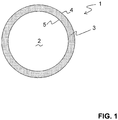
- Figure 1 shows an exemplary line 1 using a flexible and flame-retardant polyamide molding compound according to the invention in a section transverse to the main direction.
- the cross-sectional area can be constant over the main direction, i.e. the tube can have a substantially hollow cylindrical shape.
- the cross-sectional area can also vary over the main direction, for example in the form of a corrugated tube.
- the outer surface 4 of the line layer 3 limits the line 1 to the outside.
- the line can also be designed as a multilayer line, for example with a barrier layer between two further layers, the barrier layer can for example be formed on the basis of a fluorinated polymer or EVOH.
- the inner layer, the outer layer or both layers can be formed from the material proposed here. It is preferred to produce layers other than the molding compositions containing flame retardants from the molding composition according to the invention.
- the molded parts are produced on an Arburg Allrounder 320-210-750 injection molding machine with an increasing cylinder temperature profile of 240 - 260 ° C and injection pressures of 1200 - 1800 bar.
- the mold temperature is 40 ° C.
- the geometry of the moldings corresponds to the specifications of the corresponding test standards.
- the pipe examples according to the invention show, in addition to very good oxygen index values, improvements in the mechanical properties compared to the comparative example VB1.
- the type of flame retardant is varied in Examples B1 and B2 according to the invention, good LOIs are retained.
- the invention shows a versatile way of providing a halogen-free, flame-retardant molding compound.
- the molding compounds have the necessary flexibility and at the same time meet the safety requirements with regard to low flammability.
Landscapes
- Chemical & Material Sciences (AREA)
- Health & Medical Sciences (AREA)
- Chemical Kinetics & Catalysis (AREA)
- Medicinal Chemistry (AREA)
- Polymers & Plastics (AREA)
- Organic Chemistry (AREA)
- Compositions Of Macromolecular Compounds (AREA)
Claims (15)
- Matériau de moulage polyamide constitué par les composants suivants :(A) 50 à 86 pour cent en poids d'une matrice de polyamide, constituée par :(A1) 60 à 100 pour cent en poids d'au moins un polyamide aliphatique du type :
X.Y,
dans lequel
X est une diamine aliphatique acyclique contenant 4 à 12 atomes de carbone, et
Y est choisi dans le groupe constitué par l'acide brassylique, l'acide tétradécanedioïque, l'acide pentadécanedioïque, l'acide hexadécanedioïque, l'acide heptadécanedioïque, l'acide octadécanedioïque ;(A2) 0 à 40 pour cent en poids d'un polyamide partiellement cristallin différent de (A1) ;la somme de (A1) et (A2) étant de 100 pour cent en poids du composant (A) ;(B) 5 à 25 pour cent en poids d'au moins un élastomère de polyamide à base de polyamide 12 ;(C) 8 à 30 pour cent en poids d'au moins un agent ignifuge ;(D) 1 à 10 pour cent en poids d'au moins un plastifiant ;(E) 0 à 10 pour cent en poids d'additifs différents de (B) à (D) ;la somme des composants (A) à (E) étant de 100 pour cent en poids du matériau de moulage polyamide. - Matériau de moulage polyamide selon la revendication 1, caractérisé en ce que la proportion de composant (A) dans le matériau de moulage polyamide se situe dans la plage allant de 55 à 70 pour cent en poids, de préférence dans la plage allant de 60 à 65 pour cent en poids, et/ou en ce que, dans le composant (A), la proportion de polyamide (A1) se situe dans la plage allant de 65 à 90 pour cent en poids, de préférence dans la plage allant de 70 à 80 pour cent en poids, et la proportion de polyamide partiellement cristallin (A2) se situe dans la plage allant de 10 à 35 pour cent en poids, de préférence dans la plage allant de 20 à 30 pour cent en poids.
- Matériau de moulage polyamide selon l'une quelconque des revendications précédentes, caractérisé en ce que le polyamide (A1) est choisi en tant que X.Y, X étant une diamine aliphatique non ramifiée linéaire contenant 4 à 12 atomes de carbone, et Y étant choisi dans le groupe constitué par l'acide brassylique, l'acide tétradécanedioïque, l'acide pentadécanedioïque, l'acide hexadécanedioïque, l'acide heptadécanedioïque, l'acide octadécanedioïque,
et/ou en ce que le polyamide (A1) présente une viscosité en solution relative, mesurée dans du m-crésol selon ISO 307 (2007) à une température de 20 °C, dans la plage allant de 2,0 à 2,4, de préférence de 2,05 à 2,35,
et/ou en ce que ledit au moins un polyamide (A1) présente un point de fusion dans la plage allant de 175 à 240 °C, de préférence de 177 à 220 °C. - Matériau de moulage polyamide selon l'une quelconque des revendications précédentes, caractérisé en ce que le polyamide (A1) est choisi dans le groupe suivant : le polyamide 514, le polyamide 515, le polyamide 516, le polyamide 517, le polyamide 518, le polyamide 614, le polyamide 615, le polyamide 616, le polyamide 617, le polyamide 618, le polyamide 916, le polyamide 1016 ou leurs mélanges, de préférence en tant que polyamide 616.
- Matériau de moulage polyamide selon l'une quelconque des revendications précédentes, caractérisé en ce que le polyamide partiellement cristallin du composant (A2) est choisi dans le groupe constitué par : le polyamide 6, le polyamide 66, le polyamide 11, le polyamide 12, de préférence le polyamide 12 ;
et/ou en ce que la proportion de polyamide partiellement cristallin (A2) et/ou des parties de polyamide (A1) sont utilisées en tant que matrice pour un mélange maître pour au moins un des composants (C), (D) et/ou (E). - Matériau de moulage polyamide selon l'une quelconque des revendications précédentes, caractérisé en ce que la proportion d'élastomère de polyamide (B) se situe dans la plage allant de 8 à 15 pour cent en poids, de préférence dans la plage allant de 9 à 14 pour cent en poids,
et/ou en ce que l'élastomère de polyamide (B) est formé à partir de segments durs à base de polyamide 12 et de segments souples amorphes à base d'au moins un des éléments structuraux suivants : un polyéther-diol, un polyester-diol, un diol dimère, une polyéther-diamine, les séquences polyéther de -diol et/ou -diamine étant de préférence formées à base, de préférence exclusivement, d'au moins un constituant polyoxyalkylène en C2-C5 (de préférence en C2-C4), de manière notamment préférée choisi dans le groupe suivant : l'oxyde d'éthylène, l'oxyde de propylène, le tétrahydrofurane ou un mélange de ceux-ci,
et/ou en ce que l'élastomère de polyamide (B) comprend une phase amorphe ayant une température de transition vitreuse d'au plus 30 °C ou d'au plus 20 °C, de préférence d'au plus 0 °C, ou de moins de -20 °C, la température de transition vitreuse de la phase amorphe se situant de préférence dans la plage allant de (-70 °C) à (0 °C), de manière notamment préférée dans la plage allant de (-60 °C) à (-20 °C),
et/ou en ce que l'élastomère de polyamide (B) présente un module E en traction d'au plus 1 200 MPa ou d'au plus 1 000 MPa ou d'au plus 700 MPa, de préférence dans la plage allant de 50 à 1 000 MPa ou de 80 à 700 MPa. - Matériau de moulage polyamide selon l'une quelconque des revendications précédentes, caractérisé en ce qu'au moins une des conditions suivantes est satisfaite :l'agent ignifuge du composant (C) est présent en une proportion dans la plage allant de 12 à 28 pour cent en poids, de préférence dans la plage allant de 18 à 25 pour cent en poids,l'agent ignifuge du composant (C) est choisi en tant qu'agent ignifuge entièrement exempt d'halogène,l'agent ignifuge du composant (C) est choisi dans le groupe constitué par les agents ignifuges à base de mélamine, les agents ignifuges à base de phosphore, ou les deux, les agents ignifuges à base de mélamine étant de préférence choisis dans le groupe constitué par les cyanurates de mélamine, les polyphosphates de mélamine, et, par ailleurs, les agents ignifuges à base de phosphore étant de préférence choisis dans le groupe constitué par les sels de l'acide phosphinique, les sels de l'acide diphosphinique, les phosphates d'alkyle, les phosphates d'aryle, ou leurs combinaisons, de préférence choisis dans le groupe constitué par le phosphate de crésyldiphényle, le phosphate de 2-éthylhexyldiphényle, le phosphate de tricrésyle, le phosphate de tris(2-éthylhexyle), le phosphate de triphényle ou leurs mélanges.
- Matériau de moulage polyamide selon l'une quelconque des revendications précédentes, caractérisé en ce que le plastifiant du composant (D) est présent en une proportion dans la plage allant de 1, 5 à 5 pour cent en poids, de préférence dans la plage allant de 1,5 à 3 pour cent en poids,
et/ou en ce que ledit au moins un plastifiant (D) est choisi en tant que plastifiant à base d'ester de l'acide p-hydroxybenzoïque et/ou de sulfonamide, de préférence de la classe des plastifiants sulfonamide N-substitués, de manière notamment préférée en tant que BBSA. - Matériau de moulage polyamide selon l'une quelconque des revendications précédentes, caractérisé en ce que la proportion d'additifs (E) se situe dans la plage allant de 0,01 à 3 pour cent en poids, de préférence dans la plage allant de 0,5 à 1,5 pour cent en poids,
et/ou en ce que les additifs (E) sont choisis parmi au moins un ajout du groupe suivant : les antioxydants ; les pigments non conducteurs ; les absorbeurs UV ; les stabilisateurs UV ; les stabilisateurs thermiques ; les stabilisateurs d'hydrolyse ; les colorants ; les promoteurs d'adhésion ; les agents compatibilisants ; les lubrifiants ; les adjuvants de démoulage ; les pigments organiques ou inorganiques ; les absorbeurs IR ; les antistatiques, les agents anti-bloquants, les agents de nucléation, les accélérateurs de cristallisation, les ralentisseurs de cristallisation, les additifs d'allongement de chaînes, les azurants optiques, les additifs photochromiques, et leurs mélanges. - Corps moulé, notamment conduite en matière plastique, comprenant au moins une couche en un matériau de moulage polyamide selon l'une quelconque des revendications précédentes, de préférence caractérisé en ce que la conduite en matière plastique est configurée en tant que corps moulé monocouche ou composite multicouche (1) sous la forme d'un corps creux entourant une chambre intérieure (2), et la couche (3) en un matériau de moulage polyamide selon l'une quelconque des revendications précédentes forme la couche terminant le composite multicouche (1) vers l'intérieur et/ou vers l'extérieur.
- Corps moulé, notamment conduite en matière plastique, selon la revendication 10, caractérisé en ce que la couche (3) est configurée à base de polyamide 616 en tant que composant (A1),
et/ou en ce que la couche (3) comprend une stabilisation de cuivre, de préférence à base de CuI, de préférence en tant que CuI/KI, de préférence en un rapport de 1:4 à 1:8, en une proportion dans la plage allant de 0,01 à 0,10 pour cent en poids, ou en une proportion de 0,03 à 0,07 pour cent en poids, les pourcentages en poids se rapportant à 100 pour cent en poids du matériau de moulage polyamide. - Conduite en matière plastique selon l'une quelconque des revendications 10 à 11 précédentes, caractérisée en ce que la couche en un matériau de moulage polyamide selon l'une quelconque des revendications 1 à 9 présente, lorsqu'elle est configurée en tant que couche individuelle, une épaisseur dans la plage allant de 0,5 à 2,5 mm, de manière davantage préférée dans la plage allant de 0,75 à 1,5 mm, ou, lorsqu'elle est configurée en tant que couche intérieure et/ou extérieure, une épaisseur dans la plage allant de 0,3 à 0,6 mm, de préférence dans la plage allant de 0,4 à 0,5 mm,
et, si elle est présente, une couche intermédiaire agencée entre une couche intérieure et une couche extérieure, de préférence en EVOH ou en un polymère fluoré, présente une épaisseur dans la plage allant de 0,05 à 0,2 mm, de préférence dans la plage allant de 0,075 à 0,125 mm,
l'épaisseur de paroi totale d'un composite multicouche se situant de préférence dans la plage allant de 0,5 à 2,5 mm, de manière davantage préférée dans la plage allant de 0,75 à 1,5 mm. - Corps moulé, notamment conduite en matière plastique, selon l'une quelconque des revendications 10 à 12 précédentes, caractérisé en ce qu'il est fabriqué dans un procédé d'extrusion ou, dans le cas d'une conduite en matière plastique multicouche, dans un procédé de coextrusion,
et/ou en ce que le corps moulé est configuré sous la forme d'une conduite, qui est configurée au moins en sections en tant que tube ondulé, de préférence en tant que conduite pour le domaine ferroviaire ou pour moteurs à combustion, notamment dans le domaine automobile, notamment pour carburant, urée ou agent réfrigérant. - Corps moulé, notamment conduite en matière plastique, selon l'une quelconque des revendications 10 à 13 précédentes, caractérisé en ce qu'il présente un indice d'oxygène (LOI, selon ISO 4589-2 (2006)) d'au moins 26 %, de préférence d'au moins 28 %, de manière particulièrement préférée d'au moins 30 %.
- Procédé de fabrication d'une conduite en matière plastique selon l'une quelconque des revendications 10 à 14 précédentes, caractérisé en ce que ladite au moins une, ou dans le cas d'une conduite en matière plastique multicouche, les 2 ou 3 couches, sont façonnées dans un procédé continu et/ou discontinu, de préférence dans une extrusion-soufflage, une extrusion tandem, un procédé de gainage ou un procédé de (co)extrusion, en un corps creux, de manière notamment préférée en un tube ou une conduite ou un contenant.
Priority Applications (2)
| Application Number | Priority Date | Filing Date | Title |
|---|---|---|---|
| EP17209962.4A EP3502186B1 (fr) | 2017-12-22 | 2017-12-22 | Masse de formage en polyamide souple et ignifuge et ses utilisations |
| PCT/EP2018/086271 WO2019122173A1 (fr) | 2017-12-22 | 2018-12-20 | Matière à mouler à base de polyamide plastifiée et ignifugée et ses utilisations |
Applications Claiming Priority (1)
| Application Number | Priority Date | Filing Date | Title |
|---|---|---|---|
| EP17209962.4A EP3502186B1 (fr) | 2017-12-22 | 2017-12-22 | Masse de formage en polyamide souple et ignifuge et ses utilisations |
Publications (2)
| Publication Number | Publication Date |
|---|---|
| EP3502186A1 EP3502186A1 (fr) | 2019-06-26 |
| EP3502186B1 true EP3502186B1 (fr) | 2020-05-20 |
Family
ID=60888220
Family Applications (1)
| Application Number | Title | Priority Date | Filing Date |
|---|---|---|---|
| EP17209962.4A Active EP3502186B1 (fr) | 2017-12-22 | 2017-12-22 | Masse de formage en polyamide souple et ignifuge et ses utilisations |
Country Status (2)
| Country | Link |
|---|---|
| EP (1) | EP3502186B1 (fr) |
| WO (1) | WO2019122173A1 (fr) |
Families Citing this family (2)
| Publication number | Priority date | Publication date | Assignee | Title |
|---|---|---|---|---|
| CN118931176B (zh) * | 2024-08-26 | 2026-02-03 | 会通特种材料科技有限公司 | 无卤阻燃聚酰胺组合物及其制备方法 |
| CH722231A2 (de) | 2024-10-22 | 2026-04-30 | Ems Chemie Ag | Flammgeschützte Polyamid-Formmassen |
Family Cites Families (6)
| Publication number | Priority date | Publication date | Assignee | Title |
|---|---|---|---|---|
| US8853324B2 (en) | 2006-11-22 | 2014-10-07 | E I Du Pont De Nemours And Company | Mobile telephone housing comprising polyamide resin composition |
| US20100249292A1 (en) | 2009-03-30 | 2010-09-30 | E. I. Du Pont De Nemours And Company | Flame resistant semicaromatic polyamide resin composition and articles therefrom |
| CH701371A2 (de) * | 2009-06-30 | 2010-12-31 | Ems Patent Ag | Flammgeschützte Polymerzusammensetzung. |
| CN102464881A (zh) | 2010-11-10 | 2012-05-23 | 杜邦公司 | 无卤的阻燃聚酰胺组合物 |
| US20140065338A1 (en) * | 2012-08-28 | 2014-03-06 | E I Du Pont De Nemours And Company | Monolayer tubes comprising thermoplastic polyamide |
| EP3127937B1 (fr) | 2015-08-06 | 2018-03-07 | Ems-Patent Ag | Masses de formage en polyamide 12 ignifuge pour applications ferroviaires |
-
2017
- 2017-12-22 EP EP17209962.4A patent/EP3502186B1/fr active Active
-
2018
- 2018-12-20 WO PCT/EP2018/086271 patent/WO2019122173A1/fr not_active Ceased
Non-Patent Citations (1)
| Title |
|---|
| None * |
Also Published As
| Publication number | Publication date |
|---|---|
| EP3502186A1 (fr) | 2019-06-26 |
| WO2019122173A1 (fr) | 2019-06-27 |
Similar Documents
| Publication | Publication Date | Title |
|---|---|---|
| EP2810983B1 (fr) | Masses à mouler en polyamide ignifugées renforcées par des fibres de verre | |
| EP3127937B1 (fr) | Masses de formage en polyamide 12 ignifuge pour applications ferroviaires | |
| EP3283563B1 (fr) | Composition de polyamide ignifuge | |
| EP2553021B1 (fr) | Utilisation de polyamide résistant à la corrosion et aux fissures par contrainte | |
| EP3670184A1 (fr) | Conduite de transport de fluide et son utilisation | |
| EP3546511A1 (fr) | Compositions de polyamide | |
| WO2013091737A1 (fr) | Matière moulable à base de polyamides, son utilisation ainsi que les pièces moulées fabriquées à partir de celle-ci | |
| EP2746340B1 (fr) | Masse de formage en polyamide ignifuge et son utilisation | |
| EP1454912A1 (fr) | Phosphinates de zinc fusibles | |
| WO2019012064A1 (fr) | Compositions rendues stables à la chaleur | |
| EP3502186B1 (fr) | Masse de formage en polyamide souple et ignifuge et ses utilisations | |
| EP3945110A1 (fr) | Combinaisons ignifuges-stabilisateurs pour polymères ininflammables à résistance améliorée à l'hydrolyse et leur utilisation | |
| EP0291833B1 (fr) | Masses à mouler stabilisées en polyamides renforcées par des fibres de verre | |
| EP0737712B1 (fr) | Composition à base de polypropylène avec équipement antistatique et fogging bas | |
| EP1731559B1 (fr) | Composition de moulage en polyamide ignifugée | |
| WO2019012061A1 (fr) | Compositions rendues stables à la chaleur | |
| CN105385032A (zh) | 一种各向同性聚丙烯复合物及其制备方法 | |
| EP3514198B1 (fr) | Fibres de verre hr dans des composants oscillants | |
| EP3511366B1 (fr) | Fibres de verre hr dans des composants oscillants | |
| EP4441132B1 (fr) | Produits à base de polyamide | |
| KR102712860B1 (ko) | 열가소성 수지 조성물 및 이를 이용한 성형품 | |
| EP3636714B1 (fr) | Composants thermoplastiques destinés à être utilisés dans des circuits de refroidissement | |
| EP3919562A1 (fr) | Produits à base de polyamide | |
| WO2020120523A1 (fr) | Conduite de carburant multicouche | |
| DE102021114719C5 (de) | Formkörper, Verfahren zur Herstellung eines Formkörpers sowie Verwendung einer pulverförmigen Zusammensetzung |
Legal Events
| Date | Code | Title | Description |
|---|---|---|---|
| PUAI | Public reference made under article 153(3) epc to a published international application that has entered the european phase |
Free format text: ORIGINAL CODE: 0009012 |
|
| STAA | Information on the status of an ep patent application or granted ep patent |
Free format text: STATUS: THE APPLICATION HAS BEEN PUBLISHED |
|
| AK | Designated contracting states |
Kind code of ref document: A1 Designated state(s): AL AT BE BG CH CY CZ DE DK EE ES FI FR GB GR HR HU IE IS IT LI LT LU LV MC MK MT NL NO PL PT RO RS SE SI SK SM TR |
|
| AX | Request for extension of the european patent |
Extension state: BA ME |
|
| STAA | Information on the status of an ep patent application or granted ep patent |
Free format text: STATUS: REQUEST FOR EXAMINATION WAS MADE |
|
| 17P | Request for examination filed |
Effective date: 20191029 |
|
| RBV | Designated contracting states (corrected) |
Designated state(s): AL AT BE BG CH CY CZ DE DK EE ES FI FR GB GR HR HU IE IS IT LI LT LU LV MC MK MT NL NO PL PT RO RS SE SI SK SM TR |
|
| GRAP | Despatch of communication of intention to grant a patent |
Free format text: ORIGINAL CODE: EPIDOSNIGR1 |
|
| STAA | Information on the status of an ep patent application or granted ep patent |
Free format text: STATUS: GRANT OF PATENT IS INTENDED |
|
| INTG | Intention to grant announced |
Effective date: 20200203 |
|
| GRAS | Grant fee paid |
Free format text: ORIGINAL CODE: EPIDOSNIGR3 |
|
| GRAA | (expected) grant |
Free format text: ORIGINAL CODE: 0009210 |
|
| STAA | Information on the status of an ep patent application or granted ep patent |
Free format text: STATUS: THE PATENT HAS BEEN GRANTED |
|
| AK | Designated contracting states |
Kind code of ref document: B1 Designated state(s): AL AT BE BG CH CY CZ DE DK EE ES FI FR GB GR HR HU IE IS IT LI LT LU LV MC MK MT NL NO PL PT RO RS SE SI SK SM TR |
|
| REG | Reference to a national code |
Ref country code: GB Ref legal event code: FG4D Free format text: NOT ENGLISH |
|
| REG | Reference to a national code |
Ref country code: CH Ref legal event code: EP |
|
| REG | Reference to a national code |
Ref country code: DE Ref legal event code: R096 Ref document number: 502017005376 Country of ref document: DE |
|
| REG | Reference to a national code |
Ref country code: AT Ref legal event code: REF Ref document number: 1272591 Country of ref document: AT Kind code of ref document: T Effective date: 20200615 |
|
| REG | Reference to a national code |
Ref country code: CH Ref legal event code: PFUS Owner name: EMS-CHEMIE AG, CH Free format text: FORMER OWNER: EMS-PATENT AG, CH |
|
| REG | Reference to a national code |
Ref country code: LT Ref legal event code: MG4D |
|
| REG | Reference to a national code |
Ref country code: NL Ref legal event code: MP Effective date: 20200520 |
|
| PG25 | Lapsed in a contracting state [announced via postgrant information from national office to epo] |
Ref country code: FI Free format text: LAPSE BECAUSE OF FAILURE TO SUBMIT A TRANSLATION OF THE DESCRIPTION OR TO PAY THE FEE WITHIN THE PRESCRIBED TIME-LIMIT Effective date: 20200520 Ref country code: SE Free format text: LAPSE BECAUSE OF FAILURE TO SUBMIT A TRANSLATION OF THE DESCRIPTION OR TO PAY THE FEE WITHIN THE PRESCRIBED TIME-LIMIT Effective date: 20200520 Ref country code: LT Free format text: LAPSE BECAUSE OF FAILURE TO SUBMIT A TRANSLATION OF THE DESCRIPTION OR TO PAY THE FEE WITHIN THE PRESCRIBED TIME-LIMIT Effective date: 20200520 Ref country code: GR Free format text: LAPSE BECAUSE OF FAILURE TO SUBMIT A TRANSLATION OF THE DESCRIPTION OR TO PAY THE FEE WITHIN THE PRESCRIBED TIME-LIMIT Effective date: 20200821 Ref country code: IS Free format text: LAPSE BECAUSE OF FAILURE TO SUBMIT A TRANSLATION OF THE DESCRIPTION OR TO PAY THE FEE WITHIN THE PRESCRIBED TIME-LIMIT Effective date: 20200920 Ref country code: NO Free format text: LAPSE BECAUSE OF FAILURE TO SUBMIT A TRANSLATION OF THE DESCRIPTION OR TO PAY THE FEE WITHIN THE PRESCRIBED TIME-LIMIT Effective date: 20200820 Ref country code: PT Free format text: LAPSE BECAUSE OF FAILURE TO SUBMIT A TRANSLATION OF THE DESCRIPTION OR TO PAY THE FEE WITHIN THE PRESCRIBED TIME-LIMIT Effective date: 20200921 |
|
| REG | Reference to a national code |
Ref country code: DE Ref legal event code: R082 Ref document number: 502017005376 Country of ref document: DE Representative=s name: PFENNING, MEINIG & PARTNER MBB PATENTANWAELTE, DE Ref country code: DE Ref legal event code: R081 Ref document number: 502017005376 Country of ref document: DE Owner name: EMS-CHEMIE AG, CH Free format text: FORMER OWNER: EMS-PATENT AG, DOMAT / EMS, CH |
|
| PG25 | Lapsed in a contracting state [announced via postgrant information from national office to epo] |
Ref country code: RS Free format text: LAPSE BECAUSE OF FAILURE TO SUBMIT A TRANSLATION OF THE DESCRIPTION OR TO PAY THE FEE WITHIN THE PRESCRIBED TIME-LIMIT Effective date: 20200520 Ref country code: LV Free format text: LAPSE BECAUSE OF FAILURE TO SUBMIT A TRANSLATION OF THE DESCRIPTION OR TO PAY THE FEE WITHIN THE PRESCRIBED TIME-LIMIT Effective date: 20200520 Ref country code: HR Free format text: LAPSE BECAUSE OF FAILURE TO SUBMIT A TRANSLATION OF THE DESCRIPTION OR TO PAY THE FEE WITHIN THE PRESCRIBED TIME-LIMIT Effective date: 20200520 Ref country code: BG Free format text: LAPSE BECAUSE OF FAILURE TO SUBMIT A TRANSLATION OF THE DESCRIPTION OR TO PAY THE FEE WITHIN THE PRESCRIBED TIME-LIMIT Effective date: 20200820 |
|
| PG25 | Lapsed in a contracting state [announced via postgrant information from national office to epo] |
Ref country code: NL Free format text: LAPSE BECAUSE OF FAILURE TO SUBMIT A TRANSLATION OF THE DESCRIPTION OR TO PAY THE FEE WITHIN THE PRESCRIBED TIME-LIMIT Effective date: 20200520 Ref country code: AL Free format text: LAPSE BECAUSE OF FAILURE TO SUBMIT A TRANSLATION OF THE DESCRIPTION OR TO PAY THE FEE WITHIN THE PRESCRIBED TIME-LIMIT Effective date: 20200520 |
|
| PG25 | Lapsed in a contracting state [announced via postgrant information from national office to epo] |
Ref country code: SM Free format text: LAPSE BECAUSE OF FAILURE TO SUBMIT A TRANSLATION OF THE DESCRIPTION OR TO PAY THE FEE WITHIN THE PRESCRIBED TIME-LIMIT Effective date: 20200520 Ref country code: EE Free format text: LAPSE BECAUSE OF FAILURE TO SUBMIT A TRANSLATION OF THE DESCRIPTION OR TO PAY THE FEE WITHIN THE PRESCRIBED TIME-LIMIT Effective date: 20200520 Ref country code: CZ Free format text: LAPSE BECAUSE OF FAILURE TO SUBMIT A TRANSLATION OF THE DESCRIPTION OR TO PAY THE FEE WITHIN THE PRESCRIBED TIME-LIMIT Effective date: 20200520 Ref country code: RO Free format text: LAPSE BECAUSE OF FAILURE TO SUBMIT A TRANSLATION OF THE DESCRIPTION OR TO PAY THE FEE WITHIN THE PRESCRIBED TIME-LIMIT Effective date: 20200520 Ref country code: ES Free format text: LAPSE BECAUSE OF FAILURE TO SUBMIT A TRANSLATION OF THE DESCRIPTION OR TO PAY THE FEE WITHIN THE PRESCRIBED TIME-LIMIT Effective date: 20200520 Ref country code: DK Free format text: LAPSE BECAUSE OF FAILURE TO SUBMIT A TRANSLATION OF THE DESCRIPTION OR TO PAY THE FEE WITHIN THE PRESCRIBED TIME-LIMIT Effective date: 20200520 |
|
| REG | Reference to a national code |
Ref country code: DE Ref legal event code: R097 Ref document number: 502017005376 Country of ref document: DE |
|
| PG25 | Lapsed in a contracting state [announced via postgrant information from national office to epo] |
Ref country code: PL Free format text: LAPSE BECAUSE OF FAILURE TO SUBMIT A TRANSLATION OF THE DESCRIPTION OR TO PAY THE FEE WITHIN THE PRESCRIBED TIME-LIMIT Effective date: 20200520 Ref country code: SK Free format text: LAPSE BECAUSE OF FAILURE TO SUBMIT A TRANSLATION OF THE DESCRIPTION OR TO PAY THE FEE WITHIN THE PRESCRIBED TIME-LIMIT Effective date: 20200520 |
|
| PLBE | No opposition filed within time limit |
Free format text: ORIGINAL CODE: 0009261 |
|
| STAA | Information on the status of an ep patent application or granted ep patent |
Free format text: STATUS: NO OPPOSITION FILED WITHIN TIME LIMIT |
|
| 26N | No opposition filed |
Effective date: 20210223 |
|
| PG25 | Lapsed in a contracting state [announced via postgrant information from national office to epo] |
Ref country code: SI Free format text: LAPSE BECAUSE OF FAILURE TO SUBMIT A TRANSLATION OF THE DESCRIPTION OR TO PAY THE FEE WITHIN THE PRESCRIBED TIME-LIMIT Effective date: 20200520 |
|
| PG25 | Lapsed in a contracting state [announced via postgrant information from national office to epo] |
Ref country code: MC Free format text: LAPSE BECAUSE OF FAILURE TO SUBMIT A TRANSLATION OF THE DESCRIPTION OR TO PAY THE FEE WITHIN THE PRESCRIBED TIME-LIMIT Effective date: 20200520 |
|
| REG | Reference to a national code |
Ref country code: BE Ref legal event code: MM Effective date: 20201231 |
|
| PG25 | Lapsed in a contracting state [announced via postgrant information from national office to epo] |
Ref country code: LU Free format text: LAPSE BECAUSE OF NON-PAYMENT OF DUE FEES Effective date: 20201222 Ref country code: IE Free format text: LAPSE BECAUSE OF NON-PAYMENT OF DUE FEES Effective date: 20201222 |
|
| PG25 | Lapsed in a contracting state [announced via postgrant information from national office to epo] |
Ref country code: TR Free format text: LAPSE BECAUSE OF FAILURE TO SUBMIT A TRANSLATION OF THE DESCRIPTION OR TO PAY THE FEE WITHIN THE PRESCRIBED TIME-LIMIT Effective date: 20200520 Ref country code: MT Free format text: LAPSE BECAUSE OF FAILURE TO SUBMIT A TRANSLATION OF THE DESCRIPTION OR TO PAY THE FEE WITHIN THE PRESCRIBED TIME-LIMIT Effective date: 20200520 Ref country code: CY Free format text: LAPSE BECAUSE OF FAILURE TO SUBMIT A TRANSLATION OF THE DESCRIPTION OR TO PAY THE FEE WITHIN THE PRESCRIBED TIME-LIMIT Effective date: 20200520 |
|
| PG25 | Lapsed in a contracting state [announced via postgrant information from national office to epo] |
Ref country code: MK Free format text: LAPSE BECAUSE OF FAILURE TO SUBMIT A TRANSLATION OF THE DESCRIPTION OR TO PAY THE FEE WITHIN THE PRESCRIBED TIME-LIMIT Effective date: 20200520 |
|
| PG25 | Lapsed in a contracting state [announced via postgrant information from national office to epo] |
Ref country code: BE Free format text: LAPSE BECAUSE OF NON-PAYMENT OF DUE FEES Effective date: 20201231 |
|
| GBPC | Gb: european patent ceased through non-payment of renewal fee |
Effective date: 20211222 |
|
| PG25 | Lapsed in a contracting state [announced via postgrant information from national office to epo] |
Ref country code: GB Free format text: LAPSE BECAUSE OF NON-PAYMENT OF DUE FEES Effective date: 20211222 |
|
| REG | Reference to a national code |
Ref country code: AT Ref legal event code: MM01 Ref document number: 1272591 Country of ref document: AT Kind code of ref document: T Effective date: 20221222 |
|
| PG25 | Lapsed in a contracting state [announced via postgrant information from national office to epo] |
Ref country code: AT Free format text: LAPSE BECAUSE OF NON-PAYMENT OF DUE FEES Effective date: 20221222 |
|
| PG25 | Lapsed in a contracting state [announced via postgrant information from national office to epo] |
Ref country code: AT Free format text: LAPSE BECAUSE OF NON-PAYMENT OF DUE FEES Effective date: 20221222 |
|
| REG | Reference to a national code |
Ref country code: CH Ref legal event code: U11 Free format text: ST27 STATUS EVENT CODE: U-0-0-U10-U11 (AS PROVIDED BY THE NATIONAL OFFICE) Effective date: 20260101 |
|
| PGFP | Annual fee paid to national office [announced via postgrant information from national office to epo] |
Ref country code: DE Payment date: 20251211 Year of fee payment: 9 |
|
| PGFP | Annual fee paid to national office [announced via postgrant information from national office to epo] |
Ref country code: IT Payment date: 20251223 Year of fee payment: 9 |
|
| PGFP | Annual fee paid to national office [announced via postgrant information from national office to epo] |
Ref country code: FR Payment date: 20251229 Year of fee payment: 9 |
|
| PGFP | Annual fee paid to national office [announced via postgrant information from national office to epo] |
Ref country code: AT Payment date: 20260410 Year of fee payment: 5 |
|
| PGFP | Annual fee paid to national office [announced via postgrant information from national office to epo] |
Ref country code: CH Payment date: 20260101 Year of fee payment: 9 |