EP3512857B1 - Inhibiteurs spiro-bicyclique de menin-mll-interaction - Google Patents
Inhibiteurs spiro-bicyclique de menin-mll-interaction Download PDFInfo
- Publication number
- EP3512857B1 EP3512857B1 EP17768428.9A EP17768428A EP3512857B1 EP 3512857 B1 EP3512857 B1 EP 3512857B1 EP 17768428 A EP17768428 A EP 17768428A EP 3512857 B1 EP3512857 B1 EP 3512857B1
- Authority
- EP
- European Patent Office
- Prior art keywords
- group
- optionally substituted
- alkyl
- hydrogen
- compound
- Prior art date
- Legal status (The legal status is an assumption and is not a legal conclusion. Google has not performed a legal analysis and makes no representation as to the accuracy of the status listed.)
- Active
Links
- 0 CC(C(C1)N(*)CC1(F)F)=O Chemical compound CC(C(C1)N(*)CC1(F)F)=O 0.000 description 10
- LOUHAXORUSVSMR-SSDOTTSWSA-N C[C@H]1c2c[n](C)nc2CCC1 Chemical compound C[C@H]1c2c[n](C)nc2CCC1 LOUHAXORUSVSMR-SSDOTTSWSA-N 0.000 description 3
- KPUBVYARPYJPPM-UHFFFAOYSA-N CC1(C)SC(C)=NC1 Chemical compound CC1(C)SC(C)=NC1 KPUBVYARPYJPPM-UHFFFAOYSA-N 0.000 description 2
- WNOFMUVUJYCVDA-UHFFFAOYSA-N CN(C1)CC1(CC1)CN1I Chemical compound CN(C1)CC1(CC1)CN1I WNOFMUVUJYCVDA-UHFFFAOYSA-N 0.000 description 2
- YGKWNOLGYBFBEY-UHFFFAOYSA-N CN1CC(C2)(CN2I)CC1 Chemical compound CN1CC(C2)(CN2I)CC1 YGKWNOLGYBFBEY-UHFFFAOYSA-N 0.000 description 2
- KJWGWSZUQCTZHW-UHFFFAOYSA-N IN(CC1)CC11CNCC1 Chemical compound IN(CC1)CC11CNCC1 KJWGWSZUQCTZHW-UHFFFAOYSA-N 0.000 description 2
- KSUQSWRQOSUKKK-UHFFFAOYSA-N IN(CC1)CCN1I Chemical compound IN(CC1)CCN1I KSUQSWRQOSUKKK-UHFFFAOYSA-N 0.000 description 2
- MKZDXRGGFTVCPB-UHFFFAOYSA-N CC(C(CC1)CCS1(=O)=O)N(C1)CC1(CC1)CN1c1ncnc2c1cc(CC(F)(F)F)[s]2 Chemical compound CC(C(CC1)CCS1(=O)=O)N(C1)CC1(CC1)CN1c1ncnc2c1cc(CC(F)(F)F)[s]2 MKZDXRGGFTVCPB-UHFFFAOYSA-N 0.000 description 1
- DCITVRQMGHFMKI-UHFFFAOYSA-N CC(C)(C)OC(N(C1)CC1(CC1)CN1c1ncnc2c1cc(CC(F)(F)F)[s]2)=O Chemical compound CC(C)(C)OC(N(C1)CC1(CC1)CN1c1ncnc2c1cc(CC(F)(F)F)[s]2)=O DCITVRQMGHFMKI-UHFFFAOYSA-N 0.000 description 1
- RABXUOZTBAQAAK-UHFFFAOYSA-N CC(C)(C)OC(N1CC(C2)(CN2c2c(cc(CC(F)(F)F)[s]3)c3ncn2)CC1)=O Chemical compound CC(C)(C)OC(N1CC(C2)(CN2c2c(cc(CC(F)(F)F)[s]3)c3ncn2)CC1)=O RABXUOZTBAQAAK-UHFFFAOYSA-N 0.000 description 1
- AVJOLSCGDHTLIY-UHFFFAOYSA-N CC(C)(C)OC(NCCCOc1cccc(CN(C2)CC2(CC2)CN2c2c(cc(CC(F)(F)F)[s]3)c3ncn2)c1)=O Chemical compound CC(C)(C)OC(NCCCOc1cccc(CN(C2)CC2(CC2)CN2c2c(cc(CC(F)(F)F)[s]3)c3ncn2)c1)=O AVJOLSCGDHTLIY-UHFFFAOYSA-N 0.000 description 1
- UPRDYHRCZCVTMV-UHFFFAOYSA-N CC(C)C(C(C1)(CN1C(OC)=O)F)=O Chemical compound CC(C)C(C(C1)(CN1C(OC)=O)F)=O UPRDYHRCZCVTMV-UHFFFAOYSA-N 0.000 description 1
- IRHAFRAKHXIHDC-LJQANCHMSA-N CC(C)CCN(CC1)C[C@@]1(CC1)CN1c1c(cc(CC(F)(F)F)[s]2)c2ncn1 Chemical compound CC(C)CCN(CC1)C[C@@]1(CC1)CN1c1c(cc(CC(F)(F)F)[s]2)c2ncn1 IRHAFRAKHXIHDC-LJQANCHMSA-N 0.000 description 1
- XUZKMZWAOYLXMD-UHFFFAOYSA-N CC(C)CN(C1)CC1(CC1)CCN1c1c(cc(CC(F)(F)F)[s]2)c2ncn1 Chemical compound CC(C)CN(C1)CC1(CC1)CCN1c1c(cc(CC(F)(F)F)[s]2)c2ncn1 XUZKMZWAOYLXMD-UHFFFAOYSA-N 0.000 description 1
- UUVMFGLVZZHXKA-GOSISDBHSA-N CC(C)C[C@H](C1CNC1)N(C1)CC1(CC1)CN1c1c(cc(CC(F)(F)F)[s]2)c2ncn1 Chemical compound CC(C)C[C@H](C1CNC1)N(C1)CC1(CC1)CN1c1c(cc(CC(F)(F)F)[s]2)c2ncn1 UUVMFGLVZZHXKA-GOSISDBHSA-N 0.000 description 1
- NSGMCJKNCIRQHN-YDNXMHBPSA-N CC(C)[C@@H](c1c[n](C)nc1)N(CC1)CC1(CC1)CN1c1ncnc2c1cc(CC(F)(F)F)[s]2 Chemical compound CC(C)[C@@H](c1c[n](C)nc1)N(CC1)CC1(CC1)CN1c1ncnc2c1cc(CC(F)(F)F)[s]2 NSGMCJKNCIRQHN-YDNXMHBPSA-N 0.000 description 1
- ACIOJBJUACXESV-UHFFFAOYSA-N CC(C1(C)COC1)N(C1)CC1(CC1)CN1c1c(cc(CC(F)(F)F)[s]2)c2ncn1 Chemical compound CC(C1(C)COC1)N(C1)CC1(CC1)CN1c1c(cc(CC(F)(F)F)[s]2)c2ncn1 ACIOJBJUACXESV-UHFFFAOYSA-N 0.000 description 1
- HKGWKQPWEDSOFS-UHFFFAOYSA-N CC(c1ccncc1)N(C1)CC1(CC1)CN1c1c(cc(CC(F)(F)F)[s]2)c2ncn1 Chemical compound CC(c1ccncc1)N(C1)CC1(CC1)CN1c1c(cc(CC(F)(F)F)[s]2)c2ncn1 HKGWKQPWEDSOFS-UHFFFAOYSA-N 0.000 description 1
- FVZXGMNGZDWQLM-UHFFFAOYSA-N CC(c1cnccc1)N(C1)CC1(CC1)CN1c1c(cc(CC(F)(F)F)[s]2)c2ncn1 Chemical compound CC(c1cnccc1)N(C1)CC1(CC1)CN1c1c(cc(CC(F)(F)F)[s]2)c2ncn1 FVZXGMNGZDWQLM-UHFFFAOYSA-N 0.000 description 1
- LJPCNSSTRWGCMZ-UHFFFAOYSA-N CC1COCC1 Chemical compound CC1COCC1 LJPCNSSTRWGCMZ-UHFFFAOYSA-N 0.000 description 1
- RXYPXQSKLGGKOL-UHFFFAOYSA-N CN1CCN(C)CC1 Chemical compound CN1CCN(C)CC1 RXYPXQSKLGGKOL-UHFFFAOYSA-N 0.000 description 1
- LCTBFSLINCMDKH-UHFFFAOYSA-N C[Ge](C)(C)CN(C1)CC1(CC1)CN1c1c(cc(CC(F)(F)F)[s]2)c2ncn1 Chemical compound C[Ge](C)(C)CN(C1)CC1(CC1)CN1c1c(cc(CC(F)(F)F)[s]2)c2ncn1 LCTBFSLINCMDKH-UHFFFAOYSA-N 0.000 description 1
- QFPZYAHHNKMSAE-UHFFFAOYSA-N C[n]1nc(CCCC2N(C3)CC3(CC3)CN3c3c(cc(CC(F)(F)F)[s]4)c4ncn3)c2c1 Chemical compound C[n]1nc(CCCC2N(C3)CC3(CC3)CN3c3c(cc(CC(F)(F)F)[s]4)c4ncn3)c2c1 QFPZYAHHNKMSAE-UHFFFAOYSA-N 0.000 description 1
- HLEPBDDNFVMDIT-UHFFFAOYSA-N C[n]1ncc(CN(C2)CC2(CC2)CN2c2ncnc3c2cc(CC(F)(F)F)[s]3)c1 Chemical compound C[n]1ncc(CN(C2)CC2(CC2)CN2c2ncnc3c2cc(CC(F)(F)F)[s]3)c1 HLEPBDDNFVMDIT-UHFFFAOYSA-N 0.000 description 1
- HNALJVGNFVTBFC-IBGZPJMESA-N C[n]1ncc(CN(CC2)C[C@]2(CC2)CN2c2c(cc(CC(F)(F)F)[s]3)c3ncn2)c1 Chemical compound C[n]1ncc(CN(CC2)C[C@]2(CC2)CN2c2c(cc(CC(F)(F)F)[s]3)c3ncn2)c1 HNALJVGNFVTBFC-IBGZPJMESA-N 0.000 description 1
- JWVPCJSYOQWMMT-VWLOTQADSA-N Cc1c(CN(CC2)C[C@]2(CC2)CN2c2c(cc(CC(F)(F)F)[s]3)c3ncn2)ccc2c1cc(C#N)[nH]2 Chemical compound Cc1c(CN(CC2)C[C@]2(CC2)CN2c2c(cc(CC(F)(F)F)[s]3)c3ncn2)ccc2c1cc(C#N)[nH]2 JWVPCJSYOQWMMT-VWLOTQADSA-N 0.000 description 1
- WQMIBAQGHMJFPC-UHFFFAOYSA-N FC(Cc1cc(c(N2CCNCC2)ncn2)c2[s]1)(F)F Chemical compound FC(Cc1cc(c(N2CCNCC2)ncn2)c2[s]1)(F)F WQMIBAQGHMJFPC-UHFFFAOYSA-N 0.000 description 1
- OQDZLSQOIVQCHV-UHFFFAOYSA-N FC(Cc1cc2c(N3CC4(CN(Cc5c[n](cccc6)c6n5)C4)CC3)ncnc2[s]1)(F)F Chemical compound FC(Cc1cc2c(N3CC4(CN(Cc5c[n](cccc6)c6n5)C4)CC3)ncnc2[s]1)(F)F OQDZLSQOIVQCHV-UHFFFAOYSA-N 0.000 description 1
- MWETVQXXFSPKHB-UHFFFAOYSA-N FC(Cc1cc2c(N3CC4(CN(Cc5cc(F)ccc5)C4)CC3)ncnc2[s]1)(F)F Chemical compound FC(Cc1cc2c(N3CC4(CN(Cc5cc(F)ccc5)C4)CC3)ncnc2[s]1)(F)F MWETVQXXFSPKHB-UHFFFAOYSA-N 0.000 description 1
- ISOOMPOWSBPPGO-UHFFFAOYSA-N FC(Cc1cc2c(N3CCC4(CN(CC5OCCC5)C4)CC3)ncnc2[s]1)(F)F Chemical compound FC(Cc1cc2c(N3CCC4(CN(CC5OCCC5)C4)CC3)ncnc2[s]1)(F)F ISOOMPOWSBPPGO-UHFFFAOYSA-N 0.000 description 1
- QFYDOJZAEYXCOL-UHFFFAOYSA-N FC(Cc1cc2c(N3CCN(Cc4c[n](C5OCCCC5)nc4)CC3)ncnc2[s]1)(F)F Chemical compound FC(Cc1cc2c(N3CCN(Cc4c[n](C5OCCCC5)nc4)CC3)ncnc2[s]1)(F)F QFYDOJZAEYXCOL-UHFFFAOYSA-N 0.000 description 1
- MQNUFPLIWTXWEG-UHFFFAOYSA-N FC(Cc1cc2c(N3CCN(Cc4n[n](C5OCCCC5)cc4)CC3)ncnc2[s]1)(F)F Chemical compound FC(Cc1cc2c(N3CCN(Cc4n[n](C5OCCCC5)cc4)CC3)ncnc2[s]1)(F)F MQNUFPLIWTXWEG-UHFFFAOYSA-N 0.000 description 1
- DUJLPWXXOJAVKA-QFIPXVFZSA-N FC(Cc1cc2c(N3C[C@@]4(CN(Cc5ccccc5)CC4)CCC3)ncnc2[s]1)(F)F Chemical compound FC(Cc1cc2c(N3C[C@@]4(CN(Cc5ccccc5)CC4)CCC3)ncnc2[s]1)(F)F DUJLPWXXOJAVKA-QFIPXVFZSA-N 0.000 description 1
- DUJLPWXXOJAVKA-JOCHJYFZSA-N FC(Cc1cc2c(N3C[C@]4(CN(Cc5ccccc5)CC4)CCC3)ncnc2[s]1)(F)F Chemical compound FC(Cc1cc2c(N3C[C@]4(CN(Cc5ccccc5)CC4)CCC3)ncnc2[s]1)(F)F DUJLPWXXOJAVKA-JOCHJYFZSA-N 0.000 description 1
- RCOAGZKAQZCQEF-UHFFFAOYSA-N IN1CC2(C[N-]C2)CC1 Chemical compound IN1CC2(C[N-]C2)CC1 RCOAGZKAQZCQEF-UHFFFAOYSA-N 0.000 description 1
- UWUZYPHTTVQMCK-UHFFFAOYSA-N N#CCC[n]1ncc(CN(C2)CC2(CC2)CN2c2ncnc3c2cc(CC(F)(F)F)[s]3)c1 Chemical compound N#CCC[n]1ncc(CN(C2)CC2(CC2)CN2c2ncnc3c2cc(CC(F)(F)F)[s]3)c1 UWUZYPHTTVQMCK-UHFFFAOYSA-N 0.000 description 1
- UHCWXNQQJQFLLH-UHFFFAOYSA-N N#Cc1cc(cc(CN(C2)CC2(CC2)CN2c2c(cc(CC(F)(F)F)[s]3)c3ncn2)cc2)c2[nH]1 Chemical compound N#Cc1cc(cc(CN(C2)CC2(CC2)CN2c2c(cc(CC(F)(F)F)[s]3)c3ncn2)cc2)c2[nH]1 UHCWXNQQJQFLLH-UHFFFAOYSA-N 0.000 description 1
- DIUVDPQQRYWKDX-UHFFFAOYSA-N N#Cc1ccc(CN(CC2)CC2(CC2)CN2c2c(cc(CC(F)(F)F)[s]3)c3ncn2)cc1 Chemical compound N#Cc1ccc(CN(CC2)CC2(CC2)CN2c2c(cc(CC(F)(F)F)[s]3)c3ncn2)cc1 DIUVDPQQRYWKDX-UHFFFAOYSA-N 0.000 description 1
- JLFGKCRKOVLHSE-UHFFFAOYSA-N N#Cc1cccc(CN(CC2)CC2(CC2)CN2c2c(cc(CC(F)(F)F)[s]3)c3ncn2)c1 Chemical compound N#Cc1cccc(CN(CC2)CC2(CC2)CN2c2c(cc(CC(F)(F)F)[s]3)c3ncn2)c1 JLFGKCRKOVLHSE-UHFFFAOYSA-N 0.000 description 1
- RJTQCYLPGRUSLL-UHFFFAOYSA-N NCCCOc1cccc(CN(C2)CC2(CC2)CN2c2c(cc(CC(F)(F)F)[s]3)c3ncn2)c1 Chemical compound NCCCOc1cccc(CN(C2)CC2(CC2)CN2c2c(cc(CC(F)(F)F)[s]3)c3ncn2)c1 RJTQCYLPGRUSLL-UHFFFAOYSA-N 0.000 description 1
- XKHWMTHXXHRLLH-UHFFFAOYSA-N NCC[n]1ncc(CN(C2)CC2(CC2)CN2c2c(cc(CC(F)(F)F)[s]3)c3ncn2)c1 Chemical compound NCC[n]1ncc(CN(C2)CC2(CC2)CN2c2c(cc(CC(F)(F)F)[s]3)c3ncn2)c1 XKHWMTHXXHRLLH-UHFFFAOYSA-N 0.000 description 1
Classifications
-
- C—CHEMISTRY; METALLURGY
- C07—ORGANIC CHEMISTRY
- C07D—HETEROCYCLIC COMPOUNDS
- C07D519/00—Heterocyclic compounds containing more than one system of two or more relevant hetero rings condensed among themselves or condensed with a common carbocyclic ring system not provided for in groups C07D453/00 or C07D455/00
-
- A—HUMAN NECESSITIES
- A61—MEDICAL OR VETERINARY SCIENCE; HYGIENE
- A61K—PREPARATIONS FOR MEDICAL, DENTAL OR TOILETRY PURPOSES
- A61K31/00—Medicinal preparations containing organic active ingredients
- A61K31/33—Heterocyclic compounds
- A61K31/395—Heterocyclic compounds having nitrogen as a ring hetero atom, e.g. guanethidine or rifamycins
- A61K31/495—Heterocyclic compounds having nitrogen as a ring hetero atom, e.g. guanethidine or rifamycins having six-membered rings with two or more nitrogen atoms as the only ring heteroatoms, e.g. piperazine or tetrazines
- A61K31/505—Pyrimidines; Hydrogenated pyrimidines, e.g. trimethoprim
- A61K31/519—Pyrimidines; Hydrogenated pyrimidines, e.g. trimethoprim ortho- or peri-condensed with heterocyclic rings
-
- A—HUMAN NECESSITIES
- A61—MEDICAL OR VETERINARY SCIENCE; HYGIENE
- A61K—PREPARATIONS FOR MEDICAL, DENTAL OR TOILETRY PURPOSES
- A61K45/00—Medicinal preparations containing active ingredients not provided for in groups A61K31/00 - A61K41/00
- A61K45/06—Mixtures of active ingredients without chemical characterisation, e.g. antiphlogistics and cardiaca
-
- A—HUMAN NECESSITIES
- A61—MEDICAL OR VETERINARY SCIENCE; HYGIENE
- A61P—SPECIFIC THERAPEUTIC ACTIVITY OF CHEMICAL COMPOUNDS OR MEDICINAL PREPARATIONS
- A61P35/00—Antineoplastic agents
-
- A—HUMAN NECESSITIES
- A61—MEDICAL OR VETERINARY SCIENCE; HYGIENE
- A61P—SPECIFIC THERAPEUTIC ACTIVITY OF CHEMICAL COMPOUNDS OR MEDICINAL PREPARATIONS
- A61P35/00—Antineoplastic agents
- A61P35/02—Antineoplastic agents specific for leukemia
Definitions
- the present invention relates to pharmaceutical agents useful for therapy and/or prophylaxis in a mammal, and in particular to spiro bicyclic compounds, pharmaceutical composition comprising such compounds, and their use as menin/MLL protein/protein interaction inhibitors, useful for treating diseases such as cancer, myelodysplastic syndrome (MDS) and diabetes.
- MDS myelodysplastic syndrome
- MLL is a histone methyltransferase that methylates histone H3 on lysine 4 (H3K4) and functions in multiprotein complexes.
- HSCs hematopoietic stem cells
- B cells histone methyltransferase activity is dispensable for hematopoiesis ( Mishra et al., Cell Rep 2011. 7(4), 1239-47 ).
- Menin which is encoded by the Multiple Endocrine Neoplasia type 1 (MEN1 ) gene is expressed ubiquitously and is predominantly localized in the nucleus. It has been shown to interact with numerous proteins and is, therefore, involved in a variety of cellular processes. The best understood function of menin is its role as an oncogenic cofactor of MLL fusion proteins. Menin interacts with two motifs within the N-terminal fragment of MLL that is retained in all fusion proteins, MBM1 (menin-binding motif 1) and MBM2 ( Thiel et al., Bioessays 2012. 34, 771-80 ). Menin/MLL interaction leads to the formation of a new interaction surface for lens epithelium-derived growth factor (LEDGF).
- LEDGF lens epithelium-derived growth factor
- MLL directly binds to LEDGF
- menin is obligatory for the stable interaction between MLL and LEDGF and the gene specific chromatin recruitment of the MLL complex via the PWWP domain of LEDGF
- menin is strictly required for oncogenic transformation by MLL fusion proteins suggesting the menin/MLL interaction as an attractive therapeutic target.
- conditional deletion of Men1 prevents leukomogenesis in bone marrow progenitor cells ectopically expressing MLL fusions ( Chen et al., Proc Natl Acad Sci 2006. 103, 1018-23 ).
- menin/MLL fusion interaction by loss-of-function mutations abrogates the oncogenic properties of the MLL fusion proteins, blocks the development of leukemia in vivo and releases the differentiation block of MLL-transformed leukemic blasts.
- menin is required for the maintenance of HOX gene expression by MLL fusion proteins ( Yokoyama et al., Cell 2005. 123, 207-18 ).
- small molecule inhibitors of menin/MLL interaction have been developed suggesting druggability of this protein/protein interaction and have also demonstrated efficacy in preclinical models of AML ( Borkin et al., Cancer Cell 2015. 27, 589-602 ; Cierpicki and Grembecka, Future Med Chem 2014.
- the present invention concerns novel compounds of Formula (I): and the tautomers and the stereoisomeric forms thereof, wherein
- the present invention also relates to a pharmaceutical composition
- a pharmaceutical composition comprising a therapeutically effective amount of a compound of Formula (I), a pharmaceutically acceptable salt, or a solvate thereof, and a pharmaceutically acceptable carrier or excipient.
- the invention relates to a compound of Formula (I), a pharmaceutically acceptable salt, or a solvate thereof, for use as a medicament, and to a compound of Formula (I), a pharmaceutically acceptable salt, or a solvate thereof, for use in the treatment or in the prevention of cancer, myelodysplastic syndrome (MDS) and diabetes.
- MDS myelodysplastic syndrome
- the invention relates to a compound of Formula (I), a pharmaceutically acceptable salt, or a solvate thereof, for use in the treatment or in the prevention of cancer.
- said cancer is selected from leukemias, myeloma or a solid tumor cancer (e.g. prostate cancer, lung cancer, breast cancer, pancreatic cancer, colon cancer, liver cancer, melanoma and glioblastoma, etc.).
- leukemias myeloma or a solid tumor cancer (e.g. prostate cancer, lung cancer, breast cancer, pancreatic cancer, colon cancer, liver cancer, melanoma and glioblastoma, etc.).
- the leukemias include acute leukemias, chronic leukemias, myeloid leukemias, myelogeneous leukemias, lymphoblastic leukemias, lymphocytic leukemias, Acute myelogeneous leukemias (AML), Chronic myelogenous leukemias (CML), Acute lymphoblastic leukemias (ALL), Chronic lymphocytic leukemias (CLL), T cell prolymphocytic leukemias (T-PLL), Large granular lymphocytic leukemia, Hairy cell leukemia (HCL), MLL-rearranged leukemias, MLL-PTD leukemias, MLL amplified leukemias, MLL-positive leukemias, leukemias exhibiting HOX / MEIS1 gene expression signatures etc.
- AML acute myelogeneous leukemias
- CML Chronic myelogenous leukemias
- ALL Acute lymphoblastic leukemia
- the invention also relates to the use of a compound of Formula (I), a pharmaceutically acceptable salt, or a solvate thereof, in combination with an additional pharmaceutical agent for use in the treatment or prevention of cancer, myelodysplastic syndrome (MDS) and diabetes.
- MDS myelodysplastic syndrome
- the invention relates to a process for preparing a pharmaceutical composition according to the invention, characterized in that a pharmaceutically acceptable carrier is intimately mixed with a therapeutically effective amount of a compound of Formula (I), a pharmaceutically acceptable salt, or a solvate thereof.
- the invention also relates to a product comprising a compound of Formula (I), a pharmaceutically acceptable salt, or a solvate thereof, and an additional pharmaceutical agent, as a combined preparation for simultaneous, separate or sequential use in the treatment or prevention of cancer, myelodysplastic syndrome (MDS) and diabetes.
- a product comprising a compound of Formula (I), a pharmaceutically acceptable salt, or a solvate thereof, and an additional pharmaceutical agent, as a combined preparation for simultaneous, separate or sequential use in the treatment or prevention of cancer, myelodysplastic syndrome (MDS) and diabetes.
- MDS myelodysplastic syndrome
- the invention relates to a method of treating or preventing a cell proliferative disease in a warm-blooded animal which comprises administering to the said animal an effective amount of a compound of Formula (I), a pharmaceutically acceptable salt, or a solvate thereof, as defined herein, or a pharmaceutical composition or combination as defined herein.
- 'halo' or 'halogen' as used herein represents fluoro, chloro, bromo and iodo.
- 'C x-y ' refers to the number of carbon atoms in a given group.
- a C 1-6 alkyl group contains from 1 to 6 carbon atoms
- a C 3-6 cycloalkyl group contains from 3 to 6 carbon atoms, and so on.
- the term 'C 1-4 alkyl' as used herein as a group or part of a group represents a straight or branched chain saturated hydrocarbon radical having from 1 to 4 carbon atoms, such as methyl, ethyl, n -propyl, isopropyl, n -butyl, s -butyl, t -butyl and the like.
- 'C 2-4 alkyl' as used herein as a group or part of a group represents a straight or branched chain saturated hydrocarbon radical having from 2 to 4 carbon atoms, such as ethyl, n -propyl, isopropyl, n -butyl, s -butyl, t -butyl and the like.
- 'C 1-6 alkyl' as used herein as a group or part of a group represents a straight or branched chain saturated hydrocarbon radical having from 1 to 6 carbon atoms such as the groups defined for C 1-4 alkyl and n-pentyl, n-hexyl, 2-methylbutyl and the like.
- 'C 3-6 alkyl' as used herein as a group or part of a group represents a straight or branched chain saturated hydrocarbon radical having from 3 to 6 carbon atoms such as n-propyl, isopropyl, n-butyl, s -butyl, t -butyl, n-pentyl, n-hexyl, 2-methylbutyl and the like.
- 'C 3 - 5 cycloalkyl' as used herein as a group or part of a group defines a saturated, cyclic hydrocarbon radical having from 3 to 5 carbon atoms, such as cyclopropyl, cyclobutyl and cyclopentyl.
- 'spirobicyclic' as used herein as group or part of a group represents cyclic systems wherein two cycles are joined at a single atom. Examples of these systems are 7- to 10-membered saturated spiroheterobicyclic systems containing one or two N-atoms, wherein one of the nitrogen atoms is always linked to the thienopyrimidinyl heterocycle in the compounds of Formula (I) as defined herein.
- Such spirocyclic systems include, but are not limited to systems resulting from the combination of e.g. piperidine, pyrrolidine, azetidine, and cyclobutane rings.
- Examples of such systems include, but are not limited to (a), (b), (c), (d), (e), (f) and (g) below and the like wherein a represents the position of linkage to the thienopyrimidinyl heterocycle.
- a represents the position of linkage to the thienopyrimidinyl heterocycle.
- the options for --L 2 -R 3 defined herein when L 2 is linked to a nitrogen atom of L 1 apply to examples (a)-(f); while the options for --L 2 -R 3 defined herein when L 2 is linked to a carbon atom of L 1 , apply to example (g).
- Examples of 7- to 10-membered saturated spirocarbobicyclic systems include, but are not limited to and the like.
- 'substituted' is used in the present invention, it is meant, unless otherwise indicated or clear from the context, to indicate that one or more hydrogens, in particular from 1 to 4 hydrogens, more in particular from 1 to 3 hydrogens, preferably 1 or 2 hydrogens, more preferably 1 hydrogen, on the atom or radical indicated in the expression using 'substituted' are replaced with a selection from the indicated group, provided that the normal valency is not exceeded, and that the substitution results in a chemically stable compound, i.e. a compound that is sufficiently robust to survive isolation to a useful degree of purity from a reaction mixture.
- substituents When two or more substituents are present on a moiety they may, where possible and unless otherwise indicated or clear from the context, replace hydrogens on the same atom or they may replace hydrogen atoms on different atoms in the moiety.
- a substituent on a heterocyclyl group may replace any hydrogen atom on a ring carbon atom or on a ring heteroatom.
- a 'non-aromatic group' embraces unsaturated ring systems without aromatic character, partially saturated and fully saturated carbocyclic and heterocyclic ring systems.
- the term 'fully saturated' refers to rings where there are no multiple bonds between ring atoms.
- a 'non-aromatic heterocyclyl' is a non-aromatic monocyclic or bicyclic system, unless otherwise specified, having for example, 3 to 12 ring members, more usually 5 to 10 ring members.
- monocyclic groups are groups containing 4 to 7 ring members, more usually, 5 or 6 ring members.
- Examples of bicyclic groups are those containing 8 to 12, more usually 9 or 10 ring members.
- Non-limiting examples of monocyclic heterocyclyl systems containing at least one heteroatom selected from nitrogen, oxygen or sulfur (N, O, S) include, but are not limited to 4- to 7-membered heterocyclyl systems such as azetidinyl, oxetanyl, pyrrolidinyl, tetrahydrofuranyl, piperidinyl, piperazinyl, pyranyl, dihydropyranyl, tetrahydropyranyl, morpholinyl, thiomorpholinyl, and tetrahydro-2H-thiopyranyl 1,1-dioxide, in particular azetidinyl, oxetanyl, pyrrolidinyl, tetrahydrofuranyl, piperidinyl, piperazinyl, pyranyl, dihydropyranyl, tetrahydropyranyl, morpholinyl, and thiomorpholiny.
- Non-limiting examples of bicyclic heterocyclyl systems containing at least one heteroatom selected from nitrogen, oxygen or sulfur (N, O, S) include, but are not limited to octahydro-1H-indolyl, indolinyl, Unless otherwise specified, each can be bound to the remainder of the molecule of Formula (I) through any available ring carbon atom (C-linked) or nitrogen atom (N-linked), and may optionally be substituted, where possible, on carbon and/or nitrogen atoms according to the embodiments.
- Examples of a C-linked 4- to 7-membered non-aromatic heterocyclyl containing at least one nitrogen atom include, but are not limited to, azetidinyl, pyrrolidinyl and piperidinyl, bound to the rest of the molecule through an available carbon atom.
- Lines (such as ⁇ ---') drawn into ring systems indicate that the bond may be attached to any of the suitable ring atoms.
- Het 1 and Het 2 may be attached to the remainder of the molecule of Formula (I) through any available ring carbon or nitrogen atom as appropriate, if not otherwise specified.
- each definition is independent.
- the term 'subject' as used herein, refers to an animal, preferably a mammal (e.g. cat, dog, primate or human), more preferably a human, who is or has been the object of treatment, observation or experiment.
- a mammal e.g. cat, dog, primate or human
- a human who is or has been the object of treatment, observation or experiment.
- 'therapeutically effective amount means that amount of active compound or pharmaceutical agent that elicits the biological or medicinal response in a tissue system, animal or human that is being sought by a researcher, veterinarian, medicinal doctor or other clinician, which includes alleviation or reversal of the symptoms of the disease or disorder being treated.
- composition' is intended to encompass a product comprising the specified ingredients in the specified amounts, as well as any product which results, directly or indirectly, from combinations of the specified ingredients in the specified amounts.
- treatment' is intended to refer to all processes wherein there may be a slowing, interrupting, arresting or stopping of the progression of a disease, but does not necessarily indicate a total elimination of all symptoms.
- the invention includes all stereoisomers of the compounds of the invention either as a pure stereoisomer or as a mixture of two or more stereoisomers.
- Enantiomers are stereoisomers that are non-superimposable mirror images of each other.
- a 1: 1 mixture of a pair of enantiomers is a racemate or racemic mixture.
- Atropisomers are stereoisomers which have a particular spatial configuration, resulting from a restricted rotation about a single bond, due to large steric hindrance. All atropisomeric forms of the compounds of Formula (I) are intended to be included within the scope of the present invention.
- Diastereomers are stereoisomers that are not enantiomers, i.e. they are not related as mirror images. If a compound contains a double bond, the substituents may be in the E or the Z configuration.
- Substituents on bivalent cyclic saturated or partially saturated radicals may have either the cis- or trans-configuration; for example if a compound contains a disubstituted cycloalkyl group, the substituents may be in the cis or trans configuration.
- the invention includes enantiomers, atropisomers, diastereomers, racemates, E isomers, Z isomers, cis isomers, trans isomers and mixtures thereof, whenever chemically possible.
- the absolute configuration is specified according to the Cahn-Ingold-Prelog system.
- the configuration at an asymmetric atom is specified by either R or S.
- Resolved stereoisomers whose absolute configuration is not known can be designated by (+) or (-) depending on the direction in which they rotate plane polarized light.
- resolved enantiomers whose absolute configuration is not known can be designated by (+) or (-) depending on the direction in which they rotate plane polarized light.
- stereoisomer is substantially free, i.e. associated with less than 50%, preferably less than 20%, more preferably less than 10%, even more preferably less than 5%, in particular less than 2% and most preferably less than 1%, of the other stereoisomers.
- a compound of Formula (I) is for instance specified as ( R )
- a compound of Formula (I) is for instance specified as E
- this means that the compound is substantially free of the Z isomer
- a compound of Formula (I) is for instance specified as cis, this means that the compound is substantially free of the trans isomer.
- salts include acid addition salts and base addition salts.
- Such salts may be formed by conventional means, for example by reaction of a free acid or a free base form with one or more equivalents of an appropriate base or acid, optionally in a solvent, or in a medium in which the salt is insoluble, followed by removal of said solvent, or said medium, using standard techniques (e.g. in vacuo, by freeze-drying or by filtration).
- Salts may also be prepared by exchanging a counter-ion of a compound of the invention in the form of a salt with another counter-ion, for example using a suitable ion exchange resin.
- the pharmaceutically acceptable salts as mentioned hereinabove or hereinafter are meant to comprise the therapeutically active non-toxic acid and base salt forms which the compounds of Formula (I) and solvates thereof, are able to form.
- Appropriate acids comprise, for example, inorganic acids such as hydrohalic acids, e.g. hydrochloric or hydrobromic acid, sulfuric, nitric, phosphoric and the like acids; or organic acids such as, for example, acetic, propanoic, hydroxyacetic, lactic, pyruvic, oxalic (i.e. ethanedioic), malonic, succinic (i.e.
- salt forms can be converted by treatment with an appropriate base into the free base form.
- the compounds of Formula (I) and solvates thereof containing an acidic proton may also be converted into their non-toxic metal or amine salt forms by treatment with appropriate organic and inorganic bases.
- Appropriate base salt forms comprise, for example, the ammonium salts, the alkali and earth alkaline metal salts, e.g. the lithium, sodium, potassium, cesium, magnesium, calcium salts and the like, salts with organic bases, e.g.
- primary, secondary and tertiary aliphatic and aromatic amines such as methylamine, ethylamine, propylamine, isopropylamine, the four butylamine isomers, dimethylamine, diethylamine, diethanolamine, dipropylamine, diisopropylamine, di-n-butylamine, pyrrolidine, piperidine, morpholine, trimethylamine, triethylamine, tripropylamine, quinuclidine, pyridine, quinoline and isoquinoline; the benzathine, N-methyl-D-glucamine, hydrabamine salts, and salts with amino acids such as, for example, arginine, lysine and the like.
- the salt form can be converted by treatment with acid into the free acid form.
- solvate comprises the solvent addition forms as well as the salts thereof, which the compounds of Formula (I) are able to form.
- solvent addition forms are e.g. hydrates, alcoholates and the like.
- the compounds of the invention as prepared in the processes described below may be synthesized in the form of mixtures of enantiomers, in particular racemic mixtures of enantiomers, that can be separated from one another following art-known resolution procedures.
- a manner of separating the enantiomeric forms of the compounds of Formula (I), and pharmaceutically acceptable salts, and solvates thereof involves liquid chromatography using a chiral stationary phase.
- Said pure stereochemically isomeric forms may also be derived from the corresponding pure stereochemically isomeric forms of the appropriate starting materials, provided that the reaction occurs stereospecifically.
- the present invention also embraces isotopically-labeled compounds of the present invention which are identical to those recited herein, but for the fact that one or more atoms are replaced by an atom having an atomic mass or mass number different from the atomic mass or mass number usually found in nature (or the most abundant one found in nature).
- isotopes and isotopic mixtures of any particular atom or element as specified herein are contemplated within the scope of the compounds of the invention, either naturally occurring or synthetically produced, either with natural abundance or in an isotopically enriched form.
- Exemplary isotopes that can be incorporated into compounds of the invention include isotopes of hydrogen, carbon, nitrogen, oxygen, phosphorus, sulfur, fluorine, chlorine and iodine, such as 2 H, 3 H, 11 C, 13 C, 14 C , 13 N, 15 O, 17 O, 18 O , 32 P, 33 P, 35 S, 18 F, 36 Cl, 122 I, 123 I, 125 I, 131 I, 75 Br, 76 Br, 77 Br and 82 Br.
- the radioactive isotope is selected from the group of 2 H, 3 H, 11 C and 18 F. More preferably, the radioactive isotope is 2 H.
- deuterated compounds are intended to be included within the scope of the present invention.
- Certain isotopically-labeled compounds of the present invention may be useful for example in substrate tissue distribution assays. Tritiated ( 3 H) and carbon-14 ( 14 C) isotopes are useful for their ease of preparation and detectability. Further, substitution with heavier isotopes such as deuterium (i.e., 2 H may afford certain therapeutic advantages resulting from greater metabolic stability (e.g., increased in vivo half-life or reduced dosage requirements) and hence may be preferred in some circumstances.
- R 2 is selected from hydrogen or deuterium, in particular deuterium.
- L 2 can be >C( 2 H) 2 .
- Positron emitting isotopes such as 15 O, 13 N, 11 C and 18 F are useful for positron emission tomography (PET) studies.
- PET imaging in cancer finds utility in helping locate and identify tumours, stage the disease and determine suitable treatment.
- Human cancer cells overexpress many receptors or proteins that are potential disease-specific molecular targets.
- Radiolabelled tracers that bind with high affinity and specificity to such receptors or proteins on tumour cells have great potential for diagnostic imaging and targeted radionuclide therapy ( Charron, Carlie L. et al. Tetrahedron Lett. 2016, 57(37), 4119-4127 ).
- target-specific PET radiotracers may be used as biomarkers to examine and evaluate pathology, by for example, measuring target expression and treatment response ( Austin R. et al. Cancer Letters (2016), doi: 10.1016/j.canlet.2016.05.008 ).
- the present invention relates in particular to compounds of Formula (I) and the pharmaceutically acceptable salts, and the solvates thereof, or any subgroup thereof as mentioned in any of the embodiments, wherein also the following compound and pharmaceutically acceptable addition salts, and solvates thereof, are excluded:
- the present invention relates in particular to compounds of Formula (I) and the pharmaceutically acceptable salts, and the solvates thereof, or any subgroup thereof as mentioned in any of the embodiments, wherein the intermediates and compounds described in WO2017/112768 , in as far as they are covered by the present invention, are excluded.
- the present invention relates in particular to compounds of Formula (I) as defined herein, and the tautomers and the stereoisomeric forms thereof, wherein
- the present invention relates in particular to compounds of Formula (I) as defined herein, and the tautomers and the stereoisomeric forms thereof, wherein
- the present invention relates in particular to compounds of Formula (I) as defined herein, and the tautomers and the stereoisomeric forms thereof, wherein
- the present invention relates in particular to compounds of Formula (I) as defined herein, and the tautomers and the stereoisomeric forms thereof, wherein
- the present invention relates in particular to compounds of Formula (I) as defined herein, and the tautomers and the stereoisomeric forms thereof, wherein
- the present invention relates in particular to compounds of Formula (I) as defined herein, and the tautomers and the stereoisomeric forms thereof, wherein
- Another embodiment of the present invention relates to those compounds of Formula (I) and the pharmaceutically acceptable salts, and the solvates thereof, or any subgroup thereof as mentioned in any of the other embodiments wherein one or more of the following restrictions apply:
- the present invention relates to those compounds of Formula (I) and the pharmaceutically acceptable salts, and the solvates thereof, or any subgroup thereof as mentioned in any of the other embodiments, wherein R 1 is CF 3 .
- the present invention relates to those compounds of Formula (I) and the pharmaceutically acceptable salts, and the solvates thereof, or any subgroup thereof as mentioned in any of the other embodiments, wherein R 1 is CF 3 , and wherein R 2 is hydrogen.
- the present invention relates to those compounds of Formula (I) and the pharmaceutically acceptable salts, and the solvates thereof, or any subgroup thereof as mentioned in any of the other embodiments, wherein Ar is phenyl optionally substituted according to any of the other embodiments.
- the present invention relates to those compounds of Formula (I) and the pharmaceutically acceptable salts, and the solvates thereof, or any subgroup thereof as mentioned in any of the other embodiments, wherein L 2 is linked to a carbon atom of L 1 .
- the present invention relates to those compounds of Formula (I) and the pharmaceutically acceptable salts, and the solvates thereof, or any subgroup thereof as mentioned in any of the other embodiments, wherein --L 2 -R 3 is (a).
- the present invention relates to those compounds of Formula (I) and the pharmaceutically acceptable salts, and the solvates thereof, or any subgroup thereof as mentioned in any of the other embodiments, wherein --L 2 -R 3 is (b).
- the present invention relates to those compounds of Formula (I) and the pharmaceutically acceptable salts, and the solvates thereof, or any subgroup thereof as mentioned in any of the other embodiments, wherein --L 2 -R 3 is (c).
- the present invention relates to those compounds of Formula (I) and the pharmaceutically acceptable salts, and the solvates thereof, or any subgroup thereof as mentioned in any of the other embodiments, wherein --L 2 -R 3 is (d).
- the present invention relates to those compounds of Formula (I) and the pharmaceutically acceptable salts, and the solvates thereof, or any subgroup thereof as mentioned in any of the other embodiments, wherein --L 2 -R 3 is (e).
- the present invention relates to those compounds of Formula (I) and the pharmaceutically acceptable salts, and the solvates thereof, or any subgroup thereof as mentioned in any of the other embodiments, wherein --L 2 -R 3 is (f).
- the present invention relates to those compounds of Formula (I) and the pharmaceutically acceptable salts, and the solvates thereof, or any subgroup thereof as mentioned in any of the other embodiments, wherein --L 2 -R 3 is (g).
- the present invention relates to those compounds of Formula (I) and the pharmaceutically acceptable salts, and the solvates thereof, or any subgroup thereof as mentioned in any of the other embodiments, wherein --L 2 -R 3 is (a); (b), (d), (e) or (f); and R 4a is other than hydrogen.
- the present invention relates to those compounds of Formula (I) and the pharmaceutically acceptable salts, and the solvates thereof, or any subgroup thereof as mentioned in any of the other embodiments, wherein --L 2 -R 3 is (a) or (f); and R 4a is other than hydrogen.
- the present invention relates to those compounds of Formula (I) and the pharmaceutically acceptable salts, and the solvates thereof, or any subgroup thereof as mentioned in any of the other embodiments, wherein --L 2 -R 3 is (a); and R 4a is other than hydrogen.
- the present invention relates to those compounds of Formula (I) and the pharmaceutically acceptable salts, and the solvates thereof, or any subgroup thereof as mentioned in any of the other embodiments, wherein --L 2 -R 3 is (a); and when L 2 is linked to a nitrogen atom of L 1 then R 4a is other than hydrogen.
- the present invention relates to those compounds of Formula (I) and the pharmaceutically acceptable salts, and the solvates thereof, or any subgroup thereof as mentioned in any of the other embodiments, wherein --L 2 -R 3 is (a) or (f); and when L 2 is linked to a nitrogen atom of L 1 then R 4a is other than hydrogen.
- the present invention relates to those compounds of Formula (I) and the pharmaceutically acceptable salts, and the solvates thereof, or any subgroup thereof as mentioned in any of the other embodiments, wherein --L 2 -R 3 is (a), (b), (d), (e) or (f); and when L 2 is linked to a nitrogen atom of L 1 then R 4a is other than hydrogen.
- the present invention relates to those compounds of Formula (I) and the pharmaceutically acceptable salts, and the solvates thereof, or any subgroup thereof as mentioned in any of the other embodiments, wherein L 1 represents
- the present invention relates to those compounds of Formula (I) and the pharmaceutically acceptable salts, and the solvates thereof, or any subgroup thereof as mentioned in any of the other embodiments, wherein --L 2 -R 3 is (a); R 3 is Het 1 or Het 2 .
- the present invention relates to those compounds of Formula (I) and the pharmaceutically acceptable salts, and the solvates thereof, or any subgroup thereof as mentioned in any of the other embodiments, wherein --L 2 -R 3 is (a); R 3 is Het 1 .
- the present invention relates to those compounds of Formula (I) and the pharmaceutically acceptable salts, and the solvates thereof, or any subgroup thereof as mentioned in any of the other embodiments, wherein --L 2 -R 3 is (a); R 3 is Het 1 ; and Het 1 is azetidinyl optionally substituted as defined in any of the other embodiments.
- the present invention relates to those compounds of Formula (I) and the pharmaceutically acceptable salts, and the solvates thereof, or any subgroup thereof as mentioned in any of the other embodiments, wherein
- the present invention relates to those compounds of Formula (I) and the pharmaceutically acceptable salts, and the solvates thereof, or any subgroup thereof as mentioned in any of the other embodiments, wherein
- the present invention relates to those compounds of Formula (I) and the pharmaceutically acceptable salts, and the solvates thereof, or any subgroup thereof as mentioned in any of the other embodiments, wherein
- the present invention relates to those compounds of Formula (I) and the pharmaceutically acceptable salts, and the solvates thereof, or any subgroup thereof as mentioned in any of the other embodiments, wherein
- the present invention relates to those compounds of Formula (I) and the pharmaceutically acceptable salts, and the solvates thereof, or any subgroup thereof as mentioned in any of the other embodiments, wherein
- the present invention relates to those compounds of Formula (I) and the pharmaceutically acceptable salts, and the solvates thereof, or any subgroup thereof as mentioned in any of the other embodiments, wherein
- the present invention relates to those compounds of Formula (I) and the pharmaceutically acceptable salts, and the solvates thereof, or any subgroup thereof as mentioned in any of the other embodiments, wherein
- the present invention relates to those compounds of Formula (I) and the pharmaceutically acceptable salts, and the solvates thereof, or any subgroup thereof as mentioned in any of the other embodiments, wherein
- the present invention relates to those compounds of Formula (I) and the pharmaceutically acceptable salts, and the solvates thereof, or any subgroup thereof as mentioned in any of the other embodiments, wherein
- the present invention relates to those compounds of Formula (I) and the pharmaceutically acceptable salts, and the solvates thereof, or any subgroup thereof as mentioned in any of the other embodiments, wherein L 2 is linked to a nitrogen atom of L 1 .
- the present invention relates to those compounds of Formula (I) and the pharmaceutically acceptable salts, and the solvates thereof, or any subgroup thereof as mentioned in any of the other embodiments, wherein --L 2 -R 3 is selected from the group consisting of
- the present invention relates to those compounds of Formula (I) and the pharmaceutically acceptable salts, and the solvates thereof, or any subgroup thereof as mentioned in any of the other embodiments, wherein --L 2 -R 3 is selected from the group consisting of wherein R 18 is hydrogen or methyl.
- the present invention relates to those compounds of Formula (I) and the pharmaceutically acceptable salts, and the solvates thereof, or any subgroup thereof as mentioned in any of the other embodiments, wherein L 1 represents a N-linked 7- to 10-membered saturated spiroheterobicyclic system containing one or two N-atoms selected from the group consisting of (a), (b), (c), (d), (e), (f), (g), (h), and (i) wherein a represents the position of linkage to the thienopyrimidinyl heterocycle.
- the present invention relates to those compounds of Formula (I) and the pharmaceutically acceptable salts, and the solvates thereof, or any subgroup thereof as mentioned in any of the other embodiments, wherein Het 2 is monocyclic heterocyclyl optionally substituted with one, two, or three substituents as described in the other embodiments.
- the present invention relates to those compounds of Formula (I) and the pharmaceutically acceptable salts, and the solvates thereof, or any subgroup thereof as mentioned in any of the other embodiments, wherein Het 2 is a non-aromatic heterocyclyl selected from azetidinyl, oxetanyl, tetrahydrofuranyl, piperidinyl, tetrahydropyranyl, tetrahydro-2H-thiopyranyl 1,1-dioxide, each of which are optionally substituted with one, two, or three substituents as described in the other embodiments.
- Het 2 is a non-aromatic heterocyclyl selected from azetidinyl, oxetanyl, tetrahydrofuranyl, piperidinyl, tetrahydropyranyl, tetrahydro-2H-thiopyranyl 1,1-dioxide, each of which are optionally substituted with one, two, or three substituent
- the present invention relates to those compounds of Formula (I) and the pharmaceutically acceptable salts, and the solvates thereof, or any subgroup thereof as mentioned in any of the other embodiments, wherein Het 2 is a non-aromatic heterocyclyl selected from each of which are optionally substituted with one, two, or three substituents as described in the other embodiments.
- Particular compounds of Formula (I) are compounds 82, 84, 273, and 274, including the stereoisomeric forms, the pharmaceutically acceptable salts thereof, in particular the hydrochloride salts thereof, and the solvates thereof.
- Particular compounds of Formula (I) are compounds 82, 84, 273, and 274.
- the compound of Formula (I) is selected from the group consisting of any of the exemplified compounds, and the free bases, the pharmaceutically acceptable addition salts, and the solvates thereof.
- references to Formula (I) also include all other sub-groups and examples thereof as defined herein.
- compounds of the present invention may also be prepared by analogous reaction protocols as described in the general schemes below, combined with standard synthetic processes commonly used by those skilled in the art of organic chemistry.
- reaction work-up refers to the series of manipulations required to isolate and purify the product(s) of a chemical reaction such as for example quenching, column chromatography, extraction).
- microwave heating may be used instead of conventional heating to shorten the overall reaction time.
- Scheme 1 represents L 1 as a 7- to 10-membered saturated spiroheterobicyclic system containing two N-atoms and which is N-linked to the thienopyrimidinyl heterocycle, LG 1 and LG 2 each represent a suitable leaving group, such as for example halo or methanesulfonyl; PG 1 represents a suitable protecting group, such as for example tert -butyloxycarbonyl; R 3a -PG 2 represents an R 3 as defined in Formula (I) with an appropriate protecting group, such as for example tert- butyloxycarbonyl, when the R 3 substituent bears an amino group.
- the X in formula (XI) represents CH or N (in formula (XI) L 2 can be linked to a carbon or a N-atom). All other variables in Scheme 1 are defined according to the scope of the present invention.
- Steps 6 and 7 can conveniently be performed as a one-pot procedure.
- step 6 and 7 can be performed in the presence of a suitable acid such as for example acetic acid, a suitable catalyst such as platinium oxide, in a suitable solvent such as for example ethanol at a suitable temperature such as for example 60°C;
- a suitable acid such as for example acetic acid
- a suitable catalyst such as platinium oxide
- a suitable solvent such as for example ethanol
- suitable temperature such as for example 60°C;
- reagent of Formula (XI) represents CH or N, and L 2 and R 3 are as defined according to the scope of the invention.
- Reagents of Formula (XI) are either commercially available or can be prepared by methods known to the skilled person from commercially available starting materials, e.g. by appropriate protection/deprotection steps and functional group interconversion, from starting materials, such as 2-azaspiro[3.3]heptan-6-ol ( CAS[1256352-97-2 ]).
- Steps 1 and 2 can be performed as a one-pot procedure.
- reaction conditions apply: 1: at a suitable temperature, such as for example room temperature, in the presence of a suitable acid coupling agent, such as for example 1-[bis(dimethylamino)methylene]-1H-benzotriazoliumhexafluorophosphate(1-)3-oxide (HBTU) or 1-[Bis(dimethylamino)methylene]-1H-1,2,3-triazol ⁇ [4,5-b]pyridinium3-oxide hexafluorophosphate (HATU), in the presence of a suitable base such as for example N -ethyl- N -(1-methylethyl)-2-propanamine (DIPEA), in a suitable solvent such as N,N- dimethylformamide (DMF);
- a suitable acid coupling agent such as for example 1-[bis(dimethylamino)methylene]-1H-benzotriazoliumhexafluorophosphate(1-)3-oxide (HBTU) or 1-[Bis
- reaction conditions apply: 1: at a suitable temperature, for example room temperature, in the presence of a suitable base such as for example potassium carbonate, in a suitable solvent such as for example acetonitrile.
- a suitable temperature for example room temperature
- a suitable base such as for example potassium carbonate
- a suitable solvent such as for example acetonitrile.
- reaction conditions apply: 1: at a suitable temperature such as for example 60°C, in a suitable solvent such as for example ethanol.
- the compounds of Formula (I) may be synthesized in the form of racemic mixtures of enantiomers which can be separated from one another following art-known resolution procedures.
- the racemic compounds of Formula (I) containing a basic nitrogen atom may be converted into the corresponding diastereomeric salt forms by reaction with a suitable chiral acid. Said diastereomeric salt forms are subsequently separated, for example, by selective or fractional crystallization and the enantiomers are liberated therefrom by alkali.
- An alternative manner of separating the enantiomeric forms of the compounds of Formula (I) involves liquid chromatography using a chiral stationary phase. Said pure stereochemically isomeric forms may also be derived from the corresponding pure stereochemically isomeric forms of the appropriate starting materials, provided that the reaction occurs stereospecifically.
- Suitable amino-protecting groups include acetyl, trifluoroacetyl, t-butoxycarbonyl (Boc), benzyloxycarbonyl (CBz) and 9-fluorenylmethyleneoxycarbonyl (Fmoc).
- the compounds of the present invention block the interaction of menin with MLL proteins and oncogenic MLL fusion proteins. Therefore the compounds according to the present invention and the pharmaceutical compositions comprising such compounds may be useful for the treatment or prevention, in particular treatment, of diseases such as cancer, myelodysplastic syndrome (MDS) and diabetes.
- diseases such as cancer, myelodysplastic syndrome (MDS) and diabetes.
- a solid tumor cancer e.g. prostate cancer, lung cancer, breast cancer, pancreatic cancer, colon cancer, liver cancer, melanoma and glioblastoma, etc.
- the leukemias include acute leukemias, chronic leukemias, myeloid leukemias, myelogeneous leukemias, lymphoblastic leukemias, lymphocytic leukemias, Acute myelogeneous leukemias (AML), Chronic myelogenous leukemias (CML), Acute lymphoblastic leukemias (ALL), Chronic lymphocytic leukemias (CLL), T cell prolymphocytic leukemias (T-PLL), Large granular lymphocytic leukemia, Hairy cell leukemia (HCL), MLL-rearranged leukemias, MLL-PTD leukemias, MLL amplified leukemias, MLL-positive leukemias, leukemias exphibiting HOX / MEIS1 gene expression signatures etc.
- AML acute myelogeneous leukemias
- CML Chronic myelogenous leukemias
- ALL Acute lymphoblastic leuk
- the invention relates to compounds of Formula (I), the tautomers and the stereoisomeric forms thereof, and the pharmaceutically acceptable salts, and the solvates thereof, for use as a medicament.
- the invention also relates to the use of a compound of Formula (I), a tautomer or a stereoisomeric form thereof, or a pharmaceutically acceptable salt, or a solvate thereof, or a pharmaceutical composition according to the invention, for the manufacture of a medicament.
- the present invention also relates to a compound of Formula (I), a tautomer or a stereoisomeric form thereof, or a pharmaceutically acceptable salt, or a solvate thereof, or a pharmaceutical composition according to the invention, for use in the treatment, prevention, amelioration, control or reduction of the risk of disorders associated with the interaction of menin with MLL proteins and oncogenic MLL fusion proteins in a mammal, including a human, the treatment or prevention of which is affected or facilitated by blocking the interaction of menin with MLL proteins and oncogenic MLL fusion proteins.
- the present invention relates to the use of a compound of Formula (I), a tautomer or a stereoisomeric form thereof, or a pharmaceutically acceptable salt, or a solvate thereof, or a pharmaceutical composition according to the invention, for the manufacture of a medicament for treating, preventing, ameliorating, controlling or reducing the risk of disorders associated with the interaction of menin with MLL proteins and oncogenic MLL fusion proteins in a mammal, including a human, the treatment or prevention of which is affected or facilitated by blocking the interaction of menin with MLL proteins and oncogenic MLL fusion proteins.
- the invention also relates to a compound of Formula (I), a tautomer or a stereoisomeric form thereof, or a pharmaceutically acceptable salt, or a solvate thereof, for use in the treatment or prevention of any one of the diseases mentioned hereinbefore.
- the invention also relates to a compound of Formula (I), a tautomer or a stereoisomeric form thereof, or a pharmaceutically acceptable salt, or a solvate thereof, for use in treating or preventing any one of the diseases mentioned hereinbefore.
- the invention also relates to the use of a compound of Formula (I), a tautomer or a stereoisomeric form thereof, or a pharmaceutically acceptable salt, or a solvate thereof, for the manufacture of a medicament for the treatment or prevention of any one of the disease conditions mentioned hereinbefore.
- the compounds of the present invention can be administered to mammals, preferably humans, for the treatment or prevention of any one of the diseases mentioned hereinbefore.
- Said method comprises the administration, i.e. the systemic or topical administration, preferably oral administration, of a therapeutically effective amount of a compound of Formula (I), a tautomer or a stereoisomeric form thereof, or a pharmaceutically acceptable salt, or a solvate thereof, to warm-blooded animals, including humans.
- administration i.e. the systemic or topical administration, preferably oral administration, of a therapeutically effective amount of a compound of Formula (I), a tautomer or a stereoisomeric form thereof, or a pharmaceutically acceptable salt, or a solvate thereof, to warm-blooded animals, including humans.
- the invention also relates to a method for the treatment or prevention of any one of the diseases mentioned hereinbefore comprising administering a therapeutically effective amount of compound according to the invention to a patient in need thereof.
- a therapeutically effective amount of the compounds of the present invention is the amount sufficient to have therapeutic activity and that this amount varies inter alias, depending on the type of disease, the concentration of the compound in the therapeutic formulation, and the condition of the patient.
- the amount of a compound of the present invention to be administered as a therapeutic agent for treating the disorders referred to herein will be determined on a case by case by an attending physician.
- An effective therapeutic daily amount would be from about 0.005 mg/kg to 100 mg/kg, in particular 0.005 mg/kg to 50 mg/kg, in particular 0.01 mg/kg to 50 mg/kg body weight, more in particular from 0.01 mg/kg to 25 mg/kg body weight, preferably from about 0.01 mg/kg to about 15 mg/kg, more preferably from about 0.01 mg/kg to about 10 mg/kg, even more preferably from about 0.01 mg/kg to about 1 mg/kg, most preferably from about 0.05 mg/kg to about 1 mg/kg body weight.
- a particular effective therapeutic daily amount might be 1 mg/kg body weight, 2 mg/kg body weight, 4 mg/kg body weigth, or 8 mg/kg body weight.
- the amount of a compound according to the present invention, also referred to herein as the active ingredient, which is required to achieve a therapeutically effect may vary on case-by-case basis, for example with the particular compound, the route of administration, the age and condition of the recipient, and the particular disorder or disease being treated.
- a method of treatment may also include administering the active ingredient on a regimen of between one and four intakes per day.
- the compounds according to the invention are preferably formulated prior to administration.
- suitable pharmaceutical formulations are prepared by known procedures using well known and readily available ingredients.
- compositions for preventing or treating the disorders referred to herein comprising a therapeutically effective amount of a compound of Formula (I), a tautomer or a stereoisomeric form thereof, or a pharmaceutically acceptable salt, or a solvate thereof, and a pharmaceutically acceptable carrier or diluent.
- the present invention further provides a pharmaceutical composition comprising a compound according to the present invention, together with a pharmaceutically acceptable carrier or diluent.
- a pharmaceutically acceptable carrier or diluent must be "acceptable" in the sense of being compatible with the other ingredients of the composition and not deleterious to the recipients thereof.
- compositions of this invention may be prepared by any methods well known in the art of pharmacy, for example, using methods such as those described in Gennaro et al. Remington's Pharmaceutical Sciences (18th ed., Mack Publishing Company, 1990 , see especially Part 8 : Pharmaceutical preparations and their Manufacture).
- a therapeutically effective amount of the particular compound, in base form or salt form, as the active ingredient is combined in intimate admixture with a pharmaceutically acceptable carrier, which may take a wide variety of forms depending on the form of preparation desired for administration.
- compositions are desirably in unitary dosage form suitable, preferably, for systemic administration such as oral, percutaneous or parenteral administration; or topical administration such as via inhalation, a nose spray, eye drops or via a cream, gel, shampoo or the like.
- systemic administration such as oral, percutaneous or parenteral administration; or topical administration such as via inhalation, a nose spray, eye drops or via a cream, gel, shampoo or the like.
- topical administration such as via inhalation, a nose spray, eye drops or via a cream, gel, shampoo or the like.
- any of the usual pharmaceutical media may be employed, such as, for example, water, glycols, oils, alcohols and the like in the case of oral liquid preparations such as suspensions, syrups, elixirs and solutions: or solid carriers such as starches, sugars, kaolin, lubricants, binders, disintegrating agents and the like in the case of powders, pills, capsules and tablets.
- tablets and capsules represent the most advantageous oral dosage unit form, in which case solid pharmaceutical carriers are obviously employed.
- the carrier will usually comprise sterile water, at least in large part, though other ingredients, for example, to aid solubility, may be included.
- injectable solutions for example, may be prepared in which the carrier comprises saline solution, glucose solution or a mixture of saline and glucose solution.
- injectable suspensions may also be prepared in which case appropriate liquid carriers, suspending agents and the like may be employed.
- the carrier optionally comprises a penetration enhancing agent and/or a suitable wettable agent, optionally combined with suitable additives of any nature in minor proportions, which additives do not cause any significant deleterious effects on the skin. Said additives may facilitate the administration to the skin and/or may be helpful for preparing the desired compositions.
- These compositions may be administered in various ways, e.g., as a transdermal patch, as a spot-on or as an ointment.
- Dosage unit form as used in the specification and claims herein refers to physically discrete units suitable as unitary dosages, each unit containing a predetermined quantity of active ingredient calculated to produce the desired therapeutic effect in association with the required pharmaceutical carrier.
- dosage unit forms are tablets (including scored or coated tablets), capsules, pills, powder packets, wafers, injectable solutions or suspensions, teaspoonfuls, tablespoonfuls and the like, and segregated multiples thereof.
- the present compounds can be used for systemic administration such as oral, percutaneous or parenteral administration; or topical administration such as via inhalation, a nose spray, eye drops or via a cream, gel, shampoo or the like.
- the compounds are preferably orally administered.
- the exact dosage and frequency of administration depends on the particular compound of Formula (I) used, the particular condition being treated, the severity of the condition being treated, the age, weight, sex, extent of disorder and general physical condition of the particular patient as well as other medication the individual may be taking, as is well known to those skilled in the art.
- said effective daily amount may be lowered or increased depending on the response of the treated subject and/or depending on the evaluation of the physician prescribing the compounds of the instant invention.
- the compounds of the present invention may be administered alone or in combination with one or more additional therapeutic agents.
- Combination therapy includes administration of a single pharmaceutical dosage formulation which contains a compound according to the present invention and one or more additional therapeutic agents, as well as administration of the compound according to the present invention and each additional therapeutic agent in its own separate pharmaceutical dosage formulation.
- a compound according to the present invention and a therapeutic agent may be administered to the patient together in a single oral dosage composition such as a tablet or capsule, or each agent may be administered in separate oral dosage formulations.
- an embodiment of the present invention relates to a product containing as first active ingredient a compound according to the invention and as further active ingredient one or more anticancer agent, as a combined preparation for simultaneous, separate or sequential use in the treatment of patients suffering from cancer.
- the one or more other medicinal agents and the compound according to the present invention may be administered simultaneously (e.g. in separate or unitary compositions) or sequentially in either order. In the latter case, the two or more compounds will be administered within a period and in an amount and manner that is sufficient to ensure that an advantageous or synergistic effect is achieved.
- the preferred method and order of administration and the respective dosage amounts and regimes for each component of the combination will depend on the particular other medicinal agent and compound of the present invention being administered, their route of administration, the particular condition, in particular tumour being treated and the particular host being treated. The optimum method and order of administration and the dosage amounts and regime can be readily determined by those skilled in the art using conventional methods and in view of the information set out herein.
- the weight ratio of the compound according to the present invention and the one or more other anticancer agent(s) when given as a combination may be determined by the person skilled in the art. Said ratio and the exact dosage and frequency of administration depends on the particular compound according to the invention and the other anticancer agent(s) used, the particular condition being treated, the severity of the condition being treated, the age, weight, gender, diet, time of administration and general physical condition of the particular patient, the mode of administration as well as other medication the individual may be taking, as is well known to those skilled in the art. Furthermore, it is evident that the effective daily amount may be lowered or increased depending on the response of the treated subject and/or depending on the evaluation of the physician prescribing the compounds of the instant invention. A particular weight ratio for the present compound of Formula (I) and another anticancer agent may range from 1/10 to 10/1, more in particular from 1/5 to 5/1, even more in particular from 1/3 to 3/1.
- 'ACN or 'MeCN' means acetonitrile
- 'DCM' means dichloromethane
- 'DIPEA' means N,N-diisopropylethylamine
- 'DIPE or 'DiPE means diisopropyl ether
- 'h' means hours(s)
- 'min' means minute(s)
- 'DMF' means dimethylformamide
- 'DSC' means differential scanning calorimetry
- 'TEA or 'Et 3 N' means triethyl amine
- 'Et 2 O' means diethyl ether
- 'EtOAc' or 'EA' means ethyl acetate
- 'EtOH' means ethanol
- 'HPLC' means High-performance Liquid Chromatography
- 'iPrOH' means isopropyl alcohol
- 'LC/MS' means Liquid Chromatography/Mass Spectrometry
- aq.' means saturated aqueous.
- 'AcCl' means acetyl chloride
- 'AcOH' or 'HOAc' means acetic acid
- 'BOC' or 'Boc' means tert-butyloxycarbonyl
- 'Celite®' means diatomaceous earth
- 'CH 3 COONH 4 ' means ammonium acetate
- 'COMU®' means (1-Cyano-2-ethoxy-2-oxoethylidenaminooxy)dimethylamino-morpholino-carbenium hexafluorophosphate
- 'CO 2 ' means carbon dioxide
- 'DCE' means dichloroethane
- 'DMAP' means dimethylaminopyridine
- 'DMSO' means dimethyl sulfoxyde
- 'DBU' means 1,8-diazabicyclo[5.4.0]undecene-7
- 'Rt' means retention time
- 'SFC' means supercritical fluid chromatography
- 'T' means temperature
- 'TBAF' means tetrabutylammonium fluoride
- 'TBDMS' or 'SMDBT' means tert-butyldimethylsilyl
- 'TFA' or 'CF 3 COOH' means trifluoroacetic acid
- 'THF' means tetrahydrofuran
- 'Ti(OEt) 4 ' means titanium ethoxyde
- 'Ti(OiPr) 4 ' means titanium isopropoxide
- 'v.' means volume
- 'F 3 C' or 'CF 3 ' means trifluoromethyl
- 'HBTU' means 1-[bis(dimethylamino)methylene]-1H-benzotriazoliumhexafluorophosphate(1-)3-oxide.
- compounds synthesised using the protocols as indicated may exist as a solvate e.g. hydrate, and/or contain residual solvent or minor impurities.
- Compounds isolated as a salt form may be integer stoichiometric i.e. mono- or di-salts, or of intermediate stoichiometry.
- the stereochemical configuration for centres in some compounds may be designated " R " or " S " when the mixture(s) was separated; for some compounds, the stereochemical configuration at indicated centres has been designated as "* R " (first eluted from the column in case the column conditions are described in the synthesis protocol and when only one stereocentre present) or "* S " (second eluted from the column in case the column conditions are described in the synthesis protocol and when only one stereocentre present) when the absolute stereochemistry is undetermined (even if the bonds are drawn stereospecifically) although the compound itself has been isolated as a single stereoisomer and is enantiomerically pure.
- enantiomerically pure means that the product contains at least 80% by weight of one enantiomer and 20% by weight or less of the other enantiomer. Preferably the product contains at least 90% by weight of one enantiomer and 10% by weight or less of the other enantiomer. In the most preferred embodiment the term “enantiomerically pure” means that the composition contains at least 99% by weight of one enantiomer and 1% or less of the other enantiomer.
- intermediate 53(349 mg, 1.37 mmol) and Ti(OiPr) 4 (436 ⁇ L, 1.83 mmol) were added to a solution of intermediate 11 (300 mg, 0.914 mmol) in THF (6 mL). The solution was stirred at 50°C for 5 hours then, at rt overnight. The reaction mixture was cooled to 5°C and 2N iPrMgCl in THF (2.28 mL, 4.57 mmol) was added dropwise. The reaction mixture was allowed to rise slowly to rt and stirred overnight. The reaction mixture was diluted with EtOAc and poured onto a 10% aqueous solution of K 2 CO 3 .
- Intermediate 60 (from intermediate 11 and N-Boc-4-acetylpiperidine 600 mg 52%
- Intermediate 60a and intermediate 60b From chiral SFC separation of intermediate 60: (Chiralpak AD-H 5 ⁇ m 250 ⁇ 30 mm; mobile phase: 75% CO 2 , 25% iPrOH(0.3% iPrNH 2 )). 221 mg 20% intermediate 60a 229 mg 20% Intermediate 60b
- Intermediate 109 (from intermediate 11 and intermediate 108) 324 mg 33%
- Fraction 1 was purified by reverse phase (YMC-actus Triart C18 10 ⁇ m 30 ⁇ 150 mm, mobile phase: gradient from 65% NH 4 HCO 3 0.2%, 35% ACN to 25% NH 4 HCO 3 0.2%, 75% ACN). The fractions containing the product were collected and the solvent was evaporated. The residue (160 mg; colourless oil) was freeze-dried with water-ACN to give 90 mg (6%) of white solid compound 61.
- intermediate 69 was purified by chiral SFC (Chiralpak IG 5 ⁇ m 250 ⁇ 20 mm, mobile phase: 65% CO 2 , 35% iPrOH (0.3% iPrNH 2 )). The pure fractions were collected and the solvent was evaporated to give 4.07 g of intermediate 69a (46%, yellow foam) and 4.29 g of intermediate 69b (48%, yellow foam).
- the intermediate 70a was prepared by using an analogous method as described for the alternative preparation of intermediate 11, starting from the respective starting material intermediate 69a.
- intermediate 71, 71a and 71b were prepared following Method A as described for the preparation of intermediate 71, 71a and 71b starting from the respective starting materials.
- Intermediate number Structure Quantity Yield intermediate 88 130 mg From intermediate 11b and intermediate 89 intermediate 82 40 mg From intermediate 11b and intermediate 83
- Intermediate 82a and intermediate 82b From chiral SFC separation of intermediate 82 (Stationary phase: CHIRALPAK AD-H 5 ⁇ m 250 ⁇ 30mm, Mobile phase: 70% CO2, 30% iPOH(0.3% iPrNH 2 ))
- Reaction mixture 1 In a sealed tube, a solution of intermediate 78 (2 equivalents), intermediate 11 (100 mg; 0.305 mmol) and Ti(OiPr) 4 (6 equivalents)in EtOH (0.2 mL) was heated at 45°C for 1 hour. The mixture was cooled down to room temperature, diluted with EtOH (3 mL) and NaBH 4 (2 equivalents) was added. The reaction mixture was stirred at room temperature for 4 hours indicating, according to LC/MS the formation of 60% of intermediate 77
- Reaction mixture 2 and 3 The reaction was performed twice on the same quantity : In a sealed tube, a solution of intermediate 78 (2 equivalents), intermediate 11 (450 mg; 1.37 mmol) and Ti(OiPr) 4 (6 equivalents) in EtOH (0.9 mL) was heated at 45°C for 1 hour. The mixture was cooled down to room temperature, diluted with EtOH (13 mL) and NaBH 4 (2 equivalents) was added. The reaction mixture was stirred at room temperature for 18 hours.
- the three reaction mixtures were diluted with EtOAc and poured onto a mixture of 10% K 2 CO 3 and brine.
- the suspension was sonicated for 30 min and filtered through a pad of Celite®.
- the organic layer was decanted, washed with 10% aqueous K 2 CO 3 , then brine, dried over MgSO 4 , filtered and evaporated to dryness.
- the residue (2.6g) was purified by chromatography over silica gel (irregular SiOH, 50g; mobile phase: gradient from 0% NH 4 OH, 0% MeOH, 100% DCM to 0.7% NH 4 OH, 7% MeOH, 93% DCM). The pure fractions were collected and evaporated to dryness.
- the impure fraction of intermediate 77 was further purified by achiral SFC (DIETHYLAMINOPROPYL 5 ⁇ m 150x30mm; mobile phase: 90% CO2, 10% MeOH). The pure fractions were collected and evaporated to dryness yielding 620 mg (37%) of intermediate 77.
- reaction mixture was cooled to room temperature, poured out onto a mixture of iced water and a saturated aqueous NH 4 Cl solution, and extracted with EtOAc. The organic layer was decanted, dried over MgSO 4 , filtered and evaporated to dryness yielding 4.7 g of intermediate 72 (quantitative).
- intermediates in the table below were prepared using an analogous method as described for the preparation of intermediate 72 starting from the respective starting materials.
- intermediate number Structure Quantity Yield intermediate 75 25 g Quant.
- intermediates in the table below were prepared usingan analogous method as described for the preparation of intermediate 73 starting from the respective starting materials.
- intermediate 87 145 mg 51% From intermediate 11 and 4-[(1-methyl-1H-pyrazol-4-yl)carbonyl]-1-piperidinecarboxylic acid 1,1-dimethylethyl ester
- intermediate number Structure Quantity Yield intermediate 93 510 mg From intermediate 10b and (2S,4R)-N-boc-4- methylpyrrolidine- 2-carboxylic acid intermediate 101 150 mg From intermediate 10b and (2S,4R)-1-(tert-butoxycarbonyl)-4-fluoropyrrolidine-2-carboxylic acid intermediate 96 283 mg 94% From intermediate 10 and cis-1-N-Boc-4-methoxy-L-proline intermediate 102 200 mg From intermediate 10b and (S)-5-Boc-5-Azaspiro[2.4]heptane-6-carboxylic acid intermediate 103 160 mg From intermediate 11c and (S)-5-(tert-butoxycarbonyl)-5-azaspiro [2.4] heptane-6-carboxylic acid intermediate 98 348 mg From intermediate 10b and (R)-5-(tert-butoxycarbony
- TEA 88.5 mg, 0.875 mmol
- benzaldehyde (46.4 mg, 0.44 mmol) were successively added to a solution of intermediate 11 (190 mg, 0.44 mmol) in anhydrous DCM (4 mL) and the mixture was stirred at rt for 30 min.
- NaBH(OAc) 3 was then added (185.4 mg, 0.875 mmol) and the mixture was stirred at rt overnight. Sat. aq. NaHCO 3 (10 mL) and DCM (10 mL) were added and the mixture decanted. The aqueous layer was extracted twice with DCM (10 mL).
- the enantiomers were separated via chiral SFC (stationary phase: Lux Cellulose-4 5 ⁇ m 250 ⁇ 21.2mm, mobile phase: CO2/MeOH (0.3% iPrNH2): 70/30).
- the product containing fractions were collected and evaporated to dryness yielding 80 mg (yield 31%) of a first eluted fraction F1 and 81 mg (yield 31%) of a second eluted fraction F2.
- intermediate 11 200 mg, 0.51 mmol
- intermediate 16 220 mg, 1.08 mmol
- K 2 CO 3 221.4 mg, 1.53 mmol
- the mixture was heated to 90 °C and stirred overnight.
- Water (10 mL) and DCM (10 mL) were added to the reaction mixture.
- the organic phase was separated, the aqueous layer was extracted with DCM (10 mL).
- the residue was purified by chromatography over silica gel (stationary phase: irregular SiOH 15-40 ⁇ m 24g, mobile phase: DCM/MeOH (+10% NH 4 OH): gradient from 97/3 to 90/10.
- the pure fractions were collected and evaporated to dryness.
- the residue was freeze-dried with acetonitrile/water: 20/80 yielding 0.057 g (15% yield) of compound 36.
- the residue was purified by chromatography over silica gel (irregular SiOH, 10g; mobile phase: gradient from 3% MeOH, 97% DCM to 10% MeOH, 90% DCM). The fractions containing the product were collected and evaporated to dryness yielding 144 mg of an impure fraction 1.
- a second purification was performed (irregular SiOH, 40g; mobile phase: 0.5% NH 4 OH, 95% DCM, 5% MeOH). The fractions containing the product were collected and evaporated to dryness yielding 43 mg of an impure fraction 2.
- Fraction 2 was purified again by chromatography over silica gel (irregular SiOH, 10g; mobile phase: gradient from 3% MeOH, 97% DCM to 10% MeOH, 90% DCM). The fractions containing the product were collected and evaporated to dryness. The resulting residue was taken up with diisopropyl ether. The solid was filtered and dried yielding 17 mg of compound 108.
- the residue was purified by chromatography over silica gel (stationary phase: irregular bare silica 40g, mobile phase: NH 4 OH/DCM/MeOH: 0.2/98/2).
- the residue was dissolved in 5 mL of ACN, 2eq of 4N HCl in dioxane (117 ⁇ L; 0.47 mmol) was added dropwise at 10°C.
- Et 2 O was added and after 30mn, the solution was evaporated to dryness, Et 2 O was added and a precipitate was filtered and dried yielding 38 mg of compound 58 (HCl salt).
- the residue was purified by chromatography over silica gel (irregular SiOH, 24g; mobile phase: NH 4 OH/MeOH/DCM: gradient from 0/0/100 to 0.7/7/93). The pure fractions were collected and evaporated to dryness. The residue was freeze-dried from water/ACN (80/20; 10 mL) yielding 155 mg of compound 63 (56% yield).
- the residue was purified by chromatography over silica gel (irregular SiOH, 24g; mobile phase: NH 4 OH/MeOH/DCM gradient from 0/0/100 to 0.7/7/93). The pure fractions were collected and evaporated to dryness. The residue was purified a second time by chromatography over silica gel (irregular SiOH, 10g; mobile phase: EtOAc/heptane: gradient from 60/40 to 80/20). The pure fractions were collected and evaporated to dryness. The residue was crystallized from DIPE yielding, after drying under vacuum at 50°C, 100 mg of compound 64 (53% yield).
- intermediate 35 (211 mg; 1.37 mmol) and Ti(OiPr) 4 (436 ⁇ L; 1.83 mmol) were added to a solution of intermediate 11 (300 mg; 0.914 mmol) in THF (6 mL). The solution was stirred at 50°C for 5 hours then at rt overnight. The reaction mixture was cooled to 5°C and isopropyl magnesium chloride 2M in THF (2.28 mL; 4.57 mmol) was added dropwise. The reaction mixture was allowed to rise slowly to rt and stirred overnight. The reaction mixture was diluted with EtOAc and poured onto a 10% aqueous solution of K 2 CO 3 . The precipitate was removed by filtration over Celite®.
- the residue was purified by chromatography over silica gel (irregular SiOH, 24g; mobile phase : gradient from 0% NH 4 OH, 0% MeOH, 100% DCM to 1% NH 4 OH, 10% MeOH, 90% DCM). The fractions containing the product were collected and evaporated to dryness yielding 487 mg (60%) of compound 145.
- the enantiomers of compound 145 were separated by chiral SFC (CHIRALPAK AD-H 5 ⁇ m 250 ⁇ 30mm; mobile phase: 70% CO 2 , 30% mixture of EtOH/iPrOH 50/50 v/v). The fractions containing the products were collected and evaporated to dryness.
- the residues were freeze dried from from water/ACN (80/20; 10 mL) yielding 171 mg (21%) of compound 154 and 178 mg (22%) of compound 155.
- Reaction mixture 1 A solution of 3-methyl-1-(6-oxaspiro[4.5]dec-9-yl)-1-Butanone (1.5 eq.), intermediate 11 (100 mg; 0.285 mmol), Ti(OiPr) 4 (1.6 eq.) in ethanol (0.25 mL) was stirred for 2 hours at 45°C. Ethanol (3 mL) was added and NaBH 4 (2 eq.) was added. The reaction mixture was stirred at room temperature for 18 hours.
- Reaction mixture 2 A solution of 3-methyl-1-(6-oxaspiro[4.5]dec-9-yl)-1-Butanone (546 mg; 2.436 mmol; 2eq), intermediate 11 (400 mg; 1.22 mmol), Ti(OiPr) 4 (580 ⁇ L; 1.95 mmol) in ethanol (1 mL) was stirred for 2 hours at 45°C. Ethanol (12 mL) was added and NaBH 4 (92 mg; 2.436 mmol) was added. The reaction mixture was stirred at room temperature for 18 hours.
- the two reaction mixtures were gathered and diluted with EtOAc, poured onto a 10% aqueous solution of K 2 CO 3 and filtered through a pad of Celite®.
- the organic layer was decanted, washed with brine, dried over MgSO 4 , filtered and evaporated to dryness.
- the residue was purified by chromatography over silica gel (irregular SiOH, 24g; mobile phase: gradient from 0% NH 4 OH, 0% MeOH, 100% DCM to 0.9% NH 4 OH, 9% MeOH, 91% DCM). The desired fractions were collected and evaporated to dryness.
- Compound 156 was purified by reverse phase (YMC-actus Triart C18 10 ⁇ m 30 ⁇ 150 mm, mobile phase: gradient from 50% NH 4 HCO 3 0.2%, 50% ACN to 0% NH 4 HCO 3 0.2%, 100% ACN). The pure fractions were collected and the solvent was evaporated to give 66 mg of compound 157 (colourless oil) and 264 mg of compound 156 (8%; colourless oil). 50 mg of compound 156 was freeze-dried with water-ACN to give 47 mg of compound 156 (white solid).
- the residue was purified by chromatography over silica gel (irregular SiOH, 24 g; mobile phase: gradient from 100% DCM to 10% MeOH (+10%NH 4 OH), 90% DCM). The pure fractions were collected and evaporated to dryness.
- the hydrochloride salt was prepared: The residue (110 mg, 38%) was dissolved in ACN and HCl 4N in 1,4-dioxane (2eq.) was added. The solution was evaporated to dryness and taken up several times with ACN. The residue was crystallized from Et 2 O yielding 120 mg of compound 184 (HCl salt).
- the residue was purified by chromatography over silica gel (irregular SiOH, 10g; mobile phase: gradient from 0% NH 4 OH, 0% MeOH, 100% DCM to 0.5% NH 4 OH, 5% MeOH, 95% DCM). The pure fractions were collected and evaporated to dryness. The residue was freeze dried from water/ACN (80/20; 10 mL) yielding 73 mg (56%) of compound 289.
- Compound 273 can also be prepared from intermediate 71a using the same procedure.
- Compound 200 can also be prepared from intermediate 71b using the same procedure.
- the compounds in the table below were prepared using an analogous method as described for the preparation of compound 273 starting from the respective starting materials.
- compound number Structure Quantity Yield compound 211 125 mg 56% From intermediate 77a compound 213 123 mg 55% From intermediate 77b compound 259 96 mg 49% From intermediate 80 compound 269 18 mg 55% From intermediate 82 compound 269a 170 mg 99% From intermediate 82a compound 269b 193 mg Quant. From intermediate 82b
- the enantiomers were separated by chiral SFC (Lux Cellulose-2 5 ⁇ m 250 * 30mm; mobile phase: 55% CO 2 , 45% MeOH (0.3% iPrNH 2 )). The two fractions were freeze dried from water/ACN (80/20; 12 mL) yielding 80 mg (28%) of compound 274 and 82 mg (29%) of compound 203.
- the enantiomers were separated by chiral SFC (CHIRALPAK IC 5 ⁇ m 250x20mm; mobile phase: 50% CO 2 , 50% MeOH (+2% iPrNH 2 )). The fractions containing each enantiomer were collected, evaporated to dryness and purified by reverse phase chromatography (YMC-actus Triart-C18 10 ⁇ m 30 ⁇ 150mm; mobile phase: gradient from 75% NH 4 HCO 3 0.2%, 25% ACN to 35% NH 4 HCO 3 0.2%, 65% ACN). The pure fractions were collected, evaporated to dryness and freeze dried from ACN/water (20/80) yielding 21 mg (17%) of compound 201 and 23 mg (19%) of compound 202.
- the residue was purified by chromatography over silica gel by reverse phase (stationary phase: YMC-actus Triart-C18 10 ⁇ m 30*150mm, mobile phase: 0.2% NH 4 HCO 3 /ACN: gradient from 60/40 to 0/100). The fractions containing the product were collected and evaporated to dryness. The resulting residue was solubilized in ACN and 2 equivalents of a 4N solution of HCl in dioxane was added. The mixture was concentrated and, then freeze-dried with acetonitrile/water 20/80 yielding 0.091 g of compound 317 (HCl salt).
- COMPOUND 61 was synthesized together with intermediate 68, 68a and 68b. See synthesis protocol for intermediate 68, 68a and 68b.
- the fractions containing the product were mixed and concentrated to afford 77 mg of an intermediate fraction which was further purified by via reverse phase (Stationary phase: YMC-actus Triart C18 10 ⁇ m 30*150mm, Mobile phase: Gradient from 65% NH 4 HCO 3 0.2% , 35% ACN to 25% NH 4 HCO 3 0.2% , 75% ACN).
- the fractions containing the product were mixed and concentrated to afford 40mg of a residue which was freeze-dried with acetonitrile/water 20/80 to give 34mg (21%) of compound 303 as a white powder.
- HPLC High Performance Liquid Chromatography
- MS Mass Spectrometer
- SQL Single Quadrupole Detector
- RT room temperature
- BEH bridged ethylsiloxane/silica hybrid
- HSS High Strength Silica
- DAD Diode Array Detector
- the SFC measurement was performed using an Analytical Supercritical fluid chromatography (SFC) system composed by a binary pump for delivering carbon dioxide (CO 2 ) and modifier, an autosampler, a column oven, a diode array detector equipped with a high-pressure flow cell standing up to 400 bars. If configured with a Mass Spectrometer (MS) the flow from the column was brought to the (MS). It is within the knowledge of the skilled person to set the tune parameters (e.g. scanning range, dwell time%) in order to obtain ions allowing the identification of the compound's nominal monoisotopic molecular weight (MW). Data acquisition was performed with appropriate software. Table 2a.
- SFC Analytical Supercritical fluid chromatography
- Optical Rotation is measured with a polarimeter 341 Perkin Elmer.
- the polarized light is passed through a sample with a path length of 1 decimeter and a sample concentration of 0.2 to 0.4 gram per 100 milliliters. 2 to 4 mg of the product in vial are weight, then dissolved with 1 to 1.2 ml of spectroscopy solvent (DMF for example).
- DMF spectroscopy solvent
- the cell is filled with the solution and put into the polarimeter at a temperature of 20 °C.
- the OR is read with 0.004° of precision.
- NMR experiments were carried out using a Bruker Avance 500 spectrometer equipped with a Bruker 5mm BBFO probe head with z gradients and operating at 500 MHz for the proton and 125 MHz for carbon, or using a Bruker Avance DRX 400 spectrometer using internal deuterium lock and equipped with reverse double-resonance ( 1 H, 13 C, SEI) probe head with z gradients and operating at 400 MHz for the proton and 100MHz for carbon. Chemical shifts ( ⁇ ) are reported in parts per million (ppm). J values are expressed in Hz.
- black 384-well microtiter plate was added 50 nL 160X test compound in DMSO and 4 ⁇ L 2X menin in assay buffer (40 mM Tris ⁇ HCl, pH 7.5, 50 mM NaCl, 1 mM DTT and 0.001% Tween 20). After incubation of test compound and menin for 10 min at ambient temperature, 4 ⁇ L 2X FITC-MBM1 peptide (FITC- ⁇ -alanine-SARWRFPARPGT-NH 2 ) in assay buffer was added, the microtiter plate centrifuged at 1000 rpm for 1 min and the assay mixtures incubated for 15 min at ambient temperature.
- assay buffer 40 mM Tris ⁇ HCl, pH 7.5, 50 mM NaCl, 1 mM DTT and 0.001% Tween 20.
- the relative amount of menin ⁇ FITC-MBM1 complex present in an assay mixture is determined by measuring the fluorescence polarization (FP) of the FITC label with a BMG Pherastar plate reader (ex. 485 nm/em. 520 nm) at ambient temperature.
- the final concentrations of reagents in the binding assay are 100 nM menin, 5 nM FITC-MBM1 peptide and 0.625% DMSO in assay buffer.
- Dose-response titrations of test compounds are conducted using an 11 point, three-fold serial dilution scheme, starting at 31 ⁇ M.
- % inhibition HC ⁇ LC ⁇ FP compound ⁇ LC / HC ⁇ LC ) ⁇ 100
- LC and HC are the FP values of the assay in the presence or absence of a saturating concentration of a compound that competes with FITC-MBM1 for binding to menin
- FP compound is the measured FP value in the presence of the test compound.
- HC and LC FP values represent an average of at least 16 replicates per plate.
- IC 50 is the concentration of compound that yields 50% inhibition of signal and h is the Hill coefficient.
- the anti-proliferative effect of menin/MLL protein/protein interaction inhibitor test compounds was assessed in human leukemia cell lines.
- the cell lines MV-4-11 and MOLM14 harbor MLL translocations and express the MLL fusion proteins MLL-AF4 and MLL-AF9, respectively, as well as the wildtype protein from the second allele. Therefore, the MLL rearranged cell lines MV-4-11 and MOLM14 exhibit stem cell-like HOXA / MEIS1 gene expression signatures.
- K562 and KG1 were used as a control cell lines containing two MLL wildtype alleles in order to exclude compounds that display general cytotoxic effects.
- MV-4-11 and MOLM14 were cultured in RPMI-1640 (Sigma Aldrich) supplemented with 10% fetal bovine serum (HyClone), 2 mM L-glutamine (Sigma Aldrich) and 50 ⁇ g/ml gentamycin (Gibco).
- K562 were propagated in RPMI-1640 (Sigma Aldrich) supplemented with 20% fetal bovine serum (HyClone), 2 mM L-glutamine (Sigma Aldrich) and 50 ⁇ g/ml gentamycin (Gibco).
- KG1 were cultured in Iscove's MDM (Gibco) supplemented with 20% fetal bovine serum (HyClone), 2 mM L-glutamine (Sigma Aldrich) and 50 ⁇ g/ml gentamycin (Gibco). Cells were kept at 0.3 - 2.5 million cells per ml during culturing and passage numbers did not exceed 25.
- MV-4-11, 300 MOLM14, 750 K562 or 1,300 KG1 cells were seeded in 200 ⁇ l media per well in 96-well round bottom, ultra-low attachment plates (Costar, catalogue number 7007). Cell seeding numbers were chosen based on growth curves to ensure linear growth throughout the experiment. Test compounds were added at different concentrations and the DMSO content was normalized to 0.3%. Cells were incubated for 8d at 37°C and 5% CO 2 . Spheroid like growth was monitored in real-time by live-cell imaging (IncuCyteZOOM, Essenbio, 4x objective) acquiring one image every four hours for 8d. Confluence (%) as a measure of spheroid size was determined using an integrated analysis tool.
- FITC-MBM1 peptide (FITC- ⁇ -alanine-SARWRFPARPGT-NH2) in assay buffer was added, the microtiter plate centrifuged at 1000 rpm for 1 min and the assay mixtures incubated for 15 min at ambient temperature.
- the relative amount of menin ⁇ FITC-MBM1 complex present in an assay mixture is determined by measuring the homogenous time-resolved fluorescence (HTRF) of the terbium/FITC donor /acceptor fluorphore pair using a BMG Pherastar plate reader (ex. 337 nm/terbium em.
- HTRF homogenous time-resolved fluorescence
- the degree of fluorescence resonance energy transfer (the HTRF value) is expressed as the ratio of the fluorescence emission intensities of the FITC and terbium fluorophores ( F em 520 nm/ F em 490 nm).
- the final concentrations of reagents in the binding assay are 100 pM terbium chelate-labeled menin, 75 nM FITC-MBM1 peptide and 0.5% DMSO in assay buffer. Dose-response titrations of test compounds are conducted using an 11 point, three-fold serial dilution scheme, starting at 31 ⁇ M.
- % inhibition HC ⁇ LC ⁇ HTRF compound ⁇ LC / HC ⁇ LC ) ⁇ 100
- LC and HC are the HTRF values of the assay in the presence or absence of a saturating concentration of a compound that competes with FITC-MBM1 for binding to menin
- HTRF compound is the measured HTRF value in the presence of the test compound.
- HC and LC HTRF values represent an average of at least 16 replicates per plate.
- IC 50 is the concentration of compound that yields 50% inhibition of signal and h is the Hill coefficient.
- Menin (a.a. 1-610-6xhis tag) was labeled with terbium cryptate as follows. 2mg of Menin was buffer exchanged into 1x phosphate buffered saline. 16uM Menin was incubated with 4-fold molar excess NHS-terbium cryptate (Cisbio Bioassays, Bedford, MA) for 2 hours at room temperature. The labeled protein was purified away from free label by running the reaction over a Superdex 200 Increase 10/300 GL column at 0.75ml/min. Peak fractions were collected, aliquoted and frozen at -80 °C.
Landscapes
- Health & Medical Sciences (AREA)
- Chemical & Material Sciences (AREA)
- Organic Chemistry (AREA)
- Veterinary Medicine (AREA)
- General Health & Medical Sciences (AREA)
- Medicinal Chemistry (AREA)
- Public Health (AREA)
- Pharmacology & Pharmacy (AREA)
- Life Sciences & Earth Sciences (AREA)
- Animal Behavior & Ethology (AREA)
- General Chemical & Material Sciences (AREA)
- Nuclear Medicine, Radiotherapy & Molecular Imaging (AREA)
- Chemical Kinetics & Catalysis (AREA)
- Epidemiology (AREA)
- Hematology (AREA)
- Oncology (AREA)
- Pharmaceuticals Containing Other Organic And Inorganic Compounds (AREA)
- Heterocyclic Carbon Compounds Containing A Hetero Ring Having Oxygen Or Sulfur (AREA)
- Nitrogen And Oxygen Or Sulfur-Condensed Heterocyclic Ring Systems (AREA)
Claims (15)
- Composé de formule (1)
 R1 étant choisi dans le groupe constitué par CH3, CH2F, CHF2, et CF3 ;R2 étant choisi dans le groupe constitué par hydrogène et CH3 ;L1 représentant un système spirohétérobicyclique saturé à 7 à 10 chaînons contenant un ou deux atomes N étant entendu qu'il est N-lié à l'hétérocycle thiénopyrimidinyle ; et--L2-R3 étant choisi parmi (a), (b), (c), (d), (e), (f) et (g),Ar étant phényle ou naphtyle, chacun desquels pouvant éventuellement être substitué par un, deux, ou trois substituants chacun indépendamment choisis dans le groupe constitué par halogéno,-CN, -OR24, -NR25aR25b, et C1-4alkyle éventuellement substitué par un substituant choisi dans le groupe constitué par fluoro, -CN, -OR26, -NR27aR27b, et-C(=O)NR27aR27b ;(a) L2 étant choisi dans le groupe constitué par >SO2, >CR4aR4b, et -CHR4aCHR5- ;(i) lorsque L2 est lié à un atome de carbone de L1, alors R4a et R5 sont chacun indépendamment choisis dans le groupe constitué par hydrogène ; -OR6 ; -NR7aR7b; - C (=O) NR7aR7b ; C1-4alkyle éventuellement substitué par un substituant choisi dans le groupe constitué par fluoro, -CN, -OR8, et -NR9aR9b ; et hétérocyclyle non aromatique C-lié à 4 à 7 chaînons contenant au moins un atome d'azote, d'oxygène ou de soufre ;(ii) lorsque L2 est lié à un atome d'azote de L1, alors R4a est choisi dans le groupe constitué par hydrogène ; -C(=O) NR7aR7b ; C1-4alkyle éventuellement substitué par un substituant choisi dans le groupe constitué par fluoro, -CN, -OR8, et - NR9aR9b ; et hétérocyclyle non aromatique C-lié à 4 à 7 chaînons contenant au moins un atome d'azote, d'oxygène ou de soufre ;
R5 étant choisi dans le groupe constitué par hydrogène ; -OR6 ; -NR7aR7b ; - C (=O) NR7aR7b ; C1-4alkyle éventuellement substitué par un substituant choisi dans le groupe constitué par fluoro, -CN, -OR8, et -NR9aR9b ; et hétérocyclyle non aromatique C-lié à 4 à 7 chaînons contenant au moins un atome d'azote, d'oxygène ou de soufre ;
R4b étant choisi dans le groupe constitué par hydrogène et méthyle ; ou R4a et R4b conjointement avec l'atome de carbone auquel ils sont fixés formant un C3-5cycloalkyle ou un hétérocyclyle C-lié à 4 à 6 chaînons contenant un atome d'oxygène ;
R6, R7a, R7b, R8, R9a et R9b étant chacun indépendamment choisis dans le groupe constitué par hydrogène ; C1-4alkyle éventuellement substitué par un substituant choisi dans le groupe constitué par fluoro, -CN, et-C(=O)NR10aR10b ; et C2-4alkyle substitué par un substituant choisi dans le groupe constitué par -OR11 et -NR10aR10b ;
R10a, R10b et R11 étant chacun indépendamment choisis dans le groupe constitué par hydrogène ; C1-4alkyle ; et hétérocyclyle non aromatique C-lié à 4 à 7 chaînons contenant au moins un atome d'azote, d'oxygène ou de soufre ; et
R3 étant choisi dans le groupe constitué par Ar, Het1, Het2, et un système spirocarbobicyclique saturé à 7 à 10 chaînons ; ou(b) L2 étant choisi dans le groupe constitué par >CR4cR4d et -CHR4cCHR5a- . R4c, R4d, et R5a étant chacun indépendamment choisis dans le groupe constitué par hydrogène et C1-4alkyle ; et
R3 étant choisi dans le groupe constitué par (c) --L2-R3 étant C1-6alkyle éventuellement substitué par un, deux ou trois substituants fluoro ; ou(d) L2 étant O et R3 étant choisi dans le groupe constitué par C3-6alkyle éventuellement substitué par un, deux ou trois substituants fluoro ; Ar; Het1 ; Het2 ; un système spirocarbobicyclique saturé à 7 à 10 chaînons ; -CH2-Ar ; -CH2-Het1 ; -CH2-Het2 ; et -CH2- (un système spirocarbobicyclique saturé à 7 à 10 chaînons) ; lorsque L2 est lié à un atome de carbone de L1 ; ou(e) --L2-R3 étant -O-CHR5-R3 lorsque L2 est lié à un atome de carbone de L1,
R5 étant choisi dans le groupe constitué par -C(=O)NR13aR13b ; C1-4alkyle éventuellement substitué par un substituant choisi dans le groupe constitué par fluoro, -OR14, et - NR15aR15b ; et hétérocyclyle non aromatique C-lié à 4 à 7 chaînons contenant au moins un atome d'azote, d'oxygène ou de soufre ;
R13a, R13b, R14, R15a et R15b étant chacun indépendamment choisis dans le groupe constitué par hydrogène ; C1-4alkyle éventuellement substitué par un substituant choisi dans le groupe constitué par fluoro et -C(=O)NR16aR16b ; et C2-4alkyle substitué par un substituant choisi dans le groupe constitué par -OR17 et -NR16aR16b ;
R16a, R16b et R17 étant chacun indépendamment choisis dans le groupe constitué par hydrogène ; C1-4alkyle ; et hétérocyclyle non aromatique C-lié à 4 à 7 chaînons contenant au moins un atome d'azote, d'oxygène ou de soufre ; et
R3 étant choisi dans le groupe constitué par hydrogène ; C1-4alkyle éventuellement substitué par un, deux ou trois substituants fluoro ; -CN ; Ar, Het1 ; Het2 ; et un système spirocarbobicyclique saturé à 7 à 10 chaînons ; ou(f) --L2-R3 étant R18 étant choisi dans le groupe constitué par hydrogène ; C1-4alkyle éventuellement substitué par un fluoro ou un substituant - CN ; et C2-4alkyle substitué par un substituant choisi dans le groupe constitué par -OR19 et -NR20aR20b ;R19, R20a et R20b étant chacun indépendamment choisis dans le groupe constitué par hydrogène ; C1-4alkyle éventuellement substitué par un substituant choisi dans le groupe constitué par fluoro, -CN, et - C(=O)NR21aR21b ; C2-4alkyle substitué par un substituant choisi dans le groupe constitué par -OR22 et -NR21aR21b ; et hétérocyclyle non aromatique C-lié à 4 à 7 chaînons contenant au moins un atome d'azote, d'oxygène ou de soufre ;R21a, R21b et R22 étant chacun indépendamment choisis dans le groupe constitué par hydrogène et C1-4alkyle ; etR18a étant choisi dans le groupe constitué par hydrogène, fluoro et C1-4alkyle ;R18b étant choisi dans le groupe constitué par fluoro, -OC1-4alkyle, et C1-4alkyle éventuellement substitué par 1, 2 ou 3 substituants fluoro ; ouR18a et R18b étant liés au même atome de carbone et conjointement formant un C3-5cycloalkyle ou un hétérocyclyle C-lié à 4 à 6 chaînons contenant un atome d'oxygène ; ou(g) --L2-R3 étant

Het1 étant un hétéroaryle monocyclique choisi dans le groupe constitué par pyridinyle, 4-pyrimidinyle, 5-pyrimidinyle ou 6-pyrimidinyle, pyrazinyle, pyridazinyle, furannyle, thiényle, pyrrolyle, pyrazolyle, imidazolyle, 4-thiazolyle ou 5-thiazolyle, isothiazolyle, thiadiazolyle, et isoxazolyle ; ou un hétéroaryle bicyclique choisi dans le groupe constitué par imidazothiazolyle, imidazoimidazolyle, benzofurannyle, benzothiophényle, benzimidazolyle, benzoxazolyle, isobenzoxazolyle, benzisoxazolyle, benzothiazolyle, benzisothiazolyle, isobenzofurannyle, indolyle, isoindolyle, indolizinyle, indolinyle, isoindolinyle, indazolyle, pyrazolopyridinyle, pyrazolopyrimidinyle, imidazopyridinyle, imidazopyrazinyle, imidazopyridazinyle ; chacun desquels pouvant éventuellement être substitué par un, deux ou trois substituants chacun indépendamment choisis dans le groupe constitué par halogéno, -CN, -OR24, -NR25aR25b, et C1-4alkyle éventuellement substitué par un substituant choisi dans le groupe constitué par fluoro, -CN, -OR26,-NR27aR27b, et -C(=O)NR27aR27b ; et
Het2 étant un hétérocyclyle non aromatique éventuellement substitué par un, deux ou trois substituants chacun indépendamment choisis dans le groupe constitué par halogéno, -CN, -OR24,-NR25aR25b, et C1-4alkyle éventuellement substitué par un substituant choisi dans le groupe constitué par fluoro, -CN, -OR26, -NR27aR27b, et -C(=O)NR27aR27b ; R24, R25a, R25b, R26, R27a, et R27b étant chacun indépendamment choisis dans le groupe constitué par hydrogène ; C1-4alkyle éventuellement substitué par un substituant choisi dans le groupe constitué par fluoro et -C(=O)NR28aR28b ; et C2-4alkyle substitué par un substituant choisi dans le groupe constitué par -OR29 et -NR28aR28b ;
R28a, R28b et R29 étant chacun indépendamment choisis dans le groupe constitué par hydrogène ; C1-4alkyle ; et hétérocyclyle non aromatique C-lié à 4 à 7 chaînons contenant au moins un atome d'azote, d'oxygène ou de soufre ;
ou sel pharmaceutiquement acceptable, ou solvate correspondants,
étant entendu que les composés suivants, et les sels d'addition pharmaceutiquement acceptables et les solvates correspondants sont exclus :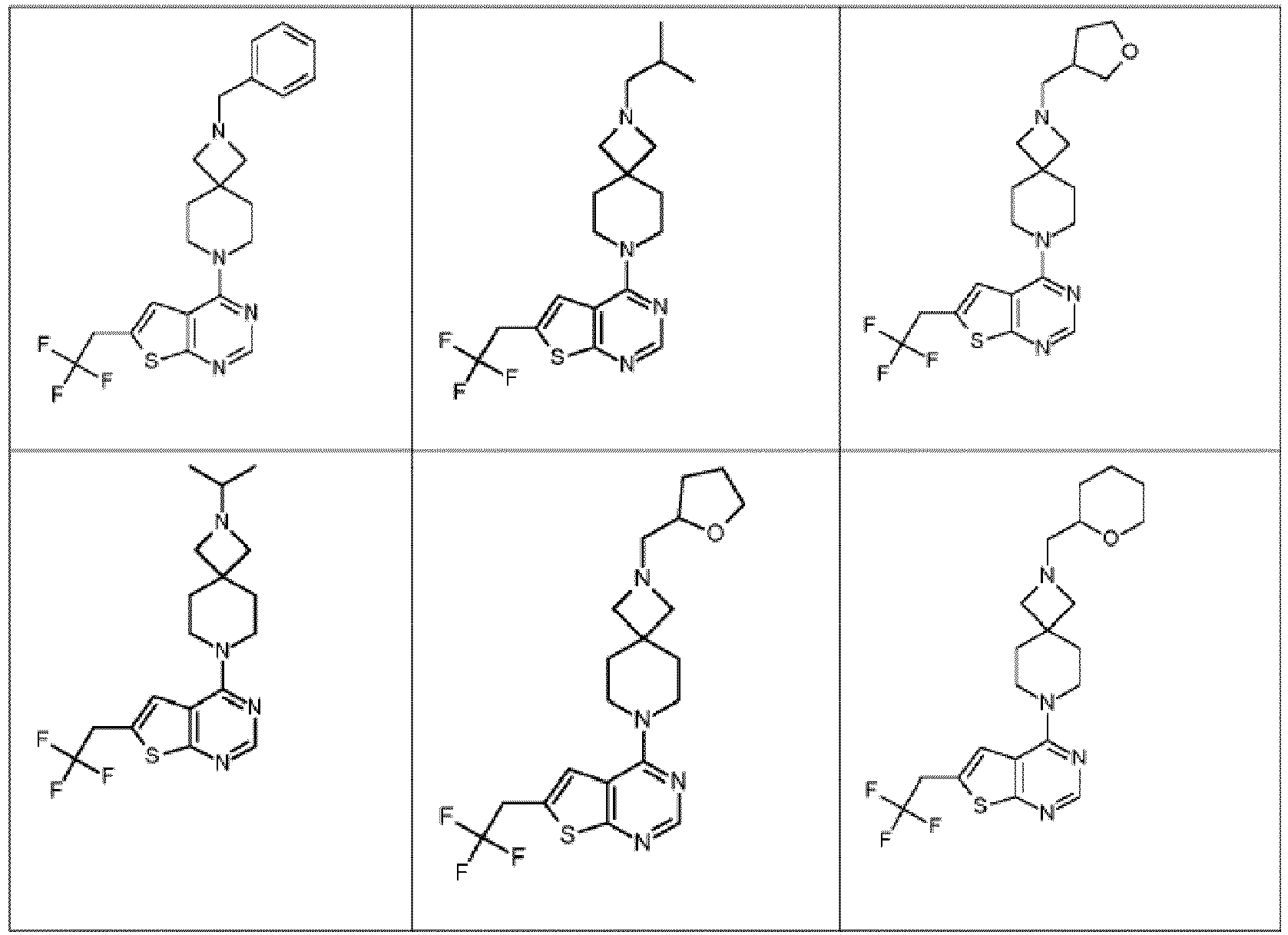


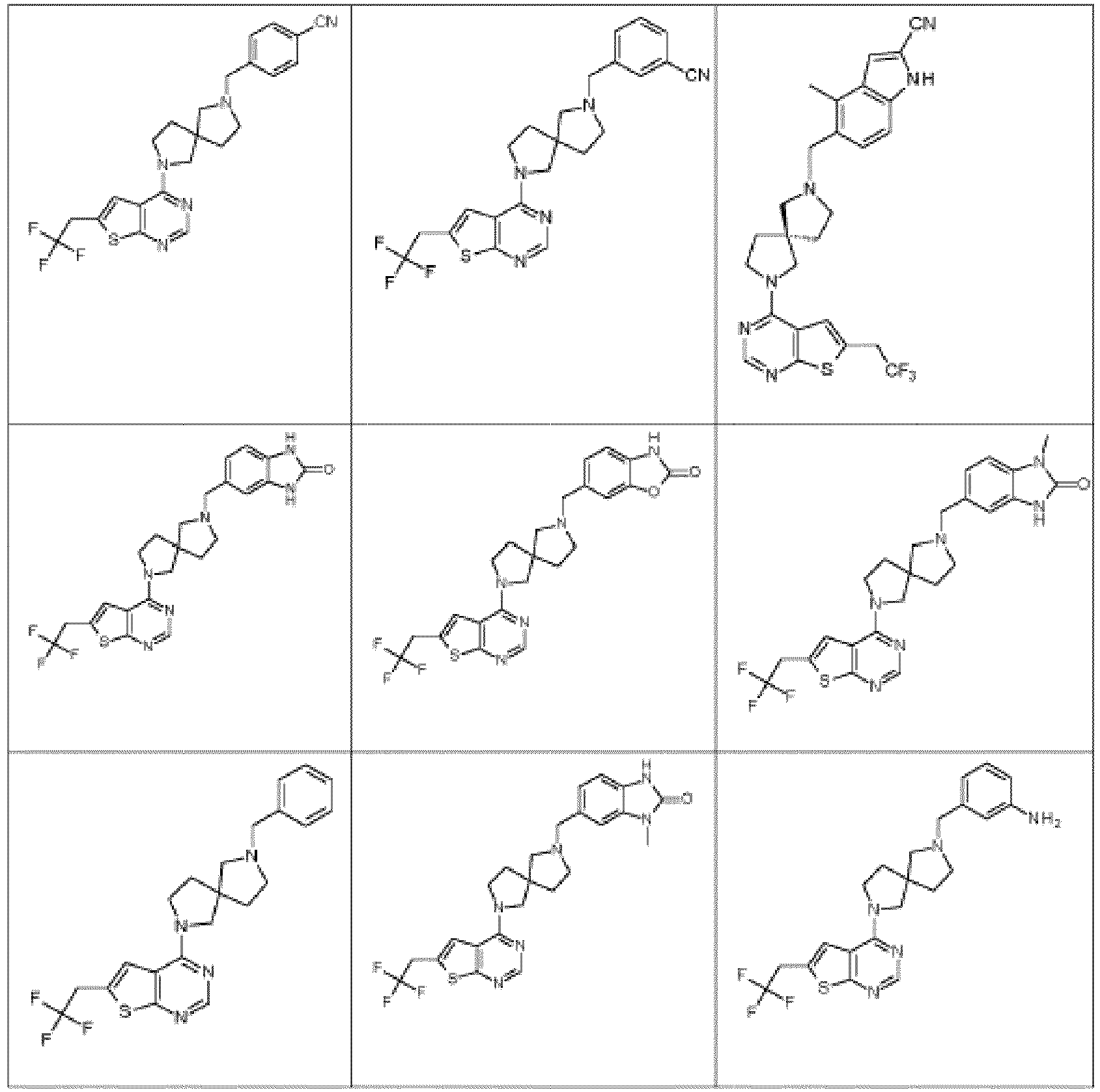


- Composé selon la revendication 1,(a) L2 étant choisi dans le groupe constitué par >SO2, >CR4aR4b, et -CHR4aCHR5- ;(i) lorsque L2 est lié à un atome de carbone de L1, alors R4a et R5 sont chacun indépendamment choisis dans le groupe constitué par hydrogène ; -OR6 ; -NR7aR7b ;-C(=O)NR7aR7b ; C1-4alkyle éventuellement substitué par un substituant choisi dans le groupe constitué par fluoro, -CN, -OR8, et -NR9aR9b ; et hétérocyclyle non aromatique C-lié à 4 à 7 chaînons contenant au moins un atome d'azote, d'oxygène ou de soufre ;(ii) lorsque L2 est lié à un atome d'azote de L1, alors R4a est choisi dans le groupe constitué par hydrogène ; -C(=O)NR7aR7b ; C1-4alkyle éventuellement substitué par un substituant choisi dans le groupe constitué par fluoro, -CN, -OR8, et -NR9aR9b ; et hétérocyclyle non aromatique C-lié à 4 à 7 chaînons contenant au moins un atome d'azote, d'oxygène ou de soufre ;
R5 étant choisi dans le groupe constitué par hydrogène ; -OR6 ; -NR7aR7b ;-C(=O)NR7aR7b ; C1-4alkyle éventuellement substitué par un substituant choisi dans le groupe constitué par fluoro, -CN, -OR8, et -NR9aR9b ; et hétérocyclyle non aromatique C-lié à 4 à 7 chaînons contenant au moins un atome d'azote, d'oxygène ou de soufre ;
R4b étant choisi dans le groupe constitué par hydrogène et méthyle ; ou >CR4aR4b formant un >C3-5cycloalcanediyle ou un hétérocyclediyle >C-lié à 4 à 6 chaînons contenant un atome d'oxygène ;
R6, R7a, R7b, R8, R9a et R9b étant chacun indépendamment choisis dans le groupe constitué par hydrogène ; C1-4alkyle éventuellement substitué par un substituant choisi dans le groupe constitué par fluoro,-CN, et -C(=O)NR10aR10b ; et C2-4alkyle substitué par un substituant choisi dans le groupe constitué par -OR11 et -NR10aR10b ;
R10a, R10b et R11 étant chacun indépendamment choisis dans le groupe constitué par hydrogène ; et C1-4alkyle ; et
R3 étant choisi dans le groupe constitué par Ar, Het1, Het2, et un système spirocarbobicyclique saturé à 7 à 10 chaînons ; ou(b) L2 étant choisi dans le groupe constitué par >CR4cR4d et -CHR4cCHR5a-, R4c, R4d, et R5a étant chacun indépendamment choisis dans le groupe constitué par hydrogène et C1-4alkyle ; et
R3 étant choisi dans le groupe constitué par (c) --L2-R3 étant C1-6alkyle éventuellement substitué par un, deux ou trois substituants fluoro ; ou(d) L2 étant O et R3 étant choisi dans le groupe constitué par Ar, Het1 ; -CH2-Ar, -CH2-Het1, et -CH2-(un système spirocarbobicyclique saturé à 7 à 10 chaînons) ; lorsque L2 est lié à un atome de carbone de L1 ; ou(e) --L2-R3 étant choisi dans le groupe constitué
par (f) --L2-R3 étant
Ar étant phényle éventuellement substitué par un, deux, ou trois substituants chacun indépendamment choisis dans le groupe constitué par halogéno, - CN, et C1-4alkyle éventuellement substitué par un substituant choisi dans le groupe constitué par fluoro, -CN, -OR26, -NR27aR27b, et -C(=O)NR27aR27b ; Het1 étant un hétéroaryle monocyclique choisi dans le groupe constitué par pyridinyle, 4-pyrimidinyle, 5-pyrimidinyle ou 6-pyrimidinyle, pyrazinyle, pyridazinyle, furannyle, thiényle, pyrrolyle, pyrazolyle, imidazolyle, 4-thiazolyle ou 5-thiazolyle, isothiazolyle, thiadiazolyle, et isoxazolyle ; ou un hétéroaryle bicyclique choisi parmi imidazopyridinyle, en particulier imidazo[1,2-a]pyridinyle ; chacun desquels pouvant éventuellement être substitué par un, deux, ou trois substituants chacun indépendamment choisis dans le groupe constitué par halogéno, -CN, et C1-4alkyle éventuellement substitué par un substituant choisi dans le groupe constitué par fluoro, -CN, -OR26, -NR27aR27b, et -C(=O)NR27aR27b ; et Het2 étant un hétérocyclyle non aromatique choisi parmi azétidinyle, pyrrolidinyle et pipéridinyle ; R26, R27a, et R27b étant chacun indépendamment choisis dans le groupe constitué par hydrogène et C1-4alkyle. - Composé selon la revendication 1 ou 2,
R1 étant CF3 ;(a) L2 étant >CR4aR4b ;R4a étant choisi dans le groupe constitué par hydrogène ; -C(=O)NR7aR7b ; C1-4alkyle ; et hétérocyclyle non aromatique C-lié à 4 à 7 chaînons contenant au moins un atome d'azote, d'oxygène ou de soufre ; etR4b étant choisi dans le groupe constitué par hydrogène et méthyle ;R7a et R7b étant chacun indépendamment choisis dans le groupe constitué par hydrogène ; C1-4alkyle ; et C2-4alkyle substitué par un substituant choisi dans le groupe constitué par -OR11 et -NR10aR10b ;R10a, R10b et R11 étant chacun indépendamment choisis dans le groupe constitué par hydrogène et C1-4alkyle ; etR3 étant choisi dans le groupe constitué par Ar, Het1, Het2, et un système spirocarbobicyclique saturé à 7 à 10 chaînons ; ou(b) L2 étant >CR4cR4d, R4c et R4d étant chacun indépendamment choisis dans le groupe constitué par hydrogène et C1-4alkyle ; et
R3 étant choisi dans le groupe constitué
par (c) --L2-R3 étant C1-6alkyle éventuellement substitué par un, deux ou trois substituants fluoro ; ou(d) L2 étant O et R3 étant choisi dans le groupe constitué par Ar, Het1, -CH2-Ar, -CH2-Het1, et -CH2-(un système spirocarbobicyclique saturé à 7 à 10 chaînons) ; lorsque L2 est lié à un atome de carbone de L1 ; ou(e) --L2-R3 étant choisi dans le groupe constitué
par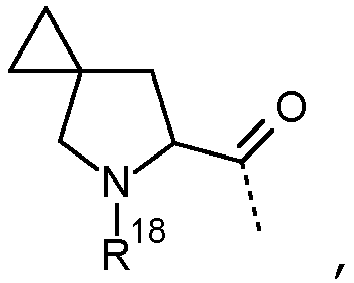 (f) --L2-R3 étantAr étant phényle éventuellement substitué par un substituant halogéno ;

Het1 étant un hétéroaryle monocyclique choisi dans le groupe constitué par pyridinyle, 4-pyrimidinyle, 5-pyrimidinyle ou 6-pyrimidinyle, pyrazinyle, pyridazinyle, pyrrolyle, pyrazolyle, imidazolyle, et 4-thiazolyle ou 5-thiazolyle ; ou un hétéroaryle bicyclique choisi parmi imidazopyridinyle, en particulier imidazo[1,2-a]pyridinyle ; chacun desquels pouvant éventuellement être substitué par un, deux, ou trois substituants chacun indépendamment choisis dans le groupe constitué par halogéno et C1-4alkyle éventuellement substitué par un substituant choisi dans le groupe constitué par fluoro, -CN, -OR26,-NR27aR27b, et -C(=O)NR27aR27b ; et
Het2 étant un hétérocyclyle non aromatique choisi parmi azétidinyle, pyrrolidinyle et pipéridinyle ; R26, R27a, et R27b étant chacun indépendamment choisis dans le groupe constitué par hydrogène et C1-4alkyle. - Composé selon l'une quelconque des revendications 1 à 3,R1 étant CF3 ;L1 représentant un système spirohétérobicyclique saturé N-lié à 7 à 10 chaînons contenant un ou deux atomes N choisi dans le groupe constitué par (a), (b), (c), (d), (e), (f) et (g)

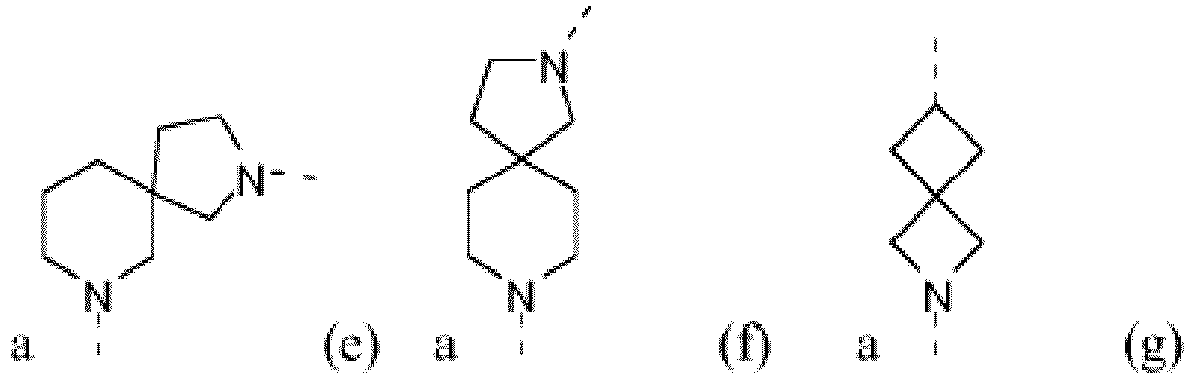 (a) L2 étant >CH2 ; et R3 étant choisi dans le groupe constitué par Ar, Het1, et un système spirocarbobicyclique saturé à 7 à 10 chaînons ; ou(b) --L2-R3 étant C1-6alkyle éventuellement substitué par un, deux ou trois substituants fluoro ; et
Ar étant phényle éventuellement substitué par un substituant halogéno ; et
Het1 étant un hétéroaryle monocyclique choisi dans le groupe constitué par 4-pyrimidinyle, 5-pyrimidinyle ou 6-pyrimidinyle, pyrazinyle, pyridazinyle, pyrrolyle, pyrazolyle, imidazolyle, et 4-thiazolyle ou 5-thiazolyle ; ou un hétéroaryle bicyclique choisi parmi imidazopyridinyle, en particulier imidazo[1,2-a]pyridinyle ; chacun desquels pouvant éventuellement être substitué par un ou deux substituants chacun indépendamment choisis dans le groupe constitué par halogéno et C1-4alkyle. - Composé selon l'une quelconque des revendications 1 à 4,R1 étant CF3 ;R2 étant hydrogène ;L1 représentant un système spirohétérobicyclique saturé N-lié à 7 à 10 chaînons contenant un ou deux atomes N choisi dans le groupe constitué par (a), (b), (c), (d), (e), (f) et (g)

 (a) L2 étant >CH2 ; et R3 étant choisi dans le groupe constitué par Ar, Het1, et un système spirocarbobicyclique saturé à 7 à 10 chaînons ; ou(b) --L2-R3 étant C1-6alkyle éventuellement substitué par un, deux ou trois substituants fluoro ; et Ar étant phényle éventuellement substitué par un substituant halogéno ; et
Het1 étant un hétéroaryle monocyclique choisi dans le groupe constitué par 4-pyrimidinyle, 5-pyrimidinyle ou 6-pyrimidinyle, pyrazinyle, pyridazinyle, pyrrolyle, pyrazolyle, et imidazolyle ; ou un hétéroaryle bicyclique choisi parmi imidazopyridinyle, en particulier imidazo[1,2-a]pyridinyle ; chacun desquels pouvant éventuellement être substitué par un ou deux substituants chacun indépendamment choisis dans le groupe constitué par halogéno et C1-4alkyle. - Composé selon la revendication 1,R1 étant CF3 ;R2 étant choisi dans le groupe constitué par hydrogène et CH3 ;L1 représentant un système spirohétérobicyclique saturé à 7 à 10 chaînons contenant un ou deux atomes N qui est N-lié à l'hétérocyclyle thiénopyrimidinyle ; et--L2-R3 étant choisi parmi (a), (b), (c), (d), (f) et (g),Ar étant phényle qui peut éventuellement être substitué par un, deux ou trois substituants chacun indépendamment choisis dans le groupe constitué par halogéno, -OR24, et C1-4alkyle éventuellement substitué par -OR26 ;(a) L2 étant choisi dans le groupe constitué par >CR4aR4b, et -CHR4aCHR5- ;
L2 étant lié à un atome d'azote de L1 ; R4a étant choisi dans le groupe constitué par hydrogène ; -C(=O)NR7aR7b ; C1-4alkyle éventuellement substitué par un substituant choisi dans le groupe constitué par -OR8, et -NR9aR9b ; et hétérocyclyle non aromatique C-lié à 4 à 7 chaînons contenant au moins un atome d'azote ;
R5 étant choisi dans le groupe substitué par hydrogène ; -OR6 ; et C1-4alkyle ;
R4b étant choisi dans le groupe constitué par hydrogène et méthyle ; ou R4a et R4b conjointement avec l'atome de carbone auquel ils sont fixés formant un C3-5cycloalkyle ou un hétérocyclyle C-lié à 4 à 6 chaînons contenant un atome d'oxygène ;
R6, R7a, R7b, R8, R9a et R9b étant chacun indépendamment choisis dans le groupe constitué par hydrogène ; et C2-4alkyle substitué par un substituant choisi dans le groupe constitué par -OR11 et -NR10aR10b ;
R10a, R10b et R11 étant chacun indépendamment choisis dans le groupe constitué par hydrogène ; et C1-4alkyle ; et
R3 étant choisi dans le groupe constitué par Ar, Het1, Het2, et un système spirocarbobicyclique saturé à 7 à 10 chaînons ; ou(b) L2 étant >CR4cR4d, R4c et R4d étant hydrogène ; et
R3 étant (c) --L2-R3 étant C1-6alkyle éventuellement substitué par un, deux ou trois substituants fluoro ; ou(d) L2 étant O et R3 étant -CH2-Ar ; ou(f) --L2-R3 étant
R18a étant choisi dans le groupe constitué par hydrogène, et fluoro;
R18b étant choisi dans le groupe constitué par fluoro, -OC1-4alkyle, et C1-4alkyle éventuellement substitué par 1, 2 ou 3 substituants fluoro ; ou
R18a et R18b étant liés au même atome de carbone et conjointement formant un C3-5cycloalkyle ; ou(g) --L2-R3 étant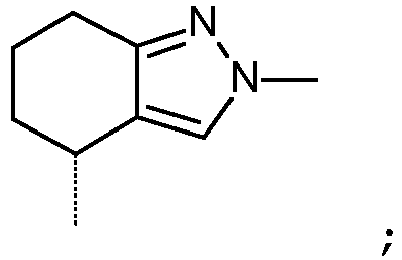
Het1 étant un hétéroaryle monocyclique choisi dans le groupe constitué par pyridinyle, 4-pyrimidinyle, 5-pyrimidinyle ou 6-pyrimidinyle, pyrazinyle, pyridazinyle, pyrrolyle, pyrazolyle, imidazolyle, 4-thiazolyle ou 5-thiazolyle, isothiazolyle, et isoxazolyle ; ou un hétéroaryle bicyclique choisi dans le groupe constitué par indolyle, imidazopyridinyle ; chacun desquels pouvant éventuellement être substitué par un, deux ou trois substituants chacun indépendamment choisis dans le groupe constitué par halogéno, - CN, -OR24, et C1-4alkyle éventuellement substitué par un substituant choisi dans le groupe constitué par -CN, -OR26, et -NR27aR27b ; et
Het2 étant un hétérocyclyle non aromatique éventuellement substitué par un, deux ou trois substituants chacun indépendamment choisis dans le groupe constitué par halogéno, -CN, et C1-4alkyle éventuellement substitué par -OR26 ;
R24, R26, R27a, et R27b étant chacun indépendamment choisis dans le groupe constitué par hydrogène ; C1-4alkyle ; et C2-4alkyle substitué par -NR28aR28b ; R28a et R28b étant hydrogène. - Composé selon la revendication 1,R1 étant choisi dans le groupe constitué par CH3, CH2F, CHF2, et CF3 ;R2 étant choisi dans le groupe constitué par hydrogène et CH3 ;L1 représentant un système spirohétérobicyclique saturé à 7 à 10 chaînons contenant un ou deux atomes N étant entendu qu'il est N-lié à l'hétérocycle thiénopyrimidinyle ; et--L2-R3 étant choisi parmi (a), (b), (d), (e), et (f),(a) L2 étant choisi dans le groupe constitué par >SO2, >CR4aR4b, et -CHR4aCHR5- ;(i) lorsque L2 est lié à un atome de carbone de L1, alors R4a et R5 sont chacun indépendamment choisis dans le groupe constitué par hydrogène ; -OR6 ; -NR7aR7b ; - C (=O) NR7aR7b ; C1-4alkyle éventuellement substitué par un substituant choisi dans le groupe constitué par fluoro, -CN, -OR8, et -NR9aR9b ; et hétérocyclyle non aromatique C-lié à 4 à 7 chaînons contenant au moins un atome d'azote, d'oxygène ou de soufre ;(ii) lorsque L2 est lié à un atome d'azote de L1, alors R4a est choisi dans le groupe constitué par -C(=O)NR7aR7b ; C1-4alkyle éventuellement substitué par un substituant choisi dans le groupe constitué par fluoro, -CN, -OR8, et - NR9aR9b; et hétérocyclyle non aromatique C-lié à 4 à 7 chaînons contenant au moins un atome d'azote, d'oxygène ou de soufre ;
R5 étant choisi dans le groupe constitué par hydrogène ; -OR6 ; -NR7aR7b ;-C(=O)NR7aR7b ; C1-4alkyle éventuellement substitué par un substituant choisi dans le groupe constitué par fluoro, -CN, -OR8, et -NR9aR9b ; et hétérocyclyle non aromatique C-lié à 4 à 7 chaînons contenant au moins un atome d'azote, d'oxygène ou de soufre ;
R4b étant choisi dans le groupe constitué par hydrogène et méthyle ; ou R4a et R4b conjointement avec l'atome de carbone auquel ils sont fixés formant un C3-5cycloalkyle ou un hétérocyclyle C-lié à 4 à 6 chaînons contenant un atome d'oxygène ;
R6, R7a, R7b, R8, R9a et R9b étant chacun indépendamment choisis dans le groupe constitué par hydrogène ; C1-4alkyle éventuellement substitué par un substituant choisi dans le groupe constitué par fluoro, -CN, et-C(=O)NR10aR10b ; et C2-4alkyle substitué par un substituant choisi dans le groupe constitué par -OR11 et -NR10aR10b ;
R10a, R10b et R11 étant chacun indépendamment choisis dans le groupe constitué par hydrogène ; C1-4alkyle ; et hétérocyclyle non aromatique C-lié à 4 à 7 chaînons contenant au moins un atome d'azote, d'oxygène ou de soufre ; et
R3 étant choisi dans le groupe constitué par Ar, Het1, Het2, et un système spirocarbobicyclique saturé à 7 à 10 chaînons ; ou(b) L2 étant choisi dans le groupe constitué par >CR4cR4d et -CHR4cCHR5a-, R4c, R4d, et R5a étant chacun indépendamment choisis dans le groupe constitué par hydrogène et C1-4alkyle ; et
R3 étant choisi dans le groupe constitué
par (d) L2 étant O et R3 étant choisi dans le groupe constitué par C3-6alkyle éventuellement substitué par un, deux ou trois substituants fluoro ; Ar ; Het1 ; Het2 ; un système spirocarbobicyclique saturé à 7 à 10 chaînons ; -CH2-Ar ; -CH2-Het1 ; -CH2-Het2 ; et -CH2- (un système spirocarbobicyclique saturé à 7 à 10 chaînons) ; lorsque L2 est lié à un atome de carbone de L1; ou(e) --L2-R3 étant -O-CHR5-R3 lorsque L2 est lié à un atome de carbone de L1,
R5 étant choisi dans le groupe constitué par-C(=O)NR13aR13b ; C1-4alkyle éventuellement substitué par un substituant choisi dans le groupe constitué par fluoro, -OR14, et-NR15aR15b ; et hétérocyclyle non aromatique C-lié à 4 à 7 chaînons contenant au moins un atome d'azote, d'oxygène ou de soufre ;
R13a, R13b, R14, R15a et R15b étant chacun indépendamment choisis dans le groupe constitué par hydrogène ; C1-4alkyle éventuellement substitué par un substituant choisi dans le groupe constitué par fluoro et -C(=O)NR16aR16b ; et C2-4alkyle substitué par un substituant choisi dans le groupe constitué par -OR17 et -NR16aR16b ;
R16a, R16b et R17 étant chacun indépendamment choisis dans le groupe constitué par hydrogène ; C1-4alkyle ; et hétérocyclyle non aromatique C-lié à 4 à 7 chaînons contenant au moins un atome d'azote, d'oxygène ou de soufre ; et
R3 étant choisi dans le groupe constitué par hydrogène ; C1-4alkyle éventuellement substitué par un, deux ou trois substituants fluoro ; -CN ; Ar, Het1 ; Het2 ; et un système spirocarbobicyclique saturé à 7 à 10 chaînons ; ou(f) --L2-R3 étant
R19, R20a et R20b étant chacun indépendamment choisis dans le groupe constitué par hydrogène ; C1-4alkyle éventuellement substitué par un substituant choisi dans le groupe constitué par fluoro, -CN, et-C(=O)NR21aR21b ; C2-4alkyle substitué par un substituant choisi dans le groupe constitué par -OR22 et -NR21aR21b ; et hétérocyclyle non aromatique C-lié à 4 à 7 chaînons contenant au moins un atome d'azote, d'oxygène ou de soufre ;
R21a, R21b et R22 étant chacun indépendamment choisis dans le groupe constitué par hydrogène et C1-4alkyle ; et
R18a étant choisi dans le groupe constitué par hydrogène, fluoro et C1-4alkyle ;
R18b étant choisi dans le groupe constitué par fluoro, -OC1-4alkyle, et C1-4alkyle éventuellement substitué par 1, 2 ou 3 substituants fluoro ; ou
R18a et R18b étant liés au même atome de carbone et conjointement formant un C3-5cycloalkyle ou un hétérocyclyle C-lié à 4 à 6 chaînons contenant un atome d'oxygène ;
et
Ar étant phényle ou naphtyle, chacun desquels pouvant éventuellement être substitué par un, deux ou trois substituants chacun indépendamment choisis dans le groupe constitué par halogéno, - CN, -OR24, -NR25aR25b, et C1-4alkyle éventuellement substitué par un substituant choisi dans le groupe constitué par fluoro, -CN, -OR26, -NR27aR27b, et-C(=O)NR27aR27b ;
Het1 étant un hétéroaryle monocyclique choisi dans le groupe constitué par pyridinyle, 4-pyrimidinyle, 5-pyrimidinyle ou 6-pyrimidinyle, pyrazinyle, pyridazinyle, furannyle, thiényle, pyrrolyle, pyrazolyle, imidazolyle, 4-thiazolyle ou 5-thiazolyle, isothiazolyle, thiadiazolyle, et isoxazolyle ; ou un hétéroaryle bicyclique choisi dans le groupe constitué par imidazothiazolyle, imidazoimidazolyle, benzofurannyle, benzothiophényle, benzimidazolyle, benzoxazolyle, isobenzoxazolyle, benzisoxazolyle, benzothiazolyle, benzisothiazolyle, isobenzofurannyle, indolyle, isoindolyle, indolizinyle, indolinyle, isoindolinyle, indazolyle, pyrazolopyridinyle, pyrazolopyrimidinyle, imidazopyridinyle, imidazopyrazinyle, imidazopyridazinyle ; chacun desquels pouvant éventuellement être substitué par un, deux ou trois substituants chacun indépendamment choisis dans le groupe constitué par halogéno, -CN, -OR24, -NR25aR25b, et C1-4alkyle éventuellement substitué par un substituant choisi dans le groupe constitué par fluoro, -CN, -OR26,-NR27aR27b, et -C(=O)NR27aR27b ; et
Het2 étant un hétérocyclyle non aromatique éventuellement substitué par un, deux ou trois substituants chacun indépendamment choisis dans le groupe constitué par halogéno, -CN, -OR24,-NR25aR25b, et C1-4alkyle éventuellement substitué par un substituant choisi dans le groupe constitué par fluoro, -CN, -OR26, -NR27aR27b, et -C(=O)NR27aR27b ; R24, R25a, R25b, R26, R27a, et R27b étant chacun indépendamment choisis dans le groupe constitué par hydrogène ; C1-4alkyle éventuellement substitué par un substituant choisi dans le groupe constitué par fluoro et -C(=O)NR28aR28b ; et C2-4alkyle substitué par un substituant choisi dans le groupe constitué par -OR29 et -NR28aR28b ;
R28a, R28b et R29 étant chacun indépendamment choisis dans le groupe constitué par hydrogène ; C1-4alkyle ; et hétérocyclyle non aromatique C-lié à 4 à 7 chaînons contenant au moins un atome d'azote, d'oxygène ou de soufre. - Composé selon la revendication 1,--L2-R3 étant (a) ;R3 étant Het1 ou Het2 ;Het1 étant un hétéroaryle monocyclique choisi dans le groupe constitué par pyridinyle, 4-pyrimidinyle, 5-pyrimidinyle ou 6-pyrimidinyle, pyrazinyle, pyridazinyle, pyrrolyle, pyrazolyle, et imidazolyle ; chacun desquels pouvant éventuellement être substitué par un, deux ou trois substituants chacun indépendamment choisis dans le groupe constitué par halogéno, -CN, -OR24, -NR25aR25b, et C1-4alkyle éventuellement substitué par un substituant choisi dans le groupe constitué par fluoro, -CN, -OR26, -NR27aR27b, et-C(=O)NR27aR27b ; etHet2 étant un hétérocyclyle non aromatique choisi dans le groupe constitué par azétidinyle, pyrrolidinyle, et pipéridinyle ; chacun desquels pouvant éventuellement être substitué par un, deux ou trois substituants chacun indépendamment choisis dans le groupe constitué par halogéno,-CN, -OR24, -NR25aR25b, et C1-4alkyle éventuellement substitué par un substituant choisi dans le groupe constitué par fluoro, -CN, -OR26, -NR27aR27b, et-C(=O)NR27aR27b.
- Composé selon la revendication 1,
L1 représentant un système spirohétérobicyclique saturé N-lié à 7 à 10 chaînons contenant un ou deux atomes de N choisi dans le groupe constitué par (a), (b), (c), (e), (f), (g), (h), et (i)
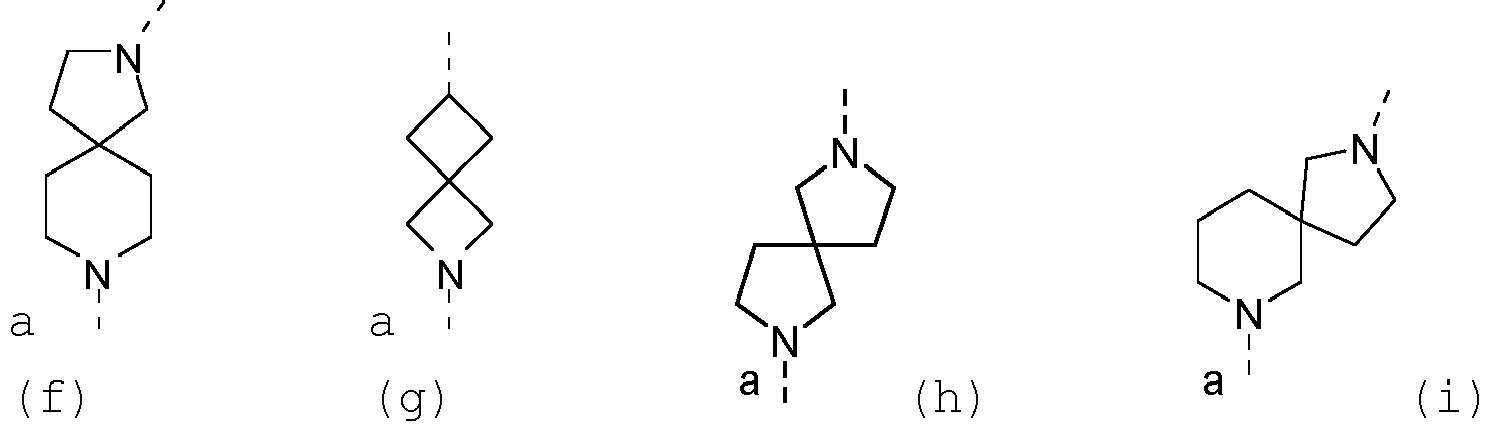
- Composition pharmaceutique comprenant un composé selon l'une quelconque des revendications 1 à 9 et un support ou un diluant pharmaceutiquement acceptable.
- Procédé pour la préparation d'une composition pharmaceutique telle que définie dans la revendication 10 comprenant le mélange d'un support pharmaceutiquement acceptable avec une quantité thérapeutiquement efficace d'un composé selon l'une quelconque des revendications 1 à 9.
- Composé selon l'une quelconque des revendications 1 à 9 ou composition pharmaceutique selon la revendication 10 pour une utilisation en tant que médicament.
- Composé selon l'une quelconque des revendications 1 à 9 ou composition pharmaceutique selon la revendication 10 pour une utilisation dans la prévention ou le traitement du cancer, du syndrome myélodysplasique (SMD) et du diabète.
- Composé ou composition pharmaceutique pour une utilisation selon la revendication 13, le cancer étant choisi parmi les leucémies, un myélome ou un cancer à tumeur solide tel qu'un cancer de la prostate, un cancer du poumon, un cancer du sein, un cancer pancréatique, un cancer du côlon, un cancer du foie, un mélanome et un gliobastome.
- Composé ou composition pharmaceutique pour une utilisation selon la revendication 14, la leucémie étant choisi parmi les leucémies aiguës, les leucémies chroniques, les leucémies myéloïdes, les leucémies myélogènes, les leucémies lymphoblastiques, les leucémies lymphocytaires, les leucémies myélogènes aiguës (LMA), les leucémies myélogènes chroniques (LMC), les leucémies lymphoblastiques aiguës (LLA), les leucémies lymphocytaires chroniques (LLC), les leucémies prolymphocytaires à cellules T (LPL-T), la leucémie à grands lymphocytes granulaires, la leucémie à tricholeucocytes (LT), les leucémies MLL réarrangées, les leucémies MLL_PTD, les leucémies MLL amplifiées, les leucémies MLL positives, et les leucémies présentant des signatures d'expression génique HOX/MEIS1.
Priority Applications (2)
| Application Number | Priority Date | Filing Date | Title |
|---|---|---|---|
| SI201730700T SI3512857T1 (sl) | 2016-09-14 | 2017-09-13 | Spiro biciklični zaviralci interakcije menin-MLL |
| HRP20210514TT HRP20210514T1 (hr) | 2016-09-14 | 2017-09-13 | Spiro biciklički inhibitori interakcije menin-mll |
Applications Claiming Priority (3)
| Application Number | Priority Date | Filing Date | Title |
|---|---|---|---|
| US201662394295P | 2016-09-14 | 2016-09-14 | |
| EP16192431 | 2016-10-05 | ||
| PCT/EP2017/073004 WO2018050686A1 (fr) | 2016-09-14 | 2017-09-13 | Inhibiteurs spiro bicycliques de l'interaction ménine-mll |
Publications (2)
| Publication Number | Publication Date |
|---|---|
| EP3512857A1 EP3512857A1 (fr) | 2019-07-24 |
| EP3512857B1 true EP3512857B1 (fr) | 2021-02-24 |
Family
ID=59895299
Family Applications (1)
| Application Number | Title | Priority Date | Filing Date |
|---|---|---|---|
| EP17768428.9A Active EP3512857B1 (fr) | 2016-09-14 | 2017-09-13 | Inhibiteurs spiro-bicyclique de menin-mll-interaction |
Country Status (15)
| Country | Link |
|---|---|
| US (1) | US11220517B2 (fr) |
| EP (1) | EP3512857B1 (fr) |
| JP (1) | JP6975791B2 (fr) |
| KR (1) | KR102493644B1 (fr) |
| CN (1) | CN109689663B (fr) |
| AU (1) | AU2017326487B2 (fr) |
| BR (1) | BR112019004691A2 (fr) |
| DK (1) | DK3512857T3 (fr) |
| ES (1) | ES2872003T3 (fr) |
| HR (1) | HRP20210514T1 (fr) |
| HU (1) | HUE053907T2 (fr) |
| IL (1) | IL265233B (fr) |
| LT (1) | LT3512857T (fr) |
| MX (1) | MX392051B (fr) |
| SI (1) | SI3512857T1 (fr) |
Families Citing this family (13)
| Publication number | Priority date | Publication date | Assignee | Title |
|---|---|---|---|---|
| US12084462B2 (en) | 2016-09-14 | 2024-09-10 | Janssen Pharmaceutica Nv | Spiro bicyclic inhibitors of menin-MLL interaction |
| CN109689663B (zh) | 2016-09-14 | 2023-04-14 | 詹森药业有限公司 | Menin-mll相互作用的螺二环抑制剂 |
| MA46228A (fr) * | 2016-09-14 | 2019-07-24 | Janssen Pharmaceutica Nv | Inhibiteurs bicycliques fusionnés de l'interaction ménine-mll |
| BR112019012106A2 (pt) | 2016-12-15 | 2019-10-29 | Janssen Pharmaceutica Nv | inibidores de azepano de interação menin-mill |
| US11396517B1 (en) | 2017-12-20 | 2022-07-26 | Janssen Pharmaceutica Nv | Exo-aza spiro inhibitors of menin-MLL interaction |
| WO2021060453A1 (fr) | 2019-09-27 | 2021-04-01 | 大日本住友製薬株式会社 | Dérivé d'amine secondaire optiquement actif réticulé |
| CN112812584A (zh) * | 2019-11-16 | 2021-05-18 | 复旦大学 | 一种含氮杂环丁烷螺环结构的荧光染料及其制备方法和应用 |
| JP7554829B2 (ja) | 2019-12-19 | 2024-09-20 | ヤンセン ファーマシューティカ エヌ.ベー. | 置換直鎖スピロ誘導体 |
| CN114478568A (zh) * | 2020-10-27 | 2022-05-13 | 苏州优理生物医药科技有限公司 | 一种噻吩并嘧啶类化合物、包含其药物组合物及其应用 |
| CN114516873A (zh) * | 2020-11-18 | 2022-05-20 | 苏州优理生物医药科技有限公司 | 一种螺环类化合物、包含其药物组合物及其应用 |
| CN116903609A (zh) * | 2021-11-05 | 2023-10-20 | 上海优理惠生医药有限公司 | 一种化合物、包含其的药物组合物及其应用 |
| WO2023244870A1 (fr) * | 2022-06-17 | 2023-12-21 | INSTITUTE FOR CANCER RESEARCH d.b.a THE RESEARCH INSTITUTE OF FOX CHASE CANCER CENTER | Compositions et procédés de contrôle de gains de copies régiospécifiques transitoires, d'insertions génomiques et de réarrangements associés à une leucémie de lignée mixte |
| WO2025067111A1 (fr) * | 2023-09-27 | 2025-04-03 | 苏州必扬医药科技有限公司 | Inhibiteur d'interaction ménine-mll et son procédé de préparation, et application |
Family Cites Families (48)
| Publication number | Priority date | Publication date | Assignee | Title |
|---|---|---|---|---|
| US6143749A (en) | 1995-06-07 | 2000-11-07 | Abbott Laboratories | Heterocyclic substituted cyclopentane compounds |
| WO2003070739A1 (fr) | 2002-02-19 | 2003-08-28 | Cv Therapeutics, Inc. | Agonistes partiels et complets des recepteurs de l'adenosine a1 |
| US20040043959A1 (en) | 2002-03-04 | 2004-03-04 | Bloom Laura A. | Combination therapies for treating methylthioadenosine phosphorylase deficient cells |
| CA2509406C (fr) | 2002-12-23 | 2012-07-03 | Janssen Pharmaceutica N.V. | Derives substitues de 1-piperidine-4-yl-4-azetidine-3-yl-piperazine et leur utilisation en tant qu'antagonistes de la neurokinine |
| US7612078B2 (en) | 2003-03-31 | 2009-11-03 | Epix Delaware, Inc. | Piperidinylamino-thieno[2,3-D] pyrimidine compounds |
| EP1753428A4 (fr) | 2004-05-14 | 2010-09-15 | Abbott Lab | Inhibiteurs de kinases en tant qu'agents therapeutiques |
| EP1856128A4 (fr) | 2005-01-19 | 2009-12-23 | Merck & Co Inc | Inhibiteurs mitotiques de la kinesine |
| GB0713602D0 (en) | 2007-07-12 | 2007-08-22 | Syngenta Participations Ag | Chemical compounds |
| TWI389913B (zh) | 2008-09-08 | 2013-03-21 | Lg Life Sciences Ltd | 并合雜環化合物 |
| WO2010041366A1 (fr) | 2008-10-06 | 2010-04-15 | 日本電気株式会社 | Dispositif de radiocommunication, système de radiocommunication, procédé de commande de dispositif de radiocommunication et support d’enregistrement |
| JP2011026305A (ja) | 2009-06-24 | 2011-02-10 | Daiichi Sankyo Co Ltd | イミダゾールカルボニル化合物を含有する医薬組成物 |
| IN2012DN01531A (fr) * | 2009-08-20 | 2015-06-05 | Bayer Cropscience Ag | |
| EP2473054B1 (fr) * | 2009-09-04 | 2017-06-14 | The Regents of the University of Michigan | Compositions et méthodes de traitement de la leucémie |
| US9586961B2 (en) * | 2010-07-09 | 2017-03-07 | Leo Pharma A/S | Homopiperazine derivatives as protein tyrosine kinase inhibitors and pharmaceutical use thereof |
| EP2646454B1 (fr) | 2010-12-03 | 2015-07-08 | Epizyme, Inc. | Modulateurs à base de 7-déazapurine de l'histone méthyltransférase et procédés d'utilisation de ceux-ci |
| CA2819620A1 (fr) | 2010-12-03 | 2012-06-21 | Epizyme, Inc. | Modulateurs d'histone methyltransferase et leurs procedes d'utilisation |
| WO2013018404A1 (fr) | 2011-08-01 | 2013-02-07 | オリンパスメディカルシステムズ株式会社 | Dispositif d'affichage de configuration de tube d'insertion |
| WO2014035140A2 (fr) | 2012-08-30 | 2014-03-06 | Kainos Medicine, Inc. | Composés et compositions pour la modulation de l'activité histone méthyltransférase |
| CN103664991B (zh) | 2012-09-19 | 2016-12-28 | 中国科学院福建物质结构研究所 | 噻吩[2,3‑d]嘧啶衍生物、其制备方法及其用途 |
| WO2014075392A1 (fr) * | 2012-11-16 | 2014-05-22 | Merck Sharp & Dohme Corp. | Inhibiteurs puriques de la phosphatidylinositol 3-kinase delta humaine |
| JP2016505000A (ja) | 2012-12-21 | 2016-02-18 | エピザイム,インコーポレイティド | Prmt5阻害剤およびその使用 |
| UA118548C2 (uk) | 2012-12-21 | 2019-02-11 | Епізайм, Інк. | Тетрагідро- та дигідроізохіноліни як інгібітори prmt5 та їх застосування |
| EP3406607A1 (fr) | 2012-12-21 | 2018-11-28 | Epizyme, Inc. | Inhibiteurs prmt5 contenant de la dihydro- ou tétrahydroisoquinoline et leurs utilisations |
| KR20150130389A (ko) | 2013-03-13 | 2015-11-23 | 더 리젠츠 오브 더 유니버시티 오브 미시간 | 티에노피리미딘 및 티에노피리딘 화합물을 포함하는 조성물 및 이의 사용 방법 |
| EP3139902A2 (fr) * | 2014-05-06 | 2017-03-15 | The Procter & Gamble Company | Compositions de parfum |
| US20170119769A1 (en) | 2014-06-10 | 2017-05-04 | The Trustees Of The University Of Pennsylvania | Scaffolds for inhibitors of menin-mll interactions |
| WO2015200680A2 (fr) | 2014-06-25 | 2015-12-30 | Epizyme, Inc. | Inhibiteurs de prmt5 et leurs utilisations |
| WO2016040330A1 (fr) | 2014-09-09 | 2016-03-17 | The Regents Of The University Of Michigan | Composés de thiénopyrimidine et de thiénopyridine et leurs procédés d'utilisation |
| WO2016081732A1 (fr) | 2014-11-19 | 2016-05-26 | Memorial Sloan-Kettering Cancer Center | Thiénopyrimidines et utilisations de celles-ci |
| CN105732636B (zh) | 2014-12-30 | 2020-04-21 | 广东东阳光药业有限公司 | 杂芳化合物及其在药物中的应用 |
| JP6584521B2 (ja) | 2015-02-24 | 2019-10-02 | ファイザー・インク | 抗がん剤として有用な置換ヌクレオシド誘導体 |
| WO2016197027A1 (fr) | 2015-06-04 | 2016-12-08 | Kura Oncology, Inc. | Méthodes et compositions d'inhibition de l'interaction de la ménine avec les protéines mll |
| AR104020A1 (es) | 2015-06-04 | 2017-06-21 | Kura Oncology Inc | Métodos y composiciones para inhibir la interacción de menina con proteínas mill |
| TWI870767B (zh) | 2015-08-26 | 2025-01-21 | 比利時商健生藥品公司 | 使用作為prmt5抑制劑之新穎經6-6雙環芳香環取代之核苷類似物 |
| AU2016378579A1 (en) * | 2015-12-22 | 2018-06-14 | Vitae Pharmaceuticals, Inc. | Inhibitors of the menin-MLL interaction |
| CN109640987B (zh) | 2016-03-16 | 2022-12-02 | 库拉肿瘤学公司 | Menin-mll的桥联双环抑制剂及使用方法 |
| CN109152784B (zh) | 2016-03-16 | 2021-12-28 | 库拉肿瘤学公司 | 经取代的menin-mll抑制剂及使用方法 |
| WO2017192543A1 (fr) | 2016-05-02 | 2017-11-09 | Regents Of The University Of Michigan | Pipéridines en tant qu'inhibiteurs de ménine |
| WO2017207387A1 (fr) * | 2016-05-31 | 2017-12-07 | Bayer Pharma Aktiengesellschaft | Dérivés d'azétidine spiro condensés en tant qu'inhibiteurs de l'interaction ménine-mml1 |
| EP3805215A1 (fr) | 2016-06-10 | 2021-04-14 | Vitae Pharmaceuticals, LLC | Inhibiteurs de l'interaction ménine-mll |
| WO2018024602A1 (fr) * | 2016-08-04 | 2018-02-08 | Bayer Aktiengesellschaft | 2,7-diazaspiro [4,4] nonanes |
| US11359116B2 (en) | 2016-09-06 | 2022-06-14 | Threebond Co., Ltd. | Thermocurable electroconductive adhesive |
| MA46228A (fr) | 2016-09-14 | 2019-07-24 | Janssen Pharmaceutica Nv | Inhibiteurs bicycliques fusionnés de l'interaction ménine-mll |
| CN109689663B (zh) | 2016-09-14 | 2023-04-14 | 詹森药业有限公司 | Menin-mll相互作用的螺二环抑制剂 |
| CA3033239A1 (fr) | 2016-09-14 | 2018-03-22 | Janssen Pharmaceutica Nv | Inhibiteurs spiro bicycliques de l'interaction menine-mll |
| US10899758B2 (en) | 2016-09-16 | 2021-01-26 | Vitae Pharmaceuticals, Llc | Inhibitors of the menin-MLL interaction |
| EA201991448A1 (ru) | 2017-01-06 | 2019-12-30 | Янссен Фармацевтика Нв | Азепановые ингибиторы взаимодействия менин-mll |
| CN110691779B (zh) | 2017-03-24 | 2023-10-10 | 库拉肿瘤学公司 | 治疗血液系统恶性肿瘤和尤因肉瘤的方法 |
-
2017
- 2017-09-13 CN CN201780056188.3A patent/CN109689663B/zh active Active
- 2017-09-13 KR KR1020197008627A patent/KR102493644B1/ko active Active
- 2017-09-13 AU AU2017326487A patent/AU2017326487B2/en not_active Ceased
- 2017-09-13 SI SI201730700T patent/SI3512857T1/sl unknown
- 2017-09-13 US US16/331,606 patent/US11220517B2/en active Active
- 2017-09-13 EP EP17768428.9A patent/EP3512857B1/fr active Active
- 2017-09-13 DK DK17768428.9T patent/DK3512857T3/da active
- 2017-09-13 HR HRP20210514TT patent/HRP20210514T1/hr unknown
- 2017-09-13 JP JP2019535974A patent/JP6975791B2/ja active Active
- 2017-09-13 LT LTEP17768428.9T patent/LT3512857T/lt unknown
- 2017-09-13 MX MX2019002962A patent/MX392051B/es unknown
- 2017-09-13 HU HUE17768428A patent/HUE053907T2/hu unknown
- 2017-09-13 BR BR112019004691A patent/BR112019004691A2/pt not_active Application Discontinuation
- 2017-09-13 ES ES17768428T patent/ES2872003T3/es active Active
-
2019
- 2019-03-07 IL IL265233A patent/IL265233B/en active IP Right Grant
Non-Patent Citations (1)
| Title |
|---|
| None * |
Also Published As
| Publication number | Publication date |
|---|---|
| HUE053907T2 (hu) | 2021-07-28 |
| MX2019002962A (es) | 2019-07-04 |
| JP2019532100A (ja) | 2019-11-07 |
| JP6975791B2 (ja) | 2021-12-01 |
| IL265233B (en) | 2021-06-30 |
| LT3512857T (lt) | 2021-04-12 |
| HRP20210514T1 (hr) | 2021-05-14 |
| CN109689663B (zh) | 2023-04-14 |
| KR102493644B1 (ko) | 2023-01-30 |
| EP3512857A1 (fr) | 2019-07-24 |
| AU2017326487B2 (en) | 2021-08-05 |
| KR20190045242A (ko) | 2019-05-02 |
| US20190211036A1 (en) | 2019-07-11 |
| BR112019004691A2 (pt) | 2019-06-25 |
| IL265233A (en) | 2019-05-30 |
| US11220517B2 (en) | 2022-01-11 |
| ES2872003T3 (es) | 2021-11-02 |
| SI3512857T1 (sl) | 2021-07-30 |
| CN109689663A (zh) | 2019-04-26 |
| AU2017326487A1 (en) | 2019-02-28 |
| DK3512857T3 (da) | 2021-05-10 |
| MX392051B (es) | 2025-03-21 |
Similar Documents
| Publication | Publication Date | Title |
|---|---|---|
| EP3512857B1 (fr) | Inhibiteurs spiro-bicyclique de menin-mll-interaction | |
| EP3512858B1 (fr) | Inhibiteur bicyclique fusionné d'interaction menin-mll | |
| WO2018050686A1 (fr) | Inhibiteurs spiro bicycliques de l'interaction ménine-mll | |
| US20240417405A1 (en) | Substituted Spiro Derivatives | |
| US11530226B2 (en) | Azepane inhibitors of menin-MLL interaction | |
| US11685734B2 (en) | ATM kinase inhibitors and compositions and methods of use thereof | |
| US12084462B2 (en) | Spiro bicyclic inhibitors of menin-MLL interaction | |
| EA045364B1 (ru) | Спиробициклические ингибиторы взаимодействия менин-mll | |
| CN113087724B (zh) | 异噻唑并嘧啶酮类化合物,包含其的药物组合物及其用途 | |
| HK40008247A (en) | Fused bicyclic inhibitors of menin-mll interaction | |
| HK40007797A (zh) | Menin-mll相互作用的螺二环抑制剂 | |
| HK40015432B (en) | Azepane inhibitors of menin-mll interaction | |
| HK40015432A (en) | Azepane inhibitors of menin-mll interaction | |
| EA045404B1 (ru) | Конденсированные бициклические ингибиторы взаимодействия менин-mll |
Legal Events
| Date | Code | Title | Description |
|---|---|---|---|
| STAA | Information on the status of an ep patent application or granted ep patent |
Free format text: STATUS: UNKNOWN |
|
| STAA | Information on the status of an ep patent application or granted ep patent |
Free format text: STATUS: THE INTERNATIONAL PUBLICATION HAS BEEN MADE |
|
| PUAI | Public reference made under article 153(3) epc to a published international application that has entered the european phase |
Free format text: ORIGINAL CODE: 0009012 |
|
| STAA | Information on the status of an ep patent application or granted ep patent |
Free format text: STATUS: REQUEST FOR EXAMINATION WAS MADE |
|
| 17P | Request for examination filed |
Effective date: 20190415 |
|
| AK | Designated contracting states |
Kind code of ref document: A1 Designated state(s): AL AT BE BG CH CY CZ DE DK EE ES FI FR GB GR HR HU IE IS IT LI LT LU LV MC MK MT NL NO PL PT RO RS SE SI SK SM TR |
|
| AX | Request for extension of the european patent |
Extension state: BA ME |
|
| GRAP | Despatch of communication of intention to grant a patent |
Free format text: ORIGINAL CODE: EPIDOSNIGR1 |
|
| STAA | Information on the status of an ep patent application or granted ep patent |
Free format text: STATUS: GRANT OF PATENT IS INTENDED |
|
| INTG | Intention to grant announced |
Effective date: 20200526 |
|
| GRAJ | Information related to disapproval of communication of intention to grant by the applicant or resumption of examination proceedings by the epo deleted |
Free format text: ORIGINAL CODE: EPIDOSDIGR1 |
|
| STAA | Information on the status of an ep patent application or granted ep patent |
Free format text: STATUS: REQUEST FOR EXAMINATION WAS MADE |
|
| INTC | Intention to grant announced (deleted) | ||
| GRAP | Despatch of communication of intention to grant a patent |
Free format text: ORIGINAL CODE: EPIDOSNIGR1 |
|
| STAA | Information on the status of an ep patent application or granted ep patent |
Free format text: STATUS: GRANT OF PATENT IS INTENDED |
|
| INTG | Intention to grant announced |
Effective date: 20200928 |
|
| GRAS | Grant fee paid |
Free format text: ORIGINAL CODE: EPIDOSNIGR3 |
|
| GRAA | (expected) grant |
Free format text: ORIGINAL CODE: 0009210 |
|
| STAA | Information on the status of an ep patent application or granted ep patent |
Free format text: STATUS: THE PATENT HAS BEEN GRANTED |
|
| AK | Designated contracting states |
Kind code of ref document: B1 Designated state(s): AL AT BE BG CH CY CZ DE DK EE ES FI FR GB GR HR HU IE IS IT LI LT LU LV MC MK MT NL NO PL PT RO RS SE SI SK SM TR |
|
| AX | Request for extension of the european patent |
Extension state: BA ME |
|
| REG | Reference to a national code |
Ref country code: CH Ref legal event code: EP |
|
| REG | Reference to a national code |
Ref country code: AT Ref legal event code: REF Ref document number: 1364307 Country of ref document: AT Kind code of ref document: T Effective date: 20210315 |
|
| REG | Reference to a national code |
Ref country code: IE Ref legal event code: FG4D |
|
| REG | Reference to a national code |
Ref country code: DE Ref legal event code: R096 Ref document number: 602017033334 Country of ref document: DE |
|
| REG | Reference to a national code |
Ref country code: HR Ref legal event code: TUEP Ref document number: P20210514T Country of ref document: HR |
|
| REG | Reference to a national code |
Ref country code: FI Ref legal event code: FGE |
|
| REG | Reference to a national code |
Ref country code: DK Ref legal event code: T3 Effective date: 20210506 |
|
| REG | Reference to a national code |
Ref country code: HR Ref legal event code: T1PR Ref document number: P20210514 Country of ref document: HR |
|
| REG | Reference to a national code |
Ref country code: SE Ref legal event code: TRGR |
|
| REG | Reference to a national code |
Ref country code: NL Ref legal event code: FP |
|
| REG | Reference to a national code |
Ref country code: NO Ref legal event code: T2 Effective date: 20210224 |
|
| REG | Reference to a national code |
Ref country code: HU Ref legal event code: AG4A Ref document number: E053907 Country of ref document: HU |
|
| PG25 | Lapsed in a contracting state [announced via postgrant information from national office to epo] |
Ref country code: BG Free format text: LAPSE BECAUSE OF FAILURE TO SUBMIT A TRANSLATION OF THE DESCRIPTION OR TO PAY THE FEE WITHIN THE PRESCRIBED TIME-LIMIT Effective date: 20210524 Ref country code: PT Free format text: LAPSE BECAUSE OF FAILURE TO SUBMIT A TRANSLATION OF THE DESCRIPTION OR TO PAY THE FEE WITHIN THE PRESCRIBED TIME-LIMIT Effective date: 20210624 Ref country code: GR Free format text: LAPSE BECAUSE OF FAILURE TO SUBMIT A TRANSLATION OF THE DESCRIPTION OR TO PAY THE FEE WITHIN THE PRESCRIBED TIME-LIMIT Effective date: 20210525 |
|
| REG | Reference to a national code |
Ref country code: AT Ref legal event code: MK05 Ref document number: 1364307 Country of ref document: AT Kind code of ref document: T Effective date: 20210224 |
|
| PG25 | Lapsed in a contracting state [announced via postgrant information from national office to epo] |
Ref country code: RS Free format text: LAPSE BECAUSE OF FAILURE TO SUBMIT A TRANSLATION OF THE DESCRIPTION OR TO PAY THE FEE WITHIN THE PRESCRIBED TIME-LIMIT Effective date: 20210224 Ref country code: PL Free format text: LAPSE BECAUSE OF FAILURE TO SUBMIT A TRANSLATION OF THE DESCRIPTION OR TO PAY THE FEE WITHIN THE PRESCRIBED TIME-LIMIT Effective date: 20210224 |
|
| REG | Reference to a national code |
Ref country code: HR Ref legal event code: ODRP Ref document number: P20210514 Country of ref document: HR Payment date: 20210910 Year of fee payment: 5 |
|
| PG25 | Lapsed in a contracting state [announced via postgrant information from national office to epo] |
Ref country code: SM Free format text: LAPSE BECAUSE OF FAILURE TO SUBMIT A TRANSLATION OF THE DESCRIPTION OR TO PAY THE FEE WITHIN THE PRESCRIBED TIME-LIMIT Effective date: 20210224 Ref country code: EE Free format text: LAPSE BECAUSE OF FAILURE TO SUBMIT A TRANSLATION OF THE DESCRIPTION OR TO PAY THE FEE WITHIN THE PRESCRIBED TIME-LIMIT Effective date: 20210224 Ref country code: CZ Free format text: LAPSE BECAUSE OF FAILURE TO SUBMIT A TRANSLATION OF THE DESCRIPTION OR TO PAY THE FEE WITHIN THE PRESCRIBED TIME-LIMIT Effective date: 20210224 Ref country code: AT Free format text: LAPSE BECAUSE OF FAILURE TO SUBMIT A TRANSLATION OF THE DESCRIPTION OR TO PAY THE FEE WITHIN THE PRESCRIBED TIME-LIMIT Effective date: 20210224 |
|
| PGFP | Annual fee paid to national office [announced via postgrant information from national office to epo] |
Ref country code: FI Payment date: 20210909 Year of fee payment: 5 |
|
| REG | Reference to a national code |
Ref country code: ES Ref legal event code: FG2A Ref document number: 2872003 Country of ref document: ES Kind code of ref document: T3 Effective date: 20211102 |
|
| REG | Reference to a national code |
Ref country code: DE Ref legal event code: R097 Ref document number: 602017033334 Country of ref document: DE |
|
| PG25 | Lapsed in a contracting state [announced via postgrant information from national office to epo] |
Ref country code: RO Free format text: LAPSE BECAUSE OF FAILURE TO SUBMIT A TRANSLATION OF THE DESCRIPTION OR TO PAY THE FEE WITHIN THE PRESCRIBED TIME-LIMIT Effective date: 20210224 Ref country code: SK Free format text: LAPSE BECAUSE OF FAILURE TO SUBMIT A TRANSLATION OF THE DESCRIPTION OR TO PAY THE FEE WITHIN THE PRESCRIBED TIME-LIMIT Effective date: 20210224 |
|
| PGFP | Annual fee paid to national office [announced via postgrant information from national office to epo] |
Ref country code: DK Payment date: 20210909 Year of fee payment: 5 Ref country code: NO Payment date: 20210909 Year of fee payment: 5 |
|
| VS25 | Lapsed in a validation state [announced via postgrant information from nat. office to epo] |
Ref country code: MD Free format text: LAPSE BECAUSE OF FAILURE TO SUBMIT A TRANSLATION OF THE DESCRIPTION OR TO PAY THE FEE WITHIN THE PRESCRIBED TIME-LIMIT Effective date: 20210224 |
|
| PLBE | No opposition filed within time limit |
Free format text: ORIGINAL CODE: 0009261 |
|
| STAA | Information on the status of an ep patent application or granted ep patent |
Free format text: STATUS: NO OPPOSITION FILED WITHIN TIME LIMIT |
|
| 26N | No opposition filed |
Effective date: 20211125 |
|
| PGFP | Annual fee paid to national office [announced via postgrant information from national office to epo] |
Ref country code: MT Payment date: 20210922 Year of fee payment: 5 |
|
| REG | Reference to a national code |
Ref country code: HR Ref legal event code: ODRP Ref document number: P20210514 Country of ref document: HR Payment date: 20220913 Year of fee payment: 6 |
|
| PGFP | Annual fee paid to national office [announced via postgrant information from national office to epo] |
Ref country code: SE Payment date: 20220811 Year of fee payment: 6 Ref country code: LU Payment date: 20220826 Year of fee payment: 6 Ref country code: HR Payment date: 20220913 Year of fee payment: 6 |
|
| PGFP | Annual fee paid to national office [announced via postgrant information from national office to epo] |
Ref country code: SI Payment date: 20220818 Year of fee payment: 6 Ref country code: MC Payment date: 20220826 Year of fee payment: 6 Ref country code: LV Payment date: 20220803 Year of fee payment: 6 Ref country code: IS Payment date: 20220816 Year of fee payment: 6 Ref country code: HU Payment date: 20220816 Year of fee payment: 6 |
|
| PGFP | Annual fee paid to national office [announced via postgrant information from national office to epo] |
Ref country code: LT Payment date: 20221017 Year of fee payment: 6 |
|
| PGFP | Annual fee paid to national office [announced via postgrant information from national office to epo] |
Ref country code: AL Payment date: 20220912 Year of fee payment: 6 |
|
| REG | Reference to a national code |
Ref country code: NO Ref legal event code: MMEP |
|
| PG25 | Lapsed in a contracting state [announced via postgrant information from national office to epo] |
Ref country code: FI Free format text: LAPSE BECAUSE OF NON-PAYMENT OF DUE FEES Effective date: 20220913 |
|
| REG | Reference to a national code |
Ref country code: DK Ref legal event code: EBP Effective date: 20220930 |
|
| PG25 | Lapsed in a contracting state [announced via postgrant information from national office to epo] |
Ref country code: CY Free format text: LAPSE BECAUSE OF FAILURE TO SUBMIT A TRANSLATION OF THE DESCRIPTION OR TO PAY THE FEE WITHIN THE PRESCRIBED TIME-LIMIT Effective date: 20210224 |
|
| PG25 | Lapsed in a contracting state [announced via postgrant information from national office to epo] |
Ref country code: NO Free format text: LAPSE BECAUSE OF NON-PAYMENT OF DUE FEES Effective date: 20220930 |
|
| PG25 | Lapsed in a contracting state [announced via postgrant information from national office to epo] |
Ref country code: DK Free format text: LAPSE BECAUSE OF NON-PAYMENT OF DUE FEES Effective date: 20220930 |
|
| REG | Reference to a national code |
Ref country code: HR Ref legal event code: PBON Ref document number: P20210514 Country of ref document: HR Effective date: 20230913 |
|
| REG | Reference to a national code |
Ref country code: LT Ref legal event code: MM4D Effective date: 20230913 |
|
| REG | Reference to a national code |
Ref country code: SE Ref legal event code: EUG |
|
| VS25 | Lapsed in a validation state [announced via postgrant information from nat. office to epo] |
Ref country code: MA Free format text: LAPSE BECAUSE OF FAILURE TO SUBMIT A TRANSLATION OF THE DESCRIPTION OR TO PAY THE FEE WITHIN THE PRESCRIBED TIME-LIMIT Effective date: 20210224 |
|
| PG25 | Lapsed in a contracting state [announced via postgrant information from national office to epo] |
Ref country code: LU Free format text: LAPSE BECAUSE OF NON-PAYMENT OF DUE FEES Effective date: 20230913 |
|
| PG25 | Lapsed in a contracting state [announced via postgrant information from national office to epo] |
Ref country code: LV Free format text: LAPSE BECAUSE OF NON-PAYMENT OF DUE FEES Effective date: 20230913 Ref country code: LU Free format text: LAPSE BECAUSE OF NON-PAYMENT OF DUE FEES Effective date: 20230913 Ref country code: MC Free format text: LAPSE BECAUSE OF NON-PAYMENT OF DUE FEES Effective date: 20231002 |
|
| PG25 | Lapsed in a contracting state [announced via postgrant information from national office to epo] |
Ref country code: LT Free format text: LAPSE BECAUSE OF NON-PAYMENT OF DUE FEES Effective date: 20230913 |
|
| PG25 | Lapsed in a contracting state [announced via postgrant information from national office to epo] |
Ref country code: HR Free format text: LAPSE BECAUSE OF NON-PAYMENT OF DUE FEES Effective date: 20230913 |
|
| PG25 | Lapsed in a contracting state [announced via postgrant information from national office to epo] |
Ref country code: LT Free format text: LAPSE BECAUSE OF NON-PAYMENT OF DUE FEES Effective date: 20230913 Ref country code: HR Free format text: LAPSE BECAUSE OF NON-PAYMENT OF DUE FEES Effective date: 20230913 Ref country code: SI Free format text: LAPSE BECAUSE OF NON-PAYMENT OF DUE FEES Effective date: 20230914 |
|
| PG25 | Lapsed in a contracting state [announced via postgrant information from national office to epo] |
Ref country code: SE Free format text: LAPSE BECAUSE OF NON-PAYMENT OF DUE FEES Effective date: 20230914 Ref country code: HU Free format text: LAPSE BECAUSE OF NON-PAYMENT OF DUE FEES Effective date: 20230914 |
|
| REG | Reference to a national code |
Ref country code: SI Ref legal event code: KO00 Effective date: 20240717 |
|
| PG25 | Lapsed in a contracting state [announced via postgrant information from national office to epo] |
Ref country code: MT Free format text: LAPSE BECAUSE OF FAILURE TO SUBMIT A TRANSLATION OF THE DESCRIPTION OR TO PAY THE FEE WITHIN THE PRESCRIBED TIME-LIMIT Effective date: 20210224 |
|
| PGFP | Annual fee paid to national office [announced via postgrant information from national office to epo] |
Ref country code: NL Payment date: 20250814 Year of fee payment: 9 |
|
| REG | Reference to a national code |
Ref country code: CH Ref legal event code: U11 Free format text: ST27 STATUS EVENT CODE: U-0-0-U10-U11 (AS PROVIDED BY THE NATIONAL OFFICE) Effective date: 20251001 |
|
| PGFP | Annual fee paid to national office [announced via postgrant information from national office to epo] |
Ref country code: DE Payment date: 20250730 Year of fee payment: 9 |
|
| PGFP | Annual fee paid to national office [announced via postgrant information from national office to epo] |
Ref country code: IT Payment date: 20250825 Year of fee payment: 9 |
|
| PG25 | Lapsed in a contracting state [announced via postgrant information from national office to epo] |
Ref country code: IS Free format text: LAPSE BECAUSE OF NON-PAYMENT OF DUE FEES Effective date: 20240405 |
|
| PGFP | Annual fee paid to national office [announced via postgrant information from national office to epo] |
Ref country code: BE Payment date: 20250818 Year of fee payment: 9 Ref country code: GB Payment date: 20250731 Year of fee payment: 9 |
|
| PGFP | Annual fee paid to national office [announced via postgrant information from national office to epo] |
Ref country code: FR Payment date: 20250808 Year of fee payment: 9 |
|
| PGFP | Annual fee paid to national office [announced via postgrant information from national office to epo] |
Ref country code: IE Payment date: 20250812 Year of fee payment: 9 |
|
| PG25 | Lapsed in a contracting state [announced via postgrant information from national office to epo] |
Ref country code: TR Free format text: LAPSE BECAUSE OF FAILURE TO SUBMIT A TRANSLATION OF THE DESCRIPTION OR TO PAY THE FEE WITHIN THE PRESCRIBED TIME-LIMIT Effective date: 20210224 |
|
| PGFP | Annual fee paid to national office [announced via postgrant information from national office to epo] |
Ref country code: CH Payment date: 20251001 Year of fee payment: 9 |
|
| PGFP | Annual fee paid to national office [announced via postgrant information from national office to epo] |
Ref country code: ES Payment date: 20251017 Year of fee payment: 9 |