EP3530290A1 - Durch carboxylesterase hydrolysierbare alpha-aminosäureester-arzneikonjugate - Google Patents
Durch carboxylesterase hydrolysierbare alpha-aminosäureester-arzneikonjugate Download PDFInfo
- Publication number
- EP3530290A1 EP3530290A1 EP19156158.8A EP19156158A EP3530290A1 EP 3530290 A1 EP3530290 A1 EP 3530290A1 EP 19156158 A EP19156158 A EP 19156158A EP 3530290 A1 EP3530290 A1 EP 3530290A1
- Authority
- EP
- European Patent Office
- Prior art keywords
- modulator
- amino acid
- ester
- enzyme
- alpha amino
- Prior art date
- Legal status (The legal status is an assumption and is not a legal conclusion. Google has not performed a legal analysis and makes no representation as to the accuracy of the status listed.)
- Withdrawn
Links
- PAYKVUCMEUURFR-NSHDSACASA-N CC(C)(C)OC(N[C@@H](CCO)C(OC1CCCC1)=O)=O Chemical compound CC(C)(C)OC(N[C@@H](CCO)C(OC1CCCC1)=O)=O PAYKVUCMEUURFR-NSHDSACASA-N 0.000 description 1
- VJLRVSPNXYXAHB-NRFANRHFSA-N CC(C)C[C@@H](C(OC1CCCC1)=O)NC(c(cc1)ccc1NCc1c(C)c2c(N)nc(N)nc2nc1)=O Chemical compound CC(C)C[C@@H](C(OC1CCCC1)=O)NC(c(cc1)ccc1NCc1c(C)c2c(N)nc(N)nc2nc1)=O VJLRVSPNXYXAHB-NRFANRHFSA-N 0.000 description 1
- XASGFOVGTYZBNT-SANMLTNESA-N COc(c(OCC[C@@H](C(OC1CCCC1)=O)N)cc1ncc2)cc1c2Oc(cc1)ccc1NC(c1ccccc1)=O Chemical compound COc(c(OCC[C@@H](C(OC1CCCC1)=O)N)cc1ncc2)cc1c2Oc(cc1)ccc1NC(c1ccccc1)=O XASGFOVGTYZBNT-SANMLTNESA-N 0.000 description 1
- LXUKWDDZUAUHNX-UHFFFAOYSA-N Oc1cc2nccc(Oc(cc3)ccc3NC(c3ccccc3)=O)c2cc1OI Chemical compound Oc1cc2nccc(Oc(cc3)ccc3NC(c3ccccc3)=O)c2cc1OI LXUKWDDZUAUHNX-UHFFFAOYSA-N 0.000 description 1
Images

Classifications
-
- A—HUMAN NECESSITIES
- A61—MEDICAL OR VETERINARY SCIENCE; HYGIENE
- A61K—PREPARATIONS FOR MEDICAL, DENTAL OR TOILETRY PURPOSES
- A61K47/00—Medicinal preparations characterised by the non-active ingredients used, e.g. carriers or inert additives; Targeting or modifying agents chemically bound to the active ingredient
- A61K47/50—Medicinal preparations characterised by the non-active ingredients used, e.g. carriers or inert additives; Targeting or modifying agents chemically bound to the active ingredient the non-active ingredient being chemically bound to the active ingredient, e.g. polymer-drug conjugates
- A61K47/51—Medicinal preparations characterised by the non-active ingredients used, e.g. carriers or inert additives; Targeting or modifying agents chemically bound to the active ingredient the non-active ingredient being chemically bound to the active ingredient, e.g. polymer-drug conjugates the non-active ingredient being a modifying agent
- A61K47/54—Medicinal preparations characterised by the non-active ingredients used, e.g. carriers or inert additives; Targeting or modifying agents chemically bound to the active ingredient the non-active ingredient being chemically bound to the active ingredient, e.g. polymer-drug conjugates the non-active ingredient being a modifying agent the modifying agent being an organic compound
- A61K47/542—Carboxylic acids, e.g. a fatty acid or an amino acid
-
- A—HUMAN NECESSITIES
- A61—MEDICAL OR VETERINARY SCIENCE; HYGIENE
- A61K—PREPARATIONS FOR MEDICAL, DENTAL OR TOILETRY PURPOSES
- A61K47/00—Medicinal preparations characterised by the non-active ingredients used, e.g. carriers or inert additives; Targeting or modifying agents chemically bound to the active ingredient
- A61K47/50—Medicinal preparations characterised by the non-active ingredients used, e.g. carriers or inert additives; Targeting or modifying agents chemically bound to the active ingredient the non-active ingredient being chemically bound to the active ingredient, e.g. polymer-drug conjugates
-
- A—HUMAN NECESSITIES
- A61—MEDICAL OR VETERINARY SCIENCE; HYGIENE
- A61K—PREPARATIONS FOR MEDICAL, DENTAL OR TOILETRY PURPOSES
- A61K47/00—Medicinal preparations characterised by the non-active ingredients used, e.g. carriers or inert additives; Targeting or modifying agents chemically bound to the active ingredient
- A61K47/50—Medicinal preparations characterised by the non-active ingredients used, e.g. carriers or inert additives; Targeting or modifying agents chemically bound to the active ingredient the non-active ingredient being chemically bound to the active ingredient, e.g. polymer-drug conjugates
- A61K47/51—Medicinal preparations characterised by the non-active ingredients used, e.g. carriers or inert additives; Targeting or modifying agents chemically bound to the active ingredient the non-active ingredient being chemically bound to the active ingredient, e.g. polymer-drug conjugates the non-active ingredient being a modifying agent
- A61K47/54—Medicinal preparations characterised by the non-active ingredients used, e.g. carriers or inert additives; Targeting or modifying agents chemically bound to the active ingredient the non-active ingredient being chemically bound to the active ingredient, e.g. polymer-drug conjugates the non-active ingredient being a modifying agent the modifying agent being an organic compound
-
- A—HUMAN NECESSITIES
- A61—MEDICAL OR VETERINARY SCIENCE; HYGIENE
- A61P—SPECIFIC THERAPEUTIC ACTIVITY OF CHEMICAL COMPOUNDS OR MEDICINAL PREPARATIONS
- A61P29/00—Non-central analgesic, antipyretic or antiinflammatory agents, e.g. antirheumatic agents; Non-steroidal antiinflammatory drugs [NSAID]
-
- A—HUMAN NECESSITIES
- A61—MEDICAL OR VETERINARY SCIENCE; HYGIENE
- A61P—SPECIFIC THERAPEUTIC ACTIVITY OF CHEMICAL COMPOUNDS OR MEDICINAL PREPARATIONS
- A61P35/00—Antineoplastic agents
-
- A—HUMAN NECESSITIES
- A61—MEDICAL OR VETERINARY SCIENCE; HYGIENE
- A61P—SPECIFIC THERAPEUTIC ACTIVITY OF CHEMICAL COMPOUNDS OR MEDICINAL PREPARATIONS
- A61P43/00—Drugs for specific purposes, not provided for in groups A61P1/00-A61P41/00
-
- C—CHEMISTRY; METALLURGY
- C07—ORGANIC CHEMISTRY
- C07C—ACYCLIC OR CARBOCYCLIC COMPOUNDS
- C07C237/00—Carboxylic acid amides, the carbon skeleton of the acid part being further substituted by amino groups
- C07C237/02—Carboxylic acid amides, the carbon skeleton of the acid part being further substituted by amino groups having the carbon atoms of the carboxamide groups bound to acyclic carbon atoms of the carbon skeleton
- C07C237/22—Carboxylic acid amides, the carbon skeleton of the acid part being further substituted by amino groups having the carbon atoms of the carboxamide groups bound to acyclic carbon atoms of the carbon skeleton having nitrogen atoms of amino groups bound to the carbon skeleton of the acid part, further acylated
-
- C—CHEMISTRY; METALLURGY
- C07—ORGANIC CHEMISTRY
- C07D—HETEROCYCLIC COMPOUNDS
- C07D213/00—Heterocyclic compounds containing six-membered rings, not condensed with other rings, with one nitrogen atom as the only ring hetero atom and three or more double bonds between ring members or between ring members and non-ring members
- C07D213/02—Heterocyclic compounds containing six-membered rings, not condensed with other rings, with one nitrogen atom as the only ring hetero atom and three or more double bonds between ring members or between ring members and non-ring members having three double bonds between ring members or between ring members and non-ring members
- C07D213/04—Heterocyclic compounds containing six-membered rings, not condensed with other rings, with one nitrogen atom as the only ring hetero atom and three or more double bonds between ring members or between ring members and non-ring members having three double bonds between ring members or between ring members and non-ring members having no bond between the ring nitrogen atom and a non-ring member or having only hydrogen or carbon atoms directly attached to the ring nitrogen atom
- C07D213/60—Heterocyclic compounds containing six-membered rings, not condensed with other rings, with one nitrogen atom as the only ring hetero atom and three or more double bonds between ring members or between ring members and non-ring members having three double bonds between ring members or between ring members and non-ring members having no bond between the ring nitrogen atom and a non-ring member or having only hydrogen or carbon atoms directly attached to the ring nitrogen atom with hetero atoms or with carbon atoms having three bonds to hetero atoms with at the most one bond to halogen, e.g. ester or nitrile radicals, directly attached to ring carbon atoms
- C07D213/72—Nitrogen atoms
- C07D213/73—Unsubstituted amino or imino radicals
-
- C—CHEMISTRY; METALLURGY
- C07—ORGANIC CHEMISTRY
- C07D—HETEROCYCLIC COMPOUNDS
- C07D215/00—Heterocyclic compounds containing quinoline or hydrogenated quinoline ring systems
- C07D215/02—Heterocyclic compounds containing quinoline or hydrogenated quinoline ring systems having no bond between the ring nitrogen atom and a non-ring member or having only hydrogen atoms or carbon atoms directly attached to the ring nitrogen atom
- C07D215/16—Heterocyclic compounds containing quinoline or hydrogenated quinoline ring systems having no bond between the ring nitrogen atom and a non-ring member or having only hydrogen atoms or carbon atoms directly attached to the ring nitrogen atom with hetero atoms or with carbon atoms having three bonds to hetero atoms with at the most one bond to halogen, e.g. ester or nitrile radicals, directly attached to ring carbon atoms
- C07D215/20—Oxygen atoms
- C07D215/22—Oxygen atoms attached in position 2 or 4
- C07D215/233—Oxygen atoms attached in position 2 or 4 only one oxygen atom which is attached in position 4
-
- C—CHEMISTRY; METALLURGY
- C07—ORGANIC CHEMISTRY
- C07D—HETEROCYCLIC COMPOUNDS
- C07D277/00—Heterocyclic compounds containing 1,3-thiazole or hydrogenated 1,3-thiazole rings
- C07D277/02—Heterocyclic compounds containing 1,3-thiazole or hydrogenated 1,3-thiazole rings not condensed with other rings
- C07D277/20—Heterocyclic compounds containing 1,3-thiazole or hydrogenated 1,3-thiazole rings not condensed with other rings having two or three double bonds between ring members or between ring members and non-ring members
- C07D277/32—Heterocyclic compounds containing 1,3-thiazole or hydrogenated 1,3-thiazole rings not condensed with other rings having two or three double bonds between ring members or between ring members and non-ring members with hetero atoms or with carbon atoms having three bonds to hetero atoms with at the most one bond to halogen, e.g. ester or nitrile radicals, directly attached to ring carbon atoms
- C07D277/38—Nitrogen atoms
- C07D277/44—Acylated amino or imino radicals
- C07D277/46—Acylated amino or imino radicals by carboxylic acids, or sulfur or nitrogen analogues thereof
-
- C—CHEMISTRY; METALLURGY
- C07—ORGANIC CHEMISTRY
- C07D—HETEROCYCLIC COMPOUNDS
- C07D471/00—Heterocyclic compounds containing nitrogen atoms as the only ring hetero atoms in the condensed system, at least one ring being a six-membered ring with one nitrogen atom, not provided for by groups C07D451/00 - C07D463/00
- C07D471/02—Heterocyclic compounds containing nitrogen atoms as the only ring hetero atoms in the condensed system, at least one ring being a six-membered ring with one nitrogen atom, not provided for by groups C07D451/00 - C07D463/00 in which the condensed system contains two hetero rings
- C07D471/04—Ortho-condensed systems
-
- C—CHEMISTRY; METALLURGY
- C07—ORGANIC CHEMISTRY
- C07C—ACYCLIC OR CARBOCYCLIC COMPOUNDS
- C07C2601/00—Systems containing only non-condensed rings
- C07C2601/06—Systems containing only non-condensed rings with a five-membered ring
- C07C2601/08—Systems containing only non-condensed rings with a five-membered ring the ring being saturated
Definitions
- This invention relates to a general method of increasing or prolonging the activity of a compound which modulates the activity of an intracellular enzyme or receptor by the covalent conjugation of an alpha amino acid ester motif to the modulator.
- the invention also relates to modulators to which an alpha amino acid ester motif has been covalently conjugated, and to a method for the identification of such conjugates having superior properties relative to the parent non-conjugated modulator.
- the invention further relates to the use of modulators containing amino acid ester motifs that allow the selective accumulation of amino acid conjugates inside cells of the monocyte-macrophage lineage.
- This invention provides such a method, and describes improved modulators incorporating the structural principles on which the method is based. It takes advantage of the fact that lipophilic (low polarity or charge neutral) molecules pass through the cell membrane and enter cells relatively easily, and hydrophilic (higher polarity, charged) molecules do not. Hence, if a lipophilic motif is attached to a given modulator, allowing the modulator to enter the cell, and if that motif is converted in the cell to one of higher polarity, it is to be expected that the modulator with the higher polarity motif attached would accumulate within the cell. Providing such a motif is attached to the modulator in a way which does not alter its binding mode with the target enzyme or receptor, the accumulation of modulator with the higher polarity motif attached is therefore expected to result in prolonged and/or increased activity.
- the present invention makes use of the fact that there are carboxylesterase enzymes within cells, which may be utilised to hydrolyse an alpha amino acid ester motif attached to a given modulator to the parent acid. Therefore, a modulator may be administered as a covalent conjugate with an alpha amino acid ester, in which form it readily enters the cell where it is hydrolysed efficiently by one or more intracellular carboxylesterases, and the resultant alpha amino acid-modulator conjugate accumulates within the cell, increasing overall potency and/or active residence time. It has also been found that by modification of the alpha amino acid motif or the way in which it is conjugated, modulators can be targeted to monocytes and macrophages.
- monocyte or macrophages
- macrophage or macrophages will be used to denote macrophages (including tumour associated macrophages) and/or monocytes.
- the present invention provides a covalent conjugate of an alpha amino acid ester and a modulator of the activity of a target intracellular enzyme or receptor, wherein: the ester group of the conjugate is hydrolysable by one or more intracellular carboxylesterase enzymes to the corresponding acid; and the alpha amino acid ester is covalently attached to the modulator at a position remote from the binding interface between the modulator and the target enzyme or receptor, and/or is conjugated to the modulator such that the binding mode of the conjugated modulator and the said corresponding acid to the target enzyme or receptor is the same as that of the unconjugated modulator.
- the invention provides a method of increasing or prolonging the intracellular potency and/or residence time of a modulator of the activity of a target intracellular enzyme or receptor comprising structural modification of the modulator by covalent attachment thereto of an alpha amino acid ester at a position remote from the binding interface between the modulator and the target enzyme or receptor, and/or such that the binding mode of the conjugated modulator and the said corresponding acid to the target enzyme or receptor is the same as that of the unconjugated modulator, the ester group of the conjugate being hydrolysable by one or more intracellular carboxylesterase enzymes to the corresponding acid.
- the invention is concerned with modification of modulators of intracellular enzymes or receptors.
- the principle of the invention is of general application, not restricted by the chemical identity of the modulator or the identity of the target enzyme or receptor, it is strongly preferred that the modulator be one that exerts its effect by reversible binding to the target enzyme or receptor, as opposed to those whose effect is due to covalent binding to the target enzyme or receptor.
- the carboxylesterase-hydrolysed conjugate is required to retain the intracellular binding activity of the parent modulator with its target enzyme or receptor, attachment of the ester motif must take account of that requirement, which will be fulfilled if the alpha amino acid carboxylesterase ester motif is attached to the modulator such that the binding mode of the corresponding carboxylesterase hydrolysis product (ie the corresponding acid) to the target is essentially the same as the unconjugated modulator. In general this is achieved by covalent attachment of the carboxylesterase ester motif to the modulator at a position remote from the binding interface between the modulator and the target enzyme or receptor. In this way, the motif is arranged to extend into solvent, rather than potentially interfering with the binding mode,
- amino acid carboxylesterase motif obviously must be a substrate for the carboxylesterase if the former is to be hydrolysed by the latter within the cell.
- Intracellular carboxylesterases are rather promiscuous in general, in that their ability to hydrolyse does not depend on very strict structural requirements of the amino acid ester substrate. Hence most modes of covalent conjugation of the amino acid carboxylesterase motif to a modulator will allow hydrolysis. Attachment by a flexible linker chain will usually be how this is achieved.
- any chemical modification of a drug may subtly alter its binding geometry, and the chemistry strategy for linkage of the carboxylesterase ester motif may introduce additional binding interactions with the target, or may substitute for one or more such interactions.
- the hydrolysed conjugate's binding mode to the target is the same as the unconjugated modulator is to be interpreted as requiring that there is no significant perturbation of the binding mode, in other words that the binding mode is essentially the same as that of the unconjugated modulator.
- the requirement is met, the main binding characteristics of the parent modulator are retained, and the modified and unmodified modulators have an overall common set of binding characteristics.
- esterase-hydrolysed carboxylic acid has a potency in an in vitro enzyme- or receptor-binding assay no less than one tenth of the potency of the parent modulator in that assay, and that the ester has a potency in a cellular activity assay at least as high as that of the parent modulator in the same assay.
- a suitable location for attachment of the carboxylesterase ester motif may be identified, usually (as stated above) at a point on the modulator which is remote from the binding interface between the inhibitor and the target enzyme or receptor.
- Intracellular carboxylesterase enzymes capable of hydrolysing the ester group of the conjugated alpha amino acid to the corresponding acid include the three known human carboxylesterase ("hCE") enzyme isotypes hCE-1 (also known as CES-1), hCE-2 (also known as CES-2) and hCE-3 ( Drug Disc. Today 2005, 10, 313-325 ). Although these are considered to be the main enzymes other carboxylester enzymes such as biphenylhydrolase (BPH) may also have a role in hydrolysing the conjugates.
- hCE human carboxylesterase
- the broken cell assay described below is a simple method of confirming that a given conjugate of modulator and alpha amino acid ester, or a given alpha amino acid ester to be assessed as a possible carboxylesterase ester motif, is hydrolysed as required.
- These enzymes can also be readily expressed using recombinant techniques, and the recombinant enzymes may be used to determine or confirm that hydrolysis occurs.
- the desired conjugate retains the covalently linked alpha amino acid motif when hydrolysed by the carboxylesterase(s) within the cell, since it is the polar carboxyl group of that motif which prevents or reduces clearance of the hydrolysed conjugate from the cell, and thereby contributes to its accumulation within the cell.
- the cellular potency of the modified modulator is predominantly due to the accumulation of the acid and its modulation of the activity of the target (although the unhydrolysed ester also exerts its activity on the target for so long as it remains unhydrolysed).
- the conjugate or more especially the hydrolysed conjugate (the corresponding acid), is not a substrate for such peptidases.
- the alpha amino acid ester group should not be the C-terminal element of a dipeptide motif in the conjugate.
- the alpha amino acid ester group may be covalently attached to the modulator via its amino group or via its alpha carbon. In some cases the modulator will have a convenient point of attachment for the carboxylesterase ester motif, and in other cases a synthetic strategy will have to be devised for its attachment.
- specific accumulation of the acid derived from the modulator conjugate in hCE-1 expressing cells can be achieved by linking the amino acid ester motif to the modulator in such a way that the nitrogen atom of the amino acid ester is not linked directly to a carbonyl, or is left unsubstituted.
- Macrophages are known to play a key role in inflammatory disorders through the release of cytokines in particular TNF ⁇ and IL-1 ( van Roon et al Arthritis and Rheumatism , 2003, 1229-1238 ). In rheumatoid arthritis they are major contributors to joint inflammation and joint destruction ( Conell in N.Eng J. Med. 2004, 350, 2591-2602 ). Macrophages are also involved in tumour growth and development ( Naldini and Carraro in Curr Drug Targets Inflamm Allergy ,2005, 3-8 ). Hence agents that selectively target macrophage cells could be of value in the treatment of cancer, inflammation and autoimmune disease. Targeting specific cell types would be expected to lead to reduced side-effects.
- the present invention enables a method of targeting modulators to macrophages, which is based on the above observation that the way in which the carboxylesterase ester motif is linked to the modulator determines whether it is hydrolysed by specific carboxylesterases, and hence whether or not the resultant acid accumulates in different cell types. Specifically it has been found that macrophages contain the human carboxylesterase hCE-1 whereas other cell types do not. In the conjugates of the invention, when the nitrogen of the ester motif is substituted but not directly bonded to a carbonyl group moiety the ester will only be hydrolysed by hCE-1 and hence the esterase-hydrolysed modulator conjugates will only accumulate in macrophages.
- ester groups which may. in principle be present in the carboxylesterase ester motif for attachment to the modulator.
- alpha amino acids both natural and non-natural, differing in the side chain on the alpha carbon, which may be used as esters in the carboxylesterase ester motif.
- Some alpha amino acid esters are rapidly hydrolysed by one or more of the hCE-1, -2 and -3 isotypes or cells containing these enzymes, while others are more slowly hydrolysed, or hydrolysed only to a very small extent.
- the carboxylesterase hydrolyses the free amino acid ester to the parent acid it will, subject to the N-carbonyl dependence of hCE-2 and hCE-3 discussed above, also hydrolyse the ester motif when covalently conjugated to the modulator.
- the broken cell assay and/or the isolated carboxylesterase assay described herein provide a straightforward, quick and simple first screen for esters which have the required hydrolysis profile. Ester motifs selected in that way may then be re-assayed in the same carboxylesterase assay when conjugated to the modulator via the chosen conjugation chemistry, to confirm that it is still a carboxylesterase substrate in that background.
- Suitable types of ester will be discussed below, but at this point it may be mentioned that it has been found that t-butyl esters of alpha amino acids are relatively poor substrates for hCE-1, -2 and -3, whereas cyclopentyl esters are effectively hydrolysed.
- Suitable alpha amino acids will also be discussed in more detail below, but at this point it may be mentioned that phenylalanine, homophenylalanine, phenylglycine and leucine are generally suitable, and esters of secondary alcohols are preferred.
- the alpha amino acid ester may be conjugated to the modulator via the amino group of the amino acid ester, or via the alpha carbon (for example through its side chain) of the amino acid ester.
- a linker radical may be present between the carboxylesterase ester motif and the modulator.
- the alpha amino acid ester may be conjugated to the modulator as a radical of formula (IA), (IB) or (IC): wherein
- (C a -C b )alkyl wherein a and b are integers refers to a straight or branched chain alkyl radical having from a to b carbon atoms.
- a 1 and b is 6, for example, the term includes methyl, ethyl, n-propyl, isopropyl, n-butyl, isobutyl, sec-butyl, t-butyl, n-pentyl and n-hexyl.
- divalent (C a -C b )alkylene radical wherein a and b are integers refers to a saturated hydrocarbon chain having from a to b carbon atoms and two unsatisfied valences.
- (C a -C b )alkenyl wherein a and b are integers refers to a straight or branched chain alkenyl moiety having from a to b carbon atoms having at least one double bond of either E or Z stereochemistry where applicable.
- the term includes, for example, vinyl, allyl, 1- and 2-butenyl and 2-methyl-2-propenyl.
- divalent (C a -C b )alkenylene radical means a hydrocarbon chain having from a to b carbon atoms, at least one double bond, and two unsatisfied valences.
- C a -C b alkynyl wherein a and b are integers refers to straight chain or branched chain hydrocarbon groups having from two to six carbon atoms and having in addition one triple bond. This term would include for example, ethynyl, 1-propynyl, 1- and 2-butynyl, 2-methyl-2-propynyl, 2-pentynyl, 3-pentynyl, 4-pentynyl, 2-hexynyl, 3-hexynyl, 4-hexynyl and 5-hexynyl.
- divalent (C a -C b )alkynylene radical wherein a and b are integers refers to a divalent hydrocarbon chain having from 2 to 6 carbon atoms, and at least one triple bond.
- Carbocyclic refers to a mono-, bi- or tricyclic radical having up to 16 ring atoms, all of which are carbon, and includes aryl and cycloalkyl.
- cycloalkyl refers to a monocyclic saturated carbocyclic radical having from 3-8 carbon atoms and includes, for example, cyclopropyl, cyclobutyl, cyclopentyl, cyclohexyl, cycloheptyl and cyclooctyl.
- aryl refers to a mono-, bi- or tri-cyclic carbocyclic aromatic radical, and includes radicals having two monocyclic carbocyclic aromatic rings which are directly linked by a covalent bond.
- Illustrative of such radicals are phenyl, biphenyl and napthyl.
- heteroaryl refers to a mono-, bi- or tri-cyclic aromatic radical containing one or more heteroatoms selected from S, N and O, and includes radicals having two such monocyclic rings, or one such monocyclic ring and one monocyclic aryl ring, which are directly linked by a covalent bond.
- Illustrative of such radicals are thienyl, benzthienyl, furyl, benzfuryl, pyrrolyl, imidazolyl, benzimidazolyl, thiazolyl, benzthiazolyl, isothiazolyl, benzisothiazolyl, pyrazolyl, oxazolyl, benzoxazolyl, isoxazolyl, benzisoxazolyl, isothiazolyl, triazolyl, benztriazolyl, thiadiazolyl, oxadiazolyl, pyridinyl, pyridazinyl, pyrimidinyl, pyrazinyl, triazinyl, indolyl and indazolyl.
- heterocyclyl or “heterocyclic” includes “heteroaryl” as defined above, and in its non-aromatic meaning relates to a mono-, bi- or tri-cyclic non-aromatic radical containing one or more heteroatoms selected from S, N and O, and to groups consisting of a monocyclic non-aromatic radical containing one or more such heteroatoms which is covalently linked to another such radical or to a monocyclic carbocyclic radical.
- radicals are pyrrolyl, furanyl, thienyl, piperidinyl, imidazolyl, oxazolyl, isoxazolyl, thiazolyl, thiadiazolyl, pyrazolyl, pyridinyl, pyrrolidinyl, pyrimidinyl, morpholinyl, piperazinyl, indolyl, morpholinyl, benzfuranyl, pyranyl, isoxazolyl, benzimidazolyl, methylenedioxyphenyl, ethylenedioxyphenyl, maleimido and succinimido groups.
- substituted as applied to any moiety herein means substituted with up to four compatible substituents, each of which independently may be, for example, (C 1 -C 6 )alkyl, (C 1 -C 6 )alkoxy, hydroxy, hydroxy(C 1 -C 6 )alkyl, mercapto, mercapto(C 1 -C 6 )alkyl, (C 1 -C 6 )alkylthio, phenyl, halo (including fluoro, bromo and chloro), trifluoromethyl, trifluoromethoxy, nitro, nitrile (-CN), oxo, -COOH, -COOR A , -COR A , -SO 2 R A -CONH 2 , -SO 2 NH 2 , -CONHR A , -SO 2 NHR A , -CONR A R B , -SO 2 NR A
- side chain of a natural or non-natural alpha-amino acid refers to the group R 1 in a natural or non-natural amino acid of formula NH 2 -CH(R 1 )-COOH.
- side chains of natural alpha amino acids include those of alanine, arginine, asparagine, aspartic acid, cysteine, cystine, glutamic acid, histidine, 5-hydroxylysine, 4-hydroxyproline, isoleucine, leucine, lysine, methionine, phenylalanine, proline, serine, threonine, tryptophan, tyrosine, valine, ⁇ -aminoadipic acid, ⁇ -amino-n-butyric acid, 3,4-dihydroxyphenylalanine, homoserine, ⁇ -methylserine, ornithine, pipecolic acid, and thyroxine.
- Natural alpha-amino acids which contain functional substituents, for example amino, carboxyl, hydroxy, mercapto, guanidyl, imidazolyl, or indolyl groups in their characteristic side chains include arginine, lysine, glutamic acid, aspartic acid, tryptophan, histidine, serine, threonine, tyrosine, and cysteine.
- R 2 in the compounds of the invention is one of those side chains, the functional substituent may optionally be protected.
- side chains of non-natural alpha amino acids include those referred to below in the discussion of suitable R 2 groups for use in compounds of the present invention.
- ester group In addition to the requirement that the ester group must be hydrolysable by one or more intracellular enzymes, it may be preferable for some applications (for example for systemic administration of the conjugate) that it be resistant to hydrolysis by carboxylester-hydrolysing enzymes in the plasma, since this ensures the conjugated modulator will survive after systemic administration for long enough to penetrate cells as the ester. It is a simple matter to test any given conjugate to measure its plasma half life as the ester, by incubation in plasma. However, it has been found that esters notionally derived from secondary alcohols are more stable to plasma carboxylester-hydrolysing enzymes than those derived from primary alcohols.
- R 9 may be, for example, methyl, ethyl, n- or iso-propyl, n- or sec-butyl, cyclohexyl, allyl, phenyl, benzyl, 2-, 3- or 4-pyridylmethyl, N-methylpiperidin-4-yl, tetrahydrofuran-3-yl or methoxyethyl.
- R 9 is cyclopentyl.
- the selection of the side chain group R 2 can determine the rate of hydrolysis. For example, when the carbon in R 2 adjacent to the alpha amino acid carbon does not contain a branch eg when R 2 is ethyl, isobutyl or benzyl the ester is more readily hydrolysed than when R 2 is branched eg isopropyl or t-butyl.
- amino acid side chains include C 1 -C 6 alkyl, phenyl, 2,- 3-, or 4-hydroxyphenyl, 2,- 3-, or 4-methoxyphenyl, 2,-3-, or 4-pyridylmethyl, benzyl, phenylethyl, 2-, 3-, or 4-hydroxybenzyl, 2,- 3-, or 4-benzyloxybenzyl, 2,- 3-, or 4- C 1 -C 6 alkoxybenzyl, and benzyloxy(C 1 -C 6 alkyl)-groups; the characterising group of a natural ⁇ amino acid, in which any functional group may be protected; groups-[Alk] n R 6 where Alk is a (C 1 -C 6 )alkyl or (C 2 -C 6 )alkenyl group optionally interrupted by one or more -O-, or -S- atoms or -N(R 7 )-groups [where R 7 is a hydrogen atom or a (C 1 -C 6
- R 2 groups examples include benzyl, phenyl, cyclohexylmethyl, pyridin-3-ylmethyl, tert-butoxymethyl, iso-butyl, sec-butyl, tert-butyl, 1-benzylthio-1-methylethyl, 1-methylthio-1-methylethyl, and 1-mercapto-1-methylethyl, phenylethyl.
- Presently preferred R 2 groups include phenyl, benzyl, tert-butoxymethyl, phenylethyl and iso-butyl.
- R 4 may be optionally substituted C 1 -C 6 alkyl, C 3 -C 7 cycloalkyl, aryl or heteroaryl, for example methyl, ethyl, n- or iso-propyl, cyclopropyl, cyclopentyl, cyclohexyl, phenyl, or pyridyl.
- Ring or ring system B may be one chosen from, for example, the following:
- this radical arises from the particular chemistry strategy chosen to link the amino acid ester motif R 1 CH(R 2 )NH- to the modulator.
- the chemistry strategy for that coupling may vary widely, and thus many combinations of the variables Y, L, X and z are possible.
- this radical arises from the particular chemistry strategy chosen to link the alpha carbon of the amino acid ester motif in formula (IB) or (IC) to the modulator.
- the -L-Y 1 - radical is indirectly linked to the alpha carbon through the intervening ring atoms of ring system B.
- the chemistry strategy for that coupling may vary widely, and thus many combinations of the variables L and Y 1 are possible.
- L may be as discussed above in the context of the radical -Y-L-X-[CH 2 ] z -.
- m and n are 1 and p is 0; Q is -O-; and Alk 1 is an optionally substituted, straight or branched, C 1 -C 6 alkylene, C 2 -C 6 alkenylene or C 2 -C 6 alkynylene radical which may optionally contain or terminate in an ether (-O-), thioether (-S-) or amino (-NR A -) link wherein R A is hydrogen or optionally substituted C 1 -C 4 alkyl.
- m, n and p may each be 1, and in such cases Q may be, for example a 1,4 phenylene radical, or a cyclopentyl, cyclohexyl, piperidinyl or piperazinyl radical.
- esters with a slow rate of carboxylesterase cleavage are preferred, since they are less susceptible to pre-systemic metabolism. Their ability to reach their target tissue intact is therefore increased, and the ester can be converted inside the cells of the target tissue into the acid product.
- ester is either directly applied to the target tissue or directed there by, for example, inhalation, it will often be desirable that the ester has a rapid rate of esterase cleavage, to minimise systemic exposure and consequent unwanted side effects.
- esterase motif is linked to the modulator via its amino group, as in formula (IA) above, if the carbon adjacent to the alpha carbon of the alpha amino acid ester is monosubstituted, ie R 2 is CH 2 R z (R z being the mono-substituent) then the esters tend to be cleaved more rapidly than if that carbon is di- or tri-substituted, as in the case where R 2 is, for example, phenyl or cyclohexyl.
- esterase motif is linked to the modulator via a carbon atom as in formulae (IB) and (IC) above
- a carbon atom to which the R 4 NHCH(R 1 )- or R 1 -(ring B)- esterase motifs are attached is unsubstituted, ie R 4 NHCH(R 1 )- or R 1 -(ring B)- is attached to a methylene (-CH 2 )- radical
- the esters tend to be cleaved more rapidly than if that carbon is substituted, or is part of a ring system such as a phenyl or cyclohexyl ring.
- the principles of this invention can be applied to modulators of a wide range of intracellular targets which are implicated in a wide range of diseases.
- the binding modes of known modulators to their targets are generally known soon after the modulators themselves become known.
- modern techniques such as X-ray crystallography and NMR are capable of revealing such binding topologies and geometries, as are traditional medicinal chemistry methods of characterising structure-activity relationships.
- it is straightforward to identify where in the structure of a given modulator an carboxylesterase ester motif could be attached without disrupting the binding of the modulator to the enzyme or receptor by use of structural data.
- Table 1 lists some intracellular enzyme or receptor targets where there is published crystal structural data.
- the method of the invention for increasing cellular potency and/or intracellular residence time of a modulator of the activity of a target intracellular enzyme or receptor, may involve several steps: Step 1 : Identify a position or positions on one or a plurality of modulator molecules sharing the same binding mode for the target enzyme or receptor, remote from the binding interface between the modulators and the target enzyme or receptor.
- positions are identified from the X-ray co-crystal structure (or structure derived by nmr) of the target enzyme or receptor with a known modulator (or a close structural analogue thereof) bound to the enzyme or receptor, by inspection of the structure.
- the X-ray crystal structure of the target enzyme or receptor with the modulator docked into the active site of the enzyme or receptor is modelled by computer graphics methods, and the model is inspected.
- the presumption is that structural modification of the modulator at positions remote from the binding interface is unlikely to interfere significantly with the binding of the modulator to the active site of the enzyme or receptor. Suitable positions will normally appear from the co-crystal structure or docked model to be orientated towards solvent.
- Step 2 Covalently modify the modulator(s) by attachment of an alpha amino acid ester radical, or a range of different alpha amino acid ester radicals at one or more of the positions identified in Step 1.
- Attachment of alpha amino acid ester radicals may be via an existing covalent coupling functionality on the modulator(s), or via a suitable functionality specifically introduced for that purpose.
- the carboxylesterase motifs may be spaced from the main molecular bulk by a spacer or linker element, to position the motif deeper into solvent and thereby reduce still further any small effect of the motif on the binding mode of the modulator and/or to ensure that the motif is accessible to the carboxylesterase by reducing steric interference that may result from the main molecular bulk of the modulator.
- Performance of Step 2 results in the preparation of one or, more usually, a small library of candidate modulators, each covalently modified relative to its parent inhibitor by the introduction of a variety of amino acid ester radicals, at one or more points of attachment identified in Step 1.
- Step 3 Test the alpha amino acid-conjugated modulator(s) prepared in step 2 to determine their activity against the target enzyme or receptor.
- the carboxylesterase motif version(s) of the parent modulator(s), prepared as a result of performing Steps 1 and 2 are preferably tested in assays appropriate to determine whether the expected retention of modulator activity has in fact been retained, and to what degree and with what potency profile.
- suitable assays will normally include assays in cell lines to assess degree of cellular activity, and potency profile, of the modified modulators.
- Step 3 Other assays which may be employed in Step 3 include in vitro enzyme or receptor modulation assays to determine the intrinsic activity of the modified modulator and its putative carboxylesterase hydrolysis product; assays to determine the rate of conversion of the modified modulators to the corresponding carboxylic acid by carboxylesterases; and assays to determine the rate and or level of accumulation of the carboxylesterase hydrolysis product (the carboxylic acid) in cells.
- both monocytic and non-monocytic cells, and/or a panel of isolated carboxylesterases can be used in order to identify compounds that show cell selectivity.
- step 3 may be repeated with a different set of candidate alpha amino acid ester-conjugated versions of the parent modulator.
- Step 4 From data acquired in Step 3, select one or more of the tested alpha amino acid ester-conjugated versions of the parent modulator(s) which cause modulation of enzyme or receptor activity inside cells, are converted to and accumulate as the corresponding carboxylic acid inside cells, and which show increased or prolonged cellular potency.
- Steps 1-4 represent a general algorithm for the implementation of the principles of the present invention.
- the application of the algorithm is illustrated in Example A below, applied to a known inhibitor of the intracellular enzyme dihydrofolate reductase (DHFR).
- DHFR dihydrofolate reductase
- Folic (pteroylglutamic) acid is a vitamin which is a key component in the biosynthesis of purine and pyrimidine nucleotides. Following absorption dietary folate is reduced to dihydrofolate and then further reduced to tetrahydrofolate by the enzyme dihydrofolate reductase (DHFR). Inhibition of DHFR leads to a reduction in nucleotide biosynthesis resulting in inhibition of DNA biosynthesis and reduced cell division. DHFR inhibitors are widely used in the treatment of cancer ( Bertino J, J.Cin. Oncol. 11, 5-14, 1993 ), cell proliferative diseases such as rheumatoid arthritis ( Cronstein N., Pharmacol. Rev.
- DHFR inhibitors have also found use as antiinfective ( Salter A., Rev. Infect. Dis. 4,196-236, 1982 ) and antiparasitic agents ( Plowe C. BMJ 328, 545-548, 2004 ).
- DHFR inhibitor compounds Many types have been suggested, and several such compounds are used as anti-cancer, anti-inflammatory, anti-infective and anti- parasitic agents.
- a general templates for known DHFR inhibitors is shown below:
- Methotrexate (S)-2-(4-(((2,4-diaminopteridin-6-yl)methyl)methylamino)-benzamido)pentanedioic acid is the most widely used DHFR inhibitor and contains a glutamate functionality which enables it to be actively transported into, and retained inside, cells.
- cancer cells can become resistant to methotrexate by modifying this active transport mechanism.
- non-mammalian cells lack the active transport system and methotrexate has limited utility as an anti-infective agent.
- DHFR inhibitor modified in accordance with the present invention that is lipophilic but whose activity accumulates inside the cell could have significant advantages. Furthermore both classes of DHFR inhibitors have side effects which limit the doses that can be used in the clinic.
- a DHFR inhibitor whose activity accumulates selectively in macrophages could have value as macrophages, via the production of cytokines, are known to play a key role in inflammatory disorders and evidence is increasing that they have a negative role in cancer.
- UV spectra were recorded at 215 nm using a Gilson G1315A Diode Array Detector, G1214A single wavelength UV detector, Waters 2487 dual wavelength UV detector, Waters 2488 dual wavelength UV detector, or Waters 2996 diode array UV detector. Mass spectra were obtained over the range m/z 150 to 850 at a sampling rate of 2 scans per second or 1 scan per 1.2 seconds using Micromass LCT with Z-spray interface or Micromass LCT with Z-spray or MUX interface. Data were integrated and reported using OpenLynx and OpenLynx Browser software The following abbreviations have been used:
- Stage 3 product (1.57g, 3.9mmol) was dissolved in acetic acid:THF:water (3:1:1, 100ml). The reaction mixture was stirred at 30°C for 16 h for complete reaction. EtOAc (200ml) was added and washed with 1M Na 2 CO 3 , 1M HCI and brine. The EtOAc extracts were dried over MgSO 4 and evaporated under reduced pressure to give the product as a clear oil which crystallised on standing (1.0g, 95%).
- Stage 1 product (0.6g, 1.87mmol) in anhydrous THF (20ml) at -20°C was slowly added triethylamine (0.032ml, 2.24mmol, 1.2eq) and ethyl chloroformate (0.021ml, 2.24mmol, 1.2eq). The mixture was stirred at -20°C for 2 h. The solid formed was filtered off and washed with THF (2 x 10ml). The filtrate was added dropwise to a solution of sodium borohydride (0.2g, 5.61 mmol, 3eq) at 0°C and stirred at r. t. for 4 h.
- SAHA Suberoylanilide hydroxamic acid
- SAHA was purchased from BioCat GmbH, Heidelberg, Germany.
- Resin was washed in the following sequence: DMF, MeOH, DMF, MeOH, DCM, MeOH, DCM, MeOH x 2, TBME x 2.
- the Stage 1 product (40.9mmol) was dissolved in THF (250ml) before addition of potassium carbonate (61.4mmol) and water (150ml). Di-tert-butyl-dicarbonate (163mmol) was added and the reaction mixture heated to 50°C for 18 h. DCM was added the resultant mixture washed consecutively with 0.1 M HCl (150ml), sal. aq. NaHCO 3 and water (150 ml). The DCM layer was dried (Na 2 SO 4 ), filtered and concentrated to dryness. After purification by flash column chromatography (5% EtOAc / hexane) the title ⁇ ulphate was isolated and used directly in Stage 3.
- the Stage 2 product (11.5mmol) was dissolved in EtOAc (150ml) before addition of Pd/C (10% wet) catalyst (0.8g) and hydrogenated under balloon pressure at r. t. for 18 h.
- the reaction mixture was filtered through a pad of celite and evaporated to dryness to give a solid.
- the Stage 4 product (loading 0.83mmol) was gently shaken in 2% TFA/DCM (10ml) for 20min. The resin was filtered. The filtrate was evaporated under reduced pressure at r. t..
- the resin was re-treated with 2% TFA/DCM (10ml) and was filtered after 20min. The combined filtrates were evaporated to dryness under reduced pressure at r. t. to give an oily residue. The residue was allowed to stand in 20% TFA/DCM for 40 min. After evaporation to dryness, also under reduced pressure at r. t., the crude product was purified by preparative HPLC.
- Stage 6 product (1.44g, loading 0.83mmol) was then gently shaken in 2% TFA/DCM (10ml) for 20 min.
- the resin was filtered and the filtrate evaporated under reduced pressure at r. t..
- the resin was re-treated with 2% TFA/DCM (10ml) and was filtered after 20 min.
- the combined filtrates were evaporated to dryness under reduced pressure at r. t. to give an oily residue.
- the residue was allowed to stand in 20% TFA/DCM for 40 min. After evaporation to dryness, under reduced pressure at r. t., the crude product was purified by preparative HPLC to yield compound (9).
- the Stage 4 product (0.045g, 0.066mmol), was dissolved in anhydrous EtOAc (5ml) and Pd(OH) 2 /C was added under an atmosphere of nitrogen. The reaction was degassed and stirred under an atmosphere of hydrogen at r. t. overnight. The catalyst was filtered off through a pad of celite and the solvent removed under reduced pressure. Compound (14) was purified by preparative HPLC.
- This example describes the modification of the known P38 kinase inhibitor 6-Amino-5-(2,4-difluoro-benzoyl)-1-(2,6-difluoro-phenyl)-1H-pyridin-2-one (compound 3258 ) by the attachment of an amino acid ester motif at a point where no disruption of its binding mode occurs.
- Triethylamine (1.09g, 10.8mmol) and formic acid (0.50g, 10.8mmol) were dissolved in EtOH (10ml) and added to a solution of Stage 1 product (1.2g, 3.4mmol) in EtOH (10ml).
- 10% Pd/C approximately 10 mol% was added and the mixture was heated to reflux. After 1 h the hot reaction mixture was filtered through celite and the residue was washed with MeOH. The filtrate and washings were combined and evaporated and the residue was partitioned between DCM and sat. aq. NaHCO 3 .
- Stage 3 product (39 ⁇ M) was suspended in EtOH (1.0ml). A solution of 1M lithium hydroxide (156 ⁇ l) was added to the above and the suspension allowed to stir for 48 h. The EtOH was subsequently removed under reduced pressure, the residual diluted with water and taken down to pH 4 with dilute acetic acid. The solution was washed with DCM, evaporated and subjected to SCX purification to afford compound (19).
- Stage 1 product (0.90g, 2.7mmol) was dissolved in EtOH (5ml) and added to a suspension of Raney nickel ( ⁇ 0.5g) and hydrazine monohydrate (0.38ml, 8.1mmol) in EtOH (5ml). After heating under reflux for 1 h the hot reaction mixture was filtered through celite and the residue was washed with MeOH. The filtrate and washings were combined and evaporated and the residue was partitioned between DCM and sat. aq. Sodium hydrogen carbonate. The organic layer was washed with brine, dried over MgSO 4 and evaporated under reduced pressure.
- Stage 3 product (39 ⁇ M) was suspended in EtOH (1.0ml). A solution of 1M lithium hydroxide (156 ⁇ l) was added to the above and the suspension allowed to stir for 48 h. The EtOH was subsequently removed under reduced pressure, the residual diluted with water and taken down to pH 4 with dilute acetic acid.
- Triethylamine (0.77ml, 5.2 mmol) and formic acid (0.19ml, 5.2 mmol) were dissolved in EtOH (4ml) and added to a solution of Stage 1 product (0.7g, 1.7mmol) in EtOH (4ml).
- 10% Pd/C (approximately 10 mol%) was added and the mixture was heated to reflux. After 2 h the hot reaction mixture was filtered through celite and the residue was washed with MeOH. The filtrate and washings were combined and evaporated and the residue was partitioned between DCM and sat. aq. Sodium hydrogen carbonate. The organic layer was washed with brine, dried over MgSO 4 and concentrated under reduced pressure.
- Stage 1 is the same as described for compound (3).
- Stage 1 product (4.0g, 9.8mmol) in DCM (12ml) was added trifluoroacetic acid (12ml). After stirring at r. t. for 1 h the reaction was diluted with DCM, cooled in ice and neutralised by the addition of aq. Ammonia. The organic layer was collected and washed with water, aq. Sodium hydrogen carbonate and brine, then dried over MgSO 4 and concentrated under reduced pressure to afford the title compound as a yellow oil (3.0g, 100%). LCMS purity 97%, m/z 309.1 [M+H] + .
- Triethylamine (1.29ml, 9.3mmol) and formic acid (348 ⁇ l, 9.3mmol) were dissolved in EtOH (10ml) and added to a solution of Stage 3 product (1.2g, 3.1mmol) in EtOH (10ml).
- 10% Pd/C approximately 10 mol% was added and the mixture was heated to reflux. After 30 min the hot reaction mixture was filtered through celite and the residue was washed with MeOH. The filtrate and washings were combined and evaporated and the residue was partitioned between DCM and sat. aq. NaHCO 3 . The organic layer was washed with brine, dried over MgSO 4 and concentrated under reduced pressure to afford the title compound (1.01g, 92%).
- This example describes the modification of the known PI3 kinase inhibitor N-[5-(4-Chloro-3-methanesulfonyl-phenyl)-4-methyl-thiazol-2-yl]-acetamide (compound (20) ) by the attachment of an amino acid ester motif at a point where no disruption of its binding mode occurs.
- Stage 5 product (20mg, 0.033mmol) in a mixture of THF (0.5ml) and MeOH (0.5ml) was added 2M aq. NaOH (0.5ml). The mixture was allowed to stand at r. t. for 3 h. Upon completion the reaction mixture was concentrated to near dryness and 1M HCl added dropwise until pH 1-2. The resultant precipitate was collected by filtration under slight pressure. The solid was washed with water (0.5ml) and thoroughly dried in vacuo to yield the title compound (12mg, 68%).
- This compound was prepared from 2-tert-butoxycarbonylamino-pentanedioic acid 1-tert-butyl ester and 5-(4-chloro-3-methanesulfonyl-phenyl)-4-methyl-thiazol-2-ylamine (Stage 4 product) following the procedure described for the synthesis of compound (21).
- the ability of compounds to inhibit histone deacetylase activities was measured using the commercially available HDAC fluorescent activity assay from Biomol.
- the Fluor de Lys TM substrate a lysine with an epsilon-amino acetylation
- the source of histone deacetylase activity HeLa cell nuclear extract
- Deacetylation of the substrate sensitises the substrate to Fluor de LysTM developer, which generates a fluorophore.
- incubation of the substrate with a source of HDAC activity results in an increase in signal that is diminished in the presence of an HDAC inhibitor.
- IC50 values were determined by non-linear regression analysis, after fitting the results of eight data points to the equation for sigmoidal dose response with variable slope (% activity against log concentration of compound), using Graphpad Prism software.
- Histone deacetylase activity from crude nuclear extract derived from HeLa cells was used for screening.
- the preparation purchased from 4C (Seneffe, Belgium), was prepared from HeLa cells harvested whilst in exponential growth phase.
- the nuclear extract was prepared according to Dignam JD 1983 Nucl. Acid. Res. 11, 1475-1489 , snap frozen in liquid nitrogen and stored at -80°C.
- the final buffer composition was 20 mM Hepes, 100 mM KCI, 0.2 mM EDTA, 0.5 mM DTT, 0.2 mM PMSF and 20 % (v/v) glycerol.
- MBP myelin basic protein
- aurora kinase A 40 ng enzyme (ProQuinase: recombinant, full length human aurora kinase A, N-terminally fused to GST and expressed by baculovirus in Sf21 insect cells) was incubated in assay buffer (50 mM Tris (pH7.5), 10 mM NaCl, 2.5 mM MgCl 2 , 1 mM DTT, 0.4 % DMSO), 10 ⁇ M ATP (Km of the enzyme) and 0.5 ⁇ Ci [ ⁇ - 33 P]-ATP and with varying concentrations of inhibitor. Wells lacking inhibitor were used as vehicle controls and wells containing no enzyme were used to measure the 'background' signal.
- assay buffer 50 mM Tris (pH7.5), 10 mM NaCl, 2.5 mM MgCl 2 , 1 mM DTT, 0.4 % DMSO
- 10 ⁇ M ATP Km of the enzyme
- Wells lacking inhibitor were used as vehicle controls and
- Dose response curves were generated from 10 concentrations (top final concentration 10 ⁇ M, with 3-fold dilutions), using triplicate wells.
- IC50 values were determined by non-linear regression analysis, after fitting the data point results to the equation for sigmoidal dose response with variable slope (% activity against log concentration of compound), using Xlfit software.
- the ability of compounds to inhibit DHFR activity was measured in an assay based on the ability of DHFR to catalyse the reversible NADPH-dependent reduction of dihydrofolic acid to tetrahydrofolic acid using a Sigma kit (Catalogue number CS0340). This uses proprietary assay buffer and recombinant human DHFR at 7.5x10 -4 Unit per reaction, NADPH at 60 ⁇ M and dihydrofolic acid at 50 ⁇ M. The reaction was followed by monitoring the decrease in absorbance at 340 nm, for a 2 minute period, at room temperature, and the enzyme activity was calculated as the rate of decrease in absorbance.
- the reaction was stopped by the addition of 5 ⁇ l of a 3 % phosphoric acid solution. 10 ⁇ l of the reaction was then spotted onto a P30 filtermat and washed three times for 5 minutes in 75 mM phosphoric acid and once in methanol, prior to drying and scintillation counting.
- Dose response curves were generated from a 1 ⁇ 2 log dilution series of a stock inhibitor solution in DMSO. Nine dilutions steps were made from a top, final concentration of 10 ⁇ M, and a 'no compound' blank was included. Samples were run in duplicate. Data from scintillation counts were collected and subjected to free-fit analysis by Graphpad Prism software. From the curve generated, the concentration giving 50 % inhibition was determined.
- PI 3-kinase ⁇ activity is dependent upon the specific and high affinity binding of the GRP1 pleckstrin homology (PH) domain to PIP3, the product of PI 3-kinase activity.
- a complex is formed between europium-labelled anti-GST monoclonal antibody, a GST-tagged GRP1 PH domain, biotinylated PIP3 and streptavidin-allophycocyanin(APC). This complex generates a stable time-resolved fluorescence resonance energy transfer (FRET) signal, which is diminished by competition of PIP3, generated in the PI 3-kinase assay, with the biotinylated PIP3.
- FRET fluorescence resonance energy transfer
- the assay was performed at Upstate (Dundee, UK) as follows: in a final reaction volume of 20 ⁇ l, PI 3-kinase ⁇ (recombinant N-terminally His6-tagged, full length human enzyme, expressed by baculovirus in Sf21 insect cells) was incubated in assay buffer containing 10 ⁇ M phosphatidylinositol-4,5-bisphosphate and 100 ⁇ M MgATP (Km of the enzyme 117 ⁇ M). The reaction was initiated by the addition of the MgATP mix.
- HTRF homogenous time-resolved fluorescence
- Duplicate data points were generated from a 1 ⁇ 2 log dilution series of a stock solution of compound in DMSO. Nine dilutions steps were made from a top final concentration of 10 ⁇ M, and a 'no compound' blank was included.
- HTRF ratio data were transformed into % activity of controls and analysed with a four parameter sigmoidal dose-response (variable slope) application. The concentration giving 50 % inhibition (IC50) was determined.
- Cancer cell lines (U937and HCT 116) growing in log phase were harvested and seeded at 1000 - 2000 cells/well (100 ⁇ l final volume) into 96-well tissue culture plates. Following 24 h of growth cells were treated with compound. Plates were then re-incubated for a further 72 - 96 h before a WST-1 cell viability assay was conducted according to the suppliers (Roche Applied Science) instructions.
- Dose response curves were generated from 8 concentrations (top final concentration 10 ⁇ M, with 3-fold dilutions), using 6 replicates.
- IC50 values were determined by non-linear regression analysis, after fitting the results to the equation for sigmoidal dose response with variable slope (% activity against log concentration of compound), using Graphpad Prism software.
- RPMI1640 tissue culture media 100 ⁇ l was plated in V-bottomed 96 well tissue culture plates. Inhibitor was added in 100 ⁇ l of RPMI1640 media, and 2 h later the blood was stimulated with LPS ( E coli strain 005:B5, Sigma) at a final concentration of 100 ng/ml and incubated at 37°C in 5 % CO 2 for 6 h. TNF- ⁇ levels were measured from cell-free supernatants by sandwich ELISA (R&D Systems #QTA00B).
- the resulting supernatant was used as a source of esterase activity and was stored at -80°C until required.
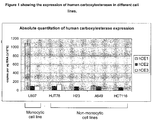
- PCR-specific primers were used to PCR-amplify hCE-1, ⁇ 2 and -3 from human cDNA. PCR products were cloned into a plasmid vector and sequence-verified. They were then serially diluted for use as standard curves in real-time PCR reactions. Total RNA was extracted from various human cell lines and cDNA prepared. To quantitate absolute levels of hCE's in the cell lines, gene expression levels were compared to the cloned PCR product standards in a real-time SYBR Green PCR assay. Figure 1 shows that hCE-1 is only expressed to a significant amount in a monocytic cell line.
- Table 4 Comparison of cell proliferation and ester cleavage for a monocytic and a non monocytic cell line.
- HDAC U937 Monitoring cell line
- HCT116 non-monocytic cell line
- Compound Cell proliferation IC50 nM Acid produced 1 ng/ml
- Cell proliferation IC50 nM Acid produced 1 ng/ml
- Unmodified Modulator Compound (7) 400 Not applicable 700 Not applicable Modified Modulator Compound (24) 60 110 2100 1 1
Landscapes
- Chemical & Material Sciences (AREA)
- Organic Chemistry (AREA)
- Health & Medical Sciences (AREA)
- Animal Behavior & Ethology (AREA)
- Medicinal Chemistry (AREA)
- Pharmacology & Pharmacy (AREA)
- Life Sciences & Earth Sciences (AREA)
- General Health & Medical Sciences (AREA)
- Public Health (AREA)
- Veterinary Medicine (AREA)
- Bioinformatics & Cheminformatics (AREA)
- Engineering & Computer Science (AREA)
- Epidemiology (AREA)
- General Chemical & Material Sciences (AREA)
- Chemical Kinetics & Catalysis (AREA)
- Nuclear Medicine, Radiotherapy & Molecular Imaging (AREA)
- Pain & Pain Management (AREA)
- Rheumatology (AREA)
- Pharmaceuticals Containing Other Organic And Inorganic Compounds (AREA)
- Medicines That Contain Protein Lipid Enzymes And Other Medicines (AREA)
- Medicinal Preparation (AREA)
- Nitrogen Condensed Heterocyclic Rings (AREA)
- Preparation Of Compounds By Using Micro-Organisms (AREA)
- Acyclic And Carbocyclic Compounds In Medicinal Compositions (AREA)
- Organic Low-Molecular-Weight Compounds And Preparation Thereof (AREA)
- Quinoline Compounds (AREA)
- Thiazole And Isothizaole Compounds (AREA)
- Pyridine Compounds (AREA)
- Peptides Or Proteins (AREA)
- Measuring Or Testing Involving Enzymes Or Micro-Organisms (AREA)
Applications Claiming Priority (5)
| Application Number | Priority Date | Filing Date | Title |
|---|---|---|---|
| GB0509226A GB0509226D0 (en) | 2005-05-05 | 2005-05-05 | Enzyme and receptor modulation |
| US68054205P | 2005-05-13 | 2005-05-13 | |
| EP20080075301 EP1964578A3 (de) | 2005-05-05 | 2006-05-04 | Durch Carboxylesterase hydrolysierbare Alpha-Aminosäureester-Arzneikonjugate. |
| EP06727008.2A EP1877098B1 (de) | 2005-05-05 | 2006-05-04 | Durch carboxylesterase hydrolysierbare alpha-aminosäureester-arzneikonjugate |
| PCT/GB2006/001635 WO2006117567A2 (en) | 2005-05-05 | 2006-05-04 | Alpha aminoacid ester-drug conjugates hydrolysable by carboxylesterase |
Related Parent Applications (3)
| Application Number | Title | Priority Date | Filing Date |
|---|---|---|---|
| EP06727008.2A Division EP1877098B1 (de) | 2005-05-05 | 2006-05-04 | Durch carboxylesterase hydrolysierbare alpha-aminosäureester-arzneikonjugate |
| EP20080075301 Division EP1964578A3 (de) | 2005-05-05 | 2006-05-04 | Durch Carboxylesterase hydrolysierbare Alpha-Aminosäureester-Arzneikonjugate. |
| EP20080075301 Previously-Filed-Application EP1964578A3 (de) | 2005-05-05 | 2006-05-04 | Durch Carboxylesterase hydrolysierbare Alpha-Aminosäureester-Arzneikonjugate. |
Publications (1)
| Publication Number | Publication Date |
|---|---|
| EP3530290A1 true EP3530290A1 (de) | 2019-08-28 |
Family
ID=36609807
Family Applications (4)
| Application Number | Title | Priority Date | Filing Date |
|---|---|---|---|
| EP08075300.7A Expired - Lifetime EP1964577B1 (de) | 2005-05-05 | 2006-05-04 | Durch carboxylesterase hydrolysierbare alpha-aminosäureester-arzneikonjugate |
| EP06727008.2A Expired - Lifetime EP1877098B1 (de) | 2005-05-05 | 2006-05-04 | Durch carboxylesterase hydrolysierbare alpha-aminosäureester-arzneikonjugate |
| EP19156158.8A Withdrawn EP3530290A1 (de) | 2005-05-05 | 2006-05-04 | Durch carboxylesterase hydrolysierbare alpha-aminosäureester-arzneikonjugate |
| EP20080075301 Ceased EP1964578A3 (de) | 2005-05-05 | 2006-05-04 | Durch Carboxylesterase hydrolysierbare Alpha-Aminosäureester-Arzneikonjugate. |
Family Applications Before (2)
| Application Number | Title | Priority Date | Filing Date |
|---|---|---|---|
| EP08075300.7A Expired - Lifetime EP1964577B1 (de) | 2005-05-05 | 2006-05-04 | Durch carboxylesterase hydrolysierbare alpha-aminosäureester-arzneikonjugate |
| EP06727008.2A Expired - Lifetime EP1877098B1 (de) | 2005-05-05 | 2006-05-04 | Durch carboxylesterase hydrolysierbare alpha-aminosäureester-arzneikonjugate |
Family Applications After (1)
| Application Number | Title | Priority Date | Filing Date |
|---|---|---|---|
| EP20080075301 Ceased EP1964578A3 (de) | 2005-05-05 | 2006-05-04 | Durch Carboxylesterase hydrolysierbare Alpha-Aminosäureester-Arzneikonjugate. |
Country Status (11)
| Country | Link |
|---|---|
| US (5) | US20090215800A1 (de) |
| EP (4) | EP1964577B1 (de) |
| JP (2) | JP2008542196A (de) |
| KR (1) | KR101332904B1 (de) |
| AU (1) | AU2006243000B2 (de) |
| BR (1) | BRPI0610368A8 (de) |
| CA (1) | CA2607020C (de) |
| IL (1) | IL186091A0 (de) |
| MX (1) | MX2007013257A (de) |
| PL (1) | PL1877098T3 (de) |
| WO (1) | WO2006117567A2 (de) |
Families Citing this family (26)
| Publication number | Priority date | Publication date | Assignee | Title |
|---|---|---|---|---|
| GB0509223D0 (en) | 2005-05-05 | 2005-06-15 | Chroma Therapeutics Ltd | Enzyme inhibitors |
| GB0608823D0 (en) * | 2006-05-04 | 2006-06-14 | Chroma Therapeutics Ltd | Inhibitors of P13 kinase |
| GB0608854D0 (en) * | 2006-05-04 | 2006-06-14 | Chroma Therapeutics Ltd | P13 kinase inhibitors |
| GB0608821D0 (en) * | 2006-05-04 | 2006-06-14 | Chroma Therapeutics Ltd | DHFR enzyme inhibitors |
| NZ573348A (en) * | 2006-05-04 | 2012-01-12 | Chroma Therapeutics Ltd | p38 MAP KINASE INHIBITORS |
| GB0608822D0 (en) * | 2006-05-04 | 2006-06-14 | Chroma Therapeutics Ltd | Inhibitors of DHFR |
| GB0608837D0 (en) | 2006-05-04 | 2006-06-14 | Chroma Therapeutics Ltd | Inhibitors of MAP kinase |
| GB0619753D0 (en) | 2006-10-06 | 2006-11-15 | Chroma Therapeutics Ltd | Enzyme inhibitors |
| JP5043120B2 (ja) | 2006-10-30 | 2012-10-10 | クロマ セラピューティクス リミテッド | ヒストンデアセチラーゼの阻害剤としてのヒドロキサメート |
| GB0622084D0 (en) | 2006-11-06 | 2006-12-13 | Chroma Therapeutics Ltd | Inhibitors of HSP90 |
| US20100267774A1 (en) * | 2007-11-07 | 2010-10-21 | Chroma Therapeutics Ltd. | P38 map kinase inhibitors |
| GB0803747D0 (en) * | 2008-02-29 | 2008-04-09 | Martin | Enzyme and receptor modulation |
| JP5555186B2 (ja) * | 2008-02-29 | 2014-07-23 | クロマ セラピューティクス リミテッド | p38MAPキナーゼ阻害剤 |
| GB0903480D0 (en) | 2009-02-27 | 2009-04-08 | Chroma Therapeutics Ltd | Enzyme Inhibitors |
| WO2010144696A1 (en) | 2009-06-11 | 2010-12-16 | Burnham Institute For Medical Research | Directed differentiation of stem cells |
| US9556426B2 (en) | 2009-09-16 | 2017-01-31 | Celgene Avilomics Research, Inc. | Protein kinase conjugates and inhibitors |
| AU2010339456A1 (en) | 2009-12-30 | 2012-07-05 | Celgene Avilomics Research, Inc. | Ligand-directed covalent modification of protein |
| GB201009853D0 (en) | 2010-06-11 | 2010-07-21 | Chroma Therapeutics Ltd | HSP90 inhibitors |
| GB201211310D0 (en) | 2012-06-26 | 2012-08-08 | Chroma Therapeutics Ltd | CSF-1R kinase inhibitors |
| CA2888928C (en) | 2012-10-17 | 2020-05-26 | Macrophage Pharma Limited | Tert-butyl n-[2-{4-[6-amino-5-(2,4-difluorobenzoyl)-2-oxopyridin-1(2h)-yl]-3,5- difluorophenyl}ethyl]-l-alaninate or a salt, hydrate or solvate thereof |
| GB201504694D0 (en) * | 2015-03-19 | 2015-05-06 | Glaxosmithkline Ip Dev Ltd | Covalent conjugates |
| WO2017216297A1 (en) | 2016-06-16 | 2017-12-21 | Glaxosmithkline Intellectual Property Development Limited | Dosage regimen |
| US10256877B2 (en) * | 2017-08-02 | 2019-04-09 | Qualcomm Incorporated | Apparatus and methods for beam refinement |
| GB201713975D0 (en) | 2017-08-31 | 2017-10-18 | Macrophage Pharma Ltd | Medical use |
| CN111303024B (zh) * | 2018-12-12 | 2023-03-28 | 安徽中科拓苒药物科学研究有限公司 | 一种喹啉结构的pan-KIT激酶抑制剂及其用途 |
| WO2024208705A1 (en) | 2023-04-02 | 2024-10-10 | The Francis Crick Institute Limited | Inhibitors of ets2-activating molecules for the treatment of inflammatory diseases |
Citations (4)
| Publication number | Priority date | Publication date | Assignee | Title |
|---|---|---|---|---|
| GB1345502A (en) | 1972-07-06 | 1974-01-30 | Parke Davis & Co | Quinazoline compounds and processes for their production |
| US6143764A (en) | 1995-11-07 | 2000-11-07 | Kirin Beer Kabushiki Kaisha | Quinoline and quinazoline derivatives inhibiting platelet-derived growth factor receptor autophosphorylation and pharmaceutical compositions containing the same |
| WO2003072552A1 (en) | 2002-02-22 | 2003-09-04 | Teva Pharmaceutical Industries Ltd. | Method for preparing benzisoxazole methane sulfonyl chloride and its amidation to form zonisamide |
| WO2003076405A1 (en) | 2002-03-14 | 2003-09-18 | Bayer Healthcare Ag | Monocyclic aroylpyridinones as antiinflammatory agents |
Family Cites Families (24)
| Publication number | Priority date | Publication date | Assignee | Title |
|---|---|---|---|---|
| US4725687A (en) * | 1986-04-28 | 1988-02-16 | Southern Research Institute | 5-methyl-5-deaza analogues of methotrexate and N10 -ethylaminopterin |
| US5175153A (en) * | 1987-11-30 | 1992-12-29 | Warner-Lambert Company | Substituted alpha-amino acids having pharmaceutical activity |
| US5331006A (en) * | 1990-08-31 | 1994-07-19 | Warner-Lambert Company | Amino acid analogs as CCK antagonists |
| AU666416B2 (en) * | 1993-01-29 | 1996-02-08 | Tanabe Seiyaku Co., Ltd. | Ellipticine derivative and process for preparing the same |
| US5480906A (en) * | 1994-07-01 | 1996-01-02 | Eli Lilly And Company | Stereochemical Wortmannin derivatives |
| CA2370267A1 (en) * | 1999-04-09 | 2000-10-19 | Basf Aktiengesellschaft | Prodrugs of thrombin inhibitors |
| US6448256B1 (en) * | 1999-05-24 | 2002-09-10 | University Of Massachusetts | Antibiotic prodrugs |
| MXPA02002505A (es) * | 1999-09-08 | 2004-09-10 | Sloan Kettering Inst Cancer | Nueva clase de agentes de citodiferenciacion e inhibidores de histona desacetilasa y metodos de utilizacion de los mismos. |
| WO2002039997A2 (en) * | 2000-11-01 | 2002-05-23 | Millennium Pharmaceuticals, Inc. | Ace-2 modulating compounds and use thereof |
| AR038703A1 (es) * | 2002-02-28 | 2005-01-26 | Novartis Ag | Derivados de 5-feniltiazol y uso como inhibidor de quinasa p i 3 |
| NZ550185A (en) * | 2002-03-04 | 2008-10-31 | Merck Hdac Res Llc | Methods of inducing terminal differentiation Methods of inducing terminal differentiation |
| CA2504460A1 (en) | 2002-11-12 | 2004-05-27 | Peter G. Klimko | Histone deacetylase inhibitors for the treatment of ocular neovascular or edematous disorders and diseases |
| CA2534342C (en) * | 2003-07-29 | 2016-05-10 | V. Ravi Chandran | Amino acid prodrugs |
| EP1677785A1 (de) * | 2003-10-22 | 2006-07-12 | Arpida A/S | Benzimidazol-derivate und ihre verwendung als peptid-deformylase-hemmer |
| EP1718145A4 (de) * | 2004-02-02 | 2012-03-07 | Biosight Ltd | Konjugate für die krebstherapie und -diagnose |
| US7205330B2 (en) * | 2004-02-27 | 2007-04-17 | Schering Corporation | Inhibitors of hepatitis C virus NS3 protease |
| EP1745022B1 (de) * | 2004-04-05 | 2014-08-13 | Aton Pharma, Inc. | Prodrugs von histondeacetylaseinhibitoren |
| ATE381566T1 (de) * | 2004-05-14 | 2008-01-15 | Millennium Pharm Inc | Verbindungen und verfahren zur inhibierung der mitotischen progression durch hemmung von aurorakinase |
| GB0509223D0 (en) * | 2005-05-05 | 2005-06-15 | Chroma Therapeutics Ltd | Enzyme inhibitors |
| GB0509227D0 (en) * | 2005-05-05 | 2005-06-15 | Chroma Therapeutics Ltd | Intracellular enzyme inhibitors |
| GB0509225D0 (en) * | 2005-05-05 | 2005-06-15 | Chroma Therapeutics Ltd | Inhibitors of enzymatic activity |
| GB0509224D0 (en) * | 2005-05-05 | 2005-06-15 | Chroma Therapeutics Ltd | Inhibitors of intracellular enzymatic activity |
| GB0619753D0 (en) * | 2006-10-06 | 2006-11-15 | Chroma Therapeutics Ltd | Enzyme inhibitors |
| GB0621830D0 (en) * | 2006-11-02 | 2006-12-13 | Chroma Therapeutics Ltd | Inhibitors of p38 mitogen-activated protein kinase |
-
2006
- 2006-05-04 EP EP08075300.7A patent/EP1964577B1/de not_active Expired - Lifetime
- 2006-05-04 EP EP06727008.2A patent/EP1877098B1/de not_active Expired - Lifetime
- 2006-05-04 JP JP2008509506A patent/JP2008542196A/ja active Pending
- 2006-05-04 PL PL06727008T patent/PL1877098T3/pl unknown
- 2006-05-04 KR KR1020077023742A patent/KR101332904B1/ko not_active Expired - Fee Related
- 2006-05-04 MX MX2007013257A patent/MX2007013257A/es active IP Right Grant
- 2006-05-04 BR BRPI0610368A patent/BRPI0610368A8/pt not_active Application Discontinuation
- 2006-05-04 US US11/918,138 patent/US20090215800A1/en not_active Abandoned
- 2006-05-04 CA CA2607020A patent/CA2607020C/en not_active Expired - Lifetime
- 2006-05-04 WO PCT/GB2006/001635 patent/WO2006117567A2/en not_active Ceased
- 2006-05-04 AU AU2006243000A patent/AU2006243000B2/en not_active Ceased
- 2006-05-04 EP EP19156158.8A patent/EP3530290A1/de not_active Withdrawn
- 2006-05-04 EP EP20080075301 patent/EP1964578A3/de not_active Ceased
-
2007
- 2007-09-20 IL IL186091A patent/IL186091A0/en unknown
-
2013
- 2013-07-02 JP JP2013139093A patent/JP2013241423A/ja active Pending
-
2014
- 2014-10-07 US US14/508,248 patent/US20150126534A1/en not_active Abandoned
-
2017
- 2017-07-14 US US15/650,031 patent/US20180000952A1/en not_active Abandoned
-
2019
- 2019-01-24 US US16/255,947 patent/US20190231887A1/en not_active Abandoned
-
2021
- 2021-05-21 US US17/326,470 patent/US20210361772A1/en not_active Abandoned
Patent Citations (4)
| Publication number | Priority date | Publication date | Assignee | Title |
|---|---|---|---|---|
| GB1345502A (en) | 1972-07-06 | 1974-01-30 | Parke Davis & Co | Quinazoline compounds and processes for their production |
| US6143764A (en) | 1995-11-07 | 2000-11-07 | Kirin Beer Kabushiki Kaisha | Quinoline and quinazoline derivatives inhibiting platelet-derived growth factor receptor autophosphorylation and pharmaceutical compositions containing the same |
| WO2003072552A1 (en) | 2002-02-22 | 2003-09-04 | Teva Pharmaceutical Industries Ltd. | Method for preparing benzisoxazole methane sulfonyl chloride and its amidation to form zonisamide |
| WO2003076405A1 (en) | 2002-03-14 | 2003-09-18 | Bayer Healthcare Ag | Monocyclic aroylpyridinones as antiinflammatory agents |
Non-Patent Citations (17)
| Title |
|---|
| BERTINO J, J.CIN. ONCOL., vol. 11, 1993, pages 5 - 14 |
| CAHARD D ET AL: "Aryloxy phosphoramidate triesters as pro-tides", MINI-REVIEWS IN MEDICINAL CHEMISTRY 2004 NETHERLANDS, vol. 4, no. 4, 2004, pages 371 - 381, XP008076430, ISSN: 1389-5575 * |
| CONELL, N.ENG J. MED., vol. 350, 2004, pages 2591 - 2602 |
| CRONSTEIN N., PHARMACOL. REV., vol. 57, pages 163 - 1723 |
| DIGNAM JD, NUCL. ACID. RES., vol. 11, 1983, pages 1475 - 1489 |
| DRUG DISC., vol. 10, 2005, pages 313 - 325 |
| GANGJEE ET AL., J.MED.CHEM., vol. 36, 1993, pages 3437 - 3443 |
| KRIGE DAVID ET AL: "CHR-2797: an antiproliferative aminopeptidase inhibitor that leads to amino acid deprivation in human leukemic cells", CANCER RESEARCH, AMERICAN ASSOCIATION FOR CANCER RESEARCH, AACR ANNUAL MEETING 2018; APRIL 14-18, 2018; CHICAGO, IL, vol. 68, no. 16, 15 August 2008 (2008-08-15), pages 6669 - 6679, XP002537080, ISSN: 1538-7445, DOI: 10.1158/0008-5472.CAN-07-6627 * |
| LEE W A ET AL: "SELECTIVE INTRACELLULAR ACTIVATION OF A NOVEL PRODRUG OF THE HUMAN IMMUNODEFICIENCY VIRUS REVERSE TRANSCRIPTASE INHIBITOR TENOFOVIR LEADS TO PREFERENTIAL DISTRIBUTION AND ACCUMULATION IN LYMPHATIC TISSUE", ANTIMICROBIAL AGENTS AND CHEMOTHERAPY, AMERICAN SOCIETY FOR MICROBIOLOGY, WASHINGTON, DC, US, vol. 49, no. 5, May 2005 (2005-05-01), pages 1898 - 1906, XP008065032, ISSN: 0066-4804 * |
| NALDINICARRARO, CURR DRUG TARGETS INFLAMM ALLERGY, 2005, pages 3 - 8 |
| NEEDHAM LINDSEY A ET AL: "Drug targeting to monocytes and macrophages using esterase-sensitive chemical motifs", JOURNAL OF PHARMACOLOGY AND EXPERIMENTAL THERAPEUTICS, AMERICAN SOCIETY FOR PHARMACOLOGY AND EXPERIMENTAL THERAPEUTICS, US, vol. 339, no. 1, 1 October 2011 (2011-10-01), pages 132 - 142, XP002725170, ISSN: 0022-3565, DOI: 10.1124/JPET.111.183640 * |
| ORG. SYNTH. COL., vol. 3, 1955, pages 272 |
| PLOWE C., BMJ, vol. 328, 2004, pages 545 - 548 |
| POLSHAKOV, V.I. ET AL., PROTEIN SCI., vol. 8, 1999, pages 467 - 481 |
| SALTER A., REV. INFECT. DIS., vol. 4, 1982, pages 196 - 236 |
| SZETO D W ET AL: "Human thymidylate synthetase-III - Effects of methotrexate and folate analogs", BIOCHEMICAL PHARMACOLOGY, ELSEVIER, US, vol. 28, no. 17, 1 September 1979 (1979-09-01), pages 2633 - 2637, XP023719265, ISSN: 0006-2952, [retrieved on 19790901], DOI: 10.1016/0006-2952(79)90039-X * |
| VAN ROON ET AL., ARTHRITIS AND RHEUMATISM, 2003, pages 1229 - 1238 |
Also Published As
| Publication number | Publication date |
|---|---|
| EP1964577B1 (de) | 2016-04-13 |
| BRPI0610368A8 (pt) | 2015-09-08 |
| EP1964578A3 (de) | 2008-11-05 |
| EP1964577A3 (de) | 2008-11-05 |
| JP2013241423A (ja) | 2013-12-05 |
| US20190231887A1 (en) | 2019-08-01 |
| US20210361772A1 (en) | 2021-11-25 |
| PL1877098T3 (pl) | 2013-09-30 |
| BRPI0610368A2 (pt) | 2010-06-15 |
| CA2607020C (en) | 2015-01-13 |
| US20090215800A1 (en) | 2009-08-27 |
| EP1877098B1 (de) | 2013-04-24 |
| KR101332904B1 (ko) | 2013-11-26 |
| AU2006243000B2 (en) | 2011-05-26 |
| US20180000952A1 (en) | 2018-01-04 |
| US20150126534A1 (en) | 2015-05-07 |
| WO2006117567A3 (en) | 2007-08-30 |
| AU2006243000A1 (en) | 2006-11-09 |
| WO2006117567A2 (en) | 2006-11-09 |
| IL186091A0 (en) | 2008-01-20 |
| CA2607020A1 (en) | 2006-11-09 |
| EP1964578A2 (de) | 2008-09-03 |
| MX2007013257A (es) | 2008-01-21 |
| JP2008542196A (ja) | 2008-11-27 |
| EP1964577A2 (de) | 2008-09-03 |
| EP1877098A2 (de) | 2008-01-16 |
| KR20080003809A (ko) | 2008-01-08 |
Similar Documents
| Publication | Publication Date | Title |
|---|---|---|
| EP1964577B1 (de) | Durch carboxylesterase hydrolysierbare alpha-aminosäureester-arzneikonjugate | |
| Tenora et al. | Tumor-targeted delivery of 6-diazo-5-oxo-l-norleucine (DON) using substituted acetylated lysine prodrugs | |
| US9636409B2 (en) | Enzyme and receptor modulation using covalent conjugates of alpha,alpha-disubstituted glycine esters | |
| Landowski et al. | Floxuridine Amino Acid Ester Prodrugs: Enhancing Caco-2 Permeability and Resistance to Glycosidic Bond Metabolism: Landowski et al. | |
| US20050137141A1 (en) | Prodrug composition | |
| KR20110011694A (ko) | 간보호제 아세트아미노펜 공통 프로드러그 | |
| CN101039701A (zh) | 含有生物可裂解二硫化物连接物的前药和共药 | |
| US20260034096A1 (en) | Sirtuin 6 protein deacylase (sirt6) activators | |
| ES2415244T3 (es) | Conjugados de éster de aminoácido alfa-fármaco hidrolizables mediante carboxilesterasa | |
| US20040058854A1 (en) | Use as medicine of a compound restoring active principles in vivo | |
| CN114621120B (zh) | 一种don前药分子、前药激活化合物和前药激活体系 | |
| Siciliano | Innovative approaches for targeted therapy and sustainable processes for API synthesis | |
| Jain et al. | CURRANT REVIEW ON SYNTHESIS OF PRODRUG AND ITS APPLICATION |
Legal Events
| Date | Code | Title | Description |
|---|---|---|---|
| PUAI | Public reference made under article 153(3) epc to a published international application that has entered the european phase |
Free format text: ORIGINAL CODE: 0009012 |
|
| STAA | Information on the status of an ep patent application or granted ep patent |
Free format text: STATUS: REQUEST FOR EXAMINATION WAS MADE |
|
| 17P | Request for examination filed |
Effective date: 20190208 |
|
| AC | Divisional application: reference to earlier application |
Ref document number: 1964578 Country of ref document: EP Kind code of ref document: P Ref document number: 1877098 Country of ref document: EP Kind code of ref document: P |
|
| AK | Designated contracting states |
Kind code of ref document: A1 Designated state(s): AT BE BG CH CY CZ DE DK EE ES FI FR GB GR HU IE IS IT LI LT LU LV MC NL PL PT RO SE SI SK TR |
|
| STAA | Information on the status of an ep patent application or granted ep patent |
Free format text: STATUS: THE APPLICATION IS DEEMED TO BE WITHDRAWN |
|
| 18D | Application deemed to be withdrawn |
Effective date: 20221201 |