EP3530490B1 - Verfahren zur herstellung eines spikes und solch ein spike selbst - Google Patents
Verfahren zur herstellung eines spikes und solch ein spike selbst Download PDFInfo
- Publication number
- EP3530490B1 EP3530490B1 EP19159272.4A EP19159272A EP3530490B1 EP 3530490 B1 EP3530490 B1 EP 3530490B1 EP 19159272 A EP19159272 A EP 19159272A EP 3530490 B1 EP3530490 B1 EP 3530490B1
- Authority
- EP
- European Patent Office
- Prior art keywords
- section
- stud pin
- supporting part
- blind hole
- stud
- Prior art date
- Legal status (The legal status is an assumption and is not a legal conclusion. Google has not performed a legal analysis and makes no representation as to the accuracy of the status listed.)
- Active
Links
Images





Classifications
-
- B—PERFORMING OPERATIONS; TRANSPORTING
- B60—VEHICLES IN GENERAL
- B60C—VEHICLE TYRES; TYRE INFLATION; TYRE CHANGING; CONNECTING VALVES TO INFLATABLE ELASTIC BODIES IN GENERAL; DEVICES OR ARRANGEMENTS RELATED TO TYRES
- B60C11/00—Tyre tread bands; Tread patterns; Anti-skid inserts
- B60C11/14—Anti-skid inserts, e.g. vulcanised into the tread band
- B60C11/16—Anti-skid inserts, e.g. vulcanised into the tread band of plug form, e.g. made from metal, textile
-
- B—PERFORMING OPERATIONS; TRANSPORTING
- B60—VEHICLES IN GENERAL
- B60C—VEHICLE TYRES; TYRE INFLATION; TYRE CHANGING; CONNECTING VALVES TO INFLATABLE ELASTIC BODIES IN GENERAL; DEVICES OR ARRANGEMENTS RELATED TO TYRES
- B60C11/00—Tyre tread bands; Tread patterns; Anti-skid inserts
- B60C11/14—Anti-skid inserts, e.g. vulcanised into the tread band
- B60C11/16—Anti-skid inserts, e.g. vulcanised into the tread band of plug form, e.g. made from metal, textile
- B60C11/1675—Anti-skid inserts, e.g. vulcanised into the tread band of plug form, e.g. made from metal, textile with special shape of the plug- tip
-
- B—PERFORMING OPERATIONS; TRANSPORTING
- B60—VEHICLES IN GENERAL
- B60C—VEHICLE TYRES; TYRE INFLATION; TYRE CHANGING; CONNECTING VALVES TO INFLATABLE ELASTIC BODIES IN GENERAL; DEVICES OR ARRANGEMENTS RELATED TO TYRES
- B60C11/00—Tyre tread bands; Tread patterns; Anti-skid inserts
- B60C11/14—Anti-skid inserts, e.g. vulcanised into the tread band
- B60C11/16—Anti-skid inserts, e.g. vulcanised into the tread band of plug form, e.g. made from metal, textile
- B60C11/1693—Attachment of the plug-tip within the plug-body
Definitions
- the invention relates to method for producing an anti-skid stud comprising a supporting part and a stud pin that is partly arranged in a blind hole in the supporting part as defined in the preamble of independent claim 1.
- the invention also relates to an anti-skid stud comprising a supporting part and a stud pin that is partly arranged in a blind hole in the supporting part as defined in the preamble of independent claim 13.
- Anti-skid studs having a supporting part made of polymer are known in the art.
- Publication US 3,837,386 presents an anti-skid stud for tires having a stud body of plastic material.
- Publication SE 7205629 presents an anti-skid stud having a supporting part made of plastic.
- Publication DE 10 2013 113 043 A1 presents an anti-skid stud having a supporting part made of plastic.
- WO 2017/1983532 presents a stud for a pneumatic vehicle tire and a method for producing a stud.
- This known stud has a stud body made from a plastic which contains reinforcing fibres, and a stud pin made from hard metal which is positioned in the stud body and protrudes out of the stud body.
- the stud body has a main body part and a base part which protrudes laterally beyond the main body part.
- the stud pin reaches in the stud body substantially as far as the level of the base part, and has a pin shank with at least one anchoring element which widens the radially inner end region of the pin shank, wherein the reinforcing fibres in the central region of the base part are oriented mainly and substantially perpendicularly with respect to the stud pin.
- This know stud is produced so that the stud pin is positioned in a casting form so that the stud pin projects out of the casting form and so that a cavity is formed around the stud pin in the casting form. Liquid plastic material containing reinforcing fibers is thereafter injected into the cavity around the stud pin in the casting form to form the stud body made from a plastic which contains reinforcing fibres.
- Document GB 1,063,936 and document RU 2 148 498 C1 presents tire studs, wherein RU 2 148 498 C1 is showing the features of the preamble of independent claims 1 and 12.
- the object of the invention is to provide a new and innovative method for producing antskid studs and correspondingly to provide an anti-skid stud.
- the anti-skid stud of the invention is correspondingly characterized by the definitions of independent claim 12.
- Preferred embodiments of the anti-skid stud are defined in the dependent claims 13 to 20.
- the method comprises providing a supporting part 1 that is made of elastic or of elastically deformable material such as of polymer and that has a blind hole 3.
- the elastic or elastically deformable material is essentially homogenous and/or is, free of fibers.
- An advantage of such material is the capably to deform elastically without breaking.
- the method comprises providing a stud pin 2 having a proximal end 4 and a distal end 5.
- the stud pin 2 can be made of or comprise hard material such as metal, and comprises preferably, but not necessarily, hard metal such as tungsten carbide and/or other carbides.
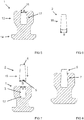
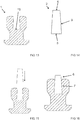
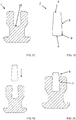
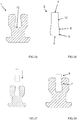
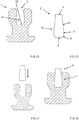
- the stud pin 2 that is provided comprises a protruding grip section 6 and an insertion section 7 having at least one first holding section 16.
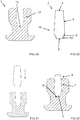
- the insertion section 7 of the stud pin 2 has one first holding section 16 and in the eleventh embodiment illustrated in figures 41 to 44 , the insertion section 7 of the stud pin 2 has two first holding sections 16.
- the blind hole 3 of the supporting part 1 that is provided has a bottom 15 and a second holding section 17.
- the second holding section 17 has a smallest cross-section A that is smaller than a largest cross section B of the first holding section 16 of the insertion section 7 of the stud pin 2 that is provided.
- the method comprises providing at least one of i) the insertion section 7 of the stud pin 2 with a first tapering section 9 that tapers for example in a beveled and/or rounded manner toward the distal end 5 of the stud pin 2, and ii) a mouth 18 of the blind hole 3 of the supporting part 1 with a beveled and/or rounded edge.
- a first tapering section 9 is provided, but the mouth 18 of the blind hole 3 is not provided with a beveled and/or rounded edge.
- no first tapering section is provided, but the mouth 18 of the blind hole 3 is provided with a beveled edge 3.
- a first tapering section 9 is provided, and the mouth 18 of the blind hole 3 is provided with a beveled and/or rounded edge
- the method comprises pressing the insertion section 7 of the stud pin 2 into the blind hole 3 of the supporting part 1 with the distal end 5 of the stud pin 2 leading the insertion section 7 of the stud pin 2 so that said largest cross section B of the first holding section 16 of the stud pin 2 at least partly passes said smallest cross-section A of the second holding section 17 of the blind hole 3 of the supporting part 1. Because the supporting part 1 is made of elastic or elastically deformable material, the largest cross section B of the first holding section 16 of the stud pin 2 can at least partly pass the smallest cross-section A of the second holding section 17 of the blind hole 3 of the supporting part 1.
- a purpose of the first tapering section 9 of the insertion section 7 of the stud pin 2 and/or of the beveled or rounded edge of the mouth 18 of the blind hole 3 of the supporting part 1 is to enable pressing of the stud pin 2 into the blind hole 3 of the supporting part 1.
- the insertion section 7 of the stud pin 2 can be provided with a first holding section 16 in the form of a first enlargement (nor marked with a reference numeral), as is the case in the embodiments shown in the figures and the blind hole 3 of the supporting part 1 can be provided with a second holding section 17 in the form of a second enlargement (nor marked with a reference numeral), as is the case in the first to ninth embodiment illustrated in figures 1 to 36 and in the thirteenth embodiment illustrated in figures 49 to 52 .
- pressing of the insertion section 7 of the stud pin 2 into the blind hole 2 of the supporting part 1 causes the largest cross section B of the first holding section 16 of the stud pin 2 to pass the smallest cross-section A of the second holding section 17 of the blind hole 3 of the supporting part 1.
- the insertion section 7 of the stud pin 2 can be provided with a first holding section 16 in the form of a first enlargement (nor marked with a reference numeral), as is the case in the embodiments shown in the figures and the cross-section of the blind hole 3 of the supporting part 1 can be essentially the same throughout the blind hole 3 of the supporting part 1, as is the case in the tenth to twelfth embodiment illustrated in figures 37 to 48 .
- pressing of the insertion section 7 of the stud pin 2 into the blind hole 2 of the supporting part 1 causes the largest cross section B of the first holding section 16 of the stud pin 2 to only partly pass the smallest cross-section A of the second holding section 17 of the blind hole 3 of the supporting part 1.
- the supporting part 1 is made of elastic or elastically deformable material, the first holding section 16 of the insertion section 7 of the stud pin 2 will cause an enlargement in the blind hole 3 of the supporting part 1.
- the first holding section 16 of the insertion section 7 of the stud pin 2 that is provided can have a second tapering section 8 that tapers towards the proximal end 4 of the stud pin 2, as is the case in the embodiments illustrated in figures 1 to 32 and in figures 45 to 52 .
- the insertion section 7 of the stud pin 2 that is provided is between the first holding section 16 and the protruding grip section 6 comprise a top section 12, which cross section is essentially the same throughout the top section as illustrated in the embodiments illustrated in figures 33 to 40 .
- the form and the dimensions of at least a part of the blind hole 3 of the supporting part 1 that is provided corresponds preferably, but not necessarily, essentially to the form and to the dimensions of at least a part of the insertion section 7 of the stud pin 2. This provides for a tight fit between the insertion section 7 of the stud pin 2 and the blind hole 3 of the supporting part 1, which extends the service-life of the anti-skid stud, because the stud pin 2 is well-retained in the supporting part 1.
- the method can comprise pressing the insertion section 7 of the stud pin 2 into the blind hole 3 of the supporting part 1 with the distal end 5 leading the stud pin 2 until the distal end 5 of the stud pin 2 abuts the bottom 15 of the blind hole 3 and until the protruding grip section 6 of the stud pin 2 is located outside the blind hole 3, as in the embodiments illustrated in figures 1 to 48 .
- An advantage of this is that the stud pin 2 is then prevented from sinking deeper into the blind hole 3 of the supporting part 1.
- the method can comprise pressing the insertion section 7 of the stud pin 2 into the blind hole 3 of the supporting part 1 with the distal end 5 leading the stud pin 2 until the distal end 5 of the stud pin 2 is at a distance from the bottom 15 of the blind hole 3 and until the protruding grip section 6 of the stud pin 2 is located outside the blind hole 3, as in the thirteenth embodiment illustrated in figures 49 to 52 .
- the first holding section 16 of the insertion section 7 of the stud pin 2 can together with the second holding section 17 of the blind hole 3 of the supporting part 1 be configured to prevent the stud pin 2 from sinking deeper into the blind hole 3 of the supporting part 1.
- An advantage of this embodiment is that the length of the stud pin 2 has then a smaller impact on the length of the protruding grip section 6 of the stud pin 2.
- the second section 9 of the insertion section 7 can extend directly from the distal end 5 in the stud pin 2 that is provided, as in the embodiments shown in figures 1 to 48 .
- the stud pin 2 that is provided can comprise a leading section 10 between the first tapering section 9 of the first holding section 16 of the insertion section 7 of the stud pin 2 and the distal end 5 of the stud pin 2, provided that the stud pin 2 is provided with such first tapering section 9, as in the thirteenth embodiment shown in figures 49 to 52 .
- the stud pin 2 that is provided can comprise a middle section 11 between the first tapering section 9 of the first holding section 16 of the insertion section 7 and the second tapering section 8 of the first holding section 16 of the insertion section 7, provided that the stud pin 2 comprises such first tapering section 9 and such second tapering section 8, as in the eight embodiment shown in figures 29 to 32 .
- the stud pin 2 that is provided can comprise a top section 12 between the second tapering section 8 of the insertion section 7 and the protruding grip section 6, provided that the stud pin 2 comprises such second tapering section 8, as in the seventh embodiment shown in figured 25 to 28.
- the second tapering section 8 of the insertion section 7 can extend directly from the protruding grip section 6 of the stud pin 2 that is provided, provided that the stud pin 2 comprises such second tapering section 8, as in the embodiments shown in figures 1 to 24 ,.
- the optional second tapering section 8 of the first holding section 16 of the insertion section 7 of the stud pin 2 can be in the form of a first truncated cone, and the optional first tapering section 9 of the first holding section 16 of the insertion section 7 of the stud pin 2 can be in the form of a second truncated cone.
- the insertion section 7 of the stud pin 2 that is provided can have a form enabling inserting the stud pin 2 only in one position into the blind hole 3 of the supporting part 1.
- the method can comprise providing the second holding section 17 of the blind hole 3 of the supporting part 1 with an undercut recess (not marked with a reference numeral), wherein the first holding section 16 of the insertion section 7 of the stud pin 2 is configured to latch into the undercut recess of the second holding section 17 of the blind hole 3 of the supporting part 1 when pressing the insertion section 7 of the stud pin 2 into the blind hole 3 of the supporting part 1.
- the method can comprise providing the supporting part 1 with a top flange 13 and with a bottom flange 14. This enhances keeping of the anti-skid stud in a tire, when the anti-skid stud is mounted in a recess in a tire.
- the supporting body can comprise a ridge or a tooth or a spline on the outer surface of the supporting body. Additionally or alternatively, the supporting part 1 can have an outer form diverging from the form of a solid of revolution An advantage of this is that the anti-skid stud is prevented from rotating a recess of the tire when mounted in a recess in a tire and the anti-skid stud is kept in a predetermined rotational position with respect to the tire. This also allows to insert the anti-skid stud into a recess in a tire with a machine in a predetermined position and promotes also retaining of the anti-skid stud in a tire.
- the method can comprise heating at least one of the supporting part 1 and the stud pin 2 prior pressing the insertion section 7 of the stud pin 2 into the blind hole 3 of the supporting part 1.
- anti-skid stud comprising a supporting part 1 and a stud pin 2 that is partly arranged in a blind hole 3 in the supporting part 1 and some variants and embodiments of the anti-skid stud will be described in greater detail.
- the anti-skid stud comprises a supporting part 1 that is made of elastic or of elastically deformable material such as of polymer and that has a blind hole 3, and a stud pin 2 having a proximal end 4 and a distal end 5.
- the stud pin 2 can be made of or comprise hard material such as metal, and comprises preferably, but not necessarily, hard metal such as tungsten carbide and/or other carbides.
- the elastic or elastically deformable material the supporting part 1 is substantially homogenous and/or free of fibers.
- An advantage of such material is the capably to deform elastically without breaking.
- the stud pin 2 comprises a protruding grip section 6 and an insertion section 7 having at least one first holding section 16.
- the insertion section 7 of the stud pin 2 has one first holding section 16 and in the eleventh embodiment illustrated in figures 41 to 44 , the insertion section 7 of the stud pin 2 has two first holding sections 16.
- the blind hole 3 of the supporting part 1 has a bottom 15 and a second holding section 17 having a smallest cross-section A that is smaller than a largest cross section B of the first holding section 16 of the insertion section 7 of the stud pin 2.
- At least one of the insertion section 7 of the stud pin 2 is provided with a first tapering section 9 that tapers for example in a beveled and/or rounded manner toward the distal end 5 of the stud pin 2 and a mouth 18 of the blind hole 3 of the supporting part 1 is provided with a beveled and/or rounded edge.
- a first tapering section 9 is provided, but the mouth 18 of the blind hole 3 is not provided with a beveled and/or rounded edge.
- no first tapering section is provided, but the mouth 18 of the blind hole 3 is provided with a beveled edge 3.
- a first tapering section 9 is provided, and the mouth 18 of the blind hole 3 is provided with a beveled and/or rounded edge
- Said insertion section 7 of the stud pin 2 is retained in the blind hole 3 of the supporting part 1 by a form-fit and/or press-fit connection between the insertion section 7 of the stud pin 2 and the blind hole 3 of the supporting part 1.
- a form-fit and press-fit connection is achieved by providing the blind hole 3 of the supporting part 1 and the insertion section 7 of the stud pin 2 with an at least partly matching design and by making the dimensions of the blind hole 3 of the supporting part 1 smaller than the dimensions of the insertion section 16 of the stud pin.
- Said largest cross section B of the first holding section 16 of the insertion section 7 of the stud pin 2 is arranged between the bottom 15 of the blind hole 3 of the supporting part 1 and said smallest cross-section A of the second holding section 17 of the blind hole 3 of the supporting part 1.
- a purpose of the first section 9 of the insertion section 7 of the stud pin 2 or of the beveled or rounded edge of the mouth 18 of the blind hole 3 of the supporting part 1 is to enable pressing of the stud pin 2 into the blind hole 3 of the supporting part 1, when manufacturing the anti-skid stud.
- the insertion section 7 of the stud pin 2 can be provided with a first holding section 16 in the form of a first enlargement (nor marked with a reference numeral), as is the case in the embodiments shown in the figures and the blind hole 3 of the supporting part 1 can be provided with a second holding section 17 in the form of a second enlargement (nor marked with a reference numeral), as is the case in the first to ninth embodiment illustrated in figures 1 to 36 and in the thirteenth embodiment illustrated in figures 49 to 52 .
- the largest cross section B of the first holding section 16 of the stud pin 2 is between the smallest cross-section A of the second holding section 17 of the blind hole 3 of the supporting part 1 and the bottom 15 of the blind hole 3 of the supporting part 1 in the anti-skid stud.
- the insertion section 7 of the stud pin 2 can be provided with a first holding section 16 in the form of a first enlargement (nor marked with a reference numeral), as is the case in the embodiments shown in the figures and the cross-section of the blind hole 3 of the supporting part 1 can be essentially the same throughout the blind hole 3 of the supporting part 1, as is the case in the tenth to twelfth embodiment illustrated in figures 37 to 48 .
- the largest cross section B of the first holding section 16 of the stud pin 2 can be considered to be at the smallest cross-section A of the second holding section 17 of the blind hole 3 of the supporting part 1. Because the supporting part 1 is made of elastic or elastically deformable material, the first holding section 16 of the insertion section 7 of the stud pin 2 will however cause an enlargement in the blind hole 3 of the supporting part 1.
- the first holding section 16 of the insertion section 7 of the stud pin 2 can have a second tapering section 8 that tapers towards the proximal end 4 of the stud pin 2, as in the embodiments illustrated in figures 1 to 32 and in figures 45 to 52 .
- the insertion section 7 of the stud pin 2 comprise between the first holding section 16 and the protruding grip section 6 a top section 12, which cross section is essentially the same throughout the top section as illustrated in the embodiments illustrated in figures 33 to 40 .
- the form and the dimensions of at least a part of the blind hole 3 of the supporting part 1 corresponding preferably, but not necessarily, essentially to the form and to the dimensions of at least a part of the insertion section 7 of the stud pin 2.
- the distal end 5 of the stud pin 2 can abut the bottom 15 of the blind hole 3 of the supporting part 1 so that the protruding grip section 6 of the stud pin 2 is located outside the blind hole 3 of the supporting part 1, as in the embodiments illustrated in figures 1 to 48 .
- the distal end 5 of the stud pin 2 can be located at a distance from the bottom 15 of the blind hole 3 of the supporting part 1 so that the protruding grip section 6 of the stud pin 2 is located outside the blind hole 3 of the supporting part 1, as in the embodiment illustrated in figures 49 to 52 .
- the stud pin 2 can comprise a leading section 10 between the first tapering section 9 of the first holding section 16 of the insertion section 7 of the stud pin 2 and the distal end 5 of the stud pin 2, provided that the stud pin 2 is provided with such first tapering section 9, as in the thirteenth embodiment shown in figures 49 to 52 .
- the stud pin 2 can comprise a middle section 11 between the first tapering section 9 of the first holding section 16 of the insertion section 7 and the second tapering section 8 of the first holding section 16 of the insertion section 7, provided that the stud pin 2 comprises such first tapering section 9 and such second tapering section 8, as in the eight embodiment shown in figures 29 to 32 .
- the stud pin 2 can comprise a top section 12 between the second tapering section 8 of the insertion section 7 and the protruding grip section 6, provided that the stud pin 2 comprises such second tapering section 8, as in the seventh embodiment shown in figured 25 to 28.
- the second tapering section 8 of the insertion section 7 can extend directly from the protruding grip section 6 of the stud pin 2 that is provided, provided that the stud pin 2 comprises such second tapering section 8, as in the embodiments shown in figures 1 to 24 and 29 to 32 and 45 to 52 .
- the optional second tapering section 8 of the first holding section 16 of the insertion section 7 of the stud pin 2 can be in the form of a first truncated cone, and the optional first tapering section 9 of the first holding section 16 of the insertion section 7 of the stud pin 2 can be in the form of a second truncated cone.
- the insertion section 7 of the stud pin 2 can have a form diverging from the form of a solid of revolution, and the protruding grip section 6 of the stud pin 2 can have a form diverging from the form of a solid of revolution.
- the insertion section 7 of the stud pin 2 can have the form of a solid of revolution
- the protruding grip section 6 of the stud pin 2 can have the form of a solid of revolution
- the blind hole 3 of the supporting part 1 can be provided with an undercut recess, and the first holding section 16 of the insertion section 7 of the stud pin 2 can be latched into the undercut recess in the blind hole 3 of the supporting part 1.
- the supporting part 1 can be provided with a top flange 13 and with a bottom flange 14. This enhances keeping of the anti-skid stud in a tire, then the anti-skid stud is mounted in a recess in a tire.
- the supporting body can comprise a ridge or a tooth or a spline on the outer surface of the supporting body. Additionally or alternatively, the supporting part 1 can have an outer form diverging from the form of a solid of revolution An advantage of this is that the anti-skid stud is prevented from rotating a recess of the tire when mounted in a recess in a tire and the anti-skid stud is kept in a predetermined rotational position with respect to the tire.
Landscapes
- Engineering & Computer Science (AREA)
- Mechanical Engineering (AREA)
- Tires In General (AREA)
Claims (20)
- Verfahren zur Herstellung eines Gleitschutzstifts, der ein Tragteil (1) und einen Verschleißstift (2), der teilweise in einer Blindbohrung (3) im Tragteil (1) angeordnet ist, umfasst, wobei das Verfahren umfasst:Bereitstellen eines Tragteils (1), das aus einem elastischen Material, das im Wesentlichen homogen und/oder frei von Fasern ist, wie einem Polymer, gefertigt ist und das eine Blindbohrung (3) aufweist, undBereitstellen eines Verschleißstifts (2) mit einem nahen Ende (4) und einem fernen Ende (5), wobei der Verschleißstift (2) so bereitgestellt wird, dass er einen vorspringenden Griffigkeitsabschnitt (6) und einen Einbauabschnitt (7) mit einem ersten Halterungsabschnitt (16) umfasst,wobei die Blindbohrung (3) des Tragteils (1) so bereitgestellt wird, dass sie einen Bohrungsgrund (15) und einen zweiten Halterungsbereich (17) mit einem kleinsten Querschnitt A umfasst, der kleiner ist als ein größter Querschnitt B des ersten Halterungsabschnitts (16) des Einbauabschnitts des bereitgestellten Verschleißstifts (2),wobei das Verfahren dadurch gekennzeichnet ist,dass i) der Einbauabschnitt (7) des Verschleißstifts (2) mit einem ersten abgeschrägten Abschnitt (9), der sich zum fernen Ende (5) des Verschleißstifts (2) hin verjüngt, und/oder ii) ein Mundloch (18) der Blindbohrung (3) des Tragteils (1) mit einer abgefasten und/oder abgerundeten Kante versehen wird,dass der Einbauabschnitt (7) des Verschleißstifts (2) mit dem fernen Ende (5) des Einbauabschnitts (7) des Verschleißstifts (2) voran in die Blindbohrung (3) des Tragteils (1) eingepresst wird, so dass der größte Querschnitt B des ersten Halterungsabschnitts (16) des Verschleißstifts (2) mindestens teilweise den kleinsten Querschnitt A des zweiten Halterungsabschnitts (17) der Blindbohrung (3) des Tragteils (1) passiert,dass der erste Halterungsabschnitt (16) des bereitgestellten Verschleißstifts (2) am fernen Ende (5) des Verschleißstifts (2) angeordnet wird, unddass der Einbauabschnitt (7) des bereitgestellten Verschleißstifts (2) zwischen dem ersten Halterungsabschnitt (16) des Verschleißstifts und dem vorspringenden Griffigkeitsabschnitt (6) des Verschleißstifts (2) einen oberen Abschnitt (12) aufweist, dessen Querschnitt über den gesamten oberen Abschnitt (12) hinweg im Wesentlichen gleich ist.
- Verfahren nach Anspruch 1, gekennzeichnet dadurch,
dass der erste Halterungsabschnitt (16) des Einbauabschnitts (7) des bereitgestellten Verschleißstifts (2) einen zweiten abgeschrägten Abschnitt (8) aufweist, der sich zum nahen Ende (4) des Verschleißstifts (2) hin verjüngt. - Verfahren nach Anspruch 1 oder 2, gekennzeichnet dadurch,
dass die Form und die Abmessungen mindestens eines Teils der Blindbohrung (3) des bereitgestellten Tragteils (1) im Wesentlichen der Form und den Abmessungen mindestens eines Teils des Einbauabschnitts (7) des Verschleißstifts (2) entsprechen. - Verfahren nach einem der Ansprüche 1 bis 3, gekennzeichnet dadurch,
dass der Einbauabschnitt (7) des Verschleißstifts (2) mit dem fernen Ende (5) des Verschleißstifts (2) voran in die Blindbohrung (3) des Tragteils (1) so weit eingepresst wird, dass das ferne Ende (5) des Verschleißstifts (2) am Bohrungsgrund (15) der Blindbohrung (3) anschlägt und der vorspringende Griffigkeitsabschnitt (6) des Verschleißstifts (2) außerhalb der Blindbohrung (3) angeordnet ist. - Verfahren nach einem der Ansprüche 1 bis 3, gekennzeichnet dadurch,
dass der Einbauabschnitt (7) des Verschleißstifts (2) mit dem fernen Ende (5) des Verschleißstifts (2) voran in die Blindbohrung (3) des Tragteils (1) so weit eingepresst wird, dass das ferne Ende (5) des Verschleißstifts (2) abständig zum Bohrungsgrund (15) der Blindbohrung (3) ist und der vorspringende Griffigkeitsabschnitt (6) des Verschleißstifts (2) außerhalb der Blindbohrung (3) angeordnet ist. - Verfahren nach einem der Ansprüche 1 bis 5, gekennzeichnet dadurch,
dass der Einbauabschnitt (7) des bereitgestellten Verschleißstifts (2) eine Form aufweist, die von der Form eines Rotationskörpers abweicht, und
dass der vorspringende Griffigkeitsabschnitt (6) des bereitgestellten Verschleißstifts (2) eine Form aufweist, die von der Form eines Rotationskörpers abweicht. - Verfahren nach einem der Ansprüche 1 bis 6, gekennzeichnet dadurch,
dass der Einbauabschnitt (7) des bereitgestellten Verschleißstifts (2) eine Form aufweist, die dafür sorgt, dass der Verschleißstift (2) nur in einer Stellung in die Blindbohrung (3) des Tragteils (1) eingesetzt werden kann. - Verfahren nach einem der Ansprüche 1 bis 7, gekennzeichnet dadurch,
dass die Blindbohrung (3) des Tragteils (1) mit einer hinterschnittenen Aussparung versehen wird, und
dass der erste Halterungsabschnitt (16) des Einbauabschnitts (7) des Verschleißstifts (2) so ausgelegt ist, dass er in die hinterschnittene Aussparung einrastet, wenn der Einbauabschnitt (7) des Verschleißstifts (2) in die Blindbohrung (3) des Tragteils (1) eingepresst wird. - Verfahren nach einem der Ansprüche 1 bis 8, gekennzeichnet dadurch,
dass das Tragteil (1) mit einer oberen Wange (13) und mit einer unteren Wange (14) versehen wird. - Verfahren nach einem der Ansprüche 1 bis 9, gekennzeichnet dadurch,
dass das Tragteil (1) und/oder der Verschleißstift (2) erhitzt werden, bevor der Einbauabschnitt (7) des Verschleißstifts (2) in die Blindbohrung (3) des Tragteils (1) eingepresst wird. - Verfahren nach einem der Ansprüche 1 bis 10, gekennzeichnet dadurch,
dass das elastische Material ein elastisch verformbares Material ist. - Gleitschutzstift, der ein Tragteil (1) und einen Verschleißstift (2), der teilweise in einer Blindbohrung (3) im Tragteil (1) angeordnet ist, umfasst, wobei der Gleitschutzstift umfasst:ein Tragteil (1), das aus einem elastischen Material, das im Wesentlichen homogen und/oder frei von Fasern ist, wie einem Polymer, gefertigt ist und das eine Blindbohrung (3) aufweist, undeinen Verschleißstift (2) mit einem nahen Ende (4) und einem fernen Ende (5),wobeider Verschleißstift (2) einen vorspringenden Griffigkeitsabschnitt (6) und einen Einbauabschnitt (7) mit einem ersten Halterungsabschnitt (16) umfasst,die Blindbohrung (3) des Tragteils (1) einen zweiten Halterungsabschnitt (17) mit einem kleinsten Querschnitt A umfasst, der kleiner ist als ein größter Querschnitt B des ersten Halterungsabschnitts (16) des Einbauabschnitts (7) des Verschleißstifts (2), wobei sich der größte Querschnitt B des ersten Halterungsabschnitts (16) des Einbauabschnitts (7) des Verschleißstifts (2) zwischen einem Bohrungsgrund (15) der Blindbohrung (3) des Tragteils (1) und dem kleinsten Querschnitt A des zweiten Halterungsabschnitts (17) der Blindbohrung (3) des Tragteils (1) befindet,wobei der Gleitschutzstift dadurch gekennzeichnet ist,dass i) der Einbauabschnitt (7) des Verschleißstifts (2) mit einem ersten abgeschrägten Abschnitt (9), der sich zum fernen Ende (5) des Verschleißstifts (2) hin verjüngt, versehen ist und/oder ii) ein Mundloch (18) der Blindbohrung (3) des Tragteils (1) mit einer abgefasten und/oder abgerundeten Kante versehen ist,dass der Einbauabschnitt (7) des Verschleißstifts (2) in der Blindbohrung (3) des Tragteils (1) durch eine formschlüssige Verbindung und/oder eine Einpressverbindung zwischen dem Einbauabschnitt (7) des Verschleißstifts (2) und der Blindbohrung (3) des Tragteils (1) gehalten wird,dass der erste Halterungsabschnitt (16) des Verschleißstifts (2) am fernen Ende (5) des Verschleißstifts (2) vorgesehen ist, unddass der Einbauabschnitt (7) des Verschleißstifts (2) zwischen dem ersten Halterungsabschnitt (16) des Verschleißstifts und dem vorspringenden Griffigkeitsabschnitt (6) des Verschleißstifts (2) einen oberen Abschnitt (12) aufweist, dessen Querschnitt über den gesamten oberen Abschnitt (12) hinweg im Wesentlichen gleich ist.
- Gleitschutzstift nach Anspruch 12, gekennzeichnet dadurch,
dass der erste Halterungsabschnitt (16) des Einbauabschnitts (7) des Verschleißstifts (2) einen zweiten abgeschrägten Abschnitt (8) aufweist, der sich zum nahen Ende (4) des Verschleißstifts (2) hin verjüngt. - Gleitschutzstift nach Anspruch 12 oder 13, gekennzeichnet dadurch,
dass die Form und die Abmessungen mindestens eines Teils der Blindbohrung (3) des Tragteils (1) im Wesentlichen der Form und den Abmessungen mindestens eines Teils des Einbauabschnitts (7) des Verschleißstifts (2) entsprechen. - Gleitschutzstift nach einem der Ansprüche 12 bis 14, gekennzeichnet dadurch,
dass das ferne Ende (5) des Verschleißstifts (2) am Bohrungsgrund (15) der Blindbohrung (3) des Tragteils (1) anschlägt und der vorspringende Griffigkeitsabschnitt (6) des Verschleißstifts (2) außerhalb der Blindbohrung (3) des Tragteils (1) angeordnet ist. - Gleitschutzstift nach einem der Ansprüche 12 bis 14, gekennzeichnet dadurch,
dass das ferne Ende (5) des Verschleißstifts (2) abständig zum Bohrungsgrund (15) der Blindbohrung (3) des Tragteils (1) angeordnet ist und der vorspringende Griffigkeitsabschnitt (6) des Verschleißstifts (2) außerhalb der Blindbohrung (3) des Tragteils (1) angeordnet ist. - Gleitschutzstift nach einem der Ansprüche 12 bis 16, gekennzeichnet dadurch,
dass der Einbauabschnitt (7) des Verschleißstifts (2) eine Form aufweist, die von der Form eines Rotationskörpers abweicht, und
dass der vorspringende Griffigkeitsabschnitt (6) des Verschleißstifts (2) eine Form aufweist, die von der Form eines Rotationskörpers abweicht. - Gleitschutzstift nach einem der Ansprüche 12 bis 17, gekennzeichnet dadurch,
dass der zweite Halterungsabschnitt (17) der Blindbohrung (3) des Tragteils (1) mit einer hinterschnittenen Aussparung versehen ist, und
dass der erste Halterungsabschnitt (16) des Einbauabschnitts (7) des Verschleißstifts (2) in die hinterschnittene Aussparung in der Blindbohrung (3) des Tragteils (1) einrastet. - Gleitschutzstift nach einem der Ansprüche 12 bis 18, gekennzeichnet dadurch,
dass der Tragkörper mit einer oberen Wange (13) und mit einer unteren Wange (14) versehen ist. - Gleitschutzstift nach einem der Ansprüche 12 bis 19, gekennzeichnet dadurch,
dass das elastische Material ein elastisch verformbares Material ist.
Applications Claiming Priority (1)
| Application Number | Priority Date | Filing Date | Title |
|---|---|---|---|
| FI20185176A FI128455B (en) | 2018-02-26 | 2018-02-26 | METHOD OF MANUFACTURING AND SLIDING A SLIDING PIN |
Publications (2)
| Publication Number | Publication Date |
|---|---|
| EP3530490A1 EP3530490A1 (de) | 2019-08-28 |
| EP3530490B1 true EP3530490B1 (de) | 2021-04-28 |
Family
ID=65598464
Family Applications (1)
| Application Number | Title | Priority Date | Filing Date |
|---|---|---|---|
| EP19159272.4A Active EP3530490B1 (de) | 2018-02-26 | 2019-02-26 | Verfahren zur herstellung eines spikes und solch ein spike selbst |
Country Status (2)
| Country | Link |
|---|---|
| EP (1) | EP3530490B1 (de) |
| FI (1) | FI128455B (de) |
Families Citing this family (1)
| Publication number | Priority date | Publication date | Assignee | Title |
|---|---|---|---|---|
| EP4375090B1 (de) | 2022-11-21 | 2025-07-30 | The Goodyear Tire & Rubber Company | Spike und reifen mit solch einem spike |
Family Cites Families (2)
| Publication number | Priority date | Publication date | Assignee | Title |
|---|---|---|---|---|
| GB1063936A (en) * | 1965-10-29 | 1967-04-05 | Kennametal Inc | Tire stud |
| RU2148498C1 (ru) * | 1998-03-30 | 2000-05-10 | ОАО"Нижнекамскшина" | Шип противоскольжения для шин транспортных средств |
-
2018
- 2018-02-26 FI FI20185176A patent/FI128455B/en active IP Right Grant
-
2019
- 2019-02-26 EP EP19159272.4A patent/EP3530490B1/de active Active
Non-Patent Citations (1)
| Title |
|---|
| None * |
Also Published As
| Publication number | Publication date |
|---|---|
| FI128455B (en) | 2020-05-29 |
| FI20185176A1 (en) | 2019-08-27 |
| EP3530490A1 (de) | 2019-08-28 |
Similar Documents
| Publication | Publication Date | Title |
|---|---|---|
| CN101566185B (zh) | 卡子 | |
| US6514024B2 (en) | Clip having retention members | |
| ES2930197T3 (es) | Conjunto de desgaste para excavadora | |
| US20130304136A1 (en) | Frangible fixing screw | |
| EP2540251B1 (de) | Herstellungsverfahren eines zahnärztlichen instruments zur wurzelkanalbehandlung | |
| EP3530490B1 (de) | Verfahren zur herstellung eines spikes und solch ein spike selbst | |
| US20080167652A1 (en) | Tool for making drill-holes in bones or removing cylindrical drill-hole cores from bones of the human body | |
| EP1018781A3 (de) | Speisehorn mit einem elliptischen offenen Ende | |
| KR102515893B1 (ko) | 크로스컨츄리 교환가능 판 시스템 | |
| US6223384B1 (en) | Trowel with a handle | |
| JP2014514512A (ja) | 接続プラグを備えたプラスチック導管用導管コネクタ | |
| DE102018111383A1 (de) | Ventilmembran, Membranventil, sowie Verfahren zum Befestigen eines in einem Gehäuse aufgenommenen Datenträgers | |
| DE19910277B4 (de) | Spinnrotor für Offenend-Spinnmaschinen | |
| US20030011236A1 (en) | Cutting tool with hardened insert | |
| BR112021008048B1 (pt) | Método de formação de um artigo de manufatura, artigo de manufatura e sistema para produção de corpos alongados | |
| CN103429195A (zh) | 用于更换受损伤的椎间盘的装置 | |
| EP3900669A1 (de) | Verfahren zur herstellung eines interdentalreinigungsinstruments | |
| KR102318474B1 (ko) | 펠트 바늘 및 적어도 하나의 펠트 바늘을 제조하는 방법 | |
| MX2011003406A (es) | Instrumento de escritura que comprende un organo de extremo montado por ajuste a presion. | |
| US10493716B2 (en) | Heat stake and method of eliminating heat stake sink marks in a plastic part | |
| CN210423338U (zh) | 圆销安装引导结构 | |
| CN110998043A (zh) | 止动锚件 | |
| CN210531378U (zh) | 金属螺杆及包含其的螺栓 | |
| EP1231041A1 (de) | Spritzgiessdüse zum Spritzgiessen von Kunstoffmaterialien | |
| EP1116889A2 (de) | Längsgeteilte Schraube |
Legal Events
| Date | Code | Title | Description |
|---|---|---|---|
| PUAI | Public reference made under article 153(3) epc to a published international application that has entered the european phase |
Free format text: ORIGINAL CODE: 0009012 |
|
| STAA | Information on the status of an ep patent application or granted ep patent |
Free format text: STATUS: THE APPLICATION HAS BEEN PUBLISHED |
|
| AK | Designated contracting states |
Kind code of ref document: A1 Designated state(s): AL AT BE BG CH CY CZ DE DK EE ES FI FR GB GR HR HU IE IS IT LI LT LU LV MC MK MT NL NO PL PT RO RS SE SI SK SM TR |
|
| AX | Request for extension of the european patent |
Extension state: BA ME |
|
| STAA | Information on the status of an ep patent application or granted ep patent |
Free format text: STATUS: REQUEST FOR EXAMINATION WAS MADE |
|
| 17P | Request for examination filed |
Effective date: 20200129 |
|
| RBV | Designated contracting states (corrected) |
Designated state(s): AL AT BE BG CH CY CZ DE DK EE ES FI FR GB GR HR HU IE IS IT LI LT LU LV MC MK MT NL NO PL PT RO RS SE SI SK SM TR |
|
| STAA | Information on the status of an ep patent application or granted ep patent |
Free format text: STATUS: EXAMINATION IS IN PROGRESS |
|
| 17Q | First examination report despatched |
Effective date: 20200626 |
|
| GRAP | Despatch of communication of intention to grant a patent |
Free format text: ORIGINAL CODE: EPIDOSNIGR1 |
|
| STAA | Information on the status of an ep patent application or granted ep patent |
Free format text: STATUS: GRANT OF PATENT IS INTENDED |
|
| INTG | Intention to grant announced |
Effective date: 20201209 |
|
| GRAS | Grant fee paid |
Free format text: ORIGINAL CODE: EPIDOSNIGR3 |
|
| GRAA | (expected) grant |
Free format text: ORIGINAL CODE: 0009210 |
|
| STAA | Information on the status of an ep patent application or granted ep patent |
Free format text: STATUS: THE PATENT HAS BEEN GRANTED |
|
| AK | Designated contracting states |
Kind code of ref document: B1 Designated state(s): AL AT BE BG CH CY CZ DE DK EE ES FI FR GB GR HR HU IE IS IT LI LT LU LV MC MK MT NL NO PL PT RO RS SE SI SK SM TR |
|
| REG | Reference to a national code |
Ref country code: GB Ref legal event code: FG4D |
|
| REG | Reference to a national code |
Ref country code: CH Ref legal event code: EP |
|
| REG | Reference to a national code |
Ref country code: AT Ref legal event code: REF Ref document number: 1386672 Country of ref document: AT Kind code of ref document: T Effective date: 20210515 |
|
| REG | Reference to a national code |
Ref country code: DE Ref legal event code: R096 Ref document number: 602019004119 Country of ref document: DE |
|
| REG | Reference to a national code |
Ref country code: IE Ref legal event code: FG4D |
|
| REG | Reference to a national code |
Ref country code: SE Ref legal event code: TRGR |
|
| REG | Reference to a national code |
Ref country code: LT Ref legal event code: MG9D |
|
| REG | Reference to a national code |
Ref country code: NO Ref legal event code: T2 Effective date: 20210428 |
|
| REG | Reference to a national code |
Ref country code: AT Ref legal event code: MK05 Ref document number: 1386672 Country of ref document: AT Kind code of ref document: T Effective date: 20210428 |
|
| PG25 | Lapsed in a contracting state [announced via postgrant information from national office to epo] |
Ref country code: NL Free format text: LAPSE BECAUSE OF FAILURE TO SUBMIT A TRANSLATION OF THE DESCRIPTION OR TO PAY THE FEE WITHIN THE PRESCRIBED TIME-LIMIT Effective date: 20210428 Ref country code: AT Free format text: LAPSE BECAUSE OF FAILURE TO SUBMIT A TRANSLATION OF THE DESCRIPTION OR TO PAY THE FEE WITHIN THE PRESCRIBED TIME-LIMIT Effective date: 20210428 Ref country code: BG Free format text: LAPSE BECAUSE OF FAILURE TO SUBMIT A TRANSLATION OF THE DESCRIPTION OR TO PAY THE FEE WITHIN THE PRESCRIBED TIME-LIMIT Effective date: 20210728 Ref country code: FI Free format text: LAPSE BECAUSE OF FAILURE TO SUBMIT A TRANSLATION OF THE DESCRIPTION OR TO PAY THE FEE WITHIN THE PRESCRIBED TIME-LIMIT Effective date: 20210428 Ref country code: LT Free format text: LAPSE BECAUSE OF FAILURE TO SUBMIT A TRANSLATION OF THE DESCRIPTION OR TO PAY THE FEE WITHIN THE PRESCRIBED TIME-LIMIT Effective date: 20210428 Ref country code: HR Free format text: LAPSE BECAUSE OF FAILURE TO SUBMIT A TRANSLATION OF THE DESCRIPTION OR TO PAY THE FEE WITHIN THE PRESCRIBED TIME-LIMIT Effective date: 20210428 |
|
| PG25 | Lapsed in a contracting state [announced via postgrant information from national office to epo] |
Ref country code: PL Free format text: LAPSE BECAUSE OF FAILURE TO SUBMIT A TRANSLATION OF THE DESCRIPTION OR TO PAY THE FEE WITHIN THE PRESCRIBED TIME-LIMIT Effective date: 20210428 Ref country code: LV Free format text: LAPSE BECAUSE OF FAILURE TO SUBMIT A TRANSLATION OF THE DESCRIPTION OR TO PAY THE FEE WITHIN THE PRESCRIBED TIME-LIMIT Effective date: 20210428 Ref country code: RS Free format text: LAPSE BECAUSE OF FAILURE TO SUBMIT A TRANSLATION OF THE DESCRIPTION OR TO PAY THE FEE WITHIN THE PRESCRIBED TIME-LIMIT Effective date: 20210428 Ref country code: PT Free format text: LAPSE BECAUSE OF FAILURE TO SUBMIT A TRANSLATION OF THE DESCRIPTION OR TO PAY THE FEE WITHIN THE PRESCRIBED TIME-LIMIT Effective date: 20210830 Ref country code: GR Free format text: LAPSE BECAUSE OF FAILURE TO SUBMIT A TRANSLATION OF THE DESCRIPTION OR TO PAY THE FEE WITHIN THE PRESCRIBED TIME-LIMIT Effective date: 20210729 Ref country code: IS Free format text: LAPSE BECAUSE OF FAILURE TO SUBMIT A TRANSLATION OF THE DESCRIPTION OR TO PAY THE FEE WITHIN THE PRESCRIBED TIME-LIMIT Effective date: 20210828 |
|
| REG | Reference to a national code |
Ref country code: NL Ref legal event code: MP Effective date: 20210428 |
|
| PG25 | Lapsed in a contracting state [announced via postgrant information from national office to epo] |
Ref country code: SK Free format text: LAPSE BECAUSE OF FAILURE TO SUBMIT A TRANSLATION OF THE DESCRIPTION OR TO PAY THE FEE WITHIN THE PRESCRIBED TIME-LIMIT Effective date: 20210428 Ref country code: ES Free format text: LAPSE BECAUSE OF FAILURE TO SUBMIT A TRANSLATION OF THE DESCRIPTION OR TO PAY THE FEE WITHIN THE PRESCRIBED TIME-LIMIT Effective date: 20210428 Ref country code: EE Free format text: LAPSE BECAUSE OF FAILURE TO SUBMIT A TRANSLATION OF THE DESCRIPTION OR TO PAY THE FEE WITHIN THE PRESCRIBED TIME-LIMIT Effective date: 20210428 Ref country code: DK Free format text: LAPSE BECAUSE OF FAILURE TO SUBMIT A TRANSLATION OF THE DESCRIPTION OR TO PAY THE FEE WITHIN THE PRESCRIBED TIME-LIMIT Effective date: 20210428 Ref country code: CZ Free format text: LAPSE BECAUSE OF FAILURE TO SUBMIT A TRANSLATION OF THE DESCRIPTION OR TO PAY THE FEE WITHIN THE PRESCRIBED TIME-LIMIT Effective date: 20210428 Ref country code: RO Free format text: LAPSE BECAUSE OF FAILURE TO SUBMIT A TRANSLATION OF THE DESCRIPTION OR TO PAY THE FEE WITHIN THE PRESCRIBED TIME-LIMIT Effective date: 20210428 Ref country code: SM Free format text: LAPSE BECAUSE OF FAILURE TO SUBMIT A TRANSLATION OF THE DESCRIPTION OR TO PAY THE FEE WITHIN THE PRESCRIBED TIME-LIMIT Effective date: 20210428 |
|
| REG | Reference to a national code |
Ref country code: DE Ref legal event code: R097 Ref document number: 602019004119 Country of ref document: DE |
|
| PLBE | No opposition filed within time limit |
Free format text: ORIGINAL CODE: 0009261 |
|
| STAA | Information on the status of an ep patent application or granted ep patent |
Free format text: STATUS: NO OPPOSITION FILED WITHIN TIME LIMIT |
|
| 26N | No opposition filed |
Effective date: 20220131 |
|
| PG25 | Lapsed in a contracting state [announced via postgrant information from national office to epo] |
Ref country code: IS Free format text: LAPSE BECAUSE OF FAILURE TO SUBMIT A TRANSLATION OF THE DESCRIPTION OR TO PAY THE FEE WITHIN THE PRESCRIBED TIME-LIMIT Effective date: 20210828 Ref country code: AL Free format text: LAPSE BECAUSE OF FAILURE TO SUBMIT A TRANSLATION OF THE DESCRIPTION OR TO PAY THE FEE WITHIN THE PRESCRIBED TIME-LIMIT Effective date: 20210428 |
|
| PG25 | Lapsed in a contracting state [announced via postgrant information from national office to epo] |
Ref country code: IT Free format text: LAPSE BECAUSE OF FAILURE TO SUBMIT A TRANSLATION OF THE DESCRIPTION OR TO PAY THE FEE WITHIN THE PRESCRIBED TIME-LIMIT Effective date: 20210428 |
|
| PG25 | Lapsed in a contracting state [announced via postgrant information from national office to epo] |
Ref country code: MC Free format text: LAPSE BECAUSE OF FAILURE TO SUBMIT A TRANSLATION OF THE DESCRIPTION OR TO PAY THE FEE WITHIN THE PRESCRIBED TIME-LIMIT Effective date: 20210428 |
|
| REG | Reference to a national code |
Ref country code: CH Ref legal event code: PL |
|
| REG | Reference to a national code |
Ref country code: BE Ref legal event code: MM Effective date: 20220228 |
|
| PG25 | Lapsed in a contracting state [announced via postgrant information from national office to epo] |
Ref country code: LU Free format text: LAPSE BECAUSE OF NON-PAYMENT OF DUE FEES Effective date: 20220226 |
|
| PG25 | Lapsed in a contracting state [announced via postgrant information from national office to epo] |
Ref country code: LI Free format text: LAPSE BECAUSE OF NON-PAYMENT OF DUE FEES Effective date: 20220228 Ref country code: IE Free format text: LAPSE BECAUSE OF NON-PAYMENT OF DUE FEES Effective date: 20220226 Ref country code: CH Free format text: LAPSE BECAUSE OF NON-PAYMENT OF DUE FEES Effective date: 20220228 |
|
| PG25 | Lapsed in a contracting state [announced via postgrant information from national office to epo] |
Ref country code: BE Free format text: LAPSE BECAUSE OF NON-PAYMENT OF DUE FEES Effective date: 20220228 |
|
| P01 | Opt-out of the competence of the unified patent court (upc) registered |
Effective date: 20230323 |
|
| P02 | Opt-out of the competence of the unified patent court (upc) changed |
Effective date: 20230404 |
|
| P02 | Opt-out of the competence of the unified patent court (upc) changed |
Effective date: 20230530 |
|
| GBPC | Gb: european patent ceased through non-payment of renewal fee |
Effective date: 20230226 |
|
| PG25 | Lapsed in a contracting state [announced via postgrant information from national office to epo] |
Ref country code: GB Free format text: LAPSE BECAUSE OF NON-PAYMENT OF DUE FEES Effective date: 20230226 |
|
| PG25 | Lapsed in a contracting state [announced via postgrant information from national office to epo] |
Ref country code: GB Free format text: LAPSE BECAUSE OF NON-PAYMENT OF DUE FEES Effective date: 20230226 |
|
| PG25 | Lapsed in a contracting state [announced via postgrant information from national office to epo] |
Ref country code: MK Free format text: LAPSE BECAUSE OF FAILURE TO SUBMIT A TRANSLATION OF THE DESCRIPTION OR TO PAY THE FEE WITHIN THE PRESCRIBED TIME-LIMIT Effective date: 20210428 Ref country code: CY Free format text: LAPSE BECAUSE OF FAILURE TO SUBMIT A TRANSLATION OF THE DESCRIPTION OR TO PAY THE FEE WITHIN THE PRESCRIBED TIME-LIMIT Effective date: 20210428 |
|
| PG25 | Lapsed in a contracting state [announced via postgrant information from national office to epo] |
Ref country code: HU Free format text: LAPSE BECAUSE OF FAILURE TO SUBMIT A TRANSLATION OF THE DESCRIPTION OR TO PAY THE FEE WITHIN THE PRESCRIBED TIME-LIMIT; INVALID AB INITIO Effective date: 20190226 |
|
| PG25 | Lapsed in a contracting state [announced via postgrant information from national office to epo] |
Ref country code: MT Free format text: LAPSE BECAUSE OF FAILURE TO SUBMIT A TRANSLATION OF THE DESCRIPTION OR TO PAY THE FEE WITHIN THE PRESCRIBED TIME-LIMIT Effective date: 20210428 |
|
| PG25 | Lapsed in a contracting state [announced via postgrant information from national office to epo] |
Ref country code: TR Free format text: LAPSE BECAUSE OF FAILURE TO SUBMIT A TRANSLATION OF THE DESCRIPTION OR TO PAY THE FEE WITHIN THE PRESCRIBED TIME-LIMIT Effective date: 20210428 |
|
| PGFP | Annual fee paid to national office [announced via postgrant information from national office to epo] |
Ref country code: SE Payment date: 20260219 Year of fee payment: 8 |
|
| PGFP | Annual fee paid to national office [announced via postgrant information from national office to epo] |
Ref country code: NO Payment date: 20260219 Year of fee payment: 8 Ref country code: DE Payment date: 20260217 Year of fee payment: 8 |
|
| PGFP | Annual fee paid to national office [announced via postgrant information from national office to epo] |
Ref country code: FR Payment date: 20260217 Year of fee payment: 8 |