EP3532561B1 - Particules abrasives magnétisables et articles abrasifs les comprenant - Google Patents
Particules abrasives magnétisables et articles abrasifs les comprenant Download PDFInfo
- Publication number
- EP3532561B1 EP3532561B1 EP17864554.5A EP17864554A EP3532561B1 EP 3532561 B1 EP3532561 B1 EP 3532561B1 EP 17864554 A EP17864554 A EP 17864554A EP 3532561 B1 EP3532561 B1 EP 3532561B1
- Authority
- EP
- European Patent Office
- Prior art keywords
- abrasive
- magnetizable
- abrasive particles
- layer
- particles
- Prior art date
- Legal status (The legal status is an assumption and is not a legal conclusion. Google has not performed a legal analysis and makes no representation as to the accuracy of the status listed.)
- Active
Links
Images




Classifications
-
- C—CHEMISTRY; METALLURGY
- C09—DYES; PAINTS; POLISHES; NATURAL RESINS; ADHESIVES; COMPOSITIONS NOT OTHERWISE PROVIDED FOR; APPLICATIONS OF MATERIALS NOT OTHERWISE PROVIDED FOR
- C09K—MATERIALS FOR MISCELLANEOUS APPLICATIONS, NOT PROVIDED FOR ELSEWHERE
- C09K3/00—Materials not provided for elsewhere
- C09K3/14—Anti-slip materials; Abrasives
- C09K3/1436—Composite particles, e.g. coated particles
-
- B—PERFORMING OPERATIONS; TRANSPORTING
- B24—GRINDING; POLISHING
- B24D—TOOLS FOR GRINDING, BUFFING OR SHARPENING
- B24D11/00—Constructional features of flexible abrasive materials; Special features in the manufacture of such materials
-
- C—CHEMISTRY; METALLURGY
- C04—CEMENTS; CONCRETE; ARTIFICIAL STONE; CERAMICS; REFRACTORIES
- C04B—LIME, MAGNESIA; SLAG; CEMENTS; COMPOSITIONS THEREOF, e.g. MORTARS, CONCRETE OR LIKE BUILDING MATERIALS; ARTIFICIAL STONE; CERAMICS; REFRACTORIES; TREATMENT OF NATURAL STONE
- C04B35/00—Shaped ceramic products characterised by their composition; Ceramics compositions; Processing powders of inorganic compounds preparatory to the manufacturing of ceramic products
- C04B35/01—Shaped ceramic products characterised by their composition; Ceramics compositions; Processing powders of inorganic compounds preparatory to the manufacturing of ceramic products based on oxide ceramics
- C04B35/10—Shaped ceramic products characterised by their composition; Ceramics compositions; Processing powders of inorganic compounds preparatory to the manufacturing of ceramic products based on oxide ceramics based on aluminium oxide
- C04B35/111—Fine ceramics
- C04B35/1115—Minute sintered entities, e.g. sintered abrasive grains or shaped particles such as platelets
-
- C—CHEMISTRY; METALLURGY
- C04—CEMENTS; CONCRETE; ARTIFICIAL STONE; CERAMICS; REFRACTORIES
- C04B—LIME, MAGNESIA; SLAG; CEMENTS; COMPOSITIONS THEREOF, e.g. MORTARS, CONCRETE OR LIKE BUILDING MATERIALS; ARTIFICIAL STONE; CERAMICS; REFRACTORIES; TREATMENT OF NATURAL STONE
- C04B35/00—Shaped ceramic products characterised by their composition; Ceramics compositions; Processing powders of inorganic compounds preparatory to the manufacturing of ceramic products
- C04B35/622—Forming processes; Processing powders of inorganic compounds preparatory to the manufacturing of ceramic products
- C04B35/624—Sol-gel processing
-
- C—CHEMISTRY; METALLURGY
- C04—CEMENTS; CONCRETE; ARTIFICIAL STONE; CERAMICS; REFRACTORIES
- C04B—LIME, MAGNESIA; SLAG; CEMENTS; COMPOSITIONS THEREOF, e.g. MORTARS, CONCRETE OR LIKE BUILDING MATERIALS; ARTIFICIAL STONE; CERAMICS; REFRACTORIES; TREATMENT OF NATURAL STONE
- C04B35/00—Shaped ceramic products characterised by their composition; Ceramics compositions; Processing powders of inorganic compounds preparatory to the manufacturing of ceramic products
- C04B35/622—Forming processes; Processing powders of inorganic compounds preparatory to the manufacturing of ceramic products
- C04B35/626—Preparing or treating the powders individually or as batches ; preparing or treating macroscopic reinforcing agents for ceramic products, e.g. fibres; mechanical aspects section B
- C04B35/628—Coating the powders or the macroscopic reinforcing agents
- C04B35/62802—Powder coating materials
- C04B35/62805—Oxide ceramics
- C04B35/62815—Rare earth metal oxides
-
- C—CHEMISTRY; METALLURGY
- C04—CEMENTS; CONCRETE; ARTIFICIAL STONE; CERAMICS; REFRACTORIES
- C04B—LIME, MAGNESIA; SLAG; CEMENTS; COMPOSITIONS THEREOF, e.g. MORTARS, CONCRETE OR LIKE BUILDING MATERIALS; ARTIFICIAL STONE; CERAMICS; REFRACTORIES; TREATMENT OF NATURAL STONE
- C04B35/00—Shaped ceramic products characterised by their composition; Ceramics compositions; Processing powders of inorganic compounds preparatory to the manufacturing of ceramic products
- C04B35/622—Forming processes; Processing powders of inorganic compounds preparatory to the manufacturing of ceramic products
- C04B35/626—Preparing or treating the powders individually or as batches ; preparing or treating macroscopic reinforcing agents for ceramic products, e.g. fibres; mechanical aspects section B
- C04B35/628—Coating the powders or the macroscopic reinforcing agents
- C04B35/62802—Powder coating materials
- C04B35/62805—Oxide ceramics
- C04B35/62826—Iron group metal oxides
-
- C—CHEMISTRY; METALLURGY
- C04—CEMENTS; CONCRETE; ARTIFICIAL STONE; CERAMICS; REFRACTORIES
- C04B—LIME, MAGNESIA; SLAG; CEMENTS; COMPOSITIONS THEREOF, e.g. MORTARS, CONCRETE OR LIKE BUILDING MATERIALS; ARTIFICIAL STONE; CERAMICS; REFRACTORIES; TREATMENT OF NATURAL STONE
- C04B35/00—Shaped ceramic products characterised by their composition; Ceramics compositions; Processing powders of inorganic compounds preparatory to the manufacturing of ceramic products
- C04B35/622—Forming processes; Processing powders of inorganic compounds preparatory to the manufacturing of ceramic products
- C04B35/626—Preparing or treating the powders individually or as batches ; preparing or treating macroscopic reinforcing agents for ceramic products, e.g. fibres; mechanical aspects section B
- C04B35/628—Coating the powders or the macroscopic reinforcing agents
- C04B35/62886—Coating the powders or the macroscopic reinforcing agents by wet chemical techniques
-
- C—CHEMISTRY; METALLURGY
- C08—ORGANIC MACROMOLECULAR COMPOUNDS; THEIR PREPARATION OR CHEMICAL WORKING-UP; COMPOSITIONS BASED THEREON
- C08G—MACROMOLECULAR COMPOUNDS OBTAINED OTHERWISE THAN BY REACTIONS ONLY INVOLVING UNSATURATED CARBON-TO-CARBON BONDS
- C08G8/00—Condensation polymers of aldehydes or ketones with phenols only
- C08G8/04—Condensation polymers of aldehydes or ketones with phenols only of aldehydes
- C08G8/08—Condensation polymers of aldehydes or ketones with phenols only of aldehydes of formaldehyde, e.g. of formaldehyde formed in situ
- C08G8/10—Condensation polymers of aldehydes or ketones with phenols only of aldehydes of formaldehyde, e.g. of formaldehyde formed in situ with phenol
-
- C—CHEMISTRY; METALLURGY
- C08—ORGANIC MACROMOLECULAR COMPOUNDS; THEIR PREPARATION OR CHEMICAL WORKING-UP; COMPOSITIONS BASED THEREON
- C08K—Use of inorganic or non-macromolecular organic substances as compounding ingredients
- C08K3/00—Use of inorganic substances as compounding ingredients
- C08K3/18—Oxygen-containing compounds, e.g. metal carbonyls
- C08K3/20—Oxides; Hydroxides
- C08K3/22—Oxides; Hydroxides of metals
-
- C—CHEMISTRY; METALLURGY
- C08—ORGANIC MACROMOLECULAR COMPOUNDS; THEIR PREPARATION OR CHEMICAL WORKING-UP; COMPOSITIONS BASED THEREON
- C08K—Use of inorganic or non-macromolecular organic substances as compounding ingredients
- C08K7/00—Use of ingredients characterised by shape
-
- C—CHEMISTRY; METALLURGY
- C08—ORGANIC MACROMOLECULAR COMPOUNDS; THEIR PREPARATION OR CHEMICAL WORKING-UP; COMPOSITIONS BASED THEREON
- C08K—Use of inorganic or non-macromolecular organic substances as compounding ingredients
- C08K9/00—Use of pretreated ingredients
- C08K9/02—Ingredients treated with inorganic substances
-
- C—CHEMISTRY; METALLURGY
- C08—ORGANIC MACROMOLECULAR COMPOUNDS; THEIR PREPARATION OR CHEMICAL WORKING-UP; COMPOSITIONS BASED THEREON
- C08K—Use of inorganic or non-macromolecular organic substances as compounding ingredients
- C08K9/00—Use of pretreated ingredients
- C08K9/04—Ingredients treated with organic substances
-
- C—CHEMISTRY; METALLURGY
- C04—CEMENTS; CONCRETE; ARTIFICIAL STONE; CERAMICS; REFRACTORIES
- C04B—LIME, MAGNESIA; SLAG; CEMENTS; COMPOSITIONS THEREOF, e.g. MORTARS, CONCRETE OR LIKE BUILDING MATERIALS; ARTIFICIAL STONE; CERAMICS; REFRACTORIES; TREATMENT OF NATURAL STONE
- C04B2235/00—Aspects relating to ceramic starting mixtures or sintered ceramic products
- C04B2235/02—Composition of constituents of the starting material or of secondary phases of the final product
- C04B2235/30—Constituents and secondary phases not being of a fibrous nature
- C04B2235/32—Metal oxides, mixed metal oxides, or oxide-forming salts thereof, e.g. carbonates, nitrates, (oxy)hydroxides, chlorides
- C04B2235/3217—Aluminum oxide or oxide forming salts thereof, e.g. bauxite, alpha-alumina
-
- C—CHEMISTRY; METALLURGY
- C04—CEMENTS; CONCRETE; ARTIFICIAL STONE; CERAMICS; REFRACTORIES
- C04B—LIME, MAGNESIA; SLAG; CEMENTS; COMPOSITIONS THEREOF, e.g. MORTARS, CONCRETE OR LIKE BUILDING MATERIALS; ARTIFICIAL STONE; CERAMICS; REFRACTORIES; TREATMENT OF NATURAL STONE
- C04B2235/00—Aspects relating to ceramic starting mixtures or sintered ceramic products
- C04B2235/02—Composition of constituents of the starting material or of secondary phases of the final product
- C04B2235/30—Constituents and secondary phases not being of a fibrous nature
- C04B2235/32—Metal oxides, mixed metal oxides, or oxide-forming salts thereof, e.g. carbonates, nitrates, (oxy)hydroxides, chlorides
- C04B2235/327—Iron group oxides, their mixed metal oxides, or oxide-forming salts thereof
- C04B2235/3272—Iron oxides or oxide forming salts thereof, e.g. hematite, magnetite
-
- C—CHEMISTRY; METALLURGY
- C04—CEMENTS; CONCRETE; ARTIFICIAL STONE; CERAMICS; REFRACTORIES
- C04B—LIME, MAGNESIA; SLAG; CEMENTS; COMPOSITIONS THEREOF, e.g. MORTARS, CONCRETE OR LIKE BUILDING MATERIALS; ARTIFICIAL STONE; CERAMICS; REFRACTORIES; TREATMENT OF NATURAL STONE
- C04B2235/00—Aspects relating to ceramic starting mixtures or sintered ceramic products
- C04B2235/02—Composition of constituents of the starting material or of secondary phases of the final product
- C04B2235/50—Constituents or additives of the starting mixture chosen for their shape or used because of their shape or their physical appearance
- C04B2235/52—Constituents or additives characterised by their shapes
-
- C—CHEMISTRY; METALLURGY
- C04—CEMENTS; CONCRETE; ARTIFICIAL STONE; CERAMICS; REFRACTORIES
- C04B—LIME, MAGNESIA; SLAG; CEMENTS; COMPOSITIONS THEREOF, e.g. MORTARS, CONCRETE OR LIKE BUILDING MATERIALS; ARTIFICIAL STONE; CERAMICS; REFRACTORIES; TREATMENT OF NATURAL STONE
- C04B2235/00—Aspects relating to ceramic starting mixtures or sintered ceramic products
- C04B2235/02—Composition of constituents of the starting material or of secondary phases of the final product
- C04B2235/50—Constituents or additives of the starting mixture chosen for their shape or used because of their shape or their physical appearance
- C04B2235/52—Constituents or additives characterised by their shapes
- C04B2235/5292—Flakes, platelets or plates
-
- C—CHEMISTRY; METALLURGY
- C04—CEMENTS; CONCRETE; ARTIFICIAL STONE; CERAMICS; REFRACTORIES
- C04B—LIME, MAGNESIA; SLAG; CEMENTS; COMPOSITIONS THEREOF, e.g. MORTARS, CONCRETE OR LIKE BUILDING MATERIALS; ARTIFICIAL STONE; CERAMICS; REFRACTORIES; TREATMENT OF NATURAL STONE
- C04B2235/00—Aspects relating to ceramic starting mixtures or sintered ceramic products
- C04B2235/70—Aspects relating to sintered or melt-casted ceramic products
- C04B2235/94—Products characterised by their shape
-
- C—CHEMISTRY; METALLURGY
- C04—CEMENTS; CONCRETE; ARTIFICIAL STONE; CERAMICS; REFRACTORIES
- C04B—LIME, MAGNESIA; SLAG; CEMENTS; COMPOSITIONS THEREOF, e.g. MORTARS, CONCRETE OR LIKE BUILDING MATERIALS; ARTIFICIAL STONE; CERAMICS; REFRACTORIES; TREATMENT OF NATURAL STONE
- C04B2235/00—Aspects relating to ceramic starting mixtures or sintered ceramic products
- C04B2235/70—Aspects relating to sintered or melt-casted ceramic products
- C04B2235/96—Properties of ceramic products, e.g. mechanical properties such as strength, toughness, wear resistance
-
- C—CHEMISTRY; METALLURGY
- C08—ORGANIC MACROMOLECULAR COMPOUNDS; THEIR PREPARATION OR CHEMICAL WORKING-UP; COMPOSITIONS BASED THEREON
- C08K—Use of inorganic or non-macromolecular organic substances as compounding ingredients
- C08K3/00—Use of inorganic substances as compounding ingredients
- C08K3/18—Oxygen-containing compounds, e.g. metal carbonyls
- C08K3/20—Oxides; Hydroxides
- C08K3/22—Oxides; Hydroxides of metals
- C08K2003/2227—Oxides; Hydroxides of metals of aluminium
-
- C—CHEMISTRY; METALLURGY
- C08—ORGANIC MACROMOLECULAR COMPOUNDS; THEIR PREPARATION OR CHEMICAL WORKING-UP; COMPOSITIONS BASED THEREON
- C08K—Use of inorganic or non-macromolecular organic substances as compounding ingredients
- C08K2201/00—Specific properties of additives
- C08K2201/01—Magnetic additives
-
- H—ELECTRICITY
- H01—ELECTRIC ELEMENTS
- H01F—MAGNETS; INDUCTANCES; TRANSFORMERS; SELECTION OF MATERIALS FOR THEIR MAGNETIC PROPERTIES
- H01F1/00—Magnets or magnetic bodies characterised by the magnetic materials therefor; Selection of materials for their magnetic properties
- H01F1/01—Magnets or magnetic bodies characterised by the magnetic materials therefor; Selection of materials for their magnetic properties of inorganic materials
- H01F1/03—Magnets or magnetic bodies characterised by the magnetic materials therefor; Selection of materials for their magnetic properties of inorganic materials characterised by their coercivity
- H01F1/0302—Magnets or magnetic bodies characterised by the magnetic materials therefor; Selection of materials for their magnetic properties of inorganic materials characterised by their coercivity characterised by unspecified or heterogeneous hardness or specially adapted for magnetic hardness transitions
Definitions
- the present disclosure broadly relates to abrasive particles, abrasive articles, and methods of making them.
- coated abrasive articles generally have abrasive particles adhered to a backing by a resinous binder material.
- examples include sandpaper and structured abrasives having precisely shaped abrasive composites adhered to a backing.
- the abrasive composites generally include abrasive particles and a resinous binder.
- Bonded abrasive particles include abrasive particles retained in a binder matrix that can be resinous or vitreous. Examples include, grindstones, cutoff wheels, hones, and whetstones.
- coated abrasive articles have been made using techniques such as electrostatic coating of abrasive particles have been used to align crushed abrasive particles with the longitudinal axes perpendicular to the backing.
- shaped abrasive particles have been aligned by mechanical methods as disclosed in U. S. Pat. Appl. Publ. No. 2013/0344786 A1 (Keipert ).
- magnetizable abrasive particles with incomplete magnetizable layers can be manipulated using magnetic fields in ways that differ from abrasive particles having layers over their entire surface to provide various abrasive articles.
- the present disclosure provides a magnetizable abrasive particle comprising a ceramic body having an outer surface, and a magnetizable layer disposed on a portion, but not the entirety, of the outer surface.
- the present disclosure provides a plurality of magnetizable abrasive particles according to the present disclosure.
- the present disclosure provides a plurality of magnetizable abrasive particles according to the present disclosure retained in a binder material.
- ceramic refers to any of various hard, brittle, heat- and corrosion-resistant materials made of at least one metallic element (which may include silicon) combined with oxygen, carbon, nitrogen, or sulfur. Ceramics may be crystalline or polycrystalline, for example.
- ferrimagnetic refers to materials (in bulk) that exhibit ferrimagnetism.
- Ferrimagnetism is a type of permanent magnetism that occurs in solids in which the magnetic fields associated with individual atoms spontaneously align themselves, some parallel, or in the same direction (as in ferromagnetism), and others generally antiparallel, or paired off in opposite directions (as in antifermmagnetism).
- the magnetic behavior of single crystals of ferrimagnetic materials may be attributed to the parallel alignment; the diluting effect of those atoms in the antiparallel arrangement keeps the magnetic strength of these materials generally less than that of purely ferromagnetic solids such as metallic iron.
- Ferrimagnetism occurs chiefly in magnetic oxides known as ferrites.
- the spontaneous alignment that produces ferrimagnetism is entirely disrupted above a temperature called the Curie point, characteristic of each ferrimagnetic material. When the temperature of the material is brought below the Curie point, ferrimagnetism revives.
- ferromagnetic refers to materials (in bulk) that exhibit ferromagnetism. Ferromagnetism is a physical phenomenon in which certain electrically uncharged materials strongly attract others. In contrast to other substances, ferromagnetic materials are magnetized easily, and in strong magnetic fields (e.g., greater than 1000 gauss (1 kG), preferably greater than 3 kG, more preferably greater than 5 kG), and more preferably greater than 7 kG) the magnetization approaches a definite limit called saturation. When a field is applied and then removed, the magnetization does not return to its original value. This phenomenon is referred to as hysteresis. When heated to a certain temperature called the Curie point, which is generally different for each substance, ferromagnetic materials lose their characteristic properties and cease to be magnetic; however, they become ferromagnetic again on cooling.
- Curie point which is generally different for each substance
- magnetic means being ferromagnetic or ferrimagnetic at 20°C, or capable of being made so, unless otherwise specified.
- magnetizable means that the item being referred to is magnetic or can be made magnetic using an applied magnetic field, and preferably has a magnetic moment of at least 0.001 electromagnetic units (emu), more preferably at least 0.005 emu, more preferably 0.01 emu, up to an including 0.1 emu, although this is not a requirement.
- magnetic field refers to magnetic fields that are not generated by any astronomical body or bodies (e.g., Earth or the sun).
- magnetic fields used in practice of the present disclosure have a field strength in the region of the magnetizable abrasive particles being oriented of at least about 10 gauss (1 mT), preferably at least about 100 gauss (10 mT), and more preferably at least about 1000 gauss (0.1 T) .
- magnetizable means capable of being magnetized or already in a magnetized state.
- shaped ceramic body refers to a ceramic body that has been intentionally shaped (e.g., extruded, die cut, molded, screen-printed) at some point during its preparation such that the resulting ceramic body is non-randomly shaped.
- shaped ceramic body as used herein excludes ceramic bodies obtained by a mechanical crushing or milling operation.
- precisely-shaped ceramic body refers to a ceramic body wherein at least a portion of the ceramic body has a predetermined shape that is replicated from a mold cavity used to form a precursor precisely-shaped ceramic body that is sintered to form the precisely-shaped ceramic body.
- a precisely-shaped ceramic body will generally have a predetermined geometric shape that substantially replicates the mold cavity that was used to form the shaped abrasive particle.
- length refers to the longest dimension of an object.
- width refers to the longest dimension of an object that is perpendicular to its length.
- thickness refers to the longest dimension of an object that is perpendicular to both of its length and width.
- spect ratio refers to the ratio length/thickness of an object.
- substantially means within 35 percent (preferably within 30 percent, more preferably within 25 percent, more preferably within 20 percent, more preferably within 10 percent, and more preferably within 5 percent) of the attribute being referred to.
- Magnetizable abrasive particles according to the present disclosure may have various different basic configurations shown in FIGS. 1-3 , for example.
- magnetizable abrasive particle 100 comprises precisely-shaped ceramic body 110 and magnetizable layer 120.
- Magnetizable layer 120 preferably comprises magnetizable particles 125 retained in a binder matrix 130 (also referred to simply as "binder").
- Ceramic body 110 has two opposed major surfaces 160, 162 connected to each other by three side surfaces 140a, 140b, 140c.
- Magnetizable layer 120 is disposed on side surface 140a of ceramic body 110.
- the magnetizable layer may optionally extend somewhat onto other surfaces of the shaped ceramic abrasive body, but does not extend to cover a majority of any other surface of the shaped ceramic body.
- magnetizable layer 120 is coextensive with side surface 140a.
- magnetizable abrasive particles of this type can be preferentially aligned with the magnetizable layer-coated surface parallel to magnetic field lines of force.
- magnetizable abrasive particle 200 comprises precisely-shaped ceramic body 110 and magnetizable layer 220.
- Magnetizable layer 220 preferably comprises magnetizable particles 125 (see FIG. 1A ) retained in binder matrix 130 (see FIG. 1A ).
- Ceramic body 110 has two opposed major surfaces 160, 162 connected to each other by three side surfaces 140a, 140b, 140c.
- Magnetizable layer 220 is disposed on major surface 160 of ceramic body 110.
- the magnetizable layer may optionally extend somewhat onto other surfaces of the shaped ceramic abrasive body, but does not extend to cover a majority of any other surface of the shaped ceramic body.
- magnetizable layer 220 is coextensive with major surface 160.
- magnetizable abrasive particles of this type preferentially align with the magnetic field lines of force resulting in an upright orientation of the magnetizable abrasive particles, when disposed centrally near the magnet (i.e., away to from field curvature at the magnet edges).
- magnetizable abrasive particle 300 comprises shaped ceramic abrasive body 310 and magnetizable layer 320.
- Magnetizable layer 320 preferably comprises magnetizable particles 125 (see FIG. 1A ) retained in binder matrix 130 (see FIG. 1A ).
- Ceramic body 310 is rod-shaped.
- Magnetizable layer 320 is disposed on end surface 350 of ceramic body 310.
- the magnetizable layer may optionally extend somewhat onto side surface 340 of shaped ceramic body 310, but does not extend to cover a majority of any other surface of the shaped ceramic body.
- magnetizable layer 320 is coextensive with end surface 350.
- magnetizable abrasive particles of this type preferentially align their longitudinal axes along the magnetic field lines of force resulting in the longitudinal axes of respective magnetizable abrasive particles being oriented.
- orientation of the magnetic field lines tends to be different at the center and edge of a magnet it is also possible to create various desired orientations of the magnetizable abrasive particles during their inclusion into an abrasive article.
- the magnetizable layer may be a unitary magnetizable material, or it may comprise magnetizable particles in a binder matrix.
- Suitable binders may be vitreous or organic, for example, as described for the binder matrix 130 hereinbelow.
- the binder matrix may be, for example selected from those vitreous and organic binders listed hereinabove, for example.
- the ceramic body may comprise any ceramic material (preferably a ceramic abrasive material), for example, selected from among the ceramic (i.e., not including diamond) abrasive materials listed hereinbelow.
- the magnetizable layer may be disposed on the ceramic body by any suitable method such as, for example, dip coating, spraying, painting, physical vapor deposition, and powder coating.
- the magnetizable layer is preferably essentially free of (i.e., containing less than 5 weight percent of, preferably containing less than 1 weight percent of) ceramic abrasive materials used in the ceramic body.
- the magnetizable layer may consist essentially of magnetizable materials (e.g., >99 to 100 percent by weight of vapor coated metals and alloys thereof), or it may contain magnetic particles retained in a binder matrix.
- the binder matrix of the magnetizable layer if present, can be inorganic (e.g., vitreous) or organic resin-based, and is typically formed from a respective binder precursor.
- Magnetizable abrasive particles according to the present disclosure can be prepared, for example, by applying a magnetizable layer or precursor thereof to the ceramic body.
- Magnetizable layers may be provided by physical vapor deposition as discussed hereinbelow.
- Magnetizable layer precursors may be provided as a dispersion or slurry in a liquid vehicle.
- the dispersion or slurry vehicle and can be made by simple mixing of its components (e.g., magnetizable particles, optional binder precursor, and liquid vehicle), for example.
- Exemplary liquid vehicles include water, alcohols (e.g., methanol, ethanol, propanol, butanol, ethylene glycol monomethyl ether), ethers (e.g., glyme, diglyme), and combinations thereof.
- the dispersion or slurry may contain additional components such as, for example, dispersant, surfactant, mold release agent, colorant, defoamer, and rheology modifier.
- additional components such as, for example, dispersant, surfactant, mold release agent, colorant, defoamer, and rheology modifier.
- the magnetizable layer precursor is dried to remove most or all of the liquid vehicle, although this is not a requirement. If a curable binder precursor is used, then a curing step (e.g., heating and/or exposure to actinic radiation) generally follows to provide the magnetizable layer.
- Vitreous binder may be produced from a precursor composition comprising a mixture or combination of one or more raw materials that when heated to a high temperature melt and/or fuse to form an integral vitreous binder matrix.
- the vitreous binder may be formed, for example, from frit.
- a frit is a composition that has been pre-fired before its use as a vitreous binder precursor composition for forming the vitreous binder of the magnetizable abrasive particle.
- frit is a generic term for a material that is formed by thoroughly blending a mixture comprising one or more frit forming components, followed by heating (also referred to as pre-firing) the mixture to a temperature at least high enough to melt it; cooling the resulting glass, and crushing it. The crushed material can then be screened to a very fine powder.
- suitable glasses for the vitreous binder and the frit for making it include silica glass, silicate glass, borosilicate glass, and combinations thereof.
- a silica glass is typically composed of 100 percent by weight of silica.
- the vitreous binder is a glass that include metal oxides or oxides of metalloids, for example, aluminum oxide, silicon oxide, boron oxide, magnesium oxide, sodium oxide, manganese oxide, zinc oxide, calcium oxide, barium oxide, lithium oxide, potassium oxide, titanium oxide, metal oxides that can be characterized as pigments (e.g., cobalt oxide, chromium oxide, and iron oxide), and mixtures thereof.
- suitable ranges for the vitreous binder and/or vitreous binder precursor include, based on the total weight of the vitreous binder and/or vitreous binder precursor: 25 to 90% by weight, preferably 35 to 85% by weight of SiO 2 ; 0 to 40% by weight, preferably 0 to 30% by weight, of B 2 O 3 ; 0 to 40% by weight, preferably 5 to 30% by weight, of Al 2 O 3 ; 0 to 5% by weight, preferably 0 to 3% by weight, of Fe 2 O 3 ; 0 to 5% by weight, preferably 0 to 3% by weight, of TiO 2 ; 0 to 20% by weight, preferably 0 to 10% by weight, of CaO; 0 to 20% by weight, preferably 1 to 10% by weight, of MgO; 0 to 20% by weight, preferably 0 to 10% by weight, of K 2 O; 0 to 25% by weight, preferably 0 to 15% by weight, of Na 2 O; 0 to 20% by weight, preferably 0 to 0
- An example of a suitable silicate glass composition comprises about 70 to about 80 percent by weight of silica, about 10 to about 20 percent sodium oxide, about 5 to about 10 percent calcium oxide, about 0.5 to about 1 percent aluminum oxide, about 2 to about 5 percent magnesium oxide, and about 0.5 to about 1 percent potassium oxide, based on the total weight of the glass frit
- Another example of a suitable silicate glass composition includes about 73 percent by weight of silica, about 16 percent by weight of sodium oxide, about 5 percent by weight of calcium oxide, about 1 percent by weight of aluminum oxide, about 4 percent by weight of magnesium oxide, and about 1 percent by weight of potassium oxide, based on the total weight of the glass frit.
- the glass matrix comprises an alumina-borosilicate glass comprising SiO 2 , B 2 O 3 , and Al 2 O 3 .
- An example of a suitable borosilicate glass composition comprises about 50 to about 80 percent by weight of silica, about 10 to about 30 percent by weight of boron oxide, about 1 to about 2 percent by weight of aluminum oxide, about 0 to about 10 percent by weight of magnesium oxide, about 0 to about 3 percent by weight of zinc oxide, about 0 to about 2 percent by weight of calcium oxide, about 1 to about 5 percent by weight of sodium oxide, about 0 to about 2 percent by weight of potassium oxide, and about 0 to about 2 percent by weight of lithium oxide, based on the total weight of the glass frit.
- borosilicate glass composition includes about 52 percent by weight of silica, about 27 percent by weight of boron oxide, about 9 percent by weight of aluminum oxide, about 8 percent by weight of magnesium oxide, about 2 percent by weight of zinc oxide, about 1 percent by weight of calcium oxide, about 1 percent by weight of sodium oxide, about 1 percent by weight of potassium oxide, and about 1 percent by weight of lithium oxide, based on the total weight of the glass frit.
- suitable borosilicate glass composition include, based upon weight, 47.61% SiO 2 , 16.65% Al 2 O 3 , 0.38% Fe 2 O 3 , 0.35% TiO 2 , 1.58% CaO, 0.10% MgO, 9.63% Na 2 O, 2.86% K 2 O, 1.77% Li 2 O, 19.03% B 2 O 3 , 0.02% MnO 2 , and 0.22% P 2 O 5 ; and 63% SiO 2 , 12% Al 2 O 3 , 1.2%CaO, 6.3% Na 2 O, 7.5%K 2 O, and 10% B 2 O 3 .
- a useful alumina-borosilicate glass composition comprises, by weight, about 18% B 2 O 3 , 8.5% Al 2 O 3 , 2.8%BaO, 1.1% CaO, 2.1%Na 2 O, 1.0% Li 2 O, with the balance being SiO 2 .
- Such an alumina-borosilicate glass, having a particle size of less than about 45 mm, is commercially available from Specialty Glass Incorporated, Oldsmar, Florida.
- Glass frit for making glass-ceramics may be selected from the group consisting of magnesium aluminosilicate, lithium aluminosilicate, zinc aluminosilicate, calcium aluminosilicate, and combinations thereof.
- Known crystalline ceramic phases that can form glasses within the above listed systems include: cordierite (2MgO.2Al 2 O 3 .5SiO 2 ), gehlenite (2CaO.Al 2 O 3. SiO 2 ), anorthite (2CaO.Al 2 O 3.
- Glass frit for making glass-ceramic may comprise nucleating agents. Nucleating agents are known to facilitate the formation of crystalline ceramic phases in glass-ceramics. As a result of specific processing techniques, glassy materials do not have the long range order that crystalline ceramics have. Glass-ceramics are the result of controlled heat-treatment to produce, in some cases, over 90% crystalline phase or phases with the remaining non-crystalline phase filling the grain boundaries. Glass ceramics combine the advantage of both ceramics and glasses and offer durable mechanical and physical properties.
- Frit useful for forming vitreous binder may also contain frit binders (e.g., feldspar, borax, quartz, soda ash, zinc oxide, whiting, antimony trioxide, titanium dioxide, sodium silicofluoride, flint, cryolite, boric acid, and combinations thereof) and other minerals (e.g., clay, kaolin, wollastonite, limestone, dolomite, chalk, and combinations thereof).
- frit binders e.g., feldspar, borax, quartz, soda ash, zinc oxide, whiting, antimony trioxide, titanium dioxide, sodium silicofluoride, flint, cryolite, boric acid, and combinations thereof
- other minerals e.g., clay, kaolin, wollastonite, limestone, dolomite, chalk, and combinations thereof.
- Vitreous binder in the magnetizable abrasive particles may be selected, for example, based on a desired coefficient of thermal expansion (CTE). Generally, it is useful for the vitreous binder and abrasive particles to have similar CTEs, for example, ⁇ 100%, 50% 40%, 25%, or 20% of each other.
- the CTE of fused alumina is typically about 8 x 10 -6 /Kelvin (K).
- K Kelvin
- a vitreous binder may be selected to have a CTE in a range from 4 x 10 -6 /K to 16 x 10 -6 /K.
- An example of a glass frit for making a suitable vitreous binder is commercially available, for example, as F245 from Fusion Ceramics, Carrollton, Ohio.
- the vitreous binder precursor in a powder form, may be mixed with a temporary binder, typically an organic binder (e.g., starch, sucrose, mannitol), which burns out during firing of the vitreous binder precursor.
- a temporary binder typically an organic binder (e.g., starch, sucrose, mannitol), which burns out during firing of the vitreous binder precursor. Firing/sintering of vitreous binders can be done, for example, in a kiln or tube furnace using techniques known in the art.
- Organic binders are generally prepared by curing (i.e., crosslinking) a resinous organic binder precursor.
- suitable organic binder precursors include thermally-curable resins and radiation-curable resins, which may be cured, for example, thermally and/or by exposure to radiation.
- Exemplary organic binder precursors include glues, phenolic resins, aminoplast resins, urea-formaldehyde resins, melamine-formaldehyde resins, urethane resins, acrylic resins (e.g., aminoplast resins having pendant ⁇ , ⁇ -unsaturated groups, acrylated urethanes, acrylated epoxy resins, acrylated isocyanurates), acrylic monomer/oligomer resins, epoxy resins (including bismaleimide and fluorene-modified epoxy resins), isocyanurate resins, an combinations thereof.
- Curatives such as thermal initiators, catalysts, photoinitiators, hardeners, and the like may be added to the organic binder precursor, typically selected and in an effective amount according to the resin system chosen.
- Conditions for curing organic binder precursors may include heating in an oven or with infrared radiation and/or actinic radiation (e.g., in the case of photoinitiated cure) using techniques known in the art.
- the magnetizable layer may be deposited using a vapor deposition technique such as, for example, physical vapor deposition (PVD) including magnetron sputtering.
- PVD physical vapor deposition
- PVD metallization of various metals, metal oxides and metallic alloys is disclosed in, for example, U. S. Pat Nos. 4,612,242 (Vesley ) and 7,727,931 (Brey et al. ).
- Magnetizable layers can typically be prepared in this general manner, but care should be generally taken to prevent the vapor coating from covering the entire surface of the shaped ceramic body. The may be accomplished by masking a portion of the ceramic body to prevent vapor deposition.
- metallic materials that may be vapor coated include stainless steels, nickel, cobalt.
- Exemplary useful magnetizable particles/materials may comprise: iron; cobalt; nickel; various alloys of nickel and iron marketed as Permalloy in various grades; various alloys of iron, nickel and cobalt marketed as Fernico, Kovar, FerNiCo I, or FerNiCo II; various alloys of iron, aluminum, nickel, cobalt, and sometimes also copper and/or titanium marketed as Alnico in various grades; alloys of iron, silicon, and aluminum (typically about 85:9:6 by weight) marketed as Sendust alloy; Heusler alloys (e.g., Cu 2 MnSn); manganese bismuthide (also known as Bismanol); rare earth magnetizable materials such as gadolinium, dysprosium, holmium, europium oxide, and alloys of samarium and cobalt (e.g., SmCo 5 ); MnSb; ferrites such as
- the magnetizable material comprises at least one metal selected from iron, nickel, and cobalt, an alloy of two or more such metals, or an alloy of at one such metal with at least one element selected from phosphorus and manganese.
- the magnetizable material is an alloy containing 8 to 12 weight percent (wt %) aluminum, 15 to 26 wt. % nickel, 5 to 24 wt. % cobalt, up to 6 wt. % copper, up to 1 wt.% titanium, wherein the balance of material to add up to 100 wt % is iron. Alloys of this type are available under the trade designation "ALNICO".
- Useful abrasive materials that can be used as ceramic bodies include, for example, fused aluminum oxide, heat treated aluminum oxide, white fused aluminum oxide, ceramic aluminum oxide materials such as those commercially available as 3M CERAMIC ABRASIVE GRAIN from 3M Company of St Paul, Minnesota, black silicon carbide, green silicon carbide, titanium diboride, boron carbide, tungsten carbide, titanium carbide, cubic boron nitride, garnet, fused alumina zirconia, sol-gel derived ceramics (e.g., alumina ceramics doped with chromia, ceria, zirconia, titania, silica, and/or tin oxide), silica (e.g., quartz, glass beads, glass bubbles and glass fibers), feldspar, or flint.
- fused aluminum oxide heat treated aluminum oxide
- white fused aluminum oxide ceramic aluminum oxide materials
- ceramic aluminum oxide materials such as those commercially available as 3M CERAMIC ABRASIVE GRAIN from
- sol-gel derived crushed ceramic particles can be found in U. S. Pat Nos. 4,314,827 (Leitheiser et al. ), 4,623,364 (Cottringer et al. ); 4,744,802 (Schwabel ), 4,770,671 (Monroe et al. ); and 4,881,951 (Monroe et al. ).
- the ceramic bodies have a Mohs hardness of at least 6, preferably at least 7, or even at least 8.
- the ceramic body may be shaped (e.g., precisely-shaped) or random (e.g., crushed). Shaped abrasive particles and precisely-shaped ceramic bodies may be prepared by a molding process using sol-gel technology as described in U. S. Pat. Nos. 5,201,916 (Berg ); 5,366,523 (Rowenhorst ( Re 35,570 )); and 5,984,988 (Berg ).
- U. S. Pat No. 8,034,137 (Erickson et al. ) describes alumina particles that have been formed in a specific shape, then crushed to form shards that retain a portion of their original shape features.
- the ceramic bodies are precisely-shaped (i.e., the ceramic bodies have shapes that are at least partially determined by the shapes of cavities in a production tool used to make them).
- Exemplary shapes of ceramic bodies include crushed, pyramids (e.g., 3-, 4-, 5-, or 6-sided pyramids), truncated pyramids (e.g., 3-, 4-, 5-, or 6-sided truncated pyramids), cones, truncated cones, rods (e.g., cylindrical, vermiform), and prisms (e.g., 3-, 4-, 5-, or 6-sided prisms).
- pyramids e.g., 3-, 4-, 5-, or 6-sided pyramids
- truncated pyramids e.g., 3-, 4-, 5-, or 6-sided truncated pyramids
- cones e.g., truncated cones
- rods e.g., cylindrical, vermiform
- prisms e.g., 3-, 4-, 5-, or 6-sided prisms
- Exemplary magnetizable materials that may be suitable for use in magnetizable particles may comprise: iron; cobalt; nickel; various alloys of nickel and iron marketed as Permalloy in various grades; various alloys of iron, nickel and cobalt marketed as Fernico, Kovar, FerNiCo I, or FerNiCo II; various alloys of iron, aluminum, nickel, cobalt, and sometimes also copper and/or titanium marketed as Alnico in various grades; alloys of iron, silicon, and aluminum (typically about 85:9:6 by weight) marketed as Sendust alloy; Heusler alloys (e.g., Cu 2 MnSn); manganese bismuthide (also known as Bismanol); rare earth magnetizable materials such as gadolinium, dysprosium, holmium, europium oxide, alloys of neodymium, iron and boron (e.g., Nd 2 Fe 14 B), and alloys of samarium and cobalt (e.g., S
- the magnetizable material comprises at least one metal selected from iron, nickel, and cobalt, an alloy of two or more such metals, or an alloy of at one such metal with at least one element selected from phosphorus and manganese.
- the magnetizable material is an alloy (e.g., Alnico alloy) containing 8 to 12 weight percent (wt %) aluminum, 15 to 26 wt % nickel, 5 to 24 wt. % cobalt, up to 6 wt % copper, up to 1 wt. % titanium, wherein the balance of material to add up to 100 wt % is iron.
- the magnetizable particles may have any size, but are preferably much smaller than the ceramic bodies as judged by average particle diameter, preferably 4 to 2000 times smaller, more preferably 100 to 2000 times smaller, and even more preferably 500 to 2000 times smaller, although other sizes may also be used.
- the magnetizable particles may have a Mohs hardness of 6 or less (e.g., 5 or less, or 4 or less), although this is not a requirement.
- Magnetizable abrasive particles according to the present disclosure may be independently sized according to an abrasives industry recognized specified nominal grade.
- Exemplary abrasive industry recognized grading standards include those promulgated by ANSI (American National Standards Institute), FEPA (Federation of European Producers of Abrasives), and JIS (Japanese Industrial Standard).
- ANSI grade designations include, for example: ANSI 4, ANSI 6, ANSI 8, ANSI 16, ANSI 24, ANSI 36, ANSI 46, ANSI 54, ANSI 60, ANSI 70, ANSI 80, ANSI 90, ANSI 100, ANSI 120, ANSI 150, ANSI 180, ANSI 220, ANSI 240, ANSI 280, ANSI 320, ANSI 360, ANSI 400, and ANSI 600.
- FEPA grade designations include F4, F5, F6, F7, F8, F10, F12, F14, F16, F18, F20, F22, F24, F30, F36, F40, F46, F54, F60, F70, F80, F90, F100, F120, F150, F180, F220, F230, F240, F280, F320, F360, F400, F500, F600, F800, F1000, F1200, F1500, and F2000.
- JIS grade designations include JIS8, JIS12, JIS16, JIS24, JIS36, JIS46, JIS54, JIS60, JIS80, JIS100, JIS150, JIS180, JIS220, JIS240, JIS280, JIS320, JIS360, JIS400, JIS600, JIS800, JIS1000, JIS1500, JIS2500, JIS4000, JIS6000, JIS8000, and JIS10,000.
- the magnetizable abrasive particles can be graded to a nominal screened grade using U. S. A. Standard Test Sieves conforming to ASTM E-11 "Standard Specification for Wire Cloth and Sieves for Testing Purposes".
- ASTM E-11 prescribes the requirements for the design and construction of testing sieves using a medium of woven wire cloth mounted in a frame for the classification of materials according to a designated particle size.
- a typical designation may be represented as -18+20 meaning that the magnetizable abrasive particles pass through a test sieve meeting ASTM E-11 specifications for the number 18 sieve and are retained on a test sieve meeting ASTM E-11 specifications for the number 20 sieve.
- the magnetizable abrasive particles have a particle size such that most of the particles pass through an 18 mesh test sieve and can be retained on a 20, 25, 30, 35, 40, 45, or 50 mesh test sieve.
- the magnetizable abrasive particles can have a nominal screened grade of: -18+20, -20/+25, -25+30, -30+35, -35+40, -40+45, -45+50, -50+60, -60+70, -70/+80, -80+100, -100+120, -120+140, -140+170, -170+200, -200+230, -230+270, -270+325, -325+400, -400+450, -450+500, or -500+635.
- a custom mesh size can be used such as -90+100.
- one or more magnets and/or electromagnets generating a magnetic field can optionally be used to place and/or orient the magnetizable abrasive particles prior to curing the binder (e.g., vitreous or organic) precursor to produce the abrasive article.
- the magnetic field may be substantially uniform over the magnetizable abrasive particles before they are fixed in position in the binder or continuous over the entire, or it may be uneven, or even effectively separated into discrete sections.
- the orientation of the magnetic field is configured to achieve alignment of the magnetizable abrasive particles according to a predetermined orientation.
- magnetic field may be used to urge the magnetizable abrasive particles onto the make layer precursor (i.e., the binder precursor for the make layer) of a coated abrasive article while maintaining a vertical or inclined orientation relative to a horizontal backing.
- the magnetizable abrasive particles are fixed in their placement and orientation.
- the presence or absence of strong magnetic field can be used to selectively placed the magnetizable abrasive particles onto the make layer precursor.
- An analogous process may be used for manufacture of slurry coated abrasive articles, except that the magnetic field acts on the magnetizable particles within the slurry. The above processes may also be carried out on nonwoven backings to make nonwoven abrasive articles.
- the magnetizable abrasive particles can be positioned and/or oriented within the corresponding binder precursor, which is then pressed and cured.
- Magnetizable abrasive particles can be used in loose form (e.g., free-flowing or in a slurry) or they may be incorporated into various abrasive articles (e.g., coated abrasive articles, bonded abrasive articles, nonwoven abrasive articles, and/or abrasive brushes).
- abrasive articles e.g., coated abrasive articles, bonded abrasive articles, nonwoven abrasive articles, and/or abrasive brushes.
- Magnetizable abrasive particles are useful, for example, in the construction of abrasive articles, including for example, coated abrasive articles (for example, conventional make and size coated abrasive articles, slurry coated abrasive articles, and structured abrasive articles), abrasive brushes, nonwoven abrasive articles, and bonded abrasive articles such as grinding wheels, hones and whetstones.
- coated abrasive articles for example, conventional make and size coated abrasive articles, slurry coated abrasive articles, and structured abrasive articles
- abrasive brushes for example, nonwoven abrasive articles, and bonded abrasive articles such as grinding wheels, hones and whetstones.
- FIG. 4 shows an exemplary embodiment of a Type 27 depressed-center grinding wheel 400 (i.e., an embodiment of a bonded abrasive article) according to one embodiment of the present disclosure.
- Center hole 412 is used for attaching bonded abrasive wheel 400 to, for example, a power driven tool (not shown).
- Bonded abrasive wheel 400 comprises shaped ceramic abrasive particles 420 according to the present disclosure retained in binder 425.
- suitable binders 425 include: organic binders such as epoxy binders, phenolic binders, aminoplast binders, and acrylic binders; and inorganic binders such as vitreous binders. Further details concerning suitable organic and inorganic binders can be found hereinabove in the discussion of binder matrixes in the magnetizable layer.
- the abrasive coat may comprise a make coat, a size coat, and magnetizable abrasive particles.
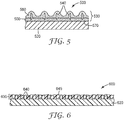
- exemplary coated abrasive article 500 has backing 520 and abrasive layer 530.
- Abrasive layer 530 includes magnetizable abrasive particles 540 according to the present disclosure secured to backing 520 by make layer 550 and size layer 560, each comprising a respective binder (e.g., epoxy resin, urethane resin, phenolic resin, aminoplast resin, or acrylic resin) that may be the same or different.
- a respective binder e.g., epoxy resin, urethane resin, phenolic resin, aminoplast resin, or acrylic resin
- the abrasive coat may comprise a cured slurry comprising a curable binder precursor and magnetizable abrasive particles according to the present disclosure.
- exemplary coated abrasive article 600 has backing 620 and abrasive layer 630.
- Abrasive layer 630 includes magnetizable abrasive particles 640 and a binder 645 (e.g., epoxy resin, urethane resin, phenolic resin, aminoplast resin, acrylic resin).
- Nonwoven abrasive articles typically include a porous (e.g., a lofty open porous) polymer filament structure having magnetizable abrasive particles bonded thereto by a binder.
- a porous (e.g., a lofty open porous) polymer filament structure having magnetizable abrasive particles bonded thereto by a binder An exemplary embodiment of a nonwoven abrasive article according to the present invention is shown in FIGS. 7A and 7B .
- Nonwoven abrasive article 700 includes a lofty open low-density fibrous web formed of entangled filaments 710 impregnated with binder 720 (e.g., epoxy resin, urethane resin, phenolic resin, aminoplast resin, acrylic resin).
- binder 720 e.g., epoxy resin, urethane resin, phenolic resin, aminoplast resin, acrylic resin.
- Binder 720 coats portions of filaments 710 and forms globules 750, which may encircle individual filaments or bundles of filaments that adhere to the surface of the filament and/or collect at the intersection of contacting filaments, providing abrasive sites throughout the nonwoven abrasive article.
- Abrasive articles according to the present disclosure are useful for abrading a workpiece.
- Methods of abrading range from snagging (i.e., high pressure high stock removal) to polishing (e.g., polishing medical implants with coated abrasive belts), wherein the latter is typically done with finer grades of abrasive particles.
- One such method includes the step of frictionally contacting an abrasive article (e.g., a coated abrasive article, a nonwoven abrasive article, or a bonded abrasive article) with a surface of the workpiece, and moving at least one of the abrasive article or the workpiece relative to the other to abrade at least a portion of the surface.
- an abrasive article e.g., a coated abrasive article, a nonwoven abrasive article, or a bonded abrasive article
- workpiece materials include metal, metal alloys, exotic metal alloys, ceramics, glass, wood, wood-like materials, composites, painted surfaces, plastics, reinforced plastics, stone, and/or combinations thereof.
- the workpiece may be flat or have a shape or contour associated with it.
- Exemplary workpieces include metal components, plastic components, particleboard, camshafts, crankshafts, furniture, and turbine blades.
- the applied force during abrading typically ranges from about 1 kilogram to about 100 kilograms.
- Abrasive articles according to the present disclosure may be used by hand and/or used in combination with a machine. At least one of the abrasive article and the workpiece is moved relative to the other when abrading. Abrading may be conducted under wet or dry conditions. Exemplary liquids for wet abrading include water, water containing conventional rust inhibiting compounds, lubricant, oil, soap, and cutting fluid. The liquid may also contain defoamers, degreasers, for example.
- the present disclosure provides a magnetizable abrasive particle comprising a ceramic body having an outer surface, and a magnetizable layer disposed on a portion, but not the entirety, of the outer surface.
- the present disclosure provides a magnetizable abrasive particle according to the first embodiment, wherein the ceramic body comprises a shaped ceramic body.
- the present disclosure provides a magnetizable abrasive particle according to the second embodiment, wherein the shaped ceramic body comprises a precisely-shaped ceramic body.
- the present disclosure provides a magnetizable abrasive particle according to any one of the first to third embodiments, wherein the outer surface of the ceramic body comprises a plurality of facets.
- the present disclosure provides a magnetizable abrasive particle according to the fourth embodiment, wherein the magnetizable layer completely covers a single facet.
- the present disclosure provides a magnetizable abrasive particle according to the fourth embodiment, wherein none of the facets is completely covered by the magnetizable layer.
- the present disclosure provides a magnetizable abrasive particle according to any one of the first to sixth embodiment, wherein the ceramic body comprises a platelet having two opposed major facets connected to each other by a plurality of side facets.
- the present disclosure provides a magnetizable abrasive particle according to the seventh embodiment, wherein the platelet is triangular.
- the present disclosure provides a magnetizable abrasive particle according to the seventh or eighth embodiment, wherein the magnetizable layer completely covers one of the two opposed major facets.
- the present disclosure provides a magnetizable abrasive particle according to the seventh or eighth embodiment, wherein the magnetizable layer completely covers one of the side facets.
- the present disclosure provides a magnetizable abrasive particle according to the ninth embodiment, wherein the magnetizable layer has a magnetizable dipole oriented perpendicular to the facet which it completely covers.
- the present disclosure provides a magnetizable abrasive particle according to the ninth embodiment, wherein the magnetizable layer has a magnetic dipole oriented parallel to the facet which it completely covers.
- the present disclosure provides a magnetizable abrasive particle according to any one of the first to sixth embodiments, wherein the ceramic body comprises a rod.
- the present disclosure provides a magnetizable abrasive particle according to any one of the first to thirteenth embodiments, wherein the magnetizable layer comprises magnetizable particles disposed in a binder matrix.
- the present disclosure provides a magnetizable abrasive particle according to the thirteenth or fourteenth embodiment, wherein the binder matrix comprises an organic binder matrix.
- the present disclosure provides an abrasive article comprising a plurality of magnetizable abrasive particles according to any one of the first to fifteenth embodiments.
- the present disclosure provides an abrasive article comprising a plurality of magnetizable abrasive particles according to the sixteenth embodiment retained in a binder material.
- the present disclosure provides an abrasive article according to the seventeenth embodiment, wherein the abrasive article comprises a bonded abrasive wheel.
- the present disclosure provides an abrasive article according to the seventeenth embodiment, wherein the coated abrasive article comprises an abrasive layer disposed on a backing, and wherein the abrasive layer comprises the binder material and the plurality of magnetizable abrasive particles.
- the present disclosure provides an abrasive article according to the seventeenth embodiment, wherein the abrasive article comprises a nonwoven abrasive, wherein the nonwoven abrasive comprises a lofty open nonwoven fiber web having an abrasive layer disposed on at least a portion thereof, and wherein the abrasive layer comprises the binder material and the plurality of magnetizable abrasive particles.
- the present disclosure provides an abrasive article according to the nineteenth embodiment, wherein a majority of the magnetizable abrasive particles are aligned parallel to each other.
- CM Silane Treated Calcium Metasilicate obtained as 400 WOLLASTOCOAT from NYCO Minerals Inc., Willsboro, New York.
- CRY Cryolite obtained as CRYOLITE TYPE RTN-C from Koppers Trading, Pittsburgh, Pennsylvania.
- IO Red iron oxide pigment MP Magnetic primer obtained as MAGNETIC PRIMER MAGNETIC GRAY from Krylon, Cleveland, Ohio.
- SAP Shaped abrasive particles were prepared according to the disclosure of U. S. Pat No. 8,142,531 (Adefris et al ).
- the shaped abrasive particles were prepared by molding alumina sol gel in equilateral triangle-shaped polypropylene mold cavities. After drying and firing, the resulting shaped abrasive particles, which were shaped as truncated triangular pyramids, were about 1.4 mm (side length) ⁇ 0.35 mm (thickness), with a draft angle approximately 98 degrees.
- the shaped abrasive particles were then coated with inorganic material according to the method described in U. S. Pat. No. 5,213,591 (Celikkaya et al ).
- SAP was placed in a polypropylene tool as described in Example 1 of PCT Pat. Publ. No. WO 2015/100018 A1 (Culler et al. ), so that each of the abrasive particles resided in a respective triangular cavity of the tool with a tip pointing down and with the opposite sidewall exposed outside the cavity.
- the MP spray can was shaken for several minutes prior to use. While the abrasive mineral housed in the tool, the MP spray can was pointed down onto the tool and sprayed for about 4 seconds. After the spraying was done, the coated mineral was allowed to sit for 30 minutes to dry off any solvent After drying, the coated abrasive particles were dislodged from the tool.
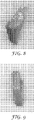
- Each of the resultant magnetized abrasive particles had a magnetic layer on the surface of an edge (sidewall) of the shaped abrasive particle, with a small amount continuing onto adjacent surfaces as shown in FIG. 8 .
- a sheet of paper was placed over the upper surface of the magnet
- the individual magnetic shaped abrasive particles were oriented upright with the coated edge facing upwards (as shown as FIG. 8 ) but inclined due to the weight of the abrasive particle, which was supported along a substantially uncoated side wall.
- SAP was placed in a polypropylene tool as described in EXAMPLE 1, while the abrasive mineral was housed in the tool.
- the tool was placed on the 6 inch (15.2 cm) ⁇ 0.5 inch (1.27 cm) end surface of the rare earth magnet used in Example 1.
- the tool was oriented such that the opposed major surface faces of the minerals were aligned parallel to the magnetic field lines where the tool was placed (i.e., the length of the exposed sidewall of the SAP particle was parallel to the thickness of the magnet).
- the MP spray can was shaken for several minutes prior to use. While the abrasive mineral housed in the tool, the MP spray can was pointed down onto the tool and sprayed for about 4 seconds.
- each of the resultant magnetizable abrasive particles had a magnetizable coating on the surface of an edge (sidewall) of the shaped abrasive particle (shown in FIG. 10 ).
- Example 2 was repeated except that the tool was rotated 90° so that the magnetic field was oriented such that the opposed major surface faces of the minerals were aligned perpendicular to the magnetic field lines where the tool was placed (i.e., the thickness of the exposed sidewall of the SAP particle was parallel to the thickness of the magnet).
- Each of the resultant magnetizable abrasive particles had a magnetizable coating on the surface of an edge (sidewall) of the shaped abrasive particle (shown in FIG. 11 ).
- Example 2 The response of resultant magnetizable shaped abrasive particles from Examples 2 and 3 to an applied magnetic field was tested by placing the individual abrasive minerals on a horizontal piece of paper which was placed onto the 6 inches (15.24 cm) ⁇ 3 inches (7.62 cm) surface of the rare earth magnet used in Example 1.
- magnetizable shaped abrasive particles from Examples 2 and 3 were placed at the edge of the magnet surface.
- the piece of paper holding the magnetic shaped abrasive particles was agitated slightly.
- the magnetic shaped abrasive particles were oriented upright (shown as FIG. 12 ) with the magnetic layer contacting the paper.
- FIG. 12 the left magnetizable shaped abrasive particle was from Example 3 and the right magnetizable shaped abrasive particle was from Example 2.
- No magnetic field was applied.
- MP spray can was shaken for several minutes prior to use. While the abrasive mineral was housed in the tool, the MP spray can was pointed down onto the tool and sprayed for about 4 seconds. After the spraying was done, the coated magnetic shaped abrasive mineral was allowed to sit for 30 minutes to dry off any solvent After drying, the coated abrasive particles were dislodged from the tool.
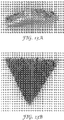
- Each of the resultant magnetic shaped abrasive particles had a magnetic coating on the largest triangular major surface of the shaped abrasive particle as shown in FIGS. 13A and 13B .
- resultant abrasive particles to magnetic field was tested by placing the individual abrasive minerals on a piece of paper which was placed on a horizontal 6 inch (15.24 cm) ⁇ 3 inch (7.62 cm) surface of the rare earth magnet used in Example 1. Two locations on the magnet were selected. When resultant magnetic shaped abrasive particles were placed on the center of the magnet where the magnetic field goes directly upwards from the magnet, the individual abrasive minerals were oriented upright with an edge facing down on the paper (as shown as FIG. 13A ).
- SAP was placed in a polypropylene tool as described in EXAMPLE 4. While the abrasive mineral housed in the tool, the tool was placed on the top of the 6 inch (15.24 cm) ⁇ 3 inch (7.62 cm) surface of the rare earth magnet used in Example 1, such that the magnetic field lines were perpendicular to the tool.
- the MP spray can was shaken for several minutes prior to use. While the abrasive mineral housed in the tool, the MP spray can was pointed down onto the tool and sprayed for about 4 seconds. After the spraying was done, the coated mineral was allowed to sit for 30 minutes to dry off any solvent. After drying, the coated abrasive particles were dislodged from the tool.
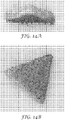
- Each of the resultant magnetic shaped abrasive particles had a magnetic coating on one major surface of the shaped abrasive particle as shown in FIGS. 14A and 14B .
- resultant abrasive particles to magnetic field was tested by placing the individual abrasive minerals on a piece of paper which was placed on a horizontal 6 inches (15.24 cm) ⁇ 3 inches (7.62 cm) surface of the rare earth magnetic used in Example 1. Two locations on the magnet were selected. When resultant magnetic shaped abrasive particles were placed on the edge of the magnet where the magnetic field approached a parallel path from the magnet, the individual abrasive minerals were oriented upright with an edge facing down on the paper (as shown in FIG. 14A ). When resultant abrasive particles were placed on the center of the magnet where the magnetic field went directly upwards from the magnet, individual abrasive minerals were laid flat with the coated surface facing upward on the paper (as shown in FIG. 14B ).
- the coated 3-inch disc was then placed directly in the center of an 8-inch (20.3 cm) diameter x 2 inches (5.1 cm) thick rare earth neodymium disc magnet (grade N50, obtained from Supermagnetman, Pelham, Alabama) with an 8-inch diameter which was magnetized through its thickness (i.e., north and south poles on opposite surfaces separated by the thickness).
- Face-coated magnetic shaped abrasive particles according to EXAMPLE 4 were then dropped from a distance of 1 inch (2.54 cm) to uniformly cover the surface of the disc.
- the abrasive particles were added to a weight of 1.55 ⁇ 0.07 grams.
- the disc was given a make pre-cure at 90°C for 12 hours followed by 103°C for 1 hour.
- the pre-cured disc was then coated by brush with size resin consisting of 37.4 parts of PR, 58.8 parts of CRY, 1.8 parts of IO, and 2.0 parts of deionized water. Excess size resin was removed with a dry brush until the flooded glossy appearance was reduced to a matte appearance. The amount of size resin applied was 3.15 g ⁇ 0.06 grams. The disc was cured for 90 minutes at 90°C, followed by 16 hours at 103°C.
- Discs (3-inch (7.6-cm) diameter) made from EXAMPLES 6, 7, and COMPARATIVE EXAMPLE A were allowed to equilibrate with ambient humidity for 2 days before testing.
- a quick change attachment of the type described in U. S. Pat. No. 6,817,935 (Bates et al. ) was affixed to the center back of each disc using adhesive.
- the disc to be tested was attached to a back pad, obtained as ROLOC DISC PAD TR 45091 from 3M Company, which was mounted on an electric rotary tool.
- the rotary tool was disposed over an X-Y table having a 1018 carbon steel workpiece measuring 14 inches (35.56 cm) ⁇ 6 inches (15.24 cm) secured to the X-Y table.
- the rotary tool was then activated to rotate at 9000 rounds per minute.
- the abrasive article was then urged at an angle of 5 degrees against the bar at a load of 5 pounds (2.27 kilograms).
- the disc traversed across the 14 inches (35.56 cm) ⁇ 6 inches (15.24 cm) face of the workpiece for 20 passes at a rate of 4.7 inches/second (11.9 cm/second) as to not go over the same abraded area twice.
- the mass of the workpiece was measured before and after each cycle to determine the total mass loss in grams after each cycle. A cumulative mass loss was determined at the end of 4 cycles.
- Table 2 The test result for each example is shown in Table 2, below.
Landscapes
- Chemical & Material Sciences (AREA)
- Engineering & Computer Science (AREA)
- Ceramic Engineering (AREA)
- Organic Chemistry (AREA)
- Manufacturing & Machinery (AREA)
- Materials Engineering (AREA)
- Structural Engineering (AREA)
- Chemical Kinetics & Catalysis (AREA)
- Inorganic Chemistry (AREA)
- Medicinal Chemistry (AREA)
- Health & Medical Sciences (AREA)
- Polymers & Plastics (AREA)
- Composite Materials (AREA)
- Mechanical Engineering (AREA)
- General Chemical & Material Sciences (AREA)
- Dispersion Chemistry (AREA)
- Polishing Bodies And Polishing Tools (AREA)
Claims (15)
- Particule abrasive magnétisable comprenant un corps en céramique ayant une surface externe et une couche magnétisable disposée sur une partie, mais pas la totalité, de la surface externe, dans laquelle le corps en céramique comprend une plaquette ayant deux facettes principales opposées reliées l'une à l'autre par une pluralité de facettes latérales, dans laquelle la couche magnétisable recouvre complètement l'une des deux facettes principales opposées, et dans laquelle la couche magnétisable a un dipôle magnétique orienté perpendiculairement ou parallèlement à la facette qu'il recouvre complètement.
- Particule abrasive magnétisable selon la revendication 1, dans laquelle le corps en céramique comprend un corps en céramique profilé.
- Particule abrasive magnétisable selon la revendication 2, dans laquelle le corps en céramique profilé comprend un corps en céramique profilé avec précision.
- Particule abrasive magnétisable selon la revendication 1, dans laquelle la couche magnétisable recouvre complètement une seule facette.
- Particule abrasive magnétisable selon la revendication 1, dans laquelle la plaquette est triangulaire.
- Particule abrasive magnétisable selon la revendication 1, dans laquelle la couche magnétisable a un dipôle magnétique orienté perpendiculairement à la facette qu'elle recouvre complètement.
- Particule abrasive magnétisable selon la revendication 1, dans laquelle la couche magnétisable a un dipôle magnétique orienté parallèlement à la facette qu'elle recouvre complètement.
- Particule abrasive magnétisable selon la revendication 1, dans laquelle la couche magnétisable comprend des particules magnétisables disposées dans une matrice de liant.
- Particule abrasive magnétisable selon la revendication 8, dans laquelle la matrice de liant comprend une matrice de liant organique.
- Pluralité de particules abrasives magnétisables selon la revendication 1.
- Article abrasif comprenant une pluralité de particules abrasives magnétisables selon la revendication 1 retenues dans un matériau de liant.
- Article abrasif selon la revendication 11, dans lequel l'article abrasif comprend une meule à abrasif lié.
- Article abrasif selon la revendication 11, dans lequel l'article abrasif comprend un article abrasif revêtu, dans lequel l'article abrasif appliqué comprend une couche abrasive disposée sur un support, et dans lequel la couche abrasive comprend le matériau de liant et la pluralité de particules abrasives magnétisables.
- Article abrasif selon la revendication 11, dans lequel l'article abrasif comprend un abrasif non tissé, dans lequel l'abrasif non tissé comprend une toile de fibres non tissées ouverte élastique ayant une couche abrasive disposée sur au moins une partie de celle-ci, et dans lequel la couche abrasive comprend le matériau de liant et la pluralité de particules abrasives magnétisables.
- Article abrasif selon la revendication 11, dans lequel une majorité des particules abrasives magnétisables sont alignées parallèlement les unes aux autres.
Applications Claiming Priority (2)
| Application Number | Priority Date | Filing Date | Title |
|---|---|---|---|
| US201662412402P | 2016-10-25 | 2016-10-25 | |
| PCT/US2017/053684 WO2018080703A1 (fr) | 2016-10-25 | 2017-09-27 | Particules abrasives magnétisables et articles abrasifs les comprenant |
Publications (3)
| Publication Number | Publication Date |
|---|---|
| EP3532561A1 EP3532561A1 (fr) | 2019-09-04 |
| EP3532561A4 EP3532561A4 (fr) | 2020-07-01 |
| EP3532561B1 true EP3532561B1 (fr) | 2021-04-28 |
Family
ID=62025369
Family Applications (1)
| Application Number | Title | Priority Date | Filing Date |
|---|---|---|---|
| EP17864554.5A Active EP3532561B1 (fr) | 2016-10-25 | 2017-09-27 | Particules abrasives magnétisables et articles abrasifs les comprenant |
Country Status (4)
| Country | Link |
|---|---|
| US (1) | US11072732B2 (fr) |
| EP (1) | EP3532561B1 (fr) |
| CN (1) | CN109890931B (fr) |
| WO (1) | WO2018080703A1 (fr) |
Families Citing this family (62)
| Publication number | Priority date | Publication date | Assignee | Title |
|---|---|---|---|---|
| PL2797716T3 (pl) | 2011-12-30 | 2021-07-05 | Saint-Gobain Ceramics & Plastics, Inc. | Kompozytowe ukształtowane cząstki ścierne i sposób ich formowania |
| WO2013102177A1 (fr) | 2011-12-30 | 2013-07-04 | Saint-Gobain Ceramics & Plastics, Inc. | Particule abrasive façonnée et procédé de formation de celle-ci |
| EP2802436B1 (fr) | 2012-01-10 | 2019-09-25 | Saint-Gobain Ceramics & Plastics, Inc. | Particules abrasives dotées de formes complexes |
| EP2852473B1 (fr) | 2012-05-23 | 2020-12-23 | Saint-Gobain Ceramics & Plastics Inc. | Particules abrasives mises en forme et leurs procédés de formation |
| EP2866977B8 (fr) | 2012-06-29 | 2023-01-18 | Saint-Gobain Ceramics & Plastics, Inc. | Particules abrasives ayant des formes particulières et procédés de formation de telles particules |
| CN108015685B (zh) | 2012-10-15 | 2020-07-14 | 圣戈班磨料磨具有限公司 | 具有特定形状的磨粒 |
| PL2978566T3 (pl) | 2013-03-29 | 2024-07-15 | Saint-Gobain Abrasives, Inc. | Cząstki ścierne o określonych kształtach i sposoby formowania takich cząstek |
| KR101889698B1 (ko) | 2013-09-30 | 2018-08-21 | 생-고뱅 세라믹스 앤드 플라스틱스, 인코포레이티드 | 형상화 연마입자 및 이의 형성 방법 |
| MX380754B (es) | 2013-12-31 | 2025-03-12 | Saint Gobain Abrasives Inc | Artículo abrasivo que incluye partículas abrasivas perfiladas. |
| US9771507B2 (en) | 2014-01-31 | 2017-09-26 | Saint-Gobain Ceramics & Plastics, Inc. | Shaped abrasive particle including dopant material and method of forming same |
| EP4306610A3 (fr) | 2014-04-14 | 2024-04-03 | Saint-Gobain Ceramics and Plastics, Inc. | Article abrasif comprenant des particules abrasives façonnées |
| US9914864B2 (en) | 2014-12-23 | 2018-03-13 | Saint-Gobain Ceramics & Plastics, Inc. | Shaped abrasive particles and method of forming same |
| CN116967949A (zh) | 2015-03-31 | 2023-10-31 | 圣戈班磨料磨具有限公司 | 固定磨料制品和其形成方法 |
| TWI634200B (zh) | 2015-03-31 | 2018-09-01 | 聖高拜磨料有限公司 | 固定磨料物品及其形成方法 |
| WO2016201104A1 (fr) | 2015-06-11 | 2016-12-15 | Saint-Gobain Ceramics & Plastics, Inc. | Article abrasif comprenant des particules abrasives profilées |
| WO2017197006A1 (fr) | 2016-05-10 | 2017-11-16 | Saint-Gobain Ceramics & Plastics, Inc. | Particules abrasives et leurs procédés de formation |
| KR102313436B1 (ko) | 2016-05-10 | 2021-10-19 | 생-고뱅 세라믹스 앤드 플라스틱스, 인코포레이티드 | 연마 입자들 및 그 형성 방법 |
| EP4349896A3 (fr) | 2016-09-29 | 2024-06-12 | Saint-Gobain Abrasives, Inc. | Articles abrasifs fixes et procédés pour les former |
| US11597860B2 (en) | 2016-10-25 | 2023-03-07 | 3M Innovative Properties Company | Magnetizable abrasive particle and method of making the same |
| CN109843509A (zh) | 2016-10-25 | 2019-06-04 | 3M创新有限公司 | 结构化磨料制品及其制备方法 |
| US11484990B2 (en) | 2016-10-25 | 2022-11-01 | 3M Innovative Properties Company | Bonded abrasive wheel and method of making the same |
| WO2018080756A1 (fr) | 2016-10-25 | 2018-05-03 | 3M Innovative Properties Company | Particules abrasives fonctionnelles, articles abrasifs, et leurs procédés de production et d'utilisation |
| CN109890930B (zh) | 2016-10-25 | 2021-03-16 | 3M创新有限公司 | 可磁化磨料颗粒及其制备方法 |
| CN109863568B (zh) | 2016-10-25 | 2020-05-15 | 3M创新有限公司 | 制备可磁化磨料颗粒的方法 |
| EP3571013B1 (fr) | 2017-01-19 | 2026-03-25 | 3M Innovative Properties Company | Mise en oeuvre du magnétisme et de particules abrasives magnétisables, procédés, appareils et systèmes mettant en uvre le magnétisme afin de fabriquer des articles abrasifs |
| US11141835B2 (en) | 2017-01-19 | 2021-10-12 | 3M Innovative Properties Company | Manipulation of magnetizable abrasive particles with modulation of magnetic field angle or strength |
| CN110225953A (zh) | 2017-01-23 | 2019-09-10 | 3M创新有限公司 | 可磁化磨料颗粒的磁力辅助布置 |
| US10759024B2 (en) | 2017-01-31 | 2020-09-01 | Saint-Gobain Ceramics & Plastics, Inc. | Abrasive article including shaped abrasive particles |
| US10563105B2 (en) | 2017-01-31 | 2020-02-18 | Saint-Gobain Ceramics & Plastics, Inc. | Abrasive article including shaped abrasive particles |
| US10865148B2 (en) | 2017-06-21 | 2020-12-15 | Saint-Gobain Ceramics & Plastics, Inc. | Particulate materials and methods of forming same |
| EP3784435B1 (fr) | 2018-04-24 | 2023-08-23 | 3M Innovative Properties Company | Procédé de fabrication d'article abrasif revêtu |
| WO2019207416A1 (fr) | 2018-04-24 | 2019-10-31 | 3M Innovative Properties Company | Article abrasif revêtu et son procédé de fabrication |
| WO2019207417A1 (fr) | 2018-04-24 | 2019-10-31 | 3M Innovative Properties Company | Procédé de fabrication d'un article abrasif revêtu |
| US11998947B2 (en) | 2018-07-18 | 2024-06-04 | 3M Innovative Properties Company | Magnetizable particles forming light controlling structures and methods of making such structures |
| KR102840317B1 (ko) | 2019-02-11 | 2025-07-29 | 쓰리엠 이노베이티브 프로퍼티즈 컴파니 | 연마 물품 |
| EP4227379A1 (fr) * | 2019-10-14 | 2023-08-16 | 3M Innovative Properties Company | Particule abrasive magnétisable et son procédé de fabrication |
| WO2021079331A1 (fr) * | 2019-10-23 | 2021-04-29 | 3M Innovative Properties Company | Particules abrasives mises en forme ayant un vide concave dans l'un de la pluralité de bords |
| WO2021116883A1 (fr) | 2019-12-09 | 2021-06-17 | 3M Innovative Properties Company | Articles abrasifs revêtus et procédés de fabrication d'articles abrasifs revêtus |
| US11918331B2 (en) | 2019-12-10 | 2024-03-05 | Hill-Rom Services, Inc. | Micro-movement and gesture detection using radar |
| CN114867582B (zh) | 2019-12-27 | 2024-10-18 | 圣戈本陶瓷及塑料股份有限公司 | 磨料制品及其形成方法 |
| EP4081370A4 (fr) | 2019-12-27 | 2024-04-24 | Saint-Gobain Ceramics & Plastics Inc. | Articles abrasifs et leurs procédés de formation |
| KR102877276B1 (ko) | 2019-12-27 | 2025-10-28 | 세인트-고바인 세라믹스 앤드 플라스틱스, 인크. | 연마 물품 및 이의 형성 방법 |
| US12581949B2 (en) | 2020-01-22 | 2026-03-17 | 3M Innovative Properties Company | Thermal interface layer |
| WO2021148916A1 (fr) | 2020-01-22 | 2021-07-29 | 3M Innovative Properties Company | Feuille adhésive électroconductrice |
| EP4096867A1 (fr) | 2020-01-31 | 2022-12-07 | 3M Innovative Properties Company | Articles abrasifs revêtus |
| CN115485100B (zh) | 2020-04-23 | 2025-02-28 | 3M创新有限公司 | 成形磨料颗粒 |
| WO2021245492A1 (fr) | 2020-06-04 | 2021-12-09 | 3M Innovative Properties Company | Particules abrasives de forme polygonale incomplète, procédés de fabrication et articles les contenant |
| WO2021245494A1 (fr) | 2020-06-04 | 2021-12-09 | 3M Innovative Properties Company | Particules abrasives façonnées et leurs procédés de fabrication |
| US12589467B2 (en) | 2020-06-30 | 2026-03-31 | 3M Innovative Properties Company | Coated abrasive articles and methods of making and using the same |
| EP4188645A1 (fr) | 2020-07-30 | 2023-06-07 | 3M Innovative Properties Company | Article abrasif et procédé de fabrication associé |
| WO2022034443A1 (fr) | 2020-08-10 | 2022-02-17 | 3M Innovative Properties Company | Articles abrasifs et leur procédé de fabrication |
| US12604449B2 (en) | 2020-12-29 | 2026-04-14 | 3M Innovative Properties Company | Electromagnetic absorbing composites |
| CA3241421A1 (fr) | 2021-12-30 | 2023-07-06 | Anthony MARTONE | Articles abrasifs et procedes de formation de ceux-ci |
| EP4457055A4 (fr) | 2021-12-30 | 2025-12-24 | Saint Gobain Abrasives Inc | Articles abrasifs et leurs procédés de formation |
| EP4457054A4 (fr) | 2021-12-30 | 2026-01-14 | Saint Gobain Abrasives Inc | Articles abrasifs et leurs procédés de formation |
| WO2023209518A1 (fr) | 2022-04-26 | 2023-11-02 | 3M Innovative Properties Company | Articles abrasifs, procédés de fabrication et utilisation associés |
| WO2024003839A1 (fr) | 2022-07-01 | 2024-01-04 | 3M Innovative Properties Company | Article de conditionnement de surface |
| CN115274285B (zh) * | 2022-08-23 | 2025-02-25 | 深圳市驭能科技有限公司 | 一种高磁导率纳米晶切割铁芯及其制备方法和应用 |
| CN120693232A (zh) | 2022-12-15 | 2025-09-23 | 3M创新有限公司 | 磨料制品及其制造方法 |
| WO2025149869A1 (fr) | 2024-01-10 | 2025-07-17 | 3M Innovative Properties Company | Article de conditionnement de surface |
| WO2025149867A1 (fr) | 2024-01-10 | 2025-07-17 | 3M Innovative Properties Company | Articles abrasifs, procédé de fabrication et utilisation associés |
| WO2025238411A1 (fr) | 2024-05-13 | 2025-11-20 | 3M Innovative Properties Company | Article abrasif, adhésif et procédé de fabrication d'article abrasif |
Family Cites Families (184)
| Publication number | Priority date | Publication date | Assignee | Title |
|---|---|---|---|---|
| US1930788A (en) * | 1927-05-31 | 1933-10-17 | Orello S Buckner | Apparatus and process of making abrasive tools |
| US2318570A (en) | 1930-01-20 | 1943-05-04 | Minnesota Mining & Mfg | Manufacture of abrasives |
| GB396231A (en) | 1931-07-16 | 1933-08-03 | Orello Simmons Buckner | Improvements in abrasive tools, and in methods and apparatus employed in their manufacture |
| US2370636A (en) | 1933-03-23 | 1945-03-06 | Minnesota Mining & Mfg | Manufacture of abrasives |
| US2216728A (en) | 1935-12-31 | 1940-10-08 | Carborundum Co | Abrasive article and method of making the same |
| US2527044A (en) | 1945-06-14 | 1950-10-24 | Exolon Company | Surface-coated abrasive grain |
| US2857879A (en) | 1955-09-01 | 1958-10-28 | Abrasive Company Of America | Apparatus for preparing abrasive articles |
| DE1694594C3 (de) | 1960-01-11 | 1975-05-28 | Minnesota Mining And Manufacturing Co., Saint Paul, Minn. (V.St.A.) | Reinigungs- und Polierkörper |
| US2947616A (en) | 1957-11-12 | 1960-08-02 | Norton Co | Grinding wheel structure |
| FR1279407A (fr) | 1960-11-08 | 1961-12-22 | Procédé de fabrication de surfaces rugueuses et de surfaces abrasives utilisant des moyens magnétiques de maintien et d'orientation, et produits industriels en résultant | |
| CH455556A (de) | 1965-02-09 | 1968-07-15 | Schladitz Whiskers Ag | Feinschleif- oder Polierkörper und Verfahren zu seiner Herstellung |
| GB1209139A (en) | 1968-06-19 | 1970-10-21 | Ind Distributors 1946 Ltd | Abrasive article manufacture |
| US3918217A (en) | 1972-07-24 | 1975-11-11 | Lloyd R Oliver & Company | Abrading device with protrusions on metal bonded abrasive grits |
| ZA741474B (en) * | 1974-03-07 | 1975-10-29 | Edenvale Eng Works | Abrasive tools |
| US4018575A (en) | 1974-03-18 | 1977-04-19 | Minnesota Mining And Manufacturing Company | Low density abrasive article |
| IE42010B1 (en) | 1974-08-15 | 1980-05-21 | Edenvale Eng Works | Abrasive products |
| ZA746013B (en) | 1974-09-23 | 1976-05-26 | Edenvale Eng Works | Abrasive tools |
| US4227350A (en) | 1977-11-02 | 1980-10-14 | Minnesota Mining And Manufacturing Company | Low-density abrasive product and method of making the same |
| US4314827A (en) | 1979-06-29 | 1982-02-09 | Minnesota Mining And Manufacturing Company | Non-fused aluminum oxide-based abrasive mineral |
| US4331453A (en) | 1979-11-01 | 1982-05-25 | Minnesota Mining And Manufacturing Company | Abrasive article |
| AT363797B (de) | 1979-12-24 | 1981-08-25 | Swarovski Tyrolit Schleif | Schleifkoerper und verfahren zur herstellung desselben |
| US4800685A (en) | 1984-05-31 | 1989-01-31 | Minnesota Mining And Manufacturing Company | Alumina bonded abrasive for cast iron |
| US5191101A (en) | 1982-11-22 | 1993-03-02 | Minnesota Mining And Manufacturing Company | Energy polymerizable compositions containing organometallic initiators |
| US4623364A (en) | 1984-03-23 | 1986-11-18 | Norton Company | Abrasive material and method for preparing the same |
| CA1266569A (fr) | 1984-05-09 | 1990-03-13 | Minnesota Mining And Manufacturing Company | Abrasif colle a substituts mineraux selectifs |
| US4609380A (en) | 1985-02-11 | 1986-09-02 | Minnesota Mining And Manufacturing Company | Abrasive wheels |
| CA1254238A (fr) | 1985-04-30 | 1989-05-16 | Alvin P. Gerk | Procede sol-gel pour l'obtention de grains d'abrasif et de produits abrasifs ceramiques durables a base d'alumine |
| US4612242A (en) | 1985-06-03 | 1986-09-16 | Minnesota Mining And Manufacturing Company | Pressure-sensitive adhesive tape containing coated glass microbubbles |
| US4652275A (en) | 1985-08-07 | 1987-03-24 | Minnesota Mining And Manufacturing Company | Erodable agglomerates and abrasive products containing the same |
| US4652274A (en) | 1985-08-07 | 1987-03-24 | Minnesota Mining And Manufacturing Company | Coated abrasive product having radiation curable binder |
| US4770671A (en) | 1985-12-30 | 1988-09-13 | Minnesota Mining And Manufacturing Company | Abrasive grits formed of ceramic containing oxides of aluminum and yttrium, method of making and using the same and products made therewith |
| ZA8763B (en) | 1986-01-21 | 1987-09-30 | Alusuisse | Composite panel that is difficult to combust and produces little smoke,and process for manufacturing same |
| US4751138A (en) | 1986-08-11 | 1988-06-14 | Minnesota Mining And Manufacturing Company | Coated abrasive having radiation curable binder |
| US4799939A (en) | 1987-02-26 | 1989-01-24 | Minnesota Mining And Manufacturing Company | Erodable agglomerates and abrasive products containing the same |
| JPH0818238B2 (ja) | 1987-03-19 | 1996-02-28 | キヤノン株式会社 | 研磨工具の製作方法 |
| US4881951A (en) | 1987-05-27 | 1989-11-21 | Minnesota Mining And Manufacturing Co. | Abrasive grits formed of ceramic containing oxides of aluminum and rare earth metal, method of making and products made therewith |
| SU1495100A1 (ru) | 1987-07-13 | 1989-07-23 | Одесский Политехнический Институт | Способ изготовлени абразивного инструмента |
| US5086086A (en) | 1987-08-28 | 1992-02-04 | Minnesota Mining And Manufacturing Company | Energy-induced curable compositions |
| US4950696A (en) | 1987-08-28 | 1990-08-21 | Minnesota Mining And Manufacturing Company | Energy-induced dual curable compositions |
| US5254194A (en) | 1988-05-13 | 1993-10-19 | Minnesota Mining And Manufacturing Company | Coated abrasive sheet material with loop material for attachment incorporated therein |
| US4985340A (en) | 1988-06-01 | 1991-01-15 | Minnesota Mining And Manufacturing Company | Energy curable compositions: two component curing agents |
| CH675250A5 (fr) | 1988-06-17 | 1990-09-14 | Lonza Ag | |
| US4916869A (en) | 1988-08-01 | 1990-04-17 | L. R. Oliver & Company, Inc. | Bonded abrasive grit structure |
| US4898597A (en) | 1988-08-25 | 1990-02-06 | Norton Company | Frit bonded abrasive wheel |
| US4991362A (en) | 1988-09-13 | 1991-02-12 | Minnesota Mining And Manufacturing Company | Hand scouring pad |
| US4903440A (en) | 1988-11-23 | 1990-02-27 | Minnesota Mining And Manufacturing Company | Abrasive product having binder comprising an aminoplast resin |
| US4933373A (en) | 1989-04-06 | 1990-06-12 | Minnesota Mining And Manufacturing Company | Abrasive wheels |
| US5213590A (en) | 1989-12-20 | 1993-05-25 | Neff Charles E | Article and a method for producing an article having a high friction surface |
| US5181939A (en) | 1989-12-20 | 1993-01-26 | Charles Neff | Article and a method for producing an article having a high friction surface |
| US5137542A (en) | 1990-08-08 | 1992-08-11 | Minnesota Mining And Manufacturing Company | Abrasive printed with an electrically conductive ink |
| US5152917B1 (en) | 1991-02-06 | 1998-01-13 | Minnesota Mining & Mfg | Structured abrasive article |
| US5236472A (en) | 1991-02-22 | 1993-08-17 | Minnesota Mining And Manufacturing Company | Abrasive product having a binder comprising an aminoplast binder |
| US5380390B1 (en) | 1991-06-10 | 1996-10-01 | Ultimate Abras Systems Inc | Patterned abrasive material and method |
| US5817204A (en) | 1991-06-10 | 1998-10-06 | Ultimate Abrasive Systems, L.L.C. | Method for making patterned abrasive material |
| US5316812A (en) | 1991-12-20 | 1994-05-31 | Minnesota Mining And Manufacturing Company | Coated abrasive backing |
| CA2116686A1 (fr) | 1991-12-20 | 1993-07-08 | Harold Wayne Benedict | Courroie abrasive sous forme d'une boucle sans fin et sans couture; methode de fabrication |
| US5282875A (en) | 1992-03-18 | 1994-02-01 | Cincinnati Milacron Inc. | High density sol-gel alumina-based abrasive vitreous bonded grinding wheel |
| RU95105160A (ru) | 1992-07-23 | 1997-01-10 | Миннесота Майнинг энд Мануфакчуринг Компани (US) | Способ приготовления абразивной частицы, абразивные изделия и изделия с абразивным покрытием |
| US5366523A (en) | 1992-07-23 | 1994-11-22 | Minnesota Mining And Manufacturing Company | Abrasive article containing shaped abrasive particles |
| US5201916A (en) | 1992-07-23 | 1993-04-13 | Minnesota Mining And Manufacturing Company | Shaped abrasive particles and method of making same |
| US5213591A (en) | 1992-07-28 | 1993-05-25 | Ahmet Celikkaya | Abrasive grain, method of making same and abrasive products |
| US5435816A (en) | 1993-01-14 | 1995-07-25 | Minnesota Mining And Manufacturing Company | Method of making an abrasive article |
| JP2980682B2 (ja) | 1993-06-02 | 1999-11-22 | 大日本印刷株式会社 | 研磨テープおよびその製造方法 |
| US5549962A (en) | 1993-06-30 | 1996-08-27 | Minnesota Mining And Manufacturing Company | Precisely shaped particles and method of making the same |
| JPH0778509A (ja) | 1993-09-08 | 1995-03-20 | Ube Ind Ltd | 配向性誘電体磁器およびその製造方法 |
| RU2124978C1 (ru) | 1993-09-13 | 1999-01-20 | Миннесота Майнинг Энд Мэнюфекчуринг Компани | Абразивное изделие, способ его производства, способ его использования для чистовой обработки и рабочий инструмент для его производства |
| US5454844A (en) | 1993-10-29 | 1995-10-03 | Minnesota Mining And Manufacturing Company | Abrasive article, a process of making same, and a method of using same to finish a workpiece surface |
| US5505747A (en) | 1994-01-13 | 1996-04-09 | Minnesota Mining And Manufacturing Company | Method of making an abrasive article |
| KR970701118A (ko) | 1994-02-22 | 1997-03-17 | 로저 로이 템트 | 연마 물품, 이의 제조 방법 및 이를 표면 마무리용으로서 사용하는 방법(abrasive article, a method of making same, and a method of using same for finishing) |
| JPH07272256A (ja) * | 1994-03-31 | 1995-10-20 | Tdk Corp | 磁気記録媒体 |
| US5858140A (en) | 1994-07-22 | 1999-01-12 | Minnesota Mining And Manufacturing Company | Nonwoven surface finishing articles reinforced with a polymer backing layer and method of making same |
| US5591239A (en) | 1994-08-30 | 1997-01-07 | Minnesota Mining And Manufacturing Company | Nonwoven abrasive article and method of making same |
| US5554068A (en) | 1994-12-13 | 1996-09-10 | Minnesota Mining And Manufacturing Company | Abrasive flap brush and method and apparatus for making same |
| US5712210A (en) | 1995-08-30 | 1998-01-27 | Minnesota Mining And Manufacturing Company | Nonwoven abrasive material roll |
| US6207246B1 (en) | 1995-08-30 | 2001-03-27 | 3M Innovative Properties Company | Nonwoven abrasive material roll |
| US5975987A (en) | 1995-10-05 | 1999-11-02 | 3M Innovative Properties Company | Method and apparatus for knurling a workpiece, method of molding an article with such workpiece, and such molded article |
| US5681361A (en) | 1996-01-11 | 1997-10-28 | Minnesota Mining And Manufacturing Company | Method of making an abrasive article and abrasive article produced thereby |
| US5700302A (en) | 1996-03-15 | 1997-12-23 | Minnesota Mining And Manufacturing Company | Radiation curable abrasive article with tie coat and method |
| DE69627538T2 (de) | 1996-05-03 | 2004-04-08 | Minnesota Mining And Manufacturing Company, St. Paul | Nichtgewebte schleifmittel |
| US5863306A (en) | 1997-01-07 | 1999-01-26 | Norton Company | Production of patterned abrasive surfaces |
| US5833724A (en) | 1997-01-07 | 1998-11-10 | Norton Company | Structured abrasives with adhered functional powders |
| US5851247A (en) | 1997-02-24 | 1998-12-22 | Minnesota Mining & Manufacturing Company | Structured abrasive article adapted to abrade a mild steel workpiece |
| US5928070A (en) | 1997-05-30 | 1999-07-27 | Minnesota Mining & Manufacturing Company | Abrasive article comprising mullite |
| US5946991A (en) | 1997-09-03 | 1999-09-07 | 3M Innovative Properties Company | Method for knurling a workpiece |
| US5942015A (en) | 1997-09-16 | 1999-08-24 | 3M Innovative Properties Company | Abrasive slurries and abrasive articles comprising multiple abrasive particle grades |
| JPH11165252A (ja) | 1997-12-04 | 1999-06-22 | Nisca Corp | 研磨材、研磨材の製造方法及び研磨若しくは研削方法 |
| KR100562446B1 (ko) | 1998-02-19 | 2006-03-20 | 미네소타 마이닝 앤드 매뉴팩춰링 캄파니 | 연마 용품 및 유리 연마 방법 |
| US6139594A (en) | 1998-04-13 | 2000-10-31 | 3M Innovative Properties Company | Abrasive article with tie coat and method |
| US6261682B1 (en) | 1998-06-30 | 2001-07-17 | 3M Innovative Properties | Abrasive articles including an antiloading composition |
| US6048375A (en) | 1998-12-16 | 2000-04-11 | Norton Company | Coated abrasive |
| US6302930B1 (en) | 1999-01-15 | 2001-10-16 | 3M Innovative Properties Company | Durable nonwoven abrasive product |
| US6319108B1 (en) | 1999-07-09 | 2001-11-20 | 3M Innovative Properties Company | Metal bond abrasive article comprising porous ceramic abrasive composites and method of using same to abrade a workpiece |
| US6293980B2 (en) | 1999-12-20 | 2001-09-25 | Norton Company | Production of layered engineered abrasive surfaces |
| WO2001053040A1 (fr) | 2000-01-19 | 2001-07-26 | Rodel Holdings, Inc. | Impression de tampons a polir |
| EP1122718A3 (fr) | 2000-02-03 | 2003-10-15 | Mitsubishi Chemical Corporation | Procédé de formation d'une configuration magnétique dans un milieu d'enregistrement magnétique, méthode de production d'un milieu d'enregistrement magnétique, dispositif de formation de configuration magnétique, milieu et dispositif d'enregistrement magnétique |
| CA2408249A1 (fr) | 2000-05-09 | 2001-11-15 | 3M Innovative Properties Company | Article abrasif poreux contenant des composites abrasifs en ceramique, procedes de fabrication et procedes d'utilisation correspondants |
| US6609951B1 (en) | 2000-06-30 | 2003-08-26 | 3M Innovative Properties Company | Method of making a surface treating article |
| JP3556886B2 (ja) | 2000-08-08 | 2004-08-25 | 独立行政法人日本学術振興会 | 配向性アルミナセラミックスの製造方法及び配向性アルミナセラミックス |
| AU2002213054A1 (en) | 2000-10-06 | 2002-04-15 | 3M Innovative Properties Company | Ceramic aggregate particles |
| US6521004B1 (en) | 2000-10-16 | 2003-02-18 | 3M Innovative Properties Company | Method of making an abrasive agglomerate particle |
| MXPA03003290A (es) | 2000-10-16 | 2004-05-04 | 3M Innovative Properties Co | Metodo de fabricacion de particulas aglomeradas. |
| DE60141700D1 (de) | 2000-10-16 | 2010-05-12 | 3M Innovative Properties Co | Atteilchen |
| US20030022604A1 (en) | 2001-05-07 | 2003-01-30 | 3M Innovative Properties Company | Abrasive product and method of making and using the same |
| US6551366B1 (en) | 2000-11-10 | 2003-04-22 | 3M Innovative Properties Company | Spray drying methods of making agglomerate abrasive grains and abrasive articles |
| US6645624B2 (en) | 2000-11-10 | 2003-11-11 | 3M Innovative Properties Company | Composite abrasive particles and method of manufacture |
| US6846232B2 (en) | 2001-12-28 | 2005-01-25 | 3M Innovative Properties Company | Backing and abrasive product made with the backing and method of making and using the backing and abrasive product |
| JP2004098265A (ja) | 2002-09-12 | 2004-04-02 | Polymatech Co Ltd | 研磨フィルム及びその製造方法 |
| JP2004098266A (ja) | 2002-09-12 | 2004-04-02 | Polymatech Co Ltd | 研磨砥石及びその製造方法 |
| JP2004107096A (ja) | 2002-09-13 | 2004-04-08 | National Institute For Materials Science | 配向性炭化ケイ素焼結体とその製造方法 |
| US20040098923A1 (en) * | 2002-11-25 | 2004-05-27 | 3M Innovative Properties Company | Nonwoven abrasive articles and methods for making and using the same |
| US6951504B2 (en) | 2003-03-20 | 2005-10-04 | 3M Innovative Properties Company | Abrasive article with agglomerates and method of use |
| EP2316567B1 (fr) | 2003-09-26 | 2018-01-24 | 3M Innovative Properties Co. | Catalyseurs d'or de l'échelle nano, agents d'activation, moyen de support et méthodologies apparentées utiles pour la fabrication de systèmes catalyseurs lorsque le catalyseur est déposé sur le moyen de support par le dépôt de vapeur physique |
| JP2005153106A (ja) | 2003-11-27 | 2005-06-16 | Ricoh Co Ltd | 研磨具、研磨具製造方法、研磨方法及び研磨装置 |
| US7150770B2 (en) | 2004-06-18 | 2006-12-19 | 3M Innovative Properties Company | Coated abrasive article with tie layer, and method of making and using the same |
| JP2006089586A (ja) * | 2004-09-24 | 2006-04-06 | Utsunomiya Univ | 磁性砥粒及びその製造方法 |
| CN1830626A (zh) | 2005-03-10 | 2006-09-13 | 浙江工业大学 | 针状磨粒砂轮及其制备方法 |
| US7491251B2 (en) | 2005-10-05 | 2009-02-17 | 3M Innovative Properties Company | Method of making a structured abrasive article |
| US7399330B2 (en) | 2005-10-18 | 2008-07-15 | 3M Innovative Properties Company | Agglomerate abrasive grains and methods of making the same |
| US7410413B2 (en) | 2006-04-27 | 2008-08-12 | 3M Innovative Properties Company | Structured abrasive article and method of making and using the same |
| US20080131705A1 (en) | 2006-12-01 | 2008-06-05 | International Business Machines Corporation | Method and system for nanostructure placement using imprint lithography |
| CN100563935C (zh) | 2007-05-23 | 2009-12-02 | 江苏天一超细金属粉末有限公司 | 一种使磨料颗粒均匀分布/有序排列/择优取向的方法和装置 |
| US8038750B2 (en) | 2007-07-13 | 2011-10-18 | 3M Innovative Properties Company | Structured abrasive with overlayer, and method of making and using the same |
| CN101353566B (zh) | 2007-07-25 | 2011-06-15 | 比亚迪股份有限公司 | 一种磁力研磨磨料及其制备方法 |
| EP2242618B1 (fr) | 2007-12-27 | 2020-09-23 | 3M Innovative Properties Company | Particules abrasives formées fracturées, article abrasif les utilisant, et leur procédé de fabrication |
| US8123828B2 (en) | 2007-12-27 | 2012-02-28 | 3M Innovative Properties Company | Method of making abrasive shards, shaped abrasive particles with an opening, or dish-shaped abrasive particles |
| JP2010090021A (ja) | 2008-10-10 | 2010-04-22 | Murata Mfg Co Ltd | ペロブスカイト構造化合物の焼結体の製造方法 |
| US8142532B2 (en) | 2008-12-17 | 2012-03-27 | 3M Innovative Properties Company | Shaped abrasive particles with an opening |
| RU2506152C2 (ru) | 2008-12-17 | 2014-02-10 | 3М Инновейтив Пропертиз Компани | Фасонные абразивные частицы с канавками |
| US8142891B2 (en) | 2008-12-17 | 2012-03-27 | 3M Innovative Properties Company | Dish-shaped abrasive particles with a recessed surface |
| US8142531B2 (en) | 2008-12-17 | 2012-03-27 | 3M Innovative Properties Company | Shaped abrasive particles with a sloping sidewall |
| CN101481597B (zh) * | 2009-01-17 | 2012-04-25 | 山东理工大学 | 磁性磨料的常压烧结方法 |
| KR101091565B1 (ko) | 2009-06-19 | 2011-12-13 | 한양대학교 산학협력단 | 자기 연마재 분말 및 그 제조방법 |
| US8425278B2 (en) | 2009-08-26 | 2013-04-23 | 3M Innovative Properties Company | Structured abrasive article and method of using the same |
| US20110088330A1 (en) | 2009-10-20 | 2011-04-21 | Beekman William A | Abrasive Tool |
| CN102666017B (zh) | 2009-12-02 | 2015-12-16 | 3M创新有限公司 | 双锥形成形磨粒 |
| KR20130018276A (ko) | 2010-03-31 | 2013-02-20 | 쓰리엠 이노베이티브 프로퍼티즈 컴파니 | 디스플레이용 전자 물품 및 그 제조 방법 |
| KR101849797B1 (ko) | 2010-04-27 | 2018-04-17 | 쓰리엠 이노베이티브 프로퍼티즈 컴파니 | 세라믹 형상화 연마 입자, 이의 제조 방법 및 이를 함유하는 연마 용품 |
| US8551577B2 (en) | 2010-05-25 | 2013-10-08 | 3M Innovative Properties Company | Layered particle electrostatic deposition process for making a coated abrasive article |
| KR101879884B1 (ko) | 2010-08-04 | 2018-07-18 | 쓰리엠 이노베이티브 프로퍼티즈 컴파니 | 교차 플레이트 성형된 연마 입자 |
| JP2012131018A (ja) | 2010-11-29 | 2012-07-12 | Shin-Etsu Chemical Co Ltd | 超硬合金台板外周切断刃の製造方法 |
| JP5776515B2 (ja) | 2010-11-29 | 2015-09-09 | 信越化学工業株式会社 | 超硬合金台板外周切断刃の製造方法 |
| PH12013501093B1 (en) | 2010-11-29 | 2018-01-05 | Shinetsu Chemical Co | Super hard alloy baseplate outer circumference cutting blade and manufacturing method thereof |
| JP5776514B2 (ja) | 2010-11-29 | 2015-09-09 | 信越化学工業株式会社 | 超硬合金台板外周切断刃 |
| US20130252521A1 (en) | 2010-11-29 | 2013-09-26 | Shin-Etsu Chemical Co., Ltd. | Super hard alloy baseplate outer circumference cutting blade and manufacturing method thereof |
| JP5932845B2 (ja) | 2011-02-16 | 2016-06-08 | スリーエム イノベイティブ プロパティズ カンパニー | 静電研磨粒子コーティング装置及び方法 |
| EP2675591B1 (fr) | 2011-02-16 | 2022-08-17 | 3M Innovative Properties Company | Article abrasif revêtu ayant des particules abrasives céramiques façonnées alignées en rotation et procédé de fabrication associé |
| PL2697416T3 (pl) | 2011-04-14 | 2017-09-29 | 3M Innovative Properties Company | Artykuł ścierny z włókniny zawierający aglomeraty ukształtowanych ziaren ściernych wiązanych elastomerem |
| TW201300199A (zh) * | 2011-06-30 | 2013-01-01 | Saint Gobain Abrasives Inc | 磨料物品及製造方法 |
| US9242342B2 (en) | 2012-03-14 | 2016-01-26 | Taiwan Semiconductor Manufacturing Company, Ltd. | Manufacture and method of making the same |
| CA2869434C (fr) | 2012-04-04 | 2021-01-12 | 3M Innovative Properties Company | Particules abrasives, procede de fabrication de particules abrasives et articles abrasifs |
| EP2692818A1 (fr) * | 2012-08-02 | 2014-02-05 | Robert Bosch Gmbh | Grain abrasif avec surfaces supérieures principales et surfaces supérieures auxiliaires |
| US9914863B2 (en) * | 2012-08-02 | 2018-03-13 | Robert Bosch Gmbh | Abrasive particle with at most three surfaces and one corner |
| EP3170879B1 (fr) * | 2012-08-02 | 2021-09-08 | Robert Bosch GmbH | Grain abrasif ayant une surface comprenant au moins une surface de base avec un contour extérieur ayant au moins sept coins |
| CN108015685B (zh) | 2012-10-15 | 2020-07-14 | 圣戈班磨料磨具有限公司 | 具有特定形状的磨粒 |
| CA2888733A1 (fr) | 2012-10-31 | 2014-05-08 | 3M Innovative Properties Company | Particules abrasives profilees, procedes de fabrication, et articles abrasifs incluant ces particules |
| KR101473367B1 (ko) | 2012-11-07 | 2014-12-17 | (주)석경에이티 | 연마제가 코팅된 자성입자의 제조방법 및 자기 연마 필러 |
| DE102012221316A1 (de) | 2012-11-22 | 2014-05-22 | Robert Bosch Gmbh | Vorrichtung und Verfahren zum Herstellen eines beschichteten Schleifmittels |
| PL2978566T3 (pl) | 2013-03-29 | 2024-07-15 | Saint-Gobain Abrasives, Inc. | Cząstki ścierne o określonych kształtach i sposoby formowania takich cząstek |
| US20140291895A1 (en) | 2013-04-01 | 2014-10-02 | I2Ic Corporation | Method of Manufacturing a Body with Oriented Aspherical Particles |
| WO2014206967A1 (fr) * | 2013-06-28 | 2014-12-31 | Robert Bosch Gmbh | Produit abrasif |
| DE102013212684A1 (de) | 2013-06-28 | 2014-12-31 | Robert Bosch Gmbh | Verfahren zur Aufbringung von Schleifkörnern auf eine Schleifmittelunterlage |
| DE102013212639A1 (de) | 2013-06-28 | 2014-12-31 | Robert Bosch Gmbh | Schleifwerkzeug |
| DE102013212609A1 (de) | 2013-06-28 | 2014-12-31 | Robert Bosch Gmbh | Verfahren zur Herstellung eines Schleifmittels |
| DE102013212617A1 (de) | 2013-06-28 | 2014-12-31 | Robert Bosch Gmbh | Vorrichtung zur Aufbringung von Schleifkörnern |
| DE102013212666A1 (de) | 2013-06-28 | 2014-12-31 | Robert Bosch Gmbh | Verfahren zur Herstellung eines Schleifmittels |
| KR101889698B1 (ko) | 2013-09-30 | 2018-08-21 | 생-고뱅 세라믹스 앤드 플라스틱스, 인코포레이티드 | 형상화 연마입자 및 이의 형성 방법 |
| WO2015048769A1 (fr) * | 2013-09-30 | 2015-04-02 | Board Of Regents, The University Of Texas System | Procédé et appareil pour une détection par balayage |
| CN103590090B (zh) | 2013-11-05 | 2016-06-22 | 陈谦 | 一种用于制作电镀砂轮的纵向电镀方法和装置 |
| JP6561058B2 (ja) | 2013-12-09 | 2019-08-14 | スリーエム イノベイティブ プロパティズ カンパニー | 集塊性研磨粒子、その粒子を含む研磨物品、及びその製造方法 |
| CN105829024B (zh) | 2013-12-23 | 2018-04-20 | 3M创新有限公司 | 涂覆磨料制品的制备机设备 |
| WO2015100018A1 (fr) | 2013-12-23 | 2015-07-02 | 3M Innovative Properties Company | Systèmes de positionnement de particules abrasives et outils de production associés |
| EP3086904B1 (fr) | 2013-12-23 | 2021-10-27 | 3M Innovative Properties Company | Procédé de réalisation d'un article abrasif revêtu |
| WO2015112379A1 (fr) * | 2014-01-22 | 2015-07-30 | United Technologies Corporation | Appareils, systèmes et procédés destinés à des grains abrasifs alignés |
| DE202014101741U1 (de) | 2014-04-11 | 2014-05-09 | Robert Bosch Gmbh | Teilweise beschichtetes Schleifkorn |
| JP6484647B2 (ja) * | 2014-04-14 | 2019-03-13 | サン−ゴバン セラミックス アンド プラスティクス,インコーポレイティド | 成形研磨粒子を含む研磨物品 |
| CN104191385B (zh) | 2014-09-05 | 2016-05-18 | 南京航空航天大学 | 一种湿法制备的铁磁性金刚石磨料 |
| CN104999385B (zh) | 2015-06-30 | 2018-05-04 | 郑州磨料磨具磨削研究所有限公司 | 一种磨料定向排布的陶瓷结合剂磨具及其制备方法 |
| EP3411450A4 (fr) | 2016-02-01 | 2019-09-18 | 3M Innovative Properties Company | Compositions adhésives |
| CN109863568B (zh) | 2016-10-25 | 2020-05-15 | 3M创新有限公司 | 制备可磁化磨料颗粒的方法 |
| WO2018080704A1 (fr) | 2016-10-25 | 2018-05-03 | 3M Innovative Properties Company | Meule abrasive agglomérée et procédé de fabrication associé |
| WO2018080756A1 (fr) | 2016-10-25 | 2018-05-03 | 3M Innovative Properties Company | Particules abrasives fonctionnelles, articles abrasifs, et leurs procédés de production et d'utilisation |
| US11484990B2 (en) | 2016-10-25 | 2022-11-01 | 3M Innovative Properties Company | Bonded abrasive wheel and method of making the same |
| EP3559142A4 (fr) | 2016-10-25 | 2020-12-09 | 3M Innovative Properties Company | Particules abrasives agglomérées magnétisables, articles abrasifs et leurs procédés de fabrication |
| CN109890930B (zh) | 2016-10-25 | 2021-03-16 | 3M创新有限公司 | 可磁化磨料颗粒及其制备方法 |
-
2017
- 2017-09-27 US US16/344,256 patent/US11072732B2/en active Active
- 2017-09-27 CN CN201780066458.9A patent/CN109890931B/zh active Active
- 2017-09-27 WO PCT/US2017/053684 patent/WO2018080703A1/fr not_active Ceased
- 2017-09-27 EP EP17864554.5A patent/EP3532561B1/fr active Active
Also Published As
| Publication number | Publication date |
|---|---|
| US11072732B2 (en) | 2021-07-27 |
| WO2018080703A1 (fr) | 2018-05-03 |
| US20190249053A1 (en) | 2019-08-15 |
| EP3532561A1 (fr) | 2019-09-04 |
| EP3532561A4 (fr) | 2020-07-01 |
| CN109890931A (zh) | 2019-06-14 |
| CN109890931B (zh) | 2021-03-16 |
Similar Documents
| Publication | Publication Date | Title |
|---|---|---|
| EP3532561B1 (fr) | Particules abrasives magnétisables et articles abrasifs les comprenant | |
| CN109844054B (zh) | 可磁化团聚物磨料颗粒、磨料制品及其制备方法 | |
| US10774251B2 (en) | Functional abrasive particles, abrasive articles, and methods of making the same | |
| US11926782B2 (en) | Magnetizable abrasive particle and method of making the same | |
| EP3784434B1 (fr) | Article abrasif revêtu et son procédé de fabrication | |
| EP3532249B1 (fr) | Articles abrasifs structurés et leurs procédés de fabrication | |
| US11724363B2 (en) | Method of making a coated abrasive article | |
| US20210155836A1 (en) | Magnetizable abrasive particle and method of making the same | |
| EP3532250B1 (fr) | Meule à abrasif aggloméré et son procédé de fabrication | |
| US10655038B2 (en) | Method of making magnetizable abrasive particles | |
| EP3532248B1 (fr) | Meule abrasive agglomérée et procédé de fabrication associé | |
| US20230061952A1 (en) | Coated abrasive articles | |
| US20220306923A1 (en) | Magnetizable abrasive particles and method of making the same |
Legal Events
| Date | Code | Title | Description |
|---|---|---|---|
| STAA | Information on the status of an ep patent application or granted ep patent |
Free format text: STATUS: THE INTERNATIONAL PUBLICATION HAS BEEN MADE |
|
| PUAI | Public reference made under article 153(3) epc to a published international application that has entered the european phase |
Free format text: ORIGINAL CODE: 0009012 |
|
| STAA | Information on the status of an ep patent application or granted ep patent |
Free format text: STATUS: REQUEST FOR EXAMINATION WAS MADE |
|
| 17P | Request for examination filed |
Effective date: 20190429 |
|
| AK | Designated contracting states |
Kind code of ref document: A1 Designated state(s): AL AT BE BG CH CY CZ DE DK EE ES FI FR GB GR HR HU IE IS IT LI LT LU LV MC MK MT NL NO PL PT RO RS SE SI SK SM TR |
|
| AX | Request for extension of the european patent |
Extension state: BA ME |
|
| DAV | Request for validation of the european patent (deleted) | ||
| DAX | Request for extension of the european patent (deleted) | ||
| A4 | Supplementary search report drawn up and despatched |
Effective date: 20200603 |
|
| RIC1 | Information provided on ipc code assigned before grant |
Ipc: C04B 35/111 20060101ALI20200527BHEP Ipc: C04B 35/628 20060101ALI20200527BHEP Ipc: C09K 3/14 20060101AFI20200527BHEP Ipc: C04B 35/624 20060101ALI20200527BHEP Ipc: B24D 11/00 20060101ALI20200527BHEP |
|
| GRAP | Despatch of communication of intention to grant a patent |
Free format text: ORIGINAL CODE: EPIDOSNIGR1 |
|
| STAA | Information on the status of an ep patent application or granted ep patent |
Free format text: STATUS: GRANT OF PATENT IS INTENDED |
|
| INTG | Intention to grant announced |
Effective date: 20210114 |
|
| GRAS | Grant fee paid |
Free format text: ORIGINAL CODE: EPIDOSNIGR3 |
|
| GRAA | (expected) grant |
Free format text: ORIGINAL CODE: 0009210 |
|
| STAA | Information on the status of an ep patent application or granted ep patent |
Free format text: STATUS: THE PATENT HAS BEEN GRANTED |
|
| AK | Designated contracting states |
Kind code of ref document: B1 Designated state(s): AL AT BE BG CH CY CZ DE DK EE ES FI FR GB GR HR HU IE IS IT LI LT LU LV MC MK MT NL NO PL PT RO RS SE SI SK SM TR |
|
| REG | Reference to a national code |
Ref country code: GB Ref legal event code: FG4D |
|
| REG | Reference to a national code |
Ref country code: CH Ref legal event code: EP |
|
| REG | Reference to a national code |
Ref country code: AT Ref legal event code: REF Ref document number: 1387031 Country of ref document: AT Kind code of ref document: T Effective date: 20210515 |
|
| REG | Reference to a national code |
Ref country code: DE Ref legal event code: R096 Ref document number: 602017037822 Country of ref document: DE |
|
| REG | Reference to a national code |
Ref country code: IE Ref legal event code: FG4D |
|
| REG | Reference to a national code |
Ref country code: FI Ref legal event code: FGE |
|
| REG | Reference to a national code |
Ref country code: LT Ref legal event code: MG9D |
|
| PG25 | Lapsed in a contracting state [announced via postgrant information from national office to epo] |
Ref country code: NL Free format text: LAPSE BECAUSE OF FAILURE TO SUBMIT A TRANSLATION OF THE DESCRIPTION OR TO PAY THE FEE WITHIN THE PRESCRIBED TIME-LIMIT Effective date: 20210428 Ref country code: LT Free format text: LAPSE BECAUSE OF FAILURE TO SUBMIT A TRANSLATION OF THE DESCRIPTION OR TO PAY THE FEE WITHIN THE PRESCRIBED TIME-LIMIT Effective date: 20210428 Ref country code: HR Free format text: LAPSE BECAUSE OF FAILURE TO SUBMIT A TRANSLATION OF THE DESCRIPTION OR TO PAY THE FEE WITHIN THE PRESCRIBED TIME-LIMIT Effective date: 20210428 Ref country code: BG Free format text: LAPSE BECAUSE OF FAILURE TO SUBMIT A TRANSLATION OF THE DESCRIPTION OR TO PAY THE FEE WITHIN THE PRESCRIBED TIME-LIMIT Effective date: 20210728 |
|
| PG25 | Lapsed in a contracting state [announced via postgrant information from national office to epo] |
Ref country code: RS Free format text: LAPSE BECAUSE OF FAILURE TO SUBMIT A TRANSLATION OF THE DESCRIPTION OR TO PAY THE FEE WITHIN THE PRESCRIBED TIME-LIMIT Effective date: 20210428 Ref country code: SE Free format text: LAPSE BECAUSE OF FAILURE TO SUBMIT A TRANSLATION OF THE DESCRIPTION OR TO PAY THE FEE WITHIN THE PRESCRIBED TIME-LIMIT Effective date: 20210428 Ref country code: LV Free format text: LAPSE BECAUSE OF FAILURE TO SUBMIT A TRANSLATION OF THE DESCRIPTION OR TO PAY THE FEE WITHIN THE PRESCRIBED TIME-LIMIT Effective date: 20210428 Ref country code: PL Free format text: LAPSE BECAUSE OF FAILURE TO SUBMIT A TRANSLATION OF THE DESCRIPTION OR TO PAY THE FEE WITHIN THE PRESCRIBED TIME-LIMIT Effective date: 20210428 Ref country code: PT Free format text: LAPSE BECAUSE OF FAILURE TO SUBMIT A TRANSLATION OF THE DESCRIPTION OR TO PAY THE FEE WITHIN THE PRESCRIBED TIME-LIMIT Effective date: 20210830 Ref country code: NO Free format text: LAPSE BECAUSE OF FAILURE TO SUBMIT A TRANSLATION OF THE DESCRIPTION OR TO PAY THE FEE WITHIN THE PRESCRIBED TIME-LIMIT Effective date: 20210728 Ref country code: GR Free format text: LAPSE BECAUSE OF FAILURE TO SUBMIT A TRANSLATION OF THE DESCRIPTION OR TO PAY THE FEE WITHIN THE PRESCRIBED TIME-LIMIT Effective date: 20210729 Ref country code: IS Free format text: LAPSE BECAUSE OF FAILURE TO SUBMIT A TRANSLATION OF THE DESCRIPTION OR TO PAY THE FEE WITHIN THE PRESCRIBED TIME-LIMIT Effective date: 20210828 |
|
| REG | Reference to a national code |
Ref country code: NL Ref legal event code: MP Effective date: 20210428 |
|
| PG25 | Lapsed in a contracting state [announced via postgrant information from national office to epo] |
Ref country code: RO Free format text: LAPSE BECAUSE OF FAILURE TO SUBMIT A TRANSLATION OF THE DESCRIPTION OR TO PAY THE FEE WITHIN THE PRESCRIBED TIME-LIMIT Effective date: 20210428 Ref country code: CZ Free format text: LAPSE BECAUSE OF FAILURE TO SUBMIT A TRANSLATION OF THE DESCRIPTION OR TO PAY THE FEE WITHIN THE PRESCRIBED TIME-LIMIT Effective date: 20210428 Ref country code: DK Free format text: LAPSE BECAUSE OF FAILURE TO SUBMIT A TRANSLATION OF THE DESCRIPTION OR TO PAY THE FEE WITHIN THE PRESCRIBED TIME-LIMIT Effective date: 20210428 Ref country code: SM Free format text: LAPSE BECAUSE OF FAILURE TO SUBMIT A TRANSLATION OF THE DESCRIPTION OR TO PAY THE FEE WITHIN THE PRESCRIBED TIME-LIMIT Effective date: 20210428 Ref country code: SK Free format text: LAPSE BECAUSE OF FAILURE TO SUBMIT A TRANSLATION OF THE DESCRIPTION OR TO PAY THE FEE WITHIN THE PRESCRIBED TIME-LIMIT Effective date: 20210428 Ref country code: EE Free format text: LAPSE BECAUSE OF FAILURE TO SUBMIT A TRANSLATION OF THE DESCRIPTION OR TO PAY THE FEE WITHIN THE PRESCRIBED TIME-LIMIT Effective date: 20210428 Ref country code: ES Free format text: LAPSE BECAUSE OF FAILURE TO SUBMIT A TRANSLATION OF THE DESCRIPTION OR TO PAY THE FEE WITHIN THE PRESCRIBED TIME-LIMIT Effective date: 20210428 |
|
| REG | Reference to a national code |
Ref country code: DE Ref legal event code: R097 Ref document number: 602017037822 Country of ref document: DE |
|
| PLBE | No opposition filed within time limit |
Free format text: ORIGINAL CODE: 0009261 |
|
| STAA | Information on the status of an ep patent application or granted ep patent |
Free format text: STATUS: NO OPPOSITION FILED WITHIN TIME LIMIT |
|
| 26N | No opposition filed |
Effective date: 20220131 |
|
| REG | Reference to a national code |
Ref country code: BE Ref legal event code: MM Effective date: 20210930 |
|
| GBPC | Gb: european patent ceased through non-payment of renewal fee |
Effective date: 20210927 |
|
| PG25 | Lapsed in a contracting state [announced via postgrant information from national office to epo] |
Ref country code: IS Free format text: LAPSE BECAUSE OF FAILURE TO SUBMIT A TRANSLATION OF THE DESCRIPTION OR TO PAY THE FEE WITHIN THE PRESCRIBED TIME-LIMIT Effective date: 20210828 Ref country code: MC Free format text: LAPSE BECAUSE OF FAILURE TO SUBMIT A TRANSLATION OF THE DESCRIPTION OR TO PAY THE FEE WITHIN THE PRESCRIBED TIME-LIMIT Effective date: 20210428 Ref country code: AL Free format text: LAPSE BECAUSE OF FAILURE TO SUBMIT A TRANSLATION OF THE DESCRIPTION OR TO PAY THE FEE WITHIN THE PRESCRIBED TIME-LIMIT Effective date: 20210428 |
|
| PG25 | Lapsed in a contracting state [announced via postgrant information from national office to epo] |
Ref country code: LU Free format text: LAPSE BECAUSE OF NON-PAYMENT OF DUE FEES Effective date: 20210927 Ref country code: IT Free format text: LAPSE BECAUSE OF FAILURE TO SUBMIT A TRANSLATION OF THE DESCRIPTION OR TO PAY THE FEE WITHIN THE PRESCRIBED TIME-LIMIT Effective date: 20210428 Ref country code: IE Free format text: LAPSE BECAUSE OF NON-PAYMENT OF DUE FEES Effective date: 20210927 Ref country code: GB Free format text: LAPSE BECAUSE OF NON-PAYMENT OF DUE FEES Effective date: 20210927 Ref country code: FR Free format text: LAPSE BECAUSE OF NON-PAYMENT OF DUE FEES Effective date: 20210930 Ref country code: BE Free format text: LAPSE BECAUSE OF NON-PAYMENT OF DUE FEES Effective date: 20210930 |
|
| PG25 | Lapsed in a contracting state [announced via postgrant information from national office to epo] |
Ref country code: CY Free format text: LAPSE BECAUSE OF FAILURE TO SUBMIT A TRANSLATION OF THE DESCRIPTION OR TO PAY THE FEE WITHIN THE PRESCRIBED TIME-LIMIT Effective date: 20210428 |
|
| P01 | Opt-out of the competence of the unified patent court (upc) registered |
Effective date: 20230530 |
|
| PG25 | Lapsed in a contracting state [announced via postgrant information from national office to epo] |
Ref country code: HU Free format text: LAPSE BECAUSE OF FAILURE TO SUBMIT A TRANSLATION OF THE DESCRIPTION OR TO PAY THE FEE WITHIN THE PRESCRIBED TIME-LIMIT; INVALID AB INITIO Effective date: 20170927 |
|
| PG25 | Lapsed in a contracting state [announced via postgrant information from national office to epo] |
Ref country code: MK Free format text: LAPSE BECAUSE OF FAILURE TO SUBMIT A TRANSLATION OF THE DESCRIPTION OR TO PAY THE FEE WITHIN THE PRESCRIBED TIME-LIMIT Effective date: 20210428 |
|
| PG25 | Lapsed in a contracting state [announced via postgrant information from national office to epo] |
Ref country code: MT Free format text: LAPSE BECAUSE OF FAILURE TO SUBMIT A TRANSLATION OF THE DESCRIPTION OR TO PAY THE FEE WITHIN THE PRESCRIBED TIME-LIMIT Effective date: 20210428 |
|
| REG | Reference to a national code |
Ref country code: CH Ref legal event code: U11 Free format text: ST27 STATUS EVENT CODE: U-0-0-U10-U11 (AS PROVIDED BY THE NATIONAL OFFICE) Effective date: 20251001 |
|
| PGFP | Annual fee paid to national office [announced via postgrant information from national office to epo] |
Ref country code: FI Payment date: 20250820 Year of fee payment: 9 |
|
| PGFP | Annual fee paid to national office [announced via postgrant information from national office to epo] |
Ref country code: DE Payment date: 20250820 Year of fee payment: 9 |
|
| PGFP | Annual fee paid to national office [announced via postgrant information from national office to epo] |
Ref country code: AT Payment date: 20250822 Year of fee payment: 9 |
|
| PG25 | Lapsed in a contracting state [announced via postgrant information from national office to epo] |
Ref country code: TR Free format text: LAPSE BECAUSE OF FAILURE TO SUBMIT A TRANSLATION OF THE DESCRIPTION OR TO PAY THE FEE WITHIN THE PRESCRIBED TIME-LIMIT Effective date: 20210428 |
|
| PGFP | Annual fee paid to national office [announced via postgrant information from national office to epo] |
Ref country code: CH Payment date: 20251001 Year of fee payment: 9 |