EP3536732B1 - Composition de précurseur de polyimide et film de polyimide utilisant ladite composition - Google Patents
Composition de précurseur de polyimide et film de polyimide utilisant ladite composition Download PDFInfo
- Publication number
- EP3536732B1 EP3536732B1 EP18856647.5A EP18856647A EP3536732B1 EP 3536732 B1 EP3536732 B1 EP 3536732B1 EP 18856647 A EP18856647 A EP 18856647A EP 3536732 B1 EP3536732 B1 EP 3536732B1
- Authority
- EP
- European Patent Office
- Prior art keywords
- polyimide
- precursor composition
- integer
- group
- independently
- Prior art date
- Legal status (The legal status is an assumption and is not a legal conclusion. Google has not performed a legal analysis and makes no representation as to the accuracy of the status listed.)
- Active
Links
Images

Classifications
-
- C—CHEMISTRY; METALLURGY
- C08—ORGANIC MACROMOLECULAR COMPOUNDS; THEIR PREPARATION OR CHEMICAL WORKING-UP; COMPOSITIONS BASED THEREON
- C08G—MACROMOLECULAR COMPOUNDS OBTAINED OTHERWISE THAN BY REACTIONS ONLY INVOLVING UNSATURATED CARBON-TO-CARBON BONDS
- C08G73/00—Macromolecular compounds obtained by reactions forming a linkage containing nitrogen with or without oxygen or carbon in the main chain of the macromolecule, not provided for in groups C08G12/00 - C08G71/00
- C08G73/06—Polycondensates having nitrogen-containing heterocyclic rings in the main chain of the macromolecule
- C08G73/10—Polyimides; Polyester-imides; Polyamide-imides; Polyamide acids or similar polyimide precursors
- C08G73/1003—Preparatory processes
- C08G73/1007—Preparatory processes from tetracarboxylic acids or derivatives and diamines
- C08G73/1028—Preparatory processes from tetracarboxylic acids or derivatives and diamines characterised by the process itself, e.g. steps, continuous
- C08G73/1032—Preparatory processes from tetracarboxylic acids or derivatives and diamines characterised by the process itself, e.g. steps, continuous characterised by the solvent(s) used
-
- C—CHEMISTRY; METALLURGY
- C08—ORGANIC MACROMOLECULAR COMPOUNDS; THEIR PREPARATION OR CHEMICAL WORKING-UP; COMPOSITIONS BASED THEREON
- C08G—MACROMOLECULAR COMPOUNDS OBTAINED OTHERWISE THAN BY REACTIONS ONLY INVOLVING UNSATURATED CARBON-TO-CARBON BONDS
- C08G73/00—Macromolecular compounds obtained by reactions forming a linkage containing nitrogen with or without oxygen or carbon in the main chain of the macromolecule, not provided for in groups C08G12/00 - C08G71/00
- C08G73/06—Polycondensates having nitrogen-containing heterocyclic rings in the main chain of the macromolecule
- C08G73/10—Polyimides; Polyester-imides; Polyamide-imides; Polyamide acids or similar polyimide precursors
- C08G73/1057—Polyimides containing other atoms than carbon, hydrogen, nitrogen or oxygen in the main chain
- C08G73/106—Polyimides containing other atoms than carbon, hydrogen, nitrogen or oxygen in the main chain containing silicon
-
- C—CHEMISTRY; METALLURGY
- C08—ORGANIC MACROMOLECULAR COMPOUNDS; THEIR PREPARATION OR CHEMICAL WORKING-UP; COMPOSITIONS BASED THEREON
- C08G—MACROMOLECULAR COMPOUNDS OBTAINED OTHERWISE THAN BY REACTIONS ONLY INVOLVING UNSATURATED CARBON-TO-CARBON BONDS
- C08G73/00—Macromolecular compounds obtained by reactions forming a linkage containing nitrogen with or without oxygen or carbon in the main chain of the macromolecule, not provided for in groups C08G12/00 - C08G71/00
- C08G73/06—Polycondensates having nitrogen-containing heterocyclic rings in the main chain of the macromolecule
- C08G73/10—Polyimides; Polyester-imides; Polyamide-imides; Polyamide acids or similar polyimide precursors
- C08G73/1075—Partially aromatic polyimides
-
- C—CHEMISTRY; METALLURGY
- C08—ORGANIC MACROMOLECULAR COMPOUNDS; THEIR PREPARATION OR CHEMICAL WORKING-UP; COMPOSITIONS BASED THEREON
- C08J—WORKING-UP; GENERAL PROCESSES OF COMPOUNDING; AFTER-TREATMENT NOT COVERED BY SUBCLASSES C08B, C08C, C08F, C08G or C08H
- C08J5/00—Manufacture of articles or shaped materials containing macromolecular substances
- C08J5/18—Manufacture of films or sheets
-
- G—PHYSICS
- G02—OPTICS
- G02F—OPTICAL DEVICES OR ARRANGEMENTS FOR THE CONTROL OF LIGHT BY MODIFICATION OF THE OPTICAL PROPERTIES OF THE MEDIA OF THE ELEMENTS INVOLVED THEREIN; NON-LINEAR OPTICS; FREQUENCY-CHANGING OF LIGHT; OPTICAL LOGIC ELEMENTS; OPTICAL ANALOGUE/DIGITAL CONVERTERS
- G02F1/00—Devices or arrangements for the control of the intensity, colour, phase, polarisation or direction of light arriving from an independent light source, e.g. switching, gating or modulating; Non-linear optics
- G02F1/01—Devices or arrangements for the control of the intensity, colour, phase, polarisation or direction of light arriving from an independent light source, e.g. switching, gating or modulating; Non-linear optics for the control of the intensity, phase, polarisation or colour
- G02F1/13—Devices or arrangements for the control of the intensity, colour, phase, polarisation or direction of light arriving from an independent light source, e.g. switching, gating or modulating; Non-linear optics for the control of the intensity, phase, polarisation or colour based on liquid crystals, e.g. single liquid crystal display cells
- G02F1/133—Constructional arrangements; Operation of liquid crystal cells; Circuit arrangements
- G02F1/1333—Constructional arrangements; Manufacturing methods
- G02F1/133305—Flexible substrates, e.g. plastics, organic film
-
- H—ELECTRICITY
- H10—SEMICONDUCTOR DEVICES; ELECTRIC SOLID-STATE DEVICES NOT OTHERWISE PROVIDED FOR
- H10D—INORGANIC ELECTRIC SEMICONDUCTOR DEVICES
- H10D86/00—Integrated devices formed in or on insulating or conducting substrates, e.g. formed in silicon-on-insulator [SOI] substrates or on stainless steel or glass substrates
- H10D86/40—Integrated devices formed in or on insulating or conducting substrates, e.g. formed in silicon-on-insulator [SOI] substrates or on stainless steel or glass substrates characterised by multiple TFTs
- H10D86/411—Integrated devices formed in or on insulating or conducting substrates, e.g. formed in silicon-on-insulator [SOI] substrates or on stainless steel or glass substrates characterised by multiple TFTs characterised by materials, geometry or structure of the substrates
-
- H—ELECTRICITY
- H10—SEMICONDUCTOR DEVICES; ELECTRIC SOLID-STATE DEVICES NOT OTHERWISE PROVIDED FOR
- H10D—INORGANIC ELECTRIC SEMICONDUCTOR DEVICES
- H10D86/00—Integrated devices formed in or on insulating or conducting substrates, e.g. formed in silicon-on-insulator [SOI] substrates or on stainless steel or glass substrates
- H10D86/40—Integrated devices formed in or on insulating or conducting substrates, e.g. formed in silicon-on-insulator [SOI] substrates or on stainless steel or glass substrates characterised by multiple TFTs
- H10D86/60—Integrated devices formed in or on insulating or conducting substrates, e.g. formed in silicon-on-insulator [SOI] substrates or on stainless steel or glass substrates characterised by multiple TFTs wherein the TFTs are in active matrices
-
- H—ELECTRICITY
- H10—SEMICONDUCTOR DEVICES; ELECTRIC SOLID-STATE DEVICES NOT OTHERWISE PROVIDED FOR
- H10P—GENERIC PROCESSES OR APPARATUS FOR THE MANUFACTURE OR TREATMENT OF DEVICES COVERED BY CLASS H10
- H10P14/00—Formation of materials, e.g. in the shape of layers or pillars
- H10P14/60—Formation of materials, e.g. in the shape of layers or pillars of insulating materials
- H10P14/68—Organic materials, e.g. photoresists
- H10P14/683—Organic materials, e.g. photoresists carbon-based polymeric organic materials, e.g. polyimides, poly cyclobutene or PVC
-
- C—CHEMISTRY; METALLURGY
- C08—ORGANIC MACROMOLECULAR COMPOUNDS; THEIR PREPARATION OR CHEMICAL WORKING-UP; COMPOSITIONS BASED THEREON
- C08J—WORKING-UP; GENERAL PROCESSES OF COMPOUNDING; AFTER-TREATMENT NOT COVERED BY SUBCLASSES C08B, C08C, C08F, C08G or C08H
- C08J2379/00—Characterised by the use of macromolecular compounds obtained by reactions forming in the main chain of the macromolecule a linkage containing nitrogen with or without oxygen, or carbon only, not provided for in groups C08J2361/00 - C08J2377/00
- C08J2379/04—Polycondensates having nitrogen-containing heterocyclic rings in the main chain; Polyhydrazides; Polyamide acids or similar polyimide precursors
- C08J2379/08—Polyimides; Polyester-imides; Polyamide-imides; Polyamide acids or similar polyimide precursors
-
- H—ELECTRICITY
- H10—SEMICONDUCTOR DEVICES; ELECTRIC SOLID-STATE DEVICES NOT OTHERWISE PROVIDED FOR
- H10D—INORGANIC ELECTRIC SEMICONDUCTOR DEVICES
- H10D86/00—Integrated devices formed in or on insulating or conducting substrates, e.g. formed in silicon-on-insulator [SOI] substrates or on stainless steel or glass substrates
- H10D86/40—Integrated devices formed in or on insulating or conducting substrates, e.g. formed in silicon-on-insulator [SOI] substrates or on stainless steel or glass substrates characterised by multiple TFTs
- H10D86/421—Integrated devices formed in or on insulating or conducting substrates, e.g. formed in silicon-on-insulator [SOI] substrates or on stainless steel or glass substrates characterised by multiple TFTs having a particular composition, shape or crystalline structure of the active layer
- H10D86/423—Integrated devices formed in or on insulating or conducting substrates, e.g. formed in silicon-on-insulator [SOI] substrates or on stainless steel or glass substrates characterised by multiple TFTs having a particular composition, shape or crystalline structure of the active layer comprising semiconductor materials not belonging to the Group IV, e.g. InGaZnO
Definitions
- the present invention relates to a polyimide precursor composition for preparing a polyimide film with low phase difference and high heat resistance to alleviate the thermal expansion-shrinkage behavior thereof.
- Polyimide (PI) is a polymer having a relatively low crystallinity or mostly non-crystalline structure, which has an advantage that it is easy to synthesize, it can be formed to a thin film and it does not require a crosslinking agent for cure.
- polyimide is a polymeric material that has excellent heat resistance and chemical resistance, excellent mechanical properties, electrical properties and dimensional stability due to its rigid chain structure in addition to its transparency. Therefore, it is widely used as electrical and electronic materials for automobiles, aerospace, flexible circuit boards, liquid crystal alignment films for LCDs, and adhesives and coatings.
- the polyimide is a high performance polymer with excellent thermal stability, mechanical properties, chemical resistance and electrical properties, it does not satisfy the basic requirements for the display area such as colorless transparency, and its thermal expansion coefficient should be further lowered.
- KAPTON sold by DuPont has a low thermal expansion coefficient of about 30 ppm/°C, but it also does not meet requirements for a plastic substrate.
- an aromatic polyimide has unique color of dark brown as electrons can be excited due to ⁇ electrons, ⁇ electrons, nonbonding unshared electron pairs within the imide structure, and it can be explained by the theory of charge transfer complex (hereinafter, called CT-complex) induced by ⁇ electrons of benzene within a main chain of the polyimide.
- CT-complex charge transfer complex
- a polyamide-imide has been widely used as an industrial material in the electrical, mechanical, electronic and aerospace fields due to its excellent properties such as heat resistance, mechanical strength and electrical property.
- the polyamide-imide has a structure different from the conventional polyimide and is known to be soluble in an organic solvent, allowing for the application which requires solution casting, such as an enamel varnish, a coating agent for electrical insulation and a paint.
- the present invention is designed to solve the problems of the related art, and thus, it is an aspect of the present invention to provide a polyimide precursor composition for preparing a polyimide film with low phase difference and high heat resistance to alleviate the thermal expansion-shrinkage behavior thereof.
- the present invention provides a polyimide precursor composition, which comprises an acid dianhydride, a diamine and a dimethylsiloxane (DMS)-diphenylsiloxane (DPS) oligomer of Formula 1 as polymerization components, and an organic solvent having a positive value of partition coefficient (logP) at 25°C and a density of 1 g/cm 3 or less:
- a polyimide precursor composition which comprises an acid dianhydride, a diamine and a dimethylsiloxane (DMS)-diphenylsiloxane (DPS) oligomer of Formula 1 as polymerization components, and an organic solvent having a positive value of partition coefficient (logP) at 25°C and a density of 1 g/cm 3 or less:
- the acid dianhydride may be selected from tetracarboxylic dianhydrides containing a tetravalent organic group of Formulas 2a to 2h: wherein,
- the diamine may comprise a compound having the structure of Formula 3 in an amount of 80 to 99 mol%, based on the total amount of the diamines: wherein,
- the tetracarboxylic dianhydrides may comprise a compound having the structure of Formula 4 in an amount of 20 to 80 mol%, based on the total amount of the tetracarboxylic dianhydrides:
- the present invention also provides a polyimide film prepared from the polyimide precursor composition.
- the polyimide film may have a haze of 2 or less.
- the polyimide film may have a Tg of 350°C or higher.
- the polyimide film may have a CTE of 100 ppm/°C or less.
- the present invention provides a transparent polyimide substrate for an oxide TFT or LTPS prepared from the polyimide precursor composition.
- polymerization components comprising a DMS-DPS oligomer having a high molecular weight of siloxane structure are brought into polymerizing and curing to prepare a polyimide copolymer in which the nano-sized DMS-DPS is dispersed with a continuous phase to maintain heat resistance and mechanical properties and effectively reduce residual stress.
- partition coefficient partition coefficient
- the polyimide according to the present invention has high heat resistance and low stress being useful as a polymer material and can be used in various fields such as a substrate for a device, a cover substrate for a display, an optical film, an integrated circuit (IC) package, an adhesive film, a multi-layered flexible printed circuit (FPC), a tape, a touch panel and a protection film for an optical disk.
- a substrate for a device a cover substrate for a display
- an optical film an integrated circuit (IC) package
- an adhesive film a multi-layered flexible printed circuit (FPC)
- FPC multi-layered flexible printed circuit
- tape a touch panel
- touch panel a protection film for an optical disk.
- substituted means that at least one hydrogen contained in the compound or organic group is substituted with a halogen atom, an alkyl group having 1 to 10 carbon atoms, a halogenated alkyl group, a cycloalkyl group having 3 to 30 carbon atoms, an aryl group having 6 to 30 carbon atoms, an alkoxy group having 1 to 10 carbon atoms, a carboxyl group, an aldehyde group, an epoxy group, a cyano group, a nitro group, an amino group, and a derivative thereof.
- a C 1-10 alkylene group e.g., methylene group
- the present invention provides a polyimide precursor composition, which comprises acid dianhydrides, diamines and a dimethylsiloxane (DMS)-diphenylsiloxane (DPS) oligomer of Formula 1 as polymerization components, and an organic solvent having a positive value of partition coefficient (logP) at 25°C and a density of 1 g/cm 3 or less: wherein, p and q are each a molar fraction, and p ranges from 70 to 90 and q ranges from 10 to 30 when the sum of p and q is 100.
- DMS dimethylsiloxane
- DPS dimethylsiloxane
- DPS dimethylsiloxane
- DPS dimethylsiloxane
- DPS dimethylsiloxane
- DPS dimethylsiloxane
- DPS dimethylsiloxane
- DPS dimethylsiloxane
- DPS dimethylsiloxane
- DPS dimethylsilox
- the organic solvent is dimethylpropionamide (DMPA) or diethylpropionamide (DEPA).
- At least one selected from the group consisting of N,N-diethylacetamide (DEAc), N,N-diethylformamide (DEF) and N-ethylpyrrolidone (NEP) may be used together.
- the polyimide copolymer according to the present invention can be obtained by using the organic solvent as described above to reduce white turbidity which may be generated by phase separation due to polarity difference between the flexible polyimide repeating unit with the structure of Formula 1 and other polyimide repeating unit with different structure.
- two types of solvents have been used to solve the phase separation.
- the present invention can reduce white turbidity only by using one kind of organic solvent, and thus a more transparent polyimide film can be produced.
- a diamine oligomer containing an Si structure with a high molecular weight is used together with an acid dianhydride in an organic solvent having a positive value of partition coefficient (logP) at 25°C and a density of 1 g/cm 3 or less for polymerization to produce a polyimide, thereby providing a polyimide film which is colorless transparent and has excellent heat resistance to alleviate the thermal expansion-shrinkage behavior.
- logP partition coefficient
- the diamine oligomer of Formula 1 has a molecular weight of 4,000 g/mol or more, preferably 4,400 g/mol or more, more preferably 5,000 g/mol or more.
- the molecular weight refers to a weight average molecular weight and the molecular weight calculation can be performed by a method of calculating an amine equivalent using NMR analysis or acid-base titration.
- the diamine oligomer of Formula 1 has a molecular weight less than 4,000 g/mol, heat resistance may be deteriorated, thereby lowering the glass transition temperature (Tg) of the polyimide prepared or excessively raising coefficient of thermal expansion thereof.
- p and q are each a molar fraction, and p ranges from 70 to 90 and q ranges from 10 to 30 when the sum of p and q is 100. If p is more than 90 and q is less than 10, the compatibility may be deteriorated to generate phase separation and white turbidity in the precursor solution, thereby causing haze in the film prepared. If p is less than 70 and q is more than 30, the effect of reducing residual stress may be lowered.
- one or more diamines may be used, and the diamine oligomer of Formula 1 may be comprised in an amount of 1 to 20 mol%, preferably 1 to 10 mol% based on the total amount of the diamines.
- the diamine oligomer of Formula 1 may be comprised in an amount of 10 to 50 wt%, preferably 10 to 40 wt% based on the total solid of the polyimide copolymer, i.e., the solid content or the total weight of the polymerization components (diamine and acid dianhydride) in the polyimide precursor. If the diamines comprising the structure of Formula 1 are excessively used, for example, in an amount of more than 50 wt% or more than 40 wt%, the mechanical properties, such as modulus, of the polyimide may be deteriorated and the strength of the film may decrease, and thus physical damages such as tearing of the film may occur during the process.
- the excessive use of the diamine of Formula 1 may occur Tg derived from the polymer having the siloxane structure. From this, the Tg appears at a low process temperature of 350°C or lower to cause wrinkles on the surface of the film due to the flow of the polymer during the inorganic film deposition process at 350°C or higher and cause crack on the inorganic film.
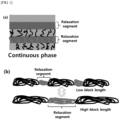
- FIG. 1 schematically shows the structure of a copolymer prepared from the precursor composition of the present invention.
- the diamine of Formula 1 containing a siloxane structure is added in the structure of the polyimide to enhance the modulus strength of the polyimide and alleviate stress by external force.
- the polyimide having the siloxane structure may have polarity and undergo phase separation due to polarity difference between it and a polyimide having no siloxane structure. This may cause the un-uniform distribution of the siloxane structure in the overall structure of the polyimide. In this case, it is difficult to improve the physical properties such as the strength enhancement and stress relaxation effect of the polyimide due to the siloxane structure, and the transparency of the film may be deteriorated due to the increase of haze due to phase separation.
- the polyimide prepared from the diamine may be more polar and the phase separation between polyimides may be more clearly observed.
- a siloxane diamine having a low molecular weight structure as shown in FIG. 1(b) a large amount of siloxane diamine should be added in order to provide stress relaxation effect and the like. This may cause a process problem such as occurrence of Tg at a low temperature to deteriorate the physical properties of the polyimide film.
- the use of a siloxane diamine having a high molecular weight can form a large relaxation segment in the molecule as shown in FIG.
- the present invention is to uniformly distribute the diamine of formula (1) having a siloxane structure with a higher molecular weight in a polyimide matrix without phase separation.
- the polar solvent may be subject to volatilization in advance during the process due to its high volatility. This may deteriorate the reproducibility of the process and fails to completely solve phase separation to raise the haze of the polyimide film prepared and lower the transparency thereof.
- the present invention uses an organic solvent having a positive value of logP, particularly an amine-based solvent having a positive value of logP, more specifically a solvent having an amphiphilic structure to solve the problem of process caused by the use of the polar solvent. Also, even though the solvent having an amphiphilic structure is used alone, it allows the uniform distribution of the polyimide by virtue of its molecular structure with amphiphilic property, and thus can solve the problems caused by phase separation to provide a polyimide having improved haze characteristics.
- the tetracarboxylic dianhydrides may be selected from those containing a tetravalent organic group of Formulas 2a to 2h in the molecular structure thereof: wherein,
- the present invention may further comprise a diamine having the structure of Formula 3 in an amount of 80 to 99 mol%, based on the total amount of the diamines: wherein,
- 'fluoro-based substituent' means not only 'fluorine atom ' but also 'a substituent containing a fluorine atom'.
- the diamine of Formula 3 may be selected from compounds of Formulas 3a to 3d: wherein, Q has the same meaning as mentioned above.
- the tetracarboxylic dianhydrides may comprise a compound having the structure of Formula 4 in an amount of 20 to 80 mol%, preferably 30 to 80 mol%, more preferably 30 to 70 mol%, based on the total amount of the tetracarboxylic dianhydrides:
- the structure of Formula 5 may be a compound of Formulas 5a to 5e:
- the addition of the fluorene-containing repeating unit in the polyimide structure can reduce retardation in the thickness direction of the film.
- the present invention may further use at least one selected from tetracarboxylic dianhydrides containing a tetravalent organic group of Formulas 6a to 6r:
- x is an integer of 1 to 10.
- At least one hydrogen atom present in each of the tetravalent aromatic organic groups of Formulas 6a to 6r may also be substituted with a substituent selected from a halogen atom selected from -F, -Cl, -Br and -I, hydroxyl (-OH), thiol (-SH), nitro (-NO 2 ), cyano, C 1-10 alkyl, C 1-4 halogenoalkoxyl, C 1-10 halogenoalkyl, and C 6-20 aryl.
- a substituent selected from a halogen atom selected from -F, -Cl, -Br and -I, hydroxyl (-OH), thiol (-SH), nitro (-NO 2 ), cyano, C 1-10 alkyl, C 1-4 halogenoalkoxyl, C 1-10 halogenoalkyl, and C 6-20 aryl.
- both tetracarboxylic dianhydrides of Formula 4 and Formula 5 may be used in the present invention.
- the tetracarboxylic dianhydride of Formula 5 may be used in an amount of 10 to 30 mol%, preferably 10 to 25 mol%, more preferably 15 to 25 mol% based on the total amount of the tetracarboxylic dianhydrides.
- the compound of Formula 5 containing the fluorene structure is used with the formula of Formula 4 in the preparation of the polyimide to alleviate surface-directed shrinkage by heat, thereby improving the shrinkage of the film which may be generated during a cooling procedure and enhancing heat resistance such as glass transition temperature.
- the total tetracarboxylic dianhydrides and the diamines may be brought into reaction in a molar ratio of 1:1.1 to 1.1:1.
- the total amount of the tetracarboxylic dianhydrides may excessively exceed the amount of the diamine, or the amount of the diamines may excessively exceed the total amount of the tetracarboxylic dianhydrides.
- the total tetracarboxylic dianhydrides and the diamines may be brought into reaction in a molar ratio of 1:0.99 to 0.99:1, preferably 1:0.98 to 0.98:1.
- the organic solvent which is useful in the present invention has a positive value of partition coefficient (logP) at 25°C and a density of 1 g/cm 3 or less and may have a boiling point of 180°C or lower. More specifically, the value of partition coefficient (logP) may range from 0.01 to 3, or 0.1 to 2, or 0.5 to 1.5.
- the partition coefficients (logP) of dimethylpropionamide (DMPA) and diethylpropionamide (DEPA) are 0.504 and 1.275, respectively, and the densities thereof are 0.876 g/cm 3 and 0.870 g/cm 3 , respectively.
- the partition coefficient may be calculated using the ACD/LogP module of ACD/Percepta platform (ACD/Labs).
- ACD/LogP module uses an algorism for quantitative structure-property relationship (QSPR) based on molecular 2D structure.
- the positive value of partition coefficient means the hydrophobic polarity of a solvent.
- the present inventors have found that when a certain solvent having a positive partition coefficient is used to prepare a polyimide precursor composition, it can improve the drying property of the solvent. Also, the use of a solvent having a positive partition coefficient can control the drying property of the solvent without using an additive such as a leveling agent for controlling the surface tension and the smoothness of the coated film. By avoiding the use of additional additive, it is possible to eliminate the problems that a low molecular weight material is contained in the final product to cause quality damage and process difficulty and to have the effect of forming a polyimide having uniform properties more effectively.
- the coating solution may be dewetted due to shrinkage of the coated layer when the coating solution is cured or stored under humidity conditions.
- the dewetting of the coating solution may cause variation in thickness of a film to lack the flexibility of the film, and thus the film may be cut or its edges may be broken when cutting, resulting in poor working performance and reduced yield.
- the polyimide precursor composition comprising a polar solvent with a negative value of logP may sporadically undergo crack generation or thickness change based on the position of the foreign material by the polarity of the foreign material in the coated film, while the polyimide precursor composition comprising a hydrophobic solvent with a positive value of logP can alleviate or inhibit crack generation and thickness change even though the fine polar foreign material is introduced.
- the dewetting phenomenon in polyimide precursor composition or film may occur within 30 minutes after coating of the polyimide precursor composition. Particularly, as the dewetting is started from the edge, the thickness of the edge may increase.
- the dewetting ratio of the coated polyimide precursor composition may be 0.1% or less.
- the dewetting ratio may be very low as 0.1% or less, preferably 0.05%, more preferably near 0%.
- Such dewetting ratio is also maintained after curing.
- the polyimide precursor composition is coated on a substrate, storing thereof for 10 minutes or longer, for example, at a temperature of 20°C to 30°C and under a humidity condition of 40% or more, more specifically, under a humidity condition of a range from 40% to 80%, i.e., 40%, 50%, 60%, 70% and 80%, respectively, for example, storing under a humidity condition of 50% for 10 to 50 minutes and then cured at 320°C or higher
- the dewetting ratio of the polyimide film thus obtained may be 0.1% or less.
- the dewetting ratio may be 0.05%, more preferably near 0%.
- the polyimide precursor composition according to the present invention can solve the dewetting phenomenon, thereby providing a polyimide with more uniform characteristics and thus improving the yield of a manufacturing process.
- the density of the organic solvent according to the present invention may be measured by a standard measuring method of ASTM D1475, and it may be 1 g/cm 3 or less. If the density is more than 1 g/cm 3 , the relative viscosity may increase and then the process efficiency may be reduced.
- the polymerization of the tetracarboxylic dianhydrides and the diamines may be carried out by conventional polymerization methods of a polyimide or its precursor, such as solution polymerization.
- the polymerization may be carried out by dissolving the diamines in an organic solvent and adding the tetracarboxylic dianhydrides to the resultant mixing solution.
- a method of polymerization may comprise the following steps:
- the reaction of polymerization may be carried out under an inert gas or nitrogen atmosphere and anhydrous conditions.
- the reaction may be carried out at a temperature of -20 to 80 °C, preferably 0 to 80 °C. If the reaction temperature is too high, the reactivity may be raised and the molecular weight may increase, and the viscosity of the precursor composition may increase, which may be disadvantageous in terms of the process.
- the polyimide precursor composition preferably has a solid content to provide a suitable viscosity taking into consideration of processibility such as coating property in the formation of a film.
- the solid content may range from 8 to 25 wt%, preferably 10 to 25 wt, more preferably 10 to 20 wt% based on the total weight of the polyimide precursor composition.
- the polyimide precursor composition has a viscosity of 3,000 cP or more, or 4,000 cP or more.
- the viscosity of the polyimide precursor composition may be 10,000 cP or less, preferably 9,000 cP or less, more preferably 8,000 cP or less. If the viscosity of the polyimide precursor composition exceeds 10,000 cP, the process efficiency may be deteriorated due to reduced defoaming efficiency when processing the polyimide film, and also electrical, optical and mechanical properties of the film may be deteriorated due to bad surface profile caused by bubble formation.
- the polyimide according to the present invention may have a weight average molecular weight of 10,000 to 200,000 g/mol, 20,000 to 100,000 g/mol or 30,000 to 100,000 g/mol. Further, it is preferred that the polyimide according to the present invention has a molecular weight distribution (Mw/Mn) of 1.1 to 2.5. If the weight average molecular weight or molecular weight distribution of the polyimide is out of the range defined above, it is difficult to form the film or it is apt to deteriorate the characteristics of the polyimide-based film, such as transmittance, heat resistance and mechanical properties.
- the polyimide precursor composition obtained by the above method may be subject to imidization.
- the imidization process may be carried out by a chemical imidization method or a thermal imidization method.
- the polyimide can be obtained by a imidization method using chemical reaction in which a dehydrating agent and an imidization catalyst are added to the polymerized polyimide precursor solution and then the resulting solution is heated at a temperature of 50 to 100 °C, or by a imidization method in which alcohol is removed while refluxing the above solution.
- the imidization catalyst may be pyridine, triethylamine, picoline or quinoline and the like, and in addition, it may be substituted or unsubstituted nitrogen-containing heterocyclic compounds, N-oxide compounds of a nitrogen-containing heterocyclic compound, substituted or unsubstituted amino acid compounds, aromatic hydrocarbon compounds having a hydroxyl group or aromatic heterocyclic compounds.
- the catalyst may be imidazole derivatives such as lower alkylimidazoles, for example, 1,2-dimethylimidazole, N-methylimidazole, N-benzyl-2-methylimidazole, 2-methylimidazole, 2-ethyl-4-methylimidazole, 5-methylbenzimidazole and the like; substituted pyridines, for example, isoquinoline, 3,5-dimethylpyridine, 3,4-dimethylpyridine, 2,5-dimethylpyridine, 2,4-dimethylpyridine, 4-n-propylpyridine and the like; p-toluene sulfonic acid and the like.
- imidazole derivatives such as lower alkylimidazoles, for example, 1,2-dimethylimidazole, N-methylimidazole, N-benzyl-2-methylimidazole, 2-methylimidazole, 2-ethyl-4-methylimidazole, 5-methylbenzimidazole and the like
- the dehydrating agent may be an acid anhydride such as acetic acid anhydride.
- the imidization may be carried out by coating the polyimide precursor composition on a substrate, followed by heat treatment.
- the polyimide precursor composition may be in the form of a solution dissolved in an organic solvent, and in this case, for example, when the polyimide precursor is synthesized in the organic solvent, the solution may be the reaction solution thus obtained itself or a solution obtained by diluting the reaction solution with another solvent. Further, when the polyimide precursor is obtained as solid powder, the solution may be a solution obtained by dissolving the powder in an organic solvent.
- the present invention provides a method for preparing a polyimide film comprising coating the polyimide precursor composition on a substrate; and heat-treating the polyimide precursor composition coated on the substrate.
- the composition After coating the polyimide precursor composition on a substrate, the composition can be heat-treated in an IR oven or a hot air oven, or on a hot plate, and the heat-treatment for curing may be performed at a temperature ranging from 300 to 500 °C, preferably 320 to 480 °C, and also may be performed in multi-steps within the above temperature range.
- the heat-treating process may be performed for 20 min to 70 min, preferably 20 min to 60 min.
- the organic solvent contained in the polyimide precursor composition of the present invention may be the same organic solvent used for the above synthesis reaction.
- a coupling agent, a crosslinkable compound, an imidization catalyst for effectively proceeding imidization and the like can be added if they do not have an influence upon the effect of the present invention.
- the polyimide film according to the present invention may have a haze of 2 or less, preferably 1 or less, or 0.9 or less to improve transparency.
- the polyimide film may have a thickness of 8 to 15 ⁇ m, preferably 10 to 12 ⁇ m.
- the polyimide film may be colorless and transparent, specifically have a transmittance of at least 80% to light at a wavelength of 380 nm to 760 nm within the film thickness of 5 to 30 ⁇ m, and a yellowness index (YI) of about 15 or less, preferably about 10 or less, more preferably about 8 or less. Therefore, the polyimide film can exhibit markedly improved transparency and optical properties due to its excellent light transmittance and yellowness index.
- YI yellowness index
- the polyimide film may have an in-plane retardation (R in ) of about 0 to 100 nm and a thickness retardation (R th ) of about 1000 nm or less, or 0 to 700 nm, preferably 0 to 600 nm, more preferably 0 to 500 nm.
- R in in-plane retardation
- R th thickness retardation
- the thickness retardation of the polyimide film satisfies such range, it is possible to develop a visual sensitivity suitable for a display. If the thickness retardation is more than 1000 nm, the polyimide film undergoes retardation therein and light looks distorted, thereby significantly deteriorating the visual sensitivity.
- the polyimide film according to the present invention may have a Tg of 350°C or higher, preferably 360°C or higher, more preferably 370°C or higher.
- the polyimide film according to the present invention may have excellent heat resistance on temperature change.
- the polyimide film according to the present invention may have a coefficient of thermal expansion (CTE) of -10 to 100 ppm/°C, preferably -7 to 90 ppm/°C, more preferably 80 ppm/°C or less, after heating and then cooling the polyimide film n+1 times in a range from 100 to 400 °C.
- CTE coefficient of thermal expansion
- Another embodiment of the present invention provides an article comprising the polyimide copolymer.
- the article may be a film, a fiber, a coating material, an adhesive and the like, but not limited thereto.
- the article may be formed by a dry/wet method, a dry method, a wet method and the like using a composite composition of the copolymer and inorganic particles, but not limited thereto.
- the article may be an optical film, and in this case, the composition comprising the polyimide copolymer may be applied on a substrate through a spin coating method followed by being dried and cured to prepare the article easily.
- the polyimide according to the present invention can maintain characteristics such as heat resistance, mechanical strength and the like due to its rigid structure, in particular, excellent heat resistance against thermal shrinkage behavior which can occur during a high temperature process. Also, it exhibits excellent colorless and transparent characteristics. Thus, it can be used in various fields such as a substrate for a device, a cover substrate for a display, an optical film, an integrated circuit (IC) package, an adhesive film, a multi-layered flexible printed circuit (FPC), a tape, a touch panel, a protection film for an optical disk and the like.
- IC integrated circuit
- FPC multi-layered flexible printed circuit
- the display device may be a liquid crystal display device (LCD), an organic light emitting diode (OLED) and the like.
- the polyimide may be suitable for an OLED device which uses a LTPS (low temperature polycrystalline silicon) process requiring a high temperature process, but not limited thereto.
- DMPA dimethyl propanamide
- DPS- DPS diphenylsiloxane-dimethylsiloxane co-oligomer
- TFMB 2,2'-bis(trifluoromethyl)benzidine
- the DMS-DPS used in Example 1 was subject to an NMR analysis and the results thereof were shown in FIG. 2 .
- Each of the polyimide copolymers obtained in Examples 1 and 2 and Comparative Examples 1 and 2 was spin coated in a thickness of 9.5 to 11 ⁇ m onto a glass substrate.
- the polyimide copolymer-coated glass substrate was put in an oven and subject to heating at a rate of 2 °C/min, followed by curing at 80 °C for 15 min, 150 °C for 30 min, 220 °C for 30 min and 400°C for 1 hr. After curing, the glass substrate was dipped in water, and the film formed on the substrate was detached and dried at 100°C in an oven, to prepare a polyimide film.
- the polyimide film prepared was measured for yellowness index (YI), haze, thickness retardation, CTE, glass transition temperature (Tg) and glass stress (Bow), and the results thereof were shown in Table 1.
- the yellowness index (YI) of the film was measured using a colorimeter (Color Eye 7000A).
- the haze of the film was measured using Haze Meter HM-150 according to the method of ASTM D1003.
- the thickness retardation (R th ) of the film was measured using Axoscan.
- the film was cut into a certain size to give a sample and the thickness of the sample was measured. Then, the retardation of the film was measured using Axoscan and the measured thickness was input while calibrating in the C-plate direction to compensate for the retardation value.
- the film was cut into a size of 5 mm ⁇ 20 mm to give a sample, and the sample was loaded thereon using an accessory.
- the actual measured length of the films was 16 mm, and the force pulling the film was set to 0.02 N.
- a first heating process was performed within the temperature ranging from 100 to 350 °C at a heating rate of 5°C/min. Then, when the heated sample was subject to cooling within the temperature ranging from 350 to 100°C at a cooling rate of 4°C /min, the change of thermal expansion was measured with TMA (Q400, TA Instruments). The infection point shown in the temperature range during the first heating process was taken as Tg.
- a glass having a size of 10 cm ⁇ 10 cm was mounted on a stress measurement system (FLX2320, TENCOR). After the center of the glass was scanned with a laser, the height deviation of the glass, i.e., a degree that the glass was warped, was measured at a distance of 4 cm between the left and right sides in the center (a total length of 8 cm) except for 1 cm on both edges of the glass.
- Example 1 Comparative Example 1 DMS-DPS Mw 5000 5000 5000 p:q 73.3:26.7 73.3:26.7 95.2:4.8 Organic Solvent DMPA DEPA NMP DMS-DPS Content (wt%) 25 25 25 25 Molecular Weight of PI 78000 85000 53000 Solid Content (wt%) 15.7 14.3 16.9 Viscosity (cps) 3900 3800 4100 Thickness ( ⁇ m) 10 10 10 YI 5.8 5.9 9.6 State of Solution Uniform Uniform Un-uniform (White turbidity) Haze 0.2 0.3 46.8 R th 185 185 190 CTE (100 ⁇ 350°C, 1st cooling) 60 60 120 Tg (°C) 400 400 350 Real Bow ( ⁇ m) 24 25 24 Residual Stress (MPa) 25 24 23
- the polyimide copolymers of Examples 1 to 2 were obtained using DMS-DPS (the moral ratio of DMS block and DPS block is 73.3: 26.7) to improve white turbidity in the solution and haze in the film, while that of Comparative Example 1 was obtained from DMS-DPS wherein the DMS block was contained in a high ratio to exhibit white turbidity in the solution and poor haze in the film. Also, Comparative Example 2 used DMS-DPS wherein the DPS block was contained in a relatively high ratio to exhibit high residual stress.
- Examples 1 to 2 using a solvent having a positive value of partition coefficient (logP) at 25°C and a density of 1 g/cm 3 or less exhibited improved optical properties and heat resistance as compared with Comparative Example 1.
Landscapes
- Chemical & Material Sciences (AREA)
- Organic Chemistry (AREA)
- Health & Medical Sciences (AREA)
- Chemical Kinetics & Catalysis (AREA)
- Medicinal Chemistry (AREA)
- Polymers & Plastics (AREA)
- Physics & Mathematics (AREA)
- Manufacturing & Machinery (AREA)
- Engineering & Computer Science (AREA)
- Nonlinear Science (AREA)
- Materials Engineering (AREA)
- Mathematical Physics (AREA)
- Crystallography & Structural Chemistry (AREA)
- General Physics & Mathematics (AREA)
- Optics & Photonics (AREA)
- Macromolecular Compounds Obtained By Forming Nitrogen-Containing Linkages In General (AREA)
- Manufacture Of Macromolecular Shaped Articles (AREA)
Claims (12)
- Composition de précurseur de polyimide, lequel comprend un dianhydride acide, une diamine et un oligomère de diméthylsiloxane (DMS)-diphénylsiloxane (DPS) de la Formule 1 en tant que composants de polymérisation, et un solvant organique ayant une valeur positive de coefficient de partage (logP) à 25°C et une densité égale ou inférieure à 1 g/cm3 :
 dans laquelle, p et q sont chacun une fraction molaire, et p va de 70 à 90 et q va de 10 à 30 quand la somme de p et q est 100,dans laquelle le solvant organique est un diméthylpropionamide (DMPA) ou un diéthylpropionamide (DEPA), etdans laquelle l'oligomère de diméthylsiloxane (DMS)-diphénylsiloxane (DPS) a un poids moléculaire égal ou supérieur à 4 000 g/mol.
 - Composition de précurseur de polyimide selon la revendication 1, dans laquelle le dianhydride acide est un ou plusieurs éléments sélectionnés parmi des dianhydrides tétracarboxyliques contenant un groupe organique tétravalent des Formules 2a à 2h :


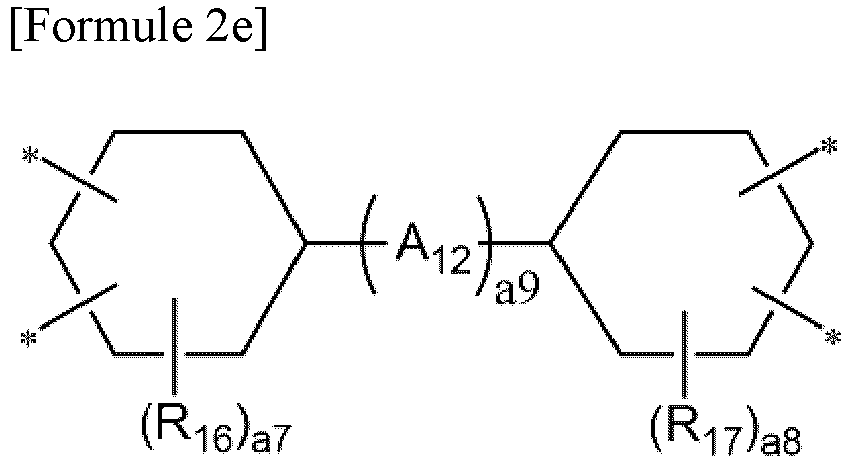


 R11 à R24 sont chacun indépendamment un substituant sélectionné dans un groupe de -F, -Cl, -Br, -I, un hydroxyle (-OH), un thiol (-SH), un nitro (-NO2), un cyano, un alkyle en C1-10, un halogénoalkoxyle en C1-4, un halogénoalkyle en C1-10 et un aryle en C6-20,a1 est un nombre entier de 0 à 2, a2 est un nombre entier de 0 à 4, a3 est un nombre entier de 0 à 8, a4 et a5 sont chacun indépendamment un nombre entier de 0 à 3, et a7 et a8 sont chacun indépendamment un nombre entier de 0 à 3, a10 et a12 sont chacun indépendamment un nombre entier de 0 à 3, a11 est un nombre entier de 0 à 4, a15 et a16 sont chacun indépendamment un nombre entier de 0 à 4, a17 et a18 sont chacun indépendamment un nombre entier de 0 à 4, et a6, a9, a13, a14, a19 et a20 sont chacun indépendamment un nombre entier de 0 à 3,n est un nombre entier de 1 à 3, etAn à A16 sont chacun indépendamment sélectionnés dans le groupe constitué de -O-, -CR'R"-, -C(=O)-, -C(=O)O-, -C(=O)NH-, -S-, -SO2-, un phénylène et une combinaison de ces derniers, dans lequel R' et R" sont chacun indépendamment sélectionnés dans le groupe constitué d'un hydrogène, un alkyle en C1-10 et un fluoroalkyle en C1-10.
 - Composition de précurseur de polyimide selon la revendication 1, dans laquelle la diamine comprend un composé ayant la structure de la Formule 3 dans une quantité de 80 à 99 % en moles, sur la base de la quantité totale de la diamine :
 R31 et R32 sont chacun indépendamment un substituant sélectionné dans le groupe de -F, -Cl, -Br, -I, un hydroxyle (-OH), un thiol (-SH), un nitro (-NO2), un cyano, un alkyle en C1-10, un halogénoalkoxyle en C1-4, un groupe halogénoalkyle en C1-10 et un aryle en C6-20, etQ est sélectionné dans le groupe constitué d'une liaison simple, -O-, -CR'R"-, - C(=O)-, -C(=O)O-, -C(=O)NH-, -S-, -SO2-, un phénylène et une combinaison de ces derniers, dans lequel R' et R" sont chacun indépendamment sélectionnés dans le groupe constitué d'un hydrogène, un alkyle en C1-10 et un fluoroalkyle en C1-10.
 - Composition de précurseur de polyimide selon la revendication 1, dans laquelle le dianhydride acide est un dianhydride tétracarboxylique comprenant un composé ayant la structure de la Formule 4 dans une quantité de 20 à 80 % en moles, sur la base de la quantité totale du dianhydride tétracarboxylique :

- Composition de précurseur de polyimide selon la revendication 1, dans laquelle le dianhydride acide est un dianhydride tétracarboxylique comprenant un composé ayant la structure de la Formule 5 dans une quantité de 20 à 80 % en moles, sur la base de la quantité totale du dianhydride tétracarboxylique :

- Composition de précurseur de polyimide selon la revendication 1, dans laquelle le dianhydride acide comprend à la fois des dianhydrides tétracarboxyliques de la Formule 4 et de la Formule 5 :


- Film de polyimide préparé à partir de la composition de précurseur de polyimide selon l'une quelconque des revendications 1 à 6.
- Film de polyimide selon la revendication 7, lequel a un voile égal ou inférieur à 2.
- Film de polyimide selon la revendication 7, lequel a une Tg égale ou supérieure à 350°C.
- Film de polyimide selon la revendication 7, lequel a un CTE égal ou inférieur à 100 ppm/°C.
- Substrat transparent de polyimide pour un TFT d'oxyde préparé à partir de la composition de précurseur de polyimide selon l'une quelconque des revendications 1 à 6.
- Substrat transparent de polyimide pour un LTPS préparé à partir la composition de précurseur de polyimide selon l'une quelconque des revendications 1 à 6.
Applications Claiming Priority (2)
| Application Number | Priority Date | Filing Date | Title |
|---|---|---|---|
| KR1020170117989A KR101840977B1 (ko) | 2017-09-14 | 2017-09-14 | 폴리이미드 전구체 조성물 및 이를 이용한 폴리이미드 필름 |
| PCT/KR2018/007733 WO2019054612A1 (fr) | 2017-09-14 | 2018-07-09 | Composition de précurseur de polyimide et film de polyimide utilisant ladite composition |
Publications (3)
| Publication Number | Publication Date |
|---|---|
| EP3536732A1 EP3536732A1 (fr) | 2019-09-11 |
| EP3536732A4 EP3536732A4 (fr) | 2020-04-15 |
| EP3536732B1 true EP3536732B1 (fr) | 2024-11-06 |
Family
ID=61900699
Family Applications (1)
| Application Number | Title | Priority Date | Filing Date |
|---|---|---|---|
| EP18856647.5A Active EP3536732B1 (fr) | 2017-09-14 | 2018-07-09 | Composition de précurseur de polyimide et film de polyimide utilisant ladite composition |
Country Status (7)
| Country | Link |
|---|---|
| US (1) | US11466124B2 (fr) |
| EP (1) | EP3536732B1 (fr) |
| JP (1) | JP6794610B2 (fr) |
| KR (1) | KR101840977B1 (fr) |
| CN (1) | CN110121520B (fr) |
| TW (1) | TWI677535B (fr) |
| WO (1) | WO2019054612A1 (fr) |
Families Citing this family (15)
| Publication number | Priority date | Publication date | Assignee | Title |
|---|---|---|---|---|
| KR101840977B1 (ko) * | 2017-09-14 | 2018-03-21 | 주식회사 엘지화학 | 폴리이미드 전구체 조성물 및 이를 이용한 폴리이미드 필름 |
| KR102117151B1 (ko) | 2017-09-29 | 2020-05-29 | 주식회사 엘지화학 | 폴리이미드 전구체 용액 및 이를 이용하여 제조된 폴리이미드 필름 |
| WO2019208590A1 (fr) * | 2018-04-23 | 2019-10-31 | 信越化学工業株式会社 | Composé contenant du silicium |
| CN108641665B (zh) * | 2018-05-14 | 2020-08-21 | 中国科学院化学研究所 | 一种聚酰亚胺胶黏剂及其制备方法 |
| KR102268861B1 (ko) * | 2018-08-20 | 2021-06-23 | 주식회사 엘지화학 | 폴리이미드 전구체 조성물 및 이를 이용하는 폴리이미드 필름 |
| WO2020040495A1 (fr) * | 2018-08-20 | 2020-02-27 | 주식회사 엘지화학 | Composition de précurseur de polyimide, son procédé de préparation et film de polyimide l'utilisant |
| KR102264423B1 (ko) * | 2018-08-20 | 2021-06-14 | 주식회사 엘지화학 | 폴리이미드 전구체 조성물, 그 제조 방법 및 이를 이용한 폴리이미드 필름 |
| CN110922753A (zh) * | 2018-09-20 | 2020-03-27 | 住友化学株式会社 | 光学膜形成用组合物 |
| KR102551047B1 (ko) | 2019-02-01 | 2023-07-04 | 주식회사 엘지화학 | 폴리이미드 필름, 이를 이용한 플렉서블 기판 및 플렉서블 기판을 포함하는 플렉서블 디스플레이 |
| JP2022025010A (ja) * | 2020-07-13 | 2022-02-09 | エスケー イノベーション カンパニー リミテッド | テトラカルボン酸二無水物およびその製造方法 |
| KR102788044B1 (ko) * | 2020-07-13 | 2025-03-31 | 에스케이이노베이션 주식회사 | 폴리이미드 전구체, 폴리이미드 전구체 조성물, 폴리이미드 필름, 이의 제조방법 및 이의 용도 |
| CN112382666B (zh) * | 2020-11-05 | 2022-09-02 | 中国科学院上海微系统与信息技术研究所 | 一种柔性器件及其制备方法 |
| CN116583553A (zh) * | 2021-12-08 | 2023-08-11 | 株式会社Lg化学 | 基于聚酰亚胺的树脂膜、使用其的用于显示装置的基底和光学装置 |
| WO2023106571A1 (fr) * | 2021-12-08 | 2023-06-15 | 주식회사 엘지화학 | Film de résine à base de polyimide, substrat pour dispositif d'affichage l'utilisant, et dispositif optique |
| TW202344566A (zh) * | 2022-02-14 | 2023-11-16 | 南韓商Sk新技術股份有限公司 | 聚醯亞胺前驅物組合物、及其製備方法與應用 |
Family Cites Families (30)
| Publication number | Priority date | Publication date | Assignee | Title |
|---|---|---|---|---|
| US4395527A (en) * | 1978-05-17 | 1983-07-26 | M & T Chemicals Inc. | Siloxane-containing polymers |
| FR2616153B1 (fr) | 1987-06-05 | 1990-11-23 | Rhone Poulenc Chimie | Copolymeres thermostables sequences de structure (bloc imide-amide)-(bloc uree-siloxane) |
| JP2002012666A (ja) * | 2000-06-29 | 2002-01-15 | Shin Etsu Chem Co Ltd | ポリイミドシリコーン樹脂、その製造方法およびその組成物 |
| JP2003156863A (ja) * | 2001-11-21 | 2003-05-30 | Konica Corp | 電子写真感光体の浸漬塗布方法及び電子写真感光体 |
| AU2003236317A1 (en) | 2002-03-29 | 2003-10-13 | Du Pont-Toray Company, Ltd. | Composite comprising heat-resistant fiber and siloxane polymer |
| JP3862267B2 (ja) | 2002-03-29 | 2006-12-27 | 株式会社飾一 | 耐熱性繊維とシロキサンポリマーとからなる複合体 |
| JP2006342310A (ja) | 2005-06-10 | 2006-12-21 | Kaneka Corp | 新規ポリイミド前駆体およびその利用 |
| JP5370676B2 (ja) | 2007-08-22 | 2013-12-18 | デクセリアルズ株式会社 | 新規なアミド基含有シロキサンアミン化合物 |
| WO2009025283A1 (fr) * | 2007-08-22 | 2009-02-26 | Sony Chemical & Information Device Corporation | Nouvelle résine de polyimide et composition de résine de polyimide photosensible |
| JP2009079165A (ja) | 2007-09-27 | 2009-04-16 | Du Pont Toray Co Ltd | ポリイミドフィルム |
| JP2009007580A (ja) * | 2008-08-12 | 2009-01-15 | Hitachi Chem Co Ltd | ポリアミドイミド樹脂及びそれを用いた接着剤組成物 |
| JP5899605B2 (ja) | 2010-01-12 | 2016-04-06 | Jnc株式会社 | 熱硬化性組成物 |
| WO2011122198A1 (fr) | 2010-03-31 | 2011-10-06 | Jsr株式会社 | Précurseur de polyimide, composition de résine contenant ledit précurseur, et procédé de formation d'un film à l'aide de la composition de résine |
| KR101787652B1 (ko) | 2011-05-13 | 2017-10-19 | 주식회사 엘지생활건강 | 세탁용 시트 |
| JP5862674B2 (ja) * | 2011-09-29 | 2016-02-16 | Jsr株式会社 | 樹脂組成物およびそれを用いた膜形成方法 |
| KR20210014751A (ko) * | 2012-12-21 | 2021-02-09 | 아사히 가세이 이-매터리얼즈 가부시키가이샤 | 폴리이미드 전구체 및 그것을 함유하는 수지 조성물 |
| DE102014104223A1 (de) | 2014-03-26 | 2015-10-01 | Elantas Italia S.R.L. | Neues Lösemittel für Polyamidimide und Polyimide |
| EP3150655B1 (fr) | 2014-05-30 | 2021-05-05 | LG Chem, Ltd. | Liquide à base de polyimide et film à base de polyimide produit en l'utilisant |
| US20170137571A1 (en) | 2014-06-04 | 2017-05-18 | Ube Industries, Ltd. | Method for producing polyimide film |
| CN106414575B (zh) | 2014-06-25 | 2021-03-02 | 旭化成株式会社 | 具有孔隙的聚酰亚胺薄膜及其制造方法 |
| KR101775204B1 (ko) * | 2014-12-04 | 2017-09-19 | 주식회사 엘지화학 | 폴리이미드계 용액 및 이를 이용하여 제조된 폴리이미드계 필름 |
| JP5944613B1 (ja) * | 2014-12-24 | 2016-07-05 | ユニチカ株式会社 | 多孔質ポリイミドフィルムおよびその製造方法 |
| KR101748931B1 (ko) * | 2015-02-09 | 2017-06-19 | 주식회사 엘지화학 | 폴리이미드계 필름 형성용 조성물 및 이를 이용하여 제조된 폴리이미드계 필름 |
| CN106133025B (zh) | 2015-03-05 | 2019-03-12 | 株式会社Lg化学 | 用于生产光电器件的柔性板的聚酰亚胺膜的组合物 |
| WO2016140559A1 (fr) * | 2015-03-05 | 2016-09-09 | 주식회사 엘지화학 | Composition de film polyimide pour substrat souple de dispositif optoélectronique |
| JP2017052877A (ja) | 2015-09-09 | 2017-03-16 | 富士ゼロックス株式会社 | ポリイミド前駆体組成物、ポリイミド前駆体組成物の製造方法、及びポリイミド成形体の製造方法 |
| KR102580455B1 (ko) | 2015-12-31 | 2023-09-20 | 주식회사 동진쎄미켐 | 폴리이미드고분자 조성물, 이의 제조 방법 및 이를 이용한 폴리이미드 필름의 제조 방법 |
| CN106674027B (zh) | 2016-12-30 | 2018-10-16 | 江苏创拓新材料有限公司 | 二胺化合物、聚酰亚胺、光学薄膜及其制备方法 |
| KR101840977B1 (ko) * | 2017-09-14 | 2018-03-21 | 주식회사 엘지화학 | 폴리이미드 전구체 조성물 및 이를 이용한 폴리이미드 필름 |
| BR112020005191B8 (pt) | 2017-10-30 | 2024-03-12 | Nippon Soda Co | Composição de concentrado emulsificável agroquímico |
-
2017
- 2017-09-14 KR KR1020170117989A patent/KR101840977B1/ko active Active
-
2018
- 2018-07-09 EP EP18856647.5A patent/EP3536732B1/fr active Active
- 2018-07-09 JP JP2019531076A patent/JP6794610B2/ja active Active
- 2018-07-09 WO PCT/KR2018/007733 patent/WO2019054612A1/fr not_active Ceased
- 2018-07-09 CN CN201880005211.0A patent/CN110121520B/zh active Active
- 2018-07-09 US US16/474,766 patent/US11466124B2/en active Active
- 2018-08-28 TW TW107129854A patent/TWI677535B/zh active
Also Published As
| Publication number | Publication date |
|---|---|
| WO2019054612A1 (fr) | 2019-03-21 |
| CN110121520A (zh) | 2019-08-13 |
| CN110121520B (zh) | 2021-10-08 |
| JP2020504198A (ja) | 2020-02-06 |
| JP6794610B2 (ja) | 2020-12-02 |
| EP3536732A1 (fr) | 2019-09-11 |
| KR101840977B1 (ko) | 2018-03-21 |
| TWI677535B (zh) | 2019-11-21 |
| EP3536732A4 (fr) | 2020-04-15 |
| US11466124B2 (en) | 2022-10-11 |
| TW201920484A (zh) | 2019-06-01 |
| US20190345288A1 (en) | 2019-11-14 |
Similar Documents
| Publication | Publication Date | Title |
|---|---|---|
| EP3536732A1 (fr) | Composition de précurseur de polyimide et film de polyimide utilisant ladite composition | |
| KR101796875B1 (ko) | 폴리이미드 전구체 용액 및 이의 제조방법 | |
| US11549013B2 (en) | Polyimide copolymer and polyimide film using same | |
| EP3392293B1 (fr) | Solution de précurseur de polyimide et procédé de production associé | |
| EP3266808B1 (fr) | Composition de film polyimide pour substrat souple de dispositif optoélectronique | |
| KR102080965B1 (ko) | 폴리이미드 전구체 용액 및 이로부터 제조된 폴리이미드 필름 | |
| KR101787941B1 (ko) | 폴리이미드 전구체 조성물 및 이를 이용하는 폴리이미드 필름 | |
| EP3505556B1 (fr) | Composition de formation de film polyimide et film polyimide ainsi produit | |
| EP3366726A1 (fr) | Polyamidimide transparent à haute résistance et son procédé de préparation | |
| KR101966737B1 (ko) | 폴리이미드 전구체 조성물 및 이를 이용한 폴리이미드 필름 | |
| KR102094059B1 (ko) | 폴리이미드 전구체 용액 및 이의 제조방법 | |
| KR102040413B1 (ko) | 실록산 화합물 및 이를 포함하는 폴리이미드 전구체 조성물 |
Legal Events
| Date | Code | Title | Description |
|---|---|---|---|
| STAA | Information on the status of an ep patent application or granted ep patent |
Free format text: STATUS: THE INTERNATIONAL PUBLICATION HAS BEEN MADE |
|
| PUAI | Public reference made under article 153(3) epc to a published international application that has entered the european phase |
Free format text: ORIGINAL CODE: 0009012 |
|
| STAA | Information on the status of an ep patent application or granted ep patent |
Free format text: STATUS: REQUEST FOR EXAMINATION WAS MADE |
|
| 17P | Request for examination filed |
Effective date: 20190607 |
|
| AK | Designated contracting states |
Kind code of ref document: A1 Designated state(s): AL AT BE BG CH CY CZ DE DK EE ES FI FR GB GR HR HU IE IS IT LI LT LU LV MC MK MT NL NO PL PT RO RS SE SI SK SM TR |
|
| AX | Request for extension of the european patent |
Extension state: BA ME |
|
| A4 | Supplementary search report drawn up and despatched |
Effective date: 20200318 |
|
| RIC1 | Information provided on ipc code assigned before grant |
Ipc: C08G 73/10 20060101AFI20200312BHEP Ipc: H01L 21/02 20060101ALI20200312BHEP Ipc: G02F 1/1333 20060101ALI20200312BHEP Ipc: C08J 5/18 20060101ALI20200312BHEP |
|
| DAV | Request for validation of the european patent (deleted) | ||
| DAX | Request for extension of the european patent (deleted) | ||
| STAA | Information on the status of an ep patent application or granted ep patent |
Free format text: STATUS: EXAMINATION IS IN PROGRESS |
|
| 17Q | First examination report despatched |
Effective date: 20220719 |
|
| GRAP | Despatch of communication of intention to grant a patent |
Free format text: ORIGINAL CODE: EPIDOSNIGR1 |
|
| STAA | Information on the status of an ep patent application or granted ep patent |
Free format text: STATUS: GRANT OF PATENT IS INTENDED |
|
| INTG | Intention to grant announced |
Effective date: 20240704 |
|
| GRAS | Grant fee paid |
Free format text: ORIGINAL CODE: EPIDOSNIGR3 |
|
| GRAA | (expected) grant |
Free format text: ORIGINAL CODE: 0009210 |
|
| STAA | Information on the status of an ep patent application or granted ep patent |
Free format text: STATUS: THE PATENT HAS BEEN GRANTED |
|
| AK | Designated contracting states |
Kind code of ref document: B1 Designated state(s): AL AT BE BG CH CY CZ DE DK EE ES FI FR GB GR HR HU IE IS IT LI LT LU LV MC MK MT NL NO PL PT RO RS SE SI SK SM TR |
|
| REG | Reference to a national code |
Ref country code: GB Ref legal event code: FG4D |
|
| REG | Reference to a national code |
Ref country code: CH Ref legal event code: EP |
|
| REG | Reference to a national code |
Ref country code: DE Ref legal event code: R096 Ref document number: 602018076375 Country of ref document: DE |
|
| REG | Reference to a national code |
Ref country code: IE Ref legal event code: FG4D |
|
| P01 | Opt-out of the competence of the unified patent court (upc) registered |
Free format text: CASE NUMBER: APP_60477/2024 Effective date: 20241109 |
|
| REG | Reference to a national code |
Ref country code: LT Ref legal event code: MG9D |
|
| REG | Reference to a national code |
Ref country code: NL Ref legal event code: MP Effective date: 20241106 |
|
| PG25 | Lapsed in a contracting state [announced via postgrant information from national office to epo] |
Ref country code: HR Free format text: LAPSE BECAUSE OF FAILURE TO SUBMIT A TRANSLATION OF THE DESCRIPTION OR TO PAY THE FEE WITHIN THE PRESCRIBED TIME-LIMIT Effective date: 20241106 Ref country code: PT Free format text: LAPSE BECAUSE OF FAILURE TO SUBMIT A TRANSLATION OF THE DESCRIPTION OR TO PAY THE FEE WITHIN THE PRESCRIBED TIME-LIMIT Effective date: 20250306 Ref country code: IS Free format text: LAPSE BECAUSE OF FAILURE TO SUBMIT A TRANSLATION OF THE DESCRIPTION OR TO PAY THE FEE WITHIN THE PRESCRIBED TIME-LIMIT Effective date: 20250306 |
|
| PG25 | Lapsed in a contracting state [announced via postgrant information from national office to epo] |
Ref country code: NL Free format text: LAPSE BECAUSE OF FAILURE TO SUBMIT A TRANSLATION OF THE DESCRIPTION OR TO PAY THE FEE WITHIN THE PRESCRIBED TIME-LIMIT Effective date: 20241106 Ref country code: FI Free format text: LAPSE BECAUSE OF FAILURE TO SUBMIT A TRANSLATION OF THE DESCRIPTION OR TO PAY THE FEE WITHIN THE PRESCRIBED TIME-LIMIT Effective date: 20241106 |
|
| REG | Reference to a national code |
Ref country code: AT Ref legal event code: MK05 Ref document number: 1739300 Country of ref document: AT Kind code of ref document: T Effective date: 20241106 |
|
| PG25 | Lapsed in a contracting state [announced via postgrant information from national office to epo] |
Ref country code: BG Free format text: LAPSE BECAUSE OF FAILURE TO SUBMIT A TRANSLATION OF THE DESCRIPTION OR TO PAY THE FEE WITHIN THE PRESCRIBED TIME-LIMIT Effective date: 20241106 |
|
| PG25 | Lapsed in a contracting state [announced via postgrant information from national office to epo] |
Ref country code: ES Free format text: LAPSE BECAUSE OF FAILURE TO SUBMIT A TRANSLATION OF THE DESCRIPTION OR TO PAY THE FEE WITHIN THE PRESCRIBED TIME-LIMIT Effective date: 20241106 |
|
| PG25 | Lapsed in a contracting state [announced via postgrant information from national office to epo] |
Ref country code: NO Free format text: LAPSE BECAUSE OF FAILURE TO SUBMIT A TRANSLATION OF THE DESCRIPTION OR TO PAY THE FEE WITHIN THE PRESCRIBED TIME-LIMIT Effective date: 20250206 |
|
| PG25 | Lapsed in a contracting state [announced via postgrant information from national office to epo] |
Ref country code: GR Free format text: LAPSE BECAUSE OF FAILURE TO SUBMIT A TRANSLATION OF THE DESCRIPTION OR TO PAY THE FEE WITHIN THE PRESCRIBED TIME-LIMIT Effective date: 20250207 Ref country code: AT Free format text: LAPSE BECAUSE OF FAILURE TO SUBMIT A TRANSLATION OF THE DESCRIPTION OR TO PAY THE FEE WITHIN THE PRESCRIBED TIME-LIMIT Effective date: 20241106 Ref country code: LV Free format text: LAPSE BECAUSE OF FAILURE TO SUBMIT A TRANSLATION OF THE DESCRIPTION OR TO PAY THE FEE WITHIN THE PRESCRIBED TIME-LIMIT Effective date: 20241106 |
|
| PG25 | Lapsed in a contracting state [announced via postgrant information from national office to epo] |
Ref country code: PL Free format text: LAPSE BECAUSE OF FAILURE TO SUBMIT A TRANSLATION OF THE DESCRIPTION OR TO PAY THE FEE WITHIN THE PRESCRIBED TIME-LIMIT Effective date: 20241106 |
|
| PG25 | Lapsed in a contracting state [announced via postgrant information from national office to epo] |
Ref country code: RS Free format text: LAPSE BECAUSE OF FAILURE TO SUBMIT A TRANSLATION OF THE DESCRIPTION OR TO PAY THE FEE WITHIN THE PRESCRIBED TIME-LIMIT Effective date: 20250206 |
|
| PG25 | Lapsed in a contracting state [announced via postgrant information from national office to epo] |
Ref country code: SM Free format text: LAPSE BECAUSE OF FAILURE TO SUBMIT A TRANSLATION OF THE DESCRIPTION OR TO PAY THE FEE WITHIN THE PRESCRIBED TIME-LIMIT Effective date: 20241106 |
|
| PG25 | Lapsed in a contracting state [announced via postgrant information from national office to epo] |
Ref country code: DK Free format text: LAPSE BECAUSE OF FAILURE TO SUBMIT A TRANSLATION OF THE DESCRIPTION OR TO PAY THE FEE WITHIN THE PRESCRIBED TIME-LIMIT Effective date: 20241106 |
|
| PGFP | Annual fee paid to national office [announced via postgrant information from national office to epo] |
Ref country code: GB Payment date: 20250624 Year of fee payment: 8 |
|
| PG25 | Lapsed in a contracting state [announced via postgrant information from national office to epo] |
Ref country code: EE Free format text: LAPSE BECAUSE OF FAILURE TO SUBMIT A TRANSLATION OF THE DESCRIPTION OR TO PAY THE FEE WITHIN THE PRESCRIBED TIME-LIMIT Effective date: 20241106 |
|
| PGFP | Annual fee paid to national office [announced via postgrant information from national office to epo] |
Ref country code: FR Payment date: 20250624 Year of fee payment: 8 |
|
| PG25 | Lapsed in a contracting state [announced via postgrant information from national office to epo] |
Ref country code: RO Free format text: LAPSE BECAUSE OF FAILURE TO SUBMIT A TRANSLATION OF THE DESCRIPTION OR TO PAY THE FEE WITHIN THE PRESCRIBED TIME-LIMIT Effective date: 20241106 |
|
| PG25 | Lapsed in a contracting state [announced via postgrant information from national office to epo] |
Ref country code: SK Free format text: LAPSE BECAUSE OF FAILURE TO SUBMIT A TRANSLATION OF THE DESCRIPTION OR TO PAY THE FEE WITHIN THE PRESCRIBED TIME-LIMIT Effective date: 20241106 |
|
| PG25 | Lapsed in a contracting state [announced via postgrant information from national office to epo] |
Ref country code: CZ Free format text: LAPSE BECAUSE OF FAILURE TO SUBMIT A TRANSLATION OF THE DESCRIPTION OR TO PAY THE FEE WITHIN THE PRESCRIBED TIME-LIMIT Effective date: 20241106 |
|
| PG25 | Lapsed in a contracting state [announced via postgrant information from national office to epo] |
Ref country code: IT Free format text: LAPSE BECAUSE OF FAILURE TO SUBMIT A TRANSLATION OF THE DESCRIPTION OR TO PAY THE FEE WITHIN THE PRESCRIBED TIME-LIMIT Effective date: 20241106 |
|
| REG | Reference to a national code |
Ref country code: DE Ref legal event code: R097 Ref document number: 602018076375 Country of ref document: DE |
|
| PG25 | Lapsed in a contracting state [announced via postgrant information from national office to epo] |
Ref country code: SE Free format text: LAPSE BECAUSE OF FAILURE TO SUBMIT A TRANSLATION OF THE DESCRIPTION OR TO PAY THE FEE WITHIN THE PRESCRIBED TIME-LIMIT Effective date: 20241106 |
|
| PLBE | No opposition filed within time limit |
Free format text: ORIGINAL CODE: 0009261 |
|
| STAA | Information on the status of an ep patent application or granted ep patent |
Free format text: STATUS: NO OPPOSITION FILED WITHIN TIME LIMIT |
|
| PGFP | Annual fee paid to national office [announced via postgrant information from national office to epo] |
Ref country code: DE Payment date: 20250624 Year of fee payment: 8 |
|
| 26N | No opposition filed |
Effective date: 20250807 |
|
| REG | Reference to a national code |
Ref country code: CH Ref legal event code: H13 Free format text: ST27 STATUS EVENT CODE: U-0-0-H10-H13 (AS PROVIDED BY THE NATIONAL OFFICE) Effective date: 20260224 |
|
| PG25 | Lapsed in a contracting state [announced via postgrant information from national office to epo] |
Ref country code: LU Free format text: LAPSE BECAUSE OF NON-PAYMENT OF DUE FEES Effective date: 20250709 |
|
| REG | Reference to a national code |
Ref country code: BE Ref legal event code: MM Effective date: 20250731 |
|
| PG25 | Lapsed in a contracting state [announced via postgrant information from national office to epo] |
Ref country code: BE Free format text: LAPSE BECAUSE OF NON-PAYMENT OF DUE FEES Effective date: 20250731 |
|
| PG25 | Lapsed in a contracting state [announced via postgrant information from national office to epo] |
Ref country code: CH Free format text: LAPSE BECAUSE OF NON-PAYMENT OF DUE FEES Effective date: 20250731 |