EP3539955B1 - Procédé de préparation de tétrazines - Google Patents
Procédé de préparation de tétrazines Download PDFInfo
- Publication number
- EP3539955B1 EP3539955B1 EP19161551.7A EP19161551A EP3539955B1 EP 3539955 B1 EP3539955 B1 EP 3539955B1 EP 19161551 A EP19161551 A EP 19161551A EP 3539955 B1 EP3539955 B1 EP 3539955B1
- Authority
- EP
- European Patent Office
- Prior art keywords
- formula
- carbon atoms
- mixture obtained
- tetrazines
- nmr
- Prior art date
- Legal status (The legal status is an assumption and is not a legal conclusion. Google has not performed a legal analysis and makes no representation as to the accuracy of the status listed.)
- Active
Links
Classifications
-
- C—CHEMISTRY; METALLURGY
- C07—ORGANIC CHEMISTRY
- C07D—HETEROCYCLIC COMPOUNDS
- C07D257/00—Heterocyclic compounds containing rings having four nitrogen atoms as the only ring hetero atoms
- C07D257/10—Heterocyclic compounds containing rings having four nitrogen atoms as the only ring hetero atoms condensed with carbocyclic rings or ring systems
- C07D257/12—Six-membered rings having four nitrogen atoms
-
- C—CHEMISTRY; METALLURGY
- C07—ORGANIC CHEMISTRY
- C07D—HETEROCYCLIC COMPOUNDS
- C07D401/00—Heterocyclic compounds containing two or more hetero rings, having nitrogen atoms as the only ring hetero atoms, at least one ring being a six-membered ring with only one nitrogen atom
- C07D401/02—Heterocyclic compounds containing two or more hetero rings, having nitrogen atoms as the only ring hetero atoms, at least one ring being a six-membered ring with only one nitrogen atom containing two hetero rings
- C07D401/04—Heterocyclic compounds containing two or more hetero rings, having nitrogen atoms as the only ring hetero atoms, at least one ring being a six-membered ring with only one nitrogen atom containing two hetero rings directly linked by a ring-member-to-ring-member bond
-
- C—CHEMISTRY; METALLURGY
- C07—ORGANIC CHEMISTRY
- C07D—HETEROCYCLIC COMPOUNDS
- C07D403/00—Heterocyclic compounds containing two or more hetero rings, having nitrogen atoms as the only ring hetero atoms, not provided for by group C07D401/00
- C07D403/02—Heterocyclic compounds containing two or more hetero rings, having nitrogen atoms as the only ring hetero atoms, not provided for by group C07D401/00 containing two hetero rings
- C07D403/10—Heterocyclic compounds containing two or more hetero rings, having nitrogen atoms as the only ring hetero atoms, not provided for by group C07D401/00 containing two hetero rings linked by a carbon chain containing aromatic rings
Definitions
- the present invention relates to a new process for the preparation of tetrazines.
- tetrazines are prepared by a two-step process comprising the addition of hydrazine to nitrile precursors, followed by the oxidation of the resulting 1,2-dihydrotetrazine (a) KA Hofmann, O. Ehrhart, Ber. Dtsch. Chem. Ges. 1912, 45, 2731-2740 ; b) T. Curtius, A. Hess, J. Prakt. Chem. 1930, 125, 40-53 ). These processes convert most aromatic nitriles into the corresponding symmetrical 3,6-disubstituted tetrazines, but do not work with aliphatic nitriles (a) N.
- the object of the present invention is therefore to provide a process for the preparation of asymmetric tetrazines, with satisfactory yields, and at reduced cost.
- the object of the present invention is therefore to provide a process for the preparation of asymmetric tetrazines, which does not require the use of a catalyst.
- the object of the present invention is therefore to provide a process making it possible to obtain asymmetric tetrazines, particularly suitable for grafting onto biological (cells, viruses, proteins, etc.) or inorganic (functional nanoparticles) structures.
- the process of the invention therefore makes it possible to obtain tetrazines carrying a hydrogen on one of the two tetrazine carbons, as well as, on the other accessible carbon of the molecule, in particular a phenyl group, carrying reactive functions in organic chemistry.
- tetrazines carrying a hydrogen on one of the two tetrazine carbons, as well as, on the other accessible carbon of the molecule, in particular a phenyl group, carrying reactive functions in organic chemistry. (alcohol, carboxylic acid, amine, etc.) suitable for grafting onto biological (cells, viruses, proteins, etc.) or inorganic structures (functional nanoparticles).
- tetrazines thus obtained are very interesting for the "clicking" of objects of biological interest, by quantitative reaction, at low temperature and in biological fluids, with proteins labeled with reactive alkenes (eg transcycloctene).
- the process according to the invention is carried out from hydrazine hydrate, which is easy to handle, and without a catalyst.
- This new process therefore constitutes a significant improvement of the existing process, and leads to a very significant drop in the cost price of the tetrazines thus prepared for commercial purposes, by limiting the working time, the cost of the reagents, and, above all, , the security requirements that are extremely expensive.
- R is an aryl, heteroaryl or arylalkyl group as indicated above.
- the aryl groups are cyclic aromatic groups comprising between 6 and 10 carbon atoms.
- aryl groups mention may be made of phenyl or naphthyl groups.
- heteroaryl denotes a monocyclic or bicyclic aromatic group of 5 to 10 members containing from 1 to 4 heteroatoms chosen from O, S or N.
- heteroaryl comprising 5 to 6 atoms, including 1 to 4 nitrogen atoms
- alkyl denotes saturated, linear or branched aliphatic hydrocarbon groups comprising, unless otherwise mentioned, from 1 to 6 carbon atoms.
- alkyl denotes saturated, linear or branched aliphatic hydrocarbon groups comprising, unless otherwise mentioned, from 1 to 6 carbon atoms.
- arylalkyl When an alkyl radical is substituted by an aryl group, the term “arylalkyl” or “aralkyl” radical is used.
- the “arylalkyl” or “aralkyl” radicals are aryl-alkyl- radicals, the aryl and alkyl groups being as defined above.
- arylalkyl radicals mention may in particular be made of the benzyl or phenethyl radical.
- aryl and “heteroaryl” radicals may be substituted with one or more substituents.
- substituents the following groups may be mentioned: amino, hydroxy, thiol, oxo, halogen, alkyl, optionally substituted, alkoxy, alkylthio, alkylamino, aryl, aryloxy, arylalkoxy, cyano, trifluoromethyl, carboxy or carboxyalkyl.
- halogen atom denotes fluorine, chlorine, bromine or iodine atoms.
- R represents a heteroaryl group as defined above, optionally substituted.
- R is an unsubstituted heteroaryl group, especially a pyridinyl group.
- R represents an aryl group as defined above, substituted or not.
- R is a substituted aryl group, especially a substituted phenyl group.
- substituents of said aryl group preferably of said phenyl group, mention may be made of halogen atoms, in particular Br or Cl, alkyl groups, in particular methyl, (hetero) aryl groups as defined above, CN, the groups of formula COOR a , R a representing H or an alkyl group comprising from 1 to 6 carbon atoms, or alternatively the alkyl groups, in particular methyl, substituted by OH, COOH or NR ' a R' b , R ' a and R ′ b , independently of one another, representing H or an alkyl group comprising from 1 to 6 carbon atoms, or a group protecting the amine functions, for example Boc.
- R represents a —CH2-Ar group
- Ar representing an aryl group as defined above and preferably a phenyl group.
- R can therefore represent, for example, a benzyl group.
- the process of the invention consists firstly in mixing a nitrile of formula (II) as defined above with dichloromethane and sulfur, in an alcohol.
- the alcohol of step a) is an alcohol of formula R′OH, R ′ representing an alkyl group comprising from 1 to 6 carbon atoms.
- alcohols mention may be made, for example, of ethanol, butanol or propanol, and preferably ethanol.
- step a) the mixing of step a) is carried out in a tube for a microwave reactor.
- step a) is carried out under microwave irradiation.
- the sulfur content is between 1 and 4 equivalents, and preferably between 1.5 and 2.5 equivalents, relative to the nitrile of formula (II).
- step b) hydrazine monohydrate, NH 2 NH 2 .H 2 O, is added to the mixture obtained at the end of step a). Then the whole thing is stirred.
- the mixture obtained at the end of step b) is introduced into a microwave reactor.
- the tube in which step a) is carried out, and therefore also subsequently, step b), is sealed and then introduced into a microwave reactor.
- the method of the invention comprises, after step b) and before step c), a step of heating the mixture obtained at the end of step b).
- the mixture obtained at the end of step b) is subjected to a heating step.
- said heating step is carried out at a temperature between 30 ° C and 70 ° C, and preferably between 45 ° C and 55 ° C.
- this heating step is carried out for a period of between 3 hours and 48 hours, and preferably between 12 hours and 30 hours.
- step b The mixture obtained at the end of step b), preferably heated, is then subjected to oxidation.
- This step consists in particular in bringing said mixture into contact with an oxidizing agent.
- oxidizing agents such as sodium nitrite or isoamyl nitrite, nitrogen oxides, oxidizing metal cations, such as, without limitation, copper II. , cerium IV, iron III, dioxygen, hydrogen peroxide, hypohalogenites, halogenates ...
- this oxidation step is carried out in the presence of oxygen or sodium nitrite.
- step c) consists in adding sodium nitrite to the mixture obtained at the end of step b), in particular with water.
- acetic acid is gradually added to the reaction mixture.
- the method of the invention comprises a step of isolating the tetrazines obtained.
- step d) consists of a step of extracting, preferably with dichloromethane, the mixture obtained at the end of step c), optionally followed by steps of drying, evaporation and / or purification.
- the mixture obtained at the end of step c) is extracted for example with dichloromethane, then dried over MgSO 4 .
- the process of the invention further comprises, in the context of step d), a step of evaporating all the solvents, in particular dichloromethane, and also preferably, a step of purifying the solvents.
- tetrazines obtained on a chromatography column.
- the present invention also relates to a compound of the following formula:
- Benzonitrile (1 mmol, Aldrich Chemicals), sulfur (2 mmol, 64 mg) and dichloromethane (1 mmol, 63.70 ⁇ l) are mixed in 1 ml of ethanol in a reaction tube for a microwave reactor. Pure hydrazine monohydrate (8 mmol, 0.4 ml, Acros Organics) is then added, and the mixture is stirred. The tube is then sealed, which is then introduced into the reactor and heated at 50 ° C for 24 h.
- reaction mixture is then taken up with 3 ml of CH2Cl2 then 10 mmoles (0.69 g) of sodium nitrite in 10 ml of water are added to the mixture, and then 20 mmoles (1.14 ml) of acetic acid are added. gradually added. During this operation, the mixture takes on the brilliant red color characteristic of tetrazines.
- the mixture is then extracted with dichloromethane, then dried over MgSO 4 . The solvents are then evaporated off and the tetrazine purified on a chromatography column (LPLC, 4g of silica).
Landscapes
- Chemical & Material Sciences (AREA)
- Organic Chemistry (AREA)
- Organic Low-Molecular-Weight Compounds And Preparation Thereof (AREA)
Description
- La présente invention a pour objet un nouveau procédé de préparation de tétrazines.
- A ce jour, les tétrazines sont préparées par un procédé en deux étapes comprenant l'addition d'hydrazine à des précurseurs nitriles, suivie de l'oxydation de la 1,2-dihydrotétrazine résultante (a) K. A. Hofmann, O. Ehrhart, Ber. Dtsch. Chem. Ges. 1912, 45, 2731-2740; b) T. Curtius, A. Hess, J. Prakt. Chem. 1930, 125, 40-53). Ces procédés permettent de transformer la plupart des nitriles aromatiques en tétrazines 3,6-disubstituées symétriques correspondantes, mais ne marchent pas avec les nitriles aliphatiques (a) N. Saracoglu, Tetrahedron 2007, 63, 4199-4236; b) M. O. Abdel-Rahman, M. A. Kira, M. N. Tolba, Tetrahedron Lett. 1968, 9, 3871-3872). En outre, il est difficile de préparer des tétrazines 3,6-disubstituées asymétriques selon cette approche classique, en raison de la formation de mélanges de produits symétriques et asymétriques, et d'une quantité accrue de sous-produits, ce qui entraîne des procédures compliquées de purification et des rendements faibles, typiquement de l'ordre de 10%-20% (M. R. Karver, R. Weissleder, S. A. Hilderbrand, Bioconjugate Chem. 2011, 22, 2263-2270).
- Plus récemment, une procédure one-pot avec catalyse métallique a été mise au point pour préparer des tétrazines asymétriques avec des rendements élevés (J. Yang, M. R. Karver, W. Li, S. Sahu, N. K. Devaraj, Angew. Chem. Int. Ed. 2012, 51, 5222-5225). Cependant, ce procédé présente de nombreux inconvénients, notamment en raison de l'utilisation d'hydrazine pure, qui est un réactif gazeux hautement toxique, cancérigène et très délicat à manipuler, ainsi que d'un catalyseur métallique coûteux. Il est fait aussi référence à Quinton , "New J. Chem.", 2015, 39, pages 9700-9713.
- Il existe donc un besoin d'un procédé de préparation de tétrazines asymétriques, simple et efficace, avec un rendement satisfaisant, et économiquement intéressant.
- La présente invention a donc pour but de fournir un procédé de préparation de tétrazines asymétriques, avec des rendements satisfaisants, et avec un coût réduit.
- La présente invention a donc pour but de fournir un procédé de préparation de tétrazines asymétriques, ne nécessitant pas l'utilisation de catalyseur.
- La présente invention a donc pour but de fournir un procédé permettant d'obtenir des tétrazines asymétriques, particulièrement adaptées au greffage sur des structures biologiques (cellules, virus, protéines...) ou inorganiques (nanoparticules fonctionnelles).
- Ainsi, la présente invention concerne un procédé de préparation d'un composé de formule (I) suivante :
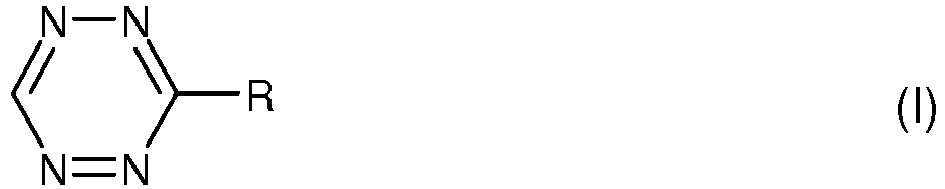
- un groupe aryle comprenant de 6 à 10 atomes de carbone, éventuellement substitué,
- un groupe hétéroaryle comprenant de 5 à 10 atomes, dont au moins un hétéroatome choisi parmi O, S ou N, éventuellement substitué, ou
- un groupe alkyle comprenant de 1 à 6 atomes de carbone, substitué par un groupe aryle comprenant de 6 à 10 atomes de carbone,
- a) une étape de mélange d'un nitrile de formule (II) suivante :
R-CN (II)
R étant tel que défini ci-dessus,
avec du dichlorométhane et du soufre, dans un alcool, - b) une étape d'addition de monohydrate d'hydrazine au mélange obtenu à l'issue de l'étape a), et mélange de l'ensemble ainsi obtenu,
- c) une étape d'oxydation du mélange obtenu à l'issue de l'étape b), et
- d) une éventuelle étape d'isolement du composé de formule (I).
- Le procédé de l'invention permet donc d'obtenir des tétrazines portant un hydrogène sur l'un des deux carbones tétraziniques, ainsi que, sur l'autre carbone accessible de la molécule, notamment un groupement phényle, portant des fonctions réactives en chimie organique (alcool, acide carboxylique, amine, etc...) adaptées au greffage sur des structures biologiques (cellules, virus, protéines...) ou inorganiques (nanoparticules fonctionnelles).
- Les tétrazines ainsi obtenues sont très intéressantes pour le "cliquage" d'objets d'intérêt biologique, par réaction quantitative, à basse température et dans des fluides biologiques, avec des protéines marquées par des alcènes réactifs (par exemple le transcycloctène).
- Le procédé selon l'invention est effectué à partir d'hydrate d'hydrazine, aisé à manipuler, et sans catalyseur.
- Ce nouveau procédé constitue donc une amélioration importante du procédé existant, et conduit à une baisse très importante du prix de revient des tétrazines ainsi préparées dans un objectif commercial, par le fait de limiter le temps de travail, le coût des réactifs, et, surtout, les exigences en matière de sécurité qui reviennent extrêmement cher.
- Les tétrazines obtenues selon le procédé de l'invention répondent à la formule (I) susmentionnée.
- Dans la formule (I), R est un groupe aryle, hétéroaryle ou arylalkyle comme indiqué ci-dessus.
- Selon l'invention, les groupes aryles sont des groupes aromatiques cycliques comprenant entre 6 et 10 atomes de carbone. A titre d'exemples de groupes aryles, on peut citer les groupes phényle ou naphtyle.
- Selon l'invention, le terme "hétéroaryle" désigne un groupe monocyclique ou bicyclique aromatique de 5 à 10 chaînons contenant de 1 à 4 hétéroatomes choisis parmi O, S ou N.
- A titre d'exemples, on peut citer les groupes imidazolyle, thiazolyle, oxazolyle, furanyle, thiophényle, pyrazolyle, oxadiazolyle, tétrazolyle, pyridinyle, pyrazinyle, pyrimidinyle, pyridazinyle, indolyle, benzofuranyle, benzothiophényle, benzoxazolyle, benzimidazolyle, indazolyle, benzothiazolyle, isobenzothiazolyle, benzotriazolyle, quinoléinyle, isoquinoléinyle.
- A titre d'hétéroaryle comprenant 5 à 6 atomes, dont 1 à 4 atomes d'azote, on peut notamment citer les groupes représentatifs suivants : pyrrolyle, pyrazolyle, 1,2,3-triazolyle, 1,2,4-triazolyle, tétrazolyle et 1,2,3-triazinyle.
- On peut également citer, à titre d'hétéroaryle, le thiophényle, l'oxazolyle, le furazanyle, le 1,2,4-thiadiazolyle, le naphthyridinyle, le quinoxalinyle, le phtalazinyle, l'imidazo[1,2-a]pyridine, l'imidazo[2,1-b]thiazolyle, le cinnolinyle, le benzofurazanyle, l'azaindolyle, le benzimidazolyle, le benzothiophényle, le thiénopyridyle, le thiénopyrimidinyle, le pyrrolopyridyle, l'imidazopyridyle, le benzoazaindole, le 1,2,4-triazinyle, l'indolizinyle, l'isoxazolyle, l'isoquinolinyle, l'isothiazolyle, le purinyle, le quinazolinyle, le quinolinyle, l'isoquinolyle, le 1,3,4-thiadiazolyle, le thiazolyle, l'isothiazolyle, le carbazolyle, ainsi que les groupes correspondants issus de leur fusion ou de la fusion avec le noyau phényle.
- Selon l'invention, le terme "alkyle" désigne des groupes aliphatiques hydrocarbonés, saturés, linéaires ou ramifiés comprenant, sauf mention contraire, de 1 à 6 atomes de carbone. A titre d'exemples, on peut citer les groupes méthyle, éthyle, n-propyle, isopropyle, butyle, isobutyle, tertbutyle ou pentyle.
- Lorsqu'un radical alkyle est substitué par un groupe aryle, on parle de radical "arylalkyle" ou "aralkyle". Les radicaux "arylalkyles" ou "aralkyles" sont des radicaux aryl-alkyl-, les groupes aryles et alkyles étant tels que définis ci-dessus. Parmi les radicaux arylalkyles, on peut notamment citer le radical benzyle ou phénéthyle.
- Les radicaux "aryle" et "hétéroaryle" susmentionnés peuvent être substitués par un ou plusieurs substituants. Parmi ces substituants, on peut citer les groupes suivants : amino, hydroxy, thiol, oxo, halogène, alkyle, éventuellement substitué, alcoxy, alkylthio, alkylamino, aryle, aryloxy, arylalcoxy, cyano, trifluorométhyle, carboxy ou carboxyalkyle.
- Dans le cadre de la présente invention, le terme "atome d'halogène" désigne les atomes fluor, chlore, brome ou iode.
- Selon un mode de réalisation, dans la formule (I), R représente un groupe hétéroaryle tel que défini ci-dessus, éventuellement substitué. De préférence, R est un groupe hétéroaryle non substitué, notamment un groupe pyridinyle.
- Selon un mode de réalisation, dans la formule (I), R représente un groupe aryle tel que défini ci-dessus, substitué ou non. De préférence, R est un groupe aryle substitué, notamment un groupe phényle substitué. En particulier, parmi les substituants dudit groupe aryle, de préférence dudit groupe phényle, on peut citer les atomes d'halogène, notamment Br ou Cl, les groupes alkyles, notamment méthyle, les groupes (hétéro)aryles tels que définis ci-dessus, CN, les groupes de formule COORa, Ra représentant H ou un groupe alkyle comprenant de 1 à 6 atomes de carbone, ou encore les groupes alkyles, notamment méthyles, substitués par OH, COOH ou NR'aR'b, R'a et R'b, indépendamment les uns des autres, représentant H ou un groupe alkyle comprenant de 1 à 6 atomes de carbone, ou un groupe protecteur des fonctions amines, par exemple Boc.
- Selon un mode de réalisation, dans la formule (I), R représente un groupe -CH2-Ar, Ar représentant un groupe aryle tel que défini ci-dessus et de préférence, un groupe phényle. R peut donc représenter par exemple un groupe benzyle.
- Le procédé de l'invention consiste dans un premier temps à mélanger un nitrile de formule (II) telle que définie ci-dessus avec du dichlorométhane et du soufre, dans un alcool.
- Selon un mode de réalisation, l'alcool de l'étape a) est un alcool de formule R'OH, R' représentant un groupe alkyle comprenant de 1 à 6 atomes de carbone.
- Parmi les alcools, on peut citer par exemple l'éthanol, le butanol ou le propanol, et préférentiellement l'éthanol.
- Selon un mode de réalisation, le mélange de l'étape a) est effectué dans un tube pour réacteur à microondes.
- Selon un mode de réalisation, l'étape a) est effectuée sous irradiation microondes.
- De préférence, dans l'étape a), la teneur en soufre est comprise entre 1 et 4 équivalents, et de préférence entre 1,5 et 2,5 équivalents, par rapport au nitrile de formule (II).
- Selon l'étape b), on ajoute du monohydrate d'hydrazine, NH2NH2.H2O, au mélange obtenu à l'issue de l'étape a). Ensuite, l'ensemble est agité.
- Selon un mode de réalisation, le mélange obtenu à l'issue de l'étape b) est introduit dans un réacteur à microondes.
- Selon un mode de réalisation, le tube dans lequel est effectué l'étape a), et donc également ensuite, l'étape b), est scellé puis introduit dans un réacteur à microondes
- Selon un mode de réalisation, le procédé de l'invention comprend, après l'étape b) et avant l'étape c), une étape de chauffage du mélange obtenu à l'issue de l'étape b).
- Selon un mode de réalisation, le mélange obtenu à l'issue de l'étape b) est soumis à une étape de chauffage.
- De préférence, ladite étape de chauffage est effectuée à une température comprise entre 30°C et 70°C, et de préférence entre 45°C et 55°C.
- De préférence, cette étape de chauffage est effectuée pendant une durée comprise entre 3 heures et 48 heures, et de préférence entre 12 heures et 30 heures.
- Le mélange obtenu à l'issue de l'étape b), de préférence chauffé, est ensuite soumis à une oxydation. Cette étape consiste notamment à mettre en présence ledit mélange avec un agent oxydant.
- Parmi les agents oxydants, on peut citer par exemple tous les nitrites, tels que le nitrite de sodium ou le nitrite d'isoamyle, les oxydes d'azote, les cations métalliques oxydants, tels que, à titre non-limitatif, le cuivre II, le cérium IV, le fer III, le dioxygène, le peroxyde d'hydrogène, les hypohalogènites, les halogènates...
- Selon un mode de réalisation, cette étape d'oxydation est effectuée en présence d'oxygène ou de nitrite de sodium. De préférence, l'étape c) consiste à ajouter du nitrite de sodium au mélange obtenu à l'issue de l'étape b), notamment avec de l'eau. De préférence, ensuite, de l'acide acétique est progressivement ajouté au mélange réactionnel.
- Selon un mode de réalisation, le procédé de l'invention comprend une étape d'isolement des tétrazines obtenues.
- De préférence, l'étape d) consiste en une étape d'extraction, de préférence avec du dichlorométhane, du mélange obtenu à l'issue de l'étape c), éventuellement suivie d'étapes de séchage, évaporation et/ou purification.
- Selon un mode de réalisation, le mélange obtenu à l'issue de l'étape c) est extrait par exemple avec du dichlorométhane, puis séché sur du MgSO4.
- Selon un mode de réalisation, le procédé de l'invention comprend en outre, dans le cadre de l'étape d), une étape d'évaporation de tous les solvants, notamment du dichlorométhane, et également de préférence, une étape de purification des tétrazines obtenues sur une colonne de chromatographie.
- La présente invention concerne également un composé de formule suivante :

-

- Du benzonitrile (1 mmol, Aldrich Chemicals), du soufre (2 mmoles, 64 mg) et du dichlorométhane (1 mmoles, 63,70 µl) sont mélangés dans 1 ml d'éthanol dans un tube de réaction pour réacteur à microondes. On ajoute alors du monohydrate d'hydrazine pur (8 mmoles, 0,4 ml, Acros Organics), et le mélange est agité. On scelle alors le tube, qui est ensuite introduit dans le réacteur et chauffé à 50°C pendant 24 h. Le mélange réactionnel est ensuite repris avec 3 ml de CH2CI2 puis 10 mmoles (0,69 g) de nitrite de sodium dans 10 ml d'eau sont ajoutées au mélange, et ensuite 20 mmoles (1,14 ml) d'acide acétique sont progressivement ajoutées. Pendant cette opération, le mélange prend la couleur rouge brillante caractéristique des tétrazines. Le mélange est alors extrait avec du dichlorométhane, puis séché sur MgSO4. Les solvants sont ensuite évaporés et la tétrazine purifiée sur une colonne de chromatographie (LPLC, 4g de silice).
- Ce procédé a été appliqué pour l'obtention des différentes tétrazines ci-dessous :


- Après chromatographie, un solide rouge brillant est obtenu (CH2Cl2 : acide acétique 50:1) (155 mg, rdt: 72%). 1H NMR (400 MHz, CDCl3, δ): 10.23 (s, 1H), 8.62 (d, J = 8.24 Hz, 2H), 7.55 (d, J = 8.24 Hz, 2H), 3.81 (s, 2H); 13C NMR (100 MHz, CDCl3, δ): 175.09, 166.38, 157.99, 138.79, 130.89, 130.65, 128.76, 40.81 ; HRMS [M+H]+ m/z calc. pour [C10H9N4O2]+ 217.0726, trouvé 217.0722.
- Après chromatographie, un solide rouge est obtenu (éther de pétrole:EtOAc = 1:1) (141 mg, rdt: 70%). 1H NMR (400 MHz, DMSO-d6, δ): 10.66 (s, 1H), 8.62 (d, J = 8.24 Hz, 2H), 8.21 (d, J = 8.24 Hz, 2H); 13C NMR (100 MHz, DMSO-d6, δ): 166.73, 165.10, 158.29, 135.72, 134.37, 130.25, 128.01; HRMS [M-H]- m/z calc. pour [C9H5N4O2]- 201.0413, trouvé 201.0412.
- Après chromatographie, un solide rouge brillant est obtenu (éther de pétrole : EtOAc = 3:1) (120 mg, rdt: 64%; 133mg, (rdt: 71% si on utilise le chlorhydrate de 4-(aminomethyl)- benzonitrile comme précurseur du nitrile). 1H NMR (400 MHz, CDCl3, δ): 10.22 (s, 1H), 8.63 (d, J = 8.24 Hz, 2H), 7.62 (d, J = 8.24 Hz, 2H), 4.86 (s, 2H); 13C NMR (100 MHz, CDCl3, δ): 166.42, 157.88, 146.37, 130.84, 128.62, 127.54, 64.78; HRMS [M+H]+ m/z calc. pour [C9H9N4O]+ 189.0776, trouvé 189.0773.
- Après chromatographie, un solide rose est obtenu (CH2Cl2 : EtOAc = 100:1) (114 mg, rdt: 40%). 1H NMR (400 MHz, CDCl3, δ): 10.22 (s, 1H), 8.60 (d, J = 8.24 Hz, 2H), 7.53 (d, J = 8.24 Hz, 2H), 4.99 (s, br, 1H), 4.46 (d, J = 5.95 Hz, 2H), 1.49 (s, 9H); 13C NMR (100 MHz, CDCl3, δ): 166.43, 157.94, 156.09, 144.79, 130.67, 128.73, 128.28, 80.07, 44.49, 28.53;
- Après chromatographie, un solide rouge est obtenu (éther de pétrole : CH2Cl2 = 2:1) (90 mg, rdt: 38%). 1H NMR (400 MHz, CDCl3, δ): 10.25 (s, 1H), 8.51 (d, J = 8.70 Hz, 2H), 7.76 (d, J = 8.70 Hz, 2H); 13C NMR (100 MHz, CDCl3, δ): 166.13, 158.04, 132.90, 130.62, 129.82, 128.65; HRMS [M]+ m/z calc. pour [C8H5BrN4]+ 235.9704, trouvé 235.9692.
- Après chromatographie, un solide rouge est obtenu (éther de pétrole : CH2Cl2 = 2:1) (103 mg, yield: 54%). 1H NMR (400 MHz, CDCl3, δ): 10.24 (s, 1H), 8.56 (d, J = 8.70 Hz, 2H), 7.59 (d, J = 8.70 Hz, 2H); 13C NMR (100 MHz, CDCl3, δ): 165.92, 157.94, 139.92, 130.11, 129.85, 129.63; HRMS [M+H]+ m/z calc. pour [C8H7ClN4]+ 194.0358, trouvé 194.0354.
- Après chromatographie, un solide rouge est obtenu (éther de pétrole : CH2Cl2 = 2:1) (96 mg, rdt: 56%). 1H NMR (400 MHz, CDCl3, δ): 10.19 (s, 1H), 8.52 (d, J = 8.24 Hz, 2H), 7.42 (d, J = 8.24 Hz, 2H), 2.49 (s, 3H); 13C NMR (100 MHz, CDCl3, δ): 166.67, 157.79, 144.15, 130.30, 128.96, 128.41, 21.89; HRMS [M+H]+ m/z calc. pour [C9H9N4]+ 173.0819, trouvé 173.0822.
- Après chromatographie, un solide rouge est obtenu (éther de pétrole : EtOAc = 1:1) (68 mg, rdt: 43%). 1H NMR (400 MHz, CDCl3, δ): 10.37 (s, 1H), 8.99 (d, J = 4.58 Hz, 1H), 8.71 (d, J = 7.79 Hz, 1H), 8.02 (t, J = 7.79 Hz, 1H), 8.71 (dd, J = 7.79 Hz, J = 4.58 Hz, 1H); 13C NMR (100 MHz, CDCl3, δ): 165.90, 158.50, 151.18, 150.03, 137.66, 126.90, 124.45;
- Après chromatographie, un solide rouge est obtenu (éther de pétrole : CH2Cl2 = 2:1) (77 mg, rdt: 45%). 1H NMR (400 MHz, CDCl3, δ): 10.21 (s, 1H), 7.43 (d, J = 8.24 Hz, 2H), 7.34 (dd, J = 8.24 Hz, J = 7.33 Hz, 2H), 7.28 (d, J = 7.33 Hz, 1H), 4.67 (s, 2H); 13C NMR (100 MHz, CDCl3, δ): 172.07, 158.18, 135.64, 129.40, 129.13, 127.67, 41.93; HRMS [M]+ m/z calc. pour [C10H8N4]+ 172.0750, trouvé 172.0743.
- Après chromatographie, un solide rouge cristallin est obtenu (éther de pétrole : CH2Cl2 = 1:1) (111 mg, rdt: 61%). 1H NMR (400 MHz, CDCl3, δ): 10.33 (s, 1H), 8.79 (d, J = 8.70 Hz, 2H), 7.93 (d, J = 8.70 Hz, 2H); 13C NMR (100 MHz, CDCl3, δ): 165.47, 158.28, 135.65, 133.20, 128.82, 118.11, 116.71.;
- Après chromatographie, un solide rouge cristallin est obtenu (éther de pétrole : CH2Cl2 = 1:3) (178 mg, rdt: 75%). 1H NMR (400 MHz, DMSO-d6, δ): 10.65 (s, 2H), 8.79 (s, 4H); 13C NMR (100 MHz, DMSO-d6, δ): 165.63, 165.10, 158.64, 136.14, 129.19.
Claims (10)
- Procédé de préparation d'un composé de formule (I) suivante :
 - un groupe aryle comprenant de 6 à 10 atomes de carbone, éventuellement substitué,- un groupe hétéroaryle comprenant de 5 à 10 atomes, dont au moins un hétéroatome choisi parmi O, S ou N, éventuellement substitué, ou- un groupe alkyle comprenant de 1 à 6 atomes de carbone, substitué par un groupe aryle comprenant de 6 à 10 atomes de carbone,ledit procédé comprenant :a) une étape de mélange d'un nitrile de formule (II) suivante :
R-CN (II)
R étant tel que défini ci-dessus,
avec du dichlorométhane et du soufre, dans un alcool,b) une étape d'addition de monohydrate d'hydrazine au mélange obtenu à l'issue de l'étape a), et mélange de l'ensemble ainsi obtenu,c) une étape d'oxydation du mélange obtenu à l'issue de l'étape b), etd) une éventuelle étape d'isolement du composé de formule (I). - Procédé selon la revendication 1, dans lequel l'alcool de l'étape a) est un alcool de formule R'OH, R' représentant un groupe alkyle comprenant de 1 à 6 atomes de carbone.
- Procédé selon la revendication 1 ou 2, dans lequel l'étape c) d'oxydation est effectuée en présence d'oxygène ou de nitrite de sodium.
- Procédé selon l'une quelconque des revendications 1 à 3, dans lequel l'étape a) est effectuée sous irradiation microondes.
- Procédé selon l'une quelconque des revendications 1 à 4, dans lequel, dans l'étape a), la teneur en soufre est comprise entre 1 et 4 équivalents, par rapport au nitrile de formule (II).
- Procédé selon l'une quelconque des revendications 1 à 5, comprenant, après l'étape b) et avant l'étape c), une étape de chauffage du mélange obtenu à l'issue de l'étape b).
- Procédé selon la revendication 6, dans lequel l'étape de chauffage est effectuée à une température comprise entre 30°C et 70°C.
- Procédé selon la revendication 6 ou 7, dans lequel l'étape de chauffage est effectuée pendant une durée comprise entre 3 heures et 48 heures.
- Procédé selon l'une quelconque des revendications 1 à 8, dans lequel l'étape d) consiste en une étape d'extraction, de préférence avec du dichlorométhane, du mélange obtenu à l'issue de l'étape c), éventuellement suivie d'étapes de séchage, évaporation et/ou purification.
- Composé de formule suivante :

Applications Claiming Priority (1)
| Application Number | Priority Date | Filing Date | Title |
|---|---|---|---|
| FR1852111A FR3078703B1 (fr) | 2018-03-12 | 2018-03-12 | Procede de preparation de tetrazines |
Publications (2)
| Publication Number | Publication Date |
|---|---|
| EP3539955A1 EP3539955A1 (fr) | 2019-09-18 |
| EP3539955B1 true EP3539955B1 (fr) | 2021-07-28 |
Family
ID=63014641
Family Applications (1)
| Application Number | Title | Priority Date | Filing Date |
|---|---|---|---|
| EP19161551.7A Active EP3539955B1 (fr) | 2018-03-12 | 2019-03-08 | Procédé de préparation de tétrazines |
Country Status (2)
| Country | Link |
|---|---|
| EP (1) | EP3539955B1 (fr) |
| FR (1) | FR3078703B1 (fr) |
-
2018
- 2018-03-12 FR FR1852111A patent/FR3078703B1/fr not_active Expired - Fee Related
-
2019
- 2019-03-08 EP EP19161551.7A patent/EP3539955B1/fr active Active
Also Published As
| Publication number | Publication date |
|---|---|
| EP3539955A1 (fr) | 2019-09-18 |
| FR3078703B1 (fr) | 2020-12-18 |
| FR3078703A1 (fr) | 2019-09-13 |
Similar Documents
| Publication | Publication Date | Title |
|---|---|---|
| CA2032988C (fr) | Procede de preparation de derives de la 1-phenyl imidazoline 2,5-dione | |
| FR2692890A1 (fr) | Procédé de préparation de la N-méthyl-3-phényl-3-[4-(trifluorométhyl)-phénoxy]-propylamine et de ses sels d'addition d'acide. | |
| EP1713750A1 (fr) | Procédé de preparation d'un compose fluoroaromatique a partir d'un compose aminoaromatique | |
| FR2819808A1 (fr) | Compositions stabilisees d'acide o-iodoxybenzoique et leur procede de preparation | |
| EP3580199B1 (fr) | Procédé de préparation monotope de composés organo-iodés | |
| EP0030528B1 (fr) | Procédé pour la fixation de groupes alkyles, aralkyles ou cycloalkyles sur une chaîne carbonée portant un groupe fonctionnel | |
| EP3539955A1 (fr) | Procédé de préparation de tétrazines | |
| FR2786483A1 (fr) | Procede de preparation de 4-hydroxyquinoleines et/ou formes tautomeres | |
| EP0020281B1 (fr) | Préparation de benzoxazolone | |
| EP0091385A1 (fr) | Procédé de préparation de p-hydroxybenzylnitriles ou p-hydroxybenzylamines | |
| FR2461695A1 (fr) | Procede de preparation d | |
| EP0060171B1 (fr) | Procédé de N-alkylation de composés organiques azotés | |
| EP0152310B1 (fr) | Procédé de préparation de trifluorométhyl anilines | |
| EP0322290B1 (fr) | Procédé d'allylation des perhalogénoalkyl,perhalogénoalcoxy, perhalogénoalkylthio anilines en présence de métaux | |
| CA2259931A1 (fr) | Procede de nitrosation d'un compose phenolique substitue par un groupememt electro-attracteur et son utilisation | |
| FR2510991A1 (fr) | Procede pour la preparation de methacrylamides et d'acrylamides n-substitues | |
| EP0018931B1 (fr) | Préparation de benzoxazolone | |
| JPS63255260A (ja) | ビス(ヒドロキシフエニル)スルフイドの製造方法 | |
| LU84129A1 (fr) | Procede d'halogenation en meta de n-(o,o'-dialkyl phenyl)alaninates et homologues | |
| FR2787787A1 (fr) | Procede de preparation de thioethers aromatiques de type diphenyle | |
| FR2726555A1 (fr) | Procede de preparation de l'oxyde de 1,1-dichloromethyle et de methyle ou de l'oxyde de 1,1-dichloromethyle et d'ethyle | |
| EP0888318A1 (fr) | Procede ameliore pour la preparation de derives de l'acide 3-(10-phenothiazyl)propanoique ou 3-(10-phenoxazyl)propanoique | |
| FR2833009A1 (fr) | Procede d'extraction de solutions de cetazine | |
| BE896093A (fr) | Procede d'obtention d'alpha-chloronitroso-alcanes dimeres et alpha-chloronitroso-alcanes dimeres obtenus par ledit procede | |
| BE875594A (fr) | Procede de preparation de cetazines, et produits ainsi obtenus |
Legal Events
| Date | Code | Title | Description |
|---|---|---|---|
| PUAI | Public reference made under article 153(3) epc to a published international application that has entered the european phase |
Free format text: ORIGINAL CODE: 0009012 |
|
| STAA | Information on the status of an ep patent application or granted ep patent |
Free format text: STATUS: THE APPLICATION HAS BEEN PUBLISHED |
|
| AK | Designated contracting states |
Kind code of ref document: A1 Designated state(s): AL AT BE BG CH CY CZ DE DK EE ES FI FR GB GR HR HU IE IS IT LI LT LU LV MC MK MT NL NO PL PT RO RS SE SI SK SM TR |
|
| AX | Request for extension of the european patent |
Extension state: BA ME |
|
| STAA | Information on the status of an ep patent application or granted ep patent |
Free format text: STATUS: REQUEST FOR EXAMINATION WAS MADE |
|
| 17P | Request for examination filed |
Effective date: 20200219 |
|
| RBV | Designated contracting states (corrected) |
Designated state(s): AL AT BE BG CH CY CZ DE DK EE ES FI FR GB GR HR HU IE IS IT LI LT LU LV MC MK MT NL NO PL PT RO RS SE SI SK SM TR |
|
| GRAP | Despatch of communication of intention to grant a patent |
Free format text: ORIGINAL CODE: EPIDOSNIGR1 |
|
| STAA | Information on the status of an ep patent application or granted ep patent |
Free format text: STATUS: GRANT OF PATENT IS INTENDED |
|
| INTG | Intention to grant announced |
Effective date: 20210322 |
|
| GRAS | Grant fee paid |
Free format text: ORIGINAL CODE: EPIDOSNIGR3 |
|
| GRAA | (expected) grant |
Free format text: ORIGINAL CODE: 0009210 |
|
| STAA | Information on the status of an ep patent application or granted ep patent |
Free format text: STATUS: THE PATENT HAS BEEN GRANTED |
|
| AK | Designated contracting states |
Kind code of ref document: B1 Designated state(s): AL AT BE BG CH CY CZ DE DK EE ES FI FR GB GR HR HU IE IS IT LI LT LU LV MC MK MT NL NO PL PT RO RS SE SI SK SM TR |
|
| REG | Reference to a national code |
Ref country code: GB Ref legal event code: FG4D Free format text: NOT ENGLISH |
|
| REG | Reference to a national code |
Ref country code: CH Ref legal event code: EP |
|
| REG | Reference to a national code |
Ref country code: AT Ref legal event code: REF Ref document number: 1414644 Country of ref document: AT Kind code of ref document: T Effective date: 20210815 |
|
| REG | Reference to a national code |
Ref country code: IE Ref legal event code: FG4D Free format text: LANGUAGE OF EP DOCUMENT: FRENCH |
|
| REG | Reference to a national code |
Ref country code: DE Ref legal event code: R096 Ref document number: 602019006335 Country of ref document: DE |
|
| REG | Reference to a national code |
Ref country code: LT Ref legal event code: MG9D |
|
| REG | Reference to a national code |
Ref country code: NL Ref legal event code: MP Effective date: 20210728 |
|
| REG | Reference to a national code |
Ref country code: AT Ref legal event code: MK05 Ref document number: 1414644 Country of ref document: AT Kind code of ref document: T Effective date: 20210728 |
|
| PG25 | Lapsed in a contracting state [announced via postgrant information from national office to epo] |
Ref country code: SE Free format text: LAPSE BECAUSE OF FAILURE TO SUBMIT A TRANSLATION OF THE DESCRIPTION OR TO PAY THE FEE WITHIN THE PRESCRIBED TIME-LIMIT Effective date: 20210728 Ref country code: RS Free format text: LAPSE BECAUSE OF FAILURE TO SUBMIT A TRANSLATION OF THE DESCRIPTION OR TO PAY THE FEE WITHIN THE PRESCRIBED TIME-LIMIT Effective date: 20210728 Ref country code: FI Free format text: LAPSE BECAUSE OF FAILURE TO SUBMIT A TRANSLATION OF THE DESCRIPTION OR TO PAY THE FEE WITHIN THE PRESCRIBED TIME-LIMIT Effective date: 20210728 Ref country code: ES Free format text: LAPSE BECAUSE OF FAILURE TO SUBMIT A TRANSLATION OF THE DESCRIPTION OR TO PAY THE FEE WITHIN THE PRESCRIBED TIME-LIMIT Effective date: 20210728 Ref country code: NO Free format text: LAPSE BECAUSE OF FAILURE TO SUBMIT A TRANSLATION OF THE DESCRIPTION OR TO PAY THE FEE WITHIN THE PRESCRIBED TIME-LIMIT Effective date: 20211028 Ref country code: PT Free format text: LAPSE BECAUSE OF FAILURE TO SUBMIT A TRANSLATION OF THE DESCRIPTION OR TO PAY THE FEE WITHIN THE PRESCRIBED TIME-LIMIT Effective date: 20211129 Ref country code: NL Free format text: LAPSE BECAUSE OF FAILURE TO SUBMIT A TRANSLATION OF THE DESCRIPTION OR TO PAY THE FEE WITHIN THE PRESCRIBED TIME-LIMIT Effective date: 20210728 Ref country code: HR Free format text: LAPSE BECAUSE OF FAILURE TO SUBMIT A TRANSLATION OF THE DESCRIPTION OR TO PAY THE FEE WITHIN THE PRESCRIBED TIME-LIMIT Effective date: 20210728 Ref country code: LT Free format text: LAPSE BECAUSE OF FAILURE TO SUBMIT A TRANSLATION OF THE DESCRIPTION OR TO PAY THE FEE WITHIN THE PRESCRIBED TIME-LIMIT Effective date: 20210728 Ref country code: AT Free format text: LAPSE BECAUSE OF FAILURE TO SUBMIT A TRANSLATION OF THE DESCRIPTION OR TO PAY THE FEE WITHIN THE PRESCRIBED TIME-LIMIT Effective date: 20210728 Ref country code: BG Free format text: LAPSE BECAUSE OF FAILURE TO SUBMIT A TRANSLATION OF THE DESCRIPTION OR TO PAY THE FEE WITHIN THE PRESCRIBED TIME-LIMIT Effective date: 20211028 |
|
| PG25 | Lapsed in a contracting state [announced via postgrant information from national office to epo] |
Ref country code: PL Free format text: LAPSE BECAUSE OF FAILURE TO SUBMIT A TRANSLATION OF THE DESCRIPTION OR TO PAY THE FEE WITHIN THE PRESCRIBED TIME-LIMIT Effective date: 20210728 Ref country code: LV Free format text: LAPSE BECAUSE OF FAILURE TO SUBMIT A TRANSLATION OF THE DESCRIPTION OR TO PAY THE FEE WITHIN THE PRESCRIBED TIME-LIMIT Effective date: 20210728 Ref country code: GR Free format text: LAPSE BECAUSE OF FAILURE TO SUBMIT A TRANSLATION OF THE DESCRIPTION OR TO PAY THE FEE WITHIN THE PRESCRIBED TIME-LIMIT Effective date: 20211029 |
|
| PG25 | Lapsed in a contracting state [announced via postgrant information from national office to epo] |
Ref country code: DK Free format text: LAPSE BECAUSE OF FAILURE TO SUBMIT A TRANSLATION OF THE DESCRIPTION OR TO PAY THE FEE WITHIN THE PRESCRIBED TIME-LIMIT Effective date: 20210728 |
|
| REG | Reference to a national code |
Ref country code: DE Ref legal event code: R097 Ref document number: 602019006335 Country of ref document: DE |
|
| RAP4 | Party data changed (patent owner data changed or rights of a patent transferred) |
Owner name: ECOLE NORMALE SUPERIEURE PARIS-SACLAY Owner name: CENTRE NATIONAL DE LA RECHERCHE SCIENTIFIQUE |
|
| PG25 | Lapsed in a contracting state [announced via postgrant information from national office to epo] |
Ref country code: SM Free format text: LAPSE BECAUSE OF FAILURE TO SUBMIT A TRANSLATION OF THE DESCRIPTION OR TO PAY THE FEE WITHIN THE PRESCRIBED TIME-LIMIT Effective date: 20210728 Ref country code: SK Free format text: LAPSE BECAUSE OF FAILURE TO SUBMIT A TRANSLATION OF THE DESCRIPTION OR TO PAY THE FEE WITHIN THE PRESCRIBED TIME-LIMIT Effective date: 20210728 Ref country code: RO Free format text: LAPSE BECAUSE OF FAILURE TO SUBMIT A TRANSLATION OF THE DESCRIPTION OR TO PAY THE FEE WITHIN THE PRESCRIBED TIME-LIMIT Effective date: 20210728 Ref country code: EE Free format text: LAPSE BECAUSE OF FAILURE TO SUBMIT A TRANSLATION OF THE DESCRIPTION OR TO PAY THE FEE WITHIN THE PRESCRIBED TIME-LIMIT Effective date: 20210728 Ref country code: CZ Free format text: LAPSE BECAUSE OF FAILURE TO SUBMIT A TRANSLATION OF THE DESCRIPTION OR TO PAY THE FEE WITHIN THE PRESCRIBED TIME-LIMIT Effective date: 20210728 Ref country code: AL Free format text: LAPSE BECAUSE OF FAILURE TO SUBMIT A TRANSLATION OF THE DESCRIPTION OR TO PAY THE FEE WITHIN THE PRESCRIBED TIME-LIMIT Effective date: 20210728 |
|
| PLBE | No opposition filed within time limit |
Free format text: ORIGINAL CODE: 0009261 |
|
| STAA | Information on the status of an ep patent application or granted ep patent |
Free format text: STATUS: NO OPPOSITION FILED WITHIN TIME LIMIT |
|
| 26N | No opposition filed |
Effective date: 20220429 |
|
| PG25 | Lapsed in a contracting state [announced via postgrant information from national office to epo] |
Ref country code: IT Free format text: LAPSE BECAUSE OF FAILURE TO SUBMIT A TRANSLATION OF THE DESCRIPTION OR TO PAY THE FEE WITHIN THE PRESCRIBED TIME-LIMIT Effective date: 20210728 |
|
| REG | Reference to a national code |
Ref country code: DE Ref legal event code: R119 Ref document number: 602019006335 Country of ref document: DE |
|
| PG25 | Lapsed in a contracting state [announced via postgrant information from national office to epo] |
Ref country code: MC Free format text: LAPSE BECAUSE OF FAILURE TO SUBMIT A TRANSLATION OF THE DESCRIPTION OR TO PAY THE FEE WITHIN THE PRESCRIBED TIME-LIMIT Effective date: 20210728 |
|
| REG | Reference to a national code |
Ref country code: CH Ref legal event code: PL |
|
| REG | Reference to a national code |
Ref country code: BE Ref legal event code: MM Effective date: 20220331 |
|
| PG25 | Lapsed in a contracting state [announced via postgrant information from national office to epo] |
Ref country code: LU Free format text: LAPSE BECAUSE OF NON-PAYMENT OF DUE FEES Effective date: 20220308 Ref country code: LI Free format text: LAPSE BECAUSE OF NON-PAYMENT OF DUE FEES Effective date: 20220331 Ref country code: IE Free format text: LAPSE BECAUSE OF NON-PAYMENT OF DUE FEES Effective date: 20220308 Ref country code: FR Free format text: LAPSE BECAUSE OF NON-PAYMENT OF DUE FEES Effective date: 20220331 Ref country code: DE Free format text: LAPSE BECAUSE OF NON-PAYMENT OF DUE FEES Effective date: 20221001 Ref country code: CH Free format text: LAPSE BECAUSE OF NON-PAYMENT OF DUE FEES Effective date: 20220331 |
|
| PG25 | Lapsed in a contracting state [announced via postgrant information from national office to epo] |
Ref country code: BE Free format text: LAPSE BECAUSE OF NON-PAYMENT OF DUE FEES Effective date: 20220331 |
|
| GBPC | Gb: european patent ceased through non-payment of renewal fee |
Effective date: 20230308 |
|
| PG25 | Lapsed in a contracting state [announced via postgrant information from national office to epo] |
Ref country code: GB Free format text: LAPSE BECAUSE OF NON-PAYMENT OF DUE FEES Effective date: 20230308 |
|
| PG25 | Lapsed in a contracting state [announced via postgrant information from national office to epo] |
Ref country code: GB Free format text: LAPSE BECAUSE OF NON-PAYMENT OF DUE FEES Effective date: 20230308 |
|
| PG25 | Lapsed in a contracting state [announced via postgrant information from national office to epo] |
Ref country code: MK Free format text: LAPSE BECAUSE OF FAILURE TO SUBMIT A TRANSLATION OF THE DESCRIPTION OR TO PAY THE FEE WITHIN THE PRESCRIBED TIME-LIMIT Effective date: 20210728 Ref country code: CY Free format text: LAPSE BECAUSE OF FAILURE TO SUBMIT A TRANSLATION OF THE DESCRIPTION OR TO PAY THE FEE WITHIN THE PRESCRIBED TIME-LIMIT Effective date: 20210728 |
|
| PG25 | Lapsed in a contracting state [announced via postgrant information from national office to epo] |
Ref country code: HU Free format text: LAPSE BECAUSE OF FAILURE TO SUBMIT A TRANSLATION OF THE DESCRIPTION OR TO PAY THE FEE WITHIN THE PRESCRIBED TIME-LIMIT; INVALID AB INITIO Effective date: 20190308 |
|
| PG25 | Lapsed in a contracting state [announced via postgrant information from national office to epo] |
Ref country code: TR Free format text: LAPSE BECAUSE OF FAILURE TO SUBMIT A TRANSLATION OF THE DESCRIPTION OR TO PAY THE FEE WITHIN THE PRESCRIBED TIME-LIMIT Effective date: 20210728 |
|
| PG25 | Lapsed in a contracting state [announced via postgrant information from national office to epo] |
Ref country code: MT Free format text: LAPSE BECAUSE OF FAILURE TO SUBMIT A TRANSLATION OF THE DESCRIPTION OR TO PAY THE FEE WITHIN THE PRESCRIBED TIME-LIMIT Effective date: 20210728 |