EP3540007A1 - Bimodales rotationsformungsharz mit erhöhtem widerstand gegen umgebungsbedingte spannungsrissbildung - Google Patents
Bimodales rotationsformungsharz mit erhöhtem widerstand gegen umgebungsbedingte spannungsrissbildung Download PDFInfo
- Publication number
- EP3540007A1 EP3540007A1 EP19172134.9A EP19172134A EP3540007A1 EP 3540007 A1 EP3540007 A1 EP 3540007A1 EP 19172134 A EP19172134 A EP 19172134A EP 3540007 A1 EP3540007 A1 EP 3540007A1
- Authority
- EP
- European Patent Office
- Prior art keywords
- bimodal polyethylene
- determined
- polyethylene composition
- molecular weight
- composition according
- Prior art date
- Legal status (The legal status is an assumption and is not a legal conclusion. Google has not performed a legal analysis and makes no representation as to the accuracy of the status listed.)
- Granted
Links
Images




Classifications
-
- C—CHEMISTRY; METALLURGY
- C08—ORGANIC MACROMOLECULAR COMPOUNDS; THEIR PREPARATION OR CHEMICAL WORKING-UP; COMPOSITIONS BASED THEREON
- C08L—COMPOSITIONS OF MACROMOLECULAR COMPOUNDS
- C08L23/00—Compositions of homopolymers or copolymers of unsaturated aliphatic hydrocarbons having only one carbon-to-carbon double bond; Compositions of derivatives of such polymers
- C08L23/02—Compositions of homopolymers or copolymers of unsaturated aliphatic hydrocarbons having only one carbon-to-carbon double bond; Compositions of derivatives of such polymers not modified by chemical after-treatment
- C08L23/04—Homopolymers or copolymers of ethene
- C08L23/08—Copolymers of ethene
- C08L23/0807—Copolymers of ethene with unsaturated hydrocarbons only containing four or more carbon atoms
- C08L23/0815—Copolymers of ethene with unsaturated hydrocarbons only containing four or more carbon atoms with aliphatic 1-olefins containing one carbon-to-carbon double bond
-
- C—CHEMISTRY; METALLURGY
- C08—ORGANIC MACROMOLECULAR COMPOUNDS; THEIR PREPARATION OR CHEMICAL WORKING-UP; COMPOSITIONS BASED THEREON
- C08L—COMPOSITIONS OF MACROMOLECULAR COMPOUNDS
- C08L23/00—Compositions of homopolymers or copolymers of unsaturated aliphatic hydrocarbons having only one carbon-to-carbon double bond; Compositions of derivatives of such polymers
- C08L23/02—Compositions of homopolymers or copolymers of unsaturated aliphatic hydrocarbons having only one carbon-to-carbon double bond; Compositions of derivatives of such polymers not modified by chemical after-treatment
- C08L23/04—Homopolymers or copolymers of ethene
- C08L23/08—Copolymers of ethene
-
- B—PERFORMING OPERATIONS; TRANSPORTING
- B29—WORKING OF PLASTICS; WORKING OF SUBSTANCES IN A PLASTIC STATE IN GENERAL
- B29C—SHAPING OR JOINING OF PLASTICS; SHAPING OF MATERIAL IN A PLASTIC STATE, NOT OTHERWISE PROVIDED FOR; AFTER-TREATMENT OF THE SHAPED PRODUCTS, e.g. REPAIRING
- B29C41/00—Shaping by coating a mould, core or other substrate, i.e. by depositing material and stripping-off the shaped article; Apparatus therefor
- B29C41/003—Shaping by coating a mould, core or other substrate, i.e. by depositing material and stripping-off the shaped article; Apparatus therefor characterised by the choice of material
-
- B—PERFORMING OPERATIONS; TRANSPORTING
- B29—WORKING OF PLASTICS; WORKING OF SUBSTANCES IN A PLASTIC STATE IN GENERAL
- B29C—SHAPING OR JOINING OF PLASTICS; SHAPING OF MATERIAL IN A PLASTIC STATE, NOT OTHERWISE PROVIDED FOR; AFTER-TREATMENT OF THE SHAPED PRODUCTS, e.g. REPAIRING
- B29C41/00—Shaping by coating a mould, core or other substrate, i.e. by depositing material and stripping-off the shaped article; Apparatus therefor
- B29C41/02—Shaping by coating a mould, core or other substrate, i.e. by depositing material and stripping-off the shaped article; Apparatus therefor for making articles of definite length, i.e. discrete articles
- B29C41/04—Rotational or centrifugal casting, i.e. coating the inside of a mould by rotating the mould
-
- C—CHEMISTRY; METALLURGY
- C08—ORGANIC MACROMOLECULAR COMPOUNDS; THEIR PREPARATION OR CHEMICAL WORKING-UP; COMPOSITIONS BASED THEREON
- C08F—MACROMOLECULAR COMPOUNDS OBTAINED BY REACTIONS ONLY INVOLVING CARBON-TO-CARBON UNSATURATED BONDS
- C08F10/00—Homopolymers and copolymers of unsaturated aliphatic hydrocarbons having only one carbon-to-carbon double bond
- C08F10/02—Ethene
-
- C—CHEMISTRY; METALLURGY
- C08—ORGANIC MACROMOLECULAR COMPOUNDS; THEIR PREPARATION OR CHEMICAL WORKING-UP; COMPOSITIONS BASED THEREON
- C08F—MACROMOLECULAR COMPOUNDS OBTAINED BY REACTIONS ONLY INVOLVING CARBON-TO-CARBON UNSATURATED BONDS
- C08F2/00—Processes of polymerisation
- C08F2/44—Polymerisation in the presence of compounding ingredients, e.g. plasticisers, dyestuffs, fillers
-
- C—CHEMISTRY; METALLURGY
- C08—ORGANIC MACROMOLECULAR COMPOUNDS; THEIR PREPARATION OR CHEMICAL WORKING-UP; COMPOSITIONS BASED THEREON
- C08L—COMPOSITIONS OF MACROMOLECULAR COMPOUNDS
- C08L23/00—Compositions of homopolymers or copolymers of unsaturated aliphatic hydrocarbons having only one carbon-to-carbon double bond; Compositions of derivatives of such polymers
- C08L23/02—Compositions of homopolymers or copolymers of unsaturated aliphatic hydrocarbons having only one carbon-to-carbon double bond; Compositions of derivatives of such polymers not modified by chemical after-treatment
- C08L23/18—Homopolymers or copolymers of hydrocarbons having four or more carbon atoms
- C08L23/20—Homopolymers or copolymers of hydrocarbons having four or more carbon atoms having four to nine carbon atoms
-
- B—PERFORMING OPERATIONS; TRANSPORTING
- B29—WORKING OF PLASTICS; WORKING OF SUBSTANCES IN A PLASTIC STATE IN GENERAL
- B29C—SHAPING OR JOINING OF PLASTICS; SHAPING OF MATERIAL IN A PLASTIC STATE, NOT OTHERWISE PROVIDED FOR; AFTER-TREATMENT OF THE SHAPED PRODUCTS, e.g. REPAIRING
- B29C41/00—Shaping by coating a mould, core or other substrate, i.e. by depositing material and stripping-off the shaped article; Apparatus therefor
-
- C—CHEMISTRY; METALLURGY
- C08—ORGANIC MACROMOLECULAR COMPOUNDS; THEIR PREPARATION OR CHEMICAL WORKING-UP; COMPOSITIONS BASED THEREON
- C08F—MACROMOLECULAR COMPOUNDS OBTAINED BY REACTIONS ONLY INVOLVING CARBON-TO-CARBON UNSATURATED BONDS
- C08F2500/00—Characteristics or properties of obtained polyolefins; Use thereof
- C08F2500/18—Bulk density
-
- C—CHEMISTRY; METALLURGY
- C08—ORGANIC MACROMOLECULAR COMPOUNDS; THEIR PREPARATION OR CHEMICAL WORKING-UP; COMPOSITIONS BASED THEREON
- C08L—COMPOSITIONS OF MACROMOLECULAR COMPOUNDS
- C08L2205/00—Polymer mixtures characterised by other features
- C08L2205/02—Polymer mixtures characterised by other features containing two or more polymers of the same C08L -group
-
- C—CHEMISTRY; METALLURGY
- C08—ORGANIC MACROMOLECULAR COMPOUNDS; THEIR PREPARATION OR CHEMICAL WORKING-UP; COMPOSITIONS BASED THEREON
- C08L—COMPOSITIONS OF MACROMOLECULAR COMPOUNDS
- C08L2205/00—Polymer mixtures characterised by other features
- C08L2205/02—Polymer mixtures characterised by other features containing two or more polymers of the same C08L -group
- C08L2205/025—Polymer mixtures characterised by other features containing two or more polymers of the same C08L -group containing two or more polymers of the same hierarchy C08L, and differing only in parameters such as density, comonomer content, molecular weight, structure
-
- C—CHEMISTRY; METALLURGY
- C08—ORGANIC MACROMOLECULAR COMPOUNDS; THEIR PREPARATION OR CHEMICAL WORKING-UP; COMPOSITIONS BASED THEREON
- C08L—COMPOSITIONS OF MACROMOLECULAR COMPOUNDS
- C08L2308/00—Chemical blending or stepwise polymerisation process with the same catalyst
Definitions
- the present invention relates to polyethylene for use in rotomolding articles.
- the polymers have exceptional environmental stress crack resistance in view of its high flow properties and stiffness which are useful in a number of custom applications including larger parts.
- the resin needs to be: capable of production at commercially acceptable rates of production; suitable for use in the rotomolding process (e.g. for example having a suitable sintering temperature and a suitable cooling rate to be removed from the mold) and finally must have suitable properties for the end use application.
- suitable for use in the rotomolding process e.g. for example having a suitable sintering temperature and a suitable cooling rate to be removed from the mold
- One important property sought is environmental stress crack resistance.
- the resin should not develop cracks due to exposure to chemicals, sunlight, etc. in applications such as tank sprayers for agricultural use, cisterns, and smaller rotomolded parts.
- United States Patent 8,486,323 issued July 16, 2013 in the name of Davis , assigned to Dow Global technologies Inc., teaches polymer blends used in rotational molded articles and having a high impact resistance.
- the blends have a residual unsaturation of less than 0.06 per 1000 carbon atoms.
- the blends of the present invention have a residual unsaturation of greater than 0.06 per 1000 carbon atoms.
- the present invention seeks to provide a high density polyethylene resin having exceptional environmental stress crack resistance (ESCR) and good flow properties.
- ESCR environmental stress crack resistance
- Flow properties are important for rotomolding resins as the resin must soften and flow in the mold. If the flow properties are too low the resin does not sinter together in a reasonable amount of time and the product cannot be made in an economical manner.
- the present invention provides a bimodal polyethylene composition having a density from 0.937 to 0.942 g/cm 3 , a melt index I 2 determined according to ASTM D 1238 (2.16 kg 190°C - I 2 ) from 4.0 to 7.0 g/10min, and I 21 determined according to ASTM D 1238 (21.6 kg 190°C - I 21 ) from 160 to 200 g/10 min, an I 21 /I 2 from 30 to 40, a bent strip ESCR as determined by ASTM D 1693 in 100% octoxynol -9 for conditions A and B of greater than 1000 hours and a terminal vinyl unsaturation greater than 0.06, preferably greater than 0.08 per 1000 carbon atoms; a primary structure parameter (PSP2) of from 4 to 7, preferably 5 to 6, and an overall Mw/Mn from 2.7 to 3.5 comprising from 2 to 6 weight % of one or more C 4-8 alpha olefin comonomers which when de-convoluted into two components consists of
- the present invention provides a bimodal polyethylene composition as above having a primary structure parameter (PSP2) from 4 to 7.
- PSP2 primary structure parameter
- the present invention provides a bimodal polyethylene composition as above wherein component (i) is present in an amount from 20 to 35 weight %.
- the present invention provides a bimodal polyethylene composition as above, wherein component (i) consists of from 1 to 25 weight % of one or more of one or more C 4-8 alpha olefin comonomers and the balance ethylene.
- the present invention provides a bimodal polyethylene composition as above wherein component (i) has a weight average molecular weight (Mw) from 120,000 to 150,000 g/mol and a polydipsersity less than 3.
- Mw weight average molecular weight
- the present invention provides a bimodal polyethylene composition as above wherein component (ii) is present in an amount from 65 to 80 weight %.
- the present invention provides a bimodal polyethylene composition as above having wherein component (ii) has a weight average molecular weight (Mw) from 20,000 to 50,000 and a polydispersity less than 3.
- component (ii) has a weight average molecular weight (Mw) from 20,000 to 50,000 and a polydispersity less than 3.
- the present invention provides a bimodal polyethylene composition as above wherein the difference in densities between components (i) and (ii) is less than 0.030, preferably less than 0.027 g/cm 3 .
- the present invention provides a process to make a bimodal polyethylene composition as above, comprising feeding ethylene and one or more C 4-8 comonomers to two sequential solution phase reactors, in the presence of a single site catalyst comprising a phosphinimine ligand together with one or more activators.
- the present invention provides a rotomolded part consisting essentially of the above bimodal polyethylene composition.
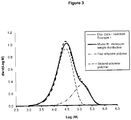
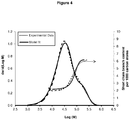
- the polymers of the present invention are bimodal polyethylene and can be de-convoluted into two distinct components. Typically, this is demonstrated by the presence of a "shoulder" at the right side of a gel permeation chromatography (GPC) curve ( Figure 1 ). In the present case there is a small shoulder to the right side of the GPC curve as shown in Figure 2 indicating a small amount of a higher molecular weight low density component.
- GPC gel permeation chromatography
- the overall polyethylene composition comprises from 0.1 to 8.0, typically from 2.0 to 6.0 weight % of one or more C 6-8 alpha olefins and the balance ethylene.
- the comonomer is 1-octene but it could also be 1-hexene.
- the higher molecular weight component is present in an amount from 20 to 45 weight % of the entire composition, preferably from 20 to 35 weight %, most preferably from 25 to 30 weight %, based on the weight of the entire composition.
- the lower molecular weight component is present in corresponding amounts from 80 to 55 weight %, of the entire composition, preferably from 80 to 65 weight %, most preferably from 65 to 75 weight % based on the weight of the entire composition.
- the higher molecular weight component has a weight average molecular weight (Mw) greater than 100,000, typically from 110,000 to 165,000, preferably from 120,000 to 150,000, as determined using gel permeation chromatography (GPC).
- Mw weight average molecular weight
- the higher molecular weight component has a polydispersity (Mw/Mn: weight average molecular weight / number average molecular weight)) less than 3 (e.g. between 2 and 3) typically less than 2.7.
- the higher molecular weight component has a lower density than the lower molecular weight component.
- the density of the higher molecular weight component in the polymer may range from 0.920 to 0.930 g/cm 3 , typically from 0.922 to 0.926 g/cm 3 , preferably from 0.922 to 0.925 g/cm 3 .
- the density of the component, or that of any other component or the total composition, is a function of the degree of comonomer incorporation.
- the higher molecular weight component has a degree of short chain branching per 1000 carbon atoms from 3 to 13, typically from 4 to 10, preferably from 4 to 8.
- the higher molecular weight component does not have any long chain branching.
- the lower molecular weight component has a weight average molecular weight (Mw) less than 100,000, typically from 15,000 to 70,000, preferably from 20,000 to 50,000, desirably from 20,000 to 40,000 g/mol, as determined using gel permeation chromatography (GPC).
- Mw weight average molecular weight
- the lower molecular weight component has a polydispersity (Mw/Mn) less than 3 (e.g. from 2 to 3) typically less than 2.8.
- the lower molecular weight component has a higher density than the higher molecular weight component.
- the density of the lower molecular weight component in the polymer is greater than 0.945 g/cm 3 , typically from 0.945 to 0.955 g/cm 3 , preferably from 0.947 to 0.952 g/cm 3 .
- the lower molecular weight (higher density component) has a degree of short chain branching of less than 5 per 1000 carbon atoms, typically from 0.5 to 4, preferably from 1 to 3 short chain branches per 1000 carbon atoms.
- the lower molecular weight component does not have any long chain branching.
- the difference in density of the higher molecular weight component and the lower molecular weight components is less than 0.030 g/cm 3 , preferably less than 0.027 g/cm 3 .
- the catalysts used to produce the polymers of the present invention do not produce long chain branching.
- the overall properties of the polyethylene composition include the following:
- composition comprises from 2 to 8, preferably from 2 to 5 weight % of one or more C 4-8 comonomers.
- the overall polymer incorporates the following molecular features:
- the PSP2 calculation as outlined by DesLauriers and Rohlfing in Macromolecular Symposia (2009), 282 (Polyolefin Characterization--ICPC 2008), pages 136-149 is incorporated by reference herein.
- the PSP2 calculation can be generally described as a multistep process.
- the first step involves estimating the homopolymer (or low comonomer polymer) density of a sample from the sample's molecular weight distribution as described by Equation 1.
- Density values at molecular weights less than 720 g/mol are equal to 1.006 g/cm 3 according to this method.
- the difference between the measured bulk density of copolymer and the calculated homopolymer density is divided by the overall short chain branching (SCB) level (as measured by size exclusion chromatography-Fourier transform infrared spectroscopy or by C13-NMR) and subsequently applied to the SCB level in each MW slice.
- SCB short chain branching
- the original observed bulk density of the copolymer (down to 0.852 g/cm 3 ) is obtained through summation of the MW slices as described above.
- Equation 2 C 1 SCB / PDI n C 2 ⁇ C 3 SCB / PDI n C 4
- C 1 1.25E-02
- C 2 0.5
- C 3 7.51 E-05
- C 4 0.62
- n 0.32.
- Equation 4 is a form of the well accepted Gibbs Thompson equation.
- PSP2 values are calculated from Equations 6a and 6b by treating this value essentially as a weighing factor (P i ) for each slice of the MWD, where P i was arbitrarily multiplied x 100 and subsequently defined as PSP2 i . As in all of the aforementioned calculations, this value at each slice is multiplied by the respective weight fraction (w i ) of the MWD profile in order to obtain a value for the bulk polymer.
- FIG. 2 A plot of the calculated w i • PSP2 i values against log M for the inventive example 1 is shown in Figure 2 , which can also be insightful when attempting understand and predict structure property relationships.
- the area underneath the resulting w i • PSP2 i vs. log M curve defines PSP2 for the whole polymer sample.
- the polymer may be made using a solution polymerization technique.
- the monomers are typically dissolved in an inert hydrocarbon solvent, typically a C 5-12 hydrocarbon, which may be unsubstituted or substituted by a C 1-4 alkyl group, such as pentane, methyl pentane, hexane, heptane, octane, cyclohexane, methylcyclohexane and hydrogenated naphtha.
- an inert hydrocarbon solvent typically a C 5-12 hydrocarbon, which may be unsubstituted or substituted by a C 1-4 alkyl group, such as pentane, methyl pentane, hexane, heptane, octane, cyclohexane, methylcyclohexane and hydrogenated naphtha.
- An example of a suitable solvent that is commercially available is "Isopar E" (C 8-12 aliphatic solvent, Exx
- Catalyst and activators are also dissolved in the solvent or suspended in a diluent miscible with the solvent at reaction conditions.
- the catalyst is a compound of the formula: wherein M is selected from the group consisting of Ti, Zr and Hf; PI is a phosphinimine ligand of the formula: wherein each R 21 is independently selected from the group consisting of a hydrogen atom; a halogen atom; hydrocarbyl radicals, typically C 1-10 , which are unsubstituted by or further substituted by a halogen atom; C 1-8 alkoxy radicals; C 6-10 aryl or aryloxy radicals; amido radicals; silyl radicals of the formula: -Si-(R 22 ) 3 wherein each R 22 is independently selected from the group consisting of hydrogen, a C 1-8 alkyl or alkoxy radical and C 6-10 aryl or aryloxy radicals; and a germanyl radical of the formula: -Ge-(R 22 ) 3 wherein R 22 is as defined above; L is a monoanionic cyclopentadienyl-type ligand
- each R 21 is a hydrocarbyl radical, preferably a C 1-6 hydrocarbyl radical, most preferably a C 1-4 hydrocarbyl radical.
- cyclopentadienyl refers to a 5-member carbon ring having delocalized bonding within the ring and typically being bound to the active catalyst site, generally a group 4 metal (M) through ⁇ 5 - bonds.
- the cyclopentadienyl ligand may be unsubstituted or up to fully substituted with one or more substituents selected from the group consisting of C 1-10 hydrocarbyl radicals which are unsubstituted or further substituted by one or more substituents selected from the group consisting of a halogen atom and a C 1-4 alkyl radical; a halogen atom; a C 1-8 alkoxy radical; a C 6-10 aryl or aryloxy radical; an amido radical which is unsubstituted or substituted by up to two C 1-8 alkyl radicals; a phosphido radical which is unsubstituted or substituted by up to two C 1-8 alkyl radicals; silyl radicals of the formula
- the cyclopentadienyl-type ligand is selected from the group consisting of a cyclopentadienyl radical, an indenyl radical and a fluorenyl radical which radicals are unsubstituted or up to fully substituted by one or more substituents selected from the group consisting of a fluorine atom, a chlorine atom; C 1-4 alkyl radicals; and a phenyl or benzyl radical which is unsubstituted or substituted by one or more fluorine atoms.
- Activatable ligands Y may be selected from the group consisting of a halogen atom, C 1-4 alkyl radicals, C 6-20 aryl radicals, C 7-12 arylalkyl radicals, C 6-10 phenoxy radicals, amido radicals which may be substituted by up to two C 1-4 alkyl radicals and C 1-4 alkoxy radicals.
- Y is selected from the group consisting of a chlorine atom, a methyl radical, an ethyl radical and a benzyl radical.
- Suitable phosphinimine catalysts are Group 4 organometallic complexes which contain one phosphinimine ligand (as described above) and one cyclopentadienyl-type (L) ligand and two activatable ligands. The catalysts are not bridged.
- the activators for the catalyst are typically selected from the group consisting of aluminoxanes and ionic activators.
- Suitable alumoxane may be of the formula: (R 4 ) 2 AlO(R 4 AlO) m Al(R 4 ) 2 wherein each R 4 is independently selected from the group consisting of C 1-20 hydrocarbyl radicals and m is from 0 to 50, preferably R 4 is a C 1-4 alkyl radical and m is from 5 to 30.
- Methylalumoxane (or "MAO") in which each R is methyl is the preferred alumoxane.
- Alumoxanes are well known as cocatalysts, particularly for metallocene-type catalysts. Alumoxanes are also readily available articles of commerce.
- alumoxane cocatalyst generally requires a molar ratio of aluminum to the transition metal in the catalyst from 20:1 to 1000:1. Preferred ratios are from 50:1 to 250:1.
- MAO typically contains free aluminum alkyl (e.g. trimethylaluminum or "TMA") which may reduce catalyst activity and/or broaden the molecular weight distribution of the polymer. If a narrow molecular weight distribution polymer is required, it is preferred to treat such commercially available MAO with an additive which is capable of reacting with the TMA. Alcohols are preferred (with hindered phenols being particularly preferred) for this purpose.
- TMA trimethylaluminum
- metallocene catalysts So-called "ionic activators" are also well known for metallocene catalysts. See, for example, U.S. Patent No. 5,198,401 (Hlatky and Turner ) and U.S. Patent No. 5,132,380 (Stevens and Neithamer ).
- ionic activators initially cause the abstraction of one or more of the activatable ligands in a manner which ionizes the catalyst into a cation, then provides a bulky, labile, non-coordinating anion which stabilizes the catalyst in a cationic form.
- the bulky, non-coordinating anion permits olefin polymerization to proceed at the cationic catalyst center (presumably because the non-coordinating anion is sufficiently labile to be displaced by monomer which coordinates to the catalyst.
- Preferred ionic activators are boron-containing ionic activators described in (i) (iii) below:
- R 7 is a pentafluorophenyl radical
- R 5 is a triphenylmethyl cation
- Z is a nitrogen atom
- R 8 is a C 1-4 alkyl radical or R 8 taken together with the nitrogen atom forms an anilinium radical which is substituted by two C 1-4 alkyl radicals.
- the "ionic activator” may abstract one or more activatable ligands so as to ionize the catalyst center into a cation but not to covalently bond with the catalyst and to provide sufficient distance between the catalyst and the ionizing activator to permit a polymerizable olefin to enter the resulting active site.
- ionic activators include: triethylammonium tetra(phenyl)boron; tripropylammonium tetra(phenyl)boron; tri(n-butyl)ammonium tetra(phenyl)boron; trimethylammonium tetra(p-tolyl)boron; trimethylammonium tetra(o-tolyl)boron; tributylammonium tetra(pentafluorophenyl)boron; tripropylammonium tetra(o,p-dimethylphenyl)boron; tributylammonium tetra(m,m-dimethylphenyl)boron; tributylammonium tetra(p-trifluoromethylphenyl)boron; tributylammonium tetra(pentafluorophenyl)boron; tri(n-butyl)ammonium te
- Readily commercially available ionic activators include: N,N-dimethylaniliniumtetrakispentafluorophenyl borate; triphenylmethylium tetrakispentafluorophenyl borate; and trispentafluorophenyl borane.
- the ionic activator may be use at about molar equivalents of boron to group IV metal in the catalyst. Suitable molar ratios of group IV metal from the catalyst to boron may range from 1:1 to 3:1, preferably from 1:1 to 1:2.
- the ionic activator may be used in combination with an alkylating activator (which may also serve as a scavenger).
- the ionic activator may be selected from the group consisting of (R 3 ) p MgX 2-p wherein X is a halide and each R 3 is independently selected from the group consisting of C 1-10 alkyl radicals and p is 1 or 2; R 3 Li wherein in R 3 is as defined above, (R 3 ) q ZnX 2-q wherein R 3 is as defined above, X is halogen and q is 1 or 2; (R 3 ) s AlX 3-s wherein R 3 is as defined above, X is halogen and s is an integer from 1 to 3.
- R 3 is a C 1-4 alkyl radical, and X is chlorine.
- Commercially available compounds include triethyl aluminum (TEAL), diethyl aluminum chloride (DEAC), dibutyl magnesium ((Bu) 2 Mg), and butyl ethyl magnesium (BuEtMg or BuMgEt).
- the phosphinimine catalyst is activated with a combination of ionic activators (e.g. boron compounds) and alkylating agent
- ionic activators e.g. boron compounds
- the molar ratio of group IV metal from the catalyst: metalloid (boron) from the ionic activator :metal from the alkylating agent may range from 1:1:1 to 1:3:10, preferably from 1:1.3 : 5 to 1:1.5:3.
- the temperature of the reactor(s) in a high temperature solution process is from about 80°C to about 300°C, preferably from about 120°C to 250°C.
- the upper temperature limit will be influenced by considerations that are well known to those skilled in the art, such as a desire to maximize operating temperature (so as to reduce solution viscosity), while still maintaining good polymer properties (as increased polymerization temperatures generally reduce the molecular weight of the polymer). In general, the upper polymerization temperature will preferably be between 200 and 300°C.
- the most preferred reaction process is a "medium pressure process", meaning that the pressure in the reactor(s) is preferably less than about 6,000 psi (about 42,000 kiloPascals or kPa). Preferred pressures are from 10,000 to 40,000 kPa (1450-5800 psi), most preferably from about 14,000-22,000kPa (2,000 psi to 3,000 psi).
- the pressure in the reactor system should be high enough to maintain the polymerization solution as a single phase solution and to provide the necessary upstream pressure to feed the polymer solution from the reactor system through a heat exchanger system and to a devolatilization system.
- Other systems permit the solvent to separate into a polymer rich and polymer lean stream to facilitate polymer separation.
- the solution polymerization process may be conducted in a stirred "reactor system” comprising one or more stirred tank reactors or in one or more loop reactors or in a mixed loop and stirred tank reactor system.
- the reactors may be in tandem or parallel operation.
- the first polymerization reactor preferably operates at lower temperature.
- the residence time in each reactor will depend on the design and the capacity of the reactor. Generally the reactors should be operated under conditions to achieve a thorough mixing of the reactants. In addition, it is preferred that from 20 to 60 weight % of the final polymer is polymerized in the first reactor, with the balance being polymerized in the second reactor.
- a particularly useful solution polymerization process uses at least two polymerization reactors in series.
- the polymerization temperature in the first reactor is from about 80°C to about 180°C (preferably from about 120°C to 160°C) and the second reactor is preferably operated at a higher temperature (up to about 220°C).
- the most preferred reaction process is a "medium pressure process", meaning that the pressure in each reactor is preferably less than about 6,000 psi (about 42,000 kilopascals or kPa), most preferably from about 2,000 psi to 3,000 psi (about 14,000 22,000 kPa).
- Mn, Mw and Mz were determined by high temperature Gel Permeation Chromatography (GPC) with differential refractive index detection using universal calibration (e.g. ASTM-D646-99).
- GPC Gel Permeation Chromatography
- Mz differential refractive index detection using universal calibration (e.g. ASTM-D646-99).
- Mw weight average molecular weight
- Mn number average molecular weight
- GPC-FTIR was used to determine the comonomer content as a function of molecular weight. After separation of the polymer by GPC an on-line FTIR measures the concentration of the polymer and methyl end groups. Methyl end groups are used in the branch frequency calculations. Conventional calibration allows for the calculation of a molecular weight distribution.
- the short chain branch frequency (SCB per 1000 carbon atoms) of copolymer samples was determined by Fourier Transform Infrared Spectroscopy (FTIR) as per ASTM D6645-01.
- FTIR Fourier Transform Infrared Spectroscopy
- a Thermo-Nicolet 750 Magna-IR Spectrophotometer was used for the measurement.
- FTIR was also used to determine internal, side chain and terminal levels of unsaturation.
- Comonomer content can also be measured using 13 C NMR techniques as discussed in Randall Rev. Macromol. Chem. Phys., C29 (2&3), p.285 ; U.S. Patent No. 5,292,845 and WO 2005/121239 .
- Polyethylene composition density (g/cm 3 ) was measured according to ASTM D792.
- the density and melt index of the first and second ethylene polymers that comprise the polyethylene composition were determined based on composition models.
- the following equations were used to calculate the density and melt index I2 (REFERENCE US Patent No. 8,022,143 B2, by Wang , assigned to NOVA Chemicals and published Sep.
- Mn, Mw, Mz, and SCB/1000C are the de-convoluted values of the individual ethylene polymer components, as obtained from the results of the de-convolution described above.
- Plaques molded from the polyethylene compositions were tested according to the following ASTM methods: Bent Strip Environmental Stress Crack Resistance (ESCR), ASTM D1693; Flexural properties, ASTM D 790; Tensile properties, ASTM D 638.
- ESCR Bent Strip Environmental Stress Crack Resistance
- Rotomolded parts were prepared in a rotational molding machine sold under the tradename Rotospeed RS3-160 by Ferry Industries Inc.
- the machine has two arms which rotate about a central axis within an enclosed oven.
- the arms are fitted with plates which rotate on an axis that is roughly perpendicular to the axis of rotation of the arm.
- Each arm is fitted with six cast aluminum molds that produce plastic cubes having dimensions of 12.5 inches (31.8 cm) x 12.5 inches x 12.5 inches.
- the arm rotation was set to about 8 revolutions per minute (rpm) and the plate rotation was set to about 2 rpm.
- Bimodal polyethylene compositions were prepared at a dual reactor pilot plant.
- the content of the first reactor flows into the second reactor, both of which are well mixed.
- the process operates using continuous feed streams.
- the catalyst cyclopentadienyl Ti tri tert.butly phosphimine di chloride
- the overall production rate was about 90 kg/hr.
- the polymer compositions prepared at the pilot plant were stabilized using a conventional additive package for rotational molding applications prior to carrying out plaque testing trials.
- the invention combines both high comonomer content and reverse comonomer distribution.
- the molecular attributes of the invention are critical in maintaining a combination of good rotomolding processability, high ESCR and a high density that in turns favors higher stiffness.
- the resins of the present invention have good flow properties and high environmental stress crack resistance and are useful in rotomolding plastic parts.
Landscapes
- Chemical & Material Sciences (AREA)
- Health & Medical Sciences (AREA)
- Chemical Kinetics & Catalysis (AREA)
- Medicinal Chemistry (AREA)
- Polymers & Plastics (AREA)
- Organic Chemistry (AREA)
- Engineering & Computer Science (AREA)
- Mechanical Engineering (AREA)
- Addition Polymer Or Copolymer, Post-Treatments, Or Chemical Modifications (AREA)
- Transition And Organic Metals Composition Catalysts For Addition Polymerization (AREA)
- Compositions Of Macromolecular Compounds (AREA)
- Moulding By Coating Moulds (AREA)
Applications Claiming Priority (3)
| Application Number | Priority Date | Filing Date | Title |
|---|---|---|---|
| CA2834068A CA2834068C (en) | 2013-11-18 | 2013-11-18 | Enhanced escr bimodal rotomolding resin |
| PCT/IB2014/065855 WO2015071807A1 (en) | 2013-11-18 | 2014-11-06 | Enhanced escr bimodal rotomolding resin |
| EP14802198.3A EP3071643B1 (de) | 2013-11-18 | 2014-11-06 | Bimodales rotationsformungsharz mit erhöhtem widerstand gegen umgebungsbedingte spannungsrissbildung |
Related Parent Applications (2)
| Application Number | Title | Priority Date | Filing Date |
|---|---|---|---|
| EP14802198.3A Division EP3071643B1 (de) | 2013-11-18 | 2014-11-06 | Bimodales rotationsformungsharz mit erhöhtem widerstand gegen umgebungsbedingte spannungsrissbildung |
| EP14802198.3A Division-Into EP3071643B1 (de) | 2013-11-18 | 2014-11-06 | Bimodales rotationsformungsharz mit erhöhtem widerstand gegen umgebungsbedingte spannungsrissbildung |
Publications (2)
| Publication Number | Publication Date |
|---|---|
| EP3540007A1 true EP3540007A1 (de) | 2019-09-18 |
| EP3540007B1 EP3540007B1 (de) | 2020-12-30 |
Family
ID=51945966
Family Applications (2)
| Application Number | Title | Priority Date | Filing Date |
|---|---|---|---|
| EP19172134.9A Active EP3540007B1 (de) | 2013-11-18 | 2014-11-06 | Bimodales rotationsformungsharz mit erhöhtem widerstand gegen umgebungsbedingte spannungsrissbildung |
| EP14802198.3A Active EP3071643B1 (de) | 2013-11-18 | 2014-11-06 | Bimodales rotationsformungsharz mit erhöhtem widerstand gegen umgebungsbedingte spannungsrissbildung |
Family Applications After (1)
| Application Number | Title | Priority Date | Filing Date |
|---|---|---|---|
| EP14802198.3A Active EP3071643B1 (de) | 2013-11-18 | 2014-11-06 | Bimodales rotationsformungsharz mit erhöhtem widerstand gegen umgebungsbedingte spannungsrissbildung |
Country Status (11)
| Country | Link |
|---|---|
| US (2) | US9181422B2 (de) |
| EP (2) | EP3540007B1 (de) |
| JP (2) | JP6445578B2 (de) |
| KR (1) | KR102256256B1 (de) |
| CN (1) | CN105705572B (de) |
| BR (1) | BR112016011268B1 (de) |
| CA (1) | CA2834068C (de) |
| DK (2) | DK3540007T3 (de) |
| ES (2) | ES2853731T3 (de) |
| MX (1) | MX370346B (de) |
| WO (1) | WO2015071807A1 (de) |
Families Citing this family (15)
| Publication number | Priority date | Publication date | Assignee | Title |
|---|---|---|---|---|
| CA2834068C (en) * | 2013-11-18 | 2020-07-28 | Nova Chemicals Corporation | Enhanced escr bimodal rotomolding resin |
| JP6778481B2 (ja) * | 2015-11-11 | 2020-11-04 | 旭化成株式会社 | ポリエチレン系重合体及びその製造方法、ポリエチレン系重合体組成物、並びに架橋パイプ |
| US9783664B1 (en) * | 2016-06-01 | 2017-10-10 | Nova Chemicals (International) S.A. | Hinged component comprising polyethylene composition |
| KR101958015B1 (ko) | 2016-11-08 | 2019-07-04 | 주식회사 엘지화학 | 에틸렌/알파-올레핀 공중합체 |
| BR112019008131B1 (pt) | 2016-11-08 | 2022-12-20 | Univation Technologies, Llc | Polietileno bimodal |
| EP3415540B1 (de) | 2016-11-15 | 2022-09-14 | LG Chem, Ltd. | Ethylen/alpha-olefin-copolymer mit hervorragender spannungsrissbeständigkeit |
| ES2956270T3 (es) * | 2019-05-31 | 2023-12-18 | Nova Chem Int Sa | Resina de rotomoldeo bimodal con mejor ductilidad y ESCR |
| WO2021014244A1 (en) * | 2019-07-25 | 2021-01-28 | Nova Chemicals (International) S.A. | Rotomolded parts prepared from bimodal polyethylene |
| CN110540690A (zh) * | 2019-09-04 | 2019-12-06 | 浙江大学 | 一种双峰高密度聚乙烯树脂及其制备方法 |
| JP7749585B2 (ja) * | 2020-04-20 | 2025-10-06 | ノバ ケミカルズ(インターナショナル)ソシエテ アノニム | 低相対弾性を有する回転成形組成物 |
| US11746220B2 (en) | 2020-06-12 | 2023-09-05 | Braskem S.A. | High flow rotomolding compositions, processes thereof, and articles therefrom |
| EP4477680A3 (de) | 2020-06-30 | 2025-03-19 | Dow Global Technologies LLC | Polyethylenzusammensetzungen |
| JP7834108B2 (ja) * | 2021-02-24 | 2026-03-23 | ノバ ケミカルズ(インターナショナル)ソシエテ アノニム | 二峰性ポリエチレン組成物 |
| WO2022195513A1 (en) | 2021-03-19 | 2022-09-22 | Nova Chemicals (International) S.A. | High density polyethylene composition |
| WO2024224253A1 (en) | 2023-04-24 | 2024-10-31 | Nova Chemicals (International) S.A. | Polymerization process, hdpe polyethylene composition and rotomolded article |
Citations (13)
| Publication number | Priority date | Publication date | Assignee | Title |
|---|---|---|---|---|
| US5132380A (en) | 1989-09-14 | 1992-07-21 | The Dow Chemical Company | Metal complex compounds |
| US5198401A (en) | 1987-01-30 | 1993-03-30 | Exxon Chemical Patents Inc. | Ionic metallocene catalyst compositions |
| US5292845A (en) | 1992-01-23 | 1994-03-08 | Mitsui Petrochemical Industries, Ltd. | Ethylene/alpha-olefin/7-methyl-1,6-octadiene copolymer rubber and composition of the same |
| US5382630A (en) | 1988-09-30 | 1995-01-17 | Exxon Chemical Patents Inc. | Linear ethylene interpolymer blends of interpolymers having narrow molecular weight and composition distribution |
| EP1304353A1 (de) * | 2001-10-18 | 2003-04-23 | Atofina Research S.A. | Physikalische Polyethylenmischungen |
| US20040062942A1 (en) * | 2002-10-01 | 2004-04-01 | Arnold Lustiger | Polyethylene compositions for rotational molding |
| WO2005121239A2 (en) | 2004-05-06 | 2005-12-22 | Dow Global Technologies Inc. | Polymer molding compositions |
| US20050288443A1 (en) * | 2004-06-29 | 2005-12-29 | Harilaos Mavridis | Polymer resins with improved environmental stress crack resistance |
| US20070298508A1 (en) | 2006-06-27 | 2007-12-27 | Deslauriers Paul J | Method for employing SEC-FTIR data to predict mechanical properties of polyethylene |
| CA2629576A1 (en) * | 2008-04-21 | 2009-10-21 | Nova Chemicals Corporation | Closures for bottles |
| US8114946B2 (en) | 2008-12-18 | 2012-02-14 | Chevron Phillips Chemical Company Lp | Process for producing broader molecular weight distribution polymers with a reverse comonomer distribution and low levels of long chain branches |
| US20120214954A1 (en) * | 2011-02-21 | 2012-08-23 | Chevron Phillips Chemical Company Lp | Polymer Compositions for Rotational Molding Applications |
| US8486323B2 (en) | 2009-08-28 | 2013-07-16 | Dow Global Technologies Llc | Rotational molded articles, and method of making the same |
Family Cites Families (13)
| Publication number | Priority date | Publication date | Assignee | Title |
|---|---|---|---|---|
| US5382631A (en) | 1988-09-30 | 1995-01-17 | Exxon Chemical Patents Inc. | Linear ethylene interpolymer blends of interpolymers having narrow molecular weight and composition distributions |
| JPH03115445A (ja) * | 1989-09-29 | 1991-05-16 | Nippon Petrochem Co Ltd | エチレン系重合体組成物 |
| CA2245375C (en) * | 1998-08-19 | 2006-08-15 | Nova Chemicals Ltd. | Dual reactor polyethylene process using a phosphinimine catalyst |
| DE19849426A1 (de) * | 1998-10-27 | 2000-05-04 | Elenac Gmbh | Bimodale Polyethylen-Blends mit hoher Mischgüte |
| JP2001089615A (ja) * | 1999-07-16 | 2001-04-03 | Mitsui Chemicals Inc | 回転成形用ポリエチレン樹脂組成物およびその組成物を用いた回転成形体 |
| CN1313528C (zh) * | 2002-10-01 | 2007-05-02 | 埃克森美孚化学专利公司 | 用于旋转模塑的聚乙烯组合物 |
| US7393916B2 (en) * | 2005-11-01 | 2008-07-01 | Univation Technologies, Llc | Method of reducing gels in polyolefins |
| CA2752407C (en) * | 2011-09-19 | 2018-12-04 | Nova Chemicals Corporation | Polyethylene compositions and closures for bottles |
| CA2777386C (en) * | 2012-05-17 | 2020-06-30 | Nova Chemicals Corporation | Rotomolding resin |
| US9115233B2 (en) * | 2012-06-21 | 2015-08-25 | Nova Chemicals (International) S.A. | Ethylene copolymer compositions, film and polymerization processes |
| CA2798854C (en) * | 2012-12-14 | 2020-02-18 | Nova Chemicals Corporation | Polyethylene compositions having high dimensional stability and excellent processability for caps and closures |
| CA2800056A1 (en) * | 2012-12-24 | 2014-06-24 | Nova Chemicals Corporation | Polyethylene blend compositions |
| CA2834068C (en) * | 2013-11-18 | 2020-07-28 | Nova Chemicals Corporation | Enhanced escr bimodal rotomolding resin |
-
2013
- 2013-11-18 CA CA2834068A patent/CA2834068C/en active Active
-
2014
- 2014-11-06 DK DK19172134.9T patent/DK3540007T3/da active
- 2014-11-06 WO PCT/IB2014/065855 patent/WO2015071807A1/en not_active Ceased
- 2014-11-06 DK DK14802198.3T patent/DK3071643T3/da active
- 2014-11-06 JP JP2016553750A patent/JP6445578B2/ja active Active
- 2014-11-06 ES ES19172134T patent/ES2853731T3/es active Active
- 2014-11-06 CN CN201480062852.1A patent/CN105705572B/zh active Active
- 2014-11-06 ES ES14802198T patent/ES2749153T3/es active Active
- 2014-11-06 BR BR112016011268-7A patent/BR112016011268B1/pt active IP Right Grant
- 2014-11-06 MX MX2016004602A patent/MX370346B/es active IP Right Grant
- 2014-11-06 EP EP19172134.9A patent/EP3540007B1/de active Active
- 2014-11-06 EP EP14802198.3A patent/EP3071643B1/de active Active
- 2014-11-06 KR KR1020167013706A patent/KR102256256B1/ko active Active
- 2014-11-07 US US14/535,612 patent/US9181422B2/en active Active
-
2015
- 2015-09-17 US US14/856,622 patent/US9540505B2/en active Active
-
2018
- 2018-11-28 JP JP2018222599A patent/JP6707613B2/ja active Active
Patent Citations (17)
| Publication number | Priority date | Publication date | Assignee | Title |
|---|---|---|---|---|
| US5198401A (en) | 1987-01-30 | 1993-03-30 | Exxon Chemical Patents Inc. | Ionic metallocene catalyst compositions |
| US5382630A (en) | 1988-09-30 | 1995-01-17 | Exxon Chemical Patents Inc. | Linear ethylene interpolymer blends of interpolymers having narrow molecular weight and composition distribution |
| US5132380A (en) | 1989-09-14 | 1992-07-21 | The Dow Chemical Company | Metal complex compounds |
| US5292845A (en) | 1992-01-23 | 1994-03-08 | Mitsui Petrochemical Industries, Ltd. | Ethylene/alpha-olefin/7-methyl-1,6-octadiene copolymer rubber and composition of the same |
| EP1304353A1 (de) * | 2001-10-18 | 2003-04-23 | Atofina Research S.A. | Physikalische Polyethylenmischungen |
| US20040062942A1 (en) * | 2002-10-01 | 2004-04-01 | Arnold Lustiger | Polyethylene compositions for rotational molding |
| US6969741B2 (en) | 2002-10-01 | 2005-11-29 | Exxonmobil Chemical Patents Inc. | Polyethylene compositions for rotational molding |
| WO2005121239A2 (en) | 2004-05-06 | 2005-12-22 | Dow Global Technologies Inc. | Polymer molding compositions |
| US20050288443A1 (en) * | 2004-06-29 | 2005-12-29 | Harilaos Mavridis | Polymer resins with improved environmental stress crack resistance |
| US20070298508A1 (en) | 2006-06-27 | 2007-12-27 | Deslauriers Paul J | Method for employing SEC-FTIR data to predict mechanical properties of polyethylene |
| CA2629576A1 (en) * | 2008-04-21 | 2009-10-21 | Nova Chemicals Corporation | Closures for bottles |
| US8022143B2 (en) | 2008-04-21 | 2011-09-20 | Nova Chemicals (International) S.A | Closures for bottles |
| US8114946B2 (en) | 2008-12-18 | 2012-02-14 | Chevron Phillips Chemical Company Lp | Process for producing broader molecular weight distribution polymers with a reverse comonomer distribution and low levels of long chain branches |
| US8475899B2 (en) | 2008-12-18 | 2013-07-02 | Chevron Phillips Chemical Company Lp | Process for producing broader molecular weight distribution polymers with a reverse comonomer distribution and low levels of long chain branches |
| US8486323B2 (en) | 2009-08-28 | 2013-07-16 | Dow Global Technologies Llc | Rotational molded articles, and method of making the same |
| US20120214954A1 (en) * | 2011-02-21 | 2012-08-23 | Chevron Phillips Chemical Company Lp | Polymer Compositions for Rotational Molding Applications |
| US8492498B2 (en) | 2011-02-21 | 2013-07-23 | Chevron Phillips Chemical Company Lp | Polymer compositions for rotational molding applications |
Non-Patent Citations (2)
| Title |
|---|
| DESLAURIERSROHLFING: "Polyolefin Characterization--ICPC 2008", MACROMOLECULAR SYMPOSIA, vol. 282, 2009, pages 136 - 149 |
| RANDALL REV. MACROMOL. CHEM. PHYS., vol. C29, no. 2&3, pages 285 |
Also Published As
| Publication number | Publication date |
|---|---|
| MX2016004602A (es) | 2016-07-06 |
| BR112016011268A2 (pt) | 2017-08-08 |
| US9181422B2 (en) | 2015-11-10 |
| JP6445578B2 (ja) | 2018-12-26 |
| ES2853731T3 (es) | 2021-09-17 |
| JP6707613B2 (ja) | 2020-06-10 |
| WO2015071807A1 (en) | 2015-05-21 |
| CA2834068A1 (en) | 2015-05-18 |
| CN105705572A (zh) | 2016-06-22 |
| KR102256256B1 (ko) | 2021-05-27 |
| EP3540007B1 (de) | 2020-12-30 |
| EP3071643A1 (de) | 2016-09-28 |
| US9540505B2 (en) | 2017-01-10 |
| US20150141579A1 (en) | 2015-05-21 |
| ES2749153T3 (es) | 2020-03-19 |
| KR20160088876A (ko) | 2016-07-26 |
| US20160002448A1 (en) | 2016-01-07 |
| JP2016538413A (ja) | 2016-12-08 |
| DK3540007T3 (da) | 2021-01-25 |
| DK3071643T3 (da) | 2019-10-21 |
| MX370346B (es) | 2019-12-10 |
| JP2019044195A (ja) | 2019-03-22 |
| CN105705572B (zh) | 2018-12-14 |
| BR112016011268B1 (pt) | 2021-10-05 |
| EP3071643B1 (de) | 2019-08-14 |
| CA2834068C (en) | 2020-07-28 |
Similar Documents
| Publication | Publication Date | Title |
|---|---|---|
| EP3540007B1 (de) | Bimodales rotationsformungsharz mit erhöhtem widerstand gegen umgebungsbedingte spannungsrissbildung | |
| US10189924B2 (en) | High density rotomolding resin | |
| US9321865B2 (en) | Rotomolding resin | |
| US12378393B2 (en) | Rotomolding compositions with low relative elasticity | |
| EP3976666B1 (de) | Bimodales rotationsformungsharz mit verbesserter spannungsrissbeständigkeit und duktilität |
Legal Events
| Date | Code | Title | Description |
|---|---|---|---|
| PUAI | Public reference made under article 153(3) epc to a published international application that has entered the european phase |
Free format text: ORIGINAL CODE: 0009012 |
|
| STAA | Information on the status of an ep patent application or granted ep patent |
Free format text: STATUS: THE APPLICATION HAS BEEN PUBLISHED |
|
| AC | Divisional application: reference to earlier application |
Ref document number: 3071643 Country of ref document: EP Kind code of ref document: P |
|
| AK | Designated contracting states |
Kind code of ref document: A1 Designated state(s): AL AT BE BG CH CY CZ DE DK EE ES FI FR GB GR HR HU IE IS IT LI LT LU LV MC MK MT NL NO PL PT RO RS SE SI SK SM TR |
|
| RIN1 | Information on inventor provided before grant (corrected) |
Inventor name: HOIDAS, MARK Inventor name: BELLEHUMEUR, CELINE |
|
| STAA | Information on the status of an ep patent application or granted ep patent |
Free format text: STATUS: REQUEST FOR EXAMINATION WAS MADE |
|
| 17P | Request for examination filed |
Effective date: 20191018 |
|
| RBV | Designated contracting states (corrected) |
Designated state(s): AL AT BE BG CH CY CZ DE DK EE ES FI FR GB GR HR HU IE IS IT LI LT LU LV MC MK MT NL NO PL PT RO RS SE SI SK SM TR |
|
| RIC1 | Information provided on ipc code assigned before grant |
Ipc: C08L 23/08 20060101AFI20200219BHEP Ipc: B29C 41/04 20060101ALI20200219BHEP Ipc: B29C 41/00 20060101ALI20200219BHEP |
|
| GRAP | Despatch of communication of intention to grant a patent |
Free format text: ORIGINAL CODE: EPIDOSNIGR1 |
|
| STAA | Information on the status of an ep patent application or granted ep patent |
Free format text: STATUS: GRANT OF PATENT IS INTENDED |
|
| INTG | Intention to grant announced |
Effective date: 20200401 |
|
| GRAJ | Information related to disapproval of communication of intention to grant by the applicant or resumption of examination proceedings by the epo deleted |
Free format text: ORIGINAL CODE: EPIDOSDIGR1 |
|
| STAA | Information on the status of an ep patent application or granted ep patent |
Free format text: STATUS: REQUEST FOR EXAMINATION WAS MADE |
|
| STAA | Information on the status of an ep patent application or granted ep patent |
Free format text: STATUS: EXAMINATION IS IN PROGRESS |
|
| 17Q | First examination report despatched |
Effective date: 20200814 |
|
| INTC | Intention to grant announced (deleted) | ||
| GRAS | Grant fee paid |
Free format text: ORIGINAL CODE: EPIDOSNIGR3 |
|
| STAA | Information on the status of an ep patent application or granted ep patent |
Free format text: STATUS: GRANT OF PATENT IS INTENDED |
|
| GRAP | Despatch of communication of intention to grant a patent |
Free format text: ORIGINAL CODE: EPIDOSNIGR1 |
|
| INTG | Intention to grant announced |
Effective date: 20201014 |
|
| GRAA | (expected) grant |
Free format text: ORIGINAL CODE: 0009210 |
|
| STAA | Information on the status of an ep patent application or granted ep patent |
Free format text: STATUS: THE PATENT HAS BEEN GRANTED |
|
| AC | Divisional application: reference to earlier application |
Ref document number: 3071643 Country of ref document: EP Kind code of ref document: P |
|
| AK | Designated contracting states |
Kind code of ref document: B1 Designated state(s): AL AT BE BG CH CY CZ DE DK EE ES FI FR GB GR HR HU IE IS IT LI LT LU LV MC MK MT NL NO PL PT RO RS SE SI SK SM TR |
|
| REG | Reference to a national code |
Ref country code: GB Ref legal event code: FG4D |
|
| REG | Reference to a national code |
Ref country code: AT Ref legal event code: REF Ref document number: 1349897 Country of ref document: AT Kind code of ref document: T Effective date: 20210115 |
|
| REG | Reference to a national code |
Ref country code: DE Ref legal event code: R096 Ref document number: 602014073923 Country of ref document: DE |
|
| REG | Reference to a national code |
Ref country code: DK Ref legal event code: T3 Effective date: 20210121 |
|
| REG | Reference to a national code |
Ref country code: IE Ref legal event code: FG4D |
|
| REG | Reference to a national code |
Ref country code: SE Ref legal event code: TRGR |
|
| REG | Reference to a national code |
Ref country code: FI Ref legal event code: FGE |
|
| REG | Reference to a national code |
Ref country code: NL Ref legal event code: FP |
|
| REG | Reference to a national code |
Ref country code: NO Ref legal event code: T2 Effective date: 20201230 |
|
| PG25 | Lapsed in a contracting state [announced via postgrant information from national office to epo] |
Ref country code: RS Free format text: LAPSE BECAUSE OF FAILURE TO SUBMIT A TRANSLATION OF THE DESCRIPTION OR TO PAY THE FEE WITHIN THE PRESCRIBED TIME-LIMIT Effective date: 20201230 Ref country code: GR Free format text: LAPSE BECAUSE OF FAILURE TO SUBMIT A TRANSLATION OF THE DESCRIPTION OR TO PAY THE FEE WITHIN THE PRESCRIBED TIME-LIMIT Effective date: 20210331 |
|
| PG25 | Lapsed in a contracting state [announced via postgrant information from national office to epo] |
Ref country code: LV Free format text: LAPSE BECAUSE OF FAILURE TO SUBMIT A TRANSLATION OF THE DESCRIPTION OR TO PAY THE FEE WITHIN THE PRESCRIBED TIME-LIMIT Effective date: 20201230 Ref country code: BG Free format text: LAPSE BECAUSE OF FAILURE TO SUBMIT A TRANSLATION OF THE DESCRIPTION OR TO PAY THE FEE WITHIN THE PRESCRIBED TIME-LIMIT Effective date: 20210330 |
|
| PG25 | Lapsed in a contracting state [announced via postgrant information from national office to epo] |
Ref country code: HR Free format text: LAPSE BECAUSE OF FAILURE TO SUBMIT A TRANSLATION OF THE DESCRIPTION OR TO PAY THE FEE WITHIN THE PRESCRIBED TIME-LIMIT Effective date: 20201230 |
|
| REG | Reference to a national code |
Ref country code: LT Ref legal event code: MG9D |
|
| PG25 | Lapsed in a contracting state [announced via postgrant information from national office to epo] |
Ref country code: RO Free format text: LAPSE BECAUSE OF FAILURE TO SUBMIT A TRANSLATION OF THE DESCRIPTION OR TO PAY THE FEE WITHIN THE PRESCRIBED TIME-LIMIT Effective date: 20201230 Ref country code: PT Free format text: LAPSE BECAUSE OF FAILURE TO SUBMIT A TRANSLATION OF THE DESCRIPTION OR TO PAY THE FEE WITHIN THE PRESCRIBED TIME-LIMIT Effective date: 20210430 Ref country code: LT Free format text: LAPSE BECAUSE OF FAILURE TO SUBMIT A TRANSLATION OF THE DESCRIPTION OR TO PAY THE FEE WITHIN THE PRESCRIBED TIME-LIMIT Effective date: 20201230 Ref country code: SK Free format text: LAPSE BECAUSE OF FAILURE TO SUBMIT A TRANSLATION OF THE DESCRIPTION OR TO PAY THE FEE WITHIN THE PRESCRIBED TIME-LIMIT Effective date: 20201230 Ref country code: EE Free format text: LAPSE BECAUSE OF FAILURE TO SUBMIT A TRANSLATION OF THE DESCRIPTION OR TO PAY THE FEE WITHIN THE PRESCRIBED TIME-LIMIT Effective date: 20201230 Ref country code: CZ Free format text: LAPSE BECAUSE OF FAILURE TO SUBMIT A TRANSLATION OF THE DESCRIPTION OR TO PAY THE FEE WITHIN THE PRESCRIBED TIME-LIMIT Effective date: 20201230 |
|
| PG25 | Lapsed in a contracting state [announced via postgrant information from national office to epo] |
Ref country code: PL Free format text: LAPSE BECAUSE OF FAILURE TO SUBMIT A TRANSLATION OF THE DESCRIPTION OR TO PAY THE FEE WITHIN THE PRESCRIBED TIME-LIMIT Effective date: 20201230 |
|
| REG | Reference to a national code |
Ref country code: ES Ref legal event code: FG2A Ref document number: 2853731 Country of ref document: ES Kind code of ref document: T3 Effective date: 20210917 |
|
| PG25 | Lapsed in a contracting state [announced via postgrant information from national office to epo] |
Ref country code: IS Free format text: LAPSE BECAUSE OF FAILURE TO SUBMIT A TRANSLATION OF THE DESCRIPTION OR TO PAY THE FEE WITHIN THE PRESCRIBED TIME-LIMIT Effective date: 20210430 |
|
| REG | Reference to a national code |
Ref country code: DE Ref legal event code: R097 Ref document number: 602014073923 Country of ref document: DE |
|
| REG | Reference to a national code |
Ref country code: AT Ref legal event code: UEP Ref document number: 1349897 Country of ref document: AT Kind code of ref document: T Effective date: 20201230 |
|
| PG25 | Lapsed in a contracting state [announced via postgrant information from national office to epo] |
Ref country code: AL Free format text: LAPSE BECAUSE OF FAILURE TO SUBMIT A TRANSLATION OF THE DESCRIPTION OR TO PAY THE FEE WITHIN THE PRESCRIBED TIME-LIMIT Effective date: 20201230 |
|
| PLBE | No opposition filed within time limit |
Free format text: ORIGINAL CODE: 0009261 |
|
| STAA | Information on the status of an ep patent application or granted ep patent |
Free format text: STATUS: NO OPPOSITION FILED WITHIN TIME LIMIT |
|
| 26N | No opposition filed |
Effective date: 20211001 |
|
| PG25 | Lapsed in a contracting state [announced via postgrant information from national office to epo] |
Ref country code: SI Free format text: LAPSE BECAUSE OF FAILURE TO SUBMIT A TRANSLATION OF THE DESCRIPTION OR TO PAY THE FEE WITHIN THE PRESCRIBED TIME-LIMIT Effective date: 20201230 |
|
| PG25 | Lapsed in a contracting state [announced via postgrant information from national office to epo] |
Ref country code: IS Free format text: LAPSE BECAUSE OF FAILURE TO SUBMIT A TRANSLATION OF THE DESCRIPTION OR TO PAY THE FEE WITHIN THE PRESCRIBED TIME-LIMIT Effective date: 20210430 |
|
| PG25 | Lapsed in a contracting state [announced via postgrant information from national office to epo] |
Ref country code: MC Free format text: LAPSE BECAUSE OF FAILURE TO SUBMIT A TRANSLATION OF THE DESCRIPTION OR TO PAY THE FEE WITHIN THE PRESCRIBED TIME-LIMIT Effective date: 20201230 |
|
| REG | Reference to a national code |
Ref country code: CH Ref legal event code: PL |
|
| PG25 | Lapsed in a contracting state [announced via postgrant information from national office to epo] |
Ref country code: LU Free format text: LAPSE BECAUSE OF NON-PAYMENT OF DUE FEES Effective date: 20211106 |
|
| PG25 | Lapsed in a contracting state [announced via postgrant information from national office to epo] |
Ref country code: CY Free format text: LAPSE BECAUSE OF FAILURE TO SUBMIT A TRANSLATION OF THE DESCRIPTION OR TO PAY THE FEE WITHIN THE PRESCRIBED TIME-LIMIT Effective date: 20201230 |
|
| PG25 | Lapsed in a contracting state [announced via postgrant information from national office to epo] |
Ref country code: SM Free format text: LAPSE BECAUSE OF FAILURE TO SUBMIT A TRANSLATION OF THE DESCRIPTION OR TO PAY THE FEE WITHIN THE PRESCRIBED TIME-LIMIT Effective date: 20201230 Ref country code: LI Free format text: LAPSE BECAUSE OF NON-PAYMENT OF DUE FEES Effective date: 20220630 Ref country code: HU Free format text: LAPSE BECAUSE OF FAILURE TO SUBMIT A TRANSLATION OF THE DESCRIPTION OR TO PAY THE FEE WITHIN THE PRESCRIBED TIME-LIMIT; INVALID AB INITIO Effective date: 20141106 Ref country code: CH Free format text: LAPSE BECAUSE OF NON-PAYMENT OF DUE FEES Effective date: 20220630 |
|
| PG25 | Lapsed in a contracting state [announced via postgrant information from national office to epo] |
Ref country code: MK Free format text: LAPSE BECAUSE OF FAILURE TO SUBMIT A TRANSLATION OF THE DESCRIPTION OR TO PAY THE FEE WITHIN THE PRESCRIBED TIME-LIMIT Effective date: 20201230 |
|
| PG25 | Lapsed in a contracting state [announced via postgrant information from national office to epo] |
Ref country code: TR Free format text: LAPSE BECAUSE OF FAILURE TO SUBMIT A TRANSLATION OF THE DESCRIPTION OR TO PAY THE FEE WITHIN THE PRESCRIBED TIME-LIMIT Effective date: 20201230 |
|
| PG25 | Lapsed in a contracting state [announced via postgrant information from national office to epo] |
Ref country code: MT Free format text: LAPSE BECAUSE OF FAILURE TO SUBMIT A TRANSLATION OF THE DESCRIPTION OR TO PAY THE FEE WITHIN THE PRESCRIBED TIME-LIMIT Effective date: 20201230 |
|
| PGFP | Annual fee paid to national office [announced via postgrant information from national office to epo] |
Ref country code: NL Payment date: 20251022 Year of fee payment: 12 |
|
| PGFP | Annual fee paid to national office [announced via postgrant information from national office to epo] |
Ref country code: DE Payment date: 20251022 Year of fee payment: 12 |
|
| PGFP | Annual fee paid to national office [announced via postgrant information from national office to epo] |
Ref country code: GB Payment date: 20251023 Year of fee payment: 12 |
|
| PGFP | Annual fee paid to national office [announced via postgrant information from national office to epo] |
Ref country code: NO Payment date: 20251024 Year of fee payment: 12 |
|
| PGFP | Annual fee paid to national office [announced via postgrant information from national office to epo] |
Ref country code: AT Payment date: 20251024 Year of fee payment: 12 |
|
| PGFP | Annual fee paid to national office [announced via postgrant information from national office to epo] |
Ref country code: FI Payment date: 20251022 Year of fee payment: 12 Ref country code: DK Payment date: 20251022 Year of fee payment: 12 Ref country code: IT Payment date: 20251022 Year of fee payment: 12 |
|
| PGFP | Annual fee paid to national office [announced via postgrant information from national office to epo] |
Ref country code: FR Payment date: 20251022 Year of fee payment: 12 |
|
| PGFP | Annual fee paid to national office [announced via postgrant information from national office to epo] |
Ref country code: BE Payment date: 20251022 Year of fee payment: 12 |
|
| PGFP | Annual fee paid to national office [announced via postgrant information from national office to epo] |
Ref country code: SE Payment date: 20251022 Year of fee payment: 12 |
|
| PGFP | Annual fee paid to national office [announced via postgrant information from national office to epo] |
Ref country code: IE Payment date: 20251024 Year of fee payment: 12 |
|
| PGFP | Annual fee paid to national office [announced via postgrant information from national office to epo] |
Ref country code: ES Payment date: 20251201 Year of fee payment: 12 |