EP3540246B1 - System aus einer manipulationsschutzvorrichtung und eines vor manipulation zu schützenden gegenstands - Google Patents
System aus einer manipulationsschutzvorrichtung und eines vor manipulation zu schützenden gegenstands Download PDFInfo
- Publication number
- EP3540246B1 EP3540246B1 EP19161816.4A EP19161816A EP3540246B1 EP 3540246 B1 EP3540246 B1 EP 3540246B1 EP 19161816 A EP19161816 A EP 19161816A EP 3540246 B1 EP3540246 B1 EP 3540246B1
- Authority
- EP
- European Patent Office
- Prior art keywords
- protected
- parts
- tampering
- protective device
- connection
- Prior art date
- Legal status (The legal status is an assumption and is not a legal conclusion. Google has not performed a legal analysis and makes no representation as to the accuracy of the status listed.)
- Active
Links
Images

Classifications
-
- F—MECHANICAL ENGINEERING; LIGHTING; HEATING; WEAPONS; BLASTING
- F16—ENGINEERING ELEMENTS AND UNITS; GENERAL MEASURES FOR PRODUCING AND MAINTAINING EFFECTIVE FUNCTIONING OF MACHINES OR INSTALLATIONS; THERMAL INSULATION IN GENERAL
- F16B—DEVICES FOR FASTENING OR SECURING CONSTRUCTIONAL ELEMENTS OR MACHINE PARTS TOGETHER, e.g. NAILS, BOLTS, CIRCLIPS, CLAMPS, CLIPS OR WEDGES; JOINTS OR JOINTING
- F16B41/00—Measures against loss of bolts, nuts, or pins; Measures against unauthorised operation of bolts, nuts or pins
- F16B41/005—Measures against unauthorised operation of bolts, nuts or pins
Definitions
- the invention relates to a system comprising a manipulation protection device and an object to be protected against manipulation, the manipulation protection device comprising a Recording for at least partially recording an object to be protected against manipulation.
- the pulse generator itself must be prevented from being tampered with and, on the other hand, the pulse generator must be prevented from being removed from an object to which it is connected without authorization.
- a wire-bound seal is also used for pulse generators in commercial vehicles to prevent tampering with the pulse generator.
- this has disadvantages in terms of manufacturing. In particular, it is complex to thread the wire into several openings and then connect the wire ends together in a tamper-proof manner.
- US 4,732,517 A deals with an anti-tamper device comprising an annular collar device for extending the fastener shank therethrough and for location adjacent the underside of the fastener head when assembled with the fastener, and a closure member adapted to mate with the collar device to cooperatively enclose the fastener head to prevent access thereto.
- the object of the present invention is therefore to provide a system comprising a tamper protection device and an object to be protected against tampering, which represents a secure tamper protection and can be easily installed.
- a non-detachable connection is understood to mean a connection that can only be released if at least one of the parts and/or the form-locking connection is destroyed. It is conceivable that, for example, with the aid of a suitable tool, the first and second parts can be separated from one another by releasing the form-locking connection when there is no object to be protected in the receptacle. In this case, it could be possible for the form-locking connection to be accessible via the receptacle using a tool and for the parts can be separated from each other. This can be advantageous if the two parts of the tamper protection device are accidentally connected to each other without an object to be protected being in the holder. If the two parts can then be separated from each other, the tamper protection device can still be used.
- the positive connection must no longer be accessible, so that separation of the first and second parts is only possible by destroying the positive connection and/or at least one of the parts.
- the advantage of using a form-fitting connection is that the two parts can be connected relatively easily, particularly by inserting or screwing them together. It is not necessary to create a force-fitting or material-fitting connection. This would involve increased effort.
- first and second parts are connected directly to one another by means of a positive connection, i.e. both the first and second parts have corresponding positive locking elements that interact directly with one another.
- the positive locking connection is produced by means of a connecting part, in particular a spring ring.
- the first part can have a groove on the inner circumference and the second part can have a groove on the outer circumference, with the connecting part, in particular the spring ring, being partially arranged in both grooves and thus preventing axial relative movement of the first and second parts.
- the first and second parts are essentially wooden cylindrical. This makes it particularly It is possible to protect an essentially cylindrical object from manipulation.
- the inner diameter of the first part can be larger than the largest outer diameter or the maximum corner dimension of a prismatic intermediate part of the object to be protected.
- the outer diameter of the second part can be smaller than the inner diameter of the first part.
- the second part can be arranged in the first part at least in sections.
- the second part can be inserted into the first part or screwed into it.
- the second part can thus be arranged so as to be protected by the first part.
- the second part can also be arranged with only one section in the first part and with another section protruding beyond the first part, in particular downwards. This means that the diameter of the tamper protection device in the area of the pulse generator's thread can be kept small, which simplifies assembly.
- the mounting of the protective device is to be measured in such a way that the protective device is arranged with play on the object to be protected, namely that it can be rotated relative to the object to be protected.
- the object to be protected Object has a tool attack, for example a hexagon. If the protective device is rotatable relative to the object to be protected, in particular relative to the tool attack, it can be prevented that the object to be protected is rotated and, for example, removed from an object to which the object to be protected is connected.
- first part has at least one form-locking element and the second part has at least one complementary form-locking element. This means that an additional connecting part is not required.
- the form-fitting connection can comprise a tongue-and-groove connection, a screw connection and/or a snap-hook connection. In principle, however, other form-fitting connections are also conceivable.
- the form-fitting connection can have at least one radially deflectable spring element, which is preferably arranged on the second part.
- a radially deflectable spring element can be displaced, for example, while the first and second parts are connected to one another, in particular the second part is inserted or screwed into the first part.
- the first part can have one or more recesses into which the radially deflectable spring element can engage in order to thereby create a form-fitting connection.
- the recess on the first part can, for example, be designed as a groove parallel to the longitudinal direction of the first part or as a rear grip on the inner wall of the first part.
- an anti-twisting device can be provided which prevents a rotating relative movement of the first and second parts in at least one direction of rotation. For example, it may be possible to screw the second part into the first part. However, turning or screwing back is prevented by the anti-twisting device, in particular a radially deflectable spring element.
- the first and the second part can be axially movable relative to each other for assembly and in a form-fitting connection axially not relative be movable relative to each other. It is thus possible to connect the first and second parts by a relative movement, but not to separate them by an opposite movement.
- the protective device can have a stop, in particular a centering collar, which limits or prevents an axial movement of the protective body relative to the object to be protected. This ensures that the protective device cannot be pulled axially away from the object to be protected.
- first and/or second part has a unique identification feature.
- a barcode or a multi-digit number can be used as an identification feature, for example. This means that every first and every second part is unique.
- the protective device has at least one recess for recognizing an identification feature of the object to be protected.
- the recess can be a viewing window or an open slot. Identification features such as a sequence of numbers or a QR code etc. can thus be detected through the protective body.
- the protection against manipulation is improved if the first and/or the second part have at least one predetermined breaking point.
- the predetermined breaking point may not be visible from the outside, especially if the first and second parts are connected to one another.
- the predetermined breaking point can lead to the first and/or the second part being damaged in the event of a manipulation attempt, and it can therefore be recognized that a manipulation attempt has taken place.
- the predetermined breaking points can be formed, for example, as circumferential notches or grooves on an inner wall of the first part or an outer wall of the second part.
- the first and/or the second part can basically be made of metal or ceramic or the like. However, particular advantages arise when the first and/or the second part are made of plastic, in particular a thermoplastic or thermosetting plastic. The first and/or the second part can thus be manufactured particularly easily using an injection molding process.
- the plastic is cross-linked using radiation. This can prevent or at least make it more difficult for it to deform when exposed to higher temperatures.
- the plastic contains electromagnetically shielding fillers. This means that the object to be protected can be electromagnetically shielded and thus also protected against manipulation.
- the plastic can contain flame-retardant additives to make it more difficult for the protective device to melt or burn.
- the protective device can be rotated by one person with respect to the object to be protected without any particular effort.
- This rotatability can be achieved by play between the cylindrical form elements of the object to be protected or by a larger dimension of the inner diameter of the first part compared to the corner dimension of the prismatic form element(s) of the object to be protected. This rotatability prevents a torque and/or a force acting on the outer diameter of the first part from being transmitted to the object to be protected.
- the first and/or the second part can have a signal transmission device, in particular a transmitting device, e.g. a transponder or an RFID chip.
- a signal transmission can take place if attempts at manipulation or manipulation of the object to be protected are detected. Attempts at manipulation can be detected, for example, if loops are introduced into the protective device, e.g. cast in, and these are damaged.
- the first part can have an inwardly protruding collar at one end.
- the inwardly protruding collar can be molded directly onto the first part.
- the collar can be completely circumferential or there can be several radially inwardly protruding sections that form the collar.
- the collar can therefore be interrupted.
- the collar can in particular overlap a plug of a sensor arrangement so that the sensor arrangement cannot be detached from the object to be protected. If eyelets for a wired seal are provided on the object to be protected, the collar can overlap the eyelets on the top so that the ability to rotate the tamper protection device is maintained.
- the second part can be slotted. is designed, in particular has a continuous slot running in the longitudinal direction, so that the second part can be placed radially or laterally on the pulse generator.
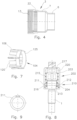
- the Fig.1 shows an object 1 to be protected, which is partially arranged in a receptacle of an anti-tampering device 2.
- the anti-tampering device 2 has a first part 3 and a second part 4.
- the first part 3 has a recess 5 through which an identification feature of the object 1 to be protected is visible.
- the tamper protection device 2 is essentially hollow-cylindrical. It can be seen that the first part 3 is stepped. In particular, it is adapted to the contour of the object 1 to be protected.
- the Fig.2 shows a longitudinal section of the arrangement according to the Fig.1 .
- the first part 3 has a first cylindrical section 6 and a second cylindrical section 7.
- the second cylindrical section 7 has a larger inner diameter than the first cylindrical section 6.
- the object 1 to be protected has a larger cross-section in the region of the second cylindrical section 7 than in the region of the first cylindrical section 6.
- the inner contour of the first part 3 is thus adapted to the outer contour of the object 1 to be protected.
- the part 3 is arranged with play on the object 1 to be protected, it cannot move any further axially in the direction of the arrow 8 due to the different diameters of the first and second cylindrical sections 6, 7.
- the second part 4 has a cylindrical section 9, the inner diameter of which is smaller than the inner diameter of the cylindrical section 7.
- the inner diameter of the cylindrical section 9 is adapted to the diameter of the object 1 to be protected in this area.
- the protective device 2 cannot be pulled off the object 1 to be protected in the opposite direction to the arrow 8.
- the protective device 2 is thus axially fixed relative to the object 1 to be protected.
- the protective device 2 is arranged with play on the object 1 to be protected, it can be rotated relative to the object 1 to be protected. This has the consequence that no force can be exerted on the prismatic tool grip 10 of the object 1 to be protected and thus the object 1 to be protected cannot be rotated, in particular the thread 11 cannot be unscrewed from a corresponding counter thread.
- the second part 4 has an external thread 12 and the first part 3 has an internal thread 13.
- the second part 4 can thus be screwed into the first part 3 up to a stop 14 designed as a collar.
- the first and second parts 3, 4 are permanently connected to one another by a positive connection 15.
- the design of the positive connection 15 is explained in more detail in the following description.
- the protective device 2 is provided with predetermined breaking points (not visible here) which break open if an attempt is made to tamper with the protective device 2.
- the object 1 to be protected is partially arranged in the receptacle 16 of the protective device 2.
- the Fig.3 shows the second part 4 in perspective.
- the external thread 12 can be seen.
- two form-locking elements 20, 21 can be seen, which can be deflected radially.
- the form-locking elements 20, 21 interact with complementary form-locking elements of the first part 3.
- the form-locking elements 20, 21, which are designed as spring bars are displaced radially inwards.
- they are deflected radially and thereby block the second part 4 from turning back.
- the second part 4 and the first part 3 are permanently connected to one another.
- an anti-twisting device is created in one direction of rotation.
- the Fig.4 shows a sectional view of the first part 3.
- the internal thread 13 can be seen, into which the external thread 12 can be screwed.
- the internal thread 13 is followed by groove-like recesses on the inside of the first part 3.
- Form-locking elements 22 The free ends of the form-locking elements 20, 21 can engage in these recesses when they are deflected. This prevents the second part 4 from turning back.
- the groove-like recesses thus represent complementary form-locking elements 22 to the form-locking elements 20, 21.
- the Fig.5 shows a sectional view along the line CC of the Fig.2
- the deflected form-locking elements 20, 21 engage in the form-locking elements 22 and thus prevent the second part 4 from rotating clockwise.
- the form-locking elements 20, 21 are displaced by the projections 23 and thus deflected radially, so that the second part 4 can rotate anti-clockwise.
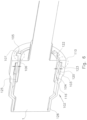
- the Fig.6 shows a sectional view through a second embodiment of a manipulation protection device 102 with a first part 103 and a second part 104.
- the parts 103, 104 are also essentially hollow-cylindrical, so that a receptacle 116 is formed for the object 1 to be protected.
- the second part 104 is arranged essentially completely in the first part 103.
- An anti-twist device 105 is provided, wherein the anti-twist device 105 comprises the axially aligned web 106 of the second part 104 and a recess 107 of the first part 103.
- the web 106 is arranged in the recess 107, so that a relative rotation of the second part 104 to the first part 103 is not possible.
- a form-locking connection 110 can be seen, which is formed by a form-locking element 120 designed as a radially deflectable spring bar and a form-locking element 122 designed as an inner projection or rear grip.
- the form-locking element 120 is displaced radially inwards by the form-locking element 122.
- the form-locking element 120 is completely arranged in the first part 103, it snaps into a recess 123 and thereby comes into engagement with the form-locking element 122.
- the second part 104 can no longer be pulled out of the first part 103 in the axial direction.
- the first and second parts 103, 104 are permanently connected to one another by the form-locking connection 110.
- the second part 104 has an annular stop 125 which prevents the entire protective device 102 from being pulled off the object 1 to be protected in the axial direction, i.e. to the left.
- the cylindrical section 126 accordingly prevents the protective device 102 from being pulled off the object 1 to be protected to the right.
- a relative rotational movement of the protective device 102 and the object 1 to be protected is possible because the protective device 102 is arranged with play on the object 1 to be protected.
- the Fig.7 shows a perspective view of the second part 104.
- the previously described elements are provided with reference numbers.
- the Fig.8 shows a sectional view through a third embodiment of a protective device 202.
- This has a first part 203 and a second part 204 arranged therein.
- the first and second parts 203, 204 are each hollow-cylindrical and form a receptacle 220 for the object to be protected.
- the second part 204 is connected to the first part 203 by a positive connection 210.
- the positive connection 210 comprises a connecting part 211, which is designed as a spring ring.
- the spring ring is partially in an inner groove 212 of the first part 203 as well as an outer peripheral groove 213 of the second part 204.
- predetermined breaking points 215, 216 are indicated, which break open if a manipulation attempt is made.
- the first part 203 has an inner diameter in the upper area - in the present case in the form of a centering collar 217 - which is dimensioned such that the protective device 202 cannot be pulled axially downwards from the object 1 to be protected.
- the second part 204 has a geometric shape that prevents the protective device 202 from being pulled upwards from the object 1 to be protected in the illustration shown.
- the protective device 202 is arranged on the object 1 to be protected with play such that a relative rotational movement of the protective device 202 to the object 1 to be protected is possible. The play is preferably so small that the protective device 202 does not rattle on the object 1 to be protected.
- the Fig.9 shows a top view of the connecting part 211.
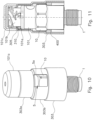
- the object 1 to be protected which is designed as a pulse generator, has a cylindrical protective housing 101 (see Fig. 11 ) for a sensor arrangement not shown in detail here.
- the protective housing 101 is provided with a tool handle 10, here a polygonal section, in particular a hexagonal section. A wrench can be attached to the tool handle 10 and the protective housing 101 can thereby be screwed into a transmission housing of a vehicle (not shown here).
- a plug arrangement 101b protrudes from the protective housing 101 and is covered by a removable protective cap 101c.
- the first part 303 of an anti-tampering device is shown.
- the upper section of the first parts 3, 103, 203 can be designed in accordance with the first part 303 or the first part 303 can be designed in such a way that it could be combined with each of the second parts 4, 104, 204.
- the first part 303 has several cylindrical sections. Overall, the first part 303 tapers towards its upper end. In the area 303a, the first part 303 has a diameter that is smaller than the minimum diameter of the tool grip 10. This can prevent the first part 303 from moving axially against the direction of the arrow 306 on the protective housing 101.
- the first part 303 which is otherwise circumferentially closed, i.e. has a continuous lateral surface, has a recess 5 through which an identification feature 5a of the object 1 can be detected.
- FIG. 11 shows that an inwardly projecting collar 305 is provided at the upper end of the first part 303, which overlaps eyelets 310 on the plug arrangement 101b after the first part 303 has been placed on the object 1.
- a total of three such eyelets 310 are provided, which could be used for a wire-based sealing.
- the collar 305 covers the eyelets 310, so that it is impossible to remove the plug arrangement 101b with the sensor arrangement from the protective housing 101.
- the collar 305 is not continuous, but individual radial projections form the collar.
- Notches particularly notches extending in the longitudinal direction, can be provided on the inner surface of the first part, which represent predetermined breaking points. The notches cause the first part 303 to be destroyed when force is applied.
- the reference number 400 designates a section of a second part, which is only indicated here.
Landscapes
- Engineering & Computer Science (AREA)
- General Engineering & Computer Science (AREA)
- Mechanical Engineering (AREA)
- Pinball Game Machines (AREA)
- Snaps, Bayonet Connections, Set Pins, And Snap Rings (AREA)
Description
- Die Erfindung betrifft ein System aus einer Manipulationsschutzvorrichtung und einem vor Manipulation zu schützenden Gegenstands, die Manipulationsschutzvorrichtung umfassend eine
Aufnahme zur zumindest teilweisen Aufnahme eines vor Manipulation zu schützenden Gegenstands. - Es ist bekannt, um Gegenstände vor Manipulation zu schützen, diese mit einer Plombe zu versehen, die nur durch Zerstören der Plombe entfernt werden kann. Eine fehlende oder beschädigte Plombe spricht dafür, dass eine Manipulation durchgeführt wurde. In bestimmten Anwendungsfällen, wie beispielsweise in Nutzfahrzeugen, müssen bestimmte Gegenstände, wie beispielsweise ein Impulsgeber, vor Manipulation geschützt werden.
- Zum einen muss verhindert werden, dass der Impulsgeber selbst manipuliert wird und zum anderen muss verhindert werden, dass der Impulsgeber in unberechtigter Weise von einem Gegenstand, mit dem er verbunden ist, entfernt wird. Auch bei Impulsgebern in Nutzfahrzeugen wird zum Verhindern von Manipulationen an dem Impulsgeber eine drahtgebundene Plombe verwendet. Dies hat jedoch fertigungstechnische Nachteile. Insbesondere ist es aufwendig, den Draht in mehrere Öffnungen einzufädeln und die Drahtenden anschließend manipulationssicher miteinander zu verbinden.
-
US 4,732,517 A befasst sich mit einer Manipulationsschutzvorrichtung mit eine ringförmige Kragenvorrichtung zur Verlängerung des Befestigungsmittel-Schaftes durch diese und zur Anordnung neben der Unterseite des Befestigungskopfes beim Zusammenbau mit dem Befestigungsmittel und ein Verschlusselement, das so angepasst ist, dass es mit der Kragenvorrichtung zusammenpasst, um den Befestigungskopf kooperativ zu umschließen, um den Zugang dazu zu verhindern. -
DE 297 21 694 U1 betrifft ein Gerät mit einem zylindrischen Schutzgehäuse mit einer Flanschfläche. - Aufgabe der vorliegenden Erfindung ist es deshalb System aus einer Manipulationsschutzvorrichtung und einem vor Manipulation zu schützenden Gegenstand bereitzustellen, das einen sicheren Manipulationsschutz darstellt und einfach montiert werden kann.
- Gelöst wird diese Aufgabe durch den Gegenstand des unabhängigen Patentanspruchs gelöst. Vorteilhafte Weiterbildungen sind Gegenstand der abhängigen Patentansprüche.
- Unter einer unlösbaren Verbindung wird im Sinne der Erfindung eine Verbindung verstanden, die nur gelöst werden kann, wenn mindestens eines der Teile und/oder die Formschlussverbindung zerstört wird. Dabei ist es denkbar, dass beispielsweise unter Zuhilfenahme eines geeigneten Werkzeugs das erste und das zweite Teil voneinander gelöst werden können, indem die Formschlussverbindung gelöst wird, wenn sich in der Aufnahme kein zu schützender Gegenstand befindet. In diesem Fall könnte es möglich sein, dass über die Aufnahme die Formschlussverbindung durch ein Werkzeug zugänglich ist und die Teile voneinander gelöst werden können. Dies kann dann vorteilhaft sein, wenn die beiden Teile der Manipulationsschutzvorrichtung versehentlich miteinander verbunden werden, ohne dass sich ein zu schützender Gegenstand in der Aufnahme befindet. Wenn die beiden Teile dann voneinander lösbar sind, kann die Manipulatlonsschutzvorrichtung immer noch verwendet werden.
- Wenn sich jedoch ein zu schützender Gegenstand in der Aufnahme befindet, darf die Formschlussverbindung nicht mehr zugänglich sein, sodass ein Trennen des ersten und des zweiten Teils nur unter Zerstörung der Formschlussverbindung und/oder zumindest eines der Teile möglich ist.
- Die Verwendung einer Formschlussverbindung hat den Vortell, dass die beiden Teile relativ einfach, Insbesondere durch Ineinanderstecken oder Ineinanderschrauben, miteinander verbunden werden können. Es ist nicht notwendig, eine kraftschlüssige oder stoffschlüssige Verbindung herzustellen. Dies wäre mit einem erhöhten Aufwand verbunden.
- Grundsätzlich denkbar und besonders vorteilhaft ist es, wenn das erste und das zweite Teil direkt mittels einer Formschlussverbindung miteinander verbunden werden, dass also sowohl das erste als auch das zweite Teil entsprechende Formschlusselemente aufweisen, die direkt miteinander zusammenwirken. Es ist jedoch auch denkbar, dass die Formschlussverbindung mittels eines Verbindungsteils, insbesondere einem Federring, hergestellt ist. Beispielsweise kann das erste Teil am Innenumfang eine Nut aufweisen und das zweite Teil am Außenumfang eine Nut aufweisen, wobei das Verbindungsteil, insbesondere der Federring, teilweise in beiden Nuten angeordnet ist und so eine axiale Relativbewegung von erstem und zweitem Tell verhindert.
- Das erste und das zweite Teil sind im Wesentlichen holzylindrisch ausgebildet. Somit ist es insbesondere
möglich, einen im Wesentlichen zylindrisch ausgebildeten Gegenstand vor Manipulation zu schützen. Dabei kann der Innendurchmesser des ersten Teils größer sein als der größte Außendurchmesser oder das maximale Eckenmaß eines prismatischen Zwischenteils des zu schützenden Gegenstands. Der Außendurchmesser des zweiten Teils kann kleiner sein als der Innendurchmesser des ersten Teils. - Das zweite Teil kann zumindest abschnittsweise In dem ersten Teil angeordnet sein. Insbesondere kann das zweite Teil in das erste Teil eingesteckt oder In dieses eingeschraubt sein. Das zweite Teil kann somit durch das erste Teil geschützt angeordnet sein. Das zweite Teil kann auch nur mit einem Abschnitt im ersten Teil angeordnet sein und mit einem weiteren Abschnitt über das erste Teil, insbesondere nach unten, vorstehen. Dadurch kann der Durchmesser der Manipulationsschutzvorrichtung im Bereich des Gewindes des Impulsgebers gering gehalten werden, was die Montage vereinfacht.
- Die Aufnahme der Schutzvorrichtung ist so messen, dass die Schutzvorrichtung mit Spiel an dem zu schützenden Gegenstand angeordnet ist, nämlich relativ zu dem zu schützenden Gegenstand drehbar ist. Dies hat insbesondere dann Vorteile, wenn der zu schützende
Gegenstand einen Werkzeug angriff, beispielsweise einen Sechskant, aufweist. Wenn die Schutzvorrichtung relativ zu dem zu schützenden Gegenstand, insbesondere relativ zu dem Werkzeugangriff drehbar ist, kann verhindert werden, dass der zu schützende Gegenstand gedreht wird und beispielsweise von einem Gegenstand entfernt wird, mit dem der zu schützende Gegenstand verbunden ist. - Weitere Vorteile ergeben sich, wenn das erste Teil zumindest ein Formschlusselement und das zweite Teil zumindest ein komplementäres Formschlusselement aufweisen. Somit kann auf ein zusätzliches Verbindungsteil verzichtet werden.
- Dabei kann die Formschlussverbindung eine Feder-Nut-Verbindung, eine Schraubverbindung und/oder eine Schnapphakenverbindung umfassen. Grundsätzlich sind jedoch auch andere Formschlussverbindungen denkbar.
- Dabei kann die Formschlussverbindung zumindest ein radial auslenkbares Federelement aufweisen, das vorzugsweise am zweiten Teil angeordnet ist. Ein radial auslenkbares Federelement kann beispielsweise verdrängt werden, während das erste und das zweite Teil miteinander verbunden werden, insbesondere das zweite Teil in das erste Teil eingesteckt oder eingeschraubt wird. Das erste Teil kann eine Aussparung oder mehrere Aussparungen aufweisen, in die das radial auslenkbare Federelement eingreifen kann, um dadurch eine Formschlussverbindung herzustellen. Die Aussparung am ersten Teil kann beispielsweise als Nut parallel zur Längsrichtung des ersten Teils ausgebildet sein oder als Hintergriff an der Innenwand des ersten Teils ausgebildet sein.
- Alternativ oder zusätzlich kann eine Verdrehsicherung vorgesehen sein, die eine drehende Relativbewegung von erstem und zweitem Teil zumindest in einer Drehrichtung verhindert. Beispielsweise kann es möglich sein, das zweite Teil in das erste Teil einzuschrauben. Ein Zurückdrehen beziehungsweise Zurückschrauben wird jedoch durch die Verdrehsicherung, insbesondere ein radial auslenkbares Federelement, verhindert.
- Das erste und das zweite Teil können zur Montage axial relativ zueinander bewegbar sein und in Formschlussverbindung axial nicht relativ zueinander bewegbar sein. Somit ist es möglich, das erste und das zweite Teil durch eine Relativbewegung miteinander zu verbinden, nicht jedoch durch eine entgegengesetzte Bewegung voneinander zu trennen.
- Die Schutzvorrichtung kann einen Anschlag, insbesondere einen Zentrierbund, aufweisen, der eine axiale Bewegung des Schutzkörpers relativ zum zu schützenden Gegenstand begrenzt oder verhindert. Somit kann sichergestellt werden, dass die Schutzvorrichtung nicht axial von dem zu schützenden Gegenstand abgezogen werden kann.
- Besondere Vorteile ergeben sich, wenn das erste und/oder das zweite Teil ein eindeutiges Identifikationsmerkmal aufweist. Als Identifikationsmerkmal kommt beispielsweise ein Barcode oder eine mehrstellige Ziffer in Frage. Somit ist jedes erste und jedes zweite Teil ein Unikat.
- Weiterhin kann vorgesehen sein, dass die Schutzvorrichtung zumindest eine Aussparung für das Erkennen eines Identifikationsmerkmals des zu schützenden Gegenstands aufweist. Bei der Aussparung kann es sich um ein Sichtfenster oder einen offenen Schlitz handeln. Somit können Identifikationsmerkmale, wie beispielsweise eine Ziffernfolge oder ein QR-Code et cetera durch den Schutzkörper hindurch erfasst werden.
- Der Manipulationsschutz wird verbessert, wenn das erste und/oder das zweite Teil zumindest eine Sollbruchstelle aufweisen. Dabei kann die Sollbruchstelle von außen nicht sichtbar sein, insbesondere wenn das erste und das zweite Teil miteinander verbunden sind. Die Sollbruchstelle kann dazu führen, dass bei einem Manipulationsversuch das erste und/oder das zweite Teil beschädigt wird und somit erkannt werden kann, dass ein Manipulationsversuch stattgefunden hat.
- Die Sollbruchstellen können beispielsweise als umlaufende Kerben oder Nuten an einer Innenwand des ersten Teils oder einer Außenwand des zweiten Teils ausgebildet sein.
- Das erste und/oder das zweite Teil können grundsätzlich aus Metall oder Keramik oder dergleichen ausgebildet sein. Besondere Vorteile ergeben sich jedoch, wenn das erste und/oder das zweite Teil aus Kunststoff, insbesondere einem Thermoplast oder Duroplast, ausgebildet sind. Somit können das erste und/oder das zweite Teil besonders einfach in einem Spritzgießverfahren hergestellt werden.
- Zudem kann es vorteilhaft sein, wenn der Kunststoff strahlenvernetzt ist. Dadurch kann eine Verformung bei Einwirkung höherer Temperaturen verhindert oder zumindest erschwert werden.
- Weiterhin ist es vorteilhaft, wenn der Kunststoff elektromagnetisch abschirmende Füllstoffe aufweist. Somit kann der zu schützende Gegenstand elektromagnetisch abgeschirmt und auch dadurch vor Manipulation geschützt werden.
- Zudem kann der Kunststoff flammhemmende Zusätze enthalten, um das Aufschmelzen beziehungsweise Brennen der Schutzvorrichtung zu erschweren.
- Die Schutzvorrichtung kann nach der Montage von einer Person ohne besondere Kraftanstrengung drehbar gegenüber dem zu schützenden Gegenstand sein. Diese Drehbarkeit kann erreicht werden durch Spiel zwischen den zylindrischen Formelementen des zu schützenden Gegenstands beziehungsweise einem größeren Maß des Innendurchmessers des ersten Teils gegenüber dem Eckenmaß des/der prismatischen Formelemente des zu schützenden Gegenstands. Durch diese Drehbarkeit wird verhindert, dass ein am Außendurchmesser des ersten Teils angreifendes Drehmoment und/oder eine Kraft auf den zu schützenden Gegenstand übertragen werden.
- Das erste und/oder das zweite Teil kann eine Signalübertragungseinrichtung, insbesondere eine Sendeeinrichtung, z. B. einen Transponder oder einen RFID-Chip, aufweisen. Dadurch kann die Schutzvorrichtung identifiziert werden. Alternativ oder zusätzlich kann eine Signalübertragung stattfinden, wenn Manipulationsversuche oder Manipulationen am zu schützenden Gegenstand erkannt werden. Manipulationsversuche können z. B. erkannt werden, wenn Schleifen in die Schutzvorrichtung eingebracht, z. B. eingegossen werden und diese verletzt werden.
- Das erste Teil kann an seinem einen Ende einen nach innen vorstehenden Bund aufweisen. Der nach innen vorstehende Bund kann dabei direkt an dem ersten Teil angeformt sein. Der Bund kann vollständig umlaufend ausgebildet sein oder es können mehrere radiale nach innen vorstehende Abschnitte vorgesehen sein, die den Bund bilden. Der Bund kann also unterbrochen sein. Der Bund kann dabei insbesondere einen Stecker einer Sensoranordnung übergreifen, sodass die Sensoranordnung nicht von dem zu schützenden Gegenstand gelöst werden kann. Wenn an dem zu schützenden Gegenstand Ösen für eine drahtgebundene Plombe vorgesehen sind, kann der Bund die Ösen oberseitig übergreifen, damit die Verdrehbarkeit der Manipulationsschutzvorrichtung erhalten bleibt.
- Es kann erwünscht sein, die Manipulationsschutzvorrichtung von Zeit zu Zeit auszutauschen. Das Entfernen ist durch Zerstörung der Manipulationsschutzvorrichtung möglich. Damit die Montage einer neuen Manipulationsschutzvorrichtung möglich ist, ohne den Impulsgeber zu entfernen, kann vorgesehen sein, dass das zweite Teil geschlitzt ausgestaltet ist, insbesondere einen in Längsrichtung verlaufenden durchgängigen Schlitz aufweist, sodass das zweite Teil radial bzw. seitlich auf den Impulsgeber aufgesetzt werden kann.
- Weitere Merkmale und Vorteile der Erfindung ergeben sich aus der nachfolgenden detaillierten Beschreibung von Ausführungsbeispielen der Erfindung, anhand der Figuren der Zeichnung, die erfindungswesentliche Einzelheiten zeigt, sowie aus den Ansprüchen. Die dort gezeigten Merkmale sind nicht notwendig maßstäblich zu verstehen und derart dargestellt, dass die erfindungsgemäßen Besonderheiten deutlich sichtbar gemacht werden können. Die verschiedenen Merkmale können je einzeln für sich oder zu mehreren in beliebigen Kombinationen bei Varianten der Erfindung verwirklicht sein.
- In der schematischen Zeichnung sind Ausführungsbeispiele der Erfindung in verschiedenen Stadien der Benutzung dargestellt und in der nachfolgenden Beschreibung näher erläutert.
- Es zeigen:
- Fig. 1
- eine perspektivische Darstellung einer Manipulationsschutzvorrichtung und eines zu schützenden Gegenstands;
- Fig. 2
- eine Längsschnittdarstellung des Gegenstands der
Fig. 1 ; - Fig. 3
- eine perspektivische Darstellung eines Teils der Manipulationsschutzvorrichtung;
- Fig. 4
- ein weiteres Teil der Manipulationsschutzvorrichtung in einer Schnittdarstellung;
- Fig. 5
- eine Schnittdarstellung gemäß der Linie C-C der
Fig. 2 ; - Fig. 6
- eine Schnittdarstellung durch eine zweite Ausführungsform einer Manipulationsschutzvorrichtung;
- Fig. 7
- eine perspektivische Darstellung eines Teils der zweiten Manipulationsschutzvorrichtung;
- Fig. 8
- eine Schnittdarstellung durch eine dritte Ausführungsform einer Manipulationsschutzvorrichtung;
- Fig. 9
- ein Verbindungselement einer Formschlussverbindung der dritten Ausführungsform einer Manipulationsschutzvorrichtung;
- Fig. 10
- eine Ausführungsform eines ersten Teils mit einem Bund;
- Fig. 11
- eine Teilschnittdarstellung der Anordnung gemäß der
Fig. 10 . - Die
Fig. 1 zeigt einen zu schützenden Gegenstand 1, der teilweise in einer Aufnahme einer Manipulationsschutzvorrichtung 2 angeordnet ist. Die Manipulationsschutzvorrichtung 2 weist ein erstes Teil 3 und ein zweites Teil 4 auf. Hier ist zu sehen, dass das erste Teil 3 eine Aussparung 5 aufweist, durch die hindurch ein Identifikationsmerkmal des zu schützenden Gegenstands 1 sichtbar ist. - Die Manipulationsschutzvorrichtung 2 ist im Wesentlichen hohlzylindrisch ausgebildet. Zu erkennen ist, dass das erste Teil 3 stufenförmig ausgebildet ist. Insbesondere ist es an die Kontur des zu schützenden Gegenstands 1 angepasst.
- Die
Fig. 2 zeigt eine Längsschnittdarstellung der Anordnung gemäß derFig. 1 . Hier ist zu erkennen, dass das erste Teil 3 einen ersten zylindrischen Abschnitt 6 und einen zweiten zylindrischen Abschnitt 7 aufweist. Der zweite zylindrische Abschnitt 7 weist einen größeren Innendurchmesser auf als der erste zylindrische Abschnitt 6. Der zu schützende Gegenstand 1 weist im Bereich des zweiten zylindrischen Abschnitts 7 einen größeren Querschnitt auf als im Bereich des ersten zylindrischen Abschnitts 6. Die Innenkontur des ersten Teils 3 ist somit an die Außenkontur des zu schützenden Gegenstands 1 angepasst. Obwohl das Teil 3 mit Spiel auf dem zu schützenden Gegenstand 1 angeordnet ist, ist es aufgrund der unterschiedlichen Durchmesser des ersten und zweiten zylindrischen Abschnitts 6, 7 axial nicht weiter in Pfeilrichtung 8 bewegbar. - Das zweite Teil 4 weist einen zylindrischen Abschnitt 9 auf, dessen Innendurchmesser kleiner ist als der Innendurchmesser des zylindrischen Abschnitts 7. Insbesondere ist der Innendurchmesser des zylindrischen Abschnitts 9 auf den Durchmesser des zu schützenden Gegenstands 1 in diesem Bereich angepasst. Dies hat zur Folge, dass die Schutzvorrichtung 2 nicht entgegen der Pfeilrichtung 8 von dem zu schützenden Gegenstand 1 abgezogen werden kann. Die Schutzvorrichtung 2 ist somit axial relativ zu dem zu schützenden Gegenstand 1 festgelegt. Dadurch, dass die Schutzvorrichtung 2 jedoch mit Spiel auf dem zu schützenden Gegenstand 1 angeordnet ist, ist diese relativ zum zu schützenden Gegenstand 1 drehbar. Dies hat zur Folge, dass auf den prismatisch ausgebildeten Werkzeugangriff 10 des zu schützenden Gegenstands 1 keine Kraft ausgeübt werden kann und somit der zu schützende Gegenstand 1 nicht gedreht werden kann, insbesondere das Gewinde 11 nicht aus einem entsprechenden Gegengewinde herausgedreht werden kann.
- Das zweite Teil 4 weist ein Außengewinde 12 und das erste Teil 3 weist ein Innengewinde 13 auf. Somit ist das zweite Teil 4 in das erste Teil 3 einschraubbar und zwar bis zu einem als Bund ausgebildeten Anschlag 14. In der gezeigten Stellung sind das erste und das zweite Teil 3, 4 durch eine Formschlussverbindung 15 unlösbar formschlüssig miteinander verbunden. Die Ausgestaltung der Formschlussverbindung 15 wird anhand der nachfolgenden Beschreibung näher erläutert. An der Schutzvorrichtung 2 sind hier nicht zu sehende Sollbruchstellen vorgesehen, die aufbrechen, wenn an der Schutzvorrichtung 2 ein Manipulationsversuch unternommen wird. Der zu schützende Gegenstand 1 ist teilweise in der Aufnahme 16 der Schutzvorrichtung 2 angeordnet.
- Die
Fig. 3 zeigt in perspektivischer Darstellung das zweite Teil 4. Hier ist zum einen das Außengewinde 12 zu erkennen. Außerdem sind zwei Formschlusselemente 20, 21 zu erkennen, die radial auslenkbar sind. Die Formschlusselemente 20, 21 wirken mit komplementären Formschlusselementen des ersten Teils 3 zusammen. Wenn das zweite Teil 4 in das erste Teil 3 eingeschraubt wird, so werden die Formschlusselemente 20, 21, die als Federstege ausgebildet sind, radial nach innen verdrängt. In entsprechenden Aussparungen beziehungsweise komplementären Formschlusselementen des ersten Teil 3 werden sie jedoch radial ausgelenkt und blockieren dadurch ein Zurückdrehen des zweiten Teils 4. Somit entsteht eine formschlüssige Verbindung, die von außen nicht mehr zugänglich ist. Dies führt dazu, dass das zweite Teil 4 und das erste Teil 3 unlösbar miteinander verbunden sind. Außerdem entsteht eine Verdrehsicherung in einer Drehrichtung. - Die
Fig. 4 zeigt eine Schnittdarstellung des ersten Teils 3. Hier ist zum einen das Innengewinde 13 zu erkennen, in dass das Außengewinde 12 eingeschraubt werden kann. An das Innengewinde 13 schließen sich als nutartige Aussparungen an der Innenseite des ersten Teils 3 ausgebildete Formschlusselemente 22 an. In diese Aussparungen können die freien Enden der Formschlusselemente 20, 21 eingreifen, wenn diese ausgelenkt werden. Somit wird ein Zurückdrehen des zweiten Teils 4 verhindert. Die nutartigen Aussparungen stellen somit komplementäre Formschlusselemente 22 zu den Formschlusselementen 20, 21 dar. - Die
Fig. 5 zeigt eine Schnittdarstellung entsprechend der Linie C-C derFig. 2 . Hier ist zu erkennen, dass die ausgelenkten Formschlusselemente 20, 21 in die Formschlusselemente 22 eingreifen und somit ein Drehen des zweiten Teils 4 im Uhrzeigersinn verhindern. Bei einer Drehung des zweiten Teils 4 entgegen des Uhrzeigersinns werden die Formschlusselemente 20, 21 durch die Vorsprünge 23 verdrängt und somit radial ausgelenkt, sodass eine Drehung des zweiten Teils 4 entgegen des Uhrzeigersinns möglich ist. - Die
Fig. 6 zeigt eine Schnittdarstellung durch eine zweite Ausführungsform einer Manipulationsschutzvorrichtung 102 mit einem ersten Teil 103 und einem zweiten Teil 104. Auch die Teile 103, 104 sind im Wesentlichen hohlzylindrisch ausgebildet, sodass eine Aufnahme 116 für den zu schützenden Gegenstand 1 gebildet ist. Das zweite Teil 104 ist im Wesentlichen vollständig im ersten Teil 103 angeordnet. Es ist eine Verdrehsicherung 105 vorgesehen, wobei die Verdrehsicherung 105 den axial ausgerichteten Steg 106 des zweiten Teils 104 und eine Ausnehmung 107 des ersten Teils 103 umfasst. Der Steg 106 ist in der Ausnehmung 107 angeordnet, sodass eine Relativverdrehung von zweitem Teil 104 zu erstem Teil 103 nicht möglich ist. - Weiterhin ist eine Formschlussverbindung 110 zu erkennen, die durch ein als radial auslenkbarer Federsteg ausgebildetes Formschlusselement 120 und ein als Innenvorsprung oder Hintergriff ausgebildetes Formschlusselement 122 ausgebildet ist. Beim Einschieben des zweiten Teils 104 in axialer Richtung in das erste Teil 103 wird das Formschlusselement 120 durch das Formschlusselement 122 radial nach innen verdrängt. Sobald das Formschlusselement 120 vollständig im ersten Teil 103 angeordnet ist, schnappt es in eine Aussparung 123 und gelangt dadurch in Hintergriff zu dem Formschlusselement 122. Nun kann das zweite Teil 104 nicht mehr in axialer Richtung aus dem ersten Teil 103 herausgezogen werden. Das erste und das zweite Teil 103, 104 sind unlösbar miteinander verbunden und zwar durch die Formschlussverbindung 110.
- Am anderen Ende weist das zweite Teil 104 einen ringförmigen Anschlag 125 auf, der verhindert, dass die gesamte Schutzvorrichtung 102 in axialer Richtung, d. h. nach links, von dem zu schützenden Gegenstand 1 abgezogen werden kann. Entsprechend verhindert der zylindrische Abschnitt 126, dass die Schutzvorrichtung 102 nach rechts von dem zu schützenden Gegenstand 1 abgezogen werden kann. Eine relative Drehbewegung von Schutzvorrichtung 102 und zu schützendem Gegenstand 1 ist jedoch möglich, da die Schutzvorrichtung 102 mit Spiel auf dem zu schützenden Gegenstand 1 angeordnet ist.
- Die
Fig. 7 zeigt eine perspektivische Darstellung des zweiten Teils 104. Die vorher bereits beschriebenen Elemente sind mit Bezugsziffern versehen. - Die
Fig. 8 zeigt eine Schnittdarstellung durch eine dritte Ausführungsform einer Schutzvorrichtung 202. Diese weist ein erstes Teil 203 und ein darin angeordnetes zweites Teil 204 auf. Das erste und das zweite Teil 203, 204 sind jeweils hohlzylindrisch ausgebildet und bilden eine Aufnahme 220 für den zu schützenden Gegenstand. Das zweite Teil 204 ist durch eine Formschlussverbindung 210 mit dem ersten Teil 203 verbunden. Die Formschlussverbindung 210 umfasst ein Verbindungsteil 211, welches als Federring ausgebildet ist. Der Federring ist sowohl teilweise in einer Innennut 212 des ersten Teils 203 als auch einer Außenumfangsnut 213 des zweiten Teils 204 angeordnet. In der gezeigten Darstellung sind Sollbruchstellen 215, 216 angedeutet, die aufbrechen, wenn ein Manipulationsversuch unternommen wird. - Das erste Teil 203 weist im oberen Bereich einen Innendurchmesser - im vorliegenden Fall in Form eines Zentrierbunds 217 - auf, der so bemessen ist, dass die Schutzvorrichtung 202 nicht axial nach unten von dem zu schützenden Gegenstand 1 abgezogen werden kann. Andererseits weist das zweite Teil 204 eine geometrische Form auf, die verhindert, dass die Schutzvorrichtung 202 in der gezeigten Darstellung nach oben von dem zu schützenden Gegenstand 1 abgezogen werden kann. Die Schutzvorrichtung 202 ist jedoch so mit Spiel auf dem zu schützenden Gegenstand 1 angeordnet, dass eine relative Drehbewegung von Schutzvorrichtung 202 zum zu schützenden Gegenstand 1 möglich ist. Das Spiel ist vorzugsweise so gering, dass die Schutzvorrichtung 202 auf dem zu schützenden Gegenstand 1 nicht klappert.
- Die
Fig. 9 zeigt eine Draufsicht auf das Verbindungsteil 211. - Der in
Fig. 10 gezeigte als Impulsgeber ausgebildete zu schützende Gegenstand 1 weist ein zylindrisches Schutzgehäuse 101 (s.Fig. 11 ) für eine hier nicht näher dargestellte Sensoranordnung auf. Das Schutzgehäuse 101 ist mit einem Werkzeugangriff 10, hier einem Mehrkantabschnitt, insbesondere Sechskantabschnitt, versehen. Am Werkzeugangriff 10 kann ein Schlüssel angesetzt werden und dadurch das Schutzgehäuse 101 in ein hier nicht dargestelltes Getriebegehäuse eines Fahrzeugs eingeschraubt werden. Am oberen Ende 101a des Schutzgehäuses 101 ragt eine Steckeranordnung 101b aus dem Schutzgehäuse 101 heraus, die durch eine abnehmbare Schutzkappe 101c abgedeckt ist. - In
Fig. 10 ist das erste Teil 303 einer Manipulationsschutzvorrichtung gezeigt. Der obere Abschnitt der ersten Teile 3, 103, 203 kann entsprechend dem ersten Teil 303 ausgestaltet sein bzw. das erste Teil 303 kann so ausgestaltet werden, dass es mit jedem der zweiten Teile 4, 104, 204 kombiniert werden könnte. Das erste Teil 303 weist mehrere zylindrische Abschnitte auf. Insgesamt verjüngt sich das erste Teil 303 zu seinem oberen Ende hin. Im Bereich 303a weist das erste Teil 303 einen Durchmesser auf, der kleiner ist als der Minimaldurchmesser des Werkzeugangriffs 10. Dadurch kann verhindert werden, dass sich das erste Teil 303 axial entgegen der Pfeilrichtung 306 auf dem Schutzgehäuse 101 verschiebt. - Im Bereich 303b weist das erste Teil 303, das ansonsten umfangsmäßig geschlossen ist, also eine durchgängige Mantelfläche aufweist, eine Aussparung 5 auf, durch die hindurch ein Identifikationsmerkmal 5a des Gegenstands 1 zu erfassen ist.
- Die teilweise geschnittene Ansicht in
Fig. 11 verdeutlicht, dass am oberen Ende des ersten Teils 303 ein nach innen vorstehender Bund 305 vorgesehen ist, der nach dem Aufsetzen des ersten Teils 303 auf den Gegenstand 1 Ösen 310 an der Steckeranordnung 101b übergreift. Insgesamt sind drei solcher Ösen 310 vorgesehen, die für eine drahtgebundene Verplombung genutzt werden könnten. Der Bund 305 überdeckt die Ösen 310, sodass es unmöglich ist, die Steckeranordnung 101b mit der Sensoranordnung aus dem Schutzgehäuse 101 zu entfernen. - Denkbar ist es auch, dass der Bund 305 nicht durchgängig ausgebildet ist, sondern einzelne radiale Vorsprünge den Bund bilden.
- An der inneren Mantelfläche des ersten Teils können Kerben, insbesondere sich in Längsrichtung erstreckende Kerben, vorgesehen sein, die Sollbruchstellen darstellen. Die Kerben bewirken, dass bei Kraftangriff das erste Teil 303 zerstört wird.
- Die Bezugsziffer 400 bezeichnet einen Abschnitt eines hier nur angedeuteten zweiten Teils.
Claims (11)
- System aus einer Manipulationsschutzvorrichtung (2, 102, 202) und eines vor Manipulation zu schützenden Gegenstands (1), die Manipulationsschutzvorrichtung umfassend: eine Aufnahme (16, 116, 220) zur zumindest teilweisen Aufnahme eines vor Manipulation zu schützenden Gegenstands (1), wobei die Manipulationsschutzvorrichtung (2, 102, 202) ein erstes Teil (3, 103, 203, 303) und ein zweites Teil (4, 104, 204) aufweist, wobei das erste und das zweite Teil (3, 4, 103, 104, 203, 204, 303) mittels einer Formschlussverbindung (15, 110, 210) zumindest dann unlösbar verbunden sind, wenn der zu schützende Gegenstand (1) in der Aufnahme (16, 116, 220) angeordnet ist, wobei das erste und zweite Teil (3, 103, 203, 303, 4, 104, 204) Hohlzylinder sind und dass die Aufnahme (16, 116, 220) der Schutzvorrichtung (2, 102, 202) so bemessen ist, dass die Schutzvorrichtung (2, 102, 202) mit Spiel an dem zu schützenden Gegenstand (1) angeordnet ist, nämlich relativ zu dem zu schützenden Gegenstand (1) drehbar ist, und wobei die unlösbare Verbindung eine Verbindung ist, die nur gelöst werden kann, wenn die Formschlussverbindung zerstört wird.
- System nach Anspruch 1, dadurch gekennzeichnet, dass das zweite Teil (4, 104, 204) zumindest abschnittsweise in dem ersten Teil (3, 103, 203, 303) angeordnet ist.
- System nach einem der vorhergehenden Ansprüche, dadurch gekennzeichnet, dass das erste Teil (3, 103, 303) zumindest ein Formschlusselement (22, 122) und das zweite Teil (4, 104) zumindest ein komplementäres Formschlusselement (20, 21, 120) aufweisen.
- System nach einem der vorhergehenden Ansprüche, dadurch gekennzeichnet, dass eine Verdrehsicherung (105) vorgesehen ist, die eine drehende Relativbewegung von erstem und zweitem Teil (3, 4, 103, 104, 303) zumindest in einer Drehrichtung verhindert.
- System nach einem der vorhergehenden Ansprüche, dadurch gekennzeichnet, dass das erste und das zweite Teil (3, 4, 103, 104, 203, 204, 303) zur Montage axial relativ zueinander bewegbar sind und in Formschlussverbindung axial nicht relativ zueinander bewegbar sind.
- System nach einem der vorhergehenden Ansprüche, dadurch gekennzeichnet, dass das erste und/oder das zweite Teil (3, 4, 103, 104, 203, 204, 303) ein eindeutiges Identifikationsmerkmal aufweist.
- System nach einem der vorhergehenden Ansprüche, dadurch gekennzeichnet, dass die Schutzvorrichtung (2, 102, 202) zumindest eine Aussparung (5) für das Erkennen eines Identifikationsmerkmals des zu schützenden Gegenstands (1) aufweist.
- System nach einem der vorhergehenden Ansprüche, dadurch gekennzeichnet, dass das erste und/oder das zweite Teil (3, 4, 103, 104, 203, 204, 303) zumindest eine Sollbruchstelle (215, 216) aufweist.
- System nach einem der vorhergehenden Ansprüche, dadurch gekennzeichnet, dass der das erste und/oder das zweite Teil (3, 4, 103, 104, 203, 204, 303) aus Kunststoff ausgebildet ist.
- System nach einem der vorhergehenden Ansprüche, dadurch gekennzeichnet, dass das erste und/oder zweite Teil (3, 4, 103, 104, 203, 204, 303) eine Signalübertragungseinrichtung, insbesondere eine Sendeeinrichtung, aufweist.
- System nach einem der vorhergehenden Ansprüche, dadurch gekennzeichnet, dass das erste Teil (303) an seinem einen Ende einen nach innen vorstehenden Bund (305) aufweist.
Applications Claiming Priority (2)
| Application Number | Priority Date | Filing Date | Title |
|---|---|---|---|
| DE202018101395.5U DE202018101395U1 (de) | 2018-03-13 | 2018-03-13 | Manipulationsschutzvorrichtung |
| DE102018110778.1A DE102018110778A1 (de) | 2018-03-13 | 2018-05-04 | Manipulationsschutzvorrichtung |
Publications (2)
| Publication Number | Publication Date |
|---|---|
| EP3540246A1 EP3540246A1 (de) | 2019-09-18 |
| EP3540246B1 true EP3540246B1 (de) | 2024-07-17 |
Family
ID=65763320
Family Applications (1)
| Application Number | Title | Priority Date | Filing Date |
|---|---|---|---|
| EP19161816.4A Active EP3540246B1 (de) | 2018-03-13 | 2019-03-11 | System aus einer manipulationsschutzvorrichtung und eines vor manipulation zu schützenden gegenstands |
Country Status (1)
| Country | Link |
|---|---|
| EP (1) | EP3540246B1 (de) |
Citations (2)
| Publication number | Priority date | Publication date | Assignee | Title |
|---|---|---|---|---|
| US3782146A (en) * | 1971-10-08 | 1974-01-01 | R Franke | Locking device |
| DE29721694U1 (de) * | 1997-12-09 | 1998-02-05 | Mannesmann VDO AG, 60388 Frankfurt | Plombiervorrichtung für einen Drehwertgeber |
Family Cites Families (1)
| Publication number | Priority date | Publication date | Assignee | Title |
|---|---|---|---|---|
| US4732517A (en) * | 1983-11-23 | 1988-03-22 | Carolina Moldings, Inc. | Anti-tamper fastener shielding apparatus |
-
2019
- 2019-03-11 EP EP19161816.4A patent/EP3540246B1/de active Active
Patent Citations (2)
| Publication number | Priority date | Publication date | Assignee | Title |
|---|---|---|---|---|
| US3782146A (en) * | 1971-10-08 | 1974-01-01 | R Franke | Locking device |
| DE29721694U1 (de) * | 1997-12-09 | 1998-02-05 | Mannesmann VDO AG, 60388 Frankfurt | Plombiervorrichtung für einen Drehwertgeber |
Also Published As
| Publication number | Publication date |
|---|---|
| EP3540246A1 (de) | 2019-09-18 |
Similar Documents
| Publication | Publication Date | Title |
|---|---|---|
| DE2906812C2 (de) | ||
| DE4121524C2 (de) | Schraubenverbindung | |
| DE102007047860B3 (de) | Verbindungselement mit einer Schraube und einer daran unverlierbar angeordneten Hülse | |
| DE102013101120B4 (de) | Kabelfixierung | |
| DE2813025C2 (de) | Sicherheitsbolzen | |
| DE3221164A1 (de) | Verschlussvorrichtung fuer einen behaelter mit einer zylindrischen oeffnung | |
| DE69400489T2 (de) | Vorhängeschloss | |
| DE69803036T2 (de) | Ausgabevorrichtung mit sicherung gegen abschrauben | |
| EP0600432B1 (de) | Rohr- oder Schlauchleitung zum Transport eines Fluids | |
| WO2001036903A1 (de) | Messseil-wegsensor | |
| DE102006061644B3 (de) | Impulsgeber mit einer Plombiervorrichtung | |
| EP3540246B1 (de) | System aus einer manipulationsschutzvorrichtung und eines vor manipulation zu schützenden gegenstands | |
| EP0923168B1 (de) | Plombiervorrichtung für einen Drehwertgeber | |
| DE102018110778A1 (de) | Manipulationsschutzvorrichtung | |
| EP0499121B1 (de) | Betätigungsglied mit Uberlastsicherung | |
| EP4462003A1 (de) | Verbindung für wasserführende bauteile | |
| EP3546896B1 (de) | Plombe für einen impulsgeber | |
| DE2349265C3 (de) | Vorrichtung zum Verschließen eines Behälters, insbesondere einer Flasche, mit einer Schraubkappe | |
| DE2945540A1 (de) | Abschliessbarer verschluss fuer oeltankfuellrohre | |
| DE10224517A1 (de) | Befestigungsteil für eine diebstahlgesicherte Befestigung eines Fahrzeugrades an einer Radnabe | |
| DE10156876C2 (de) | Einrichtung zum Absichern eines Schraubelements gegen ein unbefugtes Lösen | |
| DE8708965U1 (de) | Verliersicherung für Schrauben, insbesondere für Kopfschrauben, an elastischen Unterlagen | |
| DE19706644A1 (de) | Kunststoff-Deckel für ein Filtergehäuse | |
| DE102014002541B4 (de) | Befestigungseinrichtung zur manipulationsgeschützten Befestigung sowie Bauteilanordnung | |
| DE202010006050U1 (de) | Sicherungsvorrichtung gegen Verlorengehen nach dem Lösen eines Fixierelementes |
Legal Events
| Date | Code | Title | Description |
|---|---|---|---|
| PUAI | Public reference made under article 153(3) epc to a published international application that has entered the european phase |
Free format text: ORIGINAL CODE: 0009012 |
|
| STAA | Information on the status of an ep patent application or granted ep patent |
Free format text: STATUS: THE APPLICATION HAS BEEN PUBLISHED |
|
| AK | Designated contracting states |
Kind code of ref document: A1 Designated state(s): AL AT BE BG CH CY CZ DE DK EE ES FI FR GB GR HR HU IE IS IT LI LT LU LV MC MK MT NL NO PL PT RO RS SE SI SK SM TR |
|
| AX | Request for extension of the european patent |
Extension state: BA ME |
|
| STAA | Information on the status of an ep patent application or granted ep patent |
Free format text: STATUS: REQUEST FOR EXAMINATION WAS MADE |
|
| 17P | Request for examination filed |
Effective date: 20200123 |
|
| RBV | Designated contracting states (corrected) |
Designated state(s): AL AT BE BG CH CY CZ DE DK EE ES FI FR GB GR HR HU IE IS IT LI LT LU LV MC MK MT NL NO PL PT RO RS SE SI SK SM TR |
|
| RAP1 | Party data changed (applicant data changed or rights of an application transferred) |
Owner name: TE CONNECTIVITY KISSLING PRODUCTS GMBH |
|
| STAA | Information on the status of an ep patent application or granted ep patent |
Free format text: STATUS: EXAMINATION IS IN PROGRESS |
|
| 17Q | First examination report despatched |
Effective date: 20210125 |
|
| GRAP | Despatch of communication of intention to grant a patent |
Free format text: ORIGINAL CODE: EPIDOSNIGR1 |
|
| STAA | Information on the status of an ep patent application or granted ep patent |
Free format text: STATUS: GRANT OF PATENT IS INTENDED |
|
| INTG | Intention to grant announced |
Effective date: 20240221 |
|
| GRAS | Grant fee paid |
Free format text: ORIGINAL CODE: EPIDOSNIGR3 |
|
| GRAA | (expected) grant |
Free format text: ORIGINAL CODE: 0009210 |
|
| STAA | Information on the status of an ep patent application or granted ep patent |
Free format text: STATUS: THE PATENT HAS BEEN GRANTED |
|
| REG | Reference to a national code |
Ref country code: DE Ref legal event code: R081 Ref document number: 502019011669 Country of ref document: DE Owner name: TE CONNECTIVITY KISSLING PRODUCTS GMBH, DE Free format text: FORMER OWNER: ANMELDERANGABEN UNKLAR / UNVOLLSTAENDIG, 80297 MUENCHEN, DE |
|
| AK | Designated contracting states |
Kind code of ref document: B1 Designated state(s): AL AT BE BG CH CY CZ DE DK EE ES FI FR GB GR HR HU IE IS IT LI LT LU LV MC MK MT NL NO PL PT RO RS SE SI SK SM TR |
|
| REG | Reference to a national code |
Ref country code: CH Ref legal event code: EP |
|
| REG | Reference to a national code |
Ref country code: DE Ref legal event code: R096 Ref document number: 502019011669 Country of ref document: DE |
|
| REG | Reference to a national code |
Ref country code: IE Ref legal event code: FG4D Free format text: LANGUAGE OF EP DOCUMENT: GERMAN |
|
| REG | Reference to a national code |
Ref country code: LT Ref legal event code: MG9D |
|
| REG | Reference to a national code |
Ref country code: NL Ref legal event code: MP Effective date: 20240717 |
|
| PG25 | Lapsed in a contracting state [announced via postgrant information from national office to epo] |
Ref country code: PT Free format text: LAPSE BECAUSE OF FAILURE TO SUBMIT A TRANSLATION OF THE DESCRIPTION OR TO PAY THE FEE WITHIN THE PRESCRIBED TIME-LIMIT Effective date: 20241118 |
|
| PG25 | Lapsed in a contracting state [announced via postgrant information from national office to epo] |
Ref country code: NL Free format text: LAPSE BECAUSE OF FAILURE TO SUBMIT A TRANSLATION OF THE DESCRIPTION OR TO PAY THE FEE WITHIN THE PRESCRIBED TIME-LIMIT Effective date: 20240717 |
|
| PG25 | Lapsed in a contracting state [announced via postgrant information from national office to epo] |
Ref country code: PT Free format text: LAPSE BECAUSE OF FAILURE TO SUBMIT A TRANSLATION OF THE DESCRIPTION OR TO PAY THE FEE WITHIN THE PRESCRIBED TIME-LIMIT Effective date: 20241118 Ref country code: NL Free format text: LAPSE BECAUSE OF FAILURE TO SUBMIT A TRANSLATION OF THE DESCRIPTION OR TO PAY THE FEE WITHIN THE PRESCRIBED TIME-LIMIT Effective date: 20240717 |
|
| PG25 | Lapsed in a contracting state [announced via postgrant information from national office to epo] |
Ref country code: NO Free format text: LAPSE BECAUSE OF FAILURE TO SUBMIT A TRANSLATION OF THE DESCRIPTION OR TO PAY THE FEE WITHIN THE PRESCRIBED TIME-LIMIT Effective date: 20241017 |
|
| PG25 | Lapsed in a contracting state [announced via postgrant information from national office to epo] |
Ref country code: FI Free format text: LAPSE BECAUSE OF FAILURE TO SUBMIT A TRANSLATION OF THE DESCRIPTION OR TO PAY THE FEE WITHIN THE PRESCRIBED TIME-LIMIT Effective date: 20240717 Ref country code: GR Free format text: LAPSE BECAUSE OF FAILURE TO SUBMIT A TRANSLATION OF THE DESCRIPTION OR TO PAY THE FEE WITHIN THE PRESCRIBED TIME-LIMIT Effective date: 20241018 Ref country code: PL Free format text: LAPSE BECAUSE OF FAILURE TO SUBMIT A TRANSLATION OF THE DESCRIPTION OR TO PAY THE FEE WITHIN THE PRESCRIBED TIME-LIMIT Effective date: 20240717 |
|
| PG25 | Lapsed in a contracting state [announced via postgrant information from national office to epo] |
Ref country code: BG Free format text: LAPSE BECAUSE OF FAILURE TO SUBMIT A TRANSLATION OF THE DESCRIPTION OR TO PAY THE FEE WITHIN THE PRESCRIBED TIME-LIMIT Effective date: 20240717 |
|
| PG25 | Lapsed in a contracting state [announced via postgrant information from national office to epo] |
Ref country code: LV Free format text: LAPSE BECAUSE OF FAILURE TO SUBMIT A TRANSLATION OF THE DESCRIPTION OR TO PAY THE FEE WITHIN THE PRESCRIBED TIME-LIMIT Effective date: 20240717 |
|
| PG25 | Lapsed in a contracting state [announced via postgrant information from national office to epo] |
Ref country code: IS Free format text: LAPSE BECAUSE OF FAILURE TO SUBMIT A TRANSLATION OF THE DESCRIPTION OR TO PAY THE FEE WITHIN THE PRESCRIBED TIME-LIMIT Effective date: 20241117 |
|
| PG25 | Lapsed in a contracting state [announced via postgrant information from national office to epo] |
Ref country code: HR Free format text: LAPSE BECAUSE OF FAILURE TO SUBMIT A TRANSLATION OF THE DESCRIPTION OR TO PAY THE FEE WITHIN THE PRESCRIBED TIME-LIMIT Effective date: 20240717 |
|
| PG25 | Lapsed in a contracting state [announced via postgrant information from national office to epo] |
Ref country code: ES Free format text: LAPSE BECAUSE OF FAILURE TO SUBMIT A TRANSLATION OF THE DESCRIPTION OR TO PAY THE FEE WITHIN THE PRESCRIBED TIME-LIMIT Effective date: 20240717 Ref country code: RS Free format text: LAPSE BECAUSE OF FAILURE TO SUBMIT A TRANSLATION OF THE DESCRIPTION OR TO PAY THE FEE WITHIN THE PRESCRIBED TIME-LIMIT Effective date: 20241017 |
|
| PG25 | Lapsed in a contracting state [announced via postgrant information from national office to epo] |
Ref country code: RS Free format text: LAPSE BECAUSE OF FAILURE TO SUBMIT A TRANSLATION OF THE DESCRIPTION OR TO PAY THE FEE WITHIN THE PRESCRIBED TIME-LIMIT Effective date: 20241017 Ref country code: PL Free format text: LAPSE BECAUSE OF FAILURE TO SUBMIT A TRANSLATION OF THE DESCRIPTION OR TO PAY THE FEE WITHIN THE PRESCRIBED TIME-LIMIT Effective date: 20240717 Ref country code: NO Free format text: LAPSE BECAUSE OF FAILURE TO SUBMIT A TRANSLATION OF THE DESCRIPTION OR TO PAY THE FEE WITHIN THE PRESCRIBED TIME-LIMIT Effective date: 20241017 Ref country code: LV Free format text: LAPSE BECAUSE OF FAILURE TO SUBMIT A TRANSLATION OF THE DESCRIPTION OR TO PAY THE FEE WITHIN THE PRESCRIBED TIME-LIMIT Effective date: 20240717 Ref country code: IS Free format text: LAPSE BECAUSE OF FAILURE TO SUBMIT A TRANSLATION OF THE DESCRIPTION OR TO PAY THE FEE WITHIN THE PRESCRIBED TIME-LIMIT Effective date: 20241117 Ref country code: HR Free format text: LAPSE BECAUSE OF FAILURE TO SUBMIT A TRANSLATION OF THE DESCRIPTION OR TO PAY THE FEE WITHIN THE PRESCRIBED TIME-LIMIT Effective date: 20240717 Ref country code: GR Free format text: LAPSE BECAUSE OF FAILURE TO SUBMIT A TRANSLATION OF THE DESCRIPTION OR TO PAY THE FEE WITHIN THE PRESCRIBED TIME-LIMIT Effective date: 20241018 Ref country code: FI Free format text: LAPSE BECAUSE OF FAILURE TO SUBMIT A TRANSLATION OF THE DESCRIPTION OR TO PAY THE FEE WITHIN THE PRESCRIBED TIME-LIMIT Effective date: 20240717 Ref country code: ES Free format text: LAPSE BECAUSE OF FAILURE TO SUBMIT A TRANSLATION OF THE DESCRIPTION OR TO PAY THE FEE WITHIN THE PRESCRIBED TIME-LIMIT Effective date: 20240717 Ref country code: BG Free format text: LAPSE BECAUSE OF FAILURE TO SUBMIT A TRANSLATION OF THE DESCRIPTION OR TO PAY THE FEE WITHIN THE PRESCRIBED TIME-LIMIT Effective date: 20240717 |
|
| PG25 | Lapsed in a contracting state [announced via postgrant information from national office to epo] |
Ref country code: RO Free format text: LAPSE BECAUSE OF FAILURE TO SUBMIT A TRANSLATION OF THE DESCRIPTION OR TO PAY THE FEE WITHIN THE PRESCRIBED TIME-LIMIT Effective date: 20240717 Ref country code: DK Free format text: LAPSE BECAUSE OF FAILURE TO SUBMIT A TRANSLATION OF THE DESCRIPTION OR TO PAY THE FEE WITHIN THE PRESCRIBED TIME-LIMIT Effective date: 20240717 Ref country code: SM Free format text: LAPSE BECAUSE OF FAILURE TO SUBMIT A TRANSLATION OF THE DESCRIPTION OR TO PAY THE FEE WITHIN THE PRESCRIBED TIME-LIMIT Effective date: 20240717 |
|
| REG | Reference to a national code |
Ref country code: DE Ref legal event code: R097 Ref document number: 502019011669 Country of ref document: DE |
|
| PG25 | Lapsed in a contracting state [announced via postgrant information from national office to epo] |
Ref country code: EE Free format text: LAPSE BECAUSE OF FAILURE TO SUBMIT A TRANSLATION OF THE DESCRIPTION OR TO PAY THE FEE WITHIN THE PRESCRIBED TIME-LIMIT Effective date: 20240717 |
|
| PG25 | Lapsed in a contracting state [announced via postgrant information from national office to epo] |
Ref country code: CZ Free format text: LAPSE BECAUSE OF FAILURE TO SUBMIT A TRANSLATION OF THE DESCRIPTION OR TO PAY THE FEE WITHIN THE PRESCRIBED TIME-LIMIT Effective date: 20240717 |
|
| PG25 | Lapsed in a contracting state [announced via postgrant information from national office to epo] |
Ref country code: SK Free format text: LAPSE BECAUSE OF FAILURE TO SUBMIT A TRANSLATION OF THE DESCRIPTION OR TO PAY THE FEE WITHIN THE PRESCRIBED TIME-LIMIT Effective date: 20240717 |
|
| PLBE | No opposition filed within time limit |
Free format text: ORIGINAL CODE: 0009261 |
|
| STAA | Information on the status of an ep patent application or granted ep patent |
Free format text: STATUS: NO OPPOSITION FILED WITHIN TIME LIMIT |
|
| 26N | No opposition filed |
Effective date: 20250422 |
|
| PG25 | Lapsed in a contracting state [announced via postgrant information from national office to epo] |
Ref country code: SE Free format text: LAPSE BECAUSE OF FAILURE TO SUBMIT A TRANSLATION OF THE DESCRIPTION OR TO PAY THE FEE WITHIN THE PRESCRIBED TIME-LIMIT Effective date: 20240717 |
|
| PG25 | Lapsed in a contracting state [announced via postgrant information from national office to epo] |
Ref country code: MC Free format text: LAPSE BECAUSE OF FAILURE TO SUBMIT A TRANSLATION OF THE DESCRIPTION OR TO PAY THE FEE WITHIN THE PRESCRIBED TIME-LIMIT Effective date: 20240717 |
|
| REG | Reference to a national code |
Ref country code: CH Ref legal event code: H13 Free format text: ST27 STATUS EVENT CODE: U-0-0-H10-H13 (AS PROVIDED BY THE NATIONAL OFFICE) Effective date: 20251023 |
|
| PG25 | Lapsed in a contracting state [announced via postgrant information from national office to epo] |
Ref country code: LU Free format text: LAPSE BECAUSE OF NON-PAYMENT OF DUE FEES Effective date: 20250311 |
|
| REG | Reference to a national code |
Ref country code: BE Ref legal event code: MM Effective date: 20250331 |
|
| PG25 | Lapsed in a contracting state [announced via postgrant information from national office to epo] |
Ref country code: IT Free format text: LAPSE BECAUSE OF NON-PAYMENT OF DUE FEES Effective date: 20250311 |
|
| PGFP | Annual fee paid to national office [announced via postgrant information from national office to epo] |
Ref country code: FR Payment date: 20251231 Year of fee payment: 8 |
|
| PG25 | Lapsed in a contracting state [announced via postgrant information from national office to epo] |
Ref country code: BE Free format text: LAPSE BECAUSE OF NON-PAYMENT OF DUE FEES Effective date: 20250331 |
|
| PG25 | Lapsed in a contracting state [announced via postgrant information from national office to epo] |
Ref country code: CH Free format text: LAPSE BECAUSE OF NON-PAYMENT OF DUE FEES Effective date: 20250331 |
|
| PG25 | Lapsed in a contracting state [announced via postgrant information from national office to epo] |
Ref country code: IE Free format text: LAPSE BECAUSE OF NON-PAYMENT OF DUE FEES Effective date: 20250311 |
|
| PGFP | Annual fee paid to national office [announced via postgrant information from national office to epo] |
Ref country code: GB Payment date: 20260106 Year of fee payment: 8 |
|
| PGFP | Annual fee paid to national office [announced via postgrant information from national office to epo] |
Ref country code: DE Payment date: 20260102 Year of fee payment: 8 |
|
| PG25 | Lapsed in a contracting state [announced via postgrant information from national office to epo] |
Ref country code: IT Free format text: LAPSE BECAUSE OF NON-PAYMENT OF DUE FEES Effective date: 20250311 |
|
| PGFP | Annual fee paid to national office [announced via postgrant information from national office to epo] |
Ref country code: IT Payment date: 20260220 Year of fee payment: 8 |
|
| PGRI | Patent reinstated in contracting state [announced from national office to epo] |
Ref country code: IT Effective date: 20250731 |