EP3540246B1 - Système comprenant un dispositif de protection contre des manipulations et un objet à protéger contre les manipulations - Google Patents
Système comprenant un dispositif de protection contre des manipulations et un objet à protéger contre les manipulations Download PDFInfo
- Publication number
- EP3540246B1 EP3540246B1 EP19161816.4A EP19161816A EP3540246B1 EP 3540246 B1 EP3540246 B1 EP 3540246B1 EP 19161816 A EP19161816 A EP 19161816A EP 3540246 B1 EP3540246 B1 EP 3540246B1
- Authority
- EP
- European Patent Office
- Prior art keywords
- protected
- parts
- tampering
- protective device
- connection
- Prior art date
- Legal status (The legal status is an assumption and is not a legal conclusion. Google has not performed a legal analysis and makes no representation as to the accuracy of the status listed.)
- Active
Links
Images

Classifications
-
- F—MECHANICAL ENGINEERING; LIGHTING; HEATING; WEAPONS; BLASTING
- F16—ENGINEERING ELEMENTS AND UNITS; GENERAL MEASURES FOR PRODUCING AND MAINTAINING EFFECTIVE FUNCTIONING OF MACHINES OR INSTALLATIONS; THERMAL INSULATION IN GENERAL
- F16B—DEVICES FOR FASTENING OR SECURING CONSTRUCTIONAL ELEMENTS OR MACHINE PARTS TOGETHER, e.g. NAILS, BOLTS, CIRCLIPS, CLAMPS, CLIPS OR WEDGES; JOINTS OR JOINTING
- F16B41/00—Measures against loss of bolts, nuts, or pins; Measures against unauthorised operation of bolts, nuts or pins
- F16B41/005—Measures against unauthorised operation of bolts, nuts or pins
Definitions
- the invention relates to a system comprising a manipulation protection device and an object to be protected against manipulation, the manipulation protection device comprising a Recording for at least partially recording an object to be protected against manipulation.
- the pulse generator itself must be prevented from being tampered with and, on the other hand, the pulse generator must be prevented from being removed from an object to which it is connected without authorization.
- a wire-bound seal is also used for pulse generators in commercial vehicles to prevent tampering with the pulse generator.
- this has disadvantages in terms of manufacturing. In particular, it is complex to thread the wire into several openings and then connect the wire ends together in a tamper-proof manner.
- US 4,732,517 A deals with an anti-tamper device comprising an annular collar device for extending the fastener shank therethrough and for location adjacent the underside of the fastener head when assembled with the fastener, and a closure member adapted to mate with the collar device to cooperatively enclose the fastener head to prevent access thereto.
- the object of the present invention is therefore to provide a system comprising a tamper protection device and an object to be protected against tampering, which represents a secure tamper protection and can be easily installed.
- a non-detachable connection is understood to mean a connection that can only be released if at least one of the parts and/or the form-locking connection is destroyed. It is conceivable that, for example, with the aid of a suitable tool, the first and second parts can be separated from one another by releasing the form-locking connection when there is no object to be protected in the receptacle. In this case, it could be possible for the form-locking connection to be accessible via the receptacle using a tool and for the parts can be separated from each other. This can be advantageous if the two parts of the tamper protection device are accidentally connected to each other without an object to be protected being in the holder. If the two parts can then be separated from each other, the tamper protection device can still be used.
- the positive connection must no longer be accessible, so that separation of the first and second parts is only possible by destroying the positive connection and/or at least one of the parts.
- the advantage of using a form-fitting connection is that the two parts can be connected relatively easily, particularly by inserting or screwing them together. It is not necessary to create a force-fitting or material-fitting connection. This would involve increased effort.
- first and second parts are connected directly to one another by means of a positive connection, i.e. both the first and second parts have corresponding positive locking elements that interact directly with one another.
- the positive locking connection is produced by means of a connecting part, in particular a spring ring.
- the first part can have a groove on the inner circumference and the second part can have a groove on the outer circumference, with the connecting part, in particular the spring ring, being partially arranged in both grooves and thus preventing axial relative movement of the first and second parts.
- the first and second parts are essentially wooden cylindrical. This makes it particularly It is possible to protect an essentially cylindrical object from manipulation.
- the inner diameter of the first part can be larger than the largest outer diameter or the maximum corner dimension of a prismatic intermediate part of the object to be protected.
- the outer diameter of the second part can be smaller than the inner diameter of the first part.
- the second part can be arranged in the first part at least in sections.
- the second part can be inserted into the first part or screwed into it.
- the second part can thus be arranged so as to be protected by the first part.
- the second part can also be arranged with only one section in the first part and with another section protruding beyond the first part, in particular downwards. This means that the diameter of the tamper protection device in the area of the pulse generator's thread can be kept small, which simplifies assembly.
- the mounting of the protective device is to be measured in such a way that the protective device is arranged with play on the object to be protected, namely that it can be rotated relative to the object to be protected.
- the object to be protected Object has a tool attack, for example a hexagon. If the protective device is rotatable relative to the object to be protected, in particular relative to the tool attack, it can be prevented that the object to be protected is rotated and, for example, removed from an object to which the object to be protected is connected.
- first part has at least one form-locking element and the second part has at least one complementary form-locking element. This means that an additional connecting part is not required.
- the form-fitting connection can comprise a tongue-and-groove connection, a screw connection and/or a snap-hook connection. In principle, however, other form-fitting connections are also conceivable.
- the form-fitting connection can have at least one radially deflectable spring element, which is preferably arranged on the second part.
- a radially deflectable spring element can be displaced, for example, while the first and second parts are connected to one another, in particular the second part is inserted or screwed into the first part.
- the first part can have one or more recesses into which the radially deflectable spring element can engage in order to thereby create a form-fitting connection.
- the recess on the first part can, for example, be designed as a groove parallel to the longitudinal direction of the first part or as a rear grip on the inner wall of the first part.
- an anti-twisting device can be provided which prevents a rotating relative movement of the first and second parts in at least one direction of rotation. For example, it may be possible to screw the second part into the first part. However, turning or screwing back is prevented by the anti-twisting device, in particular a radially deflectable spring element.
- the first and the second part can be axially movable relative to each other for assembly and in a form-fitting connection axially not relative be movable relative to each other. It is thus possible to connect the first and second parts by a relative movement, but not to separate them by an opposite movement.
- the protective device can have a stop, in particular a centering collar, which limits or prevents an axial movement of the protective body relative to the object to be protected. This ensures that the protective device cannot be pulled axially away from the object to be protected.
- first and/or second part has a unique identification feature.
- a barcode or a multi-digit number can be used as an identification feature, for example. This means that every first and every second part is unique.
- the protective device has at least one recess for recognizing an identification feature of the object to be protected.
- the recess can be a viewing window or an open slot. Identification features such as a sequence of numbers or a QR code etc. can thus be detected through the protective body.
- the protection against manipulation is improved if the first and/or the second part have at least one predetermined breaking point.
- the predetermined breaking point may not be visible from the outside, especially if the first and second parts are connected to one another.
- the predetermined breaking point can lead to the first and/or the second part being damaged in the event of a manipulation attempt, and it can therefore be recognized that a manipulation attempt has taken place.
- the predetermined breaking points can be formed, for example, as circumferential notches or grooves on an inner wall of the first part or an outer wall of the second part.
- the first and/or the second part can basically be made of metal or ceramic or the like. However, particular advantages arise when the first and/or the second part are made of plastic, in particular a thermoplastic or thermosetting plastic. The first and/or the second part can thus be manufactured particularly easily using an injection molding process.
- the plastic is cross-linked using radiation. This can prevent or at least make it more difficult for it to deform when exposed to higher temperatures.
- the plastic contains electromagnetically shielding fillers. This means that the object to be protected can be electromagnetically shielded and thus also protected against manipulation.
- the plastic can contain flame-retardant additives to make it more difficult for the protective device to melt or burn.
- the protective device can be rotated by one person with respect to the object to be protected without any particular effort.
- This rotatability can be achieved by play between the cylindrical form elements of the object to be protected or by a larger dimension of the inner diameter of the first part compared to the corner dimension of the prismatic form element(s) of the object to be protected. This rotatability prevents a torque and/or a force acting on the outer diameter of the first part from being transmitted to the object to be protected.
- the first and/or the second part can have a signal transmission device, in particular a transmitting device, e.g. a transponder or an RFID chip.
- a signal transmission can take place if attempts at manipulation or manipulation of the object to be protected are detected. Attempts at manipulation can be detected, for example, if loops are introduced into the protective device, e.g. cast in, and these are damaged.
- the first part can have an inwardly protruding collar at one end.
- the inwardly protruding collar can be molded directly onto the first part.
- the collar can be completely circumferential or there can be several radially inwardly protruding sections that form the collar.
- the collar can therefore be interrupted.
- the collar can in particular overlap a plug of a sensor arrangement so that the sensor arrangement cannot be detached from the object to be protected. If eyelets for a wired seal are provided on the object to be protected, the collar can overlap the eyelets on the top so that the ability to rotate the tamper protection device is maintained.
- the second part can be slotted. is designed, in particular has a continuous slot running in the longitudinal direction, so that the second part can be placed radially or laterally on the pulse generator.
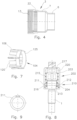
- the Fig.1 shows an object 1 to be protected, which is partially arranged in a receptacle of an anti-tampering device 2.
- the anti-tampering device 2 has a first part 3 and a second part 4.
- the first part 3 has a recess 5 through which an identification feature of the object 1 to be protected is visible.
- the tamper protection device 2 is essentially hollow-cylindrical. It can be seen that the first part 3 is stepped. In particular, it is adapted to the contour of the object 1 to be protected.
- the Fig.2 shows a longitudinal section of the arrangement according to the Fig.1 .
- the first part 3 has a first cylindrical section 6 and a second cylindrical section 7.
- the second cylindrical section 7 has a larger inner diameter than the first cylindrical section 6.
- the object 1 to be protected has a larger cross-section in the region of the second cylindrical section 7 than in the region of the first cylindrical section 6.
- the inner contour of the first part 3 is thus adapted to the outer contour of the object 1 to be protected.
- the part 3 is arranged with play on the object 1 to be protected, it cannot move any further axially in the direction of the arrow 8 due to the different diameters of the first and second cylindrical sections 6, 7.
- the second part 4 has a cylindrical section 9, the inner diameter of which is smaller than the inner diameter of the cylindrical section 7.
- the inner diameter of the cylindrical section 9 is adapted to the diameter of the object 1 to be protected in this area.
- the protective device 2 cannot be pulled off the object 1 to be protected in the opposite direction to the arrow 8.
- the protective device 2 is thus axially fixed relative to the object 1 to be protected.
- the protective device 2 is arranged with play on the object 1 to be protected, it can be rotated relative to the object 1 to be protected. This has the consequence that no force can be exerted on the prismatic tool grip 10 of the object 1 to be protected and thus the object 1 to be protected cannot be rotated, in particular the thread 11 cannot be unscrewed from a corresponding counter thread.
- the second part 4 has an external thread 12 and the first part 3 has an internal thread 13.
- the second part 4 can thus be screwed into the first part 3 up to a stop 14 designed as a collar.
- the first and second parts 3, 4 are permanently connected to one another by a positive connection 15.
- the design of the positive connection 15 is explained in more detail in the following description.
- the protective device 2 is provided with predetermined breaking points (not visible here) which break open if an attempt is made to tamper with the protective device 2.
- the object 1 to be protected is partially arranged in the receptacle 16 of the protective device 2.
- the Fig.3 shows the second part 4 in perspective.
- the external thread 12 can be seen.
- two form-locking elements 20, 21 can be seen, which can be deflected radially.
- the form-locking elements 20, 21 interact with complementary form-locking elements of the first part 3.
- the form-locking elements 20, 21, which are designed as spring bars are displaced radially inwards.
- they are deflected radially and thereby block the second part 4 from turning back.
- the second part 4 and the first part 3 are permanently connected to one another.
- an anti-twisting device is created in one direction of rotation.
- the Fig.4 shows a sectional view of the first part 3.
- the internal thread 13 can be seen, into which the external thread 12 can be screwed.
- the internal thread 13 is followed by groove-like recesses on the inside of the first part 3.
- Form-locking elements 22 The free ends of the form-locking elements 20, 21 can engage in these recesses when they are deflected. This prevents the second part 4 from turning back.
- the groove-like recesses thus represent complementary form-locking elements 22 to the form-locking elements 20, 21.
- the Fig.5 shows a sectional view along the line CC of the Fig.2
- the deflected form-locking elements 20, 21 engage in the form-locking elements 22 and thus prevent the second part 4 from rotating clockwise.
- the form-locking elements 20, 21 are displaced by the projections 23 and thus deflected radially, so that the second part 4 can rotate anti-clockwise.
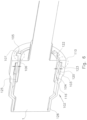
- the Fig.6 shows a sectional view through a second embodiment of a manipulation protection device 102 with a first part 103 and a second part 104.
- the parts 103, 104 are also essentially hollow-cylindrical, so that a receptacle 116 is formed for the object 1 to be protected.
- the second part 104 is arranged essentially completely in the first part 103.
- An anti-twist device 105 is provided, wherein the anti-twist device 105 comprises the axially aligned web 106 of the second part 104 and a recess 107 of the first part 103.
- the web 106 is arranged in the recess 107, so that a relative rotation of the second part 104 to the first part 103 is not possible.
- a form-locking connection 110 can be seen, which is formed by a form-locking element 120 designed as a radially deflectable spring bar and a form-locking element 122 designed as an inner projection or rear grip.
- the form-locking element 120 is displaced radially inwards by the form-locking element 122.
- the form-locking element 120 is completely arranged in the first part 103, it snaps into a recess 123 and thereby comes into engagement with the form-locking element 122.
- the second part 104 can no longer be pulled out of the first part 103 in the axial direction.
- the first and second parts 103, 104 are permanently connected to one another by the form-locking connection 110.
- the second part 104 has an annular stop 125 which prevents the entire protective device 102 from being pulled off the object 1 to be protected in the axial direction, i.e. to the left.
- the cylindrical section 126 accordingly prevents the protective device 102 from being pulled off the object 1 to be protected to the right.
- a relative rotational movement of the protective device 102 and the object 1 to be protected is possible because the protective device 102 is arranged with play on the object 1 to be protected.
- the Fig.7 shows a perspective view of the second part 104.
- the previously described elements are provided with reference numbers.
- the Fig.8 shows a sectional view through a third embodiment of a protective device 202.
- This has a first part 203 and a second part 204 arranged therein.
- the first and second parts 203, 204 are each hollow-cylindrical and form a receptacle 220 for the object to be protected.
- the second part 204 is connected to the first part 203 by a positive connection 210.
- the positive connection 210 comprises a connecting part 211, which is designed as a spring ring.
- the spring ring is partially in an inner groove 212 of the first part 203 as well as an outer peripheral groove 213 of the second part 204.
- predetermined breaking points 215, 216 are indicated, which break open if a manipulation attempt is made.
- the first part 203 has an inner diameter in the upper area - in the present case in the form of a centering collar 217 - which is dimensioned such that the protective device 202 cannot be pulled axially downwards from the object 1 to be protected.
- the second part 204 has a geometric shape that prevents the protective device 202 from being pulled upwards from the object 1 to be protected in the illustration shown.
- the protective device 202 is arranged on the object 1 to be protected with play such that a relative rotational movement of the protective device 202 to the object 1 to be protected is possible. The play is preferably so small that the protective device 202 does not rattle on the object 1 to be protected.
- the Fig.9 shows a top view of the connecting part 211.
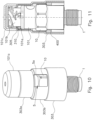
- the object 1 to be protected which is designed as a pulse generator, has a cylindrical protective housing 101 (see Fig. 11 ) for a sensor arrangement not shown in detail here.
- the protective housing 101 is provided with a tool handle 10, here a polygonal section, in particular a hexagonal section. A wrench can be attached to the tool handle 10 and the protective housing 101 can thereby be screwed into a transmission housing of a vehicle (not shown here).
- a plug arrangement 101b protrudes from the protective housing 101 and is covered by a removable protective cap 101c.
- the first part 303 of an anti-tampering device is shown.
- the upper section of the first parts 3, 103, 203 can be designed in accordance with the first part 303 or the first part 303 can be designed in such a way that it could be combined with each of the second parts 4, 104, 204.
- the first part 303 has several cylindrical sections. Overall, the first part 303 tapers towards its upper end. In the area 303a, the first part 303 has a diameter that is smaller than the minimum diameter of the tool grip 10. This can prevent the first part 303 from moving axially against the direction of the arrow 306 on the protective housing 101.
- the first part 303 which is otherwise circumferentially closed, i.e. has a continuous lateral surface, has a recess 5 through which an identification feature 5a of the object 1 can be detected.
- FIG. 11 shows that an inwardly projecting collar 305 is provided at the upper end of the first part 303, which overlaps eyelets 310 on the plug arrangement 101b after the first part 303 has been placed on the object 1.
- a total of three such eyelets 310 are provided, which could be used for a wire-based sealing.
- the collar 305 covers the eyelets 310, so that it is impossible to remove the plug arrangement 101b with the sensor arrangement from the protective housing 101.
- the collar 305 is not continuous, but individual radial projections form the collar.
- Notches particularly notches extending in the longitudinal direction, can be provided on the inner surface of the first part, which represent predetermined breaking points. The notches cause the first part 303 to be destroyed when force is applied.
- the reference number 400 designates a section of a second part, which is only indicated here.
Landscapes
- Engineering & Computer Science (AREA)
- General Engineering & Computer Science (AREA)
- Mechanical Engineering (AREA)
- Pinball Game Machines (AREA)
- Snaps, Bayonet Connections, Set Pins, And Snap Rings (AREA)
Claims (11)
- Système constitué d'un dispositif de protection contre les manipulations (2, 102, 202) et d'un objet (1) à protéger contre les manipulations, le dispositif de protection contre les manipulations comprenant : un logement (16, 116, 220) permettant d'accueillir au moins partiellement un objet (1) à protéger contre les manipulations, dans lequel le dispositif de protection contre les manipulations (2, 102, 202) présente une première partie (3, 103, 203, 303) et une deuxième partie (4, 104, 204), dans lequel les première et deuxième parties (3, 4, 103, 104, 203, 204, 303) sont reliées de manière inamovible au moyen d'une liaison par complémentarité de forme (15, 110, 210) au moins lorsque l'objet à protéger (1) est agencé dans le logement (16, 116, 220), dans lequel les première et deuxième parties (3, 103, 203, 303, 4, 104, 204) sont des cylindres creux et le logement (16, 116, 220) du dispositif de protection (2, 102, 202) est dimensionné de sorte que le dispositif de protection (2, 102, 202) est agencé de manière à présenter un jeu au niveau de l'objet à protéger (1), c'est-à-dire qu'il peut tourner par rapport à l'objet à protéger (1), et dans lequel la liaison inamovible est une liaison qui ne peut être annulée que si la liaison par complémentarité de forme est détruite.
- Système selon la revendication 1, caractérisé en ce que la deuxième partie (4, 104, 204) est agencée au moins par sections dans la première partie (3, 103, 203, 303).
- Système selon l'une quelconque des revendications précédentes, caractérisé en ce que la première partie (3, 103, 303) présente au moins un élément de liaison par complémentarité de forme (22, 122) et la deuxième partie (4, 104) présente au moins un élément de liaison par complémentarité de forme (20, 21, 120) complémentaire.
- Système selon l'une quelconque des revendications précédentes, caractérisé en ce qu'un dispositif anti-rotation (105) est prévu, qui empêche un déplacement relatif rotatif des première et deuxième parties (3, 4, 103, 104, 303) au moins dans un sens de rotation.
- Système selon l'une quelconque des revendications précédentes, caractérisé en ce que les première et deuxième parties (3, 4, 103, 104, 203, 204, 303) peuvent être déplacées axialement l'une par rapport à l'autre en vue du montage et ne peuvent pas être déplacées axialement l'une par rapport à l'autre lorsqu'elles sont reliées par complémentarité de forme.
- Système selon l'une quelconque des revendications précédentes, caractérisé en ce que la première et/ou la deuxième partie (3, 4, 103, 104, 203, 204, 303) présente(nt) une caractéristique d'identification unique.
- Système selon l'une quelconque des revendications précédentes, caractérisé en ce que le dispositif de protection (2, 102, 202) comprend au moins un évidement (5) destiné à la reconnaissance d'une caractéristique d'identification de l'objet à protéger (1).
- Système selon l'une quelconque des revendications précédentes, caractérisé en ce que la première et/ou la deuxième partie (3, 4, 103, 104, 203, 204, 303) présente(nt) au moins un point de rupture intentionnellement prévu (215, 216).
- Système selon l'une quelconque des revendications précédentes, caractérisé en ce que la première et/ou la deuxième partie (3, 4, 103, 104, 203, 204, 303) est/sont réalisée(s) en matière plastique.
- Système selon l'une quelconque des revendications précédentes, caractérisé en ce que la première et/ou la deuxième partie (3, 4, 103, 104, 203, 204, 303) présente(nt) un dispositif de transmission de signal, en particulier un dispositif d'émission.
- Système selon l'une quelconque des revendications précédentes, caractérisé en ce que la première partie (303) présente au niveau d'une de ses extrémités une collerette (305) faisant saillie vers l'intérieur.
Applications Claiming Priority (2)
| Application Number | Priority Date | Filing Date | Title |
|---|---|---|---|
| DE202018101395.5U DE202018101395U1 (de) | 2018-03-13 | 2018-03-13 | Manipulationsschutzvorrichtung |
| DE102018110778.1A DE102018110778A1 (de) | 2018-03-13 | 2018-05-04 | Manipulationsschutzvorrichtung |
Publications (2)
| Publication Number | Publication Date |
|---|---|
| EP3540246A1 EP3540246A1 (fr) | 2019-09-18 |
| EP3540246B1 true EP3540246B1 (fr) | 2024-07-17 |
Family
ID=65763320
Family Applications (1)
| Application Number | Title | Priority Date | Filing Date |
|---|---|---|---|
| EP19161816.4A Active EP3540246B1 (fr) | 2018-03-13 | 2019-03-11 | Système comprenant un dispositif de protection contre des manipulations et un objet à protéger contre les manipulations |
Country Status (1)
| Country | Link |
|---|---|
| EP (1) | EP3540246B1 (fr) |
Citations (2)
| Publication number | Priority date | Publication date | Assignee | Title |
|---|---|---|---|---|
| US3782146A (en) * | 1971-10-08 | 1974-01-01 | R Franke | Locking device |
| DE29721694U1 (de) * | 1997-12-09 | 1998-02-05 | Mannesmann VDO AG, 60388 Frankfurt | Plombiervorrichtung für einen Drehwertgeber |
Family Cites Families (1)
| Publication number | Priority date | Publication date | Assignee | Title |
|---|---|---|---|---|
| US4732517A (en) * | 1983-11-23 | 1988-03-22 | Carolina Moldings, Inc. | Anti-tamper fastener shielding apparatus |
-
2019
- 2019-03-11 EP EP19161816.4A patent/EP3540246B1/fr active Active
Patent Citations (2)
| Publication number | Priority date | Publication date | Assignee | Title |
|---|---|---|---|---|
| US3782146A (en) * | 1971-10-08 | 1974-01-01 | R Franke | Locking device |
| DE29721694U1 (de) * | 1997-12-09 | 1998-02-05 | Mannesmann VDO AG, 60388 Frankfurt | Plombiervorrichtung für einen Drehwertgeber |
Also Published As
| Publication number | Publication date |
|---|---|
| EP3540246A1 (fr) | 2019-09-18 |
Similar Documents
| Publication | Publication Date | Title |
|---|---|---|
| DE2906812C2 (fr) | ||
| DE4121524C2 (de) | Schraubenverbindung | |
| DE102007047860B3 (de) | Verbindungselement mit einer Schraube und einer daran unverlierbar angeordneten Hülse | |
| DE102013101120B4 (de) | Kabelfixierung | |
| DE2813025C2 (de) | Sicherheitsbolzen | |
| DE3221164A1 (de) | Verschlussvorrichtung fuer einen behaelter mit einer zylindrischen oeffnung | |
| DE69400489T2 (de) | Vorhängeschloss | |
| DE69803036T2 (de) | Ausgabevorrichtung mit sicherung gegen abschrauben | |
| EP0600432B1 (fr) | Tuyauterie ou tuyauterie flexible pour le transport d'un fluide | |
| WO2001036903A1 (fr) | Capteur de deplacement a cable de mesure | |
| DE102006061644B3 (de) | Impulsgeber mit einer Plombiervorrichtung | |
| EP3540246B1 (fr) | Système comprenant un dispositif de protection contre des manipulations et un objet à protéger contre les manipulations | |
| EP0923168B1 (fr) | Dispositif de scellé pour un capteur de rotation | |
| DE102018110778A1 (de) | Manipulationsschutzvorrichtung | |
| EP0499121B1 (fr) | Partie de commande avec dispositif de sécurité contre les surcharges | |
| EP4462003A1 (fr) | Raccord pour composants conduisant l'eau | |
| EP3546896B1 (fr) | Plomb pour un émetteur d'impulsions | |
| DE2349265C3 (de) | Vorrichtung zum Verschließen eines Behälters, insbesondere einer Flasche, mit einer Schraubkappe | |
| DE2945540A1 (de) | Abschliessbarer verschluss fuer oeltankfuellrohre | |
| DE10224517A1 (de) | Befestigungsteil für eine diebstahlgesicherte Befestigung eines Fahrzeugrades an einer Radnabe | |
| DE10156876C2 (de) | Einrichtung zum Absichern eines Schraubelements gegen ein unbefugtes Lösen | |
| DE8708965U1 (de) | Verliersicherung für Schrauben, insbesondere für Kopfschrauben, an elastischen Unterlagen | |
| DE19706644A1 (de) | Kunststoff-Deckel für ein Filtergehäuse | |
| DE102014002541B4 (de) | Befestigungseinrichtung zur manipulationsgeschützten Befestigung sowie Bauteilanordnung | |
| DE202010006050U1 (de) | Sicherungsvorrichtung gegen Verlorengehen nach dem Lösen eines Fixierelementes |
Legal Events
| Date | Code | Title | Description |
|---|---|---|---|
| PUAI | Public reference made under article 153(3) epc to a published international application that has entered the european phase |
Free format text: ORIGINAL CODE: 0009012 |
|
| STAA | Information on the status of an ep patent application or granted ep patent |
Free format text: STATUS: THE APPLICATION HAS BEEN PUBLISHED |
|
| AK | Designated contracting states |
Kind code of ref document: A1 Designated state(s): AL AT BE BG CH CY CZ DE DK EE ES FI FR GB GR HR HU IE IS IT LI LT LU LV MC MK MT NL NO PL PT RO RS SE SI SK SM TR |
|
| AX | Request for extension of the european patent |
Extension state: BA ME |
|
| STAA | Information on the status of an ep patent application or granted ep patent |
Free format text: STATUS: REQUEST FOR EXAMINATION WAS MADE |
|
| 17P | Request for examination filed |
Effective date: 20200123 |
|
| RBV | Designated contracting states (corrected) |
Designated state(s): AL AT BE BG CH CY CZ DE DK EE ES FI FR GB GR HR HU IE IS IT LI LT LU LV MC MK MT NL NO PL PT RO RS SE SI SK SM TR |
|
| RAP1 | Party data changed (applicant data changed or rights of an application transferred) |
Owner name: TE CONNECTIVITY KISSLING PRODUCTS GMBH |
|
| STAA | Information on the status of an ep patent application or granted ep patent |
Free format text: STATUS: EXAMINATION IS IN PROGRESS |
|
| 17Q | First examination report despatched |
Effective date: 20210125 |
|
| GRAP | Despatch of communication of intention to grant a patent |
Free format text: ORIGINAL CODE: EPIDOSNIGR1 |
|
| STAA | Information on the status of an ep patent application or granted ep patent |
Free format text: STATUS: GRANT OF PATENT IS INTENDED |
|
| INTG | Intention to grant announced |
Effective date: 20240221 |
|
| GRAS | Grant fee paid |
Free format text: ORIGINAL CODE: EPIDOSNIGR3 |
|
| GRAA | (expected) grant |
Free format text: ORIGINAL CODE: 0009210 |
|
| STAA | Information on the status of an ep patent application or granted ep patent |
Free format text: STATUS: THE PATENT HAS BEEN GRANTED |
|
| REG | Reference to a national code |
Ref country code: DE Ref legal event code: R081 Ref document number: 502019011669 Country of ref document: DE Owner name: TE CONNECTIVITY KISSLING PRODUCTS GMBH, DE Free format text: FORMER OWNER: ANMELDERANGABEN UNKLAR / UNVOLLSTAENDIG, 80297 MUENCHEN, DE |
|
| AK | Designated contracting states |
Kind code of ref document: B1 Designated state(s): AL AT BE BG CH CY CZ DE DK EE ES FI FR GB GR HR HU IE IS IT LI LT LU LV MC MK MT NL NO PL PT RO RS SE SI SK SM TR |
|
| REG | Reference to a national code |
Ref country code: CH Ref legal event code: EP |
|
| REG | Reference to a national code |
Ref country code: DE Ref legal event code: R096 Ref document number: 502019011669 Country of ref document: DE |
|
| REG | Reference to a national code |
Ref country code: IE Ref legal event code: FG4D Free format text: LANGUAGE OF EP DOCUMENT: GERMAN |
|
| REG | Reference to a national code |
Ref country code: LT Ref legal event code: MG9D |
|
| REG | Reference to a national code |
Ref country code: NL Ref legal event code: MP Effective date: 20240717 |
|
| PG25 | Lapsed in a contracting state [announced via postgrant information from national office to epo] |
Ref country code: PT Free format text: LAPSE BECAUSE OF FAILURE TO SUBMIT A TRANSLATION OF THE DESCRIPTION OR TO PAY THE FEE WITHIN THE PRESCRIBED TIME-LIMIT Effective date: 20241118 |
|
| PG25 | Lapsed in a contracting state [announced via postgrant information from national office to epo] |
Ref country code: NL Free format text: LAPSE BECAUSE OF FAILURE TO SUBMIT A TRANSLATION OF THE DESCRIPTION OR TO PAY THE FEE WITHIN THE PRESCRIBED TIME-LIMIT Effective date: 20240717 |
|
| PG25 | Lapsed in a contracting state [announced via postgrant information from national office to epo] |
Ref country code: PT Free format text: LAPSE BECAUSE OF FAILURE TO SUBMIT A TRANSLATION OF THE DESCRIPTION OR TO PAY THE FEE WITHIN THE PRESCRIBED TIME-LIMIT Effective date: 20241118 Ref country code: NL Free format text: LAPSE BECAUSE OF FAILURE TO SUBMIT A TRANSLATION OF THE DESCRIPTION OR TO PAY THE FEE WITHIN THE PRESCRIBED TIME-LIMIT Effective date: 20240717 |
|
| PG25 | Lapsed in a contracting state [announced via postgrant information from national office to epo] |
Ref country code: NO Free format text: LAPSE BECAUSE OF FAILURE TO SUBMIT A TRANSLATION OF THE DESCRIPTION OR TO PAY THE FEE WITHIN THE PRESCRIBED TIME-LIMIT Effective date: 20241017 |
|
| PG25 | Lapsed in a contracting state [announced via postgrant information from national office to epo] |
Ref country code: FI Free format text: LAPSE BECAUSE OF FAILURE TO SUBMIT A TRANSLATION OF THE DESCRIPTION OR TO PAY THE FEE WITHIN THE PRESCRIBED TIME-LIMIT Effective date: 20240717 Ref country code: GR Free format text: LAPSE BECAUSE OF FAILURE TO SUBMIT A TRANSLATION OF THE DESCRIPTION OR TO PAY THE FEE WITHIN THE PRESCRIBED TIME-LIMIT Effective date: 20241018 Ref country code: PL Free format text: LAPSE BECAUSE OF FAILURE TO SUBMIT A TRANSLATION OF THE DESCRIPTION OR TO PAY THE FEE WITHIN THE PRESCRIBED TIME-LIMIT Effective date: 20240717 |
|
| PG25 | Lapsed in a contracting state [announced via postgrant information from national office to epo] |
Ref country code: BG Free format text: LAPSE BECAUSE OF FAILURE TO SUBMIT A TRANSLATION OF THE DESCRIPTION OR TO PAY THE FEE WITHIN THE PRESCRIBED TIME-LIMIT Effective date: 20240717 |
|
| PG25 | Lapsed in a contracting state [announced via postgrant information from national office to epo] |
Ref country code: LV Free format text: LAPSE BECAUSE OF FAILURE TO SUBMIT A TRANSLATION OF THE DESCRIPTION OR TO PAY THE FEE WITHIN THE PRESCRIBED TIME-LIMIT Effective date: 20240717 |
|
| PG25 | Lapsed in a contracting state [announced via postgrant information from national office to epo] |
Ref country code: IS Free format text: LAPSE BECAUSE OF FAILURE TO SUBMIT A TRANSLATION OF THE DESCRIPTION OR TO PAY THE FEE WITHIN THE PRESCRIBED TIME-LIMIT Effective date: 20241117 |
|
| PG25 | Lapsed in a contracting state [announced via postgrant information from national office to epo] |
Ref country code: HR Free format text: LAPSE BECAUSE OF FAILURE TO SUBMIT A TRANSLATION OF THE DESCRIPTION OR TO PAY THE FEE WITHIN THE PRESCRIBED TIME-LIMIT Effective date: 20240717 |
|
| PG25 | Lapsed in a contracting state [announced via postgrant information from national office to epo] |
Ref country code: ES Free format text: LAPSE BECAUSE OF FAILURE TO SUBMIT A TRANSLATION OF THE DESCRIPTION OR TO PAY THE FEE WITHIN THE PRESCRIBED TIME-LIMIT Effective date: 20240717 Ref country code: RS Free format text: LAPSE BECAUSE OF FAILURE TO SUBMIT A TRANSLATION OF THE DESCRIPTION OR TO PAY THE FEE WITHIN THE PRESCRIBED TIME-LIMIT Effective date: 20241017 |
|
| PG25 | Lapsed in a contracting state [announced via postgrant information from national office to epo] |
Ref country code: RS Free format text: LAPSE BECAUSE OF FAILURE TO SUBMIT A TRANSLATION OF THE DESCRIPTION OR TO PAY THE FEE WITHIN THE PRESCRIBED TIME-LIMIT Effective date: 20241017 Ref country code: PL Free format text: LAPSE BECAUSE OF FAILURE TO SUBMIT A TRANSLATION OF THE DESCRIPTION OR TO PAY THE FEE WITHIN THE PRESCRIBED TIME-LIMIT Effective date: 20240717 Ref country code: NO Free format text: LAPSE BECAUSE OF FAILURE TO SUBMIT A TRANSLATION OF THE DESCRIPTION OR TO PAY THE FEE WITHIN THE PRESCRIBED TIME-LIMIT Effective date: 20241017 Ref country code: LV Free format text: LAPSE BECAUSE OF FAILURE TO SUBMIT A TRANSLATION OF THE DESCRIPTION OR TO PAY THE FEE WITHIN THE PRESCRIBED TIME-LIMIT Effective date: 20240717 Ref country code: IS Free format text: LAPSE BECAUSE OF FAILURE TO SUBMIT A TRANSLATION OF THE DESCRIPTION OR TO PAY THE FEE WITHIN THE PRESCRIBED TIME-LIMIT Effective date: 20241117 Ref country code: HR Free format text: LAPSE BECAUSE OF FAILURE TO SUBMIT A TRANSLATION OF THE DESCRIPTION OR TO PAY THE FEE WITHIN THE PRESCRIBED TIME-LIMIT Effective date: 20240717 Ref country code: GR Free format text: LAPSE BECAUSE OF FAILURE TO SUBMIT A TRANSLATION OF THE DESCRIPTION OR TO PAY THE FEE WITHIN THE PRESCRIBED TIME-LIMIT Effective date: 20241018 Ref country code: FI Free format text: LAPSE BECAUSE OF FAILURE TO SUBMIT A TRANSLATION OF THE DESCRIPTION OR TO PAY THE FEE WITHIN THE PRESCRIBED TIME-LIMIT Effective date: 20240717 Ref country code: ES Free format text: LAPSE BECAUSE OF FAILURE TO SUBMIT A TRANSLATION OF THE DESCRIPTION OR TO PAY THE FEE WITHIN THE PRESCRIBED TIME-LIMIT Effective date: 20240717 Ref country code: BG Free format text: LAPSE BECAUSE OF FAILURE TO SUBMIT A TRANSLATION OF THE DESCRIPTION OR TO PAY THE FEE WITHIN THE PRESCRIBED TIME-LIMIT Effective date: 20240717 |
|
| PG25 | Lapsed in a contracting state [announced via postgrant information from national office to epo] |
Ref country code: RO Free format text: LAPSE BECAUSE OF FAILURE TO SUBMIT A TRANSLATION OF THE DESCRIPTION OR TO PAY THE FEE WITHIN THE PRESCRIBED TIME-LIMIT Effective date: 20240717 Ref country code: DK Free format text: LAPSE BECAUSE OF FAILURE TO SUBMIT A TRANSLATION OF THE DESCRIPTION OR TO PAY THE FEE WITHIN THE PRESCRIBED TIME-LIMIT Effective date: 20240717 Ref country code: SM Free format text: LAPSE BECAUSE OF FAILURE TO SUBMIT A TRANSLATION OF THE DESCRIPTION OR TO PAY THE FEE WITHIN THE PRESCRIBED TIME-LIMIT Effective date: 20240717 |
|
| REG | Reference to a national code |
Ref country code: DE Ref legal event code: R097 Ref document number: 502019011669 Country of ref document: DE |
|
| PG25 | Lapsed in a contracting state [announced via postgrant information from national office to epo] |
Ref country code: EE Free format text: LAPSE BECAUSE OF FAILURE TO SUBMIT A TRANSLATION OF THE DESCRIPTION OR TO PAY THE FEE WITHIN THE PRESCRIBED TIME-LIMIT Effective date: 20240717 |
|
| PG25 | Lapsed in a contracting state [announced via postgrant information from national office to epo] |
Ref country code: CZ Free format text: LAPSE BECAUSE OF FAILURE TO SUBMIT A TRANSLATION OF THE DESCRIPTION OR TO PAY THE FEE WITHIN THE PRESCRIBED TIME-LIMIT Effective date: 20240717 |
|
| PG25 | Lapsed in a contracting state [announced via postgrant information from national office to epo] |
Ref country code: SK Free format text: LAPSE BECAUSE OF FAILURE TO SUBMIT A TRANSLATION OF THE DESCRIPTION OR TO PAY THE FEE WITHIN THE PRESCRIBED TIME-LIMIT Effective date: 20240717 |
|
| PLBE | No opposition filed within time limit |
Free format text: ORIGINAL CODE: 0009261 |
|
| STAA | Information on the status of an ep patent application or granted ep patent |
Free format text: STATUS: NO OPPOSITION FILED WITHIN TIME LIMIT |
|
| 26N | No opposition filed |
Effective date: 20250422 |
|
| PG25 | Lapsed in a contracting state [announced via postgrant information from national office to epo] |
Ref country code: SE Free format text: LAPSE BECAUSE OF FAILURE TO SUBMIT A TRANSLATION OF THE DESCRIPTION OR TO PAY THE FEE WITHIN THE PRESCRIBED TIME-LIMIT Effective date: 20240717 |
|
| PG25 | Lapsed in a contracting state [announced via postgrant information from national office to epo] |
Ref country code: MC Free format text: LAPSE BECAUSE OF FAILURE TO SUBMIT A TRANSLATION OF THE DESCRIPTION OR TO PAY THE FEE WITHIN THE PRESCRIBED TIME-LIMIT Effective date: 20240717 |
|
| REG | Reference to a national code |
Ref country code: CH Ref legal event code: H13 Free format text: ST27 STATUS EVENT CODE: U-0-0-H10-H13 (AS PROVIDED BY THE NATIONAL OFFICE) Effective date: 20251023 |
|
| PG25 | Lapsed in a contracting state [announced via postgrant information from national office to epo] |
Ref country code: LU Free format text: LAPSE BECAUSE OF NON-PAYMENT OF DUE FEES Effective date: 20250311 |
|
| REG | Reference to a national code |
Ref country code: BE Ref legal event code: MM Effective date: 20250331 |
|
| PG25 | Lapsed in a contracting state [announced via postgrant information from national office to epo] |
Ref country code: IT Free format text: LAPSE BECAUSE OF NON-PAYMENT OF DUE FEES Effective date: 20250311 |
|
| PGFP | Annual fee paid to national office [announced via postgrant information from national office to epo] |
Ref country code: FR Payment date: 20251231 Year of fee payment: 8 |
|
| PG25 | Lapsed in a contracting state [announced via postgrant information from national office to epo] |
Ref country code: BE Free format text: LAPSE BECAUSE OF NON-PAYMENT OF DUE FEES Effective date: 20250331 |
|
| PG25 | Lapsed in a contracting state [announced via postgrant information from national office to epo] |
Ref country code: CH Free format text: LAPSE BECAUSE OF NON-PAYMENT OF DUE FEES Effective date: 20250331 |
|
| PG25 | Lapsed in a contracting state [announced via postgrant information from national office to epo] |
Ref country code: IE Free format text: LAPSE BECAUSE OF NON-PAYMENT OF DUE FEES Effective date: 20250311 |
|
| PGFP | Annual fee paid to national office [announced via postgrant information from national office to epo] |
Ref country code: GB Payment date: 20260106 Year of fee payment: 8 |
|
| PGFP | Annual fee paid to national office [announced via postgrant information from national office to epo] |
Ref country code: DE Payment date: 20260102 Year of fee payment: 8 |
|
| PG25 | Lapsed in a contracting state [announced via postgrant information from national office to epo] |
Ref country code: IT Free format text: LAPSE BECAUSE OF NON-PAYMENT OF DUE FEES Effective date: 20250311 |
|
| PGFP | Annual fee paid to national office [announced via postgrant information from national office to epo] |
Ref country code: IT Payment date: 20260220 Year of fee payment: 8 |
|
| PGRI | Patent reinstated in contracting state [announced from national office to epo] |
Ref country code: IT Effective date: 20250731 |