EP3542932A1 - Procédé de fabrication de poudre de métal - Google Patents
Procédé de fabrication de poudre de métal Download PDFInfo
- Publication number
- EP3542932A1 EP3542932A1 EP17871668.4A EP17871668A EP3542932A1 EP 3542932 A1 EP3542932 A1 EP 3542932A1 EP 17871668 A EP17871668 A EP 17871668A EP 3542932 A1 EP3542932 A1 EP 3542932A1
- Authority
- EP
- European Patent Office
- Prior art keywords
- metal
- metal powder
- producing
- powder according
- solution
- Prior art date
- Legal status (The legal status is an assumption and is not a legal conclusion. Google has not performed a legal analysis and makes no representation as to the accuracy of the status listed.)
- Withdrawn
Links
Images





Classifications
-
- C—CHEMISTRY; METALLURGY
- C22—METALLURGY; FERROUS OR NON-FERROUS ALLOYS; TREATMENT OF ALLOYS OR NON-FERROUS METALS
- C22C—ALLOYS
- C22C33/00—Making ferrous alloys
- C22C33/02—Making ferrous alloys by powder metallurgy
- C22C33/0257—Making ferrous alloys by powder metallurgy characterised by the range of the alloying elements
- C22C33/0278—Making ferrous alloys by powder metallurgy characterised by the range of the alloying elements with at least one alloying element having a minimum content above 5%
- C22C33/0285—Making ferrous alloys by powder metallurgy characterised by the range of the alloying elements with at least one alloying element having a minimum content above 5% with Cr, Co, or Ni having a minimum content higher than 5%
-
- B—PERFORMING OPERATIONS; TRANSPORTING
- B22—CASTING; POWDER METALLURGY
- B22F—WORKING METALLIC POWDER; MANUFACTURE OF ARTICLES FROM METALLIC POWDER; MAKING METALLIC POWDER; APPARATUS OR DEVICES SPECIALLY ADAPTED FOR METALLIC POWDER
- B22F1/00—Metallic powder; Treatment of metallic powder, e.g. to facilitate working or to improve properties
- B22F1/16—Metallic particles coated with a non-metal
-
- B—PERFORMING OPERATIONS; TRANSPORTING
- B22—CASTING; POWDER METALLURGY
- B22F—WORKING METALLIC POWDER; MANUFACTURE OF ARTICLES FROM METALLIC POWDER; MAKING METALLIC POWDER; APPARATUS OR DEVICES SPECIALLY ADAPTED FOR METALLIC POWDER
- B22F9/00—Making metallic powder or suspensions thereof
- B22F9/02—Making metallic powder or suspensions thereof using physical processes
- B22F9/026—Spray drying of solutions or suspensions
-
- B—PERFORMING OPERATIONS; TRANSPORTING
- B22—CASTING; POWDER METALLURGY
- B22F—WORKING METALLIC POWDER; MANUFACTURE OF ARTICLES FROM METALLIC POWDER; MAKING METALLIC POWDER; APPARATUS OR DEVICES SPECIALLY ADAPTED FOR METALLIC POWDER
- B22F9/00—Making metallic powder or suspensions thereof
- B22F9/16—Making metallic powder or suspensions thereof using chemical processes
- B22F9/18—Making metallic powder or suspensions thereof using chemical processes with reduction of metal compounds
- B22F9/24—Making metallic powder or suspensions thereof using chemical processes with reduction of metal compounds starting from liquid metal compounds, e.g. solutions
-
- B—PERFORMING OPERATIONS; TRANSPORTING
- B22—CASTING; POWDER METALLURGY
- B22F—WORKING METALLIC POWDER; MANUFACTURE OF ARTICLES FROM METALLIC POWDER; MAKING METALLIC POWDER; APPARATUS OR DEVICES SPECIALLY ADAPTED FOR METALLIC POWDER
- B22F9/00—Making metallic powder or suspensions thereof
- B22F9/16—Making metallic powder or suspensions thereof using chemical processes
- B22F9/30—Making metallic powder or suspensions thereof using chemical processes with decomposition of metal compounds, e.g. by pyrolysis
-
- C—CHEMISTRY; METALLURGY
- C23—COATING METALLIC MATERIAL; COATING MATERIAL WITH METALLIC MATERIAL; CHEMICAL SURFACE TREATMENT; DIFFUSION TREATMENT OF METALLIC MATERIAL; COATING BY VACUUM EVAPORATION, BY SPUTTERING, BY ION IMPLANTATION OR BY CHEMICAL VAPOUR DEPOSITION, IN GENERAL; INHIBITING CORROSION OF METALLIC MATERIAL OR INCRUSTATION IN GENERAL
- C23D—ENAMELLING OF, OR APPLYING A VITREOUS LAYER TO, METALS
- C23D5/00—Coating with enamels or vitreous layers
- C23D5/02—Coating with enamels or vitreous layers by wet methods
-
- B—PERFORMING OPERATIONS; TRANSPORTING
- B22—CASTING; POWDER METALLURGY
- B22F—WORKING METALLIC POWDER; MANUFACTURE OF ARTICLES FROM METALLIC POWDER; MAKING METALLIC POWDER; APPARATUS OR DEVICES SPECIALLY ADAPTED FOR METALLIC POWDER
- B22F1/00—Metallic powder; Treatment of metallic powder, e.g. to facilitate working or to improve properties
- B22F1/06—Metallic powder characterised by the shape of the particles
- B22F1/065—Spherical particles
-
- B—PERFORMING OPERATIONS; TRANSPORTING
- B22—CASTING; POWDER METALLURGY
- B22F—WORKING METALLIC POWDER; MANUFACTURE OF ARTICLES FROM METALLIC POWDER; MAKING METALLIC POWDER; APPARATUS OR DEVICES SPECIALLY ADAPTED FOR METALLIC POWDER
- B22F2201/00—Treatment under specific atmosphere
- B22F2201/01—Reducing atmosphere
-
- B—PERFORMING OPERATIONS; TRANSPORTING
- B22—CASTING; POWDER METALLURGY
- B22F—WORKING METALLIC POWDER; MANUFACTURE OF ARTICLES FROM METALLIC POWDER; MAKING METALLIC POWDER; APPARATUS OR DEVICES SPECIALLY ADAPTED FOR METALLIC POWDER
- B22F2301/00—Metallic composition of the powder or its coating
- B22F2301/15—Nickel or cobalt
-
- B—PERFORMING OPERATIONS; TRANSPORTING
- B22—CASTING; POWDER METALLURGY
- B22F—WORKING METALLIC POWDER; MANUFACTURE OF ARTICLES FROM METALLIC POWDER; MAKING METALLIC POWDER; APPARATUS OR DEVICES SPECIALLY ADAPTED FOR METALLIC POWDER
- B22F2301/00—Metallic composition of the powder or its coating
- B22F2301/35—Iron
-
- B—PERFORMING OPERATIONS; TRANSPORTING
- B22—CASTING; POWDER METALLURGY
- B22F—WORKING METALLIC POWDER; MANUFACTURE OF ARTICLES FROM METALLIC POWDER; MAKING METALLIC POWDER; APPARATUS OR DEVICES SPECIALLY ADAPTED FOR METALLIC POWDER
- B22F2302/00—Metal Compound, non-Metallic compound or non-metal composition of the powder or its coating
- B22F2302/25—Oxide
-
- B—PERFORMING OPERATIONS; TRANSPORTING
- B22—CASTING; POWDER METALLURGY
- B22F—WORKING METALLIC POWDER; MANUFACTURE OF ARTICLES FROM METALLIC POWDER; MAKING METALLIC POWDER; APPARATUS OR DEVICES SPECIALLY ADAPTED FOR METALLIC POWDER
- B22F2302/00—Metal Compound, non-Metallic compound or non-metal composition of the powder or its coating
- B22F2302/25—Oxide
- B22F2302/256—Silicium oxide (SiO2)
-
- B—PERFORMING OPERATIONS; TRANSPORTING
- B22—CASTING; POWDER METALLURGY
- B22F—WORKING METALLIC POWDER; MANUFACTURE OF ARTICLES FROM METALLIC POWDER; MAKING METALLIC POWDER; APPARATUS OR DEVICES SPECIALLY ADAPTED FOR METALLIC POWDER
- B22F2998/00—Supplementary information concerning processes or compositions relating to powder metallurgy
- B22F2998/10—Processes characterised by the sequence of their steps
-
- B—PERFORMING OPERATIONS; TRANSPORTING
- B22—CASTING; POWDER METALLURGY
- B22F—WORKING METALLIC POWDER; MANUFACTURE OF ARTICLES FROM METALLIC POWDER; MAKING METALLIC POWDER; APPARATUS OR DEVICES SPECIALLY ADAPTED FOR METALLIC POWDER
- B22F2999/00—Aspects linked to processes or compositions used in powder metallurgy
Definitions
- the present invention relates to a method for producing a metal powder that is coated with a glassy thin film.
- Mobile devices e.g., notebook computers, smart phones, and so forth, have in recent years undergone substantial reductions in size and weight and a substantial increase in performance.
- Increasing the frequency of the switched-mode power supply is essential for reducing the size and boosting the performance of these mobile devices, and in association with this the drive frequencies of various magnetic elements, e.g., the choke coil and inductor, incorporated in the mobile devices must also accommodate the frequency increases.
- the drive frequency of a magnetic element is increased, the problem occurs of an increase in eddy current-based losses in the magnetic cores incorporated in the individual magnetic elements.
- the following is therefore done in order to reduce the eddy current losses in the case of use at high frequencies: coating an insulating material on the particle surfaces in a soft magnetic powder to interpose a coating layer of the insulating material between the individual particles, thereby cutting off, between the particles, the eddy current produced in the magnetic core.
- PL 1 discloses a soft magnetic powder having a surface coated with an inorganic insulating layer and a resin particle layer.
- This soft magnetic powder is obtained by forming an inorganic insulating layer including a low-melting-point glass on the surface of a soft magnetic powder - by the application to a preliminarily prepared soft magnetic powder of a powder coating method such as mechanofusion, a wet method such as electroless plating or a sol-gel procedure, or a dry method such as sputtering - and subsequent to this mixing a resin powder with the soft magnetic powder on which the inorganic insulating layer has been further formed.
- a powder coating method such as mechanofusion, a wet method such as electroless plating or a sol-gel procedure, or a dry method such as sputtering - and subsequent to this mixing a resin powder with the soft magnetic powder on which the inorganic insulating layer has been further formed.
- PL 2 discloses a method for producing a composite-coated soft magnetic powder wherein a coating layer in which boron nitride predominates is formed, using inexpensive materials, on the surface of a ferrous soft magnetic powder.
- a mixed powder is obtained by mixing a preliminarily prepared iron oxide powder, silicon carbide powder, carbon powder, and borosilicate glass powder using, for example, a mixer, and this mixed powder is heated at 1,000 to 1,600°C in a nitrogen-containing nonoxidizing atmosphere to form a boron nitride layer produced by the decomposition of the borosilicate glass and a metal oxide layer on the surface of an Fe-Si alloy powder.
- the particle diameter and/or particle size distribution of the preliminarily prepared soft magnetic powder must be adjusted into a suitable range depending on the circumstances.
- the composition of the insulator that will be coated, as well as the amount of coating must be controlled in the coating step for forming the insulating layer on the surface. As a consequence, it has been all but impossible to form a uniform and homogeneous insulating layer on the surface of a soft magnetic powder.
- soft magnetic powders as such have generally been prepared by a heretofore known gas atomization method, mechanical pulverization method, or gas phase reduction method.
- spray pyrolysis is known as a method for producing the metal powders used mainly in conductive pastes.
- PL 5, PL 6, and PL 7 disclose art in which a solution containing one or two or more thermally decomposable metal compounds is sprayed to convert the solution into microfine droplets and these droplets are heated to a temperature higher than the decomposition temperature of the metal compound, or are heated desirably at around or above the melting point of the metal, to thermally decompose the metal compound and produce metal particles.
- These spray pyrolysis methods can produce a metal powder that exhibits a good crystallinity, a high density, and a high dispersion performance and also support facile control of the particle diameter.
- spray pyrolysis offers the important advantage of enabling the formation of a coating layer on the metal powder surface at the same time as production of the metal powder; this is achieved by the addition, to the metal compound solution that is the starting material for the target metal powder, of a precursor for, e.g., a metal or semimetal poorly solid-soluble in the metal powder or the oxide of such a metal or semimetal.
- a precursor for, e.g., a metal or semimetal poorly solid-soluble in the metal powder or the oxide of such a metal or semimetal This is thought to occur as follows: since the metal powder yielded by spray pyrolysis has a good crystallinity and few defects in the particle interior and is almost entirely free of grain boundaries, the coating material produced by thermal decomposition is inhibited from being produced in the interior of the metal powder and is forced out to the particle surface, thereby produced at high concentrations in the vicinity of the surface.
- the composition of the product basically conforms to the composition of the metal compound in the solution, it is also easy
- metal particles having a coating layer on the surface can be produced by spray pyrolysis without requiring a separate coating step.
- PL 8 filed by the present applicant, describes an invention in which a metal powder having a glassy thin film coated on at least a portion of the surface is produced by spray pyrolysis without the introduction of a separate coating step.
- the metal powder described in PL 8 is used mainly in conductive pastes for forming a conductor layer in laminated ceramic electronic components and in particular is a metal powder having a surface coated with a glassy thin film for the purpose of improving the oxidation resistance of the metal powder during firing of the conductive paste.
- a metal powder having a surface coated with a glassy thin film for the purpose of improving the oxidation resistance of the metal powder during firing of the conductive paste.
- the production method described in PL 8 can produce a wide variety of glassy thin film-coated metal powders using a large number of glass composition/metal species combinations.
- this method where it is not necessarily easy to obtain a metal powder in which the surface is uniformly coated with a glassy thin film, and with at least some metal species it has not been possible to carry out metal particle production or a uniform coating of the metal particle surface with a glassy thin film and a tendency has been seen for the glassy thin film to be locally deposited only on a specific portion of the metal powder surface.
- improvements are obtained as various control parameters, i.e., the furnace heating temperature and atmosphere and the cooling conditions, are more strictly controlled, but it is more difficult to strictly control the control parameters as the number of parameters to be controlled increases.
- the trends described above were observed to a pronounced degree in particular when the metal powder was a soft magnetic powder containing iron (Fe).
- an object of the present invention is therefore to provide a production method that, regardless of the metal species, readily yields a metal powder that has a uniform and homogeneous glassy thin film over the entire surface without local deposition of the glassy thin film on a specific portion of the metal powder surface.
- the present invention which addresses the aforementioned problem, is a method for producing a metal powder provided on the surface thereof with a glassy thin film, wherein a solution that contains a thermally decomposable metal compound and a glass precursor that produces a glassy substance that does not form a solid solution with the metal produced from the metal compound by thermal decomposition is converted into microfine droplets, and the droplets are heated, while they are dispersed in a carrier gas, at a temperature higher than the decomposition temperature of the metal compound, higher than the decomposition temperature of the glass precursor, and higher than the melting point of the metal produced from the metal compound, to produce a metal powder containing the metal and produce a glassy substance in the vicinity of the surface of the metal powder, wherein the glass precursor is prepared such that the melting temperature Tm M of the metal and the liquid phase temperature Tm G of the mixed oxide of the glassy substance satisfy the following formula (1). ⁇ 100 ° C ⁇ Tm M ⁇ Tm G ⁇ 500 ° C
- a metal powder having a glassy thin film with a uniform film thickness and a glass composition and so forth that is homogeneous can be relatively easily obtained without strict control of a large number of complex control parameters.
- the metal powder is a soft magnetic powder that contains iron (Fe).
- Fe iron
- the present inventors carried out a variety of additional tests and hypothesized that the following, for example, could be contributing factors: generally, many metals including iron have high melting points; the iron-containing compounds used as a starting material include many compounds that are resistant to reduction; and many metals including iron exhibit a relatively poor wettability with glass. The present invention was achieved as a result of intensive research based on these hypotheses.
- the metal powder in the present invention encompasses the powder of a single metal and the powder of an alloy.
- the melting point (Tm M ) of the metal is thus preferably at least 900°C and is particularly preferably at least 1100°C.
- the metal preferably contains iron and is particularly preferably a nickel-iron alloy containing nickel and iron.
- the nickel-iron alloy may also contain a metal such as molybdenum, copper, chromium, and so forth.
- the average particle diameter of the metal powder is preferably approximately 0.2 to 20 ⁇ m.
- the present invention thus preferably satisfies the following formula (1). ⁇ 100 ° C ⁇ Tm M ⁇ Tm G ⁇ 500 ° C
- Coating of the entire metal powder surface with a glassy thin film is readily achieved when the melting point Tm M of the metal and the liquid phase temperature Tm G satisfy the aforementioned condition.
- Tm M - Tm G is more preferably in the range from -80 to 400°C and is particularly preferably in the range from -50 to 300°C.
- the present invention thus particularly preferably satisfies the following formula (2). ⁇ 50 ° C ⁇ Tm M ⁇ Tm G ⁇ 300 ° C
- the liquid phase temperature Tm G is influenced by the composition of the glassy substance.
- the glass starting material glass precursor is prepared by determining a glass composition so that the aforementioned condition with respect to the melting point Tm M of the target metal is satisfied.
- Tm M and Tm G can be readily satisfied by using a silicate based glass.
- a silicate based glass that provides an SiO 2 content in the glassy thin film of at least 40 mass% in terms of oxide is particularly favorable for the present invention.
- Tm G is preferably at least 900°C and is particularly preferably at least 1100°C, although this will also vary as a function of the melting temperature Tm M of the metal.
- the silicate based glass preferably contains an alkaline-earth metal and specifically preferably contains at least one selected from the group consisting of MgO, CaO, SrO, and BaO in terms of oxide.
- the alkaline-earth metal content is particularly preferably at least 20 mass% in terms of oxide.
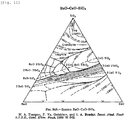
- the liquid phase temperature Tm G in the present invention can be determined from an equilibrium phase diagram, such as the one shown in Fig. 11 as an example. As necessary, it may otherwise also be determined from the heat absorption behavior in differential thermal analysis (DTA) or differential scanning calorimetry (DSC).
- DTA differential thermal analysis
- DSC differential scanning calorimetry
- the presence of an iron component in the glassy thin film on the metal powder surface can then also be confirmed. Since a ferrous compound is not used in the glass starting material (precursor), it is thought that the iron component in this glass originates from the iron compound present in the metal compound used as a starting material for the metal powder and diffuses into the glass during heating. In addition, the present inventors hypothesize that the wettability between the glass and the iron component in the metal powder is improved by the presence of the iron component in the glass, which as a result enables the formation of a strong glass coating film even on an iron-containing metal powder.
- the metal powder according to the present invention is produced by spray pyrolysis.
- the present invention is a method for producing a metal powder provided on the surface thereof with a glassy thin film, wherein a solution that contains a thermally decomposable metal compound and a glass precursor that produces a glassy substance that does not form a solid solution with the metal produced from the metal compound by thermal decomposition is converted into microfine droplets, and the droplets are heated, while they are dispersed in a carrier gas, at a temperature higher than the decomposition temperature of the metal compound, higher than the decomposition temperature of the glass precursor, and higher than the melting point of the metal produced from the metal compound, to produce a metal powder containing the metal and produce a glassy substance in the vicinity of the surface of the metal powder.
- a complex salt or double salt or one or two or more thermally decomposable salts e.g., a nitrate salt, sulfate salt, chloride, ammonium salt, phosphate salt, carboxylate salt, or resin acid salt of a metal or a metal alcoholate may be used in the present invention as the thermally decomposable metal compound that is the starting compound for the metal particles.
- a mixture of two or more metal salts is used, an alloy particle or mixed particle of two or more metals can then be obtained.
- One or two or more glass-forming glass precursors are added to a solution of this major component metal compound dissolved in water, an organic solvent such as acetone or an ether, or a mixed solvent of the preceding.
- the glass precursor should undergo vitrification and the oxide (glass) produced by thermal decomposition should not go into solid solution in the metal particle.
- the mixed solution of the metal compound and glass precursor is converted into microfine droplets using a spray device, e.g., an ultrasound type or a dual-flow nozzle type, and this is followed by thermal decomposition by heating to a temperature higher than the decomposition temperature of the metal compound and the decomposition temperature of the glass precursor.
- a spray device e.g., an ultrasound type or a dual-flow nozzle type
- thermal decomposition by heating to a temperature higher than the decomposition temperature of the metal compound and the decomposition temperature of the glass precursor.
- heating is carried out at a temperature higher than the decomposition temperature of the metal compound having the highest decomposition temperature.
- the heat treatment in the present invention is carried out at a high temperature at or above the melting point of the majority component metal. While the effect of forcing out the glass component can be obtained even at a heating temperature lower than the melting point, in such cases a metal powder having a good crystallinity is not obtained, and in addition the metal powder has an irregular shape, which may lead to an inadequate densification and dispersibility.
- the atmosphere during heating is selected as appropriate from oxidizing atmospheres, reducing atmospheres, and inert atmospheres in conformity with, for example, the species of metal compound, the species of glass precursor, the heating temperature, and so forth, but is particularly preferably a reducing atmosphere when a metal powder is being produced for which a base metal is the major component of the metal.
- the addition to the solution is preferably made in advance of a reducing agent that is soluble in the solution and that does not exhibit a reducing activity in the absence of heating (for example, during preparation of the spray solution) and exhibits a reducing activity only during heating.
- the reducing agent can be exemplified by at least one selected from the group consisting of methanol, ethanol, propanol, ethylene glycol, propylene glycol, diethylene glycol, and tetraethylene glycol.
- the base metal is not particularly limited, but iron, cobalt, nickel, copper, and so forth are preferred and iron, nickel, and alloys containing them are particularly preferred in the present invention.
- the amount of the reducing agent added to the solution is preferably 5 to 30 mass% of the whole of the solution.
- a reducing gas is optionally present in the range of 1 to 20 volume% in the carrier gas that transports the microfine droplets.
- the reducing gas can be exemplified by at least one selected from the group consisting of hydrogen, carbon monoxide, methane, and ammonia gas.
- the present invention because it produces a metal powder by spray pyrolysis from a mixed solution starting material, can yield a target metal powder having a glassy thin film on the surface through the selection of the composition of the individual components, i.e., the thermally decomposable metal compound and the glass precursor, and the amount of addition of the glass precursor relative to the metal compound.
- the total content of the thermally decomposable metal compound and the glass precursor in the mixed solution is less than 500 g/L as the total concentration in the mixed solution of the two components as the amount of metal components produced from the metal compound by thermal decomposition and the amount of glass components in terms of oxide produced from the glass precursor by thermal decomposition. This total content is advantageously 20 to 100 g/L from the standpoint of the ease of control.
- the aforementioned amount of metal components is then the total amount of metal components produced from the metal compound(s) by thermal decomposition.
- the mixing ratio between the metal compound and glass precursor in the mixed solution is determined by the mass ratio of the amount of glass components in terms of oxide relative to the amount of metal components that will be provided by spray pyrolysis. No effect occurs when the amount of glass components in terms of oxide produced from the glass precursor relative to the amount of metal components produced from the metal compound is smaller than 0.1 mass%.
- the amount of glass precursor addition is too large, the glass produced from the glass precursor is produced segregated to only a portion of the metal particle surface and the uniform coating of the entire particle surface with the glassy thin film becomes difficult.
- the glass precursor is added so as to provide 0.1 to 20 mass% as the aforementioned amount of glass components in terms of oxide relative to the aforementioned amount of metal components, while an addition that provides 0.5 to 15 mass% is particularly desirable.
- the production method according to the present invention makes it possible to easily obtain metal powder particles that are uniformly coated over the entire surface with a homogeneous glassy thin film; however, the production may also occur to a very small extent of metal powder particles that are provided with a glassy thin film that is slightly nonuniform to a degree that is not problematic at a practical level.
- the metal powder provided by the production according to the present invention does not exclude such a powder that is not problematic at a practical level.
- Nickel nitrate hexahydrate and iron nitrate were weighed out so as to provide the metal shown in Table 1 and were dissolved in water to provide the metal component concentration in the solution also shown in the same table. The following were added to this with mixing to produce a starting solution: ethylene glycol (MEG) as reducing agent and tetraethyl orthosilicate (TEOS) and barium nitrate that had been weighed out to provide the glass component shown in Table 1 [The numerical values for the glass composition in the table give the content proportion in mass% with respect to the total mass when converted to the oxide.
- MEG ethylene glycol
- TEOS tetraethyl orthosilicate
- the amount of added glass components in the table is the amount (mass%) of glass components in terms of oxide with respect to the amount of the metal components; this also applies to Tables 2 and 3.].
- the metal component concentration (g/L) in the solution shown in Table 1 and Tables 2 and 3 is the metal compound content per 1 L of solution, as the metal components produced from the metal compound by thermal decomposition.
- the amount of reducing agent in the solution given in Table 1 and Tables 2 and 3 is the content (mass%) of the reducing agent with respect to the solution as a whole.
- the starting solution was converted into microfine droplets using an ultrasound spray device and, using nitrogen gas as the carrier at the flow rate given in Table 1, was fed into a ceramic tube heated to 1550°C in an electric furnace.
- the droplets were thermally decomposed while passing through a heating zone and were collected in the form of a powder.
- the collected powder was a nickel-iron alloy powder, and diffraction lines other than this were not detected.
- this powder was washed with 5% dilute hydrochloric acid, the amount of added material in the powder after washing was substantially depleted while there was almost no dissolution of the nickel or iron.
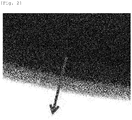
- Fig. 1 is a TEM image that shows an image of an entire particle in the powder immediately after collection.
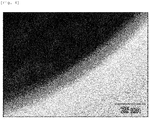
- Fig. 3 gives the results for line analysis of this powder in the direction of the arrow in Fig. 2 using energy-dispersive X-ray analysis (EDX). While powder with a small particle diameter is seen in Fig. 1 , a powder with a more uniform particle diameter can be obtained as necessary by carrying out a classification process thereon.
- EDX energy-dispersive X-ray analysis
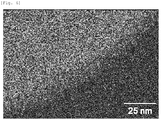
- Figs. 5 to 9 give the mapping results for each of the elements nickel, iron, barium, silicon, and oxygen, respectively, from the TEM image of the powder given in Fig. 4 .
- Fig. 6 the presence of iron in the glassy thin film on the surface of the nickel-iron alloy powder could be confirmed.
- the melting point (Tm M ) of the alloy the liquid phase temperature (Tm G ) determined from the equilibrium phase diagram for the mixed oxide for the glass component, the glass coating ratio [%] with respect to the particle surface as determined from the area by element mapping, and the thickness [nm] of the glassy thin film as determined from the TEM image.
- a nickel-iron alloy powder coated with a BaO-SiO 2 glassy thin film was obtained as in Experimental Example 1 except that the glass components were as described in Table 1.
- the analytic results, obtained as in Experimental Example 1, are given in Table 1.
- Nickel-iron alloy powders coated with a glassy thin film were obtained as in Experimental Examples 1 and 2 except that for each experimental example the metal composition, glass components, amount of added glass components, and amount of reducing agent added to the solution [content (mass%) of the reducing agent with respect to the entire solution] are set as indicated in Table 1.
- Calcium nitrate was used as the calcium source for the glass components; manganese nitrate was used as the manganese source; and bismuth citrate was used as the bismuth source.
- the analytic results, obtained as in Experimental Example 1, are given in Table 1.
- Iron powders coated with a glassy thin film were obtained in each of these experimental examples as in Experimental Example 1 except that iron nitrate was used for the metal components, that the procedure was carried out so as to provide the metal components concentration in the solution and the glass components as given in Table 2, and that the reducing agent given in Table 2 was added to the carrier gas.
- the amount of reducing agent in the solution is, as above, the content (mass%) of the reducing agent with respect to the entire solution.
- hydrogen gas and carbon monoxide were added in the amounts (volume%) shown in Table 2 to the nitrogen gas used as a carrier gas.
- the analytic results, obtained as in Experimental Example 1, are given in Table 2.
- Metal powders coated with a glassy thin film were obtained as in Experimental Example 1, except that the metal composition, the metal component concentration in the solution, the glass components, and the reducing agent added to the solution [the amount of reducing agent in the solution is the content (mass%) with respect to the overall solution] are changed in accordance with Table 3.
- Tetraethylene glycol (TEG) was used as the reducing agent in Experimental Example 22, while, as in Experimental Example 1, MEG was used in Experimental Examples 23 to 25. No reducing agent was used in Experimental Example 26.
- the analytic results, obtained as in Experimental Example 1, are given in Table 3.
Landscapes
- Chemical & Material Sciences (AREA)
- Chemical Kinetics & Catalysis (AREA)
- General Chemical & Material Sciences (AREA)
- Engineering & Computer Science (AREA)
- Materials Engineering (AREA)
- Mechanical Engineering (AREA)
- Metallurgy (AREA)
- Organic Chemistry (AREA)
- Manufacture Of Metal Powder And Suspensions Thereof (AREA)
- Powder Metallurgy (AREA)
- Soft Magnetic Materials (AREA)
- Glass Compositions (AREA)
Applications Claiming Priority (2)
| Application Number | Priority Date | Filing Date | Title |
|---|---|---|---|
| JP2016223134 | 2016-11-16 | ||
| PCT/JP2017/040351 WO2018092664A1 (fr) | 2016-11-16 | 2017-11-09 | Procédé de fabrication de poudre de métal |
Publications (2)
| Publication Number | Publication Date |
|---|---|
| EP3542932A1 true EP3542932A1 (fr) | 2019-09-25 |
| EP3542932A4 EP3542932A4 (fr) | 2020-06-24 |
Family
ID=62145744
Family Applications (2)
| Application Number | Title | Priority Date | Filing Date |
|---|---|---|---|
| EP17871386.3A Withdrawn EP3542931A4 (fr) | 2016-11-16 | 2017-11-09 | Procédé de fabrication de poudre de métal |
| EP17871668.4A Withdrawn EP3542932A4 (fr) | 2016-11-16 | 2017-11-09 | Procédé de fabrication de poudre de métal |
Family Applications Before (1)
| Application Number | Title | Priority Date | Filing Date |
|---|---|---|---|
| EP17871386.3A Withdrawn EP3542931A4 (fr) | 2016-11-16 | 2017-11-09 | Procédé de fabrication de poudre de métal |
Country Status (9)
| Country | Link |
|---|---|
| US (2) | US11426791B2 (fr) |
| EP (2) | EP3542931A4 (fr) |
| JP (2) | JP7068663B2 (fr) |
| KR (2) | KR102305736B1 (fr) |
| CN (2) | CN109982798B (fr) |
| CA (2) | CA3043296A1 (fr) |
| MY (2) | MY192419A (fr) |
| TW (2) | TWI761391B (fr) |
| WO (2) | WO2018092665A1 (fr) |
Families Citing this family (4)
| Publication number | Priority date | Publication date | Assignee | Title |
|---|---|---|---|---|
| MY192419A (en) * | 2016-11-16 | 2022-08-19 | Shoei Chemical Ind Co | Method for producing metal powder |
| WO2021039828A1 (fr) * | 2019-08-30 | 2021-03-04 | Dowaエレクトロニクス株式会社 | Poudre magnétique douce à base de fe revêtue d'oxyde de silicium, et procédé de fabrication de celle-ci |
| DE112022002808T5 (de) | 2021-05-28 | 2024-03-07 | Shoei Chemical Inc. | Isoliertes beschichtetes weichmagnetisches Pulver |
| EP4491301A1 (fr) * | 2023-07-14 | 2025-01-15 | Ecole Polytechnique Fédérale de Lausanne (EPFL) | Catalyseurs en alliage encapsulés et leurs procédés de préparation |
Family Cites Families (30)
| Publication number | Priority date | Publication date | Assignee | Title |
|---|---|---|---|---|
| JPS621807A (ja) | 1985-06-26 | 1987-01-07 | Shoei Kagaku Kogyo Kk | 金属粉末の製造方法 |
| JPS6331522A (ja) | 1986-07-25 | 1988-02-10 | Kao Corp | 吸湿剤 |
| TW261554B (fr) | 1992-10-05 | 1995-11-01 | Du Pont | |
| JP3064713B2 (ja) | 1992-11-30 | 2000-07-12 | 昭栄化学工業株式会社 | 耐酸化性パラジウム粉末と耐酸化性パラジウム粉末の製造方法とこれを用いた厚膜導電性ペーストおよび積層セラミックコンデンサ |
| GB9302387D0 (en) * | 1993-02-06 | 1993-03-24 | Osprey Metals Ltd | Production of powder |
| JPH09256005A (ja) | 1996-03-25 | 1997-09-30 | Daido Steel Co Ltd | 金属粉末およびその製造方法 |
| US6569397B1 (en) | 2000-02-15 | 2003-05-27 | Tapesh Yadav | Very high purity fine powders and methods to produce such powders |
| JP3277823B2 (ja) * | 1996-09-25 | 2002-04-22 | 昭栄化学工業株式会社 | 金属粉末の製造方法 |
| JP3206496B2 (ja) * | 1997-06-02 | 2001-09-10 | 昭栄化学工業株式会社 | 金属粉末及びその製造方法 |
| US7097686B2 (en) * | 1997-02-24 | 2006-08-29 | Cabot Corporation | Nickel powders, methods for producing powders and devices fabricated from same |
| JPH1171601A (ja) * | 1997-08-29 | 1999-03-16 | Sumitomo Metal Mining Co Ltd | 粉体材料とその製造方法 |
| JP3475749B2 (ja) * | 1997-10-17 | 2003-12-08 | 昭栄化学工業株式会社 | ニッケル粉末及びその製造方法 |
| US6679938B1 (en) * | 2001-01-26 | 2004-01-20 | University Of Maryland | Method of producing metal particles by spray pyrolysis using a co-solvent and apparatus therefor |
| JP2003049203A (ja) | 2001-02-28 | 2003-02-21 | Kawasaki Steel Corp | ニッケル−鉄系合金粉末およびニッケル−鉄−モリブデン系合金粉末と鉄心の製造方法 |
| DE10110341A1 (de) * | 2001-03-03 | 2002-10-31 | Bosch Gmbh Robert | Metallpulver-Verbundwerkstoff und Ausgangsmaterial und Verfahren für die Herstellung eines solchen |
| JP3772967B2 (ja) * | 2001-05-30 | 2006-05-10 | Tdk株式会社 | 磁性金属粉末の製造方法 |
| WO2005015581A1 (fr) | 2003-08-06 | 2005-02-17 | Nippon Kagaku Yakin Co., Ltd. | Poudre composite faiblement magnetique et procede de production associe, et procede de production d'un produit compact faiblement magnetique |
| KR100771773B1 (ko) * | 2005-11-01 | 2007-10-30 | 삼성전기주식회사 | 복합니켈 입자 및 그 제조방법 |
| TWI477332B (zh) * | 2007-02-27 | 2015-03-21 | Mitsubishi Materials Corp | 金屬奈米粒子分散液及其製造方法及金屬奈米粒子之合成方法 |
| US8840701B2 (en) * | 2008-08-13 | 2014-09-23 | E I Du Pont De Nemours And Company | Multi-element metal powders for silicon solar cells |
| JP5546551B2 (ja) * | 2008-11-21 | 2014-07-09 | ヘンケル コーポレイション | 熱分解性ポリマー被覆金属粉末 |
| CN101920180A (zh) | 2009-06-09 | 2010-12-22 | 中国科学院理化技术研究所 | 毫米级空心聚合物微球的制备方法 |
| JP5855671B2 (ja) * | 2011-10-14 | 2016-02-09 | 株式会社村田製作所 | 金属粉末及び電子部品 |
| CN103177838B (zh) * | 2012-12-30 | 2016-08-03 | 中南大学 | 一种软磁复合粉末及其制备方法 |
| KR101504734B1 (ko) * | 2013-02-06 | 2015-03-23 | 건국대학교 산학협력단 | 기상 공정에 의해 합성된 금속세라믹 코어쉘 구조의 자성체 분말 및 이의 제조방법 |
| JP2014192454A (ja) | 2013-03-28 | 2014-10-06 | Hitachi Metals Ltd | 複合被覆軟磁性金属粉末の製造方法および複合被覆軟磁性金属粉末、並びにこれを用いた圧粉磁心 |
| JP5862835B2 (ja) | 2013-04-05 | 2016-02-16 | 株式会社村田製作所 | 金属粉末の製造方法、導電性ペーストの製造方法、および積層セラミック電子部品の製造方法 |
| JP6314846B2 (ja) * | 2015-01-09 | 2018-04-25 | セイコーエプソン株式会社 | 粉末冶金用金属粉末、コンパウンド、造粒粉末および焼結体 |
| JP6314866B2 (ja) * | 2015-02-09 | 2018-04-25 | セイコーエプソン株式会社 | 粉末冶金用金属粉末、コンパウンド、造粒粉末および焼結体の製造方法 |
| MY192419A (en) * | 2016-11-16 | 2022-08-19 | Shoei Chemical Ind Co | Method for producing metal powder |
-
2017
- 2017-11-09 MY MYPI2019002705A patent/MY192419A/en unknown
- 2017-11-09 JP JP2018551589A patent/JP7068663B2/ja active Active
- 2017-11-09 US US16/461,739 patent/US11426791B2/en active Active
- 2017-11-09 WO PCT/JP2017/040352 patent/WO2018092665A1/fr not_active Ceased
- 2017-11-09 US US16/461,749 patent/US11458536B2/en active Active
- 2017-11-09 CN CN201780070809.3A patent/CN109982798B/zh active Active
- 2017-11-09 WO PCT/JP2017/040351 patent/WO2018092664A1/fr not_active Ceased
- 2017-11-09 MY MYPI2019002704A patent/MY193167A/en unknown
- 2017-11-09 CA CA3043296A patent/CA3043296A1/fr not_active Abandoned
- 2017-11-09 KR KR1020197014967A patent/KR102305736B1/ko active Active
- 2017-11-09 EP EP17871386.3A patent/EP3542931A4/fr not_active Withdrawn
- 2017-11-09 EP EP17871668.4A patent/EP3542932A4/fr not_active Withdrawn
- 2017-11-09 CN CN201780070551.7A patent/CN109952168B/zh active Active
- 2017-11-09 KR KR1020197014966A patent/KR102305733B1/ko active Active
- 2017-11-09 CA CA3043293A patent/CA3043293A1/fr not_active Abandoned
- 2017-11-09 JP JP2018551588A patent/JP7133150B2/ja active Active
- 2017-11-15 TW TW106139417A patent/TWI761391B/zh active
- 2017-11-15 TW TW106139419A patent/TWI761392B/zh active
Also Published As
| Publication number | Publication date |
|---|---|
| CN109952168B (zh) | 2022-05-10 |
| JPWO2018092665A1 (ja) | 2019-10-17 |
| CN109982798A (zh) | 2019-07-05 |
| JP7133150B2 (ja) | 2022-09-08 |
| JPWO2018092664A1 (ja) | 2019-10-17 |
| JP7068663B2 (ja) | 2022-05-17 |
| CN109982798B (zh) | 2022-09-06 |
| WO2018092664A1 (fr) | 2018-05-24 |
| CA3043293A1 (fr) | 2018-05-24 |
| EP3542931A1 (fr) | 2019-09-25 |
| MY193167A (en) | 2022-09-26 |
| KR20190085940A (ko) | 2019-07-19 |
| WO2018092665A1 (fr) | 2018-05-24 |
| KR20190086469A (ko) | 2019-07-22 |
| EP3542931A4 (fr) | 2020-06-24 |
| CN109952168A (zh) | 2019-06-28 |
| KR102305733B1 (ko) | 2021-09-28 |
| TW201832847A (zh) | 2018-09-16 |
| TWI761391B (zh) | 2022-04-21 |
| TW201825210A (zh) | 2018-07-16 |
| US11426791B2 (en) | 2022-08-30 |
| US20200061715A1 (en) | 2020-02-27 |
| EP3542932A4 (fr) | 2020-06-24 |
| MY192419A (en) | 2022-08-19 |
| KR102305736B1 (ko) | 2021-09-28 |
| CA3043296A1 (fr) | 2018-05-24 |
| TWI761392B (zh) | 2022-04-21 |
| US20190314893A1 (en) | 2019-10-17 |
| US11458536B2 (en) | 2022-10-04 |
Similar Documents
| Publication | Publication Date | Title |
|---|---|---|
| EP3542932A1 (fr) | Procédé de fabrication de poudre de métal | |
| CA2216339C (fr) | Processus de preparation de poudre metallique | |
| US20190214172A1 (en) | Powder for magnetic core, method of producing dust core, dust core, and method of producing powder for magnetic core | |
| WO2020040250A1 (fr) | Poudre de noyau magnétique, noyau magnétique et parties de bobine utilisant celle-ci, et procédé de fabrication de poudre de noyau magnétique | |
| EP1737003B1 (fr) | Matériau magnétique doux et noyau de poudre | |
| JP4836837B2 (ja) | コアシェル型磁性ナノ粒子の製造方法 | |
| JP2021027326A (ja) | 軟磁性金属粉末及び電子部品 | |
| JPH0294406A (ja) | 圧粉コア | |
| EP4195225B1 (fr) | Alliage magnétique doux dopé aux ions de terres rares, matériau composite magnétique doux et son procédé de préparation | |
| EP0834369B1 (fr) | Préparation de poudre métallique par décomposition | |
| JP2017171974A (ja) | ポリマー被覆鉄ニッケル合金微粒子、その製造方法、及びそれを用いた印刷用組成物及び磁性体膜 | |
| KR20240012412A (ko) | 절연 피복 연자성 분말 | |
| JP7783030B2 (ja) | 軟磁性金属粉末、圧粉磁心、磁性部品および電子機器 |
Legal Events
| Date | Code | Title | Description |
|---|---|---|---|
| STAA | Information on the status of an ep patent application or granted ep patent |
Free format text: STATUS: THE INTERNATIONAL PUBLICATION HAS BEEN MADE |
|
| PUAI | Public reference made under article 153(3) epc to a published international application that has entered the european phase |
Free format text: ORIGINAL CODE: 0009012 |
|
| STAA | Information on the status of an ep patent application or granted ep patent |
Free format text: STATUS: REQUEST FOR EXAMINATION WAS MADE |
|
| 17P | Request for examination filed |
Effective date: 20190523 |
|
| AK | Designated contracting states |
Kind code of ref document: A1 Designated state(s): AL AT BE BG CH CY CZ DE DK EE ES FI FR GB GR HR HU IE IS IT LI LT LU LV MC MK MT NL NO PL PT RO RS SE SI SK SM TR |
|
| AX | Request for extension of the european patent |
Extension state: BA ME |
|
| DAV | Request for validation of the european patent (deleted) | ||
| DAX | Request for extension of the european patent (deleted) | ||
| A4 | Supplementary search report drawn up and despatched |
Effective date: 20200528 |
|
| RIC1 | Information provided on ipc code assigned before grant |
Ipc: B22F 1/02 20060101ALI20200520BHEP Ipc: C22C 33/02 20060101ALI20200520BHEP Ipc: B22F 9/02 20060101ALI20200520BHEP Ipc: B22F 9/30 20060101AFI20200520BHEP Ipc: B22F 1/00 20060101ALN20200520BHEP |
|
| STAA | Information on the status of an ep patent application or granted ep patent |
Free format text: STATUS: EXAMINATION IS IN PROGRESS |
|
| 17Q | First examination report despatched |
Effective date: 20211123 |
|
| STAA | Information on the status of an ep patent application or granted ep patent |
Free format text: STATUS: THE APPLICATION IS DEEMED TO BE WITHDRAWN |
|
| 18D | Application deemed to be withdrawn |
Effective date: 20240601 |