EP3545012B1 - Copolymères et leur utilisation dans des compositions détergentes - Google Patents
Copolymères et leur utilisation dans des compositions détergentes Download PDFInfo
- Publication number
- EP3545012B1 EP3545012B1 EP17811865.9A EP17811865A EP3545012B1 EP 3545012 B1 EP3545012 B1 EP 3545012B1 EP 17811865 A EP17811865 A EP 17811865A EP 3545012 B1 EP3545012 B1 EP 3545012B1
- Authority
- EP
- European Patent Office
- Prior art keywords
- monomers
- mol
- component
- copolymers
- acid
- Prior art date
- Legal status (The legal status is an assumption and is not a legal conclusion. Google has not performed a legal analysis and makes no representation as to the accuracy of the status listed.)
- Active
Links
Classifications
-
- C—CHEMISTRY; METALLURGY
- C08—ORGANIC MACROMOLECULAR COMPOUNDS; THEIR PREPARATION OR CHEMICAL WORKING-UP; COMPOSITIONS BASED THEREON
- C08F—MACROMOLECULAR COMPOUNDS OBTAINED BY REACTIONS ONLY INVOLVING CARBON-TO-CARBON UNSATURATED BONDS
- C08F220/00—Copolymers of compounds having one or more unsaturated aliphatic radicals, each having only one carbon-to-carbon double bond, and only one being terminated by only one carboxyl radical or a salt, anhydride ester, amide, imide or nitrile thereof
- C08F220/02—Monocarboxylic acids having less than ten carbon atoms; Derivatives thereof
- C08F220/52—Amides or imides
- C08F220/54—Amides, e.g. N,N-dimethylacrylamide or N-isopropylacrylamide
- C08F220/60—Amides, e.g. N,N-dimethylacrylamide or N-isopropylacrylamide containing nitrogen in addition to the carbonamido nitrogen
-
- C—CHEMISTRY; METALLURGY
- C08—ORGANIC MACROMOLECULAR COMPOUNDS; THEIR PREPARATION OR CHEMICAL WORKING-UP; COMPOSITIONS BASED THEREON
- C08F—MACROMOLECULAR COMPOUNDS OBTAINED BY REACTIONS ONLY INVOLVING CARBON-TO-CARBON UNSATURATED BONDS
- C08F220/00—Copolymers of compounds having one or more unsaturated aliphatic radicals, each having only one carbon-to-carbon double bond, and only one being terminated by only one carboxyl radical or a salt, anhydride ester, amide, imide or nitrile thereof
- C08F220/02—Monocarboxylic acids having less than ten carbon atoms; Derivatives thereof
- C08F220/52—Amides or imides
- C08F220/54—Amides, e.g. N,N-dimethylacrylamide or N-isopropylacrylamide
- C08F220/56—Acrylamide; Methacrylamide
-
- C—CHEMISTRY; METALLURGY
- C11—ANIMAL OR VEGETABLE OILS, FATS, FATTY SUBSTANCES OR WAXES; FATTY ACIDS THEREFROM; DETERGENTS; CANDLES
- C11D—DETERGENT COMPOSITIONS; USE OF SINGLE SUBSTANCES AS DETERGENTS; SOAP OR SOAP-MAKING; RESIN SOAPS; RECOVERY OF GLYCEROL
- C11D3/00—Other compounding ingredients of detergent compositions covered in group C11D1/00
- C11D3/16—Organic compounds
- C11D3/37—Polymers
- C11D3/3746—Macromolecular compounds obtained by reactions only involving carbon-to-carbon unsaturated bonds
- C11D3/3769—(Co)polymerised monomers containing nitrogen, e.g. carbonamides, nitriles or amines
-
- C—CHEMISTRY; METALLURGY
- C08—ORGANIC MACROMOLECULAR COMPOUNDS; THEIR PREPARATION OR CHEMICAL WORKING-UP; COMPOSITIONS BASED THEREON
- C08F—MACROMOLECULAR COMPOUNDS OBTAINED BY REACTIONS ONLY INVOLVING CARBON-TO-CARBON UNSATURATED BONDS
- C08F222/00—Copolymers of compounds having one or more unsaturated aliphatic radicals, each having only one carbon-to-carbon double bond, and at least one being terminated by a carboxyl radical and containing at least one other carboxyl radical in the molecule; Salts, anhydrides, esters, amides, imides, or nitriles thereof
- C08F222/10—Esters
- C08F222/1006—Esters of polyhydric alcohols or polyhydric phenols
- C08F222/102—Esters of polyhydric alcohols or polyhydric phenols of dialcohols, e.g. ethylene glycol di(meth)acrylate or 1,4-butanediol dimethacrylate
-
- C—CHEMISTRY; METALLURGY
- C08—ORGANIC MACROMOLECULAR COMPOUNDS; THEIR PREPARATION OR CHEMICAL WORKING-UP; COMPOSITIONS BASED THEREON
- C08F—MACROMOLECULAR COMPOUNDS OBTAINED BY REACTIONS ONLY INVOLVING CARBON-TO-CARBON UNSATURATED BONDS
- C08F222/00—Copolymers of compounds having one or more unsaturated aliphatic radicals, each having only one carbon-to-carbon double bond, and at least one being terminated by a carboxyl radical and containing at least one other carboxyl radical in the molecule; Salts, anhydrides, esters, amides, imides, or nitriles thereof
- C08F222/10—Esters
- C08F222/1006—Esters of polyhydric alcohols or polyhydric phenols
- C08F222/106—Esters of polycondensation macromers
- C08F222/1063—Esters of polycondensation macromers of alcohol terminated polyethers
-
- C—CHEMISTRY; METALLURGY
- C11—ANIMAL OR VEGETABLE OILS, FATS, FATTY SUBSTANCES OR WAXES; FATTY ACIDS THEREFROM; DETERGENTS; CANDLES
- C11D—DETERGENT COMPOSITIONS; USE OF SINGLE SUBSTANCES AS DETERGENTS; SOAP OR SOAP-MAKING; RESIN SOAPS; RECOVERY OF GLYCEROL
- C11D3/00—Other compounding ingredients of detergent compositions covered in group C11D1/00
- C11D3/16—Organic compounds
- C11D3/37—Polymers
- C11D3/3703—Macromolecular compounds obtained otherwise than by reactions only involving carbon-to-carbon unsaturated bonds
- C11D3/3719—Polyamides or polyimides
Definitions
- the present invention relates to copolymers obtainable from the radical copolymerization of at least the following components: cationic monomers selected from the group consisting of cationic (meth)acrylamide monomers and diallyldimethylammonium chloride, polyethylene glycol macromonomers and neutral acrylamide monomers, cleaning compositions containing such copolymers, and the use of the copolymers or the cleaning compositions, in particular for producing gloss on hard surfaces, for hydrophilizing hard surfaces and for achieving a repair effect on hard surfaces.
- cationic monomers selected from the group consisting of cationic (meth)acrylamide monomers and diallyldimethylammonium chloride, polyethylene glycol macromonomers and neutral acrylamide monomers
- cleaning compositions containing such copolymers and the use of the copolymers or the cleaning compositions, in particular for producing gloss on hard surfaces, for hydrophilizing hard surfaces and for achieving a repair effect on hard surfaces.
- Commercial cleaning formulations enable the efficient cleaning of hard surfaces in industrial, household, or public areas. They generally consist of an aqueous solution of surfactants, particularly non-ionic and anionic surfactants, alcohol(s) to facilitate drying, bases to adjust the pH, and, optionally, quaternary amines as disinfectants.
- surfactants particularly non-ionic and anionic surfactants
- alcohol(s) to facilitate drying
- bases to adjust the pH
- quaternary amines as disinfectants.
- WO 2013/170001 and WO 2013/170002 describe cleaning formulations containing alkoxylated polyethyleneimine polymers that improve the shine on hard surfaces.
- WO 2009/156067 describes cleaning formulations containing graft copolymers of saccharides that can be used to improve the gloss retention of hard surfaces and/or have hydrophilizing properties.
- WO 2003/031546 describes aqueous antimicrobial cleaning compositions for the treatment of hard surfaces, with the result of maintaining or improving the shine of the hard surfaces.
- WO 98/49263 describes aqueous, acidic surface cleaners that contain a polymer additive and achieve an improved surface shine.
- EP 1196523 B1 describes cleaning compositions intended for the treatment of hard surfaces in industry, the home or the general public and which are particularly intended to impart hydrophilic and protective properties to these surfaces.
- the object of the present invention was to develop polymer additives which are water-soluble or water-dispersible and can be added to cleaning compositions, in particular with the result that advantageous gloss effects can be observed on the hard surfaces after their application.
- (meth)acrylic encompasses both the corresponding acrylic compound and the corresponding methacrylic compound.
- hard surface in the sense of the invention means a surface made of dimensionally stable materials, e.g., plastic, ceramic, stone such as natural stone, porcelain, glass, wood, linoleum, and metal such as stainless steel, typically surfaces in kitchen and sanitary areas, for example in kitchens, bathrooms, and toilets, in the home, but also in the industrial sector, for example in butcher shops, slaughterhouses, dairies, storage tanks for food or industrial products, as well as in public areas, such as building facades, in swimming pools, or in train stations.
- plastic plastic, ceramic, stone such as natural stone, porcelain, glass, wood, linoleum, and metal such as stainless steel
- WO 2012/076365 A1 discloses cationic copolymers containing cationic structural units and macromonomeric structural units and their use as additives for building material systems, in particular based on calcium sulfate.
- WO 2008/049549 A2 describes hydrophobically modified cationic copolymers that contain at least three different structural units, one of which contains a terminal phenyl group or a specifically substituted phenyl group. These copolymers, particularly in combination with anionic surfactants, can significantly improve water retention in aqueous construction material systems based on hydraulic binders, such as cement, even in the presence of high salt loads.
- Dispersions comprising inorganic particles, water, and at least one water-soluble polymer are described.
- the at least one water-soluble polymer has repeating units derived from monomers having at least one quaternary ammonium group, repeating units derived from monomers having at least one carboxyl group, and repeating units derived from ester monomers containing polyalkoxyalkylene groups and having a number-average molecular weight in the range from 3,000 g/mol to 10,000 g/mol.
- the dispersions can be used in particular for the production of concrete and can be processed over a very long period of time.
- WO 2008/046652 A1 describes graft polymers obtainable by copolymerization of at least one specific macromonomer and at least one further monomer which has a polymerizable ethylenically unsaturated double bond and their use as dispersants, for example in pigment concentrates.
- JP 2008-056711 A discloses copolymers having a number-average molecular weight of 5,000 to 1,000,000, which contain structural units formed by polymerization of certain cationic monomers, polyoxyalkylene-modified monomers, and crosslinkable monomers, and which may additionally contain further structural units formed by polymerization of other monomers copolymerizable with the aforementioned monomers.
- the copolymers can be used, for example, as antistatic agents for thermoplastic polymers.
- US 2014/213748 describes other cationic polymers that can be used in cleaning agents.
- An advantage of the invention is that the copolymers according to the invention can be added to cleaning compositions and, when applied to a hard surface, can provide a beneficial cleaning effect.
- a further advantage of the invention is that the copolymers according to the invention can be added to cleaning compositions, thereby producing a gloss effect on the hard surface to which they have been applied.
- a further advantage of the invention is that the copolymers according to the invention can be added to cleaning compositions and impart hydrophilic properties to the hard surface to which they have been applied.
- the contact angle between the treated surface and a drop of water or a drop of an aqueous cleaning composition can be reduced.
- the presence of traces or stains left on hard surfaces by water or aqueous cleaning compositions that have come into contact with them is related to the phenomenon of contraction of the Water droplets or drops of aqueous cleaning compositions that come into contact with the hard surface leave traces on the surface during subsequent drying.
- reducing the contact angle between the treated surface and a water droplet can improve the drying speed of a surface.
- repair effects can be advantageously achieved on the hard surface to which the copolymers according to the invention or the cleaning compositions containing them have been applied.
- copolymers according to the invention or the cleaning compositions containing them can be applied in such a way that they remain on the hard surface after application (“leave-on” application) or are removed from it and preferably rinsed off with water (“rinse-off” application).
- copolymers according to the invention or the cleaning compositions containing them can, for example, advantageously be used on hard surfaces in bathrooms or kitchens, on floors or on toilets.
- the one or more cationic monomers of component a) are selected from the group consisting of diallyldimethylammonium chloride and (3-methacrylamidopropyl)trimethylammonium chloride.
- the one or more neutral acrylamide monomers of component c) are selected from the monomers of formula (III) wherein R2 and R3 may each be the same or different and independently of one another each represent hydrogen and/or an aliphatic hydrocarbon radical having 1 to 20 and preferably 1 to 4 C atoms.
- the one or more neutral acrylamide monomers of component c) are selected from the group consisting of acrylamide, N-ethylacrylamide, N,N-dimethylacrylamide, N-tert-butylacrylamide and N-isopropylacrylamide and especially preferably the one or more neutral acrylamide monomers of component c) are selected from the group consisting of N,N-dimethylacrylamide and N-isopropylacrylamide.
- copolymers according to the invention are preferably obtainable from the radical copolymerization of at least components a), b) and c), wherein in the copolymerization
- Component a) is used in an amount of 25.0 to 80.0 mol%
- component b) is used in an amount of 1.0 to 4.4 mol%
- Component c) is used in an amount of 15.6 to 74.0 mol%.
- the copolymers according to the invention are obtainable from the radical copolymerization of only components a), b) and c), i.e. in this preferred embodiment of the invention, no further monomer which is different from the monomers of components a), b) and c) is used to prepare the copolymers according to the invention.
- the copolymers according to the invention are obtainable from the radical copolymerization of the monomers of components a), b), c) and additionally one or more monomers of a component d) which are different from the monomers of components a), b) and c).
- the copolymers according to the invention are obtainable from the radical copolymerization of the monomers of components a), b), c) and additionally one or more monomers of a component d) which are different from the monomers of components a), b) and c), the monomers of component d) in a particularly preferred embodiment of the invention are selected from the group consisting of N-vinyl-substituted lactams having 5 to 7 ring atoms and the monomers of the general formula (V).
- N-vinyl-substituted lactams with 5 to 7 ring atoms N-vinylpyrrolidone is preferred.
- the groups SO 3 H, PO 3 H 2 , O-PO 3 H 2 and para-substituted C 6 H 4 -SO 3 H in the monomers of formula (V) can also be present in salt form, preferably as NH 4 + -, alkali or alkaline earth salt and particularly preferably as NH 4 + - or as Na + -salt.
- R 13 is N(CH 3 ) 2
- those selected from the group consisting of [3-(acryloylamino)propyl]dimethylamine, [3-(methacryloylamino)propyl]dimethylamine, 2-acryloylamino-2-methylpropanesulfonic acid and the salts of 2-acryloylamino-2-methylpropanesulfonic acid are preferred, and those selected from the group consisting of 2-acryloylamino-2-methylpropanesulfonic acid and the salts of 2-acryloylamino-2-methylpropanesulfonic acid are particularly preferred.
- the copolymers according to the invention are obtainable from the radical copolymerization of the monomers of components a), b), c) and additionally one or more monomers of a component d) which are different from the monomers of components a), b) and c), the monomers of component d) are, in a further particularly preferred embodiment of the invention, selected from the monomers of the formula (VIII).
- monomers of formula (VIII) those selected from the group consisting of [2-(methacryloyloxy)ethyl]dimethylamine, [2-(acryloyloxy)ethyl]dimethylamine, [2-(methacryloyloxy)ethyl]diethylamine and [2-(acryloyloxy)ethyl]diethylamine are preferred.
- the copolymers according to the invention are obtainable from the radical copolymerization of the monomers of components a), b), c) and additionally one or more monomers of a component d) which are different from the monomers of components a), b) and c), the monomers of component d) are, in a further particularly preferred embodiment of the invention, selected from the monomers of the formulas (IX) and/or (X).
- the monomers of formula (X) may also be present in salt form, preferably as NH 4 + , alkali or alkaline earth salt and particularly preferably as NH 4 + or as Na + salt.
- the copolymers according to the invention are obtainable from the radical copolymerization of the monomers of components a), b), c) and additionally one or more monomers of a component d) which are different from the monomers of components a), b) and c), the monomers of component d) are, in a further particularly preferred embodiment of the invention, selected from the monomers of the formula (VII).
- monomers of formula (VII) those selected from the group consisting of acrylic acid, sodium acrylate, potassium acrylate, methacrylic acid, sodium methacrylate and potassium methacrylate are preferred.
- the copolymers according to the invention are obtainable from the radical copolymerization of the monomers of components a), b), c) and additionally one or more monomers of a component d) which are different from the monomers of components a), b) and c), the monomers of component d) are, in a further particularly preferred embodiment of the invention, selected from the monomers of the formulas (Va), (Vb) and/or (Vc).
- the groups SO 3 H, PO 3 H 2 , O-PO 3 H 2 and para-substituted C 6 H 4 -SO 3 H in the monomers of formula (Vb) can also be present in salt form, preferably as NH 4 + -, alkali or alkaline earth salt and particularly preferably as NH 4 + - or as Na + -salt.
- the copolymers according to the invention are obtainable from the radical copolymerization of only components a), b), c) and d), ie in this preferred In one embodiment of the invention, no further monomer which is different from the monomers of components a), b), c) and d) is used to prepare the copolymers according to the invention.
- the structural units of the copolymers according to the invention resulting from the polymerization of the monomers a), b) and c) and optionally d) and optionally further monomers are present in a random, block-shaped, alternating or gradient-like distribution in the copolymer.
- the weight-average molecular weight M w of the copolymers according to the invention is preferably from 10,000 to 250,000 g/mol, particularly preferably from 15,000 to 200,000 g/mol and especially preferably from 20,000 to 150,000 g/mol.
- the copolymers of the invention can be prepared by methods familiar to those skilled in the art.
- the copolymers of the invention can particularly preferably be prepared by free-radical solvent polymerization.
- Common solvents can be, for example, polar solvents such as alcohols or water, as well as alcohol-water mixtures.
- the polymerization is initiated by free-radical sources such as, for example, inorganic persulfates, organic azo compounds, peroxides, inorganic redox systems, or UV light. Chain transfer regulators that form less reactive radicals can also be used to control the molecular weight of the copolymers.
- Such chain transfer regulators include, for example, phenols, thiols, for example, sodium 2-mercaptoethanesulfonate, or sodium hypophosphite.
- the monomers for preparing the copolymers of the invention and, if appropriate, a chain transfer regulator are dissolved in the solvent, oxygen is expelled, the temperature is then increased, and the free-radical initiator is added. The copolymerization is then carried out at the desired temperature for the desired time.
- the reaction mixture is then cooled if necessary, and the resulting copolymer is either further processed in solution or processed, e.g., the solution containing the copolymer can be purified by partial evaporation of the Solvent, if necessary under reduced pressure, or the solvent can be completely removed by evaporation or the copolymer can be isolated by other means, for example by freeze-drying or precipitation.
- the solution containing the copolymer can be purified by partial evaporation of the Solvent, if necessary under reduced pressure, or the solvent can be completely removed by evaporation or the copolymer can be isolated by other means, for example by freeze-drying or precipitation.
- the copolymers according to the invention are preferably obtainable from the radical copolymerization of at least components a), b) and c) in a solvent selected from the group consisting of water, one or more alcohols and mixtures thereof, wherein the one or more alcohols are preferably selected from the group consisting of methanol, ethanol, isopropanol, n-propanol, isobutanol, n-butanol, tert-butanol, ethylene glycol, propylene glycol, propylene glycol monobutyl ether, ethylene glycol monobutyl ether, propylene glycol monomethyl ether, ethylene glycol monomethyl ether and mixtures thereof.
- the solvent is selected from the group consisting of water, ethanol, isopropanol, propylene glycol, tert-butanol, propylene glycol monobutyl ether and mixtures thereof and most preferably, the solvent is selected from the group consisting of water, isopropanol, tert-butanol, propylene glycol and mixtures thereof.
- copolymers according to the invention are preferably obtainable from the radical copolymerization of at least components a), b) and c) at temperatures in the range from 20 to 200 °C, particularly preferably in the range from 20 to 100 °C and especially preferably in the range from 40 to 80 °C.
- the copolymers according to the invention are preferably obtainable from the radical copolymerization of at least components a), b) and c), wherein the radical copolymerization is initiated by heating, irradiation with light or by addition of a radical initiator and particularly preferably is initiated by addition of a radical initiator, wherein the radical initiator is particularly preferably selected from the group consisting of peroxides, preferably dialkyl peroxides, hydroperoxides, peroxyketals, peroxyesters, peroxydicarbonates and/or diacyl peroxides; Azo compounds, preferably 2,2'-azobis[2-(2-imidazolin-2-yl)propane]dihydrochloride, 2,2'-azobis(2-methylpropionamidine)dihydrochloride, 2,2'-azobis[N-(2-carboxyethyl)-2-methylpropionamidine]tetrahydrate, 2,2'-Azobis[2-(2-imidazolin-2
- the copolymers according to the invention are particularly preferably obtainable from the radical copolymerization of at least components a), b) and c), wherein the radical copolymerization is initiated by adding a radical initiator selected from the group consisting of 2,2'-azobis(2-methylpropionamidine) dihydrochloride, 2,2'-azobis[N-(2-carboxyethyl)-2-methylpropionamidine] tetrahydrate, 2,2'-azobis[2-(2-imidazolin-2-yl)propane], 2,2'-azobis[2-methyl-N-(2-hydroxyethyl)propionamide], 4,4'-azobis(4-cyanovaleric acid), ammonium persulfate, sodium persulfate and potassium persulfate and preferably by adding a radical initiator selected from the group consisting of ammonium persulfate, sodium persulfate and 2,2'-Azobis[2-(2-imidazolin-2-yl
- the copolymers according to the invention are obtainable from the radical copolymerization of at least components a), b) and c), wherein the radical copolymerization is carried out in the presence of a chain transfer agent selected from the group consisting of mercaptans, preferably octyl mercaptan, n-dodecyl mercaptan, tert-dodecyl mercaptan, mercaptoethanol and 2-mercaptoethanesulfonate sodium; halogenated compounds; thiosalicylic acid; mercaptoacetic acid; buten-1-ol; dimeric ⁇ -methylstyrene and hypophosphite derivatives, preferably sodium hypophosphite.
- a chain transfer agent selected from the group consisting of mercaptans, preferably octyl mercaptan, n-dodecyl mercaptan, tert-dodecyl
- the copolymers according to the invention are obtainable from the radical copolymerization of at least components a), b), and c), wherein the radical copolymerization is carried out in the presence of a chain transfer agent selected from the group consisting of mercaptans, preferably sodium 2-mercaptoethanesulfonate, and sodium hypophosphite.
- a chain transfer agent selected from the group consisting of mercaptans, preferably sodium 2-mercaptoethanesulfonate, and sodium hypophosphite.
- the copolymers according to the invention are obtainable from the radical copolymerization of at least components a), b), and c), wherein the radical copolymerization is carried out in the presence of sodium hypophosphite as a chain transfer agent.
- the copolymers according to the invention can be advantageously used in cleaning compositions.
- the copolymers according to the invention represent component Z1). These cleaning compositions are described in more detail below.
- the cleaning compositions preferably contain one or more copolymers of component Z1) in an amount of 0.005 to 10 wt.%, particularly preferably in an amount of 0.01 to 5 wt.% and especially preferably in an amount of 0.1 to 0.5 wt.%, in each case based on the total weight of the cleaning composition.
- the cleaning agent compositions contain one or more surfactants as component Z2).
- the one or more surfactants of component Z2) of the cleaning compositions are selected from the group consisting of anionic, non-ionic, amphoteric and cationic surfactants.
- the cleaning compositions may optionally contain anionic surfactants, e.g., alkylbenzenesulfonates, alkyl sulfates, alkyl ether sulfates, alkanesulfonates, Contain alkyl ether carboxylic acids, sulfosuccinates, isethionates, taurates, glycinates, and/or acylglutamates.
- the alkyl chains of the surfactants mentioned can be synthetic or of natural origin and consist of 8 to 30, preferably 8 to 18, and particularly preferably 12 to 14 carbon atoms in a linear or branched arrangement.
- Anionic surfactants used according to the invention are preferably aliphatic sulfates such as fatty alcohol sulfates, fatty alcohol ether sulfates, dialkyl ether sulfates, monoglyceride sulfates, and aliphatic sulfonates such as alkanesulfonates, olefinsulfonates, ethersulfonates, n-alkyl ether sulfonates, estersulfonates, and ligninsulfonates.
- aliphatic sulfates such as fatty alcohol sulfates, fatty alcohol ether sulfates, dialkyl ether sulfates, monoglyceride sulfates, and aliphatic sulfonates such as alkanesulfonates, olefinsulfonates, ethersulfonates, n-alkyl ether sulfonates, estersulfonates, and
- alkylbenzenesulfonates fatty acid cyanamides, sulfosuccinates (sulfosuccinic acid esters), sulfosuccinamates, sulfosuccinamides, fatty acid isethionates, acylaminoalkanesulfonates (fatty acid taurides), fatty acid sarcosinates, ethercarboxylic acids, and alkyl (ether) phosphates, as well as alpha-sulfofatty acid salts, acylglutamates, monoglyceride disulfates, and alkyl ethers of glycerol disulfate.
- fatty alcohol sulfates and/or fatty alcohol ether sulfates are products of sulfation reactions on corresponding alcohols
- fatty alcohol ether sulfates are products of sulfation reactions on alkoxylated alcohols.
- alkoxylated alcohols to be the reaction products of alkylene oxide, preferably ethylene oxide, with alcohols, preferably with longer-chain alcohols in the context of the present invention.
- n moles of ethylene oxide and one mole of alcohol generally form a complex mixture of addition products with varying degrees of ethoxylation.
- a further embodiment of the alkoxylation involves the use of mixtures of alkylene oxides, preferably a mixture of ethylene oxide and propylene oxide.
- Preferred fatty alcohol ether sulfates are the sulfates of low-ethoxylated fatty alcohols having 1 to 4 ethylene oxide units (EO), in particular 1 to 2 EO, for example 1.3 EO.
- alkylbenzenesulfonate alkanesulfonate, alkyl ether sulfate or alkyl sulfate.
- Anionic surfactants are typically used as salts, but also as acids.
- the salts are preferably alkali metal salts, alkaline earth metal salts, ammonium salts, and mono-, di-, or trialkanolammonium salts, for example mono-, di-, or triethanolammonium salts, in particular lithium, sodium, potassium, or ammonium salts, particularly preferably sodium or potassium salts, especially preferably sodium salts.
- surfactants can be non-ionic, amphoteric and/or cationic surfactants, for example betaines, amidobetaines, amine oxides, amidoamine oxides, fatty alcohol polyglycol ethers, alkyl polyglycosides or quaternary ammonium compounds.
- nonionic surfactants can be, for example, alkoxylates such as polyglycol ethers, fatty alcohol polyglycol ethers (fatty alcohol alkoxylates), alkylphenol polyglycol ethers, end-capped polyglycol ethers, mixed ethers and hydroxy mixed ethers, and fatty acid polyglycol esters. Ethylene oxide-propylene oxide block copolymers and fatty acid alkanolamides and fatty acid polyglycol ethers can also be used.
- Another important class of nonionic surfactants that can be used according to the invention are polyol surfactants, particularly glycosurfactants, such as alkyl polyglycosides, especially alkyl polyglucosides.
- Suitable fatty alcohol polyglycol ethers are unbranched or branched, saturated or unsaturated C 8 -C 22 alcohols alkoxylated with ethylene oxide (EO) and/or propylene oxide (PO) with a degree of alkoxylation of up to 30, preferably ethoxylated C 13 -C 18 fatty alcohols with a degree of ethoxylation of less than 30, particularly preferably 1 to 20, especially preferably 1 to 12 and most preferably 1 to 8, for example C 12 -C 14 fatty alcohol ethoxylates with 8 EO.
- EO ethylene oxide
- PO propylene oxide
- Alkyl polyglycosides are surfactants that can be obtained by the reaction of sugars and alcohols using the relevant processes of preparative organic chemistry, resulting in a mixture of monoalkylated, oligomeric, or polymeric sugars, depending on the type of preparation.
- Preferred alkyl polyglycosides are alkyl polyglucosides, where the alcohol is particularly preferably a long-chain fatty alcohol or a mixture of long-chain fatty alcohols with branched or unbranched C 8 - to C 18 -alkyl chains, and the degree of oligomerization (DP) of the sugar is from 1 to 10, preferably from 1 to 6, particularly preferably from 1.1 to 3, and especially preferably from 1.1 to 1.7, for example C 8 -C 10 -alkyl-1,5-glucoside (DP of 1.5).
- amphoteric surfactants that can be used according to the invention include betaines, amine oxides, alkylamidoalkylamines, alkyl-substituted amino acids, acylated amino acids and biosurfactants.
- Suitable betaines are the alkyl betaines, the alkylamidobetaines, the imidazolinium betaines, the sulfobetaines (INCI sultaines) and the amidosulfobetaines as well as the phosphobetaines.
- betaines and sulfobetaines are the following compounds named according to INCI: Almondamidopropyl Betaine, Apricotamidopropylbetaine, Avocadamidopropylbetaine, Babassuamidopropylbetaine, Behenamidopropylbetaine, Behenylbetaine, Betaine, Canolamidopropylbetaine, Capryl/Capramidopropylbetaine, Carnitine, Cetylbetaine, Cocamidoethylbetaine, Cocamidopropylbetaine, Cocamidopropylhydroxysultaine, Cocobetaine, Cocohydroxysultaine, Coco/Oleamidopropylbetaine, Coco-Sultaine, Decylbetaine, Dihydroxyethyloleylglycinate, Dihydroxyethyl Soy Glycinate, Dihydroxyethylstearylglycinate, Dihydroxyethyl Tallow Glycinate, Dimethicone Propy
- the amine oxides suitable according to the invention include alkylamine oxides, in particular alkyldimethylamine oxides, alkylamidoamine oxides and alkoxyalkylamine oxides.
- Suitable amine oxides are the following compounds named according to INCI: almondamidopropylamine oxides, babassuamidopropylamine oxides, behenamine oxides, cocamidopropyl amine oxides, cocamidopropylamine oxides, cocamine oxides, coco-morpholine oxides, decylamine oxides, decyltetradecylamine oxides, diaminopyrimidine oxides, dihydroxyethyl C 8 -C 10 alkoxypropylamine Oxides, Dihydroxyethyl C 9 -C 11 Alkoxypropylamine Oxide, Dihydroxyethyl C 12 -C 15 Alkoxypropylamine Oxide, Dihydroxyethyl Cocamine Oxide, Dihydroxyethyl Lauramine Oxide, Dihydroxyethyl Stearamine Oxide, Dihydroxyethyl Tallowamine Oxide, Hydrogenated Palm Kernel Amine Oxide, Hydrogenated Tallowamine Oxide, Hydroxyethy
- alkylamidoalkylamines are the following compounds named according to INCI: Cocoamphodipropionic Acid, Cocobetainamido Amphopropionate, DEA-Cocoamphodipropionate, Disodium Caproamphodiacetate, Disodium Caproamphodipropionate, Disodium Capryloamphodiacetate, Disodium Capryloamphodipropionate, Disodium Cocoamphocarboxyethylhydroxypropylsulfonate, Disodium Cocoamphodiacetate, Disodium Cocoamphodipropionate, Disodium Isostearoamphodipropionate, Disodium Isostearoamphodipropionate, Disodium Laureth-5 Carboxymphodiacetate, Disodium Lauroamphodiacetate, Disodium Lauroamphodipropionate, Disodium Oleoamphodipropionate, Disodium PPG-2-Isodeceth-7 Carboxymphodiacetate
- alkyl-substituted amino acids are the following compounds named according to INCI: Aminopropyl Laurylglutamine, Cocaminobutyric Acid, Cocaminopropionic Acid, DEA-Lauraminopropionate, Disodium Cocaminopropyl Iminodiacetate, Disodium Dicarboxyethyl Cocopropylenediamine, Disodium Lauriminodipropionate, Disodium Steariminodipropionate, Disodium Tallowiminodipropionate, Lauraminopropionic Acid, Lauryl Aminopropylglycine, Lauryl Diethylenediaminoglycine, Myristaminopropionic Acid, Sodium C 12 -C 15 Alkoxypropyl Iminodipropionate, Sodium Cocaminopropionate, Sodium Lauraminopropionate, Sodium Lauriminodipropionate, Sodium Lauroyl Methylaminopropionate, TEA-Lauramino
- the one or more surfactants of component Z2) of the cleaning compositions are selected from the group consisting of fatty alcohol polyglycol ethers, alkyl polyglycosides, alkylbenzenesulfonates, alkanesulfonates, alkyl ether sulfates, alkyl sulfates and quaternary ammonium compounds.
- the proportion of the one or more surfactants of component Z2) in the cleaning composition is preferably from 0.1 to 20% by weight and particularly preferably from 0.1 to 6.0% by weight, in each case based on the total weight of the cleaning composition.
- the cleaning agent compositions contain water as component Z3).
- the proportion of water in the cleaning agent compositions is preferably from 10.00 to 99.89% by weight, particularly preferably from 40.00 to 98.00% by weight and especially preferably from 70 to 97.00% by weight, in each case based on the total weight of the cleaning agent compositions.
- the acids can be inorganic acids, e.g. hydrochloric acid, sulfuric acid, nitric acid, amidosulfonic acid and/or phosphoric acid.
- the acids present are organic acids, particularly preferably non-complexing acids such as lactic acid, formic acid, acetic acid, glycolic acid, and/or gluconic acid.
- Other preferred acids are malic acid, citric acid, tartaric acid, adipic acid, and/or succinic acid.
- the cleaning compositions contain one acid. In a further preferred embodiment of the invention, the cleaning compositions contain a mixture of two or more acids.
- the amount of acid used is preferably from 0.1 to 10% by weight, particularly preferably from 0.2 to 5% by weight and especially preferably from 1 to 3% by weight, in each case based on the total weight of the cleaning composition.
- a salt of an acid can also be added to buffer the pH, in particular the sodium, potassium, or magnesium salt, but also other alkali or alkaline earth salts or ammonium salts, in particular volatile amines such as monoethanolamine, ammonia, diethanolamines, but also triethanolamine.
- the salt or salts of the acid or acids already present are used.
- Suitable complexing agents are known to the person skilled in the art and are described, for example, in DE-A-10 2009 001 559 described.
- Chelating agents also known as sequestering agents, are ingredients capable of complexing and inactivating metal ions to prevent their adverse effects on the stability or appearance of the product, such as cloudiness. On the one hand, it is important to complex the calcium and magnesium ions that cause water hardness, which are incompatible with many ingredients. On the other hand, complexing the ions of heavy metals such as iron or copper delays the oxidative decomposition of the finished product. Furthermore, the complexing agents support the cleaning effect.
- the following complexing agents designated according to INCI are suitable: aminotrimethylene, phosphonic acid, beta-alanine diacetic acid, calcium disodium EDTA, citric acid, cyclodextrin, cyclohexanediamine tetraacetic acid, diammonium citrate, diammonium EDTA, diethylenetriamine pentamethylene phosphonic acid, dipotassium EDTA, disodium azacycloheptane diphosphonate, disodium EDTA, Disodium Pyrophosphate, EDTA, Etidronic Acid, Galactaric Acid, Gluconic Acid, Glucuronic Acid, HEDTA, Hydroxypropyl Cyclodextrin, Methyl Cyclodextrin, Pentapotassium Triphosphate, Pentasodium Aminotrimethylene Phosphonate, Pentasodium Ethylenediamine Tetramethylene Phosphonate, Pentasodium Pentetate, Penta
- the proportion of component Z5) in the cleaning agent composition is preferably from 0.1 to 10% by weight, particularly preferably from 0.1 to 3.0% by weight and especially preferably from 0.1 to 1.0% by weight, in each case based on the total weight of the cleaning agent composition.
- Suitable water-soluble solvents are known to the person skilled in the art and are described, for example, in US 2005/0239674 described.
- Alcohols, glycerol, glycols, and glycol ethers are preferably used, preferably lower alcohols such as ethanol, isopropanol, butanol, isobutanol, or alkylene glycols, e.g., propylene glycol, and glycol ethers, e.g., ethylene glycol n-butyl ether or propylene glycol n-butyl ether.
- mixtures of several solvents are used.
- the proportion of component Z6) in the cleaning composition is preferably from 0.1 to 10% by weight, particularly preferably from 0.1 to 3% by weight and especially preferably from 0.5 to 1.5 wt.%, based on the total weight of the cleaning composition.
- Suitable additives are other common ingredients of cleaning agents, for example disinfectants, pH adjusters, dyes, fragrances, buffers, viscosity regulators, corrosion inhibitors, organic and inorganic salts, optical brighteners, bleaching agents, antioxidants, opacifiers, hydrotropes, abrasives, preservatives, oxidizing agents and/or insecticides.
- cleaning agents for example disinfectants, pH adjusters, dyes, fragrances, buffers, viscosity regulators, corrosion inhibitors, organic and inorganic salts, optical brighteners, bleaching agents, antioxidants, opacifiers, hydrotropes, abrasives, preservatives, oxidizing agents and/or insecticides.
- bleaching agents can be added to the cleaning composition.
- Suitable bleaching agents include peroxides, peracids, and/or perborates; H 2 O 2 is particularly preferred.
- the cleaning agent compositions may also contain enzymes, preferably proteases, lipases, amylases, hydrolases, and/or cellulases. They can be added to the cleaning agent compositions in any form established according to the state of the art. In the case of liquid or gel-like cleaning agent compositions, this includes, in particular, solutions of the enzymes, advantageously as concentrated as possible, with a low water content, and/or containing stabilizers.
- enzymes preferably proteases, lipases, amylases, hydrolases, and/or cellulases.
- the enzymes can be encapsulated, for example by spray-drying or extrusion of the enzyme solution together with a polymer, preferably natural, or in the form of capsules, for example those in which the enzymes are enclosed as if in a solidified gel, or in those of the core-shell type, in which an enzyme-containing core is coated with a protective layer impermeable to water, air, and/or chemicals.
- Additional active ingredients such as stabilizers, emulsifiers, pigments, bleaching agents, or dyes, can be applied in superimposed layers.
- Such capsules are applied using known methods, for example by shaking or rolling granulation or in fluid-bed processes.
- Such granules for example by applying polymeric film formers, are low in dust and stable in storage due to the coating.
- enzyme stabilizers may be present in enzyme-containing cleaning agent compositions in order to protect an enzyme contained in a cleaning agent composition from damage such as inactivation, denaturation or degradation, for example due to physical influences, oxidation or proteolytic cleavage.
- enzyme stabilizers benzamidine hydrochloride, borax, boric acids, boronic acids or their salts or esters, especially derivatives with aromatic groups, such as substituted phenylboronic acids or their salts or esters; peptide aldehydes (oligopeptides with a reduced C-terminus), amino alcohols such as mono-, di-, triethanol- and propanolamine and mixtures thereof; aliphatic carboxylic acids up to C12 , such as succinic acid, other dicarboxylic acids or salts of the acids mentioned; end-capped fatty acid amide alkoxylates; lower aliphatic alcohols and especially polyols, such as glycerin,
- combinations of stabilizers are used, for example the combination of polyols, boric acid and/or borax, the combination of boric acid or borate, reducing salts and succinic acid or other dicarboxylic acids or the combination of boric acid or borate with polyols or polyamino compounds and with reducing salts.
- Suitable as disinfectants and/or preservatives are, for example, antimicrobial active ingredients from the groups of alcohols, aldehydes, antimicrobial acids or their salts, carboxylic acid esters, acid amides, phenols, phenol derivatives, diphenyls, diphenylalkanes, urea derivatives, oxygen and nitrogen acetals and formals, benzamidines, isothiazoles and their derivatives such as isothiazolines and isothiazolinones, Phthalimide derivatives, pyridine derivatives, antimicrobial surfactants, guanidines, antimicrobial amphoteric compounds, quinolines, 1,2-dibromo-2,4-dicyanobutane, iodo-2-propynyl butyl carbamate, iodine, iodophors and peroxides.
- antimicrobial active ingredients from the groups of alcohols, aldehydes, antimicrobial acids or their salts,
- Preferred antimicrobial agents are preferably selected from the group comprising ethanol, n-propanol, i-propanol, 1,3-butanediol, phenoxyethanol, 1,2-propylene glycol, glycerin, undecylenic acid, citric acid, lactic acid, benzoic acid, salicylic acid, thymol, 2-benzyl-4-chlorophenol, 2,2'-methylene-bis-(6-bromo-4-chlorophenol), 2,4,4'-trichloro-2'-hydroxydiphenyl ether, N-(4-chlorophenyl)-N-(3,4-dichlorophenyl)urea, N,N'-(1,10-decanediyldi-1-pyridinyl-4-ylidene)-bis-(1-octanamine) dihydrochloride, N,N'-Bis-(4-chlorophenyl)-3,12-diimino
- Preferred antimicrobial quaternary surfactants contain an ammonium, sulfonium, phosphonium, iodonium, or arsonium group, as described, for example, in KH Walljunusser in "Practice of Sterilization, Disinfection - Preservation: Germ Identification - Industrial Hygiene” (5th edition - Stuttgart; New York: Thieme, 1995) ) describes.
- disinfection, sanitation, antimicrobial effect and antimicrobial agent have the usual technical meaning within the scope of the invention, which is used, for example, by KH Wallophusser in "Practice of Sterilization, Disinfection - Preservation: Germ Identification - Industrial Hygiene” (5th edition - Stuttgart; New York: Thieme, 1995) ). While disinfection in the narrower sense of medical practice means the killing of – theoretically all – infectious germs, sanitation is understood to mean the elimination of all germs as far as possible, including saprophytic germs that are normally harmless to humans.
- thickeners are polysaccharides and heteropolysaccharides, especially polysaccharide gums, for example gum arabic, agar, Alginates, carrageenans and their salts, guar, guaran, tragacanth, gellan gum, ramsan, dextran or xanthan gum and their derivatives, e.g., propoxylated guar gum, as well as their mixtures.
- polysaccharide thickeners such as starches or cellulose derivatives, can be used alternatively, but preferably in addition, to a polysaccharide gum.
- starches of various origins include starches of various origins and starch derivatives, e.g., hydroxyethyl starch, starch phosphate esters, or starch acetates, or carboxymethylcellulose or its sodium salt, methyl, ethyl, hydroxyethyl, hydroxypropyl, hydroxypropylmethyl, or hydroxyethylmethylcellulose, or cellulose acetate.
- starch derivatives e.g., hydroxyethyl starch, starch phosphate esters, or starch acetates, or carboxymethylcellulose or its sodium salt, methyl, ethyl, hydroxyethyl, hydroxypropyl, hydroxypropylmethyl, or hydroxyethylmethylcellulose, or cellulose acetate.
- a particularly preferred polysaccharide thickener is the microbial anionic heteropolysaccharide xanthan gum, which is produced by Xanthomonas campestris and some other species under aerobic conditions with a molecular weight of 2 - 15 x 10 6 and is available, for example, from Kelco under the trade names Keltrol ® and Kelzan ® or from Rhodia under the trade name Rhodopol ® .
- Phyllosilicates can also be used as thickeners. These include, for example, the magnesium or sodium-magnesium phyllosilicates from Solvay Alkali, available under the trade name Laponite® , particularly Laponite® RD or Laponite® RDS, as well as the magnesium silicates from Süd-Chemie, especially Optigel® SH.
- the amount of viscosity regulator if different from 0%, is preferably up to 0.5% by weight, more preferably from 0.001 to 0.3% by weight, especially preferably from 0.01 to 0.2% by weight, and extremely preferably from 0.01 to 0.15% by weight, in each case based on the total weight of the cleaning composition.
- the viscosity of the cleaning composition is preferably from 0.4 to 400 mPas.
- the cleaning compositions may contain one or more corrosion inhibitors.
- Suitable corrosion inhibitors are, for example, the following substances named according to INCI: Cyclohexylamine, Diammonium Phosphate, Dilithium Oxalate, Dimethylamino Methylpropanol, Dipotassium Oxalate, Dipotassium Phosphate, Disodium Phosphate, Disodium Pyrophosphate, Disodium Tetrapropenyl Succinate, Hexoxyethyl Diethylammonium, Phosphates, Nitromethane, Potassium Silicate, Sodium Aluminate, Sodium Hexametaphosphate, Sodium Metasilicate, Sodium Molybdate, Sodium Nitrite, Sodium Oxalate, Sodium Silicate, Stearamidopropyl Dimethicone, Tetrapotassium Pyrophosphate, Tetrasodium Pyrophosphate and Triisopropanolamine.
- fragrance compounds such as synthetic esters, ethers, aldehydes, ketones, alcohols, and hydrocarbons
- ester-type fragrance compounds include benzyl acetate, phenoxyethyl isobutyrate, p-tert-butylcyclohexyl acetate, linalyl acetate, dimethylbenzylcarbinyl acetate, phenylethyl acetate, linalyl benzoate, benzyl formate, ethyl methylphenylglycinate, allylcyclohexyl propionate, styrallyl propionate, and benzyl salicylate.
- Ethers include, for example, benzyl ethyl ether
- aldehydes include, for example, the linear alkanals with 8 to 18 carbon atoms, citral, citronellal, citronellyloxyacetaldehyde, hydroxycitronellal, lilial, and bourgeonal
- ketones include, for example, benzyl ethyl ether.
- the odorants include ionones, alpha-isomethyl ionone, and methyl cedryl ketone; the alcohols include anethole, citronellol, eugenol, geranium, linalool, phenylethyl alcohol, and terpineol; and the hydrocarbons primarily include terpenes and balsams. Blends of different odorants are preferred, as they combine to create an appealing fragrance.
- Natural fragrance mixtures obtained from plant or animal sources can also be used as fragrances, such as pine, citrus, jasmine, lily, rose, or ylang-ylang oil.
- Essential oils of lower volatility which are usually used as aroma components, are also suitable as perfume oils, such as sage oil, chamomile oil, clove oil, lemon balm oil, mint oil, cinnamon leaf oil, linden blossom oil, juniper berry oil, vetiver oil, olibanum oil, galbanum oil, and labdanum oil.
- the amount of fragrances in the cleaning compositions is preferably from 0.001 to 2% by weight and particularly preferably from 0.01 to 2% by weight, in each case based on the total weight of the cleaning compositions.
- any dyes and pigments contained in the cleaning agent compositions can be selected from the corresponding positive list of the Cosmetics Regulation or the EC list of cosmetic colorants.
- Pearlescent pigments e.g., nacre (guanine/hypoxanthine mixed crystals from fish scales) and mother-of-pearl (ground mussel shells), monocrystalline pearlescent pigments such as bismuth oxychloride (BiOCl), and layered substrate pigments, e.g., are also advantageous.
- BiOCl bismuth oxychloride
- the amount of dyes and pigments in the detergent compositions is preferably from 0.01 to 1.0% by weight, based on the total weight of the detergent compositions.
- the proportion of component Z7) in the cleaning agent compositions is preferably from 0.01 to 10% by weight, particularly preferably from 0.1 to 1% by weight and especially preferably from 0.1 to 0.5% by weight, in each case based on the total weight of the cleaning agent compositions.
- the present invention also relates to cleaning compositions which contain one or more copolymers according to the invention.
- copolymers according to the invention and the cleaning compositions according to the invention are advantageously suitable for producing shine on hard surfaces, preferably on hard surfaces made of plastic, ceramic, stone such as natural stone, porcelain, glass, wood, linoleum or metal such as stainless steel.
- the present invention therefore further relates to the use of one or more copolymers according to the invention, preferably in a cleaning agent composition according to the invention, or a cleaning agent composition according to the invention for producing shine on hard surfaces, preferably on hard surfaces made of plastic, ceramic, stone such as natural stone, porcelain, glass, wood, linoleum or metal such as stainless steel.
- copolymers according to the invention and the cleaning compositions according to the invention are also advantageously suitable for hydrophilizing hard surfaces, preferably hard surfaces made of plastic, ceramic, stone such as natural stone, porcelain, glass, wood, linoleum or metal such as stainless steel.
- the present invention therefore further relates to the use of one or more copolymers according to the invention, preferably in a cleaning agent composition according to the invention, or a cleaning agent composition according to the invention for hydrophilizing a hard surface, preferably a hard surface made of plastic, ceramic, stone such as natural stone, porcelain, glass, wood, linoleum or metal such as stainless steel.
- copolymers according to the invention and the Cleaning compositions are also advantageously suitable for achieving a repair effect on hard surfaces, preferably on hard surfaces made of plastic, ceramic, stone such as natural stone, porcelain, glass, wood, linoleum or metal such as stainless steel.
- the present invention therefore further relates to the use of one or more copolymers according to the invention, preferably in a cleaning agent composition according to the invention, or a cleaning agent composition according to the invention for achieving a repair effect on a hard surface, preferably on a hard surface made of plastic, ceramic, stone such as natural stone, porcelain, glass, wood, linoleum or metal such as stainless steel.
- copolymers according to the invention also apply correspondingly to the cleaning compositions according to the invention and to the inventive use of the copolymers according to the invention or the cleaning compositions according to the invention, in particular for producing shine on hard surfaces, for hydrophilizing hard surfaces and for achieving a repair effect on hard surfaces.
- AAPTAC [3-(Acryloylamino)-propyl]-trimethylammonium chloride (75 wt.% active in aqueous solution)
- DADMAC Diallyldimethylammonium chloride (65 wt.% active in aqueous solution)
- DMAA N,N-Dimethylacrylamide (100% active)
- MAPTAC [3-(Methacryloylamino)-propyl]-trimethylammonium chloride (50 wt.% active in aqueous solution)
- NIPAM N-Isopropylacrylamide (100% active)
- VA-44 2,2'-Azobis[2-(2-imidazolin
- acidic monomers these are pre-neutralized with a base such as an alkali carbonate, for example potassium carbonate.
- a base such as an alkali carbonate, for example potassium carbonate.
- the aqueous solution is then purged with nitrogen for 30 minutes and heated to 60°C.
- the amount of initiator (VA-44) specified in Table 1 is dissolved in 10 g of distilled water and metered in over a period of 90 minutes. After the metering is complete, stirring is continued for a further hour at an internal temperature of 60°C.
- the reaction conversion is checked by subsequent analysis of the solid, and any unreacted monomers are reacted by adding a small amount of a 10 wt.% aqueous solution of the previously used initiator until complete conversion is achieved.
- the reaction mixture is then cooled to room temperature (20-23 °C).
- Table 1a Relative amounts according to Table 1 Copolymer No. Total amount of monomers used [mmol] Structural units (A) [mol-%] Structural units (B) [mol-%] Structural units (C) [mol-%] 1 117,865 28.0 4.1 67.9 2 129,196 25.5 3.7 70.7 3 111,470 75.1 4.3 20.5 6 108,177 42.7 4.5 52.9 7 115,640 26.6 4.2 69.2 8 108,177 42.7 4.5 52.9 10 100,816 45.6 4.8 49.6 11 115,640 26.6 4.2 69.2 14 70,344 36.6 42.4 21.0 15 70,344 36.6 42.4 21.0 19 126,895 33.1 3.8 63.1 20 126,895 33.1 3.8 63.1 21 126,895 33.1 3.8 63.1 22 89,009 68.9 5.4 25.7 23 86,170 71.1
- Black, glossy ceramic tiles (10 x 10 cm) are pre-cleaned, and then approximately 10 drops of the cleaning agent are applied to the center of the tiles.
- the cleaning agent is spread evenly over the tile using a folded cellulose kitchen towel. After the tiles have dried vertically for at least 30 minutes, they are visually rated (1-10), with 1 being considered the best and 10 the worst.
- Example formulations with and without the inventive copolymer were prepared, and gloss tests were conducted with these formulations.
- the example formulations and gloss results are shown in Table 2.
- Table 2 Example formulations and gloss results
- the experiments were conducted using the QCM-D quartz crystal microbalance (Quartz Crystal Microbalance with Dissipation Monitoring, Q-Sense, Västra Frölinda, Sweden).
- the method is based on the change in the natural frequency of a piezoelectric quartz crystal when it is loaded with a mass.
- the surface of the quartz crystal can be modified by spin coating or vapor deposition.
- the oscillating quartz crystal is located in a measuring cell.
- the measuring cell is a flow cell, into which the solution to be analyzed is pumped from storage vessels.
- the pumping speed is kept constant throughout the measurement. Typical pumping speeds are between 50–250 ⁇ l/minute. During a measurement, care must be taken to ensure that the tubing and measuring cell are free of air bubbles.
- Each measurement begins with the recording of the baseline, to which all frequency and dissipation measurements are set as the zero point.
- quartz crystals with a 50 nm thick silicon dioxide coating QSX303, Q-Sense, Västra Frölinda, Sweden
- quartz crystals with a 50 nm thick stainless steel (SS2343) coating QSX304 Q-Sense, Västra Frölinda, Sweden
- Aqueous solutions of the copolymers according to the invention with an active content of 2000 ppm were investigated. Tap water with a hardness of 20° dH was used as the water. The pH was adjusted to 10 with NaOH or citric acid. Table 4 Adsorption of the copolymers on silica: Copolymer No. Adsorbed mass [ng/cm 2 ] 23 264.4 22 275.9 8 355.8 3 142.5 7 348.0 Copolymer No. Adsorbed mass [ng/cm 2 ] 23 129.7 22 153.6
- the contact angles were measured on various surfaces (ceramic, glass, stainless steel) by modifying the surfaces using the following method: The surfaces were immersed three times for 2 minutes in fresh deionized water (DI water) and then immersed in the respective aqueous copolymer solution for 20 minutes at room temperature while stirring. The surfaces were then dried with a gentle stream of nitrogen. The contact angles on the prepared surfaces were measured using DI water (apparatus: drop analyzer from Krüss, Hamburg, Model DSA 100).
- the contact angle of a water droplet on a surface is a measure of its hydrophilicity.
- a highly hydrophilic surface is completely wetted by a water droplet. This phenomenon is also known as droplet spreading.
- Copolymers according to the invention were tested as an aqueous solution with an active content of 2000 ppm. Tap water with a hardness of 20° dH was used as the water. The pH was adjusted to 10 with NaOH or citric acid. Table 6 Contact angle on black ceramic tile Copolymer No. Contact angle of water Untreated 18° 23 8° 22 Drop spreads 8 4.2° 3 15° 7 5° Copolymer No. Contact angle of water Untreated 39° 8 Drop spreads 3 Drop spreads 7 Drop spreads Copolymer No. Contact angle of water Untreated 15° 23 Drop spreads 22 Drop spreads
- the topography of the surface of a damaged black tile was determined before and after treatment with aqueous solutions of the inventive copolymers with an active content of 2000 ppm (equipment: contact-free optical 3D surface characterization from Sensofar, Barcelona, Model S neox).
- equipment contact-free optical 3D surface characterization from Sensofar, Barcelona, Model S neox.
- MountainsMap software Digital Surf SARL, Besançon, France
- various 3D parameters can be calculated by segmenting the surface topography into area elements. These parameters provide information about, among other things, height (calculated according to ISO 25178) and roughness (calculated according to ISO 4287).
- Table 9 Roughness of a black damaged tile before and after copolymer treatment Copolymer No. Roughness untreated [nm] Roughness after treatment [nm] 22 71* 36* 8 140 94.6 3 110 108 7 86 85 * Changing the roughness of a black tile
Landscapes
- Chemical & Material Sciences (AREA)
- Organic Chemistry (AREA)
- Chemical Kinetics & Catalysis (AREA)
- Health & Medical Sciences (AREA)
- Medicinal Chemistry (AREA)
- Polymers & Plastics (AREA)
- Engineering & Computer Science (AREA)
- Oil, Petroleum & Natural Gas (AREA)
- Wood Science & Technology (AREA)
- Life Sciences & Earth Sciences (AREA)
- Detergent Compositions (AREA)
- Addition Polymer Or Copolymer, Post-Treatments, Or Chemical Modifications (AREA)
- Macromonomer-Based Addition Polymer (AREA)
Claims (14)
- Copolymère pouvant être obtenu par copolymérisation radicalaire d'au moins les composants a), b) et c)a) 25,0 à 80,0 % en mol d'un ou plusieurs monomères cationiques choisis dans le groupe consistant en les (méth)acrylamides monomères cationiques et le chlorure de diallyldiméthylammonium, etb) 1,0 à 50,0 % en mol et de préférence 1,0 à 10,0 % en mol d'un ou plusieurs macromonomères de polyéthylèneglycol, etc) 15,0 à 74,0 % en mol d'un ou plusieurs acrylamides monomères neutres,caractérisé en ce que le ou les macromonomères de polyéthylèneglycol du composant b) sont choisis parmi les monomères de formule (IV)
H2C=CRx-Z-O-(C3H6O)l-(CH2CH2O)p-H (IV)
dans laquelleRx représente H ou un méthyle,Z représente O(CH2)4,l représente en moyenne en moles un nombre de 0 à 7 et de préférence de 0 à 6, etp représente en moyenne en moles un nombre de 1 à 150, de préférence de 11 à 150 et d'une manière particulièrement préférée de 12 à 150. - Copolymère selon la revendication 1, caractérisé en ce que le ou les (méth)acrylamides monomères cationiques du composant a) sont choisis parmi les monomères de formule (I)
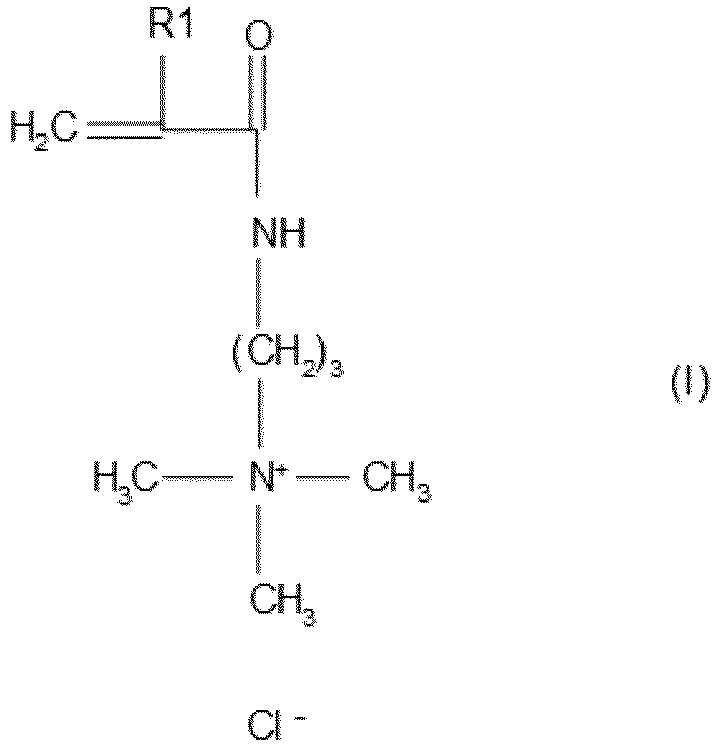 R1 représente un hydrogène ou un méthyle.
 - Copolymère selon la revendication 1 ou 2, caractérisé en ce que le ou les monomères cationiques du composant a) sont choisis dans le groupe consistant en le chlorure de diallyldiméthylammonium et le chlorure de (3-méthacrylamidopropyl)-triméthylammonium.
- Copolymère selon l'une ou plusieurs des revendications 1 à 3, caractérisé en ce que dans la formule (IV) Rx représente H, l = 0 et p représente en moyenne en moles un nombre de 1 à 150, de préférence de 11 à 150 et d'une manière particulièrement préférée de 12 à 150.
- Copolymère selon l'une ou plusieurs des revendications 1 à 4, caractérisé en ce que le ou les macromonomères de polyéthylèneglycol du composant b) sont choisis dans le groupe consistant en les monomères de formule (IV-A)
 pA représente en moyenne en moles un nombre de 1 à 150, de préférence de 1 à 120, d'une manière particulièrement préférée de 11 à 120 et tout spécialement de 22 à 120.
 - Copolymère selon l'une ou plusieurs des revendications 1 à 5, caractérisé en ce que le ou les acrylamides monomères neutres du composant c) sont choisis parmi les monomères de formule (III)

R2 et R3 peuvent être identiques ou différents et représentent chacun indépendamment de l'autre un hydrogène et/ou un radical hydrocarboné aliphatique ayant de 1 à 20 et de préférence de 1 à 4 atomes de carbone. - Copolymère selon l'une ou plusieurs des revendications 1 à 6, caractérisé en ce que le ou les acrylamides monomères neutres du composant c) sont choisis dans le groupe consistant en l'acrylamide, le N-éthylacrylamide, le N,N-diméthylacrylamide, le N-tert-butylacrylamide et le N-isopropylacrylamide et sont de préférence choisis dans le groupe consistant en le N,N-diméthylacrylamide et le N-isopropylacrylamide.
- Copolymère selon l'une ou plusieurs des revendications 1 à 7, caractérisé en ce qu'il peut être obtenu par copolymérisation radicalaire d'au moins un composant a), b) et c), lors de la copolymérisation le composant a) étant utilisé en une quantité de 25,0 à 80,0 % en mol, le composant b) étant utilisé en une quantité de 1,0 à 4,4 % en mol et le composant c) étant utilisé en une quantité de 15,6 à 74,0 % en mol.
- Copolymère selon l'une ou plusieurs des revendications 1 à 8, caractérisé en ce que les motifs structuraux sont obtenus par la polymérisation des monomères a), b) et c) et éventuellement d'autres monomères selon une répartition statistique, en blocs, alternée ou à gradient dans le copolymère.
- Copolymère selon l'une ou plusieurs des revendications 1 à 9, caractérisé en ce que sa masse moléculaire moyenne en masse Mw est de 10 000 à 250 000 g/mol, de préférence de 15 000 à 200 000 g/mol et d'une manière particulièrement préférée de 20 000 à 150 000 g/mol, la masse moléculaire moyenne en masse Mw étant mesurée par GPC (chromatographie par perméation de gel) avec l'étalon poly(2-vinylpyridine) pour des masses moléculaires Mw dans la plage de 1 110 à 1 060 000 g/mol.
- Composition nettoyante, caractérisée en ce qu'elle contient un ou plusieurs copolymères selon l'une ou plusieurs des revendications 1 à 10.
- Utilisation d'un ou plusieurs copolymères selon l'une des revendications 1 à 10 ou d'une composition nettoyante selon la revendication 11 pour produire un brillant sur des surfaces dures, de préférence sur des surfaces dures en plastique, céramique, pierre, par exemple pierre naturelle, porcelaine, verre, bois, linoléum ou métal, par exemple l'acier inoxydable.
- Utilisation d'un ou plusieurs copolymères selon l'une ou plusieurs des revendications 1 à 10 ou d'une composition nettoyante selon la revendication 11 pour hydrophiliser une surface dure, de préférence une surface dure en plastique, céramique, pierre, par exemple pierre naturelle, porcelaine, verre, bois, linoléum ou métal, par exemple acier inoxydable.
- Utilisation d'un ou plusieurs copolymères selon l'une ou plusieurs des revendications 1 à 10 ou d'une composition nettoyante selon la revendication 11 pour obtenir un effet de retouche sur une surface dure, de préférence sur une surface dure en plastique, céramique, pierre, par exemple pierre naturelle, porcelaine, verre, bois, linoléum ou métal, par exemple acier inoxydable.
Applications Claiming Priority (2)
| Application Number | Priority Date | Filing Date | Title |
|---|---|---|---|
| DE102016223586.9A DE102016223586A1 (de) | 2016-11-28 | 2016-11-28 | Copolymere und deren verwendung in reinigungsmittel-zusammensetzungen |
| PCT/EP2017/079951 WO2018095920A1 (fr) | 2016-11-28 | 2017-11-21 | Copolymères et leur utilisation dans des compositions de détergents |
Publications (2)
| Publication Number | Publication Date |
|---|---|
| EP3545012A1 EP3545012A1 (fr) | 2019-10-02 |
| EP3545012B1 true EP3545012B1 (fr) | 2025-03-12 |
Family
ID=60654924
Family Applications (1)
| Application Number | Title | Priority Date | Filing Date |
|---|---|---|---|
| EP17811865.9A Active EP3545012B1 (fr) | 2016-11-28 | 2017-11-21 | Copolymères et leur utilisation dans des compositions détergentes |
Country Status (10)
| Country | Link |
|---|---|
| US (1) | US11692052B2 (fr) |
| EP (1) | EP3545012B1 (fr) |
| JP (1) | JP2019535880A (fr) |
| CN (1) | CN109996823B (fr) |
| AR (1) | AR110258A1 (fr) |
| DE (1) | DE102016223586A1 (fr) |
| ES (1) | ES3025760T3 (fr) |
| MX (1) | MX2019005797A (fr) |
| PL (1) | PL3545012T3 (fr) |
| WO (1) | WO2018095920A1 (fr) |
Families Citing this family (12)
| Publication number | Priority date | Publication date | Assignee | Title |
|---|---|---|---|---|
| DE102016223586A1 (de) | 2016-11-28 | 2018-05-30 | Clariant International Ltd | Copolymere und deren verwendung in reinigungsmittel-zusammensetzungen |
| DE102016223590A1 (de) | 2016-11-28 | 2018-05-30 | Clariant International Ltd | Copolymer enthaltende reinigungsmittelzusammensetzungen |
| DE102016223588A1 (de) | 2016-11-28 | 2018-05-30 | Clariant International Ltd | Copolymere und deren verwendung in reinigungsmittel-zusammensetzungen |
| JP7043222B2 (ja) * | 2017-10-31 | 2022-03-29 | 東京応化工業株式会社 | 表面処理液、及び表面処理方法 |
| DE102019208832A1 (de) * | 2019-06-18 | 2020-12-24 | Henkel Ag & Co. Kgaa | Polymere für die Behandlung von Oberflächen |
| CA3148977A1 (fr) | 2019-09-26 | 2021-04-01 | Ecolab Usa Inc. | Degraissant et nettoyant a base de solvant hautement alcalin renfermant de la gomme de diutane en tant que systeme epaississant principal |
| EP3868854A1 (fr) * | 2020-02-20 | 2021-08-25 | Clariant International Ltd | Compositions de nettoyage comprenant des copolymères et leur utilisation |
| JP2024026937A (ja) * | 2022-08-16 | 2024-02-29 | ライオン株式会社 | 硬表面用の液体洗浄剤組成物 |
| EP4638676A1 (fr) | 2022-12-19 | 2025-10-29 | Unilever IP Holdings B.V. | Composition moussante de nettoyage de surfaces dures |
| WO2025186296A1 (fr) | 2024-03-06 | 2025-09-12 | Unilever Ip Holdings B.V. | Composition de bloc pour toilettes solide |
| WO2025219144A1 (fr) * | 2024-04-16 | 2025-10-23 | Unilever Ip Holdings B.V. | Composition de nettoyage de surface dure |
| WO2026068577A1 (fr) | 2024-09-30 | 2026-04-02 | Unilever Ip Holdings B.V. | Composition de nettoyage de surface dure |
Citations (1)
| Publication number | Priority date | Publication date | Assignee | Title |
|---|---|---|---|---|
| CN105542090A (zh) * | 2015-12-08 | 2016-05-04 | 江苏苏博特新材料股份有限公司 | 一种混凝土用流变改性剂及其制备方法 |
Family Cites Families (108)
| Publication number | Priority date | Publication date | Assignee | Title |
|---|---|---|---|---|
| US2182306A (en) | 1935-05-10 | 1939-12-05 | Ig Farbenindustrie Ag | Polymerization of ethylene imines |
| US2208095A (en) | 1937-01-05 | 1940-07-16 | Ig Farbenindustrie Ag | Process of producing insoluble condensation products containing sulphur and nitrogen |
| US2553696A (en) | 1944-01-12 | 1951-05-22 | Union Carbide & Carbon Corp | Method for making water-soluble polymers of lower alkylene imines |
| US2806839A (en) | 1953-02-24 | 1957-09-17 | Arnold Hoffman & Co Inc | Preparation of polyimines from 2-oxazolidone |
| US2809971A (en) | 1955-11-22 | 1957-10-15 | Olin Mathieson | Heavy-metal derivatives of 1-hydroxy-2-pyridinethiones and method of preparing same |
| BE615597A (fr) | 1958-06-19 | |||
| NL132418C (fr) | 1962-04-13 | |||
| US3128287A (en) | 1963-01-31 | 1964-04-07 | Pfizer & Co C | 2,2'-oxodisuccinic acid, derivatives thereof, and process for preparing |
| CA777769A (en) | 1963-03-18 | 1968-02-06 | H. Roy Clarence | Substituted methylene diphosphonic acid compounds and detergent compositions |
| US3213030A (en) | 1963-03-18 | 1965-10-19 | Procter & Gamble | Cleansing and laundering compositions |
| US3236733A (en) | 1963-09-05 | 1966-02-22 | Vanderbilt Co R T | Method of combatting dandruff with pyridinethiones metal salts detergent compositions |
| US3400148A (en) | 1965-09-23 | 1968-09-03 | Procter & Gamble | Phosphonate compounds |
| CA790610A (en) | 1965-12-28 | 1968-07-23 | T. Quimby Oscar | Diphosphonate compounds and detergent compositions |
| US3761418A (en) | 1967-09-27 | 1973-09-25 | Procter & Gamble | Detergent compositions containing particle deposition enhancing agents |
| US3635830A (en) | 1968-05-24 | 1972-01-18 | Lever Brothers Ltd | Detergent compositions containing oxydisuccing acid salts as builders |
| US3753196A (en) | 1971-10-05 | 1973-08-14 | Kulite Semiconductor Products | Transducers employing integral protective coatings and supports |
| US3958581A (en) | 1972-05-17 | 1976-05-25 | L'oreal | Cosmetic composition containing a cationic polymer and divalent metal salt for strengthening the hair |
| CA1018893A (en) | 1972-12-11 | 1977-10-11 | Roger C. Birkofer | Mild thickened shampoo compositions with conditioning properties |
| US4605509A (en) | 1973-05-11 | 1986-08-12 | The Procter & Gamble Company | Detergent compositions containing sodium aluminosilicate builders |
| US4009256A (en) | 1973-11-19 | 1977-02-22 | National Starch And Chemical Corporation | Novel shampoo composition containing a water-soluble cationic polymer |
| US3985669A (en) | 1974-06-17 | 1976-10-12 | The Procter & Gamble Company | Detergent compositions |
| US4323683A (en) | 1980-02-07 | 1982-04-06 | The Procter & Gamble Company | Process for making pyridinethione salts |
| US4345080A (en) | 1980-02-07 | 1982-08-17 | The Procter & Gamble Company | Pyridinethione salts and hair care compositions |
| US4379753A (en) | 1980-02-07 | 1983-04-12 | The Procter & Gamble Company | Hair care compositions |
| US4470982A (en) | 1980-12-22 | 1984-09-11 | The Procter & Gamble Company | Shampoo compositions |
| US4529773A (en) | 1982-03-17 | 1985-07-16 | David Witiak | Alkali-soluble emulsion polymers in acidic surfactant compositions |
| DE3413571A1 (de) | 1984-04-11 | 1985-10-24 | Hoechst Ag, 6230 Frankfurt | Verwendung von kristallinen schichtfoermigen natriumsilikaten zur wasserenthaertung und verfahren zur wasserenthaertung |
| US4566984A (en) | 1984-11-16 | 1986-01-28 | The Procter & Gamble Company | Ether polycarboxylates |
| US4702857A (en) | 1984-12-21 | 1987-10-27 | The Procter & Gamble Company | Block polyesters and like compounds useful as soil release agents in detergent compositions |
| US4663071A (en) | 1986-01-30 | 1987-05-05 | The Procter & Gamble Company | Ether carboxylate detergent builders and process for their preparation |
| CA2001927C (fr) | 1988-11-03 | 1999-12-21 | Graham Thomas Brown | Aluminosilicates et detergents |
| US5104646A (en) | 1989-08-07 | 1992-04-14 | The Procter & Gamble Company | Vehicle systems for use in cosmetic compositions |
| EP0467472A3 (en) | 1990-07-16 | 1993-06-02 | Colgate-Palmolive Company | Hard surface liquid cleaning composition with anti-soiling polymer |
| SK21093A3 (en) | 1990-09-28 | 1993-10-06 | Procter & Gamble | Polyhydroxy fatty acid amide surfactants to enhace enzyme performance |
| US5194639A (en) | 1990-09-28 | 1993-03-16 | The Procter & Gamble Company | Preparation of polyhydroxy fatty acid amides in the presence of solvents |
| GB9116871D0 (en) | 1991-08-05 | 1991-09-18 | Unilever Plc | Hair care composition |
| WO1995022311A1 (fr) | 1994-02-18 | 1995-08-24 | Unilever Plc | Compositions de detersif pour soins corporels |
| GB9507130D0 (en) | 1995-04-06 | 1995-05-31 | Unilever Plc | Hair treatment composition |
| EP0868448B1 (fr) | 1995-12-22 | 2004-03-24 | Janice E. Losasso | Polymeres structures de faible poids moleculaire |
| US6255267B1 (en) | 1996-03-04 | 2001-07-03 | Hpd Laboratories, Inc. | Manual toilet bowl cleaner |
| CN1224451A (zh) | 1996-05-03 | 1999-07-28 | 普罗格特-甘布尔公司 | 含有改性聚胺的织物处理组合物 |
| US5858948A (en) | 1996-05-03 | 1999-01-12 | Procter & Gamble Company | Liquid laundry detergent compositions comprising cotton soil release polymers and protease enzymes |
| ATE255626T1 (de) | 1997-02-14 | 2003-12-15 | Procter & Gamble | Flüssige reinigungsmittelzusammensetzungen für harte oberflächen |
| ES2201264T3 (es) | 1997-04-30 | 2004-03-16 | THE PROCTER & GAMBLE COMPANY | Composiciones acidas para eliminar costras de cal. |
| US5977275A (en) | 1998-02-17 | 1999-11-02 | National Starch And Chemical Investment Holding Corporation | Polymers having pendant polysaccharide moieties and uses thereof |
| US6361768B1 (en) | 1998-12-29 | 2002-03-26 | Pmd Holdings Corp. | Hydrophilic ampholytic polymer |
| FR2796392B1 (fr) | 1999-07-15 | 2003-09-19 | Rhodia Chimie Sa | Composition nettoyante comprenant un polymere hydrosoluble ou hydrodispersable |
| JP2001181354A (ja) | 1999-12-28 | 2001-07-03 | Lion Corp | カチオン性ポリマー |
| US7202200B1 (en) | 2000-11-28 | 2007-04-10 | The Clorox Company | Hard surface cleaner with improved stain repellency comprising a fluoropolymer and a quaternary ammonium surfactant |
| BR0110718A (pt) | 2000-05-09 | 2003-03-18 | Unilever Nv | Polissacarìdeo aniÈnico, hidrofóbico, processo para a preparação do mesmo, composição de tratamento de tecido, e, composição detergente |
| US6410005B1 (en) | 2000-06-15 | 2002-06-25 | Pmd Holdings Corp. | Branched/block copolymers for treatment of keratinous substrates |
| DE60131634T2 (de) | 2000-10-13 | 2008-10-30 | Kansai Paint Co., Ltd., Amagasaki | Pigment-dispergierendes harz |
| DE10059827A1 (de) | 2000-12-01 | 2002-06-20 | Clariant Gmbh | Kosmetische und dermatologische Haarbehandlungsmittel |
| WO2003031546A1 (fr) | 2001-10-09 | 2003-04-17 | The Procter & Gamble Company | Compositions aqueuses pour le traitement d'une surface |
| GB0130499D0 (en) | 2001-12-20 | 2002-02-06 | Unilever Plc | Polymers for laundry cleaning compositions |
| GB0229147D0 (en) | 2002-12-13 | 2003-01-15 | Unilever Plc | Polymers and laundry detergent compositions containing them |
| DE10258831A1 (de) | 2002-12-17 | 2004-07-08 | Henkel Kgaa | Reinigungsmittel für harte Oberflächen |
| DE10358587A1 (de) | 2003-12-12 | 2005-07-07 | Hans Schwarzkopf & Henkel Gmbh & Co. Kg | Volumengebendes kosmetisches Mittel |
| DE102004040848A1 (de) | 2004-08-23 | 2006-03-02 | Henkel Kgaa | Reiniger mit Fäkalschmutz-abweisenden Eigenschaften |
| JP2006316035A (ja) | 2005-05-16 | 2006-11-24 | Lion Corp | シャンプー組成物及びその製造方法 |
| WO2006130709A2 (fr) * | 2005-06-01 | 2006-12-07 | Rhodia Inc. | Systemes de coacervats presentant des proprietes anti-depot et anti-adherence de salissures sur des surfaces hydrophiles |
| US7807766B2 (en) | 2005-09-21 | 2010-10-05 | Cognis Ip Management Gmbh | Polymers for use in cleaning compositions |
| EP1948702A2 (fr) | 2005-11-17 | 2008-07-30 | The Procter and Gamble Company | Utilisation et application de copolymeres zwitterioniques definis |
| DE102005060431A1 (de) | 2005-12-15 | 2007-06-21 | Henkel Kgaa | Maschinelles Geschirrspülmittel |
| FR2896248B1 (fr) | 2006-01-18 | 2008-03-07 | Arkema Sa | Procede de preparation de latex stabilises par polymerisation en emulsion |
| DE102006007004A1 (de) | 2006-02-15 | 2007-08-16 | Construction Research & Technology Gmbh | Wasserlösliche sulfogruppenhaltige Copolymere, Verfahren zu deren Herstellung und ihre Verwendung |
| WO2007138053A1 (fr) | 2006-05-31 | 2007-12-06 | Basf Se | Polymères greffés amphiphiles à base d'oxydes de polyalkylène et esters vinyliques |
| JP4868981B2 (ja) | 2006-08-29 | 2012-02-01 | 竹本油脂株式会社 | 熱可塑性高分子用帯電防止剤及び熱可塑性高分子成形体の帯電防止方法並びに帯電防止性熱可塑性高分子成形体 |
| DE102006049381A1 (de) | 2006-10-19 | 2008-04-24 | Süd-Chemie AG | Amphiphile Pfropfpolymere |
| DE102006050761A1 (de) | 2006-10-27 | 2008-05-08 | Construction Research & Technology Gmbh | Hydrophob modifizierte kationische Copolymere |
| DE102007013141A1 (de) | 2007-03-15 | 2008-09-18 | Cognis Ip Management Gmbh | Amphotere Polymere als Soil Release Additive in Wasch- und Reinigungsmitteln |
| DE102007023813A1 (de) | 2007-05-21 | 2008-11-27 | Evonik Röhm Gmbh | Dispersion umfassend anorganische Partikel, Wasser und mindestens ein polymeres Additiv |
| DE102007061970A1 (de) | 2007-12-21 | 2008-07-03 | Clariant International Limited | Kosmetische, pharmazeutische oder dermatologische Zusammensetzungen enthaltend einen hohen Gehalt an wasserlöslichen Pflegekomponenten |
| JP5502337B2 (ja) | 2008-03-04 | 2014-05-28 | 花王株式会社 | 毛髪用洗浄剤組成物 |
| DE102008013171A1 (de) | 2008-03-07 | 2009-09-10 | Beiersdorf Ag | Volumengebender Haarfestiger mit ampholytischem Copolymer |
| EP2110117A1 (fr) | 2008-04-15 | 2009-10-21 | KPSS-Kao Professional Salon Services GmbH | Composition de nettoyage donnant du volume |
| DE102008001661A1 (de) | 2008-05-08 | 2009-11-12 | Beiersdorf Ag | Haarpflegeformulierungen mit kationisch amphoteren Polymeren |
| EP2138560B2 (fr) | 2008-06-24 | 2015-04-01 | Cognis IP Management GmbH | Produit de nettoyage contenant des copolymères greffés |
| EP2116225A1 (fr) | 2008-10-16 | 2009-11-11 | Beiersdorf AG | Produit de soin capillaire à rinçage pour l'augmentation du volume de la coiffure |
| US8852353B2 (en) | 2008-12-10 | 2014-10-07 | Michael Oberlander | Solid dishmachine detergent not requiring a separate rinse additive |
| DE102009001559A1 (de) | 2009-03-16 | 2009-12-31 | Henkel Ag & Co. Kgaa | Kalklösendes Reinigungsmittel |
| MX2011009195A (es) | 2009-03-20 | 2012-02-28 | Basf Se | Polimeros anfoliticos de secado rapido para composiciones de limpieza. |
| US20110236582A1 (en) | 2010-03-29 | 2011-09-29 | Scheuing David R | Polyelectrolyte Complexes |
| US9017652B1 (en) * | 2010-04-09 | 2015-04-28 | Lubrizol Advanced Materials, Inc. | Combination of crosslinked cationic and ampholytic polymers for personal and household applications |
| AU2010363642B2 (en) | 2010-11-10 | 2014-07-24 | Colgate-Palmolive Company | Fabric conditioners containing soil releasing polymer |
| EP2463317A1 (fr) | 2010-12-09 | 2012-06-13 | BASF Construction Polymers GmbH | Additif pour des mélanges de matièriaux de construction comprenant une phase fluide |
| US20140298591A1 (en) | 2011-10-25 | 2014-10-09 | Basf Se | Use of comb or block copolymers as soil antiredeposition agents and soil release agents in laundry processes |
| FR2985727B1 (fr) | 2012-01-16 | 2014-05-09 | Snf Sas | Nouveaux polymeres peignes utilisables en cosmetique et detergence |
| JP6117592B2 (ja) | 2012-03-30 | 2017-04-19 | 株式会社コーセー | 整髪用化粧料 |
| KR102012188B1 (ko) | 2012-03-30 | 2019-08-20 | 가부시키가이샤 코세 | 모발 화장료 |
| JP6106492B2 (ja) | 2012-03-30 | 2017-03-29 | 株式会社コーセー | 整髪用化粧料 |
| US8759271B2 (en) | 2012-05-11 | 2014-06-24 | The Procter & Gamble Company | Liquid detergent composition for improved shine |
| US8623806B2 (en) | 2012-05-11 | 2014-01-07 | The Procter & Gamble Company | Liquid detergent composition for improved shine |
| EP2855649B1 (fr) | 2012-05-30 | 2017-02-01 | Clariant International Ltd | Composition contenant de la n-méthyl-n-acylglucamine |
| JP2014012818A (ja) | 2012-06-27 | 2014-01-23 | Rohm & Haas Co | 硬表面をクリーニングおよびコーティングするための縞模様のつかない配合物 |
| JP6058359B2 (ja) | 2012-11-14 | 2017-01-11 | 互応化学工業株式会社 | 毛髪化粧料用基剤及び毛髪化粧料 |
| FR3001457B1 (fr) * | 2013-01-31 | 2015-02-06 | Snf Sas | Nouveaux polymeres peignes utilisables en cosmetique et detergence |
| HUE035705T2 (en) | 2013-11-27 | 2018-05-28 | Basf Se | Random copolymers in the washing process as a dirt remover |
| US9522971B2 (en) | 2014-12-31 | 2016-12-20 | Chung Yuan Christian University | Amine modifying material and application thereof |
| CN105037644A (zh) | 2015-07-01 | 2015-11-11 | 广东灵捷制造化工有限公司 | 一种高分子阳离子表面活性剂、其制备方法及用途 |
| DE102016223585A1 (de) | 2016-11-28 | 2018-05-30 | Clariant International Ltd | Copolymere und deren verwendung in waschmittel-zusammensetzungen |
| DE102016223590A1 (de) | 2016-11-28 | 2018-05-30 | Clariant International Ltd | Copolymer enthaltende reinigungsmittelzusammensetzungen |
| DE102016223584A1 (de) | 2016-11-28 | 2018-05-30 | Clariant International Ltd | Copolymer enthaltende waschmittelzusammensetzungen |
| DE102016223588A1 (de) | 2016-11-28 | 2018-05-30 | Clariant International Ltd | Copolymere und deren verwendung in reinigungsmittel-zusammensetzungen |
| DE102016223589A1 (de) | 2016-11-28 | 2018-05-30 | Clariant International Ltd | Copolymer enthaltendes maschinelles geschirrspülmittel |
| EP3544688B1 (fr) | 2016-11-28 | 2023-03-08 | Clariant International Ltd | Composition cosmétique comprenant un copolymère cationique |
| DE102016223586A1 (de) | 2016-11-28 | 2018-05-30 | Clariant International Ltd | Copolymere und deren verwendung in reinigungsmittel-zusammensetzungen |
| EP3868854A1 (fr) | 2020-02-20 | 2021-08-25 | Clariant International Ltd | Compositions de nettoyage comprenant des copolymères et leur utilisation |
-
2016
- 2016-11-28 DE DE102016223586.9A patent/DE102016223586A1/de not_active Withdrawn
-
2017
- 2017-11-21 EP EP17811865.9A patent/EP3545012B1/fr active Active
- 2017-11-21 MX MX2019005797A patent/MX2019005797A/es unknown
- 2017-11-21 WO PCT/EP2017/079951 patent/WO2018095920A1/fr not_active Ceased
- 2017-11-21 JP JP2019527871A patent/JP2019535880A/ja active Pending
- 2017-11-21 US US16/463,340 patent/US11692052B2/en active Active
- 2017-11-21 ES ES17811865T patent/ES3025760T3/es active Active
- 2017-11-21 CN CN201780073411.5A patent/CN109996823B/zh active Active
- 2017-11-21 PL PL17811865.9T patent/PL3545012T3/pl unknown
- 2017-11-28 AR ARP170103311A patent/AR110258A1/es unknown
Patent Citations (1)
| Publication number | Priority date | Publication date | Assignee | Title |
|---|---|---|---|---|
| CN105542090A (zh) * | 2015-12-08 | 2016-05-04 | 江苏苏博特新材料股份有限公司 | 一种混凝土用流变改性剂及其制备方法 |
Also Published As
| Publication number | Publication date |
|---|---|
| MX2019005797A (es) | 2019-08-12 |
| JP2019535880A (ja) | 2019-12-12 |
| BR112019009247A2 (pt) | 2019-07-16 |
| DE102016223586A1 (de) | 2018-05-30 |
| PL3545012T3 (pl) | 2025-05-19 |
| AR110258A1 (es) | 2019-03-13 |
| WO2018095920A1 (fr) | 2018-05-31 |
| US11692052B2 (en) | 2023-07-04 |
| ES3025760T3 (en) | 2025-06-09 |
| CN109996823A (zh) | 2019-07-09 |
| US20190375871A1 (en) | 2019-12-12 |
| EP3545012A1 (fr) | 2019-10-02 |
| CN109996823B (zh) | 2022-06-03 |
Similar Documents
| Publication | Publication Date | Title |
|---|---|---|
| EP3545066B1 (fr) | Compositions de détergents contenant un copolymère | |
| EP3545011B1 (fr) | Copolymères et leur utilisation dans des compositions détergentes | |
| DE102016223586A1 (de) | Copolymere und deren verwendung in reinigungsmittel-zusammensetzungen | |
| EP3868854A1 (fr) | Compositions de nettoyage comprenant des copolymères et leur utilisation | |
| WO2010115813A1 (fr) | Utilisation d'une combinaison de tensioactifs à activité prébiotique | |
| WO2018095916A1 (fr) | Copolymères et leur utilisation dans des compositions de détergents à lessive | |
| DE102009001559A1 (de) | Kalklösendes Reinigungsmittel | |
| EP3545063A1 (fr) | Compositions de détergent à lessive contenant un copolymère | |
| EP1564283A2 (fr) | combinaison de tensio-actifs | |
| WO2015120990A1 (fr) | Agent de nettoyage acide pour surfaces dures | |
| WO2007118748A1 (fr) | Détergent aqueux | |
| EP1941020A1 (fr) | Detergents pour vaisselle a la main contenant des agents pour le soin de la peau | |
| EP4134422A1 (fr) | (co)polymères et leur utilisation dans des compositions de nettoyage | |
| BR112019009247B1 (pt) | Copolímeros, composição de agente de limpeza que os compreende, e usos dos mesmos |
Legal Events
| Date | Code | Title | Description |
|---|---|---|---|
| STAA | Information on the status of an ep patent application or granted ep patent |
Free format text: STATUS: UNKNOWN |
|
| STAA | Information on the status of an ep patent application or granted ep patent |
Free format text: STATUS: THE INTERNATIONAL PUBLICATION HAS BEEN MADE |
|
| PUAI | Public reference made under article 153(3) epc to a published international application that has entered the european phase |
Free format text: ORIGINAL CODE: 0009012 |
|
| STAA | Information on the status of an ep patent application or granted ep patent |
Free format text: STATUS: REQUEST FOR EXAMINATION WAS MADE |
|
| 17P | Request for examination filed |
Effective date: 20190628 |
|
| AK | Designated contracting states |
Kind code of ref document: A1 Designated state(s): AL AT BE BG CH CY CZ DE DK EE ES FI FR GB GR HR HU IE IS IT LI LT LU LV MC MK MT NL NO PL PT RO RS SE SI SK SM TR |
|
| AX | Request for extension of the european patent |
Extension state: BA ME |
|
| DAV | Request for validation of the european patent (deleted) | ||
| DAX | Request for extension of the european patent (deleted) | ||
| STAA | Information on the status of an ep patent application or granted ep patent |
Free format text: STATUS: EXAMINATION IS IN PROGRESS |
|
| 17Q | First examination report despatched |
Effective date: 20220125 |
|
| GRAP | Despatch of communication of intention to grant a patent |
Free format text: ORIGINAL CODE: EPIDOSNIGR1 |
|
| STAA | Information on the status of an ep patent application or granted ep patent |
Free format text: STATUS: GRANT OF PATENT IS INTENDED |
|
| INTG | Intention to grant announced |
Effective date: 20240620 |
|
| GRAJ | Information related to disapproval of communication of intention to grant by the applicant or resumption of examination proceedings by the epo deleted |
Free format text: ORIGINAL CODE: EPIDOSDIGR1 |
|
| STAA | Information on the status of an ep patent application or granted ep patent |
Free format text: STATUS: EXAMINATION IS IN PROGRESS |
|
| GRAP | Despatch of communication of intention to grant a patent |
Free format text: ORIGINAL CODE: EPIDOSNIGR1 |
|
| STAA | Information on the status of an ep patent application or granted ep patent |
Free format text: STATUS: GRANT OF PATENT IS INTENDED |
|
| INTC | Intention to grant announced (deleted) | ||
| P01 | Opt-out of the competence of the unified patent court (upc) registered |
Free format text: CASE NUMBER: APP_59800/2024 Effective date: 20241105 |
|
| INTG | Intention to grant announced |
Effective date: 20241126 |
|
| GRAL | Information related to payment of fee for publishing/printing deleted |
Free format text: ORIGINAL CODE: EPIDOSDIGR3 |
|
| GRAS | Grant fee paid |
Free format text: ORIGINAL CODE: EPIDOSNIGR3 |
|
| GRAA | (expected) grant |
Free format text: ORIGINAL CODE: 0009210 |
|
| STAA | Information on the status of an ep patent application or granted ep patent |
Free format text: STATUS: THE PATENT HAS BEEN GRANTED |
|
| AK | Designated contracting states |
Kind code of ref document: B1 Designated state(s): AL AT BE BG CH CY CZ DE DK EE ES FI FR GB GR HR HU IE IS IT LI LT LU LV MC MK MT NL NO PL PT RO RS SE SI SK SM TR |
|
| REG | Reference to a national code |
Ref country code: GB Ref legal event code: FG4D Free format text: NOT ENGLISH |
|
| REG | Reference to a national code |
Ref country code: CH Ref legal event code: EP |
|
| REG | Reference to a national code |
Ref country code: DE Ref legal event code: R096 Ref document number: 502017016744 Country of ref document: DE |
|
| REG | Reference to a national code |
Ref country code: IE Ref legal event code: FG4D Free format text: LANGUAGE OF EP DOCUMENT: GERMAN |
|
| REG | Reference to a national code |
Ref country code: ES Ref legal event code: FG2A Ref document number: 3025760 Country of ref document: ES Kind code of ref document: T3 Effective date: 20250609 |
|
| PG25 | Lapsed in a contracting state [announced via postgrant information from national office to epo] |
Ref country code: RS Free format text: LAPSE BECAUSE OF FAILURE TO SUBMIT A TRANSLATION OF THE DESCRIPTION OR TO PAY THE FEE WITHIN THE PRESCRIBED TIME-LIMIT Effective date: 20250612 |
|
| PG25 | Lapsed in a contracting state [announced via postgrant information from national office to epo] |
Ref country code: FI Free format text: LAPSE BECAUSE OF FAILURE TO SUBMIT A TRANSLATION OF THE DESCRIPTION OR TO PAY THE FEE WITHIN THE PRESCRIBED TIME-LIMIT Effective date: 20250312 |
|
| REG | Reference to a national code |
Ref country code: LT Ref legal event code: MG9D |
|
| PG25 | Lapsed in a contracting state [announced via postgrant information from national office to epo] |
Ref country code: NO Free format text: LAPSE BECAUSE OF FAILURE TO SUBMIT A TRANSLATION OF THE DESCRIPTION OR TO PAY THE FEE WITHIN THE PRESCRIBED TIME-LIMIT Effective date: 20250612 |
|
| PG25 | Lapsed in a contracting state [announced via postgrant information from national office to epo] |
Ref country code: HR Free format text: LAPSE BECAUSE OF FAILURE TO SUBMIT A TRANSLATION OF THE DESCRIPTION OR TO PAY THE FEE WITHIN THE PRESCRIBED TIME-LIMIT Effective date: 20250312 |
|
| REG | Reference to a national code |
Ref country code: NL Ref legal event code: MP Effective date: 20250312 |
|
| PG25 | Lapsed in a contracting state [announced via postgrant information from national office to epo] |
Ref country code: LV Free format text: LAPSE BECAUSE OF FAILURE TO SUBMIT A TRANSLATION OF THE DESCRIPTION OR TO PAY THE FEE WITHIN THE PRESCRIBED TIME-LIMIT Effective date: 20250312 |
|
| PG25 | Lapsed in a contracting state [announced via postgrant information from national office to epo] |
Ref country code: GR Free format text: LAPSE BECAUSE OF FAILURE TO SUBMIT A TRANSLATION OF THE DESCRIPTION OR TO PAY THE FEE WITHIN THE PRESCRIBED TIME-LIMIT Effective date: 20250613 Ref country code: BG Free format text: LAPSE BECAUSE OF FAILURE TO SUBMIT A TRANSLATION OF THE DESCRIPTION OR TO PAY THE FEE WITHIN THE PRESCRIBED TIME-LIMIT Effective date: 20250312 |
|
| PG25 | Lapsed in a contracting state [announced via postgrant information from national office to epo] |
Ref country code: NL Free format text: LAPSE BECAUSE OF FAILURE TO SUBMIT A TRANSLATION OF THE DESCRIPTION OR TO PAY THE FEE WITHIN THE PRESCRIBED TIME-LIMIT Effective date: 20250312 |
|
| PG25 | Lapsed in a contracting state [announced via postgrant information from national office to epo] |
Ref country code: SE Free format text: LAPSE BECAUSE OF FAILURE TO SUBMIT A TRANSLATION OF THE DESCRIPTION OR TO PAY THE FEE WITHIN THE PRESCRIBED TIME-LIMIT Effective date: 20250312 |
|
| PG25 | Lapsed in a contracting state [announced via postgrant information from national office to epo] |
Ref country code: SM Free format text: LAPSE BECAUSE OF FAILURE TO SUBMIT A TRANSLATION OF THE DESCRIPTION OR TO PAY THE FEE WITHIN THE PRESCRIBED TIME-LIMIT Effective date: 20250312 |
|
| PG25 | Lapsed in a contracting state [announced via postgrant information from national office to epo] |
Ref country code: PT Free format text: LAPSE BECAUSE OF FAILURE TO SUBMIT A TRANSLATION OF THE DESCRIPTION OR TO PAY THE FEE WITHIN THE PRESCRIBED TIME-LIMIT Effective date: 20250714 |
|
| PG25 | Lapsed in a contracting state [announced via postgrant information from national office to epo] |
Ref country code: EE Free format text: LAPSE BECAUSE OF FAILURE TO SUBMIT A TRANSLATION OF THE DESCRIPTION OR TO PAY THE FEE WITHIN THE PRESCRIBED TIME-LIMIT Effective date: 20250312 Ref country code: CZ Free format text: LAPSE BECAUSE OF FAILURE TO SUBMIT A TRANSLATION OF THE DESCRIPTION OR TO PAY THE FEE WITHIN THE PRESCRIBED TIME-LIMIT Effective date: 20250312 |
|
| PG25 | Lapsed in a contracting state [announced via postgrant information from national office to epo] |
Ref country code: RO Free format text: LAPSE BECAUSE OF FAILURE TO SUBMIT A TRANSLATION OF THE DESCRIPTION OR TO PAY THE FEE WITHIN THE PRESCRIBED TIME-LIMIT Effective date: 20250312 |
|
| PG25 | Lapsed in a contracting state [announced via postgrant information from national office to epo] |
Ref country code: SK Free format text: LAPSE BECAUSE OF FAILURE TO SUBMIT A TRANSLATION OF THE DESCRIPTION OR TO PAY THE FEE WITHIN THE PRESCRIBED TIME-LIMIT Effective date: 20250312 |
|
| PG25 | Lapsed in a contracting state [announced via postgrant information from national office to epo] |
Ref country code: IS Free format text: LAPSE BECAUSE OF FAILURE TO SUBMIT A TRANSLATION OF THE DESCRIPTION OR TO PAY THE FEE WITHIN THE PRESCRIBED TIME-LIMIT Effective date: 20250712 |
|
| REG | Reference to a national code |
Ref country code: DE Ref legal event code: R097 Ref document number: 502017016744 Country of ref document: DE |
|
| PGFP | Annual fee paid to national office [announced via postgrant information from national office to epo] |
Ref country code: DE Payment date: 20251126 Year of fee payment: 9 |
|
| PGFP | Annual fee paid to national office [announced via postgrant information from national office to epo] |
Ref country code: GB Payment date: 20251125 Year of fee payment: 9 |
|
| PG25 | Lapsed in a contracting state [announced via postgrant information from national office to epo] |
Ref country code: DK Free format text: LAPSE BECAUSE OF FAILURE TO SUBMIT A TRANSLATION OF THE DESCRIPTION OR TO PAY THE FEE WITHIN THE PRESCRIBED TIME-LIMIT Effective date: 20250312 |
|
| PGFP | Annual fee paid to national office [announced via postgrant information from national office to epo] |
Ref country code: IT Payment date: 20251121 Year of fee payment: 9 |
|
| PGFP | Annual fee paid to national office [announced via postgrant information from national office to epo] |
Ref country code: FR Payment date: 20251124 Year of fee payment: 9 |
|
| PLBE | No opposition filed within time limit |
Free format text: ORIGINAL CODE: 0009261 |
|
| STAA | Information on the status of an ep patent application or granted ep patent |
Free format text: STATUS: NO OPPOSITION FILED WITHIN TIME LIMIT |
|
| REG | Reference to a national code |
Ref country code: CH Ref legal event code: L10 Free format text: ST27 STATUS EVENT CODE: U-0-0-L10-L00 (AS PROVIDED BY THE NATIONAL OFFICE) Effective date: 20260121 |
|
| PGFP | Annual fee paid to national office [announced via postgrant information from national office to epo] |
Ref country code: PL Payment date: 20251110 Year of fee payment: 9 |
|
| PGFP | Annual fee paid to national office [announced via postgrant information from national office to epo] |
Ref country code: ES Payment date: 20251209 Year of fee payment: 9 |
|
| 26N | No opposition filed |
Effective date: 20251215 |