EP3547874B1 - Procede pour determiner l'orientation de la tete d' un utilisateur pendant le nettoyage des dents - Google Patents
Procede pour determiner l'orientation de la tete d' un utilisateur pendant le nettoyage des dents Download PDFInfo
- Publication number
- EP3547874B1 EP3547874B1 EP17816590.8A EP17816590A EP3547874B1 EP 3547874 B1 EP3547874 B1 EP 3547874B1 EP 17816590 A EP17816590 A EP 17816590A EP 3547874 B1 EP3547874 B1 EP 3547874B1
- Authority
- EP
- European Patent Office
- Prior art keywords
- user
- head
- orientation
- sensor
- oral care
- Prior art date
- Legal status (The legal status is an assumption and is not a legal conclusion. Google has not performed a legal analysis and makes no representation as to the accuracy of the status listed.)
- Active
Links
Images


Classifications
-
- A—HUMAN NECESSITIES
- A46—BRUSHWARE
- A46B—BRUSHES
- A46B11/00—Brushes with reservoir or other means for applying substances, e.g. paints, pastes, water
-
- A—HUMAN NECESSITIES
- A46—BRUSHWARE
- A46B—BRUSHES
- A46B15/00—Other brushes; Brushes with additional arrangements
- A46B15/0002—Arrangements for enhancing monitoring or controlling the brushing process
-
- A—HUMAN NECESSITIES
- A46—BRUSHWARE
- A46B—BRUSHES
- A46B15/00—Other brushes; Brushes with additional arrangements
- A46B15/0002—Arrangements for enhancing monitoring or controlling the brushing process
- A46B15/0004—Arrangements for enhancing monitoring or controlling the brushing process with a controlling means
-
- A—HUMAN NECESSITIES
- A46—BRUSHWARE
- A46B—BRUSHES
- A46B15/00—Other brushes; Brushes with additional arrangements
- A46B15/0002—Arrangements for enhancing monitoring or controlling the brushing process
- A46B15/0004—Arrangements for enhancing monitoring or controlling the brushing process with a controlling means
- A46B15/0006—Arrangements for enhancing monitoring or controlling the brushing process with a controlling means with a controlling brush technique device, e.g. stroke movement measuring device
-
- A—HUMAN NECESSITIES
- A46—BRUSHWARE
- A46B—BRUSHES
- A46B15/00—Other brushes; Brushes with additional arrangements
- A46B15/0002—Arrangements for enhancing monitoring or controlling the brushing process
- A46B15/0038—Arrangements for enhancing monitoring or controlling the brushing process with signalling means
-
- A—HUMAN NECESSITIES
- A61—MEDICAL OR VETERINARY SCIENCE; HYGIENE
- A61C—DENTISTRY; APPARATUS OR METHODS FOR ORAL OR DENTAL HYGIENE
- A61C17/00—Devices for cleaning, polishing, rinsing or drying teeth, teeth cavities or prostheses; Saliva removers; Dental appliances for receiving spittle
- A61C17/16—Power-driven cleaning or polishing devices
- A61C17/22—Power-driven cleaning or polishing devices with brushes, cushions, cups, or the like
- A61C17/221—Control arrangements therefor
-
- A—HUMAN NECESSITIES
- A46—BRUSHWARE
- A46B—BRUSHES
- A46B13/00—Brushes with driven brush bodies or carriers
- A46B13/02—Brushes with driven brush bodies or carriers power-driven carriers
-
- A—HUMAN NECESSITIES
- A46—BRUSHWARE
- A46B—BRUSHES
- A46B2200/00—Brushes characterized by their functions, uses or applications
- A46B2200/10—For human or animal care
- A46B2200/1066—Toothbrush for cleaning the teeth or dentures
-
- A—HUMAN NECESSITIES
- A61—MEDICAL OR VETERINARY SCIENCE; HYGIENE
- A61C—DENTISTRY; APPARATUS OR METHODS FOR ORAL OR DENTAL HYGIENE
- A61C1/00—Dental machines for boring or cutting ; General features of dental machines or apparatus, e.g. hand-piece design
- A61C1/0007—Control devices or systems
- A61C1/0015—Electrical systems
-
- A—HUMAN NECESSITIES
- A61—MEDICAL OR VETERINARY SCIENCE; HYGIENE
- A61C—DENTISTRY; APPARATUS OR METHODS FOR ORAL OR DENTAL HYGIENE
- A61C19/00—Dental auxiliary appliances
- A61C19/04—Measuring instruments specially adapted for dentistry
Definitions
- the present disclosure relates generally to systems and methods for determining the orientation of a user's head during use of an oral care device.
- US 2012/310593 A1 discloses a method of monitoring tooth brushing comprising: receiving a position signal from a position sensor disposed on a toothbrush comprising a handle and a head; receiving a force signal from a force sensor disposed on the toothbrush; and calculating a position of the head of the toothbrush using the position signal in combination with the force signal.
- the present disclosure is directed to inventive systems and methods for determining the orientation of a user's head during use of an oral care device.
- Various embodiments and implementations herein are directed to an oral care device including a motion sensor that can be configured to deduce the location of a user's head during use of the oral care device.
- the sensor can be wired or wirelessly connected to a controller comprising a processor and a non-transitory storage medium for storing program code, which can be programmed to detect when the device is located within a designated calibration area within the oral cavity, estimate the orientation of the user's head based on the motion of the device within the designated calibration area, and determine the orientation of the device relative to the user's mouth.
- the inventive systems and methods enable tracking of the device using one or more sensors without a mandatory head orientation at the start of a cleaning session, and/or without directly measuring the orientation of the head at the start of the cleaning session.
- a processor or controller may be associated with one or more storage media (generically referred to herein as "memory,” e.g., volatile and non-volatile computer memory).
- the storage media may be encoded with one or more programs that, when executed on one or more processors and/or controllers, perform at least some of the functions discussed herein.
- Various storage media may be fixed within a processor or controller or may be transportable, such that the one or more programs stored thereon can be loaded into a processor or controller so as to implement various aspects of the present disclosure discussed herein.
- program or “computer program” are used herein in a generic sense to refer to any type of computer code (e.g., software or microcode) that can be employed to program one or more processors or controllers.
- Suitable personal care devices include a toothbrush, a flossing device, an oral irrigator, a tongue cleaner, or other oral care device.
- suitable personal care devices include a toothbrush, a flossing device, an oral irrigator, a tongue cleaner, or other oral care device.
- the disclosure is not limited to these enumerated devices, and thus the disclosure and embodiments disclosed herein can encompass any oral care device.
- an oral care device 10 that includes a handle or body portion 12 and a device head member 14.
- Device head member 14 includes at its end remote from the body portion a device head 16.
- the body portion 12 typically comprises a housing, at least a portion of which is hollow, to contain components of the personal care device.
- device head member 14 is mounted so as to be able to move relative to the body portion 12. The movement can be any of a variety of different movements, including vibrations or rotation, among others.
- the oral care device 10 is depicted as an oscillating toothbrush, it will be understood that alternative embodiments of the oral care device are also envisioned.
- the body portion 12 can comprise a drivetrain assembly with a motor 22 for generating movement, and a transmission component or drivetrain shaft 24, for transmitting the generated movements to device head member 14.
- the drivetrain assembly can include components such as a power supply, an oscillator, and one or more electromagnets, among other components.
- the power supply comprises one or more rechargeable batteries, not shown, which can, for example, be electrically charged in a charging holder in which oral care device 10 is placed when not in use.
- device head member 14 is mounted to the drive train shaft 24 so as to be able to vibrate relative to body portion 12.
- sensor 28 is configured to generate information indicative of the acceleration and angular orientation of oral care device 10.
- the sensor may comprise two or more sensors 28 that function together as the 6-axis or a 9-axis spatial sensor system.
- the control system 100 of oral care device 10 comprise a controller 30 with a processor 32, a memory 34, which can store an operating system as well as sensor data, and a connectivity module 36.
- the device also comprises a power source 38 which can be AC power, or can be battery power from a rechargeable battery.
- the control system 100 further comprises a user interface 40, which is configured to transmit or receive information to the user.
- the sensor 28 of the system which includes an inertial motion sensor such as an accelerometer, gyroscope, or magnetic sensor, generates sensor data in response to motion and communicates that data to controller 30.
- Connectivity module 36 of the device can be configured and/or programmed to transmit sensor data to a wireless transceiver (not shown).
- connectivity module 36 may transmit sensor data via a Wi-Fi connection over the Internet or an Intranet to a dental professional, a database, or other location.
- connectivity module 36 may transmit sensor or feedback data via a Bluetooth or other wireless connection to a local device (e.g., a separate computing device), database, or other transceiver.
- connectivity module 36 allows the user to transmit sensor data to a separate database to be saved for long-term storage, to transmit sensor data for further analysis, to transmit user feedback to a separate user interface, or to share data with a dental professional, among other uses.
- Connectivity module 36 may also be a transceiver that can receive user input information, including the above referenced standards (as should be appreciated by a person of ordinary skill in the art in conjunction with a review of this disclosure).
- Other communication and control signals described herein can be effectuated by a hard wire (non-wireless) connection, or by a combination of wireless and non-wireless connections.
- the processing can generally comprise of one or more of the following steps: (i) normalizing or otherwise processing the sensor data for further analysis; (ii) retrieving stored sensor data from memory 34 for analysis; (iii) analyzing the data to determine whether the oral care device is within one or more calibration areas within the oral cavity; (iv) analyzing the data to estimate the orientation of the user's head based on the restricted movement of the device within the calibration area; (v) analyzing the data to determine the relative orientation of the device with respect to the user's mouth; (vi) tracking the oral care device during a cleaning session or, after a cleaning session, determining its location using stored data; and (vii) outputting data to the user in the indication on the user interface 40 regarding feedback for the cleaning session.
- an oral care device 10 is provided.
- Oral care device 10 can be any of the devices described or otherwise envisioned herein.
- the oral care device also includes one or more sensors 28.
- Sensor 28 can be any of the sensors described or otherwise envisioned herein.
- Sensor 28 comprises an inertial motion sensor such as an accelerometer, gyroscope, or magnetic sensor.
- sensor 28 is configured to generate information indicative of the acceleration and angular orientation of oral care device 10.
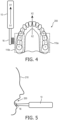
- FIG. 5 is a schematic representation of a side view of a user's head 210 and oral cavity 200.
- the device head 16 is positioned within a calibration area in the user's mouth, such as the lower right rear molar region.
- Oral care device 10 can only adopt a certain orientation when the device head 16 is properly positioned within the calibration area, as shown in FIG. 5 .
- the user's head will likely adopt a certain orientation when the device head 16 is properly positioned within the calibration area.
- oral care device 10 can comprise a second sensor (not shown) utilized to determine whether the device is located within a calibration area 110 of the user's oral cavity 200.
- a second sensor utilized to determine whether the device is located within a calibration area 110 of the user's oral cavity 200.
- the distance between the device handle 12 and the face of the user can be measured via proximity sensing to determine that the user is cleaning the molars and thus that the device is located within a calibration area 110.
- acoustic vibrations of the mouth could be used to determine whether the mouth is open or closed, thereby inferring knowledge about the region in which the device is located. Many other sensor configurations are possible.
- the device or system may comprise predetermined or learned information about where within the user's oral cavity 200 the oral care device 10 is generally first activated.
- the system may determine after several uses that the user always starts on the lower right outer quadrant.
- the device or system may utilize two or more of these approaches simultaneously or sequentially to further refine the localization of the oral care device 10 within the user's oral cavity 200, and, more specifically, whether that locale is a calibration area 110.
- prior knowledge about the likelihood of a typical starting position could be utilized together with an estimate obtained from sensor data to achieve higher confidence in the localization of the oral care device 10 within the user's oral cavity 200.
- the system may periodically update the orientation of the user's head using the orientation of device head 16 when it is located within calibration area 110. According, at step 332 of the method, the system receives information from the one or more sensors 28 about the orientation of the device head, and uses that information to update or regenerate an estimate of the orientation of the user's head.
- the user cleans an area of the oral cavity outside the calibration area 110, and the one or more sensors 28 of the device generates sensor data regarding motion and/or orientation of the device.
- Device 10 may comprise an inertial motion sensor 28 that generates sensor data regarding motion and/or orientation of the device.
- the sensor 28 sends the sensor data to controller 30, either automatically or in response to a query.
- the data can be generated and/or communicated continuously or periodically.
- a step 350 of the method the orientation of the device head with respect to the user's oral cavity is determined, based on the estimated orientation of the user's head from step 330 of the method, and on the motion data generated by the sensor at step 340 of the method.
- the system has estimated the orientation of the user's head in a previous step, and has received information about the motion of the device from the one or more sensors 28.
- the device can deduce and therefore track the orientation and/or location of the oral care device as the user moves it throughout the mouth, adopting new orientations and locations.
- the system or device provides feedback to the user regarding the determined orientation of the device head with respect to the user's oral cavity. This may be in substantially real-time, meaning as soon as the information is generated and available to the user.
- the feedback may comprise information about orientation of the device head, whether the orientation is proper or improper, cleaning time, coverage, cleaning efficacy, and/or other information.
- the feedback may comprise the amount of time spent cleaning specific segments in the user's mouth.
- the user could receive feedback about individual teeth within a region.
- the system can communicate information to the user about which regions were adequately cleaned and which regions were not adequately cleaned.
- the feedback may be provided via user feedback 40, and can be a display, report, or even a single value, among other types of feedback.
- the system or device provides feedback to the user regarding an entire cleaning session.
- the system collects information about motion and orientation of the device 10 during the cleaning session, and collates that information into feedback. This feedback can be similar to the feedback provided in real-time in step 360.
- the orientation of the user's head can be estimated by matching the relative orientation between the user's head and the device to the typical distribution over a full or partial cleaning session. In one embodiment, this could be performed by minimizing the distance between the measured cleaning angle histograms and a template histogram of cleaning angles.
- the typical distribution of the device's orientation with respect to the user's head can be learned, for example, from lab tests and could be represented as a probability distribution.
- the phrase "at least one,” in reference to a list of one or more elements, should be understood to mean at least one element selected from any one or more of the elements in the list of elements, but not necessarily including at least one of each and every element specifically listed within the list of elements and not excluding any combinations of elements in the list of elements.
- This definition also allows that elements may optionally be present other than the elements specifically identified within the list of elements to which the phrase "at least one" refers, whether related or unrelated to those elements specifically identified.
Landscapes
- Health & Medical Sciences (AREA)
- Life Sciences & Earth Sciences (AREA)
- Public Health (AREA)
- Epidemiology (AREA)
- Animal Behavior & Ethology (AREA)
- General Health & Medical Sciences (AREA)
- Dentistry (AREA)
- Veterinary Medicine (AREA)
- Biophysics (AREA)
- Engineering & Computer Science (AREA)
- Oral & Maxillofacial Surgery (AREA)
- Biomedical Technology (AREA)
- Water Supply & Treatment (AREA)
- Brushes (AREA)
- Dental Tools And Instruments Or Auxiliary Dental Instruments (AREA)
Claims (8)
- Procédé non thérapeutique (300) permettant de déterminer l'orientation de la tête d'un utilisateur à l'aide d'un dispositif de soins bucco-dentaires (10), le procédé comprenant les étapes de :fourniture (310) d'un dispositif de soins bucco-dentaires (10) comprenant une tête de dispositif (16), au moins un capteur (28) incluant un capteur de mouvement inertiel, et un dispositif de commande (30) couplé pour recevoir des données de capteur provenant du au moins un capteur (28) ;détermination (320) du moment où la tête de dispositif (16) se situe dans une zone d'étalonnage (110) à l'intérieur de la cavité buccale (200) de l'utilisateur, la zone d'étalonnage (110) étant une zone à l'intérieur de la cavité buccale (200) de l'utilisateur dans laquelle il existe une contrainte physique entre le dispositif de soins bucco-dentaires (10) et la tête de l'utilisateur ; etestimation (330), par le dispositif de commande, sur la base d'une orientation de la tête de dispositif (16) dans la zone d'étalonnage (110), d'une orientation de la tête de l'utilisateur.
- Procédé selon la revendication 1, comprenant en outre l'étape de réception (340) de données provenant du au moins un capteur (28) concernant le mouvement du dispositif de soins bucco-dentaires (10) dans une zone en dehors de la zone d'étalonnage (110).
- Procédé selon la revendication 2, comprenant en outre l'étape de détermination (350), sur la base de l'orientation estimée de la tête de l'utilisateur et des données de mouvement générées par le au moins un capteur (28), d'une orientation de la tête de dispositif (16) par rapport à la cavité buccale (200) de l'utilisateur pour une zone en dehors de la zone d'étalonnage (110).
- Procédé selon la revendication 1, comprenant en outre l'étape de fourniture (360) d'un retour d'information à l'utilisateur concernant l'orientation déterminée et/ou l'emplacement de la tête de dispositif (16) par rapport à la cavité buccale (200) de l'utilisateur.
- Procédé selon la revendication 1, dans lequel l'étape de détermination du moment où la tête de dispositif (16) est située dans une zone d'étalonnage (110) dans la cavité buccale (200) de l'utilisateur comprend des données provenant d'un second capteur.
- Procédé selon la revendication 1, comprenant en outre l'étape de génération (370), sur la base d'une pluralité d'estimations de l'orientation de la tête de dispositif (16) par rapport à la cavité buccale (200) de l'utilisateur, d'un retour d'information pour une session de nettoyage.
- Procédé selon la revendication 6, comprenant en outre l'étape de communication (380) du retour d'information généré.
- Dispositif de soins bucco-dentaires (10) configuré pour déterminer une orientation de la tête d'un utilisateur, le dispositif de soins bucco-dentaires comprenant :une tête de dispositif (16) ;un ou plusieurs capteurs (28) incluant un capteur de mouvement inertiel ; etun dispositif de commande (30) couplé pour recevoir des données de capteur provenant des un ou plusieurs capteurs (28) et configuré pour estimer, sur la base d'une orientation de la tête de dispositif dans la zone d'étalonnage, une orientation de la tête de l'utilisateur au moyen d'un procédé selon l'une quelconque des revendications précédentes.
Applications Claiming Priority (2)
| Application Number | Priority Date | Filing Date | Title |
|---|---|---|---|
| US201662428701P | 2016-12-01 | 2016-12-01 | |
| PCT/EP2017/081086 WO2018100121A1 (fr) | 2016-12-01 | 2017-11-30 | Procédé de détermination de l'orientation de la tête d'un utilisateur lors du nettoyage des dents |
Publications (3)
| Publication Number | Publication Date |
|---|---|
| EP3547874A1 EP3547874A1 (fr) | 2019-10-09 |
| EP3547874B1 true EP3547874B1 (fr) | 2025-04-09 |
| EP3547874C0 EP3547874C0 (fr) | 2025-04-09 |
Family
ID=60702659
Family Applications (1)
| Application Number | Title | Priority Date | Filing Date |
|---|---|---|---|
| EP17816590.8A Active EP3547874B1 (fr) | 2016-12-01 | 2017-11-30 | Procede pour determiner l'orientation de la tete d' un utilisateur pendant le nettoyage des dents |
Country Status (7)
| Country | Link |
|---|---|
| US (1) | US20200022488A1 (fr) |
| EP (1) | EP3547874B1 (fr) |
| JP (1) | JP7454376B2 (fr) |
| KR (1) | KR20190089950A (fr) |
| CN (2) | CN110139582A (fr) |
| RU (1) | RU2759877C2 (fr) |
| WO (1) | WO2018100121A1 (fr) |
Families Citing this family (11)
| Publication number | Priority date | Publication date | Assignee | Title |
|---|---|---|---|---|
| DE102019120648B4 (de) | 2018-08-02 | 2026-02-12 | Ranir, Llc | Drucksensorsystem und Verfahren für eine elektrische Zahnbürste |
| EP3970663A1 (fr) | 2020-09-21 | 2022-03-23 | Koninklijke Philips N.V. | Dispositif de soin buccal comportant une fonctionnalité de détection |
| CN116583205A (zh) | 2020-10-28 | 2023-08-11 | 皇家飞利浦有限公司 | 用于确定口腔护理装置的位置和取向的系统与方法 |
| EP4247220A1 (fr) * | 2020-11-19 | 2023-09-27 | Koninklijke Philips N.V. | Détection d'usure pour système d'hygiène buccale |
| CN114299576B (zh) * | 2021-12-24 | 2024-08-27 | 广州星际悦动股份有限公司 | 口腔清洁区域识别方法、刷牙信息录入系统及相关装置 |
| EP4536134B1 (fr) * | 2022-06-10 | 2026-03-18 | Koninklijke Philips N.V. | Système de détermination d'ouverture de bouche |
| EP4289394A1 (fr) * | 2022-06-10 | 2023-12-13 | Koninklijke Philips N.V. | Détermination d'ouverture de bouche |
| CN121358377A (zh) * | 2023-06-12 | 2026-01-16 | 皇家飞利浦有限公司 | 估计牙刷用户的头部倾斜角度 |
| EP4477109A1 (fr) * | 2023-06-12 | 2024-12-18 | Koninklijke Philips N.V. | Estimation de l'angle d'inclinaison de la tête d'un utilisateur de brosse à dents |
| WO2024256179A1 (fr) * | 2023-06-12 | 2024-12-19 | Koninklijke Philips N.V. | Estimation de l'angle d'inclinaison de la tête de l'utilisateur d'une brosse à dents |
| EP4477110A1 (fr) * | 2023-06-12 | 2024-12-18 | Koninklijke Philips N.V. | Estimation de l'angle d'inclinaison de la tête d'un utilisateur de brosse à dents |
Family Cites Families (13)
| Publication number | Priority date | Publication date | Assignee | Title |
|---|---|---|---|---|
| DE10337062A1 (de) * | 2003-08-12 | 2005-03-03 | Trisa Holding Ag | Zahnbürste mit Zahnbürstenkörper und Zahnpastabehälter |
| US20080109973A1 (en) * | 2006-11-15 | 2008-05-15 | Farrell Mark E | Personal care products and methods |
| KR101564459B1 (ko) * | 2008-02-27 | 2015-10-30 | 코닌클리케 필립스 엔.브이. | 칫솔에 대한 덴탈 위치 추적 시스템 |
| JP5251265B2 (ja) * | 2008-06-02 | 2013-07-31 | オムロンヘルスケア株式会社 | 電動歯ブラシ |
| CN102711555B (zh) * | 2009-12-17 | 2015-03-25 | 荷兰联合利华有限公司 | 牙刷跟踪系统 |
| RU2552992C2 (ru) * | 2009-12-23 | 2015-06-10 | Конинклейке Филипс Электроникс Н.В. | Зубная щетка с отслеживанием положения |
| JP5796408B2 (ja) * | 2011-08-24 | 2015-10-21 | オムロンヘルスケア株式会社 | 口腔ケア装置 |
| US10172443B2 (en) * | 2013-08-11 | 2019-01-08 | Yong-Jing Wang | Oral care tools and systems |
| EP3086689B1 (fr) * | 2013-12-24 | 2017-09-20 | Braun GmbH | Détection de position d'un accessoire de soin buccal |
| EP2896319B1 (fr) * | 2014-01-21 | 2018-04-18 | Braun GmbH | Brosse à dents électrique ou rasoir électrique |
| CN105982756B (zh) * | 2015-02-06 | 2018-03-27 | 北京希澈科技有限公司 | 牙齿保健系统及其操作方法 |
| CN105029891B (zh) * | 2015-08-19 | 2017-08-29 | 秦立新 | 刷牙动作检测校正方法及系统、牙刷、远程控制装置 |
| CN105466422A (zh) * | 2015-12-02 | 2016-04-06 | 爱芽(北京)科技有限公司 | 一种检测牙刷在口腔内部位置变动算法 |
-
2017
- 2017-11-30 RU RU2019120394A patent/RU2759877C2/ru active
- 2017-11-30 JP JP2019528828A patent/JP7454376B2/ja active Active
- 2017-11-30 KR KR1020197018778A patent/KR20190089950A/ko not_active Ceased
- 2017-11-30 US US16/465,802 patent/US20200022488A1/en not_active Abandoned
- 2017-11-30 WO PCT/EP2017/081086 patent/WO2018100121A1/fr not_active Ceased
- 2017-11-30 EP EP17816590.8A patent/EP3547874B1/fr active Active
- 2017-11-30 CN CN201780074534.0A patent/CN110139582A/zh active Pending
- 2017-11-30 CN CN202311419183.6A patent/CN117224262A/zh active Pending
Also Published As
| Publication number | Publication date |
|---|---|
| RU2759877C2 (ru) | 2021-11-18 |
| JP7454376B2 (ja) | 2024-03-22 |
| EP3547874A1 (fr) | 2019-10-09 |
| RU2019120394A3 (fr) | 2021-04-19 |
| WO2018100121A1 (fr) | 2018-06-07 |
| US20200022488A1 (en) | 2020-01-23 |
| JP2019536560A (ja) | 2019-12-19 |
| RU2019120394A (ru) | 2021-01-11 |
| CN110139582A (zh) | 2019-08-16 |
| EP3547874C0 (fr) | 2025-04-09 |
| KR20190089950A (ko) | 2019-07-31 |
| CN117224262A (zh) | 2023-12-15 |
Similar Documents
| Publication | Publication Date | Title |
|---|---|---|
| EP3547874B1 (fr) | Procede pour determiner l'orientation de la tete d' un utilisateur pendant le nettoyage des dents | |
| US11006742B2 (en) | Method and system for a achieving optimal oral hygiene by means of feedback | |
| RU2738074C2 (ru) | Система гигиены ротовой полости с визуальным распознаванием для контроля соблюдения правил чистки зубов | |
| US11039907B2 (en) | Methods and systems for providing brushing session feedback | |
| CN110213980A (zh) | 用于依从性监测的口腔卫生系统及远程-牙科系统 | |
| US20200069042A1 (en) | Method and system for localization of an oral cleaning device | |
| US12575665B2 (en) | Systems and methods for determining location and orientation of an oral care device | |
| CN108135682A (zh) | 具有用于口腔卫生监测的磁力仪的牙刷系统 | |
| EP3537928B1 (fr) | Dispositif de nettoyage buccal de détermination de conformité à une séance de nettoyage guidée | |
| CN110049743B (zh) | 用于校准口腔清洁设备的方法及系统 | |
| WO2024133385A1 (fr) | Dispositif, procédé et système de rétroaction instantanée de soins buccaux | |
| EP4389065A1 (fr) | Dispositif, procédé et système de rétroaction instantanée de soins buccaux | |
| HK40000334A (en) | Oral hygiene system with visual recognition for compliance monitoring | |
| HK40014638A (en) | Oral hygiene system for compliance monitoring and tele-dentistry system |
Legal Events
| Date | Code | Title | Description |
|---|---|---|---|
| STAA | Information on the status of an ep patent application or granted ep patent |
Free format text: STATUS: UNKNOWN |
|
| STAA | Information on the status of an ep patent application or granted ep patent |
Free format text: STATUS: THE INTERNATIONAL PUBLICATION HAS BEEN MADE |
|
| PUAI | Public reference made under article 153(3) epc to a published international application that has entered the european phase |
Free format text: ORIGINAL CODE: 0009012 |
|
| STAA | Information on the status of an ep patent application or granted ep patent |
Free format text: STATUS: REQUEST FOR EXAMINATION WAS MADE |
|
| 17P | Request for examination filed |
Effective date: 20190701 |
|
| AK | Designated contracting states |
Kind code of ref document: A1 Designated state(s): AL AT BE BG CH CY CZ DE DK EE ES FI FR GB GR HR HU IE IS IT LI LT LU LV MC MK MT NL NO PL PT RO RS SE SI SK SM TR |
|
| AX | Request for extension of the european patent |
Extension state: BA ME |
|
| DAV | Request for validation of the european patent (deleted) | ||
| DAX | Request for extension of the european patent (deleted) | ||
| RAP1 | Party data changed (applicant data changed or rights of an application transferred) |
Owner name: KONINKLIJKE PHILIPS N.V. |
|
| STAA | Information on the status of an ep patent application or granted ep patent |
Free format text: STATUS: EXAMINATION IS IN PROGRESS |
|
| 17Q | First examination report despatched |
Effective date: 20220208 |
|
| GRAP | Despatch of communication of intention to grant a patent |
Free format text: ORIGINAL CODE: EPIDOSNIGR1 |
|
| STAA | Information on the status of an ep patent application or granted ep patent |
Free format text: STATUS: GRANT OF PATENT IS INTENDED |
|
| INTG | Intention to grant announced |
Effective date: 20241104 |
|
| GRAS | Grant fee paid |
Free format text: ORIGINAL CODE: EPIDOSNIGR3 |
|
| GRAA | (expected) grant |
Free format text: ORIGINAL CODE: 0009210 |
|
| STAA | Information on the status of an ep patent application or granted ep patent |
Free format text: STATUS: THE PATENT HAS BEEN GRANTED |
|
| AK | Designated contracting states |
Kind code of ref document: B1 Designated state(s): AL AT BE BG CH CY CZ DE DK EE ES FI FR GB GR HR HU IE IS IT LI LT LU LV MC MK MT NL NO PL PT RO RS SE SI SK SM TR |
|
| REG | Reference to a national code |
Ref country code: GB Ref legal event code: FG4D |
|
| REG | Reference to a national code |
Ref country code: CH Ref legal event code: EP |
|
| REG | Reference to a national code |
Ref country code: IE Ref legal event code: FG4D |
|
| U01 | Request for unitary effect filed |
Effective date: 20250409 |
|
| U07 | Unitary effect registered |
Designated state(s): AT BE BG DE DK EE FI FR IT LT LU LV MT NL PT RO SE SI Effective date: 20250415 |
|
| PG25 | Lapsed in a contracting state [announced via postgrant information from national office to epo] |
Ref country code: ES Free format text: LAPSE BECAUSE OF FAILURE TO SUBMIT A TRANSLATION OF THE DESCRIPTION OR TO PAY THE FEE WITHIN THE PRESCRIBED TIME-LIMIT Effective date: 20250409 |
|
| PG25 | Lapsed in a contracting state [announced via postgrant information from national office to epo] |
Ref country code: GR Free format text: LAPSE BECAUSE OF FAILURE TO SUBMIT A TRANSLATION OF THE DESCRIPTION OR TO PAY THE FEE WITHIN THE PRESCRIBED TIME-LIMIT Effective date: 20250710 Ref country code: NO Free format text: LAPSE BECAUSE OF FAILURE TO SUBMIT A TRANSLATION OF THE DESCRIPTION OR TO PAY THE FEE WITHIN THE PRESCRIBED TIME-LIMIT Effective date: 20250709 |
|
| PG25 | Lapsed in a contracting state [announced via postgrant information from national office to epo] |
Ref country code: PL Free format text: LAPSE BECAUSE OF FAILURE TO SUBMIT A TRANSLATION OF THE DESCRIPTION OR TO PAY THE FEE WITHIN THE PRESCRIBED TIME-LIMIT Effective date: 20250409 |
|
| PG25 | Lapsed in a contracting state [announced via postgrant information from national office to epo] |
Ref country code: HR Free format text: LAPSE BECAUSE OF FAILURE TO SUBMIT A TRANSLATION OF THE DESCRIPTION OR TO PAY THE FEE WITHIN THE PRESCRIBED TIME-LIMIT Effective date: 20250409 |
|
| PG25 | Lapsed in a contracting state [announced via postgrant information from national office to epo] |
Ref country code: RS Free format text: LAPSE BECAUSE OF FAILURE TO SUBMIT A TRANSLATION OF THE DESCRIPTION OR TO PAY THE FEE WITHIN THE PRESCRIBED TIME-LIMIT Effective date: 20250709 |
|
| PG25 | Lapsed in a contracting state [announced via postgrant information from national office to epo] |
Ref country code: IS Free format text: LAPSE BECAUSE OF FAILURE TO SUBMIT A TRANSLATION OF THE DESCRIPTION OR TO PAY THE FEE WITHIN THE PRESCRIBED TIME-LIMIT Effective date: 20250809 |
|
| U20 | Renewal fee for the european patent with unitary effect paid |
Year of fee payment: 9 Effective date: 20251201 |
|
| PG25 | Lapsed in a contracting state [announced via postgrant information from national office to epo] |
Ref country code: SM Free format text: LAPSE BECAUSE OF FAILURE TO SUBMIT A TRANSLATION OF THE DESCRIPTION OR TO PAY THE FEE WITHIN THE PRESCRIBED TIME-LIMIT Effective date: 20250409 |
|
| PG25 | Lapsed in a contracting state [announced via postgrant information from national office to epo] |
Ref country code: CZ Free format text: LAPSE BECAUSE OF FAILURE TO SUBMIT A TRANSLATION OF THE DESCRIPTION OR TO PAY THE FEE WITHIN THE PRESCRIBED TIME-LIMIT Effective date: 20250409 |
|
| PG25 | Lapsed in a contracting state [announced via postgrant information from national office to epo] |
Ref country code: SK Free format text: LAPSE BECAUSE OF FAILURE TO SUBMIT A TRANSLATION OF THE DESCRIPTION OR TO PAY THE FEE WITHIN THE PRESCRIBED TIME-LIMIT Effective date: 20250409 |
|
| PLBE | No opposition filed within time limit |
Free format text: ORIGINAL CODE: 0009261 |
|
| STAA | Information on the status of an ep patent application or granted ep patent |
Free format text: STATUS: NO OPPOSITION FILED WITHIN TIME LIMIT |
|
| REG | Reference to a national code |
Ref country code: CH Ref legal event code: L10 Free format text: ST27 STATUS EVENT CODE: U-0-0-L10-L00 (AS PROVIDED BY THE NATIONAL OFFICE) Effective date: 20260218 |
|
| 26N | No opposition filed |
Effective date: 20260112 |