EP3548895B1 - Preparation d'echantillons microbiens vivants et de microorganismes pour effectuer ensuite une mesure et une evaluation par spectrometrie de masse - Google Patents
Preparation d'echantillons microbiens vivants et de microorganismes pour effectuer ensuite une mesure et une evaluation par spectrometrie de masse Download PDFInfo
- Publication number
- EP3548895B1 EP3548895B1 EP16822599.3A EP16822599A EP3548895B1 EP 3548895 B1 EP3548895 B1 EP 3548895B1 EP 16822599 A EP16822599 A EP 16822599A EP 3548895 B1 EP3548895 B1 EP 3548895B1
- Authority
- EP
- European Patent Office
- Prior art keywords
- sample
- microorganisms
- microbial
- mass
- nutrient medium
- Prior art date
- Legal status (The legal status is an assumption and is not a legal conclusion. Google has not performed a legal analysis and makes no representation as to the accuracy of the status listed.)
- Active
Links
Images




Classifications
-
- G—PHYSICS
- G01—MEASURING; TESTING
- G01N—INVESTIGATING OR ANALYSING MATERIALS BY DETERMINING THEIR CHEMICAL OR PHYSICAL PROPERTIES
- G01N33/00—Investigating or analysing materials by specific methods not covered by groups G01N1/00 - G01N31/00
- G01N33/48—Biological material, e.g. blood, urine; Haemocytometers
- G01N33/50—Chemical analysis of biological material, e.g. blood, urine; Testing involving biospecific ligand binding methods; Immunological testing
- G01N33/68—Chemical analysis of biological material, e.g. blood, urine; Testing involving biospecific ligand binding methods; Immunological testing involving proteins, peptides or amino acids
- G01N33/6803—General methods of protein analysis not limited to specific proteins or families of proteins
- G01N33/6848—Methods of protein analysis involving mass spectrometry
-
- C—CHEMISTRY; METALLURGY
- C12—BIOCHEMISTRY; BEER; SPIRITS; WINE; VINEGAR; MICROBIOLOGY; ENZYMOLOGY; MUTATION OR GENETIC ENGINEERING
- C12Q—MEASURING OR TESTING PROCESSES INVOLVING ENZYMES, NUCLEIC ACIDS OR MICROORGANISMS; COMPOSITIONS OR TEST PAPERS THEREFOR; PROCESSES OF PREPARING SUCH COMPOSITIONS; CONDITION-RESPONSIVE CONTROL IN MICROBIOLOGICAL OR ENZYMOLOGICAL PROCESSES
- C12Q1/00—Measuring or testing processes involving enzymes, nucleic acids or microorganisms; Compositions therefor; Processes of preparing such compositions
- C12Q1/02—Measuring or testing processes involving enzymes, nucleic acids or microorganisms; Compositions therefor; Processes of preparing such compositions involving viable microorganisms
- C12Q1/18—Testing for antimicrobial activity of a material
-
- G—PHYSICS
- G01—MEASURING; TESTING
- G01N—INVESTIGATING OR ANALYSING MATERIALS BY DETERMINING THEIR CHEMICAL OR PHYSICAL PROPERTIES
- G01N33/00—Investigating or analysing materials by specific methods not covered by groups G01N1/00 - G01N31/00
- G01N33/48—Biological material, e.g. blood, urine; Haemocytometers
- G01N33/50—Chemical analysis of biological material, e.g. blood, urine; Testing involving biospecific ligand binding methods; Immunological testing
- G01N33/68—Chemical analysis of biological material, e.g. blood, urine; Testing involving biospecific ligand binding methods; Immunological testing involving proteins, peptides or amino acids
- G01N33/6803—General methods of protein analysis not limited to specific proteins or families of proteins
- G01N33/6848—Methods of protein analysis involving mass spectrometry
- G01N33/6851—Methods of protein analysis involving laser desorption ionisation mass spectrometry
-
- G—PHYSICS
- G01—MEASURING; TESTING
- G01N—INVESTIGATING OR ANALYSING MATERIALS BY DETERMINING THEIR CHEMICAL OR PHYSICAL PROPERTIES
- G01N2560/00—Chemical aspects of mass spectrometric analysis of biological material
-
- G—PHYSICS
- G01—MEASURING; TESTING
- G01N—INVESTIGATING OR ANALYSING MATERIALS BY DETERMINING THEIR CHEMICAL OR PHYSICAL PROPERTIES
- G01N2800/00—Detection or diagnosis of diseases
- G01N2800/44—Multiple drug resistance
Definitions
- the invention relates to methods for preparing living microbial samples and microorganisms for subsequent mass spectrometric measurement and evaluation. Findings that can be derived from such a measurement can be used in particular for the accelerated identification of microorganisms in the microbial sample according to type/subspecies and/or the rapid determination of resistance/sensitivity of the microorganisms to antimicrobial substances and/or the further characterization of microorganisms; for example with regard to pathogenicity, virulence and metabolism. According to a preferred embodiment of the invention, the preparation takes place in particular directly on a mass spectrometric sample carrier.
- antimicrobial agents initially administered as part of a so-called “empirical” or “calculated” therapy usually do not cover multi-resistant pathogens in their activity spectrum, it is crucial for the success of the treatment to detect resistance at an early stage. Rapid detection of resistant microorganisms enables timely switching to antimicrobial substances effective against these pathogens. These are referred to below as antibiotics; This does not only mean substances that are effective against bacteria, but also agents that act against fungi and other microorganisms. Such an early switch to correct antimicrobial therapy can be crucial for the success of the treatment.
- Phenotypic resistance means that the microorganism grows despite the presence of an antibiotic. In phenotypic antibiotic sensitivity, growth is inhibited in the presence of the tested antibiotic, provided that it has been applied in sufficient concentration. Phenotypic sensitivity testing is the gold standard, partly because the test results are generated independently of the underlying resistance mechanisms. Molecularly, certain resistance genes can be detected within a short period of time, for example by polymerase chain reaction (PCR). However, this detection is only possible for a selection of resistance mechanisms; the other resistance mechanisms are not detected.
- PCR polymerase chain reaction
- the patent publication US 2015/0086971 A1 discloses methods and apparatus for locating and selecting a colony of microorganisms on a culture dish and identifying microorganisms in the selected colony using MALDI. Included are the automated steps of locating and selecting a colony of microorganisms on a culture dish; obtaining a sample of the selected colony of microorganisms; applying at least a portion of the sample of the selected colony of microorganisms to a target plate; and transferring the target plate with the sample to an apparatus for performing MALDI to identify the sample of the selected colony of microorganisms.
- the patent publication WO 2016/016580 A1 relates to a method for preparing a surface on an analysis plate for carrying out at least one characterisation of a population of at least one microorganism in the presence of at least one antimicrobial agent by mass spectrometry according to the matrix-assisted laser desorption/ionisation mass spectrometry technique known as MALDI.
- It comprises the following successive steps: - a step consisting in using an analysis plate intended for characterisation by the MALDI technique and containing at least one analysis zone containing an antimicrobial agent; - a step consisting in depositing the population of at least one microorganism on the analysis zone in contact with the antimicrobial agent; - an incubation step consisting in keeping the analysis plate for a sufficient period of time and under conditions sufficient to allow interaction of the antimicrobial agent with the microorganism present; and - a step consisting in depositing on the analysis zone a matrix suitable for the MALDI technique.
- the patent publication WO 2012/023845 A1 relates to a method for characterizing the antibiotic resistance of a microorganism, the method comprising the steps of: (a) providing a reference mass spectrum of an antimicrobial compound, its enzymatic modification product, its molecular target, or a substrate compound of its modifying enzyme; (b) exposing a microorganism, a cell lysate thereof, or a growth medium supernatant thereof to the antimicrobial compound or the substrate compound in aqueous liquid to thereby provide an exposed sample; (c) acquiring a mass spectrum of the exposed sample; (d) comparing the mass spectrum acquired in step (c) with the reference mass spectrum from step (a), and (e) determining from the comparison whether modification of the antimicrobial compound, its modification product, or its molecular target or the substrate has occurred after exposure, and determining that the microorganism is potentially resistant to the antimicrobial compound if the modification is observed.
- the methods described here represent an alternative method for a very fast and simple MS-based microbial measurement; for example, with regard to the identification of species/subspecies and/or resistance/susceptibility testing and/or further pathogen characterization.
- the disclosure relates in particular to the method of sample processing/sample preparation as well as to algorithms for data evaluation.
- the present disclosure relates to a method for preparing living microbial samples for subsequent mass spectrometric Measurement comprising the following steps: (a) providing a flat sample carrier comprising a plurality of sample spots (so-called "spots"); (b) applying at least one living microbial sample in a nutrient medium drop to at least one of the sample spots; (c) placing the sample carrier in an incubation chamber with a defined atmosphere for a predetermined period of time to stimulate microorganism growth; (d) removing residual liquid from the nutrient medium drop after the predetermined period of time to expose a microorganism deposit on the sample spot; (e) preparing the sample spot for desorbing ionization; (f) transferring the sample carrier to a desorption ion source of a mass spectrometer, generating ions from the prepared sample spot and recording at least one associated mass spectrum; and (g) comparing the recorded mass spectrum with a reference data set to determine at least one property of the microbial
- the first preferred aspect of the disclosure is based in particular on the new and surprising finding that a flat mass spectrometric sample carrier, which serves as a substrate for the ionization of the prepared samples in a suitable ion source, can already function as a substrate for growth-promoting incubation of microorganisms in a preceding step.
- This dual function greatly simplifies the workflow in the laboratory and shortens the time required for the diagnostic work process because cumbersome and error-prone manual sample transfer steps can be avoided and separate processing vessels such as microtitration plates become superfluous.
- This procedural simplification can help to establish the rapid, reliable and extensively validated mass spectrometric measurement of microorganisms in clinical diagnostics.
- the reference data set may be composed of mass signals contained in the mass spectrum recorded in step (f) that are not originally from microorganisms.
- Examples include mass signals from one (or more) reference substances added during preparation of the microbial sample (internal standard), which can be used for quantification purposes.
- the same microbial sample is applied to several sample spots in parallel in step (b), with the nutrient medium drops sometimes containing an antimicrobial substance and sometimes not.
- a mass spectrometric sample carrier is particularly well suited for extensive resistance/sensitivity testing because it offers enough space to simultaneously monitor the growth of microorganisms in the presence of different antimicrobial substances (or to the same antimicrobial substance at different concentrations). The question of whether a microorganism reacts sensitively to a certain antimicrobial substance (or at what concentration it does so), which would indicate its effectiveness as a drug, for example, can therefore be clarified very quickly and reliably.
- the reference data set can be a mass spectrum recorded promptly of a sample spot to which a nutrient medium drop without antimicrobial substance or enzyme inhibitor was applied in step (b); and the at least one property from step (g) can, as part of a characterization, include a resistance/sensitivity of microorganisms in the microbial sample to the antimicrobial substance or a combination of antimicrobial substance and enzyme inhibitor.
- the minimum inhibitory concentration of an antibiotic with respect to the microorganisms can be determined by applying several nutrient medium drops, each with different concentrations of the antimicrobial substance (and/or optionally the inhibitor), in step (b) and assessing the degree of effectiveness along a series of increasing or decreasing concentrations.
- the reference data set may be a mass spectrum of a sample spot on a second sample carrier, wherein the microorganisms for the The mass spectrum used in the reference data set was incubated for a shorter period of time, possibly even without incubation at all.
- the microbial sample is preferably applied to the sample spot in a drop of nutrient medium without antimicrobial substance or without a combination of antimicrobial substance and enzyme inhibitor.
- the amounts of microbial cells initially applied to the sample spots for the mass spectra of the microbial sample and the reference data set are preferably the same.
- the at least one property in step (g) is derived from a difference in microorganism growth, which is reflected in the form or intensity of the microorganism-specific mass signal signature in the recorded mass spectrum; depending on whether growth inhibition by an antimicrobial substance alone or in combination with an enzyme inhibitor could be found or not.
- microorganism growth can be assessed on the basis of a successful identification of the species, provided that the amount of microorganisms in the microbial sample measured before incubation is not sufficient for a reliable identification.
- An example of a well-known identification method is the MALDI Biotyper ® algorithm, which confirms a reasonably reliable identification of a species of microorganism if the calculated similarity index (so-called "log(score)") is greater than or equal to 1.7. A high degree of reliability is achieved with similarity indexes greater than or equal to 2.0.
- the microbial sample in step (b) in the nutrient medium drop can be measured in such a way that an amount is slightly below the detection limit of the mass spectrometric measurement.
- the period of time that the sample carrier has to spend in the incubation chamber in order to stimulate microorganism growth can be reduced to a minimum. This is because growth that reaches or slightly exceeds the detection limit can be interpreted as an indication of the presence or a characteristic of the microorganism, compared to a measurement that contains no meaningful data other than background signals.
- the temperature and humidity in the incubation chamber in step (c) can be set to about 36°C (possibly necessary or even required for incubation or sensitivity testing) or close to saturation in order to create the best possible or required growth conditions for the microorganisms to be examined.
- the general aim should be to create conditions in the incubation chamber that allow growth differences to become most apparent.
- the temperature of 36°C corresponds approximately to the human body temperature and is suitable for those microorganisms that have specialized in humans as a host. In the veterinary, food or However, in environmental diagnostics, for example, other temperatures can be recognized as most suitable, depending on which host or environmental environment is preferred by the microorganism.
- the removal of residual liquid can include dabbing off a droplet supernatant, for example using an absorbent material, or pipetting.
- a droplet supernatant for example using an absorbent material, or pipetting.
- the preparation in step (e) can comprise a preparatory extraction of microbial proteins/peptides from the microorganism deposit and/or washing of the microorganism deposit and/or embedding of the microorganism deposit in a laser light-absorbing matrix substance for subsequent ionization by matrix-assisted laser desorption (MALDI).
- MALDI matrix-assisted laser desorption
- the number of microorganism-specific mass signals in the recorded mass spectrum can be increased and thus the significance of the measurement can be improved; in particular if identification according to the type/subspecies of the microorganism being examined is sought.
- One or more washing steps are particularly suitable for removing almost ubiquitous salts from the microorganism deposit, which can otherwise impair the ionization efficiency.
- the preparation process can be further optimized in this way.
- matrix substances are 2,5-dihydroxybenzoic acid, sinapic acid or ⁇ -cyano-4-hydroxycinnamic acid.
- the MALDI method has proven to be a very important and reliable tool in the ion-based investigation of microorganisms. At the same time, it allows pulsed ion generation, which is well suited for time-of-flight dispersive recording of mass spectra.
- step (e) can also involve only a short waiting time of, for example, a few minutes without further treatment of the microorganism deposit.
- the mass spectra in step (f) are recorded using time-of-flight dispersive methods.
- Time-of-flight mass spectrometers can currently be considered the "gold standard" in both clinical and non-clinical microorganism testing due to their high resolution, fast measurement time and broad mass acceptance.
- Examples of mass spectrometers that work according to the time-of-flight principle include those in the commercially available microflex ® series from Bruker Daltonik GmbH.
- the microbial sample in step (b) can be (i) dispensed as a suspension in the nutrient medium drop on the at least one sample spot or (ii) first deposited in cell form on the at least one sample spot and then immersed in a dispensed nutrient medium drop.
- the antimicrobial substances can also be applied to the sample spot either together with the microbial sample and/or the nutrient medium or separately from them. In principle, it is also conceivable to reverse the order of depositing and dispensing so that a drop is dispensed first, into which the microbial sample is then introduced.
- a method for preparing microorganisms for subsequent mass spectrometric measurement comprising the following steps: (a) providing a flat sample carrier comprising a plurality of sample spots; for example an MSP 48/96 target polished steel BC from Bruker Daltonik GmbH; (b) applying intact microorganisms grown and/or separated away from the sample carrier in a nutrient medium drop to at least one of the sample spots of the flat sample carrier; preferably using a nano- or micropipette; the amount of drops transferred can be between 1 and 10 microliters; (c) keeping the flat sample carrier for a predetermined standing time to allow a microorganism deposit to form on the sample spot; preferably about 10 to 60 minutes; (d) removing residual liquid from the culture medium drop after the predetermined standing time to expose the microorganism deposit; (e) preparing the sample spot for desorbing ionization; preferably with MALDI matrix substance; (f)
- the microorganisms can be cultured in a liquid nutrient medium in at least one vessel away from the flat sample carrier before application in step (b) and transferred from there to the sample spot; preferably, the culture in a conditioned/temperature-controlled incubator takes about 4 to 24 hours.
- the culture is particularly useful for sensitivity testing of the microorganisms - preferably in the presence and absence of an antibiotic, as described above.
- culture is not absolutely necessary and therefore does not need to be part of the protected method.
- An existing suspension of microorganisms can be use; for example, one that has been created as a result of other work steps in the laboratory.
- the same microorganisms can be grown in several (external) vessels, and an antimicrobial substance can be added to the liquid nutrient medium at different times and not at different times.
- an enzyme inhibitor can be added to the liquid nutrient medium in different vessels with added antimicrobial substance at different times and not at different times.
- One example is a ⁇ -lactamase inhibitor.
- the reference data set can be a mass spectrum recorded in real time of a sample spot on which there is a deposit of microorganisms that originated from a liquid nutrient medium without an antimicrobial substance or enzyme inhibitor
- the at least one property from step (g) can, as part of a characterization, include a sensitivity of the microorganisms to the antimicrobial substance or a combination of antimicrobial substance and enzyme inhibitor.
- the same microorganisms can be grown in different (external) vessels with liquid nutrient medium at different concentrations, and the at least one property from step (g) can, as part of a characterization, include a minimum inhibitory concentration of the antimicrobial substance with respect to the microorganisms.
- the at least one property in step (g) is derived from a difference in microorganism growth, which may, for example, manifest itself in a difference between reliable and failed identification with the MALDI Biotyper ® algorithm.
- the removal of residual liquid from the flat sample carrier in step (d) may comprise dabbing off a supernatant drop using an absorbent material or pipetting.
- illustration 1 shows schematically an embodiment of a mass spectrometer 10 with a linear-axial flight path 2, which ends at a detector 4, and an upstream ion source 6 for matrix-assisted laser desorption (MALDI), as is frequently used in a mass spectrometric investigation of microbial cells.
- MALDI matrix-assisted laser desorption
- the preparation of a living microbial sample directly on a mass spectrometric sample carrier can be used solely for the cultivation of microorganisms in order to generate a sufficient number of microorganisms on the sample spots for mass spectrometric detection.
- the nutrient medium drop in which the living microbial cells are suspended or immersed functions as a breeding reactor in this simple but nevertheless surprisingly efficient embodiment.
- the humidity in the incubation chamber 16 can be adjusted using sodium chloride solution, for example.
- the microorganisms can multiply by metabolizing the nutrient medium in the drop 14.
- the multiplication can be seen in that the initially clear nutrient medium in the drop 14 becomes cloudy after a few hours (not shown).
- the clouding is not a mandatory requirement for microorganism growth that can be detected by mass spectrometry.
- it can serve as a visual process control mark if the incubation times are sufficiently long.
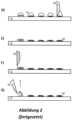
- Figure 2B The inventors have surprisingly observed that at the same time the increased microorganisms settle in sufficient quantities at the interface between the drop 14 and the carrier surface, which greatly facilitates the subsequent liquid depletion (dehumidification) or drying.
- Figure 2C The inventors have surprisingly observed that at the same time the increased microorganisms settle in sufficient quantities at the interface between the drop 14 and the carrier surface, which greatly facilitates the subsequent liquid depletion (dehumidification) or drying.
- the present disclosure also provides methods and test kits for processing the microbial samples for resistance/susceptibility testing, as explained below.
- the antibiotic for example an antibiotic solution in a liquid nutrient medium
- a microorganism suspension can be mixed with a microorganism suspension either in a culture vessel or directly on a spot of a MALDI-TOF MS carrier 12 (hatched drop 14*).
- a growth control is usually carried out on another area of the MALDI-TOF MS carrier, ie a cultivation of the microorganism suspension in a nutrient medium without the addition of an antibiotic (unhatched drop 14).
- a very small amount of the suspension is applied to the spots; for example, 1-10 microliters.
- the sensitivity testing takes place in microdroplets 14, 14*, preferably of about 4-8 microliters volume.
- the MALDI-TOF MS carrier 12 with the test mixture is then incubated in a so-called "moist chamber” 16 (humidity chamber) in an incubator at high humidity.
- the purpose of the moisture chamber 16 is to ensure that the droplets 14, 14* do not evaporate prematurely during incubation and can be designed as a box with a lid, for example made of plastic, into which the MALDI-TOF MS carrier can be easily placed.
- the aim is to largely remove the residual liquid from the nutrient medium drop 14, 14* in order to prepare the sample spot for subsequent preparation.
- the inventors have found during their investigations that the microbial cells seem to have a tendency to sediment during the incubation, which can last several hours, and then predominantly accumulate directly on the surface of the MALDI-TOF MS carrier 12. To a certain extent, the cells even adhere ("stick") to the surface of the carrier 12 and form a kind of "microorganism biofilm", whereas liquid components form a "supernatant" arranged above it.
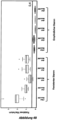
- Figure 4B shows in a bar chart a statistic of the growth behaviour of Klebsiella pneumoniae towards Meropenem from the experiment in Figure 4A over five different droplet sizes 2, 4, 6, 8 and 10 microliters.
- the relative growth of the sensitive strain is reliably below the threshold of significant Growth of 0.4, whereas in the resistant strain it ends up well above the threshold; with one exception in the four microliter drops, where the median is significantly larger than 0.4, but there are also isolated measurements below it.
- the advantage of the methods described here for the combination tests is, in addition to being easier to carry out, that the result is available after just a few hours, compared to the result of the agar diffusion method, for example, which takes significantly more than 12 hours, so that it is only available much later, the next day.
- the speed advantage of the methods described here results from the fact that, on the one hand, the growth of microorganisms in a liquid nutrient medium is significantly faster than on a solid medium, and, on the other hand, a high Microorganism concentration is quickly achieved due to the small liquid volume.
- mass spectrometric measurement for example by MALDI-TOF MS, ensures more sensitive and faster growth detection than can be achieved by visual observation of growth on a solid medium, as in the case of the agar diffusion method.
- the laser shots are fired in a precisely defined spatial grid using MALDI-TOF MS methods - for example, 1,000 shots distributed over defined areas of a prepared spot on a MALDI-TOF MS carrier.
- the number of "successful" shots i.e. shots in which a mass spectrum with a detectable microorganism signature was generated, is compared, for example, between the microbial sample with antibiotic and the microbial sample without antibiotic (growth control).
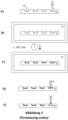
- residual liquid of the nutrient medium can be removed from the sample spot after the standing time, for example by means of an absorbent fabric (cloth 26) which is brought into fluid contact with the drop 14 on a spot on the side of the carrier surface and simply sucks off a large part of the liquid.
- absorbent fabric cloth 26
- other types of liquid removal such as pipetting can of course also be used, as already described above.
- Figure 5H Figure 5H .
Landscapes
- Life Sciences & Earth Sciences (AREA)
- Health & Medical Sciences (AREA)
- Engineering & Computer Science (AREA)
- Molecular Biology (AREA)
- Chemical & Material Sciences (AREA)
- Physics & Mathematics (AREA)
- Bioinformatics & Cheminformatics (AREA)
- Immunology (AREA)
- Bioinformatics & Computational Biology (AREA)
- Proteomics, Peptides & Aminoacids (AREA)
- Biomedical Technology (AREA)
- Hematology (AREA)
- Urology & Nephrology (AREA)
- Organic Chemistry (AREA)
- Biochemistry (AREA)
- Spectroscopy & Molecular Physics (AREA)
- Microbiology (AREA)
- Biophysics (AREA)
- Biotechnology (AREA)
- General Health & Medical Sciences (AREA)
- Analytical Chemistry (AREA)
- Zoology (AREA)
- Wood Science & Technology (AREA)
- Food Science & Technology (AREA)
- Pathology (AREA)
- General Physics & Mathematics (AREA)
- Cell Biology (AREA)
- Medicinal Chemistry (AREA)
- Toxicology (AREA)
- General Engineering & Computer Science (AREA)
- Genetics & Genomics (AREA)
- Optics & Photonics (AREA)
- Other Investigation Or Analysis Of Materials By Electrical Means (AREA)
- Measuring Or Testing Involving Enzymes Or Micro-Organisms (AREA)
Claims (13)
- Méthode de préparation d'échantillons microbiens vivants en vue d'une mesure subséquente par spectrométrie de masse, comprenant les étapes suivantes :(a) fournir un support d'échantillon plat contenant plusieurs points d'échantillonnage ;(b) déposer au moins un échantillon microbien vivant dans une gouttelette de milieu nutritif sur au moins une des points d'échantillonnage ;(c) placer le support d'échantillon dans un espace d'incubation avec une atmosphère définie pendant une période de temps prédéterminée pour stimuler la croissance des micro-organismes ;(d) éliminer le liquide résiduel de la gouttelette de milieu nutritif après la période prédéterminée pour exposer un dépôt de micro-organismes sur le point d'échantillonnage ;(e) préparer le point d'échantillonnage pour une ionisation de désorption ;(f) transférer le support d'échantillon dans une source d'ions de désorption d'un spectromètre de masse, générer des ions à partir de le point d'échantillonnage préparé et acquérir au moins un spectre de masse correspondant ; et(g) comparer le spectre de masse acquis avec un ensemble de données de référence pour déterminer au moins une caractéristique de l'échantillon microbien.
- Méthode selon la revendication 1, dans laquelle l'ensemble de données de référence comporte des spectres de référence provenant d'une bibliothèque de spectres de masse acquis précédemment, et pour une identification, l'au moins une caractéristique de l'étape (g) comprend les espèces ou sous-espèces de micro-organismes dans l'échantillon microbien.
- Méthode selon la revendication 1 ou la revendication 2, dans laquelle le même échantillon microbien est appliqué à l'étape (b) en parallèle sur plusieurs points d'échantillonnage, et les gouttelettes de milieu nutritif contiennent parfois une substance antimicrobienne ou une combinaison de substance antimicrobienne et d'inhibiteur enzymatique et parfois non.
- Méthode selon la revendication 3, dans laquelle un inhibiteur de β-lactamase est utilisé comme inhibiteur enzymatique.
- Méthode selon la revendication 3 ou la revendication 4, dans laquelle l'ensemble de données de référence est un spectre de masse acquis très récemment à partir d'un point d'échantillonnage sur lequel, à l'étape (b), une gouttelette de milieu nutritif sans substance antimicrobienne ou combinaison de substance antimicrobienne et d'inhibiteur enzymatique a été appliquée ; et l'au moins une caractéristique de l'étape (g) pour une caractérisation comprend une sensibilité des micro-organismes dans l'échantillon microbien à la substance antimicrobienne ou à la combinaison de substance antimicrobienne et d'inhibiteur enzymatique.
- Méthode selon la revendication 5, dans laquelle, à l'étape (b), plusieurs gouttelettes de milieu nutritif, contenant chacune différentes concentrations de la même substance antimicrobienne, sont appliquées et, pour une caractérisation, l'au moins une caractéristique de l'étape (g) comprend une concentration minimale inhibitrice de la substance antimicrobienne à l'égard des micro-organismes.
- Méthode selon l'une quelconque des revendications 3 à 6, dans laquelle l'au moins une caractéristique de l'étape (g) est dérivée d'une différence dans la croissance des micro-organismes.
- Méthode selon l'une quelconque des revendications 3 à 7, dans laquelle l'échantillon microbien de l'étape (b) est dosé dans la gouttelette de milieu nutritif de manière à ce que la quantité soit légèrement inférieure à la limite de détection de la mesure spectrométrique de masse.
- Méthode selon l'une quelconque des revendications 1 à 8, dans laquelle la température et l'humidité dans l'espace d'incubation à l'étape (c) sont réglées à environ 36°C et proches de la saturation, respectivement.
- Méthode selon l'une quelconque des revendications 1 à 9, dans laquelle l'élimination du liquide résiduel à l'étape (d) comprend à tamponner le surnageant des gouttelettes avec un matériau absorbant ou à l'enlever à la pipette.
- Méthode selon l'une quelconque des revendications 1 à 10, dans laquelle la préparation à l'étape (e) comprend une extraction préparatoire des protéines/peptides microbiens du dépôt de micro-organismes et/ou le lavage du dépôt de micro-organismes et/ou l'incorporation du dépôt de micro-organismes dans une substance matricielle absorbant la lumière laser pour être ensuite ionisée par désorption laser assistée par matrice (MALDI) à l'étape (f).
- Méthode selon l'une quelconque des revendications 1 à 11, dans laquelle les spectres de masse à l'étape (f) sont acquis avec une dispersion à temps de vol.
- Méthode selon l'une quelconque des revendications 1 à 12, dans laquelle, à l'étape (b), l'échantillon microbien (i) est distribué sous forme de suspension dans la gouttelette de milieu nutritif sur l'au moins un point d'échantillonnage (ii) est d'abord déposé sous forme cellulaire sur l'au moins un point d'échantillonnage et ensuite immergé dans une gouttelette distribuée de milieu nutritif.
Priority Applications (3)
| Application Number | Priority Date | Filing Date | Title |
|---|---|---|---|
| HUE16822599A HUE068472T2 (hu) | 2016-11-30 | 2016-11-30 | Élõ mikrobális minták és mikroorganizmusok elõkészítése késõbbi tömegspekrometriás méréshez és értékeléshez |
| HRP20241335TT HRP20241335T1 (hr) | 2016-11-30 | 2016-11-30 | Priprema živih mikrobnih uzoraka i mikroorganizama za naknadno maseno spektrometrijsko mjerenje i procjenu |
| EP24178341.4A EP4417975A1 (fr) | 2016-11-30 | 2016-11-30 | Préparation d'échantillons microbiens vivants et de microorganismes pour effectuer ensuite une mesure et une évaluation par spectrométrie de masse |
Applications Claiming Priority (1)
| Application Number | Priority Date | Filing Date | Title |
|---|---|---|---|
| PCT/DE2016/100561 WO2018099500A1 (fr) | 2016-11-30 | 2016-11-30 | Préparation d'échantillons microbiens vivants et de microorganismes pour effectuer ensuite une mesure et une évaluation par spectrométrie de masse |
Related Child Applications (1)
| Application Number | Title | Priority Date | Filing Date |
|---|---|---|---|
| EP24178341.4A Division EP4417975A1 (fr) | 2016-11-30 | 2016-11-30 | Préparation d'échantillons microbiens vivants et de microorganismes pour effectuer ensuite une mesure et une évaluation par spectrométrie de masse |
Publications (3)
| Publication Number | Publication Date |
|---|---|
| EP3548895A1 EP3548895A1 (fr) | 2019-10-09 |
| EP3548895C0 EP3548895C0 (fr) | 2024-07-03 |
| EP3548895B1 true EP3548895B1 (fr) | 2024-07-03 |
Family
ID=57749628
Family Applications (2)
| Application Number | Title | Priority Date | Filing Date |
|---|---|---|---|
| EP16822599.3A Active EP3548895B1 (fr) | 2016-11-30 | 2016-11-30 | Preparation d'echantillons microbiens vivants et de microorganismes pour effectuer ensuite une mesure et une evaluation par spectrometrie de masse |
| EP24178341.4A Pending EP4417975A1 (fr) | 2016-11-30 | 2016-11-30 | Préparation d'échantillons microbiens vivants et de microorganismes pour effectuer ensuite une mesure et une évaluation par spectrométrie de masse |
Family Applications After (1)
| Application Number | Title | Priority Date | Filing Date |
|---|---|---|---|
| EP24178341.4A Pending EP4417975A1 (fr) | 2016-11-30 | 2016-11-30 | Préparation d'échantillons microbiens vivants et de microorganismes pour effectuer ensuite une mesure et une évaluation par spectrométrie de masse |
Country Status (13)
| Country | Link |
|---|---|
| US (3) | US11480579B2 (fr) |
| EP (2) | EP3548895B1 (fr) |
| JP (1) | JP6886514B2 (fr) |
| KR (1) | KR102218221B1 (fr) |
| CN (2) | CN116243006A (fr) |
| AU (1) | AU2016431213B2 (fr) |
| CA (1) | CA3054334C (fr) |
| DE (1) | DE112016007491A5 (fr) |
| ES (1) | ES2985581T3 (fr) |
| HR (1) | HRP20241335T1 (fr) |
| HU (1) | HUE068472T2 (fr) |
| PL (1) | PL3548895T3 (fr) |
| WO (1) | WO2018099500A1 (fr) |
Families Citing this family (10)
| Publication number | Priority date | Publication date | Assignee | Title |
|---|---|---|---|---|
| DE102017119868B4 (de) | 2017-07-12 | 2021-05-27 | Bruker Daltonik Gmbh | Feuchtestabilisierung bei der Präparation von Proben für die Spektrometrie |
| DE102019101389B4 (de) | 2019-01-21 | 2020-08-06 | Bruker Daltonik Gmbh | Verfahren zur Probenaufbereitung auf einem spektrometrischen Probenträger |
| FR3103197B1 (fr) | 2019-11-15 | 2024-08-30 | Biomerieux Sa | Determination par spectrometrie de masse de la sensibilite ou de la resistance de bacteries a un antibiotique |
| CN111735871B (zh) * | 2020-08-27 | 2020-12-15 | 中国疾病预防控制中心传染病预防控制所 | 用于大肠杆菌与志贺菌甄别的试剂盒 |
| CN112285196B (zh) * | 2020-11-19 | 2025-02-11 | 深圳市易瑞生物技术股份有限公司 | 加热浓缩进样装置 |
| JP7517162B2 (ja) * | 2021-01-18 | 2024-07-17 | 株式会社島津製作所 | 質量分析用試料の調製方法及び質量分析方法 |
| FR3119459A1 (fr) | 2021-02-04 | 2022-08-05 | bioMérieux | Plaque pour une analyse par spectrometrie de masse utilisant une technique d’ionisation maldi |
| CN113984873B (zh) * | 2021-10-28 | 2024-07-09 | 安图实验仪器(郑州)有限公司 | 用于微生物质谱鉴定的多点位吸液系统 |
| DE102021130356B3 (de) * | 2021-11-19 | 2023-04-20 | Bruker Daltonics GmbH & Co. KG | Referenzdatensatz-basiertes, spektrometrisches Charakterisieren von Zellsubstraten unter Verwendung von Teilbibliotheken |
| DE102022115561B4 (de) * | 2022-06-22 | 2024-06-13 | Bruker Daltonics GmbH & Co. KG | Massenspektrometrische Bestimmung der Zelltoxizität |
Citations (3)
| Publication number | Priority date | Publication date | Assignee | Title |
|---|---|---|---|---|
| WO2012023845A1 (fr) * | 2010-08-19 | 2012-02-23 | Erasmus University Medical Center Rotterdam | Procédés et moyens de caractérisation d'une résistance à un antibiotique dans des microorganismes |
| US20150086971A1 (en) * | 2012-03-30 | 2015-03-26 | Bd Kiestra B.V. | Automated selection of microorganisms and identification using maldi |
| WO2016016580A1 (fr) * | 2014-07-30 | 2016-02-04 | bioMérieux | Caracterisation de micro-organismes par maldi-tof |
Family Cites Families (16)
| Publication number | Priority date | Publication date | Assignee | Title |
|---|---|---|---|---|
| WO2004072616A2 (fr) * | 2003-02-10 | 2004-08-26 | Waters Investments Limited | Plaque de preparation d'echantillons pour la spectrometrie de masse |
| CA2467131C (fr) | 2003-05-13 | 2013-12-10 | Becton, Dickinson & Company | Appareil et methode de traitement d'echantillons biologiques et chimiques |
| FR2857451B1 (fr) * | 2003-07-11 | 2005-09-30 | Commissariat Energie Atomique | Procede et dispositif pour l'analyse de milieux reactionnels vivants |
| AU2006347612A1 (en) * | 2005-08-15 | 2008-05-15 | Drexel University | Chlorine-loaded carbide-derived carbon with bactericidal properties |
| US8476064B2 (en) * | 2006-05-09 | 2013-07-02 | Charm Sciences, Inc. | Inhibition assay method and device for detection of antibiotics |
| DE102006021493B4 (de) * | 2006-05-09 | 2010-04-01 | Bruker Daltonik Gmbh | Massenspektrometrische Messung mikrobieller Resistenzen |
| RU2519650C2 (ru) * | 2008-10-31 | 2014-06-20 | Биомерьё, Инк. | Способы разделения, характеристики и(или) идентификации микроорганизмов с помощью масс-спектрометрии |
| EP2335825A1 (fr) | 2009-12-21 | 2011-06-22 | F. Hoffmann-La Roche AG | Unité et dispositif pour la préparation de cellules et/ou de particules dans un liquide et procédé d'analyse microscopique |
| EP3192862B1 (fr) | 2010-07-02 | 2021-04-07 | The University of North Carolina at Chapel Hill | Échafaudages de biomatrice |
| DE102010033105B4 (de) * | 2010-08-02 | 2016-05-04 | Bruker Daltonik Gmbh | Massenspektrometrische Sepsisdiagnose ohne Blutkultur |
| DE102010052975A1 (de) * | 2010-11-30 | 2012-05-31 | Bruker Daltonik Gmbh | Verfahren und Probenträger für die Unterstützung der händischen Präparation von Proben für eine Ionisierung mit matrix-unterstützter Laserdesorption |
| EP2806275B1 (fr) | 2013-05-23 | 2015-07-01 | Bruker Daltonik GmbH | Détermination de la résistance par spectrométrie de masse par mesure de croissance |
| JP6238069B2 (ja) | 2014-03-20 | 2017-11-29 | 株式会社島津製作所 | 微生物の識別方法 |
| EP4012372A1 (fr) * | 2014-08-18 | 2022-06-15 | Becton, Dickinson and Company | Procédé de préparation d'échantillon pour maldi et système automatisé à cet effet |
| EP3081652B1 (fr) * | 2015-04-13 | 2017-06-28 | Bruker Daltonik GmbH | Test rapide par spectrométrie de masse de résistances |
| DE102015207016A1 (de) | 2015-04-17 | 2016-10-20 | Robert Bosch Gmbh | Objektverfolgung vor und während eines Zusammenstoßes |
-
2016
- 2016-11-30 US US16/464,288 patent/US11480579B2/en active Active
- 2016-11-30 ES ES16822599T patent/ES2985581T3/es active Active
- 2016-11-30 DE DE112016007491.3T patent/DE112016007491A5/de active Pending
- 2016-11-30 KR KR1020197014594A patent/KR102218221B1/ko active Active
- 2016-11-30 EP EP16822599.3A patent/EP3548895B1/fr active Active
- 2016-11-30 CN CN202310248499.7A patent/CN116243006A/zh active Pending
- 2016-11-30 HU HUE16822599A patent/HUE068472T2/hu unknown
- 2016-11-30 HR HRP20241335TT patent/HRP20241335T1/hr unknown
- 2016-11-30 CA CA3054334A patent/CA3054334C/fr active Active
- 2016-11-30 WO PCT/DE2016/100561 patent/WO2018099500A1/fr not_active Ceased
- 2016-11-30 AU AU2016431213A patent/AU2016431213B2/en active Active
- 2016-11-30 CN CN201680091260.1A patent/CN110023761B/zh active Active
- 2016-11-30 EP EP24178341.4A patent/EP4417975A1/fr active Pending
- 2016-11-30 PL PL16822599.3T patent/PL3548895T3/pl unknown
- 2016-11-30 JP JP2019528742A patent/JP6886514B2/ja active Active
-
2022
- 2022-08-30 US US17/823,318 patent/US12031989B2/en active Active
-
2024
- 2024-06-04 US US18/732,797 patent/US12590971B2/en active Active
Patent Citations (3)
| Publication number | Priority date | Publication date | Assignee | Title |
|---|---|---|---|---|
| WO2012023845A1 (fr) * | 2010-08-19 | 2012-02-23 | Erasmus University Medical Center Rotterdam | Procédés et moyens de caractérisation d'une résistance à un antibiotique dans des microorganismes |
| US20150086971A1 (en) * | 2012-03-30 | 2015-03-26 | Bd Kiestra B.V. | Automated selection of microorganisms and identification using maldi |
| WO2016016580A1 (fr) * | 2014-07-30 | 2016-02-04 | bioMérieux | Caracterisation de micro-organismes par maldi-tof |
Also Published As
| Publication number | Publication date |
|---|---|
| AU2016431213B2 (en) | 2023-10-05 |
| US12590971B2 (en) | 2026-03-31 |
| EP4417975A1 (fr) | 2024-08-21 |
| JP2020501137A (ja) | 2020-01-16 |
| WO2018099500A1 (fr) | 2018-06-07 |
| PL3548895T3 (pl) | 2024-12-02 |
| US20240319204A1 (en) | 2024-09-26 |
| HRP20241335T1 (hr) | 2024-12-20 |
| EP3548895C0 (fr) | 2024-07-03 |
| CN116243006A (zh) | 2023-06-09 |
| JP6886514B2 (ja) | 2021-06-16 |
| US20200291446A1 (en) | 2020-09-17 |
| CA3054334C (fr) | 2023-09-26 |
| US11480579B2 (en) | 2022-10-25 |
| EP3548895A1 (fr) | 2019-10-09 |
| CN110023761A (zh) | 2019-07-16 |
| CA3054334A1 (fr) | 2018-06-07 |
| ES2985581T3 (es) | 2024-11-06 |
| AU2016431213A1 (en) | 2019-10-10 |
| US20220412987A1 (en) | 2022-12-29 |
| KR20190073466A (ko) | 2019-06-26 |
| KR102218221B1 (ko) | 2021-02-22 |
| US12031989B2 (en) | 2024-07-09 |
| CN110023761B (zh) | 2023-05-05 |
| DE112016007491A5 (de) | 2019-09-05 |
| HUE068472T2 (hu) | 2024-12-28 |
Similar Documents
| Publication | Publication Date | Title |
|---|---|---|
| EP3548895B1 (fr) | Preparation d'echantillons microbiens vivants et de microorganismes pour effectuer ensuite une mesure et une evaluation par spectrometrie de masse | |
| DE102009033368B4 (de) | Massenspektrometrische Sepsisdiagnose | |
| WO2003025113A2 (fr) | Procede pour cultiver et analyser des cultures de cellules individuelles microbiennes | |
| EP2279264B1 (fr) | Procédé de caractérisation de l'activité biologique d'oeufs de trichuris | |
| EP3077800B1 (fr) | Procédé et dispositif de détection de germes résistants | |
| EP3404417B1 (fr) | Préparation de cellules biologiques sur des supports d'échantillons spectrométriques de masse pour une ionisation par désorption | |
| EP2596129A1 (fr) | Procédé, dispositif et kit d'analyse pour réactions de biologie moléculaire | |
| EP1364068B1 (fr) | Procede et kit permettant l'identification d'adn specifique des especes animales dans un echantillon | |
| DE102012014981B3 (de) | Verfahren zur Differenzierung zwischen lebenden und toten Zellen | |
| EP1280603B1 (fr) | Procede d'identification, de quantification et de visualisation de micro-organismes | |
| EP2339023A2 (fr) | Vérification de mycobactéries et de leurs gènes de résistance | |
| DE102007023984A1 (de) | Verfahren zum Zählen von Zellkolonien |
Legal Events
| Date | Code | Title | Description |
|---|---|---|---|
| REG | Reference to a national code |
Ref country code: HR Ref legal event code: TUEP Ref document number: P20241335T Country of ref document: HR |
|
| STAA | Information on the status of an ep patent application or granted ep patent |
Free format text: STATUS: UNKNOWN |
|
| STAA | Information on the status of an ep patent application or granted ep patent |
Free format text: STATUS: THE INTERNATIONAL PUBLICATION HAS BEEN MADE |
|
| PUAI | Public reference made under article 153(3) epc to a published international application that has entered the european phase |
Free format text: ORIGINAL CODE: 0009012 |
|
| STAA | Information on the status of an ep patent application or granted ep patent |
Free format text: STATUS: REQUEST FOR EXAMINATION WAS MADE |
|
| 17P | Request for examination filed |
Effective date: 20190429 |
|
| AK | Designated contracting states |
Kind code of ref document: A1 Designated state(s): AL AT BE BG CH CY CZ DE DK EE ES FI FR GB GR HR HU IE IS IT LI LT LU LV MC MK MT NL NO PL PT RO RS SE SI SK SM TR |
|
| AX | Request for extension of the european patent |
Extension state: BA ME |
|
| DAV | Request for validation of the european patent (deleted) | ||
| DAX | Request for extension of the european patent (deleted) | ||
| STAA | Information on the status of an ep patent application or granted ep patent |
Free format text: STATUS: EXAMINATION IS IN PROGRESS |
|
| 17Q | First examination report despatched |
Effective date: 20200612 |
|
| RAP1 | Party data changed (applicant data changed or rights of an application transferred) |
Owner name: BRUKER DALTONICS GMBH & CO. KG |
|
| GRAP | Despatch of communication of intention to grant a patent |
Free format text: ORIGINAL CODE: EPIDOSNIGR1 |
|
| STAA | Information on the status of an ep patent application or granted ep patent |
Free format text: STATUS: GRANT OF PATENT IS INTENDED |
|
| GRAS | Grant fee paid |
Free format text: ORIGINAL CODE: EPIDOSNIGR3 |
|
| INTG | Intention to grant announced |
Effective date: 20240226 |
|
| P01 | Opt-out of the competence of the unified patent court (upc) registered |
Effective date: 20240311 |
|
| GRAA | (expected) grant |
Free format text: ORIGINAL CODE: 0009210 |
|
| STAA | Information on the status of an ep patent application or granted ep patent |
Free format text: STATUS: THE PATENT HAS BEEN GRANTED |
|
| AK | Designated contracting states |
Kind code of ref document: B1 Designated state(s): AL AT BE BG CH CY CZ DE DK EE ES FI FR GB GR HR HU IE IS IT LI LT LU LV MC MK MT NL NO PL PT RO RS SE SI SK SM TR |
|
| REG | Reference to a national code |
Ref country code: CH Ref legal event code: EP |
|
| REG | Reference to a national code |
Ref country code: DE Ref legal event code: R096 Ref document number: 502016016612 Country of ref document: DE |
|
| P04 | Withdrawal of opt-out of the competence of the unified patent court (upc) registered |
Free format text: CASE NUMBER: APP_45343/2024 Effective date: 20240805 |
|
| U01 | Request for unitary effect filed |
Effective date: 20240802 |
|
| U07 | Unitary effect registered |
Designated state(s): AT BE BG DE DK EE FI FR IT LT LU LV MT NL PT SE SI Effective date: 20240808 |
|
| REG | Reference to a national code |
Ref country code: GR Ref legal event code: EP Ref document number: 20240401891 Country of ref document: GR Effective date: 20241007 |
|
| REG | Reference to a national code |
Ref country code: ES Ref legal event code: FG2A Ref document number: 2985581 Country of ref document: ES Kind code of ref document: T3 Effective date: 20241106 |
|
| REG | Reference to a national code |
Ref country code: HR Ref legal event code: ODRP Ref document number: P20241335T Country of ref document: HR Payment date: 20241121 Year of fee payment: 9 |
|
| REG | Reference to a national code |
Ref country code: HR Ref legal event code: T1PR Ref document number: P20241335 Country of ref document: HR |
|
| REG | Reference to a national code |
Ref country code: HU Ref legal event code: AG4A Ref document number: E068472 Country of ref document: HU |
|
| U20 | Renewal fee for the european patent with unitary effect paid |
Year of fee payment: 9 Effective date: 20241126 |
|
| P05 | Withdrawal of opt-out of the competence of the unified patent court (upc) changed |
Free format text: CASE NUMBER: APP_45343/2024 Effective date: 20240808 |
|
| PG25 | Lapsed in a contracting state [announced via postgrant information from national office to epo] |
Ref country code: IS Free format text: LAPSE BECAUSE OF FAILURE TO SUBMIT A TRANSLATION OF THE DESCRIPTION OR TO PAY THE FEE WITHIN THE PRESCRIBED TIME-LIMIT Effective date: 20241103 |
|
| PG25 | Lapsed in a contracting state [announced via postgrant information from national office to epo] |
Ref country code: RS Free format text: LAPSE BECAUSE OF FAILURE TO SUBMIT A TRANSLATION OF THE DESCRIPTION OR TO PAY THE FEE WITHIN THE PRESCRIBED TIME-LIMIT Effective date: 20241003 |
|
| PG25 | Lapsed in a contracting state [announced via postgrant information from national office to epo] |
Ref country code: RS Free format text: LAPSE BECAUSE OF FAILURE TO SUBMIT A TRANSLATION OF THE DESCRIPTION OR TO PAY THE FEE WITHIN THE PRESCRIBED TIME-LIMIT Effective date: 20241003 Ref country code: IS Free format text: LAPSE BECAUSE OF FAILURE TO SUBMIT A TRANSLATION OF THE DESCRIPTION OR TO PAY THE FEE WITHIN THE PRESCRIBED TIME-LIMIT Effective date: 20241103 |
|
| PG25 | Lapsed in a contracting state [announced via postgrant information from national office to epo] |
Ref country code: SM Free format text: LAPSE BECAUSE OF FAILURE TO SUBMIT A TRANSLATION OF THE DESCRIPTION OR TO PAY THE FEE WITHIN THE PRESCRIBED TIME-LIMIT Effective date: 20240703 |
|
| PG25 | Lapsed in a contracting state [announced via postgrant information from national office to epo] |
Ref country code: SK Free format text: LAPSE BECAUSE OF FAILURE TO SUBMIT A TRANSLATION OF THE DESCRIPTION OR TO PAY THE FEE WITHIN THE PRESCRIBED TIME-LIMIT Effective date: 20240703 |
|
| PLBE | No opposition filed within time limit |
Free format text: ORIGINAL CODE: 0009261 |
|
| STAA | Information on the status of an ep patent application or granted ep patent |
Free format text: STATUS: NO OPPOSITION FILED WITHIN TIME LIMIT |
|
| 26N | No opposition filed |
Effective date: 20250404 |
|
| PG25 | Lapsed in a contracting state [announced via postgrant information from national office to epo] |
Ref country code: MC Free format text: LAPSE BECAUSE OF FAILURE TO SUBMIT A TRANSLATION OF THE DESCRIPTION OR TO PAY THE FEE WITHIN THE PRESCRIBED TIME-LIMIT Effective date: 20240703 |
|
| REG | Reference to a national code |
Ref country code: CH Ref legal event code: U11 Free format text: ST27 STATUS EVENT CODE: U-0-0-U10-U11 (AS PROVIDED BY THE NATIONAL OFFICE) Effective date: 20251201 |
|
| PGFP | Annual fee paid to national office [announced via postgrant information from national office to epo] |
Ref country code: HU Payment date: 20251121 Year of fee payment: 10 |
|
| REG | Reference to a national code |
Ref country code: HR Ref legal event code: ODRP Ref document number: P20241335 Country of ref document: HR Payment date: 20251120 Year of fee payment: 10 |
|
| U20 | Renewal fee for the european patent with unitary effect paid |
Year of fee payment: 10 Effective date: 20251127 |
|
| PGFP | Annual fee paid to national office [announced via postgrant information from national office to epo] |
Ref country code: GB Payment date: 20251121 Year of fee payment: 10 |
|
| PGFP | Annual fee paid to national office [announced via postgrant information from national office to epo] |
Ref country code: NO Payment date: 20251125 Year of fee payment: 10 |
|
| PGFP | Annual fee paid to national office [announced via postgrant information from national office to epo] |
Ref country code: HR Payment date: 20251120 Year of fee payment: 10 |
|
| PGFP | Annual fee paid to national office [announced via postgrant information from national office to epo] |
Ref country code: GR Payment date: 20251120 Year of fee payment: 10 Ref country code: TR Payment date: 20251124 Year of fee payment: 10 |
|
| PGFP | Annual fee paid to national office [announced via postgrant information from national office to epo] |
Ref country code: CH Payment date: 20251201 Year of fee payment: 10 |
|
| PGFP | Annual fee paid to national office [announced via postgrant information from national office to epo] |
Ref country code: CZ Payment date: 20251125 Year of fee payment: 10 Ref country code: IE Payment date: 20251121 Year of fee payment: 10 |
|
| PGFP | Annual fee paid to national office [announced via postgrant information from national office to epo] |
Ref country code: PL Payment date: 20251121 Year of fee payment: 10 |
|
| PGFP | Annual fee paid to national office [announced via postgrant information from national office to epo] |
Ref country code: RO Payment date: 20251127 Year of fee payment: 10 |
|
| PGFP | Annual fee paid to national office [announced via postgrant information from national office to epo] |
Ref country code: ES Payment date: 20251229 Year of fee payment: 10 |
|
| PG25 | Lapsed in a contracting state [announced via postgrant information from national office to epo] |
Ref country code: CY Free format text: LAPSE BECAUSE OF FAILURE TO SUBMIT A TRANSLATION OF THE DESCRIPTION OR TO PAY THE FEE WITHIN THE PRESCRIBED TIME-LIMIT; INVALID AB INITIO Effective date: 20161130 |