EP3551376B1 - Werkzeug für optische oberflächenbehandlung - Google Patents
Werkzeug für optische oberflächenbehandlung Download PDFInfo
- Publication number
- EP3551376B1 EP3551376B1 EP17800905.6A EP17800905A EP3551376B1 EP 3551376 B1 EP3551376 B1 EP 3551376B1 EP 17800905 A EP17800905 A EP 17800905A EP 3551376 B1 EP3551376 B1 EP 3551376B1
- Authority
- EP
- European Patent Office
- Prior art keywords
- tool
- end surface
- transverse end
- petal
- support
- Prior art date
- Legal status (The legal status is an assumption and is not a legal conclusion. Google has not performed a legal analysis and makes no representation as to the accuracy of the status listed.)
- Active
Links
Images


Classifications
-
- B—PERFORMING OPERATIONS; TRANSPORTING
- B24—GRINDING; POLISHING
- B24B—MACHINES, DEVICES, OR PROCESSES FOR GRINDING OR POLISHING; DRESSING OR CONDITIONING OF ABRADING SURFACES; FEEDING OF GRINDING, POLISHING, OR LAPPING AGENTS
- B24B13/00—Machines or devices designed for grinding or polishing optical surfaces on lenses or surfaces of similar shape on other work; Accessories therefor
- B24B13/01—Specific tools, e.g. bowl-like; Production, dressing or fastening of these tools
- B24B13/012—Specific tools, e.g. bowl-like; Production, dressing or fastening of these tools conformable in shape to the optical surface, e.g. by fluid pressure acting on an elastic membrane
-
- B—PERFORMING OPERATIONS; TRANSPORTING
- B24—GRINDING; POLISHING
- B24B—MACHINES, DEVICES, OR PROCESSES FOR GRINDING OR POLISHING; DRESSING OR CONDITIONING OF ABRADING SURFACES; FEEDING OF GRINDING, POLISHING, OR LAPPING AGENTS
- B24B7/00—Machines or devices designed for grinding plane surfaces on work, including polishing plane glass surfaces; Accessories therefor
- B24B7/20—Machines or devices designed for grinding plane surfaces on work, including polishing plane glass surfaces; Accessories therefor characterised by a special design with respect to properties of the material of non-metallic articles to be ground
- B24B7/22—Machines or devices designed for grinding plane surfaces on work, including polishing plane glass surfaces; Accessories therefor characterised by a special design with respect to properties of the material of non-metallic articles to be ground for grinding inorganic material, e.g. stone, ceramics, porcelain
- B24B7/24—Machines or devices designed for grinding plane surfaces on work, including polishing plane glass surfaces; Accessories therefor characterised by a special design with respect to properties of the material of non-metallic articles to be ground for grinding inorganic material, e.g. stone, ceramics, porcelain for grinding or polishing glass
-
- B—PERFORMING OPERATIONS; TRANSPORTING
- B24—GRINDING; POLISHING
- B24D—TOOLS FOR GRINDING, BUFFING OR SHARPENING
- B24D13/00—Wheels having flexibly-acting working parts, e.g. buffing wheels; Mountings therefor
- B24D13/14—Wheels having flexibly-acting working parts, e.g. buffing wheels; Mountings therefor acting by the front face
- B24D13/142—Wheels of special form
Definitions
- the invention relates to optical quality surfacing, for surfaces such as a face of an ophthalmic glass or of a camera lens or of an instrument intended for the observation of distant objects or else a face of a semiconductor substrate.
- surfacing is understood to mean any operation aimed at modifying the state of a previously shaped surface. These are in particular polishing, smoothing or roughening operations aimed at modifying (reducing or increasing) the roughness of the surface and / or reducing its waviness.
- a tool for surfacing an optical surface comprising: a rigid support having a transverse end surface; a resiliently compressible interface secured to the rigid support and having a first transverse end surface, a second transverse end surface and a side surface
- the tool is brought into contact with it while maintaining sufficient tool pressure on it so that, by deformation of the interface, the pad conforms to the shape of the optical surface. .
- the optical surface is rotated, its friction against the tool being sufficient to jointly drive the latter in rotation, a variable shift during the operation ensures the relative movement and the scanning.
- the surfacing operation requires an abrasive which may be contained in the pad or in the fluid.
- the elastically compressible interface makes it possible to compensate for the difference in curvature between the end surface of the tool support and the optical surface.
- the invention aims to provide an efficient surfacing tool in terms of productivity and quality of appearance obtained while remaining simple, convenient and economical to manufacture.
- the elastic nature of the deformation of the tool between the rest position and the reference position means that the tool is not permanently deformed, i.e. when the tool is stopped against the reference surface it returns to the rest position, possibly with a delay of a few seconds.
- the tool according to the invention is simple, convenient and economical to manufacture.
- the tool according to the invention for example as explained below, so that the tool has the capacity to exert pressure. relatively uniform over the surface to be worked, which is favorable to the productivity performance and the appearance quality of the surfacing carried out.
- the tool is thus able to deform elastically both from the rest position to the first reference position and from the rest position to the second reference position, and therefore to deform elastically over a range of particularly extensive curvature.
- an assembly formed by a surfacing machine and by a tool according to the invention can face most common ophthalmic lenses.
- the universal nature of the tool according to the invention is particularly advantageous in terms of productivity since there is no need to change the tool when the curvature of the surface to be worked is changed.
- the invention also relates to an assembly comprising a face milling machine and a tool as explained above, in which said machine is configured to apply to the support of the tool a predetermined machine force of constant value, and said tool is configured so that the value of the force applied to the support coaxially with the tool while the tool is coaxial with the reference surface to move the tool from the rest position to the reference position is between 85 % and 100% of said constant value of the machine force.
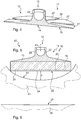
- the flexible collar 13 is transversely beyond the rigid support 12, which is arranged centrally.
- the flexible collar 13 has an outer diameter (large diameter) similar to the outer diameter of the interface 16 and the pad 20.
- the internal diameter (small diameter) of the flexible collar 13 corresponds to the external diameter of the support 12, the collar 13 taking root laterally to the support 12.
- the rigid support 12 and the flexible peripheral flange 13 are made of plastic material molded in one piece, the support 12 being solid at least in the vicinity of the surface 14 in order to have the required rigidity while the flange 13 is of low thickness. wall in order to be flexible.
- the flange 13 has eight slots 26 oriented radially and distributed equiangularly, so that the flange 13 is subdivided into eight petals 27 each generally shaped as a truncated angular sector.
- the subdivision of the flange 13 into petals helps to allow this flange to be flexible in order to conform to different curvatures of surfaces to be polished.
- the surface 14 of the support 12 is flush with the surface 15 of the collar 13 located on the same side.
- the support 12 has a projecting shank 28 which serves to connect the tool 10 to the spindle of a face milling machine 29 shown in a simplified manner on the figure. figure 3 by arrows 30 and 31 which symbolize the driving forces applied to the tool 10 by the machine 29, which will be described below.
- the shank 28 has a cavity 32 for receiving the spindle head.
- the cavity 32 has a spherical portion 33 shaped generally as three-quarters of a sphere and an annular rib 34.
- the spindle head intended to be received in the cavity 32 comprises an end in a portion of a sphere shaped like the portion 33 and a cylindrical portion of smaller diameter than the rib 34.
- the assembly between the shank 28 and the spindle of the machine is done by simple snap-fit, the wall thickness of the shank 28 being low enough to be able to deform so that the spherical part of the spindle head fits into the portion 33 .
- the tool 10 When the spindle head is engaged in the cavity 32, the tool 10 cooperates in a ball joint connection with respect to the spindle.
- the diameter of the interface 16 and the pad 20 corresponds to the outer diameter of the flange 13.
- the securing between the interface 16 and the base 11 is effected by bonding between the surface 17 of the interface 16 and the surfaces 14 and 15 of the base 11.
- the elastically compressible interface 16 is a foam having a thickness of the order of 9 mm and the flexible pad 20 has a thickness of the order of 1 mm.
- the diameter of the interface 16 and of the buffer 20 is of the order of 55 mm.
- the surface 15 of the collar 13 which, as indicated above, is flush with the surface 14, is shaped in the extension of the surface 14.
- the surfaces 14 and 15 are shaped as the same portion of a sphere.
- the end surface 14 of the support 12 and the end surface 15 of the collar 13 are shaped as a portion of a sphere having a radius of curvature of the order of 110 mm.
- the contact surface between the interface 16 and the base 11 is particularly important since this contact surface corresponds to the surface 14 and to the surface 15.
- the figure 3 shows an ophthalmic lens 35, the optical surface 23 of which is being surfaced by the tool 10, in order to reduce its roughness.
- the machine 29 brings the tool 10 into contact with the surface 23 via the surface 22 of the pad 20.
- the machine 29 maintains on the surface 23, by exerting the force 31, sufficient pressure of the tool 10 to that, by deformation of the interface 16, the pad 20 matches the shape of the optical surface 23.
- the lens 35 While spraying the optical surface 23 with a fluid, the lens 35 is rotated as shown by arrow 36, the friction against the tool 10 being sufficient to drive the tool 10 in rotation.
- Variable shifting during operation through the reciprocating drive force 30, provides relative movement and sweeping.
- the surfacing operation requires an abrasive which may be contained in the pad 20 or in the fluid.
- the elastically compressible interface 16 makes it possible to compensate for the difference in curvature between the end surface 14 of the support 12 of the tool and the optical surface 23.
- the peripheral part 25 of the buffer 20 is connected to the support 12 exclusively by the interface 16 and by the collar 13.
- the collar 13 is in fact configured to be sufficiently elastically deformable so that there is no need for such elastic return means.
- the base 11, which must both be rigid in the vicinity of the end surface 14, flexible at the level of the barrel 28 to allow the locking of the machine spindle and elastic at the collar 13, is advantageously made of PA11, POM, PA66, PUR or Elastollan ®.
- PA11 which has an elastic modulus E (Young's modulus) of 1320 N / mm 2 and an elastic limit in tension ⁇ MAX of 35 N / mm 2 ; and grade 1164D of ELASTOLLAN ® has a modulus of elasticity E of 300 N / mm 2 and an elastic limit in tension ⁇ MAX of 40 N / mm 2 .
- E Young's modulus
- ELASTOLLAN ® has a modulus of elasticity E of 300 N / mm 2 and an elastic limit in tension ⁇ MAX of 40 N / mm 2 .
- PA66 one grade of which has an elastic modulus of 2500 N / mm 2 .
- the collar 13 is configured so that the tool 10 is elastically deformable between the rest position that it takes in the absence of stress ( figures 1 and 2 ) and one or more reference positions where the surface 22 is fully pressed against a concave reference surface or different concave reference surfaces, as well as on the figure 3 where the entire surface 22 of the tool 10 is pressed against the surface 23.
- the first concave reference surface 37 is part of a test stand 38.
- the second reference surface 40 is part of a test stand 41.
- the elastic nature of the deformation of the tool between the rest position and each of the first and second reference positions means that the tool is not permanently deformed, that is to say that when one ceases to tackle the tool against the reference surface 37 or 40, it returns to the rest position, possibly with a delay of a few seconds.
- the assembly formed by machine 29 and tool 10 can surface most common ophthalmic lenses.
- the embodiment of the tool 10 illustrated in the figures 4 and 5 is identical to the embodiment illustrated in the figures 1 to 3 except that in the rest position, the transverse end surface 14 of the support 12 and the transverse end surface 15 of the collar 13 are plane.
- the figure 5 shows this tool 10 in the rest position on the second concave reference surface 40.
- the concave reference surface 40 has a radius of 40mm.
- the support 41 to which the reference surface 40 belongs is part of a test device 42 which is useful for the development of the surfacing tool 10 to select the best candidates among samples (prototype tools) made with different sizing and different materials.
- the test device 42 comprises a dynamic member for applying a linear force symbolized by the arrow 43.
- This member comprises at its distal end a head similar to the head of a spindle of a surfacing machine which is engaged. in the cavity 32 of the barrel 28.
- the head of the member 43 is moved at a predetermined controlled speed, for example 25 mm / s, coaxially with the tool 10 while the tool 10 is coaxial with the surface 40.
- a force of intensity F is applied on the support 12 coaxially with the tool 10 while the tool 10 is coaxial with the surface 40.
- the intensity of the force F is measured and recorded during the displacement of the organ 43.
- the training of the organ 43 is stopped when a predetermined threshold is reached, for example 160 N.
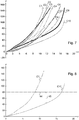
- the figure 7 is a graph showing the result of such tests, carried out at a speed of 25 mm / s until reaching a force value of 160 N.
- the displacement z of the member 43 is plotted on the abscissa and the force F on the ordinate.
- Curves C1 to C10 each correspond to a different sample.
- the curves with an odd suffix relate to samples having the same interface 16 of a first nature.
- the even suffix curves relate to samples having the same interface 16 of a second nature, which is more flexible than the interface 16 of the first nature.
- the curves having two successive suffixes of which the first is odd and the second is even relate to samples having the same base 11, for example curves C1 and C2 relate to samples having a base 11 of a first nature and the curves C3 and C4 of the samples having the same base 11 of a second nature.
- the bases 11 of different natures differ from each other only by the average thickness of the petals 27, which decreases with the suffixes of the curves (the curves C1 and C2 concern the samples having the petals 27 of greater average thickness while the curves C9 and C10 relate to samples having the petals 27 of smaller average thickness).
- the distance d ( figure 5 ) between the center of the surface 22 of the pad 20 and the surface 40 is not zero, i.e. as long as the surface 22 is not entirely pressed against the surface 40, the distance d varies as the z displacement. Then, the displacement z corresponds to the compression of the interface 16.
- the figure 8 is a graph similar to the figure 7 , but showing only the curves C1 and C10 as well as a horizontal line corresponding to the fixed intensity predetermined of the force 31 exerted by the machine 29 on the tool 10 (intensity of the order of 80 N) and a vertical line corresponding to the distance d when the tool 10 is in the rest position (distance from the order of 12 mm).
- the tool to which the curve C1 relates does not flex enough under the force 31 to be fully pressed against the surface 40: for the intensity of the force 31, the displacement z is much less than the distance d in the tool's rest position.
- the tool to which the curve C10 relates is pressed against the surface 40 well below the intensity of the force 31.
- the tool to which the curve C10 relates exerts on the surface 40 a pressure that is too localized in the center.
- a tool capable of exerting a uniform pressure on the surface to be worked will have an excellent behavior in surfacing, which will give it excellent performance in terms of the quality of appearance obtained on the worked surface and also in terms of speed. of execution, the uniformity of the pressure favoring the speed of the achievement of the sufficient removal of material on the whole of the worked surface.
- a tool 10 designed to work a concave surface so that the value of the force applied to the support 12 is between 30 N and 180 N, coaxially with the tool 10. while the tool 10 is coaxial with a concave reference surface similar to the surface 40 (radius 40 mm).
- the tool 10 is configured so that the value of the force applied to the support 12 coaxially to tool 10 while tool 10 is coaxial with a reference surface such as surface 40 to make move the tool from the rest position to a position where the tool is pressed against this surface, ie between 85% and 100% of this constant value of the machine force.
- the collar 13 is configured so that it is between 3 N / mm and 15 N / mm with an imposed displacement speed of 25 mm / s, the force-to-displacement ratio between, on the one hand, the value of the force F applied to the support 12 coaxially with the tool 10 while the tool 10 is coaxial with the surface 40 to cause the tool to pass from the rest position to the position where the surface 22 is pressed against the surface 40 and, on the other hand, the value of the displacement z of the support between the rest position and the position where the surface 22 is pressed against the surface 40.
- Each petal 27 has a thickness which varies as a function of the distance x at its distal end, with for each distance x the thickness which is constant.
- each petal increases between its distal end and its root through which it is laterally connected to the rigid support 12.
- the end surface 14 of the rigid support 12 is not deformable and therefore does not conform to the surface 40.
- the flexibility of the flange 13 is such that the surface 15 of the flange 13 conforms to the surface 40, i.e., the surface 15 is fully pressed against the surface 40.
- the surface 15 assumes the same curvature as the surface 40, that is to say that for each petal 27 the surface 15 adopts a radius of 40 mm.
- K is equal to 12 R Q sp E with R which is the radius of the surface 40 (here 40 mm); Q sp which is the surface charge of the petals 27, assumed to be constant; and E which is the modulus of elasticity (Young's modulus) of the material of the petals 27.
- the surface load Q sp of the petals 27 is the ratio between the force expected to be applied to the support 12 (for example the intensity of the force 31, of the order of 80 N) and the area of the surface 15.
- the petals are in the form of an angular sector trunk.
- h x 3 K b x at 0 x 2 2 + at 1 x 3 6
- a 0 is equal to 18 mm (at the distal end, x is equal to 0) and that a 1 is equal to - 0.663 (at the distal end, x is equal to 19 and b is equal to 5.4).
- K is equal to 12 R Q sp E with R which is the radius of the surface 40; Q sp which is the surface load of the petals 27 considered here as constant and equal to the ratio between the force expected to be applied to the support 12 and the area of the surface 15; and E which is the modulus of elasticity of the material of the petals.
- the pressure exerted on this surface by the petals 27 remains uniform, but obviously d different intensity (the smaller the radius R, the higher the pressure).
- the intensity of the force applied to the support 12 is different (for example 80 N instead of 100 N), the pressure exerted by the petals 27 remains uniform but of different intensity.
- the base 11 also exerts pressure on the elastically compressible interface 16 via the transverse end surface 14 of the support 12. Consequently, the tool 10 also exerts (via the surface 22 of the pad 20) on the. surface to be worked by applying pressure to the right of the support 12.
- the pressure exerted by the support 12 on the interface 16 (which transmits it to the surface to work via the buffer 20) is in principle equal to the ratio between the intensity of the force applied to the support 12 and the area of the surface 14.
- the geometry of the petals 27 by assuming that for a surface to be worked having a predetermined radius of curvature, for example 35 mm as shown below. above, the surface load exerted by the surfaces 14 and 15 is uniform, that is to say that the surface load Q sp of the surface 15 of the petals 27 is equal to the surface load of the surface 14 of the support 12.
- the pressure exerted by the tool 10 on the surface to be worked (via the surface 22 of the pad 20) will be the same at the right of the support 21 and to the right of the collar 13.
- the pressure exerted by the tool 10 on the surface to be worked (via the surface 22 of the pad 20) will be different to the right of the support 21 and to the right of the flange 13.
- the pressure to the right of the collar 13 will be smaller than the pressure to the right of the support 12.
- the tool is off-center with respect to the surface to be worked and it is relatively frequent that the surface to be worked is not spherical, but the behavior of the tool whose petals are configured as has just been explained remains excellent.
- the surfaces which the tool 10 is able to face are not limited to the surfaces on which the surface 22 of the pad 20 can be fully pressed when the tool 10 and the surface to be worked are centered. one in relation to the other. On the contrary, the tool 10 is able to resurface many surfaces on which the surface 22 is then mostly pressed, but not entirely.
- the ratio between the total area of the surface 15 of the petals and the area of the corresponding annular surface is between 30 and 80%.
- the deformation of the material of the petals 27 should also remain in the elastic range.
- h MAX R ⁇ MAX 2 E with ⁇ MAX which is the elastic limit in traction of the material of the petals, E which is the modulus of elasticity (Young's modulus) of the material of the petals and R which is the radius mentioned above.
- the material of the collar 13 (and therefore of the base 11) is grade 1164D of ELASTOLLAN ® which, as indicated above has a modulus of elasticity E of 300 N / mm 2 and a limit elastic in tension ⁇ MAX of 40 N / mm 2 , for a radius of curvature R of 35 mm, the maximum thickness h MAX is 2.33 mm.
- the radius R has been selected as representing the most severe conditions of use of the tool, here the smallest radius of a concave surface.
- the tool will then be able to work also under less severe conditions.
- the embodiment of the tool 10 illustrated in the figures 10 and 11 is similar to the embodiments shown on the figures 1 to 3 and on figures 4 and 5 , except that in the rest position the end surface 14 of the support 12 and the end surface 15 of the flange 13 are concave (and not convex as in the figures 1 to 3 or flat like on figures 4 and 5 ).
- the surface 14 and the surface 15 are shaped as a portion of a sphere having a radius of curvature of the order of 110 mm.
- the collar 13 is configured so that the tool 10 is elastically deformable between the rest position that it takes in the absence of stress ( figures 10 and 11 ) and one or more reference positions where the surface 22 is fully pressed against a convex reference surface or different convex reference surfaces.
- the first convex reference surface 46 forms part of a test stand 48.
- the second convex reference surface 47 forms part of a test stand 49.
- the constant K of the above formulas is selected at least partially experimentally, for example as shown in the figures 7 and 8 .
- the surface 22 of the pad 20 is not entirely pressed against a reference surface such as 37, 40, 46 or 47 but is only partially pressed, for example. with the part of the surface 22 pressed against the surface to be worked which has a radius (if the plated part has the center of the surface 20) or (if the plated part is annular) which has a difference between the internal radius and the external radius equal to at least half of the radius of the surface 22.
- the plated part has a radius of at least 27.5 mm; and if the plated part is annular, the difference between the outer radius and the inner radius of the plated part is at least 27.5 mm.
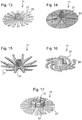
- the figures 11 to 15 show different variants of the base 11 where the petals are shaped differently.
- the slits 26 between the petals 27 have a greater angular amplitude and the number of petals is higher.
- each petal 27 comprises on the side of the shank 28 (and therefore on the side opposite to the transverse end surface 15) a projecting rib 50 oriented radially.
- each petal 27 is Y-shaped attached by its base to the rigid support 12.
- the petals 27 are subdivided by slits 26 curved.
- each petal 27 takes root on one end of an arm 51 with a U-shaped section arranged transversely to this petal, the other end of this arm taking root on the rigid support 12.
Landscapes
- Engineering & Computer Science (AREA)
- Mechanical Engineering (AREA)
- Physics & Mathematics (AREA)
- Fluid Mechanics (AREA)
- Chemical & Material Sciences (AREA)
- Ceramic Engineering (AREA)
- Inorganic Chemistry (AREA)
- Grinding And Polishing Of Tertiary Curved Surfaces And Surfaces With Complex Shapes (AREA)
- Polishing Bodies And Polishing Tools (AREA)
- Prostheses (AREA)
Claims (15)
- Werkzeug für Oberflächenbehandlung mit optischer Qualität, umfassend:- eine Basis (11), die eine starre Stütze (12) und einen flexiblen Bund (13) aufweist, der die starre Stütze (12) umgibt, wobei die starre Stütze (12) eine Querendfläche (14) aufweist, wobei der Bund (13) eine Querendfläche (15) aufweist, die an derselben Seite wie die Querendfläche (14) der starren Stütze (12) angeordnet ist,- eine elastisch zusammendrückbare Schnittstelle (16), die eine erste Querendfläche (17), eine zweite Querendfläche (18) und eine Seitenfläche (19) aufweist, die sich von dem Umfang der ersten Querendfläche (17) zu dem Umfang der zweiten Querendfläche (18) erstreckt, wobei die erste Querendfläche (17) der elastisch zusammendrückbaren Schnittstelle (16) an der Querendfläche (14) der starren Stütze (12) und an der Querendfläche (15) des Bunds (13) festgeklammert ist, und- einen flexiblen Puffer (20), der eine erste Querendfläche (21), die an der zweiten Querendfläche (18) der elastisch zusammendrückbaren Schnittstelle (16) festgeklammert ist, und eine zweite Querendfläche (22) aufweist, die dazu ausgestaltet ist, gegen eine zu bearbeitende Fläche (23) angelegt zu werden, wobei der Puffer (20) einen mittleren Teil (24), der in einer Linie mit der Querendfläche (14) der starren Stütze (12) liegt, und einen Umfangsteil (25) aufweist, der quer jenseits dieser Querendfläche (14) liegt,dadurch gekennzeichnet, dass der Umfangsteil (25) ausschließlich über die Schnittstelle (16) und über den Bund (13) mit der Stütze (12) verbunden ist, wobei der Bund (13) dazu ausgestaltet ist, dass das Werkzeug (10) zwischen einer Ruheposition, die es bei nicht vorliegender Beaufschlagung einnimmt, und einer Bezugsposition elastisch deformierbar ist, in der die zweite Querendfläche (22) des flexiblen Puffers (20) fest gegen eine Bezugsfläche (37, 40, 46, 47) gedrückt ist, die kugelförmig mit einem Radius zwischen 40 mm und 1500 mm ist.
- Werkzeug nach Anspruch 1, dadurch gekennzeichnet, dass der Bund (13) so ausgestaltet ist, dass das Werkzeug (10) elastisch deformierbar ist zwischen der Ruheposition, die es bei nicht vorliegender Beaufschlagung einnimmt, und,- wenn die zu bearbeitende Fläche konkav ist, sowohl bis zu einer ersten konkaven Bezugsposition, in der die zweite Querendfläche (22) des flexiblen Puffers fest gegen eine erste konkave Bezugsfläche (37) gedrückt ist, die konkav kugelförmig mit einem Radius von 1500 mm ist, als auch bis zu einer zweiten konkaven Bezugsposition, in der die zweite Querendfläche (22) des flexiblen Puffers fest gegen eine zweite konkave Bezugsfläche (40) gedrückt ist, die konkav kugelförmig mit einem Radius von 40 mm ist, oder- wenn die zu bearbeitende Fläche konvex ist, sowohl bis zu einer ersten konvexen Bezugsposition, in der die zweite Querendfläche (22) des flexiblen Puffers fest gegen eine erste konvexe Bezugsfläche (46) gedrückt ist, die konvex kugelförmig mit einem Radius von 40 mm ist, als auch bis zu einer zweiten konvexen Bezugsposition, in der die zweite Querendfläche (22) des flexiblen Puffers fest gegen eine zweite konvexe Bezugsfläche (47) gedrückt ist, die konvex kugelförmig mit einem Radius von 1500 mm ist.
- Werkzeug nach einem der Ansprüche 1 oder 2, dadurch gekennzeichnet, dass die Größe der auf die Stütze (12) koaxial zu dem Werkzeug (10) ausgeübten Kraft, während das Werkzeug (10) koaxial zu der Bezugsfläche (40, 47) ist, um das Werkzeug (10) aus der Ruheposition in die Bezugsposition zu bewegen, zwischen 30 N und 180 N liegt.
- Werkzeug nach einem der Ansprüche 1 bis 3, dadurch gekennzeichnet, dass der Bund (13) so ausgestaltet ist, dass das Kraft-Weg-Verhältnis zwischen der Größe der auf die Stütze (12) koaxial zu dem Werkzeug (10) ausgeübten Kraft, während das Werkzeug (10) koaxial zu der Bezugsfläche (40, 47) ist, um das Werkzeug (10) aus der Ruheposition in die Bezugsposition zu bewegen, einerseits, und der Länge des Wegs der Stütze (12) zwischen der Ruheposition und der Bezugsposition andererseits zwischen 3 N/mm und 15 N/mm mit einer auferlegten Verschiebungsgeschwindigkeit von 25 mm/s beträgt.
- Werkzeug nach einem der Ansprüche 1 bis 4, dadurch gekennzeichnet, dass die Querendfläche (15) des Bunds (13) mit der Querendfläche (14) der Stütze (12) bündig ist.
- Werkzeug nach einem der Ansprüche 1 bis 5, dadurch gekennzeichnet, dass der Bund (13) in Blätter (27) unterteilt ist.
- Werkzeug nach Anspruch 6, dadurch gekennzeichnet, dass die Blätter (27) durch radial ausgerichtete Schlitze (26) unterteilt sind.
- Werkzeug nach Anspruch 7, dadurch gekennzeichnet, dass jedes Blatt (27) seitlich an der starren Stütze (12) wurzelt.
- Werkzeug nach Anspruch 8, dadurch gekennzeichnet, dass jedes Blatt (27) eine Dicke hat, die abhängig von dem Abstand x zu seinem distalen Ende variiert, mit einer Dicke für jeden Abstand x, die konstant ist.
- Werkzeug nach Anspruch 9, dadurch gekennzeichnet, dass bei jedem Abstand x die Dicke h(x) des Blatts (27) durch folgende Formel gegeben ist:

- Werkzeug nach Anspruch 10, dadurch gekennzeichnet, dass die Breite des Blatts (27) als Funktion des Abstands x am distalen Ende des Blatts in der Form eines Polynoms ausgedrückt werden kann:


- Werkzeug nach Anspruch 11, dadurch gekennzeichnet, dass die Blätter (27) winkelsektorstumpfförmig sind, so dass die Breite des Blatts als Funktion des Abstands x am distalen Ende des Blatts in der Form des folgenden Polynoms ausgedrückt werden kann:


- Werkzeug nach einem der Ansprüche 9 bis 12, dadurch gekennzeichnet, dass bei jedem Abstand x von dem distalen Ende des Blatts (27) die Dicke des Blatts kleiner

wobei σMAX die Zugfestigkeit des Materials der Blätter ist, E der Elastizitätsmodul des Materials der Blätter ist und R der Kehrwert der Krümmungsdifferenz zwischen der Ruheposition und der Bezugsposition des Werkzeugs ist. - Werkzeug nach einem der Ansprüche 6 bis 13, dadurch gekennzeichnet, dass das Verhältnis zwischen dem Flächeninhalt der Querendfläche (15) des Bunds (13), d. h. dem Gesamtflächeninhalt der Oberfläche der Blätter (27), und dem Flächeninhalt der entsprechenden ringförmigen Oberfläche zwischen 30 und 80% beträgt.
- Anordnung, aufweisend eine Poliermaschine (29) und ein Werkzeug nach einem der Ansprüche 1 bis 14, wobei die Maschine (29) dazu ausgestaltet ist, eine vorbestimmte Maschinenkraft (31) konstanter Größe auf die Stütze (12) des Werkzeugs (10) auszuüben, und das Werkzeug (10) so ausgestaltet ist, dass die Größe der auf die Stütze (12) koaxial zu dem Werkzeug (10) ausgeübten Kraft (31), während das Werkzeug koaxial zu der Bezugsfläche (40) ist, um das Werkzeug (10) aus der Ruheposition in die Bezugsposition zu bewegen, zwischen 85% und 100 % der konstanten Größe der Maschinenkraft (31) liegt.
Applications Claiming Priority (2)
| Application Number | Priority Date | Filing Date | Title |
|---|---|---|---|
| FR1662259A FR3059921B1 (fr) | 2016-12-09 | 2016-12-09 | Outil de surfacage a qualite optique |
| PCT/FR2017/052965 WO2018104601A1 (fr) | 2016-12-09 | 2017-10-27 | Outil de surfaçage à qualité optique |
Publications (2)
| Publication Number | Publication Date |
|---|---|
| EP3551376A1 EP3551376A1 (de) | 2019-10-16 |
| EP3551376B1 true EP3551376B1 (de) | 2021-12-08 |
Family
ID=58401722
Family Applications (1)
| Application Number | Title | Priority Date | Filing Date |
|---|---|---|---|
| EP17800905.6A Active EP3551376B1 (de) | 2016-12-09 | 2017-10-27 | Werkzeug für optische oberflächenbehandlung |
Country Status (6)
| Country | Link |
|---|---|
| US (1) | US11969848B2 (de) |
| EP (1) | EP3551376B1 (de) |
| CN (1) | CN109996651B (de) |
| BR (1) | BR112019010040B1 (de) |
| FR (1) | FR3059921B1 (de) |
| WO (1) | WO2018104601A1 (de) |
Families Citing this family (3)
| Publication number | Priority date | Publication date | Assignee | Title |
|---|---|---|---|---|
| DE102019005084A1 (de) * | 2019-07-16 | 2021-01-21 | Schneider Gmbh & Co. Kg | Polierwerkzeug sowie Vorrichtung zum Polieren eines Werkstücks |
| CN112059815B (zh) * | 2020-08-20 | 2022-05-31 | 中国科学院上海光学精密机械研究所 | 一种固定式磨头结构及其无边缘误差加工方法 |
| CN113510568B (zh) * | 2021-09-13 | 2022-01-11 | 中国科学院光电技术研究所 | 一种高陡度大偏离量非球面元件主动平滑方法 |
Family Cites Families (18)
| Publication number | Priority date | Publication date | Assignee | Title |
|---|---|---|---|---|
| US3583111A (en) * | 1966-08-22 | 1971-06-08 | David Volk | Lens grinding apparatus |
| GB1188381A (en) * | 1967-04-20 | 1970-04-15 | Lionel Gordon Hooke | Improvements in Sanding or Polishing Attachments for Electric Hand Tools |
| DE3416186A1 (de) * | 1983-05-17 | 1985-01-24 | Hans J. 4400 Münster Fabritius | Schleifscheibe |
| US5403231A (en) * | 1992-06-24 | 1995-04-04 | Arnold Duckworth | Fairing machine |
| JPH08206953A (ja) * | 1994-11-28 | 1996-08-13 | Canon Inc | 研削・研磨方法及び研削・研磨用工具及びその製造方法 |
| JP3787457B2 (ja) | 1999-05-10 | 2006-06-21 | キヤノン株式会社 | 研磨工具 |
| DE60232497D1 (de) * | 2001-01-05 | 2009-07-16 | Seiko Epson Corp | Poliervorrichtung und -verfahren |
| JP2003275949A (ja) * | 2002-01-15 | 2003-09-30 | Seiko Epson Corp | 研磨方法及び研磨装置 |
| FR2834662B1 (fr) | 2002-01-16 | 2004-05-14 | Essilor Int | Outil pour le surfacage d'une surface optique |
| FR2857610B1 (fr) * | 2003-07-16 | 2006-03-17 | Essilor Int | Outil pour le surfacade d'une surface optique |
| EP1655102B1 (de) * | 2004-11-09 | 2008-01-09 | Seiko Epson Corporation | Elastisches Polierwerkzeug und Verfahren zum Polieren einer Linse mit einem solchen Werkzeug |
| FR2900356B1 (fr) * | 2006-04-27 | 2008-07-18 | Essilor Int | Outil de surfacage d'une surface optique |
| FR2918911B1 (fr) | 2007-07-16 | 2009-10-16 | Essilor Int | Outil de surfacage a qualite optique |
| FR2935627B1 (fr) | 2008-09-10 | 2010-09-03 | Essilor Int | Outil de surfacage a qualite optique |
| FR2935628B1 (fr) | 2008-09-10 | 2011-10-14 | Essilor Int | Outil de surfacage a qualite optique |
| FR2953433B1 (fr) | 2009-12-08 | 2012-02-10 | Essilor Int | Outil de surfacage a qualite optique |
| JP5864298B2 (ja) * | 2011-02-21 | 2016-02-17 | Hoya株式会社 | 眼鏡レンズの製造方法 |
| JP2013086239A (ja) * | 2011-10-21 | 2013-05-13 | Hoya Corp | プラスチックレンズ用の研磨工具、プラスチックレンズの研磨方法及びプラスチックレンズの製造方法 |
-
2016
- 2016-12-09 FR FR1662259A patent/FR3059921B1/fr not_active Expired - Fee Related
-
2017
- 2017-10-27 WO PCT/FR2017/052965 patent/WO2018104601A1/fr not_active Ceased
- 2017-10-27 EP EP17800905.6A patent/EP3551376B1/de active Active
- 2017-10-27 US US16/467,867 patent/US11969848B2/en active Active
- 2017-10-27 CN CN201780072780.2A patent/CN109996651B/zh active Active
- 2017-10-27 BR BR112019010040-7A patent/BR112019010040B1/pt active IP Right Grant
Non-Patent Citations (1)
| Title |
|---|
| None * |
Also Published As
| Publication number | Publication date |
|---|---|
| FR3059921B1 (fr) | 2019-05-24 |
| FR3059921A1 (fr) | 2018-06-15 |
| EP3551376A1 (de) | 2019-10-16 |
| US20190344396A1 (en) | 2019-11-14 |
| BR112019010040A2 (pt) | 2019-09-03 |
| CN109996651B (zh) | 2022-06-07 |
| WO2018104601A1 (fr) | 2018-06-14 |
| CN109996651A (zh) | 2019-07-09 |
| BR112019010040B1 (pt) | 2023-12-26 |
| US11969848B2 (en) | 2024-04-30 |
Similar Documents
| Publication | Publication Date | Title |
|---|---|---|
| EP2012969B1 (de) | Werkzeug für optische oberflächenbehandlung | |
| BE1014743A3 (fr) | Disque et systeme de polissage. | |
| CA2373148C (fr) | Procede de fabrication d'une surface d'une lentille ophtalmique, installation de mise en oeuvre du procede et lentille ophtalmique obtenue selon le procede | |
| EP2170554B1 (de) | Vorrichtung zur optischen flächenbehandlung | |
| WO2004087374A1 (fr) | Machine de meulage de verres optiques | |
| WO2018104601A1 (fr) | Outil de surfaçage à qualité optique | |
| FR2542239A1 (fr) | Broche porte-piece pour machine de surfacage | |
| EP2337652A1 (de) | Werkzeug zur oberflächenbearbeitung mit optischer qualität | |
| EP1644160B1 (de) | Werkzeug zur feinbearbeitung einer optischen fläche | |
| EP1266723B1 (de) | Werkstückhalter für eine Augenoptik | |
| EP1699592A1 (de) | Pneumatischer verriegelungsträger für eine optische linse | |
| WO2013045795A1 (fr) | Dispositif de polissage de lentilles optiques | |
| FR2935628A1 (fr) | Outil de surfacage a qualite optique | |
| WO1999019598A1 (fr) | Accouplement pour dispositif a transmission de forces | |
| EP2120818A1 (de) | Chirurgische mikromanipulatorspitze, chirurgischer mikromanipulator und verfahren zur herstellung einer spitze für einen derartigen mikromanipulator | |
| EP0042341B1 (de) | Endbearbeitungswerkzeug | |
| FR2823143A1 (fr) | Outil torique de polissage d'une surface optique d'une lentille, et procede de polissage d'une surface atorique au moyen d'un tel outil | |
| FR2885063A1 (fr) | Procede et dispositif de travail de la peripherie d'une lentille ophtalmique de lunettes | |
| FR2677569A1 (fr) | Procede et appareil pour former une cavite dans un corps massif en matiere rigide. | |
| FR2595243A1 (fr) | Couteau pour la chirurgie du segment anterieur de l'oeil | |
| EP2509744B1 (de) | Werkzeug für optische oberflächenbehandlung | |
| EP1066919A1 (de) | Endbearbeitungswerkzeug für optische Oberfläche, insbesondere für optische Linze | |
| FR2619607A1 (fr) | Joint homocinetique et son procede de fabrication | |
| FR2632217A1 (fr) | Dispositif et procede de fabrication d'une poulie a gorge a partir d'un disque circulaire en tole | |
| FR2809044A1 (fr) | Outil abrasif a surface d'attaque en calotte |
Legal Events
| Date | Code | Title | Description |
|---|---|---|---|
| STAA | Information on the status of an ep patent application or granted ep patent |
Free format text: STATUS: UNKNOWN |
|
| STAA | Information on the status of an ep patent application or granted ep patent |
Free format text: STATUS: THE INTERNATIONAL PUBLICATION HAS BEEN MADE |
|
| PUAI | Public reference made under article 153(3) epc to a published international application that has entered the european phase |
Free format text: ORIGINAL CODE: 0009012 |
|
| STAA | Information on the status of an ep patent application or granted ep patent |
Free format text: STATUS: REQUEST FOR EXAMINATION WAS MADE |
|
| 17P | Request for examination filed |
Effective date: 20190612 |
|
| AK | Designated contracting states |
Kind code of ref document: A1 Designated state(s): AL AT BE BG CH CY CZ DE DK EE ES FI FR GB GR HR HU IE IS IT LI LT LU LV MC MK MT NL NO PL PT RO RS SE SI SK SM TR |
|
| AX | Request for extension of the european patent |
Extension state: BA ME |
|
| DAV | Request for validation of the european patent (deleted) | ||
| DAX | Request for extension of the european patent (deleted) | ||
| STAA | Information on the status of an ep patent application or granted ep patent |
Free format text: STATUS: EXAMINATION IS IN PROGRESS |
|
| 17Q | First examination report despatched |
Effective date: 20200707 |
|
| GRAP | Despatch of communication of intention to grant a patent |
Free format text: ORIGINAL CODE: EPIDOSNIGR1 |
|
| STAA | Information on the status of an ep patent application or granted ep patent |
Free format text: STATUS: GRANT OF PATENT IS INTENDED |
|
| INTG | Intention to grant announced |
Effective date: 20210604 |
|
| GRAS | Grant fee paid |
Free format text: ORIGINAL CODE: EPIDOSNIGR3 |
|
| GRAA | (expected) grant |
Free format text: ORIGINAL CODE: 0009210 |
|
| STAA | Information on the status of an ep patent application or granted ep patent |
Free format text: STATUS: THE PATENT HAS BEEN GRANTED |
|
| AK | Designated contracting states |
Kind code of ref document: B1 Designated state(s): AL AT BE BG CH CY CZ DE DK EE ES FI FR GB GR HR HU IE IS IT LI LT LU LV MC MK MT NL NO PL PT RO RS SE SI SK SM TR |
|
| REG | Reference to a national code |
Ref country code: GB Ref legal event code: FG4D Free format text: NOT ENGLISH |
|
| REG | Reference to a national code |
Ref country code: AT Ref legal event code: REF Ref document number: 1453394 Country of ref document: AT Kind code of ref document: T Effective date: 20211215 Ref country code: CH Ref legal event code: EP |
|
| REG | Reference to a national code |
Ref country code: DE Ref legal event code: R096 Ref document number: 602017050676 Country of ref document: DE |
|
| REG | Reference to a national code |
Ref country code: IE Ref legal event code: FG4D Free format text: LANGUAGE OF EP DOCUMENT: FRENCH |
|
| REG | Reference to a national code |
Ref country code: LT Ref legal event code: MG9D |
|
| REG | Reference to a national code |
Ref country code: NL Ref legal event code: MP Effective date: 20211208 |
|
| PG25 | Lapsed in a contracting state [announced via postgrant information from national office to epo] |
Ref country code: RS Free format text: LAPSE BECAUSE OF FAILURE TO SUBMIT A TRANSLATION OF THE DESCRIPTION OR TO PAY THE FEE WITHIN THE PRESCRIBED TIME-LIMIT Effective date: 20211208 Ref country code: LT Free format text: LAPSE BECAUSE OF FAILURE TO SUBMIT A TRANSLATION OF THE DESCRIPTION OR TO PAY THE FEE WITHIN THE PRESCRIBED TIME-LIMIT Effective date: 20211208 Ref country code: FI Free format text: LAPSE BECAUSE OF FAILURE TO SUBMIT A TRANSLATION OF THE DESCRIPTION OR TO PAY THE FEE WITHIN THE PRESCRIBED TIME-LIMIT Effective date: 20211208 Ref country code: BG Free format text: LAPSE BECAUSE OF FAILURE TO SUBMIT A TRANSLATION OF THE DESCRIPTION OR TO PAY THE FEE WITHIN THE PRESCRIBED TIME-LIMIT Effective date: 20220308 |
|
| REG | Reference to a national code |
Ref country code: AT Ref legal event code: MK05 Ref document number: 1453394 Country of ref document: AT Kind code of ref document: T Effective date: 20211208 |
|
| PG25 | Lapsed in a contracting state [announced via postgrant information from national office to epo] |
Ref country code: SE Free format text: LAPSE BECAUSE OF FAILURE TO SUBMIT A TRANSLATION OF THE DESCRIPTION OR TO PAY THE FEE WITHIN THE PRESCRIBED TIME-LIMIT Effective date: 20211208 Ref country code: NO Free format text: LAPSE BECAUSE OF FAILURE TO SUBMIT A TRANSLATION OF THE DESCRIPTION OR TO PAY THE FEE WITHIN THE PRESCRIBED TIME-LIMIT Effective date: 20220308 Ref country code: LV Free format text: LAPSE BECAUSE OF FAILURE TO SUBMIT A TRANSLATION OF THE DESCRIPTION OR TO PAY THE FEE WITHIN THE PRESCRIBED TIME-LIMIT Effective date: 20211208 Ref country code: HR Free format text: LAPSE BECAUSE OF FAILURE TO SUBMIT A TRANSLATION OF THE DESCRIPTION OR TO PAY THE FEE WITHIN THE PRESCRIBED TIME-LIMIT Effective date: 20211208 Ref country code: GR Free format text: LAPSE BECAUSE OF FAILURE TO SUBMIT A TRANSLATION OF THE DESCRIPTION OR TO PAY THE FEE WITHIN THE PRESCRIBED TIME-LIMIT Effective date: 20220309 Ref country code: ES Free format text: LAPSE BECAUSE OF FAILURE TO SUBMIT A TRANSLATION OF THE DESCRIPTION OR TO PAY THE FEE WITHIN THE PRESCRIBED TIME-LIMIT Effective date: 20211208 |
|
| PG25 | Lapsed in a contracting state [announced via postgrant information from national office to epo] |
Ref country code: NL Free format text: LAPSE BECAUSE OF FAILURE TO SUBMIT A TRANSLATION OF THE DESCRIPTION OR TO PAY THE FEE WITHIN THE PRESCRIBED TIME-LIMIT Effective date: 20211208 |
|
| PG25 | Lapsed in a contracting state [announced via postgrant information from national office to epo] |
Ref country code: SM Free format text: LAPSE BECAUSE OF FAILURE TO SUBMIT A TRANSLATION OF THE DESCRIPTION OR TO PAY THE FEE WITHIN THE PRESCRIBED TIME-LIMIT Effective date: 20211208 Ref country code: SK Free format text: LAPSE BECAUSE OF FAILURE TO SUBMIT A TRANSLATION OF THE DESCRIPTION OR TO PAY THE FEE WITHIN THE PRESCRIBED TIME-LIMIT Effective date: 20211208 Ref country code: RO Free format text: LAPSE BECAUSE OF FAILURE TO SUBMIT A TRANSLATION OF THE DESCRIPTION OR TO PAY THE FEE WITHIN THE PRESCRIBED TIME-LIMIT Effective date: 20211208 Ref country code: PT Free format text: LAPSE BECAUSE OF FAILURE TO SUBMIT A TRANSLATION OF THE DESCRIPTION OR TO PAY THE FEE WITHIN THE PRESCRIBED TIME-LIMIT Effective date: 20220408 Ref country code: EE Free format text: LAPSE BECAUSE OF FAILURE TO SUBMIT A TRANSLATION OF THE DESCRIPTION OR TO PAY THE FEE WITHIN THE PRESCRIBED TIME-LIMIT Effective date: 20211208 Ref country code: CZ Free format text: LAPSE BECAUSE OF FAILURE TO SUBMIT A TRANSLATION OF THE DESCRIPTION OR TO PAY THE FEE WITHIN THE PRESCRIBED TIME-LIMIT Effective date: 20211208 |
|
| PG25 | Lapsed in a contracting state [announced via postgrant information from national office to epo] |
Ref country code: PL Free format text: LAPSE BECAUSE OF FAILURE TO SUBMIT A TRANSLATION OF THE DESCRIPTION OR TO PAY THE FEE WITHIN THE PRESCRIBED TIME-LIMIT Effective date: 20211208 Ref country code: AT Free format text: LAPSE BECAUSE OF FAILURE TO SUBMIT A TRANSLATION OF THE DESCRIPTION OR TO PAY THE FEE WITHIN THE PRESCRIBED TIME-LIMIT Effective date: 20211208 |
|
| REG | Reference to a national code |
Ref country code: DE Ref legal event code: R097 Ref document number: 602017050676 Country of ref document: DE |
|
| PG25 | Lapsed in a contracting state [announced via postgrant information from national office to epo] |
Ref country code: IS Free format text: LAPSE BECAUSE OF FAILURE TO SUBMIT A TRANSLATION OF THE DESCRIPTION OR TO PAY THE FEE WITHIN THE PRESCRIBED TIME-LIMIT Effective date: 20220408 |
|
| PLBE | No opposition filed within time limit |
Free format text: ORIGINAL CODE: 0009261 |
|
| STAA | Information on the status of an ep patent application or granted ep patent |
Free format text: STATUS: NO OPPOSITION FILED WITHIN TIME LIMIT |
|
| PG25 | Lapsed in a contracting state [announced via postgrant information from national office to epo] |
Ref country code: DK Free format text: LAPSE BECAUSE OF FAILURE TO SUBMIT A TRANSLATION OF THE DESCRIPTION OR TO PAY THE FEE WITHIN THE PRESCRIBED TIME-LIMIT Effective date: 20211208 Ref country code: AL Free format text: LAPSE BECAUSE OF FAILURE TO SUBMIT A TRANSLATION OF THE DESCRIPTION OR TO PAY THE FEE WITHIN THE PRESCRIBED TIME-LIMIT Effective date: 20211208 |
|
| 26N | No opposition filed |
Effective date: 20220909 |
|
| PG25 | Lapsed in a contracting state [announced via postgrant information from national office to epo] |
Ref country code: SI Free format text: LAPSE BECAUSE OF FAILURE TO SUBMIT A TRANSLATION OF THE DESCRIPTION OR TO PAY THE FEE WITHIN THE PRESCRIBED TIME-LIMIT Effective date: 20211208 |
|
| PG25 | Lapsed in a contracting state [announced via postgrant information from national office to epo] |
Ref country code: MC Free format text: LAPSE BECAUSE OF FAILURE TO SUBMIT A TRANSLATION OF THE DESCRIPTION OR TO PAY THE FEE WITHIN THE PRESCRIBED TIME-LIMIT Effective date: 20211208 |
|
| REG | Reference to a national code |
Ref country code: CH Ref legal event code: PL |
|
| REG | Reference to a national code |
Ref country code: BE Ref legal event code: MM Effective date: 20221031 |
|
| PG25 | Lapsed in a contracting state [announced via postgrant information from national office to epo] |
Ref country code: LU Free format text: LAPSE BECAUSE OF NON-PAYMENT OF DUE FEES Effective date: 20221027 |
|
| P01 | Opt-out of the competence of the unified patent court (upc) registered |
Effective date: 20230525 |
|
| PG25 | Lapsed in a contracting state [announced via postgrant information from national office to epo] |
Ref country code: LI Free format text: LAPSE BECAUSE OF NON-PAYMENT OF DUE FEES Effective date: 20221031 Ref country code: CH Free format text: LAPSE BECAUSE OF NON-PAYMENT OF DUE FEES Effective date: 20221031 |
|
| PG25 | Lapsed in a contracting state [announced via postgrant information from national office to epo] |
Ref country code: BE Free format text: LAPSE BECAUSE OF NON-PAYMENT OF DUE FEES Effective date: 20221031 |
|
| PG25 | Lapsed in a contracting state [announced via postgrant information from national office to epo] |
Ref country code: IE Free format text: LAPSE BECAUSE OF NON-PAYMENT OF DUE FEES Effective date: 20221027 |
|
| PG25 | Lapsed in a contracting state [announced via postgrant information from national office to epo] |
Ref country code: HU Free format text: LAPSE BECAUSE OF FAILURE TO SUBMIT A TRANSLATION OF THE DESCRIPTION OR TO PAY THE FEE WITHIN THE PRESCRIBED TIME-LIMIT; INVALID AB INITIO Effective date: 20171027 |
|
| PG25 | Lapsed in a contracting state [announced via postgrant information from national office to epo] |
Ref country code: CY Free format text: LAPSE BECAUSE OF FAILURE TO SUBMIT A TRANSLATION OF THE DESCRIPTION OR TO PAY THE FEE WITHIN THE PRESCRIBED TIME-LIMIT Effective date: 20211208 |
|
| PG25 | Lapsed in a contracting state [announced via postgrant information from national office to epo] |
Ref country code: MK Free format text: LAPSE BECAUSE OF FAILURE TO SUBMIT A TRANSLATION OF THE DESCRIPTION OR TO PAY THE FEE WITHIN THE PRESCRIBED TIME-LIMIT Effective date: 20211208 |
|
| PG25 | Lapsed in a contracting state [announced via postgrant information from national office to epo] |
Ref country code: TR Free format text: LAPSE BECAUSE OF FAILURE TO SUBMIT A TRANSLATION OF THE DESCRIPTION OR TO PAY THE FEE WITHIN THE PRESCRIBED TIME-LIMIT Effective date: 20211208 |
|
| PG25 | Lapsed in a contracting state [announced via postgrant information from national office to epo] |
Ref country code: MT Free format text: LAPSE BECAUSE OF FAILURE TO SUBMIT A TRANSLATION OF THE DESCRIPTION OR TO PAY THE FEE WITHIN THE PRESCRIBED TIME-LIMIT Effective date: 20211208 |
|
| PGFP | Annual fee paid to national office [announced via postgrant information from national office to epo] |
Ref country code: DE Payment date: 20251029 Year of fee payment: 9 |
|
| PGFP | Annual fee paid to national office [announced via postgrant information from national office to epo] |
Ref country code: GB Payment date: 20251027 Year of fee payment: 9 |
|
| PGFP | Annual fee paid to national office [announced via postgrant information from national office to epo] |
Ref country code: IT Payment date: 20251021 Year of fee payment: 9 |
|
| PGFP | Annual fee paid to national office [announced via postgrant information from national office to epo] |
Ref country code: FR Payment date: 20251027 Year of fee payment: 9 |