EP3552722A1 - Walzanlage und walzverfahren - Google Patents
Walzanlage und walzverfahren Download PDFInfo
- Publication number
- EP3552722A1 EP3552722A1 EP17880333.4A EP17880333A EP3552722A1 EP 3552722 A1 EP3552722 A1 EP 3552722A1 EP 17880333 A EP17880333 A EP 17880333A EP 3552722 A1 EP3552722 A1 EP 3552722A1
- Authority
- EP
- European Patent Office
- Prior art keywords
- cooling
- finishing
- finishing roll
- roll
- rolling
- Prior art date
- Legal status (The legal status is an assumption and is not a legal conclusion. Google has not performed a legal analysis and makes no representation as to the accuracy of the status listed.)
- Withdrawn
Links
- 238000005096 rolling process Methods 0.000 title claims abstract description 54
- 238000000034 method Methods 0.000 title claims abstract description 21
- 238000001816 cooling Methods 0.000 claims abstract description 188
- 239000000463 material Substances 0.000 claims abstract description 145
- 239000012809 cooling fluid Substances 0.000 claims abstract description 37
- 238000003825 pressing Methods 0.000 claims abstract description 13
- 238000005498 polishing Methods 0.000 claims abstract description 3
- 229910000831 Steel Inorganic materials 0.000 claims description 13
- 239000010959 steel Substances 0.000 claims description 13
- OKTJSMMVPCPJKN-UHFFFAOYSA-N Carbon Chemical compound [C] OKTJSMMVPCPJKN-UHFFFAOYSA-N 0.000 claims description 12
- 229910052799 carbon Inorganic materials 0.000 claims description 12
- 239000010955 niobium Substances 0.000 claims description 12
- 229910000677 High-carbon steel Inorganic materials 0.000 claims description 6
- 229910000954 Medium-carbon steel Inorganic materials 0.000 claims description 6
- 230000005540 biological transmission Effects 0.000 claims description 6
- 229910052758 niobium Inorganic materials 0.000 claims description 6
- GUCVJGMIXFAOAE-UHFFFAOYSA-N niobium atom Chemical compound [Nb] GUCVJGMIXFAOAE-UHFFFAOYSA-N 0.000 claims description 6
- 239000000498 cooling water Substances 0.000 description 42
- 238000005507 spraying Methods 0.000 description 20
- 230000000694 effects Effects 0.000 description 7
- 238000005098 hot rolling Methods 0.000 description 6
- 230000033001 locomotion Effects 0.000 description 5
- SZVJSHCCFOBDDC-UHFFFAOYSA-N iron(II,III) oxide Inorganic materials O=[Fe]O[Fe]O[Fe]=O SZVJSHCCFOBDDC-UHFFFAOYSA-N 0.000 description 4
- UQSXHKLRYXJYBZ-UHFFFAOYSA-N Iron oxide Chemical compound [Fe]=O UQSXHKLRYXJYBZ-UHFFFAOYSA-N 0.000 description 3
- 230000008859 change Effects 0.000 description 3
- 238000010438 heat treatment Methods 0.000 description 3
- 230000009467 reduction Effects 0.000 description 3
- 230000007547 defect Effects 0.000 description 2
- 230000002542 deteriorative effect Effects 0.000 description 2
- 229910052595 hematite Inorganic materials 0.000 description 2
- 239000011019 hematite Substances 0.000 description 2
- LIKBJVNGSGBSGK-UHFFFAOYSA-N iron(3+);oxygen(2-) Chemical compound [O-2].[O-2].[O-2].[Fe+3].[Fe+3] LIKBJVNGSGBSGK-UHFFFAOYSA-N 0.000 description 2
- 230000001050 lubricating effect Effects 0.000 description 2
- 239000007921 spray Substances 0.000 description 2
- 230000002411 adverse Effects 0.000 description 1
- 230000015572 biosynthetic process Effects 0.000 description 1
- 239000000470 constituent Substances 0.000 description 1
- 230000008878 coupling Effects 0.000 description 1
- 238000010168 coupling process Methods 0.000 description 1
- 238000005859 coupling reaction Methods 0.000 description 1
- 230000001747 exhibiting effect Effects 0.000 description 1
- 230000006872 improvement Effects 0.000 description 1
- JEIPFZHSYJVQDO-UHFFFAOYSA-N iron(III) oxide Inorganic materials O=[Fe]O[Fe]=O JEIPFZHSYJVQDO-UHFFFAOYSA-N 0.000 description 1
- 239000010687 lubricating oil Substances 0.000 description 1
- 238000004519 manufacturing process Methods 0.000 description 1
- 230000004048 modification Effects 0.000 description 1
- 238000012986 modification Methods 0.000 description 1
- NDLPOXTZKUMGOV-UHFFFAOYSA-N oxo(oxoferriooxy)iron hydrate Chemical compound O.O=[Fe]O[Fe]=O NDLPOXTZKUMGOV-UHFFFAOYSA-N 0.000 description 1
- 230000000704 physical effect Effects 0.000 description 1
- 230000008569 process Effects 0.000 description 1
- 239000010731 rolling oil Substances 0.000 description 1
- 239000004576 sand Substances 0.000 description 1
- 239000000126 substance Substances 0.000 description 1
- 239000013077 target material Substances 0.000 description 1
- 238000004804 winding Methods 0.000 description 1
Images




Classifications
-
- B—PERFORMING OPERATIONS; TRANSPORTING
- B21—MECHANICAL METAL-WORKING WITHOUT ESSENTIALLY REMOVING MATERIAL; PUNCHING METAL
- B21B—ROLLING OF METAL
- B21B45/00—Devices for surface or other treatment of work, specially combined with or arranged in, or specially adapted for use in connection with, metal-rolling mills
- B21B45/02—Devices for surface or other treatment of work, specially combined with or arranged in, or specially adapted for use in connection with, metal-rolling mills for lubricating, cooling, or cleaning
- B21B45/0239—Lubricating
-
- B—PERFORMING OPERATIONS; TRANSPORTING
- B21—MECHANICAL METAL-WORKING WITHOUT ESSENTIALLY REMOVING MATERIAL; PUNCHING METAL
- B21B—ROLLING OF METAL
- B21B1/00—Metal-rolling methods or mills for making semi-finished products of solid or profiled cross-section; Sequence of operations in milling trains; Layout of rolling-mill plant, e.g. grouping of stands; Succession of passes or of sectional pass alternations
- B21B1/22—Metal-rolling methods or mills for making semi-finished products of solid or profiled cross-section; Sequence of operations in milling trains; Layout of rolling-mill plant, e.g. grouping of stands; Succession of passes or of sectional pass alternations for rolling plates, strips, bands or sheets of indefinite length
- B21B1/24—Metal-rolling methods or mills for making semi-finished products of solid or profiled cross-section; Sequence of operations in milling trains; Layout of rolling-mill plant, e.g. grouping of stands; Succession of passes or of sectional pass alternations for rolling plates, strips, bands or sheets of indefinite length in a continuous or semi-continuous process
-
- B—PERFORMING OPERATIONS; TRANSPORTING
- B21—MECHANICAL METAL-WORKING WITHOUT ESSENTIALLY REMOVING MATERIAL; PUNCHING METAL
- B21B—ROLLING OF METAL
- B21B28/00—Maintaining rolls or rolling equipment in effective condition
- B21B28/02—Maintaining rolls in effective condition, e.g. reconditioning
-
- B—PERFORMING OPERATIONS; TRANSPORTING
- B21—MECHANICAL METAL-WORKING WITHOUT ESSENTIALLY REMOVING MATERIAL; PUNCHING METAL
- B21B—ROLLING OF METAL
- B21B45/00—Devices for surface or other treatment of work, specially combined with or arranged in, or specially adapted for use in connection with, metal-rolling mills
- B21B45/02—Devices for surface or other treatment of work, specially combined with or arranged in, or specially adapted for use in connection with, metal-rolling mills for lubricating, cooling, or cleaning
-
- B—PERFORMING OPERATIONS; TRANSPORTING
- B21—MECHANICAL METAL-WORKING WITHOUT ESSENTIALLY REMOVING MATERIAL; PUNCHING METAL
- B21B—ROLLING OF METAL
- B21B45/00—Devices for surface or other treatment of work, specially combined with or arranged in, or specially adapted for use in connection with, metal-rolling mills
- B21B45/02—Devices for surface or other treatment of work, specially combined with or arranged in, or specially adapted for use in connection with, metal-rolling mills for lubricating, cooling, or cleaning
- B21B45/0203—Cooling
- B21B45/0209—Cooling devices, e.g. using gaseous coolants
-
- B—PERFORMING OPERATIONS; TRANSPORTING
- B21—MECHANICAL METAL-WORKING WITHOUT ESSENTIALLY REMOVING MATERIAL; PUNCHING METAL
- B21B—ROLLING OF METAL
- B21B45/00—Devices for surface or other treatment of work, specially combined with or arranged in, or specially adapted for use in connection with, metal-rolling mills
- B21B45/02—Devices for surface or other treatment of work, specially combined with or arranged in, or specially adapted for use in connection with, metal-rolling mills for lubricating, cooling, or cleaning
- B21B45/0203—Cooling
- B21B45/0209—Cooling devices, e.g. using gaseous coolants
- B21B45/0215—Cooling devices, e.g. using gaseous coolants using liquid coolants, e.g. for sections, for tubes
- B21B45/0218—Cooling devices, e.g. using gaseous coolants using liquid coolants, e.g. for sections, for tubes for strips, sheets, or plates
-
- B—PERFORMING OPERATIONS; TRANSPORTING
- B21—MECHANICAL METAL-WORKING WITHOUT ESSENTIALLY REMOVING MATERIAL; PUNCHING METAL
- B21B—ROLLING OF METAL
- B21B45/00—Devices for surface or other treatment of work, specially combined with or arranged in, or specially adapted for use in connection with, metal-rolling mills
- B21B45/02—Devices for surface or other treatment of work, specially combined with or arranged in, or specially adapted for use in connection with, metal-rolling mills for lubricating, cooling, or cleaning
- B21B45/0203—Cooling
- B21B45/0209—Cooling devices, e.g. using gaseous coolants
- B21B45/0215—Cooling devices, e.g. using gaseous coolants using liquid coolants, e.g. for sections, for tubes
- B21B45/0233—Spray nozzles, Nozzle headers; Spray systems
-
- B—PERFORMING OPERATIONS; TRANSPORTING
- B21—MECHANICAL METAL-WORKING WITHOUT ESSENTIALLY REMOVING MATERIAL; PUNCHING METAL
- B21B—ROLLING OF METAL
- B21B27/00—Rolls, roll alloys or roll fabrication; Lubricating, cooling or heating rolls while in use
- B21B27/06—Lubricating, cooling or heating rolls
- B21B27/10—Lubricating, cooling or heating rolls externally
- B21B2027/103—Lubricating, cooling or heating rolls externally cooling externally
Definitions
- the present disclosure relates to a rolling facility and a rolling method.
- FIG. 1 schematically illustrates a hot rolling process of producing a hot-rolled steel plate.
- a slab having passed through a heating furnace 10
- a feed roll 5 to be subjected to rough rolling, followed by finish rolling in a finishing mill 30, to be cooled on a run-out table 40, and to then be wound in coil form in a winding device 50.
- the slab moved from the heating furnace 10 is first rolled in the form of a steel plate, and in the finishing mill 30, the primary rolled steel plate is rolled to have a final target thickness.
- the work roll In a case in which the work roll is exposed to high temperature for an extended period of time, the work roll may be in a thermal fatigue state.
- high intensity scale such as hematite and magnetite may be generated, causing a phenomenon in which mill scale of a roll surface is partially or entirely peeled off.
- spindle scale and sand scale may occur on the surface of a product, thereby deteriorating the quality of the product.
- a thermal fatigue phenomenon of a work roll should be suppressed, and the temperature of the work roll should be properly controlled.
- a method of spraying cooling water on a work roll may be used.
- An aspect of the present disclosure is to provide a rolling facility and a rolling method, in which damage to a work roll pressing a material in a hot rolling process may be prevented and the quality of a rolled product may be improved.
- An aspect of the present disclosure is to provide a rolling facility and a rolling method, in which a material may be prevented from being rapidly cooled before entering a work roll and cooling efficiency of the work roll and the material may increase.
- An aspect of the present disclosure is to provide a rolling facility and a rolling method, in which efficiency and productivity in a rolling process may increase.
- a rolling facility and a rolling method are provided.
- a rolling facility includes a roughing mill including a roughing roll pressing a material transferred thereto; a finishing mill including a finishing roll, provided on a material conveying path and pressing the material having passed through the roughing mill; a wiper device provided on an inlet side of the finishing roll, polishing a surface of the finishing roll, and supplying a cooling fluid to the material; and a cooling device provided on the material conveying path and cooling the material having passed through the finishing mill.
- the wiper device includes a plurality of cooling header units supplying the cooling fluid to the material in different positions.
- the wiper device may include a device frame disposed after the finishing roll in a material travel direction; a wiper member provided on the device frame; and a cooling header unit provided on the device frame or the wiper member, supplying a largest amount of cooling fluid in a position farthest away from the finishing roll, and supplying a smallest amount of cooling fluid in a position closest to the finishing roll.
- the wiper device may further include a cooling header adjusting unit connected to the cooling header unit to adjust at least one of a distance from the cooling header unit to the finishing roll or the material and an angle formed by the cooling header unit with the material, to prevent the cooling fluid supplied to the material from overlapping.
- a cooling header adjusting unit connected to the cooling header unit to adjust at least one of a distance from the cooling header unit to the finishing roll or the material and an angle formed by the cooling header unit with the material, to prevent the cooling fluid supplied to the material from overlapping.
- the cooling header adjusting unit may include a distance adjusting unit, connected to the cooling header unit, to move the cooling header unit along the wiper member to vary a distance from the cooling header unit to the finishing roll or the material; and an angle adjusting unit connected to the device frame or the wiper member to rotate the device frame or the wiper member to adjust an angle formed by the cooling header unit with the material.
- the cooling header unit may include a plurality of cooling pipes provided on the wiper member to face the material and spaced apart from each other by a predetermined distance; and a cooling nozzle provided in the plurality of cooling pipes and provided as a plurality of cooling nozzles disposed in a width direction of the material.
- the distance adjusting unit may include a moving frame supporting or fixing the plurality of cooling pipes; a moving rail provided on the moving frame and the wiper member; and a power transmission unit connected to the moving frame or the plurality of cooling pipes to move the moving frame or the plurality of cooling pipes along the moving rail.
- the power transmission unit may include a screw housing provided on the moving frame; and a screw member connected to a rotary shaft of a motor connected to an encoder, and connected to the screw housing.
- the angle adjusting unit may include an angle adjusting motor in which a rotary shaft is connected to the device frame or the wiper member, and may adjust an angle formed by a jet port of the cooling nozzle with the material by rotating the device frame or the wiper member by the angle adjusting motor.
- the wiper device may further include a sensing unit provided on at least one of the device frame, the wiper member, and the plurality of cooling pipes, the sensing unit being electrically connected to a control unit.
- the sensing unit may include an angle sensor provided on the device frame or the wiper member; and a distance sensor provided on the plurality of cooling pipes.
- the rolling facility may further include an outlet-side cooling device provided on an exit side of the finishing roll to supply the cooling fluid to the finishing roll.
- the material may be a material comprising at least one of a medium carbon steel having 0.08% to 0.3% by weight of carbon, a high carbon steel having 0.3% or more by weight of carbon, and a niobium (N b )-added steel.
- a method of rolling a material using a rolling facility includes a roughing operation of pressing the material with a roughing mill; an inlet-side cooling operation of supplying a cooling fluid to the material, on an inlet side of a finishing roll of a finishing mill; a finishing operation of pressing the material with the finishing roll after the inlet-side cooling operation or during the inlet-side cooling operation; and an outlet-side cooling operation of supplying the cooling fluid to the finishing roll and the material, on an exit side of the finishing roll, after the finishing operation or during the finishing operation.
- the cooling fluid may be supplied to a plurality of cooling pipes spaced apart from each other by different distances from the finishing roll, to supply a greatest amount of cooling fluid at a farthest distance from the finishing roll and supply a smallest amount of cooling fluid at a closest distance from the finishing roll.
- the inlet-side cooling operation may include a nozzle adjusting operation of changing a position of a nozzle supplying the cooling fluid or rotating the nozzle.
- the nozzle adjusting operation may be performed by changing a distance from the nozzle to the finishing roll or the material or changing an angle formed by the nozzle with respect to the material.
- the inlet-side cooling operation may be performed to supply the cooling fluid to the material, such that a temperature of a material, including at least one of a medium carbon steel having 0.08% to 0.3% by weight of carbon, a high carbon steel having 0.3% or more by weight of carbon, and a niobium (N b )-added steel, is within a range of 850°C to 900°C.
- a temperature of a material including at least one of a medium carbon steel having 0.08% to 0.3% by weight of carbon, a high carbon steel having 0.3% or more by weight of carbon, and a niobium (N b )-added steel, is within a range of 850°C to 900°C.
- the lifetime of a work roll may be increased and a replacement cycle of the work roll may be extended.
- the material may be prevented from being rapidly cooled and from deteriorating the quality of a rolled product, and cooling efficiency of the material and the work roll may be increased.
- manufacturing costs may be reduced, and the product quality and productivity may be improved.
- cooling water used as a cooling fluid
- the cooling fluid type is not necessarily limited by an embodiment in the present disclosure, and may be appropriately changed and applied by those skilled in the art.
- a rolling facility 100 may include a roughing mill 110, having a roughing roll 111 pressing a material 1 to be fed, a finishing mill 120 having finishing rolls 121 provided on a conveying path of the material to press the material having passed through the roughing mill, a wiper device 140, provided on an inlet side of the finishing roll to polish a surface of the finishing roll and supplying a cooling fluid to the material, and a cooling device 130 provided on the conveying path of the material to cool the material having passed through the finishing mill.
- the cooling device 130 may be a run-out table.
- the wiper device 140 may be respectively provided on all of the finishing rolls 121 provided on the conveying path of the material 1 or may only be provided on the finishing roll 121 at any position, but the configuration thereof is not limited thereto, and may be appropriately selected and applied by those skilled in the art, depending on rolling conditions or the like.
- an inlet-side cooling unit 60 may be provided on an inlet side of the finishing roll 121 to supply cooling water to the finishing roll 121.
- an outlet-side cooling unit 70 may be provided to supply the cooling water to the finishing roll 121.
- the wiper device 140 provided below the inlet-side cooling unit 60 is in contact with a surface of the finishing roll 121.
- the wiper device 140 polishes the surface of the finishing roll, thereby increasing process efficiency without separately performing a finishing roll replacement operation.
- a lubricating unit 80 supplying rolling oil and air, may be provided above the wiper device 140.
- the lubricating unit 80 may include a plurality of supply lines (not illustrated) connected to a lubricating oil supplier (not illustrated) and an air supplier (not illustrated), respectively, and supply nozzles provided on the supply pipes, respectively.
- the wiper device 140 includes a plurality of cooling header units 143 supplying a cooling fluid to the material in different positions.
- the cooling header unit may include a cooling pipe 233 connected to a cooling water supply unit (not illustrated) and a cooling nozzle 333 provided on the cooling pipe.
- the cooling pipe 233 may include a first cooling pipe 233a disposed to be closest to the finishing roll 121, a third cooling pipe 233c spaced farthest from the finishing roll 121, and a second cooling pipe 233b disposed between the first cooling pipe 233a and the third cooling pipe 233c.
- the number of cooling pipes is not necessarily limited by the present disclosure, but may be appropriately selected and applied by those skilled in the art depending on material characteristics and a working environment.
- the cooling pipe 233 may be provided with a plurality of cooling nozzles 333 arranged in a width direction of the finishing roll (121 in FIG. 3 ).
- the cooling nozzles 333 may be provided to spray cooling water to the material by being spaced apart from the surface of the finishing roll or the surface of the material.
- the cooling pipe 233 is spaced apart from the finishing roll or the material by a predetermined distance
- the cooling nozzles 333 are present in predetermined positions from the finishing roll or the material, and a distance from the cooling nozzles 333 to the surface of the material is defined as a first spraying distance di, and a distance from the cooling nozzles 333 in another position to the surface of the material is defined as a second spraying distance d 2 .
- the first spraying distance d 1 is shorter than the second spraying distance d 2 , and thus, it can be seen that the closer the cooling pipe 233 is disposed to the finishing roll or the material, a spraying distance is reduced.
- the second spraying distance d2 becomes longer as the cooling pipe 233 is further spaced away from the finishing roll or the material, and in this case, an overlap region R in which cooling water jetted from the cooling nozzles 333 are overlapped occurs.
- the overlap region R occurs as described above, it may be difficult to uniformly supply cooling water, and a large amount of cooling water is accumulated in a specific region on the material, which lowers cooling efficiency of the finishing roll and the material.
- a wiper device capable of improving cooling efficiency of the material and the finishing roll, while preventing the problem described above and uniformly supplying cooling water, is provided.
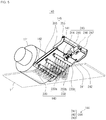
- FIG. 5 illustrates the wiper device 140 according to an embodiment of the present disclosure.
- the wiper device 140 includes a device frame 141 disposed behind the finishing roll 121 in a traveling direction of the material 1.
- a thickness of the material before being drawn into the finishing roll 121 is greater than a thickness of the material after having been drawn into the finishing roll 121.
- a side on which the thickness of the material is relatively great is defined as on an inlet side of the finishing roll 121, and a side on which the thickness of the material is less than that on the inlet side is defined as an exit side.
- the device frame 141 may be disposed on an inlet side of the finishing roll 121.
- a wiper member 142 may be coupled to the device frame 141 by a coupling member (not illustrated).
- the wiper member 142 may also be integrally formed with the device frame 141, but an embodiment thereof is not limited thereto.
- the wiper member 142 may be appropriately modified by those skilled in the art.
- the cooling header unit 143 may be provided with the device frame 141 or the wiper member 142, and the cooling header unit 143 may be configured to supply cooling water to the surface of the material 1.
- the cooling header unit 143 may be provided on the device frame 141 or the wiper member 142 as described above.
- a case in which the cooling header unit 143 is provided on the wiper member 142 will be described by way of example.
- cooling header unit 143 may be appropriately selected by those skilled in the art.
- cooling header unit 143 when the cooling header unit 143 is provided on the device frame 141 or the wiper member 142 on the inlet side of the finishing roll, a rolling mill space may be efficiently utilized. Therefore, according to an embodiment in the present disclosure, not only constructing a cooling header unit applicable in the actual mill space, but also constructing a cooling header unit suitable for the actual mill space may be implemented.
- cooling header unit 143 in an embodiment of the present disclosure, there is an effect in which cooling of a material surface, based on an actual thickness of the material 1, may be performed, regardless of a reduction rate, a finishing roll gap, a finishing roll diameter, and the like.
- the materials may have different thicknesses depending on physical conditions such as an ambient temperature, a material heating history, or the like, even under the same rolling condition and reduction. Therefore, in a case in which cooling water is supplied, based on data of the material, of which a thickness is estimated by a rolling condition, a reduction rate, or the like (in this case, since the thickness of the material is determined by an interval of finishing rolls pressing the material, the thickness of the material may be regarded as being the same as an interval of the finishing rolls), cooling work suitable for an actual material thickness may be performed.
- the cooling header unit 143 supplies the cooling water directly to the surface of the material 1, to cool the surface of the material on the inlet side of the finishing roll, to a temperature of a critical point or lower.
- Such a method may efficiently cool the surface of the material as compared with a method of supplying cooling water to a finishing roll or a finishing roll gap, and further, has an effect of efficiently cooling up to a finishing roll.
- a cooling header adjusting unit 144 may be provided to move the cooling header unit 143 on the wiper member 142 to remove the overlap region (see R in FIG. 4 ) in which cooling water overlaps, and thus, to promote uniform cooling.
- the cooling header unit may be provided as a plurality of cooling header units below the wiper member, and may be configured to supply a largest amount of cooling fluid, in a position farthest away from the finishing roll, and to supply a smallest amount of cooling fluid, in a position closest to the finishing roll.
- the temperature of the material 1 may be prevented from suddenly changing before entering the finishing roll 121.
- a smallest amount of cooling fluid is supplied from the third cooling pipe 233c farthest from the finishing roll 121 to cool the material 1
- an amount of cooling fluid more than that from the third cooling pipe 233c is supplied from the second cooling pipe 233b to cool the material 1
- a greatest amount of cooling fluid is supplied through the first cooling pipe 233a provided immediately before the finishing roll 121, thereby exhibiting an effect of preventing brittleness from occurring due to rapid cooling of the material before being drawn into the finishing roll 121, and thus, contributing to improvement in moldability.
- the material 1 is a material containing at least one of medium carbon steel (0.08% to 0.3% of carbon weight), high carbon steel (0.3% or more of carbon weight) and niobium(N b )-added steel, the effect as described above may be further significantly increased.
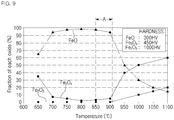
- the amount of the cooling water supplied to the cooling pipe is controlled such that a material temperature before being drawn into the finishing roll 121 is in the range of 850°C to 900°C, thereby significantly increasing formability of the material 1.
- the material 1 is a material containing at least one of medium carbon steel (0.08% to 0.3% of carbon weight), high carbon steel (0.3% or more of carbon weight) and niobium (N b )-added steel
- a material temperature is within a range from 850°C or higher to 900°C or lower
- the fraction of hematite (ferrous oxide: Fe 2 O 3 ) and magnetite (ferric oxide: Fe 3 O 4 ) which have hardness greater than that of the finishing roll, is increased, causing that mill scale is peeled off as a surface defect.
- a surface temperature of the material may be in the range of 850°C to 900°C, which may be significantly effective to improve the quality.
- a separate temperature measuring unit (not illustrated) may be provided on the inlet side of the finishing roll 121, but this may also be selected and applied by those skilled in the art.
- the sudden decrease in the surface temperature of the material causes a decrease in the temperature of the entirety of the material in a thickness direction, adversely affecting plate passing ability. Therefore, cooling the material uniformly, while preventing rapid cooling of the material and formation of an overlap region (see R in FIG. 4 ) of cooling water, may be significantly important.
- the material 1 may be appropriately cooled to be in an optimum state by adjusting a distance and an angle of the cooling pipe 233 by the cooling header adjusting unit 144.
- the cooling header adjusting unit may vary a distance from the cooling nozzle 333 to the material surface by moving the cooling pipe 233 on the wiper member 142 by a distance adjusting unit 343.
- the distance adjusting unit 343 may change the position of the cooling nozzle 333 on the wiper member 142 and thereby change a distance of the spray from the cooling nozzle 333 to the material surface.
- the position of the cooling pipe 233 appropriate for rolling conditions may be selected, thereby preventing cooling water supplied from a plurality of the cooling nozzles from overlapping, and there is an effect of removing an overlap region in which cooling water is overlapped.
- the cooling efficiency of the material and the finishing roll may be improved, and the quality of a rolled product may be improved.
- the cooling header adjusting unit 144 is configured to rotate the wiper member 142 (by rotating the device frame in a case in which the cooling pipe is installed on the device frame) on which the cooling pipe 233 is installed, by an angle adjusting unit, in such a manner that an angle formed by the cooling nozzle 333 with respect to a surface of the material 1 may also be changed, which will be described later.
- a moving frame 241 is provided between the wiper member 142 and the cooling pipe 233, and a moving rail 242 may be provided between the moving frame 241 and the wiper member 142.
- the moving rail 242 may be provided as an LM guide, but the configuration thereof is not limited thereto and may be replaced by other guiding parts.
- a movement path of the cooling pipe 233 may be set in advance on the wiper member 142, and the stable movement of the cooling pipe 233 may be implemented.
- the distance adjusting unit 343 to move the cooling pipe 233 on the wiper member 142 may include the moving frame 241 supporting or fixing the cooling pipe 233, the moving rail 242 provided on the moving frame and the wiper member 142, and a power transmission unit 243 connected to the moving frame or the cooling pipe to move the moving frame or the cooling pipe along the moving rail.
- the power transmission unit 243 may include a screw housing 244, an encoder 247, a motor 246, and a screw member 245 that is connected to a rotary shaft of the motor connected to the screw housing and the encoder and is connected to the screw housing to pass through the inside of the screw housing.
- a bracket member supporting the screw member 245 may be further provided between the screw member 245 and the screw housing 244, to support the screw member 245.
- the screw member 245 may be efficiently supported when a length of the screw member is increased or a moving distance is relatively increased, and the screw member 245 may be prevented from drooping due to the load, or the like.
- the screw member 245 may be provided with threads protruding from an outer circumference and the screw housing 244 may be provided with a thread groove that engages with the thread of the screw member 245. In this case, when the screw member 245 is rotated by the motor 246, the screw housing 244 does not rotate but performs a linear motion in such a manner that the moving frame 241 connected to the screw housing 244 is moved linearly along the moving rail 242.
- a bearing (not illustrated) may be provided in a region in which the screw housing 244 engages with the screw member 245, to prevent rotation of the screw housing 244 due to rotation of the screw member 245.
- the cooling pipe 233 moves, and a distance by which the cooling pipe 233 moves may be detected by the encoder 247.
- the encoder 247 may detect the number of revolutions of the motor 246 to calculate a linear travel distance, which may be performed more efficiently by a control unit (not illustrated) electrically connected to the encoder 247.
- a distance by which the cooling pipe 233 is separated from the surface of the material 1 may be adjusted by moving the moving frame 241 through the rotation of the motor 246. Accordingly, as such, by adjusting the position of the cooling pipe 233, a spraying distance of cooling water may be adjusted, and by adopting an appropriate position of the cooling pipe 233 depending on rolling conditions, the overlap region (see R in FIG. 4 ) in which the cooling water sprayed from the cooling nozzle 333 is superimposed may be prevented from occurring.
- cooling pipe 233 may be configured to be separately controlled, but an embodiment thereof is not limited thereto, and may be selectively modified by those skilled in the art.
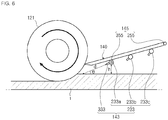
- a sensing unit 145 is provided as illustrated in FIG. 6 .
- the travel distance and position of the cooling pipe 233 may be grasped by a distance sensor 355 provided on the cooling pipe 233.
- the distance sensor 355 may also be electrically connected to the control unit (not illustrated).
- the cooling nozzle 333 of the cooling pipe 233 may adjust an angle ⁇ at which the cooling water is sprayed.
- the angle ⁇ at which the cooling water is sprayed may be adjusted by rotating the wiper device 140, in detail, the wiper member (see 142 in FIG. 5 ) or the device frame (see 141 in FIG. 5 ) by a predetermined angle.
- angle ⁇ at which the cooling water is sprayed may be sensed by an angle sensor 255 that may be provided on the wiper member.
- a thickness of the material 1 is set before the material 1 is drawn into the finishing roll 121, and a value of the angle ⁇ at which the cooling water is sprayed by the angle sensor 255 may be known.
- an optimum spraying distance at which the cooling water overlap region does not occur may have a previously derived value, and the angle ⁇ at which the cooling water is sprayed may be a value that does not change after initial setting in which a diameter of the finishing roll 121 and a target material are determined.
- the cooling pipe may be moved to an optimum spraying distance at which the overlap region does not occur, by the distance adjusting unit 343 according to an embodiment, and the device frame or the wiper member may be rotated to form an initially determined angle ⁇ at which the cooling water is sprayed, by an angle adjusting unit (see 350 in FIG. 7 ) .
- a movement amount d' of the cooling pipe 233 for setting an optimal spraying distance d opt is as in the following Equation 2.
- d ′ d opt ⁇ h ′ sin ⁇ ⁇
- the above-mentioned [Equation 1] and [Equation 2] may be calculated on the basis of the first cooling pipe 233a, and when the respective cooling pipes are configured so that the distance and the angle are individually changed, the above-mentioned [Equation 1] and [Equation 2] may be individually applied to the respective cooling pipes, and the spraying distance and the spraying angle may also be separately calculated with respect to the respective cooling pipes.
- An angle ⁇ at which the cooling water is sprayed may be adjusted by the angle adjusting unit 350, which is connected to the device frame 141 or the wiper member 142, to rotate the device frame or the wiper member such that an angle formed by the cooling header unit 143 with respect to the surface of the material 1 may be adjusted.
- angle adjusting unit 350 is provided in the device frame 141 as an example, but an embodiment thereof is not limited thereto, and may be appropriately changed by those skilled in the art.
- the angle adjusting unit 350 may include an angle adjusting motor 351 of which a rotational axis is connected to the device frame.
- an encoder 352 may also be connected to the angle adjusting motor 351.
- the device frame 141 may also be provided with an angle sensor 163 to sense a rotational state and angle.
- the sensors described above may all be configured to be electrically connected to the control unit (not illustrated) so that information thereof may be transferred to an operator.
- the wiper member 142 connected to the device frame 141 rotates, and the cooling nozzle 333 may rotate accordingly.
- the operator may adjust the angle ⁇ at which the cooling water is sprayed onto the surface of the material 1 by the cooling nozzle 333, according to this principle.
- occurrence of an overlap region may be prevented more effectively.
- angle adjusting unit 350 is provided in the device frame 141 as an example, but an embodiment thereof is not limited thereto, and may be appropriately changed by those skilled in the art.
- the angle adjusting unit 350 may include an angle adjusting motor 351 of which a rotational axis is connected to the device frame.
- an encoder 352 may also be connected to the angle adjusting motor 351.
- the device frame 141 may also be provided with an angle sensor 163 to sense a rotational state and angle.
- the sensors described above may all be configured to be electrically connected to the control unit (not illustrated) so that information thereof may be transferred to an operator.
- the wiper member 142 connected to the device frame 141 rotates, and the cooling nozzle 333 may rotate accordingly.
- the operator may adjust the angle ⁇ at which the cooling water is sprayed onto the surface of the material 1 by the cooling nozzle 333, according to this principle.
- occurrence of an overlap region may be prevented more effectively.
- a method of rolling a material using a rolling facility may include a roughing operation S610 in which the material is pressed by a roughing mill, an inlet-side cooling operation S620 in which cooling water is supplied to the material on an inlet side of a finishing roll of a finishing mill, a finishing operation S630 in which the material is pressed by the finishing roll after the inlet-side cooling operation or during the inlet-side cooling operation, and an outlet-side cooling operation S640 in which the cooling water is supplied to the finishing roll and the material on an exit side of the finishing roll after the finishing operation or during the finishing operation.
- the inlet-side cooling operation S620 may include a nozzle adjusting operation S621 of changing a position of a nozzle for supplying cooling water or rotating the nozzle, and the nozzle adjusting operation may be performed by adjusting a distance from the nozzle to the finishing roll or the material or changing an angle formed by the nozzle with respect to the material.
- the outlet-side cooling operation S640 may be performed by supplying cooling water to the finishing roll 121 on an exit side of the finishing roll 121 by the outlet-side cooling unit 70 as illustrated in FIG. 3 .
- the cooling water may be uniformly sprayed onto the surface of the material, thereby enabling efficient cooling of the surface of the material. Therefore, a phenomenon in which mill scale of a roll surface is partially or entirely peeled off may be prevented, and the quality of a rolled product may be further improved.
Landscapes
- Engineering & Computer Science (AREA)
- Mechanical Engineering (AREA)
- Metal Rolling (AREA)
Applications Claiming Priority (2)
| Application Number | Priority Date | Filing Date | Title |
|---|---|---|---|
| KR1020160169026A KR102075193B1 (ko) | 2016-12-12 | 2016-12-12 | 압연설비 및 압연방법 |
| PCT/KR2017/014564 WO2018110946A1 (ko) | 2016-12-12 | 2017-12-12 | 압연설비 및 압연방법 |
Publications (2)
| Publication Number | Publication Date |
|---|---|
| EP3552722A1 true EP3552722A1 (de) | 2019-10-16 |
| EP3552722A4 EP3552722A4 (de) | 2020-01-01 |
Family
ID=62559509
Family Applications (1)
| Application Number | Title | Priority Date | Filing Date |
|---|---|---|---|
| EP17880333.4A Withdrawn EP3552722A4 (de) | 2016-12-12 | 2017-12-12 | Walzanlage und walzverfahren |
Country Status (6)
| Country | Link |
|---|---|
| US (1) | US20190308234A1 (de) |
| EP (1) | EP3552722A4 (de) |
| JP (1) | JP2020500716A (de) |
| KR (1) | KR102075193B1 (de) |
| CN (1) | CN110099756A (de) |
| WO (1) | WO2018110946A1 (de) |
Cited By (1)
| Publication number | Priority date | Publication date | Assignee | Title |
|---|---|---|---|---|
| WO2021197720A1 (de) * | 2020-04-02 | 2021-10-07 | Sms Group Gmbh | Verfahren und vorrichtung zum kühlen eine walze |
Families Citing this family (2)
| Publication number | Priority date | Publication date | Assignee | Title |
|---|---|---|---|---|
| CN111250697B (zh) * | 2020-02-18 | 2022-03-29 | 太原理工大学 | 一种氧化钆/钨/铝中子和伽马射线核壳共屏蔽材料的制备方法 |
| KR102386732B1 (ko) * | 2020-11-17 | 2022-04-14 | 주식회사 포스코 | 열간 압연설비 |
Family Cites Families (24)
| Publication number | Priority date | Publication date | Assignee | Title |
|---|---|---|---|---|
| JPH02229604A (ja) * | 1989-03-01 | 1990-09-12 | Kawasaki Steel Corp | 圧延機ロールの水切り方法 |
| US5212975A (en) * | 1991-05-13 | 1993-05-25 | International Rolling Mill Consultants, Inc. | Method and apparatus for cooling rolling mill rolls and flat rolled products |
| JPH06210339A (ja) * | 1993-01-12 | 1994-08-02 | Sumitomo Metal Ind Ltd | 高温鋼板の冷却装置 |
| JP3012123B2 (ja) * | 1993-09-02 | 2000-02-21 | 川崎製鉄株式会社 | 熱間圧延装置 |
| JPH08155528A (ja) * | 1994-11-30 | 1996-06-18 | Nkk Corp | 金属板の冷却装置 |
| DE19737735A1 (de) * | 1997-08-29 | 1999-03-04 | Schloemann Siemag Ag | Vorrichtung und Verfahren zur auslaufseitigen Kühlung der Arbeitswalzen eines Walzgerüstes |
| JPH11129002A (ja) * | 1997-10-29 | 1999-05-18 | Kawasaki Steel Corp | 熱間仕上圧延方法 |
| KR100406372B1 (ko) | 1999-08-25 | 2003-11-19 | 주식회사 포스코 | 열간압연장치 및 이를 이용한 열간압연방법 |
| KR20010059510A (ko) * | 1999-12-30 | 2001-07-06 | 이구택 | 압연재의 균일 변형을 유도하는 스테인레스강의열간압연방법 |
| DE10131369A1 (de) * | 2001-06-28 | 2003-01-09 | Sms Demag Ag | Verfahren und Vorrichtung zum Kühlen und Schmieren von Walzen eines Walzgerüstes |
| JP2003039109A (ja) * | 2001-07-30 | 2003-02-12 | Toshiba Corp | 巻取温度制御装置 |
| JP3881632B2 (ja) * | 2003-04-11 | 2007-02-14 | 新日本製鐵株式会社 | 圧延ロール表面粗度調整による鋼板の製造方法 |
| KR101050794B1 (ko) * | 2003-12-30 | 2011-07-20 | 주식회사 포스코 | 연연속 열간압연설비의 압연롤 연마장치 및 연마 방법 |
| JP4333406B2 (ja) * | 2004-02-26 | 2009-09-16 | Jfeスチール株式会社 | 熱延金属ストリップの冷却方法およびその装置 |
| JP4661226B2 (ja) * | 2005-01-12 | 2011-03-30 | Jfeスチール株式会社 | 鋼板の冷却方法及び冷却装置 |
| KR100711772B1 (ko) * | 2005-12-26 | 2007-05-10 | 주식회사 포스코 | 열간 압연 장치 및 방법 |
| KR100742891B1 (ko) * | 2006-07-07 | 2007-07-25 | 주식회사 포스코 | 열연강판의 제조방법 |
| JP2008246562A (ja) * | 2007-03-30 | 2008-10-16 | Jfe Steel Kk | 熱間圧延方法 |
| KR101077174B1 (ko) * | 2009-04-21 | 2011-10-27 | 주식회사 포스코 | 인라인 압연기의 워크롤 냉각 장치 |
| KR101175781B1 (ko) * | 2009-10-29 | 2012-08-21 | 현대제철 주식회사 | 압연공정에 구비되는 온도측정장치 및 압연공정에서 소재의 온도를 측정하는 방법 |
| JP5646261B2 (ja) * | 2010-09-22 | 2014-12-24 | 三菱日立製鉄機械株式会社 | 熱延鋼帯の冷却装置 |
| CN202192103U (zh) * | 2011-07-01 | 2012-04-18 | 中冶赛迪工程技术股份有限公司 | 轧件均匀冷却装置 |
| CN104690091B (zh) * | 2015-03-20 | 2017-04-19 | 中国重型机械研究院股份公司 | 整体机架二十辊轧机可调式喷淋系统 |
| CN205341520U (zh) * | 2016-01-19 | 2016-06-29 | 中冶南方工程技术有限公司 | 一种串列式h型钢轧机前后控冷装置供水系统 |
-
2016
- 2016-12-12 KR KR1020160169026A patent/KR102075193B1/ko active Active
-
2017
- 2017-12-12 EP EP17880333.4A patent/EP3552722A4/de not_active Withdrawn
- 2017-12-12 CN CN201780075979.0A patent/CN110099756A/zh not_active Withdrawn
- 2017-12-12 WO PCT/KR2017/014564 patent/WO2018110946A1/ko not_active Ceased
- 2017-12-12 US US16/465,811 patent/US20190308234A1/en not_active Abandoned
- 2017-12-12 JP JP2019531142A patent/JP2020500716A/ja active Pending
Cited By (1)
| Publication number | Priority date | Publication date | Assignee | Title |
|---|---|---|---|---|
| WO2021197720A1 (de) * | 2020-04-02 | 2021-10-07 | Sms Group Gmbh | Verfahren und vorrichtung zum kühlen eine walze |
Also Published As
| Publication number | Publication date |
|---|---|
| KR102075193B1 (ko) | 2020-02-07 |
| KR20180067370A (ko) | 2018-06-20 |
| WO2018110946A1 (ko) | 2018-06-21 |
| CN110099756A (zh) | 2019-08-06 |
| US20190308234A1 (en) | 2019-10-10 |
| EP3552722A4 (de) | 2020-01-01 |
| JP2020500716A (ja) | 2020-01-16 |
Similar Documents
| Publication | Publication Date | Title |
|---|---|---|
| KR20190058526A (ko) | 자성 가열을 이용한 예비시효 시스템 및 방법 | |
| EP3552722A1 (de) | Walzanlage und walzverfahren | |
| KR101464093B1 (ko) | 열연 강대의 제조 장치 및 제조 방법 | |
| WO2011125670A1 (ja) | 熱延鋼板の製造装置及び製造方法 | |
| CN103987469A (zh) | 热轧钢板冷却装置 | |
| JP5617321B2 (ja) | 冷却装置を駆動するポンプを用いた鋼板の製造方法 | |
| KR102329511B1 (ko) | 압연설비 및 압연방법 | |
| JP5261971B2 (ja) | 圧延機ワークロールのロールギャップ測定装置 | |
| CN117677447A (zh) | 用于将中间带材热轧成薄带材的六辊式轧机机架和精轧机组 | |
| CN103433276B (zh) | 型钢轧制生产线及其生产方法 | |
| JP7311764B2 (ja) | 冷間タンデム圧延設備及び冷間タンデム圧延方法 | |
| KR102386732B1 (ko) | 열간 압연설비 | |
| KR20180067469A (ko) | 압연설비 및 압연방법 | |
| JP5768468B2 (ja) | 金属帯の冷間圧延機および冷間圧延方法 | |
| KR102010365B1 (ko) | 사상 압연 사이드 가이드 장치 | |
| JP5626275B2 (ja) | 熱延鋼板の冷却方法 | |
| JP4453299B2 (ja) | 表面欠陥の少ない鋼帯の製造方法 | |
| JP6008142B2 (ja) | 熱延鋼板の巻取り制御方法および巻取り制御装置 | |
| KR101525059B1 (ko) | 압연기의 커플링 지지장치 | |
| JP4760403B2 (ja) | サーマルクラウン制御装置、圧延機及びその圧延機を用いた金属帯の製造方法 | |
| JP6683166B2 (ja) | 冷間圧延の板厚制御方法 | |
| JP3777719B2 (ja) | オンラインロールグラインダによる圧延ロール表面の研削方法 | |
| CN118357281B (zh) | 基于淬火特性进行热轧卷的轧制生产设备及加工方法 | |
| KR20110034356A (ko) | 압연장치용 권취롤러 | |
| JP5278580B2 (ja) | 熱延鋼板の冷却装置及び冷却方法 |
Legal Events
| Date | Code | Title | Description |
|---|---|---|---|
| PUAI | Public reference made under article 153(3) epc to a published international application that has entered the european phase |
Free format text: ORIGINAL CODE: 0009012 |
|
| 17P | Request for examination filed |
Effective date: 20190627 |
|
| AK | Designated contracting states |
Kind code of ref document: A1 Designated state(s): AL AT BE BG CH CY CZ DE DK EE ES FI FR GB GR HR HU IE IS IT LI LT LU LV MC MK MT NL NO PL PT RO RS SE SI SK SM TR |
|
| AX | Request for extension of the european patent |
Extension state: BA ME |
|
| A4 | Supplementary search report drawn up and despatched |
Effective date: 20191129 |
|
| RIC1 | Information provided on ipc code assigned before grant |
Ipc: B21B 1/24 20060101ALI20191125BHEP Ipc: B21B 45/02 20060101ALI20191125BHEP Ipc: B21B 28/02 20060101AFI20191125BHEP |
|
| DAV | Request for validation of the european patent (deleted) | ||
| DAX | Request for extension of the european patent (deleted) | ||
| STAA | Information on the status of an ep patent application or granted ep patent |
Free format text: STATUS: THE APPLICATION HAS BEEN WITHDRAWN |
|
| 18W | Application withdrawn |
Effective date: 20200610 |