EP3553698B1 - Détection de composants dans un ensemble d'objets, en particulier de déchets, d'ordures et/ou de matériaux valorisables - Google Patents
Détection de composants dans un ensemble d'objets, en particulier de déchets, d'ordures et/ou de matériaux valorisables Download PDFInfo
- Publication number
- EP3553698B1 EP3553698B1 EP19167744.2A EP19167744A EP3553698B1 EP 3553698 B1 EP3553698 B1 EP 3553698B1 EP 19167744 A EP19167744 A EP 19167744A EP 3553698 B1 EP3553698 B1 EP 3553698B1
- Authority
- EP
- European Patent Office
- Prior art keywords
- objects
- amount
- recording device
- optical recording
- image
- Prior art date
- Legal status (The legal status is an assumption and is not a legal conclusion. Google has not performed a legal analysis and makes no representation as to the accuracy of the status listed.)
- Active
Links
Images

Classifications
-
- G—PHYSICS
- G01—MEASURING; TESTING
- G01N—INVESTIGATING OR ANALYSING MATERIALS BY DETERMINING THEIR CHEMICAL OR PHYSICAL PROPERTIES
- G01N21/00—Investigating or analysing materials by the use of optical means, i.e. using sub-millimetre waves, infrared, visible or ultraviolet light
- G01N21/17—Systems in which incident light is modified in accordance with the properties of the material investigated
- G01N21/25—Colour; Spectral properties, i.e. comparison of effect of material on the light at two or more different wavelengths or wavelength bands
- G01N21/29—Colour; Spectral properties, i.e. comparison of effect of material on the light at two or more different wavelengths or wavelength bands using visual detection
-
- B—PERFORMING OPERATIONS; TRANSPORTING
- B65—CONVEYING; PACKING; STORING; HANDLING THIN OR FILAMENTARY MATERIAL
- B65F—GATHERING OR REMOVAL OF DOMESTIC OR LIKE REFUSE
- B65F3/00—Vehicles particularly adapted for collecting refuse
-
- G—PHYSICS
- G01—MEASURING; TESTING
- G01N—INVESTIGATING OR ANALYSING MATERIALS BY DETERMINING THEIR CHEMICAL OR PHYSICAL PROPERTIES
- G01N21/00—Investigating or analysing materials by the use of optical means, i.e. using sub-millimetre waves, infrared, visible or ultraviolet light
- G01N21/17—Systems in which incident light is modified in accordance with the properties of the material investigated
- G01N21/25—Colour; Spectral properties, i.e. comparison of effect of material on the light at two or more different wavelengths or wavelength bands
- G01N21/31—Investigating relative effect of material at wavelengths characteristic of specific elements or molecules, e.g. atomic absorption spectrometry
- G01N21/35—Investigating relative effect of material at wavelengths characteristic of specific elements or molecules, e.g. atomic absorption spectrometry using infrared light
- G01N21/3563—Investigating relative effect of material at wavelengths characteristic of specific elements or molecules, e.g. atomic absorption spectrometry using infrared light for analysing solids; Preparation of samples therefor
-
- G—PHYSICS
- G06—COMPUTING OR CALCULATING; COUNTING
- G06V—IMAGE OR VIDEO RECOGNITION OR UNDERSTANDING
- G06V10/00—Arrangements for image or video recognition or understanding
- G06V10/10—Image acquisition
- G06V10/12—Details of acquisition arrangements; Constructional details thereof
- G06V10/14—Optical characteristics of the device performing the acquisition or on the illumination arrangements
- G06V10/143—Sensing or illuminating at different wavelengths
-
- G—PHYSICS
- G06—COMPUTING OR CALCULATING; COUNTING
- G06V—IMAGE OR VIDEO RECOGNITION OR UNDERSTANDING
- G06V20/00—Scenes; Scene-specific elements
- G06V20/50—Context or environment of the image
- G06V20/59—Context or environment of the image inside of a vehicle, e.g. relating to seat occupancy, driver state or inner lighting conditions
-
- B—PERFORMING OPERATIONS; TRANSPORTING
- B65—CONVEYING; PACKING; STORING; HANDLING THIN OR FILAMENTARY MATERIAL
- B65F—GATHERING OR REMOVAL OF DOMESTIC OR LIKE REFUSE
- B65F3/00—Vehicles particularly adapted for collecting refuse
- B65F3/14—Vehicles particularly adapted for collecting refuse with devices for charging, distributing or compressing refuse in the interior of the tank of a refuse vehicle
- B65F2003/146—Sensors, e.g. pressure sensors
-
- B—PERFORMING OPERATIONS; TRANSPORTING
- B65—CONVEYING; PACKING; STORING; HANDLING THIN OR FILAMENTARY MATERIAL
- B65F—GATHERING OR REMOVAL OF DOMESTIC OR LIKE REFUSE
- B65F2210/00—Equipment of refuse receptacles
- B65F2210/20—Temperature sensing means
-
- G—PHYSICS
- G06—COMPUTING OR CALCULATING; COUNTING
- G06T—IMAGE DATA PROCESSING OR GENERATION, IN GENERAL
- G06T2207/00—Indexing scheme for image analysis or image enhancement
- G06T2207/30—Subject of image; Context of image processing
- G06T2207/30108—Industrial image inspection
Definitions
- the invention relates to the field of the detection of components in a set of objects, in particular a system and a method for detecting the components in a set of objects, in particular waste, garbage and / or recyclable materials, which are on a surface, in particular in a vehicle Garbage collection, is distributed.
- the invention also relates to a vehicle for garbage collection.
- Garbage, refuse and various recyclable materials are usually collected at regular intervals by special vehicles and transported for further processing, e.g. incineration or recycling, in a treatment plant set up for this purpose.
- the collected goods are analyzed and sorted in order to enable legally compliant and sustainable treatment.
- a coarse sorting takes place before collection, in which waste owners are obliged to dispose of the different waste fractions in specific waste bins. Therefore, separate bins are provided for different categories, e.g. residual waste, plastics, cans, organic waste and glass in front of residential houses and company buildings.
- EP 3 208 753 A1 describes a waste management system for remote testing.
- the system can include an optical sensor that can be mounted on board the service vehicle and is configured to capture image data associated with the waste.
- Dr Tuomas et al: "ZenRobotics Recycler - Robotic Sorting using Machine Learning” “discloses a system that sorts construction and demolition waste by picking up valuable objects from a conveyor belt with robotic hands, achieving useful purity of wood, stone, and metal without resorting to human sorters.
- Machine learning is used to do some of the main problems to solve, such as recognizing materials and picking irregular objects from a waste stream on a conveyor belt.
- the system is also configured to be mounted in the garbage dump of a compact garbage truck, which is completely dark and exposed to very strong mechanical loads.
- the described system is based on the knowledge that an intelligent evaluation of the optical properties of the quantity of objects present on a surface in the vehicle just after a bin has been emptied allows an efficient and reliable detection of the individual components of this quantity. On the one hand, it can be recognized immediately when dangerous objects are loaded into the vehicle. On the other hand, when they arrive at the treatment plant, there is detailed knowledge of the goods collected so that further sorting and processing can be specifically designed and adapted.
- a system for detecting a quantity of waste and garbage
- a system for the first time, which is not operated on a conveyor belt within a plant (e.g. a garbage sorting plant), but is mounted in the "inhospitable" environment of a garbage truck.
- the system described is (at least partially) mounted in the chute of a compacted refuse vehicle.
- This environment is completely dark and exposed to very strong mechanical loads (especially jolting and shaking) from the moving garbage truck, the pressing processes and also from garbage flying around. For this reason, the challenges in terms of lighting, electronics and pollution are extremely high in the present system.
- the measuring environment of a vibrating, dark and dirty environment of a garbage dump requires completely different technical solutions.
- the evaluation by means of the neural network finally enables a data processing unit to deal with this highly complex
- Classification activity "to train”.
- the learning algorithm can use standard neural networks and thus enable versatile use of the classification system.
- 2D color image particularly refers to an ordinary digital photo, particularly with a resolution of 5MP or more.
- 2D spectral image refers in particular to an image that was recorded at a specific wavelength, the wavelength being in the range from visible light to near-infrared light.
- 3D image refers in particular to a three-dimensional image that was recorded, for example, with an (active or passive) stereo camera or with a time-of-flight camera (TOF camera).
- TOF camera time-of-flight camera
- the system described can in particular be used in such a way that after the contents of a garbage can have been unloaded into a refuse collection vehicle, the first, second and third optical recording devices are operated and the resulting image data are evaluated by means of the data processing unit using a neural network in order to identify the individual To capture components. Only then are the goods compressed. So it can be for every individual Loading process can be detected with great accuracy, which components are present in the filled amount of objects.
- the detection of the constituents in the set of objects comprises detection of an object type for each object.
- a corresponding object type for example "newspaper”, “aluminum can”, “battery”, “plastic can”, etc. is therefore determined for each individual object.
- the result of the detection thus includes a list of the object types that are contained in the set of objects.
- detecting the constituents in the set of objects includes detecting a set of objects for each object.
- a corresponding amount of objects for example a volume or a mass, is consequently determined for each individual object.
- the result of the detection thus includes an indication of the amount of each constituent.
- the lighting unit is set up in particular to illuminate the set of objects to be detected powerfully and uniformly in order to provide good and reproducible lighting for the optical recording devices.
- the lighting unit is further configured to emit light with a spectral composition that contains each of the predetermined wavelengths of the second optical recording device.
- the system also has a position determination unit which is set up to determine a geographical position of the set of objects and to store this geographical position together with the 2D color image, the plurality of 2D spectral images and the 3D image .
- the position determination unit may in particular have a GPS unit or the like. By knowing the geographical position, it can be determined, for example, in which residential buildings the garbage is incorrectly pre-sorted or dangerous objects are handed in that have to be disposed of in a different way.
- the position determination unit is also set up to determine a date and a time.
- the first optical recording device, the second optical recording device and the third optical recording device are fixedly arranged relative to a predetermined reference point.
- the system also has a thermal camera which is set up to determine a temperature distribution in the set of objects.
- the temperature distribution may also be used to determine the constituents.
- the system furthermore has an alarm unit which is set up to emit an alarm signal if the set of objects has a temperature which exceeds a predetermined temperature threshold value.
- an alarm signal is given when one or more objects have a sufficiently high temperature. In this way, dangerous situations that could lead to burning vehicles can be avoided.
- the third optical recording device has the first optical recording device, a further optical recording device and a 3D data processing unit, the further optical recording device being identical to the first optical recording device and being attached in a predetermined position relative to this the 3D data processing unit is set up to generate 3D image data based on 2D images that were recorded by the first optical recording device and the further optical recording device.
- the third optical recording device consists of two identical or largely similar 2D cameras, one of which is at the same time the first optical recording device.
- the two cameras are fixedly attached relative to one another and thus allow 3D image data to be generated by the 3D data processing unit.
- the data processing unit is mounted in a control center, the system also having a data communication unit which is used to transmit data, in particular the 2D color image, the plurality of 2D spectral images and the 3D image is set up by the first, second and third recording device to the data processing unit.
- the data processing unit is located in a control center and receives the image data (and possibly further data, such as GPS data) by means of data transmission through the data communication unit, e.g. by means of cellular radio transmission, WLAN or the like.
- a vehicle for garbage collection which has a system according to the first aspect or one of the above embodiments.
- At least one of the first optical recording device, the second optical recording device, and the third optical recording device is set up to record series of images. Furthermore, the system can be set up to provide dynamic lighting (in particular by means of the lighting unit).
- the system is (at least partially) coupled to the power supply of the garbage truck via peak smoothing and / or an undervoltage supply.
- Another challenge is the stable installation of the system described in the garbage truck.
- it has been found to be advantageous to combine the hardware of the system with the voltage supply of the garbage truck via a peak smoothing and / or undervoltage supply.
- a combination of slowly starting lighting (so that not too much electricity is drawn) and an optimized coupling with the control of a standard garbage truck can be quite advantageous.
- the system has: a projection device for providing a light projection, in particular a laser projection, and a calibration device for performing an axis calibration by means of the light projection. This can improve the accuracy of the receiving devices.
- the second recording device in particular an infrared or NIR sensor
- the third recording device in particular an RGB stereo camera
- the sensor fusion has a coupling of the second recording device and the third recording device via the (in particular automatic) axis calibration by means of the light (in particular laser, further in particular laser point) projection.
- a sensor unit can comprise a sensor fusion of RGB stereo camera (s) and a NIR (near infrared) sensor via an automatic axis calibration via a laser point projection.
- RGB stereo camera s
- NIR near infrared
- the data from homogeneous surfaces can also be used advantageously for a learning algorithm.
- the set of objects has an inhomogeneous mixture of waste and garbage, in particular containing residual waste and / or organic waste.
- the system also has: a compression unit which is set up to compress the captured data and to provide the compressed data to the data communication unit.
- the data is compressed on an industrial PC contained in the system so that it can be transmitted from the vehicle via WLAN (if available at the respective location) or LTE.
- the Figure 1 shows a system 100 according to the invention for detecting the components in a quantity of objects, in particular waste, garbage and / or valuable materials, which is distributed over an area, in particular in a vehicle for garbage collection.
- the system 100 has an RGB camera (first optical recording device) 110, a multispectral camera (second optical recording device) 120, a 3D camera (third optical recording device) 130 and a data processing unit 140. These three optical recording devices 110, 120, 130 and the data processing unit 140 are required for the functioning of the system 100.
- the in Figure 1 The system 100 shown furthermore has, as optional features, a lighting unit 150, a GPS unit (geographical position determination unit) 160, a thermal camera 170, an alarm unit 180 and a data memory 190.
- the RGB camera 110 is preferably a conventional digital camera with an image resolution of 5 MP or more and a fixed focal length that is suitable for capturing the relevant area in the hold of a refuse collection vehicle.
- the multispectral camera 120 is set up for this purpose a series of images at different wavelengths between visible light and Record near-infrared light.
- the 3D camera 130 is preferably a stereo camera or a time-of-flight camera.
- the stereo camera preferably consists of the RGB camera 110 and a further RGB camera which is identical to it and which is fixedly positioned relative to the RGB camera 110 in order to enable a 3D reconstruction.
- the three optical recording devices 110, 120, 130 are permanently installed in the vehicle and aligned relative to a common reference point so that all images can be superimposed directly.
- the data processing unit 140 has a suitable computer which is set up with software for evaluating the recorded images using a neural network.
- the neural network is trained to recognize a number of different object types in the recorded images and thus to detect the components of the existing set of objects.
- the data processing unit 140 can also be configured to detect the quantity (or size) of each object.
- the result i.e. a list of recognized object types and possibly the quantities of objects, is stored in the memory in the data processing unit 140 and / or in an external memory 190.
- the external memory may be attached separately in the vehicle or in a control center. In the latter case, the data is transmitted via a secure mobile data connection.
- the data processing unit 140 can also be installed in the control center, where the evaluation of the recorded data is then carried out. In the latter case, the image data are preferably transmitted to the control center by means of mobile data communication.
- the lighting unit 150 is fixedly mounted in the vehicle and aligned in such a way that the area with the objects to be detected is illuminated well and evenly.
- the spectral composition of the delivered Light is adapted in particular to the corresponding requirements of the multispectral camera 120.
- the GPS unit 160 determines the corresponding geographical position of the vehicle as well as the date and time for each process. These data are stored together with the images from the three optical recording devices 110, 120, 130 and the analysis result of the data processing unit 140, so that the recorded components can be assigned to a geographical position and, if applicable, the date and time.
- the thermal camera 170 is also permanently installed in the vehicle and is designed to determine a heat distribution in the set of objects to be analyzed, for example as a color image in which each color tone corresponds to a specific temperature.
- the determined temperature distribution may be included in the analysis carried out by the data processing unit 140. If a temperature above a predetermined threshold value is detected, the alarm unit 180 can be triggered in order to notify the driver of the vehicle of a dangerous situation so that he can immediately take appropriate safety measures.
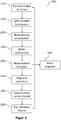
- FIG. 2 shows a method 200 in accordance with an embodiment of the present invention.
- the method 200 begins at 210 by placing the contents of a garbage can in the collection vehicle and determining the geographic position of the vehicle at 220.
- the quantity of objects distributed on the area provided for this purpose in the vehicle is now illuminated at 230 by switching on the lighting unit 150.
- images are recorded by each of the optical recording devices 110, 120, 130 and optionally by the thermal camera 170.
- the RGB photo captured by the first optical capture device 110 which is captured by the Spectral images recorded by the second optical recording device 120 and the 3D image recorded by the third optical recording device 130 are then analyzed at 250 by the data processing unit 140 using a neural network so as to detect the constituents in the scanned set of objects.
- a dangerous object such as a chemical product or a burning object
- an alarm is issued at 260 to alert the driver of the vehicle.
- the result of the acquisition process possibly together with the position, date and time, is saved.
- the lighting unit 150 is turned off and the quantity of objects is compressed at 280 in the vehicle.
- the collection continues at 290 by driving the vehicle to the next bin and repeating steps 210 to 280.
- the constituents of each emptied bin are consequently recorded and stored, so that detailed information about all the objects collected is available upon arrival at the processing plant and can be used to make processing optimally and safely.
Landscapes
- Engineering & Computer Science (AREA)
- Physics & Mathematics (AREA)
- General Physics & Mathematics (AREA)
- Multimedia (AREA)
- Theoretical Computer Science (AREA)
- Mechanical Engineering (AREA)
- Spectroscopy & Molecular Physics (AREA)
- Life Sciences & Earth Sciences (AREA)
- Health & Medical Sciences (AREA)
- Chemical & Material Sciences (AREA)
- Analytical Chemistry (AREA)
- Biochemistry (AREA)
- General Health & Medical Sciences (AREA)
- Immunology (AREA)
- Pathology (AREA)
- Investigating Or Analysing Materials By Optical Means (AREA)
- Length Measuring Devices By Optical Means (AREA)
- Sorting Of Articles (AREA)
Claims (14)
- Système (100) pour détecter les composants dans une quantité d'objets, constituée de déchets, d'ordures et/ou de matériaux recyclables, qui est répartie sur une surface dans un véhicule à ordures compressées, le système présentant :un premier dispositif d'enregistrement optique (110), qui est conçu pour enregistrer une image en couleur 2D de la quantité d'objets ;un deuxième dispositif d'enregistrement optique (120), qui est conçu pour enregistrer une multitude d'images spectrales 2D de la quantité d'objets, dans lequel chaque image spectrale 2D correspond à une longueur d'onde respective prédéfinie ;un troisième dispositif d'enregistrement optique (130), qui est conçu pour enregistrer une image 3D de la quantité d'objets ;une unité d'éclairage (150), qui est conçue pour éclairer la quantité d'objets ; etune unité de traitement de données (140), qui est conçue pour détecter les composants dans la quantité d'objets sur la base de l'image en couleur 2D de la multitude d'images spectrales 2D et de l'image 3D et en utilisant un réseau neuronal, dans lequell'unité de traitement de données (140) est conçue en outre pour détecter à l'aide du réseau neuronal les composants de la quantité présente d'objets sur les images enregistrées ;dans lequel le système est configuré pour être monté à proximité du déversement d'ordures d'un véhicule à ordures compressées, lequel environnement est totalement sombre et est exposé à une contrainte mécanique très forte.
- Système selon la revendication précédente, dans lequel la détection des composants dans la quantité d'objets présente une détection d'un type d'objet pour chaque objet.
- Système selon l'une quelconque des revendications précédentes, dans lequel la détection des composants dans la quantité d'objets présente une détection d'une quantité d'objets pour chaque objet.
- Système selon l'une quelconque des revendications précédentes, présentant en outre une unité de détermination de position (160), qui est conçue pour déterminer une position géographique de la quantité d'objets et pour mémoriser ladite position géographique conjointement avec l'image en couleur 2D, la multitude d'images spectrales 2D et l'image 3D.
- Système selon la revendication précédente, dans lequel l'unité de détermination de position est conçue en outre pour déterminer une date et une heure.
- Système selon l'une quelconque des revendications précédentes, dans lequel le premier dispositif d'enregistrement optique, le deuxième dispositif d'enregistrement optique et le troisième dispositif d'enregistrement optique sont disposés de manière solidaire par rapport à un point de référence prédéterminé.
- Système selon l'une quelconque des revendications précédentes, présentant en outre une caméra thermique (170), qui est conçue pour déterminer une répartition de température dans la quantité d'objets.
- Système selon la revendication précédente, présentant en outre une unité d'alarme (180), qui est conçue pour émettre un signal d'alarme quand la quantité d'objets présente une température, laquelle dépasse une valeur de seuil de température prédéterminée.
- Système selon l'une quelconque des revendications précédentes, dans lequel le troisième dispositif d'enregistrement optique présente le premier dispositif d'enregistrement optique, un autre dispositif d'enregistrement optique et une unité de traitement de données 3D, dans lequel l'autre dispositif d'enregistrement optique est installé de manière identique avec le premier dispositif d'enregistrement optique et dans une position prédéterminée par rapport à celui-ci, dans lequel l'unité de traitement de données 3D est conçue pour générer des données d'image 3D sur la base d'images 2D, qui ont été enregistrées par le premier dispositif d'enregistrement optique et l'autre dispositif d'enregistrement optique.
- Système selon l'une quelconque des revendications précédentes, dans lequel l'unité de traitement de données est installée dans une centrale, le système présentant en outre une unité de communication de données, qui est conçue pour transmettre des données, en particulier l'image en couleur 2D, la multitude d'images spectrales 2D et l'image 3D des premier, deuxième et troisième dispositifs d'enregistrement à l'unité de traitement de données.
- Système selon l'une quelconque des revendications précédentes, présentant en outre,un dispositif de projection pour fournir une projection de lumière, en particulier une projection laser, etun dispositif d'étalonnage pour mettre en œuvre un étalonnage d'axe au moyen de la projection de lumière.
- Véhicule pour l'évacuation d'ordures, le véhicule présentant un système selon l'une quelconque des revendications précédentes,dans lequel le véhicule est un véhicule à ordures compressées avec un déversement, etdans lequel le système est monté à proximité du déversement.
- Véhicule selon la revendication 12,
dans lequel le système est couplé au moins en partie à l'alimentation en tension du véhicule à ordures par l'intermédiaire d'un lissage de pic et/ou d'une alimentation en sous-tension. - Procédé pour détecter les composants dans une quantité d'objets, constituée de déchets, d'ordures et/ou de matières recyclables, qui est répartie sur une surface dans un véhicule à ordures compressés, le procédé présentant :l'éclairage de la quantité d'objets ;l'enregistrement d'une image en couleur 2D de la quantité d'objets ;l'enregistrement d'une multitude d'images spectrales 2D de la quantité d'objets, dans lequel chaque image spectrale 2D correspond à une longueur d'onde respective prédéterminée ;l'enregistrement d'une image 3D de la quantité d'objets ; etla détection des composants dans la quantité d'objets sur la base de l'image en couleur 2D, de la multitude d'images spectrales 2D et de l'image 3D et en utilisant un réseau neuronal, dans lequel les composants de la quantité présente d'objets sont détectés sur les images enregistrées à l'aide du réseau neuronal.
Priority Applications (1)
| Application Number | Priority Date | Filing Date | Title |
|---|---|---|---|
| PL19167744T PL3553698T3 (pl) | 2018-04-09 | 2019-04-08 | Wykrywanie składników w masie przedmiotów, zwłaszcza odpadów, śmieci i/lub surowców wtórnych |
Applications Claiming Priority (1)
| Application Number | Priority Date | Filing Date | Title |
|---|---|---|---|
| ATA50289/2018A AT521101B1 (de) | 2018-04-09 | 2018-04-09 | Erfassung der Bestandteile in einer Menge von Gegenständen, insbesondere Abfällen, Müll und/oder Wertstoffen |
Publications (2)
| Publication Number | Publication Date |
|---|---|
| EP3553698A1 EP3553698A1 (fr) | 2019-10-16 |
| EP3553698B1 true EP3553698B1 (fr) | 2021-10-27 |
Family
ID=66102451
Family Applications (1)
| Application Number | Title | Priority Date | Filing Date |
|---|---|---|---|
| EP19167744.2A Active EP3553698B1 (fr) | 2018-04-09 | 2019-04-08 | Détection de composants dans un ensemble d'objets, en particulier de déchets, d'ordures et/ou de matériaux valorisables |
Country Status (4)
| Country | Link |
|---|---|
| EP (1) | EP3553698B1 (fr) |
| AT (1) | AT521101B1 (fr) |
| ES (1) | ES2905109T3 (fr) |
| PL (1) | PL3553698T3 (fr) |
Families Citing this family (3)
| Publication number | Priority date | Publication date | Assignee | Title |
|---|---|---|---|---|
| US12378068B2 (en) * | 2021-07-08 | 2025-08-05 | The Heil Co. | Refuse collection with auger and contamination detection panel |
| DK4181086T3 (da) | 2021-11-16 | 2024-10-07 | C Trace Gmbh | Affaldsbortskaffelsessystem og fremgangsmåde til detektering af forurenende stoffer i affaldsbeholdere |
| DE102023125252A1 (de) * | 2023-09-18 | 2025-03-20 | zebrafant.ai GmbH | Abfallerkennungssystem und computerimplementiertes Verfahren zum Bestimmen einer Eigenschaft von Abfall in einem Abfallbehälter |
Citations (1)
| Publication number | Priority date | Publication date | Assignee | Title |
|---|---|---|---|---|
| EP3208753A1 (fr) * | 2016-02-20 | 2017-08-23 | Rubicon Global Holdings, LLC | Système de gestion de déchets mettant en oeuvre un contrôle a distance |
Family Cites Families (9)
| Publication number | Priority date | Publication date | Assignee | Title |
|---|---|---|---|---|
| CA2171851A1 (fr) * | 1993-09-16 | 1995-03-23 | Herbert Furumoto | Dispositif permettant de commander une installation de production de cellulose desencree a l'aide d'analyseurs d'etat, constitues de reseaux neuronaux, des suspensions de vieux papiers |
| DE19543134A1 (de) * | 1995-11-18 | 1997-05-22 | Dietrich Dr Wienke | Verfahren und Vorrichtung zur getrennten Erfassung von Wertstoffen - insbesondere von Kunststoffverpackungen - in Form dezentral aufstellbarer sensorbetriebener intelligenter Container |
| JP2002267599A (ja) * | 2001-03-07 | 2002-09-18 | Mitsubishi Heavy Ind Ltd | プラスチックの材質識別システムおよびプラスチックの材質識別・分別システム |
| ES2330819B1 (es) * | 2007-08-30 | 2010-09-24 | Tt Ambiental Gestio I Serveis, S.L. | Sistema de gestion integral de recogida de residuos urbanos y de estado fisico del mobiliario y espacio urbano en una zona urbana. |
| JP2010094634A (ja) * | 2008-10-17 | 2010-04-30 | Canon Inc | プラスチックの分別装置および分別方法 |
| WO2014179667A2 (fr) * | 2013-05-03 | 2014-11-06 | Ecowastehub Corp. | Système d'identification et de ségrégation de déchets solides |
| FR3036107B1 (fr) * | 2015-05-11 | 2020-02-14 | Paprec Group | Vehicule de collecte de dechets |
| CN205596583U (zh) * | 2016-05-11 | 2016-09-28 | 安徽喜洋洋农业科技有限公司 | 一种新型智能测土配方施肥装置 |
| DE102016109999A1 (de) * | 2016-05-31 | 2017-11-30 | Mtm Plastics Gmbh | Verfahren und Vorrichtung zur Analyse inhomogener Schüttgüter |
-
2018
- 2018-04-09 AT ATA50289/2018A patent/AT521101B1/de not_active IP Right Cessation
-
2019
- 2019-04-08 ES ES19167744T patent/ES2905109T3/es active Active
- 2019-04-08 EP EP19167744.2A patent/EP3553698B1/fr active Active
- 2019-04-08 PL PL19167744T patent/PL3553698T3/pl unknown
Patent Citations (1)
| Publication number | Priority date | Publication date | Assignee | Title |
|---|---|---|---|---|
| EP3208753A1 (fr) * | 2016-02-20 | 2017-08-23 | Rubicon Global Holdings, LLC | Système de gestion de déchets mettant en oeuvre un contrôle a distance |
Also Published As
| Publication number | Publication date |
|---|---|
| AT521101A1 (de) | 2019-10-15 |
| ES2905109T3 (es) | 2022-04-07 |
| EP3553698A1 (fr) | 2019-10-16 |
| PL3553698T3 (pl) | 2022-02-28 |
| AT521101B1 (de) | 2020-02-15 |
Similar Documents
| Publication | Publication Date | Title |
|---|---|---|
| EP3553698B1 (fr) | Détection de composants dans un ensemble d'objets, en particulier de déchets, d'ordures et/ou de matériaux valorisables | |
| Palmieri et al. | Recycling-oriented characterization of plastic frames and printed circuit boards from mobile phones by electronic and chemical imaging | |
| DE102011088393B4 (de) | Bestimmen einer Gesamtzahl an Personen in einem IR-Bild, das mittels eines IR-Bilderzeugungssystems gewonnen wird | |
| DE4129754C2 (de) | Verfahren zur Gewinnung sortenreiner Kunststofffraktionen | |
| EP0795919B1 (fr) | Procédé de tri des déchets électronique, notamment de batteries anciennes et/ou accumulateurs anciens et dispositif pour la mise en oeuvre du procédé | |
| EP0439674A2 (fr) | Dispositif pour trier des déchets | |
| DE4305006A1 (de) | Verfahren zum automatischen Sortieren von Abfallmaterial und Verfahren zur Spektralanalyse von Stoffen sowie Einrichtungen zur Durchführung der Verfahren | |
| EP3494385B1 (fr) | Dispositif et procédé d'analyse d'alliage de fragments de ferraille en métal | |
| EP4181086B1 (fr) | Système d'élimination des déchets et procédé de détection des matières perturbatrices dans des conteneurs à déchets | |
| EP3465151B1 (fr) | Procédé et dispositif d'analyse pour matériaux en vrac | |
| DD152870A1 (de) | Verfahren und vorrichtung zum klassieren in bewegung befindlichen stueckgutes | |
| WO1993019999A1 (fr) | Procede et dispositif visant a rechercher les elements metalliques contenus dans les dechets menagers | |
| EP1421999A2 (fr) | Procédé d'identification, de classification et de tri d'objets ou matériaux et système de reconnaissance correspondant | |
| DE3215067A1 (de) | Automatische pruefvorrichtung zum nachweis von fremdkoerpern | |
| DE4033501A1 (de) | Sammel- und transportsystem fuer muell, insbesondere fuer wertstoffe aus hausmuell | |
| CN116967155A (zh) | 一种建筑废弃物现场智能分拣方法 | |
| EP0761311B1 (fr) | Procédé et dispositif pour la reconnaissance et le tri de piles usées destinées à être recyclées | |
| DE19543134A1 (de) | Verfahren und Vorrichtung zur getrennten Erfassung von Wertstoffen - insbesondere von Kunststoffverpackungen - in Form dezentral aufstellbarer sensorbetriebener intelligenter Container | |
| EP1533045B1 (fr) | Procédé et dispositif de tri pour déchets du papier et carton | |
| EP3322983B1 (fr) | Procédé pour fournir un combustible de remplacement et procédé d'analyse finale d'un combustible de remplacement | |
| EP0557738B1 (fr) | Procédé et dispositif pour distinguer des pièces en matière plastique et l'usage du procédé pour séparer des pièces recyclables en matière plastique de déchets industriels et/ou ménagers | |
| KR102914790B1 (ko) | Ai 기반 스마트 계근대 시스템 | |
| DE102023107571B4 (de) | Verfahren zur Beurteilung eines Einsatzes eines Schüttguts innerhalb eines Prozesses | |
| EP0922505B1 (fr) | Procédé et dispositif de séparation automatique de cartes téléphoniques selon leurs matériaux spécifiques | |
| DE102023106456A1 (de) | Abfallsammelfahrzeug sowie Verfahren zum Sammeln und Trennen von Abfall |
Legal Events
| Date | Code | Title | Description |
|---|---|---|---|
| PUAI | Public reference made under article 153(3) epc to a published international application that has entered the european phase |
Free format text: ORIGINAL CODE: 0009012 |
|
| STAA | Information on the status of an ep patent application or granted ep patent |
Free format text: STATUS: THE APPLICATION HAS BEEN PUBLISHED |
|
| AK | Designated contracting states |
Kind code of ref document: A1 Designated state(s): AL AT BE BG CH CY CZ DE DK EE ES FI FR GB GR HR HU IE IS IT LI LT LU LV MC MK MT NL NO PL PT RO RS SE SI SK SM TR |
|
| AX | Request for extension of the european patent |
Extension state: BA ME |
|
| STAA | Information on the status of an ep patent application or granted ep patent |
Free format text: STATUS: REQUEST FOR EXAMINATION WAS MADE |
|
| 17P | Request for examination filed |
Effective date: 20200406 |
|
| RBV | Designated contracting states (corrected) |
Designated state(s): AL AT BE BG CH CY CZ DE DK EE ES FI FR GB GR HR HU IE IS IT LI LT LU LV MC MK MT NL NO PL PT RO RS SE SI SK SM TR |
|
| STAA | Information on the status of an ep patent application or granted ep patent |
Free format text: STATUS: EXAMINATION IS IN PROGRESS |
|
| 17Q | First examination report despatched |
Effective date: 20200626 |
|
| GRAP | Despatch of communication of intention to grant a patent |
Free format text: ORIGINAL CODE: EPIDOSNIGR1 |
|
| STAA | Information on the status of an ep patent application or granted ep patent |
Free format text: STATUS: GRANT OF PATENT IS INTENDED |
|
| INTG | Intention to grant announced |
Effective date: 20210610 |
|
| GRAS | Grant fee paid |
Free format text: ORIGINAL CODE: EPIDOSNIGR3 |
|
| GRAA | (expected) grant |
Free format text: ORIGINAL CODE: 0009210 |
|
| STAA | Information on the status of an ep patent application or granted ep patent |
Free format text: STATUS: THE PATENT HAS BEEN GRANTED |
|
| AK | Designated contracting states |
Kind code of ref document: B1 Designated state(s): AL AT BE BG CH CY CZ DE DK EE ES FI FR GB GR HR HU IE IS IT LI LT LU LV MC MK MT NL NO PL PT RO RS SE SI SK SM TR |
|
| REG | Reference to a national code |
Ref country code: GB Ref legal event code: FG4D Free format text: NOT ENGLISH |
|
| REG | Reference to a national code |
Ref country code: CH Ref legal event code: EP |
|
| REG | Reference to a national code |
Ref country code: DE Ref legal event code: R096 Ref document number: 502019002584 Country of ref document: DE |
|
| REG | Reference to a national code |
Ref country code: AT Ref legal event code: REF Ref document number: 1442470 Country of ref document: AT Kind code of ref document: T Effective date: 20211115 |
|
| REG | Reference to a national code |
Ref country code: IE Ref legal event code: FG4D Free format text: LANGUAGE OF EP DOCUMENT: GERMAN |
|
| REG | Reference to a national code |
Ref country code: DE Ref legal event code: R079 Ref document number: 502019002584 Country of ref document: DE Free format text: PREVIOUS MAIN CLASS: G06K0009000000 Ipc: G06V0010000000 |
|
| REG | Reference to a national code |
Ref country code: LT Ref legal event code: MG9D |
|
| REG | Reference to a national code |
Ref country code: NL Ref legal event code: MP Effective date: 20211027 |
|
| RAP2 | Party data changed (patent owner data changed or rights of a patent transferred) |
Owner name: SCANTEC GMBH |
|
| REG | Reference to a national code |
Ref country code: ES Ref legal event code: FG2A Ref document number: 2905109 Country of ref document: ES Kind code of ref document: T3 Effective date: 20220407 |
|
| PG25 | Lapsed in a contracting state [announced via postgrant information from national office to epo] |
Ref country code: RS Free format text: LAPSE BECAUSE OF FAILURE TO SUBMIT A TRANSLATION OF THE DESCRIPTION OR TO PAY THE FEE WITHIN THE PRESCRIBED TIME-LIMIT Effective date: 20211027 Ref country code: LT Free format text: LAPSE BECAUSE OF FAILURE TO SUBMIT A TRANSLATION OF THE DESCRIPTION OR TO PAY THE FEE WITHIN THE PRESCRIBED TIME-LIMIT Effective date: 20211027 Ref country code: FI Free format text: LAPSE BECAUSE OF FAILURE TO SUBMIT A TRANSLATION OF THE DESCRIPTION OR TO PAY THE FEE WITHIN THE PRESCRIBED TIME-LIMIT Effective date: 20211027 Ref country code: BG Free format text: LAPSE BECAUSE OF FAILURE TO SUBMIT A TRANSLATION OF THE DESCRIPTION OR TO PAY THE FEE WITHIN THE PRESCRIBED TIME-LIMIT Effective date: 20220127 |
|
| REG | Reference to a national code |
Ref country code: DE Ref legal event code: R081 Ref document number: 502019002584 Country of ref document: DE Owner name: SCANTEC GMBH, DE Free format text: FORMER OWNER: SAUBERMACHER DIENSTLEISTUNGS AG, FELDKIRCHEN BEI GRAZ, AT |
|
| PG25 | Lapsed in a contracting state [announced via postgrant information from national office to epo] |
Ref country code: IS Free format text: LAPSE BECAUSE OF FAILURE TO SUBMIT A TRANSLATION OF THE DESCRIPTION OR TO PAY THE FEE WITHIN THE PRESCRIBED TIME-LIMIT Effective date: 20220227 Ref country code: SE Free format text: LAPSE BECAUSE OF FAILURE TO SUBMIT A TRANSLATION OF THE DESCRIPTION OR TO PAY THE FEE WITHIN THE PRESCRIBED TIME-LIMIT Effective date: 20211027 Ref country code: PT Free format text: LAPSE BECAUSE OF FAILURE TO SUBMIT A TRANSLATION OF THE DESCRIPTION OR TO PAY THE FEE WITHIN THE PRESCRIBED TIME-LIMIT Effective date: 20220228 Ref country code: NO Free format text: LAPSE BECAUSE OF FAILURE TO SUBMIT A TRANSLATION OF THE DESCRIPTION OR TO PAY THE FEE WITHIN THE PRESCRIBED TIME-LIMIT Effective date: 20220127 Ref country code: NL Free format text: LAPSE BECAUSE OF FAILURE TO SUBMIT A TRANSLATION OF THE DESCRIPTION OR TO PAY THE FEE WITHIN THE PRESCRIBED TIME-LIMIT Effective date: 20211027 Ref country code: LV Free format text: LAPSE BECAUSE OF FAILURE TO SUBMIT A TRANSLATION OF THE DESCRIPTION OR TO PAY THE FEE WITHIN THE PRESCRIBED TIME-LIMIT Effective date: 20211027 Ref country code: HR Free format text: LAPSE BECAUSE OF FAILURE TO SUBMIT A TRANSLATION OF THE DESCRIPTION OR TO PAY THE FEE WITHIN THE PRESCRIBED TIME-LIMIT Effective date: 20211027 Ref country code: GR Free format text: LAPSE BECAUSE OF FAILURE TO SUBMIT A TRANSLATION OF THE DESCRIPTION OR TO PAY THE FEE WITHIN THE PRESCRIBED TIME-LIMIT Effective date: 20220128 |
|
| REG | Reference to a national code |
Ref country code: GB Ref legal event code: 732E Free format text: REGISTERED BETWEEN 20220630 AND 20220706 |
|
| REG | Reference to a national code |
Ref country code: DE Ref legal event code: R097 Ref document number: 502019002584 Country of ref document: DE |
|
| PG25 | Lapsed in a contracting state [announced via postgrant information from national office to epo] |
Ref country code: SM Free format text: LAPSE BECAUSE OF FAILURE TO SUBMIT A TRANSLATION OF THE DESCRIPTION OR TO PAY THE FEE WITHIN THE PRESCRIBED TIME-LIMIT Effective date: 20211027 Ref country code: SK Free format text: LAPSE BECAUSE OF FAILURE TO SUBMIT A TRANSLATION OF THE DESCRIPTION OR TO PAY THE FEE WITHIN THE PRESCRIBED TIME-LIMIT Effective date: 20211027 Ref country code: RO Free format text: LAPSE BECAUSE OF FAILURE TO SUBMIT A TRANSLATION OF THE DESCRIPTION OR TO PAY THE FEE WITHIN THE PRESCRIBED TIME-LIMIT Effective date: 20211027 Ref country code: EE Free format text: LAPSE BECAUSE OF FAILURE TO SUBMIT A TRANSLATION OF THE DESCRIPTION OR TO PAY THE FEE WITHIN THE PRESCRIBED TIME-LIMIT Effective date: 20211027 Ref country code: DK Free format text: LAPSE BECAUSE OF FAILURE TO SUBMIT A TRANSLATION OF THE DESCRIPTION OR TO PAY THE FEE WITHIN THE PRESCRIBED TIME-LIMIT Effective date: 20211027 Ref country code: CZ Free format text: LAPSE BECAUSE OF FAILURE TO SUBMIT A TRANSLATION OF THE DESCRIPTION OR TO PAY THE FEE WITHIN THE PRESCRIBED TIME-LIMIT Effective date: 20211027 |
|
| PLBE | No opposition filed within time limit |
Free format text: ORIGINAL CODE: 0009261 |
|
| STAA | Information on the status of an ep patent application or granted ep patent |
Free format text: STATUS: NO OPPOSITION FILED WITHIN TIME LIMIT |
|
| 26N | No opposition filed |
Effective date: 20220728 |
|
| PG25 | Lapsed in a contracting state [announced via postgrant information from national office to epo] |
Ref country code: AL Free format text: LAPSE BECAUSE OF FAILURE TO SUBMIT A TRANSLATION OF THE DESCRIPTION OR TO PAY THE FEE WITHIN THE PRESCRIBED TIME-LIMIT Effective date: 20211027 |
|
| PG25 | Lapsed in a contracting state [announced via postgrant information from national office to epo] |
Ref country code: SI Free format text: LAPSE BECAUSE OF FAILURE TO SUBMIT A TRANSLATION OF THE DESCRIPTION OR TO PAY THE FEE WITHIN THE PRESCRIBED TIME-LIMIT Effective date: 20211027 |
|
| REG | Reference to a national code |
Ref country code: CH Ref legal event code: PL |
|
| REG | Reference to a national code |
Ref country code: BE Ref legal event code: MM Effective date: 20220430 |
|
| PG25 | Lapsed in a contracting state [announced via postgrant information from national office to epo] |
Ref country code: MC Free format text: LAPSE BECAUSE OF FAILURE TO SUBMIT A TRANSLATION OF THE DESCRIPTION OR TO PAY THE FEE WITHIN THE PRESCRIBED TIME-LIMIT Effective date: 20211027 Ref country code: LU Free format text: LAPSE BECAUSE OF NON-PAYMENT OF DUE FEES Effective date: 20220408 Ref country code: LI Free format text: LAPSE BECAUSE OF NON-PAYMENT OF DUE FEES Effective date: 20220430 Ref country code: CH Free format text: LAPSE BECAUSE OF NON-PAYMENT OF DUE FEES Effective date: 20220430 |
|
| PG25 | Lapsed in a contracting state [announced via postgrant information from national office to epo] |
Ref country code: BE Free format text: LAPSE BECAUSE OF NON-PAYMENT OF DUE FEES Effective date: 20220430 |
|
| PG25 | Lapsed in a contracting state [announced via postgrant information from national office to epo] |
Ref country code: IE Free format text: LAPSE BECAUSE OF NON-PAYMENT OF DUE FEES Effective date: 20220408 |
|
| P01 | Opt-out of the competence of the unified patent court (upc) registered |
Effective date: 20230602 |
|
| REG | Reference to a national code |
Ref country code: AT Ref legal event code: PC Ref document number: 1442470 Country of ref document: AT Kind code of ref document: T Owner name: SCANTEC GMBH, DE Effective date: 20230516 |
|
| PG25 | Lapsed in a contracting state [announced via postgrant information from national office to epo] |
Ref country code: HU Free format text: LAPSE BECAUSE OF FAILURE TO SUBMIT A TRANSLATION OF THE DESCRIPTION OR TO PAY THE FEE WITHIN THE PRESCRIBED TIME-LIMIT; INVALID AB INITIO Effective date: 20190408 |
|
| PG25 | Lapsed in a contracting state [announced via postgrant information from national office to epo] |
Ref country code: MK Free format text: LAPSE BECAUSE OF FAILURE TO SUBMIT A TRANSLATION OF THE DESCRIPTION OR TO PAY THE FEE WITHIN THE PRESCRIBED TIME-LIMIT Effective date: 20211027 Ref country code: CY Free format text: LAPSE BECAUSE OF FAILURE TO SUBMIT A TRANSLATION OF THE DESCRIPTION OR TO PAY THE FEE WITHIN THE PRESCRIBED TIME-LIMIT Effective date: 20211027 |
|
| PGFP | Annual fee paid to national office [announced via postgrant information from national office to epo] |
Ref country code: PL Payment date: 20240327 Year of fee payment: 6 |
|
| PG25 | Lapsed in a contracting state [announced via postgrant information from national office to epo] |
Ref country code: TR Free format text: LAPSE BECAUSE OF FAILURE TO SUBMIT A TRANSLATION OF THE DESCRIPTION OR TO PAY THE FEE WITHIN THE PRESCRIBED TIME-LIMIT Effective date: 20211027 |
|
| PGFP | Annual fee paid to national office [announced via postgrant information from national office to epo] |
Ref country code: GB Payment date: 20240423 Year of fee payment: 6 |
|
| PGFP | Annual fee paid to national office [announced via postgrant information from national office to epo] |
Ref country code: DE Payment date: 20240418 Year of fee payment: 6 |
|
| PGFP | Annual fee paid to national office [announced via postgrant information from national office to epo] |
Ref country code: ES Payment date: 20240517 Year of fee payment: 6 |
|
| PGFP | Annual fee paid to national office [announced via postgrant information from national office to epo] |
Ref country code: AT Payment date: 20240417 Year of fee payment: 6 |
|
| PGFP | Annual fee paid to national office [announced via postgrant information from national office to epo] |
Ref country code: IT Payment date: 20240430 Year of fee payment: 6 Ref country code: FR Payment date: 20240419 Year of fee payment: 6 |
|
| PG25 | Lapsed in a contracting state [announced via postgrant information from national office to epo] |
Ref country code: MT Free format text: LAPSE BECAUSE OF FAILURE TO SUBMIT A TRANSLATION OF THE DESCRIPTION OR TO PAY THE FEE WITHIN THE PRESCRIBED TIME-LIMIT Effective date: 20211027 |
|
| REG | Reference to a national code |
Ref country code: DE Ref legal event code: R119 Ref document number: 502019002584 Country of ref document: DE |
|
| REG | Reference to a national code |
Ref country code: AT Ref legal event code: MM01 Ref document number: 1442470 Country of ref document: AT Kind code of ref document: T Effective date: 20250408 |
|
| GBPC | Gb: european patent ceased through non-payment of renewal fee |
Effective date: 20250408 |
|
| PG25 | Lapsed in a contracting state [announced via postgrant information from national office to epo] |
Ref country code: DE Free format text: LAPSE BECAUSE OF NON-PAYMENT OF DUE FEES Effective date: 20251104 |
|
| PG25 | Lapsed in a contracting state [announced via postgrant information from national office to epo] |
Ref country code: GB Free format text: LAPSE BECAUSE OF NON-PAYMENT OF DUE FEES Effective date: 20250408 |
|
| PG25 | Lapsed in a contracting state [announced via postgrant information from national office to epo] |
Ref country code: AT Free format text: LAPSE BECAUSE OF NON-PAYMENT OF DUE FEES Effective date: 20250408 |
|
| PG25 | Lapsed in a contracting state [announced via postgrant information from national office to epo] |
Ref country code: FR Free format text: LAPSE BECAUSE OF NON-PAYMENT OF DUE FEES Effective date: 20250430 |
|
| PG25 | Lapsed in a contracting state [announced via postgrant information from national office to epo] |
Ref country code: IT Free format text: LAPSE BECAUSE OF NON-PAYMENT OF DUE FEES Effective date: 20250408 |
|
| PG25 | Lapsed in a contracting state [announced via postgrant information from national office to epo] |
Ref country code: PL Free format text: LAPSE BECAUSE OF NON-PAYMENT OF DUE FEES Effective date: 20250408 |