EP0922505B1 - Procédé et dispositif de séparation automatique de cartes téléphoniques selon leurs matériaux spécifiques - Google Patents
Procédé et dispositif de séparation automatique de cartes téléphoniques selon leurs matériaux spécifiques Download PDFInfo
- Publication number
- EP0922505B1 EP0922505B1 EP98119472A EP98119472A EP0922505B1 EP 0922505 B1 EP0922505 B1 EP 0922505B1 EP 98119472 A EP98119472 A EP 98119472A EP 98119472 A EP98119472 A EP 98119472A EP 0922505 B1 EP0922505 B1 EP 0922505B1
- Authority
- EP
- European Patent Office
- Prior art keywords
- card
- cards
- sorting table
- identification
- punching
- Prior art date
- Legal status (The legal status is an assumption and is not a legal conclusion. Google has not performed a legal analysis and makes no representation as to the accuracy of the status listed.)
- Expired - Lifetime
Links
- 238000000034 method Methods 0.000 title claims abstract description 52
- 239000000463 material Substances 0.000 title claims description 46
- 229920000122 acrylonitrile butadiene styrene Polymers 0.000 claims abstract description 36
- 238000012360 testing method Methods 0.000 claims abstract description 30
- 238000004080 punching Methods 0.000 claims abstract description 24
- RYGMFSIKBFXOCR-UHFFFAOYSA-N Copper Chemical compound [Cu] RYGMFSIKBFXOCR-UHFFFAOYSA-N 0.000 claims abstract description 21
- 238000010521 absorption reaction Methods 0.000 claims abstract description 21
- 230000003287 optical effect Effects 0.000 claims abstract description 13
- 239000010949 copper Substances 0.000 claims abstract description 12
- 229910052802 copper Inorganic materials 0.000 claims abstract description 11
- 238000000197 pyrolysis Methods 0.000 claims abstract description 11
- 230000005284 excitation Effects 0.000 claims abstract description 8
- 239000011230 binding agent Substances 0.000 claims abstract description 5
- 239000002904 solvent Substances 0.000 claims abstract description 5
- 229920003023 plastic Polymers 0.000 claims description 31
- 239000004033 plastic Substances 0.000 claims description 31
- 239000000203 mixture Substances 0.000 claims description 13
- 238000000926 separation method Methods 0.000 claims description 12
- ZAMOUSCENKQFHK-UHFFFAOYSA-N Chlorine atom Chemical compound [Cl] ZAMOUSCENKQFHK-UHFFFAOYSA-N 0.000 claims description 10
- 229910052801 chlorine Inorganic materials 0.000 claims description 9
- 239000000460 chlorine Substances 0.000 claims description 9
- 239000000969 carrier Substances 0.000 claims description 8
- 150000002825 nitriles Chemical class 0.000 claims description 8
- 230000005855 radiation Effects 0.000 claims description 8
- 230000003595 spectral effect Effects 0.000 claims description 8
- 238000001514 detection method Methods 0.000 claims description 7
- 238000004519 manufacturing process Methods 0.000 claims description 5
- 238000012545 processing Methods 0.000 claims description 5
- 238000011156 evaluation Methods 0.000 claims description 4
- 230000001419 dependent effect Effects 0.000 claims description 3
- 230000005670 electromagnetic radiation Effects 0.000 claims description 2
- 238000006243 chemical reaction Methods 0.000 claims 1
- 238000007599 discharging Methods 0.000 claims 1
- 239000000126 substance Substances 0.000 claims 1
- 239000004800 polyvinyl chloride Substances 0.000 abstract description 32
- 229920000915 polyvinyl chloride Polymers 0.000 abstract description 31
- XECAHXYUAAWDEL-UHFFFAOYSA-N acrylonitrile butadiene styrene Chemical compound C=CC=C.C=CC#N.C=CC1=CC=CC=C1 XECAHXYUAAWDEL-UHFFFAOYSA-N 0.000 abstract description 30
- 239000004676 acrylonitrile butadiene styrene Substances 0.000 abstract description 30
- 238000004458 analytical method Methods 0.000 abstract description 7
- 230000008569 process Effects 0.000 abstract description 3
- 238000007689 inspection Methods 0.000 abstract 1
- 238000011835 investigation Methods 0.000 abstract 1
- 125000002560 nitrile group Chemical group 0.000 abstract 1
- 239000000523 sample Substances 0.000 description 9
- 238000001228 spectrum Methods 0.000 description 8
- 239000011159 matrix material Substances 0.000 description 7
- 238000000295 emission spectrum Methods 0.000 description 4
- 229920000642 polymer Polymers 0.000 description 4
- 238000007789 sealing Methods 0.000 description 3
- 238000010276 construction Methods 0.000 description 2
- 238000013461 design Methods 0.000 description 2
- 238000011161 development Methods 0.000 description 2
- 238000001704 evaporation Methods 0.000 description 2
- 238000005259 measurement Methods 0.000 description 2
- 239000002184 metal Substances 0.000 description 2
- 229910052751 metal Inorganic materials 0.000 description 2
- 230000001681 protective effect Effects 0.000 description 2
- 230000035945 sensitivity Effects 0.000 description 2
- 210000002023 somite Anatomy 0.000 description 2
- 101100400452 Caenorhabditis elegans map-2 gene Proteins 0.000 description 1
- 229910021591 Copper(I) chloride Inorganic materials 0.000 description 1
- XUIMIQQOPSSXEZ-UHFFFAOYSA-N Silicon Chemical compound [Si] XUIMIQQOPSSXEZ-UHFFFAOYSA-N 0.000 description 1
- 230000009471 action Effects 0.000 description 1
- 230000003466 anti-cipated effect Effects 0.000 description 1
- 230000015572 biosynthetic process Effects 0.000 description 1
- 238000004364 calculation method Methods 0.000 description 1
- 230000015556 catabolic process Effects 0.000 description 1
- 230000008859 change Effects 0.000 description 1
- 239000003086 colorant Substances 0.000 description 1
- 238000002485 combustion reaction Methods 0.000 description 1
- 238000004590 computer program Methods 0.000 description 1
- OXBLHERUFWYNTN-UHFFFAOYSA-M copper(I) chloride Chemical compound [Cu]Cl OXBLHERUFWYNTN-UHFFFAOYSA-M 0.000 description 1
- 238000006731 degradation reaction Methods 0.000 description 1
- 230000004069 differentiation Effects 0.000 description 1
- 239000007772 electrode material Substances 0.000 description 1
- 230000008030 elimination Effects 0.000 description 1
- 238000003379 elimination reaction Methods 0.000 description 1
- 230000008020 evaporation Effects 0.000 description 1
- 210000003746 feather Anatomy 0.000 description 1
- 239000012535 impurity Substances 0.000 description 1
- 230000006698 induction Effects 0.000 description 1
- 238000003780 insertion Methods 0.000 description 1
- 230000037431 insertion Effects 0.000 description 1
- 230000016507 interphase Effects 0.000 description 1
- 238000002156 mixing Methods 0.000 description 1
- 239000005022 packaging material Substances 0.000 description 1
- 230000002093 peripheral effect Effects 0.000 description 1
- 239000013502 plastic waste Substances 0.000 description 1
- 239000000843 powder Substances 0.000 description 1
- 238000004064 recycling Methods 0.000 description 1
- 230000035939 shock Effects 0.000 description 1
- 229910052710 silicon Inorganic materials 0.000 description 1
- 239000010703 silicon Substances 0.000 description 1
- 238000010183 spectrum analysis Methods 0.000 description 1
- 230000000638 stimulation Effects 0.000 description 1
- 238000012546 transfer Methods 0.000 description 1
- 238000013022 venting Methods 0.000 description 1
Images





Classifications
-
- B—PERFORMING OPERATIONS; TRANSPORTING
- B29—WORKING OF PLASTICS; WORKING OF SUBSTANCES IN A PLASTIC STATE IN GENERAL
- B29B—PREPARATION OR PRETREATMENT OF THE MATERIAL TO BE SHAPED; MAKING GRANULES OR PREFORMS; RECOVERY OF PLASTICS OR OTHER CONSTITUENTS OF WASTE MATERIAL CONTAINING PLASTICS
- B29B17/00—Recovery of plastics or other constituents of waste material containing plastics
- B29B17/02—Separating plastics from other materials
-
- B—PERFORMING OPERATIONS; TRANSPORTING
- B07—SEPARATING SOLIDS FROM SOLIDS; SORTING
- B07C—POSTAL SORTING; SORTING INDIVIDUAL ARTICLES, OR BULK MATERIAL FIT TO BE SORTED PIECE-MEAL, e.g. BY PICKING
- B07C5/00—Sorting according to a characteristic or feature of the articles or material being sorted, e.g. by control effected by devices which detect or measure such characteristic or feature; Sorting by manually actuated devices, e.g. switches
- B07C5/34—Sorting according to other particular properties
-
- B—PERFORMING OPERATIONS; TRANSPORTING
- B07—SEPARATING SOLIDS FROM SOLIDS; SORTING
- B07C—POSTAL SORTING; SORTING INDIVIDUAL ARTICLES, OR BULK MATERIAL FIT TO BE SORTED PIECE-MEAL, e.g. BY PICKING
- B07C5/00—Sorting according to a characteristic or feature of the articles or material being sorted, e.g. by control effected by devices which detect or measure such characteristic or feature; Sorting by manually actuated devices, e.g. switches
- B07C5/34—Sorting according to other particular properties
- B07C5/344—Sorting according to other particular properties according to electric or electromagnetic properties
-
- B—PERFORMING OPERATIONS; TRANSPORTING
- B07—SEPARATING SOLIDS FROM SOLIDS; SORTING
- B07C—POSTAL SORTING; SORTING INDIVIDUAL ARTICLES, OR BULK MATERIAL FIT TO BE SORTED PIECE-MEAL, e.g. BY PICKING
- B07C5/00—Sorting according to a characteristic or feature of the articles or material being sorted, e.g. by control effected by devices which detect or measure such characteristic or feature; Sorting by manually actuated devices, e.g. switches
- B07C5/36—Sorting apparatus characterised by the means used for distribution
-
- G—PHYSICS
- G01—MEASURING; TESTING
- G01N—INVESTIGATING OR ANALYSING MATERIALS BY DETERMINING THEIR CHEMICAL OR PHYSICAL PROPERTIES
- G01N21/00—Investigating or analysing materials by the use of optical means, i.e. using sub-millimetre waves, infrared, visible or ultraviolet light
- G01N21/17—Systems in which incident light is modified in accordance with the properties of the material investigated
- G01N21/25—Colour; Spectral properties, i.e. comparison of effect of material on the light at two or more different wavelengths or wavelength bands
- G01N21/31—Investigating relative effect of material at wavelengths characteristic of specific elements or molecules, e.g. atomic absorption spectrometry
- G01N21/35—Investigating relative effect of material at wavelengths characteristic of specific elements or molecules, e.g. atomic absorption spectrometry using infrared light
- G01N21/3563—Investigating relative effect of material at wavelengths characteristic of specific elements or molecules, e.g. atomic absorption spectrometry using infrared light for analysing solids; Preparation of samples therefor
-
- B—PERFORMING OPERATIONS; TRANSPORTING
- B29—WORKING OF PLASTICS; WORKING OF SUBSTANCES IN A PLASTIC STATE IN GENERAL
- B29K—INDEXING SCHEME ASSOCIATED WITH SUBCLASSES B29B, B29C OR B29D, RELATING TO MOULDING MATERIALS OR TO MATERIALS FOR MOULDS, REINFORCEMENTS, FILLERS OR PREFORMED PARTS, e.g. INSERTS
- B29K2027/00—Use of polyvinylhalogenides or derivatives thereof as moulding material
- B29K2027/06—PVC, i.e. polyvinylchloride
-
- B—PERFORMING OPERATIONS; TRANSPORTING
- B29—WORKING OF PLASTICS; WORKING OF SUBSTANCES IN A PLASTIC STATE IN GENERAL
- B29K—INDEXING SCHEME ASSOCIATED WITH SUBCLASSES B29B, B29C OR B29D, RELATING TO MOULDING MATERIALS OR TO MATERIALS FOR MOULDS, REINFORCEMENTS, FILLERS OR PREFORMED PARTS, e.g. INSERTS
- B29K2055/00—Use of specific polymers obtained by polymerisation reactions only involving carbon-to-carbon unsaturated bonds, not provided for in a single one of main groups B29K2023/00 - B29K2049/00, e.g. having a vinyl group, as moulding material
- B29K2055/02—ABS polymers, i.e. acrylonitrile-butadiene-styrene polymers
-
- B—PERFORMING OPERATIONS; TRANSPORTING
- B29—WORKING OF PLASTICS; WORKING OF SUBSTANCES IN A PLASTIC STATE IN GENERAL
- B29K—INDEXING SCHEME ASSOCIATED WITH SUBCLASSES B29B, B29C OR B29D, RELATING TO MOULDING MATERIALS OR TO MATERIALS FOR MOULDS, REINFORCEMENTS, FILLERS OR PREFORMED PARTS, e.g. INSERTS
- B29K2705/00—Use of metals, their alloys or their compounds, for preformed parts, e.g. for inserts
-
- B—PERFORMING OPERATIONS; TRANSPORTING
- B29—WORKING OF PLASTICS; WORKING OF SUBSTANCES IN A PLASTIC STATE IN GENERAL
- B29L—INDEXING SCHEME ASSOCIATED WITH SUBCLASS B29C, RELATING TO PARTICULAR ARTICLES
- B29L2031/00—Other particular articles
- B29L2031/30—Vehicles, e.g. ships or aircraft, or body parts thereof
- B29L2031/3055—Cars
- B29L2031/3061—Number plates
-
- B—PERFORMING OPERATIONS; TRANSPORTING
- B29—WORKING OF PLASTICS; WORKING OF SUBSTANCES IN A PLASTIC STATE IN GENERAL
- B29L—INDEXING SCHEME ASSOCIATED WITH SUBCLASS B29C, RELATING TO PARTICULAR ARTICLES
- B29L2031/00—Other particular articles
- B29L2031/34—Electrical apparatus, e.g. sparking plugs or parts thereof
- B29L2031/3425—Printed circuits
-
- Y—GENERAL TAGGING OF NEW TECHNOLOGICAL DEVELOPMENTS; GENERAL TAGGING OF CROSS-SECTIONAL TECHNOLOGIES SPANNING OVER SEVERAL SECTIONS OF THE IPC; TECHNICAL SUBJECTS COVERED BY FORMER USPC CROSS-REFERENCE ART COLLECTIONS [XRACs] AND DIGESTS
- Y02—TECHNOLOGIES OR APPLICATIONS FOR MITIGATION OR ADAPTATION AGAINST CLIMATE CHANGE
- Y02W—CLIMATE CHANGE MITIGATION TECHNOLOGIES RELATED TO WASTEWATER TREATMENT OR WASTE MANAGEMENT
- Y02W30/00—Technologies for solid waste management
- Y02W30/50—Reuse, recycling or recovery technologies
- Y02W30/62—Plastics recycling; Rubber recycling
Definitions
- the invention relates to a method and a device for automatic and material-specific separation of cards with data and Function carriers such as cards with magnetic stripes and cards with contactless and / or contact-based electronic chips, in particular telephone cards, and for the production of unmixed PVC and ABS plastic fractions.
- data and Function carriers such as cards with magnetic stripes and cards with contactless and / or contact-based electronic chips, in particular telephone cards, and for the production of unmixed PVC and ABS plastic fractions.
- DE 41 29 754 C2 discloses a method for computer-controlled Production of unmixed plastic fractions from plastic parts, in particular packaging materials, existing mixtures known. This is during transport of the plastic parts by a Sorting device a spectral analysis of the respective plastic part performed by evaporating a material sample and the intensity of the thereby emitted light measured as a function of wavelength and is recorded. The material type is determined by the measured Emission spectrum automatically stored by means of a computer Reference spectra is compared. Depending on the type of material determined the plastic part by means of a discharge device in transported corresponding collection container.
- this method can be used for any mixtures of Plastic parts produce pure plastic fractions, if these each consist of a homogeneous plastic.
- this includes plastic cards with data and Function carriers, in which in the card body or on the Card surface Magnetic strips, electronic chips with contact surfaces, Induction coils u. ⁇ . Embedded or applied.
- Such cards are increasingly used in public life, e.g. as bank or Phone cards.
- the amount of cards that grows too Termination of use must be recycled.
- a general fundamental disadvantage of the method of DE 41 29 754 C2 which also strikes other areas than automatic card separation, is the amount of analysis time and computational capacity per examined Plastic part is needed, on the one hand, the entire emission spectrum On the other hand, to analyze this spectrum with one Reference spectrum to compare and thus identify the material.
- the invention is therefore based on the object, a method for By means of a mixture of telephone cards, Chip cards, magnetic stripe cards and other cards fast and under obtained reduced analysis costs unmixed plastic fractions can be. Furthermore, a device for carrying out the Method be provided.
- the cards collected for recycling initially consist of a mixture of smart cards with contact-type working electronic chips, in particular telephone cards with a metallic Contact surface, chip cards with contactless chips, Magnetic stripe cards and other cards. It can be assumed be that the total accumulating cards the same size and in certain Tolerances are the same thickness. This allows them in the device in defined position on a sorting table are held, in the card receivers to be processed to the dimensions of Cards are adapted.
- the sorting table is preferably circular in plan view from above rotatable about its central axis. He has a plurality of Card receivers in the radial direction on or in the table surface are arranged.
- the sorting table is preferably by means of a motor with predetermined clock frequency and predetermined Winkelinkrement to the Rotatable central axis, where the card identification and processing serving functional elements, in particular the identification units, the punching unit and the ejection unit at the angular positions in Area of the sorting table are arranged with the current Rest positions of the card reader correspond.
- the version with a rotating table is also space-saving. Equally, however, is also a conveyor belt with Card readers possible as a sorting table.
- the cards in the card receivers by generation fixed a negative pressure.
- This is indicated by the floor area of each one Mapaufsacrificings at least one suction opening, which via a Control valve vacuum connection has or with a vacuum pump connected is.
- the control valve is operated by computer control, so that each one newly inserted into the card reader card are fixed can.
- the suction through the suction openings can also be independent of an object continuously.
- a plurality of suction openings are in the bottom surface a card reader peripherally arranged.
- curved Cards are fixed in a flat position.
- the smart cards are working with contact electronic chips, especially the phone cards, separated. This takes place in the proposed method in step b) on the basis of Metal contacts used in the contactless transfer cards and the Magnetic stripe cards are missing, or optically, by the Absorption and reflection behavior of the card surface is analyzed.
- This identification allows on the one hand a separation of Magnetund contactless transmitting cards, on the other hand, the determination of Contact surface position in the other contact-type working cards, which are processed further.
- the remaining cards are immediately after the Determination of the card category or at a later date under Using a known reject method ejected.
- test contacts it is determined whether the card has metallic contact surfaces.
- the position of these contact surfaces is standardized, i. they can only appear in four different areas the chip card are located.
- the test contact is from the top and bottom of the Map that he is the map surface in one of these areas touched. If there is a contact surface there, a signal is generated on the one hand gives the indication of a contact chip card, for other also indicates the position of the contact surface.
- the test contact points preferably two contact probes, so two metallic pins, thereby when touching the metallic contact surface a short circuit as a signal is caused. It can be used a test contact, the relative to the map surface is also transversely movable and successively the different areas on the map, possibly also from below.
- the device preferably has four test contacts, their location in the application, i. in on a map brought up Condition, with the standard possible positions of the contact surfaces corresponds. If in this case additionally the method step b2) is performed, the step b1) already with three test contacts be achieved.
- a material identification takes place automatically.
- PVC polyvinyl chloride
- ABS acrylonitrile-butadiene-styrene
- PVC contains covalently bound chlorine, which is liberated during pyrolytic degradation such as evaporation, plasma formation, combustion. In the presence of elemental copper this is oxidized by the chlorine. The resulting CuCl 2 shows an intense green flame coloration in the spectral range between 500 to 530 nm, which indicates the presence of chlorine.
- BEILSTEIN sample detection of covalently bonded chlorine is extremely sensitive and used according to the invention for the identification of the card material PVC, since otherwise no chlorine-containing materials for chip or magnetic cards are used.
- the intensity of light in the spectral range between 500 - 530 nm emitted light is measured with a detector, with wavelengths outside this area with a filter, such as interference filters, be suppressed.
- a filter such as interference filters
- the excitation of the map material is expediently by a pulsed laser, but at sufficiently high laser power and Focusing also done in continuous operation. Alternatively it will suggested a spark stimulation.
- the Device for this preferably comprises a metering unit, which the Apply mixture in a defined area to the card.
- the pyrolysis of the map material occurs by means of spark excitation, are preferably used to generate the gas discharge copper electrodes used. As with a gas discharge from always a small amount of Electrode material is secreted, so that on the separate Adding copper can be dispensed with.
- ABS acrylonitrile butadiene styrene
- CN nitrile
- This absorption band is used to identify ABS by measuring the absorption behavior of the card in this wavelength range from 4.2 to 4.6 ⁇ m, preferably 4.4 ⁇ m.
- the card is illuminated by infrared light generated by an infrared light source, for example a Nernst pencil, and the intensity in the wavelength range from 4.2 to 4.6 ⁇ m, preferably 4.4 ⁇ m, is measured by means of an infrared detector.
- a corresponding wavelength-selecting filter for example an IR band-pass filter.
- No other plastic absorbs so strongly in this spectral range, so that here too specificity, if appropriate with comparison of the measured intensity with a predetermined threshold, combines with high detection sensitivity.
- the chip is used in method step e) punched together with contact surface, so that the card matrix of pure Plastic remains.
- the device has at least one, but preferably two or four stamping punch principle known Construction on.
- stamp this must be transversal to Card surface to be movable to contact surfaces, which adjoin four different locations on the card body, punch.
- punches these are arranged such that their position corresponds with the possible position of the contact surfaces, if there is a card in the punching unit.
- Preferred is a Design with two stamps whose stamp surface is about the length a contact surface but one opposite a contact surface enlarged Has width.
- stamps are symmetrical to the card length as well Transverse axis arranged so that in each case two contact surface positions in the right and left half of the card are detected with a punching operation.
- the area of pure map material that is punched out too much is to neglect the remaining card area, the Version with two stamps but four stamps mechanically easier to realize.
- the bottom of the sorting table or the individual Miltonholz choir has at least in the area of the punching unit shape and position of the stamp adapted punched holes on.
- the identification results from steps b) and d) are used for computer-controlled decision which cards at what time should be discharged.
- the ejection takes place at a fixed Place the sorting table in provided collection containers.
- contactless Chip cards and magnetic cards are without identification after identification Further processing ejected; contact-type chip cards made of PVC or ABS after punching out the chips and contact surfaces in material-specific Collection container.
- contact-type chip cards made of PVC or ABS after punching out the chips and contact surfaces in material-specific Collection container.
- In a further development of the method are also at Magnetic stripe cards punched out the magnetic strips; these cards can then be supplied to a single-grade plastic fraction.
- the ejection of the cards takes place by means of a blast of compressed air or by means of a mechanical shock, passing through an ejection opening in the sorting table takes place, or by sucking and lifting the card from the sorting table.
- the cards are thus determined depending on the Map materials and functional carriers separate collection containers fed, wherein at least one sorted PVC and a varietal ABS fraction is produced without metallic impurities.
- Sorting steps are computer controlled and a corresponding Computer program is part of the apparatus. This fact is going out No longer mentioned for reasons of simplification.
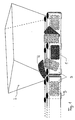
- the map mixture becomes, the schematic representation in FIG. 1 accordingly, poured into a funnel-shaped shaft 2, which is tapers downwards.
- the cards 1 slip by their own weight below and there are detected by a treadmill 3, the order Transport rollers 5 is running. Due to the geometric design of the opening on End of the shaft and with the help of a Receivebegrenzers 4 are the Cards single and lying in the direction of their longitudinal axis transported. This principle is similar in letter sorting used. Too badly bent cards stay behind and must be manually removed from time to time.
- the conveyor belt 3 opens into a stacking shaft 8 according to FIG. 2, which the cards reach via a roller 6.
- the stacking shaft 8 forms characterized by a deck of cards 9.
- the cards through the Conveyor belt 3 introduced so that it from the underlying detected rotating sorting table 10 and by suction of the Card Reader 11 can be fixed.
- the heart of the arrangement is a circular rotating sorting table 10 according to Fig. 3.
- the sorting table 10 carries eight card receivers 11, the by a vacuum supply 14, which is released by a control valve 13 will have vacuum connection.
- the card readers are through a recess formed in the sorting table surface, their dimensions the dimensions of the cards to be processed 1 are adapted, wherein in each case one card is to be held in register in a card reader (Step a).
- the cards are in the card reader by negative pressure fixed.
- the vacuum supply 14 necessary for this purpose is more exact in FIG. 4 shown.
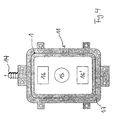
- Figure 4 shows the bottom view of such a card reader 11, wherein the vacuum in a channel in the edge region 17 of Card pickup 11 is guided and by in Figure 5 a and b shown suction openings 18 a card 1 in the card reader 11 in fixed in a defined position.
- FIG. 5 b After the cross-sectional view of FIG. 5 b is located inside and outside the peripheral ring Intake openings 18 each have a receiving channel 19, 19 'for a Sealing ring.
- the stacking shaft 8 opens according to FIG. 2 at a distance d above the Sorting table that is smaller than an average card thickness.
- the vacuum supply takes place according to Figure 6 along the engine or Table axis 20.
- the table axis has a A plurality of terminals 21 for producing a vacuum supply 14th to the individual card receivers 11.
- a further vacuum supply 22 to the vacuum pump.
- FIG. 4 and Fig. 5 a three Incorporated openings. It is in detail to two rectangular Punching openings 16, 16 'at least the size of a contact surface and a centered in the bottom surface of the card reader ejection opening 15th
- the sorting table 10 is stored at the periphery on rollers and in a Guiding frame 12 out. On the fixed border, the Guide frame 12, the individual will be active in the sorting involved components such as identification units, punching unit, Ejector mounted in defined angular positions.
- the sorting table is clocked rotated so that in the resting phases each one Card reader is located in the working area of a functional element and the card held therein is analyzed, edited or ejected can.
- the position of the functional elements relative to the sorting table is in Figure 1 each with the name of the process or Device feature a to e indicated. Where a means card feed and holder, b1 / 2 contact surface identification, c1 / 2 Material identification, d punching, e ejection. There are three Ejectors e for the ejection of contact-based PVC or ABS cards or other cards available.
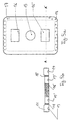
- test contacts 24, 24 '' 'from below and two Test contacts 24 ', 24 "brought from above to the card Approaching from below is expediently carried out by the punched holes 16, 16 '.
- the position of the contact surface results in each case thereafter, which test contact is shorted, which is symbolically marked with x x.
- test contact Fig. 7 e He insists made of two metallic contact probes 37, which are isolated from each other and are pressed against the card surface by means of a spring 26, wherein a short circuit is measured when touching a metallic surface becomes.
- step b2 For the separation of the contact cards not necessarily required optical sensor 25, is still in between Chip and magnetic stripe cards due to the reflection or Absorption behavior of the map surface differentiated (step b2). These cards could then be separated into PVC / ABS / other cards. be included. In this respect, the arrangement is expandable.
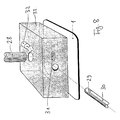
- the measuring arrangement for the identification of PVC cards is shown in FIG pulsed laser 28 vaporizes and pyrolyzes some card matrix material together with the previously applied copper powder 31.
- the with PVC cards occurring green flame coloration is through an interference filter 29 hidden and above a detector 30, e.g. a photocell or a Si detector, registered by the computer.
- Laser 28 and detector 30 are under about 90 ° relative to each other to direct laser irradiation to prevent the detector.
- the measuring point is surrounded by a protective cover 33 to endangerment excluded by laser beams.
- a suction device 32nd After each measurement, the atmosphere is cleaned of residues, so that Falsifications by foreign material deposits are avoided.
- FIG. 9 The measuring arrangement for the identification of ABS cards is shown in FIG. 9.
- An IR light source 36 e.g. a NERNST pin radiates through the card 1, the Light passes through the card reader in the region of the ejection opening 15.
- the radiation transmitted by the card is sensitive by an IR Detected detector 35, wherein a corresponding edge or Interference filter 34 only radiation in the range of about 4.5 microns lets through. If the map material is ABS, then a strong absorption, d. H. a significant decrease in intensity of the radiation. If the radiation intensity falls below a given value Threshold, so is the map material for the calculator as ABS identified.
- the cards identified as contact cards are continued. All other cards are after venting the control valve 13 ejected.
- the via the ejection opening 15 on the card e.g. over one Air blast.
- the Kunststoff- and thus the Chipposition are asymmetric to Longitudinal axis of the map. Because the location of the card in the card reader through The random principle is determined, are at least two punches required. If you wanted to punch out exactly only the contact surface 27, so In addition, two positions each of the two punches would be required, d. H. for each of the punch should be constructive next to the up / down movement provided an additional translational degree of freedom become.
- If a slightly larger area of 17 mm x 12 mm 204 mm 2 (4.4% of the matrix area) punched out in one operation, so the contact surface is certainly detected in one step, regardless of whether they happen to be on the front or back the card is located.
- the additional plastic loss is then 1.6% of the card mass. This is acceptable considering that this reduces the control of the two punches to the vertical direction of travel.
Landscapes
- Physics & Mathematics (AREA)
- Engineering & Computer Science (AREA)
- Spectroscopy & Molecular Physics (AREA)
- Analytical Chemistry (AREA)
- General Health & Medical Sciences (AREA)
- Health & Medical Sciences (AREA)
- Life Sciences & Earth Sciences (AREA)
- Chemical & Material Sciences (AREA)
- Environmental & Geological Engineering (AREA)
- Biochemistry (AREA)
- Mechanical Engineering (AREA)
- General Physics & Mathematics (AREA)
- Immunology (AREA)
- Pathology (AREA)
- Credit Cards Or The Like (AREA)
- Control Of Vending Devices And Auxiliary Devices For Vending Devices (AREA)
- Investigating, Analyzing Materials By Fluorescence Or Luminescence (AREA)
- Sampling And Sample Adjustment (AREA)
- Sorting Of Articles (AREA)
Claims (26)
- Procédé destiné à séparer automatiquement et de façon spécifique aux matériaux des cartes (1) ayant des supports de données et de fonction (27) comme les cartes (1) à bandes magnétiques et les cartes (1) à puces électroniques fonctionnant sans et/ou avec contact, en particulier les cartes téléphoniques, et à produire des fractions pures de matières plastiques ABS et PVC, caractérisé par la combinaison des étapes suivantes, automatiques et commandées par ordinateur :a) mise en place de cartes individuelles (1) dans une position définie sur une table de tri (10) ;b1) identification de cartes (1) avec puces électroniques fonctionnant avec contact et comportant des surfaces de contact métalliques (27) sur la surface de la carte au moyen d'un ou de plusieurs contacts de contrôle (24, 24', 24'', 24'''), lesquels sont appuyés sur le corps de la carte dans les zones où des surfaces de contact peuvent se trouver conformément aux normes, sachant qu'un contact de contrôle (24, 24', 24", 24''') entrant en contact à cette occasion avec une surface de contact métallique (27) donne un signal et que ce signal indique la présence d'une carte à puce à contact ainsi que la position de la surface de contact correspondante (27) sur la carte (1), et/oub2) identification de cartes (1) dotées de puces électroniques fonctionnant avec contact ou de bandes magnétiques par analyse optique de la structure de la surface de la carte ;c1) identification de cartes (1) dont le corps est en matière plastique PVC par décèlement du chlore fixé dans le PVC au moyen d'un test de Beilstein, le matériau du corps de la carte étant pyrolysé et mis en réaction avec du cuivre et l'émission lumineuse étant mesurée dans la région spectrale avec des longueurs d'onde λ comprises entre 500 et 530 nm environ,
et/ouc2) identification de cartes (1) dont le corps est en matière plastique ABS par décèlement des nitriles (CN) contenus dans l'ABS, le comportement d'absorption du corps de la carte étant mesuré dans la région spectrale infrarouge avec des longueurs d'onde comprises entre 4,2 et 4,6 µm ;d) matriçage du corps de la carte dans la zone de positionnement de la surface de contact constatée à l'étape b) afin d'éliminer la puce et la surface de contact correspondante (27) ;e) dépôt des cartes identifiées dans les étapes b1) et/ou b2) ainsi que c1) et/ou c2) ou des cartes non identifiées dans des récipients de collecte, au moins trois fractions pouvant ainsi être constituées, dont, dans chaque cas, une fraction pure PVC et une fraction pure ABS. - Procédé selon la revendication 1, caractérisé en ce que les cartes (1) sont tout d'abord isolées et empilées, les cartes (1) étant ensuite soumises à partir de la pile de cartes (9) aux opérations de l'étape a).
- Procédé selon la revendication 1 ou 2, caractérisé en ce que les cartes (1) sont aspirées par dépression, dans l'étape a), par un ou plusieurs orifices d'aspiration (18) se trouvant dans la table de tri (10) et ainsi fixées sur la table de tri (10).
- Procédé selon l'une quelconque des revendications précédentes, caractérisé en ce que les cartes (1) sont éjectées à l'étape e) au moyen d'un coup d'air comprimé ou d'une impulsion mécanique par un orifice de sortie (15) se trouvant dans la table de tri (10), ou par aspiration et soulèvement de la carte de la table de tri (10).
- Procédé selon l'une quelconque des revendications précédentes, caractérisé en ce que, pour identifier les cartes téléphoniques, les contacts de contrôle (24, 24', 24", 24"') sont rapprochés des zones spécifiques de la surface de la carte où se trouvent les surfaces de contact (27) lorsqu'il s'agit de cartes téléphoniques.
- Procédé selon l'une quelconque des revendications précédentes, caractérisé en ce que, à l'étape b2), le comportement de réflexion ou d'absorption de la surface de la carte, variable d'un endroit à l'autre, est analysé au moyen d'au moins une source lumineuse, qui se trouve dans une position définie par rapport à la carte fixée sur la table de tri (10), et d'au moins un capteur optique (25), le ou les signaux du capteur servant à distinguer les cartes (1) à surfaces de contact (27) des cartes (1) à bandes magnétiques.
- Procédé selon l'une quelconque des revendications précédentes, caractérisé en ce que, avant la pyrolyse du matériau de la carte à l'étape c1), une poudre de cuivre (31), de préférence constituée d'un mélange de poudre de cuivre, de liant et de solvant facilement volatil, est étalée sur la carte (1) et un test de Beilstein, exigeant la présence de cuivre élémentaire, peut être ainsi réalisé.
- Procédé selon l'une quelconque des revendications 1 à 7, caractérisé en ce que la pyrolyse du matériau de la carte est effectuée par excitation de laser sur une zone définie de la carte (1).
- Procédé selon l'une quelconque des revendications 1 à 7, caractérisé en ce que, la pyrolyse du matériau de la carte est effectuée à l'étape c1) par excitation d'étincelles sur une zone définie de la carte (1).
- Procédé selon la revendication 9, caractérisé en ce que des électrodes en cuivre sont utilisées afin de générer une décharge à étincelles.
- Procédé selon l'une quelconque des revendications 1 à 10, caractérisé en ce que, le comportement d'absorption du corps de la carte à l'étape c2) est mesuré avec une longueur d'onde de 4,4 µm environ.
- Dispositif destiné à réaliser le procédé selon l'une quelconque des revendications précédentes, caractérisé par :a) une table de tri (10) comportant un certain nombre de supports de carte (11) rectangulaires, respectivement de la longueur et de la largeur des cartes à séparer (1), chaque support de carte (11) ne pouvant accueillir et positionner qu'une carte correspondant à ses dimensions;b1) une unité d'identification destinée à identifier les cartes (1) ayant des puces électroniques, laquelle comprend un ou plusieurs contacts de contrôle (24, 24', 24", 24''') pouvant être approchés du corps de la carte positionnées dans le support de carte (11) jusqu'à toucher le corps dans la zone où des surfaces de contact métalliques peuvent se trouver, conformément aux normes, dans les cartes à identifier (1), sachant qu'un contact de contrôle (24, 24', 24", 24'''), en touchant la carte (1), donne un signal indiquant, le cas échéant, la présence d'une surface de contact (27), lequel signal est évalué par une unité d'évaluation et sert à identifier la carte ainsi qu'à indiquer la position, le cas échéant, des surfaces de contact (27),b2) une unité d'identification destinée à identifier les cartes (1) dotées de puces électroniques fonctionnant avec contact ou de bandes magnétiques, laquelle analyse de façon optique la structure de la surface de la carte au moyen d'au moins un capteur optique (25) et/ou d'une caméra, sachant que les signaux du capteur ou de la caméra sont évalués par une unité d'évaluation pour mettre en évidence des signes distinctifs caractéristiques tels que position et nature des supports de données et de fonctions ;c1) une unité d'identification destinée à identifier les cartes (1), dont le corps est en matière plastique PVC, consistant en une source d'excitation (28) pour la pyrolyse d'une partie du matériau du corps de la carte, en un détecteur (30) pour détecter le rayonnement électromagnétique ainsi qu'en un filtre de longueur d'onde (28) disposé devant le détecteur (30) et laissant passer des longueurs d'onde λ comprises entre 500 et 530 nm environ, sachant que l'intensité du rayonnement détecté est un indice de la présence de chlore et donc de PVC,
et/ouc2) une unité d'identification destinée à identifier les cartes (1) dont le corps est en matière plastique ABS, consistant en une source lumineuse infrarouge (36), un détecteur sensible à l'infrarouge (35), qui est disposé, en cas d'application ,sur le côté opposé à la source lumineuse de la carte (1) et mesure donc l'absorption de la carte (1), ainsi qu'un filtre (34) disposé dans le passage des rayons, lequel transmet des longueurs d'onde λ comprises entre 4,2 et 4,6 µm, sachant que l'intensité ou la chute d'intensité du rayonnement transmis est un indice de l'absorption et donc de la présence d'un groupe de nitriles (CN) mettant en évidence l'ABS ;d) une unité de matriçage, consistant en au moins une matrice pouvant être approchée du support de carte, laquelle est à même, en cas d'application, de matricer le corps de la carte dans la zone de positionnement de la surface de contact constatée à l'étape c),e) au moins une unité d'éjection, laquelle est à même d'éliminer des cartes données (1) de la table de tri (10) et de les déposer dans des récipients de collecte. - Dispositif selon la revendication 12, caractérisé en ce qu'il comprend un entonnoir (2) ouvert en haut et en bas et se rétrécissant vers le bas afin d'isoler les cartes (1) à partir d'un mélange de cartes avant le transport vers la table de tri (10) et le traitement ultérieur, l'orifice supérieur dudit entonnoir servant à déverser un mélange de cartes, lesquelles cartes (1) sortent par l'orifice inférieur pour tomber sur une bande transporteuse (3), sachant que l'orifice inférieur a une largeur inférieure à celle d'une carte et une longueur supérieure à la largeur d'une carte, de préférence un multiple de la largeur de l'orifice.
- Dispositif selon la revendication 13, caractérisé en ce que, sur le bord inférieur de l'entonnoir ou au niveau de la bande transporteuse (3) est disposé un délimiteur de cartes (4), au moyen duquel les cartes (1) sont orientées de façon à ce que le sens de leur axe longitudinal concorde avec le sens de transport de la bande transporteuse (3).
- Dispositif selon l'une quelconque des revendications 12 à 14, caractérisé en ce que la source d'excitation (28) pour pyrolyser une partie du matériau du corps de la carte est un laser pulsé.
- Dispositif selon l'une quelconque des revendications 12 à 14, caractérisé en ce que le dispositif destiné à pyrolyser une partie du matériau du corps de la carte au moyen d'une décharge d'étincelles comprend deux électrodes, de préférence en cuivre.
- Dispositif selon l'une quelconque des revendications 12 à 16, caractérisé en ce que la source lumineuse infrarouge (36) est une broche de Nernst.
- Dispositif selon l'une quelconque des revendications 12 à 17, caractérisé en ce que le fond de la table de tri comprend au moins un orifice d'aspiration (18) dans chaque zone correspondant à un support de carte, lequel orifice est relié par l'intermédiaire d'une valve de commande (13) à un dispositif de mise sous vide ou de dépression (14).
- Dispositif selon la revendication 18, caractérisé en ce que le fond de la table de tri comprend un nombre important d'orifices d'aspiration (18) dans chaque zone correspondant à un support de carte, lesdits orifices étant disposés de manière périphérique sur le fond du support de carte.
- Dispositif selon l'une quelconque des revendications 12 à 19, caractérisé en ce que le fond de la table de tri comprend, dans chaque zone correspondant à un support de carte (11), au moins un, et de préférence deux ou quatre trous de matrice (16, 16') dont la position et la forme correspondent, en cas d'application, à la situation et à la forme de la matrice de découpage.
- Dispositif selon la revendication 20, caractérisé en ce que deux matrices de découpage sont présentes, lesquelles peuvent être commandées séparément et sont chacune à même de découper dans le corps de la carte une pièce rectangulaire, qui se trouve le long du bord transversal de la carte et est disposée de façon symétrique par rapport à l'axe longitudinal de la carte.
- Dispositif selon l'une quelconque des revendications 12 à 21, caractérisé en ce que le fond de la table de tri (10) comprend au moins un orifice de sortie (15) dans chaque zone correspondant à un support de carte (11), un tampon d'éjection pénétrant , en cas d'éjection, de façon mécanique par cet orifice et dégageant la carte de son support ou l'orifice étant relié en cas d'éjection à un réservoir d'air comprimé par l'intermédiaire d'une valve de commande, pour que la carte soit éjectable par un coup d'air comprimé.
- Dispositif selon l'une quelconque des revendications 12 à 21, caractérisé en ce qu'il comprend, pour l'éjection d'une carte, un bras d'éjection relié par l'intermédiaire d'une valve de commande à un dispositif de mise sous vide ou de dépression et dont l'extrémité est conçue comme surface d'aspiration, laquelle peut être approchée du support de carte (11) et est à même d'aspirer une carte qui s'y trouve et de l'en dégager.
- Dispositif selon l'une quelconque des revendications 12 à 22, caractérisé en ce que la table de tri (10) est circulaire vue d'en haut et rotative autour de son axe central (20), et en ce qu'un nombre important de supports de carte (11) sont disposés en rayons sur ou dans la surface de la table.
- Dispositif selon la revendication 24, caractérisé en ce que, la table de tri (10) tourne autour de son axe central au moyen d'un moteur à une fréquence et avec un incrément d'angle prédéterminés, les éléments fonctionnels, en particulier les unités d'identification, l'unité de matriçage et l'unité d'éjection sont disposés sur les positions d'angle, dans la zone de la table de tri (10), qui correspondent aux positions de repos momentanées des supports de cartes (11).
- Dispositif selon l'une quelconque des revendications 11 à 24, caractérisé en ce qu'il comprend une unité de dosage avec une substance cuprifère, au moyen de laquelle une poudre de cuivre (31), de préférence constituée d'un mélange de poudre de cuivre, de liant et de solvant facilement volatil, peut être étalée à un endroit défini sur les cartes (1).
Applications Claiming Priority (2)
| Application Number | Priority Date | Filing Date | Title |
|---|---|---|---|
| DE19755219A DE19755219C1 (de) | 1997-12-12 | 1997-12-12 | Verfahren und Vorrichtung zur automatischen und materialspezifischen Trennung von Telefonkarten |
| DE19755219 | 1997-12-12 |
Publications (3)
| Publication Number | Publication Date |
|---|---|
| EP0922505A2 EP0922505A2 (fr) | 1999-06-16 |
| EP0922505A3 EP0922505A3 (fr) | 2002-10-23 |
| EP0922505B1 true EP0922505B1 (fr) | 2005-02-02 |
Family
ID=7851653
Family Applications (1)
| Application Number | Title | Priority Date | Filing Date |
|---|---|---|---|
| EP98119472A Expired - Lifetime EP0922505B1 (fr) | 1997-12-12 | 1998-10-15 | Procédé et dispositif de séparation automatique de cartes téléphoniques selon leurs matériaux spécifiques |
Country Status (3)
| Country | Link |
|---|---|
| EP (1) | EP0922505B1 (fr) |
| AT (1) | ATE288325T1 (fr) |
| DE (2) | DE19755219C1 (fr) |
Families Citing this family (3)
| Publication number | Priority date | Publication date | Assignee | Title |
|---|---|---|---|---|
| DE102009002615A1 (de) * | 2009-04-24 | 2010-10-28 | Robert Bosch Gmbh | Verfahren zum Lösen von miteinander verbundenen Bauteilen |
| DE102011012592B4 (de) * | 2011-02-28 | 2015-10-15 | Fraunhofer-Gesellschaft zur Förderung der angewandten Forschung e.V. | Verfahren und Vorrichtung zum automatisierten Identifizieren, Abtrennen, Vereinzeln und Sortieren von Komponenten elektronischer Baugruppen und Geräte |
| FR3045157B1 (fr) * | 2015-12-11 | 2019-07-26 | Idemia France | Controle qualite d'un contact electrique |
Family Cites Families (6)
| Publication number | Priority date | Publication date | Assignee | Title |
|---|---|---|---|---|
| DE3638431A1 (de) * | 1986-11-11 | 1988-05-26 | Multitest Elektronische Syst | Einrichtung zum testen und sortieren von elektronischen bauelementen, insbesondere von dual-in-line-ic's |
| US5150307A (en) * | 1990-10-15 | 1992-09-22 | Automation Industrial Control, Inc. | Computer-controlled system and method for sorting plastic items |
| DE4105586A1 (de) * | 1991-02-22 | 1992-08-27 | Gerhard Prof Barich | Verfahren und vorrichtung zum sortieren von kunststoffabfaellen |
| DE4129754C2 (de) * | 1991-09-04 | 1994-08-11 | Mannesmann Ag | Verfahren zur Gewinnung sortenreiner Kunststofffraktionen |
| DE4419943A1 (de) * | 1994-06-08 | 1995-12-14 | Bodenseewerk Geraetetech | Vorrichtung zum Sortieren von Gegenständen |
| DE29615032U1 (de) * | 1996-08-29 | 1996-10-24 | Ernst Reiner GmbH & Co KG, Feinmechanik und Apparatebau, 78120 Furtwangen | Vorrichtung zum Entfernen eines Chips von einer Chipkarte |
-
1997
- 1997-12-12 DE DE19755219A patent/DE19755219C1/de not_active Expired - Fee Related
-
1998
- 1998-10-15 AT AT98119472T patent/ATE288325T1/de not_active IP Right Cessation
- 1998-10-15 EP EP98119472A patent/EP0922505B1/fr not_active Expired - Lifetime
- 1998-10-15 DE DE59812535T patent/DE59812535D1/de not_active Expired - Lifetime
Also Published As
| Publication number | Publication date |
|---|---|
| EP0922505A2 (fr) | 1999-06-16 |
| ATE288325T1 (de) | 2005-02-15 |
| DE19755219C1 (de) | 1999-04-22 |
| DE59812535D1 (de) | 2005-03-10 |
| EP0922505A3 (fr) | 2002-10-23 |
Similar Documents
| Publication | Publication Date | Title |
|---|---|---|
| DE19751862C2 (de) | Verfahren und Vorrichtung zum Identifizieren und Sortieren von bandgeförderten Objekten | |
| DE69215463T2 (de) | System zur Dokumentenausrichtung in der automatisierten Verarbeitung von grossen Poststücke und dergleichen | |
| DE69131078T2 (de) | Verfahren und Vorrichtung zum Diskriminieren und Zählen von Währung | |
| DE3587836T2 (de) | Verfahren und Vorrichtung zur Validierung von Zahlungsmitteln. | |
| DE2755264C3 (de) | Anlage zur chemischen Analyse | |
| DE69527546T2 (de) | Verfahren und Apparat zum Erkennen und Zählen von Dokumenten | |
| DE69529454T2 (de) | Verfahren und gerät zur dokumentenerkennung, authentifizierung und/oder zählung | |
| DE69126839T2 (de) | Automatisches zellenklassifikationssystem und verfahren | |
| DE4129754C2 (de) | Verfahren zur Gewinnung sortenreiner Kunststofffraktionen | |
| WO1985005478A1 (fr) | Installation pour compter et trier des pieces de monnaie d'un collecteur de pieces de monnaie | |
| EP2702385B1 (fr) | Dispositif de poinçonnage pourvu d'une plaque de réception éclairée | |
| EP3494385B1 (fr) | Dispositif et procédé d'analyse d'alliage de fragments de ferraille en métal | |
| EP2892835A1 (fr) | Dispositif et procédé de commande du guidage précis d'une pile de documents de valeur | |
| DE2921862A1 (de) | Maschine fuer die automatische qualitaetskontrolle an frisch gedruckten banknoten und wertpapieren | |
| EP2980761A1 (fr) | Unite de terminal destinee a la verification d'un document de securite | |
| EP0922505B1 (fr) | Procédé et dispositif de séparation automatique de cartes téléphoniques selon leurs matériaux spécifiques | |
| EP4012381B1 (fr) | Dispositif et procédé de détection des particules dans des liquides et des gaz | |
| EP1995594B1 (fr) | Appareil d'analyse portable pour tester des échantillons | |
| EP3553698B1 (fr) | Détection de composants dans un ensemble d'objets, en particulier de déchets, d'ordures et/ou de matériaux valorisables | |
| EP1844865B1 (fr) | Marquage électronique pour le tri d'objets individuels, fabriqués et vérifiés en groupement d'objets | |
| EP2702384B1 (fr) | Dispositif de poinçonnage pourvu d'une plaque de réception | |
| EP0761311B1 (fr) | Procédé et dispositif pour la reconnaissance et le tri de piles usées destinées à être recyclées | |
| DE3140680A1 (de) | Blattsortiervorrichtung | |
| WO2020064141A1 (fr) | Agencement et procédé de traitement de documents de valeur | |
| WO2015043751A1 (fr) | Procédé de vérification d'un document de valeur ayant un substrat polymère et une fenêtre transparente, et moyen servant à mettre en œuvre le procédé |
Legal Events
| Date | Code | Title | Description |
|---|---|---|---|
| PUAI | Public reference made under article 153(3) epc to a published international application that has entered the european phase |
Free format text: ORIGINAL CODE: 0009012 |
|
| AK | Designated contracting states |
Kind code of ref document: A2 Designated state(s): AT BE CH CY DE DK ES FI FR GB GR IE IT LI LU MC NL PT SE |
|
| AX | Request for extension of the european patent |
Free format text: AL;LT;LV;MK;RO;SI |
|
| PUAL | Search report despatched |
Free format text: ORIGINAL CODE: 0009013 |
|
| AK | Designated contracting states |
Kind code of ref document: A3 Designated state(s): AT BE CH CY DE DK ES FI FR GB GR IE IT LI LU MC NL PT SE |
|
| AX | Request for extension of the european patent |
Free format text: AL;LT;LV;MK;RO;SI |
|
| RIC1 | Information provided on ipc code assigned before grant |
Free format text: 7B 07C 5/34 A, 7B 07C 5/344 B |
|
| 17P | Request for examination filed |
Effective date: 20030423 |
|
| AKX | Designation fees paid |
Designated state(s): AT BE CH DE DK ES FR GB GR IT LI LU NL PT |
|
| GRAP | Despatch of communication of intention to grant a patent |
Free format text: ORIGINAL CODE: EPIDOSNIGR1 |
|
| GRAS | Grant fee paid |
Free format text: ORIGINAL CODE: EPIDOSNIGR3 |
|
| GRAA | (expected) grant |
Free format text: ORIGINAL CODE: 0009210 |
|
| AK | Designated contracting states |
Kind code of ref document: B1 Designated state(s): AT BE CH DE DK ES FR GB GR IT LI LU NL PT |
|
| PG25 | Lapsed in a contracting state [announced via postgrant information from national office to epo] |
Ref country code: NL Free format text: LAPSE BECAUSE OF FAILURE TO SUBMIT A TRANSLATION OF THE DESCRIPTION OR TO PAY THE FEE WITHIN THE PRESCRIBED TIME-LIMIT Effective date: 20050202 Ref country code: IT Free format text: LAPSE BECAUSE OF FAILURE TO SUBMIT A TRANSLATION OF THE DESCRIPTION OR TO PAY THE FEE WITHIN THE PRESCRIBED TIME-LIMIT;WARNING: LAPSES OF ITALIAN PATENTS WITH EFFECTIVE DATE BEFORE 2007 MAY HAVE OCCURRED AT ANY TIME BEFORE 2007. THE CORRECT EFFECTIVE DATE MAY BE DIFFERENT FROM THE ONE RECORDED. Effective date: 20050202 |
|
| REG | Reference to a national code |
Ref country code: GB Ref legal event code: FG4D Free format text: NOT ENGLISH |
|
| REG | Reference to a national code |
Ref country code: CH Ref legal event code: NV Representative=s name: ISLER & PEDRAZZINI AG Ref country code: CH Ref legal event code: EP |
|
| REG | Reference to a national code |
Ref country code: IE Ref legal event code: FG4D Free format text: GERMAN |
|
| REF | Corresponds to: |
Ref document number: 59812535 Country of ref document: DE Date of ref document: 20050310 Kind code of ref document: P |
|
| PG25 | Lapsed in a contracting state [announced via postgrant information from national office to epo] |
Ref country code: GR Free format text: LAPSE BECAUSE OF FAILURE TO SUBMIT A TRANSLATION OF THE DESCRIPTION OR TO PAY THE FEE WITHIN THE PRESCRIBED TIME-LIMIT Effective date: 20050502 Ref country code: DK Free format text: LAPSE BECAUSE OF FAILURE TO SUBMIT A TRANSLATION OF THE DESCRIPTION OR TO PAY THE FEE WITHIN THE PRESCRIBED TIME-LIMIT Effective date: 20050502 |
|
| PG25 | Lapsed in a contracting state [announced via postgrant information from national office to epo] |
Ref country code: ES Free format text: LAPSE BECAUSE OF FAILURE TO SUBMIT A TRANSLATION OF THE DESCRIPTION OR TO PAY THE FEE WITHIN THE PRESCRIBED TIME-LIMIT Effective date: 20050513 |
|
| GBT | Gb: translation of ep patent filed (gb section 77(6)(a)/1977) |
Effective date: 20050422 |
|
| NLV1 | Nl: lapsed or annulled due to failure to fulfill the requirements of art. 29p and 29m of the patents act | ||
| PG25 | Lapsed in a contracting state [announced via postgrant information from national office to epo] |
Ref country code: LU Free format text: LAPSE BECAUSE OF NON-PAYMENT OF DUE FEES Effective date: 20051031 Ref country code: BE Free format text: LAPSE BECAUSE OF NON-PAYMENT OF DUE FEES Effective date: 20051031 |
|
| PLBE | No opposition filed within time limit |
Free format text: ORIGINAL CODE: 0009261 |
|
| STAA | Information on the status of an ep patent application or granted ep patent |
Free format text: STATUS: NO OPPOSITION FILED WITHIN TIME LIMIT |
|
| ET | Fr: translation filed | ||
| 26N | No opposition filed |
Effective date: 20051103 |
|
| REG | Reference to a national code |
Ref country code: CH Ref legal event code: PCAR Free format text: ISLER & PEDRAZZINI AG;POSTFACH 1772;8027 ZUERICH (CH) |
|
| BERE | Be: lapsed |
Owner name: DEUTSCHE TELEKOM A.G. Effective date: 20051031 |
|
| PG25 | Lapsed in a contracting state [announced via postgrant information from national office to epo] |
Ref country code: PT Free format text: LAPSE BECAUSE OF NON-PAYMENT OF DUE FEES Effective date: 20050702 |
|
| PGFP | Annual fee paid to national office [announced via postgrant information from national office to epo] |
Ref country code: CH Payment date: 20091026 Year of fee payment: 12 Ref country code: AT Payment date: 20091022 Year of fee payment: 12 |
|
| PGFP | Annual fee paid to national office [announced via postgrant information from national office to epo] |
Ref country code: GB Payment date: 20091023 Year of fee payment: 12 Ref country code: FR Payment date: 20091110 Year of fee payment: 12 |
|
| PGFP | Annual fee paid to national office [announced via postgrant information from national office to epo] |
Ref country code: DE Payment date: 20091218 Year of fee payment: 12 |
|
| REG | Reference to a national code |
Ref country code: CH Ref legal event code: PL |
|
| GBPC | Gb: european patent ceased through non-payment of renewal fee |
Effective date: 20101015 |
|
| PG25 | Lapsed in a contracting state [announced via postgrant information from national office to epo] |
Ref country code: LI Free format text: LAPSE BECAUSE OF NON-PAYMENT OF DUE FEES Effective date: 20101031 Ref country code: CH Free format text: LAPSE BECAUSE OF NON-PAYMENT OF DUE FEES Effective date: 20101031 Ref country code: FR Free format text: LAPSE BECAUSE OF NON-PAYMENT OF DUE FEES Effective date: 20101102 |
|
| REG | Reference to a national code |
Ref country code: FR Ref legal event code: ST Effective date: 20110630 |
|
| REG | Reference to a national code |
Ref country code: DE Ref legal event code: R119 Ref document number: 59812535 Country of ref document: DE Effective date: 20110502 |
|
| PG25 | Lapsed in a contracting state [announced via postgrant information from national office to epo] |
Ref country code: GB Free format text: LAPSE BECAUSE OF NON-PAYMENT OF DUE FEES Effective date: 20101015 Ref country code: AT Free format text: LAPSE BECAUSE OF NON-PAYMENT OF DUE FEES Effective date: 20101015 |
|
| PG25 | Lapsed in a contracting state [announced via postgrant information from national office to epo] |
Ref country code: DE Free format text: LAPSE BECAUSE OF NON-PAYMENT OF DUE FEES Effective date: 20110502 |