EP3554860B1 - Anordnung aus reifenkarkasse und rad mit verbessertem selbstversiegelndem produkt - Google Patents
Anordnung aus reifenkarkasse und rad mit verbessertem selbstversiegelndem produkt Download PDFInfo
- Publication number
- EP3554860B1 EP3554860B1 EP17816963.7A EP17816963A EP3554860B1 EP 3554860 B1 EP3554860 B1 EP 3554860B1 EP 17816963 A EP17816963 A EP 17816963A EP 3554860 B1 EP3554860 B1 EP 3554860B1
- Authority
- EP
- European Patent Office
- Prior art keywords
- self
- sealing product
- pneumatic tyre
- assembly
- sealing
- Prior art date
- Legal status (The legal status is an assumption and is not a legal conclusion. Google has not performed a legal analysis and makes no representation as to the accuracy of the status listed.)
- Not-in-force
Links
Images

Classifications
-
- B—PERFORMING OPERATIONS; TRANSPORTING
- B29—WORKING OF PLASTICS; WORKING OF SUBSTANCES IN A PLASTIC STATE IN GENERAL
- B29D—PRODUCING PARTICULAR ARTICLES FROM PLASTICS OR FROM SUBSTANCES IN A PLASTIC STATE
- B29D30/00—Producing pneumatic or solid tyres or parts thereof
- B29D30/06—Pneumatic tyres or parts thereof (e.g. produced by casting, moulding, compression moulding, injection moulding, centrifugal casting)
- B29D30/0681—Parts of pneumatic tyres; accessories, auxiliary operations
- B29D30/0685—Incorporating auto-repairing or self-sealing arrangements or agents on or into tyres
-
- B—PERFORMING OPERATIONS; TRANSPORTING
- B29—WORKING OF PLASTICS; WORKING OF SUBSTANCES IN A PLASTIC STATE IN GENERAL
- B29C—SHAPING OR JOINING OF PLASTICS; SHAPING OF MATERIAL IN A PLASTIC STATE, NOT OTHERWISE PROVIDED FOR; AFTER-TREATMENT OF THE SHAPED PRODUCTS, e.g. REPAIRING
- B29C73/00—Repairing of articles made from plastics or substances in a plastic state, e.g. of articles shaped or produced by using techniques covered by this subclass or subclass B29D
- B29C73/16—Auto-repairing or self-sealing arrangements or agents
- B29C73/163—Sealing compositions or agents, e.g. combined with propellant agents
-
- B—PERFORMING OPERATIONS; TRANSPORTING
- B60—VEHICLES IN GENERAL
- B60C—VEHICLE TYRES; TYRE INFLATION; TYRE CHANGING; CONNECTING VALVES TO INFLATABLE ELASTIC BODIES IN GENERAL; DEVICES OR ARRANGEMENTS RELATED TO TYRES
- B60C19/00—Tyre parts or constructions not otherwise provided for
- B60C19/12—Puncture preventing arrangements
- B60C19/122—Puncture preventing arrangements disposed inside of the inner liner
-
- B—PERFORMING OPERATIONS; TRANSPORTING
- B29—WORKING OF PLASTICS; WORKING OF SUBSTANCES IN A PLASTIC STATE IN GENERAL
- B29C—SHAPING OR JOINING OF PLASTICS; SHAPING OF MATERIAL IN A PLASTIC STATE, NOT OTHERWISE PROVIDED FOR; AFTER-TREATMENT OF THE SHAPED PRODUCTS, e.g. REPAIRING
- B29C73/00—Repairing of articles made from plastics or substances in a plastic state, e.g. of articles shaped or produced by using techniques covered by this subclass or subclass B29D
- B29C73/16—Auto-repairing or self-sealing arrangements or agents
- B29C73/22—Auto-repairing or self-sealing arrangements or agents the article containing elements including a sealing composition, e.g. powder being liberated when the article is damaged
-
- B—PERFORMING OPERATIONS; TRANSPORTING
- B29—WORKING OF PLASTICS; WORKING OF SUBSTANCES IN A PLASTIC STATE IN GENERAL
- B29D—PRODUCING PARTICULAR ARTICLES FROM PLASTICS OR FROM SUBSTANCES IN A PLASTIC STATE
- B29D30/00—Producing pneumatic or solid tyres or parts thereof
- B29D30/06—Pneumatic tyres or parts thereof (e.g. produced by casting, moulding, compression moulding, injection moulding, centrifugal casting)
- B29D30/0681—Parts of pneumatic tyres; accessories, auxiliary operations
- B29D30/0685—Incorporating auto-repairing or self-sealing arrangements or agents on or into tyres
- B29D2030/0686—Incorporating sealants on or into tyres not otherwise provided for; auxiliary operations therefore, e.g. preparation of the tyre
- B29D2030/0695—Incorporating sealants on or into tyres not otherwise provided for; auxiliary operations therefore, e.g. preparation of the tyre the sealant being in the form of one wide strip, e.g. a patch
-
- B—PERFORMING OPERATIONS; TRANSPORTING
- B29—WORKING OF PLASTICS; WORKING OF SUBSTANCES IN A PLASTIC STATE IN GENERAL
- B29D—PRODUCING PARTICULAR ARTICLES FROM PLASTICS OR FROM SUBSTANCES IN A PLASTIC STATE
- B29D30/00—Producing pneumatic or solid tyres or parts thereof
- B29D30/06—Pneumatic tyres or parts thereof (e.g. produced by casting, moulding, compression moulding, injection moulding, centrifugal casting)
- B29D30/0681—Parts of pneumatic tyres; accessories, auxiliary operations
- B29D30/0685—Incorporating auto-repairing or self-sealing arrangements or agents on or into tyres
- B29D2030/0686—Incorporating sealants on or into tyres not otherwise provided for; auxiliary operations therefore, e.g. preparation of the tyre
- B29D2030/0697—Incorporating sealants on or into tyres not otherwise provided for; auxiliary operations therefore, e.g. preparation of the tyre the sealant being in liquid form, e.g. applied by spraying
-
- B—PERFORMING OPERATIONS; TRANSPORTING
- B29—WORKING OF PLASTICS; WORKING OF SUBSTANCES IN A PLASTIC STATE IN GENERAL
- B29L—INDEXING SCHEME ASSOCIATED WITH SUBCLASS B29C, RELATING TO PARTICULAR ARTICLES
- B29L2030/00—Pneumatic or solid tyres or parts thereof
Definitions
- the invention relates to the field of tire and wheel assemblies.
- It relates more particularly to an assembly of tire and wheel resistant to the effects of a puncture.
- a tire or pneumatic tire comprises an internal sealing layer delimiting the internal volume of the pneumatic tire.
- the pneumatic tire can undergo a perforation, for example due to the penetration of a perforating object such as a screw or a nail, which can cause it to be flattened more or less suddenly.
- a perforating object such as a screw or a nail
- the first solution consists in placing in contact with the internal sealing layer, during the manufacture of the pneumatic tire, an additional layer of a product of very low rigidity and which can easily deform.
- the product of the additional layer due to its flexibility and its ability to deform easily, coats the perforating object and in the event of removal of the latter penetrates into the perforation, fills this and thus limits or avoids an air leak resulting from the perforation of the tire.
- a product called a solid self-sealing product, is for example described in the document WO 2012/052663 .
- the second solution consists in injecting, after a perforation, a liquid product comprising sealing agents such as fibers or rubber particles into the tire. This product then penetrates into the perforation and limits or prevents an air leak resulting from the puncture of the tire.
- a liquid self-sealing product or an anti-puncture product is for example described in the document WO 2011/148853 or FR 2 923 750 .
- the aim of the invention is therefore to provide a tire and wheel assembly comprising a self-sealing product that is more effective than the solutions of the prior art without causing the forfeitures mentioned above.
- the invention relates to an assembly of a pneumatic tire and a wheel, the pneumatic tire being mounted on the wheel, the assembly comprising first and second self-sealing products housed in the internal volume of the pneumatic tire.
- the first self-sealing product called the solid self-sealing product, forming a layer against a predetermined part of the internal surface of the tire, the relative position of this predetermined part in the tire not varying substantially under the effect of gravity
- the second self-sealing product said liquid self-sealing product, being in liquid form, the relative position of the second product varying under the effect of gravity in the internal volume (V) of the pneumatic tire (10) to allow act simultaneously with the first self-sealing product.
- the inventors have observed, by carrying out puncture tests on tires, that the effectiveness of a solid or liquid self-sealing product for filling the perforation depends on the geometry of this perforation, but also on the moment when the object perforator was removed from the tire.
- the inventors were able to determine that the solid and liquid self-sealing products, usually used mutually exclusively (the first being used as a preventive measure and the second as a curative), had complementary properties. They therefore had the idea of integrating them into an assembled assembly so that they could act simultaneously, when the perforation occurs.
- the equivalent thickness of the liquid self-sealing product is between 0.4 and 1.5 mm, preferably between 0.5 and 1.2 mm.
- the dynamic viscosity of the liquid self-sealing product is less than 1000 Pa.s in a temperature range of between -15 ° C and 60 ° C, for example less than 100 Pa. s, and preferably greater than 0.01 Pa.s.
- the layer of solid self-sealing product has a thickness less than 5 mm, preferably between 2.5 and 3.5 mm.
- the internal surface of the pneumatic tire consists of a sealing layer, the sealing layer comprising, for example, butyl rubber.
- the predetermined part covered by the solid self-sealing product is a part facing the crown of the tire.
- the liquid self-sealing product comprises sealing agents such as fibers and rubber particles dispersed in a liquid solvent, the liquid solvent comprising for example water.
- the liquid self-sealing product comprises a natural rubber latex in an aqueous base.
- the liquid self-sealing product includes a glycol-based antifreeze.
- the liquid self-sealing product comprises particles with a diameter of between 10 and 800 ⁇ m, for example rubber powder obtained by grinding used tires, the diameter of more than 70% of the particles in number preferably being between 10 and 300 ⁇ m.
- the solid self-sealing product further comprises between 30 and 90 phr of a hydrocarbon resin and between 0 and 30 phr of a filler.
- the solid self-sealing product further comprises a liquid plasticizer at a level of between 0 and 60 phr or further comprises between 0.5 and 15 phr of thiuram polysulphide.
- the majority elastomer being a butyl-based elastomer
- the majority elastomer is a high molecular mass butyl rubber
- the solid self-sealing product further comprises a butyl elastomer of low molecular weight
- the number molecular weight of the high molecular weight butyl rubber is greater than 120,000 g / ml and more preferably greater than 150,000 g / ml.
- the solid self-sealing product further comprises an extender oil at a level of at least 100 phr, and preferably greater than 250 pce.
- the solid self-sealing product has a Shore00 hardness less than 10 and preferably equal to 0.
- the invention also relates to a method of manufacturing an assembly of a pneumatic tire and of a wheel, the assembly being according to the invention, during which the liquid self-sealing product is housed in the front tire. its mounting on the wheel.
- the invention also relates to a method of manufacturing an assembly of a pneumatic tire and of a wheel, the assembly being according to the invention, the method during which the liquid self-sealing product is introduced into the pneumatic tire after its mounting in the wheel by an inflation valve for the pneumatic tire and before inflation of the pneumatic tire.
- the liquid self-sealing product is introduced into the internal volume of the tire before the tire is mounted on the wheel rim.
- the assembly of a pneumatic tire and a wheel being provided with an inflation valve, the liquid self-sealing product is introduced after the tire has been mounted on the wheel rim at through said inflation valve.
- FIG. 1 One represented on the figure 1 a pneumatic tire according to an embodiment of the invention designated by the general reference 10.
- X, Y, Z axes are shown which are mutually orthogonal, corresponding to the usual radial (X), axial (Y) and circumferential (Z) orientations of the tire 10.
- the pneumatic tire 10 is part of an assembly of a pneumatic tire and a wheel on which it is intended to be mounted.
- the wheel which may in particular be a passenger vehicle type motor vehicle wheel, has not been shown in the figures.
- the pneumatic tire 10 comprises a crown S extended by two shoulders E, two sidewalls F and two beads B.
- a single sidewall F, a single shoulder E and a single bead B are shown in the figures.
- Two beads 16 are embedded in the beads B.
- the two beads 16 are arranged symmetrically with respect to a radial median plane M of the tire.
- Each rod 16 is of revolution about a reference axis.
- This reference axis substantially parallel to the Y direction, is substantially coincident with an axis of revolution of the tire.
- the crown S comprises a tread 20, provided with sculptures 22, as well as a reinforcement 24.
- This reinforcement 24 comprises layers of metallic or textile reinforcements 26, 28 embedded in masses of rubber 32 and 34.
- the pneumatic tire 10 also comprises an inner sealing rubber layer 40 as well as a carcass ply 42.
- the layer 40 at least partially delimits the internal volume V of the pneumatic tire 10 and comprises for example butyl rubber.
- the layer 40 and the ply 42 are generally toroidal in shape and are both coaxial with the bead wires 16.
- the layer 40 and ply 42 extend between the two annular bead wires 16 of the pneumatic tire 10 passing through the crown S.
- the carcass ply 42 comprises a part 44 folded around the bead wire 16.
- the bead B also comprises a mass of annular protective rubber 46 intended to allow, in part, the radial and axial attachment. of the pneumatic tire 10 on a rim.
- the bead B of the pneumatic tire 10 also comprises a mass of rubber 48 for the stuffing of a volume comprised between the folded part 44 of the carcass ply 42 and a part 50 of the carcass ply 42 facing axially of the folded part 44.
- the pneumatic tire 10 also comprises, in its internal volume V, first and second self-sealing products housed in the internal volume of the pneumatic tire.
- the first self-sealing product covers a predetermined part of the internal surface of the tire 10.
- the relative position of this predetermined part in the tire does not vary appreciably under the effect of gravity. .
- the predetermined part in question is a layer 56 of solid self-sealing product of the pneumatic tire 10, which is disposed radially internally with respect to the sealing layer 40.
- the predetermined part covered by the self-sealing product -closing solid OS is a part facing the crown S of the tire.
- this layer 56 of solid self-sealing product is applied in contact with the internal sealing layer 40.
- the layer 56 of solid self-sealing product OS has a thickness ES less than 4 mm, preferably between 2.5 and 3.5 mm.
- the solid self-sealing product OS presents, at an excitation frequency of 10 Hz and for any temperature value included in a temperature range between 10 ° C and 150 ° C, a lower loss factor tan ⁇ at 0.8 and a complex dynamic shear modulus G * between 0.01 and 0.1 MPa.
- the solid self-sealing product (OS) may also have a Shore00 hardness less than 10 and preferably equal to 0.
- the second self-sealing product is arranged in the form of a mass 58 of liquid self-sealing product from the pneumatic tire 10.
- the second self-sealing product OL being in liquid form, unlike the layer 56 of solid self-sealing product OS, the relative position of the mass 58 of liquid self-sealing product tends to vary under the effect of gravity, and during the rolling of the tire.
- the dynamic viscosity of the liquid self-sealing product OL is less than 1000 Pa.s in a temperature range between -15 ° C and 60 ° C.
- this dynamic viscosity is less than 100 Pa.s.
- the dynamic viscosity is preferably greater than 0.01 Pa.s.
- the mass 58 of liquid self-sealing product OL tends to be distributed over the entire circumference of the tire 10 so as to form a second layer 58 of self-sealing product OL.
- the figure 1 shows in particular the state of the layers 56,58 of solid self-sealing product OS and liquid OL.
- the equivalent thickness e of the liquid self-sealing product is between 0.4 and 1.5 mm, preferably between 0.5 and 1.2 mm.
- the liquid self-sealing product OL comprises sealing agents such as fibers and rubber particles dispersed in a liquid solvent, such as water.
- the liquid self-sealing product comprises a natural rubber latex in an aqueous base.
- liquid self-sealing product OL In order to prevent the liquid self-sealing product OL from freezing, it includes in its composition a glycol-based antifreeze.
- the self-sealing liquid product OL further comprises particles with a diameter of between 10 and 800 ⁇ m. They may be, for example, rubber powder obtained by grinding used tires. The diameter of more than 70% of these particles by number is preferably between 10 and 300 ⁇ m.
- the majority elastomer of the solid self-sealing product OS is an unsaturated diene elastomer.
- the OS solid self-sealing product further comprises between 30 and 90 phr of a hydrocarbon resin and between 0 and 30 phr of a filler and between 0.5 and 15 phr of thiuram polysulphide.
- the predominant elastomer of the OS solid self-sealing product is an unsaturated diene elastomer.
- the solid self-sealing OS product further comprises between 30 and 90 phr of a hydrocarbon resin and between 0 and 30 phr of a filler and a liquid plasticizer at a rate of between 0 and 60 phr. .
- the glass transition temperature Tg of this liquid plasticizer will for example be less than -20 ° C.
- the main elastomer of the OS solid self-sealing product is a butyl-based elastomer.
- the majority elastomer is a high molecular weight butyl rubber
- the OS solid self-sealing product further comprises a low molecular weight butyl elastomer.
- the number molecular mass of the high molecular mass butyl rubber will in particular be greater than 120,000 g / ml, and preferably greater than 150,000 g / ml.
- the majority elastomer of the OS solid self-sealing product is a thermoplastic, for example a styrenic elastomer or a thermoplastic copolymer with polystyrene and polyisobutylene blocks.
- the majority elastomer of the solid self-sealing product OS is a styrenic elastomer.
- the OS solid self-sealing product further comprises more than 100 phr of an extender oil, for example more than 250 phr of this oil, and more than 20 phr of a hydrocarbon resin.
- the glass transition temperature Tg of this hydrocarbon resin will for example be greater than 0 ° C.
- the majority elastomer of the OS self-sealing solid product is a thermoplastic copolymer containing polystyrene and polyisobutylene blocks.
- the OS solid self-sealing product further comprises at least 100 phr of an extender oil.
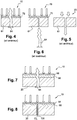
- a pneumatic tire 60 according to the prior art, provided with a tread 61 and a layer of solid self-sealing product 62, after having been pierced by a screw 64, causing a perforation 66 of the tire .
- the solid self-sealing product 62 after tearing off the screw 64, the solid self-sealing product 62 partially fills the perforation 66, but due to the complex geometry of the screw 64, a gap 68 remains even one hour after the perforation .
- the viscosity of the solid self-sealing product OS means that it does not escape out of the perforation 66, but prevents it from reaching certain areas of the perforation 66.
- a pneumatic tire 70 according to the prior art, provided with a tread 61 and a layer of liquid self-sealing product 72, after having been pierced by a screw 64, causing a perforation 66 of the tire .
- the tire 10 comprises the tread 20, the layer 56 of solid self-sealing product OS, and the layer 58 of self-sealing liquid OL.
- Tests have made it possible to establish a comparative table of the performances of the pneumatic tires of the prior art and of the pneumatic tire according to the invention when faced with a rolling test on a support studded with screws 40 mm in length.
- the table below shows the coverage rate of the different tires, calculated at different times of the rolling test.
- the coverage rate is defined here as being the result of the calculation, defined as a percentage, of the number of perforating objects not exhibiting any leakage, divided by the total number of perforating objects inserted into the tire tested.
- Pneumatic tire provided only with a solid self-sealing product (1.2 kg)
- Pneumatic tire provided only with a liquid self-sealing product (1 kg of product)
- the coverage rate of a pneumatic tire provided only with a solid self-sealing product is 10% just after a perforation. This is because the solid self-sealing product takes a certain time to flow and fill the perforation.
- a pneumatic tire fitted only with a liquid self-sealing product has a coverage rate of 100%, because the liquid state allows the self-sealing product to quickly fill the perforation.
- the coverage rate of the tire fitted only with a solid self-sealing product increases because the product may have crept and partially fill the perforation.
- the pneumatic tire according to the invention increases its coverage rate.
- the coverage rate of a pneumatic tire fitted only with a liquid self-sealing product remains 100%.
- the coverage rate of the pneumatic tire fitted only with a liquid self-sealing product falls to zero because nothing is holding the product any longer. self-sealing liquid that drains out of the bandage. This is not the case with the pneumatic tire fitted only with a solid self-sealing product, which may have crept while remaining in the tire in place despite the tearing of the screw, and allows a coverage rate of 70%. .
- the pneumatic tire according to the invention benefits from a coverage rate of 75%.
- the self-sealing liquid product OL is housed in the pneumatic tire 10 before it is mounted on the wheel.
- the liquid self-sealing product OL is introduced into the pneumatic tire 10 after its mounting in the wheel by an inflation valve for the pneumatic tire 10.
- the liquid self-sealing product OL is also introduced. before inflating the tire 10.
- the first step is to take a tire equipped with a layer comprising the solid self-sealing product OS.
- the tire is mounted on a wheel rim to obtain a set of a tire and a wheel defining an internal volume V.
- the liquid self-sealing product OL is then introduced into the internal volume V.
- the liquid self-sealing product OL is introduced after the tire has been mounted on the wheel rim through said inflation valve.
Landscapes
- Engineering & Computer Science (AREA)
- Mechanical Engineering (AREA)
- Tires In General (AREA)
Claims (15)
- Anordnung aus einem Luftreifen und einem Rad, wobei der Luftreifen (10) auf dem Rad montiert ist,
dadurch gekennzeichnet, dass sie ein erstes und ein zweites selbstdichtendes Produkt umfasst, die im Innenvolumen (V) des Luftreifens (10) aufgenommen sind,
wobei das erste selbstdichtende Produkt, festes selbstdichtendes Produkt (OS) genannt, eine Schicht (56) auf einem vorbestimmten Teil der Innenfläche des Luftreifens (10) bildet, wobei sich die relative Position dieses vorbestimmten Teils im Luftreifen (10) unter dem Einfluss der Schwerkraft nicht wesentlich ändert,
wobei das zweite selbstdichtende Produkt, flüssiges selbstdichtendes Produkt (OL) genannt, in flüssiger Form vorliegt, wobei sich die relative Position des zweiten Produkts im Innenvolumen (V) des Luftreifens (10) unter dem Einfluss der Schwerkraft ändert, um zu ermöglichen, dass es gleichzeitig mit dem ersten selbstdichtenden Produkt wirkt. - Anordnung nach Anspruch 1, wobei das flüssige selbstdichtende Produkt (OL) eine äquivalente Dicke e zwischen 0,3 und 2,5 mm aufweist, wobei diese äquivalente Dicke durch die Beziehung
 m die Masse des flüssigen selbstdichtenden Produkts (OL) ist,L die Breite des Laufstreifens des Luftreifens (10) ist,D die Innenabwicklung des Luftreifens (10) ist, undγ die Dichte des flüssigen selbstdichtenden Produkts ist.
 - Anordnung aus einem Luftreifen und einem Rad nach Anspruch 2, wobei die äquivalente Dicke des flüssigen selbstdichtenden Produkts zwischen 0,4 und 1,5 mm, vorzugsweise zwischen 0,5 und 1,2 mm liegt.
- Anordnung aus einem Luftreifen und einem Rad nach einem der vorhergehenden Ansprüche, wobei die dynamische Viskosität des flüssigen selbstdichtenden Produkts (OL) in einem Temperaturbereich zwischen -15 °C und 60 °C kleiner als 1000 Pa.s, zum Beispiel kleiner als 100 Pa.s ist.
- Anordnung aus einem Luftreifen und einem Rad nach einem der vorhergehenden Ansprüche, wobei die Schicht des festen selbstdichtenden Produkts (OS) eine Dicke kleiner als 4 mm, vorzugsweise zwischen 2,5 und 3,5 mm aufweist.
- Anordnung aus einem Luftreifen und einem Rad nach einem der vorhergehenden Ansprüche, wobei der vorbestimmte Teil, der mit dem festen selbstdichtenden Produkt (OS) bedeckt ist, ein Teil gegenüber dem Scheitel (S) des Reifens ist.
- Anordnung aus einem Luftreifen und einem Rad nach einem der vorhergehenden Ansprüche, wobei das flüssige selbstdichtende Produkt (OL) Verdichtungsmittel umfasst, wie etwa Fasern und Kautschukpartikel, die in einem flüssigen Lösungsmittel dispergiert sind, wobei das flüssige Lösungsmittel zum Beispiel Wasser umfasst.
- Anordnung aus einem Luftreifen und einem Rad nach Anspruch 6, wobei das flüssige selbstdichtende Produkt (OL) ein Naturkautschuklatex in einer wässrigen Lösung umfasst.
- Anordnung aus einem Luftreifen und einem Rad nach einem der vorhergehenden Ansprüche wobei das flüssige selbstdichtende Produkt (OL) ein Frostschutzmittel umfasst.
- Anordnung aus einem Luftreifen und einem Rad nach Anspruch 9, wobei das Frostschutzmittel auf Glykol basiert.
- Anordnung aus einem Luftreifen und einem Rad nach einem der vorhergehenden Ansprüche, wobei das flüssige selbstdichtende Produkt (OL) Partikel mit einem Durchmesser zwischen 10 und 800 µm umfasst, zum Beispiel Kautschukpulver, das durch Zerkleinerung von Altreifen gewonnen wurde, wobei der Durchmesser eines zahlenmäßigen Anteils der Partikel von mehr als 70 % zwischen 10 und 300 µm liegt.
- Anordnung aus einem Luftreifen und einem Rad nach einem der vorhergehenden Ansprüche, wobei das feste selbstdichtende Produkt (OS) als Hauptbestandteil ein Elastomer umfasst, das ausgewählt ist aus:- einem ungesättigten Dienelastomer,- einem Elastomer auf Butylbasis,- einem thermoplastischen Elastomer, zum Beispiel einem Styrolelastomer, oder einem thermoplastischen Polystyrol- und Polyisobutylen-Blockcopolymer, und- einem Polyurethan.
- Verfahren zur Herstellung einer Anordnung aus einem Luftreifen (10) und einem Rad, dadurch gekennzeichnet, dass die Anordnung eine Anordnung nach einem der Ansprüche 1 bis 12 ist, und dadurch, dass das flüssige selbstdichtende Produkt (OL) in dem Luftreifen (10) vor dessen Montage auf dem Rad untergebracht wird.
- Verfahren zur Herstellung einer Anordnung aus einem Luftreifen (10) und einem Rad, dadurch gekennzeichnet, dass die Anordnung eine Anordnung nach einem der Ansprüche 1 bis 12 ist, und dadurch, dass das flüssige selbstdichtende Produkt (OL) in den Luftreifen (10) nach dessen Montage auf dem Rad und vor dem Aufpumpen des Luftreifens (10) über ein Ventil zum Aufpumpen des Luftreifens (10) eingeleitet wird.
- Verfahren zur Anbringung eines selbstdichtenden Systems in einer Anordnung aus einem Luftreifen (10) und einem Rad, dadurch gekennzeichnet, dass die Anordnung eine Anordnung nach einem der Ansprüche 1 bis 12 ist, und dadurch, dass es die folgenden Schritte umfasst:- Es wird ein Reifen bereitgestellt, der mit einer Schicht (56) ausgestattet ist, die das feste selbstdichtende Produkt (OS) umfasst;- der Reifen wird auf einer Radfelge montiert, um eine Anordnung aus einem Reifen und einem Rad zu erhalten, die ein Innenvolumen (V) definiert;- in das Innenvolumen (V) wird das flüssige selbstdichtende Produkt (OL) eingeleitet.
Applications Claiming Priority (2)
| Application Number | Priority Date | Filing Date | Title |
|---|---|---|---|
| FR1662665A FR3060462A1 (fr) | 2016-12-16 | 2016-12-16 | Ensemble de bandage pneumatique et de roue comprenant un produit auto-obturant ameliore |
| PCT/FR2017/053350 WO2018109305A1 (fr) | 2016-12-16 | 2017-12-01 | Ensemble de bandage pneumatique et de roue comprenant un produit auto-obturant ameliore |
Publications (2)
| Publication Number | Publication Date |
|---|---|
| EP3554860A1 EP3554860A1 (de) | 2019-10-23 |
| EP3554860B1 true EP3554860B1 (de) | 2021-02-03 |
Family
ID=58501533
Family Applications (1)
| Application Number | Title | Priority Date | Filing Date |
|---|---|---|---|
| EP17816963.7A Not-in-force EP3554860B1 (de) | 2016-12-16 | 2017-12-01 | Anordnung aus reifenkarkasse und rad mit verbessertem selbstversiegelndem produkt |
Country Status (5)
| Country | Link |
|---|---|
| US (1) | US11312094B2 (de) |
| EP (1) | EP3554860B1 (de) |
| CN (1) | CN110325380A (de) |
| FR (1) | FR3060462A1 (de) |
| WO (1) | WO2018109305A1 (de) |
Families Citing this family (2)
| Publication number | Priority date | Publication date | Assignee | Title |
|---|---|---|---|---|
| EP4306336B1 (de) * | 2021-03-09 | 2026-04-08 | Sumitomo Rubber Industries, Ltd. | Dichtungsreifen |
| WO2025038257A1 (en) | 2023-08-17 | 2025-02-20 | ExxonMobil Technology and Engineering Company | Elastomer compositions and methods thereof |
Family Cites Families (16)
| Publication number | Priority date | Publication date | Assignee | Title |
|---|---|---|---|---|
| US3563294A (en) * | 1968-07-02 | 1971-02-16 | Alex Chien | Puncture-sealing band |
| GB1541382A (en) * | 1976-06-07 | 1979-02-28 | Yokohama Rubber Co Ltd | Puncture sealant for a tubeless pneumatic tyre |
| US4287928A (en) * | 1977-04-28 | 1981-09-08 | The B. F. Goodrich Company | Puncture-sealing tire |
| EP0135463A1 (de) * | 1983-08-15 | 1985-03-27 | The Goodyear Tire & Rubber Company | Selbstdichtender Luftreifen und Verfahren zu seiner Herstellung |
| DE19839911A1 (de) * | 1998-09-02 | 2000-03-16 | Hans Juergen Iffert | Schutzvorrichtung eines Fahrzeugreifens |
| FR2910382B1 (fr) * | 2006-12-22 | 2009-03-06 | Michelin Soc Tech | Pneumatique avec une couche auto-obturante |
| FR2923750B1 (fr) * | 2007-11-16 | 2011-03-18 | Michelin Soc Tech | Pneumatique capable de rouler malgre une perforation,et procede pour sa fabrication. |
| CN101934589B (zh) * | 2009-06-29 | 2014-10-29 | 住友橡胶工业株式会社 | 自封式密封剂 |
| US8578986B2 (en) * | 2009-12-18 | 2013-11-12 | The Goodyear Tire & Rubber Company | Pneumatic tire having a built-in seamless polyurethane sealant layer and preparation thereof |
| JP4784694B1 (ja) | 2010-05-27 | 2011-10-05 | 横浜ゴム株式会社 | 液状凝固剤およびタイヤパンクシール材セット |
| FR2966081B1 (fr) | 2010-10-18 | 2012-12-14 | Michelin Soc Tech | Bandage pneumatique comprenant une couche auto-obturante a gradient radial de fluage |
| CN201856585U (zh) * | 2010-10-25 | 2011-06-08 | 杭州顺源轮胎制造有限公司 | 一种防弹安全轮胎 |
| FR2978447B1 (fr) * | 2011-07-29 | 2014-12-19 | Michelin Soc Tech | Composition d'elastomere pour objet pneumatique, a propriete auto-obturante |
| CN202952780U (zh) * | 2012-08-18 | 2013-05-29 | 贺卫初 | 一种不怕扎充气橡胶轮胎 |
| US10399391B2 (en) | 2014-12-16 | 2019-09-03 | Triangle Tyre Co., Ltd. | Pneumatic tire having multiple built-in sealant layers and preparation thereof |
| DE202015006945U1 (de) * | 2015-10-06 | 2015-10-26 | Continental Reifen Deutschland Gmbh | Selbstdichtender Fahrzeugluftreifen |
-
2016
- 2016-12-16 FR FR1662665A patent/FR3060462A1/fr not_active Withdrawn
-
2017
- 2017-12-01 EP EP17816963.7A patent/EP3554860B1/de not_active Not-in-force
- 2017-12-01 CN CN201780086710.2A patent/CN110325380A/zh active Pending
- 2017-12-01 WO PCT/FR2017/053350 patent/WO2018109305A1/fr not_active Ceased
- 2017-12-01 US US16/470,502 patent/US11312094B2/en active Active
Non-Patent Citations (1)
| Title |
|---|
| None * |
Also Published As
| Publication number | Publication date |
|---|---|
| US11312094B2 (en) | 2022-04-26 |
| EP3554860A1 (de) | 2019-10-23 |
| FR3060462A1 (fr) | 2018-06-22 |
| WO2018109305A1 (fr) | 2018-06-21 |
| US20200122420A1 (en) | 2020-04-23 |
| CN110325380A (zh) | 2019-10-11 |
Similar Documents
| Publication | Publication Date | Title |
|---|---|---|
| EP2125392B1 (de) | Reifen mit einer selbstabdichtenden lage | |
| EP2167329B1 (de) | Reifen mit selbstverschliessender schicht | |
| EP2125949B1 (de) | Pneumatisches objekt | |
| EP2303563B1 (de) | Selbstdichtende elastomerzusammensetzung | |
| EP2870001B1 (de) | Luftreifen mit laufstreifen aus mehreren elastomermischungen | |
| EP2611628B1 (de) | Fahrzeugluftreifen mit reifenlaufläche die abbaubaren füllstoff beinhaltet | |
| EP2815222B1 (de) | Verfahren zum testen der beständigkeit eines reifens gegenüber druckverlust | |
| WO2014005927A1 (fr) | Pneumatique comportant une bande de roulement constituee de plusieurs melanges elastomeriques | |
| EP2870003B1 (de) | Luftreifen mit laufstreifen aus mehreren elastomermischungen | |
| CA3029958A1 (fr) | Pneumatique dont la zone du bourrelet est allegee | |
| EP3554860B1 (de) | Anordnung aus reifenkarkasse und rad mit verbessertem selbstversiegelndem produkt | |
| EP2870002B1 (de) | Reifen mit einer lauffläche aus mehreren elastomermischungen | |
| FR2969536A1 (fr) | Valve auto-obturante | |
| EP2629991B1 (de) | Reifen mit einer selbstdichtungsschicht mit einem axialen strömungsgefälle | |
| FR3063678A1 (fr) | Pneumatique comportant une bande de roulement constituee de plusieurs melanges elastomeriques | |
| CA3003544C (fr) | Pneumatique presentant des proprietes d'usure ameliorees | |
| EP3160769B1 (de) | Reifen mit verbesserten dynamischen eigenschaften | |
| EP1670651B1 (de) | Reifen für schwerfahrzeugen, lauffläche und verwendung davon | |
| WO2020094951A1 (fr) | Pneumatique dont la zone du bourrelet est allegee | |
| FR3053930A1 (fr) | Pneumatique dont la zone du bourrelet est allegee | |
| FR3087155A1 (fr) | Pneumatique dont la zone du bourrelet est allegee | |
| EP3691920B1 (de) | Reifen mit einschnitten im wulstbereich | |
| CA3003081C (fr) | Pneumatique presentant des proprietes d'usure ameliorees | |
| WO2026077727A1 (fr) | Pneumatique | |
| EP4065386A1 (de) | Reifen mit einer lauffläche aus mehreren elastomermischungen |
Legal Events
| Date | Code | Title | Description |
|---|---|---|---|
| STAA | Information on the status of an ep patent application or granted ep patent |
Free format text: STATUS: UNKNOWN |
|
| STAA | Information on the status of an ep patent application or granted ep patent |
Free format text: STATUS: THE INTERNATIONAL PUBLICATION HAS BEEN MADE |
|
| PUAI | Public reference made under article 153(3) epc to a published international application that has entered the european phase |
Free format text: ORIGINAL CODE: 0009012 |
|
| STAA | Information on the status of an ep patent application or granted ep patent |
Free format text: STATUS: REQUEST FOR EXAMINATION WAS MADE |
|
| 17P | Request for examination filed |
Effective date: 20190606 |
|
| AK | Designated contracting states |
Kind code of ref document: A1 Designated state(s): AL AT BE BG CH CY CZ DE DK EE ES FI FR GB GR HR HU IE IS IT LI LT LU LV MC MK MT NL NO PL PT RO RS SE SI SK SM TR |
|
| AX | Request for extension of the european patent |
Extension state: BA ME |
|
| DAV | Request for validation of the european patent (deleted) | ||
| DAX | Request for extension of the european patent (deleted) | ||
| GRAP | Despatch of communication of intention to grant a patent |
Free format text: ORIGINAL CODE: EPIDOSNIGR1 |
|
| STAA | Information on the status of an ep patent application or granted ep patent |
Free format text: STATUS: GRANT OF PATENT IS INTENDED |
|
| INTG | Intention to grant announced |
Effective date: 20200817 |
|
| RAP1 | Party data changed (applicant data changed or rights of an application transferred) |
Owner name: COMPAGNIE GENERALE DES ETABLISSEMENTS MICHELIN |
|
| GRAS | Grant fee paid |
Free format text: ORIGINAL CODE: EPIDOSNIGR3 |
|
| GRAA | (expected) grant |
Free format text: ORIGINAL CODE: 0009210 |
|
| STAA | Information on the status of an ep patent application or granted ep patent |
Free format text: STATUS: THE PATENT HAS BEEN GRANTED |
|
| AK | Designated contracting states |
Kind code of ref document: B1 Designated state(s): AL AT BE BG CH CY CZ DE DK EE ES FI FR GB GR HR HU IE IS IT LI LT LU LV MC MK MT NL NO PL PT RO RS SE SI SK SM TR |
|
| REG | Reference to a national code |
Ref country code: GB Ref legal event code: FG4D Free format text: NOT ENGLISH |
|
| REG | Reference to a national code |
Ref country code: AT Ref legal event code: REF Ref document number: 1359623 Country of ref document: AT Kind code of ref document: T Effective date: 20210215 Ref country code: CH Ref legal event code: EP |
|
| REG | Reference to a national code |
Ref country code: DE Ref legal event code: R096 Ref document number: 602017032366 Country of ref document: DE |
|
| REG | Reference to a national code |
Ref country code: IE Ref legal event code: FG4D Free format text: LANGUAGE OF EP DOCUMENT: FRENCH |
|
| REG | Reference to a national code |
Ref country code: NL Ref legal event code: MP Effective date: 20210203 |
|
| REG | Reference to a national code |
Ref country code: LT Ref legal event code: MG9D |
|
| REG | Reference to a national code |
Ref country code: AT Ref legal event code: MK05 Ref document number: 1359623 Country of ref document: AT Kind code of ref document: T Effective date: 20210203 |
|
| PG25 | Lapsed in a contracting state [announced via postgrant information from national office to epo] |
Ref country code: FI Free format text: LAPSE BECAUSE OF FAILURE TO SUBMIT A TRANSLATION OF THE DESCRIPTION OR TO PAY THE FEE WITHIN THE PRESCRIBED TIME-LIMIT Effective date: 20210203 Ref country code: GR Free format text: LAPSE BECAUSE OF FAILURE TO SUBMIT A TRANSLATION OF THE DESCRIPTION OR TO PAY THE FEE WITHIN THE PRESCRIBED TIME-LIMIT Effective date: 20210504 Ref country code: HR Free format text: LAPSE BECAUSE OF FAILURE TO SUBMIT A TRANSLATION OF THE DESCRIPTION OR TO PAY THE FEE WITHIN THE PRESCRIBED TIME-LIMIT Effective date: 20210203 Ref country code: PT Free format text: LAPSE BECAUSE OF FAILURE TO SUBMIT A TRANSLATION OF THE DESCRIPTION OR TO PAY THE FEE WITHIN THE PRESCRIBED TIME-LIMIT Effective date: 20210604 Ref country code: NO Free format text: LAPSE BECAUSE OF FAILURE TO SUBMIT A TRANSLATION OF THE DESCRIPTION OR TO PAY THE FEE WITHIN THE PRESCRIBED TIME-LIMIT Effective date: 20210503 Ref country code: BG Free format text: LAPSE BECAUSE OF FAILURE TO SUBMIT A TRANSLATION OF THE DESCRIPTION OR TO PAY THE FEE WITHIN THE PRESCRIBED TIME-LIMIT Effective date: 20210503 Ref country code: LT Free format text: LAPSE BECAUSE OF FAILURE TO SUBMIT A TRANSLATION OF THE DESCRIPTION OR TO PAY THE FEE WITHIN THE PRESCRIBED TIME-LIMIT Effective date: 20210203 |
|
| PG25 | Lapsed in a contracting state [announced via postgrant information from national office to epo] |
Ref country code: AT Free format text: LAPSE BECAUSE OF FAILURE TO SUBMIT A TRANSLATION OF THE DESCRIPTION OR TO PAY THE FEE WITHIN THE PRESCRIBED TIME-LIMIT Effective date: 20210203 Ref country code: RS Free format text: LAPSE BECAUSE OF FAILURE TO SUBMIT A TRANSLATION OF THE DESCRIPTION OR TO PAY THE FEE WITHIN THE PRESCRIBED TIME-LIMIT Effective date: 20210203 Ref country code: LV Free format text: LAPSE BECAUSE OF FAILURE TO SUBMIT A TRANSLATION OF THE DESCRIPTION OR TO PAY THE FEE WITHIN THE PRESCRIBED TIME-LIMIT Effective date: 20210203 Ref country code: PL Free format text: LAPSE BECAUSE OF FAILURE TO SUBMIT A TRANSLATION OF THE DESCRIPTION OR TO PAY THE FEE WITHIN THE PRESCRIBED TIME-LIMIT Effective date: 20210203 Ref country code: NL Free format text: LAPSE BECAUSE OF FAILURE TO SUBMIT A TRANSLATION OF THE DESCRIPTION OR TO PAY THE FEE WITHIN THE PRESCRIBED TIME-LIMIT Effective date: 20210203 Ref country code: SE Free format text: LAPSE BECAUSE OF FAILURE TO SUBMIT A TRANSLATION OF THE DESCRIPTION OR TO PAY THE FEE WITHIN THE PRESCRIBED TIME-LIMIT Effective date: 20210203 |
|
| PG25 | Lapsed in a contracting state [announced via postgrant information from national office to epo] |
Ref country code: IS Free format text: LAPSE BECAUSE OF FAILURE TO SUBMIT A TRANSLATION OF THE DESCRIPTION OR TO PAY THE FEE WITHIN THE PRESCRIBED TIME-LIMIT Effective date: 20210603 |
|
| PG25 | Lapsed in a contracting state [announced via postgrant information from national office to epo] |
Ref country code: SM Free format text: LAPSE BECAUSE OF FAILURE TO SUBMIT A TRANSLATION OF THE DESCRIPTION OR TO PAY THE FEE WITHIN THE PRESCRIBED TIME-LIMIT Effective date: 20210203 Ref country code: CZ Free format text: LAPSE BECAUSE OF FAILURE TO SUBMIT A TRANSLATION OF THE DESCRIPTION OR TO PAY THE FEE WITHIN THE PRESCRIBED TIME-LIMIT Effective date: 20210203 Ref country code: EE Free format text: LAPSE BECAUSE OF FAILURE TO SUBMIT A TRANSLATION OF THE DESCRIPTION OR TO PAY THE FEE WITHIN THE PRESCRIBED TIME-LIMIT Effective date: 20210203 |
|
| REG | Reference to a national code |
Ref country code: DE Ref legal event code: R097 Ref document number: 602017032366 Country of ref document: DE |
|
| PG25 | Lapsed in a contracting state [announced via postgrant information from national office to epo] |
Ref country code: RO Free format text: LAPSE BECAUSE OF FAILURE TO SUBMIT A TRANSLATION OF THE DESCRIPTION OR TO PAY THE FEE WITHIN THE PRESCRIBED TIME-LIMIT Effective date: 20210203 Ref country code: DK Free format text: LAPSE BECAUSE OF FAILURE TO SUBMIT A TRANSLATION OF THE DESCRIPTION OR TO PAY THE FEE WITHIN THE PRESCRIBED TIME-LIMIT Effective date: 20210203 Ref country code: SK Free format text: LAPSE BECAUSE OF FAILURE TO SUBMIT A TRANSLATION OF THE DESCRIPTION OR TO PAY THE FEE WITHIN THE PRESCRIBED TIME-LIMIT Effective date: 20210203 |
|
| PLBE | No opposition filed within time limit |
Free format text: ORIGINAL CODE: 0009261 |
|
| STAA | Information on the status of an ep patent application or granted ep patent |
Free format text: STATUS: NO OPPOSITION FILED WITHIN TIME LIMIT |
|
| 26N | No opposition filed |
Effective date: 20211104 |
|
| PG25 | Lapsed in a contracting state [announced via postgrant information from national office to epo] |
Ref country code: ES Free format text: LAPSE BECAUSE OF FAILURE TO SUBMIT A TRANSLATION OF THE DESCRIPTION OR TO PAY THE FEE WITHIN THE PRESCRIBED TIME-LIMIT Effective date: 20210203 Ref country code: AL Free format text: LAPSE BECAUSE OF FAILURE TO SUBMIT A TRANSLATION OF THE DESCRIPTION OR TO PAY THE FEE WITHIN THE PRESCRIBED TIME-LIMIT Effective date: 20210203 |
|
| PGFP | Annual fee paid to national office [announced via postgrant information from national office to epo] |
Ref country code: DE Payment date: 20211210 Year of fee payment: 5 Ref country code: FR Payment date: 20211224 Year of fee payment: 5 |
|
| PG25 | Lapsed in a contracting state [announced via postgrant information from national office to epo] |
Ref country code: SI Free format text: LAPSE BECAUSE OF FAILURE TO SUBMIT A TRANSLATION OF THE DESCRIPTION OR TO PAY THE FEE WITHIN THE PRESCRIBED TIME-LIMIT Effective date: 20210203 |
|
| PG25 | Lapsed in a contracting state [announced via postgrant information from national office to epo] |
Ref country code: IT Free format text: LAPSE BECAUSE OF FAILURE TO SUBMIT A TRANSLATION OF THE DESCRIPTION OR TO PAY THE FEE WITHIN THE PRESCRIBED TIME-LIMIT Effective date: 20210203 |
|
| PG25 | Lapsed in a contracting state [announced via postgrant information from national office to epo] |
Ref country code: IS Free format text: LAPSE BECAUSE OF FAILURE TO SUBMIT A TRANSLATION OF THE DESCRIPTION OR TO PAY THE FEE WITHIN THE PRESCRIBED TIME-LIMIT Effective date: 20210603 |
|
| PG25 | Lapsed in a contracting state [announced via postgrant information from national office to epo] |
Ref country code: MC Free format text: LAPSE BECAUSE OF FAILURE TO SUBMIT A TRANSLATION OF THE DESCRIPTION OR TO PAY THE FEE WITHIN THE PRESCRIBED TIME-LIMIT Effective date: 20210203 |
|
| REG | Reference to a national code |
Ref country code: CH Ref legal event code: PL |
|
| GBPC | Gb: european patent ceased through non-payment of renewal fee |
Effective date: 20211201 |
|
| REG | Reference to a national code |
Ref country code: BE Ref legal event code: MM Effective date: 20211231 |
|
| PG25 | Lapsed in a contracting state [announced via postgrant information from national office to epo] |
Ref country code: LU Free format text: LAPSE BECAUSE OF NON-PAYMENT OF DUE FEES Effective date: 20211201 Ref country code: IE Free format text: LAPSE BECAUSE OF NON-PAYMENT OF DUE FEES Effective date: 20211201 Ref country code: GB Free format text: LAPSE BECAUSE OF NON-PAYMENT OF DUE FEES Effective date: 20211201 |
|
| PG25 | Lapsed in a contracting state [announced via postgrant information from national office to epo] |
Ref country code: BE Free format text: LAPSE BECAUSE OF NON-PAYMENT OF DUE FEES Effective date: 20211231 |
|
| PG25 | Lapsed in a contracting state [announced via postgrant information from national office to epo] |
Ref country code: LI Free format text: LAPSE BECAUSE OF NON-PAYMENT OF DUE FEES Effective date: 20211231 Ref country code: CH Free format text: LAPSE BECAUSE OF NON-PAYMENT OF DUE FEES Effective date: 20211231 |
|
| PG25 | Lapsed in a contracting state [announced via postgrant information from national office to epo] |
Ref country code: CY Free format text: LAPSE BECAUSE OF FAILURE TO SUBMIT A TRANSLATION OF THE DESCRIPTION OR TO PAY THE FEE WITHIN THE PRESCRIBED TIME-LIMIT Effective date: 20210203 |
|
| REG | Reference to a national code |
Ref country code: DE Ref legal event code: R119 Ref document number: 602017032366 Country of ref document: DE |
|
| PG25 | Lapsed in a contracting state [announced via postgrant information from national office to epo] |
Ref country code: HU Free format text: LAPSE BECAUSE OF FAILURE TO SUBMIT A TRANSLATION OF THE DESCRIPTION OR TO PAY THE FEE WITHIN THE PRESCRIBED TIME-LIMIT; INVALID AB INITIO Effective date: 20171201 |
|
| PG25 | Lapsed in a contracting state [announced via postgrant information from national office to epo] |
Ref country code: DE Free format text: LAPSE BECAUSE OF NON-PAYMENT OF DUE FEES Effective date: 20230701 |
|
| PG25 | Lapsed in a contracting state [announced via postgrant information from national office to epo] |
Ref country code: FR Free format text: LAPSE BECAUSE OF NON-PAYMENT OF DUE FEES Effective date: 20221231 |
|
| PG25 | Lapsed in a contracting state [announced via postgrant information from national office to epo] |
Ref country code: MK Free format text: LAPSE BECAUSE OF FAILURE TO SUBMIT A TRANSLATION OF THE DESCRIPTION OR TO PAY THE FEE WITHIN THE PRESCRIBED TIME-LIMIT Effective date: 20210203 |
|
| PG25 | Lapsed in a contracting state [announced via postgrant information from national office to epo] |
Ref country code: MT Free format text: LAPSE BECAUSE OF FAILURE TO SUBMIT A TRANSLATION OF THE DESCRIPTION OR TO PAY THE FEE WITHIN THE PRESCRIBED TIME-LIMIT Effective date: 20210203 |
|
| PG25 | Lapsed in a contracting state [announced via postgrant information from national office to epo] |
Ref country code: TR Free format text: LAPSE BECAUSE OF FAILURE TO SUBMIT A TRANSLATION OF THE DESCRIPTION OR TO PAY THE FEE WITHIN THE PRESCRIBED TIME-LIMIT Effective date: 20210203 |