EP2629991B1 - Reifen mit einer selbstdichtungsschicht mit einem axialen strömungsgefälle - Google Patents
Reifen mit einer selbstdichtungsschicht mit einem axialen strömungsgefälle Download PDFInfo
- Publication number
- EP2629991B1 EP2629991B1 EP11832111.6A EP11832111A EP2629991B1 EP 2629991 B1 EP2629991 B1 EP 2629991B1 EP 11832111 A EP11832111 A EP 11832111A EP 2629991 B1 EP2629991 B1 EP 2629991B1
- Authority
- EP
- European Patent Office
- Prior art keywords
- self
- sealing
- sealing layer
- layer
- pneumatic tyre
- Prior art date
- Legal status (The legal status is an assumption and is not a legal conclusion. Google has not performed a legal analysis and makes no representation as to the accuracy of the status listed.)
- Not-in-force
Links
Images

Classifications
-
- B—PERFORMING OPERATIONS; TRANSPORTING
- B60—VEHICLES IN GENERAL
- B60C—VEHICLE TYRES; TYRE INFLATION; TYRE CHANGING; CONNECTING VALVES TO INFLATABLE ELASTIC BODIES IN GENERAL; DEVICES OR ARRANGEMENTS RELATED TO TYRES
- B60C19/00—Tyre parts or constructions not otherwise provided for
- B60C19/12—Puncture preventing arrangements
-
- B—PERFORMING OPERATIONS; TRANSPORTING
- B29—WORKING OF PLASTICS; WORKING OF SUBSTANCES IN A PLASTIC STATE IN GENERAL
- B29C—SHAPING OR JOINING OF PLASTICS; SHAPING OF MATERIAL IN A PLASTIC STATE, NOT OTHERWISE PROVIDED FOR; AFTER-TREATMENT OF THE SHAPED PRODUCTS, e.g. REPAIRING
- B29C73/00—Repairing of articles made from plastics or substances in a plastic state, e.g. of articles shaped or produced by using techniques covered by this subclass or subclass B29D
- B29C73/16—Auto-repairing or self-sealing arrangements or agents
- B29C73/22—Auto-repairing or self-sealing arrangements or agents the article containing elements including a sealing composition, e.g. powder being liberated when the article is damaged
-
- B—PERFORMING OPERATIONS; TRANSPORTING
- B29—WORKING OF PLASTICS; WORKING OF SUBSTANCES IN A PLASTIC STATE IN GENERAL
- B29D—PRODUCING PARTICULAR ARTICLES FROM PLASTICS OR FROM SUBSTANCES IN A PLASTIC STATE
- B29D30/00—Producing pneumatic or solid tyres or parts thereof
- B29D30/06—Pneumatic tyres or parts thereof (e.g. produced by casting, moulding, compression moulding, injection moulding, centrifugal casting)
- B29D30/0681—Parts of pneumatic tyres; accessories, auxiliary operations
- B29D30/0685—Incorporating auto-repairing or self-sealing arrangements or agents on or into tyres
-
- B—PERFORMING OPERATIONS; TRANSPORTING
- B60—VEHICLES IN GENERAL
- B60C—VEHICLE TYRES; TYRE INFLATION; TYRE CHANGING; CONNECTING VALVES TO INFLATABLE ELASTIC BODIES IN GENERAL; DEVICES OR ARRANGEMENTS RELATED TO TYRES
- B60C19/00—Tyre parts or constructions not otherwise provided for
- B60C19/12—Puncture preventing arrangements
- B60C19/122—Puncture preventing arrangements disposed inside of the inner liner
-
- B—PERFORMING OPERATIONS; TRANSPORTING
- B29—WORKING OF PLASTICS; WORKING OF SUBSTANCES IN A PLASTIC STATE IN GENERAL
- B29D—PRODUCING PARTICULAR ARTICLES FROM PLASTICS OR FROM SUBSTANCES IN A PLASTIC STATE
- B29D30/00—Producing pneumatic or solid tyres or parts thereof
- B29D30/06—Pneumatic tyres or parts thereof (e.g. produced by casting, moulding, compression moulding, injection moulding, centrifugal casting)
- B29D30/0681—Parts of pneumatic tyres; accessories, auxiliary operations
- B29D30/0685—Incorporating auto-repairing or self-sealing arrangements or agents on or into tyres
- B29D2030/0686—Incorporating sealants on or into tyres not otherwise provided for; auxiliary operations therefore, e.g. preparation of the tyre
- B29D2030/069—Incorporating sealants on or into tyres not otherwise provided for; auxiliary operations therefore, e.g. preparation of the tyre through the use of a cylindrical support, e.g. a drum
-
- B—PERFORMING OPERATIONS; TRANSPORTING
- B29—WORKING OF PLASTICS; WORKING OF SUBSTANCES IN A PLASTIC STATE IN GENERAL
- B29D—PRODUCING PARTICULAR ARTICLES FROM PLASTICS OR FROM SUBSTANCES IN A PLASTIC STATE
- B29D30/00—Producing pneumatic or solid tyres or parts thereof
- B29D30/06—Pneumatic tyres or parts thereof (e.g. produced by casting, moulding, compression moulding, injection moulding, centrifugal casting)
- B29D30/0681—Parts of pneumatic tyres; accessories, auxiliary operations
- B29D30/0685—Incorporating auto-repairing or self-sealing arrangements or agents on or into tyres
- B29D2030/0686—Incorporating sealants on or into tyres not otherwise provided for; auxiliary operations therefore, e.g. preparation of the tyre
- B29D2030/0694—Incorporating sealants on or into tyres not otherwise provided for; auxiliary operations therefore, e.g. preparation of the tyre the sealant being in the form of one or more narrow strips, e.g. applied by winding into the interior of the tyre
-
- Y—GENERAL TAGGING OF NEW TECHNOLOGICAL DEVELOPMENTS; GENERAL TAGGING OF CROSS-SECTIONAL TECHNOLOGIES SPANNING OVER SEVERAL SECTIONS OF THE IPC; TECHNICAL SUBJECTS COVERED BY FORMER USPC CROSS-REFERENCE ART COLLECTIONS [XRACs] AND DIGESTS
- Y10—TECHNICAL SUBJECTS COVERED BY FORMER USPC
- Y10T—TECHNICAL SUBJECTS COVERED BY FORMER US CLASSIFICATION
- Y10T152/00—Resilient tires and wheels
- Y10T152/10—Tires, resilient
- Y10T152/10495—Pneumatic tire or inner tube
- Y10T152/10666—Automatic sealing of punctures [e.g., self-healing, etc.]
Definitions
- the invention relates to the field of pneumatic tires and more particularly that of pneumatic tires provided with means for self-sealing a perforation in the tire.
- a tire comprises an internal sealing layer delimiting the internal volume of the tire.
- This layer generally comprises a butyl type gum known to be impervious to air.
- the tire may be punctured by penetration of a piercing object into the tire, for example a nail. This perforation causes the puncture of the tire.
- the development of the self-sealing product is relatively complex. Indeed, when the product is too soft and / or has a capacity to flow too large, the self-sealing product can flow under the effect of the centrifugal force during use of the tire. Thus, the product flows axially towards the center of the tire. The axially outer parts or shoulders of the tire are then less well protected. In addition, the product can flow axially to the center of the tire even when the tire is stopped, especially under high temperature conditions. In addition, if the piercing object is removed from the tire, the self-sealing product can flow through the perforation and escape the tire. The anti-puncture function is no longer ensured.
- the product when the product is too rigid and / or has a capacity to flow too small, the product does not flow sufficiently into the perforation, especially in cold weather.
- the invention therefore aims to provide a more effective self-sealing product layer.
- the subject of the invention is a tire comprising an internal sealing layer partially delimiting the internal volume of the tire, the tire comprising a layer of at least one self-sealing product, known as a self-sealing layer.
- shutter arranged radially inwardly with respect to the inner sealing layer, the self-sealing layer having an axially increasing creep resistance indicator of the median plane towards the outside of the tire.
- the layer effectively performs self-sealing function and durably in service. Indeed, the most fl uid part is disposed in the central part of the tire, where the risk of creep is the most reduced. The axially outer parts or shoulders of the tire are protected by the part that flushes less but which nevertheless provides a sufficient anti-puncture function.
- the axial growth of an indicator corresponds to an increase of the indicator when one moves axially in the layer of self-sealing product of the median plane of the tire towards the outside of the tire.
- a growth can be continuous, that is to say that the indicator decreases and then increases constantly when moving axially from one shoulder to the other in the layer of self-sealing product. Growth may also be discontinuous, i.e. the indicator varies stepwise as one moves axially through the self-sealing product layer.
- the creep resistance indicator is representative of the ability of the product to withstand strain under stress for a certain period of time. The lower the indicator, the more the product can flow, the higher the indicator, the less the product can flow.
- any range of values designated by the expression “between a and b” represents the range of values from more than a to less than b (i.e., terminals a and b excluded) while any range of values designated by the expression “from a to b” means the range of values from the "a" terminal to the "b" terminal, that is to say including the strict "a” and "a” limits. "B”.
- the term "phr" means parts by weight per hundred parts of solid elastomer.
- the self-sealing product is an elastomer composition
- elastomer composition comprising at least, as majority elastomer (preferably for more than 50 phr), a diene elastomer, a hydrocarbon resin, a liquid plasticizer whose glass transition temperature is below -10 ° C, preferably -20 ° C, or -30 ° C, and optionally a load.
- the level of liquid plasticizer of the self-sealing layer is maximum in an axially central portion of the self-sealing layer and minimum in an axial end portion of the self-sealing layer.
- the self-sealing layer has a level of liquid plasticizer axially decreasing towards the outside of the tire.
- the difference in rate is preferably greater than 5 phr.
- the charge ratio of the self-sealing layer is minimal in an axially central portion of the self-sealing layer and maximum in an axial end portion of the self-sealing layer.
- the self-sealing layer has an axially increasing load ratio towards the outside of the tire.
- the self-sealing product further comprising a crosslinking system
- the rate of the crosslinking system of the self-sealing layer is minimal in an axially central portion of the self-sealing and maximum layer in an axial end portion of the self-sealing layer.
- the self-sealing layer has a rate of the axially increasing cross-linking system to the outside of the tire.
- the self-sealing layer comprises first and second layers respectively of first and second distinct self-sealing products, wherein the first layer of first self-sealing product is arranged axially on either side of the second layer of second self-sealing product disposed in an axially central portion of the tire and wherein the first self-sealing product has a creep resistance indicator greater than a creep resistance indicator of the second self-sealing product.
- each of the first and second self-sealing products comprises as majority elastomer a diene elastomer, a hydrocarbon resin, a liquid plasticizer whose glass transition temperature is below -10 ° C, preferably -20 ° C, or -30 ° C and possibly a load.
- the creep resistance indicator may be a Mooney consistency measurement made at 60 ° C with an L-type rotor.
- the amplitude of variation of the creep resistance indicator in the self-sealing layer is between 3 and 25 Mooney units (UM), and very preferably between 5 and 20 Mooney units (UM).
- the characteristics relating to the feed rates, the liquid plasticizer and the crosslinking system of the first and second self-sealing products make it possible, in isolation or in synergy, to make the first product self-sealing. more resistant to creep that is to say less fluent than the second self-sealing product but also to reduce the level of adhesive of the first self-sealing product compared to the level of adhesive of the second self-sealing product.
- the diene elastomer is of the saturated or unsaturated type.
- unsaturated diene elastomer is meant a diene elastomer derived at least in part from conjugated diene monomers and having a level of units derived from conjugated dienes which is greater than 30% (mol%), preferably 50%.
- Such a diene elastomer is preferably selected from the group consisting of polybutadienes (BR), natural rubber (NR), synthetic polyisoprenes (IR), butadiene copolymers, isoprene copolymers and mixtures of such elastomers.
- the unsaturated diene elastomer is more preferably an isoprene elastomer, preferably selected from the group consisting of natural rubber, synthetic polyisoprenes and mixtures of such elastomers.
- resin is hereby reserved, by definition known to those skilled in the art, to a compound that is solid at room temperature (23 ° C), as opposed to a liquid plasticizer such as an oil.
- the hydrocarbon resin is selected from the group consisting of homopolymer or copolymer resins of cyclopentadiene (CPD) or dicyclopentadiene (DCPD), terpene homopolymer or copolymer resins, C5 homopolymer or copolymer cut resins, and mixtures of these resins.
- the hydrocarbon resin is advantageously chosen from the group consisting of CPD / vinylaromatic copolymer resins, DCPD / vinylaromatic copolymer resins, CPD / terpene copolymer resins, DCPD / terpene copolymer resins.
- CPD / C5 cut copolymer resins CPD / C5 cut copolymer resins, DCPD / C5 cut copolymer resins, terpene / vinylaromatic copolymer resins, C5 / vinylaromatic cut copolymer resins and mixtures of these resins.
- the liquid plasticizing agent (at 23 ° C.), said to have a low Tg (glass transition temperature), has the function of softening the self-sealing product by diluting the diene elastomer and the hydrocarbon resin, in particular improving the performance of the car. cold clogging.
- the plasticizer is selected from the group consisting of liquid elastomers, polyolefinic oils, naphthenic oils, paraffinic oils, DAE (Distillate Aromatic Extracts) oils, MES (Medium Extracted Extracts) oils, TDAE (Treated) oils. Distillate Aromatic Extracts), mineral oils, vegetable oils, ethers plasticizers, phosphate plasticizers, sulphonate plasticizers and mixtures of these compounds.
- the Liquid plasticizer is selected from the group consisting of liquid elastomers, polyolefin oils, vegetable oils and mixtures thereof.
- the liquid plasticizer is chosen from the group of liquid polybutadienes, liquid polyisoprenes, vegetable oils and mixtures of these compounds.
- the fillers are of the reinforcing, non-reinforcing or inert type and have the function of giving a minimum mechanical strength to the self-sealing product.
- the fillers are, for example, nanoparticles of carbon black or reinforcing inorganic fillers or a mixture of these two types of filler.
- the non-reinforcing fillers may be microparticles of natural (chalk) or synthetic calcium carbonates, of synthetic or natural silicates (such as kaolin, talc, mica) of ground silicas, titanium oxides, aluminas or aluminosilicates.
- additives may also be added, preferably in an amount less than 20 phr, more preferably 15 phr.
- the additives comprise protective agents such as anti-UV, anti-oxidants or antiozonants, various other stabilizers, coloring agents advantageously used for coloring each self-sealing product.
- Each self-sealing product may also optionally include a diene elastomer crosslinking system.
- This system is of the vulcanization type, in this case based on sulfur.
- orthogonal X, Y, Z axes are represented between them corresponding to the usual radial (X), axial (Y) and circumferential (Z) orientations of a tire.
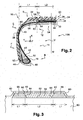
- FIG. 1 a pneumatic tire according to one embodiment of the invention designated by the general reference 10A.
- the tire 10A is intended to be mounted on a wheel of a motor vehicle tourism type.
- the tire 10A comprises an apex S extended by two shoulders E, two sidewalls F and two beads B.
- a single sidewall F, a single shoulder E and a single bead B are shown in the figures.
- Two rods 16 (only one is shown) are embedded in the beads B.
- the two rods 16 are arranged symmetrically with respect to a median radial plane M of the tire.
- Each rod 16 is of revolution about a reference axis.
- This reference axis substantially parallel to the Y direction, is substantially coincident with an axis of revolution of the tire.
- the top S comprises a tread 20, provided with treads 22, and a frame 24.
- This frame 24 comprises plies of metal or textile reinforcements 26, 28 and 30 embedded in masses of rubber 32 and 34.
- a mass of rubber 36 extends radially from the top to the level of the rod 16 of the bead B delimiting an outer surface 38 of the shoulder E, the sidewall F and the bead B.
- the tire 10A also comprises an inner sealing rubber layer 40 and a carcass ply 42.
- the layer 40 delimits at least part of the internal volume V of the tire 10A and is produced in a butyl rubber.
- the layer 40 and the ply 42 are generally toroidal in shape and are both coaxial with the rods 16.
- the layer 40 and ply 42 extend between the two annular rods 16 of the tire 10A passing through the apex S.
- the carcass ply 42 comprises a folded portion 44 around the bead wire 16.
- the bead B also comprises a mass of protective rubber 46 annular intended to allow, in part, the radial and axial attachment 10A tire on a rim.
- the bead B of the tire 10A also comprises a mass of rubber 48 for tamping a volume between the folded portion 44 of the carcass ply 42 and a portion 50 of the carcass ply 42 facing axially from the folded portion 44.
- the bead B also comprises a mass of This mass 52 forms a stuffing mass covering, at least partially, the folded portion 44 of the carcass ply 42.
- the mass 52 is separated locally from the mass 48 by the folded portion 44.
- the tire 10A also comprises a layer 54 of at least one self-sealing product arranged radially internally with respect to the layer of sealing rubber 40.
- the layer 54 is applied in contact with the layer internal sealing 40.
- the layer 54 at least partially defines the internal volume V of the tire.
- the layer 54 comprises a first layer 56 of a first self-sealing product O1 disposed on axial end portions L1 at the shoulders of the tire 10A.
- the layer 54 also comprises a second layer 58 of a second self-sealing product 02 distinct from the first product O1.
- the second layer 58 is disposed axially between the two parts of the first layer 56 in an axially central portion L2 of the tire 10A.
- the two layers 56 and 58 are in contact with the sealing layer 40.
- Each of the first and second self-sealing products O1, O2 comprises, as majority elastomer, a saturated diene elastomer, a hydrocarbon resin, a liquid plasticizer whose glass transition temperature is below -10 ° C. and optionally a charge. and a crosslinking system.
- the first self-sealing product O1 comprises between 20 and 70 phr of the hydrocarbon resin, at most 20 phr of the liquid plasticizer and at most 60 phr of the fillers.
- the first self-sealing product O1 advantageously comprises at most 2 phr of the liquid plasticizer.
- the diene elastomer is saturated.
- the second self-sealing product 02 comprises between 30 and 90 phr of the hydrocarbon resin, at most 60 phr of the liquid plasticizer and at most 30 phr of the fillers.
- the diene elastomer is unsaturated.
- the charge ratio of the self-sealing layer 54 is minimal in the axially central portion L2 of the self-sealing layer 54 and the maximum in the axial end portion L1 of the self-sealing layer 54.
- the degree of the charges of the first self-sealing product O1 is greater than or equal to the level of the charges of the second self-sealing product 02 so that the self-sealing layer 54 has an axially increasing load ratio towards the outside of the tire.
- the level of liquid plasticizer of the self-sealing layer 54 is maximum in the axially central portion L2 of the self-sealing layer 54 and minimum in the axial end portion L1 of the self-sealing layer 54.
- the The rate of the liquid plasticizer of the first self-sealing product O1 is lower than the level of the liquid plasticizer of the second self-sealing product 02 so that the self-sealing layer 54 has a rate of liquid plasticizer axially decreasing towards the outside of the tire.
- the level of the crosslinking system of the self-sealing layer 54 is minimal in the axially central portion L2 of the self-sealing layer 54 and the maximum in the axial end portion L1 of the self-sealing layer 54.
- the rate of the crosslinking system of the first self-sealing product O1 is greater than or equal to the level of the crosslinking system of the second self-sealing product 02 so that the self-sealing layer 54 has a ratio of the axially increasing crosslinking system to the outside of the tire.
- the first and second layers 56, 58 directly cover the inner sealing layer 40 and partially delimit the internal volume of the tire 10A.
- the first layer 56 comprises two axially outer and 62 axially internal end edges.
- the second layer 58 also includes two end edges 64.
- each edge 60 is inclined axially outwardly of the tire as it moves radially inwardly of the tire.
- the edges 62 and the edges 64 are inclined axially towards the inside of the tire as it moves radially inwardly of the tire. In this way, the layer 58 is blocked and held against the internal sealing layer 40 by the layer 56.
- Layer 54 has an axially increasing creep resistance indicator I away from the median plane M of the tire.
- the first layer 56 has a creep resistance indicator I1 greater than a creep resistance indicator I2 of the second layer 58.
- each creep resistance indicator I, I1, I2 is a value of a measurement.
- Mooney made with an L-type rotor at 60 ° C.
- One measure of Mooney's unit is the UM Mooney unit.
- the Mooney measurement is performed using a consistometer according to ASTM D 1646-99.
- the Mooney measurement is carried out according to the following principle: the generally raw mixture is molded in a cylindrical chamber heated to a given temperature, usually 100 ° C. and in this case 60 ° C. After one minute of preheating, the rotor rotates within the test tube at 2 revolutions per minute and the useful torque is measured to maintain this movement after 4 minutes of rotation.
- the variation of the creep resistance indicator is between 3 and 25 ⁇ m and more preferably between 5 and 20 ⁇ m.
- the self-sealing products described have a degree of crosslinking after vulcanization of the tire very low and such that it is still possible to characterize these products by their UM.
- a manufacturing drum 80 substantially of revolution is used around an axis coinciding with the axis of the blank which is also the axis of the future tire 10A.
- the drum 80 has an outer surface 82 for removing the different product layers.
- the first 56 and second 58 layers are successively or jointly deposited on the surface 82 for removing the garment drum.
- the first layer 56 and the second layer 58 are deposited first.
- the inner sealing layer 40 is deposited in contact with the layers 56 and 58.
- the following layers and layers are deposited so as to produce a blank to obtain the tire 10A of the figure 1 .
- thermoplastic film is deposited on the outer surface 82 prior to the deposition of the first 56 and second 58 layers on the surface 82.
- the first layer 56 is in contact with the layer 40 along the shoulder E and a portion of the sidewall F.
- This embodiment has the advantage of protecting the tire 10B against a puncture at the shoulders E and at the adjacent portions of the flanks F.
Landscapes
- Engineering & Computer Science (AREA)
- Mechanical Engineering (AREA)
- Tires In General (AREA)
Claims (12)
- Luftreifen (10A-10B), umfassend eine innere Dichtungsschicht (40), die einen Teil des Innenvolumens (V) des Luftreifens begrenzt, dadurch gekennzeichnet, dass er eine Schicht (54) aus mindestens einem selbstdichtenden Produkt (O1, 02) umfasst, wobei die selbstdichtende Schicht, bezogen auf die innere Dichtungsschicht (40) radial in einem inneren Bereich angebracht ist, wobei die selbstdichtende Schicht (54) einen Kriechfestigkeitsindikator (I1, 12) aufweist, der von der Mittelebene (M) zur Außenseite des Luftreifens (10A-10B) axial ansteigt.
- Luftreifen (10A-10B) nach Anspruch 1, wobei das selbstdichtende Produkt mindestens ein Dienelastomer als Hauptelastomer, zwischen 20 und 90 Gewichtsteile je hundert Teile festes Elastomer eines Kohlenwasserstoffharzes, höchstens 60 Gewichtsteile je hundert Teile festes Elastomer eines flüssigen Weichmachers, dessen Glasübergangstemperatur unterhalb von -10 °C liegt und höchstens 60 Gewichtsteile je hundert Teile festes Elastomer eines Füllstoffs umfasst.
- Luftreifen (10A-10B) nach Anspruch 2, wobei der Anteil an flüssigem Weichmacher der selbstdichtenden Schicht (54) in einem axialen Mittelabschnitt der selbstdichtenden Schicht (54) maximal ist und in einem axialen Endabschnitt der selbstdichtenden Schicht (54) minimal ist.
- Luftreifen (10A-10B) nach Anspruch 3, wobei die axiale Variation des Anteils an flüssigem Weichmacher in der selbstdichtenden Schicht größer als 5 Teile je hundert Teile festes Elastomer ist.
- Luftreifen (10A-10B) nach einem der Ansprüche 2 bis 4, wobei der Anteil an Füllstoffen der selbstdichtenden Schicht (54) in einem axialen Mittelabschnitt der selbstdichtenden Schicht (54) minimal ist und in einem axialen Endabschnitt der selbstdichtenden Schicht (54) maximal ist.
- Luftreifen (10A-10B) nach einem der vorhergehenden Ansprüche, wobei das selbstdichtende Produkt ferner ein Vernetzungssystem umfasst und wobei der Anteil des Vernetzungssystems im axialen Mittelabschnitt der selbstdichtenden Schicht (54) minimal ist und in einem axialen Endabschnitt der selbstdichtenden Schicht (54) maximal ist.
- Luftreifen (10A-10B) nach einem der vorhergehenden Ansprüche, wobei die selbstdichtende Schicht (54) erste und zweite Schichten (56, 58) aus jeweils unterschiedlichen ersten und zweiten selbstdichtenden Produkten (O1, 02) umfasst, wobei die erste Schicht aus dem ersten selbstdichtenden Produkts axial beiderseits der zweiten Schicht aus dem zweiten selbstdichtenden Produkt angebracht ist, die in einem axialen Mittelabschnitt des Luftreifens angebracht ist, und wobei das erste selbstdichtende Produkt (O1) einen Kriechfestigkeitsindikator (I1) aufweist, der größer ist als der Kriechfestigkeitsindikator (12) des zweiten selbstdichtenden Produkts (02).
- Luftreifen (10A-10B) nach dem vorhergehenden Anspruch, wobei das erste selbstdichtende Produkt (O1) 20 bis 70 Gewichtsteile eines Kohlenwasserstoffharzes je hundert Teile festes Elastomer, höchstens 20 Gewichtsteile eines flüssigen Weichmachers je hundert Teile festes Elastomer und höchstens 60 Gewichtsteile Füllstoffe je hundert Teile festes Elastomer umfasst.
- Luftreifen (10A-10B) nach Anspruch 7 oder 8, wobei das zweite selbstdichtende Produkt (02) 30 bis 90 Gewichtsteile eines Kohlenwasserstoffharzes je hundert Teile festes Elastomer, höchstens 60 Gewichtsteile eines flüssigen Weichmachers je hundert Teile festes Elastomer und höchstens 30 Gewichtsteile Füllstoffe je hundert Teile festes Elastomer umfasst.
- Luftreifen (10A-10B) nach einem der vorhergehenden Ansprüche, wobei der Kriechfestigkeitsindikator eine Messung der Mooney-Viskosität, die bei 60 °C mit einem Rotor der Größe L durchgeführt wird und wobei die Variationsamplitude des Kriechfestigkeitsindikators (I1, 12) in der selbstdichtenden Schicht (54) im Bereich zwischen 3 und 25 Mooney-Einheiten (MU) liegt.
- Luftreifen (10A-10B) nach Anspruch, wobei die Variationsamplitude des Kriechfestigkeitsindikators (I1, 12) in der selbstdichtenden Schicht (54) im Bereich zwischen 5 und 20 Mooney-Einheiten (MU) liegt.
- Verfahren zur Herstellung eines Rohlings eines Luftreifens (10A-10D), dadurch gekennzeichnet, dass:- mindestens eine Schicht (54) aus mindestens einem selbstdichtenden Produkt (O1, 02), genannt selbstdichtende Schicht, auf einer Oberfläche einer Reifenbautrommel aufgebracht wird, wobei die selbstdichtende Schicht (54) einen Kriechfestigkeitsindikator (I1, 12) aufweist, der von der Mittelebene (M) zur Außenseite des Luftreifens (10A-10B) axial ansteigt,- eine innere Dichtungsschicht (40) in Kontakt mit der selbstdichtenden Schicht (54) (O1, 02) aufgebracht wird.
Applications Claiming Priority (2)
| Application Number | Priority Date | Filing Date | Title |
|---|---|---|---|
| FR1058487A FR2966080B1 (fr) | 2010-10-18 | 2010-10-18 | Bandage pneumatique comprenant une couche auto-obturante a gradient axial de fluage |
| PCT/FR2011/052388 WO2012052662A2 (fr) | 2010-10-18 | 2011-10-13 | Bandage pneumatique comprenant une couche auto-obturante a gradient axial de fluage |
Publications (2)
| Publication Number | Publication Date |
|---|---|
| EP2629991A2 EP2629991A2 (de) | 2013-08-28 |
| EP2629991B1 true EP2629991B1 (de) | 2015-01-07 |
Family
ID=43844560
Family Applications (1)
| Application Number | Title | Priority Date | Filing Date |
|---|---|---|---|
| EP11832111.6A Not-in-force EP2629991B1 (de) | 2010-10-18 | 2011-10-13 | Reifen mit einer selbstdichtungsschicht mit einem axialen strömungsgefälle |
Country Status (6)
| Country | Link |
|---|---|
| US (1) | US20130263989A1 (de) |
| EP (1) | EP2629991B1 (de) |
| JP (1) | JP5950918B2 (de) |
| CN (1) | CN103180153B (de) |
| FR (1) | FR2966080B1 (de) |
| WO (1) | WO2012052662A2 (de) |
Families Citing this family (4)
| Publication number | Priority date | Publication date | Assignee | Title |
|---|---|---|---|---|
| FR2966081B1 (fr) * | 2010-10-18 | 2012-12-14 | Michelin Soc Tech | Bandage pneumatique comprenant une couche auto-obturante a gradient radial de fluage |
| FR2978447B1 (fr) | 2011-07-29 | 2014-12-19 | Michelin Soc Tech | Composition d'elastomere pour objet pneumatique, a propriete auto-obturante |
| FR2987125B1 (fr) | 2012-02-16 | 2014-11-07 | Michelin & Cie | Methode de test de la resistance a une perte de pression d'un pneumatique |
| CN114013223A (zh) * | 2021-12-29 | 2022-02-08 | 摩通企业管理(江苏)有限公司 | 一种具有自修补功能的防穿刺轮胎 |
Family Cites Families (20)
| Publication number | Priority date | Publication date | Assignee | Title |
|---|---|---|---|---|
| GB340681A (en) * | 1929-10-30 | 1931-01-08 | Ig Farbenindustrie Ag | Improvements in the manufacture and production of tyres for vehicles |
| GB755672A (en) * | 1953-09-18 | 1956-08-22 | Wingfoot Corp | Gas-retaining chambers such as self-sealing pneumatic tyres and inner tubes |
| US3981342A (en) * | 1975-03-12 | 1976-09-21 | Uniroyal Inc. | Puncture sealing composition and tire |
| US4044811A (en) * | 1975-07-16 | 1977-08-30 | The General Tire & Rubber Company | Laminated pneumatic tire |
| JPS5397046A (en) * | 1977-02-05 | 1978-08-24 | Yokohama Rubber Co Ltd:The | Selaing rubber composition |
| DE2935845C2 (de) * | 1978-09-12 | 1983-02-17 | Kuraray Co., Ltd., Kurashiki, Okayama | Verwendung einer Masse auf Basis von Kautschuk als härtbare Dichtungsmasse |
| US4761136A (en) * | 1986-07-28 | 1988-08-02 | Kerr Manufacturing Company | Visible light cured impression material |
| JPH06226870A (ja) * | 1993-02-02 | 1994-08-16 | Bridgestone Corp | 空気入りタイヤ |
| JP4162737B2 (ja) * | 1997-07-14 | 2008-10-08 | 横浜ゴム株式会社 | シーリング材組成物 |
| JP3352026B2 (ja) * | 1997-11-28 | 2002-12-03 | 住友ゴム工業株式会社 | 空気入りタイヤおよび空気入りタイヤの製造方法 |
| JP4371472B2 (ja) * | 1999-07-05 | 2009-11-25 | 横浜ゴム株式会社 | セルフシールタイヤ及びその製造方法 |
| BR0211505A (pt) * | 2002-05-31 | 2004-09-14 | Pirelli | Pneu para rodas de veìculo e processo para produzir o mesmo |
| US7607466B2 (en) * | 2006-10-27 | 2009-10-27 | Daniel Kim | Self-sealing tire |
| JPWO2008123175A1 (ja) * | 2007-04-02 | 2010-07-15 | 横浜ゴム株式会社 | 空気入りタイヤ |
| FR2934275B1 (fr) * | 2008-07-24 | 2013-01-04 | Michelin Soc Tech | Composition auto-obturante pour objet pneumatique |
| FR2938263B1 (fr) * | 2008-07-24 | 2013-01-04 | Michelin Soc Tech | Procede de fabrication d'une composition auto-obturante |
| FR2938264B1 (fr) * | 2008-08-01 | 2013-08-16 | Michelin Soc Tech | Procede de fabrication d'une composition auto-obturante. |
| FR2934603B1 (fr) * | 2008-08-01 | 2012-12-14 | Michelin Soc Tech | Composition auto-obturante pour objet pneumatique. |
| FR2939145B1 (fr) * | 2008-12-03 | 2010-12-31 | Soc Tech Michelin | Objet pneumatique pourvu d'une couche auto-obturante et etanche aux gaz, a base d'elastomere thermoplastique et d'une huile d'extension |
| JP5396623B2 (ja) * | 2009-06-12 | 2014-01-22 | 西川ゴム工業株式会社 | ゴム製品 |
-
2010
- 2010-10-18 FR FR1058487A patent/FR2966080B1/fr not_active Expired - Fee Related
-
2011
- 2011-10-13 JP JP2013534363A patent/JP5950918B2/ja not_active Expired - Fee Related
- 2011-10-13 CN CN201180050091.4A patent/CN103180153B/zh not_active Expired - Fee Related
- 2011-10-13 EP EP11832111.6A patent/EP2629991B1/de not_active Not-in-force
- 2011-10-13 WO PCT/FR2011/052388 patent/WO2012052662A2/fr not_active Ceased
- 2011-10-13 US US13/879,202 patent/US20130263989A1/en not_active Abandoned
Also Published As
| Publication number | Publication date |
|---|---|
| FR2966080A1 (fr) | 2012-04-20 |
| CN103180153A (zh) | 2013-06-26 |
| JP2013544698A (ja) | 2013-12-19 |
| CN103180153B (zh) | 2015-07-22 |
| WO2012052662A3 (fr) | 2012-07-12 |
| WO2012052662A2 (fr) | 2012-04-26 |
| US20130263989A1 (en) | 2013-10-10 |
| JP5950918B2 (ja) | 2016-07-13 |
| EP2629991A2 (de) | 2013-08-28 |
| FR2966080B1 (fr) | 2012-12-14 |
Similar Documents
| Publication | Publication Date | Title |
|---|---|---|
| EP2629964B1 (de) | Reifen mit einer selbstdichtungsschicht mit einem radialen strömungsgefälle | |
| EP2125949B1 (de) | Pneumatisches objekt | |
| EP2834090B1 (de) | Reifen und rad-reifen-anordnung mit erweiterter mobilität | |
| EP2303563B1 (de) | Selbstdichtende elastomerzusammensetzung | |
| EP2318202B1 (de) | Selbstabdichtende zusammensetzung für einen aufblasbaren artikel | |
| EP3016808B1 (de) | Reifen mit einem verbesserten profil | |
| EP3774407B1 (de) | Pflaster und verfahren zur befestigung eines elektronischen elements an der oberfläche eines reifens | |
| EP2629991B1 (de) | Reifen mit einer selbstdichtungsschicht mit einem axialen strömungsgefälle | |
| FR2969536A1 (fr) | Valve auto-obturante | |
| EP3554860B1 (de) | Anordnung aus reifenkarkasse und rad mit verbessertem selbstversiegelndem produkt | |
| WO2017103458A1 (fr) | Pneumatique présentant des propriétés d'usure et de résistance au roulement améliorées | |
| WO2020065175A1 (fr) | Pneumatique dont l'armature de carcasse est renforcee par une couche d'elements de renforcement dans la zone du bourrelet | |
| EP4178810A1 (de) | Reifen mit verbesserten dauer- und rollwiderstandseigenschaften | |
| EP3390092B1 (de) | Reifen mit verbesserten abnutzungseigenschaften | |
| EP3390091B1 (de) | Reifen mit verbesserten verschleisseigenschaften | |
| WO2017103453A1 (fr) | Pneumatique presentant des proprietes d'usure et de resistance au roulement ameliorees | |
| WO2017103462A1 (fr) | Pneumatique presentant des proprietes d'usure et de resistance au roulement ameliorees | |
| WO2017103456A1 (fr) | Pneumatique presentant des proprietes d'usure et de resistance au roulement ameliorees | |
| WO2015091186A1 (fr) | Pneumatique dont la zone sommet est pourvue d'une sous-couche comportant un elastomere thermoplastique copolymere a bloc polyester aromatique | |
| WO2017103454A1 (fr) | Pneumatique presentant des proprietes d'usure et de resistance au roulement ameliorees | |
| WO2014096213A1 (fr) | Ensemble pneumatique-roue a mobilite etendue | |
| FR3143432A1 (fr) | Pneumatique allégé comportant une couche d’éléments de renforcement circonférentiels | |
| FR3143424A1 (fr) | Pneumatique allégé comportant une couche d’éléments de renforcement circonférentiels |
Legal Events
| Date | Code | Title | Description |
|---|---|---|---|
| PUAI | Public reference made under article 153(3) epc to a published international application that has entered the european phase |
Free format text: ORIGINAL CODE: 0009012 |
|
| 17P | Request for examination filed |
Effective date: 20130415 |
|
| AK | Designated contracting states |
Kind code of ref document: A2 Designated state(s): AL AT BE BG CH CY CZ DE DK EE ES FI FR GB GR HR HU IE IS IT LI LT LU LV MC MK MT NL NO PL PT RO RS SE SI SK SM TR |
|
| DAX | Request for extension of the european patent (deleted) | ||
| GRAP | Despatch of communication of intention to grant a patent |
Free format text: ORIGINAL CODE: EPIDOSNIGR1 |
|
| INTG | Intention to grant announced |
Effective date: 20140912 |
|
| GRAS | Grant fee paid |
Free format text: ORIGINAL CODE: EPIDOSNIGR3 |
|
| GRAA | (expected) grant |
Free format text: ORIGINAL CODE: 0009210 |
|
| AK | Designated contracting states |
Kind code of ref document: B1 Designated state(s): AL AT BE BG CH CY CZ DE DK EE ES FI FR GB GR HR HU IE IS IT LI LT LU LV MC MK MT NL NO PL PT RO RS SE SI SK SM TR |
|
| REG | Reference to a national code |
Ref country code: GB Ref legal event code: FG4D Free format text: NOT ENGLISH |
|
| REG | Reference to a national code |
Ref country code: CH Ref legal event code: EP |
|
| REG | Reference to a national code |
Ref country code: IE Ref legal event code: FG4D Free format text: LANGUAGE OF EP DOCUMENT: FRENCH |
|
| REG | Reference to a national code |
Ref country code: AT Ref legal event code: REF Ref document number: 705418 Country of ref document: AT Kind code of ref document: T Effective date: 20150215 |
|
| REG | Reference to a national code |
Ref country code: DE Ref legal event code: R096 Ref document number: 602011013066 Country of ref document: DE Effective date: 20150305 |
|
| REG | Reference to a national code |
Ref country code: NL Ref legal event code: VDEP Effective date: 20150107 |
|
| REG | Reference to a national code |
Ref country code: AT Ref legal event code: MK05 Ref document number: 705418 Country of ref document: AT Kind code of ref document: T Effective date: 20150107 |
|
| REG | Reference to a national code |
Ref country code: LT Ref legal event code: MG4D |
|
| PG25 | Lapsed in a contracting state [announced via postgrant information from national office to epo] |
Ref country code: HR Free format text: LAPSE BECAUSE OF FAILURE TO SUBMIT A TRANSLATION OF THE DESCRIPTION OR TO PAY THE FEE WITHIN THE PRESCRIBED TIME-LIMIT Effective date: 20150107 Ref country code: NO Free format text: LAPSE BECAUSE OF FAILURE TO SUBMIT A TRANSLATION OF THE DESCRIPTION OR TO PAY THE FEE WITHIN THE PRESCRIBED TIME-LIMIT Effective date: 20150407 Ref country code: ES Free format text: LAPSE BECAUSE OF FAILURE TO SUBMIT A TRANSLATION OF THE DESCRIPTION OR TO PAY THE FEE WITHIN THE PRESCRIBED TIME-LIMIT Effective date: 20150107 Ref country code: BG Free format text: LAPSE BECAUSE OF FAILURE TO SUBMIT A TRANSLATION OF THE DESCRIPTION OR TO PAY THE FEE WITHIN THE PRESCRIBED TIME-LIMIT Effective date: 20150407 Ref country code: SE Free format text: LAPSE BECAUSE OF FAILURE TO SUBMIT A TRANSLATION OF THE DESCRIPTION OR TO PAY THE FEE WITHIN THE PRESCRIBED TIME-LIMIT Effective date: 20150107 Ref country code: LT Free format text: LAPSE BECAUSE OF FAILURE TO SUBMIT A TRANSLATION OF THE DESCRIPTION OR TO PAY THE FEE WITHIN THE PRESCRIBED TIME-LIMIT Effective date: 20150107 Ref country code: FI Free format text: LAPSE BECAUSE OF FAILURE TO SUBMIT A TRANSLATION OF THE DESCRIPTION OR TO PAY THE FEE WITHIN THE PRESCRIBED TIME-LIMIT Effective date: 20150107 |
|
| PG25 | Lapsed in a contracting state [announced via postgrant information from national office to epo] |
Ref country code: LV Free format text: LAPSE BECAUSE OF FAILURE TO SUBMIT A TRANSLATION OF THE DESCRIPTION OR TO PAY THE FEE WITHIN THE PRESCRIBED TIME-LIMIT Effective date: 20150107 Ref country code: IS Free format text: LAPSE BECAUSE OF FAILURE TO SUBMIT A TRANSLATION OF THE DESCRIPTION OR TO PAY THE FEE WITHIN THE PRESCRIBED TIME-LIMIT Effective date: 20150507 Ref country code: NL Free format text: LAPSE BECAUSE OF FAILURE TO SUBMIT A TRANSLATION OF THE DESCRIPTION OR TO PAY THE FEE WITHIN THE PRESCRIBED TIME-LIMIT Effective date: 20150107 Ref country code: AT Free format text: LAPSE BECAUSE OF FAILURE TO SUBMIT A TRANSLATION OF THE DESCRIPTION OR TO PAY THE FEE WITHIN THE PRESCRIBED TIME-LIMIT Effective date: 20150107 Ref country code: GR Free format text: LAPSE BECAUSE OF FAILURE TO SUBMIT A TRANSLATION OF THE DESCRIPTION OR TO PAY THE FEE WITHIN THE PRESCRIBED TIME-LIMIT Effective date: 20150408 Ref country code: RS Free format text: LAPSE BECAUSE OF FAILURE TO SUBMIT A TRANSLATION OF THE DESCRIPTION OR TO PAY THE FEE WITHIN THE PRESCRIBED TIME-LIMIT Effective date: 20150107 Ref country code: PL Free format text: LAPSE BECAUSE OF FAILURE TO SUBMIT A TRANSLATION OF THE DESCRIPTION OR TO PAY THE FEE WITHIN THE PRESCRIBED TIME-LIMIT Effective date: 20150107 |
|
| REG | Reference to a national code |
Ref country code: DE Ref legal event code: R097 Ref document number: 602011013066 Country of ref document: DE |
|
| REG | Reference to a national code |
Ref country code: FR Ref legal event code: PLFP Year of fee payment: 5 |
|
| PG25 | Lapsed in a contracting state [announced via postgrant information from national office to epo] |
Ref country code: SK Free format text: LAPSE BECAUSE OF FAILURE TO SUBMIT A TRANSLATION OF THE DESCRIPTION OR TO PAY THE FEE WITHIN THE PRESCRIBED TIME-LIMIT Effective date: 20150107 Ref country code: RO Free format text: LAPSE BECAUSE OF FAILURE TO SUBMIT A TRANSLATION OF THE DESCRIPTION OR TO PAY THE FEE WITHIN THE PRESCRIBED TIME-LIMIT Effective date: 20150107 Ref country code: CZ Free format text: LAPSE BECAUSE OF FAILURE TO SUBMIT A TRANSLATION OF THE DESCRIPTION OR TO PAY THE FEE WITHIN THE PRESCRIBED TIME-LIMIT Effective date: 20150107 Ref country code: EE Free format text: LAPSE BECAUSE OF FAILURE TO SUBMIT A TRANSLATION OF THE DESCRIPTION OR TO PAY THE FEE WITHIN THE PRESCRIBED TIME-LIMIT Effective date: 20150107 Ref country code: DK Free format text: LAPSE BECAUSE OF FAILURE TO SUBMIT A TRANSLATION OF THE DESCRIPTION OR TO PAY THE FEE WITHIN THE PRESCRIBED TIME-LIMIT Effective date: 20150107 |
|
| PLBE | No opposition filed within time limit |
Free format text: ORIGINAL CODE: 0009261 |
|
| STAA | Information on the status of an ep patent application or granted ep patent |
Free format text: STATUS: NO OPPOSITION FILED WITHIN TIME LIMIT |
|
| 26N | No opposition filed |
Effective date: 20151008 |
|
| PG25 | Lapsed in a contracting state [announced via postgrant information from national office to epo] |
Ref country code: IT Free format text: LAPSE BECAUSE OF FAILURE TO SUBMIT A TRANSLATION OF THE DESCRIPTION OR TO PAY THE FEE WITHIN THE PRESCRIBED TIME-LIMIT Effective date: 20150107 |
|
| PG25 | Lapsed in a contracting state [announced via postgrant information from national office to epo] |
Ref country code: SI Free format text: LAPSE BECAUSE OF FAILURE TO SUBMIT A TRANSLATION OF THE DESCRIPTION OR TO PAY THE FEE WITHIN THE PRESCRIBED TIME-LIMIT Effective date: 20150107 |
|
| PG25 | Lapsed in a contracting state [announced via postgrant information from national office to epo] |
Ref country code: LU Free format text: LAPSE BECAUSE OF FAILURE TO SUBMIT A TRANSLATION OF THE DESCRIPTION OR TO PAY THE FEE WITHIN THE PRESCRIBED TIME-LIMIT Effective date: 20151013 |
|
| REG | Reference to a national code |
Ref country code: CH Ref legal event code: PL |
|
| GBPC | Gb: european patent ceased through non-payment of renewal fee |
Effective date: 20151013 |
|
| PG25 | Lapsed in a contracting state [announced via postgrant information from national office to epo] |
Ref country code: MC Free format text: LAPSE BECAUSE OF FAILURE TO SUBMIT A TRANSLATION OF THE DESCRIPTION OR TO PAY THE FEE WITHIN THE PRESCRIBED TIME-LIMIT Effective date: 20150107 |
|
| REG | Reference to a national code |
Ref country code: IE Ref legal event code: MM4A |
|
| PG25 | Lapsed in a contracting state [announced via postgrant information from national office to epo] |
Ref country code: GB Free format text: LAPSE BECAUSE OF NON-PAYMENT OF DUE FEES Effective date: 20151013 Ref country code: LI Free format text: LAPSE BECAUSE OF NON-PAYMENT OF DUE FEES Effective date: 20151031 Ref country code: CH Free format text: LAPSE BECAUSE OF NON-PAYMENT OF DUE FEES Effective date: 20151031 |
|
| REG | Reference to a national code |
Ref country code: FR Ref legal event code: PLFP Year of fee payment: 6 |
|
| PG25 | Lapsed in a contracting state [announced via postgrant information from national office to epo] |
Ref country code: IE Free format text: LAPSE BECAUSE OF NON-PAYMENT OF DUE FEES Effective date: 20151013 |
|
| PG25 | Lapsed in a contracting state [announced via postgrant information from national office to epo] |
Ref country code: SM Free format text: LAPSE BECAUSE OF FAILURE TO SUBMIT A TRANSLATION OF THE DESCRIPTION OR TO PAY THE FEE WITHIN THE PRESCRIBED TIME-LIMIT Effective date: 20150107 Ref country code: HU Free format text: LAPSE BECAUSE OF FAILURE TO SUBMIT A TRANSLATION OF THE DESCRIPTION OR TO PAY THE FEE WITHIN THE PRESCRIBED TIME-LIMIT; INVALID AB INITIO Effective date: 20111013 |
|
| PG25 | Lapsed in a contracting state [announced via postgrant information from national office to epo] |
Ref country code: CY Free format text: LAPSE BECAUSE OF FAILURE TO SUBMIT A TRANSLATION OF THE DESCRIPTION OR TO PAY THE FEE WITHIN THE PRESCRIBED TIME-LIMIT Effective date: 20150107 |
|
| PG25 | Lapsed in a contracting state [announced via postgrant information from national office to epo] |
Ref country code: BE Free format text: LAPSE BECAUSE OF NON-PAYMENT OF DUE FEES Effective date: 20151031 |
|
| PG25 | Lapsed in a contracting state [announced via postgrant information from national office to epo] |
Ref country code: MT Free format text: LAPSE BECAUSE OF FAILURE TO SUBMIT A TRANSLATION OF THE DESCRIPTION OR TO PAY THE FEE WITHIN THE PRESCRIBED TIME-LIMIT Effective date: 20150107 |
|
| REG | Reference to a national code |
Ref country code: FR Ref legal event code: PLFP Year of fee payment: 7 |
|
| PGFP | Annual fee paid to national office [announced via postgrant information from national office to epo] |
Ref country code: FR Payment date: 20171024 Year of fee payment: 7 Ref country code: DE Payment date: 20171019 Year of fee payment: 7 |
|
| PG25 | Lapsed in a contracting state [announced via postgrant information from national office to epo] |
Ref country code: TR Free format text: LAPSE BECAUSE OF FAILURE TO SUBMIT A TRANSLATION OF THE DESCRIPTION OR TO PAY THE FEE WITHIN THE PRESCRIBED TIME-LIMIT Effective date: 20150107 Ref country code: MK Free format text: LAPSE BECAUSE OF FAILURE TO SUBMIT A TRANSLATION OF THE DESCRIPTION OR TO PAY THE FEE WITHIN THE PRESCRIBED TIME-LIMIT Effective date: 20150107 Ref country code: PT Free format text: LAPSE BECAUSE OF FAILURE TO SUBMIT A TRANSLATION OF THE DESCRIPTION OR TO PAY THE FEE WITHIN THE PRESCRIBED TIME-LIMIT Effective date: 20150107 |
|
| PG25 | Lapsed in a contracting state [announced via postgrant information from national office to epo] |
Ref country code: AL Free format text: LAPSE BECAUSE OF FAILURE TO SUBMIT A TRANSLATION OF THE DESCRIPTION OR TO PAY THE FEE WITHIN THE PRESCRIBED TIME-LIMIT Effective date: 20150107 |
|
| REG | Reference to a national code |
Ref country code: DE Ref legal event code: R119 Ref document number: 602011013066 Country of ref document: DE |
|
| PG25 | Lapsed in a contracting state [announced via postgrant information from national office to epo] |
Ref country code: DE Free format text: LAPSE BECAUSE OF NON-PAYMENT OF DUE FEES Effective date: 20190501 |
|
| PG25 | Lapsed in a contracting state [announced via postgrant information from national office to epo] |
Ref country code: FR Free format text: LAPSE BECAUSE OF NON-PAYMENT OF DUE FEES Effective date: 20181031 |