EP3555331B1 - Aluminiumlegierung zum laserschweissen ohne fülldraht - Google Patents
Aluminiumlegierung zum laserschweissen ohne fülldraht Download PDFInfo
- Publication number
- EP3555331B1 EP3555331B1 EP17826268.9A EP17826268A EP3555331B1 EP 3555331 B1 EP3555331 B1 EP 3555331B1 EP 17826268 A EP17826268 A EP 17826268A EP 3555331 B1 EP3555331 B1 EP 3555331B1
- Authority
- EP
- European Patent Office
- Prior art keywords
- mpa
- content
- sheet
- ppm
- laser welding
- Prior art date
- Legal status (The legal status is an assumption and is not a legal conclusion. Google has not performed a legal analysis and makes no representation as to the accuracy of the status listed.)
- Active
Links
Images



Classifications
-
- B—PERFORMING OPERATIONS; TRANSPORTING
- B23—MACHINE TOOLS; METAL-WORKING NOT OTHERWISE PROVIDED FOR
- B23K—SOLDERING OR UNSOLDERING; WELDING; CLADDING OR PLATING BY SOLDERING OR WELDING; CUTTING BY APPLYING HEAT LOCALLY, e.g. FLAME CUTTING; WORKING BY LASER BEAM
- B23K26/00—Working by laser beam, e.g. welding, cutting or boring
- B23K26/20—Bonding
- B23K26/32—Bonding taking account of the properties of the material involved
-
- C—CHEMISTRY; METALLURGY
- C22—METALLURGY; FERROUS OR NON-FERROUS ALLOYS; TREATMENT OF ALLOYS OR NON-FERROUS METALS
- C22C—ALLOYS
- C22C21/00—Alloys based on aluminium
- C22C21/02—Alloys based on aluminium with silicon as the next major constituent
-
- C—CHEMISTRY; METALLURGY
- C22—METALLURGY; FERROUS OR NON-FERROUS ALLOYS; TREATMENT OF ALLOYS OR NON-FERROUS METALS
- C22C—ALLOYS
- C22C21/00—Alloys based on aluminium
- C22C21/02—Alloys based on aluminium with silicon as the next major constituent
- C22C21/04—Modified aluminium-silicon alloys
-
- C—CHEMISTRY; METALLURGY
- C22—METALLURGY; FERROUS OR NON-FERROUS ALLOYS; TREATMENT OF ALLOYS OR NON-FERROUS METALS
- C22F—CHANGING THE PHYSICAL STRUCTURE OF NON-FERROUS METALS AND NON-FERROUS ALLOYS
- C22F1/00—Changing the physical structure of non-ferrous metals or alloys by heat treatment or by hot or cold working
- C22F1/04—Changing the physical structure of non-ferrous metals or alloys by heat treatment or by hot or cold working of aluminium or alloys based thereon
- C22F1/043—Changing the physical structure of non-ferrous metals or alloys by heat treatment or by hot or cold working of aluminium or alloys based thereon of alloys with silicon as the next major constituent
-
- B—PERFORMING OPERATIONS; TRANSPORTING
- B23—MACHINE TOOLS; METAL-WORKING NOT OTHERWISE PROVIDED FOR
- B23K—SOLDERING OR UNSOLDERING; WELDING; CLADDING OR PLATING BY SOLDERING OR WELDING; CUTTING BY APPLYING HEAT LOCALLY, e.g. FLAME CUTTING; WORKING BY LASER BEAM
- B23K2101/00—Articles made by soldering, welding or cutting
- B23K2101/006—Vehicles
-
- B—PERFORMING OPERATIONS; TRANSPORTING
- B23—MACHINE TOOLS; METAL-WORKING NOT OTHERWISE PROVIDED FOR
- B23K—SOLDERING OR UNSOLDERING; WELDING; CLADDING OR PLATING BY SOLDERING OR WELDING; CUTTING BY APPLYING HEAT LOCALLY, e.g. FLAME CUTTING; WORKING BY LASER BEAM
- B23K2101/00—Articles made by soldering, welding or cutting
- B23K2101/18—Sheet panels
-
- B—PERFORMING OPERATIONS; TRANSPORTING
- B23—MACHINE TOOLS; METAL-WORKING NOT OTHERWISE PROVIDED FOR
- B23K—SOLDERING OR UNSOLDERING; WELDING; CLADDING OR PLATING BY SOLDERING OR WELDING; CUTTING BY APPLYING HEAT LOCALLY, e.g. FLAME CUTTING; WORKING BY LASER BEAM
- B23K2103/00—Materials to be soldered, welded or cut
- B23K2103/08—Non-ferrous metals or alloys
- B23K2103/10—Aluminium or alloys thereof
Definitions
- the invention relates to the field of parts shaped by stamping or extrusion for the automobile industry, in particular parts assembled by remote laser welding without filler wire, or “Remote laser welding”. More particularly, they are alloy parts of the AA6xxx family according to the designation of the “Aluminum Association”, with the addition of hardening elements and intended for the manufacture by stamping of parts for lining, structure or reinforcement of the body. blank motor vehicles.
- Solutions consisting of monolithic sheets which can be assembled by remote laser welding without filler wire and which exhibit the properties of mechanical characteristics, formability and corrosion, similar to the aluminum alloy sheets commonly used in the automotive industry are particularly suitable. useful.
- the term “monolithic” is understood to mean a product composed of a single alloy and not a composite, a composite product being for example composed of two alloys co-rolled or obtained by “bi-alloy” casting.
- the solutions known for in particular reducing the sensitivity to cracking of aluminum alloys and which more generally make it possible to improve their weldability are the increase in the silicon content beyond 2%, in magnesium beyond of 5%, and in copper above 6% (see figure 1 ).
- a filler wire is used to ensure good resistance to cracking during laser welding; this consists of an alloy of the AA4XXX series with a high silicon content (12% for example) or an alloy of the AA5XXX series.
- elements such as Titanium and Zirconium refines the solidification structure and therefore decreases the susceptibility to cracking during laser welding, as reported “Current issues and problems in laser welding of automotive aluminum alloys”, H. Zhao, DR White, and T. DebRoy, International Materials Reviews, Volume 44, Issue 6 (01 June 1999), pp. 238-266 , from which the figure 1 .
- a monolithic sheet was developed by "Sky” for application to arc welding according to the TIG and MIG processes and was the subject of the request. US4897124 .
- the range of composition of said sheet, defined on the figure 2 with an Fe content of between 0.05% and 0.5% and at least one element of the following group: Mn at a content of less than 0.6%, Cr at a content of less than 0.3% and Zr also at a content of less than 0.3%.
- Mn at a content of less than 0.6%
- Cr at a content of less than 0.3%
- Zr also at a content of less than 0.3%.
- Improved weldability is claimed, as is improved formability and corrosion resistance.
- the patent application JP2006104580 discloses an aluminum alloy sheet of the 3XXX series exhibiting good pulsed laser weldability, of composition, in% by weight, Si:> 0.20 to 0.60, Fe: 0.25 to 0.55, Cu: 0.10 to 0.35, Mn: 0.9 to 1.5, Mg, 0.25 to 0.55, remainder of aluminum and inevitable impurities, the total value of Si, Fe, Cu and Mg being less than or equal to 1.5% by weight.
- These 3XXX alloy sheets do not have the desired mechanical characteristics.
- the patent application US2005 / 0155676 describes safety or structural parts obtained by die casting made of an alloy containing Si: 2 to 6, Mg ⁇ 0.40, Cu ⁇ 0.30, Zn ⁇ 0.30, Fe ⁇ 0.50, Ti ⁇ 0.30 at least one element to reduce adhesion to the mold such as Mn (0.3 - 2), Cr (0.1 - 0.3) Co (0.1 - 0.3) V (0.1 at 0.3) or Mo (0.1 - 0.4) and at least one element to modify eutectics such as Sr (50 - 500 ppm), Na (20 - 100 ppm) or Ca (30 - 120 ppm) . These molded products do not have the desired geometric and mechanical characteristics.
- the patent application JP 1995109537 describes a hypo-eutectic Al-Si alloy usable for molded, extruded and forged products which has a composition containing, in% by weight, Si: 3.3 - 5.5, Mg: 0.2 - 0.7, Ti : 0.01 - 0.2, B: 0.0001 - 0.01, Fe ⁇ 0.2, P ⁇ 0.005 and Ca ⁇ 0.005 and satisfying the P / Ca ratio ⁇ 1.0 by weight. These products do not have the desired geometric and mechanical characteristics.
- the AA6XXX series aluminum alloys are known to be very susceptible to cracking during assembly by laser welding, especially causing critical cracks in the welded bead.
- the problem posed is the development of an aluminum alloy sheet which does not form critical cracks during assembly by remote laser welding without filler wire and which has high mechanical characteristics.
- This aluminum alloy sheet must have the same performance or improved performance in mechanical strength, formability, and corrosion, as the aluminum alloys commonly used.
- said semi-finished products constitute automotive structural components and / or automotive white body components and / or automotive vehicle skin components and / or automotive vehicle opening components.
- the object of the invention also includes a structural component, body in white, skin or opening of a motor vehicle obtained by the method according to the invention.
- the process according to the invention comprises the supply of monolithic semi-finished products of aluminum alloy, typically rolled sheets or extruded profiles. At least one of the semi-finished products is a rolled sheet. In one embodiment of the invention, at least two of the two semi-finished products are rolled sheets. In another embodiment of the invention at least a second semi-finished product is an extruded profile.
- the monolithic sheet manufacturing process typically involves casting, reheating / homogenizing, hot rolling, cold rolling, dissolving and quenching.
- the casting is generally of the vertical semi-continuous type of plates followed by scalping, or possibly of the continuous type.
- the reheating of the wafers is typically carried out at a temperature of the order of 550 ° C. for at least 4 h, in order to globulize the excess silicon particles when its content is greater than 1.2%, and to obtain particles with a circular appearance. and evenly distributed in the thickness of the sheet.
- This temperature is advantageously between the solvus and the solidus of the alloy considered.
- Hot rolling is no different from hot rolling an alloy of the AA6XXX family used for door reinforcements for example.
- the dissolving, following cold rolling, is typically carried out at a temperature of the order of 550 ° C., in order to recrystallize and put all the free Mg and Si into solution, before quenching.
- This temperature is advantageously between the solvus and the solidus of the alloy, just as for reheating.
- a second semi-finished product is a section
- the typical manufacturing steps are similar:
- the casting of billets is also generally of the vertical semi-continuous type followed by possible scalping.
- the reheating of the billets before or after their cutting to length is typically carried out at a temperature of the order of 550 ° C. This temperature is advantageously between the solvus and the solidus of the alloy considered.
- the billets After reheating, the billets are spun with solution and quenching on a press or separately.
- the dissolution is typically carried out at a temperature of the order of 550 ° C., in order to put all the free Mg and Si back into solution, before the quenching.
- This temperature is more advantageously between the solvus and the solidus of the alloy, just as for reheating.
- Si The presence of silicon at a minimum content of 2.5% makes it possible to obtain a significant improvement in weldability. Above a content of 5%, the formability begins to decrease and becomes problematic above 14% and in certain cases above 10.0%. A preferred silicon content is 2.7 to 5.0%.
- a minimum Fe content of 0.05% unexpectedly improves weldability, while for a content greater than 0.8% formability is significantly degraded.
- a preferential iron content is 0.15 to 0.60%.
- the present inventors have found that the addition of copper, while improving the mechanical characteristics, significantly degrades neither the weldability nor the corrosion resistance.
- the copper content is ⁇ 0.30% and more preferably ⁇ 0.5% or even ⁇ 0.6%.
- the maximum copper content is 0.9% and preferably 0.8%.
- Mg A minimum Mg content of 0.05% and preferably 0.2% is necessary for the sufficient formation of Mg 2 Si precipitates in order to obtain the mechanical characteristics required after curing of the paints. Its negative influence on welding imposes a limitation to a maximum content of 0.8%. A preferential magnesium content is 0.3 to 0.5%. In an advantageous embodiment, a copper content of 0.5-0.8% and an Mg content of 0.3-0.5% are combined.
- Cr Its content is limited to 0.35%. An addition of 0.05% or more has a hardening effect, but above 0.35% chromium forms harmful intermetallic phases. A preferential chromium content is 0.05 to 0.25%.
- Mn its content is limited to 0.70%. An addition of manganese beyond 0.05% can increase the mechanical characteristics by the effect of a solid solution, but beyond 0.70%, it would very strongly decrease the formability, a phenomenon already perceptible above 0, 30 %.
- the Mn content is 0.05 to 0.30%.
- the maximum content of Mn is 0.2% and preferably 0.05%.
- Ti It was noted that this element had the effect of refining the solidification structure and therefore decreasing the sensitivity to cracking. A minimum Ti content of 0.02% is therefore necessary. Preferably, the minimum Ti content is 0.05% and preferably 0.10%. On the other hand, a maximum content of 0.30% and preferably 0.25% is required so as not to form primary phases during vertical casting, which have a detrimental effect on the mechanical characteristics and formability.
- Sr adding Sr is optional. At a content of less than 500 ppm, it makes it possible to act on the form of the Al-Si eutectic during solidification, promotes the production of Si particles of circular appearance and homogeneously distributed after heating and before rolling. hot. Beyond that, its effect on the gassing of the cast plate becomes significant.
- a preferential strontium content is 200 to 400 ppm.
- the use of other so-called "modifying elements, such as sodium Na at levels up to 200 ppm (preferably from 20 to 200 ppm) or antimony Sb at levels up to 0.15% (of preferably 0.04 to 0.15%) is also possible.
- a preferred Na content is 20 to 200 ppm.
- a preferential Sb content is 0.04 to 0.15%
- the addition of Sr alone is chosen.
- the other elements are not added intentionally, they are inevitable impurities with content ⁇ 0.05 each and ⁇ 0.15 in total, the rest is aluminum.
- the mechanical characteristics of the rolled sheet used for the process according to the invention are advantageously in the delivery state T4 Rp 0.2 ⁇ 165 MPa and preferentially Rp 0.2 ⁇ 175 MPa and / or Rm ⁇ 310 MPa and preferentially Rm ⁇ 330 MPa.
- the mechanical characteristics of the rolled sheet used for the process according to the invention are advantageously after treatment representative of the baking of paints, strain hardening of 2% followed by 20 min at 180 ° C, Rp 0.2 ⁇ 240 MPa and preferably Rp 0.2 ⁇ 260 MPa and / or Rm ⁇ 340 MPa and preferably Rm ⁇ 360 MPa.
- the mechanical characteristics of the sheet after a treatment simulating post-forming precipitation, strain hardening of 5% in the direction perpendicular to the rolling direction followed by 30 min at 205 ° C are advantageously Rp 0.2 ⁇ 280 MPa, preferably Rp 0.2 ⁇ 310 MPa and preferably Rp 0.2 ⁇ 350 MPa and / or Rm ⁇ 330 MPa and preferentially Rm ⁇ 360 MPa and preferably Rm ⁇ 380 MPa and / or a normalized bending angle ⁇ norm measured according to standard NF EN ISO 7438 and procedure VDA 238-100 at least 50 ° and preferably at least 60 °.
- the laminated sheet used has a thickness of between 0.5 mm and 4 mm and more preferably between 1 and 3 mm.
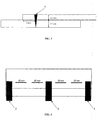
- the method according to the invention can in particular be used for welding by superposition, as illustrated on figure 3 or butt welding as illustrated by figure 7 . It was also noted that the tendency to crack during welding was markedly less when said laminated sheet of composition according to the invention was positioned above the other semi-finished product (s) during welding, either on the side. of the impact of the laser beam. This advantage is obtained in the case overlay welding.
- the laminated sheet of composition according to the invention is positioned on the side of the impact of the laser beam.
- the butt welding configuration makes it possible to obtain, after welding, a butt-welded blank, preferably characterized in that at least two of said semi-finished products have a different thickness and / or a different mechanical strength.
- the invention also relates to a butt welded blank consisting of several semi-finished products, at least one of which is a rolled sheet having a composition according to the invention and being assembled by butt welding according to a welding process without filler wire according to the invention. invention.
- the essential advantage of the invention is the possibility of using a monolithic rolled sheet, exhibiting improved weldability, in particular during remote laser welding without filler wire, a welding process generally known to those skilled in the art under the name “Remote Laser Welding”, as well as formability and corrosion resistance properties at least comparable to those of alloys of the AA6XXX family conventionally used for automobile parts and high mechanical characteristics.
- the targeted applications cover automotive structural components, in particular many parts of the “body in white” among which a distinction is made: body skin parts (or exterior body panels) such as the front fenders, the roof or roof, the skins hood, trunk or door; lining parts such as, for example, the door, fender, tailgate or hood liners; and finally the structural parts, such as for example the side members, the aprons, the load floors and the front, middle and rear legs.
- the invention makes it possible to produce reinforcing parts such as door reinforcements.
- the method according to the invention in which said semi-finished products constitute automotive structural components, automotive white body components, automotive vehicle skin components, automotive vehicle opening components is advantageous.
- the method according to the invention thus makes it possible to obtain particularly advantageous structural components, body in white, skin or opening of a motor vehicle.
- Alloys 8 and 9 have a composition according to the invention. Alloys 1 to 7 are reference alloys. ⁇ b> Table 1. ⁇ /b> Composition of the different alloys tested.
- the cracks were evaluated according to the following method: A cross section is made on each weld bead. After coating and polishing, each of the sections is observed by optical microscopy in order to determine the size of any cracks in the bead. An average is then carried out on the 16 sections in order to obtain the average crack. It is also possible to determine the fraction of cracks whose length is greater than a certain length. In this case, for each of the alloys, the average length of the cracks, the fraction of cracks whose length exceeds 0.2 times the thickness of the upper sheet, and the fraction of cracks whose length exceeds 0.4 times the thickness of the top sheet are determined. The whole is summarized in Table 3.
- Example 9 exhibits sufficient (Example 9) or even excellent (Example 8) weldability, contrary to what could have been expected given the addition of copper.
- Example 8 shows a degradation of the weldability with the increase in the copper content, whereas the alloys according to the invention, the copper content of which is even higher, exhibit sufficient weldability.
- Reference Example 3 exhibits insufficient welding characteristics.
- the tensile tests at ambient temperature were carried out according to standard NF EN ISO 6892-1 with non-proportional test specimens of geometry widely used for sheets and corresponding to type of test specimen 2 of table B.1 of appendix B of Standard. These test pieces have in particular a width of 20 mm and a length calibrated 120 mm. The percent elongation after break is measured using an 80 mm basic extensometer and is therefore rated A 80 according to the standard.
- the mechanical properties were also characterized after 5% deformation in the direction perpendicular to the rolling direction and a heat treatment of 30 min at 205 ° C, characteristic of a post-forming precipitation treatment. , as well as the folding characteristics.
- the three-point bending test was carried out according to the NF EN ISO 7438 standard and the VDA 238-100 procedure.
- the folding device is as shown on the figure 8 .
- the rollers have a diameter of 30 mm and the distance between the axes of the rollers is equal to 30 + 2t mm, t being the thickness of the sheet tested.
- the punch is brought into contact with the sheet with a pre-force of 30 Newtons. Once contact is established, the movement of the punch is indexed to zero.
- the test then consists of moving the punch so as to perform the "three-point bending" of the sheet.
- the test stops when a microcracking of the sheet leads to a force drop on the punch of at least 30 Newtons, or when the punch has moved 14.2 mm which corresponds to the maximum authorized stroke.
- the sheet sample is therefore folded as shown in figure 9 .
- the LDH parameter is widely used for the evaluation of the drawability of sheet thicknesses from 0.5 to 3.0 mm. It has been the subject of numerous publications, notably that of R. Thompson, “The LDH test to evaluate sheet metal formability - Final Report of the LDH Committee of the North American Deep Drawing Research Group”, SAE conference, Detroit, 1993, SAE Paper n ° 930815 . This is a stamping test of a blank blocked at the periphery by a ring. The hold-down pressure is controlled to prevent slipping in the ring. The blank, of dimensions 120 x 160 mm, is stressed in a mode close to plane deformation. The punch used is hemispherical.
- the figure 5 specifies the dimensions of the tools used to perform this test.
- Lubrication between the punch and the sheet is provided by graphite grease (Shell HDM2 grease).
- the lowering speed of the punch is 50 mm / min.
- the so-called LDH value is the value of the displacement of the breaking punch, i.e. the limiting depth of stamping. It actually corresponds to the average of three tests, giving a 95% confidence interval on the measurement of 0.2 mm.
- Table 6 indicates the values of the LDH parameter obtained on 120 ⁇ 160 mm specimens cut from the aforementioned sheets with a thickness of 1.2 mm and for which the dimension of 160 mm was positioned parallel to the rolling direction. ⁇ b> Table 6 ⁇ /b> Results of formability tests Reference Formability LDH120 (mm) 1 23.9 2 3 4 26.0 5 26.3 6 26.1 7 26.3 8 26.7 9 27.7
- the intergranular corrosion test according to the ISO 11846 standard consists of immersing the specimens according to the figure 6 for 24 h in a solution of sodium chloride (30 g / l) and hydrochloric acid (10 ml / l) at a temperature of 30 ° C (obtained by keeping in a dry oven), after pickling with hot soda (5% by mass) and with nitric acid (70% by mass) at room temperature.
- the samples have a dimension of 40 mm (rolling direction) x 30 mm x thickness.
- the type and depth of corrosion caused is determined by micrographic cross-sectional examination of the metal. The median and maximum corrosion depth is measured on each sample. The results are summarized in Table 7 below.
Landscapes
- Chemical & Material Sciences (AREA)
- Engineering & Computer Science (AREA)
- Mechanical Engineering (AREA)
- Physics & Mathematics (AREA)
- Metallurgy (AREA)
- Organic Chemistry (AREA)
- Materials Engineering (AREA)
- Optics & Photonics (AREA)
- Crystallography & Structural Chemistry (AREA)
- Thermal Sciences (AREA)
- Plasma & Fusion (AREA)
- Laser Beam Processing (AREA)
- Metal Rolling (AREA)
- Body Structure For Vehicles (AREA)
- Heat Treatment Of Sheet Steel (AREA)
Claims (13)
- Verfahren zum Schweißen von monolithischen Halbzeugen aus Aluminiumlegierung mittels Laser ohne Schweißdraht, umfassend die folgenden Schritte:- Bereitstellung von mindestens zwei monolithischen Halbzeugen aus Aluminiumlegierung, von denen mindestens eines ein gewalztes Blech der Zusammensetzung (Gew.-%) ist:Si: 2,5-14,Fe: 0,05-0,8,Cu: 0,25-1,0,Mg: 0,05-0,8,Mn: ≤ 0,70,Cr: ≤ 0,35,Ti: 0,02-0,30,Sr bis zu 500 ppm,Na bis zu 200 ppm,Sb bis zu 0,15 %,unvermeidbare Verunreinigungen jeweils < 0,05 und insgesamt < 0,15, Rest Aluminium,- Schweißen der Halbzeuge aus Aluminiumlegierung mittels Laser ohne Schweißdraht.
- Verfahren nach Anspruch 1, dadurch gekennzeichnet, dass das Blech im Zustand T4 Rp0,2 ≥ 165 MPa und vorzugsweise Rp0,2 ≥ 175 MPa und/oder Rm ≥ 310 MPa und vorzugsweise Rm ≥ 330 MPa aufweist.
- Verfahren nach Anspruch 1 oder Anspruch 2, dadurch gekennzeichnet, dass das Blech nach einer für das Einbrennen der Lacke repräsentativen Behandlung, einer Zugumformung von 2 % gefolgt von 20 min bei 180°C, Rp0,2 ≥ 240 MPa und vorzugsweise Rp0,2 ≥ 260 MPa und/oder Rm ≥ 340 MPa und vorzugsweise Rm ≥ 360 MPa aufweist.
- Verfahren nach einem der Ansprüche 1 bis 3, dadurch gekennzeichnet, dass das Blech nach einer die Ausscheidung nach der Formgebung simulierenden Behandlung, einer Zugumformung von 5 % in einer Richtung senkrecht zur Walzrichtung gefolgt von 30 min bei 205°C, Rp0,2 ≥ 280 MPa, vorzugsweise Rp0,2 ≥ 310 MPa und bevorzugt Rp0,2 ≥ 350 MPa und/oder Rm ≥ 330 MPa und vorzugsweise Rm ≥ 360 MPa und bevorzugt Rm ≥ 380 MPa und/oder einen normierten Biegewinkel αnorm, gemessen nach NF EN ISO 7438 und VDA-Verfahren 238-100, von mindestens 50° und vorzugsweise mindestens 60° aufweist.
- Verfahren nach einem der Ansprüche 1 bis 4, dadurch gekennzeichnet, dass der Mg-Gehalt zwischen 0,3 und 0,5 % liegt.
- Verfahren nach einem der Ansprüche 1 bis 5, dadurch gekennzeichnet, dass der Si-Gehalt zwischen 2,5 und 10,0 % und vorzugsweise zwischen 2,7 und 5,0 % liegt.
- Verfahren nach einem der Ansprüche 1 bis 6, dadurch gekennzeichnet, dass der Sr-Gehalt zwischen 200 und 400 ppm und/oder der Na-Gehalt zwischen 20 und 200 ppm und/oder der Sb-Gehalt zwischen 0,04 und 0,15 % liegt.
- Verfahren nach einem der Ansprüche 1 bis 7, dadurch gekennzeichnet, dass der Fe-Gehalt zwischen 0,15 und 0,60 % liegt.
- Verfahren nach einem der Ansprüche 1 bis 8, dadurch gekennzeichnet, dass der Cu-Gehalt zwischen 0,3 und 0,9 % und vorzugsweise zwischen 0,5 und 0,8 % liegt.
- Verfahren nach einem der Ansprüche 1 bis 9, dadurch gekennzeichnet, dass der Kupfergehalt 0,5 - 0,8 % und der Mg-Gehalt 0,3 - 0,5 % beträgt.
- Verfahren nach einem der Ansprüche 1 bis 10, dadurch gekennzeichnet, dass das Schweißen der Halbzeuge aus Aluminiumlegierung mittels Laser ohne Schweißdraht durch Übereinanderlegen oder in Stumpfstoßkonfiguration durchgeführt wird.
- Verfahren nach einem der Ansprüche 1 bis 11, dadurch gekennzeichnet, dass die Halbprodukte Kraftfahrzeugstrukturbauteile und/oder Kraftfahrzeugkarosseriebauteile und/oder Kraftfahrzeughautbauteile und/oder Kraftfahrzeugtür- bzw. Kraftfahrzeugöffnungsbauteile darstellen.
- Struktur-, Karosserie-, Haut- oder Tür- bzw. Öffnungsbauteil eines Kraftfahrzeugs, dadurch gekennzeichnet, dass es nach dem Verfahren gemäß einem der Ansprüche 1 bis 12 erhalten wird.
Applications Claiming Priority (2)
| Application Number | Priority Date | Filing Date | Title |
|---|---|---|---|
| FR1662751A FR3060606B1 (fr) | 2016-12-19 | 2016-12-19 | Alliage d’aluminium pour soudage par laser sans fil d’apport |
| PCT/FR2017/053531 WO2018115638A1 (fr) | 2016-12-19 | 2017-12-13 | Alliage d'aluminium pour soudage par laser sans fil d'apport |
Publications (2)
| Publication Number | Publication Date |
|---|---|
| EP3555331A1 EP3555331A1 (de) | 2019-10-23 |
| EP3555331B1 true EP3555331B1 (de) | 2021-07-14 |
Family
ID=58347593
Family Applications (1)
| Application Number | Title | Priority Date | Filing Date |
|---|---|---|---|
| EP17826268.9A Active EP3555331B1 (de) | 2016-12-19 | 2017-12-13 | Aluminiumlegierung zum laserschweissen ohne fülldraht |
Country Status (8)
| Country | Link |
|---|---|
| US (1) | US11524362B2 (de) |
| EP (1) | EP3555331B1 (de) |
| JP (1) | JP2020503438A (de) |
| KR (1) | KR20190098987A (de) |
| CN (1) | CN110100021A (de) |
| CA (1) | CA3044722A1 (de) |
| FR (1) | FR3060606B1 (de) |
| WO (1) | WO2018115638A1 (de) |
Families Citing this family (5)
| Publication number | Priority date | Publication date | Assignee | Title |
|---|---|---|---|---|
| DE102019003187A1 (de) | 2019-05-06 | 2020-11-12 | Daimler Ag | Bauteil, insbesondere für ein Fahrzeug, sowie Verfahren zum Herstellen eines solchen Bauteils |
| EP4461435A3 (de) * | 2020-01-22 | 2025-02-19 | Tesla, Inc. | Druckgussaluminiumlegierungen für bauteile |
| DE102020210182B4 (de) * | 2020-08-11 | 2024-09-19 | Continental Autonomous Mobility Germany GmbH | Schweißverfahren, Druckgussformteil und Aktuatorgehäuse |
| CN112048646A (zh) * | 2020-09-02 | 2020-12-08 | 中国航发北京航空材料研究院 | 一种用于电弧熔丝增材制造的Al-Si-Mg-Sc-Zr丝材及其制备方法 |
| FR3147572B1 (fr) | 2023-04-07 | 2026-02-13 | Constellium Neuf Brisach | Echangeur de chaleur à base d’un alliage d’aluminium |
Family Cites Families (15)
| Publication number | Priority date | Publication date | Assignee | Title |
|---|---|---|---|---|
| US4897124A (en) | 1987-07-02 | 1990-01-30 | Sky Aluminium Co., Ltd. | Aluminum-alloy rolled sheet for forming and production method therefor |
| JPH07109537B2 (ja) | 1990-04-26 | 1995-11-22 | 日本ビクター株式会社 | 集団学習装置 |
| JP2743709B2 (ja) | 1992-05-08 | 1998-04-22 | 日本軽金属株式会社 | 押出し・鍛造用アルミニウム合金 |
| DE69410906T2 (de) * | 1993-08-28 | 1998-12-17 | Kabushiki Kaisha Kobe Seiko Sho (Kobe Steel, Ltd.), Kobe | Aluminiumlegierungsgussstück mit hoher Laserschweissbarkeit, Verbindung aus einem Aluminiumlegierungsguss und Verfahren zur Verbesserung eines Konstruktionselement aus Aluminiumlegierungsguss |
| JPH08300999A (ja) | 1995-05-08 | 1996-11-19 | Toyota Auto Body Co Ltd | 車両用リフタのリンクガイド機構 |
| JPH112705A (ja) | 1997-06-12 | 1999-01-06 | Mitsubishi Rayon Co Ltd | 光制御機能を有する樹脂シ−ト |
| JPH1112705A (ja) * | 1997-06-20 | 1999-01-19 | Sumitomo Light Metal Ind Ltd | 切削性に優れた高強度アルミニウム合金鍛造品の製造方法 |
| JP3548709B2 (ja) * | 2000-05-08 | 2004-07-28 | 九州三井アルミニウム工業株式会社 | 輸送機器用Al合金の半溶融ビレットの製造方法 |
| FR2827306B1 (fr) * | 2001-07-10 | 2004-10-22 | Pechiney Aluminium | Alliage d'aluminium a haute ductilite pour coulee sous pression |
| FR2835533B1 (fr) * | 2002-02-05 | 2004-10-08 | Pechiney Rhenalu | TOLE EN ALLIAGE Al-Si-Mg POUR PEAU DE CARROSSERIE AUTOMOBILE |
| DE602004004028T2 (de) | 2003-10-17 | 2007-07-05 | Kabushiki Kaisha Toyota Chuo Kenkyusho, Nagakute | Aluminium-Gusslegierung, Aluminium-Gusslegierungen und deren Herstellungsverfahren |
| JP4274170B2 (ja) | 2005-11-09 | 2009-06-03 | 日本軽金属株式会社 | パルスレーザー溶接性に優れたアルミニウム合金板 |
| FR2913898B1 (fr) * | 2007-03-23 | 2009-05-08 | Alcan Rhenalu Sa | Element structural en alliage d'aluminium incluant un capteur optique. |
| CN103045918A (zh) * | 2012-04-10 | 2013-04-17 | 湖南晟通科技集团有限公司 | 高焊接强度Al-Mg-Si合金及其型材制备方法 |
| FR3038242B1 (fr) * | 2015-07-02 | 2017-06-23 | Constellium Neuf-Brisach | Alliage d'aluminium pour soudage par laser sans fils d'apport |
-
2016
- 2016-12-19 FR FR1662751A patent/FR3060606B1/fr active Active
-
2017
- 2017-12-13 WO PCT/FR2017/053531 patent/WO2018115638A1/fr not_active Ceased
- 2017-12-13 CN CN201780077644.2A patent/CN110100021A/zh active Pending
- 2017-12-13 JP JP2019533036A patent/JP2020503438A/ja active Pending
- 2017-12-13 KR KR1020197018917A patent/KR20190098987A/ko not_active Withdrawn
- 2017-12-13 CA CA3044722A patent/CA3044722A1/fr active Pending
- 2017-12-13 EP EP17826268.9A patent/EP3555331B1/de active Active
- 2017-12-13 US US16/470,333 patent/US11524362B2/en active Active
Also Published As
| Publication number | Publication date |
|---|---|
| EP3555331A1 (de) | 2019-10-23 |
| WO2018115638A1 (fr) | 2018-06-28 |
| CA3044722A1 (fr) | 2018-06-28 |
| FR3060606A1 (fr) | 2018-06-22 |
| KR20190098987A (ko) | 2019-08-23 |
| JP2020503438A (ja) | 2020-01-30 |
| CN110100021A (zh) | 2019-08-06 |
| US20200114468A1 (en) | 2020-04-16 |
| US11524362B2 (en) | 2022-12-13 |
| FR3060606B1 (fr) | 2018-12-07 |
Similar Documents
| Publication | Publication Date | Title |
|---|---|---|
| EP3317041B1 (de) | Verfahren zum laserschweissen von monolithischem halbzeug aus einer aluminiumlegierung ohne fülldraht sowie entsprechendes bauteil und massgeschneiderter rohling | |
| EP3303646B1 (de) | Metallblech für eine kraftfahrzeugkarosserie mit hoher mechanischer festigkeit | |
| EP3362282B1 (de) | Strukturbauteil einer kraftfahrzeugschale zur bereitstellung eines hervorragenden kompromisses zwischen mechanischer festigkeit und crashfestigkeit | |
| EP3384060B1 (de) | Hochsteifes dünnes blech für eine fahrzeugkarosserie | |
| EP3555331A1 (de) | Aluminiumlegierung zum laserschweissen ohne fülldraht | |
| FR2979576A1 (fr) | Tole plaquee pour carrosserie automobile | |
| FR2922222A1 (fr) | Tole plaquee en alliages de la serie 6xxx pour carrosserie automobile. | |
| EP3019637B1 (de) | Blech aus aluminiumlegierung für die struktur eines kraftfahrzeugs | |
| WO2018185425A1 (fr) | Procede ameliore de fabrication de composant de structure de caisse automobile | |
| EP4355923A1 (de) | Band aus 6xxx-legierung und herstellungsverfahren |
Legal Events
| Date | Code | Title | Description |
|---|---|---|---|
| STAA | Information on the status of an ep patent application or granted ep patent |
Free format text: STATUS: UNKNOWN |
|
| STAA | Information on the status of an ep patent application or granted ep patent |
Free format text: STATUS: THE INTERNATIONAL PUBLICATION HAS BEEN MADE |
|
| PUAI | Public reference made under article 153(3) epc to a published international application that has entered the european phase |
Free format text: ORIGINAL CODE: 0009012 |
|
| STAA | Information on the status of an ep patent application or granted ep patent |
Free format text: STATUS: REQUEST FOR EXAMINATION WAS MADE |
|
| 17P | Request for examination filed |
Effective date: 20190716 |
|
| AK | Designated contracting states |
Kind code of ref document: A1 Designated state(s): AL AT BE BG CH CY CZ DE DK EE ES FI FR GB GR HR HU IE IS IT LI LT LU LV MC MK MT NL NO PL PT RO RS SE SI SK SM TR |
|
| AX | Request for extension of the european patent |
Extension state: BA ME |
|
| RIN1 | Information on inventor provided before grant (corrected) |
Inventor name: CERVI, LAURENT Inventor name: MASSE, JEAN-PHILIPPE Inventor name: KEMPA, STEFAN |
|
| DAV | Request for validation of the european patent (deleted) | ||
| DAX | Request for extension of the european patent (deleted) | ||
| GRAP | Despatch of communication of intention to grant a patent |
Free format text: ORIGINAL CODE: EPIDOSNIGR1 |
|
| STAA | Information on the status of an ep patent application or granted ep patent |
Free format text: STATUS: GRANT OF PATENT IS INTENDED |
|
| INTG | Intention to grant announced |
Effective date: 20210219 |
|
| GRAS | Grant fee paid |
Free format text: ORIGINAL CODE: EPIDOSNIGR3 |
|
| GRAA | (expected) grant |
Free format text: ORIGINAL CODE: 0009210 |
|
| STAA | Information on the status of an ep patent application or granted ep patent |
Free format text: STATUS: THE PATENT HAS BEEN GRANTED |
|
| AK | Designated contracting states |
Kind code of ref document: B1 Designated state(s): AL AT BE BG CH CY CZ DE DK EE ES FI FR GB GR HR HU IE IS IT LI LT LU LV MC MK MT NL NO PL PT RO RS SE SI SK SM TR |
|
| REG | Reference to a national code |
Ref country code: GB Ref legal event code: FG4D Free format text: NOT ENGLISH |
|
| REG | Reference to a national code |
Ref country code: IE Ref legal event code: FG4D Free format text: LANGUAGE OF EP DOCUMENT: FRENCH |
|
| REG | Reference to a national code |
Ref country code: DE Ref legal event code: R096 Ref document number: 602017042228 Country of ref document: DE |
|
| REG | Reference to a national code |
Ref country code: AT Ref legal event code: REF Ref document number: 1410714 Country of ref document: AT Kind code of ref document: T Effective date: 20210815 |
|
| REG | Reference to a national code |
Ref country code: LT Ref legal event code: MG9D |
|
| REG | Reference to a national code |
Ref country code: NL Ref legal event code: MP Effective date: 20210714 |
|
| PG25 | Lapsed in a contracting state [announced via postgrant information from national office to epo] |
Ref country code: SE Free format text: LAPSE BECAUSE OF FAILURE TO SUBMIT A TRANSLATION OF THE DESCRIPTION OR TO PAY THE FEE WITHIN THE PRESCRIBED TIME-LIMIT Effective date: 20210714 Ref country code: RS Free format text: LAPSE BECAUSE OF FAILURE TO SUBMIT A TRANSLATION OF THE DESCRIPTION OR TO PAY THE FEE WITHIN THE PRESCRIBED TIME-LIMIT Effective date: 20210714 Ref country code: HR Free format text: LAPSE BECAUSE OF FAILURE TO SUBMIT A TRANSLATION OF THE DESCRIPTION OR TO PAY THE FEE WITHIN THE PRESCRIBED TIME-LIMIT Effective date: 20210714 Ref country code: ES Free format text: LAPSE BECAUSE OF FAILURE TO SUBMIT A TRANSLATION OF THE DESCRIPTION OR TO PAY THE FEE WITHIN THE PRESCRIBED TIME-LIMIT Effective date: 20210714 Ref country code: FI Free format text: LAPSE BECAUSE OF FAILURE TO SUBMIT A TRANSLATION OF THE DESCRIPTION OR TO PAY THE FEE WITHIN THE PRESCRIBED TIME-LIMIT Effective date: 20210714 Ref country code: BG Free format text: LAPSE BECAUSE OF FAILURE TO SUBMIT A TRANSLATION OF THE DESCRIPTION OR TO PAY THE FEE WITHIN THE PRESCRIBED TIME-LIMIT Effective date: 20211014 Ref country code: LT Free format text: LAPSE BECAUSE OF FAILURE TO SUBMIT A TRANSLATION OF THE DESCRIPTION OR TO PAY THE FEE WITHIN THE PRESCRIBED TIME-LIMIT Effective date: 20210714 Ref country code: NL Free format text: LAPSE BECAUSE OF FAILURE TO SUBMIT A TRANSLATION OF THE DESCRIPTION OR TO PAY THE FEE WITHIN THE PRESCRIBED TIME-LIMIT Effective date: 20210714 Ref country code: PT Free format text: LAPSE BECAUSE OF FAILURE TO SUBMIT A TRANSLATION OF THE DESCRIPTION OR TO PAY THE FEE WITHIN THE PRESCRIBED TIME-LIMIT Effective date: 20211115 Ref country code: NO Free format text: LAPSE BECAUSE OF FAILURE TO SUBMIT A TRANSLATION OF THE DESCRIPTION OR TO PAY THE FEE WITHIN THE PRESCRIBED TIME-LIMIT Effective date: 20211014 |
|
| PG25 | Lapsed in a contracting state [announced via postgrant information from national office to epo] |
Ref country code: PL Free format text: LAPSE BECAUSE OF FAILURE TO SUBMIT A TRANSLATION OF THE DESCRIPTION OR TO PAY THE FEE WITHIN THE PRESCRIBED TIME-LIMIT Effective date: 20210714 Ref country code: LV Free format text: LAPSE BECAUSE OF FAILURE TO SUBMIT A TRANSLATION OF THE DESCRIPTION OR TO PAY THE FEE WITHIN THE PRESCRIBED TIME-LIMIT Effective date: 20210714 Ref country code: GR Free format text: LAPSE BECAUSE OF FAILURE TO SUBMIT A TRANSLATION OF THE DESCRIPTION OR TO PAY THE FEE WITHIN THE PRESCRIBED TIME-LIMIT Effective date: 20211015 |
|
| REG | Reference to a national code |
Ref country code: DE Ref legal event code: R097 Ref document number: 602017042228 Country of ref document: DE |
|
| PG25 | Lapsed in a contracting state [announced via postgrant information from national office to epo] |
Ref country code: DK Free format text: LAPSE BECAUSE OF FAILURE TO SUBMIT A TRANSLATION OF THE DESCRIPTION OR TO PAY THE FEE WITHIN THE PRESCRIBED TIME-LIMIT Effective date: 20210714 |
|
| PLBE | No opposition filed within time limit |
Free format text: ORIGINAL CODE: 0009261 |
|
| STAA | Information on the status of an ep patent application or granted ep patent |
Free format text: STATUS: NO OPPOSITION FILED WITHIN TIME LIMIT |
|
| PG25 | Lapsed in a contracting state [announced via postgrant information from national office to epo] |
Ref country code: SM Free format text: LAPSE BECAUSE OF FAILURE TO SUBMIT A TRANSLATION OF THE DESCRIPTION OR TO PAY THE FEE WITHIN THE PRESCRIBED TIME-LIMIT Effective date: 20210714 Ref country code: SK Free format text: LAPSE BECAUSE OF FAILURE TO SUBMIT A TRANSLATION OF THE DESCRIPTION OR TO PAY THE FEE WITHIN THE PRESCRIBED TIME-LIMIT Effective date: 20210714 Ref country code: RO Free format text: LAPSE BECAUSE OF FAILURE TO SUBMIT A TRANSLATION OF THE DESCRIPTION OR TO PAY THE FEE WITHIN THE PRESCRIBED TIME-LIMIT Effective date: 20210714 Ref country code: EE Free format text: LAPSE BECAUSE OF FAILURE TO SUBMIT A TRANSLATION OF THE DESCRIPTION OR TO PAY THE FEE WITHIN THE PRESCRIBED TIME-LIMIT Effective date: 20210714 Ref country code: CZ Free format text: LAPSE BECAUSE OF FAILURE TO SUBMIT A TRANSLATION OF THE DESCRIPTION OR TO PAY THE FEE WITHIN THE PRESCRIBED TIME-LIMIT Effective date: 20210714 Ref country code: AL Free format text: LAPSE BECAUSE OF FAILURE TO SUBMIT A TRANSLATION OF THE DESCRIPTION OR TO PAY THE FEE WITHIN THE PRESCRIBED TIME-LIMIT Effective date: 20210714 |
|
| 26N | No opposition filed |
Effective date: 20220419 |
|
| PG25 | Lapsed in a contracting state [announced via postgrant information from national office to epo] |
Ref country code: MC Free format text: LAPSE BECAUSE OF FAILURE TO SUBMIT A TRANSLATION OF THE DESCRIPTION OR TO PAY THE FEE WITHIN THE PRESCRIBED TIME-LIMIT Effective date: 20210714 Ref country code: IT Free format text: LAPSE BECAUSE OF FAILURE TO SUBMIT A TRANSLATION OF THE DESCRIPTION OR TO PAY THE FEE WITHIN THE PRESCRIBED TIME-LIMIT Effective date: 20210714 |
|
| GBPC | Gb: european patent ceased through non-payment of renewal fee |
Effective date: 20211213 |
|
| PG25 | Lapsed in a contracting state [announced via postgrant information from national office to epo] |
Ref country code: LU Free format text: LAPSE BECAUSE OF NON-PAYMENT OF DUE FEES Effective date: 20211213 Ref country code: IE Free format text: LAPSE BECAUSE OF NON-PAYMENT OF DUE FEES Effective date: 20211213 Ref country code: GB Free format text: LAPSE BECAUSE OF NON-PAYMENT OF DUE FEES Effective date: 20211213 |
|
| REG | Reference to a national code |
Ref country code: AT Ref legal event code: UEP Ref document number: 1410714 Country of ref document: AT Kind code of ref document: T Effective date: 20210714 |
|
| PG25 | Lapsed in a contracting state [announced via postgrant information from national office to epo] |
Ref country code: CY Free format text: LAPSE BECAUSE OF FAILURE TO SUBMIT A TRANSLATION OF THE DESCRIPTION OR TO PAY THE FEE WITHIN THE PRESCRIBED TIME-LIMIT Effective date: 20210714 |
|
| PG25 | Lapsed in a contracting state [announced via postgrant information from national office to epo] |
Ref country code: HU Free format text: LAPSE BECAUSE OF FAILURE TO SUBMIT A TRANSLATION OF THE DESCRIPTION OR TO PAY THE FEE WITHIN THE PRESCRIBED TIME-LIMIT; INVALID AB INITIO Effective date: 20171213 |
|
| PG25 | Lapsed in a contracting state [announced via postgrant information from national office to epo] |
Ref country code: MK Free format text: LAPSE BECAUSE OF FAILURE TO SUBMIT A TRANSLATION OF THE DESCRIPTION OR TO PAY THE FEE WITHIN THE PRESCRIBED TIME-LIMIT Effective date: 20210714 |
|
| PG25 | Lapsed in a contracting state [announced via postgrant information from national office to epo] |
Ref country code: TR Free format text: LAPSE BECAUSE OF FAILURE TO SUBMIT A TRANSLATION OF THE DESCRIPTION OR TO PAY THE FEE WITHIN THE PRESCRIBED TIME-LIMIT Effective date: 20210714 |
|
| PG25 | Lapsed in a contracting state [announced via postgrant information from national office to epo] |
Ref country code: MT Free format text: LAPSE BECAUSE OF FAILURE TO SUBMIT A TRANSLATION OF THE DESCRIPTION OR TO PAY THE FEE WITHIN THE PRESCRIBED TIME-LIMIT Effective date: 20210714 |
|
| REG | Reference to a national code |
Ref country code: CH Ref legal event code: U11 Free format text: ST27 STATUS EVENT CODE: U-0-0-U10-U11 (AS PROVIDED BY THE NATIONAL OFFICE) Effective date: 20260101 |
|
| PGFP | Annual fee paid to national office [announced via postgrant information from national office to epo] |
Ref country code: AT Payment date: 20251230 Year of fee payment: 9 |
|
| PGFP | Annual fee paid to national office [announced via postgrant information from national office to epo] |
Ref country code: FR Payment date: 20251226 Year of fee payment: 9 |
|
| PGFP | Annual fee paid to national office [announced via postgrant information from national office to epo] |
Ref country code: BE Payment date: 20251229 Year of fee payment: 9 |
|
| PGFP | Annual fee paid to national office [announced via postgrant information from national office to epo] |
Ref country code: DE Payment date: 20251229 Year of fee payment: 9 |
|
| PGFP | Annual fee paid to national office [announced via postgrant information from national office to epo] |
Ref country code: CH Payment date: 20260101 Year of fee payment: 9 |