EP3557549B1 - Procédé d'évaluation d'un événement - Google Patents
Procédé d'évaluation d'un événement Download PDFInfo
- Publication number
- EP3557549B1 EP3557549B1 EP18168348.3A EP18168348A EP3557549B1 EP 3557549 B1 EP3557549 B1 EP 3557549B1 EP 18168348 A EP18168348 A EP 18168348A EP 3557549 B1 EP3557549 B1 EP 3557549B1
- Authority
- EP
- European Patent Office
- Prior art keywords
- trajectory
- event
- area
- image data
- movement
- Prior art date
- Legal status (The legal status is an assumption and is not a legal conclusion. Google has not performed a legal analysis and makes no representation as to the accuracy of the status listed.)
- Active
Links
Images


Classifications
-
- G—PHYSICS
- G08—SIGNALLING
- G08B—SIGNALLING SYSTEMS, e.g. PERSONAL CALLING SYSTEMS; ORDER TELEGRAPHS; ALARM SYSTEMS
- G08B13/00—Burglar, theft or intruder alarms
- G08B13/18—Actuation by interference with heat, light, or radiation of shorter wavelength; Actuation by intruding sources of heat, light, or radiation of shorter wavelength
- G08B13/189—Actuation by interference with heat, light, or radiation of shorter wavelength; Actuation by intruding sources of heat, light, or radiation of shorter wavelength using passive radiation detection systems
- G08B13/194—Actuation by interference with heat, light, or radiation of shorter wavelength; Actuation by intruding sources of heat, light, or radiation of shorter wavelength using passive radiation detection systems using image scanning and comparing systems
- G08B13/196—Actuation by interference with heat, light, or radiation of shorter wavelength; Actuation by intruding sources of heat, light, or radiation of shorter wavelength using passive radiation detection systems using image scanning and comparing systems using television cameras
- G08B13/19602—Image analysis to detect motion of the intruder, e.g. by frame subtraction
- G08B13/19613—Recognition of a predetermined image pattern or behaviour pattern indicating theft or intrusion
-
- G—PHYSICS
- G06—COMPUTING OR CALCULATING; COUNTING
- G06T—IMAGE DATA PROCESSING OR GENERATION, IN GENERAL
- G06T7/00—Image analysis
- G06T7/20—Analysis of motion
-
- G—PHYSICS
- G06—COMPUTING OR CALCULATING; COUNTING
- G06V—IMAGE OR VIDEO RECOGNITION OR UNDERSTANDING
- G06V20/00—Scenes; Scene-specific elements
- G06V20/50—Context or environment of the image
- G06V20/52—Surveillance or monitoring of activities, e.g. for recognising suspicious objects
-
- G—PHYSICS
- G06—COMPUTING OR CALCULATING; COUNTING
- G06V—IMAGE OR VIDEO RECOGNITION OR UNDERSTANDING
- G06V40/00—Recognition of biometric, human-related or animal-related patterns in image or video data
- G06V40/20—Movements or behaviour, e.g. gesture recognition
-
- G—PHYSICS
- G08—SIGNALLING
- G08B—SIGNALLING SYSTEMS, e.g. PERSONAL CALLING SYSTEMS; ORDER TELEGRAPHS; ALARM SYSTEMS
- G08B29/00—Checking or monitoring of signalling or alarm systems; Prevention or correction of operating errors, e.g. preventing unauthorised operation
- G08B29/18—Prevention or correction of operating errors
- G08B29/185—Signal analysis techniques for reducing or preventing false alarms or for enhancing the reliability of the system
-
- G—PHYSICS
- G06—COMPUTING OR CALCULATING; COUNTING
- G06T—IMAGE DATA PROCESSING OR GENERATION, IN GENERAL
- G06T2207/00—Indexing scheme for image analysis or image enhancement
- G06T2207/30—Subject of image; Context of image processing
- G06T2207/30241—Trajectory
Definitions
- This invention relates to a method for evaluating a movement event in the area, which movement event is detected by means of an image sensor that outputs image data, from which image data a trajectory of an object describing a movement and/or a property of the moving object in the area can be determined, which trajectory coordinate values and time values and/or property values and time values.
- a movement event is to be understood as an event in which a person and/or an object moves in an area, although within the scope of the disclosure of this invention no distinction is made between a moving person and a moving object.
- a moving object can be, for example, a moving vehicle.
- An area can be divided into sub-areas with or without structural measures.
- the user can freely choose how to divide the area into sub-areas.
- the sub-areas can be chosen to overlap one another.
- the sub-areas can also change over time.
- US7262690B2 discloses a method by which an alarm is forwarded to a portable device such as a cell phone.
- the method described for verification includes a first and a second alarm detection, which is compared and, if necessary, stored in a database. There is no reference in this document to a comparison of an alarm event with an alarm event stored in the database.
- US20110254680 discloses a method by means of which a potential alarm is validated and, depending on the validation of the potential alarm, this alarm is passed on to a subsequently switched module.
- the alarm signal is compared with reference alarms stored in a database. There is no reference in this document to the comparison of object trajectories and the verification of an alarm derived from this.
- US20110254680 discloses a method in which an object is classified by comparing a movement of the object described by a trajectory with a reference trajectory of the object class, wherein an event is detected in which event the trajectory deviates from the reference trajectory.
- WO2012092148 is also based on a determination of whether a detected trajectory corresponds to a (reference) trajectory corresponding to a normal situation (see [0008], [0011] of WO2012092148 ), whereby this evaluation is based on the distance of the trajectory from the reference trajectory.
- US2003058111 is based on comparing an event such as a trajectory with a reference trajectory.
- US2003053659 discloses that the trajectory of an object is compared with a normal reference trajectory and an abnormal reference trajectory, where in US2003053659 There is no indication how the comparison of the trajectory and the reference trajectory actually takes place. Because of this lack of revelation US2003053659 not to be regarded as relevant prior art.
- US5966074 As prior art, in which document the evaluation of a trajectory is based on the location of the trajectory, the angle and the speed. It is found in US5966074 no reference to the evaluation of a trajectory with regard to a time specification and a coordinate specification.
- FR2872326 A situation is assessed as an alarm situation if this situation corresponds to a class from a large number of classes describing alarm situations.
- US2016196728 is based on a comparison of a trajectory with a reference trajectory (see claim 2 of US2016196728 ). It is found in US2016196728 no indication of a comparison of the trajectory with the reference trajectory in relation to a time specification of the trajectory.
- EP2899706 discloses the point-by-point comparison of a trajectory with a reference trajectory.
- US2017286781A1 is based on the allocation of the trajectory to certain clusters.
- KR20120078415 A trajectory is again compared with a reference trajectory.
- WO2008103206 discloses the evaluation of a trajectory based on speed values and acceleration values.
- DE102007052763 describes the division of a trajectory into relevant sections and the comparison of the sections with a reference trajectory.
- DE102006053286 mentions the comparison of motion vectors with a main flow direction, and in a broader sense the comparison of trajectories with main trajectories.
- DE20061000494 discloses the comparison of reference values of an event with a reference event.
- EP1350234 describes the comparison of a trajectory with reference trajectories.
- DE102008061910 discloses the comparison of a trajectory with a reference trajectory using the in DE102008061910 specified methods.
- the trajectory includes not only coordinate values about the movement of the object but also property values such as color or size of the object.
- WO20017042089 does not disclose the consideration of a trajectory with coordinate values, which coordinate values describe a movement of the object, and with property values about the shape and color of the object.
- the method according to the invention has the task of providing a reliable method for evaluating the movement event.
- An evaluation of the motion event is that the motion event is evaluated as an ordinary event or as an alarm event.
- the basic approach of the solution discussed below is based, among other things, on replicating human observation, for example of a security guard, as best as possible.
- This approach includes, in particular, that an event is observed while observing the course of the event over time.
- a trajectory can include coordinate values and time values for a sufficiently precise description of the position of an object at at least two points in time.
- One like this Trajectory describes the movement of an object with sufficient precision by specifying start coordinates and a start time as well as end coordinates and an end time.
- the start coordinates and the end coordinates can be different or the same.
- the latter can be caused by an object remaining at one point, which can also be described by a trajectory.
- this is relevant in order to describe with sufficient accuracy an object remaining on the boundary between the partial area and the further partial area or an object remaining in a partial area before or after or between the transition between the partial areas.
- a trajectory can also include information about the movement of the object, such as the speed and/or the acceleration of the object.
- a trajectory includes information about at least one property of the moving object, such as size, color, etc. of the object.
- a trajectory which is used to evaluate a movement event according to the method according to the invention, can be formed from individual partial trajectories in a method presented.
- a trajectory can be a mathematical function or can be formed by a set of values.
- this is viewed as a purely mathematical problem, which is why forming the trajectory using a set of values or a function is viewed as equivalent within the scope of the disclosure.
- the area information can be information about the entry and/or presence of the object in a sub-area.
- the area specification can also be formed by the coordinate values of the trajectory.
- a reference trajectory includes coordinate values and time values, whereby the time values cannot be absolute time specifications.
- the reference time values are always relative times.
- a reference range specification can further include a reference property - again in analogy to the description above.
- a reference area information includes information about the entry of an object following a reference trajectory into a partial area and/or about the presence of the object in a partial area.
- a reference range specification can be formed by the reference coordinate values of the reference trajectory.
- a reference trajectory and/or a reference property can be obtained via a measurement and/or through input by a user.
- trajectory function a trajectory function, a first reference function and a second reference function are determined and a similarity measure describing the similarity of the trajectory function to the respective reference trajectory function is determined by using methods according to the prior art.
- the trajectory function and the reference function can describe the time course of one or two or three coordinate values or reference coordinate values or the course of the trajectory or the reference trajectory with sufficient accuracy using common teaching.
- a first reference trajectory and a second reference trajectory can differ characteristically based on a characteristic number of reference coordinate values.
- the person skilled in the art can choose the number of coordinate values and reference coordinate values equal to the characteristic number.
- the trajectory function can be, for example, a polynomial of the nth degree.
- the trajectory function can include region-wise polynomials of the nth degree.
- the similarity measure can be determined using common teaching in such a way that a first difference between the trajectory function and the first reference trajectory and a second difference between the trajectory function and the second reference trajectories are determined.
- the trajectory has a higher degree of similarity to the reference trajectory, to which reference trajectory a smaller difference is determined.
- the similarity measure can be a time-independent quantity.
- a trajectory can be formed by a mathematical function or by a set of values
- the similarity measure can be determined by comparing functions and/or by comparing values. It is also not excluded within the scope of the invention that values are compared with a function.
- a further solution approach of the method according to the invention is based on the fact that the trajectory function described above and/or the trajectories can be described sufficiently precisely by a trajectory parameter.
- the trajectory parameter is determined using the theory of curve discussion and includes a range and a time.
- curve discussion in mathematics means the examination of the graph of a function for its geometric properties.
- the term is expanded to the effect that areas described by the graph and, for example, an axis or by the graph and, for example, another graph, as well as their partial areas, are examined.
- a histogram can be created and calculated.
- a histogram can, for example, include the following parameters as a function over time or a coordinate: partial area affiliation of an object, partial area of an object point, the speed of the object, object size, object shape such as aspect ratio or orientation, distance traveled, class affiliation, which is based on a classification method is determined according to current teachings and/or color.
- the further solution approach of the method according to the invention also includes that the reference functions and/or the reference trajectories can each be described sufficiently precisely by a reference parameter.
- the reference parameters are determined by applying the common theory of curve discussion.
- the reference parameter therefore includes a reference range information and a reference time information.
- trajectory parameter or a reference parameter sum parameters of the trajectory or the reference trajectory such as the average speed, Distance traveled, length of the trajectory or the reference trajectory in time or frames, class affiliation (see above), color properties can be described.
- information describing the weather conditions prevailing in the area and/or the image quality can be included in the method according to the invention.
- the area specification and the reference area specification can also be provided by specifying coordinates.
- the trajectory parameter and the reference parameter can, for example, be limited to specifying how long the object or a reference object stays in a sub-area.
- the similarity measure can be determined in such a way that absolute differences or percentage differences between the trajectory parameter and the first reference parameter (ordinary event) and between the trajectory parameter and the second reference parameter (alarm event) are determined.
- the similarity measure can be a time-independent quantity.
- the determination of the degree of similarity of the trajectory to a first reference trajectory and to a second reference trajectory can be done by introducing a classifier according to the prior art.
- the task underlying the subject matter of the invention of accurately evaluating a movement event is associated with processing the available image data in a sufficiently stable method.
- the image data on the basis of which the method according to the invention or a method according to the prior art is to be carried out is often not error-free data.
- the false alarm rate can be significantly reduced.
- This evaluation also essentially corresponds to the subjective evaluation by a security guard who, for example, does not trigger an alarm because an object is only in a prohibited area for a tolerable period of time.
- a motion event is assessed as an event that is more similar to an ordinary event, no alarm is usually triggered. If a motion event is assessed as an event that is more similar to an alarm event, an alarm is usually triggered.
- the method according to the invention can include method steps according to which method steps the image data are evaluated before and/or during and/or after the evaluation of the movement event according to a defined rule and an alarm signal is output depending on whether the rule is fulfilled.
- the evaluation of the image data according to defined rules can be carried out in addition to the evaluation of the movement event described above, the evaluation according to rules as such being carried out using methods according to the prior art, which methods involve the evaluation of the trajectory described above in comparison with a reference trajectory be combined.
- the method according to the invention can be characterized in that the reference trajectories stored in the database are described by at least one hypergraph.
- a variety of reference trajectories can be described by a hypergraph.
- the method according to the invention can be designed more effectively, particularly when there are a large number of reference trajectories, since the trajectory and/or at least one trajectory function and/or at least one trajectory parameter is compared with the hypergraph.
- the number of input values can therefore be reduced by introducing a hypergraph to describe the reference trajectories stored in the database while achieving an equivalent result.
- the user can introduce limit values for the similarity measure, from which limit values a trajectory is considered to be a trajectory sufficiently similar to the first reference trajectory or to the second reference trajectory. This also includes that a trajectory that has a degree of similarity to the first reference trajectory and/or to the second reference trajectory that is below a limit value is viewed as an unassignable event.
- the detection of an unassignable event which is defined by a trajectory with a similarity value that is below a limit value to a normal event and an alarm event, can also lead to the output of an alarm.
- the above-mentioned comparison to determine the similarity measure can be carried out using learning procedures partially or completely defined by a user and calculating a classifier. Such learning methods are known to those skilled in the art under the terms “semi-supervised learning” or “supervised learning”.
- the method according to the invention is based on the evaluation of a movement event of an object in an area comprising partial areas.
- the area can include restricted areas in which restricted areas movement of an object is not possible for technical reasons, or include so-called free sub-areas in which free sub-areas an object can move.
- the method according to the invention can be characterized in that the blocked areas can also be described by a hypergraph, whereby the effectiveness of the method according to the invention can be further increased.
- the method according to the invention can be characterized in that the movement events of other objects are not evaluated or are evaluated with a different weighting than the movement of the object.
- the selection of the further objects can take place via at least one property of the further object and/or via the selection of partial image areas of an image captured by the image sensor.
- the method according to the invention can be made significantly more effective compared to methods according to the prior art, since the trajectories of the other objects are not taken into account. For example, the movement of leaves in an area below a tree may be ignored. Furthermore, weather events such as snow or rain cannot be evaluated or can be evaluated with a different weighting than the movement of the object.
- the method according to the invention can be characterized in that the object events that are not to be evaluated are also described by the hypergraph and contained in it are, whereby the method is described more effectively in the sense of a reduction of the input values.
- the method can include substeps in which substeps the trajectory is compared with the information about the areas.
- a trajectory that indicates a movement in a restricted area can, for example, be viewed as an error-prone trajectory.
- the method according to the invention can include that the image data determined by means of the image sensor comprising the trajectory and/or further image data comprising a further trajectory, which further image data are determined by a further image sensor, are continuously stored in the database.
- the further image sensor can supply further image data over the area or further image data over a further area.
- the database containing the reference trajectories is constantly being expanded.
- the geometric transformation takes place taking into account the position of the additional image sensor in relation to the area.
- the geometric similarity of the positioning of the image sensor in the area and the positioning of the further image sensor in the further area must be taken into account in the geometric transformation, taking into account the geometric similarity of the area and the further area.
- the image data and/or the further image data or the trajectories and/or the further trajectories can be stored in the database as an event verified as an alarm event or as an event verified as a normal event, in order to continuously expand the database.
- the expansion of the database is not only limited to the trajectories determined from image data, but is to be applied to all image data in order to solve the problem according to the invention.
- the verification of the event or the classification of this image data and/or this further image data into a normal event or into an alarm event can be done by a user.
- the trajectory can be evaluated depending on additional sensor data.
- the area can also be monitored by other sensors such as access controls etc., which additional sensors provide further sensor data.
- the trajectory can be classified into an alarm event or a normal event.
- the expert must evaluate logical correlations or contradictions.
- the classification can also be carried out by including the other sensor data in the learning process.
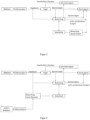
- Figure 1 shows a block diagram for a better understanding of the method according to the invention.
- image data can be determined using state-of-the-art methods. This image data is processed in a video analysis so that a trajectory comprising coordinate information and time information for describing a movement of an object in an area is output from the image data using methods according to the prior art.
- the trajectory determined in this way forms the basis of the method according to the invention for evaluating a movement event.
- the trajectory determined from the image data is divided into alarm situations or ordinary situations using state-of-the-art methods.
- the trajectory is determined using simple rules, which rules refer to the occurrence or Non-occurrence of an event is assessed as an alarm situation or a normal situation and an alarm can be triggered accordingly.
- the method according to the invention includes, in addition to the methods described above according to the prior art or as an alternative to the methods described above for evaluating a movement event according to rigid rules, the evaluation of the trajectory determined from the image data by means of the greater similarity to an ordinary one determined by the similarity measure event or to an alarm event.
- the trajectory obtained from the video analysis and/or the trajectory evaluated as an alarm event by applying the evaluation using the rigid rules is assigned to an evaluation.
- the trajectory is compared with reference trajectories stored in a database and a similarity measure is determined.
- the reference trajectories stored in the database are classified as a normal situation or an alarm situation.
- the trajectory is evaluated as an alarm event, in which alarm event an alarm signal is issued, or as an ordinary event.
- the trajectory has a higher degree of similarity to a reference trajectory verified as an alarm event than to a reference trajectory verified as an ordinary event.
- the trajectory has a higher degree of similarity to a reference trajectory verified as a common event than to a reference trajectory verified as an alarm event.
- the user further defines a limit value for a similarity measure, above which limit a trajectory is clearly viewed as an alarm event or as an ordinary event becomes. If the trajectory to be evaluated has a similarity measure that falls below the limit value with a reference trajectory verified as an alarm event and a similarity measure that falls below the limit value with a reference trajectory verified as an ordinary event, the trajectory is evaluated as an unassignable event. To be on the safe side, evaluating a trajectory as an unassignable event also leads to an alarm signal.
- Figure 2 shows a further embodiment of the method according to the invention, wherein the in Figure 2 embodiment shown in Figure 1 includes the method steps shown.
- the trajectory determined from the video analysis is stored in the database after a previous evaluation by a person. As a result, the database is constantly being expanded.
- an unassignable event is evaluated by a person, whereby the unassignable event is evaluated as an alarm event or as a normal event and, evaluated as such, is stored in the database as a reference trajectory.
- FIG 4 illustrated embodiment of the method according to the invention is based on the in Figure 2 embodiment shown.
- further image data can be recorded, for example by a further camera, which further image data is fed to a video analysis analogously to the embodiment of the method according to the invention described above, in order to obtain further trajectories.
- the further image data can concern the area or a further area.
- the further trajectories are verified by a user as alarm events and as ordinary events and are stored as such as further reference trajectories in the database.
- the method according to the invention in the in figure 4 The embodiment shown is characterized in that the further reference trajectories are also used to evaluate the trajectories as a normal event or as an alarm event.
- Figure 5 illustrates the use of a hypergraph.
- a hypergraph includes and describes with sufficient precision the in Figure 5 shown embodiment rules and the data contained in a database such as reference trajectories or reference properties.
- This is represented by the dashed field labeled hypergraph.
- the method according to the invention is more efficient by introducing a hypergraph comprising the rules and the data of the database, because the trajectory only needs to be compared with the hypergraph as part of the evaluation.
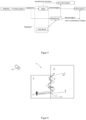
- Figure 6 , Figure 7 , Figure 8 and Figure 9 illustrate the application of the method according to the invention to the evaluation of a movement event in an in Figure 6 shown area 1.
- the area 1 includes a first sub-area 3 and a second sub-area 4.
- the area 1 is monitored via a state-of-the-art camera 6 comprising an image sensor.
- image data is generated using methods according to the prior art, from which image data a trajectory 8 of a person 5 moving between the first sub-area 3 and the second sub-area 4 can be determined.
- the trajectory 8 describes a movement of the person 5 between the first sub-area 3 and the second sub-area 4 with sufficient accuracy.
- the trajectory 8 crosses the border 2 between the first sub-area 3 and the second sub-area 4.
- the trajectory 8 includes at least time values and coordinate values.
- the coordinate values can be converted into area information.
- Figure 6 further comprises a first reference trajectory 9, which is verified as an ordinary event, and a second reference trajectory 10, which is verified as an alarm event.
- the reference trajectories 9, 10 are stored in a database.
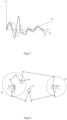
- the diagram in Figure 7 comprises a trajectory function 11, which trajectory function 11 is determined from the trajectory 8, a first reference function 12 and a second reference function 13.
- the first reference function and the second reference function 13 determined from the first reference trajectory 9 or from the second reference trajectory 10.
- Figure 7 comprises a diagram in which diagram the trajectory function 11, the first reference function 12 and the second reference function 13 are shown describing the movement of the person 5 or the reference person in the x direction as a function of time.
- the graph included shows at what point in time the person 5 is in which sub-area 3, 4. In particular, the graph shows how far the person 5 moves away from the boundary 2 when moving.
- a solution approach of the method according to the invention is based on the comparison of the diagram in the Figure 7 illustrated trajectory function 11 with the reference functions 12, 13. Methods according to the prior art can be used here to determine a similarity measure between the trajectory function 11 and the reference functions 12, 13.
- a further solution approach of the method according to the invention is based on the fact that the functions 11, 12, 13 shown in FIG. 7 can each be described with sufficient accuracy by a trajectory parameter 20, 21 or by a reference parameter 22, 23.
- the trajectory parameters 20, 21 and the reference parameters 22, 23 each include a range specification and a time specification or a reference range specification and a reference time specification.
- the trajectory parameters 20, 21 and the reference parameters 22, 23 can be determined using the common theory of curve discussion.
- Figure 8 illustrates such an evaluation of a movement event that can be adequately described by the trajectory 8 using trajectory parameters 20, 21 and reference parameters 22, 23.
- the evaluation is illustrated using a diagram, whereby it is clear to the person skilled in the art that the application of the method according to the invention is in no way necessarily via a diagram, but only the similarity of the time information and area information or coordinate information to be compared needs to be considered.
- the times are plotted on the abscissa.
- the area information is plotted on the ordinate in the form of x coordinate information.
- a first reference parameter 22 of first reference trajectories 9 is entered in the left area of the diagram and a second reference parameter 23 of second reference trajectories 10 is entered in a right area of the diagram.
- the reference parameters 22, 23 are determined from reference trajectories 9, 10.
- the trajectory parameter 20 of the movement event has a smaller distance and therefore a higher degree of similarity to the first reference parameter 22 than to the second reference parameter 23 and is therefore to be assessed as a normal movement event.
- the trajectory parameter 21 of another movement event which in Figure 6 is not entered, has a smaller distance and therefore a higher degree of similarity to the first reference parameter 22 than to the second reference parameter 23.
- the trajectory parameter 22 of the further movement event lies outside the limit values 24, 25 symbolized by lines, which is why the further movement event 22 is to be assessed as a non-assignable movement event.
- Figure 9 illustrates the application of the method according to the invention using the example of in Figure 9 shown area 1.
- the area 1 is divided into a first sub-area 3 and a second sub-area 4 by a fence 19 forming a border 2.
- the method according to the invention is to be used in order to detect a movement of a person 5 from the first sub-area 3 into the second sub-area 4, represented by a trajectory 8.
- the area 1 is monitored by a camera 6, which camera 6 includes an image sensor for recording image data.
- the trajectory 8 of the person 5 can be determined from the image data, which include a movement of a person 5. It is the task of the method according to the invention to evaluate the movement event of the person 5 described by the trajectory 8.
- Such analyzes according to the prior art are limited to the query of whether a simple rule is fulfilled, such as the trajectory crossing boundary 2, and often leads to false alarms.
- a simple rule such as the trajectory crossing boundary 2
- Such an assessment also includes recognizing an actual alarm event from a variety of common events.
- Figure 9 comprises a first reference trajectory 9, which is from an in Figure 9 bird not shown is disputed.
- the detection of the bird's trajectory 9 crossing the fence 2 using simple rules would trigger a false alarm .
- the first reference trajectory 9 describes - as can be seen by the layperson - a normal movement event. No alarm may be triggered for this movement event.
- Figure 9 includes a second reference trajectory 10 of a person 5 climbing over the fence 19.
- the second reference trajectory 10 represents an exceptional reference event, which is verified as an alarm event.
- FIG. 10 comprises a diagram with a trajectory function 11, which shows the dependence of the movement in the z direction of the in Figure 9 entered trajectory 8 as a function over time, and a first reference function 12 and a second reference function 13.
- the first reference function 12 and the second reference function 13 show, in analogy to the selected representation of the trajectory function 11, the movement of the in Figure 9 registered reference trajectories 9,10 as a function over time.
- the method according to the invention is more effective than a comparison of the trajectory with reference trajectories proposed according to the prior art.
- the example shown illustrates the comparison of a trajectory 8 with two reference trajectories 9, 10. The effectiveness mentioned comes into play in particular when a trajectory is compared with a large number of reference trajectories verified as a normal event or as an alarm event.
- the application of the second solution approach of the method according to the invention is based on the curve discussion of the trajectory function 11 and the reference functions 12, 13.
- This The solution approach is based on the basic idea that the trajectory function 11 and the reference functions 12, 13 can be described by parameters 21, 22, 23 with sufficient accuracy and allowing an effective evaluation.
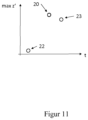
- the maximum slope of functions 11, 12, 13 can be considered within the framework of an application of the common doctrine of curve discussion. It is in the diagram of Figure 11 The maximum slope max z ⁇ is plotted on the ordinate and the time value is plotted on the abscissa.
- the one in the diagram Figure 11 Entered trajectory parameter 20 indicates at what point in time the maximum gradient z ⁇ of the in Figure 10 registered trajectory function 11 can be determined.
- the reference parameters 22, 23 indicate this in an analogous manner for the first reference function 12 and for the second reference function 13, respectively.
- the second approach allows an evaluation of the movement event described by the trajectory 8 in an increased effective manner compared to the first approach.
- the in Figure 11 In the comparison shown, only individual parameters are compared.
Landscapes
- Engineering & Computer Science (AREA)
- General Physics & Mathematics (AREA)
- Physics & Mathematics (AREA)
- Theoretical Computer Science (AREA)
- Computer Vision & Pattern Recognition (AREA)
- Multimedia (AREA)
- Computer Security & Cryptography (AREA)
- Health & Medical Sciences (AREA)
- General Health & Medical Sciences (AREA)
- Psychiatry (AREA)
- Social Psychology (AREA)
- Human Computer Interaction (AREA)
- Image Analysis (AREA)
Claims (11)
- Méthode d'évaluation d'un événement de mouvement dans une zone,ledit événement de mouvement étant détecté au moyen d'un capteur d'image qui sort des données d'image,caractérisée en ce qu'une trajectoire d'un objet décrivant un mouvement et une propriété de l'objet en mouvement dans la zone est déterminée à partir des données d'image,ladite trajectoire comprenant des valeurs de coordonnées ainsi que la taille et la couleur de l'objet en tant que valeurs de propriété et valeurs de temps,ladite trajectoire étant comparée à une première trajectoire de référence vérifiée comme un événement ordinaire et à une deuxième trajectoire de référence vérifiée comme un événement d'alarme pour déterminer une mesure de similitude, lesdites trajectoires de référence étant stockées dans une base de données,lesdites trajectoires de référence comprenant des valeurs de coordonnées de référence et des valeurs de temps de référence ainsi que la taille et la couleur d'un objet de référence en tant que propriétés de référence et valeurs de temps de référence,une fonction de trajectoire décrivant l'évolution dans le temps d'au moins une valeur de coordonnée ainsi que la taille et la couleur de l'objet en tant que valeur de propriété de la trajectoireet une fonction de référence décrivant l'évolution dans le temps d'au moins une valeur de coordonnée de référence ainsi que la taille et la couleur de l'objet de référence comme valeurs de propriété de référence des trajectoires de référence
et/ouau moins un paramètre de trajectoire de la trajectoire déterminé à partir de la fonction de trajectoire ou de la trajectoire par application de la discussion des courbes,ledit paramètre de trajectoire comprenant une indication de temps relative et une indication de zone,et un paramètre de référence des trajectoires de référence, qui peut être déterminé à partir de la fonction de référence respective ou de la trajectoire de référence respective par application de la discussion des courbes,ledit paramètre de référence comprenant une indication de temps de référence relative et une indication de zone de référence,sont comparés pour déterminer la mesure de similitude. - Méthode selon la revendication 1, caractérisée en ce que les trajectoires de référence stockées dans la base de données sont décrites par au moins un hypergraphe.
- Méthode selon l'une des revendications 1 à 2, caractérisée en ce qu'une valeur de similitude entre la trajectoire et la trajectoire de référence est calculée, la trajectoire étant évaluée comme un événement non attribuable si une valeur limite de la mesure de similitude n'est pas atteinte.
- Méthode selon l'une des revendications 1 à 3, caractérisée en ce que la comparaison est effectuée en déterminant la mesure de similitude en utilisant des procédures d'apprentissage qui sont partiellement ou totalement définies par un utilisateur et qui servent à calculer un classificateur.
- Méthode selon l'une des revendications 1 à 4, caractérisée en ce que la base de données comprend des informations géométriques sur les mouvements libres possibles d'un objet, les mouvements bloqués d'un objet et/ou les mouvements limités d'un objet dans la zone, la trajectoire étant comparée aux données géométriques.
- Méthode selon l'une des revendications 1 à 5, caractérisée en ce que les événements de mouvement d'autres objets ne sont pas évalués dans la méthode selon l'invention.
- Méthode selon l'une des revendications 1 à 6, caractérisée en ce que les données d'image déterminées au moyen du capteur d'image comprenant la trajectoire et/ou d'autres données d'image comprenant une autre trajectoire sont stockées dans la base de données, lesdites autres données d'image étant déterminées par un autre capteur d'image.
- Méthode selon la revendication 7, caractérisée en ce que les données d'image et/ou les autres données d'image sont stockées dans la base de données en tant qu'événement vérifié comme événement d'alarme ou en tant qu'événement vérifié comme événement ordinaire.
- Méthode selon la revendication 8, caractérisée en ce que la vérification de l'événement est effectuée par un utilisateur.
- Méthode selon l'une des revendications 1 à 9, caractérisée en ce que la classification de la trajectoire s'effectue en fonction d'autres données de capteurs.
- Méthode selon l'une des revendications 1 à 10, caractérisée en ce qu'une trajectoire d'un objet décrivant un mouvement et/ou une propriété de l'objet déplacé d'une première zone partielle dans une deuxième zone partielle peut/peuvent être déterminée/s à partir des données d'image, la zone pouvant être subdivisée par une première zone partielle et par une deuxième zone partielle.
Priority Applications (1)
| Application Number | Priority Date | Filing Date | Title |
|---|---|---|---|
| EP18168348.3A EP3557549B1 (fr) | 2018-04-19 | 2018-04-19 | Procédé d'évaluation d'un événement |
Applications Claiming Priority (1)
| Application Number | Priority Date | Filing Date | Title |
|---|---|---|---|
| EP18168348.3A EP3557549B1 (fr) | 2018-04-19 | 2018-04-19 | Procédé d'évaluation d'un événement |
Publications (2)
| Publication Number | Publication Date |
|---|---|
| EP3557549A1 EP3557549A1 (fr) | 2019-10-23 |
| EP3557549B1 true EP3557549B1 (fr) | 2024-02-21 |
Family
ID=62027917
Family Applications (1)
| Application Number | Title | Priority Date | Filing Date |
|---|---|---|---|
| EP18168348.3A Active EP3557549B1 (fr) | 2018-04-19 | 2018-04-19 | Procédé d'évaluation d'un événement |
Country Status (1)
| Country | Link |
|---|---|
| EP (1) | EP3557549B1 (fr) |
Families Citing this family (4)
| Publication number | Priority date | Publication date | Assignee | Title |
|---|---|---|---|---|
| CN109753868B (zh) * | 2018-11-14 | 2023-09-29 | 深圳卡路里体育技术有限公司 | 运动动作的评估方法及装置、智能手环 |
| CN111798971A (zh) * | 2020-07-15 | 2020-10-20 | 智博云信息科技(广州)有限公司 | 一种医疗信息数据处理方法、系统、电子设备及介质 |
| DE102021100395A1 (de) | 2021-01-12 | 2022-07-14 | Dspace Gmbh | Computerimplementiertes Verfahren zur Bestimmung von Ähnlichkeitswerten von Verkehrsszenarien |
| NL2029156B1 (nl) * | 2021-09-09 | 2023-03-23 | Helin Ip B V | Werkwijze en inrichting voor het reduceren van vals gedetecteerde alarmen op een boorplatform |
Family Cites Families (33)
| Publication number | Priority date | Publication date | Assignee | Title |
|---|---|---|---|---|
| US5764283A (en) | 1995-12-29 | 1998-06-09 | Lucent Technologies Inc. | Method and apparatus for tracking moving objects in real time using contours of the objects and feature paths |
| US5966074A (en) | 1996-12-17 | 1999-10-12 | Baxter; Keith M. | Intruder alarm with trajectory display |
| CA2327847C (fr) | 2000-12-07 | 2010-02-23 | Phasys Limited | Systeme de transmission et de verification de signaux d'alarmes |
| US6441734B1 (en) | 2000-12-12 | 2002-08-27 | Koninklijke Philips Electronics N.V. | Intruder detection through trajectory analysis in monitoring and surveillance systems |
| GB0102355D0 (en) | 2001-01-30 | 2001-03-14 | Mygard Plc | Security system |
| US20030053659A1 (en) | 2001-06-29 | 2003-03-20 | Honeywell International Inc. | Moving object assessment system and method |
| US20030058111A1 (en) | 2001-09-27 | 2003-03-27 | Koninklijke Philips Electronics N.V. | Computer vision based elderly care monitoring system |
| WO2004017273A1 (fr) | 2002-08-15 | 2004-02-26 | Roke Manor Research Limited | Detecteur d'anomalies dans des mouvements video |
| FR2872326B1 (fr) | 2004-06-25 | 2009-07-10 | Jean Baptiste Ducatez | Procede de detection d'evenements par videosurveillance |
| US20060176167A1 (en) | 2005-01-25 | 2006-08-10 | Laser Shield Systems, Inc. | Apparatus, system, and method for alarm systems |
| US7504942B2 (en) | 2006-02-06 | 2009-03-17 | Videoiq, Inc. | Local verification systems and methods for security monitoring |
| DE102006000494A1 (de) | 2006-09-28 | 2008-04-03 | Vis-à-pix GmbH | System und Verfahren zum bildbasierten Erkennen und/oder zum Signalisieren von definierten Ereignissen |
| DE102006053286A1 (de) | 2006-11-13 | 2008-05-15 | Robert Bosch Gmbh | Verfahren zur Detektion von bewegungsauffälligen Bildbereichen, Vorrichtung sowie Computerprogramm zur Durchführung des Verfahrens |
| US7667596B2 (en) | 2007-02-16 | 2010-02-23 | Panasonic Corporation | Method and system for scoring surveillance system footage |
| DE102007052763A1 (de) | 2007-11-06 | 2008-06-12 | Daimler Ag | Verfahren zur Vorhersage einer Aktion eines bewegten Objekts |
| US8614744B2 (en) | 2008-07-21 | 2013-12-24 | International Business Machines Corporation | Area monitoring using prototypical tracks |
| DE102008061910A1 (de) | 2008-12-15 | 2009-09-03 | Daimler Ag | Verfahren zur Erfassung und Vorhersage von Aktionen eines oder meherer bewegter Objekte |
| US8253564B2 (en) | 2009-02-19 | 2012-08-28 | Panasonic Corporation | Predicting a future location of a moving object observed by a surveillance device |
| US8340352B2 (en) | 2009-08-18 | 2012-12-25 | Behavioral Recognition Systems, Inc. | Inter-trajectory anomaly detection using adaptive voting experts in a video surveillance system |
| US8379085B2 (en) | 2009-08-18 | 2013-02-19 | Behavioral Recognition Systems, Inc. | Intra-trajectory anomaly detection using adaptive voting experts in a video surveillance system |
| US20110205359A1 (en) | 2010-02-19 | 2011-08-25 | Panasonic Corporation | Video surveillance system |
| US20110254680A1 (en) | 2010-04-16 | 2011-10-20 | Infrasafe, Inc. | Security monitoring system |
| MY161490A (en) * | 2010-12-01 | 2017-04-14 | Mimos Berhad | A system and method to detect human loitering activity using trajectory information |
| US8855361B2 (en) | 2010-12-30 | 2014-10-07 | Pelco, Inc. | Scene activity analysis using statistical and semantic features learnt from object trajectory data |
| KR101233412B1 (ko) | 2010-12-31 | 2013-02-15 | 주식회사 호서텔넷 | 모션영상 비교를 통한 위급상황 신호 송출방법 및 송출시스템 |
| US8660368B2 (en) | 2011-03-16 | 2014-02-25 | International Business Machines Corporation | Anomalous pattern discovery |
| US9158976B2 (en) | 2011-05-18 | 2015-10-13 | International Business Machines Corporation | Efficient retrieval of anomalous events with priority learning |
| WO2013138700A1 (fr) | 2012-03-15 | 2013-09-19 | Behavioral Recognition Systems, Inc. | Normalisation d'un volume d'alerte dans un système de surveillance vidéo |
| US9613277B2 (en) | 2013-08-26 | 2017-04-04 | International Business Machines Corporation | Role-based tracking and surveillance |
| PL406971A1 (pl) | 2014-01-28 | 2015-08-03 | Politechnika Poznańska | Sposób analizy zachowania osób w inteligentnym systemie monitorowania oraz inteligentny system monitorowania |
| US20160196728A1 (en) | 2015-01-06 | 2016-07-07 | Wipro Limited | Method and system for detecting a security breach in an organization |
| EP3141926B1 (fr) * | 2015-09-10 | 2018-04-04 | Continental Automotive GmbH | Détection automatisée de dérive dangereux de véhicules automobiles par des capteurs de véhicules |
| US10423892B2 (en) | 2016-04-05 | 2019-09-24 | Omni Ai, Inc. | Trajectory cluster model for learning trajectory patterns in video data |
-
2018
- 2018-04-19 EP EP18168348.3A patent/EP3557549B1/fr active Active
Non-Patent Citations (1)
| Title |
|---|
| STAUFFER C ET AL: "LEARNING PATTERNS OF ACTIVITY USING REAL-TIME TRACKING", IEEE TRANSACTIONS ON PATTERN ANALYSIS AND MACHINE INTELLIGENCE, IEEE COMPUTER SOCIETY, USA, vol. 22, no. 8, 1 August 2000 (2000-08-01), pages 747 - 757, XP000976482, ISSN: 0162-8828, DOI: 10.1109/34.868677 * |
Also Published As
| Publication number | Publication date |
|---|---|
| EP3557549A1 (fr) | 2019-10-23 |
Similar Documents
| Publication | Publication Date | Title |
|---|---|---|
| EP3466239B1 (fr) | Procédé de fonctionnement d'un engin agricole automatique | |
| DE69322306T2 (de) | Gegenstandserkennungssystem mittels Bildverarbeitung | |
| EP3044760B1 (fr) | Procédé d'analyse de la distribution d'objets dans des files d'attente libres | |
| EP3156820B1 (fr) | Procede de detection d'un objet dynamique dans l'environnement d'un vehicule automobile en fonction d'informations provenant d'un dispositif de detection par ultrasons cote vehicule, systeme d'assistance au conducteur et vehicule automobile | |
| WO2019063416A1 (fr) | Procédé et équipement destinés à commander un système d'assistance à la conduite et système d'assistance à la conduite et véhicule automobile | |
| EP2174260A2 (fr) | Dispositif pour identifier et/ou classifier des modèles de mouvements dans une séquence d'images d'une scène de surveillance, procédé et programme informatique | |
| DE102008013366A1 (de) | Verfahren zur Bereitstellung von Information für Fahrerassistenzsysteme | |
| EP3557549A1 (fr) | Procédé d'évaluation d'un événement de mouvement | |
| EP3646184A1 (fr) | Procédé, dispositif et support d'enregistrement pouvant être lu par un ordinateur pourvu d'instructions pour la résolution d'une redondance de deux modules redondants ou plus | |
| EP4248418A2 (fr) | Procédé et système pour annoter des données de capteur | |
| EP3391349B1 (fr) | Procédé et dispositif de classement de données d'yeux ouverts d'au moins un oeil d'un passager d'un véhicule ainsi que procédé et dispositif de détection d'une envie de dormir et/ou d'un microsommeil d'un passager d'un véhicule | |
| DE102019209463A1 (de) | Verfahren zur Bestimmung eines Vertrauenswertes eines Objektes einer Klasse | |
| DE102023123012B3 (de) | Verfahren und Vorrichtung zur schnellen Kollisionserkennung bei hochautomatisiertem Testen von Fahrvorgängen | |
| EP4007990A1 (fr) | Procédé pour analyser des informations d'image avec des valeurs scalaires associées | |
| EP2483834B1 (fr) | Methode et appareil pour la reconnaissance d'une detection fausse d'un objet dans un image | |
| DE102019212357B4 (de) | Verfahren zur Vermeidung einer bevorstehenden Kollision eines Fahrzeugs sowie Unfallvermeidungs-System | |
| DE102017211555A1 (de) | Verfahren zur Überwachung mindestens eines Insassen eines Kraftfahrzeugs, wobei das Verfahren insbesondere zur Überwachung und Erkennung möglicher Gefahrensituationen für mindestens einen Insassen dient | |
| AT524965B1 (de) | Computerimplementiertes Verfahren zur Erstellung einer Aufmerksamkeitszone | |
| WO2024184262A1 (fr) | Procédé de détection d'un être vivant, unité d'évaluation et véhicule | |
| WO2022157039A1 (fr) | Détection du degré d'attention d'un occupant d'un véhicule sur la base de la distribution de fréquences de la largeur d'ouverture oculaire | |
| EP3969341B1 (fr) | Méthode pour indiquer et/ou calculer le mouvement relatif | |
| DE102020208068A1 (de) | Verfahren zur Erkennung eines in einem Überwachungsbereich erscheinenden Objekts, Computerprogramm, Speichermedium und Steuereinrichtung | |
| EP3503060B1 (fr) | Procédé de commande d'une unité d'affichage d'alarme | |
| EP3398828B1 (fr) | Système d'aide à la conduite et procédé permettant d'assister un conducteur d'un véhicule ferroviaire | |
| DE112007000537T5 (de) | System zur Durchführung der Strukturdatenanalyse |
Legal Events
| Date | Code | Title | Description |
|---|---|---|---|
| PUAI | Public reference made under article 153(3) epc to a published international application that has entered the european phase |
Free format text: ORIGINAL CODE: 0009012 |
|
| STAA | Information on the status of an ep patent application or granted ep patent |
Free format text: STATUS: THE APPLICATION HAS BEEN PUBLISHED |
|
| AK | Designated contracting states |
Kind code of ref document: A1 Designated state(s): AL AT BE BG CH CY CZ DE DK EE ES FI FR GB GR HR HU IE IS IT LI LT LU LV MC MK MT NL NO PL PT RO RS SE SI SK SM TR |
|
| AX | Request for extension of the european patent |
Extension state: BA ME |
|
| STAA | Information on the status of an ep patent application or granted ep patent |
Free format text: STATUS: REQUEST FOR EXAMINATION WAS MADE |
|
| 17P | Request for examination filed |
Effective date: 20200211 |
|
| RBV | Designated contracting states (corrected) |
Designated state(s): AL AT BE BG CH CY CZ DE DK EE ES FI FR GB GR HR HU IE IS IT LI LT LU LV MC MK MT NL NO PL PT RO RS SE SI SK SM TR |
|
| STAA | Information on the status of an ep patent application or granted ep patent |
Free format text: STATUS: EXAMINATION IS IN PROGRESS |
|
| 17Q | First examination report despatched |
Effective date: 20211011 |
|
| GRAP | Despatch of communication of intention to grant a patent |
Free format text: ORIGINAL CODE: EPIDOSNIGR1 |
|
| STAA | Information on the status of an ep patent application or granted ep patent |
Free format text: STATUS: GRANT OF PATENT IS INTENDED |
|
| RIC1 | Information provided on ipc code assigned before grant |
Ipc: G06T 7/20 20170101ALI20231026BHEP Ipc: G06V 40/20 20220101ALI20231026BHEP Ipc: G06V 20/52 20220101ALI20231026BHEP Ipc: G08B 29/18 20060101ALI20231026BHEP Ipc: G08B 13/196 20060101AFI20231026BHEP |
|
| INTG | Intention to grant announced |
Effective date: 20231115 |
|
| GRAS | Grant fee paid |
Free format text: ORIGINAL CODE: EPIDOSNIGR3 |
|
| GRAA | (expected) grant |
Free format text: ORIGINAL CODE: 0009210 |
|
| STAA | Information on the status of an ep patent application or granted ep patent |
Free format text: STATUS: THE PATENT HAS BEEN GRANTED |
|
| AK | Designated contracting states |
Kind code of ref document: B1 Designated state(s): AL AT BE BG CH CY CZ DE DK EE ES FI FR GB GR HR HU IE IS IT LI LT LU LV MC MK MT NL NO PL PT RO RS SE SI SK SM TR |
|
| REG | Reference to a national code |
Ref country code: GB Ref legal event code: FG4D Free format text: NOT ENGLISH |
|
| REG | Reference to a national code |
Ref country code: CH Ref legal event code: EP |
|
| REG | Reference to a national code |
Ref country code: IE Ref legal event code: FG4D Free format text: LANGUAGE OF EP DOCUMENT: GERMAN |
|
| REG | Reference to a national code |
Ref country code: DE Ref legal event code: R096 Ref document number: 502018014125 Country of ref document: DE |
|
| REG | Reference to a national code |
Ref country code: LT Ref legal event code: MG9D |
|
| REG | Reference to a national code |
Ref country code: NL Ref legal event code: MP Effective date: 20240221 |
|
| PG25 | Lapsed in a contracting state [announced via postgrant information from national office to epo] |
Ref country code: IS Free format text: LAPSE BECAUSE OF FAILURE TO SUBMIT A TRANSLATION OF THE DESCRIPTION OR TO PAY THE FEE WITHIN THE PRESCRIBED TIME-LIMIT Effective date: 20240621 |
|
| PG25 | Lapsed in a contracting state [announced via postgrant information from national office to epo] |
Ref country code: LT Free format text: LAPSE BECAUSE OF FAILURE TO SUBMIT A TRANSLATION OF THE DESCRIPTION OR TO PAY THE FEE WITHIN THE PRESCRIBED TIME-LIMIT Effective date: 20240221 |
|
| PG25 | Lapsed in a contracting state [announced via postgrant information from national office to epo] |
Ref country code: GR Free format text: LAPSE BECAUSE OF FAILURE TO SUBMIT A TRANSLATION OF THE DESCRIPTION OR TO PAY THE FEE WITHIN THE PRESCRIBED TIME-LIMIT Effective date: 20240522 |
|
| PG25 | Lapsed in a contracting state [announced via postgrant information from national office to epo] |
Ref country code: HR Free format text: LAPSE BECAUSE OF FAILURE TO SUBMIT A TRANSLATION OF THE DESCRIPTION OR TO PAY THE FEE WITHIN THE PRESCRIBED TIME-LIMIT Effective date: 20240221 Ref country code: RS Free format text: LAPSE BECAUSE OF FAILURE TO SUBMIT A TRANSLATION OF THE DESCRIPTION OR TO PAY THE FEE WITHIN THE PRESCRIBED TIME-LIMIT Effective date: 20240521 Ref country code: NL Free format text: LAPSE BECAUSE OF FAILURE TO SUBMIT A TRANSLATION OF THE DESCRIPTION OR TO PAY THE FEE WITHIN THE PRESCRIBED TIME-LIMIT Effective date: 20240221 |
|
| PG25 | Lapsed in a contracting state [announced via postgrant information from national office to epo] |
Ref country code: ES Free format text: LAPSE BECAUSE OF FAILURE TO SUBMIT A TRANSLATION OF THE DESCRIPTION OR TO PAY THE FEE WITHIN THE PRESCRIBED TIME-LIMIT Effective date: 20240221 |
|
| PG25 | Lapsed in a contracting state [announced via postgrant information from national office to epo] |
Ref country code: RS Free format text: LAPSE BECAUSE OF FAILURE TO SUBMIT A TRANSLATION OF THE DESCRIPTION OR TO PAY THE FEE WITHIN THE PRESCRIBED TIME-LIMIT Effective date: 20240521 Ref country code: NO Free format text: LAPSE BECAUSE OF FAILURE TO SUBMIT A TRANSLATION OF THE DESCRIPTION OR TO PAY THE FEE WITHIN THE PRESCRIBED TIME-LIMIT Effective date: 20240521 Ref country code: NL Free format text: LAPSE BECAUSE OF FAILURE TO SUBMIT A TRANSLATION OF THE DESCRIPTION OR TO PAY THE FEE WITHIN THE PRESCRIBED TIME-LIMIT Effective date: 20240221 Ref country code: LT Free format text: LAPSE BECAUSE OF FAILURE TO SUBMIT A TRANSLATION OF THE DESCRIPTION OR TO PAY THE FEE WITHIN THE PRESCRIBED TIME-LIMIT Effective date: 20240221 Ref country code: IS Free format text: LAPSE BECAUSE OF FAILURE TO SUBMIT A TRANSLATION OF THE DESCRIPTION OR TO PAY THE FEE WITHIN THE PRESCRIBED TIME-LIMIT Effective date: 20240621 Ref country code: HR Free format text: LAPSE BECAUSE OF FAILURE TO SUBMIT A TRANSLATION OF THE DESCRIPTION OR TO PAY THE FEE WITHIN THE PRESCRIBED TIME-LIMIT Effective date: 20240221 Ref country code: GR Free format text: LAPSE BECAUSE OF FAILURE TO SUBMIT A TRANSLATION OF THE DESCRIPTION OR TO PAY THE FEE WITHIN THE PRESCRIBED TIME-LIMIT Effective date: 20240522 Ref country code: FI Free format text: LAPSE BECAUSE OF FAILURE TO SUBMIT A TRANSLATION OF THE DESCRIPTION OR TO PAY THE FEE WITHIN THE PRESCRIBED TIME-LIMIT Effective date: 20240221 Ref country code: ES Free format text: LAPSE BECAUSE OF FAILURE TO SUBMIT A TRANSLATION OF THE DESCRIPTION OR TO PAY THE FEE WITHIN THE PRESCRIBED TIME-LIMIT Effective date: 20240221 Ref country code: BG Free format text: LAPSE BECAUSE OF FAILURE TO SUBMIT A TRANSLATION OF THE DESCRIPTION OR TO PAY THE FEE WITHIN THE PRESCRIBED TIME-LIMIT Effective date: 20240221 |
|
| PG25 | Lapsed in a contracting state [announced via postgrant information from national office to epo] |
Ref country code: PL Free format text: LAPSE BECAUSE OF FAILURE TO SUBMIT A TRANSLATION OF THE DESCRIPTION OR TO PAY THE FEE WITHIN THE PRESCRIBED TIME-LIMIT Effective date: 20240221 Ref country code: PT Free format text: LAPSE BECAUSE OF FAILURE TO SUBMIT A TRANSLATION OF THE DESCRIPTION OR TO PAY THE FEE WITHIN THE PRESCRIBED TIME-LIMIT Effective date: 20240621 |
|
| PG25 | Lapsed in a contracting state [announced via postgrant information from national office to epo] |
Ref country code: SE Free format text: LAPSE BECAUSE OF FAILURE TO SUBMIT A TRANSLATION OF THE DESCRIPTION OR TO PAY THE FEE WITHIN THE PRESCRIBED TIME-LIMIT Effective date: 20240221 Ref country code: PT Free format text: LAPSE BECAUSE OF FAILURE TO SUBMIT A TRANSLATION OF THE DESCRIPTION OR TO PAY THE FEE WITHIN THE PRESCRIBED TIME-LIMIT Effective date: 20240621 Ref country code: PL Free format text: LAPSE BECAUSE OF FAILURE TO SUBMIT A TRANSLATION OF THE DESCRIPTION OR TO PAY THE FEE WITHIN THE PRESCRIBED TIME-LIMIT Effective date: 20240221 Ref country code: LV Free format text: LAPSE BECAUSE OF FAILURE TO SUBMIT A TRANSLATION OF THE DESCRIPTION OR TO PAY THE FEE WITHIN THE PRESCRIBED TIME-LIMIT Effective date: 20240221 |
|
| PG25 | Lapsed in a contracting state [announced via postgrant information from national office to epo] |
Ref country code: DK Free format text: LAPSE BECAUSE OF FAILURE TO SUBMIT A TRANSLATION OF THE DESCRIPTION OR TO PAY THE FEE WITHIN THE PRESCRIBED TIME-LIMIT Effective date: 20240221 |
|
| PG25 | Lapsed in a contracting state [announced via postgrant information from national office to epo] |
Ref country code: SM Free format text: LAPSE BECAUSE OF FAILURE TO SUBMIT A TRANSLATION OF THE DESCRIPTION OR TO PAY THE FEE WITHIN THE PRESCRIBED TIME-LIMIT Effective date: 20240221 |
|
| PG25 | Lapsed in a contracting state [announced via postgrant information from national office to epo] |
Ref country code: EE Free format text: LAPSE BECAUSE OF FAILURE TO SUBMIT A TRANSLATION OF THE DESCRIPTION OR TO PAY THE FEE WITHIN THE PRESCRIBED TIME-LIMIT Effective date: 20240221 Ref country code: CZ Free format text: LAPSE BECAUSE OF FAILURE TO SUBMIT A TRANSLATION OF THE DESCRIPTION OR TO PAY THE FEE WITHIN THE PRESCRIBED TIME-LIMIT Effective date: 20240221 |
|
| PG25 | Lapsed in a contracting state [announced via postgrant information from national office to epo] |
Ref country code: SK Free format text: LAPSE BECAUSE OF FAILURE TO SUBMIT A TRANSLATION OF THE DESCRIPTION OR TO PAY THE FEE WITHIN THE PRESCRIBED TIME-LIMIT Effective date: 20240221 |
|
| PG25 | Lapsed in a contracting state [announced via postgrant information from national office to epo] |
Ref country code: SM Free format text: LAPSE BECAUSE OF FAILURE TO SUBMIT A TRANSLATION OF THE DESCRIPTION OR TO PAY THE FEE WITHIN THE PRESCRIBED TIME-LIMIT Effective date: 20240221 Ref country code: SK Free format text: LAPSE BECAUSE OF FAILURE TO SUBMIT A TRANSLATION OF THE DESCRIPTION OR TO PAY THE FEE WITHIN THE PRESCRIBED TIME-LIMIT Effective date: 20240221 Ref country code: RO Free format text: LAPSE BECAUSE OF FAILURE TO SUBMIT A TRANSLATION OF THE DESCRIPTION OR TO PAY THE FEE WITHIN THE PRESCRIBED TIME-LIMIT Effective date: 20240221 Ref country code: EE Free format text: LAPSE BECAUSE OF FAILURE TO SUBMIT A TRANSLATION OF THE DESCRIPTION OR TO PAY THE FEE WITHIN THE PRESCRIBED TIME-LIMIT Effective date: 20240221 Ref country code: DK Free format text: LAPSE BECAUSE OF FAILURE TO SUBMIT A TRANSLATION OF THE DESCRIPTION OR TO PAY THE FEE WITHIN THE PRESCRIBED TIME-LIMIT Effective date: 20240221 Ref country code: CZ Free format text: LAPSE BECAUSE OF FAILURE TO SUBMIT A TRANSLATION OF THE DESCRIPTION OR TO PAY THE FEE WITHIN THE PRESCRIBED TIME-LIMIT Effective date: 20240221 |
|
| PG25 | Lapsed in a contracting state [announced via postgrant information from national office to epo] |
Ref country code: MC Free format text: LAPSE BECAUSE OF FAILURE TO SUBMIT A TRANSLATION OF THE DESCRIPTION OR TO PAY THE FEE WITHIN THE PRESCRIBED TIME-LIMIT Effective date: 20240221 |
|
| REG | Reference to a national code |
Ref country code: DE Ref legal event code: R097 Ref document number: 502018014125 Country of ref document: DE |
|
| PG25 | Lapsed in a contracting state [announced via postgrant information from national office to epo] |
Ref country code: MC Free format text: LAPSE BECAUSE OF FAILURE TO SUBMIT A TRANSLATION OF THE DESCRIPTION OR TO PAY THE FEE WITHIN THE PRESCRIBED TIME-LIMIT Effective date: 20240221 |
|
| REG | Reference to a national code |
Ref country code: CH Ref legal event code: PL |
|
| PG25 | Lapsed in a contracting state [announced via postgrant information from national office to epo] |
Ref country code: IT Free format text: LAPSE BECAUSE OF FAILURE TO SUBMIT A TRANSLATION OF THE DESCRIPTION OR TO PAY THE FEE WITHIN THE PRESCRIBED TIME-LIMIT Effective date: 20240221 |
|
| PG25 | Lapsed in a contracting state [announced via postgrant information from national office to epo] |
Ref country code: LU Free format text: LAPSE BECAUSE OF NON-PAYMENT OF DUE FEES Effective date: 20240419 |
|
| PLBE | No opposition filed within time limit |
Free format text: ORIGINAL CODE: 0009261 |
|
| STAA | Information on the status of an ep patent application or granted ep patent |
Free format text: STATUS: NO OPPOSITION FILED WITHIN TIME LIMIT |
|
| REG | Reference to a national code |
Ref country code: BE Ref legal event code: MM Effective date: 20240430 |
|
| PG25 | Lapsed in a contracting state [announced via postgrant information from national office to epo] |
Ref country code: LU Free format text: LAPSE BECAUSE OF NON-PAYMENT OF DUE FEES Effective date: 20240419 Ref country code: IT Free format text: LAPSE BECAUSE OF FAILURE TO SUBMIT A TRANSLATION OF THE DESCRIPTION OR TO PAY THE FEE WITHIN THE PRESCRIBED TIME-LIMIT Effective date: 20240221 |
|
| PG25 | Lapsed in a contracting state [announced via postgrant information from national office to epo] |
Ref country code: BE Free format text: LAPSE BECAUSE OF NON-PAYMENT OF DUE FEES Effective date: 20240430 |
|
| PG25 | Lapsed in a contracting state [announced via postgrant information from national office to epo] |
Ref country code: FR Free format text: LAPSE BECAUSE OF NON-PAYMENT OF DUE FEES Effective date: 20240421 |
|
| 26N | No opposition filed |
Effective date: 20241122 |
|
| GBPC | Gb: european patent ceased through non-payment of renewal fee |
Effective date: 20240521 |
|
| PG25 | Lapsed in a contracting state [announced via postgrant information from national office to epo] |
Ref country code: FR Free format text: LAPSE BECAUSE OF NON-PAYMENT OF DUE FEES Effective date: 20240421 Ref country code: BE Free format text: LAPSE BECAUSE OF NON-PAYMENT OF DUE FEES Effective date: 20240430 Ref country code: CH Free format text: LAPSE BECAUSE OF NON-PAYMENT OF DUE FEES Effective date: 20240430 |
|
| PG25 | Lapsed in a contracting state [announced via postgrant information from national office to epo] |
Ref country code: IE Free format text: LAPSE BECAUSE OF NON-PAYMENT OF DUE FEES Effective date: 20240419 |
|
| PG25 | Lapsed in a contracting state [announced via postgrant information from national office to epo] |
Ref country code: SI Free format text: LAPSE BECAUSE OF FAILURE TO SUBMIT A TRANSLATION OF THE DESCRIPTION OR TO PAY THE FEE WITHIN THE PRESCRIBED TIME-LIMIT Effective date: 20240221 |
|
| PG25 | Lapsed in a contracting state [announced via postgrant information from national office to epo] |
Ref country code: GB Free format text: LAPSE BECAUSE OF NON-PAYMENT OF DUE FEES Effective date: 20240521 |
|
| PG25 | Lapsed in a contracting state [announced via postgrant information from national office to epo] |
Ref country code: CY Free format text: LAPSE BECAUSE OF FAILURE TO SUBMIT A TRANSLATION OF THE DESCRIPTION OR TO PAY THE FEE WITHIN THE PRESCRIBED TIME-LIMIT; INVALID AB INITIO Effective date: 20180419 |
|
| PG25 | Lapsed in a contracting state [announced via postgrant information from national office to epo] |
Ref country code: HU Free format text: LAPSE BECAUSE OF FAILURE TO SUBMIT A TRANSLATION OF THE DESCRIPTION OR TO PAY THE FEE WITHIN THE PRESCRIBED TIME-LIMIT; INVALID AB INITIO Effective date: 20180419 |
|
| PG25 | Lapsed in a contracting state [announced via postgrant information from national office to epo] |
Ref country code: TR Free format text: LAPSE BECAUSE OF FAILURE TO SUBMIT A TRANSLATION OF THE DESCRIPTION OR TO PAY THE FEE WITHIN THE PRESCRIBED TIME-LIMIT Effective date: 20240221 |
|
| PGFP | Annual fee paid to national office [announced via postgrant information from national office to epo] |
Ref country code: DE Payment date: 20260203 Year of fee payment: 9 |
|
| PGFP | Annual fee paid to national office [announced via postgrant information from national office to epo] |
Ref country code: AT Payment date: 20260203 Year of fee payment: 9 |