EP3557745A1 - Procédé et système de commande permettant de compenser le courant homopolaire pour réduire le courant de masse - Google Patents
Procédé et système de commande permettant de compenser le courant homopolaire pour réduire le courant de masse Download PDFInfo
- Publication number
- EP3557745A1 EP3557745A1 EP19169654.1A EP19169654A EP3557745A1 EP 3557745 A1 EP3557745 A1 EP 3557745A1 EP 19169654 A EP19169654 A EP 19169654A EP 3557745 A1 EP3557745 A1 EP 3557745A1
- Authority
- EP
- European Patent Office
- Prior art keywords
- current
- control system
- zero
- rectifier
- ground
- Prior art date
- Legal status (The legal status is an assumption and is not a legal conclusion. Google has not performed a legal analysis and makes no representation as to the accuracy of the status listed.)
- Pending
Links
Images


Classifications
-
- H—ELECTRICITY
- H02—GENERATION; CONVERSION OR DISTRIBUTION OF ELECTRIC POWER
- H02M—APPARATUS FOR CONVERSION BETWEEN AC AND AC, BETWEEN AC AND DC, OR BETWEEN DC AND DC, AND FOR USE WITH MAINS OR SIMILAR POWER SUPPLY SYSTEMS; CONVERSION OF DC OR AC INPUT POWER INTO SURGE OUTPUT POWER; CONTROL OR REGULATION THEREOF
- H02M7/00—Conversion of AC power input into DC power output; Conversion of DC power input into AC power output
- H02M7/42—Conversion of DC power input into AC power output without possibility of reversal
- H02M7/44—Conversion of DC power input into AC power output without possibility of reversal by static converters
- H02M7/48—Conversion of DC power input into AC power output without possibility of reversal by static converters using discharge tubes with control electrode or semiconductor devices with control electrode
- H02M7/483—Converters with outputs that each can have more than two voltages levels
-
- H—ELECTRICITY
- H02—GENERATION; CONVERSION OR DISTRIBUTION OF ELECTRIC POWER
- H02H—EMERGENCY PROTECTIVE CIRCUIT ARRANGEMENTS
- H02H9/00—Emergency protective circuit arrangements for limiting excess current or voltage without disconnection
- H02H9/08—Limitation or suppression of earth fault currents, e.g. Petersen coil
-
- H—ELECTRICITY
- H02—GENERATION; CONVERSION OR DISTRIBUTION OF ELECTRIC POWER
- H02J—ELECTRIC POWER NETWORKS; CIRCUIT ARRANGEMENTS OR SYSTEMS FOR SUPPLYING OR DISTRIBUTING ELECTRIC POWER; SYSTEMS FOR STORING ELECTRIC ENERGY
- H02J9/00—Circuit arrangements for emergency or stand-by power supply, e.g. for emergency lighting
- H02J9/04—Circuit arrangements for emergency or stand-by power supply, e.g. for emergency lighting in which the distribution system is disconnected from the normal source and connected to a standby source
- H02J9/06—Circuit arrangements for emergency or stand-by power supply, e.g. for emergency lighting in which the distribution system is disconnected from the normal source and connected to a standby source with automatic change-over, e.g. UPS systems
-
- H—ELECTRICITY
- H02—GENERATION; CONVERSION OR DISTRIBUTION OF ELECTRIC POWER
- H02M—APPARATUS FOR CONVERSION BETWEEN AC AND AC, BETWEEN AC AND DC, OR BETWEEN DC AND DC, AND FOR USE WITH MAINS OR SIMILAR POWER SUPPLY SYSTEMS; CONVERSION OF DC OR AC INPUT POWER INTO SURGE OUTPUT POWER; CONTROL OR REGULATION THEREOF
- H02M1/00—Details of apparatus for conversion
- H02M1/32—Means for protecting converters other than automatic disconnection
-
- H—ELECTRICITY
- H02—GENERATION; CONVERSION OR DISTRIBUTION OF ELECTRIC POWER
- H02M—APPARATUS FOR CONVERSION BETWEEN AC AND AC, BETWEEN AC AND DC, OR BETWEEN DC AND DC, AND FOR USE WITH MAINS OR SIMILAR POWER SUPPLY SYSTEMS; CONVERSION OF DC OR AC INPUT POWER INTO SURGE OUTPUT POWER; CONTROL OR REGULATION THEREOF
- H02M5/00—Conversion of AC power input into AC power output, e.g. for change of voltage, for change of frequency, for change of number of phases
- H02M5/40—Conversion of AC power input into AC power output, e.g. for change of voltage, for change of frequency, for change of number of phases with intermediate conversion into DC
- H02M5/42—Conversion of AC power input into AC power output, e.g. for change of voltage, for change of frequency, for change of number of phases with intermediate conversion into DC by static converters
- H02M5/44—Conversion of AC power input into AC power output, e.g. for change of voltage, for change of frequency, for change of number of phases with intermediate conversion into DC by static converters using discharge tubes or semiconductor devices to convert the intermediate DC into AC
- H02M5/453—Conversion of AC power input into AC power output, e.g. for change of voltage, for change of frequency, for change of number of phases with intermediate conversion into DC by static converters using discharge tubes or semiconductor devices to convert the intermediate DC into AC using devices of a triode or transistor type requiring continuous application of a control signal
- H02M5/458—Conversion of AC power input into AC power output, e.g. for change of voltage, for change of frequency, for change of number of phases with intermediate conversion into DC by static converters using discharge tubes or semiconductor devices to convert the intermediate DC into AC using devices of a triode or transistor type requiring continuous application of a control signal using semiconductor devices only
- H02M5/4585—Conversion of AC power input into AC power output, e.g. for change of voltage, for change of frequency, for change of number of phases with intermediate conversion into DC by static converters using discharge tubes or semiconductor devices to convert the intermediate DC into AC using devices of a triode or transistor type requiring continuous application of a control signal using semiconductor devices only having a rectifier with controlled elements
-
- H—ELECTRICITY
- H02—GENERATION; CONVERSION OR DISTRIBUTION OF ELECTRIC POWER
- H02M—APPARATUS FOR CONVERSION BETWEEN AC AND AC, BETWEEN AC AND DC, OR BETWEEN DC AND DC, AND FOR USE WITH MAINS OR SIMILAR POWER SUPPLY SYSTEMS; CONVERSION OF DC OR AC INPUT POWER INTO SURGE OUTPUT POWER; CONTROL OR REGULATION THEREOF
- H02M7/00—Conversion of AC power input into DC power output; Conversion of DC power input into AC power output
- H02M7/02—Conversion of AC power input into DC power output without possibility of reversal
- H02M7/04—Conversion of AC power input into DC power output without possibility of reversal by static converters
- H02M7/12—Conversion of AC power input into DC power output without possibility of reversal by static converters using discharge tubes with control electrode or semiconductor devices with control electrode
- H02M7/21—Conversion of AC power input into DC power output without possibility of reversal by static converters using discharge tubes with control electrode or semiconductor devices with control electrode using devices of a triode or transistor type requiring continuous application of a control signal
- H02M7/217—Conversion of AC power input into DC power output without possibility of reversal by static converters using discharge tubes with control electrode or semiconductor devices with control electrode using devices of a triode or transistor type requiring continuous application of a control signal using semiconductor devices only
-
- H—ELECTRICITY
- H02—GENERATION; CONVERSION OR DISTRIBUTION OF ELECTRIC POWER
- H02M—APPARATUS FOR CONVERSION BETWEEN AC AND AC, BETWEEN AC AND DC, OR BETWEEN DC AND DC, AND FOR USE WITH MAINS OR SIMILAR POWER SUPPLY SYSTEMS; CONVERSION OF DC OR AC INPUT POWER INTO SURGE OUTPUT POWER; CONTROL OR REGULATION THEREOF
- H02M7/00—Conversion of AC power input into DC power output; Conversion of DC power input into AC power output
- H02M7/42—Conversion of DC power input into AC power output without possibility of reversal
- H02M7/44—Conversion of DC power input into AC power output without possibility of reversal by static converters
- H02M7/48—Conversion of DC power input into AC power output without possibility of reversal by static converters using discharge tubes with control electrode or semiconductor devices with control electrode
-
- H—ELECTRICITY
- H02—GENERATION; CONVERSION OR DISTRIBUTION OF ELECTRIC POWER
- H02J—ELECTRIC POWER NETWORKS; CIRCUIT ARRANGEMENTS OR SYSTEMS FOR SUPPLYING OR DISTRIBUTING ELECTRIC POWER; SYSTEMS FOR STORING ELECTRIC ENERGY
- H02J9/00—Circuit arrangements for emergency or stand-by power supply, e.g. for emergency lighting
- H02J9/04—Circuit arrangements for emergency or stand-by power supply, e.g. for emergency lighting in which the distribution system is disconnected from the normal source and connected to a standby source
- H02J9/06—Circuit arrangements for emergency or stand-by power supply, e.g. for emergency lighting in which the distribution system is disconnected from the normal source and connected to a standby source with automatic change-over, e.g. UPS systems
- H02J9/062—Circuit arrangements for emergency or stand-by power supply, e.g. for emergency lighting in which the distribution system is disconnected from the normal source and connected to a standby source with automatic change-over, e.g. UPS systems for AC powered loads
- H02J9/063—Common neutral, e.g. AC input neutral line connected to AC output neutral line and DC middle point
-
- H—ELECTRICITY
- H02—GENERATION; CONVERSION OR DISTRIBUTION OF ELECTRIC POWER
- H02M—APPARATUS FOR CONVERSION BETWEEN AC AND AC, BETWEEN AC AND DC, OR BETWEEN DC AND DC, AND FOR USE WITH MAINS OR SIMILAR POWER SUPPLY SYSTEMS; CONVERSION OF DC OR AC INPUT POWER INTO SURGE OUTPUT POWER; CONTROL OR REGULATION THEREOF
- H02M1/00—Details of apparatus for conversion
- H02M1/0003—Details of control, feedback or regulation circuits
- H02M1/0025—Arrangements for modifying reference values, feedback values or error values in the control loop of a converter
-
- H—ELECTRICITY
- H02—GENERATION; CONVERSION OR DISTRIBUTION OF ELECTRIC POWER
- H02M—APPARATUS FOR CONVERSION BETWEEN AC AND AC, BETWEEN AC AND DC, OR BETWEEN DC AND DC, AND FOR USE WITH MAINS OR SIMILAR POWER SUPPLY SYSTEMS; CONVERSION OF DC OR AC INPUT POWER INTO SURGE OUTPUT POWER; CONTROL OR REGULATION THEREOF
- H02M1/00—Details of apparatus for conversion
- H02M1/12—Arrangements for reducing harmonics from AC input or output
-
- H—ELECTRICITY
- H02—GENERATION; CONVERSION OR DISTRIBUTION OF ELECTRIC POWER
- H02M—APPARATUS FOR CONVERSION BETWEEN AC AND AC, BETWEEN AC AND DC, OR BETWEEN DC AND DC, AND FOR USE WITH MAINS OR SIMILAR POWER SUPPLY SYSTEMS; CONVERSION OF DC OR AC INPUT POWER INTO SURGE OUTPUT POWER; CONTROL OR REGULATION THEREOF
- H02M1/00—Details of apparatus for conversion
- H02M1/12—Arrangements for reducing harmonics from AC input or output
- H02M1/123—Suppression of common mode voltage or current
-
- H—ELECTRICITY
- H03—ELECTRONIC CIRCUITRY
- H03H—IMPEDANCE NETWORKS, e.g. RESONANT CIRCUITS; RESONATORS
- H03H7/00—Multiple-port networks comprising only passive electrical elements as network components
- H03H7/01—Frequency selective two-port networks
- H03H7/0115—Frequency selective two-port networks comprising only inductors and capacitors
Definitions
- the field of the invention relates generally to uninterruptible power supplies, and more particularly, to methods and control systems for zero- sequence current compensation for ground current reduction in uninterruptible power supply systems.
- CMV common-mode voltage
- a common arrangement in three-level power converters involves splitting the DC-link into two halves.
- a known solution to the CMV problem involves connecting the midpoint of the DC-link to mid-points of the input and output AC filters to create a common midpoint, and then connecting it to ground. Bonding the midpoint to ground preserves system grounding and also contains fault currents in a ring architecture to the load-side of the circuit.
- a control system for a multilevel power converter includes a rectifier coupled to a DC link, the DC link including a midpoint coupled to electrical ground that divides the DC link into two halves.
- the control system includes a processor coupled to a memory device, and is configured to generate a reference current command for controlling an output of the rectifier, the reference current command generated based on a difference between a desired DC link voltage value and a measured DC link voltage value.
- the system is also configured to determine a zero-sequence current component of input current supplied to the multilevel power converter, wherein the zero-sequence current component is associated with non-linearities in said multilevel power converter that cause ground current injection into the input current by the rectifier.
- the system is further configured to subtract the determined zero-sequence current component from the reference current command to reduce the ground current injected into the input current by the rectifier.
- a method of controlling a multilevel power converter includes a rectifier coupled to a DC link, the DC link including a midpoint coupled to electrical ground that divides the DC link into two halves.
- the method implemented by a processor coupled to a memory device, and includes generating, by the processor, a reference current command for controlling an output of the rectifier, the reference current command generated based on a difference between a desired DC link voltage value and a measured DC link voltage value.
- the method also includes determining, by the processor, a zero-sequence current component of input current supplied to the multilevel power converter, wherein the zero-sequence current component is associated with non- linearities in said multilevel power converter that cause ground current injection into the input current by the rectifier.
- the method further includes subtracting, by the processor, the determined zero-sequence current component from the reference current command to reduce the ground current injected into the input current by the rectifier.
- FIG. 1 is a schematic diagram of an exemplary power converter 100 that includes a utility 102, an uninterruptible power supply (UPS) 104, and at least one load 106.
- UPS 104 facilitates delivering power from utility 102 to load 106.
- UPS 104 does not include a transformer (i.e., UPS 104 is transformerless).
- UPS 104 may include a transformer.
- power converter 100 includes one UPS 104.
- power converter 100 may include a plurality of multi-mode UPSs 104 coupled in parallel.
- UPS 104 includes a double-conversion, path that includes, in series, a first switch 110, an input filter 112, an alternating current (AC) to direct current (DC) rectifier 114, a DC-AC inverter 116, an output filter 118, and a second switch 120.
- a DC-DC converter 122 and a battery 124 are coupled in parallel with inverter 116.
- a third switch 126 facilitates selectively connecting load 106 to UPS 104.
- rectifier 114 and inverter 116 are three-level converters.
- rectifier 114 and inverter 116 may be any converters that enable power converter 100 to function as described herein.
- UPS 104 includes rectifier 114 and inverter 116, UPS 104 may also be referred to as a double-conversion UPS.
- a control system 142 is communicatively coupled to UPS 104 and controls operation of UPS 104, as described herein.
- Control system 142 may include its own power system (not shown) such as a dedicated energy source (e.g., a battery).
- control system 142 is coupled to a substitute controller (not shown) that may be used in the event that control system 142 fails.
- Control system 142 may control power distribution and management of power converter 100 over a relatively large geographic area.
- control system 142 is implemented by a processor 144 communicatively coupled to a memory device 146 for executing instructions.
- executable instructions are stored in memory device 146.
- control system 142 may be implemented using any circuitry that enables control system 142 to control operation of UPS 104 as described herein.
- control system 142 may determine zero-sequence current components in the input current and compensate for the zero-sequence current components by reducing ground current caused by rectifier 114.
- control system 142 may dynamically determine what power resources will be needed and at what performance level and environmental conditions (e.g., temperature, humidity, time of day, etc.) those power resources will need to operate.
- Control system 142 may perform dynamic monitoring to determine whether a load 106 is satisfied with the power delivered, and whether delivered power is free of harmonics, transients, etc.
- dynamic monitoring may include tracking resource usage to determine how much current or voltage should be delivered.
- Control system 142 may also monitor and/or control rapidity (i.e., bandwidth) and inverter capability (e.g., overload, reactive power, active power) to facilitate ensuring reliability of power converter 100 and minimizing performance degradation of UPS 104.
- control system 142 performs one or more operations described herein by programming processor 144.
- processor 144 may be programmed by encoding an operation as one or more executable instructions and by providing the executable instructions in memory device 146.
- Processor 144 may include one or more processing units (e.g., in a multicore configuration). Further, processor 144 may be implemented using one or more heterogeneous processor systems in which a main processor is present with secondary processors on a single chip. As another illustrative example, processor 144 may be a symmetric multi-processor system containing multiple processors of the same type.
- processor 144 may be implemented using any suitable programmable circuit including one or more systems and microcontrollers, microprocessors, reduced instruction set circuits (RISC), application specific integrated circuits (ASIC), programmable logic circuits, field programmable gate arrays (FPGA), and any other circuit capable of executing the functions described herein.
- processor 144 causes control system 142 to operate UPS 104, as described herein.
- memory device 146 is one or more devices that enable information such as executable instructions and/or other data to be stored and retrieved.
- Memory device 146 may include one or more computer readable media, such as, without limitation, dynamic random access memory (DRAM), static random access memory (SRAM), a solid state disk, and/or a hard disk.
- Memory device 146 may be configured to store, without limitation, application source code, application object code, source code portions of interest, object code portions of interest, configuration data, execution events and/or any other type of data.
- FIG. 1 depicts power converter 100 in a one-line diagram form
- the power converter 100 may have multiple phases, such as three phases.
- the output AC power provided to load 106 may include any number of phases (e.g., u1, u2, u3).
- any reference made herein to a current or a voltage in one phase is intended to be a reference to the current and voltage of each phase.
- FIG. 2 is a circuit diagram of an exemplary power system 200 that includes a UPS 201.
- UPS 201 is similar to UPS 104 (shown in FIG. 1 ).
- UPS 201 is coupled to an AC input source 202 that supplies three-phase power via lines 204, 206, and 208.
- AC input source 202 may represent, for example, utility power from an electrical grid or a local or remote generator.
- UPS 201 includes an input filter 210, a rectifier 212, an inverter 216, an output filter 218, and a controller 220.
- UPS 201 is a doubleconversion transformerless UPS and rectifier 212 and inverter 216 each include three- level T-type neutral-point-clamped (NPC) converters.
- Controller 220 controls operation of rectifier 212 such that rectifier 212 provides DC power to inverter 216.
- Rectifier 212 converts the three-phase AC power from AC input source 202 into DC power on a DC link 222.
- DC link 222 is a split DC link and includes an upper capacitor 224 and a lower capacitor 226.
- Upper and lower capacitors 224 and 226 are coupled between positive and negative terminals of DC link 222 and filter residual AC components of the DC power on DC link 222.
- a midpoint 228 between upper and lower capacitors 224 and 226 is bonded to a midpoint of input filter 210 and output filter 218, all of which are connected to ground 229.
- controller 220 is substantially similar to control system 142 (shown in FIG. 1 ) and controls operation of rectifier 212 using a processor operably coupled to memory and/or storage. Controller 220 controls how rectifier 212 converts the AC power from AC input source 202 into DC power for DC link 222 by sending switching signals to a number of switches, for example, Insulated Gate Bipolar Transistors (IGBT), included within rectifier 212. In this manner, controller 220 controls the amount of current passing through each of a first leg 238, a second leg 240, and a third leg 242 of rectifier 212, which in turn, controls the amount of current drawn from each phase of AC input source 202 on lines 204, 206, and 208.
- IGBT Insulated Gate Bipolar Transistors
- Rectifier 212 attempts to combine three-phases of input current that are 120° apart, but non-linearities in the current introduce distortion that contributes to ground current injection caused by rectifier 212.
- rectifier 212 may cause ground current to flow into the ground conductor of ground 229, resulting in a ground fault from midpoint 228 to ground 229.
- controller 220 determines a zero-sequence current component of input AC current and compensates for the zero-sequence current component to reduce ground current caused by rectifier 212, as described in more detail herein.
- the zero-sequence current component is one of the three symmetrical components used to study systems under unbalanced conditions.
- the zero-sequence current component corresponds to a neutral current value of three input current phasors of the input current.
- the zero-sequence current component is directly associated with ground faults.
- FIG. 3 is a block diagram of a current control algorithm 300 that provides zero-sequence current compensation for ground current reduction in UPS 201 (shown in FIG. 2 ).
- Current control algorithm 300 may be executed using, for example, controller 220 (shown in FIG. 2 ).
- the algorithm is shown as being applied to one leg of rectifier 212 (shown in FIG. 2 ); however, it may be identically applied to the other two legs of rectifier 212 and so the description will not be repeated herein.
- a reference current command signal is generated for controlling an output of rectifier 212.
- the reference current command signal is based on a difference between a desired DC link voltage and a measured DC link voltage value Udc. Specifically, measured DC link voltage value Udc is subtracted from a reference DC link voltage value Udc ref at summation block 302 to determine an error DC link voltage value eUdc.
- the DC link voltage value is measured at DC link 222.
- the reference DC link voltage value Udc ref represents a desired DC link voltage value at DC link 222.
- the error DC link voltage value eUdc is inputted into a PI controller 304, which generates a d-domain reference current command signal I d .
- D-domain reference current command signal I d is inputted into a d-q to a-b-c domain transformation block 306 along with a q-domain reference current command signal I q of 0 and an output from a phase locked loop block 308 based on input voltage.
- the d-q to a-b-c domain transformation block 306 generates reference current command signals I* a ,b,c-
- the reference current command signals I a ,b,c are adjusted by a zero-sequence compensation block 310 to compensate for zero-sequence current components.
- Ground current caused by non- linearities in power system 200 is injected by rectifier 212 onto the AC input current.
- the ground current is computed as the zero-sequence of AC input current from AC source 202.
- a summation block 312 determines the zero-sequence current component, which is a sum of the line currents I m that are already normally measured by controller 220 for control of rectifier 212 using, for example, a current sensor.
- a gain k is added to the zero-sequence current component i Mo at gain block 314. Gain k may be determined as a function of the sum of the line currents I m , while factoring in performance and stability considerations.
- the output of gain block 314 is a zero-sequence compensation reference current signal Izs_ref
- the zero-sequence compensation reference current signal Izs_ref is subtracted from reference current command signals I* a ,b,c at a summation block 316 to mitigate ground current distortion and reduce ground current caused by rectifier 212.
- Compensated reference current command signals I a .b. c are provided to a current controller 318 and then to a PWM controller 320 for controlling rectifier 212.
- analog control may be used to alter the current reference.
- a summing amplifier would compute the zero-sequence current component, which is then fed to a differential amplifier to alter the current reference.
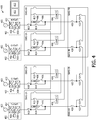
- FIG. 4 is a schematic diagram of an exemplary redundant isolated-parallel (IP) uninterruptible power supply (UPS) ring bus architecture 400 in which current control algorithm 300 (shown in FIG. 3 ) may be used.
- architecture 400 includes a plurality of UPSs 402 arranged in a ring architecture, or parallel architecture, as described herein.
- architecture 400 includes four UPSs 402 in the exemplary embodiment.
- architecture 400 may include any number of UPSs 402 that enable architecture 400 to function as described herein.
- architecture 400 is a three wire system.
- architecture 400 may be a four wire system (typically to supply loads that require a neutral wire).
- UPSs 402 are static double conversion UPSs (i.e., true on-line system systems). Both static and rotary UPSs may require droop control techniques for both voltage and frequency. In some cases, droop control for frequency alone may be sufficient. In some embodiments, droop control techniques are modified in order to handle nonlinear loads.
- Architecture 400 facilitates providing power to one or more loads 404.
- one or more utilities function as a voltage source 403 and provide alternating current (AC) power to loads 404.
- Generators may also function as voltage sources 403.
- voltage sources 403 do not need to be synchronized in architecture 400. This is advantageous, as every UPS 402 may be fed by an individual generator and/or utility, and there is no need to add additional equipment to synchronize voltage sources 403.
- UPS 402 utilizes energy storage systems 458 (e.g., batteries, flywheels, etc. with their converter) connected to UPSs 402 to keep power flowing to loads 404, as described herein. Further, if a given UPS 402 fails, loads 404 receive power through a ring bus 406, as described herein.
- architecture 400 includes four loads 404. Alternatively, architecture 400 may include any suitable number of loads 404 that enable architecture 400 to function as described herein.
- each UPS 402 is electrically coupled to an associated load 404, and coupled to ring bus 406 through an associated choke 408 (e.g., an inductor).
- an associated choke 408 e.g., an inductor
- UPSs 402 cannot work properly due to undesirable circulation currents.
- at least one controller 409 controls operation of UPSs 402. More specifically, at least one controller 409 controls a frequency of an output voltage of each UPS 402, as described herein. The frequency for each UPS 402 is calculated as a function of power, as described herein.
- architecture 400 includes a separate, dedicated controller 409 for each UPS 402.
- system may include a single controller 409 that controls operation of all UPSs 402.
- Each controller 409 may include its own power system (not shown) such as a dedicated energy source (e.g., a battery).
- each controller 409 is coupled to a substitute controller (not shown) that may be used in the event that controller 409 fails.
- each controller 409 is implemented by a processor 411 communicatively coupled to a memory device 413 for executing instructions.
- executable instructions are stored in memory device 413.
- controller 409 may be implemented using any circuitry that enables controller 409 to control operation of UPSs 402 as described herein.
- controller 409 may include a state machine that learns or is pre-programmed to determine information relevant to which loads 404 require power.
- controller 409 performs one or more operations described herein by programming processor 411.
- processor 411 may be programmed by encoding an operation as one or more executable instructions and by providing the executable instructions in memory device 413.
- Processor 411 may include one or more processing units (e.g., in a multicore configuration). Further, processor 411 may be implemented using one or more heterogeneous processor systems in which a main processor is present with secondary processors on a single chip. As another illustrative example, processor 411 may be a symmetric multi-processor system containing multiple processors of the same type.
- processor 411 may be implemented using any suitable programmable circuit including one or more systems and microcontrollers, microprocessors, reduced instruction set circuits (RISC), application specific integrated circuits (ASIC), programmable logic circuits, field programmable gate arrays (FPGA), and any other circuit capable of executing the functions described herein.
- processor 411 causes controller 409 to operate UPSs 402, as described herein.
- memory device 413 is one or more devices that enable information such as executable instructions and/or other data to be stored and retrieved.
- Memory device 413 may include one or more computer readable media, such as, without limitation, dynamic random access memory (DRAM), static random access memory (SRAM), a solid state disk, and/or a hard disk.
- Memory device 413 may be configured to store, without limitation, application source code, application object code, source code portions of interest, object code portions of interest, configuration data, execution events and/or any other type of data.
- one or more controllers 409 calculates an output voltage frequency for each UPS 402, and one or more controllers 409 operate each UPS 402 at the calculated frequency.
- Operating each UPS 402 at their respective calculated frequencies as determined by the droop controls makes it possible to achieve load sharing and stability in architecture 400.
- the frequencies of operation across the various UPSs 402 are different in transient conditions (e.g., following a variation of one or more loads 404).
- each UPS 402 is able to supply power to an associated local load 404, as well as transfer active and reactive power to ring bus 406 through an associated choke 408.
- architecture 400 facilitates sharing local loads 404 equally between UPSs 402 without any communication using droop controls, and in particular, frequency versus active power and voltage versus reactive power. This removes limitations on the number of UPSs 402 in architecture 400.
- architecture 400 includes a number of switching devices. Specifically, for each UPS 402, a first switching device 410 is electrically coupled between UPS 402 and choke 408, a second switching device 412 is electrically coupled between first switching device 410 and local load 404, a third switching device 414 is electrically coupled between first switching device 410 and ring bus 406, and a fourth switching device 416 is coupled between choke 408 and ring bus 406. Further, at ring bus 406, a central switching device 420, a left switching device 422, and a right switching device 424 are associated with each UPS 402, and facilitate isolating UPS 402 from ring bus 406 and/or other UPSs 402 on ring bus 406.
- Each switching device 410, 412, 414, 416, 420, 422, and 424 may include associated logic and relays (neither shown) for operation.
- the protection scheme provided by switching devices 410, 412, 414, 416, 420, 422, and 424 facilitates locating faults in architecture 400 and isolating those faults by opening the appropriate devices.
- third switching devices 414 also referred to as bypass breakers, facilitate bypassing choke 408 when the associated UPS 402 fails or is under maintenance. This facilitates improving the quality of the voltage on the associated local load 404 as the voltage drop on choke 408 is removed.
- At least one controller 409 detects a fault condition within architecture and controls one or more switching devices 410, 412, 414, 416, 420, 422, and 424 to address the fault condition.
- a 'fault condition' refers to any scenario in which one or more switching devices 410, 412, 414, 416, 420, 422, and 424 should be switched (i.e., opened or closed) to facilitate operation of architecture 400. Accordingly, addressing a 'fault condition' includes bypassing choke 408 when the associated UPS 402 fails or is under maintenance.
- Current control algorithm 300 provides zero-sequence current compensation for ground current reduction in UPSs 402. As described above, bonding the midpoint 228 of split-capacitor DC link 222 to ground preserves system grounding as well as contains fault currents in a ring architecture to the load-side of the circuit. Standards limit ground current from UPSs to 5% of the maximum input current of the UPS, so any non-linearity injects current on the midpoint 228.
- Controller 220 compensates for the zero-sequence current components by reducing ground current caused by rectifier 212.
- At least one technical effect of the systems and methods described herein includes (a) generating a reference current command for controlling the rectifier; (b) determining a zero-sequence current component of input current supplied to the multilevel power converter; and (c) compensating the reference current command with the determined zero-sequence current component to reduce ground current injected by the rectifier.
Landscapes
- Engineering & Computer Science (AREA)
- Power Engineering (AREA)
- Business, Economics & Management (AREA)
- Emergency Management (AREA)
- Rectifiers (AREA)
- Inverter Devices (AREA)
Applications Claiming Priority (1)
| Application Number | Priority Date | Filing Date | Title |
|---|---|---|---|
| US15/955,154 US10826381B2 (en) | 2018-04-17 | 2018-04-17 | Method and control system for zero-sequence current compensation for ground current reduction |
Publications (1)
| Publication Number | Publication Date |
|---|---|
| EP3557745A1 true EP3557745A1 (fr) | 2019-10-23 |
Family
ID=66217839
Family Applications (1)
| Application Number | Title | Priority Date | Filing Date |
|---|---|---|---|
| EP19169654.1A Pending EP3557745A1 (fr) | 2018-04-17 | 2019-04-16 | Procédé et système de commande permettant de compenser le courant homopolaire pour réduire le courant de masse |
Country Status (3)
| Country | Link |
|---|---|
| US (1) | US10826381B2 (fr) |
| EP (1) | EP3557745A1 (fr) |
| CN (1) | CN110391652B (fr) |
Cited By (2)
| Publication number | Priority date | Publication date | Assignee | Title |
|---|---|---|---|---|
| EP4195489A4 (fr) * | 2020-09-08 | 2023-09-27 | Huawei Digital Power Technologies Co., Ltd. | Onduleur à trois niveaux, ainsi que procédé et système de commande |
| US12249864B2 (en) | 2020-10-23 | 2025-03-11 | Abb Schweiz Ag | Uninterruptible power supply converter circuit |
Families Citing this family (7)
| Publication number | Priority date | Publication date | Assignee | Title |
|---|---|---|---|---|
| US10641245B2 (en) * | 2017-01-05 | 2020-05-05 | General Electric Company | Hybrid power generation system and an associated method thereof |
| CN111193318A (zh) * | 2020-02-17 | 2020-05-22 | 北京中清智辉能源科技有限公司 | 电源切换装置及供电系统 |
| US11101640B1 (en) * | 2020-07-29 | 2021-08-24 | Abb Schweiz | Solid-state protection for direct current networks |
| CN113676071B (zh) * | 2021-08-18 | 2023-02-03 | 中车青岛四方车辆研究所有限公司 | 三电平辅助逆变器控制方法 |
| US11955835B2 (en) * | 2021-10-13 | 2024-04-09 | Abb Schweiz Ag | Method and control to integrate fuel cells in datacenters with ring-bus architecture |
| CN113972634B (zh) * | 2021-10-28 | 2022-09-16 | 同济大学 | 一种自适应零序能量注入的微电网差动保护方法 |
| EP4443735A1 (fr) * | 2023-04-06 | 2024-10-09 | Hamilton Sundstrand Corporation | Convertisseur de puissance multiniveau |
Citations (5)
| Publication number | Priority date | Publication date | Assignee | Title |
|---|---|---|---|---|
| US20130163292A1 (en) * | 2011-12-22 | 2013-06-27 | General Electric Company | Mid-point voltage control |
| KR101506010B1 (ko) * | 2014-10-01 | 2015-03-30 | 주식회사 이온 | 무정전 전원장치의 직류단 전압 불평형 제어 장치 |
| EP2966754A1 (fr) * | 2014-07-09 | 2016-01-13 | General Electric Company | Alimentation sans coupure et procédé de fonctionnement |
| EP3093977A1 (fr) * | 2014-01-06 | 2016-11-16 | Mitsubishi Electric Corporation | Dispositif de conversion de puissance électrique |
| US9735616B2 (en) * | 2014-03-13 | 2017-08-15 | General Electric Company | Systems and methods for providing increased fault current capability in uninterruptible power supply systems |
Family Cites Families (18)
| Publication number | Priority date | Publication date | Assignee | Title |
|---|---|---|---|---|
| US5574356A (en) * | 1994-07-08 | 1996-11-12 | Northrop Grumman Corporation | Active neutral current compensator |
| PL2599179T3 (pl) | 2010-07-27 | 2016-08-31 | Zapadoceska Univerzita V Plzni | Urządzenie równoważące prąd doziemny podłączone do punktu neutralnego transformatora |
| US8441820B2 (en) * | 2010-09-29 | 2013-05-14 | General Electric Company | DC-link voltage balancing system and method for multilevel converters |
| CN103138594B (zh) | 2011-11-22 | 2016-03-02 | 通用电气公司 | 中点箝位式变流器的控制系统及控制方法及补偿控制单元 |
| EP2624433A1 (fr) | 2012-02-03 | 2013-08-07 | ABB Research Ltd. | Convertisseur pv non-isolé avec réduction des courants de terre |
| ES2718807T3 (es) * | 2012-06-07 | 2019-07-04 | Abb Research Ltd | Procedimiento de amortiguación de secuencia cero y equilibrado de tensión en un convertidor de tres niveles con condensadores de enlace de CC divididos y filtro LCL virtualmente conectado a tierra |
| JP5993675B2 (ja) * | 2012-09-14 | 2016-09-14 | 株式会社日立製作所 | 電力変換装置,電力変換システム及び電力変換装置の制御方法 |
| US9923505B2 (en) * | 2013-11-26 | 2018-03-20 | Regal Beloit America, Inc. | Methods and systems for controlling an electric motor |
| WO2015108614A1 (fr) * | 2014-01-15 | 2015-07-23 | Abb Technology Ag | Convertisseurs de puissance modulaires, multicanaux et entrelacés |
| KR101512188B1 (ko) * | 2014-02-11 | 2015-04-22 | 한국전기연구원 | 모듈형 멀티레벨 컨버터의 구동방법 및 구동장치 |
| US10135237B2 (en) * | 2014-07-30 | 2018-11-20 | Abb Schweiz Ag | Systems and methods for exploiting current capability in static ups |
| CN204349789U (zh) * | 2015-02-10 | 2015-05-20 | 哈尔滨理工大学 | 交流驱动系统共模电压和轴承电流无源/有源抑制装置 |
| US9742311B2 (en) * | 2015-10-02 | 2017-08-22 | Hamilton Sundstrand Corporation | Systems and methods for controlling inverters |
| CA3006344C (fr) * | 2015-11-13 | 2024-01-02 | Marquette University | Topologie a tolerance de pannes pour convertisseurs multiniveaux du type en t |
| CN106786636A (zh) * | 2015-11-19 | 2017-05-31 | 中国石油化工股份有限公司 | 一种电力网中性点柔性接地电流补偿系统 |
| US20190190403A1 (en) * | 2016-08-16 | 2019-06-20 | Toshiba Mitsubishi-Electric Industrial Systems Corporation | System-connected inverter device and method for operating same |
| CN106972505B (zh) * | 2017-05-05 | 2023-09-22 | 贵州电网有限责任公司电力科学研究院 | 统一电能质量治理的混合型电力电子变压器及其控制方法 |
| US10523130B2 (en) * | 2018-01-22 | 2019-12-31 | Hamilton Sundstrand Corporation | Alternate grounding of inverter midpoint for three level switching control |
-
2018
- 2018-04-17 US US15/955,154 patent/US10826381B2/en active Active
-
2019
- 2019-04-16 EP EP19169654.1A patent/EP3557745A1/fr active Pending
- 2019-04-17 CN CN201910310458.XA patent/CN110391652B/zh active Active
Patent Citations (5)
| Publication number | Priority date | Publication date | Assignee | Title |
|---|---|---|---|---|
| US20130163292A1 (en) * | 2011-12-22 | 2013-06-27 | General Electric Company | Mid-point voltage control |
| EP3093977A1 (fr) * | 2014-01-06 | 2016-11-16 | Mitsubishi Electric Corporation | Dispositif de conversion de puissance électrique |
| US9735616B2 (en) * | 2014-03-13 | 2017-08-15 | General Electric Company | Systems and methods for providing increased fault current capability in uninterruptible power supply systems |
| EP2966754A1 (fr) * | 2014-07-09 | 2016-01-13 | General Electric Company | Alimentation sans coupure et procédé de fonctionnement |
| KR101506010B1 (ko) * | 2014-10-01 | 2015-03-30 | 주식회사 이온 | 무정전 전원장치의 직류단 전압 불평형 제어 장치 |
Non-Patent Citations (1)
| Title |
|---|
| JIA ZOU ET AL: "Triple line-voltage cascaded VIENNA converter applied as the medium-voltage rectifier", IECON 2017 - 43RD ANNUAL CONFERENCE OF THE IEEE INDUSTRIAL ELECTRONICS SOCIETY, IEEE, 29 October 2017 (2017-10-29), pages 1635 - 1641, XP033279778, DOI: 10.1109/IECON.2017.8216277 * |
Cited By (2)
| Publication number | Priority date | Publication date | Assignee | Title |
|---|---|---|---|---|
| EP4195489A4 (fr) * | 2020-09-08 | 2023-09-27 | Huawei Digital Power Technologies Co., Ltd. | Onduleur à trois niveaux, ainsi que procédé et système de commande |
| US12249864B2 (en) | 2020-10-23 | 2025-03-11 | Abb Schweiz Ag | Uninterruptible power supply converter circuit |
Also Published As
| Publication number | Publication date |
|---|---|
| US20190319530A1 (en) | 2019-10-17 |
| CN110391652A (zh) | 2019-10-29 |
| US10826381B2 (en) | 2020-11-03 |
| CN110391652B (zh) | 2024-01-09 |
Similar Documents
| Publication | Publication Date | Title |
|---|---|---|
| US10826381B2 (en) | Method and control system for zero-sequence current compensation for ground current reduction | |
| Pal et al. | Topologies and control strategies implicated in dynamic voltage restorer (DVR) for power quality improvement | |
| Cao et al. | Operating principle of soft open points for electrical distribution network operation | |
| Yeh et al. | A reconfigurable uninterruptible power supply system for multiple power quality applications | |
| EP2671310B1 (fr) | Convertisseur électronique de puissance | |
| WO2020136700A1 (fr) | Dispositif de conversion de puissance | |
| Pal et al. | State of the art: Dynamic voltage restorer for power quality improvement | |
| Liu et al. | Modular multilevel converter with high-frequency transformers for interfacing hybrid DC and AC microgrid systems | |
| Pires et al. | A cascaded dual four-leg inverter for photovoltaic systems with capability to compensate unbalanced distribution networks | |
| Li et al. | Control strategy of a cross-phase-connected unified power quality conditioner | |
| Sadigh et al. | Flying capacitor multicell converter based dynamic voltage restorer | |
| Pal et al. | Simulation of dynamic voltage restorer (DVR) to mitigate voltage sag during three-phase fault | |
| Mortezaei et al. | 5-level Cascaded H-Bridge Multilevel microgrid Inverter applicable to multiple DG resources with power quality enhancement capability | |
| Mexis et al. | Voltage unbalance mitigation by novel control of bess single–phase inverters | |
| Verma et al. | Control of a Multi-functional Solar PV-Battery System for operation in a Microgrid Environment | |
| Isik et al. | Negative Sequence Component Elimination with M-STATCOM for Versatile FACTS | |
| Machado et al. | Fault-tolerant Utility Interface power converter for low-voltage microgrids | |
| Awad et al. | Static series compensator for voltage dips mitigation | |
| Sadigh et al. | Stacked multicell converter based DVR with energy minimized compensation strategy | |
| Dargahi et al. | Medium voltage dynamic voltage restorer (DVR) based on DFCM converter for power quality improvement | |
| Ramos et al. | A Zero Harmonic Distortion Grid-Connected Grid-Forming Converter for Battery Energy Storage System Applications | |
| Helal et al. | Dynamic voltage restorer adopting 150 conduction angle VSI | |
| Rastegar et al. | An improved D-SSSC voltage and current load balancing control strategy under unbalanced load | |
| Shuai et al. | An Optimized Control Strategy for Mitigating Three-Phase Imbalance and Dynamic Economic Operation in Flexible Interconnected Distribution Stations | |
| Sharma et al. | A dynamic voltage restorer based on voltage balanced back-to-back stacked multicell converter with equal voltage sources |
Legal Events
| Date | Code | Title | Description |
|---|---|---|---|
| PUAI | Public reference made under article 153(3) epc to a published international application that has entered the european phase |
Free format text: ORIGINAL CODE: 0009012 |
|
| STAA | Information on the status of an ep patent application or granted ep patent |
Free format text: STATUS: THE APPLICATION HAS BEEN PUBLISHED |
|
| AK | Designated contracting states |
Kind code of ref document: A1 Designated state(s): AL AT BE BG CH CY CZ DE DK EE ES FI FR GB GR HR HU IE IS IT LI LT LU LV MC MK MT NL NO PL PT RO RS SE SI SK SM TR |
|
| AX | Request for extension of the european patent |
Extension state: BA ME |
|
| STAA | Information on the status of an ep patent application or granted ep patent |
Free format text: STATUS: REQUEST FOR EXAMINATION WAS MADE |
|
| 17P | Request for examination filed |
Effective date: 20200227 |
|
| RBV | Designated contracting states (corrected) |
Designated state(s): AL AT BE BG CH CY CZ DE DK EE ES FI FR GB GR HR HU IE IS IT LI LT LU LV MC MK MT NL NO PL PT RO RS SE SI SK SM TR |
|
| STAA | Information on the status of an ep patent application or granted ep patent |
Free format text: STATUS: EXAMINATION IS IN PROGRESS |
|
| 17Q | First examination report despatched |
Effective date: 20200610 |
|
| RAP3 | Party data changed (applicant data changed or rights of an application transferred) |
Owner name: ABB SCHWEIZ AG |
|
| RIC1 | Information provided on ipc code assigned before grant |
Ipc: H02M 5/458 20060101AFI20250801BHEP Ipc: H02M 7/217 20060101ALI20250801BHEP Ipc: H02M 7/483 20070101ALI20250801BHEP Ipc: H02M 1/12 20060101ALI20250801BHEP Ipc: H02J 9/06 20060101ALI20250801BHEP Ipc: H02M 1/00 20060101ALN20250801BHEP |
|
| GRAP | Despatch of communication of intention to grant a patent |
Free format text: ORIGINAL CODE: EPIDOSNIGR1 |
|
| STAA | Information on the status of an ep patent application or granted ep patent |
Free format text: STATUS: GRANT OF PATENT IS INTENDED |
|
| RIC1 | Information provided on ipc code assigned before grant |
Ipc: H02M 5/458 20060101AFI20260225BHEP Ipc: H02M 7/217 20060101ALI20260225BHEP Ipc: H02M 7/483 20070101ALI20260225BHEP Ipc: H02M 1/12 20060101ALI20260225BHEP Ipc: H02J 9/06 20060101ALI20260225BHEP Ipc: H02M 1/00 20060101ALN20260225BHEP |
|
| INTG | Intention to grant announced |
Effective date: 20260306 |