EP3564969A1 - Fügematerial und fügeverfahren damit - Google Patents
Fügematerial und fügeverfahren damit Download PDFInfo
- Publication number
- EP3564969A1 EP3564969A1 EP17886598.6A EP17886598A EP3564969A1 EP 3564969 A1 EP3564969 A1 EP 3564969A1 EP 17886598 A EP17886598 A EP 17886598A EP 3564969 A1 EP3564969 A1 EP 3564969A1
- Authority
- EP
- European Patent Office
- Prior art keywords
- bonding material
- bonding
- chain
- silver particles
- fine silver
- Prior art date
- Legal status (The legal status is an assumption and is not a legal conclusion. Google has not performed a legal analysis and makes no representation as to the accuracy of the status listed.)
- Withdrawn
Links
Images



Classifications
-
- H—ELECTRICITY
- H10—SEMICONDUCTOR DEVICES; ELECTRIC SOLID-STATE DEVICES NOT OTHERWISE PROVIDED FOR
- H10W—GENERIC PACKAGES, INTERCONNECTIONS, CONNECTORS OR OTHER CONSTRUCTIONAL DETAILS OF DEVICES COVERED BY CLASS H10
- H10W72/00—Interconnections or connectors in packages
- H10W72/30—Die-attach connectors
-
- B—PERFORMING OPERATIONS; TRANSPORTING
- B22—CASTING; POWDER METALLURGY
- B22F—WORKING METALLIC POWDER; MANUFACTURE OF ARTICLES FROM METALLIC POWDER; MAKING METALLIC POWDER; APPARATUS OR DEVICES SPECIALLY ADAPTED FOR METALLIC POWDER
- B22F1/00—Metallic powder; Treatment of metallic powder, e.g. to facilitate working or to improve properties
- B22F1/10—Metallic powder containing lubricating or binding agents; Metallic powder containing organic material
- B22F1/102—Metallic powder coated with organic material
-
- B—PERFORMING OPERATIONS; TRANSPORTING
- B22—CASTING; POWDER METALLURGY
- B22F—WORKING METALLIC POWDER; MANUFACTURE OF ARTICLES FROM METALLIC POWDER; MAKING METALLIC POWDER; APPARATUS OR DEVICES SPECIALLY ADAPTED FOR METALLIC POWDER
- B22F1/00—Metallic powder; Treatment of metallic powder, e.g. to facilitate working or to improve properties
- B22F1/05—Metallic powder characterised by the size or surface area of the particles
-
- B—PERFORMING OPERATIONS; TRANSPORTING
- B22—CASTING; POWDER METALLURGY
- B22F—WORKING METALLIC POWDER; MANUFACTURE OF ARTICLES FROM METALLIC POWDER; MAKING METALLIC POWDER; APPARATUS OR DEVICES SPECIALLY ADAPTED FOR METALLIC POWDER
- B22F1/00—Metallic powder; Treatment of metallic powder, e.g. to facilitate working or to improve properties
- B22F1/05—Metallic powder characterised by the size or surface area of the particles
- B22F1/054—Nanosized particles
-
- B—PERFORMING OPERATIONS; TRANSPORTING
- B22—CASTING; POWDER METALLURGY
- B22F—WORKING METALLIC POWDER; MANUFACTURE OF ARTICLES FROM METALLIC POWDER; MAKING METALLIC POWDER; APPARATUS OR DEVICES SPECIALLY ADAPTED FOR METALLIC POWDER
- B22F1/00—Metallic powder; Treatment of metallic powder, e.g. to facilitate working or to improve properties
- B22F1/05—Metallic powder characterised by the size or surface area of the particles
- B22F1/054—Nanosized particles
- B22F1/056—Submicron particles having a size above 100 nm up to 300 nm
-
- B—PERFORMING OPERATIONS; TRANSPORTING
- B22—CASTING; POWDER METALLURGY
- B22F—WORKING METALLIC POWDER; MANUFACTURE OF ARTICLES FROM METALLIC POWDER; MAKING METALLIC POWDER; APPARATUS OR DEVICES SPECIALLY ADAPTED FOR METALLIC POWDER
- B22F1/00—Metallic powder; Treatment of metallic powder, e.g. to facilitate working or to improve properties
- B22F1/10—Metallic powder containing lubricating or binding agents; Metallic powder containing organic material
- B22F1/107—Metallic powder containing lubricating or binding agents; Metallic powder containing organic material containing organic material comprising solvents, e.g. for slip casting
-
- B—PERFORMING OPERATIONS; TRANSPORTING
- B22—CASTING; POWDER METALLURGY
- B22F—WORKING METALLIC POWDER; MANUFACTURE OF ARTICLES FROM METALLIC POWDER; MAKING METALLIC POWDER; APPARATUS OR DEVICES SPECIALLY ADAPTED FOR METALLIC POWDER
- B22F7/00—Manufacture of composite layers, workpieces, or articles, comprising metallic powder, by sintering the powder, with or without compacting wherein at least one part is obtained by sintering or compression
- B22F7/06—Manufacture of composite layers, workpieces, or articles, comprising metallic powder, by sintering the powder, with or without compacting wherein at least one part is obtained by sintering or compression of composite workpieces or articles from parts, e.g. to form tipped tools
- B22F7/062—Manufacture of composite layers, workpieces, or articles, comprising metallic powder, by sintering the powder, with or without compacting wherein at least one part is obtained by sintering or compression of composite workpieces or articles from parts, e.g. to form tipped tools involving the connection or repairing of preformed parts
- B22F7/064—Manufacture of composite layers, workpieces, or articles, comprising metallic powder, by sintering the powder, with or without compacting wherein at least one part is obtained by sintering or compression of composite workpieces or articles from parts, e.g. to form tipped tools involving the connection or repairing of preformed parts using an intermediate powder layer
-
- B—PERFORMING OPERATIONS; TRANSPORTING
- B23—MACHINE TOOLS; METAL-WORKING NOT OTHERWISE PROVIDED FOR
- B23K—SOLDERING OR UNSOLDERING; WELDING; CLADDING OR PLATING BY SOLDERING OR WELDING; CUTTING BY APPLYING HEAT LOCALLY, e.g. FLAME CUTTING; WORKING BY LASER BEAM
- B23K35/00—Rods, electrodes, materials, or media, for use in soldering, welding, or cutting
- B23K35/02—Rods, electrodes, materials, or media, for use in soldering, welding, or cutting characterised by mechanical features, e.g. shape
- B23K35/0222—Rods, electrodes, materials, or media, for use in soldering, welding, or cutting characterised by mechanical features, e.g. shape for use in soldering or brazing
- B23K35/0244—Powders, particles or spheres; Preforms made therefrom
-
- B—PERFORMING OPERATIONS; TRANSPORTING
- B23—MACHINE TOOLS; METAL-WORKING NOT OTHERWISE PROVIDED FOR
- B23K—SOLDERING OR UNSOLDERING; WELDING; CLADDING OR PLATING BY SOLDERING OR WELDING; CUTTING BY APPLYING HEAT LOCALLY, e.g. FLAME CUTTING; WORKING BY LASER BEAM
- B23K35/00—Rods, electrodes, materials, or media, for use in soldering, welding, or cutting
- B23K35/22—Rods, electrodes, materials, or media, for use in soldering, welding, or cutting characterised by the composition or nature of the material
- B23K35/24—Selection of soldering or welding materials proper
- B23K35/26—Selection of soldering or welding materials proper with the principal constituent melting at less than 400°C
-
- B—PERFORMING OPERATIONS; TRANSPORTING
- B23—MACHINE TOOLS; METAL-WORKING NOT OTHERWISE PROVIDED FOR
- B23K—SOLDERING OR UNSOLDERING; WELDING; CLADDING OR PLATING BY SOLDERING OR WELDING; CUTTING BY APPLYING HEAT LOCALLY, e.g. FLAME CUTTING; WORKING BY LASER BEAM
- B23K35/00—Rods, electrodes, materials, or media, for use in soldering, welding, or cutting
- B23K35/22—Rods, electrodes, materials, or media, for use in soldering, welding, or cutting characterised by the composition or nature of the material
- B23K35/24—Selection of soldering or welding materials proper
- B23K35/30—Selection of soldering or welding materials proper with the principal constituent melting at less than 1550°C
- B23K35/3006—Ag as the principal constituent
-
- B—PERFORMING OPERATIONS; TRANSPORTING
- B23—MACHINE TOOLS; METAL-WORKING NOT OTHERWISE PROVIDED FOR
- B23K—SOLDERING OR UNSOLDERING; WELDING; CLADDING OR PLATING BY SOLDERING OR WELDING; CUTTING BY APPLYING HEAT LOCALLY, e.g. FLAME CUTTING; WORKING BY LASER BEAM
- B23K35/00—Rods, electrodes, materials, or media, for use in soldering, welding, or cutting
- B23K35/22—Rods, electrodes, materials, or media, for use in soldering, welding, or cutting characterised by the composition or nature of the material
- B23K35/36—Selection of non-metallic compositions, e.g. coatings or fluxes; Selection of soldering or welding materials, conjoint with selection of non-metallic compositions, both selections being of interest
- B23K35/365—Selection of non-metallic compositions of coating materials either alone or conjoint with selection of soldering or welding materials
-
- H—ELECTRICITY
- H01—ELECTRIC ELEMENTS
- H01B—CABLES; CONDUCTORS; INSULATORS; SELECTION OF MATERIALS FOR THEIR CONDUCTIVE, INSULATING OR DIELECTRIC PROPERTIES
- H01B1/00—Conductors or conductive bodies characterised by the conductive materials; Selection of materials as conductors
-
- H—ELECTRICITY
- H01—ELECTRIC ELEMENTS
- H01B—CABLES; CONDUCTORS; INSULATORS; SELECTION OF MATERIALS FOR THEIR CONDUCTIVE, INSULATING OR DIELECTRIC PROPERTIES
- H01B1/00—Conductors or conductive bodies characterised by the conductive materials; Selection of materials as conductors
- H01B1/20—Conductive material dispersed in non-conductive organic material
- H01B1/22—Conductive material dispersed in non-conductive organic material the conductive material comprising metals or alloys
-
- B—PERFORMING OPERATIONS; TRANSPORTING
- B22—CASTING; POWDER METALLURGY
- B22F—WORKING METALLIC POWDER; MANUFACTURE OF ARTICLES FROM METALLIC POWDER; MAKING METALLIC POWDER; APPARATUS OR DEVICES SPECIALLY ADAPTED FOR METALLIC POWDER
- B22F2301/00—Metallic composition of the powder or its coating
- B22F2301/25—Noble metals, i.e. Ag Au, Ir, Os, Pd, Pt, Rh, Ru
- B22F2301/255—Silver or gold
-
- B—PERFORMING OPERATIONS; TRANSPORTING
- B22—CASTING; POWDER METALLURGY
- B22F—WORKING METALLIC POWDER; MANUFACTURE OF ARTICLES FROM METALLIC POWDER; MAKING METALLIC POWDER; APPARATUS OR DEVICES SPECIALLY ADAPTED FOR METALLIC POWDER
- B22F2304/00—Physical aspects of the powder
- B22F2304/05—Submicron size particles
- B22F2304/056—Particle size above 100 nm up to 300 nm
-
- B—PERFORMING OPERATIONS; TRANSPORTING
- B22—CASTING; POWDER METALLURGY
- B22F—WORKING METALLIC POWDER; MANUFACTURE OF ARTICLES FROM METALLIC POWDER; MAKING METALLIC POWDER; APPARATUS OR DEVICES SPECIALLY ADAPTED FOR METALLIC POWDER
- B22F9/00—Making metallic powder or suspensions thereof
- B22F9/16—Making metallic powder or suspensions thereof using chemical processes
- B22F9/18—Making metallic powder or suspensions thereof using chemical processes with reduction of metal compounds
- B22F9/24—Making metallic powder or suspensions thereof using chemical processes with reduction of metal compounds starting from liquid metal compounds, e.g. solutions
-
- H—ELECTRICITY
- H10—SEMICONDUCTOR DEVICES; ELECTRIC SOLID-STATE DEVICES NOT OTHERWISE PROVIDED FOR
- H10W—GENERIC PACKAGES, INTERCONNECTIONS, CONNECTORS OR OTHER CONSTRUCTIONAL DETAILS OF DEVICES COVERED BY CLASS H10
- H10W72/00—Interconnections or connectors in packages
- H10W72/071—Connecting or disconnecting
- H10W72/073—Connecting or disconnecting of die-attach connectors
- H10W72/07331—Connecting techniques
-
- H—ELECTRICITY
- H10—SEMICONDUCTOR DEVICES; ELECTRIC SOLID-STATE DEVICES NOT OTHERWISE PROVIDED FOR
- H10W—GENERIC PACKAGES, INTERCONNECTIONS, CONNECTORS OR OTHER CONSTRUCTIONAL DETAILS OF DEVICES COVERED BY CLASS H10
- H10W72/00—Interconnections or connectors in packages
- H10W72/071—Connecting or disconnecting
- H10W72/073—Connecting or disconnecting of die-attach connectors
- H10W72/07331—Connecting techniques
- H10W72/07332—Compression bonding, e.g. thermocompression bonding
-
- H—ELECTRICITY
- H10—SEMICONDUCTOR DEVICES; ELECTRIC SOLID-STATE DEVICES NOT OTHERWISE PROVIDED FOR
- H10W—GENERIC PACKAGES, INTERCONNECTIONS, CONNECTORS OR OTHER CONSTRUCTIONAL DETAILS OF DEVICES COVERED BY CLASS H10
- H10W72/00—Interconnections or connectors in packages
- H10W72/30—Die-attach connectors
- H10W72/321—Structures or relative sizes of die-attach connectors
- H10W72/325—Die-attach connectors having a filler embedded in a matrix
-
- H—ELECTRICITY
- H10—SEMICONDUCTOR DEVICES; ELECTRIC SOLID-STATE DEVICES NOT OTHERWISE PROVIDED FOR
- H10W—GENERIC PACKAGES, INTERCONNECTIONS, CONNECTORS OR OTHER CONSTRUCTIONAL DETAILS OF DEVICES COVERED BY CLASS H10
- H10W72/00—Interconnections or connectors in packages
- H10W72/30—Die-attach connectors
- H10W72/351—Materials of die-attach connectors
- H10W72/352—Materials of die-attach connectors comprising metals or metalloids, e.g. solders
Definitions
- the present invention relates to a bonding material and a bonding method employing same, in particular to a bonding material containing fine silver particles and a bonding method employing this bonding material.
- Nano-order particles when having a size of a minute particle diameter, is known to demonstrate physical properties that are peculiar to the size. Nano-order particles in particular may demonstrate different properties from those of a bulk material. Based on such characteristics, there are proposed bonding materials in which nanometal particles are used to bond different substances.
- Patent Document 1 which aims at ensuring adequate bonding strength with the simplest possible constitution while also limiting unevenness in bonding strength, discloses a bonding material that contains: fine silver particles having an average primary particle diameter (D50 diameter) of 0.5 to 3.0 ⁇ m (as measured with the particle size distribution measurement device "Microtrac”); fine silver particles having an average primary particle diameter of 1 to 200 nm (as measured with "Microtrac”) and being coated with a fatty acid having a carbon number of 6; and a disperse medium for dispersing the fine silver particles.
- D50 diameter average primary particle diameter
- Microtrac fine silver particles having an average primary particle diameter of 1 to 200 nm
- disperse medium for dispersing the fine silver particles.
- Patent Document 2 which aims at enabling uniform application on a bonding surface even with an increased silver content and forming a dense bonding layer to achieve resistance to repeated heat shock, discloses a bonding material constituted by: fine silver particles being coated with a carboxylic acid that has a carbon number of lower than or equal to 6 and having an average primary particle diameter of 10 to 30 nm; fine silver particles being coated with a carboxylic acid that has a carbon number of lower than or equal to 6 and having an average primary particle diameter of 100 to 200 nm; fine silver particles having an average primary particle diameter of 0.3 to 3.0 ⁇ m; and a dispersing agent having a phosphoric ester group.
- the inventors of the present invention considered that, in order to comprehensively evaluate the aforementioned matters, it would be appropriate to evaluate whether voids or cracks are present in a bonding layer.
- a condition in which there are few or no voids or cracks in a bonding layer will be expressed as the bonding properties being preferable.
- the present invention aims at providing a bonding material having both preferable dispensing properties and preferable bonding properties, which are in a trade-off relationship as described above, as well as providing a bonding method employing the bonding material.
- a first aspect of the present invention is a bonding material comprising fine silver particles having an average primary particle diameter of smaller than or equal to 130 nm, and a crosslinking-type inter-particle distance keeping agent crosslinking between the fine silver particles and keeping a distance between the fine silver particles.
- a second aspect of the present invention is the invention as set forth in the first aspect, wherein the crosslinking-type inter-particle distance keeping agent is a compound ⁇ expressed by formula (I) below (here, in formula (I), R represents an organic group having a valence of 2 to 4, A and B represent a hydroxyl group, amino group, carboxyl group, or thiol group, and in a case where two As are present, the two As may be identical or different from each other and in a case where two Bs are present, the two Bs may be identical or different from each other, and assuming that in the longest straight-chain moiety forming R, the longest moiety from among moieties between an atom 1 bonding to A and an atom 2 bonding to B is a first main chain, the number of chain-forming atoms of the first main chain is 10 to 180).
- formula (I) a compound ⁇ expressed by formula (I) below
- R represents an organic group having a valence of 2 to 4
- a and B represent
- a third aspect of the present invention is the invention as set forth in the second aspect, wherein at least one from among A and B in the formula (I) is a hydroxyl group, amino group, or thiol group, and the longest straight-chain moiety forming R in the formula (I) has a side chain, and the number of chain-forming atoms of the longest straight-chain moiety in the side chain is smaller than or equal to 1/3 of the number of chain-forming atoms of the first main chain.
- a fourth aspect of the present invention is the invention as set forth in the second or third aspect, wherein the longest straight-chain moiety forming R in the formula (I) has a side chain, the side chain is a hydrocarbon group having a carbon number of 1 to 12, and A and B may bond to the side chain.
- a sixth aspect of the present invention is the invention as set forth in the second aspect, wherein the compound ⁇ is any one of formulae (II) to (IV) below (here, in formula (II), v and y are each independently an integer of 1 to 2, w is an integer of 0 to 10, and x is an integer of 14 to 40) (here, in formula (III), the plurality of ks are each independently an integer of 3 to 10, the plurality of ls are each independently an integer of 6 to 16, and m is an integer of 2 to 8) [Chemical formula 4] C n H 2n+1 CHOH)-(CH 2 ) p -CONH-(CH 2 ) q -NHCO-(CH 2 ) r -CH(OH)C s H 2s+1 (IV) (here, in formula (IV), n and s are each independently an integer of 3 to 10, p and r are each independently an integer of 6 to 18, and q is an integer of 2 to 10).
- a seventh aspect of the present invention is the invention as set forth in any one of the first to sixth aspects, wherein the bonding material further comprises silver particles having an average primary particle diameter of 0.3 to 10 ⁇ m.
- An eighth aspect of the present invention is the invention as set forth in any one of the first to seventh aspects, wherein the fine silver particles are coated with an organic compound.
- a ninth aspect of the present invention is the invention as set forth in any one of the first to eighth aspects, wherein the bonding material further comprises a polar solvent.
- a tenth aspect of the present invention is the invention as set forth in any one of the first to ninth aspects, wherein the bonding material further comprises an acid-type dispersing agent.
- An eleventh aspect of the present invention is a bonding method comprising: placing the bonding material as set forth in any one of the first to tenth aspects between substances to be bonded and heating the bonding material to form a bonding layer from the bonding material; and bonding together the substances accordingly.
- a bonding material having both preferable dispensing properties and preferable bonding properties and a bonding method employing the bonding material can be provided.
- the bonding material being a silver paste containing fine silver particles.
- the fine silver particles to be used in this embodiment there are no particular limitations on the fine silver particles to be used in this embodiment, given that the average primary particle diameter thereof is smaller than or equal to 130 nm.
- a method known in the art may be used as a method for producing the fine silver particles, and it is also possible to use fine silver particles that are known in the art and have an average primary particle diameter of smaller than or equal to 130 nm.
- Fine silver particles having an average primary particle diameter of smaller than or equal to 130 nm are preferable in terms of bonding properties and, in particular, fine silver particles having an average primary particle diameter of 1 to 40 nm superior in bonding properties.
- the average primary particle diameter of the fine silver particles is more preferably 5 to 30 nm, yet more preferably 10 to 20 nm.
- the average primary particle diameter of the fine silver particles is preferably 50 to 115 nm, more preferably 55 to 100 nm.
- the fine silver particles there may be used as the fine silver particles a combination of fine silver particles having an average primary particle diameter of 1 to 40 nm and fine silver particles having an average primary particle diameter of 41 to 130 nm.
- An average primary particle diameter of metal particles (fine silver particles or silver particles (to be described later)) as referred to in this description means an average value of primary particle diameters obtained on the basis of a transmission electron microscopic photograph (TEM image) or scanning electron microscopic photograph (SEM image) of the metal particles.
- such an average primary particle diameter may be calculated from the primary particle diameters of any 100 or more metal particles in an image (scanning electron microscope (SEM) image or transmission electron microscope (TEM) image) (the diameters being diameters of circles having the same areas as the metal particles) that is obtained through observation of the metal particles at a prescribed magnification using, for example, a TEM (JEM-1011 (Japan Electron Optics Laboratory Ltd.)) or a SEM (S-4700 (Hitachi Hi-Technologies Corporation)).
- Image analysis software EIZOU KUN (registered trademark) (Asahi Kasei Engineering Corporation)
- EIZOU KUN registered trademark
- the fine silver particles used in the present invention are prone to aggregation because of the average primary particle diameter thereof being as small as smaller than or equal to 130 nm, so it is preferable that the particles be coated with an organic compound.
- an organic compound any known organic compound that is able to coat fine silver particles can be used.
- saturated fatty acid or amine include hexanoic acid, sorbic acid, hexylamine, and octylamine.
- the content of the fine silver particles described above in the bonding material according to this embodiment is preferably 4% to 97% by mass, more preferably 4% to 85% by mass, from the viewpoint of demonstrating appropriate bonding strength.
- Silver particles having an average primary particle diameter of 0.3 to 10 ⁇ m may be added to the bonding material according to this embodiment. Addition of silver particles allows for a reduction in the viscosity of the bonding material and facilitates printing of the bonding material (compared to when the metal particles are constituted solely by fine silver particles without the addition of silver particles). From the viewpoint of such printing suitability, the average primary particle diameter of the silver particles is more preferably 0.3 to 5 ⁇ m, yet more preferably 0.3 to 3 ⁇ m.
- the silver particles may be coated with an organic compound for purposes such as attaining higher dispersibility, and when doing so, it is preferable that an organic compound having a carbon number of smaller than or equal to 20 (the carbon number of an organic compound is usually greater than or equal to 2) be used to coat the silver particles.
- the content of silver particles in the bonding material according to this embodiment is preferably 20% to 80% by mass from the viewpoint of ensuring good printing suitability without degradation in bonding properties due to a reduction in the amount of fine silver particles blended.
- the total content of fine silver particles and silver particles in the bonding material according to this embodiment is preferably 85% to 97% by mass, more preferably 87% to 95% by mass, from the viewpoint of what has been described above.
- the bonding material according to this embodiment contains a crosslinking-type inter-particle distance keeping agent that keeps a distance between fine silver particles through crosslinking between fine silver particles.
- Crosslinking between fine silver particles allows a physical distance to be kept between the fine silver particles so that aggregation of the fine silver particles prior to use of the bonding material can be prevented and a dispersed state of the fine silver particles can be maintained.
- the cross-link breaks or weakens due to application of shear force, resulting in a decrease in viscosity so that discharge in dispense-type printing is facilitated, whereas when the printing has been completed and there is no shear force, viscosity is recovered even in an ink having ordinary thixotropy, and it is considered that the recovery of the cross-link results in an earlier recovery of the viscosity (see the examples described later).
- the crosslinking-type inter-particle distance keeping agent is found to make the dispensing properties of the bonding material preferable.
- the crosslinking-type inter-particle distance keeping agent during sintering (being heated to, for example, 170°C to 400°C) volatilize due to being heated or at least the molecular motion thereof becomes more active due to being heated, thereby becoming more easily separable from the fine silver particle, so the crosslinking-type inter-particle distance keeping agent does not hinder sintering of the fine silver particles, and thus preferable bonding properties can be achieved.
- the crosslinking-type inter-particle distance keeping agent may crosslink between such metal particles or between such metal particles and fine silver particles.
- any agent can be used for the crosslinking-type inter-particle distance keeping agent as long as the agent demonstrates a similar function to the aforementioned by cross-linking (bonding) between fine silver particles.
- a bond to silver per se may serve to bond fine silver particles together through the crosslinking-type inter-particle distance keeping agent.
- the crosslinking-type inter-particle distance keeping agent has a plurality of functional groups (e.g., a hydroxyl group, amino group, thiol group, and carboxyl group) that have affinity for the fine silver particles so as to crosslink between the fine silver particles.
- a functional group e.g., a hydroxyl group, amino group, thiol group, and carboxyl group
- the crosslinking-type inter-particle distance keeping agent serves to keep a distance between fine silver particles, if the distance is too long, a gap will be present between the fine silver particles, which may result in the formation of voids during sintering for the bonding and thus cause cracks and the like; therefore, it is preferred that the crosslinking-type inter-particle distance keeping agent have a molecular length and a molecular structure according to which a distance that is appropriate from the aforementioned perspective can be kept between fine silver particles.
- the crosslinking-type inter-particle distance keeping agent may be, for example, a compound ⁇ expressed by formula (I) below.
- R represents an organic group having a valence of 2 to 4
- a and B represent a hydroxyl group, amino group, carboxyl group, or thiol group, and assuming that in the longest straight-chain moiety forming R, the longest moiety from among moieties between an atom 1 bonding to A and an atom 2 bonding to B is a first main chain, the number of chain-forming atoms of the first main chain is 10 to 180.
- the two As may be identical or different from each other; the same stands for B.
- a and B may bond to any site in the longest straight-chain moiety of R and may not bond to a terminal of the straight-chain moiety.
- R may have a side chain.
- a and B may bond to this side chain.
- the definition of the first main chain is that in a case where there are a plurality of As and/or Bs, observation is made for the first main chain from the side of As and/or Bs that is closest to the molecular terminal.
- the number of the chain-forming atoms of the first main chain being 10 to 180, A and B are separated to a certain degree, and the function of the crosslinking-type inter-particle distance keeping agent of keeping an appropriate distance between the fine silver particles is demonstrated preferably.
- the number of chain-forming atoms of the first main chain is preferably 20 to 120.
- the side chain in the first main chain is not included in the count of the number of chain-forming atoms.
- the chain-forming atom is an atom that has a valence of greater than or equal to 2 and that bonds to more than or equal to 2 atoms having a valance of greater than or equal to 2. It is assumed that this chain-forming atom includes divalent atoms (e.g., O, N, C, and S) that form A and B. An increase in the number of chain-forming atoms is assumed to indicate a longer chain.
- At least one from among A and B in the formula (I) be a hydroxyl group, amino group, or thiol group
- the longest straight-chain moiety forming R in the formula (I) have a side chain
- the number of chain-forming atoms of the longest straight-chain moiety in the side chain be smaller than or equal to 1/3 of the number of chain-forming atoms of the first main chain. If so, in the recovery of the viscosity of the bonding material indicated in the examples described later, the original viscosity of the bonding material can be recovered within a short period of time after start of the recovery.
- the number of chain-forming atoms of the longest straight-chain moiety in the side chain at this time be greater than or equal to 1/100 of the number of chain-forming atoms of the first main chain. It is assumed that the chain-forming atoms of the longest straight-chain moiety in the side chain are equivalent to the chain-forming atoms in the first main chain and include an atom having a valence of greater than or equal to 2 and bonding to H at the side chain terminal.
- all of A and B be hydroxyl groups, amino groups, or thiol groups from the viewpoint of early recovery of the viscosity of the bonding material and the viewpoint of the bonding properties thereof, and from these viewpoints, it is most preferable that all of A and B be hydroxyl groups.
- examples of the side chain include a hydrocarbon group having a carbon number of 1 to 12 (preferably 2 to 8). This hydrocarbon group may be saturated or unsaturated and may have a branch.
- the longest straight-chain moiety forming the compound ⁇ is a second main chain
- the difference between the numbers of chain-forming atoms of the second main chain and the first main chain be smaller than or equal to 1/4 of the number of chain-forming atoms of the second main chain. If so, A and B are at the molecular terminal of the compound ⁇ (i.e. the difference is zero) or in the vicinity thereof, and act more readily with the fine silver particles.
- the second main chain indicates the longest straight-chain moiety in the "compound ⁇ " itself
- the first main chain indicates, as has already been described above, the longest moiety from among moieties between an atom 1 bonding to A and an atom 2 bonding to B in the longest straight-chain moiety forming "R".
- the chain-forming atom of the first main chain and the second main chain is preferably C, N, O, or S, more preferably C, N, or O.
- the first main chain and the second main chain are saturated or unsaturated.
- R a represents the aforementioned side chain of R
- X represents halogen.
- the compound ⁇ is preferably a compound expressed by any one of formulae (II) to (IV) below.
- v and y are each independently an integer of 1 to 2
- w is an integer of 0 to 10 (preferably an integer of 0 to 8 from the viewpoint of achieving both dispensing properties and bonding properties)
- x is an integer of 14 to 40 (preferably an integer of 18 to 36 from the viewpoint of achieving both dispensing properties and bonding properties).
- the plurality of ks are each independently an integer of 3 to 10 (preferably an integer of 4 to 8 from the viewpoint of achieving both dispensing properties and bonding properties)
- the plurality of ls are each independently an integer of 6 to 16 (preferably an integer of 8 to 12 from the viewpoint of achieving both dispensing properties and bonding properties)
- m is an integer of 2 to 8 (preferably an integer of 3 to 6 from the viewpoint of achieving both dispensing properties and bonding properties).
- n and s are each independently an integer of 3 to 10 (preferably an integer of 4 to 8 from the viewpoint of achieving both dispensing properties and bonding properties)
- p and r are each independently an integer of 6 to 18 (preferably an integer of 8 to 14 from the viewpoint of achieving both dispensing properties and bonding properties)
- q is an integer of 2 to 10 (preferably an integer of 2 to 6 from the viewpoint of achieving both dispensing properties and bonding properties).
- the compound expressed by formula (II) is particularly preferable from the viewpoint of bonding properties and dispensing properties.
- the compound ⁇ include polyhydroxycarboxylic acid ester (synthesized from transesterification of dicarboxylic acid dimethyl ester with alkanolamines) (the polyhydroxycarboxylic acid ester including BYK-R606 (BYK Japan KK) mentioned above).
- the compound ⁇ may be hydrogenated castor oils (e.g. that produced by KF TRADING CO., LTD.) or a dimer acid (a liquid fatty acid, the main component of which is a dibasic of C36 dicarboxylic acid obtained by dimerization of a vegetable oil-based C18 unsaturated fatty acid and which contains a monobasic and a tribasic (e.g. product name: Tsunodyme 395 (TSUNO CO., LTD.)).
- a dimer acid a liquid fatty acid, the main component of which is a dibasic of C36 dicarboxylic acid obtained by dimerization of a vegetable oil-based C18 unsaturated fatty acid and which contains a monobasic and a tribasic (e.g. product name: Tsunodyme 395 (TSUNO CO., LTD.)).
- the content of the crosslinking-type inter-particle distance keeping agent described above in the bonding material according to this embodiment is preferably 0.01% to 2% by mass, more preferably 0.03% to 1% by mass, from the viewpoint of achieving both preferable dispensing properties and preferable bonding properties.
- a bonding material usually contains a solvent so that the bonding material assumes an easily printable form.
- a solvent there are no particular limitations on the solvent to be used in this embodiment, given that, eventually, there can be obtained a bonding material (silver paste) with which a bonding layer can be formed through sintering of fine silver particles (and silver particles) and which has a viscosity such that printing can be performed with ease.
- One type of solvent may be used singly or two or more types thereof may be used in combination.
- the content of the solvent in the bonding material is preferably 1% to 10% by mass, more preferably 2% to 8% by mass.
- a polar solvent or a non-polar solvent may be used for this solvent, and from the viewpoint of environmental load and miscibility with other components in the bonding material, a polar solvent is preferable.
- Used as such a polar solvent may be water, alcohol, polyol, glycol ether, 1-methylpyrrolidinone, pyridine, terpineol, butyl carbitol, butyl carbitol acetate, texanol, phenoxypropanol, diethylene glycol monobutyl ether, diethylene glycol monobutyl ether acetate, ⁇ -butyrolactone, ethylene glycol monomethyl ether acetate, ethylene glycol monoethyl ether acetate, methoxybutyl acetate, methoxypropyl acetate, diethylene glycol monoethyl ether acetate, ethyl lactate, 1-octanol, and so on.
- a dispersing agent may be added to the bonding material for the purpose of keeping the dispersed state of the fine silver particles more reliably.
- Any dispersing agent may be used that can maintain dispersion of the fine silver particles and that, during sintering, separates from the fine silver particles through, for example, volatilization from the particles.
- various commercially-available dispersing agents may be used, among which use of acid-type dispersing agents and phosphoric ester-type dispersing agents is preferable.
- the acid-type dispersing agent include butoxyethoxy acetic acid. One type from among such dispersing agents may be used singly or two or more types therefrom may be used in combination.
- the content of the dispersing agent in the bonding material is preferably 0.01% to 3% by mass, more preferably 0.03% to 2% by mass.
- compositions known in the art may be included, as appropriate, in the bonding material according to this embodiment, in addition to the constituents mentioned above.
- specific examples of such components include viscosity modifiers, organic binders, inorganic binders, pH adjusters, buffers, antifoaming agents, leveling agents, and volatilization inhibitors.
- a preferable viscosity of the bonding material according to this embodiment is 5 to 40 Pa ⁇ s as a general index, although the preferable viscosity varies according to the printing method in question in which the bonding material is adopted.
- the viscosity is measured using a rotary dynamic viscoelasticity measurement device under the condition of 25°C and 5 rpm.
- the bonding material may be produced by, for example, separately preparing the components forming the bonding material and mixing the same in an arbitrary order using ultrasonic dispersion, disper, 3-roll mill, ball mill, beads mill, twin-screw kneader, revolving stirrer, or the like.
- the technical concept of the present invention is applicable to a bonding method that employs the bonding material described above.
- the technical concept may be applied to a bonding method including: placing the bonding material described above between substances to be bonded and heating the bonding material to form a bonding layer from the bonding material; and bonding together the substances accordingly.
- a method known in the art may be used as a specific bonding method, and the following shows some examples.
- the bonding material (silver paste) described above may be applied onto at least one of two substances to be bonded by dispense-type printing; the bonding material may be disposed so as to be interposed between the substances; and heating may be carried out at 170°C to 400°C, preferably at 200°C to 300°C, in order to sinter the fine silver particles (and silver particles) in the bonding material, thereby forming a bonding layer, so that the substances are bonded through this bonding layer.
- the bonding material may be applied to one of two substances to be bonded; heating may be carried out at 60°C to 160°C, preferably 80°C to 150°C, to dry the bonding material and form a pre-dried film; the other one of the substances to be bonded may be placed on the pre-dried film; and thereafter heating may be carried out at 170°C to 400°C, preferably at 200°C to 300°C, in order to sinter the fine silver particles (and silver particles) in the bonding material, thereby forming a bonding layer, so that the substances are bonded through this bonding layer.
- pressure may be applied on the substances to be bonded, although such application of pressure is not essential.
- the substances to be bonded can be bonded through heating in an inert atmosphere such as nitrogen atmosphere but can also be bonded through heating in the atmosphere.
- the bonding material according to the present invention has been described as being printed using a dispense-type printing method; however, the bonding material may be printed using other methods such as metal mask printing.
- the substances to be bonded in the bonding method include: a substrate and a semiconductor element; a substrate and another substrate (which may be formed from different materials); etc.
- a silver nitrate aqueous solution obtained by dissolving 33.8 g of silver nitrate crystal (Wako Pure Chemical Corporation) in 180 g of water was prepared as a silver salt aqueous solution, and the temperature of the silver salt aqueous solution was adjusted to 60°C. Then, 0.00008 g of copper nitrate trihydrate (Wako Pure Chemical Corporation) (1 ppm in terms of copper relative to silver) was added to the silver salt aqueous solution. The addition of copper nitrate trihydrate was carried out such that an aqueous solution obtained by diluting an aqueous solution with a comparatively high concentration of copper nitrate trihydrate was added so that an intended copper addition amount would be achieved.
- the silver salt aqueous solution described above was added at once to the reducing agent solution described above and mixed, and stirring the mixture, reduction reaction was initiated. Change in color of the slurry as the reaction solution terminated about 10 seconds after initiation of the reduction reaction.
- the slurry was aged for 10 minutes while being stirred, after which the stirring was stopped and the slurry was subjected to solid-liquid separation based on suction filtration.
- the solid obtained by the solid-liquid separation was washed with pure water and vacuum-dried at 40°C for 12 hours, thereby obtaining a dry powder of the first fine silver particles (coated with hexanoic acid).
- the proportion of silver in the first fine silver particles was calculated to be 97% by mass from the weight after removal of the hexanoic acid through heating.
- the average primary particle diameter (particle size) of the first fine silver particles was 17 nm, as measured using a transmission electron microscope (TEM).
- the raw material solution (silver nitrate aqueous solution), the temperature of which had been adjusted to 40°C, was added at once to the reducing solution (reducing agent-containing aqueous solution) to allow reaction therebetween and the resultant was further stirred for 80 minutes, after which the temperature of the same was raised from 40°C to 60°C at the temperature-raising speed of 1°C/min, then the stirring was terminated.
- the solution containing the aggregate of fine silver particles was filtered using a No. 5C filter paper, and the substance recovered through the filtration was washed with pure water to obtain an aggregate of fine silver particles.
- This aggregate of fine silver particles was dried in a vacuum drier at 80°C for 12 hours to obtain a dry powder of the aggregate of fine silver particles.
- the thus obtained dry powder of the aggregate of fine silver particles was subjected to comminution and the size of the secondary aggregate was adjusted; thus, the second fine silver particles were obtained.
- the average primary particle diameter (particle size) of the second fine silver particles was 85 nm, as measured using a scanning electron microscope (SEM).
- Table 1 below shows the aforementioned constituents and the contents thereof. The constituents and the contents thereof for Examples 2 and 3 and Comparative examples 1 and 2 described below are also shown in Table 1.
- Example 1 Example 2
- Comparative example 1 Comparative example 2 First fine silver particles 14.60 14.61 14.48 14.63 14.62 Second fine silver particles 26.94 26.97 26.72 27.00 26.99 Silver particles: AG2-1C 51.04 51.09 50.62 51.16 51.13
- Second solvent dodecanol 0.85 0.80 2.66 0.73 1.77
- Third solvent IPTL-B 3.48 3.49 3.45 3.49 3.49 Dispersing Agent: butoxyethoxy acetic acid 0.50 0.50 0.49 0.50 0.50
- Other acid-type dispersing agent 0.99 1.00 0 1.00 0
- Crosslinking-type inter-particle distance keeping agent BYK-R606 0.10 0.05 0.10 0 0
- the viscosity of this bonding material was 24 (Pa ⁇ s) at 5 rpm.
- the viscosity at 1 rpm was 65 (Pa ⁇ s).
- Example 1 Example 2
- Example 3 Comparative example 1 Comparative example 2
- Dispensing properties Weight fluctuation (%) ⁇ 10 ⁇ 10 ⁇ 10 > ⁇ 10% Bonding properties Void, crack None None None Crack None
- a bonding material (silver paste) was produced using an equivalent method to Example 1, except that the amount of each constituent blended in the bonding material was changed as in Table 1 above (the amount of each constituent blended is adjusted so that the viscosity would be substantially the same; same below).
- the measured viscosity of the bonding material at 25°C was 64 (Pa ⁇ s) at 1 rpm and 24 (Pa ⁇ s) at 5 rpm.
- a bonding material (silver paste) was produced using an equivalent method to Example 1, except that the amount of each constituent blended in the bonding material was changed as in Table 1 above.
- the measured viscosity of the bonding material at 25°C was 86.3 (Pa ⁇ s) at 1 rpm and 25 (Pa ⁇ s) at 5 rpm.
- a bonding material (silver paste) was produced using an equivalent method to Example 1, except that polyhydroxycarboxylic acid ester (BYK-R606 (BYK Japan KK)) as the crosslinking-type inter-particle distance keeping agent in the bonding material was not used and that the amount of each constituent blended was changed as in Table 1 above.
- the measured viscosity of the bonding material at 25°C was 55 (Pa ⁇ s) at 1 rpm and 25 (Pa ⁇ s) at 5 rpm.
- a bonding material (silver paste) was produced using an equivalent method to Example 1, except that polyhydroxycarboxylic acid ester (BYK-R606 (BYK Japan KK)) as the crosslinking-type inter-particle distance keeping agent in the bonding material was not used, that butoxyethoxy acetic acid (BEA) (Tokyo Chemical Industry Co., Ltd.) was used alone as the dispersing agent, and that the amount of each constituent blended was changed as in Table 1 above.
- the measured viscosity of the bonding material at 25°C was 56 (Pa ⁇ s) at 1 rpm and 25 (Pa ⁇ s) at 5 rpm.
- the bonding material (silver paste) above was loaded into a syringe.
- a needle (0.58 mm ⁇ ) was attached to the syringe and a 23 mm-long line pattern was drawn (printed) using a dispenser (ML-5000XII (Musashi Engineering Inc.)).
- the line pattern was singly printed (so-called "purging") on a glass plate. Then, printing was halted for 3 minutes, whereafter 10 line patterns were printed on another glass plate. An interval between printing one line pattern and starting to print the next line pattern was 1 second.
- Comparative example 1 in terms of dispensing properties was not unfavorable, there would be a significant difference between Example 1 and Comparative example 1 in terms of bonding properties, which constitute the other item of evaluation.
- bonding test was conducted.
- the substrate there was used a 10 mm square copper plate on which gold plating had been applied.
- the bonding material (silver paste) of the examples and comparative examples was applied in the shape of a 3 mm square-equivalent snow star (asterisk) using the dispenser (ML-5000XII), and a onto this, a semiconductor element having been subjected to 3 mm square gold plating was mounted.
- Fig. 1 Results for Example 1 and Comparative example 1 are shown in Fig. 1 as representative examples.
- Fig. 1 shows an observation result for a silver bonding layer in which the bonding material of Example 1 was used, and (b) shows an observation result for a silver bonding layer in which the bonding material of Comparative example 1 was used.
- the viscosities of the bonding materials produced in Example 1 and Comparative example 2 were measured over time using the aforementioned rheometer (rotary dynamic viscoelasticity measurement device) (HAAKE RheoStress 600 (Thermo Fisher Scientific)). Specifically, the temperature of the bonding material was adjusted to 25°C, and measurement was carried out at the shear rate of 10 (1/s) for 120 seconds, after which the shear rate was reduced to 1 (1/s) and measurement was carried out for 600 seconds.
- rheometer rotary dynamic viscoelasticity measurement device
- the viscosity at each timepoint after the shear rate was reduced to 1 (1/s) was divided by the viscosity at the timepoint at which measurement was ended (the timepoint at which 600 seconds (during which the reduced shear rate of 1 (1/s) was maintained) elapsed) and the resulting value was defined to be the recovery rate.
- Figs. 2 to 5 show the results of the same.
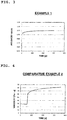
- Fig. 2 is a plot showing the result relating to a change over time of viscosity when the shear strength (shear rate: 1/s) was changed for the bonding material according to Example 1, where the horizontal axis indicates time (s) and the vertical axis indicates viscosity (Pa ⁇ s).
- Fig. 3 is a plot showing the result relating to a change over time of the recovery rate obtained on the basis of Fig. 2 , where the horizontal axis indicates time (s) and the vertical axis indicates the recovery rate.
- 0th second in Fig. 3 corresponds to the timepoint of the 120th second in Fig. 2 .
- Fig. 4 is a plot showing the result relating to a change over time of viscosity when the shear strength (shear rate: 1/s) was changed for the bonding material according to Comparative example 2, where the horizontal axis indicates time (s) and the vertical axis indicates viscosity (Pa ⁇ s).
- Fig. 5 is a plot showing the result relating to a change over time of the recovery rate obtained on the basis of Fig. 4 , where the horizontal axis indicates time (s) and the vertical axis indicates the recovery rate.
- 0th second in Fig. 5 corresponds to the timepoint of the 120th second in Fig. 4 .
- Example 1 ( Fig. 2 ) viscosity recovers very quickly after the shear rate is reduced to 1 (1/s) at once.
- the recovery rate at the measurement starting timepoint is higher than or equal to 0.90.
- the recovery rate of the bonding material as defined above be high: Specifically, the same at the measurement starting timepoint is preferably higher than or equal to 0.80, more preferably higher than or equal to 0.85.
- Example 7 HINOACT KF-1000 (Example 4), MA-WAX-O (Example 5), Tsunodyme 395 (Example 6), and hydrogenated castor oil (Example 7) were used in place of BYK-R606 used in Examples 1 to 3 as the crosslinking-type inter-particle distance keeping agent, the test was conducted accordingly.
- the method for producing the first and second fine silver particles are the same as for Example 1, and also for other matters, the same matters as those in Example 1 are adopted unless specifically noted otherwise.
- Example 3 shows the aforementioned constituents and the contents thereof. The constituents and the contents thereof for the examples described below are also shown in Table 3.
- Example 4 Example 5
- Example 6 Example 7 First fine silver particles 14.61 14.61 14.61 Second fine silver particles 26.97 26.97 26.97 26.97 Silver particles: AG2-1C 51.09 51.09 51.09 51.09
- First solvent 2-ethyl-1,3-hexanediol 1.49 1.49 1.49 1.49 1.49 1.49 Second solvent: dodecanol 0.8 0.8 0.8 0.8
- Third solvent IPTL-B 3.49 3.49 3.49 3.49 3.49 3.49 3.49 3.49 3.49 Dispersing Agent: butoxyethoxy acetic acid 0.5 0.5 0.5 0.5 0.5 0.5
- Other acid-type dispersing agent 1 1 1 1
- Crosslinking-type inter-particle distance keeping agent HINOACT KF-1000 0.05 0 0 0
- Crosslinking-type inter-particle distance keeping agent MA-WAX-O
- a reason for which the dispensing properties of the bonding material are preferable is that viscosity recovers quickly in the bonding material when shear force ceases to be applied. Accordingly, in Examples 4 to 7, the evaluation of dispensing properties is based on how quickly viscosity recovers. Specifically, the method used in the [Verification of Quick Viscosity Recovery in Examples] section above was adopted to carry out the measurements. Figs. 6 to 13 show results for Examples 4 to 7.
- Fig. 6 is a plot showing a result relating to a change over time of viscosity when a shear strength (shear rate: 1/s) was changed for a bonding material according to Example 4 (HINOACT KF-1000), where the horizontal axis indicates time (s) and the vertical axis indicates viscosity (Pa ⁇ s).
- Fig. 7 is a plot showing a result relating to a change over time of a recovery rate obtained on the basis of Fig. 6 , where the horizontal axis indicates time (s) and the vertical axis indicates the recovery rate.
- 0th second in Fig. 7 corresponds to the timepoint of the 120th second in Fig. 6 .
- Results for Example 4 correspond to Figs. 6 and 7
- results for Example 5 correspond to Figs. 8 and 9
- results for Example 6 correspond to Figs. 10 and 11
- results for Example 7 hydrogenated castor oil correspond to Figs. 12 and 13 .
- Example 4 HINOACT KF-1000
- Example 5 MA-WAX-O
- a bonding material having both preferable dispensing properties and preferable bonding properties could be provided in the case of examples 4 to 7.
- the existence of differences between these examples in terms of dispensing properties and the inferiority of these examples compared to examples 1 to 3 in terms of bonding properties are as described above.
- Comparative examples 1 and 2 in which no crosslinking-type inter-particle distance keeping agent was added gave either a result with unfavorable dispensing properties in terms of weight fluctuation in the discharged amount in the dispenser exceeding ⁇ 10% or a result with unfavorable bonding properties in terms of occurrence of cracks or voids.
Landscapes
- Engineering & Computer Science (AREA)
- Chemical & Material Sciences (AREA)
- Nanotechnology (AREA)
- Inorganic Chemistry (AREA)
- Mechanical Engineering (AREA)
- Physics & Mathematics (AREA)
- Dispersion Chemistry (AREA)
- Spectroscopy & Molecular Physics (AREA)
- Composite Materials (AREA)
- Manufacturing & Machinery (AREA)
- Materials Engineering (AREA)
- Powder Metallurgy (AREA)
- Conductive Materials (AREA)
Applications Claiming Priority (3)
| Application Number | Priority Date | Filing Date | Title |
|---|---|---|---|
| JP2016256400 | 2016-12-28 | ||
| JP2017251767A JP2018109232A (ja) | 2016-12-28 | 2017-12-27 | 接合材及びそれを用いた接合方法 |
| PCT/JP2017/047171 WO2018124263A1 (ja) | 2016-12-28 | 2017-12-28 | 接合材及びそれを用いた接合方法 |
Publications (2)
| Publication Number | Publication Date |
|---|---|
| EP3564969A1 true EP3564969A1 (de) | 2019-11-06 |
| EP3564969A4 EP3564969A4 (de) | 2020-05-27 |
Family
ID=62709402
Family Applications (1)
| Application Number | Title | Priority Date | Filing Date |
|---|---|---|---|
| EP17886598.6A Withdrawn EP3564969A4 (de) | 2016-12-28 | 2017-12-28 | Fügematerial und fügeverfahren damit |
Country Status (7)
| Country | Link |
|---|---|
| US (1) | US20200094318A1 (de) |
| EP (1) | EP3564969A4 (de) |
| JP (1) | JP2018109232A (de) |
| KR (1) | KR20190103155A (de) |
| CN (1) | CN110114838A (de) |
| TW (1) | TW201833247A (de) |
| WO (1) | WO2018124263A1 (de) |
Families Citing this family (6)
| Publication number | Priority date | Publication date | Assignee | Title |
|---|---|---|---|---|
| US10910340B1 (en) * | 2019-10-14 | 2021-02-02 | Heraeus Deutschland GmbH & Co. KG | Silver sintering preparation and the use thereof for the connecting of electronic components |
| JP6836090B1 (ja) * | 2020-04-02 | 2021-02-24 | 千住金属工業株式会社 | フラックス組成物、及びそれを用いたはんだペースト |
| JP7574773B2 (ja) * | 2020-12-22 | 2024-10-29 | artience株式会社 | 金属粒子含有組成物、接合用ペースト、接合体及び接合体の製造方法 |
| JP7581841B2 (ja) * | 2020-12-22 | 2024-11-13 | artience株式会社 | 金属粒子含有組成物、接合用ペースト及び接合体 |
| KR20250026767A (ko) | 2022-06-20 | 2025-02-25 | 아티엔스 가부시키가이샤 | 금속 입자 함유 조성물, 접합용 페이스트 및 접합체 |
| TWI912535B (zh) * | 2022-06-21 | 2026-01-21 | 日商愛天思股份有限公司 | 含金屬粒子的組成物、接合用糊和接合體 |
Family Cites Families (18)
| Publication number | Priority date | Publication date | Assignee | Title |
|---|---|---|---|---|
| JPS5824201B2 (ja) | 1978-03-24 | 1983-05-19 | 株式会社神戸製鋼所 | 表面疵自動切削制御方法 |
| JPS5824201A (ja) | 1981-08-06 | 1983-02-14 | Fujitsu Ltd | ヘリカルフイルタ |
| JPS5976684A (ja) | 1982-10-22 | 1984-05-01 | Toshiba Corp | 溶接またはろう付け用電極 |
| JP5686598B2 (ja) * | 2007-09-27 | 2015-03-18 | ビーエーエスエフ ソシエタス・ヨーロピアBasf Se | 分離可能な及び再分散可能な遷移金属ナノ粒子、それらの製造方法、並びにir吸収体としての使用 |
| JP5398132B2 (ja) * | 2007-09-28 | 2014-01-29 | 豊田バンモップス株式会社 | 研削砥石 |
| US8361350B2 (en) * | 2008-12-10 | 2013-01-29 | Xerox Corporation | Silver nanoparticle ink composition |
| US8858700B2 (en) * | 2009-07-14 | 2014-10-14 | Dowa Electronics Materials Co., Ltd. | Bonding material using metal nanoparticles coated with C6-C8 fatty acids, and bonding method |
| US9137902B2 (en) * | 2009-08-14 | 2015-09-15 | Xerox Corporation | Process to form highly conductive feature from silver nanoparticles with reduced processing temperature |
| US8524525B2 (en) * | 2010-01-25 | 2013-09-03 | The Board Of Trustees Of The Leland Stanford Junior University | Joined nanostructures and methods therefor |
| JP4928639B2 (ja) * | 2010-03-15 | 2012-05-09 | Dowaエレクトロニクス株式会社 | 接合材およびそれを用いた接合方法 |
| KR102188054B1 (ko) * | 2010-11-22 | 2020-12-07 | 도와 일렉트로닉스 가부시키가이샤 | 접합재료, 접합체, 및 접합방법 |
| KR101725181B1 (ko) * | 2011-06-10 | 2017-04-10 | 도와 일렉트로닉스 가부시키가이샤 | 접합재 및 이것을 이용하여 작성된 접합체 |
| JP5976684B2 (ja) | 2012-01-20 | 2016-08-24 | Dowaエレクトロニクス株式会社 | 接合材およびそれを用いた接合方法 |
| JP5934561B2 (ja) * | 2012-04-06 | 2016-06-15 | 株式会社アルバック | 導電性金属ペースト |
| JP2013151753A (ja) * | 2013-03-04 | 2013-08-08 | Dowa Electronics Materials Co Ltd | 極性媒体との親和性に優れた銀微粉および銀インク |
| JP6099472B2 (ja) * | 2013-04-26 | 2017-03-22 | Dowaエレクトロニクス株式会社 | 金属ナノ粒子分散体、金属ナノ粒子分散体の製造方法および接合方法 |
| EP3128540B1 (de) * | 2014-04-04 | 2019-06-12 | KYOCERA Corporation | Wärmehärtende harzzusammensetzung, halbleiterbauelement und elektrische/elektronische komponente |
| JP5992961B2 (ja) * | 2014-06-25 | 2016-09-14 | Dowaエレクトロニクス株式会社 | 接合材およびそれを用いた接合方法 |
-
2017
- 2017-12-27 JP JP2017251767A patent/JP2018109232A/ja active Pending
- 2017-12-28 WO PCT/JP2017/047171 patent/WO2018124263A1/ja not_active Ceased
- 2017-12-28 EP EP17886598.6A patent/EP3564969A4/de not_active Withdrawn
- 2017-12-28 TW TW106146247A patent/TW201833247A/zh unknown
- 2017-12-28 CN CN201780079148.0A patent/CN110114838A/zh active Pending
- 2017-12-28 KR KR1020197017210A patent/KR20190103155A/ko not_active Abandoned
- 2017-12-28 US US16/473,072 patent/US20200094318A1/en not_active Abandoned
Also Published As
| Publication number | Publication date |
|---|---|
| TW201833247A (zh) | 2018-09-16 |
| WO2018124263A1 (ja) | 2018-07-05 |
| EP3564969A4 (de) | 2020-05-27 |
| KR20190103155A (ko) | 2019-09-04 |
| US20200094318A1 (en) | 2020-03-26 |
| JP2018109232A (ja) | 2018-07-12 |
| CN110114838A (zh) | 2019-08-09 |
Similar Documents
| Publication | Publication Date | Title |
|---|---|---|
| EP3564969A1 (de) | Fügematerial und fügeverfahren damit | |
| EP3505272B1 (de) | Bindematerial und binderverfahren damit | |
| EP3590633A1 (de) | Verbindungsmaterial und verklebter körper damit | |
| TW201502108A (zh) | 具有難以燒結之貴金屬或非貴金屬表面上之經塗覆氧化銀的燒結糊狀物 | |
| JP7635712B2 (ja) | 銀粒子 | |
| US12539566B2 (en) | Sintering paste and use thereof for connecting components | |
| CN109074897B (zh) | 接合材料及使用该接合材料的接合方法 | |
| US10821558B2 (en) | Bonding material and bonding method using same | |
| US20230311249A1 (en) | Metal paste for bonding and bonding method | |
| KR20200062181A (ko) | 은 미립자 분산액 | |
| KR102354209B1 (ko) | 접합재 및 그것을 사용한 접합 방법 | |
| JP2017186656A (ja) | 銅微粒子集合体の分散溶液、焼結導電体の製造方法、及び焼結導電接合部材の製造方法 | |
| EP3189914B1 (de) | Bindematerial und binderverfahren damit | |
| CN113646386B (zh) | 多孔质碳及树脂组合物 | |
| WO2017188206A1 (ja) | 接合材およびそれを用いた接合方法 | |
| CN115812089A (zh) | 导电性油墨 | |
| WO2018221594A1 (ja) | 接合材、接合体および接合方法 | |
| JP2024038285A (ja) | 銀粒子の焼結体 | |
| JP2026052661A (ja) | 銅ペースト及び銅粒子並びにそれらを用いた接合用部材 | |
| JP2022049054A (ja) | 導電体作製方法、金属ペースト及び導電体 | |
| EP4541486A1 (de) | Metallpartikelhaltige zusammensetzung, paste zum verbinden und verbundener körper |
Legal Events
| Date | Code | Title | Description |
|---|---|---|---|
| STAA | Information on the status of an ep patent application or granted ep patent |
Free format text: STATUS: THE INTERNATIONAL PUBLICATION HAS BEEN MADE |
|
| PUAI | Public reference made under article 153(3) epc to a published international application that has entered the european phase |
Free format text: ORIGINAL CODE: 0009012 |
|
| STAA | Information on the status of an ep patent application or granted ep patent |
Free format text: STATUS: REQUEST FOR EXAMINATION WAS MADE |
|
| 17P | Request for examination filed |
Effective date: 20190725 |
|
| AK | Designated contracting states |
Kind code of ref document: A1 Designated state(s): AL AT BE BG CH CY CZ DE DK EE ES FI FR GB GR HR HU IE IS IT LI LT LU LV MC MK MT NL NO PL PT RO RS SE SI SK SM TR |
|
| AX | Request for extension of the european patent |
Extension state: BA ME |
|
| DAV | Request for validation of the european patent (deleted) | ||
| DAX | Request for extension of the european patent (deleted) | ||
| A4 | Supplementary search report drawn up and despatched |
Effective date: 20200429 |
|
| RIC1 | Information provided on ipc code assigned before grant |
Ipc: H05K 3/34 20060101ALI20200422BHEP Ipc: B23K 35/365 20060101ALI20200422BHEP Ipc: B22F 1/00 20060101ALI20200422BHEP Ipc: B23K 35/26 20060101ALI20200422BHEP Ipc: H01B 1/22 20060101AFI20200422BHEP Ipc: B22F 9/24 20060101ALN20200422BHEP Ipc: H01B 1/00 20060101ALI20200422BHEP |
|
| STAA | Information on the status of an ep patent application or granted ep patent |
Free format text: STATUS: EXAMINATION IS IN PROGRESS |
|
| 17Q | First examination report despatched |
Effective date: 20210315 |
|
| STAA | Information on the status of an ep patent application or granted ep patent |
Free format text: STATUS: THE APPLICATION HAS BEEN WITHDRAWN |
|
| 18W | Application withdrawn |
Effective date: 20210908 |