EP3565875B1 - Entwachsungs- und entaromatisierungsverfahren von kohlenwasserstoff in einem schlammreaktor - Google Patents
Entwachsungs- und entaromatisierungsverfahren von kohlenwasserstoff in einem schlammreaktor Download PDFInfo
- Publication number
- EP3565875B1 EP3565875B1 EP17822349.1A EP17822349A EP3565875B1 EP 3565875 B1 EP3565875 B1 EP 3565875B1 EP 17822349 A EP17822349 A EP 17822349A EP 3565875 B1 EP3565875 B1 EP 3565875B1
- Authority
- EP
- European Patent Office
- Prior art keywords
- process according
- hydrocarbon
- weight
- group
- fluids
- Prior art date
- Legal status (The legal status is an assumption and is not a legal conclusion. Google has not performed a legal analysis and makes no representation as to the accuracy of the status listed.)
- Active
Links
Images
Classifications
-
- C—CHEMISTRY; METALLURGY
- C10—PETROLEUM, GAS OR COKE INDUSTRIES; TECHNICAL GASES CONTAINING CARBON MONOXIDE; FUELS; LUBRICANTS; PEAT
- C10G—CRACKING HYDROCARBON OILS; PRODUCTION OF LIQUID HYDROCARBON MIXTURES, e.g. BY DESTRUCTIVE HYDROGENATION, OLIGOMERISATION, POLYMERISATION; RECOVERY OF HYDROCARBON OILS FROM OIL-SHALE, OIL-SAND, OR GASES; REFINING MIXTURES MAINLY CONSISTING OF HYDROCARBONS; REFORMING OF NAPHTHA; MINERAL WAXES
- C10G45/00—Refining of hydrocarbon oils using hydrogen or hydrogen-generating compounds
- C10G45/58—Refining of hydrocarbon oils using hydrogen or hydrogen-generating compounds to change the structural skeleton of some of the hydrocarbon content without cracking the other hydrocarbons present, e.g. lowering pour point; Selective hydrocracking of normal paraffins
- C10G45/60—Refining of hydrocarbon oils using hydrogen or hydrogen-generating compounds to change the structural skeleton of some of the hydrocarbon content without cracking the other hydrocarbons present, e.g. lowering pour point; Selective hydrocracking of normal paraffins characterised by the catalyst used
- C10G45/64—Refining of hydrocarbon oils using hydrogen or hydrogen-generating compounds to change the structural skeleton of some of the hydrocarbon content without cracking the other hydrocarbons present, e.g. lowering pour point; Selective hydrocracking of normal paraffins characterised by the catalyst used containing crystalline alumino-silicates, e.g. molecular sieves
-
- B—PERFORMING OPERATIONS; TRANSPORTING
- B01—PHYSICAL OR CHEMICAL PROCESSES OR APPARATUS IN GENERAL
- B01J—CHEMICAL OR PHYSICAL PROCESSES, e.g. CATALYSIS OR COLLOID CHEMISTRY; THEIR RELEVANT APPARATUS
- B01J19/00—Chemical, physical or physico-chemical processes in general; Their relevant apparatus
- B01J19/18—Stationary reactors having moving elements inside
-
- B—PERFORMING OPERATIONS; TRANSPORTING
- B01—PHYSICAL OR CHEMICAL PROCESSES OR APPARATUS IN GENERAL
- B01J—CHEMICAL OR PHYSICAL PROCESSES, e.g. CATALYSIS OR COLLOID CHEMISTRY; THEIR RELEVANT APPARATUS
- B01J8/00—Chemical or physical processes in general, conducted in the presence of fluids and solid particles; Apparatus for such processes
- B01J8/08—Chemical or physical processes in general, conducted in the presence of fluids and solid particles; Apparatus for such processes with moving particles
- B01J8/085—Feeding reactive fluids
-
- B—PERFORMING OPERATIONS; TRANSPORTING
- B01—PHYSICAL OR CHEMICAL PROCESSES OR APPARATUS IN GENERAL
- B01J—CHEMICAL OR PHYSICAL PROCESSES, e.g. CATALYSIS OR COLLOID CHEMISTRY; THEIR RELEVANT APPARATUS
- B01J8/00—Chemical or physical processes in general, conducted in the presence of fluids and solid particles; Apparatus for such processes
- B01J8/08—Chemical or physical processes in general, conducted in the presence of fluids and solid particles; Apparatus for such processes with moving particles
- B01J8/087—Heating or cooling the reactor
-
- B—PERFORMING OPERATIONS; TRANSPORTING
- B01—PHYSICAL OR CHEMICAL PROCESSES OR APPARATUS IN GENERAL
- B01J—CHEMICAL OR PHYSICAL PROCESSES, e.g. CATALYSIS OR COLLOID CHEMISTRY; THEIR RELEVANT APPARATUS
- B01J8/00—Chemical or physical processes in general, conducted in the presence of fluids and solid particles; Apparatus for such processes
- B01J8/08—Chemical or physical processes in general, conducted in the presence of fluids and solid particles; Apparatus for such processes with moving particles
- B01J8/10—Chemical or physical processes in general, conducted in the presence of fluids and solid particles; Apparatus for such processes with moving particles moved by stirrers or by rotary drums or rotary receptacles or endless belts
-
- B—PERFORMING OPERATIONS; TRANSPORTING
- B01—PHYSICAL OR CHEMICAL PROCESSES OR APPARATUS IN GENERAL
- B01J—CHEMICAL OR PHYSICAL PROCESSES, e.g. CATALYSIS OR COLLOID CHEMISTRY; THEIR RELEVANT APPARATUS
- B01J8/00—Chemical or physical processes in general, conducted in the presence of fluids and solid particles; Apparatus for such processes
- B01J8/18—Chemical or physical processes in general, conducted in the presence of fluids and solid particles; Apparatus for such processes with fluidised particles
- B01J8/20—Chemical or physical processes in general, conducted in the presence of fluids and solid particles; Apparatus for such processes with fluidised particles with liquid as a fluidising medium
- B01J8/22—Chemical or physical processes in general, conducted in the presence of fluids and solid particles; Apparatus for such processes with fluidised particles with liquid as a fluidising medium gas being introduced into the liquid
-
- B—PERFORMING OPERATIONS; TRANSPORTING
- B01—PHYSICAL OR CHEMICAL PROCESSES OR APPARATUS IN GENERAL
- B01J—CHEMICAL OR PHYSICAL PROCESSES, e.g. CATALYSIS OR COLLOID CHEMISTRY; THEIR RELEVANT APPARATUS
- B01J8/00—Chemical or physical processes in general, conducted in the presence of fluids and solid particles; Apparatus for such processes
- B01J8/18—Chemical or physical processes in general, conducted in the presence of fluids and solid particles; Apparatus for such processes with fluidised particles
- B01J8/20—Chemical or physical processes in general, conducted in the presence of fluids and solid particles; Apparatus for such processes with fluidised particles with liquid as a fluidising medium
- B01J8/22—Chemical or physical processes in general, conducted in the presence of fluids and solid particles; Apparatus for such processes with fluidised particles with liquid as a fluidising medium gas being introduced into the liquid
- B01J8/222—Chemical or physical processes in general, conducted in the presence of fluids and solid particles; Apparatus for such processes with fluidised particles with liquid as a fluidising medium gas being introduced into the liquid in the presence of a rotating device only
-
- C—CHEMISTRY; METALLURGY
- C10—PETROLEUM, GAS OR COKE INDUSTRIES; TECHNICAL GASES CONTAINING CARBON MONOXIDE; FUELS; LUBRICANTS; PEAT
- C10G—CRACKING HYDROCARBON OILS; PRODUCTION OF LIQUID HYDROCARBON MIXTURES, e.g. BY DESTRUCTIVE HYDROGENATION, OLIGOMERISATION, POLYMERISATION; RECOVERY OF HYDROCARBON OILS FROM OIL-SHALE, OIL-SAND, OR GASES; REFINING MIXTURES MAINLY CONSISTING OF HYDROCARBONS; REFORMING OF NAPHTHA; MINERAL WAXES
- C10G45/00—Refining of hydrocarbon oils using hydrogen or hydrogen-generating compounds
- C10G45/44—Hydrogenation of the aromatic hydrocarbons
- C10G45/46—Hydrogenation of the aromatic hydrocarbons characterised by the catalyst used
-
- C—CHEMISTRY; METALLURGY
- C10—PETROLEUM, GAS OR COKE INDUSTRIES; TECHNICAL GASES CONTAINING CARBON MONOXIDE; FUELS; LUBRICANTS; PEAT
- C10G—CRACKING HYDROCARBON OILS; PRODUCTION OF LIQUID HYDROCARBON MIXTURES, e.g. BY DESTRUCTIVE HYDROGENATION, OLIGOMERISATION, POLYMERISATION; RECOVERY OF HYDROCARBON OILS FROM OIL-SHALE, OIL-SAND, OR GASES; REFINING MIXTURES MAINLY CONSISTING OF HYDROCARBONS; REFORMING OF NAPHTHA; MINERAL WAXES
- C10G45/00—Refining of hydrocarbon oils using hydrogen or hydrogen-generating compounds
- C10G45/44—Hydrogenation of the aromatic hydrocarbons
- C10G45/46—Hydrogenation of the aromatic hydrocarbons characterised by the catalyst used
- C10G45/48—Hydrogenation of the aromatic hydrocarbons characterised by the catalyst used containing nickel or cobalt metal, or compounds thereof
-
- C—CHEMISTRY; METALLURGY
- C10—PETROLEUM, GAS OR COKE INDUSTRIES; TECHNICAL GASES CONTAINING CARBON MONOXIDE; FUELS; LUBRICANTS; PEAT
- C10G—CRACKING HYDROCARBON OILS; PRODUCTION OF LIQUID HYDROCARBON MIXTURES, e.g. BY DESTRUCTIVE HYDROGENATION, OLIGOMERISATION, POLYMERISATION; RECOVERY OF HYDROCARBON OILS FROM OIL-SHALE, OIL-SAND, OR GASES; REFINING MIXTURES MAINLY CONSISTING OF HYDROCARBONS; REFORMING OF NAPHTHA; MINERAL WAXES
- C10G45/00—Refining of hydrocarbon oils using hydrogen or hydrogen-generating compounds
- C10G45/58—Refining of hydrocarbon oils using hydrogen or hydrogen-generating compounds to change the structural skeleton of some of the hydrocarbon content without cracking the other hydrocarbons present, e.g. lowering pour point; Selective hydrocracking of normal paraffins
- C10G45/60—Refining of hydrocarbon oils using hydrogen or hydrogen-generating compounds to change the structural skeleton of some of the hydrocarbon content without cracking the other hydrocarbons present, e.g. lowering pour point; Selective hydrocracking of normal paraffins characterised by the catalyst used
-
- B—PERFORMING OPERATIONS; TRANSPORTING
- B01—PHYSICAL OR CHEMICAL PROCESSES OR APPARATUS IN GENERAL
- B01J—CHEMICAL OR PHYSICAL PROCESSES, e.g. CATALYSIS OR COLLOID CHEMISTRY; THEIR RELEVANT APPARATUS
- B01J2208/00—Processes carried out in the presence of solid particles; Reactors therefor
- B01J2208/00008—Controlling the process
- B01J2208/00017—Controlling the temperature
- B01J2208/00106—Controlling the temperature by indirect heat exchange
- B01J2208/00115—Controlling the temperature by indirect heat exchange with heat exchange elements inside the bed of solid particles
- B01J2208/00141—Coils
-
- B—PERFORMING OPERATIONS; TRANSPORTING
- B01—PHYSICAL OR CHEMICAL PROCESSES OR APPARATUS IN GENERAL
- B01J—CHEMICAL OR PHYSICAL PROCESSES, e.g. CATALYSIS OR COLLOID CHEMISTRY; THEIR RELEVANT APPARATUS
- B01J2208/00—Processes carried out in the presence of solid particles; Reactors therefor
- B01J2208/00796—Details of the reactor or of the particulate material
- B01J2208/00823—Mixing elements
- B01J2208/00858—Moving elements
- B01J2208/00867—Moving elements inside the bed, e.g. rotary mixer
-
- B—PERFORMING OPERATIONS; TRANSPORTING
- B01—PHYSICAL OR CHEMICAL PROCESSES OR APPARATUS IN GENERAL
- B01J—CHEMICAL OR PHYSICAL PROCESSES, e.g. CATALYSIS OR COLLOID CHEMISTRY; THEIR RELEVANT APPARATUS
- B01J2219/00—Chemical, physical or physico-chemical processes in general; Their relevant apparatus
- B01J2219/00049—Controlling or regulating processes
- B01J2219/00051—Controlling the temperature
- B01J2219/00074—Controlling the temperature by indirect heating or cooling employing heat exchange fluids
- B01J2219/00076—Controlling the temperature by indirect heating or cooling employing heat exchange fluids with heat exchange elements inside the reactor
- B01J2219/00083—Coils
-
- C—CHEMISTRY; METALLURGY
- C10—PETROLEUM, GAS OR COKE INDUSTRIES; TECHNICAL GASES CONTAINING CARBON MONOXIDE; FUELS; LUBRICANTS; PEAT
- C10G—CRACKING HYDROCARBON OILS; PRODUCTION OF LIQUID HYDROCARBON MIXTURES, e.g. BY DESTRUCTIVE HYDROGENATION, OLIGOMERISATION, POLYMERISATION; RECOVERY OF HYDROCARBON OILS FROM OIL-SHALE, OIL-SAND, OR GASES; REFINING MIXTURES MAINLY CONSISTING OF HYDROCARBONS; REFORMING OF NAPHTHA; MINERAL WAXES
- C10G2300/00—Aspects relating to hydrocarbon processing covered by groups C10G1/00 - C10G99/00
- C10G2300/10—Feedstock materials
- C10G2300/1037—Hydrocarbon fractions
- C10G2300/1048—Middle distillates
- C10G2300/1059—Gasoil having a boiling range of about 330 - 427 °C
-
- C—CHEMISTRY; METALLURGY
- C10—PETROLEUM, GAS OR COKE INDUSTRIES; TECHNICAL GASES CONTAINING CARBON MONOXIDE; FUELS; LUBRICANTS; PEAT
- C10G—CRACKING HYDROCARBON OILS; PRODUCTION OF LIQUID HYDROCARBON MIXTURES, e.g. BY DESTRUCTIVE HYDROGENATION, OLIGOMERISATION, POLYMERISATION; RECOVERY OF HYDROCARBON OILS FROM OIL-SHALE, OIL-SAND, OR GASES; REFINING MIXTURES MAINLY CONSISTING OF HYDROCARBONS; REFORMING OF NAPHTHA; MINERAL WAXES
- C10G2300/00—Aspects relating to hydrocarbon processing covered by groups C10G1/00 - C10G99/00
- C10G2300/20—Characteristics of the feedstock or the products
- C10G2300/30—Physical properties of feedstocks or products
- C10G2300/301—Boiling range
-
- C—CHEMISTRY; METALLURGY
- C10—PETROLEUM, GAS OR COKE INDUSTRIES; TECHNICAL GASES CONTAINING CARBON MONOXIDE; FUELS; LUBRICANTS; PEAT
- C10G—CRACKING HYDROCARBON OILS; PRODUCTION OF LIQUID HYDROCARBON MIXTURES, e.g. BY DESTRUCTIVE HYDROGENATION, OLIGOMERISATION, POLYMERISATION; RECOVERY OF HYDROCARBON OILS FROM OIL-SHALE, OIL-SAND, OR GASES; REFINING MIXTURES MAINLY CONSISTING OF HYDROCARBONS; REFORMING OF NAPHTHA; MINERAL WAXES
- C10G2300/00—Aspects relating to hydrocarbon processing covered by groups C10G1/00 - C10G99/00
- C10G2300/20—Characteristics of the feedstock or the products
- C10G2300/30—Physical properties of feedstocks or products
- C10G2300/304—Pour point, cloud point, cold flow properties
Definitions
- the invention relates to a hydrotreating process for the production of hydrocarbon fluids with low aromatics content and which exhibit a low pour point.
- Hydrocarbon fluids find widespread use as solvents such as in adhesives, cleaning fluids, explosives solvents, for decorative coatings and printing inks, light oils for use in applications such as metal extraction, metalworking or demoulding and industrial lubricants, and drilling fluids.
- the hydrocarbon fluids can also be used as extender oils in adhesives and sealant systems such as silicone sealants and as viscosity depressants in plasticised polyvinyl chloride formulations and as carrier in polymer formulation used as flocculants for example in water treatment, mining operations or paper manufacturing and also used as thickener for printing pastes.
- Hydrocarbon fluids may also be used as solvents in a wide variety of other applications such as chemical reactions.
- hydrocarbon fluids vary considerably according to the use to which the fluid is to be put.
- Important properties of hydrocarbon fluids are the distillation range generally determined by ASTM D-86 or the ASTM D-1160 vacuum distillation technique used for heavier materials, flash point, density, aniline point as determined by ASTM D-611, pour point as determined by ASTM D-5950, aromatic content, sulphur content, viscosity, colour and refractive index.
- fluids with low pour point exhibit improved cold flow properties compared to fluids having a higher pour point.
- Drilling fluids would typically require low pour point. Due to environmental requirements and safety reasons the aromatics content of hydrocarbon fluids has to be kept at low level and aromatics compounds have to be hydrogenated in order to obtain high purity products. This is why there is a need to provide hydrocarbon fluids with low pour points and low aromatics content.
- Document US 2009/159489 discloses a process of upgrading a highly aromatic hydrocarbon feedstream.
- Document WO 2015/027043 discloses a process for hydrogenating a Fischer-Tropsch wax.
- Document US 4648957 discloses a process for hydrodewaxing hydrocarbon feedstock.
- Processes for the production of fluids with low pour points and low aromatics content are known in the art. Usually, these processes comprise a dewaxing step and a dearomatization step performed separately in fixed bed reactors.
- WO 2011/143396 discloses a method for producing a diesel fuel.
- the process comprises a step of catalytic dewaxing followed by a catalytic dearomatization.
- the dewaxed effluent from the dewaxing step is quenched before being treated by an aromatic saturation catalyst.
- the reaction system includes at least one dewaxing stage and one aromatic saturation stage each one including one or more catalytic bed(s). The dewaxing bed and the aromatic saturation bed are separated one from the other.
- WO 2014/090757 discloses a process for the production of hydrocarbon solvents with low aromatics and sulphur contents and which exhibit a pour point of -25°C or less.
- the process comprises the steps of dewaxing a hydrocarbon fraction followed by hydrodearomatization of all or a part of the dewaxed effluent.
- the catalytic beds are distributed into one dewaxing section and one dearomatization section. These two sections are separated and comprise fixed beds.
- US 6 340 430 discloses a hydrotreating process intended to simultaneously improve the cold flow properties of diesel fuel and to reduce the aromatic hydrocarbon content of jet fuel and diesel of a single broad boiling point range.
- the catalysts can preferably be in a fixed bed, but can also be slurried.
- the dewaxing process is known to be exothermic.
- another aim of the present invention is to prevent the run-away of the reaction by controlling the exothermicity of the process.
- the invention provides a process for the production of a hydrocarbon fluid comprising the step of catalytically hydrogenating a hydrocarbon cut in presence of both a dearomatization catalyst and a dewaxing catalyst in a single slurry reactor, disclosed appended claims.
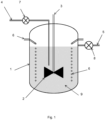
- Fig. 1 shows a schematic drawing of one configuration of a reactor that can be used in the process of the invention.
- the invention relates to a process for the production of a hydrocarbon fluid with a low aromatic content and a low pour point, e.g. below -40°C comprising the step of catalytically hydrogenating a hydrocarbon cut in presence of both a dearomatization catalyst and a dewaxing catalyst in a single batch or continuous slurry reactor under conditions effective to proceed with dearomatization and dewaxing.
- a Gas to liquids (GTL) process is a refinery process that converts natural gas or other gaseous hydrocarbons into longer-chain hydrocarbons such as gasoline or diesel fuel. Methane-rich gases are converted into liquid synthetic fuels either via direct conversion or via syngas as an intermediate, for example using the Fischer Tropsch process, Methanol to Gasoline process (MTG) or Syngas to gasoline plus process (STG+). For the Fischer Tropsch process, the effluents produced are Fischer-Tropsch derived.
- Fischer-Tropsch derived is meant that a hydrocarbon composition is, or derives from, a synthesis product of a Fischer-Tropsch condensation process.
- the carbon monoxide and hydrogen may themselves be derived from organic or inorganic, natural or synthetic sources, typically either from natural gas or from organically derived methane. For example, it can also be derived from biomass or from coal.
- the collected hydrocarbon composition containing a continuous iso-paraffinic series as described above may preferably be obtained by hydroisomerisation of a paraffinic wax, preferably followed by dewaxing, such as solvent or catalytic dewaxing.
- the paraffinic wax is preferably a Fischer-Tropsch derived wax.
- Hydrocarbon cuts may be obtained directly from the Fischer-Tropsch reaction, or indirectly for instance by fractionation of Fischer-Tropsch synthesis products or preferably from hydrotreated Fischer-Tropsch synthesis products.
- Hydrotreatment preferably involves hydrocracking to adjust the boiling range (see, e.g., GB-B-2077289 and EP-A-0147873 ) and/or hydroisomerisation, which can improve cold flow properties by increasing the proportion of branched paraffins.
- EP-A-0583836 describes a two-step hydrotreatment process in which a Fischer-Tropsch synthesis product is firstly subjected to hydroconversion under conditions such that it undergoes substantially no isomerisation or hydrocracking (this hydrogenates the olefinic and oxygen-containing components), and then at least part of the resultant product is hydroconverted under conditions such that hydrocracking and isomerisation occur to yield a substantially paraffinic hydrocarbon fuel.
- the desired gas oil fraction(s) may subsequently be isolated for instance by distillation.
- Fischer-Tropsch condensation products such as polymerization, alkylation, distillation, cracking-decarboxylation, isomerisation and hydroreforming
- Fischer-Tropsch processes which for example can be used to prepare the above-described Fischer-Tropsch derived collected hydrocarbon composition are the so-called commercial Slurry Phase Distillate technology of Sasol, the Shell Middle Distillate Synthesis Process and the "AGC-21" Exxon Mobil process.
- the gas to liquid feedstock shall contain less than 1 ppm sulphur as measured according to ASTM method D5453, less than 1 wt. % aromatics as measured according to method IP391, and have a density lower or equal to 0.800 g/cm 3 as measured according to method ASTMD4052.
- the hydrocarbon fluid from biological origin is then produced by using for instance a process first comprising a hydrodeoxygenation (HDO) step for decomposing the structure of the biological ester or triglyceride constituent, and for removing oxygen, phosphorus and sulphur compounds, concurrently hydrogenating the olefinic bonds, followed by isomerization of the product thus obtained, thus branching the hydrocarbon chain and improving the low temperature properties of the paraffin.
- HDO hydrodeoxygenation
- the product may for instance be fractionated to give the desired fractions.
- Gas Condensates is a product derived from natural gas. It corresponds to a mixture of liquid hydrocarbons with more than four carbon atoms per molecule. Under natural conditions, a gas condensate is a solution of heavier hydrocarbons. The gas condensate separated from natural gas at reduced pressure and/or temperature by reverse condensation is a colourless or slightly coloured liquid of density 700-800 kg/m 3 , which starts boiling at 30-70°C. The composition of a gas condensate corresponds approximately to the gasoline or kerosene fraction of crude oil or to a mixture of them.
- Hydrocarbon cuts can be typical refinery feeds of any type including feedstock from distillate hydrocracker unit, but also feedstock having high aromatic contents like standard ultra-low sulphur Diesel feedstock, heavy Diesel or jet type.
- heavy fractions such as cuts from heavy hydrocarbon fractions derived from the unit for catalytic cracking of vacuum distillates (FCC-Fluid Catalytic Cracking), such as fractions of Light Cycle Oils (LCO) or petroleum residues (slurry) or hydrocracked gas oils or hydrocracked vacuum gas oils.
- LCO Light Cycle Oils
- slurry petroleum residues
- hydrocracked gas oils hydrocracked vacuum gas oils.
- the feed constituted by a gas oil fraction obtained by any refining process in particular refers to a fraction selected from among the atmospheric distillation gas oils, vacuum distillation gas oils, hydrocracked gas oils, gas oils from catalytic cracking, gas oils from visbreaking, coking gas oils, gas oils derived from gas deposit, deasphalted gas oils, gas oils derived from the hydrotreating of heavy fractions (Atmospheric Residue and vacuum distillation gas oil or VGO), gas oils with a sulphur content greater than 15 ppm being desulphurised by hydrotreating and/or hydrocracking prior to treatment according to the method of the invention. It would not be going beyond the scope of the invention if this feed were to be derived from several gas oil fractions referenced in the list here above.
- Heavy gasoil is especially defined with respect to its boiling range, and refers to gasoil having a final boiling point above 300°C, especially above 340°C, and especially more than 360°C.
- the initial boiling point is not especially relevant and can be below or above 240°C for example, and typically above 280°C.
- the standard ultra-low sulphur Diesel contains less than 10 ppm sulphur as measured according to EN ISO 20846, has a density comprised between 0.820 and 0.845 g/cm 3 as measured according to method EN ISO 12185, and generally answers the specifications of EuroV Diesel as defined in European Directive 2009/30/EC. It is generally obtained by a severe hydrodesulphuration of straight run gasoil cuts from atmospheric distillation.
- Typical refinery feeds can also be hydrocracked to obtain shorter and simple molecules by the addition of hydrogen under high pressure in the presence of a catalyst.
- Descriptions of hydrocracking processes may be found in Hydrocarbon Processing of November 1996 pages 124 to 128 , hydrocracking science and technology, 1996 , US4347124 , US4447315 , WO-A-99/47626
- Any cut and feed can be blended; for example the optionally hydrocracked feed may be blended with the hydrocarbon cut originating from of a gas-to-liquid process and/or gas condensates and/or hydrodeoxygenated hydrocarbon cuts from the biomass in a proportion of 5 to 95 wt. % of each respective component.
- the sulphur content of the feed is below 15ppm, preferably below 10ppm.
- Hydrodesulphuration is a known treatment.
- Fractionating is also possible after the process of the invention has been carried out, especially for fractionating out the light fractions that may be formed during dewaxing.
- the hydrodewaxing/hydrodearomatization process takes place in a single slurry reactor.
- Slurry reactors are well known in the art.
- single reactor it is meant that all the reactants are introduced in only one reactor and are able to react all in the same reactor.
- Slurry reactors usually contain a catalyst (solid) suspended in a liquid, through which a gas (hydrogen) is bubbled. It operates a three-phase reaction. They can operate in either batch or continuous mode. Preferentially the process according to the invention is performed in a slurry reactor operating in a batch mode. A preferred reactor is thus the well known CSTR (Continuous Stirred Tank Reactor).
- CSTR Continuous Stirred Tank Reactor
- the catalyst may be in the form of granules, pellets or any type of supported catalyst or unsupported catalyst. Inside the reactor the catalyst is slurried in a liquid. Gas reactant, here hydrogen, is bubbled into the reactor. The gas is then absorbed into the liquid from the bubbles' surface.
- Gas reactant here hydrogen
- FIG. 1 shows an example of tank 1 according to the invention filled with a reactive medium 9.
- the tank 1 comprises a stirring device 2, a gas inlet 3, an inlet feed line 4, an outlet feed line 5 and a thermal device 6.
- the gas inlet is a hollow tube designed to provide hydrogen in the neighbourhood of the stirring baffles of the stirring device 2.
- an inlet flow valve 7 and an outlet flow valve 8 have been represented.
- the feed such as diesel is introduced into the tank 1 through the inlet feed line 4 and the product is extracted out through the outlet feed line 5.
- the thermal device 6 is cooling coils which can be regulated by thermocouples, not represented in Fig. 1 , and allows maintaining the reactive medium temperature within the prescribed range.
- the invention also relates to the process as carried out in a continuous stirred-tank reactor which comprises:
- the agitation will preferably be mechanic, magnetic agitation being for small scale reactors (with typically higher rotation speed values than for large scale reactor with mechanic agitation).
- the reactor may be provided with a turbine and a rotating arm equipped with baffles.
- the stirring device may be a rotating arm comprising a hollow tube, at least one hole and stirring baffles or blades.
- the rotation speed of the rotating arm can range from 100 to 1000 rpm.
- the at least one hole of the rotating arm is at the neighbourhood of the stirring baffles and the inlet feed line of the reactor is located at the neighbourhood of the hole.
- the neighbourhood of the stirring baffles can notably mean a zone wherein the action of baffles is visible in the medium, i.e. the baffles modify the flow of the medium.
- the expression "at the neighbourhood” preferably means at a distance of less than 15 cm, more preferably of less than 10 cm.
- the hole or holes of the rotating arm is or are located at a distance of less than 15 cm, preferably less than 10 cm of the stirring baffles and the inlet feed line of the reactor is located at a distance of less than 15 cm, preferably of less than 10 cm of the hole or holes of the rotating arm.
- the thermal device for measuring and controlling the temperature within the reactive medium so as to maintain the reactive medium temperature within the prescribed range comprises devices for removing heat and devices for measuring the temperature.
- the device for removing the heat can be chosen from double jacket, internal heat exchanger, cooling coils, external heat exchanger.
- the device for measuring the temperature can be a plurality of thermocouples.
- slurry reactor has many advantages such as good temperature control, good heat recovery, constant overall catalytic activity maintained easily by addition of a small amount of catalyst, especially useful for catalysts that cannot be pelletized.
- the large heat capacity of reactor acts as a safety feature against explosions.
- the hydrogenation conditions for the dewaxing and dearomatization are typically the following:
- dewaxing and “hydrodewaxing” are used interchangeably and designate a process of removing and/or isomerising paraffin waxes.
- Hydrodewaxing takes place using a catalyst.
- Typical hydrodewaxing catalysts include but are not limited to silicalite catalysts having a silica/alumina ratio greater than 130, preferably higher than 150.
- Other catalysts include silicalites, zeolites such as ZSM-5 that may support transition metals or a zeolite ZSM48 that may support platinum/palladium type metals.
- Non-zeolitic molecular sieve (NZMS) material essentially free of Y zeolite, can be used.
- Mesoporous catalysts can be used.
- the hydrodewaxing catalyst can also be silicalite, aluminosilicate (Al-oxide Si-dioxide), MFI zeolites and silicoaluminophosphates (SAPOs), with or without metal components as recited below.
- a preferred catalyst is aluminosilicate (Al-oxide Si-dioxide).
- the main catalytic activity is determined by the pores of the dewaxing catalyst.
- a metal may be present, in low amounts.
- the catalyst comprises 0 to 10% by weight of at least one metal from group VIII and optionally 0 to 20% by weight of a group VI metal, such as a hydrogenation metal or metal couple selected from cobalt/molybdenum, nickel/tungsten, cobalt/tungsten, nickel/molybdenum and platinum/palladium, where each metal of each couple can serve as a unique hydrogenation metal.
- Such catalysts useful for the invention are disclosed in the prior art such as e.g. WO2014/090757 , US6340430 , US6517704 , US5855767 and WO2011/143396 .
- the hydrodewaxing catalyst can be present in the reactor in an amount ranging from 0.5 to 10 wt%, preferably from 1 to 6wt%, more preferably from 2 to 4wt%, based on the total amount of reactant added in the reactor.
- dearomatization and “hydrodearomatization” are used interchangeably and designate a process of hydrogenating aromatic compounds.
- Hydrodearomatization takes place using a catalyst.
- Typical hydrodearomatization catalysts include but are not limited to Group VIII and/or Group VIB metal, preferably supported, such as: nickel, platinum, palladium, rhodium, nickel tungstate, nickel molybdenum, molybdenum, cobalt molybdenate, nickel molybdenate on silica and/or alumina carriers.
- Mesoporous catalysts can be used.
- a preferred catalyst is Ni-based and is supported on an alumina carrier, having a specific surface area varying between 50 and 300 m 2 /g of catalyst.
- the hydrodearomatization catalyst includes one single metal selected from Group VIII and/or Group VIB metal, preferably nickel.
- Such catalysts useful for the invention are disclosed in the prior art such as e.g. WO2014/090757 , US6340430 , US6517704 , US5855767 and WO2011/143396 .
- the hydrodearomatization catalyst can be present in the reactor in an amount ranging from 0.5 to 6 wt%, preferably from 0.8 to 4wt%, more preferably from 1 to 3wt%, based on the total amount of reactant added in the reactor.
- reaction product exiting the reactor after having been separated from the catalyst slurry, may be subjected to further treatments. Further dearomatization by hydrogenation in further reactors can be carried out in order to achieve deep dearomatization. Further hydrogenation processes are known in the art.
- Fractionation can also be carried out to produce fluids with a defined boiling range. Fractionation is a process known in the art for separating the light fraction which can be produced during the dewaxing (which in standard fixed beds processes is eliminated by the top flash vessel).
- the fluids produced according to the process of the invention possess outstanding properties, in terms of aniline point or solvency power, molecular weight, vapour pressure, viscosity, defined evaporation conditions for systems where drying is important, and defined surface tension.
- the fluids produced according to the process of the invention have a boiling range from 50 to 400°C and also exhibit an enhanced safety, due to a low aromatics content, typically less than 1wt%, more preferably less than 0.6wt%. This makes them suitable for use in a variety of applications. This is especially useful for high temperature boiling products, typically products boiling in the range 300-400°C, preferably 320-380°C.
- the fluids prepared according to the process of the present invention also have an extremely low sulphur content, typically less than 5ppm, even less than 3ppm and preferably less than 0.5ppm, at a level too low to be detected by the usual low-sulphur analyzers.
- the fluids produced by the process of the present invention have a variety of uses for example in drilling fluids, in hydraulic fracturing, in mining, in water treatments, in industrial solvents, in paint compositions, in explosives, in printing inks, in oil dispersants, in food processing industry and in metal working fluids, such as cutting fluids, electric discharge machining (EDM) fluids, rust preventives, coating fluids and aluminium rolling oils, and in concrete demoulding formulations.
- EDM electric discharge machining
- rust preventives coating fluids and aluminium rolling oils
- concrete demoulding formulations such as shock absorbers, insulation oils, hydraulic oils, gear oils, turbine oils, textile oils and in transmission fluids such as automatic transmission fluids or manual gear box formulations.
- the Initial Boiling Point (IBP) to Final Boiling Point (FBP) range is selected according to the particular use and composition.
- the fluids are also useful as components in adhesives, sealants or polymer systems such as silicone sealant, modified silane polymers where they act as extender oils and as viscosity depressants for polyvinyl chloride (PVC) pastes or Plastisol formulations.
- the fluids produced according to the process of the present invention may also be used as new and improved solvents, particularly as solvents for resins.
- the solvent-resin composition may comprise a resin component dissolved in the fluid, the fluid comprising 5 to 95% by total volume of the composition.
- the fluids produced according to the process of the present invention may be used in place of solvents currently used for inks, coatings and the like.
- the fluids produced according to the process of the present invention may also be used to dissolve resins such as: acrylic-thermoplastic, acrylic-thermosetting, chlorinated rubber, epoxy (either one or two part), hydrocarbon (e.g., olefins, terpene resins, rosin esters, petroleum resins, coumarone-indene, styrene-butadiene, styrene, methyl-styrene, vinyl-toluene, polychloroprene, polyamide, polyvinyl chloride and isobutylene), phenolic, polyester and alkyd, polyurethane and modified polyurethane, silicone and modified silicone (MS polymers), urea, and, vinyl polymers and polyvinyl acetate.
- resins such as: acrylic-thermoplastic, acrylic-thermosetting, chlorinated rubber, epoxy (either one or two part), hydrocarbon (e.g., olefins, terpene resins,
- the fluids and fluid-resin blends examples include coatings, cleaning compositions and inks.
- the blend preferably has high resin content, i.e., a resin content of 20% to 80% by volume.
- the blend preferably contains a lower concentration of the resin, i.e., 5%-30% by volume.
- the fluids produced by the process of the present invention can be used as cleaning compositions for the removal of hydrocarbons.
- the fluids may also be used in cleaning compositions such as for use in removing ink, more specifically in removing ink from printing.
- the cleaning compositions are environmentally friendly in that they contain no or hardly any aromatic volatile organic compounds and/or halogen containing compounds.
- the compositions fulfil strict safety regulations. In order to fulfil the safety regulations, it is preferred that the compositions have a flash point of more than 62°C, more preferably a flash point of 90°C or more. This makes them very safe for transportation, storage and use.
- the fluids produced according to the process of the present invention have been found to give a good performance in that ink is readily removed while these requirements are met.
- the fluids produced according to the process of the invention are also useful as continuous oil phase for drilling fluids.
- the fluid may also be used as dispersed in a continuous aqueous phase of a penetration rate enhancer.
- Fluids used for offshore or on-shore applications need to exhibit acceptable biodegradability, human, eco-toxicity, eco-accumulation and lack of visual sheen credentials for them to be considered as candidate fluids for the manufacturer of drilling fluids.
- fluids used in drilling uses need to possess acceptable physical attributes. These generally include a viscosity of less than 4.0 mm 2 /s at 40°C, a flash value of less than 100°C and, for cold weather applications, a pour point of -40°C or lower.
- these properties can only be attained through the use of expensive synthetic fluids such as hydrogenated polyalphaolefins, as well as unsaturated internal olefins and linear alpha-olefins and esters. These properties can however be obtained in fluids produced according to the process of the present invention.
- Drilling fluids may be classified as either water-based or oil-based, depending upon whether the continuous phase of the fluid is mainly oil or mainly water.
- Water-based fluids may however contain oil and oil-based fluids may contain water. Fluids produced according to the process of the invention are particularly useful as oil phase.
- the fluids of the invention are especially suited for high boiling ranges application.
- Preferred fluids have boiling ranges with an initial boiling point above 300°C.
- Table 1 shows the characteristics of the feedstock (heavy gasoil) used during the tests, and the standards used in the present description.
- Table 1 Characteristic Standards Unit Heavy gasoil Aromatic NF EN 12916 wt% 9.8 N-paraffin GC wt% 27.7 Isoparaffin GC wt% 38.4 Naphthene GC wt% 24.1 Mononaphthene GC wt% 23.2 Olefin ASTM D2710 Br 2 /100g 2.9 Viscosity (40°C) ASTM D445 cSt 7.7 Sulphur ASTM D5453 ppm 2.4 Nitrogen ASTM D4629 ppm ⁇ 0.5 Distillation cut ASTM D86 °C 296.8-369.3 Pour point ASTM D5950 °C 12
- the present example provides the preparation of a hydrocarbon fluid according to the process of the present invention, that is to say a dual hydrodewaxing HDA and hydrodearomatization HDW process of heavy diesel performed in a single batch slurry reactor (HDW+HDA).
- the comparative process consists in the dewaxing of a hydrocarbon cut followed by dearomatization performed in one continuous fixed-bed reactor.
- the dual HDW+HDA process according to the present invention was carried out according to the following procedure:
- Table 2 shows the reaction conditions for the dual HDW+HDA process and the CP1 process.
- Table 2 Parameter Dual HDW + HDA (invention) CP1-HDW (prior art) CP1-HDA (prior art) Pressure (bar) 80 30 160 Reaction temperature (°C) 250-280 305 245 Catalyst Al-oxide Si-dioxide Ni-Al Al-oxide Si-dioxide Ni-Al Contact time (hr) 15 2.5 2.5 2.5
- Table 3 shows the characteristics of the products obtained after the HDA+HDW process according to the invention and after the comparative process.
- Table 3 Characteristic Dual HDW + HDA (Invention) CP1-HDW (prior art) + CP1-HDA (prior art) Aromatic (ppm) 5382 127 Viscosity (at 40°C) (mm 2 /s) 8.7 8.7 Initial boiling point (°C) 76.9 314 5% boiling point (°C) 311 Final boiling point (°C) 377.1 367.3 Pour point (°C) -48 -40
- the aim of the present example is to compare the HDW+HDA process according to the invention performed in a single batch slurry reactor with a hydrodearomatization process performed alone in the same batch slurry reactor (CP2) and a hydrodewaxing process performed alone in the same batch slurry reactor (CP3), the hydrodewaxing process being carried out first and then the hydrodearomatization process being carried out.
- the example compares the properties of the fluid resulting from the invention, with the fluid that is obtained by the sequential hydrodewaxing then hydrodearomatization process.
- Table 5 shows the characteristics of the products obtained after the HDA, HDW and HDW+HDA processes.
- the hydrodearomatization and hydrodewaxing processes performed separately one from the other in a batch slurry reactor are compared to the hydrodearomatization and hydrodewaxing processes performed together in the same single batch slurry reactor.
- the aromatics content of the fluid after the HDA process and the pour point of the fluid after the HDW process are compared to those after the HDW+HDA process.
Landscapes
- Chemical & Material Sciences (AREA)
- Chemical Kinetics & Catalysis (AREA)
- Organic Chemistry (AREA)
- Oil, Petroleum & Natural Gas (AREA)
- Engineering & Computer Science (AREA)
- General Chemical & Material Sciences (AREA)
- Crystallography & Structural Chemistry (AREA)
- Combustion & Propulsion (AREA)
- Production Of Liquid Hydrocarbon Mixture For Refining Petroleum (AREA)
Claims (14)
- Verfahren zur Erzeugung eines Kohlenwasserstofffluids, umfassend den Schritt: Katalytisches Hydrieren eines Kohlenwasserstoffschnitts in Gegenwart sowohl eines Entaromatisierungskatalysators als auch eines Entwachsungskatalysators in einem einzelnen Aufschlämmungsreaktor, wobei die Menge des Entaromatisierungskatalysators, bezogen auf das Gewicht des Kohlenwsserstoffschnitts, zwischen 0,1 und 6 Gew.-% liegt und/oder wobei die Menge des Entwachsungskatalysators, bezogen auf das Gewicht des Kohlenwsserstoffschnitts, zwischen 0,1 und 6 Gew.-% liegt, wobei der Entaromatisierungskatalysator aus der aus den Metallen der Gruppen VIII und/oder VIB gewählt ist und wobei der Entwachsungskatalysator aus folgender Gruppe gewählt ist: Silikalit, das vorzugsweise ein Siliziumdioxid-Aluminiumoxid-Verhältnis größer 130 aufweist, Zeolithe, MFI-Zeolithe, Silikoalumophosphate, Alumosilikate, umfassend zu 0 - 10 Gew.-% mindestens ein Metall der Gruppe VIII und wahlweise zu 0 - 20 Gew.- % ein Metall der Gruppe VI, wobei der Kohlenwasserstoffschnitt einen Schwefelgehalt kleiner 15 ppm aufweist, wobei der Kohlenwasserstoffschnitt ein Gasöl mit einem 300 °C übersteigenden Siedeende ist.
- Verfahren nach Anspruch 1, wobei die Reaktionstemperatur im Bereich von 180 - 325°C, insbesondere 190 - 300°C, vorzugsweise 200 - 280°C und besonders bevorzugt 250 - 280°C liegt.
- Verfahren nach Anspruch 1 oder 2, wobei der Reaktionsdruck im Bereich von 30 - 160 bar, insbesondere 50 - 140 bar, vorzugsweise 60 - 120 bar und besonders bevorzugt 80 - 100 bar.
- Verfahren nach einem der Ansprüche 1 - 3, wobei der Entaromatisierungskatalysator trägergestützt ist und vorzugsweise gewählt ist aus Nickel, Platin, Palladium, Rhodium, Nickelwolframat, Nickelmolybdän, Molybdän, Kobaltmolybdänat, Nickelmolybdänat auf Siliziumdioxid- und/oder Aluminiumoxidträger oder anderen, und zwar vorzugsweise Nickel auf einem Aluminiumoxidträger.
- Verfahren nach einem der Ansprüche 1 - 4, wobei es sich beim Entwachsungskatalysator um zu 0 - 10 Gew.-% mindestens ein Metall der Gruppe VIII und wahlweise zu 0 - 20 Gew.-% ein Metall der Gruppe VI umfassendes Alumosilikat handelt.
- Verfahren nach einem der Ansprüche 1 - 5, wobei die Metalle der Gruppe VIII und VIB aus folgender Gruppe gewählt sind:Nickel, Wolfram, Kobalt, Molybdän, Platin, Palladium und mindestens zwei davon umfassende Assoziationen.
- Verfahren nach einem der Ansprüche 1 - 6, wobei die Menge des Entaromatisierungskatalysators, bezogen auf das Gewicht des Kohlenwasserstoffschnitts, zwischen 1 und 5 Gew.-%, vorzugsweise zwischen 2 und 4 Gew.-% liegt.
- Verfahren nach einem der Ansprüche 1 - 7, wobei die Menge des Entwachsungskatalysators, bezogen auf das Gewicht des Kohlenwasserstoffschnitts, zwischen 0,2 und 4 Gew.-%, vorzugsweise zwischen 0,3 und 3 Gew.-% liegt.
- Verfahren nach einem der Ansprüche 1 - 8, wobei das Gewichtsverhältnis der Menge des Entwachsungskatalysators zur Menge des Entaromatisierungskatalysator vorzugsweise zwischen 1:1 und 1:10, insbesondere zwischen 1:1 und 1:5 und besonders bevorzugt zwischen 1:2 und 1:4 liegt.
- Verfahren nach einem der Ansprüche 1 - 9, wobei es sich beim Schnitt um ein Gasöl mit einem 340°C, besonders aber 360°C übersteigenden Siedeende und vorteilhafterweise mit einem 240°C, typischerweise aber 280°C übersteigenden Siedebeginn handelt.
- Verfahren nach einem der Ansprüche 1 - 10, wobei das resultierende Kohlenwasserstofffluid einen Siedepunkt im Bereich von 200°C -450°C, insbesondere 250°C - 420°C, vorzugsweise from 300°C - 400°C und/oder einen 80°C, insbesondere 60°C, vorteilhafterweise aber 50°C unterschreitenden Siedebereich aufweist.
- Verfahren nach einem der Ansprüche 1 - 11, wobei das resultierende Kohlenwasserstofffluid einen Aromatengehalt kleiner 1 Gew.-%, vorzugsweise kleiner 0,6 Gew.-% aufweist.
- Verfahren nach einem der Ansprüche 1 - 12, wobei das resultierende Kohlenwasserstofffluid einen -40 °C, vorzugsweise -45 °C unterschreitenden Stockpunkt aufweist.
- Kontinuierlich, vorzugsweise in einem Rührkessel, ausgeführtes Verfahren nach einem der Ansprüche 1 - 13.
Applications Claiming Priority (2)
| Application Number | Priority Date | Filing Date | Title |
|---|---|---|---|
| EP17150206.5A EP3342842A1 (de) | 2017-01-03 | 2017-01-03 | Entwachsungs- und entaromatisierungsverfahren von kohlenwasserstoff in einem schlammreaktor |
| PCT/EP2017/084813 WO2018127458A1 (en) | 2017-01-03 | 2017-12-29 | Dewaxing and dearomatization process of hydrocarbon in a slurry reactor |
Publications (2)
| Publication Number | Publication Date |
|---|---|
| EP3565875A1 EP3565875A1 (de) | 2019-11-13 |
| EP3565875B1 true EP3565875B1 (de) | 2023-03-15 |
Family
ID=57708533
Family Applications (2)
| Application Number | Title | Priority Date | Filing Date |
|---|---|---|---|
| EP17150206.5A Withdrawn EP3342842A1 (de) | 2017-01-03 | 2017-01-03 | Entwachsungs- und entaromatisierungsverfahren von kohlenwasserstoff in einem schlammreaktor |
| EP17822349.1A Active EP3565875B1 (de) | 2017-01-03 | 2017-12-29 | Entwachsungs- und entaromatisierungsverfahren von kohlenwasserstoff in einem schlammreaktor |
Family Applications Before (1)
| Application Number | Title | Priority Date | Filing Date |
|---|---|---|---|
| EP17150206.5A Withdrawn EP3342842A1 (de) | 2017-01-03 | 2017-01-03 | Entwachsungs- und entaromatisierungsverfahren von kohlenwasserstoff in einem schlammreaktor |
Country Status (8)
| Country | Link |
|---|---|
| US (1) | US11248179B2 (de) |
| EP (2) | EP3342842A1 (de) |
| KR (1) | KR102475585B1 (de) |
| CN (1) | CN110291176A (de) |
| ES (1) | ES2943475T3 (de) |
| FI (1) | FI3565875T3 (de) |
| RU (1) | RU2757916C2 (de) |
| WO (1) | WO2018127458A1 (de) |
Family Cites Families (33)
| Publication number | Priority date | Publication date | Assignee | Title |
|---|---|---|---|---|
| FR2362208A1 (fr) | 1976-08-17 | 1978-03-17 | Inst Francais Du Petrole | Procede de valorisation d'effluents obtenus dans des syntheses de type fischer-tropsch |
| NL8003313A (nl) | 1980-06-06 | 1982-01-04 | Shell Int Research | Werkwijze voor de bereiding van middeldestillaten. |
| JPS5820657B2 (ja) | 1980-06-24 | 1983-04-25 | 日鉄鉱業株式会社 | 磁性流体による比重選別方法及びその装置 |
| US4478955A (en) | 1981-12-21 | 1984-10-23 | The Standard Oil Company | Upgrading synthesis gas |
| US4447315A (en) | 1983-04-22 | 1984-05-08 | Uop Inc. | Hydrocracking process |
| IN161735B (de) | 1983-09-12 | 1988-01-30 | Shell Int Research | |
| US4648957A (en) * | 1984-12-24 | 1987-03-10 | Mobil Oil Corporation | Lube hydrodewaxing method and apparatus with light product removal and enhanced lube yields |
| US4943672A (en) | 1987-12-18 | 1990-07-24 | Exxon Research And Engineering Company | Process for the hydroisomerization of Fischer-Tropsch wax to produce lubricating oil (OP-3403) |
| US5059299A (en) | 1987-12-18 | 1991-10-22 | Exxon Research And Engineering Company | Method for isomerizing wax to lube base oils |
| DK0583836T4 (da) | 1992-08-18 | 2002-03-11 | Shell Int Research | Fremgangsmåde til fremstilling af carbonhydridbrændstoffer |
| EP0668342B1 (de) | 1994-02-08 | 1999-08-04 | Shell Internationale Researchmaatschappij B.V. | Verfahren zur Herstellung von Basisschmieröl |
| US5855767A (en) | 1994-09-26 | 1999-01-05 | Star Enterprise | Hydrorefining process for production of base oils |
| EP1365005B1 (de) | 1995-11-28 | 2005-10-19 | Shell Internationale Researchmaatschappij B.V. | Verfahren zur Herstellung von Schmierölen |
| CZ297084B6 (cs) * | 1996-07-16 | 2006-09-13 | Chevron U. S. A. Inc. | Zpusob výroby zásob skladovatelných mazacích oleju |
| US6090989A (en) | 1997-10-20 | 2000-07-18 | Mobil Oil Corporation | Isoparaffinic lube basestock compositions |
| NZ504988A (en) | 1997-12-30 | 2001-08-31 | Shell Int Research | Cobalt and titania based fisher-tropsch catalyst |
| HUP0101799A3 (en) | 1998-03-14 | 2002-03-28 | Chevron U S A Inc San Francisc | Integrated hydroconversion process |
| US6517704B1 (en) | 1998-09-29 | 2003-02-11 | Exxonmobil Research And Engineering Company | Integrated lubricant upgrading process |
| US6340430B1 (en) | 1999-09-15 | 2002-01-22 | Uop Llc | Distillate dewaxing process |
| US6547957B1 (en) * | 2000-10-17 | 2003-04-15 | Texaco, Inc. | Process for upgrading a hydrocarbon oil |
| EP1644463A1 (de) * | 2003-06-27 | 2006-04-12 | Shell Internationale Researchmaatschappij B.V. | Verfahren zur herstellung eines schmierbaseöls |
| US8048290B2 (en) * | 2007-06-11 | 2011-11-01 | Neste Oil Oyj | Process for producing branched hydrocarbons |
| CA2709070C (en) * | 2007-12-21 | 2019-06-04 | Chevron U.S.A. Inc. | A method of making high energy distillate fuels |
| FR2958657B1 (fr) | 2010-04-13 | 2012-05-11 | Inst Francais Du Petrole | Procede d'hydroconversion de charges petrolieres via une technologie en slurry permettant la recuperation des metaux du catalyseur et de la charge mettant en oeuvre une etape de cokefaction. |
| AU2011253088B2 (en) | 2010-05-14 | 2016-09-08 | Exxonmobil Research And Engineering Company | Two step including catalytic HDW and HDT method for making diesel with low polyaromatic content |
| FR2999190B1 (fr) * | 2012-12-10 | 2015-08-14 | Total Raffinage Marketing | Procede d'obtention de solvants hydrocarbones de temperature d'ebullition superieure a 300°c et de point d'ecoulement inferieur ou egal a -25°c |
| RU2561918C2 (ru) * | 2012-12-25 | 2015-09-10 | Виктор Петрович Томин | Способ получения низкозастывающих термостабильных углеводородных фракций |
| CA2911233C (en) * | 2013-06-20 | 2020-07-28 | Exxonmobil Research And Engineering Company | Slurry hydroconversion with high activity catalysts |
| US9234144B2 (en) * | 2013-06-28 | 2016-01-12 | Uop Llc | Process and apparatus for producing diesel |
| FI126674B (en) * | 2013-07-12 | 2017-03-31 | Upm Kymmene Corp | Process for the preparation of hydrocarbons |
| CA2918834C (en) * | 2013-08-21 | 2019-08-20 | Gi-Gasification International (Luxembourg), S.A. | Methods, systems, and apparatuses for low-temperature, fischer-tropsch wax hydrogenation |
| CN104818050A (zh) * | 2015-05-07 | 2015-08-05 | 北京中科诚毅科技发展有限公司 | 一种多重优化的浆态床加氢反应器及其用途与设计方法 |
| EP3095839A1 (de) * | 2015-05-20 | 2016-11-23 | Total Marketing Services | Verfahren zur herstellung von biologisch abbaubaren kohlenwasserstoffflüssigkeiten durch hydrierung |
-
2017
- 2017-01-03 EP EP17150206.5A patent/EP3342842A1/de not_active Withdrawn
- 2017-12-29 FI FIEP17822349.1T patent/FI3565875T3/fi active
- 2017-12-29 US US16/474,418 patent/US11248179B2/en not_active Expired - Fee Related
- 2017-12-29 ES ES17822349T patent/ES2943475T3/es active Active
- 2017-12-29 WO PCT/EP2017/084813 patent/WO2018127458A1/en not_active Ceased
- 2017-12-29 KR KR1020197020002A patent/KR102475585B1/ko active Active
- 2017-12-29 EP EP17822349.1A patent/EP3565875B1/de active Active
- 2017-12-29 RU RU2019121485A patent/RU2757916C2/ru active
- 2017-12-29 CN CN201780081742.3A patent/CN110291176A/zh active Pending
Also Published As
| Publication number | Publication date |
|---|---|
| EP3565875A1 (de) | 2019-11-13 |
| RU2757916C2 (ru) | 2021-10-22 |
| US20190345398A1 (en) | 2019-11-14 |
| RU2019121485A3 (de) | 2021-03-30 |
| KR102475585B1 (ko) | 2022-12-08 |
| CN110291176A (zh) | 2019-09-27 |
| KR20190104035A (ko) | 2019-09-05 |
| FI3565875T3 (fi) | 2023-06-05 |
| US11248179B2 (en) | 2022-02-15 |
| WO2018127458A1 (en) | 2018-07-12 |
| EP3342842A1 (de) | 2018-07-04 |
| ES2943475T3 (es) | 2023-06-13 |
| RU2019121485A (ru) | 2021-02-05 |
Similar Documents
| Publication | Publication Date | Title |
|---|---|---|
| EP3071673B1 (de) | Verwendung eines gemischten ausgangsstoffes mit geringem schwefelgehalt in einem verfahren zur herstellung von kohlenwasserstoffflüssigkeiten mit geringem aromaten- und schwefelgehalt | |
| US9688924B2 (en) | Process for the production of hydrocarbon fluids having a low aromatic content | |
| EP2847302B1 (de) | Verfahren zur herstellung von schmierölen mit hohem viskositätsindex | |
| US9315742B2 (en) | Process for the production of hydrocarbon fluids having a low aromatic content | |
| EP2588571A1 (de) | Verfahren zur herstellung von gruppe-ii- und gruppe-iii-schmierbasisölen | |
| WO2012003245A1 (en) | Process for the preparation of group ii and group iii lube oil base oils | |
| US12209223B2 (en) | Process for the production of fluids | |
| CN119403902A (zh) | 用于生产液体运输燃料组分的方法 | |
| EP3565875B1 (de) | Entwachsungs- und entaromatisierungsverfahren von kohlenwasserstoff in einem schlammreaktor | |
| EP3298109A1 (de) | Verfahren zur herstellung von biologisch abbaubaren kohlenwasserstoffflüssigkeiten auf basis von syngas | |
| CA3255253A1 (en) | PROCESS FOR PRODUCING COMPONENTS OF LIQUID TRANSPORT FUEL | |
| CN100575459C (zh) | 费-托合成油的加氢处理方法 |
Legal Events
| Date | Code | Title | Description |
|---|---|---|---|
| STAA | Information on the status of an ep patent application or granted ep patent |
Free format text: STATUS: UNKNOWN |
|
| STAA | Information on the status of an ep patent application or granted ep patent |
Free format text: STATUS: THE INTERNATIONAL PUBLICATION HAS BEEN MADE |
|
| PUAI | Public reference made under article 153(3) epc to a published international application that has entered the european phase |
Free format text: ORIGINAL CODE: 0009012 |
|
| STAA | Information on the status of an ep patent application or granted ep patent |
Free format text: STATUS: REQUEST FOR EXAMINATION WAS MADE |
|
| 17P | Request for examination filed |
Effective date: 20190712 |
|
| AK | Designated contracting states |
Kind code of ref document: A1 Designated state(s): AL AT BE BG CH CY CZ DE DK EE ES FI FR GB GR HR HU IE IS IT LI LT LU LV MC MK MT NL NO PL PT RO RS SE SI SK SM TR |
|
| AX | Request for extension of the european patent |
Extension state: BA ME |
|
| DAV | Request for validation of the european patent (deleted) | ||
| DAX | Request for extension of the european patent (deleted) | ||
| STAA | Information on the status of an ep patent application or granted ep patent |
Free format text: STATUS: EXAMINATION IS IN PROGRESS |
|
| 17Q | First examination report despatched |
Effective date: 20200717 |
|
| RAP1 | Party data changed (applicant data changed or rights of an application transferred) |
Owner name: TOTALENERGIES ONETECH |
|
| GRAP | Despatch of communication of intention to grant a patent |
Free format text: ORIGINAL CODE: EPIDOSNIGR1 |
|
| STAA | Information on the status of an ep patent application or granted ep patent |
Free format text: STATUS: GRANT OF PATENT IS INTENDED |
|
| INTG | Intention to grant announced |
Effective date: 20221021 |
|
| GRAS | Grant fee paid |
Free format text: ORIGINAL CODE: EPIDOSNIGR3 |
|
| GRAA | (expected) grant |
Free format text: ORIGINAL CODE: 0009210 |
|
| STAA | Information on the status of an ep patent application or granted ep patent |
Free format text: STATUS: THE PATENT HAS BEEN GRANTED |
|
| AK | Designated contracting states |
Kind code of ref document: B1 Designated state(s): AL AT BE BG CH CY CZ DE DK EE ES FI FR GB GR HR HU IE IS IT LI LT LU LV MC MK MT NL NO PL PT RO RS SE SI SK SM TR |
|
| REG | Reference to a national code |
Ref country code: CH Ref legal event code: EP Ref country code: GB Ref legal event code: FG4D |
|
| REG | Reference to a national code |
Ref country code: DE Ref legal event code: R096 Ref document number: 602017066869 Country of ref document: DE |
|
| REG | Reference to a national code |
Ref country code: IE Ref legal event code: FG4D |
|
| REG | Reference to a national code |
Ref country code: AT Ref legal event code: REF Ref document number: 1554026 Country of ref document: AT Kind code of ref document: T Effective date: 20230415 |
|
| REG | Reference to a national code |
Ref country code: NL Ref legal event code: FP |
|
| REG | Reference to a national code |
Ref country code: FI Ref legal event code: FGE |
|
| REG | Reference to a national code |
Ref country code: ES Ref legal event code: FG2A Ref document number: 2943475 Country of ref document: ES Kind code of ref document: T3 Effective date: 20230613 |
|
| P01 | Opt-out of the competence of the unified patent court (upc) registered |
Effective date: 20230523 |
|
| REG | Reference to a national code |
Ref country code: LT Ref legal event code: MG9D |
|
| PG25 | Lapsed in a contracting state [announced via postgrant information from national office to epo] |
Ref country code: RS Free format text: LAPSE BECAUSE OF FAILURE TO SUBMIT A TRANSLATION OF THE DESCRIPTION OR TO PAY THE FEE WITHIN THE PRESCRIBED TIME-LIMIT Effective date: 20230315 Ref country code: NO Free format text: LAPSE BECAUSE OF FAILURE TO SUBMIT A TRANSLATION OF THE DESCRIPTION OR TO PAY THE FEE WITHIN THE PRESCRIBED TIME-LIMIT Effective date: 20230615 Ref country code: LV Free format text: LAPSE BECAUSE OF FAILURE TO SUBMIT A TRANSLATION OF THE DESCRIPTION OR TO PAY THE FEE WITHIN THE PRESCRIBED TIME-LIMIT Effective date: 20230315 Ref country code: LT Free format text: LAPSE BECAUSE OF FAILURE TO SUBMIT A TRANSLATION OF THE DESCRIPTION OR TO PAY THE FEE WITHIN THE PRESCRIBED TIME-LIMIT Effective date: 20230315 Ref country code: HR Free format text: LAPSE BECAUSE OF FAILURE TO SUBMIT A TRANSLATION OF THE DESCRIPTION OR TO PAY THE FEE WITHIN THE PRESCRIBED TIME-LIMIT Effective date: 20230315 |
|
| REG | Reference to a national code |
Ref country code: AT Ref legal event code: MK05 Ref document number: 1554026 Country of ref document: AT Kind code of ref document: T Effective date: 20230315 |
|
| PG25 | Lapsed in a contracting state [announced via postgrant information from national office to epo] |
Ref country code: SE Free format text: LAPSE BECAUSE OF FAILURE TO SUBMIT A TRANSLATION OF THE DESCRIPTION OR TO PAY THE FEE WITHIN THE PRESCRIBED TIME-LIMIT Effective date: 20230315 Ref country code: GR Free format text: LAPSE BECAUSE OF FAILURE TO SUBMIT A TRANSLATION OF THE DESCRIPTION OR TO PAY THE FEE WITHIN THE PRESCRIBED TIME-LIMIT Effective date: 20230616 |
|
| PG25 | Lapsed in a contracting state [announced via postgrant information from national office to epo] |
Ref country code: SM Free format text: LAPSE BECAUSE OF FAILURE TO SUBMIT A TRANSLATION OF THE DESCRIPTION OR TO PAY THE FEE WITHIN THE PRESCRIBED TIME-LIMIT Effective date: 20230315 Ref country code: RO Free format text: LAPSE BECAUSE OF FAILURE TO SUBMIT A TRANSLATION OF THE DESCRIPTION OR TO PAY THE FEE WITHIN THE PRESCRIBED TIME-LIMIT Effective date: 20230315 Ref country code: PT Free format text: LAPSE BECAUSE OF FAILURE TO SUBMIT A TRANSLATION OF THE DESCRIPTION OR TO PAY THE FEE WITHIN THE PRESCRIBED TIME-LIMIT Effective date: 20230717 Ref country code: EE Free format text: LAPSE BECAUSE OF FAILURE TO SUBMIT A TRANSLATION OF THE DESCRIPTION OR TO PAY THE FEE WITHIN THE PRESCRIBED TIME-LIMIT Effective date: 20230315 Ref country code: CZ Free format text: LAPSE BECAUSE OF FAILURE TO SUBMIT A TRANSLATION OF THE DESCRIPTION OR TO PAY THE FEE WITHIN THE PRESCRIBED TIME-LIMIT Effective date: 20230315 Ref country code: AT Free format text: LAPSE BECAUSE OF FAILURE TO SUBMIT A TRANSLATION OF THE DESCRIPTION OR TO PAY THE FEE WITHIN THE PRESCRIBED TIME-LIMIT Effective date: 20230315 |
|
| PG25 | Lapsed in a contracting state [announced via postgrant information from national office to epo] |
Ref country code: SK Free format text: LAPSE BECAUSE OF FAILURE TO SUBMIT A TRANSLATION OF THE DESCRIPTION OR TO PAY THE FEE WITHIN THE PRESCRIBED TIME-LIMIT Effective date: 20230315 Ref country code: PL Free format text: LAPSE BECAUSE OF FAILURE TO SUBMIT A TRANSLATION OF THE DESCRIPTION OR TO PAY THE FEE WITHIN THE PRESCRIBED TIME-LIMIT Effective date: 20230315 Ref country code: IS Free format text: LAPSE BECAUSE OF FAILURE TO SUBMIT A TRANSLATION OF THE DESCRIPTION OR TO PAY THE FEE WITHIN THE PRESCRIBED TIME-LIMIT Effective date: 20230715 |
|
| REG | Reference to a national code |
Ref country code: DE Ref legal event code: R097 Ref document number: 602017066869 Country of ref document: DE |
|
| PGFP | Annual fee paid to national office [announced via postgrant information from national office to epo] |
Ref country code: GB Payment date: 20231220 Year of fee payment: 7 |
|
| PLBE | No opposition filed within time limit |
Free format text: ORIGINAL CODE: 0009261 |
|
| STAA | Information on the status of an ep patent application or granted ep patent |
Free format text: STATUS: NO OPPOSITION FILED WITHIN TIME LIMIT |
|
| PG25 | Lapsed in a contracting state [announced via postgrant information from national office to epo] |
Ref country code: SI Free format text: LAPSE BECAUSE OF FAILURE TO SUBMIT A TRANSLATION OF THE DESCRIPTION OR TO PAY THE FEE WITHIN THE PRESCRIBED TIME-LIMIT Effective date: 20230315 Ref country code: DK Free format text: LAPSE BECAUSE OF FAILURE TO SUBMIT A TRANSLATION OF THE DESCRIPTION OR TO PAY THE FEE WITHIN THE PRESCRIBED TIME-LIMIT Effective date: 20230315 |
|
| PGFP | Annual fee paid to national office [announced via postgrant information from national office to epo] |
Ref country code: NL Payment date: 20231220 Year of fee payment: 7 Ref country code: IT Payment date: 20231228 Year of fee payment: 7 Ref country code: FR Payment date: 20231222 Year of fee payment: 7 Ref country code: FI Payment date: 20231221 Year of fee payment: 7 Ref country code: DE Payment date: 20231214 Year of fee payment: 7 |
|
| 26N | No opposition filed |
Effective date: 20231218 |
|
| PGFP | Annual fee paid to national office [announced via postgrant information from national office to epo] |
Ref country code: BE Payment date: 20231220 Year of fee payment: 7 |
|
| PGFP | Annual fee paid to national office [announced via postgrant information from national office to epo] |
Ref country code: ES Payment date: 20240130 Year of fee payment: 7 |
|
| REG | Reference to a national code |
Ref country code: CH Ref legal event code: PL |
|
| PG25 | Lapsed in a contracting state [announced via postgrant information from national office to epo] |
Ref country code: LU Free format text: LAPSE BECAUSE OF NON-PAYMENT OF DUE FEES Effective date: 20231229 |
|
| PG25 | Lapsed in a contracting state [announced via postgrant information from national office to epo] |
Ref country code: MC Free format text: LAPSE BECAUSE OF FAILURE TO SUBMIT A TRANSLATION OF THE DESCRIPTION OR TO PAY THE FEE WITHIN THE PRESCRIBED TIME-LIMIT Effective date: 20230315 |
|
| PG25 | Lapsed in a contracting state [announced via postgrant information from national office to epo] |
Ref country code: MC Free format text: LAPSE BECAUSE OF FAILURE TO SUBMIT A TRANSLATION OF THE DESCRIPTION OR TO PAY THE FEE WITHIN THE PRESCRIBED TIME-LIMIT Effective date: 20230315 Ref country code: LU Free format text: LAPSE BECAUSE OF NON-PAYMENT OF DUE FEES Effective date: 20231229 |
|
| REG | Reference to a national code |
Ref country code: IE Ref legal event code: MM4A |
|
| PG25 | Lapsed in a contracting state [announced via postgrant information from national office to epo] |
Ref country code: IE Free format text: LAPSE BECAUSE OF NON-PAYMENT OF DUE FEES Effective date: 20231229 |
|
| PG25 | Lapsed in a contracting state [announced via postgrant information from national office to epo] |
Ref country code: CH Free format text: LAPSE BECAUSE OF NON-PAYMENT OF DUE FEES Effective date: 20231231 |
|
| PG25 | Lapsed in a contracting state [announced via postgrant information from national office to epo] |
Ref country code: IE Free format text: LAPSE BECAUSE OF NON-PAYMENT OF DUE FEES Effective date: 20231229 Ref country code: CH Free format text: LAPSE BECAUSE OF NON-PAYMENT OF DUE FEES Effective date: 20231231 |
|
| PG25 | Lapsed in a contracting state [announced via postgrant information from national office to epo] |
Ref country code: BG Free format text: LAPSE BECAUSE OF FAILURE TO SUBMIT A TRANSLATION OF THE DESCRIPTION OR TO PAY THE FEE WITHIN THE PRESCRIBED TIME-LIMIT Effective date: 20230315 |
|
| PG25 | Lapsed in a contracting state [announced via postgrant information from national office to epo] |
Ref country code: BG Free format text: LAPSE BECAUSE OF FAILURE TO SUBMIT A TRANSLATION OF THE DESCRIPTION OR TO PAY THE FEE WITHIN THE PRESCRIBED TIME-LIMIT Effective date: 20230315 |
|
| REG | Reference to a national code |
Ref country code: DE Ref legal event code: R119 Ref document number: 602017066869 Country of ref document: DE |
|
| PG25 | Lapsed in a contracting state [announced via postgrant information from national office to epo] |
Ref country code: FI Free format text: LAPSE BECAUSE OF NON-PAYMENT OF DUE FEES Effective date: 20241229 |
|
| PG25 | Lapsed in a contracting state [announced via postgrant information from national office to epo] |
Ref country code: CY Free format text: LAPSE BECAUSE OF FAILURE TO SUBMIT A TRANSLATION OF THE DESCRIPTION OR TO PAY THE FEE WITHIN THE PRESCRIBED TIME-LIMIT; INVALID AB INITIO Effective date: 20171229 |
|
| REG | Reference to a national code |
Ref country code: NL Ref legal event code: MM Effective date: 20250101 |
|
| PG25 | Lapsed in a contracting state [announced via postgrant information from national office to epo] |
Ref country code: HU Free format text: LAPSE BECAUSE OF FAILURE TO SUBMIT A TRANSLATION OF THE DESCRIPTION OR TO PAY THE FEE WITHIN THE PRESCRIBED TIME-LIMIT; INVALID AB INITIO Effective date: 20171229 |
|
| GBPC | Gb: european patent ceased through non-payment of renewal fee |
Effective date: 20241229 |
|
| PG25 | Lapsed in a contracting state [announced via postgrant information from national office to epo] |
Ref country code: NL Free format text: LAPSE BECAUSE OF NON-PAYMENT OF DUE FEES Effective date: 20250101 |
|
| REG | Reference to a national code |
Ref country code: BE Ref legal event code: MM Effective date: 20241231 |
|
| PG25 | Lapsed in a contracting state [announced via postgrant information from national office to epo] |
Ref country code: DE Free format text: LAPSE BECAUSE OF NON-PAYMENT OF DUE FEES Effective date: 20250701 |
|
| PG25 | Lapsed in a contracting state [announced via postgrant information from national office to epo] |
Ref country code: IT Free format text: LAPSE BECAUSE OF NON-PAYMENT OF DUE FEES Effective date: 20241229 |
|
| PG25 | Lapsed in a contracting state [announced via postgrant information from national office to epo] |
Ref country code: GB Free format text: LAPSE BECAUSE OF NON-PAYMENT OF DUE FEES Effective date: 20241229 Ref country code: BE Free format text: LAPSE BECAUSE OF NON-PAYMENT OF DUE FEES Effective date: 20241231 |
|
| PG25 | Lapsed in a contracting state [announced via postgrant information from national office to epo] |
Ref country code: FR Free format text: LAPSE BECAUSE OF NON-PAYMENT OF DUE FEES Effective date: 20241231 |
|
| PG25 | Lapsed in a contracting state [announced via postgrant information from national office to epo] |
Ref country code: TR Free format text: LAPSE BECAUSE OF FAILURE TO SUBMIT A TRANSLATION OF THE DESCRIPTION OR TO PAY THE FEE WITHIN THE PRESCRIBED TIME-LIMIT Effective date: 20230315 |
|
| REG | Reference to a national code |
Ref country code: ES Ref legal event code: FD2A Effective date: 20260205 |
|
| PG25 | Lapsed in a contracting state [announced via postgrant information from national office to epo] |
Ref country code: ES Free format text: LAPSE BECAUSE OF NON-PAYMENT OF DUE FEES Effective date: 20241230 |