EP3567563B1 - Système et procédé de surveillance de patients souffrant de troubles cognitifs - Google Patents
Système et procédé de surveillance de patients souffrant de troubles cognitifs Download PDFInfo
- Publication number
- EP3567563B1 EP3567563B1 EP19173609.9A EP19173609A EP3567563B1 EP 3567563 B1 EP3567563 B1 EP 3567563B1 EP 19173609 A EP19173609 A EP 19173609A EP 3567563 B1 EP3567563 B1 EP 3567563B1
- Authority
- EP
- European Patent Office
- Prior art keywords
- bed
- patient
- sensors
- processing unit
- detect
- Prior art date
- Legal status (The legal status is an assumption and is not a legal conclusion. Google has not performed a legal analysis and makes no representation as to the accuracy of the status listed.)
- Active
Links
Images
Classifications
-
- G—PHYSICS
- G08—SIGNALLING
- G08B—SIGNALLING SYSTEMS, e.g. PERSONAL CALLING SYSTEMS; ORDER TELEGRAPHS; ALARM SYSTEMS
- G08B21/00—Alarms responsive to a single specified undesired or abnormal condition and not otherwise provided for
- G08B21/18—Status alarms
- G08B21/22—Status alarms responsive to presence or absence of persons
-
- A—HUMAN NECESSITIES
- A61—MEDICAL OR VETERINARY SCIENCE; HYGIENE
- A61B—DIAGNOSIS; SURGERY; IDENTIFICATION
- A61B5/00—Measuring for diagnostic purposes; Identification of persons
- A61B5/103—Measuring devices for testing the shape, pattern, colour, size or movement of the body or parts thereof, for diagnostic purposes
- A61B5/11—Measuring movement of the entire body or parts thereof, e.g. head or hand tremor or mobility of a limb
- A61B5/1113—Local tracking of patients, e.g. in a hospital or private home
- A61B5/1115—Monitoring leaving of a patient support, e.g. a bed or a wheelchair
-
- A—HUMAN NECESSITIES
- A61—MEDICAL OR VETERINARY SCIENCE; HYGIENE
- A61B—DIAGNOSIS; SURGERY; IDENTIFICATION
- A61B5/00—Measuring for diagnostic purposes; Identification of persons
- A61B5/68—Arrangements of detecting, measuring or recording means, e.g. sensors, in relation to patient
- A61B5/6887—Arrangements of detecting, measuring or recording means, e.g. sensors, in relation to patient mounted on external non-worn devices, e.g. non-medical devices
- A61B5/6891—Furniture
-
- G—PHYSICS
- G08—SIGNALLING
- G08B—SIGNALLING SYSTEMS, e.g. PERSONAL CALLING SYSTEMS; ORDER TELEGRAPHS; ALARM SYSTEMS
- G08B21/00—Alarms responsive to a single specified undesired or abnormal condition and not otherwise provided for
- G08B21/02—Alarms for ensuring the safety of persons
- G08B21/04—Alarms for ensuring the safety of persons responsive to non-activity, e.g. of elderly persons
- G08B21/0438—Sensor means for detecting
- G08B21/0492—Sensor dual technology, i.e. two or more technologies collaborate to extract unsafe condition, e.g. video tracking and RFID tracking
-
- G—PHYSICS
- G08—SIGNALLING
- G08B—SIGNALLING SYSTEMS, e.g. PERSONAL CALLING SYSTEMS; ORDER TELEGRAPHS; ALARM SYSTEMS
- G08B21/00—Alarms responsive to a single specified undesired or abnormal condition and not otherwise provided for
- G08B21/02—Alarms for ensuring the safety of persons
- G08B21/04—Alarms for ensuring the safety of persons responsive to non-activity, e.g. of elderly persons
- G08B21/0407—Alarms for ensuring the safety of persons responsive to non-activity, e.g. of elderly persons based on behaviour analysis
- G08B21/043—Alarms for ensuring the safety of persons responsive to non-activity, e.g. of elderly persons based on behaviour analysis detecting an emergency event, e.g. a fall
Definitions
- the present invention relates to a system for monitoring patients with cognitive disorders.
- the present invention also relates to a method for monitoring patients with cognitive disorders.
- the present invention relates to a system and a method for monitoring patients with cognitive disorders subject to a risk of injuries due to falls and/or loss of consciousness and/or confusion.
- the present invention relates to a system and a method for monitoring patients with cognitive disorders, of the type suffering from a disease such as Alzheimer.
- Alzheimer a disorder which is the most common cause of dementia
- Alzheimer constitutes 60% of all cases of dementia and creates, as well as other degenerative neurological disorders, a state of total dependency of the patient, so creating a really complicated and difficult situation for the family who has to assist and also for the health facility that has the task to assist and cure the patient.
- the assistance weighs for 80% of all cases on the family who has to commit the entire day to cure the patient, with a great psychological stress and expenditures.
- a sensor assembly includes one or more sound detectors to detect sound caused by a patient's movement. The detector assembly monitors the movement of the patient for determining if an abnormal movement or a seizure condition is present.
- an image sensor is used. A detector assembly monitors images produced by the image sensor to determine if the movements exceed predetermined thresholds.
- Other types of sensors can be used in other arrangements. The sensors can either be placed on a surface common to the patient or they can be attached to the patient's body.
- the patent application US2016140827A1 describes a person support apparatus, such as a bed, a stretcher, a cot, or the like, and includes a fall detector.
- the fall detector is adapted to detect when a person associated with the person's support apparatus has fallen and to issue a fall alarm.
- the person support apparatus also includes an exit detection system that issues an exit alarm when the person exits from the person support apparatus.
- the fall alarm is given a higher priority than the exit alarm.
- the fall detector may include a camera, a thermal image sensor, a device worn by the person, or another sensor.
- the person support apparatus may also, or alternatively, include a timer for measuring how long an occupant remains out of the person support apparatus.
- a further solution published in the patent application US2016/0063846 describes a system for determining the position of a patient in a hospital bed comprising: at least a deformation sensor, able to generate a signal indicating a deformation of the structure of the bed; a unit able to determine the position, in order to determine a lateral and/or longitudinal position of the patient depending on the deformation of the structure.
- the application also describes a method for monitoring the exit of a patient from a hospital bed comprising the steps of: determining the position of the patient on the bed depending on the measured deformation and generating a warning signal if the determined position is out of a preset area.
- a system for detecting the weight of a hospital bed comprises a base with a frame suspended with respect to a fixed frame comprising: a load sensor which connects the suspended frame and the fixed frame by means of a suspension element which allows a free vertical movement of the suspended frame with respect to the fixed frame.
- the international application published as WO2014165798 describes a method and an apparatus for detecting and alerting about a patient leaving the bed, this being a factor which causes stress to those who take care of patients who often wander out of bed due to dementia, Alzheimer's disease or other medical conditions.
- the apparatus comprises a sock provided with a pressure sensor and a battery-powered microcontroller unit provided with a radiofrequency module. Once the patient leaves the bed and touches the floor, the sensor immediately detects the pressure caused by his body weight and activates by a wireless connection a sound audible at a monitoring unit which can be a smartphone, a tablet or a PC.
- the senor and the microcontroller unit can be assembled in a single assembly to be mounted on a normal sock, slipper or shoe.
- the device also counts the steps and measures the time interval between them accurately.
- the pressure sensor and/or the sensor/microcontroller assembly can adhere to a foot.
- the purpose of the present invention is to provide a system and a method for monitoring patients with cognitive disorders that is able to control and monitor the patient in real-time in a reliable, fast and efficient manner, so optimizing the human resources acting both in a clinic and in a family, therefore having characteristics so as to overcome the limits that still affect the actual known systems.
- a system for monitoring patients with cognitive disorders is provided, as defined in claim 1.
- a method for monitoring patients with cognitive disorders is also provided, as defined in claim 7.
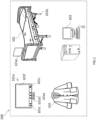
- FIG 1 a system 100 for monitoring patients with cognitive disorders is shown, according to the invention.
- the system 100 for monitoring patients with cognitive disorders comprises:
- the weight sensors 101b configured to detect the presence of the patient in the bed 101 are weight sensors of the oleo dynamic type mounted into the feet of the bed 101 and are configured to measure the weight of the bed 101.
- weight sensors 101b of the oleo dynamic type allows a more accurate measure of the weight of the bed 101 in the presence and in the absence of the patient, compared to weight sensors realized through other technologies.
- weight sensors 101b of the oleo dynamic type according to the invention can be used in any hospital or domestic bed.
- the acoustic sensors 101e allow to detect environmental noises, for example screams emitted by the patient, whose sound intensity is higher than a preset threshold.
- the processing unit 101a is mounted at the foot of the bed.
- the sensors 101c, 101e, 101d, 101f are housed into the processing unit 101a.
- the use of flame sensors 101d allows to detect promptly the presence of fume or flames near the bed 101 of the patient.
- control system implemented by the at least a processing unit 101a is based on a machine learning algorithm developed on the basis of the behavioral analysis of the sampled and analyzed data and is able to process through a comparison with known models the signals generated by the sensors 101b, 101c, 101e, 101d, 101f and 102, generating visual and acoustic alarms.
- said machine learning algorithm allows to obtain a synergic effect on the detections carried out by all the sensors, discriminating and correlating them in a smart way, so minimizing the risk of generating false alarms and notifying the concerning warnings.
- the sensor group in particular, composed as illustrated above, bases its behavior on the analysis of events and is designed depending on said logic of machine learning aiming at discriminating false positives.
- the machine learning algorithm that supervises the behavior of the system in its unsupervised learning, used to find a set of frequent behaviors in a given set of data, is based on the "Apriori Machine Learning Algorithm, that is a simple and powerful data mining logic which generates an association rule on the transaction databases and on which some measures have been implemented in order to improve its weak points.
- the extraction of association rules uses the Candidate-Generation-Based (CGB) and Pattern-Growth-Based (PGB) strategies.
- the algorithm calculates the number of pulses recorded in a given time span obtained from a database of events recorded during the self-learning phase in order to determine whether the detected and processed event from the at least one processing unit 101a is a valid positive or a false positive.
- the behavior of the sensors 101c is analyzed with regard to detection times and to the speed of the movements through the comparative analysis of predictive models developed experimentally, also crossing data coming from the weight sensors 101b of the oleo dynamic type; the algorithm is however based on a logic capable of self-adaptation in cases where too many false positives are detected.
- the sensors having a linear analogue output such as the flame sensors 101d, the acoustic sensors 101e and the weight sensors 101b
- dedicated functions that digitize their measures are carried out through the ADC (Analog to Digital Converter) of the MCU (MicroController Unit) integrated in the at least a processing unit 101a, at regular intervals and in very short times. If in the average of these measurements the potential alarm signal is present only once for a very short period of time ⁇ T (T being preset in advance), the algorithm discards the event. On the contrary, if the alarm event is present in more than one measurement made in a time not longer than 2T, the same alarm is notified.
- ADC Analog to Digital Converter
- each processing unit 101a is associated with a unique identification code which allows the association of the bed and the hospital room with the patient's registry.
- the processing unit 101a is equipped with a display able to visualize images or videos.
- the at least a processing unit 101a allows to make and receive phone calls and video calls, even without the intervention of the patient, by means of a self-call or an auto-reply.
- the display allows the patient to visualize images or videos that help him to maintain a connection with his personal memories.
- the processing unit 101a sends the data stored therein according to a preset programming to a remote cloud server, not shown in the figure.
- this periodic data upload operation allows both to store data of any single patient, and to verify the correspondence of said data with those stored locally in the processing unit 101a, thus detecting possible manipulations of the same data, voluntary or unintentional, made by patients.
- the architecture of the software modules has been designed according to a criterion of robustness and reliability by historicizing each event detected by a "Domino" central on two redundant servers (a local server and a cloud server) where the access logs of the authorized operators are recorded in order to be able to verify the events detected and their management without the possibility of tampering.
- the wearable sensor 102 is coupled with a small proximity sensor, not shown in the figure, that, located in the patient's room, allows to verify the presence of the same patient in the room within the operating range of the sensor 102, which can be set as desired, for example from 0 to 15 m.
- the voluntary or unintentional departure of the patient from the room can be controlled through the detections of the wearable sensor 102.
- said proximity sensor is a miniaturized beacon-type device communicating with the wearable sensor 102 through a short-range wireless connection, for example a Bluetooth LE connection.
- the wearable sensor 102 is configured to detect and notify, through the at least a processing unit 101a, sudden accelerations to which the patient is subject by issuing a distress call in case of an accidental fall or in case of fainting.
- the system 100 also includes a software application provided with a web user interface that allows to display from afar by the Internet a historical record of the visual and acoustic alarms generated by the processing unit 101a depending on the signals coming from the sensors 101b, 101c, 101d, 101e, 101f and 102, said alarms being sent according to the logic set up by the control system of the processing unit 101a by SMS, instant messaging or e-mail to portable devices, such as smartphones or tablets, of healthcare professionals.
- a software application provided with a web user interface that allows to display from afar by the Internet a historical record of the visual and acoustic alarms generated by the processing unit 101a depending on the signals coming from the sensors 101b, 101c, 101d, 101e, 101f and 102, said alarms being sent according to the logic set up by the control system of the processing unit 101a by SMS, instant messaging or e-mail to portable devices, such as smartphones or tablets, of healthcare professionals.
- said software application provided with a web user interface is installed on the computer 103.
- the at least a processing unit 101a and the computer 103 are connected through a wired or a wireless LAN network.
- the present invention relates also to a method for monitoring patients with cognitive disorders by means of the system 100, comprising the steps of:
- each alarm can be notified to a mobile device of a remote user, for example a healthcare professional provided with a smartphone or a tablet, via SMS, instant messaging or e-mail.
- the method includes the step of video calling patients.
- a healthcare professional can receive the alarm from one or more patients, going with certainty into the patient's room from which the alarm was generated and thus carry out the due control.
- the healthcare professional can make a call to the processing unit 101a to monitor the patient's condition from afar.
- the healthcare professional can:
- the system and method for monitoring patients with cognitive disorders allow a remote monitoring of patients.
- the system and method for monitoring patients with cognitive disorders allow a real-time monitoring in a reliable, fast and efficient manner, optimizing the human resources acting both in the clinic and in the family, so reducing the effort of a caregiver.
Landscapes
- Health & Medical Sciences (AREA)
- Life Sciences & Earth Sciences (AREA)
- Physics & Mathematics (AREA)
- General Health & Medical Sciences (AREA)
- Engineering & Computer Science (AREA)
- Animal Behavior & Ethology (AREA)
- Public Health (AREA)
- Pathology (AREA)
- Emergency Management (AREA)
- Biomedical Technology (AREA)
- Surgery (AREA)
- Molecular Biology (AREA)
- Business, Economics & Management (AREA)
- General Physics & Mathematics (AREA)
- Veterinary Medicine (AREA)
- Biophysics (AREA)
- Heart & Thoracic Surgery (AREA)
- Medical Informatics (AREA)
- Oral & Maxillofacial Surgery (AREA)
- Dentistry (AREA)
- Physiology (AREA)
- Gerontology & Geriatric Medicine (AREA)
- Multimedia (AREA)
- Measuring And Recording Apparatus For Diagnosis (AREA)
- Alarm Systems (AREA)
- Investigating Or Analysing Biological Materials (AREA)
Claims (9)
- Système (100) de surveillance de patients atteints de troubles cognitifs comprenant :- au moins un lit (101) comprenant une pluralité de capteurs de poids (101b) configurés pour détecter la présence du patient dans le lit (101);- une pluralité de capteurs (101c) configurés pour détecter la descente du patient du lit(101);- une pluralité de capteurs acoustiques(101e) capables de détecter les bruits ambiants à proximité du lit (101) du patient;- une pluralité de capteurs flammes (101d) capables de détecter la fumée et les flammes à proximité du lit (101) du patient;- un pluralité de capteurs de chocs (101f) capables de détecter des mouvements soudains du lit (101);- au moins un capteur portable (102) placé sur les vêtements du patient ;Caractérisé par le fait qu'il comprend :- au moins une unité de traitement (101a) installée au pied du lit (101) qui renferme lesdits capteurs(101c) configurés pour détecter la descente du patient du lit (101), lesdits capteurs acoustiques(101e), lesdits capteurs de flammes(101d)et lesdits capteurs de chocs(101f), fournie avec un accès Internet et avec un système de commande configuré pour recueillir, numériser et analyser les signaux émis desdits capteurs de poids (101b), desdits capteurs(101c) configurés pour détecter la descente du patient du lit (101), desdits capteurs acoustiques(101e), desdits capteurs de flammes(101d), desdits capteurs de chocs(101f) et dudit capteur portable(102) par le biais d'un algorithme d'apprentissage automatique conçu pour comparer lesdits signaux avec des modèles et données connus en lien avec lesdits signaux avec une base de données d'évènements enregistrés durant une phase d'auto-apprentissage générant des alarmes visuelles et acoustiques qui sont notifiées à distance à des professionnels de santé équipés d'appareils mobiles, réduisant le risque de générér de fausses alarmes;- une caméra vidéo montée sur l'unité de traitement(101a) ;- un ordinateur (103) avec accès à Internet et configuré pour recevoir des données transmises par au moins une unité de traitement(101a) par le biais d'un réseau local câblé ou sans fil.
- Système (100) selon la revendication 1, caractérisé par le fait que les capteurs de poids(101b) sont des capteurs de poids de type oléodynamique et qu'ils sont montés dans les pieds du lit.
- Système (100) selon la revendication 1, caractérisé par le fait que l'unité de traitement(101a) est associée à un code d'identification unique du lit (101) et de la chambre d'hôpital du patient.
- Système (100) selon la revendication 1, caractérisé par le fait que l'unité de traitement(101a) est équipée d'un écran capable de visualiser des images et est configuré de manière à passer et recevoir des appels téléphoniques et des appels vidéos.
- Système (100) selon la revendication 1, caractérisé par le fait que le capteur portable (102) est couplé à un capteur beacon de proximité par le biais d'une connexion sans fil à courte portée et est configuré pour détecter et notifier les accélérations soudaines auxquelles le patient est soumis.
- Système (100) selon la revendication 1, caractérisé en ce qu'il comprend une application logicielle dotée d'une interface web installée sur l'ordinateur (103) et configurée pour afficher un historique des alarmes visuelles et acoustiques générées par l'unité d'élaboration (101a).
- Méthode de surveillance d'un patient atteint de troubles cognitifs au moyen du système (100) selon la revendication 1, comprenant les étapes suivantes :- Détection de la présence ou l'absence du patient du lit par le biais de capteurs de poids de type oléodynamique, de mouvements soudains du lit, de la présence de flammes et de fumée à proximité du lit, d'une tentative du patient de descendre du lit, de la présence du patient dans une zone de distances prédéterminées;- Envoi des signaux de l'étape de détection susmentionnée à une unité de traitement (101a) installée au pied du lit ;- Établissement d'une connexion entre l'unité de traitement(101a) et un dispositif doté d'une application logicielle avec une interface web, ledit dispositif étant configuré pour afficher un historique des avertissements visuels et acoustiques générés par l'unité d'élaboration au cours de l'étape de détection susmentionnée.
- Méthode selon la revendication 7, caractérisée par le fait que chaque alarme peut être notifiée à un appareil mobile d'un utilisateur se situant à distance.
- Méthode selon la revendication 7, caractérisée par l'étape consistant à passer un appel vidéo.
Priority Applications (2)
| Application Number | Priority Date | Filing Date | Title |
|---|---|---|---|
| SI201930724T SI3567563T1 (sl) | 2018-05-11 | 2019-05-09 | Sistem in postopek za spremljanje bolnikov s kognitivnimi motnjami |
| HRP20240336TT HRP20240336T1 (hr) | 2018-05-11 | 2019-05-09 | Sustav i postupak praćenja bolesnika s kognitivnim poremećajima |
Applications Claiming Priority (1)
| Application Number | Priority Date | Filing Date | Title |
|---|---|---|---|
| IT102018000005262A IT201800005262A1 (it) | 2018-05-11 | 2018-05-11 | Sistema e metodo di monitoraggio di pazienti con disturbi cognitivi |
Publications (2)
| Publication Number | Publication Date |
|---|---|
| EP3567563A1 EP3567563A1 (fr) | 2019-11-13 |
| EP3567563B1 true EP3567563B1 (fr) | 2023-12-13 |
Family
ID=63312223
Family Applications (1)
| Application Number | Title | Priority Date | Filing Date |
|---|---|---|---|
| EP19173609.9A Active EP3567563B1 (fr) | 2018-05-11 | 2019-05-09 | Système et procédé de surveillance de patients souffrant de troubles cognitifs |
Country Status (10)
| Country | Link |
|---|---|
| EP (1) | EP3567563B1 (fr) |
| DK (1) | DK3567563T3 (fr) |
| ES (1) | ES2972662T3 (fr) |
| FI (1) | FI3567563T3 (fr) |
| HR (1) | HRP20240336T1 (fr) |
| HU (1) | HUE065646T2 (fr) |
| IT (1) | IT201800005262A1 (fr) |
| PL (1) | PL3567563T3 (fr) |
| PT (1) | PT3567563T (fr) |
| SI (1) | SI3567563T1 (fr) |
Families Citing this family (2)
| Publication number | Priority date | Publication date | Assignee | Title |
|---|---|---|---|---|
| IT202000028880A1 (it) * | 2020-11-27 | 2022-05-27 | Dom Ino Labs S R L | Sistema di sicurezza per il monitoraggio di persone non autosufficienti e relativo metodo |
| JP7714953B2 (ja) * | 2021-08-11 | 2025-07-30 | コニカミノルタ株式会社 | 見守りシステム、見守り装置、見守り方法、および見守りプログラム |
Family Cites Families (6)
| Publication number | Priority date | Publication date | Assignee | Title |
|---|---|---|---|---|
| US20030236474A1 (en) * | 2002-06-24 | 2003-12-25 | Balbir Singh | Seizure and movement monitoring |
| US7126467B2 (en) * | 2004-07-23 | 2006-10-24 | Innovalarm Corporation | Enhanced fire, safety, security, and health monitoring and alarm response method, system and device |
| US8736439B1 (en) | 2013-04-06 | 2014-05-27 | Kenneth Feng Shinozuka | Sock for bed-departure detection |
| US9754476B2 (en) | 2014-08-27 | 2017-09-05 | Umano Medical Inc. | Hospital bed with patient weight and displacement sensors |
| US9940810B2 (en) * | 2014-11-19 | 2018-04-10 | Stryker Corporation | Person support apparatuses with patient mobility monitoring |
| US10417385B2 (en) * | 2015-12-31 | 2019-09-17 | Cerner Innovation, Inc. | Methods and systems for audio call detection |
-
2018
- 2018-05-11 IT IT102018000005262A patent/IT201800005262A1/it unknown
-
2019
- 2019-05-09 PT PT191736099T patent/PT3567563T/pt unknown
- 2019-05-09 SI SI201930724T patent/SI3567563T1/sl unknown
- 2019-05-09 DK DK19173609.9T patent/DK3567563T3/da active
- 2019-05-09 ES ES19173609T patent/ES2972662T3/es active Active
- 2019-05-09 PL PL19173609.9T patent/PL3567563T3/pl unknown
- 2019-05-09 EP EP19173609.9A patent/EP3567563B1/fr active Active
- 2019-05-09 FI FIEP19173609.9T patent/FI3567563T3/fi active
- 2019-05-09 HR HRP20240336TT patent/HRP20240336T1/hr unknown
- 2019-05-09 HU HUE19173609A patent/HUE065646T2/hu unknown
Also Published As
| Publication number | Publication date |
|---|---|
| PL3567563T3 (pl) | 2024-05-20 |
| HRP20240336T1 (hr) | 2024-06-07 |
| PT3567563T (pt) | 2024-03-08 |
| EP3567563A1 (fr) | 2019-11-13 |
| DK3567563T3 (da) | 2024-03-11 |
| SI3567563T1 (sl) | 2024-04-30 |
| IT201800005262A1 (it) | 2019-11-11 |
| HUE065646T2 (hu) | 2024-06-28 |
| ES2972662T3 (es) | 2024-06-13 |
| FI3567563T3 (fi) | 2024-03-13 |
Similar Documents
| Publication | Publication Date | Title |
|---|---|---|
| EP2335232B1 (fr) | Système d'alerte de sortie de lit | |
| JP6823160B2 (ja) | ベッド転落を予測及び防止する患者監視のためのデバイス、システム、及び方法 | |
| CN106716447B (zh) | 占用检测 | |
| US20110313325A1 (en) | Method and system for fall detection | |
| US10410062B2 (en) | Systems and methods for occupancy monitoring | |
| JP6983866B2 (ja) | 転倒検出に関するデバイス、システム、及び方法 | |
| JP5924820B2 (ja) | トイレ見守り方法およびこれに用いるトイレ見守り装置 | |
| JP2019534495A (ja) | ベッド転落を予測及び防止する患者監視のためのデバイス、システム、及び方法 | |
| JP2019535052A (ja) | ベッド転落を予測及び防止する患者監視のためのデバイス、システム、及び方法 | |
| NL2020786B1 (en) | Wearable device | |
| WO2017146643A1 (fr) | Système de surveillance de patient | |
| WO2016186160A1 (fr) | Système de traitement d'image, dispositif de traitement d'image, procédé de traitement d'image et programme de traitement d'image | |
| EP3567563A1 (fr) | Système et procédé de surveillance de patients souffrant de troubles cognitifs | |
| EP4005466A1 (fr) | Système de sécurité et procédé de surveillance de personnes non autonomes | |
| JP2012230610A (ja) | 生体位置監視装置及びシステム | |
| KR20170035459A (ko) | 생체 신호 감지 기능과 이동 통신 기능을 연동한 독거노인 및 환자 관리 시스템 | |
| JP2019152914A (ja) | 保育施設児童見守りシステム及び情報処理方法 | |
| AU2015299180B2 (en) | A system for identifying a change in walking speed of a person. | |
| EP4038595B1 (fr) | Système et procédé de surveillance d'un individu | |
| RU2751146C1 (ru) | Устройство контроля и оповещения о состоянии пользователя | |
| Mendis et al. | SURAKSHA E-Caretaker: elders falling detection and alerting system using machine learning | |
| KR20250178327A (ko) | 영유아 케어의 안전 모니터링 방법 및 이를 이용한 안전 모니터링 시스템 | |
| Kadeeja et al. | IoT-Based Fall Detection and Airbag Deployment System for Enhanced Elderly Care Using NodeMCU ESP8266 and MPU6050 Sensor | |
| KR20180080409A (ko) | 환자의 위급 상황 모니터링 시스템 및 그 방법 | |
| FI121356B (fi) | Menetelmä, järjestelmä ja tietokoneohjelmisto henkilön tarkkailemista varten |
Legal Events
| Date | Code | Title | Description |
|---|---|---|---|
| REG | Reference to a national code |
Ref country code: HR Ref legal event code: TUEP Ref document number: P20240336T Country of ref document: HR |
|
| PUAI | Public reference made under article 153(3) epc to a published international application that has entered the european phase |
Free format text: ORIGINAL CODE: 0009012 |
|
| STAA | Information on the status of an ep patent application or granted ep patent |
Free format text: STATUS: THE APPLICATION HAS BEEN PUBLISHED |
|
| AK | Designated contracting states |
Kind code of ref document: A1 Designated state(s): AL AT BE BG CH CY CZ DE DK EE ES FI FR GB GR HR HU IE IS IT LI LT LU LV MC MK MT NL NO PL PT RO RS SE SI SK SM TR |
|
| AX | Request for extension of the european patent |
Extension state: BA ME |
|
| STAA | Information on the status of an ep patent application or granted ep patent |
Free format text: STATUS: REQUEST FOR EXAMINATION WAS MADE |
|
| 17P | Request for examination filed |
Effective date: 20200515 |
|
| RBV | Designated contracting states (corrected) |
Designated state(s): AL AT BE BG CH CY CZ DE DK EE ES FI FR GB GR HR HU IE IS IT LI LT LU LV MC MK MT NL NO PL PT RO RS SE SI SK SM TR |
|
| STAA | Information on the status of an ep patent application or granted ep patent |
Free format text: STATUS: EXAMINATION IS IN PROGRESS |
|
| 17Q | First examination report despatched |
Effective date: 20210903 |
|
| GRAP | Despatch of communication of intention to grant a patent |
Free format text: ORIGINAL CODE: EPIDOSNIGR1 |
|
| STAA | Information on the status of an ep patent application or granted ep patent |
Free format text: STATUS: GRANT OF PATENT IS INTENDED |
|
| RIC1 | Information provided on ipc code assigned before grant |
Ipc: A61B 5/00 20060101ALI20230609BHEP Ipc: A61B 5/11 20060101ALI20230609BHEP Ipc: G08B 21/04 20060101ALI20230609BHEP Ipc: G08B 21/22 20060101AFI20230609BHEP |
|
| INTG | Intention to grant announced |
Effective date: 20230707 |
|
| GRAS | Grant fee paid |
Free format text: ORIGINAL CODE: EPIDOSNIGR3 |
|
| GRAA | (expected) grant |
Free format text: ORIGINAL CODE: 0009210 |
|
| STAA | Information on the status of an ep patent application or granted ep patent |
Free format text: STATUS: THE PATENT HAS BEEN GRANTED |
|
| AK | Designated contracting states |
Kind code of ref document: B1 Designated state(s): AL AT BE BG CH CY CZ DE DK EE ES FI FR GB GR HR HU IE IS IT LI LT LU LV MC MK MT NL NO PL PT RO RS SE SI SK SM TR |
|
| REG | Reference to a national code |
Ref country code: GB Ref legal event code: FG4D |
|
| REG | Reference to a national code |
Ref country code: CH Ref legal event code: EP |
|
| REG | Reference to a national code |
Ref country code: DE Ref legal event code: R096 Ref document number: 602019043105 Country of ref document: DE |
|
| REG | Reference to a national code |
Ref country code: IE Ref legal event code: FG4D |
|
| P01 | Opt-out of the competence of the unified patent court (upc) registered |
Effective date: 20231208 |
|
| REG | Reference to a national code |
Ref country code: PT Ref legal event code: SC4A Ref document number: 3567563 Country of ref document: PT Date of ref document: 20240308 Kind code of ref document: T Free format text: AVAILABILITY OF NATIONAL TRANSLATION Effective date: 20240304 |
|
| REG | Reference to a national code |
Ref country code: DK Ref legal event code: T3 Effective date: 20240305 |
|
| REG | Reference to a national code |
Ref country code: FI Ref legal event code: FGE Ref country code: NL Ref legal event code: FP |
|
| REG | Reference to a national code |
Ref country code: SE Ref legal event code: TRGR |
|
| PG25 | Lapsed in a contracting state [announced via postgrant information from national office to epo] |
Ref country code: GR Free format text: LAPSE BECAUSE OF FAILURE TO SUBMIT A TRANSLATION OF THE DESCRIPTION OR TO PAY THE FEE WITHIN THE PRESCRIBED TIME-LIMIT Effective date: 20240314 |
|
| REG | Reference to a national code |
Ref country code: LT Ref legal event code: MG9D |
|
| PG25 | Lapsed in a contracting state [announced via postgrant information from national office to epo] |
Ref country code: LT Free format text: LAPSE BECAUSE OF FAILURE TO SUBMIT A TRANSLATION OF THE DESCRIPTION OR TO PAY THE FEE WITHIN THE PRESCRIBED TIME-LIMIT Effective date: 20231213 |
|
| PG25 | Lapsed in a contracting state [announced via postgrant information from national office to epo] |
Ref country code: LT Free format text: LAPSE BECAUSE OF FAILURE TO SUBMIT A TRANSLATION OF THE DESCRIPTION OR TO PAY THE FEE WITHIN THE PRESCRIBED TIME-LIMIT Effective date: 20231213 Ref country code: GR Free format text: LAPSE BECAUSE OF FAILURE TO SUBMIT A TRANSLATION OF THE DESCRIPTION OR TO PAY THE FEE WITHIN THE PRESCRIBED TIME-LIMIT Effective date: 20240314 Ref country code: BG Free format text: LAPSE BECAUSE OF FAILURE TO SUBMIT A TRANSLATION OF THE DESCRIPTION OR TO PAY THE FEE WITHIN THE PRESCRIBED TIME-LIMIT Effective date: 20240313 |
|
| REG | Reference to a national code |
Ref country code: HR Ref legal event code: ODRP Ref document number: P20240336T Country of ref document: HR Payment date: 20240514 Year of fee payment: 6 |
|
| PG25 | Lapsed in a contracting state [announced via postgrant information from national office to epo] |
Ref country code: RS Free format text: LAPSE BECAUSE OF FAILURE TO SUBMIT A TRANSLATION OF THE DESCRIPTION OR TO PAY THE FEE WITHIN THE PRESCRIBED TIME-LIMIT Effective date: 20231213 Ref country code: LV Free format text: LAPSE BECAUSE OF FAILURE TO SUBMIT A TRANSLATION OF THE DESCRIPTION OR TO PAY THE FEE WITHIN THE PRESCRIBED TIME-LIMIT Effective date: 20231213 |
|
| REG | Reference to a national code |
Ref country code: HR Ref legal event code: T1PR Ref document number: P20240336 Country of ref document: HR |
|
| REG | Reference to a national code |
Ref country code: ES Ref legal event code: FG2A Ref document number: 2972662 Country of ref document: ES Kind code of ref document: T3 Effective date: 20240613 |
|
| REG | Reference to a national code |
Ref country code: HU Ref legal event code: AG4A Ref document number: E065646 Country of ref document: HU |
|
| PG25 | Lapsed in a contracting state [announced via postgrant information from national office to epo] |
Ref country code: IS Free format text: LAPSE BECAUSE OF FAILURE TO SUBMIT A TRANSLATION OF THE DESCRIPTION OR TO PAY THE FEE WITHIN THE PRESCRIBED TIME-LIMIT Effective date: 20240413 |
|
| PG25 | Lapsed in a contracting state [announced via postgrant information from national office to epo] |
Ref country code: CZ Free format text: LAPSE BECAUSE OF FAILURE TO SUBMIT A TRANSLATION OF THE DESCRIPTION OR TO PAY THE FEE WITHIN THE PRESCRIBED TIME-LIMIT Effective date: 20231213 |
|
| PG25 | Lapsed in a contracting state [announced via postgrant information from national office to epo] |
Ref country code: SK Free format text: LAPSE BECAUSE OF FAILURE TO SUBMIT A TRANSLATION OF THE DESCRIPTION OR TO PAY THE FEE WITHIN THE PRESCRIBED TIME-LIMIT Effective date: 20231213 |
|
| PG25 | Lapsed in a contracting state [announced via postgrant information from national office to epo] |
Ref country code: SM Free format text: LAPSE BECAUSE OF FAILURE TO SUBMIT A TRANSLATION OF THE DESCRIPTION OR TO PAY THE FEE WITHIN THE PRESCRIBED TIME-LIMIT Effective date: 20231213 Ref country code: SK Free format text: LAPSE BECAUSE OF FAILURE TO SUBMIT A TRANSLATION OF THE DESCRIPTION OR TO PAY THE FEE WITHIN THE PRESCRIBED TIME-LIMIT Effective date: 20231213 Ref country code: IS Free format text: LAPSE BECAUSE OF FAILURE TO SUBMIT A TRANSLATION OF THE DESCRIPTION OR TO PAY THE FEE WITHIN THE PRESCRIBED TIME-LIMIT Effective date: 20240413 Ref country code: EE Free format text: LAPSE BECAUSE OF FAILURE TO SUBMIT A TRANSLATION OF THE DESCRIPTION OR TO PAY THE FEE WITHIN THE PRESCRIBED TIME-LIMIT Effective date: 20231213 Ref country code: CZ Free format text: LAPSE BECAUSE OF FAILURE TO SUBMIT A TRANSLATION OF THE DESCRIPTION OR TO PAY THE FEE WITHIN THE PRESCRIBED TIME-LIMIT Effective date: 20231213 |
|
| REG | Reference to a national code |
Ref country code: DE Ref legal event code: R097 Ref document number: 602019043105 Country of ref document: DE |
|
| PLBE | No opposition filed within time limit |
Free format text: ORIGINAL CODE: 0009261 |
|
| STAA | Information on the status of an ep patent application or granted ep patent |
Free format text: STATUS: NO OPPOSITION FILED WITHIN TIME LIMIT |
|
| 26N | No opposition filed |
Effective date: 20240916 |
|
| PG25 | Lapsed in a contracting state [announced via postgrant information from national office to epo] |
Ref country code: MC Free format text: LAPSE BECAUSE OF FAILURE TO SUBMIT A TRANSLATION OF THE DESCRIPTION OR TO PAY THE FEE WITHIN THE PRESCRIBED TIME-LIMIT Effective date: 20231213 |
|
| PG25 | Lapsed in a contracting state [announced via postgrant information from national office to epo] |
Ref country code: LU Free format text: LAPSE BECAUSE OF NON-PAYMENT OF DUE FEES Effective date: 20240509 |
|
| PG25 | Lapsed in a contracting state [announced via postgrant information from national office to epo] |
Ref country code: MC Free format text: LAPSE BECAUSE OF FAILURE TO SUBMIT A TRANSLATION OF THE DESCRIPTION OR TO PAY THE FEE WITHIN THE PRESCRIBED TIME-LIMIT Effective date: 20231213 Ref country code: LU Free format text: LAPSE BECAUSE OF NON-PAYMENT OF DUE FEES Effective date: 20240509 |
|
| PG25 | Lapsed in a contracting state [announced via postgrant information from national office to epo] |
Ref country code: IE Free format text: LAPSE BECAUSE OF NON-PAYMENT OF DUE FEES Effective date: 20240509 |
|
| REG | Reference to a national code |
Ref country code: HR Ref legal event code: ODRP Ref document number: P20240336 Country of ref document: HR Payment date: 20250428 Year of fee payment: 7 |
|
| PGFP | Annual fee paid to national office [announced via postgrant information from national office to epo] |
Ref country code: NL Payment date: 20250512 Year of fee payment: 7 |
|
| PGFP | Annual fee paid to national office [announced via postgrant information from national office to epo] |
Ref country code: FI Payment date: 20250512 Year of fee payment: 7 |
|
| PGFP | Annual fee paid to national office [announced via postgrant information from national office to epo] |
Ref country code: DE Payment date: 20250512 Year of fee payment: 7 Ref country code: PL Payment date: 20250428 Year of fee payment: 7 |
|
| PGFP | Annual fee paid to national office [announced via postgrant information from national office to epo] |
Ref country code: GB Payment date: 20250514 Year of fee payment: 7 Ref country code: ES Payment date: 20250618 Year of fee payment: 7 Ref country code: DK Payment date: 20250516 Year of fee payment: 7 |
|
| PGFP | Annual fee paid to national office [announced via postgrant information from national office to epo] |
Ref country code: HU Payment date: 20250513 Year of fee payment: 7 Ref country code: NO Payment date: 20250515 Year of fee payment: 7 |
|
| PGFP | Annual fee paid to national office [announced via postgrant information from national office to epo] |
Ref country code: IT Payment date: 20250513 Year of fee payment: 7 Ref country code: BE Payment date: 20250512 Year of fee payment: 7 |
|
| PGFP | Annual fee paid to national office [announced via postgrant information from national office to epo] |
Ref country code: HR Payment date: 20250428 Year of fee payment: 7 |
|
| PGFP | Annual fee paid to national office [announced via postgrant information from national office to epo] |
Ref country code: PT Payment date: 20250505 Year of fee payment: 7 |
|
| PGFP | Annual fee paid to national office [announced via postgrant information from national office to epo] |
Ref country code: FR Payment date: 20250514 Year of fee payment: 7 |
|
| PGFP | Annual fee paid to national office [announced via postgrant information from national office to epo] |
Ref country code: CH Payment date: 20250601 Year of fee payment: 7 |
|
| PGFP | Annual fee paid to national office [announced via postgrant information from national office to epo] |
Ref country code: RO Payment date: 20250429 Year of fee payment: 7 Ref country code: AT Payment date: 20250512 Year of fee payment: 7 |
|
| PGFP | Annual fee paid to national office [announced via postgrant information from national office to epo] |
Ref country code: SI Payment date: 20250425 Year of fee payment: 7 Ref country code: SE Payment date: 20250515 Year of fee payment: 7 |
|
| PG25 | Lapsed in a contracting state [announced via postgrant information from national office to epo] |
Ref country code: CY Free format text: LAPSE BECAUSE OF FAILURE TO SUBMIT A TRANSLATION OF THE DESCRIPTION OR TO PAY THE FEE WITHIN THE PRESCRIBED TIME-LIMIT; INVALID AB INITIO Effective date: 20190509 |