EP4005466A1 - Système de sécurité et procédé de surveillance de personnes non autonomes - Google Patents
Système de sécurité et procédé de surveillance de personnes non autonomes Download PDFInfo
- Publication number
- EP4005466A1 EP4005466A1 EP21206351.5A EP21206351A EP4005466A1 EP 4005466 A1 EP4005466 A1 EP 4005466A1 EP 21206351 A EP21206351 A EP 21206351A EP 4005466 A1 EP4005466 A1 EP 4005466A1
- Authority
- EP
- European Patent Office
- Prior art keywords
- patient
- bed
- processing unit
- safety system
- sensor
- Prior art date
- Legal status (The legal status is an assumption and is not a legal conclusion. Google has not performed a legal analysis and makes no representation as to the accuracy of the status listed.)
- Withdrawn
Links
Images
Classifications
-
- A—HUMAN NECESSITIES
- A61—MEDICAL OR VETERINARY SCIENCE; HYGIENE
- A61B—DIAGNOSIS; SURGERY; IDENTIFICATION
- A61B5/00—Measuring for diagnostic purposes; Identification of persons
- A61B5/0002—Remote monitoring of patients using telemetry, e.g. transmission of vital signals via a communication network
- A61B5/0004—Remote monitoring of patients using telemetry, e.g. transmission of vital signals via a communication network characterised by the type of physiological signal transmitted
-
- A—HUMAN NECESSITIES
- A61—MEDICAL OR VETERINARY SCIENCE; HYGIENE
- A61B—DIAGNOSIS; SURGERY; IDENTIFICATION
- A61B5/00—Measuring for diagnostic purposes; Identification of persons
- A61B5/0002—Remote monitoring of patients using telemetry, e.g. transmission of vital signals via a communication network
- A61B5/0015—Remote monitoring of patients using telemetry, e.g. transmission of vital signals via a communication network characterised by features of the telemetry system
- A61B5/0022—Monitoring a patient using a global network, e.g. telephone networks, internet
-
- A—HUMAN NECESSITIES
- A61—MEDICAL OR VETERINARY SCIENCE; HYGIENE
- A61B—DIAGNOSIS; SURGERY; IDENTIFICATION
- A61B5/00—Measuring for diagnostic purposes; Identification of persons
- A61B5/103—Measuring devices for testing the shape, pattern, colour, size or movement of the body or parts thereof, for diagnostic purposes
- A61B5/11—Measuring movement of the entire body or parts thereof, e.g. head or hand tremor or mobility of a limb
- A61B5/1113—Local tracking of patients, e.g. in a hospital or private home
-
- A—HUMAN NECESSITIES
- A61—MEDICAL OR VETERINARY SCIENCE; HYGIENE
- A61B—DIAGNOSIS; SURGERY; IDENTIFICATION
- A61B5/00—Measuring for diagnostic purposes; Identification of persons
- A61B5/103—Measuring devices for testing the shape, pattern, colour, size or movement of the body or parts thereof, for diagnostic purposes
- A61B5/11—Measuring movement of the entire body or parts thereof, e.g. head or hand tremor or mobility of a limb
- A61B5/1113—Local tracking of patients, e.g. in a hospital or private home
- A61B5/1115—Monitoring leaving of a patient support, e.g. a bed or a wheelchair
-
- A—HUMAN NECESSITIES
- A61—MEDICAL OR VETERINARY SCIENCE; HYGIENE
- A61B—DIAGNOSIS; SURGERY; IDENTIFICATION
- A61B5/00—Measuring for diagnostic purposes; Identification of persons
- A61B5/103—Measuring devices for testing the shape, pattern, colour, size or movement of the body or parts thereof, for diagnostic purposes
- A61B5/11—Measuring movement of the entire body or parts thereof, e.g. head or hand tremor or mobility of a limb
- A61B5/1116—Determining posture transitions
-
- A—HUMAN NECESSITIES
- A61—MEDICAL OR VETERINARY SCIENCE; HYGIENE
- A61B—DIAGNOSIS; SURGERY; IDENTIFICATION
- A61B5/00—Measuring for diagnostic purposes; Identification of persons
- A61B5/103—Measuring devices for testing the shape, pattern, colour, size or movement of the body or parts thereof, for diagnostic purposes
- A61B5/11—Measuring movement of the entire body or parts thereof, e.g. head or hand tremor or mobility of a limb
- A61B5/1116—Determining posture transitions
- A61B5/1117—Fall detection
-
- A—HUMAN NECESSITIES
- A61—MEDICAL OR VETERINARY SCIENCE; HYGIENE
- A61B—DIAGNOSIS; SURGERY; IDENTIFICATION
- A61B5/00—Measuring for diagnostic purposes; Identification of persons
- A61B5/103—Measuring devices for testing the shape, pattern, colour, size or movement of the body or parts thereof, for diagnostic purposes
- A61B5/11—Measuring movement of the entire body or parts thereof, e.g. head or hand tremor or mobility of a limb
- A61B5/1126—Measuring movement of the entire body or parts thereof, e.g. head or hand tremor or mobility of a limb using a particular sensing technique
- A61B5/1128—Measuring movement of the entire body or parts thereof, e.g. head or hand tremor or mobility of a limb using a particular sensing technique using image analysis
-
- A—HUMAN NECESSITIES
- A61—MEDICAL OR VETERINARY SCIENCE; HYGIENE
- A61B—DIAGNOSIS; SURGERY; IDENTIFICATION
- A61B5/00—Measuring for diagnostic purposes; Identification of persons
- A61B5/68—Arrangements of detecting, measuring or recording means, e.g. sensors, in relation to patient
- A61B5/6801—Arrangements of detecting, measuring or recording means, e.g. sensors, in relation to patient specially adapted to be attached to or worn on the body surface
- A61B5/6802—Sensor mounted on worn items
- A61B5/6804—Garments; Clothes
-
- A—HUMAN NECESSITIES
- A61—MEDICAL OR VETERINARY SCIENCE; HYGIENE
- A61B—DIAGNOSIS; SURGERY; IDENTIFICATION
- A61B5/00—Measuring for diagnostic purposes; Identification of persons
- A61B5/68—Arrangements of detecting, measuring or recording means, e.g. sensors, in relation to patient
- A61B5/6887—Arrangements of detecting, measuring or recording means, e.g. sensors, in relation to patient mounted on external non-worn devices, e.g. non-medical devices
- A61B5/6889—Rooms
-
- A—HUMAN NECESSITIES
- A61—MEDICAL OR VETERINARY SCIENCE; HYGIENE
- A61B—DIAGNOSIS; SURGERY; IDENTIFICATION
- A61B5/00—Measuring for diagnostic purposes; Identification of persons
- A61B5/68—Arrangements of detecting, measuring or recording means, e.g. sensors, in relation to patient
- A61B5/6887—Arrangements of detecting, measuring or recording means, e.g. sensors, in relation to patient mounted on external non-worn devices, e.g. non-medical devices
- A61B5/6891—Furniture
-
- A—HUMAN NECESSITIES
- A61—MEDICAL OR VETERINARY SCIENCE; HYGIENE
- A61B—DIAGNOSIS; SURGERY; IDENTIFICATION
- A61B5/00—Measuring for diagnostic purposes; Identification of persons
- A61B5/68—Arrangements of detecting, measuring or recording means, e.g. sensors, in relation to patient
- A61B5/6887—Arrangements of detecting, measuring or recording means, e.g. sensors, in relation to patient mounted on external non-worn devices, e.g. non-medical devices
- A61B5/6892—Mats
-
- A—HUMAN NECESSITIES
- A61—MEDICAL OR VETERINARY SCIENCE; HYGIENE
- A61B—DIAGNOSIS; SURGERY; IDENTIFICATION
- A61B5/00—Measuring for diagnostic purposes; Identification of persons
- A61B5/72—Signal processing specially adapted for physiological signals or for diagnostic purposes
- A61B5/7271—Specific aspects of physiological measurement analysis
- A61B5/7282—Event detection, e.g. detecting unique waveforms indicative of a medical condition
-
- A—HUMAN NECESSITIES
- A61—MEDICAL OR VETERINARY SCIENCE; HYGIENE
- A61B—DIAGNOSIS; SURGERY; IDENTIFICATION
- A61B5/00—Measuring for diagnostic purposes; Identification of persons
- A61B5/74—Details of notification to user or communication with user or patient; User input means
- A61B5/746—Alarms related to a physiological condition, e.g. details of setting alarm thresholds or avoiding false alarms
-
- A—HUMAN NECESSITIES
- A61—MEDICAL OR VETERINARY SCIENCE; HYGIENE
- A61B—DIAGNOSIS; SURGERY; IDENTIFICATION
- A61B5/00—Measuring for diagnostic purposes; Identification of persons
- A61B5/74—Details of notification to user or communication with user or patient; User input means
- A61B5/7465—Arrangements for interactive communication between patient and care services, e.g. by using a telephone network
- A61B5/747—Arrangements for interactive communication between patient and care services, e.g. by using a telephone network in case of emergency, i.e. alerting emergency services
-
- G—PHYSICS
- G08—SIGNALLING
- G08B—SIGNALLING SYSTEMS, e.g. PERSONAL CALLING SYSTEMS; ORDER TELEGRAPHS; ALARM SYSTEMS
- G08B21/00—Alarms responsive to a single specified undesired or abnormal condition and not otherwise provided for
- G08B21/02—Alarms for ensuring the safety of persons
- G08B21/04—Alarms for ensuring the safety of persons responsive to non-activity, e.g. of elderly persons
- G08B21/0407—Alarms for ensuring the safety of persons responsive to non-activity, e.g. of elderly persons based on behaviour analysis
- G08B21/043—Alarms for ensuring the safety of persons responsive to non-activity, e.g. of elderly persons based on behaviour analysis detecting an emergency event, e.g. a fall
-
- G—PHYSICS
- G08—SIGNALLING
- G08B—SIGNALLING SYSTEMS, e.g. PERSONAL CALLING SYSTEMS; ORDER TELEGRAPHS; ALARM SYSTEMS
- G08B21/00—Alarms responsive to a single specified undesired or abnormal condition and not otherwise provided for
- G08B21/02—Alarms for ensuring the safety of persons
- G08B21/04—Alarms for ensuring the safety of persons responsive to non-activity, e.g. of elderly persons
- G08B21/0438—Sensor means for detecting
- G08B21/0446—Sensor means for detecting worn on the body to detect changes of posture, e.g. a fall, inclination, acceleration, gait
-
- G—PHYSICS
- G08—SIGNALLING
- G08B—SIGNALLING SYSTEMS, e.g. PERSONAL CALLING SYSTEMS; ORDER TELEGRAPHS; ALARM SYSTEMS
- G08B21/00—Alarms responsive to a single specified undesired or abnormal condition and not otherwise provided for
- G08B21/02—Alarms for ensuring the safety of persons
- G08B21/04—Alarms for ensuring the safety of persons responsive to non-activity, e.g. of elderly persons
- G08B21/0438—Sensor means for detecting
- G08B21/0461—Sensor means for detecting integrated or attached to an item closely associated with the person but not worn by the person, e.g. chair, walking stick, bed sensor
-
- G—PHYSICS
- G08—SIGNALLING
- G08B—SIGNALLING SYSTEMS, e.g. PERSONAL CALLING SYSTEMS; ORDER TELEGRAPHS; ALARM SYSTEMS
- G08B21/00—Alarms responsive to a single specified undesired or abnormal condition and not otherwise provided for
- G08B21/02—Alarms for ensuring the safety of persons
- G08B21/04—Alarms for ensuring the safety of persons responsive to non-activity, e.g. of elderly persons
- G08B21/0438—Sensor means for detecting
- G08B21/0492—Sensor dual technology, i.e. two or more technologies collaborate to extract unsafe condition, e.g. video tracking and RFID tracking
-
- G—PHYSICS
- G16—INFORMATION AND COMMUNICATION TECHNOLOGY [ICT] SPECIALLY ADAPTED FOR SPECIFIC APPLICATION FIELDS
- G16H—HEALTHCARE INFORMATICS, i.e. INFORMATION AND COMMUNICATION TECHNOLOGY [ICT] SPECIALLY ADAPTED FOR THE HANDLING OR PROCESSING OF MEDICAL OR HEALTHCARE DATA
- G16H40/00—ICT specially adapted for the management or administration of healthcare resources or facilities; ICT specially adapted for the management or operation of medical equipment or devices
- G16H40/20—ICT specially adapted for the management or administration of healthcare resources or facilities; ICT specially adapted for the management or operation of medical equipment or devices for the management or administration of healthcare resources or facilities, e.g. managing hospital staff or surgery rooms
-
- G—PHYSICS
- G16—INFORMATION AND COMMUNICATION TECHNOLOGY [ICT] SPECIALLY ADAPTED FOR SPECIFIC APPLICATION FIELDS
- G16H—HEALTHCARE INFORMATICS, i.e. INFORMATION AND COMMUNICATION TECHNOLOGY [ICT] SPECIALLY ADAPTED FOR THE HANDLING OR PROCESSING OF MEDICAL OR HEALTHCARE DATA
- G16H40/00—ICT specially adapted for the management or administration of healthcare resources or facilities; ICT specially adapted for the management or operation of medical equipment or devices
- G16H40/60—ICT specially adapted for the management or administration of healthcare resources or facilities; ICT specially adapted for the management or operation of medical equipment or devices for the operation of medical equipment or devices
- G16H40/67—ICT specially adapted for the management or administration of healthcare resources or facilities; ICT specially adapted for the management or operation of medical equipment or devices for the operation of medical equipment or devices for remote operation
-
- G—PHYSICS
- G16—INFORMATION AND COMMUNICATION TECHNOLOGY [ICT] SPECIALLY ADAPTED FOR SPECIFIC APPLICATION FIELDS
- G16H—HEALTHCARE INFORMATICS, i.e. INFORMATION AND COMMUNICATION TECHNOLOGY [ICT] SPECIALLY ADAPTED FOR THE HANDLING OR PROCESSING OF MEDICAL OR HEALTHCARE DATA
- G16H50/00—ICT specially adapted for medical diagnosis, medical simulation or medical data mining; ICT specially adapted for detecting, monitoring or modelling epidemics or pandemics
- G16H50/20—ICT specially adapted for medical diagnosis, medical simulation or medical data mining; ICT specially adapted for detecting, monitoring or modelling epidemics or pandemics for computer-aided diagnosis, e.g. based on medical expert systems
-
- A—HUMAN NECESSITIES
- A61—MEDICAL OR VETERINARY SCIENCE; HYGIENE
- A61B—DIAGNOSIS; SURGERY; IDENTIFICATION
- A61B2562/00—Details of sensors; Constructional details of sensor housings or probes; Accessories for sensors
- A61B2562/08—Sensors provided with means for identification, e.g. barcodes or memory chips
-
- A—HUMAN NECESSITIES
- A61—MEDICAL OR VETERINARY SCIENCE; HYGIENE
- A61B—DIAGNOSIS; SURGERY; IDENTIFICATION
- A61B5/00—Measuring for diagnostic purposes; Identification of persons
- A61B5/103—Measuring devices for testing the shape, pattern, colour, size or movement of the body or parts thereof, for diagnostic purposes
- A61B5/11—Measuring movement of the entire body or parts thereof, e.g. head or hand tremor or mobility of a limb
- A61B5/1118—Determining activity level
-
- A—HUMAN NECESSITIES
- A61—MEDICAL OR VETERINARY SCIENCE; HYGIENE
- A61B—DIAGNOSIS; SURGERY; IDENTIFICATION
- A61B5/00—Measuring for diagnostic purposes; Identification of persons
- A61B5/48—Other medical applications
- A61B5/4842—Monitoring progression or stage of a disease
-
- A—HUMAN NECESSITIES
- A61—MEDICAL OR VETERINARY SCIENCE; HYGIENE
- A61B—DIAGNOSIS; SURGERY; IDENTIFICATION
- A61B5/00—Measuring for diagnostic purposes; Identification of persons
- A61B5/72—Signal processing specially adapted for physiological signals or for diagnostic purposes
- A61B5/7235—Details of waveform analysis
- A61B5/7264—Classification of physiological signals or data, e.g. using neural networks, statistical classifiers, expert systems or fuzzy systems
Definitions
- the present invention relates to a safety system for monitoring not self-sufficient persons.
- the present invention relates to a safety system and method for monitoring patients with cognitive disorders at risk of self-injury due to a fall and/or unconsciousness and/or loss.
- the present invention relates to a safety system and method for monitoring patients or persons not self-sufficient and having cognitive disorders, for example patients suffering from diseases such as Alzheimer's or sleepwalking.
- Alzheimer's represents 60% of cases of dementia and creates, like other neurological degenerative diseases, a state of total dependence of the patient, thus generating a very complex and difficult situation for the family who has to assist the same patient, and also for a health facility having the task of assisting and treating the patient himself. Assistance weighs, for 80% of the cases, on the family which must devote the entire day to caring for the sick, with considerable psychological stress and waste of economic resources.
- these last see their costs rise due to the constant monitoring that this disease requires. In fact, it is necessary to prepare resources and personnel day and night, with inevitable technical/economic implications.
- sleepwalking risks causing even serious involuntary injuries to those who suffer from it.
- a first technical solution is disclosed by the European patent application EP3567563A1 , whose subject is a system for monitoring patients with cognitive disorders comprising one bed having a plurality of weight sensors, a plurality of sensors configured to detect the descending of the patient from the bed, a plurality of acoustic sensors, a plurality of flame sensors, a plurality of shock sensors, a wearable sensor, a processing unit, a video camera and a computer.
- the patent application US2016063846A1 instead, describes a system for determining the location of a patient on a hospital bed comprising a deformation sensor adapted to generate a signal indicative of a deformation of a frame of the bed, and a location determination unit for determining a lateral and/or longitudinal location of the patient based on the deformation of the frame.
- a weight sensing system for a hospital bed having a base with a suspended frame suspended from a fixed frame, comprises a load sensor connecting the suspended frame and the fixed frame via a suspension member, which is unsecured from the fixed frame, to allow free vertical movement of the suspended frame relative to the fixed frame.
- the patent application WO2014165798 relates to a method and an apparatus for low-cost detection and alerting of bed-departure, which causes significant stress to caretakers of patients who often wander out of bed as a result of their dementia, Alzheimer's disease, or other medical conditions.
- the apparatus comprises a sock embedded with a pressure sensor and a battery-powered microcontroller unit with a radio frequency module. Once the user wanders out of bed and steps onto the floor, the sensor on the sock will immediately detect the pressure caused by his or her body weight and wirelessly trigger an audible sound at a caretaker's monitoring unit, which can be a smartphone, a tablet or a PC.
- the senor and the microcontroller unit can be packaged in one assembly to be mounted on an ordinary sock, slipper, or shoe.
- the apparatus also accurately counts steps and measures the time interval between them.
- the pressure sensor and/or the sensor/microcontroller unit assembly can adhere to a foot.
- the purpose of the present invention is to provide a safety system for monitoring not self-sufficient persons, which is able to control and monitor the patient in real time in a reliable, fast and efficient manner, optimizing the human resources operating both in the health facility and in the family, having, therefore, characteristics such as to overcome the limits of the current known systems.
- a safety system for monitoring not self-sufficient persons is provided, as defined in claim 1.
- a safety method for monitoring not self-sufficient persons is also provided, as defined in claim 9.
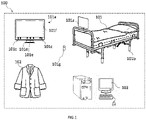
- a safety system 100 for monitoring not self-sufficient persons is shown, according to the invention.
- the safety system 100 comprises:
- the safety system 100 comprises also:
- such a plurality of algorithms is able to process the data saved to the central database, i.e., the data downloaded from each local database installed on a corresponding embedded processing unit 101a, related to each patient and his corresponding bed 101.
- the data entered by the at least one healthcare professional comprise data concerning the sleep-wake cycle, a pharmacological therapy and a diet followed by each patient.
- the plurality of algorithms comprised in the computer 103 is able to process also the data entered by the at least one healthcare professional, that comprise data concerning the sleep-wake cycle, the pharmacological therapy and the diet followed by each patient.
- the plurality of algorithms is able to generate and send visual and/or acoustic alarms and/or requests for preventive interventions to healthcare professionals, in particular to mobile terminals managed by said healthcare professionals.
- the plurality of algorithms is able to evaluate a degree of correlation between the temporal evolution of data related to patients having the same pathologies and generate graphs able to describe behavioral trends of the patients or trends concerning the pathologies under observation.
- the plurality of algorithms is able to evaluate, in addition, a further degree of correlation between the data concerning the sleep-wake cycle, the data related to the signal generated by the sensor 101g, the pharmacological therapy, the diet followed by each patient and the temporal evolution of the pathologies under observation.
- the measurement and evaluation of the aforementioned degree of correlation between the data concerning the sleep-wake cycle, the pharmacological therapy, the diet followed by each patient and the temporal evolution of the pathologies under observation allow to evaluate and verify the overall state of health of each patient, to correct potential deficiencies regarding therapy, diet or other parameters, and to determine potential cause-effect relationships between said parameters and the pathologies.
- the safety system 100 comprises also:
- the computer 103 queries, i.e., performs a polling, in asynchronous mode, of the at least one embedded processing unit 101a in order to download the data stored in the local database, or buffer, comprised in said embedded processing unit 101a.
- the data entered by health professionals in the central database comprised in the computer 103 relate to the intervention of said operators, following an alarm.
- the control system is configured to analyze the aforementioned data, related to the signals detected by the sensors 101b, 101c, 101e, 101d, 101f, 101g, 102, through the use of algorithms of different kind, and to generate a plurality of visual and/or acoustic alarms when the data received and analyzed, or a combination of said data, exceed the limits assigned to them and specific for each patient, with reference, for example, to the presence of the patient in the bed, when the values detected by the sensors exceed specific thresholds, but also in the case in which the combination of readings of several sensors corresponds to a pre-established dangerous condition for the patient considered in the environment, for example an abandonment of the bed, convulsive or uncontrolled movements in the bed, screams, incongruous movements in the environment, presence of fire or smoke, and/or even in the case in which there is a critical combination of the physical parameters monitored, concerning the patient himself.
- values of tuples of likelihood functions are generated in order to measure the evolution of a disease and/or of the behavior of the patient, with such values able to be used for the generation of requests for preventive interventions.
- the approximation of the values calculated for the likelihood functions of a specific patient in a given situation, to values detected and/or calculated in correspondence with previous and specific critical conditions can numerically and preventively highlight the approaching of critical conditions which, in this way, can be prevented or mitigated.
- Even the approaching of the specific data detected, related to the patient and to the surrounding environment, or a combination of them, to values calculated with predetermined models for the type of disease of the patient considered, can generate the emission of an alarm signal, communicated for example remotely to an operator.
- the safety system 100 comprises at least one mobile terminal of a healthcare professional configured to remotely receive, from the computer 103, notifications concerning the aforementioned alarms and/or requests for preventive interventions, said alarms and said requests being able to be implemented by means of visual and/or acoustic signals.
- the safety system 100 includes at least one video camera, one microphone and one loudspeaker integrated in the embedded processing unit 101a, suitable for a remote verbal and visual interaction with the patient.
- the central database installed on the computer 103, is configured for the creation and the management, starting from the acquired data, related to the patient and to the environment that hosts said patient, for example the room, of a dataset characterized by a plurality of records that allow to have a detailed and temporally congruent image of the state of the patient and of the environment hosting him, and also the evolution over time of the same data, of behavioral aspects of the patient and of his physiognomy, i.e., face/body over time.
- said central database are saved, for each patient and for each pathology associated with the patient, a history of first data related to parameters associated with critical events of the patient himself, and second data concerning the application of models and algorithms to said history of the first data able to evaluate and predict, by means of correlation algorithms, the eventual exceeding of historical likelihood thresholds in the evolution of a predetermined pathology, and to generate corresponding alarms on the basis of the prediction/prevention functions of the safety system 100.
- the aforementioned threshold values are re-evaluated and updated based on the correlations and historical events for the same patient or for patients suffering from the same pathologies.
- the safety system 100 comprises a plurality of models refined over time by means of the history of data and the application of machine learning algorithms to the same data, or models concerning the critical situations for each patient and for each associated pathology.
- the safety system 100 contemplates the creation of the history of the data in its database and, in particular, of the data associated with specific critical situations of each patient, together with the outcomes achieved from the application of the algorithms to the same data.
- the latter constitute the reference data for the subsequent evaluations of new data and, therefore, for the preventive determination of any new critical situations that may arise following the overcoming of the historical likelihood thresholds in the evolution of the disease under observation.
- Such threshold values are re-evaluated and updated in relation to the evolutions and historical events for the same patient or for patients suffering from the same pathologies and act as inputs, as described above, in the analysis of new data and trends acquired. Consequently, the safety system 100 provides not only an initial learning step for the machine learning algorithms, but also a constant learning and refinement of the inputs for the same algorithms, with reference to each patient.
- the safety system 100 comprises a plurality of behavioral models of the operators generated through the creation of a history of the interventions of the same operators, following the reception of alarm signals or requests for attention, and of the effects of the same interventions, also validated through feedback provided by the sensors/actuators, in order to identify the best assistance modalities to suggest in the future.
- the weight sensors 101b configured for detecting the presence of the patient in the bed 101, are oleo dynamic weight sensors, installed in correspondence with an end portion of the bed 101, therefore at the foot of the bed 101, and are configured to evaluate the weight of the bed 101, with and without the patient present on the bed 101 itself.
- weight sensors 101b of the oleo dynamic type allows a more accurate measurement of the weight of the bed 101 in the presence and absence of the patient, compared to weight sensors made with other technologies.
- the safety system 100 is modular and scalable, therefore able to of be configured according to the specific characteristics of the person to be monitored, to the host environment, e.g., a nursing home, a retirement home, an isolated house and to the targets of monitoring and medical check.
- a further advantage given by the use of the weight sensors 101b according to the invention, is that they can be used in any hospital or domestic bed.
- the acoustic sensor 101e allows to detect environmental noises and/or sounds emitted by the patient, whose sound intensity is higher than a preset threshold, with reference, for example, to screams.
- the machine learning algorithms running on the computer 103 are able to interpret automatically, by means of the acoustic sensor 101e, the words spoken by the patient within a predefined dataset of words, according to speech recognition logics.
- the embedded processing unit 101a is installed on the bed 101, for example in correspondence with one of its end portions, preferably at the footboard.
- the sensors 101c, 101e, 101d, 101f, 101e, 101g are installed in the embedded processing unit 101a.
- the use of the thermal camera 101d allows to promptly detect the presence of smoke or flames in proximity of the bed 101.
- control system running on the computer 103, associated on the same computer 103 with the machine learning algorithms developed on the basis of the behavioral analysis of the sampled and analyzed data, is able to process, through a comparison with known and/or developed models, the signals generated by the sensors 101b, 101c, 101e, 101d, 101f, 101g, 102 and by the video camera, generating immediate or preventive, visual and/or acoustic alarms, as previously mentioned.
- said machine learning algorithms allow to achieve a synergistic effect on the detections performed by all sensors, discriminating and correlating them in an intelligent way, minimizing the risk of generating false alarms and their corresponding notifications.
- the safety system 100 bases its behavior on the analysis of the events and is designed on the underlying machine learning logic, which is also able to discriminate false positives.
- association rules preferably uses Candidate-Generation-Based (CGB) and Pattern-Growth-Based strategies (PGB).
- the algorithm calculates the number of pulses recorded during a predetermined time frame obtained from a series of events recorded in the database in a self-learning step, in order to determine whether the detected event is a true positive or a false positive.
- the behavior of the sensors 101c configured to detect the descending of the patient from the bed 101 is analyzed with regard to the detection times and the speed of displacements through the comparative analysis of the predictive models developed experimentally, also crossing the data coming from the weight sensors 101b of the oleo dynamic type; the algorithm is however based on a logic capable of self-adaptation in cases where too many false positives are recorded.
- sensors having a linear analog output such as the thermal camera 101d, the acoustic sensor 101e and the weight sensors 101b
- ADC Analog to Digital Converter
- MCU Micro Controller Unit
- each embedded processing unit 101a is associated with a unique identification code, such a code allowing the association of any single bed 101 and of the hospital room with the registry of the related patient.
- the embedded processing unit 101a is equipped with a screen able to display images or videos.
- the embedded processing unit 101a allows to make and receive telephone and video calls, even without the intervention of the patient, by means of a self-call or a self-answer.
- the screen of the embedded processing unit 101a allows the patient to view images or videos that help him maintain a contact with his personal memories.
- each embedded processing unit 101a records the data acquired by itself on a local database, which hosts onboard, and an automatic mechanism guarantees the transfer and replication of the same records of the local database on a remote database available to the control system, followed by a simultaneous cancellation, on the embedded processing unit 101a, of the records already transferred.
- such a replication operation allows to store the data of any single patient safely, preventing at the same time any manipulation on the embedded processing unit 101a.
- the architecture of the software modules is designed according to robustness and reliability criteria, through the historicization of each detected event, of each subsequent processing of each log and action of the operators on a remote server, while guaranteeing the integrity of the data and preventing their manipulation.
- the wearable sensor 102 is a proximity sensor of the beacon type, not shown in the figure, coupled, by means of a short-range wireless standard, with the at least one embedded processing unit 101a, and is configured to detect and signal sudden accelerations to which the patient is subject and his presence within a predetermined area.
- the voluntary or involuntary exit of the patient from the room can be controlled, and the sudden accelerations to which the patient is subject can be detected and signaled.
- said proximity sensor 102 is connected through a short-range wireless standard to the embedded processing unit 101a. Furthermore, according to another aspect of the invention, the wearable sensor 102 is configured to detect and signal, to the embedded processing unit 101a, sudden accelerations to which the patient is subject by launching an SOS in the event of a fall, both accidental and due to fainting.
- the safety system 100 also comprises a software application with a web interface that allows to view from afar, through the Internet, the chronology of the visual and/or acoustic alarms and/or requests for preventive interventions generated by the control system running on the computer 103, on the basis of the signals coming from the sensors 101b, 101c, 101d, 101e, 101f, 101g, 102 and from the video camera, said alarms being sent by SMS, instant messaging or e-mail to portable devices such as smartphone or tablet managed by healthcare professionals.
- said software application with a web interface is installed on the computer 103.
- such a web interface is able to configure, manage and monitor, and in particular consult, data concerning a plurality of rooms/patients to which the safety system 100 is applied, by consulting applications on fixed or portable devices such as PCs, tablets, smartphones, provided with specific user interfaces that allow operators to verify the status of patients and their rooms, receive alarm notifications or requests for attention, insertion of notes describing the performed interventions, the adjustment of alarm thresholds or attention ranges about certain situations that the main central application, i.e., the control system running on the computer 103 uses, while managing the overall system, as an input for the processing algorithms, customized for the needs of each patient.
- the main central application i.e., the control system running on the computer 103 uses, while managing the overall system, as an input for the processing algorithms, customized for the needs of each patient.
- the embedded processing unit 101a and the computer 103 are connected by means of a wired or wireless LAN.
- the present invention also refers to a safety method for monitoring not self-sufficient persons or patients with cognitive disorders, such a method comprising the steps of:
- the safety method for monitoring not self-sufficient persons by means of the safety system 100 comprises the steps of:
- each alarm and/or request for preventive interventions is uniquely associated with a patient and a room and may also be notified to and displayed by a mobile terminal of a remote user, for example a healthcare professional provided with a smartphone or a tablet, by means of an SMS, instant messaging or an e-mail.
- the method for monitoring not self-sufficient persons comprises the activation of a full-duplex video and acoustic connection to the patient, following the receipt of an alarm also on the mobile terminal, in order to monitor the status of the patient and interact with the patient himself.
- the healthcare professional following a notification of an alarm, can observe the patient through the video camera, interacting with the patient himself.
- a healthcare professional is able to resolve the alarm concerning a patient by approaching the same patient and, subsequently, by recording the resolution of the issue of one or more patients, uniquely identified, going with certainty to the room of the patient from which the alarm has been generated, thus carrying out the necessary check.
- the health care professional is able to:
- the safety system and method allow to monitor patients from afar.
- the safety system and method allow to perform said monitoring in real-time, in a reliable, fast and efficient way, optimizing the human resources working both in the clinic and in the family, reducing the so-called "caregiver effort”.
Landscapes
- Health & Medical Sciences (AREA)
- Life Sciences & Earth Sciences (AREA)
- Engineering & Computer Science (AREA)
- General Health & Medical Sciences (AREA)
- Biomedical Technology (AREA)
- Medical Informatics (AREA)
- Public Health (AREA)
- Physics & Mathematics (AREA)
- Pathology (AREA)
- Molecular Biology (AREA)
- Biophysics (AREA)
- Heart & Thoracic Surgery (AREA)
- Surgery (AREA)
- Animal Behavior & Ethology (AREA)
- Veterinary Medicine (AREA)
- Business, Economics & Management (AREA)
- Physiology (AREA)
- Emergency Management (AREA)
- Dentistry (AREA)
- Oral & Maxillofacial Surgery (AREA)
- Gerontology & Geriatric Medicine (AREA)
- General Physics & Mathematics (AREA)
- Primary Health Care (AREA)
- Epidemiology (AREA)
- General Business, Economics & Management (AREA)
- Psychiatry (AREA)
- Computer Networks & Wireless Communication (AREA)
- Computer Vision & Pattern Recognition (AREA)
- Data Mining & Analysis (AREA)
- Emergency Medicine (AREA)
- Databases & Information Systems (AREA)
- Nuclear Medicine, Radiotherapy & Molecular Imaging (AREA)
- Social Psychology (AREA)
- Psychology (AREA)
- Critical Care (AREA)
- Radiology & Medical Imaging (AREA)
- Nursing (AREA)
- Multimedia (AREA)
- Artificial Intelligence (AREA)
- Signal Processing (AREA)
Applications Claiming Priority (1)
| Application Number | Priority Date | Filing Date | Title |
|---|---|---|---|
| IT102020000028880A IT202000028880A1 (it) | 2020-11-27 | 2020-11-27 | Sistema di sicurezza per il monitoraggio di persone non autosufficienti e relativo metodo |
Publications (1)
| Publication Number | Publication Date |
|---|---|
| EP4005466A1 true EP4005466A1 (fr) | 2022-06-01 |
Family
ID=74759269
Family Applications (1)
| Application Number | Title | Priority Date | Filing Date |
|---|---|---|---|
| EP21206351.5A Withdrawn EP4005466A1 (fr) | 2020-11-27 | 2021-11-04 | Système de sécurité et procédé de surveillance de personnes non autonomes |
Country Status (2)
| Country | Link |
|---|---|
| EP (1) | EP4005466A1 (fr) |
| IT (1) | IT202000028880A1 (fr) |
Cited By (2)
| Publication number | Priority date | Publication date | Assignee | Title |
|---|---|---|---|---|
| IT202300020964A1 (it) * | 2023-10-09 | 2025-04-09 | Lares S R L S | Metodo e sistema di monitoraggio e notifica dello stato psicofisico di un individuo |
| JP7775970B1 (ja) * | 2024-10-24 | 2025-11-26 | 積水ハウス株式会社 | 在不在判定システム、在不在判定方法、アクション実行抑制システム、アクション実行抑制方法及びプログラム |
Citations (4)
| Publication number | Priority date | Publication date | Assignee | Title |
|---|---|---|---|---|
| WO2014165798A2 (fr) | 2013-04-06 | 2014-10-09 | Shinozuka Kenneth Feng | Appareil et procédé de contrôle de sortie de lit et de marche |
| US20160063846A1 (en) | 2014-08-27 | 2016-03-03 | Umano Medical Inc. | Hospital bed with patient weight and displacement sensors |
| EP3567563A1 (fr) | 2018-05-11 | 2019-11-13 | Innovazione Tecnologica Srl | Système et procédé de surveillance de patients souffrant de troubles cognitifs |
| US20200253547A1 (en) * | 2017-10-31 | 2020-08-13 | Apple Inc. | Monitoring System for Assessing Control of a Disease State |
-
2020
- 2020-11-27 IT IT102020000028880A patent/IT202000028880A1/it unknown
-
2021
- 2021-11-04 EP EP21206351.5A patent/EP4005466A1/fr not_active Withdrawn
Patent Citations (4)
| Publication number | Priority date | Publication date | Assignee | Title |
|---|---|---|---|---|
| WO2014165798A2 (fr) | 2013-04-06 | 2014-10-09 | Shinozuka Kenneth Feng | Appareil et procédé de contrôle de sortie de lit et de marche |
| US20160063846A1 (en) | 2014-08-27 | 2016-03-03 | Umano Medical Inc. | Hospital bed with patient weight and displacement sensors |
| US20200253547A1 (en) * | 2017-10-31 | 2020-08-13 | Apple Inc. | Monitoring System for Assessing Control of a Disease State |
| EP3567563A1 (fr) | 2018-05-11 | 2019-11-13 | Innovazione Tecnologica Srl | Système et procédé de surveillance de patients souffrant de troubles cognitifs |
Non-Patent Citations (2)
| Title |
|---|
| CLIODHNA NÍ SCANAILL ET AL: "A Review of Approaches to Mobility Telemonitoring of the Elderly in Their Living Environment", ANNALS OF BIOMEDICAL ENGINEERING, KLUWER ACADEMIC PUBLISHERS-PLENUM PUBLISHERS, NE, vol. 34, no. 4, 1 April 2006 (2006-04-01), pages 547 - 563, XP019273086, ISSN: 1573-9686 * |
| GINGRAS GUILLAUME ET AL: "IoT Ambient Assisted Living: Scalable Analytics Architecture and Flexible Process", PROCEDIA COMPUTER SCIENCE, ELSEVIER, AMSTERDAM, NL, vol. 177, 1 January 2020 (2020-01-01), pages 396 - 404, XP086350230, ISSN: 1877-0509, [retrieved on 20201111], DOI: 10.1016/J.PROCS.2020.10.053 * |
Cited By (2)
| Publication number | Priority date | Publication date | Assignee | Title |
|---|---|---|---|---|
| IT202300020964A1 (it) * | 2023-10-09 | 2025-04-09 | Lares S R L S | Metodo e sistema di monitoraggio e notifica dello stato psicofisico di un individuo |
| JP7775970B1 (ja) * | 2024-10-24 | 2025-11-26 | 積水ハウス株式会社 | 在不在判定システム、在不在判定方法、アクション実行抑制システム、アクション実行抑制方法及びプログラム |
Also Published As
| Publication number | Publication date |
|---|---|
| IT202000028880A1 (it) | 2022-05-27 |
Similar Documents
| Publication | Publication Date | Title |
|---|---|---|
| JP5877528B2 (ja) | 自動通報システム | |
| JP5426428B2 (ja) | 患者状態情報管理システム | |
| Linkous et al. | Health monitoring in smart homes utilizing internet of things | |
| TWI772762B (zh) | 照護系統與自動照護方法 | |
| JP2017168098A (ja) | 見守りシステム及び生活支援提案システム | |
| EP4005466A1 (fr) | Système de sécurité et procédé de surveillance de personnes non autonomes | |
| WO2017146643A1 (fr) | Système de surveillance de patient | |
| KR20170035459A (ko) | 생체 신호 감지 기능과 이동 통신 기능을 연동한 독거노인 및 환자 관리 시스템 | |
| EP3567563B1 (fr) | Système et procédé de surveillance de patients souffrant de troubles cognitifs | |
| JP2026021481A (ja) | 監視システム、監視装置、監視方法及び監視プログラム | |
| JP2026021481A5 (fr) | ||
| KR102608941B1 (ko) | 인공지능을 이용한 환자의 이상 행동 탐지 시스템 | |
| JP7502737B2 (ja) | 見守り支援システムおよび見守り支援方法 | |
| EP3357420A1 (fr) | Surveillance de l'activité d'une personne | |
| EP4334922B1 (fr) | Système et procédé de surveillance pour reconnaître l'activité de personnes déterminées | |
| JPWO2020075675A1 (ja) | ケアシステムの管理方法および管理装置、ならびにプログラム | |
| KR20230056143A (ko) | IoT 항균등 노인 돌봄 서비스 시스템 | |
| KR102901823B1 (ko) | 생체신호와 인공지능 영상분석을 결합한 안전 모니터링 시스템 및 방법 | |
| KR102779522B1 (ko) | 병원내 환자 모니터링 시스템 및 그 방법 | |
| US12597257B2 (en) | Monitoring system and method for recognizing the activity of determined persons | |
| JP7786673B2 (ja) | 情報処理方法、情報処理装置、及びプログラム | |
| WO2020075674A1 (fr) | Procédé de gestion de système de soins, dispositif de gestion et programme | |
| IT202100001253A1 (it) | Sistema di assistenza domiciliare per soggetti fragili | |
| JP2025086221A (ja) | コンピュータプログラム、監視装置及び監視方法 | |
| KR20260031523A (ko) | 피보호자 모니터링 장치 및 방법 |
Legal Events
| Date | Code | Title | Description |
|---|---|---|---|
| PUAI | Public reference made under article 153(3) epc to a published international application that has entered the european phase |
Free format text: ORIGINAL CODE: 0009012 |
|
| STAA | Information on the status of an ep patent application or granted ep patent |
Free format text: STATUS: THE APPLICATION HAS BEEN PUBLISHED |
|
| AK | Designated contracting states |
Kind code of ref document: A1 Designated state(s): AL AT BE BG CH CY CZ DE DK EE ES FI FR GB GR HR HU IE IS IT LI LT LU LV MC MK MT NL NO PL PT RO RS SE SI SK SM TR |
|
| STAA | Information on the status of an ep patent application or granted ep patent |
Free format text: STATUS: THE APPLICATION IS DEEMED TO BE WITHDRAWN |
|
| 18D | Application deemed to be withdrawn |
Effective date: 20221202 |