EP3573413B1 - Procédé d'accès aléatoire, équipement d'utilisateur et station de base - Google Patents
Procédé d'accès aléatoire, équipement d'utilisateur et station de base Download PDFInfo
- Publication number
- EP3573413B1 EP3573413B1 EP18772323.4A EP18772323A EP3573413B1 EP 3573413 B1 EP3573413 B1 EP 3573413B1 EP 18772323 A EP18772323 A EP 18772323A EP 3573413 B1 EP3573413 B1 EP 3573413B1
- Authority
- EP
- European Patent Office
- Prior art keywords
- base station
- preamble sequence
- scrambling code
- service data
- mapping
- Prior art date
- Legal status (The legal status is an assumption and is not a legal conclusion. Google has not performed a legal analysis and makes no representation as to the accuracy of the status listed.)
- Active
Links
Images








Classifications
-
- H—ELECTRICITY
- H04—ELECTRIC COMMUNICATION TECHNIQUE
- H04W—WIRELESS COMMUNICATION NETWORKS
- H04W72/00—Local resource management
- H04W72/04—Wireless resource allocation
- H04W72/044—Wireless resource allocation based on the type of the allocated resource
-
- H—ELECTRICITY
- H04—ELECTRIC COMMUNICATION TECHNIQUE
- H04L—TRANSMISSION OF DIGITAL INFORMATION, e.g. TELEGRAPHIC COMMUNICATION
- H04L27/00—Modulated-carrier systems
- H04L27/26—Systems using multi-frequency codes
- H04L27/2601—Multicarrier modulation systems
- H04L27/2602—Signal structure
-
- H—ELECTRICITY
- H04—ELECTRIC COMMUNICATION TECHNIQUE
- H04L—TRANSMISSION OF DIGITAL INFORMATION, e.g. TELEGRAPHIC COMMUNICATION
- H04L27/00—Modulated-carrier systems
- H04L27/26—Systems using multi-frequency codes
- H04L27/2601—Multicarrier modulation systems
- H04L27/2647—Arrangements specific to the receiver only
- H04L27/2655—Synchronisation arrangements
- H04L27/2689—Link with other circuits, i.e. special connections between synchronisation arrangements and other circuits for achieving synchronisation
- H04L27/2692—Link with other circuits, i.e. special connections between synchronisation arrangements and other circuits for achieving synchronisation with preamble design, i.e. with negotiation of the synchronisation sequence with transmitter or sequence linked to the algorithm used at the receiver
-
- H—ELECTRICITY
- H04—ELECTRIC COMMUNICATION TECHNIQUE
- H04L—TRANSMISSION OF DIGITAL INFORMATION, e.g. TELEGRAPHIC COMMUNICATION
- H04L5/00—Arrangements affording multiple use of the transmission path
- H04L5/003—Arrangements for allocating sub-channels of the transmission path
- H04L5/0048—Allocation of pilot signals, i.e. of signals known to the receiver
-
- H—ELECTRICITY
- H04—ELECTRIC COMMUNICATION TECHNIQUE
- H04L—TRANSMISSION OF DIGITAL INFORMATION, e.g. TELEGRAPHIC COMMUNICATION
- H04L5/00—Arrangements affording multiple use of the transmission path
- H04L5/003—Arrangements for allocating sub-channels of the transmission path
- H04L5/0048—Allocation of pilot signals, i.e. of signals known to the receiver
- H04L5/0051—Allocation of pilot signals, i.e. of signals known to the receiver of dedicated pilots, i.e. pilots destined for a single user or terminal
-
- H—ELECTRICITY
- H04—ELECTRIC COMMUNICATION TECHNIQUE
- H04L—TRANSMISSION OF DIGITAL INFORMATION, e.g. TELEGRAPHIC COMMUNICATION
- H04L5/00—Arrangements affording multiple use of the transmission path
- H04L5/003—Arrangements for allocating sub-channels of the transmission path
- H04L5/0053—Allocation of signalling, i.e. of overhead other than pilot signals
-
- H—ELECTRICITY
- H04—ELECTRIC COMMUNICATION TECHNIQUE
- H04W—WIRELESS COMMUNICATION NETWORKS
- H04W74/00—Wireless channel access
- H04W74/08—Non-scheduled access, e.g. ALOHA
- H04W74/0833—Random access procedures, e.g. with 4-step access
-
- H—ELECTRICITY
- H04—ELECTRIC COMMUNICATION TECHNIQUE
- H04W—WIRELESS COMMUNICATION NETWORKS
- H04W56/00—Synchronisation arrangements
- H04W56/004—Synchronisation arrangements compensating for timing error of reception due to propagation delay
- H04W56/0045—Synchronisation arrangements compensating for timing error of reception due to propagation delay compensating for timing error by altering transmission time
-
- H—ELECTRICITY
- H04—ELECTRIC COMMUNICATION TECHNIQUE
- H04W—WIRELESS COMMUNICATION NETWORKS
- H04W74/00—Wireless channel access
- H04W74/08—Non-scheduled access, e.g. ALOHA
- H04W74/0833—Random access procedures, e.g. with 4-step access
- H04W74/0838—Random access procedures, e.g. with 4-step access using contention-free random access [CFRA]
Definitions
- This application relates to the field of wireless communications technologies, and in particular, to a random access method, user equipment (English: User Equipment, UE) and a base station.
- user equipment English: User Equipment, UE
- base station a base station
- UE To access a wireless network and send uplink data, UE needs to establish a connection to a cell by using a random access process and obtain uplink synchronization.
- long term evolution English: Long Term Evolution, LTE
- the following six events trigger the random access process.
- Random access processes are usually classified into a “contention-based” access process and a “non-contention-based” access process.
- the "contention-based” access process is applicable to the first five events
- the "non-contention-based” access process is applicable to three events: the third, fourth, and sixth events.
- the contention-based random access process includes the following four steps:
- the UE sends the MSG 1 usually, a spectrum shift is performed on a generated preamble, the preamble is converted into time domain data, and then the time domain data is directly configured on a subcarrier.
- a preamble obtained after the foregoing processing is sent through an antenna port of the UE.
- WO 2009/020423 A1 discloses uplink scrambling during random access.
- US 2015/0282215 A1 discloses random access procedures for machine-type communications.
- US 2010/0039988 A1 discloses a method for preventing misuse of a random access procedure in a mobile station.
- the UE needs to wait a relatively long time before obtaining a service provided by the network side.
- a location of a vehicle in which the UE is located and an ambient environment may be different from a location of the vehicle in which the UE is located and an ambient environment that exist when the UE initiates the random access process.
- an embodiment of this application provides a random access method.
- UE adds both a preamble and service data to an MSG 1 in a random access process.
- a base station may obtain the service data from the received MSG 1. Therefore, the base station does not need to wait for completion of the random access process before obtaining service data that is transmitted by the UE by using an extra time-frequency resource.
- the base station may provide a service to the UE based on the service data carried in the MSG 1. Therefore, a service delay can be reduced based on a random access solution provided in this embodiment of this application.
- UE To transmit data to a network side, UE first needs to establish a connection to a cell. Downlink synchronization and uplink synchronization are involved in a process of establishing a connection to a cell.
- the UE obtains downlink synchronization with a cell and system information of the cell by using a cell search process. In addition to performing cell search during power-on, to support mobility, the UE continuously searches neighboring cells, obtains synchronization, and estimates signal received quality of the cell, so that the UE determines, in an RRC_CONNECTED state, whether to perform switching, or the UE determines, in an RRC_IDLE state, whether to perform cell reselection. After obtaining the downlink synchronization, the UE establishes, by using a random access process, uplink synchronization with the cell with which downlink synchronization is obtained.
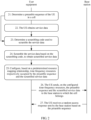
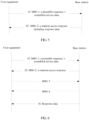
- FIG. 1 is a schematic diagram of a random access method according to an embodiment of this application.
- the random access method is applicable to a "contention-based" access process and a "non-contention-based” access process.
- UE has obtained downlink synchronization with a cell by using a cell search process, that is, has obtained frequency and symbol synchronization with the cell, has obtained a start position of a downlink frame, and has determined a physical-layer cell identifier (English: Physical-layer Cell Identity, PCI) of the cell.
- PCI Physical-layer Cell Identity
- the cell is a cell with which the UE has obtained downlink synchronization, but has not obtained uplink synchronization in the cell search process, that is, a cell used as a random access target.
- Step 10 The UE sends an MSG 1 to a base station to which the cell belongs.
- the MSG 1 includes both a preamble sequence and scrambled service data. Time-frequency resources respectively occupied by the preamble sequence and the scrambled service data conform to a predetermined resource mapping relationship.
- a process in which the UE determines the preamble sequence is similar to that in an existing random access process, and includes obtaining, from a broadcast system information SIB 2 sent by the base station, a resource that can be used to transmit the preamble sequence, and configuring preamble sequence groups for contention-based random access and non-contention-based random access.
- the UE selects a preamble sequence from the preamble sequence groups based on an estimated size of an MSG 3. Other details about determining the preamble sequence by the UE are not described herein.
- the UE After determining the preamble sequence, the UE configures, based on the predetermined resource mapping relationship, the time-frequency resources required for sending the determined preamble sequence and the service data. Then the UE sends, on the configured time-frequency resources, the preamble sequence and service data to the base station to which the cell belongs.
- the resource mapping relationship and sending the MSG 1 by the UE are described in further detail in the following embodiments.
- the service data includes various types of control information or service information of an application.
- service information of an application may be measurement parameter values in aspects of a current location of the UE, an environment, and the like.
- the UE may scramble the service data based on a scrambling code that is in a one-to-one correspondence with the preamble sequence of the UE.
- Step 20 The UE receives an MSG 2 sent by the base station, where the MSG 2 is a random access response.
- the random access response includes optional information, such as an RA-RNTI, an identifier of the random access preamble sequence, a time advance instruction determined based on an estimated delay between the base station and the UE, a temporary C-RNTI, and an uplink resource allocated to an MSG 3.
- the UE may determine, based on the RA-RNTI and the identifier of the preamble sequence that are carried in the MSG 2, whether the MSG 2 corresponding to the sent MSG 1 is successfully received, and perform subsequent processing.
- the preamble sequence is specially used by the UE. Therefore, there is no conflict.
- the UE already has a unique identifier C-RNTI in an accessed cell. Therefore, the base station does not need to allocate a C-RNTI to the UE, and the access process is completed.
- the UE sends the MSG 3 and receives an MSG 4 sent by the base station. The subsequent steps are basically similar to those in the existing random access process. Details are not described herein again.
- the UE when the UE sends the MSG 1, the UE sends the preamble sequence and the service data to the base station on the configured time-frequency resources.
- the MSG 1 carries both the preamble and the service data.
- the base station may obtain the service data from the received MSG 1 in time, to provide a service for the UE. Therefore, the base station does not need to wait for completion of a random access process before obtaining service data that is transmitted by the UE by using an extra time-frequency resource, thereby reducing a service delay.
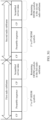
- FIG. 2 is a schematic diagram of a random access method according to an embodiment of this application. Implementation details of the random access method are emphasized in FIG. 2 from a perspective of UE.
- Step 21 After obtaining downlink synchronization with a cell, the UE determines a preamble sequence of the UE in the cell.
- a process in which the UE determines the preamble sequence is similar to that in an existing random access process. Details are not described herein.
- the preamble sequence is a Zadoff-Chu ZC sequence, an M sequence, a Golden sequence, or the like.
- Step 22 The UE obtains service data.
- the UE may obtain the service data from an application program installed on the UE.
- step 21 and step 22 There is no need to limit an order of performing step 21 and step 22. After step 21 and step 22 are performed, the UE performs step 23.
- Step 23 The UE determines a scrambling code used to scramble the service data.
- the scrambling code is in a one-to-one correspondence with the preamble sequence determined in step 21.
- an RRC state of the UE is not limited.
- the scrambling code is in a one-to-one correspondence with an identifier of the UE; or the scrambling code is in a one-to-one correspondence with a combination of the preamble sequence determined in step 21 and an identifier of the UE.
- An RRC_INACTIVE state has the following features: A network side reserves context (context) information of the UE in an RRC_INACTIVE state.
- the base station and a core network reserve connection information of the UE in an RRC_INACTIVE state may learn a location of the UE in an RRC_INACTIVE state at an RNA layer.
- a network layer may learn a specific RNA in which the UE is located.
- the identifier of the UE is a unique identifier of the UE in the base station, and includes a cell radio network temporary identifier (English: Cell Radio Network Temporary Identifier, C-RNTI), a temporary mobile subscriber identity (English: Temporary Mobile Subscriber Identity, TMSI), an international mobile subscriber identity (English: international mobile subscriber identity, IMSI), and the like.
- a manner of determining the scrambling code is learned in advance by the UE and the base station to which the cell belongs. After determining the preamble sequence, the UE may determine the corresponding scrambling code based on the preamble sequence and/or the identifier of the UE.
- the manner of determining the scrambling code is configured on the base station and the UE by default.
- the manner of determining the scrambling code is notified by the base station to the UE by using a scrambling code mapping indication.
- the base station uses three scrambling code mapping indications to respectively indicate the three correspondences and specific mapping modes.
- the mapping mode of a preamble sequence and a scrambling code includes, but is not limited to, any one of the following (1) to (5).
- a second scrambling code mapping indication is used to indicate a mapping mode of a preamble sequence and an identifier of the UE.
- the second scrambling code mapping indication is 2X
- 2 is used to indicate that the scrambling code is in a one-to-one correspondence with the identifier of the UE
- X is used to indicate the mapping mode of a preamble sequence and an identifier of the UE.
- the mapping mode of a preamble sequence and an identifier of the UE includes: If the UE is in an RRC_CONNECTED state or an RRC_ACTIVE state, the scrambling code is a ZC sequence in a one-to-one correspondence with the identifier of the UE in a predetermined codebook.
- the second scrambling code mapping indication may be 21.
- a third scrambling code mapping indication is used to indicate a mapping mode of a preamble sequence and a combination of the preamble sequence and an identifier of the UE.
- the third scrambling code mapping indication is 3X
- 3 is used to indicate that the scrambling code is in a one-to-one correspondence with the combination of the preamble sequence and the identifier of the UE
- X is used to indicate the mapping mode of a preamble sequence and a combination of the preamble sequence and an identifier of the UE.
- the mapping mode of a preamble sequence and a combination of the preamble sequence and an identifier of the UE includes:
- the scrambling code is a ZC sequence in a one-to-one correspondence with the combination of the preamble sequence and the identifier of the UE in a predetermined codebook.
- the third scrambling code mapping indication may be 31.
- the UE receives the first scrambling code mapping indication sent by the base station.
- the UE determines the scrambling code in a one-to-one correspondence with the preamble sequence based on the mapping mode indicated by the first scrambling code mapping indication and the preamble sequence.
- the UE receives the second scrambling code mapping indication sent by the base station.
- the UE determines the scrambling code in a one-to-one correspondence with the identifier of the UE based on the mapping mode indicated by the second scrambling code mapping indication and the identifier of the UE.
- the UE receives the third scrambling code mapping indication sent by the base station to which the cell belongs.
- the UE determines the scrambling code in a one-to-one correspondence with the combination of the preamble sequence and the identifier of the UE based on the mapping mode indicated by the third scrambling code mapping indication and the combination of the preamble sequence and the identifier of the UE.
- the base station notifies the UE of one of the three scrambling code mapping indications in any one of the following manners, and notification manners include, but are not limited to, the following manners:
- Step 24 The UE scrambles the service data based on the scrambling code, to obtain scrambled service data.
- Scrambling is encrypting, by using a scrambling code, a signal carrying service data. Data transmission security can be improved through scrambling.
- Step 25 The UE configures, based on a predetermined resource mapping relationship, time-frequency resources respectively occupied by the preamble sequence and the scrambled service data.
- the predetermined resource mapping relationship is learned in advance by the UE and the base station to which the cell belongs.
- the UE determines, based on a resource that can be used to transmit the preamble sequence and that is indicated in an SIB 2, the time-frequency resource used to subsequently transmit the preamble sequence, and then determines, based on the time-frequency resource used by the preamble sequence and the predetermined resource mapping relationship, the time-frequency resource correspondingly occupied by the scrambled service data.
- the predetermined resource mapping relationship is configured on the base station and the UE by default.
- the predetermined resource mapping relationship is notified by the base station to the UE.
- the base station uses a resource mapping indicator to indicate the predetermined resource mapping relationship.
- the base station sends the resource mapping indicator to the UE, and the UE receives the resource mapping indicator sent by the base station.
- the UE configures, based on the resource mapping relationship indicated by the resource mapping indicator, the time-frequency resources respectively occupied by the preamble sequence and the scrambled service data.
- the base station notifies the UE of the resource mapping indicator in any one of the following manners, and notification manners include, but are not limited to, the following manners:
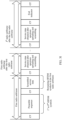
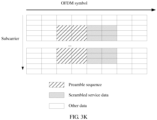
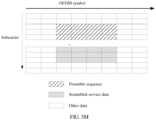
- the predetermined resource mapping relationship includes a time domain resource mapping relationship and a frequency domain resource mapping relationship.
- the time domain resource mapping relationship includes any one of the following (1) to (9).
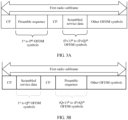
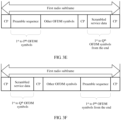
- the preamble sequence and the scrambled service data use symbols in a same radio subframe, as described in (1) to (6).
- the preamble sequence and the scrambled service data may use symbols in different radio subframes, as described in (7) to (11).
- symbols occupied by the preamble sequence and the scrambled service data are orthogonal frequency division multiplexing (English: Orthogonal Frequency Division Multiplexing, OFDM) symbols in a radio subframe except a cycle prefix (English: Cycle Prefix, CP).
- Whether the CP is added to the radio subframe and a length of the CP may be set based on an application requirement.
- Whether a GT (Guard Time) is added to the radio subframe and a length of the GT may be set based on an application requirement.
- the frequency domain resource mapping relationship includes either of the following (1) and (2).
- the resource mapping relationship may be determined by combining any one of the time domain resource mapping relationships and any one of the frequency domain resource mapping relationships.
- a resource mapping relationship determined by combining the first time domain resource mapping relationship and the first frequency domain resource mapping relationship is that the preamble sequence and the scrambled service data use symbols in the same radio subframe in the same subcarrier, the preamble sequence occupies the first P OFDM symbols in the radio subframe, and the scrambled service data occupies the (P+1) th to (P+Q) th OFDM symbols in the first radio subframe. Other combinations are not listed one by one.
- Step 26 The UE sends, on the configured time-frequency resources, the preamble sequence and the scrambled service data to the base station to which the cell belongs.
- Step 27 The UE receives a random access response sent by the base station based on the preamble sequence.
- the base station may notify the UE of the scrambling code mapping indication and the resource mapping indicator in a same manner, or may notify the UE of the scrambling code mapping indication and the resource mapping indicator in different manners.
- the base station may notify the UE of the scrambling code mapping indication and the resource mapping indicator by using different time-frequency resources on the physical broadcast channel.
- the base station may notify the UE of the scrambling code mapping indication by using the physical broadcast channel, and may notify the UE of the resource mapping indicator by using the SI.
- the service data may be further coded based on a predetermined coding scheme before the service data is scrambled based on the scrambling code. Then coded service data is scrambled.
- the coding further helps distinguish between different types of service data.
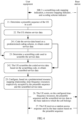
- FIG. 4 A flowchart of such a random access method is shown in FIG. 4 . Steps 21 to 23 and step 25 are similar to the corresponding steps in FIG. 2 . For implementation steps, refer to the descriptions in the corresponding steps in FIG. 2 . Details are not repeated herein again.
- Step 21 After obtaining downlink synchronization with a cell, UE determines a preamble sequence of the UE in the cell.
- Step 22 The UE obtains service data.
- Step 23 The UE determines a scrambling code used to scramble the service data.
- the UE After obtaining the service data, the UE performs step 241.
- Step 241 The UE codes the service data based on a predetermined coding scheme, to obtain coded service data.
- the predetermined coding scheme is learned in advance by the UE and a base station to which the cell belongs.
- the predetermined coding scheme is configured on a base station and the UE by default.
- the predetermined coding scheme is notified by a base station to the UE by using a coding scheme indicator, and the coding scheme indicator is used to indicate the predetermined coding scheme.
- the coding scheme includes, but is not limited to, a Turbo code or a polar code.
- a first coding scheme indicator indicates the Turbo code
- a second coding scheme indicator indicates the polar code
- a third coding scheme indicator indicates a low-density parity-check code (English: Low Density Parity Check Code, LDPC).
- step 23 and step 241 are performed.
- step 242 is performed.
- Step 242 The UE scrambles the coded service data in step 241 based on the scrambling code determined in step 23, to obtain scrambled service data.
- Step 25 The UE configures, based on a predetermined resource mapping relationship, time-frequency resources respectively occupied by the preamble sequence and the scrambled service data obtained in step 242.
- Step 26 The UE sends, on the configured time-frequency resources, the preamble sequence and the scrambled service data to the base station to which the cell belongs.
- Step 27 The UE receives a random access response sent by the base station based on the preamble sequence.
- the base station may notify the UE of a scrambling code mapping indication, a resource mapping indicator, and the coding scheme indicator in a same manner, or may notify the UE of a scrambling code mapping indication, a resource mapping indicator, and the coding scheme indicator in different manners.
- the base station may notify the UE of a scrambling code mapping indication, a resource mapping indicator, and the coding scheme indicator by using different time-frequency resources in SI, for example, notify the UE of a scrambling code mapping indication, a resource mapping indicator, and the coding scheme indicator by using different symbols in an SIB 2.
- the base station may notify the UE of a scrambling code mapping indication and a resource mapping indicator by using a physical broadcast channel, and may notify the UE of the coding scheme indicator by using SI.
- the base station needs to deliver response data including a control instruction to the UE based on service data that includes measurement parameter values in aspects of a current location, an environment, and the like and that is reported by the UE.
- This application provides two manners in which the base station delivers the response data to the UE. In this application, the two response manners are respectively described in detail with reference to FIG. 5 and FIG. 6 .
- FIG. 5 is a flowchart of a random access method according to an embodiment of this application. After generating corresponding response data based on service data in an MSG 1, a base station sends the response data to UE by using an MSG 2. The method includes the following steps:
- Step 10 The UE sends the MSG 1 to the base station to which a cell belongs.
- the MSG 1 includes both a preamble sequence and scrambled service data. This step is similar to step 10 in FIG. 1 .
- the UE generates the MSG 1 refer to FIG. 2 , FIG. 3 , FIG. 4 , and the descriptions about FIG. 2 , FIG. 3 , and FIG. 4 . Details are not described herein again.
- Step 20' The UE receives the MSG 2 sent by the base station, where the MSG 2 is a random access response.
- the random access response further includes the response data, and the response data is generated by the base station based on the service data.
- the base station may send the response data in a plurality of manners by using the MSG 2. For example, the base station adds the response data to a padding field; or redefines field content of an existing random access response, and adds the response data to some existing fields in the random access response, such as a UL-Grant field and a temporary C-RNTI field.
- the base station may send the response data to the UE by using the MSG 2.
- this makes little impact on an existing random access process, and does not greatly prolong a time for completing the random access process.
- the UE may obtain the service after receiving the MSG 2, thereby greatly reducing a service delay, and improving service timeliness.
- FIG. 6 is a flowchart of another random access method according to this application. After a random access process is completed, the UE receives response data sent by a base station. The method includes the following steps:
- Step 10 The UE sends an MSG 1 to the base station to which a cell belongs.
- the MSG 1 includes both a preamble sequence and scrambled service data. This step is similar to step 10 in FIG. 1 .
- the UE generates the MSG 1 refer to FIG. 2 , FIG. 3 , FIG. 4 , and the descriptions about FIG. 2 , FIG. 3 , and FIG. 4 . Details are not described herein again.
- Step 20 The UE receives an MSG 2 sent by the base station, where the MSG 2 is a random access response. This step is similar to step 20 in FIG. 1 . Details are not described herein again.
- Step 30 The UE receives the response data sent by the base station after the random access process is completed.
- the base station may send the response data to the UE by using a downlink channel after the random access process is completed.
- the downlink channel is a physical downlink shared channel (English: Physical Downlink Shared Channel, PDSCH), a physical downlink control channel (English: Physical Downlink Control Channel, PDCCH), or the like.
- the UE needs to send service data to the base station after random access is completed, and then waits to receive response data sent by the base station.
- the UE already sends the service data to the base station by using the MSG 1. Therefore, the UE does not need to send the service data after random access is completed. After the random access process is completed, the UE may directly receive the response data.
- the random access method provided in this embodiment can reduce a time used by the UE to obtain a service, thereby improving timeliness of the service.
- FIG. 7 is a schematic diagram of a random access method according to this application. Implementation details of the random access method are emphasized in FIG. 7 from a perspective of a base station.
- Step 70 The base station determines, based on a predetermined resource mapping relationship, time-frequency resources respectively occupied by a preamble sequence and service data that are in a cell covered by the base station.
- a quantity of preamble sequences that can be used by each cell is limited. For example, in an LTE network, each cell has 64 preamble sequences that can be used.
- the preamble sequence is sent on a physical random access channel (English: Physical Random Access Channel, PRACH).
- the base station notifies, by using broadcast system information SIB 2, all UEs of specific time-frequency resources on which sending preamble sequences is allowed.
- the base station may determine, based on the predetermined resource mapping relationship and a time-frequency resource occupied by each preamble sequence, a time-frequency resource occupied by the corresponding service data.
- the predetermined resource mapping relationship is learned by the base station and the UE in advance before the UE sends the preamble sequence and the service data.
- the predetermined resource mapping relationship is configured on the base station and the UE by default.
- the predetermined resource mapping relationship is notified by the base station to the UE.
- the base station uses a resource mapping indicator to indicate the predetermined resource mapping relationship.
- the base station sends the resource mapping indicator to the UE, and the UE receives the resource mapping indicator sent by the base station.
- the UE configures, based on the resource mapping relationship indicated by the resource mapping indicator, the time-frequency resources respectively occupied by the preamble sequence and the scrambled service data.
- the resource mapping relationship refer to the descriptions in the foregoing embodiment. Details are not described herein again.
- Step 71 The base station receives, on the determined time-frequency resources, the preamble sequence and the service data that are sent by the UE, where the UE has obtained downlink synchronization with the cell, but has not obtained uplink synchronization with the cell.
- Step 72 The base station determines a scrambling code, where the scrambling code is in a one-to-one correspondence with the received preamble sequence, or the scrambling code is in a one-to-one correspondence with an identifier of the UE, or the scrambling code is in a one-to-one correspondence with a combination of the received preamble sequence and an identifier of the UE.
- the scrambling code is in a one-to-one correspondence with the preamble sequence sent by the UE.
- an RRC state of the UE is not limited.
- the scrambling code is in a one-to-one correspondence with the identifier of the UE.
- the scrambling code is in a one-to-one correspondence with the combination of the preamble sequence sent by the UE and the identifier of the UE.
- a manner of determining the scrambling code is learned in advance by the UE and the base station to which the cell belongs.
- the base station determines a corresponding scrambling code based on the preamble sequence and/or the identifier of the UE in an RRC_CONNECTED state or an RRC_INACTIVE state in a known manner of determining the scrambling code.
- the manner of determining the scrambling code is configured on the base station and the UE by default.
- the manner of determining the scrambling code is notified by the base station to the UE by using a scrambling code mapping indication.
- Step 73 The base station descrambles the received service data based on the scrambling code, to obtain descrambled service data.
- Descrambling is reverse processing of scrambling, that is, decrypting, by using a scrambling code, a signal carrying service data. After obtaining the descrambled service data, the base station may provide a corresponding service for a user based on the service data.
- Step 74 The base station sends a random access response to the UE based on the preamble sequence.
- the base station when the base station receives an MSG 1, the base station receives, on the time-frequency resources having a mapping relationship, the preamble sequence and the service data that are sent by the UE.
- the MSG 1 carries both the preamble and the service data. Therefore, the base station does not need to provide a service for the UE after waiting for completion of a random access process, thereby reducing a service delay.
- the method shown in FIG. 7 further includes: sending, by the base station, a resource mapping indicator to the UE, where the resource mapping indicator is used to indicate the predetermined resource mapping relationship.
- the method shown in FIG. 7 further includes: sending, by the base station, a scrambling code mapping indication to the UE.
- a first scrambling code mapping indication is used to indicate a mapping mode of a preamble sequence and a scrambling code
- a second scrambling code mapping indication is used to indicate a mapping mode of a preamble sequence and an identifier of the UE
- a third scrambling code mapping indication is used to indicate a mapping mode of a preamble sequence and a combination of the preamble sequence and an identifier of the UE.
- this application provides two manners in which the base station delivers the response data to the UE.
- the base station may add the response data to the random access response and send the random access response to the UE, or may send the response data to the UE after the random access process is completed.
- the two manners of sending the response data may be selected based on a data volume of the service data and a processing time and a processing difficulty of the service data.
- the UE may code the service data.
- the base station further needs to perform corresponding decoding.
- the random access method further includes the following step:
- Step 75 The base station decodes the descrambled service data based on a decoding scheme corresponding to a predetermined coding scheme.
- the predetermined coding scheme is learned in advance by the UE and the base station to which the cell belongs.
- the predetermined coding scheme is configured on the base station and the UE by default.
- the predetermined coding scheme is notified by the base station to the UE by using a coding scheme indicator, and the coding scheme indicator is used to indicate the predetermined coding scheme.
- the method further includes: sending, by the base station, a coding scheme indicator to the UE, where the coding scheme indicator is used to indicate the predetermined coding scheme.
- the base station needs to decode the descrambled service data, and then generates the response data based on the decoded service data after obtaining the decoded service data.
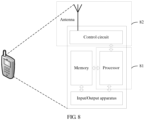
- FIG. 8 is a schematic structural diagram of UE according to an embodiment of this application.
- the UE may complete the functions of the UE in the procedures shown in FIG. 1 , FIG. 2 , FIG. 3 , and FIG. 4 .
- FIG. 8 shows only main components of the UE.
- the UE includes a processor 81, a memory, a control circuit, an antenna, and an input/output apparatus.
- the processor is mainly configured to: process a communications protocol and communication data, control the entire user equipment, execute a software program, and process data of the software program, for example, configured to support the UE in performing some of the described actions in the procedures shown in FIG. 1 , FIG. 2 , and FIG. 4 .
- the memory is mainly configured to store the software program and the data.
- the control circuit is mainly configured to perform conversion between a baseband signal and a radio frequency signal and process the radio frequency signal.
- the control circuit and the antenna are referred to as a transceiver 82 that is mainly configured to receive and send a radio frequency signal in a form of an electromagnetic wave, for example, send an MSG 1 to a base station, and receive an MSG 2 sent by the base station.
- the processor 81 may read the software program in the memory, interpret and execute an instruction in the software program, and process the data of the software program.
- the processor 81 is configured to: after the UE obtains downlink synchronization with a cell, determine a preamble sequence of the UE in the cell, where the UE has not obtained uplink synchronization with the cell; obtain service data; determine a scrambling code, where the scrambling code is in a one-to-one correspondence with the preamble sequence, or the scrambling code is in a one-to-one correspondence with an identifier of the UE, or the scrambling code is in a one-to-one correspondence with a combination of the preamble sequence and an identifier of the UE; and scramble the service data based on the scrambling code, to obtain scrambled service data; and configure, based on a predetermined resource mapping relationship, time-frequency resources respectively occupied by the preamble sequence and the scrambled service data.
- the transceiver 82 is configured to: send, on the time-frequency resources configured by the processor 81, the preamble sequence and the scrambled service data to the base station to which the cell belongs; and receive a random access response sent by the base station based on the preamble sequence.
- the UE When the UE provided in this embodiment of this application sends an MSG 1, the UE sends the preamble sequence and the service data to the base station on the configured time-frequency resources.
- the MSG 1 carries both the preamble and the service data.
- the base station may obtain the service data from the received MSG 1 in time, to provide a service for the UE. Therefore, the base station does not need to wait for completion of a random access process before obtaining service data that is transmitted by the UE by using an extra time-frequency resource, thereby reducing a service delay.
- the scrambling code is in a one-to-one correspondence with the preamble sequence
- the transceiver 82 is further configured to receive a first scrambling code mapping indication sent by the base station, where the first scrambling code mapping indication is used to indicate a mapping mode of a preamble sequence and a scrambling code.
- the processor 81 is further configured to determine the scrambling code in a one-to-one correspondence with the preamble sequence based on the mapping mode and the preamble sequence.
- the scrambling code is in a one-to-one correspondence with the identifier of the UE
- the transceiver 82 is further configured to receive a second scrambling code mapping indication sent by the base station, where the second scrambling code mapping indication is used to indicate a mapping mode of a preamble sequence and an identifier of the UE
- the processor 81 is further configured to determine the scrambling code in a one-to-one correspondence with the identifier of the UE based on the mapping mode and the identifier of the UE.
- the scrambling code is in a one-to-one correspondence with the combination of the preamble sequence and the identifier of the UE
- the transceiver 82 is further configured to receive a third scrambling code mapping indication sent by the base station to which the cell belongs, where the third scrambling code mapping indication is used to indicate a mapping mode of a preamble sequence and a combination of the preamble sequence and an identifier of the UE
- the processor 81 is further configured to determine the scrambling code in a one-to-one correspondence with the combination of the preamble sequence and the identifier of the UE based on the mapping mode and the combination of the preamble sequence and the identifier of the UE.
- the transceiver 82 is further configured to receive a resource mapping indicator sent by the base station, where the resource mapping indicator is used to indicate the predetermined resource mapping relationship; and the processor 81 is further configured to configure, based on the resource mapping relationship indicated by the resource mapping indicator, the time-frequency resources respectively occupied by the preamble sequence and the scrambled service data.
- the transceiver 82 is further configured to receive a coding scheme indicator sent by the base station, where the coding scheme indicator is used to indicate a predetermined coding scheme.
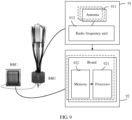
- FIG. 9 is a schematic structural diagram of a base station according to an embodiment of this application.
- the base station device may be used as the base station in FIG. 1 , FIG. 2 , FIG. 4 , and FIG. 5 .
- the base station device includes one or more transceivers 91 and one or more baseband units (English: baseband unit, BBU for short) 92.
- the transceiver 91 may be referred to as a remote radio unit (English: remote radio unit, RRU for short), a transceiver unit, a transceiver machine, a transceiver circuit, or the like.
- the transceiver 91 may include at least one antenna 911 and a radio frequency unit 912.
- the transceiver 91 is mainly configured to: receive and send a radio frequency signal and perform conversion between the radio frequency signal and a baseband signal.
- the processor 92 is mainly configured to perform baseband processing, control the base station, and the like.
- the transceiver 91 and the baseband unit 92 may be physically disposed together, or may be physically separated. In other words, the base station is a distributive base station.
- the baseband unit 92 is mainly used to complete a baseband processing function, such as channel coding, multiplexing, modulation, or spectrum spreading.
- the baseband unit 92 may include one or more boards, and the plurality of boards may jointly support a radio access network (for example, an LTE network) of a single access standard, or may respectively support radio access networks of different access standards.
- the baseband unit 92 includes a processor 921.
- the processor 921 may be configured to control the base station shown in FIG. 9 to perform the procedure performed by the base station in each of the foregoing embodiments.
- the baseband unit 92 may further include a memory 922, configured to store a necessary instruction and necessary data.
- the processor 921 is configured to determine, based on a predetermined resource mapping relationship, time-frequency resources respectively occupied by a preamble sequence and service data that are in a cell covered by the base station.
- the transceiver 91 is configured to receive, on the determined time-frequency resources, the preamble sequence and the service data that are sent by UE, where the UE has obtained downlink synchronization with the cell, but has not obtained uplink synchronization with the cell.
- the processor 921 is further configured to: determine a scrambling code, where the scrambling code is in a one-to-one correspondence with the received preamble sequence, or the scrambling code is in a one-to-one correspondence with an identifier of the UE, or the scrambling code is in a one-to-one correspondence with a combination of the received preamble sequence and an identifier of the UE; and descramble, based on the scrambling code, the service data sent by the UE, to obtain descrambled service data.
- the transceiver 91 is further configured to send a random access response to the UE based on the preamble sequence.
- the base station When the base station provided in this embodiment of this application receives an MSG 1, the base station receives, on the time-frequency resources having a mapping relationship, the preamble sequence and the service data that are sent by the UE. In other words, the MSG 1 carries both the preamble and the service data. Therefore, the base station does not need to provide a service for the UE after waiting for completion of a random access process, thereby reducing a service delay.
- the transceiver 91 is further configured to send a resource mapping indicator to the UE, where the resource mapping indicator is used to indicate the predetermined resource mapping relationship.
- the transceiver 91 is further configured to: before receiving the preamble sequence and the service data that are sent by the UE, send a first scrambling code mapping indication to the UE, where the first scrambling code mapping indication is used to indicate a mapping mode of a preamble sequence and a scrambling code.
- the transceiver 91 is further configured to: before receiving the preamble sequence and the service data that are sent by the UE, send a second scrambling code mapping indication to the UE, where the second scrambling code mapping indication is used to indicate a mapping mode of a preamble sequence and an identifier of the UE.
- the transceiver 91 is further configured to: before receiving the preamble sequence and the service data that are sent by the UE, send a third scrambling code mapping indication to the UE, where the third scrambling code mapping indication is used to indicate a mapping mode of a preamble sequence and a combination of the preamble sequence and an identifier of the UE.
- the UE further codes to-be-sent data before scrambling the to-be-sent service data.
- the base station also needs to decode the received service data after descrambling the received service data.
- the processor 921 is further configured to: after obtaining the descrambled service data, decode the descrambled service data based on a decoding scheme corresponding to a predetermined coding scheme.
- the transceiver 91 is further configured to: before receiving the preamble sequence and the service data that are sent by the UE, send a coding scheme indicator to the UE, where the coding scheme indicator is used to indicate the predetermined coding scheme.
- An embodiment of this application further provides a random access system of UE.
- the random access system includes a base station and the UE.
- the random access system includes a base station and the UE.
- For a structure of the base station refer to the descriptions in FIG. 9 .
- For a structure of the UE refer to the descriptions in FIG. 8 .
- For a process of interaction between the base station and the UE refer to the descriptions in the foregoing method embodiment.
- All or some of the foregoing embodiments may be implemented by using of software, hardware, firmware, or any combination thereof.
- the embodiments may be implemented completely or partially in a form of a computer program product.
- the computer program product includes one or more computer instructions.
- the computer program instructions When the computer program instructions are loaded and executed on a computer, the procedures or functions according to the embodiments of the present invention are all or partially generated.
- the computer may be a general-purpose computer, a dedicated computer, a computer network, or another programmable apparatus.
- the computer instructions may be stored in a computer-readable storage medium or may be transmitted from a computer-readable storage medium to another computer-readable storage medium.
- the computer instructions may be transmitted from a website, a computer, a server, or a data center to another website, computer, server, or data center in a wired (for example, a coaxial cable, an optical fiber, or a digital subscriber line (DSL)) or wireless (for example, infrared, radio, or microwave) manner.
- the computer-readable storage medium may be any usable medium accessible by a computer, or a data storage device, such as a server or a data center, integrating one or more usable media.
- the usable medium may be a magnetic medium (such as a floppy disk, a hard disk, or a magnetic tape), an optical medium (for example, a DVD), a semiconductor medium (for example, a solid state disk Solid State Disk (SSD)), or the like.
- a magnetic medium such as a floppy disk, a hard disk, or a magnetic tape
- an optical medium for example, a DVD
- a semiconductor medium for example, a solid state disk Solid State Disk (SSD)
Landscapes
- Engineering & Computer Science (AREA)
- Signal Processing (AREA)
- Computer Networks & Wireless Communication (AREA)
- Mobile Radio Communication Systems (AREA)
Claims (15)
- Procédé d'accès aléatoire comprenant les étapes suivantes :après avoir obtenu une synchronisation de liaison descendante avec une cellule, déterminer (21), par un équipement utilisateur, UE, une séquence de préambule de l'UE dans la cellule, où l'UE n'a pas obtenu de synchronisation de liaison montante avec la cellule ;obtenir (22) , par l'UE, des données de service ;déterminer (23), par l'UE, un code de brouillage, où le code de brouillage est en correspondance biunivoque avec la séquence de préambule ;brouiller (24), par l'UE, les données de service sur la base du code de brouillage, pour obtenir des données de service brouillées ;déterminer (25), par l'UE, sur la base d'une relation de mappage de ressources prédéterminée, des ressources temps-fréquence respectivement occupées par la séquence de préambule et les données de service brouillées ;envoyer (10, 26) par l'UE, sur les ressources temps-fréquence déterminées, la séquence de préambule et les données de service brouillées à une station de base à laquelle la cellule appartient ; etrecevoir (20, 27), par l'UE, une réponse d'accès aléatoire en provenance de la station de base.
- Procédé selon la revendication 1, dans lequel le code de brouillage est en correspondance biunivoque avec la séquence de préambule, et la détermination d'un code de brouillage comprend les étapes suivantes :recevoir, par l'UE, une première indication de mappage de code de brouillage en provenance de la station de base, où la première indication de mappage de code de brouillage indique un mode de mappage d'une séquence de préambule et d'un code de brouillage ; etdéterminer, par l'UE, le code de brouillage en correspondance biunivoque avec la séquence de préambule sur la base du mode de mappage et de la séquence de préambule.
- Procédé selon la revendication 1, dans lequel le code de brouillage est en correspondance biunivoque avec la combinaison de la séquence de préambule et d'un identifiant de l'UE, et la détermination d'un code de brouillage comprend les étapes suivantes :recevoir, par l'UE, une troisième indication de mappage de code de brouillage en provenance de la station de base à laquelle la cellule appartient, où la troisième indication de mappage de code de brouillage indique un mode de mappage d'une séquence de préambule et une combinaison de la séquence de préambule et d'un identifiant de l'UE ; etdéterminer, par l'UE, le code de brouillage en correspondance biunivoque avec la combinaison de la séquence de préambule et de l'identifiant de l'UE sur la base du mode de mappage et de la combinaison de la séquence de préambule et de l'identifiant de l'UE.
- Procédé selon l'une quelconque des revendications 1 à 3, dans lequel la détermination, sur la base d'une relation de mappage de ressources prédéterminée, des ressources temps-fréquence respectivement occupées par la séquence de préambule et les données de service brouillées comprend les étapes suivantes :recevoir, par l'UE, un indicateur de mappage de ressources en provenance de la station de base, l'indicateur de mappage de ressources indiquant la relation de mappage de ressources prédéterminée ; etdéterminer, par l'UE, sur la base de la relation de mappage de ressources indiquée par l'indicateur de mappage de ressources, les ressources temps-fréquence respectivement occupées par la séquence de préambule et les données de service brouillées.
- Procédé selon l'une quelconque des revendications 1 à 4, dans lequel le brouillage, par l'UE, des données de service sur la base du code de brouillage comprend les étapes suivantes :coder (241), par l'UE, les données de service sur la base d'un schéma de codage prédéterminé, pour obtenir des données de service codées ; etbrouiller (242), par l'UE, les données de service codées sur la base du code de brouillage ;où, avant le codage, par l'UE, des données de service sur la base d'un schéma de codage prédéterminé, le procédé comprend en outre l'étape suivante :
recevoir, par l'UE, un indicateur de schéma de codage en provenance de la station de base, où l'indicateur de schéma de codage indique le schéma de codage prédéterminé. - Procédé d'accès aléatoire, comprenant les étapes suivantes :déterminer (70), par une station de base, sur la base d'une relation de mappage de ressources prédéterminée, des ressources temps-fréquence respectivement occupées par une séquence de préambule et des données de service qui sont dans une cellule couverte par la station de base ;recevoir (10, 71), par la station de base, sur les ressources temps-fréquence déterminées, la séquence de préambule et les données de service qui sont en provenance d'un équipement utilisateur, UE, où l'UE a obtenu une synchronisation de liaison descendante avec la cellule, mais n'a pas obtenu une synchronisation de liaison montante avec la cellule ;déterminer (72), par la station de base, un code de brouillage, où le code de brouillage est en correspondance biunivoque avec la séquence de préambule reçue ;débrouiller (73), par la station de base, sur la base du code de brouillage, les données de service en provenance de l'UE, pour obtenir des données de service débrouillées ; etenvoyer (20, 74), par la station de base, une réponse d'accès aléatoire à l'UE.
- Procédé selon la revendication 6, dans lequel, avant la réception de la séquence de préambule et des données de service en provenance de l'UE, le procédé comprend en outre l'étape suivante :
envoyer, par la station de base, un indicateur de mappage de ressources à l'UE, où l'indicateur de mappage de ressources indique la relation de mappage de ressources prédéterminée. - Procédé selon la revendication 6 ou 7, dans lequel le code de brouillage est en correspondance biunivoque avec la séquence de préambule, et avant la réception de la séquence de préambule et des données de service en provenance de l'UE, le procédé comprend en outre l'étape suivante :
envoyer, par la station de base, une première indication de mappage de code de brouillage à l'UE, où la première indication de mappage de code de brouillage indique un mode de mappage d'une séquence de préambule et d'un code de brouillage. - Procédé selon la revendication 6 ou 7, dans lequel le code de brouillage est en correspondance biunivoque avec la combinaison de la séquence de préambule et d'un identifiant de l'UE et, avant la réception de la séquence de préambule et des données de service en provenance de l'UE, le procédé comprend en outre l'étape suivante :
envoyer, par la station de base, une troisième indication de mappage de code de brouillage à l'UE, où la troisième indication de mappage de code de brouillage indique un mode de mappage d'une séquence de préambule et une combinaison de la séquence de préambule et d'un identifiant de l'UE. - Procédé selon l'une quelconque des revendications 6 à 9, dans lequel après l'obtention des données de service débrouillées, le procédé comprend en outre l'étape suivante :décoder (75), par la station de base, les données de service débrouillées sur la base d'un schéma de décodage correspondant à un schéma de codage prédéterminé ;où, avant la réception de la séquence de préambule et des données de service en provenance de l'UE, le procédé comprend en outre l'étape suivante :
envoyer, par la station de base, un indicateur de schéma de codage à l'UE, où l'indicateur de schéma de codage indique le schéma de codage prédéterminé. - Procédé selon l'une quelconque des revendications 2, 3, 4, 5, 7, 8, 9,10, dans lequel :lorsqu'il dépend de la revendication 2 ou de la revendication 8, la première indication de mappage de code de brouillage, dans lequel, lorsqu'il dépend de la revendication 3 ou de la revendication 9, la troisième indication de mappage de code de brouillage, dans lequel, lorsqu'il dépend de la revendication 4 ou de la revendication 7, l'indicateur de mappage de ressources, dans lequel, lorsqu'il dépend de la revendication 5 ou de la revendication 10, l'indicateur de schéma de codage,est notifié(e) par la station de base à l'UE en utilisant un canal de diffusion physique, PBCH, ou est notifié(e) par la station de base à l'UE en utilisant un message d'information de système, SI, ou est notifié(e) par la station de base à l'UE en utilisant un canal de commande de liaison descendante physique, PDCCH.
- Equipement utilisateur, UE, comprenant un émetteur-récepteur (82) et un processeur (81), dans lequel :
l'UE est configuré pour exécuter le procédé selon l'une quelconque des revendications 1 à 5, ou le procédé selon la revendication 11 lorsqu'il dépend de l'une quelconque des revendications 2 à 5. - Station de base, comprenant un processeur (921) et un émetteur-récepteur (91), dans laquelle
la station de base est configurée pour exécuter le procédé selon l'une quelconque des revendications 6 à 10, ou le procédé selon la revendication 11 lorsqu'il dépend de l'une quelconque des revendications 7 à 10. - Support de stockage lisible par ordinateur sur lequel est stocké un programme informatique, qui, lorsqu'il est exécuté par un ordinateur, met en œuvre le procédé selon l'une quelconque des revendications 1 à 11.
- Produit programme comprenant un programme informatique, qui, lorsqu'il est exécuté par un ordinateur, met en œuvre le procédé selon l'une quelconque des revendications 1 à 11.
Priority Applications (1)
| Application Number | Priority Date | Filing Date | Title |
|---|---|---|---|
| EP25171372.3A EP4625918A3 (fr) | 2017-03-20 | 2018-02-24 | Procédé d'accès aléatoire, équipement utilisateur, station de base et système d'accès aléatoire |
Applications Claiming Priority (2)
| Application Number | Priority Date | Filing Date | Title |
|---|---|---|---|
| CN201710166657.9A CN108633104B (zh) | 2017-03-20 | 2017-03-20 | 随机接入方法、用户设备、基站以及随机接入系统 |
| PCT/CN2018/077103 WO2018171377A1 (fr) | 2017-03-20 | 2018-02-24 | Procédé d'accès aléatoire, équipement d'utilisateur, station de base et système d'accès aléatoire |
Related Child Applications (2)
| Application Number | Title | Priority Date | Filing Date |
|---|---|---|---|
| EP25171372.3A Division EP4625918A3 (fr) | 2017-03-20 | 2018-02-24 | Procédé d'accès aléatoire, équipement utilisateur, station de base et système d'accès aléatoire |
| EP25171372.3A Division-Into EP4625918A3 (fr) | 2017-03-20 | 2018-02-24 | Procédé d'accès aléatoire, équipement utilisateur, station de base et système d'accès aléatoire |
Publications (3)
| Publication Number | Publication Date |
|---|---|
| EP3573413A1 EP3573413A1 (fr) | 2019-11-27 |
| EP3573413A4 EP3573413A4 (fr) | 2020-02-19 |
| EP3573413B1 true EP3573413B1 (fr) | 2025-05-21 |
Family
ID=63586264
Family Applications (2)
| Application Number | Title | Priority Date | Filing Date |
|---|---|---|---|
| EP18772323.4A Active EP3573413B1 (fr) | 2017-03-20 | 2018-02-24 | Procédé d'accès aléatoire, équipement d'utilisateur et station de base |
| EP25171372.3A Pending EP4625918A3 (fr) | 2017-03-20 | 2018-02-24 | Procédé d'accès aléatoire, équipement utilisateur, station de base et système d'accès aléatoire |
Family Applications After (1)
| Application Number | Title | Priority Date | Filing Date |
|---|---|---|---|
| EP25171372.3A Pending EP4625918A3 (fr) | 2017-03-20 | 2018-02-24 | Procédé d'accès aléatoire, équipement utilisateur, station de base et système d'accès aléatoire |
Country Status (4)
| Country | Link |
|---|---|
| US (2) | US11284442B2 (fr) |
| EP (2) | EP3573413B1 (fr) |
| CN (2) | CN111818664B (fr) |
| WO (1) | WO2018171377A1 (fr) |
Families Citing this family (7)
| Publication number | Priority date | Publication date | Assignee | Title |
|---|---|---|---|---|
| CN108633013B (zh) * | 2017-03-22 | 2019-09-17 | 电信科学技术研究院 | 一种收发物理随机接入信道前导码序列的方法及装置 |
| EP3949636B1 (fr) | 2019-03-29 | 2025-04-02 | Nokia Technologies OY | Transmission d'informations en accès aléatoire |
| WO2020223921A1 (fr) * | 2019-05-08 | 2020-11-12 | 哈尔滨海能达科技有限公司 | Procédé de traitement de signaux, dispositif associé et système d'antenne lora |
| CN112838906B (zh) * | 2019-11-25 | 2022-12-02 | 华为技术有限公司 | 一种数据处理的方法以及相关装置 |
| WO2021159408A1 (fr) | 2020-02-13 | 2021-08-19 | Nokia Shanghai Bell Co., Ltd. | Préambule amélioré de canal physique à accès aléatoire |
| CN117044336A (zh) * | 2021-03-25 | 2023-11-10 | Oppo广东移动通信有限公司 | 扰码资源的配置方法及装置、终端设备、网络设备 |
| CN115604854A (zh) * | 2021-07-07 | 2023-01-13 | 大唐移动通信设备有限公司(Cn) | 数据传输方法、终端和网络侧设备 |
Family Cites Families (24)
| Publication number | Priority date | Publication date | Assignee | Title |
|---|---|---|---|---|
| CN101102298B (zh) * | 2006-07-06 | 2011-07-27 | 华为技术有限公司 | 多载波传输系统中部分带宽的使用方法和系统 |
| US8169992B2 (en) * | 2007-08-08 | 2012-05-01 | Telefonaktiebolaget Lm Ericsson (Publ) | Uplink scrambling during random access |
| ES2388951T3 (es) * | 2007-08-17 | 2012-10-22 | Ntt Docomo, Inc. | Procedimiento de comunicaciones móviles, dispositivo de estación base de radio y estación móvil |
| EP2206396B1 (fr) * | 2007-10-31 | 2017-07-19 | Koninklijke Philips N.V. | Procédé de signalisation de canaux d'accès aléatoire |
| US9357563B2 (en) * | 2008-08-12 | 2016-05-31 | Google Technology Holdings LLC | Preventing misuse of random access procedure in wireless communication system |
| WO2010067968A2 (fr) * | 2008-12-10 | 2010-06-17 | 엘지전자 주식회사 | Procédé permettant d'activer un terminal pour détecter et rechercher efficacement une station de base femto |
| US8660165B2 (en) * | 2009-06-11 | 2014-02-25 | Andrew Llc | System and method for detecting spread spectrum signals in a wireless environment |
| KR101217574B1 (ko) | 2009-06-16 | 2013-01-18 | 한국전자통신연구원 | 나노선 메모리 |
| US8989117B2 (en) * | 2011-08-16 | 2015-03-24 | Telefonaktiebolaget L M Ericsson (Publ) | Enhanced dedicated-channel signaling in a CELL—FACH state |
| CN102548015A (zh) * | 2012-01-13 | 2012-07-04 | 电信科学技术研究院 | 一种随机接入及其控制方法、装置和系统 |
| WO2014023026A1 (fr) * | 2012-08-10 | 2014-02-13 | 华为技术有限公司 | Procédé, station de base et équipement d'utilisateur pour un accès aléatoire |
| US9468022B2 (en) | 2012-12-26 | 2016-10-11 | Samsung Electronics Co., Ltd. | Method and apparatus for random access in communication system with large number of antennas |
| HUE038735T2 (hu) | 2013-03-15 | 2018-11-28 | Qualcomm Inc | Javított véletlen hozzáférési eljárás nyalábformálással LTE rendszerben |
| CN104754702A (zh) * | 2013-12-26 | 2015-07-01 | 华为技术有限公司 | 一种随机接入的干扰控制方法、设备及系统 |
| JP6346958B2 (ja) * | 2014-02-16 | 2018-06-20 | エルジー エレクトロニクス インコーポレイティド | 無線通信システムにおけるアップリンクデータ転送方法及びそのための装置 |
| EP3123805B1 (fr) * | 2014-03-27 | 2019-05-08 | Telefonaktiebolaget LM Ericsson (publ) | Procédures d'accès aléatoire pour des communications du type machine |
| CN104981022B (zh) * | 2014-04-04 | 2020-07-10 | 北京三星通信技术研究有限公司 | 数据传输的方法、基站及终端 |
| CN105376009A (zh) * | 2014-08-27 | 2016-03-02 | 华为技术有限公司 | 一种上行数据传输方法及装置 |
| US10700830B2 (en) * | 2014-10-21 | 2020-06-30 | Qualcomm Incorporated | Techniques for conveying identification information in a preamble transmission |
| WO2016089146A1 (fr) * | 2014-12-05 | 2016-06-09 | 엘지전자(주) | Procédé et dispositif de sélection de cellule dans un système de communications sans fil |
| US10142980B2 (en) * | 2016-02-26 | 2018-11-27 | Qualcomm Incorporated | Discovery reference signal transmission window detection and discovery reference signal measurement configuration |
| ES2887009T3 (es) * | 2017-01-05 | 2021-12-21 | Guangdong Oppo Mobile Telecommunications Corp Ltd | Método y dispositivo para acceso aleatorio |
| ES3027198T3 (en) * | 2017-01-23 | 2025-06-13 | Ericsson Telefon Ab L M | Method and device for two-step random accessing |
| US20200288506A1 (en) * | 2019-02-15 | 2020-09-10 | Qualcomm Incorporated | Techniques for supporting co-existence between 2-step random access and 4-step random access |
-
2017
- 2017-03-20 CN CN202010480510.9A patent/CN111818664B/zh active Active
- 2017-03-20 CN CN201710166657.9A patent/CN108633104B/zh active Active
-
2018
- 2018-02-24 EP EP18772323.4A patent/EP3573413B1/fr active Active
- 2018-02-24 WO PCT/CN2018/077103 patent/WO2018171377A1/fr not_active Ceased
- 2018-02-24 EP EP25171372.3A patent/EP4625918A3/fr active Pending
-
2019
- 2019-09-20 US US16/576,785 patent/US11284442B2/en active Active
-
2022
- 2022-02-28 US US17/682,509 patent/US11985709B2/en active Active
Also Published As
| Publication number | Publication date |
|---|---|
| CN108633104A (zh) | 2018-10-09 |
| US20200015282A1 (en) | 2020-01-09 |
| WO2018171377A1 (fr) | 2018-09-27 |
| EP4625918A2 (fr) | 2025-10-01 |
| CN108633104B (zh) | 2020-06-16 |
| CN111818664A (zh) | 2020-10-23 |
| EP3573413A1 (fr) | 2019-11-27 |
| US11985709B2 (en) | 2024-05-14 |
| CN111818664B (zh) | 2023-01-13 |
| US11284442B2 (en) | 2022-03-22 |
| EP3573413A4 (fr) | 2020-02-19 |
| US20220256616A1 (en) | 2022-08-11 |
| EP4625918A3 (fr) | 2025-11-19 |
Similar Documents
| Publication | Publication Date | Title |
|---|---|---|
| US11985709B2 (en) | Random access method, user equipment, base station, and random access system | |
| JP7553438B2 (ja) | ランダムアクセス方法及び端末装置並びにコンピューター記憶媒体 | |
| EP3768013B1 (fr) | Dispositif terminal, dispositif de station de base et procédé de communication | |
| EP3780808B1 (fr) | Dispositif terminal et procédé de communication | |
| EP3105988B1 (fr) | Équipement utilisateur, noeud de réseau et procédés correspondants pour gérer des transmissions de préambule sur un canal d'accès aléatoire dans un réseau de radiocommunication | |
| EP2745602B1 (fr) | Commande des échecs des accès aléatoires sur une cellule secondaire | |
| EP3618534B1 (fr) | Dispositif terminal, dispositif de station de base et procédé de communication | |
| JP2023537067A (ja) | 周波数領域リソース決定方法、デバイス、及び記憶媒体 | |
| CN114126073B (zh) | 用于等待时间减少的随机接入过程 | |
| US11503643B2 (en) | Random access method and device | |
| JP7282182B2 (ja) | Ra-rnti処理方法及び装置 | |
| CN112753274A (zh) | 用于支持用于2步随机接入过程的多个消息a大小和上行链路覆盖的方法和装置 | |
| WO2019120260A1 (fr) | Procédé et appareil de communication | |
| CN108668361B (zh) | 一种信息生成方法和设备 | |
| WO2016164011A1 (fr) | Transmission de message de réponse à accès aléatoire | |
| US9681439B2 (en) | Method and arrangement in a telecommunication system | |
| CN104303568B (zh) | 调度信令的传输方法和设备 | |
| CN114208300B (zh) | 两步随机接入中接收和发送随机接入响应的方法及装置 | |
| JP7005371B2 (ja) | 端末装置、基地局装置、および、通信方法 |
Legal Events
| Date | Code | Title | Description |
|---|---|---|---|
| STAA | Information on the status of an ep patent application or granted ep patent |
Free format text: STATUS: THE INTERNATIONAL PUBLICATION HAS BEEN MADE |
|
| PUAI | Public reference made under article 153(3) epc to a published international application that has entered the european phase |
Free format text: ORIGINAL CODE: 0009012 |
|
| STAA | Information on the status of an ep patent application or granted ep patent |
Free format text: STATUS: REQUEST FOR EXAMINATION WAS MADE |
|
| 17P | Request for examination filed |
Effective date: 20190821 |
|
| AK | Designated contracting states |
Kind code of ref document: A1 Designated state(s): AL AT BE BG CH CY CZ DE DK EE ES FI FR GB GR HR HU IE IS IT LI LT LU LV MC MK MT NL NO PL PT RO RS SE SI SK SM TR |
|
| AX | Request for extension of the european patent |
Extension state: BA ME |
|
| A4 | Supplementary search report drawn up and despatched |
Effective date: 20200122 |
|
| RIC1 | Information provided on ipc code assigned before grant |
Ipc: H04W 74/08 20090101AFI20200116BHEP |
|
| DAV | Request for validation of the european patent (deleted) | ||
| DAX | Request for extension of the european patent (deleted) | ||
| STAA | Information on the status of an ep patent application or granted ep patent |
Free format text: STATUS: EXAMINATION IS IN PROGRESS |
|
| 17Q | First examination report despatched |
Effective date: 20210301 |
|
| RIC1 | Information provided on ipc code assigned before grant |
Ipc: H04L 27/26 20060101ALI20210223BHEP Ipc: H04W 74/08 20090101AFI20210223BHEP Ipc: H04L 5/00 20060101ALI20210223BHEP |
|
| GRAP | Despatch of communication of intention to grant a patent |
Free format text: ORIGINAL CODE: EPIDOSNIGR1 |
|
| STAA | Information on the status of an ep patent application or granted ep patent |
Free format text: STATUS: GRANT OF PATENT IS INTENDED |
|
| INTG | Intention to grant announced |
Effective date: 20221024 |
|
| GRAJ | Information related to disapproval of communication of intention to grant by the applicant or resumption of examination proceedings by the epo deleted |
Free format text: ORIGINAL CODE: EPIDOSDIGR1 |
|
| STAA | Information on the status of an ep patent application or granted ep patent |
Free format text: STATUS: EXAMINATION IS IN PROGRESS |
|
| INTC | Intention to grant announced (deleted) | ||
| REG | Reference to a national code |
Ref country code: DE Ref legal event code: R079 Free format text: PREVIOUS MAIN CLASS: H04W0074080000 Ipc: H04W0074083300 Ref country code: DE Ref legal event code: R079 Ref document number: 602018082112 Country of ref document: DE Free format text: PREVIOUS MAIN CLASS: H04W0074080000 Ipc: H04W0074083300 |
|
| GRAP | Despatch of communication of intention to grant a patent |
Free format text: ORIGINAL CODE: EPIDOSNIGR1 |
|
| STAA | Information on the status of an ep patent application or granted ep patent |
Free format text: STATUS: GRANT OF PATENT IS INTENDED |
|
| RIC1 | Information provided on ipc code assigned before grant |
Ipc: H04W 56/00 20090101ALN20241210BHEP Ipc: H04W 74/0838 20240101ALN20241210BHEP Ipc: H04L 27/26 20060101ALI20241210BHEP Ipc: H04L 5/00 20060101ALI20241210BHEP Ipc: H04W 74/0833 20240101AFI20241210BHEP |
|
| INTG | Intention to grant announced |
Effective date: 20250110 |
|
| GRAS | Grant fee paid |
Free format text: ORIGINAL CODE: EPIDOSNIGR3 |
|
| GRAA | (expected) grant |
Free format text: ORIGINAL CODE: 0009210 |
|
| STAA | Information on the status of an ep patent application or granted ep patent |
Free format text: STATUS: THE PATENT HAS BEEN GRANTED |
|
| AK | Designated contracting states |
Kind code of ref document: B1 Designated state(s): AL AT BE BG CH CY CZ DE DK EE ES FI FR GB GR HR HU IE IS IT LI LT LU LV MC MK MT NL NO PL PT RO RS SE SI SK SM TR |
|
| REG | Reference to a national code |
Ref country code: GB Ref legal event code: FG4D |
|
| REG | Reference to a national code |
Ref country code: CH Ref legal event code: EP |
|
| REG | Reference to a national code |
Ref country code: DE Ref legal event code: R096 Ref document number: 602018082112 Country of ref document: DE |
|
| REG | Reference to a national code |
Ref country code: IE Ref legal event code: FG4D |
|
| REG | Reference to a national code |
Ref country code: NL Ref legal event code: MP Effective date: 20250521 |
|
| PG25 | Lapsed in a contracting state [announced via postgrant information from national office to epo] |
Ref country code: PT Free format text: LAPSE BECAUSE OF FAILURE TO SUBMIT A TRANSLATION OF THE DESCRIPTION OR TO PAY THE FEE WITHIN THE PRESCRIBED TIME-LIMIT Effective date: 20250922 Ref country code: FI Free format text: LAPSE BECAUSE OF FAILURE TO SUBMIT A TRANSLATION OF THE DESCRIPTION OR TO PAY THE FEE WITHIN THE PRESCRIBED TIME-LIMIT Effective date: 20250521 Ref country code: ES Free format text: LAPSE BECAUSE OF FAILURE TO SUBMIT A TRANSLATION OF THE DESCRIPTION OR TO PAY THE FEE WITHIN THE PRESCRIBED TIME-LIMIT Effective date: 20250521 |
|
| REG | Reference to a national code |
Ref country code: LT Ref legal event code: MG9D |
|
| PG25 | Lapsed in a contracting state [announced via postgrant information from national office to epo] |
Ref country code: NO Free format text: LAPSE BECAUSE OF FAILURE TO SUBMIT A TRANSLATION OF THE DESCRIPTION OR TO PAY THE FEE WITHIN THE PRESCRIBED TIME-LIMIT Effective date: 20250821 Ref country code: GR Free format text: LAPSE BECAUSE OF FAILURE TO SUBMIT A TRANSLATION OF THE DESCRIPTION OR TO PAY THE FEE WITHIN THE PRESCRIBED TIME-LIMIT Effective date: 20250822 |
|
| PG25 | Lapsed in a contracting state [announced via postgrant information from national office to epo] |
Ref country code: PL Free format text: LAPSE BECAUSE OF FAILURE TO SUBMIT A TRANSLATION OF THE DESCRIPTION OR TO PAY THE FEE WITHIN THE PRESCRIBED TIME-LIMIT Effective date: 20250521 Ref country code: NL Free format text: LAPSE BECAUSE OF FAILURE TO SUBMIT A TRANSLATION OF THE DESCRIPTION OR TO PAY THE FEE WITHIN THE PRESCRIBED TIME-LIMIT Effective date: 20250521 |
|
| PG25 | Lapsed in a contracting state [announced via postgrant information from national office to epo] |
Ref country code: BG Free format text: LAPSE BECAUSE OF FAILURE TO SUBMIT A TRANSLATION OF THE DESCRIPTION OR TO PAY THE FEE WITHIN THE PRESCRIBED TIME-LIMIT Effective date: 20250521 |
|
| PG25 | Lapsed in a contracting state [announced via postgrant information from national office to epo] |
Ref country code: HR Free format text: LAPSE BECAUSE OF FAILURE TO SUBMIT A TRANSLATION OF THE DESCRIPTION OR TO PAY THE FEE WITHIN THE PRESCRIBED TIME-LIMIT Effective date: 20250521 |
|
| PG25 | Lapsed in a contracting state [announced via postgrant information from national office to epo] |
Ref country code: RS Free format text: LAPSE BECAUSE OF FAILURE TO SUBMIT A TRANSLATION OF THE DESCRIPTION OR TO PAY THE FEE WITHIN THE PRESCRIBED TIME-LIMIT Effective date: 20250821 |
|
| PG25 | Lapsed in a contracting state [announced via postgrant information from national office to epo] |
Ref country code: IS Free format text: LAPSE BECAUSE OF FAILURE TO SUBMIT A TRANSLATION OF THE DESCRIPTION OR TO PAY THE FEE WITHIN THE PRESCRIBED TIME-LIMIT Effective date: 20250921 |
|
| PG25 | Lapsed in a contracting state [announced via postgrant information from national office to epo] |
Ref country code: LV Free format text: LAPSE BECAUSE OF FAILURE TO SUBMIT A TRANSLATION OF THE DESCRIPTION OR TO PAY THE FEE WITHIN THE PRESCRIBED TIME-LIMIT Effective date: 20250521 |
|
| REG | Reference to a national code |
Ref country code: AT Ref legal event code: MK05 Ref document number: 1798002 Country of ref document: AT Kind code of ref document: T Effective date: 20250521 |
|
| PG25 | Lapsed in a contracting state [announced via postgrant information from national office to epo] |
Ref country code: SM Free format text: LAPSE BECAUSE OF FAILURE TO SUBMIT A TRANSLATION OF THE DESCRIPTION OR TO PAY THE FEE WITHIN THE PRESCRIBED TIME-LIMIT Effective date: 20250521 Ref country code: AT Free format text: LAPSE BECAUSE OF FAILURE TO SUBMIT A TRANSLATION OF THE DESCRIPTION OR TO PAY THE FEE WITHIN THE PRESCRIBED TIME-LIMIT Effective date: 20250521 Ref country code: DK Free format text: LAPSE BECAUSE OF FAILURE TO SUBMIT A TRANSLATION OF THE DESCRIPTION OR TO PAY THE FEE WITHIN THE PRESCRIBED TIME-LIMIT Effective date: 20250521 |
|
| PGFP | Annual fee paid to national office [announced via postgrant information from national office to epo] |
Ref country code: FR Payment date: 20251231 Year of fee payment: 9 |
|
| PG25 | Lapsed in a contracting state [announced via postgrant information from national office to epo] |
Ref country code: CZ Free format text: LAPSE BECAUSE OF FAILURE TO SUBMIT A TRANSLATION OF THE DESCRIPTION OR TO PAY THE FEE WITHIN THE PRESCRIBED TIME-LIMIT Effective date: 20250521 |
|
| PG25 | Lapsed in a contracting state [announced via postgrant information from national office to epo] |
Ref country code: EE Free format text: LAPSE BECAUSE OF FAILURE TO SUBMIT A TRANSLATION OF THE DESCRIPTION OR TO PAY THE FEE WITHIN THE PRESCRIBED TIME-LIMIT Effective date: 20250521 |
|
| PG25 | Lapsed in a contracting state [announced via postgrant information from national office to epo] |
Ref country code: SK Free format text: LAPSE BECAUSE OF FAILURE TO SUBMIT A TRANSLATION OF THE DESCRIPTION OR TO PAY THE FEE WITHIN THE PRESCRIBED TIME-LIMIT Effective date: 20250521 Ref country code: RO Free format text: LAPSE BECAUSE OF FAILURE TO SUBMIT A TRANSLATION OF THE DESCRIPTION OR TO PAY THE FEE WITHIN THE PRESCRIBED TIME-LIMIT Effective date: 20250521 |
|
| PG25 | Lapsed in a contracting state [announced via postgrant information from national office to epo] |
Ref country code: IT Free format text: LAPSE BECAUSE OF FAILURE TO SUBMIT A TRANSLATION OF THE DESCRIPTION OR TO PAY THE FEE WITHIN THE PRESCRIBED TIME-LIMIT Effective date: 20250521 |
|
| REG | Reference to a national code |
Ref country code: DE Ref legal event code: R097 Ref document number: 602018082112 Country of ref document: DE |
|
| PLBE | No opposition filed within time limit |
Free format text: ORIGINAL CODE: 0009261 |
|
| STAA | Information on the status of an ep patent application or granted ep patent |
Free format text: STATUS: NO OPPOSITION FILED WITHIN TIME LIMIT |
|
| REG | Reference to a national code |
Ref country code: CH Ref legal event code: L10 Free format text: ST27 STATUS EVENT CODE: U-0-0-L10-L00 (AS PROVIDED BY THE NATIONAL OFFICE) Effective date: 20260402 |
|
| PGFP | Annual fee paid to national office [announced via postgrant information from national office to epo] |
Ref country code: GB Payment date: 20260106 Year of fee payment: 9 |
|
| PGFP | Annual fee paid to national office [announced via postgrant information from national office to epo] |
Ref country code: DE Payment date: 20260102 Year of fee payment: 9 |
|
| 26N | No opposition filed |
Effective date: 20260224 |