EP3575892A1 - Dispositif et procédé d'estimation de valeurs de paramètres de modèle, programme, support d'enregistrement sur lequel est enregistré un programme, et système d'estimation de valeurs de paramètres de modèle - Google Patents
Dispositif et procédé d'estimation de valeurs de paramètres de modèle, programme, support d'enregistrement sur lequel est enregistré un programme, et système d'estimation de valeurs de paramètres de modèle Download PDFInfo
- Publication number
- EP3575892A1 EP3575892A1 EP17893753.8A EP17893753A EP3575892A1 EP 3575892 A1 EP3575892 A1 EP 3575892A1 EP 17893753 A EP17893753 A EP 17893753A EP 3575892 A1 EP3575892 A1 EP 3575892A1
- Authority
- EP
- European Patent Office
- Prior art keywords
- model parameter
- section
- input
- parameter value
- function
- Prior art date
- Legal status (The legal status is an assumption and is not a legal conclusion. Google has not performed a legal analysis and makes no representation as to the accuracy of the status listed.)
- Granted
Links
Images





Classifications
-
- G—PHYSICS
- G06—COMPUTING OR CALCULATING; COUNTING
- G06N—COMPUTING ARRANGEMENTS BASED ON SPECIFIC COMPUTATIONAL MODELS
- G06N7/00—Computing arrangements based on specific mathematical models
- G06N7/01—Probabilistic graphical models, e.g. probabilistic networks
-
- G—PHYSICS
- G05—CONTROLLING; REGULATING
- G05B—CONTROL OR REGULATING SYSTEMS IN GENERAL; FUNCTIONAL ELEMENTS OF SUCH SYSTEMS; MONITORING OR TESTING ARRANGEMENTS FOR SUCH SYSTEMS OR ELEMENTS
- G05B17/00—Systems involving the use of models or simulators of said systems
- G05B17/02—Systems involving the use of models or simulators of said systems electric
-
- G—PHYSICS
- G05—CONTROLLING; REGULATING
- G05B—CONTROL OR REGULATING SYSTEMS IN GENERAL; FUNCTIONAL ELEMENTS OF SUCH SYSTEMS; MONITORING OR TESTING ARRANGEMENTS FOR SUCH SYSTEMS OR ELEMENTS
- G05B13/00—Adaptive control systems, i.e. systems automatically adjusting themselves to have a performance which is optimum according to some preassigned criterion
- G05B13/02—Adaptive control systems, i.e. systems automatically adjusting themselves to have a performance which is optimum according to some preassigned criterion electric
- G05B13/04—Adaptive control systems, i.e. systems automatically adjusting themselves to have a performance which is optimum according to some preassigned criterion electric involving the use of models or simulators
-
- G—PHYSICS
- G05—CONTROLLING; REGULATING
- G05B—CONTROL OR REGULATING SYSTEMS IN GENERAL; FUNCTIONAL ELEMENTS OF SUCH SYSTEMS; MONITORING OR TESTING ARRANGEMENTS FOR SUCH SYSTEMS OR ELEMENTS
- G05B13/00—Adaptive control systems, i.e. systems automatically adjusting themselves to have a performance which is optimum according to some preassigned criterion
- G05B13/02—Adaptive control systems, i.e. systems automatically adjusting themselves to have a performance which is optimum according to some preassigned criterion electric
- G05B13/04—Adaptive control systems, i.e. systems automatically adjusting themselves to have a performance which is optimum according to some preassigned criterion electric involving the use of models or simulators
- G05B13/041—Adaptive control systems, i.e. systems automatically adjusting themselves to have a performance which is optimum according to some preassigned criterion electric involving the use of models or simulators in which a variable is automatically adjusted to optimise the performance
-
- G—PHYSICS
- G06—COMPUTING OR CALCULATING; COUNTING
- G06F—ELECTRIC DIGITAL DATA PROCESSING
- G06F16/00—Information retrieval; Database structures therefor; File system structures therefor
- G06F16/90—Details of database functions independent of the retrieved data types
- G06F16/901—Indexing; Data structures therefor; Storage structures
- G06F16/9024—Graphs; Linked lists
-
- G—PHYSICS
- G06—COMPUTING OR CALCULATING; COUNTING
- G06F—ELECTRIC DIGITAL DATA PROCESSING
- G06F17/00—Digital computing or data processing equipment or methods, specially adapted for specific functions
- G06F17/10—Complex mathematical operations
- G06F17/18—Complex mathematical operations for evaluating statistical data, e.g. average values, frequency distributions, probability functions, regression analysis
-
- G—PHYSICS
- G06—COMPUTING OR CALCULATING; COUNTING
- G06F—ELECTRIC DIGITAL DATA PROCESSING
- G06F30/00—Computer-aided design [CAD]
- G06F30/20—Design optimisation, verification or simulation
-
- G—PHYSICS
- G06—COMPUTING OR CALCULATING; COUNTING
- G06N—COMPUTING ARRANGEMENTS BASED ON SPECIFIC COMPUTATIONAL MODELS
- G06N20/00—Machine learning
-
- G—PHYSICS
- G06—COMPUTING OR CALCULATING; COUNTING
- G06F—ELECTRIC DIGITAL DATA PROCESSING
- G06F2111/00—Details relating to CAD techniques
- G06F2111/08—Probabilistic or stochastic CAD
-
- G—PHYSICS
- G06—COMPUTING OR CALCULATING; COUNTING
- G06N—COMPUTING ARRANGEMENTS BASED ON SPECIFIC COMPUTATIONAL MODELS
- G06N3/00—Computing arrangements based on biological models
- G06N3/004—Artificial life, i.e. computing arrangements simulating life
- G06N3/006—Artificial life, i.e. computing arrangements simulating life based on simulated virtual individual or collective life forms, e.g. social simulations or particle swarm optimisation [PSO]
-
- G—PHYSICS
- G06—COMPUTING OR CALCULATING; COUNTING
- G06N—COMPUTING ARRANGEMENTS BASED ON SPECIFIC COMPUTATIONAL MODELS
- G06N3/00—Computing arrangements based on biological models
- G06N3/12—Computing arrangements based on biological models using genetic models
- G06N3/126—Evolutionary algorithms, e.g. genetic algorithms or genetic programming
Definitions
- the present invention relates to an estimator, an estimation method, a program and a storage medium where a program stored for a parameter estimation and a model parameter estimation system.
- a so-called plant model that simulates a product operation is used for the performance verification in design and/or for health monitoring (technique for detecting an anomaly of a product or a foresight of the anomaly from a measurement value of a sensor attached to the product) in operation.
- the plant model is useful for grasping product characteristics by roughly reproducing an operation, product limit design (critical design that can ensure safety) by safety evaluation, grasping product states based on measurement information, and the like. Therefore, improving the validity of a computation result of the plant model makes it possible to perform more accurate verification while taking advantage of the plant model and to provide higher value-added services.
- a model parameter value estimation technique there is known a technique for executing simulation on a probability density function related to the product characteristics a plurality of times while varying the model parameter values, and for searching a model parameter value with a maximum likelihood (refer to Patent Document 1 and the like).
- Patent Document 1 Japanese Patent No. 5418408
- Patent Document 1 a user needs to input statistics such as a standard deviation of the probability density function related to the product characteristics. Owing to this, there is a limit to estimation accuracy for the model parameter values in a case in which a distribution profile and statistics for the probability density function are unknown or difficult to estimate due to the insufficient number of items of data about the measurement value.
- the present invention has been achieved in the light of the above circumstances, and an object of the present invention is to provide an estimator and an estimation method for model parameter value estimation, a program, a storage medium storing a program, and a model parameter value estimation system capable of estimating a model parameter value even if a distribution profile and statistics for the probability density function are unknown or difficult to estimate.
- a model parameter value estimator includes: a plant model which is a preset physical model simulating an operation of a target product, to which a model parameter value is input, and which computes a process value; a model parameter value estimation section which estimates the model parameter value with a higher likelihood on the basis of the process value; an accumulation section which accumulates a computation result of the model parameter value estimation section; and an output section which outputs the computation result of the model parameter value estimation section.
- a measurement value of the target product and a plurality of process values computed by the plant model are input to the model parameter value estimation section.
- the model parameter value estimation section performs Bayesian updating on a probability density function accumulated in the accumulation section while regarding a function generated on the basis of accuracy evaluation of each of the plurality of process values with respect to the measurement value as a likelihood function.
- an estimator and an estimation method for model parameter value estimation, a program, a storage medium storing a program, and a model parameter value estimation system that can estimate a model parameter value even if a distribution profile and statistics for a probability density function are unknown.
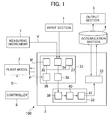
- Fig. 1 is a schematic diagram of a model parameter value estimator according to the present embodiment.
- a model parameter value estimator 100 according to the present embodiment includes an input section 1, a plant model 2, a model parameter value estimation section 3, an accumulation section 4, and an output section 5.
- the input section 1, the model parameter value estimation section 3, the accumulation section 4, the output section 5, and the like could be stored in the same terminal as a whole, or part of the elements could be stored in terminals/servers at remote locations at home or abroad and the elements could be configured as a system.
- the input section 1 is a section to which an item (type) of a model parameter to be estimated and an upper limit and a lower limit of model parameter values related to the model parameters to be estimated are input.
- the item of the model parameter to be estimated and the upper limit and the lower limit of the model parameter values are input to the input section 1 by, for example, a user.
- the number of items of model parameters input to the input section 1 may be one or may be equal to or greater than two.
- the input section 1 is not limited to a specific one if the input section 1 is configured such that the item of the model parameter to be estimated and the upper limit and the lower limit of the model parameter values can be input thereto.
- the plant model is a type of preset physical model (simulator) that simulates an operation of a product on the basis of a simulated control signal corresponding to a control signal used in actual product operation control.
- Examples of the plant model include simulators for an engine, an inverter, a motor, a vehicle, and the like used in MILS (Model in the loop simulation) and SILS (Software in the loop simulation) in automotive model-based development, and dynamic characteristics simulators computing transient characteristics of temperatures, pressures, flows, and the like of fluids flowing within power generation plants such as a thermal power generation plant and a nuclear power generation plant from material balances or heat balances of gas and steam.
- the plant model is established by a combination of computation models related to various characteristics of a product to be simulated (hereinafter, referred to as "target product").
- the computation models include a pressure/flow computation model that computes pressures and flows from publicly known fluid mechanics equations, and a temperature/heat transfer volume computation model that computes temperatures and heat transfer volumes from publicly known thermodynamics equations and heat transfer equations.
- a plurality of model parameter values M are input to the plant model 2 according to the present embodiment from the model parameter value estimation section 3, and the plant model 2 simulates an operation of the target product on the basis of simulated control signals S output from a controller 8 to compute a plurality of process values P corresponding to each of the model parameter values M.
- the model parameter values include a heat transfer area, a thickness, and a scaling factor of pipework, a temperature and a heat quantity of gas turbine exhaust gas in response to a gas turbine load, time constants of response delays in a temperature and a mass flow of steam, which is generated by heat recovery from the gas turbine exhaust gas, with respect to a change in the gas turbine load, the temperature and the flow of the steam in response to the gas turbine load, and the like.
- the process values include values, such as flows, temperatures, and pressures of gas and steam flowing in the power generation plant including a flow, a temperature, and a pressure of combustion gas, which can be directly acquired by measuring instruments, and values, such as the gas turbine load, a coal fired boiler load, and a steam turbine load, and a thermal stress within a plant structure, which can be indirectly acquired on the basis of measurement values of the measuring instruments.
- the model parameter value estimation section 3 estimates a model parameter value with a higher likelihood on the basis of process values.
- the model parameter value estimation section 3 estimates a model parameter value with a high likelihood by inputting measurement values V acquired by a measuring instrument 7 provided in the target product during operation of the target product and the plurality of process values P computed by the plant model 2 and by performing Bayesian updating on probability density functions accumulated in the accumulation section 4 while regarding a function generated on the basis of accuracy evaluation of the plurality of process values P with respect to the measurement values V as a likelihood function.
- the measurement values V input to the model parameter value estimation section 3 correspond to the process values P computed by the plant model 2.
- the model parameter value estimation section 3 includes a model parameter sensitivity analysis section 31, a likelihood function generation section 32, and a Bayesian learning section 33.
- the model parameter sensitivity analysis section 31 generates a scatter diagram that depicts a relationship between the model parameter values M and evaluation values that indicate accuracy evaluation of the plurality of process values P with respect to the measurement values V on the basis of the evaluation values.
- the model parameter sensitivity analysis section 31 includes a model parameter information acquisition section 34, a model parameter value output section 35, a process value input section 36, an evaluation value generation section 37, and a scatter diagram generation section 38.
- the model parameter information acquisition section 34 is electrically connected to the input section 1 and the measuring instrument 7.
- the item of the model parameter and the upper limit and the lower limit of the model parameter values input to the input section 1 and the measurement values V acquired by the measuring instrument 7 are input to the model parameter information acquisition section 34.
- the item of the model parameter and the upper limit and the lower limit of the model parameter values input to the model parameter information acquisition section 34 are input to the model parameter value output section 35, and the model parameter value output section 35 changes model parameter values within a range from the input upper limit to the input lower limit to generate a plurality of model parameter values, and outputs the plurality of model parameter values to the plant model 2.
- Examples of a method of generating the plurality of model parameter values include a generation method by randomly changing the model parameter values within the range from the upper limit to the lower limit, a generation method by equally dividing the model parameter values within the range from the upper limit to the lower limit, and a search method using a publicly known machine learning technique.
- the method is not limited to a specific one if the plurality of model parameter values dispersed within the range from the upper limit to the lower limit can be obtained by the method.
- the model parameter value output section 35 has not only function described above but also a function to determine whether all of the plurality of model parameter values have been output to the plant model 2. For example, if the plurality of model parameter values are randomly generated within the range from the upper limit to the lower limit, the model parameter value output section 35 determines whether the number x of the model parameter values output to the plant model 2 reaches the number X of the generated model parameter values.
- the model parameter value output section 35 if the number of the input items of model parameters is two or more, the model parameter value output section 35 generates a plurality of model parameter values for the model parameter corresponding to one item, sets a model parameter value as a fixed value for the model parameter corresponding to the other item, and outputs the plurality of model parameter values for the model parameter corresponding to the one item and the fixed value for the model parameter corresponding to the other item to the plant model 2. After completing computation for the model parameter corresponding to the one item, the model parameter value output section 35 generates a plurality of model parameter values for the model parameter corresponding to the other item and outputs the plurality of model parameter values to the plant model 2. The model parameter value output section 35 repeats the above operation for each of the input items of model parameters.
- the plurality of process values P output from the plant model 2 to correspond to each of the model parameter values M are input to the process value input section 36.
- the plurality of process values P are input to the evaluation value generation section 37 from the process value input section 36 and the measurement values V are input thereto from the model parameter information acquisition section 34, and the evaluation value generation section 37 generates evaluation values E that indicate accuracy evaluation of the plurality of process values P with respect to the measurement values V from a pre-defined evaluation equation on the basis of differences between the plurality of process values P and the measurement values V.
- the evaluation equation is defined to generate a higher evaluation value as the difference between the process value P and the measurement value V is smaller.
- Examples of the evaluation equation include one defined such that an absolute value of the difference between the process value P and the measurement value V is regarded as an error for the measurement value V, a numeric value obtained by dividing this absolute value by 100 is subtracted from 1, and a resultant value is evaluated. It is noted that the accuracy evaluation of the plurality of process values P with respect to the measurement values V is not limited to specific one if accuracies of the plurality of process values P with respect to the measurement values V can be evaluated by time-averaging instantaneous maximum errors or differences between the measurement values V and the plurality of process values P.
- Each model parameter value M is input to the scatter diagram generation section 38 from the model parameter value output section 35 and the evaluation value E corresponding to each model parameter value M is input thereto from the evaluation value generation section 37, and the scatter diagram generation section 38 generates a scatter diagram that depicts the relationship between each input model parameter values M and the input evaluation values E.
- Fig. 2 illustrates an example of the scatter diagram generated by the scatter diagram generation section 38.
- a vertical axis indicates the evaluation value E and a horizontal axis indicates each model parameter value M.
- an evaluation value Ea corresponding to a model parameter value Ma is the highest; thus, a difference between a process value Pa corresponding to the model parameter value Ma and the measurement value V is the smallest.
- an evaluation value Eb corresponding to a model parameter value Mb is lower than the evaluation value Ea; thus, a difference between a process value Pb corresponding to the model parameter value Mb and the measurement value V is larger than the difference between the process value Pa and the measurement value V.
- the likelihood function generation section 32 acquires a probability density function on the basis of the scatter diagram generated by the scatter diagram generation section 38 and generates (acquires) a likelihood function.
- the likelihood function generation section 32 includes a function regression section 39, a probability density function acquisition section 40, and a likelihood function acquisition section 41.
- the function regression section 39 is electrically connected to the scatter diagram generation section 38.
- the scatter diagram generated by the scatter diagram generation section 38 is input to the function regression section 39, and the function regression section 39 generates a function by performing function regression on the input scatter diagram.
- Examples of a function regression method include a method of searching a function suited for a profile of the scatter diagram generated by the scatter diagram generation section 38 from a plurality of function data stored in a storage section (not depicted) in advance using publicly known machine learning. It is noted that the function regression method is not limited to a specific method if a function that reduces a distance (difference) between the pieces of data in the scatter diagram generated by the scatter diagram generation section 38 is obtained by the method.
- the function generated by the function regression section 39 is input to the probability density function acquisition section 40, and the probability density function acquisition section 40 regards a function obtained by normalizing the input function as a probability density function that indicates a probability of each model parameter value M.
- the probability density function acquisition section 40 normalizes the function generated by the function regression section 39 in such a manner that a value integrated along the range from the upper limit to the lower limit of the model parameter value input to the input section 1 becomes 1.
- the probability density function acquired by the probability density function acquisition section 40 is input to the likelihood function acquisition section 41, and the likelihood function acquisition section 41 regards the input probability density function as a likelihood function by Bayesian updating and outputs the probability density function.
- the present embodiment exemplifies a configuration of the likelihood function generation section 32 such that the probability density function acquisition section 40 regards the function obtained by normalizing the function generated by the function regression section 39 as the probability density function and that the likelihood function acquisition section 41 regards the probability density function acquired by the probability density function acquisition section 40 as the likelihood function by the Bayesian updating and outputs the probability density function.
- the likelihood function generation section 32 is not always limited to the configuration described above.
- the likelihood function generation section 32 may be configured such that the likelihood function acquisition section 41 includes the probability density function acquisition section 40, the function generated by the function regression section 39 is input to the likelihood function acquisition section 41, and the likelihood function acquisition section 41 normalizes the input function, regards the function obtained by normalizing the input function as the probability density function, and outputs the probability density function as the likelihood function.
- Fig. 3 illustrates an example of the likelihood function acquired by the likelihood function acquisition section 41.
- a vertical axis indicates a probability density D and a horizontal axis indicates each model parameter value M.
- a probability density Da corresponding to the model parameter value Ma is the highest, and a probability density Db corresponding to the model parameter value Mb is lower than the probability density Da.
- the Bayesian learning section 33 is electrically connected to the likelihood function acquisition section 41 and the accumulation section 4.
- the likelihood function acquired by the likelihood function acquisition section 41 is input to the Bayesian learning section 33, and the Bayesian learning section 33 reads the latest probability density function among the probability density functions accumulated in the accumulation section 4 and related to the model parameter values, performs Bayesian updating using the input likelihood function with the read probability density function assumed as prior distribution data, and generates a probability density function related to each model parameter value as posterior distribution data.
- the accumulation section 4 accumulates a computation result of the model parameter value estimation section 3. Specifically, the probability density functions generated by Bayesian updating in the Bayesian learning section 33 and related to the model parameter values are input to and accumulated in the accumulation section 4. In the present embodiment, the accumulation section 4 accumulates each probability density function generated by past Bayesian updating (Bayesian updating prior to the latest Bayesian updating).
- the output section 5 outputs the computation result of the model parameter value estimation section 3. Specifically, the output section 5 reads and outputs the probability density functions accumulated in the accumulation section 4.
- the output section 5 is a display device or the like that displays the probability density functions. In the present embodiment, the output section 5 is configured to display one or more combinations of the probability density functions each by an arbitrary number of times of updating among the plurality of probability density functions accumulated in the accumulation section 4 and the model parameter values corresponding to an average of each of the probability density functions.
- Fig. 4 illustrates an output example of the output section 5.
- a vertical axis indicates the probability density D and a horizontal axis indicates each model parameter value M.
- a dotted line indicates a probability density function Fs if the number of times of Bayesian updating (number of times of learning) is S, and a solid line indicates a probability density function Ft if the number of times of Bayesian updating is T (> S).
- a model parameter value corresponding to the average of the probability density function Fs is Ms and a model parameter value corresponding to the average of the probability density function Ft is Mt.
- a probability density corresponding to the model parameter value Ms is Ds and a probability density corresponding to the model parameter value Mt is Dt.
- the output section 5 displays combinations of the probability density functions by the Bayesian updating the S times and T time and the model parameter values Ms and Mt corresponding to the averages of the probability density functions Fs and Ft.
- the output section 5 may compare transitions of transient response of the process values P obtained by inputting the measurement values V of the target product and the model parameter values M corresponding to the averages of the probability density functions by arbitrary numbers of times of updating to the plant model 2 and output a comparison result.
- Fig. 5 illustrates another output example of the output section 5.
- a vertical axis indicates the process value P and a horizontal axis indicates time t.
- a solid line indicates a transition line L of the measurement value (measured value) V of the target product, a dotted line indicates a transition line Ls of a process value Ps corresponding to the model parameter value Ms, and a dotted line indicates a transition line Lt of a process value Pt corresponding to the model parameter value Mt.
- the likelihood of the model parameter value Mt is higher than that of the model parameter value Ms.
- the transition line Lt is closer to a profile of the transition line L than the transition line Ls (in other words, an error of the process value Pt with respect to the measurement value V is smaller than that of the process value Ps with respect to the measurement value V).
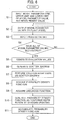
- Fig. 6 is a flowchart illustrating a procedure for a model parameter value estimation method according to the present embodiment.
- the model parameter value estimator 100 estimates model parameter values if the measurement value of the target product is measured.
- Step S1 When the measurement values V of the target product are measured, the item of model parameter, the upper limit and the lower limit of the model parameter values, and the measurement values V are input to the model parameter information acquisition section 34 (Step S1).
- the model parameter value output section 35 then generates the plurality of model parameter values M within the range from the upper limit to the lower limit and outputs them to the plant model 2 (Step S2).
- the process values P output from the plant model 2 are then input to the process value input section 36 (Step S3).
- the model parameter value output section 35 determines whether all of the plurality of model parameter values M have been output to the plant model 2 (Step S4). If the model parameter value output section 35 determines that all of the plurality of model parameter values M have been output to the plant model 2 (Yes), the model parameter value estimator 100 moves the procedure from Step S4 to Step S5. Conversely, if the model parameter value output section 35 determines that at least one of the plurality of model parameter values M has not been output to the plant model 2 (No), the model parameter value estimator 100 repeats Steps S2, S3, and S4 until the model parameter value output section 35 determines that all of the plurality of model parameter values M have been output to the plant model 2.
- the evaluation value generation section 37 generates the evaluation value E that indicates the accuracy evaluation of each of the process values P with respect to the measurement value V on the basis of the differences between the process values P and the measurement value V (Step S5).
- the scatter diagram generation section 38 generates the scatter diagram that depicts the relationship between the model parameter values M and the evaluation values E (Step S6).
- the function regression section 39 then performs function regression on the scatter diagram to generate a function (Step S7).
- the probability density function acquisition section 40 then normalizes the function generated by the function-regression section 39 and acquires the probability density function related to each model parameter value (Step S8).
- the likelihood function acquisition section 41 then acquires the likelihood function by Bayesian updating from the probability density function acquired by the probability density function acquisition section 40 (Step S9).
- the Bayesian learning section 33 then performs Bayesian updating using the likelihood function with the latest probability density function among the probability density functions accumulated in the accumulation section 4 assumed as a prior distribution, and generates the probability density function related to each model parameter value as a posterior distribution (Step S10).
- the accumulation section 4 then accumulates the probability density function generated by Bayesian updating in the Bayesian learning section 33 (Step S11).
- Processes by the model parameter estimator 100 according to the present embodiment may be realized by pa program stored in a computer. A case in which the program stored in the computer realizes the processes by the model parameter estimator 100 according to the present embodiment will next be described.
- Fig. 7 is a schematic diagram of the computer that realizes the processes by the model parameter estimator 100 according to the present embodiment.
- a computer 200 includes, as hardware, a CPU (Central Processing Unit) 201, an HDD (Hard Disk Drive) 202, a RAM (Random Access Memory) 203, a ROM (Read Only Memory) 204, an I/O port 205, a keyboard 206, a storage medium 207, and a monitor 208.
- a CPU Central Processing Unit
- HDD Hard Disk Drive
- RAM Random Access Memory
- ROM Read Only Memory
- the program executed by the computer 200 is stored in the ROM 204, and the plant model 2, the model parameter value estimation section 3, the accumulation section 4, and the like are loaded onto the RAM 203 and generated by causing the CPU 201 to read the program from the ROM 204 and execute the program.
- the item of the model parameter and the upper limit and the lower limit of the model parameter values are input from the keyboard 206 and are transmitted, together with the measurement values V measured by the measuring instrument 7, to the CPU 201 via the I/O port 205.
- the evaluation equation for generating evaluation values, function data used in the function regression, the probability density functions related to the model parameter values, and the like are stored in storage mediums such as the HDD 202 and the ROM 204.
- the probability density functions generated by Bayesian updating are stored in the storage mediums such as the HDD 202 and the ROM 204 and also displayed on the monitor 208 via the I/O port 205.
- the processes by the model parameter estimator 100 may be realized as the program which the computer is causes to execute.
- the processes described above may be realized by installing such a program from a server or the like and causing the computer to execute the program.
- the processes described above can be realized by storing such a program in the storage medium 207 and causing the computer to read this program.
- the storage medium 207 any of various types of mediums including storage mediums such as a CD-ROM, a flexible disk, and a magneto-optical disk for storing information optically, electrically, or magnetically, and semiconductor memories such as a ROM and a flash memory for electrically storing information can be used.
- a configuration of the plant model 2 is not limited to a configuration such that the plant model 2 is loaded onto the RAM 203 by causing the CPU 201 to read the program from the ROM 204 and to execute the program; alternatively, the plant model 2 may be configured such that the plant model 2 is provided as hardware different from and independent of the computer 200.
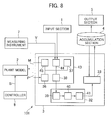
- Fig. 8 is a schematic diagram of a model parameter value estimator according to the present embodiment.
- equivalent sections to those in the model parameter value estimator 100 according to the first embodiment are denoted by the same reference characters and description thereof will be omitted as appropriate.
- a model parameter value estimator 101 differs from the model parameter value estimator 100 in that the model parameter value estimator 101 includes an optimum model parameter value search section 43 as an alternative to the model parameter sensitivity analysis section 31.
- the model parameter value estimator 101 is similar to the model parameter value estimator 100 in other configurations.
- the optimum model parameter value search section 43 includes a second model parameter information acquisition section 44 and a second model parameter value output section 45 as alternatives to the model parameter information acquisition section 34 and the model parameter value output section 35.
- the optimum model parameter value search section 43 is similar to the model parameter sensitivity analysis section 31 in other configurations.
- the second model parameter information acquisition section 44 is electrically connected to the input section 1 and the measuring instrument 7.
- two (two types) or more items of model parameters and the upper limit and the lower limit of each of the model parameter values input to the input section 1 and the measurement values V acquired by the measuring instrument 7 are input to the second model parameter information acquisition section 44.
- the two or more items of model parameters and the upper limit and the lower limit of each of the model parameter values input to the model parameter information acquisition section 34 are input to the second model parameter value output section 45, and the second model parameter value output section 45 simultaneously changes the model parameter values within the range from the input upper limit to the input lower limit to generate a plurality of model parameter values, and outputs the plurality of model parameter values to the plant model 2.
- Examples of the method of generating the plurality of model parameter values include the generation method by randomly changing the model parameter values within the range from the upper limit to the lower limit, the generation method by equally dividing the model parameter values within the range from the upper limit to the lower limit, and the search method using the publicly known machine learning technique.
- the method is not limited to a specific one if the plurality of model parameter values dispersed within the range from the upper limit to the lower limit can be obtained by the method. It is noted that if a value that enables the difference between the measurement value of the target product and the process values to be reduced is searched using an optimization algorithm based on multi-point search, many non-optimum solutions are obtained simultaneously in a course of computing a global optimum solution; thus, it is possible to efficiently generate the scatter diagram that depicts the relationship between the model parameter values and the evaluation values as exemplarily illustrated in Fig. 2 .
- Examples of the optimization algorithm based on the multi-point search include a genetic algorithm, a MOGA (Multi-Objective Genetic Algorithm), an NSGA-II (Non-dominated Sorting Genetic Algorithms-II), and an SPEA2 (Strength Pareto Evolutionary Algorithm-II) obtained by extending the genetic algorithm to multi-objective optimization, and a particle swarm optimization.
- MOGA Multi-Objective Genetic Algorithm
- NSGA-II Non-dominated Sorting Genetic Algorithms-II
- SPEA2 Strength Pareto Evolutionary Algorithm-II
- the present invention is also applicable to simulators for the engine, the inverter, the motor, a vehicle, and the like in the automotive model-based development, and dynamic characteristics simulators within power generation plants such as the thermal power generation plant and the nuclear power generation plant.
- the present embodiment can attain the following effects in addition to each of the effects obtained by the first embodiment described above.
- the model parameter values are simultaneously changed for the model parameters to be estimated to generate a plurality of model parameter values M, the plurality of model parameter values M are input to the plant model 2, and a plurality of process values P are acquired.
- the model parameters to be estimated are two or more mutually influencing model parameters, it is possible to independently generate the scatter diagram that depicts the relationship between the plurality of model parameter values M and the evaluation values E.
- the model parameters to be estimated are two or more mutually influencing model parameters, it is possible to acquire the likelihood function on the basis of the independently generated scatter diagram and estimate the model parameter values by performing Bayesian updating on the probability density functions related to the model parameter values.
- Fig. 9 is an illustrative diagram of a relationship among the model parameters related to the static characteristics and the dynamic characteristics. As exemplarily illustrated in Fig. 9 , it is assumed in the present embodiment that a heating medium 46 discharged from the heat source apparatus 48 and having a mass flow G1, a pressure P1, and a temperature T1 flows into pipework 47 connected to the heat source apparatus 48, receives a heat quantity Q while flowing in the pipework 47, and is discharged to outside of the pipework 47.
- model parameter values are estimated in a case in which measurement values (mass flow G2_obs, pressure P2_obs, and temperature T2_obs) at an exit of the pipework 47 match process values (mass flow G2_cal, pressure P2_cal, and temperature T2_cal) when an operating state of a heat source apparatus 48, for example, a load of the heat source apparatus 48 is set as an input condition for the plant model 2 and this load changes over time.
- a state of the heating medium 46 discharged from the heat source apparatus 48 is also kept constant; thus, the mass flow G1, the pressure P1, and the temperature T1 of the heating medium 46 in response to the load of the heat source apparatus 48 serve as model parameters related to static characteristics.
- a heat transfer area A of the pipework 47, a pipework thickness d, a pipework scaling factor Rf, a delay time constant ⁇ , a coefficient k related to a heat transfer rate, and the like influence the transient response and, therefore, serve as model parameters related to dynamic characteristics.
- this transient response is influences by the model parameters related to the static characteristics and the dynamic characteristics; thus, it is difficult to uniquely estimate model parameter values that enable the measurement values match the process values.
- the model parameters to be estimated are two or more mutually influencing model parameters, it is possible to independently generate the scatter diagram that depicts the relationship between the plurality of model parameter values M and the evaluation values E, as described above.
- the model parameters related to the static characteristics and the model parameters related to dynamic characteristics it is possible to simultaneously estimate the model parameter values from transient data.
- Fig. 10 is a schematic diagram of a model parameter value estimator according to the present embodiment.
- equivalent sections to those in the model parameter value estimator 100 according to the first embodiment are denoted by the same reference characters and description thereof will be omitted as appropriate.
- a model parameter value estimator 102 differs from the model parameter value estimator 100 in that the model parameter value estimator 102 includes a product state estimation section 6.
- the model parameter value estimator 101 is similar to the model parameter value estimator 100 in other configurations.
- the product state estimation section 6 is electrically connected to the accumulation section 4 and the output section 5.
- the product state estimation section 6 estimates a state of the target product on the basis of the transition of the model parameter values (model parameter average values) corresponding to the averages of the probability density functions accumulated in the accumulation section 4 and related to the model parameter values.
- Fig. 11 exemplarily illustrates the transition of the model parameter average values.
- a vertical axis indicates the model parameter average value and a horizontal axis indicates the number of times of updating the probability density functions.
- model parameter average values corresponding to numbers 1, 2, ..., and n are model parameter average values after updating the first, second, ..., and the n-th times, respectively.
- the model parameter average values vary in an initial period (period up to the fifth updating) in which the number of times of updating the model parameter values on the basis of the measurement values of the target product is low.
- the initial period transitions to a convergent period (period from the sixth updating to the tenth updating) and it is supposed that the model parameter average values converge into a constant value by repeating Bayesian updating.
- the model parameter average values have a change such as a monotonic decrease, a monotonic increase, or a variation (in Fig. 11 , the model parameter average values have a monotonic decrease).
- Examples of a method of searching a state change of the target product include a method of user's visual determination from the transition of the model parameter average values output from the output section 5 and a method of searching the state change from pattern learning of data about the model parameter average values obtained on the basis of publicly known data mining or machine learning scheme.
- the detected change in the model parameter average values simply results from a fluctuation in the measurement values or the process values or results from the state change of the target product can be determined from the standard deviations of the obtained probability density functions. Specifically, if the standard deviations of the probability density functions are large, it is highly likely that the change in the model parameter average values results from the fluctuation in the measurement values or the process values. Conversely, if the standard deviations of the probability density functions are sufficiently small, it is highly likely that the change in the model parameter average values results from the state change of the target product.
- the present embodiment can attain the following effects in addition to each of the effects obtained by the first embodiment described above.
- the present embodiment it is possible to estimate the state of the target product on the basis of the transition of the model parameter average values. In other words, it is possible to take advantage of the plant model 2 for the estimation of the aged deterioration and the anomaly diagnosis for the target product.
- the present invention is not limited to the embodiments described above but encompasses various modifications.
- the embodiments described above have been described in detail for describing the present invention to facilitate understanding the present invention, and the present invention is not always limited to the invention having all the configurations described.
- the configuration of a certain embodiment can be partially replaced by the configuration of another embodiment or the configuration of another embodiment can be added to the configuration of the certain embodiment.
- part of the configuration of each embodiment can be deleted.
- the configuration of the model parameter value estimator such that the model parameter information acquisition section 34 is electrically connected to the measuring instrument 7 and the measurement values V acquired by the measuring instrument 7 are input to the model parameter information acquisition section 34 has been exemplarily illustrated.
- an essential effect of the present invention is to provide a model parameter value estimator that can estimate model parameter values even if the distribution profile and statistics for the probability density functions are either unknown or difficult to estimate.
- the model parameter value estimator may be configured such that the user inputs the measurement values V acquired by the measuring instrument 7 to the model parameter information acquisition section 34.
- the configuration of the model parameter value estimator such that the model parameter value output section 35 determines whether all of the plurality of model parameter values have been output to the plant model 2 has been exemplarily illustrated.
- the model parameter value estimator may be configured such that an apparatus that determines whether all of the plurality of model parameter values have been output to the plant model 2 is provided separately.
- the configuration of the model parameter value estimator such that the function regression section 39 searches a function suited for the profile of the scatter diagram generated by the scatter diagram generation section 38 from the plurality of function data stored in the storage section in advance, and that the probability density function acquisition section 40 normalizes the function generated by the function regression section 39 has been exemplarily illustrated.
- the model parameter value estimator may be configured such that a plurality of pieces of normalized function data are stored in the storage section in advance, and that the function regression section 39 searches from the storage section the function suited for the profile of the scatter diagram generated by the scatter diagram generation section 38.
- the configuration of the model parameter value estimator 102 such that the product state estimation section 6 is provided in the model parameter value estimator 100 according to the first embodiment has been exemplarily illustrated.
Landscapes
- Engineering & Computer Science (AREA)
- Physics & Mathematics (AREA)
- General Physics & Mathematics (AREA)
- Theoretical Computer Science (AREA)
- Software Systems (AREA)
- Evolutionary Computation (AREA)
- Data Mining & Analysis (AREA)
- General Engineering & Computer Science (AREA)
- Artificial Intelligence (AREA)
- Automation & Control Theory (AREA)
- Mathematical Physics (AREA)
- Computer Vision & Pattern Recognition (AREA)
- Medical Informatics (AREA)
- Mathematical Analysis (AREA)
- Mathematical Optimization (AREA)
- Pure & Applied Mathematics (AREA)
- Computational Mathematics (AREA)
- Health & Medical Sciences (AREA)
- Probability & Statistics with Applications (AREA)
- Databases & Information Systems (AREA)
- Algebra (AREA)
- Computing Systems (AREA)
- Geometry (AREA)
- Computer Hardware Design (AREA)
- Life Sciences & Earth Sciences (AREA)
- Bioinformatics & Cheminformatics (AREA)
- Evolutionary Biology (AREA)
- Bioinformatics & Computational Biology (AREA)
- Operations Research (AREA)
- Testing And Monitoring For Control Systems (AREA)
- Feedback Control In General (AREA)
- Management, Administration, Business Operations System, And Electronic Commerce (AREA)
Applications Claiming Priority (1)
| Application Number | Priority Date | Filing Date | Title |
|---|---|---|---|
| PCT/JP2017/002995 WO2018138880A1 (fr) | 2017-01-27 | 2017-01-27 | Dispositif et procédé d'estimation de valeurs de paramètres de modèle, programme, support d'enregistrement sur lequel est enregistré un programme, et système d'estimation de valeurs de paramètres de modèle |
Publications (3)
| Publication Number | Publication Date |
|---|---|
| EP3575892A1 true EP3575892A1 (fr) | 2019-12-04 |
| EP3575892A4 EP3575892A4 (fr) | 2020-09-02 |
| EP3575892B1 EP3575892B1 (fr) | 2022-05-11 |
Family
ID=62978159
Family Applications (1)
| Application Number | Title | Priority Date | Filing Date |
|---|---|---|---|
| EP17893753.8A Active EP3575892B1 (fr) | 2017-01-27 | 2017-01-27 | Dispositif et procédé d'estimation de valeurs de paramètres de modèle, programme, support d'enregistrement sur lequel est enregistré un programme, et système d'estimation de valeurs de paramètres de modèle |
Country Status (6)
| Country | Link |
|---|---|
| US (1) | US20190019096A1 (fr) |
| EP (1) | EP3575892B1 (fr) |
| JP (1) | JP6686151B2 (fr) |
| KR (1) | KR102153924B1 (fr) |
| CN (1) | CN108700852B (fr) |
| WO (1) | WO2018138880A1 (fr) |
Cited By (1)
| Publication number | Priority date | Publication date | Assignee | Title |
|---|---|---|---|---|
| CN111310303A (zh) * | 2020-01-17 | 2020-06-19 | 合肥工业大学 | 一种幅值指数衰减的正弦波参数识别方法 |
Families Citing this family (55)
| Publication number | Priority date | Publication date | Assignee | Title |
|---|---|---|---|---|
| US11128528B2 (en) | 2016-12-30 | 2021-09-21 | Intel Corporation | Decentralized data storage and processing for IoT devices |
| CN107491626B (zh) * | 2017-10-09 | 2019-09-27 | 清华大学 | 一种热网供热功率可调节能力的计算与建模方法 |
| US11385282B2 (en) | 2017-11-15 | 2022-07-12 | Proteantecs Ltd. | Integrated circuit margin measurement and failure prediction device |
| US12282058B2 (en) | 2017-11-23 | 2025-04-22 | Proteantecs Ltd. | Integrated circuit pad failure detection |
| CN111684292B (zh) | 2017-11-23 | 2023-06-20 | 普罗泰克斯公司 | 集成电路焊盘故障检测 |
| CN111837045B (zh) | 2018-01-08 | 2024-04-16 | 普罗泰克斯公司 | 集成电路工作负载、温度和/或亚阈值泄漏传感器 |
| US11740281B2 (en) | 2018-01-08 | 2023-08-29 | Proteantecs Ltd. | Integrated circuit degradation estimation and time-of-failure prediction using workload and margin sensing |
| TWI828676B (zh) | 2018-04-16 | 2024-01-11 | 以色列商普騰泰克斯有限公司 | 用於積體電路剖析及異常檢測之方法和相關的電腦程式產品 |
| US11475178B2 (en) * | 2018-05-08 | 2022-10-18 | Autodesk, Inc. | Generative design techniques for automobile designs |
| EP3811246A4 (fr) | 2018-06-19 | 2022-03-23 | Proteantecs Ltd. | Simulation et test de circuit intégré efficaces |
| JP6940001B2 (ja) * | 2018-06-29 | 2021-09-22 | 日本電気株式会社 | 学習モデル作成支援装置、学習モデル作成支援方法、及びプログラム |
| JP2020046964A (ja) * | 2018-09-19 | 2020-03-26 | ファナック株式会社 | 特性判定装置、特性判定方法及び特性判定プログラム |
| US20200103293A1 (en) * | 2018-09-28 | 2020-04-02 | Rosemount Inc. | Non-invasive process fluid temperature indication |
| JP6799047B2 (ja) * | 2018-11-19 | 2020-12-09 | ファナック株式会社 | 暖機運転評価装置、暖機運転評価方法及び暖機運転評価プログラム |
| CN113167776B (zh) * | 2018-11-29 | 2024-02-27 | 株式会社岛津制作所 | 试样测定装置及测定参数设定支持装置 |
| JP7419380B2 (ja) | 2018-12-30 | 2024-01-22 | プロテアンテックス リミテッド | 集積回路i/oの完全性および劣化監視 |
| JP7262232B2 (ja) * | 2019-01-29 | 2023-04-21 | 東京エレクトロン株式会社 | 画像認識システムおよび画像認識方法 |
| JP7107246B2 (ja) * | 2019-02-21 | 2022-07-27 | 日本電信電話株式会社 | 推定装置、推定方法、及びプログラム |
| JP6903246B2 (ja) * | 2019-03-04 | 2021-07-14 | 三菱電機株式会社 | 情報処理装置、情報処理方法及び情報処理プログラム |
| JP6925565B2 (ja) * | 2019-03-13 | 2021-08-25 | 三菱電機株式会社 | シミュレーション装置、シミュレーションプログラム及びシミュレーション方法 |
| US11982996B2 (en) | 2019-04-29 | 2024-05-14 | Siemens Aktiengesellschaft | Method and apparatus for configuring processing parameters of production equipment, and computer-readable medium |
| DE112020002299A5 (de) | 2019-05-09 | 2022-03-03 | Dürr Systems Ag | Verfahren zur Analyse von Qualitätsmängeln |
| JP2022531717A (ja) * | 2019-05-09 | 2022-07-08 | デュール システムズ アーゲー | 工作物を管理する方法、管理設備及び処理設備 |
| PT3966650T (pt) * | 2019-05-09 | 2024-04-04 | Duerr Systems Ag | Processo para o controlo e pós-tratamento de peças de trabalho, instalação de controlo e instalação de tratamento |
| EP3966647B1 (fr) * | 2019-05-09 | 2025-10-29 | Dürr Systems AG | Procédé d'analyse et dispositifs correspondants |
| JP2022531714A (ja) * | 2019-05-09 | 2022-07-08 | デュール システムズ アーゲー | 分析方法及びそのための装置 |
| TWI845679B (zh) * | 2019-05-13 | 2024-06-21 | 以色列商普騰泰克斯有限公司 | 藉由測量及模擬來確定積體電路的未知偏誤及元件參數 |
| JP7252449B2 (ja) * | 2019-05-16 | 2023-04-05 | 富士通株式会社 | 最適化装置、最適化システム、最適化方法および最適化プログラム |
| DE112019007433B4 (de) * | 2019-06-28 | 2023-05-17 | Mitsubishi Electric Corporation | Bearbeitungsbedingung-Sucheinrichtung und Bearbeitungsbedingung-Suchverfahren |
| CN113994281A (zh) * | 2019-07-03 | 2022-01-28 | 富士胶片株式会社 | 优化支援装置、方法及程序 |
| KR102224983B1 (ko) * | 2019-10-17 | 2021-03-08 | 한국서부발전 주식회사 | 가스터빈 연소기의 점검 진단 장치 |
| TW202127252A (zh) | 2019-12-04 | 2021-07-16 | 以色列商普騰泰克斯有限公司 | 記憶體裝置退化偵測 |
| JP7373384B2 (ja) * | 2019-12-18 | 2023-11-02 | 株式会社日立製作所 | 計算機システム及びスケジューリングシステムの検証方法 |
| CN115461632A (zh) | 2020-04-20 | 2022-12-09 | 普腾泰克斯有限公司 | 晶粒对晶粒的连接性监视 |
| US12241933B2 (en) | 2020-07-06 | 2025-03-04 | Proteantecs Ltd. | Integrated circuit margin measurement for structural testing |
| JP7519836B2 (ja) * | 2020-07-31 | 2024-07-22 | 三菱重工サーマルシステムズ株式会社 | 推定装置、推定方法、及びプログラム |
| JP7443224B2 (ja) * | 2020-12-04 | 2024-03-05 | 株式会社東芝 | 設計支援方法、設計支援システム、プログラム、及び記憶媒体 |
| JP7495874B2 (ja) * | 2020-12-16 | 2024-06-05 | 株式会社日立製作所 | プラント制御システム、プラント制御方法及びプログラム |
| WO2022153984A1 (fr) * | 2021-01-15 | 2022-07-21 | 株式会社Preferred Networks | Procédé de génération de données d'apprentissage, procédé de génération de modèle et dispositif de génération de données d'apprentissage |
| JP2022134564A (ja) * | 2021-03-03 | 2022-09-15 | 三菱重工業株式会社 | 特徴量抽出方法、性能予測モデル作成方法、プラントの運転支援方法、特徴量抽出装置、性能予測モデル作成装置、及びプラントの運転支援装置 |
| JP7363840B2 (ja) * | 2021-03-10 | 2023-10-18 | 横河電機株式会社 | 解析装置、解析方法およびプログラム |
| EP4320497A4 (fr) | 2021-04-07 | 2025-02-26 | Proteantecs Ltd. | Mise à l'échelle de fréquence adaptative sur la base d'une mesure de temps de cycle d'horloge |
| KR20230023470A (ko) * | 2021-08-10 | 2023-02-17 | 에스케이하이닉스 주식회사 | 스토리지 장치 및 그의 딜레이 시간을 계산하는 모델을 최적화하는 호스트 장치 |
| CN113777919B (zh) * | 2021-08-13 | 2023-11-17 | 哈尔滨工程大学 | 一种基于nsga-ⅱ遗传算法的自抗扰控制的串级燃气轮机功率控制方法 |
| KR102807059B1 (ko) * | 2021-08-18 | 2025-05-15 | 한국전력공사 | 시뮬레이터 충실도 개선 방법 |
| US12367248B2 (en) * | 2021-10-19 | 2025-07-22 | Intel Corporation | Hardware-aware machine learning model search mechanisms |
| US12367249B2 (en) * | 2021-10-19 | 2025-07-22 | Intel Corporation | Framework for optimization of machine learning architectures |
| JP7734571B2 (ja) * | 2021-11-30 | 2025-09-05 | 株式会社日立製作所 | プロセスモデル構築システム、プロセスモデル構築方法 |
| CN114444272B (zh) * | 2021-12-31 | 2024-04-12 | 华中科技大学 | 一种基于贝叶斯层次模型的食品污染物暴露与健康危害的剂量反应关系模型建立方法 |
| US11815551B1 (en) | 2022-06-07 | 2023-11-14 | Proteantecs Ltd. | Die-to-die connectivity monitoring using a clocked receiver |
| US12013800B1 (en) | 2023-02-08 | 2024-06-18 | Proteantecs Ltd. | Die-to-die and chip-to-chip connectivity monitoring |
| US12123908B1 (en) | 2023-09-12 | 2024-10-22 | Proteantecs Ltd. | Loopback testing of integrated circuits |
| US12461143B2 (en) | 2024-01-24 | 2025-11-04 | Proteantecs Ltd. | Integrated circuit margin measurement |
| CN119323122B (zh) * | 2024-09-30 | 2025-10-10 | 湖南大学 | 一种基于物理信息神经网络的线驱动软体机器人建模方法 |
| CN121092821B (zh) * | 2025-11-12 | 2026-03-27 | 云南电网有限责任公司 | 基于多维参数的气室内热平衡温度的计算方法及装置 |
Family Cites Families (26)
| Publication number | Priority date | Publication date | Assignee | Title |
|---|---|---|---|---|
| JPS5418408B2 (fr) | 1972-09-29 | 1979-07-07 | ||
| US8095479B2 (en) * | 2006-02-28 | 2012-01-10 | Hitachi, Ltd. | Plant control apparatus and method having functions of determining appropriate learning constraint conditions |
| JP4974330B2 (ja) * | 2006-02-28 | 2012-07-11 | 株式会社日立製作所 | 制御装置 |
| JP5341800B2 (ja) * | 2010-03-11 | 2013-11-13 | アズビル株式会社 | 制御モデル更新装置、制御モデル更新方法、空調制御システム、データ妥当性判断装置 |
| JP5418408B2 (ja) * | 2010-05-31 | 2014-02-19 | 富士通株式会社 | シミュレーションパラメータ校正方法、装置及びプログラム |
| JP5726574B2 (ja) * | 2011-03-01 | 2015-06-03 | みずほ情報総研株式会社 | 素子解析システム、素子解析方法及び素子解析プログラム |
| CN102156104B (zh) * | 2011-03-28 | 2013-07-31 | 上海印钞有限公司 | 有机颜料耐溶剂性能定量评价方法 |
| CN102800128A (zh) * | 2012-08-09 | 2012-11-28 | 中国人民解放军信息工程大学 | 利用散点图矩阵和回归分析建立地形描述精度模型的方法 |
| US9104961B2 (en) * | 2012-10-08 | 2015-08-11 | Microsoft Technology Licensing, Llc | Modeling a data generating process using dyadic Bayesian models |
| CN102968529B (zh) * | 2012-11-14 | 2015-06-03 | 上海城市水资源开发利用国家工程中心有限公司 | 一种供水管网模型计算结果不确定性区间的量化方法 |
| JP5896891B2 (ja) * | 2012-12-17 | 2016-03-30 | 三菱重工業株式会社 | パラメータ推定装置、パラメータ推定方法、蓄電システム及びプログラム |
| US20130309666A1 (en) * | 2013-01-25 | 2013-11-21 | Sequenom, Inc. | Methods and processes for non-invasive assessment of genetic variations |
| CN103559337B (zh) * | 2013-10-18 | 2017-01-18 | 中冶集团武汉勘察研究院有限公司 | 一种基于线性回归建立细粒尾矿工程性质指标估算经验公式的方法 |
| FR3012999B1 (fr) * | 2013-11-14 | 2015-11-13 | Renault Sas | Procede d'aide a la decision par approche bayesienne dans un systeme de surveillance de la pression des pneumatiques d'un vehicule automobile. |
| US9928214B2 (en) * | 2013-12-04 | 2018-03-27 | International Business Machines Corporation | Sketching structured matrices in nonlinear regression problems |
| EP2881822A1 (fr) * | 2013-12-05 | 2015-06-10 | Bayer Technology Services GmbH | Procédé implémenté par ordinateur et système de surveillance automatique et de détermination de l'état de l'intégralité des étapes de processus dans une unité de traitement |
| FR3018917B1 (fr) * | 2014-03-18 | 2016-04-01 | Jtekt Europe Sas | Modelisation du frottement dans une direction assistee par un nuage de points |
| CN104063445B (zh) * | 2014-06-16 | 2017-04-26 | 百度移信网络技术(北京)有限公司 | 一种相似性度量的方法以及系统 |
| JP6190771B2 (ja) * | 2014-07-07 | 2017-08-30 | 日本電信電話株式会社 | パラメータ推定方法、装置、及びプログラム |
| US10451587B2 (en) * | 2014-07-16 | 2019-10-22 | Duke University | Methods, systems and computer program products for estimating shear wave speed using statistical inference |
| CN104462842A (zh) * | 2014-12-22 | 2015-03-25 | 厦门大学 | 一种基于贝叶斯网络的故障数据挖掘诊断方法 |
| JP6400511B2 (ja) * | 2015-03-16 | 2018-10-03 | 株式会社日立製作所 | プラント制御用のデータ処理装置およびプラント |
| JP2016177682A (ja) * | 2015-03-20 | 2016-10-06 | 株式会社東芝 | 設備評価装置、設備評価方法、コンピュータプログラム |
| CN105675539B (zh) * | 2016-01-07 | 2019-05-10 | 北京市农林科学院 | 一种农产品品质综合评价方法 |
| CN105930647B (zh) * | 2016-04-18 | 2018-09-14 | 北京航空航天大学 | 一种考虑多失效模式的梁结构非概率可靠性求解方法 |
| CN106202631B (zh) * | 2016-06-28 | 2019-04-05 | 湖南大学 | 一种冲压成形高强钢的材料参数获取方法 |
-
2017
- 2017-01-27 WO PCT/JP2017/002995 patent/WO2018138880A1/fr not_active Ceased
- 2017-01-27 JP JP2018538906A patent/JP6686151B2/ja active Active
- 2017-01-27 KR KR1020187024965A patent/KR102153924B1/ko active Active
- 2017-01-27 US US16/076,809 patent/US20190019096A1/en not_active Abandoned
- 2017-01-27 CN CN201780014460.1A patent/CN108700852B/zh active Active
- 2017-01-27 EP EP17893753.8A patent/EP3575892B1/fr active Active
Cited By (2)
| Publication number | Priority date | Publication date | Assignee | Title |
|---|---|---|---|---|
| CN111310303A (zh) * | 2020-01-17 | 2020-06-19 | 合肥工业大学 | 一种幅值指数衰减的正弦波参数识别方法 |
| CN111310303B (zh) * | 2020-01-17 | 2024-02-02 | 合肥工业大学 | 一种幅值指数衰减的正弦波参数识别方法 |
Also Published As
| Publication number | Publication date |
|---|---|
| CN108700852B (zh) | 2021-07-16 |
| JPWO2018138880A1 (ja) | 2019-02-07 |
| JP6686151B2 (ja) | 2020-04-22 |
| CN108700852A (zh) | 2018-10-23 |
| WO2018138880A1 (fr) | 2018-08-02 |
| WO2018138880A9 (fr) | 2018-09-20 |
| EP3575892B1 (fr) | 2022-05-11 |
| KR20180111886A (ko) | 2018-10-11 |
| US20190019096A1 (en) | 2019-01-17 |
| KR102153924B1 (ko) | 2020-09-09 |
| EP3575892A4 (fr) | 2020-09-02 |
Similar Documents
| Publication | Publication Date | Title |
|---|---|---|
| EP3575892B1 (fr) | Dispositif et procédé d'estimation de valeurs de paramètres de modèle, programme, support d'enregistrement sur lequel est enregistré un programme, et système d'estimation de valeurs de paramètres de modèle | |
| EP3809220B1 (fr) | Procédé et système de détection semi-supervisée d'anomalies profondes pour des systèmes de surveillance industrielle à grande échelle basés sur des données de série chronologique utilisant des données de simulation de jumeau numérique | |
| CN103649858A (zh) | 用于预测组件或系统状况的方法和设备及计算机程序产品 | |
| JP2010277577A (ja) | 制御及び推定のための線形モデルのリアルタイムスケジューリング | |
| JP2016151909A (ja) | 異常診断方法及び異常診断システム | |
| CN115962797B (zh) | 一种基于温度应力下的传感器可靠性测试方法及系统 | |
| JP7707124B2 (ja) | 情報処理装置、情報処理方法およびプログラム | |
| Li et al. | Dynamic temperature measurement with a dual-thermocouple sensor based on a dual-head one-dimensional convolutional neural network | |
| US20220044151A1 (en) | Apparatus and method for electronic determination of system data integrity | |
| CN119903383B (zh) | 高温老化试验箱健康状态评估方法及装置 | |
| US20240220849A1 (en) | Thermal predictive modeling of physical assets | |
| US20190235128A1 (en) | Determination of virtual process parameters | |
| CN118032160A (zh) | 一种变压器无线测温方法、系统、电子设备以及存储介质 | |
| Visser et al. | Experience with gsp as a gas path analysis tool | |
| CN120312138B (zh) | 用于钻井过程中的溢流监测的方法、装置、存储介质及处理器 | |
| Jarrett et al. | Validation of a Gas Turbine Thermodynamic Model Without Accurate Component Maps | |
| CN117553938B (zh) | 一种高低温环境下温度二次仪表的误差修正方法 | |
| Diesch et al. | Application of virtual sensors for stress-related design and operation-specific lifetime prognosis | |
| WO2024043337A1 (fr) | Dispositif d'estimation, procédé d'estimation, et programme d'estimation | |
| CN119860828A (zh) | 一种在线计量系统及方法 | |
| US20080215281A1 (en) | Method for measuring correlation between frequency response functions | |
| CN119180138A (zh) | 散热器进风量仿真方法及相关设备 | |
| KR20250055382A (ko) | 축소 차원 모델링 장치 및 방법 | |
| Sakhnyuk | Substantiation of a criterion of metrological reliability of measuring instruments | |
| Stenfelt et al. | Handling of model uncertainties for underdetermined gas path analysis |
Legal Events
| Date | Code | Title | Description |
|---|---|---|---|
| STAA | Information on the status of an ep patent application or granted ep patent |
Free format text: STATUS: THE INTERNATIONAL PUBLICATION HAS BEEN MADE |
|
| PUAI | Public reference made under article 153(3) epc to a published international application that has entered the european phase |
Free format text: ORIGINAL CODE: 0009012 |
|
| STAA | Information on the status of an ep patent application or granted ep patent |
Free format text: STATUS: REQUEST FOR EXAMINATION WAS MADE |
|
| 17P | Request for examination filed |
Effective date: 20190827 |
|
| AK | Designated contracting states |
Kind code of ref document: A1 Designated state(s): AL AT BE BG CH CY CZ DE DK EE ES FI FR GB GR HR HU IE IS IT LI LT LU LV MC MK MT NL NO PL PT RO RS SE SI SK SM TR |
|
| AX | Request for extension of the european patent |
Extension state: BA ME |
|
| DAV | Request for validation of the european patent (deleted) | ||
| DAX | Request for extension of the european patent (deleted) | ||
| A4 | Supplementary search report drawn up and despatched |
Effective date: 20200731 |
|
| RIC1 | Information provided on ipc code assigned before grant |
Ipc: G06F 30/20 20200101AFI20200727BHEP Ipc: G06F 111/08 20200101ALN20200727BHEP Ipc: G06F 17/18 20060101ALI20200727BHEP Ipc: G06N 7/00 20060101ALI20200727BHEP Ipc: G06N 3/12 20060101ALN20200727BHEP Ipc: G05B 17/02 20060101ALI20200727BHEP Ipc: G06N 3/00 20060101ALN20200727BHEP |
|
| RAP1 | Party data changed (applicant data changed or rights of an application transferred) |
Owner name: MITSUBISHI POWER, LTD. |
|
| REG | Reference to a national code |
Ref country code: DE Ref legal event code: R079 Ref document number: 602017057496 Country of ref document: DE Free format text: PREVIOUS MAIN CLASS: G05B0013040000 Ipc: G06F0030200000 |
|
| GRAP | Despatch of communication of intention to grant a patent |
Free format text: ORIGINAL CODE: EPIDOSNIGR1 |
|
| STAA | Information on the status of an ep patent application or granted ep patent |
Free format text: STATUS: GRANT OF PATENT IS INTENDED |
|
| RIC1 | Information provided on ipc code assigned before grant |
Ipc: G06F 111/08 20200101ALN20220124BHEP Ipc: G06N 3/12 20060101ALN20220124BHEP Ipc: G06N 3/00 20060101ALN20220124BHEP Ipc: G05B 17/02 20060101ALI20220124BHEP Ipc: G06N 7/00 20060101ALI20220124BHEP Ipc: G06F 17/18 20060101ALI20220124BHEP Ipc: G06F 30/20 20200101AFI20220124BHEP |
|
| GRAS | Grant fee paid |
Free format text: ORIGINAL CODE: EPIDOSNIGR3 |
|
| INTG | Intention to grant announced |
Effective date: 20220301 |
|
| GRAA | (expected) grant |
Free format text: ORIGINAL CODE: 0009210 |
|
| STAA | Information on the status of an ep patent application or granted ep patent |
Free format text: STATUS: THE PATENT HAS BEEN GRANTED |
|
| REG | Reference to a national code |
Ref country code: DE Ref legal event code: R081 Ref document number: 602017057496 Country of ref document: DE Owner name: MITSUBISHI HEAVY INDUSTRIES, LTD., JP Free format text: FORMER OWNER: MITSUBISHI POWER, LTD., YOKOHAMA, KANAGAWA, JP |
|
| AK | Designated contracting states |
Kind code of ref document: B1 Designated state(s): AL AT BE BG CH CY CZ DE DK EE ES FI FR GB GR HR HU IE IS IT LI LT LU LV MC MK MT NL NO PL PT RO RS SE SI SK SM TR |
|
| REG | Reference to a national code |
Ref country code: GB Ref legal event code: FG4D |
|
| REG | Reference to a national code |
Ref country code: CH Ref legal event code: EP |
|
| REG | Reference to a national code |
Ref country code: AT Ref legal event code: REF Ref document number: 1492071 Country of ref document: AT Kind code of ref document: T Effective date: 20220515 |
|
| RAP2 | Party data changed (patent owner data changed or rights of a patent transferred) |
Owner name: MITSUBISHI HEAVY INDUSTRIES, LTD. |
|
| REG | Reference to a national code |
Ref country code: DE Ref legal event code: R096 Ref document number: 602017057496 Country of ref document: DE |
|
| REG | Reference to a national code |
Ref country code: IE Ref legal event code: FG4D |
|
| REG | Reference to a national code |
Ref country code: LT Ref legal event code: MG9D |
|
| REG | Reference to a national code |
Ref country code: NL Ref legal event code: MP Effective date: 20220511 |
|
| REG | Reference to a national code |
Ref country code: AT Ref legal event code: MK05 Ref document number: 1492071 Country of ref document: AT Kind code of ref document: T Effective date: 20220511 |
|
| PG25 | Lapsed in a contracting state [announced via postgrant information from national office to epo] |
Ref country code: SE Free format text: LAPSE BECAUSE OF FAILURE TO SUBMIT A TRANSLATION OF THE DESCRIPTION OR TO PAY THE FEE WITHIN THE PRESCRIBED TIME-LIMIT Effective date: 20220511 Ref country code: PT Free format text: LAPSE BECAUSE OF FAILURE TO SUBMIT A TRANSLATION OF THE DESCRIPTION OR TO PAY THE FEE WITHIN THE PRESCRIBED TIME-LIMIT Effective date: 20220912 Ref country code: NO Free format text: LAPSE BECAUSE OF FAILURE TO SUBMIT A TRANSLATION OF THE DESCRIPTION OR TO PAY THE FEE WITHIN THE PRESCRIBED TIME-LIMIT Effective date: 20220811 Ref country code: NL Free format text: LAPSE BECAUSE OF FAILURE TO SUBMIT A TRANSLATION OF THE DESCRIPTION OR TO PAY THE FEE WITHIN THE PRESCRIBED TIME-LIMIT Effective date: 20220511 Ref country code: LT Free format text: LAPSE BECAUSE OF FAILURE TO SUBMIT A TRANSLATION OF THE DESCRIPTION OR TO PAY THE FEE WITHIN THE PRESCRIBED TIME-LIMIT Effective date: 20220511 Ref country code: HR Free format text: LAPSE BECAUSE OF FAILURE TO SUBMIT A TRANSLATION OF THE DESCRIPTION OR TO PAY THE FEE WITHIN THE PRESCRIBED TIME-LIMIT Effective date: 20220511 Ref country code: GR Free format text: LAPSE BECAUSE OF FAILURE TO SUBMIT A TRANSLATION OF THE DESCRIPTION OR TO PAY THE FEE WITHIN THE PRESCRIBED TIME-LIMIT Effective date: 20220812 Ref country code: FI Free format text: LAPSE BECAUSE OF FAILURE TO SUBMIT A TRANSLATION OF THE DESCRIPTION OR TO PAY THE FEE WITHIN THE PRESCRIBED TIME-LIMIT Effective date: 20220511 Ref country code: ES Free format text: LAPSE BECAUSE OF FAILURE TO SUBMIT A TRANSLATION OF THE DESCRIPTION OR TO PAY THE FEE WITHIN THE PRESCRIBED TIME-LIMIT Effective date: 20220511 Ref country code: BG Free format text: LAPSE BECAUSE OF FAILURE TO SUBMIT A TRANSLATION OF THE DESCRIPTION OR TO PAY THE FEE WITHIN THE PRESCRIBED TIME-LIMIT Effective date: 20220811 Ref country code: AT Free format text: LAPSE BECAUSE OF FAILURE TO SUBMIT A TRANSLATION OF THE DESCRIPTION OR TO PAY THE FEE WITHIN THE PRESCRIBED TIME-LIMIT Effective date: 20220511 |
|
| PG25 | Lapsed in a contracting state [announced via postgrant information from national office to epo] |
Ref country code: RS Free format text: LAPSE BECAUSE OF FAILURE TO SUBMIT A TRANSLATION OF THE DESCRIPTION OR TO PAY THE FEE WITHIN THE PRESCRIBED TIME-LIMIT Effective date: 20220511 Ref country code: PL Free format text: LAPSE BECAUSE OF FAILURE TO SUBMIT A TRANSLATION OF THE DESCRIPTION OR TO PAY THE FEE WITHIN THE PRESCRIBED TIME-LIMIT Effective date: 20220511 Ref country code: LV Free format text: LAPSE BECAUSE OF FAILURE TO SUBMIT A TRANSLATION OF THE DESCRIPTION OR TO PAY THE FEE WITHIN THE PRESCRIBED TIME-LIMIT Effective date: 20220511 Ref country code: IS Free format text: LAPSE BECAUSE OF FAILURE TO SUBMIT A TRANSLATION OF THE DESCRIPTION OR TO PAY THE FEE WITHIN THE PRESCRIBED TIME-LIMIT Effective date: 20220911 |
|
| PG25 | Lapsed in a contracting state [announced via postgrant information from national office to epo] |
Ref country code: SM Free format text: LAPSE BECAUSE OF FAILURE TO SUBMIT A TRANSLATION OF THE DESCRIPTION OR TO PAY THE FEE WITHIN THE PRESCRIBED TIME-LIMIT Effective date: 20220511 Ref country code: SK Free format text: LAPSE BECAUSE OF FAILURE TO SUBMIT A TRANSLATION OF THE DESCRIPTION OR TO PAY THE FEE WITHIN THE PRESCRIBED TIME-LIMIT Effective date: 20220511 Ref country code: RO Free format text: LAPSE BECAUSE OF FAILURE TO SUBMIT A TRANSLATION OF THE DESCRIPTION OR TO PAY THE FEE WITHIN THE PRESCRIBED TIME-LIMIT Effective date: 20220511 Ref country code: EE Free format text: LAPSE BECAUSE OF FAILURE TO SUBMIT A TRANSLATION OF THE DESCRIPTION OR TO PAY THE FEE WITHIN THE PRESCRIBED TIME-LIMIT Effective date: 20220511 Ref country code: DK Free format text: LAPSE BECAUSE OF FAILURE TO SUBMIT A TRANSLATION OF THE DESCRIPTION OR TO PAY THE FEE WITHIN THE PRESCRIBED TIME-LIMIT Effective date: 20220511 Ref country code: CZ Free format text: LAPSE BECAUSE OF FAILURE TO SUBMIT A TRANSLATION OF THE DESCRIPTION OR TO PAY THE FEE WITHIN THE PRESCRIBED TIME-LIMIT Effective date: 20220511 |
|
| REG | Reference to a national code |
Ref country code: DE Ref legal event code: R097 Ref document number: 602017057496 Country of ref document: DE |
|
| PLBE | No opposition filed within time limit |
Free format text: ORIGINAL CODE: 0009261 |
|
| STAA | Information on the status of an ep patent application or granted ep patent |
Free format text: STATUS: NO OPPOSITION FILED WITHIN TIME LIMIT |
|
| PG25 | Lapsed in a contracting state [announced via postgrant information from national office to epo] |
Ref country code: AL Free format text: LAPSE BECAUSE OF FAILURE TO SUBMIT A TRANSLATION OF THE DESCRIPTION OR TO PAY THE FEE WITHIN THE PRESCRIBED TIME-LIMIT Effective date: 20220511 |
|
| 26N | No opposition filed |
Effective date: 20230214 |
|
| PG25 | Lapsed in a contracting state [announced via postgrant information from national office to epo] |
Ref country code: SI Free format text: LAPSE BECAUSE OF FAILURE TO SUBMIT A TRANSLATION OF THE DESCRIPTION OR TO PAY THE FEE WITHIN THE PRESCRIBED TIME-LIMIT Effective date: 20220511 |
|
| REG | Reference to a national code |
Ref country code: CH Ref legal event code: PL |
|
| GBPC | Gb: european patent ceased through non-payment of renewal fee |
Effective date: 20230127 |
|
| PG25 | Lapsed in a contracting state [announced via postgrant information from national office to epo] |
Ref country code: LU Free format text: LAPSE BECAUSE OF NON-PAYMENT OF DUE FEES Effective date: 20230127 |
|
| REG | Reference to a national code |
Ref country code: BE Ref legal event code: MM Effective date: 20230131 |
|
| PG25 | Lapsed in a contracting state [announced via postgrant information from national office to epo] |
Ref country code: LI Free format text: LAPSE BECAUSE OF NON-PAYMENT OF DUE FEES Effective date: 20230131 Ref country code: GB Free format text: LAPSE BECAUSE OF NON-PAYMENT OF DUE FEES Effective date: 20230127 Ref country code: CH Free format text: LAPSE BECAUSE OF NON-PAYMENT OF DUE FEES Effective date: 20230131 |
|
| PG25 | Lapsed in a contracting state [announced via postgrant information from national office to epo] |
Ref country code: FR Free format text: LAPSE BECAUSE OF NON-PAYMENT OF DUE FEES Effective date: 20230131 Ref country code: BE Free format text: LAPSE BECAUSE OF NON-PAYMENT OF DUE FEES Effective date: 20230131 |
|
| PG25 | Lapsed in a contracting state [announced via postgrant information from national office to epo] |
Ref country code: IT Free format text: LAPSE BECAUSE OF FAILURE TO SUBMIT A TRANSLATION OF THE DESCRIPTION OR TO PAY THE FEE WITHIN THE PRESCRIBED TIME-LIMIT Effective date: 20220511 Ref country code: IE Free format text: LAPSE BECAUSE OF NON-PAYMENT OF DUE FEES Effective date: 20230127 |
|
| PG25 | Lapsed in a contracting state [announced via postgrant information from national office to epo] |
Ref country code: MC Free format text: LAPSE BECAUSE OF FAILURE TO SUBMIT A TRANSLATION OF THE DESCRIPTION OR TO PAY THE FEE WITHIN THE PRESCRIBED TIME-LIMIT Effective date: 20220511 |
|
| PG25 | Lapsed in a contracting state [announced via postgrant information from national office to epo] |
Ref country code: MC Free format text: LAPSE BECAUSE OF FAILURE TO SUBMIT A TRANSLATION OF THE DESCRIPTION OR TO PAY THE FEE WITHIN THE PRESCRIBED TIME-LIMIT Effective date: 20220511 |
|
| PG25 | Lapsed in a contracting state [announced via postgrant information from national office to epo] |
Ref country code: BG Free format text: LAPSE BECAUSE OF FAILURE TO SUBMIT A TRANSLATION OF THE DESCRIPTION OR TO PAY THE FEE WITHIN THE PRESCRIBED TIME-LIMIT Effective date: 20220511 |
|
| PG25 | Lapsed in a contracting state [announced via postgrant information from national office to epo] |
Ref country code: BG Free format text: LAPSE BECAUSE OF FAILURE TO SUBMIT A TRANSLATION OF THE DESCRIPTION OR TO PAY THE FEE WITHIN THE PRESCRIBED TIME-LIMIT Effective date: 20220511 |
|
| PG25 | Lapsed in a contracting state [announced via postgrant information from national office to epo] |
Ref country code: CY Free format text: LAPSE BECAUSE OF FAILURE TO SUBMIT A TRANSLATION OF THE DESCRIPTION OR TO PAY THE FEE WITHIN THE PRESCRIBED TIME-LIMIT; INVALID AB INITIO Effective date: 20170127 |
|
| PG25 | Lapsed in a contracting state [announced via postgrant information from national office to epo] |
Ref country code: HU Free format text: LAPSE BECAUSE OF FAILURE TO SUBMIT A TRANSLATION OF THE DESCRIPTION OR TO PAY THE FEE WITHIN THE PRESCRIBED TIME-LIMIT; INVALID AB INITIO Effective date: 20170127 |
|
| PG25 | Lapsed in a contracting state [announced via postgrant information from national office to epo] |
Ref country code: TR Free format text: LAPSE BECAUSE OF FAILURE TO SUBMIT A TRANSLATION OF THE DESCRIPTION OR TO PAY THE FEE WITHIN THE PRESCRIBED TIME-LIMIT Effective date: 20220511 |
|
| PGFP | Annual fee paid to national office [announced via postgrant information from national office to epo] |
Ref country code: DE Payment date: 20251203 Year of fee payment: 10 |