EP3576193A2 - Matériau actif d'électrode positive comprenant un oxyde à base de lithium-manganèse riche en lithium, et composé de lithium-tungstène, ou en outre, composé de tungstène, sur l'oxyde à base de lithium-manganèse riche en lithium, et électrode positive de batterie secondaire au lithium le comprenant - Google Patents
Matériau actif d'électrode positive comprenant un oxyde à base de lithium-manganèse riche en lithium, et composé de lithium-tungstène, ou en outre, composé de tungstène, sur l'oxyde à base de lithium-manganèse riche en lithium, et électrode positive de batterie secondaire au lithium le comprenant Download PDFInfo
- Publication number
- EP3576193A2 EP3576193A2 EP18860518.2A EP18860518A EP3576193A2 EP 3576193 A2 EP3576193 A2 EP 3576193A2 EP 18860518 A EP18860518 A EP 18860518A EP 3576193 A2 EP3576193 A2 EP 3576193A2
- Authority
- EP
- European Patent Office
- Prior art keywords
- lithium
- tungsten
- positive electrode
- active material
- electrode active
- Prior art date
- Legal status (The legal status is an assumption and is not a legal conclusion. Google has not performed a legal analysis and makes no representation as to the accuracy of the status listed.)
- Granted
Links
Images


Classifications
-
- H—ELECTRICITY
- H01—ELECTRIC ELEMENTS
- H01M—PROCESSES OR MEANS, e.g. BATTERIES, FOR THE DIRECT CONVERSION OF CHEMICAL ENERGY INTO ELECTRICAL ENERGY
- H01M4/00—Electrodes
- H01M4/02—Electrodes composed of, or comprising, active material
- H01M4/36—Selection of substances as active materials, active masses, active liquids
- H01M4/362—Composites
- H01M4/364—Composites as mixtures
-
- C—CHEMISTRY; METALLURGY
- C01—INORGANIC CHEMISTRY
- C01G—COMPOUNDS CONTAINING METALS NOT COVERED BY SUBCLASSES C01D OR C01F
- C01G41/00—Compounds of tungsten
-
- C—CHEMISTRY; METALLURGY
- C01—INORGANIC CHEMISTRY
- C01G—COMPOUNDS CONTAINING METALS NOT COVERED BY SUBCLASSES C01D OR C01F
- C01G41/00—Compounds of tungsten
- C01G41/006—Compounds containing tungsten, with or without oxygen or hydrogen, and containing two or more other elements
-
- C—CHEMISTRY; METALLURGY
- C01—INORGANIC CHEMISTRY
- C01G—COMPOUNDS CONTAINING METALS NOT COVERED BY SUBCLASSES C01D OR C01F
- C01G53/00—Compounds of nickel
- C01G53/40—Complex oxides containing nickel and at least one other metal element
- C01G53/42—Complex oxides containing nickel and at least one other metal element containing alkali metals, e.g. LiNiO2
- C01G53/44—Complex oxides containing nickel and at least one other metal element containing alkali metals, e.g. LiNiO2 containing manganese
-
- C—CHEMISTRY; METALLURGY
- C01—INORGANIC CHEMISTRY
- C01G—COMPOUNDS CONTAINING METALS NOT COVERED BY SUBCLASSES C01D OR C01F
- C01G53/00—Compounds of nickel
- C01G53/40—Complex oxides containing nickel and at least one other metal element
- C01G53/42—Complex oxides containing nickel and at least one other metal element containing alkali metals, e.g. LiNiO2
- C01G53/44—Complex oxides containing nickel and at least one other metal element containing alkali metals, e.g. LiNiO2 containing manganese
- C01G53/50—Complex oxides containing nickel and at least one other metal element containing alkali metals, e.g. LiNiO2 containing manganese of the type (MnO2)n-, e.g. Li(NixMn1-x)O2 or Li(MyNixMn1-x-y)O2
-
- H—ELECTRICITY
- H01—ELECTRIC ELEMENTS
- H01B—CABLES; CONDUCTORS; INSULATORS; SELECTION OF MATERIALS FOR THEIR CONDUCTIVE, INSULATING OR DIELECTRIC PROPERTIES
- H01B1/00—Conductors or conductive bodies characterised by the conductive materials; Selection of materials as conductors
- H01B1/06—Conductors or conductive bodies characterised by the conductive materials; Selection of materials as conductors mainly consisting of other non-metallic substances
- H01B1/08—Conductors or conductive bodies characterised by the conductive materials; Selection of materials as conductors mainly consisting of other non-metallic substances oxides
-
- H—ELECTRICITY
- H01—ELECTRIC ELEMENTS
- H01M—PROCESSES OR MEANS, e.g. BATTERIES, FOR THE DIRECT CONVERSION OF CHEMICAL ENERGY INTO ELECTRICAL ENERGY
- H01M10/00—Secondary cells; Manufacture thereof
- H01M10/05—Accumulators with non-aqueous electrolyte
- H01M10/052—Li-accumulators
-
- H—ELECTRICITY
- H01—ELECTRIC ELEMENTS
- H01M—PROCESSES OR MEANS, e.g. BATTERIES, FOR THE DIRECT CONVERSION OF CHEMICAL ENERGY INTO ELECTRICAL ENERGY
- H01M4/00—Electrodes
- H01M4/02—Electrodes composed of, or comprising, active material
- H01M4/13—Electrodes for accumulators with non-aqueous electrolyte, e.g. for lithium-accumulators; Processes of manufacture thereof
- H01M4/131—Electrodes based on mixed oxides or hydroxides, or on mixtures of oxides or hydroxides, e.g. LiCoOx
-
- H—ELECTRICITY
- H01—ELECTRIC ELEMENTS
- H01M—PROCESSES OR MEANS, e.g. BATTERIES, FOR THE DIRECT CONVERSION OF CHEMICAL ENERGY INTO ELECTRICAL ENERGY
- H01M4/00—Electrodes
- H01M4/02—Electrodes composed of, or comprising, active material
- H01M4/13—Electrodes for accumulators with non-aqueous electrolyte, e.g. for lithium-accumulators; Processes of manufacture thereof
- H01M4/139—Processes of manufacture
- H01M4/1391—Processes of manufacture of electrodes based on mixed oxides or hydroxides, or on mixtures of oxides or hydroxides, e.g. LiCoOx
-
- H—ELECTRICITY
- H01—ELECTRIC ELEMENTS
- H01M—PROCESSES OR MEANS, e.g. BATTERIES, FOR THE DIRECT CONVERSION OF CHEMICAL ENERGY INTO ELECTRICAL ENERGY
- H01M4/00—Electrodes
- H01M4/02—Electrodes composed of, or comprising, active material
- H01M4/36—Selection of substances as active materials, active masses, active liquids
- H01M4/362—Composites
- H01M4/366—Composites as layered products
-
- H—ELECTRICITY
- H01—ELECTRIC ELEMENTS
- H01M—PROCESSES OR MEANS, e.g. BATTERIES, FOR THE DIRECT CONVERSION OF CHEMICAL ENERGY INTO ELECTRICAL ENERGY
- H01M4/00—Electrodes
- H01M4/02—Electrodes composed of, or comprising, active material
- H01M4/36—Selection of substances as active materials, active masses, active liquids
- H01M4/48—Selection of substances as active materials, active masses, active liquids of inorganic oxides or hydroxides
- H01M4/485—Selection of substances as active materials, active masses, active liquids of inorganic oxides or hydroxides of mixed oxides or hydroxides for inserting or intercalating light metals, e.g. LiTi2O4 or LiTi2OxFy
-
- H—ELECTRICITY
- H01—ELECTRIC ELEMENTS
- H01M—PROCESSES OR MEANS, e.g. BATTERIES, FOR THE DIRECT CONVERSION OF CHEMICAL ENERGY INTO ELECTRICAL ENERGY
- H01M4/00—Electrodes
- H01M4/02—Electrodes composed of, or comprising, active material
- H01M4/36—Selection of substances as active materials, active masses, active liquids
- H01M4/48—Selection of substances as active materials, active masses, active liquids of inorganic oxides or hydroxides
- H01M4/50—Selection of substances as active materials, active masses, active liquids of inorganic oxides or hydroxides of manganese
- H01M4/505—Selection of substances as active materials, active masses, active liquids of inorganic oxides or hydroxides of manganese of mixed oxides or hydroxides containing manganese for inserting or intercalating light metals, e.g. LiMn2O4 or LiMn2OxFy
-
- H—ELECTRICITY
- H01—ELECTRIC ELEMENTS
- H01M—PROCESSES OR MEANS, e.g. BATTERIES, FOR THE DIRECT CONVERSION OF CHEMICAL ENERGY INTO ELECTRICAL ENERGY
- H01M4/00—Electrodes
- H01M4/02—Electrodes composed of, or comprising, active material
- H01M4/36—Selection of substances as active materials, active masses, active liquids
- H01M4/48—Selection of substances as active materials, active masses, active liquids of inorganic oxides or hydroxides
- H01M4/52—Selection of substances as active materials, active masses, active liquids of inorganic oxides or hydroxides of nickel, cobalt or iron
- H01M4/525—Selection of substances as active materials, active masses, active liquids of inorganic oxides or hydroxides of nickel, cobalt or iron of mixed oxides or hydroxides containing iron, cobalt or nickel for inserting or intercalating light metals, e.g. LiNiO2, LiCoO2 or LiCoOxFy
-
- H—ELECTRICITY
- H01—ELECTRIC ELEMENTS
- H01M—PROCESSES OR MEANS, e.g. BATTERIES, FOR THE DIRECT CONVERSION OF CHEMICAL ENERGY INTO ELECTRICAL ENERGY
- H01M4/00—Electrodes
- H01M4/02—Electrodes composed of, or comprising, active material
- H01M4/62—Selection of inactive substances as ingredients for active masses, e.g. binders, fillers
-
- C—CHEMISTRY; METALLURGY
- C01—INORGANIC CHEMISTRY
- C01P—INDEXING SCHEME RELATING TO STRUCTURAL AND PHYSICAL ASPECTS OF SOLID INORGANIC COMPOUNDS
- C01P2002/00—Crystal-structural characteristics
- C01P2002/50—Solid solutions
-
- C—CHEMISTRY; METALLURGY
- C01—INORGANIC CHEMISTRY
- C01P—INDEXING SCHEME RELATING TO STRUCTURAL AND PHYSICAL ASPECTS OF SOLID INORGANIC COMPOUNDS
- C01P2004/00—Particle morphology
- C01P2004/01—Particle morphology depicted by an image
- C01P2004/03—Particle morphology depicted by an image obtained by SEM
-
- C—CHEMISTRY; METALLURGY
- C01—INORGANIC CHEMISTRY
- C01P—INDEXING SCHEME RELATING TO STRUCTURAL AND PHYSICAL ASPECTS OF SOLID INORGANIC COMPOUNDS
- C01P2004/00—Particle morphology
- C01P2004/60—Particles characterised by their size
- C01P2004/61—Micrometer sized, i.e. from 1-100 micrometer
-
- C—CHEMISTRY; METALLURGY
- C01—INORGANIC CHEMISTRY
- C01P—INDEXING SCHEME RELATING TO STRUCTURAL AND PHYSICAL ASPECTS OF SOLID INORGANIC COMPOUNDS
- C01P2004/00—Particle morphology
- C01P2004/60—Particles characterised by their size
- C01P2004/62—Submicrometer sized, i.e. from 0.1-1 micrometer
-
- C—CHEMISTRY; METALLURGY
- C01—INORGANIC CHEMISTRY
- C01P—INDEXING SCHEME RELATING TO STRUCTURAL AND PHYSICAL ASPECTS OF SOLID INORGANIC COMPOUNDS
- C01P2004/00—Particle morphology
- C01P2004/60—Particles characterised by their size
- C01P2004/64—Nanometer sized, i.e. from 1-100 nanometer
-
- C—CHEMISTRY; METALLURGY
- C01—INORGANIC CHEMISTRY
- C01P—INDEXING SCHEME RELATING TO STRUCTURAL AND PHYSICAL ASPECTS OF SOLID INORGANIC COMPOUNDS
- C01P2004/00—Particle morphology
- C01P2004/80—Particles consisting of a mixture of two or more inorganic phases
- C01P2004/82—Particles consisting of a mixture of two or more inorganic phases two phases having the same anion, e.g. both oxidic phases
- C01P2004/84—Particles consisting of a mixture of two or more inorganic phases two phases having the same anion, e.g. both oxidic phases one phase coated with the other
-
- C—CHEMISTRY; METALLURGY
- C01—INORGANIC CHEMISTRY
- C01P—INDEXING SCHEME RELATING TO STRUCTURAL AND PHYSICAL ASPECTS OF SOLID INORGANIC COMPOUNDS
- C01P2006/00—Physical properties of inorganic compounds
- C01P2006/40—Electric properties
-
- H—ELECTRICITY
- H01—ELECTRIC ELEMENTS
- H01M—PROCESSES OR MEANS, e.g. BATTERIES, FOR THE DIRECT CONVERSION OF CHEMICAL ENERGY INTO ELECTRICAL ENERGY
- H01M10/00—Secondary cells; Manufacture thereof
- H01M10/05—Accumulators with non-aqueous electrolyte
- H01M10/052—Li-accumulators
- H01M10/0525—Rocking-chair batteries, i.e. batteries with lithium insertion or intercalation in both electrodes; Lithium-ion batteries
-
- H—ELECTRICITY
- H01—ELECTRIC ELEMENTS
- H01M—PROCESSES OR MEANS, e.g. BATTERIES, FOR THE DIRECT CONVERSION OF CHEMICAL ENERGY INTO ELECTRICAL ENERGY
- H01M4/00—Electrodes
- H01M4/02—Electrodes composed of, or comprising, active material
- H01M2004/026—Electrodes composed of, or comprising, active material characterised by the polarity
- H01M2004/028—Positive electrodes
-
- Y—GENERAL TAGGING OF NEW TECHNOLOGICAL DEVELOPMENTS; GENERAL TAGGING OF CROSS-SECTIONAL TECHNOLOGIES SPANNING OVER SEVERAL SECTIONS OF THE IPC; TECHNICAL SUBJECTS COVERED BY FORMER USPC CROSS-REFERENCE ART COLLECTIONS [XRACs] AND DIGESTS
- Y02—TECHNOLOGIES OR APPLICATIONS FOR MITIGATION OR ADAPTATION AGAINST CLIMATE CHANGE
- Y02E—REDUCTION OF GREENHOUSE GAS [GHG] EMISSIONS, RELATED TO ENERGY GENERATION, TRANSMISSION OR DISTRIBUTION
- Y02E60/00—Enabling technologies; Technologies with a potential or indirect contribution to GHG emissions mitigation
- Y02E60/10—Energy storage using batteries
Definitions
- the present invention relates to a positive electrode active material comprising a lithium-rich lithium manganese-based oxide and further comprising a lithium tungsten compound, or additionally a tungsten compound on the lithium-rich lithium manganese-based oxide, and a positive electrode for a lithium secondary battery comprising the same.
- lithium secondary batteries having high energy density and operating potential, long cycle life, and low self-discharge ratio are commercially available and widely used.
- Carbon materials are mainly used for a negative electrode active material of these lithium secondary batteries, and the use of lithium metal, sulfur compounds and the like are also under consideration.
- lithium-containing cobalt oxide (LiCoO 2 ) is mainly used for a positive electrode active material and, in addition, the uses of lithium-containing manganese oxides, such as LiMnO 2 having a layered crystal structure and LiMn 2 O 4 having a spinel crystal structure, and lithium-containing nickel oxides (LiNiO 2 ) are also under consideration.
- LiCoO 2 is most commonly used due to its excellent lifetime characteristics and high charge-discharge efficiency, but has low structural stability.
- LiNiO 2 based positive electrode active materials are relatively inexpensive, and makes it possible for a battery to have high discharge capacity, However, phase transition abruptly occurs in the crystal structure depending on the change in volume of the battery caused by charge-discharge cycle. In addition, when LiNiO 2 is exposed to air and moisture, the safety of LiNiO 2 is abruptly lowered.
- lithium manganese oxides such as LiMnO 2 , LiMn 2 O 4 , etc. have merits of excellent thermal safety and low price but entail disadvantages such as low capacity, poor cycle life characteristics, poor high-temperature characteristics, etc.
- the oxide containing excessive lithium has a composition limit that rate characteristics are low, and thus controls the structure in such a direction as to improve the rate characteristics by making the primary particles smaller and making the BET of the secondary particles larger.
- control of such a structure causes a problem that the surface is rough and the press density is lowered.
- the present invention has been made to solve the problems of conventional techniques and other technical problems that have yet to be resolved.
- the positive electrode active material according to the present invention is a positive electrode active material including a lithium-rich lithium manganese-based oxide, wherein the lithium-rich lithium manganese-based oxide is represented by the following chemical formula (1), Li 1+a Ni x Co y Mn z M v O 2-b A b (1)
- the lithium-rich lithium manganese-based oxide an active material having 50 mol% or more of Mn has been actively developed as high-voltage and high-capacity materials for realizing a high energy density, as described above.
- the active material causes a side reaction due to high-voltage driving, which leads to an increase in resistance of the positive electrode active material, an increase in resistance due to the decomposition of the electrolyte, a generation of gas, and the like, thereby further promoting deterioration of the battery cell.
- the surface treatment of the positive electrode active material is necessary.
- active materials other than the above-mentioned composition also have the above-mentioned problems during high voltage driving, and thus attempts have been made to introduce a coating layer of a metal oxide such as Al 2 O 3 or WO 3 .
- the positive electrode active material according to the present invention is a lithium manganese-based oxide having Mn of 50 mol% or more, and there is an additional problem that low press density and rate characteristics are limited in the realization of energy density. The rate characteristics are rather further reduced by the surface treatment of the metal oxide as described above, and there has still been a problem that the cell performance other than surface protection is poor.
- the active material according to the present invention solving the problem of low press density is essential for realizing high energy density.
- the press density is lowered even though the effect of improving the performance of other battery cells can be achieved. It has been only applied to a limited active material, which has excellent press density as such. Such attempts have been difficult in lithium-rich lithium manganese-based oxides where it is difficult to obtain the desired degree of press density as described above.
- the present inventors have conducted extensive and intensive researches, and have found that in the lithium-rich lithium manganese-based oxide according to the present invention, when a tungsten compound is used to form a lithium tungsten compound on the lithium-rich lithium manganese-based oxide, unlike the lithium transition metal oxides having other compositions, not only the surface protection property is improved, but also the problem of the reduction of the press density and rate characteristics as characteristic defects appearing in the lithium-rich lithium manganese-based oxide is solved, making it possible to realize a high energy density, thereby completing the present invention.
- the lithium-rich lithium manganese-based oxide according to the present invention exhibits further improved effects.
- a lithium tungsten compound may be contained on the lithium-rich lithium manganese-based oxide according to the present invention, and in addition, a tungsten compound that has not reacted with lithium may be contained together.
- lithium tungsten (W) compound, or the (i) lithium tungsten (W) compound and (ii) tungsten (W) compound being contained "on” the lithium-rich lithium manganese-based oxide may mean that the (i) lithium tungsten (W) compound, or the (i) lithium tungsten (W) compound and (ii) tungsten (W) compound are formed in the vicinity of the surface of the lithium-rich manganese-based oxide, for example, at a distance of within 20% or 10% of the radius from the surface of the lithium-rich lithium manganese-based oxide.
- the presence of the tungsten-containing component formed in the vicinity of the surface of the lithium-excess lithium manganese-based oxide can be confirmed by elemental analysis of the surface of the lithium manganese-based oxide with ICP or the like.
- the lithium tungsten compound is formed by mixing a lithium-rich lithium manganese-based oxide and a tungsten compound and subjecting the mixture to a heat treatment reaction. Specifically, the tungsten compound reacts with lithium existing in the lithium manganese-based oxide to form a lithium tungsten compound.
- a lithium tungsten compound alone can be contained on the lithium-rich lithium manganese-based oxide. Otherwise, a tungsten compound and a lithium tungsten compound may also be present together.
- reacting with lithium in the lithium-rich lithium manganese-based oxide mainly means reacting with lithium existing as excess on the surface of the above-mentioned oxide, but being formed by reaction with excess lithium in the lattice that constitutes the lithium manganese-based oxide by heat treatment. Therefore, due to these reactions, the lithium-rich lithium manganese-based oxide is partially modified into a lithium-quantitative lithium manganese-based oxide or a lithium-deficient lithium manganese-based oxide.
- the positive electrode active material according to the present invention may also include an oxide having the above composition, and thus, these additional forms are, of course, included in the scope of the present invention.
- the (i) tungsten (W) compound, or the (i) tungsten (W) compound and (ii) lithium tungsten compound may be contained in an amount of 0.1% to 7% by weight, in particular 2% to 7% by weight, based on the total weight of the positive electrode active material.
- the content of the tungsten compound remaining left unreacted is large and thus an increase in resistance may occur, which is not preferable.
- the total amount of the (i) tungsten (W) compound, or the (i) tungsten (W) compound and (ii) lithium tungsten compound contained in the lithium-rich lithium manganese-based oxide may be determined by analyzing the surface of the lithium-rich manganese-based oxide with ICP, quantitatively analyzing the tungsten element and then calculating therefrom, but it may be calculated from the amount of the raw material containing tungsten (W) added in the preparation process of the positive electrode active material described later.
- the raw material containing tungsten (W) appears to be capable of reacting equivalently on the lithium manganese-based oxide to form the lithium tungsten (W) compound or the (i) lithium tungsten (W) compound and (ii) tungsten (W) compound.
- the tungsten (W) compound is not limited as long as it contains tungsten, and may be, for example, at least one selected from the group consisting of tungsten oxide, tungsten carbide, and tungsten nitride. Specifically, it can be tungsten oxide, particularly, in order to prevent the formation of additional compounds by heat treatment.
- the lithium tungsten compound produced by the reaction of the tungsten compound and lithium may be, for example, a material such as Li 2 WO 4 , Li 4 WO 5 or Li 6 W 2 O 9 .
- the lithium-rich lithium manganese-based oxide generally has an average particle diameter (D50) of 1 ⁇ m to 50 ⁇ m.
- D50 average particle diameter
- the average particle diameter (D 50 ) is defined as a particle diameter based on 50% of the particle diameter distribution, and for example, it can be measured using a laser diffraction method.
- Another embodiment of the present invention provides a method for producing the above-mentioned positive electrode active material, the method comprising the steps of:
- the positive electrode active material according to the present invention can be formed by mixing a lithium-rich manganese-based oxide and a tungsten (W)-containing raw material.
- the tungsten (W)-containing raw material may be at least one selected from the group consisting of tungsten oxide, tungsten carbide, and tungsten nitride, which may exist as a consequence, and the above materials may react with lithium (Li) of a lithium-rich manganese-based oxide by heat treatment to form a lithium tungsten compound.
- the tungsten (W)-containing raw material may be mixed so as to be contained in an amount of 0.1% to 5% by weight based on the total weight of the lithium-rich manganese-based oxide and the tungsten (W)-containing raw material. In particular, it can be mixed to be contained in an amount of 2% to 5% by weight.
- the tungsten-containing raw material When the tungsten-containing raw material is added in very large amount beyond the above range, the constitutions existing in the form of a tungsten compound increases and resistance may increase due to coating. And when the tungsten-containing raw material is added in very small amounts, the effect of the surface protection property is deteriorated, which is not preferable.
- the mixing of the above-mentioned step (i) is not limited to a known method as a conventionally known technique, but in particular, it may be a dry mixing method.
- the mixing of the above step (i) is a conventionally known technique, and is not limited to a known method, but specifically, it may be a dry mixing method.
- the particle diameter (D 50 ) which is the average diameter of the tungsten-containing raw material may be 0.05 ⁇ m to 1 ⁇ m.
- the tungsten-containing raw material can be attached in the form of particles to the surface of the lithium-rich lithium manganese-based oxide.
- the mixture thus formed may be heat-treated to form a lithium tungsten compound as a reaction of the tungsten raw material.
- the heat treatment may be performed at 300 to 800 degrees Celsius and may be performed for 5 to 12 hours.
- Another embodiment of the invention provides a positive electrode in which a positive electrode mixture containing the positive electrode active material is formed on a current collector.
- the positive electrode mixture may further include a conductive material and a binder in addition to the positive electrode active material.
- the positive electrode can be produced, for example, by coating a positive electrode slurry in which a positive electrode active material, a conductive material and a binder are mixed in a positive electrode current collector, and then drying and pressing the slurry.
- the positive electrode current collector is generally manufactured to have a thickness of 3 to 201 ⁇ m.
- Such positive electrode current collector is not particularly limited as long as it has high conductivity without inducing any chemical change in the battery.
- any one selected from the group consisting of stainless steel, aluminum, nickel, titanium, a surface treated material of aluminum or stainless steel with carbon, nickel, titanium or silver may be used, and specifically, aluminum may be used.
- the current collector may form fine irregularities on its surface to increase the adhesion strength of the positive electrode active material, and it may be used in various shapes such as a film, a sheet, a foil, a net, a porous body, a foam, a non-woven fabric, and the like.
- the conductive material is generally added in an amount of 0.1 to 30% by weight based on the total weight of the mixture containing the positive electrode active material.
- the conductive material is not particularly limited as long as it has conductivity without inducing any chemical change in the battery.
- graphite such as natural graphite or artificial graphite
- carbon black such as carbon black, acetylene black, Ketjen black, channel black, furnace black, lamp black, or summer black
- conductive fiber such as carbon fiber or metallic fiber
- metallic powder such as carbon fluoride powder, aluminum powder, or nickel powder
- conductive whisker such as zinc oxide or potassium titanate
- conductive metal oxide such as titanium oxide
- polyphenylene derivatives may be used as the conductive material.
- the binder is a component that assists in bonding between the active material and the conductive agent or the like and bonding to the current collector, and is usually added in an amount of 0.1 to 30% by weight based on the total weight of the mixture containing the positive electrode active material.
- these binders include polyvinylidene fluoride, polyvinyl alcohol, carboxymethyl cellulose (CMC), starch, hydroxypropyl cellulose, regenerated cellulose, polyvinyl pyrrolidone, tetrafluoroethylene, polyethylene, polypropylene, ethylenepropylene-diene terpolymer (EPDM), sulfonated EPDM, styrene butadiene rubber, fluoro rubber, and various copolymers.
- the positive electrode may be used for a positive electrode for lithium secondary batteries, and the lithium secondary battery comprises the positive electrode, a negative electrode, a separator, and a non-aqueous electrolyte containing a lithium salt.
- the negative electrode is manufactured by coating a negative electrode active material onto a negative electrode current collector and drying it, and if necessary, the components contained in the positive electrode described above can be optionally further included.
- the negative electrode current collector is generally manufactured to have a thickness of 3 to 500 ⁇ m.
- Such negative electrode current collector is not particularly limited as long as it has conductivity without inducing any chemical change in the battery.
- copper, stainless steel, aluminum, nickel, titanium, calcined carbon, a surface treated material of copper or stainless steel with carbon, nickel, titanium, silver or the like, an aluminum-cadmium alloy, etc. may be used.
- the negative electrode current collector may form fine irregularities on its surface to increase the adhesion strength of the negative electrode active material, and it can be used in various shapes such as such as a film, a sheet, a foil, a net, a porous body, a foamed body, a non-woven fabric, etc.
- the negative electrode active material examples include carbon such as hardly graphitizable carbon and graphite-based carbon; metal composite oxides such as Li x Fe 2 O 3 (0 ⁇ x ⁇ 1), Li x WO 2 (0 ⁇ x ⁇ 1), Sn x Me 1-x Me' y O z (Me: Mn, Fe, Pb, Ge; Me': Al, B, P, Si, Group I, II and III elements, halogen; 0 ⁇ x ⁇ 1; 1 ⁇ y ⁇ 3; 1 ⁇ z ⁇ 8); lithium metals; lithium alloys; silicon-based alloys; tin-based alloys; metal oxides such as SnO, SnO 2 , PbO, PbO 2 , Pb 2 O 3 , Pb 3 O 4 , Sb 2 O 3 , Sb 2 O 4 , Sb 2 O 5 , GeO, GeO 2 , Bi 2 O 3 , Bi 2 O 4 , and Bi 2 O 5 ; conductive polymers such as polyacetylene; and Li-Co-N
- the separator is interposed between the positive electrode and the negative electrode, and an insulating thin film having high ion permeability and mechanical strength is used.
- a pore diameter of the separator is generally 0.01 to 10 ⁇ m, and a thickness thereof is generally 5 to 300 ⁇ m.
- olefin-based polymers such as polypropylene, which is chemically resistant and hydrophobic; a sheet or a non-woven fabric made of glass fiber, polyethylene or the like may be used as an example of the separator.
- the solid electrolyte such as a polymer
- the solid electrolyte may also serve as a separator.
- the lithium salt-containing non-aqueous electrolyte consists of a non-aqueous electrolyte and lithium.
- a non-aqueous organic solvent, an organic solid electrolyte, an inorganic solid electrolyte or the like may be used, but is not limited thereto.
- non-protic organic solvents such as N-methyl-2-pyrollidinone, propylene carbonate, ethylene carbonate, butylene carbonate, dimethyl carbonate, diethyl carbonate, gamma-butyro lactone, 1,2-dimethoxy ethane, tetrahydroxy Franc, 2-methyl tetrahydrofuran, dimethylsulfoxide, 1,3-dioxolane, formamide, dimethylformamide, dioxolane, acetonitrile, nitromethane, methyl formate, methyl acetate, phosphoric acid triester, trimethoxy methane, dioxolane derivatives, sulfolane, methyl sulfolane, 1,3-dimethyl-2-imidazolidinone, propylene carbonate derivatives, tetrahydrofuran derivatives, ether, methyl propionate, and ethyl propionate.
- non-protic organic solvents such as N-methyl-2-
- organic solid electrolyte examples include polyethylene derivatives, polyethylene oxide derivatives, polypropylene oxide derivatives, phosphoric acid ester polymers, polyagitation lysine, polyester sulfide, polyvinyl alcohols, polyvinylidene fluoride, and polymers containing ionic dissociation groups.
- Examples of the inorganic solid electrolyte include, but are not limited to, nitrides, halides and sulfates of lithium (Li) such as Li 3 N, LiI, Li 5 NI 2 , Li 3 N-LiI-LiOH, LiSiO 4 , LiSiO 4 -LiI-LiOH, Li 2 SiS 3 , Li 4 SiO 4 , Li 4 SiO 4 -LiI-LiOH, and Li 3 PO 4 -Li 2 S-SiS 2 .
- Li lithium
- the lithium salt is a material that is readily soluble in the non-aqueous electrolyte and examples thereof include, but are not limited to, LiCl, LiBr, LiI, LiClO 4 , LiBF 4 , LiB 10 Cl 10 , LiPF 6 , LiCF 3 SO 3 , LiCF 3 CO 2 , LiAsF 6 , LiSbF 6 , LiAlCl 4 , CH 3 SO 3 Li, CF 3 SO 3 Li, (CF 3 SO 2 ) 2 NLi, chloroborane lithium, lower aliphatic carboxylic acid lithium, lithium tetraphenyl borate, and imides.
- pyridine triethylphosphite, triethanolamine, cyclic ether, ethylenediamine, n-glyme, hexaphosphoric triamide, nitrobenzene derivatives, sulfur, quinone imine dyes, N-substituted oxazolidinone, N,N-substituted imidazolidine, ethylene glycol dialkyl ether, ammonium salts, pyrrole, 2-methoxy ethanol, aluminum trichloride, or the like may be added to the electrolyte.
- the electrolyte may further include halogen-containing solvents, such as carbon tetrachloride and ethylene trifluoride. Furthermore, in order to improve high-temperature storage characteristics, the electrolyte may further include carbon dioxide gas, and may further include fluoro-ethylene carbonate(FEC), propene sultone(PRS), etc.
- halogen-containing solvents such as carbon tetrachloride and ethylene trifluoride.
- the electrolyte may further include carbon dioxide gas, and may further include fluoro-ethylene carbonate(FEC), propene sultone(PRS), etc.
- a precursor was synthesized so that the molar ratio of Ni, Co and Mn was 18: 18: 64, and then mixed with Li 2 CO 3 so that the molar ratio of Li: (Ni+Mn+Co) became 1.35 : 1.
- the mixture was then calcinated in a furnace at 940°C for 10 hours to prepare Li 1.18 Ni 0.15 Co 0.15 Mn 0.52 O 2 .
- a precursor was synthesized so that the molar ratio of Ni, Co and Mn was 12: 12: 76, and then mixed with Li 2 CO 3 so that the molar ratio of Li: (Ni+Mn+Co) became 1.4 : 1.
- the mixture was then calcinated in a furnace at 940°C for 10 hours to prepare Li 1.2 Ni 0.1 CO 0.1 Mn 0.6 O 2 .
- a precursor was synthesized so that the molar ratio of Ni, Co and Mn was 22: 22: 56, and then mixed with Li 2 CO 3 so that the molar ratio of Li: (Ni+Mn+Co) became 1.2 : 1.
- the mixture was then calcinated in a furnace at 940°C for 10 hours to prepare Li 1.1 Ni 0.2 CO 0.2 Mn 0.5 O 2 .
- LiNi 0.5 Co 0.15 Mn 0.52 O 2 and WO 3 were mixed in a weight ratio of 98: 2 by using a ball mill, and the mixture was calcinated in a furnace at 600°C for 10 hours to produce a positive electrode active material.
- the SEM photograph of the synthesized positive electrode active material is shown in FIG. 1 .
- Example 1 it can be confirmed that in the case of the positive electrode active material according to Example 1, powders such as fine powders having a size of several hundred of nanometers presented on the surface of the active material in Comparative Example 1 were clearly reduced in Example 1 as compared with the positive electrode active material according to Comparative Example 1 shown in FIG. 2 , and thus the surface of the active material of Example 1 became smoother than the surface of the active material of Comparative Example 1.
- the positive electrode active material As a result of analyzing the positive electrode active material as described above, it was confirmed that it contains the composition of the lithium tungsten oxide. At this time, the content thereof was confirmed to be about 2.1 to 2.5% by weight based on the total weight of the positive electrode active material.
- a positive electrode active material was produced in the same manner as in Example 1, except that Li 1.18 Ni 0.5 CO 0.15 Mn 0.52 O 2 prepared in Preparation Example 1 and WO 3 were mixed in a weight ratio of 96: 4 by using a ball mill.
- the positive electrode active material As a result of analyzing the positive electrode active material as described above, it was confirmed that it contains the composition of the lithium tungsten oxide. At this time, At this time, the content thereof was confirmed to be about 4.1 to 5% by weight based on the total weight of the positive electrode active material.
- a positive electrode active material was produced in the same manner as in Example 1, except that Li 1.2 Ni 0.1 CO 0.1 Mn 0.6 O 2 prepared in Preparation Example 2 and WO 3 were mixed in a weight ratio of 96: 4 by using a ball mill.
- the positive electrode active material As a result of analyzing the positive electrode active material as described above, it was confirmed that it contains the composition of the lithium tungsten oxide. At this time, At this time, the content thereof was confirmed to be about 2.1 to 2.5% by weight based on the total weight of the positive electrode active material.
- a positive electrode active material was produced in the same manner as in Example 1, except that Li 1.1 Ni 0.2 CO 0.2 Mn 0.5 O 2 prepared in Preparation Example 3 and WO 3 were mixed in a weight ratio of 98: 2 by using a ball mill.
- the positive electrode active material As a result of analyzing the positive electrode active material as described above, it was confirmed that it contains the composition of the lithium tungsten oxide. At this time, At this time, the content thereof was confirmed to be about 2.1 to 2.5% by weight based on the total weight of the positive electrode active material.
- Li 1.18 Ni 0.15 Co 0.15 Mn 0.52 O 2 prepared in Preparation Example 1 was prepared as a positive electrode active material.
- the SEM photograph of the synthesized positive electrode active material is shown in FIG. 2 .
- a positive electrode active material was produced in the same manner as in Example 1, except that Li 1.18 Ni 0.15 Co 0.15 Mn 0.52 O 2 prepared in Preparation Example 1 and WO 3 were mixed in a weight ratio of 93: 7 by using a ball mill.
- the positive electrode active material As a result of analyzing the positive electrode active material as described above, it was confirmed that it contains the composition of the lithium tungsten oxide. At this time, At this time, the content thereof was confirmed to be about 7.1 to 8.8% by weight based on the total weight of the positive electrode active material.
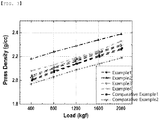
- the powder press density was measured for each of the positive electrode active materials prepared in Examples 1 to 4 and Comparative Examples 1 and 2, and the results are shown in FIG. 3 below.
- the press density is improved. It can also be confirmed that the press density improves as the content of these materials increases to a certain level. However, in Comparative Example 2 in which the content exceeds a certain level, the press density is lower than that of Comparative Example 1 in which the surface treatment is not performed, and it is confirmed that there is a limit to the appropriate amount of the tungsten (W) coating content.
- the positive electrode active material used in Examples and Comparative Examples according to the present invention exhibits low rate characteristics due to the problem in the composition of the material, and in order to overcome this problem, it has a structure of high BET unlike Reference Examples 1 and 2 below.
- a material with a high BET has the effect of smoothing the surface and increasing the powder press density during the surface treatment of WO 3 at an appropriate level.
- the amount has an optimum point, and when this amount is exceeded, the press density is rather low, but the surface characteristics (BET) at the time of application of the optimum content are the same level as those of Reference Examples 1 and 2 below.
- the introduction of additional tungsten (W) raw materials is expected to play a role in preventing pressing.
- a positive electrode active material was produced in the same manner as in Example 1, except that LiNi 0.6 Co 0.2 Mn 0.2 O 2 and WO 3 were mixed in a weight ratio of 98: 2 by using a ball mill.
- a positive electrode active material was produced in the same manner as in Example 1, except that LiNi 0.5 Co 0.2 Mn 0.3 O 2 and WO 3 were mixed in a weight ratio of 98: 2 by using a ball mill.
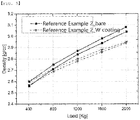
- the press densities are rather reduced by the formation of the lithium tungsten compound. This is because, originally, the lithium transition metal oxide having the above composition has a high press density, whereas when the BET is low and thus a lithium tungsten compound is additionally formed, the homogeneity of the surface is rather lowered to impede pressing.
- Each of the positive electrode active materials prepared in Examples 1 to 4 and Comparative Examples 1 and 2 was used, and PVdF as a binder and Super-P as a conductive material were used.
- the positive electrode active material, the binder and the conductive material were mixed well in a weight ratio of 96: 2: 2 in NMP, and the mixture was coated onto an Al foil having a thickness of 20 ⁇ m, dried at 130°C and pressed so that the porosity was 30%, thereby producing positive electrodes.
- An artificial graphite was as a negative electrode active material, and an artificial graphite : a conductive material (Super-P) and a binder (PVdF) were mixed in a weight ratio of 95: 2.5: 2.5, and the mixture was added to NMP as a solvent to prepare a negative electrode mixture slurry. The slurry was then coated on a copper foil in a thickness of 70 ⁇ m, dried and pressed at 130 degrees Celsius to produce a negative electrode.
- Super-P conductive material
- PVdF binder
- Secondary batteries were manufactured by using the positive electrode and the negative electrode, a polyethylene membrane (Celgard, thickness: 20 ⁇ m) as a separator, and a liquid electrolyte in which LiPF 6 was dissolved at 1 M in a mixed solvent of ethylene carbonate, dimethylene carbonate, and diethyl carbonate in a ratio of 1: 2: 1.
- the positive electrode active material according to the present invention includes the lithium-rich lithium manganese-based oxide (having a composition of Mn of 0.5 or more) in which a lithium tungsten compound, or both the lithium tungsten compound and a tungsten (W) compound is contained on a lithium-rich lithium manganese-based oxide, whereby not only it has the surface stability, and further, the tungsten-containing raw material reacts with Li existing in the lithium manganese-based oxide to form a lithium tungsten compound, and therefore, the surface roughness is reduced to improve the press density, but also the diffusion characteristics of lithium ions are improved, and the charge/reversal rate characteristics of the secondary battery including the same can be improved.
Landscapes
- Chemical & Material Sciences (AREA)
- Chemical Kinetics & Catalysis (AREA)
- Electrochemistry (AREA)
- General Chemical & Material Sciences (AREA)
- Inorganic Chemistry (AREA)
- Organic Chemistry (AREA)
- Engineering & Computer Science (AREA)
- Composite Materials (AREA)
- Materials Engineering (AREA)
- Manufacturing & Machinery (AREA)
- Battery Electrode And Active Subsutance (AREA)
- Inorganic Compounds Of Heavy Metals (AREA)
Applications Claiming Priority (3)
| Application Number | Priority Date | Filing Date | Title |
|---|---|---|---|
| KR20170128179 | 2017-09-29 | ||
| KR1020180103798A KR102498342B1 (ko) | 2017-09-29 | 2018-08-31 | 리튬 과잉의 리튬 망간계 산화물 및 리튬 과잉의 리튬 망간계 산화물상에 리튬 텅스텐 화합물, 또는 추가적으로 텅스텐 화합물을 더 포함하는 양극 활물질 및 이를 포함하는 리튬 이차전지용 양극 |
| PCT/KR2018/010472 WO2019066297A2 (fr) | 2017-09-29 | 2018-09-07 | Matériau actif d'électrode positive comprenant un oxyde à base de lithium-manganèse riche en lithium, et composé de lithium-tungstène, ou en outre, composé de tungstène, sur l'oxyde à base de lithium-manganèse riche en lithium, et électrode positive de batterie secondaire au lithium le comprenant |
Publications (3)
| Publication Number | Publication Date |
|---|---|
| EP3576193A2 true EP3576193A2 (fr) | 2019-12-04 |
| EP3576193A4 EP3576193A4 (fr) | 2020-06-03 |
| EP3576193B1 EP3576193B1 (fr) | 2022-11-02 |
Family
ID=66164395
Family Applications (1)
| Application Number | Title | Priority Date | Filing Date |
|---|---|---|---|
| EP18860518.2A Active EP3576193B1 (fr) | 2017-09-29 | 2018-09-07 | Matériau actif d'électrode positive comprenant un oxyde à base de lithium-manganèse riche en lithium, avec un composé de lithium-tungstène, et éventuellement un composé de tungstène additionnel, formés sur sa surface, et électrode positive de batterie secondaire au lithium le comprenant |
Country Status (8)
| Country | Link |
|---|---|
| US (1) | US11289695B2 (fr) |
| EP (1) | EP3576193B1 (fr) |
| JP (1) | JP7041803B2 (fr) |
| KR (1) | KR102498342B1 (fr) |
| CN (1) | CN110383542B (fr) |
| ES (1) | ES2932363T3 (fr) |
| HU (1) | HUE060700T2 (fr) |
| PL (1) | PL3576193T3 (fr) |
Families Citing this family (12)
| Publication number | Priority date | Publication date | Assignee | Title |
|---|---|---|---|---|
| KR20220030211A (ko) * | 2019-06-28 | 2022-03-10 | 바스프 에스이 | 리튬 니켈 산화물 미립자 물질, 그 제조 방법 및 용도 |
| CN119905575A (zh) * | 2019-10-18 | 2025-04-29 | Ecopro Bm有限公司 | 锂二次电池正极活性物质、其的制备方法及包含其的锂二次电池 |
| CN115053367B (zh) * | 2020-02-21 | 2024-07-30 | 宁德新能源科技有限公司 | 正极材料和包含所述正极材料的电化学装置 |
| KR102530216B1 (ko) * | 2020-06-05 | 2023-05-09 | 포항공과대학교 산학협력단 | 리튬 이차전지용 양극 활물질의 전기화학적 특성을 활성화시키는 방법 및 리튬 이차전지용 양극 활물질 |
| US12512459B2 (en) * | 2020-09-30 | 2025-12-30 | Panasonic Intellectual Property Management Co., Ltd. | Positive electrode active material for nonaqueous electrolyte secondary batteries, and nonaqueous electrolyte secondary battery |
| US12525603B2 (en) * | 2020-12-18 | 2026-01-13 | Umicore | Positive electrode active material for rechargeable batteries |
| CN116941070B (zh) | 2021-07-21 | 2025-01-17 | 株式会社Lg新能源 | 锂二次电池 |
| KR102769524B1 (ko) * | 2022-07-27 | 2025-02-19 | 주식회사 엘지화학 | 양극 활물질 및 이의 제조 방법 |
| CN115494048A (zh) * | 2022-09-01 | 2022-12-20 | 天津巴莫科技有限责任公司 | 含钨氧化物的溶解方法及正极材料中钨含量的测定方法 |
| WO2025028923A1 (fr) * | 2023-08-01 | 2025-02-06 | 주식회사 엘지화학 | Matériau actif d'électrode positive, son procédé de fabrication, et électrode positive et batterie secondaire au lithium le comprenant |
| KR20250028721A (ko) * | 2023-08-22 | 2025-03-04 | 주식회사 엘지화학 | 양극 활물질, 이의 제조 방법, 및 이를 포함하는 양극 및 리튬 이차전지 |
| KR20250049936A (ko) * | 2023-10-05 | 2025-04-14 | 포스코홀딩스 주식회사 | 리튬 이차 전지용 양극 활물질, 이의 제조방법 및 이를 포함하는 리튬 이차 전지 |
Family Cites Families (23)
| Publication number | Priority date | Publication date | Assignee | Title |
|---|---|---|---|---|
| JPS62139260A (ja) | 1985-12-12 | 1987-06-22 | Matsushita Electric Ind Co Ltd | 有機電解液電池用正極活物質の製造法 |
| JP5035712B2 (ja) | 2010-09-30 | 2012-09-26 | 住友金属鉱山株式会社 | 非水系電解質二次電池用正極活物質とその製造方法、および該正極活物質を用いた非水系電解質二次電池 |
| US8992410B2 (en) * | 2010-11-03 | 2015-03-31 | Vysera Biomedical Limited | Urological device |
| JP5662132B2 (ja) | 2010-12-17 | 2015-01-28 | 三星エスディアイ株式会社Samsung SDI Co.,Ltd. | リチウムイオン二次電池 |
| WO2012164752A1 (fr) * | 2011-05-30 | 2012-12-06 | 住友金属鉱山株式会社 | Matériau actif d'électrode positive pour des batteries secondaires non aqueuses, son procédé de fabrication, et batterie secondaire à électrolyte non aqueux l'utilisant |
| JP6072688B2 (ja) | 2011-07-28 | 2017-02-01 | 三洋電機株式会社 | 非水電解質二次電池及び非水電解質二次電池の製造方法 |
| JP5822708B2 (ja) * | 2011-12-16 | 2015-11-24 | 住友金属鉱山株式会社 | 非水系電解質二次電池用正極活物質とその製造方法、および該正極活物質を用いた非水系電解質二次電池 |
| CN103633329B (zh) | 2012-08-28 | 2015-12-02 | 华为技术有限公司 | 一种全固态锂离子电池复合型正极材料及其制备方法和全固态锂离子电池 |
| KR20140044594A (ko) | 2012-10-05 | 2014-04-15 | 삼성에스디아이 주식회사 | 리튬 이차 전지용 양극 활물질층 조성물 및 이를 이용한 리튬 이차 전지 |
| KR102152370B1 (ko) | 2013-12-31 | 2020-09-07 | 삼성에스디아이 주식회사 | 양극 활물질 및 이를 포함하는 리튬 이차전지 |
| US10217997B2 (en) | 2014-03-18 | 2019-02-26 | Lg Chem, Ltd. | Positive electrode active material and lithium secondary battery including the same |
| KR101772737B1 (ko) | 2014-09-01 | 2017-09-12 | 주식회사 엘지화학 | 리튬이차전지용 양극활물질, 이의 제조방법 및 이를 포함하는 리튬이차전지 |
| CN106716701A (zh) | 2014-09-26 | 2017-05-24 | 三洋电机株式会社 | 非水电解质二次电池 |
| KR101844110B1 (ko) | 2014-10-31 | 2018-05-14 | 주식회사 엘지화학 | 리튬 이차전지용 양극 활물질, 및 이를 포함하는 양극 및 리튬 이차전지 |
| JP6210439B2 (ja) | 2014-12-26 | 2017-10-11 | 住友金属鉱山株式会社 | 非水系電解質二次電池用正極活物質とその製造方法、及び該正極活物質を用いた非水系電解質二次電池 |
| JP6978182B2 (ja) * | 2015-04-24 | 2021-12-08 | 住友金属鉱山株式会社 | 非水系電解質二次電池用正極活物質とその製造方法、および該正極活物質を用いた非水系電解質二次電池 |
| JP6569544B2 (ja) | 2015-05-26 | 2019-09-04 | 住友金属鉱山株式会社 | 非水系電解質二次電池用正極活物質とその製造方法、および該正極活物質を用いた非水系電解質二次電池 |
| JP2017010841A (ja) * | 2015-06-24 | 2017-01-12 | 住友金属鉱山株式会社 | 非水系電解質二次電池用正極活物質とその製造方法、および該正極活物質を用いた非水系電解質二次電池 |
| WO2017090378A1 (fr) * | 2015-11-27 | 2017-06-01 | 住友金属鉱山株式会社 | Matériau d'électrode positive pour une batterie rechargeable à électrolyte non aqueux et son procédé de fabrication, pâte composite d'électrode positive et batterie rechargeable à électrolyte non aqueux |
| KR102004457B1 (ko) | 2015-11-30 | 2019-07-29 | 주식회사 엘지화학 | 이차전지용 양극활물질 및 이를 포함하는 이차전지 |
| WO2017095134A1 (fr) * | 2015-11-30 | 2017-06-08 | 주식회사 엘지화학 | Matière active de cathode pour batterie secondaire et batterie secondaire la comprenant |
| US10553856B2 (en) * | 2015-11-30 | 2020-02-04 | Panasonic Intellectual Property Management Co., Ltd. | Nonaqueous electrolyte secondary battery |
| JP6818225B2 (ja) | 2016-01-27 | 2021-01-20 | 住友金属鉱山株式会社 | 非水系電解質二次電池用正極活物質の製造方法 |
-
2018
- 2018-08-31 KR KR1020180103798A patent/KR102498342B1/ko active Active
- 2018-09-07 JP JP2019548587A patent/JP7041803B2/ja active Active
- 2018-09-07 EP EP18860518.2A patent/EP3576193B1/fr active Active
- 2018-09-07 US US16/489,562 patent/US11289695B2/en active Active
- 2018-09-07 PL PL18860518.2T patent/PL3576193T3/pl unknown
- 2018-09-07 ES ES18860518T patent/ES2932363T3/es active Active
- 2018-09-07 CN CN201880016005.XA patent/CN110383542B/zh active Active
- 2018-09-07 HU HUE18860518A patent/HUE060700T2/hu unknown
Also Published As
| Publication number | Publication date |
|---|---|
| CN110383542B (zh) | 2022-06-14 |
| PL3576193T3 (pl) | 2023-03-20 |
| CN110383542A (zh) | 2019-10-25 |
| ES2932363T3 (es) | 2023-01-18 |
| JP2020511741A (ja) | 2020-04-16 |
| KR102498342B1 (ko) | 2023-02-10 |
| JP7041803B2 (ja) | 2022-03-25 |
| US11289695B2 (en) | 2022-03-29 |
| HUE060700T2 (hu) | 2023-04-28 |
| KR20190038314A (ko) | 2019-04-08 |
| US20190386294A1 (en) | 2019-12-19 |
| EP3576193B1 (fr) | 2022-11-02 |
| EP3576193A4 (fr) | 2020-06-03 |
Similar Documents
| Publication | Publication Date | Title |
|---|---|---|
| US11258054B2 (en) | Positive electrode active material comprising lithium-rich lithium manganese-based oxide in which coating layer including lithium-deficient transition metal oxide is formed, and positive electrode for lithium secondary battery comprising the same | |
| EP3576193B1 (fr) | Matériau actif d'électrode positive comprenant un oxyde à base de lithium-manganèse riche en lithium, avec un composé de lithium-tungstène, et éventuellement un composé de tungstène additionnel, formés sur sa surface, et électrode positive de batterie secondaire au lithium le comprenant | |
| EP2806486B1 (fr) | Matière active de cathode, batterie rechargeable au lithium permettant de contrôler les impuretés ou le gonflement contenant celles-ci et procédé de préparation de matière active de cathode doté d'une productivité améliorée | |
| EP3012890B1 (fr) | Procédé de préparation d'un matériau actif de cathode pour des batteries secondaire | |
| US8481213B2 (en) | Cathode active material for lithium secondary battery | |
| EP2506343B1 (fr) | Anode réalisée par une combinaison de deux éléments, et batterie secondaire au lithium l'utilisant | |
| KR20200056235A (ko) | 양극 활물질, 이의 제조방법 및 이를 포함하는 리튬 이차 전지 | |
| EP2506342A2 (fr) | Anode réalisée par une combinaison de deux éléments, et batterie secondaire au lithium l'utilisant | |
| EP3582301B1 (fr) | Matériau actif d'électrode positive pour haute tension, comprenant un oxyde à base de lithium/manganèse, et son procédé de production | |
| EP2713427B1 (fr) | Matériau actif d'électrode positive pour batterie secondaire à régime amélioré | |
| JP2017511570A (ja) | 正極活物質及びそれを含むリチウム二次電池 | |
| KR20180089030A (ko) | 고전압용 리튬 코발트 산화물을 포함하는 리튬 이차전지용 양극 활물질 및 이를 제조하는 방법 | |
| CN102804458B (zh) | 锂二次电池用正极活性材料 | |
| EP2511972B1 (fr) | Matériau actif de cathode et batterie secondaire au lithium utilisant un tel matériau | |
| US10573880B2 (en) | Cathode active material for secondary battery with enhanced lifespan characteristics and method of preparing the same | |
| JP2017512374A (ja) | 正極活物質及びそれを含むリチウム二次電池 | |
| WO2019066297A2 (fr) | Matériau actif d'électrode positive comprenant un oxyde à base de lithium-manganèse riche en lithium, et composé de lithium-tungstène, ou en outre, composé de tungstène, sur l'oxyde à base de lithium-manganèse riche en lithium, et électrode positive de batterie secondaire au lithium le comprenant | |
| US9276264B2 (en) | Cathode active material for secondary batteries |
Legal Events
| Date | Code | Title | Description |
|---|---|---|---|
| STAA | Information on the status of an ep patent application or granted ep patent |
Free format text: STATUS: THE INTERNATIONAL PUBLICATION HAS BEEN MADE |
|
| PUAI | Public reference made under article 153(3) epc to a published international application that has entered the european phase |
Free format text: ORIGINAL CODE: 0009012 |
|
| STAA | Information on the status of an ep patent application or granted ep patent |
Free format text: STATUS: REQUEST FOR EXAMINATION WAS MADE |
|
| 17P | Request for examination filed |
Effective date: 20190827 |
|
| AK | Designated contracting states |
Kind code of ref document: A2 Designated state(s): AL AT BE BG CH CY CZ DE DK EE ES FI FR GB GR HR HU IE IS IT LI LT LU LV MC MK MT NL NO PL PT RO RS SE SI SK SM TR |
|
| AX | Request for extension of the european patent |
Extension state: BA ME |
|
| A4 | Supplementary search report drawn up and despatched |
Effective date: 20200508 |
|
| RIC1 | Information provided on ipc code assigned before grant |
Ipc: C01G 53/00 20060101ALI20200501BHEP Ipc: H01M 4/1391 20100101ALI20200501BHEP Ipc: H01M 4/36 20060101ALI20200501BHEP Ipc: H01M 4/02 20060101ALN20200501BHEP Ipc: C01G 41/00 20060101ALI20200501BHEP Ipc: H01M 4/505 20100101ALI20200501BHEP Ipc: H01M 4/131 20100101AFI20200501BHEP Ipc: H01M 4/62 20060101ALI20200501BHEP Ipc: H01M 10/0525 20100101ALN20200501BHEP |
|
| DAV | Request for validation of the european patent (deleted) | ||
| DAX | Request for extension of the european patent (deleted) | ||
| RAP1 | Party data changed (applicant data changed or rights of an application transferred) |
Owner name: LG ENERGY SOLUTION LTD. |
|
| RAP3 | Party data changed (applicant data changed or rights of an application transferred) |
Owner name: LG ENERGY SOLUTION, LTD. |
|
| REG | Reference to a national code |
Ref country code: DE Ref legal event code: R079 Ref document number: 602018042688 Country of ref document: DE Free format text: PREVIOUS MAIN CLASS: H01M0004360000 Ipc: H01M0004131000 |
|
| GRAP | Despatch of communication of intention to grant a patent |
Free format text: ORIGINAL CODE: EPIDOSNIGR1 |
|
| STAA | Information on the status of an ep patent application or granted ep patent |
Free format text: STATUS: GRANT OF PATENT IS INTENDED |
|
| RIC1 | Information provided on ipc code assigned before grant |
Ipc: H01M 10/0525 20100101ALN20220502BHEP Ipc: H01M 4/02 20060101ALN20220502BHEP Ipc: C01G 53/00 20060101ALI20220502BHEP Ipc: C01G 41/00 20060101ALI20220502BHEP Ipc: H01M 4/62 20060101ALI20220502BHEP Ipc: H01M 4/505 20100101ALI20220502BHEP Ipc: H01M 4/36 20060101ALI20220502BHEP Ipc: H01M 4/1391 20100101ALI20220502BHEP Ipc: H01M 4/131 20100101AFI20220502BHEP |
|
| INTG | Intention to grant announced |
Effective date: 20220524 |
|
| GRAS | Grant fee paid |
Free format text: ORIGINAL CODE: EPIDOSNIGR3 |
|
| GRAA | (expected) grant |
Free format text: ORIGINAL CODE: 0009210 |
|
| STAA | Information on the status of an ep patent application or granted ep patent |
Free format text: STATUS: THE PATENT HAS BEEN GRANTED |
|
| AK | Designated contracting states |
Kind code of ref document: B1 Designated state(s): AL AT BE BG CH CY CZ DE DK EE ES FI FR GB GR HR HU IE IS IT LI LT LU LV MC MK MT NL NO PL PT RO RS SE SI SK SM TR |
|
| REG | Reference to a national code |
Ref country code: GB Ref legal event code: FG4D |
|
| REG | Reference to a national code |
Ref country code: CH Ref legal event code: EP Ref country code: AT Ref legal event code: REF Ref document number: 1529416 Country of ref document: AT Kind code of ref document: T Effective date: 20221115 |
|
| REG | Reference to a national code |
Ref country code: DE Ref legal event code: R096 Ref document number: 602018042688 Country of ref document: DE |
|
| REG | Reference to a national code |
Ref country code: IE Ref legal event code: FG4D |
|
| REG | Reference to a national code |
Ref country code: SE Ref legal event code: TRGR |
|
| REG | Reference to a national code |
Ref country code: ES Ref legal event code: FG2A Ref document number: 2932363 Country of ref document: ES Kind code of ref document: T3 Effective date: 20230118 |
|
| REG | Reference to a national code |
Ref country code: LT Ref legal event code: MG9D |
|
| REG | Reference to a national code |
Ref country code: NL Ref legal event code: MP Effective date: 20221102 |
|
| REG | Reference to a national code |
Ref country code: AT Ref legal event code: MK05 Ref document number: 1529416 Country of ref document: AT Kind code of ref document: T Effective date: 20221102 |
|
| PG25 | Lapsed in a contracting state [announced via postgrant information from national office to epo] |
Ref country code: PT Free format text: LAPSE BECAUSE OF FAILURE TO SUBMIT A TRANSLATION OF THE DESCRIPTION OR TO PAY THE FEE WITHIN THE PRESCRIBED TIME-LIMIT Effective date: 20230302 Ref country code: NO Free format text: LAPSE BECAUSE OF FAILURE TO SUBMIT A TRANSLATION OF THE DESCRIPTION OR TO PAY THE FEE WITHIN THE PRESCRIBED TIME-LIMIT Effective date: 20230202 Ref country code: LT Free format text: LAPSE BECAUSE OF FAILURE TO SUBMIT A TRANSLATION OF THE DESCRIPTION OR TO PAY THE FEE WITHIN THE PRESCRIBED TIME-LIMIT Effective date: 20221102 Ref country code: FI Free format text: LAPSE BECAUSE OF FAILURE TO SUBMIT A TRANSLATION OF THE DESCRIPTION OR TO PAY THE FEE WITHIN THE PRESCRIBED TIME-LIMIT Effective date: 20221102 Ref country code: AT Free format text: LAPSE BECAUSE OF FAILURE TO SUBMIT A TRANSLATION OF THE DESCRIPTION OR TO PAY THE FEE WITHIN THE PRESCRIBED TIME-LIMIT Effective date: 20221102 |
|
| REG | Reference to a national code |
Ref country code: HU Ref legal event code: AG4A Ref document number: E060700 Country of ref document: HU |
|
| PG25 | Lapsed in a contracting state [announced via postgrant information from national office to epo] |
Ref country code: RS Free format text: LAPSE BECAUSE OF FAILURE TO SUBMIT A TRANSLATION OF THE DESCRIPTION OR TO PAY THE FEE WITHIN THE PRESCRIBED TIME-LIMIT Effective date: 20221102 Ref country code: LV Free format text: LAPSE BECAUSE OF FAILURE TO SUBMIT A TRANSLATION OF THE DESCRIPTION OR TO PAY THE FEE WITHIN THE PRESCRIBED TIME-LIMIT Effective date: 20221102 Ref country code: IS Free format text: LAPSE BECAUSE OF FAILURE TO SUBMIT A TRANSLATION OF THE DESCRIPTION OR TO PAY THE FEE WITHIN THE PRESCRIBED TIME-LIMIT Effective date: 20230302 Ref country code: HR Free format text: LAPSE BECAUSE OF FAILURE TO SUBMIT A TRANSLATION OF THE DESCRIPTION OR TO PAY THE FEE WITHIN THE PRESCRIBED TIME-LIMIT Effective date: 20221102 Ref country code: GR Free format text: LAPSE BECAUSE OF FAILURE TO SUBMIT A TRANSLATION OF THE DESCRIPTION OR TO PAY THE FEE WITHIN THE PRESCRIBED TIME-LIMIT Effective date: 20230203 |
|
| P01 | Opt-out of the competence of the unified patent court (upc) registered |
Effective date: 20230408 |
|
| PG25 | Lapsed in a contracting state [announced via postgrant information from national office to epo] |
Ref country code: NL Free format text: LAPSE BECAUSE OF FAILURE TO SUBMIT A TRANSLATION OF THE DESCRIPTION OR TO PAY THE FEE WITHIN THE PRESCRIBED TIME-LIMIT Effective date: 20221102 |
|
| PG25 | Lapsed in a contracting state [announced via postgrant information from national office to epo] |
Ref country code: SM Free format text: LAPSE BECAUSE OF FAILURE TO SUBMIT A TRANSLATION OF THE DESCRIPTION OR TO PAY THE FEE WITHIN THE PRESCRIBED TIME-LIMIT Effective date: 20221102 Ref country code: RO Free format text: LAPSE BECAUSE OF FAILURE TO SUBMIT A TRANSLATION OF THE DESCRIPTION OR TO PAY THE FEE WITHIN THE PRESCRIBED TIME-LIMIT Effective date: 20221102 Ref country code: EE Free format text: LAPSE BECAUSE OF FAILURE TO SUBMIT A TRANSLATION OF THE DESCRIPTION OR TO PAY THE FEE WITHIN THE PRESCRIBED TIME-LIMIT Effective date: 20221102 Ref country code: DK Free format text: LAPSE BECAUSE OF FAILURE TO SUBMIT A TRANSLATION OF THE DESCRIPTION OR TO PAY THE FEE WITHIN THE PRESCRIBED TIME-LIMIT Effective date: 20221102 Ref country code: CZ Free format text: LAPSE BECAUSE OF FAILURE TO SUBMIT A TRANSLATION OF THE DESCRIPTION OR TO PAY THE FEE WITHIN THE PRESCRIBED TIME-LIMIT Effective date: 20221102 |
|
| REG | Reference to a national code |
Ref country code: DE Ref legal event code: R097 Ref document number: 602018042688 Country of ref document: DE |
|
| PG25 | Lapsed in a contracting state [announced via postgrant information from national office to epo] |
Ref country code: SK Free format text: LAPSE BECAUSE OF FAILURE TO SUBMIT A TRANSLATION OF THE DESCRIPTION OR TO PAY THE FEE WITHIN THE PRESCRIBED TIME-LIMIT Effective date: 20221102 Ref country code: AL Free format text: LAPSE BECAUSE OF FAILURE TO SUBMIT A TRANSLATION OF THE DESCRIPTION OR TO PAY THE FEE WITHIN THE PRESCRIBED TIME-LIMIT Effective date: 20221102 |
|
| PLBE | No opposition filed within time limit |
Free format text: ORIGINAL CODE: 0009261 |
|
| STAA | Information on the status of an ep patent application or granted ep patent |
Free format text: STATUS: NO OPPOSITION FILED WITHIN TIME LIMIT |
|
| 26N | No opposition filed |
Effective date: 20230803 |
|
| PG25 | Lapsed in a contracting state [announced via postgrant information from national office to epo] |
Ref country code: SI Free format text: LAPSE BECAUSE OF FAILURE TO SUBMIT A TRANSLATION OF THE DESCRIPTION OR TO PAY THE FEE WITHIN THE PRESCRIBED TIME-LIMIT Effective date: 20221102 |
|
| REG | Reference to a national code |
Ref country code: CH Ref legal event code: PL |
|
| PG25 | Lapsed in a contracting state [announced via postgrant information from national office to epo] |
Ref country code: LU Free format text: LAPSE BECAUSE OF NON-PAYMENT OF DUE FEES Effective date: 20230907 |
|
| REG | Reference to a national code |
Ref country code: BE Ref legal event code: MM Effective date: 20230930 |
|
| PG25 | Lapsed in a contracting state [announced via postgrant information from national office to epo] |
Ref country code: LU Free format text: LAPSE BECAUSE OF NON-PAYMENT OF DUE FEES Effective date: 20230907 Ref country code: IT Free format text: LAPSE BECAUSE OF FAILURE TO SUBMIT A TRANSLATION OF THE DESCRIPTION OR TO PAY THE FEE WITHIN THE PRESCRIBED TIME-LIMIT Effective date: 20221102 Ref country code: MC Free format text: LAPSE BECAUSE OF FAILURE TO SUBMIT A TRANSLATION OF THE DESCRIPTION OR TO PAY THE FEE WITHIN THE PRESCRIBED TIME-LIMIT Effective date: 20221102 |
|
| REG | Reference to a national code |
Ref country code: IE Ref legal event code: MM4A |
|
| PG25 | Lapsed in a contracting state [announced via postgrant information from national office to epo] |
Ref country code: IE Free format text: LAPSE BECAUSE OF NON-PAYMENT OF DUE FEES Effective date: 20230907 |
|
| PG25 | Lapsed in a contracting state [announced via postgrant information from national office to epo] |
Ref country code: CH Free format text: LAPSE BECAUSE OF NON-PAYMENT OF DUE FEES Effective date: 20230930 |
|
| PG25 | Lapsed in a contracting state [announced via postgrant information from national office to epo] |
Ref country code: CH Free format text: LAPSE BECAUSE OF NON-PAYMENT OF DUE FEES Effective date: 20230930 Ref country code: IE Free format text: LAPSE BECAUSE OF NON-PAYMENT OF DUE FEES Effective date: 20230907 |
|
| PG25 | Lapsed in a contracting state [announced via postgrant information from national office to epo] |
Ref country code: BE Free format text: LAPSE BECAUSE OF NON-PAYMENT OF DUE FEES Effective date: 20230930 |
|
| PG25 | Lapsed in a contracting state [announced via postgrant information from national office to epo] |
Ref country code: BG Free format text: LAPSE BECAUSE OF FAILURE TO SUBMIT A TRANSLATION OF THE DESCRIPTION OR TO PAY THE FEE WITHIN THE PRESCRIBED TIME-LIMIT Effective date: 20221102 |
|
| PG25 | Lapsed in a contracting state [announced via postgrant information from national office to epo] |
Ref country code: BG Free format text: LAPSE BECAUSE OF FAILURE TO SUBMIT A TRANSLATION OF THE DESCRIPTION OR TO PAY THE FEE WITHIN THE PRESCRIBED TIME-LIMIT Effective date: 20221102 |
|
| PG25 | Lapsed in a contracting state [announced via postgrant information from national office to epo] |
Ref country code: CY Free format text: LAPSE BECAUSE OF FAILURE TO SUBMIT A TRANSLATION OF THE DESCRIPTION OR TO PAY THE FEE WITHIN THE PRESCRIBED TIME-LIMIT; INVALID AB INITIO Effective date: 20180907 |
|
| PGFP | Annual fee paid to national office [announced via postgrant information from national office to epo] |
Ref country code: DE Payment date: 20250820 Year of fee payment: 8 |
|
| PGFP | Annual fee paid to national office [announced via postgrant information from national office to epo] |
Ref country code: PL Payment date: 20250822 Year of fee payment: 8 |
|
| PGFP | Annual fee paid to national office [announced via postgrant information from national office to epo] |
Ref country code: HU Payment date: 20250929 Year of fee payment: 8 Ref country code: GB Payment date: 20250820 Year of fee payment: 8 |
|
| PGFP | Annual fee paid to national office [announced via postgrant information from national office to epo] |
Ref country code: FR Payment date: 20250821 Year of fee payment: 8 |
|
| PGFP | Annual fee paid to national office [announced via postgrant information from national office to epo] |
Ref country code: SE Payment date: 20250821 Year of fee payment: 8 |
|
| PG25 | Lapsed in a contracting state [announced via postgrant information from national office to epo] |
Ref country code: TR Free format text: LAPSE BECAUSE OF FAILURE TO SUBMIT A TRANSLATION OF THE DESCRIPTION OR TO PAY THE FEE WITHIN THE PRESCRIBED TIME-LIMIT Effective date: 20221102 |
|
| PGFP | Annual fee paid to national office [announced via postgrant information from national office to epo] |
Ref country code: ES Payment date: 20251007 Year of fee payment: 8 |