EP3577802B1 - Procédé et dispositif pour la transmission de données à commande temporelle dans un tsn - Google Patents
Procédé et dispositif pour la transmission de données à commande temporelle dans un tsn Download PDFInfo
- Publication number
- EP3577802B1 EP3577802B1 EP17711599.5A EP17711599A EP3577802B1 EP 3577802 B1 EP3577802 B1 EP 3577802B1 EP 17711599 A EP17711599 A EP 17711599A EP 3577802 B1 EP3577802 B1 EP 3577802B1
- Authority
- EP
- European Patent Office
- Prior art keywords
- time
- source
- network element
- sink
- network
- Prior art date
- Legal status (The legal status is an assumption and is not a legal conclusion. Google has not performed a legal analysis and makes no representation as to the accuracy of the status listed.)
- Active
Links
Images

Classifications
-
- H—ELECTRICITY
- H04—ELECTRIC COMMUNICATION TECHNIQUE
- H04J—MULTIPLEX COMMUNICATION
- H04J3/00—Time-division multiplex systems
- H04J3/02—Details
- H04J3/06—Synchronising arrangements
- H04J3/0635—Clock or time synchronisation in a network
- H04J3/0638—Clock or time synchronisation among nodes; Internode synchronisation
- H04J3/0658—Clock or time synchronisation among packet nodes
- H04J3/0661—Clock or time synchronisation among packet nodes using timestamps
- H04J3/0667—Bidirectional timestamps, e.g. NTP or PTP for compensation of clock drift and for compensation of propagation delays
-
- H—ELECTRICITY
- H04—ELECTRIC COMMUNICATION TECHNIQUE
- H04J—MULTIPLEX COMMUNICATION
- H04J3/00—Time-division multiplex systems
- H04J3/02—Details
- H04J3/06—Synchronising arrangements
- H04J3/0635—Clock or time synchronisation in a network
- H04J3/0638—Clock or time synchronisation among nodes; Internode synchronisation
- H04J3/0652—Synchronisation among time division multiple access [TDMA] nodes, e.g. time triggered protocol [TTP]
-
- H—ELECTRICITY
- H04—ELECTRIC COMMUNICATION TECHNIQUE
- H04J—MULTIPLEX COMMUNICATION
- H04J3/00—Time-division multiplex systems
- H04J3/02—Details
- H04J3/06—Synchronising arrangements
- H04J3/0635—Clock or time synchronisation in a network
- H04J3/0638—Clock or time synchronisation among nodes; Internode synchronisation
- H04J3/0658—Clock or time synchronisation among packet nodes
- H04J3/0673—Clock or time synchronisation among packet nodes using intermediate nodes, e.g. modification of a received timestamp before further transmission to the next packet node, e.g. including internal delay time or residence time into the packet
-
- H—ELECTRICITY
- H04—ELECTRIC COMMUNICATION TECHNIQUE
- H04J—MULTIPLEX COMMUNICATION
- H04J3/00—Time-division multiplex systems
- H04J3/02—Details
- H04J3/06—Synchronising arrangements
- H04J3/0635—Clock or time synchronisation in a network
- H04J3/0682—Clock or time synchronisation in a network by delay compensation, e.g. by compensation of propagation delay or variations thereof, by ranging
-
- H—ELECTRICITY
- H04—ELECTRIC COMMUNICATION TECHNIQUE
- H04J—MULTIPLEX COMMUNICATION
- H04J3/00—Time-division multiplex systems
- H04J3/02—Details
- H04J3/06—Synchronising arrangements
- H04J3/0635—Clock or time synchronisation in a network
- H04J3/0685—Clock or time synchronisation in a node; Intranode synchronisation
- H04J3/0697—Synchronisation in a packet node
-
- H—ELECTRICITY
- H04—ELECTRIC COMMUNICATION TECHNIQUE
- H04L—TRANSMISSION OF DIGITAL INFORMATION, e.g. TELEGRAPHIC COMMUNICATION
- H04L47/00—Traffic control in data switching networks
- H04L47/10—Flow control; Congestion control
- H04L47/22—Traffic shaping
-
- H—ELECTRICITY
- H04—ELECTRIC COMMUNICATION TECHNIQUE
- H04L—TRANSMISSION OF DIGITAL INFORMATION, e.g. TELEGRAPHIC COMMUNICATION
- H04L47/00—Traffic control in data switching networks
- H04L47/10—Flow control; Congestion control
- H04L47/24—Traffic characterised by specific attributes, e.g. priority or QoS
- H04L47/2416—Real-time traffic
-
- H—ELECTRICITY
- H04—ELECTRIC COMMUNICATION TECHNIQUE
- H04L—TRANSMISSION OF DIGITAL INFORMATION, e.g. TELEGRAPHIC COMMUNICATION
- H04L47/00—Traffic control in data switching networks
- H04L47/50—Queue scheduling
- H04L47/56—Queue scheduling implementing delay-aware scheduling
- H04L47/564—Attaching a deadline to packets, e.g. earliest due date first
- H04L47/566—Deadline varies as a function of time spent in the queue
-
- H—ELECTRICITY
- H04—ELECTRIC COMMUNICATION TECHNIQUE
- H04J—MULTIPLEX COMMUNICATION
- H04J3/00—Time-division multiplex systems
- H04J3/02—Details
- H04J3/06—Synchronising arrangements
- H04J3/0635—Clock or time synchronisation in a network
- H04J3/0685—Clock or time synchronisation in a node; Intranode synchronisation
- H04J3/0694—Synchronisation in a TDMA node, e.g. TTP
Definitions
- TSN Time Sensitive Networking, IEEE 802.1
- IEEE 802.1 The extensions of the IEEE working group TSN (Time Sensitive Networking, IEEE 802.1) enable real-time communication in networks that work according to the Ethernet standard.
- the current IEEE standards for TSN which are currently being developed, particularly take into account the requirements of the automotive industry and controls in automation systems with their requirements for the networks with regard to real-time behavior.
- Mechanisms and protocols are defined in order to be able to offer deterministic services for time-sensitive streaming through a network according to the Ethernet standard.
- Time-Aware-Shaper is defined in the IEEE 802.1Qbv standard and can protect scheduled, scheduled data transfer from disruptions from other data traffic by using fixed time windows and thus achieving a deterministic low latency. If the so-called "cut-through" routing is offered in combination with TAS, the best real-time performance can be achieved with the lowest latency and the lowest delay variance.
- TAS network for a scheduled data transfer requires that all network elements, i.e. both the switching stations / bridges and the end user stations, are time-synchronized so that the TAS time windows are scheduled on the same time base.
- TAS windows depends on the global network information, for example on the network topology, and therefore requires a fully managed network. Because of the high planning and administrative effort and inefficient use of bandwidth for the remaining data traffic, these networks are, for example, already PROFINET IRT (Isochrounous Real Time) network, mainly used for hard real-time systems and motion control applications that place the highest demands on real-time capability and reliability. For those real-time systems that do not require these highest requirements with the lowest latency, other traffic flow regulations with less planning effort than TAS are preferred, as long as the required determinism is offered.
- PROFINET IRT Isochrounous Real Time
- CBS Credit-Based Shaper
- AVB uses the Stream Reservation Protocol (SRP), which is defined in IEEE 802.1Qat, for the reservation of resources in the network for each individual AVB stream, calculated on the basis of a worst-case delay and with a memory requirement calculated for the bridges based on Traffic Classes.
- SRP Stream Reservation Protocol
- the worst-case delay per network element (bridge) in CBS is topology-dependent and the same dependency is found in the memory requirement. This means that the worst-case analysis becomes very complex and depends on the topology. Inaccurate worst-case calculations lead to incorrect reservations in the network, either too many resources are occupied. The more problematic case, however, would be the insufficient reservation, which leads to unexpected data loss due to insufficiently dimensioned bridge memory. which ultimately causes serious errors in the real-time system.
- CQF Cyclic Queuing and Forwarding
- latency Min H - 1 * T
- the transmission jitter for CQF is 2T, which is a fixed value, regardless of the number of hops in the transmission link.
- CQF achieves a deterministic latency and a topology-independent jitter, but for the price of increased latency in the best case as a result of the waiting time forced by the shaper in each bridge.
- the duration T of the time intervals must be selected large enough to accommodate all data in a given class measurement interval, plus an interference frame of maximum size with lower priority. If the frame preemption defined in IEEE 802.1bu / 802.3.3br is combined with CQF, then the maximum size of an interference fragment can be further reduced to the size of a maximum frame fragment. This means that more stream data can be reserved for the same interval duration T for use with CQF if preemption is used.
- CQF is superior to CBS in terms of technology independence and the simplicity of calculating worst-case latency in the worst case, CQF needs it also a cyclical time sequence that requires a time-synchronized network as a basis.
- CQF is implemented with PSFP (perstream filtering and policing, IEEE 802.1Qi) and TAS (IEEE 802.QBv)
- PSFP perstream filtering and policing, IEEE 802.1Qi
- TAS IEEE 802.QBv
- the traffic classes are a limited resource of a bridge (with an IEEE 802.1Q-compliant bridge there is a maximum of 8), the need for two queues per traffic class is seen as a disadvantage of the CQF.
- the second weak point of CQF is the need for time synchronization.
- a data transmission method is known, for example for the 3G HSDPA protocols (HARQ, 3GPP TS 25.308), which takes the delay into account during data transmission, accumulates this information over the transmission path and, depending on the information during transmission, uses a suitable transmission protocol to maintain a desired transmission time.
- 3G HSDPA protocols HARQ, 3GPP TS 25.308
- the method concerns the time-controlled data transmission of data packets in a time-sensitive network according to the TSN standard.
- the network consists of individual network elements and the time lapse in each network element is divided into pre-planned, equally large time windows.
- the network elements each have their own independent timer and these time windows begin and end at the same points in time for all network elements.
- a data packet is transmitted from a first network element to a subsequent network element in the time window which follows the time window in which this data packet was received by a preceding network element.
- Each network element determines, based on its own independent timer and a delay value, at what point in time the next transmission window begins and / or ends.
- a new traffic shaping method for time-sensitive data streams is described, which is also called “Packet Delay Variation Compensation (PDVC)" in the following.
- the aim is to offer the same real-time performance and configuration complexity as CQF, but without the need for time synchronization of the entire network.
- the PDVC Shaper also ensures that a data frame that is received by a bridge in a first time interval is passed on to the next hop / bridge by this bridge in the next time interval.
- a major difference to CQF is how these time intervals are implemented in the bridges.
- CQF realizes the intervals in the bridge in a certain way by using a cyclical network-central timer and forms the streams of a given transport class based on the same schedule (a sequence of successive time intervals).
- the cyclic timer of the CQF Bridges in the network must run on a common time base so that the time intervals can be synchronized to the same start time.
- Each bridge knows the start time of the time interval that belongs to a certain data stream. This is defined by the source of the stream, (StreamID), by tracking the timing of each frame on each hop along the data path from source to sink.
- StreamID source of the stream
- Each data frame must contain a so-called “delay value”, i.e. a delay value that is measured by each bridge using a local clock that measures the delay time the data frame spends in the queue at the outgoing port.
- the measured delay value should deduct any delay caused by the PDVC Shaper and reflect how the actual transmission time AT deviates from the planned transmission time.
- Eligilibility Time ET The planned transmission time for a data frame, usually referred to as Eligilibility Time ET, is determined by the PDVC Shaper at the earliest possible point in time when the data frame is entered in the queue of the output transmission port.
- T is the class measurement interval which belongs to the stream of this data frame and represents the transmission interval of the stream at its source.
- T is the class measurement interval which belongs to the stream of this data frame and represents the transmission interval of the stream at its source.
- PDVC determines the ET for a data frame on the current bridge, based on the delay information of the data frame on the previous hop.
- Such a shaping approach is based on the information from the previous hop and is also referred to as "route based traffic shaping".
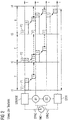
- Figure 1 shows an example of the procedure according to the invention, using the PDVC Shaper for the transmission of a single data stream from the source source through 2 bridges B1, B2 to a data sink, sink.
- Each of these network elements has its own timer C1 to C4, which is self-sufficient and not synchronized with one of the other time sources.
- the data source periodically generates a frame P1, P2, P3, P4 at times t1, t2, t3, t4, with a constant time interval T between times t1 to t4.
- the start time of the respective time interval is shown in the figure by a dashed vertical line.
- the data packets in dashed lines show the time at which the packet is scheduled to be sent, the packets with a solid line below the respective time line t of the respective network element then the actual time at which the packet is sent - ideally in the same time window.
- each subsequent receiving bridge B1, B2 realign the time of the transmission of the data frame.
- the transfer time is calculated using the formula for ET (i + 1) from above.
- CD denotes an additional constant delay per jump.
- PDVC must be used on all bridges B1, B2 along the data transmission path, as well as in the data sources, if these Data sources also generate other data traffic that conflicts with the first data traffic and delays the planned transmission in time.
- the maximum delay per bridge and the maximum end-to-end latency of PDVC are similar to CQF because of the dependence on the interval T and the number of hops h.
- PDVC via bridge delay ⁇ 2T per hop delivery jitter 2T H - 1 * T ⁇ PDVC end-to-end latency ⁇ H * T
- the above limit values are calculated under the condition of Formula 2 that the value of T is always less than any possible value of (DV (i) + CD) that can occur.
- the same conditions apply to CQF for the selection of T by taking into account the maximum amount of stream data observed during the time interval T plus a maximally large disturbing data frame.
- the combined use of frame preemption and PDVC helps reduce the number of possible stream data for a fixed time interval T, or the time interval T for the same amount of stream data, resulting in reduced worst-case latency.
- the traffic shaper described here offers a similarly good real-time performance with fixed maximum latency and fixed delivery jitter as CQF. This performance is required in a large number of industrial applications and controls that do not have the highest demands on real-time.
- the greatest advantage compared to the standardized solution is that the solution can do without a time-synchronized network such as PTP IEEE 1588 or IEEE 802.1AS and thus save the costs otherwise required.
- the main method that is used is the so-called traffic shaping in order to obtain a deterministic performance, which forces a delay for every data frame at every hop to ensure that the periodic stream traffic through the network with a fixed per-hop delay.
- PDVC makes these decisions based on previous hop information, which is measured using local clocks and is transmitted from bridge to bridge in every frame .
Landscapes
- Engineering & Computer Science (AREA)
- Computer Networks & Wireless Communication (AREA)
- Signal Processing (AREA)
- Data Exchanges In Wide-Area Networks (AREA)
- Synchronisation In Digital Transmission Systems (AREA)
Claims (7)
- Procédé pour la transmission de données à commande temporelle de paquets de données (P1, P2, P3, P4) dans un réseau sensible au temps conformément à la norme TSN, dans lequel- chaque paquet de données correspond à un flux de données et est identifié par un identifiant streamID unique- le réseau est composé d'éléments de réseau (source, B1, B2, sink) individuels, et- le déroulement temporel (t) dans chaque élément de réseau (source, B1, B2, sink) est divisé en fenêtres temporelles (T) prédéfinies, de même taille et- les éléments de réseau (source, B1, B2, sink) disposent chacun d'un propre chronomètre (C1, C2, C3, C4) indépendant, non synchronisé avec des chronomètres d'autres éléments de réseau, et- ces fenêtres temporelles commencent et terminent aux mêmes moments (t1, t2, t3, t4) sur tous les éléments de réseau,caractérisé en ce que la transmission d'un paquet de données (P1, P2, P3, P4) d'un premier élément de réseau (source, B1, B2) à un élément de réseau (B1, B2, sink) suivant s'effectue dans la fenêtre temporelle qui suit la fenêtre temporelle dans laquelle ce paquet de données (P1, P2, P3, P4) a été reçu d'un élément de réseau (source, B1, B2) précédent, et chaque élément de réseau (source, B1, B2, sink) connaît le temps de départ de la fenêtre temporelle qui fait partie d'un flux de données, chaque élément de réseau (source, B1, B2, sink), en se basant sur le chronomètre (C1, C2, C3, C4) propre indépendant, non synchronisé avec des chronomètres d'autres éléments de réseau et une valeur de temporisation (DVi) détermine à quel moment (t1, t2, t3, t4) la fenêtre temporelle suivante commence et/ou termine pour l'émission et
la valeur de temporisation (DVi) nécessaire est calculée dans l'élément de réseau (source, B1, B2) émetteur en fonction du flux de données correspondant et est transmise à l'élément de réseau (B1, B2, sink) récepteur dans le paquet de données (P1, P2, P3, P4). - Procédé selon la revendication 1, caractérisé en ce que la valeur de temporisation (DVi) est calculée à partir du temps de transmission AT(i) réel moins le temps de transmission ET(i) prévu.
- Procédé selon l'une des revendications précédentes, caractérisé en ce que le temps de transmission prévu se calcule dans l'étape de transmission suivante ET(i+1) par l'intervalle de mesure T - (temps de temporisation DV(i) plus une autre valeur de temporisation (CD).
- Procédé selon l'une des revendications précédentes, caractérisé en ce que pour déterminer la valeur de temporisation (CD), le temps de transmission pour le paquet de données (P1, P2, P3, P4) est déterminé par le calcul- de la durée de la transmission par le temps de départ de la transmission de données sur l'élément de réseau (source, B1, B2) émetteur jusqu'à la réception complète du paquet de données sur l'élément de réseau (B1, B2, sink) récepteur plus une part de temporisation fonction du matériel et- de la durée de la procédure de transfert dans l'élément de réseau (source, B1, B2, sink).
- Procédé selon la revendication 4, caractérisé en ce que les durées sont déterminées au préalable par un protocole de synchronisation.
- Élément de réseau (source, B1, B2, sink) qui est conçu pour être entraîné dans un réseau sensible au temps conformément à la norme TSN, dans lequel- le réseau est composé d'éléments de réseau (source, B1, B2, sink) individuels, et- le déroulement temporel (t) dans chaque élément de réseau (source, B1, B2, sink) est divisé en fenêtres temporelles (T) prédéfinies, de même taille et- les éléments de réseau (source, B1, B2, sink) disposent chacun d'un propre chronomètre (C1, C2, C3, C4) indépendant, non synchronisé avec des chronomètres d'autres éléments de réseau, et- ces fenêtres temporelles commencent et terminent aux mêmes moments (t1, t2, t3, t4) sur tous les éléments de réseau, et- chaque paquet de données (P1, P2, P3, P4) à envoyer correspond à un flux de données et est identifié par un identifiant streamID uniquecaractérisé en ce que- l'élément de réseau (source, B1, B2) est conçu pour envoyer le paquet de données (P1, P2, P3, P4) à un élément de réseau (source, B1, B2, sink) suivant dans la fenêtre temporelle qui suit la fenêtre temporelle dans laquelle ce paquet de données (P1, P2, P3, P4) a été reçu d'un élément de réseau (source, B1, B2) précédent, etchaque élément de réseau (source, B1, B2, sink) connaît le temps de départ de la fenêtre temporelle qui fait partie d'un flux de données, et l'élément de réseau (source, B1, B2, sink), en se basant sur le propre chronomètre (C1, C2, C3, C4) indépendant, non synchronisé avec des chronomètres d'autres éléments de réseau et une valeur de temporisation (DVi) détermine à quel moment (t1, t2, t3, t4) la fenêtre temporelle suivante commence et/ou termine pour l'émission et
la valeur de temporisation (DVi) nécessaire est calculée dans l'élément de réseau (source, B1, B2) émetteur en fonction du flux de données correspondant et est transmise à l'élément de réseau (B1, B2, sink) récepteur dans le paquet de données (P1, P2, P3, P4). - Dispositif approprié pour l'exécution du procédé selon les caractéristiques d'une des revendications 1 à 5.
Applications Claiming Priority (1)
| Application Number | Priority Date | Filing Date | Title |
|---|---|---|---|
| PCT/EP2017/055819 WO2018166576A1 (fr) | 2017-03-13 | 2017-03-13 | Procédé et dispositif servant à la transmission de données commandée en temps dans un réseau tsn |
Publications (2)
| Publication Number | Publication Date |
|---|---|
| EP3577802A1 EP3577802A1 (fr) | 2019-12-11 |
| EP3577802B1 true EP3577802B1 (fr) | 2020-10-21 |
Family
ID=58358565
Family Applications (1)
| Application Number | Title | Priority Date | Filing Date |
|---|---|---|---|
| EP17711599.5A Active EP3577802B1 (fr) | 2017-03-13 | 2017-03-13 | Procédé et dispositif pour la transmission de données à commande temporelle dans un tsn |
Country Status (4)
| Country | Link |
|---|---|
| US (1) | US11018791B2 (fr) |
| EP (1) | EP3577802B1 (fr) |
| CN (1) | CN110431769B (fr) |
| WO (1) | WO2018166576A1 (fr) |
Families Citing this family (37)
| Publication number | Priority date | Publication date | Assignee | Title |
|---|---|---|---|---|
| US12166683B2 (en) | 2018-11-19 | 2024-12-10 | Telefonaktiebolaget Lm Ericsson (Publ) | Output pacing in a cellular communications system serving as a time-sensitive networking (TSN) node |
| WO2020148616A1 (fr) | 2019-01-15 | 2020-07-23 | Telefonaktiebolaget Lm Ericsson (Publ) | Mappage qos de système de communication tsn-cellulaire et optimisation ran sur la base d'informations relatives à un motif de trafic tsn |
| CN113424463B (zh) * | 2019-02-14 | 2022-12-06 | 瑞典爱立信有限公司 | 对虚拟TSN桥接器管理、QoS映射和TSN Qbv调度的5G系统支持 |
| EP3700146A1 (fr) | 2019-02-22 | 2020-08-26 | Siemens Aktiengesellschaft | Procédé de fonctionnement d'un système de communication destiné à la transmission de données critiques et appareil de communication |
| WO2020245679A1 (fr) | 2019-06-03 | 2020-12-10 | Telefonaktiebolaget Lm Ericsson (Publ) | Mappage de qos de tsn et 5gs - procédé basé sur un plan d'utilisateur |
| US11770273B2 (en) * | 2019-06-14 | 2023-09-26 | Nokia Technologies Oy | Supporting bridge managed objects |
| CN114041280B (zh) * | 2019-06-25 | 2024-09-03 | 西门子股份公司 | 用于适配至少一个预定义帧延迟的计算机实现方法 |
| DE102019217909A1 (de) * | 2019-11-20 | 2021-05-20 | Wago Verwaltungsgesellschaft Mbh | Verfahren, System und Gateway zur Vernetzung zeitsensitiver Feldbusse |
| DE102019217913A1 (de) * | 2019-11-20 | 2021-05-20 | Wago Verwaltungsgesellschaft Mbh | Verfahren, System und Gateway zur Vernetzung zeitsensitiver Feldbusse |
| US11463370B2 (en) | 2020-02-12 | 2022-10-04 | Nokia Solutions And Networks Oy | Scalable deterministic services in packet networks |
| CN111327540A (zh) * | 2020-02-25 | 2020-06-23 | 重庆邮电大学 | 一种工业时间敏感网络数据确定性调度方法 |
| EP3873009B1 (fr) * | 2020-02-28 | 2024-08-21 | Siemens Aktiengesellschaft | Procédé de synchronisation des applications de commande sur un réseau de communication permettant de transmettre des données temporellement critiques, appareil d'infrastructure de réseau et terminal de communication |
| CN111490841B (zh) | 2020-03-23 | 2024-05-31 | 腾讯科技(深圳)有限公司 | 用于实现时间同步的方法及相关设备 |
| CN111786900B (zh) * | 2020-06-15 | 2022-04-29 | 北京交通大学 | 一种基于时间队列的时态感知流量整形器 |
| DE102020207744A1 (de) | 2020-06-23 | 2021-12-23 | Robert Bosch Gesellschaft mit beschränkter Haftung | Verfahren zum Betreiben eines echtzeitbasierten Kommunikationssystems, Kommunikationssystem und Kommunikationseinheit |
| WO2021062426A2 (fr) * | 2020-12-16 | 2021-04-01 | Futurewei Technologies, Inc. | Segmentation de mise en file d'attente et transfert cycliques (cqf) |
| CN112600739B (zh) * | 2020-12-31 | 2022-05-31 | 网络通信与安全紫金山实验室 | 一种车载以太网avb抖动优化方法、系统及存储介质 |
| CN113206724B (zh) * | 2021-03-17 | 2022-03-01 | 西安电子科技大学 | 一种适用于准动态链路的可预知确定性调度方法及装置 |
| CN113055303B (zh) * | 2021-03-24 | 2022-06-03 | 重庆邮电大学 | 一种适用于时间敏感网络中多周期应用的门控调度方法 |
| CN113572706B (zh) * | 2021-06-16 | 2023-02-21 | 燕山大学 | 一种无边界协同控制时间敏感网络自适应分级调度方法 |
| CN113542151A (zh) * | 2021-06-18 | 2021-10-22 | 新华三大数据技术有限公司 | 一种流量调度方法及装置、计算机可读存储介质 |
| CN115622656A (zh) * | 2021-07-12 | 2023-01-17 | 中兴通讯股份有限公司 | 数据传输方法和装置、网络设备及存储介质 |
| CN113612700B (zh) * | 2021-08-12 | 2023-11-14 | 北京邮电大学 | 一种低时延零抖动的混合时间敏感流量调度方法及装置 |
| EP4388687B1 (fr) * | 2021-09-08 | 2025-10-22 | Huawei Technologies Co., Ltd. | Synchronisation d'entrée pour mise en file d'attente cyclique et renvoi (cqf) |
| CN114338555B (zh) * | 2021-11-16 | 2024-02-06 | 北京邮电大学 | 一种用于实现广域确定性网络的全网周期标签规划的方法及装置 |
| CN118614048A (zh) | 2021-12-17 | 2024-09-06 | 上海诺基亚贝尔股份有限公司 | 用于针对电信系统的调度优化的设备、方法和计算机可读介质 |
| CN114553782B (zh) * | 2022-01-28 | 2024-07-19 | 北京邮电大学 | 一种大规模确定性网络中基于网络边缘流量整形调度方法 |
| CN114553789B (zh) * | 2022-02-24 | 2023-12-12 | 昆高新芯微电子(江苏)有限公司 | 直通转发模式下TSN Qci流过滤功能的实现方法和系统 |
| US12532278B2 (en) * | 2022-04-01 | 2026-01-20 | Intel Corporation | Methods and apparatus to provide performance measurements in time-sensitive networks |
| US11870699B1 (en) | 2022-06-27 | 2024-01-09 | Ottopia Technologies Ltd. | Techniques for multi-channel network congestion control |
| US12089057B2 (en) | 2022-06-27 | 2024-09-10 | Ottopia Technologies Ltd. | System and method for improving network coverage using device location management |
| CN117597908A (zh) * | 2022-07-19 | 2024-02-23 | 新华三技术有限公司 | 确定性流传输方法、系统及电子设备 |
| DE102022118267B3 (de) | 2022-07-21 | 2024-01-25 | Rockwell Collins Deutschland Gmbh | Synchronisiertes Datennetzwerk-System und Verfahren zum Initialisieren sowie zum Synchronisieren desselben |
| JP2024017314A (ja) * | 2022-07-27 | 2024-02-08 | 富士通株式会社 | 通信装置、通信スイッチ及びiTAS周期設定方法 |
| CN115934860B (zh) * | 2022-12-28 | 2025-08-01 | 云控智行科技有限公司 | 一种时延数据的处理方法、装置及设备 |
| CN117082002A (zh) * | 2023-07-14 | 2023-11-17 | 杭州又拍云科技有限公司 | 一种循环数据确定性传输系统及方法 |
| CN119766663B (zh) * | 2024-12-25 | 2026-04-10 | 上海交通大学 | 一种基于路由和调度的时间敏感网络拓扑设计方法 |
Family Cites Families (7)
| Publication number | Priority date | Publication date | Assignee | Title |
|---|---|---|---|---|
| EP1318632B1 (fr) * | 2001-11-24 | 2007-01-03 | Lg Electronics Inc. | Planification de transmission de données par paquet |
| US8724615B1 (en) * | 2005-10-11 | 2014-05-13 | Atmel Corporation | Method and apparatus for generation of a system master timebase of a computing device using indirect signalling of timing information |
| JP2008167141A (ja) | 2006-12-28 | 2008-07-17 | Nec Corp | データ伝送方法および装置、それを用いた通信システム |
| EP2034642B1 (fr) * | 2007-09-07 | 2011-10-26 | Siemens Aktiengesellschaft | Procédé destiné à la transmission d'informations de synchronisation dans un réseau de communication |
| US8416812B2 (en) * | 2008-09-22 | 2013-04-09 | Codrut Radu Radulescu | Network timing synchronization systems |
| PT3633918T (pt) * | 2011-06-14 | 2022-03-18 | Viasat Inc | Protocolo de transporte para conteúdo de antecipação |
| CN106341238A (zh) * | 2016-08-10 | 2017-01-18 | 深圳奥尼电子股份有限公司 | 时间控制装置和时间控制方法 |
-
2017
- 2017-03-13 CN CN201780088491.1A patent/CN110431769B/zh active Active
- 2017-03-13 US US16/492,819 patent/US11018791B2/en active Active
- 2017-03-13 WO PCT/EP2017/055819 patent/WO2018166576A1/fr not_active Ceased
- 2017-03-13 EP EP17711599.5A patent/EP3577802B1/fr active Active
Non-Patent Citations (1)
| Title |
|---|
| None * |
Also Published As
| Publication number | Publication date |
|---|---|
| EP3577802A1 (fr) | 2019-12-11 |
| WO2018166576A1 (fr) | 2018-09-20 |
| CN110431769A (zh) | 2019-11-08 |
| CN110431769B (zh) | 2021-06-04 |
| US11018791B2 (en) | 2021-05-25 |
| US20200213022A1 (en) | 2020-07-02 |
Similar Documents
| Publication | Publication Date | Title |
|---|---|---|
| EP3577802B1 (fr) | Procédé et dispositif pour la transmission de données à commande temporelle dans un tsn | |
| EP3622692B1 (fr) | Procédé de transmission performante de données dans un réseau de données, à conditions en partie en temps réel, et système de mise en oeuvre dudit procédé | |
| EP2559221B1 (fr) | Procédé et dispositif d'échange de données ainsi que réseau | |
| DE68911695T2 (de) | Überlastfreies paketvermittlungsnetzwerk. | |
| EP3674824B1 (fr) | Procédé de fonctionnement d'un système de communication destiné à la transmission de données critiques et appareil de communication | |
| EP3522482A1 (fr) | Procédé de communication de données dans un réseau industriel, procédé de commande, dispositif, programme informatique et support lisible par ordinateur | |
| EP3038325A1 (fr) | Procédé destiné à la transmission de données dans un réseau de communication d'un système d'automatisation industriel et appareil de communication à couplage | |
| EP2832052B1 (fr) | Procédé de transmission de paquets de données dans un réseau de communication et réseau de communication | |
| DE102011003321A1 (de) | Verfahren zum Erhöhen der Qualität der Datenübertragung in einem paketbasierten Kommunikationsnetz | |
| EP3679691A1 (fr) | Procédé de transmission de données et réseau de communication | |
| EP3873009B1 (fr) | Procédé de synchronisation des applications de commande sur un réseau de communication permettant de transmettre des données temporellement critiques, appareil d'infrastructure de réseau et terminal de communication | |
| EP3629548B1 (fr) | Procédé de transmission de données dans un réseau de communication industriel et appareil de communication | |
| EP1826646B1 (fr) | Procédé, noeud et réseau destinés à l'envoi cyclique de télégrammes par Ethernet | |
| EP2920923B1 (fr) | Procédé et réseau informatique pour la transmission de messages temps réel | |
| EP1734700A1 (fr) | Procédé et dispositif pour la transmission de données en temps réel dans un réseau Ethernet | |
| EP3917089A1 (fr) | Procédé de fonctionnement d'un système de communication permettant de transmettre des données critiques dans le temps et commutateur | |
| EP3906642B1 (fr) | Procédé de communication de données, noeuds réseau, programme informatique et support lisible par ordinateur | |
| EP1453252B1 (fr) | Transmission de données dans un réseau de données commutable | |
| DE102008008881A1 (de) | Kommunikationssystem | |
| DE10057651C2 (de) | Verfahren zur Herstellung von computergestützten Echtzeitsystemen | |
| WO2019016002A1 (fr) | Transmission de paquets de données sans instabilité | |
| DE102023116931A1 (de) | Analysieren und Modellieren des Jitter- und Verzögerungsverhaltens insbesondere gemischter industrieller zeitempfindlicher Netzwerke | |
| EP3518470A1 (fr) | Procédé de communication de données dans un dispositif de réseau à base d'ethernet, en particulier industriel, destiné à la mise en uvre dudit procédé, programme informatique ainsi que support lisible par ordinateur | |
| WO2020020579A1 (fr) | Procédé de transmission de données temporellement critiques à l'intérieur d'un système de communication pour système d'automatisation industrielle et système de communication | |
| EP3896918A1 (fr) | Procédé de fonctionnement d'un système de communication permettant de transmettre des données critiques dans le temps, dispositif de commande de domaines et dispositif de commande de communication |
Legal Events
| Date | Code | Title | Description |
|---|---|---|---|
| STAA | Information on the status of an ep patent application or granted ep patent |
Free format text: STATUS: UNKNOWN |
|
| STAA | Information on the status of an ep patent application or granted ep patent |
Free format text: STATUS: THE INTERNATIONAL PUBLICATION HAS BEEN MADE |
|
| PUAI | Public reference made under article 153(3) epc to a published international application that has entered the european phase |
Free format text: ORIGINAL CODE: 0009012 |
|
| STAA | Information on the status of an ep patent application or granted ep patent |
Free format text: STATUS: REQUEST FOR EXAMINATION WAS MADE |
|
| 17P | Request for examination filed |
Effective date: 20190904 |
|
| AK | Designated contracting states |
Kind code of ref document: A1 Designated state(s): AL AT BE BG CH CY CZ DE DK EE ES FI FR GB GR HR HU IE IS IT LI LT LU LV MC MK MT NL NO PL PT RO RS SE SI SK SM TR |
|
| AX | Request for extension of the european patent |
Extension state: BA ME |
|
| GRAP | Despatch of communication of intention to grant a patent |
Free format text: ORIGINAL CODE: EPIDOSNIGR1 |
|
| STAA | Information on the status of an ep patent application or granted ep patent |
Free format text: STATUS: GRANT OF PATENT IS INTENDED |
|
| DAV | Request for validation of the european patent (deleted) | ||
| DAX | Request for extension of the european patent (deleted) | ||
| INTG | Intention to grant announced |
Effective date: 20200616 |
|
| GRAS | Grant fee paid |
Free format text: ORIGINAL CODE: EPIDOSNIGR3 |
|
| GRAA | (expected) grant |
Free format text: ORIGINAL CODE: 0009210 |
|
| STAA | Information on the status of an ep patent application or granted ep patent |
Free format text: STATUS: THE PATENT HAS BEEN GRANTED |
|
| AK | Designated contracting states |
Kind code of ref document: B1 Designated state(s): AL AT BE BG CH CY CZ DE DK EE ES FI FR GB GR HR HU IE IS IT LI LT LU LV MC MK MT NL NO PL PT RO RS SE SI SK SM TR |
|
| REG | Reference to a national code |
Ref country code: GB Ref legal event code: FG4D Free format text: NOT ENGLISH |
|
| REG | Reference to a national code |
Ref country code: CH Ref legal event code: EP |
|
| REG | Reference to a national code |
Ref country code: IE Ref legal event code: FG4D Free format text: LANGUAGE OF EP DOCUMENT: GERMAN |
|
| REG | Reference to a national code |
Ref country code: AT Ref legal event code: REF Ref document number: 1326906 Country of ref document: AT Kind code of ref document: T Effective date: 20201115 |
|
| REG | Reference to a national code |
Ref country code: DE Ref legal event code: R096 Ref document number: 502017007841 Country of ref document: DE |
|
| REG | Reference to a national code |
Ref country code: NL Ref legal event code: MP Effective date: 20201021 |
|
| PG25 | Lapsed in a contracting state [announced via postgrant information from national office to epo] |
Ref country code: NO Free format text: LAPSE BECAUSE OF FAILURE TO SUBMIT A TRANSLATION OF THE DESCRIPTION OR TO PAY THE FEE WITHIN THE PRESCRIBED TIME-LIMIT Effective date: 20210121 Ref country code: RS Free format text: LAPSE BECAUSE OF FAILURE TO SUBMIT A TRANSLATION OF THE DESCRIPTION OR TO PAY THE FEE WITHIN THE PRESCRIBED TIME-LIMIT Effective date: 20201021 Ref country code: PT Free format text: LAPSE BECAUSE OF FAILURE TO SUBMIT A TRANSLATION OF THE DESCRIPTION OR TO PAY THE FEE WITHIN THE PRESCRIBED TIME-LIMIT Effective date: 20210222 Ref country code: FI Free format text: LAPSE BECAUSE OF FAILURE TO SUBMIT A TRANSLATION OF THE DESCRIPTION OR TO PAY THE FEE WITHIN THE PRESCRIBED TIME-LIMIT Effective date: 20201021 Ref country code: GR Free format text: LAPSE BECAUSE OF FAILURE TO SUBMIT A TRANSLATION OF THE DESCRIPTION OR TO PAY THE FEE WITHIN THE PRESCRIBED TIME-LIMIT Effective date: 20210122 |
|
| REG | Reference to a national code |
Ref country code: LT Ref legal event code: MG4D |
|
| PG25 | Lapsed in a contracting state [announced via postgrant information from national office to epo] |
Ref country code: BG Free format text: LAPSE BECAUSE OF FAILURE TO SUBMIT A TRANSLATION OF THE DESCRIPTION OR TO PAY THE FEE WITHIN THE PRESCRIBED TIME-LIMIT Effective date: 20210121 Ref country code: LV Free format text: LAPSE BECAUSE OF FAILURE TO SUBMIT A TRANSLATION OF THE DESCRIPTION OR TO PAY THE FEE WITHIN THE PRESCRIBED TIME-LIMIT Effective date: 20201021 Ref country code: IS Free format text: LAPSE BECAUSE OF FAILURE TO SUBMIT A TRANSLATION OF THE DESCRIPTION OR TO PAY THE FEE WITHIN THE PRESCRIBED TIME-LIMIT Effective date: 20210221 Ref country code: PL Free format text: LAPSE BECAUSE OF FAILURE TO SUBMIT A TRANSLATION OF THE DESCRIPTION OR TO PAY THE FEE WITHIN THE PRESCRIBED TIME-LIMIT Effective date: 20201021 Ref country code: ES Free format text: LAPSE BECAUSE OF FAILURE TO SUBMIT A TRANSLATION OF THE DESCRIPTION OR TO PAY THE FEE WITHIN THE PRESCRIBED TIME-LIMIT Effective date: 20201021 Ref country code: SE Free format text: LAPSE BECAUSE OF FAILURE TO SUBMIT A TRANSLATION OF THE DESCRIPTION OR TO PAY THE FEE WITHIN THE PRESCRIBED TIME-LIMIT Effective date: 20201021 |
|
| PG25 | Lapsed in a contracting state [announced via postgrant information from national office to epo] |
Ref country code: NL Free format text: LAPSE BECAUSE OF FAILURE TO SUBMIT A TRANSLATION OF THE DESCRIPTION OR TO PAY THE FEE WITHIN THE PRESCRIBED TIME-LIMIT Effective date: 20201021 Ref country code: HR Free format text: LAPSE BECAUSE OF FAILURE TO SUBMIT A TRANSLATION OF THE DESCRIPTION OR TO PAY THE FEE WITHIN THE PRESCRIBED TIME-LIMIT Effective date: 20201021 |
|
| REG | Reference to a national code |
Ref country code: DE Ref legal event code: R097 Ref document number: 502017007841 Country of ref document: DE |
|
| PG25 | Lapsed in a contracting state [announced via postgrant information from national office to epo] |
Ref country code: RO Free format text: LAPSE BECAUSE OF FAILURE TO SUBMIT A TRANSLATION OF THE DESCRIPTION OR TO PAY THE FEE WITHIN THE PRESCRIBED TIME-LIMIT Effective date: 20201021 Ref country code: SK Free format text: LAPSE BECAUSE OF FAILURE TO SUBMIT A TRANSLATION OF THE DESCRIPTION OR TO PAY THE FEE WITHIN THE PRESCRIBED TIME-LIMIT Effective date: 20201021 Ref country code: SM Free format text: LAPSE BECAUSE OF FAILURE TO SUBMIT A TRANSLATION OF THE DESCRIPTION OR TO PAY THE FEE WITHIN THE PRESCRIBED TIME-LIMIT Effective date: 20201021 Ref country code: LT Free format text: LAPSE BECAUSE OF FAILURE TO SUBMIT A TRANSLATION OF THE DESCRIPTION OR TO PAY THE FEE WITHIN THE PRESCRIBED TIME-LIMIT Effective date: 20201021 Ref country code: CZ Free format text: LAPSE BECAUSE OF FAILURE TO SUBMIT A TRANSLATION OF THE DESCRIPTION OR TO PAY THE FEE WITHIN THE PRESCRIBED TIME-LIMIT Effective date: 20201021 Ref country code: EE Free format text: LAPSE BECAUSE OF FAILURE TO SUBMIT A TRANSLATION OF THE DESCRIPTION OR TO PAY THE FEE WITHIN THE PRESCRIBED TIME-LIMIT Effective date: 20201021 |
|
| PLBE | No opposition filed within time limit |
Free format text: ORIGINAL CODE: 0009261 |
|
| STAA | Information on the status of an ep patent application or granted ep patent |
Free format text: STATUS: NO OPPOSITION FILED WITHIN TIME LIMIT |
|
| PG25 | Lapsed in a contracting state [announced via postgrant information from national office to epo] |
Ref country code: DK Free format text: LAPSE BECAUSE OF FAILURE TO SUBMIT A TRANSLATION OF THE DESCRIPTION OR TO PAY THE FEE WITHIN THE PRESCRIBED TIME-LIMIT Effective date: 20201021 |
|
| 26N | No opposition filed |
Effective date: 20210722 |
|
| PG25 | Lapsed in a contracting state [announced via postgrant information from national office to epo] |
Ref country code: AL Free format text: LAPSE BECAUSE OF FAILURE TO SUBMIT A TRANSLATION OF THE DESCRIPTION OR TO PAY THE FEE WITHIN THE PRESCRIBED TIME-LIMIT Effective date: 20201021 Ref country code: IT Free format text: LAPSE BECAUSE OF FAILURE TO SUBMIT A TRANSLATION OF THE DESCRIPTION OR TO PAY THE FEE WITHIN THE PRESCRIBED TIME-LIMIT Effective date: 20201021 Ref country code: MC Free format text: LAPSE BECAUSE OF FAILURE TO SUBMIT A TRANSLATION OF THE DESCRIPTION OR TO PAY THE FEE WITHIN THE PRESCRIBED TIME-LIMIT Effective date: 20201021 |
|
| REG | Reference to a national code |
Ref country code: CH Ref legal event code: PL |
|
| PG25 | Lapsed in a contracting state [announced via postgrant information from national office to epo] |
Ref country code: SI Free format text: LAPSE BECAUSE OF FAILURE TO SUBMIT A TRANSLATION OF THE DESCRIPTION OR TO PAY THE FEE WITHIN THE PRESCRIBED TIME-LIMIT Effective date: 20201021 |
|
| REG | Reference to a national code |
Ref country code: BE Ref legal event code: MM Effective date: 20210331 |
|
| PG25 | Lapsed in a contracting state [announced via postgrant information from national office to epo] |
Ref country code: CH Free format text: LAPSE BECAUSE OF NON-PAYMENT OF DUE FEES Effective date: 20210331 Ref country code: LU Free format text: LAPSE BECAUSE OF NON-PAYMENT OF DUE FEES Effective date: 20210313 Ref country code: LI Free format text: LAPSE BECAUSE OF NON-PAYMENT OF DUE FEES Effective date: 20210331 Ref country code: IE Free format text: LAPSE BECAUSE OF NON-PAYMENT OF DUE FEES Effective date: 20210313 |
|
| PG25 | Lapsed in a contracting state [announced via postgrant information from national office to epo] |
Ref country code: IS Free format text: LAPSE BECAUSE OF FAILURE TO SUBMIT A TRANSLATION OF THE DESCRIPTION OR TO PAY THE FEE WITHIN THE PRESCRIBED TIME-LIMIT Effective date: 20210221 |
|
| PG25 | Lapsed in a contracting state [announced via postgrant information from national office to epo] |
Ref country code: BE Free format text: LAPSE BECAUSE OF NON-PAYMENT OF DUE FEES Effective date: 20210331 |
|
| REG | Reference to a national code |
Ref country code: AT Ref legal event code: MM01 Ref document number: 1326906 Country of ref document: AT Kind code of ref document: T Effective date: 20220313 |
|
| PG25 | Lapsed in a contracting state [announced via postgrant information from national office to epo] |
Ref country code: CY Free format text: LAPSE BECAUSE OF FAILURE TO SUBMIT A TRANSLATION OF THE DESCRIPTION OR TO PAY THE FEE WITHIN THE PRESCRIBED TIME-LIMIT Effective date: 20201021 |
|
| PG25 | Lapsed in a contracting state [announced via postgrant information from national office to epo] |
Ref country code: HU Free format text: LAPSE BECAUSE OF FAILURE TO SUBMIT A TRANSLATION OF THE DESCRIPTION OR TO PAY THE FEE WITHIN THE PRESCRIBED TIME-LIMIT; INVALID AB INITIO Effective date: 20170313 Ref country code: AT Free format text: LAPSE BECAUSE OF NON-PAYMENT OF DUE FEES Effective date: 20220313 |
|
| PG25 | Lapsed in a contracting state [announced via postgrant information from national office to epo] |
Ref country code: MK Free format text: LAPSE BECAUSE OF FAILURE TO SUBMIT A TRANSLATION OF THE DESCRIPTION OR TO PAY THE FEE WITHIN THE PRESCRIBED TIME-LIMIT Effective date: 20201021 |
|
| PG25 | Lapsed in a contracting state [announced via postgrant information from national office to epo] |
Ref country code: MT Free format text: LAPSE BECAUSE OF FAILURE TO SUBMIT A TRANSLATION OF THE DESCRIPTION OR TO PAY THE FEE WITHIN THE PRESCRIBED TIME-LIMIT Effective date: 20201021 |
|
| PGFP | Annual fee paid to national office [announced via postgrant information from national office to epo] |
Ref country code: DE Payment date: 20250520 Year of fee payment: 9 |
|
| PGFP | Annual fee paid to national office [announced via postgrant information from national office to epo] |
Ref country code: GB Payment date: 20250403 Year of fee payment: 9 |
|
| PG25 | Lapsed in a contracting state [announced via postgrant information from national office to epo] |
Ref country code: TR Free format text: LAPSE BECAUSE OF FAILURE TO SUBMIT A TRANSLATION OF THE DESCRIPTION OR TO PAY THE FEE WITHIN THE PRESCRIBED TIME-LIMIT Effective date: 20201021 |
|
| PGFP | Annual fee paid to national office [announced via postgrant information from national office to epo] |
Ref country code: FR Payment date: 20260316 Year of fee payment: 10 |