EP3579965B1 - Polymerperlen und anwendung davon - Google Patents
Polymerperlen und anwendung davon Download PDFInfo
- Publication number
- EP3579965B1 EP3579965B1 EP18751811.3A EP18751811A EP3579965B1 EP 3579965 B1 EP3579965 B1 EP 3579965B1 EP 18751811 A EP18751811 A EP 18751811A EP 3579965 B1 EP3579965 B1 EP 3579965B1
- Authority
- EP
- European Patent Office
- Prior art keywords
- dimethacrylate
- diacrylate
- polymer beads
- triacrylate
- pentaerythritol
- Prior art date
- Legal status (The legal status is an assumption and is not a legal conclusion. Google has not performed a legal analysis and makes no representation as to the accuracy of the status listed.)
- Active
Links
Images


Classifications
-
- B—PERFORMING OPERATIONS; TRANSPORTING
- B01—PHYSICAL OR CHEMICAL PROCESSES OR APPARATUS IN GENERAL
- B01J—CHEMICAL OR PHYSICAL PROCESSES, e.g. CATALYSIS OR COLLOID CHEMISTRY; THEIR RELEVANT APPARATUS
- B01J41/00—Anion exchange; Use of material as anion exchangers; Treatment of material for improving the anion exchange properties
- B01J41/04—Processes using organic exchangers
- B01J41/05—Processes using organic exchangers in the strongly basic form
-
- B—PERFORMING OPERATIONS; TRANSPORTING
- B01—PHYSICAL OR CHEMICAL PROCESSES OR APPARATUS IN GENERAL
- B01J—CHEMICAL OR PHYSICAL PROCESSES, e.g. CATALYSIS OR COLLOID CHEMISTRY; THEIR RELEVANT APPARATUS
- B01J41/00—Anion exchange; Use of material as anion exchangers; Treatment of material for improving the anion exchange properties
- B01J41/04—Processes using organic exchangers
-
- B—PERFORMING OPERATIONS; TRANSPORTING
- B01—PHYSICAL OR CHEMICAL PROCESSES OR APPARATUS IN GENERAL
- B01J—CHEMICAL OR PHYSICAL PROCESSES, e.g. CATALYSIS OR COLLOID CHEMISTRY; THEIR RELEVANT APPARATUS
- B01J41/00—Anion exchange; Use of material as anion exchangers; Treatment of material for improving the anion exchange properties
- B01J41/08—Use of material as anion exchangers; Treatment of material for improving the anion exchange properties
- B01J41/12—Macromolecular compounds
- B01J41/14—Macromolecular compounds obtained by reactions only involving unsaturated carbon-to-carbon bonds
-
- C—CHEMISTRY; METALLURGY
- C02—TREATMENT OF WATER, WASTE WATER, SEWAGE, OR SLUDGE
- C02F—TREATMENT OF WATER, WASTE WATER, SEWAGE, OR SLUDGE
- C02F1/00—Treatment of water, waste water, or sewage
- C02F1/42—Treatment of water, waste water, or sewage by ion-exchange
-
- C—CHEMISTRY; METALLURGY
- C08—ORGANIC MACROMOLECULAR COMPOUNDS; THEIR PREPARATION OR CHEMICAL WORKING-UP; COMPOSITIONS BASED THEREON
- C08F—MACROMOLECULAR COMPOUNDS OBTAINED BY REACTIONS ONLY INVOLVING CARBON-TO-CARBON UNSATURATED BONDS
- C08F2/00—Processes of polymerisation
- C08F2/12—Polymerisation in non-solvents
- C08F2/16—Aqueous medium
- C08F2/18—Suspension polymerisation
- C08F2/20—Suspension polymerisation with the aid of macromolecular dispersing agents
-
- C—CHEMISTRY; METALLURGY
- C08—ORGANIC MACROMOLECULAR COMPOUNDS; THEIR PREPARATION OR CHEMICAL WORKING-UP; COMPOSITIONS BASED THEREON
- C08F—MACROMOLECULAR COMPOUNDS OBTAINED BY REACTIONS ONLY INVOLVING CARBON-TO-CARBON UNSATURATED BONDS
- C08F2/00—Processes of polymerisation
- C08F2/44—Polymerisation in the presence of compounding ingredients, e.g. plasticisers, dyestuffs, fillers
-
- C—CHEMISTRY; METALLURGY
- C08—ORGANIC MACROMOLECULAR COMPOUNDS; THEIR PREPARATION OR CHEMICAL WORKING-UP; COMPOSITIONS BASED THEREON
- C08F—MACROMOLECULAR COMPOUNDS OBTAINED BY REACTIONS ONLY INVOLVING CARBON-TO-CARBON UNSATURATED BONDS
- C08F220/00—Copolymers of compounds having one or more unsaturated aliphatic radicals, each having only one carbon-to-carbon double bond, and only one being terminated by only one carboxyl radical or a salt, anhydride ester, amide, imide or nitrile thereof
- C08F220/02—Monocarboxylic acids having less than ten carbon atoms; Derivatives thereof
- C08F220/04—Acids; Metal salts or ammonium salts thereof
- C08F220/06—Acrylic acid; Methacrylic acid; Metal salts or ammonium salts thereof
-
- C—CHEMISTRY; METALLURGY
- C08—ORGANIC MACROMOLECULAR COMPOUNDS; THEIR PREPARATION OR CHEMICAL WORKING-UP; COMPOSITIONS BASED THEREON
- C08F—MACROMOLECULAR COMPOUNDS OBTAINED BY REACTIONS ONLY INVOLVING CARBON-TO-CARBON UNSATURATED BONDS
- C08F220/00—Copolymers of compounds having one or more unsaturated aliphatic radicals, each having only one carbon-to-carbon double bond, and only one being terminated by only one carboxyl radical or a salt, anhydride ester, amide, imide or nitrile thereof
- C08F220/02—Monocarboxylic acids having less than ten carbon atoms; Derivatives thereof
- C08F220/52—Amides or imides
- C08F220/54—Amides, e.g. N,N-dimethylacrylamide or N-isopropylacrylamide
- C08F220/56—Acrylamide; Methacrylamide
-
- C—CHEMISTRY; METALLURGY
- C08—ORGANIC MACROMOLECULAR COMPOUNDS; THEIR PREPARATION OR CHEMICAL WORKING-UP; COMPOSITIONS BASED THEREON
- C08J—WORKING-UP; GENERAL PROCESSES OF COMPOUNDING; AFTER-TREATMENT NOT COVERED BY SUBCLASSES C08B, C08C, C08F, C08G or C08H
- C08J3/00—Processes of treating or compounding macromolecular substances
- C08J3/12—Powdering or granulating
-
- C—CHEMISTRY; METALLURGY
- C08—ORGANIC MACROMOLECULAR COMPOUNDS; THEIR PREPARATION OR CHEMICAL WORKING-UP; COMPOSITIONS BASED THEREON
- C08J—WORKING-UP; GENERAL PROCESSES OF COMPOUNDING; AFTER-TREATMENT NOT COVERED BY SUBCLASSES C08B, C08C, C08F, C08G or C08H
- C08J9/00—Working-up of macromolecular substances to porous or cellular articles or materials; After-treatment thereof
- C08J9/28—Working-up of macromolecular substances to porous or cellular articles or materials; After-treatment thereof by elimination of a liquid phase from a macromolecular composition or article, e.g. drying of coagulum
-
- C—CHEMISTRY; METALLURGY
- C08—ORGANIC MACROMOLECULAR COMPOUNDS; THEIR PREPARATION OR CHEMICAL WORKING-UP; COMPOSITIONS BASED THEREON
- C08K—Use of inorganic or non-macromolecular organic substances as compounding ingredients
- C08K3/00—Use of inorganic substances as compounding ingredients
- C08K3/18—Oxygen-containing compounds, e.g. metal carbonyls
- C08K3/20—Oxides; Hydroxides
- C08K3/22—Oxides; Hydroxides of metals
-
- C—CHEMISTRY; METALLURGY
- C08—ORGANIC MACROMOLECULAR COMPOUNDS; THEIR PREPARATION OR CHEMICAL WORKING-UP; COMPOSITIONS BASED THEREON
- C08L—COMPOSITIONS OF MACROMOLECULAR COMPOUNDS
- C08L33/00—Compositions of homopolymers or copolymers of compounds having one or more unsaturated aliphatic radicals, each having only one carbon-to-carbon double bond, and only one being terminated by only one carboxyl radical, or of salts, anhydrides, esters, amides, imides or nitriles thereof; Compositions of derivatives of such polymers
- C08L33/04—Homopolymers or copolymers of esters
- C08L33/06—Homopolymers or copolymers of esters of esters containing only carbon, hydrogen and oxygen, which oxygen atoms are present only as part of the carboxyl radical
- C08L33/10—Homopolymers or copolymers of methacrylic acid esters
-
- C—CHEMISTRY; METALLURGY
- C08—ORGANIC MACROMOLECULAR COMPOUNDS; THEIR PREPARATION OR CHEMICAL WORKING-UP; COMPOSITIONS BASED THEREON
- C08L—COMPOSITIONS OF MACROMOLECULAR COMPOUNDS
- C08L71/00—Compositions of polyethers obtained by reactions forming an ether link in the main chain; Compositions of derivatives of such polymers
-
- C—CHEMISTRY; METALLURGY
- C02—TREATMENT OF WATER, WASTE WATER, SEWAGE, OR SLUDGE
- C02F—TREATMENT OF WATER, WASTE WATER, SEWAGE, OR SLUDGE
- C02F1/00—Treatment of water, waste water, or sewage
- C02F1/48—Treatment of water, waste water, or sewage with magnetic or electric fields
- C02F1/488—Treatment of water, waste water, or sewage with magnetic or electric fields for separation of magnetic materials, e.g. magnetic flocculation
-
- C—CHEMISTRY; METALLURGY
- C02—TREATMENT OF WATER, WASTE WATER, SEWAGE, OR SLUDGE
- C02F—TREATMENT OF WATER, WASTE WATER, SEWAGE, OR SLUDGE
- C02F2101/00—Nature of the contaminant
- C02F2101/30—Organic compounds
-
- C—CHEMISTRY; METALLURGY
- C08—ORGANIC MACROMOLECULAR COMPOUNDS; THEIR PREPARATION OR CHEMICAL WORKING-UP; COMPOSITIONS BASED THEREON
- C08F—MACROMOLECULAR COMPOUNDS OBTAINED BY REACTIONS ONLY INVOLVING CARBON-TO-CARBON UNSATURATED BONDS
- C08F220/00—Copolymers of compounds having one or more unsaturated aliphatic radicals, each having only one carbon-to-carbon double bond, and only one being terminated by only one carboxyl radical or a salt, anhydride ester, amide, imide or nitrile thereof
- C08F220/02—Monocarboxylic acids having less than ten carbon atoms; Derivatives thereof
- C08F220/10—Esters
- C08F220/26—Esters containing oxygen in addition to the carboxy oxygen
- C08F220/32—Esters containing oxygen in addition to the carboxy oxygen containing epoxy radicals
- C08F220/325—Esters containing oxygen in addition to the carboxy oxygen containing epoxy radicals containing glycidyl radical, e.g. glycidyl (meth)acrylate
-
- C—CHEMISTRY; METALLURGY
- C08—ORGANIC MACROMOLECULAR COMPOUNDS; THEIR PREPARATION OR CHEMICAL WORKING-UP; COMPOSITIONS BASED THEREON
- C08F—MACROMOLECULAR COMPOUNDS OBTAINED BY REACTIONS ONLY INVOLVING CARBON-TO-CARBON UNSATURATED BONDS
- C08F222/00—Copolymers of compounds having one or more unsaturated aliphatic radicals, each having only one carbon-to-carbon double bond, and at least one being terminated by a carboxyl radical and containing at least one other carboxyl radical in the molecule; Salts, anhydrides, esters, amides, imides, or nitriles thereof
- C08F222/10—Esters
- C08F222/1006—Esters of polyhydric alcohols or polyhydric phenols
- C08F222/103—Esters of polyhydric alcohols or polyhydric phenols of trialcohols, e.g. trimethylolpropane tri(meth)acrylate
- C08F222/1035—Esters of polyhydric alcohols or polyhydric phenols of trialcohols, e.g. trimethylolpropane tri(meth)acrylate of aromatic trialcohols
-
- C—CHEMISTRY; METALLURGY
- C08—ORGANIC MACROMOLECULAR COMPOUNDS; THEIR PREPARATION OR CHEMICAL WORKING-UP; COMPOSITIONS BASED THEREON
- C08K—Use of inorganic or non-macromolecular organic substances as compounding ingredients
- C08K3/00—Use of inorganic substances as compounding ingredients
- C08K3/18—Oxygen-containing compounds, e.g. metal carbonyls
- C08K3/20—Oxides; Hydroxides
- C08K3/22—Oxides; Hydroxides of metals
- C08K2003/2231—Oxides; Hydroxides of metals of tin
-
- C—CHEMISTRY; METALLURGY
- C08—ORGANIC MACROMOLECULAR COMPOUNDS; THEIR PREPARATION OR CHEMICAL WORKING-UP; COMPOSITIONS BASED THEREON
- C08K—Use of inorganic or non-macromolecular organic substances as compounding ingredients
- C08K3/00—Use of inorganic substances as compounding ingredients
- C08K3/18—Oxygen-containing compounds, e.g. metal carbonyls
- C08K3/20—Oxides; Hydroxides
- C08K3/22—Oxides; Hydroxides of metals
- C08K2003/2265—Oxides; Hydroxides of metals of iron
- C08K2003/2272—Ferric oxide (Fe2O3)
-
- C—CHEMISTRY; METALLURGY
- C08—ORGANIC MACROMOLECULAR COMPOUNDS; THEIR PREPARATION OR CHEMICAL WORKING-UP; COMPOSITIONS BASED THEREON
- C08K—Use of inorganic or non-macromolecular organic substances as compounding ingredients
- C08K3/00—Use of inorganic substances as compounding ingredients
- C08K3/18—Oxygen-containing compounds, e.g. metal carbonyls
- C08K3/20—Oxides; Hydroxides
- C08K3/22—Oxides; Hydroxides of metals
- C08K2003/2265—Oxides; Hydroxides of metals of iron
- C08K2003/2275—Ferroso-ferric oxide (Fe3O4)
-
- C—CHEMISTRY; METALLURGY
- C08—ORGANIC MACROMOLECULAR COMPOUNDS; THEIR PREPARATION OR CHEMICAL WORKING-UP; COMPOSITIONS BASED THEREON
- C08K—Use of inorganic or non-macromolecular organic substances as compounding ingredients
- C08K2201/00—Specific properties of additives
- C08K2201/01—Magnetic additives
Definitions
- the present invention relates in general to polymer beads, to a process for preparing the same, and to the application thereof.
- the polymer beads are particularly suitable for use in removing undesirable contaminants from water, and accordingly it will be convenient to describe the invention herein with reference to this application. However, it is to be understood the polymer beads may also be used in other applications.
- polymer beads have been applied in the treatment of water contaminated with dissolved organic carbon (DOC).
- DOC dissolved organic carbon
- the polymer beads may also be provided with ion exchange capacity to provide for what is commonly referred to in the art as an ion exchange resin. Providing the polymer beads with ion exchange capacity can enhance their contaminant removal efficiency.
- polymer beads with or without ion exchange capacity, can be packed into a column and the contaminated water passed through the column for purification.
- this "packed column” approach to removing contaminants from water can be limited in its efficiency.
- the polymer beads may be provided with porosity which increases their surface area that makes contact with the contaminated water.
- Polymer beads having solid particulate material distributed therethrough can enhance the ease of their separation from water by increasing the density of the polymer bead and/or by providing another property such as magnetic susceptibility that can be used to separate the polymer beads from the water.
- WO 96/07675 discloses polymer beads incorporating solid particulate material.
- the polymer beads may be provided with ion exchange capacity, and were found to be effective at removing contaminants, such as DOC, from water.
- US 2013/341554 A1 relates to an acrylic strongly basic anion exchange microsphere resin containing magnetic grains and a group containing quaternary ammonium salts.
- the manufacturing is: taking acrylic compounds as the monomer and mixing it with the cross linking agent and porogenic agent to form an oil phase; evenly mixing the oil phase with magnetic grains and then conducting suspension polymerization; aminating and alkylating the polymerized magnetic grains so as to form the quaternary ammonium salts, namely the magnetic, acrylic strongly basic anion exchange microsphere resin.
- US 2005/224413 A1 relates to water treatment, in particular to a process for the removal of dissolved organic carbon from water. The process involves an ion-exchange resin which is prepared using divinylbenzene.
- the present invention is set out in the appended claims.
- the invention provides a process for producing polymer beads having a porous polymeric matrix in which is distributed solid particulate material; the process comprising:
- polymer beads produced in accordance with the invention demonstrate superior ability to remove contaminants from water relative to other known comparable polymer beads.
- a non-polymeric porogen and no polymeric porogen affords a particular morphology to the polymeric matrix of the polymer beads that surprisingly enhances contaminate, such as DOC, removal from water. That morphology is also believed to surprisingly impart improved mechanical properties to the so form beads.
- the so formed polymer beads are subjected to a cleaning step to remove non-polymeric porogen from the polymeric matrix of the polymer beads.
- the present invention also provides polymer beads comprising a porous polymeric matrix having distributed therethrough solid particulate material, the polymeric matrix (i) comprising polymerised monomer residues of (a) at least one mono-ethylenically unsaturated monomer, and (b) at least one crosslinking monomer having at least two ethylenically unsaturated groups separated by at least 4 consecutive acyclic atoms, wherein the polymeric matrix comprises non-polymeric porogen and no polymeric porogen.
- the present invention further provides polymer beads comprising a porous polymeric matrix having distributed therethrough solid particulate material, the polymeric matrix (i) comprising polymerised monomer residues of (a) at least one mono-ethylenically unsaturated monomer, and (b) at least one crosslinking monomer having at least two ethylenically unsaturated groups separated by at least 4 consecutive acyclic atoms, wherein the polymeric matrix comprises no porogen.
- porogens in preparing polymer beads to impart porosity throughout the polymer matrix of the polymer beads.
- use of non-polymeric porogen in combination with the specified crosslinking monomer according to invention gives rise to a morphology of the polymer beads that advantageously exhibits (i) an improved ability for removing contaminants, such as DOC, from water, and (ii) improved mechanical properties.
- the dispersed phase is an organic phase and the continuous phase is an aqueous phase.
- the dispersed organic phase comprises the solid particulate material.
- the polymer beads are provided with ion exchange capacity.
- the polymer beads are produced using a polymerisable monomer composition comprising one or more functional monomers having a functional group that upon reaction provides, the polymeric matrix of the beads with ion exchange sites.
- the present invention also provides a method of treating an aqueous solution, the method comprising contacting said aqueous solution with polymer beads of, or prepared in accordance with, the present invention.
- Treatment of the aqueous solution may involve removing contaminants form the solution such as DOC.
- the present invention further provides a method of separating ions from an aqueous solution, the method comprising contacting the solution with polymer beads of, or prepared in accordance with, the present invention, having ion exchange capacity,
- the polymer beads according to the invention have a porous polymeric matrix.
- a porous polymeric matrix is meant the polymeric matrix that forms the bead structure has internal and surface pores (voids).
- the polymer beads according to the invention have a porous polymeric matrix in which is distributed solid particulate material.
- the solid particulate material being “distributed" in the porous polymeric matrix is meant the solid particulate material is contained within and spread throughout the polymeric matrix per se (i.e. not merely located within a pore space of the polymeric matrix).
- the polymeric matrix of the polymer beads is formed from a polymerisable monomer composition and therefore comprises as part of its molecular structure polymerised monomer residues from that composition.
- the process according to the invention involves providing a dispersion having a dispersed phase and a continuous phase.
- the dispersion may be prepared according to techniques well known in the art.
- the dispersion may be prepared in a manner suitable for performing well known techniques of dispersion or suspension polymerisation.
- a stabiliser in order to prevent the dispersed phase of the dispersion from coalescing it may be desirable to use a stabiliser.
- the type of stabiliser used will depend on the nature of both the dispersed and continuous phases.
- Suitable stabilisers that may be used to prevent the dispersed phase from coalescing include, but are not limited to, polyvinyl alcohol, gelatine, methyl cellulose, sodium polyacrylate, or combinations thereof.
- the stabiliser is typically used in an amount of about 0.01 to about 5 wt%, for example from about 0.05 to about 2.0 wt%, based on the weight of the entire dispersion.
- the dispersed phase is an organic phase and the continuous phase is an aqueous phase.
- the process comprises providing a dispersion having a dispersed organic phase and a continuous aqueous phase.
- the dispersed phase comprises polymerisable monomer composition.
- the polymerisable monomer composition itself comprises at least one mono-ethylenically unsaturated monomer.
- mono-ethylenically unsaturated monomer monomer having one double bond that is capable of being polymerised to form polymer.
- Suitable monomers are those which can be polymerised by free radical process. The monomers should also be capable of being polymerised with other monomers. Factors that determine copolymerisability of various monomers are well documented in the art. For example, see: Greenlee, R.Z., in Polymer Handbook 3rd Edition (Brandup, J., and Immergut. E.H. Eds) Wiley: New York, 1989 p II/53 .
- Such monomers include those with the general formula (I):
- the or each R 1 may also be independently selected from optionally substituted C 1 -C 22 alkyl, optionally substituted C 2 -C 22 alkenyl, optionally substituted C 2 -C 22 alkynyl, optionally substituted C 6 -C 18 aryl, optionally substituted C 3 -C 18 heteroaryl, optionally substituted C 3 -C 18 carbocyclyl, optionally substituted C 2 -C 18 heterocyclyl, optionally substituted C 7 -C 24 arylalkyl, optionally substituted C 4 -C 18 heteroarylalkyl, optionally substituted C 7 -C 24 alkylaryl, optionally substituted C 1 -C 12 alkylheterocyclyl, optionally substituted C 4 -C 18 alkylheteroaryl, and an optionally substituted polymer chain.
- polymer chains include those selected from polyalkylene oxide, polyarylene ether and polyalkylene ether.
- R 1 may be independently selected from optionally substituted C 1 -C 6 alkyl.
- mono-ethylenically unsaturated monomers include, but are not limited to, maleic anhydride, N-alkylmaleimide, N-arylmaleimide, dialkyl fumarate and cyclopolymerisable monomers, acrylate and methacrylate esters, acrylic and methacrylic acid, styrene, acrylamide, methacrylamide, and methacrylonitrile, mixtures of these monomers, and mixtures of these monomers with other monomers.
- Suitable mono-ethylenically unsaturated monomers include the following: methyl methacrylate, ethyl methacrylate, propyl methacrylate (all isomers), butyl methacrylate (all isomers), 2-ethylhexyl methacrylate, isobornyl methacrylate, methacrylic acid, benzyl methacrylate, phenyl methacrylate, methacrylonitrile, alpha-methylstyrene, methyl acrylate, ethyl acrylate, propyl acrylate (all isomers), butyl acrylate (all isomers), 2-ethylhexyl acrylate, isobornyl acrylate, acrylic acid, benzyl acrylate, phenyl acrylate, acrylonitrile, styrene, functional methacrylates, acrylates and styrenes selected from glycidyl methacrylate, 2-hydroxyethacryl
- the polymerisable monomer composition further comprises at least one crosslinking monomer having at least two ethylenically unsaturated groups.
- Each of the at least two ethylenically unsaturated groups of the crosslinking monomer are of course to be capable of undergoing polymerisation.
- the crosslinking monomer will provide for crosslinking points within the polymeric matrix molecular structure of the polymer beads.
- the crosslinking monomer has at least three ethylenically unsaturated groups. Each of these three ethylenically unsaturated groups is also to be polymerisable.
- crosslinking monomers used in accordance with the invention are that the at least two ethylenically unsaturated groups are separated by at least 4 consecutive acyclic atoms.
- the crosslinking monomer has at least three ethylenically unsaturated groups, each of the at least three ethylenically unsaturated groups are separated at least by 4 consecutive acyclic atoms.
- ethylenically unsaturated groups being separated by at least "4 consecutive acyclic atoms” is meant that in the atom connectivity between the ethylenically unsaturated groups there must be at least 4 acyclic atoms sequentially connected in series.
- an "acyclic atom” is meant an atom that does not form part of a ring structure. There is no particular limitation regarding the nature of the acyclic atoms.
- the consecutive acyclic atoms may include a carbon atom, a nitrogen atom, an oxygen atom, or a combination thereof.
- the at least two ethylenically unsaturated groups are separated by at least 5, or at least 6, or at least 7 acyclic atoms.
- the crosslinking monomer comprises at least 3 ethylenically unsaturated groups
- the at least three ethylenically unsaturated groups are each separated by at least 4, or at least 5, or at least 6, or at least 7 acyclic atoms.
- the crosslinking monomer is an acyclic crosslinking monomer.
- Suitable crosslinking monomers having at least 2 ethylenically unsaturated groups include, but are not limited to, ethylene glycol dimethacrylate, poly(ethylene glycol) dimethacrylate, methylene bisacrylamide, triethylene glycol diacrylate and triethylene glycol dimethacrylate, ethylene glycol diacrylate and ethylene glycol dimethacrylate, diethylene glycol diacrylate and diethylene glycol dimethacrylate, glycerol diacrylate and glycerol dimethacrylate, 1,3-butanediol diacrylate and 1,3-butanediol dimethacrylate, 1,3-propanediol diacrylate and 1,3-propanediol dimethacrylate, 1,3-pentanediol diacrylate and 1,3-pentanediol dimethacrylate, 1,4-butanediol diacrylate and 1,4-butanediol dimethacrylate
- Suitable crosslinking monomers having at least three ethylenically unsaturated groups include, but are not limited to, trimethylolpropane triacrylate, trimethylolpropane trimethacrylate, pentaerythritol triacrylate, pentaerythritol trimethacrylate, glycerol triacrylate, glycerol trimethacrylate, pentaerythritol tetraacrylate, pentaerythritol tetramethacrylate, tris(2-hydroxy ethyl) isocyanurate triacrylate, ethoxylated trimethylolpropane triacrylate, ethoxylated trimethylolpropane trimethacrylate, propoxylated trimethylolpropane triacrylate, propoxylated trimethylolpropane trimethacrylate, ethoxylated glycerol triacrylate, ethoxylated glycerol trimethacryl
- Suitable crosslinking monomers having at least three ethylenically unsaturated groups also include, but are not limited to, ethoxylated (3, 6, 9, 12, 15, 18, or 20) trimethylolpropane triacrylate, ethoxylated (3, 6, 9, 12, 15, 18, or 20) trimethylolpropane trimethacrylate, propoxylated (3, 6, 9, 12, 15, 18, or 20) trimethylolpropane triacrylate, propoxylated (3, 6, 9, 12, 15, 18, or 20) trimethylolpropane trimethacrylate, ethoxylated (3, 6, 9, 12, 15, 18, or 20) glycerol triacrylate, ethoxylated (3, 6, 9, 12, 15, 18, or 20) glycerol trimethacrylate, propoxylated (3, 6, 9, 12, 15, 18, or 20) glycerol triacrylate, propoxylated (3, 6, 9, 12, 15, 18, or 20) glycerol triacrylate, propoxylated (3, 6, 9, 12, 15, 18, or 20) gly
- crosslinking monomers suitable for use in accordance with the invention it will be convenient to compare the crosslinking monomers trimethylolpropane triacrylate and divinylbenzene.
- trimethylolpropane triacrylate has three ethylenically unsaturated groups that are each separated by 7 acyclic atoms.
- divinylbenzene is a crosslinking monomer having two ethylenically unsaturated groups separated only by cyclic atoms. Accordingly, a crosslinking monomer such as divinylbenzene falls outside the scope of crosslinking monomers suitable for use in accordance with the invention.
- the polymerisable monomer composition used in accordance with the process of the invention does not comprise divinylbenzene.
- the polymeric matrix of the polymer beads according to the invention does not comprise or incorporate polymerised monomer residues of divinylbenzene.
- the dispersed phase also comprises solid particulate material.
- the dispersed phase is described as a dispersed organic phase, it will be appreciated that organic phase will also comprise or have dispersed therethrough the solid particulate material.
- the solid particulate material is of a type that results in the polymer beads having a higher density than they otherwise would have in the absence of the solid particulate material.
- the solid particulate material may be described as a weighting agent and assisting promoting rapid settling of the polymer beads.
- the solid particulate material used will generally be a material that has a higher density than the density of the polymer beads in the absence of the solid particulate material.
- the solid particulate material will typically be insoluble in any of the liquids used in preparing the polymer beads, and typically also insoluble in any liquid that the resulting polymer beads may contact.
- suitable solid particulate material include, but are not limited to, titania, zirconia, barite, cassiterite, silica, aluminosilicates, nickel oxide, copper oxide, zinc oxide, zinc sulphide, and other oxides, sulphides, sulphates, carbonates of heavy metals.
- the solid particulate material is a magnetic material.
- magnetic is intended to denote a property of a substance that enables it to be temporarily or permanently magnetised, and therefore includes the property of being paramagnetic. Accordingly, reference to a “magnetic particle” or a “magnetic solid particulate material” implies that this substance is at least capable of being magnetised, if not already in a magnetised state.
- incorporación of solid magnetic particulate material into the polymer beads can advantageously enable them to be used in applications involving continuous flows of water to be treated. In the absence of any applied sheer, attraction between the magnetic particles in the polymer beads causes them to flocculate and settle rapidly, enabling the beads to be readily separated under more demanding process conditions.
- the dispersed phase may include any solid particulate material that is magnetic.
- examples of such material include, but are not limited to, ⁇ -iron oxide ( ⁇ -Fe 2 O 3 , also known as maghemite), magnetite (Fe 3 O 4 ), chromium dioxide, other metal oxides and more exotic magnetic materials, such as those based on neodymium or samarium and other rare earth materials, for example samarium-cobalt or neodymium iron boride.
- Maghemite is preferred because it is inexpensive.
- the magnetic particles may be included in the dispersed phase in a form that may or may not be magnetised.
- Suitable paramagnetic materials include, but are not limited to, iron bearing minerals such as montmorillonite, nontronite, biotite, siderite and pyrite, aluminium and copper.
- the particle size of the solid particulate material may range in size that is up to about one-tenth of the particle size of the polymer beads formed during the process. Solid particles that are larger than this may be difficult to evenly disperse throughout the polymer beads. More preferably, the solid particles range in size from sub-micron (e.g.0.1 ⁇ m) to about 50 ⁇ m, for example from about 0.05 ⁇ m to about 10 ⁇ m, or from about 0.05 ⁇ m to 5 ⁇ m, or from about 0.05 ⁇ m to 1 ⁇ m.
- sub-micron e.g.0.1 ⁇ m
- the dispersing agent acts to disperse the particles in the droplets of the dispersed phase to thereby form a stable dispersion (or suspension) of the particles in the dispersed phase.
- the dispersing agent also acts to promote a substantially even distribution of particles throughout the so formed polymeric matrix of the polymer beads. By distributing the particles in this manner, the problem of erosion of the particles from the polymer beads in service, as may happen if the particles were located only on the outer surface of the beads is avoided, or at least alleviated.
- the dispersed phase therefore further comprises a dispersing agent for dispersing the solid particulate material throughout the dispersed phase.
- the polymeric matrix of the polymer beads has distributed therethrough dispersing agent.
- Suitable dispersing agents for dispersing the solid particulate material will generally have a good binding affinity toward the surface of the particles and preferably should be able to chemically or physically bond to the surface of the particles.
- the dispersing agent will also generally be compatible with or soluble in the polymerisable monomer composition and the so formed polymeric matrix.
- the dispersing agent reacts with monomer of the polymerisable monomer composition to become covalently bound so the so formed polymeric matrix.
- the polymeric matrix of the polymer beads has dispersing agent covalently bound thereto. In that case, the dispersing agent will not be merely distributed throughout the polymeric matrix but rather will form part of the polymeric matrix.
- a dispersing agent that forms a covalent bond with the polymeric matrix not only results in a substantially even distribution of particles throughout the polymer bead, but the particles also advantageously become more effectively bound within the bead through the dispersing agent being covalently bound to the polymer matrix. In that case, the problem of leaching of the particles from the polymer beads can be avoided, or at least alleviated.
- dispersing agent will typically depend upon the particular particulate material and polymerisable monomer composition being used. Those skilled in the art should be able to readily select a suitable dispersing agent having regard to the specific reagents used in preparing the beads.
- suitable dispersing agents for dispersing the solid particulate material in the dispersed phase include, but are not limited to, an amine block co-polymer such as that sold under the tradename Disperbyk ® 162, Disperbyk163, Disperbyk 164, Disperbyk 166 and Disperbyk 167 by Byk Chemie.
- Other types of dispersing agents found to be suitable include polyether phosphates, and modified polyurethanes.
- suitable dispersants include Solsperse 20000, Solsperse 24000, Solsperse 32000, Solsperse 38500, Solsperse 46000, Solsperse 82500, and Solsperse 55000 from Lubirzol.
- the solid particulate material will generally be added in an amount of from 10 to 300 wt%, based on the weight of the polymerisable monomer composition, for example from 20 to 100 wt% (same basis).
- the dispersing agent used to disperse the solid particulate material in the dispersed phase will generally be added in an amount of from 0.1 to 30 wt%, for example in an amount of from 1 to 10 wt%, based on the weight of solid particulate material.
- the dispersed phase further comprises a non-polymeric porogen and no polymeric porogen.
- Porogens are used in the art to impart internal and surface macroporosity. Promoting such porosity of polymer beads increases the total surface area of the beads, which in turn can improve the efficiency of the beads in removing certain contaminants from water.
- Porogens may conveniently be classified as being non-polymeric or polymeric.
- Polymeric porogens are typically made by a polymerisation process and have a molecular structure based on polymerised residues of monomer.
- Non-polymeric porogens typically have a lower molecular weight than polymeric porogens, are not made by a polymerisation process and do not have a molecular structure based on polymerised residues of monomer.
- a porogen functions by providing discrete regions within the polymerisable monomer composition that do not participate in the polymerisation reaction. Once polymerisation takes place and the polymeric matrix is formed, the porogen can be partially or fully be removed thereby leaving pores or voids in the structure of the beads.
- non-polymeric porogens can typically be flushed entirely out of the polymer bead structure, for example by a cleaning step, due at least to their high molecular weight some polymeric porogen can be permanently trapped in the so formed polymer beads.
- Polymer beads for removing contaminates from water have been prepared using non-polymeric porogens, polymeric porogens and combinations thereof.
- WO 1996/007675 discloses polymer beads prepared using non-polymeric porogen in combination with divinyl benzene as a crosslinking monomer.
- WO 2014/032092 discloses polymer beads prepared using polymeric porogen and crosslinking monomers similar to those described herein. Use of the crosslinking monomers in combination with the polymeric porogen is said to provide for polymer beads with entrapped polymeric porogen having a unique pitted surface that exhibit improved properties for removing contaminates from water relative to those disclosed in WO 1996/007675 .
- polymer beads prepared in accordance with the present invention can exhibit improved mechanical properties such as improved wear resistance and/or an improved ability for removing contaminates from water relative to polymer beads disclosed in WO 96/07675 or WO 2014/032092 .
- improved mechanical properties such as improved wear resistance and/or an improved ability for removing contaminates from water relative to polymer beads disclosed in WO 96/07675 or WO 2014/032092 .
- non-polymeric porogens examples include aromatic compounds such as toluene and benzene, alcohols such as butanol, iso-octanol, cyclohexanol, dodecanol, isoamyl alcohol, tertiary amyl alcohol and methyl iso-butyl carbinol, esters such as ethyl acetate and butyl acetate, saturated hydrocarbons such as n-heptane, iso-octane, halogenated solvents such as dichloroethane and trichloroethylene, and plasticisers such as dioctylphthalate and dibutyl adipate, and combinations thereof.
- aromatic compounds such as toluene and benzene
- alcohols such as butanol, iso-octanol, cyclohexanol, dodecanol, isoamyl alcohol, tertiary amyl alcohol and methyl is
- polymeric porogens examples include, but are not limited to, poly(vinyl methyl ether), poly(ethylene oxide), poly(vinyl acetate), poly( methyl methacrylates), poly(vinyl acetate co-maleic or fumric acid and esters), fatty alcohol ethoxylates, fatty alcohol alkoxylates, alcohol alkoxylates, fatty acid athoxylates, castor oil ethoxylates, fatty amine ethoxylates, alkylphenol ethoxylates, alkyl ethoxy carboxylic acids, and combinations thereof.
- the non-polymeric porogen will generally be used in an amount ranging from about 10 wt% to about 60 wt%, or in an amount ranging from about 15 wt% to about 60 wt%, or in an amount ranging from about 20 wt% to about 50 wt%, relative to the total amount of non-polymeric porogen and monomer used.
- non-polymeric porogen is not used in conjunction with any polymeric porogen.
- the components in the dispersed phase typically form an intimate mixture.
- at least the polymerisable monomer composition, the solid particulate material and the non-polymeric porogen are well mixed.
- the process of the invention involves polymerising the polymerisable monomer composition to form the polymer beads.
- the polymerisation may require the presence of a radical initiator to initiate reaction of the monomers.
- a free radical initiator can also be included in the dispersed phase.
- suitable initiators include azoisobutyronitrile, benzoyl peroxide, lauroyl peroxide and t-butyl hydroperoxide.
- the amount of initiator used is generally in the range of 0.01 to 5 wt %, more preferably 0.10 to 1%, calculated on the total weight of polymerisable monomers present.
- the process of the invention may be performed using conventional suspension polymerisation techniques.
- the dispersion of the dispersed phase (which includes the monomers to be polymerised) in the continuous phase is typically achieved by mixing, for example, the organic and aqueous phases and shearing the resulting mixture.
- the shear applied to the dispersion can be adjusted to control the size of the droplets of the dispersed phase.
- the shear applied to the dispersion largely controls the particle size of the polymer beads.
- the polymer beads are controlled to have a particle size within the range of about 10 to about 500 micron, or for example within the range of about 30 to about 1,000 micron, or within the range of about 100 to about 300 micron,.
- the polymerisation reaction may be initiated by heating the dispersion to a desired reaction temperature.
- the dispersion may be held at the desired reaction temperature until the polymerisation reaction is substantially complete.
- the monomers will typically be selected to provide polymer beads that are suited to a desired application.
- the resulting polymer beads may include acid or amine groups that can enable the polymer beads to function as an ion exchange resin, with these functional groups being directly provided by the polymerised residues of one or more functional monomers.
- Functional monomers capable of directly introducing amine functionality to the beads include, but are not limited to, dimethylaminoethyl methacrylate, aminopropyl acrylamide and methacrylamide, N,N-dimethylaminopropyl acrylamide and methacrylamide, vinyl pyridine, and organic-soluble diallylamine or vinylimidazole salts.
- Functional monomers capable of directly introducing acid functionality to the beads include, but are not limited to, acrylic acid, methacrylic acid and ethacrylic acid.
- the resulting polymer beads may require subsequent treatment to provide functional groups that will enable the polymer beads to function as an ion exchange resin.
- the particular treatment process used will be dependent on the composition of the polymer beads to be treated.
- the treatment process may involve reacting the polymer beads with one or more compounds that convert functional groups present on the beads into ion exchange groups, or reacting functional groups on the beads with one or more compounds that introduce ion exchange groups to the beads.
- the functional groups on the beads are converted into ion exchange groups
- the functional groups may be converted into amine or acid groups, or salts thereof, or quaternary ammonium groups.
- suitable functional groups and reactants may be employed for this purpose, the nature of which would be known to those skilled in the art.
- the functional groups on the beads are amide or ester groups, and that the amide or ester groups are introduced to the polymer beads by way of an amide or ester functional monomer.
- Exemplary amide functional monomers include, but are not limited to, N-vinyl formamide or N-methyl-N-vinyl acetamide.
- Amide groups can be readily converted to amine groups by hydrolysis, Hofmann degradation or borohydride reduction. Hydrolysis is a preferred technique.
- amide groups in N-vinylformamide or N-methyl-N-vinylacetamide monomer units can be converted to amine groups by hydrolysis.
- Amine groups can be readily converted into a salt or quaternary ammonium group.
- ester functional monomers include, but are not limited to, methyl-, ethyl-, or butyl acrylate.
- Ester groups can be readily converted to weak acid groups by hydrolysis.
- ester groups in methyl-, ethyl-, or butyl acrylate monomer units can be converted to weak acid groups by hydrolysis.
- the one or more compounds preferably introduce amine or quaternary ammonium groups.
- suitable functional groups and reacting compounds may be employed for this purpose, the nature of which would be known to those skilled in the art.
- the polymerisable monomer composition comprises glycidyl methacrylate as functional monomer.
- Suitable reactant compounds include, but are not limited to, amines, diamines, and polyamine compounds and their respective salts.
- Preferred compounds for introducing amine or quaternary ammonium groups include, but are not limited to, piperidine, N, N-diethylethylene diamine, dimethylamine, diethylamine, trimethylamine, triethylamine, 3-dimethylaminopropylamine, ethylenediamine, diethylenetriamine, polyethyleneimine and their respective salts.
- non-polymeric porogen may remain within voids/pores of the polymeric matrix of the polymer beads.
- a cleaning process This may be achieved by a sequence of washing steps and/or by steam stripping the beads.
- One method for cleaning the polymer beads includes the following steps:
- the polymer beads may be first subjected to steam stripping and then washed as outlined above.
- the present invention provides polymer beads comprising a porous polymeric matrix having distributed therethrough solid particulate material, the polymeric matrix (i) comprising polymerised monomer residues of (a) at least one mono-ethylenically unsaturated monomer, and (b) at least one crosslinking monomer having at least two ethylenically unsaturated groups separated by at least 4 consecutive acyclic atoms, wherein the polymeric matrix comprises non-polymeric porogen and no polymeric porogen.
- any non-polymeric porogen remaining can be removed.
- the present invention further provides polymer beads comprising a porous polymeric matrix having distributed therethrough solid particulate material, the polymeric matrix (i) comprising polymerised monomer residues of (a) at least one mono-ethylenically unsaturated monomer, and (b) at least one crosslinking monomer having at least two ethylenically unsaturated groups separated by at least 4 consecutive acyclic atoms, wherein the polymeric matrix comprises no porogen.
- the polymer matrix comprising the "polymerised monomer residues” is meant that the specified monomers have been polymerised to form the polymer matrix and therefore the polymerised monomer residues make up at least a part of the molecular structure of that polymeric matrix.
- the polymeric matrix (i) presents as at least part of its molecular structure polymerised monomer residues of (a) at least one mono-ethylenically unsaturated monomer, and (b) at least one crosslinking monomer having at least two ethylenically unsaturated groups separated by at least 4 consecutive acyclic atoms.
- Polymer beads according to the invention are therefore formed of a porous polymeric matrix, the polymeric matrix itself (i) presenting as part of its molecular structure polymerised monomer residues of (a) at least one mono-ethylenically unsaturated monomer, and (b) at least one crosslinking monomer having at least two ethylenically unsaturated groups separated by at least 4 consecutive acyclic atoms, and (ii) having distributed therethrough solid particulate material.
- the polymer beads have ion exchange capacity.
- the present invention also provides a method of treating an aqueous solution (e.g. water), the method comprising contacting said aqueous solution with polymer beads of, or prepared in accordance with, the present invention.
- Treatment of the aqueous solution may involve removing contaminants such as DOC.
- DOC becomes adsorbed to a surface of the polymer beads and removal of the polymer beads from the aqueous solution also results in DOC being removed from the aqueous solution.
- the present invention further provides a method of separating ions from an aqueous solution, said method comprising contacting the solution with polymer beads having ion exchange capacity of, or prepared in accordance with, the present invention.
- ions become adsorbed to a surface of the polymer beads and removal of the polymer beads from the aqueous solution also results in ions being separated from the aqueous solution.
- the polymer beads, together with the adsorbed contaminants/ions can readily be separated from the aqueous solution thereby leaving purified aqueous solution.
- the polymer beads contain solid particulate material, their separation from the aqueous solution can be facilitated by, for example, the beads having an increased density that allows for more rapid settling.
- the polymer beads may contain magnetic solid particulate material and they can be separated from solution using the beads' magnetic properties. For example, in the absence of sheer, the beads can aggregate through magnetic attraction and settle out of the purified solution. Alternatively, they can be separated on a wet high intensity magnetic separator or magnetic drum separator or similar device.
- anions that may be separated from the aqueous solution include, but are not limited to, dissolved organics such as humates and fulvates, chromate, arsenate, arsenita, selenate, selenite, phosphate, perchlorate, nitrate and dissolved organic nitrogen.
- dissolved organics such as humates and fulvates, chromate, arsenate, arsenita, selenate, selenite, phosphate, perchlorate, nitrate and dissolved organic nitrogen.
- Examples of cations that may be separated from the aqueous solution include, but are not limited to, transition metal ions such as cadmium and zinc, and also metal ions such as calcium and magnesium.
- the polymer beads in accordance with the invention are particularly suitable for use in removing undesirable contaminants from an aqueous solution.
- the invention therefore also provides a method of removing DOC from an aqueous solution, the method comprising (i) contacting said aqueous solution with polymer beads of, or prepared in accordance with, the present invention, and (ii) removing polymer beads with DOC adsorbed thereon from the aqueous solution to thereby remove DOC from the aqueous solution.
- the invention therefore also provides a method of removing ions from an aqueous solution, said method comprising (i) contacting said aqueous solution with ion exchange polymer beads of, or prepared in accordance with, the present invention, and (ii) removing from the solution polymer beads that have undergone ion exchange with the ions to be removed.
- Polymer beads in accordance with the invention can advantageously provide for an increase of charge density in the order of 10-20%, relative to conventional polymer beads such as those prepared in accordance with WO 96/07675 or WO 2014/032092 .
- Polymer beads in accordance with the invention advantageously exhibit excellent wear resistance thereby minimising their attrition during application, for example in removing undesirable contaminants from an aqueous solution.
- alkyl includes saturated aliphatic groups, including straight-chain alkyl groups (e.g., methyl, ethyl, propyl, butyl, pentyl, hexyl, heptyl, octyl, nonyl, decyl, etc.) and branched-chain alkyl groups (isopropyl, tert-butyl, isobutyl, etc.).
- alkyl refers to straight chained alkyl.
- C x-y alkyl wherein x is 1-5 and y is 2-12 indicates an alkyl group (straight- or branched-chain) containing the specified number of carbon atoms.
- C 1-2 alkyl includes, but is not limited to, methyl, ethyl, propyl, butyl, isopropyl, tert-butyl and isobutyl.
- alkylene refers to a divalent alkyl group.
- a straight chain or branched chain alkyl has 12 or fewer carbon atoms (i.e. C 1-12 ). In some embodiments a straight chain or branched chain alkyl has 8 or fewer carbon atoms (i.e. C 1-8 ).
- alkenyl includes unsaturated aliphatic groups analogous in length and possible substitution to the alkyls described above, but which contain at least one double bond.
- alkenyl includes straight-chain alkenyl groups (e.g., ethenyl, propenyl, butenyl, pentenyl, hexenyl, heptenyl, octenyl, nonenyl, decenyl, etc.) and branched-chain alkenyl groups.
- alkenyl refers to straight chained alkenyl.
- a straight chain or branched chain alkenyl group has 12 or fewer carbon atoms in its backbone (e.g., C 2 -C 12 for straight chain, C 3 -C 12 for branched chain).
- C 2 -C 12 includes alkenyl groups containing 2 to 12 carbon atoms.
- alkenylene refers to a divalent alkenyl group.
- alkynyl includes unsaturated aliphatic groups analogous in length and possible substitution to the alkyls described above, but which contain at least one triple bond.
- alkynyl includes straight-chain alkynyl groups (e.g., ethynyl, propynyl, butynyl, pentynyl, hexynyl, heptynyl, octynyl, nonynyl, decynyl, etc.) and branched-chain alkynyl groups.
- alkynyl refers to straight chained alkynyl.
- a straight chain or branched chain alkynyl group has 12 or fewer carbon atoms in its backbone (e.g., C 2 -C 12 for straight chain, C 2 -C 12 for branched chain).
- C 2 -C 12 includes alkynyl groups containing 2 to 12 carbon atoms.
- alkynylene refers to a divalent alkynyl group.
- carbocyclyl includes any of non-aromatic monocyclic, polycyclic, fused or conjugated hydrocarbon residues, preferably C 3-20 (e.g. C 3-10 or C 3-8 ).
- the rings may be saturated, e.g. cycloalkyl, or may possess one or more double bonds (cycloalkenyl) and/or one or more triple bonds (cycloalkynyl).
- Particularly preferred carbocyclyl moieties are 5-, 6-membered or 9-10 membered ring systems.
- Suitable examples include cyclopropyl, cyclobutyl, cyclopentyl, cyclohexyl, cycloheptyl, cyclooctyl, cyclononyl, cyclodecyl, cyclopentenyl, cyclohexenyl, cyclooctenyl, cyclopentadienyl, cyclohexadienyl, cyclooctatetraenyl, indanyl, decalinyl and indenyl.
- a carbocyclyl group may be optionally substituted by one or more optional substituents as herein defined.
- the term "carbocyclylene" is intended to denote the divalent form of carbocyclyl.
- cycloalkyl includes saturated cyclic aliphatic groups (cyclopropyl, cyclopentyl, cyclohexyl, cycloheptyl, cyclooctyl).
- C 3-6 cycloalkyl includes, but is not limited to, cyclopropyl, cyclopentyl, and cyclohexyl.
- preferred cycloalkyls have from 4-7 carbon atoms in their ring structure, and more preferably have 5 or 6 carbons in the ring structure.
- heterocycloalkyl refers to a cycloalkyl group containing one or more endocyclic heteroatoms.
- cycloalkenyl groups may have from 3-8 carbon atoms in their ring structure, and more preferably have 5 or 6 carbons in the ring structure.
- heteroatom includes atoms of any element other than carbon or hydrogen.
- Preferred heteroatoms are nitrogen, oxygen, sulfur and phosphorus.
- Particularly preferred heteroatoms are nitrogen and oxygen.
- amine or “amino” should be understood as being broadly applied to both a molecule, or a moiety or functional group, as generally understood in the art, and may be primary, secondary, or tertiary.
- amine or “amino” includes compounds where a nitrogen atom is covalently bonded to at least one carbon or hydrogen.
- optionally substituted typically refers to where a hydrogen atom on a group has been substituted with a non-hydrogen group. Unless the context requires otherwise, such as where the optional substituent has been explicitly referred to, examples of optional substituents are detailed below. Any optionally substituted group may bear one, two, three or more optional substituents.
- the optional substituents are selected from: optionally substituted C 1-6 alkyl; optionally substituted C 6-10 aryl; optionally substituted C 2-8 heterocyclyl; halogen; -OH; -NH 2 ; -NO 2 ; -SO 2 NH 2 ; -COOH; -COO(C 1-6 alkyl); -NHCOO(C 1-6 alkyl); -NH-COR a wherein R a is H or C 1-6 alkyl; -NR a R b wherein R a is H or C 1-6 alkyl and R b is H or C 1-6 alkyl; -C(O)NR a R b , wherein R a is H or C 1-6 alkyl and R b is H, C 1-6 alkyl; -C(O)R a wherein R a is H or C 1-6 alkyl; or -Y-Q wherein:
- the optional substituents are selected from: optionally substituted C 1-6 alkyl; optionally substituted C 6-10 aryl; halogen; -OH; -NH 2 ; -COOH; -COO(C 1-6 alkyl); -NR a R b wherein R a is H or C 1-6 alkyl and R b is H or C 1-6 alkyl; -NH-COR a wherein R a is H or C 1-6 alkyl; -C(O)NR a R b , wherein R a is H or C 1-6 alkyl, and R b is H, C 1-6 alkyl; C(O)R a wherein R a is H or C 1-6 alkyl; or -Y-Q, wherein:
- amide includes compounds or moieties which contain a nitrogen atom which is bound to the carbon of a carbonyl or a thiocarbonyl group.
- aryl refers to aromatic monocyclic (eg phenyl) or polycyclic groups (e.g., tricyclic, bicyclic, e.g., naphthalene, anthryl, phenanthryl).
- Aryl groups can also be fused or bridged with alicyclic or heterocyclic rings which are not aromatic so as to form a polycycle (e.g., tetralin, methylenedioxyphenyl).
- heteroaryl represents a monocyclic or bicyclic ring, typically of up to 7 atoms in each ring, wherein at least one ring is aromatic and contains from 1 to 4 heteroatoms selected from the group consisting of O, N and S.
- Heteroaryl groups within the scope of this definition include but are not limited to: benzimidazole (otherwise known as benzoimadazole), acridinyl, carbazolyl, cinnolinyl, quinoxalinyl, pyrrazolyl, indolyl, benzotriazolyl, furanyl, thienyl, benzothienyl, benzofuranyl, quinolinyl, isoquinolinyl, oxazolyl, isoxazolyl, indoiyl, pyrazinyl, pyridazinyl, pyridinyl, pyrimidinyl, pyrrolyl, tetrahydroquinoline.
- benzimidazole otherwise known as benzoimadazole
- acridinyl carbazolyl
- cinnolinyl quinoxalinyl
- pyrrazolyl indolyl
- benzotriazolyl furanyl
- heteroaryl is also understood to include the N-oxide derivative of any nitrogen-containing heteroaryl.
- heteroaryl substituent is bicyclic and one ring is non-aromatic or contains no heteroatoms, it is understood that attachment is via the aromatic ring or via the heteroatom containing ring, respectively.
- heterocycle or “heterocyclyl” as used herein is intended to mean a 5- to 10-membered aromatic or nonaromatic heterocycle containing from 1 to 4 heteroatoms selected from the group consisting of O, N and S, and includes bicyclic groups.
- Heterocyclyl therefore includes the above mentioned heteroaryls, as well as dihydro and tetrathydro analogs thereof. Further examples of “heterocyclyl” include, but are not limited to the following: benzoimidazolyl, benzofuranyl, benzofurazanyl, benzopyrazolyl, benzotriazolyl, benzothiophenyl, benzoxazolyl, carbazolyl, carbolinyl, cinnolinyl, furanyl, imidazolyl, indolinyl, indoiyl, indolazinyl, indazolyl, isobenzofuranyl, isoindolyl, isoquinolyl, isothiazolyl, isoxazolyl, naphthpyridinyl, oxiranyl, oxadiazolyl, oxazolyl, oxazoline, isoxazoiine, oxetanyl, pyranyl, pyr
- heterocycloalkyl refers to a saturated heterocyclyl group.
- the heterocycloalkyl group is optionally substituted with one or more OH and/or CH 2 OH.
- An example of such a group is the simple sugar ribose.
- alkylheterocyclyl refers to an alkyl group being attached to a heterocyclyl group.
- acyl includes compounds and moieties which contain the acyl radical (CH 3 CO-) or a carbonyl group such as CH 3 CH 2 CH 2 CO-.
- alkoxy includes substituted and unsubstituted alkyl, alkenyl, and alkynyl groups covalently linked to an oxygen atom.
- alkoxy groups include methoxy, ethoxy, isopropyloxy (isopropoxy), propoxy, butoxy, and pentoxy groups and may include cyclic groups such as cyclopentoxy.
- carbonyl or “carboxy” includes compounds and moieties which contain a carbon connected with a double bond to an oxygen atom, and tautomeric forms thereof.
- moieties that contain a carbonyl include aldehydes, ketones, carboxylic acids, amides, esters, anhydrides, etc.
- carboxy moiety refers to groups such as “alkylcarbonyl” groups wherein an alkyl group is covalently bound to a carbonyl group, "alkenyl carbonyl” groups wherein an alkenyl group is covalently bound to a carbonyl group, "alkynylcarbonyl” groups wherein an alkynyl group is covalently bound to a carbonyl group, “arylcarbonyl” groups wherein an aryl group is covalently attached to the carbonyl group.
- the term also refers to groups wherein one or more heteroatoms are covalently bonded to the carbonyl moiety.
- the term includes moieties such as, for example, aminocarbonyl moieties, (wherein a nitrogen atom is bound to the carbon of the carbonyl group, e.g., an amide), aminocarbonyloxy moieties, wherein an oxygen and a nitrogen atom are both bond to the carbon of the carbonyl group (e.g., also referred to as a "carbamate").
- aminocarbonylamino groups e.g., ureas
- heteroatom can be further substituted with one or more alkyl, alkenyl, alkynyl, aryl, aralkyl, acyl, etc. moieties.
- thiocarbonyl or “thiocarboxy” includes compounds and moieties which contain a carbon connected with a double bond to a sulfur atom.
- thiocarbonyl moiety includes moieties that are analogous to carbonyl moieties.
- thiocarbonyl moieties include aminothiocarbonyl, wherein an amino group is bound to the carbon atom of the thiocarbonyl group, furthermore other thiocarbonyl moieties include, oxythiocarbonyls (oxygen bound to the carbon atom), aminothiocarbonylamino groups, etc.
- esters includes compounds and moieties that contain a carbon or a heteroatom bound to an oxygen atom that is bonded to the carbon of a carbonyl group.
- ester includes alkoxycarboxy groups such as methoxycarbonyl, ethoxycarbonyl, propoxycarbonyl, butoxycarbonyl, pentoxycarbonyl, etc.
- alkyl, alkenyl, or alkynyl groups are as defined above.
- hydroxy or "hydroxyl” includes groups with an -OH.
- halogen includes fluorine, chlorine, bromine and iodine. In some embodiments halogen refers to fluorine or chlorine.
- polycyclyl or “polycyclic” include moieties with two or more rings (e.g., cycloalkyls, cycloalkenyls, cycloalkynyls, aryls and/or heterocyclyls) in which two or more carbons are common to two adjoining rings, e.g., the rings are "fused rings". Rings that are joined through non-adjacent atoms are termed "bridged" rings.
- all of the compounds of the invention will further include bonds between adjacent atoms and/or hydrogens as required to satisfy the valence of each atom. That is, double bonds and/or hydrogen atoms are typically added to provide the following number of total bonds to each of the following types of atoms: carbon: four bonds; nitrogen: three bonds; oxygen: two bonds; and sulfur: two, four or six bonds. It is also to be understood that definitions given to the variables of the generic formulae described herein will result in molecular structures that are in agreement with standard organic chemistry definitions and knowledge, e.g., valency rules.
- the structures of some of the compounds of this invention include asymmetric carbon atoms. It is to be understood accordingly that the isomers arising from such asymmetry (e.g., all enantiomers, stereoisomers, rotamers, tautomers, diastereomers, or racemates) are included within the scope of this invention. Such isomers can be obtained in substantially pure form by classical separation techniques and by stereochemically controlled synthesis. Furthermore, the structures and other compounds and moieties discussed in this application also include all tautomers thereof. Compounds described herein may be obtained through synthetic strategies known in the art.
- the polymer beads were prepared in accordance with the process of the present invention using the following raw materials:
- GMA(440g), TMPTMA (130g) and remaining cyclohexanol (120g) and the Vazo67 (1.85g) were then added and the mixture was stirred for a further five minutes before adding it to the heated water phase.
- the resulting dispersion was then stirred and held at 80°C for two hours.
- the nitrogen purge was stopped and a mixture of trimethylamine hydrochloride (450g 55% w/w) added, then the mixture was stirred and held at 80°C for a further three hours.
- the mixture was then cooled and the resulting polymer beads were cleaned with pure water or ethanol.
- the resulting dispersion was then stirred and held at 80°C for two hours.
- the nitrogen purge was stopped and a mixture of trimethylamine hydrochloride (450g 55% w/w) added, then the mixture was stirred and held at 80°C for a further three hours.
- the mixture was then cooled and the resulting polymer beads were cleaned with pure water.
- Polymer beads were prepared in the manner of Example 1, except that DVB-55 (divinyl benzene) was used as the crosslinking agent and only cyclohexanol was used as the porogen.
- DVB-55 divininyl benzene
- Example 1 A jar test for removing DOC from various water samples (samples A, B and C from different regions of the United States) was conducted using polymer bead samples (resins) made in Example 1 and Comparative Examples 1 and 2.
- the jar test was performed as follows: 2ml of resin was measured, and this was added to 1.2L of the water to be treated. The solution was stirred for 30 minutes using a Boltac jar tester. The resin was then separated from the water, and the water was measured at UV254 using a UV/Visible spectrometer. The change in absorbance was presented as a percentage DOC removal.
- DOC removal rates for water source A using New Resin were up to 17% better than the Old Resin (for same BV) and 6% better than the PP Resin.
- DOC removal rates for Water source B using New Resin were up to 96% better than Old Resin (for same BV), and 3% better than the PP Resin Example.
- DOC removal rates at water source C using New Resin were over 200% better than comparative Old Resin (for same BV), and 4% better than the PP Resin Sample.
- Ajar test (as outlined above) for removing DOC from a water sample (obtained from a region of northern New Zealand) was conducted using polymer bead samples (resins) made in Example 1 and Comparative Example 2.
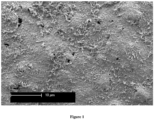
- a SEM (Scanning Electron Microscope) photo of the resulting beads is shown in Figure 1 .
- the SEM photo shows a moderately smooth surface with a few pores up to the size of 1 um.
- a SEM (Scanning Electron Microscope) photo of the resulting beads is shown in Figure 2 .
- the SEM photo shows a highly pitted surface with large pores and fissures of size up to 10 um.
- a SEM photo of the resulting beads is shown in Figure 3 .
- the SEM photo shows a very smooth surface with pores up to 1um in diameter.
- DMA analysis was performed on a DMA Q800 (TA instrument, USA).
- the stress rate was set at 2 N.min -1 and the temperature kept at 25°C.
- the dimension of the freeze-dried bead sample beds was set at 15 mm in diameter and 1.5 to 1.8 mm in thicknesses with a total sample weight of 100 ⁇ 5 mg.
- the elastic modulus, E was determined from the slope of the linear dependence at the initial deformation range.
- the data from the DMA analysis demonstrates the New resin (according to the invention) is mechanically more stiff and resilient than the other two samples (comparative). Trails of the New resin support that data in that they have been found to be less prone to attrition during processing.
- BET Brunauer Emmett Teller
- the surface area of the resin beads was measured by BET using an Autosorb IQ instrument (Quantachrome, USA). Freeze dried Samples were degassed for 9 h at 100°C before analysis. The average values from two BET measurements are reported in Table 5. Table 5. BET surface area of the resin beads. Sample BET surface area (m 2 /g) Standard deviation Old resin 19.067 1.173 New resin 25.496 2.051 PP resin 53.358 0.151
- the BET data shows the three samples have different surface areas, which in turn is indicative of each sample having different and distinctive morphologies.
- DFT Density Functional Theory
- the DFT data shows the two samples have different pore size distributions, which in turn is indicative of each sample having different and distinctive morphologies.
Landscapes
- Chemical & Material Sciences (AREA)
- Organic Chemistry (AREA)
- Chemical Kinetics & Catalysis (AREA)
- Health & Medical Sciences (AREA)
- Medicinal Chemistry (AREA)
- Polymers & Plastics (AREA)
- Engineering & Computer Science (AREA)
- Life Sciences & Earth Sciences (AREA)
- Hydrology & Water Resources (AREA)
- Environmental & Geological Engineering (AREA)
- Water Supply & Treatment (AREA)
- Materials Engineering (AREA)
- Analytical Chemistry (AREA)
- Addition Polymer Or Copolymer, Post-Treatments, Or Chemical Modifications (AREA)
- Manufacture Of Porous Articles, And Recovery And Treatment Of Waste Products (AREA)
- Polymerisation Methods In General (AREA)
- Treatment Of Water By Ion Exchange (AREA)
- Solid-Sorbent Or Filter-Aiding Compositions (AREA)
Claims (12)
- Verfahren zur Herstellung von Polymerkügelchen mit Ionenaustauschkapazität und einer porösen Polymermatrix, in der festes teilchenförmiges Material verteilt ist, wobei das Verfahren umfasst:(i) Bereitstellen einer Dispersion mit einer dispergierten organischen Phase und einer kontinuierlichen wässrigen Phase, wobei die dispergierte organische Phase umfasst:(a) polymerisierbare Monomerzusammensetzung,(b) festes teilchenförmiges Material,(c) nicht-polymeres Porogen,(d) kein polymeres Porogen und(e) Dispersionsmittel zum Dispergieren des festen teilchenförmigen Materials in der gesamten dispergierten organischen Phase,
wobei die polymerisierbare Monomerzusammensetzung;(f) wenigstens ein monoethylenisch ungesättigtes Monomer umfasst,(g) wenigstens ein vernetzendes Monomer mit wenigstens zwei ethylenisch ungesättigten Gruppen, die durch wenigstens 4 aufeinanderfolgende azyklische Atome getrennt sind, umfasst;(h) Glycidylmethacrylat mit einer funktionellen Gruppe umfasst; und(i) kein Divinylbenzol umfasst;(ii) Polymerisieren der polymerisierbaren Monomerzusammensetzung in Gegenwart des nicht-polymeren Porogens und des festen teilchenförmigen Materials, um die poröse Polymermatrix der Kügelchen zu bilden; und(iii) Umsetzen der funktionellen Gruppen, die durch das Glycidylmethacrylat auf der porösen Polymermatrix der so gebildeten Polymerkügelchen bereitgestellt werden, mit einer reaktiven Verbindung, die aus Monoaminen, Diaminen und Polyaminverbindungen und ihren jeweiligen Salzen ausgewählt ist, um Amin- oder quaternäre Ammoniumgruppen bereitzustellen. - Verfahren nach Anspruch 1, wobei das wenigstens eine vernetzende Monomer ausgewählt ist aus (i) Ethylenglykoldimethacrylat, Poly(ethylenglykol)dimethacrylat, Methylenbisacrylamid, Triethylenglykoldiacrylat, Triethylenglykoldimethacrylat, Ethylenglykoldiacrylat, Diethylenglykoldiacrylat, Diethylenglykoldimethacrylat, Glycerindiacrylat, Glycerindimethacrylat, 1,3-Butandioldiacrylat und 1,3-Butandioldimethacrylat, 1,3-Propandioldiacrylat, 1,3-Propandioldimethacrylat, 1,3-Pentandioldiacrylat, 1,3-Pentandioldimethacrylat, 1,4-Butandioldiacrylat, 1,4-Butandioldimethacrylat, Hexamethylenglykoldiacrylat, Hexamethylenglykoldimethacrylat, Decamethylenglykoldiacrylat, Decamethylenglykoldimethacrylat, 2,2-Dimethylolpropan-Diacrylat, 2,2-Dimethylolpropan-Dimethacrylat, Tripropylenglykoldiacrylat, Tripropylenglykoldimethacrylat, 2,2-Di(p-hydroxyphenyl)propandiacrylat, 2,2-Di(p-hydroxyphenyl)propandimethacrylat, 2,2,4-Trimethyl-1,3-pentandioldiacrylat, 2,2,4-Trimethyl1-1,3-pentandioldimethacrylat, Tetraethylenglykoldiacrylat, Tetraethylenglykoldimethacrylat und Kombinationen davon, und/oder (ii) Trimethylolpropantriacrylat, Trimethylolpropantrimethacrylat, Pentaerythrittriacrylat, Pentaerythrittrimethacrylat, Glycerintriacrylat, Glycerintrimethacrylat, Pentaerythrittetraacrylat, Pentaerythrittetramethacrylat, Tris(2-hydroxyethyl)isocyanurattriacrylat, ethoxyliertes Trimethylolpropantriacrylat, ethoxyliertes Trimethylolpropantrimethacrylat, propoxyliertes Trimethylolpropantriacrylat, propoxyliertes Trimethylolpropantrimethacrylat, ethoxyliertes Glycerintriacrylat, ethoxyliertes Glycerintrimethacrylat, propoxyliertes Glycerintriacrylat, propoxyliertes Glycerintrimethacrylat, ethoxyliertes Pentaerythrittriacrylat, ethoxyliertes Pentaerythrittrimethacrylat, propoxyliertes Pentaerythrittriacrylat, propoxyliertes Pentaerythrittrimethacrylat, ethoxyliertes Pentaerythrittetraacrylat, ethoxyliertes Pentaerythrittetramethacrylat, propoxyliertes Pentaerythrittetraacrylat, propoxyliertes Pentaerythrittetramethacrylat und Kombinationen davon.
- Verfahren nach einem der Ansprüche 1 bis 2, wobei das feste teilchenförmige Material magnetisch ist und vorzugsweise aus Maghemit, Magnetit, Chromdioxid und Kombinationen davon ausgewählt wird.
- Verfahren nach einem der Ansprüche 1 bis 3, wobei das nicht-polymere Porogen aus Toluol, Benzol, Butanol, Iso-Octanol, Cyclohexanol, Dodecanol, Isoamylalkohol, tertiärem Amylalkohol, Methylisobutylcarbinol, Ethylacetat, Butylacetat, n-Heptan, Iso-Octan, Dichlorethan, Trichlorethylen, Dioctylphthalat, Dibutyladipat und Kombinationen davon ausgewählt ist.
- Polymerkügelchen mit Ionenaustauschkapazität, umfassend eine poröse Polymermatrix, durch die ein festes teilchenförmiges Material und ein Dispersionsmittel verteilt sind, wobei die Polymermatrix (i) polymerisierte Monomerreste von (a) wenigstens einem monoethylenisch ungesättigten Monomer, (b) wenigstens einem vernetzenden Monomer mit wenigstens zwei ethylenisch ungesättigten Gruppen, die durch wenigstens 4 aufeinanderfolgende azyklische Atome getrennt sind und (c) Glycidylmethacrylat mit einer funktionellen Gruppe, die mit einer reaktiven Verbindung, ausgewählt aus Monoaminen, Diaminen und Polyaminverbindungen und ihren jeweiligen Salzen, umgesetzt wurde, um die Polymermatrix der Kügelchen mit den Ionenaustauschstellen in Form von Amin- oder quaternären Ammoniumgruppen zu versehen, umfasst, wobei die Polymermatrix nicht-polymeres Porogen, kein polymeres Porogen und keine polymerisierten Reste von Divinylbenzol umfasst.
- Polymerkügelchen mit Ionenaustauschkapazität, umfassend eine poröse Polymermatrix, durch die ein festes teilchenförmiges Material und ein Dispersionsmittel verteilt sind, wobei die Polymermatrix (i) polymerisierte Monomerreste von (a) wenigstens einem monoethylenisch ungesättigten Monomer, (b) wenigstens einem vernetzenden Monomer mit wenigstens zwei ethylenisch ungesättigten Gruppen, die durch wenigstens 4 aufeinanderfolgende azyklische Atome getrennt sind und (c) Glycidylmethacrylat mit einer funktionellen Gruppe, die mit einer reaktiven Verbindung, ausgewählt aus Monoaminen, Diaminen und Polyaminverbindungen und ihren jeweiligen Salzen, umgesetzt wurde, um die Polymermatrix der Kügelchen mit den Ionenaustauschstellen in Form von Amin- oder quaternären Ammoniumgruppen zu versehen, umfasst, wobei die Polymermatrix kein Porogen und keine polymerisierten Reste von Divinylbenzol umfasst.
- Polymerkügelchen nach Anspruch 5, wobei das nicht-polymere Porogen aus Toluol, Benzol, Butanol, Iso-Octanol, Cyclohexanol, Dodecanol, Isoamylalkohol, tertiärem Amylalkohol, Methylisobutylcarbinol, Ethylacetat, Butylacetat, n-Heptan, Iso-Octan, Dichlorethan, Trichlorethylen, Dioctylphthalat, Dibutyladipat und Kombinationen davon ausgewählt ist.
- Polymerkügelchen nach einem der Ansprüche 5 bis 7, wobei das wenigstens eine vernetzende Monomer aus (i) Ethylenglykoldimethacrylat, Poly(ethylenglykol)dimethacrylat, Methylenbisacrylamid, Triethylenglykoldiacrylat, Triethylenglykoldimethacrylat, Ethylenglykoldiacrylat, Diethylenglykoldiacrylat, Diethylenglykoldimethacrylat, Glycerindiacrylat, Glycerindimethacrylat, 1,3-Butandioldiacrylat und 1,3-Butandioldimethacrylat, 1,3-Propandioldiacrylat, 1,3-Propandiol-Dimethacrylat, 1,3-Pentandioldiacrylat, 1,3-Pentandioldimethacrylat, 1,4-Butandioldiacrylat, 1,4-Butandioldimethacrylat, Hexamethylenglykoldiacrylat, Hexamethylenglykoldimethacrylat, Decamethylenglykoldiacrylat, Decamethylenglykoldimethacrylat, 2,2-Dimethylolpropan-Diacrylat, 2,2-Dimethylolpropan-Dimethacrylat, Tripropylenglykoldiacrylat, Tripropylenglykoldimethacrylat, 2,2-Di(p-hydroxyphenyl)propandiacrylat, 2,2-Di(p-hydroxyphenyl)propandimethacrylat, 2,2,4- Trimethyl-1,3-Pentandioldiacrylat, 2,2,4-Trimethyl1-1,3-pentandioldimethacrylat, Tetraethylenglykoldiacrylat, Tetraethylenglykoldimethacrylat, und Kombinationen davon, und/oder (ii) Trimethylolpropantriacrylat, Trimethylolpropantrimethacrylat, Pentaerythrittriacrylat, Pentaerythrittrimethacrylat, Glycerintriacrylat, Glycerintrimethacrylat, Pentaerythrittetraacrylat, Pentaerythrittetramethacrylat, Tris(2-hydroxyethyl)isocyanurattriacrylat, ethoxyliertes Trimethylolpropantriacrylat, ethoxyliertes Trimethylolpropantrimethacrylat, propoxyliertes Trimethylolpropantriacrylat, propoxyliertes Trimethylolpropantrimethacrylat, ethoxyliertes Glycerintriacrylat, ethoxyliertes Glycerintrimethacrylat, propoxyliertes Glycerintriacrylat, propoxyliertes Glycerintrimethacrylat, ethoxyliertes Pentaerythrittriacrylat, ethoxyliertes Pentaerythrittrimethacrylat, propoxyliertes Pentaerythrittriacrylat, propoxyliertes Pentaerythrittrimethacrylat, ethoxyliertes Pentaerythrittetraacrylat, ethoxyliertes Pentaerythrittetramethacrylat, propoxyliertes Pentaerythrittetraacrylat, propoxyliertes Pentaerythrittetramethacrylat, und Kombinationen davon ausgewählt ist.
- Polymerkügelchen nach einem der Ansprüche 5 bis 8, wobei das feste teilchenförmige Material magnetisch ist und vorzugsweise aus Maghemit, Magnetit, Chromdioxid und Kombinationen davon ausgewählt ist.
- Verfahren zur Behandlung einer wässrigen Lösung, wobei das Verfahren das Inkontaktbringen der wässrigen Lösung mit Polymerkügelchen nach einem der Ansprüche 5 bis 9 umfasst.
- Verfahren nach Anspruch 10, wobei das Verfahren das Entfernen von gelöstem organischem Kohlenstoff aus einer wässrigen Lösung umfasst, wobei das Verfahren (i) das Inkontaktbringen der wässrigen Lösung mit Polymerkügelchen und (ii) das Entfernen von Polymerkügelchen mit daran adsorbiertem gelöstem organischem Kohlenstoff aus der wässrigen Lösung umfasst.
- Verfahren nach Anspruch 10, wobei das Verfahren das Entfernen von Ionen aus einer wässrigen Lösung umfasst, wobei das Verfahren (i) das Inkontaktbringen der wässrigen Lösung mit Polymerkügelchen und (ii) das Entfernen von Polymerkügelchen, die einem Ionenaustausch mit den zu entfernenden Ionen unterzogen wurden, aus der Lösung umfasst.
Applications Claiming Priority (2)
| Application Number | Priority Date | Filing Date | Title |
|---|---|---|---|
| AU2017900397A AU2017900397A0 (en) | 2017-02-09 | Polymer beads and application thereof | |
| PCT/AU2018/050089 WO2018145152A1 (en) | 2017-02-09 | 2018-02-07 | Polymer beads and application thereof |
Publications (3)
| Publication Number | Publication Date |
|---|---|
| EP3579965A1 EP3579965A1 (de) | 2019-12-18 |
| EP3579965A4 EP3579965A4 (de) | 2020-12-16 |
| EP3579965B1 true EP3579965B1 (de) | 2023-04-05 |
Family
ID=63106829
Family Applications (1)
| Application Number | Title | Priority Date | Filing Date |
|---|---|---|---|
| EP18751811.3A Active EP3579965B1 (de) | 2017-02-09 | 2018-02-07 | Polymerperlen und anwendung davon |
Country Status (11)
| Country | Link |
|---|---|
| US (1) | US20200030786A1 (de) |
| EP (1) | EP3579965B1 (de) |
| JP (1) | JP7149949B2 (de) |
| KR (1) | KR102607919B1 (de) |
| CN (1) | CN110505914B (de) |
| AU (1) | AU2018217433B2 (de) |
| CA (1) | CA3052322A1 (de) |
| MY (1) | MY205543A (de) |
| NZ (1) | NZ755700A (de) |
| SG (1) | SG11201906845PA (de) |
| WO (1) | WO2018145152A1 (de) |
Families Citing this family (6)
| Publication number | Priority date | Publication date | Assignee | Title |
|---|---|---|---|---|
| CN108329411B (zh) * | 2018-04-27 | 2019-11-22 | 南京大学 | 一种复合功能树脂及制备方法和应用 |
| CN112138635B (zh) * | 2020-08-03 | 2022-09-27 | 江苏理工学院 | 一种改性聚合物吸附材料的制备方法与应用 |
| CN113024718B (zh) * | 2021-02-25 | 2023-02-24 | 宁波争光树脂有限公司 | 一种大孔丙烯酸弱碱阴离子交换树脂的制备方法 |
| CN113477227B (zh) * | 2021-07-30 | 2022-02-01 | 中国环境科学研究院 | 一种接枝强化生物炭基重金属吸附材料的制备方法 |
| CN115260399B (zh) * | 2022-08-26 | 2023-10-03 | 核工业北京化工冶金研究院 | 丙烯腈骨架大孔树脂及其制备方法和用途 |
| JP2025521024A (ja) * | 2023-02-01 | 2025-07-04 | エルジー・ケム・リミテッド | 多孔性粒子およびその製造方法 |
Family Cites Families (12)
| Publication number | Priority date | Publication date | Assignee | Title |
|---|---|---|---|---|
| US5855790A (en) * | 1994-02-07 | 1999-01-05 | Selective Environmental Technologies, Inc. | Magnetic particles, a method for the preparation thereof and their use in the purification of solutions |
| AUPM807094A0 (en) | 1994-09-09 | 1994-10-06 | Commonwealth Scientific And Industrial Research Organisation | Polymer beads and method for preparation thereof |
| AUPM959994A0 (en) | 1994-11-22 | 1994-12-15 | Ici Australia Operations Proprietary Limited | Water treatment process |
| CN101134119A (zh) * | 2002-05-24 | 2008-03-05 | 血管技术国际股份公司 | 用于涂覆医用植入物的组合物和方法 |
| MXPA06010789A (es) * | 2004-03-23 | 2007-05-15 | Commw Scient Ind Res Org | Esferas de polimero que incorporan particulas de oxido de hierro. |
| CN102417557B (zh) * | 2005-08-03 | 2015-03-11 | 默克专利股份公司 | 亲水交联聚合物 |
| CN101781437B (zh) * | 2010-01-12 | 2012-07-04 | 南京大学 | 一种磁性丙烯酸系强碱阴离子交换微球树脂及其制备方法 |
| KR102033492B1 (ko) * | 2012-08-30 | 2019-10-17 | 이솜 오퍼레이션스 피티와이 리미티드 | 고체 미립자 재료를 포함하는 폴리머 비드 |
| EP2835384A1 (de) * | 2013-08-09 | 2015-02-11 | LANXESS Deutschland GmbH | Verfahren zur Herstellung von monodispersen, amidomethylierten vinylaromatischen Perlpolymerisaten |
| CN103881023A (zh) * | 2014-03-03 | 2014-06-25 | 江苏大学 | 一种通过悬浮聚合制备磁性分子印迹聚合物的方法 |
| CN105061663B (zh) * | 2015-08-28 | 2017-07-21 | 湖南农业大学 | 用于水性样品农残检测的伪模板磁性分子印迹聚合物及应用 |
| CN105884985A (zh) * | 2016-05-13 | 2016-08-24 | 华南农业大学 | 一种磁性镉离子印迹聚合物及其制备方法 |
-
2018
- 2018-02-07 EP EP18751811.3A patent/EP3579965B1/de active Active
- 2018-02-07 CA CA3052322A patent/CA3052322A1/en active Pending
- 2018-02-07 AU AU2018217433A patent/AU2018217433B2/en active Active
- 2018-02-07 WO PCT/AU2018/050089 patent/WO2018145152A1/en not_active Ceased
- 2018-02-07 MY MYPI2019004593A patent/MY205543A/en unknown
- 2018-02-07 NZ NZ755700A patent/NZ755700A/en unknown
- 2018-02-07 SG SG11201906845PA patent/SG11201906845PA/en unknown
- 2018-02-07 CN CN201880010842.1A patent/CN110505914B/zh active Active
- 2018-02-07 KR KR1020197026429A patent/KR102607919B1/ko active Active
- 2018-02-07 JP JP2019542569A patent/JP7149949B2/ja active Active
- 2018-02-07 US US16/484,664 patent/US20200030786A1/en not_active Abandoned
Also Published As
| Publication number | Publication date |
|---|---|
| KR102607919B1 (ko) | 2023-11-30 |
| JP7149949B2 (ja) | 2022-10-07 |
| EP3579965A4 (de) | 2020-12-16 |
| WO2018145152A1 (en) | 2018-08-16 |
| CN110505914B (zh) | 2022-10-04 |
| SG11201906845PA (en) | 2019-08-27 |
| MY205543A (en) | 2024-10-25 |
| AU2018217433A1 (en) | 2019-08-08 |
| EP3579965A1 (de) | 2019-12-18 |
| AU2018217433B2 (en) | 2023-03-09 |
| NZ755700A (en) | 2022-08-26 |
| JP2020506993A (ja) | 2020-03-05 |
| CN110505914A (zh) | 2019-11-26 |
| US20200030786A1 (en) | 2020-01-30 |
| KR20190138780A (ko) | 2019-12-16 |
| CA3052322A1 (en) | 2018-08-16 |
Similar Documents
| Publication | Publication Date | Title |
|---|---|---|
| EP3579965B1 (de) | Polymerperlen und anwendung davon | |
| US7875662B2 (en) | Method for preparing surface-imprinted polymer microspheres having a core-shell form for selective separation of heavy metal ions | |
| EP1567570B1 (de) | Modifizierte polymere flockungsmittel mit verbesserter leistungscharakteristik | |
| DE69317154T2 (de) | Verfahren zur Herstellung vernetzter Copolymere von Methacrylsäureanhydrid | |
| EP2890734B1 (de) | Polymerperlen mit einem festen partikelmaterial | |
| EP0243768A2 (de) | Verfahren zur Herstellung perlförmiger Polymerisate auf Basis von wasserlöslichen ethylenisch ungesättigten Monomeren | |
| WO2007065933A1 (de) | Magnetische polymerpartikel | |
| JP4627009B2 (ja) | エマルションの製造方法 | |
| EP0667874A1 (de) | Unlösliche, nur wenig quellbare polymerisate mit aminogruppen, verafhren zu ihrer herstellung und ihre verwendung. | |
| CN110964145B (zh) | 一种基于乙酰丙酮基的磁性聚合物微球及其制备方法 | |
| EP0925313B1 (de) | Unlösliche, nur wenig quellbare polymerisate mit modifizierten aminogruppen, verfahren zu ihrer herstellung und ihre verwendung | |
| WO2019092036A1 (de) | Dispergiermittel für pigmente in nicht wässrigen farbmittelpräparationen | |
| CN105542066A (zh) | 一种螺吡喃基无规共聚物P(SPMA-co-MAA)的制备方法 | |
| EP1761592A1 (de) | Verfahren zur herstellung von polymeren trägermaterialien auf basis von kohlenhydrat-bis- (meth)acrylamiden | |
| JP3962963B2 (ja) | 四級アンモニウム塩基を有するポリマーおよびその製造方法 | |
| WO1995001309A1 (de) | Verfahren zur verringerung des gehalts an feindispergierten feststoffen in prozesswässern der papierherstellung | |
| JP4142319B2 (ja) | 高分子凝集剤組成物 | |
| JP2008308598A (ja) | (メタ)アクリル系重合体の製造方法 |
Legal Events
| Date | Code | Title | Description |
|---|---|---|---|
| STAA | Information on the status of an ep patent application or granted ep patent |
Free format text: STATUS: THE INTERNATIONAL PUBLICATION HAS BEEN MADE |
|
| PUAI | Public reference made under article 153(3) epc to a published international application that has entered the european phase |
Free format text: ORIGINAL CODE: 0009012 |
|
| STAA | Information on the status of an ep patent application or granted ep patent |
Free format text: STATUS: REQUEST FOR EXAMINATION WAS MADE |
|
| 17P | Request for examination filed |
Effective date: 20190814 |
|
| AK | Designated contracting states |
Kind code of ref document: A1 Designated state(s): AL AT BE BG CH CY CZ DE DK EE ES FI FR GB GR HR HU IE IS IT LI LT LU LV MC MK MT NL NO PL PT RO RS SE SI SK SM TR |
|
| AX | Request for extension of the european patent |
Extension state: BA ME |
|
| DAV | Request for validation of the european patent (deleted) | ||
| DAX | Request for extension of the european patent (deleted) | ||
| REG | Reference to a national code |
Ref country code: DE Ref legal event code: R079 Ref document number: 602018048062 Country of ref document: DE Free format text: PREVIOUS MAIN CLASS: B01J0020020000 Ipc: B01J0041050000 |
|
| A4 | Supplementary search report drawn up and despatched |
Effective date: 20201112 |
|
| RIC1 | Information provided on ipc code assigned before grant |
Ipc: C08F 2/44 20060101ALI20201106BHEP Ipc: B01J 41/14 20060101ALI20201106BHEP Ipc: C08F 2/12 20060101ALI20201106BHEP Ipc: C02F 1/48 20060101ALI20201106BHEP Ipc: C08J 9/28 20060101ALI20201106BHEP Ipc: C08F 220/06 20060101ALI20201106BHEP Ipc: C02F 1/42 20060101ALI20201106BHEP Ipc: G01N 1/36 20060101ALI20201106BHEP Ipc: C08F 220/56 20060101ALI20201106BHEP Ipc: B01J 41/05 20170101AFI20201106BHEP Ipc: C02F 101/30 20060101ALI20201106BHEP Ipc: C08F 2/20 20060101ALI20201106BHEP |
|
| STAA | Information on the status of an ep patent application or granted ep patent |
Free format text: STATUS: EXAMINATION IS IN PROGRESS |
|
| 17Q | First examination report despatched |
Effective date: 20210908 |
|
| GRAP | Despatch of communication of intention to grant a patent |
Free format text: ORIGINAL CODE: EPIDOSNIGR1 |
|
| STAA | Information on the status of an ep patent application or granted ep patent |
Free format text: STATUS: GRANT OF PATENT IS INTENDED |
|
| GRAJ | Information related to disapproval of communication of intention to grant by the applicant or resumption of examination proceedings by the epo deleted |
Free format text: ORIGINAL CODE: EPIDOSDIGR1 |
|
| STAA | Information on the status of an ep patent application or granted ep patent |
Free format text: STATUS: EXAMINATION IS IN PROGRESS |
|
| INTG | Intention to grant announced |
Effective date: 20220831 |
|
| INTC | Intention to grant announced (deleted) | ||
| GRAP | Despatch of communication of intention to grant a patent |
Free format text: ORIGINAL CODE: EPIDOSNIGR1 |
|
| STAA | Information on the status of an ep patent application or granted ep patent |
Free format text: STATUS: GRANT OF PATENT IS INTENDED |
|
| INTG | Intention to grant announced |
Effective date: 20221021 |
|
| GRAS | Grant fee paid |
Free format text: ORIGINAL CODE: EPIDOSNIGR3 |
|
| GRAA | (expected) grant |
Free format text: ORIGINAL CODE: 0009210 |
|
| STAA | Information on the status of an ep patent application or granted ep patent |
Free format text: STATUS: THE PATENT HAS BEEN GRANTED |
|
| AK | Designated contracting states |
Kind code of ref document: B1 Designated state(s): AL AT BE BG CH CY CZ DE DK EE ES FI FR GB GR HR HU IE IS IT LI LT LU LV MC MK MT NL NO PL PT RO RS SE SI SK SM TR |
|
| REG | Reference to a national code |
Ref country code: GB Ref legal event code: FG4D |
|
| REG | Reference to a national code |
Ref country code: CH Ref legal event code: EP |
|
| REG | Reference to a national code |
Ref country code: AT Ref legal event code: REF Ref document number: 1557838 Country of ref document: AT Kind code of ref document: T Effective date: 20230415 |
|
| REG | Reference to a national code |
Ref country code: DE Ref legal event code: R096 Ref document number: 602018048062 Country of ref document: DE |
|
| REG | Reference to a national code |
Ref country code: IE Ref legal event code: FG4D |
|
| P01 | Opt-out of the competence of the unified patent court (upc) registered |
Effective date: 20230510 |
|
| REG | Reference to a national code |
Ref country code: NL Ref legal event code: FP |
|
| REG | Reference to a national code |
Ref country code: LT Ref legal event code: MG9D |
|
| REG | Reference to a national code |
Ref country code: AT Ref legal event code: MK05 Ref document number: 1557838 Country of ref document: AT Kind code of ref document: T Effective date: 20230405 |
|
| PG25 | Lapsed in a contracting state [announced via postgrant information from national office to epo] |
Ref country code: SE Free format text: LAPSE BECAUSE OF FAILURE TO SUBMIT A TRANSLATION OF THE DESCRIPTION OR TO PAY THE FEE WITHIN THE PRESCRIBED TIME-LIMIT Effective date: 20230405 Ref country code: PT Free format text: LAPSE BECAUSE OF FAILURE TO SUBMIT A TRANSLATION OF THE DESCRIPTION OR TO PAY THE FEE WITHIN THE PRESCRIBED TIME-LIMIT Effective date: 20230807 Ref country code: NO Free format text: LAPSE BECAUSE OF FAILURE TO SUBMIT A TRANSLATION OF THE DESCRIPTION OR TO PAY THE FEE WITHIN THE PRESCRIBED TIME-LIMIT Effective date: 20230705 Ref country code: ES Free format text: LAPSE BECAUSE OF FAILURE TO SUBMIT A TRANSLATION OF THE DESCRIPTION OR TO PAY THE FEE WITHIN THE PRESCRIBED TIME-LIMIT Effective date: 20230405 Ref country code: AT Free format text: LAPSE BECAUSE OF FAILURE TO SUBMIT A TRANSLATION OF THE DESCRIPTION OR TO PAY THE FEE WITHIN THE PRESCRIBED TIME-LIMIT Effective date: 20230405 |
|
| PG25 | Lapsed in a contracting state [announced via postgrant information from national office to epo] |
Ref country code: RS Free format text: LAPSE BECAUSE OF FAILURE TO SUBMIT A TRANSLATION OF THE DESCRIPTION OR TO PAY THE FEE WITHIN THE PRESCRIBED TIME-LIMIT Effective date: 20230405 Ref country code: PL Free format text: LAPSE BECAUSE OF FAILURE TO SUBMIT A TRANSLATION OF THE DESCRIPTION OR TO PAY THE FEE WITHIN THE PRESCRIBED TIME-LIMIT Effective date: 20230405 Ref country code: LV Free format text: LAPSE BECAUSE OF FAILURE TO SUBMIT A TRANSLATION OF THE DESCRIPTION OR TO PAY THE FEE WITHIN THE PRESCRIBED TIME-LIMIT Effective date: 20230405 Ref country code: LT Free format text: LAPSE BECAUSE OF FAILURE TO SUBMIT A TRANSLATION OF THE DESCRIPTION OR TO PAY THE FEE WITHIN THE PRESCRIBED TIME-LIMIT Effective date: 20230405 Ref country code: IS Free format text: LAPSE BECAUSE OF FAILURE TO SUBMIT A TRANSLATION OF THE DESCRIPTION OR TO PAY THE FEE WITHIN THE PRESCRIBED TIME-LIMIT Effective date: 20230805 Ref country code: HR Free format text: LAPSE BECAUSE OF FAILURE TO SUBMIT A TRANSLATION OF THE DESCRIPTION OR TO PAY THE FEE WITHIN THE PRESCRIBED TIME-LIMIT Effective date: 20230405 Ref country code: GR Free format text: LAPSE BECAUSE OF FAILURE TO SUBMIT A TRANSLATION OF THE DESCRIPTION OR TO PAY THE FEE WITHIN THE PRESCRIBED TIME-LIMIT Effective date: 20230706 |
|
| PG25 | Lapsed in a contracting state [announced via postgrant information from national office to epo] |
Ref country code: FI Free format text: LAPSE BECAUSE OF FAILURE TO SUBMIT A TRANSLATION OF THE DESCRIPTION OR TO PAY THE FEE WITHIN THE PRESCRIBED TIME-LIMIT Effective date: 20230405 |
|
| REG | Reference to a national code |
Ref country code: DE Ref legal event code: R097 Ref document number: 602018048062 Country of ref document: DE |
|
| PG25 | Lapsed in a contracting state [announced via postgrant information from national office to epo] |
Ref country code: SK Free format text: LAPSE BECAUSE OF FAILURE TO SUBMIT A TRANSLATION OF THE DESCRIPTION OR TO PAY THE FEE WITHIN THE PRESCRIBED TIME-LIMIT Effective date: 20230405 |
|
| PG25 | Lapsed in a contracting state [announced via postgrant information from national office to epo] |
Ref country code: SM Free format text: LAPSE BECAUSE OF FAILURE TO SUBMIT A TRANSLATION OF THE DESCRIPTION OR TO PAY THE FEE WITHIN THE PRESCRIBED TIME-LIMIT Effective date: 20230405 Ref country code: SK Free format text: LAPSE BECAUSE OF FAILURE TO SUBMIT A TRANSLATION OF THE DESCRIPTION OR TO PAY THE FEE WITHIN THE PRESCRIBED TIME-LIMIT Effective date: 20230405 Ref country code: RO Free format text: LAPSE BECAUSE OF FAILURE TO SUBMIT A TRANSLATION OF THE DESCRIPTION OR TO PAY THE FEE WITHIN THE PRESCRIBED TIME-LIMIT Effective date: 20230405 Ref country code: EE Free format text: LAPSE BECAUSE OF FAILURE TO SUBMIT A TRANSLATION OF THE DESCRIPTION OR TO PAY THE FEE WITHIN THE PRESCRIBED TIME-LIMIT Effective date: 20230405 Ref country code: DK Free format text: LAPSE BECAUSE OF FAILURE TO SUBMIT A TRANSLATION OF THE DESCRIPTION OR TO PAY THE FEE WITHIN THE PRESCRIBED TIME-LIMIT Effective date: 20230405 Ref country code: CZ Free format text: LAPSE BECAUSE OF FAILURE TO SUBMIT A TRANSLATION OF THE DESCRIPTION OR TO PAY THE FEE WITHIN THE PRESCRIBED TIME-LIMIT Effective date: 20230405 |
|
| PLBE | No opposition filed within time limit |
Free format text: ORIGINAL CODE: 0009261 |
|
| STAA | Information on the status of an ep patent application or granted ep patent |
Free format text: STATUS: NO OPPOSITION FILED WITHIN TIME LIMIT |
|
| 26N | No opposition filed |
Effective date: 20240108 |
|
| PG25 | Lapsed in a contracting state [announced via postgrant information from national office to epo] |
Ref country code: SI Free format text: LAPSE BECAUSE OF FAILURE TO SUBMIT A TRANSLATION OF THE DESCRIPTION OR TO PAY THE FEE WITHIN THE PRESCRIBED TIME-LIMIT Effective date: 20230405 |
|
| PG25 | Lapsed in a contracting state [announced via postgrant information from national office to epo] |
Ref country code: SI Free format text: LAPSE BECAUSE OF FAILURE TO SUBMIT A TRANSLATION OF THE DESCRIPTION OR TO PAY THE FEE WITHIN THE PRESCRIBED TIME-LIMIT Effective date: 20230405 Ref country code: IT Free format text: LAPSE BECAUSE OF FAILURE TO SUBMIT A TRANSLATION OF THE DESCRIPTION OR TO PAY THE FEE WITHIN THE PRESCRIBED TIME-LIMIT Effective date: 20230405 |
|
| PG25 | Lapsed in a contracting state [announced via postgrant information from national office to epo] |
Ref country code: MC Free format text: LAPSE BECAUSE OF FAILURE TO SUBMIT A TRANSLATION OF THE DESCRIPTION OR TO PAY THE FEE WITHIN THE PRESCRIBED TIME-LIMIT Effective date: 20230405 |
|
| REG | Reference to a national code |
Ref country code: CH Ref legal event code: PL |
|
| PG25 | Lapsed in a contracting state [announced via postgrant information from national office to epo] |
Ref country code: LU Free format text: LAPSE BECAUSE OF NON-PAYMENT OF DUE FEES Effective date: 20240207 |
|
| PG25 | Lapsed in a contracting state [announced via postgrant information from national office to epo] |
Ref country code: CH Free format text: LAPSE BECAUSE OF NON-PAYMENT OF DUE FEES Effective date: 20240229 |
|
| PG25 | Lapsed in a contracting state [announced via postgrant information from national office to epo] |
Ref country code: LU Free format text: LAPSE BECAUSE OF NON-PAYMENT OF DUE FEES Effective date: 20240207 Ref country code: CH Free format text: LAPSE BECAUSE OF NON-PAYMENT OF DUE FEES Effective date: 20240229 |
|
| PG25 | Lapsed in a contracting state [announced via postgrant information from national office to epo] |
Ref country code: BG Free format text: LAPSE BECAUSE OF FAILURE TO SUBMIT A TRANSLATION OF THE DESCRIPTION OR TO PAY THE FEE WITHIN THE PRESCRIBED TIME-LIMIT Effective date: 20230405 |
|
| PG25 | Lapsed in a contracting state [announced via postgrant information from national office to epo] |
Ref country code: BG Free format text: LAPSE BECAUSE OF FAILURE TO SUBMIT A TRANSLATION OF THE DESCRIPTION OR TO PAY THE FEE WITHIN THE PRESCRIBED TIME-LIMIT Effective date: 20230405 |
|
| REG | Reference to a national code |
Ref country code: BE Ref legal event code: MM Effective date: 20240229 |
|
| PG25 | Lapsed in a contracting state [announced via postgrant information from national office to epo] |
Ref country code: BE Free format text: LAPSE BECAUSE OF NON-PAYMENT OF DUE FEES Effective date: 20240229 |
|
| PG25 | Lapsed in a contracting state [announced via postgrant information from national office to epo] |
Ref country code: BE Free format text: LAPSE BECAUSE OF NON-PAYMENT OF DUE FEES Effective date: 20240229 |
|
| PG25 | Lapsed in a contracting state [announced via postgrant information from national office to epo] |
Ref country code: CY Free format text: LAPSE BECAUSE OF FAILURE TO SUBMIT A TRANSLATION OF THE DESCRIPTION OR TO PAY THE FEE WITHIN THE PRESCRIBED TIME-LIMIT; INVALID AB INITIO Effective date: 20180207 |
|
| PG25 | Lapsed in a contracting state [announced via postgrant information from national office to epo] |
Ref country code: HU Free format text: LAPSE BECAUSE OF FAILURE TO SUBMIT A TRANSLATION OF THE DESCRIPTION OR TO PAY THE FEE WITHIN THE PRESCRIBED TIME-LIMIT; INVALID AB INITIO Effective date: 20180207 |
|
| PG25 | Lapsed in a contracting state [announced via postgrant information from national office to epo] |
Ref country code: TR Free format text: LAPSE BECAUSE OF FAILURE TO SUBMIT A TRANSLATION OF THE DESCRIPTION OR TO PAY THE FEE WITHIN THE PRESCRIBED TIME-LIMIT Effective date: 20230405 |
|
| PGFP | Annual fee paid to national office [announced via postgrant information from national office to epo] |
Ref country code: NL Payment date: 20260218 Year of fee payment: 9 |
|
| PGFP | Annual fee paid to national office [announced via postgrant information from national office to epo] |
Ref country code: GB Payment date: 20260219 Year of fee payment: 9 |
|
| PGFP | Annual fee paid to national office [announced via postgrant information from national office to epo] |
Ref country code: DE Payment date: 20260218 Year of fee payment: 9 Ref country code: IE Payment date: 20260218 Year of fee payment: 9 |
|
| PGFP | Annual fee paid to national office [announced via postgrant information from national office to epo] |
Ref country code: FR Payment date: 20260218 Year of fee payment: 9 |