EP3580224B1 - Agents inhibiteurs d'ask1 - Google Patents
Agents inhibiteurs d'ask1 Download PDFInfo
- Publication number
- EP3580224B1 EP3580224B1 EP18706091.8A EP18706091A EP3580224B1 EP 3580224 B1 EP3580224 B1 EP 3580224B1 EP 18706091 A EP18706091 A EP 18706091A EP 3580224 B1 EP3580224 B1 EP 3580224B1
- Authority
- EP
- European Patent Office
- Prior art keywords
- oxa
- triazola
- pyridina
- aza
- mmol
- Prior art date
- Legal status (The legal status is an assumption and is not a legal conclusion. Google has not performed a legal analysis and makes no representation as to the accuracy of the status listed.)
- Active
Links
Classifications
-
- C—CHEMISTRY; METALLURGY
- C07—ORGANIC CHEMISTRY
- C07D—HETEROCYCLIC COMPOUNDS
- C07D498/00—Heterocyclic compounds containing in the condensed system at least one hetero ring having nitrogen and oxygen atoms as the only ring hetero atoms
- C07D498/12—Heterocyclic compounds containing in the condensed system at least one hetero ring having nitrogen and oxygen atoms as the only ring hetero atoms in which the condensed system contains three hetero rings
- C07D498/14—Ortho-condensed systems
Definitions
- ASK1 apoptosis signal-regulating kinase 1
- Apoptosis Signal-regulating Kinase 1 (ASK1), also known as MAP3K5, is a member of the mitogen-activated protein kinase kinase kinase (“MAP3K") family that activates the c-Jun N-terminal protein kinase (“JNK”) and p38 MAP kinase ( Ichijo, H. et al., Science 1997, 275, 90-94 ).
- ASK1 is an evolutionary conserved and stress-responsive mitogen-activated protein kinase (MAPK).
- ASK1 has been found to be expressed in heart, brain, lung, liver and kidney, as well as in developing skin, cartilage and bone ( Tobiume et al., Biochem Biophys Res Commun. 1997, 239(3), 905-10 ).
- ASK1 is a central regulator of cell death and participates in several stress-induced and receptor-mediated cell death pathways triggered by various forms of cellular stress, including oxidative stress, reactive oxygen species (ROS), endoplasmic reticulum (ER) stress and unfolded protein response (UPR), mitochondrial stress, bacterial infection, increased calcium influx, DNA damage, UV radiation, viral infection, heat shock, osmotic shock, endotoxic lipopolysaccharide (LPS), FasL, and activation by pro-inflammatory cytokines such as tumor necrosis factor (TNF) and interleukin-1 ( Nishitoh et al., Genes Dev. 2002, 16, 1345-1355 ; Matsukawa et al., Nat.
- TNF tumor necrosis factor
- TNF-1 interleukin-1
- ASK1 undergoes activation via autophosphorylation at Thr838 in response to these signals and in turn phosphorylates MAP2Ks, such as MKK3/6 and MKK4/7, which then phosphorylate and activate p38 and JNK MAPKs, respectively.
- MAP2Ks such as MKK3/6 and MKK4/7
- Activation of the JNK and p38 pathways induces stress responses related to cell death, differentiation and the production of inflammatory cytokines.
- ASK1 is kept in an inactive state through binding to its repressor Thioredoxin (Trx) ( Saitoh, M. et al., Embo J. 1998, 17, 2596-2606 ), and through association with AKT ( Zhang, L., et al. Proc. Natl. Acad. Sci. U.S.A 1999, 96, 8511-8515 ).
- ASK1 plays an essential role not only in cell death pathways, but also in inflammatory and innate immune responses including cytokine responses, and cell differentiation. Phosphorylation of ASK1 protein can lead to apoptosis or other cellular responses depending on the cell type.
- ASK1 activation and signaling have been reported to play an important role in a broad range of diseases including neurodegenerative, cardiovascular, inflammatory, autoimmunity, and metabolic disorders.
- ASK1 has been implicated in mediating organ damage following ischemia and reperfusion of the heart, brain, and kidney ( Watanabe et al. BBRC 2005, 333, 562-567 ; Zhang et al., Life Sci 2003, 74-37-43 ; Terada et al. BBRC 2007, 364: 1043-49 ).
- WO-A1-2011 008709 discloses ASK-1 inhibitors based on 2-benzoylamino-6-(1,3,4-triazol-2-yl)-pyridines.
- a first embodiment of the invention is a compound of Formula (I'): or a pharmaceutically acceptable salt thereof, wherein:
- the compound of the present invention is a compound of Formula (I): or a pharmaceutically acceptable salt thereof, wherein:
- the present invention also provides a pharmaceutical composition
- a pharmaceutical composition comprising at least one compound described herein, or a pharmaceutically acceptable salt thereof, and at least one pharmaceutically acceptable excipient.
- the invention is a method of treating a disorder responsive to inhibition of ASK1 in a subject comprising administering to said subject an effective amount of at least one compound described herein, or a pharmaceutically acceptable salt thereof.
- the present invention also includes the use of at least one compound described herein, or a pharmaceutically acceptable salt thereof, for the manufacture of a medicament for the treatment of a disorder responsive to inhibition of ASK1. Also provided is a compound described herein, or a pharmaceutically acceptable salt thereof for use in treating a disorder responsive to inhibition of ASK1.
- the compounds or pharmaceutically acceptable salts thereof as described herein can have activity as ASK1 modulators.
- compounds or pharmaceutically acceptable salts thereof as described herein can be ASK1 inhibitors.
- the compound is represented by formula (I') or (I), or a pharmaceutically acceptable salt thereof, wherein L is C 3-5 alkylene optionally substituted with one or two R 2 and the definitions for the other variables are as defined in the first embodiment.
- the compound is represented by formula (I') or (I), or a pharmaceutically acceptable salt thereof, wherein L is C 4 alkylene optionally substituted with one or two R 2 , and the values of the other variables are as defined in the first embodiment.
- the compound is represented by formula (I') or (I), or a pharmaceutically acceptable salt thereof, wherein L is C 4 alkenylene optionally substituted with one or two R 2 , and the values of the other variables are as defined in the first embodiment.
- the compound is represented by formula (I') or (I), or a pharmaceutically acceptable salt thereof, wherein:
- the compound is represented by formula (I') or (I), or pharmaceutically acceptable salt thereof, wherein R 2 is C 1-4 alkyl, and the values of the other variables are as defined in the fifth embodiment.
- the compound is represented by formula (I') or (I), or pharmaceutically acceptable salt thereof, wherein R 2 is methyl, and the values of the other variables are as defined in the fifth embodiment.
- the compound is represented by formula (I') or (I), or pharmaceutically acceptable salt thereof, wherein n is 0, and the values of the other variables are as defined in the first, second, third, fourth, fifth, sixth, seventh, or eighth embodiment.
- the compound is represented by formula (I') or (I), or pharmaceutically acceptable salt thereof, wherein:
- R 1 in each occurrence is independently selected from C 1-6 alkyl, C 2-6 alkenyl, 4- to 7-membered monocyclic non-aromatic heterocyclyl, 5- to 6-membered N-containing heteroaryl, 6-to 8-membered spiro or bridged bicyclic heterocyclyl, halo, -CN, -C(O)R 1a , -C(O) 2 R 1a -C(O)N(R 1a ) 2 , -S(O) 2 R 1a , and -S(O) 2 N(R 1a ) 2 , wherein said C 1-6 alkyl, C 2-6 alkenyl, 4- to 7-membered monocyclic non-aromatic heterocyclyl, 5- to 6-membered N-containing heteroaryl, and 6- to 8-membered spiro or bridged bicyclic heterocyclyl, are optionally
- the compound is represented by formula (I') or (I), or a pharmaceutically acceptable salt thereof, wherein:
- R 1 in each occurrence is independently selected from C 1-6 alkyl, C 2-6 alkenyl, C 3-6 cycloalkyl selected from cyclopropyl, cyclobutyl, cyclopentyl, and cyclohexyl, 4- to 7-membered monocyclic heterocyclyl selected from azetidinyl, pyrrolidinyl, tetrahydrofuranyl, thiolanyl, imidazolidinyl, pyrazolidinyl, oxazolidinyl, isoxazolidinyl, thiazolidinyl, isothiazolidinyl, dioxolanyl, dithiolanyl, oxathiolanyl, piperidinyl, tetrahydropyranyl, thianyl, piperazinyl, morpholinyl, thiomorpholinyl,
- the compound is represented by formula (I') or (I), or pharmaceutically acceptable salt thereof, wherein:
- the compound is represented by Formula (II') or (II): or a pharmaceutically acceptable salt thereof, wherein:
- the compound is represented by the Formula (II): or a pharmaceutically acceptable salt thereof, wherein:
- the compound is represented by formula (II') or (II), or pharmaceutically acceptable salt thereof, wherein R 1 is -CN, -F, or a heterocyclyl selected from the following: R 1' when present is -F; and the values of the other variables are as defined for the thirteenth or fourteenth embodiment .
- the compound is represented by formula (II), or pharmaceutically acceptable salt thereof, wherein R 1 is a heterocyclyl selected from the following: , and the values of the other variables are as defined for the thirteenth or fourteenth embodiment.
- the compound is represented by formula (II') or (II), or pharmaceutically acceptable salt thereof, wherein R 10 is -CH 3 , -CH 2 CH 2 N(CH 3 ) 2 or cyclopropyl, and the values of the other variables are as defined for the thirteenth, fourteenth, fifteenth or sixteenth embodiment.
- the compound is selected from:
- the invention is any one of the compounds disclosed in the Exemplification section as a neutral compound or a pharmaceutically acceptable salt thereof.
- L when L is defined as a specific C 3-5 alkylene or C 3-5 alkenylene group, the radical on the left side of L is connected to the -O- group of formula (I) or (II) and the radical on the right side of L is connected to the triazole group of formula (I) or (II).
- L when L is -CH 2 -CH 2 -CH 2 -CH(CH 3 )-, the -CH 2 - on the left side is connected the -O- group and the - CH(CH 3 )- on the right side is connected to the triazole group.
- alkyl refers to a fully saturated branched or unbranched hydrocarbon moiety.
- the alkyl comprises 1 to 6 carbon atoms, or 1 to 4 carbon atoms.
- an alkyl comprises from 6 to 20 carbon atoms.
- Representative examples of alkyl include, but are not limited to, methyl, ethyl, n-propyl, iso-propyl, n-butyl, sec-butyl, iso-butyl, tert-butyl, n-pentyl, isopentyl, neopentyl, or n-hexyl.
- Alkenyl refers to an unsaturated hydrocarbon group which may be linear or branched and has at least one carbon-carbon double bond. Alkenyl groups with 2-6 carbon atoms can be preferred. The alkenyl group may contain 1, 2 or 3 carbon-carbon double bonds, or more. Examples of alkenyl groups include ethenyl, n-propenyl, isopropenyl, n-but-2-enyl, n-hex-3-enyl and the like.
- Alkynyl refers to an unsaturated hydrocarbon group which may be linear or branched and has at least one carbon-carbon triple bond. Alkynyl groups with 2-6 carbon atoms can be preferred. The alkynyl group may contain 1, 2 or 3 carbon-carbon triple bonds, or more. Examples of alkynyl groups include ethynyl, n-propynyl, n-but-2-ynyl, n-hex-3-ynyl and the like.
- C x-xx The number of carbon atoms in a group is specified herein by the prefix “C x-xx ", wherein x and xx are integers.
- C 1-4 alkyl is an alkyl group which has from 1 to 4 carbon atoms.
- Halogen or “halo” may be fluoro, chloro, bromo or iodo.
- heterocyclyl refers to a saturated or unsaturated, monocyclic or bicyclic (e.g., bridged or spiro ring systems) ring system which has from 3- to 10-ring members, or in particular 3- to 8-ring members, 3- to 7-ring members, 3- to 6- ring members or 5- to 7- ring members or 4- to 7- ring members, at least one of which is a heteroatom, and up to 4 (e.g., 1, 2, 3, or 4) of which may be heteroatoms, wherein the heteroatoms are independently selected from O, S and N, and wherein C can be oxidized (e.g., C(O)), N can be oxidized (e.g., N(O)) or quaternized, and S can be optionally oxidized to sulfoxide and sulfone.
- C can be oxidized
- N can be oxidized
- S can be optionally oxidized to sulfoxide and sulfone.
- heteroaryl refers to an aromatic 5- or 6-membered monocyclic ring system, having 1 to 4 heteroatoms independently selected from O, S and N, and wherein N can be oxidized (e.g., N(O)) or quaternized, and S can be optionally oxidized to sulfoxide and sulfone.
- a heterocyclyl is a 3-to 7-membered saturated monocyclic or a 3-to 6-membered saturated monocyclic or a 5-to 7-membered saturated monocyclic ring or a 4- to 7-membered saturated monocyclic ring.
- a heterocyclyl is a 3-to 7-membered monocyclic or a 3-to 6-membered monocyclic or a 5-to 7-membered monocyclic ring.
- a heterocyclyl is a 6 or-7-membered bicyclic ring.
- a heterocyclyl is a 4- to 7-membered monocyclic non-aromatic ring.
- a heterocyclyl is 6- to 8-membered spiro or bridged bicyclic ring.
- the heterocyclyl group can be attached at a heteroatom or a carbon atom.
- heterocyclyls include, but are not limited to, aziridinyl, oxiranyl, thiiranyl, oxaziridinyl, azetidinyl, oxetanyl, thietanyl, pyrrolidinyl, tetrahydrofuranyl, thiolanyl, imidazolidinyl, pyrazolidinyl, oxazolidinyl, isoxazolidinyl, thiazolidinyl, isothiazolidinyl, dioxolanyl, dithiolanyl, oxathiolanyl, piperidinyl, tetrahydropyranyl, thianyl, piperazinyl, morpholinyl, thiomorpholinyl, dioxanyl, dithianyl, trioxanyl, trithianyl, azepanyl, oxepanyl, thiepanyl, dihydro
- a heterocyclyl is a 4- to 7-membered monocyclic heterocyclyl.
- 4- to 7-membered monocyclic heterocyclic ring systems include, but are not limited to azetidinyl, pyrrolidinyl, tetrahydrofuranyl, thiolanyl, imidazolidinyl, pyrazolidinyl, oxazolidinyl, isoxazolidinyl, thiazolidinyl, isothiazolidinyl, dioxolanyl, dithiolanyl, oxathiolanyl, piperidinyl, tetrahydropyranyl, thianyl, piperazinyl, morpholinyl, thiomorpholinyl, dioxanyl, dithianyl,azepanyl, oxepanyl, thiepanyl, dihydrofuranyl, imidazolinyl, dihydropyr
- a "4- to 7-membered monocyclic non-aromatic heterocyclyl” is a monocyclic heterocyclyl having 4- to 7-ring members and is saturated or partially unsaturated ( i.e., non-aromatic).
- Examples of 4- to 7-membered monocyclic non-aromatic heterocyclyls include, but are not limited to, azetidinyl, pyrrolidinyl, tetrahydrofuranyl, thiolanyl, imidazolidinyl, pyrazolidinyl, oxazolidinyl, isoxazolidinyl, thiazolidinyl, isothiazolidinyl, dioxolanyl, dithiolanyl, oxathiolanyl, piperidinyl, tetrahydropyranyl, thianyl, piperazinyl, morpholinyl, thiomorpholinyl, dioxanyl, dithianyl, azepanyl, oxepanyl, thiepanyl, dihydrofuranyl, imidazolinyl, and dihydropyranyl.
- 6- to 8-membered spiro or bridged bicyclic heterocyclyl refers to a bicyclic heterocyclyl ring that is a bridged or spiro ring system having total of 6- to 8-ring members .
- 6- to 8-membered spiro or bridged bicyclic heterocyclic ring systems include, but are not limited to, 3-azabicyclo[3.1.0]hexanyl, 3-azabicyclo[3.1.1]heptanyl, 2-azaspiro[3.3]heptanyl, 2-oxa-6-azaspiro[3.3]heptanyl, 3-oxa-8-azabicyclo[3.2.1]octanyl, 6-oxa-3-azabicyclo[3.1.1]heptanyl, 8-oxa-3-azabicyclo[3.2.1]octanyl, 3-oxa-6-azabicyclo[3.1.1]heptanyl, and 5-azaspiro[2.3]hexanyl.
- bridged ring system is a ring system that has a carbocyclyl or heterocyclyl ring wherein two non-adjacent atoms of the ring are connected (bridged) by one or more (preferably from one to three) atoms selected from C, N, O, or S.
- a bridged ring system may have from 6 to 8 ring members.
- spiro ring system is a ring system that has two rings each of which are independently selected from a carbocyclyl or a heterocyclyl, wherein the two ring structures having one ring atom in common. Spiro ring systems have from 5 to 8 ring members.
- N-containing heterocyclyl or “N-containing heteroaryl” refers to a heterocyclyl or a heteroaryl containing at least one N as ring atom.
- the N-containing heterocyclyl group or the N-containing heteroaryl group can be attached at a N or a carbon atom.
- a "4- to 7-membered monocyclic non-aromatic heterocyclyl” is a saturated or partially unsaturated N-containing heterocyclyl that is monocyclic.
- Examples of 4- to 7-membered monocyclic non-aromatic heterocyclyl include azetidinyl, pyrrolidinyl, imidazolidinyl, pyrazolidinyl, oxazolidinyl, isoxazolidinyl, thiazolidinyl, isothiazolidinyl, piperidinyl, piperazinyl, morpholinyl, thiomorpholinyl, azepanyl, and imidazolinyl.
- a "5- to 6-membered N-containing heteroaryl” is a N-containing heteroaryl containing 5- or 6-ring members.
- Examples of 5- to 6-membered N-containing heteroaryl include imidazolyl, pyrazolyl, oxazolyl, isoxazolyl, thiazolyl, isothiazolyl, oxadiazolyl, thiadiazolyl, triazolyl, tetrazolyl, pyridinyl, pyrazinyl, pyrimidinyl, pyridazinyl, triazinyl, tetrazinyl and the like.
- Carbocyclyl refers to saturated or unsaturated monocyclic or bicyclic hydrocarbon groups of 3-7 carbon atoms, 3-6, or 5-7 carbon atoms.
- the term “carbocyclyl” encompasses cycloalkyl groups and aromatic groups.
- the term “cycloalkyl” refers to completely saturated monocyclic or bicyclic or spiro hydrocarbon groups of 3-7 carbon atoms, 3-6 carbon atoms, or 5-7 carbon atoms.
- Exemplary monocyclic carbocyclyl groups include, but are not limited to, cyclopropyl, cyclobutyl, cyclopentyl, cyclohexyl, cycloheptyl, cyclopropenyl, cyclobutenyl, cyclopenentyl, cyclohexenyl, cycloheptenyl, cyclobutadienyl, cyclopentadienyl, cyclohexadienyl, cycloheptadienyl, phenyl and cycloheptatrienyl.
- Exemplary bicyclic carbocyclyl groups include bicyclo[2.1.1]hexyl, bicyclo[2.2.1]heptyl, bicyclo[2.2.1]heptenyl, tricyclo[2.2.1.0 2,6 ]heptanyl, 6,6-dimethylbicyclo[3.1.1]heptyl, or 2,6,6-trimethylbicyclo[3.1.1]heptyl, spiro[2.2]pentanyl, and spiro[3.3]heptanyl.
- a compound provided herein is sufficiently basic or acidic to form stable nontoxic acid or base salts
- preparation and administration of the compounds as pharmaceutically acceptable salts may be appropriate.
- pharmaceutically acceptable salts are organic acid addition salts formed with acids which form a physiological acceptable anion, for example, tosylate, methanesulfonate, acetate, citrate, malonate, tartarate, succinate, benzoate, ascorbate, ⁇ -ketoglutarate, or ⁇ -glycerophosphate.
- Inorganic salts may also be formed, including hydrochloride, sulfate, nitrate, bicarbonate, and carbonate salts.
- salts may be obtained using standard procedures well known in the art, for example by reacting a sufficiently basic compound such as an amine with a suitable acid affording a physiologically acceptable anion.
- a sufficiently basic compound such as an amine
- a suitable acid affording a physiologically acceptable anion.
- Alkali metal (for example, sodium, potassium or lithium) or alkaline earth metal (for example calcium) salts of carboxylic acids can also be made.
- Salts from inorganic bases can include but are not limited to, sodium, potassium, lithium, ammonium, calcium or magnesium salts.
- Salts derived from organic bases can include, but are not limited to, salts of primary, secondary or tertiary amines, such as alkyl amines, dialkyl amines, trialkyl amines, substituted alkyl amines, di(substituted alkyl) amines, tri(substituted alkyl) amines, alkenyl amines, dialkenyl amines, trialkenyl amines, substituted alkenyl amines, di(substituted alkenyl) amines, tri(substituted alkenyl) amines, cycloalkyl amines, di(cycloalkyl) amines, tri(cycloalkyl) amines, substituted cycloalkyl amines, substituted cycloalkyl amines, substituted
- amines where the two or three substituents, together with the amino nitrogen, form a heterocycloalkyl or heteroaryl group.
- Non-limiting examples of amines can include, isopropylamine, trimethyl amine, diethyl amine, tri(iso-propyl) amine, tri(n-propyl) amine, ethanolamine, 2-dimethylaminoethanol, trimethamine, lysine, arginine, histidine, caffeine, procaine, hydrabamine, choline, betaine, ethylenediamine, glucosamine, N-alkylglucamines, theobromine, purines, piperazine, piperidine, morpholine, or N-ethylpiperidine, and the like.
- Other carboxylic acid derivatives can be useful, for example, carboxylic acid amides, including carboxamides, lower alkyl carboxamides, or dialkyl carboxamides, and the like.
- the compounds or pharmaceutically acceptable salts thereof as described herein can contain one or more asymmetric centers in the molecule.
- any structure that does not designate the stereochemistry is to be understood as embracing all the various stereoisomers (e.g., diastereomers and enantiomers) in pure or substantially pure form, as well as mixtures thereof (such as a racemic mixture, or an enantiomerically enriched mixture). It is well known in the art how to prepare such optically active forms (for example, resolution of the racemic form by recrystallization techniques, synthesis from optically-active starting materials, by chiral synthesis, or chromatographic separation using a chiral stationary phase).
- stereochemical purity of the compounds is at least 20%, 30%, 40%, 50%, 60%, 70%, 80%, 90%, 95%, 97%, 99%, 99.5% or 99.9%.
- “Stereochemical purity” means the weight percent of the desired stereoisomer relative to the combined weight of all stereoisomers.
- the disclosed compounds may exist in tautomeric forms and mixtures and separate individual tautomers are contemplated. In addition, some compounds may exhibit polymorphism.
- the compounds of the invention or a pharmaceutically acceptable salt thereof include deuterium.
- Another embodiment is a pharmaceutical composition
- a pharmaceutical composition comprising at least one compound described herein, or a pharmaceutically acceptable salt thereof, and at least one pharmaceutically acceptable carrier.
- the compounds, or pharmaceutically acceptable salts thereof described herein may be used to decrease the activity of ASK1, or to otherwise affect the properties and/or behavior of ASK1, e.g., stability, phosphorylation, kinase activity, interactions with other proteins, etc.
- One embodiment of the invention includes a method of treating a disorder responsive to inhibition of ASK1 in a subject comprising administering to said subject an effective amount of at least one compound described herein, or a pharmaceutically acceptable salt thereof.
- ASK1 is involved in ROS- or ER stress-related disease mechanisms, suggesting its therapeutic role in various human diseases.
- the accumulation of misfolded proteins in the endoplasmic reticulum induces ER stress, leading to the disturbance of ER function.
- Unfolded-protein response (UPR) is the ER quality control system to restore function. Apoptosis signaling is induced with prolonged ER stress or malfunction of the UPR.
- the role for ASK1 activation in neurodegenerative disease involves both ER and oxidative stress mechanisms.
- the disorders responsive to inhibition of ASK1 include, but are not limited to, neurodegenerative disorders, cardiovascular diseases, metabolic (e.g. diabetes) disorders, inflammatory diseases, damage following ischemia, autoimmune disorders, destructive bone disorders, polyglutamine diseases, glutamate neurotoxicity, pain, traumatic brain injury, hemorrhagic stroke, ischemia, acute hypoxia, kidney fibrosis (renal fibrosis), kidney injury ( Terada et al., Biochem Biophys Res Commun.
- the invention provides a method for treating a neurodegenerative disease.
- the neurodegenerative diseases include, but are not limited to, Alzheimer disease, hippocampal sclerosis, frontotemporal dementia (FTD), frontotemporal lobar degeneration (FTLD), Huntington's disease, corticobasal degeneration, amyotrophic lateral sclerosis, spinal muscular atrophy, motor neuron disease, inclusion body myositis, Parkinson's disease, dementia with Lewy bodies, Lewy body disease, multiple system atrophy, progressive supranuclear palsy, Pick's disease, prion diseases, traumatic brain injury, ischemic and hemorrhagic stroke, cerebral ischemia, hypoxia, and glutamate neurotoxicity.
- the neurodegenerative disease is selected from Alzheimer's disease (AD), Parkinson's disease, Huntington's disease, and Amyotrophic lateral sclerosis (ALS).
- ALS is a progressive neurodegenerative disease that affects nerve cells in the brain and spinal cord.
- the progressive degeneration of motor neurons in ALS eventually leads to their death.
- motor neurons die the ability of the brain to initiate and control muscle movement is lost.
- voluntary muscle action progressively affected people may lose the ability to speak, eat, move, and breathe. Patients in the later stages of the disease may become totally paralyzed.
- ASK1 is required for Fas receptor induced death of mouse primary motor neurons, and mutSOD1 motor neurons demonstrate increased susceptibility ( Raoul et al., Neuron. 2002, 35(6), 1067-83 ).
- Mutant SOD1 protein causes motor neuron death through activation of ASK1.
- Activation of the ASK1 pathway is increased in mutSOD1 motor neurons, and is active early in SOD1 mouse disease progression ( Wengenack et al., Brain Res. 2004, 1027(1-2), 73-86 ; Holsek et al., Brain Res. 2005, 1045(1-2), 185-98 ).
- ASK1 mediates cytotoxic signaling in mutSOD1 expressing cells, and the protective effect of pro-survival pathways in mutSOD1 motor neurons involves inhibition of ASK1 ( Pevani et al., Mol Neurobiol. 2014, 49(1):136-48 ).
- Parkinson's disease is a disorder of the nervous system that results from the loss of cells in various parts of the brain, including a region called the substantia nigra.
- the sustantia nigra cells produce dopamine, a chemical messenger responsible for transmitting signals within the brain that allow for coordination of movement. Loss of dopamine causes neurons to fire without normal control, leaving patients less able to direct or control their movement. Parkinson's disease is one of several diseases categorized by clinicians as movement disorders.
- AlphaSynuclein transgenic mice deficient in ASK1 demonstrate improved motor function ( Lee et al., NeuroBiolAging 2015, 36(1), 519-26 ).
- 6-hydroxydopamine 6-hydroxydopamine ( 6-OHDA, a toxin that causes dopaminergic cell loss) models
- attenuating the ASK1 signaling cascade provides protection against dopaminergic neuron loss ( Hu et al., J Neurosci. 2011, 31(1), 247-61 )
- AD Alzheimer's disease
- AD is a type of dementia that causes problems with memory, thinking and behavior.
- the brain cells degenerate and die, causing a steady decline in memory and mental function.
- AD is characterized by increased levels of Amyloid-beta peptides and hyper-phosphorylated Tau which lead to the hallmark pathologies ABeta-amyloid plaques and Tau tangles.
- ASK1 activation may be associated with AD. Neurons treated with toxic ABeta peptides demonstrate increased toxicity due to oxidative stress (ROS). Exposure to ABeta Peptides leads to ASK1 activation ( Wang et al., J Mol Neurosci. 2015, 55(1), 227-32 ). ABeta-induced neuronal death via ROS-mediated ASK1 activation is a key mechanism for ABeta-induced neurotoxicity ( Kadowaki et al., Cell Death Differ. 2005, 12(1), 19-24 ). ASK1 is also required for ROS-induced JNK activation and apoptosis.
- ROS oxidative stress
- Huntington's disease is an inherited disease that causes the progressive breakdown (degeneration) of nerve cells in the brain. Huntington's disease has a broad impact on a person's functional abilities and usually results in movement, thinking (cognitive) and psychiatric disorders. Mutations in the HTT gene cause Huntington disease.
- the HTT gene provides instructions for making a protein called huntingtin. Although the function of this protein is unknown, it appears to play an important role in nerve cells (neurons) in the brain.
- the HTT mutation that causes Huntington disease involves a DNA segment known as a CAG trinucleotide repeat.
- This segment is made up of a series of three DNA building blocks (cytosine, adenine, and guanine) that appear multiple times in a row.
- the CAG segment is repeated 10 to 35 times within the gene.
- the CAG segment is repeated 36 to more than 120 times.
- People with 36 to 39 CAG repeats may or may not develop the signs and symptoms of Huntington disease, while people with 40 or more repeats almost always develop the disorder.
- the expanded CAG repeats are translated into a series of uninterrupted glutamine residues forming what is known as a polyglutamine tract ("polyQ"). Such polyglutamine tracts may be subject to increased aggregation.
- ASK1 is essential for endoplasmic reticulum stress-induced neuronal cell death triggered by expanded polyglutamine repeats. ( Nishitoh et al., Genes Dev. 2002, 16(11), 1345-55 ).
- Another embodiment of the invention includes a method for treating an autoimmune disease in a subject comprising administering to the subject a therapeutically effective amount of a compound disclosed herein, or a pharmaceutically acceptable salt thereof.
- the autoimmune disease is selected from rheumatoid arthritis, systemic lupus erythematosus, multiple sclerosis, diabetes, systemic sclerosis, Grave's disease, Guillain-Barre syndrome, myasthenia gravis, psoriasis, Crohn's disease, ulcerative colitis, optic neuritis, and Sjogren's syndrome.
- the autoimmune disease is multiple sclerosis (MS).
- MS Multiple sclerosis
- CNS central nervous system
- CNS central nervous system
- myelin which surrounds and insulates nerve fibers.
- myelin When myelin is damaged, scar tissue is formed (sclerosis) which gives the disease its name. 20% of MS patients initially present with optic neuritis, and 30-70% of MS patients develop optic neuritis during the course of disease (loss of visual acuity, which can lead to neuromyelitis optica severe and irreversible visual loss).
- Optic neuritis is inflammation of the optic nerve, which is the most common form of optic neuropathy.
- EAE autoimmune encephalomyelitis
- the invention provides a method of treating a cardiovascular disease in a subject comprising administering to the subject a therapeutically effective amount of a compound disclosed herein, or a pharmaceutically acceptable salt thereof.
- Cardiovascular diseases refer to diseases of the cardiovasculature (heart and blood vessels) arising from any one or more than one of, for example, heart failure (including congestive heart failure, diastolic heart failure and systolic heart failure), acute heart failure, ischemia, recurrent ischemia, myocardial infarction, arrhythmias, angina (including exercise-induced angina, variant angina, stable angina, unstable angina), acute coronary syndrome, diabetes, atherosclerosis, and intermittent claudication.
- heart failure including congestive heart failure, diastolic heart failure and systolic heart failure
- acute heart failure including congestive heart failure, diastolic heart failure and systolic heart failure
- ischemia ischemia
- recurrent ischemia myocardial infarction
- arrhythmias including exercise-induced angina, variant angina, stable angina, unstable angina
- acute coronary syndrome diabetes, atherosclerosis, and intermittent claudication.
- Cardiovascular diseases also include diseases associated with malfunction of heart valves which do not allow sufficient amount of blood to flow through (such as valvular stenosis, valvular insufficiency or regurgitation, congenital valve disease, bicuspid aortic valve disease, or acquired valve disease) .
- Intermittent claudication means the pain associated with peripheral artery disease.
- Peripheral artery disease or PAD is a type of occlusive peripheral vascular disease (PVD). PAD affects the arteries outside the heart and brain. The most common symptom of PAD is a painful cramping in the hips, thighs, or calves when walking, climbing stairs, or exercising. The pain is called intermittent claudication. When listing the symptom intermittent claudication, it is intended to include both PAD and PVD.
- Arrhythmia refers to any abnormal heart rate. Bradycardia refers to abnormally slow heart rate whereas tachycardia refers to an abnormally rapid heart rate.
- the treatment of arrhythmia is intended to include the treatment of supra ventricular tachycardias such as atrial fibrillation, atrial flutter, AV nodal reentrant tachycardia, atrial tachycardia, and the ventricular tachycardias (VTs), including idiopathic ventricular tachycardia, ventricular fibrillation, pre-excitation syndrome, and Torsade de Pointes (TdP).
- supra ventricular tachycardias such as atrial fibrillation, atrial flutter, AV nodal reentrant tachycardia, atrial tachycardia, and the ventricular tachycardias (VTs), including idiopathic ventricular tachycardia, ventricular fibrillation, pre-excitation syndrome
- the invention provides a method for treating ischemia in a subject comprising administering to the subject a therapeutically effective amount of a compound disclosed herein, or a pharmaceutically acceptable salt thereof.
- ASK1 reactive oxygen species
- the invention provides a method for treating liver injury in a subject comprising administering to the subject a therapeutically effective amount of a compound disclosed herein, or a pharmaceutically acceptable salt thereof.
- Acetaminophen (APAP) overdose is the most common form of drug-induced liver injury. JNK activation is a consequence of oxidative stress produced during APAP metabolism, resulting in hepatocyte damage with necrotic and apoptotic cell death. ( Nakagawa et al., Gastroenterology. 2008, 135(4), 1311-21 ). It has been shown that ASK1 inhibitors protect against APAP induced liver injury ( Xie et al., Toxicol Appl Pharmacol. 2015, 286(1), 1-9 ; He et al., Asian Pac J Trop Med. 2016, 9(3), 283-7 ).
- the term "subject” and “patient” may be used interchangeably, and means a mammal in need of treatment, e.g., companion animals (e.g., dogs, cats, and the like), farm animals (e.g., cows, pigs, horses, sheep, goats and the like) and laboratory animals (e.g., rats, mice, guinea pigs and the like).
- the subject is a human in need of treatment.
- the term "treating" or 'treatment” refers to obtaining desired pharmacological and/or physiological effect.
- the effect can be therapeutic, which includes achieving, partially or substantially, one or more of the following results: partially or totally reducing the extent of the disease, disorder or syndrome; ameliorating or improving a clinical symptom or indicator associated with the disorder; or delaying, inhibiting or decreasing the likelihood of the progression of the disease, disorder or syndrome.
- the dose of a compound provided herein, or a pharmaceutically acceptable salt thereof, administered to a subject can be 10 ⁇ g -500 mg.
- Administering a compound described herein, or a pharmaceutically acceptable salt thereof, to a mammal comprises any suitable delivery method.
- Administering a compound described herein, or a pharmaceutically acceptable salt thereof, to a mammal includes administering a compound described herein, or a pharmaceutically acceptable salt thereof, topically, enterally, parenterally, transdermally, transmucosally, via inhalation, intracisternally, epidurally, intravaginally, intravenously, intramuscularly, subcutaneously, intradermally or intravitreally to the mammal.
- Administering a compound described herein, or a pharmaceutically acceptable salt thereof, to a mammal also includes administering topically, enterally, parenterally, transdermally, transmucosally, via inhalation, intracisternally, epidurally, intravaginally, intravenously, intramuscularly, subcutaneously, intradermally or intravitreally to a mammal a compound that metabolizes within or on a surface of the body of the mammal to a compound described herein, or a pharmaceutically acceptable salt thereof.
- a compound or pharmaceutically acceptable salt thereof as described herein may be systemically administered, e.g., orally, in combination with a pharmaceutically acceptable vehicle such as an inert diluent or an assimilable edible carrier. They may be enclosed in hard or soft shell gelatin capsules, may be compressed into tablets, or may be incorporated directly with the food of the patient's diet.
- a pharmaceutically acceptable vehicle such as an inert diluent or an assimilable edible carrier.
- the compound or pharmaceutically acceptable salt thereof as described herein may be combined with one or more excipients and used in the form of ingestible tablets, buccal tablets, troches, capsules, elixirs, suspensions, syrups, or wafers, and the like.
- Such compositions and preparations should contain at least about 0.1% of active compound.
- the percentage of the compositions and preparations may, of course, be varied and may conveniently be between about 2 to about 60% of the weight of a given unit dosage form.
- the tablets, troches, pills, capsules, and the like can include the following: binders such as gum tragacanth, acacia, corn starch or gelatin; excipients such as dicalcium phosphate; a disintegrating agent such as corn starch, potato starch, alginic acid and the like; a lubricant such as magnesium stearate; or a sweetening agent such as sucrose, fructose, lactose or aspartame or a flavoring agent.
- binders such as gum tragacanth, acacia, corn starch or gelatin
- excipients such as dicalcium phosphate
- a disintegrating agent such as corn starch, potato starch, alginic acid and the like
- a lubricant such as magnesium stearate
- a sweetening agent such as sucrose, fructose, lactose or aspartame or a flavoring agent.
- the active compound may also be administered intravenously or intraperitoneally by infusion or injection.
- Solutions of the active compound or its salts can be prepared in water, optionally mixed with a nontoxic surfactant.
- Exemplary pharmaceutical dosage forms for injection or infusion can include sterile aqueous solutions or dispersions or sterile powders comprising the active ingredient which are adapted for the extemporaneous preparation of sterile injectable or infusible solutions or dispersions.
- the ultimate dosage form should be sterile, fluid and stable under the conditions of manufacture and storage.
- Sterile injectable solutions can be prepared by incorporating the active compound in the required amount in the appropriate solvent with various of the other ingredients enumerated above, as required, followed by filter sterilization.
- the preferred methods of preparation can be vacuum drying and the freeze drying techniques, which can yield a powder of the active ingredient plus any additional desired ingredient present in the previously sterile-filtered solutions.
- Exemplary solid carriers can include finely divided solids such as talc, clay, microcrystalline cellulose, silica, alumina and the like.
- Useful liquid carriers include water, alcohols or glycols or water-alcohol/glycol blends, in which the compounds or pharmaceutically acceptable salts thereof as described herein can be dissolved or dispersed at effective levels, optionally with the aid of non-toxic surfactants.
- Useful dosages of a compound or pharmaceutically acceptable salt thereof as described herein can be determined by comparing their in vitro activity, and in vivo activity in animal models. Methods for the extrapolation of effective dosages in mice, and other animals, to humans are known to the art; for example, see U.S. Pat. No. 4,938,949 .
- a dose can be in the range of from about 0.1 to about 10 mg/kg of body weight per day.
- the compound or a pharmaceutically acceptable salt thereof as described herein can be conveniently administered in unit dosage form; for example, containing 0.01 to 10 mg, or 0.05 to 1 mg, of active ingredient per unit dosage form. In some embodiments, a dose of 5 mg/kg or less can be suitable.
- the desired dose may conveniently be presented in a single dose or as divided doses administered at appropriate intervals.
- the disclosed method can include a kit comprising a compound or pharmaceutically acceptable salt thereof as described herein and instructional material which can describe administering a compound or pharmaceutically acceptable salt thereof as described herein or a composition comprising a compound or pharmaceutically acceptable salt thereof as described herein to a cell or a subject.
- instructional material which can describe administering a compound or pharmaceutically acceptable salt thereof as described herein or a composition comprising a compound or pharmaceutically acceptable salt thereof as described herein to a cell or a subject.
- the subject can be a human.
- Example 1 5 5 -Bromo-1 4 H -6-oxa-3-aza-2(2,6)-pyridina-1(3,4)-triazola-5(1,2)-benzenacyclodecaphan-4-one
- Step A Methyl 5-bromo-2-(4-(( tert -butoxycarbonyl)amino)butoxy)benzoate
- Step C Methyl 5-bromo-2-(4-(3-(6-formamidopyridin-2-yl)-4 H -1,2,4-triazol-4-yl)butoxy)benzoate
- Step D 2-(4-(3-(6-Aminopyridin-2-yl)-4 H -1,2,4-triazol-4-yl)butoxy)-5-bromobenzoic acid
- Step E 5 -Bromo-1 4 H -6-oxa-3-aza-2(2,6)-pyridina-1(3,4)-triazola-5(1,2)-benzenacyclodecaphan-4-one
- Example 2 1 4 H -6-Oxa-3-aza-2(2,6)-pyridina-1(3,4)-triazola-5(1,2)-benzenacyclodecaphan-4-one
- Example 3 5 5 -Morpholino-1 4 H -6-oxa-3-aza-2(2,6)-pyridina-1(3,4)-triazola-5(1,2)-benzenacyclodecaphan-4-one
- Example 4 5 5 -(2-Oxa-6-azaspiro[3.3]heptan-6-yl)-1 4 H -6-oxa-3-aza-2(2,6)-pyridina-1(3,4)-triazola-5(1,2)-benzenacyclodecaphan-4-one
- Example 5 5 5 -(3-Oxa-8-azabicyclo[3.2.1]octan-8-yl)-1 4 H -6-oxa-3-aza-2(2,6)-pyridina-1(3,4)-triazola-5(1,2)-benzenacyclodecaphan-4-one
- Example 6 5 5 -(6-Oxa-3-azabicyclo[3.1.1]heptan-3-yl)-1 4 H -6-oxa-3-aza-2(2,6)-pyridina-1(3,4)-triazola-5(1,2)-benzenacyclodecaphan-4-one
- the title compound was synthesized according to the general procedure described in Example 4 and using 5 5 -bromo-1 4 H -6-oxa-3-aza-2(2,6)-pyridina-1(3,4)-triazola-5(1,2)-benzenacyclodecaphan-4-one (25 mg, 0.06 mmol) and 6-oxa-3-azabicyclo[3.1.1]heptane (20 mg, 0.18 mmol, purchased from Combi-Blocks, CAS#112461-31-1 ) to give the desired product (3 mg, 12%) as a yellow film.
- Example 7 5 5 -(8-Oxa-3-azabicyclo[3.2.1]octan-3-yl)-1 4 H -6-oxa-3-aza-2(2,6)-pyridina-1(3,4)-triazola-5(1,2)-benzenacyclodecaphan-4-one
- the title compound was synthesized according to the general procedure described in Example 4 and using 5 5 -bromo-1 4 H -6-oxa-3-aza-2(2,6)-pyridina-1(3,4)-triazola-5(1,2)-benzenacyclodecaphan-4-one (25 mg, 0.06 mmol) and 8-oxa-3-azabicyclo[3.2.1]octane hydrochcloride (27 mg, 0.18 mmol, purchased from Ark Pharma, Inc. CAS#54745-74-3 ) to give the desired product (3 mg, 11%) as a yellow film.
- Example 8 5 5 -(3-Oxa-6-azabicyclo[3.1.1]heptan-6-yl)-1 4 H -6-oxa-3-aza-2(2,6)-pyridina-1(3,4)-triazola-5(1,2)-benzenacyclodecaphan-4-one
- the title compound was synthesized according to the general procedure described in Example 4 and using 5 5 -bromo-1 4 H -6-oxa-3-aza-2(2,6)-pyridina-1(3,4)-triazola-5(1,2)-benzenacyclodecaphan-4-one (25 mg, 0.06 mmol) and 3-oxa-6-azabicyclo[3.1.1]heptane (18 mg, 0.18 mmol, purchased from J&W Pharmlab, LLC., CAS# 286390-20-3 ) to give the desired product (6 mg, 23%) as a yellow film.
- Example 9 5 5 -(3,3-Difluoroazetidin-1-yl)-1 4 H -6-oxa-3-aza-2(2,6)-pyridina-1(3,4)-triazola-5(1,2)-benzenacyclodecaphan-4-one
- Example 10 5 5 -(3,3-Difluoropyrrolidin-1-yl)-1 4 H -6-oxa-3-aza-2(2,6)-pyridina-1(3,4)-triazola-5(1,2)-benzenacyclodecaphan-4-one
- the title compound was synthesized according to the general procedure described in Example 9 and using 5 5 -bromo-1 4 H -6-oxa-3-aza-2(2,6)-pyridina-1(3,4)-triazola-5(1,2)-benzenacyclodecaphan-4-one (25 mg, 0.06 mmol) and 3,3-difluoropyrrolidine hydrochloride (26 mg, 0.18 mmol, purchased from Combi-Blocks Inc., CAS#163457-23-6 ) to give the desired product (7 mg, 26%) as a yellow film.
- Example 11 5 5 -(3,3-Difluoropiperidin-1-yl)-1 4 H -6-oxa-3-aza-2(2,6)-pyridina-1(3,4)-triazola-5(1,2)-benzenacyclodecaphan-4-one
- the title compound was synthesized according to the general procedure described in Example 9 and using 5 5 -bromo-1 4 H -6-oxa-3-aza-2(2,6)-pyridina-1(3,4)-triazola-5(1,2)-benzenacyclodecaphan-4-one (25 mg, 0.06 mmol) and 3,3-difluoropiperidine hydrochloride (29 mg, 0.18 mmol, purchased from Sigma-Aldrich, CAS#496807-97-7 ) to give the desired product (7 mg, 25%) as a yellow film.
- Example 12 5 5 -(4,4-Difluoropiperidin-1-yl)-1 4 H -6-oxa-3-aza-2(2,6)-pyridina-1(3,4)-triazola-5(1,2)-benzenacyclodecaphan-4-one
- the title compound was synthesized according to the general procedure described in Example 9 and using 5 5 -bromo-1 4 H -6-oxa-3-aza-2(2,6)-pyridina-1(3,4)-triazola-5(1,2)-benzenacyclodecaphan-4-one (25 mg, 0.06 mmol) and 4,4-difluoropiperidine hydrochloride (29 mg, 0.18 mmol, purchased from Matrix Scientific, CAS#144230-52-4 ) to give the desired product (9 mg, 33%) as a yellow film.
- Example 13 5 5 -(4-Ethylpiperazin-1-yl)-1 4 H -6-oxa-3-aza-2(2,6)-pyridina-1(3,4)-triazola-5(1,2)-benzenacyclodecaphan-4-one
- the title compound was synthesized according to the general procedure described in Example 4 and using 5 5 -bromo-1 4 H -6-oxa-3-aza-2(2,6)-pyridina-1(3,4)-triazola-5(1,2)-benzenacyclodecaphan-4-one (25 mg, 0.06 mmol) and 1-ethylpiperazine (21 mg, 0.18 mmol, purchased from TCI, CAS#5308-25-8 ) to give the title compound (3 mg, 11%) as a yellow residue.
- Example 14 5 5 -(2,5-Dihydrofuran-3-yl)-1 4 H -6-oxa-3-aza-2(2,6)-pyridina-1(3,4)-triazola-5(1,2)-benzenacyclodecaphan-4-one
- the vial was purged with N 2 for 10 min, DMSO (0.8 mL) was added and the resulting mixture was heated at 80 °C for 6 h. After this time the reaction mixture was allowed to reach room temperature upon which it was filtered and subjected to HPLC purification (using a Sunfire Prep C18 OBD, 5 ⁇ m 30 ⁇ 50mm column and using water/CH 3 CN (containing 0.1% TFA) from 90/10 to 10/90 as the mobile phase at a flow rate of 50 mL/min) to give the title compound (19 mg, 39%) as a beige film.
- HPLC purification using a Sunfire Prep C18 OBD, 5 ⁇ m 30 ⁇ 50mm column and using water/CH 3 CN (containing 0.1% TFA) from 90/10 to 10/90 as the mobile phase at a flow rate of 50 mL/min
- Example 15 rac- 5 5 -(Tetrahydrofuran-3-yl)-1 4 H -6-oxa-3-aza-2(2,6)-pyridina-1(3,4)-triazola-5(1,2)-benzenacyclodecaphan-4-one
- Example 16 5 5 -(3,6-Dihydro-2 H -pyran-4-yl)-1 4 H -6-oxa-3-aza-2(2,6)-pyridina-1(3,4)-triazola-5(1,2)-benzenacyclodecaphan-4-one
- Example 17 5 5 -(Tetrahydro-2 H -pyran-4-yl)-1 4 H -6-oxa-3-aza-2(2,6)-pyridina-1(3,4)-triazola-5(1,2)-benzenacyclodecaphan-4-one
- Example 18 5 5 -Methyl-1 4 H -6-oxa-3-aza-2(2,6)-pyridina-1(3,4)-triazola-5(1,2)-benzenacyclodecaphan-4-one
- Example 19 5 5 -Vinyl-1 4 H -6-oxa-3-aza-2(2,6)-pyridina-1(3,4)-triazola-5(1,2)-benzenacyclodecaphan-4-one
- reaction vial was charged with 5 5 -bromo-1 4 H -6-oxa-3-aza-2(2,6)-pyridina-1(3,4)-triazola-5(1,2)-benzenacyclodecaphan-4-one (500 mg, 1.2 mmol) and Pd(dtbpf)Cl 2 (110 mg, 0.17 mmol), potassium vinyltrifluoroborate (243 mg, 1.8 mmol) and potassium phosphate (282 mg, 1.3 mmol).
- the reaction vial was purged with N 2 for 15 min, THF (8 mL) was added and the resulting mixture was heated at 80 °C for 2 h. After this time the reaction mixture was cooled to room temperature, filtered and evaporated under vacuum.
- Example 20 4-Oxo-1 4 H -6-oxa-3-aza-2(2,6)-pyridina-1(3,4)-triazola-5(1,2)-benzenacyclodecaphane-5 5 -carbonitrile
- Example 21 5 5 -(4-Methyl-1 H -imidazol-1-yl)-1 4 H -6-oxa-3-aza-2(2,6)-pyridina-1(3,4)-triazola-5(1,2)-benzenacyclodecaphan-4-one
- reaction vial was charged with 5 5 -bromo-1 4 H -6-oxa-3-aza-2(2,6)-pyridina-1(3,4)-triazola-5(1,2)-benzenacyclodecaphan-4-one (300 mg, 0.72 mmol), sodium tert-butoxide (209 mg, 2.2 mmol) and 4-methyl-1 H -imidazole (178 mg, 2.2 mmol).
- the reaction vial was purged with N 2 , tert-butanol (3 mL) was added and the mixture was heated at 85 °C.
- a vial containing a solution of dtbpf (70 mg, 0.14 mmol) and Pd 2 dba 3 (66 mg, 0.072 mmol) in toluene (1.5 mL) was heated at reflux for 15 minutes, cooled to room temperature and then added to the first vial.
- the resulting mixture was heated at reflux for 4 h. After this time the reaction was cooled to room temperature and MeOH (2 mL) was added and the reaction mixture was filtered.
- Example 22 5 5 -(4-Cyclopropyl-1 H -imidazol-1-yl)-1 4 H -6-oxa-3-aza-2(2,6)-pyridina-1(3,4)-triazola-5(1,2)-benzenacyclodecaphan-4-one
- the title compound was synthesized according to the general procedure described in Example 21 and using 5 5 -bromo-1 4 H -6-oxa-3-aza-2(2,6)-pyridina-1(3,4)-triazola-5(1,2)-benzenacyclodecaphan-4-one (25 mg, 0.06 mmol) and 4-cyclopropyl-1 H -imidazole (20 mg, 0.18 mmol, purchased from Combi-Blocks Inc., CAS#89830-98-8 ) to give the desired product (3 mg, 11%) as a white solid.
- Example 23 5 5 -(1-Methyl-1 H -pyrazol-5-yl)-1 4 H -6-oxa-3-aza-2(2,6)-pyridina-1(3,4)-triazola-5(1,2)-benzenacyclodecaphan-4-one
- Example 24 5 5 -(1-Methyl-1 H -pyrazol-4-yl)-1 4 H -6-oxa-3-aza-2(2,6)-pyridina-1(3,4)-triazola-5(1,2)-benzenacyclodecaphan-4-one
- Example 25 5 5 -(Pyridin-2-yl)-1 4 H -6-oxa-3-aza-2(2,6)-pyridina-1(3,4)-triazola-5(1,2)-benzenacyclodecaphan-4-one
- Step A 5 5 -(4,4,5,5-Tetramethyl-1,3,2-dioxaborolan-2-yl)-1 4 H -6-oxa-3-aza-2(2,6)-pyridina-1(3,4)-triazola-5(1,2)-benzenacyclodecaphan-4-one
- Step B 5 5 -(Pyridin-2-yl)-1 4 H -6-oxa-3-aza-2(2,6)-pyridina-1(3,4)-triazola-5(1,2)-benzenacyclodecaphan-4-one
- Example 26 5 5 -(Pyridin-3-yl)-1 4 H -6-oxa-3-aza-2(2,6)-pyridina-1(3,4)-triazola-5(1,2)-benzenacyclodecaphan-4-one
- the filtrate was purified by HPLC (using a Phenomenex Synergi C18, 4 ⁇ m 150 ⁇ 30mm column and using water (containing 0.05% HCl)/CH 3 CN from 14 to 29% as the mobile phase at a flow rate of 25 mL/min) as a brown solid.
- Example 27 5 5 -(Pyridin-4-yl)-1 4 H -6-oxa-3-aza-2(2,6)-pyridina-1(3,4)-triazola-5(1,2)-benzenacyclodecaphan-4-one
- Example 28 5 5 -(Methylsulfonyl)-1 4 H -6-oxa-3-aza-2(2,6)-pyridina-1(3,4)-triazola-5(1,2)-benzenacyclodecaphan-4-one
- reaction mixture was filtered and purified by HPLC (using a Sunfire Prep C18 OBD, 5 ⁇ m 30x50mm column and using water/CH 3 CN (containing 0.1% TFA) from 90/10 to 30/70 as the mobile phase at a flow rate of 50 mL/min) to give the title compound (14 mg, 22%).
- Example 29 5 5 -(1-Methyl-1 H -imidazol-5-yl)-1 4 H -6-oxa-3-aza-2(2,6)-pyridina-1(3,4)-triazola-5(1,2)-benzenacyclodecaphan-4-one
- Example 30 5 5 -(1-Methyl-1 H -1,2,3-triazol-4-yl)-1 4 H -6-oxa-3-aza-2(2,6)-pyridina-1(3,4)-triazola-5(1,2)-benzenacyclodecaphan-4-one
- Example 31 5 5 -(Pyrrolidine-1-carbonyl)-1 4 H -6-oxa-3-aza-2(2,6)-pyridina-1(3,4)-triazola-5(1,2)-benzenacyclodecaphan-4-one
- Step A Methyl 4-oxo-1 4 H -6-oxa-3-aza-2(2,6)-pyridina-1(3,4)-triazola-5(1,2)-benzenacyclodecaphane-5 5 -carboxylate
- the reaction mixture was heated to 70 °C and held at that temperature for 30 h.
- the brown suspension was concentrated under vacuum and DMSO (3.0 mL) was added, the resulting solution was filtered and subjected to HPLC purification (using an XTerra Prep RP18 OBD, 10 ⁇ m 50x250 mm column and using water (containing 0.1% TFA)/CH 3 CN from 90/10 to 10/90 as the mobile phase at a flow rate of 50 mL/min) to give the title compound (150 mg, 63%) as a white solid.
- Step B 5 5 -(Pyrrolidine-1-carbonyl)-1 4 H -6-oxa-3-aza-2(2,6)-pyridina-1(3,4)-triazola-5(1,2)-benzenacyclodecaphan-4-one
- a reaction vial was charged with methyl 4-oxo-1 4 H -6-oxa-3-aza-2(2,6)-pyridina-1(3,4)-triazola-5(1,2)-benzenacyclodecaphane-5 5 -carboxylate (25 mg, 0.06 mmol) and pyrrolidine (0.5 mL, 6.0 mmol) and the resulting mixture was heated at reflux for 12 h.
- Example 32 5 5 -(1,3-Dimethyl-1 H -pyrazol-4-yl)-1 4 H -6-oxa-3-aza-2(2,6)-pyridina-1(3,4)-triazola-5(1,2)-benzenacyclodecaphan-4-one
- a reaction vial was charged with 1,3-dimethyl-4-(4,4,5,5-tetramethyl-1,3,2-dioxaborolan-2-yl)pyrazole (96 mg, 0.43 mmol), 5 5 -bromo-1 4 H -6-oxa-3-aza-2(2,6)-pyridina-1(3,4)-triazola-5(1,2)-benzenacyclodecaphan-4-one (150 mg, 0.36 mmol), Pd(dppf)Cl 2 (26 mg, 0.04 mmol) and K 3 PO 4 (160 mg, 0.75 mmol). The vial was purged with N 2 for 10 min.
- Example 33 5 5 -(1,3,5-Trimethyl-1 H -pyrazol-4-yl)-1 4 H -6-oxa-3-aza-2(2,6)-pyridina-1(3,4)-triazola-5(1,2)-benzenacyclodecaphan-4-one
- a reaction vial was charged with 1-methyl-5-(4,4,5,5-tetramethyl-1,3,2-dioxaborolan-2-yl)triazole (45 mg, 0.22 mol), 5 5 -bromo-1 4 H -6-oxa-3-aza-2(2,6)-pyridina-1(3,4)-triazola-5(1,2)-benzenacyclodecaphan-4-one (75 mg, 0.18 mmol), Pd(dppf)Cl 2 (13 mg, 0.02 mmol) and K 3 PO 4 (80 mg, 0.38 mmol). The vial was purged with N 2 for 10 min. DMSO (1 mL) was added and the resulting mixture was heated to 80 °C for 2 h.
- reaction mixture was allowed to reach room temperature and the solids were removed by filtration.
- the filtrate was subjected to HPLC purification (using an XTerra Prep RP18 OBD, 10 ⁇ m 50x250mm column and using water (containing 0.1% TFA)/CH 3 CN from 90/10 to 40/60 as the mobile phase at a flow rate of 50 mL/min) to give the title compound (57 mg, 56 %) as a white solid.
- Example 34 5 5 -(1,3-Dimethyl-1 H -pyrazol-5-yl)-1 4 H -6-oxa-3-aza-2(2,6)-pyridina-1(3,4)-triazola-5(1,2)-benzenacyclodecaphan-4-one
- a reaction vial was charged with 1,3-dimethyl-5-(4,4,5,5-tetramethyl-1,3,2-dioxaborolan-2-yl)pyrazole (48 mg, 0.22 mmol), 5 5 -bromo-1 4 H -6-oxa-3-aza-2(2,6)-pyridina-1(3,4)-triazola-5(1,2)-benzenacyclodecaphan-4-one (75 mg, 0.18 mmol), Pd(dppf)Cl 2 (13 mg, 0.02 mmol) and K 3 PO 4 (80 mg, 0.38 mmol). The vial was purged with N 2 for 10 min.
- Example 35 5 5 -(1-Cyclobutyl-1 H -pyrazol-4-yl)-1 4 H -6-oxa-3-aza-2(2,6)-pyridina-1(3,4)-triazola-5(1,2)-benzenacyclodecaphan-4-one
- a reaction vial was charged with 1-cyclobutyl-4-(4,4,5,5-tetramethyl-1,3,2-dioxaborolan-2-yl)-1 H -pyrazole (49 mg, 0.20 mmol), 5 5 -bromo-1 4 H -6-oxa-3-aza-2(2,6)-pyridina-1(3,4)-triazola-5(1,2)-benzenacyclodecaphan-4-one (75 mg, 0.18 mmol), Pd(dppf)Cl 2 (13 mg, 0.02 mmol) and K 3 PO 4 (80 mg, 0.38 mmol). The vial was purged with N 2 for 10 min.
- Example 36 5 5 -(1-Isopropyl-1 H -pyrazol-4-yl)-1 4 H -6-oxa-3-aza-2(2,6)-pyridina-1(3,4)-triazola-5(1,2)-benzenacyclodecaphan-4-one
- a reaction vial was charged with 1-isopropyl-4-(4,4,5,5-tetramethyl-1,3,2-dioxaborolan-2-yl)-1 H -pyrazole (34 mg, 0.14 mmol), 5 5 -bromo-1 4 H -6-oxa-3-aza-2(2,6)-pyridina-1(3,4)-triazola-5(1,2)-benzenacyclodecaphan-4-one (50 mg, 0.12 mmol), Pd(dppf)Cl 2 (9 mg, 0.01 mmol) and K 3 PO 4 (53 mg, 0.25 mmol). The vial was purged with N 2 for 10 min.
- Example 37 5 5 -(1,5-Dimethyl-1 H -pyrazol-4-yl)-1 4 H -6-oxa-3-aza-2(2,6)-pyridina-1(3,4)-triazola-5(1,2)-benzenacyclodecaphan-4-one
- a reaction vial was charged with 1,5-dimethyl-4-(4,4,5,5-tetramethyl-1,3,2-dioxaborolan-2-yl)-1 H -pyrazole (32 mg, 0.14 mmol), 5 5 -bromo-1 4 H -6-oxa-3-aza-2(2,6)-pyridina-1(3,4)-triazola-5(1,2)-benzenacyclodecaphan-4-one (50 mg, 0.12 mmol) and Pd(dppf)Cl 2 (9 mg, 0.01 mmol) and K 3 PO 4 (53 mg, 0.25 mmol. The vial was purged with N 2 for 10 min.
- Example 38 5 5 -(1-(Oxetan-3-yl)-1 H -pyrazol-4-yl)-1 4 H -6-oxa-3-aza-2(2,6)-pyridina-1(3,4)-triazola-5(1,2)-benzenacyclodecaphan-4-one
- a reaction vial was charged with 1-(oxetan-3-yl)-4-(4,4,5,5-tetramethyl-1,3,2-dioxaborolan-2-yl)-1 H -pyrazole (54 mg, 0.22 mmol), 5 5 -bromo-1 4 H -6-oxa-3-aza-2(2,6)-pyridina-1(3,4)-triazola-5(1,2)-benzenacyclodecaphan-4-one (75 mg, 0.18 mmol), Pd(dppf)Cl 2 (13 mg, 0.02 mmol) and K 3 PO 4 (80 mg, 0.38 mmol). The vial was purged with N 2 for 10 min.
- Example 39 5 5 -(1-(2-(Dimethylamino)ethyl)-1 H -pyrazol-4-yl)-1 4 H -6-oxa-3-aza-2(2,6)-pyridina-1(3,4)-triazola-5(1,2)-benzenacyclodecaphan-4-one
- Example 40 5 5 -(5-Methyl-4,5,6,7-tetrahydropyrazolo[1,5-alpyrazin-3-yl)-1 4 H -6-oxa-3-aza-2(2,6)-pyridina-1(3,4)-triazola-5(1,2)-benzenacyclodecaphan-4-one
- Example 41 5 5 -(1 H -Imidazol-1-yl)-1 4 H -6-oxa-3-aza-2(2,6)-pyridina-1(3,4)-triazola-5(1,2)-benzenacyclodecaphan-4-one
- Example 42 5 5 -(4,5-Dimethyl-1 H -imidazol-1-yl)-1 4 H -6-oxa-3-aza-2(2,6)-pyridina-1(3,4)-triazola-5(1,2)-benzenacyclodecaphan-4-one
- the mixture was filtered and the filtrate was purified by HPLC (using a Phenomenex Synergi C18, 4 ⁇ m 150 ⁇ 30mm column and using CH 3 CN/water (containing 0.05% HCl), from 12% to 42% as the mobile phase at a flow rate of 25 mL/min) to give the title compound (15 mg, 10%) as a white solid.
- Example 43 5 5 -(2-Methyl-1 H -imidazol-1-yl)-1 4 H -6-oxa-3-aza-2(2,6)-pyridina-1(3,4)-triazola-5(1,2)-benzenacyclodecaphan-4-one
- Example 44 5 5 -(1 H -Pyrazol-1-yl)-1 4 H -6-oxa-3-aza-2(2,6)-pyridina-1(3,4)-triazola-5(1,2)-benzenacyclodecaphan-4-one
- Example 45 5 5 -(3-Methyl-1 H -pyrazol-l-yl)-1 4 H -6-oxa-3-aza-2(2,6)-pyridina-1(3,4)-triazola-5(1,2)-benzenacyclodecaphan-4-one and
- Example 45a 5 5 -(5-Methyl-1 H -pyrazol-1-yl)-1 4 H -6-oxa-3-aza-2(2,6)-pyridina-1(3,4)-triazola-5(1,2)-benzenacyclodecaphan-4-one
- Example 46 5 5 -(3,5-Dimethyl-1 H -pyrazol-l-yl)-1 4 H -6-oxa-3-aza-2(2,6)-pyridina-1(3,4)-triazola-5(1,2)-benzenacyclodecaphan-4-one
- Example 47 5 5 -(Aminomethyl)-1 4 H -6-oxa-3-aza-2(2,6)-pyridina-1(3,4)-triazola-5(1,2)-benzenacyclodecaphan-4-one
- Example 48 5 5 -((Dimethylamino)methyl)-1 4 H -6-oxa-3-aza-2(2,6)-pyridina-1(3,4)-triazola-5(1,2)-benzenacyclodecaphan-4-one
- Example 49 5 5 -(2-Hydroxypropan-2-yl)-1 4 H -6-oxa-3-aza-2(2,6)-pyridina-1(3,4)-triazola-5(1,2)-benzenacyclodecaphan-4-one
- Example 50 5 5 -(2-Methoxypropan-2-yl)-1 4 H -6-oxa-3-aza-2(2,6)-pyridina-1(3,4)-triazola-5(1,2)-benzenacyclodecaphan-4-one
- Example 51 2-Methyl-2-(4-oxo-1 4 H -6-oxa-3-aza-2(2,6)-pyridina-1(3,4)-triazola-5(1,2)-benzenacyclodecaphane-5 5 - yl)propanenitrile
- Example 52 5 4 -Fluoro-5 5 -(pyridin-4-yl)-1 4 H -6-oxa-3-aza-2(2,6)-pyridina-1(3,4) triazola-5(1,2)-benzenacyclodecaphan-4-one
- Step C Methyl 5-bromo-2-(4-(( tert -butoxycarbonyl)amino)butoxy)-4-fluorobenzoate
- Step E Methyl 5-bromo-4-fluoro-2-(4-(3-(6-formamidopyridin-2-yl)-4 H -1,2,4-triazol-4-yl)butoxy)benzoate
- Step F 2-(4-(3-(6-Aminopyridin-2-yl)-4 H -1,2,4-triazol-4-yl)butoxy)-5-bromo-4-fluorobenzoic acid
- Step G 5 5 -Bromo-5 4 -fluoro-1 4 H -6-oxa-3-aza-2(2,6)-pyridina-1(3,4)-triazola-5(1,2)- benzenacyclodecaphan-4-one
- Step H. 5 4 -Fluoro-5 5 -(pyridin-4-yl)-1 4 H -6-oxa-3-aza-2(2,6)-pyridina-1(3,4)-triazola-5(1,2)-benzenacyclodecaphan-4-one
- Example 53 5 4 -Fluoro-5 5 -(2-(trifluoromethyl)pyridin-4-yl)-1 4 H -6-oxa-3-aza-2(2,6-pyridina-1(3,4)-triazola-5(1,2)-benzenacyclodecaphan-4-one
- Example 54 5 4 -Fluoro-5 5 -(2-methylpyridin-4-yl)-1 4 H -6-oxa-3-aza-2(2,6)-pyridina-1(3,4)-triazola-5(1,2)-benzenacyclodecaphan-4-one
- Example 55 5 4 -Fluoro-5 5 -(2-fluoropyridin-4-yl)-1 4 H -6-oxa-3-aza-2(2,6)-pyridina-1(3,4)-triazola-5(1,2)-benzenacyclodecaphan-4-one
- Example 56 5 5 -(2-Cyclopropylpyridin-4-yl)-5 4 -fluoro-1 4 H -6-oxa-3-aza-2(2,6)-pyridina-1(3,4)-triazola-5(1,2)-benzenacyclodecaphan-4-one
- Step A 4-Chloro-2-cyclopropylpyridine and 2-chloro-4-cyclopropylpyridine
- Step C. 5 5 -(2-Cyclopropylpyridin-4-yl)-5 4 -fluoro-1 4 H -6-oxa-3-aza-2(2,6)-pyridina-1(3,4)-triazola-5(1,2)-benzenacyclodecaphan-4-one
- Example 57 5 4 -Fluoro-5 5 -(6-methylpyridin-3-yl)-1 4 H -6-oxa-3-aza-2(2,6)-pyridina-1(3,4)-triazola-5(1,2)-benzenacyclodecaphan-4-one
- Example 58 5 4 -Fluoro-5 5 -(5-(trifluoromethyl)pyridin-3-yl)-1 4 H -6-oxa-3-aza-2(2,6-pyridina-1(3,4)-triazola-5(1,2)-benzenacyclodecaphan-4-one
- Example 59 5 5 -(6-Cyclopropylpyridin-3-yl)-5 4 -fluoro-1 4 H -6-oxa-3-aza-2(2,6)-pyridina-1(3,4)-triazola-5(1,2)-benzenacyclodecaphan-4-one
- Example 60 5 4 -Fluoro-5 5 -(pyrimidin-5-yl)-1 4 H -6-oxa-3-aza-2(2,6)-pyridina-1(3,4)-triazola-5(1,2)-benzenacyclodecaphan-4-one
- Example 61 5 4 -Fluoro-5 5 -(pyridazin-4-yl)-1 4 H -6-oxa-3-aza-2(2,6)-pyridina-1(3,4)-triazola-5(1,2)-benzenacyclodecaphan-4-one
- Step A (5 4 -Fluoro-4-oxo-1 4 H -6-oxa-3-aza-2(2,6)-pyridina-1(3,4)-triazola-5(1,2)-benzenacyclodecaphane-5 5 -yl)boronic acid
- Step B 5 4 -Fluoro-5 5 -(pyridazin-4-yl)-1 4 H -6-oxa-3-aza-2(2,6)-pyridina-1(3,4)-triazola-5(1,2)-benzenacyclodecaphan-4-one
- Example 62 5 5 -(1,5-Dimethyl-1 H -pyrazol-4-yl)-5 4 -fluoro-1 4 H -6-oxa-3-aza-2(2,6)-pyridina-1(3,4)-triazola-5(1,2)-benzenacyclodecaphan-4-one
- Example 63 5 4 -Fluoro-5 5 -(1-methyl-1 H -pyrazol-4-yl)-1 4 H -6-oxa-3-aza-2(2,6)-pyridina-1(3,4)-triazola-5(1,2)-benzenacyclodecaphan-4-one
- the mixture was filtered and purified by HPLC (using a Phenomenex Synergi C18, 4 ⁇ m 150x30mm column and using CH 3 CN/water (containing 0.05% HCl), from 31% to 51% as the mobile phase at a flow rate of 25 mL/min) to provide the title compound (50 mg, 33%) as a yellow solid.
- HPLC using an Xtimate C18, 5 ⁇ m 150x25mm column and using water (containing 10 mM NH 4 HCO 3 )/CH 3 CN, from 30% to 60% as the mobile phase at a flow rate of 25 mL/min) to provide the title compound (5 mg, 12%) as a white solid.
- Example 64 5 5 -(1-(2-(Dimethylamino)ethyl)-1 H -pyrazol-4-yl)-5 4 -fluoro-1 4 H -6-oxa-3-aza-2(2,6)-pyridina-1(3,4)-triazola-5(1,2)-benzenacyclodecaphan-4-one
- Example 65 5 4 -Fluoro-5 5 -(5-methyl-4,5,6,7-tetrahydropyrazolo[1,5- a ]pyrazin-3-yl)-1 4 H -6-oxa-3-aza-2(2,6)-pyridina-1(3,4)-triazola-5(1,2)-benzenacyclodecaphan-4-one
- Example 66 5 4 -Fluoro-5 5 -(4-methyl-1 H -imidazol-l-yl)-1 4 H -6-oxa-3-aza-2(2,6)-pyridina-1(3,4)-triazola-5(1,2)-benzenacyclodecaphan-4-one
- Example 67 5 5 -(3,6-Dihydro-2 H -pyran-4-yl)-5 4 -fluoro-1 4 H -6-oxa-3-aza-2(2,6)-pyridina-1(3,4)-triazola-5(1,2)-benzenacyclodecaphan-4-one
- Example 68 5 4 -Fluoro-5 5 -(tetrahydro-2 H -pyran-4-yl)-1 4 H -6-oxa-3-aza-2(2,6)-pyridina-1(3,4)-triazola-5(1,2)-benzenacyclodecaphan-4-one
- Example 69 5 4 -Fluoro-5 5 -(1-methyl-1,2,3,6-tetrahydropyridin-4-yl)-1 4 H -6-oxa-3-aza-2(2,6)-pyridina-1(3,4)-triazola-5(1,2)-benzenacyclodecaphan-4-one
- Example 70 5 4 -Fluoro-5 5 -(1-methylpiperidin-4-yl)-1 4 H -6-oxa-3-aza-2(2,6)-pyridina-1(3,4)-triazola-5(1,2)-benzenacyclodecaphan-4-one
- Example 71 5 4 -Fluoro-5 5 -morpholino-1 4 H -6-oxa-3-aza-2(2,6)-pyridina-1(3,4)-triazola-5(1,2)-benzenacyclodecaphan-4-one
- Example 72 5 5 -(6-Oxa-3-azabicyclo[3.1.1]heptan-3-yl)-5 4 -fluoro-1 4 H -6-oxa-3-aza-2(2,6)-pyridina-1(3,4)-triazola-5(1,2)-benzenacyclodecaphan-4-one
- Example 73 5 4 -Fluoro-5 5 -(4-methylpiperazin-1-yl)-1 4 H -6-oxa-3-aza-2(2,6)-pyridina-1(3,4)-triazola-5(1,2)-benzenacyclodecaphan-4-one
- Example 74 5 4 -Fluoro-4-oxo-1 4 H -6-oxa-3-aza-2(2,6)-pyridina-1(3,4)-triazola-5(1,2)-benzenacyclodecaphane-55-carbonitrile
- reaction mixture was filtered and the filtrate was purified by HPLC (using a Phenomenex Synergi C18, 4 ⁇ m 150x30mm column and using CH 3 CN/water (containing 0.05% HCl), from 35% to 55% as the mobile phase at a flow rate of 25 mL/min) to provide the title compound (30 mg, 34%) as a white solid.
- Example 75 5 4 -Fluoro-5 5 -(2-methoxyethoxy)-1 4 H -6-oxa-3-aza-2(2,6)-pyridina-1(3,4)-triazola-5(1,2)-benzenacyclodecaphan-4-one
- Step A tert-Butyl 5 5 -bromo-5 4 -fluoro-4-oxo-1 4 H -6-oxa-3-aza-2(2,6)-pyridina-1(3,4)-triazola-5(1,2)-benzenacyclodecaphane-3-carboxylate
- Step B tert-Butyl 5 4 -fluoro-4-oxo-5 5 -(4,4,5,5-tetramethyl-1,3,2-dioxaborolan-2-yl)-1 4 H -6-oxa-3-aza-2(2,6)-pyridina-1(3,4)-triazola-5(1,2)-benzenacyclodecaphane-3-carboxylate
- Step C tert-Butyl 5 4 -fluoro-5 5 -hydroxy-4-oxo-1 4 H -6-oxa-3-aza-2(2,6)-pyridina-1(3,4)-triazola-5(1,2)-benzenacyclodecaphane-3-carboxylate
- Step D tert -Butyl 5 4 -fluoro-5 5 -(2-methoxyethoxy)-4-oxo-1 4 H -6-oxa-3-aza-2(2,6)-pyridina-1(3,4)-triazola-5(1,2)-benzenacyclodecaphane-3-carboxylate
- Step E 5 4 -Fluoro-5 5 -(2-methoxyethoxy)-1 4 H -6-oxa-3-aza-2(2,6)-pyridina-1(3,4)-triazola-5(1,2)-benzenacyclodecaphan-4-one
- the crude product was purified by HPLC (using a Waters Xbridge Prep OBD C18, 5 ⁇ m 150x30mm column and using water (containing 0.05% NH 3 .H 2 O)/CH 3 CN, from 26% to 56% as the mobile phase at a flow rate of 25 mL/min) to give the title compound (13 mg, 17% over two steps) as a white solid.
- Example 76 5 5 -(2-(Dimethylamino)ethoxy)-5 4 -fluoro-1 4 H -6-oxa-3-aza-2(2,6)-pyridina-1(3,4)-triazola-5(1,2)-benzenacyclodecaphan-4-one
- Step A tert-Butyl 5 5 -(2-bromoethoxy)-5 4 -fluoro-4-oxo-1 4 H -6-oxa-3-aza-2(2,6)-pyridina-1(3,4)-triazola-5(1,2)-benzenacyclodecaphane-3-carboxylate
- Step B tert-Butyl 5 5 -(2-(dimethylamino)ethoxy)-5 4 -fluoro-4-oxo-1 4 H -6-oxa-3-aza-2(2,6)-pyridina-1(3,4)-triazola-5(1,2)-benzenacyclodecaphane-3-carboxylate
- Step C. 5 5 -(2-(Dimethylamino)ethoxy)-5 4 -fluoro-1 4 H -6-oxa-3-aza-2(2,6)-pyridina-1(3,4)-triazola-5(1,2)-benzenacyclodecaphan-4-one
- Example 77 5 5 -(1-(2-(Dimethylamino)ethyl)-1 H -pyrazol-4-yl)-5 4 -(trifluoromethyl)-1 4 H -6-oxa-3-aza-2(2,6)-pyridina-1(3,4)-triazola-5(1,2)-benzenacyclodecaphan-4-one
- Step A Methyl 5-bromo-2-(4-(( tert -butoxycarbonyl)amino)butoxy)-4-(trifluoromethyl)benzoate
- Step C Methyl 5-bromo-2-(4-(3-(6-formamidopyridin-2-yl)-4 H -1,2,4-triazol-4-yl)butoxy)-4-(trifluoromethyl)benzoate
- Step D 2-(4-(3-(6-Aminopyridin-2-yl)-4 H -1,2,4-triazol-4-yl)butoxy)-5-bromo-4-(trifluoromethyl)benzoic acid
- Step E 5 -Bromo-5 4 -(trifluoromethyl)-1 4 H -6-oxa-3-aza-2(2,6)-pyridina-1(3,4)-triazola-5(1,2)-benzenacyclodecaphan-4-one
- Step F 5 -(1-(2-(Dimethylamino)ethyl)-1 H -pyrazol-4-yl)-5 4 -(trifluoromethyl)-1 4 H -6-oxa-3-aza-2(2,6)-pyridina-1(3,4)-triazola-5(1,2)-benzenacyclodecaphan-4-one
- Example 78 5 4 -(1-Methyl-1,2,3,6-tetrahydropyridin-4-yl)-1 4 H -6-oxa-3-aza-2(2,6)-pyridina-1(3,4)-triazola-5(1,2)-benzenacyclodecaphan-4-one
- Step A Methyl 4-bromo-2-(4-(( tert -butoxycarbonyl)amino)butoxy)benzoate
- Step C Methyl 4-bromo-2-(4-(3-(6-formamidopyridin-2-yl)-4 H -1,2,4-triazol-4-yl)butoxy)benzoate
- Step D 2-(4-(3-(6-Aminopyridin-2-yl)-4 H -1,2,4-triazol-4-yl)butoxy)-4-bromobenzoic acid
- Step E. 5 4 -Bromo-1 4 H -6-oxa-3-aza-2(2,6)-pyridina-1(3,4)-triazola-5(1,2)-benzenacyclodecaphan-4-one
- Step F. 5 4 -(1-Methyl-1,2,3,6-tetrahydropyridin-4-yl)-1 4 H -6-oxa-3-aza-2(2,6)-pyridina-1(3,4)-triazola-5(1,2)-benzenacyclodecaphan-4-one
- Example 79 5 4 -(1-Methylpiperidin-4-yl)-1 4 H -6-oxa-3-aza-2(2,6)-pyridina-1(3,4)-triazola-5(1,2)-benzenacyclodecaphan-4-one
- Example 80 5 4 -Morpholino-1 4 H -6-oxa-3-aza-2(2,6)-pyridina-1(3,4)-triazola-5(1,2)-benzenacyclodecaphan-4-one
- the mixture was purified by HPLC (using an Xtimate C18, 5 ⁇ m 150x25mm column and using water (containing 10 mM NH 4 HCO 3 )/CH 3 CN, from 36% to 56% as the mobile phase at a flow rate of 25 mL/min) to give the title compound (52 mg, 51%) as white solid.
- Example 81 5 4 -(4-Methylpiperazin-1-yl)-1 4 H -6-oxa-3-aza-2(2,6)-pyridina-1(3,4)-triazola-5(1,2)-benzenacyclodecaphan-4-one
- reaction was concentrated and purified by HPLC (using a Waters Xbridge Prep OBD C18, 5 ⁇ m 150x30mm column and using water (containing 0.05% NH 3 .H 2 O and 10 mM NH 4 HCO 3 )/CH 3 CN, from 20% to 50% as the mobile phase at a flow rate of 25 mL/min) to give the title compound (33 mg, 39%) as a white solid.
- Example 82 ( S )-5 4 -(2,4-Dimethylpiperazin-1-yl)-1 4 H -6-oxa-3-aza-2(2,6)-pyridina-1(3,4)-triazola-5(1,2)-benzenacyclodecaphan-4-one and
- Example 83 ( R )-5 4 -(2,4-Dimethylpiperazin-1-yl)-1 4 H -6-oxa-3-aza-2(2,6)-pyridina-1(3,4)-triazola-5(1,2)-benzenacyclodecaphan-4-one
- Example 84 5 4 -(1-Methyl-1 H -pyrazol-4-yl)-1 4 H -6-oxa-3-aza-2(2,6)-pyridina-1(3,4)-triazola-5(1,2)-benzenacyclodecaphan-4-one
- the mixture was degassed by purging with N 2 and stirred at 95 °C for 16 h. After this time, the mixture was concentrated to give the crude product, which was purified by HPLC (using an Xtimate C18, 5 ⁇ m 150x25mm column and using water (containing 10 mM NH 4 HCO 3 )/CH 3 CN, from 25% to 55% as the mobile phase at a flow rate of 25 mL/min) to give the title compound (40 mg, 40%) as a red solid.
- Example 85 5 5 -Fluoro-5 4 -(1-methyl-1,2,3,6-tetrahydropyridin-4-yl)-1 4 H -6-oxa-3-aza-2(2,6)-pyridina-1(3,4)-triazola-5(1,2)-benzenacyclodecaphan-4-one
- Step A Methyl 4-bromo-2-(4-(( tert -butoxycarbonyl)amino)butoxy)-5-fluorobenzoate
- Step C Methyl 4-bromo-5-fluoro-2-(4-(3-(6-formamidopyridin-2-yl)-4 H -1,2,4-triazol-4-yl)butoxy)benzoate
- Step D 2-(4-(3-(6-Aminopyridin-2-yl)-4 H -1,2,4-triazol-4-yl)butoxy)-4-bromo-5-fluorobenzoic acid
- Step E 5 4 -Bromo-5 5 -fluoro-1 4 H -6-oxa-3-aza-2(2,6)-pyridina-1(3,4)-triazola-5(1,2)-benzenacyclodecaphan-4-one
- Step F. 5 5 -Fluoro-5 4 -(1-methyl-1,2,3,6-tetrahydropyridin-4-yl)-1 4 H -6-oxa-3-aza-2(2,6)-pyridina-1(3,4)-triazola-5(1,2)-benzenacyclodecaphan-4-one
- Example 86 5 5 -Fluoro-5 4 -(1-methylpiperidin-4-yl)-1 4 H -6-oxa-3-aza-2(2,6)-pyridina-1(3,4)-triazola-5(1,2)-benzenacyclodecaphan-4-one
- Example 87 5 5 -Fluoro-5 4 -morpholino-1 4 H -6-oxa-3-aza-2(2,6)-pyridina-1(3,4)-triazola-5(1,2)-benzenacyclodecaphan-4-one
- the crude product was purified by HPLC (using an Xtimate C18, 5 ⁇ m 150x25mm column and using water (containing 10 mM NH 4 HCO 3 )/CH 3 CN, from 26% to 46% as the mobile phase at a flow rate of 25 mL/min) to give the title compound (31 mg, 37%) as white solid.
- Example 88 5 5 -Fluoro-5 4 -((2-methoxyethyl)amino)-1 4 H -6-oxa-3-aza-2(2,6)-pyridina-1(3,4)-triazola-5(1,2)-benzenacyclodecaphan-4-one
- the mixture was degassed by purging with N 2 and it was heated at 110 °C for 16 h. After this time the mixture was filtered and the filtrate was purified by HPLC (using a Waters Xbridge Prep OBD C18, 5 ⁇ m 150x30mm column and using water (containing 0.04% NH 3 .H 2 O and 10 mM NH 4 HCO 3 )/CH 3 CN, from 22% to 52% as the mobile phase at a flow rate of 25 mL/min) to give the title compound (47 mg, 24%) as a white solid.
- HPLC using a Waters Xbridge Prep OBD C18, 5 ⁇ m 150x30mm column and using water (containing 0.04% NH 3 .H 2 O and 10 mM NH 4 HCO 3 )/CH 3 CN, from 22% to 52% as the mobile phase at a flow rate of 25 mL/min
- Example 89 ( R )-8-Methyl-1 4 H -6-oxa-3-aza-2(2,6)-pyridina-1(3,4)-triazola-5(1,2)-benzenacyclodecaphan-4-one and Example 90: ( S )-8-Methyl-1 4 H -6-oxa-3-aza-2(2,6)-pyridina-1(3,4)-triazola-5(1,2)-benzenacyclodecaphan-4-one
- Step A rac -Methyl 5-bromo-2-(4-(( tert -butoxycarbonyl)amino)-2-methylbutoxy)benzoate
- Step B rac -Methyl 2-(4-amino-2-methylbutoxy)-5-bromobenzoate
- Step C rac -Methyl 5-bromo-2-(4-(3-(6-formamidopyridin-2-yl)-4 H -1,2,4-triazol-4-yl)-2-methylbutoxy)benzoate
- Step D rac -2-(4-(3-(6-Aminopyridin-2-yl)-4 H -1,2,4-triazol-4-yl)-2-methylbutoxy)-5-bromobenzoic acid
- Step E rac -5 5 -Bromo-8-methyl-1 4 H -6-oxa-3-aza-2(2,6)-pyridina-1(3,4)-triazola-5(1,2)-benzenacyclodecaphan-4-one
- Step F rac -8-Methyl-1 4 H -6-oxa-3-aza-2(2,6)-pyridina-1(3,4)-triazola-5(1,2)-benzenacyclodecaphan-4-one
- Step G ( R )-8-Methyl-1 4 H -6-oxa-3-aza-2(2,6)-pyridina-1(3,4)-triazola-5(1,2)-benzenacyclodecaphan-4-one and ( S )-8-Methyl-1 4 H -6-oxa-3-aza-2(2,6)-pyridina-1(3,4)-triazola - 5(1,2) - benzenacyclodecaphan-4-one
- Example 91 ( S )-10-Methyl-1 4 H -6-oxa-3-aza-2(2,6)-pyridina-1(3,4)-triazola-5(1,2)-benzenacyclodecaphan-4-one and Example 92: ( R )-10-Methyl-1 4 H -6-oxa-3-aza-2(2,6)-pyridina-1(3,4)-triazola-5(1,2)-benzenacyclodecaphan-4-one
- Step A rac -Methyl 5-bromo-2-((4-(( tert -butoxycarbonyl)amino)pentyl)oxy)benzoate
- Step B rac -methyl 2-((4-aminopentyl)oxy)-5-bromobenzoate
- Step C rac -Methyl 5-bromo-2-((4-(3-(6-formamidopyridin-2-yl)-4 H -1,2,4-triazol-4-yl)pentyl)oxy)benzoate
- Step D rac -2-((4-(3-(6-Aminopyridin-2-yl)-4 H -1,2,4-triazol-4-yl)pentyl)oxy)-5-bromobenzoic acid
- Step E rac-5 5 -Bromo-10-methyl-1 4 H -6-oxa-3-aza-2(2,6)-pyridina-1(3,4)-triazola-5(1,2)-benzenacyclodecaphan-4-one
- Step F rac -10-Methyl-1 4 H -6-oxa-3-aza-2(2,6)-pyridina-1(3,4)-triazola-5(1,2)-benzenacyclodecaphan-4-one
- Step G ( S )-10-Methyl-1 4 H -6-oxa-3-aza-2(2,6)-pyridina-1(3,4)-triazola-5(1,2)-benzenacyclodecaphan-4-one and ( R )-10-Methyl-1 4 H -6-oxa-3-aza-2(2,6)-pyridina-1(3,4)-triazola-5(1,2)-benzenacyclodecaphan-4-one
- Example 93 ( R )-10-Methyl-5 5 -(4-methyl-1 H -imidazol-1-yl)-1 4 H -6-oxa-3-aza-2(2,6)-pyridina-1(3,4)-triazola-5(1,2)-benzenacyclodecaphan-4-one and
- Example 94 ( S )-10-Methyl-5 5 -(4-methyl-1 H -imidazol-1-yl)-1 4 H -6-oxa-3-aza-2(2,6)-pyridina-1(3,4)-triazola-5(1,2)-benzenacyclodecaphan-4-one
- Step A rac -10-Methyl-5 5 -(4-methyl-1 H -imidazol-1-yl)-1 4 H -6-oxa-3-aza-2(2,6)-pyridina-1(3,4)-triazola-5(1,2)-benzenacyclodecaphan-4-one
- Step B ( S )-10-Methyl-5 5 -(4-methyl-1H-imidazol-1-yl)-1 4 H -6-oxa-3-aza-2(2,6)-pyridina-1(3,4)-triazola-5(1,2)-benzenacyclodecaphan-4-one and ( R )-10-Methyl-5 5 -(4-methyl-1 H -imidazol-1-yl)-1 4 H -6-oxa-3-aza-2(2,6)-pyridina-1(3,4)-triazola-5(1,2)-benzenacyclodecaphan-4-one
- Example 95 ( R )-10-Methyl-5 5 -(1-methyl-1 H -pyrazol-4-yl)-1 4 H -6-oxa-3-aza-2(2,6)-pyridina-1(3,4)-triazola-5(1,2)-benzenacyclodecaphan-4-one and
- Example 96 ( S )-10-Methyl-5 5 -(1-methyl-1 H -pyrazol-4-yl)-1 4 H -6-oxa-3-aza-2(2,6)-pyridina-1(3,4)-triazola-5(1,2)-benzenacyclodecaphan-4-one
- Step A rac -10-Methyl-5 5 -(1-methyl-1 H -pyrazol-4-yl)-1 4 H -6-oxa-3-aza-2(2,6)-pyridina-1(3,4)-triazola-5(1,2)-benzenacyclodecaphan-4-one
- the title compound was synthesized according to the general procedure described in Example 24 and using rac -5 5 -bromo-10-methyl-1 4 H -6-oxa-3-aza-2(2,6)-pyridina-1(3,4)-triazola-5(1,2)-benzenacyclodecaphan-4-one (60 mg, 0.14 mmol) and 1-methyl-4-(4,4,5,5-tetramethyl-1,3,2-dioxaborolan-2-yl)pyrazole (36 mg, 0.18 mmol) to give the title compound (15 mg, 20%).
- Step B ( R )-10-Methyl-5 5 -(1-methyl-1 H -pyrazol-4-yl)-1 4 H -6-oxa-3-aza-2(2,6)-pyridina-1(3,4)-triazola-5(1,2)-benzenacyclodecaphan-4-one and ( S )-10-Methyl-5 5 -(1-methyl-1 H -pyrazol-4-yl)-1 4 H -6-oxa-3-aza-2(2,6)-pyridina-1(3,4)-triazola-5(1,2)-benzenacyclodecaphan-4-one
- Example 97 ( S )-5 4 -Fluoro-10-methyl-1 4 H -6-oxa-3-aza-2(2,6)-pyridina-1(3,4)-triazola-5(1,2)-benzenacyclodecaphan-4-one and
- Example 98 ( R )-5 4 -Fluoro-10-methyl-1 4 H -6-oxa-3-aza-2(2,6)-pyridina-1(3,4)-triazola-5(1,2)-benzenacyclodecaphan-4-one
- Step A rac- Methyl 2-((4-(( tert -butoxycarbonyl)amino)pentyl)oxy)-4-fluorobenzoate
- the title compound was synthesized according to the general procedure described in Example 1, Step A and using methyl 4-fluoro-2-hydroxybenzoate (5.0 g, 29.4 mmol) and tert- butyl N -(4-hydroxy-1-methyl-butyl)carbamate (5.97 g, 29.4 mmol).
- the product was purified by column chromatography on silica gel using Heptanes/(EtOAc/EtOH, 3/1) from 1/0 to 1/1 to give the desired product (6.8 g, 65%) as a colorless oil.
- Step B rac -Methyl 2-((4-aminopentyl)oxy)-4-fluorobenzoate
- Step C rac -Methyl 4-fluoro-2-((4-(3-(6-formamidopyridin-2-yl)-4 H -1,2,4-triazol-4-yl)pentyl)oxy)benzoate
- the title compound was synthesized according to the general procedure described in Example 1, Step C and using rac -methyl 2-((4-aminopentyl)oxy)-4-fluorobenzoate (4.8 g, 19 mmol) and N ,6-bis[(E)-dimethylaminomethyleneamino]pyridine-2-carboxamide (2.5 g, 9.5 mmol) to give the title compound (2.8 g, 69%) as the major product as a yellow oil which was used without further purification in the next step.
- Step D rac -2-((4-(3-(6-Aminopyridin-2-yl)-4 H -1,2,4-triazol-4-yl)pentyl)oxy)-4-fluorobenzoic acid
- Step E rac -5 4 -Fluoro-10-methyl-1 4 H -6-oxa-3-aza-2(2,6)-pyridina-1(3,4)-triazola-5(1,2)-benzenacyclodecaphan-4-one
- Step F ( S )-5 4 -Fluoro-10-methyl-1 4 H -6-oxa-3-aza-2(2,6)-pyridina-1(3,4)-triazola-5(1,2)-benzenacyclodecaphan-4-one and ( R )-5 4 -Fluoro-10-methyl-1 4 H -6-oxa-3-aza-2(2,6)-pyridina-1(3,4)-triazola-5(1,2)-benzenacyclodecaphan-4-one
- Example 99 ( S )-5 5 -Fluoro-10-methyl-1 4 H -6-oxa-3-aza-2(2,6)-pyridina-1(3,4)-triazola-5(1,2)-benzenacyclodecaphan-4-one and Example 100: ( R )-5 5 -Fluoro-10-methyl-1 4 H -6-oxa-3-aza-2(2,6)-pyridina-1(3,4)-triazola-5(1,2)-benzenacyclodecaphan-4-one
- Step A rac- Methyl 2-((4-(( tert -butoxycarbonyl)amino)pentyl)oxy)-5-fluorobenzoate
- the title compound was synthesized according to the general procedure described in Example 1, Step A and using methyl 5-fluoro-2-hydroxybenzoate (5.0 g, 29.4 mmol) and tert- butyl N -(4-hydroxy-1-methyl-butyl)carbamate (5.97 g, 29.4 mmol).
- the product was purified by column chromatography on silica gel using Heptanes/(EtOAc:EtOH, 3:1) from 1/0 to 1/1 to give the desired product (7.7 g, 74%).
- Step B rac -Methyl 2-((4-aminopentyl)oxy)-5-fluorobenzoate
- Step C rac -Methyl 5-fluoro-2-((4-(3-(6-formamidopyridin-2-yl)-4 H -1,2,4-triazol-4-yl)pentyl)oxy)benzoate
- Step D rac -2-((4-(3-(6-Aminopyridin-2-yl)-4 H -1,2,4-triazol-4-yl)pentyl)oxy)-5- fluorobenzoic acid
- Step E rac -5 5 -Fluoro-10-methyl-1 4 H -6-oxa-3-aza-2(2,6)-pyridina-1(3,4)-triazola-5(1,2)-benzenacyclodecaphan-4-one
- Step F ( S )-5 5 -Fluoro-10-methyl-1 4 H -6-oxa-3-aza-2(2,6)-pyridina-1(3,4)-triazola-5(1,2)-benzenacyclodecaphan-4-one and ( R )-5 5 -Fluoro-10-methyl-1 4 H -6-oxa-3-aza-2(2,6)-pyridina-1(3,4)-triazola-5(1,2)-benzenacyclodecaphan-4-one
- Example 101 ( S )-5 5 -Bromo-5 4 -fluoro-10-methyl-1 4 H -6-oxa-3-aza-2(2,6)-pyridina-1(3,4)-triazola-5(1,2)-benzenacyclodecaphan-4-one and
- Example 102 ( R )-5 5 -Bromo-5 4 - fluoro-10-methyl-1 4 H -6-oxa-3-aza-2(2,6)-pyridina-1(3,4)-triazola-5(1,2)-benzenacyclodecaphan-4-one
- Step A rac -Methyl 5-bromo-2-((4-(( tert -butoxycarbonyl)amino)pentyl)oxy)-4- fluorobenzoate
- Step B rac -Methyl 2-((4-aminopentyl)oxy)-5-bromo-4-fluorobenzoate
- Step C rac -Methyl 5-bromo-4-fluoro-2-((4-(3-(6-formamidopyridin-2-yl)-4 H -1,2,4-triazol-4-yl)pentyl)oxy)benzoate
- Step D rac -2-((4-(3-(6-Aminopyridin-2-yl)-4 H -1,2,4-triazol-4-yl)pentyl)oxy)-5- bromo-4-fluorobenzoic acid
- Step E rac -5 5 -Bromo-5 4 -fluoro-10-methyl-1 4 H -6-oxa-3-aza-2(2,6)-pyridina-1(3,4)-triazola-5(1,2)-benzenacyclodecaphan-4-one
- Step F ( S )-5 5 -Bromo-5 4 -fluoro-10-methyl-1 4 H -6-oxa-3-aza-2(2,6)-pyridina-1(3,4)-triazola-5(1,2)-benzenacyclodecaphan-4-one and ( R )-5 5 -Bromo-5 4 -fluoro-10-methyl-1 4 H -6-oxa-3-aza-2(2,6)-pyridina-1(3,4)-triazola-5(1,2)-benzenacyclodecaphan-4-one
- Example 103 ( S )-5 4 -Fluoro-10-methyl-5 5 -morpholino-1 4 H -6-oxa-3-aza-2(2,6)-pyridina-1(3,4)-triazola-5(1,2)-benzenacyclodecaphan-4-one
- Example 104 (10 S )-5 5 -(6-Oxa-3-azabicyclo[3.1.1]heptan-3-yl)-5 4 -fluoro-10-methyl-1 4 H -6-oxa-3-aza-2(2,6)-pyridina-1(3,4)-triazola-5(1,2)-benzenacyclodecaphan-4-one
- Example 105 ( S )-5 4 -Fluoro-10-methyl-5 5 -(4-methylpiperazin-1-yl)-1 4 H -6-oxa-3-aza-2(2,6)-pyridina-1(3,4)-triazola-5(1,2)-benzenacyclodecaphan-4-one
- Example 106 ( S )-5 4 -Fluoro-10-methyl-5 5 -(1-methyl-1,2,3,6-tetrahydropyridin-4-yl)-1 4 H -6-oxa-3-aza-2(2,6)-pyridina-1(3,4)-triazola-5(1,2)-benzenacyclodecaphan-4-one
- Example 107 ( S )-5 4 -Fluoro-10-methyl-5 5 -(1-methylpiperidin-4-yl)-1 4 H -6-oxa-3-aza-2(2,6)-pyridina-1(3,4)-triazola-5(1,2)-benzenacyclodecaphan-4-one
- Example 108 ( S )-5 5 -(3,6-Dihydro-2 H -pyran-4-yl)-5 4 -fluoro-10-methyl-1 4 H -6-oxa-3-aza-2(2,6)-pyridina-1(3,4)-triazola-5(1,2)-benzenacyclodecaphan-4-one
- Example 109 ( S )-5 4 -Fluoro-5 5 -(3-fluoropyridin-4-yl)-10-methyl-1 4 H -6-oxa-3-aza-2(2,6)-pyridina-1(3,4)-triazola-5(1,2)-benzenacyclodecaphan-4-one
- Example 110 ( S )-5 4 -Fluoro-10-methyl-5 5 -(pyrimidin-5-yl)-1 4 H -6-oxa-3-aza-2(2,6)-pyridina-1(3,4)-triazola-5(1,2)-benzenacyclodecaphan-4-one
- Example 111 ( S )-5 4 -Fluoro-10-methyl-5 5 -(5-(trifluoromethyl)pyridin-3-yl)-1 4 H -6-oxa-3-aza-2(2,6)-pyridina-1(3,4)-triazola-5(1,2)-benzenacyclodecaphan-4-one
- Example 112 ( S )-5 4 -Fluoro-10-methyl-5 5 -(pyridin-4-yl)-1 4 H -6-oxa-3-aza-2(2,6)-pyridina-1(3,4)-triazola-5(1,2)-benzenacyclodecaphan-4-one
- Example 113 (S)-5 4 -Fluoro-10-methyl-5 5 -(4-methyl-1 H -imidazol-1-yl)-1 4 H -6-oxa-3-aza-2(2,6)-pyridina-1(3,4)-triazola-5(1,2)-benzenacyclodecaphan-4-one
- Step A ( S )-5 4 -Fluoro-10-methyl-5 5 -(4,4,5,5-tetramethyl-1,3,2-dioxaborolan-2-yl)-1 4 H -6-oxa-3-aza-2(2,6)-pyridina-1(3,4)-triazola-5(1,2)-benzenacyclodecaphan-4-one
- Step B ( S )-5 4 -Fluoro-10-methyl-5 5 -(4-methyl-1 H -imidazol-1-yl)-1 4 H -6-oxa-3-aza-2(2,6)-pyridina-1(3,4)-triazola-5(1,2)-benzenacyclodecaphan-4-one
- Example 114 ( S )-5 4 -Fluoro-10-methyl-5 5 -(1-methyl-1 H -pyrazol-4-yl)-1 4 H -6-oxa-3-aza-2(2,6)-pyridina-1(3,4)-triazola-5(1,2)-benzenacyclodecaphan-4-one
- Example 115 ( S )-5 5 -(1-(2-(Dimethylamino)ethyl)-1 H -pyrazol-4-yl)-5 4 -fluoro-10-methyl-1 4 H -6-oxa-3-aza-2(2,6)-pyridina-1(3,4)-triazola-5(1,2)-benzenacyclodecaphan-4-one
- Example 116 ( S )-5 5 -(2-(Dimethylamino)ethoxy)-5 4 -fluoro-10-methyl-1 4 H -6-oxa-3-aza-2(2,6)-pyridina-1(3,4)-triazola-5(1,2)-benzenacyclodecaphan-4-one
- Step A tert -Butyl ( S )-5 5 -(2-bromoethoxy)-5 4 -fluoro-10-methyl-4-oxo-1 4 H -6-oxa-3-aza-2(2,6)-pyridina-1(3,4)-triazola-5(1,2)-benzenacyclodecaphane-3-carboxylate
- Step B tert -Butyl ( S )-5 5 -(2-(dimethylamino)ethoxy)-5 4 -fluoro-10-methyl-4-oxo-1 4 H- 6-oxa-3-aza-2(2,6)-pyridina-1(3,4)-triazola-5(1,2)-benzenacyclodecaphane-3-carboxylate
- Step C (S ) -5 5 -(2-(Dimethylamino)ethoxy)-5 4 -fluoro-10-methyl-1 4 H -6-oxa-3-aza-2(2,6)-pyridina-1(3,4)-triazola-5(1,2)-benzenacyclodecaphan-4-one
- Step A tert -Butyl ( S )-5 5 -bromo-5 4 -fluoro-10-methyl-4-oxo-1 4 H -6-oxa-3-aza-2(2,6)-pyridina-1(3,4)-triazola-5(1,2)-benzenacyclodecaphane-3-carboxylate
- Step B tert -Butyl (S)-5 4 -fluoro-10-methyl-4-oxo-5 5 -(4,4,5,5-tetramethyl-1,3,2-dioxaborolan-2-yl)-1 4 H -6-oxa-3-aza-2(2,6)-pyridina-1(3,4)-triazola-5(1,2)-benzenacyclodecaphane-3-carboxylate
- Step C tert -Butyl ( S )-5 4 -fluoro-5 5 -hydroxy-10-methyl-4-oxo-1 4 H -6-oxa-3-aza-2(2,6)-pyridina-1(3,4)-triazola-5(1,2)-benzenacyclodecaphane-3-carboxylate
- Step D tert -Butyl ( S )-5 4 -fluoro-5 5 -(2-methoxyethoxy)-10-methyl-4-oxo-1 4 H -6-oxa-3-aza-2(2,6)-pyridina-1(3,4)-triazola-5(1,2)-benzenacyclodecaphane-3-carboxylate
- Step E (S)-5 4 -Fluoro-5 5 -(2-methoxyethoxy)-10-methyl-1 4 H -6-oxa-3-aza-2(2,6)-pyridina-1(3,4)-triazola-5(1,2)-benzenacyclodecaphan-4-one
- the reaction mixture was filtered and the filtrate was purified by HPLC (using an Xtimate C18, 5 ⁇ m 150x25mm column and using water (containing 10 mM NH 4 HCO 3 )/CH 3 CN, from 36% to 76% as the mobile phase at a flow rate of 25 mL/min). Further purifitcation by HPLC (using a Phenomenex Synergi C18, 4 ⁇ m 150x30mm column and using water (containing 0.05% HCl)/CH 3 CN, from 29% to 49% as the mobile phase at a flow rate of 25 mL/min) gave the title compound (11 mg, 12%) as a white solid.
- the mixture was filtered and the filtrate was purified by HPLC (using a Waters Xbridge Prep OBD C18, 5 ⁇ m 150x30mm column and using water (containing 0.05% NH 3 .H 2 O and 10 mM NH 4 HCO 3 )/CH 3 CN, from 30% to 60% as the mobile phase at a flow rate of 25 mL/min) to give the title compound (6 mg, 11%) as a white solid.
- Example 120 ( S )-5 4 -Bromo-10-methyl-1 4 H -6-oxa-3-aza-2(2,6)-pyridina-1(3,4)-triazola-5(1,2)-benzenacyclodecaphan-4-one and Example 121: ( R )-5 4 -Bromo-10-methyl-1 4 H -6-oxa-3-aza-2(2,6)-pyridina-1(3,4)-triazola-5(1,2)-benzenacyclodecaphan-4-one
- Step A rac- Methyl 4-bromo-2-((4-(( tert -butoxycarbonyl)(4-methoxybenzyl)amino)pentyl)oxy)benzoate
- Step B rac- Methyl 4-bromo-2-((4-(( tert -butoxycarbonyl)amino)pentyl)oxy)benzoate
- Step D rac- Methyl 4-bromo-2-((4-(3-(6-formamidopyridin-2-yl)-4 H -1,2,4-triazol-4-yl)pentyl)oxy)benzoate
- Step E rac -2-((4-(3-(6-Aminopyridin-2-yl)-4 H -1,2,4-triazol-4-yl)pentyl)oxy)-4-bromobenzoic acid
- Step F rac -5 4 -Bromo-10-methyl-1 4 H -6-oxa-3-aza-2(2,6)-pyridina-1(3,4)-triazola-5(1,2)-benzenacyclodecaphan-4-one
- Step G ( S )-5 4 -Bromo-10-methyl-1 4 H -6-oxa-3-aza-2(2,6)-pyridina-1(3,4)-triazola-5(1,2)-benzenacyclodecaphan-4-one and ( R )-5 4 -Bromo-10-methyl-1 4 H -6-oxa-3-aza-2(2,6)-pyridina-1(3,4)-triazola-5(1,2)-benzenacyclodecaphan-4-one
- Example 122 ( S )-10-Methyl-5 4 -(4-methylpiperazin-1-yl)-1 4 H -6-oxa-3-aza-2(2,6)-pyridina-1(3,4)-triazola-5(1,2)-benzenacyclodecaphan-4-one and Example 123: ( R )-10-Methyl-5 4 -(4-methylpiperazin-1-yl)-1 4 H -6-oxa-3-aza-2(2,6)-pyridina-1(3,4)-triazola-5(1,2)-benzenacyclodecaphan-4-one
- Step A rac -10-Methyl-5 4 -(4-methylpiperazin-1-yl)-1 4 H -6-oxa-3-aza-2(2,6)-pyridina-1(3,4)-triazola-5(1,2)-benzenacyclodecaphan-4-one
- Step B ( S )-10-Methyl-5 4 -(4-methylpiperazin-1-yl)-1 4 H -6-oxa-3-aza-2(2,6)-pyridina-1(3,4)-triazola-5(1,2)-benzenacyclodecaphan-4-one and ( R )-10-Methyl-5 4 -(4-methylpiperazin-1-yl)-1 4 H -6-oxa-3-aza-2(2,6)-pyridina-1(3,4)-triazola-5(1,2)-benzenacyclodecaphan-4-one
- Example 124 ( S )-5 5 -Bromo-5 4 -fluoro-9-methyl-1 4 H -6-oxa-3-aza-2(2,6)-pyridina-1(3,4)-triazola-5(1,2)-benzenacyclodecaphan-4-one and
- Example 125 ( R )-5 5 -Bromo-5 4 - fluoro-9-methyl-1 4 H -6-oxa-3-aza-2(2,6)-pyridina-1(3,4)-triazola-5(1,2)-benzenacyclodecaphan-4-one
- Step B rac-tert- Butyl (4-methoxybenzyl)(2-oxopropyl)carbamate
- Step C rac- Methyl ( E )-4-(( tert -butoxycarbonyl)(4-methoxybenzyl)amino)-3-methylbut-2-enoate
- Step D rac- Methyl 4-(( tert -butoxycarbonyl)(4-methoxybenzyl)amino)-3-methylbutanoate
- Step F rac- Methyl 5-bromo-2-(4-(( tert -butoxycarbonyl)(4-methoxybenzyl)amino)-3-methylbutoxy)-4-fluorobenzoate
- Step G rac- Methyl 5-bromo-2-(4-(( tert -butoxycarbonyl)amino)-3-methylbutoxy)-4-fluorobenzoate
- Step I rac- Methyl 5-bromo-4-fluoro-2-(4-(3-(6-formamidopyridin-2-yl)-4 H -1,2,4-triazol-4-yl)-3-methylbutoxy)benzoate
- Step J rac -2-(4-(3-(6-Aminopyridin-2-yl)-4 H -1,2,4-triazol-4-yl)-3-methylbutoxy)-5-bromo-4-fluorobenzoic acid
- Step K rac -5 5 -Bromo-5 4 -fluoro-9-methyl-1 4 H -6-oxa-3-aza-2(2,6)-pyridina-1(3,4)-triazola-5(1,2)-benzenacyclodecaphan-4-one
- Step L ( S )-5 5 -Bromo-5 4 -fluoro-9-methyl-1 4 H -6-oxa-3-aza-2(2,6)-pyridina-1(3,4)-triazola-5(1,2)-benzenacyclodecaphan-4-one and ( R )-5 5 -Bromo-5 4 -fluoro-9-methyl-1 4 H -6-oxa-3-aza-2(2,6)-pyridina-1(3,4)-triazola-5(1,2)-benzenacyclodecaphan-4-one
- Example 126 ( S )-5 4 -Fluoro-9-methyl-5 5 -morpholino-1 4 H -6-oxa-3-aza-2(2,6)-pyridina-1(3,4)-triazola-5(1,2)-benzenacyclodecaphan-4-one
Landscapes
- Chemical & Material Sciences (AREA)
- Organic Chemistry (AREA)
- Pharmaceuticals Containing Other Organic And Inorganic Compounds (AREA)
Claims (15)
- Composé de formule (I) :
 n est choisi parmi 0, 1 et 2 ;L est choisi parmi les groupes C3-5alkylène et C3-5alcénylène, lesdits groupes C3-5alkylène et C3-5alcénylène étant éventuellement substitués par un ou deux groupes R2 ;R1 dans chaque occurrence est indépendamment choisi parmi les groupes C1-6alkyle, C2-6alcényle, C2-6alcynyle, carbocyclyle, hétérocyclyle, halogéno, -CN, -C(O)R1a, -C(O)2R1a, -C(O)N(R1a)2, -N(R1a)2, -N(R1a)C(O)R1a, -N(R1a)C(O)2R1a, -N(R1a)C(O)N(R1a)2, -N(R1a)S(O)2R1a, -OR1a, -OC(O)R1a, -OC(O)N(R1a)2, -SR1a, -S(O)R1a, -S(O)2R1a, -S(O)N(R1a)2 et -S(O)2N(R1a)2, lesdits groupes C1-6alkyle, C2-6alcényle, C2-6alcynyle, carbocyclyle et hétérocyclyle étant éventuellement substitués par un ou plusieurs groupes R10 ;R1a dans chaque occurrence est indépendamment choisi parmi un atome H, les groupes C1-6alkyle, C2-6alcényle, C2-6alcynyle, carbocyclyle et hétérocyclyle, lesdits groupes C1-6alkyle, C2-6alcényle, C2-6alcynyle, carbocyclyle et hétérocyclyle dans chaque occurrence étant éventuellement et indépendamment substitués par un ou plusieurs groupes R10 ;R10 dans chaque occurrence est indépendamment choisi parmi les groupes C1-6alkyle, C2-6alcényle, C2-6alcynyle, carbocyclyle, hétérocyclyle, halogéno, -CN, -C(O)R10a, -C(O)2R10a, -C(O)N(R10a)2, -N(R10a)2, -N(R10a)C(O)R10a, -N(R10a)C(O)2R10a, -N(R10a)C(O)N(R10a)2, -N(R10a)S(O)2R10a, -OR10a, -OC(O)R10a, -OC(O)N(R10a)2, -SR10a, -S(O)R10a, -S(O)2R10a, -S(O)N(R10a)2 et -S(O)2N(R10a)2 ;R10a dans chaque occurrence est indépendamment choisi parmi un atome H, les groupes C1-6alkyle, C2-6alcényle, C2-6alcynyle, carbocyclyle et hétérocyclyle ;R2 dans chaque occurrence est indépendamment choisi parmi les groupes C1-6alkyle,-CN, -C(O)R2a, -C(O)2R2a, -C(O)N(R2a)2, -NO2, -N(R2a)2, -N(R2a)C(O)R2a, -N(R2a)C(O)2R2a, -N(R2a)C(O)N(R2a)2, -N(R2a)S(O)2R2a, -OR2a, -OC(O)R2a, -OC(O)N(R2a)2, -SR2a, -S(O)R2a, -S(O)2R2a, -S(O)N(R2a)2 et -S(O)2N(R1a)2, ledit groupe C1-6alkyle étant éventuellement substitué par un ou plusieurs groupes R20 ;R2a dans chaque occurrence est indépendamment choisi parmi un atome H, les groupes C1-6alkyle, C2-6alcényle, C2-6alcynyle, carbocyclyle et hétérocyclyle, lesdits groupes C1-6alkyle, C2-6alcényle, C2-6alcynyle, carbocyclyle et hétérocyclyle dans chaque occurrence étant éventuellement et indépendamment substitués par un ou plusieurs groupes R20 ; etR20 est indépendamment choisi parmi les groupes C1-6alkyle, halogéno et -OR20a, ; etR20a dans chaque occurrence est indépendamment choisi parmi un atome H, les groupes C1-6alkyle, C2-6alcényle, C2-6alcynyle, carbocyclyle et hétérocyclyle.
 - Composé selon la revendication 1, L représentant un groupe C3-5alkylène éventuellement substitué par un ou deux groupes R2 ; ou L représentant un groupe C4alkylène éventuellement substitué par un ou deux groupes R2 ; ou L représentant un groupe C4alcénylène éventuellement substitué par un ou deux groupes R2.
- Composé selon la revendication 1 ou la revendication 2 :R2 dans chaque occurrence étant indépendamment choisi parmi les groupes C1-6alkyle, -CN, -C(O)R2a, -C(O)2R2a, -C(O)N(R2a)2, -NO2, -N(R2a)2, -N(R2a)C(O)R2a, -N(R2a)C(O)2R2a, -OR2a, -OC(O)R2a et -OC(O)N(R2a)2, ledit groupe C1-6alkyle étant éventuellement substitué par un à quatre groupes R20 ;R2a dans chaque occurrence étant indépendamment choisi parmi un atome H ou un groupe C1-6alkyle, ledit groupe C1-6alkyle dans chaque occurrence étant éventuellement et indépendamment substitué par un à trois groupes R20 ; etR20 représentant indépendamment un groupe halogéno ou -OR20a ; etR20a dans chaque occurrence représentant indépendamment un atome H ou un groupe C1-6alkyle.
- Composé selon la revendication 3, R2 représentant un groupe C1-4alkyle ; ou R2 représentant un groupe méthyle.
- Composé selon la revendication 1 ou 2, L représentant un groupe -(CH2)4-, -CH2-CH(CH3)-CH2-CH2-, -CH2-CH2-CH2-CH(CH3)-, -(CH2)5-, -(CH2)3- ou -CH2-CH=CH-CH2-.
- Composé selon l'une quelconque des revendications 1 à 5, n valant 0.
- Composé selon l'une quelconque des revendications 1 à 5 :(i) R1 dans chaque occurrence étant indépendamment choisi parmi un groupe C1-6alkyle, C2-6alcényle, hétérocyclyle non-aromatique monocyclique de 4 à 7 chaînons, hétéroaryle contenant un atome N de 5 à 6 chaînons, spiro ou hétérocyclyle bicyclique ponté de 6 à 8 chaînons, halogéno, -CN, -C(O)R1a, -C(O)2R1a, -C(O)N(R1a)2, -S(O)2R1a et -S(O)2N(R1a)2, lesdits groupes C1-6alkyle, C2-6alcényle, hétérocyclyle non-aromatique monocyclique de 4 à 7 chaînons, hétéroaryle contenant un atome N de 5 à 6 chaînons et spiro ou hétérocyclyle bicyclique ponté de 6 à 8 chaînons étant éventuellement substitués par un à quatre groupes R10 ;R1a dans chaque occurrence étant indépendamment choisi parmi un atome H, les groupes C1-6alkyle et hétérocyclyle non-aromatique monocyclique contenant un atome N de 4 à 7 chaînons, lesdits groupes C1-6alkyle et hétérocyclyle non-aromatique monocyclique contenant un atome N de 4 à 7 chaînons dans chaque occurrence étant éventuellement et indépendamment substitués par un à trois groupes R10 ; etR10 dans chaque occurrence étant indépendamment choisi parmi les groupes C1-6alkyle, halogéno et C3-6cycloalkyle.
- Composé selon l'une quelconque des revendications 1 à 5 :R1 dans chaque occurrence étant indépendamment choisi parmi les groupes C1-6alkyle, C2-6alcényle, C3-6cycloalkyle choisi parmi les groupes cyclopropyle, cyclobutyle, cyclopentyle et cyclohexyle, hétérocyclyle monocyclique de 4 à 7 chaînons choisi parmi les groupes azétidinyle, pyrrolidinyle, tétrahydrofuranyle, thiolanyle, imidazolidinyle, pyrazolidinyle, oxazolidinyle, isoxazolidinyle, thiazolidinyle, isothiazolidinyle, dioxolanyle, dithiolanyle, oxathiolanyle, pipéridinyle, tétrahydropyranyle, thianyle, pipérazinyle, morpholinyle, thiomorpholinyle, dioxanyle, dithianyle, trioxanyle, trithianyle, azépanyle, oxépanyle, thiépanyle, dihydrofuranyle, imidazolinyle, dihydropyranyle, pyrrolyle, furanyle, thiophényle (ou thiényle), imidazolyle, pyrazolyle, oxazolyle, isoxazolyle, thiazolyle, isothiazolyle, furazanyle, oxadiazolyle, thiadiazolyle, dithiazolyle, triazolyle, tétrazolyle, pyridinyle, pyranyle, thiopyranyle, pyrazinyle, pyrimidinyle, pyridazinyle, oxazinyle, thiazinyle, dioxinyle, dithiinyle, oxathianyle, triazinyle, tétrazinyle, azépinyle, oxépinyle, thiépinyle, diazépinyle et thiazépinyle, spiro ou hétérocyclyle bicyclique ponté de 6 à 8 chaînons choisi parmi les groupes 3-azabicyclo[3.1.0]hexanyle, 3-azabicyclo[3.1.1]heptanyle, 2-azaspiro[3.3]heptanyle, 2-oxa-6-azaspiro[3.3]heptanyle, 3-oxa-8-azabicyclo[3.2.1]octanyle, 6-oxa-3-azabicyclo[3.1.1]heptanyle, 8-oxa-3-azabicyclo[3.2.1]octanyle, 3-oxa-6-azabicyclo[3.1.1]heptanyle et 5-azaspiro[2.3]hexanyle, halogéno, -CN, -C(O)R1a et -S(O)2R1a, lesdits groupes C1-6alkyle, C2-6alcényle, C3-6cycloalkyle, hétérocyclyle monocyclique de 4 à 7 chaînons, et spiro ou hétérocyclyle bicyclique ponté de 6 à 8 chaînons étant éventuellement substitués par un à quatre groupes R10 ;R1a dans chaque occurrence représentant un atome H, un groupe C1-6alkyle ou hétérocyclyle monocyclique de 4 à 7 chaînons choisi parmi les groupes azétidinyle, pyrrolidinyle, imidazolidinyle, pyrazolidinyle, oxazolidinyle, isoxazolidinyle, thiazolidinyle, isothiazolidinyle, pipéridinyle, pipérazinyle, morpholinyle et azépanyle ; etR10 dans chaque occurrence étant indépendamment choisi parmi les groupes C1-6alkyle, C3-6cycloalkyle choisi parmi les groupes cyclopropyle, cyclobutyle, cyclopentyle et cyclohexyle, et halogéno.
- Composé selon l'une quelconque des revendications 1 à 5 :n valant 1 ;R1 dans chaque occurrence étant indépendamment choisi parmi les groupes -CH3, -CF3, -CH=CH2, hétérocyclyle choisi parmi les groupes azétidinyle, pyrrolidinyle, tétrahydrofuranyle, pipéridinyle, tétrahydropyranyle, pipérazinyle, morpholinyle, dihydrofuranyle, dihydropyranyle, imidazolyle, pyrazolyle, triazolyle, pyridinyle, 2-oxa-6-azaspiro[3.3]heptanyle, 3 -oxa- 8-azabicyclo [3.2.1] octanyle, 6-oxa-3-azabicyclo[3.1.1]heptanyle, 8-oxa-3-azabicyclo[3.2.1]octanyle et 3-oxa-6- azabicyclo[3.1.1]heptanyle, -Br, -F, -CN, -C(O)R1a et -S(O)2R10a, ledit groupe hétérocyclyle étant éventuellement substitué par un à deux groupes R10 ;R1a dans chaque occurrence représentant un atome H, un groupe -CH3 ou pyrrolidinyle ;R10 dans chaque occurrence étant indépendamment choisi parmi les groupes -CH3, -CH2CH3, cyclopropyle et -F.
- Composé selon la revendication 1, ledit composé étant représenté par la formule (II) :
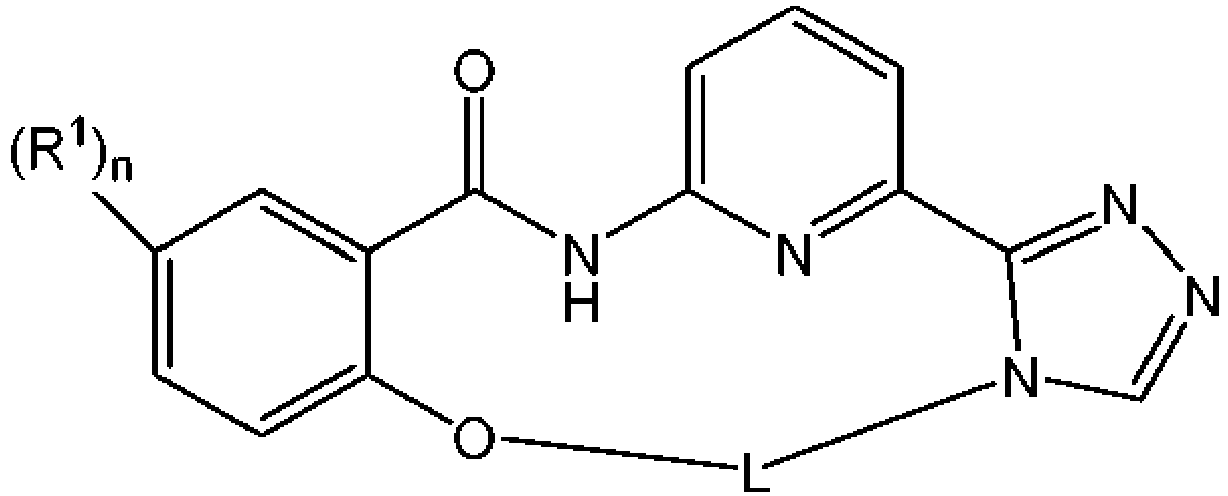 L représente un groupe -(CH2)4- ou -CH2-CH2-CH2-CH(CH3)- ;n vaut 0 ou 1 ;R1 représente un groupe hétérocyclyle choisi parmi les groupes imidazolyle, pyrazolyle et 6-oxa-3-azabicyclo[3.1.1]heptanyle, ledit groupe hétérocyclyle étant éventuellement substitué par un groupe R10 ; etR10 représentant un groupe C1-4alkyle ou C3-6cycloalkyle.
 - Composé selon la revendication 10,
R1 représentant un groupe hétérocyclyle choisi parmi les suivants :
- Composé selon la revendication 10, R10 représentant un groupe -CH3 ou cyclopropyle.
- Composé selon la revendication 1, ledit composé étant

- Composition pharmaceutique comprenant un composé selon l'une quelconque des revendications 1 à 13, ou un sel pharmaceutiquement acceptable de celui-ci, et un excipient pharmaceutiquement acceptable.
- Composé selon l'une quelconque des revendications 1 à 13 ou sel pharmaceutiquement acceptable de celui-ci pour une utilisation dans le traitement d'un trouble sensible à l'inhibition de la kinase 1 régulatrice du signal d'apoptose (ASK1) chez un sujet :(i) ledit trouble étant choisi dans le groupe constitué par un trouble neurodégénératif, une maladie cardiovasculaire, un trouble métabolique, une maladie inflammatoire, un trouble auto-immun, un trouble osseux destructif, une maladie à polyglutamine, la neurotoxicité du glutamate, la douleur, une lésion cérébrale traumatique, un accident vasculaire cérébral hémorragique, une ischémie, une hypoxie aiguë, une fibrose des reins (fibrose rénale), une lésion rénale, une maladie rénale diabétique, une néphropathie diabétique, une stéatohépatite non alcoolique (NASH), une hypertension artérielle pulmonaire (PAH), une névrite optique, une maladie hépatique, une maladie respiratoire, une lésion de reperfusion cardiaque, une hypertrophie cardiaque, une fibrose cardiaque, un trouble métabolique énergétique, un cancer et une infection ;(ii) ledit trouble étant un trouble neurodégénératif, éventuellement ledit trouble neurodégénératif étant choisi parmi la maladie d'Alzheimer (MA), la maladie de Parkinson, la maladie de Huntington et la sclérose latérale amyotrophique (SLA) ;(iii) ledit trouble étant une maladie auto-immune, éventuellement ladite maladie auto-immune étant la sclérose en plaques ; ou(iv) ledit trouble étant une maladie cardiovasculaire, éventuellement ladite maladie cardiovasculaire étant une ischémie.
Applications Claiming Priority (3)
| Application Number | Priority Date | Filing Date | Title |
|---|---|---|---|
| US201762456011P | 2017-02-07 | 2017-02-07 | |
| US201762470533P | 2017-03-13 | 2017-03-13 | |
| PCT/US2018/017061 WO2018148204A1 (fr) | 2017-02-07 | 2018-02-06 | Agents inhibiteurs d'ask1 |
Publications (2)
| Publication Number | Publication Date |
|---|---|
| EP3580224A1 EP3580224A1 (fr) | 2019-12-18 |
| EP3580224B1 true EP3580224B1 (fr) | 2022-07-13 |
Family
ID=61244765
Family Applications (1)
| Application Number | Title | Priority Date | Filing Date |
|---|---|---|---|
| EP18706091.8A Active EP3580224B1 (fr) | 2017-02-07 | 2018-02-06 | Agents inhibiteurs d'ask1 |
Country Status (4)
| Country | Link |
|---|---|
| US (1) | US11168095B2 (fr) |
| EP (1) | EP3580224B1 (fr) |
| ES (1) | ES2926449T3 (fr) |
| WO (1) | WO2018148204A1 (fr) |
Families Citing this family (15)
| Publication number | Priority date | Publication date | Assignee | Title |
|---|---|---|---|---|
| JOP20190221A1 (ar) | 2017-04-05 | 2019-09-23 | Seal Rock Therapeutics Inc | مركبات مثبطات كيناز منظم لإشارات الاستماتة 1 (ask1) واستخداماتها |
| ES2971098T3 (es) | 2017-05-12 | 2024-06-03 | Enanta Pharm Inc | Inhibidores de la quinasa 1 que regula la señal de apoptosis y métodos de uso de los mismos |
| US10246439B2 (en) | 2017-05-25 | 2019-04-02 | Enanta Pharmaceuticals, Inc. | Apoptosis signal-regulating kinase 1 inhibitors and methods of use thereof |
| WO2018218051A1 (fr) | 2017-05-25 | 2018-11-29 | Enanta Pharmaceuticals, Inc. | Inhibiteurs de kinase 1 de régulation du signal apoptotique, et leurs méthodes d'utilisation |
| US10253018B2 (en) | 2017-05-25 | 2019-04-09 | Enanta Pharmaceuticals, Inc. | Apoptosis signal-regulating kinase 1 inhibitors and methods of use thereof |
| US10597382B2 (en) | 2017-08-28 | 2020-03-24 | Enanta Pharmaceuticals, Inc. | Tetrazole containing apoptosis signal-regulating kinase 1 inhibitors and methods of use thereof |
| CN111315380A (zh) * | 2017-09-08 | 2020-06-19 | 弗朗塞拉美国制药有限责任公司 | 凋亡信号调节激酶抑制剂及其用途 |
| CN111801314B (zh) | 2018-01-02 | 2023-10-31 | 西尔洛克治疗公司 | Ask1抑制剂化合物及其用途 |
| EP3787621B1 (fr) | 2018-05-02 | 2024-12-18 | Enanta Pharmaceuticals, Inc. | Inhibiteurs de la kinase 1 régulant le signal d'apoptose contenant des tétrazoles et leurs méthodes d'utilisation |
| US10683289B2 (en) | 2018-05-02 | 2020-06-16 | Enanta Pharmaceuticals, Inc. | Apoptosis signal-regulating kinase 1 inhibitors and methods of use thereof |
| MA53223A (fr) * | 2018-08-14 | 2022-04-27 | Biogen Ma Inc | Composés macrocycliques de pyridine en tant qu'agents inhibiteurs d'ask1 |
| US10968199B2 (en) | 2018-08-22 | 2021-04-06 | Enanta Pharmaceuticals, Inc. | Cycloalkyl-containing apoptosis signal-regulating kinase 1 inhibitors and methods of use thereof |
| US11345699B2 (en) | 2018-11-19 | 2022-05-31 | Enanta Pharmaceuticals, Inc. | Apoptosis signal-regulating kinase 1 inhibitors and methods of use thereof |
| BR112021011643A2 (pt) * | 2018-12-21 | 2021-09-08 | Novartis Ag | Compostos macrocíclicos e seu uso no tratamento de doença |
| WO2020198214A1 (fr) | 2019-03-25 | 2020-10-01 | Enanta Pharmaceuticals, Inc. | Inhibiteurs de la kinase 1 régulant le signal d'apoptose et leurs procédés d'utilisation |
Family Cites Families (3)
| Publication number | Priority date | Publication date | Assignee | Title |
|---|---|---|---|---|
| US4938949A (en) | 1988-09-12 | 1990-07-03 | University Of New York | Treatment of damaged bone marrow and dosage units therefor |
| TWI491606B (zh) * | 2009-07-13 | 2015-07-11 | Gilead Sciences Inc | 調節細胞凋亡信號之激酶的抑制劑 |
| CN111315380A (zh) * | 2017-09-08 | 2020-06-19 | 弗朗塞拉美国制药有限责任公司 | 凋亡信号调节激酶抑制剂及其用途 |
-
2018
- 2018-02-06 EP EP18706091.8A patent/EP3580224B1/fr active Active
- 2018-02-06 ES ES18706091T patent/ES2926449T3/es active Active
- 2018-02-06 US US16/483,790 patent/US11168095B2/en active Active - Reinstated
- 2018-02-06 WO PCT/US2018/017061 patent/WO2018148204A1/fr not_active Ceased
Also Published As
| Publication number | Publication date |
|---|---|
| WO2018148204A1 (fr) | 2018-08-16 |
| EP3580224A1 (fr) | 2019-12-18 |
| US20190359634A1 (en) | 2019-11-28 |
| US11168095B2 (en) | 2021-11-09 |
| ES2926449T3 (es) | 2022-10-26 |
Similar Documents
| Publication | Publication Date | Title |
|---|---|---|
| US11168095B2 (en) | ASK1 inhibiting agents | |
| JP7644517B2 (ja) | Kras突然変異型タンパク質阻害剤 | |
| US11427577B2 (en) | Inhibiting agents for Bruton's tyrosine kinase | |
| AU2017339839A1 (en) | Substituted pyrrolidines as CFTR modulators | |
| US11236086B2 (en) | Substituted pyrrolopyridines as inhibitors of activin receptor-like kinase | |
| EP4051680B1 (fr) | Bi-hétérocycles condensés utilisés en tant qu'agents inhibiteurs de la tyrosine kinase de bruton | |
| US20220048884A1 (en) | Nrf2 activator | |
| TW201315727A (zh) | 尿嘧啶衍生物及其醫藥用途 | |
| CA3048849A1 (fr) | Activateur de nrf2 | |
| KR20210021342A (ko) | Jak 패밀리의 키나제의 소분자 억제제 | |
| CN117916234A (zh) | 作为tyk2/jak1假激酶结构域抑制剂的化合物及合成和使用方法 | |
| EP3814333B1 (fr) | Agents inhibiteurs d'ask1 | |
| EP3837251B1 (fr) | Agents inhibiteurs d'ask1 | |
| EP3837265B1 (fr) | Composés macrocycliques de pyridine en tant qu'agents inhibiteurs d'ask1 | |
| JP7810700B2 (ja) | 芳香族エチレン系化合物、その製造方法、中間体、医薬組成物及びその使用 | |
| WO2017123766A1 (fr) | Composés et compositions pour le traitement d'une maladie | |
| HK40100583A (en) | Benzoazepine analogs as inhibiting agents for bruton’s tyrosine kinase | |
| HK40022870B (en) | Benzoazepine analogs as inhibiting agents for bruton's tyrosine kinase | |
| HK40022870A (en) | Benzoazepine analogs as inhibiting agents for bruton's tyrosine kinase | |
| HK40001031B (en) | Irak4 inhibiting agents | |
| HK1237783A1 (en) | 5-amino-4-carbamoyl-pyrazole compounds as selective and irreversible t790m over wt-egfr kinase inhibitors and use thereof |
Legal Events
| Date | Code | Title | Description |
|---|---|---|---|
| STAA | Information on the status of an ep patent application or granted ep patent |
Free format text: STATUS: UNKNOWN |
|
| STAA | Information on the status of an ep patent application or granted ep patent |
Free format text: STATUS: THE INTERNATIONAL PUBLICATION HAS BEEN MADE |
|
| PUAI | Public reference made under article 153(3) epc to a published international application that has entered the european phase |
Free format text: ORIGINAL CODE: 0009012 |
|
| STAA | Information on the status of an ep patent application or granted ep patent |
Free format text: STATUS: REQUEST FOR EXAMINATION WAS MADE |
|
| 17P | Request for examination filed |
Effective date: 20190821 |
|
| AK | Designated contracting states |
Kind code of ref document: A1 Designated state(s): AL AT BE BG CH CY CZ DE DK EE ES FI FR GB GR HR HU IE IS IT LI LT LU LV MC MK MT NL NO PL PT RO RS SE SI SK SM TR |
|
| AX | Request for extension of the european patent |
Extension state: BA ME |
|
| DAV | Request for validation of the european patent (deleted) | ||
| DAX | Request for extension of the european patent (deleted) | ||
| GRAP | Despatch of communication of intention to grant a patent |
Free format text: ORIGINAL CODE: EPIDOSNIGR1 |
|
| STAA | Information on the status of an ep patent application or granted ep patent |
Free format text: STATUS: GRANT OF PATENT IS INTENDED |
|
| INTG | Intention to grant announced |
Effective date: 20200917 |
|
| GRAJ | Information related to disapproval of communication of intention to grant by the applicant or resumption of examination proceedings by the epo deleted |
Free format text: ORIGINAL CODE: EPIDOSDIGR1 |
|
| STAA | Information on the status of an ep patent application or granted ep patent |
Free format text: STATUS: REQUEST FOR EXAMINATION WAS MADE |
|
| INTC | Intention to grant announced (deleted) | ||
| GRAP | Despatch of communication of intention to grant a patent |
Free format text: ORIGINAL CODE: EPIDOSNIGR1 |
|
| STAA | Information on the status of an ep patent application or granted ep patent |
Free format text: STATUS: GRANT OF PATENT IS INTENDED |
|
| INTG | Intention to grant announced |
Effective date: 20210317 |
|
| GRAJ | Information related to disapproval of communication of intention to grant by the applicant or resumption of examination proceedings by the epo deleted |
Free format text: ORIGINAL CODE: EPIDOSDIGR1 |
|
| STAA | Information on the status of an ep patent application or granted ep patent |
Free format text: STATUS: REQUEST FOR EXAMINATION WAS MADE |
|
| GRAP | Despatch of communication of intention to grant a patent |
Free format text: ORIGINAL CODE: EPIDOSNIGR1 |
|
| STAA | Information on the status of an ep patent application or granted ep patent |
Free format text: STATUS: GRANT OF PATENT IS INTENDED |
|
| INTC | Intention to grant announced (deleted) | ||
| INTG | Intention to grant announced |
Effective date: 20210805 |
|
| GRAJ | Information related to disapproval of communication of intention to grant by the applicant or resumption of examination proceedings by the epo deleted |
Free format text: ORIGINAL CODE: EPIDOSDIGR1 |
|
| STAA | Information on the status of an ep patent application or granted ep patent |
Free format text: STATUS: REQUEST FOR EXAMINATION WAS MADE |
|
| INTC | Intention to grant announced (deleted) | ||
| GRAP | Despatch of communication of intention to grant a patent |
Free format text: ORIGINAL CODE: EPIDOSNIGR1 |
|
| STAA | Information on the status of an ep patent application or granted ep patent |
Free format text: STATUS: GRANT OF PATENT IS INTENDED |
|
| INTG | Intention to grant announced |
Effective date: 20220127 |
|
| GRAS | Grant fee paid |
Free format text: ORIGINAL CODE: EPIDOSNIGR3 |
|
| GRAA | (expected) grant |
Free format text: ORIGINAL CODE: 0009210 |
|
| STAA | Information on the status of an ep patent application or granted ep patent |
Free format text: STATUS: THE PATENT HAS BEEN GRANTED |
|
| AK | Designated contracting states |
Kind code of ref document: B1 Designated state(s): AL AT BE BG CH CY CZ DE DK EE ES FI FR GB GR HR HU IE IS IT LI LT LU LV MC MK MT NL NO PL PT RO RS SE SI SK SM TR |
|
| REG | Reference to a national code |
Ref country code: CH Ref legal event code: EP |
|
| REG | Reference to a national code |
Ref country code: DE Ref legal event code: R096 Ref document number: 602018037852 Country of ref document: DE |
|
| REG | Reference to a national code |
Ref country code: AT Ref legal event code: REF Ref document number: 1504242 Country of ref document: AT Kind code of ref document: T Effective date: 20220815 |
|
| REG | Reference to a national code |
Ref country code: IE Ref legal event code: FG4D |
|
| REG | Reference to a national code |
Ref country code: ES Ref legal event code: FG2A Ref document number: 2926449 Country of ref document: ES Kind code of ref document: T3 Effective date: 20221026 |
|
| REG | Reference to a national code |
Ref country code: LT Ref legal event code: MG9D |
|
| REG | Reference to a national code |
Ref country code: NL Ref legal event code: MP Effective date: 20220713 |
|
| PG25 | Lapsed in a contracting state [announced via postgrant information from national office to epo] |
Ref country code: SE Free format text: LAPSE BECAUSE OF FAILURE TO SUBMIT A TRANSLATION OF THE DESCRIPTION OR TO PAY THE FEE WITHIN THE PRESCRIBED TIME-LIMIT Effective date: 20220713 Ref country code: RS Free format text: LAPSE BECAUSE OF FAILURE TO SUBMIT A TRANSLATION OF THE DESCRIPTION OR TO PAY THE FEE WITHIN THE PRESCRIBED TIME-LIMIT Effective date: 20220713 Ref country code: PT Free format text: LAPSE BECAUSE OF FAILURE TO SUBMIT A TRANSLATION OF THE DESCRIPTION OR TO PAY THE FEE WITHIN THE PRESCRIBED TIME-LIMIT Effective date: 20221114 Ref country code: NO Free format text: LAPSE BECAUSE OF FAILURE TO SUBMIT A TRANSLATION OF THE DESCRIPTION OR TO PAY THE FEE WITHIN THE PRESCRIBED TIME-LIMIT Effective date: 20221013 Ref country code: NL Free format text: LAPSE BECAUSE OF FAILURE TO SUBMIT A TRANSLATION OF THE DESCRIPTION OR TO PAY THE FEE WITHIN THE PRESCRIBED TIME-LIMIT Effective date: 20220713 Ref country code: LV Free format text: LAPSE BECAUSE OF FAILURE TO SUBMIT A TRANSLATION OF THE DESCRIPTION OR TO PAY THE FEE WITHIN THE PRESCRIBED TIME-LIMIT Effective date: 20220713 Ref country code: LT Free format text: LAPSE BECAUSE OF FAILURE TO SUBMIT A TRANSLATION OF THE DESCRIPTION OR TO PAY THE FEE WITHIN THE PRESCRIBED TIME-LIMIT Effective date: 20220713 Ref country code: FI Free format text: LAPSE BECAUSE OF FAILURE TO SUBMIT A TRANSLATION OF THE DESCRIPTION OR TO PAY THE FEE WITHIN THE PRESCRIBED TIME-LIMIT Effective date: 20220713 |
|
| REG | Reference to a national code |
Ref country code: AT Ref legal event code: MK05 Ref document number: 1504242 Country of ref document: AT Kind code of ref document: T Effective date: 20220713 |
|
| PG25 | Lapsed in a contracting state [announced via postgrant information from national office to epo] |
Ref country code: PL Free format text: LAPSE BECAUSE OF FAILURE TO SUBMIT A TRANSLATION OF THE DESCRIPTION OR TO PAY THE FEE WITHIN THE PRESCRIBED TIME-LIMIT Effective date: 20220713 Ref country code: IS Free format text: LAPSE BECAUSE OF FAILURE TO SUBMIT A TRANSLATION OF THE DESCRIPTION OR TO PAY THE FEE WITHIN THE PRESCRIBED TIME-LIMIT Effective date: 20221113 Ref country code: HR Free format text: LAPSE BECAUSE OF FAILURE TO SUBMIT A TRANSLATION OF THE DESCRIPTION OR TO PAY THE FEE WITHIN THE PRESCRIBED TIME-LIMIT Effective date: 20220713 Ref country code: GR Free format text: LAPSE BECAUSE OF FAILURE TO SUBMIT A TRANSLATION OF THE DESCRIPTION OR TO PAY THE FEE WITHIN THE PRESCRIBED TIME-LIMIT Effective date: 20221014 |
|
| REG | Reference to a national code |
Ref country code: DE Ref legal event code: R097 Ref document number: 602018037852 Country of ref document: DE |
|
| PG25 | Lapsed in a contracting state [announced via postgrant information from national office to epo] |
Ref country code: SM Free format text: LAPSE BECAUSE OF FAILURE TO SUBMIT A TRANSLATION OF THE DESCRIPTION OR TO PAY THE FEE WITHIN THE PRESCRIBED TIME-LIMIT Effective date: 20220713 Ref country code: RO Free format text: LAPSE BECAUSE OF FAILURE TO SUBMIT A TRANSLATION OF THE DESCRIPTION OR TO PAY THE FEE WITHIN THE PRESCRIBED TIME-LIMIT Effective date: 20220713 Ref country code: DK Free format text: LAPSE BECAUSE OF FAILURE TO SUBMIT A TRANSLATION OF THE DESCRIPTION OR TO PAY THE FEE WITHIN THE PRESCRIBED TIME-LIMIT Effective date: 20220713 Ref country code: CZ Free format text: LAPSE BECAUSE OF FAILURE TO SUBMIT A TRANSLATION OF THE DESCRIPTION OR TO PAY THE FEE WITHIN THE PRESCRIBED TIME-LIMIT Effective date: 20220713 Ref country code: AT Free format text: LAPSE BECAUSE OF FAILURE TO SUBMIT A TRANSLATION OF THE DESCRIPTION OR TO PAY THE FEE WITHIN THE PRESCRIBED TIME-LIMIT Effective date: 20220713 |
|
| PLBE | No opposition filed within time limit |
Free format text: ORIGINAL CODE: 0009261 |
|
| STAA | Information on the status of an ep patent application or granted ep patent |
Free format text: STATUS: NO OPPOSITION FILED WITHIN TIME LIMIT |
|
| PG25 | Lapsed in a contracting state [announced via postgrant information from national office to epo] |
Ref country code: SK Free format text: LAPSE BECAUSE OF FAILURE TO SUBMIT A TRANSLATION OF THE DESCRIPTION OR TO PAY THE FEE WITHIN THE PRESCRIBED TIME-LIMIT Effective date: 20220713 Ref country code: EE Free format text: LAPSE BECAUSE OF FAILURE TO SUBMIT A TRANSLATION OF THE DESCRIPTION OR TO PAY THE FEE WITHIN THE PRESCRIBED TIME-LIMIT Effective date: 20220713 |
|
| 26N | No opposition filed |
Effective date: 20230414 |
|
| PG25 | Lapsed in a contracting state [announced via postgrant information from national office to epo] |
Ref country code: AL Free format text: LAPSE BECAUSE OF FAILURE TO SUBMIT A TRANSLATION OF THE DESCRIPTION OR TO PAY THE FEE WITHIN THE PRESCRIBED TIME-LIMIT Effective date: 20220713 |
|
| P01 | Opt-out of the competence of the unified patent court (upc) registered |
Effective date: 20230526 |
|
| PG25 | Lapsed in a contracting state [announced via postgrant information from national office to epo] |
Ref country code: SI Free format text: LAPSE BECAUSE OF FAILURE TO SUBMIT A TRANSLATION OF THE DESCRIPTION OR TO PAY THE FEE WITHIN THE PRESCRIBED TIME-LIMIT Effective date: 20220713 |
|
| PG25 | Lapsed in a contracting state [announced via postgrant information from national office to epo] |
Ref country code: MC Free format text: LAPSE BECAUSE OF FAILURE TO SUBMIT A TRANSLATION OF THE DESCRIPTION OR TO PAY THE FEE WITHIN THE PRESCRIBED TIME-LIMIT Effective date: 20220713 |
|
| REG | Reference to a national code |
Ref country code: CH Ref legal event code: PL |
|
| REG | Reference to a national code |
Ref country code: BE Ref legal event code: MM Effective date: 20230228 |
|
| PG25 | Lapsed in a contracting state [announced via postgrant information from national office to epo] |
Ref country code: LU Free format text: LAPSE BECAUSE OF NON-PAYMENT OF DUE FEES Effective date: 20230206 Ref country code: LI Free format text: LAPSE BECAUSE OF NON-PAYMENT OF DUE FEES Effective date: 20230228 Ref country code: CH Free format text: LAPSE BECAUSE OF NON-PAYMENT OF DUE FEES Effective date: 20230228 |
|
| REG | Reference to a national code |
Ref country code: IE Ref legal event code: MM4A |
|
| PG25 | Lapsed in a contracting state [announced via postgrant information from national office to epo] |
Ref country code: IE Free format text: LAPSE BECAUSE OF NON-PAYMENT OF DUE FEES Effective date: 20230206 |
|
| PG25 | Lapsed in a contracting state [announced via postgrant information from national office to epo] |
Ref country code: BE Free format text: LAPSE BECAUSE OF NON-PAYMENT OF DUE FEES Effective date: 20230228 |
|
| PG25 | Lapsed in a contracting state [announced via postgrant information from national office to epo] |
Ref country code: BG Free format text: LAPSE BECAUSE OF FAILURE TO SUBMIT A TRANSLATION OF THE DESCRIPTION OR TO PAY THE FEE WITHIN THE PRESCRIBED TIME-LIMIT Effective date: 20220713 |
|
| PG25 | Lapsed in a contracting state [announced via postgrant information from national office to epo] |
Ref country code: BG Free format text: LAPSE BECAUSE OF FAILURE TO SUBMIT A TRANSLATION OF THE DESCRIPTION OR TO PAY THE FEE WITHIN THE PRESCRIBED TIME-LIMIT Effective date: 20220713 |
|
| PG25 | Lapsed in a contracting state [announced via postgrant information from national office to epo] |
Ref country code: CY Free format text: LAPSE BECAUSE OF FAILURE TO SUBMIT A TRANSLATION OF THE DESCRIPTION OR TO PAY THE FEE WITHIN THE PRESCRIBED TIME-LIMIT; INVALID AB INITIO Effective date: 20180206 |
|
| PG25 | Lapsed in a contracting state [announced via postgrant information from national office to epo] |
Ref country code: HU Free format text: LAPSE BECAUSE OF FAILURE TO SUBMIT A TRANSLATION OF THE DESCRIPTION OR TO PAY THE FEE WITHIN THE PRESCRIBED TIME-LIMIT; INVALID AB INITIO Effective date: 20180206 |
|
| PG25 | Lapsed in a contracting state [announced via postgrant information from national office to epo] |
Ref country code: TR Free format text: LAPSE BECAUSE OF FAILURE TO SUBMIT A TRANSLATION OF THE DESCRIPTION OR TO PAY THE FEE WITHIN THE PRESCRIBED TIME-LIMIT Effective date: 20220713 |
|
| PGFP | Annual fee paid to national office [announced via postgrant information from national office to epo] |
Ref country code: GB Payment date: 20260121 Year of fee payment: 9 |
|
| PGFP | Annual fee paid to national office [announced via postgrant information from national office to epo] |
Ref country code: ES Payment date: 20260302 Year of fee payment: 9 |
|
| PGFP | Annual fee paid to national office [announced via postgrant information from national office to epo] |
Ref country code: DE Payment date: 20260121 Year of fee payment: 9 |
|
| PGFP | Annual fee paid to national office [announced via postgrant information from national office to epo] |
Ref country code: IT Payment date: 20260121 Year of fee payment: 9 |
|
| PGFP | Annual fee paid to national office [announced via postgrant information from national office to epo] |
Ref country code: FR Payment date: 20260121 Year of fee payment: 9 |