EP3586522B1 - Procédé de fabrication d'un boîtier de dispositif auditif - Google Patents
Procédé de fabrication d'un boîtier de dispositif auditif Download PDFInfo
- Publication number
- EP3586522B1 EP3586522B1 EP17706796.4A EP17706796A EP3586522B1 EP 3586522 B1 EP3586522 B1 EP 3586522B1 EP 17706796 A EP17706796 A EP 17706796A EP 3586522 B1 EP3586522 B1 EP 3586522B1
- Authority
- EP
- European Patent Office
- Prior art keywords
- protective structure
- hearing device
- opening
- device housing
- preform
- Prior art date
- Legal status (The legal status is an assumption and is not a legal conclusion. Google has not performed a legal analysis and makes no representation as to the accuracy of the status listed.)
- Active
Links
Images
Classifications
-
- H—ELECTRICITY
- H04—ELECTRIC COMMUNICATION TECHNIQUE
- H04R—LOUDSPEAKERS, MICROPHONES, GRAMOPHONE PICK-UPS OR LIKE ACOUSTIC ELECTROMECHANICAL TRANSDUCERS; ELECTRIC HEARING AIDS; PUBLIC ADDRESS SYSTEMS
- H04R1/00—Details of transducers, loudspeakers or microphones
- H04R1/10—Earpieces; Attachments therefor ; Earphones; Monophonic headphones
- H04R1/1016—Earpieces of the intra-aural type
-
- H—ELECTRICITY
- H04—ELECTRIC COMMUNICATION TECHNIQUE
- H04R—LOUDSPEAKERS, MICROPHONES, GRAMOPHONE PICK-UPS OR LIKE ACOUSTIC ELECTROMECHANICAL TRANSDUCERS; ELECTRIC HEARING AIDS; PUBLIC ADDRESS SYSTEMS
- H04R1/00—Details of transducers, loudspeakers or microphones
- H04R1/10—Earpieces; Attachments therefor ; Earphones; Monophonic headphones
- H04R1/1058—Manufacture or assembly
-
- H—ELECTRICITY
- H04—ELECTRIC COMMUNICATION TECHNIQUE
- H04R—LOUDSPEAKERS, MICROPHONES, GRAMOPHONE PICK-UPS OR LIKE ACOUSTIC ELECTROMECHANICAL TRANSDUCERS; ELECTRIC HEARING AIDS; PUBLIC ADDRESS SYSTEMS
- H04R25/00—Electric hearing aids
- H04R25/65—Housing parts, e.g. shells, tips or moulds, or their manufacture
- H04R25/658—Manufacture of housing parts
-
- H—ELECTRICITY
- H04—ELECTRIC COMMUNICATION TECHNIQUE
- H04R—LOUDSPEAKERS, MICROPHONES, GRAMOPHONE PICK-UPS OR LIKE ACOUSTIC ELECTROMECHANICAL TRANSDUCERS; ELECTRIC HEARING AIDS; PUBLIC ADDRESS SYSTEMS
- H04R2225/00—Details of deaf aids covered by H04R25/00, not provided for in any of its subgroups
- H04R2225/023—Completely in the canal [CIC] hearing aids
-
- H—ELECTRICITY
- H04—ELECTRIC COMMUNICATION TECHNIQUE
- H04R—LOUDSPEAKERS, MICROPHONES, GRAMOPHONE PICK-UPS OR LIKE ACOUSTIC ELECTROMECHANICAL TRANSDUCERS; ELECTRIC HEARING AIDS; PUBLIC ADDRESS SYSTEMS
- H04R2225/00—Details of deaf aids covered by H04R25/00, not provided for in any of its subgroups
- H04R2225/025—In the ear hearing aids [ITE] hearing aids
-
- H—ELECTRICITY
- H04—ELECTRIC COMMUNICATION TECHNIQUE
- H04R—LOUDSPEAKERS, MICROPHONES, GRAMOPHONE PICK-UPS OR LIKE ACOUSTIC ELECTROMECHANICAL TRANSDUCERS; ELECTRIC HEARING AIDS; PUBLIC ADDRESS SYSTEMS
- H04R2225/00—Details of deaf aids covered by H04R25/00, not provided for in any of its subgroups
- H04R2225/77—Design aspects, e.g. CAD, of hearing aid tips, moulds or housings
Definitions
- the present invention is related to a method of manufacturing a hearing device housing
- Hearing devices are typically used to improve the hearing capability or communication capability of a user.
- a hearing device may pick up the surrounding sound with a microphone of the hearing device, processing the microphone signal thereby taking into account the hearing preferences of the user of the hearing device and providing the processed sound signal into a hearing canal of the user via a miniature loudspeaker, commonly referred to as a receiver.
- a hearing device may also receive sound from an alternative input such as an induction coil or a wireless interface.
- a hearing device comprises a housing. If the hearing device is an In-The-Ear hearing device (ITE) or a custom shaped earpiece, the housing is individually formed to fit into an ear canal of a user. ITE's are known which can be equipped with a module rather than a faceplate.
- the module can comprise components such as a frame, battery door and electrical and mechanical parts, etc.
- the module can be mounted to the hearing device housing by inserting into an opening formed into the housing.
- the module can be releasably mounted to the hearing device housing by e.g. using a click-in mechanism, sealing, etc.
- the hearing device housing can be processed, e.g. by means of surface finishing. If the hearing device comprises a custom shaped earpiece the housing comprises an opening which for example allows insertion of a receiver or a sound tube.
- the module can be inserted into the hearing device housing opening, which requires to accordingly model the opening to the hearing device housing. Any gaps which are possibly present between the hearing device housing and the module, e.g. resulting from tolerances during a printing process of the hearing device housing, can be filled up with e.g. a sealing material, etc.
- titanium can be selected as a metal for manufacturing the hearing device housing to be equipped with the module. Titanium is a high strength material which shows excellent characteristics. In an example, housings made of titanium can be as thin as 0.2mm. Further, titanium is a high durable metal and shows improved resistance against entrance of e.g. liquids.
- Hearing device housings made of titanium can be manufactured by using additive manufacturing technologies. However, said housings can exhibit rough surfaces that are inappropriate for being directly inserted into the ear canal of the user. It is known to apply surface treatment processes, e.g. manual grinding, in order to smoothen the housing surfaces such to achieve defined surface properties. However, manual grinding of hearing device housings which are made of titanium is a laborious process which requires additional steps, increased time and thus incurs high costs.
- a further problem in the state of the art is that the periphery of the opening, which is formed into the housing, is strongly exposed to the outside and thus to the abrasive media during grinding. This can result in an overly strong abrasion of this area (periphery of the opening) compared to the rest of the housing. This can result in a sort of wavy, imprecise opening.
- a further problem in the state of the art is that, having an opening in an otherwise enclosed part can result to imprecisions during the additive manufacturing process since internal thermal stress produces warpage.
- Document EP 2 037 702 A2 describes using a finishing plug for a hearing device shell. This plug is inserted into the opening of the shell after manufacturing thereof but prior to surface treating. After surface treating, the plug is removed. It is a problem that inserting the plug into the opening and removing the plug after surface treating are laborious processes incurring high costs. It is also a problem, that with e.g. metal printing, the tolerances of both parts add up and the plug could not fit into opening. Therefore, it could be necessary that the parts have to be grinded prior to insertion. This process can lead to increased laborious work, incurring high costs.
- the present invention is directed to a method of manufacturing a hearing device housing made of a metal comprising titanium, wherein said hearing device housing comprises at least one opening, said method comprising the steps of:
- the opening can be modeled into the preform of different preform geometries via the 3D-modelling software.
- the 3D-modelling software can be e.g. a RSM (Rapid Shell Modeling) software.
- RSM Rapid Shell Modeling
- the hearing device housing can be designed digitally ("designing a pre-model of the hearing device housing"), resulting in hearing devices that can be manufactured fast and more accurately.
- the position of the protective structure in or around uniform openings can be identical for each housing.
- the protective structure at least in a periphery thereof is formed with recesses. Therefore, the protective structure is connected to the housing by spaced-apart connection points which are continuously arranged along the opening of the housing. This allows to easily remove the protective structure from the housing by simply breaking out the protective structure at its connection points (along the recessed portion).
- the dimension of the connecting points can be approximately 0.15mm x 0.15mm. Removing the protective structure from the housing can be achieved simply by hand or by using a tool.
- the protective structure comprises apertures. The apertures can be dimensioned such to prevent entrance of abrasive media during grinding.
- the removing step comprises breaking out the protective structure from the preform.
- the connecting points of the protective structure can be designed such to withstand surface treating, e.g. vibratory grinding, but can be easily removed afterwards by breaking out the protective structure, e.g. manually.
- the dimension of the connecting points can be approximately 0.15mm x 0.15mm.
- the thickness of the protective structure can be approximately 0.15mm.
- the method further comprises the step of: subsequently to the removing step, trimming remaining connection points from the inner rim and/or periphery of the opening.
- the remaining connection points are trimmed by means of milling and/or grinding.
- the remaining connection points can also be referred as spikes.
- the remaining connection points can be left on the periphery of the opening for use of an improved support of the module once inserted.
- the remaining connection points or rather spikes can pinch into the material of the module during insertion.
- the protective structure substantially extends parallel to a plane defined by the opening.
- the top surface of the protective structure is formed inwardly displaced from the top surface of the preform. Therefore, the protective structure is less exposed to the abrasive material during grinding. This allows the protective structure to suffer less wear.
- the hearing device housing is made of a metal comprising titanium.
- the protective structure on a top surface thereof is provided with a labelling.
- the labelling may comprise a code.
- the code can comprise information about the hearing device housing ID.
- the labeling can be applied as part of the designing step. Further, the code can comprise information about how to process the hearing device housing, e.g. the diameter of holes to be drilled into the housing, etc.
- the wall thickness of the hearing device housing is 0.2mm or less.
- the periphery of the protective structure comprises recesses. Therefore, the protective structure can be removed from the housing easily.
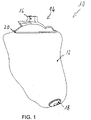
- Fig. 1 depicts a hearing device 10 in a perspective view.
- the hearing device 10 is an In-The-Ear (ITE) hearing device.
- ITE In-The-Ear
- the housing 12 of the hearing device 10 is made of titanium.
- One of a plurality of advantages in using titanium is the ability of creating housings which are very thin while still showing increased strength.
- the hearing device 10 further comprises a module 14 which is inserted into an opening formed into the hearing device housing 12.
- the module 14 can be mounted to the hearing device housing 12 by means of sealing.
- the module 14 can be pre-assembled, comprising a battery compartment which openable end thereof is for receiving a battery (not shown). The openable end can be opened and closed via a battery door 16.
- the battery door 16 is closed.
- the battery door 16 can be opened to exchange a used battery as well as for service, maintenance, etc.
- the module 14 can further comprise at least one microphone, a GMR switch, processing means, etc.
- the module 14 can be easily pre-assembled to the hearing device housing 12.
- the hearing device 10 further comprises a sound outlet 18 for outputting sound from a receiver (not shown) of the hearing device 10 to the ear canal of the user.
- the module 14 comprises an outer rim 20 which abuts against the periphery of an opening of the hearing device housing 12 once inserted.
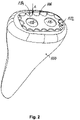
- Fig. 2 depicts a preform 100 of a hearing device housing according to the invention.
- the hearing device housing can be embodied as the hearing device housing as shown in Fig. 1 .
- the preform 100 comprises a protective structure 102 covering the opening of the preform 100. Designing the protective structure 102 is part of the step of designing a pre-model of the hearing device housing by means of a 3D-modelling software. In a next step, the preform 100 of the hearing device housing is produced based on the pre-model.
- the protective structure 102 is formed to be prepared for removal in a later stage.
- the protective structure 102 is at least in a periphery thereof formed with recesses 104.
- the recesses 104 allow that the protective structure 102 is connected to the preform 100 solely by (remaining) connecting points 106. Therefore, in a later stage, the protective structure 102 can be removed by simply breaking out the protective structure 102 (by its connection points 106) from the preform 100. In other words, the protective structure 102 can be removed by simply breaking the connection points 106 thus disconnecting the protective structure 102 from the preform 100.
- the preform 100 can be surface-treated by means of a process using abrasive media, e.g. vibratory grinding (not shown).
- abrasive media e.g. vibratory grinding
- the protective structure 102 is removed (not shown) as a sacrificial structure thus providing the hearing device housing (with the opening).
- the protective structure 102 can comprise apertures 108.
- the apertures 108 can allow to compensate for tolerances which possibly arise during manufacturing of the preform 100 and/or protective structure 102.
- the protective structure 102 can be formed such to substantially extend parallel to a plane defined by the opening. As depicted in the Fig. 2 , in a region surrounding the opening, the top surface of the protective structure 102 can be formed inwardly displaced from the top surface of the preform 100 in a direction as indicated by an arrow A. In this case, the edges of the protective structure 102 are not flush with the surface of the preform 100 at the border of the opening but are slightly inwardly displaced and therefore will be less exposed during a following mechanical surface treating step. While not shown, in the region surrounding the opening, a portion of the periphery of the protective structure can be directly positioned onto the top surface of the preform 100. In another example, while not shown, in a region surrounding the opening, a portion of the periphery of the protective structure can be located onto the top surface of the preform 100 via interposed platforms.
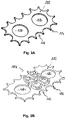
- Figs. 3A,B schematically depict the protective structure 102 in different aspects of the invention.
- the thickness of the protective structure 102 can be selected such to withstand the surface treatment process. In an example, the thickness can vary between 0.1 to 0.15mm.
- the protective structure 102 can be removed after the surface treatment process manually by using a tool or just by hand.
- the protective structure 102 can be provided with a code 110 which can bear information, e.g. an ID of the hearing device, an information about how to process the housing, etc.
- the protective structure 102 can be provided with apertures 108.
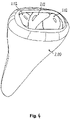
- Fig. 4 schematically depicts a hearing device housing 200 according to the prior art, wherein the housing 200 is clogged inside with grinding stones 202 of abrasive media.
- the grinding stones 202 are entered the housing 200 via the opening thereof.
- the surface treatment can comprise e.g. vibratory grinding.
- removal of the clogged grinding stones 202 out of the hollow body of the housing 200 is impossible at least without damaging of the housing 200. Any efforts to do so would be inefficient.
- a further problem is an overly strong abrasion of the exposed area surrounding the opening (periphery of the opening), which might result in a wavy, imprecise opening.
Landscapes
- Engineering & Computer Science (AREA)
- Physics & Mathematics (AREA)
- Acoustics & Sound (AREA)
- Signal Processing (AREA)
- Manufacturing & Machinery (AREA)
- Health & Medical Sciences (AREA)
- General Health & Medical Sciences (AREA)
- Neurosurgery (AREA)
- Otolaryngology (AREA)
- Finish Polishing, Edge Sharpening, And Grinding By Specific Grinding Devices (AREA)
- Grinding And Polishing Of Tertiary Curved Surfaces And Surfaces With Complex Shapes (AREA)
Claims (8)
- Procédé pour fabriquer un boîtier de dispositif auditif (12) constitué d'un métal comprenant du titane, dans lequel ledit boîtier de dispositif auditif (12) comprend au moins une ouverture, ledit procédé comprenant les étapes consistant à :- concevoir un pré-modèle du boîtier de dispositif auditif (12) à l'aide d'un logiciel de modélisation 3D, ledit pré-modèle comprenant une structure de protection (102) couvrant ladite ouverture et la protégeant contre l'entrée de substances abrasives, ladite structure de protection (102) étant conçue pour être retirée, cette dernière étant conçue raccordée au boîtier par des points de raccordement espacés disposés en continu le long de l'ouverture du boîtier (12),- produire une préforme (100) du boîtier de dispositif auditif (12) sur la base du pré-modèle, la préforme (100) ayant l'ouverture couverte par la structure de protection (102) qui est imprimée d'un seul tenant avec la préforme (100), empêchant ainsi les substances abrasives d'entrer pendant le traitement de surface, dans lequel, dans une zone entourant l'ouverture, la face supérieure de la structure de protection (102) est formée déplacée vers l'intérieur par rapport à la face supérieure de la préforme (100), ladite production consistant à traiter en surface la préforme (100), ledit traitement de surface consistant à poncer à l'aide de matières abrasives, et après quoi à- retirer la structure de protection (102) en rompant la structure de protection (102) au niveau de ses points de raccordement, fournissant ainsi le boîtier de dispositif auditif (12) avec l'ouverture.
- Procédé selon la revendication 1, dans lequel la structure de protection (102) est formée, au moins en périphérie, avec des évidements (104).
- Procédé selon la revendication 1 ou 2, dans lequel la structure de protection (102) comprend des orifices (108).
- Procédé selon l'une des revendications précédentes, comprenant en outre l'étape consistant à :- suite à l'étape de retrait, ébavurer les points de raccordement restants depuis le bord intérieur ou depuis la périphérie de l'ouverture.
- Procédé selon la revendication 4, dans lequel les points de raccordement restants sont ébavurés par fraisage ou meulage.
- Procédé selon l'une des revendications précédentes, dans lequel la structure de protection (102) s'étend de façon sensiblement parallèle à un plan défini par l'ouverture.
- Procédé selon l'une des revendications précédentes, dans lequel la structure de protection (102) est munie sur sa face supérieure d'un marquage.
- Procédé selon l'une des revendications précédentes, dans lequel l'épaisseur de paroi du boîtier de dispositif auditif (12) est de 0,2 mm ou moins.
Applications Claiming Priority (1)
| Application Number | Priority Date | Filing Date | Title |
|---|---|---|---|
| PCT/EP2017/054186 WO2018153457A1 (fr) | 2017-02-23 | 2017-02-23 | Procédé de fabrication d'un boîtier de dispositif auditif, préforme d'un boîtier de dispositif auditif, boîtier de dispositif auditif et dispositif auditif |
Publications (2)
| Publication Number | Publication Date |
|---|---|
| EP3586522A1 EP3586522A1 (fr) | 2020-01-01 |
| EP3586522B1 true EP3586522B1 (fr) | 2023-01-18 |
Family
ID=58108653
Family Applications (1)
| Application Number | Title | Priority Date | Filing Date |
|---|---|---|---|
| EP17706796.4A Active EP3586522B1 (fr) | 2017-02-23 | 2017-02-23 | Procédé de fabrication d'un boîtier de dispositif auditif |
Country Status (4)
| Country | Link |
|---|---|
| US (1) | US11368773B2 (fr) |
| EP (1) | EP3586522B1 (fr) |
| CN (1) | CN110326304B (fr) |
| WO (1) | WO2018153457A1 (fr) |
Families Citing this family (1)
| Publication number | Priority date | Publication date | Assignee | Title |
|---|---|---|---|---|
| EP3588978B1 (fr) * | 2018-06-21 | 2024-08-07 | Sonova AG | Procédé de fabrication d'une coque métallique pour un dispositif auditif |
Citations (2)
| Publication number | Priority date | Publication date | Assignee | Title |
|---|---|---|---|---|
| DE19507881A1 (de) * | 1994-03-10 | 1995-09-14 | Materialise Nv | Verfahren zum Stützen eines Objekts, verfertigt durch Stereolithographie oder ein anderes schnelles Prototypen-Fertigungsverfahren |
| US20090123014A1 (en) * | 2007-11-09 | 2009-05-14 | Siemens Medical Instruments Pte. Ltd. | In-the-ear hearing device housing and the production thereof |
Family Cites Families (19)
| Publication number | Priority date | Publication date | Assignee | Title |
|---|---|---|---|---|
| DE3604648A1 (de) * | 1985-12-03 | 1987-08-20 | Toepholm & Westermann | Verfahren zum herstellen eines im-ohr-hoergeraetes |
| US5487012A (en) * | 1990-12-21 | 1996-01-23 | Topholm & Westermann Aps | Method of preparing an otoplasty or adaptive earpiece individually matched to the shape of an auditory canal |
| US20040071305A1 (en) * | 2001-02-01 | 2004-04-15 | Peter Frederiksen | Faceplate |
| ES2378060T3 (es) * | 2001-03-02 | 2012-04-04 | 3Shape A/S | Procedimiento para modelar piezas auriculares personalizadas |
| EP1246505A1 (fr) * | 2001-03-26 | 2002-10-02 | Widex A/S | Prothèse auditive avec plaque frontale qui est produite automatiquement pour s'adapter à la coquille de la prothèse |
| US20020196954A1 (en) | 2001-06-22 | 2002-12-26 | Marxen Christopher J. | Modeling and fabrication of three-dimensional irregular surfaces for hearing instruments |
| US7191029B2 (en) * | 2001-06-22 | 2007-03-13 | Siemens Hearing Instruments, Inc. | Rapid prototype fabrication of a monolithic hearing instrument housing with an integrally-fabricated faceplate |
| US20030044036A1 (en) * | 2001-08-31 | 2003-03-06 | Masters Martin W. | Textured surfaces fo hearing instruments |
| US8077894B2 (en) * | 2007-01-22 | 2011-12-13 | Siemens Hearing Instruments, Inc. | Feature protection for stereo lithographic manufacturing processes |
| DE102007016400A1 (de) | 2007-04-03 | 2008-10-09 | Inno-Shape Gmbh | Verfahren zum Herstellen einer Otoplastik |
| DE102007028230B3 (de) * | 2007-06-20 | 2008-11-13 | Siemens Medical Instruments Pte. Ltd. | Verschlusselement für Gehäuseöffnungen bei einem Tumbling-Prozess und Verfahren zum Glätten oder Beschichten von Gehäuseteilen für eine Hörvorrichtung |
| US20090067656A1 (en) * | 2007-09-12 | 2009-03-12 | Siemens Hearing Instruments Inc. | Protective Finishing Plug For A Hearing Instrument Shell |
| WO2010040419A1 (fr) * | 2008-10-10 | 2010-04-15 | Widex A/S | Procédé servant à fabriquer un appareil auditif possédant un composant élastique ajusté de façon personnalisée |
| EP2615854A1 (fr) | 2012-06-14 | 2013-07-17 | Oticon A/s | Boîtier pour prothèse auditive |
| CN105556989A (zh) * | 2013-07-22 | 2016-05-04 | 索诺亚公司 | 具有提高的低频响应的听力装置以及用于制造这种听力装置的方法 |
| CN103974183A (zh) * | 2014-05-26 | 2014-08-06 | 俞辰 | 一种基于3d打印技术的定制式耳机及其制造方法 |
| WO2016037634A1 (fr) * | 2014-09-08 | 2016-03-17 | Sonova Ag | Procédé de production d'une coque de prothèse auditive, coque de prothèse auditive et prothèse auditive |
| US10070959B2 (en) * | 2016-09-28 | 2018-09-11 | DePuy Synthes Products, Inc. | Method of texturing prosthetic implants |
| US11070928B2 (en) * | 2016-09-29 | 2021-07-20 | Sonova Ag | Hearing device and a method for manufacturing thereof |
-
2017
- 2017-02-23 EP EP17706796.4A patent/EP3586522B1/fr active Active
- 2017-02-23 US US16/485,859 patent/US11368773B2/en active Active
- 2017-02-23 CN CN201780086903.8A patent/CN110326304B/zh active Active
- 2017-02-23 WO PCT/EP2017/054186 patent/WO2018153457A1/fr not_active Ceased
Patent Citations (2)
| Publication number | Priority date | Publication date | Assignee | Title |
|---|---|---|---|---|
| DE19507881A1 (de) * | 1994-03-10 | 1995-09-14 | Materialise Nv | Verfahren zum Stützen eines Objekts, verfertigt durch Stereolithographie oder ein anderes schnelles Prototypen-Fertigungsverfahren |
| US20090123014A1 (en) * | 2007-11-09 | 2009-05-14 | Siemens Medical Instruments Pte. Ltd. | In-the-ear hearing device housing and the production thereof |
Also Published As
| Publication number | Publication date |
|---|---|
| WO2018153457A1 (fr) | 2018-08-30 |
| EP3586522A1 (fr) | 2020-01-01 |
| US20200007969A1 (en) | 2020-01-02 |
| CN110326304A (zh) | 2019-10-11 |
| US11368773B2 (en) | 2022-06-21 |
| CN110326304B (zh) | 2023-09-12 |
Similar Documents
| Publication | Publication Date | Title |
|---|---|---|
| US8199952B2 (en) | Method for adaptive construction of a small CIC hearing instrument | |
| CA2663102A1 (fr) | Procede de production d'un boitiier pour prothese auditive et prothese auditive correspondante | |
| CA2656238C (fr) | Boitier pour prothese auditive, prothese auditive et procede de fabrication d'une prothese auditive | |
| US7856111B2 (en) | Hearing aid with sound tube serving for retention in concha | |
| US20120243701A1 (en) | Concha-Fitting Custom Earplug with Flexible Skin and Filler Material | |
| US20140247957A1 (en) | Hearing aid with a bushing for an ear wax guard | |
| US20050123157A1 (en) | Method for producing a hearing aid | |
| EP3586522B1 (fr) | Procédé de fabrication d'un boîtier de dispositif auditif | |
| EP1947907B1 (fr) | Procédé lithographique stéréo de fabrication de prothèses auditives | |
| EP2083583A1 (fr) | Fabrication d'un couvercle en silicone souple pour la protection d'un instrument auditif | |
| EP3520439B1 (fr) | Dispositif auditif et son procédé de fabrication | |
| US11265662B2 (en) | Hearing aid comprising a loop antenna | |
| US20210144493A1 (en) | A method of sealing a module and a hearing device | |
| EP2037702A2 (fr) | Obturateur de finition protecteur pour la protection d'un instrument d'écoute | |
| EP3326388B1 (fr) | Dispositif auditif destiné à être porté au moins en partie à l'intérieur d'un canal auditif et procédé de fabrication d'un tel dispositif auditif | |
| US20100220882A1 (en) | Hearing device with an acoustics unit and a shell part | |
| EP2048895B1 (fr) | Système de modélisation binaurale informatisée à base de règles et procédé pour la conception d'une assistance auditive | |
| US12494674B2 (en) | Wirelessly rechargeable in-ear hearing device and charger for same | |
| US20090123014A1 (en) | In-the-ear hearing device housing and the production thereof | |
| CN217037410U (zh) | 听力设备壳体和听力设备 | |
| CN112995877A (zh) | 用于听力装置的组合件的制造方法 | |
| US8050438B2 (en) | Closure element for housing openings during a tumbling process | |
| EP3588978B1 (fr) | Procédé de fabrication d'une coque métallique pour un dispositif auditif | |
| CN112653977B (zh) | 连接到耳壳的助听器电池 | |
| EP3334191A1 (fr) | Boitier pour un appareil de correction auditive |
Legal Events
| Date | Code | Title | Description |
|---|---|---|---|
| STAA | Information on the status of an ep patent application or granted ep patent |
Free format text: STATUS: UNKNOWN |
|
| STAA | Information on the status of an ep patent application or granted ep patent |
Free format text: STATUS: THE INTERNATIONAL PUBLICATION HAS BEEN MADE |
|
| PUAI | Public reference made under article 153(3) epc to a published international application that has entered the european phase |
Free format text: ORIGINAL CODE: 0009012 |
|
| STAA | Information on the status of an ep patent application or granted ep patent |
Free format text: STATUS: REQUEST FOR EXAMINATION WAS MADE |
|
| 17P | Request for examination filed |
Effective date: 20190805 |
|
| AK | Designated contracting states |
Kind code of ref document: A1 Designated state(s): AL AT BE BG CH CY CZ DE DK EE ES FI FR GB GR HR HU IE IS IT LI LT LU LV MC MK MT NL NO PL PT RO RS SE SI SK SM TR |
|
| AX | Request for extension of the european patent |
Extension state: BA ME |
|
| DAV | Request for validation of the european patent (deleted) | ||
| DAX | Request for extension of the european patent (deleted) | ||
| STAA | Information on the status of an ep patent application or granted ep patent |
Free format text: STATUS: EXAMINATION IS IN PROGRESS |
|
| 17Q | First examination report despatched |
Effective date: 20200805 |
|
| GRAP | Despatch of communication of intention to grant a patent |
Free format text: ORIGINAL CODE: EPIDOSNIGR1 |
|
| STAA | Information on the status of an ep patent application or granted ep patent |
Free format text: STATUS: GRANT OF PATENT IS INTENDED |
|
| INTG | Intention to grant announced |
Effective date: 20220907 |
|
| GRAS | Grant fee paid |
Free format text: ORIGINAL CODE: EPIDOSNIGR3 |
|
| GRAA | (expected) grant |
Free format text: ORIGINAL CODE: 0009210 |
|
| STAA | Information on the status of an ep patent application or granted ep patent |
Free format text: STATUS: THE PATENT HAS BEEN GRANTED |
|
| AK | Designated contracting states |
Kind code of ref document: B1 Designated state(s): AL AT BE BG CH CY CZ DE DK EE ES FI FR GB GR HR HU IE IS IT LI LT LU LV MC MK MT NL NO PL PT RO RS SE SI SK SM TR |
|
| REG | Reference to a national code |
Ref country code: GB Ref legal event code: FG4D |
|
| REG | Reference to a national code |
Ref country code: DE Ref legal event code: R096 Ref document number: 602017065559 Country of ref document: DE |
|
| REG | Reference to a national code |
Ref country code: CH Ref legal event code: EP |
|
| REG | Reference to a national code |
Ref country code: AT Ref legal event code: REF Ref document number: 1545295 Country of ref document: AT Kind code of ref document: T Effective date: 20230215 Ref country code: IE Ref legal event code: FG4D |
|
| REG | Reference to a national code |
Ref country code: LT Ref legal event code: MG9D |
|
| REG | Reference to a national code |
Ref country code: NL Ref legal event code: MP Effective date: 20230118 |
|
| REG | Reference to a national code |
Ref country code: AT Ref legal event code: MK05 Ref document number: 1545295 Country of ref document: AT Kind code of ref document: T Effective date: 20230118 |
|
| PG25 | Lapsed in a contracting state [announced via postgrant information from national office to epo] |
Ref country code: NL Free format text: LAPSE BECAUSE OF FAILURE TO SUBMIT A TRANSLATION OF THE DESCRIPTION OR TO PAY THE FEE WITHIN THE PRESCRIBED TIME-LIMIT Effective date: 20230118 |
|
| PG25 | Lapsed in a contracting state [announced via postgrant information from national office to epo] |
Ref country code: RS Free format text: LAPSE BECAUSE OF FAILURE TO SUBMIT A TRANSLATION OF THE DESCRIPTION OR TO PAY THE FEE WITHIN THE PRESCRIBED TIME-LIMIT Effective date: 20230118 Ref country code: PT Free format text: LAPSE BECAUSE OF FAILURE TO SUBMIT A TRANSLATION OF THE DESCRIPTION OR TO PAY THE FEE WITHIN THE PRESCRIBED TIME-LIMIT Effective date: 20230518 Ref country code: NO Free format text: LAPSE BECAUSE OF FAILURE TO SUBMIT A TRANSLATION OF THE DESCRIPTION OR TO PAY THE FEE WITHIN THE PRESCRIBED TIME-LIMIT Effective date: 20230418 Ref country code: LV Free format text: LAPSE BECAUSE OF FAILURE TO SUBMIT A TRANSLATION OF THE DESCRIPTION OR TO PAY THE FEE WITHIN THE PRESCRIBED TIME-LIMIT Effective date: 20230118 Ref country code: LT Free format text: LAPSE BECAUSE OF FAILURE TO SUBMIT A TRANSLATION OF THE DESCRIPTION OR TO PAY THE FEE WITHIN THE PRESCRIBED TIME-LIMIT Effective date: 20230118 Ref country code: HR Free format text: LAPSE BECAUSE OF FAILURE TO SUBMIT A TRANSLATION OF THE DESCRIPTION OR TO PAY THE FEE WITHIN THE PRESCRIBED TIME-LIMIT Effective date: 20230118 Ref country code: ES Free format text: LAPSE BECAUSE OF FAILURE TO SUBMIT A TRANSLATION OF THE DESCRIPTION OR TO PAY THE FEE WITHIN THE PRESCRIBED TIME-LIMIT Effective date: 20230118 Ref country code: AT Free format text: LAPSE BECAUSE OF FAILURE TO SUBMIT A TRANSLATION OF THE DESCRIPTION OR TO PAY THE FEE WITHIN THE PRESCRIBED TIME-LIMIT Effective date: 20230118 |
|
| PG25 | Lapsed in a contracting state [announced via postgrant information from national office to epo] |
Ref country code: SE Free format text: LAPSE BECAUSE OF FAILURE TO SUBMIT A TRANSLATION OF THE DESCRIPTION OR TO PAY THE FEE WITHIN THE PRESCRIBED TIME-LIMIT Effective date: 20230118 Ref country code: PL Free format text: LAPSE BECAUSE OF FAILURE TO SUBMIT A TRANSLATION OF THE DESCRIPTION OR TO PAY THE FEE WITHIN THE PRESCRIBED TIME-LIMIT Effective date: 20230118 Ref country code: IS Free format text: LAPSE BECAUSE OF FAILURE TO SUBMIT A TRANSLATION OF THE DESCRIPTION OR TO PAY THE FEE WITHIN THE PRESCRIBED TIME-LIMIT Effective date: 20230518 Ref country code: GR Free format text: LAPSE BECAUSE OF FAILURE TO SUBMIT A TRANSLATION OF THE DESCRIPTION OR TO PAY THE FEE WITHIN THE PRESCRIBED TIME-LIMIT Effective date: 20230419 Ref country code: FI Free format text: LAPSE BECAUSE OF FAILURE TO SUBMIT A TRANSLATION OF THE DESCRIPTION OR TO PAY THE FEE WITHIN THE PRESCRIBED TIME-LIMIT Effective date: 20230118 |
|
| REG | Reference to a national code |
Ref country code: CH Ref legal event code: PL |
|
| REG | Reference to a national code |
Ref country code: DE Ref legal event code: R097 Ref document number: 602017065559 Country of ref document: DE Ref country code: BE Ref legal event code: MM Effective date: 20230228 |
|
| PG25 | Lapsed in a contracting state [announced via postgrant information from national office to epo] |
Ref country code: SM Free format text: LAPSE BECAUSE OF FAILURE TO SUBMIT A TRANSLATION OF THE DESCRIPTION OR TO PAY THE FEE WITHIN THE PRESCRIBED TIME-LIMIT Effective date: 20230118 Ref country code: RO Free format text: LAPSE BECAUSE OF FAILURE TO SUBMIT A TRANSLATION OF THE DESCRIPTION OR TO PAY THE FEE WITHIN THE PRESCRIBED TIME-LIMIT Effective date: 20230118 Ref country code: MC Free format text: LAPSE BECAUSE OF FAILURE TO SUBMIT A TRANSLATION OF THE DESCRIPTION OR TO PAY THE FEE WITHIN THE PRESCRIBED TIME-LIMIT Effective date: 20230118 Ref country code: LU Free format text: LAPSE BECAUSE OF NON-PAYMENT OF DUE FEES Effective date: 20230223 Ref country code: LI Free format text: LAPSE BECAUSE OF NON-PAYMENT OF DUE FEES Effective date: 20230228 Ref country code: EE Free format text: LAPSE BECAUSE OF FAILURE TO SUBMIT A TRANSLATION OF THE DESCRIPTION OR TO PAY THE FEE WITHIN THE PRESCRIBED TIME-LIMIT Effective date: 20230118 Ref country code: DK Free format text: LAPSE BECAUSE OF FAILURE TO SUBMIT A TRANSLATION OF THE DESCRIPTION OR TO PAY THE FEE WITHIN THE PRESCRIBED TIME-LIMIT Effective date: 20230118 Ref country code: CZ Free format text: LAPSE BECAUSE OF FAILURE TO SUBMIT A TRANSLATION OF THE DESCRIPTION OR TO PAY THE FEE WITHIN THE PRESCRIBED TIME-LIMIT Effective date: 20230118 Ref country code: CH Free format text: LAPSE BECAUSE OF NON-PAYMENT OF DUE FEES Effective date: 20230228 |
|
| PLBE | No opposition filed within time limit |
Free format text: ORIGINAL CODE: 0009261 |
|
| STAA | Information on the status of an ep patent application or granted ep patent |
Free format text: STATUS: NO OPPOSITION FILED WITHIN TIME LIMIT |
|
| PG25 | Lapsed in a contracting state [announced via postgrant information from national office to epo] |
Ref country code: SK Free format text: LAPSE BECAUSE OF FAILURE TO SUBMIT A TRANSLATION OF THE DESCRIPTION OR TO PAY THE FEE WITHIN THE PRESCRIBED TIME-LIMIT Effective date: 20230118 |
|
| REG | Reference to a national code |
Ref country code: IE Ref legal event code: MM4A |
|
| 26N | No opposition filed |
Effective date: 20231019 |
|
| PG25 | Lapsed in a contracting state [announced via postgrant information from national office to epo] |
Ref country code: SI Free format text: LAPSE BECAUSE OF FAILURE TO SUBMIT A TRANSLATION OF THE DESCRIPTION OR TO PAY THE FEE WITHIN THE PRESCRIBED TIME-LIMIT Effective date: 20230118 Ref country code: IE Free format text: LAPSE BECAUSE OF NON-PAYMENT OF DUE FEES Effective date: 20230223 |
|
| PG25 | Lapsed in a contracting state [announced via postgrant information from national office to epo] |
Ref country code: BE Free format text: LAPSE BECAUSE OF NON-PAYMENT OF DUE FEES Effective date: 20230228 |
|
| PG25 | Lapsed in a contracting state [announced via postgrant information from national office to epo] |
Ref country code: IT Free format text: LAPSE BECAUSE OF FAILURE TO SUBMIT A TRANSLATION OF THE DESCRIPTION OR TO PAY THE FEE WITHIN THE PRESCRIBED TIME-LIMIT Effective date: 20230118 |
|
| PG25 | Lapsed in a contracting state [announced via postgrant information from national office to epo] |
Ref country code: BG Free format text: LAPSE BECAUSE OF FAILURE TO SUBMIT A TRANSLATION OF THE DESCRIPTION OR TO PAY THE FEE WITHIN THE PRESCRIBED TIME-LIMIT Effective date: 20230118 |
|
| PG25 | Lapsed in a contracting state [announced via postgrant information from national office to epo] |
Ref country code: BG Free format text: LAPSE BECAUSE OF FAILURE TO SUBMIT A TRANSLATION OF THE DESCRIPTION OR TO PAY THE FEE WITHIN THE PRESCRIBED TIME-LIMIT Effective date: 20230118 |
|
| PG25 | Lapsed in a contracting state [announced via postgrant information from national office to epo] |
Ref country code: CY Free format text: LAPSE BECAUSE OF FAILURE TO SUBMIT A TRANSLATION OF THE DESCRIPTION OR TO PAY THE FEE WITHIN THE PRESCRIBED TIME-LIMIT; INVALID AB INITIO Effective date: 20170223 |
|
| PG25 | Lapsed in a contracting state [announced via postgrant information from national office to epo] |
Ref country code: HU Free format text: LAPSE BECAUSE OF FAILURE TO SUBMIT A TRANSLATION OF THE DESCRIPTION OR TO PAY THE FEE WITHIN THE PRESCRIBED TIME-LIMIT; INVALID AB INITIO Effective date: 20170223 |
|
| PG25 | Lapsed in a contracting state [announced via postgrant information from national office to epo] |
Ref country code: TR Free format text: LAPSE BECAUSE OF FAILURE TO SUBMIT A TRANSLATION OF THE DESCRIPTION OR TO PAY THE FEE WITHIN THE PRESCRIBED TIME-LIMIT Effective date: 20230118 |
|
| PGFP | Annual fee paid to national office [announced via postgrant information from national office to epo] |
Ref country code: GB Payment date: 20260227 Year of fee payment: 10 |
|
| PGFP | Annual fee paid to national office [announced via postgrant information from national office to epo] |
Ref country code: DE Payment date: 20260227 Year of fee payment: 10 |
|
| PGFP | Annual fee paid to national office [announced via postgrant information from national office to epo] |
Ref country code: FR Payment date: 20260225 Year of fee payment: 10 |