EP3586632B1 - Dérivés de 10h-benzo[g]pteridin-2,4-dion, leur procédé de production et d'utilisation - Google Patents
Dérivés de 10h-benzo[g]pteridin-2,4-dion, leur procédé de production et d'utilisation Download PDFInfo
- Publication number
- EP3586632B1 EP3586632B1 EP19191309.4A EP19191309A EP3586632B1 EP 3586632 B1 EP3586632 B1 EP 3586632B1 EP 19191309 A EP19191309 A EP 19191309A EP 3586632 B1 EP3586632 B1 EP 3586632B1
- Authority
- EP
- European Patent Office
- Prior art keywords
- atoms
- aryl
- radical
- bis
- mit
- Prior art date
- Legal status (The legal status is an assumption and is not a legal conclusion. Google has not performed a legal analysis and makes no representation as to the accuracy of the status listed.)
- Active
Links
Images


Classifications
-
- A—HUMAN NECESSITIES
- A01—AGRICULTURE; FORESTRY; ANIMAL HUSBANDRY; HUNTING; TRAPPING; FISHING
- A01N—PRESERVATION OF BODIES OF HUMANS OR ANIMALS OR PLANTS OR PARTS THEREOF; BIOCIDES, e.g. AS DISINFECTANTS, AS PESTICIDES OR AS HERBICIDES; PEST REPELLANTS OR ATTRACTANTS; PLANT GROWTH REGULATORS
- A01N43/00—Biocides, pest repellants or attractants, or plant growth regulators containing heterocyclic compounds
- A01N43/90—Biocides, pest repellants or attractants, or plant growth regulators containing heterocyclic compounds having two or more relevant hetero rings, condensed among themselves or with a common carbocyclic ring system
-
- A—HUMAN NECESSITIES
- A61—MEDICAL OR VETERINARY SCIENCE; HYGIENE
- A61K—PREPARATIONS FOR MEDICAL, DENTAL OR TOILETRY PURPOSES
- A61K41/00—Medicinal preparations obtained by treating materials with wave energy or particle radiation ; Therapies using these preparations
- A61K41/0057—Photodynamic therapy with a photosensitizer, i.e. agent able to produce reactive oxygen species upon exposure to light or radiation, e.g. UV or visible light; photocleavage of nucleic acids with an agent
-
- A—HUMAN NECESSITIES
- A61—MEDICAL OR VETERINARY SCIENCE; HYGIENE
- A61P—SPECIFIC THERAPEUTIC ACTIVITY OF CHEMICAL COMPOUNDS OR MEDICINAL PREPARATIONS
- A61P31/00—Antiinfectives, i.e. antibiotics, antiseptics, chemotherapeutics
-
- C—CHEMISTRY; METALLURGY
- C07—ORGANIC CHEMISTRY
- C07D—HETEROCYCLIC COMPOUNDS
- C07D475/00—Heterocyclic compounds containing pteridine ring systems
- C07D475/12—Heterocyclic compounds containing pteridine ring systems containing pteridine ring systems condensed with carbocyclic rings or ring systems
- C07D475/14—Benz [g] pteridines, e.g. riboflavin
Definitions
- the present invention relates to 10H-benzo[g]pteridine-2,4-dione derivatives, their production and use.
- the active or passive entry, attachment and multiplication of pathogens in a host is called infection.
- Sources of infectious particles are everywhere.
- the human body is colonized by a large number of microorganisms, which are usually kept under control by normal metabolism and an intact immune system.
- the immune system is weakened, for example, the pathogens can multiply and symptoms can vary depending on the type of pathogen.
- Medicine has specific antidotes available for many diseases caused by pathogens, such as antibiotics against bacteria or antimicrobials against fungi or virostatics against viruses.
- these antidotes when used, the emergence of resistant pathogens can be observed, some of which show resistance to several antidotes at the same time.
- the emergence of these resistant or multi-resistant pathogens has changed the therapy of Infectious diseases increasingly difficult.
- the clinical consequence of resistance is evidenced by treatment failure, particularly in immunocompromised patients.
- New starting points for combating resistant or multi-resistant germs are therefore on the one hand the search for new antidotes, for example antibiotics or antimicrobials, and on the other hand the search for alternative inactivation options.
- ROS reactive oxygen species
- ROS reactive oxygen species
- ROS reactive oxygen species
- photosensitizers are known from the prior art, for example from the group of porphyrins and their derivatives or phthalocyanines and their derivatives or fullerenes and their derivatives or derivatives of the phenothiazininium structure, such as methylene blue or toluidine blue, or representatives of the phenoxazinium series, such as Nile blue.
- the photodynamics of methylene blue or toluidine blue in relation to bacteria is already used in dentistry, for example.
- the photosensitizers known from the prior art are mostly substances with a relatively complex molecular structure and therefore expensive production processes.
- 10-methyl-10H-benzo[g]pteridine-2,4-dione derivatives, riboflavin and tetraacetylriboflavin have high yields of singlet oxygen, but their affinity to microorganisms is low. It is also known that singlet oxygen can only diffuse a short distance before reacting or decomposing. Therefore, the inactivation of microorganisms by 10-methyl-10H-benzo[g]pteridine-2,4-dione derivatives, riboflavin and Tetraacetylriboflavin insufficient.
- WO 2010/019208 A1 and the WO 2011/008247 A1 numerous flavin, roseoflavin and riboflavin derivatives are known which can bind to flavin mononucleotide (FMN) riboswiches.
- Riboswiches are RNA elements in untranslated regions of prokaryotic, fungal, and plant mRNA that bind small molecular weight metabolites, such as FMN, and then regulate gene expression. For example, upon binding of FMN to prokaryotic FMN riboswiches, the expression of enzymes responsible for riboflavin and FMN biosynthesis is repressed, resulting in the arrest of riboflavin and FMN biosynthesis.
- Riboflavin plays a central role in metabolism as it serves as a precursor for flavin coenzymes. Therefore, suppressed riboflavin and FMN biosynthesis leads to reduced survivability.
- the compound of the formula (1) according to the invention is a 10H-benzo[g]pteridine-2,4-dione or flavin derivative, which is also referred to as such in the following.
- Any suitable anion can be used as the counterion to the positively charged quaternary nitrogen atom.
- Anions are preferably used as the counterion to the positively charged quaternary nitrogen atom, which make it possible to provide a pharmacologically tolerable salt.
- X in the compound of formula (1) is an organic radical having only one quaternary nitrogen atom, which counterion is fluoride, chloride, bromide, iodide, sulfate, hydrogen sulfate, phosphate, dihydrogen phosphate, hydrogen phosphate, tosylate, mesylate, formate, acetate, oxalate, benzoate, citrate and/or mixtures thereof.
- the 10H-benzo[g]pteridine-2,4-dione derivative of the formula (1) according to the invention contains no basic, preferably neutral, protonatable and/or positively charged nitrogen atoms and no other quaternary nitrogen atoms.
- photosensitizer is understood to mean compounds which absorb light and then generate reactive oxygen species (ROS), preferably free radicals and/or singlet oxygen, from triplet oxygen.
- ROS reactive oxygen species
- the term “photodynamic therapy” means the light-induced inactivation of cells or microorganisms.
- the term “inactivation” is understood to mean the reduction in viability or the destruction of a microorganism, preferably its destruction.
- a light-induced inactivation can be determined, for example, by reducing the number of microorganisms after irradiation of a defined initial amount of these microorganisms in the presence of at least one compound of the formula (1) according to the invention.
- a reduction in viability means that the number of microorganisms is reduced by at least 99.0%, preferably by at least 99.9%, more preferably by at least 99.99%, more preferably by at least 99.999%, even more preferably by at least 99.9999%, is reduced. Most preferably the number of microorganisms is reduced by more than 99.9 to 100%, preferably by more than 99.99 to 100%.
- the reduction in the number of microorganisms is preferably carried out according to Boyce, JM and Pittet, D. ("Guidelines for hand hygiene in healthcare settings.
- log 10 reduction factor means the difference between the logarithm of the number of microorganisms before and the logarithm of the number of microorganisms after irradiation of these microorganisms with electromagnetic radiation in the presence of at least one compound of the formula (1) according to the invention Roger that.
- Suitable methods for determining the log 10 reduction factor are, for example, in DIN EN 14885:2007-01 "Chemical disinfectants and antiseptics - Application of European standards for chemical disinfectants and antiseptics” or in Rabenau, HF and Schwebke, I. (" Guideline of the German Association for Combating Viral Diseases (DVV) eV and the Robert Koch Institute (RKI) for testing the effectiveness of chemical disinfectants against viruses in human medicine" Federal Health Gazette, Health Research, Health Protection 51(8), (2008), pages 937 - 945 ) described.
- the log 10 reduction factor after irradiation of microorganisms with electromagnetic radiation in the presence of at least one compound of the formula (1) according to the invention is at least 2 log 10 , preferably at least 3 log 10 , more preferably at least 4 log 10 , more preferably at least 4, 5 log 10 , more preferably at least 5 log 10 , more preferably at least 6 log 10 , even more preferably at least 7 log 10 , even more preferably at least 7.5 log 10 .
- a reduction in the number of microorganisms after irradiation of these microorganisms with electromagnetic radiation in the presence of at least one compound according to the invention of the formula (1) by 2 powers of ten, based on the initial amount of these microorganisms, means a log 10 reduction factor of 2 log 10 .
- the number of microorganisms after irradiation of these microorganisms with electromagnetic radiation in the presence of at least one compound of the formula (1) according to the invention by at least 1 power of ten, more preferably by at least 2 powers of ten, preferably by at least 4 powers of ten, more preferably by at least 5 Powers of ten, more preferably by at least 6 powers of ten, more preferably by at least 7 powers of ten, based in each case on the starting amount of these microorganisms.
- microorganisms is understood to mean, in particular, viruses, archaea, prokaryotic microorganisms such as bacteria and bacterial spores, and eukaryotic microorganisms such as fungi, protozoa, fungal spores, and unicellular algae.
- the microorganisms can be unicellular or multicellular, for example as fungal mycelium.
- the 10H-benzo[g]pteridine-2,4-dione derivative of the formula (1) according to the invention has no neutral, protonatable nitrogen atom which is bonded directly to the isoalloxazine ring, for example as an amino residue, methylamino residue or dimethylamino radical, and no positively charged nitrogen atom directly bonded to the isoalloxazine ring, for example as a pyridin-1-ium-1-yl radical or trimethylammonio radical.
- the organic radical X contains no basic nitrogen atoms, preferably no neutral, protonatable nitrogen atom, and/or no protonatable, positively charged nitrogen atom.
- the R5 radical is a non-cyclic polyol radical selected from the group consisting of arabityl, ribityl, xylityl, erythrityl, threityl, lactityl, mannityl and sorbityl, more preferably D-ribityl and D-arabityl, or an ether , ester or acetal thereof.
- the organic radical X having only one quaternary nitrogen atom is a radical of general formula (2): where A is an oxygen or a sulfur atom and where n is an integer from 1 to 8 and m is an integer from 0 to 100, preferably 0-59, preferably 0-10, and B is a radical of formula (3) , (4a), (4b), (5a) or (5b): and where each of the radicals R (I) , R (II) , R (III) , R (IV) and R (V) is independently an aryl radical having 5 to 20 carbon atoms, an alkyl radical, which may be straight-chain or branched can, with 1 to 20 carbon atoms, an alkenyl radical, which can be straight-chain or branched, with 2 to 20 carbon atoms, a hydroxyalkyl radical, which can be straight-chain or branched, with 1 to 20 carbon
- the residue of formula (5a): is selected from the group consisting of residues of formulas (7a), (7b) and (7c): consists, selected, where R (IV) is in each case an aryl radical having 5 to 20 carbon atoms, for example phenyl or benzyl, alkyl radical which can be straight-chain or branched, having 1 to 20 carbon atoms, for example methyl, ethyl, n-propyl , i-propyl, n-butyl or t-butyl, alkenyl radical, which can be straight-chain or branched, with 2 to 20 carbon atoms, hydroxyalkyl radical, which can be straight-chain or branched, with 1 to 20 carbon atoms, for example hydroxymethyl, 2-Hydroxyethyl, 3-hydroxypropyl or 1-hydroxy-1-methyl-ethyl, ether radical which can be straight-chain or branched, with 2 to 20 carbon atoms, for example meth
- the residue of formula (4a) is selected from the group consisting of residues of formulas (8a), (8b) and (8c): consists, selected, where R (VII) is in each case hydrogen, an aryl radical having 5 to 20 carbon atoms, for example phenyl or benzyl, an alkyl radical which can be straight-chain or branched, having 1 to 20 carbon atoms, for example methyl, ethyl, n-Propyl, i-propyl, n-butyl or t-butyl, an alkenyl radical, which can be straight-chain or branched, with 2 to 20 carbon atoms, a hydroxyalkyl radical, which can be straight-chain or branched, with 1 to 20 carbon Atoms, for example hydroxymethyl, 2-hydroxyethyl, 3-hydroxypropyl or 1-hydroxy-1-methyl-ethyl, an ether radical, which can be straight-chain or branched, having 2 to 20 carbon atoms, for
- residue of formula (4b) is 1-methylpyrrolidin-1-ium-1-yl, 1-methylpiperazin-1-ium-1-yl or 4-methylmorpholin-4-ium-4-yl.
- radicals R (I) , R (II) , R (III) , R (IV) and R (V) are independently selected from the group consisting of hydrogen and alkyl groups of the general formula - (CH 2 ) n -CH 3 , where n is an integer of 0 to 19, preferably from 1 to 17.
- the radicals R (I) , R (II) , R (III) , R (IV) and R (V) are independently selected from the group consisting of hydrogen, methyl, ethyl, prop-1 -yl, prop-2-yl, but-1-yl, but-2-yl, 2-methylprop-1-yl, 2-methylprop-2-yl, pent-1-yl, pent-2-yl , pent-3-yl, 2-methylbut-1-yl, 2-methylbut-2-yl, 2-methylbut-3-yl, 2-methylbut-4-yl, 2,2-dimethylprop-1-yl, hex -1-yl, hex-2-yl, hex-3-yl, hept-1-yl, oct-1-yl, 2-methylpent-1-yl, 2-methylpent-2-yl, 2-methylpent-3 -yl, 2-methylpent-4-yl, 2-methylpent-5-yl, 3-methylp
- radicals R (I) , R (II) , R (III) , R (IV) and R (V) are independently selected from the group consisting of methyl, ethyl, prop-1-yl, but-1-yl, pent-1-yl, hex-1-yl, hept-1- and oct-1-yl.
- radicals R (I) , R (II) , R (III) , R (IV) and R (V) are independently hydrogen or the radical with the formula (10): where each r is an integer from 1 to 20, preferably from 1 to 8, more preferably from 1 to 4.
- the organic radical of the general formula -(C(D)(E)) h -X is selected from the group , which consists of the radicals of the formula (12a) to (15b), selected.
- the 10H-benzo[g]pteridine-2,4-dione derivative of the formula (1) according to the invention is selected from the group consisting of the compounds of the formulas (30) to (43):
- the aforementioned aldehyde residues, ketone residues, carboxylic acid residues, carboxamide residues, thioester residues, cycloalkyl residues, cycloalkenyl residues, alkyl residues and alkenyl residues can be straight-chain or branched, preferably straight-chain, and either unsubstituted or with at least one radical which is halogen, preferably chlorine, bromine, iodine or fluorine, thiol, nitro, hydroxy, sulfanyl, alkyloxy, preferably methoxy, ethoxy, n-propyloxy, i-propyloxy, n-butyloxy or n-pentyloxy , Alkylsulfanyl, preferably methylsulfanyl, ethylsulfanyl, n-prop
- the aforesaid alkyl radicals are each selected from the group consisting of methyl, ethyl, n -propyl, n -butyl, n -pentyl, n -hexyl, n -heptyl and n -octyl.
- aforesaid alkyl radicals can be non-cyclic polyol radicals of the general formula -CH 2 (CH(OH)) g CH 2 OH, where g is an integer from 1 to 10, preferably 1 to 4. More preferably, the non-cyclic polyol residues are selected from the group consisting of arabityl, ribityl, xylityl, erythrityl, threityl, lactityl, mannityl and sorbityl, more preferably D-ribityl and D-arabityl.
- the aforementioned cycloalkyl radicals and cycloalkenyl radicals can have oxygen and/or sulfur atoms as ring atoms and can be unsubstituted or have at least one radical consisting of hydroxyl, sulfanyl, alkyloxy, preferably methoxy, ethoxy, n-propyloxy, i-propyloxy, n-butyloxy or n-pentyloxy, alkylsulfanyl, preferably methylsulfanyl, ethylsulfanyl, n-propylsulfanyl, i-propylsulfanyl, n-butylsulfanyl or n-pentylsulfanyl or alkanoyloxy, preferably formyloxy, acetoxy or n-propanoyl
- the aforesaid cycloalkyl radicals and cycloalkenyl radicals having oxygen and/or sulfur atoms as ring atoms are each selected from the group consisting of tetrahydrofuranyl, tetrahydrothiophenyl, tetrahydropyranyl, tetrahydrothiopyranyl, dioxolanyl and dioxanyl.
- the aryl radicals each have at most 4, more preferably at most 3, more preferably at most 2, fused rings. Even more preferably, the aryl radicals each have 1 ring.
- the aforesaid aryl radicals are selected from the group consisting of phenyl, benzyl, naphthyl, anthracenyl, phenanthrenyl and pyrenyl .
- the aforementioned alkenyl radicals have 2 to 17 carbon atoms, more preferably 2 to 13 carbon atoms, more preferably 2 to 9 carbon atoms, more preferably 2 to 5 carbon atoms.
- the aforesaid alkenyl radicals are selected from the group consisting of ethenyl, n-propenyl and n-butenyl.
- the aforementioned aldehydes have 1 to 17 carbon atoms, more preferably 1 to 13 carbon atoms, more preferably 1 up to 9 carbon atoms, more preferably 1 to 5 carbon atoms.
- the aforesaid aldehydes are selected from the group consisting of methanal-1-yl (formyl), ethanal-1-yl (2-oxoethyl), n-propanal-1-yl (3-oxopropyl) and n- butanal-1-yl (4-oxobutyl) is selected.
- the aforementioned ketones have 2 to 17 carbon atoms, more preferably 3 to 14 carbon atoms, more preferably 3 up to 9 carbon atoms.
- the aforementioned ketones are selected from the group consisting of dimethyl ketyl, methyl ethyl ketyl, ethyl methyl ketyl, diethyl ketyl, methyl propyl ketyl, ethyl propyl ketyl, propyl methyl ketyl, propyl -ethyl-ketyl and dipropyl-ketyl, which may be straight-chain or branched.
- the aforementioned aldehyde residues and/or ketone residues can be monosaccharide residues, preferably pentose or ketose residues.
- suitable monosaccharide residues have 3 to 7 carbon atoms, preferably 5 to 6 carbon atoms, and have one carbonyl group, preferably aldehyde group or keto group, and at least one Hydroxyl group and can be open-chain or cyclic, preferably in the form of furanose or pyranose.
- Suitable monosaccharide residues are preferably derived from monosaccharides selected from the group consisting of D-glyceraldehyde, L-glyceraldehyde, D-erythrose, L-erythrose, D-threose, L-threose, D-ribose, L-ribose, D- Arabinose, L-arabinose, D-xylose, L-xylose, D-lyxose, L-lyxose, D-allose, L-allose, D-altrose, L-altrose, D-glucose, L-glucose, D-mannose, L-Mannose, D-Gulose, L-Gulose, D-Idose, L-Idose, D-Galactose, L-Galactose, D-Talose, L-Talose, Dihydroxyacetone, D-Erythrulose, L-Erythrulose, D-Ribulose
- Suitable monosaccharides from the group consisting of D-ribose, L-ribose, D-arabinose, L-arabinose, D-xylose, L-xylose, D-lyxose, L-lyxose, D-allose, L-allose , D-Altrose, L-Altrose, D-Glucose, L-Glucose, D-Mannose, L-Mannose, D-Gulose, L-Gulose, D-Idose, L-Idose, D-Galactose, L-Galactose, D -Talose, L-Talose, D-Talose, D-Talose, D-Talose, D-Talose, D-Talose, D-Talose, D-Talose, D-Talose, D-Talose, D-Talose, D-Talose, D-Talose, D-Talose, D-Talose, D-R
- the aforementioned carboxylic acid esters have 1 to 17 carbon atoms, more preferably 1 to 15 carbon atoms, more preferably 1 up to 12 carbon atoms.
- the aforesaid carboxylic acid esters are selected from the group consisting of ethyl ester, n-propyl ester, i-propyl ester, n-butyl ester, sec-butyl ester, tert-butyl ester and benzyl ester.
- the aforementioned carboxamides have 1 to 17 carbon atoms, more preferably 1 to 15 carbon atoms, more preferably 1 to 12 carbon atoms.
- the aforementioned carboxamides from the group consisting of amide, N-methylamide, N-ethylamide, N-(n-propyl)amide, N-(i-propyl)amide, N-(n-butyl) amide, N-(sec-butyl)amide, N-(tert-butyl)amide, N-phenylamide, N-benzylamide, N,N-dimethylamide, N-methyl-N-ethylamide, N,N- Diethylamide, N-methyl-N-(n-propyl)amide, N-methyl-N-(i-propyl)amide, N-methyl-N-(n-butyl)amide, N-methyl-N-(sec.
- the aforementioned heteroaryl radical which contains no nitrogen atom, having 4 to 20 carbon atoms from the group consisting of thiophenyl, furanyl, benzothiofuranyl and benzofuranyl.
- the aforementioned ether radicals have 2 to 17 carbon atoms, more preferably 2 to 13 carbon atoms, more preferably 2 up to 9 carbon atoms.
- the aforementioned ether radicals are selected, for example, from the group consisting of methoxymethyl, methoxyethyl, methoxy-n-propyl, ethoxymethyl, n-propoxymethyl, 2-ethoxyethoxymethyl, 2-(2-ethoxyethoxy)ethyl, i-propoxymethyl, tert .-butyloxymethyl, dioxa-3,6-heptyl and benzyloxymethyl.
- the aforesaid ether residues can be simple ether residues, oligoether residues, polyether residues, or mixtures thereof.
- the aforementioned thioether radicals have 2 to 17 carbon atoms, more preferably 2 to 13 carbon atoms, more preferably 2 up to 9 carbon atoms.
- the aforementioned thioether radicals are, for example, from the group consisting of methylsulfanylmethyl, methylsulfanylethyl, 3-methylsulfanyl-n-propyl, ethylsulfanylmethyl, n-propylsulfanylmethyl, 2-ethylsulfanylethylsulfanylmethyl, 2-(2-ethylsulfanylethylsulfanyl)ethyl, 2-methylsulfanylpropyl, tert .-butylsulfanymethyl and benzylsulfanymethyl.
- the 10H-benzo[g]pteridine-2,4-dione derivative according to the invention of formula (1) has a molecular weight of less than 1300 g/mol, preferably less than 990 g/mol, more preferably less than 810 g/mol, more preferably less than 690 g/mol, even more preferably less than 610 g/mol , even more preferably less than 600 g/mol, even more preferably less than 570 g/mol.
- chiral centers can be present in the R or in the S configuration.
- the invention relates both to the optically pure compounds and to mixtures of stereoisomers, such as mixtures of enantiomers and mixtures of diastereomers, in any ratio.
- the invention preferably also relates to mesomers and/or tautomers of the compound of formula (1), both the pure compounds and the isomer mixtures in any ratio.
- the 10H-benzo[g]pteridine-2,4-dione derivative of the formula (1) according to the invention is selected from the group consisting of the compounds with the formulas (30) to (43):
- Suitable methods for removing the amino protecting group PG are known from the prior art.
- benzyloxycarbonyl (Cbz) can be removed again by catalytic hydrogenation with hydrogenolytic cleavage of the benzyl-heteroatom bond followed by decarboxylation of the unstable carbamic acid formed in this way or treatment with acids.
- di-tert-butyloxycarbonyl (Boc) can be removed by acidic hydrolysis.
- Allyloxycarbonyl (Alloc) can be split off, for example, by the action of tetrakis(triphenylphosphine)palladium(0) and a nucleophile.
- steps (B) and/or (C) take place in the presence of one or more solvents.
- Step (B) can be carried out, for example, in the presence of dichloromethane (DCM) or tetrahydrofuran (THF), preferably in the presence of a base such as potassium carbonate.
- step (B) can be carried out, for example, in the presence of dimethylformamide (DMF) and triphenylphosphine (PPh3) and/or potassium iodide.
- Step (C) can be carried out, for example, in the presence of water/dichloromethane or toluene/tetrabutylammonium iodide (TBAI).
- TBAI water/dichloromethane or toluene/tetrabutylammonium iodide
- Unicellular or multicellular microorganisms can trigger infectious diseases.
- the number of pathogens can be reduced and/or the pathogens can be inactivated by means of an antidote, for example an antibiotic, antimicrobial or antiviral.
- an antidote for example an antibiotic, antimicrobial or antiviral.
- a pathogen-specific antidote can be applied systemically and/or topically.
- the pathogen-specific antidote is transferred into the blood and/or lymphatic system of the body to be treated and distributed throughout the body.
- Systemic absorption of the pathogen-specific antidote can lead to degradation of the antidote and/or side effects, for example due to biochemical conversion (metabolization) of the antidote.
- the antidote is applied where it is intended to have a therapeutic effect, for example on an infected area of skin, while the healthy skin is not stressed. Systemic side effects can thus be largely avoided.
- Superficial skin or soft-tissue infections do not necessarily need to be treated with systemic application of a pathogen-specific antidote, since the antidote can be applied directly to the infected skin area.
- pathogen-specific antidotes sometimes have strong side effects and interactions both when applied systemically and topically.
- resistance can also develop with topical application due to unreliable medication intake (compliance) by the patient, especially when using antibiotics.
- An alternative here is the photodynamic inactivation of microorganisms where resistance to photodynamic inactivation is unknown. Regardless of the type of microorganisms to be combated and the associated infectious diseases, the number of pathogens is reduced and/or the pathogens are killed. For example, mixtures of different microorganisms, such as fungi and bacteria or different strains of bacteria, can be combated.
- At least one 10H-benzo[g]pteridine-2,4-dione derivative of the formula (1) or a pharmacologically acceptable salt and/or ester and/or complex thereof is used as a photosensitizer in the photodynamic inactivation of microorganisms, preferably used in photodynamic therapy.
- the 10H-benzo[g]pteridine-2,4-dione derivative of the formula (1) according to the invention exhibits a high yield of singlet oxygen after irradiation with electromagnetic radiation of a suitable wavelength and energy density.
- the electromagnetic radiation is preferably in the visible spectral range, ultraviolet and/or infrared range. More preferably, the electromagnetic radiation has a wavelength in a range from 280 to 1000 nm, more preferably from 380 to 1000 nm.
- the electromagnetic radiation has an energy density in a range from 1 ⁇ W/cm 2 to 1 MW/cm 2 , more preferably from 1 mW/cm 2 to 1 kW/cm 2 .
- Irradiation time can be varied depending on the type of microorganisms and/or the severity of the infection. Preferably the Irradiation time in a range from 1 ⁇ s to 1 h, more preferably from 1 ms to 1000 s.
- the electromagnetic radiation is generated by a radiation source selected from the group consisting of sun and artificial radiation sources, e.g. UV lamp, IR lamp, fluorescent lamps, light emitting diodes, laser or chemical light.
- a radiation source selected from the group consisting of sun and artificial radiation sources, e.g. UV lamp, IR lamp, fluorescent lamps, light emitting diodes, laser or chemical light.
- the inventors have surprisingly found that the 10H-benzo[g]pteridine-2,4-dione derivative of the formula (1) according to the invention or pharmacologically acceptable salts and/or esters and/or complexes thereof preferably has a high affinity for microorganisms having.
- the 10H-benzo[g]pteridine-2,4-dione derivative of the formula (1) of the present invention can bind to microorganisms effectively and locally generate sufficient singlet oxygen to inactivate, preferably kill, the microorganisms.
- At least one 10H-benzo[g]pteridine-2,4-dione derivative of the formula (1) according to the invention is bound by microorganisms.
- the microorganisms After irradiation with electromagnetic radiation of a suitable wavelength and energy density, the microorganisms are inactivated, preferably killed, by the reactive oxygen species (ROS) formed, preferably oxygen radicals and/or singlet oxygen.
- ROS reactive oxygen species
- the binding of at least one 10H-benzo[g]pteridine-2,4-dione derivative of the formula (1) according to the invention to microorganisms preferably also allows staining or localization of microorganisms. This can preferably also the course of the inactivation of microorganisms or the decolonization can be followed.
- the term “decolonization” means the removal, preferably complete removal, of microorganisms.
- At least one 10H-benzo[g]pteridine-2,4-dione derivative of the formula (1) according to the invention or a pharmacologically acceptable salt and/or ester and/or complex thereof is used in the inactivation of unicellular or multicellular Microorganisms preferably selected from the group consisting of viruses, archaea, bacteria, bacterial spores, fungi, for example mycelial fungi and yeasts, fungal spores, protozoa, algae and blood-borne parasites.
- Body surfaces for example skin or mucosa, of humans and animals, preferably mammals, can preferably be treated.
- At least one 10H-benzo[g]pteridine-2,4-dione derivative of the formula (1) according to the invention or a pharmacologically acceptable salt and/or ester and/or complex thereof is in a pharmaceutical preparation for topical, preferably nasal, oral, anal, vaginal or dermal application.
- Topical application also means application on or in the ear, preferably the outer ear.
- the outer ear includes the ear cartilage, the pinna, the earlobe and the external auditory canal or ear canal and the outside of the eardrum.
- an infectious, preferably viral, bacterial and/or mycotic skin disease which is preferably selected from the group consisting of Staphylococcal scalded
- biofilms such as plaque or plaque
- proteins proteins, carbohydrates, phosphates and microorganisms.
- Dental plaque occurs particularly where tooth surfaces cannot be kept plaque-free by natural or artificial cleaning. This circumstance makes it difficult to find access to the microorganisms embedded in the biofilm.
- At least one 10H-benzo[g]pteridine-2,4-dione derivative of the formula (1) according to the invention or a pharmacologically acceptable salt and/or ester and/or complex thereof is used as a photosensitizer in the photodynamic inactivation of microorganisms used in the oral cavity.
- an infectious, preferably viral, bacterial and/or mycotic disease of the tooth tissue preferably plaque, caries or pulpitis
- an infectious, preferably viral, bacterial and/or mycotic disease of the periodontium preferably gingivitis, periodontitis , endodontitis or peri-implantitis.
- At least one 10H-benzo[g]pteridine-2,4-dione derivative of the formula (1) according to the invention or a pharmacologically tolerable salt and/or ester and/or complex thereof or a pharmaceutical preparation containing at least a 10H-benzo[g]pteridine-2,4-dione derivative of the formula (1) according to the invention or a pharmacologically acceptable salt and/or ester and/or complex thereof is used in the cleaning of teeth, dentures and/or dental braces.
- MRSA methicillin-resistant Staphylococcus aureus
- the present invention relates to a pharmaceutical composition containing at least one 10H-benzo[g]pteridine-2,4-dione derivative of the formula (1) according to the invention or a pharmacologically tolerable salt and/or ester and/or complex thereof.
- the pharmaceutical composition is preferably prepared by mixing at least one compound of formula (1) or a pharmacologically acceptable salt and/or ester and/or complex thereof with one or more physiologically acceptable excipient(s) and brought into a suitable administration form.
- a suitable dosage form of the pharmaceutical composition according to the invention is preferably selected from the group consisting of ointment, cream, gel, lotion, shaking mixture, solution, for example in drop or spray form, powder, microcapsule and paste.
- composition according to the invention can be applied topically, preferably nasally, orally, anally, vaginally or dermally.
- the pharmaceutically customary liquid or solid fillers and extenders, solvents, emulsifiers, lubricants, flavorings, colorants and/or buffer substances come into consideration as physiologically acceptable excipients.
- the pharmaceutical composition contains an effective amount of at least one 10H-benzo[g]pteridine-2,4-dione derivative of the formula (1) according to the invention or a pharmacologically acceptable salt and/or ester and/or complex thereof, wherein the effective amount comprises from 0.01 ⁇ g to 1000 ⁇ g per gram of composition, preferably from 0.1 ⁇ g to 500 ⁇ g per gram of composition.
- the pharmaceutical composition comprises at least one 10H-benzo[g]pteridine-2,4-dione derivative of the formula (1) according to the invention or a pharmacologically acceptable salt and/or ester and/or complex thereof and at least one other pharmaceutically active ingredient.
- the at least one other pharmaceutically active ingredient is selected from the group consisting of antibiotics, antimicrobials, antivirals, antihistamines, sympathomimetics, antihemorrhagics, emollients and skin protection agents, analgesics, disinfectants, immune sera and immunoglobulins, antiparasitic substances, insecticides, repellents and corticosteroids .
- the wound dressing and/or bandage comprises at least one 10H-benzo[g]pteridine-2,4-dione derivative of the formula (1) according to the invention or a pharmacologically tolerable salt and/or ester and/or complex thereof other components, preferably absorbents, for example calcium alginate or polyurethane foam, or other pharmaceutically active substances.
- NMR spectra were measured on a Bruker Avance 300 spectrometer (300 MHz [ 1 H NMR], 75 MHz [ 13 C NMR]) (Bruker Corporation, Billerica, US).
- IR spectra were recorded on a Biorad Excalibur FTS 3000 spectrometer (Bio-Rad Laboratories GmbH, Kunststoff, DE).
- ES-MS were measured with a ThermoQuest Finnigan TSQ 7000 spectrometer, all HR-MS determined on a ThermoQuest Finnigan MAT 95 (each Thermo Fisher Scientific Inc, Waltham, US) spectrometer, argon served as ionization gas for FAB.
- UV/Vis spectra were recorded with a Varian Cary 50 Bio UV/VIS spectrometer, fluorescence spectra with a Varian Cary Eclipse spectrometer.
- the solvents for absorption and emission measurements were purchased in special spectroscopic purity from Acros or Baker or Uvasol from Merck. Millipore water (18 M ⁇ , Milli Q Plus ) was used for all measurements.
- Bromocholine hydrobromide is commercially available with >98% purity (TCI GmbH, Eschborn, Germany) and was used without further purification.
- 1,2-Dinitro-4,5-dimethyl-benzene (3.92 g, 20 mmol) and the corresponding primary amine (100 mmol) were dissolved in dry ethanol (100 mL) and freshly distilled triethylamine (50 mL) 2 Refluxed days at 90 ° C oil bath temperature under nitrogen. After cooling to room temperature, the solvent mixture was removed under reduced pressure and the residue dried.
- Table 1 amines used example target connection primary amine (52) H2NCH2CH2CH2CH3 _ _ _ _ la) (53) H2NCH2CH2NHAc Ib) (54) H2NCH2CH2N ( CH3 ) 2 i) (55) H2NCH2CH2OCH2CH2OH
- the crude product was purified by column chromatography on silica gel using ethyl acetate/petroleum ether 1:1 to give a red oil which solidified to an orange solid after standing for a long time (4.31 g, 86% of theory, 16.9 mmol).
- 3,4-dimethyl-1-bromobenzene (85) (0.37 g, 2 mmol) was added to a suspension of palladium(II) acetate (22 mg, 0.1 mmol) and sodium tert-butoxide (224 mg, 2.3 mmol) in dry dioxane (5 mL) under argon in a dry Schlenck tube. After addition of hexadecylamine (0.72 g, 3 mmol) and tri(tert-butyl)phosphine in toluene (0.3 ml), the mixture was stirred at 80° C. overnight.
- the reaction mixture was diluted with dichloromethane (30 mL) and washed with H 2 O (2x 10 mL). After the organic phase had been dried over MgSO 4 , the solvent was removed under reduced pressure. After purification by column chromatography (silica gel, ethyl acetate/EtOH, 9:1), the target compound (86) (0.62 g, 1.79 mmol, 90%) was obtained as a colorless solid.
- Flavins used and example target connection Flavin XIa) (74) (56) XIb) (75) (56) XIc) (76) (87)
- a sample of the bacterial strain Staphylococcus. aureus (ATCC number: 25923) or Escherichia. coli (ATCC number: 25922) was removed from a cryo-freeze culture, individualized on Mueller-Hinton agar plates and cultured under aerobic conditions at 37°C in an overnight culture. Then 5 ml of Müller-Hinton liquid medium were inoculated with a smear of the bacterial culture (single colony) and incubated at 37° C. overnight. The bacterial suspension obtained in this way was centrifuged at 2500 rpm for 10 min and the bacterial pellet obtained was resuspended in 5 ml of sterile PBS.
- the biochemical analysis and resistance determination of the bacteria was carried out with the VITEK2 system according to the guidelines M100-S14 of the NCCLS (2004).
- Müller-Hinton media were used according to the NCCLS guidelines (German Society for Hygiene and Microbiology (DGHM), Institute for Hygiene and Microbiology, University of Bonn, Germany):
- the lamp Omnicure Series 2000 (Photonics Solutions Inc., Edinburgh, UK), which emits light from a range of 390 nm to 500 nm and has emission maxima E max at 405 nm and 436 nm, was used for sensitization.
- the power applied was 50mW/cm 2 in each case.
- CFU or CFU colony-forming units per ml
- the determination of the colony-forming units (CFU or CFU) per ml was carried out according to the method published by Miles and Misra ( Miles, A.A.; Misra, SS, Irwin, JO (1938 Nov). "The estimation of the bactericidal power of the blood.”. The Journal of hygiene 38 (6): 732-49 ).
- serial dilutions of 10 -2 to 10 -9 of the corresponding bacterial suspension were prepared. 3 ⁇ 20 ⁇ l each of the corresponding bacterial dilutions were then placed on Müller-Hinton plates dropped and incubated at 37°C for 24 h. Thereafter, the number of surviving colony-forming units (CFU or CFU) was determined. All experiments were each repeated three times.
- the Figures 1-8 show the logarithmic decreases in CFU/ml 24 h after irradiation and the associated controls (irradiated bacteria only; bacteria incubated with photosensitizer but not irradiated; untreated bacteria) for the respective photosensitizer indicated.
- CFU or CFU colony forming units
- FIG 1 Figure 12 shows the effect of Flavin FL-09 (iodide of the compound of formulas (36)) on E. coli and S. aureus.
- FIG 2 shows the effect of Flavin FL-11 (bromide of the compound of formulas (32)) on E. coli and S. aureus.
- FIG 3 shows the effect of Flavin FL-12 (iodide of the compound of formulas (30)) on E. coli and S. aureus.
- FIG 4 shows the effect of Flavin FL-14 (bromide of the compound of formulas (35)) on E. coli and S. aureus.
- FIG. 12 shows the effect of Flavin FL-16 (bromide of the compound of formulas (33)) on E. coli and S. aureus.
- FIG 12 shows the effect of Flavin FL-18 (bromide of the compound of formulas (37)) on E. coli and S. aureus.
- FIG 7 shows the effect of Flavin FL-25 (bromide of the compound of formulas (31)) on E. coli and S. aureus.
- FIG 8 shows the effect of Flavin FL-9a (iodide of the compound of formulas (43)) on E. coli and S. aureus.
Landscapes
- Health & Medical Sciences (AREA)
- Life Sciences & Earth Sciences (AREA)
- Chemical & Material Sciences (AREA)
- Organic Chemistry (AREA)
- General Health & Medical Sciences (AREA)
- Public Health (AREA)
- Veterinary Medicine (AREA)
- Medicinal Chemistry (AREA)
- Pharmacology & Pharmacy (AREA)
- Animal Behavior & Ethology (AREA)
- Environmental Sciences (AREA)
- Zoology (AREA)
- Agronomy & Crop Science (AREA)
- Pest Control & Pesticides (AREA)
- Plant Pathology (AREA)
- Engineering & Computer Science (AREA)
- Dentistry (AREA)
- Wood Science & Technology (AREA)
- Epidemiology (AREA)
- Molecular Biology (AREA)
- Biochemistry (AREA)
- Communicable Diseases (AREA)
- Oncology (AREA)
- Chemical Kinetics & Catalysis (AREA)
- General Chemical & Material Sciences (AREA)
- Nuclear Medicine, Radiotherapy & Molecular Imaging (AREA)
- Organic Low-Molecular-Weight Compounds And Preparation Thereof (AREA)
- Pharmaceuticals Containing Other Organic And Inorganic Compounds (AREA)
- Paints Or Removers (AREA)
- Toxicology (AREA)
- Acyclic And Carbocyclic Compounds In Medicinal Compositions (AREA)
Claims (16)
- Composé de Formule (1)
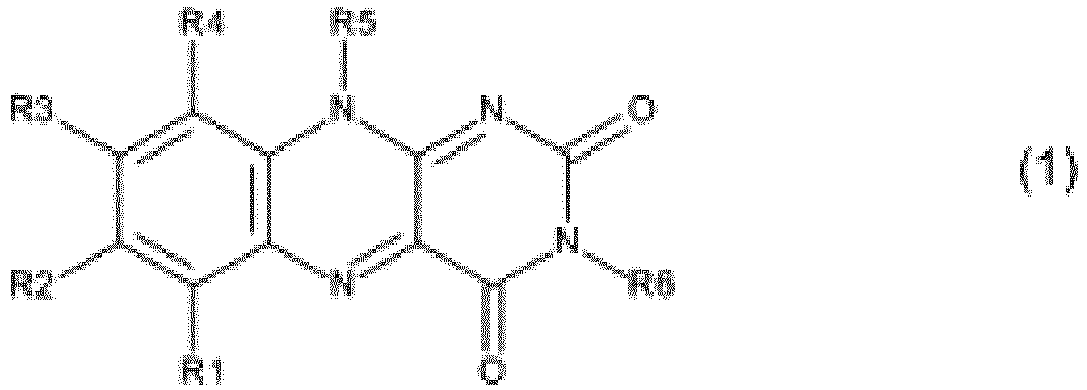 A) seul un radical R1, R2, R3 ou R4 est un radical organique de Formule générale -(C(D)(E))h-X ou -(C(D)(E))k-aryl-(C(D)(E))l-X, h représentant un nombre entier de 1 à 20 et k, l représentant chacun indépendamment de l'autre un nombre entier de 0 à 6, D et E représentant chacun indépendamment de l'autre un hydrogène, un halogène, un hydroxyle, O-R(VIII), R(VIII) représentant un méthyle, un éthyle, un n-propyle, un n-butyle, un phényle ou un benzyle, O-C(=O)-R(IX), R(IX) représentant un hydrogène, un méthyle, un éthyle, un n-propyle, un n-butyle, un phényle ou un benzyle, ou un thiol, et X représentant un radical organique n'ayant qu'un atome d'azote quaternaire et aryle représentant un radical aromatique substitué ou non substitué ou un radical hétéroaromatique substitué ou non substitué ne contenant aucun atome d'azote, et
dans lequel les radicaux R1, R2, R3 ou R4 qui ne sont pas -(C(D)(E))h-X ou -(C(D)(E))k-aryl-(C(D)(E))l-X, peuvent chacun indépendamment des autres être identiques ou différents, et représentent chacun un hydrogène, un halogène, un hydroxyle, un thiol, un nitro, un carboxylate, un aldéhyde ayant 1 à 20 atomes de carbone, une cétone ayant 2 à 20 atomes de carbone, un O-alkyle ayant 1 à 20 atomes de carbone, un S-alkyle ayant 1 à 20 atomes de carbone, un O-alcényle ayant 2 à 20 atomes de carbone, un S-alcényle ayant 2 à 20 atomes de carbone, un O-aryle ayant 5 à 20 atomes de carbone, un S-aryle ayant 5 à 20 atomes de carbone, un éther ayant 2 à 20 atomes de carbone, un thioéther ayant 2 à 20 atomes de carbone, un ester d'acide carboxylique ayant 1 à 20 atomes de carbone, un carboxamide ayant 1 à 20 atomes de carbone, un thioester ayant 1 à 20 atomes de carbone, un alkyle ayant 1 à 20 atomes de carbone, un alcényle ayant 2 à 20 atomes de carbone, un cycloalkyle ayant 3 à 20 atomes de carbone, un cycloalcényle ayant 3 à 20 atomes de carbone, un aryle ayant 5 à 20 atomes de carbone ou un hétéroaryle ayant 4 à 20 atomes de carbone, qui ne contient pas d'atomes N, et chacun des radicaux R5 ou R6 étant, chacun indépendamment de l'autre, identique ou différent, et représentant un hydrogène, un alkyle ayant 1 à 20 atomes de carbone, un alcényle ayant 1 à 20 atomes de carbone, un éther ayant 2 à 20 atomes de carbone, un thioéther ayant 2 à 20 atomes de carbone, un cycloalkyle ayant 3 à 20 atomes de carbone, un cycloalcényle ayant 3 à 20 atomes de carbone, un aryle ayant 5 à 20 atomes de carbone ou un hétéroaryle ayant 4 à 20 atomes de carbone, qui ne contient pas d'atomes N, ou le radical R5 représentant un radical polyol acyclique de Formule générale -CH2(CH(OH))gCH2OH ou un éther, un ester ou un acétal de celui-ci, g représentant un nombre entier de 1 à 10, de préférence de 1 à 4, et R6 représentant un hydrogène, un alkyle ayant 1 à 20 atomes de carbone, un alcényle ayant 1 à 20 atomes de carbone, un éther ayant 2 à 20 atomes de carbone, un thioéther ayant 2 à 20 atomes de carbone, un cycloalkyle ayant 3 à 20 atomes de carbone, un cycloalcényle ayant 3 à 20 atomes de carbone, un aryle ayant 5 à 20 atomes de carbone ou un hétéroaryle ayant 4 à 20 atomes de carbone, qui ne contient pas d'atomes N,
ou dans lequelB) seul un radical R5 ou R6 représente un radical organique de Formule générale -(C(D)(E))h-X ou -(C(D)(E))k-aryl-(C(D)(E))l-X, dans lequel h représente un nombre entier de 1 à 20 et k, l représentent chacun indépendamment de l'autre un nombre entier de 0 à 6, D et E représentent chacun indépendamment de l'autre un hydrogène, un halogène, un hydroxyle, O-R(VIII), dans lequel R(VIII) représente un méthyle, un éthyle, un n-propyle, un n-butyle, un phényle ou un benzyle, O-C(=O)-R(IX), dans lequel R(IX) représente un hydrogène, un méthyle, un éthyle, un n-propyle, un n-butyle, un phényle ou un benzyle, ou un thiol, et X représente un radical organique ayant un seul atome d'azote quaternaire, et aryle représentant un radical aromatique substitué ou non substitué ou un radical hétéroaromatique substitué ou non substitué, qui ne contient aucun atome d'azote,etdans lequel le radical R5 ou R6 qui n'est pas -(C(D)(E))h-X ou -(C(D)(E))k-aryl-(C(D)(E))l-X, représente un hydrogène, un alkyle ayant 1 à 20 atomes de carbone, un alcényle ayant 2 à 20 atomes de carbone, un cycloalkyle ayant 3 à 20 atomes de carbone, un éther ayant 2 à 20 atomes de carbone, un thioéther ayant 2 à 20 atomes de carbone, un cycloalcényle ayant 3 à 20 atomes de carbone, un aryle ayant 5 à 20 atomes de carbone ou un hétéroaryle ayant 4 à 20 atomes de carbone, qui ne contient pas d'atomes N,
oudans lequel seul le radical R6 représente un radical organique de Formule générale -(C(D)(E))h-X ou -(C(D)(E))k-aryl-(C(D)(E))l-X, et le radical R5 représentant un radical polyol acyclique de Formule générale -CH2(CH(OH))gCH2OH ou un éther, un ester ou un acétal de celui-ci, g représentant un nombre entier de 1 à 10, de préférence de 1 à 4,
et dans lequel les radicaux R1 à R4 peuvent chacun indépendamment des autres être identiques ou différents, et représentant un hydrogène, un halogène, un hydroxyle, un thiol, un nitro, un carboxylate, un aldéhyde ayant 1 à 20 atomes de carbone, une cétone ayant 2 à 20 atomes de carbone, un O-alkyle ayant 1 à 20 atomes de carbone, un S-alkyle ayant 1 à 20 atomes de carbone, un O-alcényle ayant 2 à 20 atomes de carbone, un S-alcényle ayant 2 à 20 atomes de carbone, un O-aryle ayant 5 à 20 atomes de carbone, un S-aryle ayant 5 à 20 atomes de carbone, un éther ayant 2 à 20 atomes de carbone, un thioéther ayant 2 à 20 atomes de carbone, un ester d'acide carboxylique ayant 1 à 20 atomes de carbone, un carboxamide ayant 1 à 20 atomes de carbone, un thioester ayant 1 à 20 atomes de carbone, un alkyle ayant 1 à 20 atomes de carbone, un alcényle ayant 2 à 20 atomes de carbone, un cycloalkyle ayant 3 à 20 atomes de carbone, un cycloalcényle ayant 3 à 20 atomes de carbone, un aryle ayant 5 à 20 atomes de carbone ou un hétéroaryle ayant 4 à 20 atomes de carbone, qui ne contient pas d'atomes N. - Composé pour une utilisation selon la revendication 1, dans lequel les radicaux R1 et R4, qui peuvent chacun indépendamment de l'autre être identiques ou différents, représentent chacun un hydrogène ou un méthyle, et seul un radical R2, R3, R5 ou R6 représentant un radical organique de Formule générale - (C(D)(E))h-X ou -(C(D)(E))k-aryl-(C(D)(E))l-X.
- Composé pour une utilisation selon l'une des revendications 1 ou 2, X représentant un radical de Formule générale (2) :


ou représente un éther en C1 à C20, et le radical de Formule (4a) et le radical de Formule (5a) :

- Composé pour une utilisation selon l'une des revendications 1 à 3, le composé de Formule (1) étant dans le groupe constitué par les composés ayant les Formules (30) à (43) :


- Composition pharmaceutique comprenant au moins un composé de Formule (1)

dans lequelA) seul un radical R1, R2, R3 ou R4 est un radical organique de Formule générale -(C(D)(E))h-X ou -(C(D)(E))k-aryl-(C(D)(E))l-X, dans lequel h représente un nombre entier de 1 à 20 et k, l représentent chacun indépendamment de l'autre un nombre entier de 0 à 6, dans lequel D et E représente chacun indépendamment de l'autre un hydrogène, un halogène, un hydroxyle, O-R(VIII), dans lequel R(VIII) représente un méthyle, un éthyle, un n-propyle, un n-butyle, un phényle ou un benzyle, O-C(=O)-R(IX), dans lequel R(IX) représente un hydrogène, un méthyle, un éthyle, un n-propyle, un n-butyle, un phényle ou un benzyle, ou un thiol, et X représente un radical organique n'ayant qu'un atome d'azote quaternaire et aryle représentant un radical aromatique substitué ou non substitué ou un radical hétéroaromatique substitué ou non substitué ne contenant aucun atome d'azote, etdans lequel les radicaux R1, R2, R3 ou R4 qui ne sont pas -(C(D)(E))h-X ou -(C(D)(E))k-aryl-(C(D)(E))l-X, peuvent chacun indépendamment des autres être identiques ou différents, et représentant chacun un hydrogène, un halogène, un hydroxyle, un thiol, un nitro, un carboxylate, un aldéhyde ayant 1 à 20 atomes de carbone, une cétone ayant 2 à 20 atomes de carbone, un O-alkyle ayant 1 à 20 atomes de carbone, un S-alkyle ayant 1 à 20 atomes de carbone, un O-alcényle ayant 2 à 20 atomes de carbone, un S-alcényle ayant 2 à 20 atomes de carbone, un O-aryle ayant 5 à 20 atomes de carbone, un S-aryle ayant 5 à 20 atomes de carbone, un éther ayant 2 à 20 atomes de carbone, un thioéther ayant 2 à 20 atomes de carbone, un ester d'acide carboxylique ayant 1 à 20 atomes de carbone, un carboxamide ayant 1 à 20 atomes de carbone, un thioester ayant 1 à 20 atomes de carbone, un alkyle ayant 1 à 20 atomes de carbone, un alcényle ayant 2 à 20 atomes de carbone, un cycloalkyle ayant 3 à 20 atomes de carbone, un cycloalcényle ayant 3 à 20 atomes de carbone, un aryle ayant 5 à 20 atomes de carbone ou un hétéroaryle ayant 4 à 20 atomes de carbone, qui ne contient pas d'atomes N, et chacun des radicaux R5 ou R6 étant, chacun indépendamment de l'autre, identique ou différent, et représentant un hydrogène, un alkyle ayant 1 à 20 atomes de carbone, un alcényle ayant 1 à 20 atomes de carbone, un éther ayant 2 à 20 atomes de carbone, un thioéther ayant 2 à 20 atomes de carbone, un cycloalkyle ayant 3 à 20 atomes de carbone, un cycloalcényle ayant 3 à 20 atomes de carbone, un aryle ayant 5 à 20 atomes de carbone ou un hétéroaryle ayant 4 à 20 atomes de carbone, qui ne contient pas d'atomes N, ou le radical R5 représentant un radical polyol acyclique de Formule générale -CH2(CH(OH))gCH2OH ou un éther, un ester ou un acétal de celui-ci, g représentant un nombre entier de 1 à 10, de préférence de 1 à 4, et R6 représentant un hydrogène, un alkyle ayant 1 à 20 atomes de carbone, un alcényle ayant 1 à 20 atomes de carbone, un éther ayant 2 à 20 atomes de carbone, un thioéther ayant 2 à 20 atomes de carbone, un cycloalkyle ayant 3 à 20 atomes de carbone, un cycloalcényle ayant 3 à 20 atomes de carbone, un aryle ayant 5 à 20 atomes de carbone ou un hétéroaryle ayant 4 à 20 atomes de carbone, qui ne contient pas d'atomes N,
oudans lequel B) un seul radical R5 ou R6 représente un radical organique de Formule générale -(C(D)(E))h-X ou -(C(D)(E))k-aryl-(C(D)(E))l-X, dans lequel h représente un nombre entier de 1 à 20 et k, l représentent chacun indépendamment de l'autre un nombre entier de 0 à 6, D et E représentant chacun indépendamment de l'autre un hydrogène, un halogène, un hydroxyle, O-R(VIII), dans lequel R(VIII) représente un méthyle, un éthyle, un n-propyle, un n-butyle, un phényle ou un benzyle, O-C(=O)-R(IX), dans lequel R(IX) représente un hydrogène, un méthyle, un éthyle, un n-propyle, un n-butyle, un phényle ou un benzyle, ou un thiol, et X représente un radical organique ayant un seul atome d'azote quaternaire, et aryle représentant un radical aromatique substitué ou non substitué ou un radical hétéroaromatique substitué ou non substitué, qui ne contient aucun atome d'azote, etdans lequel le radical R5 ou R6 qui n'est pas -(C(D)(E))h-X ou -(C(D)(E))k-aryl-(C(D)(E))l-X, représente un hydrogène, un alkyle ayant 1 à 20 atomes de carbone, un alcényle ayant 2 à 20 atomes de carbone, un cycloalkyle ayant 3 à 20 atomes de carbone, un éther ayant 2 à 20 atomes de carbone, un thioéther ayant 2 à 20 atomes de carbone, un cycloalcényle ayant 3 à 20 atomes de carbone, un aryle ayant 5 à 20 atomes de carbone ou un hétéroaryle ayant 4 à 20 atomes de carbone, qui ne contient pas d'atomes N,oudans lequel seul le radical R6 représente un radical organique de Formule générale -(C(D)(E))h-X ou -(C(D)(E))k-aryl-(C(D)(E))l-X, et le radical R5 représentant un radical polyol acyclique de Formule générale -CH2(CH(OH))gCH2OH ou un éther, un ester ou un acétal de celui-ci, g représentant un nombre entier de 1 à 10, de préférence de 1 à 4,et dans lequel les radicaux R1 à R4 peuvent chacun indépendamment des autres être identiques ou différents, et représentant un hydrogène, un halogène, un hydroxyle, un thiol, un nitro, un carboxylate, un aldéhyde ayant 1 à 20 atomes de carbone, une cétone ayant 2 à 20 atomes de carbone, un O-alkyle ayant 1 à 20 atomes de carbone, un S-alkyle ayant 1 à 20 atomes de carbone, un O-alcényle ayant 2 à 20 atomes de carbone, un S-alcényle ayant 2 à 20 atomes de carbone, un O-aryle ayant 5 à 20 atomes de carbone, un S-aryle ayant 5 à 20 atomes de carbone, un éther ayant 2 à 20 atomes de carbone, un thioéther ayant 2 à 20 atomes de carbone, un ester d'acide carboxylique ayant 1 à 20 atomes de carbone, un carboxamide ayant 1 à 20 atomes de carbone, un thioester ayant 1 à 20 atomes de carbone, un alkyle ayant 1 à 20 atomes de carbone, un alcényle ayant 2 à 20 atomes de carbone, un cycloalkyle ayant 3 à 20 atomes de carbone, un cycloalcényle ayant 3 à 20 atomes de carbone, un aryle ayant 5 à 20 atomes de carbone ou un hétéroaryle ayant 4 à 20 atomes de carbone, qui ne contient pas d'atomes N. - Composition pharmaceutique pour une utilisation selon la revendication 5, les radicaux R1 et R4, qui peuvent chacun indépendamment de l'autre être identiques ou différents, représentent un hydrogène ou un méthyle, et seul un radical R2, R3, R5 ou R6 représentant un radical organique de Formule générale -(C(D)(E))h-X ou -(C(D)(E))k-aryl-(C(D)(E))l-X.
- Composition pharmaceutique pour une utilisation selon l'une des revendications 5 ou 6, X représentant un radical de Formule générale (2) :
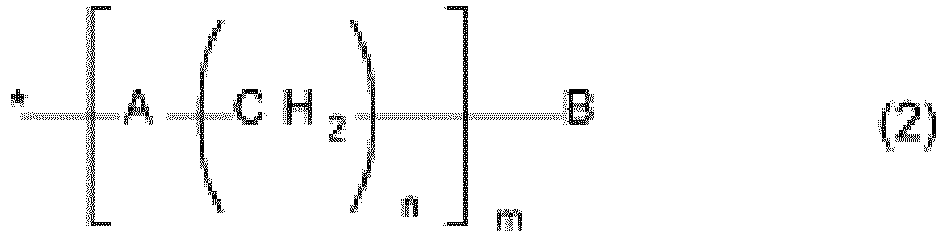
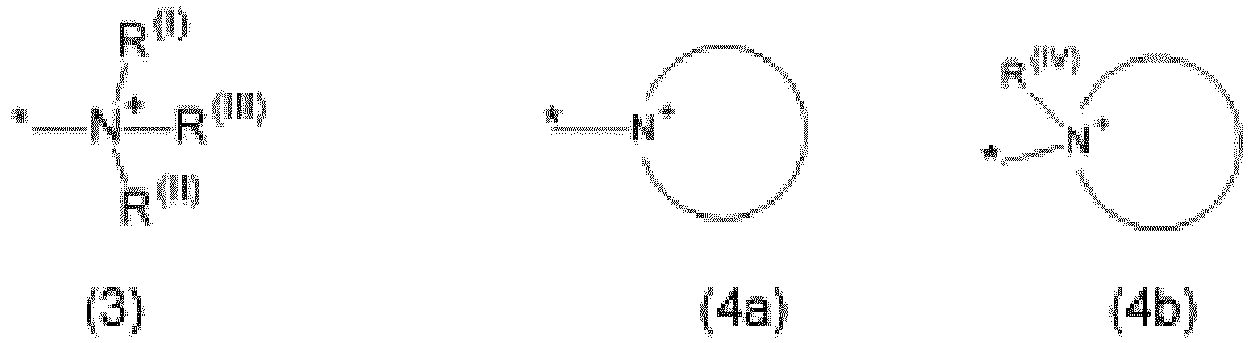

ou représente un éther en C1 à C20, et le radical de Formule (4a) et le radical de Formule (5a) :
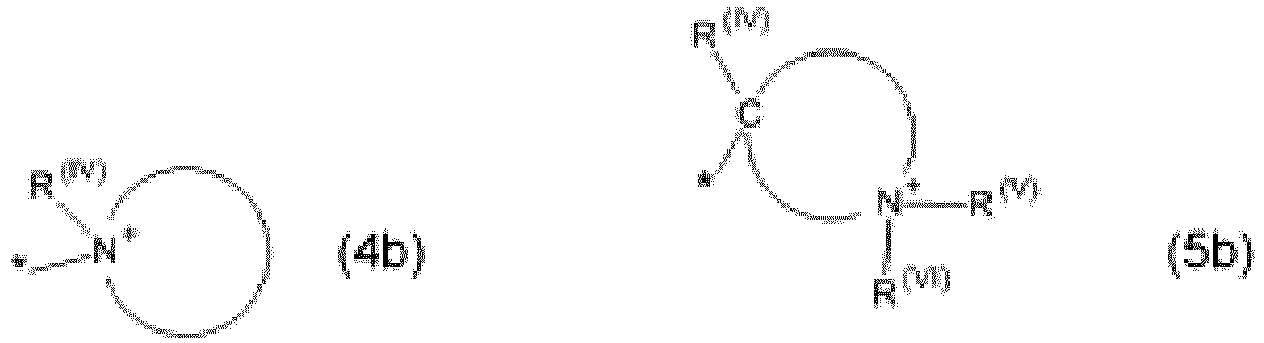
- Composition pharmaceutique pour une utilisation selon l'une des revendications 5 à 7, le composé de Formule (1) étant dans le groupe constitué par les composés ayant les Formules (30) à (43) :


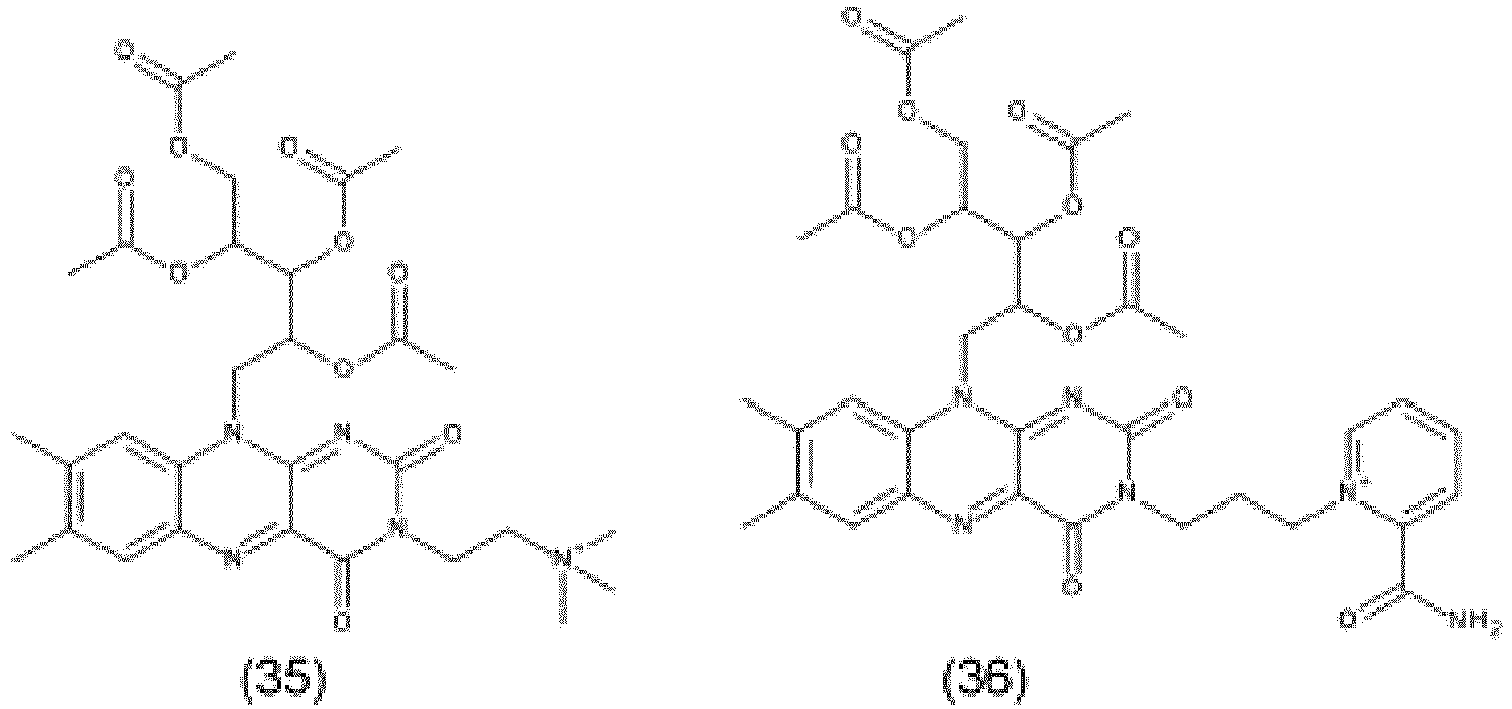


- Composition pharmaceutique pour une utilisation selon l'une des revendications 5 à 8, l'adjuvant physiologiquement acceptable étant choisi dans le groupe constitué par les charges et les diluants, les solvants, les émulsifiants, les lubrifiants, les correcteurs de goût, les colorants et/ou les substances tampons, liquides ou solides, pharmaceutiquement usuels.
- Composé pour une utilisation selon l'une des revendications 1 à 4 ou composition pharmaceutique pour une utilisation selon les revendications 5 à 9, les microorganismes étant choisis dans le groupe constitué par les virus, les archées, les bactéries, les spores bactériennes, les champignons, les spores fongiques, les protozoaires, les algues et les parasites transmissibles par le sang.
- Composé pour une utilisation selon l'une des revendications 1 à 4 ou 10, ou composition pharmaceutique pour une utilisation selon l'une des revendications 5 à 10, pour la désinfection et/ou la décolonisation de surfaces corporelles, de préférence la peau ou une muqueuse, d'un mammifère, de préférence l'homme.
- Composé pour une utilisation selon l'une des revendications 1 à 4, 10 ou 11 ou composition pharmaceutique pour une utilisation selon l'une des revendications 5 à 11, pour administration topique, de préférence nasale, orale, anale, vaginale ou dermique.
- Composé pour une utilisation selon l'une des revendications 1 à 4, 10, 11 ou 12, ou composition pharmaceutique pour une utilisation selon l'une des revendications 5 à 12 pour la prophylaxie et/ou le traitement d'une maladie cutanée infectieuse, qui est de préférence choisie dans le groupe constitué par le syndrome de la peau ébouillantée staphylococcique, l'impetigo, un abcès cutané, un furoncle, une escarboucle, des flegmons, une cellulite, une lymphadénite aiguë, des kystes pilonidaux, une pyodermie, une dermatite purulente, une dermatite septique, une dermatite suppurante, un érythrasme, un érysipèle, un acné vulgaire ou une infection fongique.
- Composé pour une utilisation selon l'une des revendications 1 à 4, 10, 11 ou 12 ou composition pharmaceutique pour une utilisation selon l'une des revendications 5 à 12, pour la désinfection et/ou la réduction du nombre de germes dans des plaies infectées.
- Composé pour une utilisation selon l'une des revendications 1 à 4, 10, 11 ou 12 ou composition pharmaceutique pour une utilisation selon l'une des revendications 5 à 12, pour la prophylaxie et/ou le traitement de maladies infectieuses de l'oreille, des voies aériennes supérieures, de la cavité buccale, du pharynx, du larynx, des voies aériennes inférieures et/ou de l'œsophage.
- Composé pour une utilisation selon l'une des revendications 1 à 4, 10, 11 ou 12 ou composition pharmaceutique pour une utilisation selon l'une des revendications 5 à 12, pour le traitement et/ou la prophylaxie d'une infection du tissu dentaire, de préférence une plaque, une carie ou une pulpite, et/ou d'une maladie infectieuse du parodonte, de préférence une gingivite, une paradontite, une endodontite ou une périimplantite.
Applications Claiming Priority (3)
| Application Number | Priority Date | Filing Date | Title |
|---|---|---|---|
| DE102011105653A DE102011105653A1 (de) | 2011-06-22 | 2011-06-22 | 10H-Benzo[g]pteridin-2,4-dion-Derivate, Verfahren zur Herstellung und Verwendung derselben |
| PCT/EP2012/062173 WO2012175730A1 (fr) | 2011-06-22 | 2012-06-22 | Dérivés de 10h-benzo[g]ptéridine-2,4-dione, procédé de production et d'utilisation desdits dérivés |
| EP12735235.9A EP2723743B1 (fr) | 2011-06-22 | 2012-06-22 | Dérivés de 10h-benzo[g]ptéridine-2,4-dione, procédé de production et d'utilisation desdits dérivés |
Related Parent Applications (1)
| Application Number | Title | Priority Date | Filing Date |
|---|---|---|---|
| EP12735235.9A Division EP2723743B1 (fr) | 2011-06-22 | 2012-06-22 | Dérivés de 10h-benzo[g]ptéridine-2,4-dione, procédé de production et d'utilisation desdits dérivés |
Publications (2)
| Publication Number | Publication Date |
|---|---|
| EP3586632A1 EP3586632A1 (fr) | 2020-01-01 |
| EP3586632B1 true EP3586632B1 (fr) | 2022-09-28 |
Family
ID=46513718
Family Applications (2)
| Application Number | Title | Priority Date | Filing Date |
|---|---|---|---|
| EP19191309.4A Active EP3586632B1 (fr) | 2011-06-22 | 2012-06-22 | Dérivés de 10h-benzo[g]pteridin-2,4-dion, leur procédé de production et d'utilisation |
| EP12735235.9A Active EP2723743B1 (fr) | 2011-06-22 | 2012-06-22 | Dérivés de 10h-benzo[g]ptéridine-2,4-dione, procédé de production et d'utilisation desdits dérivés |
Family Applications After (1)
| Application Number | Title | Priority Date | Filing Date |
|---|---|---|---|
| EP12735235.9A Active EP2723743B1 (fr) | 2011-06-22 | 2012-06-22 | Dérivés de 10h-benzo[g]ptéridine-2,4-dione, procédé de production et d'utilisation desdits dérivés |
Country Status (6)
| Country | Link |
|---|---|
| US (1) | US9185913B2 (fr) |
| EP (2) | EP3586632B1 (fr) |
| DE (1) | DE102011105653A1 (fr) |
| ES (2) | ES2934463T3 (fr) |
| PL (2) | PL3586632T3 (fr) |
| WO (1) | WO2012175730A1 (fr) |
Families Citing this family (7)
| Publication number | Priority date | Publication date | Assignee | Title |
|---|---|---|---|---|
| DE102011105657A1 (de) * | 2011-06-22 | 2012-12-27 | TriOpto Tec GmbH | 10H-Benzo[g]pteridin-2,4-dion-Derivate, Verfahren zur Herstellung und Verwendung derselben |
| ES2895851T3 (es) | 2016-04-01 | 2022-02-22 | Trioptotec Gmbh | Dispersión de fotosensibilizador y uso de la misma |
| WO2018033200A1 (fr) * | 2016-08-16 | 2018-02-22 | Toyota Motor Europe | Liquides ioniques fluorés à forte solubilité dans l'oxygène pour batteries métal-air |
| EP3725334A1 (fr) * | 2019-04-16 | 2020-10-21 | HUBL GmbH Edelstahltechnik | Dispositif et procédé de réduction du nombre de germes |
| EP4126558A1 (fr) | 2020-04-03 | 2023-02-08 | Giesecke+Devrient Currency Technology GmbH | Substrat de document de valeur et procédé de désinfection |
| DE102023105388B3 (de) | 2023-03-06 | 2024-05-29 | Multivac Sepp Haggenmüller Se & Co. Kg | Herstellen einer Verpackung aus einer photodynamischen Materialbahn |
| WO2024246147A1 (fr) | 2023-06-02 | 2024-12-05 | Wella Germany Gmbh | Agent de blanchiment comprenant une phénalénone |
Family Cites Families (6)
| Publication number | Priority date | Publication date | Assignee | Title |
|---|---|---|---|---|
| GB1394672A (en) * | 1971-05-21 | 1975-05-21 | Ici Ltd | Radiation sensitive materials |
| US6258577B1 (en) | 1998-07-21 | 2001-07-10 | Gambro, Inc. | Method and apparatus for inactivation of biological contaminants using endogenous alloxazine or isoalloxazine photosensitizers |
| US20120077781A1 (en) | 2008-08-11 | 2012-03-29 | Robert Gadwood | Flavin derivatives |
| FR2944633A1 (fr) * | 2009-04-15 | 2010-10-22 | Alcatel Lucent | Procede d'assistance au developpement ou a l'utilisation d'un systeme complexe. |
| CN102471283A (zh) | 2009-06-30 | 2012-05-23 | 佰欧莱利克斯公司 | 黄素衍生物 |
| DE102011105657A1 (de) * | 2011-06-22 | 2012-12-27 | TriOpto Tec GmbH | 10H-Benzo[g]pteridin-2,4-dion-Derivate, Verfahren zur Herstellung und Verwendung derselben |
-
2011
- 2011-06-22 DE DE102011105653A patent/DE102011105653A1/de not_active Ceased
-
2012
- 2012-06-22 PL PL19191309.4T patent/PL3586632T3/pl unknown
- 2012-06-22 US US14/127,472 patent/US9185913B2/en active Active
- 2012-06-22 EP EP19191309.4A patent/EP3586632B1/fr active Active
- 2012-06-22 WO PCT/EP2012/062173 patent/WO2012175730A1/fr not_active Ceased
- 2012-06-22 ES ES19191309T patent/ES2934463T3/es active Active
- 2012-06-22 ES ES12735235T patent/ES2755026T3/es active Active
- 2012-06-22 PL PL12735235T patent/PL2723743T3/pl unknown
- 2012-06-22 EP EP12735235.9A patent/EP2723743B1/fr active Active
Also Published As
| Publication number | Publication date |
|---|---|
| US20140200220A1 (en) | 2014-07-17 |
| ES2755026T3 (es) | 2020-04-21 |
| ES2934463T3 (es) | 2023-02-22 |
| DE102011105653A1 (de) | 2012-12-27 |
| US9185913B2 (en) | 2015-11-17 |
| PL3586632T3 (pl) | 2023-01-30 |
| EP3586632A1 (fr) | 2020-01-01 |
| PL2723743T3 (pl) | 2020-03-31 |
| EP2723743B1 (fr) | 2019-08-14 |
| EP2723743A1 (fr) | 2014-04-30 |
| WO2012175730A1 (fr) | 2012-12-27 |
Similar Documents
| Publication | Publication Date | Title |
|---|---|---|
| EP3492104B1 (fr) | Utilisation de dérivés de 10h-benzo[g]pteridine-2,4-dione | |
| EP2678035B1 (fr) | Dérivés de phénalène-1-one, leur procédé de production et leur utilisation | |
| EP3586632B1 (fr) | Dérivés de 10h-benzo[g]pteridin-2,4-dion, leur procédé de production et d'utilisation | |
| EP3225112B1 (fr) | Dispersion de photosensibilisant et son utilisation | |
| DE60218454T2 (de) | Biologisch aktive derivate des methylenblaus | |
| DE60317711T2 (de) | Kationische porphyrin-derivate als antibakterielle mittel | |
| EP3135110B1 (fr) | Derives de 1,7-diaryl-1,6-heptadiene -3,5-dione et son procede de fabrication et utilisation | |
| EP2723742B1 (fr) | Dérivés de 10h-benzo[g]ptéridine-2,4-dione, procédé de production et d'utilisation desdits dérivés | |
| DE3887662T2 (de) | N-Alkylamide von D,L- und L(-)-Carnitin mit bakterizider Wirkung, Herstellungsverfahren und die sie enthaltenden pharmazeutischen und kosmetischen Mittel. | |
| KR20140114419A (ko) | 피부 손상을 예방 또는 복구하는 작용제 | |
| DE3339196A1 (de) | Antimikrobielles konservierungs- und desinfektionsmittel | |
| HK1244629B (en) | Photosensitiser dispersion and use of the same | |
| DE102007035323A1 (de) | Neue Ketoconazol-Derivate sowie deren Herstellung und Verwendung als antimikrobielle und antiinflammatorische Wirkstoffe | |
| DE102010056443A1 (de) | Chlorin-Derivate und deren Verwendung | |
| SE175407C1 (fr) |
Legal Events
| Date | Code | Title | Description |
|---|---|---|---|
| PUAI | Public reference made under article 153(3) epc to a published international application that has entered the european phase |
Free format text: ORIGINAL CODE: 0009012 |
|
| STAA | Information on the status of an ep patent application or granted ep patent |
Free format text: STATUS: REQUEST FOR EXAMINATION WAS MADE |
|
| 17P | Request for examination filed |
Effective date: 20190812 |
|
| AC | Divisional application: reference to earlier application |
Ref document number: 2723743 Country of ref document: EP Kind code of ref document: P |
|
| AK | Designated contracting states |
Kind code of ref document: A1 Designated state(s): AL AT BE BG CH CY CZ DE DK EE ES FI FR GB GR HR HU IE IS IT LI LT LU LV MC MK MT NL NO PL PT RO RS SE SI SK SM TR |
|
| RIN1 | Information on inventor provided before grant (corrected) |
Inventor name: SPAETH, ANDREAS Inventor name: MAISCH, TIM |
|
| GRAP | Despatch of communication of intention to grant a patent |
Free format text: ORIGINAL CODE: EPIDOSNIGR1 |
|
| STAA | Information on the status of an ep patent application or granted ep patent |
Free format text: STATUS: GRANT OF PATENT IS INTENDED |
|
| INTG | Intention to grant announced |
Effective date: 20210412 |
|
| GRAJ | Information related to disapproval of communication of intention to grant by the applicant or resumption of examination proceedings by the epo deleted |
Free format text: ORIGINAL CODE: EPIDOSDIGR1 |
|
| STAA | Information on the status of an ep patent application or granted ep patent |
Free format text: STATUS: REQUEST FOR EXAMINATION WAS MADE |
|
| INTC | Intention to grant announced (deleted) | ||
| GRAS | Grant fee paid |
Free format text: ORIGINAL CODE: EPIDOSNIGR3 |
|
| STAA | Information on the status of an ep patent application or granted ep patent |
Free format text: STATUS: GRANT OF PATENT IS INTENDED |
|
| GRAP | Despatch of communication of intention to grant a patent |
Free format text: ORIGINAL CODE: EPIDOSNIGR1 |
|
| INTG | Intention to grant announced |
Effective date: 20220119 |
|
| GRAA | (expected) grant |
Free format text: ORIGINAL CODE: 0009210 |
|
| STAA | Information on the status of an ep patent application or granted ep patent |
Free format text: STATUS: THE PATENT HAS BEEN GRANTED |
|
| AC | Divisional application: reference to earlier application |
Ref document number: 2723743 Country of ref document: EP Kind code of ref document: P |
|
| AK | Designated contracting states |
Kind code of ref document: B1 Designated state(s): AL AT BE BG CH CY CZ DE DK EE ES FI FR GB GR HR HU IE IS IT LI LT LU LV MC MK MT NL NO PL PT RO RS SE SI SK SM TR |
|
| REG | Reference to a national code |
Ref country code: GB Ref legal event code: FG4D Free format text: NOT ENGLISH |
|
| REG | Reference to a national code |
Ref country code: CH Ref legal event code: EP |
|
| REG | Reference to a national code |
Ref country code: DE Ref legal event code: R096 Ref document number: 502012017097 Country of ref document: DE |
|
| REG | Reference to a national code |
Ref country code: AT Ref legal event code: REF Ref document number: 1520643 Country of ref document: AT Kind code of ref document: T Effective date: 20221015 |
|
| REG | Reference to a national code |
Ref country code: IE Ref legal event code: FG4D Free format text: LANGUAGE OF EP DOCUMENT: GERMAN |
|
| REG | Reference to a national code |
Ref country code: NL Ref legal event code: FP |
|
| REG | Reference to a national code |
Ref country code: LT Ref legal event code: MG9D |
|
| REG | Reference to a national code |
Ref country code: SE Ref legal event code: TRGR |
|
| PG25 | Lapsed in a contracting state [announced via postgrant information from national office to epo] |
Ref country code: RS Free format text: LAPSE BECAUSE OF FAILURE TO SUBMIT A TRANSLATION OF THE DESCRIPTION OR TO PAY THE FEE WITHIN THE PRESCRIBED TIME-LIMIT Effective date: 20220928 Ref country code: NO Free format text: LAPSE BECAUSE OF FAILURE TO SUBMIT A TRANSLATION OF THE DESCRIPTION OR TO PAY THE FEE WITHIN THE PRESCRIBED TIME-LIMIT Effective date: 20221228 Ref country code: LV Free format text: LAPSE BECAUSE OF FAILURE TO SUBMIT A TRANSLATION OF THE DESCRIPTION OR TO PAY THE FEE WITHIN THE PRESCRIBED TIME-LIMIT Effective date: 20220928 Ref country code: LT Free format text: LAPSE BECAUSE OF FAILURE TO SUBMIT A TRANSLATION OF THE DESCRIPTION OR TO PAY THE FEE WITHIN THE PRESCRIBED TIME-LIMIT Effective date: 20220928 Ref country code: FI Free format text: LAPSE BECAUSE OF FAILURE TO SUBMIT A TRANSLATION OF THE DESCRIPTION OR TO PAY THE FEE WITHIN THE PRESCRIBED TIME-LIMIT Effective date: 20220928 |
|
| REG | Reference to a national code |
Ref country code: ES Ref legal event code: FG2A Ref document number: 2934463 Country of ref document: ES Kind code of ref document: T3 Effective date: 20230222 |
|
| PG25 | Lapsed in a contracting state [announced via postgrant information from national office to epo] |
Ref country code: HR Free format text: LAPSE BECAUSE OF FAILURE TO SUBMIT A TRANSLATION OF THE DESCRIPTION OR TO PAY THE FEE WITHIN THE PRESCRIBED TIME-LIMIT Effective date: 20220928 Ref country code: GR Free format text: LAPSE BECAUSE OF FAILURE TO SUBMIT A TRANSLATION OF THE DESCRIPTION OR TO PAY THE FEE WITHIN THE PRESCRIBED TIME-LIMIT Effective date: 20221229 |
|
| PG25 | Lapsed in a contracting state [announced via postgrant information from national office to epo] |
Ref country code: SM Free format text: LAPSE BECAUSE OF FAILURE TO SUBMIT A TRANSLATION OF THE DESCRIPTION OR TO PAY THE FEE WITHIN THE PRESCRIBED TIME-LIMIT Effective date: 20220928 Ref country code: RO Free format text: LAPSE BECAUSE OF FAILURE TO SUBMIT A TRANSLATION OF THE DESCRIPTION OR TO PAY THE FEE WITHIN THE PRESCRIBED TIME-LIMIT Effective date: 20220928 Ref country code: PT Free format text: LAPSE BECAUSE OF FAILURE TO SUBMIT A TRANSLATION OF THE DESCRIPTION OR TO PAY THE FEE WITHIN THE PRESCRIBED TIME-LIMIT Effective date: 20230130 Ref country code: CZ Free format text: LAPSE BECAUSE OF FAILURE TO SUBMIT A TRANSLATION OF THE DESCRIPTION OR TO PAY THE FEE WITHIN THE PRESCRIBED TIME-LIMIT Effective date: 20220928 |
|
| PG25 | Lapsed in a contracting state [announced via postgrant information from national office to epo] |
Ref country code: SK Free format text: LAPSE BECAUSE OF FAILURE TO SUBMIT A TRANSLATION OF THE DESCRIPTION OR TO PAY THE FEE WITHIN THE PRESCRIBED TIME-LIMIT Effective date: 20220928 Ref country code: IS Free format text: LAPSE BECAUSE OF FAILURE TO SUBMIT A TRANSLATION OF THE DESCRIPTION OR TO PAY THE FEE WITHIN THE PRESCRIBED TIME-LIMIT Effective date: 20230128 Ref country code: EE Free format text: LAPSE BECAUSE OF FAILURE TO SUBMIT A TRANSLATION OF THE DESCRIPTION OR TO PAY THE FEE WITHIN THE PRESCRIBED TIME-LIMIT Effective date: 20220928 |
|
| P01 | Opt-out of the competence of the unified patent court (upc) registered |
Effective date: 20230519 |
|
| REG | Reference to a national code |
Ref country code: DE Ref legal event code: R097 Ref document number: 502012017097 Country of ref document: DE |
|
| PG25 | Lapsed in a contracting state [announced via postgrant information from national office to epo] |
Ref country code: AL Free format text: LAPSE BECAUSE OF FAILURE TO SUBMIT A TRANSLATION OF THE DESCRIPTION OR TO PAY THE FEE WITHIN THE PRESCRIBED TIME-LIMIT Effective date: 20220928 |
|
| PG25 | Lapsed in a contracting state [announced via postgrant information from national office to epo] |
Ref country code: DK Free format text: LAPSE BECAUSE OF FAILURE TO SUBMIT A TRANSLATION OF THE DESCRIPTION OR TO PAY THE FEE WITHIN THE PRESCRIBED TIME-LIMIT Effective date: 20220928 |
|
| PGFP | Annual fee paid to national office [announced via postgrant information from national office to epo] |
Ref country code: NL Payment date: 20230620 Year of fee payment: 12 |
|
| PLBE | No opposition filed within time limit |
Free format text: ORIGINAL CODE: 0009261 |
|
| STAA | Information on the status of an ep patent application or granted ep patent |
Free format text: STATUS: NO OPPOSITION FILED WITHIN TIME LIMIT |
|
| PGFP | Annual fee paid to national office [announced via postgrant information from national office to epo] |
Ref country code: SE Payment date: 20230622 Year of fee payment: 12 |
|
| 26N | No opposition filed |
Effective date: 20230629 |
|
| PG25 | Lapsed in a contracting state [announced via postgrant information from national office to epo] |
Ref country code: SI Free format text: LAPSE BECAUSE OF FAILURE TO SUBMIT A TRANSLATION OF THE DESCRIPTION OR TO PAY THE FEE WITHIN THE PRESCRIBED TIME-LIMIT Effective date: 20220928 |
|
| PG25 | Lapsed in a contracting state [announced via postgrant information from national office to epo] |
Ref country code: MC Free format text: LAPSE BECAUSE OF FAILURE TO SUBMIT A TRANSLATION OF THE DESCRIPTION OR TO PAY THE FEE WITHIN THE PRESCRIBED TIME-LIMIT Effective date: 20220928 |
|
| PG25 | Lapsed in a contracting state [announced via postgrant information from national office to epo] |
Ref country code: MC Free format text: LAPSE BECAUSE OF FAILURE TO SUBMIT A TRANSLATION OF THE DESCRIPTION OR TO PAY THE FEE WITHIN THE PRESCRIBED TIME-LIMIT Effective date: 20220928 |
|
| REG | Reference to a national code |
Ref country code: BE Ref legal event code: MM Effective date: 20230630 |
|
| PG25 | Lapsed in a contracting state [announced via postgrant information from national office to epo] |
Ref country code: LU Free format text: LAPSE BECAUSE OF NON-PAYMENT OF DUE FEES Effective date: 20230622 |
|
| PG25 | Lapsed in a contracting state [announced via postgrant information from national office to epo] |
Ref country code: LU Free format text: LAPSE BECAUSE OF NON-PAYMENT OF DUE FEES Effective date: 20230622 |
|
| REG | Reference to a national code |
Ref country code: DE Ref legal event code: R084 Ref document number: 502012017097 Country of ref document: DE |
|
| PG25 | Lapsed in a contracting state [announced via postgrant information from national office to epo] |
Ref country code: BE Free format text: LAPSE BECAUSE OF NON-PAYMENT OF DUE FEES Effective date: 20230630 |
|
| PGFP | Annual fee paid to national office [announced via postgrant information from national office to epo] |
Ref country code: IE Payment date: 20240617 Year of fee payment: 13 |
|
| PGFP | Annual fee paid to national office [announced via postgrant information from national office to epo] |
Ref country code: GB Payment date: 20240620 Year of fee payment: 13 |
|
| PGFP | Annual fee paid to national office [announced via postgrant information from national office to epo] |
Ref country code: DE Payment date: 20240626 Year of fee payment: 13 |
|
| PGFP | Annual fee paid to national office [announced via postgrant information from national office to epo] |
Ref country code: AT Payment date: 20240617 Year of fee payment: 13 |
|
| PGFP | Annual fee paid to national office [announced via postgrant information from national office to epo] |
Ref country code: FR Payment date: 20240621 Year of fee payment: 13 |
|
| PGFP | Annual fee paid to national office [announced via postgrant information from national office to epo] |
Ref country code: PL Payment date: 20240524 Year of fee payment: 13 |
|
| PGFP | Annual fee paid to national office [announced via postgrant information from national office to epo] |
Ref country code: IT Payment date: 20240628 Year of fee payment: 13 |
|
| PGFP | Annual fee paid to national office [announced via postgrant information from national office to epo] |
Ref country code: ES Payment date: 20240718 Year of fee payment: 13 Ref country code: CH Payment date: 20240701 Year of fee payment: 13 |
|
| PG25 | Lapsed in a contracting state [announced via postgrant information from national office to epo] |
Ref country code: BG Free format text: LAPSE BECAUSE OF FAILURE TO SUBMIT A TRANSLATION OF THE DESCRIPTION OR TO PAY THE FEE WITHIN THE PRESCRIBED TIME-LIMIT Effective date: 20220928 |
|
| PG25 | Lapsed in a contracting state [announced via postgrant information from national office to epo] |
Ref country code: BG Free format text: LAPSE BECAUSE OF FAILURE TO SUBMIT A TRANSLATION OF THE DESCRIPTION OR TO PAY THE FEE WITHIN THE PRESCRIBED TIME-LIMIT Effective date: 20220928 |
|
| REG | Reference to a national code |
Ref country code: SE Ref legal event code: EUG |
|
| REG | Reference to a national code |
Ref country code: NL Ref legal event code: MM Effective date: 20240701 |
|
| PG25 | Lapsed in a contracting state [announced via postgrant information from national office to epo] |
Ref country code: NL Free format text: LAPSE BECAUSE OF NON-PAYMENT OF DUE FEES Effective date: 20240701 |
|
| PG25 | Lapsed in a contracting state [announced via postgrant information from national office to epo] |
Ref country code: NL Free format text: LAPSE BECAUSE OF NON-PAYMENT OF DUE FEES Effective date: 20240701 |
|
| PG25 | Lapsed in a contracting state [announced via postgrant information from national office to epo] |
Ref country code: CY Free format text: LAPSE BECAUSE OF FAILURE TO SUBMIT A TRANSLATION OF THE DESCRIPTION OR TO PAY THE FEE WITHIN THE PRESCRIBED TIME-LIMIT; INVALID AB INITIO Effective date: 20120622 |
|
| PG25 | Lapsed in a contracting state [announced via postgrant information from national office to epo] |
Ref country code: HU Free format text: LAPSE BECAUSE OF FAILURE TO SUBMIT A TRANSLATION OF THE DESCRIPTION OR TO PAY THE FEE WITHIN THE PRESCRIBED TIME-LIMIT; INVALID AB INITIO Effective date: 20120622 |
|
| PG25 | Lapsed in a contracting state [announced via postgrant information from national office to epo] |
Ref country code: SE Free format text: LAPSE BECAUSE OF NON-PAYMENT OF DUE FEES Effective date: 20240623 |
|
| PG25 | Lapsed in a contracting state [announced via postgrant information from national office to epo] |
Ref country code: TR Free format text: LAPSE BECAUSE OF FAILURE TO SUBMIT A TRANSLATION OF THE DESCRIPTION OR TO PAY THE FEE WITHIN THE PRESCRIBED TIME-LIMIT Effective date: 20220928 |
|
| REG | Reference to a national code |
Ref country code: DE Ref legal event code: R119 Ref document number: 502012017097 Country of ref document: DE |
|
| REG | Reference to a national code |
Ref country code: CH Ref legal event code: H13 Free format text: ST27 STATUS EVENT CODE: U-0-0-H10-H13 (AS PROVIDED BY THE NATIONAL OFFICE) Effective date: 20260127 |
|
| REG | Reference to a national code |
Ref country code: AT Ref legal event code: MM01 Ref document number: 1520643 Country of ref document: AT Kind code of ref document: T Effective date: 20250622 |
|
| GBPC | Gb: european patent ceased through non-payment of renewal fee |
Effective date: 20250622 |
|
| PG25 | Lapsed in a contracting state [announced via postgrant information from national office to epo] |
Ref country code: GB Free format text: LAPSE BECAUSE OF NON-PAYMENT OF DUE FEES Effective date: 20250622 |
|
| PG25 | Lapsed in a contracting state [announced via postgrant information from national office to epo] |
Ref country code: IE Free format text: LAPSE BECAUSE OF NON-PAYMENT OF DUE FEES Effective date: 20250622 Ref country code: DE Free format text: LAPSE BECAUSE OF NON-PAYMENT OF DUE FEES Effective date: 20260101 |
|
| PG25 | Lapsed in a contracting state [announced via postgrant information from national office to epo] |
Ref country code: AT Free format text: LAPSE BECAUSE OF NON-PAYMENT OF DUE FEES Effective date: 20250622 |
|
| PG25 | Lapsed in a contracting state [announced via postgrant information from national office to epo] |
Ref country code: IT Free format text: LAPSE BECAUSE OF NON-PAYMENT OF DUE FEES Effective date: 20250622 |
|
| PG25 | Lapsed in a contracting state [announced via postgrant information from national office to epo] |
Ref country code: FR Free format text: LAPSE BECAUSE OF NON-PAYMENT OF DUE FEES Effective date: 20250630 |
|
| PG25 | Lapsed in a contracting state [announced via postgrant information from national office to epo] |
Ref country code: CH Free format text: LAPSE BECAUSE OF NON-PAYMENT OF DUE FEES Effective date: 20250630 |