EP3592876B1 - Alliages d'aluminium de la série 5000 à haute performance - Google Patents
Alliages d'aluminium de la série 5000 à haute performance Download PDFInfo
- Publication number
- EP3592876B1 EP3592876B1 EP18763441.5A EP18763441A EP3592876B1 EP 3592876 B1 EP3592876 B1 EP 3592876B1 EP 18763441 A EP18763441 A EP 18763441A EP 3592876 B1 EP3592876 B1 EP 3592876B1
- Authority
- EP
- European Patent Office
- Prior art keywords
- weight
- alloy
- aluminum
- aluminum alloy
- sheet
- Prior art date
- Legal status (The legal status is an assumption and is not a legal conclusion. Google has not performed a legal analysis and makes no representation as to the accuracy of the status listed.)
- Active
Links
Images



Classifications
-
- C—CHEMISTRY; METALLURGY
- C22—METALLURGY; FERROUS OR NON-FERROUS ALLOYS; TREATMENT OF ALLOYS OR NON-FERROUS METALS
- C22F—CHANGING THE PHYSICAL STRUCTURE OF NON-FERROUS METALS AND NON-FERROUS ALLOYS
- C22F1/00—Changing the physical structure of non-ferrous metals or alloys by heat treatment or by hot or cold working
- C22F1/06—Changing the physical structure of non-ferrous metals or alloys by heat treatment or by hot or cold working of magnesium or alloys based thereon
-
- B—PERFORMING OPERATIONS; TRANSPORTING
- B65—CONVEYING; PACKING; STORING; HANDLING THIN OR FILAMENTARY MATERIAL
- B65D—CONTAINERS FOR STORAGE OR TRANSPORT OF ARTICLES OR MATERIALS, e.g. BAGS, BARRELS, BOTTLES, BOXES, CANS, CARTONS, CRATES, DRUMS, JARS, TANKS, HOPPERS, FORWARDING CONTAINERS; ACCESSORIES, CLOSURES, OR FITTINGS THEREFOR; PACKAGING ELEMENTS; PACKAGES
- B65D1/00—Rigid or semi-rigid containers having bodies formed in one piece, e.g. by casting metallic material, by moulding plastics, by blowing vitreous material, by throwing ceramic material, by moulding pulped fibrous material or by deep-drawing operations performed on sheet material
- B65D1/12—Cans, casks, barrels, or drums
-
- C—CHEMISTRY; METALLURGY
- C22—METALLURGY; FERROUS OR NON-FERROUS ALLOYS; TREATMENT OF ALLOYS OR NON-FERROUS METALS
- C22C—ALLOYS
- C22C21/00—Alloys based on aluminium
- C22C21/06—Alloys based on aluminium with magnesium as the next major constituent
-
- C—CHEMISTRY; METALLURGY
- C22—METALLURGY; FERROUS OR NON-FERROUS ALLOYS; TREATMENT OF ALLOYS OR NON-FERROUS METALS
- C22C—ALLOYS
- C22C21/00—Alloys based on aluminium
- C22C21/06—Alloys based on aluminium with magnesium as the next major constituent
- C22C21/08—Alloys based on aluminium with magnesium as the next major constituent with silicon
-
- C—CHEMISTRY; METALLURGY
- C22—METALLURGY; FERROUS OR NON-FERROUS ALLOYS; TREATMENT OF ALLOYS OR NON-FERROUS METALS
- C22F—CHANGING THE PHYSICAL STRUCTURE OF NON-FERROUS METALS AND NON-FERROUS ALLOYS
- C22F1/00—Changing the physical structure of non-ferrous metals or alloys by heat treatment or by hot or cold working
- C22F1/04—Changing the physical structure of non-ferrous metals or alloys by heat treatment or by hot or cold working of aluminium or alloys based thereon
- C22F1/047—Changing the physical structure of non-ferrous metals or alloys by heat treatment or by hot or cold working of aluminium or alloys based thereon of alloys with magnesium as the next major constituent
Definitions
- This application relates to a family of 5000-series aluminum alloys with high strength, good ductility, high creep resistance, high thermal stability and durability.
- the disclosed alloys are especially advantageous for, but not limited to, improving performance of beverage can lids and tabs. Additionally, the disclosed alloys are, for example, advantageous for improving performance of roofing and siding materials, chemical and food equipment, storage tanks, home appliances, sheet-metal work, marine parts, transportation parts, heavy duty cooking utensils, hydraulic tubes, fuel tanks, pressure vessels, heavy-duty truck and trailer bodies and assemblies, drilling rigs, missile components, and railroad cars.
- the production of aluminum cans largely to store beverages, is the single largest usage of aluminum in the world.
- the annual production is a staggering 320 billion cans per year, equating to 4.16 billion kilograms of aluminum.
- aluminum canning is likely the world's best example of recycling, as 75% of the aluminum used in cans is recycled.
- the production of aluminum cans is enormous, so an efficiency improvement comes with a giant multiplicative effect; a single gram of weight saved in the can may save over 200 thousand metric tons of aluminum globally per year. Together with this weight benefit, the energy consumption as well as the CO 2 emissions during transport are reduced - both key metrics in sustainability of the environment. Additionally, the lightness of aluminum cans helps save resources during filling, storage, transportation and scrap at the end of the product's life. Thus lightweighting the can has been a front-burner issue for decades.
- a common can design consists of two pieces: the can body is made of 3000-series aluminum, specifically AA3004, while the can lid and opener are made from 5000-series aluminum, specifically AA5182.
- the success behind the consistent and precise production of aluminum cans is based on the strong yet formable 3000- and 5000-series aluminum sheets.
- the can body is about 75% of the can's mass, while the smaller lid claims the rest, 25%.
- Two most obvious ways to design a lighter can are: (i) designing a smaller lid and (ii) reducing thickness of the can's wall and lid.
- a well-known means to enhance the strength and maintain the ductility of commercial aluminum alloys is the addition of small concentrations of Scandium (Sc).
- the strengthening originates from the creation during aging of Ll 2 - structured Al 3 Sc nano-precipitates ( ⁇ 5-10 nm in diam.) which are coherent with the aluminum matrix.
- the small volume fraction, nano-size and matrix coherency of these precipitates help the alloys maintain other properties, such as ductility and formability.
- Scandium is extremely costly (ten-fold more expensive than silver), severely prohibiting its usage in cost-sensitive applications such as food and drink packaging.
- the present invention relates to heat-treatable aluminum-magnesium-based (5000-series) alloys.
- the present invention provides an aluminum alloy comprising: aluminum, magnesium, manganese, silicon, zirconium, and an inoculant comprising either tin or strontium: wherein the alloy comprises: about 3.0 to about 6.2% by weight magnesium; about 0.01 to about 1.8% by weight manganese; about 0.01 to about 0.2% by weight silicon; about 0.2 to about 0.5% by weight zirconium; no more than about 0.5% by weight iron; either (a) about 0.01 to about 0.2% by weight tin; or (b) about 0.001 to about 0.1% by weight strontium; and aluminum as the remainder; wherein the alloy includes a nanoscale precipitate comprising Al 3 Zr, wherein the nanoscale precipitate has an average diameter of about 20 nm or less and has an L1 2 structure in an ⁇ -Al face centered cubic matrix, wherein the average number density of the nanoscale precipitate is about 20 21 m -3
- the plurality of L1 2 precipitates has an average diameter of about 10 nm or less or an average diameter of about 3 nm to about 7 nm.
- the alloy comprises about 4.5% by weight magnesium; about 0.35% by weight manganese; about 0.2% by weight silicon; about 0.3% by weight zirconium; about 0.1% by weight tin; and aluminum as the remainder.
- the alloy comprises about 4.5% by weight magnesium; about 0.25% by weight manganese; about 0.09% by weight silicon; about 0.2% by weight iron; about 0.3% by weight zirconium; about 0.1% by weight tin; and aluminum as the remainder.
- the alloy comprises about 4.5% by weight magnesium; about 0.35% by weight manganese; about 0.2% by weight silicon; about 0.3% by weight zirconium; about 0.003% by weight strontium; and aluminum as the remainder.
- the alloy possesses a recrystallization temperature of about 300°C.
- the alloy comprises no more than about 0.5% iron as an impurity.
- the aluminum alloy is in hard temper and possesses a yield strength of at least about 380 MPa, a tensile strength of at least about 440 MPa, and an elongation of at least about 5% at room temperature.
- the aluminum alloy is in soft temper and possesses a yield strength of at least about 190 MPa, a tensile strength of at least about 320 MPa, and an elongation of at least about 18% at room temperature.
- the present invention also provides a method for manufacturing a component from the aluminum alloy of the present invention, the method comprising: (a) melting the alloy at a temperature of about 700°C to about 900°C; (b) casting the melted alloy into casting molds at ambient temperature; and (c) using a cooling medium to cool the cast ingot; wherein the method further comprises either: d(i) heat aging the cast ingot at a temperature of about 350°C to about 450°C for a time of about 2 hours to about 48 hours; or d(ii) hot rolling the cast ingot into a sheet.
- the method comprises: d(i) heat aging the cast ingot at a temperature of about 350°C to about 450°C for a time of about 2 hours to about 48 hours; and further comprises (e) cold rolling the cast ingot to form a sheet product.
- the method further comprises: (f) stabilization heat treating the sheet product at a temperature of about 140°C to about 170°C for a time of about 1 to about 5 hours.
- the method comprises: d(ii) hot rolling the cast ingot into a sheet; and further comprises (e) heat aging the sheet at a temperature of about 350°C to about 450°C for a time of about 2 to about 48 hours. In some embodiments, the method further comprises (f) cold rolling the sheet to form a thin sheet or foil product. In some embodiments, the method further comprises (g) stabilization heat treating the thin sheet or foil product at a temperature of about 140°C to about 170°C for a time of about 1 to about 5 hours. In alternative embodiments, the method comprises (g) heat aging the thin sheet or foil product at a temperature about 300°C to about 410°C for a time of about 2 to about 24 hours.
- the method comprises: d(ii) hot rolling the cast ingot into a sheet; and further comprises: (e) cold rolling the sheet to form a thin sheet or foil product; and (f) heat aging the thin sheet or foil product at a temperature about 300°C to about 410°C for a time of about 2 to about 24 hours.
- the present invention also provides a beverage can lid or a beverage can tab comprising the aluminum alloy of the present invention.
- the present invention also provides an aluminum alloy component comprising the aluminum alloy of the present invention, wherein the aluminum alloy component is selected from a group consisting of roofing materials, siding materials, chemical manufacturing equipment, food manufacturing equipment, storage tanks, home appliances, sheet-metal work, marine parts, transportation parts, heavy duty cooking utensils, hydraulic tubes, fuel tanks, pressure vessels, truck bodies, truck assemblies, trailer bodies, trailer assemblies, drilling rigs, missile components, and railroad cars.
- the aluminum alloy component is selected from a group consisting of roofing materials, siding materials, chemical manufacturing equipment, food manufacturing equipment, storage tanks, home appliances, sheet-metal work, marine parts, transportation parts, heavy duty cooking utensils, hydraulic tubes, fuel tanks, pressure vessels, truck bodies, truck assemblies, trailer bodies, trailer assemblies, drilling rigs, missile components, and railroad cars.
- the present invention also provides a fabricated form of the aluminum alloy of the present invention, the fabricated form selected from a group consisting of wires, sheets, plates and foils.
- 5000-series aluminum alloys are strain-hardenable but not heat-treatable. They contain magnesium as the main alloying element, optionally with manganese, and typically have good strength, formability, and corrosion resistance.
- AA5182 aluminum alloy containing 4-5Mg and 0.2-0.5Mn (wt.%), is currently being utilized for beverage can lids. It also is being used in automotive applications. The effect of Al 3 Zr nano-precipitates on the mechanical performance of this alloy was investigated.
- Figure 1A displays the microhardness evolution during isochronal aging of Al-4.5Mg-0.35Mn-0.2Si wt.% (AA5182, example alloy), Al-4.5Mg-0.35Mn-0.3Zr wt.% and Al-4.5Mg-0.35Mn-0.2Si-0.3Zr-0.1Sn wt.% (invented alloy).
- AA5182 is not heat-treatable, thus its microhardness evolution is unchanged at all temperatures. With an addition of 0.3% Zr, the microhardness evolution also appears unchanged at all temperatures. There is a slight increase in microhardness from 400 to 550 °C, compared to the based AA5182 alloy, but this is within experimental error.
- Figure 3 displays the microhardness evolution during isochronal aging of Al-4.5Mg-0.35Mn-0.2Si wt.% (AA5182), Al-4.5Mg-0.35Mn-0.2Si-0.3Zr-0.003Sr wt.% (invented alloy) and Al-4.5Mg-0.35Mn-0.2Si-0.3Zr-0.5Zn wt.% (invented alloy).
- AA5182 Al-4.5Mg-0.35Mn-0.2Si-0.3Zr-0.003Sr wt.%
- Al-4.5Mg-0.35Mn-0.2Si-0.3Zr-0.5Zn wt.% invented alloy.
- 0.3Zr+0.003Sr wt.% there is a significant increase in microhardness from 250 to 500 °C, reaching 82 ⁇ 4 HV (a 19% increase), compared to the based AA5182 alloy.
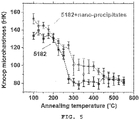
- Figure 5 suggests that the recrystallization temperature is at ⁇ 250 °C for cold-rolled Al-4.5Mg-0.35Mn-0.2Si wt.% (AA5182) and at ⁇ 300 °C for cold-rolled Al-4.5Mg-0.35Mn-0.2Si-0.3Zr-0.1Sn wt.% (invented alloy), containing nano-precipitates (an increase of 50 °C).
- Al 3 Zr nano-precipitates suppresses the recrystallization, by pinning the movement of grain boundaries via Zener pinning.
- Table 1 lists mechanical properties of thin sheets (0.25 mm in thickness) of Al-4.5Mg-0.25Mn-0.2Fe-0.09Si wt.% (AA5182) in hard-temper (example alloy 1) and soft temper (example alloy 2), Al-4.5Mg-0.25Mn-0.2Fe-0.09Si-0.3Zr-0.1Sn wt.% (AA5182-nano) in hard-temper (invented alloy 1) and soft temper (invented alloy 2).
- AA5182 hard-temper is a common aluminum alloy for beverage can lids, whereas AA5182 soft-temper is commonly used in automotive applications.
- the AA5182-nano alloy in both hard- and soft-tempers (invented alloys 1 and 2) achieve higher yield strength and tensile strength, while maintaining essentially the same elongation at break, compared to the AA5182 alloy with the respective tempers (example alloy 1 and 2).
- the thin sheets of the alloys in Table 1 were fabricated by the following steps: casting, hot-rolling, annealing, cold-rolling, and stabilizing heat treatment for hard-temper; and casting, hot-rolling, cold-rolling, and annealing for soft-temper.
- Table 1 Yield strength (MPa) Tensile strength (MPa) Elongation at break (%) AA5182 - hard temper (example alloy 1) 355 ⁇ 6 412 ⁇ 7 6-8 AA5182-nano - hard temper (invented alloy 1) 390 ⁇ 6 450 ⁇ 8 6-8 AA5182 - soft temper (example alloy 2) 170 ⁇ 5 315 ⁇ 6 20-25 AA5182-nano - soft temper (invented alloy 2) 200 ⁇ 4 330 ⁇ 7 20-25
- the disclosed aluminum alloys are essentially free of scandium, which is understood to mean that no scandium is added intentionally. Addition of scandium in aluminum alloys is advantageous for mechanical properties. For example, it is described in U.S. Patent No. 5,624,632 . However, scandium is very expensive (ten times more expensive than silver), severely limiting its practical applications.
- Zirconium with a concentration of up to about 0.3 wt.%, is sometimes added to aluminum alloys for grain refining.
- the refined grain structure helps improve castability, ductility, and workability of the final product.
- An example is described in U.S. Patent No. 5,976,278 .
- zirconium with a concentration of less than about 0.5 wt.%, and preferably less than about 0.4 wt.% is added together with an inoculant element to form Al 3 Zr nano-precipitates, wherein the nanoscale precipitate has an average diameter of about 20 nm or less and has an L1 2 structure in an ⁇ -Al face centered cubic matrix, and wherein the average number density of the nanoscale precipitate is about 20 21 m -3 or more, with a purpose to improve mechanical strength, ductility, creep resistance, thermal stability and durability of the based alloys.
- a zirconium concentration of more than about 0.2 wt.% is needed so that Zr atoms have enough driving force to form Al 3 Zr nano-precipitates.
- the present aluminum alloys comprise an inoculant, wherein the inoculant comprises either tin or strontium.
- the presence of an inoculant accelerates precipitation kinetics of Al 3 Zr nano-precipitates, thus these precipitates can be formed within a practical amount of time during heat- treatment.
- the beneficial Al 3 Zr nano-precipitates can be formed within a few hours of heat treatment, with the presence of the inoculant, compared to between a few weeks and a few months of heat treatment without the presence of an inoculant.
- tin appears to be the best performer in terms of accelerating precipitation kinetics of Al 3 Zr nano-precipitates.
- a tin concentration of less than about 0.2% is needed for the mentioned purpose. Beyond this value, tin will form bubbles and/or a liquid phase in the aluminum solid matrix, which is detrimental for the mechanical properties. For example, this behavior is described in U.S. Patent No. 9,453,272 .
- the present aluminum alloy comprises aluminum, magnesium, manganese, silicon, zirconium, and an inoculant comprising either tin or strontium, wherein the alloy comprises: about 3.0 to about 6.2% by weight magnesium; about 0.01 to about 1.8% by weight manganese; about 0.01 to about 0.2% by weight silicon; about 0.2 to about 0.5% by weight zirconium; no more than about 0.5% by weight iron; either (a) about 0.01 to about 0.2% by weight tin; or (b) about 0.001 to about 0.1% by weight strontium; and aluminum as the remainder; and includes a nanoscale precipitate comprising Al 3 Zr, wherein the nanoscale precipitate has an average diameter of about 20 nm or less and has an L1 2 structure in an ⁇ -Al face centered cubic matrix, wherein the average number density of the nanoscale precipitate is about 2021 m -3 or more.
- the aluminum alloy if in hard temper it possesses a yield strength of at least about 380 MPa, a tensile strength of at least about 440 MPa, and an elongation of at least about 5% at room temperature.
- the aluminum alloy if it is in soft temper it possesses a yield strength of at least about 190 MPa, a tensile strength of at least about 320 MPa, and an elongation of at least about 18% at room temperature.
- the aluminum alloy possesses a recrystallization temperature of about 300°C.
- the aluminum alloy comprises about 3.0 to about 6.2% by weight magnesium; about 0.01 to about 1.8% by weight manganese; about 0.01 to about 0.2% by weight silicon; about 0.2 to about 0.5% by weight zirconium; about 0.01 to about 0.2% by weight tin; and aluminum as the remainder.
- the aluminum alloy comprises about 3.0 to about 6.2% by weight magnesium; about 0.01 to about 1.8% by weight manganese; about 0.01 to about 0.2% by weight silicon; about 0.2 to about 0.5% by weight zirconium; about 0.001 to about 0.1% by weight strontium; and aluminum as the remainder.
- the aluminum alloy comprises a plurality of L1 2 precipitates having an average diameter of about 10 nm or less.
- the aluminum alloy comprises a plurality of L1 2 precipitates having an average diameter of about 3 nm to about 7 nm.
- the aluminum alloy comprises about 4.5% by weight magnesium, about 0.35% by weight manganese, about 0.2% by weight silicon, about 0.3% by weight zirconium, about 0.1% by weight tin, and aluminum as the remainder.
- the aluminum alloy comprises about 4.5% by weight magnesium, about 0.35% by weight manganese, about 0.2% by weight silicon, about 0.3% by weight zirconium, about 0.003% by weight strontium, and aluminum as the remainder.
- the aluminum alloy comprises no more than about 0.5% iron as an impurity element.
- Also provided is a method for manufacturing a component from a disclosed aluminum alloy comprising: a) melting the alloy at a temperature of about 700 to about 900°C; b) casting the melted alloy into casting molds at ambient temperature; c) using a cooling medium to cool the cast ingot; and d)(i) heat aging the cast ingot at a temperature of about 350°C to about 450°C for a time of about 2 to about 48 hours.
- the method further comprises (e) cold rolling the cast ingot to form a sheet product.
- the method further comprises (f) a final stabilizing heat treatment of the sheet product at a temperature of about 140°C to about 170°C for a time of about 1 to about 5 hours.
- the cooling medium can be air, water, ice, or dry ice.
- the heat aging step stated above (350-450°C for 2-48 hours) is determined to be peak-aging for components comprising the disclosed aluminum alloys.
- the microstructure of the component is thermally stable and is unchanged by exposure to elevated temperatures for extended times.
- Also provided is a method for manufacturing a component from a disclosed aluminum alloy comprising: a) melting the alloy at a temperature of about 700 to 900°C; b) casting the alloy into casting molds at ambient temperature; c) using a cooling medium to cool the cast ingot; and d)(ii) hot rolling the cast ingot into a sheet.
- the method further comprises (e) heat aging the sheet at a temperature of about 350°C to about 450°C for a time of about 2 to about 48 hours.
- the method further comprises (f) cold rolling the sheet, after the heat aging step, to form a thin sheet or foil product.
- the method further comprises (g) a final stabilizing heat treatment of the thin sheet or foil product at a temperature of about 140°C to about 170°C for a time of about 1 to about 5 hours. In an alternative embodiment, the method further comprises (g) heat aging the thin sheet or foil product at a temperature of about 350°C to about 450°C for a time of about 2 to about 48 hours
- Also provided is a method for manufacturing a component from a disclosed aluminum alloy comprising: a) melting the alloy at a temperature of about 700 to 900°C; b) casting the alloy into casting molds at ambient temperature; c) using a cooling medium to cool the cast ingot; d)(ii) hot rolling the cast ingot into a sheet; e) cold rolling the sheet to form a thin sheet or foil product; and f) heat aging the thin sheet or foil product at a temperature of about 300°C to about 410°C for a time of about 2 to about 24 hours.
- Some applications for the disclosed alloys include, for example, beverage can lids, beverage can tabs, roofing materials, siding materials, chemical manufacturing equipment, food manufacturing equipment, storage tanks, home appliances, sheet-metal work, marine parts, transportation parts, heavy duty cooking utensils, hydraulic tubes, fuel tanks, pressure vessels, truck bodies, truck assemblies, trailer bodies, trailer assemblies, drilling rigs, missile components, and railroad cars.
- Some fabricated forms of the disclosed aluminum alloys include, for example, wires, sheets, plates and foils.
Landscapes
- Chemical & Material Sciences (AREA)
- Engineering & Computer Science (AREA)
- Mechanical Engineering (AREA)
- Materials Engineering (AREA)
- Organic Chemistry (AREA)
- Metallurgy (AREA)
- Physics & Mathematics (AREA)
- Crystallography & Structural Chemistry (AREA)
- Thermal Sciences (AREA)
- Ceramic Engineering (AREA)
- Continuous Casting (AREA)
- Metal Rolling (AREA)
- Manufacture Of Metal Powder And Suspensions Thereof (AREA)
Claims (17)
- Alliage d'aluminium comprenant :de l'aluminium, du magnésium, du manganèse, du silicium, du zirconium, et un inoculant comprenant soit de l'étain, soit du strontium ;l'alliage comprenant :environ 3,0 à environ 6,2 % en poids de magnésium ;environ 0,01 à environ 1,8 % en poids de manganèse ;environ 0,01 à environ 0,2 % en poids de silicium ;environ 0,2 à environ 0,5 % en poids de zirconium ;pas plus d'environ 0,5 % en poids de fer ;soit(a) environ 0,01 à environ 0,2 % en poids d'étain ;
soit(b) environ 0,001 à environ 0,1 % en poids de strontium ;et de l'aluminium pour le reste ;l'alliage comportant un précipité à l'échelle nanométrique comprenant de l'Al3Zr ;dans lequel le précipité à l'échelle nanométrique a un diamètre moyen d'environ 20 nm ou moins et a une structure L12 dans une matrice cubique à faces centrées d'α-Al ; etdans lequel la densité en nombre moyen du précipité à l'échelle nanométrique est d'environ 2021 m-3 ou plus. - Alliage d'aluminium de la revendication 1, dans lequel la pluralité de précipités L12 a un diamètre moyen d'environ 10 nm ou moins ou un diamètre moyen d'environ 3 nm à environ 7 nm.
- Alliage d'aluminium de la revendication 1, comprenant :(a) environ 4,5 % en poids de magnésium ;environ 0,35 % en poids de manganèse ;environ 0,2 % en poids de silicium ;environ 0,3 % en poids de zirconium ;environ 0,1 % en poids d'étain ; etde l'aluminium pour le reste ; ou(b) environ 4,5 % en poids de magnésium ;environ 0,25 % en poids de manganèse ;environ 0,09 % en poids de silicium ;environ 0,2 % en poids de fer ;environ 0,3 % en poids de zirconium ;environ 0,1 % en poids d'étain ; etde l'aluminium pour le reste ; ou(c) environ 4,5 % en poids de magnésium ;environ 0,35 % en poids de manganèse ;environ 0,2 % en poids de silicium ;environ 0,3 % en poids de zirconium ;environ 0,003 % en poids de strontium ; etde l'aluminium pour le reste.
- Alliage d'aluminium de la revendication 1, l'alliage possédant une température de recristallisation d'environ 300 °C.
- Alliage d'aluminium de la revendication 1, l'alliage ne comprenant pas plus d'environ 0,5 % de fer en tant qu'impureté.
- Alliage d'aluminium de la revendication 1, l'alliage d'aluminium étant à trempe dure, et possédant une limite d'élasticité d'au moins 380 MPa environ, une résistance à la traction d'au moins 440 MPa environ, et un allongement d'au moins 5 % environ à température ambiante ; ou
l'alliage d'aluminium étant à trempe douce, et possédant une limite d'élasticité d'au moins 190 MPa environ, une résistance à la traction d'au moins 320 MPa environ, et un allongement d'au moins 18 % environ à température ambiante. - Procédé de fabrication d'un composant à partir de l'alliage d'aluminium de la revendication 1, le procédé comprenant :a) la fusion de l'alliage à une température d'environ 700 °C à environ 900 °C ;b) la coulée de l'alliage fondu dans des moules de coulée à température ambiante ; etc) l'utilisation d'un milieu de refroidissement pour refroidir le lingot coulé ;le procédé comprenant en outre soit :d(i) le vieillissement thermique du lingot coulé à une température d'environ 350 °C à environ 450 °C pendant un temps d'environ 2 heures à environ 48 heures ; soitd(ii) le laminage à chaud du lingot coulé en une tôle.
- Procédé de la revendication 7, le procédé comprenant :d(i) le vieillissement thermique du lingot coulé à une température d'environ 350 °C à environ 450 °C pendant un temps d'environ 2 heures à environ 48 heures ; et le procédé comprenant en outree) le laminage à froid du lingot coulé pour former un produit en tôle.
- Procédé de la revendication 8, comprenant en outre :
f) un traitement thermique de stabilisation du produit en tôle à une température d'environ 140 °C à environ 170 °C pendant un temps d'environ 1 à environ 5 heures. - Procédé de la revendication 7, le procédé comprenant :d(ii) le laminage à chaud du lingot coulé en une tôle ; et le procédé comprenant en outree) le vieillissement thermique de la tôle à une température d'environ 350 °C à environ 450 °C pendant un temps d'environ 2 heures à environ 48 heures.
- Procédé de la revendication 10, comprenant en outre :
f) le laminage à froid de la tôle pour former un produit en tôle fine ou en feuille. - Procédé de la revendication 11, comprenant en outre :
g) un traitement thermique de stabilisation du produit en tôle fine ou en feuille à une température d'environ 140 °C à environ 170 °C pendant un temps d'environ 1 à environ 5 heures. - Procédé de la revendication 7, le procédé comprenant :d(ii) le laminage à chaud du lingot coulé en une tôle ; et le procédé comprenant en outree) le laminage à froid de la tôle pour former un produit en tôle fine ou en feuille ; etf) le vieillissement thermique du produit en tôle fine ou en feuille à une température d'environ 300 °C à environ 410 °C pendant un temps d'environ 2 à environ 24 heures.
- Couvercle de canette de boisson ou languette de canette de boisson comprenant l'alliage d'aluminium de la revendication 1.
- Composant en alliage d'aluminium comprenant l'alliage d'aluminium de la revendication 1, le composant en alliage d'aluminium étant choisi dans un groupe constitué par les matériaux de toiture, les matériaux de bardage, l'équipement de fabrication de produits chimiques, l'équipement de fabrication d'aliments, les réservoirs de stockage, les appareils électroménagers, la tôlerie, les pièces marines, les pièces pour le transport, les ustensiles de cuisson très résistants, les tubes hydrauliques, les réservoirs de carburant, les cuves sous pression, les carrosseries de camions, les assemblages de camions, les carrosseries de remorques, les assemblages de remorques, les appareils de forage, les composants de missiles, et les wagons.
- Forme fabriquée de l'alliage d'aluminium de la revendication 1, la forme fabriquée étant choisie dans un groupe constitué par les fils, les tôles, les plaques et les feuilles.
- Procédé de la revendication 11, comprenant en outre :
g) le vieillissement thermique du produit en tôle fine ou en feuille à une température d'environ 300 °C à environ 410 °C pendant un temps d'environ 2 à environ 24 heures.
Applications Claiming Priority (2)
| Application Number | Priority Date | Filing Date | Title |
|---|---|---|---|
| US201762468467P | 2017-03-08 | 2017-03-08 | |
| PCT/US2018/020899 WO2018165012A1 (fr) | 2017-03-08 | 2018-03-05 | Alliages d'aluminium de la série 5000 à haute performance |
Publications (3)
| Publication Number | Publication Date |
|---|---|
| EP3592876A1 EP3592876A1 (fr) | 2020-01-15 |
| EP3592876A4 EP3592876A4 (fr) | 2020-10-21 |
| EP3592876B1 true EP3592876B1 (fr) | 2023-01-04 |
Family
ID=63447925
Family Applications (1)
| Application Number | Title | Priority Date | Filing Date |
|---|---|---|---|
| EP18763441.5A Active EP3592876B1 (fr) | 2017-03-08 | 2018-03-05 | Alliages d'aluminium de la série 5000 à haute performance |
Country Status (5)
| Country | Link |
|---|---|
| US (1) | US11814701B2 (fr) |
| EP (1) | EP3592876B1 (fr) |
| JP (1) | JP7401307B2 (fr) |
| CN (1) | CN110520548B (fr) |
| WO (1) | WO2018165012A1 (fr) |
Families Citing this family (3)
| Publication number | Priority date | Publication date | Assignee | Title |
|---|---|---|---|---|
| WO2021133200A1 (fr) | 2019-12-27 | 2021-07-01 | Общество с ограниченной ответственностью "Объединенная Компания РУСАЛ Инженерно-технологический центр" | Alliage à base d'aluminium |
| EP4146837A1 (fr) | 2020-05-04 | 2023-03-15 | Nanoal LLC | Alliages d'aluminium de série 5000 à haute résistance et à stabilité thermique |
| CN115820970B (zh) * | 2022-11-14 | 2024-03-12 | 江苏吉鑫风能科技股份有限公司 | 一种风电铸件用球墨铸铁的生产工艺 |
Family Cites Families (50)
| Publication number | Priority date | Publication date | Assignee | Title |
|---|---|---|---|---|
| US3551143A (en) | 1963-10-10 | 1970-12-29 | Showa Denko Kk | Aluminum base alloys having improved high temperature properties and method for their production |
| US3807969A (en) | 1970-07-13 | 1974-04-30 | Southwire Co | Aluminum alloy electrical conductor |
| AU615265B2 (en) | 1988-03-09 | 1991-09-26 | Toyota Jidosha Kabushiki Kaisha | Aluminum alloy composite material with intermetallic compound finely dispersed in matrix among reinforcing elements |
| JP2599450B2 (ja) * | 1988-10-26 | 1997-04-09 | 古河電気工業株式会社 | キャンエンド用アルミニウム合金板の製造方法 |
| US5087301A (en) | 1988-12-22 | 1992-02-11 | Angers Lynette M | Alloys for high temperature applications |
| JP2965774B2 (ja) | 1992-02-13 | 1999-10-18 | ワイケイケイ株式会社 | 高強度耐摩耗性アルミニウム合金 |
| JPH05331587A (ja) | 1992-06-01 | 1993-12-14 | Mitsubishi Alum Co Ltd | メッキ性と化成処理性に優れたAl合金 |
| JPH07145441A (ja) | 1993-01-27 | 1995-06-06 | Toyota Motor Corp | 超塑性アルミニウム合金およびその製造方法 |
| US5327955A (en) | 1993-05-04 | 1994-07-12 | The Board Of Trustees Of Western Michigan University | Process for combined casting and heat treatment |
| ATE231927T1 (de) | 1994-04-14 | 2003-02-15 | Sumitomo Electric Industries | Gleitstück aus gesinterter aluminiumlegierung |
| US5624632A (en) | 1995-01-31 | 1997-04-29 | Aluminum Company Of America | Aluminum magnesium alloy product containing dispersoids |
| EP0799900A1 (fr) * | 1996-04-04 | 1997-10-08 | Hoogovens Aluminium Walzprodukte GmbH | Alliage d'aluminium-magnesium à haute résistance mécanique pour structures soudées de grandes dimensions |
| FR2752244B1 (fr) * | 1996-08-06 | 1998-09-18 | Pechiney Rhenalu | Produit pour construction soudee en alliage almgmn a tenue a la corrosion amelioree |
| JP4080013B2 (ja) | 1996-09-09 | 2008-04-23 | 住友電気工業株式会社 | 高強度高靱性アルミニウム合金およびその製造方法 |
| US5976278A (en) | 1997-10-03 | 1999-11-02 | Reynolds Metals Company | Corrosion resistant, drawable and bendable aluminum alloy, process of making aluminum alloy article and article |
| US6592687B1 (en) | 1998-09-08 | 2003-07-15 | The United States Of America As Represented By The National Aeronautics And Space Administration | Aluminum alloy and article cast therefrom |
| EP1138794B1 (fr) * | 2000-03-31 | 2007-02-14 | Corus Aluminium Voerde GmbH | Produit moulé sous pression à base d'aluminium |
| JP3752140B2 (ja) * | 2000-10-03 | 2006-03-08 | 株式会社神戸製鋼所 | 曲げ加工性に優れたAl−Mg−Si系Al合金板 |
| CA2454509A1 (fr) | 2001-07-25 | 2003-02-06 | Showa Denko K.K. | Alliage d'aluminium presentant une excellente usinabilite, et materiau d'alliage d'aluminium et son procede de production |
| DE10231437B4 (de) | 2001-08-10 | 2019-08-22 | Corus Aluminium N.V. | Verfahren zur Herstellung eines Aluminiumknetlegierungsprodukts |
| DE10231422A1 (de) | 2001-08-13 | 2003-02-27 | Corus Aluminium Nv | Aluminium-Magnesium-Legierungserzeugnis |
| US6918970B2 (en) | 2002-04-10 | 2005-07-19 | The United States Of America As Represented By The Administrator Of The National Aeronautics And Space Administration | High strength aluminum alloy for high temperature applications |
| US20040091386A1 (en) | 2002-07-30 | 2004-05-13 | Carroll Mark C. | 5000 series alloys with improved corrosion properties and methods for their manufacture and use |
| JP2004250738A (ja) * | 2003-02-19 | 2004-09-09 | Kobe Steel Ltd | Al−Mg系合金板 |
| AT412284B (de) | 2003-03-14 | 2004-12-27 | Miba Gleitlager Gmbh | Aluminiumknetlegierung |
| JP5059353B2 (ja) * | 2006-07-24 | 2012-10-24 | 株式会社神戸製鋼所 | 耐応力腐食割れ性に優れたアルミニウム合金板 |
| US8323373B2 (en) | 2006-10-27 | 2012-12-04 | Nanotec Metals, Inc. | Atomized picoscale composite aluminum alloy and method thereof |
| WO2008098743A1 (fr) * | 2007-02-12 | 2008-08-21 | Aleris Aluminum Koblenz Gmbh | Alliage d'al-mg pour plaques de blindage |
| US9039848B2 (en) * | 2007-11-15 | 2015-05-26 | Aleris Aluminum Koblenz Gmbh | Al—Mg—Zn wrought alloy product and method of its manufacture |
| US7871477B2 (en) | 2008-04-18 | 2011-01-18 | United Technologies Corporation | High strength L12 aluminum alloys |
| US7811395B2 (en) | 2008-04-18 | 2010-10-12 | United Technologies Corporation | High strength L12 aluminum alloys |
| US8778099B2 (en) | 2008-12-09 | 2014-07-15 | United Technologies Corporation | Conversion process for heat treatable L12 aluminum alloys |
| US20100143177A1 (en) | 2008-12-09 | 2010-06-10 | United Technologies Corporation | Method for forming high strength aluminum alloys containing L12 intermetallic dispersoids |
| WO2010085888A1 (fr) * | 2009-01-29 | 2010-08-05 | Novelis Inc. | Protection contre la corrosion de ligne de coupe pour parois d'extrémité de conteneur |
| US20100252148A1 (en) | 2009-04-07 | 2010-10-07 | United Technologies Corporation | Heat treatable l12 aluminum alloys |
| CN101649405B (zh) * | 2009-09-17 | 2011-04-27 | 中南大学 | 一种Al-Mg-Mn-Zr-Sr合金及制备方法 |
| US20130199680A1 (en) | 2010-04-07 | 2013-08-08 | Rheinfelden Alloys Gmbh & Co. Kg | Aluminum Die Casting Alloy |
| US8758529B2 (en) | 2010-06-30 | 2014-06-24 | GM Global Technology Operations LLC | Cast aluminum alloys |
| US9533351B2 (en) | 2010-10-04 | 2017-01-03 | Gkn Sinter Metals, Llc | Aluminum powder metal alloying method |
| US9551050B2 (en) | 2012-02-29 | 2017-01-24 | The Boeing Company | Aluminum alloy with additions of scandium, zirconium and erbium |
| RU2534170C1 (ru) | 2012-12-06 | 2014-11-27 | Федеральное государственное автономное образовательное учреждение высшего профессионального образования "Национальный исследовательский технологический университет "МИСиС" | Термостойкий сплав на основе алюминия и способ получения из него деформированных полуфабрикатов |
| CN103233147B (zh) | 2013-05-06 | 2015-10-28 | 北京工业大学 | 一种Al-Er-Zr-Si铝合金及热处理工艺 |
| JP6210896B2 (ja) | 2014-02-06 | 2017-10-11 | 株式会社神戸製鋼所 | 缶蓋用アルミニウム合金板およびその製造方法 |
| WO2015138748A1 (fr) * | 2014-03-12 | 2015-09-17 | NanoAL LLC | Superalliages d'aluminium destinés à être utilisés dans des applications à haute température |
| CN103866167B (zh) * | 2014-03-27 | 2017-01-25 | 北京科技大学 | 一种铝合金板材的制备方法 |
| CN103924175B (zh) * | 2014-04-12 | 2017-01-25 | 北京工业大学 | 一种提高含Zn、Er铝镁合金耐蚀性能的稳定化热处理工艺 |
| CN105525162A (zh) * | 2014-09-29 | 2016-04-27 | 刘小会 | 一种添加Zr和稀土Sc元素提高Al-5.2Mg-0.3Mn合金的制备工艺 |
| US20160271688A1 (en) * | 2015-03-17 | 2016-09-22 | Juergen Wuest | Low cost high ductility cast aluminum alloy |
| US10697046B2 (en) | 2016-07-07 | 2020-06-30 | NanoAL LLC | High-performance 5000-series aluminum alloys and methods for making and using them |
| CN107475648A (zh) * | 2017-08-16 | 2017-12-15 | 天津忠旺铝业有限公司 | 一种5383铝合金的稳定化工艺 |
-
2018
- 2018-03-05 EP EP18763441.5A patent/EP3592876B1/fr active Active
- 2018-03-05 CN CN201880025144.9A patent/CN110520548B/zh active Active
- 2018-03-05 JP JP2019548274A patent/JP7401307B2/ja active Active
- 2018-03-05 WO PCT/US2018/020899 patent/WO2018165012A1/fr not_active Ceased
-
2019
- 2019-09-06 US US16/562,981 patent/US11814701B2/en active Active
Also Published As
| Publication number | Publication date |
|---|---|
| EP3592876A4 (fr) | 2020-10-21 |
| CN110520548B (zh) | 2022-02-01 |
| JP7401307B2 (ja) | 2023-12-19 |
| CN110520548A (zh) | 2019-11-29 |
| EP3592876A1 (fr) | 2020-01-15 |
| WO2018165012A1 (fr) | 2018-09-13 |
| JP2020510759A (ja) | 2020-04-09 |
| US11814701B2 (en) | 2023-11-14 |
| US20190390306A1 (en) | 2019-12-26 |
Similar Documents
| Publication | Publication Date | Title |
|---|---|---|
| US12018354B2 (en) | High-performance 3000-series aluminum alloys | |
| KR100605741B1 (ko) | 내식성과 도금성이 우수한 마그네슘합금 단련재 | |
| US20120230862A1 (en) | Aluminium foil alloy | |
| US11814701B2 (en) | High-performance 5000-series aluminum alloys | |
| US10704128B2 (en) | High-strength corrosion-resistant aluminum alloys and methods of making the same | |
| US20240263279A1 (en) | High strength microalloyed magnesium alloy | |
| AU759402B2 (en) | Aluminium based alloy and method for subjecting it to heat treatment | |
| CN110947762A (zh) | 一种真空钎焊用308铝合金三层复合板的制备方法 | |
| JPH0440418B2 (fr) | ||
| JP4117243B2 (ja) | 焼付け塗装硬化性に優れたアルミニウム合金板 | |
| RU2230131C1 (ru) | Сплав системы алюминий-магний-марганец и изделие из этого сплава | |
| ZA200600425B (en) | Thin strips or foils of alfesi alloy | |
| EP3652356B1 (fr) | Alliage d'aluminium résistant à la corrosion, à résistance élevée, et procédé de fabrication associé | |
| US20230193430A1 (en) | High strength and thermally stable 5000-series aluminum alloys | |
| Series et al. | Aluminum alloys and heat treatment | |
| JP2000144353A (ja) | 耐ブローアップ性に優れた飲料缶用アルミニウム合金エンドの製造方法 | |
| Belov et al. | The Influence of Zirconium and Silicon Additions on the Microstructure and Hardening of Al-2% Mn Sheet Alloys | |
| JPH06271968A (ja) | しごき加工性に優れたアルミニウム合金板およびその製造方法 | |
| AU8407591A (en) | Mechanically and thermally treated AL Base-ZN-MG-SI-CU alloy for deepdrawn liquid containers |
Legal Events
| Date | Code | Title | Description |
|---|---|---|---|
| STAA | Information on the status of an ep patent application or granted ep patent |
Free format text: STATUS: THE INTERNATIONAL PUBLICATION HAS BEEN MADE |
|
| PUAI | Public reference made under article 153(3) epc to a published international application that has entered the european phase |
Free format text: ORIGINAL CODE: 0009012 |
|
| STAA | Information on the status of an ep patent application or granted ep patent |
Free format text: STATUS: REQUEST FOR EXAMINATION WAS MADE |
|
| 17P | Request for examination filed |
Effective date: 20191007 |
|
| AK | Designated contracting states |
Kind code of ref document: A1 Designated state(s): AL AT BE BG CH CY CZ DE DK EE ES FI FR GB GR HR HU IE IS IT LI LT LU LV MC MK MT NL NO PL PT RO RS SE SI SK SM TR |
|
| AX | Request for extension of the european patent |
Extension state: BA ME |
|
| DAV | Request for validation of the european patent (deleted) | ||
| DAX | Request for extension of the european patent (deleted) | ||
| A4 | Supplementary search report drawn up and despatched |
Effective date: 20200921 |
|
| RIC1 | Information provided on ipc code assigned before grant |
Ipc: C22F 1/047 20060101ALI20200915BHEP Ipc: C22C 21/08 20060101AFI20200915BHEP Ipc: C22F 1/06 20060101ALI20200915BHEP |
|
| STAA | Information on the status of an ep patent application or granted ep patent |
Free format text: STATUS: EXAMINATION IS IN PROGRESS |
|
| 17Q | First examination report despatched |
Effective date: 20220228 |
|
| GRAP | Despatch of communication of intention to grant a patent |
Free format text: ORIGINAL CODE: EPIDOSNIGR1 |
|
| STAA | Information on the status of an ep patent application or granted ep patent |
Free format text: STATUS: GRANT OF PATENT IS INTENDED |
|
| INTG | Intention to grant announced |
Effective date: 20220720 |
|
| GRAS | Grant fee paid |
Free format text: ORIGINAL CODE: EPIDOSNIGR3 |
|
| GRAA | (expected) grant |
Free format text: ORIGINAL CODE: 0009210 |
|
| STAA | Information on the status of an ep patent application or granted ep patent |
Free format text: STATUS: THE PATENT HAS BEEN GRANTED |
|
| AK | Designated contracting states |
Kind code of ref document: B1 Designated state(s): AL AT BE BG CH CY CZ DE DK EE ES FI FR GB GR HR HU IE IS IT LI LT LU LV MC MK MT NL NO PL PT RO RS SE SI SK SM TR |
|
| REG | Reference to a national code |
Ref country code: GB Ref legal event code: FG4D |
|
| REG | Reference to a national code |
Ref country code: CH Ref legal event code: EP |
|
| REG | Reference to a national code |
Ref country code: AT Ref legal event code: REF Ref document number: 1541971 Country of ref document: AT Kind code of ref document: T Effective date: 20230115 |
|
| REG | Reference to a national code |
Ref country code: DE Ref legal event code: R096 Ref document number: 602018045038 Country of ref document: DE |
|
| REG | Reference to a national code |
Ref country code: IE Ref legal event code: FG4D |
|
| REG | Reference to a national code |
Ref country code: DE Ref legal event code: R081 Ref document number: 602018045038 Country of ref document: DE Owner name: NANOAL LLC, ASHLAND, US Free format text: FORMER OWNER: NANOAL LLC, SKOKIE, IL, US |
|
| RAP4 | Party data changed (patent owner data changed or rights of a patent transferred) |
Owner name: NANOAL LLC |
|
| REG | Reference to a national code |
Ref country code: LT Ref legal event code: MG9D |
|
| REG | Reference to a national code |
Ref country code: NL Ref legal event code: MP Effective date: 20230104 |
|
| REG | Reference to a national code |
Ref country code: AT Ref legal event code: MK05 Ref document number: 1541971 Country of ref document: AT Kind code of ref document: T Effective date: 20230104 |
|
| P01 | Opt-out of the competence of the unified patent court (upc) registered |
Effective date: 20230516 |
|
| PG25 | Lapsed in a contracting state [announced via postgrant information from national office to epo] |
Ref country code: NL Free format text: LAPSE BECAUSE OF FAILURE TO SUBMIT A TRANSLATION OF THE DESCRIPTION OR TO PAY THE FEE WITHIN THE PRESCRIBED TIME-LIMIT Effective date: 20230104 |
|
| PG25 | Lapsed in a contracting state [announced via postgrant information from national office to epo] |
Ref country code: RS Free format text: LAPSE BECAUSE OF FAILURE TO SUBMIT A TRANSLATION OF THE DESCRIPTION OR TO PAY THE FEE WITHIN THE PRESCRIBED TIME-LIMIT Effective date: 20230104 Ref country code: PT Free format text: LAPSE BECAUSE OF FAILURE TO SUBMIT A TRANSLATION OF THE DESCRIPTION OR TO PAY THE FEE WITHIN THE PRESCRIBED TIME-LIMIT Effective date: 20230504 Ref country code: NO Free format text: LAPSE BECAUSE OF FAILURE TO SUBMIT A TRANSLATION OF THE DESCRIPTION OR TO PAY THE FEE WITHIN THE PRESCRIBED TIME-LIMIT Effective date: 20230404 Ref country code: LV Free format text: LAPSE BECAUSE OF FAILURE TO SUBMIT A TRANSLATION OF THE DESCRIPTION OR TO PAY THE FEE WITHIN THE PRESCRIBED TIME-LIMIT Effective date: 20230104 Ref country code: LT Free format text: LAPSE BECAUSE OF FAILURE TO SUBMIT A TRANSLATION OF THE DESCRIPTION OR TO PAY THE FEE WITHIN THE PRESCRIBED TIME-LIMIT Effective date: 20230104 Ref country code: HR Free format text: LAPSE BECAUSE OF FAILURE TO SUBMIT A TRANSLATION OF THE DESCRIPTION OR TO PAY THE FEE WITHIN THE PRESCRIBED TIME-LIMIT Effective date: 20230104 Ref country code: ES Free format text: LAPSE BECAUSE OF FAILURE TO SUBMIT A TRANSLATION OF THE DESCRIPTION OR TO PAY THE FEE WITHIN THE PRESCRIBED TIME-LIMIT Effective date: 20230104 Ref country code: AT Free format text: LAPSE BECAUSE OF FAILURE TO SUBMIT A TRANSLATION OF THE DESCRIPTION OR TO PAY THE FEE WITHIN THE PRESCRIBED TIME-LIMIT Effective date: 20230104 |
|
| PG25 | Lapsed in a contracting state [announced via postgrant information from national office to epo] |
Ref country code: SE Free format text: LAPSE BECAUSE OF FAILURE TO SUBMIT A TRANSLATION OF THE DESCRIPTION OR TO PAY THE FEE WITHIN THE PRESCRIBED TIME-LIMIT Effective date: 20230104 Ref country code: PL Free format text: LAPSE BECAUSE OF FAILURE TO SUBMIT A TRANSLATION OF THE DESCRIPTION OR TO PAY THE FEE WITHIN THE PRESCRIBED TIME-LIMIT Effective date: 20230104 Ref country code: IS Free format text: LAPSE BECAUSE OF FAILURE TO SUBMIT A TRANSLATION OF THE DESCRIPTION OR TO PAY THE FEE WITHIN THE PRESCRIBED TIME-LIMIT Effective date: 20230504 Ref country code: GR Free format text: LAPSE BECAUSE OF FAILURE TO SUBMIT A TRANSLATION OF THE DESCRIPTION OR TO PAY THE FEE WITHIN THE PRESCRIBED TIME-LIMIT Effective date: 20230405 Ref country code: FI Free format text: LAPSE BECAUSE OF FAILURE TO SUBMIT A TRANSLATION OF THE DESCRIPTION OR TO PAY THE FEE WITHIN THE PRESCRIBED TIME-LIMIT Effective date: 20230104 |
|
| REG | Reference to a national code |
Ref country code: DE Ref legal event code: R097 Ref document number: 602018045038 Country of ref document: DE |
|
| PG25 | Lapsed in a contracting state [announced via postgrant information from national office to epo] |
Ref country code: SM Free format text: LAPSE BECAUSE OF FAILURE TO SUBMIT A TRANSLATION OF THE DESCRIPTION OR TO PAY THE FEE WITHIN THE PRESCRIBED TIME-LIMIT Effective date: 20230104 Ref country code: RO Free format text: LAPSE BECAUSE OF FAILURE TO SUBMIT A TRANSLATION OF THE DESCRIPTION OR TO PAY THE FEE WITHIN THE PRESCRIBED TIME-LIMIT Effective date: 20230104 Ref country code: MC Free format text: LAPSE BECAUSE OF FAILURE TO SUBMIT A TRANSLATION OF THE DESCRIPTION OR TO PAY THE FEE WITHIN THE PRESCRIBED TIME-LIMIT Effective date: 20230104 Ref country code: EE Free format text: LAPSE BECAUSE OF FAILURE TO SUBMIT A TRANSLATION OF THE DESCRIPTION OR TO PAY THE FEE WITHIN THE PRESCRIBED TIME-LIMIT Effective date: 20230104 Ref country code: DK Free format text: LAPSE BECAUSE OF FAILURE TO SUBMIT A TRANSLATION OF THE DESCRIPTION OR TO PAY THE FEE WITHIN THE PRESCRIBED TIME-LIMIT Effective date: 20230104 Ref country code: CZ Free format text: LAPSE BECAUSE OF FAILURE TO SUBMIT A TRANSLATION OF THE DESCRIPTION OR TO PAY THE FEE WITHIN THE PRESCRIBED TIME-LIMIT Effective date: 20230104 |
|
| REG | Reference to a national code |
Ref country code: CH Ref legal event code: PL |
|
| PLBE | No opposition filed within time limit |
Free format text: ORIGINAL CODE: 0009261 |
|
| STAA | Information on the status of an ep patent application or granted ep patent |
Free format text: STATUS: NO OPPOSITION FILED WITHIN TIME LIMIT |
|
| PG25 | Lapsed in a contracting state [announced via postgrant information from national office to epo] |
Ref country code: SK Free format text: LAPSE BECAUSE OF FAILURE TO SUBMIT A TRANSLATION OF THE DESCRIPTION OR TO PAY THE FEE WITHIN THE PRESCRIBED TIME-LIMIT Effective date: 20230104 |
|
| REG | Reference to a national code |
Ref country code: BE Ref legal event code: MM Effective date: 20230331 |
|
| 26N | No opposition filed |
Effective date: 20231005 |
|
| GBPC | Gb: european patent ceased through non-payment of renewal fee |
Effective date: 20230404 |
|
| PG25 | Lapsed in a contracting state [announced via postgrant information from national office to epo] |
Ref country code: LU Free format text: LAPSE BECAUSE OF NON-PAYMENT OF DUE FEES Effective date: 20230305 |
|
| REG | Reference to a national code |
Ref country code: IE Ref legal event code: MM4A |
|
| PG25 | Lapsed in a contracting state [announced via postgrant information from national office to epo] |
Ref country code: GB Free format text: LAPSE BECAUSE OF NON-PAYMENT OF DUE FEES Effective date: 20230404 |
|
| PG25 | Lapsed in a contracting state [announced via postgrant information from national office to epo] |
Ref country code: SI Free format text: LAPSE BECAUSE OF FAILURE TO SUBMIT A TRANSLATION OF THE DESCRIPTION OR TO PAY THE FEE WITHIN THE PRESCRIBED TIME-LIMIT Effective date: 20230104 Ref country code: LI Free format text: LAPSE BECAUSE OF NON-PAYMENT OF DUE FEES Effective date: 20230331 Ref country code: IE Free format text: LAPSE BECAUSE OF NON-PAYMENT OF DUE FEES Effective date: 20230305 Ref country code: GB Free format text: LAPSE BECAUSE OF NON-PAYMENT OF DUE FEES Effective date: 20230404 Ref country code: FR Free format text: LAPSE BECAUSE OF NON-PAYMENT OF DUE FEES Effective date: 20230331 Ref country code: CH Free format text: LAPSE BECAUSE OF NON-PAYMENT OF DUE FEES Effective date: 20230331 |
|
| PG25 | Lapsed in a contracting state [announced via postgrant information from national office to epo] |
Ref country code: BE Free format text: LAPSE BECAUSE OF NON-PAYMENT OF DUE FEES Effective date: 20230331 |
|
| PG25 | Lapsed in a contracting state [announced via postgrant information from national office to epo] |
Ref country code: IT Free format text: LAPSE BECAUSE OF FAILURE TO SUBMIT A TRANSLATION OF THE DESCRIPTION OR TO PAY THE FEE WITHIN THE PRESCRIBED TIME-LIMIT Effective date: 20230104 |
|
| PG25 | Lapsed in a contracting state [announced via postgrant information from national office to epo] |
Ref country code: BG Free format text: LAPSE BECAUSE OF FAILURE TO SUBMIT A TRANSLATION OF THE DESCRIPTION OR TO PAY THE FEE WITHIN THE PRESCRIBED TIME-LIMIT Effective date: 20230104 |
|
| PG25 | Lapsed in a contracting state [announced via postgrant information from national office to epo] |
Ref country code: BG Free format text: LAPSE BECAUSE OF FAILURE TO SUBMIT A TRANSLATION OF THE DESCRIPTION OR TO PAY THE FEE WITHIN THE PRESCRIBED TIME-LIMIT Effective date: 20230104 |
|
| PG25 | Lapsed in a contracting state [announced via postgrant information from national office to epo] |
Ref country code: CY Free format text: LAPSE BECAUSE OF FAILURE TO SUBMIT A TRANSLATION OF THE DESCRIPTION OR TO PAY THE FEE WITHIN THE PRESCRIBED TIME-LIMIT; INVALID AB INITIO Effective date: 20180305 |
|
| PG25 | Lapsed in a contracting state [announced via postgrant information from national office to epo] |
Ref country code: HU Free format text: LAPSE BECAUSE OF FAILURE TO SUBMIT A TRANSLATION OF THE DESCRIPTION OR TO PAY THE FEE WITHIN THE PRESCRIBED TIME-LIMIT; INVALID AB INITIO Effective date: 20180305 |
|
| PG25 | Lapsed in a contracting state [announced via postgrant information from national office to epo] |
Ref country code: TR Free format text: LAPSE BECAUSE OF FAILURE TO SUBMIT A TRANSLATION OF THE DESCRIPTION OR TO PAY THE FEE WITHIN THE PRESCRIBED TIME-LIMIT Effective date: 20230104 |
|
| PGFP | Annual fee paid to national office [announced via postgrant information from national office to epo] |
Ref country code: DE Payment date: 20260319 Year of fee payment: 9 |