EP3600192B1 - Installation de production de produits d'hygiène, en particulier de changes pour adultes ou pour bébés - Google Patents
Installation de production de produits d'hygiène, en particulier de changes pour adultes ou pour bébés Download PDFInfo
- Publication number
- EP3600192B1 EP3600192B1 EP18714231.0A EP18714231A EP3600192B1 EP 3600192 B1 EP3600192 B1 EP 3600192B1 EP 18714231 A EP18714231 A EP 18714231A EP 3600192 B1 EP3600192 B1 EP 3600192B1
- Authority
- EP
- European Patent Office
- Prior art keywords
- change module
- format change
- strip material
- sheet
- format
- Prior art date
- Legal status (The legal status is an assumption and is not a legal conclusion. Google has not performed a legal analysis and makes no representation as to the accuracy of the status listed.)
- Active
Links
Images


Classifications
-
- A—HUMAN NECESSITIES
- A61—MEDICAL OR VETERINARY SCIENCE; HYGIENE
- A61F—FILTERS IMPLANTABLE INTO BLOOD VESSELS; PROSTHESES; DEVICES PROVIDING PATENCY TO, OR PREVENTING COLLAPSING OF, TUBULAR STRUCTURES OF THE BODY, e.g. STENTS; ORTHOPAEDIC, NURSING OR CONTRACEPTIVE DEVICES; FOMENTATION; TREATMENT OR PROTECTION OF EYES OR EARS; BANDAGES, DRESSINGS OR ABSORBENT PADS; FIRST-AID KITS
- A61F13/00—Bandages or dressings; Absorbent pads
- A61F13/15—Absorbent pads, e.g. sanitary towels, swabs or tampons for external or internal application to the body; Supporting or fastening means therefor; Tampon applicators
- A61F13/15577—Apparatus or processes for manufacturing
- A61F13/15804—Plant, e.g. involving several steps
-
- A—HUMAN NECESSITIES
- A61—MEDICAL OR VETERINARY SCIENCE; HYGIENE
- A61F—FILTERS IMPLANTABLE INTO BLOOD VESSELS; PROSTHESES; DEVICES PROVIDING PATENCY TO, OR PREVENTING COLLAPSING OF, TUBULAR STRUCTURES OF THE BODY, e.g. STENTS; ORTHOPAEDIC, NURSING OR CONTRACEPTIVE DEVICES; FOMENTATION; TREATMENT OR PROTECTION OF EYES OR EARS; BANDAGES, DRESSINGS OR ABSORBENT PADS; FIRST-AID KITS
- A61F13/00—Bandages or dressings; Absorbent pads
- A61F13/15—Absorbent pads, e.g. sanitary towels, swabs or tampons for external or internal application to the body; Supporting or fastening means therefor; Tampon applicators
- A61F13/15577—Apparatus or processes for manufacturing
- A61F13/15804—Plant, e.g. involving several steps
- A61F2013/15813—Plant, e.g. involving several steps with modular lines
Definitions
- the present invention relates to a manufacturing plant for hygiene products, in particular adult or baby diapers, with several processing stations configured to produce a first product format.
- Hygiene products are understood to be absorbent bodies used close to the body, in particular adult or baby diapers, incontinence pads and pants, sanitary napkins, panty liners, or similar.
- Hygiene products have in common that they have a fluid-absorbing core enclosed by a body-facing material layer (topsheet) and a body-removing material layer (backsheet). Attached to this central part are lateral fastening elements (ears or wings), which serve to secure the hygiene product to the body.
- production systems with multiple processing stations including in particular a feed device for strip material for the backsheet, a feed device for strip material for the topsheet, a feed device for strip material for the lateral fastening elements, a device for forming the liquid-absorbing core and placing it on the strip material for the backsheet, etc.
- the individual layers are brought together one after the other and usually bonded together in a material-to-material manner (by gluing, ultrasonic sealing, etc.), creating a product strand, also referred to below as a fixed layer structure, which is cut to length and folded at predetermined intervals to produce individual products.
- the individual processing stations are arranged one after the other in the direction of production in a production line, which, due to the large number of processing stations, is either very long or has two floors.
- Such production facilities are generally suitable for producing hygiene products of a certain type, for example adult diapers, in different sizes.
- format change in order to change from one diaper size to another of the same type (so-called format change), it is necessary to take the production line out of operation and convert several of the processing stations.
- the size of the side fasteners differs between the different sizes of adult diapers.
- the distance between the front fasteners (front ears) and the back fasteners (back ears) also differs between the different diaper sizes.
- the sizes of the backsheet, topsheet and/or liquid-absorbing core can also differ between diaper sizes.
- the knife shaft for cutting the side fasteners must be replaced with one of a different size (the knife shaft diameter for sizes S and M is 150 mm, the knife shaft diameter for sizes L and XL is 210 mm).
- the gap between the knife shaft and any underlying transfer roller of the acceleration system, through which the respective strip material runs in the direction of production, must also be readjusted to avoid any functional disadvantages.
- the gap between a pressure roller that interacts with the collecting drum to compress the layer structure must also be readjusted.
- a format change therefore leads to relatively long downtimes of the production line and also requires a large number of adjustments, each of which is prone to errors and can initially lead to a relatively large amount of scrap when the production line is restarted after a format change.
- the proposed production plant for hygiene products has several processing stations for producing a first product format and several corresponding processing stations for producing a second product format, wherein the processing stations for the first product format are combined in a first format change module and the processing stations for the second product format are combined in a separate second format change module.
- first format change module For example, adult diapers in sizes S and M can be produced using the processing stations for the first product format, and adult diapers in sizes L and XL can be produced using the processing stations for the second product format.
- the format change modules each form a functional unit that can be integrated into a production line of the production plant to produce the respective product format.
- the first format change module is integrated into the production line
- the second format change module is integrated into the production line instead of the first format change module.
- the production line and the format change modules together form the production plant.
- the second format change module which is located outside the production line, can be optimally maintained, repaired, adjusted and/or tested, so that the production line only has to be shut down for the time the first format change module is being replaced with the second format change module.
- the production line can be started up again immediately after the replacement and can immediately produce hygiene products of the second product format. Because the second format change module was already optimally adjusted before it was integrated into the production line, subsequent adjustment work for readjustment during start-up of the production line is also no longer necessary, which also significantly reduces the risk of corresponding material waste.
- the format change modules proposed for integration into the production line do not necessarily have to include all format-dependent processing stations of the production line.
- a core forming device for producing and forming the liquid-absorbing cores and placing them on the strip material of the distal layer (backsheet) can be arranged independently of the respective format change module, with all other format-dependent processing stations that would have required conversion according to the state of the art preferably being combined in a single format change module. Accordingly, the core forming device must be converted separately for the purpose of the format change.
- the core forming device in particular can be replaced and adjusted relatively easily.
- the advantage of omitting the core forming device from a respective format change module is that the individual format change modules are smaller and lighter, making them easier to handle.
- the design of the production system according to claim 1 provides that the format-change modules each comprise both the cutting device for the lateral fastening elements or intermediate products and the layer-joining device.
- the layer-joining device comprises, in particular, a collecting drum (claim 2) and a pressure roller (claim 3).
- the first and second format change module in the section between the cutting device and the layer joining device can also have a handling device which serves to accelerate the lateral fastening elements or intermediate products in the production direction and/or to rotate individual fastening elements or intermediate products in order to adapt their orientation for the subsequent joining to the strip material of the body-side layer.
- the respective format change module can also have, as a processing station for the respective product format, a first feed device for strip material for the lateral fastening elements and/or a second feed device for strip material for the body-side layer and/or a third feed device for strip material for the body-removable layer and/or a fourth feed device for cross strips as well as a corresponding cutting device for the cross strips and/or a transfer device for the layer structure to subsequent processing stations (claim 5).
- the respective format change module has a module frame in which the corresponding format-dependent processing stations are installed.
- the format change modules of the proposed production line can also have, in particular on the module frame, movement units with which the format change modules can be moved relative to the rest of the production line as a whole, as well as additionally or alternatively a coupling unit for detachable connection (coupling) with the rest of the production line (claim 12).
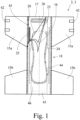
- Fig. 1 shows schematically the structure of a hygiene product 2, here exemplified in the form of an adult diaper 3, which can be manufactured with a proposed production plant 1.
- the hygiene product 2 essentially consists of a multi-layered central part 46 (chassis) and lateral fastening elements 15a (back ears) attached in a rear section and lateral fastening elements 15b (front ears) attached in a front section.
- the middle part 46 has an upper layer 16 (topsheet) facing the body during intended use, and a lower layer 17 (backsheet) facing away from the body during intended use. Between the band material 16 forming the topsheet and the band material 17 forming the backsheet, the hygiene product 2 has a liquid-absorbing core 20 and preferably a liquid acquisition and/or distribution layer 23. A pressing region 44 is provided around the core 20, in which the layers of the middle part 46 are pressed together.
- the topsheet 16 is provided on both long sides with flap-shaped leak protection 24 (upstanding cuffs), which serve to retain liquid when properly applied. Furthermore, elastic longitudinal bands 25 and elastic transverse bands 26 are provided in the central part 46 to ensure an optimal fit of the hygiene product 2 on the user's body.
- the lateral fastening elements 15a and 15b are here and preferably fixed between the strip material 16 of the top sheet and the strip material 17 of the back sheet in a connection area 45, which can be achieved by means of hot gluing, ultrasonic sealing, and/or hot stamping.
- the rear lateral fastening elements 15a also have fastening strips 42, in particular in the form of adhesive and/or hook-and-loop strips.
- a frontal fastening surface 43 frontal tape
- frontal tape which can be designed as an adhesive and/or hook-and-loop strip, can be provided on the central part 46 for fastening purposes, in particular for interaction with one of the fastening strips 42.
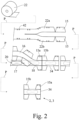
- the proposed production system 1 has a plurality of processing stations 4 to 12, 4' to 12', and 27 to 30.
- processing stations 4 to 12 and 4' to 12' are format-dependent processing stations, i.e., processing stations designed to produce a specific product format (a specific product size) and are interchangeable during a format change.
- Processing stations 27 to 30, on the other hand, are format-independent and therefore do not need to be interchanged during a format change.
- the first format change module 13 and the second format change module 13' can be alternately integrated into a production line 14 of the production plant 1, depending on the product format to be produced. If hygiene products 2 of the first product format are to be produced, the first format change module 13 is integrated into the production line 14, and the second format change module 13' is arranged outside the production line 14. In the opposite case, if the second product format is to be produced, the first format change module 13 is exchanged for the second format change module 13'.
- the two format change modules 13 and 13' have, in particular, the same structure, i.e., they have corresponding processing stations or the same types of processing stations, whereby, in particular, the size of the corresponding processing stations, the distances between adjacent corresponding processing stations and/or the component distances within the corresponding processing stations differ in the two format change modules 13 and 13' in order to be able to produce the desired different product formats.
- the first product format can, for example, be adult diapers 3 in sizes S and M and the second product format can be adult diapers 3 in sizes L and XL.
- the dimensions of a hygiene product 2 in of size S and a hygiene product 2 in size M may differ slightly, but the differences are so small that no, or at least no significant, changes are required within the format change module 13.
- the overall lengths for sizes S and M differ by, for example, 40 mm, and for sizes L and XL even by only, for example, 15 mm, which does not require replacement of the format change module 13 or 13', whereas for sizes M and L the overall lengths may differ by, for example, 90 mm, which then requires replacement of the format change module 13 or 13'.
- the format change modules 13 and 13' are fully functional when integrated into the production line 14. In particular, it is only necessary to connect the respective integrated format change module 13 or 13' electrically, pneumatically, and/or hydraulically.
- the respective format change module 13 or 13' is fully functional even when not integrated into the production line 14, so that a functional test can be performed at any time, even outside the production line.
- the layer joining device 5 or 5' of the respective format change module 13 or 13' has a collecting drum 19 configured to combine the strip material 16 forming the body-side layer, which is provided in particular with at least the intermediate products 15 for the lateral fastening elements 15a and 15b, with the strip material 17 forming the body-removable layer, which is provided in particular with at least the liquid-absorbing cores 20.
- the collecting drum 19 is configured in particular to suck in the strip material 16 forming the topsheet.
- the collecting drum 19 has, for example, circumferentially arranged openings (not shown) and is in fluid communication with a vacuum generating device (not shown), which is in particular not part of the respective format change module 13 or 13'.
- the layer joining device 5 or 5' here further comprises a pressure roller 21 which interacts with the collecting drum 19 in such a way that the layer structure 18 is pressed together at least in sections between the collecting drum 19 and the pressure roller 21, in particular in a pressure region 44 around the core 20.
- each of the format change modules 13 and 13' here and preferably has a module frame 37 or 37', respectively, into which the processing stations 4 to 12 or 4' to 12' for the respective product format are installed.
- the module frames 37 and 37' have, in particular, the same dimensions and are provided with a movement unit 38 or 38' in the form of air sliding cushions 39 or 39' and a coupling unit 40 or 40' for coupling with corresponding counterparts 41 provided in the production line 14.
- strip material 22 for the lateral fastening elements 15a and 15b or the previous intermediate product 15 is provided in the form of an endless roll.
- the strip material 22 is then divided into two strands 22a and 22b by means of a longitudinal cutting device 35, wherein the intermediate products 15 for the lateral fastening elements 15a and 15b are shaped or cut to size in the cutting device 4 or 4', whereby in this variant some offcuts arise (low waste variant) which can be vacuumed off.
- the intermediate products 15 are then connected in particular in a material-to-material bond to the strip material 16 of the body-side layer (topsheet), for example by means of glue and/or ultrasound and/or embossing, wherein this strip material 16 is then combined with the strip material 17 of the body-removable layer (backsheet), onto which the liquid-absorbing cores 20 were previously placed.
- the merging takes place on the collecting drum 19, whereby the resulting layered structure or product strand 18 is subsequently pressed together around the cores 20 between the collecting drum 19 and the pressure roller 21.
- the layered structure 18, in which a liquid absorption and/or distribution layer 23 (acquisition layer) as well as elastic longitudinal bands 25 and elastic transverse bands 26 can also be integrated, is then divided in the cutting device 28, whereby an individual product 34 is created.
- the separation between the individual product 34 and the preceding layered strand 18 runs transversely to the production direction P through the intermediate products 15, whereby the intermediate products 15 are divided into the lateral fastening elements 15a and 15b, which are already Fig. 1 Before cutting to length, a longitudinal fold and then a cross fold can be carried out (in Fig. 2 not shown).
- the finished individual products 34 can then be packaged.
- the second embodiment differs from the variant in Fig. 2 by cutting the intermediate products 15 for the subsequent lateral fastening elements 15a and 15b without waste (zero waste variant). This requires, after cutting in the cutting device 4 or 4', a rotation of every second intermediate product 15 by 180° about an axis perpendicular to the intermediate product 15 (the axis can also be different, as long as the intermediate product is subsequently aligned like the adjacent intermediate products).
- the further course of the process is based on Fig. 2 described are identical.
Landscapes
- Health & Medical Sciences (AREA)
- Life Sciences & Earth Sciences (AREA)
- Engineering & Computer Science (AREA)
- Biomedical Technology (AREA)
- Manufacturing & Machinery (AREA)
- Epidemiology (AREA)
- Botany (AREA)
- Heart & Thoracic Surgery (AREA)
- Vascular Medicine (AREA)
- Animal Behavior & Ethology (AREA)
- General Health & Medical Sciences (AREA)
- Public Health (AREA)
- Veterinary Medicine (AREA)
- Absorbent Articles And Supports Therefor (AREA)
Claims (12)
- Installation de fabrication (1) pour des produits d'hygiène (2), en particulier des couches pour adultes ou pour bébés (2),- comprenant plusieurs postes de traitement (4, 5,... 12) configurés pour la fabrication d'un premier format de produit, et- comprenant plusieurs postes de traitement (4', 5',... 12') configurés pour la fabrication d'un deuxième format de produit,les postes de traitement (4, 5,... 12) pour le premier format de produit étant regroupés dans un premier module (13) de changement de format et les postes de traitement (4', 5, ... 12') pour le deuxième format de produit étant regroupés dans un deuxième module (13') de changement de format, etle premier module (13) de changement de format et le deuxième module (13') de changement de format étant aptes à être intégrés en alternance dans une ligne de production (14) de l'installation de fabrication (1),le premier module (13) de changement de format, en tant que postes de traitement (4, 5) pour le premier format de produit, et le deuxième module (13') de changement de format, en tant que postes de traitement (4', 5') pour le deuxième format de produit, comprenant chacun :- un dispositif de coupe (4, 4') conçu de manière à façonner les éléments de fixation latéraux (15a, 15b) du produit d'hygiène (2) ou des produits intermédiaires (15) à partir desquels les éléments de fixation latéraux (15a, 15b) sont fabriqués, et- un dispositif (5, 5') de liaison de couches conçu de manière à réunir au moins un matériau en bande (16) formant une couche côté corps, un matériau en bande (17) formant la couche éloignée du corps ainsi que les éléments de fixation latéraux (15a, 15b) ou des produits intermédiaires (15) et pour les assembler en une structure stratifiée fixe (18), les éléments de fixation latéraux (15a, 15b) ou les produits intermédiaires (15) étant aptes à être reliés au matériau en bande (16) formant la couche côté corps et/ou au matériau en bande (17) formant la couche éloignée du corps, en particulier par liaison de matière, de préférence par application de colle chaude, par soudage par ultrasons et/ou par estampage à chaud, par liaison de force et/ou par complémentarité de forme,l'installation de fabrication (1) comprenant, en tant que poste de traitement supplémentaire (27) qui ne fait pas partie du module (13, 13') de changement de format respectif,- un premier dispositif de pliage (27) conçu de manière à plier longitudinalement la structure stratifiée fixée (18), et/ou- un dispositif de coupe (28) conçu de manière à couper la structure stratifiée fixée (18), et/ou- un deuxième dispositif de pliage (29) conçu de manière à plier transversalement des produits individuels (34) fabriqués à partir de la structure stratifiée fixée (18), et/ouun dispositif d'empilage (30) conçu de manière à empiler, et en particulier emballer, des produits individuels (34) fabriqués à partir de la structure stratifiée fixe (18).
- Installation de fabrication (1) selon la revendication 1, caractérisée en ce que le dispositif (5, 5') de liaison de couches comprend un tambour collecteur (19) qui est conçu de manière à réunir le matériau en bande (16) formant la couche côté corps, qui est notamment pourvu au moins des éléments de fixation latéraux (15a, 15b) ou des produits intermédiaires (15) avec le matériau en bande (17) formant la couche éloignée du corps, qui est notamment pourvu au moins de noyaux (20) absorbant les liquides, le tambour collecteur (19) étant notamment conçu de manière à aspirer le matériau en bande (16) formant la couche côté corps.
- Installation de fabrication (1) selon la revendication 2, caractérisée en ce que le dispositif (5, 5') de liaison de couches comprend un rouleau de pression (21) qui coopère avec le tambour collecteur (19) de telle manière que la structure en couches (18) soit comprimée au moins partiellement entre le tambour collecteur (19) et le rouleau de pression (21), en particulier au moins autour des noyaux (20).
- Installation de fabrication (1) selon l'une des revendications précédentes, caractérisée en ce que le premier module (13) de changement de format, en tant que poste de traitement (6) pour le premier format de produit, et le deuxième module (13') de changement de format, en tant que poste de traitement (6') pour le deuxième format de produit, par rapport au sens de production (P) entre le dispositif de coupe (4, 4') et le dispositif (5, 5') de liaison de couches, présentent chacun un dispositif de manipulation (6, 6') qui est conçu de manière à accélérer les éléments de fixation latéraux (15a, 15b) ou les produits intermédiaires (15) dans le sens de la production (P), et en particulier à les espacer les uns des autres dans le sens de la fabrication (P) et/ou à faire pivoter certains éléments de fixation (15a, 15b) ou produits intermédiaires (15), en particulier de 180°.
- Installation de fabrication (1) selon l'une des revendications précédentes, caractérisée en ce que le premier module (13) de changement de format, en tant que postes de traitement (7, 8,... 12) pour le premier format de produit, et le deuxième module (13') de changement de format, en tant que postes de traitement (7', 8',... 12') pour le deuxième format de produit, comprennent chacun :- un premier dispositif d'alimentation (7, 7') conçu de manière à alimenter le dispositif de coupe (4, 4') en bande (22) pour les éléments de fixation latéraux (15a, 15b) ou les produits intermédiaires (15), en particulier sous la forme de deux brins de matériau (22a, 22b), et/ou- un deuxième dispositif d'alimentation (8, 8') conçu de manière à alimenter la bande (16) formant la couche côté corps vers le dispositif (5, 5') de liaison de couches, le matériau en bande (16) formant la couche côté corps étant notamment pourvu d'au moins une couche (23) d'absorption et de répartition de liquide et/ou d'une protection antifuite (24) et/ou d'une couche intermédiaire, et/ou- un troisième dispositif d'alimentation (9, 9') conçu de manière à alimenter vers le dispositif (5, 5') de liaison de couches la bande (17) formant la couche éloignée du corps, la bande (17) formant la couche éloignée du corps étant notamment pourvue de noyaux (20) absorbant les liquides et/ou de bandes longitudinales élastiques (25), et/ou- un quatrième dispositif d'alimentation (10, 10') conçu de manière à alimenter des bandes transversales élastiques (26) ainsi qu'un dispositif de coupe (11, 11') conçu de manière à couper les bandes transversales élastiques (26) et/ou- un dispositif de transfert (12, 12') conçu de manière à transférer la structure stratifiée fixée (18) vers un autre poste de traitement (27, 28,... 33), qui ne fait notamment pas partie du module de changement de format respectif (13, 13').
- Installation de fabrication (1) selon l'une des revendications précédentes, caractérisée en ce que le poste de traitement supplémentaire (27, 28, ... 30), qui ne fait pas partie du module respectif (13, 13') de changement de format, est placé en aval du module respectif (13, 13') de changement de format dans le sens de la fabrication (P) lorsqu'il est intégré dans la ligne de fabrication (14).
- Installation de fabrication (1) selon l'une des revendications précédentes, caractérisée en ce que l'installation de fabrication (1) comprend, en tant que poste de traitement supplémentaire (31) qui ne fait pas partie du module respectif (13, 13') de changement de format, un premier dispositif de fourniture (31) qui est conçu de manière à alimenter du matériau en bande (22) pour les éléments de fixation latéraux (15a, 15b) ou des produits intermédiaires (15) vers le module respectif (13, 13') de changement de format, et en particulier vers le premier dispositif d'alimentation (7, 7') du module respectif (13, 13') de changement de format, le premier dispositif de fourniture (31) comprenant en particulier un dispositif de division longitudinale (35) pour diviser le matériau en bande (22) en deux brins de matériau en bande séparés (22a, 22b).
- Installation de fabrication (1) selon l'une des revendications précédentes, caractérisée en ce que l'installation de fabrication (1) comprend, en tant que poste de traitement supplémentaire (32) qui ne fait pas partie du module respectif (13, 13') de changement de format, un deuxième dispositif de fourniture (32) qui est conçu de manière à alimenter le matériau en bande (16) formant la couche côté corps vers le module respectif (13, 13') de changement de format, et en particulier vers le deuxième dispositif d'alimentation (8, 8') du module respectif (13, 13') de changement de format, le deuxième dispositif de fourniture (32) comprenant en particulier un dispositif de stratification (36) pour réunir le matériau en bande (16) formant la couche côté corps et une couche de réception et de distribution de liquide (23) et/ou une protection de sortie (24) et/ou une couche intermédiaire.
- Installation de fabrication (1) selon l'une des revendications précédentes, caractérisée en que l'installation de fabrication (1) comprend, en tant que poste de traitement supplémentaire, un troisième dispositif de fourniture (33) qui est conçu de manière à alimenter le matériau en bande (17) formant la couche éloignée du corps vers le module respectif (13, 13') de changement de format, et en particulier vers le troisième dispositif d'alimentation (9, 9') du module respectif (13, 13') de changement de format, le troisième dispositif de fourniture (33) comprenant en particulier un dispositif (37) de formage de noyaux qui est configuré pour fabriquer et former des noyaux (20) absorbant les liquides et pour placer les noyaux (20) sur le matériau en bande (17) formant la couche éloignée du corps.
- Installation de fabrication (1) selon l'une des revendications 7 à 9, caractérisée en ce que le poste de traitement supplémentaire (31, 32, 33), qui ne fait pas partie du module (13, 13') de changement de format, est placé en amont du module respectif (13, 13') de changement de format intégré dans la ligne de production (14) par rapport au sens de production (P).
- Installation de fabrication (1) selon l'une des revendications précédentes, caractérisée en ce que le module respectif (13, 13') de changement de format comprend un châssis (37, 37') de module dans lequel sont installées les postes de traitement (4, 5,... 12 ; 4', 5',... 12') pour le format de produit respectif, le châssis (37) de module du premier module (13) de changement de format ayant en particulier les mêmes dimensions que le châssis (37') de module du deuxième module (13') de changement de format.
- Installation de fabrication (1) selon l'une des revendications précédentes, caractérisée en ce que le module (13, 13') de changement de format respectif comprend une unité de déplacement (38, 38') qui contient en particulier des rouleaux de transport ou des coussins d'air (39, 39') et/ou une unité de liaison (40, 40') conçue de manière à venir en accouplement avec des contreparties correspondantes (41) dans la ligne de fabrication (14).
Applications Claiming Priority (2)
| Application Number | Priority Date | Filing Date | Title |
|---|---|---|---|
| DE102017106728.0A DE102017106728A1 (de) | 2017-03-29 | 2017-03-29 | Fertigungsanlage für Hygieneprodukte, insbesondere Erwachsenen- oder Babywindeln |
| PCT/EP2018/057790 WO2018178084A1 (fr) | 2017-03-29 | 2018-03-27 | Installation de production de produits d'hygiène, en particulier de changes pour adultes ou pour bébés |
Publications (3)
| Publication Number | Publication Date |
|---|---|
| EP3600192A1 EP3600192A1 (fr) | 2020-02-05 |
| EP3600192C0 EP3600192C0 (fr) | 2025-05-28 |
| EP3600192B1 true EP3600192B1 (fr) | 2025-05-28 |
Family
ID=61827737
Family Applications (1)
| Application Number | Title | Priority Date | Filing Date |
|---|---|---|---|
| EP18714231.0A Active EP3600192B1 (fr) | 2017-03-29 | 2018-03-27 | Installation de production de produits d'hygiène, en particulier de changes pour adultes ou pour bébés |
Country Status (3)
| Country | Link |
|---|---|
| EP (1) | EP3600192B1 (fr) |
| DE (1) | DE102017106728A1 (fr) |
| WO (1) | WO2018178084A1 (fr) |
Families Citing this family (2)
| Publication number | Priority date | Publication date | Assignee | Title |
|---|---|---|---|---|
| CN112882447A (zh) * | 2021-01-12 | 2021-06-01 | 宣城睿晖宣晟企业管理中心合伙企业(有限合伙) | 基于自动生产线的生产工艺控制方法、装置和计算设备 |
| CN119112506B (zh) * | 2024-11-15 | 2025-02-11 | 泉州市嘉华卫生用品有限公司 | 一种具有护肤颗粒的芯体生产工艺及纸尿裤和拉拉裤 |
Family Cites Families (10)
| Publication number | Priority date | Publication date | Assignee | Title |
|---|---|---|---|---|
| SE502825C2 (sv) * | 1994-05-31 | 1996-01-22 | Moelnlycke Ab | Processlinje för tillverkning av absorberande engångsartiklar innefattande ett ramverk med bärplattor |
| SE502823C2 (sv) * | 1994-05-31 | 1996-01-22 | Moelnlycke Ab | Processlinje för tillverkning av absorberande engångsartiklar innefattande ett ramverk med tillförselledningar |
| ES2282236T3 (es) | 2000-02-02 | 2007-10-16 | THE PROCTER & GAMBLE COMPANY | Sistema de fabricacion flexible. |
| US6574520B1 (en) * | 2000-02-02 | 2003-06-03 | The Procter & Gamble Company | Flexible manufacturing system |
| DE10144028A1 (de) * | 2001-09-04 | 2003-03-27 | Winkler & Duennebier Ag | Maschinengestell in Modulbauweise |
| DE10150337A1 (de) * | 2001-10-15 | 2003-07-10 | Winkler & Duennebier Ag | Vorrichtung zum Herstellen, insbesondere von Hygieneartikeln |
| US8321049B2 (en) * | 2009-08-20 | 2012-11-27 | The Procter & Gamble Company | Flexible manufacturing systems and methods |
| US20110041997A1 (en) * | 2009-08-20 | 2011-02-24 | James Jay Benner | Speed Change Kit For An Absorent Article Converting Line |
| EP3082680A1 (fr) * | 2013-12-20 | 2016-10-26 | The Procter & Gamble Company | Opérations d'unités modulaires pour convertisseur de monture souple |
| EP3082678A1 (fr) * | 2013-12-20 | 2016-10-26 | The Procter & Gamble Company | Base pour un convertisseur de support souple |
-
2017
- 2017-03-29 DE DE102017106728.0A patent/DE102017106728A1/de active Pending
-
2018
- 2018-03-27 WO PCT/EP2018/057790 patent/WO2018178084A1/fr not_active Ceased
- 2018-03-27 EP EP18714231.0A patent/EP3600192B1/fr active Active
Also Published As
| Publication number | Publication date |
|---|---|
| DE102017106728A1 (de) | 2018-10-04 |
| WO2018178084A1 (fr) | 2018-10-04 |
| EP3600192A1 (fr) | 2020-02-05 |
| EP3600192C0 (fr) | 2025-05-28 |
Similar Documents
| Publication | Publication Date | Title |
|---|---|---|
| DE69215643T2 (de) | Verfahren zur Herstellung von absorbtionsfähigem Material | |
| DE112013002045B4 (de) | Verfahren zur Übertragung einzelner Artikel | |
| DE60319101T3 (de) | Vorrichtung und verfahren zum schneiden und anordnen von materialstücken | |
| DE69704851T2 (de) | Verfahren zur herstellung von seiteneinsatzstücken für wegwerfartikel | |
| DE112013002052B4 (de) | Vorrichtungen zum Übertragen seperater Artikel | |
| DE112013002061B4 (de) | Fluidsysteme und Verfahren für die Übertragung eigenständiger Artikel | |
| DE69506751T2 (de) | Verfahren und Vorrichtung zum Herstellen von mehrschichtigem, absorbierenden Erzeugnissen | |
| EP2146675B1 (fr) | Procédé de production d'une couche | |
| DE69702389T2 (de) | Verfahren zum falten und handhaben einer materialbahn in kontinuierlichem betrieb | |
| DE19823954C2 (de) | Verfahren und Vorrichtung zum Ausbilden luftaufgebrachter absorbierender Faserkerne | |
| DE69420562T2 (de) | Verfahren und vorrichtung zum befestigen von verschlusselementen an eine wegwerfwindel mit unterschiedlicher dichte | |
| DE2740088A1 (de) | Verfahren und vorrichtung zum fliegenden verbinden der enden zweier bahnen | |
| EP3868694A1 (fr) | Dispositif rotatif pour une installation de production de produits d'hygiène | |
| DE112005003155B4 (de) | Verfahren zur Herstellung eines Wegwerftrageartikels | |
| DE3203992C2 (de) | Anordnung zum Herstellen von Damenbinden | |
| DE112014005523T5 (de) | Vorrichtung und Verfahren zum Befördern von Absorptionsartikeln | |
| DE112014005552T5 (de) | Vorrichtung und Verfahren zum Befördern von Absorptionsartikeln | |
| DE60209925T2 (de) | Verfahren und vorrichtung zum prägen einer mehrlagigen tissue-papierbahn | |
| DE112018005100T5 (de) | Vorrichtung und verfahren zum formen eines absorbierenden pads | |
| EP3600192A1 (fr) | Installation de production de produits d'hygiène, en particulier de changes pour adultes ou pour bébés | |
| EP2629727B1 (fr) | Procédé de fabrication d'une couche d'incontinence jetable comportant des parties latérales de couche profilées | |
| DE2305069A1 (de) | Absorptionsprodukt sowie verfahren und vorrichtung zur herstellung desselben | |
| DE102010008906A1 (de) | Anlage zur Herstellung von Wellpappe | |
| EP1269948B1 (fr) | Article hygiénique absorbant, procédé et appareil pour sa production | |
| EP2574577A2 (fr) | Procédé destiné au traitement d'une bande de matériau, notamment pour la fabrication de produits d'hygiène |
Legal Events
| Date | Code | Title | Description |
|---|---|---|---|
| STAA | Information on the status of an ep patent application or granted ep patent |
Free format text: STATUS: UNKNOWN |
|
| STAA | Information on the status of an ep patent application or granted ep patent |
Free format text: STATUS: THE INTERNATIONAL PUBLICATION HAS BEEN MADE |
|
| PUAI | Public reference made under article 153(3) epc to a published international application that has entered the european phase |
Free format text: ORIGINAL CODE: 0009012 |
|
| STAA | Information on the status of an ep patent application or granted ep patent |
Free format text: STATUS: REQUEST FOR EXAMINATION WAS MADE |
|
| 17P | Request for examination filed |
Effective date: 20190920 |
|
| AK | Designated contracting states |
Kind code of ref document: A1 Designated state(s): AL AT BE BG CH CY CZ DE DK EE ES FI FR GB GR HR HU IE IS IT LI LT LU LV MC MK MT NL NO PL PT RO RS SE SI SK SM TR |
|
| AX | Request for extension of the european patent |
Extension state: BA ME |
|
| DAV | Request for validation of the european patent (deleted) | ||
| DAX | Request for extension of the european patent (deleted) | ||
| STAA | Information on the status of an ep patent application or granted ep patent |
Free format text: STATUS: EXAMINATION IS IN PROGRESS |
|
| 17Q | First examination report despatched |
Effective date: 20230307 |
|
| RAP1 | Party data changed (applicant data changed or rights of an application transferred) |
Owner name: WINKLER + DUENNEBIER GMBH |
|
| GRAP | Despatch of communication of intention to grant a patent |
Free format text: ORIGINAL CODE: EPIDOSNIGR1 |
|
| STAA | Information on the status of an ep patent application or granted ep patent |
Free format text: STATUS: GRANT OF PATENT IS INTENDED |
|
| INTG | Intention to grant announced |
Effective date: 20250217 |
|
| GRAS | Grant fee paid |
Free format text: ORIGINAL CODE: EPIDOSNIGR3 |
|
| GRAA | (expected) grant |
Free format text: ORIGINAL CODE: 0009210 |
|
| STAA | Information on the status of an ep patent application or granted ep patent |
Free format text: STATUS: THE PATENT HAS BEEN GRANTED |
|
| AK | Designated contracting states |
Kind code of ref document: B1 Designated state(s): AL AT BE BG CH CY CZ DE DK EE ES FI FR GB GR HR HU IE IS IT LI LT LU LV MC MK MT NL NO PL PT RO RS SE SI SK SM TR |
|
| REG | Reference to a national code |
Ref country code: GB Ref legal event code: FG4D Free format text: NOT ENGLISH |
|
| REG | Reference to a national code |
Ref country code: CH Ref legal event code: EP |
|
| REG | Reference to a national code |
Ref country code: IE Ref legal event code: FG4D Free format text: LANGUAGE OF EP DOCUMENT: GERMAN Ref country code: DE Ref legal event code: R096 Ref document number: 502018015846 Country of ref document: DE |
|
| RAP4 | Party data changed (patent owner data changed or rights of a patent transferred) |
Owner name: BW CONVERTING GMBH |
|
| U01 | Request for unitary effect filed |
Effective date: 20250625 |
|
| U07 | Unitary effect registered |
Designated state(s): AT BE BG DE DK EE FI FR IT LT LU LV MT NL PT RO SE SI Effective date: 20250702 |
|
| PG25 | Lapsed in a contracting state [announced via postgrant information from national office to epo] |
Ref country code: ES Free format text: LAPSE BECAUSE OF FAILURE TO SUBMIT A TRANSLATION OF THE DESCRIPTION OR TO PAY THE FEE WITHIN THE PRESCRIBED TIME-LIMIT Effective date: 20250528 |
|
| PG25 | Lapsed in a contracting state [announced via postgrant information from national office to epo] |
Ref country code: NO Free format text: LAPSE BECAUSE OF FAILURE TO SUBMIT A TRANSLATION OF THE DESCRIPTION OR TO PAY THE FEE WITHIN THE PRESCRIBED TIME-LIMIT Effective date: 20250828 Ref country code: GR Free format text: LAPSE BECAUSE OF FAILURE TO SUBMIT A TRANSLATION OF THE DESCRIPTION OR TO PAY THE FEE WITHIN THE PRESCRIBED TIME-LIMIT Effective date: 20250829 |
|
| PG25 | Lapsed in a contracting state [announced via postgrant information from national office to epo] |
Ref country code: PL Free format text: LAPSE BECAUSE OF FAILURE TO SUBMIT A TRANSLATION OF THE DESCRIPTION OR TO PAY THE FEE WITHIN THE PRESCRIBED TIME-LIMIT Effective date: 20250528 |
|
| PG25 | Lapsed in a contracting state [announced via postgrant information from national office to epo] |
Ref country code: HR Free format text: LAPSE BECAUSE OF FAILURE TO SUBMIT A TRANSLATION OF THE DESCRIPTION OR TO PAY THE FEE WITHIN THE PRESCRIBED TIME-LIMIT Effective date: 20250528 |
|
| PG25 | Lapsed in a contracting state [announced via postgrant information from national office to epo] |
Ref country code: RS Free format text: LAPSE BECAUSE OF FAILURE TO SUBMIT A TRANSLATION OF THE DESCRIPTION OR TO PAY THE FEE WITHIN THE PRESCRIBED TIME-LIMIT Effective date: 20250828 |
|
| PG25 | Lapsed in a contracting state [announced via postgrant information from national office to epo] |
Ref country code: IS Free format text: LAPSE BECAUSE OF FAILURE TO SUBMIT A TRANSLATION OF THE DESCRIPTION OR TO PAY THE FEE WITHIN THE PRESCRIBED TIME-LIMIT Effective date: 20250928 |
|
| PG25 | Lapsed in a contracting state [announced via postgrant information from national office to epo] |
Ref country code: SM Free format text: LAPSE BECAUSE OF FAILURE TO SUBMIT A TRANSLATION OF THE DESCRIPTION OR TO PAY THE FEE WITHIN THE PRESCRIBED TIME-LIMIT Effective date: 20250528 |
|
| PG25 | Lapsed in a contracting state [announced via postgrant information from national office to epo] |
Ref country code: CZ Free format text: LAPSE BECAUSE OF FAILURE TO SUBMIT A TRANSLATION OF THE DESCRIPTION OR TO PAY THE FEE WITHIN THE PRESCRIBED TIME-LIMIT Effective date: 20250528 |
|
| PG25 | Lapsed in a contracting state [announced via postgrant information from national office to epo] |
Ref country code: SK Free format text: LAPSE BECAUSE OF FAILURE TO SUBMIT A TRANSLATION OF THE DESCRIPTION OR TO PAY THE FEE WITHIN THE PRESCRIBED TIME-LIMIT Effective date: 20250528 |
|
| PLBE | No opposition filed within time limit |
Free format text: ORIGINAL CODE: 0009261 |
|
| STAA | Information on the status of an ep patent application or granted ep patent |
Free format text: STATUS: NO OPPOSITION FILED WITHIN TIME LIMIT |
|
| REG | Reference to a national code |
Ref country code: CH Ref legal event code: L10 Free format text: ST27 STATUS EVENT CODE: U-0-0-L10-L00 (AS PROVIDED BY THE NATIONAL OFFICE) Effective date: 20260409 |
|
| 26N | No opposition filed |
Effective date: 20260303 |
|
| U20 | Renewal fee for the european patent with unitary effect paid |
Year of fee payment: 9 Effective date: 20260330 |