EP3600852B1 - Verfahren zum verschweissen - Google Patents
Verfahren zum verschweissen Download PDFInfo
- Publication number
- EP3600852B1 EP3600852B1 EP18721951.4A EP18721951A EP3600852B1 EP 3600852 B1 EP3600852 B1 EP 3600852B1 EP 18721951 A EP18721951 A EP 18721951A EP 3600852 B1 EP3600852 B1 EP 3600852B1
- Authority
- EP
- European Patent Office
- Prior art keywords
- tube
- aforementioned
- tube end
- protective layer
- welded
- Prior art date
- Legal status (The legal status is an assumption and is not a legal conclusion. Google has not performed a legal analysis and makes no representation as to the accuracy of the status listed.)
- Active
Links
Images
Classifications
-
- B—PERFORMING OPERATIONS; TRANSPORTING
- B29—WORKING OF PLASTICS; WORKING OF SUBSTANCES IN A PLASTIC STATE IN GENERAL
- B29C—SHAPING OR JOINING OF PLASTICS; SHAPING OF MATERIAL IN A PLASTIC STATE, NOT OTHERWISE PROVIDED FOR; AFTER-TREATMENT OF THE SHAPED PRODUCTS, e.g. REPAIRING
- B29C65/00—Joining or sealing of preformed parts, e.g. welding of plastics materials; Apparatus therefor
- B29C65/02—Joining or sealing of preformed parts, e.g. welding of plastics materials; Apparatus therefor by heating, with or without pressure
- B29C65/04—Dielectric heating, e.g. high-frequency welding, i.e. radio frequency welding of plastic materials having dielectric properties, e.g. PVC
-
- B—PERFORMING OPERATIONS; TRANSPORTING
- B29—WORKING OF PLASTICS; WORKING OF SUBSTANCES IN A PLASTIC STATE IN GENERAL
- B29C—SHAPING OR JOINING OF PLASTICS; SHAPING OF MATERIAL IN A PLASTIC STATE, NOT OTHERWISE PROVIDED FOR; AFTER-TREATMENT OF THE SHAPED PRODUCTS, e.g. REPAIRING
- B29C65/00—Joining or sealing of preformed parts, e.g. welding of plastics materials; Apparatus therefor
- B29C65/02—Joining or sealing of preformed parts, e.g. welding of plastics materials; Apparatus therefor by heating, with or without pressure
-
- B—PERFORMING OPERATIONS; TRANSPORTING
- B29—WORKING OF PLASTICS; WORKING OF SUBSTANCES IN A PLASTIC STATE IN GENERAL
- B29C—SHAPING OR JOINING OF PLASTICS; SHAPING OF MATERIAL IN A PLASTIC STATE, NOT OTHERWISE PROVIDED FOR; AFTER-TREATMENT OF THE SHAPED PRODUCTS, e.g. REPAIRING
- B29C65/00—Joining or sealing of preformed parts, e.g. welding of plastics materials; Apparatus therefor
- B29C65/02—Joining or sealing of preformed parts, e.g. welding of plastics materials; Apparatus therefor by heating, with or without pressure
- B29C65/14—Joining or sealing of preformed parts, e.g. welding of plastics materials; Apparatus therefor by heating, with or without pressure using wave energy, i.e. electromagnetic radiation, or particle radiation
- B29C65/1403—Joining or sealing of preformed parts, e.g. welding of plastics materials; Apparatus therefor by heating, with or without pressure using wave energy, i.e. electromagnetic radiation, or particle radiation characterised by the type of electromagnetic or particle radiation
-
- B—PERFORMING OPERATIONS; TRANSPORTING
- B29—WORKING OF PLASTICS; WORKING OF SUBSTANCES IN A PLASTIC STATE IN GENERAL
- B29C—SHAPING OR JOINING OF PLASTICS; SHAPING OF MATERIAL IN A PLASTIC STATE, NOT OTHERWISE PROVIDED FOR; AFTER-TREATMENT OF THE SHAPED PRODUCTS, e.g. REPAIRING
- B29C65/00—Joining or sealing of preformed parts, e.g. welding of plastics materials; Apparatus therefor
- B29C65/02—Joining or sealing of preformed parts, e.g. welding of plastics materials; Apparatus therefor by heating, with or without pressure
- B29C65/14—Joining or sealing of preformed parts, e.g. welding of plastics materials; Apparatus therefor by heating, with or without pressure using wave energy, i.e. electromagnetic radiation, or particle radiation
- B29C65/16—Laser beams
-
- B—PERFORMING OPERATIONS; TRANSPORTING
- B29—WORKING OF PLASTICS; WORKING OF SUBSTANCES IN A PLASTIC STATE IN GENERAL
- B29C—SHAPING OR JOINING OF PLASTICS; SHAPING OF MATERIAL IN A PLASTIC STATE, NOT OTHERWISE PROVIDED FOR; AFTER-TREATMENT OF THE SHAPED PRODUCTS, e.g. REPAIRING
- B29C65/00—Joining or sealing of preformed parts, e.g. welding of plastics materials; Apparatus therefor
- B29C65/48—Joining or sealing of preformed parts, e.g. welding of plastics materials; Apparatus therefor using adhesives, i.e. using supplementary joining material; solvent bonding
- B29C65/4895—Solvent bonding, i.e. the surfaces of the parts to be joined being treated with solvents, swelling or softening agents, without adhesives
-
- B—PERFORMING OPERATIONS; TRANSPORTING
- B29—WORKING OF PLASTICS; WORKING OF SUBSTANCES IN A PLASTIC STATE IN GENERAL
- B29C—SHAPING OR JOINING OF PLASTICS; SHAPING OF MATERIAL IN A PLASTIC STATE, NOT OTHERWISE PROVIDED FOR; AFTER-TREATMENT OF THE SHAPED PRODUCTS, e.g. REPAIRING
- B29C66/00—General aspects of processes or apparatus for joining preformed parts
- B29C66/004—Preventing sticking together, e.g. of some areas of the parts to be joined
-
- B—PERFORMING OPERATIONS; TRANSPORTING
- B29—WORKING OF PLASTICS; WORKING OF SUBSTANCES IN A PLASTIC STATE IN GENERAL
- B29C—SHAPING OR JOINING OF PLASTICS; SHAPING OF MATERIAL IN A PLASTIC STATE, NOT OTHERWISE PROVIDED FOR; AFTER-TREATMENT OF THE SHAPED PRODUCTS, e.g. REPAIRING
- B29C66/00—General aspects of processes or apparatus for joining preformed parts
- B29C66/01—General aspects dealing with the joint area or with the area to be joined
- B29C66/05—Particular design of joint configurations
- B29C66/10—Particular design of joint configurations particular design of the joint cross-sections
- B29C66/11—Joint cross-sections comprising a single joint-segment, i.e. one of the parts to be joined comprising a single joint-segment in the joint cross-section
- B29C66/112—Single lapped joints
- B29C66/1122—Single lap to lap joints, i.e. overlap joints
-
- B—PERFORMING OPERATIONS; TRANSPORTING
- B29—WORKING OF PLASTICS; WORKING OF SUBSTANCES IN A PLASTIC STATE IN GENERAL
- B29C—SHAPING OR JOINING OF PLASTICS; SHAPING OF MATERIAL IN A PLASTIC STATE, NOT OTHERWISE PROVIDED FOR; AFTER-TREATMENT OF THE SHAPED PRODUCTS, e.g. REPAIRING
- B29C66/00—General aspects of processes or apparatus for joining preformed parts
- B29C66/01—General aspects dealing with the joint area or with the area to be joined
- B29C66/05—Particular design of joint configurations
- B29C66/306—Applying a mark during joining
-
- B—PERFORMING OPERATIONS; TRANSPORTING
- B29—WORKING OF PLASTICS; WORKING OF SUBSTANCES IN A PLASTIC STATE IN GENERAL
- B29C—SHAPING OR JOINING OF PLASTICS; SHAPING OF MATERIAL IN A PLASTIC STATE, NOT OTHERWISE PROVIDED FOR; AFTER-TREATMENT OF THE SHAPED PRODUCTS, e.g. REPAIRING
- B29C66/00—General aspects of processes or apparatus for joining preformed parts
- B29C66/01—General aspects dealing with the joint area or with the area to be joined
- B29C66/05—Particular design of joint configurations
- B29C66/306—Applying a mark during joining
- B29C66/3062—Applying a mark during joining in the form of letters or numbers
-
- B—PERFORMING OPERATIONS; TRANSPORTING
- B29—WORKING OF PLASTICS; WORKING OF SUBSTANCES IN A PLASTIC STATE IN GENERAL
- B29C—SHAPING OR JOINING OF PLASTICS; SHAPING OF MATERIAL IN A PLASTIC STATE, NOT OTHERWISE PROVIDED FOR; AFTER-TREATMENT OF THE SHAPED PRODUCTS, e.g. REPAIRING
- B29C66/00—General aspects of processes or apparatus for joining preformed parts
- B29C66/01—General aspects dealing with the joint area or with the area to be joined
- B29C66/05—Particular design of joint configurations
- B29C66/306—Applying a mark during joining
- B29C66/3062—Applying a mark during joining in the form of letters or numbers
- B29C66/30621—Applying a mark during joining in the form of letters or numbers in the form of letters
-
- B—PERFORMING OPERATIONS; TRANSPORTING
- B29—WORKING OF PLASTICS; WORKING OF SUBSTANCES IN A PLASTIC STATE IN GENERAL
- B29C—SHAPING OR JOINING OF PLASTICS; SHAPING OF MATERIAL IN A PLASTIC STATE, NOT OTHERWISE PROVIDED FOR; AFTER-TREATMENT OF THE SHAPED PRODUCTS, e.g. REPAIRING
- B29C66/00—General aspects of processes or apparatus for joining preformed parts
- B29C66/01—General aspects dealing with the joint area or with the area to be joined
- B29C66/345—Progressively making the joint, e.g. starting from the middle
- B29C66/3452—Making complete joints by combining partial joints
-
- B—PERFORMING OPERATIONS; TRANSPORTING
- B29—WORKING OF PLASTICS; WORKING OF SUBSTANCES IN A PLASTIC STATE IN GENERAL
- B29C—SHAPING OR JOINING OF PLASTICS; SHAPING OF MATERIAL IN A PLASTIC STATE, NOT OTHERWISE PROVIDED FOR; AFTER-TREATMENT OF THE SHAPED PRODUCTS, e.g. REPAIRING
- B29C66/00—General aspects of processes or apparatus for joining preformed parts
- B29C66/50—General aspects of joining tubular articles; General aspects of joining long products, i.e. bars or profiled elements; General aspects of joining single elements to tubular articles, hollow articles or bars; General aspects of joining several hollow-preforms to form hollow or tubular articles
- B29C66/51—Joining tubular articles, profiled elements or bars; Joining single elements to tubular articles, hollow articles or bars; Joining several hollow-preforms to form hollow or tubular articles
- B29C66/52—Joining tubular articles, bars or profiled elements
- B29C66/522—Joining tubular articles
- B29C66/5221—Joining tubular articles for forming coaxial connections, i.e. the tubular articles to be joined forming a zero angle relative to each other
-
- B—PERFORMING OPERATIONS; TRANSPORTING
- B29—WORKING OF PLASTICS; WORKING OF SUBSTANCES IN A PLASTIC STATE IN GENERAL
- B29C—SHAPING OR JOINING OF PLASTICS; SHAPING OF MATERIAL IN A PLASTIC STATE, NOT OTHERWISE PROVIDED FOR; AFTER-TREATMENT OF THE SHAPED PRODUCTS, e.g. REPAIRING
- B29C66/00—General aspects of processes or apparatus for joining preformed parts
- B29C66/50—General aspects of joining tubular articles; General aspects of joining long products, i.e. bars or profiled elements; General aspects of joining single elements to tubular articles, hollow articles or bars; General aspects of joining several hollow-preforms to form hollow or tubular articles
- B29C66/51—Joining tubular articles, profiled elements or bars; Joining single elements to tubular articles, hollow articles or bars; Joining several hollow-preforms to form hollow or tubular articles
- B29C66/52—Joining tubular articles, bars or profiled elements
- B29C66/522—Joining tubular articles
- B29C66/5221—Joining tubular articles for forming coaxial connections, i.e. the tubular articles to be joined forming a zero angle relative to each other
- B29C66/52211—Joining tubular articles for forming coaxial connections, i.e. the tubular articles to be joined forming a zero angle relative to each other for making endless tubular articles, e.g. endless inner tubes
-
- B—PERFORMING OPERATIONS; TRANSPORTING
- B29—WORKING OF PLASTICS; WORKING OF SUBSTANCES IN A PLASTIC STATE IN GENERAL
- B29C—SHAPING OR JOINING OF PLASTICS; SHAPING OF MATERIAL IN A PLASTIC STATE, NOT OTHERWISE PROVIDED FOR; AFTER-TREATMENT OF THE SHAPED PRODUCTS, e.g. REPAIRING
- B29C66/00—General aspects of processes or apparatus for joining preformed parts
- B29C66/50—General aspects of joining tubular articles; General aspects of joining long products, i.e. bars or profiled elements; General aspects of joining single elements to tubular articles, hollow articles or bars; General aspects of joining several hollow-preforms to form hollow or tubular articles
- B29C66/61—Joining from or joining on the inside
- B29C66/612—Making circumferential joints
-
- B—PERFORMING OPERATIONS; TRANSPORTING
- B29—WORKING OF PLASTICS; WORKING OF SUBSTANCES IN A PLASTIC STATE IN GENERAL
- B29C—SHAPING OR JOINING OF PLASTICS; SHAPING OF MATERIAL IN A PLASTIC STATE, NOT OTHERWISE PROVIDED FOR; AFTER-TREATMENT OF THE SHAPED PRODUCTS, e.g. REPAIRING
- B29C66/00—General aspects of processes or apparatus for joining preformed parts
- B29C66/70—General aspects of processes or apparatus for joining preformed parts characterised by the composition, physical properties or the structure of the material of the parts to be joined; Joining with non-plastics material
- B29C66/71—General aspects of processes or apparatus for joining preformed parts characterised by the composition, physical properties or the structure of the material of the parts to be joined; Joining with non-plastics material characterised by the composition of the plastics material of the parts to be joined
-
- B—PERFORMING OPERATIONS; TRANSPORTING
- B29—WORKING OF PLASTICS; WORKING OF SUBSTANCES IN A PLASTIC STATE IN GENERAL
- B29C—SHAPING OR JOINING OF PLASTICS; SHAPING OF MATERIAL IN A PLASTIC STATE, NOT OTHERWISE PROVIDED FOR; AFTER-TREATMENT OF THE SHAPED PRODUCTS, e.g. REPAIRING
- B29C66/00—General aspects of processes or apparatus for joining preformed parts
- B29C66/70—General aspects of processes or apparatus for joining preformed parts characterised by the composition, physical properties or the structure of the material of the parts to be joined; Joining with non-plastics material
- B29C66/71—General aspects of processes or apparatus for joining preformed parts characterised by the composition, physical properties or the structure of the material of the parts to be joined; Joining with non-plastics material characterised by the composition of the plastics material of the parts to be joined
- B29C66/712—General aspects of processes or apparatus for joining preformed parts characterised by the composition, physical properties or the structure of the material of the parts to be joined; Joining with non-plastics material characterised by the composition of the plastics material of the parts to be joined the composition of one of the parts to be joined being different from the composition of the other part
-
- B—PERFORMING OPERATIONS; TRANSPORTING
- B29—WORKING OF PLASTICS; WORKING OF SUBSTANCES IN A PLASTIC STATE IN GENERAL
- B29C—SHAPING OR JOINING OF PLASTICS; SHAPING OF MATERIAL IN A PLASTIC STATE, NOT OTHERWISE PROVIDED FOR; AFTER-TREATMENT OF THE SHAPED PRODUCTS, e.g. REPAIRING
- B29C66/00—General aspects of processes or apparatus for joining preformed parts
- B29C66/70—General aspects of processes or apparatus for joining preformed parts characterised by the composition, physical properties or the structure of the material of the parts to be joined; Joining with non-plastics material
- B29C66/73—General aspects of processes or apparatus for joining preformed parts characterised by the composition, physical properties or the structure of the material of the parts to be joined; Joining with non-plastics material characterised by the intensive physical properties of the material of the parts to be joined, by the optical properties of the material of the parts to be joined, by the extensive physical properties of the parts to be joined, by the state of the material of the parts to be joined or by the material of the parts to be joined being a thermoplastic or a thermoset
- B29C66/735—General aspects of processes or apparatus for joining preformed parts characterised by the composition, physical properties or the structure of the material of the parts to be joined; Joining with non-plastics material characterised by the intensive physical properties of the material of the parts to be joined, by the optical properties of the material of the parts to be joined, by the extensive physical properties of the parts to be joined, by the state of the material of the parts to be joined or by the material of the parts to be joined being a thermoplastic or a thermoset characterised by the extensive physical properties of the parts to be joined
- B29C66/7352—Thickness, e.g. very thin
-
- B—PERFORMING OPERATIONS; TRANSPORTING
- B29—WORKING OF PLASTICS; WORKING OF SUBSTANCES IN A PLASTIC STATE IN GENERAL
- B29C—SHAPING OR JOINING OF PLASTICS; SHAPING OF MATERIAL IN A PLASTIC STATE, NOT OTHERWISE PROVIDED FOR; AFTER-TREATMENT OF THE SHAPED PRODUCTS, e.g. REPAIRING
- B29C66/00—General aspects of processes or apparatus for joining preformed parts
- B29C66/70—General aspects of processes or apparatus for joining preformed parts characterised by the composition, physical properties or the structure of the material of the parts to be joined; Joining with non-plastics material
- B29C66/73—General aspects of processes or apparatus for joining preformed parts characterised by the composition, physical properties or the structure of the material of the parts to be joined; Joining with non-plastics material characterised by the intensive physical properties of the material of the parts to be joined, by the optical properties of the material of the parts to be joined, by the extensive physical properties of the parts to be joined, by the state of the material of the parts to be joined or by the material of the parts to be joined being a thermoplastic or a thermoset
- B29C66/739—General aspects of processes or apparatus for joining preformed parts characterised by the composition, physical properties or the structure of the material of the parts to be joined; Joining with non-plastics material characterised by the intensive physical properties of the material of the parts to be joined, by the optical properties of the material of the parts to be joined, by the extensive physical properties of the parts to be joined, by the state of the material of the parts to be joined or by the material of the parts to be joined being a thermoplastic or a thermoset characterised by the material of the parts to be joined being a thermoplastic or a thermoset
- B29C66/7392—General aspects of processes or apparatus for joining preformed parts characterised by the composition, physical properties or the structure of the material of the parts to be joined; Joining with non-plastics material characterised by the intensive physical properties of the material of the parts to be joined, by the optical properties of the material of the parts to be joined, by the extensive physical properties of the parts to be joined, by the state of the material of the parts to be joined or by the material of the parts to be joined being a thermoplastic or a thermoset characterised by the material of the parts to be joined being a thermoplastic or a thermoset characterised by the material of at least one of the parts being a thermoplastic
- B29C66/73921—General aspects of processes or apparatus for joining preformed parts characterised by the composition, physical properties or the structure of the material of the parts to be joined; Joining with non-plastics material characterised by the intensive physical properties of the material of the parts to be joined, by the optical properties of the material of the parts to be joined, by the extensive physical properties of the parts to be joined, by the state of the material of the parts to be joined or by the material of the parts to be joined being a thermoplastic or a thermoset characterised by the material of the parts to be joined being a thermoplastic or a thermoset characterised by the material of at least one of the parts being a thermoplastic characterised by the materials of both parts being thermoplastics
-
- B—PERFORMING OPERATIONS; TRANSPORTING
- B29—WORKING OF PLASTICS; WORKING OF SUBSTANCES IN A PLASTIC STATE IN GENERAL
- B29C—SHAPING OR JOINING OF PLASTICS; SHAPING OF MATERIAL IN A PLASTIC STATE, NOT OTHERWISE PROVIDED FOR; AFTER-TREATMENT OF THE SHAPED PRODUCTS, e.g. REPAIRING
- B29C66/00—General aspects of processes or apparatus for joining preformed parts
- B29C66/80—General aspects of machine operations or constructions and parts thereof
- B29C66/81—General aspects of the pressing elements, i.e. the elements applying pressure on the parts to be joined in the area to be joined, e.g. the welding jaws or clamps
- B29C66/812—General aspects of the pressing elements, i.e. the elements applying pressure on the parts to be joined in the area to be joined, e.g. the welding jaws or clamps characterised by the composition, by the structure, by the intensive physical properties or by the optical properties of the material constituting the pressing elements, e.g. constituting the welding jaws or clamps
- B29C66/8126—General aspects of the pressing elements, i.e. the elements applying pressure on the parts to be joined in the area to be joined, e.g. the welding jaws or clamps characterised by the composition, by the structure, by the intensive physical properties or by the optical properties of the material constituting the pressing elements, e.g. constituting the welding jaws or clamps characterised by the intensive physical properties or by the optical properties of the material constituting the pressing elements, e.g. constituting the welding jaws or clamps
- B29C66/81266—Optical properties, e.g. transparency, reflectivity
- B29C66/81267—Transparent to electromagnetic radiation, e.g. to visible light
-
- B—PERFORMING OPERATIONS; TRANSPORTING
- B29—WORKING OF PLASTICS; WORKING OF SUBSTANCES IN A PLASTIC STATE IN GENERAL
- B29C—SHAPING OR JOINING OF PLASTICS; SHAPING OF MATERIAL IN A PLASTIC STATE, NOT OTHERWISE PROVIDED FOR; AFTER-TREATMENT OF THE SHAPED PRODUCTS, e.g. REPAIRING
- B29C66/00—General aspects of processes or apparatus for joining preformed parts
- B29C66/80—General aspects of machine operations or constructions and parts thereof
- B29C66/83—General aspects of machine operations or constructions and parts thereof characterised by the movement of the joining or pressing tools
- B29C66/832—Reciprocating joining or pressing tools
- B29C66/8322—Joining or pressing tools reciprocating along one axis
-
- F—MECHANICAL ENGINEERING; LIGHTING; HEATING; WEAPONS; BLASTING
- F16—ENGINEERING ELEMENTS AND UNITS; GENERAL MEASURES FOR PRODUCING AND MAINTAINING EFFECTIVE FUNCTIONING OF MACHINES OR INSTALLATIONS; THERMAL INSULATION IN GENERAL
- F16L—PIPES; JOINTS OR FITTINGS FOR PIPES; SUPPORTS FOR PIPES, CABLES OR PROTECTIVE TUBING; MEANS FOR THERMAL INSULATION IN GENERAL
- F16L31/00—Arrangements for connecting hoses to one another or to flexible sleeves
-
- F—MECHANICAL ENGINEERING; LIGHTING; HEATING; WEAPONS; BLASTING
- F16—ENGINEERING ELEMENTS AND UNITS; GENERAL MEASURES FOR PRODUCING AND MAINTAINING EFFECTIVE FUNCTIONING OF MACHINES OR INSTALLATIONS; THERMAL INSULATION IN GENERAL
- F16L—PIPES; JOINTS OR FITTINGS FOR PIPES; SUPPORTS FOR PIPES, CABLES OR PROTECTIVE TUBING; MEANS FOR THERMAL INSULATION IN GENERAL
- F16L47/00—Connecting arrangements or other fittings specially adapted to be made of plastics or to be used with pipes made of plastics
- F16L47/02—Welded joints; Adhesive joints
-
- B—PERFORMING OPERATIONS; TRANSPORTING
- B29—WORKING OF PLASTICS; WORKING OF SUBSTANCES IN A PLASTIC STATE IN GENERAL
- B29K—INDEXING SCHEME ASSOCIATED WITH SUBCLASSES B29B, B29C OR B29D, RELATING TO MOULDING MATERIALS OR TO MATERIALS FOR MOULDS, REINFORCEMENTS, FILLERS OR PREFORMED PARTS, e.g. INSERTS
- B29K2675/00—Use of PU, i.e. polyureas or polyurethanes or derivatives thereof, for preformed parts, e.g. for inserts
-
- B—PERFORMING OPERATIONS; TRANSPORTING
- B29—WORKING OF PLASTICS; WORKING OF SUBSTANCES IN A PLASTIC STATE IN GENERAL
- B29L—INDEXING SCHEME ASSOCIATED WITH SUBCLASS B29C, RELATING TO PARTICULAR ARTICLES
- B29L2023/00—Tubular articles
- B29L2023/005—Hoses, i.e. flexible
-
- B—PERFORMING OPERATIONS; TRANSPORTING
- B29—WORKING OF PLASTICS; WORKING OF SUBSTANCES IN A PLASTIC STATE IN GENERAL
- B29L—INDEXING SCHEME ASSOCIATED WITH SUBCLASS B29C, RELATING TO PARTICULAR ARTICLES
- B29L2023/00—Tubular articles
- B29L2023/24—Endless tubes, e.g. inner tubes for pneumatic tyres
- B29L2023/245—Inner tubes
-
- B—PERFORMING OPERATIONS; TRANSPORTING
- B29—WORKING OF PLASTICS; WORKING OF SUBSTANCES IN A PLASTIC STATE IN GENERAL
- B29L—INDEXING SCHEME ASSOCIATED WITH SUBCLASS B29C, RELATING TO PARTICULAR ARTICLES
- B29L2030/00—Pneumatic or solid tyres or parts thereof
Definitions
- the invention relates to a method for welding a first tube end at a seam with a second tube end in a seam that runs around the circumference of the first tube end, a protective layer being applied first to the seam in the first tube end, then the second tube end over the seam is pushed beyond the first end of the hose and finally the hose ends are pressed flat at the seam between two clamping jaws that are guided towards one another and welded in this position, the protective layer being applied to an inside of the first hose end and preventing the inside of the first hose end from welding.
- US 6,540,859 B1 discloses such a method of splicing an irrigation hose.
- the hose is pressed flat together, so-called “cat's eyes” are formed at both ends of the cross-section:
- the hose is deflected by 180 ° in a small circumferential piece, the outside being stretched and the inside being compressed.
- the tube is opened, the inside is stretched accordingly.
- a weld seam made at this point is weakened as a result.
- U.S. 6,090,233 A and WO 97/06954 A1 propose in the background of the invention to insert a flat heat shield made of starch, wax paper, fiberglass, cotton, wool, asbestos or Teflon® into the inner end of the hose as a protective layer to weld two hose ends of an irrigation hose.
- the welding of the hose ends with the known method has insufficient tightness for the production of an air hose for a vehicle wheel.
- U.S. 2,623,571 A a method for producing an air hose for a vehicle wheel, wherein the two ends are beveled conically or appropriately funnel-shaped and welded.
- the invention is based on the object of improving the tightness of the weld seam.
- the tube ends after the welding in two first partial seams are first erected and then pressed flat again across the first partial seams and welded in two further partial seams, the first partial seams and the further partial seams the Form a seam.
- Welding in two steps avoids weakening the "cat's eyes". In this way, the tightness is further increased, especially with larger wall thicknesses of the hose ends.
- the first partial seams and the further partial seams preferably cover different parts of the circumference.
- a lettering or other marking can be applied to the second hose end.
- the size of the marking is limited to the size of the clamping jaws - that is, to the size of the respective partial seam.
- the first partial seams and the second partial seams preferably overlap. This prevents gaps between the first and second partial seams.
- the first and second partial seams also preferably cover a total of up to 120% of the circumference.
- the longer clamping jaws and thus the longer partial seams preferably cover at least 60% of the circumference. More preferably, the longer clamping jaws do not cover more than 80% of the circumference in order to avoid excessive mechanical stress and possible damage to the extrudate in the "cat's eyes".
- the protective layer can be restricted to one half of the circumference. In order to avoid welding of the inside, the position of the protective layer over the circumference must then be taken into account when inserting it between the clamping jaws.
- the first hose end and / or the second hose end are preferably made of thermoplastic polyurethane.
- Thermoplastic polyurethane TPU
- Thermoplastic polyurethane is particularly suitable for extrusion.
- the method according to the invention can in particular also be used to weld a TPU hose without burrs to a hose made of another thermoplastic (e.g. PVC).
- the hose ends are preferably thermally welded in a method according to the invention.
- Thermal welding processes i.e. processes in which the surfaces to be welded are heated to such an extent that they flow into one another and form a material unit, are carried out in particular by means of high frequency, by means of lasers or by means of an electron beam.
- the hose ends can also be chemically welded, in particular by temporarily loosening the surfaces to be welded.
- the clamping jaws are preferably transparent.
- Transparent clamping jaws are permeable for a laser or electron beam.
- the protective layer is preferably applied to the inside using a roller.
- the protective layer can be applied to the inside in some other way, for example sprayed on or sprayed on.
- the protective layer can be placed loosely on the inside.
- the protective layer preferably hardens before welding.
- the protective layer can consist of a material that is hard when applied.
- the protective layer preferably consists of a lacquer which is heat-resistant up to at least 250 ° C. after curing.
- Heat-resistant paints based on polyester, PVC copolymers, polyvinyl acetate, polyvinyl butyral, nitrocellulose, acetyl cellulose or cellulose acetate are generally known.
- the protective layer can consist of a heat-resistant foil, for example a metal foil, in particular aluminum, which is placed on the inside before welding.
- a method for producing an inner tube for a vehicle wheel, a blank being cut from an endlessly tubular extrudate and closed in a toroidal shape and two tube ends of the blank being welded to the inner tube as described above.
- This type of production of inner tubes is known and proven from the prior art.
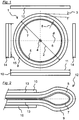
- an inner tube 1 is manufactured for a 29 "vehicle wheel, not shown, of a bicycle.
- the inner tube 1 is shown in FIG Figure 1 not shown to scale in a section through the seam.
- the inner tube 1 has an outer diameter 2 of 30 mm.
- the wall thickness 3 of the inner tube 1 is 350 ⁇ m .
- the inner tube 1 is produced endlessly from thermoplastic polyurethane (TPU) on a polyester basis by blown film extrusion.
- the extrudate is cut to length in blanks (not shown) of 2030 mm each, exactly orthogonally to the tube's longitudinal axis 4.
- a first hose end 5 of the blank is opened so that the inside 6 becomes visible and is easily accessible.
- a protective layer 7 made of a heat-resistant clear lacquer (eg with the trade name Motip 04033 ) with a thickness of approx. 5 ⁇ m is now applied all around to a depth of 20 mm in the direction of the longitudinal axis 4 of the hose with a small felt roller .
- the protective layer 7 wets the entire circumference of the inside 6. This avoids locally limited welds which reduce the quality of the weld seam or can even lead to the two inner foils no longer being separable from one another.
- the first hose end 5 is inserted lengthways into the second hose end 9 in such a way that both overlap by about 10 mm .
- the protective layer 7 is heat-resistant up to 800 ° C.
- the first hose end 5 and the second hose end 9 are pressed flat together and as in FIG Figure 2 initially shown between two first clamping jaws 10 with a length 11 of about 33 mm (about 70% of the hose width) welded by means of high frequency.
- the first clamping jaws 10 emboss and print the manufacturer's logo and technical data as well as the test seal of the inner tube 1 on the seam.
- the inner tube 1 is then erected in the area of the cat's eyes 12, pressed flat again across the first partial seams 13 and welded again between two second clamping jaws 14 with a length 15 of approx. 19 mm (approx. 40% of the hose width).
- the electrodes are made of brass and have a width of 5 mm (not shown) in the direction of the hose longitudinal axis 4.
- the clamping jaws 10, 14 and thus the first partial seams 13 and the second partial seams cover a total of 110% of the circumference.
Landscapes
- Engineering & Computer Science (AREA)
- Mechanical Engineering (AREA)
- Physics & Mathematics (AREA)
- Electromagnetism (AREA)
- General Engineering & Computer Science (AREA)
- Health & Medical Sciences (AREA)
- Toxicology (AREA)
- Optics & Photonics (AREA)
- Lining Or Joining Of Plastics Or The Like (AREA)
- Non-Disconnectible Joints And Screw-Threaded Joints (AREA)
- Butt Welding And Welding Of Specific Article (AREA)
Description
- Die Erfindung betrifft ein Verfahren zum Verschweißen eines ersten Schlauchendes an einer Nahtstelle mit einem zweiten Schlauchende in einer Naht, die auf einem Umfang des ersten Schlauchendes umläuft, wobei zunächst an der Nahtstelle in dem ersten Schlauchende eine Schutzschicht appliziert, dann das zweite Schlauchende über die Nahtstelle hinaus über das erste Schlauchende geschoben wird und schließlich die Schlauchenden an der Nahtstelle zwischen zwei aufeinander zu geführten Spannbacken flach zusammengepresst und in dieser Stellung verschweißt werden, wobei die Schutzschicht auf einer Innenseite des ersten Schlauchendes appliziert wird und ein Verschweißen der Innenseite des ersten Schlauchendes verhindert.
-
US 6,540,859 B1 offenbart ein solches Verfahren zum Spleißen eines Bewässerungsschlauchs. Beim flachen Zusammenpressen des Schlauchs bilden sich an beiden Enden des Querschnitts sog. "Katzenaugen": Der Schlauch wird in einem kleinen Umfangsstück um 180 ° umgelenkt, wobei die Außenseite gedehnt und die Innenseite gestaucht wird. Beim Öffnen des Schlauchs wird die Innenseite entsprechend gedehnt. Eine an dieser Stelle angebrachte Schweißnaht wird dadurch geschwächt. -
US 6,090,233 A undWO 97/06954 A1 - Im weiteren Hintergrund der Erfindung offenbart
US 2,623,571 A ein Verfahren zum Herstellen eines Luftschlauchs für ein Fahrzeugrad, wobei die beiden Enden kegel- bzw. dazu passend trichterförmig abgeschrägt und verschweißt werden. - Der Erfindung liegt die Aufgabe zugrunde, die Dichtigkeit der Schweißnaht zu verbessern.
- Ausgehend von dem bekannten Verfahren wird nach der Erfindung vorgeschlagen, dass die Schlauchenden nach dem Verschweißen in zwei ersten Teilnähten zunächst aufgerichtet und dann quer zu den ersten Teilnähten erneut flach zusammengepresst und in zwei weiteren Teilnähten verschweißt werden, wobei die ersten Teilnähte und die weiteren Teilnähte die Naht bilden. Das Schweißen in zwei Schritten vermeidet die Schwächung an den "Katzenaugen". Die Dichtigkeit wird so insbesondere bei größeren Wandstärken der Schlauchenden weiter gesteigert.
- Vorzugsweise überdecken in einem solchen Verfahren die ersten Teilnähte und die weiteren Teilnähte unterschiedliche Anteile des Umfangs. Zugleich mit dem Verschweißen kann eine Beschriftung oder anderweitige Markierung auf das zweite Schlauchende aufgebracht werden. Die Größe der Markierung ist auf die Größe der Spannbacken - also auf die Größe der jeweiligen Teilnaht - beschränkt. Die asymmetrische Verschweißung in zwei Schritten mit unterschiedlich langen Teilnähten ermöglicht (zugleich mit der längeren Teilnaht) eine größere Markierung auf dem Schlauchende.
- Vorzugsweise überlappen die ersten Teilnähte und die zweiten Teilnähte. So werden Lücken zwischen den ersten und zweiten Teilnähten vermieden. Weiter vorzugsweise überdecken die ersten und zweiten Teilnähte in Summe bis zu 120 % des Umfangs.
- Vorzugsweise überdecken die längeren Spannbacken und damit die längeren Teilnähte mindestens 60 % des Umfangs. Weiter vorzugsweise überdecken die längeren Spannbacken nicht mehr als 80 % des Umfangs, um eine übermäßige mechanische Belastung und mögliche Beschädigung des Extrudats in den "Katzenaugen" zu vermeiden.
- Die Schutzschicht kann in einem erfindungsgemäßen Verfahren auf eine Hälfte des Umfangs beschränkt werden. Um ein Verschweißen der Innenseite zu vermeiden, muss dann aber die Position der Schutzschicht über dem Umfang beim Einlegen zwischen die Spannbacken berücksichtigt werden.
- Vorzugsweise besteht in einem erfindungsgemäßen Verfahren das erste Schlauchende und/oder das zweite Schlauchende aus thermoplastischem Polyurethan. Thermoplastisches Polyurethan (TPU) eignet sich besonders zur Extrusion. Das erfindungsgemäße Verfahren kann insbesondere auch genutzt werden, um einen TPU-Schlauch gratlos mit einem Schlauch aus einem anderen Thermoplasten (z.B. PVC) zu verschweißen.
- Vorzugsweise werden in einem erfindungsgemäßen Verfahren die Schlauchenden thermisch verschweißt. Thermische Schweißverfahren, also Verfahren, in denen die zu verschweißenden Oberflächen soweit erhitzt werden, dass sie ineinander fließen und eine stoffliche Einheit bilden, werden insbesondere mittels Hochfrequenz, mittels Laser oder mittels Elektronenstrahl ausgeführt. Alternativ können die Schlauchenden auch chemisch verschweißt werden, insbesondere durch vorübergehendes Anlösen der zu verschweißenden Oberflächen.
- Vorzugsweise sind in einem erfindungsgemäßen Verfahren die Spannbacken transparent. Transparente Spannbacken sind für eine Laser- oder Elektronenstrahl durchlässig.
- Vorzugsweise wird in einem erfindungsgemäßen Verfahren die Schutzschicht mit einer Rolle auf die Innenseite aufgebracht. Alternativ kann die Schutzschicht anderweitig auf die Innenseite aufgebracht, beispielsweise aufgesprüht oder -gespritzt werden. Weiter alternativ kann die Schutzschicht locker auf die Innenseite aufgelegt werden.
- Vorzugsweise härtet in einem erfindungsgemäßen Verfahren die Schutzschicht vor dem Verschweißen aus. Alternativ kann die Schutzschicht aus einem bereit beim Applizieren harten Material bestehen.
- Vorzugsweise besteht in einem erfindungsgemäßen Verfahren die Schutzschicht aus einem nach dem Aushärten bis mindestens 250 °C hitzebeständigen Lack.
- Hitzebeständige Lacke sind auf der Basis von Polyester, PVC-Mischpolymerisaten, Polyvinylacetat, Polyvinylbutyral, Nitrocellulose, Acetylcellulose oder Celluloseacetat allgemein bekannt. Alternativ kann die Schutzschicht aus einer hitzebeständigen Folie, beispielsweise einer Metallfolie, insbesondere aus Aluminium bestehen, die vor dem Verschweißen auf die Innenseite aufgelegt wird.
- Vorgeschlagen wird erfindungsgemäß weiterhin ein Verfahren zum Herstellen eines Innenschlauchs für ein Fahrzeugrad, wobei aus einem endlos-schlauchförmigen Extrudat ein Rohling geschnitten und torusförmig geschlossen wird und zwei Schlauchenden des Rohlings wie vorstehend beschrieben zu dem Innenschlauch verschweißt werden. Diese Art der Herstellung von Innenschläuchen ist aus dem Stand der Technik bekannt und bewährt.
- Die Erfindung wird nachfolgend anhand eines Ausführungsbeispiels erläutert. Es zeigen
- Fig. 1
- einen Schnitt durch einen Innenschlauch und
- Fig. 2
- ein Detail aus dem erfindungsgemäßen Verfahren.
- In einem erfindungsgemäßen Verfahren wird ein Innenschlauch 1 für ein nicht dargestelltes 29"-Fahrzeugrad eines Fahrrads gefertigt. Der Innenschlauch 1 ist in
Figur 1 nicht maßstäblich in einem Schnitt durch die Nahtstelle dargestellt Der Innenschlauch 1 hat einen Außendurchmesser 2 von 30 mm. Die Wandstärke 3 des Innenschlauchs 1 beträgt 350 µm. Der Innenschlauch 1 wird durch Blasfolienextrusion endlos aus thermoplastischem Polyurethan (TPU) auf Polyesterbasis gefertigt. - Das Extrudat wird in nicht dargestellte Rohlinge von jeweils 2030 mm genau orthogonal zur Schlauchlängsachse 4 abgelängt.
- Ein erstes Schlauchende 5 des Rohlings wird geöffnet, so dass die Innenseite 6 sichtbar wird und gut zugänglich ist. Auf die Innenseite 6 wird nun ringsum bis in eine Tiefe von 20 mm in Richtung der Schlauchlängsachse 4 mit einer kleinen Filzrolle eine Schutzschicht 7 aus einem hitzebeständigen Klarlack (z.B. mit dem Handelsnamen Motip 04033) mit einer Dicke von ca. 5 µm aufgetragen.
- Die Schutzschicht 7 benetzt den gesamten Umfang der Innenseite 6. So werden lokal begrenzte Verschweißungen vermieden, die die Qualität der Schweißnaht mindern oder sogar dazu führen können, dass die beiden innenliegenden Folien nicht mehr voneinander zu trennen sind.
- Nach einer Trockenzeit von ca. 30 Minuten, in der die Schutzschicht 7 aushärtet, wird das erste Schlauchende 5 längs derart in das zweite Schlauchende 9 gesteckt, dass beide um etwa 10 mm überlappen. Die Schutzschicht 7 ist bis 800 °C hitzebeständig.
- Das erste Schlauchende 5 und das zweite Schlauchende 9 werden flach zusammengepresst und wie in
Figur 2 dargestellt zunächst zwischen zwei ersten Spannbacken 10 mit einer Länge 11 von ca. 33 mm (etwa 70 % der Schlauchbreite) mittels Hochfrequenz verschweißt. Zugleich prägen und drucken die ersten Spannbacken 10 das Logo des Herstellers und technische Daten sowie Prüfsiegel des Innenschlauchs 1 auf die Nahtstelle. - Dann wird der Innenschlauch 1 im Bereich der Katzenaugen 12 aufgerichtet, quer zu den ersten Teilnähten 13 erneut flach zusammengepresst und zwischen zwei zweiten Spannbacken 14 mit einer Länge 15 von ca. 19 mm (etwa 40 % der Schlauchbreite) erneut verschweißt. Die Elektroden bestehen aus Messing und weisen in Richtung der Schlauchlängsachse 4 eine nicht dargestellte Breite von 5 mm auf. Die Spannbacken 10, 14 und damit die ersten Teilnähte 13 und die zweiten Teilnähte überdecken in Summe 110 % des Umfangs.
- In den Figuren sind
- 1
- Innenschlauch
- 2
- Außendurchmesser
- 3
- Wandstärke
- 4
- Schlauchlängsachse
- 5
- erstes Schlauchende
- 6
- Innenseite
- 7
- Schutzschicht
- 8
- Dicke
- 9
- zweites Schlauchende
- 10
- erste Spannbacke
- 11
- Länge
- 12
- Katzenauge
- 13
- erste Teilnaht
- 14
- zweite Spannbacke
- 15
- Länge
Claims (9)
- Verfahren zum Verschweißen eines ersten Schlauchendes (5) an einer Nahtstelle mit einem zweiten Schlauchende (9) in einer Naht, die auf einem Umfang des ersten Schlauchendes (5) umläuft, wobei zunächst an der Nahtstelle in dem ersten Schlauchende (5) eine Schutzschicht (7) appliziert, dann das zweite Schlauchende (9) über die Nahtstelle hinaus über das erste Schlauchende (5) geschoben wird und schließlich die Schlauchenden (5, 9) an der Nahtstelle zwischen zwei aufeinander zu geführten Spannbacken (10, 14) flach zusammengepresst und in dieser Stellung verschweißt werden, wobei die Schutzschicht (7) auf einer Innenseite (6) des ersten Schlauchendes (5) appliziert wird und ein Verschweißen der Innenseite (6) des ersten Schlauchendes (5) verhindert, dadurch gekennzeichnet, dass die Schlauchenden (5, 9) nach dem Verschweißen in zwei ersten Teilnähten (13) zunächst aufgerichtet und dann quer zu den ersten Teilnähten (13) erneut flach zusammengepresst und in zwei weiteren Teilnähten verschweißt werden, wobei die ersten Teilnähte (13) und die weiteren Teilnähte die Naht bilden.
- Verfahren nach dem vorgenannten Anspruch, dadurch gekennzeichnet, dass die ersten Teilnähte (13) und die weiteren Teilnähte unterschiedliche Anteile des Umfangs überdecken.
- Verfahren nach einem der vorgenannten Ansprüche, dadurch gekennzeichnet, dass das erste Schlauchende (5) und/oder das zweite Schlauchende (9) aus thermoplastischem Polyurethan besteht.
- Verfahren nach einem der vorgenannten Ansprüche, dadurch gekennzeichnet, dass die Schlauchenden (5, 9) thermisch verschweißt werden.
- Verfahren nach einem der vorgenannten Ansprüche, dadurch gekennzeichnet, dass die Spannbacken transparent sind.
- Verfahren nach einem der vorgenannten Ansprüche, dadurch gekennzeichnet, dass die Schutzschicht (7) mit einer Rolle auf die Innenseite (6) aufgebracht wird.
- Verfahren nach einem der vorgenannten Ansprüche, dadurch gekennzeichnet, dass die Schutzschicht (7) vor dem Verschweißen aushärtet.
- Verfahren nach dem vorgenannten Anspruch, dadurch gekennzeichnet, dass die Schutzschicht (7) aus einem nach dem Aushärten bis mindestens 250 °C hitzebeständigen Lack besteht.
- Verfahren zum Herstellen eines Innenschlauchs (1) für ein Fahrzeugrad, dadurch gekennzeichnet, dass aus einem endlos-schlauchförmigen Extrudat ein Rohling geschnitten und torusförmig geschlossen wird und zwei Schlauchenden (5, 9) des Rohlings nach einem der vorgenannten Ansprüche zu dem Innenschlauch (1) verschweißt werden.
Priority Applications (1)
| Application Number | Priority Date | Filing Date | Title |
|---|---|---|---|
| PL18721951T PL3600852T3 (pl) | 2017-03-30 | 2018-03-29 | Sposób zgrzewania |
Applications Claiming Priority (2)
| Application Number | Priority Date | Filing Date | Title |
|---|---|---|---|
| DE102017106906.2A DE102017106906A1 (de) | 2017-03-30 | 2017-03-30 | Verfahren zum Verschweißen |
| PCT/EP2018/000138 WO2018177599A1 (de) | 2017-03-30 | 2018-03-29 | Verfahren zum verschweissen |
Publications (2)
| Publication Number | Publication Date |
|---|---|
| EP3600852A1 EP3600852A1 (de) | 2020-02-05 |
| EP3600852B1 true EP3600852B1 (de) | 2021-02-03 |
Family
ID=62111014
Family Applications (1)
| Application Number | Title | Priority Date | Filing Date |
|---|---|---|---|
| EP18721951.4A Active EP3600852B1 (de) | 2017-03-30 | 2018-03-29 | Verfahren zum verschweissen |
Country Status (14)
| Country | Link |
|---|---|
| US (1) | US11279096B2 (de) |
| EP (1) | EP3600852B1 (de) |
| JP (1) | JP7086168B2 (de) |
| KR (1) | KR102386540B1 (de) |
| CN (1) | CN110582393B (de) |
| DE (1) | DE102017106906A1 (de) |
| DK (1) | DK3600852T3 (de) |
| EA (1) | EA037865B1 (de) |
| ES (1) | ES2869127T3 (de) |
| MX (1) | MX376644B (de) |
| PL (1) | PL3600852T3 (de) |
| PT (1) | PT3600852T (de) |
| SG (1) | SG11201908935QA (de) |
| WO (1) | WO2018177599A1 (de) |
Family Cites Families (20)
| Publication number | Priority date | Publication date | Assignee | Title |
|---|---|---|---|---|
| US2623571A (en) * | 1951-01-19 | 1952-12-30 | Goodrich Co B F | Method of splicing tubular articles |
| DE2257402A1 (de) * | 1972-11-23 | 1974-06-12 | Vredestein Rubber | Luftschlauch, insbesondere fuer fahrraeder und mopeds |
| FR2560120B1 (fr) * | 1984-02-29 | 1989-08-04 | Hutchinson | Perfectionnements apportes aux chambres a air discontinues |
| JPS6440322A (en) * | 1987-08-07 | 1989-02-10 | Okura Industrial Co Ltd | Method for joining tube for bicycle |
| US6056526A (en) * | 1994-11-30 | 2000-05-02 | 3M Innovative Properties Company | Molding tool for sealant material |
| US5690769A (en) * | 1995-08-21 | 1997-11-25 | T-Systems International | Method for splicing drip irrigation hoses using splicing means internal to the hoses |
| DE29712264U1 (de) * | 1997-07-11 | 1998-11-12 | Sator Alexander Paul | Vorrichtung zum Verschweißen der Enden von rohrförmigen Behältern, insbesondere von Tuben |
| US6090233A (en) * | 1998-05-01 | 2000-07-18 | Drip Tape Manufacturers & Engineers, Inc. | Irrigation hose splice and method of making same |
| JP2000008260A (ja) | 1998-06-16 | 2000-01-11 | Asahi Chem Ind Co Ltd | 吸音材 |
| US6632306B1 (en) * | 2000-08-07 | 2003-10-14 | Roberts Group Holdings, Llc | Method and apparatus for splicing drip irrigation tape |
| US6540859B1 (en) * | 2001-10-16 | 2003-04-01 | The Toro Company | Method for splicing hose |
| US6832852B2 (en) * | 2002-04-27 | 2004-12-21 | Kenneth R. Wilkes | Gusseted flexible bottle with fitment and method of fabrication |
| US7722733B2 (en) * | 2004-03-29 | 2010-05-25 | Baxter International Inc. | Method for sterile connection of tubing |
| DE102008017922B4 (de) | 2007-06-27 | 2017-05-18 | Ems-Patent Ag | Laserschweißverbindung von Kunststoffrohren mit anderen Kunststoffteilen |
| FR2928299B1 (fr) * | 2008-03-10 | 2010-03-19 | Michelin Soc Tech | Chambre a air pour bandage pneumatique a base d'un elastomere |
| DE102009026952A1 (de) * | 2009-06-16 | 2010-12-23 | Herrmann Ultraschalltechnik Gmbh & Co. Kg | Ultraschallbearbeitungsvorrichtung sowie Quersiegelsonotrode hierfür |
| US8888406B2 (en) * | 2012-02-25 | 2014-11-18 | Mid-American Gunite, Inc. | Weighted bag |
| JP5912687B2 (ja) | 2012-03-09 | 2016-04-27 | 株式会社キャンパスクリエイト | 熱可塑性樹脂チューブの溶着装置及び溶着方法 |
| WO2017145269A1 (ja) | 2016-02-23 | 2017-08-31 | 精電舎電子工業株式会社 | レーザ溶着装置およびレーザ溶着方法 |
| CN206140941U (zh) * | 2016-08-31 | 2017-05-03 | 中山市源业精密机械厂 | 一种软管材成型机 |
-
2017
- 2017-03-30 DE DE102017106906.2A patent/DE102017106906A1/de not_active Ceased
-
2018
- 2018-03-29 ES ES18721951T patent/ES2869127T3/es active Active
- 2018-03-29 WO PCT/EP2018/000138 patent/WO2018177599A1/de not_active Ceased
- 2018-03-29 MX MX2019011732A patent/MX376644B/es active IP Right Grant
- 2018-03-29 JP JP2020502767A patent/JP7086168B2/ja not_active Expired - Fee Related
- 2018-03-29 DK DK18721951.4T patent/DK3600852T3/da active
- 2018-03-29 SG SG11201908935Q patent/SG11201908935QA/en unknown
- 2018-03-29 EA EA201992290A patent/EA037865B1/ru unknown
- 2018-03-29 KR KR1020197032074A patent/KR102386540B1/ko not_active Expired - Fee Related
- 2018-03-29 PT PT187219514T patent/PT3600852T/pt unknown
- 2018-03-29 CN CN201880029213.3A patent/CN110582393B/zh not_active Expired - Fee Related
- 2018-03-29 EP EP18721951.4A patent/EP3600852B1/de active Active
- 2018-03-29 PL PL18721951T patent/PL3600852T3/pl unknown
-
2019
- 2019-09-24 US US16/580,500 patent/US11279096B2/en not_active Expired - Fee Related
Non-Patent Citations (1)
| Title |
|---|
| None * |
Also Published As
| Publication number | Publication date |
|---|---|
| JP2020515445A (ja) | 2020-05-28 |
| US11279096B2 (en) | 2022-03-22 |
| ES2869127T3 (es) | 2021-10-25 |
| EA201992290A1 (ru) | 2020-02-12 |
| EA037865B1 (ru) | 2021-05-28 |
| PL3600852T3 (pl) | 2021-10-25 |
| JP7086168B2 (ja) | 2022-06-17 |
| EP3600852A1 (de) | 2020-02-05 |
| DE102017106906A1 (de) | 2018-10-04 |
| DK3600852T3 (da) | 2021-04-26 |
| CN110582393B (zh) | 2021-09-28 |
| PT3600852T (pt) | 2021-04-22 |
| KR102386540B1 (ko) | 2022-04-15 |
| SG11201908935QA (en) | 2019-11-28 |
| US20200079033A1 (en) | 2020-03-12 |
| MX2019011732A (es) | 2020-02-17 |
| KR20190136040A (ko) | 2019-12-09 |
| CN110582393A (zh) | 2019-12-17 |
| WO2018177599A1 (de) | 2018-10-04 |
| MX376644B (es) | 2025-03-07 |
Similar Documents
| Publication | Publication Date | Title |
|---|---|---|
| DE3314264C2 (de) | Verfahren zur Herstellung von Stahl-Verbundrohren | |
| DE3135966C2 (de) | Verfahren zur Herstellung mehrschichtiger Schraubennahtrohre | |
| EP0737803B1 (de) | Abgassammelrohr, insbesondere für eine Brennkraftmaschine in einem Kraftfahrzeug, und Verfahren zu dessen Herstellung | |
| DE60101789T2 (de) | Verfahren zur herstellung eines rohrförmigen bauteils | |
| WO2015189187A1 (de) | VERFAHREN ZUM HERSTELLEN EINES MEHRLAGIGEN GROßROHRES | |
| DE19511970C2 (de) | Verfahren zum Herstellen von verformten mehrwandigen Rohren mit Hohlräumen zwischen den Wandungen | |
| DE3446280C2 (de) | ||
| DE102018202798B4 (de) | Verfahren und Vorrichtung zum Herstellen eines torusförmigen Fahrradschlauchs | |
| EP1463592B1 (de) | Verschluss eines gasleitsystems | |
| EP1138408A2 (de) | Verfahren zur Herstellung von grossvolumigen Hohlkörpern | |
| DE102012009845A1 (de) | Rohrstück aus Metallblech und Verfahren zu dessen Herstellung, Streck-Biegevorrichtung zur Herstellung eines Rohrbogens und Verfahren zur Herstellung eines Rohrbogens | |
| WO2018177599A1 (de) | Verfahren zum verschweissen | |
| EP0141350A1 (de) | Verfahren zur Herstellung pulvermetallurgischer Gegenstände | |
| DE19814314A1 (de) | Verfahren zur Herstellung von Hohlkörpern aus thermoplastischem Kunststoff sowie nach diesem Verfahren hergestellter Hohlkörper | |
| EP1313591B1 (de) | Verfahren zur plastischen verformung einer nabenbohrung eines schnelllaufenden turbomaschinenteils | |
| WO2010022930A1 (de) | Vorrichtung zur vorbereitung der stirnseiten dünnwandiger ummantelungen zum schweissen | |
| DE102011051108A1 (de) | Verfahren zum Herstellen von Rohrkörpern für Verpackungstuben sowie Verpackungstube mit Rohrkörper | |
| DE102014010911A1 (de) | Verfahren und Vorrichtung zum Kalibrieren eines Rohrsteckverbundes | |
| DE102019213396A1 (de) | Verfahren zum Verbinden zweier Bauteile, Bauteileverbund und Werkzeug zum Durchführen des Verfahrens | |
| DE3405640A1 (de) | Verfahren zur herstellung eines verbundrohres | |
| WO2021058164A1 (de) | Verfahren zur herstellung einer rohrleitungsanordnung und rohrleitungsanordnung | |
| EP1800830B1 (de) | Anlage zur Herstellung eines Mehrschichtverbundrohres | |
| DE102015203071B3 (de) | Rohranordnung und Verfahren zu deren Herstellung | |
| DE102006030951B3 (de) | Vorrichtung zur Herstellung von Metallverbundrohren | |
| DE2609570A1 (de) | Verfahren zur herstellung von regenrinnenablaufbogen und nach diesem verfahren hergestellter regenrinnenablaufbogen |
Legal Events
| Date | Code | Title | Description |
|---|---|---|---|
| STAA | Information on the status of an ep patent application or granted ep patent |
Free format text: STATUS: UNKNOWN |
|
| STAA | Information on the status of an ep patent application or granted ep patent |
Free format text: STATUS: THE INTERNATIONAL PUBLICATION HAS BEEN MADE |
|
| PUAI | Public reference made under article 153(3) epc to a published international application that has entered the european phase |
Free format text: ORIGINAL CODE: 0009012 |
|
| STAA | Information on the status of an ep patent application or granted ep patent |
Free format text: STATUS: REQUEST FOR EXAMINATION WAS MADE |
|
| 17P | Request for examination filed |
Effective date: 20191002 |
|
| AK | Designated contracting states |
Kind code of ref document: A1 Designated state(s): AL AT BE BG CH CY CZ DE DK EE ES FI FR GB GR HR HU IE IS IT LI LT LU LV MC MK MT NL NO PL PT RO RS SE SI SK SM TR |
|
| AX | Request for extension of the european patent |
Extension state: BA ME |
|
| DAV | Request for validation of the european patent (deleted) | ||
| DAX | Request for extension of the european patent (deleted) | ||
| REG | Reference to a national code |
Ref country code: DE Ref legal event code: R079 Ref document number: 502018003857 Country of ref document: DE Free format text: PREVIOUS MAIN CLASS: B29C0065140000 Ipc: B29C0065040000 |
|
| GRAP | Despatch of communication of intention to grant a patent |
Free format text: ORIGINAL CODE: EPIDOSNIGR1 |
|
| STAA | Information on the status of an ep patent application or granted ep patent |
Free format text: STATUS: GRANT OF PATENT IS INTENDED |
|
| RIC1 | Information provided on ipc code assigned before grant |
Ipc: B29C 65/14 20060101ALI20200821BHEP Ipc: B29C 65/48 20060101ALI20200821BHEP Ipc: B29L 23/24 20060101ALN20200821BHEP Ipc: F16L 31/00 20060101ALI20200821BHEP Ipc: F16L 47/02 20060101ALI20200821BHEP Ipc: B29C 65/16 20060101ALI20200821BHEP Ipc: B29L 23/00 20060101ALN20200821BHEP Ipc: B29C 65/04 20060101AFI20200821BHEP |
|
| INTG | Intention to grant announced |
Effective date: 20200911 |
|
| RIN1 | Information on inventor provided before grant (corrected) |
Inventor name: MATTFELD, PATRICK |
|
| GRAS | Grant fee paid |
Free format text: ORIGINAL CODE: EPIDOSNIGR3 |
|
| GRAA | (expected) grant |
Free format text: ORIGINAL CODE: 0009210 |
|
| STAA | Information on the status of an ep patent application or granted ep patent |
Free format text: STATUS: THE PATENT HAS BEEN GRANTED |
|
| AK | Designated contracting states |
Kind code of ref document: B1 Designated state(s): AL AT BE BG CH CY CZ DE DK EE ES FI FR GB GR HR HU IE IS IT LI LT LU LV MC MK MT NL NO PL PT RO RS SE SI SK SM TR |
|
| REG | Reference to a national code |
Ref country code: GB Ref legal event code: FG4D Free format text: NOT ENGLISH |
|
| REG | Reference to a national code |
Ref country code: AT Ref legal event code: REF Ref document number: 1359602 Country of ref document: AT Kind code of ref document: T Effective date: 20210215 Ref country code: CH Ref legal event code: EP |
|
| REG | Reference to a national code |
Ref country code: DE Ref legal event code: R096 Ref document number: 502018003857 Country of ref document: DE |
|
| REG | Reference to a national code |
Ref country code: IE Ref legal event code: FG4D Free format text: LANGUAGE OF EP DOCUMENT: GERMAN |
|
| REG | Reference to a national code |
Ref country code: PT Ref legal event code: SC4A Ref document number: 3600852 Country of ref document: PT Date of ref document: 20210422 Kind code of ref document: T Free format text: AVAILABILITY OF NATIONAL TRANSLATION Effective date: 20210415 |
|
| REG | Reference to a national code |
Ref country code: DK Ref legal event code: T3 Effective date: 20210420 |
|
| REG | Reference to a national code |
Ref country code: NL Ref legal event code: FP |
|
| REG | Reference to a national code |
Ref country code: SE Ref legal event code: TRGR |
|
| REG | Reference to a national code |
Ref country code: NO Ref legal event code: T2 Effective date: 20210203 |
|
| REG | Reference to a national code |
Ref country code: LT Ref legal event code: MG9D |
|
| PG25 | Lapsed in a contracting state [announced via postgrant information from national office to epo] |
Ref country code: LT Free format text: LAPSE BECAUSE OF FAILURE TO SUBMIT A TRANSLATION OF THE DESCRIPTION OR TO PAY THE FEE WITHIN THE PRESCRIBED TIME-LIMIT Effective date: 20210203 Ref country code: HR Free format text: LAPSE BECAUSE OF FAILURE TO SUBMIT A TRANSLATION OF THE DESCRIPTION OR TO PAY THE FEE WITHIN THE PRESCRIBED TIME-LIMIT Effective date: 20210203 Ref country code: FI Free format text: LAPSE BECAUSE OF FAILURE TO SUBMIT A TRANSLATION OF THE DESCRIPTION OR TO PAY THE FEE WITHIN THE PRESCRIBED TIME-LIMIT Effective date: 20210203 Ref country code: GR Free format text: LAPSE BECAUSE OF FAILURE TO SUBMIT A TRANSLATION OF THE DESCRIPTION OR TO PAY THE FEE WITHIN THE PRESCRIBED TIME-LIMIT Effective date: 20210504 |
|
| PG25 | Lapsed in a contracting state [announced via postgrant information from national office to epo] |
Ref country code: LV Free format text: LAPSE BECAUSE OF FAILURE TO SUBMIT A TRANSLATION OF THE DESCRIPTION OR TO PAY THE FEE WITHIN THE PRESCRIBED TIME-LIMIT Effective date: 20210203 Ref country code: RS Free format text: LAPSE BECAUSE OF FAILURE TO SUBMIT A TRANSLATION OF THE DESCRIPTION OR TO PAY THE FEE WITHIN THE PRESCRIBED TIME-LIMIT Effective date: 20210203 |
|
| PG25 | Lapsed in a contracting state [announced via postgrant information from national office to epo] |
Ref country code: IS Free format text: LAPSE BECAUSE OF FAILURE TO SUBMIT A TRANSLATION OF THE DESCRIPTION OR TO PAY THE FEE WITHIN THE PRESCRIBED TIME-LIMIT Effective date: 20210603 |
|
| REG | Reference to a national code |
Ref country code: ES Ref legal event code: FG2A Ref document number: 2869127 Country of ref document: ES Kind code of ref document: T3 Effective date: 20211025 |
|
| PG25 | Lapsed in a contracting state [announced via postgrant information from national office to epo] |
Ref country code: EE Free format text: LAPSE BECAUSE OF FAILURE TO SUBMIT A TRANSLATION OF THE DESCRIPTION OR TO PAY THE FEE WITHIN THE PRESCRIBED TIME-LIMIT Effective date: 20210203 Ref country code: SM Free format text: LAPSE BECAUSE OF FAILURE TO SUBMIT A TRANSLATION OF THE DESCRIPTION OR TO PAY THE FEE WITHIN THE PRESCRIBED TIME-LIMIT Effective date: 20210203 |
|
| REG | Reference to a national code |
Ref country code: DE Ref legal event code: R097 Ref document number: 502018003857 Country of ref document: DE |
|
| PG25 | Lapsed in a contracting state [announced via postgrant information from national office to epo] |
Ref country code: SK Free format text: LAPSE BECAUSE OF FAILURE TO SUBMIT A TRANSLATION OF THE DESCRIPTION OR TO PAY THE FEE WITHIN THE PRESCRIBED TIME-LIMIT Effective date: 20210203 Ref country code: RO Free format text: LAPSE BECAUSE OF FAILURE TO SUBMIT A TRANSLATION OF THE DESCRIPTION OR TO PAY THE FEE WITHIN THE PRESCRIBED TIME-LIMIT Effective date: 20210203 |
|
| PLBE | No opposition filed within time limit |
Free format text: ORIGINAL CODE: 0009261 |
|
| STAA | Information on the status of an ep patent application or granted ep patent |
Free format text: STATUS: NO OPPOSITION FILED WITHIN TIME LIMIT |
|
| 26N | No opposition filed |
Effective date: 20211104 |
|
| PG25 | Lapsed in a contracting state [announced via postgrant information from national office to epo] |
Ref country code: IE Free format text: LAPSE BECAUSE OF NON-PAYMENT OF DUE FEES Effective date: 20210329 Ref country code: AL Free format text: LAPSE BECAUSE OF FAILURE TO SUBMIT A TRANSLATION OF THE DESCRIPTION OR TO PAY THE FEE WITHIN THE PRESCRIBED TIME-LIMIT Effective date: 20210203 |
|
| REG | Reference to a national code |
Ref country code: DE Ref legal event code: R082 Ref document number: 502018003857 Country of ref document: DE Representative=s name: BAUER WAGNER PELLENGAHR SROKA PATENT- & RECHTS, DE |
|
| PG25 | Lapsed in a contracting state [announced via postgrant information from national office to epo] |
Ref country code: SI Free format text: LAPSE BECAUSE OF FAILURE TO SUBMIT A TRANSLATION OF THE DESCRIPTION OR TO PAY THE FEE WITHIN THE PRESCRIBED TIME-LIMIT Effective date: 20210203 |
|
| PGFP | Annual fee paid to national office [announced via postgrant information from national office to epo] |
Ref country code: GB Payment date: 20220322 Year of fee payment: 5 Ref country code: DK Payment date: 20220324 Year of fee payment: 5 Ref country code: DE Payment date: 20220331 Year of fee payment: 5 Ref country code: CH Payment date: 20220324 Year of fee payment: 5 Ref country code: BG Payment date: 20220322 Year of fee payment: 5 |
|
| PG25 | Lapsed in a contracting state [announced via postgrant information from national office to epo] |
Ref country code: IS Free format text: LAPSE BECAUSE OF FAILURE TO SUBMIT A TRANSLATION OF THE DESCRIPTION OR TO PAY THE FEE WITHIN THE PRESCRIBED TIME-LIMIT Effective date: 20210603 |
|
| PGFP | Annual fee paid to national office [announced via postgrant information from national office to epo] |
Ref country code: TR Payment date: 20220309 Year of fee payment: 5 Ref country code: SE Payment date: 20220324 Year of fee payment: 5 Ref country code: PT Payment date: 20220308 Year of fee payment: 5 Ref country code: PL Payment date: 20220310 Year of fee payment: 5 Ref country code: NO Payment date: 20220322 Year of fee payment: 5 Ref country code: NL Payment date: 20220325 Year of fee payment: 5 Ref country code: MC Payment date: 20220321 Year of fee payment: 5 Ref country code: LU Payment date: 20220325 Year of fee payment: 5 Ref country code: IT Payment date: 20220323 Year of fee payment: 5 Ref country code: FR Payment date: 20220325 Year of fee payment: 5 Ref country code: CZ Payment date: 20220328 Year of fee payment: 5 Ref country code: BE Payment date: 20220325 Year of fee payment: 5 |
|
| PGFP | Annual fee paid to national office [announced via postgrant information from national office to epo] |
Ref country code: ES Payment date: 20220418 Year of fee payment: 5 |
|
| P01 | Opt-out of the competence of the unified patent court (upc) registered |
Effective date: 20230521 |
|
| PG25 | Lapsed in a contracting state [announced via postgrant information from national office to epo] |
Ref country code: CY Free format text: LAPSE BECAUSE OF FAILURE TO SUBMIT A TRANSLATION OF THE DESCRIPTION OR TO PAY THE FEE WITHIN THE PRESCRIBED TIME-LIMIT Effective date: 20210203 |
|
| PG25 | Lapsed in a contracting state [announced via postgrant information from national office to epo] |
Ref country code: HU Free format text: LAPSE BECAUSE OF FAILURE TO SUBMIT A TRANSLATION OF THE DESCRIPTION OR TO PAY THE FEE WITHIN THE PRESCRIBED TIME-LIMIT; INVALID AB INITIO Effective date: 20180329 |
|
| REG | Reference to a national code |
Ref country code: DE Ref legal event code: R119 Ref document number: 502018003857 Country of ref document: DE |
|
| REG | Reference to a national code |
Ref country code: NO Ref legal event code: MMEP |
|
| PG25 | Lapsed in a contracting state [announced via postgrant information from national office to epo] |
Ref country code: MC Free format text: LAPSE BECAUSE OF NON-PAYMENT OF DUE FEES Effective date: 20230331 Ref country code: CZ Free format text: LAPSE BECAUSE OF NON-PAYMENT OF DUE FEES Effective date: 20230329 |
|
| REG | Reference to a national code |
Ref country code: CH Ref legal event code: PL Ref country code: SE Ref legal event code: EUG |
|
| REG | Reference to a national code |
Ref country code: DK Ref legal event code: EBP Effective date: 20230331 |
|
| REG | Reference to a national code |
Ref country code: NL Ref legal event code: MM Effective date: 20230401 |
|
| GBPC | Gb: european patent ceased through non-payment of renewal fee |
Effective date: 20230329 |
|
| PG25 | Lapsed in a contracting state [announced via postgrant information from national office to epo] |
Ref country code: PT Free format text: LAPSE BECAUSE OF NON-PAYMENT OF DUE FEES Effective date: 20230929 |
|
| REG | Reference to a national code |
Ref country code: BE Ref legal event code: MM Effective date: 20230331 |
|
| PG25 | Lapsed in a contracting state [announced via postgrant information from national office to epo] |
Ref country code: NL Free format text: LAPSE BECAUSE OF NON-PAYMENT OF DUE FEES Effective date: 20230401 Ref country code: LU Free format text: LAPSE BECAUSE OF NON-PAYMENT OF DUE FEES Effective date: 20230329 |
|
| PG25 | Lapsed in a contracting state [announced via postgrant information from national office to epo] |
Ref country code: GB Free format text: LAPSE BECAUSE OF NON-PAYMENT OF DUE FEES Effective date: 20230329 |
|
| PG25 | Lapsed in a contracting state [announced via postgrant information from national office to epo] |
Ref country code: SE Free format text: LAPSE BECAUSE OF NON-PAYMENT OF DUE FEES Effective date: 20230330 Ref country code: LI Free format text: LAPSE BECAUSE OF NON-PAYMENT OF DUE FEES Effective date: 20230331 Ref country code: GB Free format text: LAPSE BECAUSE OF NON-PAYMENT OF DUE FEES Effective date: 20230329 Ref country code: FR Free format text: LAPSE BECAUSE OF NON-PAYMENT OF DUE FEES Effective date: 20230331 Ref country code: DE Free format text: LAPSE BECAUSE OF NON-PAYMENT OF DUE FEES Effective date: 20231003 Ref country code: CH Free format text: LAPSE BECAUSE OF NON-PAYMENT OF DUE FEES Effective date: 20230331 Ref country code: NO Free format text: LAPSE BECAUSE OF NON-PAYMENT OF DUE FEES Effective date: 20230331 |
|
| PG25 | Lapsed in a contracting state [announced via postgrant information from national office to epo] |
Ref country code: BE Free format text: LAPSE BECAUSE OF NON-PAYMENT OF DUE FEES Effective date: 20230331 |
|
| PG25 | Lapsed in a contracting state [announced via postgrant information from national office to epo] |
Ref country code: MK Free format text: LAPSE BECAUSE OF FAILURE TO SUBMIT A TRANSLATION OF THE DESCRIPTION OR TO PAY THE FEE WITHIN THE PRESCRIBED TIME-LIMIT Effective date: 20210203 Ref country code: IT Free format text: LAPSE BECAUSE OF NON-PAYMENT OF DUE FEES Effective date: 20230329 Ref country code: DK Free format text: LAPSE BECAUSE OF NON-PAYMENT OF DUE FEES Effective date: 20230331 |
|
| REG | Reference to a national code |
Ref country code: ES Ref legal event code: FD2A Effective date: 20240430 |
|
| REG | Reference to a national code |
Ref country code: AT Ref legal event code: MM01 Ref document number: 1359602 Country of ref document: AT Kind code of ref document: T Effective date: 20230329 |
|
| PG25 | Lapsed in a contracting state [announced via postgrant information from national office to epo] |
Ref country code: ES Free format text: LAPSE BECAUSE OF NON-PAYMENT OF DUE FEES Effective date: 20230330 |
|
| PG25 | Lapsed in a contracting state [announced via postgrant information from national office to epo] |
Ref country code: AT Free format text: LAPSE BECAUSE OF NON-PAYMENT OF DUE FEES Effective date: 20230329 |
|
| PG25 | Lapsed in a contracting state [announced via postgrant information from national office to epo] |
Ref country code: ES Free format text: LAPSE BECAUSE OF NON-PAYMENT OF DUE FEES Effective date: 20230330 Ref country code: AT Free format text: LAPSE BECAUSE OF NON-PAYMENT OF DUE FEES Effective date: 20230329 |
|
| PG25 | Lapsed in a contracting state [announced via postgrant information from national office to epo] |
Ref country code: MT Free format text: LAPSE BECAUSE OF FAILURE TO SUBMIT A TRANSLATION OF THE DESCRIPTION OR TO PAY THE FEE WITHIN THE PRESCRIBED TIME-LIMIT Effective date: 20210203 |
|
| PG25 | Lapsed in a contracting state [announced via postgrant information from national office to epo] |
Ref country code: BG Free format text: LAPSE BECAUSE OF NON-PAYMENT OF DUE FEES Effective date: 20230329 |
|
| PG25 | Lapsed in a contracting state [announced via postgrant information from national office to epo] |
Ref country code: BG Free format text: LAPSE BECAUSE OF NON-PAYMENT OF DUE FEES Effective date: 20230329 |
|
| PG25 | Lapsed in a contracting state [announced via postgrant information from national office to epo] |
Ref country code: PL Free format text: LAPSE BECAUSE OF NON-PAYMENT OF DUE FEES Effective date: 20230329 |
|
| PG25 | Lapsed in a contracting state [announced via postgrant information from national office to epo] |
Ref country code: PL Free format text: LAPSE BECAUSE OF NON-PAYMENT OF DUE FEES Effective date: 20230329 |
|
| PGFP | Annual fee paid to national office [announced via postgrant information from national office to epo] |
Ref country code: AT Payment date: 20260410 Year of fee payment: 5 |