EP3601208B1 - Procédé chimique de préparation de déshydrohédione - Google Patents
Procédé chimique de préparation de déshydrohédione Download PDFInfo
- Publication number
- EP3601208B1 EP3601208B1 EP18775050.0A EP18775050A EP3601208B1 EP 3601208 B1 EP3601208 B1 EP 3601208B1 EP 18775050 A EP18775050 A EP 18775050A EP 3601208 B1 EP3601208 B1 EP 3601208B1
- Authority
- EP
- European Patent Office
- Prior art keywords
- hedione
- chlorinating
- chlorinating agent
- chlorine
- initiation
- Prior art date
- Legal status (The legal status is an assumption and is not a legal conclusion. Google has not performed a legal analysis and makes no representation as to the accuracy of the status listed.)
- Active
Links
Images
Classifications
-
- C—CHEMISTRY; METALLURGY
- C07—ORGANIC CHEMISTRY
- C07C—ACYCLIC OR CARBOCYCLIC COMPOUNDS
- C07C67/00—Preparation of carboxylic acid esters
- C07C67/30—Preparation of carboxylic acid esters by modifying the acid moiety of the ester, such modification not being an introduction of an ester group
- C07C67/303—Preparation of carboxylic acid esters by modifying the acid moiety of the ester, such modification not being an introduction of an ester group by hydrogenation of unsaturated carbon-to-carbon bonds
-
- C—CHEMISTRY; METALLURGY
- C07—ORGANIC CHEMISTRY
- C07C—ACYCLIC OR CARBOCYCLIC COMPOUNDS
- C07C67/00—Preparation of carboxylic acid esters
- C07C67/30—Preparation of carboxylic acid esters by modifying the acid moiety of the ester, such modification not being an introduction of an ester group
- C07C67/307—Preparation of carboxylic acid esters by modifying the acid moiety of the ester, such modification not being an introduction of an ester group by introduction of halogen; by substitution of halogen atoms by other halogen atoms
-
- C—CHEMISTRY; METALLURGY
- C07—ORGANIC CHEMISTRY
- C07C—ACYCLIC OR CARBOCYCLIC COMPOUNDS
- C07C67/00—Preparation of carboxylic acid esters
- C07C67/30—Preparation of carboxylic acid esters by modifying the acid moiety of the ester, such modification not being an introduction of an ester group
- C07C67/317—Preparation of carboxylic acid esters by modifying the acid moiety of the ester, such modification not being an introduction of an ester group by splitting-off hydrogen or functional groups; by hydrogenolysis of functional groups
-
- C—CHEMISTRY; METALLURGY
- C07—ORGANIC CHEMISTRY
- C07C—ACYCLIC OR CARBOCYCLIC COMPOUNDS
- C07C69/00—Esters of carboxylic acids; Esters of carbonic or haloformic acids
- C07C69/62—Halogen-containing esters
- C07C69/63—Halogen-containing esters of saturated acids
- C07C69/635—Halogen-containing esters of saturated acids containing rings in the acid moiety
-
- C—CHEMISTRY; METALLURGY
- C07—ORGANIC CHEMISTRY
- C07C—ACYCLIC OR CARBOCYCLIC COMPOUNDS
- C07C69/00—Esters of carboxylic acids; Esters of carbonic or haloformic acids
- C07C69/66—Esters of carboxylic acids having esterified carboxylic groups bound to acyclic carbon atoms and having any of the groups OH, O—metal, —CHO, keto, ether, acyloxy, groups, groups, or in the acid moiety
- C07C69/67—Esters of carboxylic acids having esterified carboxylic groups bound to acyclic carbon atoms and having any of the groups OH, O—metal, —CHO, keto, ether, acyloxy, groups, groups, or in the acid moiety of saturated acids
- C07C69/716—Esters of keto-carboxylic acids or aldehydo-carboxylic acids
-
- C—CHEMISTRY; METALLURGY
- C07—ORGANIC CHEMISTRY
- C07C—ACYCLIC OR CARBOCYCLIC COMPOUNDS
- C07C69/00—Esters of carboxylic acids; Esters of carbonic or haloformic acids
- C07C69/66—Esters of carboxylic acids having esterified carboxylic groups bound to acyclic carbon atoms and having any of the groups OH, O—metal, —CHO, keto, ether, acyloxy, groups, groups, or in the acid moiety
- C07C69/73—Esters of carboxylic acids having esterified carboxylic groups bound to acyclic carbon atoms and having any of the groups OH, O—metal, —CHO, keto, ether, acyloxy, groups, groups, or in the acid moiety of unsaturated acids
- C07C69/738—Esters of keto-carboxylic acids or aldehydo-carboxylic acids
Definitions
- the present invention relates to synthesis of unsaturated cyclic ketones, in particular synthesis of dehydrohedione (DHH), a compound useful for preparing fragrance ingredient Hedione.
- DHH dehydrohedione
- Hedione also named as methyldihydrojasmonate
- DHH unsaturated analogue
- CN 101 302 157 A discloses a method for preparing 3-oxo-2-pentyl-cyclopentaneacetic acid methyl ester.
- the present application discloses a new method of preparing dehydrohedione (DHH) from Hedione via ⁇ -chloro intermediate ( ⁇ -chlorohedione). It is surprisingly found that DHH can be prepared in high yields via elimination of chlorine from ⁇ -chlorohedione and that the chlorinating step and the eliminating step can conveniently be performed in one pot or in a continuous reactor system.
- the present invention provides a chemical process using methyl 2-(3-oxo-2-pentylcyclopentyl)acetate (Hedione) as a starting material comprising: (a) chlorinating Hedione to obtain methyl 2-(2-chloro-3-oxo-2-pentylcyclopentyl)acetate ( ⁇ -chlorohedione) in the presence of a chlorinating agent at a temperature of 55 °C or below, and (b) eliminating chlorine from ⁇ -chlorohedione to obtain methyl 2-(3-oxo-2-pentylcyclopent-1-en-1-yl)acetate (DHH) in the presence of a lower alkyl alcohol, wherein the lower alkyl alcohol has a formula of R-OH and wherein R is a lower alkyl group containing 1-4 carbon atoms.
- the chemical process of the present invention further includes the step of reducing DHH to (1 R ,2 S )-(+)- cis Hedione or its mixture in the presence of a chiral catalyst system.
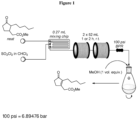
- Figure 1 shows an example schematic flow setup used for the SO 2 Cl 2 oxidation of Hedione.
- the present invention is based on the surprising discovery of a facile process for chlorination-elimination oxidation of Hedione resulting in its formal oxidation to DHH.
- the process can be readily conducted in one pot or in a continuous reactor system. And accordingly, a simple and cost effective synthesis process of DHH from Hedione is developed.
- Hedione is chlorinated to obtain ⁇ -chlorohedione in the presence of a chlorinating agent at a temperature of 55°C or below, followed by eliminating chlorine from ⁇ -chlorohedione to obtain DHH.
- the eliminating step of ⁇ -chlorohedione can be conducted in a solvent comprising a lower alkyl alcohol, preferably methanol or ethanol, and more preferably, methanol.
- a solvent comprising a lower alkyl alcohol, preferably methanol or ethanol, and more preferably, methanol.
- Lower alkyl amines and thiols are also suitable to promote the elimination reaction.
- the eliminating step, together with or without the chlorinating step is conducted in methanol.
- the chlorinating agent is sulfuryl chloride, chlorine gas, a cyclic chlorine compound having a structural moiety of -N(Cl)-C(O)- (such as -C(O)-N(Cl)-C(O)-) in a 5- or 6-membered ring (such as 1,3-dichloro-5,5-dimethylhydantoin), or a combination thereof.
- the cyclic chlorine compound is selected from the group consisting of trichloroisocyanuric acid, 1,3-dichloro-5,5-dimethylhydantoin, N -chlorosuccinimide, and combinations thereof.
- the chlorinating agent is added in portions into neat Hedione or a solution of Hedione.
- the chlorinating step includes an initiation stage after the addition of a first portion of the chlorinating agent, and the initiation stage is achieved by a thermal initiation at a temperature of 40 °C or greater (preferably 40 °C to 120 °C, and more preferably 45 °C to 55 °C) or a UV-visible light initiation, in the presence or absence of a radical initiator.
- the chlorinating agent is added in the total amount of 0.8 to 2.2 chlorine equivalents relative to Hedione, and the first portion of the chlorinating agent constitutes 5 % to 25 % by weight of the total amount of the chlorinating agent added to the reaction.
- the chlorinating step is performed at a temperature of 30 °C or below (e.g., 0 °C to 30 °C, 5 °C to 30 °C, and 15 °C to 30 °C) after the initiation stage.
- the chlorinating agent is sulfuryl chloride (SO 2 Cl 2 ).
- SO 2 Cl 2 sulfuryl chloride
- Sulfuryl chloride provides one chlorine atom when chlorinating Hedione, with the other chlorine atom forming a molecule of HCl as a by-product.
- one mole of sulfuryl chloride equals to one chlorine equivalent in the chlorination reaction relative to one mole of Hedione.
- the chlorinating step is performed at a temperature of 30 °C or below without a solvent or in a solvent selected from the group consisting of chloroform, dichloromethane, ethyl acetate, toluene, xylenes, and combinations thereof.
- the amount of sulfuryl chloride is in a range of 0.75 to 1.1 chlorine equivalents as compared to that of Hedione.
- the chemical process further comprising reducing DHH to (1 R ,2 S )-(+)- cis Hedione or its mixture in the presence of a chiral catalyst system.
- Exemplary chiral catalysts include ruthenium (II) catalyst comprising ligands formed of bidentate phosphines, characterized in that it is obtainable by a process which comprises treating an appropriate Ru(II) complex and a bidentate diphosphine ligand, present in equimolar amounts, with an acid of formula HX, wherein X is a non-coordinating anion, said acid being used in a ratio which does not exceed 2 molar equivalents per mole of the Ru(II) complex, the treatment being carried out in a non-coordinating or weakly coordinating medium and under an inert atmosphere. See US Patent 5,874,600 .
- Suitable Ru(II) complexes can be selected from the group of Ru(II) compounds of the type (diene)Ru(allyl) 2 or bis(pentadienyl)Ru such as bis(2-methallyl) (1,5-cyclooctadiene)Ru(II), bis(2,4-dimethylpentadienyl)Ru(II) or bis(2,4-dimethyl-1-oxapentadienyl)Ru(II).
- the diphosphine ligand can be the chiral ligands known under the abbreviations of Me-DuPHOS, Et-DuPHOS, BINAP, To1BINAP, SKEWPHOS and JOSIPHOS, preferably (R,R)-(-)-Me-DuPHOS.
- the chlorinating and eliminating steps are performed in a one-pot process. In some embodiments, the chlorinating step, the eliminating step, or both are performed in a continuous reactor system.
- the continuous reactor system is a single continuous stirred tank reactor ("CSTR"), a system having multiple CSTRs in series, or a continuous flow reactor system such as a tubular flow system.
- CSTR continuous stirred tank reactor
- BPR back pressure regulator
- lower alkyl alcohol means an alcohol of formula "R-OH", where R is a lower alkyl group containing 1 to 4 carbon atoms.
- R is a lower alkyl group containing 1 to 4 carbon atoms.
- Representative examples of lower alkyl alcohol include, but are not limited to, methanol, ethanol, n-propanol, iso-propanol, etc., preferably methanol and ethanol, and more preferably methanol.
- chlorine equivalent refers to the molar equivalent of chlorine atoms supplied by the chlorinating agent in the chlorination reaction relative to Hedione.
- flow reactor refers to a dynamic reactor system in which reactants flow continuously into the vessel and products are continuously removed, in contrast to a batch reactor (as defined in McGraw-Hill Dictionary of Scientific & Technical Terms, 6E, Copyright ⁇ 2003 by The McGraw-Hill Companies, Inc. ).
- flow reactors include, but are not limited to, continuous flow microreactors (e.g., the H-Cube ® continuous flow hydrogenation reactor marketed by ThalesNano), fluidized bed reactors, membrane reactors, laminar flow reactors, baffle flow reactors and the like.
- the present invention particularly relates to a chemical process involving the transformation of Hedione to DHH.
- the (1 R ,2 S )-(+)- cis isomer is the most desirable, being almost entirely responsible for the characteristic odor of Hedione.
- enantioselective routes to this compound have been reported, they are prohibitively expensive and poorly scalable, hence, ' cis -enhancement' of Hedione ® is still the favored approach within the fragrance industry. This is primarily achieved through hydrogenation of DHH (1b, its ⁇ , ⁇ -unsaturated analogue).
- the preferred method of DHH synthesis on a large scale still remains through direct oxidation of Hedione (see, e.g., US 6,586,620 ).
- one advantage of this process involves a convenient and operationally simple means of effecting the oxidative transformation of Hedione 1 to DHH 2 via ⁇ -chlorohedione 5, as shown in Scheme 2.
- Suitable chlorinating agents include sulfuryl chloride (SO 2 Cl 2 ), chlorine gas, and cyclic chlorine compounds each having a structural moiety of -N(Cl)-C(O)- in a 5- or 6-membered ring. These chlorinating agents are cost effective and readily available. They surprisingly chlorinate Hedione in high yields and under mild conditions.
- Exemplary cyclic chlorine compounds having a structural moiety of -N(Cl)-C(O)- in a 5or 6-membered ring include trichloroisocyanuric acid (TCCA, 6 ) and its salts (such as a sodium salt), dichloroisocyanuric acid and its salts (such as a sodium salt), monochloroisocyanuric acid and its salts (such as a sodium salt), 1,3-dichloro-5,5-dimethylhydantoin (DCDMH, 7 ), and N-chlorosuccinimide (NCS, 8 ), whose structural formulae are shown in Scheme 3 below.
- TCCA has three chlorine atoms available for a chlorination reaction.
- 1 mole of TCCA (including its salts) equals to 3 chlorine equivalents relative to 1 mole of Hedione.
- 1 mole of dichloroisocyanuric acid (including its salts) equals to 2 chlorine equivalents relative to 1 mole of Hedione
- 1 mole of monochloroisocyanuric acid (including its salts) equals to a chlorine equivalent relative to 1 mole of Hedione
- 1 mole of DCDMH equals to 2 chlorine equivalents relative to 1 mole of Hedione
- 1 mole of NCS equals to 1 chlorine equivalent relative to 1 mole of Hedione.
- TCCA 6 an inexpensive industrial disinfectant and bleaching agent used in swimming pools and in the textile industry, is preferable for its selectivity towards the desired ⁇ -position (5) chlorination.
- the chlorinating step is conducted at a temperature of 55 °C or below, so as to avoid a runaway reaction. More preferably, the reaction temperature in the chlorinating step is kept at 30 °C or below, and even more preferably, at an ambient temperature such as from 15 °C to 25 °C.
- the chlorinating agent is added portion-wise. For example, the chlorinating agent alone or in a solution (e.g. a methanol solution) is added in portions into neat Hedione or a solution of Hedione. In some embodiments, the chlorinating agent is added at a total amount of 0.8 to 2.2 chlorine equivalents relative to Hedione.
- a slight superstoichiometric chlorine equivalent of the chlorinating agent for instance, from 1 to 1.5 chlorine equivalents for the cyclic chlorine compound and 0.7 to 1.5 chlorine equivalents for SO 2 Cl 2 , is preferable for the conversion to ⁇ -chlorohedione.
- an initiation stage is beneficial after the addition of a first portion of the chlorinating agent.
- Table 1 below shows the chlorination results using TCCA.
- solid TCCA was added in portions to control the temperature and avoid a runaway reaction.
- a high temperature such as 64.7 °C (Table 1, entry 1)
- the reaction occurred immediately upon addition of the TCCA which makes controlling the reaction temperature challenging.
- a low temperature e.g., 30 °C, 25 °C, and 15 °C
- TCCA itself is not reacting directly with the starting material (as an electrophilic chlorinating agent) but that it acts as a source of Cl 2 or Cl radicals which are the reactive species.
- An initiation stage assists cleavage of an N-Cl bond in TCCA to generate a chlorine radical or Cl 2 with an initiation stage using radical initiators such as AIBN.
- radical initiators such as AIBN.
- This is classically achieved by heating or irradiating with UV-visible light. By heating the reaction therefore, this initiation can be induced and made to occur predictably.
- the initiation is highly exothermic and leads to a rapid propagation in the presence of additional TCCA. Initiating the reaction in the presence of small amounts of TCCA and then dosing the remainder of the TCCA afterwards is a preferred way to carry out the process.
- Thermal initiation typically occurs at 45 °C to 51 °C.
- an initiation stage at 45 °C to 55 °C is preferred after the addition of a first portion of the chlorinating agent, which constitutes 5 to 25 % by weight of the total amount of the chlorinating agent.
- the chlorinating step after the initiation stage is preferably performed at a temperature of 30 °C or below.
- Table 2 below shows yields of ⁇ -chlorohedione were obtained by using different chlorinating agents.
- the SO 2 Cl 2 chlorination step can be carried out in suitable solvents as shown in Table 3. Conducting the reaction under a solvent-free condition led to a yield of 58% (Table 3, entry 4). Methanol was added to the reaction mixture after the chlorination step.
- Table 3 Chlorination of Hedione with SO 2 Cl 2 in different solvents Entry Solvent 1 H-NMR yield a 1 CHCl 3 73% 2 EtOAc 72% 3 Toluene 74% 4 Neat 58% Reactions conducted on a 5 mmol scale (1 M). a Calculated using 1,3,5-trimethoxybenzene as an external 1 H-NMR standard.
- the chlorination step can be complete within 10 hours (such as within 8 hours, within 5 hours, within 3 hours, within 2 hours, 1 hour to 10 hours).
- the elimination step can be complete within 24 hours ( e.g ., within 20 hours, within 16 hours, within 12 hours, within 10 hours, within 8 hours, within 5 hours, within 3 hours, and 1 hour to 24 hours).
- the reactions can be monitored with a liquid chromatography and mass spectrometer (LC-MS) showing the peaks of Hedione, ⁇ -chlorohedione (the intermediates), and DHH (the final product).
- LC-MS liquid chromatography and mass spectrometer
- Table 4 below shows the chlorination of Hedione to ⁇ -chlorohedione and the subsequent elimination to DHH.
- the yield is calculated as the overall yield from Hedione to DHH.
- the chemical process of the present invention may further comprise a step of reducing DHH to (1 R ,2 S )-(+)- cis Hedione or its mixture.
- the reducing step can be performed using hydrogen in the presence of a chiral catalyst system. See Demole et al., Helev. Chim. Acta 1962, 45, 675-92 ; Werkhoff et al., Food Rev. Int. 2002, 18, 103-22 ; and Davies, Chem. World-UK 2009, Feb., 40-44 .
- This application also discloses a system for conducting the chemical process of the present invention.
- the spontaneous elimination of chlorine from ⁇ -chlorohedione the oxidation of Hedione to DHH via chlorinating and eliminating steps, as well as the subsequent reduction of DHH to (1 R ,2 S )-(+)- cis Hedione, may be performed in a one-pot process, which greatly simplifies the process and the equipment required.
- the continuous reactor system employed in the present invention may comprise a single continuous stirred tank reactor ("CSTR"), a system having multiple CSTRs in series, or a continuous flow reactor system, such as H-Cube ® continuous flow hydrogenation reactor marketed by ThalesNano.
- CSTR continuous stirred tank reactor
- H-Cube ® continuous flow hydrogenation reactor marketed by ThalesNano.
- a continuous flow reactor system is attractive for the reaction with SO 2 Cl 2 , due to the fact that SO 2 gas evolution occurs.
- exothermic reactions that involve the generation of gas are prone to rapid gas evolution and overpressures, hence, very careful addition of reagents to such reactions are necessary at scale.
- Gas generation can be easily managed in flow by pressurizing the system with a suitable back pressure regulator (BPR) ( Mallia et al., Org. Process Res. Dev. 2015 ).
- BPR back pressure regulator
- the gas can be kept in solution whilst in the flow stream and then removed from the reaction upon passing the BPR. This allows for steady, constant removal of gas in a manner that carries with it improved safety implications compared to batch.
- BPR back pressure regulator
- Another advantage of continuous flow reactor system for the reaction with SO 2 Cl 2 is that all materials used are miscible liquids.
- Figure 1 shows a schematic semi-continuous system of the present invention, in which the chlorination step is performed in flow and the elimination is performed batch-wise.
- neat Hedione was fed into a 0.27 mL Uniqsis mixing chip along with a solution of SO 2 Cl 2 in CHCl 3 at a rate such that 1.1 equivalent of SO 2 Cl 2 was used with a residence time of 1 hour to 2 hours within the flow reactors.
- the flow system was pressurized using a 100 psi ( ⁇ 7 bar) BPR for the chlorination step and the outlet was collected in a stirred flask. Upon halting collection, methanol (MeOH) was added and the reaction was left to stir for 16 hours at 25 °C. The system worked well and gave comparable yields to the batch process (Table 5 vs. Table 4).
- IR spectra were obtained using a Perkin Elmer Spectrum Two UATR Two FT-IR Spectrometer (neat, ATR sampling) with the intensities of the characteristic signals being reported as weak (w, ⁇ 20% of tallest signal), medium (m, 21-70% of tallest signal) or strong (s, >71% of tallest signal).
- Low and high resolution mass spectrometry was performed using the indicated techniques.
- Gas chromatography mass spectrometry (GC-MS) was performed on a Shimadzu QP2010-Ultra equipped with an Rxi-5Sil MS column in EI mode.
Landscapes
- Chemical & Material Sciences (AREA)
- Organic Chemistry (AREA)
- Organic Low-Molecular-Weight Compounds And Preparation Thereof (AREA)
Claims (15)
- Procédé chimique utilisant le 2-(3-oxo-2-pentylcyclopentyl)acétate de méthyle (« hédione ») comme une matière première comprenant :la chloration de l'hédione pour obtenir 2-(2-chloro-3-oxo-2-pentylcyclopentyl)acétate de méthyle (« α-chlorohédione ») en la présence d'un agent de chloration à une température de 55 °C ou moins, etl'élimination de chlore de la α-chlorohédione pour obtenir le 2-(3-oxo-2-pentylcyclopent-1-én-1-yl)acétate de méthyle (« déshydrohédione ») en la présence d'un alcool alkylique inférieur, l'alcool alkylique inférieur ayant une formule de R-OH et R étant un groupe alkyle inférieur contenant 1 à 4 atomes de carbone.
- Procédé selon la revendication 1, l'alcool alkylique inférieur étant le méthanol.
- Procédé selon la revendication 1 ou 2, l'agent de chloration étant le chlorure de sulfuryle, un gaz de chlore, un composé chloré cyclique ayant un groupement structural de -C(O)-N(Cl)-C(O)- dans un cycle à 5 ou 6 chaînons, ou une combinaison correspondante.
- Procédé selon la revendication 3, le composé chloré cyclique étant choisi dans le groupe constitué par l'acide trichloroisocyanurique, la 1,3-dichloro-5,5-diméthylhydantoïne, le N-chlorosuccinimide, et des combinaisons correspondantes.
- Procédé selon l'une quelconque des revendications 1 à 4, l'agent de chloration étant ajouté en portions dans une solution d'hédione.
- Procédé selon la revendication 5, l'étape de chloration comprenant un stade d'initiation après l'ajout d'une première portion de l'agent de chloration, et le stade d'initiation étant achevé par une initiation thermique à une température de 45 à 55 °C ou une initiation par de la lumière UV-visible, en la présence ou en l'absence d'un initiateur de radicaux.
- Procédé selon la revendication 6, l'agent de chloration étant ajouté en la quantité totale de 0,8 à 2,2 équivalents de chlore par rapport à l'hédione, et la première portion de l'agent de chloration constituant 5 à 25 % en poids de la quantité totale de l'agent de chloration.
- Procédé selon l'une quelconque des revendications 1 à 7, l'étape de chloration étant réalisée à une température de 30 °C ou moins après le stade d'initiation.
- Procédé selon la revendication 3, l'agent de chloration étant le chlorure de sulfuryle.
- Procédé selon la revendication 9, l'étape de chloration étant réalisée à une température de 30 °C ou moins dans un solvant choisi dans le groupe constitué par le dichlorométhane, le chloroforme, l'acétonitrile, l'acétate d'éthyle, le toluène, les xylènes, et des combinaisons correspondantes.
- Procédé selon la revendication 9 ou 10, la quantité de chlorure de sulfuryle étant dans une plage de 0,75 à 1,1 équivalent molaire par comparaison avec celui de l'hédione.
- Procédé selon l'une quelconque des revendications 1 à 11, comprenant en outre la réduction de la déshydrohédione en (1R,2S)-(+)-cis hédione ou son mélange en la présence d'un système de catalyseur chiral.
- Procédé selon l'une quelconque des revendications 1 à 12, les étapes de chloration et d'élimination étant réalisées dans un pot.
- Procédé selon l'une quelconque des revendications 1 à 13, l'étape de chloration, l'étape d'élimination, ou les deux étant réalisées dans un système de réacteur en continu.
- Procédé selon la revendication 14, le système de réacteur en continu étant un réacteur à cuve agité en continu unique (« CSTR »), un système ayant plusieurs CSTR en série, ou un système de réacteur à flux continu, et l'hédione et l'agent de chloration étant alimentés dans le système de réacteur en continu qui est pressurisé en utilisant un régulateur de contre-pression (BPR).
Applications Claiming Priority (2)
| Application Number | Priority Date | Filing Date | Title |
|---|---|---|---|
| US201762479919P | 2017-03-31 | 2017-03-31 | |
| PCT/US2018/025319 WO2018183788A1 (fr) | 2017-03-31 | 2018-03-30 | Procédé chimique de préparation de déshydrohédione |
Publications (3)
| Publication Number | Publication Date |
|---|---|
| EP3601208A1 EP3601208A1 (fr) | 2020-02-05 |
| EP3601208A4 EP3601208A4 (fr) | 2021-05-05 |
| EP3601208B1 true EP3601208B1 (fr) | 2025-02-12 |
Family
ID=63677104
Family Applications (1)
| Application Number | Title | Priority Date | Filing Date |
|---|---|---|---|
| EP18775050.0A Active EP3601208B1 (fr) | 2017-03-31 | 2018-03-30 | Procédé chimique de préparation de déshydrohédione |
Country Status (5)
| Country | Link |
|---|---|
| US (1) | US11198667B2 (fr) |
| EP (1) | EP3601208B1 (fr) |
| CN (1) | CN110475763B (fr) |
| ES (1) | ES3015541T3 (fr) |
| WO (1) | WO2018183788A1 (fr) |
Families Citing this family (1)
| Publication number | Priority date | Publication date | Assignee | Title |
|---|---|---|---|---|
| CN117586119A (zh) * | 2023-11-21 | 2024-02-23 | 浙江新化化工股份有限公司 | 一种3-氧代-2-戊基-环戊烯基乙酸甲酯的合成方法 |
Family Cites Families (9)
| Publication number | Priority date | Publication date | Assignee | Title |
|---|---|---|---|---|
| US4816609A (en) * | 1987-05-26 | 1989-03-28 | The Dow Chemical Company | Process and catalyst for the dehydrohalogenation of halogenated hydrocarbons |
| US5874600A (en) | 1995-11-22 | 1999-02-23 | Firmenich Sa | Ruthenium catalysts and their use in the asymmetric hydrogenation of cyclopentenones |
| US6586620B1 (en) | 1999-11-05 | 2003-07-01 | Firmenich Sa | Process for the preparation of alkyl 3-oxo-2-pentyl-1-cyclopenteneacetates |
| EP1900720B1 (fr) * | 2005-06-30 | 2012-06-13 | Asahi Kasei Chemicals Corporation | Procédé de production d'une cyclopentanone substituée |
| CN100582082C (zh) * | 2006-01-11 | 2010-01-20 | 浙江新和成股份有限公司 | 顺式-二氢茉莉酮酸甲酯的合成方法 |
| CN101302157B (zh) * | 2008-06-26 | 2011-04-27 | 上海应用技术学院 | 3-氧代-2-戊基环戊烯基乙酸甲酯的制备方法 |
| EP2703381B1 (fr) * | 2011-04-28 | 2015-10-21 | Ono Pharmaceutical Co., Ltd. | Procédé de fabrication de composé contenant un cycle à cinq chaînons |
| US20160175829A1 (en) | 2013-08-02 | 2016-06-23 | The Governors Of The University Of Alberta | Catalyst systems for use in continuous flow reactors and methods of manufacture and use thereof |
| CN104086480A (zh) | 2014-06-20 | 2014-10-08 | 沈阳化工研究院有限公司 | 一种制备2-氯-5-氯甲基吡啶的方法 |
-
2018
- 2018-03-30 EP EP18775050.0A patent/EP3601208B1/fr active Active
- 2018-03-30 ES ES18775050T patent/ES3015541T3/es active Active
- 2018-03-30 WO PCT/US2018/025319 patent/WO2018183788A1/fr not_active Ceased
- 2018-03-30 US US16/499,626 patent/US11198667B2/en active Active
- 2018-03-30 CN CN201880022527.0A patent/CN110475763B/zh active Active
Also Published As
| Publication number | Publication date |
|---|---|
| ES3015541T3 (en) | 2025-05-06 |
| WO2018183788A1 (fr) | 2018-10-04 |
| CN110475763B (zh) | 2023-01-20 |
| CN110475763A (zh) | 2019-11-19 |
| US20200039915A1 (en) | 2020-02-06 |
| EP3601208A1 (fr) | 2020-02-05 |
| US11198667B2 (en) | 2021-12-14 |
| EP3601208A4 (fr) | 2021-05-05 |
Similar Documents
| Publication | Publication Date | Title |
|---|---|---|
| JP3281920B2 (ja) | アリルフラン化合物の製造方法 | |
| EP3097067B1 (fr) | Perfectionnements apportés à des composés organiques ou en relation avec ceux-ci | |
| EA008352B1 (ru) | Рутениевые комплексы в качестве (пред)катализаторов для реакций метатезиса | |
| Gladow et al. | Synthesis of Perfluoroalkyl‐Substituted γ‐Lactones and 4, 5‐Dihydropyridazin‐3 (2H)‐ones via Donor Acceptor Cyclopropanes | |
| JP2000086550A (ja) | α―置換環系の合成方法 | |
| Moriarty et al. | Metal-free intramolecular cyclopropanation of alkenes through iodonium ylide methodology | |
| Maruyama et al. | A short and stereoselective synthesis of the (±) Prelog-Djerassi lactonic acid | |
| US11198667B2 (en) | Chemical process of preparing dehydrohedione | |
| JPH03184938A (ja) | エチレン性ケトンの製造方法 | |
| Keränen et al. | Sequential hydroformylation/aldol reactions: versatile and controllable access to functionalised carbocycles from unsaturated carbonyl compounds | |
| FR2464936A1 (fr) | Procede pour la preparation de muscone | |
| WO2016164565A1 (fr) | Trans-cycloheptènes et hétéro-trans-cycloheptènes pour couplage bioorthogonal | |
| JP4551000B2 (ja) | 4−置換n−[(アルケ−2−エニ−1−イル)オキシ]−およびn−アラルキルオキシ−2,2,6,6−テトラアルキルピペリジンの合成方法 | |
| Sirasani et al. | Sequencing cross-metathesis and non-metathesis reactions to rapidly access building blocks for synthesis | |
| Madda et al. | Stereoselective total synthesis of rubrenolide and rubrynolide | |
| WO2009133950A1 (fr) | Procédé de fabrication d’un composé d’éther de vinyle | |
| Menicagli et al. | Triisobutylaluminum assisted reductive rearrangement of 2-ethoxy-4-alkyl-2, 3-dihydrofurans | |
| Janecki et al. | A New, General Approach to Substituted 3-Diethoxyphosphoryl-2, 5-dihydro-2-furanones | |
| Arisawa et al. | Rhodium Catalyzed Anti-Markovnikov Addition of Triphenylphosphine to 1, 3-Dienes A Novel Method to Separate Pure (Z)-1, 3-Alkadienes from Isomeric Mixtures. | |
| KR101548886B1 (ko) | 비대칭 마이클 촉매 반응을 통한 (r)-롤리프람 전구체의 제조방법 및 이를 이용한 (r)-롤리프람의 제조 방법 | |
| JPS629580B2 (fr) | ||
| Sim et al. | Asymmetric Synthesis of 1, 1-Diarylalkanes via Friedel–Crafts Alkylation of Donor–Acceptor Cyclopropanes with Electron-Rich Benzene | |
| Bates et al. | Palladium catalyzed allylation is under stereoelectronic control | |
| JP2542503B2 (ja) | シクロヘキサノン誘導体の合成法 | |
| JP4171345B2 (ja) | ラブデン酸の製造方法 |
Legal Events
| Date | Code | Title | Description |
|---|---|---|---|
| STAA | Information on the status of an ep patent application or granted ep patent |
Free format text: STATUS: THE INTERNATIONAL PUBLICATION HAS BEEN MADE |
|
| PUAI | Public reference made under article 153(3) epc to a published international application that has entered the european phase |
Free format text: ORIGINAL CODE: 0009012 |
|
| STAA | Information on the status of an ep patent application or granted ep patent |
Free format text: STATUS: REQUEST FOR EXAMINATION WAS MADE |
|
| 17P | Request for examination filed |
Effective date: 20190930 |
|
| AK | Designated contracting states |
Kind code of ref document: A1 Designated state(s): AL AT BE BG CH CY CZ DE DK EE ES FI FR GB GR HR HU IE IS IT LI LT LU LV MC MK MT NL NO PL PT RO RS SE SI SK SM TR |
|
| AX | Request for extension of the european patent |
Extension state: BA ME |
|
| DAV | Request for validation of the european patent (deleted) | ||
| DAX | Request for extension of the european patent (deleted) | ||
| A4 | Supplementary search report drawn up and despatched |
Effective date: 20210407 |
|
| RIC1 | Information provided on ipc code assigned before grant |
Ipc: C07C 67/317 20060101AFI20210330BHEP Ipc: C07C 69/738 20060101ALI20210330BHEP Ipc: C07C 69/716 20060101ALI20210330BHEP Ipc: C07C 67/307 20060101ALI20210330BHEP Ipc: C07C 69/635 20060101ALI20210330BHEP |
|
| STAA | Information on the status of an ep patent application or granted ep patent |
Free format text: STATUS: EXAMINATION IS IN PROGRESS |
|
| 17Q | First examination report despatched |
Effective date: 20230207 |
|
| GRAP | Despatch of communication of intention to grant a patent |
Free format text: ORIGINAL CODE: EPIDOSNIGR1 |
|
| STAA | Information on the status of an ep patent application or granted ep patent |
Free format text: STATUS: GRANT OF PATENT IS INTENDED |
|
| RIC1 | Information provided on ipc code assigned before grant |
Ipc: C07C 67/303 20060101ALI20240625BHEP Ipc: C07C 69/635 20060101ALI20240625BHEP Ipc: C07C 67/307 20060101ALI20240625BHEP Ipc: C07C 69/716 20060101ALI20240625BHEP Ipc: C07C 69/738 20060101ALI20240625BHEP Ipc: C07C 67/317 20060101AFI20240625BHEP |
|
| INTG | Intention to grant announced |
Effective date: 20240709 |
|
| P01 | Opt-out of the competence of the unified patent court (upc) registered |
Free format text: CASE NUMBER: APP_53161/2024 Effective date: 20240924 |
|
| GRAS | Grant fee paid |
Free format text: ORIGINAL CODE: EPIDOSNIGR3 |
|
| GRAA | (expected) grant |
Free format text: ORIGINAL CODE: 0009210 |
|
| STAA | Information on the status of an ep patent application or granted ep patent |
Free format text: STATUS: THE PATENT HAS BEEN GRANTED |
|
| AK | Designated contracting states |
Kind code of ref document: B1 Designated state(s): AL AT BE BG CH CY CZ DE DK EE ES FI FR GB GR HR HU IE IS IT LI LT LU LV MC MK MT NL NO PL PT RO RS SE SI SK SM TR |
|
| REG | Reference to a national code |
Ref country code: GB Ref legal event code: FG4D |
|
| REG | Reference to a national code |
Ref country code: CH Ref legal event code: EP |
|
| REG | Reference to a national code |
Ref country code: DE Ref legal event code: R096 Ref document number: 602018079093 Country of ref document: DE |
|
| REG | Reference to a national code |
Ref country code: IE Ref legal event code: FG4D |
|
| REG | Reference to a national code |
Ref country code: ES Ref legal event code: FG2A Ref document number: 3015541 Country of ref document: ES Kind code of ref document: T3 Effective date: 20250506 |
|
| REG | Reference to a national code |
Ref country code: NL Ref legal event code: MP Effective date: 20250212 |
|
| PG25 | Lapsed in a contracting state [announced via postgrant information from national office to epo] |
Ref country code: RS Free format text: LAPSE BECAUSE OF FAILURE TO SUBMIT A TRANSLATION OF THE DESCRIPTION OR TO PAY THE FEE WITHIN THE PRESCRIBED TIME-LIMIT Effective date: 20250512 |
|
| PG25 | Lapsed in a contracting state [announced via postgrant information from national office to epo] |
Ref country code: FI Free format text: LAPSE BECAUSE OF FAILURE TO SUBMIT A TRANSLATION OF THE DESCRIPTION OR TO PAY THE FEE WITHIN THE PRESCRIBED TIME-LIMIT Effective date: 20250212 |
|
| PG25 | Lapsed in a contracting state [announced via postgrant information from national office to epo] |
Ref country code: PL Free format text: LAPSE BECAUSE OF FAILURE TO SUBMIT A TRANSLATION OF THE DESCRIPTION OR TO PAY THE FEE WITHIN THE PRESCRIBED TIME-LIMIT Effective date: 20250212 |
|
| REG | Reference to a national code |
Ref country code: LT Ref legal event code: MG9D |
|
| PG25 | Lapsed in a contracting state [announced via postgrant information from national office to epo] |
Ref country code: IS Free format text: LAPSE BECAUSE OF FAILURE TO SUBMIT A TRANSLATION OF THE DESCRIPTION OR TO PAY THE FEE WITHIN THE PRESCRIBED TIME-LIMIT Effective date: 20250612 Ref country code: NO Free format text: LAPSE BECAUSE OF FAILURE TO SUBMIT A TRANSLATION OF THE DESCRIPTION OR TO PAY THE FEE WITHIN THE PRESCRIBED TIME-LIMIT Effective date: 20250512 |
|
| PG25 | Lapsed in a contracting state [announced via postgrant information from national office to epo] |
Ref country code: NL Free format text: LAPSE BECAUSE OF FAILURE TO SUBMIT A TRANSLATION OF THE DESCRIPTION OR TO PAY THE FEE WITHIN THE PRESCRIBED TIME-LIMIT Effective date: 20250212 |
|
| PG25 | Lapsed in a contracting state [announced via postgrant information from national office to epo] |
Ref country code: HR Free format text: LAPSE BECAUSE OF FAILURE TO SUBMIT A TRANSLATION OF THE DESCRIPTION OR TO PAY THE FEE WITHIN THE PRESCRIBED TIME-LIMIT Effective date: 20250212 |
|
| PG25 | Lapsed in a contracting state [announced via postgrant information from national office to epo] |
Ref country code: LV Free format text: LAPSE BECAUSE OF FAILURE TO SUBMIT A TRANSLATION OF THE DESCRIPTION OR TO PAY THE FEE WITHIN THE PRESCRIBED TIME-LIMIT Effective date: 20250212 Ref country code: PT Free format text: LAPSE BECAUSE OF FAILURE TO SUBMIT A TRANSLATION OF THE DESCRIPTION OR TO PAY THE FEE WITHIN THE PRESCRIBED TIME-LIMIT Effective date: 20250612 |
|
| PG25 | Lapsed in a contracting state [announced via postgrant information from national office to epo] |
Ref country code: GR Free format text: LAPSE BECAUSE OF FAILURE TO SUBMIT A TRANSLATION OF THE DESCRIPTION OR TO PAY THE FEE WITHIN THE PRESCRIBED TIME-LIMIT Effective date: 20250513 Ref country code: BG Free format text: LAPSE BECAUSE OF FAILURE TO SUBMIT A TRANSLATION OF THE DESCRIPTION OR TO PAY THE FEE WITHIN THE PRESCRIBED TIME-LIMIT Effective date: 20250212 |
|
| REG | Reference to a national code |
Ref country code: AT Ref legal event code: MK05 Ref document number: 1765967 Country of ref document: AT Kind code of ref document: T Effective date: 20250212 |
|
| PG25 | Lapsed in a contracting state [announced via postgrant information from national office to epo] |
Ref country code: SE Free format text: LAPSE BECAUSE OF FAILURE TO SUBMIT A TRANSLATION OF THE DESCRIPTION OR TO PAY THE FEE WITHIN THE PRESCRIBED TIME-LIMIT Effective date: 20250212 |
|
| PG25 | Lapsed in a contracting state [announced via postgrant information from national office to epo] |
Ref country code: SM Free format text: LAPSE BECAUSE OF FAILURE TO SUBMIT A TRANSLATION OF THE DESCRIPTION OR TO PAY THE FEE WITHIN THE PRESCRIBED TIME-LIMIT Effective date: 20250212 |
|
| PG25 | Lapsed in a contracting state [announced via postgrant information from national office to epo] |
Ref country code: DK Free format text: LAPSE BECAUSE OF FAILURE TO SUBMIT A TRANSLATION OF THE DESCRIPTION OR TO PAY THE FEE WITHIN THE PRESCRIBED TIME-LIMIT Effective date: 20250212 |
|
| PG25 | Lapsed in a contracting state [announced via postgrant information from national office to epo] |
Ref country code: IT Free format text: LAPSE BECAUSE OF FAILURE TO SUBMIT A TRANSLATION OF THE DESCRIPTION OR TO PAY THE FEE WITHIN THE PRESCRIBED TIME-LIMIT Effective date: 20250212 |
|
| PG25 | Lapsed in a contracting state [announced via postgrant information from national office to epo] |
Ref country code: AT Free format text: LAPSE BECAUSE OF FAILURE TO SUBMIT A TRANSLATION OF THE DESCRIPTION OR TO PAY THE FEE WITHIN THE PRESCRIBED TIME-LIMIT Effective date: 20250212 |
|
| PG25 | Lapsed in a contracting state [announced via postgrant information from national office to epo] |
Ref country code: EE Free format text: LAPSE BECAUSE OF FAILURE TO SUBMIT A TRANSLATION OF THE DESCRIPTION OR TO PAY THE FEE WITHIN THE PRESCRIBED TIME-LIMIT Effective date: 20250212 Ref country code: CZ Free format text: LAPSE BECAUSE OF FAILURE TO SUBMIT A TRANSLATION OF THE DESCRIPTION OR TO PAY THE FEE WITHIN THE PRESCRIBED TIME-LIMIT Effective date: 20250212 |
|
| PG25 | Lapsed in a contracting state [announced via postgrant information from national office to epo] |
Ref country code: RO Free format text: LAPSE BECAUSE OF FAILURE TO SUBMIT A TRANSLATION OF THE DESCRIPTION OR TO PAY THE FEE WITHIN THE PRESCRIBED TIME-LIMIT Effective date: 20250212 |
|
| PG25 | Lapsed in a contracting state [announced via postgrant information from national office to epo] |
Ref country code: SK Free format text: LAPSE BECAUSE OF FAILURE TO SUBMIT A TRANSLATION OF THE DESCRIPTION OR TO PAY THE FEE WITHIN THE PRESCRIBED TIME-LIMIT Effective date: 20250212 |
|
| REG | Reference to a national code |
Ref country code: DE Ref legal event code: R097 Ref document number: 602018079093 Country of ref document: DE |
|
| PG25 | Lapsed in a contracting state [announced via postgrant information from national office to epo] |
Ref country code: LU Free format text: LAPSE BECAUSE OF NON-PAYMENT OF DUE FEES Effective date: 20250330 |
|
| REG | Reference to a national code |
Ref country code: BE Ref legal event code: MM Effective date: 20250331 |
|
| PLBE | No opposition filed within time limit |
Free format text: ORIGINAL CODE: 0009261 |
|
| STAA | Information on the status of an ep patent application or granted ep patent |
Free format text: STATUS: NO OPPOSITION FILED WITHIN TIME LIMIT |
|
| PG25 | Lapsed in a contracting state [announced via postgrant information from national office to epo] |
Ref country code: MC Free format text: LAPSE BECAUSE OF FAILURE TO SUBMIT A TRANSLATION OF THE DESCRIPTION OR TO PAY THE FEE WITHIN THE PRESCRIBED TIME-LIMIT Effective date: 20250212 |
|
| REG | Reference to a national code |
Ref country code: CH Ref legal event code: L10 Free format text: ST27 STATUS EVENT CODE: U-0-0-L10-L00 (AS PROVIDED BY THE NATIONAL OFFICE) Effective date: 20251224 |
|
| PG25 | Lapsed in a contracting state [announced via postgrant information from national office to epo] |
Ref country code: BE Free format text: LAPSE BECAUSE OF NON-PAYMENT OF DUE FEES Effective date: 20250331 |
|
| PG25 | Lapsed in a contracting state [announced via postgrant information from national office to epo] |
Ref country code: IE Free format text: LAPSE BECAUSE OF NON-PAYMENT OF DUE FEES Effective date: 20250330 |
|
| 26N | No opposition filed |
Effective date: 20251113 |
|
| GBPC | Gb: european patent ceased through non-payment of renewal fee |
Effective date: 20250512 |
|
| REG | Reference to a national code |
Ref country code: CH Ref legal event code: U11 Free format text: ST27 STATUS EVENT CODE: U-0-0-U10-U11 (AS PROVIDED BY THE NATIONAL OFFICE) Effective date: 20260401 |
|
| PG25 | Lapsed in a contracting state [announced via postgrant information from national office to epo] |
Ref country code: GB Free format text: LAPSE BECAUSE OF NON-PAYMENT OF DUE FEES Effective date: 20250512 |
|
| PGFP | Annual fee paid to national office [announced via postgrant information from national office to epo] |
Ref country code: DE Payment date: 20260204 Year of fee payment: 9 |
|
| PGFP | Annual fee paid to national office [announced via postgrant information from national office to epo] |
Ref country code: FR Payment date: 20260209 Year of fee payment: 9 |
|
| PG25 | Lapsed in a contracting state [announced via postgrant information from national office to epo] |
Ref country code: CY Free format text: LAPSE BECAUSE OF FAILURE TO SUBMIT A TRANSLATION OF THE DESCRIPTION OR TO PAY THE FEE WITHIN THE PRESCRIBED TIME-LIMIT Effective date: 20250212 |
|
| PG25 | Lapsed in a contracting state [announced via postgrant information from national office to epo] |
Ref country code: LT Free format text: LAPSE BECAUSE OF FAILURE TO SUBMIT A TRANSLATION OF THE DESCRIPTION OR TO PAY THE FEE WITHIN THE PRESCRIBED TIME-LIMIT Effective date: 20250212 |
|
| PG25 | Lapsed in a contracting state [announced via postgrant information from national office to epo] |
Ref country code: TR Free format text: LAPSE BECAUSE OF FAILURE TO SUBMIT A TRANSLATION OF THE DESCRIPTION OR TO PAY THE FEE WITHIN THE PRESCRIBED TIME-LIMIT Effective date: 20250212 |
|
| PGFP | Annual fee paid to national office [announced via postgrant information from national office to epo] |
Ref country code: ES Payment date: 20260416 Year of fee payment: 9 |
|
| PGFP | Annual fee paid to national office [announced via postgrant information from national office to epo] |
Ref country code: CH Payment date: 20260401 Year of fee payment: 9 |