EP3601209B1 - Nouveaux composés esters, procédé de production desdits composés et leur utilisation - Google Patents
Nouveaux composés esters, procédé de production desdits composés et leur utilisation Download PDFInfo
- Publication number
- EP3601209B1 EP3601209B1 EP18724128.6A EP18724128A EP3601209B1 EP 3601209 B1 EP3601209 B1 EP 3601209B1 EP 18724128 A EP18724128 A EP 18724128A EP 3601209 B1 EP3601209 B1 EP 3601209B1
- Authority
- EP
- European Patent Office
- Prior art keywords
- acid
- group
- lubricating
- integer
- radicals
- Prior art date
- Legal status (The legal status is an assumption and is not a legal conclusion. Google has not performed a legal analysis and makes no representation as to the accuracy of the status listed.)
- Active
Links
Classifications
-
- C—CHEMISTRY; METALLURGY
- C07—ORGANIC CHEMISTRY
- C07C—ACYCLIC OR CARBOCYCLIC COMPOUNDS
- C07C69/00—Esters of carboxylic acids; Esters of carbonic or haloformic acids
- C07C69/608—Esters of carboxylic acids having a carboxyl group bound to an acyclic carbon atom and having a ring other than a six-membered aromatic ring in the acid moiety
-
- C—CHEMISTRY; METALLURGY
- C07—ORGANIC CHEMISTRY
- C07C—ACYCLIC OR CARBOCYCLIC COMPOUNDS
- C07C69/00—Esters of carboxylic acids; Esters of carbonic or haloformic acids
- C07C69/66—Esters of carboxylic acids having esterified carboxylic groups bound to acyclic carbon atoms and having any of the groups OH, O—metal, —CHO, keto, ether, acyloxy, groups, groups, or in the acid moiety
- C07C69/67—Esters of carboxylic acids having esterified carboxylic groups bound to acyclic carbon atoms and having any of the groups OH, O—metal, —CHO, keto, ether, acyloxy, groups, groups, or in the acid moiety of saturated acids
-
- C—CHEMISTRY; METALLURGY
- C07—ORGANIC CHEMISTRY
- C07C—ACYCLIC OR CARBOCYCLIC COMPOUNDS
- C07C323/00—Thiols, sulfides, hydropolysulfides or polysulfides substituted by halogen, oxygen or nitrogen atoms, or by sulfur atoms not being part of thio groups
- C07C323/50—Thiols, sulfides, hydropolysulfides or polysulfides substituted by halogen, oxygen or nitrogen atoms, or by sulfur atoms not being part of thio groups containing thio groups and carboxyl groups bound to the same carbon skeleton
- C07C323/51—Thiols, sulfides, hydropolysulfides or polysulfides substituted by halogen, oxygen or nitrogen atoms, or by sulfur atoms not being part of thio groups containing thio groups and carboxyl groups bound to the same carbon skeleton having the sulfur atoms of the thio groups bound to acyclic carbon atoms of the carbon skeleton
- C07C323/52—Thiols, sulfides, hydropolysulfides or polysulfides substituted by halogen, oxygen or nitrogen atoms, or by sulfur atoms not being part of thio groups containing thio groups and carboxyl groups bound to the same carbon skeleton having the sulfur atoms of the thio groups bound to acyclic carbon atoms of the carbon skeleton the carbon skeleton being acyclic and saturated
-
- C—CHEMISTRY; METALLURGY
- C07—ORGANIC CHEMISTRY
- C07C—ACYCLIC OR CARBOCYCLIC COMPOUNDS
- C07C67/00—Preparation of carboxylic acid esters
- C07C67/04—Preparation of carboxylic acid esters by reacting carboxylic acids or symmetrical anhydrides onto unsaturated carbon-to-carbon bonds
- C07C67/05—Preparation of carboxylic acid esters by reacting carboxylic acids or symmetrical anhydrides onto unsaturated carbon-to-carbon bonds with oxidation
-
- C—CHEMISTRY; METALLURGY
- C07—ORGANIC CHEMISTRY
- C07C—ACYCLIC OR CARBOCYCLIC COMPOUNDS
- C07C67/00—Preparation of carboxylic acid esters
- C07C67/08—Preparation of carboxylic acid esters by reacting carboxylic acids or symmetrical anhydrides with the hydroxy or O-metal group of organic compounds
-
- C—CHEMISTRY; METALLURGY
- C07—ORGANIC CHEMISTRY
- C07C—ACYCLIC OR CARBOCYCLIC COMPOUNDS
- C07C69/00—Esters of carboxylic acids; Esters of carbonic or haloformic acids
- C07C69/66—Esters of carboxylic acids having esterified carboxylic groups bound to acyclic carbon atoms and having any of the groups OH, O—metal, —CHO, keto, ether, acyloxy, groups, groups, or in the acid moiety
- C07C69/67—Esters of carboxylic acids having esterified carboxylic groups bound to acyclic carbon atoms and having any of the groups OH, O—metal, —CHO, keto, ether, acyloxy, groups, groups, or in the acid moiety of saturated acids
- C07C69/708—Ethers
-
- C—CHEMISTRY; METALLURGY
- C07—ORGANIC CHEMISTRY
- C07C—ACYCLIC OR CARBOCYCLIC COMPOUNDS
- C07C69/00—Esters of carboxylic acids; Esters of carbonic or haloformic acids
- C07C69/66—Esters of carboxylic acids having esterified carboxylic groups bound to acyclic carbon atoms and having any of the groups OH, O—metal, —CHO, keto, ether, acyloxy, groups, groups, or in the acid moiety
- C07C69/73—Esters of carboxylic acids having esterified carboxylic groups bound to acyclic carbon atoms and having any of the groups OH, O—metal, —CHO, keto, ether, acyloxy, groups, groups, or in the acid moiety of unsaturated acids
-
- C—CHEMISTRY; METALLURGY
- C07—ORGANIC CHEMISTRY
- C07C—ACYCLIC OR CARBOCYCLIC COMPOUNDS
- C07C69/00—Esters of carboxylic acids; Esters of carbonic or haloformic acids
- C07C69/74—Esters of carboxylic acids having an esterified carboxyl group bound to a carbon atom of a ring other than a six-membered aromatic ring
- C07C69/75—Esters of carboxylic acids having an esterified carboxyl group bound to a carbon atom of a ring other than a six-membered aromatic ring of acids with a six-membered ring
-
- C—CHEMISTRY; METALLURGY
- C07—ORGANIC CHEMISTRY
- C07C—ACYCLIC OR CARBOCYCLIC COMPOUNDS
- C07C69/00—Esters of carboxylic acids; Esters of carbonic or haloformic acids
- C07C69/76—Esters of carboxylic acids having a carboxyl group bound to a carbon atom of a six-membered aromatic ring
- C07C69/80—Phthalic acid esters
-
- C—CHEMISTRY; METALLURGY
- C10—PETROLEUM, GAS OR COKE INDUSTRIES; TECHNICAL GASES CONTAINING CARBON MONOXIDE; FUELS; LUBRICANTS; PEAT
- C10M—LUBRICATING COMPOSITIONS; USE OF CHEMICAL SUBSTANCES EITHER ALONE OR AS LUBRICATING INGREDIENTS IN A LUBRICATING COMPOSITION
- C10M105/00—Lubricating compositions characterised by the base-material being a non-macromolecular organic compound
- C10M105/08—Lubricating compositions characterised by the base-material being a non-macromolecular organic compound containing oxygen
- C10M105/32—Esters
- C10M105/42—Complex esters, i.e. compounds containing at least three esterified carboxyl groups and derived from the combination of at least three different types of the following five types of compound: monohydroxy compounds, polyhydroxy compounds, monocarboxylic acids, polycarboxylic acids and hydroxy carboxylic acids
-
- C—CHEMISTRY; METALLURGY
- C07—ORGANIC CHEMISTRY
- C07C—ACYCLIC OR CARBOCYCLIC COMPOUNDS
- C07C2601/00—Systems containing only non-condensed rings
- C07C2601/12—Systems containing only non-condensed rings with a six-membered ring
- C07C2601/14—The ring being saturated
-
- C—CHEMISTRY; METALLURGY
- C07—ORGANIC CHEMISTRY
- C07C—ACYCLIC OR CARBOCYCLIC COMPOUNDS
- C07C2601/00—Systems containing only non-condensed rings
- C07C2601/12—Systems containing only non-condensed rings with a six-membered ring
- C07C2601/16—Systems containing only non-condensed rings with a six-membered ring the ring being unsaturated
-
- C—CHEMISTRY; METALLURGY
- C10—PETROLEUM, GAS OR COKE INDUSTRIES; TECHNICAL GASES CONTAINING CARBON MONOXIDE; FUELS; LUBRICANTS; PEAT
- C10M—LUBRICATING COMPOSITIONS; USE OF CHEMICAL SUBSTANCES EITHER ALONE OR AS LUBRICATING INGREDIENTS IN A LUBRICATING COMPOSITION
- C10M2207/00—Organic non-macromolecular hydrocarbon compounds containing hydrogen, carbon and oxygen as ingredients in lubricant compositions
- C10M2207/28—Esters
- C10M2207/30—Complex esters, i.e. compounds containing at leasst three esterified carboxyl groups and derived from the combination of at least three different types of the following five types of compounds: monohydroxyl compounds, polyhydroxy xompounds, monocarboxylic acids, polycarboxylic acids or hydroxy carboxylic acids
-
- C—CHEMISTRY; METALLURGY
- C10—PETROLEUM, GAS OR COKE INDUSTRIES; TECHNICAL GASES CONTAINING CARBON MONOXIDE; FUELS; LUBRICANTS; PEAT
- C10M—LUBRICATING COMPOSITIONS; USE OF CHEMICAL SUBSTANCES EITHER ALONE OR AS LUBRICATING INGREDIENTS IN A LUBRICATING COMPOSITION
- C10M2207/00—Organic non-macromolecular hydrocarbon compounds containing hydrogen, carbon and oxygen as ingredients in lubricant compositions
- C10M2207/28—Esters
- C10M2207/30—Complex esters, i.e. compounds containing at leasst three esterified carboxyl groups and derived from the combination of at least three different types of the following five types of compounds: monohydroxyl compounds, polyhydroxy xompounds, monocarboxylic acids, polycarboxylic acids or hydroxy carboxylic acids
- C10M2207/301—Complex esters, i.e. compounds containing at leasst three esterified carboxyl groups and derived from the combination of at least three different types of the following five types of compounds: monohydroxyl compounds, polyhydroxy xompounds, monocarboxylic acids, polycarboxylic acids or hydroxy carboxylic acids used as base material
-
- C—CHEMISTRY; METALLURGY
- C10—PETROLEUM, GAS OR COKE INDUSTRIES; TECHNICAL GASES CONTAINING CARBON MONOXIDE; FUELS; LUBRICANTS; PEAT
- C10N—INDEXING SCHEME ASSOCIATED WITH SUBCLASS C10M RELATING TO LUBRICATING COMPOSITIONS
- C10N2020/00—Specified physical or chemical properties or characteristics, i.e. function, of component of lubricating compositions
- C10N2020/01—Physico-chemical properties
- C10N2020/02—Viscosity; Viscosity index
-
- C—CHEMISTRY; METALLURGY
- C10—PETROLEUM, GAS OR COKE INDUSTRIES; TECHNICAL GASES CONTAINING CARBON MONOXIDE; FUELS; LUBRICANTS; PEAT
- C10N—INDEXING SCHEME ASSOCIATED WITH SUBCLASS C10M RELATING TO LUBRICATING COMPOSITIONS
- C10N2020/00—Specified physical or chemical properties or characteristics, i.e. function, of component of lubricating compositions
- C10N2020/01—Physico-chemical properties
- C10N2020/081—Biodegradable compounds
-
- C—CHEMISTRY; METALLURGY
- C10—PETROLEUM, GAS OR COKE INDUSTRIES; TECHNICAL GASES CONTAINING CARBON MONOXIDE; FUELS; LUBRICANTS; PEAT
- C10N—INDEXING SCHEME ASSOCIATED WITH SUBCLASS C10M RELATING TO LUBRICATING COMPOSITIONS
- C10N2030/00—Specified physical or chemical properties which is improved by the additive characterising the lubricating composition, e.g. multifunctional additives
- C10N2030/02—Pour-point; Viscosity index
-
- C—CHEMISTRY; METALLURGY
- C10—PETROLEUM, GAS OR COKE INDUSTRIES; TECHNICAL GASES CONTAINING CARBON MONOXIDE; FUELS; LUBRICANTS; PEAT
- C10N—INDEXING SCHEME ASSOCIATED WITH SUBCLASS C10M RELATING TO LUBRICATING COMPOSITIONS
- C10N2030/00—Specified physical or chemical properties which is improved by the additive characterising the lubricating composition, e.g. multifunctional additives
- C10N2030/12—Inhibition of corrosion, e.g. anti-rust agents or anti-corrosives
-
- C—CHEMISTRY; METALLURGY
- C10—PETROLEUM, GAS OR COKE INDUSTRIES; TECHNICAL GASES CONTAINING CARBON MONOXIDE; FUELS; LUBRICANTS; PEAT
- C10N—INDEXING SCHEME ASSOCIATED WITH SUBCLASS C10M RELATING TO LUBRICATING COMPOSITIONS
- C10N2030/00—Specified physical or chemical properties which is improved by the additive characterising the lubricating composition, e.g. multifunctional additives
- C10N2030/62—Food grade properties
-
- C—CHEMISTRY; METALLURGY
- C10—PETROLEUM, GAS OR COKE INDUSTRIES; TECHNICAL GASES CONTAINING CARBON MONOXIDE; FUELS; LUBRICANTS; PEAT
- C10N—INDEXING SCHEME ASSOCIATED WITH SUBCLASS C10M RELATING TO LUBRICATING COMPOSITIONS
- C10N2030/00—Specified physical or chemical properties which is improved by the additive characterising the lubricating composition, e.g. multifunctional additives
- C10N2030/64—Environmental friendly compositions
-
- C—CHEMISTRY; METALLURGY
- C10—PETROLEUM, GAS OR COKE INDUSTRIES; TECHNICAL GASES CONTAINING CARBON MONOXIDE; FUELS; LUBRICANTS; PEAT
- C10N—INDEXING SCHEME ASSOCIATED WITH SUBCLASS C10M RELATING TO LUBRICATING COMPOSITIONS
- C10N2030/00—Specified physical or chemical properties which is improved by the additive characterising the lubricating composition, e.g. multifunctional additives
- C10N2030/66—Hydrolytic stability
-
- C—CHEMISTRY; METALLURGY
- C10—PETROLEUM, GAS OR COKE INDUSTRIES; TECHNICAL GASES CONTAINING CARBON MONOXIDE; FUELS; LUBRICANTS; PEAT
- C10N—INDEXING SCHEME ASSOCIATED WITH SUBCLASS C10M RELATING TO LUBRICATING COMPOSITIONS
- C10N2030/00—Specified physical or chemical properties which is improved by the additive characterising the lubricating composition, e.g. multifunctional additives
- C10N2030/68—Shear stability
-
- C—CHEMISTRY; METALLURGY
- C10—PETROLEUM, GAS OR COKE INDUSTRIES; TECHNICAL GASES CONTAINING CARBON MONOXIDE; FUELS; LUBRICANTS; PEAT
- C10N—INDEXING SCHEME ASSOCIATED WITH SUBCLASS C10M RELATING TO LUBRICATING COMPOSITIONS
- C10N2030/00—Specified physical or chemical properties which is improved by the additive characterising the lubricating composition, e.g. multifunctional additives
- C10N2030/74—Noack Volatility
-
- C—CHEMISTRY; METALLURGY
- C10—PETROLEUM, GAS OR COKE INDUSTRIES; TECHNICAL GASES CONTAINING CARBON MONOXIDE; FUELS; LUBRICANTS; PEAT
- C10N—INDEXING SCHEME ASSOCIATED WITH SUBCLASS C10M RELATING TO LUBRICATING COMPOSITIONS
- C10N2040/00—Specified use or application for which the lubricating composition is intended
- C10N2040/02—Bearings
-
- C—CHEMISTRY; METALLURGY
- C10—PETROLEUM, GAS OR COKE INDUSTRIES; TECHNICAL GASES CONTAINING CARBON MONOXIDE; FUELS; LUBRICANTS; PEAT
- C10N—INDEXING SCHEME ASSOCIATED WITH SUBCLASS C10M RELATING TO LUBRICATING COMPOSITIONS
- C10N2040/00—Specified use or application for which the lubricating composition is intended
- C10N2040/04—Oil-bath; Gear-boxes; Automatic transmissions; Traction drives
-
- C—CHEMISTRY; METALLURGY
- C10—PETROLEUM, GAS OR COKE INDUSTRIES; TECHNICAL GASES CONTAINING CARBON MONOXIDE; FUELS; LUBRICANTS; PEAT
- C10N—INDEXING SCHEME ASSOCIATED WITH SUBCLASS C10M RELATING TO LUBRICATING COMPOSITIONS
- C10N2040/00—Specified use or application for which the lubricating composition is intended
- C10N2040/38—Conveyors or chain belts
Definitions
- the invention relates to novel ester compounds based on di-, tri- and higher functional carboxylic acids according to the general formula (I)
- Ester compounds have been used more and more frequently in lubricant preparations in recent years.
- the ester when the lubricant is used in the presence of water, the ester is split into the fatty acid and the alcohol. This reaction can be catalyzed by acids, bases or copper, for example. This results in the destruction of the molecules.
- the lubricants therefore lose their lubricating effect. There is therefore a high demand for hydrolysis-stable esters.
- conventional lubricants are not suitable for high-temperature applications, for example, because they can be destroyed at high temperatures by oxidation and/or thermal decomposition processes as well as by polymerization, thereby severely limiting their lubricating properties and effects.
- the lubricant is split into low-molecular volatile components. The evaporation of these volatile components leads to undesirable changes in viscosity, oil loss and excessive steam formation. This also results in a loss of lubricating effect.
- Polymerization also causes the lubricants to lose their lubricating properties due to the The formation of insoluble polymerization products reduces their lubricating effect. This contamination must be removed, which increases maintenance work. Chemical waste is also produced, which must be disposed of at great expense.
- lubricants In order to meet the diverse requirements, lubricants must, among other things, have high stability, low friction coefficients and high wear resistance.
- High processing temperatures often occur during food processing, such as cooking, baking, boiling, roasting, braising, sterilizing, frying and steaming.
- Various tools are used in these processes.
- High-temperature-resistant lubricants are required to lubricate these tools.
- Base oils used to lubricate equipment for processing foodstuffs are subject to special requirements in terms of their environmental compatibility and toxicity.
- a food-grade lubricant should be H1 if the lubricant can come into direct or indirect contact with foodstuffs, beverages and foodstuffs.
- the preferred areas of application in the food industry include chains in ovens and other high-temperature applications, as well as transport slings, particularly trolleys and their bearings.
- estolides that are used in lubricants. These estolides are produced in non-oligomeric form, with only di- and higher carboxylic acids being used as linker compounds.
- the lubricants obtained have low hydrolysis resistance and a low viscosity index.
- Esters that contain higher functional carboxylic acids as the central molecule, such as dimer acid, are known. However, these compounds are generally not biodegradable. The advantage of these compounds is their technically excellent properties. It is also known that esters can be produced from oleic acid oligomers and/or 12-hydroxystearic acid oligomers. These substances are biodegradable, stable to hydrolysis and can be produced from renewable raw materials.
- the present invention was therefore based on the object of providing new ester compounds which satisfy the above-mentioned requirements, ie they must be usable in lubricants and be producible from simple and easily accessible starting materials.
- a synthesis process for producing these ester compounds should be provided, which achieves high yield and high selectivity and enables easy purification.
- radical Z polyvalent carboxylic acids selected from the group consisting of hydrogenated or non-hydrogenated dimer acid, hydrogenated or non-hydrogenated trimer acid are used.
- residue Z polyvalent carboxylic acids selected from the group consisting of hydrogenated or non-hydrogenated dimer acid are used.
- ester compounds of the general formula (I) and (II) according to the invention can be synthesized using the reference methods A, B and C described below.
- di-, tri- or higher functional carboxylic acids are reacted with unsaturated fatty acids under the influence of catalysts such as perchloric acid and then esterified with alcohol.
- the unsaturated fatty acid is preferably selected from the group consisting of oleic acid and/or erucic acid.
- the alcohol is preferably selected from the group consisting of 2-ethyl-hexan-1-ol and/or 2-propyl-heptan-1-ol and/or 2-hexyl-decan-1-ol and/or 2-octyldodecan-1-ol and/or iso-amyl alcohol.
- Perchloric acid is preferably used as catalyst in reaction step (A) and p -toluenesulfonic acid is preferably used in reaction step (D).
- the long-chain fatty acid with hydroxy groups is preferably selected from 12-hydroxystearic acid and/or ricinoleic acid.
- the alcohol is preferably selected from the group consisting of 2-ethyl-hexan-1-ol and/or 2-propyl-heptan-1-ol and/or 2-hexyl-decan-1-ol and/or 2-octyldodecan-1-ol and/or iso-amyl alcohol.
- p-Toluenesulfonic acid is preferably used as catalyst in reaction step (A).
- process C Another preferred synthesis process is process C, in which a long-chain fatty acid with a hydroxy group is reacted with an alcohol under the action of catalysts and the intermediate product thus obtained is esterified with a di-, tri- or higher functional carboxylic acid.
- the long-chain fatty acid with hydroxy groups is preferably selected from 12-hydroxystearic acid and/or ricinoleic acid.
- the alcohol is preferably selected from the group consisting of 2-ethyl-hexan-1-ol and/or 2-propyl-heptan-1-ol and/or 2-hexyl-decan-1-ol and/or 2-octyldodecan-1-ol and/or iso-amyl alcohol.
- reaction steps (A) and (E) are preferably used as catalyst in reaction steps (A) and (E).
- All processes can be partially or completely converted to alternative catalysts, e.g. enzyme-based catalysts.
- dimer acid and oleic acid Use of dimer acid and oleic acid
- the dimer acid is represented by the following structural formula in Method A.
- This synthesis scheme is a synthesis of a compound or oligomeric mixture using perchloric acid as a catalyst.
- the reaction is not regioselective, so that linkage can occur at both olefinic C atoms (C9 or C10; represented by the circles in the figure below). Furthermore, linkage can also occur at other C atoms through rearrangement reactions, which is not shown in the structural formula below.
- a di, tri or higher functional carboxylic acid is used as the polyvalent carboxylic acid, which is preferably selected from the group consisting of hydrogenated and non-hydrogenated dimer acid, trimer acid, 3,3'-thiodipropionic acid, 2,2'-thiodiacetic acid, diglycolic acid, itaconic acid, phenylsuccinic acid, phthalic anhydride, cyclohexane-1,2-dicarboxylic anhydride, cyclohexane-1,4-dicarboxylic acid.
- 2-ethylhexan-1-ol (as R 1 OH in the figures above) is used for esterification.
- Other alcohols can also be used.
- iso-amyl alcohol and Guerbet alcohol such as 2-hexyldecan-1-ol or 2-octyldodecan-1-ol, and 2-propylheptan-1-ol can be used.
- R 1 OH is an alcohol selected from the group consisting of i-amyl alcohol, 2-ethylhexan-1-ol, 2-propylheptan-1-ol, 2-hexyldecan-1-ol, 2-octyldodecan-1-ol.
- the polyvalent carboxylic acid is a di-, tri-, or higher functional carboxylic acid, which is preferably selected from the group consisting of hydrogenated or non-hydrogenated dimer acid.
- ricinoleic acid is also used.
- the new ester compounds prepared by the process according to the invention are used in lubricant compositions.
- the ester compound according to the invention can be used to provide lubricants that are used in the high-temperature range, in the marine sector and in the food sector.
- the lubricant compositions according to the invention can contain other base oil components based on natural glyceride esters, preferably sunflower oil, rapeseed oil or rapeseed oil, linseed oil, corn oil or corn germ oil, safflower oil, soybean oil, linseed oil, peanut oil, "Lesqueralle” oil, palm oil, olive oil, in the monomeric, oligomeric and/or polymerized form or mixtures of the oils mentioned.
- natural glyceride esters preferably sunflower oil, rapeseed oil or rapeseed oil, linseed oil, corn oil or corn germ oil, safflower oil, soybean oil, linseed oil, peanut oil, "Lesqueralle” oil, palm oil, olive oil, in the monomeric, oligomeric and/or polymerized form or mixtures of the oils mentioned.
- Esters such as trimethylolpropane and pentaerythritol esters, as well as TMP complex esters, can also be fully or partially esterified with saturated and/or mono- or polyunsaturated carboxylic acids with a chain length of 6 to 36 carbon atoms. These can be linear or branched.
- complex esters of dimer acids dimer acid esters such as ethylhexyl dimerate, aliphatic carboxylic acid and dicarboxylic acid esters as well as phosphate esters, trimellitic and pyromellitic acid esters, ethers, polyether polyols, as well as perfluoropolyethers, alkyl diphenyl ethers and polyphenyl ethers, silicone oils, polyglycols consisting of statistically distributed polyoxyethylene and/or polyoxypropylene units and/or other polyoxyalkylene building blocks as well as other glycol derivatives.
- the use of polyalphaolefins and metallocene-catalyzed polyalphaolefins as well as alphaolefin copolymers is also possible.
- polymeric systems such as non-hydrogenated, partially hydrogenated or fully hydrogenated polyisobutylene or a mixture thereof, styrene and polystyrene and their derivatives and/or polymeric systems based on acrylates, acetate polymers and amides, polyethylenes, polypropylenes, halogenated polypropylenes and/or cycloalkanes is also possible.
- mineral oils such as white oil, alkylated diphenyl ethers, alkylated naphthalenes as well as perfluoropolyethers and silicone oils can be used.
- the lubricant containing the ester compound of the general formula (I) according to the invention can be used both in the form of a lubricating oil and as a lubricating grease.
- the lubricant further comprises additives which are used individually or in combination and are selected from the group consisting of anti-corrosion additives, antioxidants, anti-wear additives, UV stabilizers, inorganic or organic solid lubricants, pour point and VI improvers, polymers, adhesion additives, dyes, emulsifiers, defoamers and solid lubricants and are typical for the formulation of a lubricating oil or lubricating grease.
- additives which are used individually or in combination and are selected from the group consisting of anti-corrosion additives, antioxidants, anti-wear additives, UV stabilizers, inorganic or organic solid lubricants, pour point and VI improvers, polymers, adhesion additives, dyes, emulsifiers, defoamers and solid lubricants and are typical for the formulation of a lubricating oil or lubricating grease.
- Lubricating greases can be produced with different thickeners.
- One possible group of thickeners are ureas, which are obtained from the reaction product of a diisocyanate, preferably 2,4-diisocyanatotoluene, 2,6-diisocyanatotoluene, 4,4'-diisocyanatodiphenylmethane, 2,4'-diisocyanatophenylmethane, 4,4'-diisocyanatodiphenyl, 4,4'-diisocyanato-3-3'-dimethylphenyl, 4,4'-diisocyanato-3,3'-dimethylphenylmethane, which can be used individually or in combination, with an amine of the general formula R' 2 -NR, or a diamine of the general formula R' 2 -NR-NR' 2 , where R is an aryl, alkyl or alkylene radical having 2 to 22 carbon atoms and R' is identical
- thickeners can be Al complex soaps, metal simple soaps of the elements of the first and second main groups of the periodic table, metal complex soaps of the elements of the first and second main groups of the periodic table, bentonites, sulfonates, silicates, aerosil, polyimides or PTFE or a mixture of the aforementioned thickeners.
- antioxidants can reduce or even prevent the oxidation of the oil or fat according to the invention, especially during its use.
- the antioxidants are selected from the group consisting of aromatic diarylamines, phenols, thiophenols, phosphites, butylated hydroxytoluene, butylated hydroxyanisole, phenyl-alpha-naphthylamines, phenyl-betanaphthylamines, octylated/butylated diphenylamines, di-alpha-tocopherol, benzenepropanoic acid and mixtures of these components.
- the lubricant according to the invention can contain anti-corrosive additives, metal deactivators or ion complexing agents. These include triazoles, imidazolines, N-methylglycine (sarcosine), benzotriazole derivatives, N,N-bis(2-ethylhexyl)-ar-methyl-1H-benzotriazole-1-methanamine; n-methyl-N(1-oxo-9-octadecenyl)glycine, mixture of phosphoric acid and its mono- and diisooctyl esters reacted with (C11-14)-alkylamines, mixture of phosphoric acid and mono- and diisooctyl esters reacted with tert-alkylamine and primary (C12-14)-amines, dodecanoic acid, triphenylphosphorothionate and amine phosphates.
- metal deactivators or ion complexing agents include triazoles, imidazolines, N-
- Such additives are commercially available under the names: IRGAMET ® 39, IRGACOR ® DSS G, Amin O; SARKOSYL ® O (Ciba), COBRATEC ® 122, CUVAN ® 303, VANLUBE ® 9123, CI-426, CI-426EP, CI-429 and Cl-498 available.
- the lubricant according to the invention can contain anti-wear additives, anti-wear additives and friction modifiers.
- Wear protection additives are amines, amine phosphates, phosphates, thiophosphates, phosphothionates, aryl phosphate, alkylated polysulfides, sulfurized amine compounds, sulfurized fatty acid methyl esters, naphthenic acids, nanoparticles selected from the group Al 2 O 3 , SiO 2 , TiO 2 , ZrO 2 , WOs, Ta 2 O 5 , V 2 O 5 , CeO 2 , aluminum titanate, BN, MoSi2, SiC, Si 3 N 4 , TiC, TiN, ZrB 2 , clay minerals and/or mixtures thereof as well as thermally stable carbonates and/or sulfates, and mixtures of these components.
- anti-wear additives include IRGALUBE ® TPPT, IRGALUBE ® 232, IRGALUBE ® 349, IRGALUBE ® 211 and ADDITIN ® RC3760 Liq 3960, FIRC-SHUN ® FG 1505 and FG 1506, NA-LUBE ® KR-015FG, LUBEBOND ® , FLUORO ® FG, SYNALOX ® 40-D, ACHESON ® FGA 1820 and ACHESON ® FGA 1810.
- the lubricant according to the invention can also contain pour point and viscosity improvers and adhesion additives.
- Pour point and viscosity improvers are selected from the group consisting of linear and/or branched alkylated, acrylated and aliphatic polymers and copolymers as well as polymerized fatty acid esters, as well as from the group PlB (polyisobutylene) and PB (polybutene), which are used partially or fully hydrogenated.
- the lubricant according to the invention can contain UV stabilizers.
- UV stabilizers are selected from the group consisting of nitrogen heterocycles, substituted nitrogen heterocycles, linear and branched alkylated, acylated, aliphatic nitrogen heterocycles, and their derivatives.
- the lubricant according to the invention can contain solid lubricants.
- Solid lubricants include, for example, PTFE, BN, pyrophosphate, Zn oxide, Mg oxide, pyrophosphates, thiosulfates, Mg carbonate, Ca carbonate, Ca stearate, Zn sulfide, molybdenum sulfide, W sulfide, Sn sulfide, graphite, graphene, nanotubes, SiO 2 modifications or a mixture thereof.
- the lubricant according to the invention may contain emulsifiers.
- Emulsifiers are selected from the groups of branched and/or linear ethoxylated and/or propoxylated alcohols and their salts such as alcohols, C16-C18, ethoxylated, propoxylated, polyglycols, fatty acid esters, silicates, ionic surfactants such as sodium salts of alkylsulfonic acids, where the chains contain C14-17 carbons.
- the lubricant according to the invention may contain defoamers.
- Defoamers are selected from the group consisting of ethoxylated and/or propoxylated alcohols of chain lengths C10-C18, mono- and diglycerides of edible fats, acrylates, propoxylated and/or ethoxylated alkyl ethers (polyglycols), alcohols, siloxanes.
- the lubricant compositions according to the invention based on the ester compound of the general formulas (I) or (II) are used in the marine sector, in the inland waters sector and in offshore installations, i.e. for lubricating chains, plain bearings, propeller rudders, propeller shafts, machine components and systems that come into contact with salt water in the marine sector or with water and aqueous media in inland waters. They are also used for lubricating work equipment in the food processing industry, as hydraulic oil in the food processing industry, for transport and control chains, for devices for processing grain, flour and animal feed, and in ovens.
- They are also used for lubricating rolling and plain bearings, transport and control chains in vehicle technology, conveyor technology, mechanical engineering, office technology and in industrial systems and machines, in the areas of household appliances and consumer electronics.
- they are used for the lubrication of bevel and spur gears of track roller bearings in continuous casting plants and transport roller bearings in continuous furnaces and for open tooth lubrication on rotary kilns, tube mills, drums and mixers, as used especially in the cement, lime, gypsum, mining and chemical industries.
- ester compounds according to the invention and their preparation as well as their use in a lubricant composition are now explained with reference to the following examples.
- Dimer acid (100 g, Pripol 1013, CRODA) was mixed with HClO 4 solution (70% in water, 60 g) and heated to 60°C for 30 min.
- Oleic acid 500 g, Radiacid 0137, OLEON
- the reaction mixture was then stirred at 60 °C for 13 h.
- the product was diluted with toluene (300 ml) and diethyl ether (100 ml) and washed with water (7 x 600 ml).
- Erucic acid can be used instead of oleic acid.
- Dimer acid (90 g, Pripol 1013, CRODA) was mixed with 12-hydroxystearic acid (90 g, 12-HSA) and p -toluenesulfonic acid monohydrate (12.0 g) and heated to 135 °C. To accelerate the distillation process, the pressure was reduced and 12-HSA (90 g) was added 5 times after 1.5 hours each. The reaction mixture was stirred at 135 °C under reduced pressure and the resulting amount of water (27.4 ml) was removed via a water separator. After adding the last portion of 12-HSA, the reaction mixture was stirred at 135 °C under reduced pressure for 10 h.
- Ricinoleic acid can be used instead of 12-hydroxystearic acid.
- Ricinoleic acid can be used instead of 12-hydroxystearic acid.
- the crude products obtained were purified, as already described, using a short-path evaporator (model VKL 70-4 FDRR-SKR-T from VTA) while applying a suitable vacuum and the distillation conditions were optimized using GPC analysis.
- a short-path evaporator model VKL 70-4 FDRR-SKR-T from VTA
- the distillation conditions were optimized using GPC analysis.
- the first distillation step at 200°C, solvent and unreacted alcohol were removed.
- the temperature was not allowed to exceed 300°C, as ester pyrolysis begins at this temperature.
- Compound (1) is the reaction product of dimer acid/oleic acid/2-ethylhexan-1-ol
- compound (2) is the reaction product of dimer acid/oleic acid/ISOFOL 16
- compound (3) is the reaction product of dimer acid/oleic acid/ISOFOL 20
- compound (4) is the reaction product of dimer acid/12-HSA/2-ethylhexan-1-ol
- compound (5) is the reaction product of 12-HSA/2-ethylhexan-1-ol/dimer acid
- the Beverage Bottle Test is used to determine the hydrolysis resistance of lubricants or base oils.
- Table 3 shows that the products (1), (3) and (4) according to the invention are very hydrolysis stable compared to the reference ester. The acid number and the kinematic viscosity change significantly less.
- Alcohols R 1 OH i -amyl alcohol (A1) 2-ethylhexan-1-ol (A2) 2-propylheptan-1-ol (A3) 2-Hexyldecan-1-ol ( A4 , ISOFOL 16) 2-Octyldodecan-1-ol ( A5 , ISOFOL 20)
- dimer acid (52) (9) trimeric acid (S3) (10) 3,3'-thiodipropionic acid (S4) (11) 2,2'-thiodiacetic acid (S4) (11) 2,2'-thiodiacetic acid (55) (12) diglycolic acid (S6) (13) itaconic acid (S7) (14) phenylsuccinic acid (S8) (15) phthalic anhydride (S9) (16) cyclohexane-1,2-dicarboxylic anhydride (S10) (17) Cyclohexene-4,5-dicarboxylic anhydride (S11) (18) * For compounds (19), (20) and (21) ricinoleic acid was used instead of 12-HSA.
- A1 iso -amyl alcohol
- A2 2-ethylhexan-1-ol
- A3 2-propylheptan-1-ol
- A4 2-hexyldecan-1-ol
- A5 2-octyldodecan-1-ol
- Ester compounds according to process C with 12-HSA as polymer unit alcohols R 1 OH see Figure 2)
- the table shows that excellent low-temperature properties (see PP) can be achieved.
- the compounds (6), (7), (8), (9) and (10), (19) to (22) and (28) are dimer acids, the compounds (10 and (29) are trimer acids.
- Compounds 19 to 21 are particularly noteworthy, as they show very low pour points at 40°C despite their high viscosity.
- the consistently high viscosity indices (VI) are also worth mentioning.
- the lubricating grease is manufactured using a procedure known to those skilled in the art: the thickener is produced by an in situ reaction of the reactants used in the base oil. The mixture is then heated to 150°C to 210°C, stirred for several hours and cooled again. During the cooling process, the necessary additives are added at around 60°C. A homogeneous mixture of the grease is obtained by the final homogenization step using a roller, colloid mill or Gaulin.
- the resulting grease was tested for its chemical and physical properties, the results are shown in Table 8. It has the properties of a typical Li-complex grease, eg a dropping point of >300 °C. The results of the corrosion effect on copper, water resistance and noise test are very good. The oil separation at high temperatures is also very good/low.
Landscapes
- Chemical & Material Sciences (AREA)
- Organic Chemistry (AREA)
- Health & Medical Sciences (AREA)
- Emergency Medicine (AREA)
- Chemical Kinetics & Catalysis (AREA)
- General Chemical & Material Sciences (AREA)
- Oil, Petroleum & Natural Gas (AREA)
- Organic Low-Molecular-Weight Compounds And Preparation Thereof (AREA)
- Lubricants (AREA)
Claims (11)
- Composé ester de formule générale (I) :
 le résidu Z est choisi à partir de l'élément structural d'un acide carboxylique sans unités carboxyle, qui contient au moins un atome de C hybridé en sp3 avec un atome de H ou aucun, ou au moins un atome de C hybridé en sp2 sans atomes de H, ou au moins un hétéroatome dans la chaîne/le cycle ou comme substituant, choisi dans le groupe constitué d'acide dimérique hydraté ou non hydraté, d'acide trimérique hydraté ou non hydraté,le résidu R1 est choisi dans le groupe constitué de résidus alkyle en C1 à C30 ramifiés ou non ramifiés, de résidus alcényle en C1 à C30 ramifiés ou non ramifiés, de résidus arylalkyle en C7 à C30 et/ou de résidus hétéroarylalkyle en C1 à C30 et de résidus aryle en C4 à C30,le résidu W est choisi dans le groupe constitué de -CH2-et/ou -CH=CH-,x est un nombre entier de 1 à 20, de préférence de 1 à 10,y est un nombre entier de 1 à 20, de préférence de 1 à 10,m est un nombre entier de 1 à 10, de préférence de 1 à 5,k est un nombre entier de 2 à 5.
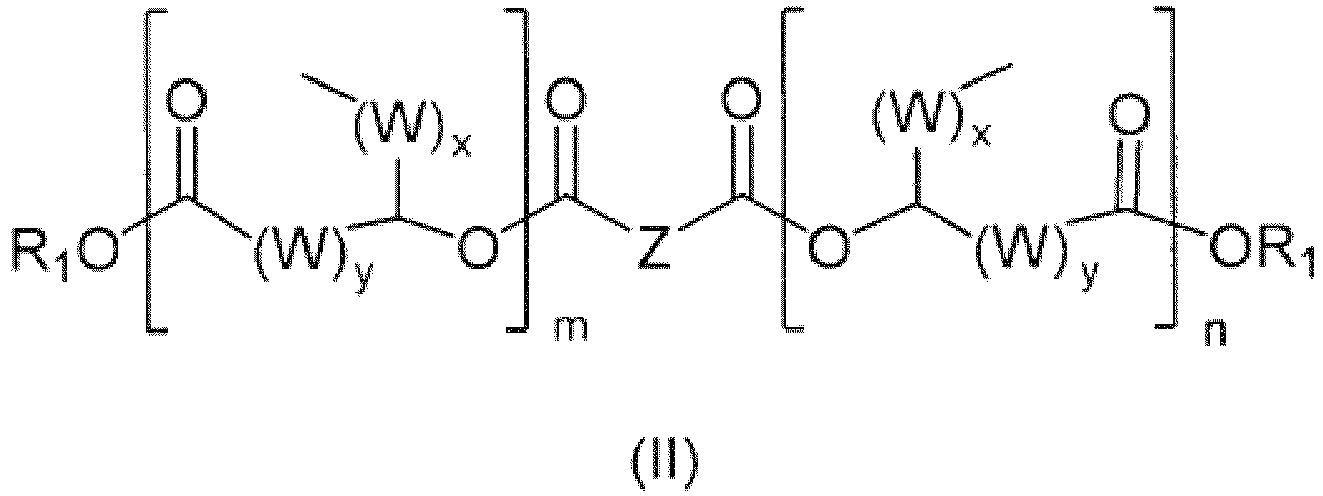
 - Composé ester selon la revendication 1 de formule générale (II)
 le résidu Z est choisi à partir de l'élément structural d'un acide carboxylique sans unités carboxyle, qui contient au moins un atome de C hybridé en sp3 avec un atome de H ou aucun, ou au moins un atome de C hybridé en sp2 sans atomes de H, ou au moins un hétéroatome dans la chaîne/le cycle ou comme substituant, choisi dans le groupe constitué d'acide dimérique hydraté ou non hydraté,le résidu R1 est choisi dans le groupe constitué de résidus alkyle en C1 à C30 ramifiés ou non ramifiés, de résidus alcényle en C1 à C30 ramifiés ou non ramifiés, de résidus arylalkyle en C7 à C30 et/ou de résidus hétéroarylalkyle en C1 à C30 et de résidus aryle en C4 à C30,le résidu W est choisi dans le groupe constitué de -CH2-et/ou -CH=CH-,x est un nombre entier de 1 à 20, de préférence de 1 à 10,y est un nombre entier de 1 à 20, de préférence de 1 à 10,m est un nombre entier de 1 à 10, de préférence de 1 à 5,n est un nombre entier de 1 à 10, de préférence de 1 à 5.
 - Procédé de fabrication du composé ester de formules générales (I)


comprenant les étapes de :(A) conversion d'un acide carboxylique difonctionnel, trifonctionnel ou de fonction supérieure avec un acide gras à longue chaîne pourvu de groupe hydroxy en présence d'un catalyseur à une température de 120 à 150 °C,(B) réduction de la pression,(C) addition par portion ou en continu de l'acide gras à longue chaîne pourvu de groupe hydroxy pendant une durée de 5 à 20 heures,(D) agitation du mélange de réaction obtenu pendant 5 à 20 heures sous pression réduite et élimination de l'eau obtenue,(E) estérification du produit intermédiaire avec un alcool à une température de 120 à 150°C pendant 3 à 5 heures sous agitation,(F) lavage du produit brut avec une solution aqueuse de NaHCO3 et de l'eau,(G) séchage sur Na2SO4,(H) purification du produit brut au moyen d'un évaporateur direct sous pression réduite à une température de 190 à 300 °C. - Procédé de fabrication de composés esters de formules générales (I) ou (II) selon la revendication 3, dans lequel l'acide gras à longue chaîne pourvu de groupes hydroxy est choisi parmi l'acide 12-hydroxystéarique et/ou l'acide ricinolique ; l'alcool est choisi dans le groupe constitué du 2-éthylhexan-1-ol et/ou du 2-propyl-heptan-1-ol et/ou du 2-hexyldécan-1-ol et/ou du 2-octyldodécan-1-ol et/ou de l'alcool isoamylique ; le catalyseur à l'étape de réaction (A) est l'acide p-toluènesulfonique.
- Procédé de fabrication des composés esters de formules générales (I)


comprenant les étapes de :(A) conversion d'un acide gras à longue chaîne pourvu de groupe hydroxy avec un alcool en présence d'un catalyseur à une température de 60 à 90 °C,(B) réduction de la pression,(C) agitation du mélange de réaction obtenu pendant 6 à 10 heures sous pression réduite et élimination de l'eau obtenue,(D) élimination du solvant et de l'alcool excédentaire sous vide,(E) conversion du produit intermédiaire avec un acide carboxylique bifonctionnel, trifonctionnel ou de fonction supérieure en présence d'un catalyseur à une température de 120 à 160°C pendant 6 à 10 heures sous agitation et élimination de l'eau obtenue,(F) élimination du catalyseur par lavage (à l'acide) du produit brut avec une solution aqueuse de NaHCO3 et de l'eau ou par filtration des catalyseurs supportés par support ou par évaporation des catalyseurs volatils par application d'un vide,(G) séchage sur des agents dessiccatifs appropriés, comme par exemple Na2SO4,(H) purification du produit brut sous pression réduite à une température de 190 à 300 °C, par exemple au moyen d'un évaporateur direct. - Procédé de fabrication de composés esters de formules générales (I) ou (II) selon la revendication 5 dans lequel l'acide gras à longue chaîne pourvu de groupes hydroxy est choisi parmi l'acide 12-hydroxystéarique et/ou l'acide ricinolique ; l'alcool est choisi dans le groupe constitué du 2-éthylhexan-1-ol et/ou du 2-propyl-heptan-1-ol et/ou du 2-hexyldécan-1-ol et/ou du 2-octyldodécan-1-ol et/ou de l'alcool isoamylique ; le catalyseur aux étapes de réaction (A) et (E) est l'acide p-toluènesulfonique.
- Utilisation du composé ester de formules générales (I)


dans une composition lubrifiante. - Utilisation du composé ester de formules générales (I) ou (II) dans une composition lubrifiante selon la revendication 7 dans le domaine de la marine, pour la lubrification d'outils de travail dans l'industrie de transformation des produits alimentaires, pour la lubrification de paliers à roulement et paliers lisses, de chaînes de transport et de commande dans le génie automobile, dans la manutention, dans le génie mécanique, dans l'équipement bureautique pour la lubrification d'engrenages à roue conique et à roue droite de paliers à roulettes dans des installations de coulée continue et des paliers à rouleaux transporteurs dans des fours continus et pour la lubrification ouverte de roues dentées sur des fours tubulaires rotatifs, des broyeurs tubulaires, des tambours et des mélangeurs, tels qu'ils se présentent spécifiquement dans l'industrie du ciment, de la chaux, du plâtre, des mines et de la chimie.
- Utilisation du composé ester de formules générales (I)

dans une composition lubrifiante, la composition lubrifiante comprenant une huile de base, le composé ester de formules générales (I) ou (II), des lubrifiants solides et des additifs. - Utilisation selon la revendication 9, dans laquelle la composition lubrifiante comprend en outre un agent épaississant.
- Utilisation de compositions lubrifiantes à base des composés esters de formules générales (I)


dans le domaine de la marine, pour la lubrification d'outils de travail dans l'industrie de transformation des produits alimentaires, pour la lubrification de paliers à roulement et paliers lisses, de chaînes de transport et de commande dans le génie automobile, dans la manutention, dans le génie mécanique, dans l'équipement bureautique pour la lubrification d'engrenages à roue conique et à roue droite de paliers à roulettes dans des installations de coulée continue et des paliers à rouleaux transporteurs dans des fours continus et pour la lubrification ouverte de roues dentées sur des fours tubulaires rotatifs, des broyeurs tubulaires, des tambours et des mélangeurs, tels qu'ils se présentent spécifiquement dans l'industrie du ciment, de la chaux, du plâtre, des mines et de la chimie.
Applications Claiming Priority (3)
| Application Number | Priority Date | Filing Date | Title |
|---|---|---|---|
| DE102017003040 | 2017-03-29 | ||
| DE102018002041.0A DE102018002041A1 (de) | 2017-03-29 | 2018-03-14 | Neue Esterverbindungen, Verfahren zu ihrer Herstellung sowie ihre Verwendung |
| PCT/EP2018/000117 WO2018177588A1 (fr) | 2017-03-29 | 2018-03-26 | Nouveaux composés esters, procédé de production desdits composés et leur utilisation |
Publications (2)
| Publication Number | Publication Date |
|---|---|
| EP3601209A1 EP3601209A1 (fr) | 2020-02-05 |
| EP3601209B1 true EP3601209B1 (fr) | 2024-11-27 |
Family
ID=63524453
Family Applications (1)
| Application Number | Title | Priority Date | Filing Date |
|---|---|---|---|
| EP18724128.6A Active EP3601209B1 (fr) | 2017-03-29 | 2018-03-26 | Nouveaux composés esters, procédé de production desdits composés et leur utilisation |
Country Status (13)
| Country | Link |
|---|---|
| US (1) | US11117854B2 (fr) |
| EP (1) | EP3601209B1 (fr) |
| JP (1) | JP6980026B2 (fr) |
| KR (1) | KR102270356B1 (fr) |
| CN (1) | CN110382456A (fr) |
| AU (1) | AU2018241897B2 (fr) |
| BR (1) | BR112019019911A2 (fr) |
| CA (1) | CA3054968C (fr) |
| DE (1) | DE102018002041A1 (fr) |
| PH (1) | PH12019502041A1 (fr) |
| SG (1) | SG11201907296UA (fr) |
| WO (1) | WO2018177588A1 (fr) |
| ZA (1) | ZA201905065B (fr) |
Families Citing this family (8)
| Publication number | Priority date | Publication date | Assignee | Title |
|---|---|---|---|---|
| WO2020152286A2 (fr) * | 2019-01-23 | 2020-07-30 | Peter Greven GmbH & Co. KG | Esters d'estolide et leur utilisation comme huile de base dans les lubrifiants |
| CN110724054A (zh) * | 2019-10-29 | 2020-01-24 | 中国科学院兰州化学物理研究所 | 一种链条油用耐高温合成酯 |
| DE102020112993A1 (de) | 2020-05-13 | 2021-11-18 | Klüber Lubrication München Se & Co. Kg | Lithiumkomplexhybridfett |
| CN114478289A (zh) * | 2020-10-26 | 2022-05-13 | 中国石油化工股份有限公司 | 酯类化合物及其制备方法、用途和抗氧剂组合物 |
| CN114150525B (zh) * | 2021-11-26 | 2022-12-27 | 上海东升新材料有限公司 | 一种纳米改性造纸用润滑剂 |
| CN114713249B (zh) * | 2022-04-20 | 2023-11-03 | 中国石油大学(华东) | 一种制备二聚酸和三聚酸的催化剂及其使用方法 |
| CN115651743B (zh) * | 2022-10-27 | 2023-09-22 | 中国科学院兰州化学物理研究所 | 一种可原位形成石墨烯的润滑组合物及其制备方法和应用 |
| CN118813311A (zh) * | 2024-06-19 | 2024-10-22 | 中国石油大学(华东) | 一种酯类的用途及其制备方法 |
Family Cites Families (10)
| Publication number | Priority date | Publication date | Assignee | Title |
|---|---|---|---|---|
| JPS53126397A (en) * | 1977-04-13 | 1978-11-04 | Teijin Ltd | Fiber treating oil agent |
| US5045586A (en) * | 1988-08-04 | 1991-09-03 | Lenick Jr Anthony J O | Lubricants for thermoplastic resins |
| EP0952142B1 (fr) * | 1998-04-20 | 2006-10-18 | Givaudan SA | Composés ayant des groupes hydroxyles protégés |
| FI120684B (fi) * | 2005-10-21 | 2010-01-29 | Valtion Teknillinen | Menetelmä oligo-/polyestereiden valmistamiseksi suberiinin ja/tai kutiinin karboksyylihapposeoksesta |
| WO2012173665A1 (fr) * | 2011-06-17 | 2012-12-20 | Lubrigreen Biosynthetics, Llc | Compositions de graisses comprenant des huiles de base contenant des étholides |
| WO2012173666A1 (fr) * | 2011-06-17 | 2012-12-20 | Lubrigreen Biosynthetics, Llc | Étholides époxydés, étholides sulfurés, et leurs procédés de fabrication |
| US9018406B2 (en) * | 2012-03-27 | 2015-04-28 | Biosynthetic Technologies, Llc | Dicarboxylate-capped estolide compounds and methods of making and using the same |
| CN102719013B (zh) * | 2012-07-01 | 2013-11-27 | 桂林理工大学 | 含柔性链的反应型增溶剂改性Lignin/PP木塑复合材料的方法 |
| AU2013345136B2 (en) * | 2012-11-19 | 2017-02-23 | Biosynthetic Technologies, Llc | Diels Alder based estolide and lubricant compositions |
| KR20160046660A (ko) * | 2014-10-21 | 2016-04-29 | 에스케이이노베이션 주식회사 | 결합제를 이용한 에스톨라이드의 제조 방법 |
-
2018
- 2018-03-14 DE DE102018002041.0A patent/DE102018002041A1/de not_active Withdrawn
- 2018-03-26 CA CA3054968A patent/CA3054968C/fr active Active
- 2018-03-26 BR BR112019019911A patent/BR112019019911A2/pt not_active Application Discontinuation
- 2018-03-26 EP EP18724128.6A patent/EP3601209B1/fr active Active
- 2018-03-26 US US16/492,751 patent/US11117854B2/en active Active
- 2018-03-26 SG SG11201907296U patent/SG11201907296UA/en unknown
- 2018-03-26 WO PCT/EP2018/000117 patent/WO2018177588A1/fr not_active Ceased
- 2018-03-26 CN CN201880017153.3A patent/CN110382456A/zh active Pending
- 2018-03-26 KR KR1020197025878A patent/KR102270356B1/ko active Active
- 2018-03-26 AU AU2018241897A patent/AU2018241897B2/en active Active
- 2018-03-26 JP JP2019549479A patent/JP6980026B2/ja active Active
-
2019
- 2019-07-31 ZA ZA2019/05065A patent/ZA201905065B/en unknown
- 2019-09-09 PH PH12019502041A patent/PH12019502041A1/en unknown
Also Published As
| Publication number | Publication date |
|---|---|
| BR112019019911A2 (pt) | 2020-04-22 |
| AU2018241897A1 (en) | 2019-10-03 |
| ZA201905065B (en) | 2021-06-30 |
| CA3054968A1 (fr) | 2018-10-04 |
| KR102270356B1 (ko) | 2021-07-01 |
| JP6980026B2 (ja) | 2021-12-15 |
| PH12019502041A1 (en) | 2020-03-16 |
| JP2020510048A (ja) | 2020-04-02 |
| CA3054968C (fr) | 2022-10-04 |
| DE102018002041A1 (de) | 2018-10-04 |
| SG11201907296UA (en) | 2019-10-30 |
| CN110382456A (zh) | 2019-10-25 |
| WO2018177588A1 (fr) | 2018-10-04 |
| EP3601209A1 (fr) | 2020-02-05 |
| AU2018241897B2 (en) | 2021-02-25 |
| US11117854B2 (en) | 2021-09-14 |
| KR20190115459A (ko) | 2019-10-11 |
| US20200071256A1 (en) | 2020-03-05 |
Similar Documents
| Publication | Publication Date | Title |
|---|---|---|
| EP3601209B1 (fr) | Nouveaux composés esters, procédé de production desdits composés et leur utilisation | |
| EP3375850B1 (fr) | Lubrifiant haute température pour l'industrie alimentaire | |
| EP3913039B1 (fr) | Mélange de composés ester | |
| EP3372660B1 (fr) | Lubrifiants haute température | |
| DE69525657T2 (de) | Verwendung von biologisch abbaubarem synthetischen verzweigten ester in einem zwei-takt motor öl um die herstellung von rauch in einem zwei-takt motor zu reduzieren | |
| DE112009005504B4 (de) | Verwendung einer fluorhaltigen Diamid-Verbindung als Rostschutzzusatz einer Schmiermittelzusammensetzung | |
| DE60127439T2 (de) | Verfahren zur schmierung eines stufenlosen getriebes | |
| EP4143281B1 (fr) | Composition lubrifiante et son utilisation | |
| DE102020112993A1 (de) | Lithiumkomplexhybridfett | |
| EP2796447B1 (fr) | Nouveaux composés contenant des ponts de soufre, leur procédé de fabrication et leur utilisation | |
| EP3902896B1 (fr) | Lubrifiant exempt d'huile minérale et procédé d'obtention d'un lubrifiant exempt d'huile minérale | |
| EP4491699A1 (fr) | Composés de phtalimide utilisés comme huile de base pour des compositions lubrifiantes | |
| HK40009514A (en) | Novel ester compounds, method for the production thereof and use thereof | |
| WO2025233106A1 (fr) | Polyolester en tant qu'huile de base pour compositions lubrifiantes | |
| EP2192105A1 (fr) | Lubrifiant et son procédé de fabrication |
Legal Events
| Date | Code | Title | Description |
|---|---|---|---|
| STAA | Information on the status of an ep patent application or granted ep patent |
Free format text: STATUS: UNKNOWN |
|
| STAA | Information on the status of an ep patent application or granted ep patent |
Free format text: STATUS: THE INTERNATIONAL PUBLICATION HAS BEEN MADE |
|
| PUAI | Public reference made under article 153(3) epc to a published international application that has entered the european phase |
Free format text: ORIGINAL CODE: 0009012 |
|
| STAA | Information on the status of an ep patent application or granted ep patent |
Free format text: STATUS: REQUEST FOR EXAMINATION WAS MADE |
|
| 17P | Request for examination filed |
Effective date: 20190909 |
|
| AK | Designated contracting states |
Kind code of ref document: A1 Designated state(s): AL AT BE BG CH CY CZ DE DK EE ES FI FR GB GR HR HU IE IS IT LI LT LU LV MC MK MT NL NO PL PT RO RS SE SI SK SM TR |
|
| AX | Request for extension of the european patent |
Extension state: BA ME |
|
| DAV | Request for validation of the european patent (deleted) | ||
| DAX | Request for extension of the european patent (deleted) | ||
| STAA | Information on the status of an ep patent application or granted ep patent |
Free format text: STATUS: EXAMINATION IS IN PROGRESS |
|
| 17Q | First examination report despatched |
Effective date: 20211011 |
|
| 17Q | First examination report despatched |
Effective date: 20211021 |
|
| GRAP | Despatch of communication of intention to grant a patent |
Free format text: ORIGINAL CODE: EPIDOSNIGR1 |
|
| STAA | Information on the status of an ep patent application or granted ep patent |
Free format text: STATUS: GRANT OF PATENT IS INTENDED |
|
| INTG | Intention to grant announced |
Effective date: 20240620 |
|
| P01 | Opt-out of the competence of the unified patent court (upc) registered |
Free format text: CASE NUMBER: APP_48661/2024 Effective date: 20240826 |
|
| GRAS | Grant fee paid |
Free format text: ORIGINAL CODE: EPIDOSNIGR3 |
|
| GRAA | (expected) grant |
Free format text: ORIGINAL CODE: 0009210 |
|
| STAA | Information on the status of an ep patent application or granted ep patent |
Free format text: STATUS: THE PATENT HAS BEEN GRANTED |
|
| RAP3 | Party data changed (applicant data changed or rights of an application transferred) |
Owner name: KLUEBER LUBRICATION MUENCHEN GMBH & CO. KG |
|
| AK | Designated contracting states |
Kind code of ref document: B1 Designated state(s): AL AT BE BG CH CY CZ DE DK EE ES FI FR GB GR HR HU IE IS IT LI LT LU LV MC MK MT NL NO PL PT RO RS SE SI SK SM TR |
|
| REG | Reference to a national code |
Ref country code: GB Ref legal event code: FG4D Free format text: NOT ENGLISH |
|
| REG | Reference to a national code |
Ref country code: CH Ref legal event code: EP |
|
| REG | Reference to a national code |
Ref country code: DE Ref legal event code: R096 Ref document number: 502018015362 Country of ref document: DE |
|
| REG | Reference to a national code |
Ref country code: IE Ref legal event code: FG4D Free format text: LANGUAGE OF EP DOCUMENT: GERMAN |
|
| REG | Reference to a national code |
Ref country code: LT Ref legal event code: MG9D |
|
| REG | Reference to a national code |
Ref country code: NL Ref legal event code: MP Effective date: 20241127 |
|
| PG25 | Lapsed in a contracting state [announced via postgrant information from national office to epo] |
Ref country code: PT Free format text: LAPSE BECAUSE OF FAILURE TO SUBMIT A TRANSLATION OF THE DESCRIPTION OR TO PAY THE FEE WITHIN THE PRESCRIBED TIME-LIMIT Effective date: 20250327 Ref country code: IS Free format text: LAPSE BECAUSE OF FAILURE TO SUBMIT A TRANSLATION OF THE DESCRIPTION OR TO PAY THE FEE WITHIN THE PRESCRIBED TIME-LIMIT Effective date: 20250327 Ref country code: HR Free format text: LAPSE BECAUSE OF FAILURE TO SUBMIT A TRANSLATION OF THE DESCRIPTION OR TO PAY THE FEE WITHIN THE PRESCRIBED TIME-LIMIT Effective date: 20241127 |
|
| PG25 | Lapsed in a contracting state [announced via postgrant information from national office to epo] |
Ref country code: FI Free format text: LAPSE BECAUSE OF FAILURE TO SUBMIT A TRANSLATION OF THE DESCRIPTION OR TO PAY THE FEE WITHIN THE PRESCRIBED TIME-LIMIT Effective date: 20241127 Ref country code: NL Free format text: LAPSE BECAUSE OF FAILURE TO SUBMIT A TRANSLATION OF THE DESCRIPTION OR TO PAY THE FEE WITHIN THE PRESCRIBED TIME-LIMIT Effective date: 20241127 |
|
| PG25 | Lapsed in a contracting state [announced via postgrant information from national office to epo] |
Ref country code: BG Free format text: LAPSE BECAUSE OF FAILURE TO SUBMIT A TRANSLATION OF THE DESCRIPTION OR TO PAY THE FEE WITHIN THE PRESCRIBED TIME-LIMIT Effective date: 20241127 |
|
| PG25 | Lapsed in a contracting state [announced via postgrant information from national office to epo] |
Ref country code: ES Free format text: LAPSE BECAUSE OF FAILURE TO SUBMIT A TRANSLATION OF THE DESCRIPTION OR TO PAY THE FEE WITHIN THE PRESCRIBED TIME-LIMIT Effective date: 20241127 |
|
| PG25 | Lapsed in a contracting state [announced via postgrant information from national office to epo] |
Ref country code: NO Free format text: LAPSE BECAUSE OF FAILURE TO SUBMIT A TRANSLATION OF THE DESCRIPTION OR TO PAY THE FEE WITHIN THE PRESCRIBED TIME-LIMIT Effective date: 20250227 |
|
| PG25 | Lapsed in a contracting state [announced via postgrant information from national office to epo] |
Ref country code: LV Free format text: LAPSE BECAUSE OF FAILURE TO SUBMIT A TRANSLATION OF THE DESCRIPTION OR TO PAY THE FEE WITHIN THE PRESCRIBED TIME-LIMIT Effective date: 20241127 Ref country code: GR Free format text: LAPSE BECAUSE OF FAILURE TO SUBMIT A TRANSLATION OF THE DESCRIPTION OR TO PAY THE FEE WITHIN THE PRESCRIBED TIME-LIMIT Effective date: 20250228 |
|
| PG25 | Lapsed in a contracting state [announced via postgrant information from national office to epo] |
Ref country code: PL Free format text: LAPSE BECAUSE OF FAILURE TO SUBMIT A TRANSLATION OF THE DESCRIPTION OR TO PAY THE FEE WITHIN THE PRESCRIBED TIME-LIMIT Effective date: 20241127 |
|
| PG25 | Lapsed in a contracting state [announced via postgrant information from national office to epo] |
Ref country code: RS Free format text: LAPSE BECAUSE OF FAILURE TO SUBMIT A TRANSLATION OF THE DESCRIPTION OR TO PAY THE FEE WITHIN THE PRESCRIBED TIME-LIMIT Effective date: 20250227 |
|
| PG25 | Lapsed in a contracting state [announced via postgrant information from national office to epo] |
Ref country code: SM Free format text: LAPSE BECAUSE OF FAILURE TO SUBMIT A TRANSLATION OF THE DESCRIPTION OR TO PAY THE FEE WITHIN THE PRESCRIBED TIME-LIMIT Effective date: 20241127 |
|
| PG25 | Lapsed in a contracting state [announced via postgrant information from national office to epo] |
Ref country code: DK Free format text: LAPSE BECAUSE OF FAILURE TO SUBMIT A TRANSLATION OF THE DESCRIPTION OR TO PAY THE FEE WITHIN THE PRESCRIBED TIME-LIMIT Effective date: 20241127 |
|
| PG25 | Lapsed in a contracting state [announced via postgrant information from national office to epo] |
Ref country code: EE Free format text: LAPSE BECAUSE OF FAILURE TO SUBMIT A TRANSLATION OF THE DESCRIPTION OR TO PAY THE FEE WITHIN THE PRESCRIBED TIME-LIMIT Effective date: 20241127 |
|
| PG25 | Lapsed in a contracting state [announced via postgrant information from national office to epo] |
Ref country code: RO Free format text: LAPSE BECAUSE OF FAILURE TO SUBMIT A TRANSLATION OF THE DESCRIPTION OR TO PAY THE FEE WITHIN THE PRESCRIBED TIME-LIMIT Effective date: 20241127 |
|
| PG25 | Lapsed in a contracting state [announced via postgrant information from national office to epo] |
Ref country code: SK Free format text: LAPSE BECAUSE OF FAILURE TO SUBMIT A TRANSLATION OF THE DESCRIPTION OR TO PAY THE FEE WITHIN THE PRESCRIBED TIME-LIMIT Effective date: 20241127 |
|
| PG25 | Lapsed in a contracting state [announced via postgrant information from national office to epo] |
Ref country code: CZ Free format text: LAPSE BECAUSE OF FAILURE TO SUBMIT A TRANSLATION OF THE DESCRIPTION OR TO PAY THE FEE WITHIN THE PRESCRIBED TIME-LIMIT Effective date: 20241127 |
|
| PG25 | Lapsed in a contracting state [announced via postgrant information from national office to epo] |
Ref country code: IT Free format text: LAPSE BECAUSE OF FAILURE TO SUBMIT A TRANSLATION OF THE DESCRIPTION OR TO PAY THE FEE WITHIN THE PRESCRIBED TIME-LIMIT Effective date: 20241127 |
|
| REG | Reference to a national code |
Ref country code: DE Ref legal event code: R097 Ref document number: 502018015362 Country of ref document: DE |
|
| PG25 | Lapsed in a contracting state [announced via postgrant information from national office to epo] |
Ref country code: SE Free format text: LAPSE BECAUSE OF FAILURE TO SUBMIT A TRANSLATION OF THE DESCRIPTION OR TO PAY THE FEE WITHIN THE PRESCRIBED TIME-LIMIT Effective date: 20241127 |
|
| PLBE | No opposition filed within time limit |
Free format text: ORIGINAL CODE: 0009261 |
|
| STAA | Information on the status of an ep patent application or granted ep patent |
Free format text: STATUS: NO OPPOSITION FILED WITHIN TIME LIMIT |
|
| REG | Reference to a national code |
Ref country code: CH Ref legal event code: L10 Free format text: ST27 STATUS EVENT CODE: U-0-0-L10-L00 (AS PROVIDED BY THE NATIONAL OFFICE) Effective date: 20251008 |
|
| PG25 | Lapsed in a contracting state [announced via postgrant information from national office to epo] |
Ref country code: MC Free format text: LAPSE BECAUSE OF FAILURE TO SUBMIT A TRANSLATION OF THE DESCRIPTION OR TO PAY THE FEE WITHIN THE PRESCRIBED TIME-LIMIT Effective date: 20241127 |
|
| REG | Reference to a national code |
Ref country code: CH Ref legal event code: H13 Free format text: ST27 STATUS EVENT CODE: U-0-0-H10-H13 (AS PROVIDED BY THE NATIONAL OFFICE) Effective date: 20251023 |
|
| 26N | No opposition filed |
Effective date: 20250828 |
|
| PG25 | Lapsed in a contracting state [announced via postgrant information from national office to epo] |
Ref country code: LU Free format text: LAPSE BECAUSE OF NON-PAYMENT OF DUE FEES Effective date: 20250326 |
|
| GBPC | Gb: european patent ceased through non-payment of renewal fee |
Effective date: 20250326 |
|
| REG | Reference to a national code |
Ref country code: BE Ref legal event code: MM Effective date: 20250331 |
|
| PG25 | Lapsed in a contracting state [announced via postgrant information from national office to epo] |
Ref country code: GB Free format text: LAPSE BECAUSE OF NON-PAYMENT OF DUE FEES Effective date: 20250326 |
|
| PG25 | Lapsed in a contracting state [announced via postgrant information from national office to epo] |
Ref country code: FR Free format text: LAPSE BECAUSE OF NON-PAYMENT OF DUE FEES Effective date: 20250331 |
|
| PG25 | Lapsed in a contracting state [announced via postgrant information from national office to epo] |
Ref country code: BE Free format text: LAPSE BECAUSE OF NON-PAYMENT OF DUE FEES Effective date: 20250331 |
|
| PG25 | Lapsed in a contracting state [announced via postgrant information from national office to epo] |
Ref country code: CH Free format text: LAPSE BECAUSE OF NON-PAYMENT OF DUE FEES Effective date: 20250331 |
|
| PG25 | Lapsed in a contracting state [announced via postgrant information from national office to epo] |
Ref country code: IE Free format text: LAPSE BECAUSE OF NON-PAYMENT OF DUE FEES Effective date: 20250326 |
|
| PGFP | Annual fee paid to national office [announced via postgrant information from national office to epo] |
Ref country code: DE Payment date: 20260320 Year of fee payment: 9 |