EP3604590A1 - Fil machine et fil d'acier plat - Google Patents
Fil machine et fil d'acier plat Download PDFInfo
- Publication number
- EP3604590A1 EP3604590A1 EP18770555.3A EP18770555A EP3604590A1 EP 3604590 A1 EP3604590 A1 EP 3604590A1 EP 18770555 A EP18770555 A EP 18770555A EP 3604590 A1 EP3604590 A1 EP 3604590A1
- Authority
- EP
- European Patent Office
- Prior art keywords
- flat steel
- wire rod
- steel wire
- oxide
- complex oxide
- Prior art date
- Legal status (The legal status is an assumption and is not a legal conclusion. Google has not performed a legal analysis and makes no representation as to the accuracy of the status listed.)
- Withdrawn
Links
Images
Classifications
-
- C—CHEMISTRY; METALLURGY
- C22—METALLURGY; FERROUS OR NON-FERROUS ALLOYS; TREATMENT OF ALLOYS OR NON-FERROUS METALS
- C22C—ALLOYS
- C22C38/00—Ferrous alloys, e.g. steel alloys
- C22C38/18—Ferrous alloys, e.g. steel alloys containing chromium
- C22C38/34—Ferrous alloys, e.g. steel alloys containing chromium with more than 1.5% by weight of silicon
-
- C—CHEMISTRY; METALLURGY
- C22—METALLURGY; FERROUS OR NON-FERROUS ALLOYS; TREATMENT OF ALLOYS OR NON-FERROUS METALS
- C22C—ALLOYS
- C22C38/00—Ferrous alloys, e.g. steel alloys
- C22C38/18—Ferrous alloys, e.g. steel alloys containing chromium
- C22C38/22—Ferrous alloys, e.g. steel alloys containing chromium with molybdenum or tungsten
-
- C—CHEMISTRY; METALLURGY
- C21—METALLURGY OF IRON
- C21C—PROCESSING OF PIG-IRON, e.g. REFINING, MANUFACTURE OF WROUGHT-IRON OR STEEL; TREATMENT IN MOLTEN STATE OF FERROUS ALLOYS
- C21C1/00—Refining of pig-iron; Cast iron
- C21C1/02—Dephosphorising or desulfurising
-
- C—CHEMISTRY; METALLURGY
- C21—METALLURGY OF IRON
- C21C—PROCESSING OF PIG-IRON, e.g. REFINING, MANUFACTURE OF WROUGHT-IRON OR STEEL; TREATMENT IN MOLTEN STATE OF FERROUS ALLOYS
- C21C7/00—Treating molten ferrous alloys, e.g. steel, not covered by groups C21C1/00 - C21C5/00
- C21C7/0037—Treating molten ferrous alloys, e.g. steel, not covered by groups C21C1/00 - C21C5/00 by injecting powdered material
-
- C—CHEMISTRY; METALLURGY
- C21—METALLURGY OF IRON
- C21C—PROCESSING OF PIG-IRON, e.g. REFINING, MANUFACTURE OF WROUGHT-IRON OR STEEL; TREATMENT IN MOLTEN STATE OF FERROUS ALLOYS
- C21C7/00—Treating molten ferrous alloys, e.g. steel, not covered by groups C21C1/00 - C21C5/00
- C21C7/04—Removing impurities by adding a treating agent
- C21C7/064—Dephosphorising; Desulfurising
-
- C—CHEMISTRY; METALLURGY
- C21—METALLURGY OF IRON
- C21C—PROCESSING OF PIG-IRON, e.g. REFINING, MANUFACTURE OF WROUGHT-IRON OR STEEL; TREATMENT IN MOLTEN STATE OF FERROUS ALLOYS
- C21C7/00—Treating molten ferrous alloys, e.g. steel, not covered by groups C21C1/00 - C21C5/00
- C21C7/04—Removing impurities by adding a treating agent
- C21C7/068—Decarburising
-
- C—CHEMISTRY; METALLURGY
- C21—METALLURGY OF IRON
- C21C—PROCESSING OF PIG-IRON, e.g. REFINING, MANUFACTURE OF WROUGHT-IRON OR STEEL; TREATMENT IN MOLTEN STATE OF FERROUS ALLOYS
- C21C7/00—Treating molten ferrous alloys, e.g. steel, not covered by groups C21C1/00 - C21C5/00
- C21C7/04—Removing impurities by adding a treating agent
- C21C7/072—Treatment with gases
-
- C—CHEMISTRY; METALLURGY
- C21—METALLURGY OF IRON
- C21C—PROCESSING OF PIG-IRON, e.g. REFINING, MANUFACTURE OF WROUGHT-IRON OR STEEL; TREATMENT IN MOLTEN STATE OF FERROUS ALLOYS
- C21C7/00—Treating molten ferrous alloys, e.g. steel, not covered by groups C21C1/00 - C21C5/00
- C21C7/10—Handling in a vacuum
-
- C—CHEMISTRY; METALLURGY
- C21—METALLURGY OF IRON
- C21D—MODIFYING THE PHYSICAL STRUCTURE OF FERROUS METALS; GENERAL DEVICES FOR HEAT TREATMENT OF FERROUS OR NON-FERROUS METALS OR ALLOYS; MAKING METAL MALLEABLE, e.g. BY DECARBURISATION OR TEMPERING
- C21D7/00—Modifying the physical properties of iron or steel by deformation
- C21D7/13—Modifying the physical properties of iron or steel by deformation by hot working
-
- C—CHEMISTRY; METALLURGY
- C21—METALLURGY OF IRON
- C21D—MODIFYING THE PHYSICAL STRUCTURE OF FERROUS METALS; GENERAL DEVICES FOR HEAT TREATMENT OF FERROUS OR NON-FERROUS METALS OR ALLOYS; MAKING METAL MALLEABLE, e.g. BY DECARBURISATION OR TEMPERING
- C21D8/00—Modifying the physical properties of ferrous metals or ferrous alloys by deformation combined with, or followed by, heat treatment
- C21D8/06—Modifying the physical properties of ferrous metals or ferrous alloys by deformation combined with, or followed by, heat treatment during manufacturing of rods or wires
-
- C—CHEMISTRY; METALLURGY
- C21—METALLURGY OF IRON
- C21D—MODIFYING THE PHYSICAL STRUCTURE OF FERROUS METALS; GENERAL DEVICES FOR HEAT TREATMENT OF FERROUS OR NON-FERROUS METALS OR ALLOYS; MAKING METAL MALLEABLE, e.g. BY DECARBURISATION OR TEMPERING
- C21D9/00—Heat treatment, e.g. annealing, hardening, quenching or tempering, adapted for particular articles; Furnaces therefor
- C21D9/52—Heat treatment, e.g. annealing, hardening, quenching or tempering, adapted for particular articles; Furnaces therefor for wires; for strips ; for rods of unlimited length
- C21D9/525—Heat treatment, e.g. annealing, hardening, quenching or tempering, adapted for particular articles; Furnaces therefor for wires; for strips ; for rods of unlimited length for wire, for rods
-
- C—CHEMISTRY; METALLURGY
- C22—METALLURGY; FERROUS OR NON-FERROUS ALLOYS; TREATMENT OF ALLOYS OR NON-FERROUS METALS
- C22C—ALLOYS
- C22C38/00—Ferrous alloys, e.g. steel alloys
- C22C38/001—Ferrous alloys, e.g. steel alloys containing N
-
- C—CHEMISTRY; METALLURGY
- C22—METALLURGY; FERROUS OR NON-FERROUS ALLOYS; TREATMENT OF ALLOYS OR NON-FERROUS METALS
- C22C—ALLOYS
- C22C38/00—Ferrous alloys, e.g. steel alloys
- C22C38/002—Ferrous alloys, e.g. steel alloys containing In, Mg, or other elements not provided for in one single group C22C38/001 - C22C38/60
-
- C—CHEMISTRY; METALLURGY
- C22—METALLURGY; FERROUS OR NON-FERROUS ALLOYS; TREATMENT OF ALLOYS OR NON-FERROUS METALS
- C22C—ALLOYS
- C22C38/00—Ferrous alloys, e.g. steel alloys
- C22C38/005—Ferrous alloys, e.g. steel alloys containing rare earths, i.e. Sc, Y, Lanthanides
-
- C—CHEMISTRY; METALLURGY
- C22—METALLURGY; FERROUS OR NON-FERROUS ALLOYS; TREATMENT OF ALLOYS OR NON-FERROUS METALS
- C22C—ALLOYS
- C22C38/00—Ferrous alloys, e.g. steel alloys
- C22C38/02—Ferrous alloys, e.g. steel alloys containing silicon
-
- C—CHEMISTRY; METALLURGY
- C22—METALLURGY; FERROUS OR NON-FERROUS ALLOYS; TREATMENT OF ALLOYS OR NON-FERROUS METALS
- C22C—ALLOYS
- C22C38/00—Ferrous alloys, e.g. steel alloys
- C22C38/04—Ferrous alloys, e.g. steel alloys containing manganese
-
- C—CHEMISTRY; METALLURGY
- C22—METALLURGY; FERROUS OR NON-FERROUS ALLOYS; TREATMENT OF ALLOYS OR NON-FERROUS METALS
- C22C—ALLOYS
- C22C38/00—Ferrous alloys, e.g. steel alloys
- C22C38/06—Ferrous alloys, e.g. steel alloys containing aluminium
-
- C—CHEMISTRY; METALLURGY
- C22—METALLURGY; FERROUS OR NON-FERROUS ALLOYS; TREATMENT OF ALLOYS OR NON-FERROUS METALS
- C22C—ALLOYS
- C22C38/00—Ferrous alloys, e.g. steel alloys
- C22C38/08—Ferrous alloys, e.g. steel alloys containing nickel
-
- C—CHEMISTRY; METALLURGY
- C22—METALLURGY; FERROUS OR NON-FERROUS ALLOYS; TREATMENT OF ALLOYS OR NON-FERROUS METALS
- C22C—ALLOYS
- C22C38/00—Ferrous alloys, e.g. steel alloys
- C22C38/12—Ferrous alloys, e.g. steel alloys containing tungsten, tantalum, molybdenum, vanadium, or niobium
-
- C—CHEMISTRY; METALLURGY
- C22—METALLURGY; FERROUS OR NON-FERROUS ALLOYS; TREATMENT OF ALLOYS OR NON-FERROUS METALS
- C22C—ALLOYS
- C22C38/00—Ferrous alloys, e.g. steel alloys
- C22C38/14—Ferrous alloys, e.g. steel alloys containing titanium or zirconium
-
- C—CHEMISTRY; METALLURGY
- C22—METALLURGY; FERROUS OR NON-FERROUS ALLOYS; TREATMENT OF ALLOYS OR NON-FERROUS METALS
- C22C—ALLOYS
- C22C38/00—Ferrous alloys, e.g. steel alloys
- C22C38/16—Ferrous alloys, e.g. steel alloys containing copper
-
- C—CHEMISTRY; METALLURGY
- C22—METALLURGY; FERROUS OR NON-FERROUS ALLOYS; TREATMENT OF ALLOYS OR NON-FERROUS METALS
- C22C—ALLOYS
- C22C38/00—Ferrous alloys, e.g. steel alloys
- C22C38/18—Ferrous alloys, e.g. steel alloys containing chromium
-
- C—CHEMISTRY; METALLURGY
- C22—METALLURGY; FERROUS OR NON-FERROUS ALLOYS; TREATMENT OF ALLOYS OR NON-FERROUS METALS
- C22C—ALLOYS
- C22C38/00—Ferrous alloys, e.g. steel alloys
- C22C38/18—Ferrous alloys, e.g. steel alloys containing chromium
- C22C38/24—Ferrous alloys, e.g. steel alloys containing chromium with vanadium
-
- C—CHEMISTRY; METALLURGY
- C22—METALLURGY; FERROUS OR NON-FERROUS ALLOYS; TREATMENT OF ALLOYS OR NON-FERROUS METALS
- C22C—ALLOYS
- C22C38/00—Ferrous alloys, e.g. steel alloys
- C22C38/18—Ferrous alloys, e.g. steel alloys containing chromium
- C22C38/28—Ferrous alloys, e.g. steel alloys containing chromium with titanium or zirconium
-
- C—CHEMISTRY; METALLURGY
- C22—METALLURGY; FERROUS OR NON-FERROUS ALLOYS; TREATMENT OF ALLOYS OR NON-FERROUS METALS
- C22C—ALLOYS
- C22C38/00—Ferrous alloys, e.g. steel alloys
- C22C38/18—Ferrous alloys, e.g. steel alloys containing chromium
- C22C38/32—Ferrous alloys, e.g. steel alloys containing chromium with boron
-
- C—CHEMISTRY; METALLURGY
- C22—METALLURGY; FERROUS OR NON-FERROUS ALLOYS; TREATMENT OF ALLOYS OR NON-FERROUS METALS
- C22C—ALLOYS
- C22C38/00—Ferrous alloys, e.g. steel alloys
- C22C38/18—Ferrous alloys, e.g. steel alloys containing chromium
- C22C38/40—Ferrous alloys, e.g. steel alloys containing chromium with nickel
- C22C38/54—Ferrous alloys, e.g. steel alloys containing chromium with nickel with boron
-
- C—CHEMISTRY; METALLURGY
- C21—METALLURGY OF IRON
- C21D—MODIFYING THE PHYSICAL STRUCTURE OF FERROUS METALS; GENERAL DEVICES FOR HEAT TREATMENT OF FERROUS OR NON-FERROUS METALS OR ALLOYS; MAKING METAL MALLEABLE, e.g. BY DECARBURISATION OR TEMPERING
- C21D2211/00—Microstructure comprising significant phases
- C21D2211/002—Bainite
-
- C—CHEMISTRY; METALLURGY
- C21—METALLURGY OF IRON
- C21D—MODIFYING THE PHYSICAL STRUCTURE OF FERROUS METALS; GENERAL DEVICES FOR HEAT TREATMENT OF FERROUS OR NON-FERROUS METALS OR ALLOYS; MAKING METAL MALLEABLE, e.g. BY DECARBURISATION OR TEMPERING
- C21D2211/00—Microstructure comprising significant phases
- C21D2211/004—Dispersions; Precipitations
-
- C—CHEMISTRY; METALLURGY
- C21—METALLURGY OF IRON
- C21D—MODIFYING THE PHYSICAL STRUCTURE OF FERROUS METALS; GENERAL DEVICES FOR HEAT TREATMENT OF FERROUS OR NON-FERROUS METALS OR ALLOYS; MAKING METAL MALLEABLE, e.g. BY DECARBURISATION OR TEMPERING
- C21D2211/00—Microstructure comprising significant phases
- C21D2211/005—Ferrite
-
- C—CHEMISTRY; METALLURGY
- C21—METALLURGY OF IRON
- C21D—MODIFYING THE PHYSICAL STRUCTURE OF FERROUS METALS; GENERAL DEVICES FOR HEAT TREATMENT OF FERROUS OR NON-FERROUS METALS OR ALLOYS; MAKING METAL MALLEABLE, e.g. BY DECARBURISATION OR TEMPERING
- C21D2211/00—Microstructure comprising significant phases
- C21D2211/008—Martensite
Definitions
- the present invention relates to a wire rod and a flat steel wire.
- flat steel wires are used as a reinforcing material.
- Flat steel wires of this type are formed by being flattened to be 40% to 80% of a hot-rolled wire rod in thickness and used with the processed structure or after being quenched and tempered.
- mining has taken place deep in the sea, and the transportation distance of mined substances has become longer, and thus there has been an intensifying demand for flexible pipes and flat steel wires that are a reinforcing material of flexible pipes to have a high strength.
- flexible pipes are used in a sour environment including hydrogen sulfide, and thus flat steel wires need to have a characteristic of resisting the occurrence of hydrogen induced cracking (HIC), that is, hydrogen induced cracking resistance.
- HIC hydrogen induced cracking
- Patent Document 1 describes a technique for obtaining a high-strength flat steel wire having excellent hydrogen embrittlement resistance by carrying out a cold process on high-carbon steel having a pearlite structure and tempering the high-carbon steel for a short period of time.
- Patent Document 1 Published Japanese Translation No. 2013-534966 of the PCT International Publication
- Patent Document 1 discloses a flat steel wire having a tensile strength of 1,300 MPa or more and having excellent hydrogen induced cracking resistance in an environment with a pH of 5.6 or more; however, in a HIC test of this flat steel wire with a pH of 5.5 or less, cracks are formed even in a case where the tensile strength is set to 1,100 MPa.
- the present inventors considered that the lack of the hydrogen induced cracking resistance of the flat steel wire of Patent Document 1 results from the strong development of the degradation of hydrogen embrittlement resistance caused by the separation of inclusions.
- the present invention has been made in consideration of the above-described circumstance, and an object of the present invention is to provide a wire rod from which a flat steel wire having a tensile strength of 1,100 MPa or more and having excellent hydrogen induced cracking resistance can be obtained.
- the wire rod of the present invention can be used to manufacture a flat steel wire according to the present embodiment which has a tensile strength of 1,100 MPa or more and has excellent hydrogen induced cracking resistance in a severe sour environment with a pH of 5.5 or less.
- the flat steel wire according to the present embodiment has a tensile strength of 1,100 MPa or more and is excellent in terms of hydrogen induced cracking resistance and thus can be used as, for example, flat steel wires for the tension reinforcement of flexible pipes that are used in a severe sour environment.
- the present inventors carried out a variety of studies in order to solve the above-described problem.
- sulfides were detoxified by adding Ca or the like; however, even in such cases, there was a case where HIC occurred near the central axes of wire rods and flat steel wires.
- the present inventors found that, in a cracked portion near the central axis, the presence of a complex oxide including Al 2 O 3 and CaO affects HIC.
- the present inventors found that HIC can be effectively prevented by controlling the composition and size of the complex oxide including Al 2 O 3 and CaO near the central axis. That is, the following knowledge (a) to (d) was obtained.
- a wire rod according to the present embodiment and a flat steel wire according to the present embodiment that is obtained by rolling the wire rod are completed on the basis of the above-described knowledge.
- the wire rod according to the present embodiment will be described.
- the amount of the chemical composition is "mass%”.
- C is an element that strengthens steel. In order to obtain this effect, 0.15% or more of C needs to be contained. When the C content exceeds 0.85%, the strength excessively increases, and thus cracks are formed in the wire rod during a flattening process, and the hydrogen induced cracking resistance deteriorates. Therefore, an appropriate C content is 0.15% to 0.85%. Furthermore, the C content is preferably set to 0.20% or more and, furthermore, preferably set to 0.30% or more, 0.35% or more, or 0.40% or more from the viewpoint of suppressing the formation of cracks.
- the C content is preferably set to 0.75% or less, and, furthermore, in order to improve the hydrogen induced cracking resistance, the C content is desirably set to 0.65% or less, 0.60% or less, or 0.50% or less.
- Si is an element that forms a solid solution in a matrix and improves the strength of the flat steel wire. In order to obtain this effect, 0.10% or more of Si needs to be contained. However, when the Si content exceeds 2.00%, cracks are generated in the wire rod during the flattening process. Therefore, the Si content is 0.10% to 2.00%. In a case where it is necessary to further increase the strength, 0.30% or more of Si needs to be contained, and it is more preferably that 0.50% or more, 0.55% or more, 0.60% or more, or 0.70% or more of Si needs to be contained. In a case where it is necessary to suppress the cracking of the wire rod during a process for producing the flat steel wire, the Si content is preferably set to less than 2.00% and more preferably set to 1.80% or less, 1.70% or less, or 1.50% or less.
- Mn is an element that has an effect for enhancing the hardenability of steel and is necessary to increase the strength of the heat-treated flat steel wire. In order to obtain this effect, 0.30% or more of Mn needs to be contained. However, when the Mn content exceeds 1.50%, the strength of the wire rod excessively increases, and there is a problem in that cracks are generated in the wire rod at the time of processing the wire rod to the flat steel wire. Therefore, the Mn content in the wire rod according to the present embodiment is 0.30% to 1.50%.
- the Mn content is preferably 0.40% or more and is more preferably 0.50% or more, 0.60% or more, 0.70% or more, 0.80% or more, or 0.90% or more.
- the Mn content is preferably set to 1.30% or less and more preferably set to 1.10% or less, 1.05% or less, or 1.00% or less.
- S is an impurity.
- MnS has a stretched form and degrades the hydrogen induced cracking resistance.
- the upper limit of the S content is set to 0.020% or less.
- the S content is preferably less than 0.010% and more preferably less than 0.008% or less than 0.005%.
- the S content may also be set to 0.001 % or more, 0.003% or more, or 0.005% or more.
- the P content is an impurity.
- the P content exceeds 0.020%, hydrogen induced cracking is likely to occur, and, in the flat steel wire, it is not possible to suppress hydrogen induced cracking in a severe sour environment with a pH of 5.5 or less. Therefore, the P content is set to 0.020% or less.
- the P content is preferably 0.015% or less, more preferably less than 0.013% or less than 0.010%, and far more preferably less than 0.008%. From the viewpoint of the steel making costs, the P content may be set to 0.003% or more or 0.005% or more.
- Al is an element having a deoxidation action and is necessary to decrease the amount of oxygen in the wire rod. In order to obtain this effect, 0.001 % or more of Al needs to be contained.
- An Al content is preferably 0.002% or more and 0.005% or more, more preferably 0.015% or more, and still more preferably 0.020% or more or 0.025% or more.
- the Al content is set to 0.080% or less.
- the Al content is preferably 0.060% or less and more preferably 0.050% or less, 0.045% or less, or 0.040% or less.
- N has an effect for forming a solid solution in ferrite and improving the strength of the flat steel wire. Furthermore, N has an effect for generating a nitride or a carbonitride by bonding to Al, Ti, and the like and refining an austenite grain during hot rolling and has an effect for improving the hydrogen induced cracking resistance of the flat steel wire. In order to obtain this effect, 0.0020% or more of N needs to be contained, and 0.0030% or more. 0.0035% or more, or 0.0040% or more of N is preferably contained.
- the nitride or the carbonitride becomes coarse, the ductility degrades, and internal cracks are generated during a flat rolling process, and thus it is necessary to set the N content to 0.0080% or less.
- the N content is preferably 0.0060% or less and more preferably set to 0.0055% or less, 0.0050% or less, 0.0045% or less, or 0.0040% or less.
- O is an impurity. O forms a coarse oxide and degrades the hydrogen induced cracking resistance of steel. Therefore, the O content is preferably small.
- the O content is 0.0050% or less.
- the O content is preferably less than 0.0050%, more preferably less than 0.0040%, and still more preferably less than 0.0035%. From the viewpoint of the steel making costs, the O content may be set to 0.0007% or more or 0.0010% or more.
- Ca has an effect for finely dispersing MnS when included in MnS.
- MnS When MnS is finely dispersed, hydrogen induced cracking attributed to MnS can be suppressed.
- 0.0002% or more of Ca In order to obtain the effect of Ca for suppressing hydrogen induced cracking, 0.0002% or more of Ca needs to be contained, and, in a case where it is necessary to obtain a stronger effect, 0.0005% or more, 0.0008% or more, 0.0010% or more, or 0.0015% or more of Ca needs to be contained.
- an appropriate Ca content in the case of being contained is 0.0050% or less.
- the Ca content is preferably 0.0040% or less and more preferably 0.0030% or less, 0.0025% or less, or 0.0020% or less.
- the wire rod according to the present embodiment may contain at least one or more elements selected from Cr, Ti, Nb, V, Cu, Ni, Mo, B, REM, and Zr as necessary instead of some of Fe that is a remainder described below.
- the wire rod according to the present embodiment is capable of solving the problem without containing these arbitrary components, and thus the lower limit value of the amount of the arbitrary element is 0%.
- the actions and effects of Cr, Ti, Nb, V, Cu, Ni, Mo, B, REM, and Zr that are arbitrary elements and reasons for limiting the amounts thereof will be described.
- “%" indicates “mass%”.
- an appropriate Cr content in the wire rod according to the present embodiment is 1.00% or less.
- the Cr content is preferably 0.10% or more and more preferably 0.20% or more.
- the Cr content is preferably set to 0.80% or less and more preferably 0.60% or less.
- Ti has an effect for forming a carbide, a nitride, or a carbonitride by bonding to N or C and refining the austenite grain during hot rolling by a pinning effect thereof and has an effect for improving the hydrogen induced cracking resistance of the flat steel wire and thus may be contained.
- 0.002% or more of Ti is preferably contained.
- the Ti content is preferably set to 0.005% or more and more preferably set to 0.010% or more.
- the Ti content exceeds 0.050%, the effect is saturated, furthermore, a number of coarse TiN is generated and acts as a cause for the formation of cracks during the flattening process, and there is a possibility that the hydrogen induced cracking resistance may be deteriorated. Therefore, the Ti content is set to 0.050% or less and is more preferably 0.035% or less.
- Nb 0% to 0.050%
- Nb has an effect for forming a carbide, a nitride, or a carbonitride by bonding to N or C and refining the austenite grain during hot rolling by the pinning effect thereof and has an effect for improving the hydrogen induced cracking resistance of the flat steel wire and thus may be contained.
- 0.002% or more of Nb is preferably contained.
- the Nb content is preferably set to 0.005% or more and more preferably set to 0.010% or more.
- the Nb content exceeds 0.050%, the effect is saturated, and, furthermore, there is an adverse influence on the manufacturability of steel such as the generation of cracks in a steel piece in a step of blooming a steel ingot or a slab into the steel piece. Therefore, the Nb content is set to 0.050% or less, and is preferably 0.035% or less and more preferably 0.030% or less.
- V is capable of increasing the strength of the flat steel wire by bonding to C and N to form a carbide, a nitride, or a carbonitride.
- 0.02% or more of V is preferably contained.
- the V content exceeds 0.15%, there is a case where the strength of the flat steel wire increases due to a carbide or a carbonitride to be precipitated and cracks are formed during the flattening process. Therefore, the V content is set to 0.15% or less. From the viewpoint of suppressing cracking during the flattening process, the V content is more preferably 0.10% or less and still more preferably 0.08% or less. In order to stably obtain the above-described effect of V, the lower limit of the V content is more preferably 0.03% or more.
- Cu is an element that enhances the hardenability of steel and may be contained. In order to obtain the effect for enhancing the hardenability, 0.01% or more of Cu is preferably contained. However, when the Cu content exceeds 1.00%, the strength of the wire rod excessively increases, and there is a problem in that cracks are generated in the wire rod at the time of being processed to the flat steel wire. Therefore, the Cu content in the case of being contained is 1.00% or less. From the viewpoint of improving the hardenability, the Cu content in the case of being contained is preferably 0.10% or more and more preferably 0.30% or more. The Cu content in the case of being contained is preferably set to 0.80% or less and is more preferably 0.50% or less in consideration of a property of being processed to the flat steel wire.
- Ni is an element that enhances the hardenability of steel and may be contained. In order to obtain the effect for enhancing the hardenability, 0.01% or more of Ni is preferably contained. However, when the Ni content exceeds 1.50%, the strength of the wire rod excessively increases, and there is a problem in that cracks are generated in the wire rod at the time of being processed to the flat steel wire. Therefore, the Ni content in the case of being contained is 1.50% or less. From the viewpoint of improving the hardenability, the Ni content in the case of being contained is preferably 0.10% or more and more preferably 0.30% or more. The Ni content in the case of being contained is preferably set to 1.00% or less and is more preferably 0.60% or less in consideration of a property of being processed to the flat steel wire.
- Mo is an element that enhances the hardenability of steel and may be contained. In order to obtain the effect for enhancing the hardenability, 0.01% or more of Mo is preferably contained. However, when the Mo content exceeds 1.00%, the strength of the wire rod excessively increases, and there is a problem in that cracks are generated in the wire rod at the time of being processed to the flat steel wire. Therefore, the Mo content in the case of being contained is 1.00% or less. From the viewpoint of improving the hardenability, the Mo content in the case of being contained is preferably 0.02% or more and more preferably 0.05% or more. The Mo content in the case of being contained is preferably set to 0.50% or less and is more preferably 0.30% or less in consideration of a property of being processed to the flat steel wire.
- B is effective for enhancing the hardenability of steel when added in a small amount, and in a case where it is necessary to obtain this effect, 0.0002% or more of B may be contained. Even when more than 0.0100% of B is contained, the effect is saturated, and, furthermore, a coarse nitride is generated, and thus hydrogen induced cracking is likely to occur. Therefore, the B content in the case of being contained is 0.0100% or less. Furthermore, in a case where it is necessary to enhance the hardenability, the B content needs to be set to 0.0010% or more and is more preferably 0.0020% or more. In order to improve the hydrogen induced cracking resistance, the B content is preferably set to 0.0050% or less and is more preferably 0.0030% or less.
- REM is a collective term of rare earth metals and, similar to Ca, has an effect for finely dispersing MnS when included in MnS.
- MnS When MnS is finely dispersed, the hydrogen induced cracking resistance can be improved, and thus REM may be contained.
- 0.0002% or more of REM In order to obtain the effect for suppressing hydrogen induced cracking, 0.0002% or more of REM needs to be contained, and, in a case where it is necessary to obtain a stronger effect, 0.0005% or more of REM needs to be contained.
- the REM content exceeds 0.0100%, the effect is saturated, and an oxide that is generated by a reaction with oxygen in steel becomes coarse, which causes cracking during the flattening process. Therefore, an appropriate REM content in the case of being contained is 0.0100% or less. From the viewpoint of a property of being processed to the flat steel wire, the REM content is preferably 0.0050% or less and more preferably 0.0030% or less.
- Rare earth metal is the collective term of two element of scandium (Sc) and yttrium (Y) and 15 (lanthanoid) elements of lanthanum (La) through lutetium (Lu). In the case of adding these elements, the elements may be added singly or may be added as a mixture.
- the REM content refers to the total value of the amounts of these 17 elements.
- Zr has an effect for generating an oxide by reacting with O and suppressing hydrogen induced cracking by finely dispersing the oxide when added in a small amount and may be contained in a case where it is necessary to obtain this effect.
- 0.0002% or more of Zr needs to be contained, and, in a case where it is necessary to obtain a stronger effect, 0.0010% or more Zr needs to be contained.
- the Zr content in the case of being contained is 0.1000% or less.
- the Zr content is preferably 0.0800% or less and more preferably 0.0500% or less.
- the remainder in the chemical composition of the wire rod includes Fe and an impurity.
- impurity refers to an element that is mixed into an iron and steel material from an ore or a scrap as a raw material, a manufacturing environment, or the like at the time of industrially manufacturing the iron and steel material and substantially has no influence on the Properties of the wire rod according to the present embodiment.
- the wire rod having the above-described components contains an oxide including CaO and Al 2 O 3 in a predetermined amount or more.
- the present inventors found that a void that is generated around this oxide during the flattening process of the wire rod accelerates hydrogen induced cracking.
- the oxide can be finely crushed during the flattening process by controlling the compositional ratio and the size of the oxide to appropriate ranges and the oxide migrates following the base metal during the crushing, which makes adhesion between the base metal and the oxide favorable and improves the hydrogen induced cracking resistance after the flattening process. In order to obtain this effect, it is necessary to strictly control the compositional ratio or the size of the oxide.
- the oxide that is a control subject in the wire rod according to the present embodiment will be described.
- the oxide having an adverse influence on the hydrogen induced cracking resistance of the wire rod and the flat steel wire is an oxide that includes CaO and Al 2 O 3 and satisfies Expression A and Expression B.
- the "oxide including CaO and Al 2 O 3 and satisfying Expression A and Expression B" will be abbreviated as the "complex oxide” in some cases.
- Oxide-forming elements other than Ca and Al described in Expression A are, in the chemical composition of the wire rod according to the present embodiment, Si, Mg, and Mn.
- the complex oxide causes hydrogen induced cracking and is regarded as an improvement subject in the wire rod according to the present embodiment. Therefore, in the wire rod according to the present embodiment, the composition and the size of the complex oxide are limited.
- a variety of inclusions other than the complex oxide substantially have no influences on hydrogen induced cracking. Therefore, in the wire rod according to the present embodiment, a variety of inclusions other than the complex oxide are not particularly limited.
- the amount of oxides other than CaO and Al 2 O 3 is small due to the chemical composition of the wire rod. Therefore, the oxides other than CaO and Al 2 O 3 do not have any influences on hydrogen induced cracking.
- a complex oxide in which the amount (mol%) of the other oxide-forming elements such as Si, Mg, and Mn is 1/3 or more of the amount (mol%) or Ca or the amount (mol%) of Al is not present at a starting point of cracking in an evaluation test of the wire rod and the flat steel wire and is regarded to have no influences on hydrogen induced cracking.
- an inclusion in which the amount (mol%) of O is smaller than the amount (mol%) of S, that is, an inclusion not satisfying Expression B is also regarded to have no influences on hydrogen induced cracking.
- the complex oxide that is regarded as the control subject is limited to a compound that includes CaO and Al 2 O 3 and satisfies Expressions A and B below.
- the complex oxide that is regarded as the control subject in the wire rod according to the present embodiment may be limited to an oxide that is substantially made up of CaO and Al 2 O 3 .
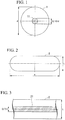
- a central portion 11 of a C-section of a wire rod 1 refers to a range of 1/10 of a diameter d of the wire rod from the central of the wire rod in a case where the C-section of the wire rod 1 is substantially circular. That is, the central portion 11 of the C-section of the substantially circular wire rod 1 is a region in a concentric circle of the section of the wire rod 1 having a diameter of 1/5d (2/10d).
- the C-section of the wire rod 1 is not substantially circular
- a region that has a homothetic shape with a homothetic ratio of 1/5 of the C-section of the wire rod 1 and has a geometric central at the same location as that of the C-section of the wire rod 1 is regarded as the central portion 11 of the C-section of the wire rod 1.
- the complex oxide is likely to gather in the central portion of the slab, and thus, even in a wire rod that is obtained by rolling the slab, the complex oxide is likely to gather in the central portion.
- the composition of the complex oxide in the central portion is also substantially identical to that in the peripheral portion, and it is considered that the precipitation of a coarse complex oxide is also suppressed in the peripheral portion as long as that is suppressed in the central portion. For the above-described reason, the complex oxide is evaluated in the central portion of the C-section of the wire rod.
- compositional ratio ⁇ concentration of CaO in oxide by unit mass % / concentration of Al 2 O 3 in oxide by unit mass %
- the average value of the compositional ratios ⁇ of the complex oxide in the central portion of the wire rod is 3.00 or more, CaO is a dominant component of the complex oxide, and the hydrogen induced cracking resistance after the flattening process deteriorates regardless of the control of the size.
- the average value of the compositional ratios ⁇ of the complex oxide in the central portion of the wire rod is regulated to be 0 or more and 3.00 or less.
- the upper limit of the average value of the compositional ratios ⁇ of the complex oxide in the central portion of the wire rod is preferably 1.00 or less and more preferably 0.60 or less.
- the lower limit of the average value of the compositional ratios ⁇ of the complex oxide in the central portion of the wire rod may be set to 0.02, 0.05, 0.10, 0.15, or 0.20.
- the average value of the equivalent circle diameters of the complex oxide is set to 6.0 ⁇ m or less.
- the lower limit value of the average value of the equivalent circle diameters of the complex oxide is not particularly specified, but may be regulated to be 2.0 ⁇ m, 2.5 ⁇ m, 3.0 ⁇ m, 3.5 ⁇ m, or 4.0 ⁇ m.
- the chemical composition of the complex oxide is considered to be substantially uniform in a wire rod regardless of the size. Therefore, it is possible to observe 10 views in the C-section of the central portion of the wire rod, analyze chemical compositions and compute compositional ratios ⁇ only for complex oxides having the maximum equivalent circle diameter (complex oxides having a chemical composition that is most easily analyzed) in the respective views, and regard a value obtained by averaging the compute compositional ratios ⁇ of the complex oxides in these 10 views as the average value of the compositional ratios ⁇ of the complex oxide which are measured in the central portion of the wire rod. As long as this value satisfies the above-described requirement of the wire rod according to the present embodiment, the wire rod is regarded to satisfy the requirement of the wire rod according to the present embodiment. A specific method for analyzing the chemical composition of the complex oxide in the wire rod will be described below.
- the C-section (that is, a cut surface perpendicular to the rolling direction of the wire rod) of the wire rod is mirror-polished, 10 places are observed using a field emission scanning electron microscope (FE-SEM) at a magnification of 1,000 times in a reflected electron image so that inclusions such as the complex oxide and the like can be observed, and photographs are captured.
- the area per view is set to 8,000 ⁇ m 2 (100 ⁇ m in height and 80 ⁇ m in width) or more.
- the chemical compositions of the respective inclusions are collectively measured using EDS, thereby determining whether or not the inclusions are the complex oxide that is regarded as the control subject in the wire rod according to the present embodiment.
- the characteristic X-ray spectra of the complex oxides having the maximum size in the respective photographs are obtained using energy-dispersive X-ray spectroscopy (EDS), thereby analyzing elements. Therefore, the compositions of the complex oxides can be evaluated. From the peak energies of the obtained characteristic X-ray spectra, elements that are included in the complex oxides are specified, and the amounts (mol%) of the elements are determined from the heights of the peaks.
- the mass ratios CaO/Al 2 O 3 of the complex oxides are computed, thereby obtaining the compositional ratios ⁇ of the complex oxides having the maximum size in the respective views.
- these compositional ratios ⁇ in 10 views are averaged, thereby computing the average value of the compositional ratios ⁇ of the complex oxides which are measured in the central portion of the wire rod.
- an oxide in which the amount (mol%) of the other oxide-forming elements such as Si, Mg, and Mn is 1/3 or more of a larger one of the amount (mol%) or Ca and the amount (mol%) of Al is determined as, for example, an oxide that includes CaO, Al 2 O 3 , and SiO 2 and is not the control subject in the wire rod according to the present embodiment.
- an inclusion in which the amount (mol%) of O is smaller than the amount (mol%) of S is determined as a sulfide-based inclusion and is not the control subject in the wire rod according to the present embodiment. Such an inclusion is ignored at the time of confirming the state of the complex oxide.
- the C-section (that is, a cut surface perpendicular to the rolling direction) of the wire rod is mirror-polished, 10 places are observed using a field emission scanning electron microscope (FE-SEM) at a magnification of 1,000 times in a reflected electron image so that inclusions can be observed, and photographs are captured.
- the area per view is set to 8,000 ⁇ m 2 (100 ⁇ m in height and 80 ⁇ m in width) or more.
- the chemical compositions of the respective inclusions are collectively measured using EDS, thereby determining whether or not the inclusions are the complex oxide that is regarded as the control subject in the wire rod according to the present embodiment.
- the areas of the complex oxides having the maximum size are measured by an ordinary image analysis from the respective photographs, and equivalent circle diameters that are obtained from the areas are computed.
- the photographs for measuring the equivalent circle diameter reflected electron images are preferably used.
- the average value of the equivalent circle diameters, which have been obtained using the above-described method, of the maximum complex oxides in the photographs of the 10 places is obtained, whereby the average value of the equivalent circle diameters of the complex oxides which are measured in the central portion of the C-section of the wire rod is obtained.
- the metallographic structure of the wire rod has no substantial influence on the hydrogen induced cracking resistance of the flat steel wire. This is because the states of a sulfide and the complex oxide are dominant regarding the hydrogen induced cracking resistance of the flat steel wire as described above. Therefore, the metallographic structure of the wire rod is not limited. However, in the case of taking the workability into account, the metallographic structure of the wire rod is preferably controlled to be a pearlite structure, a ferrite structure, or a bainite structure. Therefore, the metallographic structure of the wire rod may be regulated as a metallographic structure including a total of 99area% or more of a pearlite structure, a ferrite structure, and a bainite structure.
- the diameter of the wire rod is also not particularly limited, and the diameters of wire rods for flat steel wires that are in circulation in the current market are generally set to 7 to 16 mm, and thus the diameter of the wire rod according to the present embodiment may also be regulated to be 7 to 16 mm.
- the tensile strength of the wire rod is also not particularly limited.
- the lower limit value of the tensile strength of the wire rod according to the present embodiment may be regulated to be 600 MPa or 700 MPa.
- the upper limit value of the tensile strength of the wire rod according to the present embodiment may be regulated to be 1,400 MPa or 1,350 MPa.
- the compositional ratio ⁇ of the oxide including CaO and Al 2 O 3 is made to be appropriate by adding Ca in a molten steel stage, and, furthermore, the size of the complex oxide is controlled.
- the effect of the wire rod according to the present embodiment can be obtained regardless of the method for manufacturing the wire rod, but the wire rod needs to be manufactured according to, for example, a manufacturing method described below.
- the following manufacturing process is simply an example, and it is needless to say that a wire rod having a chemical composition and other requirements in the ranges of the wire rod according to the present embodiment which is obtained using a process other than the following manufacturing process is also considered as the wire rod according to the present embodiment.
- the component of molten steel is adjusted in a converter after the desulfurization of hot metal, a Ca alloy is added to the molten steel, and then a steel piece is obtained using continuous casting. After that, the steel piece is reheated to hot-roll a product and is finished to a steel material having a predetermined diameter.
- a method for manufacturing the molten steel will be described in more detail.
- Desulfurization is carried out using a Kanbara reactor (KR) method in which a desulfurizer is added to hot metal tapped from a blast furnace and stirred, thereby removing sulfur, subsequently, dephosphorization and decarbonization are carried out in a converter.
- KR Kanbara reactor
- the component of the molten steel is adjusted by adding an alloy of metallic Al or the like. Subsequently, the molten steel is degassed in Ruhrstahl-Heraeus (RH), and a Ca alloy is added to the molten steel.
- the composition of the Ca alloy is, for example, 40mass% of Ca and 60mass% of Si.
- a method for adding the Ca alloy a powder injection method in which the powder of the Ca alloy is blown into the steel together with an inert gas is used.
- a timing of adding the Ca alloy is set to 30 minutes or more and 60 minutes or less from the addition of the metallic Al.
- the Ca alloy is added within 30 minutes from the addition of the metallic Al, some of Ca added to the metal is consumed due to the reaction with coarse Al 2 O 3 floating in the steel, and thus a sulfide-detoxifying effect of Ca cannot be obtained.
- coarse Al 2 O 3 remains, and thus the equivalent circle diameter of the oxide in the wire rod after rolling does not reach 6.0 ⁇ m or less.
- the compositional ratio ⁇ (mass% of CaO / mass% of Al 2 O 3 ) of the complex oxide satisfies 0.00 ⁇ ⁇ ⁇ 3.00.
- This molten steel is turned into a steel piece using a continuous casting method.
- the casting rate at the time of turning the molten steel into the steel piece is preferably 0.6 m/min to 1.4 m/min. During casting, some of the inclusions float and do not remain in the steel piece, but the rest of the inclusions move down and remain in the steel piece.
- the obtained steel piece is hot-rolled, thereby manufacturing a wire rod.
- the hot rolling is carried out by heating the steel piece at 1,020°C or more.
- the final finishing temperature of the hot rolling is set to 800°C to 960°C.
- the hot rolling is carried out so that the area ratio of the cross section of the steel piece before the hot rolling to the hot-rolled wire rod (the cross section area (mm 2 ) of the steel piece / the cross section area (mm 2 ) of the hot-rolled wire rod) reaches 100.0 or more.
- the crushing of the complex oxide during the hot rolling becomes insufficient, and the size of the complex oxide in the wire rod does not reach 6.0 ⁇ m or less.
- the size and compositional ratio of the complex oxide can be controlled using the above-described steps.
- the flat steel wire according to the present embodiment is a flat steel wire obtained by rolling the wire rod according to the present embodiment.
- the shape of a flat steel wire 2 is not particularly limited, but the shape of a C-section thereof is preferably a shape formed by pressing a circle.
- the minor axis length of the C-section will be referred to as a thickness t of the flat steel wire 2, and the major axis of the C-section will be referred to as a width w of the flat steel wire 2.
- an L-section of the flat steel wire 2 described below refers to a cross section that is parallel to the rolling direction and the minor axis direction of the flat steel wire and substantially includes the center axis of the flat steel wire.
- the center axis of the flat steel wire refers to an axis that passes through the center of the C-section and is parallel to the rolling direction.
- the minor axis direction of the flat steel wire refers to the minor axis direction of a cross section perpendicular to the rolling direction of the flat steel wire.
- a center portion 21 in the L-section of the flat steel wire 2 refers to a region that is in a range of 1/7 of the minor axis length (the thickness t of the flat steel wire 2) of the flat steel wire 2 from the center axis of the flat steel wire 2 as shown in FIG. 3 .
- the center portion 21 in the L-section of the flat steel wire 2 is a region at a depth of 5/14t or more from the surface of the flat steel wire in the L-section.
- center portion 21 in the L-section of the flat steel wire 2 will be simply referred to as the "center portion" in some cases.
- an arbitrary axis that passes through the center of the C-section of the flat steel wire and an axis perpendicular to the above-described axis may be regarded as the long axis and the short axis.
- the chemical composition of the flat steel wire include, by mass%, C: 0.15% to 0.85%, Si: 0.10% to 2.00%, Mn: 0.30% to 1.50%, Al: 0.001% to 0.080%, Ca: 0.0002% to 0.0050%, N: 0.0020% to 0.0080%, P: 0.020% or less, S: 0.020% or less, O: 0.0050% or less, Cr: 0% to 1.00%, V: 0% to 0.15%, Ti: 0% to 0.050%, Nb: 0% to 0.050%, Cu: 0% to 1.00%, Ni: 0% to 1.50%, Mo: 0% to 1.00%, B: 0% to 0.0100%, REM: 0% to 0.0100%, Zr: 0% to 0.1000%, and a remainder including Fe and impurities.
- the flat steel wire is a flat steel wire obtained by rolling the wire rod, and thus the chemical composition of the flat steel wire according to the present embodiment is identical to the chemical composition of the wire rod according to the present embodiment. It is needless to say that the preferred upper limit value and the preferred lower limit value that have described regarding the respective elements in the chemical composition of the wire rod are also applicable to the chemical composition of the flat steel wire.
- the form of an oxide including CaO and Al 2 O 3 (complex oxide) is regulated.
- the definitions of the complex oxide in the flat steel wire and a compositional ratio ⁇ thereof are identical to the definitions of the complex oxide in the wire rod and the compositional ratio ⁇ thereof.
- the average value of the compositional ratios ⁇ of the complex oxide that is observed in the center portion of the flat steel wire is made to satisfy 0.00 ⁇ ⁇ ⁇ 3.00.
- the flat steel wire is a flat steel wire obtained by rolling the wire rod, and thus the chemical composition of the complex oxide in the flat steel wire according to the present embodiment is identical to the chemical composition of the complex oxide in the wire rod according to the present embodiment.
- the average value of the equivalent circle diameters of the complex oxide that is observed in the center portion of the flat steel wire is set to 3.0 ⁇ m or less. In a case where the average value of the equivalent circle diameters of the complex oxide that is observed in the center portion of the flat steel wire exceeds 3.0 ⁇ m, the hydrogen induced cracking Properties of the flat steel wire is impaired by a void that is generated around the complex oxide.
- the metallographic structure of the flat steel wire similar to the metallographic structure of the wire rod, has no significant influence on the hydrogen induced cracking resistance of the flat steel wire. Therefore, the metallographic structure of the flat steel wire is not particularly limited. For example, in a case where the structure in the center portion of the flat steel wire includes 98area% or more of tempered martensite, it is possible to further improve the tensile strength of the flat steel wire, which is preferable. For example, in a case where the structure in the center portion of the flat steel wire includes 20% to 60area% of ferrite and 40% to 60area% of bainite, it is possible to improve the toughness and the like of the flat steel wire, which is preferable.
- the width w and the thickness t of the flat steel wire are also not particularly limited. Generally, the widths of flat steel wires that are in circulation in the current market are set to 13 to 16 mm, and the thicknesses t are set to 2 to 7 mm, and thus the width and thickness of the flat steel wire according to the present embodiment may also be regulated as described above.
- the tensile strength of the flat steel wire is also not particularly limited.
- the tensile strength of the flat steel wire is desirably set to approximately 1,100 to 1,500 MPa, which can be achieved by appropriately adjusting a heat treatment condition of the flat steel wire.
- a sulfide-based inclusion in the flat steel wire also does not need to be limited in terms of the form and the like for the same reason as the sulfide-based inclusion in the wire rod.
- Methods for evaluating the complex oxide in the flat steel wire are based on the methods for evaluating the complex oxide in the wire rod. However, the methods for evaluating the complex oxide are different between the flat steel wire and the wire rod in terms of the fact that the complex oxide in the wire rod is evaluated in the central portion of the C-section of the wire rod, but the complex oxide in the flat steel wire is evaluated in the center portion of the L-section of the flat steel wire.
- the L-section of the flat steel wire in the present embodiment is a cross section including the center axis of the flat steel wire; however, at the time of evaluating the complex oxide, the complex oxide may also be evaluated using a cross section slightly away from the center axis of the flat steel wire as a measurement surface.
- the center portion in the measurement surface may be specified by regarding an axis parallel to the rolling direction of the measurement surface as the center axis of the flat steel wire. Even when there is a small gap between the measurement surface and the center axis of the flat steel wire, the evaluation results of the complex oxide are not substantially affected.
- a method for manufacturing the flat steel wire according to the present embodiment includes a step of flattening the wire rod according to the present embodiment.
- the reduction of area in the flattening process is set to 40% or more. In a case where the reduction of area is less than 40%, the complex oxide in the wire rod is not sufficiently crushed, and thus it is difficult to set the maximum value of the equivalent circle diameter of the complex oxide in the flat steel wire to 3.0 ⁇ m or less.
- the wire rod before the flattening process or the flat steel wire after the flattening process may be appropriately heat-treated. This is because the forms of the complex oxide and sulfides do not significantly change at a heat treatment temperature for ordinary steel.
- Steels A and B having a chemical composition shown in Table 1 were manufactured using the following method. Desulfurization was carried out using a KR method on hot metal, and dephosphorization and decarbonization were carried out in a converter. After that, in order to adjust elements except for Ca, REM, and Zr in the above-described chemical composition, metallic A1 or the like was added to molten steel. A sample for an analysis was taken from the molten steel, a component analysis was carried out, and the chemical composition other than Ca, REM, and Zr was adjusted. After that, the molten steel was degassed in Ruhrstahl-Heraeus (RH), and a CaSi alloy was added to the molten steel.
- RH Ruhrstahl-Heraeus
- the composition of the CaSi alloy was 40 mass% of Ca and 60 mass% of Si.
- the CaSi alloy was added using a powder injection method in which the powder of the CaSi alloy was blown into the steel together with an inert gas.
- the CaSi alloy was added after 40 minutes from the addition of the metallic Al.
- the CaSi alloy was added after 25 minutes from the addition of the metallic Al.
- the addition timing of the CaSi alloy was after 70 minutes from the addition of the metallic Al.
- the molten steel obtained as described above was cast, thereby producing a steel ingot.
- the casting rate was set to 0.9 m/min.
- this steel ingot was reheated at 1,250°C for 12 hours and bloomed to a 122 mm ⁇ 122 mm steel piece, thereby producing a material for rolling.
- the material for rolling was heated to 1,050°C and rolled to a wire rod having a diameter of 12 mm.
- the material for rolling was heated to 1,250°C, hot-rolled to a diameter of 16 mm, cut to a length of 1,500 mm, and ground to a diameter of 12 mm.
- the surface of the wire rod was lubricated, then a primary wire drawing process was carried out so as to obtain a wire rod having a diameter of 11 mm.
- the wire-drawn wire rod was flat rolled by a cold rolling mill (flattening process) and formed to a flat steel wire having a width of 15 mm and a thickness of 3 mm.
- the flat steel wire was heated at 900°C for 15 minutes, then, quenched by being immersed in a cold oil, and tempered at a temperature of 450°C for 60 minutes.
- Test No. A5 the wire rod was flat rolled (flattening process) and then annealed at 450°C for 60 minutes.
- steels a to au having a chemical composition shown in Table 2-1 and Table 2-2 (Test Nos. 1 to 47 in Table 4-1 and Table 4-2) were melted using the same method as for the steel A1, the obtained steel ingots were heated at 1,250°C for 12 hours, and then steel pieces obtained by blooming 122 mm ⁇ 122 mm steel pieces were used as materials for rolling. Next, the materials for rolling were heated at 1,050°C and flat rolled (flattening process) to wire rods having a diameter of 12 mm. After that, the surfaces of the wire rods were lubricated, and a primary wire drawing process was carried out so as to obtain wire rods having a diameter of 11 mm.
- the wire-drawn wire rods were rolled in a cold rolling mill and formed to flat steel wires having a width of 15 mm and a thickness of 3 mm.
- the formed flat steel wires were heated at 900°C for 15 minutes, then, quenched by being immersed in a cold oil, and heated at a temperature of 450°C for 60 minutes.
- the steps following the heat treatment were not carried out, and the test and the evaluation were stopped.
- a symbol "-" is given to cells in the "Evaluation result" column for the above-described samples. Underlined numerical values in Table 2-1 and Table 2-2 indicate that the component composition is not in the scope of the present invention.
- complex oxide compositional ratio ⁇ indicates the average value of the compositional ratios ⁇ of the complex oxide in the central portion of the wire rod
- average equivalent circle diameter indicates the average value of the equivalent circle diameters of the complex oxide in the central portion of the wire rod or the center portion of the flat steel wire.
- the average value of the compositional ratios ⁇ of the complex oxide in the center portion of the flat steel wire is substantially identical to that in the central portion of the wire rod and is thus not measured.
- the average value of the compositional ratios ⁇ of the complex oxide in the central portion of the wire rod and the average value of the equivalent circle diameters of the complex oxide in the central portion of the wire rod or the center portion of the flat steel wire were investigated using the above-described method.
- the tensile strength of the wire rod and the structure, tensile strength, and hydrogen induced cracking resistance of the flat steel wire were respectively investigated using methods described below.
- the wire rod was cut to a length of 340 mm, the top and bottom 70 mm portions were fixed using hydraulic chucks, and a tensile test was carried out.
- the tensile strength was computed by dividing the obtained maximum load by the cross section area of the wire rod.
- the tensile strength is preferably 600 MPa or more, and thus a wire rod having a tensile strength of 600 MPa or more was evaluated as an acceptable product.
- An L-section of the flat steel wire was mirror-polished and eroded with picral, five arbitrary places in the center portion of the L-section were respectively observed using FE-SEM at a magnification of 2,000 times, and five photographs were captured.
- An OHP sheet was overlaid on each of the obtained photographs, and regions overlapping with a ferrite structure and a bainite structure in each of the transparent sheets were painted with color.
- the area ratio of the "region painted with color" in each of the transparent sheets was obtained using image analysis software, thereby obtaining the area ratios of the ferrite structure and the bainite structure in each of the five places.
- the area ratios of the ferrite structure and the bainite structure in the five places were averaged, thereby computing the area ratios of the ferrite structure and the bainite structure in the flat steel wire.
- structures other than ferrite, bainite, and martensite were not substantially confirmed in any of the flat steel wires, and thus a value obtained by subtracting the area ratios of the ferrite structure and the bainite structure from 100% was regarded as the average value of a martensite structure.
- the flat steel wire was cut to a length of 400 mm, the top and bottom 100 mm portions were fixed using hydraulic chucks, and a tensile test was carried out.
- the tensile stress was computed by dividing the obtained maximum load by the cross section area of the flat steel wire.
- the tensile strength is preferably 1,100 MPa or more, and thus a flat steel wire having a tensile strength of 1,100 MPa or more was evaluated as an acceptable product.
- the hydrogen induced cracking resistance was evaluated using the flat steel wire cut to a length of 150 mm.
- a solution for supplying hydrogen to a test specimen a 5% NaCl+CH 3 COONa aqueous solution was used, and the solution was used after the pH was adjusted to 5.0.
- a hydrogen sulfide (H2S) and carbon dioxide (CO 2 )-mixed gas was introduced thereto, and the flat steel wire was immersed in the solution, thereby investigating the generation of cracks.
- the pressure of the hydrogen sulfide was 0.1 MPa
- the testing temperature was 25°C
- the testing time was 96 hours.
- Af represents the total area (mm 2 ) of the crack-generated portions measured by UST
- w represents the width (mm) of the flat steel wire
- L represents the length (mm) of the flat steel wire.
- the Ca content was outside the scope of the present invention, additionally, the compositional ratio of the complex oxide was outside the scope of the present invention, and hydrogen induced cracking occurred.
Landscapes
- Chemical & Material Sciences (AREA)
- Engineering & Computer Science (AREA)
- Materials Engineering (AREA)
- Metallurgy (AREA)
- Organic Chemistry (AREA)
- Mechanical Engineering (AREA)
- Crystallography & Structural Chemistry (AREA)
- Physics & Mathematics (AREA)
- Thermal Sciences (AREA)
- Manufacturing & Machinery (AREA)
- Heat Treatment Of Steel (AREA)
- Treatment Of Steel In Its Molten State (AREA)
Applications Claiming Priority (2)
| Application Number | Priority Date | Filing Date | Title |
|---|---|---|---|
| JP2017059111 | 2017-03-24 | ||
| PCT/JP2018/011862 WO2018174270A1 (fr) | 2017-03-24 | 2018-03-23 | Fil machine et fil d'acier plat |
Publications (2)
| Publication Number | Publication Date |
|---|---|
| EP3604590A1 true EP3604590A1 (fr) | 2020-02-05 |
| EP3604590A4 EP3604590A4 (fr) | 2020-12-30 |
Family
ID=63584572
Family Applications (1)
| Application Number | Title | Priority Date | Filing Date |
|---|---|---|---|
| EP18770555.3A Withdrawn EP3604590A4 (fr) | 2017-03-24 | 2018-03-23 | Fil machine et fil d'acier plat |
Country Status (5)
| Country | Link |
|---|---|
| EP (1) | EP3604590A4 (fr) |
| JP (1) | JP6733808B2 (fr) |
| KR (1) | KR20190119089A (fr) |
| BR (1) | BR112019017993A2 (fr) |
| WO (1) | WO2018174270A1 (fr) |
Cited By (1)
| Publication number | Priority date | Publication date | Assignee | Title |
|---|---|---|---|---|
| WO2023075660A1 (fr) * | 2021-10-28 | 2023-05-04 | Suzuki Garphyttan Ab | Fil plat et son procédé de production |
Families Citing this family (3)
| Publication number | Priority date | Publication date | Assignee | Title |
|---|---|---|---|---|
| WO2021106936A1 (fr) * | 2019-11-26 | 2021-06-03 | 日本製鉄株式会社 | Produit moulé par estampage à chaud et tôle d'acier pour estampage à chaud |
| CN117506218A (zh) * | 2022-07-26 | 2024-02-06 | 宝山钢铁股份有限公司 | 一种耐候埋弧焊丝用盘条、焊丝及其应用 |
| CN117845137B (zh) * | 2024-01-08 | 2024-09-13 | 钢铁研究总院有限公司 | 一种Mn-Si-V-Ti-Nb-Cr多元合金化热轧盘条及其制备方法 |
Family Cites Families (11)
| Publication number | Priority date | Publication date | Assignee | Title |
|---|---|---|---|---|
| JP3601388B2 (ja) * | 1999-12-17 | 2004-12-15 | 住友金属工業株式会社 | 鋼線材及び鋼線材用鋼の製造方法 |
| JP2007002294A (ja) * | 2005-06-23 | 2007-01-11 | Kobe Steel Ltd | 伸線性および疲労特性に優れた鋼線材並びにその製造方法 |
| JP4718359B2 (ja) * | 2005-09-05 | 2011-07-06 | 株式会社神戸製鋼所 | 伸線性と疲労特性に優れた鋼線材およびその製造方法 |
| FR2960556B3 (fr) * | 2010-05-31 | 2012-05-11 | Arcelormittal Wire France | Fil de forme en acier a hautes caracteristiques mecaniques resistant a la fragilisation par l'hydrogene |
| EP2682489B1 (fr) * | 2011-03-01 | 2021-01-13 | Nippon Steel Corporation | Tige de file d'acier à forte teneur en carbone ayant d' excellentes caractéristiques d'aptitude à l'étirage et de fatigue après étirage |
| JP5824401B2 (ja) * | 2012-03-30 | 2015-11-25 | 株式会社神戸製鋼所 | 耐水素誘起割れ性に優れた鋼板およびその製造方法 |
| JP6036997B2 (ja) * | 2013-04-23 | 2016-11-30 | 新日鐵住金株式会社 | 耐疲労特性に優れたばね鋼及びその製造方法 |
| DE102013012118A1 (de) * | 2013-07-18 | 2015-01-22 | C.D. Wälzholz GmbH | Kaltgewalztes Schmalband in Form von Flachdraht oder Profilen aus einem hochfesten Stahl für den Einsatz in flexiblen Rohren, insbesondere in flexiblen Rohren für Offshore-Anwendungen sowie Verfahren zur Herstellung derartiger kaltgewalzter Schmalbänder |
| JP2015163735A (ja) * | 2014-01-29 | 2015-09-10 | 株式会社神戸製鋼所 | 疲労特性に優れたばね用鋼線材、およびばね |
| US10202665B2 (en) * | 2014-04-23 | 2019-02-12 | Nippon Steel & Sumitomo Metal Corporation | Spring steel and method for producing the same |
| JP6648896B2 (ja) | 2015-09-18 | 2020-02-14 | Necソリューションイノベータ株式会社 | 組織改善活動支援システム、情報処理装置、方法およびプログラム |
-
2018
- 2018-03-23 WO PCT/JP2018/011862 patent/WO2018174270A1/fr not_active Ceased
- 2018-03-23 JP JP2019507037A patent/JP6733808B2/ja active Active
- 2018-03-23 BR BR112019017993-3A patent/BR112019017993A2/pt not_active IP Right Cessation
- 2018-03-23 KR KR1020197026762A patent/KR20190119089A/ko not_active Ceased
- 2018-03-23 EP EP18770555.3A patent/EP3604590A4/fr not_active Withdrawn
Cited By (1)
| Publication number | Priority date | Publication date | Assignee | Title |
|---|---|---|---|---|
| WO2023075660A1 (fr) * | 2021-10-28 | 2023-05-04 | Suzuki Garphyttan Ab | Fil plat et son procédé de production |
Also Published As
| Publication number | Publication date |
|---|---|
| JPWO2018174270A1 (ja) | 2020-01-09 |
| WO2018174270A1 (fr) | 2018-09-27 |
| KR20190119089A (ko) | 2019-10-21 |
| BR112019017993A2 (pt) | 2020-05-19 |
| JP6733808B2 (ja) | 2020-08-05 |
| EP3604590A4 (fr) | 2020-12-30 |
Similar Documents
| Publication | Publication Date | Title |
|---|---|---|
| EP2980250B1 (fr) | Plaque d'acier résistant à l'abrasion ayant une excellente ténacité à basse température et son procédé de fabrication | |
| US7264684B2 (en) | Steel for steel pipes | |
| KR101198481B1 (ko) | 휨 가공성이 우수한 고강도 냉연 강판 | |
| EP2942415B1 (fr) | Tôle d'acier résistant à l'abrasion qui présente une excellente ténacité à basse température ainsi qu'une certaine résistance à la fragilisation par l'hydrogène, et procédé de fabrication de cette dernière | |
| EP2695960B1 (fr) | Tôle d'acier résistant à l'abrasion qui présente une excellente résistance à une fissuration par corrosion sous tension et procédé de production de cette dernière | |
| EP3202943B1 (fr) | Tube d'acier haute résistance sans soudure pour puits de pétrole, et procédé de production de tube d'acier haute résistance sans soudure pour puits de pétrole | |
| EP2163658B9 (fr) | Tôle d'acier inoxydable ferritique ayant une excellente résistance à la corrosion à l'encontre de l'acide sulfurique, et son procédé de fabrication | |
| EP3533893A1 (fr) | Profilé acier en h et procédé pour le fabriquer | |
| EP3282029B1 (fr) | Tôle d'acier pour traitement thermique | |
| EP2947168B1 (fr) | Fil machine en acier calmé au si présentant d'excellentes propriétés de fatigue, et ressort utilisant celui-ci | |
| EP3546610A1 (fr) | Tuyau en acier soudé par résistance électrique de type brut de laminage pour tuyaux de canalisation | |
| EP2990496A1 (fr) | Acier à ressort qui présente d'excellentes caractéristiques de fatigue et procédé permettant de fabriquer ce dernier | |
| EP3249070B1 (fr) | Rail | |
| EP2977479B1 (fr) | Matériau acier présentant une résistance supérieure dans une zone affectée par la chaleur de soudage | |
| EP2990497A1 (fr) | Acier purifié à faible teneur en oxygène et produit en acier purifié à faible teneur en oxygène | |
| EP3988678B1 (fr) | Fil machine | |
| EP3144407B1 (fr) | Procédé pour produire le tuyau d'acier sans soudure pour tube de canalisation | |
| EP2960353A1 (fr) | Feuille d'acier laminée à froid à résistance élevée ayant une excellente aptitude à la flexion | |
| EP3249069A1 (fr) | Rail | |
| EP2554704A1 (fr) | Fil en acier à haute teneur en carbone présentant une excellente capacité de tréfilage et une excellente propriété de fatigue après le tréfilage | |
| EP3604590A1 (fr) | Fil machine et fil d'acier plat | |
| EP3702484B1 (fr) | Acier comprenant du nickel pour basse température | |
| EP3705593A1 (fr) | Tôle en acier laminée à chaud, et procédé de fabrication de celle-ci | |
| EP3677700A1 (fr) | Acier riche en mn et son procédé de production | |
| EP3831973A1 (fr) | Acier à haute teneur en manganèse et son procédé de production |
Legal Events
| Date | Code | Title | Description |
|---|---|---|---|
| STAA | Information on the status of an ep patent application or granted ep patent |
Free format text: STATUS: THE INTERNATIONAL PUBLICATION HAS BEEN MADE |
|
| PUAI | Public reference made under article 153(3) epc to a published international application that has entered the european phase |
Free format text: ORIGINAL CODE: 0009012 |
|
| STAA | Information on the status of an ep patent application or granted ep patent |
Free format text: STATUS: REQUEST FOR EXAMINATION WAS MADE |
|
| 17P | Request for examination filed |
Effective date: 20191018 |
|
| AK | Designated contracting states |
Kind code of ref document: A1 Designated state(s): AL AT BE BG CH CY CZ DE DK EE ES FI FR GB GR HR HU IE IS IT LI LT LU LV MC MK MT NL NO PL PT RO RS SE SI SK SM TR |
|
| AX | Request for extension of the european patent |
Extension state: BA ME |
|
| DAV | Request for validation of the european patent (deleted) | ||
| DAX | Request for extension of the european patent (deleted) | ||
| A4 | Supplementary search report drawn up and despatched |
Effective date: 20201126 |
|
| STAA | Information on the status of an ep patent application or granted ep patent |
Free format text: STATUS: THE APPLICATION IS DEEMED TO BE WITHDRAWN |
|
| 18D | Application deemed to be withdrawn |
Effective date: 20210626 |