EP3604831A1 - Cheville d'étanchéité composite - Google Patents
Cheville d'étanchéité composite Download PDFInfo
- Publication number
- EP3604831A1 EP3604831A1 EP19185074.2A EP19185074A EP3604831A1 EP 3604831 A1 EP3604831 A1 EP 3604831A1 EP 19185074 A EP19185074 A EP 19185074A EP 3604831 A1 EP3604831 A1 EP 3604831A1
- Authority
- EP
- European Patent Office
- Prior art keywords
- base body
- axial direction
- section
- composite sealing
- sealant
- Prior art date
- Legal status (The legal status is an assumption and is not a legal conclusion. Google has not performed a legal analysis and makes no representation as to the accuracy of the status listed.)
- Granted
Links
Images



Classifications
-
- F—MECHANICAL ENGINEERING; LIGHTING; HEATING; WEAPONS; BLASTING
- F16—ENGINEERING ELEMENTS AND UNITS; GENERAL MEASURES FOR PRODUCING AND MAINTAINING EFFECTIVE FUNCTIONING OF MACHINES OR INSTALLATIONS; THERMAL INSULATION IN GENERAL
- F16B—DEVICES FOR FASTENING OR SECURING CONSTRUCTIONAL ELEMENTS OR MACHINE PARTS TOGETHER, e.g. NAILS, BOLTS, CIRCLIPS, CLAMPS, CLIPS OR WEDGES; JOINTS OR JOINTING
- F16B13/00—Dowels or other devices fastened in walls or the like by inserting them in holes made therein for that purpose
- F16B13/02—Dowels or other devices fastened in walls or the like by inserting them in holes made therein for that purpose in one piece with protrusions or ridges on the shaft
-
- F—MECHANICAL ENGINEERING; LIGHTING; HEATING; WEAPONS; BLASTING
- F16—ENGINEERING ELEMENTS AND UNITS; GENERAL MEASURES FOR PRODUCING AND MAINTAINING EFFECTIVE FUNCTIONING OF MACHINES OR INSTALLATIONS; THERMAL INSULATION IN GENERAL
- F16B—DEVICES FOR FASTENING OR SECURING CONSTRUCTIONAL ELEMENTS OR MACHINE PARTS TOGETHER, e.g. NAILS, BOLTS, CIRCLIPS, CLAMPS, CLIPS OR WEDGES; JOINTS OR JOINTING
- F16B13/00—Dowels or other devices fastened in walls or the like by inserting them in holes made therein for that purpose
- F16B13/12—Separate metal or non-separate or non-metal dowel sleeves fastened by inserting the screw, nail or the like
- F16B13/124—Separate metal or non-separate or non-metal dowel sleeves fastened by inserting the screw, nail or the like fastened by inserting a threaded element, e.g. screw or bolt
-
- F—MECHANICAL ENGINEERING; LIGHTING; HEATING; WEAPONS; BLASTING
- F16—ENGINEERING ELEMENTS AND UNITS; GENERAL MEASURES FOR PRODUCING AND MAINTAINING EFFECTIVE FUNCTIONING OF MACHINES OR INSTALLATIONS; THERMAL INSULATION IN GENERAL
- F16B—DEVICES FOR FASTENING OR SECURING CONSTRUCTIONAL ELEMENTS OR MACHINE PARTS TOGETHER, e.g. NAILS, BOLTS, CIRCLIPS, CLAMPS, CLIPS OR WEDGES; JOINTS OR JOINTING
- F16B13/00—Dowels or other devices fastened in walls or the like by inserting them in holes made therein for that purpose
- F16B2013/006—Dowels or other devices fastened in walls or the like by inserting them in holes made therein for that purpose with sealing means
Definitions
- a composite sealing dowel is understood to mean a screw dowel which develops a sealing effect between a screw and a structure in which the screw dowel is arranged, in particular with regard to moisture and liquids.
- the screw dowel penetrates a composite seal provided in the structure and seals reliably and permanently against this composite seal.
- Composite sealing systems with a protective layer of ceramic covering and clothing building materials or natural or cast stone tiles are often used for this. These usually consist of a ceramic tile or plate, grout between the tiles or plates, tile adhesive under the tile or plate and a seal.
- the seal is usually arranged between the tile adhesive and a building structure (a wall or a floor, for example made of brick or concrete) and glued to the building structure.
- powdery, pasty, liquid or sheet-like sealing materials are used for the sealing.
- Suitable liquid waterproofing materials can be obtained from Sopro Bauchemie GmbH, Wiesbaden, Germany, in various configurations, for example under the designations Surface Seal Flexible (FDF), Seal Slurry Flex (DSF), Turbo Seal Slurry (TDS) or PU Surface Seal (PU-FD).
- Suitable sheet-like sealing materials can be in various configurations, for example under the name sealing and decoupling sheet AEB (protected trademark) or sealing and decoupling membrane plus (protected trademark), can be obtained from Sopro Bauchemie GmbH, Wiesbaden, Germany.
- Such sheet-like sealing materials consist, for example, of tear-resistant polypropylene film with a special fleece fabric coating on both sides made of polypropylene and a thickness of approximately 0.3 mm to 0.9 mm.
- a particular problem in the case of composite waterproofing systems is the penetration subsequently introduced, in particular boreholes, since these typically penetrate the composite waterproofing right down to the building structure. Even with such penetrations, the tightness of the composite sealing system must be guaranteed.
- a composite sealing dowel with a hollow cylindrical base body
- the hollow cylindrical base body need not be a perfect hollow cylinder in the mathematical sense.
- the hollow cylinder can be closed on one side and rounded at the closed end. It is also permissible for an outer surface of the hollow cylinder to have penetrations, depressions or projections. It points the base body has an opening for receiving a screw in the axial direction at a first end.
- the composite sealing dowel expands.
- the screw is secured against being pulled out by a frictional connection between the composite sealing dowel and the surrounding material.
- the screw forms a counter thread in the inner part of the composite sealing dowel, plastically deforming the material from which the composite sealing dowel is formed and additionally displacing it radially outward, thus spreading the composite sealing dowel.
- the base body has a first section and a second section in the axial direction, the first section being arranged between the second section and the first end of the base body.
- the base body On its radially outer lateral surface, the base body has an elastic sealant in the first section.
- the base body on its radially outer lateral surface is free of the elastic sealant.
- the elastic sealant is formed from a material that differs from the material from which the base body is formed.
- the first and second sections are determined by the presence or absence of elastic sealant.
- a composite seal which, as described above, consists of a protective layer made of a ceramic tile or plate or a natural or concrete stone, grout between the tiles or plates, tile adhesive located under the tile or plate and a seal the elastic sealant present in the first section brings about a sealing effect which, in the axial direction of the composite sealing dowel, comprises the seal of the composite seal and sections on both sides of the seal and thus acts across layers.
- the material forming the base body has in the first section on the radially outer lateral surface of the base body a recess which extends in the axial and radial directions and in which the elastic sealant is fully or partially inserted. Since a recess is set back radially inward relative to the adjacent radially outer lateral surface of the base body, it is possible to fix the position of the elastic sealant in the axial direction of the base body by fully or partially inserting the elastic sealant. This also makes it possible to ensure that a radially outer lateral surface of the elastic sealant is flush with the radially outer lateral surface of the base body (which means that both surfaces are flush) or protrudes only slightly in relation to this.
- “Slightly” should be understood to mean that the radially outer lateral surface of the elastic sealant projects over the radially outer lateral surface of the base body by less than the average wall thickness of the base body and in particular by less than half the average wall thickness of the base body. According to one embodiment, the radially outer lateral surface of the elastic sealant projects from the radially outer lateral surface of the base body by less than 1 mm and in particular by less than 0.5 mm.
- the term "inserted” is intended to include both the subsequent insertion of a separate elastic sealant in the form of a ring and the encapsulation of the base body with the elastic sealant.
- the average thickness of the outer wall of the base body is the radial distance between one and a radially outer one
- the circumferential surface of the base body defines the smallest circle to form the largest circle defined by a radially inner circumferential surface of the base body, the centers of both circles coinciding.
- the recess extends in the axial direction over the entire first section of the base body, which means that the elastic sealant is inserted into the recess in the base body over its entire axial extent.
- the recess extends in the axial direction over between 20% and 90% or over between 40% and 85% or over between 60% and 80% of the first section of the base body, which means that the elastic sealant is based on it axial extension is only partially inserted into the recess in the base body.
- the recess extends completely around the base body in the circumferential direction; then the elastic sealant used is ring-shaped in and of itself.
- a depth of the recess in the first section in the radial direction is between 0.25 mm and 2.5 mm or between 0.5 mm and 2.25 mm or between 1.0 mm and 2.0 mm.
- a recess with such a depth ensures that sufficient elastic sealant can be arranged around the base body in order to achieve the intended sealing effect.
- the base body has in the first section on its radially inner lateral surface a projection which extends in the radial and axial directions.
- the projection extends in the axial direction over the entire first section of the base body, and is subsequently arranged in the axial direction at the same position as the elastic sealant.
- the projection extends in the axial direction over between 25% and 95% or over between 45% and 90% or over between 65% and 85% of the first section of the base body.
- the projection can either have a smaller extent in the axial direction of the base body than the elastic sealant and lie completely in the first section or can also be offset in the axial direction with respect to the first section. If the projection is offset in the axial direction with respect to the first section, the projection can even be larger than the first section.
- the projection extends around the circumference completely within the base body.
- a plurality of projections separated from one another are provided distributed in the circumferential direction. The use of a plurality of projections distributed in the circumferential direction avoids excessive wall thicknesses of the base body.
- a height of the projection in the radial direction with respect to the radially inner lateral surface of the base body is between 0.25 mm and 2.5 mm or between 0.5 mm and 2.25 mm or between 1.0 mm and 2.0 mm , According to one embodiment, the height of the projection in the radial direction is less than or equal to the thickness of the elastic sealant in the radial direction.
- the base body in the first section likewise has an elastic sealant on its radially inner lateral surface.
- the base body also has an elastic sealant in its interior, the sealing effect is improved compared to a screw screwed into the composite sealing dowel.
- the elastic sealant arranged in the first section on the radially inner lateral surface extends in the axial direction over the entire first section of the base body.
- the elastic sealant completely surrounds the base body on its radially outer lateral surface and / or on its radially inner lateral surface in the circumferential direction of the base body, and thus forms a ring.
- the elastic sealant is an elastomer body which completely surrounds the base body on its radially outer lateral surface and / or on its radially inner lateral surface in the circumferential direction of the base body, and thus forms a ring.
- the elastomer body is a type of rubber, perfluorinated rubber (FFKM or FFPM), polyethylene (PE) or polytetrafluoroethylene (PTFE).
- the hollow cylindrical base body of the composite sealing dowel has a pasty sealant with the opening for the screw in its interior. Since the base body of composite sealing anchors typically does not consist of pasty material, the sealant is thus formed from a material which differs from the material from which the base body is formed. Furthermore, an outer wall of the base body has several openings and / or weakenings.
- a “weakening” is understood to mean an area in which the outer wall has a thickness of at least 50% and in particular at least 75% and further is in particular reduced by at least 90% compared to the average thickness of the outer wall at this point.
- the pasty sealant pressed outward of the base body produces a sealing effect which, in the axial direction of the composite sealing dowel, comprises the composite seal and sections on both sides of the composite seal and thus acts across layers.
- pasty sealant remaining in the interior of the base body provides a good seal against a screw screwed into the composite sealing dowel.
- the composite sealing dowel outside of the base body is free of pasty sealant.
- the pasty sealant is provided in a first end in the axial direction of the hollow cylindrical base body with the opening for the screw.
- the hollow cylindrical base body is completely or at least 2/3 or at least half or at least one third filled with the pasty sealant in the axial direction.
- the openings and / or weakenings are spaced apart from one another in the circumferential direction.
- the openings and / or weakenings are arranged distributed uniformly around the basic body in the circumferential direction.
- the openings are elongated holes, the longitudinal axes of which are oriented in the axial direction of the base body or enclose an angle of between 5 ° and 60 ° with the axial direction of the base body or enclose an angle of between 5 ° and 30 ° with the axial direction of the base body.
- the weakenings are long grooves, the longitudinal axes of which are oriented in the axial direction of the base body or enclose an angle of between 5 ° and 60 ° with the axial direction of the base body or enclose an angle of between 5 ° and 30 ° with the axial direction of the base body. Due to the largely axial orientation of the openings / weakenings, a reduction in the tensile force that can be absorbed in the axial direction by the composite sealing dowel is kept low.
- the base body has a first partition, which is arranged between the pasty sealant and the first end of the base body and closes off the pasty sealant with respect to the opening of the base body. In this way, drying out or hardening of the pasty sealant can be avoided.
- the first partition is formed in one piece with the base body.
- the first partition is pressed or glued or welded or inserted into the base body. It is emphasized that the partition also has the shape of a plug and can be designed such that it can be removed from the base body.
- the base body has a second partition, which is spaced apart from the first partition in the axial direction.
- the pasty sealant can then be arranged between the first partition and the second partition.
- the two partitions serve to limit the Section in which the pasty sealant is present.
- the second partition is formed in one piece with the base body.
- the second partition is pressed or glued or welded or inserted into the base body.
- a thickness of the (first and / or second) partition is reduced by at least 50% or by at least 75% or by at least 90% compared to an average thickness of the outer wall of the base body. This ensures that the (first and / or second) partition can easily be penetrated by a screw. According to one embodiment, the thickness of the second partition is greater than or equal to the thickness of the first partition.
- the pasty sealant is a butyl rubber sealant or a polysulfide sealant or a silicone sealant or a polyurethane sealant or an MS polymer sealant or a resin.
- Such materials are safe to process, can be easily combined with composite sealing systems and have good and long-lasting sealing properties.
- the base body has a section in the axial direction in which the base body is free of sealant, this section adjoining the first end of the base body and extending from the first end by between 1 mm and 10 mm or by between 2. 5 mm and 8 mm or extends between 3 mm and 6 mm in the axial direction. In this way it is avoided that the sealant penetrates outside of a penetration into which the composite sealing dowel is inserted.
- the section of the base body in which the base body has sealant extends over between 5 mm and 30 mm or over between 7 mm and 20 mm or over between 10 mm and 15 mm in the axial direction.
- the section of the base body in which the base body has sealant extends in the axial direction over between 20% and 70% of the total length of the base body or over between 30% and 60% of the total length of the base body or over between 40% and 50 % of the total length of the body.
- the composite sealing dowel is well adapted for sealing penetrations made in composite sealing systems, since such an axial extension of the sealant can act across layers by placing the composite sealing plug in the axial direction of the seal of the composite seal and on both sides of the sealant sealant is arranged.
- the base body is formed from plastic and in particular from polyamide or metal.
- a composite sealing dowel has a hollow cylindrical base body with an opening arranged at an end in the axial direction for receiving a screw.
- the base body in each case has on its radially inner and radially outer outer surfaces elastomer layers, which are continuous in both the axial direction and in the circumferential direction of the composite sealing dowel.
- This can also be a single common elastomer layer; the base body can thus be formed entirely from elastomer.
- the extent of the hollow cylindrical base body in the axial direction is at least 10 mm or at least 15 mm.
- the composite sealing dowel Due to its elastomer layers, the composite sealing dowel has good sealing properties both against an inner wall of the penetration and against a screw inserted through the opening in the base body. If the penetration is enforced by a composite seal, which, as described above, can be formed from a ceramic tile or plate, joint mortar between the tiles or plates, tile adhesive under the tile or plate and a seal, this causes the elastomer layer on the radially outer outer surface a sealing effect which in the axial direction of the composite sealing dowel comprises the sealing of the composite sealing and sections on both sides of the sealing and thus acts across layers.
- a composite seal which, as described above, can be formed from a ceramic tile or plate, joint mortar between the tiles or plates, tile adhesive under the tile or plate and a seal, this causes the elastomer layer on the radially outer outer surface a sealing effect which in the axial direction of the composite sealing dowel comprises the sealing of the composite sealing and sections on both sides of the sealing and thus acts across layers.
- the base body has a layer of polyamide or metal between its radially inner and radially outer elastomer layers.
- a core considerably increases the stability of the composite sealing dowel and thus facilitates insertion of the composite sealing dowel into a penetration along its axial direction.
- Such a core also prevents the elastomer layers from being accidentally penetrated completely in the radial direction by a screw.
- the thickness of each elastomer layer in the radial direction is between 1 mm and 3 mm or between 1.5 mm and 2 mm.
- the thickness of the layer of polyamide or metal in the radial direction is between 0.25 mm and 1.5 mm or between 0.4 mm and 0.8 mm.
- the base body has in a section which is optionally free of sealant, at least one pair of slots running in the axial direction, which have a lateral surface of the base body penetrate. These slots facilitate spreading of the composite sealing dowel in the section.
- the base body has, in a section which is optionally free of sealant, grooves which are oriented in the circumferential direction on its radially outer lateral surface and which alternate in the axial direction with projections oriented in the circumferential direction.
- Such a surface can interlock well with the inner wall of a penetration into which the composite sealing dowel is inserted.
- the base body has a radially outwardly directed flange at its first end adjacent to the opening.
- a flange prevents the composite sealing dowel from being inserted too deeply into a penetration.
- such a flange optically closes off the penetration.
- the base body is closed at its second end opposite the first end in the axial direction.
- This second end can also be rounded in order to facilitate insertion of the composite sealing dowel into a penetration.
- Embodiments of a method for sealing a penetration by a composite sealing system comprise the steps of providing a composite sealing dowel as described above, inserting the composite sealing dowel into the penetration, providing a screw and screwing the screw into the base body of the composite sealing dowel ,
- an outer diameter of the base body of the composite sealing dowel is matched to an inner diameter of the penetration and an outer diameter of the screw is adapted to an inner diameter of the base body of the composite sealing dowel.
- the composite sealing dowel described above is particularly well suited for use in sealing a penetration through a composite sealing system, since sealant is arranged in the axial direction of the composite sealing dowel in the area of the sealing of the composite sealing and on both sides of the sealing, and such a composite sealing dowel can therefore work across layers.
- Embodiments of a system for sealing a penetration by a composite sealing system have a composite sealing dowel inserted into the penetration and a screw screwed into the composite sealing dowel.
- the composite sealing dowel and the screw are jointly designed to ensure the tightness required for a particular stress class of the composite sealing system also in the area of penetration.
- the composite sealing dowel is the composite sealing dowel described above.
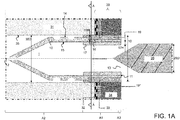
- Figures 1A to 1C show a first embodiment of a composite sealing dowel 1, which is suitable for sealing a penetration 35, such as a borehole, through a composite sealing system 30.
- the shows Figure 1A a sectional view along the longitudinal axis of the composite sealing dowel before screwing in a screw 20 and Figure 1C the same sectional view after screw 20.
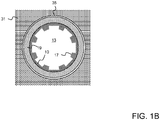
- Figure 1B shows a cross-sectional view through the view Figure 1A along the section line AA.
- the composite sealing system 30 shown in this embodiment has a 0.5 mm thick sealing membrane 32 which is applied to a structure in the form of a wall 31.
- the sealing membrane 32 supports tiles 34 with a thickness of 10 mm by means of a 3 mm thick layer of tile adhesive 33.
- the penetration 34 which in the embodiment shown has an inner diameter 34D of 10 mm, completely penetrates the sealing membrane 32, the tile adhesive 33 and the tiles 34 and penetrates into the wall 31.
- the composite sealing dowel 1 is essentially formed by a hollow cylindrical base body 10 made of polyamide.
- the base body 10 has an opening 13 for the screw 20.
- the first end 11 is followed by a section A3, in which the base body 10 has a radially outwardly directed flange.
- This section A3 extends in the embodiment shown by 1 mm in the axial direction.
- This flange-forming section A3 is followed by a (first) section A1, in which the base body 10 has on its radially outer lateral surface 14 an elastic sealant in the form of an annular elastomer body 19 made of rubber.
- This ring-shaped elastomer body 19 extends in the axial direction of the base body over 12 mm and thus has a greater longitudinal extent than the thickness of the composite seal 30.
- the annular elastomer body 19 is inserted in the axial direction to 90% in a recess 16 which is formed on the radially outer lateral surface 14 of the base body 10 and extends all around the base body 10 in the circumferential direction.
- a depth 16H of the recess in relation to the adjacent lateral surface 14 of the base body 10 is approximately 1 mm.
- the recess 16 fixes the position of the elastomer body 19 relative to the base body 10.
- the end of the recess 16 facing the first end 11 of the base body 10 is delimited by the flange.
- the (first) section A1 defined by the annular elastomer body 19 is adjoined in the axial direction of the base body 10 by a (second) section A2, which is free of the elastomer body 19, and at the first end 11 thereof in the axial direction of the opposite second End 12 of the base body 10 is closed and has a tip.
- the tip facilitates insertion of the base body 10 into the penetration 35.
- the lateral surface of the base body 10 is penetrated by a pair of slots oriented in the axial direction; these are in the Figures 1A and 1C can be seen in the area of the tip of the base body 10.
- the base body 10 has in this section A2 on its radially outer circumferential surface grooves which are oriented in the circumferential direction and which alternate in the axial direction with projections oriented in the circumferential direction.
- the base body 10 has, in the (first) section A1 defined by the ring-shaped elastomer body 19, on its radially inner lateral surface 15, projections 17 which are radially opposite the adjacent lateral surface 15 by a height 17H of 1 mm and in extend in the axial direction over the entire length of the annular elastomer body 19.
- FIG. 1B it can be clearly seen that eight projections 17 are arranged distributed uniformly in the circumferential direction of the base body 10 and are formed in one piece with the base body 10. It is emphasized that in the Figure 1B For the sake of clarity, the cross-sectional view shown is shown only for the opening 13 of the base body 10 for the screw 20, and not for the inner wall of the tip of the base body 10 that is spaced axially from the section line AA.
- the projections 17 favor that the ring-shaped elastomer body 19 is pressed radially outward of the base body 10 when the screw 20 is screwed into the composite sealing dowel 1, thus producing a press seal for the penetration 35 and in particular for the composite seal 30.
- the annular elastomer body 19 penetrates into gaps and cracks in the penetration 35, which is shown in Figure 1C is symbolically illustrated by the area marked with the reference number 19 *. Since the ring-shaped elastomer body 19 is arranged not only in the area of the sealing sheet 32 of the composite seal 30, but in the axial direction of the penetration 35 on both sides of the sealing sheet 32, it acts Composite sealing dowel 1 across layers.
- an outer diameter 1D of the composite sealing dowel 1 can be adapted to an inner diameter 35D of the penetration 35 and an outer diameter 20D of the screw 20 can be adapted to an inner diameter of the composite sealing dowel 1.
- an annular elastomer body 19 provided on the radially outer lateral surface 14 of the base body 10 an annular elastomer body can also be provided on the radially inner lateral surface of the base body 10, which provides the seal against the screw. However, this is not specifically shown in the figures.
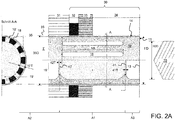
- Figures 2A and 2 B a second embodiment of a composite sealing dowel 1 ', which is suitable for sealing a penetration 35 through a composite sealing system 30, is explained.
- Figure 2A shows on the right a sectional view along the longitudinal axis of the composite sealing dowel 1 'before screwing in a screw 20 and on the left a cross-sectional view along the section line AA through the right figure.
- Figure 2B shows the same views after screw 20 has been screwed in.
- the sealing layer 32 of the composite sealing system 30 is not formed by a sealing membrane but by a 2 mm thick layer of a formerly liquid sealing material which has been applied to a drywall 31.
- the tile adhesive 33 and the tiles 34 of the composite sealing system 30 correspond to the first embodiment.
- the composite sealing dowel 1 ' also has a hollow cylindrical base body 10' made of polyamide and an opening 13 in the axial direction at a first end 11 for receiving a screw 20.
- the base body 10 ' is not shown over its entire length; in particular, an end opposite the first end 11 is not shown.
- the base body 10 'can have a shape which corresponds to the shape of the base body 10 according to the first embodiment in section A2 (which is free of sealant).
- the base body 10 'can be closed at its second end opposite the first end 11 in the axial direction.
- the base body 10 ' has a pasty sealant 19' made of MS polymer in its interior. On its outer surface in the radial direction, the base body 10 'is free of the pasty sealant 19'.
- the presence of this sealant 19 ' also defines a (first) section A1 of the base body 10' in the axial direction in this embodiment.
- an outer wall of the base body 10 ' has twelve elongated holes 18 which are arranged uniformly distributed from one another in the circumferential direction of the base body 10'. Longitudinal axes of the elongated holes 18 are oriented in the axial direction of the base body 10 '.
- the length 18L of the elongated holes 18 is 13 mm in each case in the embodiment shown and thus exceeds the thickness of conventional composite sealing systems 30.
- the (first) section A1 in which the pasty sealant 19 'is arranged, is delimited by first and second partition walls 41, 42.
- the first partition 41 closes the pasty sealant 19 'from the opening 13 of the base body 10'
- the second partition 42 closes the pasty sealant 19 'from a (second) section A2 of the base body 10' which is free of sealant.
- the second partition 42 was in front of one Filling of pasty sealant 19 'and the first partition 41 welded after filling of pasty sealant 19' with an inner wall of the base body 10 '.
- the partitions 41 and 42 have wall thicknesses 41T and 42T, which correspond to only 15% of an average wall thickness 10'T of the base body 10 '.
- an average wall thickness 10'T (here corresponds to the average thickness of the outer wall) of the base body 10 ', the radial distance between a smallest circle defined by a radially outer circumferential surface 14 of the base body 10' and one of a radially inner circumferential surface of the base body 10 'understood the largest circle, whereby the centers of both circles coincide.
- the partition walls 41 and 42 can be easily penetrated by the screw 20.
- section A3 which is free of sealant, and is adjacent to the first end 11 of the base body 10 ′ with the opening 13, in the second embodiment a substantially larger longitudinal extension of around 4 mm and has no flange. The greater length of this section A3 prevents pasty sealant 19 'from being pressed out of the penetration 35.
- the screw 20 When the screw 20 is inserted into the opening 13 of the base body 10 ', the screw first presses an outer wall of the base body 10' outwards in section A3 and thus provides a certain press seal to an inner wall of the penetration 35. The screw 20 then destroys the first partition 41 and presses the pasty sealant 19 'via the elongated holes 18 outside the base body 10', since the pasty sealant 19 'is prevented by the second partition 42 from evading in the axial direction. A resulting filling zone for the pasty sealant 19 'is shown in Figure 2B shown schematically.
- the backfill zone not only extends in the area of the sealing layer 32 of the composite sealing system 30, but also in the axial direction of the penetration 35 on both sides of the sealing layer 32 the composite sealing dowel 1 here also across layers.
- the screw 20 also destroys the second partition 42 and penetrates into the section A2 of the base body 10 'free of sealant.
- the latter section A2 is used in particular for the mechanical fastening of the composite sealing dowel 1 'in the penetration 35.
- an outer diameter 20D of the screw 20 is to be adapted to an inner diameter of the base body 10 'of the composite sealing dowel 1' and an outer diameter 1'D of the composite sealing dowel 1 'to an inner diameter 35D of the penetration 35 and thus to be suitably selected ,
- Figures 3A and 3B a third embodiment of a composite sealing dowel 1 ", which for sealing a penetration 35 through a composite sealing system 30 is explained.
- Figure 3A shows a sectional view along the longitudinal axis of the composite sealing dowel 1 "before screwing in a screw 20 and
- Figure 3B branches the same view after screwing in screw 20.
- the composite sealing system 30 corresponds to the composite sealing system of the first embodiment and has a sealing membrane 32 applied to a wall 31, which carries tiles 34 by means of tile adhesive 33.
- the hollow cylindrical base body 10 "of the composite sealing dowel 1" is formed on its radially inner and outer surfaces from elastomer layers 101, 103 of rubber.
- the composite sealing dowel 1 "thus has elastomer both along its entire axial extent and in the circumferential direction on its outer surfaces.
- a core made of a polyamide layer 102 with a radial direction between the elastomer layers 101, 103 Measured wall thickness of 0.5 mm is provided, which gives the composite sealing dowel 1 "stability in the axial direction and prevents a screw from completely destroying the elastomer layers 101, 103.
- the core 102 is only optional.
- the composite sealing dowel 1 can therefore alternatively also be formed entirely from elastomer.
- the thickness of the elastomer layers 101, 103 on the outer surfaces of the composite sealing dowel 1" is measured starting from the polyamide layer 102 in the radial direction, both for the penetration 35 as well as the screw 20 each 1.5 mm.
- the elastomer When the screw 20 is screwed in, the elastomer is applied to the inner wall of the penetration 35 across all layers of the composite sealing system 30 and the outer wall of the screw 20 are pressed and the penetration 35 is thus completely sealed against the ingress of water.
- the composite sealing dowel 1 unlike in the first embodiment, the composite sealing dowel 1 "does not have a flange surrounding its opening 13 for the screw 20. One such can optionally be provided. Furthermore, the composite sealing dowel 1" has a different way than in FIG Figure 1 shown no tip, but is hollow cylindrical. However, a tip can be provided in order to facilitate the introduction of the composite sealing dowel 1 "into the penetration 35.
- the composite sealing dowel of the first or third embodiment additionally has pasty sealing material in its interior and corresponding openings / weakenings in the lateral surface, which allow the pasty sealing material to escape radially when a screw is screwed in.
- Partition walls can also be provided which limit the pasty sealing material.
- the composite sealing dowel of the second embodiment can have on its radially outer and / or radially inner circumferential surface adjacent to the opening for the screw a particularly annular elastic sealant, which produces a press seal to the inner wall of the penetration or to the screw when screwing in a screw, and so on Prevents pasty sealant pressed out of the composite sealing dowel from escaping from the penetration.
- the present document discloses a composite sealing dowel for sealing a penetration through a composite sealing system, with a hollow cylindrical base body.
- the base body faces axially Direction at a first end to an opening for receiving a screw.
- the base body has at least in one section an elastic or plastic sealant, the sealant 19, 19 'being formed from a material which differs from the material from which the base body is formed and when the screw is screwed into the composite seal -Dowel is pressed radially outwards of the base body.
- the entire base body is formed from an elastic sealant.
- the interaction of the composite sealing dowel and the screw ensures that the tightness required for a particular stress class of the composite sealing system is also ensured in the area of penetration.
Landscapes
- Engineering & Computer Science (AREA)
- General Engineering & Computer Science (AREA)
- Mechanical Engineering (AREA)
- Gasket Seals (AREA)
- Building Environments (AREA)
- Dowels (AREA)
Priority Applications (2)
| Application Number | Priority Date | Filing Date | Title |
|---|---|---|---|
| EP21181844.8A EP3904704B1 (fr) | 2018-08-03 | 2019-07-08 | Cheville composite d'étanchéité |
| PL19185074T PL3604831T3 (pl) | 2018-08-03 | 2019-07-08 | Kołek rozporowy do uszczelnienia zespolonego |
Applications Claiming Priority (1)
| Application Number | Priority Date | Filing Date | Title |
|---|---|---|---|
| DE202018003632.3U DE202018003632U1 (de) | 2018-08-03 | 2018-08-03 | Schraubdübel mit Dichtwirkung |
Related Child Applications (2)
| Application Number | Title | Priority Date | Filing Date |
|---|---|---|---|
| EP21181844.8A Division-Into EP3904704B1 (fr) | 2018-08-03 | 2019-07-08 | Cheville composite d'étanchéité |
| EP21181844.8A Division EP3904704B1 (fr) | 2018-08-03 | 2019-07-08 | Cheville composite d'étanchéité |
Publications (2)
| Publication Number | Publication Date |
|---|---|
| EP3604831A1 true EP3604831A1 (fr) | 2020-02-05 |
| EP3604831B1 EP3604831B1 (fr) | 2021-08-11 |
Family
ID=67220663
Family Applications (2)
| Application Number | Title | Priority Date | Filing Date |
|---|---|---|---|
| EP21181844.8A Active EP3904704B1 (fr) | 2018-08-03 | 2019-07-08 | Cheville composite d'étanchéité |
| EP19185074.2A Active EP3604831B1 (fr) | 2018-08-03 | 2019-07-08 | Cheville d'étanchéité composite |
Family Applications Before (1)
| Application Number | Title | Priority Date | Filing Date |
|---|---|---|---|
| EP21181844.8A Active EP3904704B1 (fr) | 2018-08-03 | 2019-07-08 | Cheville composite d'étanchéité |
Country Status (5)
| Country | Link |
|---|---|
| EP (2) | EP3904704B1 (fr) |
| DE (1) | DE202018003632U1 (fr) |
| HU (1) | HUE056288T2 (fr) |
| MA (1) | MA49531A (fr) |
| PL (2) | PL3904704T3 (fr) |
Cited By (1)
| Publication number | Priority date | Publication date | Assignee | Title |
|---|---|---|---|---|
| DE102022122613A1 (de) | 2022-09-06 | 2024-03-07 | Adolf Würth GmbH & Co. KG | Dübel mit umfänglich bündig aneinander anliegenden, getrennten Spreizstegen und darin enthaltenem Klebstoff |
Families Citing this family (3)
| Publication number | Priority date | Publication date | Assignee | Title |
|---|---|---|---|---|
| DK3805578T3 (da) * | 2019-10-11 | 2022-04-04 | Edm System Gmbh | Tætningsmanchet |
| WO2025252676A1 (fr) * | 2024-06-03 | 2025-12-11 | Tirmpas Vasileios | Élément de scellement expansible activé par l'humidité |
| EP4660468A1 (fr) * | 2024-06-03 | 2025-12-10 | Tirmpas, Vasileios | Élément d'étanchéité extensible activé par l'humidité |
Citations (1)
| Publication number | Priority date | Publication date | Assignee | Title |
|---|---|---|---|---|
| DE19845696A1 (de) * | 1998-10-05 | 2000-04-06 | Grohe Kg Hans | Dübel mit Abdichtung |
-
2018
- 2018-08-03 DE DE202018003632.3U patent/DE202018003632U1/de active Active
-
2019
- 2019-07-08 PL PL21181844.8T patent/PL3904704T3/pl unknown
- 2019-07-08 HU HUE19185074A patent/HUE056288T2/hu unknown
- 2019-07-08 PL PL19185074T patent/PL3604831T3/pl unknown
- 2019-07-08 MA MA049531A patent/MA49531A/fr unknown
- 2019-07-08 EP EP21181844.8A patent/EP3904704B1/fr active Active
- 2019-07-08 EP EP19185074.2A patent/EP3604831B1/fr active Active
Patent Citations (1)
| Publication number | Priority date | Publication date | Assignee | Title |
|---|---|---|---|---|
| DE19845696A1 (de) * | 1998-10-05 | 2000-04-06 | Grohe Kg Hans | Dübel mit Abdichtung |
Cited By (2)
| Publication number | Priority date | Publication date | Assignee | Title |
|---|---|---|---|---|
| DE102022122613A1 (de) | 2022-09-06 | 2024-03-07 | Adolf Würth GmbH & Co. KG | Dübel mit umfänglich bündig aneinander anliegenden, getrennten Spreizstegen und darin enthaltenem Klebstoff |
| EP4336056A1 (fr) | 2022-09-06 | 2024-03-13 | Adolf Würth GmbH & Co. KG | Cheville avec nervures d'écartement séparées adjacentes circonférentiellement affleurantes et adhésif contenu dans celle-ci |
Also Published As
| Publication number | Publication date |
|---|---|
| EP3604831B1 (fr) | 2021-08-11 |
| PL3904704T3 (pl) | 2025-09-22 |
| EP3904704B1 (fr) | 2025-03-12 |
| PL3604831T3 (pl) | 2022-01-10 |
| EP3904704A1 (fr) | 2021-11-03 |
| DE202018003632U1 (de) | 2019-08-07 |
| MA49531A (fr) | 2021-04-14 |
| EP3904704C0 (fr) | 2025-03-12 |
| HUE056288T2 (hu) | 2022-02-28 |
Similar Documents
| Publication | Publication Date | Title |
|---|---|---|
| EP3604831B1 (fr) | Cheville d'étanchéité composite | |
| EP1101992A2 (fr) | Manchon d'étanchéité | |
| DE2910090A1 (de) | Dichtungsstreifen zum abdichten von stossfugen und kreuzungsstellen zwischen bauelementen | |
| DE3414180A1 (de) | Dichtungseinrichtung fuer aneinanderstossende, zumindest etwa rohrfoermige bauteile, insbesondere fuer betonformteile | |
| CH663262A5 (de) | Durchfuehrung fuer leitungen, wie kabel oder rohre durch eine wandoeffnung und vorrichtung zur herstellung einer laibung fuer eine solche durchfuehrung in einer betonwand. | |
| EP3621502B1 (fr) | Cordon de joint | |
| EP0178405A1 (fr) | Cheville en matière plastique, en particulier pour des fixations à des parois de parement en plâtre pourvues de carreaux de céramique de locaux humides | |
| DE102013202002B4 (de) | Dichtungsvorrichtung mit Dichtungskörper und Dichtungsmasse und Verfahren zum Abdichten eines Rohres gegenüber einem Durchbruch in einem Wandabschnitt | |
| DE102010034200B4 (de) | Abdichtung zur Einarbeitung für Flächenabdichtungen mit Fliesen im Verbund | |
| DE102007014593A1 (de) | Verpreßschlauch für Beton-Baukörper | |
| EP3667105A1 (fr) | Cheville à expansion en matière plastique, procédé de fixation d'une vis et d'une cheville à expansion en matière plastique et dispositif doté d'une cheville à expansion en matière plastique | |
| EP0246219B1 (fr) | Passage pour tuyau | |
| DE102012218036A1 (de) | Schlauch, insbesondere Brauseschlauch | |
| AT387835B (de) | Rohrdurchfuehrung | |
| DE4336379A1 (de) | Abdichtungsprofil für Fugen zwischen Betonplatten und Verfahren zur Fugenabdichtung einer Fuge zwischen zwei Betonplatten mit einem derartigen Abdichtungsprofil | |
| EP3146156B1 (fr) | Élément de protection destiné à être relié à un élément en béton d'une construction de tunnel présentant un drainage | |
| DE10028202C2 (de) | Eckabdichtung an Bauwerken | |
| DE3806784C2 (de) | Abdeckeinrichtung für ein dünnwandiges Schachtrohr | |
| EP4279676B1 (fr) | Dispositif de raccordement à étanchéité améliorée sur un tube principal endommagé à l'intérieur | |
| EP3805578B1 (fr) | Manchette d'étanchéité | |
| WO2020007631A1 (fr) | Cuvelage de tunnel composé d'au moins deux éléments en béton | |
| DE29911070U1 (de) | Dichtungsmanschette und Rohling für eine Dichtungsmanschette | |
| DE20200448U1 (de) | Bandartige Vorrichtung zum Schließen einer zwischen zwei Bauteilen angeordneten Fuge | |
| DE102016104219B4 (de) | Verbesserte Sitzkontrolle für Integrierte Dichtung | |
| DE3201360C2 (de) | Vorrichtung zum Injizieren eines Spannglieds, insbesondere eines Einzelspannglieds |
Legal Events
| Date | Code | Title | Description |
|---|---|---|---|
| PUAI | Public reference made under article 153(3) epc to a published international application that has entered the european phase |
Free format text: ORIGINAL CODE: 0009012 |
|
| STAA | Information on the status of an ep patent application or granted ep patent |
Free format text: STATUS: THE APPLICATION HAS BEEN PUBLISHED |
|
| AK | Designated contracting states |
Kind code of ref document: A1 Designated state(s): AL AT BE BG CH CY CZ DE DK EE ES FI FR GB GR HR HU IE IS IT LI LT LU LV MC MK MT NL NO PL PT RO RS SE SI SK SM TR |
|
| AX | Request for extension of the european patent |
Extension state: BA ME |
|
| STAA | Information on the status of an ep patent application or granted ep patent |
Free format text: STATUS: REQUEST FOR EXAMINATION WAS MADE |
|
| 17P | Request for examination filed |
Effective date: 20200331 |
|
| RAV | Requested validation state of the european patent: fee paid |
Extension state: TN Effective date: 20200331 Extension state: MA Effective date: 20200331 Extension state: MD Effective date: 20200331 |
|
| RAX | Requested extension states of the european patent have changed |
Extension state: ME Payment date: 20200331 Extension state: BA Payment date: 20200331 |
|
| RBV | Designated contracting states (corrected) |
Designated state(s): AL AT BE BG CH CY CZ DE DK EE ES FI FR GB GR HR HU IE IS IT LI LT LU LV MC MK MT NL NO PL PT RO RS SE SI SK SM TR |
|
| STAA | Information on the status of an ep patent application or granted ep patent |
Free format text: STATUS: EXAMINATION IS IN PROGRESS |
|
| 17Q | First examination report despatched |
Effective date: 20201221 |
|
| GRAP | Despatch of communication of intention to grant a patent |
Free format text: ORIGINAL CODE: EPIDOSNIGR1 |
|
| STAA | Information on the status of an ep patent application or granted ep patent |
Free format text: STATUS: GRANT OF PATENT IS INTENDED |
|
| INTG | Intention to grant announced |
Effective date: 20210316 |
|
| GRAS | Grant fee paid |
Free format text: ORIGINAL CODE: EPIDOSNIGR3 |
|
| GRAA | (expected) grant |
Free format text: ORIGINAL CODE: 0009210 |
|
| STAA | Information on the status of an ep patent application or granted ep patent |
Free format text: STATUS: THE PATENT HAS BEEN GRANTED |
|
| AK | Designated contracting states |
Kind code of ref document: B1 Designated state(s): AL AT BE BG CH CY CZ DE DK EE ES FI FR GB GR HR HU IE IS IT LI LT LU LV MC MK MT NL NO PL PT RO RS SE SI SK SM TR |
|
| REG | Reference to a national code |
Ref country code: CH Ref legal event code: EP |
|
| REG | Reference to a national code |
Ref country code: DE Ref legal event code: R096 Ref document number: 502019002014 Country of ref document: DE |
|
| REG | Reference to a national code |
Ref country code: IE Ref legal event code: FG4D Free format text: LANGUAGE OF EP DOCUMENT: GERMAN Ref country code: AT Ref legal event code: REF Ref document number: 1419663 Country of ref document: AT Kind code of ref document: T Effective date: 20210915 |
|
| REG | Reference to a national code |
Ref country code: NL Ref legal event code: FP |
|
| REG | Reference to a national code |
Ref country code: SE Ref legal event code: TRGR |
|
| REG | Reference to a national code |
Ref country code: LT Ref legal event code: MG9D |
|
| PG25 | Lapsed in a contracting state [announced via postgrant information from national office to epo] |
Ref country code: HR Free format text: LAPSE BECAUSE OF FAILURE TO SUBMIT A TRANSLATION OF THE DESCRIPTION OR TO PAY THE FEE WITHIN THE PRESCRIBED TIME-LIMIT Effective date: 20210811 Ref country code: NO Free format text: LAPSE BECAUSE OF FAILURE TO SUBMIT A TRANSLATION OF THE DESCRIPTION OR TO PAY THE FEE WITHIN THE PRESCRIBED TIME-LIMIT Effective date: 20211111 Ref country code: PT Free format text: LAPSE BECAUSE OF FAILURE TO SUBMIT A TRANSLATION OF THE DESCRIPTION OR TO PAY THE FEE WITHIN THE PRESCRIBED TIME-LIMIT Effective date: 20211213 Ref country code: BG Free format text: LAPSE BECAUSE OF FAILURE TO SUBMIT A TRANSLATION OF THE DESCRIPTION OR TO PAY THE FEE WITHIN THE PRESCRIBED TIME-LIMIT Effective date: 20211111 Ref country code: LT Free format text: LAPSE BECAUSE OF FAILURE TO SUBMIT A TRANSLATION OF THE DESCRIPTION OR TO PAY THE FEE WITHIN THE PRESCRIBED TIME-LIMIT Effective date: 20210811 Ref country code: RS Free format text: LAPSE BECAUSE OF FAILURE TO SUBMIT A TRANSLATION OF THE DESCRIPTION OR TO PAY THE FEE WITHIN THE PRESCRIBED TIME-LIMIT Effective date: 20210811 Ref country code: FI Free format text: LAPSE BECAUSE OF FAILURE TO SUBMIT A TRANSLATION OF THE DESCRIPTION OR TO PAY THE FEE WITHIN THE PRESCRIBED TIME-LIMIT Effective date: 20210811 Ref country code: ES Free format text: LAPSE BECAUSE OF FAILURE TO SUBMIT A TRANSLATION OF THE DESCRIPTION OR TO PAY THE FEE WITHIN THE PRESCRIBED TIME-LIMIT Effective date: 20210811 |
|
| PG25 | Lapsed in a contracting state [announced via postgrant information from national office to epo] |
Ref country code: LV Free format text: LAPSE BECAUSE OF FAILURE TO SUBMIT A TRANSLATION OF THE DESCRIPTION OR TO PAY THE FEE WITHIN THE PRESCRIBED TIME-LIMIT Effective date: 20210811 Ref country code: GR Free format text: LAPSE BECAUSE OF FAILURE TO SUBMIT A TRANSLATION OF THE DESCRIPTION OR TO PAY THE FEE WITHIN THE PRESCRIBED TIME-LIMIT Effective date: 20211112 |
|
| REG | Reference to a national code |
Ref country code: HU Ref legal event code: AG4A Ref document number: E056288 Country of ref document: HU |
|
| PG25 | Lapsed in a contracting state [announced via postgrant information from national office to epo] |
Ref country code: DK Free format text: LAPSE BECAUSE OF FAILURE TO SUBMIT A TRANSLATION OF THE DESCRIPTION OR TO PAY THE FEE WITHIN THE PRESCRIBED TIME-LIMIT Effective date: 20210811 |
|
| VS25 | Lapsed in a validation state [announced via postgrant information from nat. office to epo] |
Ref country code: MD Free format text: LAPSE BECAUSE OF FAILURE TO SUBMIT A TRANSLATION OF THE DESCRIPTION OR TO PAY THE FEE WITHIN THE PRESCRIBED TIME-LIMIT Effective date: 20210811 |
|
| REG | Reference to a national code |
Ref country code: DE Ref legal event code: R097 Ref document number: 502019002014 Country of ref document: DE |
|
| PG25 | Lapsed in a contracting state [announced via postgrant information from national office to epo] |
Ref country code: SM Free format text: LAPSE BECAUSE OF FAILURE TO SUBMIT A TRANSLATION OF THE DESCRIPTION OR TO PAY THE FEE WITHIN THE PRESCRIBED TIME-LIMIT Effective date: 20210811 Ref country code: SK Free format text: LAPSE BECAUSE OF FAILURE TO SUBMIT A TRANSLATION OF THE DESCRIPTION OR TO PAY THE FEE WITHIN THE PRESCRIBED TIME-LIMIT Effective date: 20210811 Ref country code: RO Free format text: LAPSE BECAUSE OF FAILURE TO SUBMIT A TRANSLATION OF THE DESCRIPTION OR TO PAY THE FEE WITHIN THE PRESCRIBED TIME-LIMIT Effective date: 20210811 Ref country code: EE Free format text: LAPSE BECAUSE OF FAILURE TO SUBMIT A TRANSLATION OF THE DESCRIPTION OR TO PAY THE FEE WITHIN THE PRESCRIBED TIME-LIMIT Effective date: 20210811 Ref country code: CZ Free format text: LAPSE BECAUSE OF FAILURE TO SUBMIT A TRANSLATION OF THE DESCRIPTION OR TO PAY THE FEE WITHIN THE PRESCRIBED TIME-LIMIT Effective date: 20210811 Ref country code: AL Free format text: LAPSE BECAUSE OF FAILURE TO SUBMIT A TRANSLATION OF THE DESCRIPTION OR TO PAY THE FEE WITHIN THE PRESCRIBED TIME-LIMIT Effective date: 20210811 |
|
| PLBE | No opposition filed within time limit |
Free format text: ORIGINAL CODE: 0009261 |
|
| STAA | Information on the status of an ep patent application or granted ep patent |
Free format text: STATUS: NO OPPOSITION FILED WITHIN TIME LIMIT |
|
| 26N | No opposition filed |
Effective date: 20220512 |
|
| PG25 | Lapsed in a contracting state [announced via postgrant information from national office to epo] |
Ref country code: IT Free format text: LAPSE BECAUSE OF FAILURE TO SUBMIT A TRANSLATION OF THE DESCRIPTION OR TO PAY THE FEE WITHIN THE PRESCRIBED TIME-LIMIT Effective date: 20210811 |
|
| PG25 | Lapsed in a contracting state [announced via postgrant information from national office to epo] |
Ref country code: SI Free format text: LAPSE BECAUSE OF FAILURE TO SUBMIT A TRANSLATION OF THE DESCRIPTION OR TO PAY THE FEE WITHIN THE PRESCRIBED TIME-LIMIT Effective date: 20210811 |
|
| PG25 | Lapsed in a contracting state [announced via postgrant information from national office to epo] |
Ref country code: MC Free format text: LAPSE BECAUSE OF FAILURE TO SUBMIT A TRANSLATION OF THE DESCRIPTION OR TO PAY THE FEE WITHIN THE PRESCRIBED TIME-LIMIT Effective date: 20210811 |
|
| REG | Reference to a national code |
Ref country code: BE Ref legal event code: MM Effective date: 20220731 |
|
| PG25 | Lapsed in a contracting state [announced via postgrant information from national office to epo] |
Ref country code: BE Free format text: LAPSE BECAUSE OF NON-PAYMENT OF DUE FEES Effective date: 20220731 |
|
| P01 | Opt-out of the competence of the unified patent court (upc) registered |
Effective date: 20230519 |
|
| PG25 | Lapsed in a contracting state [announced via postgrant information from national office to epo] |
Ref country code: IE Free format text: LAPSE BECAUSE OF NON-PAYMENT OF DUE FEES Effective date: 20220708 |
|
| GBPC | Gb: european patent ceased through non-payment of renewal fee |
Effective date: 20230708 |
|
| PG25 | Lapsed in a contracting state [announced via postgrant information from national office to epo] |
Ref country code: MK Free format text: LAPSE BECAUSE OF FAILURE TO SUBMIT A TRANSLATION OF THE DESCRIPTION OR TO PAY THE FEE WITHIN THE PRESCRIBED TIME-LIMIT Effective date: 20210811 Ref country code: CY Free format text: LAPSE BECAUSE OF FAILURE TO SUBMIT A TRANSLATION OF THE DESCRIPTION OR TO PAY THE FEE WITHIN THE PRESCRIBED TIME-LIMIT Effective date: 20210811 Ref country code: GB Free format text: LAPSE BECAUSE OF NON-PAYMENT OF DUE FEES Effective date: 20230708 |
|
| VS25 | Lapsed in a validation state [announced via postgrant information from nat. office to epo] |
Ref country code: MA Free format text: LAPSE BECAUSE OF FAILURE TO SUBMIT A TRANSLATION OF THE DESCRIPTION OR TO PAY THE FEE WITHIN THE PRESCRIBED TIME-LIMIT Effective date: 20210811 |
|
| PG25 | Lapsed in a contracting state [announced via postgrant information from national office to epo] |
Ref country code: MT Free format text: LAPSE BECAUSE OF FAILURE TO SUBMIT A TRANSLATION OF THE DESCRIPTION OR TO PAY THE FEE WITHIN THE PRESCRIBED TIME-LIMIT Effective date: 20210811 |
|
| PGFP | Annual fee paid to national office [announced via postgrant information from national office to epo] |
Ref country code: NL Payment date: 20250508 Year of fee payment: 7 |
|
| PGFP | Annual fee paid to national office [announced via postgrant information from national office to epo] |
Ref country code: PL Payment date: 20250509 Year of fee payment: 7 |
|
| PGFP | Annual fee paid to national office [announced via postgrant information from national office to epo] |
Ref country code: LU Payment date: 20250513 Year of fee payment: 7 |
|
| PGFP | Annual fee paid to national office [announced via postgrant information from national office to epo] |
Ref country code: FR Payment date: 20250508 Year of fee payment: 7 |
|
| PGFP | Annual fee paid to national office [announced via postgrant information from national office to epo] |
Ref country code: SE Payment date: 20250508 Year of fee payment: 7 |
|
| PGFP | Annual fee paid to national office [announced via postgrant information from national office to epo] |
Ref country code: HU Payment date: 20250509 Year of fee payment: 7 |
|
| PGFP | Annual fee paid to national office [announced via postgrant information from national office to epo] |
Ref country code: DE Payment date: 20250508 Year of fee payment: 7 |
|
| PGFP | Annual fee paid to national office [announced via postgrant information from national office to epo] |
Ref country code: AT Payment date: 20250709 Year of fee payment: 7 |
|
| PGFP | Annual fee paid to national office [announced via postgrant information from national office to epo] |
Ref country code: CH Payment date: 20250801 Year of fee payment: 7 |
|
| PG25 | Lapsed in a contracting state [announced via postgrant information from national office to epo] |
Ref country code: TR Free format text: LAPSE BECAUSE OF FAILURE TO SUBMIT A TRANSLATION OF THE DESCRIPTION OR TO PAY THE FEE WITHIN THE PRESCRIBED TIME-LIMIT Effective date: 20210811 |